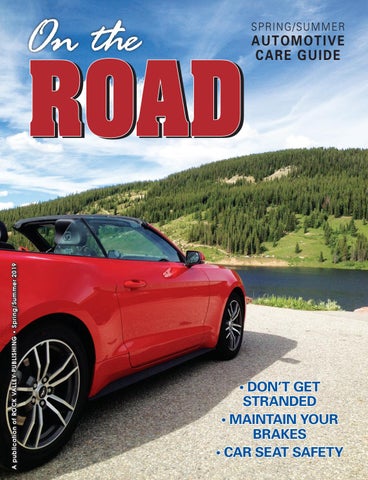
On the
SPRING/SUMMER
A publication of ROCK VALLEY PUBLISHING • Spring/Summer 2019
ROAD
AUTOMOTIVE CARE GUIDE
• DON’T GET STRANDED • MAINTAIN YOUR BRAKES • CAR SEAT SAFETY
AUTOMOTIVE CARE GUIDE
Spring/Summer 2019
ALL MAKES & MODELS - FOREIGN & DOMESTIC Air Conditioning • Brakes • Emission Repair • Exhaust Tune-Ups • Timing Belts • Engines • Heating & Cooling Shocks & Struts • Starting & Charging • And More!
Brake & Exhaust Inspections Are Always FREE! Automotive Engineer on Staff!
Same Day Service on Most Repairs
ASE Certified Technicians
Ask About Our No-Interest, EasyPay Financing Options
Nationwide 24 Month/24K Mile Warranty
FREE Shuttle Service - Loaner Vehicles
SEMI-SYNTHETIC OIL CHANGE & SEASONAL CHECK-UP *
19
95
$
*Restrictions apply. In lieu of other offers. Most cars and light trucks. See store for details.
RV
ACTIVE MILITARY & VETERANS *
OFF *WITH VALID I.D.
ANY SERVICE PERFORMED
*Excludes tires, batteries and dealer parts. Restrictions apply. In lieu of other offers. Most cars and light trucks. See store for details.
FREE
*
STANDARD BRAKE PADS
SPECIAL OFFER INCLUDES: oil filter, oil change with up to 5 qts. of quality SEMI-SYNTHETIC motor oil and chassis lube. Visual check of fluids, belts, hoses, heater, tires, steering, suspension, wiper blades, washers, lights, and factory recommended maintenance.
10%
SPRING BRAKE SPECIAL
RV
WHEN INSTALLED AT TUFFY!
FREE BRAKE INSPECTION!
*Additional fees may apply. Some restrictions apply. In lieu of other offers. Most cars and light trucks. See store for details.
RV
CHOOSE YOUR SAVINGS $25
SERVICE PERFORMED OFF* ANY OVER $150 $50 OFF* ANY SERVICE PERFORMED OVER $500 $100 OFF* ANY SERVICE PERFORMED OVER $1,000 *Excludes tires, batteries and dealer parts. Restrictions apply. In lieu of other offers. Most cars and light trucks. See store for details.
RV
Loves Park/Rockford
815-639-1239
6574 E. Riverside Blvd.
Automotive Engineer and ASE Certified Technicians
M-F 7:30am-6:00pm • SAT 8am-4pm
facebook.com/TuffyRockford #tuffyrockford Visit our website www.TuffyRockford.com
for more offers!
Only Tuffy® offers 2 years of FREE ROADSIDE ASSISTANCE on every purchase and a 2-Year/24,000-Mile Warranty, whichever comes first, on parts and labor for qualifying purchases. Our work will be — DONE RIGHT. PERIOD. See store for details. Towing • Lock Out Assistance • Flat Tire Assistance • Fuel/Oil/Fluid Delivery • Jump Starts
341553
Page 2
#4256-19
Spring/Summer 2019
AUTOMOTIVE CARE GUIDE
Page 3
Spring is here and it’s time to start thinking about those weekend getaways and other road trips you’ll be making over the summer months. Have the car checked out and be prepared before you hit the road. STOCK PHOTO On the Road
5 TIPS FOR YOUR NEXT ROAD TRIP Are you planning a classic American road trip? With a tank of gas, the right attitude and some smart supplies, you can explore amazing locales on a budget. “The great American road trip is still very much alive, and we’re not just talking long endurance cross-country trips. Places you can go from your own hometown and return on just one tank of gas,” said Peter Greenberg, Emmy-award-winning producer, writer, radio broadcaster and TV correspondent. “If travel can be defined as an experience that is absolutely meant to be shared, then the road trip is still very high on my list. It offers shared adventure, shared experience and shared storytelling.” Start planning your next affordable road trip with these smart tips and tricks:
Discover one-tank destinations
so research destinations you can get to on one tank of gas. This keeps fuel costs down, and because you don’t need to stay overnight, you won’t have to budget for a hotel. People tend to forget the beautiful spots just a few hours away from home, so bring a map and see which direction catches your attention.
Fill up the tires Of course you’ll want to check your fluid levels, wiper blades, and spare tire before you leave. One of the best ways to maximize your vehicle’s fuel efficiency is to make sure tires are properly inflated. According to the U.S. Department of Energy, you can improve your gas mileage by 0.6 percent on average and up to 3 percent in some cases simply by keeping your tires inflated to the manufacturer’s recommended pressure.
You only need one day to get away,
Strive for a high mpg Some cars have better fuel economy than others. With a practical design and impressive fuel efficiency, the Toyota Corolla Hatchback is ideal for road trip adventures. Getting up to an EPAestimated 42 mpg on the highway, you won’t have to limit your road trip due to fuel cost concerns. Plus the roomy design makes it easy to get comfortable and enjoy the ride. Learn more at www.toyota.com.
Create comfort Remember the journey should be as much fun as the destination. Clean out your car, make sure windows are sparkling clean to take in the views, pack carfriendly snacks and drinks, and bring along cozy pillows or blankets. Technology can create comfort, so charge those digital devices and utilize your vehicle’s features. For example, the
341906
2212 Prairie Ave., Beloit, WI
(608) 362-5377
G AND RECBEOLOIT,VWIERY TOWSININ CE 1958
On the
501 Hemenway Pl., So. Beloit, IL
(815) 389-3032
2019
Corolla Hatchback has Apple CarPlay and Amazon Alexa Connectivity, so podcasts, music and directions are always ready.
Pack smart Whether you’re on an impromptu or well-planned road trip, you can ease costs and streamline fun by packing wisely. Sunscreen, sunglasses and comfortable shoes are must-haves for any road trip. After all, you never know what adventures will come your way. Consider packing sandwiches – the ultimate road trip food – which are great for eating in the car or on a picnic so you don’t have to buy full meals. “Some of my most amazing travel memories are from one tank road trips,” Greenberg said. “I think everyone should make these excursions part of their travel plans. They are fun, affordable and great for people of all ages.”
(BPT)
ROAD
SPRING/SUMMER AUTOMOTIVE CARE GUIDE A publication of ROCK VALLEY PUBLISHING LLC 1102 Ann St., Delavan, WI 53115 • (262) 728-3411
AND RECOVERY TOWING BELOIT, WI SINCE 1958
24 HOUR TOWING SERVICE & RECOVERY National Certified Drivers • Fully Insured
EDITOR: ...................................................................................................... Tracy Ouellette CREATIVE DIRECTOR: ...................................................................................... Heidi Schulz ADVERTISING DIRECTOR: .....................................................................Vicki Vanderwerff SECTION DESIGNER: ..............................................................................Jennifer DeGroot FOR ADVERTISING OPPORTUNITIES: Call (262) 728-3411
Page 4
AUTOMOTIVE CARE GUIDE
Spring/Summer 2019
Safety first when driving with pets in the car Many people can recognize the familiar image of a car traveling down the road with the head of a seemingly happy dog hanging out from the front passenger seat. Traveling in such a way may seem harmless, but doing so can be detrimental to both pets and their owners. According to Paws to Click, a community that aims to inspire pet owners to travel responsibly with their pets, allowing pets to travel in cars without employing a harness poses a significant threat to everyone in the car. The group notes that an unrestrained 75 lb. dog will exert about 2,250 lbs. of force in a crash in which the car is traveling at just 30 miles per hour. Such force can injure others in the car as well as the pet. In addition, unrestrained pets may challenge first responders in an effort to protect their owners after an accident has taken place. It makes all the sense in the world to harness pets when taking them along in the car. After all, drivers and their passengers wear seat belts, so why not provide the same safety net to pets? However, Paws to Click notes that 84 percent of dog owners drive with their dogs in the car without using restraints. This despite the fact that American Veterinary Medical Foundation advises all pet owners to properly restrain their pets before departing on a car trip, no matter how short or how long that trip is expected to be. In addition to properly restraining
pets on car trips, pet owners can take these steps to ensure their pets are safe.
LEAVE THEM AT HOME IF YOU CAN
Don’t take pets along on car trips unless it’s absolutely necessary. It can be fun to take a pet with you everywhere, but the AVMF advises pet owners to leave their pets home when possible. Pets that are not suffering from separation anxiety will be fine at home without their owners. Pet owners whose pets are exhibiting signs of anxiety should address the anxiety so pets are comfortable at home alone. Taking pets everywhere is not a cure for separation anxiety.
DO NOT LEAVE PETS UNATTENDED IN CARS
A study from the Louisiana Office of Public Health found that temperatures in a dark sedan or a light gray minivan parked on a hot, but cloudy day reached higher than 125 F in just 20 minutes. The study also found that cracking the window in such situations had little effect on the temperature inside the vehicle. On hot days, leave pets at home. Owners who must take their pets with them should never leave them in the car, as temperatures inside vehicles rise quickly, putting pets’ health in jeopardy.
STOCK PHOTO On the Road
Many pet owners are tempted to take their pets with them on car trips. But that should only be done when absolutely necessary, and safety must be the utmost priority when traveling with pets in a car.
y h t r o road-w (METRO CREATIVE)
Keep tires
for safer driving Making driving more safe can come down to ensuring that the vehicle is in good working order — starting from the ground up. The National Highway Traffic Safety Administration warns that an average of 200 people die each year in tire-related crashes. In 2016, 733 people across the United States lost their lives in accidents in which tire malfunction was a contributing factor. Roughly 70 percent of single vehicle accidents are tire-related. Taking tire maintenance seriously can greatly reduce the chances of blowouts, accidents and fatalities.
STOCK PHOTO On the Road
Tire function is an important part of maintaining vehicle safety and performance.
Maintain the right pressure Caring for tires not only improves safety, but also it extends the life of the tires, saving drivers money as a result. Michelin Tires says that simply checking the tires’ inflation pressure can make a significant difference in how long tires last. For example, a tire that is consistently 20 percent under-inflated may see its life expectancy reduced by 20 percent. Tires that are not properly inflated also can have a high rolling resistance. In such instance, the engine must expend more effort to move the vehicle – thus eating up fuel. Pressure should be checked at ambient
temperature before driving, states AAA. The recommended inflation pressure can be found in the drivers manual or on the tire. Check tire tread Tires rely on good tread depth to maintain traction and shed water during wet conditions. AAA recommends checking tread with a visual inspection and with the “quarter test.” Insert a quarter into a tread groove with the top of Washington’s head facing down. If the top of his head is not visible, the tires have at least 4⁄32” of tread and are acceptable for continued use. If the top of Washington’s head shows, tires need to be replaced.
Learn about tire aging Check the owner’s manual for specific recommendations concerning replacing the spare tire for the vehicle. Some manufacturers state after six years, while others say 10 years is the maximum service life for tires. While most tire centers will use newly manufactured tires when replacing tires, you can double check the age of any tire by looking at the sidewall for the tire identification number, offers NHTSA. The last four digits are the week and year of manufacture. (METRO CREATIVE)
Spring/Summer 2019
AUTOMOTIVE CARE GUIDE
Page 5
Car safety tips for kids of all ages For many parents, you buckle up your kids and off you go to day care, school or the park. You trust their car seat or booster seat will keep your child safe should something happen, but are you sure the seat you installed months or years ago is truly secure? “I am deeply concerned that nearly half of all car seats are not used correctly,” says Heidi King, deputy administrator of the National Highway Traffic Safety Administration. “You don’t have to be a parent to play a part in protecting children. I urge everyone to follow these simple tips to ensure kids stay safe in the car at every age.” The right car seat is the best protection in a crash Every 33 seconds, a child younger than 13 years old is involved in a car crash, according to NHTSA data. Even more startling: Car crashes are a leading cause of death for children ages 1 to 13. One of the most common mistakes parents and caregivers make is moving children to the next car seat too soon. No matter their age, you need to make sure that the car seat you use is the right one for your child’s age, as well as their size (based on their weight and height).
Newborn to 3 years INFANT AND REAR-FACING CAR SEAT The youngest passengers should remain
in a rear-facing car seat until they reach the maximum weight or height of their seat. This positioning better absorbs the force of an impact, making it a better option for small passengers whose necks and spines are still developing. In fact, car seats have been shown to reduce fatal injury by 71 percent for infants (under one year old) in passenger cars. Keep in mind, even if your child’s feet touch the back of the vehicle seat, that doesn’t necessarily mean they’re ready for a forward-facing seat. Parents shouldn’t move their toddlers into a forward-facing car seat until they’ve hit the maximum height or weight limit of their current car seat.
4 to 7 years old FORWARD-FACING CAR SEAT At this age your child will likely use a forward-facing car seat with a harness. One critical step for installing this car seat correctly is making sure to secure it with its tether, not just a seat belt. The tether is an adjustable strap with a hook that can be found at the top of most forward-facing car seats. When you secure the tether to the tether anchor in your vehicle, it keeps the car seat from moving forward in a crash, helping protect your child from head and neck injuries. Additionally, always make sure the chest clip is secured across the chest rather than on the belly. These clips have
a tendency to move down, so it’s up to caregivers to align it properly. Make it a habit to always slide the clip up to the appropriate place after buckling your child in to their seat.
8 to 12 years old BOOSTER SEAT After a child exceeds the age and size limits of their forward-facing seat, they can transition to a booster seat. A booster seat lifts a child up and helps their body properly align with the vehicle’s existing seat belt. Kids should stay in a booster seat until they are big enough to sit properly with the lap and shoulder belt securely buckled. That means the lap belt is snug across their upper thighs, not their stomach, and the shoulder belt is snug across their shoulder and chest, not their neck or face.
“Tweens” and preteens SEAT BELT Once your child is big enough to ride safely without needing a car seat or booster seat, keep in mind the back seat is still the safest place. All kids 13 and under should ride in the back, even if they try to convince you the front is the “cool” place to be. For more advice and to find a car seat check location near you, visit NHTSA.gov/ TheRightSeat. (BPT)
Car crashes are a leading cause of death for children ages 1-13, so parents should be proactive about making sure their child has the best protection possible whenever they’re in the car. STOCK PHOTO On the Road
Page 6
AUTOMOTIVE CARE GUIDE
Spring/Summer 2019
Reduce distractions behind the wheel Despite the fact that automobiles are now designed with more safety features than ever before, the rate of traffic accidents and fatalities continue to rise. The National Safety Council says safety improvement like crash-avoidance technology hasn’t reduced accidents, and driver error is still to blame for many crashes – with distractions behind the wheel and impaired driving leading the way. The National Highway Traffic Safety Administration says distracted driving claimed 3,450 lives in 2016 alone. Distracted driving is defined as any activity that diverts drivers’ attention from the road. This can include everything from talking to passengers to eating to fiddling with the car radio. However, distractions from technology have become especially alarming, particularly texting or reading phones while driving. During daylight hours, approximately 481,000 drivers typically use cell phones while driving. The NHTSA says that removing one’s eyes from the road for a mere 5 seconds when traveling at 55 miles per hour is like driving the length of a football field with your eyes closed. Reducing distractions should be a priority for all drivers. Here are some suggestions, courtesy of Geico insurance and AAA Exchange. • Store loose gear and other items that can roll around away from the driver’s seat so you are not tempted to reach for them. • Adjust mirrors, GPS maps, climate controls, music, and more before you put the car in drive. • Use a mobile phone only for emergency purposes and only after pulling over to the side of the road. Avoid social conversations on the phone while driving. • Limit the number of passengers you allow inside your car. The more passengers, the more distractions. This is especially true for young drivers. • Eat food before getting in the car. Snacking while driving makes you less attentive to the road around you. • Secure children and pets accordingly. Both should wear harnesses and not be given free reign to roam around the car. • Try to focus only on driving while in the car. Leave the multitasking to when you’re not behind the wheel. Geico indicates that studies have shown people are limited in the amount of information they can process at any one time. Driving requires focus and an ability to react to a host of potential circumstances. Distractions compromise drivers’ ability to focus. (METRO CREATIVE)
STOCK PHOTO On the Road
Whether driving, riding a bicycle or walking, everyone should work together to share roads safely.
Tips for sharing the road with
cyclists and pedestrians The country’s roadways are for all to enjoy. Tens of millions of cars take to the highways every day, but they’re not the only mode of transportation allowed on the road. Cyclists and pedestrians also make use of streets when sidewalks or biking paths are unavailable. Did you know that bicyclists accounted for 2.2 percent of all traffic deaths in the United States in 2016? In addition, the National Highway Traffic Safety Administration says nearly 15 pedestrians per day lose their lives when struck by motor vehicles, and there were 5,376 pedestrian deaths in 2015. Although biking and walking are inherently safe activities for millions of people per year, motorists, cyclists and pedestrians can all take steps to make roads safer for everyone.
Follow the rules of the road STOCK PHOTO On the Road
Reducing distractions can considerably cut down on the number of motor vehicle accidents each year.
Whether you’re riding a bike or driving a motor vehicle, the rules of the road are the same. That means heeding traffic signals, signage, right-of-way, speed limits, and much more.
Avoid alcohol use
Alcohol impairs motor skills, which are necessary to walk and operate cars and bicycles safely. Many
accidents and fatalities on the roads can be traced to alcohol consumption. Do not drink and drive or drink and ride. Pedestrians who need to walk heavily trafficked areas would be smart to limit their alcohol consumption as well.
Make yourself more visible
Pedestrians and cyclists can make themselves more visible to motorists in various ways. Wear brightcolored, reflective gear when walking or riding, and install reflective lights on bicycles.
Stay alert
Remain alert at all times when behind the wheel. Motorists should be focused on the road at all times, avoiding distractions such as smartphones and in-vehicle entertainment systems. Such devices can dramatically reduce motorists’ reaction times, greatly increasing the risk of accident. Slow down when cyclists, runners and other pedestrians are nearby.
Pass safely
Do not pass too closely when driving near cyclists and pedestrians. Always yield to pedestrians in crosswalks. For more information, visit www.nhtsa.gov.
(METRO CREATIVE)
Spring/Summer 2019
AUTOMOTIVE CARE GUIDE
Page 7
Shopping for a used car can be an enjoyable experience if you do your homework and follow a few, common-sense guidelines.
Auto insight:
STOCK PHOTO On the Road
SMART GUIDELINES FOR BUYING A USED CAR Buying a used car can be a great decision. Oftentimes, that’s where you’ll find a deal. On the other hand, you’ve got to make sure there won’t be any surprises. Before you hit the car lot, take some time to prepare for the purchase. These guidelines will help you make a wise decision on a used vehicle that works for you.
Set a budget Think about what you’re willing to pay for a car. Have a budget and stick to it. If you plan to finance it through your bank or credit union, figure out what you would be comfortable paying every month. “When it comes to the cost of owning a vehicle, in addition to the car payment, think about other related monthly expenses, such as gas, maintenance and insurance,” says Joe Pendergast, vice president of consumer lending at Navy Federal Credit Union.
Get pre-approved for a loan By getting pre-approved for a loan, you can be confident in your budget and set your financing limits from the start.
“Getting pre-approved may even increase your purchasing power. Oftentimes, the dealer may be more willing to bargain on the car price if the amount you’re willing to pay has already been set,” says Pendergast. Financial institutions, such as Navy Federal for example, offer auto loans nationwide at low fixed rates, discounts on insurance and asset protection, as well as a calculator to help determine how much financing your car will cost.
Create a must-have list It’s important to separate the must-haves from the nice-to-haves when looking at vehicle features. If you have kids, a fourdoor vehicle might be essential, and you’ll want to ensure there’s enough seating for your entire family. You might want leather, but cloth seats will do. Know your needs versus your wants and make a list of nonnegotiables. You probably also have a few types of vehicles in mind. Do some research and read reviews so you can narrow your focus when you’re shopping. This helps save time when searching online or navigating the car lots.
Understand the history
At least one person owned the vehicle before you, so it’s important to know the car’s history. When you get approved for a used car loan through Navy Federal, you get free access to a CARFAX Vehicle History Report, which helps you identify cars with potential problems and purchase safe, reliable ones.
Pay attention to mileage For used cars, the lower the mileage, the better. Fewer miles often means there’s less wear and tear – a higher value for you. A good average to target for cars is about 15,000 miles a year.
Check the tires One important thing to consider when buying a used car is the condition of the tires. If the tires don’t have enough tread, you’ll need to invest in new ones.
Test drive Never consider buying a vehicle before taking it for a test drive. By getting behind the wheel, you can ensure it feels good to
you, find out if anything seems off, such as strange noises or smells, and see how it handles. “Don’t rush the process. If you’re not satisfied after a test drive, keep searching, there’s plenty of inventory out there,” says Pendergast.
Get an inspection It will cost you, but if you want peace of mind, consider investing in an inspection by a certified mechanic. You’ll have to request borrowing the car for the inspection, which may not always be possible, but it’s worth exploring if you’re having second thoughts.
Certifications If you’re shopping for a used car that is five years old or less, you may want to explore certified used vehicles. Some dealerships offer certifications for the used cars they are reselling under their brand. This could include valuable bonuses, such as vehicle inspections and warranties, not to mention peace of mind.
(BPT)
Page 8
Stay ahead of problems
AUTOMOTIVE CARE GUIDE
Spring/Summer 2019
HOW TO REDUCE VEHICLE MAINTENANCE COSTS Major repairs to a vehicle can be expensive. When unanticipated repairs are necessary, drivers’ budgets can be thrown out of whack, potentially causing a domino effect that compromises their ability to pay their bills on time. Whether your vehicle is brand new, a few years old or reaching milestones on its odometer with every mile driven, there are ways to care for the vehicle so you aren’t caught off guard by costly repairs down the road.
way to protect the engine. Manufacturer guidelines vary in regard to oil change and oil filter replacement intervals, but such recommendations can be found in your manual.
Hone your DIY skills Drivers also can save money on maintenance by doing some of their own minor vehicle repairs. YouTube is home to many DIY tutorials that can teach drivers how to change their own oil and replace the filters on their vehicles. Routine repairs are relatively easy, and many tutorials can walk you through them step-by-step. Depending on how much you drive, learning to do your own minor vehicle repairs may save you hundreds of dollars per year.
Read your owner’s manual A vehicle owner’s manual is a great resource that can help drivers keep their cars and trucks running strong for years. Every vehicle, whether it’s purchased brand new from a dealership or preowned from a preowned dealer or private citizen, should come with an owner’s manual. Don’t worry if you purchased a preowned vehicle from a private citizen who lost the manual, as many manufacturers have manuals available for free on their websites. Print manuals may cost some money. Drivers may be able to find their manuals elsewhere online on a site such as Justgivemethedamnmanual. com, which has thousands of manuals from various automakers available. Once you have the manual in hand or on your computer, visit the maintenance section to familiarize yourself with the
Perform routine inspections STOCK PHOTO On the Road
By adhering to manufacturer maintenance guidelines and paying attention to their vehicles, drivers can reduce the cost of keeping their cars on the road.
manufacturer’s recommended maintenance guidelines. Adhering to those guidelines is a great way to keep your car running strong for years on end, and it might just save you from the hassle of sudden expensive repairs.
MPLETE CO
«
«
Protect the engine The engine is arguably the most expensive part of your vehicle to replace, so protecting it should be a priority. Routine oil changes and oil filter replacements is a great
Older vehicles may or may not alert drivers via noises or leaks that they’re in need of repair. Routine inspections of hoses, brakes and tires, which should always be properly inflated, can let drivers know if their vehicles are experiencing problems before those problems grow and become something costly. Vehicle maintenance costs tend to be most expensive when drivers ignore routine maintenance or miss signs that their cars and trucks might be struggling.
(METRO CREATIVE)
2125 Rivington Road • Loves Park, IL
AMPBELL S Cautomotive A
U
TO
M OT
A EP IVE R
MIKE MILES Owner
IR
Car & Light Truck Service
• • • •
Mechanics in:
Computerized Carburetion Power Accessories Fuel Injection General Motors Repairs
• • • •
Heating Tune Ups Ignition Alternators
• • • •
Starters Air Conditioning Fire Damage Wiring
815-877-2266 341921
Make your can run for MILES at Campbell’s Automotive! CHECK OUT OUR TIRE PRICES! www.campbellsautolovespark.com
Spring/Summer 2019
AUTOMOTIVE CARE GUIDE
Page 9
Don’t make these mistakes after a collision
In the United States alone, there are 10 million car accidents every year, and the tense moments following a car accident, even a minor one, can be scary and stressful for everyone involved. Drivers and passengers can feel confused and unsure of what to do. Even the most experienced and seasoned drivers can make basic mistakes after they have been involved in a traumatic event. Simple, avoidable mistakes could cost you time and money, or lead to personal, medical and legal issues. Here are some of the most common mistakes to avoid after a collision:
Fleeing the scene Leaving the scene of an accident could land you in serious legal trouble. You may be in shock, but the most important thing to do is stay where you are. Check on your passengers, and once you exit your vehicle, check with the other driver involved in the accident. Try to remain calm and wait for law enforcement to arrive on the scene. If it is safe to do so, use your cell phone to take photos of your vehicle to document the damage that resulted from the accident while you wait for police.
Exchanging too much information Do not share your driver’s license or who was at fault with the other driver; however, share this information with the police along with your current insurance. Always exchange contact information with the other driver, get contact info from any witnesses, and obtain full insurance details from other drivers involved in the accident. Make sure accurate information is included in the police report, and ask for a copy of the report to edit any incorrect information.
Take the proper steps in reporting a crash and following up with medical attention, injuries are not always apparent immediately after a collision.
Failing to get medical advice
Not reporting the accident
You may think that you were lucky enough to escape injury, but you should always get a medical checkup after a car
STOCK PHOTO On the Road
accident, especially if you hit your head. Remember, only a medical professional can rule out possible head trauma and other serious injuries. Even if it’s just a minor collision, always report the accident to the police. Never let someone convince you to avoid
calling the police. If you decide to make a claim with your insurance company later on, or if you decide to pursue a legal claim, not reporting the accident could hurt your case.
Having your vehicle repaired at just any shop You might have to make a decision on-
the-spot as to where to have your vehicle repaired. Don’t make a panicked decision when it comes to your safety. Visit www.goldclass.com to find a Gold Class shop that has collision repair professionals with up-to-date training contributing to complete, safe and quality repairs.
(NEWSUSA)
Smarter driving for foggy weather
STOCK PHOTO On the Road
Driving in fog can be tricky and unsafe. Always exercise caution when fog rolls in.
Weather patterns can be fickle. One moment it may be chilly and sunny, while the next warm and wet. As a new season arrives, fog may roll in along with it. Fog occurs during extremely humid conditions. For fog to be present, some type of dust or air pollution also needs to be present in the air so that microscopic water particles can surround it. According to the National Geographic Society, fog occurs when water vapor, or water in its gaseous form, condenses. During condensation, molecules of water vapor combine to make tiny liquid water droplets that hang in the air. You can see fog because of these tiny water droplets. While fog can be a marvel to behold – completely obscuring landmarks or mountains in some instances – it can make driving challenging. Even seasoned drivers find fog is dangerous and difficult to drive in. The Federal Highway Administration says fog may contribute to more than 500 fatalities each year. When driving in foggy conditions, drivers’ full attention needs to be directed to the road. These tips also can help keep drivers safe when navigating foggy conditions.
• Reduce speed. Slowing down affords you more reaction time if traffic stops or if other hazards seemingly appear out of nowhere. Leave considerable space between cars. • Engage the wipers. Improve visibility as much as possible by turning on the windshield wipers and the defroster to help. • Use low beams. Make sure your vehicle is as visible as possible to others. Turn on the low-beam headlights so your car is noticeable to other motorists. High beams can cause glare, so avoid them, however tempting it may be to use them. • Drive in the right lane. Use the lines and reflectors on the right side of the road to help guide your direction, suggests AccuWeather. • Remain engaged. Do not use cruise control or allow any distractions in the car when driving in fog. Turn off the radio, put your phone away and focus on driving. • Take a break. If the fog is greatly compromising your visibility, pull over in a safe spot or parking lot until it dissipates. Make sure to put on your hazard lights. The California DMV says the best advice for driving in fog is not to do so.
(METRO CREATIVE)
Page 10
AUTOMOTIVE CARE GUIDE
Spring/Summer 2019
4 reasons to skip topping off at the filling station The familiar click of the nozzle when filling up at the gas station is recognizable to anyone with a few miles of driving under their belt. Once that nozzle clicks, just about every driver faces the decision of whether or not to squeeze a few extra cents’ worth of gas into their vehicles or remove the nozzle from their vehicles, place it back where it belongs and head off on their way. Such scenes play out every day across the globe, and it’s likely that the majority of drivers try to squeeze a few extra drops into their tank. While topping off can seem like a financially savvy way to delay your next trip to the filling station, doing so may only cost drivers and the planet they call home. The following are four great reasons to skip topping off the next time you pull into a filling station.
Topping off costs you money
According to the Environmental Protection Agency, drivers who top off at the pump are likely paying for gas they’re not getting. That’s because gas station pumps have vapor recovery systems that feed gas vapors back into their tanks in an effort to decrease air pollution. So any gas that drivers try to pump into their tanks after the nozzle has clicked may only be drawn into the vapor line and fed back into the gas station’s tanks and not your vehicle’s fuel tank.
Topping off may damage your car Topping off won’t just hurt your pocketbook; it can potentially damage
your vehicle as well. Fuel tanks need extra room inside them so gas can expand while the car is being operated. Without room to expand, gas may evaporate into the vehicle’s vapor collection system, which can damage the system and produce greater gas emissions, thereby harming the planet.
Topping off can affect the air you breathe
If you had a choice, would you pay extra for more air pollution? Likely not. But the EPA notes that this is precisely what many people are doing when they top off their gas tanks. When vehicles’ fuel tanks are overfilled, gas vapors can escape into the air and produce toxic air pollutants. That adversely affects air quality, which ultimately affects your health as well.
Topping off can cost the gas station money
Many drivers may wonder why gas stations, who would seemingly benefit financially from topping off, post signs that forbid topping off. But the EPA notes that gas stations are likely to lose money due to drivers squeezing an extra few cents’ worth of gas into their vehicles. That’s because topping off can damage the station’s vapor recovery systems, causing them to operate improperly and requiring potentially costly maintenance. (METRO CREATIVE)
STOCK PHOTO On the Road
Topping off at the filling station may seem like a savvy move. But drivers, their vehicles and the planet are best served by taking the pump handle out of the tanks at the familiar sound of the nozzle’s click. Come See Us for All Your Automotive Needs! Serving Byron and Surrounding Areas for Over 20 Years!
Parson’s Collision Center 2050 Harlem Rd. Loves Park, IL 61111 815-633-6620
Come say to “HEY!” ! u Wilb r 341701
MANUS REPAIR AND STORAGE
Parson’s Collision Center East 5902 Sandy Hollow Rd. Rockford, IL 61107 815-874-7100 341592
Randy Manus, Owner
38 Years in Business
PECATONICA, IL Call 239-2588
341550
Complete Auto Repair
Spring/Summer 2019
AUTOMOTIVE CARE GUIDE
Page 11
WISCONSIN’S PREMIER AUTO SWAP MEETS 42ND ANNUAL
SPRING JEFFERSON APRIL 26-28, 2019
JEFFERSON CO. FAIR PARK, JEFFERSON WI
3 DAY SWAP MEET & CARS FOR SALE CORRAL 3,100 SWAP SPACES & 100’S OF CARS FOR SALE NOW ONLINE!
2 DAY CAR SHOW!! (SAT-SUN) ALL MAKES MODELS WELCOME FEATURING FORDS! HOURS FRI. 10-6,
INFO: 608 244-8416 OR www.madisonclassics.com
Upcoming events: SUMMER ELKHORN AUG. 3-4 2019 FALL JEFFERSON SEPT. 27-29 2019
341549
Page 12
AUTOMOTIVE CARE GUIDE
Spring/Summer 2019
301 Industrial Dr. Clinton, WI
608-676-4000
Monday-Friday 7:30 a.m. - 5 p.m. Saturday 8 a.m. - 12 p.m. • Sunday Closed
Complete Auto ServiCe
Brakes – Mufflers – Electrical Suspension – Wheel Alignments Computer Control Systems Standard & Specialized Services to suit your needs
$10 OFF on any $50 service $20 OFF on any $100 service Authorized dealer Tires Owners Don & Cheryl Rhode
Serving you for over a decade! 341741
alltechauto.mechanicnet.com