• Machinery Loans • Livestock Loans • Lines of Credit • Farm Improvement Loans • Real Estate Loans • Financial Planning • Leasing
A Heritage of Serving Local Agriculture Since 1882
www.stillmanbank.com
344613
1 • Thursday, May 16, 2019 - Midwest Farm & Ag - Rock Valley Publishing, LLC
Member FDIC
T, , PAIN D L I U R! WE B ELIVE AND D
Country B arns Portable Buildings N CKE CHI OPS CO
OCK EST LIV LTERS SHE
MINI KEN C O
CHIC
OP
BARN HIGH GE GARA
608-879-3321
344660
BARN HIGH AGE COTT
Owners: Phil & Glenda Wenger • 11220 W. State Rd. 81 (8 Miles West of Beloit) • Mon-Thurs: 8:30 am-5:30 pm, Fri: 8:30 am-4:30 pm, Sat: 10 am-noon, Sun: CLOSED
Midwest Farm &Ag VOLUME 5 NUMBER 3
Published by Rock Valley Publishing, LLC
May 16, 2019
Master Gardener Helpline opens in Winnebago County The University of Illinois Extension is offering a helpline for the growing season in Winnebago County. The helpline is designed to help the home gardener with their horticulture questions. Master Gardener Volunteers staff the helpline and are physically located in the Extension office, 1040 N. Second Street, Rockford from 9:00 am to noon Mondays and Wednesdays through November. They can also be reached by phone at 815-986-4357 at any time (messages will be taken). Each year, the Master Gardeners field a variety of questions from across the county. Resources will be shared via email, through the US mail service or can be picked up in the office. Often, related materials will be printed for
the caller and mailed. Soil test kits are also available in the Extension office and can be picked up for no charge. Once results are received, individuals are encouraged to meet with a Master Gardener if they have questions. Master Gardeners are volunteers that go through horticulture training led by University of Illinois Extension Educators. During the training they learn about all aspect of horticulture but they also receive training about the resources that the University of Illinois Extension has available for them to use. A Master Gardener has the ability to find research based information from the University to provide to homeowners when they call with a question.
“Each year the calls to the helpline are documented so that we know the types of questions are coming in and where in the county the questions are coming from” stated Margaret Larson, Extension County Director, “it helps us to identify trends and key issues for that particular growing season.” Questions fielded include those about trees and shrubs, lawns and turf grasses, vegetables, bugs and diseases. To contact the Master Gardener Helpline please call the University of Illinois Extension-Winnebago County at (815) 986-4357. More information about Extension and horticulture resources can be found at go.illinois. edu/jsw.
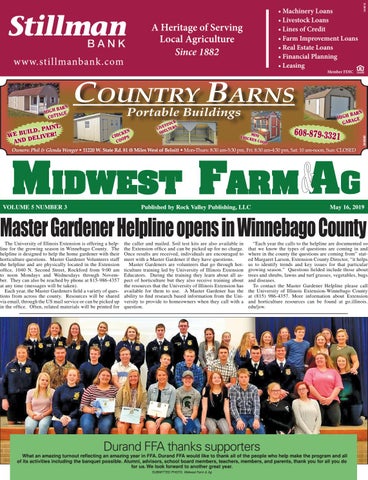
Durand FFA thanks supporters
What an amazing turnout reflecting an amazing year in FFA. Durand FFA would like to thank all of the people who help make the program and all of its activities including the banquet possible. Alumni, advisors, school board members, teachers, members, and parents, thank you for all you do for us. We look forward to another great year. SUBMITTED PHOTO Midwest Farm & Ag
2 • Thursday, May 16, 2019 - Midwest Farm & Ag - Rock Valley Publishing, LLC
Ag in the Classroom awards grants to fund ag literacy projects The Wisconsin Farm Bureau Foundation’s Ag in the Classroom program has awarded nearly $9,017 to schools and organizations to expand agricultural literacy. Groups, schools and organizations can apply for up to $500 as part of the Ag in the Classroom’s matching grant program to support their project, provided they have a source of matching funds. The 22 matching grant recipients are: Build a Food Forest – Deep Mulch Gardening – $500, Independence “Building a Food Forest” is an educational and active learning program for Pre-K-12 and adults. This program will create meaningful experiences to help improve the well-being of individuals by teaching them how to grow their own vegetables and fruits. Story Gardens – $500, Milton Story Gardens will serve as an outdoor extension of the Milton Public Library as an all-ages destination combining a love of nature, books and art. When completed, the space will feature raised garden beds for instruction on horticulture, an outdoor performance area and more. Cows on the Concourse – $500, Madison Located just off the Capitol Square, this free event is fun for the whole family. The grant will help fund the ‘Ed’Moo’Cation Zone’, the ‘Cow Zones’ where local farmers and ‘Moo Experts’ share information about dairy cows and the ‘My Dairyland Scavenger Hunt’. FARM Agricultural Career Exploration Program – $500, Madison Easter Seals Wisconsin’s Agricultural Career Exploration Program educates
students with disabilities about the vast agricultural career opportunities. These classes encourage students to see how their own interests could potentially fit into an agricultural career. Farmers’ Market Play Space at the Library – $350, Edgerton Children can now play the role of a farmer. They can display play fruits and vegetables in a farm stand, use a toy cash register to sell their produce and pretend to cook and eat their foods. Books on farming and markets are also available. Farming at Silverwood Summer School – $500, Edgerton The Friends of Silverwood Park will purchase gardening tools and plants for every student in the Silverwood Summer School Program. Students will plant their own garden space and learn about drip irrigation and the process of caring for their plants through the growing season. Learning to Grow – $500, Glenwood City Glenwood City Agriculture Department’s Learning to Grow Project teaches students of all ages food production, harvesting, composting and fruit production. The produce will be student-grown, processed and served in the school lunch program. Flowers for Mom – $250, Green Bay The Green Bay East FFA Alumni and Green Bay East FFA members will plant flowers and learn how to transfer and care for the plants. Then they will learn how to prepare the plants for sale. Agri-Puppets: Where Education Meets Entertainment – $500, Green Lake The Green Lake County Fair will be hosting the Agri-Puppets: Where Educa-
e’re a strong, healthy, locally-owned Independent Bank. in Agricultural Banking to help you make the most of your operation. AAgriculture. First Name Basis Our are On inhealthy, You can count on our expertise e’re roots a strong, locally-owned Independent Bank. Agricultural to help you make moston ofyour your operation. We wantin to help meet your goals and achieve dreams. Our rootsyou areBanking inBANKING You canthe count our expertise OnAgriculture. A First Name Basis BANKING Come see us when you needtofinancing for operating in Agricultural Banking help you make the mostexpenses, of your operation. A First Namegoals Basis and achieve your dreams. We want to help you On meet your equipment, real estate and livestock. On A First Name Basis Come see us when you need financing for operating expenses, We want to help you meet your goals and achieve your dreams. equipment, real estate and livestock. A First Name Come see us when you needOnfinancing forBasis operating expenses, equipment, real estate and livestock. On A First Name Basis
BANKING BANKING
BANKING BANKING On A First Name Basis BANKING On A First Name Basis
© Vic Jacquot
344640
BANKING BANKING On A First Basis The Farmers & Merchants Bank On A First Name BasisName BANKINGMemberOnF.D.I.C A First Name Basis 303 E. Spring Street • Orfordville, WI BANKING On A First Name Basis 608-879-2911 BANKING
John Lutheran site in Wausau will use the grant to purchase a farmers’ market stand and play food items. The project includes a book case, sorting set, books, sliceable fruits and vegetables and other supplies. Ag Education at the Sauk County Fair – $500, Baraboo The Sauk County Fair will set up an interactive display on Wisconsin agriculture, allowing youth fairgoers to experience agriculture education in an exciting and innovative way. Important agricultural information will be transformed into fun and exciting learning experiences for youth. Gardening after School – $500, Siren The Siren School District and the Dragon Learning Center are constructing a raised-bed garden to teach agriculture and gardening to more than 200 students during STEM enrichment activities after school. Students will learn about record keeping, agronomy, soils and plant biology. Ag Materials in the Classroom – $350, Medford Taylor County Farm Bureau is working with fourth grade teachers in the county to enhance the Wisconsin unit on agriculture. The funds will be used to purchase books, Ag Mags and other resources. Volunteer farmers will give presentations to students. Day on the Farm – $334, Verona The Verona FFA Chapter will be operating an educational field trip to fourth graders within the Verona School District. Students will be able to tour a local dairy farm and participate in small group activities, designed to introduce them to agriculture in Wisconsin. Learning Coop Presentation Table – $500, Elkhorn The Barnyard Adventure Learning Coop will add a mirrored presentation table at this year’s fair. The new table will magnify the learning experience by allowing more people to see what the presenters are doing. Rooting for Agriculture Observation Stations – $240, Elkhorn The observation tables will demonstrate and enhance learning by sharing underground and above ground views of a variety of diverse plants. There will be twelve stations purchased along with the needed supplies for viewing stands, planting materials and signage.
2019 IL Forage Expo set for June 19 in Winnebago
We’re Here To Serve Your Agricultural Needs We’re Here To To Serve We’re Here ServeYour Your Needs e’reAgricultural a strong, healthy, locally-owned Independent Bank. OurAgricultural roots are in Agriculture. You Needs can count on our expertise BANKING
W W W
tion Meets Entertainment. Agri-Puppets is a one-of-a-kind show specializing in teaching the importance of agriculture, farming and animals. Farmer in the Classroom – $330, Fort Atkinson Twenty Jefferson County Ag in the Classroom volunteers will give the classroom presentation, ‘A Day Without Agriculture,’ to more than 31 classes in Jefferson County. The group is part of the annual fourth grade farm tour where students get to visit and learn at a dairy farm. Laconia FFA Day on the Farm – $250, Rosendale Every spring, nearly 400 elementary students in second through fourth grades from local districts are invited to visit a farm. This year’s stations include dairy cattle, sheep and goats, farm equipment, wildlife, maple syrup, feeds, horses, dairy products and a hayride. Let’s Get Hatching – $300, Merrimac With additional funds from the Merrimac Home and School Club, the Merrimac Community Charter School will use the grant money to purchase a new incubator. Teachers plan to hatch chickens and ducks this spring to add to the school barnyard. Neal Wilkins School Garden – $500, Platteville The Neal Wilkins Early Learning Center School Garden will be a collaborative space that offers students opportunities to learn about math, literacy, science and agriculture. Students will not only learn about food sources and production, they will also provide food for consumption. Food Bank Project Expansion – $250, Randolph The Randolph Cambria-Friesland FFA will continue enhancing its land lab. This on-going annual project allows high school students to manage both food donations and elementary student education while learning themselves. Rock County Celebrates National Ag Day 2020 – $500, Janesville Rock County Ag in the Classroom will bring Rock County native, farmer and author Lisl Detlefsen to their area to celebrate National Ag Day. Detlefsen will help students understand where their food comes from using her latest book, “Right This Very Minute”. To Market To Market – $363, Wausau DC Everest 4K students from the St.
NRCS State Conservationist, Ivan Dozier encourages livestock owners and operators in northern Illinois to make plans now to spend a day learning more about grass and forage solutions at the 2019 Illinois Forage Expo event. The event will be held Wednesday, June 19 from 8:30 a.m. until 4 p.m. at the Mitchell Dairy and Grain Farm in Winnebago, Ill. Activities for the day include an Education Program, Quality Hay and Haylage Contest, Forage Equipment demonstrations, and Dairy facility/ operations tours (am & pm). The Forage Expo is sponsored by the Illinois Forage and Grassland Council and the Northwest Illinois Forage and Grassland Council and supported by USDA’s Natural Resources
Conservation Service (NRCS) and the University of Illinois Extension. Farmers, vendors, or businesses interested in exhibiting or demonstrating equipment should contact Don Brown at 815-238-8372 or email don.brownjr708@gmail. com. There will be 10’ x 10’ indoor exhibits and 25’ x 25’ outdoor exhibits spaces available. Additional space may be purchased. There is no cost to attend the Expo. Lunch and drinks can/may be purchased on site. Address for the 2019 Illinois Forage Expo, Mitchell Dairy and Grain Farm, is 9387 Bridgeland Road, Winnebago, Illinois 61088. Watch your local paper for more information as the event date approaches.
Midwest Farm & Ag - Rock Valley Publishing, LLC - Thursday, May 16, 2019 • 3
Three inducted to Rock County Ag Business Hall of Fame hobby for Traynor but also a way to make money to send back to his family as they worked on the dairy farm east of Milton. Community involvement was always important to Traynor. He served in various capacities in Harold Traynor the Milton community, on the Rock County Fair Board, in the Wisconsin Fair Association, in the American Milking Shorthorn Association and with World Dairy Expo as founder and director. He was also honored to be a lifetime member of the Dairy Shrine Club.
Wisconsin Farm Bureau encourages safe driving practices around farm equipment Spring means one thing for farmers: it’s time to hit the fields. Tractors and other implements of husbandry (IOH) are allowed to operate on Wisconsin roadways but are often large and slow-moving which can cause confusion for drivers sharing the roads. “One accident involving farm equipment on the roadway is too many,” said Wisconsin Farm Bureau President Jim Holte. “At the end of the day farmers and motorists alike want to return home to their families. Safety has to be a top priority for everyone sharing the road.” Since 2011, the Wisconsin Department of Transportation has recorded more than 1,300 crashes involving agricultural equipment that resulted in 678 injuries and 26 deaths. Three scenarios drivers and farmers should know how to handle are passing farm equipment, left-hand turns and braking distance needed at controlled intersections. Passing: In 2014, it became illegal to pass an IOH, which include farm tractors and farm machinery, or an Ag-Commercial Motor Vehicle, trucks that are specially designed for agricultural work, in a no-passing zone. Motorists should wait until they enter a passing zone when considering going around a slow-moving vehicle. Farmers should not pull over in a no-passing zone to let vehicles pass, unless the road shoulder condition and width can allow for the farm machinery to completely move onto the shoulder. Farmers should also not wave a driver forward to pass them. While these actions seem courteous, it sends mixed signals and isn’t encouraged. In a passing zone, or if shoulder width permits, farmers are obligated to yield the roadway to the overtaking vehicle so they do not impede the normal movement of traffic. Left-hand turn: It can turn into a dangerous situation when a farmer is attempting to make a left-hand turn. Farm equipment, especially the tractor, will likely have two flashing amber or yellow lights on the cab or tire fenders of the tractor when in operation on the roadway. When a farmer signals to turn, the light will continue to flash in the direction the farmer is turning. The other light will go solid. For motorists, this is a very important distinction to recognize. For farm tractors or farm machinery without turn signals, hand signals should be used to indicate the operator’s intention to turn. A controlled intersection: When a motorist legally passes large farm equipment within a very short distance of a controlled intersection (stop sign or stop lights), this action can dramatically impact the reaction time and braking distance for the farm equipment operator. Farm equipment is much heavier than a normal passenger vehicle which makes having adequate braking distance critical for the operator. The Wisconsin Department of Transportation recommends drivers slow down immediately when they see a slow-moving vehicle emblem (orange and red triangle) on the rear of a tractor or other piece of equipment. This emblem indicates that the farm machine usually travels slower than 25 mph. Stay alert, focused and patient when passing a slow-moving agricultural vehicle in an area where passing is legal. Farmers are asked to comply with the proper lighting and marking requirements to draw attention to the size, shape and speed of agricultural vehicles and to alert drivers that caution is required. There are specific requirements for different types of equipment. Farmers should also know their local weight restrictions. Generally, agricultural weight limits are 23,000 pounds per axle or 92,000 pounds gross vehicle weight, dependent on number of axles and axle spacing, and subject to seasonal or special postings. Farmers can find more information about weight limits from the Wisconsin Department of Agriculture, Trade and Consumer Protection and Wisconsin Department of Transportation. “Together we can have a safe planting season and enjoy the rural roads of Wisconsin,” Holte added.
Traynor married his wife, Edna, in 1936 and they had two sons, Robert and Scott. His family was always his priority, but Traynor also made sure his cattle were well cared for each day. He believed in taking care of what took care of him. Roland “Rollie” Jeans spent his career dedicated to the farmers of Rock County as a veterinarian and trusted friend. His level head and desire to give back made him a wonderful member of the Evansville community. Rollie Jeans Jeans grew up on a small dairy farm near Osceola, Wisconsin in Polk County. He attended University of Minnesota – St. Paul to obtain a degree in veterinary medicine and graduated in 1959. In 1961, he moved his family to Rollie Jeans Rock County where he practiced veterinary medicine for 37 years. Throughout his career, he enjoyed getting to know the farm families he served as he worked primarily on large animals around the county. This year, Jeans will celebrate 60 years of marriage with his wife, Deanna. Together they enjoy traveling and staying active in the Evansville community as well as spending time with their four children: Cheryl, David, Kathy and Nancy and their grandchildren. Jeans has been a member of the Evansville Lions Club for 50 years and St. John’s Lutheran Church for 58 years.
Glenn Thompson Glenn Thompson has dedicated his career to creating positive change by directly influencing 4-H and other agriculture programs both locally and statewide. With his pragmatic approach to promoting the agriculture industry, Glenn Thompson Thompson made the most of every opportunity he had to make a positive difference in people’s lives while remaining well-grounded, humble and flexible with the times. Positions as 4-H and agriculture agents in Monroe and Sheboygan counties and state administrative positions through the University of WisconsinExtension resulted in a 31-year career of agricultural education. After retiring in 1991, Thompson spent 19 years working for Wisconsin Farm Technology Days as assistant manager, general manager and consultant. Thompson spent his lifetime as a great advocate of agriculture. He gave many years of service promoting youth in his positions with the Rock County Fair, and working to preserve farmland as he served on the Town of Fulton Planning and Zoning Committee. His service in the United States Army from 1953 to 1955 involved 16 months of active duty in Korea. Upon his return home, he married his wife, Janice and they now share 63 years of marriage and three children: Randy, Sue and Steve.
Butterburgers Never Frozen From Local Midwest Farms
2676 Cranston Road Beloit, WI 53511 608-365-4400 www.culvers.com
345944
The Ag Business Council of Rock County hosted the 2019 Ag Business Council Hall of Fame dinner in Janesville on April 5. Three men were inducted for their contributions to the agricultural industry. Harold Traynor Harold Traynor (1913-2010) served the agriculture industry with fairness and wisdom. His honesty, dry sense of humor and hard-working approach to life were just some of the numerous qualities that carried him through many adventures with his family and his cattle. He grew up on a Milking Shorthorn dairy farm and showed his cows at fairs and shows all around the United States both as a child and an adult. Judging cattle at worldwide shows was not only a
4 • Thursday, May 16, 2019 - Midwest Farm & Ag - Rock Valley Publishing, LLC
SUBMITTED PHOTOS Midwest Farm & Ag
Goats, sheep studies
Thanks to Emma Hunderman and her mom for taking time to share her goats with Stillman Valley FFA. Ms. Eden and the intro to ag class have been learning about goats and sheep. The greenhouse was a perfect spot to hang out.
SUBMITTED PHOTOS Midwest Farm & Ag
Pec FFA welcomes students to petting zoo
What a great day for the Pecatonica FFA petting zoo. Thank you to everyone who came out that day and to those who made this event possible!! Also a big thanks to Muller-Pinehurst dairy for supplying the ice cream, Peabudy’s North for the tractor/ bailer, Mark and Barb Klinger for use of their calves, the Larson’s for the straw, Jeff Clark for the use of his hayracks, everyone who brought animals, and of course all of the workers who helped. This wouldn’t have been possible without everyone!!
Midwest Farm & Ag - Rock Valley Publishing, LLC - Thursday, May 16, 2019 • 5
UW Changes Lives: Experts advance new crops for long-term profitability BY DAVID TENENBAUM
On a field in western Madison, where cornfields sprout houses, Amaya Atucha and three graduate students are giving a buzzcut to some experimental grape vines. As the sun plays hide and seek with clouds above the West Madison Agricultural Research Station, the group shortens each cane branching off the main vine to just two buds. As a yard of cane, severed, drops to the ground, Atucha explains that when sunlight can strike the grape clusters, acidity will decline. At the same time, the ruby-red color so desired in wine will gain depth. It’s easy to pity the vines, as the canes pile up beneath them, but vineyards are not planted to grow wood. The goal is grapes – fresh, abundant, and full of the chemistry that makes great wine, says Atucha, an assistant professor of horticulture at UW–Madison. Atucha is also the Division of Extension’s expert advisor for fruit farmers statewide. At West Madison, and other sites around DAVID TENENBAUM PHOTOS Midwest Farm & Ag the state, Atucha does practical research Amaya Atucha, University of Wisconsin–Madison Division of Extension fruit on new varieties. She studies pruning, specialist, testing a pruning technique for wine grapes at West Madison Agricul- timing and other cultural techniques to intural Research Station in Madison. crease profitability of grape production in the state. Atucha’s grape project is one of several at UW–Madison’s Division of Extension that focuses on small, new or reintroduced crops that could support the bottom line in a state battered by low prices for corn, soybean and milk. “Wisconsin’s agriculture is changing in many ways,” says Karl Martin, Extension dean and director. “Extension educators are working with farmers to adapt to changes by exploring innovative alternatives to traditional crops.” Hops Extension Buffalo County Extension agriculture agent Carl Duley and others from the University are orchestrating the return of a classic Wisconsin crop: hops, the bittering agent in beer. “UW Extension agents and specialists work with growers to identify problems, challenges and opportunities to improve hops production in Wisconsin through workshops, field days, one-on-one visits Michael North, a graduate student in horticulture, working along a grape trellis and on-farm research trials and demonin Madison. strations,” says Duley. One ongoing focus, in collaboration with hops growers near Tomah, Rosholt and Waterloo, concerns different methods for applying nitrogen to two varieties of hops. Hazelnuts Wisconsin also hosts a long campaign to introduce hazelnuts, a crop that can take almost 10 years to reach profitability. Most of the U.S. crop grows in Oregon, where 40,000 acres have been plant-
JASON FISCHBACH PHOTO Midwest Farm & Ag
(Left) Jason Fischbach, co-leader of the Upper Midwest Hazelnut Development Initiative, with a bush hazelnut at a UW–Madison experimental farm. Hazelnuts grown as bushes can be harvested with modified blueberry pickers.
ed in recent years – a sign of profitability, says Jason Fischbach, an Extension woody crops specialist. American hazelnut shrubs grow wild across much of Minnesota and Wisconsin, but they’ve been largely ignored due to the small nut size. “Until about 20 years ago, nobody had looked at its gene pool in terms of supporting a new crop, even though they survive cold winters and resist endemic diseases,” Fischbach says. Then, a few hazelnut hobbyists began breeding native trees for bigger nutmeats and better taste. In 2007, UW–Madison and the University of Minnesota created the Upper Midwest Hazelnut Development Initiative to develop improved hazelnuts for Midwest growers. The strains are based on hybrids between American hazelnuts and European hazelnuts. This year, after trialing top plants at five sites for more than a decade, the best 12 varieties are being propagated for release to growers. Tree breeding is not for the impatient, and to speed the process, researchers in the Initiative are developing tools to select for genes instead of visible traits. “Some day we hope to know what they will taste like at the seedling stage, way before we get nut production,” Fischbach says. Hazelnuts are tough to propagate, he adds. “They are adapted to sandy, droughty conditions, and when they experience stress, they go dormant, drop their leaves and say, ‘See you next year.’” Growers also need patience, since the crop may not start to earn a profit for nine years. After that, however, it’s reasonable to expect $3,500 net per acre, depending on prices. “Especially given the situation with our row crops, there would be a big payoff if we can pull this off and start a nut crop in Wisconsin,” Fischbach says. “One hundred years ago, cranberry growers turned a wild plant in a marsh into a huge industry. We are following in their footsteps.” Grapes Could a bunch of grapes equal a bunch of profit? Grapes are gaining popularity in Wisconsin, prodded by the local food movement and a rising number of vineyards. “As state viticulturist and an extension person, I am in charge of everything related to growing grapes,” Atucha says. “I’m on the board of the Wisconsin Grape Growers Association, and participate in almost all educational programming, including field days, vineyard walks, workshops, talks and newsletters.” Atucha’s research focuses on North American grapes, made by grafting standard wine grapes to rootstock from cold-tolerant North American vines. Because these vines “grow and grow, and are very difficult to manage, we focus on pruning and vine training. The goal is to grow grapes without requiring a ton of labor, yet still make a high yield of fruit that will make excellent wine,” she says. “It’s an ongoing project.” During the season, her lab also provides growers with data – including acidity and sugar levels — on several common grapes. “It’s an extension project designed to help our expanding vineyards and wineries,” Atucha says.
6 • Thursday, May 16, 2019 - Midwest Farm & Ag - Rock Valley Publishing, LLC
McDonald’s USA announces significant progress toward 100% cage-free egg sourcing commitment McDonald’s USA announced that it has reached a milestone with 33 percent of its egg supply converted to cage-free, delivering meaningful progress towards its 10 year commitment to source 100 percent cage-free eggs by 2025. This milestone means that 726 million cage-free eggs will be sourced for McDonald’s U.S. restaurants in 2019. “McDonald’s uses more than two billion eggs a year in the United States, so the move to 100 percent cage-free eggs by 2025 is a huge undertaking that we knew we could not do by ourselves,” said Marion Gross, SVP and Chief Supply Chain Officer, North America for McDonald’s. “We’re proud of the progress that we, along with our suppliers and farmers, have made in the years since our announcement and look forward to reaching our goal by 2025.” Added Peter Forsman, Owner of Fors-
man Farms, a member of McDonald’s supply chain, “Initially, our family was unsure of our ability to convert our farm to cagefree egg production, as well as the benefits of a conversion based on the time, investment and training needed to make such a change. “However, after we committed to converting our production, we saw the positive impact to our business. Currently, 100 percent of the eggs from our farm that go into McDonald’s supply chain are cage-free and many of our other customers will be making the change, as well.” Each supplying farm incorporates different solutions as they transition to cage-free, which include time and financial investments across the supply chain, as well as technology and infrastructure upgrades for both suppliers and farmers. The Forsman’s, for example, chose to build entirely new barns to support this
way of farming, and incorporated mobile application technology to create efficiencies in managing lighting and temperature within the barns. Other producers are actively updating current farms to include cage-free aviaries and one has even installed heated floors to ensure dry, quality floor cover for birds no matter the time of year. To support farmers and build on their individual learnings, McDonald’s hosts a Cage-Free Egg Summit each year, convening all of its egg-supplying farmer partners to share best practices and problem solve in a pre-competitive, open forum. “As McDonald’s USA’s egg supplier, the commitment they made to source 100% cage-free eggs represented a shift not only for our business with them, but for the industry, given their position as a leader,” said Norm Stocker, Vice President of Food Service – Poultry at Cargill.
“Consumer preferences are changing and people are increasingly interested in how their food is sourced. McDonald’s has led the way, with a thoughtful and measured approach to switching to cage-free eggs to meet consumer demand at a massive size and scale.” In partnership with its supply chain, McDonald’s will continue to build on the progress and momentum to accomplish the goal of sourcing 100 percent cage-free eggs, equivalent to more than 2.2 billion eggs annually, in all McDonald’s U.S. restaurants by 2025. About McDonald’s McDonald’s is the world’s leading global foodservice retailer with nearly 38,000 locations in over 100 countries around the world. Over 92 percent of McDonald’s restaurants worldwide are owned and operated by independent local business men and women.
Back in the saddle
Wheels are turning: Share the roads with farmers safely
As the wheels begin turning this planting season, it is important for everyone to remember that we all need to share the roads. Farmers and motorists both have the right to use the roads. Although farm equipment will use the roads all year round, motorists encounter more farm equipment in the spring as farmers are preparing the soil and planting the crops and in the fall as farmers are harvesting their crops. Here are a few safety tips and reminders for both motorists and farmers to help prevent accidents on the roads during planting season. Help prevent accidents. Please stay alert, be patient, and when you see farm equipment ahead, slow down. Motorists Reduce speed when encountering farm equipment on public roads. Flashing amber lights mean “caution.” Slow down when you see the Slow Moving Vehicle (SMV) Emblem- the orange and red reflective triangle warns you that the tractor or combine travels at a slow rate of speed. Keep a safe distance from the
farmer’s hand signals. Farmers By Plan travel to avoid rush hours, ANNE MARIE bad weather, the busiest roads, and CAIN the time before daylight and after Winnebago-Boone dark. Farm Bureau Manager Be obvious to motorists by proper use of reflective SMV emblems on any implement of farm equipment so the farmer husbandry operated on public can see you. If you can’t see his roadways. It’s the law! mirrors, he can’t see you! Use reflective marking tape and Pass wide, large farm equipment reflectors on the extremities of only if you know conditions are safe equipment. and you are sure the farmer will Turn on hazard lights mounted on not be making a left-hand turn. Be farm equipment and turn off field cautious when pulling back in. work lights for all roadway travel. It is illegal to pass in a no passing Install mirrors that are wide zone or within 100 feet of an enough for you to see what is intersection, railroad crossing, or following you. bridge. Always use turn signals to Be prepared to yield to wide indicated plans to turn into fields or equipment. driveways Always wear a safety belt and Be aware of traffic- oncoming, in heed the road’s speed limit. front of you, and behind you. Watch for the farmer’s indication If road and shoulder conditions of a turn. Newer equipment has are safe, pull over temporarily to one or more amber lights flashing allow traffic to pass. rapidly to indicate a turn. Older Slow down on turns and curves. equipment is typically not equipped Check the traffic behind you. with turn signals so watch for Minimize the width of equipment
as much as possible. You may not interfere with traffic in the adjoining lane. When practical, truck larger equipment to the next location. Wishing everyone a safe planting season! Interested in seeing animals and farm equipment up close? Join us at the Mitchell Dairy Farm on Saturday, June 8. Learn about farm equipment, cow and calf care from housing, health and nutrition to how the milk gets from the cow to you. Got questions, get the answers straight from local farmers! Each 90-minute tour will depart by motor coach from either the CherryVale Mall overflow parking lot or the Winnebago-Boone Farm Bureau located at 1925 S. Meridian Road, Rockford. For more information, visit our website at www.winnebagoboonefarmbureau. org. Reservations are required to reserve your seat. Cost is $5 per person. Seats are first come first serve. Defensive driving course to be offered
Defensive Driving Course will be held on June 25-26, from 10 a.m. To 3 p.m. At the Winnebago-Boone Farm Bureau located at 1925 S. Meridian Road, Rockford, Ill. The course is open to people 55 years of age and older who are farm bureau members and COUNTRY insureds. The registration fee of $20 covers course materials and instruction. Winnebago-Boone Farm Bureau and the WinnebagoBoone COUNTRY Representatives will provide lunch both days. Those completing the course are eligible for a discount on their auto insurance, but they must attend both days to qualify. An examination is not required to complete the course or receive certification. Reservations are required and class size is limited. Registrations are due by June 3, 2019. Act now to take advantage of this costsaving traffic safety program. Call the Winnebago-Boone Farm Bureau at (815) 962-0653 to make reservations or for more information.
Country Pride Meats Tri-County Dairy Supply “Fresh from our farm to your table” Full ‘Old Fashioned’ Retail Counter
Custom Slaughtering
• BULK TANKS • MILKERS • DAIRY SUPPLIES • HI PRESSURE WASHERS • RITCHIE WATERERS
Homemade beefsticks, sausage & beef jerky Try our wide selection of delicious homemade brats!
24 HOUR REFRIGERATION SERVICE VENTLESS GAS SPACE HEATERS “For Service Call”
Fresh cut daily!
4107 Hwy. 51 N, Janesville
608-676-4181
345938
109 Church St. • Clinton, WI 53525 Hours: M-F 8 a.m. - 6 p.m.; Sat. 8 a.m. - 5 p.m.; Sun. 10 a.m. - 2 p.m.
(608) 757-2697
344721
Midwest Farm & Ag - Rock Valley Publishing, LLC - Thursday, May 16, 2019 • 7
U of I Soybean Industry chair helps advance Illinois producer profitability
The Illinois Soybean Association (ISA) is pleased to recognize Gary Schnitkey, Ph.D., as the new University of Illinois Department of Agricultural and Consumer Economics Soybean Industry Chair in Agricultural Strategy. Schnitkey, a professor of ag and consumer economics who specializes in crop insurance, farm and risk management and farm finance issues, was honored during an investiture ceremony held April 24. “Illinois soybean producers are fortunate that for the last several years, Gary Schnitkey has provided timely and critical information and advice to enhance our production business skills,” says Lynn Rohrscheib, ISA chairwoman and producer from Fairmount, Ill. “We are pleased to fund this endowed chair position through the ISA checkoff program and look forward to continuing to rely on
Schnitkey’s recommendations and analysis in new ways as Illinois soybean producers work to remain profitable and relevant in the global marketplace.” The Department of Agricultural and Consumer Economics Soybean Industry Endowed Chair in Agricultural Strategy was first funded by the ISA checkoff program in 1996. The holder provides intellectual leadership, conducts research, educates students and performs public service and outreach in the discipline of ag strategy, particularly as it relates to the soybean industry. “Schnitkey has a distinguished career of important contributions to teaching, research and Extension related to farm economics and farm management,” says Sean Fox, head of the Department of Agricultural and Consumer Economics.
“His research is carried out in synergy with an award-winning Extension program. He is also an accomplished teacher and mentor for undergraduate and graduate students. We’re fortunate to have him as a faculty colleague.” Schnitkey conducts research and publishes on finance and risk management topics, including book chapters, scholarly articles, farmdocDaily articles and numerous blog posts. His work also directly impacts farmers and agribusinesses through innovative outreach programs, as he hosts some 50 meetings annually with farmers and agribusinesses. He also teaches undergraduate courses in financial management and international agribusiness. He earned his M.S. and Ph.D. in ag economics from the University of Illinois and
spent 10 years at Ohio State University before returning to U of I as an associate professor in 1998. He was promoted to full professor in 2005. The Illinois Soybean Association (ISA) represents more than 43,000 soybean farmers in Illinois through the state soybean checkoff and membership efforts. The checkoff funds market development, soybean production and profitability research, promotion, issues management and analysis, communications and education. Membership and advocacy efforts support Illinois soybean farmer interests in local areas, Springfield and Washington, D.C. ISA programs are designed to ensure Illinois soy is the highest quality, most dependable, sustainable and competitive in the global marketplace. For more information, visit the website www.ilsoy.org.
Wisconsin Farm Bureau member selected for national program Derek Orth, a Grant County Farm Bureau member, has been chosen to participate in the American Farm Bureau’s tenth class of the Partners in Agricultural Leadership honors program along with nine other young leaders. PAL is designed to help agricultural leaders accelerate their leadership abilities and solidify their roles as advocates for agriculture. Derek, his wife Charisse farm with his parents on their dairy, Orthridge Jerseys, in Grant County. The couple are proud parents to two young daughters, Zeeva and Jaylee. Derek is a former Wisconsin Farm Bureau Federation Young Farmer and Agriculturist
Committee chair, Farm Bureau Leadership Institute graduate and AFBF Young Farmer & Rancher Committee member. He currently serves on the Grant County Farm Bureau Board of Directors and as chair of the WFBF Dairy Committee. “I am humbled and honored to have been selected for this opportunity,” Orth said. “I am eager to make new connections while learning and refining skills to make me a stronger advocate for the industry I love – agriculture.” Other members of PAL Class 10 are: Erika Archie, Texas; David Hafner, Florida;
James Henderson, Colorado; Beth Hodge, New Hampshire; Jenny Holtermann, California; Sarah Ison, Ohio; Bryan Jones, Florida; Matthew McClanahan, Tennessee; and Kyle Wilson, Utah. “Farm Bureau is equipping young leaders for effective engagement,” said AFBF President Zippy Duvall. “The members of the new PAL class are already elite leaders. We look forward to seeing them progress to the highest levels of agricultural advocacy.” To be eligible for the PAL program, applicants must be between the ages of 30 and 45, with demonstrated leadership skills.
PAL training involves four learning modules designed to develop specific advocacy skills while exploring components of leadership and its theories and philosophies. The modules build on one another over the two years of the program and include intense, in-person, hands-on training. Graduates emerge with experience and confidence in legislative policy-making, issues management, social media and media relations. The PAL program is sponsored by AFBF, Farm Credit and Bayer Co. Find out more about the PAL program at www.fb.org.
345942
8 • Thursday, May 16, 2019 - Midwest Farm & Ag - Rock Valley Publishing, LLC
Mike Halvensleben recognized with the Patriot Award The Employer Support of the Guard and Reserve (ESGR) recently presented the Patriot Award to Mike Halvensleben, Vice President – Landmark Logistics of Landmark Services Cooperative (LSC) on Friday, April 12. The award recognizes supervisors and managers nominated by a National Guardsman or Reservist employee for support provided directly to the nominator. To recognize employers who support their Guard and Reserve employees, ESGR grants a series of Department of Defense awards. The first in ESGR’s series of awards is the Patriot Award. The Patriot Award reflects the efforts made to support citizen warriors through a wide-range of measures including flexible schedules, time off prior to and after deployment, caring for families, and granting leaves of absence if needed. “Landmark is grateful for all those that serve our country and protect our freedoms. We are very proud of Mike’s and all employees’ dedicated efforts to support our employee servicemen and women. Employees of Landmark ‘Work Proud’,” states Jim Dell, CEO and president of LSC. Mike was nominated in February 2019 by one of his employees. “I am very thankful for Mike’s support with my military leave. He deserves to be recognized and that’s why I nominated him for this award,” proudly boasts Charlie Lentz, Logistics driver of LSC. Mike was extremely touched to be
SUBMITTED PHOTO Midwest Farm & Ag
344813
The Patriot Award was presented to Mike Halvensleben, Vice President – Landmark Logistics of Landmark Services Cooperative (LSC) on Friday, April 12.
Your Full Service Grocery Store
A Cut Above the Rest Family Owned & Operated Since 1974
OPEN 7 DAYS A WEEK: 6 am-10 pm Conveniently Located!
DELAVAN
1414 E. Geneva St. in the Shopko Shopping Center
262-728-2638
Farm Fresh e Produc d e r e v li De y Dail
Stinebrink’s Liquor Store (Next Door) Largest Liquor Store in the Area
262-740-0541
LAKE GENEVA
100 East Geneva Square in the Geneva Square Shopping Center
262-248-8798
nominated and honored to receive a framed Patriot Award certificate and accompanying lapel pin. Recognizing supportive employers is vital to ESGR’s mission. ESGR’s 54 State Committees actively promote awards as a key element in furthering employer support, while strengthening relationships between service members and employers. These Department of Defense awards honor the sacrifices made by so many employers year after year. “When I make a Patriot Award presentation I’m struck by the willingness of the employers to work with their employees in the area of military deployments and training. The absence of an employee can be pretty disruptive to the usual state of affairs in any enterprise, but the employers seem to accept this and do the best they can to make it as easy as possible for our military,” states Wynne Williams of ESGR. Landmark Services Cooperative is a member-owned cooperative dedicated to providing customers with the highest quality products and services. For 85+ years, Landmark has provided farm-related products and services to its more than 11,000 members in southern Wisconsin and northern Illinois. Employing more than 300 full-time people and reaching sales in excess of $373 million, Landmark provides a customer service-oriented approach in the communities it serves. For more information, visit landmark.coop, or call 800-236-3276.
IDOA dedicates plaque to Former Director John R. Block Block also served as Secretary of the U.S. Department of Agriculture
John R. Block is a name many in agriculture know. He served as the Director of the Illinois Department of Agriculture from 1977-1981 and is the only Illinois Director to go on to serve as the Secretary of the U.S. Department of Agriculture. He held that position from 1981-1985 under President Ronald Reagan, where he played a key role in the development of the 1985 Farm Bill. Growing up on a farm in Knox County, Ill., Block participated in 4-H and FFA and showed Duroc hogs at the county and Illinois State Fair. His passion for agriculture runs deep in his roots. In 2012 legislation was passed to rename the Illinois Department of Agriculture (IDOA) administration building the John R. Block building. Former Representatives Raymond Poe and Don Moffitt and Representative Tim Butler were instrumental in helping to get signage on the front of the IDOA building designating it as the “John R. Block” building. With today’s unveiling, a plaque with his likeness is now located inside the IDOA building where employees and visitors can see it as they enter for meetings in the auditorium. “John Block played a significant role in agriculture—first in Illinois, then in Washington, DC and ultimately across the entire country,” said John Sullivan, Director, Illinois Department of Agriculture. “Secretary Block set the bar high as a leader, educator, and fighter for agriculture, and I’m honored to a part of the dedication as we present this plaque to him.” “It’s a privilege to be part of this occasion to recognize Secretary Block for his accomplishments,” said Moffitt, former Representative and former Assistant Director of IDOA. “Mr. Block is from my
SUBMITTED PHOTO Midwest Farm & Ag
The Illinois Dept. of Agriculture recently dedicated a plaque in honor of former Director John R. Block.
area of the state and it has been amazing to see his passion for agriculture and the path it has taken him on.” “I am humbled and appreciative of the effort of all those involved for this recognition,” said Block. “All of my accomplishments have been a labor of love for agriculture, beginning with my roots in the wonderful black soil of Illinois.”