217874
1 • Thursday, March 21, 2019 - Midwest Farm & Ag - Rock Valley Publishing, LLC
Midwest Farm &Ag VOLUME 5 NUMBER 1
Published by Rock Valley Publishing, LLC
March 21, 2019
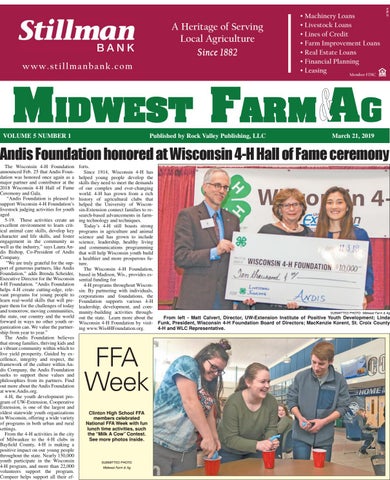
Andis Foundation honored at Wisconsin 4-H Hall of Fame ceremony
The Wisconsin 4-H Foundation announced Feb. 25 that Andis Foundation was honored once again as a major partner and contributor at the 2018 Wisconsin 4-H Hall of Fame Ceremony and Gala. “Andis Foundation is pleased to support Wisconsin 4-H Foundation’s livestock judging activities for youth aged 5-19. These activities create an excellent environment to learn critical animal care skills, develop key character and life skills, and foster engagement in the community as well as the industry,” says Laura Andis Bishop, Co-President of Andis Company. “We are truly grateful for the support of generous partners, like Andis Foundation,” adds Brenda Scheider, Executive Director for the Wisconsin 4-H Foundation. “Andis Foundation helps 4‑H create cutting-edge, relevant programs for young people to learn real-world skills that will prepare them for the challenges of today and tomorrow, moving communities, the state, our country and the world forward in ways no other youth organization can. We value the partnership from year to year.” The Andis Foundation believes that strong families, thriving kids and a vibrant community within which to live yield prosperity. Guided by excellence, integrity and respect, the framework of the culture within Andis Company, the Andis Foundation seeks to support these values and philosophies from its partners. Find out more about the Andis Foundation at www.Andis.org. 4-H, the youth development program of UW-Extension, Cooperative Extension, is one of the largest and oldest statewide youth organizations in Wisconsin, offering a wide variety of programs in both urban and rural settings. From the 4-H activities in the city of Milwaukee to the 4-H clubs in Bayfield County, 4-H is making a positive impact on our young people throughout the state. Nearly 150,000 youth participate in the Wisconsin 4-H program, and more than 22,000 volunteers support the program. Compeer helps support all their ef-
forts. Since 1914, Wisconsin 4-H has helped young people develop the skills they need to meet the demands of our complex and ever-changing world. 4-H has grown from a rich history of agricultural clubs that helped the University of Wisconsin-Extension connect families to research-based advancements in farming technology and techniques. Today’s 4-H still boasts strong programs in agriculture and animal science and has grown to include science, leadership, healthy living and communications programming that will help Wisconsin youth build a healthier and more prosperous future. The Wisconsin 4-H Foundation, based in Madison, Wis., provides essential funding for 4-H programs throughout Wisconsin. By partnering with individuals, corporations and foundations, the Foundation supports various 4-H leadership, development, and community-building activities throughSUBMITTED PHOTO Midwest Farm & Ag out the state. Learn more about the From left - Matt Calvert, Director, UW-Extension Institute of Positive Youth Development; Linda Wisconsin 4-H Foundation by visit- Funk, President, Wisconsin 4-H Foundation Board of Directors; MacKenzie Korent, St. Croix County 4-H and WLC Representative. ing www.Wis4HFoundation.org.
FFA Week Clinton High School FFA members celebrated National FFA Week with fun lunch time activities, such the “Milk A Cow” Contest. See more photos inside.
SUBMITTED PHOTO Midwest Farm & Ag
2 • Thursday, March 21, 2019 - Midwest Farm & Ag - Rock Valley Publishing, LLC
Bladel passes Winnebago County Fair Queen crown to Gors On Saturday, Feb. 23, the Illinois Conservation Torstenson Lodge of Pecatonica hosted the Winnebago County Fair crowning of the new State Queen. Alexi Bladel, of Winnebago, was crowned Miss Winnebago County Fair Queen in August of 2018. All county fair queens for 2018 from Illinois enter into an Illinois State contest, which was held on Jan. 20 in Springfield. Bladel was selected as the 2019 Illinois County Fair Queen. As she now has a new agenda for 2019, the first runner up from the 2018 Winnebago County Fair Pageant, Paige Gors, moves up into the role of 2018 Miss Winnebago County Fair. Sierra Revell, of Pecatonica, moves into the first runner-up position from her spot as second runner-up. This is the first year in the 60-year history of the state fair contest that a queen from Winnebago County was crowned. (Right) 2019 Illinois County Fair Queen Alexi Bladel, 2018 Winnebago County Fair Queen Paige Gors, and Winnebago County Fair first runner-up Sierra Revell pose on the steps of the Torstenson Lodge of Pecatonica. Royalty poses for a photo after the crowning ceremony: Sierra Revell, Paige Gors, Alexi Bladel, Stella Foley, and Khloe Wiegers.
Corn ethanol production has minimal effect on cropland use, study shows
Tri-County Dairy Supply • BULK TANKS • MILKERS • DAIRY SUPPLIES • HI PRESSURE WASHERS • RITCHIE WATERERS
24 HOUR REFRIGERATION SERVICE VENTLESS GAS SPACE HEATERS “For Service Call”
4107 Hwy. 51 N, Janesville
(608) 757-2697
305681
Full Retail Counter of Fresh Meats, Homemade Sausages, Wisconsin Cheeses & much more!
On-Site Processing to ensure Quality & Freshness
$50
.00
NOW SELLING HOMEMADE FRUIT PIES!
REGISTE R TO WIN A MONTHL Y $25 DRA WING
$75.00 All Beef Box Variety Box of Beef and Pork Try our Al Capone Roast Also Al Capone Brats Chicken, Beef, or Turkey Pot Pies. Custom Butchering by Appointment Only
OPEN Monday-Friday 8am-5pm, Saturday 8am-4pm Wisconsin Quest Illinois Link Sorg’s Gift Cards
339266
N4290 US HWY 14 • Darien, WI 53114
1-262-724-5554 1-262-724-3364
KAY DEMARCO PHOTOS Midwest Farm & Ag
Ethanol production has increased sharply in the United States in the past 10 years, leading to concerns about the expansion of demand for corn resulting in conversion of non-cropland to crop production and the environmental effects of this. However, a new study co-authored by a University of Illinois researcher shows that the overall effects of ethanol production on land-use have been minimal. The research, published in the American Journal of Agricultural Economics, looks at the effects of ethanol production capacity and crop prices on land use in the U. S. from 2007 to 2014. The increase in corn ethanol production has led to concerns that it would raise the price of corn and the demand for cropland; thus making it worthwhile to bring land that was not previously cultivated (such as grasslands) into production, says Madhu Khanna, a professor of agricultural and consumer economics at U of I. “Studies have simulated the crop price effects of producing 15 billion gallons of corn ethanol and shown that they could lead to large expansion in crop acres,” Khanna says. “We now have actual data on land-use change that has occurred since the ethanol expansion began in 2007 and can test whether the predictions of these models have held up. Interestingly, the raw data shows that although corn ethanol production more than doubled between 2007 and 2014, total cropland acres in 2014 were very similar to those in 2007 and the crop price index was lower in 2014 than in 2007.” Khanna and her co-authors, including Yijia Li, a graduate student at U of I and Ruiqing Miao from Auburn University, analyzed cropland data from
the U.S. Department of Agriculture’s National Agricultural Statistics Service to explain the extent to which changes in cropland acres could be causally attributed to changes in crop prices and proximity to ethanol plants. “Establishment of an ethanol plant in a county can increase corn acres and total cropland acres by reducing grain transportation costs and increasing the net revenue from corn production, creating an incentive to plant more corn,” Khanna says. “Additionally, higher crop prices that accompany the expansion in ethanol production can also create incentives for increasing crop acres even in locations that do not have an ethanol plant in their vicinity.” Khanna adds that in examining the causes of changes in cropland acres that have taken place it is important to consider both of these effects. Previous studies have looked at one of the other, but not simultaneously at both. “Corn ethanol capacity went up from about 6 to 14 billion gallons between 2007 and 2014 and the number of plants doubled, from about 100 to about 200, so it’s a pretty dramatic increase,” Khanna says. There was also a sharp upturn in corn prices between 2008 and 2012, but by 2014 the prices were almost down to 2007 levels again. Khanna and her co-authors found that while crop prices had a greater effect than plant proximity, overall changes in land use were minimal over the seven years included in the study. And while the higher corn prices did lead to an 8.5 percent increase in corn production, most of that increase came from conversion of other crops rather than non-cropland. Total cropland increased by 2 percent between 2008 and 2012, so in
the aggregate it was relatively small, Khanna says. “In fact, by 2014 a lot of the land which did convert into crops actually went back into non-crop, so the change in cropland, if you look at 2008 to 2014, was only by half a percent. We find that land use does respond to prices, but not by a lot.” Studies using satellite images of cropland to compare acres in 2008 and 2012 have suggested that there was a significant and irreversible increase in those acres, all attributed to corn ethanol. But a careful analysis of the data all the way to 2014 shows that the overall impact of corn ethanol production on increasing total crop acreage was very negligible. Moreover, the impact of crop price varied over time; it was a bit higher up to 2012 but then reverted almost back to previous levels in 2007-2008 by 2014 as crop prices dropped, Khanna concludes. “Our study shows that changes in land use should not be considered irreversible; as prices dropped after 2012, land reverted back to noncrop uses close to levels in 2007 and 2008.” The paper, “Effects of Ethanol Plant Proximity and Crop Prices on LandUse Change in the United States,” was published in the American Journal of Agricultural Economics and is available online. Authors include Yijia Li and Madhu Khanna, Department of Agricultural and Consumer Economics in the College of Agricultural, Consumer and Environmental Sciences and the Center for Advanced Bioenergy and Bioproducts Innovation, University of Illinois, and Ruiqing Miao, Department of Agricultural Economics and Rural Sociology, Auburn University.
Midwest Farm & Ag - Rock Valley Publishing, LLC - Thursday, March 21, 2019 • 3
USDA strengthens partnerships, protections to keep African Swine Fever out of the country The United States Department of Agriculture (USDA) today announced additional steps to keep African swine fever (ASF) from entering the United States, even as the disease spreads internationally. These steps strengthen the protections announced last fall after the deadly swine disease reached China. The goal remains to protect our nation’s swine industry from this disease. ASF does not affect people, nor is it a food safety issue. In coordination with the pork industry, USDA’s Undersecretary for Marketing and Regulatory Programs, Greg Ibach, has stated the following enhanced activities to intensify
multi-agency efforts toward the prevention of ASF’s entry into the United States: Work with Customs and Border Patrol (CBP) to train and add 60 additional beagle teams for a total of 179 teams working at key U.S. commercial, sea, and air ports; Coordinate with CBP on the further expansion of arrival screenings at key U.S. commercial sea and air ports – including checking cargo for illegal pork/pork products and ensuring travelers who pose an ASF risk receive secondary agricultural inspection; Increase inspections and enforce-
ment of garbage feeding facilities to ensure fed garbage is cooked properly to prevent potential disease spread; Heighten producer awareness and encourage self-evaluations of onfarm biosecurity procedures; Work to develop accurate and reliable testing procedures to screen for the virus in grains, feeds and additives, and swine oral fluid samples; Work closely with officials in Canada and Mexico on a North American coordinated approach to ASF defense, response, and trade maintenance; And continue high level coordination with the U.S. pork industry
leadership to assure unified efforts to combat ASF introduction. “We understand the grave concerns about the ASF situation overseas,” said Ibach. “We are committed to working with the swine industry, our producers, other government agencies, and neighboring countries to take these additional steps.” At the same time, USDA is continuing to enhance our planning so that we’re prepared in case we ever have to combat ASF. Along with our wide range of partner groups, we are working through several different ASF planning and response exercises. These cover different aspects –
from trade implications to policy discussions to the boots-on-the-ground realities of a response. These will help everyone involved ensure their response plans are ready and identify any preparedness gaps that must be addressed. ASF is a highly contagious and deadly viral disease affecting both domestic and feral (wild) pigs in all age groups. It is spread by contact with the body fluids of infected animals. It can also be spread by ticks that feed on infected animals. For more information, please visit the Animal and Plant Health Inspection Service ASF webpage.
United States wins WTO dispute finding China provides excessive government support to its grain producers U.S. Trade Representative Robert Lighthizer and Secretary of Agriculture Sonny Perdue announced today that a World Trade Organization (WTO) dispute settlement panel found that China has provided trade distorting domestic support to its grain producers well in excess of its commitments under WTO rules. China’s market price support policy artificially raises Chinese prices for grains above market levels, creating incentives for increased Chinese production of agricultural products and reduced imports. This panel report is a significant victory for U.S. agriculture that will help American farmers compete on a more level playing field. This dispute is the first to challenge China’s agricultural
policies that disregard WTO rules and shows that the United States will take whatever steps are necessary to enforce the rules and ensure free and fair trade for U.S. farmers, ranchers, workers, and businesses. “The United States proved that China for years provided government support for its grain producers far in excess of the levels China agreed to when it joined the WTO. China’s excessive support limits opportunities for U.S. farmers to export their world-class products to China. We expect China to quickly come into compliance with its WTO obligations,” said Ambassador Lighthizer. “We know that America’s farmers and ranchers thrive in a market-orient-
ed, rules-based global economy. That means all countries must play by the rules, which is why this finding is so important to U.S. agriculture,” said Secretary Perdue. Background In December 2016, USTR requested that the WTO establish a dispute settlement panel to consider whether China provides “market price support” for Indica (long-grain) rice, Japonica (short- and medium-grain) rice, wheat, and corn in excess of China’s domestic support commitments. Market price support programs are some of the most trade-distorting agricultural policies, and are therefore subject to clear limits under the WTO Agreement on Agriculture and a WTO Member’s specific
commitments. Under WTO rules, China may provide non-exempt support up to the de minimis level of 8.5 percent of the value of total production of a particular commodity, a commitment set out in China’s WTO accession agreement. The panel report agreed with the United States that China provided domestic support to its agricultural producers in 2012, 2013, 2014, 2015, well in excess of its WTO commitments. Specifically, the panel found that China had provided support in excess of permitted levels for Indica (longgrain) rice, Japonica (short- and medium-grain) rice, and wheat, in every year. Each finding individually established that China broke its overall agri-
cultural domestic support commitment for agricultural producers. For corn, the panel declined to make findings on the support provided to corn in 20122015 given that China had apparently changed its program in 2016, just prior to the WTO’s establishment of the panel. Compliance with WTO rules will lead to a reduction in the excessive support provided to China’s grains producers and should increase market forces in China, leading to a more level playing field. Read more about the United States’ challenge, including additional details about how China’s excessive domestic support to its grain producers breach its WTO commitments.
340037
4 • Thursday, March 21, 2019 - Midwest Farm & Ag - Rock Valley Publishing, LLC
Data Intensive Farm Management - Research on your farm for your farm Crop scientists have run smallplot trials for more than a century but implementation is extremely labor-intensive without the benefit of large-scale farm machinery. Larger-scale “strip trials,” in which researchers apply different rates to field-length strips, are a more recent development. Despite providing information about larger areas of land, strip trial analysis assumes
that field characteristics are uniform throughout the field. This is an assumption which is often incorrect. This is where Data Intensive Farm Management (DIFM), a new protocol from the University of Illinois designed to help producers run sophisticated trials on their own farms assessing fertilizer and seeding rates in corn and soybean pro-
Towns hired as Wisconsin Farm Bureau’s senior director of governmental relations Debi Towns has been hired by the Wisconsin Farm Bureau Federation as its senior director of governmental relations. As a registered lobbyist for WFBF, Towns will assist Farm Bureau members in working with local, state and federal lawmakers to advance the policy directives for Wisconsin’s largest general farm organization. “I’m excited to join the WFBF team,” Towns said. “Wisconsin agriculture has been a big part of my life and I am eager to utilize my experience working with lawmakers to heighten awareness of our members’ needs.” Towns comes to Farm Bureau from the Wisconsin Housing & Economic Development Authority where she served as the legislative relationships and government liaison. She previously served two terms in the State Assembly where she represented Wisconsin’s
43rd District. “Debi will be a great advocate for Wisconsin’s farmers,” said WFBF’s Executive Director of Governmental Relations Karen Gefvert. “She Debi Towns has a background in agriculture and understands the legislative process. Her relationships in both areas will help move Wisconsin agriculture forward.” Towns and her husband, Steve, are Rock County Farm Bureau members and live on a dairy farm outside of Janesville. She began her duties with the Farm Bureau on February 25. Towns succeeds Rob Richard as the senior director of governmental relations.
duction systems. Using GPS-guided precision agriculture technology, researchers and farmers are collaborating and conducting largescale, on-farm “checkerboard” field trials. DIFM’s checkerboard trials provide more specific, higher quality data than can be attained through either of the more traditional field trial methods. The goal of DIFM is to revolutionize farm management by working with farmers to implement scientific experiments on their own farms. This will enable farmers to increase their profits by making data-driven management decisions. Researchers use DIFM specialized software to program “instructions” to a variable rate planter and fertilizer applicator. The farmer simply drives through the field as the seeds and fertilizer are applied. At harvest, the DIFM software works with a GPS-linked yield monitor to record the results of each plot. Because DIFM trials are conducted on commercial farm fields, they generate specific information from those fields about those fields. This data is immediately pertinent to decisions about future management, for the producers who are involved. In addition to measuring field characteristics, DIFM will measure weather on each experimental field by installing equipment that measures and records precipitation and temperature many times per day. The beauty of the DIFM method is that it can generate huge amounts of pertinent field trial data on a farmer’s actual fields, but with
minimal nuisance to the farmer. Still, participating farmers play an active role in research, and of course take on certain responsibilities while participating. DIFM researchers ask that farmers attend an organizational meeting in February during their first year of participation in order to discuss their roles in the project. Prior to planting, the farmer • dedicates a field of at least 80 acres to the project; • provides a shape file showing the field’s boundary; • provides the latest soil fertility information available for the field • provides an A-B line for planting, fertilization, and harvest; • provides a yield map from at least one year of the crop species to be planted. • provides the width and number of rows, where applicable, of all equipment; and • provides information about the fertilization and seeding rates that would be used on that field if the farmer were not participating in the experiments. After planting, the farmer provides an as-applied map (as a shape file) for both seeding and fertilization. This tells us what was actually applied to the field. This confirms that the experiment was correctly implemented. After harvest, the farmer provides a yield map as a shape field on a one-second interval for the entire field. Importantly, farmers who participate in the DIFM project will own the data generated by the field trials run on their farms and compensa-
tion to farmers will be given for any losses due to participation. DIFM compensates farmers to ensure that they experience no income loss from participating in the project by estimating what farm income on the field would have been without DIFM. By comparing that income to the actual income generated in the field trials, we can calculate an accurate compensation estimate. In addition, DIFM provides each participating farmer with an annual $500 “thank you” payment to defray the cost of your time. Farmers familiar with using their variable rate equipment will only need to upload the field design shapefile, drive their variable rate applicators and yield-monitored harvesters, and supply to you and DIFM the resultant as-applied and yield shapefiles. DIFM has the statistical and economic expertise to analyze the data provided from your client’s, and begin to develop data-driven input management recommendations from the trial data. DIFM will provide you with a written explanation of the management implications of field trial results, and will be happy to discuss the practical implications of the results with you and your client, in person or via video conference. For questions regarding the DIFM project or interest in becoming a cooperator, contact Phillip Alberti, Crop Science Educator with University of Illinois Extension in the College of Agricultural, Consumer, and Environmental Sciences at palberti@illinois.edu, 815-235-4125 or on Twitter (@NorthernILCrops).
Midewin presents a ‘Farm History Trail’
SUBMITTED PHOTO Midwest Farm & Ag
1920’s and 30’s farm implements and household items from the Arthur and Verna Schumacher family were on display at Wilmington Island Park District, 315 N. Water St Wilmington, Ill.; Elwood Village Hall, 401 E. Mississippi Ave Elwood, Ill.; and the Joliet Area Historical Museum, 204 N. Ottawa St Joliet, lll. on March 9.
SUBMITTED PHOTO Midwest Farm & Ag
Staff and volunteers with the USDA Forest Service’s Midewin National Tallgrass Prairie were on hand to meet with guests and discuss these beloved items. Each of the three locations on the Farm History Trail had different and unique displays. Examples of items on display include a Singer sewing machine, a 2-horse yoke, and milk bottles from local dairies of the early-mid 20th Century. Shown here, the Schumachers on the Farm early 1920s.
Midwest Farm & Ag - Rock Valley Publishing, LLC - Thursday, March 21, 2019 • 5
Local students attend Farm Bureau’s FFA Farm Forum
Clinton FFA members were among the more than 200 high school students who attended the Wisconsin Farm Bureau’s FFA Farm Forum in Wisconsin Rapids Feb.15-16. “This event is a great partnership between Wisconsin Farm Bureau and Wisconsin FFA,” said Jim Holte, Wisconsin Farm Bureau Federation President. “Young ag leaders who attend this event participate in professional development activities and are able to network with their peers and Farm Bureau staff.” During the two-day event at Hotel Mead in Wisconsin Rapids, FFA members attended workshops that covered topics including post-high school agricultural opportunities, social media, agriculture advocacy and leadership. Joining Holte as keynote speakers at the event were Alison Wedig, marketing specialist with Culver Franchising System, LLC, and Chris Pollack, co-owner of Pollack-Vu Dairy. The Wisconsin Farm Bureau Foundation sponsors FFA Farm Forum in cooperation with the Wisconsin Association of FFA. This year’s FFA Farm Forum marks the 47th time the event has been hosted for Wisconsin youth. For more information about the CLINTON FFA PHOTOS Midwest Farm & Ag FFA Week was rounded out with Flannel Friday, checking on the Ms. Braukhoff proudly displays her grandfather’s Clinton jacket Wisconsin Farm Bureau, check out from the 1950s in the ag. classroom. its website at wfbf.com. greenhouse and turkey bowling at lunch.
340103
Milk chug contest at lunch to celebrate FFA Week!
Your Full Service Grocery Store One of the FFA Week activities was a straw bale toss at lunch. The winners launched the bale 37 feet.
A Cut Above the Rest Family Owned & Operated Since 1974
OPEN 7 DAYS A WEEK: 6 am-10 pm Conveniently Located!
DELAVAN
(Right) Clinton High School’s Dean of Students/Athletic Director Jeff Spiwak takes a shot at turkey bowling, a lunch time activity during FFA Week.
1414 E. Geneva St. in the Shopko Shopping Center
262-728-2638
Farm Fresh e Produc red Delive Daily
Stinebrink’s Liquor Store (Next Door) Largest Liquor Store in the Area
262-740-0541
LAKE GENEVA
100 East Geneva Square in the Geneva Square Shopping Center
262-248-8798
6 • Thursday, March 21, 2019 - Midwest Farm & Ag - Rock Valley Publishing, LLC
‘Your Farm Future: A blueprint to move your farm forward’ The UW-Extension Program “Your Farm Future: A blueprint to move your farm forward” is intended for farmers interested in planning and preparing for the future of their farm business in the context of current challenging economic conditions. The world of agriculture is always shifting, and developing a plan will help farmers navigate the future and regain a sense of control of their future. This program offers an opportunity for farmers interested to further develop and/or re-evaluate their plans and goals for their farm with consideration for family business dynamics and current economic conditions. “Wisconsin farmers are evaluating their options for 2019 and beyond, and will need
to take stock of their business and their goals for the future. “This program will provide a blueprint for navigating important decisions. The blueprint will outline important financial and succession considerations in order to make informed decisions about the future,” says Jenny Vanderlin, UW Center for Dairy Profitability. Depending on each program location, financial and/or legal specialists will be on hand to help clarify important production and financial information and/or how to prepare for a legal consult. Participants of the program will become more confident about understanding their farm financial position and performance in order to discuss the future with family members, farm
To advertise in this publication call (815) 654-4850, (262) 728-3411 or email ads@rvpublishing.com
328181
Midwest FarM &ag
The Impact Of Agriculture
F
rom our nation’s earliest days, Agriculture has played a major role in the United States economy. America’s Farmers and Ranchers cultivate the soil, plant the crops and raise the livestock necessary for our nation’s food supply.
BANKING On A First Name Basis
Today more than 21 million American workers produce, process and sell the nation’s food and fiber. As an Ag Bank, we consider it a privilege to be involved in financing agriculture. If we can be of help to On A First Name Basis you, come see us.
BANKING BANKING On A First Name Basis Member F.D.I.C
© Vic Jacquot
303 E. Spring Street • Orfordville, WI 608-879-2911
BANKING
Since 1901 in Orfordville 340134
The Farmers & Merchants BANKING On A First NameBank Basis
business partners, legal professionals and consultants. The program is sponsored by the UW-Center for Dairy Profitability, UW-Extension Farm and Risk Management Team and by the following UW-Extension County offices across the state. Programs start at 10 a.m. with the exception of April 3rd being an evening program, starting at 5:30 p.m. Contact the following UW-Extension office for more information and to register for a program you wish to attend. March 13: Green Lake, Green Lake County UW-Extension office 571 Co Rd A, Green Lake. Contact: Green Lake County UW-Extension, Agriculture Educator Ben Jenkins, (920) 294-4032 March 20: Burlington, Gateway Technical College, 496 McCanna Pkwy, Burlington. Contact: Racine and/or Walworth County UW-Extension Agriculture Educators Leigh Presley (262) 857-1948 and/or Jim Versweyveld (262) 7414951 April 3: Amnicon Town Hall 8985 US-2, South Range. Contact: Douglas County UW-Extension, Cheryl Shockley 715-395-1547 or Agriculture Agent Jane Anklam: jane.anklam@ces.uwex.edu
Illinois is 3rd in the nation for number of farmers’ markets More than 8,000 farmers’ markets across the country offer consumers farm-fresh, affordable, convenient, and healthy products such as fruits, vegetables, cheeses, herbs, fish, flowers, baked goods, meat, and much more. Please take this opportunity to search for a community or roadside farmers’ market near you. Farmers’ markets serve as integral links between urban, suburban, and rural communities, affording farmers and their consumers the opportunity to interact. The popularity of farmers’ markets continues to rise, as more and more consumers discover the joys of shopping for unique ingredients sold directly from the farm, and the pleasure of buying familiar products in their freshest possible state. To further the expansion and awareness of farmers’ markets and the contributions farmers make to daily life in America, take the opportunity to celebrate the benefits of farmers’ markets and the bountiful production of our nation’s farmers, who provide for our needs and are among the best stewards of our land. Please take this opportunity to search for a community or roadside farmers’ market near you.
SUBMITTED PHOTO Midwest Farm & Ag
Four teens were selected to represent Illinois in the national competition. They are Addie Raber, Gridely; Hannah Albert, Keyesport; Taylor Huels, Greenville; and Brady Heinzmann, Carlyle.
Practice drives winners in state dairy contest Every chance they got, the father-son team practiced. Whether doing chores or riding in the car, 11-year-old Drew Lueking of Centralia and his dad, Doug, rattle through dairy cattle facts in preparation for the Illinois 4-H Dairy Quiz Bowl contest. Doug, a registered Holstein dairy breeder and ag teacher, serves as coach for Drew and daughter Shana, as well as other 4-H members in Clinton and Bond counties. The team practices once a week. That practice paid off. Drew was part of the winning team in the junior division of the contest held Saturday, Feb. 23 in East Peoria. Drew was joined by Evan Beal of Centralia and Kaylie Huels of Greeville to claim the win for the team. In total, 57 4-H members from 12 counties competed for top awards and the chance to represent Illinois at the National 4-H Dairy Quiz Bowl to be held in Louisville, Ky., in November. Although winning is good, Drew’s mother, Sheila, said it’s more important that young people are able to speak confidently about the dairy industry, especially in recent years which have hit independent dairy farmers hard. “As farm numbers diminish, the people who are left have to be exceptional in their knowledge of the industry.” Youth from Stephenson County earned second place in the junior division. They include Magen and Abby Busker of Ridott and Blake Komprood and Jayse Rudwill of Orangeville. Four teens were selected to represent Illinois in the national competition. They are Addie Raber, Gridely; Hannah Albert, Keyesport; Taylor Huels, Greenville; and Brady Heinzmann, Carlyle. Alternates include Rosalee Zehr, Graymont; and Nathan Erbsen, Lanark. Local participants include: Bond County – Ellie Albert, Hannah Albert, Kasey Clanton, Brayden Huels, Kaylie Huels, Taylor Huels, Kaleb Johnson Clinton County – Evan Beal,
Jackson Brammeier, Brady Heinzmann, Samantha Heinzmann, Drew Lueking, Shana Lueking, Emmet Shoemaker Dave Fischer, University of Illinois Extension 4-H dairy coordinator and coach of the Illinois dairy teams, celebrated his 30th year at the helm of this year’s state dairy contest. Fischer retired as U of I Extension animal system educator in 2010 after 39 years with the organization, but continues to serve Illinois 4-H as coordinator and coach of the Illinois national dairy team. The dairy quiz bowl challenges 4-H members’ knowledge and quick recall of various aspect of dairy cattle management and products, Fischer says. Members take an individual knowledge test which helps rank them for the quiz bowl section of the contest. During the quiz bowl, each team first answers 12 oneon-one questions. Then, each team competes against another team in a timed contest where the first to buzz in and answer correctly wins points. Teams lose points for incorrect answers. “The dairy quiz bowl requires many hours of dedicated learning and a good understanding of the dairy industry,” Fischer said. Several 4-H volunteers assist the members in their study and help with the state contest. Famed University of Illinois dairy specialists Mike Hutjens and Gene McCoy serve as quiz masters, along with Fischer and Rod Stoll, Farm Credit Illinois vice president of marketplace engagement and 4-H dairy cattle breeder alum. “You know your diseases,” Stoll quipped when a young 4-H member named the correct metabolic disorder for a description of illness. “We’ll call you doc.” Stoll’s good-humored nature helps relax the contestants and encourages them when they struggle finding the right answers. Think you have what it takes to compete? Better know what disease is caused by the mycobacterium paratuberculosis organism first. Then, you might have a chance to compete.
Midwest Farm & Ag - Rock Valley Publishing, LLC - Thursday, March 21, 2019 • 7
Wisconsin FFA Foundation opens 2019 chapter grant applications The Wisconsin FFA Foundation has opened the application period for the 2019 Chapter Grants. Five opportunities are available to FFA chapters around the state due to generous funding from Foundation sponsors. The Foundation’s 2019 Chapter Grant Program is available in these categories: AgCountry Chapter Grant, Bethany L. Rieth Memorial
Community Service, Burton H. Morris Chapter Grant, Food for America, and WAXX/Wisconsin Farm Report Network with Pam Jahnke Convention Grant. Chapter grants encourage Wisconsin FFA chapters to develop individual and cooperative activities which will enhance their communities. New in 2019, the AgCountry
Chapter Grant is available to FFA chapters in the AgCountry service area, located in north-central Wisconsin. Eligible chapters are listed on the grant application. The grant can be applied for any area of need or project a chapter may have, up to $500. “We are proud to support FFA in Wisconsin,” says AgCountry CEO
Roby-Vorgias named new county director for Illinois Extension serving DuPage, Kane, Kendall counties University of Illinois Extension appointed Deanna Roby-Vorgias of Itasca as the new County Director serving DuPage, Kane and Kendall counties. Roby-Vorgias succeeds Sandra I. Davis, who retired in January with 48 years of service in Extension. As County Director, she will lead the tri-county unit and its 20plus staff members in three office locations – St. Charles, Naperville and Yorkville. She also will be responsible for personnel, financial, program, and facilities management. Roby-Vorgias has a master’s degree in Education - Human
Resource Development from University of Illinois and a bachelor’s degree in Corporate and Organizational Communications - Business Administration from Northern Illinois University. She comes to the role with 25 years of experience with University of Illinois Extension and 4-H Youth Development, most of which has been in DuPage, Kane and Kendall Counties. In 2018, she earned the state Mentoring Extension Excellence Award. University of Illinois Extension provides practical information you can trust to help people,
businesses and communities solve problems, develop skills and build a better future. Based in the College of Agricultural, Consumer and Deanna Environmental Roby-Vorgias Sciences, Extension is the statewide outreach program of the University of Illinois at Urbana Champaign, and its programs educate 1.3 million participants each year.
Marc Knisely. “This organization helps develop and transform students into young leaders by building skillsets and providing learning opportunities. FFA is a vital contributor to the health of agriculture and our rural communities.” The Community Service Grant is available due to generous donations to the Bethany L. Rieth Memorial Fund, which was established in the Past State FFA Officer’s honor after her sudden passing in February 2016. These annual grants given in Bethany’s name will be awarded to support chapters in completing meaningful service projects that make a difference in their communities. The Food for America Grant is funded once again by the Wisconsin FFA Foundation’s long-time TwoStar Mission Partner, Organic Valley/ CROPP Cooperative, Inc. This grant supports activities which inform and educate others about food systems, production and healthy choices. In its second year, the Burton H. Morris Chapter Grant is available to FFA programs with a land base in Adams County. There are no program restrictions on this grant. The funding is through a gift from the Burton H. Morris estate after the lifelong Adams’ County resident’s passing in 2016. Also in its second year, the Convention Grant is made possible by the WAXX/Wisconsin Farm Report
Network with Pam Jahnke. It is open to FFA chapters across Wisconsin whose members have financial restraints which prevent them from attending the Wisconsin FFA Convention held each June in Madison. To be eligible for a 2019 Wisconsin FFA Foundation Chapter Grant, FFA chapters must be in good standing with the Wisconsin Association of FFA and submit a completed application to the Wisconsin FFA Foundation by March 22, 2019. The application can be found on the Wisconsin FFA Foundation website under “Chapter Grants” For more information, please contact the Wisconsin FFA Foundation at 608-831-5058 or by emailing: info@wisconsinffafoundation.org. The Wisconsin FFA Foundation, a 501 (c)(3) organization, unites individuals, organizations and companies who share a common interest in the advancement of agriculture and community leadership through FFA. You can support today’s FFA members by supporting the programs that have been core tenets of the FFA: proficiency awards, career development events, state FFA degrees, sectional leadership workshops, scholarships, chapter awards, agri-science fair, state FFA convention and state officer support. Learn more about the Wisconsin FFA Foundation and sponsorship opportunities by visiting www.wisconsinffafoundation.org.
Products Available:
“Buy The Best For Your Beast”
PET & ANIMAL SUPPLIES
The area’s premier pet food and supply store. Serving all of Southern Wisconsin and Northern Illinois since 2003. We have a variety of dog/cat food, toys and treats, cage and wild bird supplies, small animal supplies and livestock feed. For all your pet and livestock supply needs, stop by today!
Delivery available • Pre-Order Baby Chicks
• • • • • • • • •
Dog/Cat Food and Supplies Holistic/Natural Pet Foods Natural Pet Treats Caged Bird Food and Supplies Small Animal Food and Supplies Livestock Feed Wild Bird Seed Pet Health Supplements Grooming Supplies
We carry brands such as: • • • • • • • • • • •
Fromm Nutri-Source Pure Vita Stella & Chewy’s Grandma Lucy’s Northwest Naturals Taste of the Wild Precise Chicken Soup Wellness American Natural Premium • Natural Planet • Sportmix • Sportmix Wholesome
• • • • • • • • • • • • • • • •
Kent Nutrena Triple Crown Safe Choice Dave’s Delco ZuPreem Kaytee Brown’s Oxbow Pestell Farmina Weruva Redbarn Jones Darford
130 10 ½ Street, Monroe, WI (Behind Pick ‘n Save in Monroe) • 608-329-5663 • www.beastbuffetmonroe.com Open Monday through Friday 9 AM to 6 PM and Saturday 8 AM - 3 PM 340722
8 • Thursday, March 21, 2019 - Midwest Farm & Ag - Rock Valley Publishing, LLC
Support 4-H with new 4-H Foundation license plates The 4-H Foundation license plate fees include an issuance fee of $15, plus an annual $25 tax-deductible contribution, in addition to the regular registration fee. This contribution goes to the Wisconsin 4-H Foundation. Vehicles that qualify • automobiles • motor homes (annual registration only) • motor trucks -4,500, 6,000 or 8,000 pounds gross weight including dual purpose farm and dual purpose motor home -12,000 pounds gross weight farm truck When you request 4-H Foundation license plates, you pay: • $25 annual donation The donation may be deductible if you itemize your income tax returns • $15 issuance fee or an annual $15 personalized plate fee, if requested • The regular registration fee for your vehicle if your current plates expire within three months or you have no plates At each plate renewal, you will pay the $25 donation and the regular registration fee for non-personalized 4-H Foundation license plates. How to apply Local DMV customer service centers do not have 4-H Foundation
license plates for immediate issue, but can process applications and the plates will be mailed. Temporary plates will be issued, if needed. To apply for 4-H Foundation license plates by mail, please send the following items: 1. If the vehicle you wish to register with 4-H Foundation license plates is already titled in your name, send:
• A copy of your Certificate of Registration or show the complete vehicle description on the MV2969 4-H Foundation License Plates Information and Application • $25 4-H Foundation donation • $15 issuance fee or $15 personalized plate fee • The annual registration fee if the current plates expire within the next three months or you have no plates
2. If the vehicle is not titled in your name, send: • A completed Wisconsin Title & License Plates Application MV1, or MV11 for dealer sales, including all fees • A completed MV2969 4-H Foundation License Plates Information and Application • The Certificate of Title assigned to you by the seller
• $25 4-H Foundation donation • $15 issuance fee or $15 personalized plate fee • The annual registration fee if you do not have plates or your current plates expire within the next three months 3. Make the check or money order payable to: Registration Fee Trust. 4. Mail with payment to: Wisconsin Department of Transportation Special Plates Unit P.O. Box 7911 Madison WI 53707-7911 Personalized license plates Personalizing your 4-H Foundation license plates is optional. A $15 personalized plate fee is required each year in addition to the $25 donation and regular annual registration fee. On the MV29694-H Foundation License Plates Information and Application, check which option you would like us to follow if your request is not available. Please allow an additional 4-6 weeks for delivery. WisDOT may refuse to issue, or may recall after issuance, a request that may be offensive to good taste or decency, misleading or conflicts with any other license plate. Questions? Email Wisconsin DMV email service or phone (608) 266-3041.
JACK’S TIRE Sales and Service
WE HAVE YOUR FARM TIRES!
• Large inventory of tires for all your agriculture equipment • A wide variety of product brands
4829 Prairie Hill Road • South Beloit, IL 61080 (815) 389-9849 • www.jackstire.com
340191
• Locally owned for 35 years • Convenient infield tire installation & repair