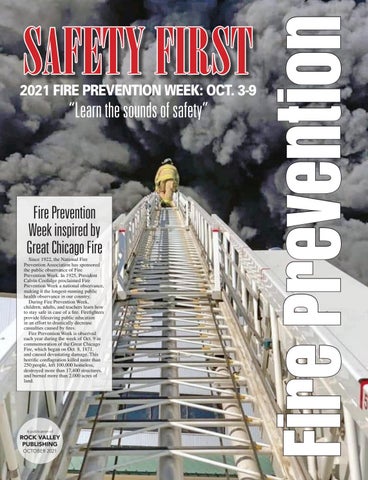
Fire Prevention
SAFETY FIRST
2021 FIRE PREVENTION WEEK: OCT. 3-9
“Learn the sounds of safety”
Fire Prevention Week inspired by Great Chicago Fire Since 1922, the National Fire Prevention Association has sponsored the public observance of Fire Prevention Week. In 1925, President Calvin Coolidge proclaimed Fire Prevention Week a national observance, making it the longest-running public health observance in our country. During Fire Prevention Week, children, adults, and teachers learn how to stay safe in case of a fire. Firefighters provide lifesaving public education in an effort to drastically decrease casualties caused by fires. Fire Prevention Week is observed each year during the week of Oct. 9 in commemoration of the Great Chicago Fire, which began on Oct. 8, 1871, and caused devastating damage. This horrific conflagration killed more than 250 people, left 100,000 homeless, destroyed more than 17,400 structures, and burned more than 2,000 acres of land.
A publication of
ROCK VALLEY PUBLISHING OCTOBER 2021
Washer, dryer fires typically are caused by failure to clean out lint, mechanical problems Page 2
FIRE PREVENTION 2021
The estimated annual number of washer and dryer fires fell during the early 1980s before leveling off through the early 1990s, when they began a slight upward trend. Since 2001, the year to year fluctuation has been more volatile, though the annual number of fires in recent years is consistently lower than those recorded before the 2000s, with the exception of an estimated 19,400 fires in 2007. An estimated 14,000 fires involving washers and dryers in 2009 represents the low point, with an estimated 15,050 fires in 2014. The leading factor contributing to the ignition of home fires involving clothes dryers was failure to clean, accounting for one-third (33 percent) of dryer fires. These fires were associated with half of the clothes dryer fire deaths, as well as 34 percent of civilian injuries and 26 percent of direct property damage. Other leading factors contributing to ignition of dryer fires were mechanical failure or malfunction (28 percent), electrical failure or malfunction (17 percent), and heat source too close to combustibles (5 percent). Equipment not being operated properly was a factor in just 2 percent of fires, but 49 percent of dryer deaths, although caution is called for in interpreting this finding due to the small numbers. A mechanical or electrical failure or malfunction was involved in the vast majority of home fires involving washing machines. Mechanical failures or malfunctions were involved in 44 percent of home washing machine fires and electrical failure or malfunction in 42 percent of the fires. Fires involving electrical failure or malfunction accounted for a much higher share of direct property damage (60 percent) than those involving mechanical
Teaching fire safety Winnebago Pack 5 learned about fire safety at a past visit to the Win-Bur-Sew Fire Station. WIN-BUR-SEW FD PHOTO Fire Prevention Week
failure or malfunction (23 percent). Other factors contributing to fires involving washing machines included equipment overloaded (3 percent), failure to clean (3 percent), unclassified misuse of material or product (2 percent), heat source too close to combustibles (2 percent), equipment unattended (2 percent), installation deficiency (2 percent), and unclassified factor (2 percent). Fires involving clothes dryers usually started with the ignition of something that was being dried or was a byproduct (such as lint) of drying, while washing machine fires usually involved the ignition of some part of the appliance. The leading items first ignited clothes dryer fires were dust, fiber, or lint (27 percent) and clothing (26 percent) and
included unclassified soft goods or wearing apparel (10 percent), linen (5 percent), and mattress or bedding (3 percent). In washing machine fires, by contrast, the leading items first ignited were electrical wire or cable insulation (26 percent), appliance housing or casing (24 percent), conveyor belt, and drive belt, or v-belt (11 percent). Clothing was the item first ignited in 8 percent of washing machine fires, with another 3 percent of fires ignited by dust, fiber, or lint. Similar to fires involving clothes dryers, the leading items first ignited in combination washer/dryers were dust, fiber, or lint (23 percent), clothing (20 percent), and appliance housing or casing (17 percent), with electrical wire or cable insulation a factor in another 8 percent of fires.
Smoking-related fires reduced by fewer smokers
According to the Centers for Disease Control and Prevention (CDC), only 15.5 percent of the adult population were current smokers in 2016, compared to 33 percent in 1980. Despite today’s comparatively small percentage of smokers, smoking remained the leading cause of home fire deaths over the total five-year period of 2012-2016. In 2013, fires started by electrical distribution and lighting equipment caused the most home fire deaths, while cooking fires ranked first in home fire deaths in 2014 and 2015. Smoking materials caused the most deaths in 2012, 2016 and in total for the five years. During 2012-2016, an estimated annual average of 18,100 (5 percent) reported home structure fires started by smoking materials killed an average of 590 (23 percent) people annually, injured 1,130 (10 percent) per year, and caused $476 million in direct property damage (7 percent) per year. Homes include one- or two-family homes, including manufactured homes, and apartments or other multi-family housing. Firefighter casualties are not included in this analysis. • Sixty-one percent of the fatalities and 48 percent of the non-fatally injured were in the area of origin and involved in ignition. • Forty-five percent of the fatalities and 56 percent of the injuries were caused by the 69 percent of fires that were confined to the object or room of origin. • Medical oxygen was involved in 13 percent of the home smoking material fire deaths. Thirty-eight percent of the victims were killed by fires that began with upholstered furniture; 29 percent died from fires in which mattresses or bedding were the item first ignited. Forty-three percent of the deaths were caused by fires that started in the living room. One-third (34 percent) were caused by fires that began in the bedroom. The increase in indoor smoking bans has been accompanied by an increase in home smoking material structure fires that began outside. The leading area of origin for home smoking fires in 2012-2016 was an exterior balcony or open porch (18 percent). The new low of 16,500 home smoking material fires in 2016 was 77 percent lower than the 1980 high of 70,800 fires. While the 2016 estimate of 660 home smoking material fire deaths was 64 percent lower than the 1980 estimate of 1,820 deaths, it was the highest seen since 2006. The smallest number of smoking fire deaths was seen in 2011. The long-term decrease in smoking fires and deaths from 1980 to 2016 is greater than the 52 percent decline in home fires and 47 percent drop in home fire deaths overall.
Fires caused by playing with fire FIRE PREVENTION 2021
Municipal fire departments responded to an estimated annual average of 30,460 fires caused by playing with fire in 2014–2018. These fires resulted in an estimated 50 deaths, 510 injuries, and $205 million in direct property damage each year. The vast majority of these fires were incidents that did not involve structures; these incidents included outside or unclassified fires, outside trash or rubbish fires, and vehicle fires. Structure fires accounted for the largest shares of the losses from the fires caused by fire play, including all of the deaths, nearly threequarters of the fires caused by playing with fire were non-structure fires.
STRUCTURE FIRES CAUSED BY PLAYING WITH FIRE In 2014–2018, municipal fire departments in the US responded to an estimated 8,100 structure fires each year that were caused by playing with fire. These fires resulted in an estimated 50 civilian deaths, 450 civilian injuries, and $143 million in direct property damage each year. Children were responsible for the vast majority of the incidents that involved playing with fire. More than three in five structure fires caused by playing with fire in 2014–2018 occurred in residential properties. These fires accounted for even greater shares of the civilian deaths, injuries, and direct property damage associated with fires due to fire play. Fires caused by playing with fire by property use: 2014–2018 Outside or special properties were the second leading site of fires caused by playing with fire, accounting for approximately one in 10 fires, but minimal losses. Educational properties and storage properties were the next leading locations and were also associated with minimal losses, although storage properties accounted for the second-highest share of direct property damage in fires due to fire play. Of the residential properties that account for the greatest share of the structure fires caused by playing with fire, the vast majority of these involve homes. In 2014– 2018, playing with fire is estimated to have caused 4,960 home structure fires each year. These fires caused an estimated 50 civilian deaths, 400 civilian injuries, and $112 in direct property damage each year. Residential properties that are not homes include such properties as residential board and care
facilities, dormitories, hotels and motels, and barracks. The number of home fires caused by playing with fire has fallen dramatically over the past 30 years. Since 1990, home fires caused by playing with fire have fallen by 80 percent, from nearly 22,000 fires in 1990 to an estimated 4,400 fires in 2018. The losses associated with these fires have also shown a substantial decline over the past three decades. Civilian deaths have fallen by 85 percent, from 330 deaths in 1990 to 50 deaths in 2018. Injuries have fallen from an estimated 2,250 injuries in 1990 to 480 injuries in 2018, a 79 percent decrease. Direct property losses, adjusted for inflation, have fallen by 69 percent, from $396 million (in 2018 dollars) in 1990 to $122 million in 2018. Research has shown that a safety standard requiring disposable cigarette lighters to be child-resistant has been instrumental in reducing fire deaths, injuries, and direct property damage since it came into effect in 1994.
AGE OF FIRE SETTERS IN HOME STRUCTURE FIRES CAUSED BY PLAYING WITH FIRE Most fires caused by playing with fire are started by children, many under the age of 10, as indicated in Figure 5. Adults (18 years and older) were responsible for just 1 percent of the home structure fires caused by playing with fire. Fires that were started by children 5 years old or younger accounted for a disproportionate share of the deaths, although the fire setters were not necessarily the victims in these fires. HOME STRUCTURE FIRES CAUSED BY PLAYING WITH FIRE BY MONTH Fires caused by playing with fire were highest during the school vacation months of June, July, and August, as well as in March. Children have more opportunities to play with fire when they have fewer structured activities and spend more time at home. Although one-quarter of the home fires caused by playing with fire occurred in the cold weather months of January, February, and March, these fires accounted for half of the civilian deaths. The share of deaths was also nearly double the share of fires in October and November, though not in December. HOME STRUCTURE FIRES CAUSED BY PLAYING WITH FIRE BY TIME OF DAY Three in 10 of the home structure fires
208 1 Center Ave 87227 ToWIng, L.L.c. ArnArn ToWIng, L.L.c. Arn ToWIng, L.L.c. Arn’s Arn ToWIng, L.L.c. Arn’s Arn ToWIng, L.L.c. n’s Arn ToWIng, L.L.c. Arn’s BRODHEAD WI 53520 Arn ToWIng, L.L.c. r rn’s 7227 Arn ToWIng, L.L.c. Arn ToWIng, L.L.c. rAdiAtor Arn’s Arn ToWIng, Arn’s tor Arn ToWIng, L.L.c. L.L.c. rAdiAtor Arn’s Arn ToWIng, L.L.c. Arn’s rAdiAtor 24 hoursArn per day •ToWIng, 7 days per week L.L.c. shop rAdiAtor 27 years. diAtor Arn ToWIng, L.L.c. op diAtor 24 hours per day • 7 days per week Arn L.L.c. hoursrAdiAtor pershop day • 7per days week rn’s Serving Brodhead for over 27 years. 24 hours day • per 7ToWIng, days perBrodhead week shop Serving rrAdiAtor over 27 24 years. hours per24 day • 7perdays week head, WI • 608-897-8088 Arn ToWIng, L.L.c. hours day • per 7 days per week Arn’s Arn ToWIng, Serving Brodhead for for over 27 s shop over 39years. years. or Serving Brodhead forL.L.c. over 27 24 years. Arn ToWIng, L.L.c. Arn’s 804 2nd St. • Brodhead, WI • 608-897-8088 24 hours per day • 7 days per week hop Brodhead, WI • 608-897-8088 hop Serving Brodhead for over 27 years. 7Ator WI • 608-897-8088 shop Serving Brodhead Arn ToWIng, L.L.c. Arn’s Arn ToWIng, L.L.c. Arn’s Arn ToWIng, L.L.c. Arn ToWIng, L.L.c. AdiAtor rn’s 24 hours per day • 7 days per week n’s 24 hours per day • 7 days per week 24 hours per day • 7 days per week 804 2nd St. • Brodhead, WI • 608-897-8088 ad for over 27 years. ead for over 27 years. for over 39 years. uto service Serving Brodhead over Arn 27 years. 804 2nd St. •forBrodhead, WI • 608-897-8088 or ToWIng, L.L.c. Arn ToWIng, L.L.c. Arn’s shop ng Brodhead rAdiAtor 4 2nd St. Arn’s • Brodhead, 608-897-8088 24WI hours per day •day days per weekper week er 27 rAdiAtor 24 hours per • 7• days hop eet •years. Brodhead, ad 247WI hours per day • 7 days per week service Auto rAdiAtor Auto service 27 years. shop Ator er 39 years. g Brodhead for over 27Arn’s years. 87227 24 hours per day •247perhours days per week o service rAdiAtor iAtor 24 hours day •608-897-8088 7 Arn days per week 804 2nd St. • Brodhead, WI • 608-897-8088 rs. rs. d for over 27 years. per day • 7 days per week . • Brodhead, WI • y • 7:30 a.m.-5:00 p.m. Arn ToWIng, L.L.c.WI rAdiAtor Arn’s p dhead for over 27 years. ToWIng, L.L.c. • Brodhead, WI 608-897-8088 Arn’s 802 2nd Street • Brodhead, shop rving Brodhead nd Street • WI Brodhead, WI • Arn’s shop Auto service dhead, • 608-897-8088 Arn ToWIng, L.L.c. Arn’s rodhead, WI hours per24 day days week 24Auto hours per day••7 7service days Arn’s service shop hours per dayper • per 7week days week -897-3330 Arn’s op ver 27 years. over 39 years. rving Brodhead for over Auto 27 24 years. shop Monday-Friday •per 7:30 a.m.-5:00 p.m. Friday • 7:30 a.m.-5:00 p.m. 24 hours per day • 7 days per week Arn ToWIng, L.L.c. 24 hours per day • 7 days per week 802 2nd Street • Brodhead, WI Arn ToWIng, L.L.c. St. • Brodhead, WI • 608-897-8088 24 hours per day • 7 days per week hop ving Brodhead for over 27 years. Arn ToWIng, L.L.c. • Brodhead, WI •608-897-8088 608-897-8088 y for an appointment. rAdiAtor nd St. • Brodhead, WI • 608-897-8088 Arn ToWIng, L.L.c. or over 27• years. , WI 608-897-8088 shop Serving Brodhead head, WI • a.m.-5:00 p.m. 802 2nd Street • Brodhead, WI 802 2nd Street • Brodhead, WI AdiAtor Arn ToWIng, L.L.c. nd St. •over Brodhead, WI • 608-897-8088 608-897-3330 Arn ToWIng, L.L.c. Arn’s Auto service 608-897-3330 24 hours per day • 7 days per week 24 hours per day • 7 days per week s arnsauto@charterinternet.com rAdiAtor d for over 27 years. for 39 years. Serving Brodhead for over 27 years. 2nd St. • Brodhead, WI • 608-897-8088 Monday-Friday • 7:30 a.m.-5:00 p.m. ’s Auto service odhead, WI • 608-897-8088 Auto service 3330 Monday-Friday • 7:30 a.m.-5:00 p.m. Call or stop by for an appointment. 804 2nd St. • Brodhead, WI • 608-897-8088 top by for an appointment. 2nd St. • Brodhead, WI • 608-897-8088 Brodhead, WI • 608-897-8088 s Auto service Monday-Friday 7:30 608-897-3330 a.m.-5:00 p.m. shop 802 2nd Street • •Brodhead, WI n’s Auto service Street • Brodhead, WI Computerized Estimates arnsauto@charterinternet.com n appointment. mates arnsauto@charterinternet.com 24 hours per day • 7 days per week 02 2nd Street • Brodhead, WI rn’s Auto service or 608-897-3330 shop Serving Brodhead for over 27 years. s Auto service 804 2nd St. • Brodhead, WI • 608-897-8088 shop Brodhead • Brodhead, WI • 608-897-3330 608-897-8088 stimates -Serving casey@arnsauto.com Monday-Friday •WI 7:30 a.m.-5:00 p.m. o service Call or for• per appointment. 2 2nd Street •27 WI 802 Street ••Brodhead, Brodhead, 802 2nd Street Brodhead, WI 24 hours perstop day •by 7per days week uto@charterinternet.com 24 hours day 7an days per week ay •2nd 7:30 a.m.-5:00 Call or stop byp.m. for an appointment. Arn’s Auto service Arn’s Auto service odhead for over years. 87227
st
or
Brodhead for over 27 years. Serving Brodhead for overBrodhead 39 years. Serving for over 27 years.
for overBrodhead 39 years. Serving for over 27 years. 24day hours per day • week 7 days perp.m. week 24 hours802 per 7 days per Monday-Friday 7:30 a.m.-5:00 nday-Friday ••• 7:30 a.m.-5:00 p.m. ears. 2nd Street • Brodhead, WI 802 Street •WI Brodhead, WI nd Street •2nd Brodhead, 608-897-3330 608-897-3330 erCall 27 years. Monday-Friday • 7:30 a.m.-5:00 p.m. s. or •stop by a.m.-5:00 for an•appointment. Friday 7:30 p.m. Monday-Friday 7:30 a.m.-5:00 p.m. all or Estimates stop by 608-897-3330 for an appointment. rized arnsauto@charterinternet.com 608-897-3330 ed608-897-3330 Estimates arnsauto@charterinternet.com Call or stop by for an appointment. 802 2nd Street • Brodhead, stopCall by for an appointment. Computerized Estimates arnsauto@charterinternet.com or stop by for an appointment. WI
imates arnsauto@charterinternet.com uterized Estimates arnsauto@charterinternet.com Monday-Friday • 7:30 a.m.-5:00 p.m. t • Brodhead, WI 608-897-3330 dhead, WI 7:30 a.m.-5:00 p.m. m.-5:00 p.m. Call or stop by for an appointment. 97-3330 Computerized Estimates arnsauto@charterinternet.com 30 or an appointment. ppointment. rnsauto@charterinternet.com o@charterinternet.com
zed Estimates arnsauto@charterinternet.com ppointment. tes arnsauto@charterinternet.com tment. mates - casey@arnsauto.com -auto@charterinternet.com casey@arnsauto.com 404236 email o@charterinternet.com arterinternet.com
404238
rn’s Auto day-Friday •service 7:30 a.m.-5:00 p.m. rn’s service 2nd Street • Auto Brodhead, WIservice Auto service Auto service Call or stop by forEstimates an appointment. Computerized arnsauto@charterinternet.com uto 608-897-3330 804 2nd St. • Brodhead, WI mputerized Estimates arnsauto@charterinternet.com Brodhead, WI 08-897-3330 802 2nd Street • Computerized Brodhead, WI • 608-897-8088 ay-Friday •days 7:30 a.m.-5:00 p.m. Estimates - casey@arnsauto.com 24 hours per day • 7per days per week y-Friday ••Brodhead, 7:30 a.m.-5:00 p.m. 608-897-3330 ours per day 7 per week 24 hours day •week 7WI days per week Street • Arn’s Auto service 24 hours per day • 7 days per Call or stop by for an appointment. Computerized Estimates arnsauto@charterinternet.com 802 2nd Street • Brodhead, WI 804 2nd St. • Brodhead, WI • 608-897-8088 by for an appointment. St. • Brodhead, WI • 608-897-8088 s Auto service Monday-Friday • 7:30 a.m.-5:00 p.m. 30 a.m.-5:00 p.m. ad, WI • 608-897-8088 • 608-897-8088 treet • Brodhead, WI or stop by for an appointment. Computerized Estimates arnsauto@charterinternet.com 608-897-3330 608-897-3330 802 2nd Street • Brodhead, WI day • 7:30 a.m.-5:00 p.m. tes arnsauto@charterinternet.com Arn’s Auto service 608-897-3330 Monday-Friday • 7:30 a.m.-5:00 2nd •arnsauto@charterinternet.com Brodhead, WI- p.m. Computerized Estimates casey@arnsauto.com dhead, WI •for 608-897-8088 7-3330 Quality is No Accident WI • Street 608-897-8088 I •stop rEstimates stop by for an appointment. 08-897-8088 Monday-Friday 7:30 a.m.-5:00 p.m. or by an appointment. 08-897-3330 Call or stop by for an •Auto appointment. ay • 608-897-8088 7:30 a.m.-5:00 p.m. Arn’s y-Friday • 7:30 a.m.-5:00 p.m. service an stimates arnsauto@charterinternet.com to service Computerized Estimates - casey@arnsauto.com n’s Auto service service 608-897-3330 608-897-3330 p byappointment. for an appointment. puterized Estimates arnsauto@charterinternet.com Estimates arnsauto@charterinternet.com Estimates casey@arnsauto.com 802by 2nd • Brodhead, WI puterized Estimates -Brodhead, casey@arnsauto.com 608-897-3330 sauto@charterinternet.com Call or stop forStreet an appointment. 8-897-3330 802 2nd Street •an WI Auto service ates arnsauto@charterinternet.com o service Call orby stop by forappointment. appointment. service Monday-Friday • 7:30 a.m.-5:00 p.m. rrvice stop forEstimates an Computerized arnsauto@charterinternet.com KEVIN ROTHENBUEHLER Street • Estimates Brodhead, WI onday-Friday • 7:30 a.m.-5:00 p.m. Brodhead, WI Computerized Estimates casey@arnsauto.com by for an appointment. erized arnsauto@charterinternet.com 608-897-3330 dhead, WI stimates arnsauto@charterinternet.com d, WI ay • 7:30 Estimates a.m.-5:00 p.m. 0 a.m.-5:00 p.m. Call terized casey@arnsauto.com 608-897-3330 or stop by for an appointment. .m.-5:00 p.m. es 00arnsauto@charterinternet.com p.m. 608.897.8234 08-897-3330 -3330 Call or Computerized stop by forEstimates an appointment. arnsauto@charterinternet.com Computerized 30 byappointment. for an appointment. Estimates - casey@arnsauto.com an fax 608-897-3818 brodhead.collision@yahoo.com
caused by playing with fire occurred between the hours of 4 to 8 p.m., the peak period for these fires. The 12 p.m. to 4 p.m. period accounted for another one-quarter of the fires. A disproportionately high share of the deaths occurred in fires that took place between 8 a.m. and noon. A slightly higher share of home fires caused by playing with fire occurred on Saturdays (17 percent), but there is otherwise little variation in the number of home fires caused by playing with fire by day of the week. A disproportionate share of the deaths was associated with fires occurring on Sundays. Although this is only a small difference, it may reflect a tendency for adults to sleep later on Sundays, leaving younger children unsupervised, which underscores the importance of keeping sources of ignition away from children. The overwhelming majority of the home fires caused by playing with fire involved lighters, accounting for well over half (55 percent) of these fires. The fires involving lighters also accounted for seven out of ten injuries associated with fires caused by playing with fire in the home. Other leading heat sources for home fires involving fire play include matches, fireworks, and candles. The fires involving matches (14 percent) accounted for a disproportionate share of the deaths (33 percent).
AREA OF ORIGIN FOR HOME STRUCTURE FIRES CAUSED BY PLAYING WITH FIRE Many of the home fires caused by playing with fire are areas where younger children may spend time without the presence of an adult. The bedroom was the most common area of origin for home fires involving playing with fire, accounting for one-third (34 percent) of the total. These fires were responsible for two in five deaths and nearly one-half of the injuries and direct property damage associated with fires involving fire play. Other leading areas of origin included the kitchen, living room, bathroom, and closets. Fires originating in a common room or living room accounted for a substantially disproportionate share of the deaths caused by fires involving fire play. Almost one in five home fires caused by playing with fire (18 percent) began with the ignition of a mattress or bedding, consistent with the bedroom as a leading area of origin. These fires were associated with the highest shares of the deaths, injuries, and direct property damage.
Page 3
Items of convenience were often among the items ignited during fire play, including magazines and paper, rubbish, and clothing. Fires involving the ignition of upholstered furniture accounted for disproportionately higher shares of the deaths and injuries. Playing with fire is estimated to have caused 3,140 fires each year in structures other than homes in 2014–2018. These fires resulted in an estimated five civilian deaths, 50 civilian injuries, and $30 million in direct property damage each year. Due to the low numbers, deaths have been excluded from the following analysis.
AGE OF FIRE SETTERS IN NON-HOME STRUCTURE FIRES CAUSED BY PLAYING WITH FIRE As with home fires, the vast majority of non-home fires caused by playing with fire were started by children 17 years old or younger. However, over half of the fire setters (51 percent) were in the older age group of 11 to 17 years old, a much higher share than was the case for home fires. One in 10 (9 percent) of these fires were started by children five years old or younger, the youngest age group, which accounted for approximately two in five of the home fires caused by fire play. The older age of fire setters in non-home fires is likely to reflect the greater independence of older children and greater time outside the home. Approximately nine out of ten (88 percent) home structure fires caused by playing with fire were started by boys. Fires started by girls accounted for a somewhat disproportionate share of the injuries (29 percent). Non-home fires caused by playing with fire showed a somewhat different monthly pattern than home fires, which were highest during the summer months. Non-home fires were highest from March through July, with April and July being the peak months. Fires in July, which accounted for approximately one in ten fires, caused approximately onequarter of the injuries (26 percent). Fewer than one in 10 fires occurred in August, but these fires accounted for nearly one-quarter of the direct property damage (23 percent). Over half (54 percent) of the non-home fires caused by playing with fire occurred in the hours between noon and 8 p.m. These fires also accounted for the greatest shares of the deaths, injuries, and direct property damage, with nearly half of the direct property damage (47 percent) being caused by fires taking place between 4 p.m. and • CONTINUED ON PAGE 5
Safety First Fire Prevention Awareness 2021
A publication of Rock Valley Publishing LLC 1102 Ann St., Delavan, WI 53115 • (262) 728-3411 EDITOR: ............................................................................Melanie Bradley CREATIVE DIRECTOR: .............................................................Heidi Schulz PAGE DESIGNER: ....................................................................Jen DeGroot ADVERTISING DIRECTOR: ................................................Vicki Vanderwerff FOR ADVERTISING OPPORTUNITIES: Call (262) 725-7701 EXT. 125
How to prevent wild fires
Page 4
FIRE PREVENTION 2021
Learn what you can do to help prevent wildfires from starting.
dry grass. Don’t allow gasoline or motor oil to spill on grass or other vegetation. Tractors, off-road vehicles and equipment being used in wooded areas, such as chainsaws, must have spark arrestors.
How to stop fires from starting If you live in a wildfire-prone area you should follow our tips on how to prepare for wildfire – but also know that prevention is an important part of preparation. Because the “safest” wildfire is one that never starts, here are some tips on how to reduce the chance of wildfire from: Campfires, bonfires Only start a campfire or bonfire in an appropriate fire pit, cleared of all vegetation and ringed by stones. Never leave a fire unattended, such as overnight. Always make sure your fire is completely doused with water and smothered with dirt before leaving. Don’t start a fire on a windy day. Save it for another time. Smoking Dispose of used matches and butts in a closed container or cup of water. Keep lighters and matches out of the reach of children. Yard waste or rubbish burns Only burn yard waste or rubbish in a 50-gallon drum or fire pit (see campfire section for fire pit tips). Never leave a fire unattended. Always make sure your fire is completely doused or smothered with dirt before leaving. Don’t burn yard waste or rubbish unless it’s allowed by your municipality.
Wildfires have continued to burn in the west, however, dry and drought conditions make fires possible in other parts of the country. SUBMITTED PHOTO Fire Prevention Week
Don’t burn anything highly combustible, including paper or fabric soaked in oil or gasoline. Don’t start a burn on a windy day. Save it for another time. Fireworks Have a bucket of water, garden hose or fire extinguisher handy. Consider wetting down the surrounding grass and other vegetation
before lighting your fireworks. Never let children use fireworks, sparklers or fire crackers unsupervised. Don’t light fireworks on windy nights. Douse used fireworks with water to make sure they are completely extinguished. Cars, tools & other combustion engines Don’t park a hot car or other machine in
How to stop fires from spreading Of course, even if we could eliminate all human-ignited wildfires, the danger would still exist due to natural factors such as lightning. Prevention efforts should also include techniques to stop a spark or lightning strike from becoming an uncontrolled fire. Fortunately, the way we plant and maintain the landscaping around our homes can reduce the chance that a small fire becomes a wildfire. Create a defensible space around your home by using the National Fire Protection Association’s (NFPA) zone concept. Choose fire-resistant plants. Consult a landscaper in your area or this state-by-state list of fire-resistant plants at the National Fire Protection Association’s Firewise website. Create empty space between shrubs and trees to reduce the chance of flames leaping between them. Prune trees above the height of bushes and shrubs (approximately 6’-10’ off the ground) and remove dead branches. Mow grassy areas regularly so that the grass is never more than 4” high. Remove dead and dry plants that could fuel a fire, as well as fallen leaves, pine cones, and other dry plant material.
Russell-Smith Insurance 519 S. Main Street Belvidere, IL 815-544-3461 Brandon Smith Insurance Agent
Jared Keating Walldog Mural
Bill Hueg
Insurance Agent
Cheryl Russell-Smith
WALLDOG DINER
Attorney & Insurance Agent
240 W. CHRYSLER DR., BELVIDERE
NORTH SIDE M C DONALD’S OUR ORIGINAL SITE 1313 N. STATE ST., BELVIDERE
381082
381243
FIRE PREVENTION 2021
Page 5
Grill fires reported to local fire departments US fire departments responded to an estimated average of 10,600 home structure and outdoor fires involving grills per year during 2014–2018. These fires caused an average of 10 civilian deaths, 160 civilian injuries, and $149 million in direct property damage annually. The term grill in this report includes all grills, hibachis, and barbecues. The estimated 10,600 home grill fires reported annually included around 4,900 fires per year in or on structures (46 percent). All the grill fire deaths, 100 of the associated fire injuries (64 percent) and $135 million in direct property damage per year (91 percent) resulted from fires involving structures. On average, 5,700 outside and unclassified grill fires were reported annually during this period (54 percent). These fires caused an average of 60 civilian injuries and $14 million in direct property damage. While grill fires are more common in the warmer months, people grill all year. According to the Hearth, Patio & Barbecue Association (HPBA), two-thirds of grill owners grill on the Fourth of July, and more than half grill on Memorial Day and Labor Day. They also found that some households have more than one type of grill or smoker. The leading area of origin for structure fires involving grills was an exterior balcony or open porch, and 44 percent of the property damage from grill structure fires resulted from fires that started there. A grill fire that starts on a balcony can easily spread to an exterior wall and, from there, into concealed structural spaces. Courtyards, terraces, and patios were the most common areas for outside or unclassified grill fires. While most grills are intended for outdoor use, some are intended for the kitchen. Only grills intended for indoor use should be used inside. Overall, grill fires were most likely to start when either cooking materials (including food) or flammable or combustible liquids or gas ignited. The latter were more commonly seen in gas grill fires. The 10 percent of grill structure fires that began with the ignition of exterior wall coverings or finishings caused 45 percent of the grill structure fire property loss. Five of every six (8,900, or 84 percent) grills involved in home fires during 2014– 2018 were fueled by gas, while 1.300, or 12 percent, used charcoal or another solid fuel. The leading causes of grill fires varied by power and fuel source and by whether the fire involved a structure. The leading factors contributing to grill fires overall were failure to clean, leaks or breaks, leaving the grill unattended, and having the grill too close to something that could catch fire. Failure to clean and leaks or breaks were more commonly seen in gas grill fires than in fires involving solid-fueled grills. While changes to the data collection rules may have impacted these trends, it is clear that gas grill fires have become much more common. In the 1980s and 1990s, the number of gas grill fire climbed while solidfueled grill fires declined. In 1980, gas grill fires were roughly 1.3 times as common as solid-fueled grill fires. In 2018, gas grill fires were six times as common. For more information about trends, see the companion Thermal burns associated with grills An estimated average of 19,700 people per year went to hospital emergency departments because of injuries associated with grills or barbecues in 2014–2018. Roughly half of these injuries (9,500) were thermal burns. More than half of the thermal burns were non-fire burns
typically caused by contact with a grill or its contents. Children under five years of age accounted for two-fifths of the grill contact burns. One out of every 10 total grill injuries was a contact burn incurred by a young child. There were numerous cases of young children with burned hands after touching a hot grill or grill part. The following examples, taken from the National Electronic Injury Surveillance System database, show how grills can cause thermal burns. Thermal burn examples A 24-year-old man was burned when he tried to relight a grill with lighter fluid, and it exploded in his face. A 46-year-old man suffered burns over 10–19 percent of his body after using gasoline to light a grill. The canister ignited and ignited his shirt. A 48-year-old woman was lighting a grill when the gas line disconnected, shooting flames into her face and hair. A 32-year-old man suffered burns to his face and arm when, at first, a gas grill would not ignite, but then burst into flames. A 47-year-old man suffered facial burns when lighting a gas grill while wearing a nasal cannula for medical oxygen. A father had his 7-month-old daughter in a chest carrier when he got too close to a grill. The girl was burned on her foot and knee. A 4-year-old girl ran over a hot coal that had just been poured out of a grill and burned her foot. A 7-year-old boy was playing football at home and ran into a hot grill. A 2-year-old boy fell into a grill that was turned off but still hot. He suffered first-degree burns to his cheek, chest, and forearm. An 18-month-old girl fell and hit her face on a grill.
PLAYING WITH FIRE
Harlem-Roscoe Firefighters extinguish a gas grill on fire on 3rd St. May 16, 2020. There was no damage to the home. HARLEM-ROSCOE FD PHOTO Fire Prevention Week
Harlem-Roscoe Firefighters responded to a propane fired grill on fire this summer on Harrison Street in Roscoe. Damage was contained to the grill and outside wall of the garage. No one was injured. HARLEM-ROSCOE FD PHOTO Fire Prevention Week
• CONTINUED FROM PAGE 3
8 p.m. Few fires caused by playing with fire occurred between midnight and 8 a.m., while nearly one-fifth of the injuries were caused by fires occurring between midnight and 4 a.m. Fires in non-home structures varied between 13 percent and 16 percent the weekly total. Unlike fires caused by fire play in homes, non-home fires did not peak on weekends; they were highest on Mondays, Wednesdays, and Fridays. An earlier NFPA report on Structure Fires in Schools found that playing with fire was the third leading cause of school fires, which is likely to partially explain the
higher shares of fires during the week. Nearly one-half (47 percent) of the nonhome structure fires caused by playing with fire were ignited by a lighter, and another one in five fires were ignited by a match. Fires ignited by lighters also accounted for the majority of the direct property damage. Fireworks were involved in the ignition of fewer than one in 10 fires but were responsible for approximately one-quarter of the injuries. Fires caused by fire play in non-home structures most often originated in a bathroom or locker room (23 percent) or
unclassified outdoor area (14 percent). Fires that began in a bedroom accounted for a small share of these fires, but substantially higher shares of the injuries. The materials first ignited in approximately two of five non-home structure fires caused by playing with fire were either rubbish, trash, or waste (27 percent) or a magazine, newspaper, or writing paper (12 percent), potentially representing materials of convenience. A mattress or bedding was the first material ignited in a small share of fires (5 percent) but was associated with larger shares of injuries.
2212 Prairie Ave., Beloit, WI
(608) 362-5377
G AND RECBEOLOIT,VWIERY TOWSININ CE 1958
Brodhead, WI Across from Subway
FREE LOANER CAR When you need body work, call us first.
501 Hemenway Pl., So. Beloit, IL
(815) 389-3032
AND RECOVERY TOWING BELOIT, WI SINCE 1958
24 HOUR TOWING SERVICE & RECOVERY
608-897-8447
404237
National Certified Drivers • Fully Insured
404110
FIRE PREVENTION 2021
Exceptional facilities with exceptional people make us the progressive leader in the open die forging industry.
WE’RE PROUD TO BE AN EMPLOYEE OWNED COMPANY.
5442 N. SECOND LOVES PARK, IL
815-877-5727
New & Used English and Western Saddles
105 Scot Dr., Clinton, WI 608-676-2288 www.scotforge.com
Gilbank
CONSTRUCTION, INC
General Contractor 301 Scot Drive Clinton, WI (608) 676 2261
356595
Piasa Leather & Saddle
356594
Page 6
Lasher Concrete
Complete Repair of: Saddles • Tack • Coats • Purses, briefcases and related items • Custom Goods • Belts • Holsters • Chaps • Leanin’ Tree Cards & Gifts
No job too
BIG or small
Insured • 50 yrs. experience
Leather Work and Repair We Repair Most Golf Bags
815-633-2951 404072
404144
A B C FIRE & SAFETY, INC. 2581 PARK AVENUE BELOIT, WI 53511 608-362-1634
• Fire Extinguishers & Cabinets • Fire Suppression Systems • Handheld Fire Extinguishers • Kitchen Protection Systems
• Inspections • Installation, Inspection, and Recharge of Fire Extinguishers • Fire Extinguisher Training •Exit Emergency Light Service
SERVING SOUTHERN WI AND NORTHERN IL FOR OVER 60 YEARS
403823
FIRE PREVENTION 2021
The true story of One spring day in 1950, in the Capitan Mountains of New Mexico, an operator in one of the fire towers spotted smoke and called the location in to the nearest ranger station. The first crew discovered a major wildfire sweeping along the ground between the trees, driven by a strong wind. Word spread rapidly, and more crews reported to help. Forest rangers, local crews from New Mexico and Texas, and the New Mexico State Game Department set out to gain control of the raging wildfire. As the crew battled to contain the blaze, they received a report of a lone bear cub seen wandering near the fire line. They hoped that the mother bear would return for him. Soon, about 30 of the firefighters were caught directly in the path of the fire storm. They survived by lying face down on a rockslide for over an hour as the fire burned past them. Nearby, the little cub had not fared as well. He took refuge in a tree that became completely charred, escaping with his life but also badly burned paws and hind legs. The crew removed the cub from the tree, and a rancher among the crew agreed to take him home. A New Mexico Department of Game and Fish ranger heard about the cub when he returned to the fire camp. He drove to the rancher’s
Smokey Bear
Smokey cub sitting on a Piper PA-12 Super Cruiser.
Judy Bell helped her mother take care of Smokey.
home to help get the cub on a plane to Santa Fe, where his burns were treated and bandaged.
Rescued!
News about the little bear spread swiftly throughout New Mexico. Soon,
Orphaned black bear cub “Smokey II” was the second live representation of Smokey Bear from 1975 to his death in 1990. SUBMITTED PHOTOS Fire Prevention Week
Sparky the fire dog teaches kids about fire safety Every firefighter has been asked two questions: 1) Do you slide down a pole? and 2) Do you have a fire dog in your station? While it is uncommon to find them in the stations any longer, the history of the Dalmatian as a member of the firefighting force goes back over a century. When fire units were deployed using horse-drawn carriages, the Dalmatians would run ahead barking and warning people that the fire wagon would soon be rushing by. Others would settle in and run beside the wagon, helping to keep the horses calm as they got closer to the blaze. They would also protect the horses from attacks by other dogs and would then stand guard over the equipment while the firefighters did their job. They were brave, loyal, and dedicated to serve. They are a perfect mascot, and provide a fitting tribute for the
Page 7
fire service today. Sparky was created by the National Fire Protection Association in 1951 and has become the Fire Safety mascot of the Fire Service. Sparky is a Dalmatian who provides child friendly lessons on fire safety and, in so doing, honors the legacy of these loyal dogs as members of the fire service team. Do you remember the lessons of “StopDrop-And Roll!”? A common tradition in the fire service is that the rookie gets chosen to put on the costume, but when the Chief is willing to take on the role of Sparky, they set the tone for their firefighters that fire safety and prevention education is everyone’s business. This is the legacy of Chief Clover and many more like him who have dedicated their lives to making their communities safer places to live.
the United Press and Associated Press broadcast his story nationwide, and many people wrote and called, asking about the cub’s recovery. The state game warden wrote to the chief of the Forest Service, offering to present the cub to the agency as long as the cub would be dedicated to a conservation and wildfire prevention publicity program. The cub was soon on his way to the National Zoo in Washington, D.C., becoming the living symbol of Smokey Bear. Smokey received numerous gifts of honey and so many letters he had to have his own zip code. He remained at the zoo until his death in 1976, when he was
returned to his home to be buried at the Smokey Bear Historical Park in Capitan, New Mexico, where he continues to be a wildfire prevention legend. Smokey cub sitting on a Piper PA-12 Super Cruiser In 1952, Steve Nelson and Jack Rollins wrote the popular anthem that would launch a continuous debate about Smokey’s name. To maintain the rhythm of the song, they added “the” between “Smokey” and “Bear.” Due to the song’s popularity, Smokey Bear has been called “Smokey the Bear” by many adoring fans, but, in actuality, his name never changed. He’s still Smokey Bear.
Parson’s Collision Center 2050 Harlem Rd. Loves Park, IL 61111 815-633-6620 Parson’s Collision Center East 5902 Sandy Hollow Rd. Rockford, IL 61107 815-874-7100
Supporting Fire Prevention in Homes, Schools and Businesses
356722
Page 8
FIRE PREVENTION 2021
301 Industrial Dr. Clinton, WI
608-676-4000
Monday-Friday 7:30 a.m. - 5 p.m. Saturday 8 a.m. - 12 p.m. • Sunday Closed
Complete Auto ServiCe
Brakes – Mufflers – Electrical Suspension – Wheel Alignments Computer Control Systems Standard & Specialized Services to suit your needs
$10 OFF on any $50 service $20 OFF on any $100 service Authorized dealer Tires Owners Don & Cheryl Rhode
Serving you for over a decade! 404394
alltechauto.mechanicnet.com