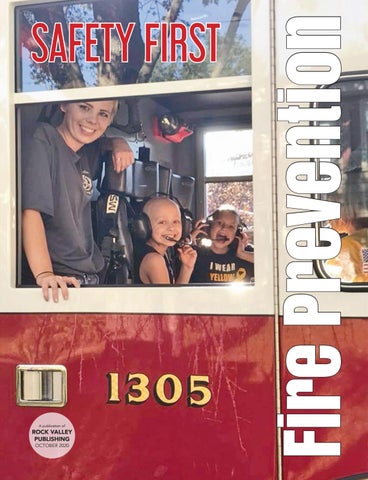
A publication of
ROCK VALLEY PUBLISHING OCTOBER 2020
Fire Prevention
SAFETY FIRST
Page 2
FIRE PREVENTION 2020
Fire Prevention Week inspired by Great Chicago Fire Since 1922, the National Fire Prevention Association has sponsored the public observance of Fire Prevention Week. In 1925, President Calvin Coolidge proclaimed Fire Prevention Week a national observance, making it the longest-running public health observance in our country. During Fire Prevention Week, children, adults, and teachers learn how to stay safe in case of a fire. Firefighters provide lifesaving public education in an effort to drastically decrease casualties caused by fires. Fire Prevention Week is observed each year during the week of Oct. 9 in commemoration of the Great Chicago Fire, which began on Oct. 8, 1871, and caused devastating damage. This horrific conflagration killed more than 250 people, left 100,000 homeless, destroyed more than 17,400 structures, and burned more than 2,000 acres of land.
Fire safety starts at home; What everyone needs to know
Is your home fire safe? Have you practiced what to do if ever there is a fire in your home? Do you have smoke detectors? Are they working? When was the last time you checked the batteries? We know that nothing is more important to you than your family’s safety. If you couldn’t answer “yes” to the all of the questions above, then there are things you can do today that will assure you and your family sleep safer tonight. It easy! And even if you answered those questions correctly, check below to make sure you’ve done all you can. Below are ten simple steps you can do today that will drastically improve the safety of your home, and assure that your family reacts correctly in the event of a fire. 10 Simple Steps to a Safer Home Take fire safety seriously! If you don’t, your children won’t! Make your “Family Escape Plan.” Create a simple, easy to understand escape plan, include two exit routes from every room, and a safe meeting place outside your home (like a tree, telephone pole, or neighbor’s home) where your family will gather once outside the home. Practice fire safety Your children know that if they want to be good at something, they have to practice. Fire Safety is no difference. Take time to practice your family escape
See FIRE SAFETY, Page 3
FIRE PREVENTION WEEK 2020:
Serve up safety in the kitchen
The National Fire Protection Association (NFPA), the official sponsor of Fire Prevention Week for more than 95 years, has announced “Serve Up Fire Safety in the Kitchen” as the theme for Fire Prevention Week, Oct. 4-10, 2020. NFPA’s focus on cooking fire safety comes in response to home cooking fires representing the leading cause of U.S. home fires, with nearly half (49 percent) of all home fires involving cooking equipment; unattended cooking is the leading cause of these fires. “Cooking continues to be a major contributor to the home fire problem,” said Lorraine Carli, NFPA vice president of Outreach and Advocacy. “The good news is that the vast majority of these fires are highly preventable. This year’s Fire Prevention
Week campaign works to better educate the public about where potential cooking hazards exist and basic but critical ways to prevent them.” Carli notes that this year’s focus on cooking safety is particularly timely. “As the public may continue to avoid restaurants for some time and opt instead to do more cooking and entertaining at home, the potential for home cooking fires will likely increase as well.” Key messages around this year’s Fire Prevention Week campaign, “Serve Up Fire Safety in the Kitchen” will include the following: * Keep a close eye on what you’re cooking; never leave cooking unattended * Keep anything that can catch fire — oven mitts, wooden utensils, food packaging, towels or curtains — at least three feet away from your stovetop. * Be on alert. If you are sleepy or have consumed alcohol, don’t use the stove or stovetop. For more information about Fire
Prevention Week and this year’s theme, “Serve Up Fire Safety in the Kitchen,” along with a wealth of resources to help promote the campaign locally, visit fpw.org. As all of us continue to navigate the evolving situation with COVID-19, NFPA remains committed to supporting you with the resources you need to minimize risk and help prevent loss, injuries, and death from fire, electrical, and other hazards. For information on NFPA’s response to the coronavirus, please visit our webpage.
About Fire Prevention Week NFPA has been the official sponsor of Fire Prevention Week since 1922. According to the National Archives and Records Administration’s Library Information Center, Fire Prevention Week is the longest running public health and safety observance on record. The President of the United States has signed a proclamation declaring a national observance during that week every year since 1925. Visit www.firepreventionweek.org for more safety information.
FIRE PREVENTION 2020
The true story of One spring day in 1950, in the Capitan Mountains of New Mexico, an operator in one of the fire towers spotted smoke and called the location in to the nearest ranger station. The first crew discovered a major wildfire sweeping along the ground between the trees, driven by a strong wind. Word spread rapidly, and more crews reported to help. Forest rangers, local crews from New Mexico and Texas, and the New Mexico State Game Department set out to gain control of the raging wildfire. As the crew battled to contain the blaze, they received a report of a lone bear cub seen wandering near the fire line. They hoped that the mother bear would return for him. Soon, about 30 of the firefighters were caught directly in the path of the fire storm. They survived by lying face down on a rockslide for over an hour as the fire burned past them. Nearby, the little cub had not fared as well. He took refuge in a tree that became completely charred, escaping with his life but also badly burned paws and hind legs. The crew removed the cub from the tree, and a rancher among the crew agreed to take him home. A New Mexico Department of Game and Fish ranger heard about the cub when he returned to the fire camp. He drove to the rancher’s home to help get the cub on a plane to Santa Fe, where his burns were treated and bandaged.
Rescued!
News about the little bear spread swiftly throughout New Mexico. Soon, the United Press and Associated Press broadcast his story nationwide, and many people
• Fire safety
Smokey Bear
Page 3
Orphaned black bear cub “Smokey II” was the second live representation of Smokey Bear from 1975 to his death in 1990.
Judy Bell helped her mother take care of Smokey.
Smokey cub sitting on a Piper PA-12 Super Cruiser.
SUBMITTED PHOTOS Fire Prevention
wrote and called, asking about the cub’s recovery. The state game warden wrote to the chief of the Forest Service, offering to present the cub to the agency as long as the cub would be dedicated to a conservation and wildfire prevention publicity program. The cub was soon on his way to the National Zoo in Washington, D.C., becoming the living symbol of Smokey Bear.
Smokey received numerous gifts of honey and so many letters he had to have his own zip code. He remained at the zoo until his death in 1976, when he was returned to his home to be buried at the Smokey Bear Historical Park in Capitan, New Mexico, where he continues to be a wildfire prevention legend. Smokey cub sitting on a Piper PA-12 Super Cruiser
In 1952, Steve Nelson and Jack Rollins wrote the popular anthem that would launch a continuous debate about Smokey’s name. To maintain the rhythm of the song, they added “the” between “Smokey” and “Bear.” Due to the song’s popularity, Smokey Bear has been called “Smokey the Bear” by many adoring fans, but, in actuality, his name never changed. He’s still Smokey Bear.
Every home should have a fire extinguisher Keep a fire extinguisher in a handy location. The best location is typically just inside a door or entrance, out of the reach of children. Avoid locating an extinguisher right next to where a fire could develop. Remember, a fire extinguisher is no substitute for the fire department, but it can be used to stop
a small fire from getting out of control. Know how to use it! It’s too late to learn once a fire has begun.
(Continued from page 2)
plan, making sure to have two exits from every room. Practice with your children several times, then allow them to do it by themselves to make sure that they fully understand what they should do if ever there’s a fire. Keep your home safe Fire safety is not a once-a-year exercise. It must be part of your daily focus. Just as important as knowing what to do in the event of a fire, it is just as important to take steps to assure a fire never starts, and if a fire does start, that your family will be alerted as quickly as possible. Install smoke detectors Statistics show that more than half of all fire deaths occur in homes with no smoke alarms, and nearly three quarters of fire deaths occur in homes without alarms or with non-functioning alarms. By placing smoke detectors in your home, you can increase the chances that all of your family gets out safely by 40-50%! Here are a few things to keep in mind: a) One in every room! It’s important that smoke detectors are located throughout your home, and most importantly, in every bedroom. b) Test them! Make sure the batteries are good and that the smoke detector itself is in proper working condition. Test your
smoke detectors once a month. c) Not sure? Replace them! If your smoke detectors are older, or if you’re not sure they are in proper working condition, think about changing them. Improvements to newer smoke detectors could provide a better level of protection to you and your family. Change batteries twice a year Most fire safety personnel recommend changing the batteries within your smoke detectors twice year. It’s a simple, yet powerful message, “Working smoke detectors save lives!” Can’t remember the last time you changed the batteries? Why take a chance? Change them now! Know that sound Make sure that all family members know and recognize the sound your smoke detectors make. An easy way to accomplish this is to make sure that you gather your family together each time you test your smoke detectors. The quicker you recognize that sound, the quicker you can react if ever there’s a fire. Keep a look-out for safety hazards in the home To many items plugged into one outlet, a shirt thrown over a lamp, a worn electrical cord; these are just a few examples of hazards within the home.
Be careful when cooking Make sure that young children never cook without proper supervision. And make sure to keep cooking surfaces clean to avoid grease fires. A majority of fires within the home begin in the kitchen.
Safety First Fire Prevention Awareness 2020
A publication of Rock Valley Publishing LLC 1102 Ann St., Delavan, WI 53115 • (262) 728-3411 EDITOR: ............................................................................Melanie Bradley CREATIVE DIRECTOR: .............................................................Heidi Schulz PAGE DESIGNER: ....................................................................Jen DeGroot ADVERTISING DIRECTOR: ................................................Vicki Vanderwerff FOR ADVERTISING OPPORTUNITIES: Call (262) 725-7701 EXT. 125
Page 4
FIRE PREVENTION 2020
Making a fire escape plan
A family escape plan needs to be simple and easy to understand. Children must be able to comprehend the information shown, so only include information that’s necessary to accomplish this goal. What to include: • Names of each room - (kitchen, bath, master bedroom, girl’s bedroom, Timmy’s room, etc.) • Two exits from every room - You should make every effort to include at least TWO escape routes from every room. In the event that fire blocks one exit
Fire can spread rapidly through your home, leaving you as little as one or two minutes to escape safely once the smoke alarm sounds. A closed door may slow the spread of smoke, heat and fire. Install smoke alarms in every sleeping room and outside each separate sleeping area. Install alarms on every level of the home. Pull together everyone in your household and make a plan. Walk through your home and inspect all possible exits and escape routes. Households with children should consider drawing a floor plan of your home, marking two ways out of each room, including windows and doors. NFPA PHOTOS Fire Prevention
Gilbank
CONSTRUCTION, INC
General Contractor
G TOWIN SINCE 1958
AND
356595
301 Scot Drive Clinton, WI (608) 676 2261
ERY OV RECBELOI T, WI
2212 Prairie Ave., Beloit, WI (608) 362-5377 501 Hemenway Pl., South Beloit, WI (815) 389-3032
route, a secondary exit becomes the difference between life and death. Your secondary, or alternate, exit can be another door or window. If using a window as a secondary exit, make sure the window is (1) easy for a child to open and (2) easy for a child to drop to the ground once outside. If the window is located on a second level or high enough from the ground to make impossible to drop safely, think about the purchase of a safety ladder. • Safe Meeting Place - A “Safe Meeting Place” is a designated location outside the home where your family will gather once outside the home. Choose your meeting place with these thoughts in mind: a) Proximity - safe meeting place should be close to the home, but not so close as to be in danger from the fire. Location, location, location” - It’s important that your safe meeting place is located in front of the house. It is very important that fire safety personnel easily see you as they arrive so (a) they will know you are out of the home, and (b) you will be able to quickly inform them if someone has not made it out of the house. c) “X marks the spot!” Pick a safe meeting place that will be easy to find whether it is day or night. The
best way to do this is by selecting a safe meeting place that is clearly marked by a non-moving item, such as a telephone pole, tree or neighbor’s front porch. Do not use anything that may move, such as a car, and avoid picking a location that will place you in the way of emergency personnel or equipment. The best Family Escape Plan will mean
very little if it’s not practiced! Together as a family, you should practice escaping from a fire at least twice a year. Practice your escapes from all rooms of the house. At the same time, you should be practicing Fire Safety Basics, going over the concepts of fire safety, including staying low when there’s smoke, getting out quickly, and once outside, staying outside.
Exceptional facilities with exceptional people make us the progressive leader in the open die forging industry.
WE’RE PROUD TO BE AN EMPLOYEE OWNED COMPANY.
AND RECOVERY TOWING BELOIT, WI SINCE 1958
24 HOUR TOWING SERVICE & RECOVERY
381568
105 Scot Dr., Clinton, WI 608-676-2288 www.scotforge.com
Visit to the fire station
356594
National Certified Drivers FULLY INSURED
Byron youngsters checked out an ambulance while visiting the Byron Fire Department. Area fire departments spend time all year teaching kids about safety issues. BYRON FD PHOTO Fire Prevention
FIRE PREVENTION 2020
Page 5
Smoke house
Firefighters are your friends
Byron firefighters taught their young guests about escaping the smoke house safely during a fire.
One of the lessons taught to young children is not to fear firefighters in their turn-out gear, so that they won’t fatally hide from them during a fire. PECATONICA FD PHOTO Fire Prevention
BYRON FD PHOTO Fire Prevention
STILLMAN VALLEY FD PHOTO Fire Prevention
SUBMITTED PHOTO Fire Prevention
Clockwise from top left: Stillman Valley kids toured the Stillman Valley Fire Dept. during last year’s Fire Prevention Week; Sparky the fire dog enjoys marching in parades and connecting with children; Youngsters from Winnebago got to see fire apparatus during a visit to the school by Win-BurSew firefighters.
WIN-BUR-SEW FD PHOTO Fire Prevention
Page 6
FIRE PREVENTION 2020
Recommended residential fire safety essentials
One of the most important steps in making your home fire safe, is to assure that you have the proper equipment installed. Below is a list of the most commonly recommended items that can help you and your family in the event of a fire. Smoke alarms/smoke detectors Each year in the United States, roughly 2,500 people die in home fires, with an additional 13,000 injuries. Most of these deaths occurred in homes that did not have a working smoke alarm. Smoke alarms provide early warning of fire, giving occupants a better chance to escape unharmed. The relatively low cost and lifesaving potential make the decision to buy and install smoke alarms an easy one. Standard Types 1) Battery Operated 2) Hardwired Battery Operated - Battery operated smoke alarms are inexpensive and easy to install. It is recommended that you change the batteries twice a year. Most battery-operated alarms work independently and will not trigger other alarms, while some models sync wirelessly with other alarms throughout the house. Some smoke alarms are offered with a 10year Lithium battery, eliminating the need to change batteries twice a year. Additional features that can be found in certain models include a safety light, wireless linking to another alarms in the house, and a voice alarm that helps awaken sleeping children. Some models also have a location feature that will actually tell you what part of the home is in danger. To see these features, including the “Child Awakening” models,
click here to visit FirstAlert.com. Hardwired - While typically slightly more expensive than battery operated models, hardwired smoke alarms are designed to be easy to install, easy to maintain, and can provide years of virtually maintenance-free protection. It’s important to note that laws in many states are requiring hardwired smoke alarms in all new residential construction. Sensor Type1) Ionization 2) Photoelectric 3) Dual Sensor The three types of alarms available today are ionization, photoelectric, and dual sensor (carries both ionization and photoelectric sensors). Ion alarms are triggered by moving particles, whereas the photoelectric responds to smoke. Bottom Line- Some reports show that ionization sensors may respond slightly faster to flaming fires, whereas photoelectric sensors may respond slightly faster to smoldering fires. For that reason, most manufacturers now offer a dual sensor model for added protection. Most manufactures also produce an alarm specifically recommended for kitchen use, utilizing the photoelectric sensor to reduce the frequency of false (nuisance) alarms. Carbon Monoxide alarms A carbon monoxide alarm, sometimes referred to as a CO detector, is a device that detects the presence of the carbon monoxide (CO) gas early enough to prevent carbon monoxide poisoning. Carbon monoxide, sometimes referred to as the “silent killer,” is a colorless and odorless compound
Piasa Leather & Saddle 5442 N. SECOND LOVES PARK, IL
815-877-5727
New & Used English and Western Saddles
Safety ladder Often overlooked, fire escape ladders are essential for any multi-level home. Escape ladders usually come in two and three-story models, and easily deploy from a standard windowsill. Escape ladder typically come folded for compact storage, but fully assembled and ready to use. Fire extinguishers With so many fire extinguishers to choose from, selecting the proper one for your home can be difficult. It’s just as important to have one in your home, as it is to ensure you have
the proper type of fire extinguisher. It is typically recommend that every home have one in the kitchen, the garage and workshop. We strongly recommend the use of a fire extinguisher should only be preformed by an adult who is trained on its proper use and maintenance. Traditional fire extinguishers Traditional Fire Extinguishers are divided into categories (Class A-D), based on different types of extinguishing agents used. Some are effective on ordinary combustibles (Class A), while others are more effective on flammable liquids, electrical wiring or cooking oils. We recommend looking for one that is specifically designed for home use, and rated for multiple kinds of typical household fires.
Protecting your valuables While you won’t find a fireproof lock box on everyone’s list of “must have fire safety items,” we’ve listed it for the potential value if ever your home is severely damaged by a fire. Losing everything can be hard enough without losing important documents and irreplaceable items. Insurance papers, birth certificates and other documents can easily be stored in the smaller lock box, as can items such as coins, stamp collections, family photos, jewelry and more. Bottom Line- It won’t cost you a lot to purchase one, yet it will be priceless to you if you ever experience a fire in your home. Please remember, none of these items will do you any good if purchased after a fire starts. You, and the lives of your family, are worth the small investment of time and money to improve the safety of your home.
A B C FIRE & SAFETY, INC. 2581 PARK AVENUE BELOIT, WI 53511 608-362-1634 SERVING YOU FOR OVER 50 YEARS
381187
Complete Repair of: Saddles • Tack • Coats • Purses, briefcases and related items
All-Tech Auto Service, Inc.
• Custom Goods • Belts • Holsters • Chaps • Leanin’ Tree Cards & Gifts
Just minutes from previous Darien location!
Leather Work and Repair We Repair Most Golf Bags Offering Boot and Shoe Repair 356721
produced by incomplete combustion. It is virtually undetectable without using a detection devise. Elevated levels of CO can be extremely dangerous to humans. CO detectors are designed to measure CO levels and sound an alarm before levels of CO become dangerous. Standard Types 1) Battery Operated 2) Hardwired 3) Plug-in with Battery Backup It is important to note that Carbon Monoxide Alarms are not smoke alarms, nor vice versa. * Combination Smoke/Carbon Monoxide Alarms 2-in-1 Protection Growing in popularity are the combination smoke and carbon monoxide alarms. Available in both battery operated and hardwired. While higher priced than a standard smoke detector, they price out typically less than buying two separate units, one smoke alarm and one carbon monoxide alarm.
Your Total Solution
301 Industrial Drive, Clinton, WI 53525 Don Rhode Jr., Owner
262-724-4000
Open M-F 7:30-5:00; Sat. by appt.
381562
How to prevent wild fires Learn what you can do to help prevent wildfires from starting. How to Stop Fires from Starting If you live in a wildfire-prone area you should follow our tips on how to prepare for wildfire – but also know that prevention is an important part of preparation. Because the “safest” wildfire is one that never starts, here are some tips on how to reduce the chance of wildfire from:
Campfires and bonfires
Only start a campfire or bonfire in an appropriate fire pit, cleared of all vegetation and ringed by stones. Never leave a fire unattended, such as overnight. Always make sure your fire is completely doused with water and smothered with dirt before leaving. Don’t start a fire on a windy day. Save it for another time.
Smoking
Dispose of used matches and butts in a closed container or cup of water. Keep lighters and matches out of the reach of children.
Yard waste or rubbish burns
Only burn yard waste or rubbish in a 50 gallon drum or fire pit (see campfire section for fire pit tips). Never leave a fire unattended. Always make sure your fire is completely doused or smothered with dirt before leaving. Don’t burn yard waste or rubbish unless it’s allowed by your municipality. Don’t burn anything highly combustible, including paper or fabric soaked in oil or gasoline. Don’t start a burn on a windy day. Save it for another time.
Fireworks
Have a bucket of water, garden hose or fire extinguisher handy. Consider wetting down the surrounding grass and other vegetation before lighting your fireworks.
Page 7
Never let children use fireworks, sparklers or fire crackers unsupervised. Never let children use fireworks, sparklers or fire crackers unsupervised. Don’t light fireworks on windy nights. Douse used fireworks with water to make sure they are completely extinguished.
Cars, tools & other combustion engines Don’t park a hot car or other machine in dry grass. Don’t allow gasoline or motor oil to spill on grass or other vegetation. Tractors, off-road vehicles and equipment being used in wooded areas, such as chainsaws, must have spark arrestors.
How to stop fires from spreading
Of course, even if we could eliminate all human-ignited wildfires, the danger would still exist due to natural factors such as lightning. Prevention efforts should also include techniques to stop a spark or lightning strike from becoming an uncontrolled fire. Fortunately, the way we plant and maintain the landscaping around our homes can reduce the chance that a small fire becomes a wildfire. Create a defensible space around your home by using the National Fire Protection Association’s (NFPA) zone concept. Choose fire-resistant plants. Consult a landscaper in your area or this state-by-state list of fire-resistant plants at the National Fire Protection Association’s Firewise website. Create empty space between shrubs and trees to reduce the chance of flames leaping between them. Prune trees above the height of bushes and shrubs (approximately 6’-10’ off the ground) and remove dead branches. Mow grassy areas regularly so that the grass is never more than 4” high. Remove dead and dry plants that could fuel a fire, as well as fallen leaves, pine cones, and other dry plant material.
The history of
the Maltese Cross
The badge of a fireman is the the Maltese Cross. The Maltese Cross is a symbol of protection . . . a badge of honor; it’s story and tradition is hundreds of years old. When a courageous band of Crusaders, known as the Knights of St. John, fought the Saracens for possession of the Holy Land, they encountered a new weapon unknown to European warriors. It was a simple, but horrible device of war, it wrought excruciating pain and agonizing death upon the brave fighters for The Cross. The Saracen’s weapon was fire. As the Crusaders advanced on the walls of the Saracens’ city they were struck by glass bombs containing naphtha. When they became saturated with the highly inflammable liquid, the Saracens hurled a flaming tree into their midst. Hundreds of Knights were burned alive. Others risked their lives to save their brothers-in-arms
FIRE PREVENTION 2020
from dying painful fiery deaths. Thus, these men became the first firefighters; and the first of a long list of courageous fire-fighters and first aiders. Their heroic efforts were recognized by fellow Crusaders who awarded each hero a badge of honor, a cross similar to the one firefighters wear today. Since the Knights of John lived for close to four centuries on a little island in the Mediterranean Sea named Malta, the cross came to be known as the Maltese Cross. The Maltese Cross is your symbol of protection. It means that the firefighter who wears this cross is willing to lay down his or her life for you, just as the Crusaders sacrificed their lives for their fellow man so many years ago. The Maltese Cross is a firefighter’s badge of honor, signifying that he or she works in courage, pride and honor - a ladder rung away from death.
Sparky the fire dog made an appearance at the Pecatonica Fire Dept.’s Chili Dinner. PECATONICA FD PHOTO Fire Prevention Week
Sparky the fire dog teaches kids about fire safety Every firefighter has been asked two questions: 1) Do you slide down a pole? and 2) Do you have a fire dog in your station? While it is uncommon to find them in the stations any longer, the history of the Dalmatian as a member of the firefighting force goes back over a century. When fire units were deployed using horsedrawn carriages, the Dalmatians would run ahead barking and warning people that the fire wagon would soon be rushing by. Others would settle in and run beside the wagon, helping to keep the horses calm as they got closer to the blaze. They would also protect the horses from attacks by other dogs and would then stand guard over the equipment while the firefighters did their job. They were brave, loyal, and dedicated to serve. They are a perfect mascot, and provide a fitting tribute for the fire service today. Sparky was created by the National Fire Protection Association in 1951 and has become the Fire Safety mascot of the Fire Service. Sparky is a Dalmatian who provides child friendly lessons on fire safety and, in so doing, honors the legacy of these loyal dogs as members of the fire service team. Do you remember the lessons of “Stop-Drop-And Roll!”? A common tradition in the fire service is that the rookie gets chosen to put on the costume, but when the Chief is willing to take on the role of Sparky, they set the tone for their firefighters that fire safety and prevention education is everyone’s business. This is the legacy of Chief Clover and many more like him who have dedicated their lives to making their communities safer places to live.
Page 8
FIRE PREVENTION 2020
Russell-Smith Insurance 519 S. Main Street Belvidere, IL 815-544-3461 Brandon Smith Insurance Agent
Jared Keating Walldog Mural
Insurance Agent
Bill Hueg
Cheryl Russell-Smith
WALLDOG DINER
Attorney & Insurance Agent
240 W. CHRYSLER DR., BELVIDERE
NORTH SIDE M C DONALD’S OUR ORIGINAL SITE
381243
1313 N. STATE ST., BELVIDERE
381082
PREVENT A FIRE TOMORROW BY SPARKING A CONVERSATION TODAY There’s no better time to talk fire safety than during Fire Prevention Week. Discuss fire safety with your family, make an escape plan, and test your smoke detectors to HARVESTING TODAY FOR A prevent a tragedy tomorrow.
WELL-FED WORLD TOMORROW Thanks to all the farmers who work long hours during harvest. We’re proud to offer the coverage they need to keep growing. Trust in Tomorrow.®
NT A FIRE RROW BY SPARKING A 323 Main St. | Pecatonica, IL 61063 | 815-239-1651 | DimondBros.com RSATION TODAY “Trust in Tomorrow.” and “Grinnell Mutual” are registered trademarks of Grinnell Mutual Reinsurance Company. © Grinnell Mutual Reinsurance Company, 2020.
| HOME LIFE during | HEALTH FARM | COMMERCIAL | WORKERS COMPENSATION | BONDS ter time toAUTO talk fire safety| than Fire|Prevention
381244