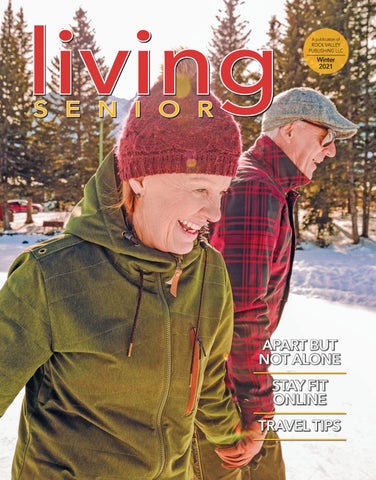
living
A publication of
ROCK VALLEY PUBLISHING LLC
Winter 2021
S E N I O R
APART BUT NOT ALONE STAY FIT ONLINE TRAVEL TIPS
LIVING SENIOR - WINTER 2021
DeVries wins BHS announces new executive director of foundation, marketing National and community relations Teaching Award
2
Jacqueline DeVries, retired Byron Middle School teacher and Rockford University adjunct professor, received the National Association for Gifted Children’s 2020 Community Service Award in a virtual Celebration of Excellence awards ceremony during the Jacqueline DeVries NAGC 67th Annual Convention held in Washington, D.C. on Nov. 15. Before retiring, Jackie worked as a mathematics teacher and taught math and reading for the academically talented program at Byron Middle School, as well as an adjunct professor in the Master of Arts in Teaching Program at Rockford University. She received several teaching awards. Jackie coached mathletes, helped start and coached academic bowl for middle school students, and developed and lead an academically talented advisory board. After receiving her master’s degree, she developed two classes at Rockford University about gifted children and education for teachers getting their master’s degrees. DeVries has received the Byron Middle School Educator of the Year award and was recognized by the ISPE Rock River Chapter for her 29 years of dedication to the MathCounts program. She previously received the ISPE Joint Honors Award for Illinois and the Rock River Chapter. While at Rockford University, Jackie received the Faculty Excellence in Teaching Award and was chosen to represent the university in a national Celebrating Service campaign. The National Association for Gifted Children annually presents the Community Service Award to an individual or group that has made a contribution that benefits the development of gifts and talents in young people. This contribution must affect the larger community, state, or nation and has made a significant contribution to education in a way that benefits the development of gifts and talents in young people.
Tami Kellerman joined Beloit Health System (BHS) on Nov. 30, as the Executive Director of Foundation, Marketing and Community Relations. Kellerman comes to BHS from Agrace Hospice and has over 20 years’ experience in the non-profit arena and organizational development. She has been instrumental in developing organizational initiatives to meet the needs of the community while fostering community partner relationships to identify new and emerging collaboration opportunities. She has held numerous leadership positions within the Stateline area, and currently serves on the Board of Directors for the YWCA of Rock County and as Vice President of the Rockford Network of Professional Women. Kellerman is a graduate of the University of Northern Iowa Tami Kellerman with a BS in Psychology and a minor in Journalism. She has her Master’s in Public Administration from Valdosta State University and is pursuing a certification as a Certified Fundraising Executive (CFRE), a distinction held by less than 6,000 nonprofit executives. Ms. Kellerman has three children and will be transitioning from her home in Loves Park, Ill., to the Roscoe/Rockton area. Her extensive professional experience will be significant in the BHS Foundation’s continued growth. “I am honored to be a part of a community hospital dedicated to providing the best care possible to our patients and their families,” commented Tami Kellerman. About Beloit Health System Beloit Health System is an independent community health system serving northern Illinois and southern Wisconsin. We offer world-class facilities and services to improve the overall health of the communities we serve with cornerstones for quality, engagement, integrity and patient satisfaction.
OSF HealthCare welcomes Dr. Alyssa Ceilesh OSF HealthCare is pleased to welcome Dr. Alyssa Ceilesh to its staff. Dr. Ceilesh joins OSF HealthCare as a doctor specializing in hematology and medical oncology with an office located at the Patricia D. Pepe Center for Cancer Care at OSF Saint Anthony Medical Center. Dr. Ceilesh received her Bachelor of Science in Biology from the University of Wisconsin Madison and her Doctor of Osteopathic Medicine from Midwestern University Chicago College of Osteopathic Medicine. Appointments can be made by calling 815-227-2273.
living S E N I O R
Dr. Alyssa Ceilesh
A publication of Rock Valley
Publishing LLC
1102 Ann St., Delavan, WI 53115
(262) 728-3411
EDITORS:...............................................Tracy Ouellette & Melanie Bradley CREATIVE/PRODUCTION DIRECTOR:.................................Heidi Schulz GRAPHIC DESIGNER:............................................................ Jen DeGroot ADVERTISING DIRECTOR:............................................ Vicki Vanderwerff
FOR ADVERTISING OPPORTUNITIES: Call (262) 725-7701 ext. 134
How to choose a safe, healthy
senior living community their health and safety protocols.” If you or a loved one are considering a senior living community, here are important safeguards to look for: • Mandatory social distancing in public areas – CDC officials and public health experts agree: Keeping people a minimum of six feet apart helps prevent the spread of COVID-19. • Mandatory facial coverings required in public areas – Face masks have been shown to reduce the spread of the virus, protecting both mask-wearer and anyone near that person from excessive exposure to airborne particles. • Mandatory regular COVID-19 testing for all team members, and testing for residents – Testing ensures that any infections are quickly identified so staff or residents who test positive can quarantine. • Required temperature and oxygen level checks for all residents, team members and guests – Elevated temperatures and decreased oxygen levels have been identified as common COVID-19 symptoms. • Proper hand washing encouraged throughout the day for residents, team members and guests – As with many viruses including colds and flu, frequent, thorough hand washing can reduce the spread of disease. • Frequent sanitizing of common areas
throughout the day – The presence of the virus on surfaces can be reduced by regular disinfecting. • Virtual tours encouraged – To limit visitors to a community, providing virtual online tours is essential.
Social and emotional well-being
One of the greatest challenges to retirement communities during this difficult time is the emotional and social isolation many residents are feeling. Look for locations that have amenities such as outdoor areas with walking trails, and have access to digital devices like tablets to stay in touch with friends and family. The Smiths agree that while they’ve had to remain apart from family right now, they’re still able to socialize to some degree. “We are so comfortable and enjoying the relationships we’re forming,” said Anita. “Two couples can do ‘socially distanced’ dining together, calling back and forth across the dining room. People are finding safe ways to communicate and socialize.” “And I’m a lot more physically fit than when I came here,” adds Stuart. “We do a lot of walking.” Exploring a move to a retirement community? Learn more at www. RetireAtBerry.com or call 706-784-7644.
The pandemic has many wondering if it’s safe to move into a retirement community at this time. Many of these communities have put in place additional safety measures to keep their residents healthy.
(BPT)
LIVING SENIOR - WINTER 2021
It’s understandable for anyone seeking a retirement community to have concerns about health and safety right now. Today’s unprecedented situation leaves many wondering – is it safe to live in a retirement community during a pandemic? The good news is, many Continuing Care Retirement Communities are taking extraordinary precautions to keep residents healthy, following up-to-date recommendations from the Centers for Disease Control and Prevention, plus local and state authorities. Recently retired couple Stuart and Anita Smith examined the measures being taken at The Spires at Berry College – a Continuing Care Retirement Community in Rome, Georgia – before making their decision to move in. Because Stuart is a retired physician, he looked closely at their health and safety protocols. He was happy to learn that they followed recommended CDC guidelines stringently, prioritizing the wellbeing of their residents. “The community was up front with us about how they were handling it – using masks, a lot of cleaning, safe dining procedures,” explained Stuart. “I think they’ve done everything really well, including daily temperature checks and not letting people bring guests or family members to visit now. I’m very confident in
STOCK PHOTO Living Senior
3
Retirement travel tips
LIVING SENIOR - WINTER 2021
that won’t break the bank
Retirement ushers in a new stage in life, one in which adults have ample free time to pursue their interests and hobbies. When eight or more hours per day are no longer allocated for work, those hours can be devoted to other pursuits. Retirees have the time to travel, and such exploration need not break the bank. A 2014 MassMutual survey found that 72 percent of respondents reported feeling quite happy or extremely happy in retirement. Being able to travel when and where they desire may be a big component of this happiness. A study by Virtuoso found that travel factors significantly into the lives of today’s seniors. They spend more on travel than any other generation – an average of $11,077 a year. Travel spending is at the highest among people between the ages of 75 and 79. Learning how to get the most bang for your traveling buck can help retirees make travel more affordable.
Avoid peak travel seasons
Many working families are restricted by school and work schedules, often limiting travel to summer and holiday breaks. The hospitality industry tends to raise their prices during these times of year. Retirees can travel any time they want. Booking trips during less busy times of year for tourism is a great way to save money.
Consider a rental agreement
Retirees who want to travel for many weeks or even months out of the year may want to think about renting their homes while they are gone. The money earned in rent can help offset the costs of travel.
Think about alternative living situations
Seeing the country and traveling most of the time may be more doable if retirees forego the house entirely and opt for different residences. Many recreational vehicles are large enough to be full-time homes. Simply park the RV in a new spot
Try a repositioning cruise
Cruising is a popular form of travel for seniors. Investopedia says cruise lines offer discount repositioning cruise trips when they need to move ships from one port to another, usually during the off-season. Unlike typical cruises where a ship will return to the port of origin, a repositioning cruise stops at several ports on the way and ultimately docks in a new end destination.
Find an inexpensive destination For the cost of staying at a popular family resort for a week, you may be able to stay for double or triple the amount of time for about the same amount of money elsewhere. Weigh destinations carefully and compare costs. Think beyond the “popular” destinations around the world.
Travel is a favorite pastime for retirees. Cost-saving strategies can make travel more budgetfriendly for seniors who want to spend more time exploring. STOCK PHOTO Living Senior
4
each month for a different perspective. House boats can be an option for the marine-minded.
(METRO CREATIVE)
Almost 42 million Americans identified as caregivers for an older adult prior to COVID-19. Overnight, it’s likely that millions more have joined their ranks. With COVID-19, there are added complications, notably physical separation. Some people are supporting older relatives who live far away while others may be close by, but are maintaining a safe distance. The goal is to maintain social closeness while also practicing physical distance. “As the primary caregiver to my parents, I know well that the ways we support the older adults in our lives have changed,” said Ray Spoljaric, CEO and Co-Founder of Aloe Care. “Caregivers are resilient, committed people and will go to any lengths to provide for those they care for. Now more than ever, communication and collaboration are key to providing the highest level of care.” If you’re a new caregiver, or concerned about COVID-19 for someone you support, consider these five tips from nationally recognized expert Amy Goyer:
Establish a care circle Identify the people who can help. It may be a combination of professionals, family members, and/or friends. Collect names, phone numbers, and email addresses of everyone in your Care Circle. This is also a good place to store elders’ information, particularly what you would need in case of an emergency (i.e., medications, pre-existing conditions, home access details). Stay connected Next, establish regular check-ins. With new physical distancing guidelines, social connection is more important than ever. Prepare a schedule of remote check-ins by the Care Circle. Consider leveraging technology in a solution like Aloe Care, which facilitates easy check-ins and care collaboration. Maintain medical care and support Telehealth is a rapidly advancing option for safe care. In fact, the Centers for Medicare and Medicaid Services recently expanded coverage and loosened policies and regulations regarding telehealth.
Many pharmacies have mail- order options and are expanding support for caregivers to manage medications. Cover the essentials Assess the food, household, and personal supplies the elders have at home and what they need to keep in stock. Many grocery stores now offer contactless delivery or pick-up. A quick online search should reveal the best local option. Additionally, the Area Agency on Aging’s Eldercare Locator is a great resource, as is Meals on Wheels. Well-rounded health While it may take some creativity during COVID-19, everyone needs stimulation physically, cognitively, and emotionally to maintain their well-being (including you, dear caregiver). Find ways to keep your loved ones and yourself active with technology, puzzles, letter-writing, exercises and more. For more advice and resources about remote caregiving, refer to the complete “Apart, Not Alone” guide by Amy Goyer.
While the coronavirus has complicated caregiving for older adults, there are still ways to make the job less stressful and keep loved ones safe. STOCK PHOTO Living Senior
(NEWSUSA)
LIVING SENIOR - WINTER 2021
Tips to help older adults stay apart, not alone during COVID-19
5
Army Veteran Felecia Dreher receives commendation from Roscoe VFW Post 295 By Jean Seegers REPORTER
Felicia Dreher graduated from Rock Valley Nursing School a year ago, and is now a medical surgical nurse at SwedishAmerican Hospital in Rockford. She has come a long way in her 31 years. Dreher graduated from high school at age 17, and, with her parent’s written consent, joined the U.S. Army. “I went into the service because it was a way for me to continue going to school,” she said. After completing six months of basic training, Dreher spent the next eight years as an ammunition’s specialist including combat duty in Afghanistan. Dreher received an honorable discharge earlier than anticipated when her mother, Sandy Lane was diagnosed with cancer. Felicia cared for her mother and organized fundraising events to help cover medical costs. “Felicia saved my life,” Lane
said. “She was with me the whole time I was receiving chemo treatments.” After returning home, Dreher enrolled in the Rock Valley Nursing Program and worked at the Roscoe VFW Post where she got to know several veterans and auxiliary members. “I enjoyed my time working there. Once Bill Graves found out I was a veteran, he wouldn’t leave me alone about joining the VFW,” she joked. On Dec. 15, veterans and auxiliary members gathered at the Roscoe Post to express their appreciation to Dreher for fighting in two battles: As a veteran defending our country, and as a nurse fighting the war against COVID-19. “You are a hero twice,” Commander Reuben Hernandez said as he presented her with a commendation and VFW membership.
Felicia Dreher is an eight-year army veteran who served in Afghanistan. She is also a registered nurse at SwedishAmerican Hospital. On Dec. 15, Roscoe VFW Post 2955 members and auxiliary presented Dreher with a commendation recognizing her as a hero for her military service and her service as a nurse fighting a war against the COVID-19 virus. Pictured are (L-R) VFW Commander Reuben Hernandez, Felicia Dreher and Bill Graves. JEAN SEEGERS Living Senior
PARK TOWER APARTMENTS
Rock On with SMTD’s TOKEN TRANSIT APP!
6
Your Preferred Choice for safe and affordable transportation serving the greater South Beloit, Rockton and Roscoe, IL area.
540 Clifford Avenue, Loves Park, IL 61111 815-654-7292 Age 62 and Older or Disabled Rent is based on income under the Section 8 Program Extremely low income persons are encouraged to apply Managed by Professional Property Management, LLC “An Equal Housing Opportunity Provider”
376521
“We’re Here To Get You There”
JOIN OUR TEXT LIST TEXT: SMTD TO: 36000
Phone: 815.624.7788 Ride Scheduling: 877.561.3330 E-Mail: info@smtd.biz Web: www.smtd.biz
387840
LIVING SENIOR - WINTER 2021
If you’re riding to appointments, shopping, visiting friends, going to church...wherever you need to go, download SMTD’s free Token Transit App today for safe and easy touchless fares on your phone! Download today from the Apple App store or Google Play store. Your ‘Ticket To Ride’ can also be purchased online or by calling 815-624-7788.
Long-time Village Clerk Lori Mitchell embarks on a new adventure Lori Mitchell is a legend.” Outside village hall, Administrator Richter referred to her as “the village’s greatest ambassador.” And to her, he said, “Your knowledge, organization, attention to detail and hard work have touched countless lives and we are blessed to have had the opportunity to work with you. We will miss you dearly. But we wish you all the best in your well deserved retirement.” He then announced her as recipient of the village’s Distinguished Service Award, with the inscription being read by the mayor. Additional best wishes came from trustees, other staff, Village Attorney Tom Green and Village Engineer Chris Dopkins. Also that week there was a remotely held retirement party plus get-togethers with friends in the community. In one of several poignant moments second-term Trustee Terri Bailey offered her congratulations and hopes for the future, saying she had known the clerk - her mother - for 49 1/2 years. Her involvement After taking office, Clerk Mitchell began the educational process of learning the functions of the Office of Village Clerk and Municipal Government. That effort resulted in her becoming an Illinois Registered Municipal Clerk (RMC), as well as an Internationally Certified and Master Municipal Clerk (CMC and MCI). Her name and reputation were known well outside the borders of the village. She represented Machesney Park by serving in many offices with the International Institute of Municipal Clerks (IIMC) and MCI, culminating with a two-year term as state president of MCI. In addition, she served for several years on the Illinois Municipal League’s Legislative Team, working alongside mayors and legislators from around the state to generate legislation that would benefit not only Machesney Park, but municipalities throughout Illinois. She was recognized several times by the Illinois legislators and was named both the Northwestern Illinois Municipal Clerk of the Year and, most recently, as the Illinois Municipal Clerk of the Year in 2017. In addition to all that, Mitchell was active in many area civic organizations including the Rock Valley Homeless Coalition, Rock Valley Credit Union Board of Directors, GPAC Senior Center Board and the Loves Park Chamber of Commerce. At the chamber, she coordinated volunteers for Young At Heart. She also served on the North Suburban Library District Local History Committee, as secretary of the Harlemites Alumi and Friends organization, president of the Lions Park Lions Club, as an elder and clerk of Session at Bethany Presbyterian Church and for the last 29 years as newsletter editor and CEO for Fishers of Men Prison Ministrues. Mitchell was planning to leave for her new winter home on Dec. 28.
LIVING SENIOR - WINTER 2021
L
ori Mitchell has been a resident of the Village of Machesney Park for a long time and over those years spent many years serving the public. For 20 years she worked for Harlem School District 122, coordinating staff and community relations. She retired in 2004 but after one year was back in the public arena, winning election as Machesney Park village clerk, a job she would keep for the next 15 years. Now it’s time for her to retire again and open a new chapter Lori Mitchell in her life, sharing the years that lie ahead between Arizona during the warmth of winter, then returning to her village home to be with friends and family in the summer. Her final village board meeting was Monday, Dec. 21, 2020. After announcing the winners of this year’s village-wide holiday decorating contest, she paused to thank family, residents and staff for the enjoyment she has had working for the people of Machesney Park. She wished everyone a blessed Christmas and a COVID-free New Year. The first of two hearty rounds of applause followed, with accolades for a job so well done being issued by the officials with whom she had worked for varying amounts of time. Mayor Steve Johnson said he and his wife, retired Parks Chamber of Commerce executive director Diana Johnson, had known Lori for 25 years. They were elected in the same year, 2005, she to a first term as village clerk and he as the village treasurer. “We have many fond memories of working together both here at village hall and at many community events,” he said, “including the Young At Hearts Festival in Loves Park; the Light Up The Parks parade; and various Parks Chamber of Commerce events and many more.” Both have offices in village hall and to her, Mayor Johnson said, “I will miss stopping by your office and seeing your smiling face. Please keep in touch.” Prior to his recent appointment as village administrator, James Richter II worked with Mitchell for four years as community development director. “Anyone who has had the pleasure of working with Lori Mitchell knows she is a strong, skilled, classy and professional lady,” he said. “It’s truly been an honor and a privilege to work with one of the most caring persons this village has ever seen.” “Each and every day I can count on Lori to set a positive tone in the workplace because she’s always happy,” he continued. “She’s always kind, and she’s always professional. In the world of municipal clerks, I assure you
7
Care options abound for aging in place CONTRIBUTOR
n the COVID-19 pandemic, home has been reinforced as the center of the universe for many of us. It’s evolved into our office. It’s doubled as our children’s classroom. It’s transformed into our vacation destination. And it continues to be where we eat, sleep and unwind every day. As the safest place we can be during an ongoing global health crisis, our homes have never been more central to our lives. For the oldest among us, this is only magnified, as eight out of every 10 COVID-19 deaths reported in the United States have been people 65 and older, according to the Centers for Disease Control and Prevention. Statistics like these underscore how vital practices such as social distancing and sheltering in place are for older adults. Fortunately, regardless of the pandemic, home is where most people want to be as they grow older. In fact, research conducted for Home Instead Inc., finds that 90 percent of older adults hope to age in place at home. But most can’t do so without help – 70 percent of older adults in the 65+ age group will need assistance at
I
some point. So how can we honor the wishes of older generations in the pandemic, keep them safe, and ensure they receive the care they need? The good news is that there are more options than ever for care for aging adults. Outside of the home, options such as retirement villages and senior apartments can provide a great deal of independence, particularly for those who are unable to age within their home. For those with specialized care needs that require higheracuity care, alternatives such as nursing homes and memory care facilities are worth considering. However, none of these alternatives can provide the flexibility and affordability of home care. Home care keeps people in the safety of their own homes and offers services that span the spectrum of assistance for older adults – from transportation and companionship to medication management and around-theclock care. If your loved one requires specialized care – whether rehabilitating from an injury or living with Alzheimer’s disease or other dementias – home care allows for a range of options to match your specific needs.
Full service dental office & great quality dentures Repairs, relines, partials and all things dental
LIVING SENIOR - WINTER 2021
8
815-969-0531 815-397-7370
3920 East State St., Rockford, IL 61108
www.strictlysmiles.com
Gregory Calleia DDS & Associates
Ask for help The pandemic has never made the need for a break more apparent among family caregivers. When considering available care choices, cost is certainly a factor that rises to the top of the list for most. Unfortunately, far too many people assume
See CARE OPTIONS, Page 9
Clinton Pharmacy
Sewing Center
Pharmacy • Gifts Soda Fountain
608-676-6092 242 Allen Street Clinton, WI • Service • Repair • New Machines Hours: Tues-Fri 10a-5p Sat 10a-2p
Free Delivery!
SENIOR CARE
238 Allen St. • Clinton 608-676-2700 • Rick & Ruth Graham •
370790
STRICTLY DENTURES & DENTAL
You can work with your provider to figure out the right fit. If you’re caring for a loved one from a distance, home care can provide peaceof-mind by simply having someone visit for a few hours, a couple times a week. Families can work with their provider to determine the appropriate level of care and stay closely connected to stay on top of changing needs. During difficult financial times, a team approach to home caregiving is an especially smart choice. Family members, friends, neighbors and providers can divide responsibilities to ensure your loved one is looked after. This is very important for anyone who feels overwhelmed by caring for a relative.
388005
By Lakelyn Hogan
ONLY BETTER
Senior Helpers stands ready to serve your family’s needs with personalized, in-home care and expertly-trained, professional caregivers.
815.395.8790 seniorhelpers.com/rockford
388004
All rights reserved. Senior Helpers locations are independently owned and operated. ©2018 SH Franchising, LLC.
388012
District 16 Illinois State Trooper Carl Heintz retires D
istrict 16 Illinois State Troopers Commander Carl Heintz worked his final shift last Thursday after announcing his retirement earlier this year. Heintz grew up, mostly in the Village of Winnebago, with the dream of becoming an Illinois State Police Trooper some day like his father. A veteran of the Persian Gulf War, in 1993 graduating from Western Illinois University and in 1995 he fulfilled that dream. In 1999 he took a transfer to Illinois State Police District 16 Pecatonica where he rose through the ranks to eventually become its commanding officer. He was promoted to the rank of Captain in September of 2018. “Integrity, Service, Pride” is what it says on their patrol cars and these are not just words to him. Capt. Heintz has always lived by these values, and personifies the true professionalism of our career. “God granted me my childhood dream of becoming an Illinois State Trooper and He has blessed me far beyond,” said Heintz. “Today will mark my final 10-42. I couldn’t be more proud to have served in the ranks with the finest professionals I know. Please continue to support our LEOs. They do their best to keep the wolves from your door. “I wish to thank my dad for inspiring me, my brother for an amazing partnership over the years, my mom for getting me through the good and the bad (she’s been praying for her Troopers since 1964) and Bryant for his unconditional love and support. May God bless and keep you safe from all harm. “
Retiring
Sergeant Glenn Heidenreich has retired after over 26 years with the Winnebago County Sheriff’s Office, The department wishes him, and thanks him for giving so much to the department and the community during his years of service. WINNEBAGO COUNTY SHERIFF PHOTO Living Senior
District 16 State Trooper Commander Carl Heintz and former Village of Winnebago Police Chief Todd Stockburger paused for a photo at a past Police Week at CherryVale Mall. SUBMITTED PHOTO Living Senior
(Continued from page 8)
resources such as Social Security and Medicare will pick up the entire tab. Beyond private pay or self-insurance, which are the most common ways people pay for care, long-term care insurance is a great option and, for those who qualify, Medicaid or Veterans Assistance could help. Before the pandemic, family caregivers were spending nearly $7,000 per year to care for an aging loved one by reducing savings for their own retirement or their kids’ education, delaying their own health care expenses and even taking loans or early withdrawals from their retirement nest eggs. COVID-19 has only exacerbated the situation. What these people are experiencing underscores the importance of planning ahead. But the truth is, only half of older adults have taken the time to do so. And the key to choosing the right approach for yourself – or a family member – is planning and discussing the alternatives before they’re even needed. (NEWSUSA)
LIVING SENIOR - WINTER 2021
• Care options
9
Will your kids squander their inheritance? Tips to prevent squabbles and sprees
W
ealth is wonderful for families to have, but it can be lost quickly if those handling the money aren’t prudent. It’s estimated that 70 percent of wealthy families will lose their wealth by the second generation, and 90 percent will squander it by the third, according to a study by the Williams Group wealth consultancy. Fortunes collapse because of family squabbles and other mistakes that could have been avoided with proper planning, says John Smallwood (www.johnlsmallwood.com), president of Smallwood Wealth Management and author of It’s Your Wealth – Keep It: The Definitive Guide to Growing,
Protecting, Enjoying, and Passing On Your Wealth. “Enduring wealth, the kind that transcends generations, boils down to teaching family members at an early age the principles of saving and hard work,” Smallwood says. “When these principles are emphasized, preparing the next generation for responsible financial management has a decent chance of being successful. “But strategically optimizing family wealth for generations also comes down to communication between the generations, and there seems to be a real disconnect between the generations when it comes to talking about wealth. And there is a fundamental misunderstanding of how to pass money well. Saving and protecting multigenerational wealth requires alignment among all family members.” Smallwood offers these three tips to help families protect
and grow their wealth across generations: * Open conversation between generations. Money is often a subject that families avoid, and as a result family members don’t understand how to protect and grow the wealth that has been worked for. “It requires open communication with family members, addressing topics that are personal in nature,” Smallwood says. “The successful families I’ve worked with over the years have had a willingness to be open with each other about the wealth that they’ve created. The more open the conversation, the better future generations will be able to avoid pitfalls and traps that place wealth under attack.” * Learn wealth-sustaining/ growing financial strategies. Smallwood emphasizes that preserving wealth from generation to generation is about education and the protection pieces that are put in place. That may require a financial planner, but with each generation having different financial philosophies and priorities, it’s first up to the parents to emphasize the importance for the next generation to sustain financial growth. “The baby boomer generation, much of which is now retiring, usually had steady jobs and an abundance of material niceties,” Smallwood says. “Since then, there’s a generation that has seen tremendous growth in incomes and lifestyles. Kids born into that lifestyle have become accustomed to it. But when those
kids try to leave the nest, they’re shocked to find out just how much money it takes to run a household.” * Pay special attention to tax ramifications. “Historically, estate taxes have been known to devastate wealth,” Smallwood says. “It’s impossible to know what the trends will be in the future. And maybe you’ve accumulated a lot of your own personal wealth, then inherit money on top of that. Then you could end up in a higher tax bracket. “With poor planning, you could be looking at 40 to 50% drains of wealth over multiple generations. Financial planners can help you be strategic and set up layers of asset protection – wills, revocable trusts, spousal lifetime access trusts, life insurance – in order to protect inherited money for you and following generations.” “Protecting wealth from all financial pressures should be the foundation of any wealth plan,” Smallwood says. “It requires consistency to stay up to date on new information, a family commitment, and work with a team of professionals. If the money is going to come to you, it must be managed properly so that it can be passed from one generation to the next.” About John L. Smallwood, CFP® John L. Smallwood is a senior wealth advisor (www. johnlsmallwood.com) and president of Smallwood Wealth Management.
LIVING SENIOR - WINTER 2021
Attentive Staff, Caring Friends
10
offers: • • • • •
385200
Individual apartment homes Private patios Kitchenettes, walk-in showers Full dining services Housekeeping & laundry service
Call 815-335-1800
• Emergency call system • 24 hour a day in-house caregivers • Social and recreational programs • Access to rehabilitation services
500 East McNair Rd. Winnebago, IL 386992
Family, friends host parade to celebrate Roscoe resident’s 85th birthday By Marianne Mueller REPORTER
irens rang out and lights began to flash in Roscoe on Sunday, Dec. 20 followed by a row of cars full of friendly, familiar faces; each who took part in a special parade to celebrate Janet Vogt’s 85th birthday. The parade was organized by Vogt’s children- daughter Mary Lewis along with her husband Rich; son Don Vogt; daughtern-law Cindie and son John Vogt who all were the first to arrive at the Vogt’s home to honor someone on their special day that is highly thought of every day. Invitations were sent out on a Facebook page for the event. This parade turned out to be a complete surprise. “My husband lured me down to the end of the driveway. He told me that the sign on my son’s car that is for sale in our yard needed more tape on it,” Vogt said. “As we were standing in the driveway one of the kids said, “Look down there; they are coming.” Her husband Paul promptly held up a sign out that read, “Honk, Janet Vogt is 85.” An additional sign sat in the front yard along with balloons attached to the mailbox alerting everyone that this was where the celebration was officially being held. Family and friends met up at Ledgewood School where the Winnebago County Sheriff’s Department, Harlem-Roscoe Fire and Roscoe Police Department led a row of around 30 plus cars to Love Road and past the Vogt’s home. Some decorated their cars by writing personalized “Happy Birthday” messages on the windows. Horns honked and with windows rolled down smiles were abundant, as well as lively hand waves, blowing kisses into the air, and warm birthday greetings spoken from different vehicles. These actions were matched with parade participants handing Janet flowers, and cards. “One of Mary’s neighbors made me a very nice quilt, “Vogt said. Birthdays that are close to the holidays are very common in the Vogt family. Janet’s fathers birthday was on Dec. 7, her brother’s birthday; Dec. 18, Janet’s son Don’s birthday is Dec. 18, granddaughter Taylor Lewis has a birthday on Dec. 21, and her grandmother’s birthday was on Dec. 29. Her daughter Mary was born on New Year’s Day in 1959. “Mary was the second baby born that year on this date,” Vogt shares. Janet Vogt was born on Dec. 20, 1935. She grew up in Sharon and in past years had lived in Roscoe. After she and Paul got married the Vogts moved back to Roscoe and have lived in the same house on Love
S
Janet Vogt’s family and friends took part in a surprise birthday parade on Sunday, Dec. 20.
Road since 1954. “Love Road is named after my great grandparents; my great grandmother was a Love,” Janet shares. She adds, “My grandmother was married to John Porter. The Porter family has long ties to the Roscoe community. “My Grandfather Porter lived off of Elevator Road.” Janet’s mother was a graduate of the Class of 1930 at Hononegah High School. In past years, Janet worked at VesleyWells and later worked as a mail carrier; delivering mail for the Roscoe Post Office where she did a rural route. Reflecting back on her time Janet used to carry caramel tootsie rolls in her Jeep to give to little kids on her route.
“When I retired, a box of Tootsie Rolls was left for me from the Tootsie Roll company,” Janet said. “I received a call that Tootsie Rolls had made it into the “Candy Hall of Fame.” Jaqueline Kennedy Onassis and Frank Sinatra both also were inductees into the Hall of Fame; both were super fans of this candy. Jackie O’ was said to have eaten miniature Tootsie Rolls while at work. It was said that Frank Sinatra ate Tootsie Rolls when he was traveling; He always had to have them.” In addition to the parade in Roscoe, relatives in Germany also organized a parade of a smaller scale in honor of Janet Vogt’s 85th Birthday celebration.
LIVING SENIOR - WINTER 2021
SUBMITTED PHOTO Living Senior
11
LIVING SENIOR - WINTER 2021
How expenses can change during retirement
12
Work is a major component of daily life, so much so that Andrew Naber, an industrial and organizational psychologist and an associate behavioral scientist at RAND Corp., determined that the average person spends 90,000 hours at work over the course of his or her lifetime. According to a 2014 Gallup poll, the average American retires at age 62, but roughly 64 percent of professionals bid farewell to the workplace between ages 55 and 65. Retirees must make a number of adjustments once they call it a career. No such adjustment is as significant as the financial one.
Most people find their post-retirement income is considerably less than when they were working full-time. That is why financial planners often recommend saving and investing enough during working years to be able to replace 80 percent of preretirement income. Certain expenses get lower after retirement, but some will rise. Here’s a look at what to expect when the bills come due during retirement.
Food costs
Food costs may go down in retirement because shopping and preparing meals for one or two people is much less costly than feeding a family of four or more. However, dining out may increase as you have more free time to visit local eateries.
Automotive costs
According to data from the U.S. Department of Transportation, the average commuter spends 25.8 minutes behind the wheel twice a day, and the average driver puts in 13,474 miles behind the wheel each year – with people between the ages of 35 and 54 clocking close to 15,000 miles. Less time spent in the car means fewer gasoline fill-ups and longer durations between oil changes and other services. In addition, based on the Internal Revenue Service reimbursement rate of 58 cents per mile, a typical commute of 20 to 30 miles a day costs $11 to $16 a day or $55 to $80 a week. In a year, you could easily be spending $2,000 to $4,000 a year
commuting if you live within 15 miles of your job. Without commuting, that cash stays in your pocket.
Taxes
Many people can expect to be done paying federal income taxes when they are retired and no longer earning an income. If the majority of retirement savings were in Roth IRA accounts, contributions are available for withdrawal tax- and penaltyfree at any age.
Housing
Your mortgage may be paid off before or soon after retirement. That eliminates the single largest expense in many people’s budgets. If your home will not be paid off, it’s possible to downsize to reduce monthly payments.
Travel
While many other expenses can go down, travel is one expense that can shoot up during retirement. But many people are happy to bear this cost. With more time for travel, retirees may allocate more funds toward vacations and other great escapes.
Health care
Seniors often see their health care needs and costs go up after retirement. It’s important to understand what is covered by health plans, and it’s equally important to set money aside for unforeseen medical expenses. (METRO CREATIVE)
Many costs of living decrease after retirement. However, it is wise to take in the whole picture to understand how to budget for retirement. STOCK PHOTO Living Senior
Neighbor’s Antiques hosting antique sale to benefit Serenity Hospice
N
An antique rocking horse is just one of the unique items to be sold during Neighbor’s Antiques close-out sale to benefit Serenity Hospice and Home.
Updates on Alzheimer’s research announced at year’s start While your eyes were laser-focused on COVID-19 last year – and rightfully so – there were noteworthy developments in Alzheimer’s disease research that you may have missed. Here are five: 1. The drug pipeline for Alzheimer’s is heating up. You may have heard of aducanumab, the Biogen drug currently being reviewed by the FDA, but there were other Alzheimer’s drugs that made strides this year. 2. Suvorexant, a drug that treats insomnia, was approved by the FDA in February for use in people with Alzheimer’s. Pimavanserin (Nuplazid), a drug that treats hallucinations and delusions in Alzheimer’s disease, was submitted to the FDA for review in June, with an anticipated decision by spring 2021. BAN2401, an anti-amyloid drug by Eisai and Biogen, is being assessed for the treatment of Alzheimer’s in a Phase 3 clinical trial that started in July of this year. A blood test for Alzhiemer’s is closer than ever. Breakthrough research presented at the Alzheimer’s Association International Conference (AAIC) 2020 in July found that specific markers in the blood may be able to detect changes in the brain 20 years before Alzheimer’s
symptoms occur. 3. Research explored the potential role of vaccines in reducing risk of Alzheimer’s. Data presented at AAIC 2020 found an unexpected benefit of getting flu and pneumonia vaccines: a reduced incidence and risk of Alzheimer’s disease. 4. A global study examining the long-term effects of COVID-19 on the brain was launched. Scientific leaders, including the Alzheimer’s Association and representatives from more than 25 countries, are working together with technical guidance from the World Health Organization to track the longterm impact of COVID-19 on the brain. 5. Genetic risk for Alzheimer’s may not mean the same for all races and ethnicities. The APOE-e4 gene variant is the most well-known and strongest genetic risk factor for Alzheimer’s disease, but that research has largely been done in people of European descent. New research published in November in Alzheimer’s & Dementia: The Journal of the Alzheimer’s Association found that APOE-e4 has a very different effect in Latinx populations, only adding significant risk in those of Cuban backgrounds.
SUBMITTED PHOTO Living Senior
‘Dr. David Gomel assumes role of Rosecrance President, CEO Rosecrance is pleased to announce that David Gomel, Ph.D., has assumed the role of President and CEO. Gomel has been with Rosecrance for 28 years, beginning as a counselor in adult substance abuse treatment. Since then, he has served in many roles, from supervisor at the former Alpine Campus to Regional President of Rosecrance, Dr. David Gomel Inc. He most recently was President and Chief Operating Officer during a yearlong transition to CEO. “On behalf of the Rosecrance Health Network Board of Directors, we are pleased to welcome David Gomel, Ph.D., as the new President and CEO of Rosecrance Health Network,” said Dan Pecora, Chair of the Rosecrance Health Network Board of Directors. “Dave’s commitment to excellence in compassionate care has been evident throughout his decades of service at Rosecrance. We have the highest confidence in Dave’s leadership not only through these unusual times, but in the years to come.” Gomel holds a doctorate in public policy and administration with an emphasis in nonprofit administration, a master’s degree in health service administration, and a bachelor’s degree in psychology. He has overseen the daily services at Rosecrance’s many treatment centers and the expanding organization for several years. “I’m grateful for the opportunity to lead the organization that has been a significant part of my life,” Gomel said.
LIVING SENIOR - WINTER 2021
eighbor’s Antiques is hosting a close-out sale and all proceeds benefit Serenity Hospice and Home. All items must go and the garage sale pricing will shock you! The sale will be Jan. 21-24 and 28-30 from 9-5 each day. Neighbor’s is located inside Conover Square shopping center in downtown Oregon (201 N. 3rd St.). Neighbor’s has been in business for more than 25 years and their inventory is varied and unique. The sale will include furniture, dishes, teapots, vintage items including purses and kitchenware along with many collectibles. Too much to mention, but all priced to sell. Neighbor’s is happy to be able to help Serenity Hospice during these unprecedented times when all of their other fundraisers have had to be canceled. Serenity is a nonprofit hospice serving nine counties in Northern Illinois and they have a hospice home located in Oregon. For more information and to see some photos of the items, check out Serenity Hospice and Home’s Facebook page or phone 815-7322499.
13
VOLUNTEER SAFELY during the pandemic
The global pandemic that begin in late 2019 and continued throughout 2020 changed many aspects of life as the world knew it, and that includes volunteering. Social distancing measures and stay-at-home mandates from state and local governments discouraged people from leaving their homes, while various health organizations warned aging men and women to stay home as much as possible. The Centers for Disease Control and Prevention notes that the risk for severe illness from COVID-19 increases with age. In recognition of that threat, many retirees who were heavily involved in volunteering prior to the pandemic were forced to cease working as volunteers, which could have a negative effect on their mental health as the pandemic continues. A report from the Mayo Clinic Health System noted that adults over age 60 experienced greater life satisfaction and greater positive changes in their perceived health as a result of volunteering. Many people have continued to volunteer during the pandemic, and those that want to do so can take these steps to make sure their efforts to give back are as safe as possible.
LIVING SENIOR - WINTER 2021
Speak with your physician first
14
Anyone, but especially seniors, who wants to volunteer during the pandemic should discuss those aspirations with their physicians prior to offering their services to charitable organizations. Doctors can discuss the acute and chronic threats posed by the COVID-19 virus and examine each individual’s medical history to help potential volunteers decide if working with a local charity is safe. In addition, doctors can check patients for COVID-19 symptoms and even have them tested to make sure
they won’t be putting anyone in danger should they decide to volunteer.
Contact the organization prior to volunteering
Some organizations may not be allowing potentially at-risk volunteers to perform inperson tasks. Contact the organization you hope to work with prior to signing up to confirm your eligibility, but also to discuss the safety protocols they’ve put in place to protect the health of their volunteers.
Monitor your own health
If you’ve signed up to volunteer, it’s vital that you monitor your own health. Health officials believe the COVID-19 virus has spread so rapidly for a number of reasons, including the likelihood that many people have had the virus but shown no symptoms. Charitable organizations will no doubt assess the health of each volunteer when they
show up to work, but volunteers also should make such assessments on their own. Check your temperature each day and familiarize yourself with the symptoms of COVID-19. If you suspect you are unwell or are even slightly under the weather, contact the charity and tell them you won’t be showing up that day. Operating with an abundance of caution during the pandemic can save lives.
Consider virtual volunteering
Virtual volunteering is a safe way to give back that won’t expose volunteers or others to the COVID-19 virus. Charitable organizations need behind-the-scenes help just as much as they need volunteers with their boots on the ground. Virtual volunteers can help with fundraising efforts and event planning, but also help charities overcome the logistical challenges of operating and meeting their missions during the pandemic.
Prior to volunteering during the pandemic, prospective volunteers can follow numerous steps to ensure volunteering is safe, both for them and the people they’re trying to help. STOCK PHOTO Living Senior
(METRO CREATIVE)
‘Alexa, check on Mom’
This year, more Americans are providing ongoing caregiving, with many having started their role as caregiver since the COVID-19 outbreak or providing care specifically because of the pandemic. Caregivers are looking to strike that balance between ensuring their elderly friends and family are safe and healthy while letting them maintain their independence. Yet, the need to limit contact by social distancing or self-quarantining has disrupted the ability to provide the hands-on care our loved ones deserve. For that reason, families are looking for ways to help make remote caregiving easier. There’s now an option for both the family member providing support and their loved one leveraging the simplicity of Alexa. The Care Hub helps families stay connected, no matter if they’re 3 or 3,000 miles apart. And, it’s available on Alexaenabled devices that many customers already have, like Echo Dot and Echo Show. Once set up and approved by both the family member and loved one, they both simply go about their day as normal.
The family member can get alerts and use the Alexa app to see their loved one’s recent activity at a high-level, so the aging loved one still has privacy while the person providing support has the information they need in order to know their loved one is OK. And their loved one has the added comfort of knowing they can ask for help at any time by just asking Alexa. Here’s a quick look at how the Care Hub works:
It alerts you when something’s amiss
As the person providing support, you can set up alerts to get notifications when your loved one has their first interaction of the day with Alexa, or if no activity is detected by a designated time, such as 10 a.m.
Non-intrusive visibility
The goal of creating Care Hub was to give people only a high-level view of their loved one’s activities. When you look through the activity feed of the Care Hub, it shares only the basics. If your loved one streams a movie, asks for information or listens to music, you can see they were using Alexa for Entertainment or Information, but it won’t reveal the details like what your loved one asked Alexa. And, the loved one can always view
this same information from the Care Hub in their Alexa app, too.
Convenient connection
When both parties have an Alexaenabled device and grant permission to connect via the Care Hub, staying in touch is easy. With the Care Hub, you can initiate a hands-free call over morning coffee or use the Drop In feature as a two-way intercom for a quick check in. Daily contact is effortless.
Help is just a call away
Care Hub makes it easy to access help when your loved one needs it. As part of the Care Hub set up process, they can enable Alexa Communications and select you as their emergency contact. If your loved one selected you as their emergency contact, when they simply say, “Alexa, call for help,” you’ll get a call on your Alexa-enabled device, and you’ll also get a text and push notification sent to your phone. So even if you’re out and about, you’ll know your loved one has reached out. Care Hub is free of charge and is available with the Alexa app. To learn more, visit amazon.com/carehub.
Care Hub on Alexa offers a simple, unobtrusive way to care for loved ones remotely and stay connected at a time when many of us are not able to be with the ones we love. STOCK PHOTO Living Senior
(BPT)
LIVING SENIOR - WINTER 2021
Care Hub allows families to care for loved ones at a distance
15
be free to simply love LEAVE THE CAREGIVING TO US
• Compassionate team specifically trained in advanced dementia care and our innovative MOSAIC philosophy • Warm, loving home designed to support those with dementia through all stages • Tailored activities to enhance life and give daily moments of joy with exercise, creative, sensory, and cognitive therapy
LIVING SENIOR - WINTER 2021
• Personalized managed care with a high caregiver ratio
16
Call 608-295-2764 today for a personalized tour. Wisconsin-based, family-owned with homes located in Beloit, Clinton, Monroe, Stoughton and more! 382213