Historical Burlington A glimpse back at the city and its origins
Published by the
2021
Burlington through the years
Page 2
HISTORICAL BURLINGTON
2021
By Tracy Ouellette EDITOR
Before pioneers began to settle in the Burlington area, Native American tribes moved through the trails that passed through the western section of what is now Racine County. Some of those trails led to Mukwonago, which had a significant Native American settlement. There was also a small Potawatomi village somewhere in Burlington Township in 1830 along with Big Foot’s village at the west end of Geneva Lake. While there were scattered farms and settlements in the very early 1830s, it after the Black Hawk War of 1832 when settlers began to move into the Burlington area. The war itself wasn’t the reason for the pioneer movement, but the national attention it garnered after newspapers on the east coast printed descriptions of the area and it’s beauty and possibilities for industry in the Rock River valley. The area was widely advertised in books and pamphlets and attracted immigrants by the droves. With Burlington on the White and Fox rivers, it was the potential of waterpower that drew many settlers looking to run saw and gristmills. According to the Burlington Historical Society website, the first “jack-knife” claim in the area was made around Dec. 15, 1835, when Moses Smith and William Whiting carved their names and date on trees near the old Standard Press building on North Pine Street. They returned a couple of weeks later with Lemuel Smith and Benjamin. The men built a shanty on the east side of the Fox River in what is now Wehmhoff-Jucker Park, while they explored the area looking for waterpower sites and farming land. In 1836 Daniel Rork made a claim to land on which much of the early settlement was built, selling the claim later to Silas Peck. During the summer of 1836 there were numerous “Yankees” who came to settle from New England, via the Great Lakes. Up until this point, the area, while part of the United States, was considered ungoverned wildness. On April 20, 1836, the Wisconsin Territory was established by Congress. This land included the area, which formed the states of Wisconsin, Iowa, Minnesota and much of the Dakotas. Milwaukee County included the present Racine, Kenosha, Rock, Jefferson, Waukesha, Walworth and Milwaukee counties and parts of Green, Dane, Washington, Ozaukee, Dodge and Columbia counties. Racine County, which also included Kenosha County at the time, separated from Milwaukee County on Dec. 7, 1836. It was also a year for wild land speculation with speculators looking for cheap land to become possible village sites or divided into lots to be sold for high profit. Claim jumping was frequent in 1836 and so were land disputes. On June 6, 1838, a mass meeting was held in Racine to organize the Settlers Claim Society. A constitution was adopted to settle disputes and protect legitimate claims. The society also acted against claim jumpers, which sometimes led to violence. One such incident was named the “Battle of Burlington” where about a dozen pioneers took part in the fight. No one was seriously injured, but there was shooting and an axe-wielding pioneer. In 1837 Moses Smith was appointed postmaster of the settlement, then called Foxville. Mail was taken once a week from Racine to Mineral Point. Smith distributed the mail from his log cabin. YEARS • CONTINUED ON PAGE 7 from top: This 1898 photo of the east side of Pine Street from Chestnut Street to Geneva Street (now known as Milwaukee Avenue). The buildings from right to left are Veteran Saloon (now site of May’s Insurance), Bankes Building (now gia bella flowers and gifts), The Exchange House (replaced in 1902 with the Hotel Burlington) and the Keuper Building (now John’s Main Event.); In October 1913, the citizens of Burlington gathered for the dedication of the 8-foot-tall statue of Abraham Lincoln giving his second inaugural address in 1865. The creation of sculptor George E. Ganiere it is located on a triangle of land at State and Kane streets; Constructed in 1840 this building was the first schoolhouse in Burlington. Originally located between Pine Street and Dodge Street near Madison Street. It is now known as Whitman School and was moved by the Burlington Historical Society to Schmaling Park in 1966. The Rev. L.A. Pettibone is pictured in front of the school. PHOTO COURTESY OF BURLINGTON HISTORICAL SOCIETY Historical Burlington
Preserving the area’s history 2021
HISTORICAL BURLINGTON
Page 3
HISTORICAL SOCIETY IS THE KEEPER OF ARTIFACTS AND RECORDS By Sandra Landen Machaj CORRESPONDENT
he Burlington Historical Society was founded in February 1928 when a meeting of citizens concerned about “collecting and preserving the historical records and artifacts pertaining to the Burlington area,” met under the chairmanship of Otis Hulett, who was the Burlington correspondent for the Racine Journal newspaper. Antoinette Meinhardt Fulton, was elected president. Hubert Dockett became the first vice-president, while Augusta Nelson served as both secretary and treasurer. Initial membership numbered 105. This was the first historical society to be formed in Racine County. A variety of items were donated to the Historical Society, each unique in its own way. A Lincoln campaign pin, ledgers from an early Burlington store, a powder horn, and a bottle of paper bullets donated by the last living Civil War veteran from Burlington. By April the collection of accessioned items had reached 208. “Today the Society has over 8,500 items in their collection,” said Don Vande Sand, vice-president and historian of the Burlington Historical Society. “There are so many items that they cannot all be displayed at one time in the museum.” The Burlington Historical Society was not only acquiring historical items, but in April of 1928 it hosted its first program – the history of the Native Americans who made their home in this area. The Indian mounds found in the downtown area of Burlington, the arrowheads that have been collected by the museum and life of the Pottawatomie Indians who inhabited the area were important to share. The society has continued to present historical programs with positive attendance by members. “At our last in-person meeting before the pandemic, in December of 2019 over 80 people attended,” Historical Society President Julie O’Neill said. “We always have good attendance for our meetings and programs. To accommodate the number of members attending the general meetings, they are always held at Veterans Terrace where there is sufficient room for everyone.”
Housing the society
Finding a home for the society was important. In October 1928, the Burlington School Board allowed a room to be used to display the artifacts at the Conkey Street School. In 1929, a display case was in place in the library. The school was renamed Cooper School in 1940 and it would not long be the home of the Historical Society. In
PHOTO COURTESY OF BURLINGTON HISTORICAL SOCIETY Historical Burlington
SANDRA LANDEN MACHAJ Historical Burlington
1947, with school enrollments increasing, the Historical Society lost their use of the schoolroom as it was needed for classes. With no home for the Burlington Historical Society, interest dwindled but they did not give up. The 1960s showed an increase in the activities of the group. They were excited HISTORY • CONTINUED ON PAGE 4
top: The Pioneer Log Cabin in Wehmoff Square is open and welcoming visitors in this 2017 photograph. The Log Cabin is open to visitors from May through October on Thursdays and Saturdays. Check with Burlington Historical Society for current hours. bottom left: The Burlington Historical Society Museum is located at 232 Perkins Blvd., Burlington. Since the 1960s this has been the home of the museum. The church building was purchased by Mrs. Fulton and donated to the Historical Society. bottom right: The two-wheeled velocipede with its large front wheel and small rear wheel was a favorite in the late 1800s and early 1900s. It was difficult to ride as the seat was so far from the ground. The large lighted, mortar and pestle, symbol of the pharmacy on the right could not easily be missed.
SANDRA LANDEN MACHAJ Historical Burlington
Historical Burlington 2021 A glimpse back at the city and its origins Published by Southern Lakes Newspapers LLC 1102 Ann St., Delavan, WI 53115 • (262) 728-3411 Editor:....................................................................... Tracy Ouellette Creative/Production Director: .......................................Heidi Schulz Advertising Director: ........................................... Vicki Vanderwerff For advertising opportunities, call (262) 725-7701, ext. 134.
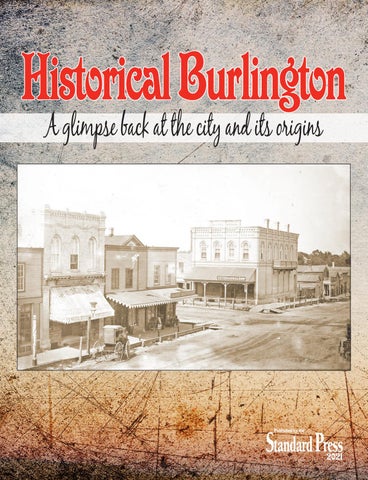
On the cover: Downtown Burlington looking northeast toward the corner of Chestnut and Pine streets in 1889. Denninston Drug Store, Stang Boot and Shoe Shop, Reuschlein’s General Store and Veteran Saloon can be seen in this photo. (Photo courtesy of the Burlington Historical Society)
Page 4
HISTORICAL BURLINGTON
HISTORY
2021
• CONTINUED FROM PAGE 3
to receive the donation of the old Holy Cross Lutheran church building on the corner of Jefferson Street and Perkins Boulevard. Mrs. Fulton had purchased it when the Church community moved to a larger space down the street and donated it to the Historical Society in 1964. Turning the building from a church into a museum required a lot of work by the volunteers. The church kitchen was revamped into a turn of the century style kitchen complete with a stove from that era and a wooden icebox, providing a step back to that time, for visitors. A variety of other exhibits were arranged by the volunteers. Many of them providing insight into the early businesses of Burlington. The items, from Indian arrowheads to a telephone switchboard, provided for a number of displays to truly bring the history of the area to the community. The Historical Society is fortunate to have the help of the Burlington Area Garden Club with advice from the Kenosha Racine Master Gardeners, to keep the Legacy garden on the museum grounds and one at the log cabin beautiful and blooming.
Log cabin on the square
“In addition to the museum, the society also is responsible for the log cabin in Wehmhoff Square, just a block away,” O’Neill said. The log cabin began its life on a farm and was moved a number of times. Moving the cabin from Echo Park required that the cabin be carefully dismantled, moved to the new location
This turn of the Century kitchen (1800s to 1900s) displays a stove that required wood to heat it for cooking, and on the other side of the room a wooden icebox where the iceman would deliver the amount of ice ordered to keep the food cold. Note the wall phone next to the door. SANDRA LANDEN MACHAJ Historical Burlington
and rebuilt, a job undertaken by the Historical Society. Once rebuilt, the log cabin required extensive cleaning, repair and then the society furnished and decorated it. The gardeners again planted a garden as the family would have had in the days of the cabin, flowers and vegetables intertwined
on the same plot. “The cabin is now open to the public from May through October on Saturdays from 10 a.m. to 2 p.m. on Thursdays to coincide with the Farmers’ Market, which is open from 3 p.m. to 7 p.m.,” O’Neill said. A third building, also under the care of
the Historical Society is an 1840s brick schoolhouse, the first school building built in Burlington. It was about to be razed, but the society began a fundraising drive to move the building to Schmaling Park. Here it was restored as a one-room schoolhouse and tours of school children are held to experience what school was like in 1840. “We are a unique organization in that we also have a cemetery under our care,” O’Neill said. “The Joseph Rooker family cemetery on Spring Prairie Road with approximately 12 to 13 graves was turned back to Burlington. We now care for it.” In the archives of the Historical Society are negatives from the photographs of the Standard Press and the Free Press, which have been donated. There are also past editions of the Standard Press also donated by the paper. The Burlington Historical Society is an active group that has kept the history of Burlington intact and available to the community. Like many volunteer organizations they are dependent on their members to further their work. Because of the coronavirus pandemic, many programs were put on hold and their work has been spent updating and deep cleaning their collections. The Burlington Historical Society is at 232 N. Perkins Blvd., Burlington. The museum is open Sundays from 1 to 4 p.m. and during the week by appointment. Visit them online at burlingtonhistory. org or find their Facebook page for updates on the Historical Society’s activities.
COMMUNITY SHRED DAY Saturday, May 1st from 10am-12pm
Come to the parking lot at our Burlington Location. 241 East Jefferson Burlington, WI
Greenwoods State Bank is committed to our Burlington community, and we join in celebrating its rich history.
241 East Jefferson | Burlington, WI 53105 | 262-767-8600 | greenwoods.bank 393751
2021
HISTORICAL BURLINGTON
Page 5
Slaves found area pipeline in Underground Railroad Abolitionists guided them to freedom By Jason Arndt STAFF WRITER
B
efore the Civil War, the Underground Railroad served as a thoroughfare for runaway slaves who risked their lives, often traveling thousands of miles, to escape their abusive Confederate owners. Along the way, they found abolitionfriendly residents and “conductors” who guided them to safety, including many in southeast Wisconsin. Caroline Quarlls, then 16, according to the Wisconsin Historical Society, was the first Underground Railroad “passenger” to set foot in Wisconsin around 1842. “She traveled by steamboat to Alton, Illinois, and then by stagecoach to Milwaukee, where she arrived in early August, 1842,” the Wisconsin Historical Society wrote in an essay. “Pursued by agents of her owner, she was hidden by a series of sympathetic abolitionists in Milwaukee, Pewaukee, Waukesha and Spring Prairie.” Lyman Goodnow, one of the abolitionists, brought her to a Town of Spring Prairie farmhouse. Meanwhile, around that time, Dr. Edward Dyer from Burlington visited a nearby friend in the township and heard Quarlls took shelter. Goodnow, according to the Burlington Historical Society, recounted Dyer’s insistence on meeting with Quarlles, whose name was spelled Quarles in some records. “We could not keep the Doctor from seeing the girl; so we all went down to where she was, and held another consultation, when it was decided I should take Mr. (Richard) Chenery’s buggy and
Lincoln School, now the Burlington Area School District offices, commemorates Dr. Edward Dyer’s contributions to the community and notes his strong advocacy. Dyer, whose name adorns Dyer Intermediate School, once lived in a home across the street from Lincoln School on State Street. JASON ARNDT Historical Burlington
harness, and continue the journey to safety and freedom,” Goodnow recounted, adding Dyer raced back to Burlington to gather necessities such as food and money to take on the journey. Three weeks later, after traveling through Illinois, Indiana, Michigan, Goodnow ushered Quarlls to freedom in Ontario, Canada. “After crossing the Detroit River, Caroline began crying, and clutched me by Dr. Edward Dyer the arm, asking if it was possible that she was being taken back to St. Louis,” Goodnow remembered. “I talked and explained, but it took some time to clear her mind, that side of the river appearing to her like the country across from St. Louis. I left Caroline with Rev. Haskell, or at his house. He was a missionary at Sandwich, Canada.” Quarlles later learned how to read, married another former slave named Allen Watkins, and lived in Ontario until her death in 1892. She had six children, three boys and three girls, and many grandchildren. Quarlls, however, wasn’t the only slave who passed through Southeast Wisconsin. According to historical records, Joshua Glover and even Frederick Douglass were among the hundreds. Guiding Glover In 1852, two years after Congress passed the Fugitive Slave Act, which allowed slaves to be recaptured and brought back to their owner, Joshua Glover escaped his owner in St. Louis and headed north by foot to Wisconsin. “Wisconsin was a free state where there
Joshua Glover, an escaped slave, was transported from a Town of Spring Prairie farmhouse to the City of Racine harbor, where he jumped aboard a ship heading to Canada. JASON ARNDT Historical Burlington
were was no slavery. It must have taken weeks to get from St. Louis to Racine, Wisconsin on foot,” states an essay from the Wisconsin Historical Society. “Soon after he arrived, Joshua got a job, found a place to live, made some friends and settled down. He was finally free.” Two years later, however, his slave owner Benammi Garland found out Glover was living in Racine. Garland, and a U.S. Marshal, then
arrived to the City of Racine, where they captured Glover and transported him to the Milwaukee jail. The capture, according to the Burlington Historical Society, reignited memories of Quarlls journey to freedom. Chauncey C. Olin, his conductor, recalled Glover’s capture and the physical abuse he sustained.
RAILROAD • CONTINUED ON PAGE 6
There really is someplace like home...
SENIOR LIVING
& Arbor View Memory Care Assisted Senior Living at its Best!
34201 Arbor Lane, Burlington (2.5 miles south of Hospital on McHenry Street)
262-539-2728 Tours available 7 days a week. Call Today! 393595
Page 6
HISTORICAL BURLINGTON
2021
RAILROAD
for Every Occasion... Family owned Since 1987 Steve & Julie Nelson
Burlington Dairy Queen 393755
324 S. Pine St., Burlington • 763-9385
• CONTINUED FROM PAGE 5
“He was captured by his master in Racine, brought to Milwaukee and thrown into jail without warrant or authority of any kind,” Olin recounted. “Even the United States Marshal for the State of Wisconsin lent himself to the dishonorable act of going personally to Racine and capturing Glover while at work trying to earn an honest living.” Glover, according to Olin, resisted arrest and required physical force before being brought to jail bloodied, bruised and covered in dirt. Sherman Booth, an abolitionist, and several others responded by storming the jail the following morning with a battering ram to set him free. Olin said the actions of Booth and others in Milwaukee showcased humanity. Additionally, according to Olin, the Racine County Sheriff issued a warrant for the arrest of Garland and the U.S. Marshal for assault and battery on Glover. Glover, taken by buggy to Waukesha to hide, was then brought through Rochester to Racine, where conductor Olin left him with Rev. M.P. Kinney to await a safe means to travel to Canada. “Because no boat was immediately available (the Great Lakes not yet being opened for the shipping season), Glover was taken from Racine to Spring Prairie, near Burlington, where he stayed for ‘some weeks’ before being returned to Racine and placed aboard a ship that took him to Canada,” the Burlington Historical Society states. Historical records indicate State Sen. J.C. Mills and Rep. Samuel Pratt harbored Glover in Spring Prairie. Meanwhile, Booth challenged the Fugitive Slave Act before the State
Supreme Court, which declared the law unconstitutional in 1855. Wisconsin became the only state to find the act unlawful. The U.S. Supreme Court, however, overturned the state’s decision and Booth was later convicted and imprisoned by federal authorities until President James Buchanon granted him freedom in 1861. As for Glover, he lived the rest of his life in Ontario, where he started a family and found a job. Glover died in 1888 at the York County Industrial Home in Haymarket, Ontario. Douglass addresses Burlington The Civil War lasted from 1861 until 1865 when Union soldiers declared victory against southern Confederates. Midway through the Civil War, President Abraham Lincoln signed the Emancipation Proclamation, which freed all slaves in southern Confederate states. Lincoln was later assassinated in 1865 by John Wilkes Booth in Washington. Human rights leader and former slave Frederick Douglass, according to the Burlington Historical Society, delivered an 1866 address on Lincoln’s assassination at current day Church of Nazarene in Burlington. History teacher Dan Meddaugh, of Catholic Central High School, wrote in a letter to this newspaper Douglass also lauded local abolitionists for their passionate activism. “..the great orator Frederick Douglass spoke to the citizens of Burlington praising them for their activism, yet challenging them to continue the fight,” Meddaugh wrote.
1 1 5 Y E A R S S T RO N G !
Reineman’s
Your Burlington Neighbor Since 1906 Hardware, Gifts, Housewares, Paint, Plumbing, Electrical, Automotive, Small Engine Repairs, Sporting Goods, Pet Supplies, Outdoor Power & Patio, Firearms, Gunsmith, Lawn & Garden, Rentals SEE US FOR ALL YOUR NEEDS DID YOU KNOW… If consumers shift just 10%
of their purchases from the big boxes to local hometown stores, an additional $1.3 Billion would stay in hometowns across the nation each year?
VISIT OUR WEBSITE:
www.reinemans.com BEHIND EVERY PROJECT IS A V ISIT O UR WEBSITE AT:
w ww.tru evalue.com/reinemans
BURLINGTON
417 Milwaukee Ave. reinemanstvburl@truevalue.net
phone: (262) 763-3577 fax: (262) 763-1853 Mon. - Fri. 7 a.m. - 7 p.m. Sat. 7 a.m. - 6 p.m. Sun. 9 a.m. - 2 p.m.
PADDOCK LAKE 24708 75th St., Rt. 50
(262) 843-2422
Mon. - Fri. 8 a.m. - 6 p.m. Sat. 8 a.m. - 5 p.m. Sun. 9 a.m. - 3 p.m.
393752
YEARS
2021
HISTORICAL BURLINGTON
Page 7
• CONTINUED FROM PAGE 2
The community’s civic life began to take shape from 1837 to 1839. The first officers for the newly established Racine County were named on April 4, 1837. They included: Lemuel Smith, assessor; Benjamin Perce, school commissioner; and Silas Peck, constable. In early 1837, Pliny Perkins and his father, Ephraim, moved to Foxville and bought the unfinished dam and “up and down” sawmill that Moses Smith and Samuel Vaughn had begun. They soon completed the dam and sawmill and also built a small, frame, gristmill, which ground the first flour shipped from Wisconsin to New York. Also in 1837 the townsmen built a wooden bridge, the first bridge to span the Fox River, to enable grain and other products to be hauled to Southport (now Kenosha). Rochester Township was established on Jan. 2, 1838, and included all of Racine County west of Mt. Pleasant. Burlington Township, including what is now the Town of Dover and much Brighton, separated from Rochester on March 9, 1839. The name was changed to Burlington on July 15, 1839. The first physician to settle in the area was Dr. Edward G. Dyer, who moved into Burlington on June 20, 1839. There were changes in the school in 1839, when Silas Peck deeded a lot bounded by Pine, Jefferson, Dodge and Madison streets to School District 1 for $20. A oneroom schoolhouse was built the following year. In 1843 Pliny Perkins built a woolen mill, which made the first roll of cloth turned out in Wisconsin and later made cloth for Civil War uniforms. The first German inhabitants, Francis and Joseph Wackerman, arrived from New York in 1841. It was the start of a 10-year period marked by a large German immigration into the area and the state. The land, climate and products of Wisconsin were so similar to those in Germany; the new settlers found themselves very much at home. The German Catholic presence in the area built the first Catholic church in 1844, under the leadership of Rev. Father Kundig. This was the very beginning of what would become St. Mary’s in Burlington. The Baptists were probably the first organize in the area, meeting in the small brick schoolhouse, later known as Whitman School, in 1843. The Presbyterian Church also met in the schoolhouse until 1852 when then built a church on Geneva Street. In March of 1852, a small group of Baptists, Unitarians and German Methodists build the Union Free Church. The winter of the “big snow” was 1842 to 1843. In a letter the editor of the Standard Democrat on Nov. 5, 1908, Thomas H. Marsland wrote, “Mr. Editor: Sixty-six years ago today, it commenced to snow and it snowed some every week up to January 1, 1843. By that time there was 20 inches or more of snow on the ground.” Marsland described a melt down in the letter during the beginning of January and then another snowfall at the end of the month, which dumped about 2 more feet of snow on the ground that didn’t melt until April. The Aiken House was the station for the John Frinke and Company stage line that ran from Racine to Janesville, beginning in 1845. The line was taken over by Beswick and Jones after 1848. On May 29, 1848, the Wisconsin Territory became the State of Wisconsin and Nelson Dewey was elected governor. Many Burlington residents were connected with the “underground railroad”
Echo Park, near the White River Dam in Burlington is overwhelmed with water July 12, 2017. ED NADOLSKI Historical Burlington
in the late 1840s and 1850s, in spite of the danger. The route came through Illinois (avoiding the Chicago area), Racine, Burlington, Gardner’s Prairie, Spring Prairie, Troy, Mukwonago, Pewaukee, Waukesha and Milwaukee. The houses of Dr. Dyer, Lemuel Smith, Origen Perkins and Silas Peck are all known to have sheltered fugitive slaves. The early 1850s were a prosperous time for the area, but from 1854 until after the Civil War, there was a depression. While a monetary panic swept the county in 1857, it was the coming of the railroad in 1855 that sent Burlington reeling. The line from Burlington to Savannah, Ill., was built in 1855; it was known as the Racine, Janesville and Mississippi Railroad Company. (It became the Western Union in 1866 and later the Chicago, Milwaukee and St. Paul Railroad). The City of Racine was almost bankrupted building this railroad. It floated stock to more than $350,000 and saw a loss on the investment. Nearly every farmer along the line mortgaged his farm to aid the building of the railroad, causing the pain to be spread. The railroad also ended the stagecoach business west of Racine. The depressed times continued until the early 1880s.
The 20th century
Commerce built up in the late 1800s and early 1900s with shops, stores, hotels, saloons and a variety of other businesses filling the downtown area. Large brick buildings began replacing wood structures and manufacturing picked up. The second railroad came through when the Wisconsin Central line arrived in 1884. The two railroads helped the city grow. In November of 1886 the settlement incorporated into a village and by 1900 it became a city. A city with all the modern convenience like running water, sewers, electricity, telephones, and piped gas for heating and cooking. By September of 1909 the downtown area modernized and paved roads were next. In 1920, the condensery and can plant were sold to the Nestlé’s Milk Products Inc. and Burlington became the division headquarters for the company’s mid-west operations. Burlington’s industry continued to grow through the next several decades, with many businesses and area banks making it through the Great Depression, wounded but still around. It was about 1937 when the city began to focus on modernization efforts. It was a sign
of recovery from the Great Depression when Burlington Mills Inc. announced major improvements to its Chestnut Street plant. The city’s first air conditioning unit was installed at Arcade Rendezvous and bowling alleys in 1837 and the Plaza Theater put in the latest sound equipment. The 1940s and World War II took many young men overseas and many local families lost loved ones. When the war ended in 1945, Burlington saw a building (and baby) boom like the rest of the country with many new homes being build and factories and retail businesses remodeled and/or expanded. The 1950s were some of the nation’s most prosperous years and Burlington was no different. New schools were built. Roads were paved. And television came to the city. In May of 1955 the Standard Democrat was purchased by the Burlington Free Press and the name of the paper was changed to the Standard Press, which is printed weekly to this day. In 1956, Mayor Ralph Larson broke the tie vote of the city council to approve an airport. By 1960 the City of Burlington’s unofficial census was about 5,800 people with the town at about 7,700 people. The Soo Line Railroad ended passenger service to Burlington in 1964 and Nestle Co. broke ground on a new plant after a fiveyear absence from operations in the city. The Pinecrest Shopping Center was building in 1965 and opened in 1966. Foster Forbes Co. also opened its manufacturing plant in 1966. The fire department got a new fire station on Washington Street in 1969. The firefighters had previously used the water department building on Commerce Street, which also housed the street and water department. The 1970s were noted for extreme weather and disastrous fires. St. Mary’s was gutted by fire on July 25, 1977, and the Coach Lamp Restaurant, Natale’s Restaurant and the Colonial Club on Brown’s Lake all burned. Then there were the floods and summer storms of 1973 and the infamous blizzard of 1978, which left 25-foot snow drifts in some places.
Modern day
The 1980s marked a decided economic change for Burlington, which grew in size and stature. A 68-acre industrial park was put in place with Wisconsin Electric Power Co. and Burlington Consumer Cooperative being the first to take residence. In 1985
the Fox River Shopping Center plans were announced that included a Pick ‘n Save and K-mart. Burlington also celebrated it 150th birthday in 1985 with a week-long party that included a three-hour parade. And in 1987 Burlington officially became Chocolate City, U.S.A. when it had its first Chocolate Festival, which was held Memorial Day weekend under the name of ChocolateFest until 2020 when the festival was canceled because of the COVID-19 pandemic. In 2021 the festival was replaced by a new event, called the Burlington Jamboree, which was also scheduled for Memorial Day weekend. Big Scherrer, ChocolateFest President, said the group of organizers took several factors into consideration when transitioning away from what had been the city’s signature festival since 1987. In addition to COVID-19, the former ChocolateFest group faced ongoing expenses with no incoming revenue, loss of chocolate vendors and key volunteer committee members as well as the absence of chocolate-relevant entities in the city. The City of Burlington, meanwhile, is undergoing a rebranding effort, moving away from Chocolate City, USA to City of Trails. “With the city rebranding, maybe it is time for us to rebrand and rebuild,” Scherrer told the Common Council. “This might just be a basic year where we are providing a carnival and some activities.” The 1990s saw the widening of the Highway 36 corridor to four lanes, which brought Walmart, Menards and Aldi to Burlington. The housing boom also brought more residents. In 2000, almost 10,000 people lived in the city, with another 6,000 or so living in the Town of Burlington. Today, there are about 25,000 people living in the area that includes the city and town of Burlington, and the towns of Rochester, Lyons and Spring Prairie. The building of the Hampton Inn and Veterans Terrace in the downtown area are fairly recent additions, but in the last 20 years, the city has also lost its K-mart and other businesses. The downtown area is experiencing a bit of a revitalization with new businesses and organizations working to fill empty storefronts with unique shops and restaurants, even a brewery.
Historic flood
On July 12, 2017, heavy rainfall (more than 7 inches) caused historic flooding in Burlington and the surrounding areas. The city, at the confluence of the Fox and White rivers, became ground zero for area-wide flooding that closed businesses and roads, infiltrated homes and buildings and cut electrical power to thousands. The Fox River crested at 16.5 feet which was 3 feet above the previous high of 13.5 recorded in 2008, according to local officials. While the waters eventually receded, clean up took months, with many residents displaced (some permanently) from their homes because of water damage and mold. The community pulled together to help neighbors and friends make it through the disaster and “Burlington Strong” became the rally cry. Sources: Burlington Historical Society, “Burlington the Frist 150+ Years” published in 1935 for the city’s centennial; “A History of Burlington” edited by Robert and Helen Mayer and published by the Bulletin Publishing Co.; and “Images of American – Burlington” published by the Burlington Historical Society in 2005.
Page 8
HISTORICAL BURLINGTON
2021
Burlington (262) 763-2653
Waterford Oak Creek New Berlin Hartford
(262) 534-5568 (414) 764-4700 (262) 786-2000 (262) 673-2500
0% E L B A L I A V
ThielmannGroup.com
A G N I C N FINA ON T1/21 N E M P I UPurchase by 5/3 Q E T C E L SE Credit Only. ved
*Appro
Air Conditioning Tune-Up
SPECIAL
89
$
95
Schedule by 5/31/21
Duct Cleaning
SPECIAL Starting At
495
$
Schedule by 5/31/21
393716