Historical
WHITEWATER e h t t a k c a b e s p m A gli s n i g i r o s t i d n a y cit
Published by the
2017
Page 2
HISTORICAL WHITEWATER • 2017
A brief history of By Carol Cartwright WHITEWATER HISTORICAL SOCIETY
Prior to white settlement, many Native American groups lived in the area that is now Whitewater. One of the most fascinating of these groups consisted of the mound builders, three different cultures that inhabited the state between around 800 B.C. to around 1200 A.D. Evidence of one of these groups can be seen in Whitewater’s Indian Mound Park. The park encloses most of a large mound group that includes effigy mounds – that is, mounds depicting animal forms. After 1200 A.D., Wisconsin’s Native Americans are thought to have been influenced by a new culture, the Middle Mississippian, which developed in southern Illinois. Middle Mississippian people traded with the Late Woodland people in Wisconsin but did not settle here. From the 1600s to the mid-nineteenth century, during the time when white exploration of Wisconsin began and white settlement first moved into the state’s interior, a number of different Native American groups came in and out of the state. Of these groups, only the Ho-Chunk and the Menominee were permanent, long-time residents. Other groups were pushed into Wisconsin from the east and elsewhere, of which the most significant were the Potawatomi. Thus, evidence of Native Americans in the area was present when the first whites arrived at the Whitewater site in 1837. The early settlers recorded what they called an old “Indian Village” of circular pole structures without their coverings. They thought the structures were related to the Potawatomi. They also discovered the mounds described earlier.
Pioneer white settlement When federal surveyors platted southern Wisconsin in the
late 1830s so that it could be offered for sale to white settlers, they used a number of land features as markers. One of these natural markers is Whitewater’s Territorial Oak, located at the northwest corner of West Main Street and North Franklin Street. Alvah Foster is credited with being the first white man to travel extensively in the area in the fall of 1836 or early in 1837. He made an informal claim, but he never settled at the Whitewater site. The man credited with being the first permanent white settler in Whitewater is Samuel Prince. In July of 1837, he erected the first log cabin. Other settlers arrived in 1837 and 1838, settling not only at the Whitewater site but also on land nearby. Like other early settlers in southern Wisconsin, the early pioneer settlers in Whitewater are historically referred to as “Yankees” because they came primarily from New York State or New England. In fact, they often came in groups from a single location. For example, the well-known pioneer Cravath and Salisbury families were from Cortland County, New York,
Whitewater COURTESY OF THE WISCONSIN HISTORICAL SOCIETY Whitewater Historical
A Whitewater family sits around two tables set for coffee, tea and perhaps some other beverage in the front yard in 1874. The frame house in back has a sign for grass seed from Whitewater on the front porch. This photo is part of the Andreas Larsen Dahl at the Wisconsin Historical Society.
and were part of a group known as the “Cortland Colony.” The Yankees were largely middle-class and came to Wisconsin looking for new economic opportunities, such as fertile, virgin land to farm; a water power site that would attract industry; or an attractive town site at which to acquire land that could be sold to other pioneers at a profit. Since Whitewater was founded on a water power site, bringing a mill to town was an early consideration for the first settlers. By the fall of 1838, owners of the two water power sites had failed to build a mill, and other pioneers were worried that Whitewater would lose out to another location if a mill were not forthcoming. A committee of pioneers was charged with finding someone with the capital to buy a water power and build a mill. The group met with Dr. James Trippe, who had already built a saw mill in East Troy. Trippe saw the Whitewater mill project as a good investment, and in November of 1838, he acquired the water power. The next spring, he built a dam and grist (flour) mill. The decade of the 1840s was filled with “firsts” in Whitewater. The first industries were started, as were the first
commercial businesses. The first frame houses were built, and the first school and the first churches were established. By 1844, there were about 200 people living in Whitewater’s 29 houses, and the small downtown had six general stores, a grocery store, two hotels, a lawyer’s office, three blacksmith shops, a tailor shop, two cabinet (furniture) makers, a wagon shop, a gunsmith’s shop, a harness and leather shop, and a cooper shop. Religious organizations also blossomed in the 1840s. The new community was primarily Yankee in ethnicity, so the first organizations were Protestant Yankee churches: Methodist, Congregational, Baptist, and Episcopal. In 1849 came what was perhaps the most important business decision in this decade of Whitewater “firsts.” In the fall, citizens met to discuss purchasing stock in the newly formed Milwaukee & Mississippi Railroad company in order to convince the company’s owners to build the railroad through Whitewater. The area around Whitewater was a thriving wheat-growing region, and the rail line was seen as an efficient way for farmers to get their wheat crops to the
Professional Shoe Fitting • Shoe Modifications & Repair GREAT SHOES! EXCELLENT SERVICE!
MEN’S SIZES TO 15 • WOMEN’S SIZES TO 12 • NARROW THROUGH EXTRA WIDE Hours: Mon.-Thurs. 9-5:30; Fri. 9-7. Sat. 9-5
Downtown Whitewater (262) 473-4093
W8285 Sunrise Lane Whitewater, WI 53190 (262) 473-8788 • (800) 475-TIRE www.petestire.net www.dalesbootery.com
286967
286968
HISTORICAL WHITEWATER • 2017
Milwaukee market. By 1851, the railroad was built from Milwaukee to Waukesha, and in September of 1852, the line came to Whitewater.
The Maturing Village
The coming of the railroad ushered in a decade of tremendous growth in Whitewater. In the 1850s, local and regional farmers were making money growing wheat on virgin soils, and they were spending it in Whitewater’s businesses and small shops. Downtown businesses boomed, and during the 1850s, Whitewater’s small, often one-story, frame-constructed commercial buildings became obsolete. Thus, the growth in the commercial economy in the 1850s resulted in the construction of several large brick buildings downtown. The large Central Block, which is still standing in the downtown today, was constructed in 1856. In the mid-1850s, two important nineteenth century industries – both related to agriculture and wheat growing – were founded and began to dominate the community’s industrial base. In 1844, L. A. Winchester established a small blacksmith shop in the pioneer settlement. In 1852, William DeWolf joined Winchester, and the partners expanded into plow making in a larger shop. In 1857, J. S. Partridge became a partner in the business, and around 1864, the company began manufacturing wagons. After DeWolf left the firm in 1867, what was now the Winchester and Partridge Manufacturing Company rapidly expanded its wagon production, and the “Whitewater Wagon” became known for its high quality. Around the same time that the Winchester and Partridge Company was expanding its plow-making operation, George Esterly was developing his innovative wheat “reaper” or harvester on his large wheat farm in the nearby Town of LaGrange. Esterly was one of the early (1837) pioneer farmers of Walworth County, and the task of harvesting wheat on his large acreage triggered his inventive mind to produce a better reaper. By 1844, he had a patent for an improved harvester, and he built these harvesters on his farm until 1855. In 1857, Esterly moved production to a new factory in Whitewater. There, he continued to improve his harvesters and began producing other agricultural equipment. The company also branched into furniture manufacturing. The growth of the 1850s can be seen in the local school system. An old brick school house, built in 1844 near where the current Arts Alliance building is located, was soon inadequate, and in the fall of 1853, the public voted on a new “Union” school building for elementary grades. It was completed in 1854 at the corner of Prairie and Center (not extant).
Whitewater Historical Society and Depot Museum of Local History 301 W. Whitewater St., Whitewater Hours are 10 a.m. to 1 p.m. on Wednesday, and 1 to 4 p.m. on Saturday and Sunday, and 4 to 7 p.m. during City Market Days For more information, visit www. whitewaterhistorical society.org
COURTESY OF THE WISCONSIN HISTORICAL SOCIETY Whitewater Historical
A view of the facade and side of Whitewater City Hall, circa 1910. The main entrance is part of the bell tower. This photo is part of the Albertype Co. at the Wisconsin Historical Society.
The growth of Whitewater’s east side resulted in a need for a school on that side of the community. In the summer of 1857, Union School No. 2, better known as the East SideSchool, was completed. It was a brick structure two stories in height, and as families moved to this area near the growing Esterly Manufacturing Company factory, the school was soon filled.
The Industrial Era After the Civil War, Whitewater entered a period of economic prosperity that would last until the mid-1890s. The Esterly Company flourished, making reapers, other agricultural equipment, and furniture. During the 1880s, at its peak production, Esterley’s factory employed
Historical Whitewater 2017 A glimpse back at the city and its origins
an average of 200 to 300 people. During the 1870s and 1880s, the Winchester and Partridge Manufacturing Company turned out hundreds of wagons, along with plows and other agricultural equipment. Other industries included a paper mill making straw paper, several large brick yards, and many other small shops. The downtown commercial business district thrived during this period. Most brick blocks in Whitewater’s current downtown were built between 1870 and 1890, as were several double storefront blocks, such as the Stewart Block in 1885. Whitewater’s downtown had a full complement of clothing, shoe, grocery, drug, and hardware stores. Several hotels operated during this era, capped off by the construction of Whitewater’s “luxury” hotel, the Walworth, in 1890.
For advertising opportunities, call (262) 763-3330.
On the cover:
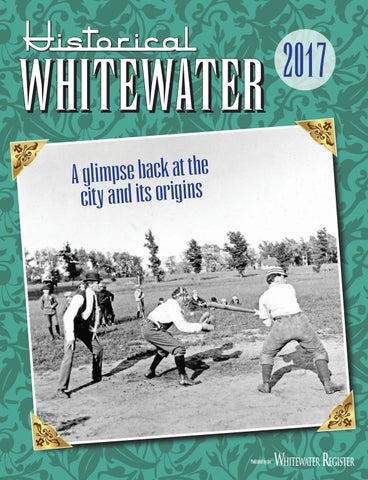
The faculty at Whitewater Normal School play a game of baseball on June 7, 1900. This photo appears courtesy of the Wisconsin Historical Society, which has an extensive archive of historical artifacts and photos. For more information on the society and its collections, visit www.wisconsinhistory.org.
See WHITEWATER, Page 7
®
Published by Southern Lakes Newspapers LLC 1102 Ann St., Delavan, WI 53115 • (262) 728-3411 Editor:....................................................................... Tracy Ouellette Creative/Production Manager: ................................... Sue Z. Lange Special Sections Advertising: .............................. Vicki Vanderwerff
Page 3
Between 1860 and 1890, most of the large and architecturally distinctive churches on Whitewater’s west side were built. The current Methodist Church was built in 187273, the Episcopal Church in 1869, and the Congregational Church in 1882. In 1886, one block east along Main Street, the Baptist community built its large church (now First English Lutheran Church). The industrial era in Whitewater also brought better and larger schools. A new Union School was built at the corner of Prairie and Center Streets, and soon a high school program was started. The Union School, fondly known as the “big brick,” was, by 1894, filled with high school students, as that program became more and more popular with middle-class families in the city. George Esterly had moved out of his large mansion a few blocks west, and so the school administration moved the elementary school pupils to the Esterly house, which then became known as the Esterly School. From 1894 until 1927, west side grade school pupils attended this school. City residents provided the east side children with a school house as early as 1857, but the growth of the Esterly Company after 1858 meant more and more children resided on the east side of the city. In 1872, a new and much larger two-story brick schoolhouse was built. This school was used well into the 1960s, after an addition was built in the 1950s. This historic school was demolished in the late twentieth century for a new school building, renamed the Washington School. Perhaps the most important event related to education during the industrial era, however, was the founding and development of the Whitewater Normal School, one of several state teachers’ colleges founded throughout Wisconsin in the nineteenth century. Between 1868 and the end of Whitewater’s industrial era in the 1890s, the Whitewater Normal School grew steadily, and the school building, soon named “Old Main,” grew as well. The first addition to the building, which doubled its space, was constructed in 1876. Old Main burned in 1891 but was quickly rebuilt. In 1897, a new addition on the front of the building was completed. The population of Whitewater reached 4,158 in 1885, and was surpassed only by its 1890 population of 4,359. But Whitewater’s industrial era ended in the 1890s. The Esterly factory and the Winchester and Partridge factory closed in 1892 and 1893, respectively, putting between 300 and 500 men out of work. The depression of 18931897 meant that no new industry filled the empty factories.
Since 1948
“For The Road Ahead”
Westsider
1335 W. Main St. Whitewater
Eastsider
650 E. Milwaukee St. Whitewater
www.frawleyoil.com 286976
Page 4
HISTORICAL WHITEWATER • 2017
Since 1962, Fairhaven has been providing care, comfort, safety and engagement for older adults.
A “Life Plan” Community Prairie Village Homes Independent Apartments Supportive Living Fully Assisted Living 24 Hour Skilled Nursing Secure Memory Care Rehabilitation Services
SUBMITTED PHOTO Whitewater Historical
Winchester True Value Hardware, at 1415 W. Main St. in Whitewater, has been around since 1846.
Hardware store was one of the first businesses in Whitewater
Fairhaven Senior Services 435 W. Starin Road Whitewater 262-473-2140 www.fairhaven.org
286973
WE’RE WHITEWATERS OLDEST CONTINUING BUSINESS!
Winchester BEHIND EVERY PROJECT IS A
• Pipe Cut & Threading • Glass & Plexiglas Cutting • Window & Screen Repair • Computerized Paint Tinting • Sharpening Services
• Major Appliances, Maytag, GE, Crosley • Barbecues, Mowers, Tractors, Lawn Furniture
W
inchester True Value Hardware is one of Whitewater’s oldest, if not the oldest, continuous business in the city. It began in 1846 when Sanger Marsch and John Partridge opened up a hardware store at what is now 153 W. Main St. The store’s ownership has changed hands about eight times over the years. In 1980 Steve Johnson bought the business from Paul Baker. In 1995 the store relocated from the downtown to its present location of 1415 W. Main St. on Whitewater’s west side. In that move the store expanded its selling area by almost four times. The store offers a wide variety of products. Including a full line of major appliances from Maytag, General Electric and Crosley appliances. It also has a
Banco Insurance Agency Complete Insurance Services
(262) 473-4264
Automobile ~ Home ~ Farm ~ Health ~ Business
Two Convenient Locations: 207 W. Main St., Whitewater ~ (262) 473-7344 KReed@firstcitizensww.com
1415 W. Main Whitewater on Whitewater’s West Side
Kasey Reed
OPEN 7 DAYS A WEEK Mon.-Fri. 8 to 7 Sat. 8 to 5 Sun. 9 to 4
complete rental department, offering many tools and party ideas for both the consumer and contractor. Pictures from within the store gives you an idea of the variety of products offered by Johnson and his competent staff. Other departments include a paint department, where custom blended paints are an everyday occurrence; plumbing department with everything from water heaters to repair parts; and a selection of nuts, bolts and assorted fasteners to put almost anything back together again. The hardware store also has large lawn and garden department, featuring Ariens power equipment, Stihl chain saws and live plants when in season. For more information, call (262) 473-4264 or visit the website at ww3. truevalue.com/winchester.
Located in First Citizens State Bank, Whitewater
111 E. Main St., Palmyra ~ (262) 495-2118 lori@bancoinsurance.com
Lori Garlock
Located in First Citizens State Bank, Palmyra
QUALITY PAINTS
www.bancoinsurance.com 286972
Serving Our Community Since 1984 286969
Serving for more than a century HISTORICAL WHITEWATER • 2017
Commercial Bank of Whitewater has a rich history in community
The doors at Commercial Bank have been open in Whitewater for more than 100 years. Organized in December of 1912, the bank opened on July 2, 1913, with $50,000 in capital. Temporary quarters were established in the Pratt Building next to the Whitewater post office, which was located diagonally across the street from what would become its first permanent location at 171 W. Main St. At the time of organization, officers of the bank consisted of President D.O. Kinsman, Vice-President D.F Zuill, cashier Merton Fish, and assistant cashier Spencer C. Fish. Bank directors included Kinsman (president), Zuill (vice-president), and M. Fish , as well as Jerome Baker, W.J. Kyle, H.O. Hamilton, J.F. Henderson, E.E. Down, J.W. Cooper and H.F. Dean. The new home of Whitewater Commercial and Savings Bank opened on Sept. 19, 1914, with more than 2,500 guests in attendance. A decision was made to remain open during the noon hour for the convenience of customers. By 1916, it was
the youngest bank in the city and one that experienced phenomenal growth since its recent organization. Banks were greatly affected by the onset of the Great Depression of the 1930s. In August of 1932, the Commercial Bank was forced to declare a bank holiday. It re-opened a few days later with not a penny of deposits lost, although the bank was not able to pay interest on deposits for a time. These trying times led to the Glass-Steagall Banking Act being passed by Congress in June 1933, creating the Federal Deposit Insurance Corporation (FDIC). The FDIC was established as a federally owned corporation to reduce bank failures by insuring individual bank deposits up to $2,500. (The current FDIC coverage is up to $250,000 per depositor.) Following World War II, assets remained constant at $3 million. In the early 1950s, Easton Johnson, a local attorney, served as president along with John Meisner as head
See COMMERCIAL BANK, Page 6
r h Ou citing c t a W or Ex ite f ming b We sanges Co Ch Sooon
Page 5
SUBMITTED PHOTOS Whitewater Historical
Above: The Commercial and Savings Bank moved to its first permanent location at 171 W. Main St. (seen here) in downtown Whitewater in September of 1914. Top: The need for more room, let to Commercial Bank building this unique bank at the corner of Fremont and Center streets in 1975. The bank is still headquartered in this building.
InvestIng In Your Future?
W8896 County Hwy. A, Delavan (608) 883-2100
Check out our hours at www.stallerestate.com
Homes
Stop in to enjoy Complimentary Wine Tasting
Just Call
Relax with a glass of wine and a cheese platter in our sunroom and gazebo looking out at the vineyard.
Commercial Bank at (262) 473-1111
NEW Wines • NEW Food Options Wine Flights • Delicious Picnic Platters Wine & Chocolate Pairings Enjoy a Picnic Overlooking the Vineyard or Bring a Blanket to Savor Your Wine in the Vineyard
For A Loan To Obtain Your Dream Home! Serving You For Over 100 Years
Rent ouR facility foR:
• Birthday Parties • Bridal Showers • Bachelor/Bachelorette Parties • Group Outings • Family Gatherings Groups and Buses Welcome TO GET ALL OF OUR UP TO DATE EVENT INFO
200 South Fremont Street Whitewater Member FDIC NMLS ID 754139
*Offer of Credit is Subject to Credit Approval*
286975
286974
Page 6
HISTORICAL WHITEWATER • 2017
Fairhaven has been around for more than 50 years Community offers many options for senior living
by Sandra Landen Machaj CORRESPONDENT
Fairhaven in Whitewater was founded in 1962 as an outreach ministry of the Wisconsin Conference of the United Church of Christ to serve those 55 years and older with housing and healthcare services that promote independence and enhance their quality of life. Over the years the community has grown into a life plan community providing for senior citizens in all phases of their lives from completely independent living to those who require skilled nursing care. Prairie Village is the newest member of the Fairhaven community. It has 40 units, which have been completed and another 50 are to be built. Private condominium style ranch houses with a choice of three different floor plans each about 1,400 square feet make up the community. Exterior and interior maintenance services are provided for a small monthly fee. The village is located near the University of Wisconsin-Whitewater campus. These homes are available to active adults from age 55. This is an active group who produce their own newsletter each month. Residents here are encouraged to participate in any activities held at Fairhaven. When one first arrives at the main campus the size of the community, and the many services available may seem overwhelming. Located on the main campus are 108 independent living apartments available for those seniors who are still active and selfsufficient but prefer to live in a more secure and social environment. These apartments come in various sizes beginning with an efficiency unit and continuing to an alcove, one and two bedroom units. Services included are heavy housecleaning every 4 to 6 weeks, cable television, weekly flat laundry, and all utilities except telephone. Residents are eligible welcome to participate in any and all activities and social programs. Transportation service is also supplied for local shopping, medical appointments and religious services. Other personal and medical services can be added for nominal fees. An emergency call system and a daily check-in system are included in each apartment. For those independent residents who may need some limited assistance, Fairhaven offers a wellness program that includes supportive services such as medication administration, help with dressing or bathing and limited access to medical staff. These are
• Commercial Bank cashier and Willis Miller as assistant cashier. In 1970, David L. Kachel purchased majority interest in Commercial Bank. As a local businessman, owner of Wisconsin Dairy Supply, and investor in local real estate, Kachel provided the bank with vision and insight, seeing to better serve the banking need of the community, business and industry, and the growing university. His eldest son, Jon. D. Kachel, a graduate of the University of Wisconsin-Whitewater’s School of Business, has been involved with the bank since 1975, with position of cashier, vice-president, executive vice-president, and currently president and CEO. Constant growth demanded larger quarters,
SUBMITTED PHOTO Whitewater Historical
Fairhaven is a life plan community with independent living apartments and all levels of care in a single location. The not-for-profit, faith-based organization’s mission is to provide care and comfort for its residents.
billed on an à la carte basis so residents only pay for the services they need or want. The next level of care available at Fairhaven, supportive living, takes place in the independent apartments. This level is for those residents who need some assistance but do not require all the services of fully assisted living. They still receive all the benefits of independent apartment living but now these residents have access to medical staff 12 hours daily and two meals are included. Medication administration, supportive guidance and cueing, limited housekeeping and some help with ADL’s are part of this level. An enhanced level of service included dressing, personal hygiene and grooming and incontinence management is also available. Fairhaven’s assisted living section consists of 23 private apartments. This area is licensed as a CBRF and provides comprehensive assistance on an as-needed basis while encouraging each resident to maintain the highest possible level of independence. The basic level of care in assisted living includes 24 hour medical staff support, assistance with bathing, dressing and grooming; medication administration; linens; three meals daily and snacks; housekeeping; activities; assistance in arranging medical
appointments and transportation services. An enhanced level of service is also available. A large section of Fairhaven is devoted to an 84 bed Medicare/Medicaid certified skilled nursing area specializing in rehabilitation and long-term care. Residents receive all support and services, nursing and otherwise, necessary to promote positive, rapid rehabilitation outcomes and to facilitate comfortable and enjoyable daily living for our long term care people. Hearthstone is Fairhaven’s memory care unit. This state of the art residence is located in a separate building and is a secure unit with 24 private rooms for Alzheimer’s and dementia patients. Hearthstone provides personalized care for each resident with a superior staff-to-resident ratio and RN/LPN staffing available 24 hours per day. The service includes three nutritious meals daily with snacks, scheduled activities throughout the day and all ancillary services on site. Two large common areas offer a “living room” setting with private lounges available for family visits. Residents are encouraged to furnish their rooms to achieve a home-like setting. For more information about Fairhaven call (262) 473-2140 or on the web at www. fairhaven.org and www.prairie-village.org.
(Continued from page 5) so in 1975, a new, more modern and unique bank building was constructed at the corner of Fremont and Center streets and remains the bank’s flagship location. A Janesville branch office was constructed and opened in 1995, followed by the opening of the Commercial Bank West Town office in 1997. David L. Kachel served as chairman of the board for 40 years until his passing in February of 2011. Today the bank directors are: Chairman of the Board Lolita A. Kachel, Crystal Singer, Michael S. Kachel, Jeffery McDonald and Jon D. Kachel. The bank’s officers are: President and CEO Jon D. Kachel, Theresa Kachel,
Annette Rechek, Jeffrey McDonald, Joel Kohl and Paul Stanton. In May of 2017, Commercial Bank and Premier Bank of Fort Atkinson applied to federal regulators to merge the two banks. The anticipated approval for the merger is expected to come in the fall of 2017. Commercial Bank continues to provide financial services and support for thousands of residents in Walworth, Rock and Jefferson counties. Its asset size has grown to more than $100 million and the bank employs 40 dedicated officers and staff in the Whitewater and Janesville offices. This historical account was provided by Commercial Bank.
A SHORT HISTORY OF
Fairhaven
The father of Fairhaven was Rev. Dr. Jess H. Norenberg. He, among others, took up the vision of a home for the aging while serving as the superintendent of the Wisconsin Congregational Conference, later to become the Wisconsin Conference of the United Church of Christ. Through his efforts and talents, Fairhaven became what it is today. In 1962, five residents moved into a newly constructed apartment building in Whitewater that was designed for seniors. The vision of its founders was residency, not institutionalism, with residents coming and going as they choose and free from the burdens of home ownership and maintenance. Over the years various additional services were added – housekeeping, laundry, food service and nursing services. In those early years, the idea of having all levels of care under one roof, now known as a continuum of care, was new to senior housing. Over Fairhaven’s 50-plus years of existence, it has added skilled nursing and rehabilitation, assisted living and supportive care levels to the independent living apartments that it first offered. Hearthstone was added with a design specifically addressing those with memory loss and staffed to accommodate and care for those residents. The most recent addition to Fairhaven is a community of patio homes for those 55 and older. Prairie Village residents enjoy an independent lifestyle while knowing that they have access to the amenities of Fairhaven and to the care levels there if the need arises.
HISTORICAL WHITEWATER • 2017
Page 7
First Citizens State Bank has a rich history in the community First Citizens State Bank in Whitewater has been providing the community with banking and financial services for 154 years. The First National Bank of Whitewater, the forerunner of First Citizens State Bank, was the fourth national bank chartered in the State of Wisconsin and the 124th in the country. According to the First Citizens State Bank 150th anniversary publication, the bank was organized in response to a demand on the part of the community for adequate banking services. There had been banks in Whitewater before that time, banks as adjuncts to private business, and banks organized for the purpose of issuing the so-called “wildcat currency,” but no bank had existed for the purpose of doing general, legitimate banking business. In the summer of 1863, Sanger Marsh and Charles M. Blackman believed that the provisions of the new National Bank Act offered an opportunity that before had been unavailable in Whitewater and began to create plans to form a new bank. The First National Bank of Whitewater opened on Jan. 2, 1864, at what is now 173 W. Main St. The president was Marsh, Blackman was the cashier, and the stockholders included Lucius Winchester, John S. Partridge, William DeWolf, Frederick F. Farnham and James F. Allen.
• Whitewater The Commercial-Agricultural Era
The first report made on that day showed capital of $33,471.15 and liabilities of $75.40. By spring of 1864, the capital had increased by $25,000 and by July another $25,000. At the end of the first year’s business, the bank showed a net profit of $2,123.12 with $1,800 distributed in dividends. The balance was used to start a surplus fund. A change in the board of directors occurred after the tragic accident in which Marsh was killed. Runaway horses caused the crash of his buggy on Oct. 29, 1872. Lewis Cook was then appointed to the board and Blackman was elected president; Farnham, vice-president; and George S. Marsh, cashier. At the annual meeting on Jan. 13, 1874, the decision was made to move the bank to the Chamberlain Building at the corner of Center and First streets. First National Bank operated without competition until 1883, when Citizens National Bank organized, primarily by Edgar M. Johnson, who became cashier; John S. Partridge, who became president, Lawrence G. Graham and Frank W. Tratt. In February 1892, First National Bank purchased the building at the corner of Main and First streets, where they have been since 1876. Both Citizens National and First
First National Bank is seen from the outside during a parade in the 1920s. In 1931, the First National Bank and the Citizens State Bank merged into First Citizens State Bank. SUBMITTED PHOTO Whitewater Historical
National weathered the financial storms of the Panic of 1893 by consolidating and, after considerable discussion, having each shareholder in each bank become a proportionate shareholder in the other bank. A few issues had to be worked out and to make the deal work; Citizens National Bank surrendered its national charter and reorganized as a state bank. After that, savings accounts were handled by Citizens State Bank and First National Bank continued as a strictly commercial bank.
In 1931, First National Bank and Citizens State Bank merged into the First Citizens State Bank. National Bank regulations on loans secured by real estate mortgages had become restrictive because of the thousands of bank failures that occurred from 1929 to that point. Operating under a state charter appeared to offer greater service to the community as did combining the assets of the two banks. Over the years the bank has expanded with two locations in Whitewater and branches in East Troy and Palmyra.
strong industrial development in town, and commercial development did not grow much beyond its boundaries in the existing downtown. The Whitewater Normal School, however, was transformed between 1950 and 1975. During this period, student enrollment went from under 1,000 students to over 10,000 students, and the normal school became a university. In 1972, the Wisconsin State University system merged with the University of Wisconsin system, and all state universities became affiliated with the University of Wisconsin. Since 1972, Whitewater’s campus has been known as the University of Wisconsin-Whitewater. The influx of more students at the university meant that the classrooms and facilities in Old Main were not sufficient. The first dorms were built in the 1950s, and additional facilities were added in the 1950s and 1960s. Much of the campus classroom space, however, was still located in Old Main. In 1970, a devastating arson fire destroyed 80 percent of Old Main. Only a portion of that building, Hyer Hall, could be salvaged. The important result of that fire was that a number of new classroom buildings were erected in the 1970s, including a center for the arts. During the 1960s, downtown business began to change. Shopping malls and large discount stores began to appear in larger communities nearby. At the same time, good roads made it easy for consumers to travel out of town for their goods. Most people still did their grocery shopping in town, but consumers left the small downtown grocery stores in favor of new supermarkets located on the edge of town. The new supermarkets had plenty of room for parking and a much larger food selection, sometimes with cheaper prices. The new chain supermarkets in Whitewater were almost all located on
the east and west edges of town, along Highway 12, a road that had become a thoroughfare through the city. The west side won the battle of retailing, however, as small strip malls made their appearance and businesses located further west. By the mid-1980s, Whitewater’s downtown had lost almost all of its traditional businesses. Many merchants, in fact, had to close their stores despite having no competition from retailers on the edge of town. The merchants simply could not compete with the wider variety and discounted merchandize that people found in shopping malls and “big box” stores. In the mid-twentieth century, industrial growth still lagged behind commercial growth. The Coburn Company and the Moksnes Manufacturing Company, now known as Schenk-Accurate, were exceptions and became, over time, substantial light industries in Whitewater. In the 1980s and 1990s, the Whitewater Community Development Authority developed a successful industrial park on the northeast side of the city. Businesses in the industrial park range from a fast-food distribution warehouse to a large factory making generators to a technology innovation center to jump-start new businesses. At the present time, the University of Wisconsin-Whitewater is still the town’s largest employer, and Whitewater will probably always be known as a “college town.” Nonetheless, Whitewater has a much more diversified industrial economy today than it did 30 years ago. Whitewater continues to develop, and the newer residential construction on the edges of town prove that families still find Whitewater to be a desirable place to live. Carol Cartwright, “A (Very) Brief History of Whitewater,” 2014, Whitewater Historical Society website, www. whitewaterhistoricalsociety.org.
(Continued from page 3)
The depression of 1890s hit industry hard, but the Wisconsin farm economy was strong, primarily due to a change from cash grain crops to cash dairying. Producing milk and selling it to a cheese factory or creamery as a cash crop provided a steady income and did not deplete the land the way wheat farming did. The growth of dairy farmers and of the cheese factories and creameries that purchased their milk fostered the development of related businesses, such as the Wisconsin Dairy Supply, the Dadmun Brothers feed mill, and the Union Produce Company. In 1913, Libby, McNeill & Libby built a large milk condensary off Wisconsin Street. During the years prior to World War II, the plant had the capacity to handle over 36 million pounds of milk per year, and after the war, the plant operated into the 1980s as the Hawthorn-Mellody milk plant. Also in 1913, a group of investors established the Whitewater Canning Company. The Whitewater Canning Company started by canning peas, but it soon added sweet corn to its production. In 1930, the factory began canning tomatoes. The growth of the Whitewater Normal School, a state teachers’ college, also helped keep the city’s commercial businesses successful. Both faculty and student populations increased during the late nineteenth and early twentieth centuries, as reflected in the growth of Old Main. A large west wing, which included a new library and training school, was added in 1911. A separate gymnasium and athletic field was completed in 1917. A large east wing was added to Old Main in 1924. Even during the Great Depression of the 1930s, enrollment at the Normal School remained steady. Until the 1950s, there were no dormitories on campus, so students lived in the community and patronized downtown shops and restaurants. Some merchants marketed books
and supplies directly to students. Especially during the Great Depression, the students in the community helped Whitewater’s merchants weather the economic hard times. Modernization came to Whitewater’s high school in 1927, when city residents passed a bond to build an elementary and high school building on the site of the Esterly School. Typical of “modern” high schools of the era, it had a two-story plan and was classical in design. It had all the amenities that we now expect in a high school, including a large gymnasium and classrooms with science labs and technical equipment. It served as a high school until 1960 and then as a junior high school until 1994. When World War II began, the economy picked up significantly. Whitewater had few factories that were in a position to become providers of war material, but other factories in the area were so positioned, and soon Whitewater enjoyed full employment. The war brought the farm economy up as well, and Whitewater’s agricultural businesses and industries profited. Although goods were rationed during World War II, people now had money to spend. Downtown commercial business picked up, ushering in the era when downtowns were at their height of activity. Local businesses flourished, along with modern “chain” stores, such as the A & P grocery store and the Gambles variety store. Whitewater’s stores offered a wide variety of goods, and there were many competitors in the areas of drugs, groceries, hardware, clothing, and shoes. Restaurants and taverns had large patronage, both from busy workers and college students. This downtown era lasted through the 1950s, and it is the source of much nostalgia today.
The university era
After World War II, Whitewater became known almost exclusively as a “college town.” There was still a lack of
Page 8
HISTORICAL WHITEWATER • 2017
D
o you remember the good ole days, when you could go to a bank and they knew who you were and could call you by your name? You could take your children and your pets to the bank and they could get a treat. Well alot of things have changed through the years and not just in banking.
Samuel Prince is credited with being Whitewater’s first permanent settler in July of 1837, since his log home is the first to be constructed. Soon to follow are William Birge, Leander Birge, Charles Hamilton, and Dr. Edward Brewer.
1839
1863
The First National Bank of Whitewater is established, having received its charter November 12, 1863. It shows assets of more than $33,000 at the end of the first day. (In 1931, The First National Bank of Whitewater and
the Citizens State Bank merge to become The First Citizens State Bank.)
1863 - 1872
Dr. James W. Trippe arrives from East Troy to construct a grist mill, which requires the building of a dam. Residents of the neighboring towns welcome this mill as they must travel to Milwaukee or Elgin, Illinois for this service.
Sanger Marsh was one of the original founders of the First National Bank of Whitewater in 1863. He served as the bank’s first President until 1872 when he was killed in a runaway horse and carriage accident.
1840
William Birge completes the first farmhouse in Whitewater.
Sanger Marsh
1842
The First National Bank of Whitewater was first located at what is now Bergey Jewelry at 173 West Main Street in 1864.
1844
1868
Egbert and William Wheeler build a blacksmith shop. The first school, a log cabin, is erected. The first Post Office is established. The first regular town meeting is held April 5, 1842.
The State of Wisconsin Normal School (UWWhitewater) opens in Whitewater. Oliver Arey is the first Principal.
A new brick school house is erected on the present site of the Birge Fountain.
1852
William DeWolf and Lucius A. Winchester form a new hardware business. They also produce plows. The Milwaukee & Mississippi railroad extends their line from Waukesha to Whitewater. The line is part of the connection from Milwaukee to the Mississippi River.
1887
Whitewater’s population is 4,158. The Village of Whitewater becomes the City of Whitewater May 5.
FIRST IN HOME MORTGAGES
1892 1857 The First The Whitewater begins publishing as a weekly NOW is theRegister time to think “FIRST”... for your home mortgage refinancing needs. National paper.
Bank bought this building fixed term at First 1858 rates. Call to see how low they really are! Low and Main The Village of Whitewater is incorporated April 21. Streets in borrowing rates also mean it’s a good time to 1892, having 1860 occupied it . purchase population a new home Whitewater’s is 2,831. since 1876. In 1931, two banks merged and the newly formed 1861 First Citizens State Bank purchased the The first public library opens. Robert McBeath is the building and occupied the space until 1964. librarian. Hannibal Rann is the first has editor.attractive “FIRSTL CITIZENS”
Think “FIRST”... for all your financial needs.
WHITEWATER WEST 1058 W. Main Street Whitewater, WI 53190 (262) 473-3666
WHITEWATER MAIN WEST OFFICE 1058 W. Main St. 207 W. Main Street P.O. Box 177 Whitewater, WI 53190 Whitewater, WI 53190 262/473-3666 (262) 473-2112
MAIN OFFICE 207 W. Main St. P.O. Box 177 Whitewater, WI 53190 262/473-2112
EAST TROY OFFICE 2546 E. Main St East Troy, WI 53120 262/642-2530
firstcitizensww.com
1915
The Whitewater fire department purchases its first motorized truck.
1934
Dean Coburn and Ronald Coburn establish the OneWire Electric Fence Company. It becomes known world-wide as the oldest and best fence company.
1935
The new Whitewater Post Office is erected on Center Street.
1948
Frawley Oil Company, Inc., is established by John “Jack” Frawley.
1951
The last passenger train runs out of Whitewater on November 12.
1964
First Citizens State Bank moves into its new building on the corner of Second and Main Streets. The grand opening is June 13, 1964. For the first time in Whitewater, customers can use the bank’s new drive-up window.
W
ell even with all the changes we have seen through the years, you still can count on good customer service here at First Citizens State Bank. We are the only locally owned and operated community bank in Walworth County. Stop in at any of our 4 branches and get first class service.
EAST TROY OFFICE 2546 E. Main Street East Troy, WI 53120 (262) 642-2530
PALMYRA OFFICE 111 E. Main St. Palmyra, WI 53156 (262) 495-2101
286966
1837
Whitewater History Timeline