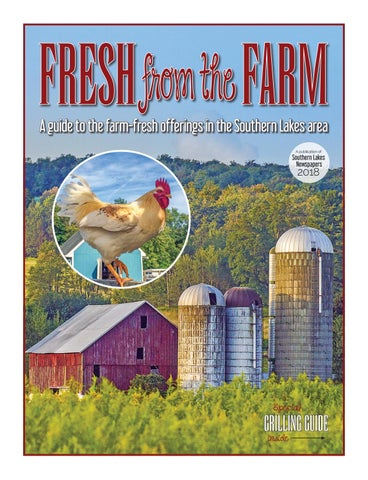
FRESH from the FARM A guide to the farm-fresh offerings in the Southern Lakes area A publication of
Southern Lakes Newspapers
2018
Special
GRILLING GUIDE inside
Racine County
“Breakfast on the Farm” June 23, 2018 • Serving 7-11 a.m.
Eggs, Sausage, Milk, Ice Cream, Tractors, Children’s Games, Petting Zoo, Live Music & More
Tickets: $6.00 ea.
Home Grown Farm Fresh Produce
Bi-Color Sweet Corn, Tomatoes, Melons, Green Beans, Peppers, Cucumbers, Squash, Specialty Vegetables & More...
Children 3 yrs. old & under are free!
Flowers, Herb Plants, Hanging Baskets and Vegetable Plants at both locations through July
Bratz Dairy Farm Jeremy & Jackie Bratz
11922 4¼ Mile Rd., Franksville, WI 53126
(1 mile north of Hwy. K on Hwy. 45) 312976
We have added a second location! In Mukwonago on Hwy NN just 4 miles west of Hwy 83
Open 9-6 Corner of Hwy 120 & Hwy 11 Spring Prairie 4 Miles North of Lake Geneva • 262-206-0177
www.genevalakesproduce.com
278544
WHOLESALE QUANTITIES AVAILABLE!
240583
2
2018 FRESH FROM THE FARM
Any time of the year is perfect for grabbing a tote bag and browsing the wares at a nearby farmers market, where shoppers are bound to find something fresh, unique and delicious.
STOCK PHOTO Fresh from the Farm
Farm fresh locally sourced 7 reasons to shop farmers markets
Farmers markets continue to thrive and expand as people increasingly realize the benefits of supporting local food providers. Buyers who are not yet familiar with farmers markets can examine the following seven reasons to break the ice.
Enjoy fresh, seasonal foods. Foods at farmers markets tend to 1. be limited to in-season offerings. Some nutritionists suggest eating seasonally available foods is better for your body.
2.
Discover new foods. There’s always something new at a farmers market, and this can entice shoppers to expand their flavor palates.
3.
Embrace organic and non-GMO offerings. Many farmers markets offer foods that are organically grown and are produced without GMOs.
Indulge in nutritious foods. Farmers who peddle their wares 4. at farmers markets adhere to careful farming methods to ensure their foods are as nutritious as possible.
5. Turn the trip into a social excursion. A farmers market can be 6. an exciting and flavorful social gathering place for families and groups of friends, as well as a great place to meet other Learn secrets and recipes. In addition to fresh produce, farmers markets may offer baked and other prepared goods. .
members of the community. Sometimes farmers also mingle with
local artisans, so the market can be a one-stop-shopping locale for locally produced food and art.
Save money. Farmers markets may sell organic produce at 7. a cost comparable or even lower than other retailers. That’s because local farmers don’t have to transport their items as far as retailers whose foods were shipped from far away places.
(METRO CREATIVE)
Fresh from the Farm 2018 A publication of Southern Lakes Newspapers www.MyRacineCounty.com 1102 Ann St., Delavan, WI 53115 • (262) 728-3411 Editor........................................................ Tracy Ouellette Creative/Production Director........................ Heidi Schulz Advertising Director...............................Vicki Vanderwerff Special Sections advertising.................. Karen Dubinsky For advertising opportunities in our publications, call (262) 725-7701, ext. 134. 2018 FRESH FROM THE FARM
3
The best nutrition for your
s n e k c i h c backyard
(BPT)
Raising backyard chickens has been a growing trend in the United States over the past several years. Consumers crave choice in their family’s diet, which often includes food they have grown or raised themselves. Raising a backyard flock helps consumers have more control over the eggs their family eats, but bringing home chicks for a backyard flock is just the beginning. The happiest backyard chickens have the healthiest diets, and the best eggs come from hens eating the most nutritious feed. Today, we are increasingly focused on the impact food has on our family’s health. Hobbyists like to feed their flock the way they feed themselves: non-GMO, organic, soy-free, omega-free and all natural. Having a say in what goes into the food their family eats is one of the main reasons people choose to raise backyard chickens. There are 2.9 million households in the U.S. raising chickens, and 62 percent of backyard hobbyists anticipate adding to their flock in the next three years. Raising chickens is a way to extend food supply, and
4
2018 FRESH FROM THE FARM
hobbyists don’t plan to scale back. Providing healthy food for your family begins with the source. Nutrena poultry feed makes it easy by using wholesome ingredients in its selection of affordable, homegrown, healthy poultry feeds. By providing your chickens with the highest-quality nutrition, you’re sure to have the freshest eggs for that Sunday morning family breakfast. With companies like Whole Foods Market reporting 426 percent growth in non-GMO sales from 2010 to 2014, it’s evident that consumers want to know what they’re eating. That’s why Nutrena also offers a USDA-certified organic line of poultry feed that is nonGMO. The Nutrena poultry feed portfolio includes three different feed lines for each type of poultry hobbyist. Whether you’re starting your chicks, supporting your layers or raising meat birds, Nutrena poultry feed offers the nutrition they need. For more information about the full line of Nutrena feed, visit NutrenaWorld.com.
STOCK PHOTOS Fresh from the Farm
Giving your backyard chickens the proper feed will keep them healthy and strong to produce the best eggs. Top: Raising backyard chickens has grown in popularity over the past decade with many municipalities allowing homeowners to keep a small number of birds for personal use.
’ k l y o ‘n
Salmonella is
when raising backyard chickens City dwellers and suburbanites have flown the coop, so to speak. A growing interest in raising chickens has enabled coops and nesting birds to spring up in neighborhoods one would not typically associate with chickens. Sometimes dubbed “urban homesteading” or “urban farming,” these homegrown operations enable people to enjoy fresh eggs from the comfort of home. Henhouses are just another extension of methods to reap the benefits of fresh, local and nonfactoryproduced foods. Although advocates insist that raising chickens on a small scale makes the birds less likely to carry disease than factoryfarmed chickens, anyone raising chickens needs to be aware of the potential for disease — particularly salmonella. Also, it’s important to care for chickens in a manner that is humane and in line with local laws.
What is salmonella?
Salmonella is a common bacteria that lives in the intestinal tract of humans, other mammals and some birds, including chickens. The U.S. Centers for Disease Control and Prevention estimates that about 1.2 million illnesses and 450 deaths are attributed to salmonella annually in the United States. The illness causes diarrhea, fever and abdominal cramps between 12 and 72 hours after infection and can last between four and seven days. Salmonella can cause death when not properly treated with antibiotics.
Spreading salmonella
STOCK PHOTO Fresh from the Farm
Salmonella can be prevented in backyard chicken coops. Plus, it’s important to note that risk of infection is very small. The American Egg Board’s Egg Safety reference says an average consumer might encounter a contaminated egg once every 84 years.
The elderly, people with weakened immune systems and young children are at the highest risk for salmonella infection than others. Children who help gather eggs and do not thoroughly wash their hands afterward can be at increased risk.
Reducing risk
Maintaining clean conditions and routinely inspecting chickens for good Although humans cannot catch salmonella from chickens the way one would health can help lower the risk of salmonella infection. Chicks and adult chickens that contract a cold, they can catch it through have salmonella may produce loose yellow handling or consuming eggs of infected or green droppings; have a drop in egg birds. The rural newsletter and farming production, increased thirst and decreased resource Grit says salmonella then can be feed consumption; and show signs of weight transmitted to humans who eat improperly loss. Look for rodents in the henhouse, cooked meat or eggs from infected birds or from putting their hands in their mouths after because infected mice or other small rodents touching chickens or eggs that have come in may transmit salmonella as well. contact with contaminated rodent or chicken Chickens also need safe, roomy and clean conditions to remain healthy and content. feces.
According to the resource MyPetChicken, a diet of whole grains and seeds also may be associated with decreased salmonella colonies. Some experts warn against washing eggs as a preventative method. According to a report written by Diane Schivera, an organic livestock specialist for the Maine Organic Farmers and Gardeners Association, thoroughly cleaning eggshells can remove a protective “bloom” that prevents bacteria from entering eggs. Eggs shouldn’t be scrubbed, but some suggest a warm-water rinse that will push dirt away from the shell’s pores. Old eggs are more susceptible to bacteria penetration. Storing eggs at room temperature may cause them to degrade faster. Once eggs are gathered, individuals should wash their hands and make sure the eggs are chilled. (METRO CREATIVE)
2018 FRESH FROM THE FARM
5
Buffalo Herd Established 1973
WHY BUFFALO? Specialty BiSon BratS H Philly Cheese H The Tailgator H Jalapeno & Cheese H Black & Blue H “Rons” Flaming Hots Also... Caribou & Bison Hotdogs
Our mission is to offer the Best Product for the Best Price to the Best PeoPle. In addition to Bison, we proudly offer High End Pork, Young Goose, Duck, Elk, Alligator, Salmon and Beef.
All Free rANGe
• Low in Cholesterol • Heart Healthy • Never Tasted Soooo Good!
Now Carrying caribou, elk & reindeer!
Visit Us At
Grayslake Market Saturdays 10-2 Chevre Spreadable Goat Cheese Amish Country Hand Rolled Butter salted or unsalted
Rainbow & Brown Extra Large Eggs
Come See Us at Lester’s Country Store on the Ranch and Visit the Buffalo Store Hours: Monday – Friday 9am to 5pm • Saturday – Sunday 9:30am to 4pm
(847) 343-8240 or (262) 537-3779 31807 60th St., Salem, WI 52168-9557 Just East of Hwy. W on Hwy. K (60th St.) North of Hwy. 50
www.lestersbisonfarm.com 6
2018 FRESH FROM THE FARM
313562
U.S. agricultural trade helps feed the world while strengthening the economy
Politicians spend a lot of time talking about America-First trade deals. Even though the average person may not think about U.S. trade often, it’s a key part of the economy – a topic that’s on everyone’s mind. In 2017 alone, the U.S. exported around $132 billion worth of agricultural products.
The future of U.S. trading Economists and agricultural experts want U.S. trade to remain strong so that exports are equal to or more than what they were last year. However, the complexities of selling U.S. commodities internationally constantly increases. Companies like Syngenta are working to grow agricultural trade to help Americans feed the world and build a stronger economy at home. Many agricultural associations and Syngenta employees work every day with foreign countries to develop positive relationships and a preference for U.S. commodities. American farmers are the most efficient in the world, says Laura Peterson, federal government and industry relations head for Syngenta. “We rely on export markets for our products, and with prices as low as they are, now is an important time to protect and grow our markets,” Peterson said. “We are able to produce far more than we consume and compete in a world of high supply, so remaining competitive is crucial for U.S. agriculture.”
Top agricultural exports
Corn, soybeans and nuts make up three of the top five agricultural exports from the U.S. There is a lot to know about these foods, including: • Corn: One planted seed delivers more than 500 kernels of corn. Corn is widely grown around the globe, with more tons produced each year than any other grain. • Soybeans: Soybeans are the largest source of protein in agriculture. The U.S. exports about half of all its soybeans to other countries. • Nuts: Nuts are wholesome and versatile. From using nuts in spreads and oils to snacking on roasted varieties, people, domestically and internationally, enjoy them every day. In December 2017 alone, the U.S. exported $936 million worth of nuts.
Negotiating trade agreements Free trade agreements beneficial to agriculture can boost the marketability of U.S. crops like corn, soybeans and nuts even more overseas. One prime example of this is NAFTA (North American Free Trade Agreement). “Syngenta remains engaged with U.S. government officials to monitor impacts in renegotiations and trade-dispute actions,” Peterson said. “The current threat of trade wars or withdrawing from trade agreements may harm agriculture. To learn more, visit www.syngenta-us. (BPT) com/thrive.
Agriculture and the economy Many people rely on the agriculture industry for their foods but think little of the impact that agriculture has on the larger economy. However, data indicates that agriculture can serve a significant role in the process of solidifying the economy of a country, particularly developing nations. Agriculture also can contribute to the economic prosperity of advanced countries. IPP Media points out that the economic history of many developed countries indicates that agricultural prosperity contributed heavily to their economic advancement. When the basic food supply is strong, the national economy can be strong as well. Particularly in the early days of the United States, farming held a crucial place in establishing the American economy and culture, and it still shapes the country today. Many states find that farming and other agricultural pursuits contribute much to the local and national economy. For example, new research from the University of Wisconsin-Madison and University of Wisconsin-Extension show that agriculture is a powerful economic force in Wisconsin. Agricultural businesses help generate more than $83 billion in activity and have created more than 400,000 jobs in that state. The public should not disregard how strong a factor agriculture can be in establishing a strong economic environment. Safeguarding agricultural jobs and the agricultural industry is crucial to economic stability. (METRO CREATIVE)
Corn makes up a large portion of the $132 billion worth of agricultural products exported each year, and Syngenta is working to increase that amount.
STOCK PHOTO Fresh from the Farm
2018 FRESH FROM THE FARM
7
Homegrown benefits The many ways buying locally grown foods pays dividends The popularity of organic foods and stores that cater to customers who prefer such foods continues to grow, and that growth has contributed to a growing awareness among shoppers of where the food they eat comes from. Many consumers now recognize the impact that food production has on the environment, and that recognition has spurred interest in locally grown foods. Locally grown foods are those that are grown within your community or a community nearby. Such foods do not need to be shipped hundreds of miles before they ultimately find their way onto your plate, and many people find that contributes to meals that are fresher than meals made up of foods shipped from afar. But freshness is not the only benefit to purchasing locally grown foods, which pay various dividends for people and the planet. Locally grown foods also:
Benefit the environment The phrase “field to plate” is significant to consumers who prefer locally grown foods. That phrase refers to the distance food travels from the grower to the plate on your dinner table. Estimates vary depending on the source, but advocates of locally grown food suggest that it reduces the field to plate distance by an average of 1,300 miles. That’s a significant feather in locally grown foods’ cap, as the Council on the Environment of New York City notes that it takes 435 fossil-fuel calories to fly a single five calorie strawberry from California to New York. Buying locally preserves that energy that is used to transport foods from afar.
Fuel local economy In addition to benefiting the environment, locally grown foods stimulate your local economy. Local, independent farmers largely have fallen by the wayside in the 21st century as industrial agribusinesses have taken over the produce sections in grocery stores across the country. But local, independent farmers are
8
2018 FRESH FROM THE FARM
STOCK PHOTO Fresh from the Farm
Locally grown foods are growing in popularity, and that popularity can be traced to the freshness of such foods as well as the numerous additional benefits that locally grown foods provide.
making a comeback, thanks in large part to consumer demand for organic foods. Supporting such farmers who grow their foods locally means you’re putting money back into your own community, a worthwhile effort at a time when so many small communities are struggling economically.
Contributes to biodiversity According to the United Nations Food and Agriculture Organization, more than 75 percent of agricultural genetic diversity was lost in the 20th century. That’s thanks in large part to industrial agribusinesses that cultivate fruits and vegetables that are bred for fast maturation. But small, local farms typically grow a wider variety of fruits and vegetables in an effort to extend their growing seasons. That means consumers of locally grown foods have access to more fruits and vegetables, and therefore more flavor.
Maintains beautiful landscapes Farmland has been on the decline for decades as cement and asphalt have made millions of acres of once-beautiful farmland disappear. Buying locally helps to maintain the green space your community and surrounding communities have left. That makes for great road trips and even helps to sustain local wildlife populations.
Provide more nutrition Fruits and vegetables can lose nutrients rapidly once they are harvested. That’s problematic when buying such foods from industrial agribusinesses that need substantial time to get their products from the farm to the shelves at your local grocery chain. But buying from local farmers increases the likelihood that the fruits and vegetables you purchase were just picked and therefore have yet to lose a significant amount of nutrients. (METRO CREATIVE)
Grilling time!
Ideas to make those farm-fresh ingredients sizzle!
2018 FRESH FROM THE FARM
9
Barbecue Glazed Ham
Serves 6 to 8 3/4 cup ketchup 3 Tablespoons brown sugar 1 1/2 Tablespoons Dijon-style mustard 2 Tablespoons Worcestershire sauce 2 Tablespoons lemon juice 2 teaspoons chili powder 1 1/2 pounds of sliced, fully cooked ham
Skillet Grilled Fish
1/4 cup all-purpose flour 1/4 cup corn meal 1 teaspoon dried basil 1/2 teaspoon garlic salt 1/2 teaspoon dried thyme 1/4 to 1/2 cayenne pepper 1/4 cup butter Fish (6 to 8 ounces each of catfish, haddock or any thick-cut fish)
Mix first six ingredients for sauce. Cut fat edge of ham. Brush meat liberally with sauce. Let stand 1 hour. Grill over coals 5 to 6 minutes per side, turning once and brushing with sauce.
In a large bag combine the first seven ingredients, add fish one at a time and shake to coat. Place a large cast iron skillet on a grill rack over hot coals. Melt butter in skillet, add fish. Grill covered for 6 to 8 minutes on each side or until fish flakes easily with a fork.
Recipe courtesy of Sarah Duesterbeck.
This recipe is courtesy of Ruth Pfeiffer.
Summer Steak Kebabs
Ingredients 1/2 cup vegetable oil 1/4 cup soy sauce 3 tablespoons honey 2 tablespoons white vinegar 1/2 teaspoon ground ginger 1/2 teaspoon garlic powder 1-1/2 pounds boneless sirloin steak, cut into 1-inch cubes 1/2 pound fresh mushrooms 2 medium onions, cut into wedges 1 sweet red pepper, cut into 1-inch chunks 1 sweet green pepper, cut into 1-inch chunks 1 yellow summer squash, cut into 1/2-inch slices Directions In a large resealable plastic bag, combine the first six ingredients; add the steak. Seal bag and turn to coat; refrigerate for 8 hours or overnight. Drain and discard marinade. On 12 metal or soaked wooden skewers, alternately thread steak, mushrooms, onions, peppers and squash. Grill, uncovered over medium heat for 12 to 14 minutes or until meat reaches desired doneness, turning occasionally. Serves 6.
10 2018 FRESH FROM THE FARM
Grilled Salmon Filet
Ingredients 2 cups of water 2 teaspoons salt 2 pounds of salmon filet cut into 4-inch pieces 1 lemon Fresh dill, chopped Lemon pepper
Directions In a large resealable plastic bag, combine water and salt, add salmon and brine for 3 to 4 hours. Discard brine and pat dry. Season salmon with lemon pepper, thin lemon slices and chopped fresh dill. Before starting grill, coat heavy duty foil with nonstick cooking spray. Grill skin side down over medium heat for 15 to 20 minutes or until fish flakes easily. This recipe is courtesy of Brian Hinzpeter.
Barbecued Pot Roast
Marinade ingredients 1/2 cup brown sugar 1/3 cup vinegar 1/4 cup ketchup 3 Tablespoons soy sauce 2 Tablespoons cooking oil 1 Tablespoon Worcestershire sauce 1 teaspoon prepared mustard 1 teaspoon salt 1/4 teaspoon garlic powder 1 teaspoon pepper 3 to 4 pounds of pot roast
Prepare marinade, all but pepper. Use a meat fork and poke holes in pot roast, sprinkle black pepper on roast and pound with the palm of your hand. Marinate overnight, turning meat occasionally. Grill 15 minutes on each side for medium rare. This recipe is courtesy of Kathy Bosk
Sal’s Grilled Butterflied Salmon
Serves 5 to 7 1-1/2 Tablespoons dried Juniper berries 2 teaspoons dried green peppercorns 1 teaspoon caster sugar 1/8 teaspoon salt 3 Tablespoons vegetable oil 2 Tablespoons lemon juice 5 pounds (2.251 kg) salon, scaled, gutted and boed for butterflying, lemon wedges to serve. Put the Juniper berries and peppercorns in a spice mill and grind coarsely. Turn the ground spices into a small bowl and stir in sugar, salt, oil and lemon juice. Open salmon like a book, skin side down, spread juniper mixture evenly over the flesh, fold salmon closed and place on a large plate. Cover and marinate in the refrigerator for 1 hour. Preheat the grill. Open the salmon again and place it on a oiled baking sheet. Spoon any Juniper mixture left on the plate over the fish. Grill about 4 inches from the heat for 8 to 10 minutes or until the fish is cooked. Serve the fish immediately with lemon wedges. This recipe courtesy of Sandy Bertini
Barbecue Chicken Thighs and Drumsticks Ingredients 1 1/2 cups brown sugar 1 cup water 1 cup cider vinegar 1 cup ketchup 1/2 cup vegetable oil 2 Tablespoons salt 1 Tablespoon mustard 2 teaspoons Worcestershire sauce 1 teaspoon soy sauce 1/2 teaspoon pepper 5 pounds chicken thighs and drumsticks Directions In a large resealable plastic bag, combine first 10 ingredients. Add chicken thighs and drumsticks. Seal bag, turn to coat and refrigerate overnight. Drain and discard marinade. Grill chicken (covered) skin side down for 15 minutes over indirect medium heat. Turn and grill for an additional 15-20 minutes.
Bacon-Wrapped Filet Mignon
Ingredients 4 bacon-wrapped beef tenderloins Black pepper White garlic powder Red paprika 1 stick of butter 1/4 cup fresh lemon juice (one lemon) 1/4 cup Worcestershire sauce
Directions Season meat with pepper until you can’t see the meat. Sprinkle garlic powder over the pepper and then paprika over the garlic powder. Heat butter, lemon juice and Worcestershire sauce in a small saucepan. Drizzle one tablespoon of sauce over each tenderloin but don’t disturb the spices, just make a paste. Flip the meat over and do the same to the other side. Marinate covered in fridge overnight. Grill over hot coals for 6 to 7 minutes each side for medium rare. This recipe is courtesy of Lisa Fagon
2018 FRESH FROM THE FARM
11
Grilled Fruit Kebabs
Ingredients 1/2 fresh pineapple trimmed and cut into 1-inch chunks 3 medium fresh peaches cut into 1-inch chunks 3 medium fresh pears cut into 1-inch chunks 3 medium fresh nectarines cut into 1-inch chunks 3 or 4 plums cut into 1-inch chunks 10 apricots cut in half Honey
Directions Thread the pineapple, peaches, pears, nectarines, plums and apricots alternately onto metal or soaked wood skewers. Grill, uncovered, over medium-hot heat until fruit is heated through, about 6 minutes, turning often. Brush with honey during the last minute of grilling.
Grilled Onions
Ingredients 4 large sweet onions 1/2 cup softened butter 2 teaspoons beef bouillon powder 1 clove of garlic, finely chopped
Directions Preheat grill for medium heat. Mix softened butter with beef bouillon and garlic. Peel outer layer off onions. Slice onions into wedges without cutting all the way through to the bottom. Place each onion on separate piece of aluminum foil. Spoon butter mixture into the center of the onions. Close foil packets. Place onions on grill over indirect heat and close the lid. Cook for one hour, or until tender. Remove onions from the foil and serve with the juices.
Your Full Service Grilling Headquarters
Your • Grills • Smokers
®
Neighborhood Expert
• Chips • Rubs
• Sauces • Pizza Ovens
Custom Installation on Home Theatre and Sound Systems
17 S. Washington, Elkhorn • (262) 723-3477
online parts & service: www.lylestv.com
312872
12 2018 FRESH FROM THE FARM
Grilled Rib-Eye Steaks
Ingredients 1/2 cup soy sauce 1/2 cup sliced green onions 1/4 cup packed brown sugar 2 cloves minced garlic 1/4 teaspoon ground ginger 1/4 teaspoon pepper 2-1/2 pounds beef rib-eye steaks
Directions In a large resealable plastic bag combine first six ingredients. Add steaks to the marinade. Seal and refrigerate for at least 8 hours. Drain and discard marinade. Grill steaks over medium-hot heat for 8-10 minutes or until meat reaches desired doneness.
Kielbasa Apple Kebabs
Ingredients 1/4 cup sugar 1 Tablespoon cornstarch 3/4 cup cranberry juice 2 Tablespoons apple cider vinegar 2 teaspoons soy sauce 1 pound kielbasa, cut into 1-inch chunks 2 tart, medium-sized apples, cut into wedges 1 red pepper, cut into 1-inch chunks 1 green pepper, cut into 1-inch chunks
Directions In a saucepan, combine sugar and cornstarch. Stir in cranberry juice, apple cider vinegar and soy sauce. Bring to a boil and cook while stirring for 1 to 2 minutes or until thickened. On metal or soaked wood skewers, alternately thread kielbasa, apple wedge, red pepper and green pepper. Grill uncovered over indirect heat about 8 minutes or until heated, turning and brushing with glaze occasionally.
Potato Packets
Ingredients 5 medium potatoes, peeled and thinly sliced 1 medium onion, sliced 6 Tablespoons butter 1/3 cup shredded cheddar cheese 1 Tablespoon fresh parsley or parsley flakes 1 teaspoon garlic powder Salt and pepper to taste 1/3 cup chicken broth Directions Spray two large pieces of heavy-duty foil (about 20-by-20 inches) with cooking spray. Divide the potatoes and onion evenly between the pieces of foil. Dot with butter. Top with cheese, parsley, garlic, salt and pepper. Fold foil up around potatoes and add the broth. Seal packets tightly. Grill over medium heat 40 to 45 minutes.
Grilled Rosemary Chicken Breasts
Whisk 8 cloves minced garlic 2 Tablespoons olive oil 2 Tablespoons minced fresh rosemary 2 Tablespoons Dijon mustard 2 Tablespoons lemon juice 1/4 teaspoon ground black pepper 1/8 teaspoon salt 4 boneless, skinless chicken breasts
Whisk first seven ingredients together in a bowl. Place chicken breasts in a resealable plastic bag. Pour garlic mixture over chicken, reserving 1/8 cup. Seal bag and massage marinade into chicken. Let stand for 30 minutes at room temperature. Place chicken on preheated grill and cook for 4 minutes. Turn the chicken, baste with reserved marinade and continue to grill until cooked through, about 5 minutes. Cover with foil and let rest for at least 2 minutes before serving.
2018 FRESH FROM THE FARM
13
FIRE UP SUMMER ENTERTAINING WITH WEBER® GRILLS AND ACCESSORIES
$649
$399
Spirit® SP-330™ LP Grill • 32,000 BTUs • 10,000 BTU side burner • 529-sq.-in. total cooking area • 3 stainless steel burners • Premium stainless-steel cooking grates • Stainless steel door and lid shroud
Spirit® E-210™ LP Grill • 26,500 BTUs • 360-sq.-in. primary cooking area • 2 stainless steel burners • Porcelain enameled cast iron cooking grates Model #46110001 T 156 775 1 Assembly required. LP gas tank not included. Limited Warranty
Model #46800401 T 202 052 1 Assembly required. LP gas tank not included. Limited Warranty
$849
$749
Genesis® EP-330™ Premium LP Grill
Genesis EP-310 Premium LP Grill ®
™
• 38,000 BTUs • 12,000-BTU side burner • 637-sq.-in. total cooking area • 3 stainless steel burners • Electronic ignition system • Front mounted control panel with soft grip controls
• 38,000 BTUs • 637-sq.-in. total cooking area • 3 stainless steel burners • Electrtonic ignition system • Front mounted control panel with soft grip controls Model #6511301 T 129 933 1 Assembly required. LP gas tank not included. Limited Warranty
$99
$149
Model #14401001 T 185 784 1
Model #741001 T 724 369 1
Weber Q 2000 Portable Gas Grill ®
®
™
18-in. Jumbo Joe Charcoal Grill
®
• 12,000 BTUs • 280-sq.in. total • 240-sq.-in. cooking space cooking area • Push button ignition • Tuck-N-Carry® lid lock • Aluminum damper & ash catcher • Two folding side shelves
Consider us your Weber® headquarters
VISIT OUR WEBSITE:
www.reinemans.com BEHIND EVERY PROJECT IS A
14
2018 FRESH FROM THE FARM
Weber® 22-in Performer® Deluxe Charcoal Grill
• Patented One-Touch cleaning system • 363-sq.-in. cooking space • Built-in thermometer in lid • Porcelain-enameled lid and bowl • High-capacity ash catcher
• Patented One-Touch cleaning system • 363-sq.-in. cooking space • Heavy-gauge porcelain enameled steel lid and bowl • Heat resistant nylon handles
Model #741001 T 724 369 1
$399
Weber® 22-in Original Kettle™ Premium Grill
Weber 22-in Original Kettle™ Charcoal Grill ®
$59
Model #6533301 T 172 919 1 Assembly required. LP gas tank not included. Limited Warranty
$229
• 363-sq.-in. cooking area • Electronic Touch-N-Go™ ignition • LCD timer • High capacity ash catcher • Charcoal bin • Heavy-duty cart Model #15501001 T 185 792 1
Model #53060001 T 172 913 1 Propane tank sold separately
TrueValue.com/Weber BURLINGTON 417 Milwaukee Ave. reinemanstvburl@truevalue.net
phone: (262) 763-3577 fax: (262) 763-1853 Mon. - Fri. 7 a.m. - 8 p.m. Sat. 7 a.m. - 6 p.m. Sun. 9 a.m. - 3 p.m.
PADDOCK LAKE 24708 75th St., Rt. 50
(262) 843-2422 Mon. - Fri. 8 a.m. - 7 p.m. Sat. 8 a.m. - 5 p.m. Sun. 9 a.m. - 3 p.m. 312979
Onion Potatoes
6 medium baking potatoes 1/2 cup butter or margarine 1 envelope onion soup mix
Scrub potatoes and cut each in 3 to 4 lengthwise slices. Mix butter and soup mix; spread on slices, then reassemble the potatoes. Wrap each potato in squares of foil, overlapping ends. Bake until done, turning once on the grill or right on top of the coals. Takes 45 to 60 minutes. This recipe is courtesy of Ruth Pfeiffer.
Sweet Grilled Corn
Ingredients 8 ears of sweet corn, husk and silk removed 3/4 cup butter 2 Tablespoons garlic 1 teaspoon rosemary 1 teaspoon sage 1 teaspoon basil 1 teaspoon thyme leaves 1-1/2 teaspoons pepper 1/2 cup grated Parmesan cheese
Directions Soak ears of corn in cold water for 1 to 3 hours. Melt butter in a microwave-safe bowl. Season with garlic, rosemary, sage, basil, thyme leaves, salt and pepper. Stir in Parmesan cheese. Drain corn and pat dry. Spread butter mixture evenly over each ear of corn, and place each piece on a square of aluminum foil. Tightly wrap each ear and puncture to allow excess steam to escape while grilling. Preheat grill for medium heat. Grill the corncobs until tender, about 20 to 30 minutes, turning frequently. Remove from the grill and check for doneness. If the corn is not done, continue cooking an additional 5 minutes.
Island Teriyaki on Hibachi
Serves 4 to 5 Marinade Combine 1/2 cup soy sauce 1/4 cup brown sugar 2 Tablespoons olive oil 1 teaspoon dry ginger 1/4 teaspoon pepper 2 cloves garlic, minced
Cut 1 1/2 pounds top sirloin steak in strips 1/4 inch thick by 1-inch wide, add to sauce, stir to coat. Let stand 2 hours. Lace meat in accordion style on skewers. Add a water chestnut at the end of each. Broil over coals 10 to 12 minutes, turning frequently, basting with marinade. Recipe courtesy of Sarah Duesterbeck.
From Our Farm to Your Table!
Pork, Beef, Lamb, Bison, Chicken, Turkey, Pheasant, Duck, Bacon, Ham, Jerky, Sausage, Brats, Wieners, Fish & Seafood, Specialty Grocery Items, Custom Meat Processing, Slaughtering Service, Fine Wines, Specialty Beers
Stop in for Our Cookouts Fridays & Saturdays Weather Permitting
Open: Mon-Fri 8-5; Sat 8-2
406 S. Wisconsin St., Elkhorn
262.723.2919
www.WilsonFarmMeats.com
1 lb. of
FREE BRATS
with $25 Purchase
OFF
Any Meat Purchase of $30 or more
Not valid Not validwith withother otheroffers. offers.With With this this offer offer only only Wilson Farm Farm Meats. Meats. Expires 10/31/2017. 10/31/2018.SLN atatWilson SLN
312972
Not With this this offer offeronly only Notvalid validwith with other other offers. offers. With at at Wilson WilsonFarm Farm Meats. Meats.Expires Expires10/31/2018.SLN 10/31/2017. SLN
5
$
2018 FRESH FROM THE FARM
15
Zucchini Boats
Summer Vegetable Medley
Ingredients 1 medium-sized zucchini 1/2 pound ground beef, cooked and drained 1/2 pound ground pork sausage, cooked and drained 2 Tablespoons butter 1 medium onion 1 small sweet pepper, any color 2 garlic cloves 1 small can of mushrooms, drained 8- to 10-ounce can tomato sauce 1 teaspoon Italian seasoning Dash of oregano 1 teaspoon sugar 2 cups cheese (Parmesan, mozzarella and cheddar mix)
Ingredients 1/2 cup melted butter 1 teaspoon fresh parsley 1 teaspoon basil 1 teaspoon chives 3/4 teaspoon salt 1/4 teaspoon pepper 3 ears sweet corn, husks removed, cut into 2-inch pieces 1 sweet red pepper, cut into 1-inch pieces 1 sweet yellow pepper, cut into 1-inch pieces 1 zucchini, cut into 1/2-inch slices 10 to 12 large fresh mushrooms
Directions Cut zucchini in half lengthwise, scoop out seeds. In a large pan, mix ground beef and pork sausage together. Saute in butter, onion, sweet pepper, garlic and mushrooms. Add tomato sauce, Italian seasoning, oregano and sugar. Mix in cheese. Remove from heat. Stuff each zucchini half with mixture. Cover well with foil, all of the boat. Heat on low on grill for 45 to 60 minutes. Slice like a loaf of bread, serve with salad and garlic bread. This recipe is courtesy of Dee Wiemer.
Directions In a large bowl, combine first six ingredients. Add corn, peppers, zucchini and mushrooms. Toss to coat vegetables. Place vegetables in a disposable foil pan. Grill covered over medium-high heat for 5 minutes; stir. Grill 5 minutes longer or until vegetables are tender.
Your Full Service Grocery Store
A Cut Above the Rest
Family Owned & Operated Since 1974
• Full Deli Department, Party Trays Available • Fresh Salad and Hot Food Bar • Produce Delivered Fresh Daily • Full Service Meat Department, Will Cut To Order • In-House Bakery, Custom Cakes • Floral Arrangements and Plants for All Occasions • Complete Liquor, Wine & Beer Department
Open 7 Days a Week 6 a.m. to 10 p.m. Farm Fresh e Produc red e v li e D Daily
tly Delavan nien e v 1414 E. Geneva St. Con cated Lo in the Shopko Shopping Center
262-728-2638
Stinebrink’s Liquor Store (Next Door) Largest Liquor Store in the Area
262-740-0541
16 2018 FRESH FROM THE FARM
Lake Geneva 100 East Geneva Square in the Geneva Square Shopping Center
262-248-8798 312974
Shelter storm e h t m fro
How to protect livestock in extreme weather
Extreme weather is seldom fun for anyone. Although people often have the means to escape inclement weather, animals are at the mercy of their caregivers. Protecting animals during extreme weather is not restricted to domesticated pets. Those who have livestock on their properties must recognize that these animals will need various levels of care as well. Animals such as chickens, cattle, goats and llamas can be adversely affected by extreme weather. Individuals can heed these safety guidelines to avoid subjecting such animals to the stress, discomfort and illness that can result from exposure to extreme weather.
Suitable shelter
One of the best ways to safeguard livestock from extreme weather is to ensure they have a place to escape the elements. Animals can get sunburned and may overheat, so make sure shelters can block the sun’s rays on hot days while also allowing for air to circulate through the dwelling. It’s also key that the shelter be capable of accommodating all of the animals at the same time. Livestock shelters do not have to be complicated. They can be as elaborate as a barn or as simple as carports or tarps and shade cloth.
Fresh water
Access to fresh, clean water is also essential. Dehydration can set in, particularly for animals with thick coats or those that are young or elderly. Animals tend to expend a lot of energy to cool down or stay warm, so they will need an ample supply of water to remain hydrated and healthy. Standing water can become a breeding ground for parasites and insect larvae. Therefore, change water frequently to make sure it is sanitary. Some farm experts advise aerating troughs to help prevent algae growth or mosquito infestations. A small amount of raw apple cider vinegar may help as well. However, always discuss water
STOCK PHOTO Fresh from the Farm
Keeping livestock comfortable and safe from the elements is essential to their well-being.
sanitation methods with a veterinarian before testing them out on farm animals.
Mold-free feed
Hot, humid temperatures can cause mold to grow on hay and other feed sources. Cows do not like to eat moldy hay and it can make horses ill. The University of Minnesota Extension says horses are particularly sensitive to dust from mold spores and can get a respiratory disease similar to asthma in humans called recurrent airway obstruction, or RAO, which is often referred to as heaves. Hay needs to be dried out before it is fed to animals. Any feed should be stored in cool, dry conditions and inspected before
being dispersed to livestock.
Haircut
Woolly animals may benefit from a shear prior to the onset of hot weather, advises the Maryland Small Ruminant group. Do not shear too short. For instance, a one-inch fleece can dissipate heat and help the sheep keep cool.
Rest
Livestock should not be worked and handled during the heat of the day. Their productivity levels may be diminished, and the extra exertion may affect their health. Rest will help them stay happy and healthy until the extreme weather has subsided. (METRO CREATIVE)
2018 FRESH FROM THE FARM
17
How a healthy diet helps you and the environment The right dietary choices cannot only improve your health but the environment as well. But urbanization and increasingly busy schedules force many people to seek the most convenient, and not necessarily the healthiest, foods. The growing reliance on processed foods may be hurting humans and the planet they call home. Processed foods tend to be loaded with starches and preservatives, increasing consumers’ risk of diabetes and being obese. In addition, many prepackaged foods are shipped from faraway processing plants, and vast amounts of fuel must be consumed for products to get from those plants to local grocery stores.
Subtle shifts in dietary habits and trends can decrease mortality rates and reduce global greenhouse gas emissions resulting from food production. Adopting alternative diets that feature a higher ratio of fish, whole grains and locally grown produce can greatly reduce an individual’s carbon footprint. The New Nordic Diet is one example of a growing dietary trend that has the potential to improve the health of humans and the environment. So says Henrik Saxe, an associate professor who specializes in sustainability at Copenhagen University. Researchers found a reduction in greenhouse gases of at least 6 percent with the
New Nordic Diet compared to typical diets in Denmark. The following are a few ways average men and women can eat to promote their own health while simultaneously protecting the environment. • Adopt climate-friendly eating habits that rely on more domestic, in-season foods; • Cut down on meat consumption; • Eat organic foods as much
as possible; • Avoid seafood harvested from fish farms, which can negatively impact your own health and marine life; • Grow your own fruits and vegetables; • Shop at local markets that support nearby farms and farmers markets; and • Purchase products with the least amount of packaging. (METRO CREATIVE)
Since 1957
Back For Her 61st Season! SWEET CORN, MELONS, PEACHES & VINE RIPENED TOMATOES
STOCK PHOTO Fresh from the Farm
Eating more locally sourced meat and produce can greatly reduce an individual’s carbon footprint.
Come out and sample the quality
guest
Conservation Dinner Fresh Gulf seafood Farm fresh produce Organic wine Local beer
“TRy BEfORE yOu Buy” LOOk fOR uS!
in the Delavan Inlet on Hwy. 50 & Inlet Shore Drive, just west of Reed’s Marine
312975
W2493 County Rd ES East Troy, WI 262-642-3303
312981
Join us for a unique farm-and-sea-to-table experience in the Beautiful Brown Barn!
Elkhorn Stand on the Square
18 2018 FRESH FROM THE FARM
Friday, August 24, 2018 6:00 pm $85/ MFAI is a 501(c)3 non-profit organization.
Farm & Sea
SERVING THE DELAVAN AREA FOR OVER 60 YEARS Come in and taste the best & freshest produce in town.
Reserve your seats online at www.michaelfields.org
STOCK PHOTO Fresh from the Farm
Clean eating starts with selecting farm-fresh fruits and vegetables and other foods that are in their most natural form.
clean eating all about?
What is
Clean eating is a growing trend among people focused on health and wellness. A relatively simple concept of selecting foods that are minimally processed, clean eating intends to instill a greater understanding of the pathway between a food’s origins and the final products that end up on grocery store shelves and dinner tables. Choosing whole or “real” foods that are as close to their natural forms as possible is a staple of clean eating. The availability
of convenience food products has never been greater, and not all packaged foods are unhealthy. But clean eating encourages consumers to be more aware of the ingredients in the foods they eat while selecting those foods that are minimally processed. Many foods designated as “clean,” including vegetables and fruits, whole grains, free-range meats, low-fat dairy products, unsalted nuts, and whole seeds, are straight from the farm. Another component of clean eating is eliminating or greatly reducing the consumption of refined sugar. Many health experts advise that refined sugar is a large contributor to unnecessary calories. Many people can get all the energy they need by consuming foods with natural sugars. If an ingredient list includes names you cannot recognize or if the natural form of the food has been changed (i.e. removing the bran from whole grains), it cannot be included in a clean-eating plan. Also, foods that have a lot of additives, including salt, sugar and fat, are not classified as clean. Jessica Fanzo, assistant professor of nutrition at Columbia University, advises that not all food processing is bad. Processing is sometimes necessary to
prevent pathogens that can lead to illness. For example, pasteurizing milk is a processing method, but one that is necessary to stop the proliferation of bacteria. Even steaming foods is processing in some form, but it is not on par with some of the overly processed foods available. The benefits to clean eating are numerous. Increasing intake of fruits and vegetables can boost your immune system and serve as a nutritious way to maintain a healthy weight. Clean eating may help you become more conscious of everything from meal ingredients to portion sizes. Those interested in clean eating can begin slowly. Start to introduce more fresh fruits, vegetables, legumes, nuts and farm-fresh foods into your diet. Look for foods in their natural form, such as whole oats and other grains. Avoid highly refined ingredients and limit sugar and salt intake. Opt for fresh herbs and spices to season food. Over time you can make other changes. Adopting a clean-eating approach to their diet is a great way for men and women to start living healthy lifestyles. Speak with a doctor or nutritionist about healthy and effective ways to transition to clean eating. (METRO CREATIVE)
2018 FRESH FROM THE FARM
19
SAFETY TIPS FOR People who live in cities, exurbs or suburbs may not come across farms very frequently. But millions of people, including children, still live on farms. In fact, in 2009 the Centers for Disease Control and Prevention noted that more than 1 million of those under the age of 20 lived, worked or had a regular presence on farms in the United States. Protecting children from injury on farms, especially those who perform work on farms, is of paramount importance. The American Society of Safety Engineers offers the following safety tips to parents of children who will be spending time on farms. Know and obey the laws Various state and federal laws are in place to protect young children from farm-related accidents and injuries. Age requirements dictate which jobs children can perform on a farm, and parents should adhere to those requirements. Asking children to do more than they’re physically capable of can lead to accident, injury or even death. Review equipment operation instructions Before assigning children a task on the farm, parents should review the equipment operation instructions. Doing so can help parents reacquaint themselves with tools and equipment they may not have used in awhile, and that can
PARENTS OF
make it easier for them to teach kids how to use such equipment. In addition, reviewing equipment instructions may provide insight to parents unsure if their children are old enough to use certain tools. Inspect equipment Before children perform any tasks on the farm, parents should inspect the equipment their children are likely to use to make sure each tool is safe. Make sure tools are in proper working order because broken or poorly working equipment increases the risk of accident or injury. Have kids take lessons Enroll children in farm safety camps. The ASSE recommends that parents contact their local Cooperative Extension and Farm Bureau offices to enroll children in farm safety camps. Such camps can teach kids safe farming techniques and the proper ways to use ageappropriate tools. Set a positive example Another way for parents to protect their children on the farm is to set a positive example. Parents can do so in various ways. Using equipment properly, removing tractor keys from ignitions when tractors are not in use and exercising caution when using hazardous materials shows kids the importance of caution when working on farms.
See You At The Racine County Fair! “SOMETHING TO CROW ABOUT” July 25 - 29, 2018 • Free Parking • Petting Zoo • Tractor Pull
STOCK PHOTO Fresh from the Farm
Hundreds of thousands of children perform jobs on farms across the country. Parents who want to teach their kids to farm should always do so with safety in mind.
Elkhorn Farm Market Producers Only Market ELKHORN TOWN SQUARE
North Wisconsin Street • Saturdays • 8 a.m. to 12:30 p.m.
• Demolition Derby • Carnival Rides • Kids’ Activities • Delicious Fried Foods
We Grow It, Make It or Bake It!
• Live Music and Much • Much More!
Racine county FaiR 19805 DuRanD ave. • union GRove, Wi 53182 (262) 878-3895 • fairadmin@racinecountyfair.com • www.racinecountyfair.com
20 2018 FRESH FROM THE FARM
312980
JUNE 9 - SEPTEMBER 29 For info. (262) 723-7733 elkhornfarmmarket@gmail.com 312971
FARM TO TABLE
businesses booming Consumers’ appetites for local foods are growing, and restaurants have taken notice. Today, many local businesses, including farms and restaurants, have mutually exclusive relationships that make it possible for local residents to enjoy nutritious, locally produced meals. According to the market research firm Packaged Facts, local foods generated $11.7 billion in sales in 2014 and will climb to $20.2 billion by 2019. Farm-totable remains a growing trend that benefits farmers, restaurateurs and consumers. This is evidenced by the rising number of farmers markets cropping up in neighborhoods all across the country, as well as the niche offerings by regional food purveyors. The U.S. Department of Agriculture says that, in the last 20 years, the number of farmers markets has grown by more than 350 percent. Many consumers are now choosing “local” for dining at home and when dining out, and this is making a major
impact on the nation’s food systems. Foodies as well as industry experts predict that the local foods movement is a permanent and mainstream trend. In 2014, the National Restaurant Association found the desire for local foods dominated its “Top Food Trends.” The most in-demand foods include locally sourced meats and seafood as well as locally sourced produce. Consumers also are interested in farm/estate-branded foods. Some restaurants are even producing “hyper-local” food, or herbs and produce grown right on the property. As the demand for local foods has evolved, so has the term “local foods.” “Local” can be a wide-ranging term that refers to foods produced in a particular town, state or even region. The 2008 Farm Act defines a “locally or regionally produced agricultural food product” as one that is marketed less than 400 miles from its origin. However, a few states have established more stringent rules that
indicate “local” constitutes food produced within the borders of a state or within a small perimeter of the state. The growing preference for locally produced foods is great news for the farmers and small food producers that have long fought for footing among the mega-importers. According to the trade publication “Produce Business,” even though “local” does not place limits on the size of the farm, the growing desire among consumers to go local is benefiting many small and midsized farms because consumers are increasingly buying foods grown closer to where they live. In addition to meats, fruits and vegetables, consumers can find many locally made items that expand the potential for farm-to-table. These include, but are not limited to, artisan cheeses, wines, beer, baked goods, milk and other dairy, and honey.
(METRO CREATIVE)
Local, sustainable foods are in demand, helping not only local restaurants and merchants, but also the small and medium farms that service these establishments. 2018 FRESH FROM THE FARM
21
Humane housing for safe and comfortable livestock Consumers depend on various agricultural producers to provide the fruits, vegetables, meat and dairy products they rely on for sustenance. The conditions in which livestock are sometimes housed and cared for is a cause of concern for many such consumers. However, farmers who understand that their livelihoods depend on the health of their animals often do their best to keep their livestock healthy and comfortable. Animal agriculture is evolving as animal scientists, veterinarians and farmers seek ways to provide for animal health and welfare. At the same time, farmers are seeking ways to minimize the negative impact these changes can have on employees and the environment.
tight quarters. Battery cages were often coveted because their sloped floors allowed clean eggs to roll away into collection areas, making the process less laborintensive. Farmers are trying to find a balance between keeping eggs clean and birds safe while providing humane living conditions without affecting the cost of eggs. In some areas, such as the European Union, battery cages are no longer in use. Egglaying hens in Canada also may find battery cages a thing of the past thanks to the a new NFACC code for the care and handling of Canada’s hens. In addition, Publix, WalMart, Costco, Denny’s and more than 20 other major companies have stopped buying eggs from producers who use battery cages.
Indoor housing
Group housing
Data published in 2016 by the U.S. Department of Agriculture found that indoor housing protects livestock from harsh external environments and serves to decrease exposure to parasites and diseases spread by insects, wildlife and other vectors. Although some are quick to say that outdoor living is better and indoor conditions can be unsanitary, many studies have proven the opposite. Increased prevalence of infectious disease and parasites are well-known risks associated with outdoor housing of livestock, says the USDA. This has been proven by studying both indoor and outdoor chickens, as well as swine.
Veal production has long been a point of contention among animal welfare activists. The traditional option has been keep calves alone in “veal crates,” which are small and provide limited movement. Many veal farmers slowly have transitioned away from veal crates, says the organization Animal Smart. Group pens and indoor barns are climate-controlled and allow calves to stay together. Some farms even afford the calves some outdoor time for fresh air. Group housing is more social and less restrictive for the calves. According to the American Veal Association, veal farmers spent more than $50 million over 10 years to transition to these group housing systems. Calves can stand, stretch, lie down, groom themselves and benefit from year-round ventilation to thrive. Great strides are being made to ensure that livestock are provided humane environments to keep them comfortable and (METRO CREATIVE) safe.
Battery cages Many people are concerned about the welfare of hens spending time in battery cages. These cages prevent hens from fighting with one another, but they also put the birds in very
22 2018 FRESH FROM THE FARM
STOCK PHOTO Fresh from the Farm
Livestock regulations are evolving to make conditions more humane and comfortable for animals.
Business Listings Brightonwoods Orchard
Fontana Farmers Market
BILL AND JUDY STONE AND PAULA PUNTENNEY 1072 288TH AVE., BURLINGTON, WI 53105
PORTER COURT PLAZA, BETWEEN MILL STREET AND HIGHWAY 67, FONTANA, WI 53125 Saturdays, 8:00 a.m. - noon, June 4 - Sept. 24 CONTACT: MARYANNE BRUSS (262) 749-8913
www.brightonwoodsorchard.com Brightonwoods Orchard is located on a rustic road 1/2 mile north of the Bong Recreation Area and features over 150 alreadypicked antique and commercial apple varieties. Our award winning fresh apple cider is available along with locally grown fall products (Pumpkin, squash, honey and more). A two-story tree house and walking trails are family favorites. Open daily September through Thanksgiving. We attend numerous summer markets in southeastern Wisconsin and two indoor winter markets. 240797
Bristol Farmer’s Market AT AQUATERRA FARMS ON HWY. 50 21010 75TH. ST., BRISTOL, WI 53104 Beginning June 1, Every Friday from 2-6 p.m. 262-857-3079
If interested in becoming a vendor, please contact: Schuyler at spigott@aquaterrafish.com Brandon at bpigott@aquaterrafish.com 312984
Cobblestone Farm HEATHER BAILEY W3456 LITTLE PRAIRIE ROAD, EAST TROY, WI 53120 (MAILING ADDRESS: N9281 NATURE ROAD)
262-689-7013
tamarlinnorth@aol.com www.cobblestonefarmhighlandcattle.com We raise Scottish Highland cattle for the exquisite beef that is known throughout the world. We raise both grass-finished and grain-finished cattle to our consumers’ specifications. We also raise pastured chickens - all of heritage breeds. On the grounds are herb gardens and vegetable gardens as well as a small apple orchard and pear trees. At Cobblestone Farm we pride ourselves with the knowledge that “You know what you are eating with Cobblestone’s Farm beef.” Visitors welcome, please call ahead for an appointment. 278811
The Elegant Farmer HWYS ES & J, MUKWONAGO, WI, 262-363-6770
www.elegantfarmer.com The Elegant Farmer continues to be one of Southeast Wisconsin’s best family destinations. Welcomed by the Smilin’ Barn, The Elegant Farmer provides simply the best handcrafted foods from its Farm Kitchen Bakery, Deli & Market featuring farm fresh season fruits and veggies. Noted by Gourmet, Wall Street Journal, Milwaukee Magazine and the Food Network as having the best apple pie in America, The Elegant Farmer’s Apple Pie Baked in a Paper Bag can be ordered online at www.elegantfarmer.com or selected from our varieties in the market. Hosting family friendly fun events including East Troy Electric Railroad train rides, Harvest Festival Saturdays and Sundays, September 8-October 21 and its popular summer cheese events including the Blue Ribbon Cheese Tasting June 9-10, Grand Champion Cheese Tasting Aug 25 & 26 and popular Garden Center. Visit www.elegantfarmer.com for more details. 313061
www.coffeemillfontana.com
240806
Historic Horticultural Hall Farmers’ Market (Lake Geneva) HORTICULTURAL HALL 330 BROAD STREET LAKE GENEVA, WI 53147 Thursdays, 8:00 am - 1:00 pm May 4 - October 26 CONTACT: SEAN PAYNE 262-745-9341
market@horticulturalhall.com www.horticulturalhall.com 240808
Rohrganics PO BOX 225 EAST TROY, WI 53120 262-684-9356
www.facebook.com/rohrganics CONTACT: MARY ROHRER
Email: mary.rohrer@rohrganics.com Rohrganics is an organically-managed family farm located two miles outside of East Troy, Wisconsin. We raise all our animals with full access to organically-planted fields and pastures. We never use synthetic herbicides, pesticides, hormones, or antibiotics. You can purchase our vegetables and meat at our farm-to-table store and café at 2894 Main Street, East Troy, WI 53120. We offer vegetables and meat by the pound and whole/half animals – contact us for more information! 312982
Turtle Creek Gardens JANET GAMBLE N5105 PINNOW ROAD DELAVAN, WI 53115 262-441-0520
farmmanager@turtlecreekgardenscsa.com www.turtlecreekgardenscsa.com Turtle Creek Gardens is a certified organic vegetable farm serving members through our CSA and direct to restaurants and grocery stores. Our farm is open to the public for on-farm sales and CSA distribution to sites in southeast Wisconsin and pick up site direct from the farm. We also have an online farm store delivered to our CSA drop sites or picked up from the farm through FarmMatch.com. Turtle Creek will also host tours for groups and individuals. Please visit our website or contact Janet Gamble for more information. 240821
2018 FRESH FROM THE FARM
23
K OR C F E E S CHSIT NT EBEVE W
NEW THIS YEAR Copper K ettle Cooked Fresh, Homemad e
CARAMEL!!!
Dedicated to growing, harvesting and delivering fresh produce
• Sweet Corn • Kettle Corn • Specialty Breads & Cookies • Pumpkins & Fall Décor
WEEKENDS ONLY
FAMILY FUN! • TUBE ROLLERS • JUMPING BALES & MORE!
• Fresh Donuts • Concession Stand • Hay Rides
Corn Maze
MID-JULY – OCTOBER 31 • 9:30 AM - 5:30 PM DAILY
Corner of F & Hwy. 67 midway between Williams Bay & Fontana
W W W . P E A R C E F A R M S . C O M 24 2018 FRESH FROM THE FARM
312967
5740 North Walworth Road, Walworth, WI • 262-275-3783