Andres Acosta, Chris Albon, Bob Barde, Tucker Briggs, Kevin Buckholtz, Cathy Bump, Andrew Cotter, Nina Gannes, Anissa Gardizy, Peter Gertler, Erika Gliebe, Adele Gower, John Gower, Kim Howard, Sean Johnson, Jing Li, Catherine Lovazzano, Vanessa Marlin, Kelsey Meranda, Pete Mulvihill, Will Newby, Wyatt Nordstrom, Fast Eddie Peinado, John Schwenger
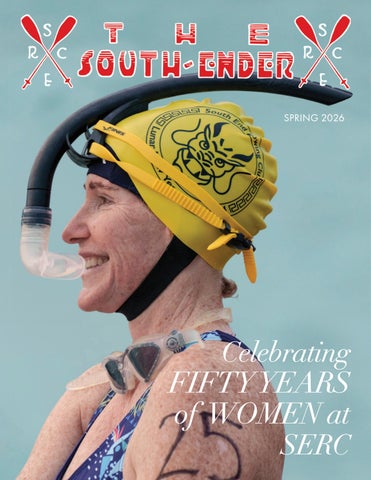
Cover Photo
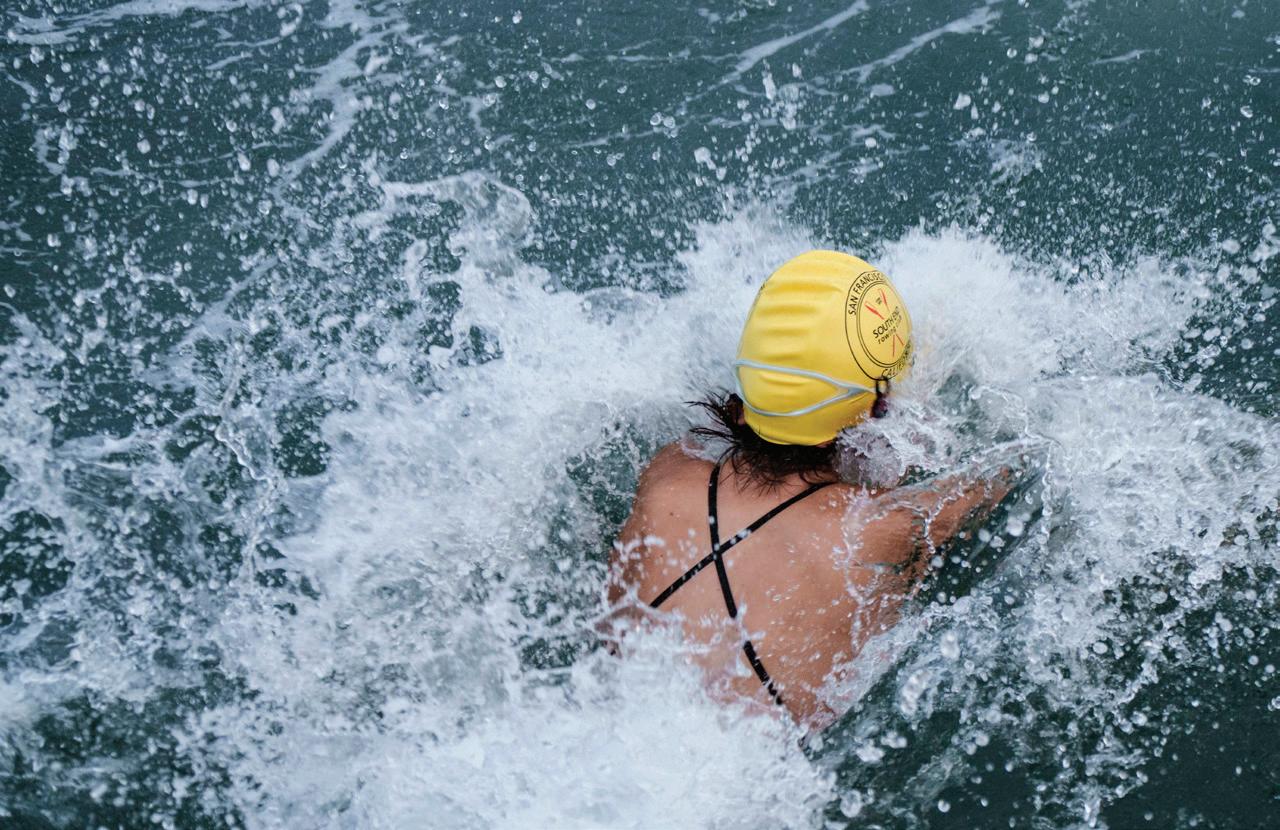
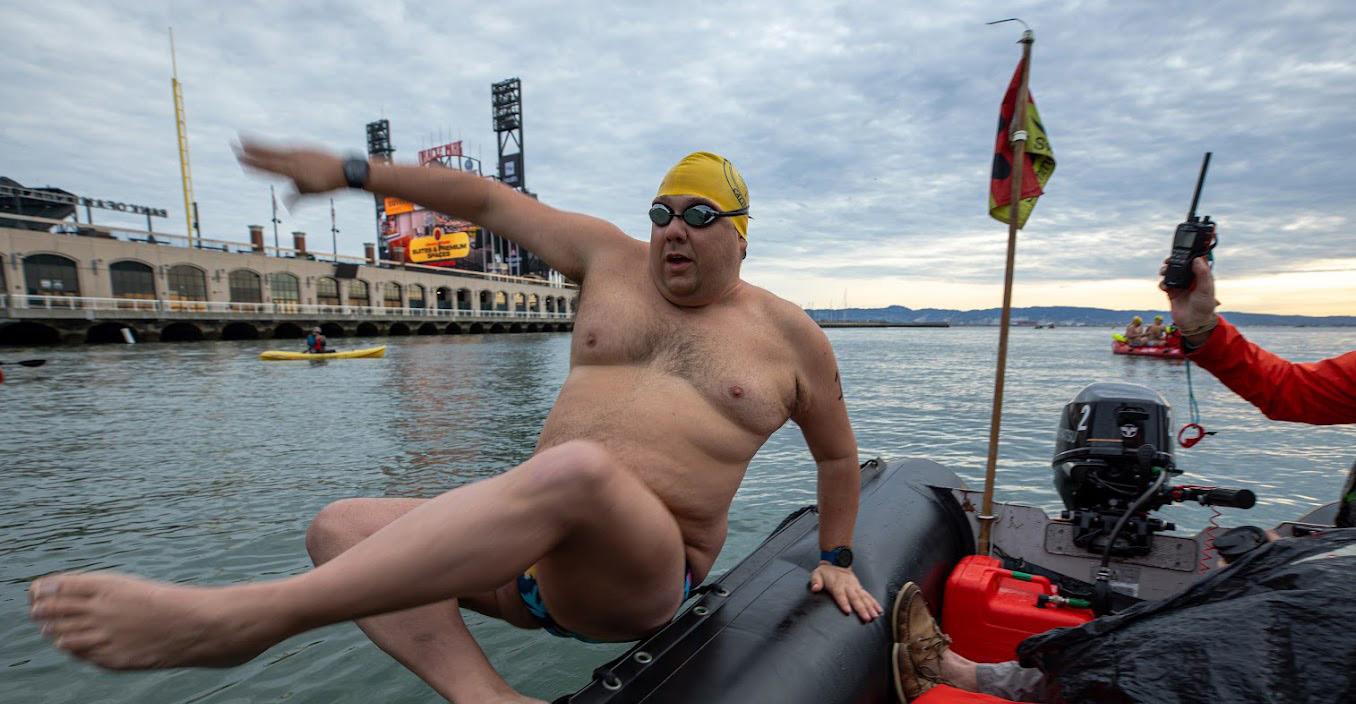
Shannon Raintree prepares to dive in for the 2024 GGB swim.
Photo credit: Kevin Buckholtz
The South Ender is the newsletter of the South End Rowing Club, published since 1931. We publish material by our members that reflects the ideals, purposes, and accomplishments of the South End. It’s our members who make this newsletter, so send articles, short items, suggestions, inquiries, and photos to us at newsletter@serc.com. Articles should be no longer than 900 words. For photos, send us high-resolution images (we print at 300dpi, so a 1,200-pixel image can only be 4 inches wide). Please tell us who’s in the photo and who took the photo. We reserve the right to edit all submitted material, but we’ll be nice about it, we promise.
Women are reshaping handball at the South End, from tournament wins to packed clinics with former pros.
By Nina Gannes
Coming in From the Cold Fifty years ago, six women fought their way through the South End’s doors. This year, we celebrate the “troublemakers” who fought for access and transformed what it means to belong to this club.
By Catherine Lovazzano
CATptain’s Log: Fundraiser Rakes in $11k for SERC’s Cats
With costumes and caipirinhas, the South End community raised nearly $11,000 for Chief Mousers Jameson and Hurley at a packed November benefit party.
By Kim Howard & Fast Eddie Peinado
Diving Back In A Letter from the Editors
BY BIANCA TAYLOR AND MARISSA MILLER
“What’s the story with the logo on the cover?”
While digging through the South Ender archives, we discovered a hand-drawn masthead from a 1931 newsletter and thanks to our shared love of SERC history, we immediately knew we had to bring it back.
A huge thanks to Todd Bergman for revitalizing it for this issue!
When we were approached with the opportunity to revive the South Ender newsletter, we jumped at it. While we represent different sports (Bianca is a swimmer, Marissa a rower), we both share a love for the cold water and warm community that have made SERC a huge part of our lives in just a short amount of time.
To say that a lot has happened in the years since the South Ender was consistently published is an understatement. Together, South Enders have weathered a global pandemic, tumultuous politics (both inside and outside of the club), and an ever-changing Bay Area. The constant for many of us during those stressful times was making our way to 500 Jefferson Street, where we knew we would find a friendly face, a cat to pet, a warm sauna, and the best view this side of the Mississippi.
It is in this spirit of resilience and togetherness that we are proud to bring you the first edition of the 2026 South Ender. We couldn’t have done it without the collaboration and generosity of so many other volunteers, especially folks who have worked on past issues of the South Ender. Thank you for sharing your knowledge with us and trusting us to bring this to life.
Mostly, we are inspired by YOU—the person reading this, who is a big part of making SERC the best club on Earth.
This newsletter is ours to build together, so please send us your achievements, article ideas, and (high-resolution) photos all year long! You can reach us at newsletter@serc.com.
Happy reading, Bianca and Marissa
Dear South Enders A Letter from the President
BY VANESSA MARLIN
I remember my first days at the South End Rowing Club almost 18 years ago. Rowing Commissioner Paul Nordquist invited me as a guest to join him for a row. The Bay felt enormous and wild. Even in the heavy wooden #11 (now officially named the Paul Nordquist), I was intimidated. The current pulled at us. A tanker moved steadily through the channel. Fishing boats buzzed around erratically. The idea that I might one day row out there alone felt like a distant dream. But I kept coming back.
Eventually, Elizabeth Glass recruited me to join a crew of determined women called the Hurley Girls, rowing and racing the barge. I was no longer just observing. I was part of something that depended on each of us showing up and pulling together. We went on a losing streak shortly after, but it didn’t matter.
Because for the first time, I felt like I belonged here.
“Never would I swim,” I told myself. I watched the swimmers shuffle miserably toward the water, bracing against the cold. What I couldn’t see then was the euphoria waiting for them on the other side: the laughter, the lifelong friendships formed, and the wisdom and support found in the sauna.
Almost everyone who walks through the doors of the South End knows that early feeling—the awe, the uncertainty, the quiet hope that there might be a place for you here.
People are drawn here by the bay, the sports, and the old-timey mystique of this place. But with that growth comes a responsibility to ensure that belonging doesn’t remain a distant dream for those still finding their way.
Belonging is not automatic. It is created in small moments.
It happens when a swimmer introduces themself to someone standing alone on the beach. When a handball player invites a new face into a game. When a runner shows up with donuts and stays to talk. When a new rower is offered a seat in the barge. When a volunteer in the kitchen turns a solitary task into a shared one. These gestures may seem small, but they change everything. They transform a 2,200-member club into a personal one.
The South End has never been defined by titles or professions. It has been defined by participation, by ordinary people who step forward and, over time, help shape its future.
Each of us has a role to play.
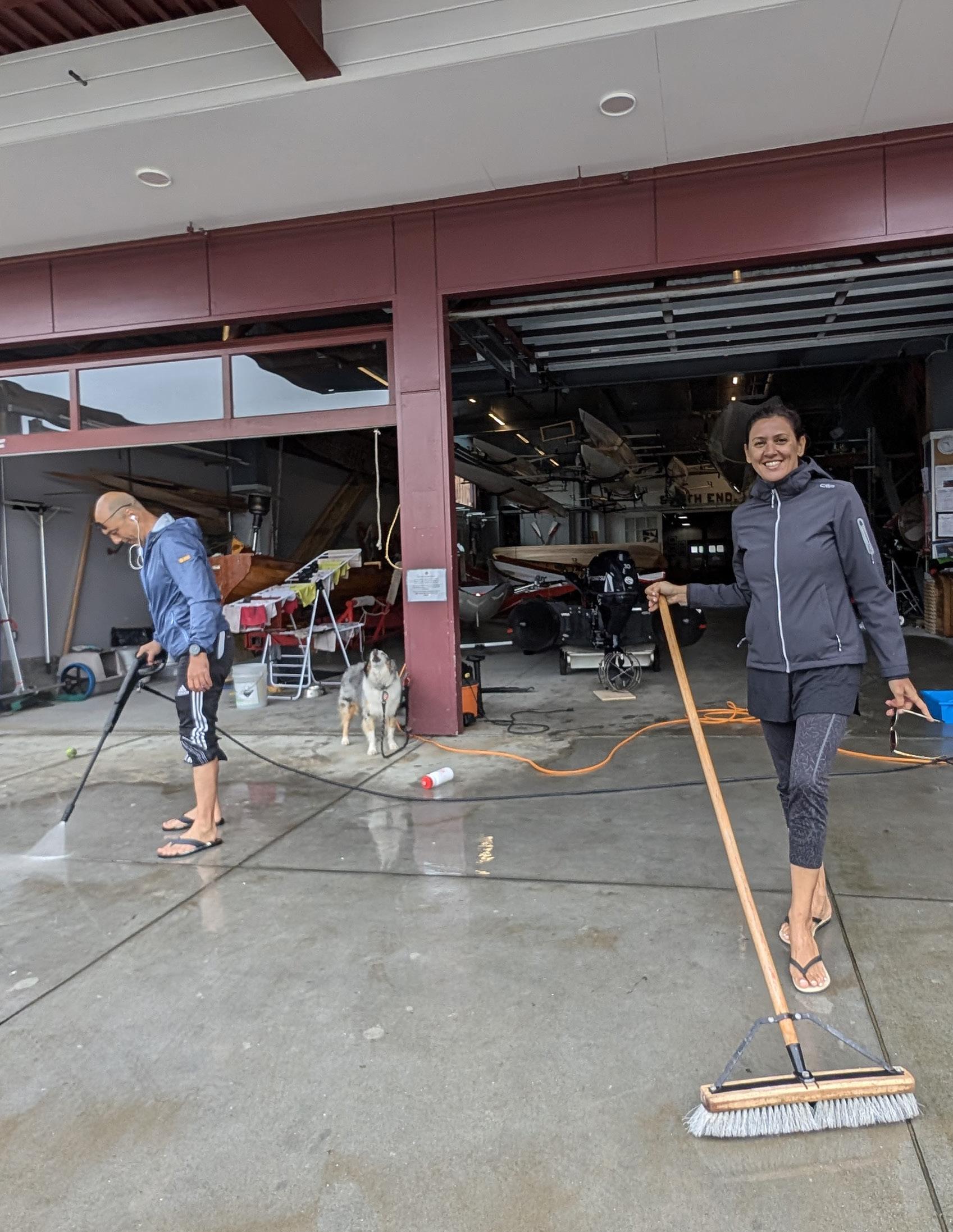
Whether it’s showing up for a Day of Service to powerwash the deck, joining a Monday Boatnight to sand and varnish, helping wash dishes in the kitchen, or simply introducing yourself to someone new, there is a place for you here. No special skills required. Just a willingness to participate.
And for those who have been here longer, the role is just as important. To notice new faces. To offer encouragement. To share what you’ve learned. To invite others into the work and the joy of this place.
Fifty years ago, a group of determined women pushed open these doors so others could follow. That moment didn’t come easily.
Today, we carry that same responsibility.
Each of us has the power to turn uncertainty into belonging. Each of us has the power to hold the door open.
Vanessa Marlin President, South End Rowing Club
Meet Your New Board Members!
In December 2025, SERC members voted for a host of people to represent us on the 2026 board of directors. Get to know a little more about those who are newer to our club leadership this year! Find the rest of your South End Board at SERC.com/board-of-directors
Jessica Gammell, Director-at-Large
“I’ve been a member since 2002 and could never choose just one favorite memory, although a few involve early morning Hurley Girl training in the dark, racing cruise ships! I am also a founding board member of the Pageturner Program. We exist to catalyze young people’s curiosity and independence by connecting them to an unlimited library of digital books (along with a Kindle).”
Adele Gower, Membership Commissioner
“I have been a member since 2019. Our pod has seen some pretty epic sunrises, which makes it easier to get up in the morning to see more of them. I also can’t forget the time I saw 15 starfish in one swim! South End membership means being part of a living tradition—a community that challenges, supports, and deeply connects me to the water and the city of San Francisco.”
Joyce Shulman, Entertainment Commissioner
“I joined in January of 2020. During my first swim, I introduced myself to a woman in her mid-70s coming out of the water, and she told me, ‘Welcome to the fountain of youth!’ My alter ego is a documentary photographer, and I also build large-scale public art (check out Naga, a sea serpent sculpture at Rainbow Falls Pond in Golden Gate Park!).”
Anissa Gardizy, Running Commissioner
“This is my second term as SERC’s running commissioner, and I was motivated to stay on the board to help the running program grow. This year, the running program will massively improve our communication so that all SERC members know what we are up to, and can join us. Stay tuned!”
John Schwenger, Swimming Commissioner
“I joined in 2021 and my favorite memory is swimming under the Golden Gate Bridge for the first time when I completed the Bay to Breakers swim. I also volunteer at Martin de Porres House of Hospitality. It is a soup kitchen that provides nourishing meals to anyone that passes through our doors.”
Will Newby, Boathouse Captain
“This is my third time on the board. I love this club and feel honored to be in service to the members and our history. There is nothing like the first time that door swings open and you see those boats and the club for the first time. It’s magical and transports your very soul.”
Kimberly Pross, Secretary
“I’ve been here 25 years! So many good memories: super long rows across the bay, sunset barge rows, epic happy hours, and even a few short swims!”
South End Shines at 2025 North Tahoe Regatta
BY WYATT NORDSTROM
The North Tahoe Regatta is unlike any other race on the calendar. Held annually for over 25 years on the crystal-clear waters of Carnelian Bay on Lake Tahoe’s north shore, and set at an elevation of 6,225 feet, it’s the highest-elevation rowing regatta in the United States. The thin air, spectacular mountain scenery, and exposed open water conditions make it a genuine adventure, and the race draws serious competition from clubs up and down the West Coast. Hosted by South End sister-club RowTahoe, the 2025 event included 17 teams from all over the West.
On a clear and beautiful day on Carnelian Bay, our biggest highlight came in the 7km Short Course Women’s Coastal 4x+, where Kate Wendelsdorf, Brittany Sutphen, Gail Gettler, Libby MacKenzie, and coxswain Marissa Miller took the top spot — and set a course record of 37 minutes and 26 seconds! That’s a tough boat to beat under any conditions, let alone at high elevation.
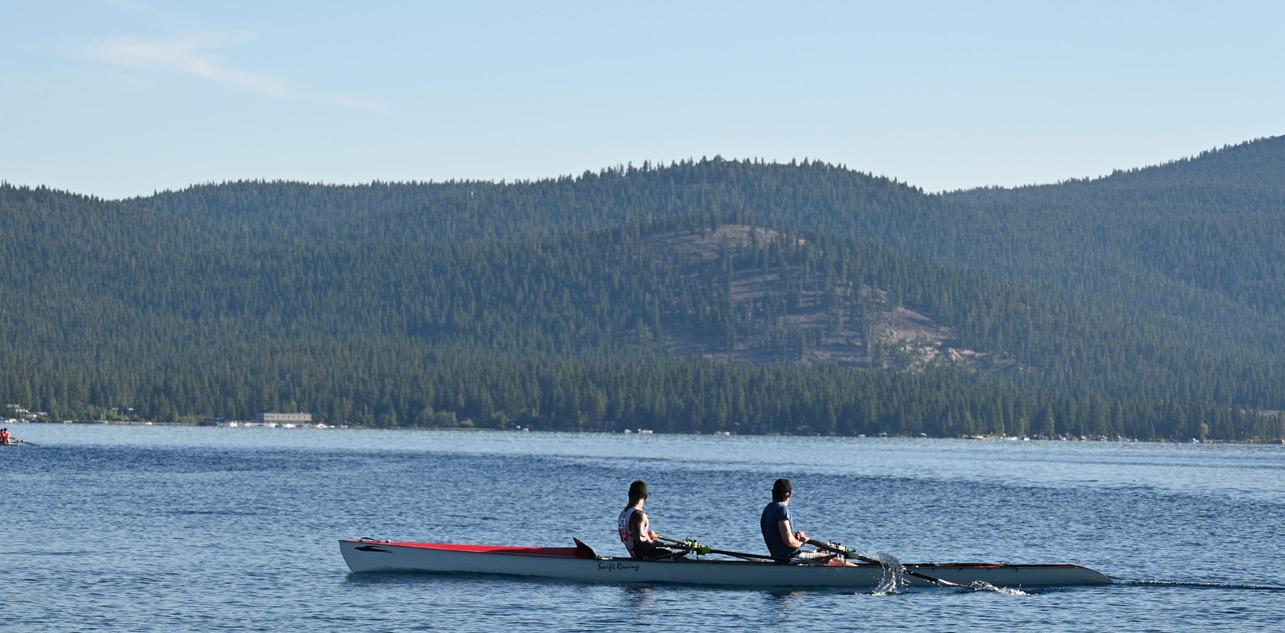
On the 16km Long Course, Pranay Desai and Wyn Forster (pictured above) put together an impressive Men’s Coastal 2x, posting the fastest raw time in their event and setting another course record, completing the race in an hour and 25 minutes.
Jessica Gammell also had a strong run, finishing second in the 7km Short Course Women’s Open Water 1x in a competitive field. SERC president, Vanessa Marlin, along with Dolphin James Dilworth, raced the 7km Short Course in a Coastal 2x in 35 minutes, 21 seconds.
When the dust settled, South End finished 4th in the Masters team standings with 31 points, a respectable result against stiff competition, with Bair Island Aquatic Center taking the overall title with 131 points. Congratulations to all the South Enders who raced, and a special nod to those who set records. Let’s shoot for the trophy at this year’s event, scheduled for August 9.
Author’s Note: RowTahoe, based in Incline Village, NV, shares several members with SERC, and welcomes guests during its on-water season (roughly late March through early November). Learn more at RowTahoe.org or contact wyatt@rowtahoe.org for more information.
Preservation in Action: The South End’s Living Fleet
BY WILL NEWBY, BOATHOUSE CAPTAIN
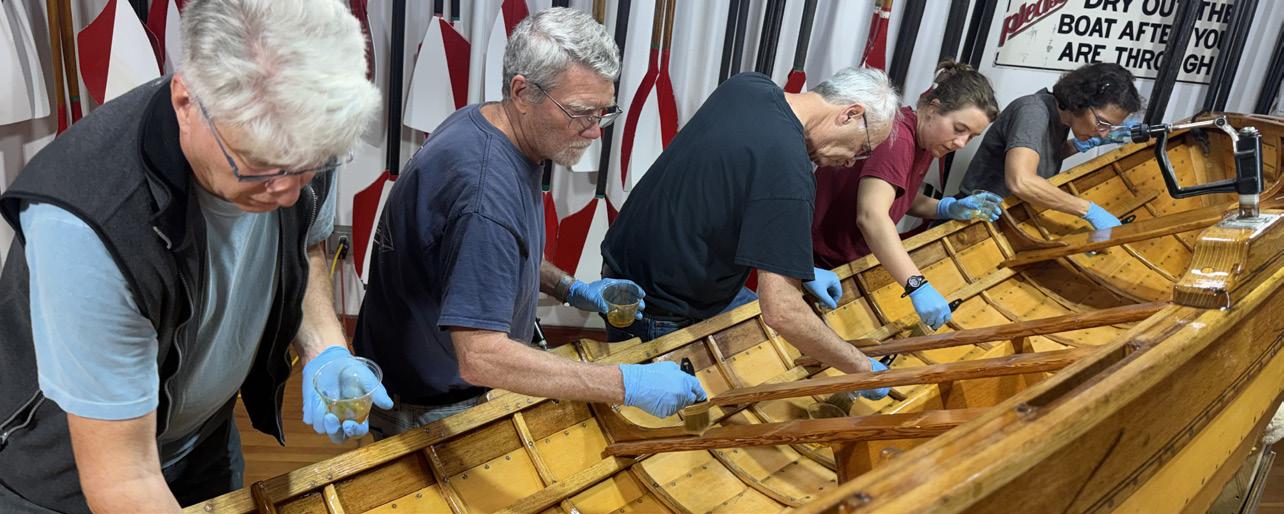
Here’s something I love about the South End: our historical boats aren’t museum pieces. They get rowed. They’re out in the fog, the salt, the sun, and the chop because that’s what they were built for. And then, every Monday night, they get taken care of. That’s the deal we’ve made with these boats, some of them over a century old. We row them hard, and we maintain them right. Preservation and use aren’t in tension here. They never have been.
Three years into the relaunch of regular Boatnight, I’m proud to say we’re holding up our end of that deal better than ever.
The South End, built in 1915 and the subject of a restoration that took over a decade, was our first project back from Covid. Six years in the water without fresh varnish meant she needed it badly, and she got it, inside and out. From there, the crew grew and the projects kept coming. After an educational ‘triage’ session reviewing the condition of the Nordquist and Penaat, we took on the Nordquist first: we completely stripped, bleached, repaired and revarnished her exterior, and she still looks brand new. We’ve been deep into the Murphy, a boat well over 100 years old that needed serious structural work: patching, a new plank, keel sealing, and revarnishing.
Oars have been repainted, our dock’s apron re-engineered to be easier on all the boats, and a dozen smaller fixes handled as they’ve come up because with a wooden fleet, something always comes up.
And not just wood! We’ve fixed plastic boats too, and rigging, trailers, dollies, and oars.
What’s changed is our capacity to keep up. We now have enough trained volunteers to run multiple projects at once, and the Monday night crew keeps growing. We’re lucky to have Jeremy Fisher-Smith back at the club, actively restoring the Thor and sharing decades of boatbuilding knowledge with anyone willing to pick up a brush or a plane. The skill levels on any given Monday range wildly, and that’s exactly the point. You don’t need experience. You just need to show up.
This fleet won’t make it to the next generation on its own. Wood rots. Varnish fades. Keels loosen. These boats survive because people care enough to put in the hours, and right now, we have the momentum and the crew to get ahead of the work instead of chasing it. By the end of 2026, I believe we’ll be looking at the best-maintained wooden fleet this club has seen in a very long time.
Come down any Monday from 6 to 9 p.m. — no experience needed, just show up — and if you’ve had a minor mishap with a boat, all the more reason. We’re always looking for cooks too, and you’ll never feed a more grateful crowd. We’re also rolling out better fleet tracking on the website this year, so you can flag what you spot even when you can’t make it in person. These boats were built to be rowed. Let’s make sure they still can be for the next hundred years!
Come Play the Perfect Game: Handball at SERC
BY ANDRES ACOSTA, HANDBALL COMMISSIONER
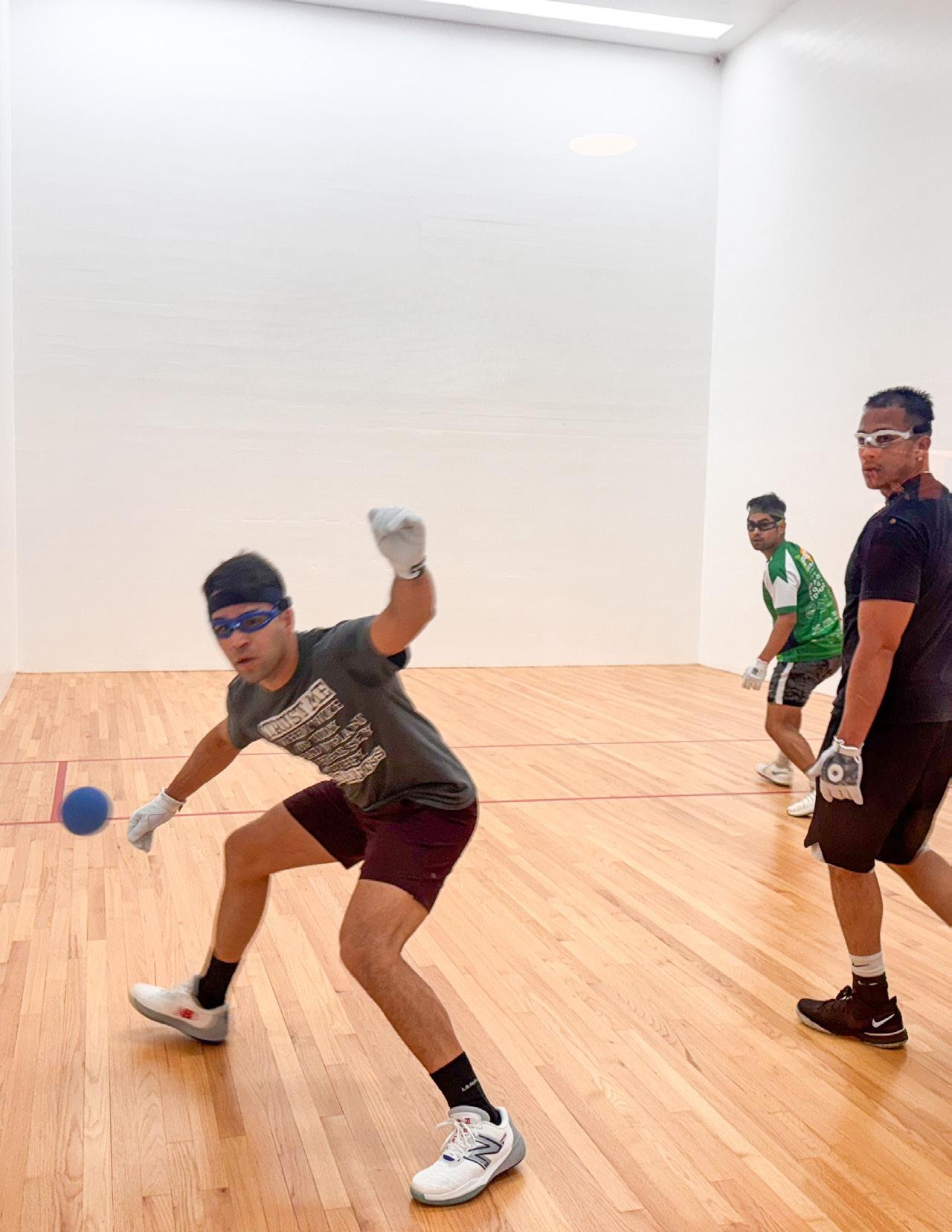
As Handball Commissioner, I’m thrilled to kick off 2026. My 2025 inaugural year was dedicated to our “small but mighty” community, prioritizing safety, and launching serc.com/handball to better connect our players. We host three annual tournaments open to the public: St. Patrick’s Doubles (March 13–15), Cinco de Mayo (May 1–3), and the Father/Son (August 8). This year, we’re also debuting a Mixed Doubles Big Ball tournament on October 17. Whether playing or spectating, join us for something special: last year we featured salsa lessons, live music, and the resurrection of a 100-year-old San Francisco Pisco Punch recipe.
Our 2026 focus is expanding the women’s program, building on Kim Howard’s 2025 clinic to create more opportunities to learn and lead. On a personal note, my favorite SERC memory remains watching Rudy Stadlberger play every year on his birthday; he proved you’re always young when you step on the court. We miss you, Rudy, thanks for everything. Whether you’re a club volunteer, swimmer, runner, or rower curious about the “perfect game,” the courts are open.
It’s Ladies’ Night on the Handball Courts!
BY NINA GANNES
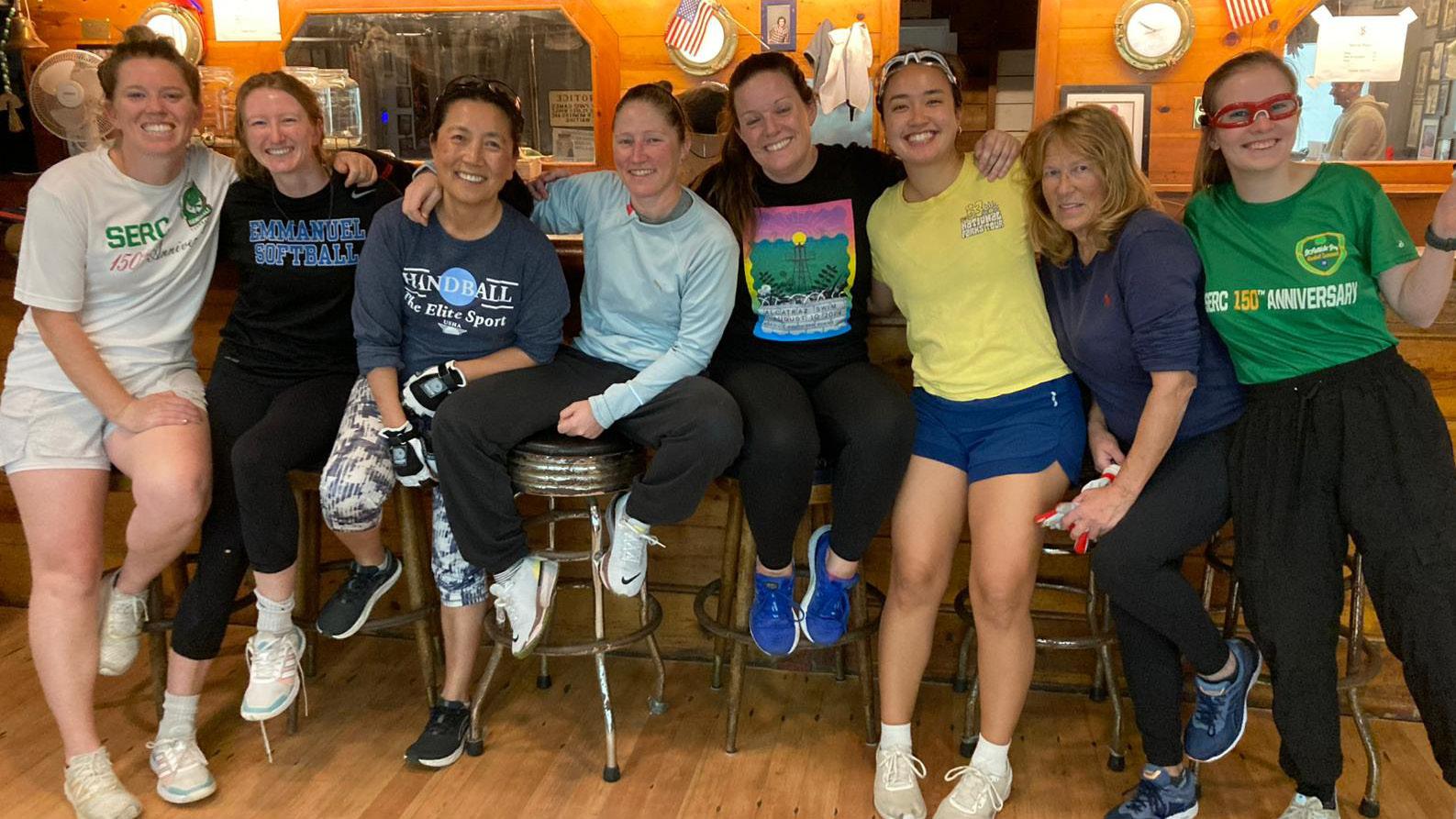
The next generation of handball players at the South End are bringing new energy to Bay Area handball! In true club style, our handball players range in age from their 20s to retirees whose age we shall not ask the fact-checkers to confirm for this newsletter.
Thanks to the momentum of the new ladies’ cohort of players, in November 2024 the Santa Rosa Turkey Shoot tournament hosted its first-ever ladies’ bracket. Brenna Gilmore (SERC) took home gold, with Julia Schmidt (DC) making a close fight for second. The February 2025 Pleasanton SuperBowl tournament similarly introduced its first-ever ladies’ bracket, with Gilmore (SERC) again taking the top prize and runner-up Margot McGrath (SERC) taking second.
The handball enthusiasm has not gone unnoticed, with former professional players Tracy Davis and Courtney Peixoto de Melo coming to SERC in January 2025 to teach a skills clinic. We had a great cohort of about 16 trainees learn better techniques for everything from throwing the ball to hitting tough back wall corner shots. All
players learned something new, no matter if it was their first day of handball or their hundredth!
One of the great parts of handball is the camaraderie amongst players of all levels. We have athletes like your author, with zero hand-eye coordination, who have spent years being incorrigibly bad at the basics. We have extennis and basketball players who pick up the game and are challenging our regulars to a competitive match on their first night. Wherever you fall on this spectrum, we’ve got a place for you in the handball community.
The easiest way to know what’s going on is to swing by the courts in the evenings after 6 p.m. Attendance varies by the day and week, but you can generally expect to see Ladies Night on Monday, a range of players Tuesday, Wednesday, and Thursday evenings, and advanced matches Friday nights and Sunday mornings. Once you’re there, ask anyone for a link to join our WhatsApp group.
See you on the courts!
Three SERC Women Finish
‘Feral’ 100 Mile Race
BY ANISSA GARDIZY, RUNNING COMMISSIONER
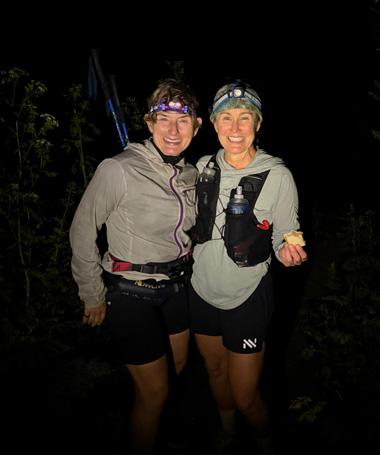
Robin Rose, Becky Margulies, Emily Gable, and Liz Warner at the start of the MMF100
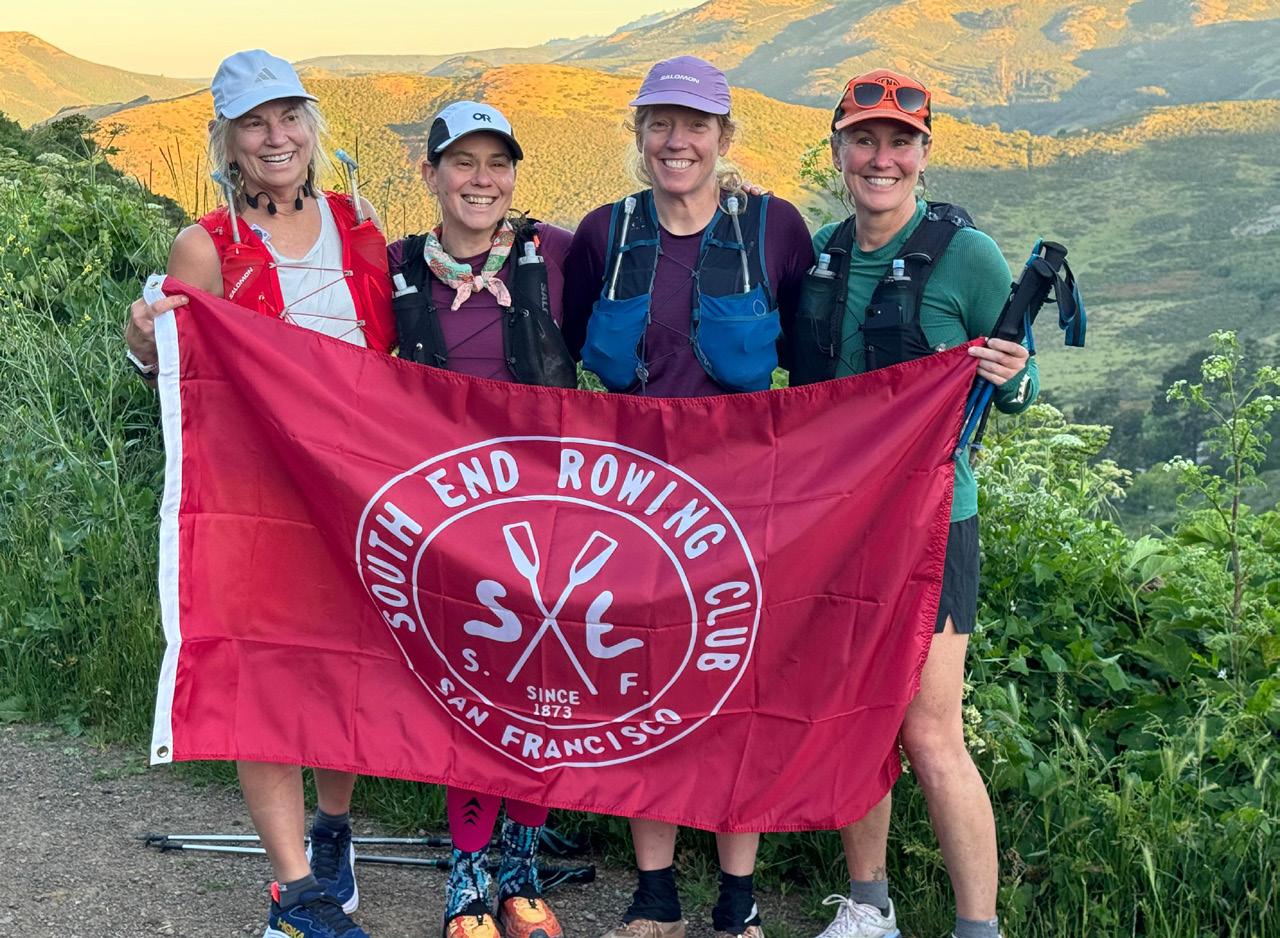
The Marty Maricle Feral 100 (MMF) is one of the South End Rowing Club’s most daunting—and most beloved— challenges. The premise is simple: run the same 50K loop in Marin three times, then make your way back across the Golden Gate Bridge to finish at the club.
It’s not a glamorous race. It’s a race where a runner drinks a lukewarm Coke on the side of the road, where aid stations spill out of car trunks, and where a volunteer cheers you on in an inflatable dinosaur costume.
The MMF draws runners looking to do something hard. Founded in 2023 and named after SERC Life Member Marty Maricle, the event celebrates a particular kind of endurance. The race is about proving to yourself that you can do much more than you think you are capable of, when surrounded by the right people.
Held on April 18 this year, the MMF had three finishers: Liz Warner, Becky Margulies, and Robin Rose. Emily Gable completed nearly 40 miles, while several others ran a single 50K loop—31 miles with roughly 5,000 feet of elevation gain.
Warner, 52, of Fairfax, returned to the race after running its inaugural edition, using it as training for a 200-miler this fall. Her day included early leg cramps that forced her to slow down and stretches where she struggled to eat.
But Warner—named Runner of the Year in 2025—leaned on experience, solving problems as they came. She focused on the positives, like her new running shoes and the fact that she didn’t have any blisters. At Pantoll Campground, her partner Van Cornwell handed her a warm bowl of ramen.
“We did a little reset and he got me out of the aid station feeling like I could keep going,” she said.
Margulies, 54, of Albany, had been eyeing the MMF since its inception but didn’t feel ready—until this year. She chose it for her first 100-miler in part because of its ethos: no strict cutoff times, and the chance to run alongside the South End community.
“I didn’t want the pressure of having to finish in a certain amount of time, I just wanted to see if I could do it,” Margulies said.
Fueling over that distance becomes its own battle. Runners cycle through homemade cookies, candy, and whatever sounds remotely edible in the moment. At aid stops, friends refill bottles from the back of cars, pass off snacks, and send runners back out onto the trail.
Margulies and Rose ran much of the race together, leaning on shared mantras: gratitude for their bodies, for the trails, and for the people around them.
“We would encourage each other and say, ‘we can do this,’ or, ‘one foot in front of the other,’ or ‘just keep going,’ and it worked,” Margulies said.
Around mile 80, Margulies recalled thinking, “This is just self-flagellation masquerading as a sport.” By mile 98, her perspective had flipped: “This is an incredible group of humans loving and supporting each other, masquerading as a sport.”
Margulies’ running partner, Robin Rose, 65, of Aptos, decided this was the year she was ready to run the MMF, thanks to encouragement from her friend and mentor, Marty Maricle herself. The race tested Rose’s resolve from the very first steps. Realizing she had left her poles at the start, she doubled back—returning breathless and mentally rattled, briefly tempted to quit. Fellow runner Thierry Nguyen noticed and offered calm and steady advice, getting her back on track. The lesson she carried home was simple: the mind is more powerful than we give it credit for. For anyone considering the race, she recommends training on the toughest sections of the trail, building a solid support
crew, and connecting with the SERC running community, a group she described as knowledgeable, open, and genuinely fun to run with.
This year, organizers also set out to bring more of the SERC running community onto the course, regardless of distance. While the MMF is typically self-supported, volunteers staffed aid stations along the first 50K loop, lowering the barrier to entry.
“If you want to try your hand at distance running, this is a beautiful, safe, local place to test your limits—without time cutoffs and with full support of the club,” finisher Liz Warner said.
Thanks to that support, four other SERC runners completed the 50k distance: Thierry Nguyen, Phil Taylor, Samuel Louie, and Greg Patterson.
Liz Warner and her pacer
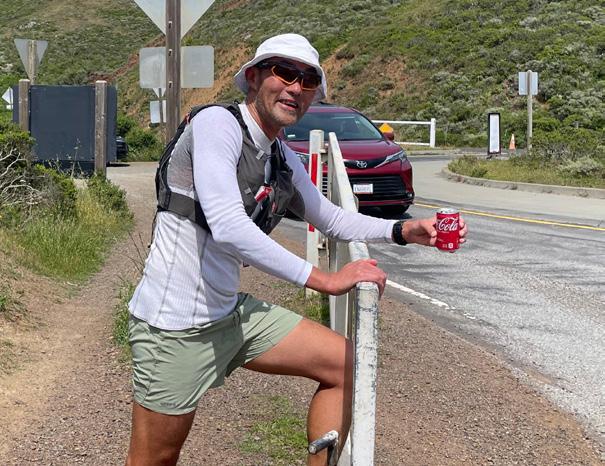
Thierry Nguyen drinking a Coke after finishing his 50K.
The Women of Aquatic Park: Coming in From the Cold
BY CATHERINE HOWARD LOVAZZANO, VICE PRESIDENT
For 50 years, women have strengthened the South End—in and on the water, in the handball court, on the run, on the board, and in the life of this club. We honor those who fought to enter, those who stayed to build, and those who will lead us forward.
It seems almost inconceivable today, in 2026, that our club would not be welcoming to all who seek the healing waters of the Bay. Our community thrives on the shared grit of a Sunriser swim, a nighttime run, a handball tournament, or the rhythmic pull of an oar. Yet, just five decades ago, there was a prolonged and pitched battle to keep women out of our clubs. Change didn’t come easily; it was forged in a courtroom.
The Legal Tide Turns In 1976, six women successfully sued the South End Rowing Club, along with the Dolphin Club and the Ariel/ SF Rowing Club, to admit women. Their lawyer noted that the basis of the suit was not merely gender bias, but federal law governing any institution operating on public parklands.
In 1977, the doors finally swung open, and the first cohort of women officially stepped across the threshold.
The Founding Women
Lee Bender, Joan Brown, Mary Dake, Trudy DiLorenzo, Diane Major, and Marilyn Rodman
These are not just names on a legal brief. Progress didn’t happen by accident.
It happened because women refused to quit. Many of these names are familiar to us, from their namesake boats, to Lee’s spirited Google Group posts. They were also known as “the troublemakers.”
Life Before the Threshold Before 1977, the experience for a female swimmer in San Francisco was one of rugged exclusion. Without ac-
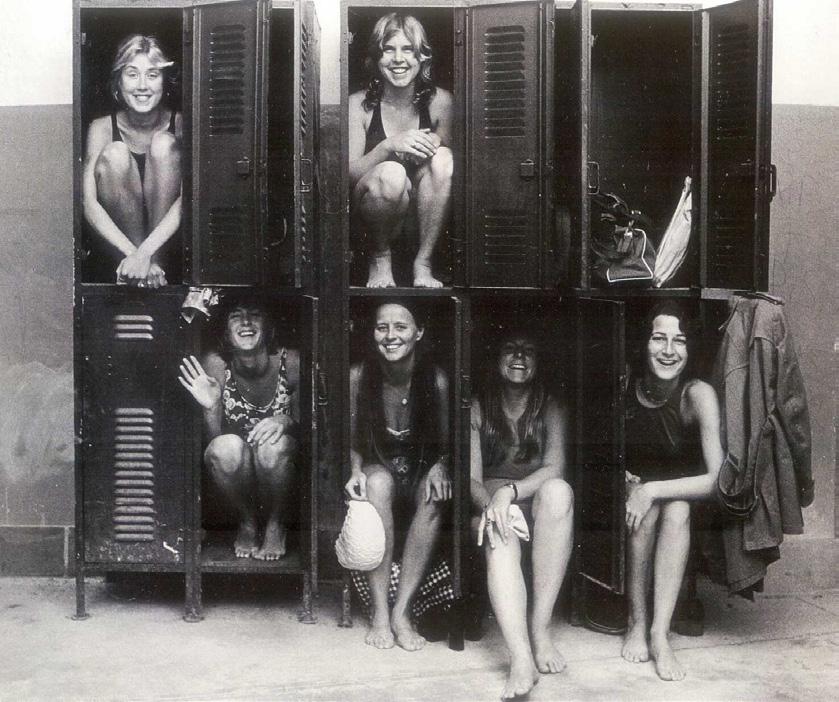
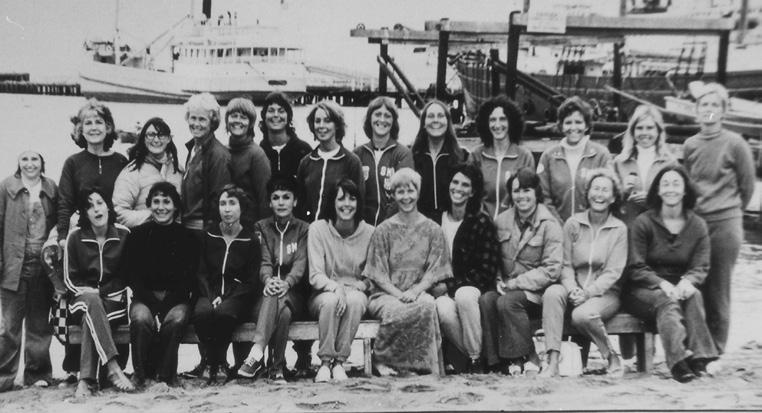
Before the South End admitted women, they were relgated to the dangerous public locker room under the Aquatic Park bleachers. Top L to R: Ginny Lutz Hofmann (Dolphin), Lane Foedisch Norton (SERC). Bottom L to R: Susan Allen (Dolphin), Paula Podolska (Dolphin), Lee Bender (SERC), Marie Henry.
Women’s (The Water Babies) First Annual Alcatraz, August 16, 1975.
cess to the clubs, women were swimming from the Aquatic Park beach, leaving their clothes and car keys stashed in the sand or tucked into shoes. There were no saunas to retreat to after a winter plunge, just a car heater and a thermos of coffee. To warm themselves after their swims, they tended fires on the beach, earning them the nickname “fire kickers.” They had no lockers for their gear, and limited access to organized swims and pilots.
“Coming in from the cold” was both literal and metaphorical. It meant moving from the exposed public beach into a community of peers. It meant trading a hiding spot for a key to the front door.
Building the Future
Once inside the club, these pioneers started carving out their space. They took to rowing the woodens, navigated the treacherous currents of the Golden Gate, and swiftly moved into leadership roles on the Board of Directors. They proved that the South End spirit—that unique blend of salt, sweat, and stubbornness—is not a gendered trait, but a human one.
As we celebrate this 50-year milestone, we look at the diverse faces on our docks today. We see young women learning to row, swim, run, and play handball—and veterans who remember how it was in the before times. We owe our current vibrancy to those six women who decided that the Bay belongs to everyone.
The water is still cold, but thanks to the troublemakers, the club is warm.
To learn more about the history of the South End, including our women’s history, read Bob Barde and Pat Cunneen’s book South End: Sport and Community at the Dock of the Bay.
We Are Marking the Milestone!
The South End is working with the Dolphin Club on events to celebrate 50 years of women’s membership in 2026. Details coming soon!
How We Got Here: A Timeline of Events
1973, 1974: First and second All Women’s Golden Gate swims. 1974: Several women are denied membership to the now-defunct San Francisco Rowing Club.
November 27, 1974: Arian et al. v. San Francisco Rowing Club et al. is filed in state court. Plaintiffs seek to force the San Francisco Rowing Club, Dolphin Club, and South End Rowing Club to admit women.
August 16, 1975: First All Women’s Alcatraz swim, pictured left.
September 16, 1976: San Francisco’s Rec & Park Commission adopts Resolution 10506, banning discrimination at facilities on park property.
October 12, 1976: South End by-laws are amended, opening the Club to all.
December 1976: Original Arian plaintiffs Diane Major and Lee Bender join the South End, followed by Joan Brown, Mary Dake, and Trudy di Lorenzo (also original plaintiffs).
December 27, 1976: Rodman v. Dolphin Boating and Swimming Club et al. is filed in federal court. Represented by attorney Sandra Terzian-Feliz, Marilyn Rodman seeks to force the Dolphin Club to admit women.
March 1977: Cecile Marie joins the South End (the sixth woman to join). Marilyn Rodman (the sixth original plaintiff) joins the Dolphin Club.
December 29, 1977: SF City Attorney Opinion Letter directs that the clubs may not discriminate in their membership processes.
March 16, 1978: SF Parks & Rec Department adopts Resolution 11189, ensuring that all private organizations using public property comply with the City Attorney’s Opinion (clubs are prohibited from rejecting a membership applicant except for good cause).
April 20, 1978: Amended complaint filed in Rodman, substituting new plaintiffs and renaming it Besig v. The Dolphin Boating and Swimming Club. Plaintiffs allege that no club on public property can allow “membership,” but that, rather, must be open to all members of the public.
August 12, 1982: In Besig ruling, the Ninth Circuit affirms the constitutionality of Parks & Rec’s decision to allow the clubs to continue as membership clubs, provided the general public is allowed day use.
Swimming into the Year of the Fire Horse
BY JING LI, SWIM DIRECTOR
Lunar New Year is one of the oldest and most important celebrations for many Asian cultures, with roots tracing back over three to four thousand years. The holiday is a celebration of renewal, gratitude, hope, and cultural pride for millions around the world, a time to honor past ancestors, gather with loved ones, and welcome good fortune for the year ahead.
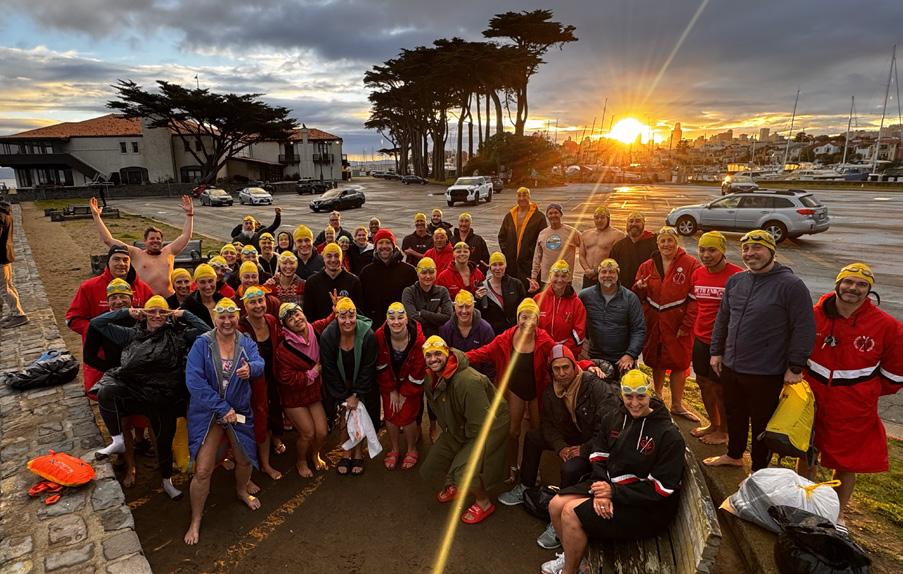
Lunar New Year brings communities together through traditions like wearing red to symbolize good fortune and protection, eating dumplings, which represent wealth, and exchanging red envelopes, which carry blessings of prosperity. In 2026, we welcomed the Year of the Fire Horse with a fun swim from Yacht Harbor back to the club. People born in the Year of the Horse are energetic, free-spirited,
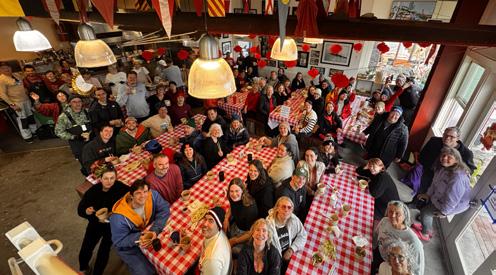
confident, and hardworking, and enjoy challenging themselves. Fifty-six swimmers showed up for our fourth annual Lunar New Year swim, despite the windy weather forecast. Afterwards, everyone loved slurping up the delicious bowls of hot, steaming pho with rice noodles!
At its heart, Lunar New Year is about reflecting on where we’ve been and stepping forward with intention into what’s ahead. Here at the South End, celebrating Lunar New Year honors the diverse cultures that strengthen our community. Wishing you and your loved ones health, happiness, and prosperity.
Happy Lunar New Year!
1873 Curious?
The 1873 Fund is Hard at Work, and You Can Help!
BY PETER GERTLER, CHAIR, 1873 FUND
Board
Jeff Gunderson, and Greg Patterson (Advisor).
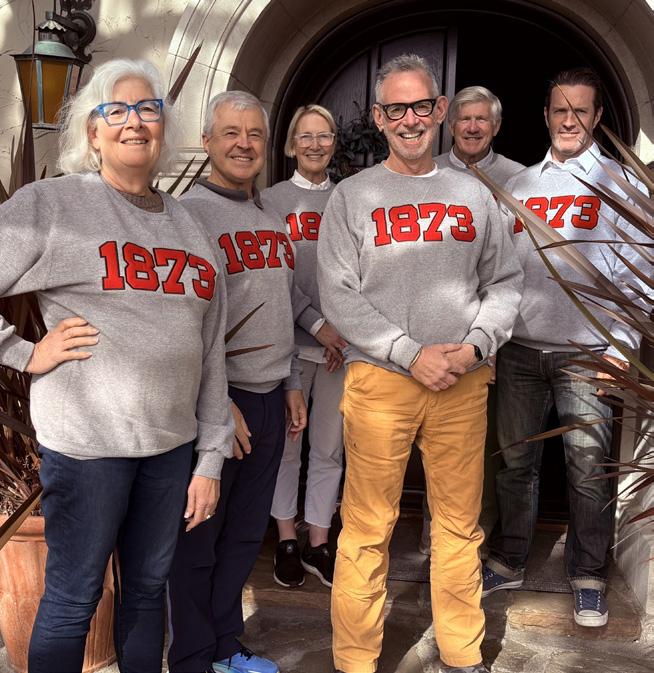
1873 is the founding year of the South End Rowing Club. It’s also the inspiration behind the 1873 Fund, a charitable organization founded 150 years later to support the Club’s future. The fund’s mission is to sustain the facilities, culture, and community of SERC for generations to come.
The Fund is an organization with IRS 501(c)(3) status, which means donations are tax-deductible. Our role is to provide the club with a significant source of revenue, beyond what its modest annual membership dues can sustain, even with the substantial growth in membership. The areas we support are:
• Major Capital Improvement Grants for new or improved physical facilities that enhance the SERC experience
• Cultural & Community Grants which range from member scholarships and financial-hardship requests to educational initiatives that preserve, connect, and strengthen the Club’s unique culture and community
Since receiving our nonprofit designation in 2023, we’ve established a strong partnership with the SERC Board, assembled a dedicated leadership team with nonprofit expertise, raised over $100,000 in donations, and granted over $20,000 to the club for its cultural and community initiatives. Now in its third year of operation, the Fund is growing from its start-up status.
In addition, we’re working on a few programs of our own.
Last fall, we hosted our first 1873 Talk (“True Tall Tales”), where more than 75 members gathered in the cookshack to learn from our resident historians, club members Jeff Gunderson and Lee Bruno, about the history of Aquatic Park and the San Francisco waterfront.
In 2026, we’re planning additional 1873 Talks, a Planned Giving Workshop, and expanded outreach activities. We’re also building our financial reserves to prepare for the club’s future capital projects.
We are also looking for volunteers as we build capacity. If you’d like to opt in to receive direct communications from the fund, including periodic updates, events, and opportunities, please visit www.1873fund.org
We are a separate entity that works in conjunction with the SERC Board to provide:
How
• Donate at 1873fund.org or through serc.com
• Include the 1873 Fund in your estate planning
• Recommend foundations for third-party grant consideration
• Participate in employer matching programs
• Support us through planned giving
Reach out to any of our Board Members or consult your financial advisor about how best to contribute.
1873 Fund
2026 (L to R): Susan Blew, Dan Needham, Fran Hegeler, Peter Gertler (Chair),
CATptain’s Log: $11K Raised for Club Cats at Catnip Soirée
BY EDISON “FAST EDDIE” PEINADO AND KIM “KIMICAT” HOWARD
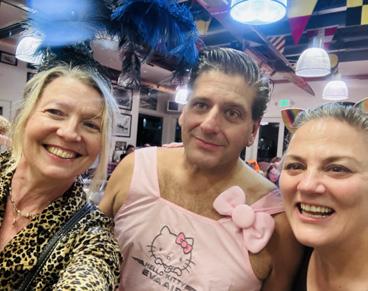
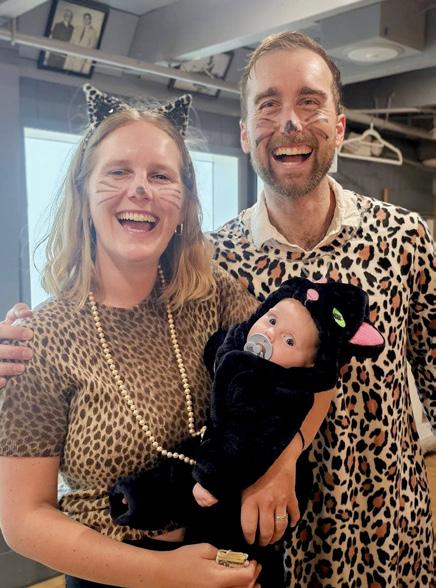
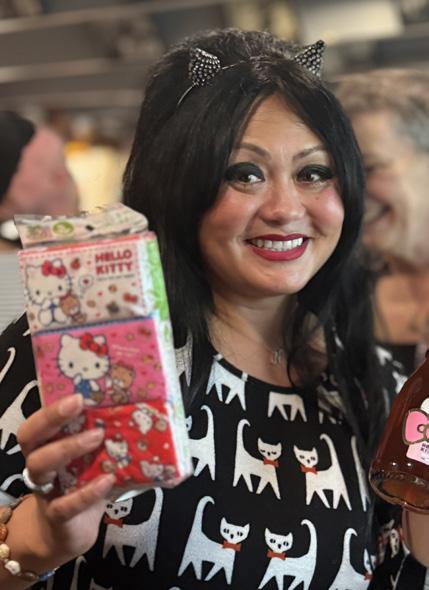
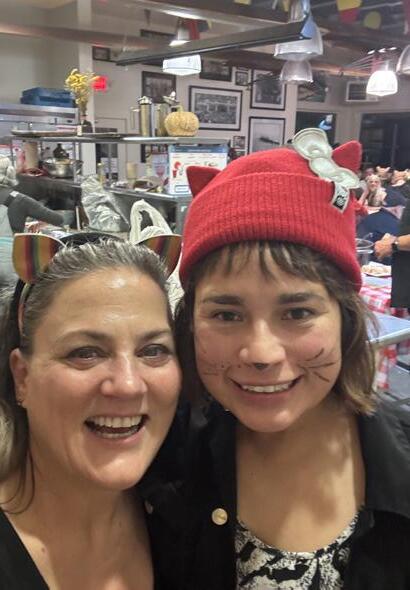
The Catnip & Caipirinha Soirée, our club cat benefit party held November 1, 2025, was a big success. Together we raised just under $11,000 for Jameson and Hurley’s emergency medical fund.
It was a night of camaraderie, community, costumes, Brazilian food, and that good feeling we get when South Enders come together for something that matters.
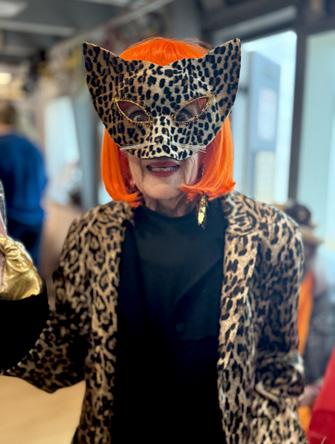
Office manager Susan Wintersteen said, “It was the best thing I have seen at the club. The food and drinks were delicious. The volunteers did a great job. People’s costumes were amazing. I was shocked to win first place and will treasure that time forever.”
We raised $6,550 from party contributions and direct donations, from South Enders, Dolphins, friends, and family. The auction, hosted both online and in person, raised over $4,400.
Auction highlights included:
Highest Donation: two-hour excursion with Molly’s Boats, provided by Molly Breivis Most Fought Over: four hours of contractor work, donated by Patrick Bobby O’Malley Daly
Biggest Donation-to-Value Ratio: Barge Row & Picnic, provided by Marissa Miller Bidders who contributed the most: Rosanna Lerma, Louisa Pickering, Zorah Rose
What meant the most to us was how many of you stepped up to help. There was a lot of work behind the scenes, but there were so many offers of help and good energy that the night felt effortless. The party and the auction showed what makes this club special: we value shared experiences, generosity, and each other.
Extra-special thanks to:
Sydelle Harrison and Laura Guptill Hovden (Treasurers), Erika Gliebe and Jeanne Sellers (Event Setup), and Kim Howard (Marketing and Auction)
My daughter Izabella Bashiyo and her fiancé Daniel Camargo came all the way from Brazil for the occasion, helping me cook for three days. Izabella also made 400 chocolate and caramel brigadeiros, and Daniel made 70 caipirinhas for the bar.
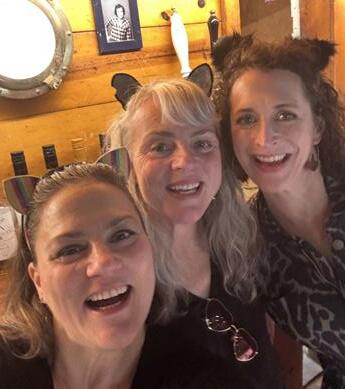
Behind the bar in cat ears were Kim Howard, Allison O’Malley Daly, Stephanie Gerk, Katrina Lundstedt, Melissa Nordquist, Fiona Caulfield and Brit Sutphen, with Bobby O’Malley Daly putting a Brazilian-Fijian twist on his famous Irish coffee. The kitchen crew was stellar, headed by Mee Lee, Zina Deretsky, Joanne Sakai, Shannon Raintree, and Kate Zierolf. So much work done so smoothly! We could not have done this without them. Big obrigado to Ned Viall, who washed dishes for hours without complaint (as he often does).
And finally, Chris Breen was an entertaining costume contest herder! The party only worked because of many hands, and thank you all!
Costume contest winner, Susan Wintersteen
Aondrea Maynard, Eddie, and Kim Howard get ready to party
Kim Howard, Katrina Lundstedt, and Melissa Nordquist
Nelson and Sheridan Auner and their new kitten, Sloane, love to support the cats!
Who are Jameson and Hurley?
Hurley
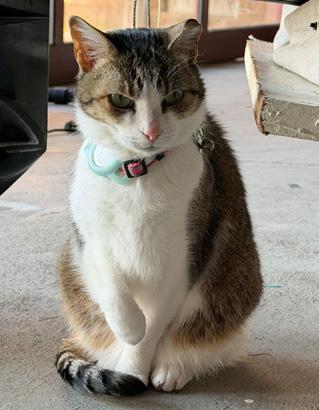
While flying for Fiji Airlines, “Cat Boss” Eddie Peinado rehomed 17 Fijian cats. Two of them, Jameson and Hurley, came back to San Francisco to become our Chief Mousers.
They are our working kitties, yes, but they are not disposable tools like mouse traps or poison pads. They are sentient, loving creatures who keep the club rodent-free and also bring comfort and companionship to many members.
Thank you to the many members who donate priceless volunteer time and love every day to keep our Chief Mousers safe. Most especially Robert MacKimmie and Jamie Lee Pickard, without whom the safety of the cats would not be possible.
Special recognition to Lynn Sywolski, who kitty-sat and donated financially for years (despite being allergic to cats!), and to Andrew Bennett, Sean Johnson, Kelsey Meranda, Chris Albion, Lauren Graffort, Jon Grunstad, Christian Einfeldt, and Meredith Axelrod for helping protect the cats during high coyote-risk hours.
Big thanks as well to our Boathouse Captains, Boatnight volunteers, and Building Commissioners who welcome the cats and make creative boathouse adaptations.
Ways you can help our club cats:
• Protect them from coyotes and cars by closing doors and windows before dark (early morning and night)
• Help bring Jameson inside at night
• Keep litter boxes clean (far east wall of lower boathouse behind Mark Hurley barge)
• Help herd them before events and big swims
• Keep them company
Want to get more involved on our Itty Bitty Kitty Committee? Contact Eddie at edisonpeinado@gmail.com or 415-412-0665.
Jameson
“Tiki” Nancy Luna enjoying her costume contest prizes
Cat lovers Kim Howard and Karla Ocampo Valle
Salty Lit: Books for Humans of the Aquatic Persuasion
BY PETE MULVIHILL
As a reader and owner of the bookstore, Green Apple Books, I often talk about books with my fellow swimmers. Here is a non-exhaustive list of recent books about swimming that may be of interest. You can buy them wherever you want, of course, but we hope you keep your dollars in the local economy by supporting any locally owned, independent bookstore, or buying from Bookshop.org.
At the top of every swimmer’s pile should be Why We Swim, a long love letter to swimming by Berkeley author Bonnie Tsui. It’s a wide-ranging exploration of swimming, including tales of Icelandic survival, swims in Saddam Hussein’s pool, Kim Chambers’ inspiring story, and how Bonnie’s own parents met in a Hong Kong pool.
For ocean and bay lovers interested in the science behind waves, currents, and beaches, the updated edition of the classic Waves and Beaches, by Willard Bascom and Kim McCoy, is a beautiful book overflowing with charts, graphs, photos, and explanations. Most importantly, it’s written for the layperson, so while it’s pretty deep, it’s also relatively accessible.
If you know someone who wants to explore new waters, or if you seek inspiration to get out of the cove, consider Places We Swim California: The Best Beaches, Rock Pools, Waterfalls, Rivers, Gorges, Lakes, and Hot Springs. Divided into six regions of our Golden State, it covers a variety of locales for plunges, dunks, swims, and soaks.
For the swimmer with wanderlust, we recommend Waterlog: A Swimmer’s Journey Through Britain, by Roger Deakin. This book has a cult-like following in England and was finally published in the U.S. a few years ago. Deakin was a nature lover who swam his way across England, plunging into every fen, moat, river, sea, bay, and creek he could find. He is credited with spawning the “wild swimming” movement in England, and the book is charming, funny, adventuresome, and inspiring.
If there’s a fiction lover on your list, I suggest Samantha Hunt’s ethereal novel The Seas. Set on a cold coast, it’s
one of those books that seamlessly walks the line between reality and fairy tale. A fellow writer summed it up well, “Hunt’s spare narrative is as mysterious and lyrical as a mermaid’s song.” You are going to want someone to discuss this book with—perfect book club book!
Another novel of note to our community is The Swimmers, by Julie Otsuka. This is a tender, funny, reflective novel focusing on a group of pool swimmers, while also tackling tough subjects including dementia and the internment of Japanese Americans. Poetic and mesmerizing.
And finally, on the less narrative, more artistic side, check out Sharks, Death, Surfers: An Illustrated Companion, by Melissa McCarthy. Bookforum summarized it like this: “Sharks, Death, Surfers is a beautiful art object, petite and strange, replete with artist renderings of sharks that span the ages, from 750 BCE to the cover of Jaws.”
Green Apple Books also carries, of course, South End: Sport and Community at the Dock of the Bay, Bob Barde’s exceptionally well-researched history of our mighty Club, written with the late, great Pat Cunneen.
Rowers Read Too!
According to your rowing editor, those who love a great underdog sports story should check out A Most Beautiful Thing: The True Story of America’s First All-Black High School Rowing Team by Arshay Cooper. Cooper grew up amid violence and hardship on Chicago’s West Side in the 90s, and found an unlikely lifeline when an opportunity to join the crew team arrived at his school. Now also a full-length film documentary, it’s a great read (and watch). Keep tissues handy. –Marissa Miller
Cold Water, Warm Hearts: The Annual Dreaded 9th
BY SEAN JOHNSON AND ANDREW COTTER
February 9th holds a special place in South End lore. It’s the day the bay supposedly reaches its coldest temperatures of the year. Every year, it draws the club’s most committed cold water swimmers out for the Dreaded 9th, a long, open water swim that earns its name through reputation as much as reality.
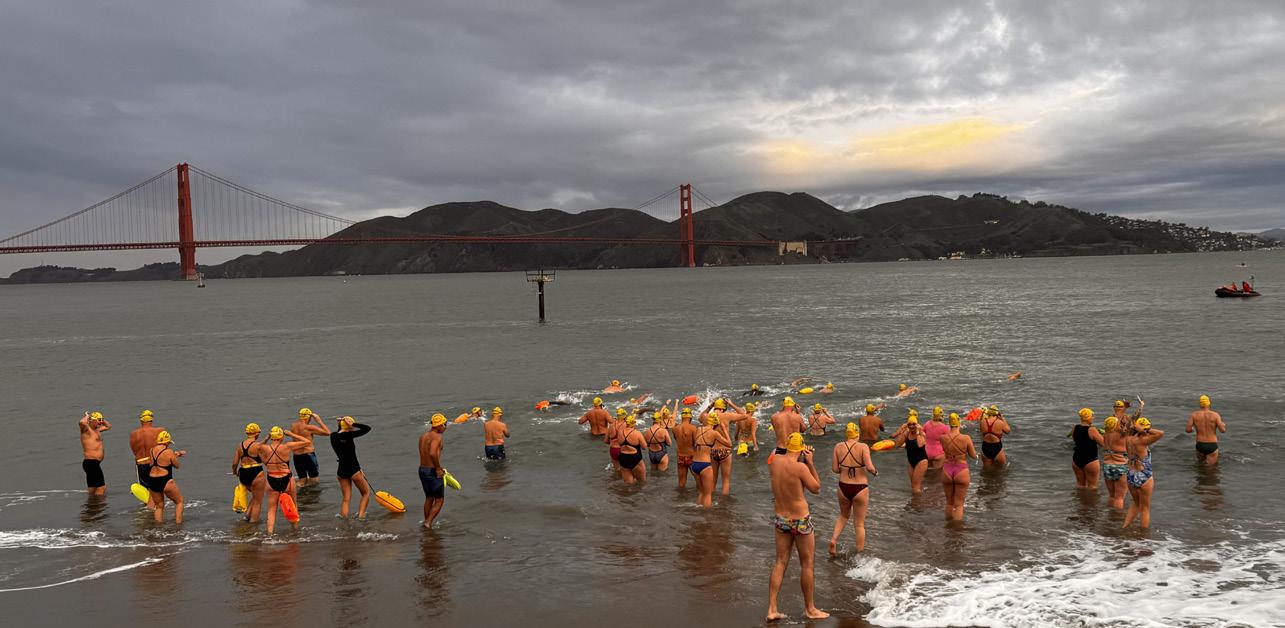
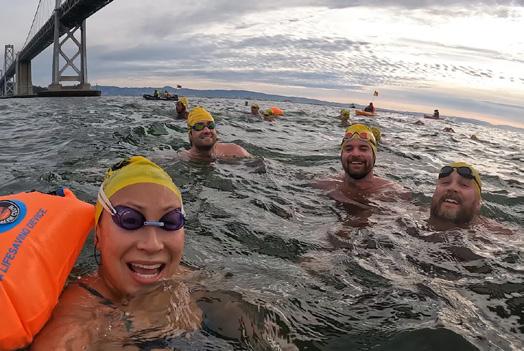
This year, 19 swimmers, 14 pilots, and six kayakers set out from McCovey Cove on the morning of the 9th under sunny skies and into 56-degree water, which felt balmy compared to the low 50s and occasional high 40s of years past. Directed by Jeff Everett, the group finished in 80 to 90 minutes, making this one of the more forgiving editions of the event in recent memory.
Conditions hadn’t looked quite so lively the day before. A test swim on the 8th found the bay glassy and still, with no boat traffic in sight. The next morning, the wind had other plans: chop filled in, and the fleet wove through Monday
rush hour ferry traffic near the Ferry Building. A mid-swim regroup at the Bay Bridge helped bring the group back together to safely navigate the traffic. “The strategy to regroup at the Bay Bridge felt like it worked,” said swimmer and test swim pilot Sarah Roberts. “It was actually a nice spot to chill and chat for a couple minutes.”
Behind the scenes, lead pilots coordinated with the Port of San Francisco, the McCovey Cove Management Office, and City Kayak Rentals to make the swim possible. Special thanks go to Tim McElligott and Morgan Bromstad from the Dolphin Club, who provided additional water support aboard vessel Aries II, keeping swimmers safe and costs down for participants. Thanks as well to all pilots, kayakers, cooks, and drivers who gave their time on a weekday morning to ensure the event ran smoothly.
Swimmer Gretchen Fermer captured the mood on the way in: “Today was great! It felt really safe and organized in addition to being crazy fun!”
See you next February!
A LOOK BACK
By Bob Cumming
My Trip to the National Regatta
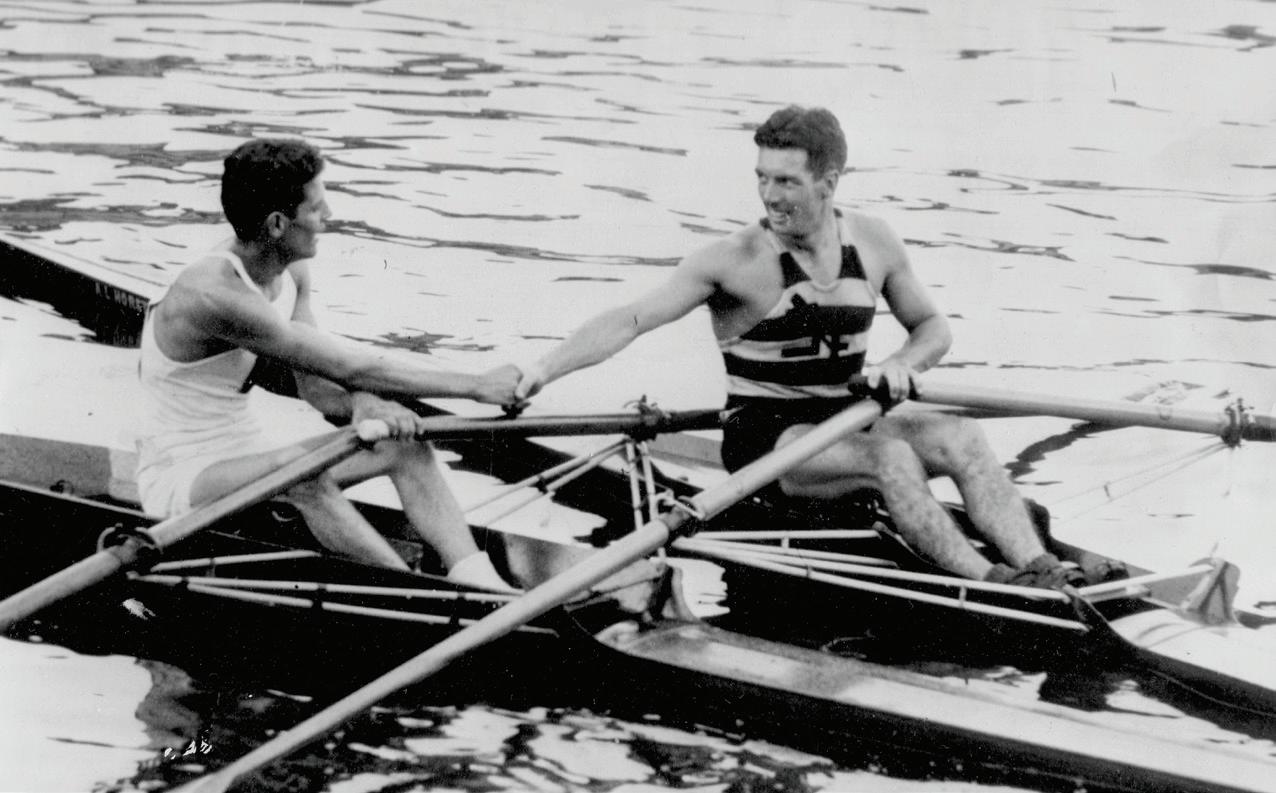
South Ender Bob Cumming (r) congratulates opponent Tommy Clarke (l) after racing on the Schuylkill River
The following is excerpted from the September 1931 issue of The South Ender:
On arriving at Philadelphia, after a very interesting, but very warm train journey, I at once got in touch with Captain Garrett Gilmore of the Bachelor’s Barge Club, which is one of the oldest rowing organizations in this country, being incorporated about 1850.
I had the use of a boat from the Bachelor’s Club and had familiarized myself somewhat with conditions on the Schuylkill River, where the races were held. Boathouse Row consists of the buildings of eleven rowing clubs and is the scene of great activity every evening and Sunday mornings.
One thing that impresses the visitor is to see so many elderly men rowing single shells. Many of them are great oarsmen in their day and still getting their exercise at the game they love.
During my first week of training, I rounded into pretty good condition, although I felt the heat quite a bit. By working out twice each day I soon began to get used to the river water, and after the rough water in San Francisco Bay, it certainly was very comfortable rowing.
As the day of the race approached, I was in very good condition and felt confident I could win, although I knew I would have a hard race. My only opponent in the event being Tommy Clarke of the Undine Barge Club. Clarke is not a very big man, he weighs only around 126 lbs but he has had a world of experience and is one of the most polished
scullers on the Schuylkill River. He is known all over the East as the 130 lb. wonder.
The race was a case of the first man out in front staying in front. Clarke’s perfect sculling earned him an enviable three-length lead in the first half mile, two lengths of which he managed to hold until he was over the finish line.
It was a hard race for both of us. Clarke’s time for the mile and a quarter [2,000 meters] was 7 minutes, 37 seconds while I was over in 7 minutes, 41 seconds which was 8 seconds faster than the Association singles which was rowed a few minutes later. There were 61 entries in the regatta and close finishes in most of the races kept things lively.
I accompanied the Philadelphia boys to the Canadian National Regatta which was held at St. Catharine’s, Ontario. I entered the 140 lbs. singles and won my way to the finals but lost the final by a scant two feet to the Canadian champion, Fred Burns. It was a hard race to lose, but I had a great deal of satisfaction in leading Clarke by about five boat lengths.
The time was slow on account of a very strong head-wind, Burns’s time was 9 minutes, 47 seconds. The distance is 1 mile, 550 yards [approximately 2,112 meters].
Editor’s Note: Coach Bob Cumming went on to eventually found the Marin Rowing Association in Greenbrae in 1968. The boathouse they row out of is named in his honor.
Photo:
South End Rowing Club
500 Jefferson Street
San Francisco, CA 94109
Love the South Ender but Want to Save Trees?
All members will receive the South Ender magazine by email AND print, by default. However, if you’d like to ONLY receive a digital copy of the newsletter, please OPT OUT of the print version at SERC.com. Just log in to your SERC account and update your Newsletter Delivery Preference under Membership Details. You can also email newsletter@serc.com to consolidate mailings if you are a multi-member household.
MARK YOUR CALENDAR!
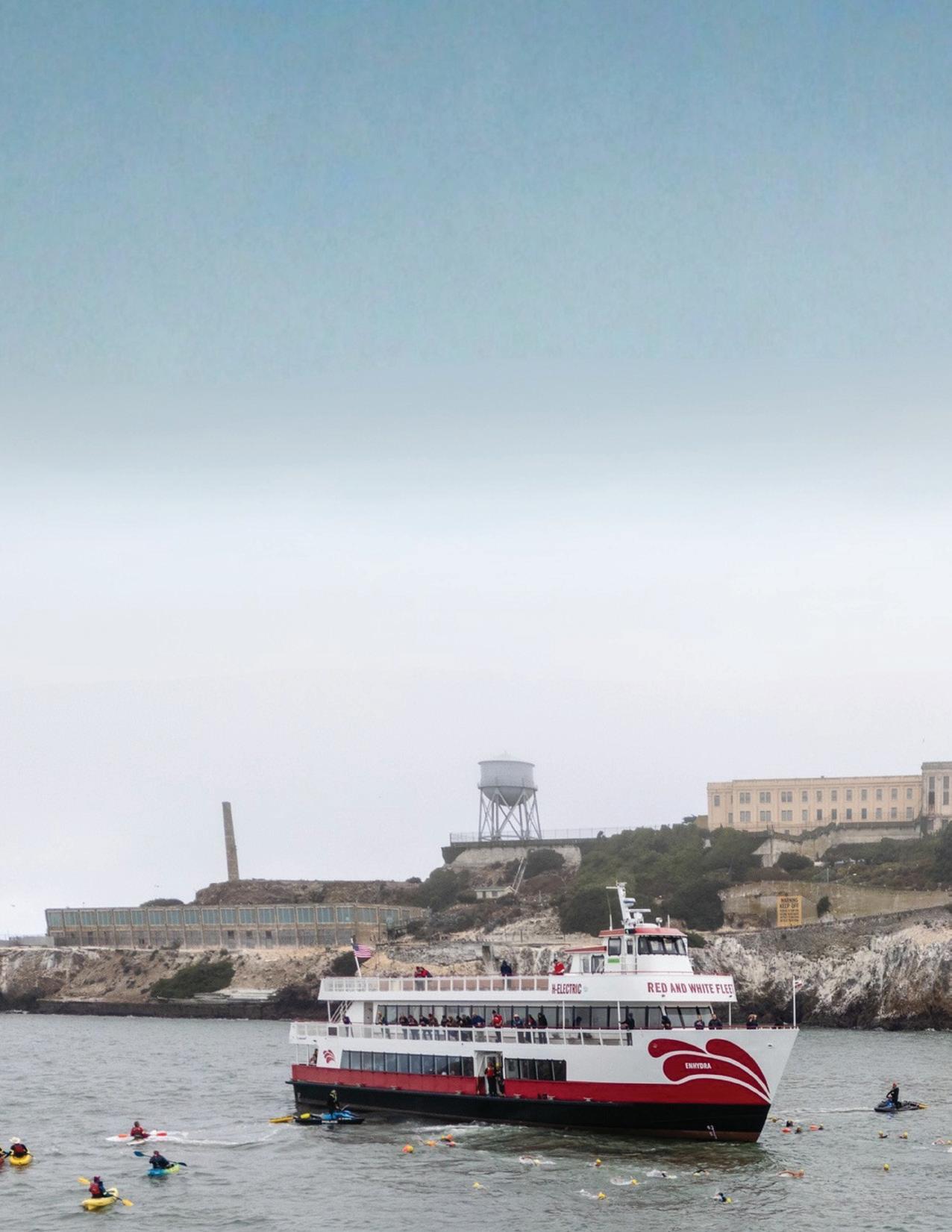
The Alcatraz Open 2026 is Sunday, September 13!
We’re calling on all South End Rowing Club members to mark your calendars for one of the most exciting and spirited days of the year.
The success of this event depends on everyone pitching in — from dock support and safety crews to helping and counting swimmers as they cross the finish line and sharing that signature SERC camaraderie.
We already have nearly 300 participants registered and expect the event to sell out soon, so let’s make sure we’re ready to show our best South End spirit and hospitality on race day!
Watch your inbox for volunteer sign-up information! Email AlcatrazOpen@serc.com with questions.