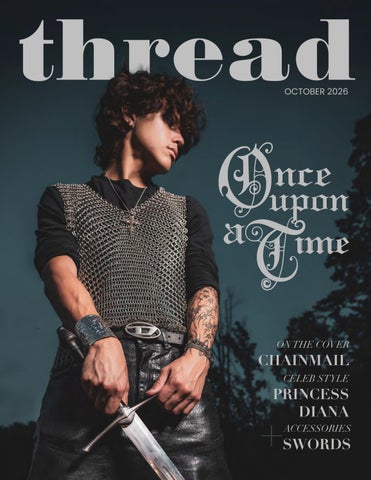
thread OCTOBER 2026
ON THE COVER
CHAINMAIL CELEB STYLE
PRINCESS DIANA
+
ACCESSORIES
SWORDS
thread
CONT #90 Fairytale to Tragedy
#34 Twinkle Twinkle Little Star
#122 Storytelling through Music
FRONT OF BOOK #04 Haute Online #08 Top 5 #12 Editor’s Note #13 Masthead #14 Executive Board
2 | THREAD
SEAMS
#18 Runway Realway: Vivienne Westwood A/W 1981 #20 Runway Realway: Zoe Gustavia, Anna Whalen Fall 2025 #22 Celeb Style: Princess Diana #24 Celeb Style: Wisdom Kaye #26 Swords #30 Chainmail #34 Twinkle Twinkle Little Star #36 Vintage Makeup #38 Robert Pattinson #40 Maya Angelou
table of contents
The Once Upon A Time Issue
ENTS #68 Book Lovers
#22 Celeb Style
#40 Maya Angelou
MIDDLE OF THE BOOK
#44 Create Your Own Story #56 Through The Looking Glass #68 Book Lovers #80 Fairytale to Tragedy #92 Looks We Like: American Girl Dolls
CAMPUS CASUAL
#100 Lost Flamingo #102 Quiz: Poet, Soldier, or King #104 Mary C. Doxsee Historical Clothing #106 Witches in Pop Culture #110 Costuming for Period Pieces #112 The Resurgence of Physical Media
BACK OF THE CLOSET
#118 Future Classics #120 Rise of Fanfiction #122 Storytelling through Music #124 The Brothers Grimm #126 IGF: Bobcats and Ballgowns #132 Rant/Rave: Nude Photography
THREAD-MAGAZINE.COM 3
HAUTE ONLINE Looking for a new internet obsession? Whether you want to listen to podcasts or watch some videos, we’ve got you covered virtually.
CRANK 2 With the weather turning cooler and Mercury retrograde approaching, I can’t think of a better time to listen to music filled with pure aggression. Filling this need is Slayyyter’s new single “Crank 2,” released on September 10, 2026. “Crank 2” is Crank’s cooler, evil older sister. With a dark and sinister tempo, “Crank 2” delivers the perfect spiteful rendition of the original, while also differentiating itself enough to hold its own. Slayyyter’s breakout success came with her third studio album, “Wor$t Girl in America”, which features the original “Crank.” Six months later, she dropped “Crank 2,” which has set the bar high for her rumored next album, “Wor$t Man in America.” 4 | THREAD
The song features something that hyper-pop, as a category, is nailing right now — adrenaline. It’s the kind of track that is built for dancing until you’re sweaty, putting on eyeliner, and breaking the sound barrier on your speaker. So, if you need a new messy single to jam out to, “Crank 2” is your girl. - SOPHIE SCHALLER
haute online
THE LOST TOUR Over the years, I’ve lost hours of time to doomscrolling. I envy older generations and their ability to be unplugged. My friends and I always talk about how draining it is to constantly receive work- or school-related emails and texts. There is never a break because phones allow for constant communication. There is a beauty in connecting with friends and loved ones no matter how far apart you are or what time it is, but it makes it difficult to be present. Phoebe Bridgers’ The Lost Tour banned phones, and it created a space to be present. I had the best five hours with my friends and girlfriend while being completely unplugged. The stadium was full of chatter while we waited for the openers. Strangers were bonding over their favorite song from the new album. Everyone in the stadium managed to organize a mass wave back and forth for a solid ten minutes. Participating in this experience was heartwarming. Once the
show began, everyone had their eyes locked on the stage, singing along to every word. People brought out lighters instead of phone flashlights for extra sad songs. There were no phones recording each song. Instead, there were just people existing in the moment. This created a very intimate experience only shared by those in attendance, rather than with the whole internet. - NATALIE SCHOOLCRAFT
THREAD-MAGAZINE.COM 5
“BIG BROTHER” Season 28 of “Big Brother” has been nothing short of entertaining. There have been rivalries, alliances, and even a showmance. For the past 11 weeks, one of the biggest topics of “Big Brother” conversation has been Melody Morris and Drew Campbell. In the first week, Melody thought Drew would get on her nerves, but that quickly changed as they grew closer. On the live feeds, they were seen walking, dancing, and having deep conversations together. Drew delivered some of the season’s most memorable lines. At one point, he told Melody that the hardest thing he’s ever done was being friends with her. Another time, he said she was “his Achilles’ heel.” Unfortunately, the showmance was brought to
6 | THREAD
an end when Melody was evicted in week 11. As she was leaving the house, Drew called out for her and hugged her, and she told him to win. After this, we saw Drew “call” Melody on the fake phone, tears in his eyes. He slept in her pod, which they once shared before her eviction. His fellow competitors, Taylor Brown and Rick Devens, have been comforting him through it all, telling him that “distance makes the heart grow fonder,” and he responded with, “Don’t hold your breath.” I hope to see more of Drew and Melody after the season is over. Whether it’s a friendship or more, I think the bond they had in the house is irreplaceable. -TAYLOR MCCONNELL
haute online
BUNCH OF FRIENDS Although there are many groups of friends that film videos and post them on YouTube, there is something so different and special about watching a “Bunch of Friends” video. Over the past year, the YouTube friend group has gained over 930,000 subscribers. Whether they are filming challenges, skits, going on trips, or just joking around, their friendship makes every video entertaining. One thing I like most about their videos is that their friend group doesn’t seem like it was put together simply for the purpose of gaining views and subscriptions. Some of them have known each other for a long time, and their personalities are all so compatible. When watching their videos, you can tell that
they genuinely care for one another, and it is so refreshing to see authentic friendships on the internet. Their channel shows that the best content does not have to be full of fake relationships and drama. Instead, it can be about genuine love and care for one another while still having fun and joking around. - EMILY PETERTONJES
THREAD-MAGAZINE.COM 7
CAPRIS
Find out the top five things that our exec board is inspired by right now.
When capris first started making a comeback, I was not completely convinced. I associated capris with my awkward middle school style, an in-between length that should have stayed in the past. Somehow, they have won me over. Capris have been everywhere lately, from your favorite influencer to your dreadful 9 a.m. lecture. I have realized they are actually one of the easiest pieces to style. A black pair of capris with kitten heels and a nice blouse can make an outfit feel put together without trying too hard. Throw them on with sneakers and a matching sports bra, and suddenly they make sense there too. They are also perfect for that weird time between summer and fall when it is too warm for jeans, but you’re getting tired of wearing shorts. They give you another option without having to completely change up your style. Don’t you just love versatility? If you have been avoiding capris because they remind you a little too much of an era in your life you would rather not be reminded of, I get it. But give them another chance. I did, and now I will absolutely be over-wearing them. - NAOMI BOYES
8 | THREAD
top five
PRESS-ON NAILS The thing that I haven’t been able to live without recently is press-on nails. Currently, I don’t have a ton of extra money to spend on getting my nails done at a salon, but I still like to have them look nice. If I put nail polish on, it lasts maybe a day before chipping, so I wanted to find something that will hold up for a bit without breaking my bank account. I discovered this brand called “imPRESS” which sells press-on nails without the glue. The nails cost about $10 per set. I was skeptical about whether they would stay on or if they just had a sticky back, but they actually last longer than the glue, in my opinion. I’ve had them on for three weeks before, and the only reason I had to take them off was that my nails were too grown out. I would recommend these press-on nails to anyone who wants to have cute nails that are budget-friendly. - AVERY ST. GEORGE
EDIT AUDIOS ESince the dawn of time, music has been a universal language that connects people across cultures and generations. Gen X had Hip-Hop and Punk, Millennials had R&B and Alternative Rock, and Gen Z currently has Pop and “edit audios.” Whenever I scroll on TikTok, my For You Page is filled with songs from different periods in time that have been mashed together to create a whole new sound. It has me thinking about how music continues to evolve and how different generations can experience the same songs in completely new ways. Every time I see a video of a DJ sitting at their at-home spin table, I get excited to see what they create and what else I can add to my edit-audio folder with over 200 songs. As time goes by and more generations are born, new music will continue to be created, and I can continue to feed my addiction. - SKYE DENSON THREAD-MAGAZINE.COM 9
OPEN MIC NIGHTS It’s no secret that the Athens music scene is a plentiful one. Students and locals crowd venues like The Union, Side Bar, Eclipse, and house shows across campus, but another avenue for viewing live music in Athens is open mic nights. Ciderhouse hosts a Monday night open mic, and Casa Nueva hosts it on Wednesdays, and these evenings are filled with a range of local talent that you don’t often see in larger-scale performances at dedicated music venues around town. More understated artists populate these kinds of nights, and you get to see a variety of genres grace the
10 | THREAD
stage for a few short minutes. Open Mic nights are a sampler of artists who often go unseen around Athens, and in my experience so far, I have heard some genuine Americana that you can only get in the hidden gems of Appalachia. - LAUREN STIDHAM
top five
VANDERPUMP RULES “Just raise your glasses high; this one’s for you tonight.” “The Real Housewives of Beverly Hills” star Lisa Vanderpump and her husband Ken Todd have been restaurateurs for over 30 years. Their West Hollywood location, “Sexy Unique Restaurant,” came into the spotlight in 2013 when Bravo TV started to follow the SUR staff around, creating the hit reality television series, “Vanderpump Rules.” The first season of the show stars Stassi Schroeder, Jax Taylor, Tom Sandoval, Kristen Doute, Katie Maloney, and Scheana Shay as they fight, laugh, cheat, audition, and most importantly, work. Many more notable people joined the show’s cast in later seasons, such as Ariana Madix, Tom Schwartz, Lala Kent, and James Kennedy. The dynamic that’s within a group of friends and couples that all work together brings such a fun twist to the standard reality-TV format. Watching arguments break out in the back alley of the restaurant that involve screaming,
punching, and verbal assault, and being cut off because table five needs a bottle of Pinot Grigio, is some of the funniest reality TV I have personally watched. Seeing the dynamics between the cast and Lisa as well, who acts as both their boss and basically their Los Angeles mother, is so thrilling and interesting to watch. The best part about all of it is that everyone on the cast is hungry for fame and to break out as a star. This leads people to make music, act, model, and do so many other things to try and make it big in Los Angeles, but they always end up back at SUR for their next shift. I highly recommend “Vanderpump Rules” for anyone who is looking for a new reality TV show to watch, or for anyone who has even the slightest interest in reality YV. It is a different approach to the television genre and will have your jaw on the floor at least once every episode. - MAXWELL GRUHN THREAD-MAGAZINE.COM 11
Editor’s Note For those of you who don’t know me, my name is Cami Seymore, and I’m incredibly honored and humbled to serve as Thread’s editor-in-chief for the 2026–2027 school year. I’m so unbelievably excited to introduce our first issue: Once Upon a Time. This issue is so special to me, as it’s the very theme I pitched during my editor-in-chief interview. Coming from a journalism background, I’ve always loved stories. Since I was a kid, I’ve either had my nose buried in a book or a pen in my hand, writing stories of my own. This issue celebrates storytelling in all its forms, from fairy tales and history to the novels that shape who we are. Thread’s core ethos is storytelling, whether through our articles, fashion, photoshoots, illustrations, or multimedia projects. At its core, a magazine is a collection of shared stories and creative visions that come together to form something bigger than the sum of its parts. Our middle of the book shoots are our longest spreads, bringing these stories to life and immersing them in the whimsical world of “Once Upon a Time.” In our first shoot, “Create Your Own Story,” models are transported into the virtual world of The Sims, where they take control of their own destinies and navigate the chaos of everyday life, from desk jobs and nights out at the bar to kitchen disasters and burnt dinners. In our second shoot, “Through the Looking Glass,” Thread reimagines the beloved Disney classic Alice in Wonderland, capturing the whimsical madness that unfolds as Alice and her friends spiral into a world of bizarre tea parties and curious characters. In our third shoot, “Book Lovers,” models wander through the stacks of Alden Library, losing themselves in the stories lining the shelves and falling in love just like the characters between the pages. Finally, in “Fairytale to Tragedy,” two lovers find themselves caught in a modern-day Romeo and Juliet, where passion, heartbreak, and fate collide. Everyone on Thread’s executive team poured so much time and energy into bringing this issue to life. There are countless moving parts behind the scenes of a magazine, and I am beyond grateful to have a team that shows up and brings so much passion to everything they do. Thread would not be what it is without each and every one of you. To our fashion and makeup teams, your styling and eye for detail bring each shoot to life and turn our creative visions into reality. Thank you for helping us create such imaginative and unforgettable visuals. To our multimedia team, thank you for creating incredible videos for our social media. Your creativity elevates our online presence tenfold and allows us to tell stories in new and exciting ways. Thank you to the amazing Natalie Schoolcraft and the rest of the business team for promoting Thread and getting our name out there. Whether through social media or the meticulous planning of 2016 Night, your work behind the scenes makes sure Thread continues to grow and reach new audiences. 12 | THREAD
I especially want to shout out our photo team, Liam Delaney, Megan Smith, and Gabrielle Jethrow, for their outstanding work ethic and dedication to showing up to every single shoot. Your consistency and commitment to capturing every moment do not go unnoticed, and our shoots would not be the same without you. Similarly, my design directors, Emily Petertonjes and Sophie Schaller, are two of the hardest-working Threadies out there. With such a limited amount of time to bring the magazine together, they work tirelessly to ensure every page is thoughtfully designed and beautifully executed. You guys are the glue that holds Thread together, so thank you, from the bottom of my heart. To our editorial team, thank you for staying on top of stories and producing the highest-quality content possible. Editorial is my baby, and I am so thankful to have Lauren Stidham as my trusted managing editor. Your organization and communication ensure our stories meet deadlines while maintaining the high standards we set for ourselves. There is no one else I would rather have in this role. To Alex Creekmore, our art director, thank you for taking a chance on Thread. Even though this is your first issue, you have stepped up to the plate on upper exec, and I am so excited to see what else you do in this role. Whether you are directing a shoot, making our models feel comfortable on set, or designing merch, you pour so much heart into everything you do. I am so grateful to have you on our team. Last, but certainly not least, I want to thank my fabulous creative director, Max Gruhn. Max is my partner in crime and my sounding board. His passion and creativity have truly flourished in this role, and I feel so lucky to lead Thread alongside someone who cares so deeply about this magazine and the people behind it. Max and I lead Thread together, and there is no one else I would
rather have by my side on this crazy, wonderful journey. Finally, to our readers and supporters, thank you for being here and for believing in Thread. This magazine wouldn’t be what it is without you. That being said, I’m so incredibly proud to share our first issue, Once Upon a Time!
YOURS TRULY, Cami Seymore Editor-In-Chief
EDITOR-IN-CHIEF Cami Seymore MANAGING EDITOR Lauren Stidham CREATIVE DIRECTOR Max Gruhn ART DIRECTOR Alex Creekmore BUSINESS MANAGER Natalie Schoolcraft EDITORIAL COPY CHIEF Lola Morana SEAMS EDITOR Naomi Boyes CAMPUS CASUAL EDITOR Skye Denson FEATURES & BOC EDITOR Olivia Leggans ONLINE CONTENT EDITOR Avery St. George COMMUNITY STANDARDS EDITOR Savannah Swanson
EDITORIAL STAFF Max Gruhn, Lauren Barna, Ryan
Dodd, David Asamoah, Hannah Jamieson, Claudia Turner, Aamina Edwards, Sierra Jessee, Shalom Boben, Sophia Anness, Mackenzie Carr, Emily Frank, Cami Seymore, Taylor Diehl, Veda Ratliff, Zion Bush, Sophia Bluck
DESIGN CO-DESIGN DIRECTORS Sophie Schaller & Emily Petertonjes
C0-ILLUSTRATION DIRECTORS Abby Stanley & Minjoon Lee
ILLUSTRATION ASSISTANT Grace Callahan FILE MANAGER Allyson Kyle WEB EDITOR Ashley Buynak DESIGN STAFF Tanner Vance, Angel Song, Audrey
masthead ILLUSTRATION STAFF Aisha Fall, Ella Katzenmeyer, Kris Amicone, Ashlynn Bolon, Addison Register, Natalie Harvey, Megan Smallwood
PHOTO C0-PHOTO CHIEF Liam Delaney HEAD OF PHOTO EDITING Megan Smith SET DIRECTOR Gabrielle Jethrow PHOTOGRAPHY STAFF Sage Kennedy, Gavin
McIntyre, Brooke Niebel, Bahji Jenkins, Adelia Smith, Audrey Frilling, Millie Wesseler, Kayana Wills, Lily Hammer, Sophie Schaller, Max Gruhn, Alex Creekmore, Isaac Woofter, Marli Saner
MULTIMEDIA MULTIMEDIA DIRECTOR Jorja Kresinski VIDEO EDITOR Kourtney Gierke PROJECT COORDINATOR Katharine Barlay STAFF Gabrielle Jethrow, Millie Wesseler, Lauren Stidham, Zion Bush
FASHION CO- FASHION DIRECTORS Erin Brogan & Courtney Getter
ASSISTANT FASHION DIRECTOR Hunter Gillispie CO-MAKEUP DIRECTORS Madelyn Jones & Bobbi Cross
ASSISTANT MAKEUP DIRECTOR Shalom Boben HAIR DIRECTOR Grace Lanzara FASHION STYLISTS AND MODELS Lola Khoury, Audrey
Soltesz, Max Gruhn, Natalie Schoolcraft, Douglas Asiedu, Ally Kyle, Zack Taylor, Splender Amoh, Bre Waugh, Addison Standafer, Emma Kiefer, Natalie Harvery, Ella Hess, Harmony Allen, Ella Loudenslager, Ky Crampton, Sasha Pinyayev, Isabella Downes, Ava Whitmyer, Alivia Jethrow, Gabrielle Jethrow, Linda LaCour, Eva Greer, Ashley Kyle, Gentry Heflin, Sam Schulz, Elise Talaga, Benny Corrales, Lana peters, Grace Rodstrom, Ethan Dick, Abby Baker, Oliver McDavid, Megan Harlan, Annabella Tirado, Giselle Li, Morgan Wisniewski, Breanna Cutright
BUSINESS & SOCIAL MEDIA DIRECTOR OF PR: CREATIVE STRATEGY Avery Tyla DIRECTOR OF PR: SALES Izzy Meek HEAD OF EVENT PLANNING Ella Katzenmeyer HEAD OF SOCIAL MEDIA Taylor McConnell
Frilling, Natalie Harvey, Alice Hurst, Aisha Fall, Max Gruhn, Hope Phillips, Kris Amicone, Morgan Wisniewski, Audrey Soltesz, Grace Callahan, Ella Wallace, Ashlynn Bolon, Addison Register
THREAD-MAGAZINE.COM 13
EXECUTIVE BOARD FALL 2026
Max Gruhn Creative Director
Lauren Stidham Managing Editor
Cami Seymore Editor-in-Chief
Natalie Schoolcraft
Business Manager
Alex Creekmore Art Director
Sophie Schaller Design Director
Emily Petertonjes Design Director
Allyson Kyle File Manager
Liam Delaney Photo Chief Gabrielle Jethrow Set Director
Megan Smith Head of Photo Editing
Ashley Buynak Web Editor Minjoon Lee Illustration Director
14 | THREAD
Grace Callahan Illustration Assistant
Abby Stanley Illustration Director
our exec board
Courtney Getter Fashion Director
Erin Brogan Fashion Director
Skye Denson Campus Casual Editor
Ella Katzenmeyer Event Planner
Grace Lanzara Hair Director
Shalom Boben Assistant Makeup Director
Madelyn Jones Makeup Director
Lola Morana Copy Cheif
Hunter Gillepsie Assistant Fashion Director
Bobbi Cross Makeup Director
Naomi Boyes Seams Editor
Taylor McConnell Head of Social Media
Katharine Barlay Project Coordinator
Savannah Swanson Community Standards Editor
Avery St. George Online Content Editor
Olivia Leggans Features Editor
Avery Tyla Director of PR: Creative Strategies Izzy Meek Director of PR: Sales
Jorja Kresinski Multimedia Director
Kourtney Gierke Video Editor
THREAD-MAGAZINE.COM 15
16 | THREAD
ADDISON STANDAFER
SEAMS From the runway to the streets, and everywhere in between, here are this seasons’s most soughtafter trends. THREAD-MAGAZINE.COM 17
Fall/Winter 1981 18 | THREAD
seams
V
ivienne Westwood’s 1981 Fall/Winter collection was a swashbuckling adventure across the runway that transported audiences to a different world. Her collection premiered at the Olympia in London, and it was the first collaboration show between Westwood and Malcolm McLaren. The whimsical collection featured a combination of ruffles, leather, and statement headwear, showing that pirate attire could be incorporated into everyday wear. The chunky belts and headbands worn on the runway created a style that remains influential over 40 years later. Westwood said cultural influence on the collection came from Native Americans, particularly their footwear and leather-braided trimming, and she included this to address the greed of American capitalism that was rooted in colonization. The outfits created a sense of nostalgia, as if the models had stepped out of the pages of a children’s book. The models donned articles like stockings and tunics that added to the vintage look.
The collection combined maximalist patterns with bright colors to give the idea of a pirate an intriguing and fashionable spin. The large overcoats and chunky suede boots also created distinctive silhouettes on the runway. Stripes were a popular facet of the collection, combined with other patterns and textures in the pieces, creating a mesmerizing show. Another staple was the large buttons on the shirts and coats, which complemented the flowy ruffles, creating balance among the pieces. The legacy of Westwood’s collection continued decades after its debut. The pirate look remained prominent in popular culture following the runway. Musical artists like Prince and FKA Twigs incorporated elements of this style into their performance fashion, and other designers, including Alexander McQueen and Jean Paul Gaultier, later created pirate-inspired runway looks. Overall, the collection fronted the ‘80s counter-culture movement, and it was also a creative runway that encouraged audiences to use their imagination to bring storybook characters to life.
BY AVERY ST. GEORGE PHOTOS BY SAGE KENNEDY EDITS BY BROOKE NIEBEL DESIGN BY TANNER VANCE MODEL BENNY CORRALES
THREAD-MAGAZINE.COM 19
ZOE GUSTAVIA ANNA WHALEN
20 | THREAD
FALL 2025
seams
Z
oe Gustavia Anna Whalen’s Fall 2025 collection, “i’minlovewitheverythingand iknownothingatall,” was an avant-garde line that explored the darkness and volatility of the current period with medieval-inspired textiles. Shown in a dark room lit by candles, Whalen intended to create an intricate experience that allowed viewers to understand her emotions on the topic. One of the most notable aspects of the line was the varying textiles the designer used to create a softer look. Inspired by 19th-century silhouettes, the womenswear shaping was reliant on the use of petticoats and corsets, draped in flowy fabrics and tea-stained lace. For contrast, the designer also used battered and reclaimed silver to make armor sculptures and plates that wrapped around the models’ bodies, resembling knights. Acknowledging the theme of a brutal society, the silver armor was intended to represent protection, while the linens and corsetry represented romanticism and fragility. The face makeup in this collection was minimal, but it was sometimes contrasted with either a dark eye shadow or a bold lip. The lack of face makeup portrayed the notion of raw beauty, reflecting the vulnerability of the audience as they were being confronted with the broader issues that surround them in the modern-day period. The contrast of a bold lip or smoky eye, however, was a nod to the modern aspect of the collection. The show itself revolved around nontraditional runway exhibitions, such as the use of candlelight as opposed to highcontrast beams. One important part of the show was the poem Whalen displayed, which described her pain and vulnerability in times of uncertainty while expressing radical hope. It was through her art and expression that viewers could connect with her feelings of despair and strive for a better future.
BY HANNAH JAMIESON PHOTOS BY BAHJI JENKINS EDITS BY MEGAN SMITH DESIGN BY ANGEL SONG MODEL LANA PETERS THREAD-MAGAZINE.COM 21
D ANA PRINCESS 22 | THREAD
A
lmost 30 years after her tragic death, Princess Diana remains a cultural mainstay and a global fashion icon. Diana still holds the informal title of “the people’s princess,” and it’s easy to see why. From her humanitarian work to her down-to-earth nature, Diana used her title to progress the monarchy forward in the modern era. As Diana was transforming the image of what a princess could be, she was also transforming what it meant to dress like one. Before she married the former Prince Charles and became the Princess of Wales, Diana was employed as a nursery teacher’s assistant. Though not poor by any means, Diana showed little interest in fashion, even telling her biographer, Andrew Morton, that she only owned “one long dress, one silk shirt, and one smart pair of shoes” at the time of her engagement. In fact, her 1981 engagement photos were taken in an off-the-rack cobalt blue suit that she acquired at the last minute because she had no royalready clothes in her closet. As Diana slowly entered the spotlight as Charles’ bride-to-be, she was quickly nicknamed “Shy Di” because of her timid nature, and her wardrobe reflected this innocent charm. Romantic blouses with ruffled “pie-crust” collars were a staple, and Diana rarely strayed from a modest jumper or tailored jacket. In 1981, Charles and Diana married, making Diana the official Princess of Wales. Because there was so much press surrounding the wedding, Diana knew she had to make a statement. Her wedding dress featured a 25-foot train and a 153-yard tulle veil. This extravagant garment inspired many brides to follow in her puffy-sleeved footsteps. As Diana’s marriage began to deteriorate and the press began closing in on her personal life, Diana began to take more personal liberties with her clothing. The epitome of Diana’s style rebellion came in the form of her now-iconic 1994 “revenge dress,” which she debuted after Charles publicly acknowledged his infidelity. Instead of appearing as the victimized wife, Diana bared her shoulders in a low-cut, fitted black cocktail dress, demonstrating her confidence and independence from Charles. The photos quickly spread across magazines, and this single dress became a global symbol of resilience and self-sufficiency. Following her divorce from Charles, Diana was finally free from the wardrobe restrictions placed on her by the royal family. She dabbled in international designers’ clothing and began to dress in shorter, more daring dresses, such as the lingerie-inspired John Galliano piece she wore to the 1996 Met Gala. She was also able to wear more casual looks in public — her gym outfits, featuring oversized sweaters and bike shorts, still influence athleisure fashion today. Princess Diana understood fashion as a form of language, and she used her wardrobe to communicate confidence, kindness, and hospitality. Though Diana may no longer be the Princess of Wales, she continues to rule the hearts of her people, setting the standard for fashion and diplomacy for the royals who succeeded her.
seams
BY CLAUDIA TURNER PHOTOS, EDITS, & DESIGN BY AUDREY FRILLING MODEL NATALIE SCHOOLCRAFT
THREAD-MAGAZINE.COM 23
FROM TIKTOK TO THE RUNWAY:
THE RISE OF
WISDOM KAYE
24 | THREAD
seams
W
isdom Uduebor, also known as Wisdom Kaye, is a popular fashion influencer across a variety of social platforms, including TikTok and Instagram. Kaye was born in Nigeria but moved to Houston at age 4. Kaye’s passion for fashion began as a way to fit in during his freshman year of high school, a time when he was being bullied by his peers. Kaye first went viral on TikTok, where he participated in the “Vogue challenge,” which gained over 2 million likes and a personal shoutout from Vogue itself. This video set the tone for the rest of his career. In 2020, during the beginning of his career, Kaye was scouted by IMG Models, and he went on to make his runway debut in 2021 at Balmain’s Spring/Summer 2022 fashion show. Since his rise to fame, Kaye has appeared on Time magazine’s TIME100 Creators list and on “Project Runway” as a guest judge. Kaye has since become known for his fan challenge videos, in which fans suggest seemingly impossible styling challenges and he attempts them. He is also known for his cinematic editing, luxury brand collaborations, and overall creativity when it comes to his visual storytelling. Kaye’s influence comes from his ability to create stories with his clothes as well as his visuals. His videos are carefully filmed and edited, resembling short fashion films rather than ordinary outfit posts. He has styled looks inspired by album covers, anime, superheroes, and different historical periods, making high fashion entertaining for viewers who may not follow traditional fashion media. Kaye’s influence also extends to the relationship between social media and traditional fashion media. His early recognition from Vogue helped establish him as more than a TikTok creator and showed that digital influencers could gain credibility within the fashion industry. Rather than simply displaying clothing, Kaye approaches his content like a visual production, using music, editing, transitions, and storytelling to create memorable fashion moments. This approach has helped introduce luxury fashion to younger audiences who may not regularly follow fashion magazines or runway shows. His success demonstrates how social media has changed the way fashion is discovered, discussed, and consumed. Through cinematic videos, fearless styling, and collaborations with major designers, Wisdom Kaye has helped blur the line between social media influencers and high fashion, showing that digital creators can shape the industry instead of merely following its trends.
BY SKYE DENSON PHOTOS & EDITS BY GAVIN MCINTYRE DESIGN BY NATALIE HARVEY MODEL DOUGLAS ASIEDU THREAD-MAGAZINE.COM 25
AN EDGE IN
FASHION 26 | THREAD
F
seams
rom traditions of chivalry in Europe to the sacred craftsmanship of the Japanese katana, swords have served as powerful cultural accessories, symbolizing artistic expression. Incorporating swords into modern style calls for historical respect and an understanding of their significance. A variety of accessories are used to express oneself, such as earrings, necklaces, and rings — swords are no exception. Common ways to display swords include wearing one on a waist belt around the hips or carrying one on the back with a harness. Such an accessory catches the light, creating a sharp presentation. Historically, swords have represented power, courage, and a solid line between right and wrong. In modern fashion, especially among Generation Z, swords are worn during events such as weddings and cosplay conventions. Even in these modern settings, swords can maintain their historic elegance. Grooms may wear them to symbolize protection and heritage, while others may wear swords as decorative props in alignment with costumes depicting characters such as knights, samurai, and Vikings. Goth, punk, and grunge styles can also incorporate sword imagery. Goth styles draw from medieval influences, punk styles can use swords as symbols of conflict and rebellion, and grunge styles can use them to represent resilience. Considering the gravity of swords, the reasons why people may wear them are not only surface-level. Protection does not merely exist in the physical realm. In various cultures, including Japanese and Chinese cultures, swords can serve as spiritual protectors that deter bad luck, negative energy, and evil spirits. With the worries that many members of Gen Z experience, incorporating sword imagery into a costume or daily outfit can serve a purpose beyond physical appearance, representing a sense of protection or internal peace. Ways to wear swords may be questioned, but they can vary from subtle to obvious. For everyday wear, metal sword hair sticks can add an elegant point to a hairstyle. For the overall look, one can wear a sword-shaped pendant on a necklace or a swordshaped brooch to add a touch of medieval influence to an outfit. Swords can also be used as props. In a traditional sense, one can use a leather sword frog, keeping the sword at one’s side. This can be paired with long trench coats and oversized techwear jackets. A more modern option is the sword-handled umbrella. It can create the illusion of carrying a sword at one’s side without being overly flashy. Swords bridge ancient honor with bold, modern style. In more ways than one, their history connects with today’s sense of identity and personal style.
BY AAMINA EDWARDS PHOTOS & EDITS BY LIAM DELANEY ILLUSTRATION BY MINJOON LEE DESIGN BY AUDREY FRILLING MODEL KYLEIGH CRAMPTON THREAD-MAGAZINE.COM 27
28 | THREAD
seams
THREAD-MAGAZINE.COM 29
ACCESSORIES:
CHAINMAIL
30 | THREAD
seams
BY SIERRA JESSEE PHOTOS AND EDITS BY LIAM DELANEY DESIGN BY EMILY PETERTONJES MODEL LOGAN TINSLEY
THREAD-MAGAZINE.COM 31
32 | THREAD
seams
C
hainmail originated as full-body armor worn by the European military during the medieval period. Britannica describes chainmail armor as being constructed from interlinked metal rings, creating a flexible form of protection. Chainmail was present in countless battles throughout history, but is it still used in figurative battles in the modern day? A figure that immediately comes to mind when discussing chainmail is Joan of Arc. At only 17, she led French troops into battle dressed in men’s attire. History reports that Joan entered the Siege of Orléans dressed in white armor while leading French assaults against English forces. Despite helping France achieve a major victory during the Hundred Years’ War, Joan was captured and put on trial for numerous charges. She defended herself at the trial for months, but eventually the weight of her impending death pressured her into confessing. Several days later, she renounced her confession, but this only led to her receiving a death sentence, according to the GIVEN Institute. Joan of Arc was burned at the stake at only 19. Joan’s armor couldn’t protect her from the harsh nature of society in the 15th century, but women still wear their own forms of armor to protect themselves in the modern day. Chainmail made several appearances in fashion looks in the past decade. A notable example was Chappell Roan’s sheer chainmail dress by Paco Rabanne for the 2024 MTV Video Music Awards. Elle reported on Roan’s medievalinspired Rabanne look for the VMAs red carpet. She gained
a large amount of attention that evening, but not solely from her attire. Chappell Roan had been under public scrutiny for a variety of reasons leading up to the award show. She had been criticized for her interactions with fans and the paparazzi, including her decision to set boundaries with them. Them reported on Roan’s public confrontation with a photographer at the VMAs and her previous comments about establishing boundaries as her fame increased. Nevertheless, she continued to face criticism for her actions. As Chappell Roan accepted her VMA for Best New Artist dressed in chainmail, perhaps she was suiting up for battle against the culture surrounding her. Another example of chainmail in modern fashion was Zendaya’s 2018 Met Gala look, in which she sported a silver Versace gown. Teen Vogue described the armored look as inspired by Joan of Arc. Furthermore, she debuted a red bob at this event, which further highlighted the inspiration behind the look. Zendaya’s choice to pay tribute to a woman who was condemned for dressing as a man offered a new interpretation of chainmail. It showed how chainmail, an accessory that was once associated with masculinity, could develop into a method of empowerment for women. Chainmail could continue to be used in fashion to emphasize the fight that women in the spotlight endure. By taking into consideration the historical context of chainmail, its meaning can continue to evolve in the future.
THREAD-MAGAZINE.COM 33
BY SHALOM BOBEN PHOTOS AND EDITS BY MEGAN SMITH DESIGN BY ALICE HURST MODEL LOLA KHOURY 34 | THREAD
seams
Twinkle, Twinkle, Little star
“
Twinkle, Twinkle, Little Star” is one of the most timeless nursery rhymes in the world. For generations, its melody has nurtured and inspired us throughout our childhoods. “Twinkle, Twinkle, Little Star” has a rich history, with its melody dating back more than two centuries, and it has been adapted across a range of cultures. The song brought joy to people around the world and has continued to do so. As a cosmetic look, “Twinkle, Twinkle, Little Star” can be adapted into dreamlike makeup. Inspiration can be drawn from the nursery rhyme's themes of wonder, magic, imagination, and curiosity, creating a design that captures the enchanting stars that watched over us as children. Britannica reported that the melody for “Twinkle, Twinkle, Little Star” was published in 1761. The melody came from a French tune called “Ah! vous dirai-je, maman” and quickly became associated with various children's songs all over Europe. Britannica noted that Wolfgang Amadeus Mozart composed variations of the melody around 1780; however, the original composer remained unknown. In 1806, Jane Taylor, a well-known English poet, novelist, and children's writer, released The Star, a poem from the children's book Rhymes for the Nursery. The lasting popularity of “Twinkle, Twinkle, Little Star” was powered by nostalgia and versatility. If you listened closely, you may have noticed that “Twinkle, Twinkle, Little Star” had the same melody as "Baa, Baa, Black Sheep" and "The Alphabet Song." The melody had an educational and comforting impact on generations, making it an essential part of the childhood experience. “Twinkle, Twinkle, Little Star” went beyond being a melody; the song carried themes of wonder, magic, imagination, and curiosity, and the ethereal makeup look captured the magic of the night sky. The darkness of the blue sky was shown through smoky blue eyes blended into shimmering silver, creating a unified statement. The iconic white starburst centerpiece and bright stars above the cheekbones represented the stars we sang to as children. The luminous eyes, combined with the dewy blended base, transformed the face into a celestial work of art. Reimagining the iconic lullaby as a modern-day piece of art kept the beloved song alive and showed how art could inspire future generations to explore creativity through the classics they grew up with. THREAD-MAGAZINE.COM 35
B
BY RYAN DODD PHOTOS BY KAYANA WILLS EDITS BY LILLY HAMMER DESIGN BY SOPHIE SCHALLER MODEL AUDREY SOLTESZ
efore makeup meant scrolling through endless tutorials or walking through Sephora aisles, beauty was sold through advertisements that promised women a specific kind of glamour. Big lashes, dramatic black eyeliner, and a smooth complexion defined one of the most recognizable beauty looks from the 1960s. Looking at advertisements from the decade, brands were not just selling mascara, lipstick, or blush; they were selling ideas of femininity, confidence, and sophistication. These advertisements represented what women were expected to look like. These advertisements did more than introduce women to the world of beauty; they also helped create expectations around femininity. The pressure to achieve a specific look has not disappeared. Women today are surrounded by influencers and endless online makeup choices, while advertisements from the 1960s acted as an earlier version of today’s TikTok tutorials, as women encountered beauty messages and standards through magazines, television, and print advertisements. Mascara was a prominent product of 1960s beauty looks. It helped make eye makeup more dramatic and created definition around the eyes. Applying mascara to the upper and lower lashes helped the eyes stand out more. As thick lashes became a major part of the glamorous look, they helped create the wide-eyed appearance associated with glamour and sophistication. Black eyeliner played a big role in beauty routines as well. Instead of keeping the eyes more natural, women made them more noticeable with dark, defined lines. Eyeliner was applied along the upper lash line and extended outward to create a more dramatic look. Pairing mascara with eyeliner made the eyes more defined and bold. This dramatic eye look showed how advertisements encouraged women to use makeup to transform their appearance rather than enhance it. The glamorous beauty look of the 1960s did not become popular by accident. Advertisements helped introduce women to products while showing them how specific products could create desired looks. Decades later, beauty advertising continued to do something similar, only the industry had expanded from magazine pages to Instagram and TikTok videos. Although the platforms changed, the influence of beauty advertising remained. What once was advertised on billboards and in magazines was later advertised through screens. From mascara ads in the 1960s to YouTube tutorials, makeup continued to sell more than just cosmetics; it sold ideas about how people wanted to look and feel.
36 | THREAD
seams
THREAD-MAGAZINE.COM 37
ROBERT
PATTINSON
38 | THREAD
seams
MODELING AND STORY BY MAX GRUHN PHOTO, EDITS & DESIGN BY SOPHIE SCHALLER
R
obert Pattinson has become a modern-day Hollywood star, with his work over the past few years consisting of several notable projects. A big part of this stardom and success comes from his storytelling abilities and the way he is able to portray a character. Pattinson’s first motion picture was “Vanity Fair” (2004), but he was cut from the final project. This led him to audition for the role of Cedric Diggory in “Harry Potter and the Goblet of Fire,” and ultimately book the role. His portrayal of Diggory launched him into the spotlight because of the innocent yet cocky nature he brought to the character. His role as Edward Cullen in the “Twilight” saga was a massive breakthrough for Pattinson. From 2008 to 2012, he was everywhere, from lunchboxes to T-shirts to makeup products and so much more. The film series grossed over $3.3 billion worldwide and gained a massive cult following that remains strong to this day. A large part of Pattinson’s performance came from his ability to portray a character that was awkward and cold but had moments of care and compassion that shone through the dark. He starred in independent films for a couple of years and rose further into stardom with A24’s 2019 film, “The Lighthouse.” He starred opposite Willem Dafoe in this psychological horror, where he was able to portray an eerie yet helpless character. The following year, “Tenet,” directed by Christopher Nolan, was released. Because he was cast as one of the main characters, it allowed Pattinson to showcase his character-building skills. In 2022, Pattinson took on the role of Bruce Wayne in Matt Reeves’ “The Batman.” He was able to show a broad range of emotions and encapsulate the brooding nature of Wayne while keeping him in touch with his childhood and love for Gotham. He was able to show a different kind of chemistry with Zoë Kravitz, who played Catwoman alongside him. The slow-burn romance that was built between them reached a bittersweet ending that showed the chemistry between the two actors. Following the massive success of “The Batman,” Pattinson starred in the 2025 film “Mickey 17,” where he played many different versions of the same man who died over and over again. He was able to once again take on a different type of character, playing an awkward and more comedic role. He also starred alongside Jennifer Lawrence the same year in “Die My Love,” a romantic drama that explored themes of isolation, creativity, motherhood, unresolved trauma, and relationship compatibility. This year was a massive year for Pattinson. He starred alongside Zendaya in “The Drama,” where he played a reserved fiancé who dealt with societal pressure and criticism surrounding his partner’s past. Following that, he starred in his second Christopher Nolan film, “The Odyssey.” His portrayal of Antinous gained widespread attention for his hot-headed, yet fearful characterization. One of his most notable performances of the year came in A24’s “Primetime,” where he played Chris Hansen, the former host of “To Catch a Predator.” His voice, mannerisms, and portrayal earned him praise for capturing the essence of Hansen. His last film of 2026 was “Dune: Part Three,” where he played Scytale. These performances highlighted his incredible storytelling techniques and character-building abilities. A Pattinson movie is a great pick for any movie night for those looking for a captivating and compelling character.
THREAD-MAGAZINE.COM 39
MAYA
ANGELOU: A prolific Life One of the most decorated and culturally significant figures of the 20th century, Maya Angelou left a vast array of influential work across numerous fields, inspiring audiences for generations.
I
n the world of literature, few artists carry quite the weight, legacy, and impact that Maya Angelou carries across a vast array of artistic fields. A critically acclaimed poet, essayist, and autobiographer, Angelou’s oeuvre spans over five decades of influence, encompassing literature, film, and other pursuits. During her life, Angelou built a vast artistic career, working as a singer, dancer, actress, and composer, while also working as a civil rights activist. Angelou received over 50 honorary degrees, multiple Grammys, and multiple national and presidential awards. As a trailblazer and cultural icon, Angelou’s impact on the world continues to influence generations. Angelou was born Marguerite Ann Johnson on April 4, 1928, in St. Louis, Missouri. As a Black child growing up in the Jim Crow South, she experienced racial discrimination firsthand. Angelou’s early experiences and trauma formed the basis of her first autobiography, I Know Why the Caged Bird Sings, renowned for its unflinching portrait of childhood during the Jim Crow era. During her early adulthood, Angelou lived in Cairo, Egypt, and then Accra, Ghana, for three years, working as an editor and a freelance writer. Angelou’s work included writing for The Ghana Times, writing for the Ghana Broadcasting Corporation, serving as an associate editor for The Arab Observer during her time in Cairo, as well as serving as a feature editor of the African Review in Accra, Ghana, from 1964 to 1966. Angelou also held a position at the University of Ghana, serving as the assistant administrator at the university’s School of Music and Drama. During Angelou’s career, she was not only a successful artist, but also a civil rights activist, collaborating with some of the most well-known activists of her time. During her time in Africa, Angelou met with American civil rights activist Malcolm X, with the intention of helping X build the Organization of AfroAmerican Unity. Earlier that decade, Angelou served as northern coordinator 40 | THREAD
for the New York office of the Southern Christian Leadership Conference, where Angelou first met Martin Luther King Jr. In 1960, Angelou directed and starred in the musical “Cabaret for Freedom” as a benefit for the conference. In 1968, after being inspired by a conversation with James Baldwin, following the death of Dr. King, Angelou began writing about her life. She began work on her first autobiography of seven, I Know Why the Caged Bird Sings (1969), which chronicled her life during her childhood from age three through age 16. It received critical acclaim and was translated into numerous languages, and it sold over a million copies worldwide. Angelou was a dedicated writer, producing multiple essays, autobiographies, and volumes of poetry. Her poetry includes works such as the Pulitzer Prize-nominated collection Just Give Me a Cool Drink of Water ‘fore I Diiie, I Shall Not Be Moved, as well as And Still I Rise. And Still I Rise features Angelou’s iconic poem Still I Rise, a powerful poem that addresses racism while emphasizing the resilience of Black people facing oppression. Angelou’s work often explores personal hardship, resilience against racism, identity, gender and feminism, and survival. In 1981, Angelou became the Reynolds Professor of American Studies at Wake Forest University in Winston-Salem, North Carolina. Angelou also served on two presidential committees: one for Gerald Ford in 1975 and another for Jimmy Carter in 1977. In 1993, Angelou was invited to compose and deliver a poem, On the Pulse of Morning, at the inauguration of President Bill Clinton, becoming the first female inaugural poet in history. In 2000, Angelou was awarded the National Medal of the Arts, and in 2011, President Barack Obama awarded her the Presidential Medal of Freedom, the nation’s highest civilian honor. Angelou passed away on May 28, 2014. Angelou’s career in the arts, her advocacy for human rights, and her story of resilience have left a lasting legacy that continues to inspire generations to come.
seams
BY DAVID ASAMOAH ILLUSTRATION AND DESIGN BY AISHA FALL
THREAD-MAGAZINE.COM 41
MIDDLE OF THE BOOK A look into Thread’s creative shoot concepts.
42 | THREAD
EMMA KIEFER THREAD-MAGAZINE.COM 43
CREATE YOUR OWN STORY
44 | THREAD
ASHLEY KYLE
PHOTOS, EDITS & DESIGN BY MAX GRUHN
THREAD-MAGAZINE.COM 45
46 | THREAD
ELISE TALAGA
THREAD-MAGAZINE.COM 47
48 | THREAD
THREAD-MAGAZINE.COM 49
GENTRY HEFLIN
50 | THREAD
THREAD-MAGAZINE.COM 51
52 | THREAD
SAM SCHULZ
THREAD-MAGAZINE.COM 53
54 | THREAD
THREAD-MAGAZINE.COM 55
EVA GREER
56 | THREAD
Through The Looking Glass who, what, wear
PHOTOS AND EDITS BY BROOKE NIEBEL DESIGN BY EMILY PETERTONJES
THREAD-MAGAZINE.COM 57
AVA WHITMYER
58 | THREAD
who, what, wear
We’re All Mad Here
THREAD-MAGAZINE.COM 59
GABRIELLE JETHROW
ALIVIA JETHROW
60 | THREAD
LINDA LACOUR
THREAD-MAGAZINE.COM 61
62 | THREAD
THREAD-MAGAZINE.COM 63
64 | THREAD
THREAD-MAGAZINE.COM 65
66 | THREAD
THREAD-MAGAZINE.COM 67
BOOK LOVERS 68 | THREAD
BRE WAUGH
SPLENDER AMOH
ALLYSON KYLE
ZACH TAYLOR
PHOTOS BY MILLIE WESSELER EDITS BY AUDREY FRILLING DESIGN BY GRACE CALLAHAN THREAD-MAGAZINE.COM 69
70 | THREAD
THREAD-MAGAZINE.COM 71
72 | THREAD
THREAD-MAGAZINE.COM 73
74 | THREAD
THREAD-MAGAZINE.COM 75
76 | THREAD
THREAD-MAGAZINE.COM 77
78 | THREAD
THREAD-MAGAZINE.COM 79
PHOTOS BY ALEX CREEKMORE EDITS BY BROOKE NIEBEL DESIGN BY GRACE CALLAHAN
SASHA PINYAYEV
ISABELLA DOWNES
80 | THREAD
THREAD-MAGAZINE.COM 81
82 | THREAD
nce Upon a Time...
THREAD-MAGAZINE.COM 83
Innocent True Love...
84 | THREAD
THREAD-MAGAZINE.COM 85
...Ended in Tragedy
86 | THREAD
THREAD-MAGAZINE.COM 87
88 | THREAD
THREAD-MAGAZINE.COM 89
90 | THREAD
THREAD-MAGAZINE.COM 91
Looks We Like: PHOTOS BY GABRIELLE JETHROW EDITS BY MEGAN SMITH DESIGN BY SOPHIE SCHALLER
92 | THREAD
n a c i r e m A l l o D l r i G
3
inspired looks
THREAD-MAGAZINE.COM 93
She’s just like you ... HARMONY ALLEN
but tinier ! 94 | THREAD
New D
olls!!
ELLA HESS
THREAD-MAGAZINE.COM 95
ELLA LOUDENSLAGER
96 | THREAD
6 r 2 a 0 2 f the ye
o s l l o D
THREAD-MAGAZINE.COM 97
CAMPUS CASUAL Light-hearted reads for the quiztaking, listicle reading, horoscope believin’ spirit in all of us.
98 | THREAD
NATALIE HARVEY
THREAD-MAGAZINE.COM 99
Lost Flamingo L
ost Flamingo Theatre Company is a student-run theatre company in Athens. Although the members and cast are mostly made up of Ohio University students, members and show attendees come from all around the area. June Meehan, a senior studying history, is director for Lost Flamingo and describes it as an “inclusive” theatre company because it welcomes members with different backgrounds and skill sets. The company’s ability to unite the Athens community is what makes it truly unique. They put on an annual showing of “The Rocky Horror Picture Show,”
100 | THREAD
which entices a line of locals that often stretches around Union Street and onto Court Street. Cast members practice for up to four days a week to honor the show’s reputation. “The Rocky Horror Picture Show” is a campy cult-classic that’s been representing and inspiring queer communities on-screen since 1975. In the original film, the late Tim Curry dresses in overtly feminine clothing and wears heavy makeup, which explains why the film is commonly referred to as “ahead of its time.” The unapologetic, wacky, and campy culture around Rocky Horror
campus casual
BY VEDA RATLIFF ILLUSTRATION BY ABBY STANLEY DESIGN BY EMILY PETERTONJES
live shows makes any opportunity to see one an honor. These showings are depicted in the popular film and novel, The Perks of Being a Wallflower, by Stephen Chbosky. In the scene where the actors play characters from “The Rocky Horror Picture Show,” call-outs can be heard by audience members in the background. “Call-outs” are another crucial part of the culture around “The Rocky Horror Picture Show.” Between lines during a show, audience members are allowed and encouraged to yell out any of their favorite phrases that relate to the situation. During the song Sweet Transvestite, one of the most well-known call-outs, “Say It!,” occurs after Frank says “I see you shiver with antici… pation.” Although the 2026 season of Lost Flamingo production of Rocky Horror has concluded, there’s three more shows to make note of this fall semester. The Great Gatsby, shown Nov. 7-8, is also a part of Lost Flamingo’s lineup. Meehan describes the actors for Gatsby as “spectacular,” and says the show is “a must-see.” “Henry, Episode IV: A New Hope,” on the other hand, is likely to be underestimated by the student body. Most students who don’t necessarily pay attention to theatre wouldn’t recognize the show name, but they’re probably familiar with Star Wars and Shakespeare. This production can be described as a Star Wars and Shakespeare crossover, or an early-modern English rebellion. The story will air on Nov. 21-22. Lost Flamingo’s last show of the semester is expected to bring the joy of the season. “A Christmas Carol,” directed by Meehan, is a winter classic. The show, taking place right before finals week, could give students the break they need before one of the most stressful times of the year. Any OU students with an interest in acting, photography, videography, tech, or directing are invited to join. Auditions for the spring semester will take place during the first week of school after winter break. “I have never seen a bad audition,” Meehan said. “With practice and confidence, they’ll do fine.” For those with busy schedules and alternate interests, there are other ways to show support for Lost Flamingo. Lost Flamingo is focused on keeping their shows as affordable as possible, and they encourage audiences to show their support at local venues such as The Union, where they host their annual showing of “The Rocky Horror Picture Show.”
THREAD-MAGAZINE.COM 101
Are You a...
Soldier, Poet, or King Choose your ideal enchanted getaway and discover if you’re a soldier, poet, or king! BY TAYLOR DIEHL ILLUSTRATIONS BY ELLA KATZENMEYER DESIGN BY KRIS AMICONE 102 | THREAD
1. You are whisked away into a mysterious, magical land! Where do you explore first?
a. The enchanted forest. I want to discover what adventures lie beyond the vast, bewitching treeline. b. The royal palace. I expect nothing less than a luxurious, first-rate vacation. c. The ancient library. Hopefully, I’ll have time to read all of the gripping literature!
2. First, you must pick out an outfit. What will you wear as you explore this new land?
a. A shining suit of armor. I must take precautions (stylishly, of course)! b. Robes or a gown. Anything that will make a statement. c. A flowing, whimsical tunic. I just want to be comfortable as I explore!
3. You never know what dangers await
you in such a magical place. Pick a weapon of your choice! a. A sword. I want my enemies to know that I mean business! b. A scepter. It wouldn’t do much damage, but at least I’d show my opponents my worth. c. A quill! Why resort to violence when you can simply use your words?
4. What
magical companion will accompany you along your journey? a. A dragon, a fierce and loyal protector. b. A unicorn, a noble and elegant leader. c. A phoenix, a wise and resilient ally.
5. Oh no, you seem to have lost your way
around the kingdom! What’s your next best move?
a. Continue on my path. I will brave all danger and go wherever the wind takes me! b. Search for guidance. Who wouldn’t be willing to help me? c. Take a moment and assess the situation. There must be answers hidden somewhere.
6. Just because your journey has ended
doesn’t mean your story will come to a close. What legacy do you want to leave behind? a. I want to be recognized for my courage and undying loyalty. b. I want people to remember what I stood for. c. I want my story and words to inspire others.
campus casual
Results: Mostly A’s: The Soldier! Ah yes, the mighty soldier! You seize life with a smile and never back down from what you want to achieve. Not only are you ambitious, but you are also loyal to a fault, always willing to fight for what you believe in. Never let the world dim your spark!
Mostly B’s: The King! Bow before thy Royal Highness! You are as elegant and noble as they come, captivating others with your charming charisma. You have a strong voice that will never be silenced. Not only do others look up to you, but they trust you to a fault. Wear your crown with pride!
Mostly C’s: The Poet! A tale as old as time! As the poet, you understand the power of words and how they can change the world. You are a gentle soul, and you care deeply about the way all things work. Whether you’re having a cozy night in or looking for a new adventure, you always make sure to stop and savor the moment. May your imagination continue to soar!
THREAD-MAGAZINE.COM 103
THE MARY C. DOXSEE HISTORIC CLOTHING AND TEXTILE COLLECTION BY LAUREN STIDHAM ILLUSTRATION BY KRIS AMICONE DESIGN BY MORGAN WISNIEWSKI
C
lothing has always been a visual reflection of what is happening in the world around us. Whether it tells individual stories or contextualizes cultural influences, each textile tells its own tale. Inside Patton Hall is a collection of over 2,500 historical clothing pieces that tell stories from the past two centuries. The Mary C. Doxsee Historic Clothing and Textile Collection is a part of the Retail and Fashion Merchandising RFM program at Ohio University. The collection began with Mary C. Doxsee when she was a professor in the RFM program. Her collection accumulated over time with the help of fellow RFM professors and personal connections. “[Professors] would bring her a plethora of clothing, antique clothing, Victorian clothing, and older [clothing],” Trina Gannon, an assistant professor of instruction in the Department of Recreation, Sport Pedagogy and Consumer Sciences, and head curator of the collection, said. “Her husband Gifford Doxsee used to teach here at OU as well, and they had a lot of foreign exchange students that would stay in their house. They invited them to stay there, and so they got a plethora of international clothes from those foreign exchange students too, because they would just bring them back as gifts.” The pieces that belong to the collection have been a part of it for years. They no longer actively source new items, but Gannon still receives special donations and hosts exhibits for significant events. Last year, the Doxsee collection hosted a special exhibit featuring a unique collection for the daughter of Gladys W. and David H. Patton, Violet Patton, after she passed. “There were people that were significant in her life that came to visit Patton Hall, and so we have a garment that she made way back when she took textile design classes in New York City, and she donated the dress here to the collection. And so, that dress, in and of itself, was on display,” Gannon said. Outside of special events, Gannon hosts semesterly exhibitions where she highlights pieces from the Doxsee Collection on Patton College’s YouTube channel, and the meaning behind each exhibit varies. “It is usually kind of specific for what might be going on in a larger cultural context. But sometimes, it’s also 104 104||THREAD THREAD
just fall; we have some old prom and homecoming dresses, so we’re gonna throw up a prom- and homecoming-themed exhibit. Or summer’s coming, so let’s do bathing suits,” Gannon said. No matter the method behind each exhibit, each piece tells its own story of the past. The Summer 2026 exhibit, “World War II Uniforms,” shows how runway fashion influenced military dress. “With Dior’s new look that came out in the late 1940s, at the time, it was such a big global impact that it trickled down to military wear for females,” Gannon said. “As opposed to World War II uniforms that seem a little bit more boxy, they’re fitted. [World War II uniforms] have the princess seams, but really, it wasn’t until the early 1950s that you got a truly fitted look with the shoulder pads in the female military garb.” The Doxsee collection is also used for educational purposes in the RFM program. Madison Temple, a sophomore studying retail and fashion merchandising, highlights a top she studied from the collection in Gannon’s Evolution of Fashion class. “The ‘60s and ‘70s were a breakout era for women. I analyzed a halter top, but it was so interesting to see that, during that time, it was seen as a way for women to show off their bodies, and it was really not approved by society. Whereas nowadays, halter tops are just a basic thing that a lot of young women wear,” Temple said. Reflecting on the collection as a whole, Gannon contextualizes the role of clothing and textiles in our lives and the lives of those who came before us. “It has always been something that’s utilitarian, but at the same time, it is adorned a certain way; clothing and dress isn’t just shirts and pants or tops — it’s the way we wear our hair, it’s piercings, it’s tattoos, it’s glasses, it’s the type of winter coat you wear, it’s the type of umbrella you have…it’s everything we do,” Gannon said. “The oldest tools used in textiles, like needles with an eye, they have placed anywhere between 70,000 to 100,000 years ago. So yes, they were used for a lot of utilitarian purposes, but don’t tell me that humans didn’t sit around thinking about, ‘What can I make that’s cool,’ because we disassociate ourselves even from our grandparents’ generation and even from our great-great-grandparents’ generation, but they were all humans just like us, all trying to live life and have fun and be expressive. So, I mean, clothing — it always tells the story.”
campus casual
THREAD-MAGAZINE.COM 105
The Modern-Day Witch Hunt BY SOPHIA BLUCK ILLUSTRATION BY ABBY STANLEY DESIGN BY ALICE HURST
W
hat makes someone a witch? In 1692, in Salem, Massachusetts, being a woman who was too outspoken, too independent, or simply unwilling to conform to what society expected could be enough to make people suspicious. Women were expected to know their place. They were expected to be mothers, caregivers, and obedient members of their communities. A woman who stepped outside of those expectations challenged men and their ideas, and when people were afraid of a woman they could not control or understand, they needed an explanation. So, they called her a witch. They blamed her. They accused her. They turned against her. Her entire life was destroyed right before her eyes because she wanted to dream further than the reality that she was in. More than 300 years later, it’s popular to believe that everyone has moved far beyond that kind of thinking. Women can vote, hold positions of power, build careers, and speak openly about what they believe. We tell ourselves that the witch hunt is over. But is it really? Today, society has different ways of tearing women down. There is no town square filled with hundreds of people waiting to decide someone’s fate, but there is something similar: the media. A comment section. A headline. A TikTok video. A post that can be shared thousands of times before the woman at the center of it even has a chance to explain herself. The crowd is no longer standing in one place right before the woman’s eyes; it is everywhere, and it is constant. And for 106 | THREAD
women in the public eye, the judgment can be relentless. Instead of accusing women of conversing with the devil, they are accused of being too much for society. If she speaks too loudly, she is called difficult. If she sets a boundary, she is selfish. If she defends herself, she is dramatic. If she becomes successful, confident, or powerful, suddenly people are looking for a reason to bring her back down because they can’t handle the fact that a woman would want to go against society’s norms and fight for what she believes in. It’s happened to countless women across history. From Sinéad O’Connor getting blacklisted in venues for standing up for her beliefs to Chappell Roan refusing to bow down to the expectations that society had placed upon rising pop stars, women have repeatedly faced criticism for simply setting a boundary or being brave enough to discuss an idea that society has considered taboo. The consequences today are not comparable to the violence faced by those accused during the Salem witch trials, but the social pattern raises a question worth examining: Are witch hunts truly a thing of the past, or have we just gotten better at hiding them? Brian Collins, a professor at Ohio University who teaches religious studies, explains how society may not have moved beyond the forces that create witch hunts but instead found different outlets to release them. “They’ve simply taken a different form,” Collins said. “Every time we turn around, there’s a new moral panic.” Collins cautions against viewing the Salem witch trials as
campus casual
THREAD-MAGAZINE.COM 107
a simple story of women being punished for being outspoken or independent. While the trials existed within a patriarchal society, he said historians cannot necessarily conclude that the women accused were more rebellious than other women in their communities. The way Salem is remembered, however, has become almost as influential as what actually happened. “We all know what you mean when you say witch trial,” Collins said. “I’m falsely accused; they’re coming after me because, you know, I tell the truth or that I don’t live up to their ideals of what I should be.” That idea of the witch hunt is still here today because the underlying social pressure to conform will never disappear. The accusations may look different, but the desire to identify someone as an outsider so society can have a common enemy and turn others against them is still present today. Today, social media has given the pressure to conform to a much larger audience. A modern witch hunt does not need to happen in a town square. It can happen in a much simpler place, such as a comment section, on TikTok, or through a post that reaches thousands of people within minutes. One accusation can quickly become a wave of criticism, with people joining in before they even know the full story. Collins points to the power that comes with being an accuser. He described the influence of having “other people brought down because of your word” as “a sort of a powerful drug,” particularly when an accuser becomes someone “everybody listens to” and one who can change other people’s lives. In social media, that power can take the form of attention and influence. A person who publicly calls out a celebrity can quickly attract an audience and receive attention or even fame. That attention can help explain why public call-outs and cancel culture have become so prevalent. A person’s words can be taken out of context or twisted, allowing criticism to spread before the person being criticized has a chance to respond. The technology is different from 1692, but the power of the crowd remains. One example of this pattern in our history is during the backlash against the Irish singer, Sinéad O’Connor. In 1992, O’Connor used a performance on “Saturday Night Live” to protest sexual abuse within the Catholic Church by tearing up a photograph of Pope John Paul II. This moment sparked intense public backlash. She was banned from appearing on “Saturday Night Live,” criticized publicly, and booed off the stage at a later concert. O’Connor’s experience shows how quickly a woman can become the focus of public outrage when she challenges an institution or belief that others have not even considered doing. She saw a huge problem happening and decided to challenge it. While she wasn’t accused of witchcraft, the reaction against outspoken women in society has stayed the same and has shown the same social pattern: When a woman challenges a taboo topic, a crowd turns against her and her identity becomes defined by the controversy. Decades later, the pressure on women to conform has not disappeared. It has simply found new ways to spread. For artists today, social media means that criticism no longer ends when the performance is over. Access to the internet has truly been a blessing and a curse. Social media has given anyone access to post at any time, and every interview, post, and public appearance can become another opportunity for strangers to judge whether 108 | THREAD
a woman is behaving the way they think she should. Dr. Patricia Stokes, an OU professor of women’s, gender, and sexuality studies, said that women can also experience forms of shaming that are specifically tied to gender. “I think there are particular ways of shaming women, though, that often have to do with sexuality, or ‘You’re a bad mother.’” Pop star Chappell Roan has experienced this pressure firsthand. As her career grew, she began speaking publicly about the expectations placed on her as a rising celebrity, particularly the expectation that fame should make her constantly available to fans and how instead she needed to dedicate time to her mental health and her own personal safety. Her decision to set boundaries sparked criticism from people who believed that becoming successful meant giving up those boundaries. Roan’s experience demonstrates how quickly a woman can face backlash for refusing to play the role others have created for her. Like O’Connor, she challenged an expectation placed on her and faced public criticism for doing so. The difference is that today’s crowd does not have to gather outside of a concert or in a public square. It can follow her everywhere, appearing in millions of comments, posts, and videos. This difference in how women and men are perceived can help explain why the backlash against women can feel so personal. Stokes explained that a man who is “hard charging — he’s ambitious, he knows what he wants” can be viewed differently than a woman with those same qualities, who she said might be “simply called a bitch.” Her grandmother, Stokes said, would call it “a witch with a B.” The phrase may sound like a joke, but it connects back to the larger pattern that has followed women throughout history. A woman who is confident, outspoken, or unwilling to conform can still be given a label meant to put her back in her place. The word may have changed, but the pressure behind it has not disappeared. However, comparing modern backlash to the Salem witch trials does not mean the two experiences are the same. The women accused during the Salem witch trials faced consequences that cannot be compared to criticism on social media. Women today have rights, opportunities, and freedoms that the women in Salem did not have. What has changed is the way the crowd operates. In Salem, accusations spread through a community. Today, they can spread across the world in seconds. A person can become the center of public outrage without ever knowing the people making accusations against them. Social media has helped society immensely in many different ways, providing jobs that would not otherwise exist and bringing awareness to important situations. But it has also made it easier for a crowd to form before anyone has taken the time to understand the full story. The modern-day witch hunt is not about proving that women are witches; it is about what happens when a woman becomes an outsider because she refuses to meet society’s expectations. Maybe the modern witch is the woman who refuses to stay quiet. Maybe she is the woman who sets a boundary, challenges an institution, or simply decides that she will not become the person everyone else expects her to be. The witch hunts may be over. But the question remains: Has society really stopped hunting witches, or has it simply found new ways to name them?
campus casual
“Has society really stopped hunting witches, or has it simply found new ways to name them? ” THREAD-MAGAZINE.COM 109
COSTUMING FOR PERIOD PIECES: From Tailoring To Stage: How Costumes Serve As a Storytelling Vessel
Costume design is a key part of visual storytelling. For period pieces, designers have overcome unique challenges in order to bring the story to life.
F
rom film to television to theater, visual arts have the power to capture an audience’s imagination and immerse them in worlds that are strikingly similar to or radically different from their own. Historical films and productions have a particular ability to transport audiences into the past, bridging the gap between what it means to be human in the past and the present. To tell a story visually, a plethora of departments come together to bring it to life, one of these departments being costume design. Costume design, according to the Costume Designers Guild, is the craft of “telling a visual story through the use of clothes.” In visual media, costumes are not distinct from the storytelling process, but instead a direct part of it. Berklee College of Music frames costume designers as developers of the “clothing and visual character of performers for theater, dance, film, television, opera, and other productions.” This suggests that costumes are not simply a piece of a visual story, but also serve as characters themselves. In fantasy media, oftentimes designers take inspiration from history and real-world cultures, adding a level of verisimilitude to their work. An example of this can be found in the TV phenomenon “Game of Thrones,” whose costumes were designed by Emmy Awardwinning designer Michele Clapton. When designing for “Game of Thrones,” Clapton drew from real-life historical periods and cultures, giving her work a level of realism while also successfully capturing audiences’ attention. Clapton’s costuming reflects character arcs, 110 | THREAD
BY DAVID ASAMOAH ILLUSTRATIONS BY GRACE CALLAHAN DESIGN BY AUDREY SOLTESZ
using wardrobe and styling as powerful means of visual storytelling. “That’s the exciting part — the clothes are the window into this character, and that’s fulfilling,” Clapton said in an interview with Robert Wilonsky from Intelligent Collector magazine. When designing for “The Crown,” Clapton researched historical photographs and records, showcasing a passion and commitment to meticulous historical costume reconstruction. Costume designer Ruth E. Carter is known for her work on “Black Panther” (2018), “Sinners” (2025), “Malcolm X” (1992), “Roots” (2016), and “Selma” (2014). As the second costume designer to receive a star on the Hollywood Walk of Fame, Carter is celebrated for her in-depth research and her historical and futuristic storytelling of Black experiences. Carter’s vast portfolio showcases stories that capture real Black stories from both the past and imagined future. Carter’s precise and accurate designs in “Malcolm X” and her use of Afrofuturism in “Black Panther” are prime examples of costume design’s variability but poignant effects on storytelling. In Variety, Carter said she designed “superheroes” in both historical and fictional Black contexts. In the tradition of storytelling, Carter referenced “griots,” a person in African culture who orally passes down stories, as a part of her artistic ideology. “As African American filmmakers, we are a modern-day version of a griot, and our representation as artisans behind the scenes is so important to audiences and to us because our very ability to tell stories is a core pillar of black culture connected deep within our souls,” Carter said.
campus casual From futuristic stories to biographical works, Carter’s work captures Black life across generations. Historical costume designers must manage authenticity while also conveying larger themes and messages. Michelle Sampson, a visiting professor of costume design at the Ohio University School of Theater, said that costume design is “not just about the time period.” “It’s about expressing the characters, their internal struggles, their internal mental state, their emotionality and how they change, and telling the story, which is the literary part of it,” Sampson said. “And that’s what attracted me to costume design, as opposed to fashion design or fine art, because it’s about storytelling, being the visual storyteller, in collaboration with set designers and lighting designers and sound designers.” For Sampson, costumes are transmitters for characters’ thoughts, experiences, and challenges. “Costumes help people visually connect with those characters, and costumes can also show what we call the arc of the character, a character who has internal changes throughout the show, either emotionally or psychologically. As costume designers, we try to express that somehow in the costumes,” Sampson said. C. David Russell, Head of Scenic and Costume Design at the OU’s School of Theater, elaborated on the difference between typical fashion design and costume design. “You’re not designing clothes, you’re designing character,” Russell said. “With a fashion designer, you’re designing clothes, and with costume design, you’re designing character and experiencing personality and emotion, and you’re doing that through the media of clothing and color and texture.” Russell also emphasized the importance of accurate historical research for a production. “One challenge is finding the right research, which is more available now than ever with the internet. You have to know what you’re going for and what you’re looking at,” Russell said. “You have to be selective. You have to really do a lot of work and get a whole range of resources from paintings too if there’s photograpic research or images of really old things that still exist.” “There are so many museums that put their archives online that you can get really good close-up detailed pictures of existing garments,” Sampson said. “So I always look for existing garments, and then I look for good scholarly articles within each period.” In theater, costume designers collaborate with directors, who oversee a unified vision for a production. “The director is the arbiter of style,” Sampson said. “They are where the buck stops. They are the ones who make the ultimate decision, and their instincts can be different than yours.” While both contemporary and historical costume design require immense skill and
research, historical costumes tend to have greater ripple effects on screen or stage. “Contemporary people don’t wear period clothes. You know, it’s a whole different kind of way of walking in the world, with what you’re wearing. For example, for women, wearing a corset changes your whole posture. Men typically don’t wear threepiece suits and a hat every day, you know,” Sampson said. Costume designers can also face challenges of balancing budget with artistry. “You’re always balancing the time, the money, especially the time and the money, and you know, the artistic elements,” Sampson said. “You have to balance all of them, and usually the biggest challenge is the time and money.” Designers can gain inspiration for design from more than just the director, plot, or source material. Instead, designers analyze actors in auditions or fittings. Shea Dooley, a senior studying psychology at OU and a head costumer for the Lost Flamingo Theater Company, shared her experiences with historical shows. “I talk to our directors, and they usually make a slideshow presentation of what they want the general vision of the costumes to be, and I draw from that a lot,” Dooley said. Dooley watched actors through rehearsals, taking inspiration from the piece’s time period, the director’s view, and seeing how they move with the character or choose to interpret the character’s emotions. Talitha Thomas, a senior studying musical theater at OU, expressed some of the challenges as an actor of dressing in period shows. “In more period shows, like within the 1800s, that kind of clothing can be restrictive, especially when it comes to dancing, for example, having to move around with a long skirt and heels,” Thomas said Thomas also shares the belief that costumes are vital to visual storytelling. “I think the biggest thing for me is representing the character,” Thomas said. “I think specifically when it comes to named characters within those shows, being able to showcase that character’s style helps with communicating who that character is.” When discussing the impact of costumes, Russell said, “It’s the closest thing to the actor, the performer. It’s the closest thing to the character. It really defines personality, and it really resonates with the story in a way that other elements may not. If we think about the choices we make in our dress, it’s very specific, and we make these choices every single day. ” Russell emphasized how period costume designers must not only consider the period characters are in, but also their social class and state of mind. When it comes to visual storytelling, costumes are a key part in bringing a vision for a story to life. Costumes serve as an active storytelling element and, like settings or props, become characters of the story being told. Historical costume designers have the task of bringing the past to life through clothing, aiding in creating a visual identity that not only fosters imagination but also aids in compelling storytelling. THREAD-MAGAZINE.COM 111
More Than Collections of physical media and the personalized, nostalgic experience it brings are making a comeback in many formats, including DVDs, CDs, and records.
D
VDs were annoying. They took forever to load, the menus were unnecessarily complicated, and there was always random music playing in the background while you figured out how to actually start the movie. Then there were the trailers. And the copyright warnings. And that time you accidentally hit the wrong button, and now you have to sit through the menu animation again. Streaming fixed all of that. You opened an app, found a movie, and pressed play. No disc. No remote gymnastics. No waiting for the menu to load. It was better. At least, that’s what we thought. But now, physical media is back. Maybe not like it was in the 2000s, but physical media is finding its way back onto shelves, into thrift shop baskets, and into the collections of those who grew up with streaming services. Vinyl has already made its comeback, CDs are getting second glances, and DVDs and Blu-rays are becoming more than just the random discs sitting in empty nesters’ basements. People are buying movies again, and somehow, they seem to like the parts that made physical media outdated. The menus, the artwork, the bonus features, the entire process of actually choosing a movie instead of opening an app and scrolling until something looks interesting, are drawing people back to physical media. A DVD was never just a movie; it was an entire experience before the movie even began. You could spend five minutes clicking through the menu, watching the animated background, and trying to find the deleted scenes. You could listen to the director’s interviews afterward, watch behind-the-scenes videos, or watch trailers of movies you’ve never even heard of. Realistically, none of this was necessary, but that was kind of the point. Streaming took away those extra additions and made watching a movie basically effortless. Physical media makes the viewer interact with the movie before, during, and after watching it, and that difference is part of what makes physical media appealing again. For some people, however, the appeal goes beyond the experience of watching a movie; it’s about having something that belongs to them. Tommy Triplett, a senior studying video game development at Ohio University, collects movies, vinyl, and other physical media. Triplett started collecting because he wanted to decorate his room and display the things he enjoyed. His movie collection began during his senior year of high school, after he had already started collecting vinyl.
112 | THREAD
A Movie
campus casual
BY ZION BUSH ILLUSTRATIONS AND DESIGN BY GRACE CALLAHAN
“Something I really enjoy, I want to have a physical version of [it],” Triplett said. For Triplett, collecting is not necessarily about finding the rarest item or owning something worth a lot of money. Triplett keeps an Excel spreadsheet of his movie collection, but said he collects because he genuinely likes the things he buys. He also sees his collection as a way to communicate with other people. The DVDs and records on Triplett’s shelves can show someone what he likes before they even have a conversation. “It’s a really good way of showing people and showing yourself what you like,” Triplett said.
T
hat idea of using a collection to express identity is not limited to movie collectors. Matthew Rosen, a media anthropologist at OU who studies reading practices and print media, said physical collections can communicate something about the person who owns them. “There’s something about being a collector that appeals to you,” Rosen said. “You have a collection, and you might have a physical space like a shelf or something where you can organize your collection and display your connection, and people that you know and can sort of interact with you through that physical collection.” “People don’t necessarily collect things because they’re intentionally trying to create a certain identity,” Rosen said. However, their interests are reflected in the physical objects they choose to keep. The difference is that a physical collection can be seen and interacted with. A digital library might contain hundreds of movies, but it doesn’t always have the same presence as a shelf full of DVDs or Blu-rays. Triplett also said he pays close attention to the artwork of the movies he buys. Sometimes, the cover is what makes him interested in watching a movie he’s never seen before. “I am a ‘judge a book by its cover’ type of guy because that’s how I found out about so many cool movies,” Triplett said. A generic action movie cover on Netflix might not catch his attention, but an interesting piece of artwork can make him want to find out what the movie is about. For Triplett, the cover is part of
the experience and can be just as important as the movie itself. Similarly, Rosen said, “If I have a book that has a beautiful design, I appreciate that, and the same for an album. The cover art is something that doesn’t translate as well to the digital realm.” Although streaming services can have posters and thumbnails, physical objects allow someone to hold the artwork, display it, and return to it. The same applies to the difference between accessing media and owning it. Streaming services make it easy to find and watch a wide variety of movies, but that access isn’t always permanent. Triplett said the number of streaming services has made it harder to find specific movies, especially when someone has to search across multiple platforms.
THREAD-MAGAZINE.COM 113
“What’s the point of me having the streaming service if none of the movies I want to watch are on the freaking streaming service?” Triplett said. Buying a physical copy means the movie is available to watch again without depending on whether a streaming service keeps it in its library. Even though buying movies requires paying up front, the buyer gets to keep the film and decide what to do with it. “You want to go back and watch it two years later? You can. You want to give it to a friend? You can,” Triplett said. Rosen experienced a similar problem with movies he purchased digitally. He said he bought Hayao Miyazaki films through the Microsoft Store and specifically chose a version with Japanese audio and English subtitles. Later, the version was changed without his knowledge, leaving him with only the English voice track. “Now I only have the possibility of hearing the English voice actors, and I don’t like that,” Rosen said. This situation shows one of the differences between owning a physical copy and purchasing digital access. A physical disc can still deteriorate or become damaged, but its contents aren’t as easily changed by a company updating or replacing a digital version.
R
osen said physical media also has what he called “tactile affordances.” People can hold it, keep it, and return to it. Digital media has its own benefits because it’s accessible and easy to share, but physical media offers something different. “The physical [media] actually has some kind of draw in and of itself, not just as a kind of contrast to the digital,” Rosen said. That draw may not always come from nostalgia. Rosen said younger people who grew up with digital media might not be returning to physical formats because they remember using them as children. Instead, they might be interested in the physical object itself and what it allows them to do. The desire to collect can also lead to community. Triplett said he and his roommate collect movies and have connected with other people through sharing and discussing physical media.
114 | THREAD
campus casual
He even lent Criterion Collection discs to a professor, creating a bonding experience through watching movies and talking about them afterward. For Triplett, collecting isn’t something that should be restricted to people who already know everything about film. “You’ve got to let people in and not keep people out,” Triplett said. That community can be found in thrift stores, film clubs, online movie accounts, and conversations between friends. Triplett said he recently spent an entire day visiting thrift stores and looking for movies. Some of the movies Triplett found cost only a few dollars, which makes collecting more affordable. He bought movies and shows ranging from “Jackie Brown” on Bluray to “South Park” on DVD. Although collectors are focused on finding and keeping these objects, archivists are dealing with the fact that physical media doesn’t last forever.
L
aura Smith, a photo archivist at OU, said the University has materials dating from around the mid-1950s to the early 2000s. The collection includes audio reels, film reels, photographs, and magazines. One of the film reels Smith showed was from President Lyndon B. Johnson’s visit to Athens on May 7, 1964. The archives also have recordings of campus events, lectures, Homecomings, building dedications, and university promotional videos. The materials are kept in their original formats even when a digital copy has been created. Smith said this is important because the original object represents the time in which it was made, and repeatedly playing or handling it can contribute to deterioration. Preserving the material is not always simple, though. Smith said some film can develop vinegar syndrome as the tapes chemically break down, releasing a vinegar-like smell and becoming brittle, dry, or sticky. Eventually, some materials may not be playable. The archives also don’t currently have the equipment needed to play every audiovisual format in the collection or digitize
those materials. Smith said digitization can be expensive, not only because of the process itself but also because of the storage and management required afterward. Physical media can be appealing because it gives people something they can hold onto. At the same time, that physicality makes it vulnerable to damage, aging, and technological changes. The archives try to extend the life of their materials by controlling temperature and humidity, using better storage containers, and regularly checking their condition. The archives are open to the public by appointment, although audio materials can be hard to access when the equipment needed to play them is unavailable. Smith said public interest in certain materials can help the archives determine what should be prioritized for digitization. “We collect the materials because we want them to be used; we want them to be researched,” Smith said. That idea connects past and present versions of physical media. People collect DVDs, CDs, and records because they want to keep something they enjoy, share it with others, or display it as part of who they are. Archives preserve older formats so people can continue learning from them, even when the original technology is no longer common. Physical media may never replace streaming, and Rosen doesn’t expect it to. Digital media is still more convenient for many people, and it makes finding and sharing content easier. But convenience is not the only thing people look for when they watch a movie. Sometimes, they want the artwork on the cover, the feeling of holding a disc, the ability to lend it to a friend, or the satisfaction of seeing it on a shelf. The menus and bonus features might have once seemed like unnecessary obstacles. Now, they can be a part of what makes the experience worth keeping. Physical media is not perfect. It costs money, takes up space, and can eventually become impossible to play. But for viewers and archivists, the physical object can mean more than the content stored inside it. Sometimes, owning the media is part of experiencing it.
THREAD-MAGAZINE.COM 115
BACK OF THE CLOSET An in-depth look at today’s most buzz-worthy topics.
116 | THREAD
THREAD-MAGAZINE.COM 117
WHAT IS GOING TO BE A FUTURE CLASSIC?
BY LAUREN BARNA ILLUSTRATION BY NATALIE HARVEY DESIGN BY ELLA WALLACE
D
ecades after its release, a truly great film can still make audiences laugh, cry, and connect with its story. Many throw around the term “classic” when describing media they love. Although not all of them deserve this title, some have become timeless favorites. Films such as “Titanic,” “Romeo & Juliet,” and “The Wizard of Oz” have been passed down through many generations and are loved across the board. Over the years, many pieces of media continue to be named as classics, but which ones truly deserve the elusive title? Merriam-Webster defines classic as “serving as a standard of excellence: of recognized value.” Some argue that the colloquial usage of “classic” takes some liberties with the dictionary definition. Grace Yaeger, a junior studying English pre-law, says the older a classic is, the more it reflects that it will maintain relevance and will continue to resonate with multiple generations. A film cannot only be talked about during its time of release, but it must also hold up for an extended amount of time. While sometimes it may maintain relevance because of theories surrounding
118 | THREAD
the film or even controversy, any talk is still good talk. Some pieces of literature Yaeger considers as classics include Pride and Prejudice and Frankenstein. When these significant novels are adapted into films, viewers constantly compare the films to their original book counterparts. Whether it is accurate or far from it, it causes discussions and debates to flood the internet. This recently happened with the release of Christopher Nolan’s adaptation of “The Odyssey.” Those who haven’t read the book but loosely knew the story raved about the film, while those, including Yaeger, who understood the novel deeply, found it hard to see the film, knowing its inaccuracies. Not only should films be widely talked about to be considered a classic; they should also be watched in nearly every household or discussed in most classrooms. A middle school canon event is reading Shakespeare’s Romeo and Juliet, and shortly after being exposed to the 1996 film version. Despite being in the curriculum, it was a universal experience; whether or not students enjoyed the film, everyone watched it at least once.
back of thecasual closet campus
Some films end up on the opposite side of this spectrum, and parents do not allow their children to see them. “Barbie” (2023) is a prime example of this. While the movie was a modern retelling of the movies many young girls grew up with, it wasn’t as magical as parents anticipated. Many thought it included “too much feminism” for their children to see. Despite these conversations, it does not seem a possible contender as a future classic because its discussions have already died down after only four years. In an interview with film fanatic Zoe Drvenkar, a junior studying middle education, she posits the idea that a classic should be something fans are willing to rewatch. Watching once and being impressed is a good start, but leaving the theater feeling as speechless as if you just watched the Mona Lisa being painted is the level of wow-factor needed for it to be crowned with the title of “classic.” Drvenkar also reiterated the point that the best films that are considered classics stem from novels that are already so impressive, and the film versions simply live up to the expectations. The final answer to our undying question of “What is going to be a future classic?” is none other than The Hunger Games. When asked the question, both Yaeger and Drvenkar answered with The Hunger Games, arguing it originated as a book that was later adapted into many films, and it has such a wide audience.Yaeger reinforces the idea that it is discussed further than just being a great adaptation: “[The books] are constantly being brought up in both literary and political discussion. Yes, they are works of fiction, but the developing parallels to the real world are crazy,” Yaeger said. Both the novel and the film are read and watched by so many dedicated fans that will continue to persuade friends, family, and generations to come to watch and read them as well.
THREAD-MAGAZINE.COM 119
The
Rise
of
Fanfiction
BY SOPHIA ANNESS ILLUSTRATION AND DESIGN BY ASHLYNN BOLON
F
andoms spring from every different form of media. Movies, books, and television all have their own fandoms. Sometimes fandoms fizzle out and fade away. Other times, fans garner criticism for their obsessive support. But what happens when fans want more? Oftentimes, they create their own stories through fanfiction. For years, fans have been taking stories and making them their own via fan art. Before the fan-made creations, there were still dedicated fans. The first modern fandom is recognized as the fans of Sherlock Holmes, who pressured the series’ author, Arthur Conan Doyle, into resurrecting Holmes after fans protested his literary death. The first modern fanfiction, however, did not come until later. Some say the first modern fanfictions were birthed by the “Star Trek” fandom. “Star Trek” fans created “zines,” or mini magazines made with folded paper and staples. These zines were a way for fans to create their own adventures for Captain Kirk and Spock. Today, many fanfictions are uploaded to websites and channels where fans can imagine new adventures with their favorite characters. Some of these popular websites and apps include fanfiction.net, Wattpad, and Archive of Our Own, colloquially known as AO3. Thousands of fan works get uploaded to these sites every day for readers to enjoy. COVID-19 forced mass audiences indoors, and the border between the “real” world and the online world dissolved. Fanfiction was no longer seen as an outlet for the sexually frustrated and socially isolated, and it was around this time that “DracoTok” and “Y/N” became popular internet phenomena. However, as COVID-19 faded, fanfiction stayed popular, with many people of all ages continuing to create and read the fanmade tales. When fans could not get enough of a story, they turned to fanfiction to read more about their favorite characters. The same was true for Riley Dunfee, a senior studying integrated social studies at Ohio University. 120 | THREAD
“I read [fanfiction] because I had finished all of the Marvel movies, and I was really bummed that they were finished,” Dunfee said. “And I wanted to keep reading something that had a plot similar to that. So, I was drawn into fan fiction.” Joseph Stanziani, a junior studying journalism at OU, shared this sentiment. “I like that it gives an alternative story to really popular books, kind of like a bunch of what-ifs,” Stanziani said. “And I really like seeing how people in fandoms … twist stories in different ways.” Creating alternate storylines through fanfictions has influenced a push toward representation in fanfiction where it may not have originally been present. Stanziani points out one example of this in fanfictions that play off of the Harry Potter series. “I feel like fanfictions have become more popular, and especially for people who want to read Harry Potter stuff, but don’t necessarily want to support J.K. Rowling or another author that may be controversial; they want to read their work, but don’t necessarily want to support that author,” Stanziani said. The Harry Potter universe is a home for many popular fanfictions that have expanded the world beyond the original characters. “I read All the Young Dudes, which was a Harry Potter fan fiction about [Harry’s] parents and Remus and all of those people,” Dunfee said. “So I really liked that one.” There is a large community of fanfiction readers across countless fandoms. This allows communities to form through social media platforms and across physical borders. TikTok has become a popular place for readers to congregate, as fans share their favorite fanfictions, create edits, and cosplay as their favorite characters. 10 years ago, fanfiction may have been a hidden interest, but as a modern media practice, fanfiction inspires new art and creates social spaces for community building.
back of the closet
THREAD-MAGAZINE.COM 121
STORYTELLING THROUGH FILM SOUNDTRACKS M usic has always told stories, but social media has created a new way to interpret them. On TikTok and Instagram, editors take songs and place them over scenes from movies and television shows, sometimes creating connections that the original artists probably never imagined. Scrolling through an Explore page or “For You” page often means encountering an edit that changes the way a song, characte, or movie is understood. One of the best examples is Simon & Garfunkel’s “The Boxer” paired with “Good Will Hunting.” The loneliness and struggle within the song suddenly feel connected to Will’s story and everything he spends the movie trying to hide from the people around him. The editor does not have to explain the connection. The combination of the music and carefully selected scenes communicates it instead. In a way, the person who made the edit is making an argument about Will’s character without ever explicitly stating one. By choosing “The Boxer” and deciding which moments from the movie to place alongside it, the editor communicates an interpretation of Will. The edit highlights his loneliness, defensiveness and struggle to let other people get close to him. Someone else could create an edit of the same character using a completely different song and produce an entirely different interpretation. That is part of what makes these edits more than just
122 | THREAD
entertaining videos. Every choice the editor makes influences the story the viewer takes away from the experience. Which scenes are included? Which ones are left out? Which lyric plays when a character looks at another person? When does the music get louder or quieter? Even the order of scenes can change the way a character is understood. An editor might take moments scattered throughout an entire movie and put them together in less than a minute, revealing a pattern that viewers may not have noticed while watching the movie itself. In that sense, social media editors are doing something similar to what writers, filmmakers, and critics already do. A critic might write hundreds of words explaining why a character behaves a certain way. An editor can sometimes communicate a similar idea through a few carefully selected scenes and the right song. Instead of directly telling the viewer what to think, the edit creates a feeling and allows the viewer to make the connection independently. That might be why certain edits stay with people. Most clips disappear from memory almost as quickly as they appear, but occasionally an edit creates such a strong connection between a song and a story that the two become almost impossible to separate afterward. The edit itself might only last 30 seconds, but the association it creates can last much longer. The effect becomes especially interesting when the song and movie come from completely different time periods. “The Boxer” was released decades before “Good Will Hunting,” meaning Paul Simon and Art Garfunkel could not have been writing about Will Hunting. Still, when the song is placed alongside his story, it can feel as though the lyrics were written specifically for him. The words suddenly seem to describe emotions that were always present in the movie, even though the two works were created completely independently. These edits can also introduce older music to audiences who might never have discovered it otherwise. Someone scrolling through TikTok could hear a song from decades ago for the first time because it was used in an edit of a favorite movie or television show. The song might initially be recognized only as “that song from that edit,” but curiosity can lead to searching for the full version, listening to the album, or discovering other music by the artist. Social media has made the age of a song matter less. Music does not necessarily disappear when its original moment in popular culture passes. The right edit, trend or scene can suddenly bring it back into people’s lives. A song released before someone was born can become a favorite because of a 20-second clip encountered while scrolling through a phone.
back of the closet This phenomenon also demonstrates how much context influences the experience of music. Songs have always collected meanings beyond what the artist originally intended. A song might remind someone of a relationship, a certain period of life, or a place once called home. Social media has added another possibility: a song can become associated with a fictional character first encountered alongside it on TikTok. Perhaps the most interesting part is that these new associations can come from strangers. The creator of a “Good Will Hunting” edit does not know the people watching it or how they already feel about “The Boxer.” Still, an interpretation of two pieces of art can change the way both are experienced. The creator notices a connection, captures it in a video, and shares it with an audience that can then recognize the connection as well. “The Boxer” existed long before “Good Will Hunting,” and “Good Will Hunting” existed long before social media edits, yet a single editor was able to bring the two together and change the way both works are experienced. That says something larger about music and storytelling. A song’s meaning does not necessarily end when the artist finishes writing it. Listeners continue adding their own experiences and interpretations, and social media has given people a new way to share those interpretations with others. A beloved song can take on a new meaning when paired with an unfamiliar character or an unexpected scene. Suddenly, the music tells more than the story originally intended. It becomes part of another narrative, shaped by the editor’s choices and the audience’s own understanding. Music can tell one story when it is written and an entirely different one decades later. Sometimes, all it takes is the right person to put the two together.
BY MACKENZIE CARR ILLUSTRATIONS BY ADDISON REGISTER DESIGN BY KRIS AMICONE
THREAD-MAGAZINE.COM 123
the Brothers
Grimm WHO TELLS STORIES MATTERS
W
BY EMILY FRANK ILLUSTRATION BY MINJOON LEE DESIGN BY ADDISON REGISTER
ho writes stories matters. But who tells and retells stories matters just as much. In the storytelling tradition, Jacob and Wilhelm Grimm are monumental historical figures. The tales they circulated laid the groundwork for many of the beloved books, films, stories, and other media that are preserved and retold today. History scholars and amateur literary lovers alike argue over stories by — and about — the Brothers Grimm. The Brothers Grimm were closer to linguists and librarians than they were to writers. They collected and transcribed tales from oral storytelling circles. Despite Disney’s monopoly on modern conceptions of fairy tales, stories such as Cinderella have multiple versions across cultures. Ye Xian is one of the oldest variants, originating in ninth-
124 | THREAD
century China. Instead of a fairy godmother, Ye Xian uses fishbones to grant her wishes, and her happily-ever-after ends with her evil stepmother and stepsister being crushed by flying stones. In Aschenputtel, the Grimm brothers’ German version of Cinderella, a bird by her mother’s grave grants Aschenputtel’s wishes. Additionally, the stepsisters cut off parts of their feet to fit into a golden shoe, hoping to marry a prince. Eventually, at Aschenputtel’s wedding, birds fly down and peck out the stepsisters’ eyes. As oral folktales were continuously transcribed and circulated as children’s stories, the original blood and gore were diluted. The modern fairy tales included in children’s books and at Disney World may seem far removed from lands of violent birds, chopped toes, and flying stones, but stories such as Cinderella, Ye Xian, and Aschenputtel remain universal. Discrepancies in details, names, and moral takeaways reveal how media translation and circulation can determine which stories we know and which stories we love. To grapple with these differences, we must ask: What types of media are translated and circulated? Who translates and circulates them and why?
back of
back of the closet
Many of the Grimms’ versions of fairy tales are darker than the Americanized Disney versions that are known today. Unlike Cinderella, some stories such as The Juniper Tree, in which a stepmother kills her stepson and then secretly feeds his body to his father, are harder to make kid-friendly. As these tales spread, circulating, owning, and endorsing them became a tool to assert power. Kaitlyn Whaley, a sophomore at Ohio University studying English, is the president of Book Buddies, a student-run organization focused on providing access to books and literacy tools in Appalachia. “If someone grew up in a society that was very Christian-based, like with Beowulf, if they were trying to push Christianity onto people, onto pagans, they’ll make it more of a Christian myth,” Whaley said. “It’s really showing you both the values of the society and the person, what the person wants you to believe in.” Brian Collins, a classics and religious studies professor at OU, said the Grimm brothers’ story preservation practices reflected larger Germanic cultural beliefs. “So, part of what collecting all these stories did was create this idea — and mostly [an] illusory idea — of a Germany that expanded far and wide through Central Europe and was stretched from Russia to France,” Collins said. Collins also said, “[The Grimms] are very important in the history of linguistics, but they’re also part of a sort of Romantic idea in Germany of the ancient blood, the blood in the soil that ultimately gave rise to Nazism, the sort of idea of the Germanic folk with this deep ancient history.” The Grimm brothers transcribed stories to celebrate a shared German culture, not necessarily to create propaganda, but Collins said the Nazi Party used the brothers’ stories to promote ideas about nationalism and a hegemonic cultural identity in Germany. From the Grimms preserving folktales to the Nazis weaponizing them to Disney selling them, media circulation shapes public understanding of stories and cultural identities. Although media content matters, how media spreads, who spreads media, and their intentions give unforeseeable meaning and power to simple stories.
THREAD-MAGAZINE.COM 125
MORE THAN DRESS UP:
BOBCATS AND BALLGOWNS AIM TO BOOST COMMUNITY AND LITERACY
BY OLIVIA LEGGANS ILLUSTRATION BY MINJOON LEE DESIGN BY ELLA WALLACE 126 | THREAD
C
ommon perceptions of princesses as passive, hyperfeminine, and reliant on Prince Charming sometimes ignore the magic, the sparkle, the mesmerized look in a child’s eyes that takes over when princesses come to life. At Ohio University, Bobcats and Ballgowns harnessed this magic and used it to bridge the gaps between children, community, and literacy. Bobcats and Ballgowns is a student-run volunteer organization that dresses up as princesses to play, dance, read, and simply spend time with children in Ohio. Maggie Zajdel, a sophomore studying social work at OU, started Bobcats and Ballgowns in September 2025 and serves as the club’s president. The impetus for the club began in Indiana at the annual Meltdown Winter Ice Festival. Zajdel’s mother helped organize the parade, so Zajdel filled the empty Princess Anna’s spot from “Frozen” (2013) as a favor to her mom. “Just seeing the kids get so excited, it just makes you feel so good,” Zajdel said. “And a lot of the kids were upset. … Kids just cry outside. And just seeing them light up and forget about everything, I just get so excited. … And I was like, ‘I really want to take that with me to college and try to keep doing something like that.’” When touring colleges, Zajdel knew she wanted a dress-up volunteer organization to be part of her educational experience, even if she had to spearhead it herself. At Indiana University, Zajdel spoke with Royal Encounters, a similar volunteer-based student organization. When she chose OU, and there were no similar opportunities in Athens, Royal Encounters inspired her to create her own club. After over 100 GroupMe sign-ups, failed thrift store shopping sessions, and six donated dresses, Bobcats and Ballgowns was officially operational. The club’s first event was Kidfest, an annual festival put on by Athens County Children Services. From dance parties to meet-and-greets to field games, the kids and princesses did it all. Zajdel focused on ensuring anyone and everyone could participate in creating these memories. “Because if you're in the club, it's not that you necessarily have to dress up as a princess,” Zajdel said. “You can do fundraising. You can, like I said, get books, get little free trinkets that we can pass out to kids, and try to incorporate costuming too. … My big thing is if you want to be in the club, come in and we'll find a place for you.” Bobcats and Ballgowns also received a $900 donation to replace its tattered costumes with better-quality and size-inclusive princess dresses. With dresses, wigs, and at least 10 consistent princess volunteers, Zajdel said the club’s most persistent obstacle is getting community organizations to engage and follow through. “There's not always somewhere to go, and the hard part is people responding. … I’m really trying to find places in Athens because that's obviously easier, one, and also my only original goal,” Zajdel said. For Zajdel, Bobcats and Ballgowns is not necessarily about dressing up in big frilly dresses — although she was thrilled that the club had funds to upgrade its costumes.
back of the closet
“JUST SEEING THE KIDS GET SO EXCITED, IT JUST MAKES YOU FEEL SO GOOD,”
MAGGIE ZAJDEL
Instead, Zajdel said she gets joy from creating memories and organizing opportunities for children to learn. “I want to really incorporate more educational stuff, though, in the [Bobcats and Ballgowns] because we have the initial meet-and-greet, and that's great,” Zajdel said. “But I want to do literacy, even helping kids with homework, doing afterschool programs. I just think that'd be way more beneficial. I mean, obviously, just spending time or making them happy is beneficial. But, to further that and be academic, I think that would be helpful.” At past events, Zajdel was pleased by the reactions of kids, volunteers, and community members, and hopes to further strengthen the club’s outreach to Athens and across Appalachia. Although modern discourse surrounding princesses often critiques them as shallow and passive, and as examples of gendered and unrealistic body norms, Bobcats and Ballgowns challenges the limiting ways we think about princesses and transforms them into a tool for community building. Zajdel promotes inclusivity and kindness, and hopes to foster literacy skills — all while keeping the twinkle alive in children’s eyes.
THREAD-MAGAZINE.COM 127
RANT
Disney
BY LAUREN BARNA ILLUSTRATION BY MEGAN SMALLWOOD DESIGN BY MORGAN WISNIEWSKI
G
rowing up in the 2000s meant childhood revolved around Disney, from fairy-tale movies and coveted trips to Walt Disney World to finally being old enough to watch Disney Channel TV shows as a teen. It was the best way to grow up. Now, in my 20s, it is heartbreaking to see that the next generation will not have the same experience. Disney’s magic has faded, and it seems we did not realize how good we had it until it was gone. Rather than investing in animation, artists, and creatives, Disney resorted to dusting off old projects and pumping out weak sequels. Within the last fifteen years, Disney released more than 20 live-action remakes, sequels, and spin-offs. Box-office success of early live-action retellings, such as “Maleficent” (2014) and “Cinderella” (2015), showed a glimmer of Disney’s original magic. These films undoubtedly stir up nostalgia, whimsy, and childhood fantasies, but after so many years of remakes with so few original stories, Disney seems to sparkle less. Disney Channel television shows are also a target for lazy storytelling. Disney recently rebooted a couple of series from the mid-2000s, such as “That’s So Raven” and “Wizards of Waverly Place.” Instead of evolving for and with younger generations, Disney pandered to older generations who were once loyal watchers, attempting to recreate their childhoods with larger budgets and less magic. This is unfair to younger generations, as they should grow up with media that reflects them, not washed-up versions of past generations. It is not just Disney films and television shows that are lacking, but also the magic of the Disney parks. In recent years, it has become increasingly difficult for families to afford trips to either Disney World or Disneyland. This means children are not only fed leftovers from past generations, but they also miss out on the indescribable magic of watching their favorite childhood films come to life. As sad as it is to admit, Disney simply isn’t what it used to be. Disney abandoned magic, creativity, and storytelling for quick sequels and reboots. It is disappointing to know future kids will likely not experience the magic that we once did. 128 THREAD 128 || THREAD
back of the closet
RAVE
Disney
BY CAMI SEYMORE ILLUSTRATION BY MEGAN SMALLWOOD DESIGN BY MORGAN WISNIEWSKI
I
t’s called “The Happiest Place on Earth” for a reason. For kids and adults alike, Disney movies have a special kind of magic that’s difficult to replicate. There’s something comforting about watching a movie that brings you back to being a kid. Whether you grew up watching Mickey Mouse and his friends, Disney princesses, Star Wars, or Marvel, these movies have a way of sticking with you. They’re cute and nostalgic, but they also teach lessons that stay with you as you grow up. However, Disney’s magic isn’t limited to its movies. The parks bring the stories you grew up with to life. As soon as you walk through the gates and see the castle, you’re transported into a fantasy world where everyday responsibilities completely disappear. Each park also has its own distinct personality. Hollywood Studios celebrates film and television, Animal Kingdom educates visitors on wildlife and conservation, EPCOT explores different cultures through its World Showcase, and Magic Kingdom delivers the quintessential, nostalgia-filled Disney experience.
The rides take that immersion even further. Detailed sets, animatronics, special effects, and storytelling make you feel like you’ve stepped directly into these beloved stories. Disney creates a little bubble where nearly every detail is designed to keep you immersed. Every ride queue is filled with easter eggs, and every historically accurate detail on Main Street and Liberty Square is intentional. Even the transportation is part of the experience. Disney World’s Orlando campus is an impressive example of a walkable city. Guests can move between parks and resorts using the monorail, Skyliner, or buses that offer convenient and complimentary transportation options. Metropolitan cities could take note. The food is good, the parks are clean, and the customer service is immaculate. However, it isn’t the products or services that keep bringing people back. Disney gives you the chance to feel like a kid again, and that escapism is Disney’s greatest product of all. People love to make fun of “Disney adults,” but maybe they’re the ones who got it right. THREAD-MAGAZINE.COM 129
KEEP UP WITH US ON OUR SOCIALS: THREAD MAGAZINE @THREADMAG @THREADMAGAZINE SPJ MARK OF EXCELLENCE: BEST STUDENT MAGAZINE, FINALIST SOCIETY OF NEWS DESIGN: MAGAZINE COVER DESIGN, HONORABLE MENTION
thread 130 | THREAD
October 2026