
Backdrop_Spring2026_Issue2

Page 1


Letter from the editor

Hello Reader,

Have you checked your calendar recently? Spring commencement is just around the corner! Despite the end-of-semester hullabaloo, our team has been hard at work and is pleased to present Volume 19, Issue 4 of Backdrop magazine, our final issue of the academic year.

We put together these stories with student perspectives and the feelings spring brings at the forefront. Sophomore writer Madeleine Cobert divulges the history and significance of fest season at Ohio University (page 10). Junior writer and Section Editor Lilia Santeramo reports on the details every student should know before signing a lease in Athens (page 22). Writer and Assistant Social Media Director Parker Jendrysik shares advice from recent alumni on how to set yourself up for success and stay sane while navigating the current job market (page 26).

Thank you to the entire Backdrop team for your hard work, big ideas and support. This organization couldn’t exist without your creativity and commitment. I take a lot of pride in everything we’ve created this year, and I hope you do, too.

To my fellow graduating seniors: Don’t forget to celebrate yourselves. It can be easy to let the stress of postgraduate realities overwhelm the excitement of graduation season. Try to take a step back and appreciate that you’ve worked hard to get to this point. Congratulations!

To the Bobcats who have more time left at OU: Document all the good (and even the not-so-good) memories and don’t take them for granted. This is your time to grow. Push yourself out of your comfort zone and get involved. After all, it’s never too late to join a new student organization ... Backdrop included.

Whatever you pursue, put your best foot forward and do it well. Enjoy every second. It really does fly by.

A unique gathering place of students and community members

Social Justice • Fair Trade • Local

Ar t & Music • Spoken Word

Musicians Open Stage

Reader ’s Choice Friendly Ser vice

Our Hours :

Monday - Friday: 7AM - 12 AM

Saturday & Sunday: 8AM - 12 AM

backdrop magazine

EDITOR-IN-CHIEF MAGGIE MALONE

MANAGING EDITOR MIYA MOORE

COPY CHIEF SUZANNE PIPER

SECTION EDITORS LUCY RILEY, LILIA SANTERAMO, LUKE WERCKMAN

COPY EDITORS IZABELLA ARIAS, RUBY JOHNSON, CARLY KUNKLER, SUZANNE PIPER, LUCY RILEY, OLIVIA TROWBRIDGE

WRITERS KENDAL AKERS, LUCIANA AVILA, NORA BARNARD, MADELEINE COLBERT, PARKER JENDRYSIK, MIYA MOORE, SUZANNE PIPER, LUCY RILEY, LILIA SANTERAMO, BRIDLEY WILKINSON

MARKETING DIRECTOR JULIAN HALL

ASSISTANT MARKETING DIRECTOR DIVY BOSE

CREATIVE DIRECTOR ALLY PARKER

ART DIRECTOR MATTHIAS AGGANIS

DESIGNERS MATTHIAS AGGANIS, SAVANNA BOS, LILLY COCHRAN, ELIZABETH DICKERSON, ZOE DUNCAN, JJ EVANS, ALLY PARKER, ELLIE

SABATINO, TOBY SUTHERLAND, CLAIRA TOKARZ, GABRIEL VANIA

PHOTO DIRECTOR CLAIRA TOKARZ

PHOTOGRAPHERS MATTHIAS AGGANIS, AYIANA ANDRELLA, NORA DAHLBERG, CLAIRA TOKARZ

SOCIAL MEDIA DIRECTOR ELIZABETH DICKERSON

ASSISTANT SOCIAL MEDIA DIRECTOR PARKER JENDRYSIK

DIGITAL DIRECTOR JULIA PARENTE

VIDEO DIRECTOR ZACH BAIC

Contents

Feature

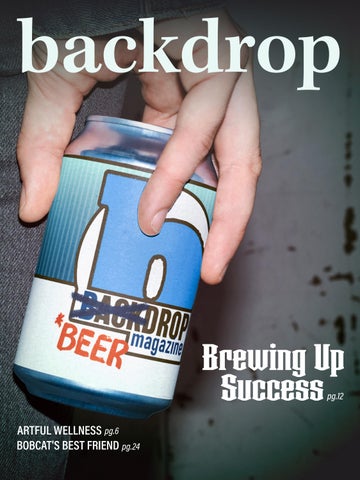
Brewing Up Success 12

OU’s brewing classes integrate experiential learning with the local community

Community

Artful Wellness 6

The Bobcat ArtsCare program promotes student health through arts-based experiences

The Trend at North End 8

Seasonal menus and weekly deals sustain student interest

Entertainment

Inside Fest Season 10

Tracing the evolution of Athens’ iconic spring tradition

Photo Essay

I Love You Back 16

What growing up in rural Appalachia looks like through the eyes of a child

The Drop

Renter Rights 22

What to know before signing a lease

Bobcat's Best Friend 24

Students find comfort through owning emotional support animals

Hang in There, Seniors 26

Advice from recent alumni on how to stay patient in your job search

Sex & Health

The Bush Administration 28

A retrospective on how “The Bush” is portrayed in modern media

Opinion

Stop Romanticizing the Reporter 30

Rom-coms have created a problematic narrative that all journalists are willing to sacrifice their integrity for love

The Bobcat ArtsCare program is redefining what student health and well-being can look like at Ohio University by going outside the bounds of traditional models of care and incorporating creative spaces. Fostering creativity, self-expression and connection, ArtsCare is designed as a wellbeing initiative founded in the arts. The program is meant to connect OU students with creative outlets and experiences which support their physical and mental health. Created from a mixture of campus partnerships, hands-on events and peer coaching, ArtsCare offers students new ways of managing stress, reconnecting with themselves and building community.

To its core, Bobcat ArtsCare operates very similarly to wellbeing coaching, yet with a creative twist. Students can selfrefer and register for one-on-one sessions with a trained peer coach. The coaches then guide them toward which arts-based experience fits their needs and interests best. These experiences range widely from dance, music and films to creative writing and painting.

The Bobcat ArtsCare program promotes student health through arts-based experiences

“The Bobcat ArtsCare is kind of an offshoot of the wellbeing coaching model,” explains ArtsCare Assistant Director Sarah Schoenhoft. “It’s essentially the same idea, but with an arts-based focus and connecting students to arts experiences both at the university and in the community.”

The approach draws from a broader concept known as “arts prescribing,” a model that is more regularly seen in countries like the U.K. where it is more common for healthcare providers to recommend a part of treatment to be creative activities. Although ArtsCare is not clinical, it still adapts this idea into a campus-friendly format that prioritizes peer support and accessibility.

Creative and artist engagement has been shown to reduce stress, improve overall mood and increase focus. Sharon Boyle, co-creator of Bobcat ArtsCare, notes that engaging in artistic activities helps to quiet the mind and narrow attention spans. “When you’re truly engaged in something creative, your mind isn’t able to focus on everything else ... It helps reduce stress levels,” Boyle says.

| PHOTOS BY NORA DAHLBERG DESIGN BY ELLIE SABATINO

“Some people come to us before maybe going to counseling,” Boswell explains, “because it seems less daunting — you’re talking to someone your age who might understand what you’re going through.”

This peer-to-peer approach fosters trust and reliability, ultimately making it easier to open up and truly explore new and different coping strategies. While partnering with counseling services, the program is a collaboration with other partners, like Tantrum Theater, Athena Cinema and more, to expand its resources and reach.

Beyond the research, the impact of ArtsCare is most visible in student experiences. Whether that's through casual dropin events or structured coaching sessions, students report a noticeable change in their mood and sense of connection. Student Supervisor Kayla Boswell explains how those changes can be subtle yet powerful.

“You see people when they first get to an event, and when they leave, there’s always a lighter energy in the room,” Boswell says. “It’s clear that people are impacted in ways they don’t even recognize themselves.”

Events are the most central part of the programming. Each week, ArtsCare puts on an event. Whether that's a workshop or an activity, it is designed to be welcoming to all skill levels. Previous events have included creative writing sessions, crochet workshops, clay modeling and interactive experiences like “portraits with pups,” where students could draw or take a photo with a service dog in training. Initiatives like “ArtsCare kits,” creating kits filled with small creative tools, drew large crowds of over 100 participants.

These events are intentionally low-pressure. Students don't need any prior experience and should feel free to create without the expectation of perfection. According to Boswell, one of the biggest misconceptions of the program is the assumption that art is only for “artsy” people or people with art experience.

“There’s a stigma of, ‘I’m not good at this,’ or ‘that’s not for me,’” Boswell says. “But art is so broad, and it’s something that’s within all of us.”

Through breaking down that misconception, ArtsCare opens the door for all students to find creative outlets.

ArtsCare also fills a unique gap in student well-being services. While psychological and counseling services are still essential, the program offers an alternative or complementary option that might feel less intimidating for students who might be hesitant or uncomfortable to seek out traditional support.

As a new program that was launched within the past year, ArtsCare is ever evolving. The staff is working to expand partnerships, finding new ways to foster creativity and benefit the students. Despite being such a new program, it has already shown promising and impactful growth. For many students, the appeal is a non-traditional approach to mental health resources and an opportunity to connect and create in ways that most traditional campus counseling and psychological structures overlook.

Getting involved with Bobcat ArtsCare is straightforward. Students can start by filling out a self-referral form through the university’s well-being services, then will get matched with a peer consultation where the student will discuss with a peer coach what form of creative outlet works best for them. Students can also always start by attending open events held by the program in the Well-Being Wing of Ping Recreation Center or Baker University Center. Pop-up activities and drop-in sessions make participation flexible and allow the students to engage on their terms.

Ultimately, Bobcat ArtsCare is about creating a space to explore, connect and, importantly, slow down in a world that can often feel overwhelming.

As Boyle puts it, the goal is to help students “feel open and able to try things,” whether that’s for the first time ever or for the first time in a long time. b

Students gathered in Well-Being Wing at Ping Recreation Center for ceramic pot painting in Athens, Ohio. April 3, 2026.
OU student Anamaris Vela getting supplies in Well-Being Wing at Ping Recreation Center in Athens, Ohio. April 3, 2026.

Seasonal menus and weekly deals sustain student interest

North End Kitchen + Bar is a well-established restaurant on Court Street in Athens, known for its tacos, cocktails and atmosphere. Since 2021, the restaurant has built a loyal following, drawing in students with their rotating seasonal and holiday menus as well as weekly deals that, for some students, set it apart in the competitive college-town food scene. While North End has always been a popular spot for Ohio University students, its seasonal offerings and marketing tactics have helped its customer based stay engaged.

For some OU students, an attachment to North End predates their enrollment at OU. Justine Spinelli, a student at OU and regular customer, says, “I tried [North End] for the first time when I toured OU, actually, as a senior in high school, and it was one of the reasons I wanted to go here.”

The restaurant has continued to attract students through its seasonal specials that consistently give customers the opportunity to try new menu items. New spring options include cocktails like a French martini, strawberry white wine spritz and limoncello spritz, paired with food specials such as strawberry ricotta and honey crostini, strawberry salad and new tacos and bowls to get customers ready for the warm weather. North End is able to get customers excited with new menu releases by introducing special drinks and limited-time menu items which make everyone excited to come back.

Olivia Campbell, a server at North End, says seasonal menu items have become especially popular with customers. “I would definitely say the crostini boards are very popular right now,” Campbell says, “but most of the time, it’s our spritzes I feel that I tend to get asked about the most.”

The excitement around new menu items is reflected in how customers respond. “I definitely do pay attention to the seasonal menus,” Spinelli says. “I follow them on social media, so when I see those posts, I always get excited.”

In a college town where students spend significant time on social platforms, North End's online presence has become a meaningful part of its outreach strategy. The restaurant uses Instagram to announce seasonal menu launches, new specials and promotional events, which is a tactic that Campbell says has a direct effect on foot traffic. “I feel like when we post something, a lot of people come in due to what they see or what we post,” Campbell says.

Going beyond just advertising new menu items, upgrading their menu designs and seasonal promotions has enhanced the overall experience at the restaurant. Since North End has started their seasonal menus, they have upgraded the design of their menus with seasoninspired drinks that put the Athens community in the seasonal spirit.

For most students,

WILKINSON | DESIGN BY GABRIEL VANIA

North End’s appeal is not only about the items on the menu, but the environment the restaurant offers. “I think the atmosphere is really fun. They always have good music. Everybody’s super nice, and the food is definitely really good,” Spinelli says.

That upbeat scene is something that staff members are aware of as well. Campbell says the close relationships she has made while working at North End have helped shape the restaurant’s energy and experience. “I do also feel like our staff is super, super close,” Campbell says. “That teamwork aspect, our close-knit kind of friend group is super unique to us.”

North End’s mixture of weekly specials and seasonal offerings has helped make it a regular spot for students. Spinelli says Taco Tuesday has become a weekly tradition for her and her roommates.

“I actually go once a week this semester, because my roommates and I have been going to their Taco Tuesdays,” Spinelli says.

On a street stacked with restaurants and bars, North End continues to stand out and give community members something new to look forward to while still offering an atmosphere they are familiar with and enjoy being a part of. The restaurant’s combination of rotating menus and strong staff culture has helped in maintaining relevance, which is a harder task than it might appear in a town full of competition. b

Inside Fest Season

Tracing the evolution of Athens’ iconic spring tradition

BY MADELEINE COLBERT | PHOTOS BY AYIANA ANDRELLA | DESIGN BY ELIZABETH DICKERSON

Fest season has become ubiquitous with Ohio University's spring semester. It’s a way to usher in warmer weather, participate in socialization that is sorely lacking during the cold, dark winter months and say goodbye to campus, either for the summer or for good, as seniors graduate in May. Students invite friends from different colleges to participate in fests, and they bring in business to local establishments.

This all brings up the question of how fest season even started at OU. The Ohio University Library Archives contains archival issues of The Post which give answers to this question.

In these papers the first mentions of fests at OU were throughout the 1960s with an event named ‘Springfest,’ including a partner fundraising event called the 'OU Beach Party.’ Springfest was a music festival that took place in the intramural fields that sat at the end of Mill Street. The bands performing were a mix of local, regional and national artists and brought in large crowds, placing a spotlight on Athens as a whole. Springfest was overseen by a school committee, and in 1986, efforts were made to get larger sponsorships for the event. According to an article in The Post that year, Miller Brewing Co. and Stroh’s Brewery Co. were considered as potential sponsors for the event.

During the advent and tenure of Springfest, the legal drinking age in Ohio was 18, so even as a schoolwide event, alcohol (specifically 3.2% beer) was served. In 1987, however, the legal drinking age in Ohio was raised to 21 to comply with federal regulations, hurting the popularity of the fest, which was already waning. However, the parties that popped up on the streets surrounding Springfest in preparation for the concert did not lose steam and continued to gain popularity. These eventually grew into the street-based fests seen at OU today.

Since the beginning, music has played a core part of the experience and a defining element of fest season. Local bands and DJs are heavily featured, and these parties give them a chance to perform for larger audiences. The band Coyote, and its members Cooper Titus, Izaak White, Sam Culver, Cooper Tussey and Miya Moore, is a local band that played at Milliron Fest and Congo Fest this season. Cooper Tussey, a fourth-year student studying middle childhood education, discussed the impact of these live shows on both exposure for local bands and on students in the crowd.

“When somebody sees a good live show, no matter who it is, because there's a lot of good bands playing, they're going to post it, take videos, send it to their friends. It's just a good way to spread a good vibe for everybody,” Tussey says.

Outside of local bands, music is provided by local DJs, most

of whom go to OU as students. One such DJ is OK DJ, or Owen Keller, a fourth-year student studying film. As a DJ, Keller gets to see the atmosphere and crowds during a fest from a different perspective than the general student body.

“There was no one [in the crowd] in a bad mood. I guess everyone was happy. Everyone was enjoying the day. It was so beautiful outside ... I think everyone's mood was fantastic. I didn't see a single person who was in a bad mood,” Keller says.

While all fests offer their own unique experiences, friendly debates persist on which fest is truly the best. On an anonymous social media poll with 95 participants, Mill/ Milliron Fest weekend was voted the best with 68%, or 65 votes, with Congo/High Fests, and Palmer/Athens Fests tied with 16%, or 15 votes each. Keller shares the sentiment that Mill is the best.

“I think most of us know a person who has a house on Mill or at least is connected in some way to someone with a house. So even though there are three big parties, there are also 20 front porches that are also blaring music and drinking and all this stuff. So I think that it's such an easy fest opportunity that literally every house just gets to participate,” Keller says.

Mill Fest might be the winner of best fest today, but the fests undergo changes from year to year, and the amount and location of fests have changed as well. Two notable fests that are now extinct are Six Fest, which was held in a field outside of campus and was stopped in 2020, and Palmer Place Fest, which has been transformed into Palmer Fest. Many of the street based fests have undergone less dramatic changes but have still seen some small differences over the four years Tussey has been a student at OU.

“I feel like a lot more people are going to more frat parties than house parties. I feel like my freshman year, there were a lot of house parties where it didn't have to be a frat. Now

it feels like there's a lot more frats involved. There's nothing wrong with that. They throw really big fun parties, but I definitely have seen that change,” Tussey says.

The stronger inclusion of frats into fest season is something that is seen in both a positive and a negative light — depending on how people look at it, and what parties fest-goers choose to frequent.

“I think there are a lot of people who are not frats and sororities that are putting a lot of money into this thing. I don't think those people charge anyone. They might have gotten reimbursed from the frat next door, but a lot of people are just throwing their own cash at these things,” Keller says.

Fest season is seen by many as simply an excuse to indulge in excessive drinking and partying, but the sense of community fests bring to campus is a hallmark of the season as well.

“It really brings people together. I feel like I've met people that I would have never met [otherwise] through fest ... I got to hang out with different groups of friends that I would never have ... It also brings people from out of town, and so you get to meet new people,” Tussey says.

Keller echoes this sentiment, commenting on how fests bring campus together with a sense of camaraderie some other universities lack.

“It’s really cool to see so many people out and about in a communal way during the day. I think it's very rare that during a day you'll actually see everyone out going to do something together, besides a sporting event,” Keller says. “So just the community, and there's music literally everywhere you walk, and so many different things happening ... There's just something so special about being able to walk outside and see hundreds of other people also walking outside, going to parties and enjoying themselves.” b

Audience watching the band Coyote perform at Congo Fest in Athens, Ohio. March 27, 2026.
The band Coyote performs for Congo Fest in Athens, Ohio. March 27, 2026.

Ohio University is known for its parties, bars and nightlife. With all the partying comes alcohol, especially beer. OU has found a way to use beer for educational and community purposes, as a way to bring people together. Not only does the university offer an entire Craft Brewing Certificate, but it also hosts alumni events about beer as a way to keep people connected. Beer has taken on a new meaning for Bobcats on and off campus, with OU offering many ways for students and alumni to get involved.

by conversations he’d had with retired OU professor Marcia Kieliszewski, who thought that craft brewing would be a great way to teach biochemistry. Held had met Jackie O’s Pub and Brewery owner Andrew Arthur "Art" Oestrike while studying at OU, and was able to use this connection many years later to bring the program to fruition.

Beer might be seen by some as nothing more than a fizzy beverage found at restaurants or gatherings. It could be hard to believe that all of general biochemistry could be taught through the beer-making process. This was exactly what brought the Craft Brewing Certificate to life.

OU alumni and professor Dr. Michael Held was inspired

“I had an acquaintance with Art a long time ago, before I left ... when we came back, I reached out to him and said, ‘We're going to be doing a brewing class, are you interested?’ And he said, ‘Absolutely yes,’” says Held.

Along with professor Dr. Sarah Wyatt, Held put together the proposal to get the equipment and start the classes.

The Craft Brewing Certificate requires two courses and is available as both an undergraduate and graduate program. Both courses, Fundamentals of Brewing Science and The Art of Craft Brewing, are typically taken by juniors and

A Jackie O's branded silo stands tall outside their taproom and production facility in Athens, Ohio. March 31, 2026.

Brewing p Success

OU’s brewing classes integrate experiential learning with the local community

seniors and generally by those over 21 years of age. One of the courses deals with how to make the beer, and the other course is about the business side of running a brewery. An internship also needs to be completed to meet the requirements for the certificate. The internship component is designed to give students direct exposure to the professional brewing industry, whether at a local Athens spot or elsewhere in Ohio’s growing craft beer scene.

Wednesdays. In the mornings, students participate in some type of lecture or discussion. Guest speakers often come in to speak to the class, giving students a broader picture of where their education could take them. The afternoon classes are more lab-style. A few of the class days are longer and spent entirely at the brewery. The brewing is done at Jackie O’s Taproom in Athens.

“Running a brewery requires both of those skill sets,” Held says. “To run a successful brewery, you have to know how to make beer. But you also have to be able to run a business.”

The chemistry course, Fundamentals of Brewing Science, is a summer course taught by Held. Throughout the 7-week course, students learn all about beer production and the science behind it. The curriculum covers everything from the role of yeast in the fermentation process to how small changes in temperature or ingredient ratios can shift the outcome of each batch. Every year, the course focuses on a different style of beer. The beer chosen to be made comes from a wide variety of options. “We got quite a range between light beers, dark beers, European-style beers, English beers, American-style craft beers,” says Held.

Class is in session twice a week, on Tuesdays and

Making the beer is one aspect, but there’s a whole other process to go through once the beer making is done. “After you physically make the beer, there are things that need to be done to it periodically. There's aging, packaging and carbonation that you have to do,” says Held. “We'll have afternoon labs to get our beer ready for consumption.”

Using what they learned, students go on to design their own beer for the final project. They pick the recipe that they think is best and make that recipe for the Ohio Brewing Keg Tapping, an official keg tapping ceremony that happens every summer in Athens.

“It's a local Athens craft beer festival and one student gets to show off their work and have their beer made and served uptown at the brewery,” says Held.

The more business-focused course, The Art of Craft Brewing, is offered throughout the school year. Oestrike is the instructor for the course, and he walks students through the basics of starting a brewery by referencing the brewing

scene in Athens. Throughout the semester, students are taken to professional beverage facilities around Athens to see first-hand the ins and outs of brewing on a large scale. These students also work together as a class to curate their own line of unique beverages. This semester’s class created a mango and pineapple spiked ginger beer, a cherry and lime fruited wheat beer and a barrel-aged imperial stout conditioned on maple, vanilla and cinnamon.

Spencer Warman, an OU senior studying political science, is currently enrolled in The Art of Craft Brewing course. "I've really enjoyed learning about their whole manufacturing process, but not just here. All the different places we've gone, we get to go. We get to talk to the owners. We get to see all their different processes.”

Class sessions can look different depending on what students are working on. Emily Durosko, a senior studying sports management, is also enrolled in the course and says, “A class day depends on where we are. We could be in the classroom throwing out different ideas for the class or be at a brew pub learning all about the production of beer.”

A class day occasionally consists of splitting into groups, each group with their own purpose. Groups focus on different things like sales and distribution, sensory analysis, facility design, promotions, entertainment and more. The work that each group completes is eventually combined to

construct the launch party, which is the event where their unique brews are officially released for the public to try. Students go through the process of planning the party by making the promotional materials, organizing food and entertainment, designing the merchandise and more.

“It's a real world hands-on learning experience, where we get to craft, design, promote and launch new product,” says Oestrike.

Both Held and Oestrike hope to see the program expand in the future. In the short term, Held hopes to be able to teach his class during the school year to increase participation. A more long-term goal is to eventually develop a four-year fermentation science program. Perhaps even a student-led brewery could be seen in OU’s far future. “Having a studentrun brewery would really integrate all the pieces, not just the science, but also the business aspect, and it really would complete the whole thing,” says Held.

As for Oestrike, he hopes to continue to give back to the community and to inspire others to do so as well.

“I'm hoping that we are establishing a group of individuals who want to start their own crafts ... that want to work on the community and do things locally within our community to benefit more people within that said community,” says Oestrike.

There are students that have gone on to continue to learn and master the art of brewing after their time at OU. “We had a student who went to the U.K. and did her master's work in brewing and distilling at Heriot-Watt University. She got an official degree, and later became a brewer at one of the oldest breweries in England,” says Held.

Craft brewing has also been used by the school as a way to keep alumni connected. From Grain to Glass was a series of events hosted by the Ohio Alumni Association. The series had different installments, all of them revolving around beer and community engagement.

The first installment, From Grain to Glass: The Science of Brewing, was held

Students enrolled in Ohio University's CAS 5413 class test two pints of student-crafted brews in Athens, Ohio. March 31, 2026.

on Nov. 7, 2024, at Nocterra Brewing Co. in Columbus, Ohio. Alumni got the opportunity to explore the science behind beer. The event was led by Held. Participants learned about the different ingredients that go into the beer-making process, as well as how other factors like temperature impact the process. The event’s $10 fee also included a drink ticket and light snacks.

“The goal was for it to feel like you’re back in a classroom, but in a way that’s relaxed, relevant and fun,” says Taylor Hayes, the associate director of alumni relations and campus partnerships at OU.

From Grain to Glass: The Art of Brewing was the second installment. Organized at Jackie O’s on Fourth, the event took place on Feb. 7, 2025. Attendees followed along as Oestrike walked them through a different side of the beer-making process, such as how beers are named and labeled. Jackie O’s architecture was also discussed, specifically in how it encaptures the brewery’s identity. The second installment also included a drink ticket and light snacks for a $10 fee.

BOBCAT BREW

The grand finale, From Grain to Glass: The Taste of Brewing, was an experience unlike the first two. Organized at OU’s own Peden Stadium, alumni were presented with a plate and local beer out on the field. The event took place on April 26, 2025, and was led by OU professor Thomas Stevenson. The dishes were presented by Patton College’s hospitality students. The attendance fee for the final installment was $40.

The alumni series is one of the ways OU has used beer to educate and connect. Hayes says, “It grew out of a broader push over the past few years to better showcase craft brewing at [OU], not just as a program, but as a real point of connection between faculty, students and alumni in the industry.” Though it was originally just a pilot series, it is coming back in a new way next school year.

Students may associate beer with partying or nights out, but in Athens, it’s now also become a gateway into learning and staying connected. Whether it’s using beer to bring alumni together or to teach biochemistry, craft brewing has taken on a new significance at OU. b

The Bobcat Brew Trail covers breweries of Ohio University alumni across Ohio. When you visit a participating brewery, scan the QR code on the “Trail Blaze” sign within the establishment. Complete the full form and include a photo of your visit that proves you were there.

From July 1, 2025, to June 30, 2026, you have the opportunity to earn the following gear as you travel the trail:

- 3 unique check-ins: Custom Brew Trail notebook

- 10 unique check-ins: Bobcat Brew Trail pin

- 20 unique check-ins: Bobcat Brew Trail metal cup

- 30 unique check-ins: Bobcat Brew Trail hat

- 41 unique check-ins: Customized insulated growler

The trail runs from July 1 to June 30 each year. The record of check-ins is deleted at the end of June, and the trail starts again on July 1.

If you would like to learn more about the Bobcat Brew Trail, scan this QR Code!

Elta, 7, in Albany, Ohio, on March 31, 2026.
PHOTOS
WORDS BY CLAIRA TOKARZ

Elta, 7, lives just off a narrow, winding road in Albany, Ohio, surrounded by greenery. Sunlight bleeds through tall grass as rolling Appalachian hills transition into soft forests surrounding her home. On a warm March day, the front door stays open as chickens roam in and out. The wind billows through chimes on the front porch, making music in the warm air. She spends her days running through the yard with her chickens, swinging on the porch, gardening with her mother and playing freely.

When Elta was very young, she and her mother had to leave their home together due to a domestic violence situation. The resulting bond between Elta and her mother, Dee, is devoted and tethered. Elta often hangs onto Dee’s arms and legs, holding onto her in a way that seems metaphorical for their shared experiences.

"Elta is unique, I think, because she has gone through a lot in her life and she has really made herself something special out of it," Dee says. "She's taken a lot of really dark times and made herself just into a ball of joy because she tries to please; she's a people-pleaser." Elta is curious about the world, and her passion for animals and family runs deep. Dee spoke about Elta’s obsession with the things she loves; her love for cats was so intense that "kitty" was Elta's first word.

"She would wake up 5 or 6 times during the night and just say, ‘Mom’ and I would have to say, ‘Elta.’ And she would say, ‘I love you’ and I would say, ‘I love you back.’”

DEE, ELTA'S MOTHER

Elta at home in Albany, Ohio, on March 31, 2026.
Elta and her mother, Dee, at home in Albany, Ohio, on March 23, 2026.
Elta at her 7th birthday party at Dow’s Rollerarena in Nelsonville, Ohio, on March 15, 2026.
Elta (left) and her mother, Dee, in the yard of their home in Albany, Ohio, on March 31, 2026.
Alanna Houser (left) and Elta at Elta’s 7th birthday party at Dow’s Rollerarena in Nelsonville, Ohio, on March 15, 2026.
Dee and Elta in Elta’s room in Albany, Ohio, on March 23, 2026.
"She's just the sweetest thing in the entire world. Her heart is on her sleeve."
DEE, ELTA'S MOTHER
Dee (right), Elta (middle) and Dee’s partner, Matt, skating at Elta’s 7th birthday party at Dow’s Rollerarena in Nelsonville, Ohio, on March 15, 2026.
Elta in Albany, Ohio, on March 31, 2026.

What to know before signing a lease

Like it or not, a staple of college life is moving. Many students in Athens are first-time or secondtime renters, and navigating searches for housing without prior experience or strong familiarity with their rights as tenants can be anxiety-inducing. However, resources are available to renters to help them through difficult situations and provide them with the knowledge they need to be empowered tenants.

One such resource is United Athens County Tenants, or UACT, a local advocacy group focused on providing renters with policy information and spreading awareness about prevalent local housing issues to push for change. UACT also compiles extensive lists of resources for people who need assistance with legal aid, finding emergency shelters and obtaining rent payment assistance.

Damon Krane, co-founder and volunteer for UACT, says he often hears from tenants with complaints about the conditions of the rental properties and problems with landlord retaliation to such complaints. Improper notice or inappropriate justifications of evictions (generally 30 days) or entrance (24 hours) are also an issue. As a volunteer, Krane can direct tenants to resources that will help them use the law as it applies to their situation.

Krane notes that in Ohio, landlord-tenant law can be both vague and ultra-specific as it applies across the state due to highly localized laws and general statewide laws.

“One strength of Ohio state landlord-tenant law is that it very clearly gives municipalities the right to create local tenant protections that have to do with health and safety within residential rental property,” Krane says. “So the silver lining is that where state law is weak, at least state law gives municipalities the right to do better — not in every way, but in a lot of ways.”

Because municipalities across Ohio have the power to create their own protections, there are disparities in the extent to which the law protects renters across the state. In light of this fact, Krane says that areaspecific knowledge is integral to empowering renters. So is community support in the form of local groups like UACT, and regional resources like Legal Aid of Southeast and Central Ohio and the Coalition on Homelessness and Housing of Ohio, whose websites feature accessible explanations of the law.

Krane mentions that in Athens and its surrounding areas, subpar code enforcement for safe living conditions poses a significant problem. But Krane says where Athens code enforcement is lacking, surrounding rural areas may have little to no ability to do code inspections. In both situations, community efforts to address code enforcement issues are a must. For Krane, awareness is integral for involvement and action leading to change.

“Most tenants, I think, are not familiar with Chapter 5321 of the Ohio Revised Code,” Krane says. “That's Ohio's Landlord-Tenant Act. They're probably not familiar with the Fair Housing Act. They're probably not aware of a lot of resources and support that is out there, so making people aware of that is definitely crucial.”

Federal protections under the Fair Housing Act prevent housing discrimination against any person for their race, color, national origin, religion, sex, familial status or disability. Additional protections in Ohio prevent discrimination

based on ancestry and military status, and in Athens, discrimination based on sexual orientation, gender identity, source of income or age is unlawful.

If a tenant believes they have experienced housing discrimination, they can report it to the U.S. Department of Housing and Urban Development or the Ohio Civil Rights Commission. It is generally advised that a tenant have as much written documentation and information about the violation as possible, and Krane recommends that tenants work with legal aid organizations or fair housing centers to assist them in navigating bureaucracy.

When signing a lease, prospective tenants can take simple actions to ensure they have a good rental experience. Carefully reading the lease and looking for red flags and compliance with the law is crucial. If the lease is difficult to understand, or its compliance with the law seems murky, utilizing resources that break down good renter habits in accessible terms can be a lifeline.

A prospective tenant might turn to one of many digital handbooks on the Legal Aid of Southeast and Central Ohio’s website. A handbook titled “Rights and Duties of Tenants in Ohio” provides simple guidance about evaluating a lease, stating that a lease should include a description and the address of the rental property, the landlord’s name and address, the length of the lease, rent and fees for late payments, expectations regarding maintenance of the property, notice requirements to terminate a lease, a sublease provision, information about security deposits and whether utilities are included in rental payments.

The digital pamphlet also notes that it is best practice for tenants to make sure they identify any potential unlawful stipulations in their lease, and either choose to pursue a rental property elsewhere, or request to change the unlawful provisions before they sign, helping prevent the tenant from having to assert their rights through the court system.

Such provisions, prohibited by the Ohio Revised Code 5321.13, are those in which the tenant agrees to allow the landlord to exercise a warrant of attorney, enabling the landlord to get a court judgement regarding owed rent or damages without notifying the tenant or going through the motions of a trial, agrees to take accountability for liabilities and responsibilities that fall on the landlord (usually pertaining to proper maintenance of the

property) or agrees to take on the financial burden of the landlord’s attorney fees should they go to court.

Krane adds that it's important to also look for provisions that are lawful but give the tenant a bad deal, such as hidden penalty fees for things like failure to notify non-renewal of a lease.

Another way to avoid unnecessary fees is evaluating the property for pre-existing damages and thoroughly documenting them, which will help a prospective tenant choose livable quarters and avoid being subjected to fees or loss of their security deposit over damages they did not make.

Once a tenant has moved in and made a maintenance request (best done in writing), it is advisable that the tenant keep copies of all communications as well as documentation of the problem they are requesting the landlord address.

Under Ohio Revised Code 5321.07, if “the tenant reasonably believes that a landlord has failed to fulfill [their] obligations, or if a governmental agency has found that the premises are not in compliance with building, housing, health, or safety codes that apply to any condition of the premises that could materially affect the health and safety of an occupant,” the tenant can take actions to get a court order to address the problem or terminate their lease.

Recently, Athens City Council passed an ordinance requiring that landlords who live over 50 miles from a rental unit list a designated emergency contact for maintenance requests so that they can be addressed in a timely manner, suggesting that the city might be making more moves to make the rental process in Athens safe and fair.

The ordinance, aimed at addressing community-specific concerns, encapsulates the importance and direct effects of continued conversation and action about housing. But the law and people in power do not always work in favor of tenants. To keep making progress, Krane recommends community self-sufficiency.

“The world is an unfair place,” Krane says, “and if tenants don't want to be screwed over and exploited, they really do need to step up, come together, build strength in numbers and become experts on how to do this stuff themselves.” b

If you take a walk on Ohio University's campus during a sunny afternoon, chances are you’ll run into some four-legged friends. Many pets on campus are owned by students as emotional support animals, service animals or companions. While having a pet on campus is often about cuddles and comfort, managing pet care alongside the demands of

college life can be challenging.

It’s no secret college can be an extremely stressful time, with students juggling their academics and social lives alongside personal responsibilities. Studies have shown that interacting with animals, particularly dogs, significantly reduces stress and anxiety in college students. An emotional support animal, or ESA, is defined as a pet that provides support to an individual with an emotional or mental disability, such as anxiety, PTSD or depression.

The Journal of American College Health researched ESAs and their impact on students’ mental health. In their 2022 study, they asked individuals with long-term mental illness to place people, objects or activities in three circles to indicate their degree of importance. According to the study, “Overall, pets placed prominently in the network with 60% placing the pet in the first or most important circle, followed by 20% in the second tier, 12% in the third and 8% did not place the pet in any of the important tiers.”

Students who struggle with their mental health can opt to get an emotional

Gracelyn Schmidt’s dog, Bowie, in the grass at Emeriti Park in Athens, Ohio. April 1, 2026.

support animal to live with them in a dorm or off-campus housing. In accordance with the Fair Housing Act, OU’s animal policy prohibits animals in campus housing except registered assistance animals, service animals and animals being trained for those purposes. There is no additional fee for having an ESA in university housing.

Carli Reddick, a fourth-year student studying English literature, owns a nine-month-old German shepherd mix named Fifi as an emotional support animal. She says owning a dog has improved her mental health.

“It keeps me on a routine,” Reddick says. “I have to wake up at a certain point because she needs to go outside so that I won't oversleep or miss anything.”

Other student pet owners share the same sentiment; Gracelyn Schmidt is one of them. As a sophomore studying psychology, she owns a miniature long-haired dachshund named Bowie. Bowie is a registered emotional support animal and helps to keep her motivated and active.

“Honestly, I think that it has made me get better at showing up to classes and things,” Schmidt says. “I have to be awake and be up to

make sure that I'm on a schedule where he can be let out.”

Owning a dog can help keep students on a set schedule and get exercise. Reddick specifically says she needs to take her dog out about five to ten times per day.

“Usually, one to three of those are for her longer walks, because she's pretty hyper and she has a lot of energy, so she likes to walk around the neighborhood and the campus and everything,” Reddick says.

While taking a morning walk is typical for many dog owners, it can be difficult to manage during a school day. Reddick scheduled her classes to best suit her dog's schedule.

“I'm very fortunate to have friends who are able to help me out,” Reddick says. “I have a friend who has a key to my apartment. That friend checks on her in the middle of my shift so she can go outside and go potty. I'm always home for her morning breakfast and her evening dinner. I always make sure I prioritize being there for those. She goes in her kennel when I have to leave, but I've never really left her during the daytime for longer than five to six hours.”

Students without a helping hand are saddled with all the daily pet care.

“I had to kind of plan my schedule around breaks when I could come back and let him out, so he's not in the crate for more than two to three hours at a time,” Schmidt says. “Class-wise, he can typically stay in a crate. I mean, up to six hours, he could, but I never go above four hours, and it's very rare that he's in the crate more than two or three.”

Being a pet owner as a student can be both rewarding and challenging. Especially for students living alone, having a pet provides a companion during hard times. Living alone also means the bulk of the pet care falls onto the student.

“I think you definitely have to make sacrifices to certain things ... You can’t be doing stuff all the time. You really have to plan things around having your pet. The same thing goes for going home. It's a bigger process of having to pack around your pet,” Schmidt says, “but I think it is definitely very [rewarding] in a lot of ways. It’s helped me to be on a better schedule, feel less lonely and given me a companion.”

Ultimately, owning a pet in college depends on the person and their circumstances. It requires commitment, planning and sacrifice, but for many students the bond makes it all worthwhile. b

Carli Reddick and her dog, Fifi, at Emeriti Park in Athens, Ohio. April 1, 2026.
Gracelyn Schmidt and her dog, Bowie, in Emeriti Park in Athens, Ohio. April 1, 2026.
Carli Reddick and her dog, Fifi, at Emeriti Park in Athens, Ohio. April 1, 2026.

Hang In There, Seniors

Advice from recent alumni on how to stay patient in your job search

The job market can be daunting, but you’re not alone in the hunt. The one thing that Ohio University students and alumni have in common is that Bobcats help Bobcats. A job can offer a sense of identity and purpose after structured education, as well as a way to build new connections with coworkers and shape a new path of life in an independent setting. But the journey there can take some time. Students are often driven to find a job immediately after graduating from college because it marks the first true stage of adulthood. However, finding and securing an entry-level position does not happen overnight. Additionally, the current job market has made obtaining a full-time role even more of a challenge. Every newly graduated OU Bobcat has their own path to follow, and some journeys take more time to unfold.

Although we hear many stories of students who attend a four-year university and directly land a full-time position after graduation, that is not always the case nowadays. According to Forbes, “Only 30% of 2025 college graduates and 41% of 2024 graduates found entry-level jobs in their fields, while 48% felt unprepared to apply for such positions, finds a

new national report.”

Students play a vital role in landing a job by pushing themselves to network and stand out to employers, but the job market is also a huge factor in whether students can even find a job in their field in the first place. The Federal Reserve Bank of St. Louis states, in July 2025, jobs “revealed a notable slowdown. Payroll growth decelerated dramatically, averaging a mere 35,000 new jobs over the last three months — far below the robust gains of prior years.”

Jenna Keiffer, a 2023 OU graduate, was able to navigate success both as an undergraduate student and as an alumna in search of an entry-level role. However, it took some time after graduation to land her current position.

"A lot of the classes that I took at OU were definitely crucial to where I am today,” Keiffer says. “I definitely think it really is up to the individual student to push yourself to do extracurriculars or get involved in something where you're using your passion and your hobby, but pushing it a little bit further.”

Keiffer has always been passionate about nature and photography, which eventually landed her a role at Stark Parks as a digital media specialist.

“When I was a senior, I worked a couple of odd jobs,” Keiffer says. “Mostly just a bunch of photography freelance jobs for the year after graduation as I was looking for a job. It definitely was a struggle looking for work right out of graduation, especially in the creative field, but it was about a year and two months after I had graduated [when] I found the [Stark Parks] position. I felt like all of the job description details were stuff that I would enjoy doing on my own time. So I was immediately drawn to the position, and then applied and [got] hired. I've been working here since 2024.”

While Keiffer’s journey to landing her current full-time position took some time, she highlights the college experience and other students she was able to work with that helped shape her work ethic, which played a role in her postgraduate success.

“There's so many different types of brains and so many different types of skills that people have, and everybody's there for different reasons,” Keiffer says about her time working with the Rough Cut Collective film club on OU’s campus. “And so I think that follows into the workplace experience as well. When you're a student, you're working with some people who are a little bit more strategic. Some people are visual people, and it's just like that in the workplace. It gives you a little bit of a taste of what you're going to be dealing with in your career world as well.”

Success is not a one-way street. There are many directions

students may take that they never expected to turn towards. Erin Bishop, an OU alum who formerly studied media and social change, was able to find her path to success through involvement on campus, internships and making alumni connections, all of which ultimately landed her at her current job with Palmer-Donavin as a digital engagement specialist.

“I started as a media and social change major and I had no idea what I was even gonna do with that. But I just knew I wanted to be in visual media,” Bishop explains. “One of my network connections is how I got this job. [I got] a message from one of my friends, and he said, ‘Hey, there's this job opening at this company that I work at, and I would love for you to apply.’ And so I applied, and that's how I basically started the process of the job.”

Bishop went on to explain how college students are expected to begin their job search fairly early into the first semester of their senior year. But for many students, it merely serves as a reminder of the clock ticking, amplifying their stress.

“I was so scared to be honest,” Bishop says. “Everyone says, ‘Oh, you have to apply for jobs ... [in the] fall. And honestly, that is way too early to write into jobs, because then, you just get stressed out because you're getting rejections. So [I was] super stressed out because I didn't have a job. None of my friends had jobs. My boyfriend didn't have a job. And so we literally were like, ‘What are we gonna do?’”

While every Bobcat’s success story after graduation is different, it is important to acknowledge and utilize the on-campus resources that OU provides to allow students to secure their “dream” job. Resources include The Ralph and Luci Schey Sales Centre, the Student Success Center, business fraternities, career fairs, the Academic Achievement Center and more.

Students can learn from mentors in any space as well. Whether it is the networking connections they make along their undergraduate journey or a familiar face in their college, it is the opportunities they take advantage of that make their experience as a Bobcat worthwhile. "Bobcats help Bobcats" is a true and bold statement that never fades.

For seniors who may feel behind the curve, Keiffer advises, “Just take it day by day. Be patient with yourself and take advantage of the time that you have right now, and while you're waiting to hear back from those jobs, learn about yourself and how you can be the best version of [yourself].” b

Erin Bishop in her college graduation attire on Ohio University’s campus in Athens, Ohio. Photo provided by Erin Bishop.
Jenna Keiffer working at Stark Parks in Stark County, Ohio. Photo provided by Jenna Keiffer.

The ADMINISTRATION

A retrospective on how “The Bush” is portrayed in modern media

Bush — a noun, a shrub or clump of shrubs with stems of moderate length. But in 2026, this might read as something completely different. Bush — a noun, often used to refer to a person’s pubic hair, especially in a vulgar context.

Pop culture and society have instilled the idea into many women that shaving or laser removal of pubic hair is more “feminine,” even though pubic hair serves a natural purpose.

Similar to eyelashes, pubic hair traps dirt, debris, and potentially harmful microorganisms. Additionally, the hair follicles produce sebum, an oil that prevents bacteria from reproducing. According to obstetrician-gynecologist Dr. Holly W. Cummings, pubic hair “keeps dust, dirt, and germs away from the vagina to prevent infection. Researchers even suspect pubic hair

may play a role in sexual attraction and sexual pleasure.”

Societally, we are no strangers to trends that directly harm women — even physically. But how did we get here? Fashion, entertainment and media continue to be a direct reflection of our societal expectations of women. Taking the time to look back through trends gives us a glimpse into what was happening during each era.

Media means many things: film, photography, music ... pornography. Pornography is the main driver of how the bush has been seen in society. According to an Overland literary journal issue, “the equation of genital hairlessness with sexual attractiveness and activity is a post-industrial desire that has been created by what cameras want and can do.” It’s impossible to have a conversation about the history of the bush without talking about the history of pornography.

Dr. Patricia Stokes, a women’s, gender and sexuality Studies professor at Ohio University, attests to this. “When we’re talking about intimate grooming, we’re also talking about the effect of pornography,” says Stokes.

Even as early as the 1800s, sexually-natured books circulated. Claire Jarvis, a professor of English at Stanford, said in a Stanford Report Article, “It’s not that people in the 20th century invented the representation of sex, Victorian novels had to find ways to build erotic tension without using explicit language.”

Instead of visuals in the 1800s, erotica was reliant on the author's detailed descriptions. As innately sexual creatures, this comes as no surprise; we find a way. “There has never been a time in human history where people were not interested in depictions of sex and sexuality,” says Stokes. But what happened as pornography grew as an industry?

Back in the 1970s, pornography could be viewed in specialized theaters. As the industry grew with blockbuster popularity, pornography grew to reach mainstream attention. The featured women went au naturel.

Fast-forward twenty-some years, and pornography grew as the internet was taking off. Who remembers that special section at the back of the video store? Pornography became more easily available to the general public through renting, as it made its way into our culture.

Think 1998. Sex and the City was all the rage — a new, flirtatious twist on how women approach sexual endeavors. Fans of the series may remember the ill-defined moment when Samantha Jones called Miranda Hobbes a “national forest” for her unkempt bush in a swimsuit. While it may not have aged well, it serves as a glimpse into hairtrimming trends of the era.

By the time 2005 rolled around, pornography was everywhere. With the rise of mainstream pornography comes a new grooming standard. “My concern about this was, women are being told all these other things, and now this too? It seemed to me like another extension of women being held to standards that men are not,” Stokes reflects. Even in the early 2000s, the bush was a popular topic

among feminist discourse. Stokes recalls feminist online blogs such as Jezebel and Feministing holding discussions about the bush. An article written by Madeleine Davies discussed her issues with another article that was telling women that they need to shave their bushes. Davies replied, “I’m talking a bush so big that people get lost in it. It will be beautiful — tourists from around the globe will come to drive their cars through it like they do with trees in the Redwood Forest.”

As a testament to the time, Backdroppers from years past covered pubic hair in a story titled “Beating the Bush” in a winter 2009 issue of the magazine. The article examined the pros and cons of different hair removal methods. “In our highly sexualized society, it’s no longer just accepted; it’s expected,” wrote Backdrop alum Erin Rose Pfeifer.

The complex conversation that is pubic hair continues to be one deeply rooted in historical discourse. “Any time I see standards that are higher for women than for men, I read that as an indicator of inequality, particularly if women feel like they can’t readily opt out,” says Stokes.

In a new wave of progressive feminism, TikTok has coined its latest trend: #FreeTheBush. For those not on BushTok, the movement serves to embrace natural body hair. The words “full bush in a bikini” have been uttered countless times since 2025. Natalie Parson, an OU senior studying social work and psychology, has watched the trends grow online. “They're [creators] making jokes online, but in a way it's empowering to women to rock a bush,” says Parson.

Beyond social media trends, the bush has tangled its way into fashion and luxury, even making its runway debut. During Maison Margiela’s spring 2024 couture show, models strutted the runway in faux pubic hair made from real human hair, intentionally exposed under silk tulle.

In late 2025, Kim Kardashian’s SKIMS released a lineup of 12 faux-hair thongs, varying both in texture and hair color. Needless to say, it made the headlines. In a flurry of mixed responses, the lineup sold out within a day of its release.

As the years go on and the trends continue to develop, it sets a precedent for what is expected of women. It’s up to us how we choose to portray the bush. Modern media and popular culture continue to be a window into societal expectations. But they are also a window into pushback, empowerment and a strong vessel for femininity. b

STOP ROMANTICIZING THE REPORTER

Rom-coms have created a problematic narrative that all journalists are willing to sacrifice their integrity for love

Journalism is a familiar profession, seen every day in the news people share, the TikToks people post but also in movies. You see news anchors in action movies such as Die Hard, reporters in thrillers such as Zodiac and of course, journalists in romantic comedies such as How to Lose a Guy in 10 Days.

In romantic comedies, seeing journalists in a main character role is quite familiar. There’s 13 Going on 30, The Holiday, The Devil Wears Prada, When Harry Met Sally..., His Girl Friday, Never Been Kissed, Up Close & Personal, Sex and the City, Bridget Jones’s Diary, Morning Glory, 27 Dresses, Down with Love, Groundhog Day, Sleepless in Seattle — just to name a few.

For some reason, journalists have become a romanticized profession in Hollywood. Movies tend to portray journalists in the same way: a character will put more attention into their love interest rather than the stressful, extensive amount of work they most likely have as journalists. For example, in When Harry Met Sally, we rarely hear Sally actually talk about her job, we only learn that she is a reporter. What these portrayals get wrong is that journalism is a passion, offering a purposedriven career focused on uncovering the truth in

different aspects, not a side story for romance. Journalists care deeply for the work they create, something these films don’t always reflect. While journalists may only be in the office from 9 to 5, many report working overtime and “bringing their work home” due to breaking news and rapid deadlines. At a certain point, incorrect movie portrayals stop being harmless entertainment and start becoming a dangerously inaccurate representation of journalism. When you compare these portrayals to the reality of a journalist's life, it becomes even more concerning.

Movies often show journalists casually walking away from their jobs for love or personal fulfillment, ignoring the real pressures that make people consider leaving. In reality, quitting journalism is rarely a light or romantic decision. It’s often tied to stress, exhaustion and the emotional demands of the job, otherwise known as burnout.

56% of journalists report burnout

While the emergency medicine burnout rate is at 52.2% according to the American Medical Association, the rate of burnout in journalists is up to 56%, according to the Poynter Institute. So why do romantic comedies continue to show journalists as careless, constantly behind on deadlines or not taking their work seriously, when they are more burnt out than

When people see these themes and portrayals in romantic comedies, it begins to shape how audiences perceive journalists in real life. If movies consistently present journalism as something casual, replaceable or secondary to personal relationships, it can make the profession seem less serious

Representation in film is incredibly important, especially in movies that have a large audience of younger adults. When young viewers see women journalists throwing away their entire career for a man, it creates the impression that this is normal and romanticizes journalism in a

A similar comparison can Grey’s

Many young adults grow up watching the show and begin to believe that working in a hospital means finding your “McDreamy,” while experiencing constant dramatic events such as plane crashes, drownings and bomb threats all in a short period of time. Sorry to burst anyone’s bubble, but this is an extremely false representation of doctors, similar to the portrayal of journalism in romantic comedies.

Constantly, journalists are combating a growing lack of public trust, and these on-screen portrayals don’t help. When films consistently show journalists as shallow or driven by personal gain rather than purpose, it reinforces the idea that journalists are not reliable or serious. This, combined with frequent claims of “bias” in response to factual reporting, only adds to the public’s skepticism and makes it harder for audiences to trust what they see and read.

According to the Pew Research Center, 57% of Americans express little to no confidence in journalists to report in the best interest of the public. This number has increased due to the influx of partisanship. Rom-coms surely haven’t captured this side of a journalist’s lifestyle.

Journalists wouldn’t go into this profession if it weren’t for genuine passion, mostly because the average salaried pay for journalists is only $46,000 to $77,000, which is modest compared to the demands and responsibilities of the job. Because of this, the motivation of journalists is commonly rooted more in commitment to the work than in financial reward.

Not to mention, the media portrays main characters such as Andie Anderson or Carrie Bradshaw wearing the most expensive clothes and shoes. Although they may be filmed during a different time period, a weekly columnist can not afford a brownstone on the Upper East Side and more than 100 pairs of Manolo Blahniks.

When people think of journalism, the films that should come to mind are not the ones that reduce it to a backdrop for romance or aesthetics, but the ones that show its real impact. Movies including She Said and Spotlight portray journalism as it actually is: serious, demanding and deeply important. They show the persistence, pressure and responsibility that come with telling the truth.

Although romantic comedies may be entertaining, they often miss what makes journalism meaningful in the first place. If audiences are going to form opinions about the profession through film, those portrayals should take into account the purpose and value behind the work. b

Turn static files into dynamic content formats.
Create a flipbook