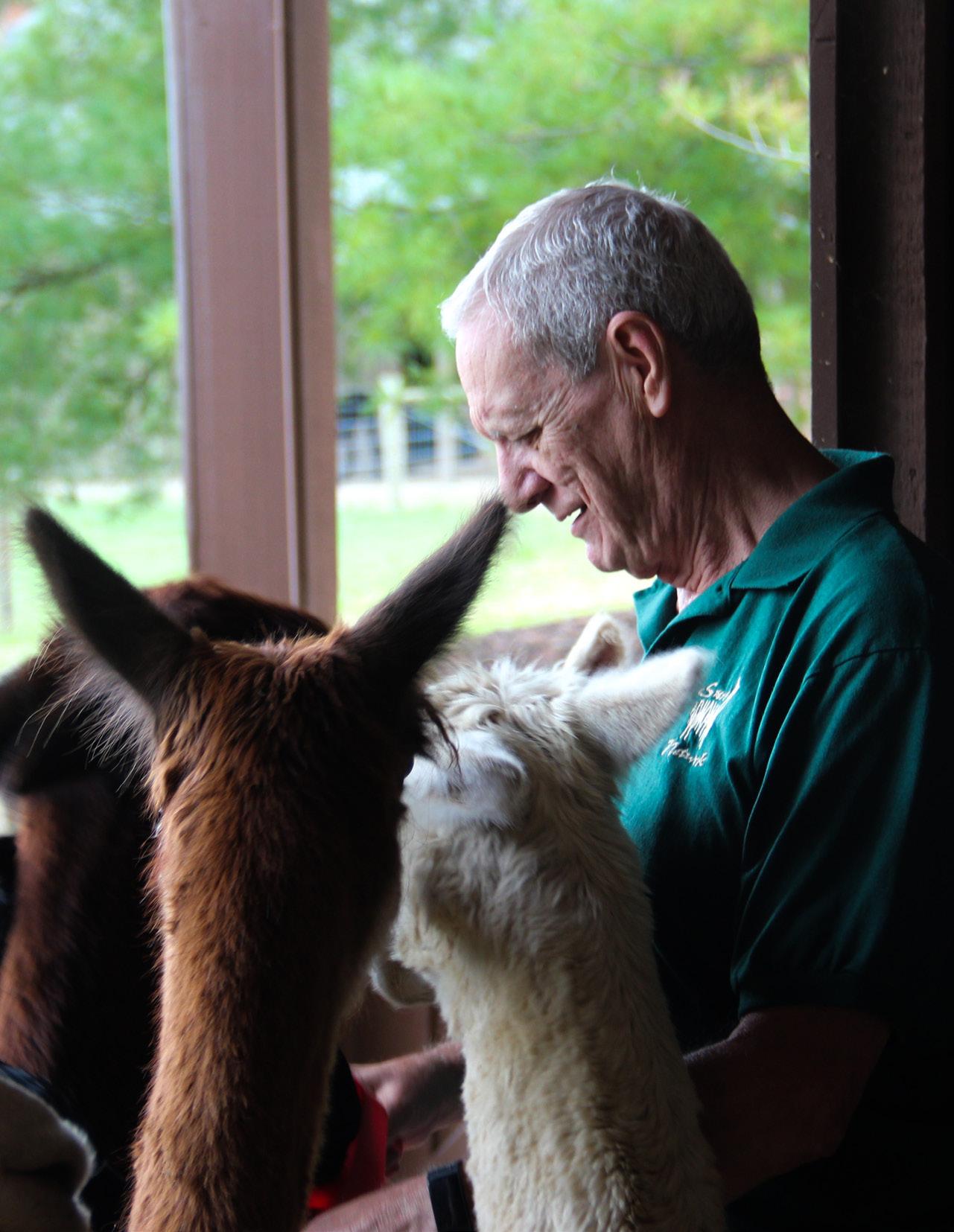
Albert and Rebecca Camma know their Alpacas by name
INSIDE
Ornery Vets Café owner
Joel Laufman understands inclusion
The Athens Asian American Alliance brings visibility to history
The father of statehood’s old home still stands
An acre of ACRE: a fresh start for Amesville
OHIO Southeast
EDITOR-IN-CHIEF
Morgan Spehar
MANAGING EDITOR
Julia Howell
COPY CHIEF
Molly Powers
EDITORS
Nathan Hart
Madyson Lewellyn
Jorja Butt
Jaelyn Smith
WRITERS
Zach Paquette
Mallory Porvaznik
Will Price
WEB EDITOR
Michael Roth
SOCIAL MEDIA
Taylor Linzinmeir
MULTIMEDIA
Alex Porter
Joey Madore
Bryan Kurp
DESIGN DIRECTOR
Isaac Miller
PHOTO EDITOR
Emma Stefanick
PHOTOGRAPHERS
Taylor Linzinmeir
Lane Moore
Jaelyn Smith
Joey Madore
FACULTY ADVISER
Kelly K. Ferguson
FROM THE EDITOR’S DESK
In this issue of Southeast Ohio, our staff ventured back out into the world after a year and a half of the coronavirus pandemic. It was fun to get to work with this year’s reporters to showcase the people and places of this region – even if continued mask mandates mean that I’m still not quite sure what the bottom of everyone’s face looks like.
In a time of near-constant adjustment and uncertainty, we highlighted some organizations and initiatives creating positive change, such as the new Athens Asian American Alliance (24) and recycling projects funded by the Ohio Environmental Protection Agency (36).
At the same time, we also tried to get back to the roots of what makes Southeast Ohio special by highlighting the history preserved at places such as the home of the man who led Ohio to statehood (4) and the communities of the Little Cities of Black Diamonds (40).
Explore new places or learn something new about an old haunt with SEO reporters as they travel around Southeast Ohio. Our staff visited a museum filled wall-to-wall with thousands of pencil sharpeners (21), found themselves stripped bare (literally) while taking a hike (30), and raised important questions like, “Why are there two Little Switzerlands in Ohio?” (14).
So whether you’re interested in southern BBQ (7), the ins and outs of timber framing (34) or alpaca farming (19), this issue has something for you. It’s been a pleasure to work with this semester’s wonderful staff, and I hope you enjoy reading these stories as much as we enjoyed telling them.
Morgan Spehar, Editor-in-Chief
Mission Statement
Southeast Ohio strives to spotlight the culture and community within our 21-county region. The student-run magazine aims to inform, entertain and inspire readers with stories that hit close to home.
On The Cover
Alpacas are part of Albert Camma’s family—and he wants to spread his passion for the animals across Southeast Ohio.
PHOTO BY WILL PRICE
Contact Us
SoutheastOhiomagazine
E.W. Scripps School of Journalism
1 Ohio University
Athens, Ohio 45701
Media
@SEOhioMagazine
@SoutheastOhioMagazine
@seohiomagazine
southeastohiomagazine.com
The Scene
4 | Set in Stone
The father of statehood’s old home still stands
Behind The Bite
8 | Pleased to Meat You
Fat Boy Q founder serves authentic BBQ
10 | Safe Space and Coffee Cake
Cafe owner understands the importance of inclusion
12 | Family Tested, Tastebud Approved
Two restaurants share a love for their customers
In Your Neighborhood
14 | A Tale of Two Switzerlands
Two towns claim to be the “The Switzerland of Ohio”
16 | Patchwork
Quilt barn trails started as an Adams County idea and grew into a national trend
19 | Blood, Sweat and Alpaca Spit
The Cammas know all their alpacas by name
21| Museum Attracts Tourists, Dull Pencils
Paul Johnson’s legacy is now a museum in Logan
Talking Points
24 | Connecting Cultures
The Athens Asian American Alliance brings visibility and history
28 | Off the Bench
Lane Smith performs despite one blind eye
30 | Nude Is Everyone’s Color
Strip away self-doubt and societal expectations at Cedar Trails
Feature Well: Building Ohio
34 | Pioneer Timber Framing: Love for Craftsmanship
Timber framing business builds handcrafted homes
36 | Southeast Ohio Talks Trash
Ramping recycling and conservation efforts
38 | An Acre of ACRE
Elementary school gets fresh start as an asset to Amesville
40 | Connecting the Dots
The Little Cities of Black Diamonds celebrates the coal mining region
42 | Staying on Track
Retired railroader and friends convert station to museum
What’s Your Story?
46 | John “John Boy” Pelletier
An interview with the recently retired Jackson County broadcasting legend following a 53-year career
PHOTO: The main entrance of the mansion and gardens.
Set in Stone
The father of statehood’s old home still stands
STORY BY JORJA BUTT PHOTOS BY LANE MOORE
Atop a hill north of Chillicothe sits a stone mansion that overlooks the 2,000-acre estate’s gardens and the inspiration for the Great Seal of Ohio. Built in 1807, the Adena Mansion was home to Ohio’s sixth governor and father of statehood, Thomas Worthington. He lobbied for Statehood through his political ambitions.
At 19 bedrooms, Governor Worthington, his wife Eleanor, and their 10 children made the Adena Mansion their own. Architect Benjamin Henry Latrobe, most famously known for his construction of the U.S. Capitol, designed the mansion with strong geometric proportions to create the simple yet elegant landmark. Time has been no match for the mansion as it stands in its original Georgian structure with some of the key design elements still intact.
“His [Gov. Worthington’s] office holds the most history. The coolest part of it is the wallpaper pattern is original,” says the Adena Mansion and Gardens Executive Director Kathy Styer. Archaeological investigations revealed the original wallpaper hidden behind a doorway, which led to the reconstruction of the room to pay homage to the original pattern.
Styer and the Adena Mansion and Gardens Society are dedicated to preserving the history of the mansion and educating the public about its beauty and importance.
“We have community events to bring people up on the hill…we then also have educational events like a children’s series and an adult series,” Styer says.
ADENA MANSION AND GARDENS
(740) 772-1500
847 Adena Road
Chillicothe, OH 45601
info@adenamansion.com
PHOTO: The formal dining room inside the Governor’s mansion.
PLEASED TO MEAT YOU
Fat
Boy Q founder and chef D’Angelo Roach serves authentic barbecue
across the Tri-State area
STORY BY MICHAEL ROTH | PHOTOS BY ALEX EICHER
D’Angelo Roach, the founder of Fat Boy Q, was tired of working steady jobs and wanted to make a living from his passion for food. “I was working my corporate job and unfulfilled,” Roach says. “I wanted to focus more on just the cooking.”
Five years ago, Roach had started D’Angelo’s Kitchen and Catering, making ribs and wings for friends and family on weekends. The time he spent making food reminded him of his favorite memories at family cookouts. “I remember them as the best times in my life,” Roach says. “The food was the best part!”
In January of 2020, Roach began working with his business partner, Marcus Williams, a business school graduate of The Ohio State University, to make food their full time job. They set up calls every night at 8 p.m. and mapped out their business plan.
In addition, Roach and Williams went on a trip down South to taste the most authentic Southern barbecue and bring some of the flavors up to Ohio. They traveled to Kansas City, St. Louis, Memphis, Dallas and Charleston, and sampled brisket, wings, burnt ends and other types of BBQs.
The culinary inspiration from this trip was so special for
Roach that he dedicated one side of the truck to a map of the cities they visited. The other side displays pictures of a chicken, pig and cow, marking the different options of meat available for customers.
But for a time, it seemed like the Fat Boy Q food truck might never become a reality. “COVID-19 hit and it seemed like the whole thing was going to implode,” Roach says. But the pandemic wasn’t all bad for the business. “It gave us more time to cross all of our T’s and dot all of our I’s.”
Expanding from D’Angelo’s Kitchen and Catering to the Fat Boy Q food truck took over a year, but finally, on April 20, 2021, the Fat Boy Q food truck was in business. On opening day in Ironton, the line went down the block on the corner of 5th and Vine. Since then, Fat Boy Q has worked events in Huntington, West Virginia; Ashland, Kentucky; and numerous towns around Lawrence County.
Ironton football games give locals another opportunity to taste Roach’s cooking. A native of Ironton, Roach wants to pay it forward for the next generation. “I’m a fourth generation Irontonian,” Roach says. “I was born at [Lawrence County General Hospital], which is no longer here; there aren’t many people that are more Irontonian than me.”
ABOVE: D’Angelo Roach helps a customer of Fat Boy Q.
“It’s like feeding your extended family.”
– D’Angelo Roach, founder of Fat Boy Q
While Roach was wondering if the area would support a food truck, he’s pleased to be able to see so many familiar faces. “It’s like feeding your extended family,” Roach says.
While pulled pork is a favorite for Irontonians, Roach hopes he can expand their meat palate. “There’s a lot more out there than just pulled pork sandwiches,” Roach says. “People don’t know what brisket or rib tips are. Our goal is to introduce them to different cuts of meat.”
In addition to ribs, rib tips, wings, pulled pork and brisket, Fat Boy Q offers their Signature Q nachos and Carolina Q bowl. The nachos include pulled pork, queso and cilantro lime slaw. The Carolina Q Bowl includes jalapeno cornbread with mac and cheese and pulled pork, drizzled with their Q sauce.
While Roach acknowledges that the first couple months for Fat Boy Q have been successful, it hasn’t always been easy for him and his staff.
“Smoking meat all night long, there’s been multiple times where I get two hours of sleep in a 40-hour period,” Roach says. “You don’t do those types of hours for something you don’t love.”
As for the future, Roach hopes to move into a building where buyers can pick up orders and dine inside. For now, he is driving the Fat Boy Q truck all around the region, serving up savory meats for his food family.
PHOTO: Fat Boy Q’s Pulled Pork sandwich drizzled in Q sauce.
PHOTO: D’Angelo Roach inside the Fat Boy Q Food Truck.
SAFE SPACE AND COFFEE CAKE
Ornery Vets Café owner Joel Laufman understands the importance of inclusion
STORY BY MALLORY PORVAZNIK | PHOTOS BY JAE SMITH AND PROVIDED
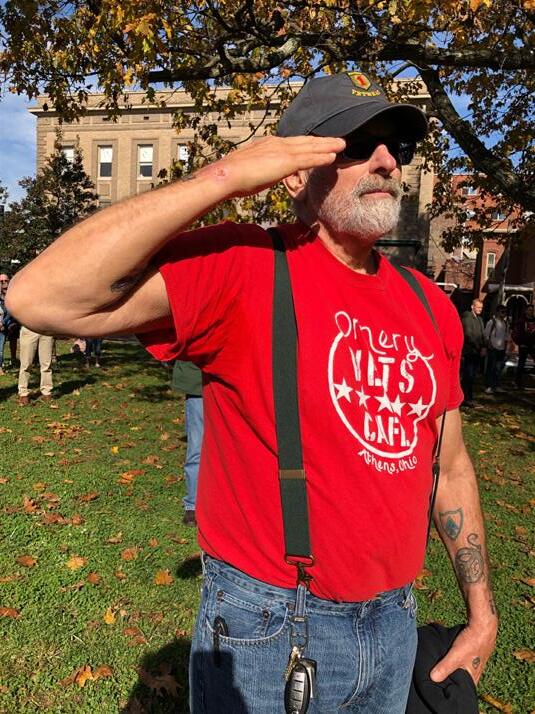
Joel Laufman’s bright eyes and wide smile greet customers at the handicapped accessible door. Always available for conversation, his open demeanor makes all who enter Ornery Vets Café in Athens feel immediately comfortable.
Customers sit in the vibrant red chairs, snacking on USA sugar cookies and sipping on drinks with names like “Berry Happy,” “The Kermit Special” and “Orange You Smooth.” Some indulge in cinnamon rolls while the more health-conscious crunch on vitamin-packed salads.
A large blue mural of the café’s logo and hand-painted symbols of each branch of the U.S. military, which represent the inspiration of the café, take up most of the wall near the door.
Laufman himself is a veteran, serving in the Vietnam War. He was later diagnosed with post-traumatic stress disorder from his experiences overseas.
An Ohio University (Athens) alumnus, Laufman taught high school and junior high for 35 years after receiving
his master’s degree in Educational Administration. He explains that, after his retirement and his wife’s passing, his mental health again took a turn for the worse, and he was inspired to open a café to bring together the veterans of Southeast Ohio with similar struggles.
“I thought it would help me to help others with my experience as a veteran,” Laufman says. He describes PTSD as something that affects everyone differently.
“It does not matter if you are young or old, black or white, male or female, it hits everybody like a sledgehammer,” Laufman says.
Opening the café and talking about his war wounds made Laufman realize that his own mental health struggles were shared with other people in the community.
Not only have veterans been taking advantage of the Café, but Laufman also explains that first responders, survivors of trauma, people struggling with depression and survivors of sexual assault meet at the café.
Ornery Vets is a 501C3 nonprofit organization. “There
are no profits here,” Laufman says. “Whatever we make here goes straight back into the business or goes back into providing services.”
The café got off to a rough start during the pandemic in 2020, but the community has rallied to support the venture. For instance, a Go-Fund Me page was created to pay for an espresso machine, and one local Athens woman was generous enough to donate $2,000 of the $3,000 needed for the machine.
The staff hopes to see a rise in the number of customers within the coming months. Laufman explains
“I opened the cafe so that I could help others with my experiences.”
- Joel Laufman owner, Ornery Vets Cafe
that their major goal is to be open during the evenings to increase profits and so that those with post-traumatic stress disorder and other survivors of trauma continue to have a meeting space.
Laufman also aims to make the café financially successful enough to donate to other organizations around Southeast Ohio. With potential and positivity, he is eager to keep pushing.
“We are always looking for opportunities and open to new partnerships.”
TOP LEFT: :Owner Joel Laufman stands at attention.
ABOVE- Get your own five-star mug.
LEFT: Sweet treats for sale.
ORNERY VETS
Instagram: orneryvetscafe
Facebook: Ornery Vets Cafe Coffee Shop
Address: 30 E State Street Athens, Ohio 45701
Phone: (740) 249-4576
email: lauffy7@gmail.com
TIME TESTED, TASTEBUD
BUSH’S RESTAURANT
Much like Diner 23, the customers of Bush’s Restaurant in Logan are what really make the establishment feel like home. The owner of Bush’s, the oldest locally owned and operated restaurant in Hocking Hills, is Lee Howdyshell. He can often be found in the dining room of his restaurant, greeting his customers. It seems he knows every single one of them on a first name basis.
Treating customers like family, along with food made from scratch, is what he thinks makes the restaurant so unique. “I’m probably noted for [my ability to] take care of people,” Howdyshell says.
Howdyshell, who has been the owner since 1985, likes to think that Bush’s is an “exception to the rule.” They make all their food from scratch, from their pies to their salad dressings. The most popular item on the menu is their Broasted Chicken, which is different than fried chicken because it is essentially fried in a pressure cooker.
Their diverse menu is full of everything from Philly cheesesteak to fishtail sandwiches, all at “family” prices. “[We can have] a customer come in every day of the week and not eat the same thing twice,” Howdyshell says.
Bush’s was opened in 1970 by Charlie Bush, who was close friends with Bob Evans. Bush’s sells many of the same
items from the original menu to this day. The menu has close ties to family, as well. The Big Ed is named after Charlie’s son Ed and the Sweet Susie named after his daughter, Susie.
Howdyshell started working for Bush when he was 12 years old, scrubbing the walls and floors to make some extra money while his mother was ill.
Now, he’s not only the owner, but the cook, the dishwasher, the server—whatever it takes to make the business run smoothly.
He works an average of eight to 16 hours a day. Despite the workload, he hopes Bush’s can keep on going for another 50 years. “We may not have a lot of money, but we have a lot of memories.”
BUSH’S RESTAURANT
428 East Front Street Logan, Ohio, 43138
http://www.bushsrestaurant.com/ (740) 941-1144
STORIES AND PHOTOS BY
ABOVE: Bush’s Restaurant, a Logan staple since 1970.
ABOVE: Time travel to the 50s at Diner 23 in Waverly.
LEFT: Abby Neff and Kwase Lane laugh in Diner 23 as they look over the impressive menu.
TASTEBUD APPROVED
BY TAYLOR LINZINMEIR
TDINER
ake one step into the chrome-covered Diner 23 in Waverly and prepare to be transported back to the ‘50s. Black and white checker print tiles line the floors while strips of neon red lights line the tops of the photo-filled walls. The vintage aesthetic extends to the counter, which offers several shiny, cherry-red stools that match the laminate booths.
A slideshow of the diner’s regulars plays on a television screen. New customers are greeted upon arrival by a friendly wave or an invitation to chat from one of the loyal patrons. Owner Mike Corwin believes people make special relationships while in the diner because of the unique customers.
“Sitting and talking to the people, it’s amazing the things they’ve been involved in.” The diner doesn’t just offer a pleasant atmosphere, but a menu that replicates the taste of the ‘50s. “Diner 23 offers the finest in good, American home cookin’! Belly up to a burger and fries and listen [to] Buddy Holly on the jukebox,” the website proclaims. Craving pancakes and French toast for dinner? No problem. Diner 23 serves breakfast all day. The most popular menu items include the Steve Evans sausage, the open-faced roast beef sandwich, Mrs. Corwin’s recipe for vegetable soup, the beans and cornbread. “There’s times I’ll cook up four pounds of beans a day,” Corwin says.
23
Despite the retro menu and façade of the building, Diner 23 was built in 2000. However, diners have been in Corwin’s blood for much longer than that. His father used to own an establishment similar to Diner 23. He can remember “old ladies” teaching him to cook when he was five years old, reminding him to wait for the bubbles to pop before flipping over a pancake.
Those childhood experiences inspired him to open Diner 23. “Our customers were like family members. I really missed it,” Corwin says.
Corwin, a Vietnam War vet, left his job as police chief after 32 years to own and operate Diner 23. “It’s time consuming, [but] it’s rewarding, as far as your friendships and relationships with the people. It’s unbelievable.”
DINER 23
300 West Emmitt Avenue, Waverly, Ohio, 45690
https://www.diner23.com/
A TALE OF TWO SWITZERLANDS
Two cities, 100 miles apart, both claim to be “The Switzerland of Ohio” STORY AND PHOTOS BY NATHAN HART
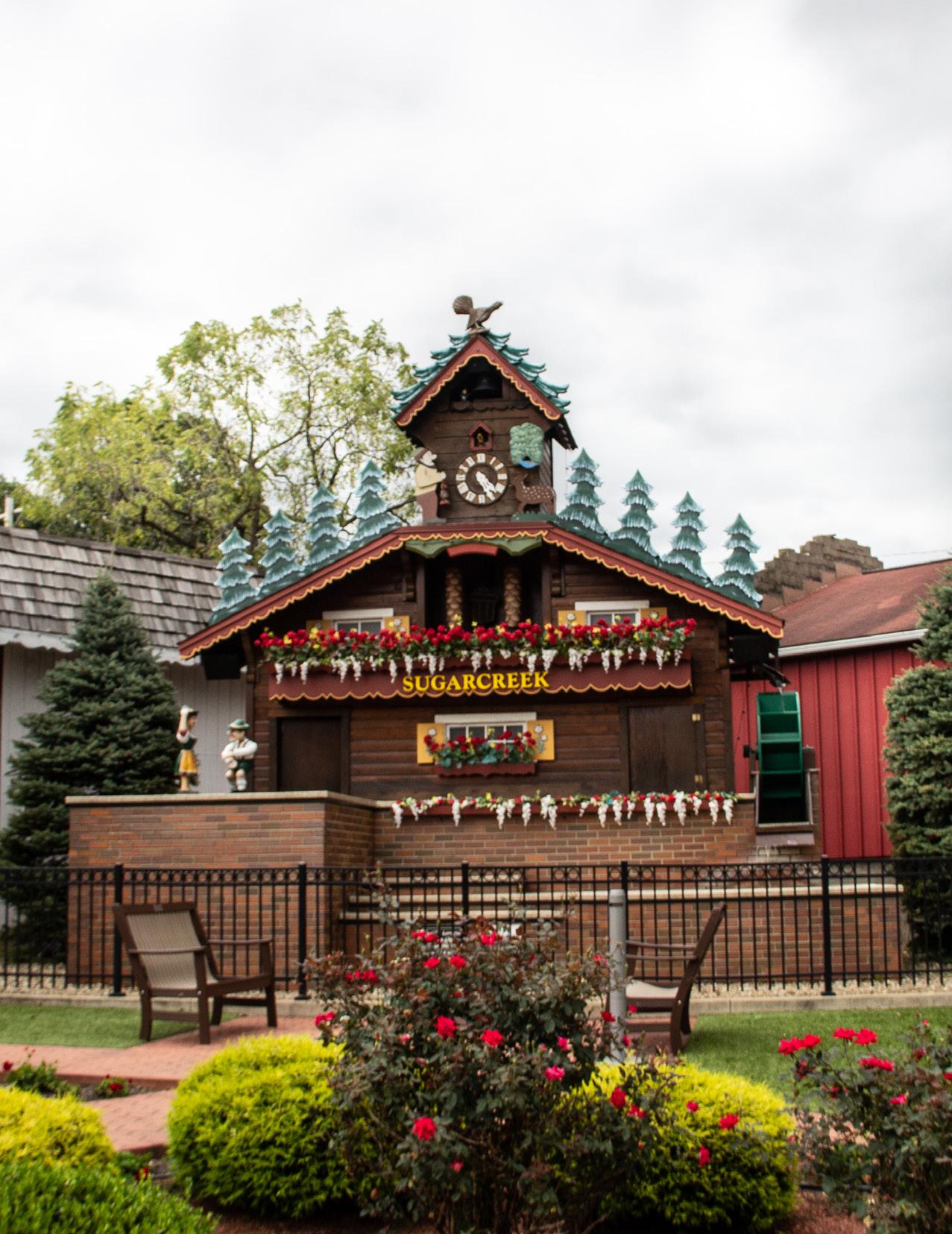
PHOTO: Sugar Creek’s “World’s Largest Cuckoo Clock.”
Rolling hills, a sea of green, fertile land and ample space are what settlers from Switzerland saw when they came across Monroe County, sometimes referred to as “The Switzerland of Ohio,” in the 1800s.
Swiss settlers were greeted with much of the same sights in Sugarcreek, around 100 miles northwest of Monroe County, which calls itself “The Little Switzerland of Ohio.”
“They liked the topography … of the land. It reminded them of Switzerland,” says Alpine Hills Museum Curator Becky Detwiler. “And they realized that the hills and the grass was good for cows grazing and that that would give good milk for cheese.”
Monroe County commissioner Mick Schumacher had similar things to say about the Swiss immigrants that settled in the area; they liked the land and it reminded them of home.
The seat of Monroe County is Woodsfield, a village of around 2,000 people that centers on a small downtown area dotted with old buildings, small businesses and a palatial courthouse built in 1908.
Sugarcreek is also a village of around 2,000 people. Sugarcreek’s downtown area has sidewalk installments flying Swiss flags, buildings influenced by Swiss architecture, and the world’s largest cuckoo clock.
Another thing the villages have in common: a history of cheese making.
Woodsfield is the home of the Monroe County Historical Society, which maintains a 19th century dairy shed used by Swiss settlers to make cheese. Inside the barn are a number of cheese molds, pots, stirring devices and more that settlers used to make their famous Swiss cheese.
“Sugarcreek, meanwhile, once had as many as 80 different places making Swiss cheese at a time,” Detwiler says.
Sugarcreek’s yearly Swiss Festival was originally a place for the many cheese makers to show off their wares to the village. “They had contests, who had the best cheese, and so that contributed to it also. That took it to the next level, I would say,” Detwiler says.
Not to be outdone, Monroe County lays claim to the Isaly family, who brought their cheese-making to the
“They liked the topography … of the land. It reminded them of Switzerland, and they realized that the hills and the grass was good for cows grazing and that would give good milk for cheese.”
– Becky Detwiler, Alpine Hills Museum Curator
area in the 19th century. Grandson of the original settlers, William Isaly later founded Isaly’s, a dairy and restaurant chain most well-known for creating the Klondike bar and its slogan, “What would you do for a Klondike bar?”
Residents of both villages can trace their heritage directly back to the Swiss immigrants who originally settled the land.
“My wife’s grandparents and her family still spoke Swiss, even, she just passed away in the late 90’s. And she and her sisters, I think there were 6 or 7 in their family, they all spoke a dialect of Swiss,” Schumacher says.
He says most of the people in Monroe County had Swiss or German heritage before aluminum factories moved into the area and brought workers with different ancestry.
Sugarcreek residents can also trace their ancestry back to Switzerland. Some residents even have grandparents who were the first members of their family to leave Europe and live in the U.S., Detwiler says.
Schumacher admitted that Monroe County’s claim to be “The Switzerland of Ohio” is not as strong as it once was.
Detwiler, meanwhile, spoke proudly of Sugarcreek’s Swiss Festival as a major component of the village’s claim to be “The Little Switzerland of Ohio.” Sugarcreek is the
ABOVE: Mick Schumacher points out dairy equipment.
ABOVE: An 18th-19th century dairy shed in Woodsfield, Ohio.
PATCHWORK
Quilt barn trails started as an Adams County idea and grew into a national trend
STORY BY EMMA STEFANICK | PHOTOS BY EMMA STEFANICK AND PROVIDED BY JULIANNA DONOFRIO
When Donna Sue Groves and her mother Maxine moved to an Adams County farm in 1989, an old Mail Pouch Tobacco barn sat on the property of their new home.
Groves thought it was the ugliest barn she had ever seen. That day, Groves made a promise to her mother, an avid quilter, that she would paint a quilt square on their barn. Little did she know that her idea would become a national phenomenon.
The first barn quilt, the Ohio Star, was hung at Lewis Mountain Herbs in 2001 during an annual festival, now called the Olde Thyme Herb Fair. Donna Sue, who was working as a southern field representative for the Ohio Arts Council at the time, helped develop the first quilt square. The square was dedicated to Maxine Groves and became the first of 20 stops on the Adam’s County driving trail, the Clothesline of Quilts.
According to Tom Cross, executive director of the Adams County Travel and Visitors Bureau, each barn on the original trail has a different quilt square pattern honoring the county’s heritage, hung on a side that can be viewed from the road.
“These 20 are old, traditional quilt patterns,” says Cross. “A lot of these patterns came over from England when the settlers came in, and they have history written all over them.”
Many patterns, including Shoo Fly, originated in the 1800s, becoming popular patterns for their simplicity and
reflection upon farm life. Many of these historic patterns have newer, similar variations, such as Shoo Fly’s close relative, Hole in the Barn Door.
While no one really knows where the name Shoo Fly comes from, it is suspected to relate back to the wild plant called clover broom, or more commonly, shoo-fly.
According to Elaine Lafferty, original owner of the Shoo Fly quilt square, Maxine Groves played a huge role in designing squares for the quilt trail. Lafferty describes how Groves had a three-ring binder with her favorite quilt square patterns that she had hand-drawn and colored sorted into individual plastic sleeves.
Groves was flipping through and said, “Now this one’s called Shoo Fly.”
Lafferty thought back to the first time she took a trip to Amish country with her parents. “That was the first time any of us had ever eaten shoo fly pie, so that remained with me, and I said I wanted that one.”
After the dedication of the Ohio Star in 2001, the Groves family had people eagerly seeking them out to become a part of the barn quilt movement. According to Tom Cross, not a day went by where Donna Groves was not answering questions about it.
As people drove across the county, be it for reason or by accident, they saw barn quilts that would stick with them in their memory for years to come. Barn quilt trails then began to pop up sporadically in new locations.
PHOTO: Elaine Lafferty stands with her barn quilt, the Shoo Fly
“ It started as wood and paint and it’s grown into so much more.”
– Julianne Donofrio
The barn quilt trail has grown from a local trend to a nationwide phenomenon, stretching from one end of the country to the other, eventually making its way into Canada. There was even a documentary made by filmmaker Julianne Donofrio about the barn quilt trails called Pieced Together
“It started as wood and paint, and it’s grown into so much more,” said Donofrio. “But I think the beauty in these patterns and in choosing your own colors is that anyone can create barn quilts. I really just think it is a way for people to celebrate their community, to preserve old barns and an art form that is truly accessible.”
Twenty years after the first barn quilt was painted, 15,000 barn quilts make up a patchwork of designated trails. Tens of thousands more exist on private property to honor family members, heritage, or to salvage old barns.
The Groves’ quilt, Snail’s Trail, was added to the Adams County driving trail in 2003, finally fulfilling the promise that Groves made to her mother 14 years before.
Since the writing of this article, Donna Sue Groves passed away at the age of 73 on November 13, 2021 after an ongoing battle with cancer.
ABOVE :The first barn quilt, the Ohio Star, is dedicated to Maxine Groves at Lewis Mountain Herbs in 2001.
ABOVE: Donna Sue Groves and her mother Maxine in front of their barn, Snail’s Trail, 2014.
BELOW LEFT: A Clothesline of Quilts mural on the new Adams County Training Center in West Union painted by Pamela Kellough.
BLOOD, SWEAT and ALPACA SPIT
Albert and Rebecca Camma know all their alpacas by name
As Albert Camma walks his farm, he has time to reflect on the endeavor he’s been working on for over a decade.
“We’ve always felt the animals share our home just like we do,” Albert says. “They’re just cool animals.”
The story of the farm began in 2008, when Albert and his wife, Rebecca, decided to get a herd of 15 alpacas after a trip to a farm in North Carolina. They now have over 100 alpacas on their 180-acre farm.
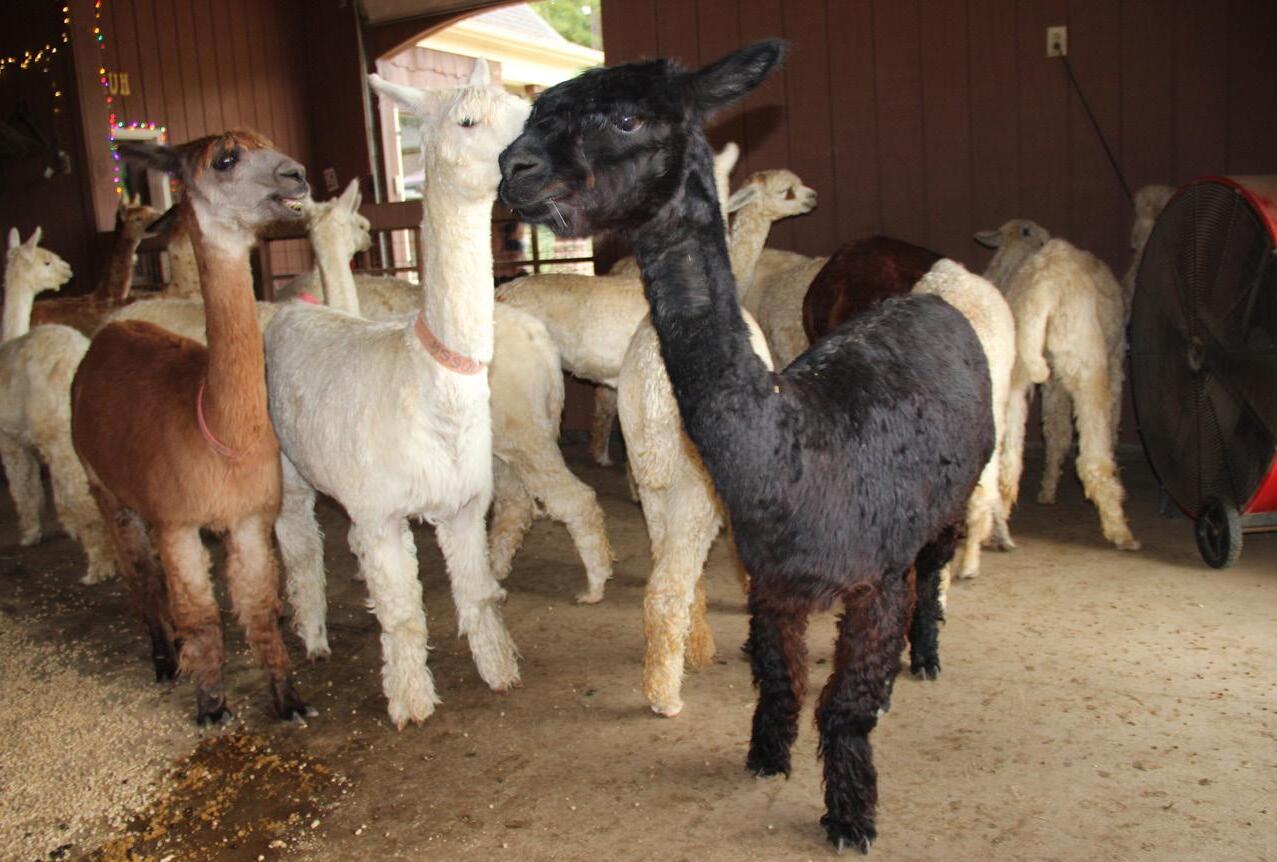
Alpacas are fluffy, with perky ears and unique, messy haircuts. They are scattered across four barns on the secluded property, which is surrounded by hills. Upon arrival, visitors buzz in through a gate adorned with the farm’s logo, the outline of the head and neck of an alpaca.
STORY AND PHOTOS BY WILL PRICE
Lindsey Warne is the chief marketing officer for the farm, and she has worked there for over five years. She says Rebecca’s passion for the animals was akin to love at first sight.
“She saw the alpaca getting born (at the farm in 2008), they knew they wanted to do something with their property,” Warne says. “It just kind of snowballed from there.”
Over the years, Rebecca and Albert have bred numerous alpacas. The alpacas come in all different colors and sizes— there are over 22 recognized colors––with features ranging from bulging eyes to perky, spear-shaped ears.
The farm owns mostly Suri alpacas, which are much rarer than the Huacaya alpaca and are known for the luster and durability of their coats. The fiber the alpacas produce is worth about $100 for a ball of yarn, depending on the animal. The farm has some of the highest quality fiber in the country, and processing these products usually takes months.
Rebecca names the alpacas. The naming process is relatively simple, as she tries to match a child’s name to have the same first letter as either it is mother or father. Sometimes, however, she gets more creative,naming some alpacas––like the Harry Potter-inspired Bellatrix Lestrange––after fictional characters.
One of the younger alpacas, Ella, still lives in the maternity ward, where the farm keeps pregnant alpacas or ones that recently gave birth. Pregnancies typically
BELOW: Albert Camma tends to several of his alpacas.
last between 11 and 12 months for the animals. Alpacas have strong bonds with their mothers and are very familyoriented animals.
The alpacas are kept in multiple barns. For example, males and females are separated to avoid unwanted breeding. The barns are littered with fans because alpacas have heavy fleece and hot Ohio summers are not their natural habitat.
If you were wondering, alpacas do spit. They eat grass and will sometimes spit after a meal as a defense mechanism. Unfortunately, it has a distinct, unpleasant smell. Years of alpacas spitting has left debris on the walls of every barn on the farm. But don’t worry—there haven’t been any incidents involving tourists.
The newest barn was built in 2018, made for older alpacas around ages 13 or 14 that can no longer breed. A typical alpaca lifespan is 15-20 years, with the oldest on the farm, Nightingale, being 18 years old. The barn also has extra cameras to monitor the older alpacas.
The alpacas aren’t the only appeal of the farm. The property also has a bed-and-breakfast with four rooms and a garden. The Alpacas of Spring Acres had to close due to the pandemic, but it reopened in May of 2021. Now guests can explore other parts of the grandiose property, such as the 5-acre lake visible from the alpaca barns.
Tours, which are scheduled by appointment and cost $10 per person, allow visitors to feed alpacas and
experience the barns first-hand. Find an alpaca you develop a connection with? While it’s probably not for sale, there is a good chance that products in the farm’s store contain fiber from that particular animal.
Albert and Rebecca had plans to build a new barn, but this was put on hold by the pandemic.
“(Rebecca) wanted to be a source to rescue these animals and then give them out to people who would take care of the animals who maybe couldn’t afford it,” Albert says.
While some dreams are on pause, Albert is satisfied that he has achieved his goal of raising awareness on alpacas.
“I guess that’s what our goal was, to get a great place for all animals, two-legged and four-legged.”
3370 Big-B Road Zanesville, OH 43701
(740)-796-2170
ABOVE: Lindsey Warne’s tasks as chief marketing officer include leading tours and running the store, all while taking care of her newborn, Molly.
BELOW: Albert Camma and his wife, Rebecca Camma, have four barns and about 100 alpacas on their property.
ALPACA OF SPRING ACRES
MUSEUM ATTRACTS TOURISTS, DULL PENCILS
Paul Johnson started collecting pencil sharpeners in 1988. Now his legacy is a museum in Logan.
STORY AND PHOTOS BY MALLORY PORVAZNIK
Tourists traveling the Hocking Hills State Park might stop into what looks like a small shed looking to find a map. Inside, the tourists would be greeted with an extensive collection of pencil sharpeners originally collected by the late Paul A. Johnson.
The museum includes historical sharpeners, military sharpeners, transportation sharpeners, game sharpeners and more. The collection began when Paul’s wife, Charlotte, bought him a pencil sharpener for Christmas one year. From there he continued collecting them in a shed outside their home.
“He passed away in 2010 and his wife wanted to let us keep it here so that people can enjoy it,” says Hocking Hills Welcome Center Manager Rose Arthur.
This impressive collection of around 3,450 pencil sharpeners, the largest collection of pencil sharpeners in America, has been featured in several magazines, including Ripley’s Believe It or Not. Pencil sharpener enthusiasts would be hard-pressed to find another museum with so many sharpeners; the closest one is in Paris, Rose says.
The museum moved in next to the welcome center in 2011 after the passing of Paul Johnson. Since the welcome center brings in millions of tourists and travelers per year, it was a perfect location for the museum and tribute to Johnson.
“Five million visitors come to Hocking Hills every year and they come through our building to get the trails maps, and we always mention to people to take a look at the museum,” Rose says.
The museum is organized into various categories: children’s, food, hearts, transportation, space, games, furniture household, military, and several more. Visitors can see Johnson’s most prized possession, his very first pencil sharpener. “Paul Johnson kept everything categorized, yet we do not know where they are specifically from; if they had a similar shape, category, theme, or all of the metals, they would be put together,” Rose says.
All the pencil sharpeners in the museum are arranged the same way as how they were set up in Johnson’s home. “There were pictures taken, everything was removed from its original location, looking at the pictures and putting in the museum exactly how Paul Johnson originally had it,” Rose says.
While adults are interested in the older sharpeners, some of the more popular pencil sharpeners that tourists gravitate to are either the Mickey Mouse or animal themed. Sometimes the younger generation needs a quick primer on the museum’s contents. “Kids come into the museum and ask what a pencil sharpener is,” Rose says.
OPPOSITE PAGE:
Pencil sharpeners of many different shapes fill the inside of the museum.
THIS PAGE: The museum’s wooden exterior.
a collection of...
3,450
CONNECTING CULTURES
The Athens Asian American Alliance works to bring visibility and history
When Fan Jiang, an Athens city resident of 14 years, was faced with a death threat directed at one of her children last school year, she turned to the city school board for a thorough investigation.
Backed by Jiang and supporters, the Athens City School District Board of Education unanimously passed a resolution to provide support and inclusivity for members of the Asian American and Pacific Islander, or AAPI, communities in April. The resolution speaks of celebrating Athens students of diverse identities and condemns “hate speech, racism, and all forms of discrimination.”
A May 2021 report from the Center for the Study of Hate and Extremism at California State University, San Bernardino, found that hate crimes against Asians went up 164% that year across 16 of the U.S.’s biggest cities. With the increase of anti-Asian crimes and prejudice came a flood of activism, organizations and resources contributing toward the support, aid and increased visibility of members of AAPI communities.
Jiang, in collaboration with Yi-Ting Wang and Noriko Kantake, founded the Athens Asian American Alliance.
“We felt like we just needed a place where all people with Asian heritage in Athens can feel safe and can connect with each other and empower each other,” says Jiang. “We also felt like, if we have an organization like that, we could help other families that face similar challenges down the road.”
AAAA’s mission is “to engage in community services and inclusion, advocate and support for social justice, and provide belonging and friendship, for all with AAPI heritage at Ohio University, Athens area schools and communities.”
Not only does AAAA want to engage with fellow residents of Athens and surrounding areas, but they also want to be a resource for Ohio University Athens’ international students and faculty as well.
Jiang also hopes for more connection between the university and Athens’ residents.
STORY BY MOLLY POWERS | PHOTOS BY EMMA STEFANICK
ABOVE: Athens Asian American Alliance members Galia Williams, Yi-Ting Wang, Fan Jiang and Noriko Kantake.
“ At first I thought, we’re just preserving Asian American presence and contributions. But then it turns out that it’s a story; it’s a story for the whole community.”
AAAA is constantly brainstorming outreach activities. Some of their ideas include working with Rural Action to introduce an Asian vegetable workshop, collaborations with university organizations such as the employee group AAPI-LEAD (which stands for Leadership, Education, Advocacy and Development), and the Asian American Pacific Islander Student Union (AAPISU).
Due to the ongoing COVID-19 pandemic, AAAA has been holding their monthly meetings, which are open for anyone to attend, on Zoom and update their Facebook page regularly with news and updates on their ongoing projects.
One of these ongoing projects is AAAA’s community oral history project. For this project, members of AAAA plans to interview Asian community members of Athens and surrounding areas in order to tell the unique stories of residents and display the impact these people have on Athens and the surrounding area.
Audio recordings and transcripts of the interviews will be made available to the public on the Southeast Ohio History
Center’s website.
– Yi-Ting Wang
Yi-Ting Wang, a 14-year resident of Athens and vice president of AAAA, says the oral history project is her personal favorite the alliance is working on.
“At first I thought, we’re just preserving Asian American presence and contributions,” says Wang. “But as it turns out, it’s a story for the whole community.”
ABOVE: Official Athens Asian American Alliance logo, courteººsy of AAAA.
PHOTO: Members of AAAA, with friends and family, carry a dragon in the Ohio University Homecoming Parade on October 9.
OFF THE BENCH
Lane Smith is one of the most athletic players in Southeast Ohio despite being blind in one eye
STORY BY JOEY MADORE | PHOTOS BY JAE SMITH
Federal Hocking High School senior guard Lane Smith lives for the game, whether it is the rhythm of the basketball, the energy of the crowd, the shoes squeaking on the floor, or the surge of adrenaline that comes from a great steal, move or basket.
The game remains the same, but the way that Smith experiences it changed after an accident in eighth grade. His right optic nerve was severed, leaving him blind in his right eye, but Smith was determined to get back to playing as soon as possible.
“I was never really worried that I would not play ever again,” Smith says. “I always had great people surrounding me and coaches who helped me get through and adapt.”
From the second Smith learned that he would not be able to see in his eye again, Jennifer Smith, Lane’s mother, says it did not take long for him to adopt a positive outlook.
“I think he cried for maybe 30 seconds to a minute,” Smith says. “And then he looked at his father and said ‘We’ll beat this.’ And he’s beat it. He had a great outlook from the time it happened, more than most kids ever would at that age.”
Smith does not allow his condition be a roadblock. Instead, it motivates him to work harder. Smith’s love for basketball and his mental toughness allowed him to get back out on the court and start playing the first week he was released from ICU.
“I’ve always thought of myself as a positive guy,” Smith says. “I always look at the positive side, and even with my eye, basketball is still what I love to do, and I was not going to let anything stop me, and I have not since.”
The sport presents challenges with how moving parts are involved, and blindness in one eye adds to the degree of difficulty. Smith had to make adjustments and retrain.
BELOW Smith poses next to the logo at his high school’s gym.
“My peripheral vision lacks a lot, of course,” Smith says. “I just have to stay on my toes and keep my head moving. I cannot keep my eye on the ball and my man at the same time, so sometimes when we’re in a zone, I have to make adjustments. Or if my man does not have the ball, hopefully they do not cut on my blind side, because if they do, they might get an open layup.”
“Screens can be the biggest issues if my teammates don’t call them out. It was hard at first in eighth grade, but I got the hang of it,” Smith says. A screen is a blocking move made by an offensive player.
Throughout his high school years Smith has been an integral part of a talented team.
During his sophomore year, he was a key role player off the bench for the Lancers, and helped them win their first TVC-Hocking championship in over a decade. That year the team also collected two playoff wins and got a chance to play in the Convocation Center at Ohio University.
Smith took a more prominent role in his junior year as a starter in many games on an impressive roster for Federal Hocking.
With Smith, the Lancers had a 15-win season––good enough for second place in their conference. They also won a sectional title in the OHSAA playoffs for a second straight season.
Smith established himself as one of the most explosive athletes on his team––and in the area–– during that year.
Standing at 6 feet tall, Smith is one of the few basketball layers in the area who has no issues rising up to flush down a monstrous dunk with his right hand.
“It’s funny because in my freshman year I could not even touch the backboard,” Smith said. “Then I really started working on it, and sophomore year I started touching the rim and last year I could get a few in every now and then, but now I’m doing all kinds of dunks––I’m really getting up there pretty good now.”
Smith’s parents Jennifer and Jerry are proud of what their son has accomplished.
“I would not have been able to handle it the way he did,” Jennifer says. “It’s never stopped him. I honestly forget that he’s blind just because he is able to handle it so well. I forget all of the time.”
Smith has already been a key player during his time with the Lancers, and he is looking forward to stepping into the role of senior leader for the upcoming season.
“I’m super excited to get everybody back in the gym for games,” Smith says. “I can remember the game my sophomore year when we became TVC champs; we had every seat packed in the house. So, it would be great to get that back.”
“ I just have to stay on my toes and keep my head moving.”
– Lane Smith
NUDE IS EVERYONE’S COLOR
Strip away self-doubt and societal expectations at Cedar Trails
STORY AND PHOTOS BY JAE SMITH
PHOTO: Along the Hoover Trail, hikers will come across bridges covered by inspirational sayings provided by past campers and members of the retreat.
ABOVE: Cedar Trails offers a safe space to escape everyday life. Visitors are encouraged to explore not only the property, but themselves as well. For many people, this can be a very relaxing, but also therapeutic in a way that offers a healing or nurturing experience.
As I neared the end of my drive, the road shifted from pavement to gravel. Armies of trees surrounded the roadside and covered me like a vibrant green awning that allowed sunbeams to peek through. When I turned into the entrance of Cedar Trails, I was overcome with the feeling that my journey had only just begun. I stepped out of my car and into my most natural form.
Cedar Trails Nudist Retreat is a family campground that started as 60 acres of land 28 years ago. Fred Roessler, the owner, built the sanctuary from scratch. He started with only his own mobile home on the property. Now, the camp ground is equipped with rental cabins, RV and tent camping sites, a catch- and- release bass pond, hiking trails, a community clubhouse and a pool. What differentiates these activities from other campgrounds is that all of them can be done naked.
Modern nudism in America evolved from a 19th century self-help reform called Naturism. This movement was considered a reaction to industrialization and urbanization. Many individuals concluded that people needed more exposer to natural healing elements, like sunlight, fresh air and water, while in loose clothing or no clothing at all. It wasn’t until the 1970s that locations wishing to practice nude recreation could advertise to the public in magazines
or newspapers.
I began my all-natural experience by stripping down to my backpack, sneakers and camera. Kelly Stevens, the manager, greeted me with a friendly face when I emerged from the bathroom. She told me that not very many people my age are comfortable with nudity because society makes us self-conscious of our bodies, but that was exactly why I chose to do it. People often associate nakedness with sexuality, but my hope was that experiencing nudism properly could change that perspective.
I decided to take on the trails. Thirty minutes into my hike, I met James Whitaker from Indiana. He showed me some of the better spots for photos and told me about his personal experience with nudism over the past 13 months.
James told me nudism did not start as a serious thing for him, but once he took his first hike and came out of the clearing, the sun and wind hit his skin, it became a spiritual self-experience.
I hiked with James for around two hours before we made our way back to the community area. It was a unique experience for both of us. I was the first person James had ever taken a nude hike with, and I had never even practiced nudism outside of my home before. I did not feel out of place being nude; I felt strong and self-aware in all the right ways.
I ate lunch and thought more about what I wanted to ask Kelly and Fred. It occurred to me that there had not been a single point in the day when I wondered if I looked okay or not. Much of that had to do with stripping away material things, like clothing.
Days prior to my visit I spoke with, Kimberly Rios, the associate professor of psychology at Ohio University (Athens).
“We tend to think people are paying a lot more attention than they actually are,” says Rios. I think being in a community where everyone in the same situation can reinforce that.”
This phenomenon is called the spotlight effect. For some people, practicing nudism is a coping mechanism that eliminates the mindset.
Professor Rios described the optimal distinctiveness theory, which is the idea that humans are characterized by the opposition of two key needs that control our relationships with ourselves and social groups. One is a need for inclusion and assimilation, which drives individuals to immerse themselves into social groups, and the other is a need for differentiation from other people.
“One way that people fill both of those needs is to associate with groups that are not so mainstream, like nudist communities, ” Rios says.
I thought about optimal distinctiveness theory as I talked to Kelly and Fred. Cedar Trails satisfied both of those needs.
“We want to provide a safe space for like-minded people,” says Stevens. “We are nudist not nuts.”
Their mission is not solely applicable to adults, it was also applicable to the children who come to the camp ground with their parents. For the last full week in June, the campground shuts down to the public and hosts a “Kids Kamp.”
This past summer was their 10th anniversary of the event. Children and their parent come to stay at the campground and from 9:00 a.m. to 5:00 p.m. they leave their parents and go with other children to conduct science experiments, play volleyball and much more.
“We want our children to know the body is beautiful and all shapes and sizes are beautiful… we have also noticed that many of them are better at communicating with adults afterwards,” says Stevens.
Together for five years now, Kelly and Fred support one another and anyone who ends up at their retreat. They want to make people to feel comfortable and safe in nothing except their own skin, much like they did for me.
I finished my day at the retreat with a swim. I then made my way to an outdoor shower, covered by a tin roof while hot water kissed my skin. Before I departed, I thanked Kelly and Fred for their time and for allowing me to spend the day. I felt renewed, my insecurities dissipated and prepared to come back next May when they re-open again.
ABOVE: Gnomes can be found all throughout the Hoover Trail, there to add an extra welcome for visitors and remind them that they should do with their time as they please.
ABOVE: Beauty is not defined by society, it comes from within and is uniquely designed by each individual.
PIONEER TIMBER FRAMING: A LOVE FOR CRAFTMANSHIP
Timber framing business out of Adams County builds handcrafted homes
STORY BY ALEX PORTER | PHOTOS BY JOEY MADORE
Nathan Adkins’ start to timber framing came unexpectedly. Prior to becoming the founder and owner of Pioneer Timber Framing, his profession was quite the opposite of what he finds himself doing today.
“I worked for GE Aviation, and I was a registered nurse,” Adkins says. After working those jobs, he found his passion for timber framing.
“Fifteen years ago, I went with my wife for a business meeting she had in Louisville, Kentucky. I bought a book on timber framing and was really interested in it,” Adkins says.
Timber framing is a unique craft different from traditional lumber building and framing. According to the Timber Framers Guild, timber framing uses heavy timbers as the frame of a structure, as opposed to smaller pieces of wood. Additionally, timber framing uses pegs to hold the structure together, not nuts, bolts or screws.
From then on, an interest discovered in a book sparked a hobby, which sparked a business. Upon returning to Ohio, Adkins bought a sawmill and went to work. He started with small cabins and other types of frames. His first
major work was for his sister.
In 2010, Adkins made the decision to change his career.
“I decided to quit my nursing job and go into this [timber framing] full time,” he says. But, just like any decision about leaving a stable job, Adkins had his doubts.
“It took a leap of faith for me to leave my job,” he says. “It was a really good job that paid me well, and it was low stress.”
Despite these reservations, Adkins dove headfirst. One major factor that motivated him to start a timber framing business was the lack of competition.
“I’m still one of the only people in southern Ohio that does the kind of work that I do,” Adkins says.
BUSINESS KEEPS ON BOOMING
There are perks to being one of the only timber framing businesses in southern Ohio. It allows Adkins to stay busy and creative.
“I always love turning nothing into something,” he says. “For most of the projects, I always do everything, from drawing the layout to construction.”
ABOVE: Pictured is one of the Adkins’ three cabin rentals. The cabin was created and designed by Nathan Adkins as a part of “BEHM Cabin Rental.”
Adkins only works on two projects per year, which allows for meticulousness and perfection. While he enjoys the process of building his timber framed homes, he does deal with problems.
“I should probably cut back on a lot of what I do, but it’s difficult because it’s hard to find the people that know how to help me build a timber frame,” Adkins says.
The biggest reason is because timber framing requires more traditional materials, whereas most carpenters use modern materials. Adkins’ competition, businesses that make log homes, have a different structure and plan into making them. The Timber Framers Guild states that the log homes are built from logs stacked horizontally to create the walls. In some cases, posts and beams could be used to hold them together.
Timber framing is a complex craft, which is why it’s difficult for Adkins to find people to help him with his processes. Nonetheless, Adkins doesn’t let that deter him from completing his work. The entire process of acquiring a customer, understanding what the customer wants and building the structure is time consuming. When rebuilding the cabins, fireplaces or homes, Adkins uses a lot of salvaged material.
“There’s all kind of things that people are interested in that I can provide,” Adkins says. “You can’t get that anywhere else.”
Materials such as sturdy, strong foundation rocks from older buildings are reused. Old flooring is revitalized and re-painted wood brown. Adkins even repurposes stained glass, which gives the cabins a cozy, warm and colorful feel.
THE BEGINNING OF A NEW BUSINESS
Adkins also runs a side business renting out two log cabins. BEHM Cabin Rental runs from April to November, giving customers “a getaway within a restored 1800s log cabin with modern amenities.”
“Six years ago, I built a cabin for a man from Cincinnati who had property in Adams County,” Adkins says. “He already had two rental houses, and I knew he was renting them out a lot, so I thought that this would be an opportunity for myself.”
Serpell Adkins, his wife, helps run the business and is responsible for keeping the cabins up to date.
“I do it full time now between taking care of everything in the home,” she says. “I don’t go to the job sites often, but I help take care of everything else. I’m the one who helps take care of cleaning the cabins and the outside landscaping.”
With the success the Adkins’ have had from BEHM Mountain Cabin Rental, they plan to possibly expand.
“I purchased another historic building that’s at the trail head of the Nature Conservancy,” Adkins says. With this purchase of new property, Adkins hopes to bring a new aspect to his rental home.
“The Nature Conservancy lies on 20,000 acres in Adams County, and the trail head is a three-mile hiking trail which leads to a waterfall,” he says.
As Nathan and Serpell Adkins expand into new territory for their business and in their lives, they always have a constant theme that drives them to new endeavors.
“The best thing I’ve learned is to not be afraid to try something new,” Serpell says.
“
www.pioneertimberframing.com
ABOVE: Serpell and Nathan Adkins stand outside one of their cabin rentals that’s a part of their second business “BEHM Mountain Cabin Rental.”
SOUTHEAST OHIO TALKS TRASH
Grant helps the region ramp up recycling and conservation
STORY BY WILL PRICE | PHOTOS BY TAYLOR LINZINMEIR AND EMMA STEFANICK
The conveyor belt work started around 3 p.m.
Rural Action volunteers set up numerous clearlymarked waste stations while supporters ate from food trucks, listened to bands, and watched skate demos at the Athens 2021 Skate Jam, an all-day benefit concert for the Athens Skate Park. As skaters lined up around the rim of the park, Shane Benton and Hannah Kopp sorted the accumulating waste to make sure everything went into the right bin. They worked most of the day.
Their efforts were part of a wider movement throughout the region, where volunteers with Americorp and Rural Action work to promote recycling and other waste-efficient initiatives. The Ohio Environmental Protection Agency issued a grant of over $600,000 this summer to numerous companies in Southeast Ohio to support these efforts.
Rural Action was one of the beneficiaries. Ed Newman, the director of Rural Action, says this focus is necessary, as waste has been mismanaged in the region for years. “At one point, Ohio was the second largest importer of waste in the nation,” Newman says. “We were a sacrifice area for {the country’s} overconsumption.”
Newman has worked in waste management for over 20 years. He works with numerous organizations to reduce waste and create a healthier environment throughout Southeast Ohio.
The workload doesn’t bother him. “I believe in the
work, [that it] can turn in good things for our community, in terms the environment, but also economically,” Newman says.
Newman says raising awareness for what people can do around Southeast Ohio is the best way to make a difference. One way Rural Action raises awareness is with events involving their Centers for Hard to Recycle Materials, or CHARM days. “What we wanted to do is establish an actual center for hard to recycle materials and then get these bits,” Newman says.
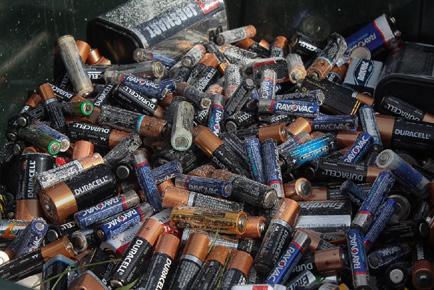
The company works to collect things like reusable batteries, mattress parts and medical materials. They then look to work with others who can best distribute those materials. “Our job was to get that stuff compartmentalized and find somewhere we take it,” Newman says. “We linked up with it with an outfit that recycles that stuff and also gets close to people in need in their area.”
Other efforts include the waste stations at events around the region, such as at the Athens Skate Jam.
Hannah Kopp saw first-hand the kind of negative effects landfills can have when she visited one last year. Now, she hopes to spread awareness.
“They always say it takes a village to do things, and I feel like that’s really important,” Kopp says. “When people learn about how to divert their waste, it really adds that collective knowledge on how we can like help to not only reduce waste into the landfill but also reduce waste in general.”
“ I believe in the work, [that it] can turn in good things for our community in terms of the environment, but also economically.”
– Shane Benton
Benton says that working at larger events has helped educate people on the benefits of recycling. “[It’s] like the “Fajita effect,” when someone walks by with a fajita and it’s sizzling and everyone looks like, ‘What is that?’ [It’s like a] conversation-starter about what we’re doing,” Benton says.
And there’s no age limit for someone to start helping the environment. Laura Simonton, the executive director of environmental health for the Vinton County Health Department, says they’ve placed a focus on raising awareness in school districts in multiple parts of southeast Ohio.
The programs work with fourth graders to increase their knowledge of the potential harm disregarding recycling can do. “The Health Department has partnered with the Gallia, Jackson, Meigs and Vinton Solid Waste District to conduct fun, interactive presentations and games to teach students the importance of recycling and how reducing the amount of recyclable materials going into landfills can positively impact the environment,” Simonton says.
Reducing recyclable waste that is thrown away can help communities by reducing the amount of land needed for landfills. But problems, like burning waste, still remain.
Simonton said her office is tasked with investigating those claims. “It is definitely a public health nuisance and must be abated due the negative effects on the environment and humans,” Simonton says.
Some of the environmental harms that burning waste can cause are species loss, habitat loss, air pollution, water pollution and soil pollution, Newman says. Maybe the largest area people can focus their attention on is their food waste.
“One of the big areas that we’re trying to get happening targeting organic waste. Food is, as it turns out, that’s a pretty big chunk of our waste,” he says.
Newman claims that about a third of the 3500 residences in Athens are actively composting, one of the main ways a community can help address waste.
But it’s not the only way. Newman says a large part of the grant they received from the Ohio EPA is going to machinery to help restaurants.
For restaurants to be able to properly compost, they typically need something to shred down the packaging food comes in, if it’s not reusable. That’s why Rural Action is investing in a shredder. “We bought that piece of equipment so that we can be more accessible to commercial establishments like all those food establishments uptown, for instance,” Newman says.
Part of the grant will also create resources to be able to work larger events around the region. “These events
where people were drinking beer, and they have all these food vendors, we’re able to turn those events in the zero waste events while people are having a good time,” he says. “So it’s kind of an art to doing that.”
Benton says that after hours of work put in by the volunteers, the most rewarding part is being able to see how much their effort paid off. “There’s a tangible thing, at the end of the day when you go through everything and you weigh it and you get your data, there’s a tangible thing like ‘Woah, [We got] a quarter ton of stuff not going to the landfill now, not becoming carbon dioxide or methane.’”
Going forward, he says that putting resources into these efforts has many benefits for the community.
“Creating markets closer to home, circulating money closer to home, creating tax base, creating jobs in our area,” he says. “Instead of sending this stuff to the landfill and burying it and creating a toxic time bomb that we’re going to have to deal with down the road.”
Simonton had one message: Get involved now.
“Parents should start teaching their children at a young age how important it really is to reduce, reuse and recycle. These really are not three little words that just sound good together.”
An Acre of ACRE
Abandoned elementary school gets fresh start as an asset to Amesville
STORY BY ZACH PAQUETTE | PHOTOS BY JOEY MADORE
Small business owners face a dizzying array of challenges. They have to hire workers, maintain a place of work, and sell a product or a service. This is where Mayor Gary Goosman of Amesville and the Amesville Community Resources for Entrepreneurs (ACRE) come in.
Located at 29 Franklin Street in Amesville, ACRE occupies the same building that was once the old Amesville Elementary School. After the school closed, the building was abandoned for almost a dozen years before the village of Amesville decided to hold an auction to sell the property. Goosman saw the nearly 60-year-old building as a resource.
“I didn’t want somebody to just tear it down and have a vacant lot. I just thought we have so little usable space in the village,” Goosman says. “If I get the building, I’ll figure out what to do with it later.”
$3,000 AND SOME MAINTENANCE LATER
On the day of the auction, Goosman and several other interested parties sat ready to bid. Everyone looked around and eventually the auctioneer started the bidding at $70,000. When nobody bid, the auctioneer dropped the price to $60,000. When nobody bid on that, he dropped it to $50,000.
“It got down to $30,000, and then he said ‘just give me a number to start the bidding.’ So, I said $3,000,” Goosman says. “Nobody else bid and that was it.”
Now that he owned the building, Goosman had to figure out what to do with it. But first, there was a lot of cleaning up to do.
“The building was abandoned for 12 years so it was
dirty, and the school district stored a lot of desks, tables, and supplies here. It was mostly clearing all of that out, giving it away or selling it then cleaning the building because it was in bad shape,” Goosman says.
The building consists of a lot of old single-paned windows and many of them were cracked. After the building closed and was abandoned, the boiler sat untouched. The lines were not flushed out and when they froze in the winter, thousands of feet of copper lines burst. The expense to repair the heating system was too great, so Goosman purchased big heaters that ran on propane.
A VISION FOR SMALL BUSINESSES
When it came time to figure out what to do with the building, Goosman weighed his options. He considered turning the rooms into living spaces, but it would have cost too much.
He even thought about turning the rooms into storage spaces for people to rent, but Goosman had his eye on an idea that would keep the community involved.
“I knew small businesspeople had a hard time starting up around here because you don’t have the capital. You’re working out of your home in a spare room and I think that the most likely scenario when I owned the building was to find artists and small businesspeople who need the space and charge well-below market rate.”
He knows he could get more, but to him, ACRE is not about making money. “It’s to allow beginning entrepreneurs to get their feet under them, develop a business model, get a product line going, and not have too much expense. At some point, if they want to build their own studio and move on, they can,” he says.
ABOVE: Gary Goosman poses next to the Amesville Community Resources for Entrepreneurs in front of the ACRE building.
Goosman has seven rooms, each about 900 square feet that he rents out to his tenants. On top of the rent, he charges the tenants for water and electricity – an additional $6 or $7 a month.
A GREAT RESPONSE BY THE COMMUNITY
Once Goosman cleaned the building up, he created a website and Facebook page. From there, he scheduled an open house and invited people from around the area.
“On that first day, I rented two of the rooms. Then, from word to mouth, every room was rented in less than six months. That was faster than what I anticipated,” Goosman says.
That was 10 years ago. Now, Goosman says three people are waiting for one of the seven rooms to become available. Goosman added that much of his advertisement nowadays has been word of mouth.
Not only does ACRE cater to the needs of small business owners in the area, but it also offers a few amenities. One of these features is the community room.
“The community room is not rented to anybody. It’s available for workshops, seminars, parties, gatherings, and sometimes movies whenever we offer our movie night,” Goosman says.
On top of the community room events, ACRE offers a wide variety of amenities outside the building. A community garden run by Community Food Initiatives, planted at the facility nine years ago, includes trees that are still producing apples today.
“There are gardens that we have installed all around the space. (We have) apple trees, horseradish, and all kinds of stuff. There are plants all around, and people can come and be involved in the gardens,” Goosman says.
On the south side of the building there is a fenced-in area that Goosman has rented out to a dog trainer.
“I have a woman who does dog training, so it is like a dog park out there. She brings people in and does obedience training. She doesn’t technically have a room here, but she pays a little bit of rent to utilize that space,” Goosman says.
Goosman has also started a library from donated books.
“There were books left here when I bought the place, and then I started telling people that they could drop their books off if they wanted to get rid of them,” Goosman said.
“They took me up on that because I have 3,000 books here now which is way beyond a little free library. The whole hallway is crammed full of them.”
Goosman has set up small libraries not only at ACRE, but around town.
LOOKING AHEAD TO THE FUTURE
For some in rural Southeast Ohio, access to reliable internet can be a problem. Goosman wants to combat this issue.
“One thing that I have been thinking about lately is turning the community room into a remote workspace. In other words, I could have rolling workstations on wheels that could lock up,” Goosman says.
“You come here, and you could have your laptop, your
printer, and you could have it all in a rolling station where you could lock up and keep it safe so it would be a smalltime office setup.”
With this plan, Goosman would turn the community room into more of a multi-purpose room. “Anything that we feel that the community needs and would be a benefit, we are willing to give it a try.”
“I bought a 100,000 square foot building with an acre of land for $3,000, which is just outrageous.”
– Gary Goosman
: Gary Goosman
BELOW: Pottery from Horvath Pottery at ACRE.
ABOVE: One of the many features of ACRE is a small pond next to the dog training area.
CONNECTING THE DOTS
The Little Cities of Black Diamonds celebrates the coal mining region
STORY BY JORJA BUTT | PHOTOS BY LANE MOORE
Appearing as small dots on maps of Southeast Ohio, small towns are sprinkled throughout the hills of Appalachia. The Little Cities of Black Diamonds, as they’re called, represent some of the most important historical moments of the coal mining industry in America.
The citizens of Perry County formed the Little Cities of Black Diamonds Council (LCBD) to educate the public. In 1990, founding members John Winnenberg and Cheryl Blosser took the first steps. The more they researched, the more they found out just how important coal mining was to the area.
“The name [Little Cities of Black Diamonds] goes back to the Civil War when the newspapers were following the coal boom,” Blosser says. “Nelsonville started out as a sleepy little town… then one of the newspaper articles referred to it as a true little city of black diamonds.”
Once new mines began to develop and the industry became profitable, the region of Perry County and Hocking Valley boomed. Seventy new coal towns developed over the span of 20 years.
Laborers flocked from all over the world as new mines began to pop up in the Hocking Valley. According to the
LCBD history archives, settlers from parts of Europe such as Italy, Germany, Hungary, Poland, and Czechoslovakia began to pour into this region of Ohio in the 19th century.
Unions formed to protect miners and pressure mine owners. According to Blosser, many of the important union meetings took place in Ohio because it was a central location among the coal states. These laborers and miners became prominent figures in labor movements and strikes that affect labor laws to this day.
“Because the American Federation of Labor (AFL) and the United Mine Workers got their starts here, all those things changed to where we started to have safety laws and child labor laws,” says Blosser.
Preserving the stories of the miners who fought to earn fair work is what LCBD strives to do. Through documentaries, books, and events, they spread the word of these important small towns in Appalachia.
“I think people should be proud of this; they should be proud that their ancestors fought for all of these things to give them a better life,” says Blosser.
As the Little Cities of Black Diamonds expanded their reach, more council members decided to educate themselves and other members. Historian and
ABOVE: Cheryl Blosser explaining the history of coal mining families and their places of residence to those on the LCBD historical walking tour.
“There are a lot of people who don’t care or don’t understand why they should feel pride because they live or grew up in this town, so we [LCBD] are trying to instill a community pride”
-Tyler McDaniel
social media executive Tyler McDaniel is one of the organization’s youngest members dedicated to honoring the past.
“We’ve morphed into a group that not only protects those stories but gets them written down and are trying to share them with people to let them know why it’s important,” McDaniel says.
LCBD aims to reach community members through events that celebrate the history of the area, such as the annual Little Cities of Black Diamonds Festival. Though normally held in person, COVID-19 limited the 2021 festival to an online format.
What was held on one day became a six-day celebration, filled with history lectures, films, raffles and more. Another positive aspect of moving online was that the festival could reach a wider audience.
“It’s really cool to connect people who otherwise couldn’t come to Southeast Ohio to see this event, so it’s been nice in that regard,” McDaniel says.
those who paved the way for generations to come. It is about continuing the history and educating others to make their stories known.
“There are a lot of people who don’t care or don’t understand why they should feel pride because they live or grew up in this town, so we [LCBD] are trying to instill a community pride,” says McDaniel.
LCBD also connects family members to their ancestors.
“We’ve had people from Europe reach out to us because they’ll have a family member who died here and is buried here, so people contact us who are looking for information,” says McDaniel
The history of the Little Cities of Black Diamonds is more than just preserving the monuments and stories of
LITTLE CITIES OF BLACK DIAMONDS
200 Main Street, New Straightsville, OH, 43766 740-270-8048
www.lcbdohio.org
BELOW: Historic Shawnee sign located in the center of the town.
LEFT: Family of European immigrants who came to the area to participate in the coal mining industry.
STAYING ON TRACK
Retired railroader and friends convert station to museum
STORY AND PHOTOS BY ISAAC MILLER
Retired railroad telegrapher Jim Love learned in 2016 that one of his former offices was slated for demolition, so he and some friends took action to get the building back on track.
The Gallipolis Railroad Freight Station Museum is a volunteer organization that rescued and currently occupies the former Gallipolis Freight Station. The station, a mediumsized yellow structure made of wood, was erected in 1901 and used by the Hocking Valley Railway Company and its successors before closing in 1981. A sign hangs on the side of the building indicating its location on the line, 18.3 miles from the Pomeroy station and 114.6 miles from Columbus Union Station.
When Love learned the building would be torn down, he talked to some friends about making the building a museum. The two friends included retired schoolteachers Jerry Davis and the late Gary Burdette. The city deeded the station to Love for $1. Love and friends formed a board of directors, elected officers and registered as a nonprofit. Love currently serves as president of the museum and Davis serves as vice president.
“It was our determination to save the building and to make it into a railroad museum to preserve that heritage for everyone in our area,” Davis says.
Davis did not work on the railroad but had relatives who were railroaders. He taught social studies for 42 years and enjoys history.
Davis says railroads are a part of history that is sometimes passed over and there are generations who are unaware. “If you don’t know your past, you cannot appreciate the present and you can’t foresee where you’re going into the future,” Davis says.
The Hocking Valley Railway was once the largest railroad located entirely within the state of Ohio and connected Athens, Columbus, Toledo and Pomeroy. The Hocking Valley Railway was merged into the Chesapeake and Ohio Railway (C&O) in 1930. The line through Gallipolis was part of the River Division, which ran from Pomeroy to Logan and connected to the Hocking Division in Logan.
“The railroads helped develop not only the nation, but they helped develop this area of Southeastern Ohio,” Davis says.
The railroad carried coal as well as other goods and passengers. Love recalls the railroad shipping farm equipment and car parts, and even remembers Sears and Roebuck shipping an entire house. “There was no such thing as UPS or any other home delivery,” Love says.
Love was born beside the railroad tracks in Corning and has been a fan of railroads his entire life. He learned how to be a telegrapher from Cecil Sargent, who would become an
agent at the Gallipolis Freight Station. “He locked the door when they closed this office,” Love says.
Love mainly worked at Kanauga, which was a junction with the New York Central (NYC) and C&O. He remembers meeting people on both railroads and would eat out with them at McDonald’s or some locally owned place. “Once you’re a railroader, you’re a clan,” Love says.
The main line has been long removed, but several pieces of rolling stock can be found outside the station in the yard. ‘Rolling stock’ refers to railroad equipment such as locomotives, passenger cars, freight cars, cabooses, etc. The former loading dock/platform has tracks on each side that contain numerous pieces of rolling stock.
“What really impresses me is the fact that we could get railroad cars,” Love says.
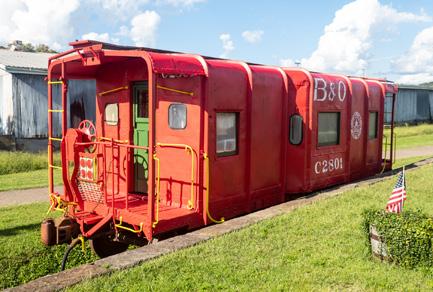
A red Baltimore and Ohio (B&O) boxcar, built in 1947, sits on one side of the loading dock. Boxcars hauled all sorts of freight and would have been common sights at freight stations. A pair of red cabooses sit on the other side of the dock, one being a B&O caboose from 1947 and the other a Southern Railway caboose built in the late 1960s.
A 1945 Porter steam locomotive sits on the same side as the boxcar. Davis says the museum will soon have another. The locomotive, known as “No. 2,” is currently on the
“It was our determination to save the building and to make it into a railroad museum to preserve that heritage for everyone in our area .”
-Jim Love
ABOVE: Davis (left) and President Jim Love (right) standing inside Love’s old telegraph office in the station building.
ABOVE: Davis sits with the Museum’s 1945 Porter Steam Locomotive.
ABOVE: A former Ringling Bros. and Barnum and Bailey Circus sleeping car on display in the yard.
ABOVE: Equipment on display in the freight yard.
ABOVE: Davis points to a section of the original wall inside the freight house.
Hocking Valley Scenic Railway in Nelsonville. The rusty little locomotive has been stored in the yard there for nearly 40 years.
There is also a passenger car in the yard numbered 41307. Silver stainless steel makes up the car’s exterior. The lettering has been peeled off, but if one looks close enough, they can see the remains of the logo of the Ringling Bros. and Barnum and Bailey Circus, once a home for trapeze artists traveling the country
The car’s interior needs some renovation, but enough remains to reflect what was basically a moving dormitory for circus performers. The open vestibule on one end provided a moving porch for them to watch the world go by. The dorm rooms are located down a narrow corridor and feature bunks, restrooms and kitchen appliances. There is even a laundry appliance that remains on one end of the car.
Davis says they want to convert the car’s interior into a place where people can have meetings, receptions or parties. Renting out the car will provide funds to help maintain the museum. “We want to save one of the rooms so people can see where the entertainers stayed,” Davis says.
Love says the museum expects to get more rolling stock. There is a company who will lay about 500 feet of track and put in a switch, which will make it possible to move the cars around.
The depot’s interior has two major rooms, which include the office area and freight house. The office is a small, green room while the freight house is a large room that is still being renovated. A small portion of the original wall has been preserved, but Davis says most of it will be replaced with local poplar. More than 4,000 Star Bricks, produced in Nelsonville, make up the freight house’s floor.
Davis says the office area will be restored to be as original as possible. Love has working telegraph equipment
that will be displayed. The freight house will also display railroad memorabilia such as tools, locks, keys and lanterns. Love wants to construct a model layout using parts that belonged to Gary Burdette and were donated to the museum by his (Burdette’s) wife.
Burdette was a well-known model railroader who was a member of the National Model Railroad Association (NMRA) and the C&O Historical Society. He was also the editor of a modeling column in the latter’s newsletter.
Love says the museum has artifacts stored in another building and will eventually have them moved into the station building when the interior is finished.
“There’s more people in this area interested in railroading than I ever imagined,” Love says.
Davis says coming up with the restoration funds has been the hardest aspect. While the museum’s work is done by volunteers, raising money to keep the museum’s doors open has been a challenge. Though, local donations and grants have helped. Davis says Ohio Valley Bank has been supportive of the museum and donated $12,000 to the museum in April 2017. The bank also has a program where if employees go and help a community organization, they will get a day off later. The bank employees have helped the museum by painting, putting wood on the walls and have even used antique railroad tools to lay track.
“Ohio Valley comes to our mind first because they have just been excellent in supporting our efforts,” Davis says.
Davis says the museum will help the area economically because people who are not from Southeast Ohio come to take pictures and then ask where to go to shop and eat.
Love, a train collector himself, says it feels good to preserve a place he once worked at and that it has been a job for him ever since.
“I work a day shift like I was getting paid, but I’m not.”
ABOVE: A few of the 4,000 plus Star Bricks that make up the freight houses floor.
PHOTO : Sign indicates location on the Hocking Valley Railway.
What made you first get interested in broadcasting?
Actually, getting into broadcasting was an accident. When I was paying my way through college at Ohio University, I was playing music and my equipment was so large that I couldn’t store it where I lived, so I was storing it at the local radio station, which was a house on Route 788.
The manager, when I was picking up the equipment one day, was basically complaining about not being able to get anybody to work and he asked me if I knew anything about radio. Then, he tore off a bunch of news off the UPI wire and sat me in front of the microphone and introed the news and had me do the news— and I was awful. But he must have been desperate because he hired me part time and I literally fell in love with the business.
What are some of your favorite memories from your career?
The one that comes back to me a lot, and we discuss [it] when we talk old times, is when we used to broadcast live from the Jackson County Fair. Back then, we would do the fair all day long. We had a remote unit that was not enclosed, it was open.
“JOHN BOY” PELLETIER
An interview with the recently retired Jackson County broadcasting legend following a 53-year career
STORY BY BRYAN KURP PHOTO PROVIDED
It looked almost more like a hot dog stand than a mobile unit. We would spin the records. We would do the news and do everything live from the fair. That would turn out to be eight-, ten-, twelve-hour days.
You’ve been pastor at Wellston Presbyterian Church the past 25 years. How did you get into becoming a pastor?
I never intended to get into broadcasting and I certainly didn’t expect to get into the pulpits, but it just happened. One of the reasons I did it is because when I started 25 years ago, in the Scioto Valley Presbytery, there were, I would say, maybe 10 to 12 churches with no pastors in the pulpit and the reason for that is, some of the older, smaller churches could not afford a full-time pastor. They let me come back to my own home church and this is where my parents worshipped. This is in my own community, and I’ve been here ever since.
What are some other ways that you are involved in the community?
Well, I’m currently a Rotarian. I’m with the Wellston Rotary Club, a past president and a Paul Harris fellow. I’m also currently the president of Jackson County Habitat for Humanity.
I’m vice president and treasurer for the Wellston Ministerial Association. I’m president of the Wellston Alumni Association and also president of the Wellston J-Vac, which is a non-profit individual board that supports the adult members of our community that have disabilities. Also, I’m a member of the Jackson County United Fund board too. That’s some of the things that keep me busy since I’m no longer working. Tell us about your nickname, “John Boy.”
Radio announcers never used their own name. I started out with “John Russell,” that was my middle name. When I went to WBNS, I was having a real problem because I signed on as “John Pelletier” but was used to saying “John Russell,” so I kept going back and forth.
Then, I got a call on the red hotline and he said, “John, make up your mind today with what you’re going to be, John Russell or John Pelletier.” So, I went with my regular name then. Later on, my wife gave me the name of “John Boy” that originated from my grandfather. My wife’s always been calling me that all along so that sort of snuck in there, and then everyone knew me as “John Boy.”
E.W. Scripps School of Journalism
BELOW: A tea set located in the dining room of Adena Mansion. PHOTO BY LANE MOORE.