NOVEMBER 2025 | VOL 45 | ISSUE NO. 3

INSIDE
▶ Changing Gears
▶ IAPH Conference
▶ Protestors on Port BLUFF FOCUS ON:
▶ The Union Steam Ship Company (part 2)
PROFILE:
▶ Scenic Luxury Cruises and Tours PUBLISHED BY

NOVEMBER 2025 | VOL 45 | ISSUE NO. 3
▶ Changing Gears
▶ IAPH Conference
▶ Protestors on Port BLUFF FOCUS ON:
▶ The Union Steam Ship Company (part 2)
PROFILE:
▶ Scenic Luxury Cruises and Tours PUBLISHED BY
Tēnā koutou katoa,
On 29 October 2025 South Port held its 37th Annual Shareholders’ Meeting (ASM) at the main administration building, on the Island Harbour at Bluff. These meetings represent an opportunity to reflect on the previous financial year and to look forward at future opportunities.
FY25 highlights:
» Bulk cargo volumes: up 12.5% to 3.0 MT;
» Container volumes: up 1% to 52,300 TEU;
» Tiwai volumes: down 20% to 811k tonnes
» Total revenue: up 13% to $63.3m from $56.1m in pcp
» EBITDA: up 21% to $25.8m from $21.3m in pcp
» EBITDA margin: up to 41% from 38% in pcp
» Record NPAT: up 81% to $13.3m from $7.4m in pcp
» Operating free cash flow: up 97% to $16.9m from $8.6m in pcp
» Debt/EBITDA: 1.0x down from 1.6x in pcp
» Dividend per share: 28.0 cps (fully imputed), payout ratio of 55% of NPAT
At the meeting we farewelled Clare Kearney who has served as a Director on the Board for the past 9 years. During this time Clare has led the Health and Safety Panel, which is an extremely important aspect of Port operation. Although we were sad to see Clare leave, we also had the opportunity to welcome Derek Nind as our new Director. Derek has extensive experience in the port and logistics sector, working in senior leadership roles at a number of ports (including South Port), and recently as CEO of CentrePort for seven years until moving into the Managing Director role at 360 Logistics. We look forward to Derek’s contribution to the Port in the coming years.
I also took the opportunity to announce that I would be stepping down as Chief Executive in the 2nd quarter of 2026. The Board will now undertake the recruitment process to find a suitable replacement.
Finally, we communicated at the ASM that the Port has had a good start to FY26 recording 904,000 MT for the quarter ended 30 September 2025, (FY25 753,000 MT), a 20% increase. Obviously, the Port has been busy!
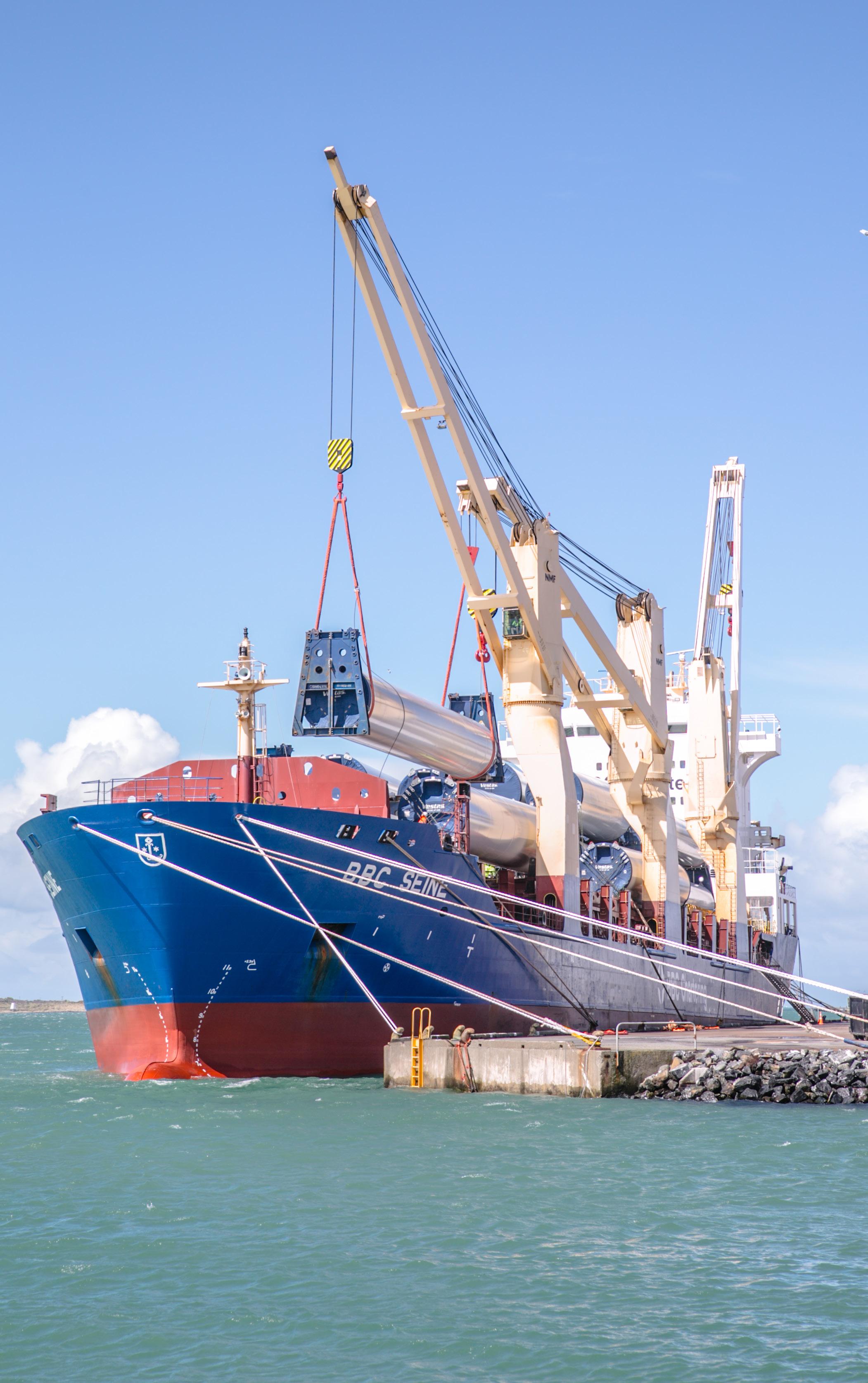
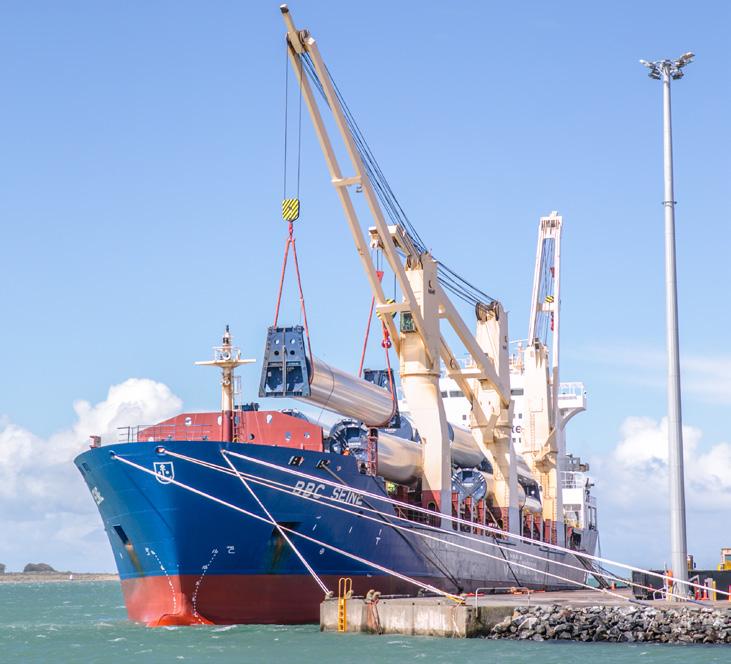
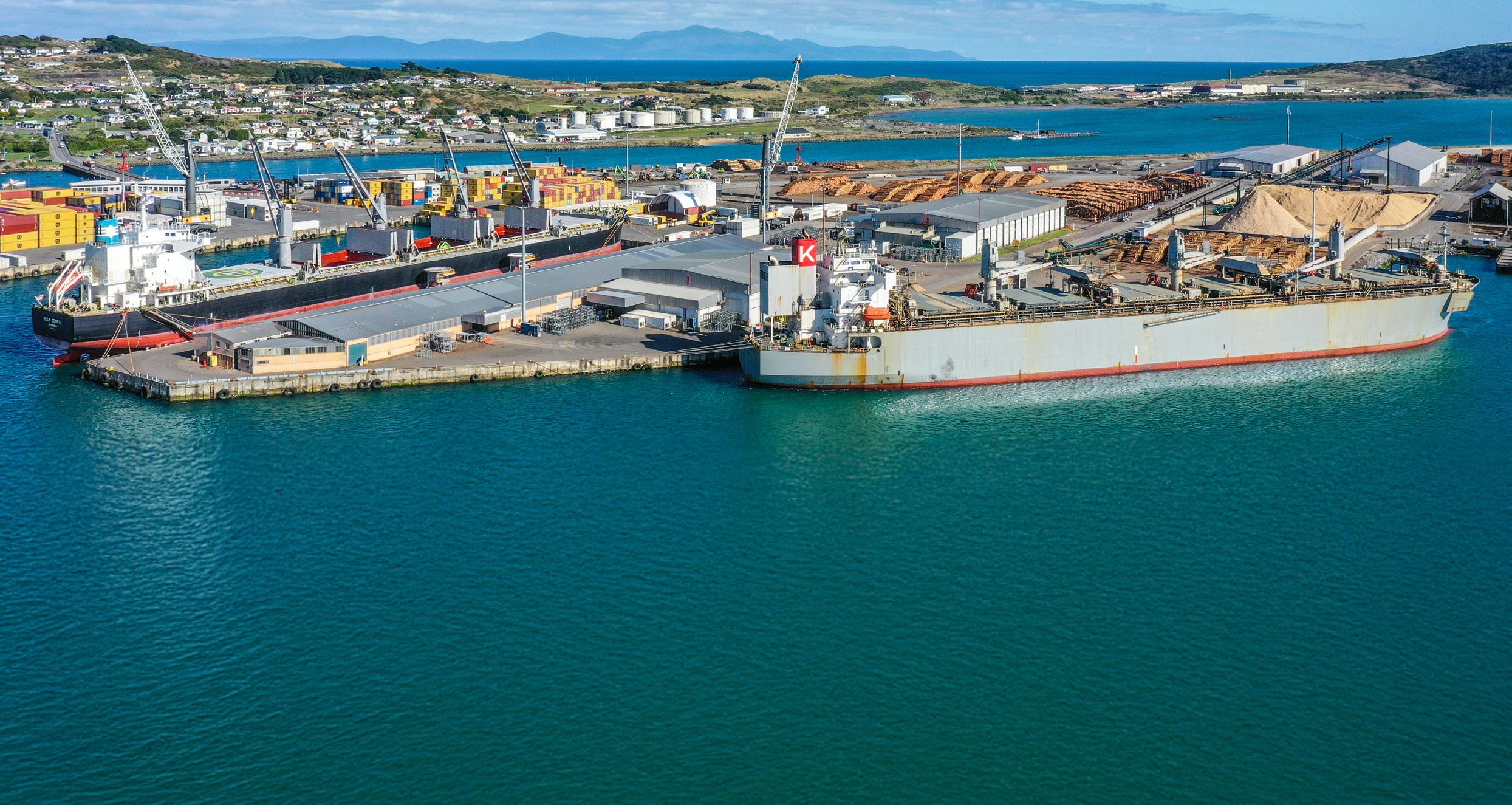
“BBC Seine” the first of 5 vessels expected in Port delivering equipment for Stage 2 of Kaiwera Downs Windfarm.
Photo
by Tammi Topi.
This however, has resulted in congestion on the Island Harbour berths, caused by a number of factors:
» The agricultural sector is performing well leading to increased imports of stock feed and fertiliser
» The weather over the spring months has been wet and windy, slowing down the discharge of weather sensitive cargo
» The deeper channel has led to more cargo being imported on vessels than was previously possible
» A number of vessels are arriving at the Port to discharge components for stage 2 of the Kaiwera Downs wind farm that can only discharge during daylight hours
» A number of cruise vessels are due to arrive at the Port It is good that we are getting busier however it would be nice to see a little more sun to help the cargo discharge/loading process, and to keep ships moving in and out of the Port!
On the topic of weather, the impacts of the event that hit the country on 23 October are still being felt around the Southland region. Our thoughts go out to those who are still suffering and working through the cleanup/losses that occurred on the day.
The Port has a number of processes in place to prepare for weather events such as these, and was fortunate to not be badly affected on the day.
Finally, as it happens, the same time every year, you wonder where the previous 12 months have gone. By the time this edition of the Portsider goes to print it will be almost December. Therefore, getting in early, we would like to wish you all a very Merry Christmas and hopefully some quality time with your families.
Ngā mihi nui, Nigel Gear Chief Executive
Bluff Portsider is compiled by: South Port NZ Ltd PO Box 1, Bluff 9842 (03) 212 8159 reception@southport.co.nz www.southport.co.nz
Chief Executive: Nigel Gear
Produced and edited by: Hollie Cooper Contributors: Dave Edge
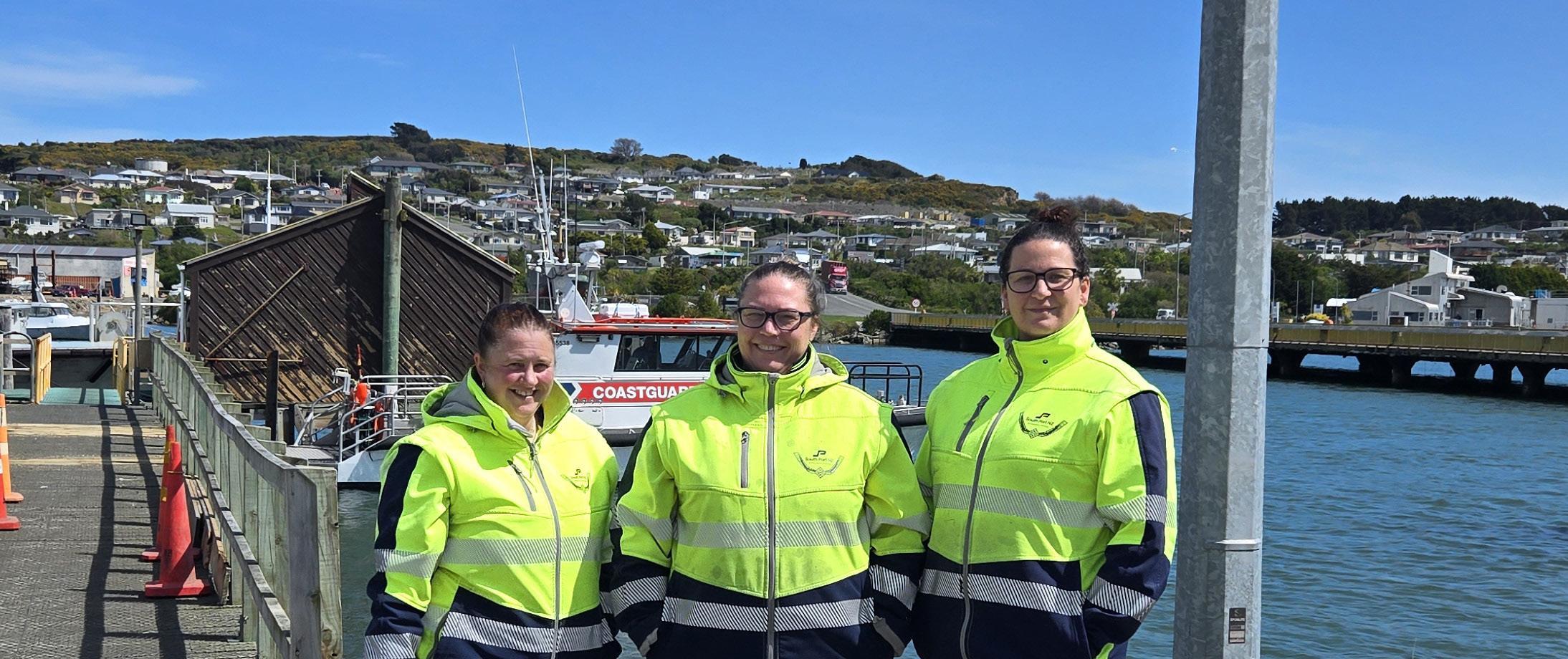
Gender diversity has been on South Port’s radar in recent years, and there has been a conscious effort made to attract more women into marine careers.
Katie Eaton, Marine Operations Supervisor, began her career in the port sector with C3 (forestry logistics) as a vessel planner.
“When the opportunity arose to join South Port, I jumped at the chance and haven’t looked back!” Katie said.
With support from the Marine Managers and Pilots, Katie has grown into a confident leader, guiding her team through complex operations and mentoring others along the way.
Jenny Phillips plays a key role as the Marine Administrator, including managing the cruise vessel operations in Fiordland and supporting marine services.
“I have a broad job role with many opportunities, and often think how lucky I am to do what I do with great people,” said Jenny.
When Amy Taylor joined South Port she was looking to challenge herself and learn new skills. Within her first year she mastered her role as a Shipping and Mooring Coordinator and is now training as a deckhand.
“The confidence and organisation I bring helps me in my role,” said Amy.
Amy is also preparing for leadership training, and is excited about her future career prospects.
All three agree that South Port fosters a culture of inclusion and respect with women working across most areas of the Port who bring a different perspective to a traditionally male dominated industry.
“The input our wāhine have, their reliability and thought process is invaluable to our day-to-day work,” says Katie.
Their advice to young wāhine considering a career in the marine industry is clear:
“Have a go!” says Jenny.
“There are real opportunities to build a career,” says Katie.
“It’s an awesome environment,” says Amy.
Joshua Rietveld ▶ (Trainee) Vessel Skipper
Peter Berge ▶ Terminal Operator
Cory Wilson ▶ Administrator, Container Operations
Storm Ryan ▶ Dairy Operator
In accordance with NZX regulations, following their 3-year term serving on the Board, Mr John Schol and Mrs Clare Kearney retire this year by rotation. Mr Schol being eligible was re-elected at the ASM held in October.
Mrs Clare Kearney elected to retire after serving 3 terms (9 years), on the Board.
“Clare has been an excellent contributor to the Company since her appointment to the Board in 2016, especially in her role as Chair of the Health and Safety Panel which she has held since 2021. Clare’s passion and advocacy for both staff, the local community and the environment will be missed on the Board,” said Philip Cory-Wright, Chair.
Following the application and interview process, the Board nominated Mr Derek Nind to join them as an Independent Director, this was voted on and approved at the ASM.
Derek has extensive port knowledge having, previously held senior commercial roles across three New Zealand ports over the last 30 years.
He is currently the Managing Director of 360 Logistics Group, and was previously the CEO of CentrePort where he was instrumental in leading the business through the devastating impacts of the Kaikoura Earthquake, recovery and regeneration.
Derek has previously held several governance roles in the logistics and property sectors.

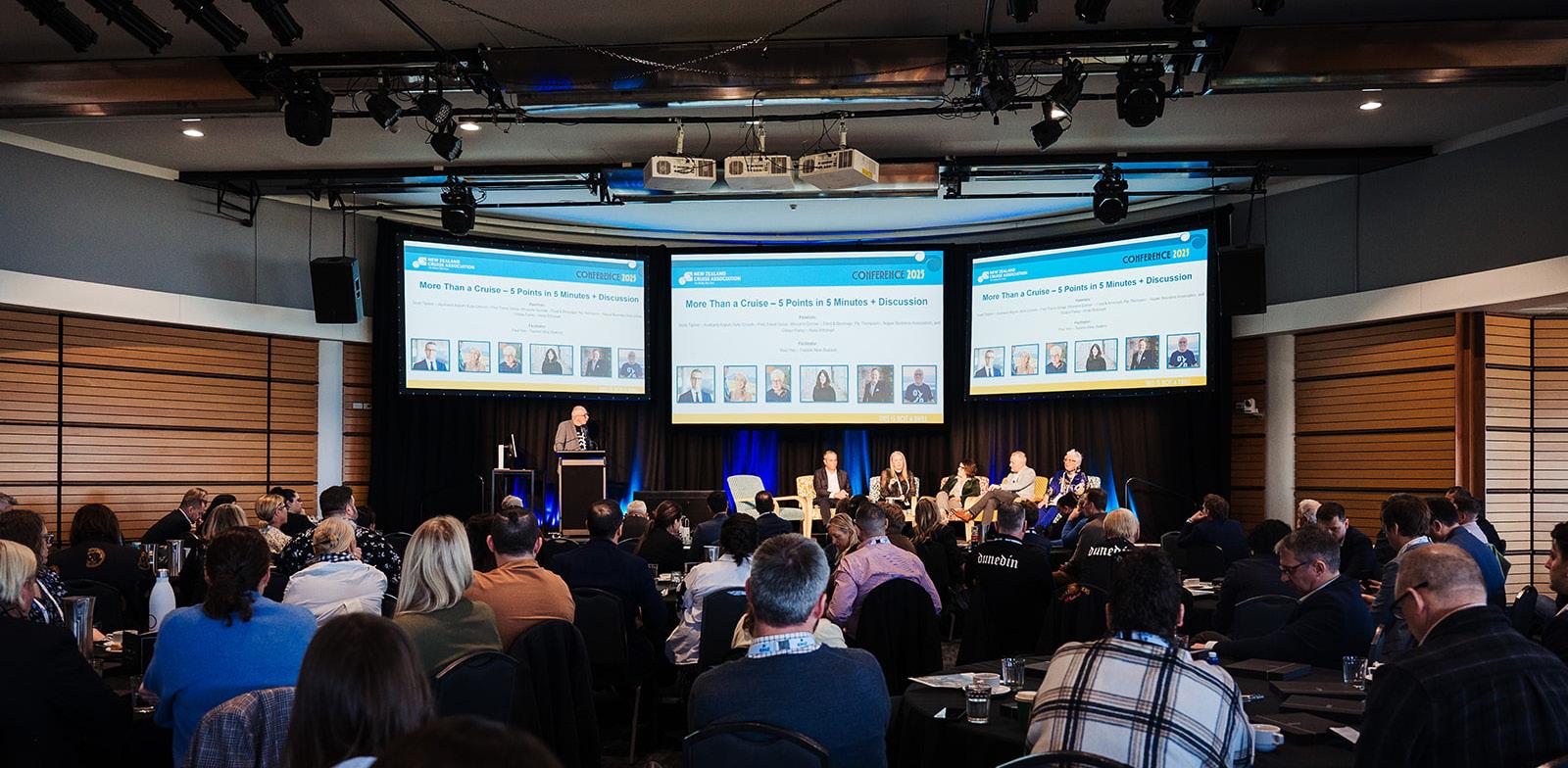
The New Zealand Cruise Association (NZCA) annual conference was held in Napier during August with over 200 attendees from a range of businesses that are associated with the cruise industry, including Leaders from many Cruise lines and Ports across New Zealand.
The South Port delegation consisted of Geoff Finnerty, Port General Manager, Jamie May, Commercial Manager, and Katie Eaton, Marine Operations Supervisor.
This was the first year Katie attended and she made the most of the opportunity arriving the day prior to the conference starting to spend time engaging with people in similar roles, with open discussions around what works well, and what doesn’t.
“It’s interesting to find how others work through similar challenges,” said Katie.
“It was also really nice to be able to meet face to face with people I have dealt with for years,” she said.
South Port has been involved with the cruise industry providing pilotage services since cruise ships started going to Fiordland.
The numbers of cruise ships heading to Bluff has not changed significantly this year, with the Port continuing to be used as a base for Heritage Expeditions who offer smallship expedition cruises travelling the Southern Ocean.
“Conferences such as these are a good opportunity to stay connected with the cruise industry, the cruise companies, ports, and to learn what’s happening in the industry,” said Geoff.
“We as a port are constantly working with the cruise ship industry and partners to ensure they know Bluff is a viable option,” he said.
For anyone interested in the cruise ships heading to Bluff for the upcoming season, details are on our website: https:// southport.co.nz/marine-services#shipping_movements
September saw the deployment of a new wave monitoring buoy placed at Southern Anchor Ridge.
The Datawell wave buoy is a new marine asset that will provide the South Port marine department valuable real-time information on sea conditions prior to shipping movements.
The wave buoy information will eventually be available on the South Port website for other boat users wanting to check sea conditions.
“This will be a great boating safety tool for the wider public,” said Sam Moore, Marine Operations Manager.
The yellow monitoring buoy is moored to 2 surface floats and anchored to the seafloor.
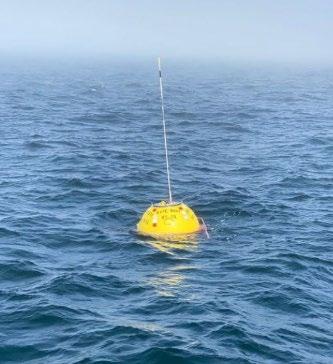
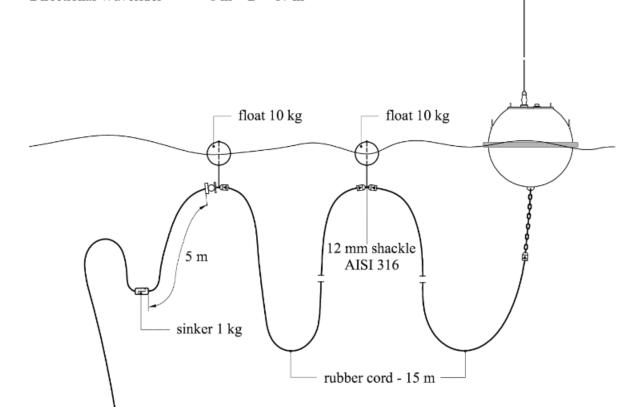
All harbour users are asked to proceed with caution in this area and maintain a 100m exclusion zone as the buoy will shift with tides and swell.
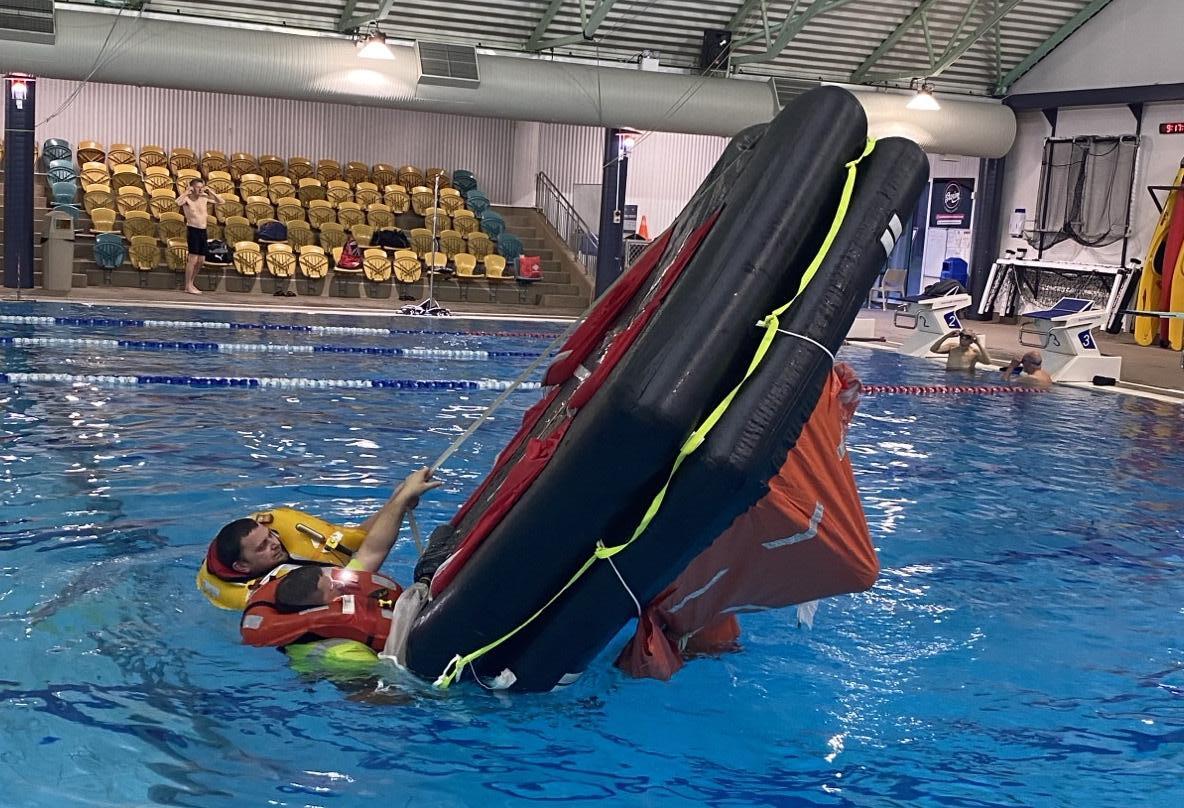
Marine Person Overboard and Water Recovery training took place at Splash Palace in Invercargill earlier this year.
This involved the entire marine department including tug and pilot launch crew, pilots and marine coordinators, who were joined by the Bluff Coastguard and Southern Ocean Safety – equipment and servicing providers.
This exercise is conducted annually to give practical experience with life preserving equipment and recovering a person from the water to a life raft or other vessel.
“Conducting realistic drill exercises for recovering persons from the water are essential to ensure the marine department is prepared for any situation that may occur,” said Sam Moore, Marine Operations Manager.
Some of the drills and exercises undertaken were – entering water from height, activating life jackets, swimming and entering life rafts, survival techniques (both in water, and using the equipment on a life raft) and recovering persons from the water.
During the drills those involved experienced firsthand the use of life rafts, life buoys, inflatable life jackets and other lifesaving equipment.
“It is imperative that our staff are all trained and familiar with the use of all Person Overboard equipment, and for some it was the first time they had undertaken training such as this,” said Sam.
“Thanks to the involvement of Bluff Coastguard and Southern Ocean Safety the day was a great success with plenty of learning and up-skilling for our team,” he said.
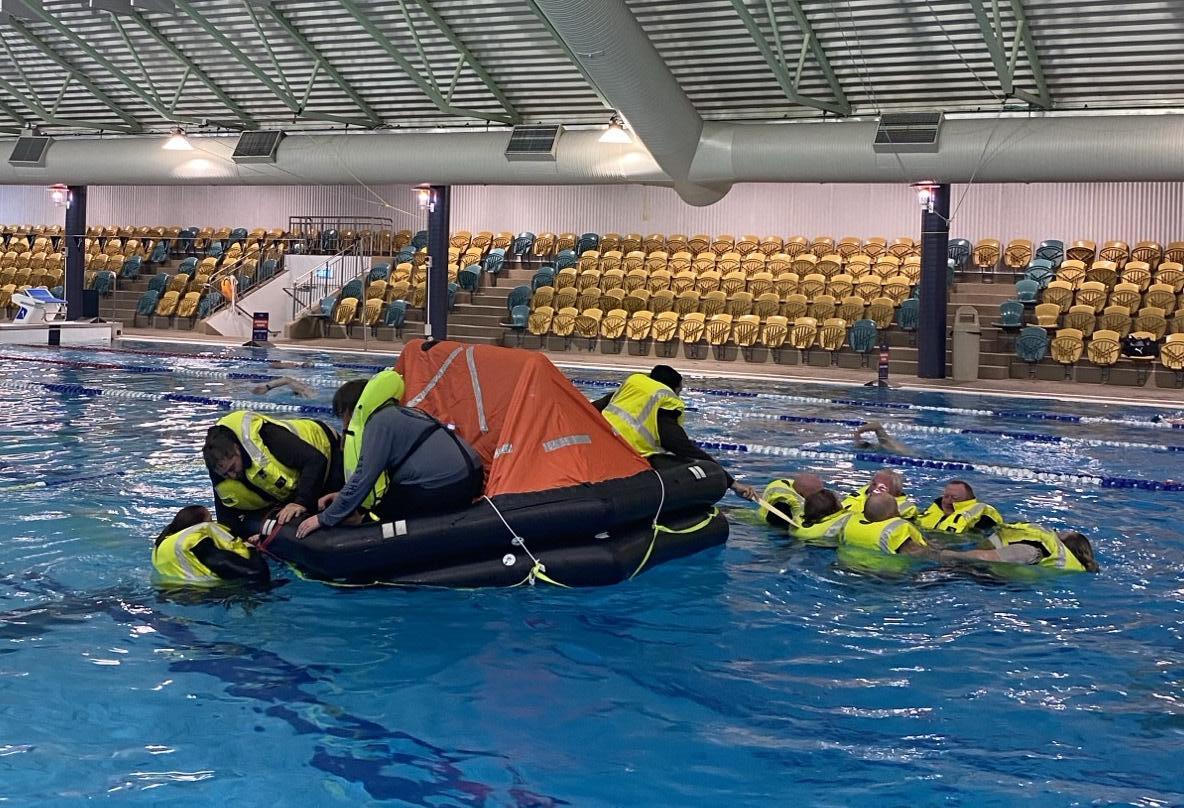
The Marine team during the life raft drill attempting to recover persons in the water.
Part two of the Union Steam Ship Company’s history as featured in the July edition of The Bluff Portsider.
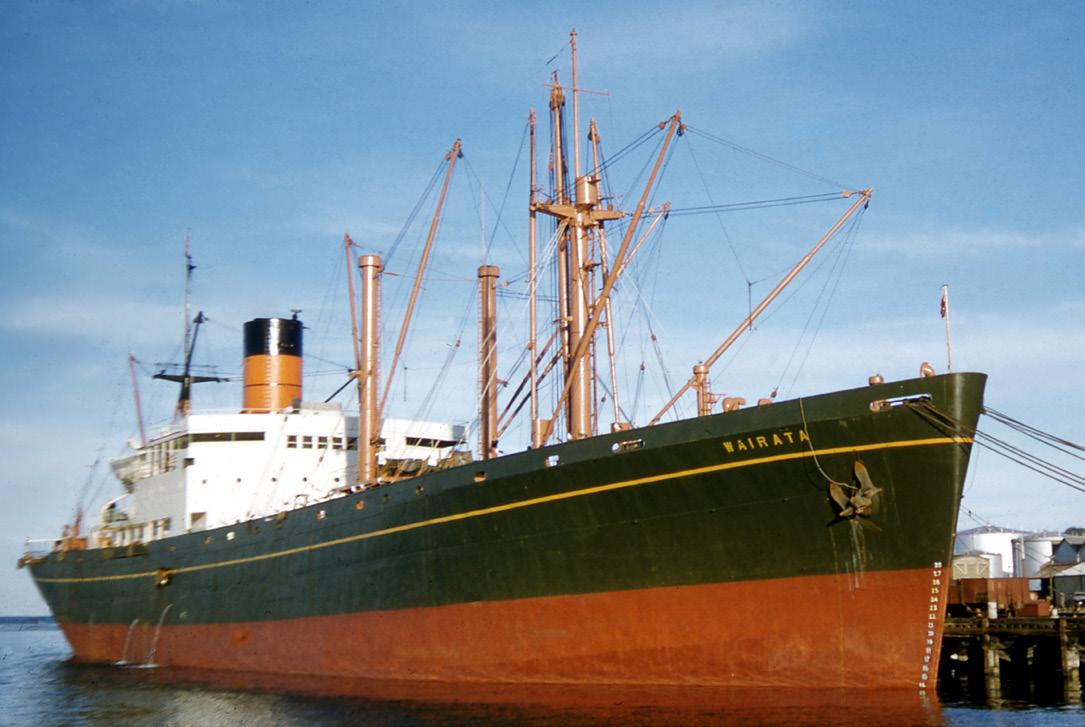
Despite having built three large motorships during the 1920’s, including the “Aorangi”, the largest and fastest passenger liner afloat powered by diesel, it was 1935 before another motorship joined the company. This was the coaster “Karu” and thereafter most vessels built for the company were motorships. The 1930’s did not begin on such an upbeat note, however, as the passenger liner “Tahiti”, bound from Wellington for San Francisco sank in mid-Pacific after her starboard tailshaft fractured and sliced open the hull on 15th August 1930. Fortunately rescue ships arrived before she sank two days later and all aboard survived - even the mail was saved. In 1917 Britain’s Peninsula and Oriental Steam Navigation Company, the P&O, had purchased all the ordinary shares in the Union Company so perhaps it’s not surprising that the replacement for the “Tahiti” was the redundant P&O liner “Razmak” built in 1925, which was renamed “Monowai”. She was placed on the San Francisco route until 1932 but thereafter, apart from war service, operated trans-Tasman and proved very popular until being withdrawn in 1960.
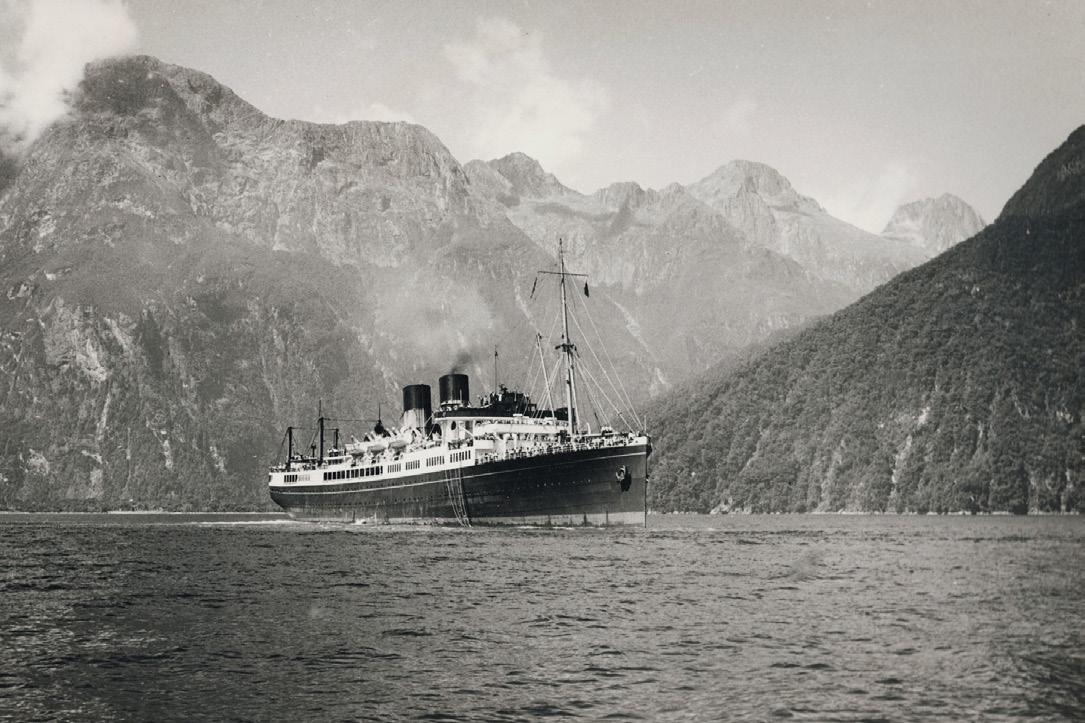
Two notable ships from the 1930’s were the “Rangatira” built in 1931 for the ‘steamer-express’ service between Lyttelton and Wellington and in 1936 Union Company’s finest ship, the “Awatea”, for the trans Tasman service. Probably the fastest merchant ship based in the Southern Hemisphere the “Awatea” was capable of 23 knots, but became a war loss on 11 November 1942 off North Africa when attacked by ‘waves of German bombers’. Eventually she sank but miraculously without loss of life. The “Awatea” was not the Union Company’s first loss of the Second World War, that dubious distinction belonging to another passenger liner, the
“Niagara”, employed on the trans-Pacific service. Outbound from Auckland to Vancouver during the early hours of 19 June 1940 she detonated a mine, one of a pattern laid by the German raider “Orion” off Whangarei. Some two hours after striking the mine the “Niagara” sank, all aboard were saved. Other vessels lost to enemy action were the “Komata”, sunk off Nauru by the German raider “Komet” in December 1940, the pioneering motorship “Hauraki”, captured by Japanese forces in the Indian Ocean in 1942, the “Kalingo” torpedoed in the Tasman Sea by a Japanese submarine and the refrigerated motorship “Limerick” off Cape Byron, NSW, also by a Japanese submarine. Finally there was the newly built “Underwood”, requisitioned by the British Ministry of War Transport upon completion in 1941 and sunk by German E-boats in 1944.
Post-war the Union Steam Ship Company lost its airline when the Government established the National Airways Corporation (NAC) in 1947, Union Airways then being absorbed, likewise its substantial holding in Tasman Empire Airways Limited (TEAL). Many years later NAC and TEAL merged to form Air New Zealand.
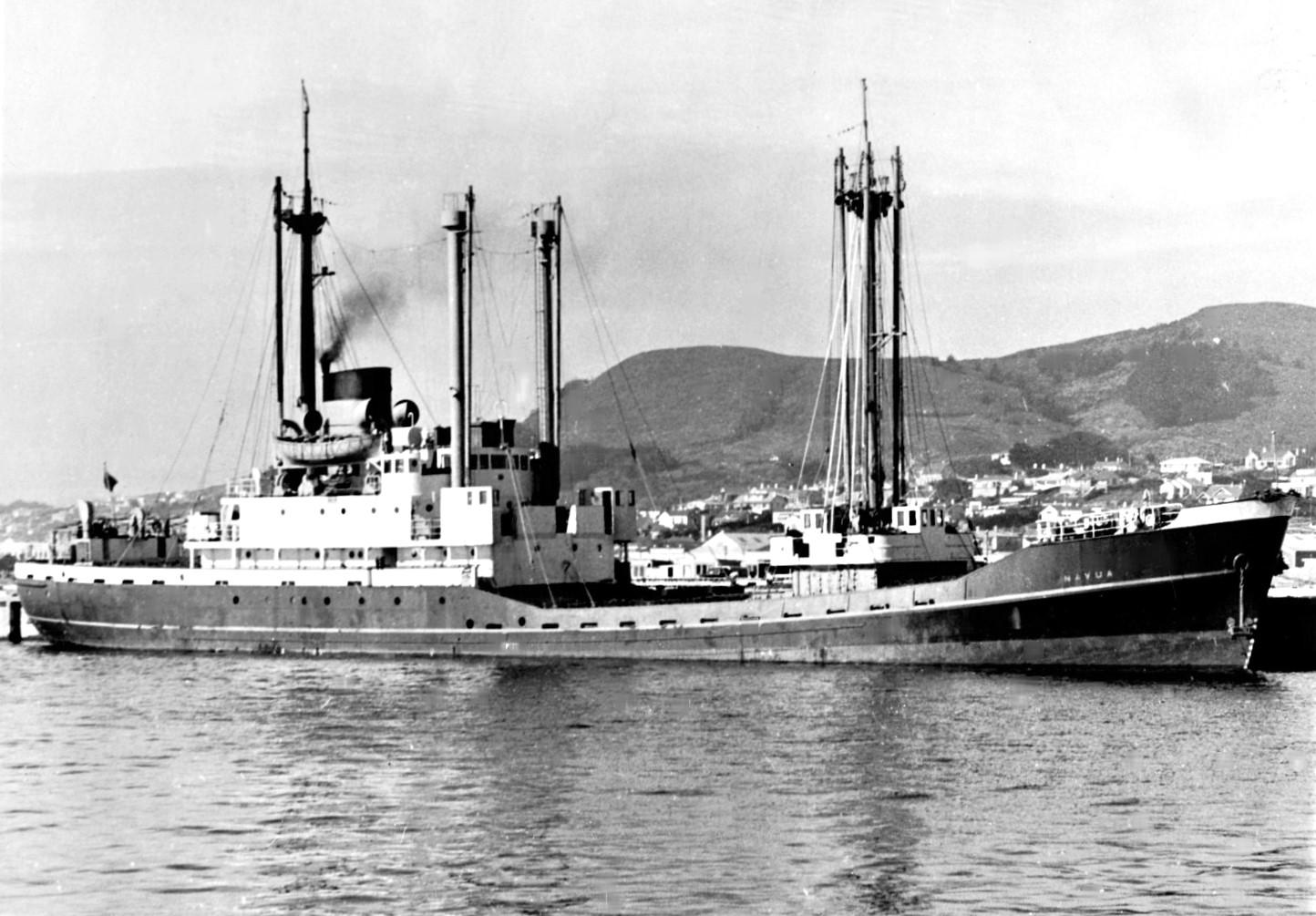
To support the passenger liner “Aorangi” on the transPacific service five ‘Canadian Victory’ class cargo ships were purchased while the Indian service gained two faster motorships. A fleet of twin screw colliers, strongly built to withstand the hazards of the West Coast bar harbours of Greymouth and Westport joined the fleet as did similar but larger general cargo ships for the trans-Tasman trade and to help out as required on the services to South East Asia, India and the Pacific Islands. Designed to supplement the regular Pacific Island traders the “Navua” is notable in the history of Bluff as the first ship to berth on the Island Harbour.
In 1953 the “Aorangi” made the last passenger sailing on the North American service followed by the “Monowai” ending the trans-Tasman route in 1960. Ocean passenger services were now restricted to the “Matua” and “Tofua” on the Pacific Islands service and a few passenger berths on the larger cargo ships. In 1962 the first rail ferry, “Aramoana”, entered service across Cook Strait under Union Company management and their thirty-seven year old “Tamahine” was withdrawn a few days later. Union Company commenced roll-on, roll off services in Australia in 1963 and in 1965 had the “Maori” converted to provide this facility on the ‘Steamer Express’ service. She was joined in 1966 by the roll-on roll-off ferry “Wahine” and the “Hinemoa” was sold after 21 years on the route. Two years later came the tragedy on Wellington harbour when the “Wahine” struck Barrett’s Reef and subsequently foundered.
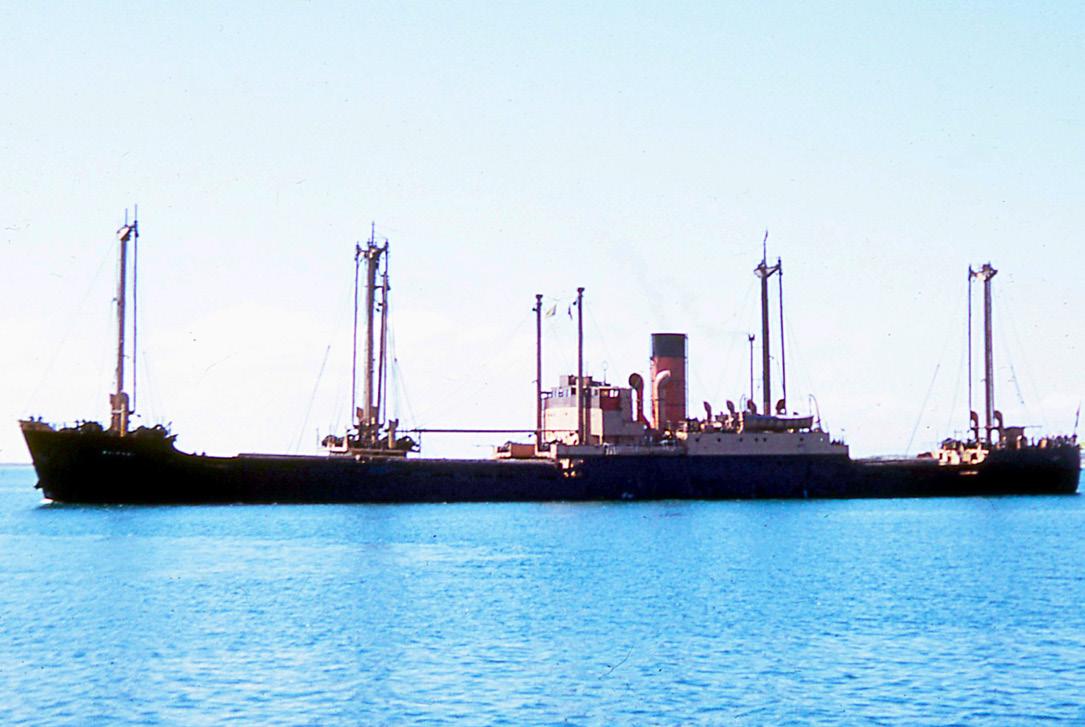
The “Maori” now continued alone until the last ferry built for the service, the “Rangatira”, arrived in 1972. The “Rangatira” was unprofitable from the start and only continued in service through a Government subsidy which ended in 1976. On 15 September 1976 the “Rangatira” made her last sailing bringing the Steamer Express service to a close.
Traditionally Union Company passenger ships had white upperworks with buff masts and derricks, bronze green hulls with a yellow sheer line and pink boot-topping, the boottopping being changed to red post-World War 2, while the cargo ships had buff upperworks, masts and derricks with black hulls and red boot-topping. In 1960 this changed with the cargo ships being repainted in the same style as the passenger ships and thus the term ‘slow greens’ was born. Funnels remained red with a black top and two black bands.
This must have been one of the most attractive colour schemes of any shipping company anywhere in the world and the ships looked splendid in it.
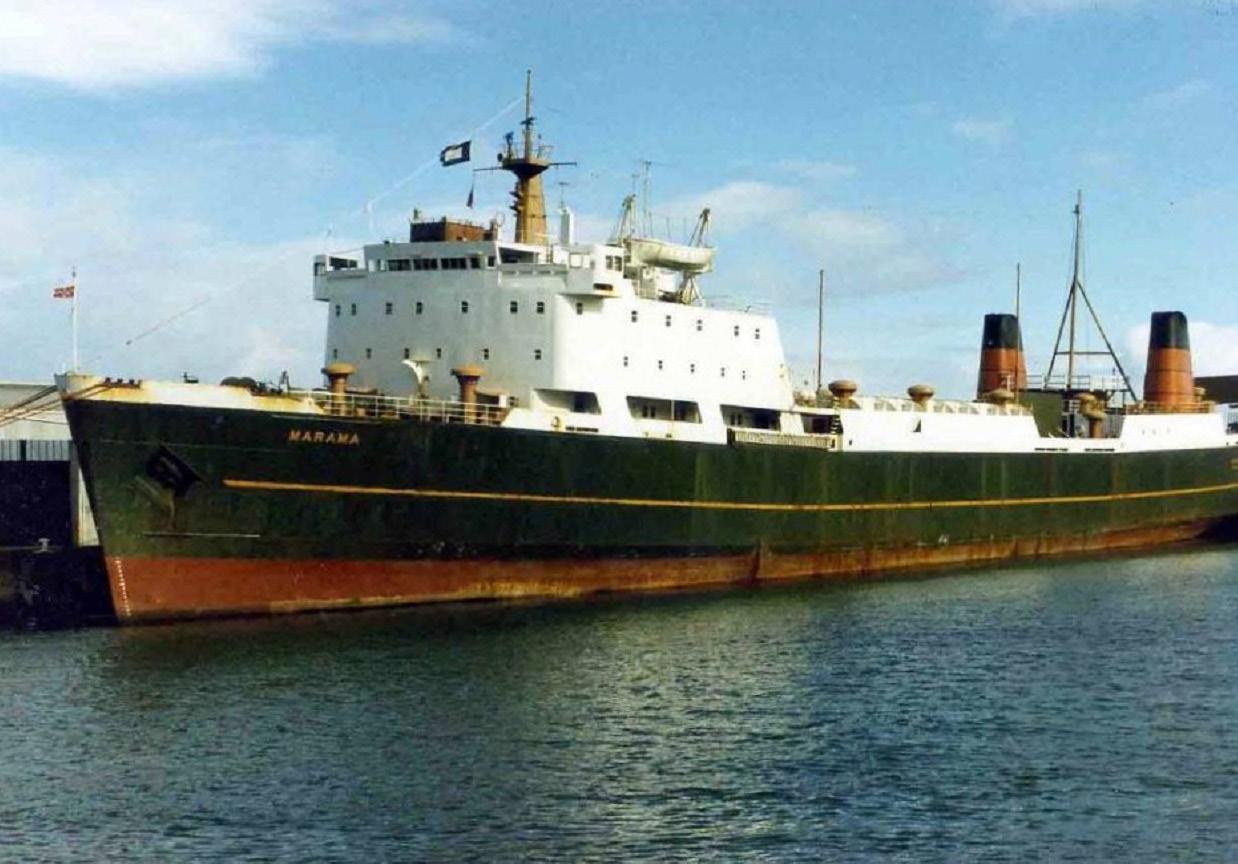
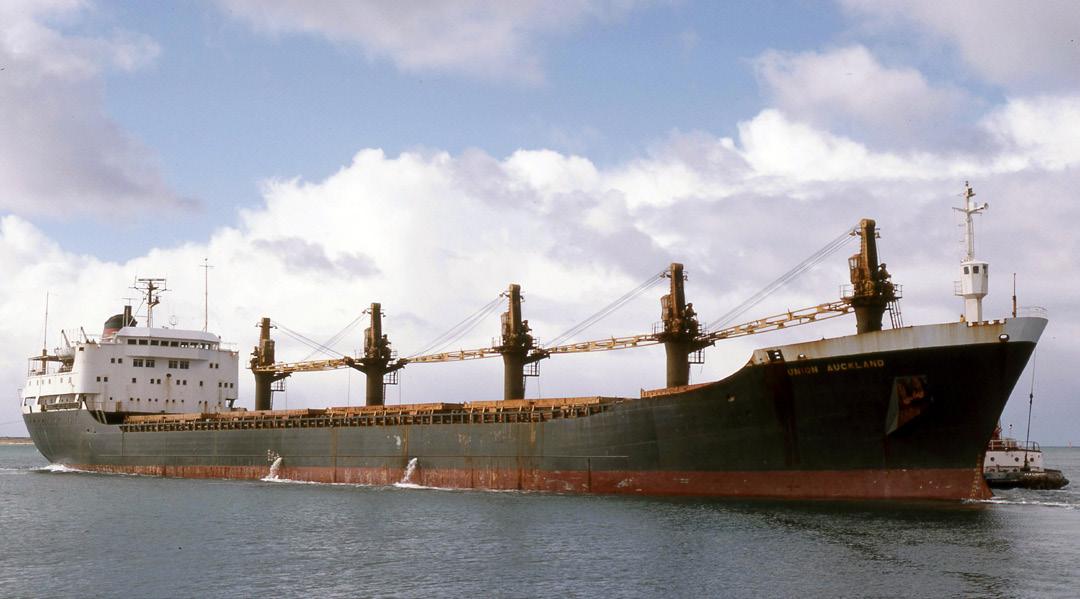
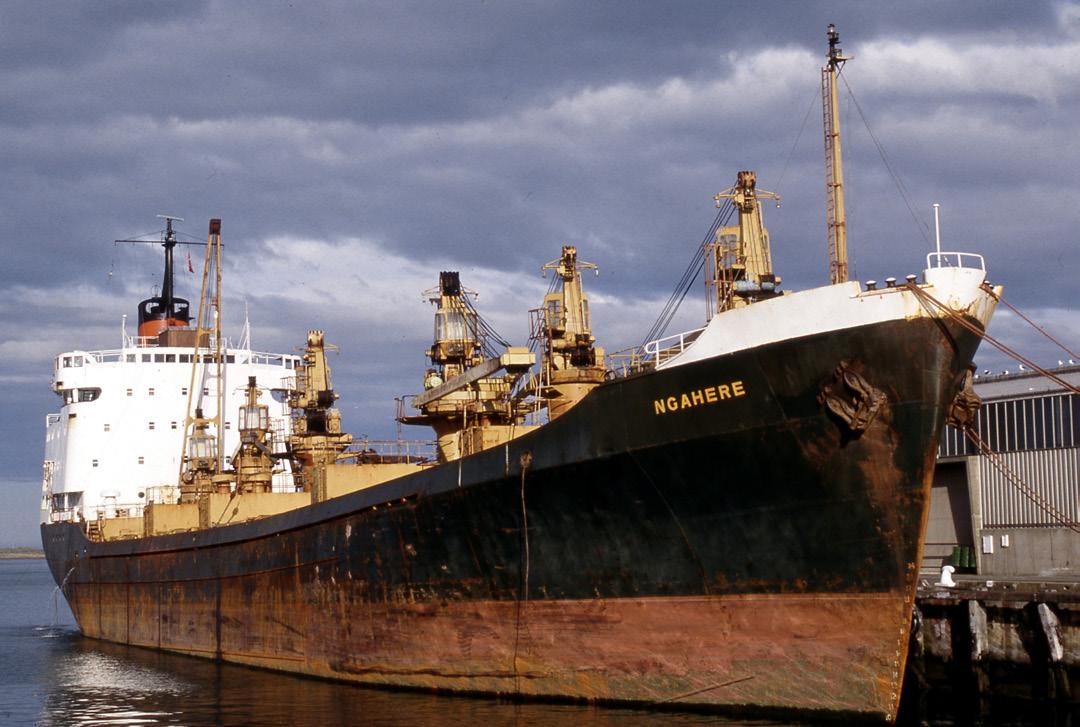
Between 1962 and 1966 the company took delivery of six ships fitted with cranes for cargo handling with the transTasman paper trade in mind, while in Australia two rollon roll-off (ro-ro)ships were built in 1964 for the Sydney and Melbourne services to Hobart. Three years later the “Hawea” became the first roll-on roll-off ship for New Zealand coastal service. Thereafter every cargo ship built for the company was a ro-ro, the next delivered being the “Maheno” and “Marama” in 1969 for the trans-Tasman route. To ensure participation in the scheduled Tasman services the Southland Harbour Board installed a linkspan at the head of berth 1, the first ro-ro to use it being the “Marama” in May 1982. She was also the last.
Renamed “Marada” she loaded empty containers at the linkspan in February 1985 before sailing to meet her breaker in Taiwan. Traces of the linkspan remain as decorative panels from it now line the South Port Office car park. The elderly, war-built steamers that maintained the trans-Pacific route were now proving uneconomical and in 1967 the service closed and that to South-East Asia and India followed in 1970. It was also in 1970 that P&O began negotiations to dispose of Union Company. These culminated in the sale of Union Company in 1972 to Tasman Union Ltd, jointly owned by NZ Maritime Holdings and TNT Shipping (NZ) Ltd. In 1983 the head office shifted to Auckland.
Between 1975 and 1977 four notable ships were delivered. These were the “Seaway Prince” and “Seaway Princess” for the Bass Strait service and the much larger “Union Rotorua” and “Union Rotoiti” serving the trans-Tasman route. All were powered by gas turbines which could burn lower grade fuel but used a great deal of it. The huge rise in oil prices shortly after they were delivered made them uneconomical and the two Bass Strait ships were laid up in 1983 and sent to the breakers when about ten years old. After serving as a power station supplying electricity to Auckland the “Union Rotorua” was sold in 1998 and broken up the following year while the “Union Rotoiti” had her gas turbines replaced with diesels which halved her fuel consumption. She was sold in 1999 and was broken up in 2007. In addition to the gas turbine quartet the company chartered a number of roll-on roll-off ships for trans-Tasman service with the “Union Hobart” and “Union Lyttelton” working through Bluff in 1982-83.
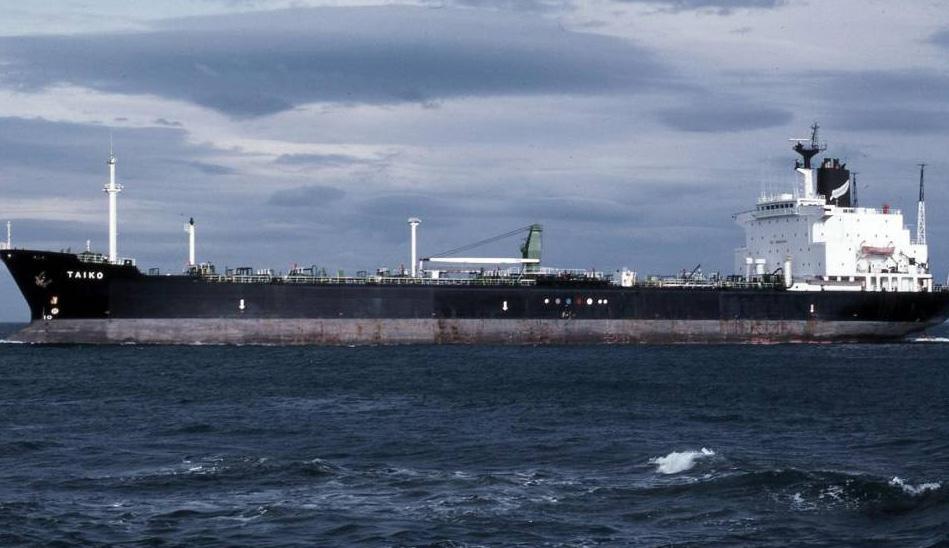
Since 1963 Union Company had managed the coastal tankers chartered to distribute oil products around the coast and decided to build a tanker for this service, the result being the “Taiko” delivered in 1984, the last and largest ship ever built for the company. In 1993 management of the coastal tankers ended and in 1999 the last Union Company

ships were sold. The only seagoing transport remaining was Ocean Bulk Limited, a joint venture between Union Shipping NZ Ltd, and Ocean Towing and Salvage (Cook Island) Ltd exporting coal from Westport to Port Kembla utilising the barge “Ocean Bulk 1” towed by the tug “Frederick Brown”, renamed “Karamea” in 1998, which began in July 1997 and ceased in June 2000, sadly bringing closure to the 125 year history of the Union Steam Ship Company of New Zealand Limited.
September saw the deployment of a new wave monitoring buoy placed at Southern Anchor Ridge.
The Datawell wave buoy is a new marine asset that will provide the South Port marine department valuable real-time information on sea conditions prior to shipping movements.
The South Port Security Team conducted their annual Maritime Security (MARSEC) live exercise in October, based on the scenario: “Maritime New Zealand has issued a security advisory following the receipt of credible intelligence indicating a planned protest event targeting port infrastructure. While the specific facility remains unidentified, the threat is believed to involve maritime assets located in the lower South Island.”
The wave buoy information will eventually be available on the South Port website for other boat users wanting to check sea conditions.
With the assistance of South Port staff playing the role of protestors objecting to the impending arrival of a shipment of wind turbine equipment, the small group of demonstrators braved the blustery conditions to help test and validate South Port’s security operations under MARSEC Level 2 conditions.
“This will be a great boating safety tool for the wider public,” said Sam Moore, Marine Operations Manager.
The yellow monitoring buoy is moored to 2 surface floats and anchored to the seafloor.
In addition to the protestors being controlled the Port had enhanced access control measures, more detailed vehicle searches and increased roving security patrols across the Island Harbour.
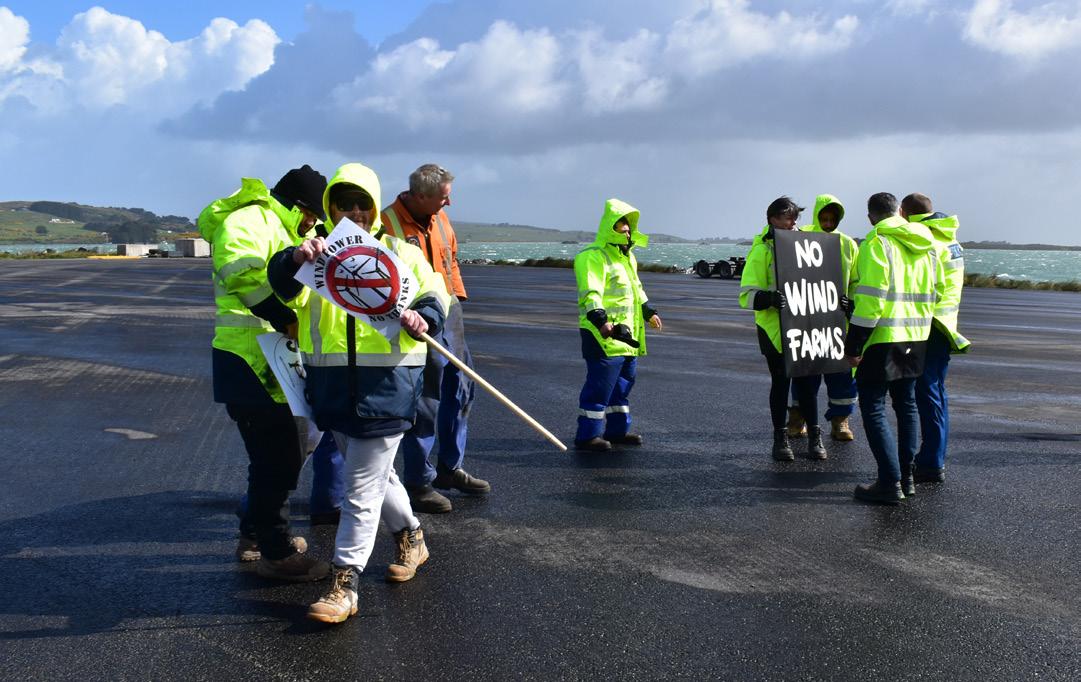
The ‘pretend protestors’ negotiate a deal with Police and Port Security as part of the live exercise.
All harbour users are asked to proceed with caution in this area and maintain a 100m exclusion zone as the buoy will shift with tides and swell.
Other exercises included a staged bomb threat phone call, and a vehicle breaching the barrier at the Gatehouse, making it’s way across the Port to join the demonstrators.
“These live exercises are an important part of evaluating South Port’s capability to operate effectively under MARSEC Level 2 conditions,” said Mark Egginton, Port Facility Security Officer.
Marine Person Overboard and Water Recovery training took place at Splash Palace in Invercargill earlier this year.
This involved the entire marine department including tug and pilot launch crew, pilots and marine coordinators, who were joined by the Bluff Coastguard and Southern Ocean Safety – equipment and servicing providers.
This also provided an opportunity to check our staff’s knowledge and understanding of roles and responsibilities under MARSEC Level 2, help us to identify opportunities for training, and test the adequacy of facilities and equipment.
This exercise is conducted annually to give practical experience with life preserving equipment and recovering a person from the water to a life raft or other vessel.
“Conducting realistic drill exercises for recovering persons from the water are essential to ensure the marine department is prepared for any situation that may occur,” said Sam Moore, Marine Operations Manager.
Also in attendance were personnel from First Security, Maritime NZ Security, Police, and NZ Customs providing an opportunity to assess the level of coordination and cooperation between South Port and relevant Government agencies during MARSEC Level 2 operations.
“Despite the adverse weather significantly impacting the exercise, with persistent rain, drizzle, and wind (ranging from 30 knots to over 50 knots), it was a very successful day,” said Mark.
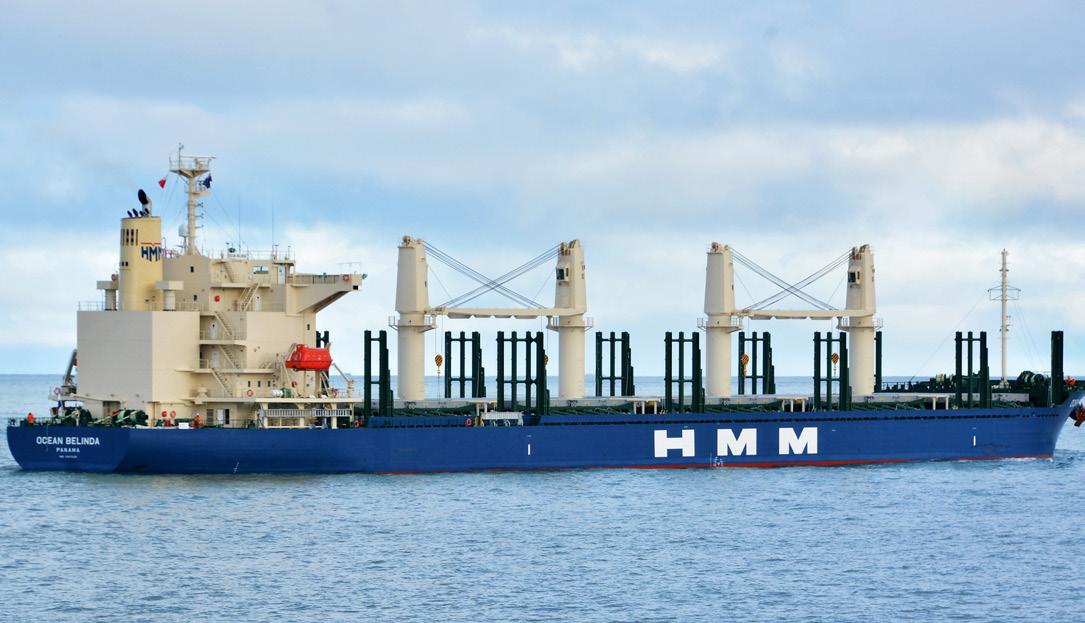
Bluff continues to welcome its fair share of ships on their maiden voyages, the most recent being the "Ocean Belinda" which was delivered earlier this year by the I-S Shipyard at Imabari.
Some of the drills and exercises undertaken were – entering water from height, activating life jackets, swimming and entering life rafts, survival techniques (both in water, and using the equipment on a life raft) and recovering persons from the water.
During the drills those involved experienced firsthand the use of life rafts, life buoys, inflatable life jackets and other lifesaving equipment.
The design of the "Ocean Belinda" is designated the 'Imabari 40' type, the '40' indicating a deadweight of about 40,000 tonnes, thus placing her in the 'Large Handysize' range. Her exact deadweight, the weight of cargo, fuel and stores she can carry, is 40,112 tonnes giving her a draught of 10.483 metres which would have prevented her from entering Bluff before the channel deepening was completed.
“It is imperative that our staff are all trained and familiar with the use of all Person Overboard equipment, and for some it was the first time they had undertaken training such as this,” said Sam.
Although registers might tell us that Shikishima Kisen KK is the owner of the "Ocean Belinda" the large letters 'HMM' painted on either side reveal the power behind the throne to be the company known until five years ago as Hyundai Merchant Marine, and nowadays as simply HMM Co Ltd.
“Thanks to the involvement of Bluff Coastguard and Southern Ocean Safety the day was a great success with plenty of learning and up-skilling for our team,” he said.
First ship of the 'Imabari 40' type to be delivered was the "Lake Grassmere" in June 2023 and there are currently 27 in service with a further 23 on order or under construction so we will undoubtedly see more Imabari 40's in the future.
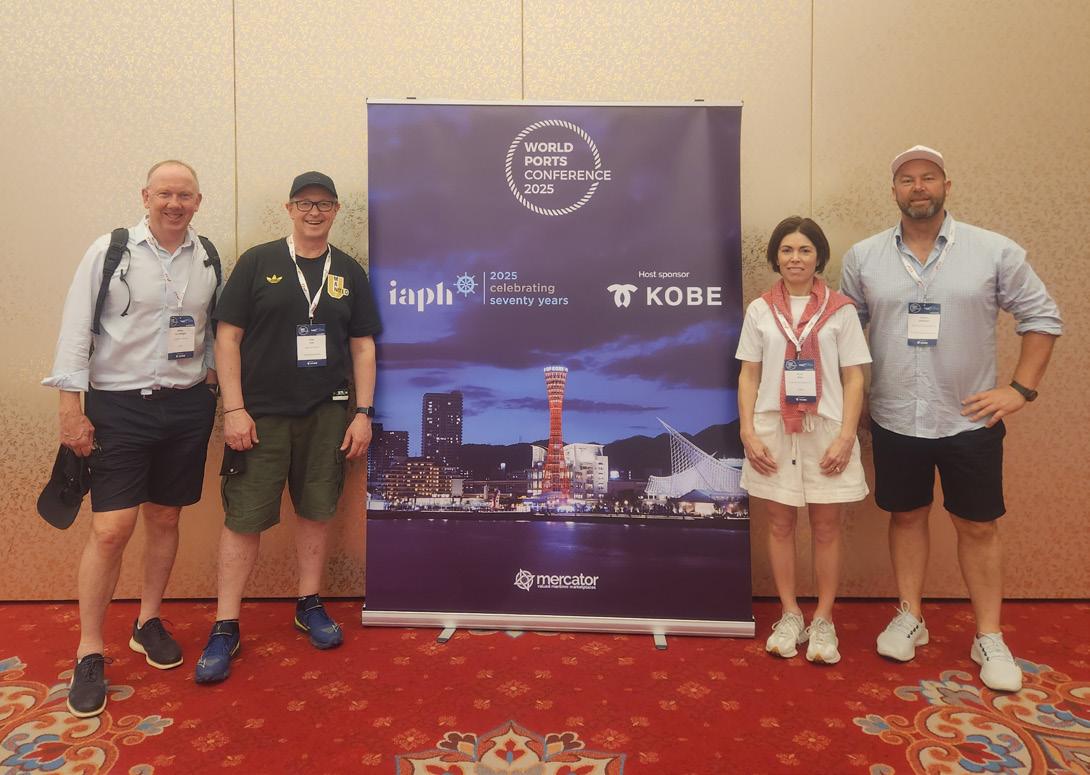
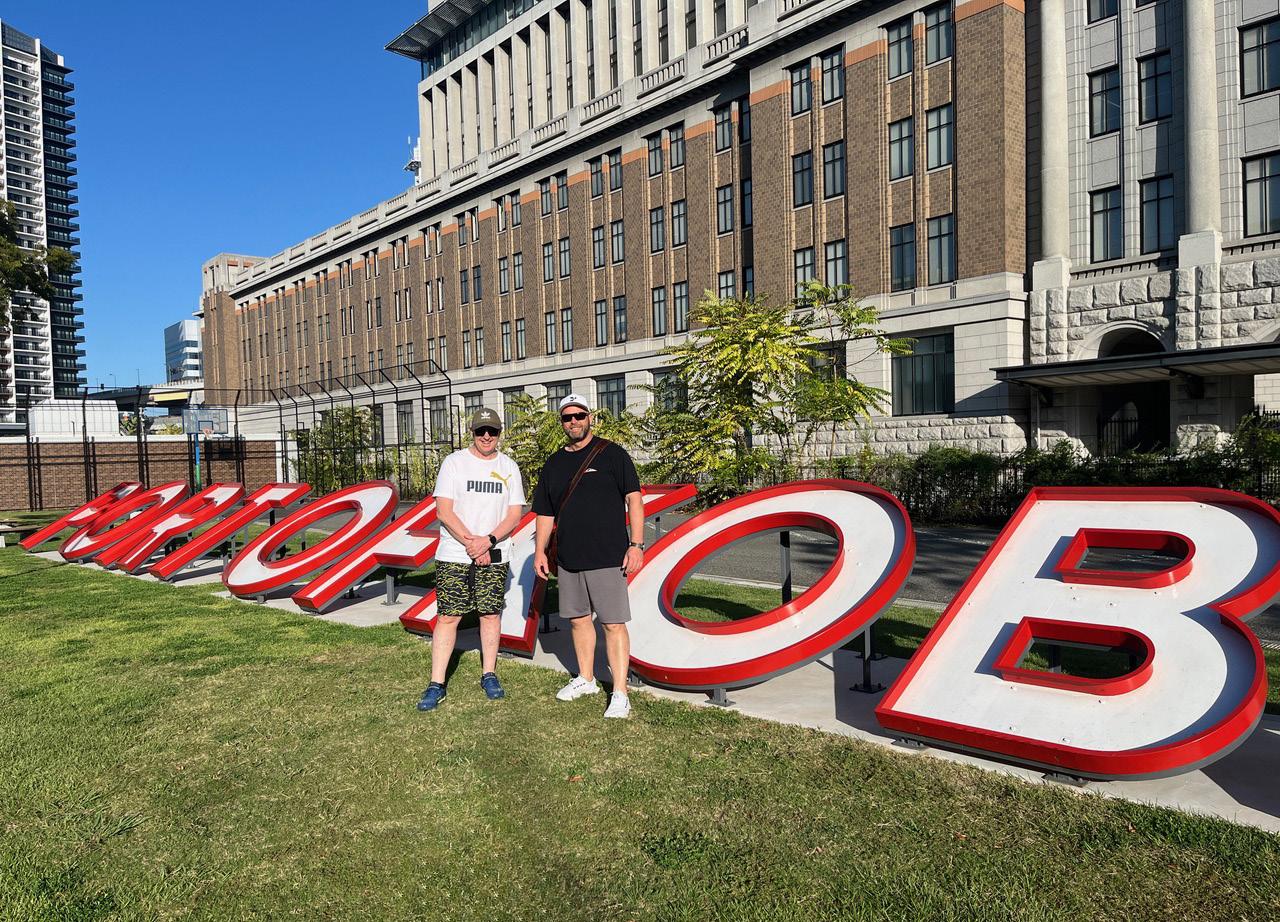
The International Association of Ports and Harbors (IAPH) celebrated its 70th anniversary with a world class conference held on the 7-9th October in Kobe, Japan which was attended by South Port delegates; Philip Cory-Wright, Chair; Nicola Greer, Director; Nigel Gear, Chief Executive and Hayden Mikkelsen, Container Operations Manager.
They were amongst over 650 delegates from across the world in attendance with a focus on international collaboration, knowledge sharing and networking. Delegates attended in-person sessions, breakouts, site visits and workshops as well as the Gala dinner celebrating the winners of the IAPH Sustainability Awards.
Over 70 years the IAPH has developed into a global alliance of 200 port authorities as well as 173 port-related businesses comprised of over 94 different nationalities across the world’s continents.
“There is a real diversity of thought with so many different regions represented, it’s a great opportunity for learning,” said Nigel.
“The conference was a great opportunity to meet with others in the port industry and pick up ideas and contacts for future strategic decisions at South Port,” said Hayden.
A key focus of the IAPH is the development of future sustainability within the port industry, and the conference included discussion on the use of Environmental, Social, and Governance (ESG) measurements.
“ESG is still alive for ports, particularly European ports - that are looking at ways to ensure they are resilient and they operate in a sustainable manner,” said Philip.
“Some of the bigger ports are planning for more automation, including autonomous ships!” Philip said
South Port has a long history of attending these events with previous executives also being involved on committees and working groups.
“It’s a good opportunity for us to learn and despite our size and location, it is comforting to know that we are in similar positions and face the same challenges as the larger ports attending the conference,” said Nigel.
With the networking opportunities presented, the South Port contingent were able to meet a number of Chief Executives from key Australian ports, along with the CEO of Ports Australia.
“Through these connections we are now looking to collaborate, share knowledge and learn from our neighbours across the Tasman,” Nigel said.
“Ports need to plan for the very long term but be flexible as to how they get there. Port of Singapore has built a whole new port facility on its west coast to cater for growth - the lesson for South Port is that we need to plan for the next 30 years but be flexible about the timing of what we do and spend to fit in with our customers’ plans. And we need to embrace technological innovation as part of that planning,” said Philip.
In addition to the conference, being a member of the IAPH provides us with industry resources, training opportunities, sharing of industry knowledge, as well as providing advocacy.
“Recognised as the only international organisation representing the voice of the world port industry, IAPH is granted Consultative Status as Non-governmental Organization (NGO) from five United Nations (UN) specialized agencies and one intergovernmental body”.
FAMILY FUN DAY OUT with Activities, Food Stalls and Music at the Bluff Oyster Festival Site (Barrow Street, Bluff), and 2-hour interactive port tours on the Island Harbour!
SUNDAY | 8 MARCH 2026
ENTERTAINMENT
at Bluff Oyster Festival Site from 9am:
ƪ Food trucks
ƪ Craft stalls
ƪ Free face painting
ƪ Free kids entertainment including a bouncy castle and mini jeeps
ƪ Live music
PORT TOUR
Includes:
ƪ Interactions with our marine plant
ƪ Demonstrations with the mobile harbour cranes and container forklifts
ƪ Demonstration of the bulk cargo operations including logs and woodchips
Registration is essential, and tickets are limited, secure yours today @ www.eventbrite.co.nz
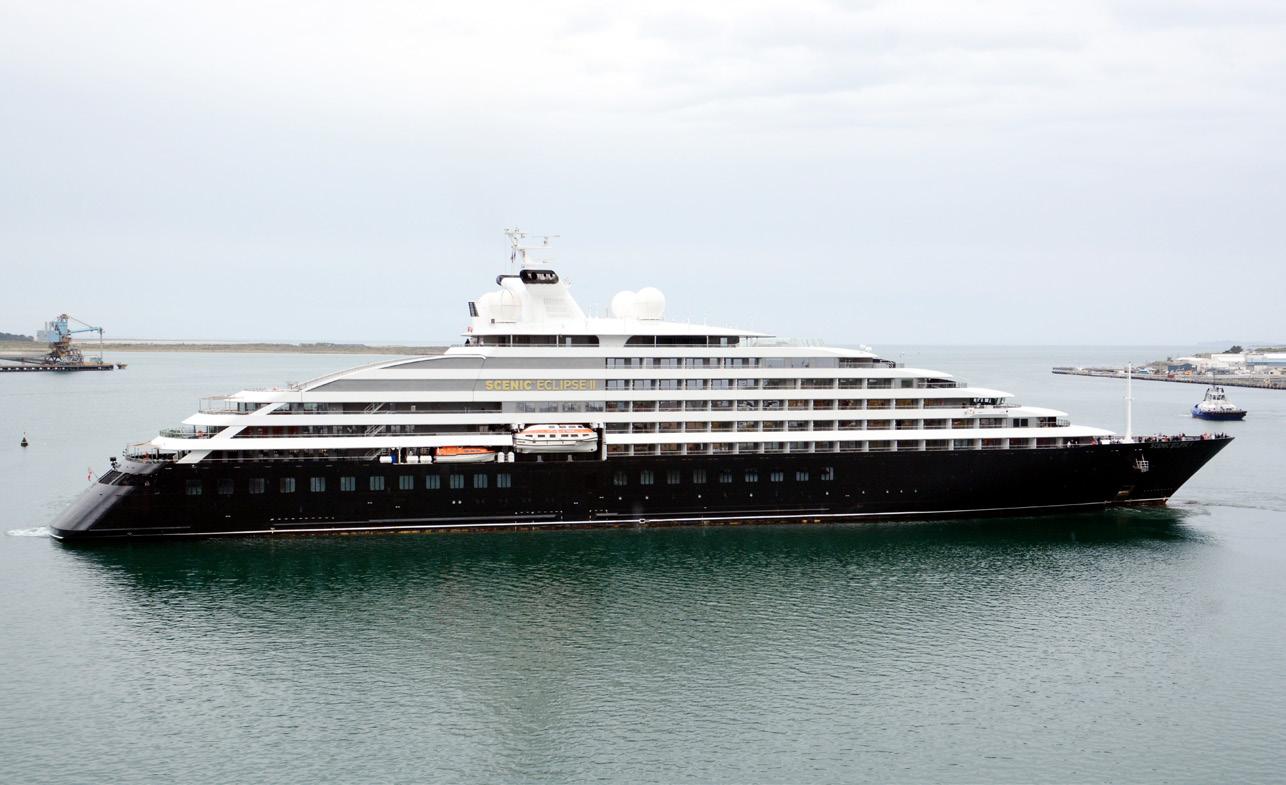
Surely the most stylish cruise ship to have visited Bluff is the “Scenic Eclipse II”. She and her slightly older sister “Scenic Eclipse” are sometimes marketed as “The billionaires’ yachts for people who aren’t billionaires” and these luxurious ships are the largest in the fleet of Scenic Luxury Cruises and Tours. The name encapsulates a company which has expanded from its origins in Newcastle, Australia, to become one of the most highly regarded cruising brands on the rivers and oceans of the world.
Glen Moroney was studying accounting at Newcastle University when he realised it was not the career for him. Instead, his father, an accountant who had moved into property development, asked him to sort out some hotels and motels in his portfolio that were not doing particularly well. Having proven adept at solving these difficulties he then moved to Warrnambool, Victoria, where he founded Warrnambool Scenic, marketing coach tours along the Great Ocean Road. This company evolved to become Scenic Luxury Cruises and Tours, offering tours of New Zealand, Canada, Alaska and eventually Europe.
which recently introduced the luxury cruising yachts “Emerald Azzurra” and “Emerald Sakara”, with three more due for delivery next year. Based in the Mediterranean they cruise as far afield as the Seychelle Islands.
Initially offering coach tours around Europe and chartering ships to expand travellers’ horizons, it was suggested that Glen build to his own specifications, luxury river ships. In 2008 with the introduction of the “Scenic Sapphire” his first cruises began, with others delivered the following year. Scenic Cruises eventually had a presence on all Europe’s major rivers and from 2012 also sailed the Volga with the “Scenic Tsar”, but this was withdrawn following the Russian invasion of Ukraine.
‘Out East’ Scenic operates on the Mekong River through Vietnam, Cambodia and Laos. Glen established a second company, Emerald Cruises, also operating river cruises,
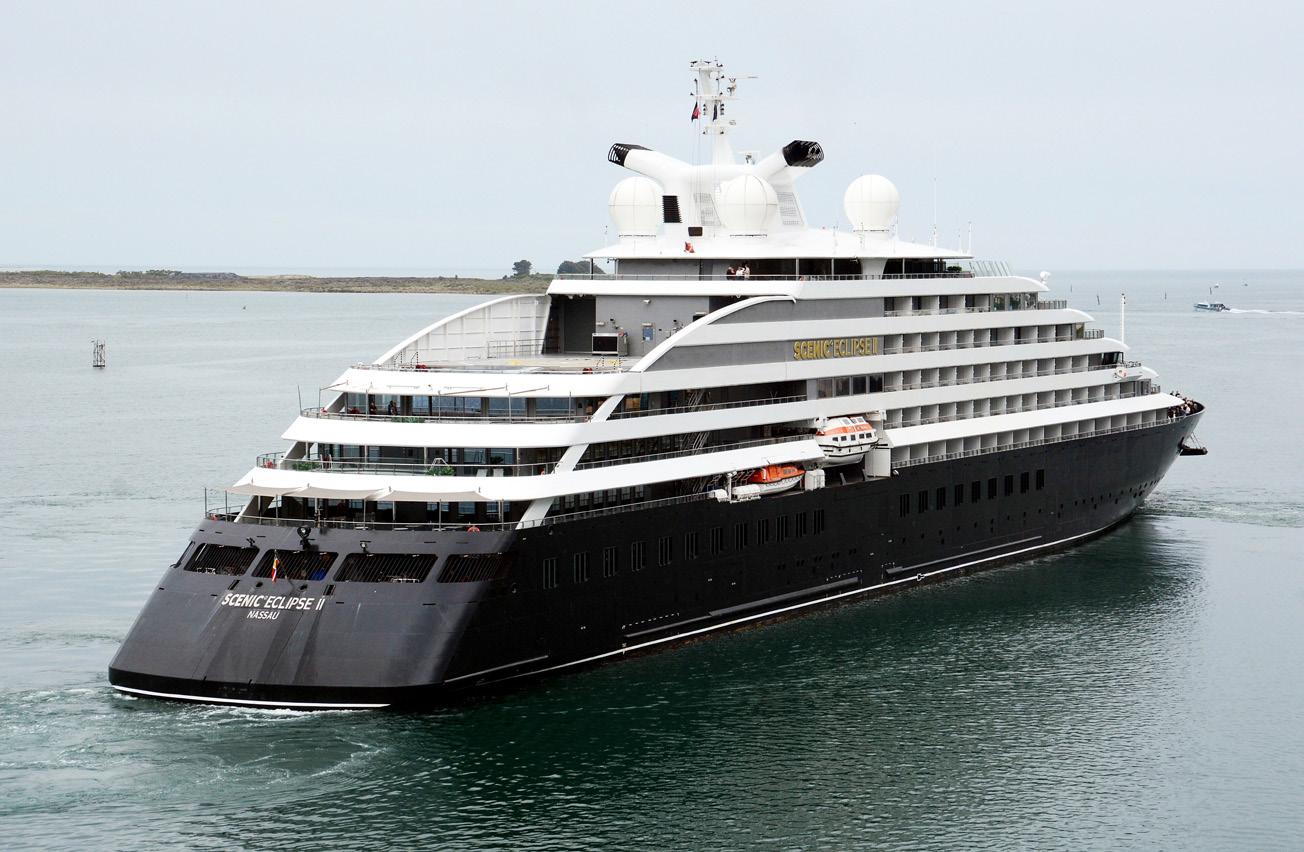
Having established a presence on the navigable rivers of Europe, and one or two in the Far East, it was time to introduce Scenic’s brand of luxury to the world’s oceans. At present the sea-going fleet comprises the “Scenic Eclipse” and “Scenic Eclipse II”, the design of which is based on the yacht “Octopus” completed in 2003 for Paul Allen, co-founder of Microsoft. Elements of the “Octopus” are obvious in the design of the Scenic pair, the first of which was ordered in 2015 from Uljanik Brodo, Croatia, for delivery in 2018 with options for a second ship. Industrial action and general turmoil at the yard caused long delays resulting in the “Scenic Eclipse” entering service in July 2019, a year later than scheduled. Needless to say, the contract for the second ship was passed to another shipyard, 3 Maj Brodogradiliste in Rijeka. She entered service as “Scenic Eclipse II” in April 2023. The pair are ‘six star’ ships boasting ten restaurants, a submersible able to carry seven guests, two helicopters and all of the usual cruise ship toys such as sailing boats, kayaks, wakeboards and water-skiing equipment.
They were built to ‘Polar 6’, the highest available ice class, as they will spend a lot of their time in polar seas. Much of the responsibility for the outfitting of cabins and passenger areas for the 228 guests was in the hands of Karen Moroney who met Glen when she was marketing his tours in Mildura, Victoria, where the couple still owns a home, although these days their main residence is in the Swiss Alps. Of course, being owners of the world’s most luxurious cruising yachts they may often be found enjoying the sea air aboard one of their fleet.