South Port’s annual result was released on 27 August and we were pleased to report a record profit of $10.71M ($9.43M 2020). Highlights included a 5.9% increase in bulk cargoes, 13.3% increase in containers to 53,750 TEU and a record volume of logs exported through the Port.
The most pleasing aspect of the result was the hard work and commitment shown by staff during a particularly disruptive time in the port industry.
The impact of COVID-19 continues to challenge our work processes and our way of life. The likely threat of the virus entering from the border has now shifted to a focus on community transmission –the threat now from within.
South Port NZ
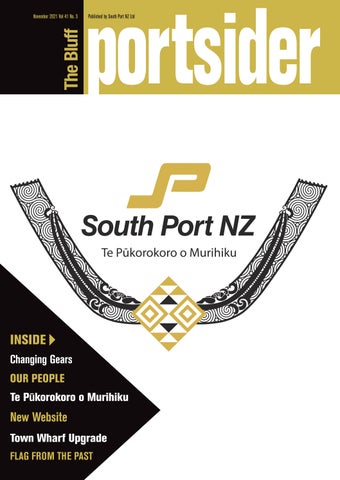
► COVER: Our modified logo and new motto have been designed to reflect Bluff’s distinctive characteristics. More information on Pg 04
The container supply chain is the other key factor that has impacted our business in recent times. This is a worldwide phenomenon and unfortunately, looks to be in play for another 12 to 18 months before we may see an easing of congestion issues impacting ports.
Regardless of these factors, the Port had an excellent safety record this past 12 months which is a credit to the whole team. Safety First is our most important core value and something that we place higher than profitability and productivity.
Manaakitanga, caring for our people, community and environment is one of our other six core values selected by the staff at South Port. Our engagement with the community as such has become an important focus for the Company in recent times. Regular meetings with stakeholders are now an expectation and has provided two way communication channels to the benefit of all involved. This has been most notable recently in the significant consultation undertaken in a number of areas with the Awarua R ū nanga. A cultural impact assessment for the channel levelling project, the naming of the new tug Rakiwai and South Port’s new logo and motto, Te P ū korokoro o Murihiku (covered within this Portsider issue). Special thanks to Dean Whaanga and the team at Te Rau Aroha Marae and also to Ng ā i Tahu
ANNUAL GENERAL MEETING –NEWLY ELECTED DIRECTOR
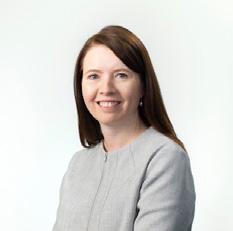
On Friday, 29 October, South Port held its 33rd Annual Shareholders’ Meeting at the Port. Michelle Henderson was elected to fill the vacancy created by the retirement of Tommy Foggo.
historian, Dr Michael Stevens, for their assistance and support through this process.
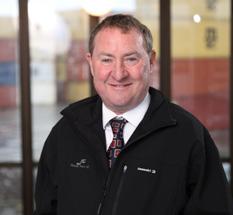
This year at the Company’s Annual General Meeting one of our long-standing Directors, Thomas (Tommy) Foggo, retired from his position on the Board. Tommy was first appointed to the Board in 2003 and has been an important contributor to the Company during these past 18 years. Tommy is also well known to the Port through his time as the Manager of both the Sanford Bluff operation and Sanford’s nationwide aquaculture business. His extensive knowledge of this industry and of the local community will be missed going forward. The team at South Port wishes Tommy and Leanne all the very best for the future.
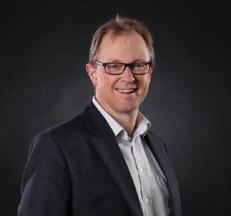
Nigel Gear
The Bluff Portsider is compiled by
South Port NZ Ltd. PO Box 1, Bluff 9842.
Phone: (03) 212 8159. Fax: (03) 212 8685
Email: reception@southport.co.nz
Website: www.southport.co.nz
Chief Executive: Mr N Gear
Contributors: D A Edge and K Hoyle
Edited by: K Hoyle
Production by: Craigs Design and Print
Michelle is a full-time independent Director based in Invercargill. She brings with her engineering expertise and a broad business understanding. She has a passion for process innovation, sustainable business outcomes and safety. Michelle was recognised as the NZ Safeguard Business Leaders’ Health and Safety Forum Leader of the Year in 2019.
Michelle is on the Board of Meridian Energy and Fulton Hogan. She is also a Board Member of Cycling New Zealand Incorporated and a Trustee of Youthline Southland. Her last executive role was Chief Operating Officer of PowerNet and she is a former executive of Rio Tinto, both in New Zealand and Australia.
Michelle is a Chartered member of the NZ Institute of Directors, and a Fellow of Leadership W.A. (Western Australia).
► Chief Executive, Nigel Gear
► Retired Director, Tommy Foggo
► Newly appointed Director, Michelle Henderson
WELCOME
Tunahau Kohu – Container Terminal Operator – April
Paul Lester – Cold Stores Logistics Administrator – May
Justine Solomon – Executive Assistant – June
Thomas Lewis – HR Administrator – June
Edward Allison – Tug Engineer – July
Dylan von Sommaruga – IT Systems Coordinator –August
Sam McCormack – Marine Operator – August
Darcy Ryan – Dairy Warehousing Operator – September
Arlene Delgado – Administrator – October
Edgar Hernan Villota Torres – Cold Stores Operator –October
Rob Dixon – Syncrolift Operator/Dockmaster Trainee – June
Te Ratu Sikisini – Container Terminal Operator – June
Hayden McLiskey – Operations and Training Co-ordinator – July
Warren Topi – Rakiwai Project Coordinator – August
Justin Bungard – Leading Hand – Tugs – August
LONG SERVICE RECOGNITION
Khamish McCauley – 10 Years – October
Lawrence Shelton – 10 Years – October
Josh Gough – 20 Years – December
WELCOME BACK
Kris Walker – Health & Safety Advisor – August
Mana Puki – Fleet Maintenance/Crane Team – September
COMMUNITY ENGAGEMENT –HOSPICE PLAYHOUSES
South Port adopted its Community Engagement Policy in 2019 which, amongst other things, promotes community interaction whereby the Port’s staff are given the opportunity to contribute one day per year to a community-driven project during work hours.
The team at South Port’s Intermodal Freight Centre (IFC) were approached to construct kitset playhouses for Hospice Southland,
who raffle the finished product to raise funds to provide specialist palliative care within Southland and the Wakatipu Basin.
The team, led by Alastair McKerchar, have done a great job of putting these together and this is an excellent example of actively engaging with a community organisation.
► Bridget Winter and Tony Rain from Hospice Southland with the IFC team, Alastair McKerchar, Brett McDonald and Dan Akuhata.
Te Pūkorokoro o Murihiku
Te Pūkorokoro o Murihiku
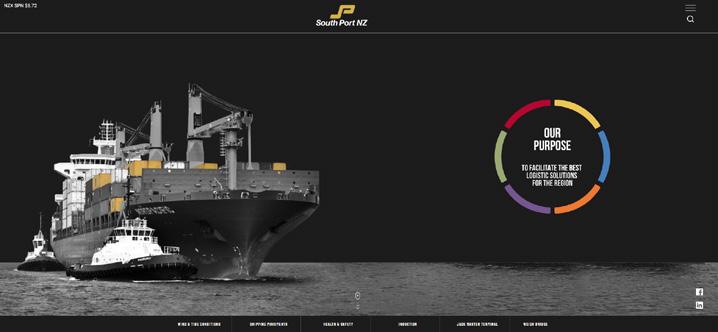
OUR PURPOSE
OUR PURPOSE
“To facilitate the best logistic solutions for the region.”
“To facilitate the best logistic solutions for the region.”
Our modified logo and new motto have been designed to reflect Bluff’s distinctive characteristics as well as South Port’s aspirations.
An explanation of South Port’s modified logo
An explanation of South Port’s modified logo
Most of our operations take place on the Island Harbour, quite literally at the heart of Awarua, from which the immediate area takes its traditional name. Reflecting this heritage underscores the interdependent nature of our local maritime history and culture, and the importance of Bluff Harbour to current and future generations.
Our modified logo and new motto have been designed to reflect Bluff’s distinctive characteristics as well as South Port’s aspirations.
WHAKAMĀRAMATANGA
Most of our operations take place on the Island Harbour, quite literally at the heart of Awarua, from which the immediate area takes its traditional name. Reflecting this heritage underscores the interdependent nature of our local maritime history and culture, and the importance of Bluff Harbour to current and future generations.
An explanation of South Port’s modified logo
An explanation of South Port’s modified logo
The new logo introduces further elements to our ties to Murihiku which is more than just the Southland boundary.
The new logo introduces further elements to our ties to Murihiku which is more than just the Southland boundary.
Following extensive consultation on the modified logo and new motto with Te Rūnanga o Awarua, South Port is honoured to receive this koha/gift. An official hui/gifting ceremony will be held when COVID-19 Alert Levels allow this gathering to take place.
Following extensive consultation on the modified logo and new motto with Te Rūnanga o Awarua, South Port is honoured to receive this koha/gift. An official hui/gifting ceremony will be held when COVID-19 Alert Levels allow this gathering to take place.
Taurapa
Taurapa
Waharua kōpito
Waharua kōpito
Taurapa
Taurapa
Within Te Ao Māori, “The Bluff” is symbolically referred to as Te Taurapa o Te Waka o Aoraki or Te Taurapa o Te Waka a Māui: the sternpost of the South Island. Incorporating this aspect of a waka into South Port’s logo therefore speaks to our specific location. The dual taurapa design further speaks to our operations: vessels safely entering and exiting Awarua.
“Te Pūkorokoro o Murihiku”
“Te Pūkorokoro o Murihiku”
Waharua kōpito
Within Te Ao Māori, “The Bluff” is symbolically referred to as Te Taurapa
Within Te Ao Māori, “The Bluff” is symbolically referred to as Te Taurapa o Te Waka o Aoraki or Te Taurapa o Te Waka a Māui: the sternpost of the South Island. Incorporating this aspect of a waka into South Port’s logo therefore speaks to our specific location. The dual taurapa design further speaks to our operations: vessels safely entering and exiting Awarua.
Versions of this pattern feature in traditional Māori garments and on marae complexes alike. It has several meanings, but one is of a point where people or events interact with and reshape one another. That is a fitting description of a port. Waharua kōpito remind us that Bluff is a place where the land meets the sea, southern New Zealand meets the world, and the past meets the future.
Versions of this pattern feature in traditional Māori garments and on marae complexes alike. It has several meanings, but one is of a point where people or events interact with and reshape one another. That is a fitting description of a port. Waharua kōpito remind us that Bluff is a place where the land meets the sea, southern New Zealand meets the world, and the past meets the future.
“Te
“Te Pūkorokoro o Murihiku”
This short whakapepeha metaphorically refers to the port of Bluff as the trachea or windpipe of southern New Zealand. This phrase is inspired by the opening of Bluff’s Island Harbour in December 1960 by the then Governor General of New Zealand, Lord Cobham, who stated that, “Trade is the breath of life to a great exporting country, and a country breathes through its ports.”
This short whakapepeha metaphorically refers to the port of Bluff as the trachea or windpipe of southern New Zealand. This phrase is inspired by the opening of Bluff’s Island Harbour in December 1960 by the then Governor General of New Zealand, Lord Cobham, who stated that, “Trade is the breath of life to a great exporting country, and a country breathes through its ports.”
Within Te Ao Māori, “The Bluff” is symbolically referred to as Te Taurapa
The paired taurapa also create a visual space, within which sits our new motto and pre-existing logo. This is akin to a ship’s hold and cargo and represents the imports and exports that underpin our quality of life in southern Murihiku.
The paired taurapa also create a visual space, within which sits our new motto and pre-existing logo. This is akin to a ship’s hold and cargo and represents the imports and exports that underpin our quality of life in southern Murihiku.
o Te Waka o Aoraki or Te Taurapa o Te Waka a Māui: the sternpost of the South Island. Incorporating this aspect of a waka into South Port’s logo therefore speaks to our specific location. The dual taurapa design
o Te Waka o Aoraki or Te Taurapa o Te Waka a Māui: the sternpost of the South Island. Incorporating this aspect of a waka into South Port’s logo therefore speaks to our specific location. The dual taurapa design further speaks to our operations: vessels safely entering and exiting
Versions of this pattern feature in traditional Māori garments and on marae complexes alike. It has several meanings, but one is of a point where people or events interact with and reshape one another. That is a fitting description of a port. Waharua kōpito remind us that Bluff is a place where
Versions of this pattern feature in traditional Māori garments and on marae complexes alike. It has several meanings, but one is of a point where people or events interact with and reshape one another. That is a fitting description of a port. Waharua kōpito remind us that Bluff is a place where the land meets the sea, southern New Zealand meets the world, and the past
This short whakapepeha metaphorically refers to the port of Bluff as the trachea or windpipe of southern New Zealand. This phrase is inspired by the opening of Bluff’s Island Harbour in December 1960 by the then Governor General of New Zealand, Lord Cobham, who stated that, “Trade is the breath of life to a great exporting country, and a country
This short whakapepeha metaphorically refers to the port of Bluff as the trachea or windpipe of southern New Zealand. This phrase is inspired by the opening of Bluff’s Island Harbour in December 1960 by the then Governor General of New Zealand, Lord Cobham, who stated
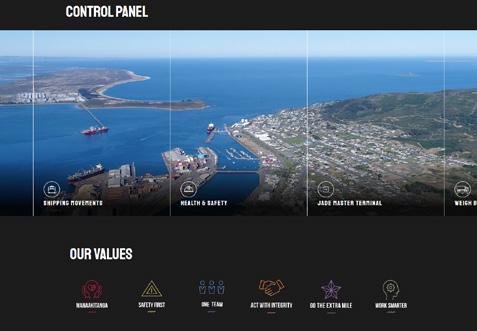
South Port went live with its updated website in October. The last time the website was updated was early-2014, so it was a good time to give it a refresh. The new website has been designed from the ground up to have a modern feel that is user friendly and allows for content to be easily updated. The fresh design also provides increased functionality which has given us the scope to add in more photos and videos, such as on the marine plant and equipment section.
The navigation of the website has also been updated and can be accessed through the 3-bar icon which is available on every page while navigating the website.
This will show a dropdown menu with all the available pages on the website.
While the information for the most part is the same as the previous website, it has been designed to automatically adjust for mobile phone and tablet users. The graphics have also been updated, such as the graphs on the wind and tide
conditions page, where they have been designed for easy viewing on any device. We have also added in some shortcuts to assist with navigating the website. Below are some of the shortcuts that have been setup.
Shipping Movements:
www.southport.co.nz/shipping
About Us:
www.southport.co.nz/about
Employment:
www.southport.co.nz/employment
Terms & Conditions:
www.southport.co.nz/terms
50 YEARS NEW ZEALAND’S ALUMINIUM SMELTER
You may recall the July edition of the Portsider where we mentioned the significant milestone of our 50-year partnership with New Zealand’s Aluminium Smelter (NZAS). April 1971 was when that relationship began with the production and export of aluminium.
Half a century and a lot has changed, but our relationship has certainly stood the test of time.
Over the years the Portsider has published regular articles related to
NZAS record volumes, milestones, electricity supply, notable vessel calls and cargo related information.
More recently, NZAS and its future at Tiwai Point have been topical with an announcement in January 2021 of a new four-year electricity contract with Meridian out to December 2024.
This positive announcement was a welcome relief for the region that is highly reliant on this business for employment and economic activity. As
previously reported, NZAS represents 30% of our cargo throughput and approximately 20% of our Net Profit After Tax (NPAT).
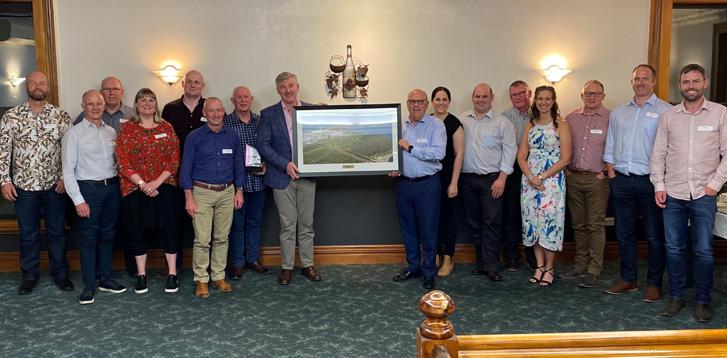
Our initial celebration was postponed due to COVID, but we were able to enjoy a relaxed dinner and presentation in October. It was a great opportunity for the Port and its neighbour across the Harbour to acknowledge this momentous occasion.
TOWN WHARF PETROLEUM BERTH UPGRADE
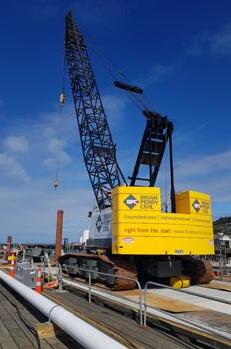
The Town Wharf project is well underway with the access structure now completed and 16 piles left to drive for the discharge platform. To reiterate, pile driving is only permitted between 8am and 6pm, Monday to Saturday. The contractors are now starting construction of the discharge area with a project completion date looking to be mid-May 2022 with an opening planned for mid-April.
The closure of Foreshore Road continues, and we thank the public for their understanding and cooperation to date. We have received a number of queries regarding pedestrian access to Foreshore Road, but unfortunately no
safe solutions have been identified at this stage.
The contractors undertaking the project have been collaborative in working with us. The fuel berth has remained operational during construction and the BPC team has been very accommodating in working in with key stakeholders, Mobil, RoadScience and South Port Marine operations, around vessel calls at the berth.
We have also received some great feedback around how engaging the crew has been when school groups have visited the site to observe construction from along the fence line.
► Members of both the South Port and NZAS Leadership teams celebrated with the presentation of a framed photograph with both NZAS, South Port and Bluff in full view.
► Brian Perry Civil crane at work on the Town Wharf.
WATTS, WATTS & COMPANY
When ageing seafarers gather to discuss good ships and hardships, good companies and bad, a London tramp ship owner generally receives more accolades than most for the quality of its ships, the standards on board and the care of its crews. The ship owner in question is the late lamented Britain Steamship Co Ltd., managed by Watts, Watts.
The Watts family were engaged in trading at Blyth, Northumberland, as far back as the 18th century and by the 1850’s Edmund Hannay Watts was a shipbroker and agent for ships trading from the North-East coast to the Continent and other short-sea destinations, generally with coal. In 1857 Edmund Hannay Watts and William Milburn began a shipping business under the style Watts, Milburn & Company, its first steamer being the Shearwater in 1864. Coal was the mainstay of British tramp ships and the tramp ship mantra of the day was the eternal triangle – ‘coal out, grain home’, and with luck just a short ballast passage in between. To ensure sufficient coal was available to fill his ships, Watts adopted the simple expedient of buying his own collieries.
In 1869 a London office was opened and Edmund Watts shifted there to take charge of the business. That same year the steamer Surbiton was delivered, the first ship named after a London suburb and introducing a naming scheme applied to the fleet thereafter. Shortly after this shift William Milburn left the company and went on to form his own shipping line which was one of those that merged to form what became known as Port Line.
On 8 December 1884 the Britain Steamship Company Limited was
formed with three ships, all named after London suburbs, transferred to it. By the end of the century the fleet numbered twenty-two so it is not altogether surprising that they were seen in New Zealand waters. The first to visit Bluff was the Romford on 11 June 1901 followed by the Blackheath and Dulwich, both of which arrived on 1 December 1901, and the Twickenham nineteen days later. The following year another seven visits were made and, remarkably, on 3 June three of the fleet were in Bluff together with the Chatham and Romford arriving on 2 June and the Ilford joining them the following day.
WThat, however, was the end of the stampede and apart from the Ilford in 1915 and two calls by the Willesden in 1926 and 1928, no other company ships called until the 1950’s.
When calls resumed what superb ships they were. Following the conclusion of hostilities in 1945 Watts, Watts decided to establish a liner service to Canada and ordered three ships, Wanstead completed in 1949, and her sisters Wendover and Woodford of 1950, that the nautical press labelled ‘outstanding’. The company was now controlled by the third generation of the Watts family and the chairman of the day, also named Edmund Hannay Watts, was a qualified naval architect and
introduced many new ideas to the ships. Pronounced knuckles featured in the hull form both forward and aft designed to reduce pitching, sliding steel hatch covers were fitted and the accommodation for all but the most senior officers was at ‘tween deck level inboard of recreational galleries along either side and everyone except a few trainees had a single berth cabin. Catering was also revolutionary, the Wanstead being the first British ship to have cafeteria style service for the crew. Some later ships had ballast tanks on deck which could be filled to reduce excessive rolling when sailing in ballast. While the Canadian liner service was short lived, these high-class ships had no difficulty in obtaining charters to prestigious liner companies and all post-war company visitors to Bluff were on charter to Port Line, which really brought the wheel full circle. First came the Wendover in 1954 and ‘56 followed by the Wanstead, later renamed Port Wanstead in 1961, and finally the Wimbledon under her chartered name Port Wimbledon in 1961 through 1964.
The company also operated a few coasters in the 1960’s, managed thirteen tankers for Gulf oil from 1958 and ordered a Panamax bulk carrier to be operated in the Seabridge consortium. Named Westminster Bridge the bulk carrier had barely entered service when the Britain Steamship Company was sold to Bibby Line and the management company of Watts, Watts to an insurance business. A favourite company of those ageing seafarers was no more.
Something of a nautical dynasty has been evolving in Hong Kong in the past decade or so featuring the father and son team of Christopher and Edward Buttery. Having graduated from Oxford University with an honours degree in modern history Christopher Buttery began his shipping career with Jardine, Matheson & Company, one of Hong Kong’s most illustrious shipping lines. In 1987 he was instrumental in founding Pacific Basin Shipping and Trading Limited in a joint venture with Belgian liner and bulk carrier operator CMB. Concentrating on the Asia/Pacific area the new company rapidly built up a substantial fleet of ‘handy-size’ bulk carriers many of which visited Bluff, the ships being distinguished by the prefix ‘Handy’ in their names. The success of the company attracted a bid from Malaysian interests which was successful and the entire fleet was sold in 1996.
Pacific Basin was not absent from the world’s oceans for long, however, as in 1998 Christopher Buttery and Paul Over re-established the company and in its second iteration Pacific Basin has proved one of the most successful shipping companies in Hong Kong. Christopher’s son Edward followed him to Oxford
TAYLOR MARITIME
University and, after experience with a leading firm of British shipbrokers, joined Pacific Basin as chartering manager in 2006. After two years there Edward moved on to gain experience in senior positions with other dry-bulk operators. During this period Edward sat the examination for the Institute of Chartered Shipbrokers receiving several awards including the President’s Prize for the best results globally. He went on to a Masters degree in Shipping, Trade and Finance in London and graduated with merit. With these illustrious results behind him Edward then joined the shipping team at a leading bank engaged in providing finance to shipping companies, particularly those with interests in Asia. (A further prize awaited him in 2017 when he received Seatrade Asia’s Young Person of the Year Award).
Edward Buttery now begin work preparing for the establishment of what became Taylor Maritime in 2013. Taylor Maritime was named for Paula Taylor, Edward’s wife, and the plan was that, through its internally managed investment company, Taylor Maritime Investments, it
would acquire high quality, Japanesebuilt, geared bulk carriers, primarily vessels in the handy-size range of about 30,000 to 40,000 tonnes deadweight, but also larger ‘supramax’ ships if sufficiently attractive terms were offered. This is a very similar strategy to that adopted by Edward’s father in the formative years of Pacific Basin. It will come as no surprise, therefore, to learn that Christopher Buttery is Chairman of the Taylor Maritime Board, leading a highpowered team with expertise in all aspects of commercial shipping. Probably the best known among them is Nicholas Lykiardopulo, of the famous Greek shipowning family, who is a leading figure in international shipping and finance.
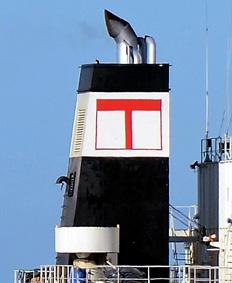
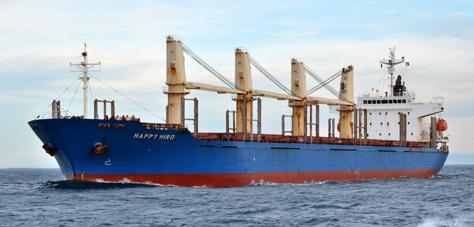
Similarly the Executive Team at Taylor Maritime, comprising Edward Buttery, Alexander Slee, Camilla Pierrepont, and Yam Lay Tam, all have extensive experience both in their designated roles and in overseeing all aspects of operating a successful shipping company. Successful is certainly a word that can be applied to Taylor Maritime. The company’s IPO was issued in London in May this year and in a recent update Taylor Maritime Investments advised its fleet value had since increased by 10.5% and charter rates by 30%. Currently the company is committed to purchasing eight more bulk carriers with the last of them expected to be delivered to Taylor Maritime in January 2022. This will take the fleet up to twenty-five vessels. Although a young company it has a strong pedigree and its ships, with their sometimes quirky names, are becoming a familiar sight here since February 2017 when the Nong Lyla became the first of the fleet to visit Bluff.
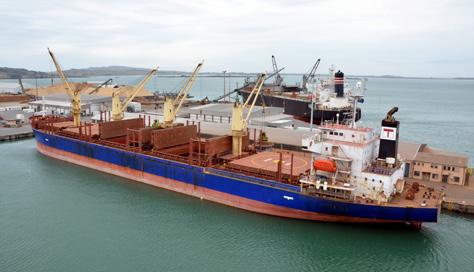
► Mega Maggie nearing completion of discharge at berth 5.