New Chief Executive Appointed
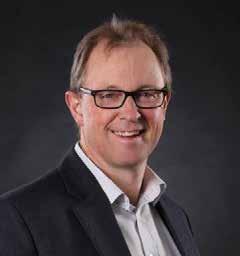
As reported in the July edition of the Portsider, long serving Chief Executive Mark O’Connor has retired after 25 years’ service with the Company. The successful candidate appointed was South Port Commercial Manager, Nigel Gear.
Interest for the vacant Chief Executive position was strong. South Port Chairman, Mr Rex Chapman said there
Changing Gears
“The only constant in life is change” (Greek philosopher Heraclitus 500 BC). 2017 is quickly drawing to a close and it is timely to reflect on the past 12 month’s activity.
Mark O’Connor our Chief Executive for the last 17 years retired in October to take “a breather” before taking on new challenges in the Governance sector. Mark has left the Company in excellent shape and his leadership will be missed, however with change comes opportunity. Hayden Mikkelsen, Helen Young and Jamie May have been included in a “reshaped” leadership team which also sees Geoff Finnerty taking on the Senior
Worth its Salt
was strong interest both internally and externally for the role, and it was “a tribute to (O’Connor’s leadership) that we have been able to find his successor from within the existing Management team”.
“Nigel is already well known by our customers and has been part of a very successful Management team operating during the Company’s recent period of growth”.
Leadership role of Port General Manager. This is an exciting time for the new team to work with staff and the Board to pave the way forward for the Company.
The agriculture sector is now in full swing and this is reflected in the increase of bulk cargoes moving across the wharves to support the region. As a result, warehouses are now also much busier with the receipt of finished goods for packing and export.
On the international scene there have been major changes in the container industry. Container shipping line consolidation has been gaining pace in recent times. Over the last two years the top global carrier numbers has fallen from 20 down to 13 and is expected to decrease to 11 after the merger of Japan’s three major carriers (expectations are that this could decrease further to six within the decade). These lines have created three mega alliances which will control 75% of global container capacity. Locally, South Port is well serviced by the Mediterranean Shipping Company (MSC) calling with the Capricorn Service on a weekly basis. MSC is the second largest container line in the world and a member of the 2M mega alliance, however is calling at Bluff under its own flag.
Business improvement has and will continue to be a major focus for the Port. PACE (Port Achieving Combined Excellence), our lean manufacturing
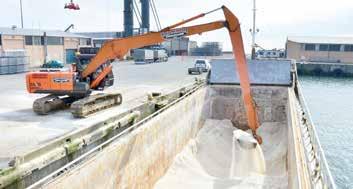
An unusual, if not unique, cargo for the Port arrived recently from Picton aboard the coastal bulk carrier Anatoki. This was a full cargo of salt consigned to Ballance Agri-Nutrients where it is used to produce fodder beet for the dairy industry. Normally this would be trucked down from points North, so road users can breathe easy knowing that the high seas have replaced the highways resulting in a couple of dozen truck and trailer units not having to make their laborious way south, and anything that can ease road congestion is obviously worth its salt.
Incoming Chief Executive, Nigel Gear said, “Mark has done an amazing job over the last 18 years and he has left some pretty big boots to fill. There has been substantial growth over the past seven or eight years and one of the big challenges we face is maintaining that growth”.
Nigel started in his new role on 1 October.
programme as well as Health & Safety (H&S) are important aspects of our business, driving efficiencies and change. The key to the success of these systems is excellent leadership and collaboration between the port, customers, suppliers, contractors and staff.
Forestry now represents a third of South Port’s cargo flows. It is therefore pleasing that recent discussions between exporters and the Company has led to the development of the first paved log storage area on the Port. Construction is currently underway and this change in infrastructure will result in enhanced storage utilisation, quality, handling, drainage and efficiencies.
The Intermodal Freight Centre (IFC) based at Mersey Street in Invercargill, completed its first 12 months of operation in August 2017. The IFC has changed the way our customers, especially those importing commodities in containers, interact with the Port. IFC customers can now contract the Port to transport the containers from Bluff to Invercargill, unpack, store and then load out the imported goods. As well as providing an efficient gateway for our customers it provides the opportunity for the empty containers to be recycled in town.
Finally, it has been a very busy year and the team at South Port would like to wish you all a very happy, safe and restful Christmas and New Year.
► Nigel Gear
► Salt being discharged from the Anatoki
Generating Business
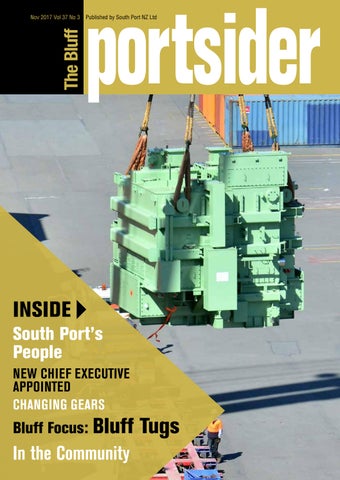
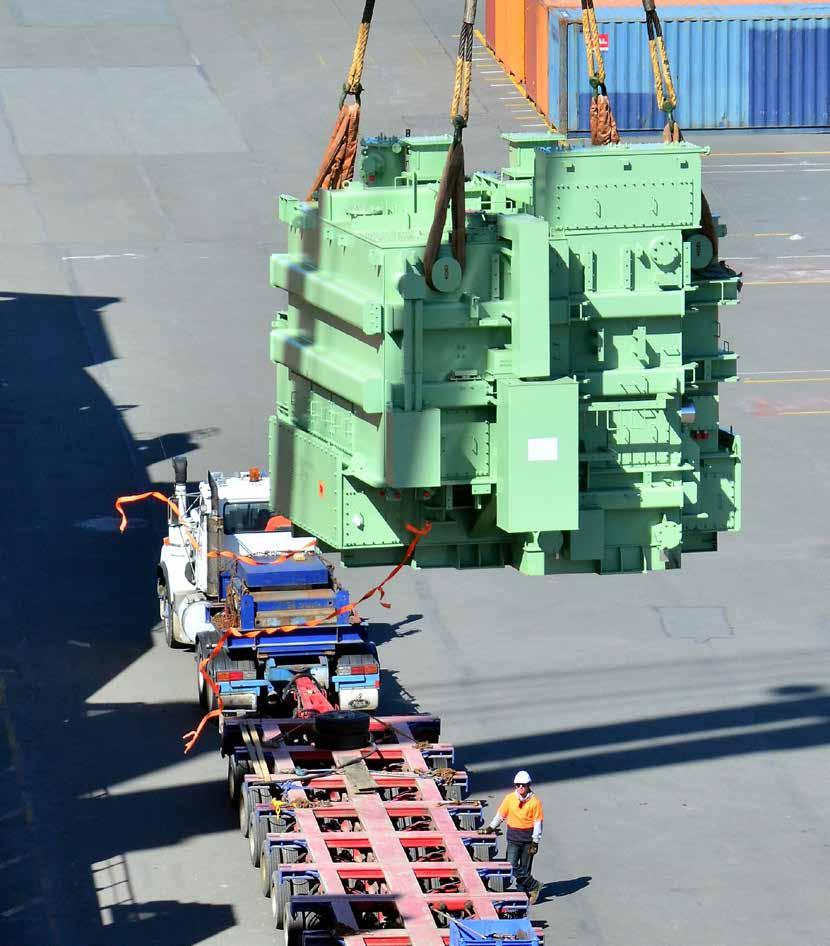
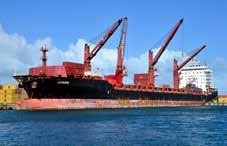
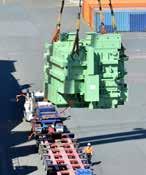
China Navigation Company ships have been regular visitors to Bluff in the last few years but all the recent visitors have been bulk carriers, at least until mid October when the Shansi called to discharge a generator and a couple of other general cargo items. The Shansi is one of four ‘S’ Class ships that maintain a break-bulk and container service from New Zealand to Asia, with the south-bound service normally terminating in Timaru, but extended to Bluff on this occasion.
Bluff’s link with the China Navigation Company dates back to 18 August 1885 when the Tamsui arrived with tea from Foochow, China. She returned the following year but there was then a long hiatus until regular visits began in 1962 when China Navigation introduced a liner service between New Zealand and the Far East, which lasted in various guises until 1982 when the last call was made to Bluff. This time, the break was quite brief as China Navigation’s parent company, Swire Shipping, was a major shareholder in Tasman-Orient Line and had several of its cargo liners operating on that company’s services through Bluff. Although it dabbled in bulk carriers during the 1960’s only in the last decade has China Navigation built up a substantial bulk carrier fleet, which continues to expand ensuring they will continue to be regular visitors into the future.
Hanging up his spanner
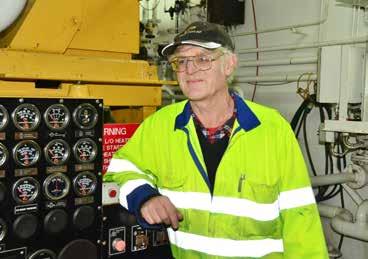
He has been a familiar face with a lot of Port workers and has seen plenty of faces come and go from the Company over the past 38 years and now it is time to say farewell. It all began back in 1979 at South Port (formerly known as the Southland Harbour Board) for Owen Bennett. Owen remembers his first job at the Port as a relief tug and maintenance engineer in the workshops. At that time, there were several infrastructure projects underway including the construction of Berth 8. Owen recalls, “The Mataura dredge (completing the job) required several visits to keep running. Up to three times a day we rowed out in a dinghy to bleed out water from the main engines”.
During this time work was beginning on the installation of the syncrolift, and the grain silos had just been transferred from the Town Wharf to Berth 2. The demolition of one meat loader (now that is a blast from the past for regular Portsider readers), and the ongoing maintenance of the remaining four meat loaders kept Owen and the department
busy. With the Port becoming busier, the engineer’s workshop was shifted from a location opposite the Bayview Hotel in Bluff to the Island Harbour. - Editor
“I remember the initial vessels I worked on during the first two years in the workshop, the Query and Aparima. They were both wooden work launches. During this time our tugs Hauroko and Monowai had to go to Lyttelton for docking as Dunedin had no available space. These trips were interesting as we stopped over for a night in Oamaru and I recall making headlines as it was the largest vessel to berth there for several years”.
The jobs Owen was tasked with were not restricted to one genre. He also engaged in casual jobs on the Stewart Island Ferry doing supply runs to the Campbell Island weather station when it was manned. It is now fully automated.
“One of the more notable vessels I remember coming to Bluff was Jack Cousteau’s Calypso. I had watched the TV series years before”. “There have been a lot of changes during my time here and I guess there will be a lot more to come”.
We wish you well, enjoy your retirement Owen.
South Port NZ
► The Shansi at Berth 4.
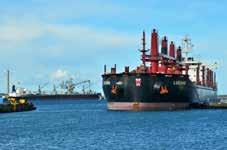
► Sometimes the bulk carriers come as couples – the Yunnan at Tiwai and the Luenho coming in to Berth 5.
► Owen Bennett in the tug engine room
FOCUS ON THE TUGS OF BLUFF
Then there were two – the Monowai sails for Picton leaving former fleetmates Hauroko and Te Matua in her wake.
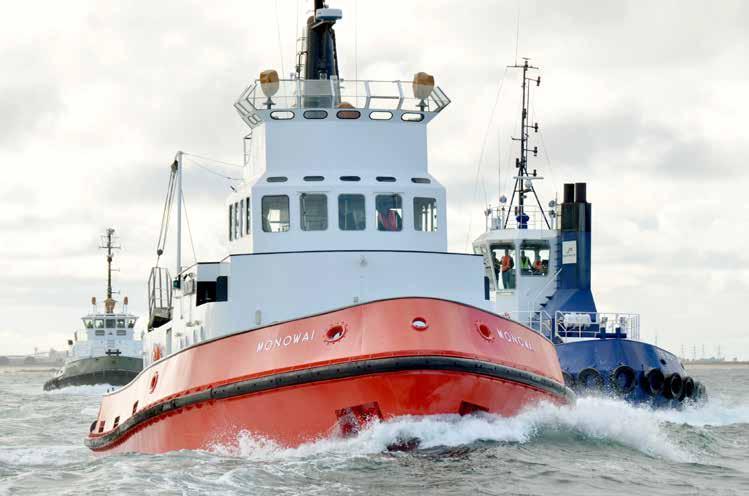
On 16 October 1973 the twin Voith tractor tug Monowai arrived in Bluff from her Whangarei builders.
On 14 August 2017 she sailed for Picton after being sold to Port Marlborough. She had completed just two months and two days short of forty-four years service to the Port, the longest of any tug based in Bluff.
The Port’s very first tug was far less successful. Built at Newcastle-on-Tyne in 1864 the iron paddle-tug Southland was shared between the Ports of Bluff and Invercargill. Found to be under-powered, she was sold in 1867 for coastal trading and again in 1868 to a Newcastle NSW tug company. On 30 July 1876 she sank off Newcastle after colliding with the steamer Waratah.
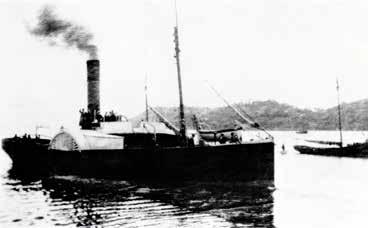
Another iron, paddle-steamer was the Port’s next tug. This was the Awarua built in 1884 for the Bluff Harbour Board, which was sailed out to Bluff, arriving on the 4th of January 1885. In addition to towage the Awarua also operated the Stewart Island ferry service during her sixteen years at the Port. Sold in 1901, she was wrecked near Whangarei on 6 February 1907. The Harbour Board also briefly owned another iron paddle-tug, the Titan in 1895, but she was sold to a local fishing company and abandoned on the Bluff foreshore in 1901.
Towage in Bluff came of age on 8 November 1900 with the arrival of the modern, single screw, steel tug Theresa Ward. She was a huge improvement on the paddlers that had preceded her and was to serve the Port for thirtythree years, twenty-seven of which she also maintained the Stewart Island ferry service. Sold to Wallace Tugs, Sydney, in 1933 she was broken up there in 1960.
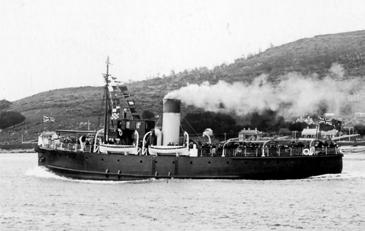
A bold move by the Bluff Harbour Board was to order New Zealand’s first large diesel powered tug, the Southland, completed in 1927. Designed for dual roles as harbour tug and Stewart Island ferry, she had twin screws driven by a pair of 6 cylinder engines and was certified to carry 285 passengers, the passenger spaces increasing her gross tonnage to 525, making her the largest tug ever owned in Bluff. The Directors would no doubt have been hailed as visionary had she been successful but she was not. Constantly breaking down she was sold in 1934, passing to Mollers’ Towages, Shanghai, in 1938. Renamed Frosty Moller and re-engined, she was captured at Hong Kong, renamed Genchi Maru and sunk by American aircraft in the South China Sea on 26 November 1943.
Unsurprisingly the Board reverted to steam power for a replacement tug. This became the Awarua powered by
two steam reciprocating engines of 1200 ihp making her the most powerful tug in New Zealand. She arrived in Bluff on 4 November 1932 and in contrast to her predecessor was a complete success. It was forty-three years before she was sold, being renamed Kiore One. After use in Fiordland as a base for deer recovery operations she was towed back to Bluff in 1988. Her two engines were then removed – one of them is now a working display in the Bluff Maritime Museum – and on 19 December 1989 the Awarua was scuttled in Foveaux Strait as a diving attraction.
The tug that towed the Awarua home to Bluff was the Hauroko, the tug that introduced the unparalleled manoeuvrability of the Voith Schneider cycloidal propulsion system to the Port. Built at Whangarei, the Hauroko was delivered to the Southland Harbour Board in 1968 and her twin Voith units produced a bollard pull of 15 tonnes. After being joined by her big sister Monowai in 1973, she became affectionately known as ‘Little Toot’.
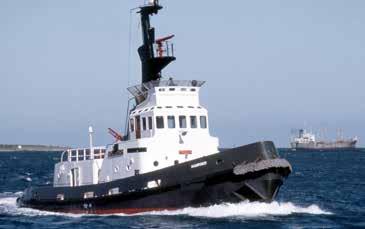
Monowai was another Whangarei-built tug but with a bollard pull of 30 tonnes.
As ships got larger the Hauroko struggled to handle them and a replacement was sought. Another Whangareibuilt Voith tractor tug, the Awanui, built in 1988, was available and South Port purchased her in 2000.
Renamed Hauroko she has a 35 tonne bollard pull and is fitted with a towing winch. Meanwhile ‘Little Toot’ was renamed Hauroko II before being sold to Auckland owners after 32 years service in Bluff. In 2003 she became Loyal and is apparently now under refit at Tauranga.
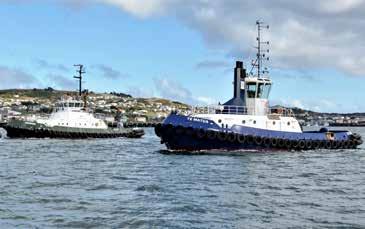
Regular readers will recall that last year the Te Matua came from Tauranga to join the South Port fleet. Distinctive by virtue of having her funnel forward of the wheelhouse allowing a clear view over the towing deck, the Te Matua has a bollard pull of 40 tonnes and is, of course, a Voith tug
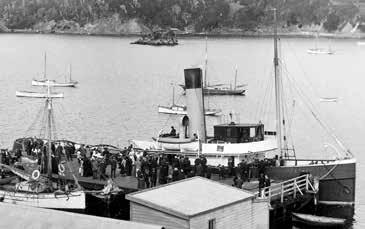
► The only photo we have found of the paddle-tug Awarua
► Theresa Ward at Halfmoon Bay in her ferry role.
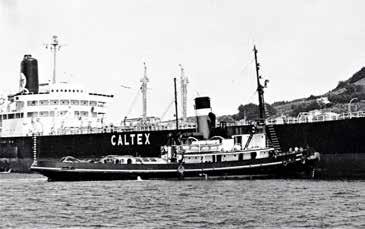
► The Awarua assists the Caltex Brussels to her berth in 1966.
► The present fleet, Hauroko and Te Matua heading off to work.
► ‘Little Toot’ returns to port after assisting the Silver Fern to sea. ► Motor-tug Southland getting along in fine style – a regrettably rare occurrence.
SOUTH PORT’S PEOPLE
Maico Lenhard

The Dairy Shed recently introduced an international flavour into the administration office. As the name may suggest, Maico Lenhard is not a common Southland name! From Brazil, he was raised in the southernmost state bordering Uruguay and Argentina, with a fascinating background.
The obvious question is why Southland? Maico was quick to point out, “My wife and I decided to leave Brazil to live in a place where we could build our family, develop ourselves and improve our English, a place where we could see ourselves living long term”.
Armed with a Bachelor in Business Management and MBA in Branding, Maico previously worked for Nike in Brazil for four years. “I had an opportunity to work in three positions, sales representative, footwear materials developer and costing coordinator. I worked on many projects where I learned to apply lean manufacturing principles, continuous improvement and cost savings. I worked with many countries such as USA, Argentina, Mexico, China and Vietnam.
Maico’s passion for football is huge. When quizzed by the Portsider he was quick to point out he still supports his home team from Brazil, Gremio Football Portoalegrense and has landed a coaching opportunity in Invercargill to mentor the Old Boys Stormers.
When not playing, coaching or following football Maico enjoys cooking, studying, spending time with his wife (Bruna Martins) and visiting new places.
Warren Shuttleworth
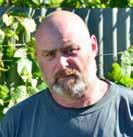
The Island Harbour Cold Stores has a new Cold Store Foreman amongst the ranks. Born and bred Southlander, Warren Shuttleworth comes to Bluff with impressive credentials.
Prior to accepting the South Port role, Warren was a Production Supervisor at the Farmlands Nutrition Feed Mill in Winton for two years overseeing the manufacturing of dairy and calf feed. Before this, he spent 28 years working for the Alliance Group at their Lorneville plant, 16 years as a Supervisor across various departments.
Warren lives in Invercargill and is married to Sharleen. They have two sons aged 23 and 21.
In his spare time, he is either riding or working on motorcycles. Both Warren and Sharleen enjoy touring on their prized Harley. Lucky dad is a handy mechanic as both of their sons race speedway bikes!
Ann-Marie Officer

A new face now greets visitors in the main admin building, with Ann-Marie Officer now on board as Administrator.
Having lived in Australia from 1998 to 2012 (with a two year period in the middle living in the UK) she has worked in various office roles in food and wine distribution and payroll/ accounts roles within the investment and health sectors.
“I was brought up in Invercargill, my mother is from Bluff and I am the oldest granddaughter of the late Isabel and Sonny Johnson.
I moved to Bluff in 2012, and have a four year old daughter Ashleigh May who attends Bluff Kindergarten, with time outside of work revolving around her. We like to go swimming, have weekends away and enjoy a little bit of overseas travel”.
Ann-Marie’s interests include home design, summer holidays, concerts, food and wine.
Elizabeth Anderson
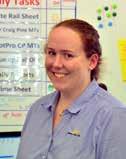
Due to the internal promotion of Jordan Culliford to the newly created Port Facility Security Officer role, the Terminal Yard Planner position became vacant. The successful candidate was Wellington born and bred Elizabeth Anderson.
As a teenager, Elizabeth moved to Dunedin to study economics before transferring to Lincoln University to focus on supply chain management. Most recently, she was based in Rotorua where she completed her Masters project in conjunction with Scion, the Crown Research Institute for Forestry.
She is passionate about supply chain management and her thesis focused on the adaptation of the lean production tool of value stream mapping, creating a supply chain view of phytosanitary compliance for export timber.
Elizabeth is also a member of the Chartered Institute of Logistics and Transport, and has been an active member of the under 35 development group.
IN THE COMMUNITY
Kicking for Glory?
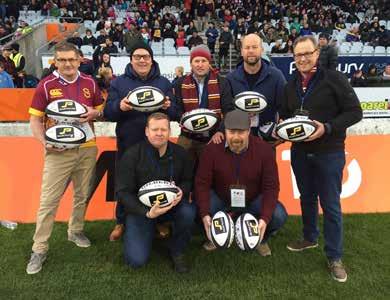
Well maybe the heading is a bit over stated, let’s be brutally honest, there are no Stephen Donald’s in the picture across lining up the winning Rugby World Cup penalty, however it was time to shine for six staff in front of a hostile Southland crowd.
South Port recently hosted 60 clients and suppliers to a Southland Mitre 10 Cup match, and as per tradition South Port staff ‘entertained’ the crowd and kicked signed rugby balls into the grandstand and terrace. ‘Entertained’ being the operative word as incoming Chief Executive, Nigel Gear, showed it was a long time between drinks when he successfully steered his club team around the park from the five eighth position. The biggest surprise was Container Manager, Hayden Mikkelsen, the way he hits a golf ball would make you think he had no show of getting the ball in the air. Well, onlookers were stumped when they saw two classical spiral punts fly into the night sky.
Missed the call for Peru?
All Whites’ coach Anthony Hudson must have been thinking long and hard after missing out on qualifying for the next Football World Cup about where the next crop of local talent will come from.
Well he needn’t look any further. The South Port United football team is making waves in the local social summer league and Captain Scott Faithfull is full of praise for his team mates.
The Portsider recently got an opportunity to sit down with Scott and discuss some of the individuals in the team and prospects for the season ahead.
“Last year I led the team to the grandfinal. I’m setting high standards however being an Aussie (I’m) not sure how high they’ll get to”.
Scott was very honest in his appraisal of some of the team.
Starting from the back is Hayden Mikkelsen. “Hayden is our full time goal keeper and proving to be our rock – literally. I have seen refrigerated honey move faster than this guy. But he does bring some “mana” to the team and if we were ever to do a haka, “Rocky” would lead it with pride”.
Scott was very complimentary in describing both Kris Walker and Josh Gough and it was not all about their football ability.
“Affectionately known as the “Milky Bar Kid”, Kris’ chiselled good looks only slightly outstrip his football skills. He not only scores goals, he has the ability to distract the female opposition with consummate ease.
For the record, the Stags were outclassed 44 – 13 by Northland.
However, we really wish he would leave his portable hair dryer at home. Josh is not that far behind Kris in the ‘good looks’ stakes, and for causing a distraction for the female opposition. He plays a solid aggressive game, and his football isn’t bad either”.
Categorised as the ‘improvers’ – Scott was quick to place Alastair McKerchar and Courtney Forde into this basket. “(Alastair) is a veteran of the last few seasons, and after purchasing a pair of bright blue football boots from Pumpkin Patch last year, has made small incremental improvements to his skill level. Courtney was our most improved player last season and she has brought that stellar form into the 2017/18 season”.
“While our form has been quite solid, we have had only one win from our first four matches, and while the losses are hard to take, they have all been close
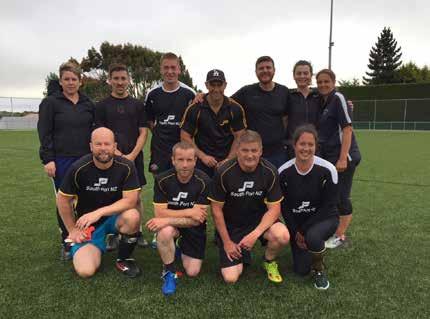
► The South Port team ready for their assignment.
COLUMBIA SHIPMANAGEMENT, CYPRUS

Traditionally, shipowners managed their own ships, which required a substantial shore staff to oversee fleet operations and the myriad matters this entails.
For many this is still the case but during the 1970’s a lot of shipowners, especially those with smaller fleets or for whom ship-owning was not a core activity, saw value in separating asset management from asset ownership. This was in line with a general trend to outsource such noncore activities and in the maritime field the growth in ship management companies was the result.
Columbia Shipmanagement Limited was founded in 1978 as a subsidiary of Schoeller Holdings, an investment company owned by Heinrich Schoeller. Headquartered in Limassol, Cyprus, Columbia has become one of the largest and most highly regarded ship management companies in the world with nearly four hundred ships engaged in world-wide trading entrusted to its management. This fleet includes general cargo ships, multi-purpose heavy-lift vessels, container ships, crude oil, bitumen and chemical tankers, bulk carriers, refrigerated ships, gas carriers and passenger ships.
Ship management services provided vary according to the requirements of
the ship-owner from simply providing qualified crew members to full management, including new-building supervision if required. Columbia maintains crewing offices in eight countries and agencies in four others to ensure it is always able to provide fully trained, qualified and competent crew, while under full management the everyday running of the ship is undertaken including insurance, chartering and vessel maintenance. A new-building supervision package may include shipyard evaluation, assessment of plans and specifications, supervision of construction, overseeing shop tests and sea trials, handling Class and Flag state registration and preparing the vessel for sea. To date Columbia has handled new-building supervision of over 260 vessels in 35+ shipyards in Germany, China, Japan, South Korea, Poland, Russia, Croatia, Argentina and South Africa.
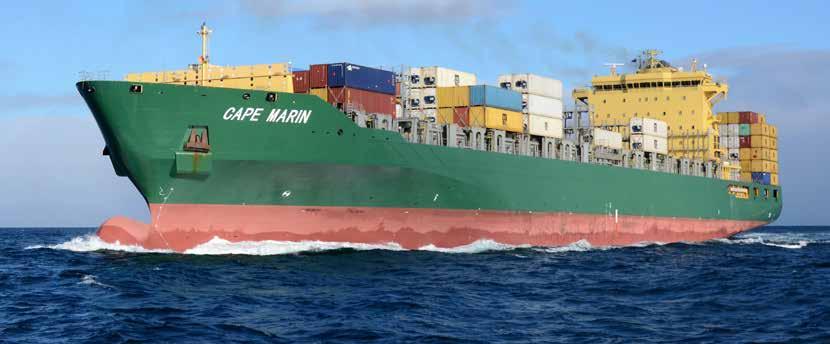
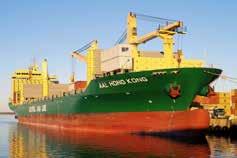
In addition to managing the ships of third parties Columbia Shipmanagement is also tasked with looking after the substantial fleet directly owned by Schoeller Holdings and its subsidiaries. A fleet of about twenty container ships with capacities of between 1,200 and 2,800 TEU are generally chartered to the major container lines, the Cape Marin currently being employed on MSC’s Capricorn Service through Bluff on which her sister Cape Madrid also served. Schoeller is also the major shareholder in the Bengal Tiger Line, incorporated in 1986 to provide feeder services in the Bay of Bengal. Its geographical range has expanded over the years and today Bengal Tiger Line operates scheduled services to fortyfive ports from the Red Sea to South Korea utilising about thirty ships.
Closer to home is Austral Asia Line founded in 1995. An occasional caller to Bluff in the past, Austral Asia operates liner services from Asia to Australia and North Asia to West Coast North America and tramping services world-wide. Specialising in heavy-lift and project cargoes, it has fourteen owned and seven time-chartered ships in service. It is the youngest multipurpose/heavylift fleet in the world.
Operating liner services from Asia to Papua New Guinea and the Solomon Islands is New Pacific Line. Formed in 2002 and originally based in Auckland, New Pacific was acquired by Schoeller Holdings in 2006 and is now based in Singapore utilising container ships chartered from its parent company. Schoeller Holdings also owns a fleet of product tankers and these operate within the United Product Tanker Pool, a joint venture between Schoeller and other independent tanker owners, with management by Columbia.
Recently it was announced that Columbia is to merge with fellow ship management company Marlow Navigation. To be known as ColumbiaMarlow, the merged company will be firmly in the upper echelon of ship management ensuring its vessels continue to be seen in the Port of Bluff.
► Columbia Shipmanagement colours.