
There has been a large effort placed on communication with both staff, contractors, customers and visitors on our collective responsibilities once you set foot on Port land.
There has been an excellent document produced called the “Common Users Safety Protocols” or CUSP which outlines these responsibilities. This can be found on our website https:// southport.co.nz/access/health-andsafety where there are some other useful tools available to ensure your visit to the Port is a safe one. Please take the time to read and make yourself familiar with these documents.
On the local front it is extremely pleasing to see the announcement that the New Zealand Aluminium Smelter (NZAS) is restarting its fourth potline. The securing of a power contract for an additional 50 MW out to 2022 has made this possible. This is an exciting time for NZAS, the
12 May 2008 is a date South Port Terminal Supervisor Graham Brown remembers like yesterday. The importance of a dreary Bluff Autumn day doesn’t rank highly on a Lonely Planet review however it is significant for him as he has just reached the ten year service milestone with the Company.
Graham recalls, “I started with four others on 12 May 2008 and was employed to work in the Open Country Dairy shed. I remember going from department to department for inductions and also to town to get my uniform. Shed 3 smoko room was an experience for a new employee and I certainly met some colourful characters on that first day!”
Prior to working in Bluff, Graham began his career at Harvey Norman in Warehouse Management starting in Auckland in 1997 when the first store was opened before moving to Perth for a number of years. He relocated back to Harvey Norman in Invercargill for the opening of their store in 2003. Five years later and the opportunity to work and live in Bluff presented itself and it was in 2008 when his connection with the Port became reality.
“The best things about working at South Port are it only takes two minutes to get to work each day and the people I work closely with make it a great place to work. I have also enjoyed the challenges I have had over the years from learning to stack pallets of milk powder to planning container vessels.”
Whilst the past ten years has gone quickly, Graham recalls humorously that “I have found the workforce here are not shy of giving you advice or their opinions whether asked for or not. This has led me to a number of new learnings and some good laughs along the way!”
Port and the region with the announcement of 32 new jobs and the increase in production of 30,000 + tonnes of export product. The Port extends its congratulations to the NZAS team on reaching this milestone.
Recently the Port has completed the paving of a 13,500 m2 log storage area on the Island Harbour. This project also incorporated the installation of an extensive new drainage and filtration system to better manage the residue seepage from the log storage areas. We would like to thank all those involved in this process especially the log exporters for their excellent support.
Finally, it is the end of the financial year and it has been an extremely busy one. Interaction with port users has increased significantly during this time which we view as a positive outcome of recent health & safety legislation changes. We look forward to continuing this interaction into 2018/19 and further creating a positive and safe working environment for all.
Outside of work Graham enjoys spending time with his family, closely followed by listening to and playing music. “I enjoy getting out and seeing live music when I can. (I’m) off to see Def Leppard in Auckland for the fourth time come November”. “I play a few different instruments but mainly guitar. Student of many, master of none!”
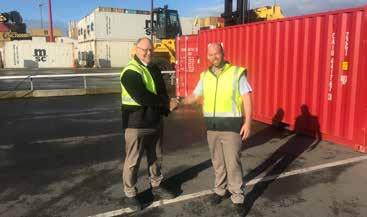
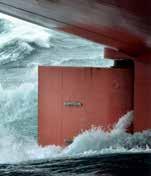
For the past couple of seasons South Port has made a contribution towards the Southland Sharks NBL basketball campaigns. As such the Company receives complimentary tickets to each home game which are up for grabs in weekly prize draws for staff that work at the Port. This season we have also secured a corporate table for three home games to share with customers and third parties. Reports from those who have attended have been positive.


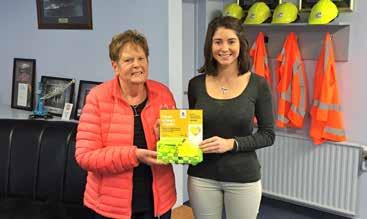
Courtney joined the local children at Bluff Kindergarten for morning tea at the start of this term before handing over a box full of donated goodies.
Every year South Port donates winter hats to the Kindergarten to help keep the kids warm, which is great when they’re outdoors playing during the day. As a bonus, this year South Port also donated a storybook from the Bill Richardson Transport World and some South Port desk pads. The kids are reusing the donated desk pads for their art and loving it! This small donation also saves the Kindergarten money by not having to purchase paper.
The rehoming of the desk pads is another small reminder that there is great value in the lean management 5S programme that we all participate in at the Port. It is an easy way to get rid of unwanted items that may be of value in other areas.
South Port with Invercargill Freight Forwarder and Custom Broker 360 Logistics partnered to raise funds for the Bluff St John Ambulance Service by holding an all staff barbecue at the Port...but this was no ordinary barbeque, this was a food truck barbeque!
The 1948 Ford pick-up truck with an inbuilt barbeque was kindly supplied by the team at 360 Logistics with David and Toni on cooking duties, the lunch was a hit. Altogether $750
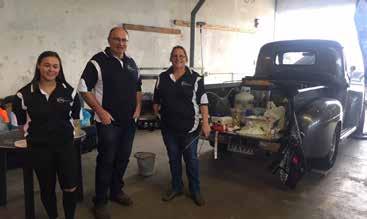
was raised for this amazing service.
The St John Ambulance Services are not fully funded by the Government. Contracts with the Ministry of Health, ACC and District Health Boards (DHBs) fund just below 70% of the direct operating costs. The shortfall must be made up from payment of part charges, community donations, fundraising and revenue from our commercial activities – so thank you to all involved in raising funds for our Bluff service.
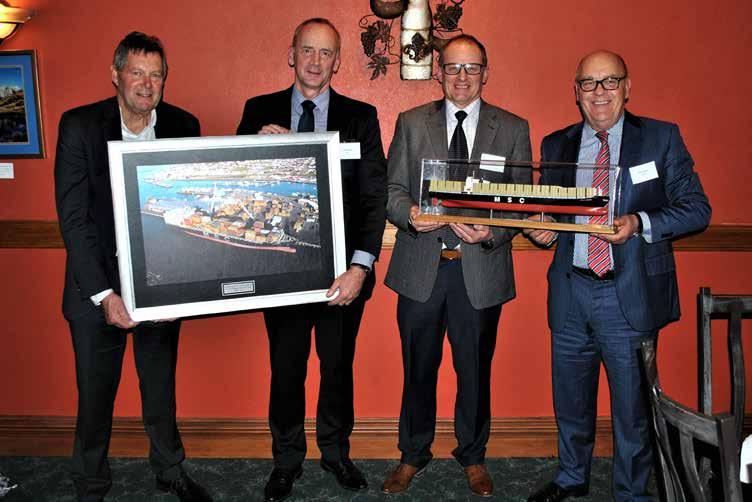
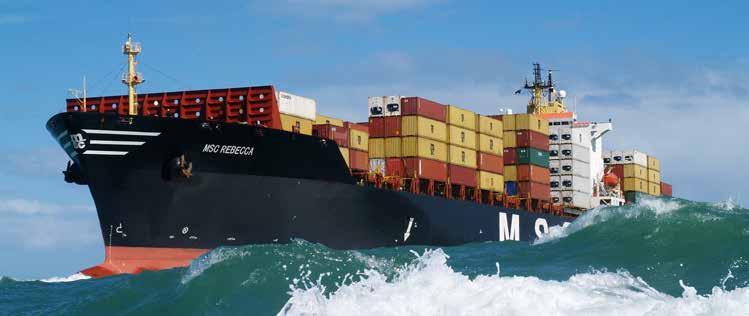
Having tested the waters a few years earlier with trans-Tasman sailings in a joint venture with other companies known as the Butterfly Service Mediterranean Shipping Company, or MSC as it is usually known, announced its intention to commence a fully containerised service from Bluff and other New Zealand ports to Singapore via Australia and Indonesia to be known as the Capricorn Service.
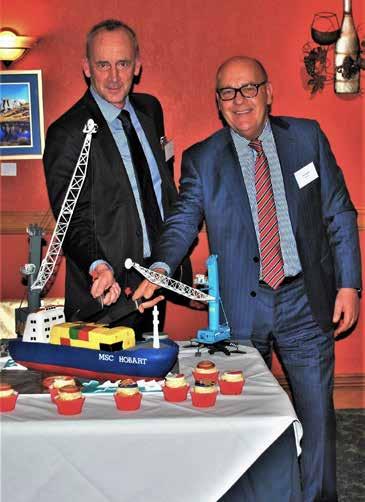
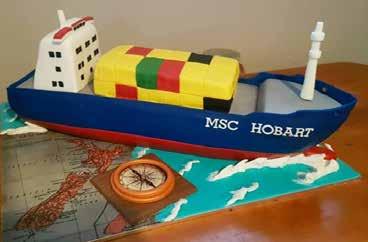
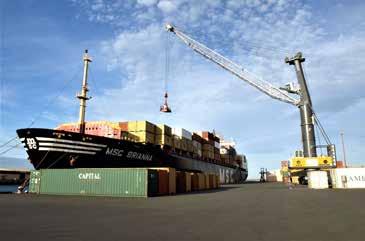
In preparation for the commencement of the Capricorn Service the MSC Edith visited Bluff in April 2008 and discharged empty containers to be filled with export cargo ready for the first sailing. On 24 May 2008 the MSC Hobart arrived in Bluff, exchanged 491 containers and departed, marking the inaugural sailing from Bluff on the Capricorn Service. Weekly sailings were established and as cargo quantities increased so did the size of the ships employed. To date the longest ships to visit Bluff were the Mare Britannicum and her sisters, all just over 260 metres long, the beamiest was the Lori at 37.3 metres and largest container exchange was made by the Bella in December 2015 when 1,524 containers were handled.
Anticipating the introduction of larger ships South Port sent its pilots to the Smartship facility in Brisbane where simulated transits in and out of Bluff were made in various weather conditions, by day and night, in container ships up to 275 metres long. Subsequent simulations increased the length to 290 metres. South Port also embarked on a continuing process of updating its container handling equipment.
To recognise the occasion, on 24 May, MSC and South Port jointly hosted 50 guests to celebrate the milestone in Invercargill. During the formalities Port General Manager, Geoff Finnerty, recalled the first load and discharge at Berth 8 saying it is a credit to all involved from within both companies, local importers and exporters who have supported the service to achieve the 10 year milestone. The event also acknowledged the retirement of MSC stalwart Kevin Inder who has been intimately involved with the Capricorn Service calling at Bluff over the past decade.
We now look forward to a second decade of the Capricorn Service and further developing our association with MSC.

►

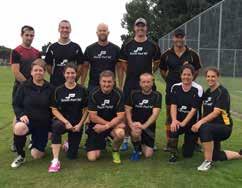
After a great effort in the 2016/17 Summer Football season playing in the Final, the South Port team came together again for the 2017/18 season which started in October 2017.
Hopes were high for another strong showing as the core group of players returned from last season along with some new signings.
Unfortunately the team ran a little hot and cold from the start of the season in October through to December, but after the Christmas break the squad clicked up a gear and came out striking!
The Portsider sat down with Team Manager and player Scott Faithfull to discuss some of the individuals who performed with distinction throughout the season.
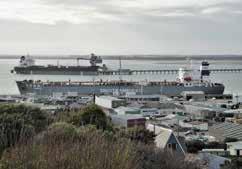
6 June proved a unique day in the history of the Port when two oil tankers were in port together discharging petroleum products.
While it is not particularly unusual for two tankers to be in port together, on previous occasions when it has happened one of them has been a chemical tanker, either loading tallow or discharging sulphuric acid, caustic soda or molasses.
On 6 June, however, we had the coastal tanker Kokako at Tiwai Wharf discharging fuel to the Smelter while at the Town Wharf the CSC Friendship was discharging product loaded in South Korea.
Hayden was like a brick wall as our Goal Keeper. He was always fearless and a wee bit scary at times!
Alistair was our “Mr Consistency” all season. He just got better with every game he played.
Our ladies, Courtney, Nicole, Di and Tania, always played a tough game, especially Courtney, who managed to knock a couple of the opposition lads over.
Alex, our rugby convert, took to football like a rugby convert. Once he got his shoulder charges under control, boy was he pretty to watch.
Then there was Frank and Josh. They were always pretty to watch and their football wasn’t bad either.
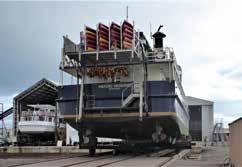
In our previous issue we mentioned the new repair shed under construction for Real Journeys adjacent to the South Port Syncrolift.
As the accompanying photograph shows, the doors are now open for business. In this particular case the business they are open for is the winter overhaul of the tourist vessel Milford Wanderer which is returning to her birthplace as she was constructed in the previous facility that occupied this area. Most of the Real Journeys’ fleet was built here in fact, so homecomings are frequent through the winter months, the off-season for Fiordland tourism.
The end of season awards went to:
• Alistair McKerchar – “Most Improved”
• Hayden Mikkelsen – “Most Valuable” Scott was quick to acknowledge that “while we did not reach the lofty heights as we did the previous season, we sure did have a lot of fun and will be all set to pull the ‘Game On’ trigger again in October 2018!”
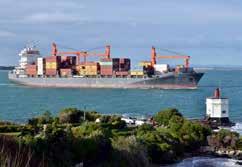
On 2 March the container ship Nordpacific arrived fresh out of the box, so to speak, as she was on her maiden voyage.
Completed by AVIC Weihai Shipyard for the Nord Group of Germany only a few weeks before her arrival here, she was the seventh of seven sisters built to the standard 5DARI 2500 design, indicating a TEU capacity of about 2,500 containers, many of which may be refrigerated.
Designated ‘Container Ship – Feedermax’ she is equipped with cranes, as this type of vessel often calls at ports that do not have their own. The first of the class, also named Nordpacific, was completed in 2015 but sold the following year and is now replaced with a newer version. Now that’s really taking fleet renewal to extremes.
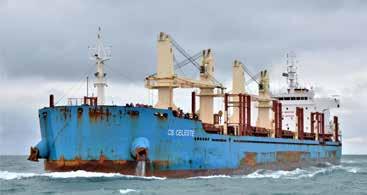
In February the bulk carrier Cascade arrived in Bluff but no record exists of her ever having left. Conversely, in that same month, the bulk carrier CS Celeste sailed from Bluff apparently never having arrived. Not really a mystery - they are one and the same, the Cascade having been renamed CS Celeste while in Bluff.
When she arrived the Cascade was under the management of Graig Shipping Plc (see page 8) but when she departed she had been handed over to her new owners who are Campbell Shipping, as the ‘CS’ prefix to her name reveals. (A brief history of Campbell Shipping appeared in our January 2015 issue). In fact a lot can usually be learned about a ship’s ownership from her name, a prefix often being the clue. When the company’s name is used, the ‘Stolt’ of Stolt tankers for example, it is a simple matter to determine ownership but initials are usually easy to work out. CS is mentioned here and MSC features strongly in this issue, with many using the company’s initials in this way when naming their ships, a nomenclature of which container companies are particularly fond. Nationality can sometimes be determined from a ship’s name, the ‘British’ prefix of BP’s tanker fleet being perhaps the most familiar use of this system nowadays.
Suffixes can be equally revealing. A ‘gracht’ suffix surely denotes Spliethoff ownership and if the name ends in ‘Arrow’ then she is likely one of the Gearbulk/G2Ocean fleet. Other names indicate function and Lauritzen’s ‘Bulker’ suffix gives a fair idea of ship type while themes are favoured by many, such
as the names of native birds in the coastal tanker fleet and the geographical names associated with their trading areas used by Pacific Basin.
So what’s in a name? – Quite a lot really.

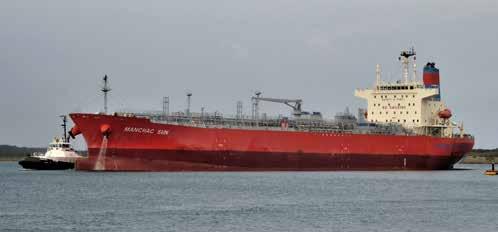
The year 2020 looms ever closer and with it the day when ships must either convert to low sulphur fuels or install equipment, generally known as ‘scrubbers’, to ensure discharges to atmosphere are within allowable limits, or use non-polluting energy sources to power their engines. One ship that is already far ahead of these requirements that are to be introduced was a recent visitor to Bluff, the products tanker Manchac Sun. As she approached there
was nothing to suggest that the inbound vessel was probably the most ecologically friendly ship to visit Bluff, but as she drew abeam the ‘POWERED BY METHANOL’ logo on her quarter became visible. Methanol is a cleanburning fuel virtually free of harmful atmospheric discharges and the managers of the Manchac Sun, Waterfront Shipping of Vancouver, Canada, has the largest single fleet of ships powered by it. This is not entirely surprising as Waterfront Shipping is a
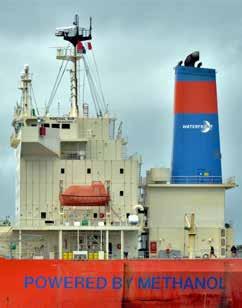
subsidiary of Methanex Corporation, the world’s largest manufacturer of methanol and owner of New Zealand’s two synthetic fuel plants. With her cleanburning fuel source the Manchac Sun projects a ‘clean, green’ image across the blue parts of our planet.
Back when Britannia ruled the waves, liners may have provided the glamour to its merchant fleet but it was the humble tramp steamer that supplied the backbone.
Britain was a major coal exporter in those days and a favoured trade for tramp ships was ‘coal out – grain home’, so naturally many tramp ships owners established themselves in the coal exporting centres such as Cardiff. Sole survivor of the numerous tramp ship companies once based there is Graig Shipping Plc.
Graig Shipping Company was incorporated in Cardiff on 15 July 1919 by five local businessmen. The name Graig was chosen for the new company as it means ‘Rock’ in Welsh, thus assuring prospective investors that the company was built upon a firm foundation. Among the founders only Idwal Williams had extensive shipping experience so when the company purchased its first ship, also named Graig, in October 1919 management was entrusted to the newly formed Idwal Williams and Company.
Born in 1884 Idwal Williams had gained his shipping acumen in the offices of the Bristol Steam Navigation Company and Furness Withy. His experience was to prove invaluable and ensure the survival of the company. In the immediate postwar years when Graig Shipping was founded, freight rates were at very high levels and it was a prosperous period for shipowners. Williams was shrewd enough to realise that this situation would not last and adopted a conservative management style. Graig Shipping was therefore in good shape to survive the
ensuing depression, which brought ruin to many others.
When war returned Graig had a fleet of two ships with one on order. Both existing ships were lost in 1940 while a replacement purchased in 1941 was also lost leaving the company with just the Graiglas, delivered in 1940, at war’s end, along with four steamers managed for the British Government.
Anticipating profitable trading conditions post-war Graig purchased three warbuilt ships from the Government and chartered a fourth while continuing to manage two others. A new colour scheme was now adopted with the hulls green rather than black and the formerly black funnels now white with a black top but still with the white over green bands derived from the Welsh national flag with a red letter G replacing the Welsh dragon. In 1952 the company acquired the Basra Steam Shipping Company Limited, of London and included in the purchase was the virtually brand new Sherbourne which became the first motorship in the fleet and its third Graig when she was so renamed. On 7 February 1954 she also became the first ship owned by Graig Shipping to visit Bluff. A momentous occasion for the company was the delivery of its first bulk carrier, the Graigwerdd, in August 1964, over twice the size of any previous ship owned and so successful that the remaining conventional ships were soon sold; only bulk carriers being built for the company thereafter.
Idwal Williams died in 1971 and was succeeded by his son, Desmond, who
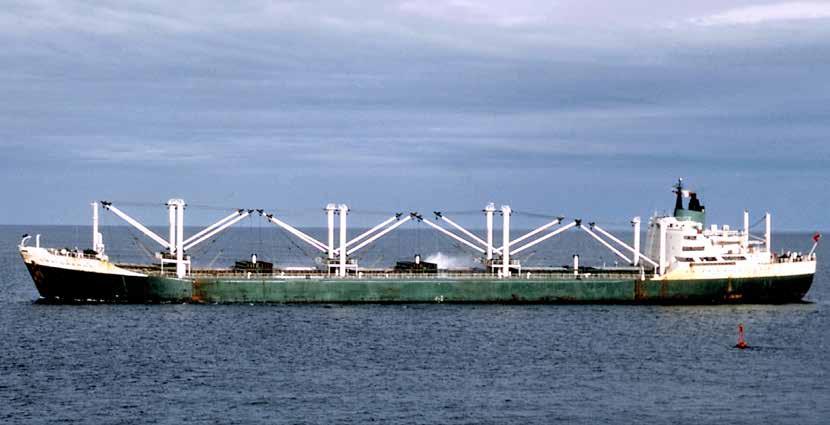
The Graigwerdd inbound for Bluff in February 1972
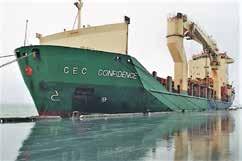
diversified the company into a number of non-maritime activities. When he was succeeded in turn by Hugh Williams, grandson of Idwal, in 1993, the nonmaritime activities were disposed of and Graig Shipmanagement established. This resulted in a partnership with Clipper Elite Carriers to manage some of a fleet of fourteen multi-purpose ships being built in China. One of these was the CEC Confidence, illustrated here. Through its office in China, Graig also oversaw the construction of the Diamond 53 series of bulk carriers for which orders valued at over $2.75 billion were placed, and many others since. Graig Shipping Plc, operating as a subsidiary of Idwal Williams & Company, today offers a wide range of services including ship design, construction supervision, financing and ship management, the most recent ship managed by the company to visit Bluff being the Cascade (see page 7). Last year Graig Ship Management was acquired by VShips, a leading ship management company and another whose ships are familiar in the Port of Bluff.