CLIMATE-RELATED DISCLOSURES
YEAR ENDED 30 JUNE 2024

YEAR ENDED 30 JUNE 2024
As a Climate Reporting Entity (CRE) under the new Aotearoa New Zealand Climate Standards, South Port is publishing our first Climate-Related Disclosures (CRD) and extending our environmental reporting from previous Annual Reports. These CRD comply with the Aotearoa New Zealand Climate Standards (NZ CS) 1, 2 and 3 issued by the New Zealand External Reporting Board.
South Port is developing its capacity to comprehend and respond to the challenges that our business faces from climate risks. The main accomplishments in the reporting period from 1 July 2023 to 30 June 2024 are:
ͩ Recruiting a Climate Change Advisor on a fixed-term basis to increase our internal capability.
ͩ Conducting our first scenario analysis to understand the impacts of climate change.
ͩ Further improving and broadening our Greenhouse Gas (GHG) inventory, especially for Scope 3 emissions.
In preparing South Port’s CRD, the Board and Management have elected to use the following Adoption Provisions in NZ CS 2:
ͩ Adoption provisions 1 and 2: Current and anticipated financial impacts. A qualitative description of certain anticipated financial impacts has been provided.
ͩ Adoption provision 3: Transition planning. South Port is progressing towards developing our transition plan, which includes consideration of how we reduce future GHG emissions and integration of the impact of climate risks for all significant investment decisions and intends to progress this in FY25.
ͩ Adoption provision 6: Comparatives for metrics (including Scope 3 GHG emissions in Year 1). Our GHG inventory includes all relevant emissions sources. However, we have enhanced our methodology for Scope 3 emissions. Therefore, we do not provide comparatives for Scope 3 in this report or comparatives for other metrics.
ͩ Adoption provision 7: Analysis of trends.
Important Note:
South Port has used reasonable efforts in the preparation of this CRD to provide accurate information, but cautions reliance being placed on representations that are necessarily subject to significant risks, uncertainties, or assumptions. This report contains forward-looking statements, including climate-related metrics, climate scenarios, assumptions, estimated climate projections, forecasts, statements of South Port’s future intentions, estimates and judgements that may not evolve as predicted. These statements necessarily involve assumptions, forecasts and projections about South Port’s present and future strategies and South Port’s future operating environment.
Such statements are inherently uncertain and subject to limitations, particularly as inputs, available data, and information are likely to change. South Port has sought to provide a reasonable basis for forward-looking statements and is committed to progressing our response to climate-related risks and opportunities over time but is constrained by the novel and developing nature of this subject matter. Climate-related risk management is an emerging area and often uses data and methodologies that are developing and uncertain. Climaterelated forward-looking statements may, therefore, be less reliable than other statements South Port may make in its annual reporting.
We have based these statements on our current knowledge as at 30 October 2024. There are many factors that could cause South Port’s actual results, performance, or achievement of climate-related metrics to differ materially from that described, including economic and technological viability, as well as climatic, government, consumer, and market factors outside of South Port’s control. South Port disclaims responsibility for any loss suffered in reliance on these CRD. Nothing in this report should be interpreted as capital growth, earnings, or any other legal, financial, tax, or other advice or guidance.
Signed on behalf of South Port New Zealand Limited:
Philip Cory-Wright Chair
30 October 2024
Nicola Greer Chair, Audit & Risk Committee
30 October 2024
Climate risks & opportunities are a standing item at Board Audit & Risk Committee meetings.
Papers
Strategies, metrics and targets Climate Risk and Opp Register
The Board of Directors oversees how the Company identifies and handles climaterelated risks and opportunities. This includes setting the risk appetite and tolerance, and approving South Port’s strategy, any future targets, and controls for responding to climate change.
The Board’s Audit and Risk Committee is responsible for the Company's response to climate-related risks. This committee meets at least twice a year, with climate-related risk as a standing agenda item. The Audit and Risk Committee met three times during FY24.
The Board delegates the overall responsibility of managing risk to the CEO. Directors are responsible for their own continuous education and to keep themselves up to date on relevant climate-related issues that may affect the Port. The Board itself is responsible for incorporating specific skill and knowledge requirements into management positions that ensure competency to deal with climate-related risks and opportunities. An external party was engaged to deliver CRD training to the Board during FY24.
The Board requires the Executive Leadership Team (ELT) to provide all relevant information to them and to engage external experts where required knowledge is not available within the organisation.
The CEO, CFO, and the Infrastructure & Environmental Manager take responsibility for assessing and managing climate-related risks and opportunities at ELT level, supported by the Risk and Technology Manager. We are currently recruiting for a Sustainability Advisor who will report to the Infrastructure & Environmental Manager.
The ELT submits updates to the Board as appropriate, which are included in the monthly board papers along with the climate risk and opportunity register. The ELT has to date informally considered risks and opportunities related to climate change as part of its business-as-usual operations, including consideration of plans, metrics and initiatives developed by the relevant Departments and the Sustainability Committee. This is the primary mechanism by which management is informed about, makes decisions on, and monitors, climate-related risks and opportunities. The Sustainability Committee meets at least nine times a year, with these meetings aligned with the ELT meetings. Work undertaken by the Sustainability Committee is presented to the Board by the ELT for review, discussion, and approval. This includes metrics for managing climate-related risks and opportunities. The CEO and ELT evaluate any new or amended business strategy with reference to the climate risk and opportunity register, and this analysis is submitted to the Board where the potential impacts of the risk or opportunity are considered material. In the reporting period, there were at least 14 occasions where the Board engaged with the ELT on climate-related issues.
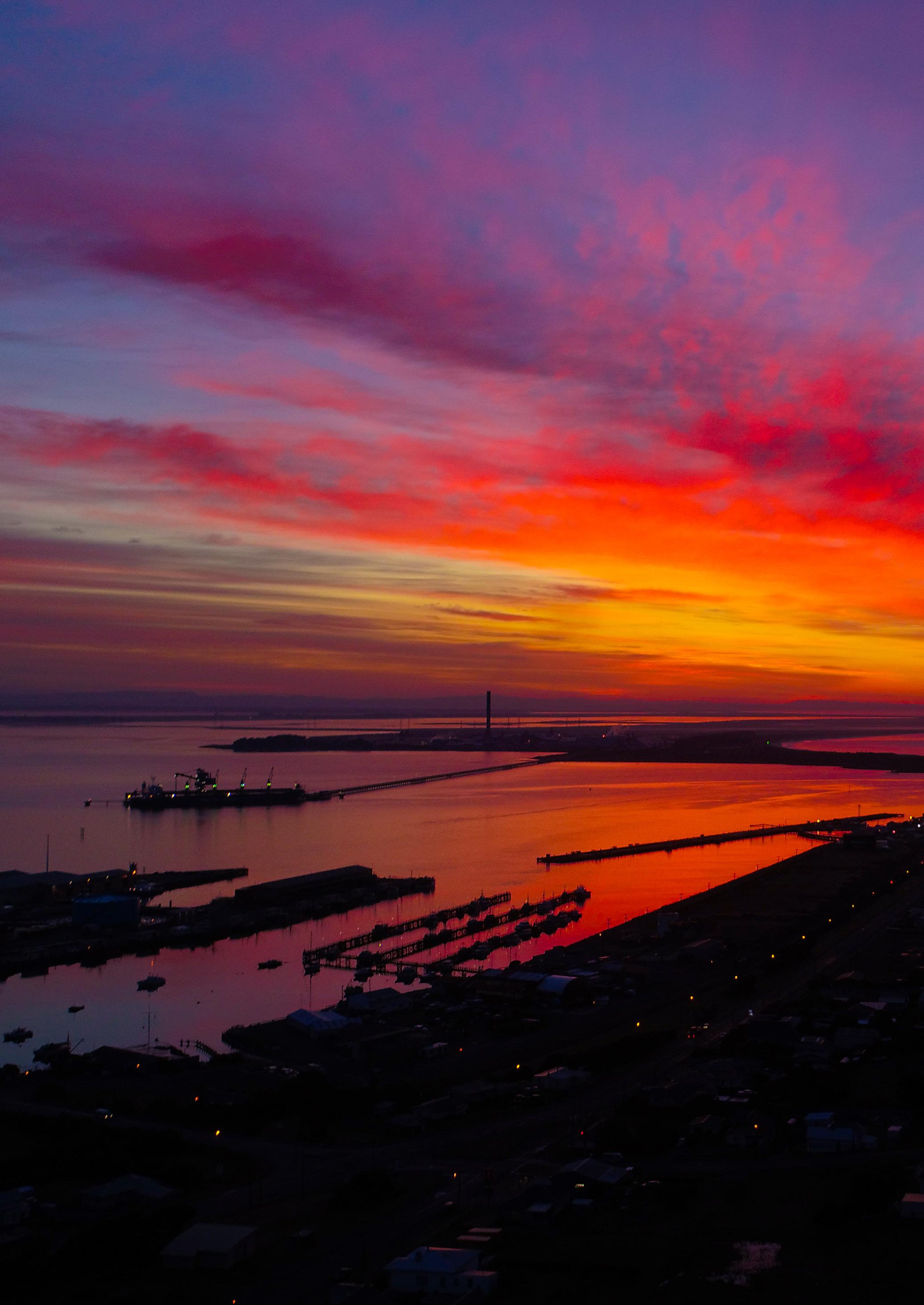
South Port’s purpose is to facilitate the best logistics solutions for the region. We achieve this through the provision of wharf infrastructure, warehousing, marine, and cargo handling activities, while developing and influencing optimal logistics solutions along the supply chain with port linkages. Owing to the long-term nature of infrastructure, the Port has generally made decisions with a long-term view. Over the last few years, we have invested in building our capabilities to understand and manage climate change risks and opportunities and will look to integrate the insights into our future processes. Although the world has started to see the impacts of climate change, South Port has not experienced any material impact to our operations to date.
In the 2023 - 2024 reporting year, we employed a Climate Change Advisor for a fixed-term and conducted a qualitative study on the effects of climate-related forces on our strategy and value chain. The scope of the analysis was focused on the Port’s immediate geographic terrain and the domestic trade structure.
This allowed an investigation of the core physical exposure, and the exposure to a shift in domestic economic structure for the timeframe of 2024-2050. This study was conducted internally without the specific involvement of external stakeholders as a standalone piece of work, but the results were assessed against South Port’s risk management processes to ensure a consistent approach was taken.
This process included an initial climate-related risk assessment, including scenario analysis. The assessment involved collaborative workshops with internal stakeholders, including the ELT and other relevant roles. Outcomes from the workshops included establishing the scope and boundaries of the risk assessment. This included determining value chain inclusions, time horizons, frequency of assessment, and identifying key risk areas.
The Board had the opportunity to participate in and view recordings of scenario analysis workshops undertaken. These were conducted by the Climate Change Advisor and overseen by the CFO. No external stakeholders or partners were involved in the scenario analysis process. The scenario analysis technical report highlighting the projected impacts of climate-related forces was then shared with the Board for their feedback.
To create different scenarios for the Port, we followed a series of steps based on 15 factors that affect the Port's operations and environment. These factors include social, technological, legal, political, economic, and environmental aspects. We used these factors to create narratives that show how the Port could be affected by different situations in the future. We looked at the whole system that the Port is part of, not just one part of it. We also considered that the factors were broad enough to cover different levels of change, from global to local.
South Port opted for three scenarios as per the overview in the table below. The 'Orderly' (Net Zero 2050) scenario has an emphasis on transition risks which we are specifically exposed to through the clients using our port. Conversely, the 'Hot house' (Current Policy) scenario focuses on physical risks that affect us significantly as we are a key part of the region's infrastructure with assets that inherently have a long lifespan. The 'Disorderly' (Delayed Transition) scenario is the third climate-related scenario and shows a mix of both transition and physical risk.
The adopted scenarios were preferred for two reasons: First, the scenarios expose South Port’s business model to maximum plausible physical/transitional risks and thus explore South Port’s strategic resilience to both abrupt and systemic manifestations of climate-related forces. Such an experimental exposure provides an optimal tool to stress-test South Port’s business and processes. Secondly, the scenarios maximise intra-sectoral alignment and comparability within the sector, as the generated scenario narratives closely align with the transport sector-specific scenarios developed by the consultancy firm KPMG, in partnership with the Aotearoa Circle, in direct collaboration with primary sectoral stakeholders. As a result, South Port’s generated scenarios are not only specifically tailored for maximum and targeted applicability to South Port’s business model, but are also aligned with the transport sector scenarios.
The scenarios adopted covered all of South Port’s operations.
SHORT-TERM Now - 2030
MEDIUM-TERM 2031 - 2040
LONG-TERM 2041 - 2050
Aligns with the remaining useful life of some critical assets. Additionally, it is indicative of the NZ Government’s level of decarbonisation ambition.
Aligns with the lifecycle of our assets and corresponds with the timeframe when dynamics of a dominant scenario will be materially entrenched.
Long-term horizon out to 2050 aligns with international emission reduction targets (Paris Agreement, 2050). It represents the last stage of total institutionalisation of preceding legislative/economic/policy dynamics.
These timelines are linked to our strategic planning horizons for capital expenditure. Small land-based mobile plant and equipment are aligned with shorter to medium timeframes whereas larger land based, and floating plant are medium-to longer-term focused. Our asset management plan and property masterplan are key documents that align with both the medium- and longer-term horizons.
The time horizons set out for scenario analysis are also aligned to the time horizons used for the risk identification.
Pathways
RCP2.6
SSP1-1.9
NGFS Net Zero 2050
RCP2.6
SSP1-2.6 NGFS
RCP8.5
SSP3-7.0
Policy Reaction
Physical
Transition
Freight
This scenario depicts a rapid and ambitious transition to a lowcarbon future, driven by strong societal demand for climate action and international cooperation on climate policy. The pathway to Net Zero 2050 involves an initial burst of activity to decarbonise society and the economy, followed by sustained efforts to maintain low emissions across all sectors. Renewable energy sources, energy efficiency, and afforestation are key enablers of this transition.
Domestic freight is assumed to shift increasingly towards coastal shipping and rail, which directly affects our business. The global shipping industry leans heavily towards using synthetic fuels, such as green ammonia, which are produced from renewable electricity. These fuels have the potential to offer a cleaner and cheaper alternative to fossil fuels and could reduce the dependence on oil imports. The structure of cargo flowing through South Port is altered, with lower agricultural output from Southland due to land use changes and reduced import of petrol-based products.
Business as usual is assumed to persist until the effects of climate change and the social responses become unavoidable. A series of severe climate disasters in major economies triggers a sudden and radical shift to a low-carbon world. Many businesses that are not resilient or strategically exposed to climate risks collapse under financial and legal pressure. After the shock, the economy gradually recovers in the new paradigm.
The freight sector is constrained by a lack of modal diversity and high operational costs due to expensive alternative fuels. The production of primary industries based on conventional agriculture and forestry is drastically reduced. The Port faces a dramatic change in cargo volumes.
The world continues to rely heavily on fossil fuels and greenhouse gas emissions keep rising. The global average temperature increases with severe consequences for the climate system and human society. Domestically, the mixture of internal economic pressures and international inaction ensures that climate mitigation policy is not pursued. Occasional severe climate events are more potent and support the drive toward climate adaptation measures.
While the change in weather patterns reduces the output of the agricultural sector in some geographies, Southland’s primary industries are not critically impacted. Together with a stable domestic economic structure, cargo volumes increase at the Port.
* South Port’s Disorderly and Hot House scenarios did not expressly include carbon sequestration from afforestation or nature-based solutions, as anticipated by NZ CS 3, paragraph 51(a)(iii)
South Port is not aware of any current material climate-related physical or transition impacts. The material climate-related risks and opportunities identified in South Port’s scenario analysis process to date, together with anticipated impacts, are listed in the table below.
Climate-Related Risks and Opportunities (Anticipated Time Horizon)
Increased sea level rise and rainfall results in disruption to on-land freight routes (roads, bridges, railways) that connect the Port to Southland.
Medium/Long-term
Sea level rise, storm and tide surges impacting operations and damaging ships, infrastructure and equipment.
Medium/Long-term
An increase in the number of high-wind days, that disrupt land-based and marine activities.
Medium/Long-term
Increasing cost of carbon associated with fossil fuel taxes.
Medium/Long-term
Increased insurance premiums, larger excesses, and reduced scope of coverage.
Medium/Long-term
Industrial and commercial demand for diesel decreases in Southland and regional wood producers in Southland and Otago divert wood exports for local consumption as biomass for process heat.
Medium/Long-term
Increasing costs of commercial farming of ruminants drives down regional production of meat and dairy. Demand for fossil fuels and farming inputs (like fertiliser and stock food) decreases. Decrease in yields across regional forestry and agriculture as a result of climate-related impacts.
Medium/Long-term
A delay in transitioning and increased demand for low carbon machinery, impacts on supply and drive increased costs.
Medium/Long-term
National policy settings and Government investment drive an increase in coastal shipping’s share of domestic freight movement.
Medium-term
Large-scale infrastructure climate resilience projects and large-scale rebuilds from climate-induced extreme weather events drive a significant increase in building and construction material imports.
Medium-term
Represents time (short/medium/longterm) KEY
Anticipated Impact
Increase in the number of times, and the length of the periods, in which South Port cannot offload or receive cargo, operational inputs or staff due to transit routes being unavailable.
Represents potential impact over short/ medium/long-term timeframes
Anticipated Financial Impact (Qualitative)
Shift in type of cargo and cargo volumes with lower imports of diesel and agricultural inputs and lower exports of meat, dairy products and wood.
Shift in capital allocation to invest in endof-trip infrastructure for alternative fueling, like hydrogen, bioenergy, or diesel-electric hybrid.
Reduced revenues as port operations are disrupted.
Significant costs of repairs and operational downtime.
Proposed Business Response
Increase in coastal shipping, exports from seafood and imports due to higher economic activity in the region.
Increased insurance costs and potential stranded assets.
Reduced revenues due to fewer port calls. Increased capital expenditure to transition to low carbon equipment.
South Port intends to integrate GHG emissions consideration in significant capital investment decisions.
Higher revenue from increasing number of port calls.
Intention to adopt strategies to build resilience into the supply chain.
South Port intends to work with customers and other external parties to determine future infrastructure requirements to take advantage of increased cargo throughout.
This table summarises South Port’s approach to climate-related risk management which is integrated into the Company’s overall risk management processes.
Identify high-level risk hotspots and drivers along value chain
For all potential risks, we identify where, when, why, and how, the potential risk could prevent the achievement of strategies, plans, and objectives.
We allocate the risk to one of the nine risk categories, which allows us to identify risk hotspots including fuel technologies, predicted weather patterns, emerging or contracting markets, or new regulation.
Internal and external stakeholders are consulted where relevant to ensure wider context is understood and all risks are identified.
IDENTIFY
Carry out initial screening of potential risks
Carry out formal assessment to determine risk
Potential risks are submitted to South Port's Climate Risk and Opportunity Register and then evaluated as to: the type of risk and its driver; how the risk may present itself in South Port’s context; the potential financial impact; the likelihood of impact and the expected time horizon; and any assumptions or sources of information used in the assessment.
Risks that are rated as 'low' do not require any further action except to record and monitor. For inherent risks rated other than low, controls are put in place to address the risk. Controls are categorised as either preventative, detective or corrective controls.
The Company’s Risk Impact Matrix has been updated to incorporate an additional risk category, Climate. This category includes assessment criteria relating to the potential impact a climate-related scenario would have on our assets, and the timeframe of impacts materialising. The assessment assists us to proportionately assess climaterelated risks against the Port’s other material risks.
Screened risks are rated on a scale from Low to Extreme.
Depending on the context, the evaluation may require engagement with specialised external experts, predictive modelling, engagement with stakeholders in the value chain linked to the hazard, etc. This is a judgement call for the ELT in conjunction with the Board. All climate-related risks are assessed using the Company's Risk Management Framework, with the top risks being included in the Material Risk Register for consideration by the Audit and Risk Committee.
This risk assessment aligns to the current business risk framework at South Port. The ELT complete inherent risk assessments for all risks identified, rating the likelihood and impact of the various risks. Key controls and mitigation processes are then noted, resulting in a residual risk score. The Material Risk Register is then reviewed and approved by the Board.
Identify potential adaptation measures
Risk treatments are identified to mitigate the risk to a tolerable level. Internal and external stakeholders should be consulted where relevant.
Carry out financial analysis
Develop implementation and review plan
All major capex spend requires financial analysis to be completed prior to approval. South Port uses a weighted average cost of capital (WACC) model to ensure that capital deployment meets internal hurdles before proceeding with new projects. Future modelling will need to formally incorporate climate-risk analysis into the decision-making process. Currently South Port does not apply an internal carbon price in this process or track capital deployment specifically to address climate risks, but South Port intends to investigate the use of an internal carbon price in FY25.
Future capital deployment decisions are expected to include climate-risk relating to adaptation (e.g. preparedness for extreme weather events), and also mitigation (e.g. considering carbon emissions linked to purchasing new equipment).
Further treatment actions are determined in order to mitigate the risk. Actions are documented to enable monitoring. Business unit managers are appointed to identify, implement and monitor controls and their effectiveness in mitigating risks. The Audit and Risk Committee has overall responsibility to ensure that risk management strategies and policies are implemented and managed appropriately, including supporting the annual review of risks and management approaches. South Port is planning to develop its transition plan to respond to identified climate-related risks and opportunities over the coming year.
Monitoring of climate-related risks is undertaken annually to refresh our climate-related risk assessment and ensure the risk remains within tolerable levels and the controls and treatments remain effective.
During the review, the effectiveness of the controls is assessed and depending on the operating effectiveness rating, the control assessment frequency is set.
South Port applies an operational control approach to consolidate GHG emissions. That means South Port accounts for 100% of the GHG emissions from operations over which it has the full authority to introduce and implement operating policies.
South Port only has one subsidiary, Awarua Holdings Ltd, which is 100% owned by the Port. There are no GHG emissions associated with Awarua Holdings that are not captured directly by the Port's activities.
South Port began measuring its GHG emissions in 2019, focusing mainly on Scope 1 and 2 emissions. Over time, we have improved the methodology for collecting and calculating Scope 3 emissions to cover our value chain. In this context, the 2024 inventory (July 2023 to June 2024) includes new categories that reflect the completeness of emissions that can be attributed to the organisation's operations within the declared boundary.
The inventory has been prepared in accordance with the Greenhouse Gas Protocol: A Corporate Accounting and Reporting Standard 2004 (GHG Protocol), the Greenhouse Gas Protocol: Corporate Value Chain (Scope 3) Accounting and Reporting Standard, with guidance provided by the Greenhouse Gas Protocol: Technical Guidance for Calculating Scope 3 Emissions (version 1.0) (Technical Guidance).
The emission factors (EFs) applied for the calculation are mostly referenced to "Measuring emissions: A guide for organisations: 2023 summary of emission factors" (MfE 2023). For those Scope 3 categories not addressed by the MfE, the United States Environmentally-Extended Input-Output model, by US EPA (calculations via GZA Scope 3 Calculator workbook) was applied to calculate emissions based on expenses (mainly Categories 1 and 2), and the "Conversion factors 2023" from the United Kingdom's Department for Energy Security and Net Zero, for Well-to-Tank (WTT) and recycling factors.
To ensure the consistency of the approach adopted (Operational Boundary), South Port excluded the following sources of Scope 3 emissions:
› Category 8 Upstream leased assets: South Port did not lease any assets in FY24.
› Category 9 Downstream transportation and distribution: South Port did not sell any products in FY24.
› Category 10 Processing of sold products: South Port did not sell any products in FY24.
› Category 11 Use of sold products: South Port did not sell any goods or services in FY24 that generated emissions not captured by Scope 1 and 2.
› Category 12 End-of-life treatment of sold products: South Port did not sell any products in FY24.
› Category 14 Franchises: South Port does not have franchises.
› Category 15 Investments: South Port did not make any investments or provide financial services in FY24
SCOPE 1
Direct GHG emissions occurring from sources that are owned or controlled by the Company (e.g. fuel).
SCOPE 2
Indirect GHG emissions occurring from the generation of purchased electricity consumed by the Company.
SCOPE 3
Other indirect GHG emissions occurring as a consequence of the activities of the Company, but generated from sources not owned or controlled by the Company (e.g. air travel).
South Port is yet to establish any GHG emissions reduction targets. We also do not currently use industry-specific indicators to track climate-related risks and opportunities. However, we may refine our approach in the future as the Port sector in New Zealand is currently working together to draft sector guidance for future use.
Without having undertaken any formal vulnerability assessment as required by the Climate Standards, South Port’s current working assessment is that, under a hot house scenario, up to 100% of our assets and business activities could be vulnerable to climate-related transition and physical risks. South Port intends to undertake work to better understand these vulnerabilities in FY25.
Climate change may also present opportunities. South Port has not yet quantified any anticipated impacts of these opportunities.
No assets or business activities were specifically aligned with
climate-related opportunities during FY24.
In relation to capital deployment, management informally considers climate risks and opportunities when undertaking capex projects, for example, the impact of sea level rise when preparing drainage designs at the Port. However, there was no capex spend undertaken in FY24 that relates specifically to the climate-related risks and opportunities identified as part of the scenario analysis.
South Port currently does not have an internal carbon emissions price.
No management remuneration was linked to climate-related risks and opportunities for the year ended 30 June 2024.
No assurance has been provided over GHG emissions in FY24. South Port adopted procedures using external advice for assessing the methodologies and assumptions in South Port's carbon inventory collation processes. These procedures were followed in FY24, and provide a strong foundation for FY25 when assurance is required for GHG emissions.