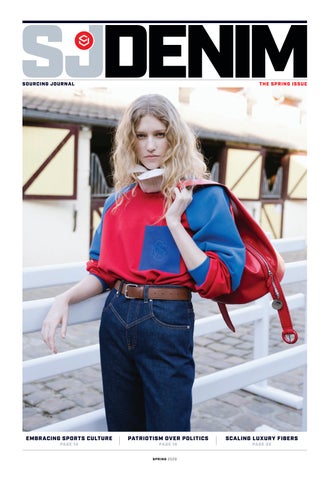
SJ Denim Spring 2026

Page 1


THREADS OF RESILIENCE

For many, a year marked by tariff uncertainty, rising shipping costs and broader economic anxiety has all but drained the joy from designing, making, selling and buying denim. These pressures have seeped into personal lives as well, tightening budgets and adding a constant undercurrent of strain. While dopamine dressing offered a lift during the pandemic blues, it feels far less effective in the face of today’s challenges.

And let’s be honest—these pressures haven’t just appeared overnight; they’ve lingered for seasons, even years. At times, it can feel absurd to dwell on them when the world outside is so volatile—when conflicts ignite overnight and moments of violence and fear disrupt everyday life. It’s a reality Los Angeles’ garment workers have already faced, as ICE raids disrupted both their work and home lives last year. “On Thin Ice” on pg. 23 examines how the community remains resilient and diligent amid ongoing immigration tensions.

The denim industry, as always, responds to challenges by adapting, pivoting, mitigating and other popular language of earnings calls. But beneath the corporate script lies a simpler truth: those who endure are the ones who must learn to do more with less. It’s no surprise, then, that more companies are turning to AI to bridge knowledge gaps. “Support System” on pg. 10 explores how new technology is being applied to streamline weaving, sourcing and garment finishing workflows.

Amid these difficulties, cultural events like sports become a moment for respite. The U.S. is entering one of its most sport-saturated periods in years and nowhere is this momentum more concentrated than in the denim industry’s U.S. hub, L.A. “Go Sports!” pg. 14 dives into the ways denim brands can tap into local and global sports culture to create moments of joy and brand loyalty.

The U.S. Semiquincentennial could have a similar impact—if brands navigate the fine line between politics and patriotism. In “Party in the USA” on pg. 18, marketing experts share tips on weaving denim’s American heritage into storytelling in a way that remains engaging yet non-partisan. Like the results of a game or the future of a nation, the denim industry’s future may feel uncertain, but it’s also full of opportunity for those willing to reimagine its story.

EDIT OR IAL

Peter Sadera Editor in Chief, Sourcing Journal Angela Velasquez Executive Editor

Malik Chua Climate & Labor Editor Kate Nishimura Deputy Editor

Taylor Logistics Editor Alexandra Harrell Sustainability & Innovation Reporter

Sarah Jones Senior Editor, Strategic Content Developmen ART DEPARTMENT

Mariya Ivankovitser Senior Design Director

Case Senior Designer

Krakora Designer

PRODUCTION

Adeline Saez Production Manager Betty Dong Production Manager

FAIRCHILD MEDIA GROUP

Amanda Smith Chief Executive Officer James Fallon Chief Content Officer

Michael Atmore Chief Brand Officer

ADVERTI SI NG

Melissa Rocco Senior Vice President, Sales

Jennifer Petersen Fashion and Luxury Advertising Director Sherry Maher Beauty Advertising Director

Samantha Rumsky Footwear Advertising Director

Stacey Lakind West Coast Director

Katherine Hogan Account Manager, Tech Maggie Wisniewski Junior Sales Associate, Footwear and Beauty Courtney Kern Manager, Digital Campaigns

Kyle Basarab Digital Specialist

IN TER N ATI ONAL OFFICES

Olga Kouznetsova European Director, Italy

Giulia Squeri European Director, Italy

Elisabeth Sugy Rawson European Director, France

M ARKE TING

William Gasperoni Vice President

Christine Staley Senior Director, Marketing & Fairchild Studio

Sara Shenasky Head of Client Activation

Barbra Leung Director, Integrated Marketing Alexa Dorfman Senior Marketing Manager

Kayla Gaussaint Associate Integrated Manager

OPERATIONS

Ashley Faradineh Executive Director, Operations

Emanuela Altimani Senior Sales Coordinator

PENSKE MEDIA CORPORATION

SOURCING JOURNAL IS OWNED AND PUBLISHED BY PENSKE MEDIA CORPORATION

Jay Penske Chairman & CEO

Gerry Byrne Vice Chairman

Craig Perreault Chief Digital Officer

George Grobar Chief Operating Officer

Sarlina See Chief Accounting Officer

Ryan Young Chief Security Officer

Todd Greene EVP, Business Affairs & Chief Legal Officer

Jenny Connelly Chief Digital Officer

Judith R. Margolin Executive Vice President, Deputy General Counsel

Tom Finn Executive VP, Strategy and Operations

Ken DelAlcazar EVP, Finance

Brian Levine Senior Vice President, Revenue Operations

Brooke Jaffe Senior Vice President, Public Affairs & Strategy

David Roberson Senior Vice President, Subscriptions

Frank McCallick Senior Vice President, Global Tax

Gabriel Koen Senior Vice President, Technology

Jerry Ruiz Senior Vice President, Oprations & Finance Deputy General Counsel

Karen Reed Senior Vice President, Finance

Lauren Utecht Senior Vice President, Human Resources

Marissa O’Hare Senior Vice President, Business Development

Nelson Anderson Senior Vice President, Creative

Andrew Root Vice President, Digital Marketing

Andy Limpus Vice President, Executive Search & Head of Talent Acquisition

Angelo D’Agostino Vice President, Human Resources

Anne Doyle Vice President, Human Resources

Brian Vrabel Head of Industry, CPG and Health

Constance Ejuma Vice President, Content Performance & Analytics

Courtney Goldstein Vice President, Human Resources

Dan Gerber Vice President, Strategic Partnerships

Danielle Levine Vice President, Associate General Counsel

Eddie Ko Vice President, Advertising Operations

Eugenia Miranda Richman Vice President, Editorial Innovation

Gurjeet Chima Vice President, International Markets

Hector Nino Vice President, Human Resources

Joni Antonacci Vice President, Production Operations

Josh Qualy Vice President, Programmatic Sales

Karl Walter Vice President, Content

Keir McMullen Vice President, Human Resources

Lise Berichel Vice President, Associate General Counsel

Matthew Reed Head of Industry, Automotive Sector & DS Penske Autosport Team

Richard Han Vice President, International Sales

Scott Ginsberg Head of Industry, Performance Marketing

Sonal Jain Vice President, Associate General Counsel

Tim Chan Vice President, E-Commerce

Tom McGinnis Vice President, Corporate Controller

Denim

that doesn't pretend, only evolves with YOU

Denim is a force in Fall/Winter 2026-2027 collections.

The denim industry is beginning to embrace the workflow benefits of artificial intelligence.

Triarchy co-founder and CEO Adam Taubenfligel remains steadfast in his commitment to sustainable production.

Denim brands are adding sports licensing and league partnerships into their strategic playbook.

The U.S.

Latinos are shaping U.S. culture, and brands can’t afford to look away.

Immigration crackdown scars Downtown Los Angeles’ Fashion District.

Denim imports show glimmer of promise amid overall apparel slump.

At

designers

INNOVATION MEETS IMPACT: HOW SOKO’S HYDROGEL IS REDEFINING DENIM’S CHEMISTRY

FFROM INDIGO DYEING to fading, denim’s iconic look and feel relies on chemistry. But while the signature aesthetics of jean treatments have held steady, the solutions and techniques used are shifting as the industry seeks to reduce its footprint.

Florence, Italy-based chemical company and research lab Soko Chimica is innovating denim processes to reduce water, chemical and energy consumption while also supporting operational efficiencies and product quality.

Here, Luca Braschi, marketing and technology manager at Soko, shares how the company is shifting water’s state for streamlined washing and cultivating a “collaborative ecosystem” for supply chain-wide developments.

SJ DENIM: The denim industry has long focused on reducing water impact. Why is Soko’s Hydrogel a game-changer in this area?

Luca Braschi: While traditional sustainability efforts usually focus on tweaking chemical formulas, Soko has reimagined the most fundamental element: water itself. By transforming water into a high-viscosity gel, we’ve created an entirely new treatment environment.

Hydrogel is a simple “one product, one process” solution that delivers the coveted stonebleached effect in a single bath. By collapsing an eight-step process into just one, we save up to 85 percent of water consumption while also eliminating the redundant rinses, heating cycles and refills that characterize traditional manufacturing.

It’s not just a product; it’s a radical simplification that delivers up to 50 percent time savings and a drastic reduction in energy consumption. A game-changer truly becomes real when it also provides clear economic benefits and boosts productivity.

How does this gel environment support durability and expand product development opportunities in denim?

L.B.: In conventional washing, water acts as a deep-penetrating medium that causes mechanical stress and loss of fabric strength. Hydrogel introduces the “protective bubble” concept. The high-viscosity gel ensures that active ingredients work primarily on the surface, preserving the core of the fiber. This move from aggressive washing to intelligent finishing results in stronger, longer-lasting denim. Because we minimize fiber degradation, Hydrogel opens the door for a wider range of sustainable or delicate fibers—such as Tencel™ or recycled blends—that previously struggled to withstand the rigors of traditional heavy bleaching.

How is Soko accelerating innovation through its Projects Division?

L.B.: The Soko Projects Division is not just a support function; it is a central R&D hub where the entire supply chain comes together. By connecting brand designers, fabric mills and garment manufacturers, we foster a collaborative ecosystem that enables the development of tailor-made projects aligned with each client’s specific needs. Fabric development and finishing expertise converge, unlocking both creative and technical opportunities that a fragmented supply chain would not be able to achieve.

This integrated approach ensures that innovation is embedded into the garment from the very beginning— starting at the fiber level. We don’t simply deliver a product; we offer a dedicated platform for experimentation, technical development and continuous support throughout the entire production process.

Could you share a success story from your Projects Division?

L.B.: Over the past few years, the Projects Division has provided targeted solutions that elevate the sustainability standards of manufacturing, resolve process challenges, explore innovative techniques to enhance fabric performance and inspire designers with creative collections.

“A GAME-CHANGER TRULY BECOMES REAL WHEN IT ALSO PROVIDES CLEAR ECONOMIC BENEFITS AND BOOSTS PRODUCTIVITY.”
LUCA BRASCHI , marketing and technology manager, Soko

The recent collaboration between Soko, Adriano Goldschmied and fabric mill Pioneer Denim has had a significant impact on the Projects Division’s ability to generate sustainable and creative synergies. Goldschmied created the concept and design, while the fabric— featuring a cotton-wool blend— was exclusively developed through the craftsmanship of Pioneer Denim. Soko applied finishing treatments using Hydrogel technology to preserve the fabric and achieve vintage wash effects, significantly reducing water consumption and enhancing the overall sustainability footprint.

What is on the horizon for Soko?

L.B.: Our business is constantly evolving, and it is essential to keep up with these changes. In the coming years, the role of the chemical supplier will shift, becoming more service-oriented and acting as a link between brands and manufacturers, supporting them with knowhow and research through the transitions required by the market.

At the same time, in terms of chemical development, we will continue to explore new, uncharted paths to deliver increasingly innovative solutions. ■

RUNWAY REPORT

is a force in designers’ Fall/Winter 2026-2027 collections. by Angela Velasquez

From New York to London, Milan to Paris, Fall/Winter 2026–2027 runways showcased denim that was inventive, unexpected, classic and undeniably chic—honoring past decades, prioritizing comfort, and proving that denim is both a wardrobe staple and a statement piece. Here’s a roundup of the washes, fits, tints and embellishments poised to captivate the denim consumer.

Denim

NEW YORK Minute

ew York Fashion Week

Nunveiled a wave of micro-trends—from brooches and mixed prints to cape silhouettes, scarves, sheer fabrics, and color blocking. Yet one element cut through the noise: denim.

For Fall/Winter 2026-2027, designers embraced the fabric’s versatility, reinventing it with dark washes, sustainable sources, nostalgia and whimsical motifs.

Coach continued to repurpose denim, presenting leather, shearling jackets and wool tailoring alongside upcycled denim. Styles spanned distressed jeans, long jean shorts and distressed black denim skirts. It was peak 2000s for 7 For All Mankind. With former Blumarine designer Nicola Brognano at the helm, the brand presented a special collection of low-rise skinny jeans, high-low skirts and studded denim jackets. The denim pieces were accompanied with other hallmarks of the era, including extra-long skinny scarves, babydoll dresses and statement necklaces.

Denim remained a key focus for Cinq à Sept, which recently introduced its first line of jeans. The brand presented a militaryinspired jacket, a belted zip-up jacket, a button-down maxi skirt and dark wash jeans with contrast stitching.

Playful elements were found throughout collections. Advisry highlighted pockets by adding outlines of hands. Aknvas pushed the peplum silhouette to a new extreme with tops that mimicked 18th-century panniers. Tanner Fletcher’s cuffed acid-washed jeans revealed a pop of check and mallard duck prints.

Dark washes refined denim. Fur-trimmed cuffs accented Tayna Taylor’s inky belted jacket. Tibi showed dark-wash denim trousers and skirted baggy jeans. Area kept its jeans dark and clean with a center crease.

Creases were prominent in Todd Snyder’s assortment of bleached and dark-wash jeans. Sharp pleating added structure to Campillo’s wide-leg jeans, while dirty tints emphasized the pocket details and creases of others. Black washes with grungy tints were part of Elena Velez’s range of jeans and asymmetrical skirts.

TRENDS

F The 2010s F Center creases F High-low hems

7 FOR ALL MANKIND
AKNVAS CINQ À SEPT
ELENA VELEZ

LONDON Laboratory

London Fashion Week delivered out-of-the-box ideas for denim driven by youth, subcultures and the deconstruction of traditional silhouettes.

Ukrainian label Kseniaschnaider presented Denim Workshop, a Fall/ Winter 2026-2027 collection “conceived as a study of denim beyond the fabric itself.” The collection spanned knitted jeans and jackets, multi-pocketed constructions and quilting techniques intended to give denim new illusions. The brand’s viral Cubic Denim returned as well, offered in recycled and patchwork variations.

The Central Saint Martins show was a playground of deconstructed denim—think tulle-layered jeans, body-peeling cuts, skirted styles, and bold 3-D printed effects

Sinead Gorey and Keburia stood out for weaving elements of military regalia into their designs, lending a sense of structure and ceremonial edge to their collections. Meanwhile, Toga and Tolu Coker embraced dark, inky washes, allowing the architectural precision and craftsmanship of their denim pieces to take center stage.

Natasha Zinko played up the fades of men’s blue jeans. Extra-long inseams puddled over pointed-toe shoes.

Erdem flashed its “Wuthering Heights” aesthetic in a collection that dripped with ribbons, bows and crystals. Embellished satin tops were paired with lowslung, baggy jeans trimmed with colorful feathers.

Labrum presented a global outlook with block-print denim suits and dark-wash denim coordinates embellished with oversized brooches and unconventional hardware. Brown tints gave more basic pieces like relaxed jeans an aged effect.

Tints and vintage washes continued to give Masha Popova’s pieces some livedin grit. Jeans were slimmed and stacked, punctuated with bleached washes and crinkled effects. However, some silhouettes like an off-theshoulder top, skirted jeans, a scarf-style halter top and an ’80s inspired jacket were less utilitarian.

TRENDS

F Low rises

F Military details

F Maximalism

KSENIA SCHNAIDER
ERDEM SINEAD GOREY
KEBURIA

Mainstage MILAN

ilan Fashion Week

Munveiled a denim season defined by standout washes, diverse silhouettes and daring coatings.

Nostalgia showed up at Diesel’s presentation, where models walked down a runway surrounded by 50,000 pieces of archival Diesel memorabilia. Felted tailoring made from production scraps and industrial leftovers, resin-treated jeans and flocked denim were among the highlights. Jeans with extra-long inseams featured hidden vertical slits near the ankle for slipping through a stiletto heel.

GCDS’s best-selling styles from the past decade returned, including long denim shorts, ruffle-trimmed short-shorts and a jean/pantie hybrid.

Philipp Plein offered crocodile prints, monogram logos and crystals in a maximalist men’s denim range. Des Phemmes stacked waistbands and belts on bottoms, while Blumarine added an overlay of chain jewelry to its low-rise jeans.

Pierre-Louis Mascia chose a more subtle approach to statement pieces with tonal patchwork denim chore jackets. Moschino presented pleated jeans with carrot-shape legs and jeans outlined with frays.

Act No. 21, Fendi, Peserico and Marques’ Almeida were among the brands that seemingly spent time in the laundry. The labels experimented with high-low contrast, overdyes and tinted fades. Dirty tints even infiltrated Emporio Armani’s range of pleated denim trousers and button-down shirts. Textured denim, jeans with subtle embellishments and worn-in bomber jackets were also part of the youthful collection.

There were signs of slimmer leg shapes on the horizon in Milan. MM6 Maison Margiela tucked straight-leg jeans into tall boots. Other styles ended neatly at the ankle. Gucci also kept jeans tame except for one pair with a wet-effect coating.

GCDS
DIESEL EMPORIO ARMANI
MM6 MAISON MARGIELA

PARIS Pretties

Denim found a home at Paris Fashion Week, where jeans were effortlessly woven into collections.

At Dior, jeans were wide, relaxed and aged through washes or straight and neat, ending just above stilettos. Other jeans and denim skirts were decorated with swags of crystals and embroidery.

Dries Van Noten wrapped a denim trench coat in colorful, tapestry-like belts, scrunched baggy jeans into shin-grazing boots and added a bomber-style collar to a denim blazer. An embellished denim maxi skirt was styled with a deconstructed denim tank.

Viktor & Rolf decorated a denim jacket and jeans with denim bows. The brand also played with bubble silhouettes and jeans with triple waistbands—a theme echoed in a button-down shirt with multiple collars and lapels.

Ganni added check paneling to the fronts of jeans and leaned into orange cheetah prints and gray washes. Kobi Halperin opted for tiger prints. Weinsanto injected a pop of red into its denim.

Long sheer tops framed Alainpaul baggy fits. Transparent tops were also part of Kimhekim’s collection, which showed jeans with repetitive branding and denim embellished with drop pearls. Stella McCartney added ’80s-inspired baubles to blue jeans as well as zippers down the front of the legs.

Awry silhouettes were seen at Burc Akyol, Zomer and the IFM Master of Arts presentation. However, most denim fits were straightforward. Tom Ford kept rises higher for men than for women. Stella McCartney featured wide-leg jeans with dropped hems and high-waisted dark jeans. Matières Fécales’ jeans were worn low and puddled at the hem.

TRENDS

F Core fits

F The ’80s F Outerwear

ALAINPAUL
DIOR STELLA MCCARTNEY
DRIES VAN NOTEN

TECHNOLOGY

The denim industry is beginning to embrace the workflow benefits of artificial intelligence. by Angela Velasquez

SUPPORT SYSTEM

not long ago, the idea of artificial intelligence (AI) playing a role in denim production seemed almost unfathomable. Historically, denim is a product of the lifestyles of its owners as well as the farmers, artisans and skilled technicians behind the scenes. At its core, the industry values and celebrates the human side of denim. ¶ Today, however, perceptions are shifting. Companies like Levi Strauss & Co., which recently launched an integrated agentic AI platform to help automate workflows across global IT, human resources, operations and more, are increasingly embracing AI, particularly as a tool to streamline time-consuming, repetitive processes. While companies emphasize that it does not replace the human touch, it is reshaping how denim is sourced, produced and finished.

“AI provides the starting point, but the character of the fabric still comes from human decisions,” said Wayne Chiang, 496 Fabric founder and CEO.

The Taipei-based denim jacquard weaver has started to utilize AI to eliminate the most time-consuming step from its production: translating creative imagery into technically feasible weaving structures. This includes pattern separation, weave mapping and yarn distribution—tasks that typically take up to 10 days and require deep technical knowledge but are also repetitive and rule-based, making them ideal candidates for AI assistance.

Chiang said AI can significantly reduce these mechanical processes, allowing textile engineers to focus on areas that require human judgment like material selection, and give them more time to expand the depth and breadth of designs. “AI does not replace craftsmanship—it allows craftsmen to practice it more fully,” he added.

Consistency and efficiency are what led Jeanologia to explore AI. In March, the technology company launched Billy AI, a platform capable of extracting precise laser designs directly from a garment photograph. The system has been trained on a large database of more than 5,000 laser designs collected from Jeanologia’s archive, together with synthetic datasets generated with the firm’s design software, eDesigner.

“For decades, re-creating the character of a vintage garment for laser finishing required hours, sometimes even a full day, of work by highly skilled designers,” said Carmen Silla, Jeanologia global marketing manager. “They had to manually analyze the garment and recreate every detail, whiskers, fades, contrasts and abrasion areas, translating them into a digital file that the laser could read and execute.”

Even with that expertise, Silla said the result was not always perfect once the garment reached production. To achieve the desired vintage look, many laundries still had to manually retouch the garment, combining laser with traditional techniques such as hand scraping to refine the effect.

“Billy changes this process completely. In just minutes, the system analyzes a target

garment image and generates a precise laser ready design that captures the natural wear patterns and authentic character of vintage denim,” she said, adding that the result is a high-quality laser file and a marking accuracy that matches brands’ expectations.

Other AI technologies are assisting brands in their decision-making processes. The first version of Frank AI by Material Exchange focused on discovering new materials and innovation across the supplier network. It was designed as an open system where multiple brands could explore new fabrics, mills and factories through a shared discovery platform.

A year later, the fashion-tech company has evolved the platform toward a closed-system model, where individual brands operate Frank within their own sourcing ecosystem, explained Darren Glenister, founder of Frank AI and co-founder of Material Exchange.

The current version uses “specialized AI agents” to support discovery, onboarding, costing, compliance, and decision support.

Within that environment, Glenister said the agents assist different stakeholders across the sourcing process—from design teams exploring new materials, to sourcing managers evaluating feasibility, to suppliers responding to briefs and providing data. The agents help with compliance validation, costing analysis and supplier interaction, allowing the entire supply network to work together in a transparent workflow before production begins. Users can communicate using “natural language” rather than rigid database filters to further streamline the process.

“In this structure, each brand connects the system directly with its preferred mills, factories, and material suppliers, creating a private environment for collaboration and development,” he said.

Initially, Glenister said the industry was hesitant about Frank because sourcing is a complex, relationship-driven process and many companies questioned whether AI could truly understand it. “However, supply chains are becoming more complex while teams are being asked to do more with fewer resources. Companies are increasingly seeing that AI can

reduce administrative workload, accelerate supplier discovery and improve visibility into sourcing decision,” he said.

As the technology matures, Glenister said it is being viewed less as an experiment and more as practical infrastructure for managing supply chain complexity. He added that several denim brands are collaborating with mills and factories directly through the platform, using it to explore fabrics, compare sustainability data, and coordinate sampling during development.

CONTINUING EDUCATION

Part of AI’s appeal lies in filling knowledge gaps—particularly for those employees may not have the time or capacity to keep up with One aspect of Frank AI’s job is to stay up to date on what’s new and next in textiles.

“One of the biggest advantages is that Frank is constantly scanning the supplier network for innovation, helping design teams stay aware of new fabric developments, fibers, finishes, and technologies. Instead of relying only on trade shows or periodic supplier meetings, teams can maintain continuous visibility into what is new across their supply network,” Glenister said.

Machine learning is central to Jeanologia’s long-term vision for Billy, which has been designed as a continuously evolving platform.

Silla said Billy AI improves over time through a “controlled update process.” New modules will be introduced, expanding its capabilities and allowing the platform to work with different types of inputs. As Jeanologia’s needs and use cases evolve, the company will refine that dataset and use it to train new versions of the system.

“The vision is to build a living system that continues growing,” she said. “Billy will progressively incorporate multimodal capabilities and interaction through natural language, opening new ways for designers and laundries to work.”

However, Chiang emphasized that the next generation of industry creatives and technicians should not sit back and rely on AI to do all of the learning. “Future textile designers will likely need a hybrid skill set—combining material expertise with digital literacy. Understanding how to collaborate with AI tools, interpret digital simulations and manage design data will become increasingly important alongside traditional textile knowledge,” Chiang said. “The next generation of textile designers will be both craftsmen and system thinkers.”

E Jeanologia’s Billy AI extracts precise laser designs from a photo.

STANDING ON BUSINESS

Triarchy co-founder and CEO Adam Taubenfligel remains steadfast in his commitment to sustainable production. by

triarchy has never positioned sustainability as a marketing angle—it has always been the foundation. But in today’s climate, that commitment is being tested. The Canadian-born, Los Angeles-based brand is navigating tariffs, compressed margins and the fallout from the bankruptcy of Saks Global, which once accounted for the majority of its wholesale business. ¶ Still, co-founder and CEO Adam Taubenfligel remains resolute. Rather than scale back its environmental standards to protect profitability, Triarchy is doubling down—investing in next-generation fabric technologies, maintaining strict non-negotiables around plastic-free production and transparency, and even launching a crowdfunding campaign in March to support its next phase of growth. ¶ In this conversation with SJ Denim, Taubenfligel discusses why integrity remains the brand’s competitive edge, the realities of operating with thinner margins, and what it takes to build a resilient denim business in an era that demands both accountability and adaptability.

SJ Denim: Triarchy has built its reputation around low-impact denim production. How has your sustainability strategy evolved in the past few years?

Adam Taubenfligel: The way that it’s evolved over the years is based on the technological advances in sustainability that keep changing. We are not necessarily changing things, but we keep on top of what’s coming in the market. Then we test it to see its validity and then deciding whether we want to adopt it or not. When we started with sustainability, it wasn’t even a buzzword yet. The number of [technologies and processes] we’ve gone through is kind of dizzying. And you know, barely any of them stick or prove to be actual solutions, but the ones that do are the ones we embrace. Whenever we find a new one, we dive into it pretty deep.

SJ Denim: What specific environmental benchmarks are non-negotiable for the brand—even during challenging times?

AT: Plastic-free stretch denim from Candiani Denim. That’s a non-negotiable for us. The more time that goes by, the more I really feel like anything that’s made of plastic is just future garbage, and I refuse to be a brand that contributes to future garbage. I just cannot do it. I mean, there have been times when it’s really made sense to because it’s a super expensive technology, but I would rather not offer a stretch product than have to sell it with petrochemicals.

SJ Denim: Triarchy launched as a non-stretch denim brand, and you’ve remained deeply committed to that philosophy by using Candiani’s Coreva technology. Are there other principles that are non-negotiable for you?

AT: I think to our detriment, they’re all non-negotiable. There’s been so many times where I’m like, can we put a couple back on the negotiating table, because it’s such a difficult balance to try to run a business and have all these non-negotiables. But once we’ve developed washes that don’t rely on hazardous chemicals and that don’t rely on water, how do you go back? How do you go, ‘Oh, you know, what? Throw the chemicals in again.’ The integrity runs too high.

The problem is not necessarily that we sell less product, it’s that we make so much less margin. Then we don’t have a competitive advantage, because we can’t afford marketing. We continue to deliver the same incredible product and people still buy it and it’s still competitively priced. But it just means that we have less margin. And that’s been the hard part—to not be able to shout about these amazing innovations because we just don’t have the money.

SJ Denim: Have you had to rethink sourcing or manufacturing partners due to supply chain instability, rising costs or other factors?

AT: The biggest—and really the only thing— that has made is rethink our production is tariffs. That obviously threw everyone for a loop. Tariffs are the main thing because if you consider the fact that we have less margin because of all the sustainability, and then you add tariffs, it starts to feel like we’re operating a not-for-profit. So, we do have to mitigate the tariffs as best as we can, but we haven’t really found a very strong solution to that yet.

SJ Denim: What breakthroughs in fabric technology or wash processes excite you most right now?

AT: Digital dye because we all know what a printed jean looks like. It’s cute and it’s fun, but it’s essentially a screen print, right? It’s a picture on top of fabric. With digital dye, it’s like the peak on another sustainability mountain that we didn’t even know existed, because it eliminates the need for a laundry. In denim, the laundry is such a pain point, because obviously it’s so consumptive of resources, but also, it’s extremely expensive and there’s so much room for error. That’s where all the problems come from—the shrinkage, the color, blah, blah, blah. With digital dye, you really can just hit it the first time perfectly. It never needs to see the laundry. You’re basically turning denim into a cut and sew garment, which to me, is a miracle. I know digital dyeing is in early days,

but it’s the most promising thing I’ve ever seen since we started.

SJ Denim: Consumers are increasingly skeptical of greenwashing. How does Triarchy maintain transparency and credibility in its sustainability claims?

AT: The only way for a brand to responsibly share anything to do with sustainability is through a third party. I don’t think any brand should be able to speak for itself, because they are controlling that narrative. And I’m not saying that people are being malicious, but they might not actually even know what they are talking about that well.

We work with Renoon, which is the thirdparty auditor that we supply data points from all our production to and then they publish that information independent of us via their platform. The information is accessible through QR codes on each garment. That’s actually the one thing that I would never put on the chopping block. As far as marketing goes, that is a non-negotiable, because you can literally scan the code and see everything. You can see where the cotton was grown, where we cut, where we wash. You can download the organic cotton certificates. You can see the carbon offset projects. It’s all there, and it’s all completely transparent, and it’s not coming from us. To me, there’s no greenwashing possibility there.

SJ Denim: Are consumers using the QR codes?

AT: Yes, the usage rate is around 50 percent. That’s pretty good.

SJ Denim: Has wholesale versus direct-to-consumer strategy played a role in stabilizing revenue during unpredictable times?

AT: If you asked me that question [earlier this year], the answer would have been very different, but with the Saks Global bankruptcy—they accounted for 80 percent of our wholesale between Saks and Neiman Marcis—it’s been brutal, to be honest. It’s forced us to put more effort into our DTC, because we must have a revenue stream that we’re in complete control of. No one is immune from that instability.

SJ Denim: What about smaller boutiques?

AT: To run hundreds of boutiques across the country, you have to have a very simplified core offering. We’re not set up like Frame. For a small brand like ours, we do a lot of unique fashion styles and a lot of that is seasonal. Boutiques view us more as a fashion brand than we are a denim brand for that reason. We can’t really benefit from what other more standardized denim brands can rely on.

SJ Denim: What’s selling? Which fits and washes are resonating with consumers?

AT: We’re seeing people come to the brand for everything that’s baggy and comfortable—not necessarily casual because a lot of it can be dressed up and down, and the detailing that we do on denim is fun.

SJ Denim: What do you have planned for the Fall/Winter 2026-2027 collection?

AT: We are working a lot with our best-selling fits like the Birkin and then working into fashion detailing across that range, because I want to make it easier for buyers and customers to basically buy repeat pairs. The Birkin is mid-rise straight leg. It’s somehow

THE PROBLEM IS NOT NECESSARILY THAT WE SELL LESS PRODUCT, IT’S THAT WE MAKE SO MUCH LESS MARGIN.”
Adam Taubenfligel, Triarchy

kind of amorphous—it looks great on everyone who puts it on. If a fit works for you, I want to give you as many reasons as you want to buy more of it without wondering if it’s going to fit.

SJ Denim: What advice would you give emerging designers who want to build sustainability into their business model from day one?

AT: What I always say when I talk to students is if you start with sustainability as your North Star, it really makes your job a lot easier, because you don’t have to fix anything later. Your design lens is restricted. I see a lot of projects—sometimes beautiful things—but it’s all plastic garbage. I understand that there’s an artistic element, and I think that’s great, but I don’t think the world needs more plastic art. So, in 2026 and looking forward, you have to be creating with natural fibers. You have to be thinking of sustainability, or honestly, the world doesn’t need it, regardless of how beautiful it is. And that’s kind of a shitty thing to have to say and to have to believe, but it’s true—we don’t need more stuff in landfills.

SJ Denim: Looking ahead five years, what does a truly resilient and sustainable denim brand look like?

AT: It’s one that does not stray from its values and does not stray from those non-negotiables that we mentioned earlier. It’s really one that finds its lane and stays in it, even if it might not be as financially lucrative as one that could just blow up if they did everything as cheaply and easily as possible. When you look at the pie of total denim sales globally, there’s enough room for everybody. We don’t have to have five brands dominate a multi-billiondollar industry.

SJ Denim: And as a consumer, it’s not fun to shop from just five brands. AT: Exactly. The reason why buyers love us is because we offer something different in denim. I think that that kind of spills into the question of de-growth. Instead of this ‘growth at all costs model’ that everyone seems to subscribe to, why can we say this is enough. People are earning a great salary. It’s a beautiful brand. It’s telling a great story. Cool.

SJ Denim: Where do you see the biggest growth opportunities for Triarchy?

AT: We’re in the process of fundraising right now, because we can only get so far with being a self-funded brand, especially with all the things that have come up in the last year. It’s important to bring on partners responsibly, but because we have so many non-negotiables, it really restricts that pool. We want to bring on partners that understand the level of integrity that we bring to the brand and that we bring it to the market as a whole and grow with us in that way.

I think when you find partners like that, you can unlock the biggest growth opportunities that are appropriate for the brand you’re building—not just the ones that exist for everyone. Let’s carve our own path and build something for the long term together.

H Triarchy is seeing consumers gravitate to denim styles that can be dressed up or down .

Denim brands are adding sports licensing and league partnerships into their strategic playbook.

GO SPORTS!

Angela Velasquez

the united states is entering one of its most sport-saturated periods in years, with major national and global events drawing millions of fans into stadiums, watch parties and citywide celebrations. ¶ Nowhere is this momentum more concentrated than in the denim industry’s U.S. hub, Los Angeles, which is set to host matches from the 2026 FIFA World Cup, Super Bowl LXI in 2027, and the 2028 Olympic and Paralympic Games.

With thousands of athletes and millions of spectators expected to pass through the city, L.A. is becoming a focal point of global sports culture. That surge of game-day energy is spilling into fashion, particularly denim—a staple that fits seamlessly into stadium style. From vintage jeans paired with team jerseys to licensed fan gear with a streetwear twist, the excitement is helping reframe denim as the unofficial uniform of modern fan culture. Brands and retailers with denim roots are claiming their spots. Levi’s got an early taste with Super Bowl LX held in February at the Levi’s Stadium just outside of its hometown of San Francisco. The denim giant marked the event by rolling out immersive pop-up experiences and exclusive product drops like a collection of NFL team jackets with Starter and its latest collaboration with Jordan Brand.

Association with the cultural-defining sports event (and Bad Bunny halftime show) was a major win for Levi’s. Launchmetrics reported that mentions of the brand in relation to the stadium generated $110.3 million in media impact value (MIV).

Ralph Lauren also made its mark on sports this year. The U.S. heritage brand, a longstanding Olympic partner, stood out at the 2026 Milan-Cortina Games as the official outfitter for Team USA’s Opening and Closing Ceremony uniforms. According to Launchmetrics, the brand generated $100.8 million in MIV—a 4 percent increase over its typical monthly global coverage in 2025. By comparison, Ralph Lauren’s MIV from Milan Men’s Fashion Week in January totaled $28 million, highlighting the unique visibility of the Olympics.

Designer jeans also made a surprising appearance on the Olympic ice when Team USA gold medalist Ilia Malinin sported a pair of $1,100 Balmain jeans during his final skate at the Games.

Meanwhile, athletic brands are tapping into denim culture. In March, Adidas Originals launched a throwback collection inspired by the iconic denim-print kit worn by the U.S. Men’s National Team (USMNT) during the 1994 FIFA World Cup, which took place across nine U.S. cities. The 1994 away kit reflected the fashion of the era while paying tribute to hardwearing denim.

“Sport sits at the intersection of emotion, identity and performance, and fashion today is increasingly shaped by those same forces,” said Ana Paula Alves de Oliveira, founder and strategic director of the consultancy Be Disobedient. “Clothing needs to adapt to hybrid lifestyles and sport has long solved that equation taking advantage of consumers who have been looking for comfort and versatility.”

However, Alves de Oliveira highlighted how the trend is part of a bigger cultural cycle. She emphasized how global sporting events like the Olympics and the World Cup create waves of national pride, collective emotion and of course, consumption.

“When billions of people watch the same moment, aesthetics and trends inevitably follow. On other hand, younger generations are revisiting Y2K sport culture: tracksuits, technical fabrics, and street athletics through the lens of wellness and lifestyle,” she said. “As a Brazilian, I have seen how sports have always been a powerful cultural language. Exporting this influence globally is a way to unite people through something bigger than fashion.”

Sports influence is making its mark on

FOR THIS GENERATION, SPORTS AREN’T JUST GAMES—THEY’RE CULTURAL TOUCHPOINTS THAT SHAPE IDENTITY…”
Richard Cox, Pacsun

the runway—from Thom Browne’s highprofile battle with Adidas over stripes to Dsquared2’s Fall/Winter 2026–2027 tribute to winter sports, featuring a cameo from “Heated Rivalry” star Hudson Williams.

Varsity iconography, racing stripes and hybrid silhouettes are commonplace in men’s and women’s fashion. However, Alves de Oliveira said the most interesting adaptations are by brands that include sport, luxury, and street in the same design conversation.

“Fashion is cyclical,” she said, noting how Lacoste transformed tennis attire into elegant casualwear in the 1920s, “essentially inventing the idea that athletic clothing could be worn beyond sport.” In the ’70s and ’80s, sport culture exploded into fashion through basketball, hip-hop and sneaker culture, led by brands like Nike and Adidas.

“More recently, designers like Stella McCartney pushed the category further, proving through her long collaboration with Adidas that performance, sustainability, and fashion could coexist beautifully,” she said.

“In denim specifically, Levi’s has consistently bridged workwear, youth culture and sport through streetwear influence.”

H The U.S. Men’s National Team wore denim-print jerseys during the 1994 FIFA World Cup.
G Adidas Originals reissued the design this spring.
H Dsquared2’s latest collection was inspired by winter sports.
H U.S. gold medalist Ilia Malinin wore Balmain jeans for a performance during the MilanCortina Games.
FASHION AND FOOTBALL AREN’T SEPARATE CONVERSATIONS ANYMORE.”

RETAIL GAMES

Major sporting moments are key opportunities to engage and create cultural relevance, according to Richard Cox, Pacsun’s chief merchandising officer. The Anaheim, Calif.based retailer works across a range of licensing agreements and creative partnerships with major sports leagues, teams and cultural figures. Pacun has also created collections around global sporting moments like the Summer and Winter Olympic Games, recognizing how these events unite audiences worldwide and influence fashion, travel and culture.

“Sports is one of Pacsun’s four core brand pillars, alongside fashion, music, and art, and it’s a key way we engage Gen Z,” he said. “For this generation, sports aren’t just games— they’re cultural touchpoints that shape identity, community, and self-expression. Athletic references naturally influence how they dress, the brands they follow, and how they curate their wardrobes.”

Last summer, the NFL and Abercrombie & Fitch announced a multi-year partnership naming Abercrombie & Fitch the NFL’s firstever Official Fashion Partner.

The brand brings a fashion-first perspective to fan apparel, blending everyday style with traditional team gear. “We are rethinking game day style, creating pieces and overall looks that feel just as relevant in everyday life as they do in the stadium. Our customer already lives in Abercrombie denim so when we think about styling licensed product, it naturally starts there,” said Carey Collins Krug, CMO of Abercrombie & Fitch.

Abercrombie began seeing organic growth in NFL licensed product back in 2022, when it started licensing deals with just five NFL teams. That has grown to all 32 teams. “This growth gave us confidence that our customer wanted this intersection of fashion and fandom. Becoming the NFL’s first official fashion partner in 2025 was a natural next step as it formalized something that was already resonating,” Collins Krug said.

EGF Levi’s and Starter released a collection of NFL team jackets earlier this year.

The partnership also reflects the NFL’s broader push to expand its audience— particularly among women, who now make up roughly half of the league’s fan base. In October, Abercrombie launched the “In Her Own League” campaign, highlighting women who are not only connected to the NFL, but who also have distinguished careers, notable accolades and a strong fashion influence both within the league and beyond it.

The initiative was an opportunity to “widen the lens outside the field,” according to Collins Krug. She said women like model and entrepreneur Olivia Culpo, who is married to

San Francisco 49ers running back Christian McCaffrey, and Chloe Kim, an Olympic snowboarder and girlfriend of Cleveland Browns defensive end Myles Garrett, brought their own accomplishments and influence into the conversation while also being connected to the league through their partners.

Partnerships often feel most authentic when brands align with sports. For Abercrombie, becoming the NFL’s first-ever official fashion partner felt like a natural evolution for the brand. “Abercrombie was founded in 1892 outfitting sportsmen, and we were literally selling football gear at one point in our history, so in many ways this partnership reconnects us to our roots while pushing us forward,” she said. The collaboration goes beyond merchandise for the brand. “It’s about the wave of fashion, sport and culture converging, and making sure Abercrombie is at the center of that shift,” Collins Krug said. “The pre-game tunnel walk for athletes has become the new runway. Athletes aren’t just influencing how people play sports they’re influencing how people dress, how they show up, how they express themselves. Fashion and football aren’t separate conversations anymore.”

Carey Collins Krug, Abercrombie & Fitch

ON THE FIELD

Sports merchandise gives brands a powerful way to connect with fans through immersive activations and partnerships.

From in-stadium experiences to communityfocused activations, Cox said Pacsun’s partnerships with the Los Angeles Rams, Los Angeles FC and Angel City FC drive deep local engagement. He added that the “collaborations connect us with fans in meaningful ways, balancing entertainment, style and communitybuilding while showing how seamlessly Pacsun merges fashion, sports and culture.”

Meanwhile, Pacsun’s multiyear collaboration with Formula 1 allows the brand to bring race weekend energy into fashion through limitededition capsules, in-market events and social storytelling that Cox said feels authentic and exciting for Gen Z. For example, Pacsun aligned with the 2024 Formula 1 Lenovo United States Grand Prix in Austin, Texas. At the race, fans could shop Pacsun’s latest styles—including T-shirts, hoodies and jeans—at a trackside booth. The activation also featured a photo moment and complimentary tote bags.

“Each activation feels organic and culturally aligned, blending sports, fashion, and lifestyle while reinforcing Pacsun’s role at the center of youth culture,” Cox said.

Abercrombie’s deal with the NFL has brought the brand closer to the league’s athletes. To celebrate the partnership, Abercrombie debuted “Style Concierge,” a national seasonal campaign featuring players known for their personal style off the field, including Christian McCaffrey, Amon-Ra St. Brown, CeeDee Lamb and Tee Higgins. The campaign was the largest advertising investment Abercrombie has made in the sports space.

Collins Krug described Style Concierge as the “cornerstone” of the partnership, particularly as it has evolved into a service, giving select players access to Abercrombie’s in-house stylists.

The season culminated in Abercrombie’s Super Bowl LX activation when the brand hosted an invite-only tunnel walk–inspired fashion presentation, featuring athletes and their partners as the models. The majority of what walked was shoppable mainline product with a few key archival references.

For Abercrombie, the presentation was an opportunity to reinforce the brand’s authenticity in sports. “We featured ephemera from our 134-year-old history, and blended vintage Abercrombie archive pieces with modern mainline product to illustrate how sport influences our design approach,” Collins Krug said.

STYLE SELLS

While traditional fan gear leans heavily on team colors and established branding, fashion brands are translating those elements for a more contemporary, trend-focused consumer.

Abercrombie’s NFL collection spans women’s High Rise 90s Relaxed Jeans with team embroidery, half-zips, baby tees, ribbed dresses, sweatshirts, vintage-inspired graphic tees and knit sweaters and cardigan made with the brand’s super soft LuxeLoft fabric.

“We find that the styling matters just as much as the product,” Collins Krug said. “We’re seeing a strong response when these pieces are layered and styled as part of a full look—relaxed denim, structured outerwear or elevated fleece.”

Pacsun has found success by reflecting how Gen Z gets dressed—blending sports with streetwear and lifestyle apparel. The brand has also partnered with leagues and cultural tastemakers to collaborate on design.

A capsule with DJ and producer Chase B in partnership with the NBA celebrated iconic franchises through streetwear-inspired graphics. A collaboration with designer Aleali May and the NFL reimaged team merchandise through a fashion-forward lens. “These projects allow us to reinterpret traditional fan gear in ways that feel authentic to youth culture,” Cox said.

Pacsun is also seeing strong momentum around vintage-inspired sports merch, especially ’80s and ’90s styles. To tap into this consumer behavior Pacun launched PS Vintage, a resale platform co-developed with Springy, a leader in online secondhand retail. The platform gives young consumers access to one-of-a-kind sports pieces while aligning with their growing interest in sustainability and circular fashion.

From a design perspective, Cox said oversized silhouettes, sun-faded washes and worn-in graphics are resonating most. Heritage-driven pieces like Carhartt denim jackets, archival Harley-Davidson tees, and classic camo or fleece from sports brands are also in high demand.

“What’s especially interesting is how Gen Z styles these items—blending eras by pairing vintage sports graphics with modern streetwear and denim. It reflects a broader approach where nostalgia mixes with contemporary pieces to create looks that feel personal and unique,” he said.

key NFL events and works with several of the league’s athletes like Denzel Ward and Cooper DeJean.

THE LONG GAME

While sporty trends might come and go, the passion for playing sports and following teams remains constant. Sports offer brands a space to invest meaningfully, confident that the audience—and their loyalty—will endure.

“Strategically, sports partnerships are central to Pacsun’s future,” Cox said. “They extend our cultural reach, engage new audiences, and showcase fashion through the lens of sport without losing authenticity. These collaborations reinforce our role as a brand that creates moments where youth culture, fashion, music, and sports intersect.”

Though the intersection of sports and culture has long been central to Abercrombie’s identity, Collins Krug said the brand is taking a deliberate approach to its next moves.

“We’re selective about what we pursue next. Our partnership with the Dallas Cowboys, for example, allows us to go deeper on a team level and build something more immersive. We’re focused on partnerships that feel authentic to where sport and culture intersect,” she said.

“Right now, our focus is on building on the momentum of this inaugural year as the NFL’s first official fashion partner and continuing to deepen that relationship in meaningful ways.”

However, never underestimate the power of sports. At a time when politics and belief systems are growing increasingly divisive, a shared love of sports—and collective support for athletes—offers a rare opportunity for connection. For brands, sports can function as a unifying cultural language that resonates across audiences.

“Sport is pure emotion,” Alves de Oliveira said. “When brands collaborate with teams or leagues, they are entering a community built on loyalty, rituals, and shared identity. When a brand speaks the language of passion, the connection becomes immediate. Sports fans belong, and belonging is one of the most powerful currencies in fashion today.”

E As an official NFL fashion partner, Abercrombie offers team gear, activates during

The U.S. Semiquincentennial presents both opportunities and challenges for denim brands. by Angela Velasquez

PARTY IN THE U.S. A.

the 250th anniversary of the united states this july arrives at a deeply divisive moment in the nation’s history, as its global standing appears increasingly fractured. ¶ A July 2025 survey by the Pew Research Center found that overall views of the U.S. had declined in 15 countries compared with the previous spring, including drops of 20 percentage points or more in Mexico, Sweden, Poland and Canada. That sentiment is reflected in international tourism to the U.S. In January, the World Travel & Tourism Council reported that the U.S. saw a 6 percent decline in foreign visitors in 2025, even as global tourism grew by more than 6 percent. ¶ Closer to home, the country is deeply divided on a range of issues shaping the national conversation—from transgender rights and access to healthcare to immigration enforcement, the economy and the escalating conflict with Iran. A February 2026 Gallup poll found that 72 percent of Americans are dissatisfied with the way things are going in the United States.

While the Fourth of July promises the potential for bigger and brighter celebrations this year, many consumers might struggle to feel festive. According to the American Revolution Bicentennial Administration, over 90 percent of Americans participated in at least one bicentennial-related activity in 1976. Fifty years later, Cassandra Napoli, WGSN’s head of consumer forecasting, said it remains to be seen how many will feel the urge to celebrate.

Brands and retailers looking to mark the occasion with special products or activations will need to strike the right balance—showing patriotic spirit without appearing tone-deaf.

American Eagle’s controversial Fall 2025 campaign, “Sydney Sweeney Has Great Jeans,” is still fresh in the minds of many marketing executives. The campaign sparked backlash online, with many consumers interpreting the messaging as having undertones of eugenics.

A registered Republican, Sweeney’s political

affiliation also came into question.

American Eagle never addressed the eugenics allegation. Rather, in a social media post, the brand reiterated that the campaign was about Sweeney’s story and jeans. Jay Schottenstein, executive chairman of the board and chief executive officer of American Eagle Outfitters Inc., called it a success during the company’s Q2 2025 earnings call.

David Loranger, an associate professor of fashion marketing and merchandising at Sacred Heart University, believes the brand underestimated young consumers’ political awareness and the strength of their beliefs.

“I think that American Eagle was betting on their core Gen Z demographic’s agnosticism regarding Sweeney’s politics and was rather counting on consumers’ laser-focus on a celebrity brand,” he said. “By contrast, Gap has been known for its diverse campaigns, so perhaps American Eagle wanted to differentiate themselves in that manner.”

H Brands like Levi’s are revisiting how they

While it appears that American Eagle has moved on from the controversy with campaigns featuring Martha Stewart and country artist Ella Langley, Loranger said “massive damage can be done to a brand through a campaign that makes customers feel excluded or deceived.” At the end of the day, as a brand that “just makes clothes,” he’s not sure why American Eagle took the chance. “To borrow on a Frank Zappa-ism, the campaign was ‘banal and insipid,’” he said.

SYMBOL STRATEGY

Navigating the U.S. Semiquincentennial in a neutral way will be a challenging feat, but it’s not impossible.

“The absolute key is to avoid politically divisive issues,” said Charles R. Taylor, a John A. Murphy professor of marketing, Villanova School of Business, Villanova University.

“Americans actually have many points of agreement, with most taking pride in the country’s natural beauty, ideals, tradition and success. Weighing in on issues where public opinion is divided, however, is a mistake that only serves to place limits on the number of buyers and is ill advised.”

While brands have navigated American symbols with caution amid political division, Napoli said the country’s 250th anniversary provides a moment for consumers to take stock and re-examine history while pursuing new versions of the American dream.

The degree to which brands will celebrate the milestone is wide ranging.

Amazon, Jockey, Target and Walmart are among the fashion brands and retailers named as America250 sponsors, a national nonpartisan organization charged by Congress to engage Americans in commemorating the country’s 250th anniversary. America250 initiatives span volunteer opportunities and student field trips to a national collegiate startup competition. “Signature events” will take place in New York City, Philadelphia, North Dakota and California from July 1-5, 2026, as well as block parties nationwide.

Last year, Bloomberg reported that Gap Inc. will participate in the nation’s 250th anniversary though further details have not been released.

Special collections, collaborations and retail activations can be expected across all categories of fashion and accessories. Despite the divisive climate, Napoli said American brands “have a right” to participate in the 250th anniversary. The milestone presents a clear opportunity to “engineer joy, cultivate a sense of unity and community and spark patriotism while reflecting America’s modern, diverse make-up,” she added. One powerful narrative is nostalgia for simpler times— evoking images of picnics, county fairs, drivein movies, and barn concerts, all “rooted in a feel-good sense of Americana.”

AMERICANS ACTUALLY HAVE MANY POINTS OF AGREEMENT, WITH MOST TAKING PRIDE IN THE COUNTRY’S NATURAL BEAUTY, IDEALS, TRADITION AND SUCCESS.”
Charles R. Taylor, Villanova University
celebrated the U.S. Bicentennial in 1976.

and the Liberty Bell—hold broad appeal across audiences. Nostalgic references to beloved actors, singers and athletes can also strike a chord. “It’s about focusing on commonality, not division,” he said.

Taylor added that participating in events with a “truly American flavor” can resonate deeply with U.S. consumers. He pointed to Budweiser’s recent Super Bowl advertisement featuring a bald eagle, Clydesdale horses, farmers and a can of Budweiser set to the sound of “Free Bird” as a strong example of how brands can tap into shared cultural symbols.

In a divided moment, he said, subtle patriotism centered on widely recognized imagery can be particularly effective. Iconic landmarks such as Niagara Falls, the Golden Gate Bridge and the Grand Canyon—as well as national symbols like the Statue of Liberty

While traditional American fashion symbols like the flag, bald eagle and Statue of Liberty will cater to patriotic consumers, Napoli urged brands to “get creative when catering to those who feel differently.” One alternative is to lean into the food-themed fashion trend by incorporating iconic American food such as hot dogs, barbeque and pies into prints and graphics.

Loranger argued that it’s less the actual visual cues, and more so the context in which these visual cues are used. “For instance, an American flag seems downright heritage in a Ralph Lauren ad, and much less so in a political ad,” he said. “I think that it’s the context that these visual cues are being placed into that warps the meaning of them into something nationalistic.”

The American flag, Uncle Sam, Rosie the Riveter, iconic buildings and landmarks, he added, are still heritage at their core, but it’s the way that they are currently being deployed that is polarizing. “Brands need to focus not only on the content they are incorporating, but also on the narrative that they are creating and how it might be interpreted,” he said.

RED, WHITE AND BLUE

Blue jeans are one of the few garments closely tied to American heritage, and denim brands would be remiss to miss the opportunity to capitalize on their connection to Americana.

“It’s a very natural moment for denim, because denim is one of the most powerful cultural symbols of the United States,” said Ana Paula Alves de Oliveira, founder and strategic director of the consultancy Be Disobedient.

Kontoor Brands-owned Wrangler recognizes the opportunity. “It’s a natural fit,” said Holly

DENIM HAS ALWAYS BEEN FOR EVERYBODY...”
Holly Wheeler, Kontoor Brands
Marketing experts are encouraging brands to tap into nostalgia as they prepare for the Semiquincentennial.
U.S. pop culture icons
like James Dean highlight denim’s enduring appeal.

Wheeler, Kontoor Brands VP, global brand marketing. “America’s 250th is a once-ina-generation national milestone, and for a heritage brand, there’s something fitting about marking a moment of that magnitude by celebrating where you’ve been. The Americana collection does both, it honors that legacy while signaling where Wrangler is headed.”

Wrangler is marking the occasion with an archive-inspired Americana collection spanning men’s and women’s denim essentials and tops in celebratory colors and patterns.

“This anniversary felt like the perfect moment to dig into our archives and reimagine the styles that built the brand, while looking ahead with the same dedication that’s defined us from the start,” Wheeler said. “That kind of longevity is a testament to consistency of craft and a commitment to quality, and that’s really the story we want to tell.”

The collection also celebrates the democratic nature of denim and jeanswear.

“We designed this collection to be worn and enjoyed by anyone who wants to be part of marking this moment,” she added. “Denim has always been for everybody, and that’s really where we started with this.”

Taylor said the 250th anniversary represents a huge marketing window for classic U.S. brands like Wrangler, Lee, Carhartt and especially Levi’s, which has long been associated with freedom and rebellion. “Levi’s has special opportunity due to its standing as an iconic American brand that literally invented denim blue jeans, dating back to the gold rush and has been worn by cowboys and factory workers alike,” he said.

Additionally, author and fashion historian Robert Ossant suggested that Levi’s could emphasize the story of Levi Strauss—an immigrant who lived the American Dream and whose vision became woven into the broader story of the U.S. However, he noted that in today’s polarized political climate, even acknowledging an immigrant narrative could risk being labeled “woke.”

FASHION AT ITS BEST REMINDS US THAT CULTURE IS SOMETHING WE BUILD TOGETHER.”

To mark the 250th anniversary of the U.S., Levi’s will showcase significant garments and artifacts that highlight the brand’s deep ties to the nation’s cultural DNA at its newly remodeled museum, The Vault, located at its headquarters in July. At an AAFA event last month, Tracey Panek, Levi Strauss & Co. historian, said the company has been revisiting its archive to see how the brand celebrated America’s Bicentennial in 1976.

Brands like Levi’s also have a chance to remind consumers of denim’s cultural influence. Elizabeth Tan, WGSN senior strategist of events and culture, said the anniversary presents an opportunity to position denim as a “uniform of U.S. sound and subculture—not just heritage.”

It’s a strategy Levi’s, Wrangler, Gap, Lucky Brand and American Eagle have embraced as of late by teaming up with musicians from a variety of genres for campaigns and collaborative capsules. Like cowboy boots, Loranger said brands like Levi’s are “baked into American symbolism.” As a Gen Xer, he said the brand instantly evokes the cover of Bruce Springsteen’s “Born in the U.S.A.”— Springsteen standing in faded Levi’s denim against a backdrop of the American flag’s redand-white stripes. Now, Beyoncé’s “Cowboy Carter” has revived that same imagery and cultural narrative for Gen Z, linking denim once again with a modern vision of Americana.

“From country and Southern rock to punk, grunge and hip hop, denim has been a staple across scenes that shaped American identity and style,” Tan said. She urges brands to celebrate the Semiquincentennial through music-led storytelling and community programming that feels “culturally nuanced and rooted in subcultures where denim has played an important role.”

Tan added that brands should work across music-native cities such as Nashville, Austin, Detroit, Atlanta, L.A. and Seattle to showcase how denim has played a role in becoming an aesthetic marker in music genres.

MEANINGFUL MARKETING

President Donald Trump’s controversial trade policies have pushed domestic manufacturing— particularly its complexities—back into the spotlight. While access to U.S.-made denim fabrics and production capacity remains limited, the upcoming Semiquincentennial presents a timely platform for denim brands to highlight their heritage, especially those producing “Made in USA” jeans.

In 2025, 47 percent of U.S. consumers said they planned to buy more Americanmade products, signaling desire to celebrate American heritage, Napoli said.

Others will focus on their past. While heritage brands may be tempted to simply revisit their historic narratives, Napoli said they should consider “re-storytelling”—or the

practice of refreshing archives or reappraising the past through a modern lens.

“Consider also developing educational materials about the history of your brand, industry or related topics to help boost consumer knowledge, which is cultural currency for young people in an age of distrust,” she said, adding that immersive experiences, short films and thoughtfully designed retail environments can help introduce new markets and audiences to the enduring value of a brand.

For legacy labels, that approach can help bridge heritage and relevance with younger consumers. “We see this as an opportunity to reintroduce Wrangler to people who maybe know us by name but don’t fully know our story,” Wheeler said. “At the end of the day, we’re a denim brand, and making a great product that honors this moment is the most authentic thing we can do. The collection speaks for itself.”

Napoli also emphasized the importance of telling human-centered stories that demystify the supply chain and show a genuine commitment to transparency in sourcing and labor practices—an approach that strongly resonates with modern consumers.

The story of American denim extends far beyond nostalgia. Alves de Oliveira believes denim can serve as a connector during this moment that is both chaotic and celebratory. If the U.S. and the rest of the Americas collaborated more intentionally, she said the denim ecosystem could become one of the most powerful creative and industrial networks in fashion.

“Denim is democratic, culturally and structurally,” she explained. “The industry already connects the Americas: cotton from countries like Brazil, Peru, and the United States, textile innovation across Mexico and Brazil, and strong manufacturing ecosystems throughout Latin America.” Rather than operating in silos, Alves de Oliveira urges the industry to embrace a “shared ecosystem” and to focus on connection.

“Fashion at its best reminds us that culture is something we build together,” she said. “America has always been a country shaped by immigration and cultural exchange. If brands celebrate that diversity honestly, the message becomes inclusive rather than political,” Alves de Oliveira said.

That shift also reflects the country’s changing demographics. “If we talk about American denim today, we also have to talk about demographic reality,” she said. “The LatAm community represents nearly 20 percent of the U.S. population, and its cultural influence is shaping music, entertainment and lifestyle at enormous scale. For denim brands, the anniversary is an opportunity to celebrate the multicultural evolution of American identity.”

“The future of American denim is purely American,” she added. “Let’s call it Pan-American.”

CULTURAL CURATORS

Latinos are shaping U.S. culture, and brands can’t afford to look away. by Angela Velasquez

apparel brands and retailers that are not paying attention to the U.S. Latino demographic aren’t just missing a trend—they’re missing one of the most powerful forces shaping the future of retail and culture.

U.S. Census Bureau statistics from 2022 show there are 65 million Latinos in the U.S., accounting for 19 percent of the total population. The Latino Donor Collaborative’s 2025 U.S. Latino GDP Report found that Latino purchasing power has surpassed $4 trillion, expanding 2.4 times faster than that of the rest of the economy.

From fashion and beauty to entertainment and sports, their preferences don’t just participate in the market—they actively redefine it. A clear example of how deeply Latino culture’s growing influence on mainstream entertainment—and its power to drive conversation, visibility, and consumer behavior—came during the 2026 Super Bowl Halftime Show headlined by Bad Bunny. The Puerto Rican singer and rapper drew criticism from conservative figures, including Donald Trump, who described the performance as a “slap in the face” to the U.S. Yet the backlash did little to dampen its reach: according to Nielsen, 128.2 million viewers tuned in to watch the U.S. citizen’s set, making it the fourth most-watched halftime show in history. Roc Nation, the NFL’s official live music entertainment strategist, reported 4.157 billion viewers across global and U.S. broadcasts of the game, YouTube and on other digital platforms in the first 24 hours after his performance.

U.S. brands are realizing that Hispanic marketing is a business imperative, according to Jose Villa, the chairman of the Hispanic Marketing Council, and they are finding creative ways to ensure that growth is captured, regardless of the current DEI pullback and narrative. “Demand for cultural competency, data-driven insights and expert partners is rising as brands compete for relevance with younger, Hispanic-skewing consumers who expect authenticity,” he said. “Gen Z and Gen

Alpha are both multicultural majority segments driven by Latino consumer growth and are the key to brand growth.”

Overlooking this demographic isn’t just a missed opportunity—it’s a strategic blind spot in a marketplace that’s becoming more diverse. Stacie de Armas, Nieslen’s SVP of inclusive insights and intelligence said 58 percent of Latinos in the U.S. are under the age of 34. The median age is 31 and 37 percent of Latino households having children in the home compared to 24 percent of non-Hispanic households. Additionally, the Hispanic Marketing Council reports that Latinos are projected to be responsible for 71 percent of U.S. population growth between 2022-2032.

De Armas emphasized that this demographic is just entering the family-building stage of life—when spending accelerates across personal wardrobes, growing children and the home. For brands and retailers, that creates a longer runway to earn and sustain brand loyalty. “You have this prime population of people that are looking for brands that are that speak to them, that have engaged with them, that feel authentic to them,” she said.

For most Latinos, they’re receiving that message on social media. De Armas said 51 percent of Hispanic consumers frequently buy products that they see advertised on social. Latino women especially rely on content creators. She noted that 15 percent of Hispanic women say that they regularly purchase products that are based on an influencer recommendation. “That’s the real opportunity here,” de Armas said. “Brands need to think about all the ways they can show up—where they advertise and how they connect with their audience.”

The 2026 Super Bowl Halftime Show also serves as a reminder of how language should not be perceived a barrier for brands to connect with Latino consumers. The Latino Donor Collaborative’s U.S. Latino GDP Report found that 68 percent of U.S. Latino households speak “some Spanish” while 32 percent speak only English. De Armas added that different languages are increasingly seen as an asset, especially among younger consumers.

Villa said one of the biggest mistakes a brand can make is “Latino coating,” or surfacelevel cultural cues, casting or translation without real insight and cultural authenticity.

Gap’s recent campaign featuring Young Miko—the bilingual, 28-year-old Puerto Rican rapper and singer—is a strong example of this cohort’s openness to multilingual content built around deep cultural insights. “Young Miko is a great example English and Spanish,” de Armas said. “She can hold her own in both spaces, and with a big brand like Gap behind her, [it is] very engaging for young Latinos. It connects music, culture and language all wrapped in one. What a perfect chapter two to the Katseye campaign.”

The next global event to test this theory will be the 2026 FIFA World Cup in North America this summer. With soccer so deeply tied to Latino identity and community, de Armas believes the tournament will provide a powerful opportunity for brands to connect with Latino consumers at scale. Nielsen data found that 37 percent of Latinos are more likely to be loyal to company that sponsors an event or sport they follow.

Cultural relevance drives commercial impact, de Armas added. When Latino identity, music, language, and storytelling are authentically represented, audiences respond—and they spend.

ON THIN ICE

Immigration crackdown scars Downtown Los Angeles’ Fashion District. by Kate Nishimura

downtown los angeles’ famed Fashion District, a professional home to some 20,000 garment workers, earned the unfortunate distinction of being ground zero for the Trump administration’s highly aggressive immigration enforcement campaign in 2025.

More than a dozen workers were arrested and whisked away by Immigration and Customs Enforcement (ICE) officers during a June raid of Ambiance Apparel, a manufacturing and wholesale apparel business, kicking off what the Garment Worker Center’s Jonathan Coleman called a “campaign of terror” in the nation’s most prominent fashion production hub.

The communications director said that while boots on the ground have backed off to a degree, the impact of harrowing abductions and the threat of future targeting still looms large in this so-called sanctuary city. This, at a time when business and footfall has been down across the district due to constrained demand within the consumer economy, a result of tariffs, global geopolitics and general uncertainty about the state of the world.

Over the past nine months, the Garment Worker Center has evolved its mission from aiding workers in the fight for fair wages to fighting for their ability to work at all. With the threat of ICE now a constant, nagging worry, “One of the things our organization does is help monitor” their activities. “We’re tapped into rapid response networks, especially in areas that are germane to our members,” Coleman said.

An increasingly significant part of GWC’s work is on policy, he added. The group, now in its 25th year, is affiliated with a federal lawsuit against the Department of Homeland Security related the abductions that took place last year. It collaborates and cooperates with other local worker rights organizations on pushing forward legislative fixes, legal remedies and the bolstering of resources for L.A.’s bluecollar workforce.

Still, the issue is far from fixed. “We have noticed a momentary, at least anecdotal, decline in [ICE] activity. But I don’t think anyone that I know thinks it’s not going to increase; they have more funding than ever, so we anticipate that it won’t stay on the ‘lower side’ we’re seeing now for much longer,” Coleman said.

“Since Donald Trump was re-elected, businesses in L.A. have suffered tremendously.

BRANDS NEED TO THINK ABOUT ALL THE WAYS THEY CAN SHOW UP... AND HOW THEY CONNECT WITH THEIR AUDIENCE.”

Because of the raids and Trump’s tariffs, tourism is down. Retail traffic is down. Workers are often scared to leave their home or go to work or go to the doctor or go to the supermarket,” Francisco, a GWC member and 20-year veteran of the Fashion District garment workforce, told SJ Denim.

Describing an ICE raid several months ago, Francisco said a man who was painting a mural outside the factory he works at was kidnapped. “We locked the business, and the workers hid in the back. It was a very stressful experience. We’ve had to stay home a number of days for our safety as well, as the business closed to make sure we weren’t at risk,” he added.

Thousands of garment workers still feel like they’re “fighting for their lives” even in this relative lull in enforcement activity. “We are asking for the city to help enforce its sanctuary ordinance. We need the city to prohibit collaboration between LAPD and federal immigration authorities. We need to feel safer in our communities,” he said.

According to Coleman, GWC has created a fund for its members to receive support for various expenses—including legal aid, in the event that they are arrested and charged. “That’s one direct way we’re materially trying to just keep [workers] housed and keep them afloat during these really uncertain times,” he said.

A beacon of hope also exists in the looming launch of a garment work BusinessSource Center—a collaboration with the L.A. Economic Workforce and Development Department (EWDD) that aims to provide burgeoning small businesses and startups with tools to help them grow and scale and remain competitive within the city. The services provided, including business consulting and one-on-one training, access to capital and workforce development tools, come at no cost to participants.

“The pilot program is finally getting off the ground and we’re going to be connecting businesses with resources, helping them plug in and find affordable space, tap into the city’s resources and hopefully, eventually expand,” Coleman said.

These pushes are long-term projects with the potential to benefit generations of garment workers, he believes, and the efforts have captured the interest of city officials including Mayor Karen Bass’ office. With the fashion sector bringing in upwards of $9 billion for L.A.—the second biggest industry driving the city’s economy—the importance of both preservation and building for the future are coming into focus, Coleman believes.

Time is of the essence, Francisco believes. “Ethical garment businesses need resources and investment. Businesses need extra support because tariffs have made the cost of doing business more expensive, and ICE raids have affected everyone in this industry directly,” he said.

Stacie de Armas, Nielsen
Bad Bunny’s Super Bowl performance took over the internet and went instantly viral.

CHANGE

there’s nothing more american than blue jeans and apple pie, and that stands to remain the case even amid a downturn in overall apparel imports.

Denim may have found an unexpected way to buck the downward trend that has gripped the industry over the course of the past year, according to Dr. Sheng Lu, professor of fashion and apparel studies at the University of Delaware.

To set the stage: America’s clothing imports declined by 1.7 percent in value and as much as 3.6 percent in quantity amid the heightened tariff tensions and sourcing shakeups that took hold in 2025. Lu’s research, fueled by data from the U.S. Office of Textiles and Apparel (OTEXA) revealed that the average tariff rate for apparel being brought into the U.S. market reached over 35 percent in December—a sharp increase from the 14.7 percent seen in January of last year, before President Donald Trump took office. ¶ However, “despite the overall decrease in U.S. apparel imports, U.S. cotton jeans imports increased slightly by 1.5 percent in 2025, reversing the decline since 2023,” Lu said.

Denim’s relative success compared with other verticals like sweaters may be attributed to a surprising factor (beyond its continued appeal with consumers). Lu said that because of higher tariffs being levied on goods produced using man-made fibers, more fashion companies have intentionally shifted to importing more cotton-based products.

“Should the high U.S. tariff rates stay in 2026, and jeans be regarded as a relatively staple and necessity, U.S. imports of jeans and denim products could continue to outperform many other categories, such as dresses and outerwear, this coming year,” he explained.

America’s apparel tariff rates vary not only by country of origin but by fiber composition.

“Generally, apparel made with cotton fibers will face a lower tariff rate”—Most Favored Nation (MFN) rates range between 8 and 16 percent— “than apparel made only from

Denim imports show glimmer of promise amid overall apparel slump. by Kate Nishimura

COURSE

Source: US International Trade Commission (USITC)

sourcing, really—“U.S. denim and jeans imports from China plummeted by over 42 percent in 2025,” Lu said.

That precipitous fall caused China to account for just 6.3 percent of overall denim imports last year, down from 11.1 percent in 2024 and far lower than the 20.3 percent seen in 2019 before the Covid crisis. Over the years, a contingent of apparel and denim brands have indicated that they plan to continue to diversify sourcing and cut China’s piece of the pie down to miniscule levels. Levi’s, for example, said China sourcing accounts for just 1 percent of their apparel products sold stateside.

“There is no sign that this trend would reverse this year,” Lu said.

That’s because American fashion companies are digging into sourcing diversification to help them become more agile and apt to absorb shocks to the market—a habit they ramped up during the pandemic.

As such, U.S. denim and jeans imports from Bangladesh grew by 12.6 percent, while Pakistan (up 15.1 percent), India (up 13.3 percent), Cambodia (up 13 percent) and Jordan (up 35.4 percent) also enjoyed substantial growth.

under the U.S.-Mexico-Canada Agreement. Imports from Asia, which faced duties ranging from 22 percent to 42 percent, still won out.

“Two factors could explain why U.S. fashion companies did not significantly increase sourcing from Mexico. One is the much higher production costs, and the other is more limited variety options,” Lu opined.

Using an industry database, the academic tracked thousands of jeans available for sale in the U.S. from 60 leading fashion brands and retailers between Jan. 1, 2025 and Dec. 31, 2025. The results showed that on average, a pair of jeans made in Mexico were priced at around $84—almost twice as much as those made in Bangladesh, which were priced at an average of $47. Mexico-made jeans were more expensive than those made in Cambodia (averaging $57 per pair), along with Pakistan (around $51 per pair) and China ($63).

During the period of study, Lu clocked just 30 styles of Mexico-made jeans sold by the retailers in question, while Bangladesh produced about 160 different styles, Cambodia made about 130 style options, and China took the cake with 300 styles.

man-made fibers,” the MFN tariff rates for which could be anywhere from 16 to 32 percent.

American fashion brands have engaged in a strategy of “tariff engineering” to mitigate duty increases, Lu said. That means they brought in more cotton apparel to avoid paying the higher duties. By quantity, OTEXA data showed that cotton apparel accounted for nearly 40 percent of total U.S. clothing imports last year, up from 38.5 percent in 2024. Man-made fiber products, by contrast, made up 56.6 percent of the apparel that made its way into the U.S. last year, a decline from the 57.9 percent seen in 2024. Companies have also changed up their denim sourcing maps in the wake of the administration’s trade strategy, which has escalated tensions with China (again) and raised questions about the future of the bilateral trade relationship. While China used to dominate denim

all

“Notably, except for Bangladesh, which has been the top supplier since 2019, most other countries are medium-sized emerging sourcing destinations, meaning they have untapped growth potential and have already built capacity to fulfill relatively large sourcing orders at competitive prices,” Lu said. Given the “ongoing geopolitical tensions and uncertainty,” Lu believes the stage is set for countries other than China to continue to capture denim production market share.

There’s one large market that hasn’t been able to capitalize on the tariff advantages afforded to denim imports, though, and that’s the Western Hemisphere. “There is no clear evidence that the current situation has significantly benefited nearshoring for denim and jeans products,” Lu said.

Last year, denim imports from Mexico declined by 1 percent, even though apparel from Mexico was largely exempt from tariffs

“Without improving the price competitiveness and diversifying the product offers, it seems challenging to significantly boost near-shoring for denim and jeans products this year, too,” Lu said.

In Accra’s vast Kantamanto Market, designers are reclaiming castoff denim as both creative material and a quiet protest against fashion’s growing waste crisis. by Jasmin Malik Chua

THE AFTERLIFE OF DENIM

in the boisterous ghanaian capital of accra, where 5 million garments from the global North pour every week into the sprawling secondhand clothing marketplace known as Kantamanto, upcycling the absurd bounty of obroni wawu—or “dead white men’s clothes” in the native Twi—has become an act of resistance in more ways than one.

Each day, customers flock to the 18-acre labyrinth of corrugated aluminum and timber to haggle for bargains on castoffs from Canada, the United States, the United Kingdom and elsewhere in Europe. But an estimated 40 percent of the clothing that enters Kantamanto also leaves as waste—too stained, torn or poorly made to resell, according to The Or Foundation, a local environmental justice nonprofit that is developing solutions to tackle the unchecked overconsumption suffocating the city.

Designers trained by the organization’s OWO School, a four-month circular fashion accelerator named after the monthlong Obroni Wawu October festival, eye Kantamanto’s discarded bales not as trash but as raw material waiting to be mined. Several of these full-time thrifters have turned to denim as their preferred form of expression for its durability and versatility.

Still, the work isn’t easy: As fast fashion continues to flood the market with low-quality synthetic-stretch blends, finding sturdy 100 percent cotton has become a progressively grueling—not to mention costly—scavenger hunt. Kantamanto’s beleaguered retailers often complain about the worsening condition of the 120-pound shipments they purchase sight unseen. Holes aren’t even the worst of their problems; many of the garments are increasingly riddled with mold, blood or worse.

“I’ve hardly been able to get five pieces a day even after going through the whole market,” said Jonathan Tackie, his voice barely audible above the honking traffic outside.

The Kala Blaq creative director was sitting in The Or Foundation’s glass-walled “The Other” showroom, a 15-minute walk from Kantamanto, surrounded by a colorful riot of reconstructed button-down shirts, tote bags, mop heads and water bottle holders that suggested some second-life possibilities for the marketplace’s discards.

But even the quality of available “hard” denim—best for ripping apart and resewing into new, more sophisticated silhouettes that hold their shape—continues to deteriorate.

Levi’s and Wrangler jeans, once common enough, have become scarce, or when finally unearthed turn out to be damaged in some irreparable way. There have been jeans so thin they were virtually transparent. Or so flimsy they shredded instantly under a needle.

Even so, Tackie, a.k.a. @bone_bwoy on Instagram, views these clothes not as lost causes but rather “wounded.” Every “tear, stain and patch” is a “scar” for his sewing machine to perform a type of textile kintsugi, except that he uses stitches instead of the gold favored by the Japanese to mend the broken pieces. In Tackie’s hands, the face and back sides of the reclaimed denim are juxtaposed to form high-contrast patchwork chessboards that “expose every move” made to save it. Hacked-up pieces from different jeans, pockets and all, get Frankensteined into a completely different pair of trousers. Bleach streaks provide fresh points of visual interest while masking imperfections.

He knows the larger battle lies upstream, however. “I have to speak about consumers: they have to be conscious because they have to question themselves,” Tackie said. “After buying the clothes and wearing them for less than five times and dumping them, where does it end?”

to be renewed.

For fellow OWO School graduate Derek Boadi Asare, founder of Koma Afric and @obiba_jr on Instagram, rescuing rejected garments carries personal weight. Asare was born with a shorter left arm but doesn’t consider himself disabled, preferring the term “unique.” It’s a perspective he applies to the secondhand clothing he works with. Jeans with split seams or busted zippers aren’t “dysfunctional,” he said, but can transcend their perceived flaws to become something else. They just need a bit of coaxing.

“It’s my life that inspires me in everything that I do,” he said. “I try to make people understand that there’s always a way. Just find it and move on.”

It’s the materials Asare finds that eventually tell him what they want to be: a chore coat layered with a crazy-quilt of various corporate pinstripes, perhaps, or a women’s blazer that first tapers, then widens at the waist so it doubles as a minidress. Sometimes he finds himself buying clothes he doesn’t have an immediate use for, certain that their time will come.

Tetteh @humblyemma

E Jonathan Tackie sees damaged clothing as “wounded,” waiting
H Tackie rips jeans apart to resew into new silhouettes.

In mending and upcycling, Asare sees a way to “fix a problem in the environment or in the world.” In repurposing, he has found his own purpose.

On the airy rooftop of The Or Foundation’s four-story office next door, the latest cohort of OWO School was in session. Twenty tailors, shoemakers, designers and merchants huddled around several pushed-together tables, deep in conversation. David Neal Dodoo, creative director of the brand Chiip O Neal and the program’s facilitator, had blindfolded representatives from each team and asked them to pick from a pile of material scraps— T-shirts, kente cloth, linen, beads, denim—and challenged them to create a product they could commercialize. Now they were figuring out brand identities for their fictional companies.

On one end, Jessica Ngon Kemoum, a branding mentor, told WasteleX, a group that had created a portrait of a woman from a wild assemblage of fabrics, threads and buttons, that any logo they choose must be easy to screenprint or embroider. (She has also banned the color green as a shorthand for sustainability, along with trash cans and chasing arrows.) Most of all, she said, it must tell a story.

The story WasteleX seeks to tell exposes the central tension at the heart of Kantamanto, and indeed Accra: the desire to make a living from clothing resale versus the crushing social and environmental toll of what Liz Ricketts, The Or Foundation’s co-founder and executive director, describes as the global North’s “extreme excess,” littering beaches, clogging

waterways and piling into burn pits and open dumpsites.

Several clothing charities and exporter associations in North America and Europe, along with some importer groups in Ghana, have cast doubt on these stark claims, framing them as propaganda meant to drive them out of business. But the reality of the 65-foot clothing-stuffed landfill that looms over the banks of the formerly pristine Korle Lagoon is difficult to dispute. Neither is the lived experience of volunteers who have to resort to hoes and machetes to dislodge massive textile “tentacles” from the sands of Jamestown Beach, only to find themselves wrestling with even more monstrous configurations the following week.

Ricketts, who moves between Accra and her native United States, remembers eating at a Jamestown bar in 2016 when she and her partner and co-founder, Branson Skinner, spied an ominous shape “surfing the waves.” They both stood up, squinting in the sun. It turned out to be a pair of jeans.

“That was the first piece of textile waste we saw out in the environment,” she said. “A few years later, we started seeing pieces of textile waste coming up from the beach, but not mounds of it. They’d be like peeking out from the sand.”

This, too, soon changed. When Accra’s only engineered landfill at Kpone burst into flames in 2019, another inflection point arrived—just as fast fashion pivoted to a digital-first, algorithm-honed, influencer-led

WE STARTED SEEING PIECES OF TEXTILE WASTE COMING UP FROM THE BEACH... PEAKING OUT FROM THE SAND.”

model that significantly accelerated the pace of production and consumption.

“That’s when we really had a deficit in terms of places to hide the waste, right?” Ricketts said. “Since then, we’ve had a lot of the mounds of material being burnt out in the open or ending up on the beach.”

The X in WasteleX, the team said, means stop.

Back in “The Other” showroom, Emmanuel Tetteh, creative director of Antydote, struggled to quantify how long it takes to create one of his upcycled looks because he gathers different elements from Kantamanto “in bits and pieces.” It can take a week or more to find what he needs for the mosaic-like designs he constructs from denim scraps, then overlays with appliqués—the Rolling Stones tongue, for instance, or Mother Mary.

Tetteh, who goes by @humblyemma on Instagram, likens upcycling to freestyling—a way to tell stories based on emotions, much like a musician riffs to a rhythm. He’s always loved fashion, he said, but OWO School helped him finesse a vision.

“For me, using secondhand fabrics gives me a second chance, because I feel like I’m starting my life afresh,” Tetteh said. “I resonate with the fabrics. Their second chance is also my second chance.”

EH

Derek Boadi Asare, founder of Koma Afric, lets the materials tell him what they want to be.

E It can take a week or more for Emmanuel Tetteh, creative director of Antydote, to create one of his upcycled looks because different elements are gathered “in bits and pieces.”

NEXT PHASE OF

With looser fits still reigning, stretch technology has shifted from a front-and-center product claim to a behind-the-scenes solution for creating authentic-looking, comfortable jeans. by Sarah Jones high-fashion runways have been heralding a skinny jean renaissance in recent seasons, but the trend has not yet trickled into mainstream retail. ¶ According to data from Circana, straight legs are the dominant denim shape right now, growing 3 percent in women’s and 4 percent in men’s year-overyear through January 2026. And for women’s styles in particular, growth has recently concentrated in looser fits like wide-leg and barrel jeans, with double-digit upticks. “The consumer appetite for ease and volume is not slowing down,” said Kristen ClassiZummo, apparel industry advisor at Circana.

Although jeans may be more relaxed around the legs, there is still a case for stretch materials to provide comfort and ease as well as recovery or bounce back, preventing bagged out knees and loosening. Stretch is particularly pertinent to the top portion of a jean from the waistline through the hips, which tends to be fitted even if the rest of the garment is loose. “We are trying to break the paradigm of stretch fibers are only for high-stretch products,” said Ebru Ozaydin, global product category director, denim, wovens and ready-towear at spandex producer The Lycra Company.

The current trend cycle is altering how denim manufacturers and brands are using stretch, and also what consumers are buying. Per Circana, men’s stretch denim has been flat over the past year. Meanwhile, women’s stretch jeans kept growing, albeit at a slower rate than rigid styles. “When you are wearing a looser silhouette, you simply need stretch less,” Classi-Zummo noted. “I do not think stretch goes away, but its role is evolving from a necessity to a feature.”

Skinny jeans of the aughts and 2010s were typically fashioned from fabrics featuring a high stretch percentage, referring to the amount the textile elongates when pulled

compared to the length at rest. With the dominance of looser silhouettes, spandex manufacturer Hyosung has seen demand for low-power stretch between 12 and 20 percent, which offers some elasticity while looking more like vintage denim. “The market has decisively pivoted from super stretch to authentic comfort,” noted Roy Chang, denim senior manager at Hyosung TNC.

Echoing this, Lycra’s Ozaydin estimates roughly 60 percent of the market currently revolves around comfort stretch, which she defines as almost 30 percent elasticity. Lycra considers between 40 and 60 percent super stretch, and anything beyond that ultra stretch. From the mill point of view, Pakistan-based Soorty has seen demand for comfort stretch and rigid fabrics outpace medium- to highstretch options. “After embracing the comfort of barrels and wide-leg fits for some time, we are now seeing a rising demand for slimmer, more tailored silhouettes enhanced with feminine details,” said Eda Dikmen, senior marketing and communications manager for Soorty. “Shifts like these usually require a unique balance: an authentic, rigid character that looks traditional but feels soft and offers high performance.”

STRETCH

Rigid jeans are less forgiving in size and fit, which Mark Ix, director of North American marketing for China-based mill Advance Denim, said has raised return rates in the industry compared to stretch denim. Mechanical stretch—in which elasticity comes from construction such as weaving techniques rather than stretch fiber—can prevent some fit issues, but he sees stretch materials as a stronger fix.

“Today, comfort stretch is the king,” said Anatt Finkler, creative director at Global Denim, explaining that it is the Mexican mill’s main category now. Although some brands are requesting rigid denim, the industry hasn’t quite moved past the pandemic era of athleisure, making slight stretch the “sweet spot.”

Per Finkler, the focus is on comfort, and while stretch is in the mix, more factors—including fiber choice and weaving techniques—come into play. For instance, Global Denim has combined stretch with added softness through the addition of Tencel fibers and left-hand twills.

STRETCH INNOVATION

Coinciding with the trend toward lower elasticity, the percent of spandex in denim garments is now smaller—often hovering around 1 to 2 percent. Here is where performance fiber technologies come in.

To prevent sagging and bagging, Hyosung is working with denim mills to incorporate its Creora 3D Max spandex, which offers strong recovery with a small percent of stretch fiber. For instance, the material maker partnered with a premium label on a “heavyweight loose fit” collection that kept its shape in a 48-hour wear test. Chang noted, “Loose fits actually need smarter stretch to stay stylish.”

As the ’90s look remains popular, Lycra introduced VintageFX technology that combines a “muscle fiber” with Lycra to strengthen recovery. This fiber pair is wrapped in a cellulosic material such as cotton, creating a dual core yarn with a matte look. VintageFX recently launched commercially in a Jack & Jones China capsule collection developed with domestic mills.

“We’ve got customers that are saying, ‘We want a better performing comfort stretch, but we want it to feel like denim,’” said Ix. He sees VintageFX as the leading solution for this, and the mill has used the fiber in its Reflex Denim concept.

Turkish mill Orta is also trialing VintageFX. “We have been exploring whether it can help us overcome some of the side effects of stretch, such as compromising the authenticity of denim,” noted Ozgur Can Yazkurt, product development manager at Orta.

Ozaydin described VintageFX as the “younger sibling” of DualFX, which also features a dualcore yarn with Lycra and Lycra T400 to provide stronger recovery, which are then wrapped in cotton. Although DualFX was initially marketed for higher stretch percentages, Advance Denim has also used it for comfort stretch denim. Similarly, Lycra Adaptiv, which offers varied compression based on the wearer’s movement, was initially focused on high stretch, but Lycra has adapted it to offer “easy and soft stretch” of 40 to 50 percent.

Providing both stretch at the top of a

jean and an authentic look through the legs requires a “flat, stable fabric” that also offers some drape, said Ix. Hyosung is meeting the demand for drapier fabrics by making its Regen bio-based spandex and recycled Regen spandex fibers finer. “Since the loose-fit trend is driven largely by Generations Z and Alpha, we are merging this aesthetic demand with our sustainability leadership, offering highperformance recycled spandex that appeals to eco-conscious consumers,” said Chang. Innovations inevitably come with added costs, which brands may not currently be willing to take on. “Once we move through this hard time that we are living, in which the price has become the most important thing, I think there’s going to be way more openness to innovation in terms of increasing the price a few cents in order to deliver a product with a newer technology,” said Finkler. “But right now, where the market is so focused on price and peanuts and dimes, we need to keep doing what we do best.”

STRETCH STORYTELLING

As stretch has become a silent partner in denim fabrics, it’s also taken a back seat in marketing. In the high-stretch era, communications to the end consumer centered on curve hugging. Now, says Hyosung’s Chang, the messaging is more about non-restrictive movement and shape retention. “We are moving away from the ‘legging-jean’ narrative toward an ‘invisible support’ narrative—where the stretch is felt, not seen,” he said.

Finkler sees this quiet suggestion or implication of stretch and comfort in lifestylefocused brand marketing, such as commercials showing talent dancing in denim. Ix added that at the moment, denim marketing is more about aesthetics than performance.

STRETCH SPECTRUM

Although high stretch is not the dominant trend today, some brands are still seeking out higher stretch fabrics to allow for more size inclusivity and movement. Adding more elasticity also helps jeans stay in consumers’ closets for longer, allowing denim to still fit as they go up or down a size or two.

Global Denim is developing the same fabrics in different levels of stretch. Instead of having a single target customer in mind, Finkler noted, “You really need to know everyone and to cater for everyone if you want to prevail.”

Yazkurt pointed out that trend shifts typically take time, as some segments resist new styles, such as when stretchy jeans were first introduced and again when looser, rigid jeans became the look. To bridge both styles in the late 2010s and early 2020s, the mill developed fabrics in rigid and stretch options. However, relaxed silhouettes are now more widely accepted. “Consumers are accustomed to these silhouettes and fabrics, which now enables us to prepare new fabrics without always needing both a stretch and a rigid option,” he said. “Rather, we now focus on the style and technical requirements of the product and the taste of the targeted customer or market segment, feeling freer to choose the correct product type during development.”

E

Non-restrictive movement is a key part of Hyosung’s messaging.

H The Lycra Company’s Vintage FX technology is gaining strong momentum.

HH

Orta is seeing demand for comfy fabrics with rigid character.

In 2023, Orta introduced Natural Comfort Denim, which is constructed of 100 percent cotton but provides 20 percent stretch. The lack of stretch fiber in the material composition allows for easier textile recycling. “The rise of rigid denim was part of a larger shift in consumer lifestyles—a move toward awareness of excessive consumption and a search for better practices,” Yazkurt said. “As a result, consumer taste has leaned toward vintage, reuse and revaluing high-quality, premium products.” Also considering sustainability, Soorty is investing in R&D for lower impact stretch, looking into bio-based materials, recycled fibers and degradable elastomers. “The evolution of stretch in modern denim is no longer only about elasticity; product development is a sophisticated engineering of comfort, performance and sustainability that mirrors denim’s evolving role in our wardrobes,” said Dikmen. “Today’s customer is multi-faceted and cannot be defined by a single habit or style. The way we engineer fabrics, utilize stretch or select materials is deeply rooted in understanding these diverse behaviors.”

Multiple experts predict that higher stretch skinny jeans will be on their way back into the trend cycle for upcoming seasons—albeit in a different form than the skinnies from the aughts. But as before, even if the trend returns, not all consumers will follow.

Orta is taking a consumer-centric approach to meet today’s diverse market. “Rather than classifying denim into stretch, rigid and other categories, our focus at Orta is on understanding consumer needs and habits—evaluating how we can best serve our customers moving forward,” said Yazkurt. “Amid today’s economic, social and political turbulence, we do not anticipate a major shift in the near future, but we continue to closely monitor how trends evolve.”

WE ARE TRYING TO BREAK THE PARADIGM OF STRETCH FIBERS ARE ONLY FOR HIGH-STRETCH PRODUCTS.” Ebru Ozaydin, The Lycra Company

SILKY

luxury fibers are increasingly finding their way into denim as mills and brands look to elevate the category with refined textures, subtle performance benefits and a more premium positioning. Materials such as silk and cashmere are being blended with traditional cotton constructions to create denim that balances authenticity with a heightened sense of sophistication. ¶ AGI Denim offers both blends in its collection. “We see a strong desire in the market for product differentiation. We see some designers and brands are looking for ways to create pieces that stand apart while still retaining the authenticity of classic denim,” said Henry Wong, AGI Denim’s VP, product development and marketing.

SMOOTH

Luxury fibers introduce refined sensory qualities without compromising denim’s structure. Silk is a strong, lustrous, proteinbased natural fiber with exceptional softness and drape. When blended with cotton, it enhances smoothness, introduces sheen, and creates a lighter yet comfortable construction while preserving denim’s traditional character.

“The result is denim that retains the structure and character designers expect, while offering a heightened sense of comfort and refinement,” Wong said.

While silk offers functional advantages, its greatest impact is often perceptual. Wong said the fiber allows denim to occupy a more premium space while still maintaining the authenticity and familiarity that designers expect from classic constructions. “When these technical advantages are blended with enhanced softness and refined hand feel, the denim is perceived as more elevated and premium—naturally placing it in the luxury category,” he said.

Despite its appeal, use of silk in denim remains rare in the market. Historically, Berke Aydemir, Naveena Denim Mills’ senior GM R&D and technical sales, said luxury fashion houses have incorporated silk blends into premium denim collections aimed at high-end markets.

Momotaro Jeans incorporates up to 42 percent silk in the weft of select styles, with jeans retailing for over $700. Loro Piana similarly produces women’s denim made from a 41 percent silk/59 percent cotton blend, woven in Japan, with retail prices exceeding $1,000.

Demand for these luxury blends is gradually increasing, but higher fiber costs mean growth is most pronounced in premium and niche segments. Though its growing, luxury fibers account for “well below” 5 percent of Pioneer Denim’s total volume. Christian Recca, Pioneer Denim’s worldwide marketing and merchandising manager, described the interest in luxury fibers as a “refinement of consumer expectations.”

“Brands are seeking fabrics that balance comfort, traceability, and a premium tactile experience without looking ostentatious,” he said. “There is an increasing sensitivity toward responsible fiber usage; our clients value a balanced approach that respects both luxury aesthetics and material ethics.”

This focus on elevated yet conscientious materials is reflected in designers’ latest choices. After several seasons of linen and hemp bringing more pronounced texture to denim, the segment is now shifting toward fabrics with more luxurious enhancements. “Silk is a luxury fiber that adds a premium twist to traditional jeans, jackets and skirts in

THERE IS A CLEAR POSITIVE RESPONSE TO DENIM THAT MAINTAINS AUTHENTICITY WHILE OFFERING ELEVATED COMFORT.”

tune with the current elevated casual trend,” said Mark Ix, Advance Denim’s director of North American marketing.

Advance Denim was an early adopter of silk blends, beginning production of mulberry silk denim more than five years ago. By combining silk with cotton and Tencel in its fabric constructions, the mill creates styles with an elevated and ultra-soft hand feel while maintaining the strength and durability associated with hardwearing denim.

“Although we have had silk denim in our line for quite some time, we have been receiving an increase in requests from both high end and mid-market brands for both silk and cashmere denim styles,” Ix said. “The current popularity of luxury fibers comes from a mix of material innovation and fashion trends. The consumer is looking for understated luxury that bridges the gap between casual and dressy. We are also seeing the consumer spending more on less garments and focusing on quality quiet luxury.”

SENSORY EXPERIENCE

Beyond its luxury appeal, silk is also valued for the performance benefits it brings to denim constructions. The fiber noticeably elevates hand feel, making denim smoother and softer against the skin, while adding a subtle sheen and surface richness that enhances the aesthetic.

Silk also supports improved moisture management and breathability, improving wearability across all seasons.

Ginza Pure—a silk, cotton and modal blend—is part of Maritaş Denim’s Luxe Drift collection. Alihan Kesim, Maritaş’ deputy general manager, said the 8.5 oz. fabric has “a natural sheen on the surface without disrupting its authenticity” and creates a “slouchy sensation” that aligns with trendy fluid silhouettes.

Naveena Denim Mills offers two silk-cotton blended denim fabrics: Silvina, a 11.75 oz.

fabric with an authentic crackled surface appearance and light, fluid drape; and Kino, a 13.75 oz. fabric with greater structural body and form retention while maintaining softness through the silk component.

Both fabrics are made with 90 percent cotton and 10 percent silk and are dyed with green-bottom indigo, which provides a wider spectrum of wash effects, richer tonal depth, and more dynamic contrast development during abrasion and finishing processes.

“The goal was to enhance sensory comfort and aesthetic depth while preserving denim authenticity,” Aydemir said.

Pure Denim developed two fabrics with AMSilk’s spider silk-based proteins: a 11.2 oz. fabric with 67 percent cotton and 33 percent spider silk, and a 12 oz. version with 59 percent cotton and 41 percent spider silk.

“Silk enhances denim without altering its identity. By integrating it in the weft, we preserve the traditional look while improving comfort and performance,” said Gigi Caccia, CEO and owner of Pure Denim. He added that the fabrics perform well in standard washing and finishing processes, giving brands full creative freedom.

Incorporating silk into denim significantly reduces the stiffness typically associated with rigid constructions—qualities that mills have long pursued through loose weaves, lyocell blends, enzyme washing and more.

“There is a clear positive response to denim that maintains authenticity while offering elevated comfort,” Aydemir said, adding that silk also improves drape and supports the development of lighter-weight fabrics suited to more refined and fashion-oriented silhouettes.

This shift toward comfort and refinement is also expanding how designers use denim across silhouettes and categories. “Silk blend denims perform strongly in fluid silhouettes, overshirts, lightweight jackets and modern tailoring approaches,” Kesim said. “They elevate denim beyond its classic workwear carrying it into a more elegant space.”

Berke Aydemir, Naveena Denim Mills
H Pure Denim introduced fabrics with AMSilk’s spider silk last year.
E Silk denim is part of Loro Piana’s quiet luxury offering.
H AGI Denim’s silk blends appeal to brands that want to maintain an authentic denim look.

SUSTAINABLE CHOICES

Silk’s inherent sustainable benefits make it an attractive option for brands wishing to combine luxury performance with more responsible material choices. As a natural protein fiber primarily composed of fibroin, silk is biodegradable under natural conditions and, unlike synthetic fibers such as polyester or nylon, does not release microplastics during wear or washing, Aydemir said.

Julieta Mercerat, PV Fashion Team’s denim project manager, highlighted silk as a compelling area of innovation within premium denim, particularly for brands seeking new ways to use natural fibers. “Although I do not see it as a trend, it reflects a genuine long-term movement in the luxury sector, moving again towards natural fibers,” she said.

For Mercerat, incorporating silk is both a statement of brand identity and a strategic positioning choice tied to the perceived nobility of the natural fiber. However, she warned against diluting its value through minimal use or synthetic blends. “Using silk in very small percentages—5 or 8 percent, sometimes mixed with fibers like nylon or polyester—only for the sake of mentioning silk on the label does not necessarily bring real value, even though it does happen,” she said.

AMSilk believes its animal-free, recyclable and biodegradable bio-silk belongs in premium denim. The German biotechnology company produces spider silk proteins through a fermentation-based process and spins them into fine filaments through a wet spinning process.

“We were motivated by innovation with substance,” Caccia said about the mill’s partnership with AMSilk. “What stood out was the combination of scientific innovation and sensorial beauty: the yarn is extremely fine, silk-like in touch and appearance, and perfectly suited to elevating denim into the luxury space.”

As with any biotech innovation, scale and cost are challenges but Caccia said production is expanding and becoming more industrialized. Additionally, from a processing perspective, AMSilk fibers integrate smoothly into established textile manufacturing equipment, minimizing the need for costly machinery changes or process adjustments.

“Interest is strongest among premium and luxury brands, attracted by both the novelty of the material and its performance benefits,” he added. “These brands are looking for meaningful differentiation, and silkblended denim offers both elevated touch and sustainability credentials.”

AMSilk is in the process of ramping up production of its spider silk-based proteins. It is currently 30 percent more expensive than traditional silk, but Benoît Cugnet, AMSilk’s head of fiber, expects it to drop as production and market adoption grows.

Backed by strategic investment and strong collaborations with key partners in fermentation and materials processing, Cugnet said AMSilk’s platform enables the production of high-performance silk proteins with consistent quality and increasing volumes. “This infrastructure enables us to meet the demands of mass manufacturing, with the

reliability and repeatability required by global fashion brands. Our scale up trajectory is firmly aligned with the needs of partners seeking high performance, sustainable materials at industrial volumes,” he said.

The benefits of AMSilk in denim are wide sweeping. Spider silk’s bacteriostatic properties inhibit the growth of odor-causing bacteria, keeping denim garments fresher for longer and reducing the need for laundering. This reduces the risk of skin irritation and fabric degradation, preserving garment integrity and appearance. It also enhances breathability and moisture management, allowing moisture and water vapor to escape and keeping the wearer cool and dry.

Through its partnership with Pure Denim, Cugnet said AMSilk further learned how its biotechnology-based production aligns naturally with the denim industry’s sustainability efforts, such as reduced water and chemical usage. Recent life cycle assessment (LCA) studies comparing AMSilk to traditional mulberry silk production show significant environmental advantages, including an 85 percent lower climate impact, a 97 percent reduction in water consumption and a 92 percent reduction in land use.

“These insights are guiding the next phase of our development, which includes broadening yarn specifications, optimizing blend ratios for luxury and performance applications, and expanding collaborations with mills that prioritize innovation and environmentally responsible manufacturing,” he said.

CONQUERING CHALLENGES

Cost remains the biggest hurdle for luxury fibers like silk. Significantly more expensive than cotton, silk’s reliance on sericulture also affects supply stability and scalability.

While Naveena’s silk developments have been well-received in presentations and sampling stages, Aydemir said the transition to commercial adoption remains selective due to pricing considerations. “Silk denim is positioned at the higher end of the premium fiber spectrum in terms of cost,” he said. “Compared to other

premium or sustainable fibers used in denim— such as hemp, pineapple fiber, or linen—silk is generally more expensive due to its production process and raw material value.”

Mills strive to balance cost with performance to keep fabrics viable for a broad customer base. For example, typically blends in 8–10 percent silk to enhance hand and comfort without compromising denim’s durability and easy care. AGI Denim found that even a modest 5 percent silk inclusion can noticeably elevate the fabric’s overall appeal.

Silk also introduces unique challenges in denim production. During R&D, Maritaş has invested heavily in developing techniques that preserve silk’s delicate fibers while ensuring long-term durability and performance.

While traditional denim is prized for rugged durability, silk softens the fabric’s structure, making it less suited for heavy-duty workwear uses. Consequently, Aydemir stresses that silk denim is aimed more at premium and fashionforward segments rather than utility markets, which inherently limits its range of applications.

REDEFINING LUXURY

Communicating sustainability to consumers has long been a challenge—especially when it comes to explaining both the price premium and the underlying need for more sustainable practices.

By comparison, incorporating luxury fibers such as silk into denim creates a tangible opportunity for storytelling—something consumers can immediately see and feel. The product itself must first feel genuinely differentiated. When these fibers are thoughtfully integrated, Wong said the fabric instantly conveys a higher level of refinement.

“From there, it naturally opens the door to a richer sense of romanticism and storytelling,” he said. “These materials carry a long history of craftsmanship and luxury, so brands can build narratives around them while still grounding the story in a tangible improvement to the fabric itself.”

Wong added that luxury can be less about

E Naveena Denim Mills offers clients two silk/ cotton blends.
E F Maritaş Denim combines silk with cotton and modal.

overt branding and more about materials, craftsmanship, and how a product feels and wears over time. The inclusion of luxury fibers in denim signals that additional thought and material quality have gone into the fabric, even if the garment still looks like classic denim. “In that sense, these fibers allow denim to retain its everyday versatility while quietly introducing a layer of luxury,” he said.

While silk’s higher cost and specialized production inherently support exclusivity and premium positioning, Aydemir emphasized that price alone does not define luxury.

“Today’s denim consumer defines luxury not solely by price, but by quality, comfort, craftsmanship and exclusivity,” he said. “Luxury denim is expected to deliver superior hand feel, refined drape, subtle aesthetic depth, and a distinctive presence compared to standard cotton denim. There is also a growing demand for elevated sensory experiences— how the fabric feels, moves, and ages.”

Much like the evolution seen in retail, dining and travel, luxury denim is defined by the experience a garment delivers—from comfort and tactility to durability and responsibility. Caccia noted that consumers increasingly value pieces designed to endure, appreciating clothing that performs better and retains its integrity over time.

While luxury blends in denim may never enter the mainstream, their emergence highlights how the denim category continues to evolve. As mills experiment with luxury materials and new technologies, denim is being reimagined with a greater emphasis on tactility, refinement and elevated performance—while still preserving its core identity.

“Silk-blended denim may remain a niche, but it represents a new wave of innovation. Denim has always evolved, and biotechnology is simply the next chapter,” Caccia said.

By combining authenticity with luxury, mills and brands to push the boundaries of what denim can be: elevated, tactile and contemporary. “It is not about replacing traditional denim, but about expanding its expressive and sensory possibilities,” Aydemir said.

CLAIMING CASHMERE

While cashmere blends add softness and warmth, many suppliers remain cautious about using and marketing it in denim.

while wool is rapidly gaining popularity among denim mills, cashmere is quietly making inroads—albeit with some caveats.

Quiet luxury brand Loro Piana introduced CashDenim in 2022, as consumers emerged from the pandemic seeking indulgent yet comfortable wardrobe updates. Described as the “fruit of a rare exchange of knowledge between Japanese denim experts and Loro Piana’s artisans in Piedmont, Italy,” CashDenim fabrics are made with a 41 percent cashmere/59 percent cotton blend. Fabrics are durable yet “pleasantly fluffy and warm to the touch,” according to the brand.

The CashDenim collection includes the unlined Neive jacket, the Kea Trucker jacket with a removable inner vest and the Quarorna and Faron Jeans. The collection retails for $1,375-$7,450.

Cashmere blends are not exclusive to luxury labels. 7 For All Mankind offers jeans made with 93 percent cotton/5 percent cashmere/2 percent elastane blends sourced from Japan that retail for under $300. Mavi is also introducing cashmere into its men’s and women’s assortment for Fall/Winter 2026-2027.

US Denim Mills produces rigid and comfort stretch fabrics with up to 5 percent cashmere. “By incorporating cashmere into our denim fabrics, we aim to bridge the gap between heritage denim authenticity and modern luxury

comfort,” said Syed Tahir Allaudin, US Group senior manager design and social media.

Cashmere-blended denim offers enhanced softness and refinement, elevating the everyday denim experience without compromising denim’s iconic look. In addition, Allaudin highlighted how cashmere provides natural insulation, allowing the fabric to deliver warmth that is typically achieved through synthetic fibers. “This also enables the development of high-end denim products that can justify premium pricing,” he added.

Maritaş Denim was targeting a “tactile experience” when it developed Balboa Blue Night, a fabric with a “cashmere inside.” As a 10.3 oz. fabric, Alihan Kesim, Maritaş’ deputy general manager, said it maintains its structural strength while offering a fuller, richer and enveloping hand feel. “This fabric transforms comfort into not only a physical but also an emotional experience almost creating a soothing, healing sensation,” he said.

However, there’s a hesitation to put a label on cashmere denim. Despite its marketing appeal, brands and mills are growing more cautious about promoting wool content as “cashmere,” as regulatory scrutiny around unverified material claims intensifies. For example, Naveena Denim Limited emphasized that its blends should be described as “wool” and not cashmere. The mill is producing wool blends ranging from 3-20 percent.

The Federal Trade Commission defines cashmere as the ultra-fine wool from the undercoat of the Cashmere (or Kashmir) goat. However, not all fibers from the Cashmere goat are considered cashmere under the Wool Products Labeling Act.

Under the Act, the term “cashmere” can be used to identify fiber content only if the fiber consists of the fine (dehaired) undercoat fibers produced by a Cashmere goat. Additionally, the average diameter of the cashmere fiber must not exceed 19 microns and the cashmere fibers in the wool product must contain no more than 3 percent (by weight) of cashmere fibers with average diameters that exceed 30 microns.

Fibers from a Cashmere goat that do not meet this definition should be identified as wool.

Pioneer Denim is also conscious of mislabeling mishaps. “Credibility is the real currency,” said Christian Recca, Pioneer Denim’s worldwide marketing and merchandising manager. “Brands are increasingly cautious about marketing ‘cashmere’ unless the fiber content is meaningful and responsibly sourced. This is why we emphasize our traceable Australian Merino wool programs.”

While Pioneer can incorporate cashmere and the mill’s vertical setup helps mitigate production sourcing risks, Recca said the company intentionally avoids the over-reliance on cashmere and instead develops responsible blends that deliver comparable softness, thermal regulation and elegance without unnecessary environmental impact

“To us, luxury isn’t about adding more—it’s about adding better,” he said.

G US Denim Mills offers fabrics made with up to 5 percent cashmere.

DOWNTOWN COOL

carolyn bessette-kennedy may have worked for Calvin Klein—the designer widely credited with putting designer denim on the radar of ’90s fashionistas—but she was never afraid to step out in her own take on denim style. ¶ Her denim of choice in the late ’90s?

The Levi’s 517—a slim bootcut that embodied her effortless, understated aesthetic going viral with millennial and Gen Zers alike thanks to the limited series “Love Story: John F. Kennedy Jr. & Carolyn Bessette.” ¶ Whether cropped at the ankle or full-length, the modern style icon styled them with simple tanks, classic outerwear and practical block-heel sandals—proving that true minimalist style never goes out of fashion.

Once again, Carolyn Bessette-Kennedy sets the bar for effortlessly cool denim style.
H Clean lines and simple silhouettes defined Carolyn BessetteKennedy’s understated minimalism.

UNLIMITED ACCESS TO OUR NEWS-BREAKING REPORTING

STAY AHEAD OF THE SUPPLY CHAIN

Unlock unlimited access to Sourcing Journal’s news-breaking reporting, newsletters, in-depth textile and sourcing intelligence, special reports, webinars, fireside chats and whitepapers.

Turn static files into dynamic content formats.

Create a flipbook
SJ Denim Spring 2026 by Sourcing Journal - Issuu