VICTORIAN FUNERALS, BARN OWLS, AND POETS
SEPTEMBER 2025
ISSUE NUMBER 2

LOCAL ARTIST SPOTLIGHT: JULIAN OREM
SCORE SAMPLER: 4 LANDSCAPES BY LOGAN PURCELL
HIDDEN COMPOSERS: THE MUSIC OF WILLIAM HERSCHEL
SEPTEMBER 2025
ISSUE NUMBER 2
LOCAL ARTIST SPOTLIGHT: JULIAN OREM
SCORE SAMPLER: 4 LANDSCAPES BY LOGAN PURCELL
HIDDEN COMPOSERS: THE MUSIC OF WILLIAM HERSCHEL
chronicling local composition and decomposition



EDITOR-IN-CHIEF
BRENNA GREEN
MANAGING EDITOR
CHARISSA GARRIGUS
CONTENT DIRECTOR
LUKE GARRIGUS
PHOTOGRAPHERS
GEORGE REVILL
LUKE GARRIGUS
BRENNA GREEN
ROB FUNKHOUSER
CONTRIBUTING WRITERS
BRENNA GREEN
CHARISSA GARRIGUS
GRACE CATLIN
LUKE GARRIGUS
ROB FUNKHOUSER
GAVIN O’TOOLE

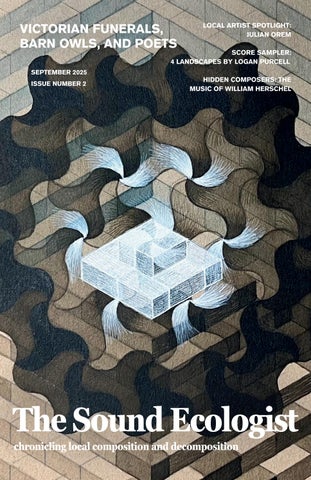
PHOTOGRAPHY BY ROB FUNKHOUSER COVER ILLUSTRATION BY AARON GREEN
OUR CONTRIBUTORS
THE SOUND ECOLOGIST MAGAZINE
IS A PUBLICATION OF SOUND ECOLOGIES, INC.
WWW.SOUNDECOLOGIES.ORG
LUKE GARRIGUS
Composer, aquarium hobbyist, President of Sound Ecologies
CHARISSA GARRIGUS
Pianist, deathnomusicologist, Vice President of Sound Ecologies

BRENNA GREEN
Pianist, composer, educator, gamelan practitioner

Music for the stars: William Herschel, composer of symphonies and violin sonatas
“4 Landscapes for Classical Guitar”Logan Purcell
Julian Orem SPECIES COUNTERPOINT
Barn Owl - Indiana Audubon guest article
POEMS BY FRIENDS
Gavin O’Toole, Grace Catlin, Rob Funkhouser
Dear Reader,
What a stroke of fortune that The Sound Ecologist has snagged your eye and you’re willing to read more. It’s vitally important for you to know that this is our second issue of the magazine.
Sound Ecologies, as a non-profit organization, has utilized music and the arts to specifically benefit environmental conservation and social causes. In the same vein, The Sound Ecologist magazine endeavors to bring together all the cyclical components of local music and nature.
In addition to our concerts, we have created this publication to further a sense of musical community with like-minded creatives and conservationists in Indianapolis. You can view the calendar for our upcoming 2025 season at the back page of this issue.

Sustainably yours,
BRENNA GREEN, EDITOR-IN-CHIEF
BY BRENNA GREEN PHOTOGRAPHY BY KATHRYN HERSHBERGER
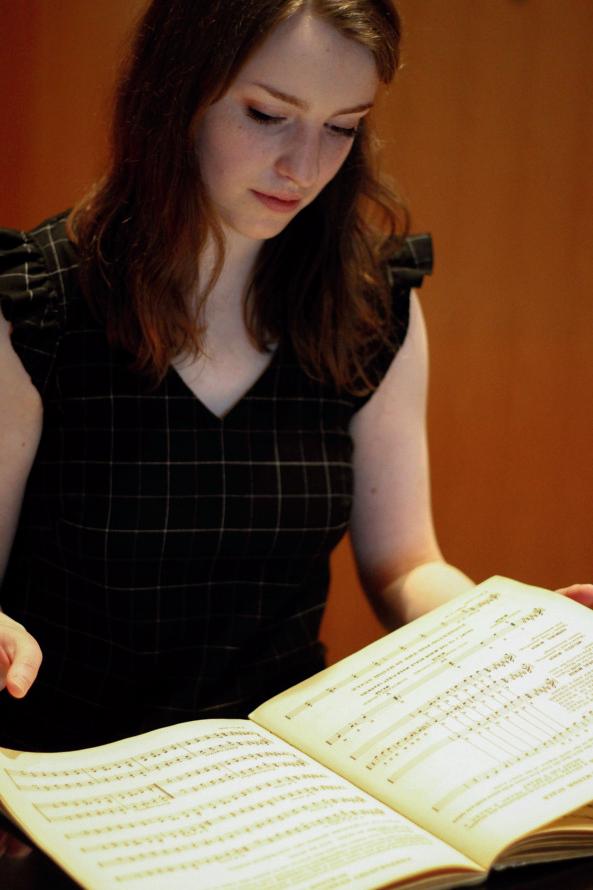
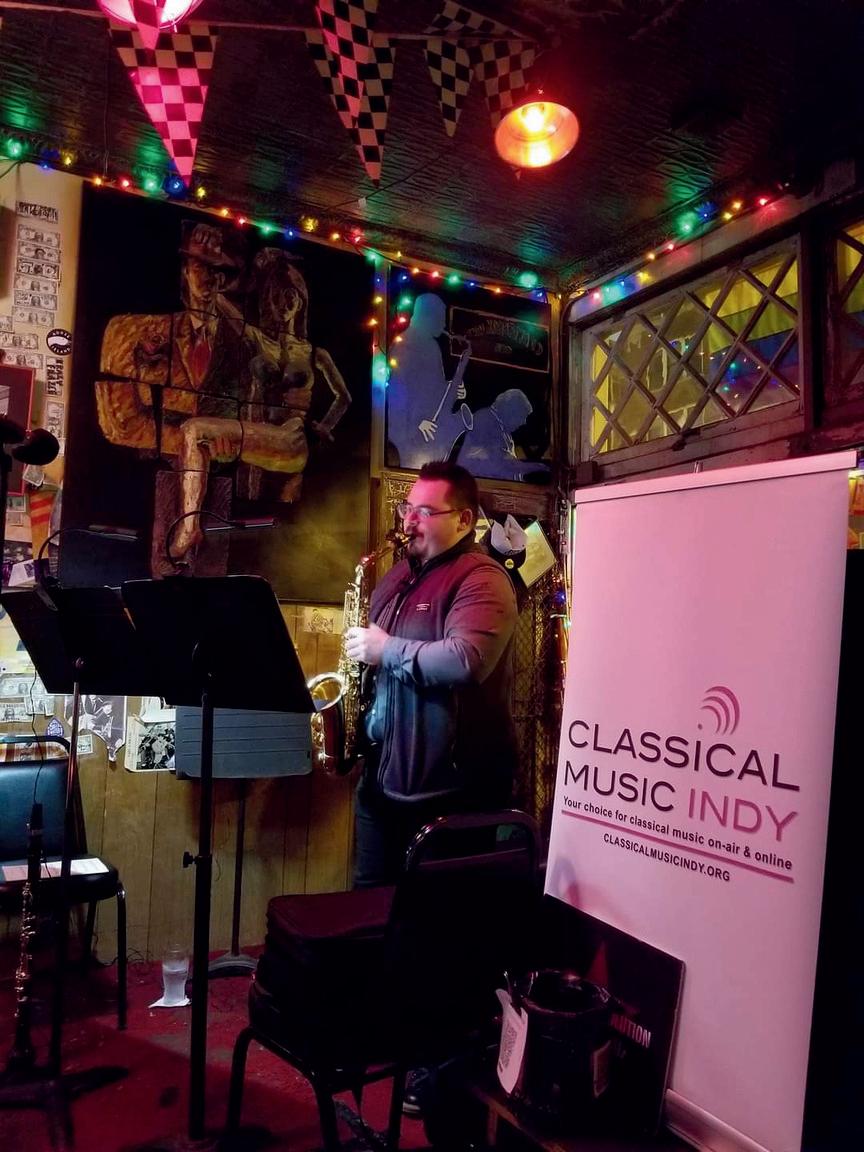
Sound Ecologies board member Brenna Green engages in a discussion with local artist Julian Orem.
Brenna Green: Where are you from? Where are you currently located?
Julian Orem: I am from Greenwood, IN. I went to Greenwood schools, where I participated in the marching band and several other ensembles. I also spent four of my formative years in Knightstown, IN, where I developed my love for the outdoors. I currently reside in Greenwood, but I spend most of my time in Broad Ripple and greater Indianapolis!
BG: What are some of your prominent musical influences?
JO: As a saxophonist I have had the pleasure of playing a multitude of musical styles. I very much consider myself a cross-genre artist. One group that makes me want to pick up my horn and play along is Bela Fleck and the Flecktones! The raw energy, fun interplay, and virtuosic ease of playing captivated me from my first listen. My goal is to bring those concepts to each of my performances. My college saxophone instructor, Dr. Heidi Radtke, instilled in me a love for new music! I was a stubborn student, and she taught me how to open my mind to exploring the far reaches of our repertoire, including working with the composers around us! The genres that have influenced me the most are Hard Bop, Minimalism, Contemporary Classical, and Folk.
BG: How do you approach creating art? What is your process like?
JO: Spontaneity and passion fuel my creative process! Unless contracted or commissioned, I do not keep a rigid schedule for projects. I am just now beginning to compose music on a more regular basis; I have always desired to do so, but found performing taking up most of my time! I usually keep a small staff paper notebook with me, in which I jot own ideas when they come to me! I approach performing as an extension of my thoughts and feelings. My goal is to share my excitement for a project with my peers and audiences. Most of my process is centered around building programs and realizing them with likeminded artists.
INDY COLLABORATOR JULIAN OREM
BG: What are some of your prominent musical influences?
JO: One piece that I keep coming back to is Gustav Mahler's Piano Quartet in A minor. While I love the piece for its emotional thematic material and structure, I find inspiration knowing that this was one of Mahler's student compositions. It is in fact his only surviving chamber music piece. Chamber music is my favorite creative space! I would love to adapt it for woodwinds and piano, or saxophone trio with piano.
BG: Piece of advice for younger composers?
JO: Listen to as much music as possible. All genres, all artists. Find your inspiration and start writing!
BG: Where do you find inspiration?
JO: I find inspiration in stories, personal interactions, current events, and nature. A shorter way to say it is that I'm inspired by the human experience.
BG: Why do you write music?
JO: I started writing music as a creative outlet. I am an established performer, but a fledgling composer. I want to share another aspect of my musical artistry with the other performers and composers that I am working with!

BG: What is currently inspiring you?
JO: I recently started reading poetry. I lament that this is the first time since high school English class that I have given it any attention. The poetry of Leonard Cohen and Robert Frost spoke to me right away. While not necessarily music related, it still has sparked my creativity!
BG: Best memory of a performance?
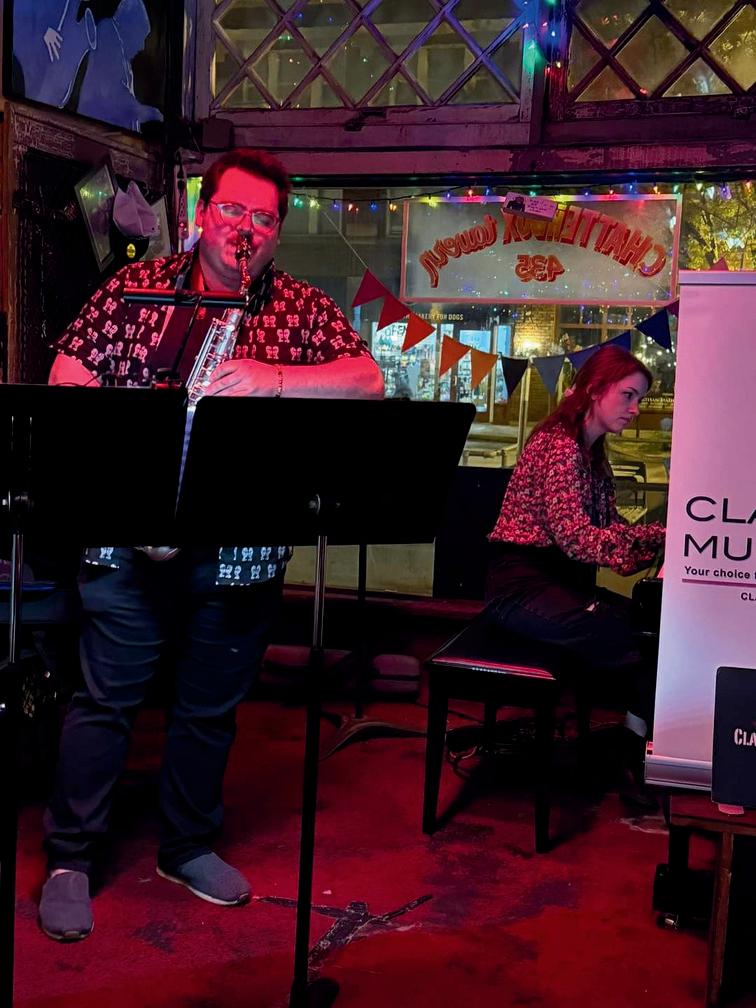
JO: I have too many amazing experiences to pick a favorite! I have really enjoyed the last couple years of performances at the Chatterbox for Classical Revolution. I play duo sets with pianist, Brenna Green, and cellist, Sean Conover.
BG: Favorite piece of music you've written?
JO: I hope to have an answer in the near future, as soon as I finish all of my projects in limbo! I am working on a small collection of art songs, a saxophone quartet, and a couple of jazz arrangements!
“THE
BY CHARISSA GARRIGUS PHOTOGRAPHY BY GEORGE REVILL
“Tuesday afternoon, the twenty-second of January instant, at half past six o'clock, our late Most Gracious Sovereign Queen Victoria expired at Osborne House, Isle of Wight, in the eighty-second year of Her age, and the sixty-fourth year of Her reign. This event has caused one universal feeling of regret and sorrow to Her late Majesty's faithful and attached subjects, to whom She was endeared by the deep interest in their welfare which She invariably manifested, as well as by the many signal virtues which marked and adorned Her character.”
– The London Gazette, January 23rd, 1901
The Victorian era was famously morbid. Considering the sheer amount of Gothic tales, strange mourning rituals, and elaborate tombstones, questions arise. How did demonstrations of sadness, loss, and death become so profoundly popular? Why did women in deep mourning wear six foot long veils made from black crepe? When did lockets filled with the hair of the dead become a mundane keepsake? Of course, Queen Victoria (1819-1901) did not begin all of these trends. However, as monarch she was responsible for continuing them and even perhaps increasing their intensity.
As a trendsetter, the widowed Victoria became a vision in black–the death of her husband Albert plunged her into a grief from which she never fully recovered. Helen Rappaport’s book Magnificent Obsession illustrates how the bereaved Queen became fixated on funerals, death customs, and mourning rites. Victoria took part in the curation of the music for her husband’s funeral and carefully selected the music for her own service several years before her death, as exemplified in Matthias Range’s book British Royal and State Funerals. I contend that Queen Victoria’s musical selections for her funeral defined a turning point in English attitudes toward grief and mourning: Queen Victoria’s own obsession with melancholy and death, changing funerary customs, and nineteenth-century beliefs in music’s ability to communicate beyond words combined to curate experiences for and generate emotions within attendees at her funeral service. As presented by biographer Christopher Hibbert in his book Queen Victoria, some of these changes included the building of a mausoleum at Frogmore, where Victoria was eventually buried, and a military escort and gun carriage—a custom that has lasted into the present day. She requested a white coffin pall, and non-traditional music written by Beethoven, Tchaikovsky, and Gounod that she had loved in life. Instead of leaving these decisions up to courtiers or following precedent as was traditionally the case, Victoria made funeral choices that showed her personality and commemorated the different facets of who she was.
Victoria and Albert’s tragic love story may be familiar to many, but what about the story of their deaths? Albert passed away at the age of forty-two. Though he and Victoria were married for about twenty years, it was clearly not enough in Victoria’s opinion. The year 1861 was not kind to Victoria—both her husband and her mother (the Duchess of Kent) passed away just months apart from each other. Albert died on December 14th of 1861 with the Duchess expiring on March 16th of that same year. These deaths heralded the beginnings of a new approach to royal funerals that came into fruition when Victoria planned her own funeral in 1897, four years before her own death. The first great change included the internment of both the Duchess of Kent and Prince Albert at Frogmore, a newly constructed mausoleum. Musicologist Matthias Range denotes, “for royalty, this was the first time that the final burial place was different to that of the funeral service.” This demonstrates Victoria’s willingness to make changes to tradition in the funereal sense.
Though both the Duchess and Albert’s funerals retained many musical similarities (certainly pursuant to the fact that they took place only months apart), it is important to note that Albert’s funeral music did reflect some choices made by Victoria herself. Specifically, Martin Luther’s Great God, what do I see and hear? and two chorales originally written in German were included in the service. Helen Rappaport points out:
For once, some of the traditional conventions of royal funerals were broken, certainly with regard to the choice of music, which was strongly printed to Albert’s own musical tastes…These had been requested by Victoria, having been privately printed in a pamphlet…on the death of her mother, ‘which the late prince was constantly in the habit of using.’
These inclusions signal the beginning of Victoria’s obsession with death and funerals, and indicate the powerful influence her tastes had on British culture and style going forward.
With respect to these events, some traditional factors did remain. Victoria herself did not attend Albert’s funeral. Historian John Wolffe reveals that, “there were significant continuities with the past, notably in …the exclusively male attendance.” Her choices of music, then reflect her burgeoning desire to become involved with the process of planning funerals. She selected music that Albert had favored in life, to be performed alongside the tune of the slow movement from Beethoven’s seventh symphony—one of her favorites. At both the funerals of the Duchess at Prince Albert, the closing work (played as a recessional on the organ) was Handel’s “Dead March” from Saul. This piece was certainly not Victoria’s choice as she was rather famously not a fan of Handel’s. She would disregard this selection in terms of her own funeral, including no notable works by that composer.
When it came to her own funeral, Queen Victoria gave careful instructions to be carried out upon her death. As will be explored further in a later part of this paper, Victoria had grown rather obsessed with death, cemeteries, and funerals in general. Of course the music at her funeral would be chosen carefully. Range includes a list of the works that Victoria specifically requested should be performed at the funeral. Notably, they included Spohr’s Blest are the Departed, Gounod’s The Lord’s Prayer, Tchaikovsky’s How Blest Are They, and Beethoven’s Funeral March. Alongside these rather unusual choices were more traditional works by Purcell and Croft, two composers whose music had featured prominently in the funerals of the Duchess and Albert discussed above. A connoisseur of funerals, Victoria chose these works in order to facilitate a specific experience. Her selection of the Beethoven points to her love for his compositions—a well documented truth. She and Albert had even attended a monument unveiling for the late composer at the Bonn Beethoven festival in 1845. The music by Gounod, Spohr, and Tchaikovsky were works Victoria had enjoyed in life, and therefore it follows that these pieces would have been chosen to create the desired funereal effect. Inclusion of traditional pieces such as those by Croft and Purcell would have reminded funeral-goers of the royal funerals of the past, though the placing of these works alongside newer ones would have created a unique experience crafted intentionally by the late Queen.
The vast majority of the works performed at Queen Victoria’s funeral were choral pieces. Range posits, “with this distinct choral participation, these services are reminiscent of the early modern pre-funeral services.” Clearly, the solemnity and beauty of choral music was something that struck Victoria, contributing to her image of a successful funeral. This contrasts with the military services Victoria had requested—her coffin was drawn on a gun-carriage with a military escort to the chapel. Instead of requesting military music, though, Victoria’s love of choral music was reflected in her funeral. Her preferred aesthetic, one that depicted who she was as a human being, was paramount as opposed to a unified theme.
Further stylistic points of interest include the fact that Victoria elected to have a white pall over her coffin. Considering her penchant for mourning black, this choice is curious. Hibbert mentions that, “this stated preference for a white funeral seems to have been prompted or reinforced by a remark from Lord Tennyson whom she had taken to see the Mausoleum at Frogmore.” Inspired by the light coming in from the windows, Tennyson remarked upon how he wished funerals might also be white. Tennyson elected to have a white pall over his coffin when he died, perhaps hoping to start a trend.
In this same vein, Victoria most certainly had a clear picture in mind of how her funeral would look and sound. Hibbert indicates that, The Queen had carefully planned her own funeral as well as the actions to be taken immediately after her death, giving ‘very minute directions’ as to what she wanted done.’ These ‘Instructions’ had been entrusted to her dressers ‘to be always taken about and kept by’ whichever one of them might be travelling with her. She included requests for items placed in her casket including her late husband’s dressing gown, her wedding veil, and specific jewelry among other things. Though she did ask for (and was afforded) full military honors, the service itself did not feature militaristic music. Wolffe points out that the “impressive choral service” at the chapel was “the formal religious climax of the funeral.” Being the high point of about a week’s worth of commemorative ceremonies, this event served as the culmination of Victoria’s funeral plans and was the epitome of her aesthetic funereal desires. Shaded in contrasts, this event showcased the many parts of the Queen’s personality and eschewed tradition in favor of reflecting a curated aesthetic.
The Queen was a famously sad widow. After the death of her husband Albert, she elected to remain in mourning attire, “although she might make the transition from the gloomy crape that was favored in the first stage of mourning, she would remain in black for the rest of her life.” She commissioned numerous monuments to Albert, insisted that his watch and gloves remain set out for him, and demanded that the Blue Room in Windsor Castle (where he had died) remained unchanged as a permanent memorial. Range points out that, “Queen Victoria afterwards introduced annual memorial services for Prince Albert, first in St George’s [where the funeral had taken place] and after 1869 in the mausoleum at Frogmore.” Beyond even this, the Queen dabbled in the occult. Biographer Christopher Hibbert relates, “I feel now to be so acquainted with death,’ [Victoria] wrote to the Princess Royal soon after her mother died, ‘& to be much nearer that unseen world.” She felt sure that her husband was watching her and that she was in communion with his spirit…[Victoria was] tempted to believe in the occult, in second sight, psychic phenomena, the power of magnetism — she had tried table-turning…and she had even conducted séances. Thus, Victoria’s obsession with death began after Albert passed and continued on throughout her life, taking various forms and bleeding into her amusement activities and resulting in her need to consider what her own death and service might look like.
Victoria became a connoisseur of funerals. Though not something one might consider an enjoyable pastime, Victoria and her ladies would often attend funerals as a means of diversion. One of her doctors recommended against this endeavor, “on the grounds that her health might be affected by such a depressing occasion. ‘She replied that she was never depressed at a funeral (!!) In fact she rather lost her temper.” Hibbert includes several accounts of Queen Victoria’s enjoyment when thinking about death, so much so that it became a well known part of Victoria’s personality. He notes that she “had an almost obsessive predilection for the observance of mourning, far more so even than was commonly accepted as appropriate at the time,” paying close attention to the funerals of friends and family and even carefully describing the manner in which her dog should be buried.
As a thanatophile, the choices Victoria made for her own funeral would have been intentional. She enjoyed the culture of mourning that had grown up in England due in large part to her own profoundly visible grief. It is therefore impossible, then, that Victoria’s musical and aesthetic preferences for her own funeral would have been arbitrary. Her enjoyment of attending funerals and opinions regarding how they were put together reflect a deep fascination with death and all of its trappings. One of Victoria’s ladies, Marie Mallet, writes, “It is very curious to see how the Queen takes the keenest interest in death and all its horrors.” I argue this interest was expressed in culmination at Victoria’s funeral.
In the nineteenth century, Music was understood as facilitating experiences beyond the physical. Leon Plantinga in his chapter entitled “The Piano and the Nineteenth Century,” describes the critical nature of emotion in music. He writes, “music was woven into the very fabric of social interaction; it was part of the system of signs by which people communicated with each other.” Emotions could be created by specific musical selections, and musicians were able to transmit meaning beyond what was said simply by how they performed. A lover of music herself, Victoria was quoted as commenting on several funeral works: [She] referred always very favorably to the funeral marches by Beethoven and Chopin–from Beethoven’s piano sonata no. 12, op. 26 and Chopin’s piano sonata no. 2, op. 35. [She described] ‘Chopin’s splendid funeral march…the beautiful & most touching funeral march by Chopin,” played in alternation with Beethoven’s. This demonstrates Victoria’s dedication to aesthetics, penchant for melancholic beauty, and understanding that music could produce certain emotions within its listeners.
One of her choices, a piece entitled Kontakion (a funeral hymn from the Eastern Byzantine tradition), caused a bit of controversy amongst her courtiers as it came from a non-Protestant denomination. Her reason for this including this piece, as written in her diary, read, “The music was beautiful & a fine Russian hymn [Kontakion] always sung at funerals throughout the Greek Church, was sung without accompaniment, & was sung without accompaniment, & was very impressive.” This work was not actually performed at the funeral, but it once again points to the aesthetic Victoria had in mind whilst planning her funeral. It also reveals a certain lack of care regarding political or traditional motives. Paramount to the Queen was the aesthetic, as revealed by her musical selections, choice of pall, and other decisions. Throughout the course of this article, I have argued that Queen Victoria’s funeral was crafted by her to produce specific emotional responses among funeral goers. Exploring changing funeral customs, Queen Victoria’s own obsession with melancholy and death, and nineteenth century attitudes towards music’s ability to communicate beyond words, I have shown how Victoria’s aesthetic selections were intended to reflect herself as a person. These factors combined to create a funeral experience that was unique in both its grandeur and intimacy.
I believe studying moments in history such as this are essential. Death is the only universally guaranteed human experience–funerals reflect people’s understanding of and attitude towards this deeply human event. The music we select to accompany us onwards speaks to who we are, what we value, and how we perceive the world. As I have shown through Queen Victoria’s service, music, aesthetic, and convention all have their parts to play in the final drama. Royal funerals after Queen Victoria drew from hers–it became tradition for military escorts to accompany the body of a deceased monarch to the funeral location. Funeral music is now selected to showcase the personality of the deceased. Though the thanatophilia that Queen Victoria embodied is no longer en vogue, her interest in crafting a funeral aesthetic belying just one aspect of who she was has carried on long beyond her death. 10
Anonymous. “Queen Victoria and Music.” The Musical Times and Singing Class Circular 42, No. 700 (1901): 374-75.
Bennett, Joseph. “Victorian Music III.” The Musical Times and Singing Class Circular 38, No. 649 (1897): 153-56.
“Funeral of Her Late Most Sacred Majesty.” The London Gazette, May 22, 1901. https://www.thegazette.co.uk/London/issue/27316/data.pdf
Gammon, Vic. “Singing and Popular Funeral Practices in the Eighteenth and Nineteenth Centuries.” Folk Music Journal 5, No. 4 (1988): 412-47.
Hibbert, Christopher. Queen Victoria: A Personal History. New York: Basic Books, 2000.
Meares, Hadley. “Queen Victoria’s Funeral Was Almost a Majestic Mess.” Vanity Fair, September 19, 2022.
https://www.vanityfair.com/style/2022/09/queen-victorias-funeral-was-almost-a-majesticmess?srsltid=AfmBOoo8cJNueBhe-kzh_XytVaHjKDAqUzTmOhMKmf-CHOb8Ixnpgf
Morris, Charles. The Life of Queen Victoria and the Story of Her Reign. Philadelphia: John C. Winston co, 1901. https://babel.hathitrust.org/cgi/pt?id=hvd.hn2v4n&seq=515
Pearsall, Cornelia. “Burying the Duke: Victorian Mourning and the Funeral of the Duke of Wellington.” Victorian Literature and Culture 27, No. 2 (1999): 365-93.
Plantinga, Leon. “The Piano and the Nineteenth Century.” In Nineteenth-Century Piano Music, edited by R. Larry Todd. Oxford: Taylor & Francis Group, 2004.
Rappaport, Helen. A Magnificent Obsession: Victoria, Albert, and the Death that Changed the British Monarchy. New York: St. Martin's Press, 2012.
Range, Matthias. British Royal and State Funerals: Music and Ceremonial Since Elizabeth I. Woodbridge: Boydell & Brewer, 2016.
Royal Museums Greenwich. “The Death of Queen Victoria.” Accessed December 2, 2024. https://www.rmg.co.uk/stories/topics/death-queen-victoria
Rushton, Julian. Europe, Empire, and Spectacle in Nineteenth-Century British Music. Florence Taylor and Francis, 2006.
Schaich, Michael. “The Funerals of the British Monarchy.” Monarchy and Religion: The Transformation of Royal Culture in Eighteenth-Century Europe. Oxford: Oxford University Press, 2007. 421-50.
“Supplement to the London Gazette Extraordinary.” The London Gazette, January 23, 1901. https://www.thegazette.co.uk/London/issue/27270/data.pdf
Wolffe, John. Great Deaths: Grieving, Religion, and Nationhood in Victorian England and Edwardian Britain. Oxford: Oxford University Press, 2000.
BY BRENNA GREEN
Many consider William Hershel to be the father of modern astronomy. He was a pioneer in construction of astronomical instruments and devices including precursors to the modern telescope. He also had several major scientific findings most notably the discovery of infrared radiation and the identification of the planet Uranus. So let’s set the scene for Herschel’s early life by taking a look at his musical beginnings. He was born in Hanover Germany in 1738. He studied the oboe from an early age with his father who was a player in the Hanover infantry band. William played violin as well, recounting that his father thought him to play on a small violin as soon as he was able to hold one.
We have it on authority from Herschel himself that his father, who was a musician, destined for him to be in the same profession, with the aspiration that his son might acquire a perfect knowledge of the theory as well as of the practice of music. He was also set at an early age to study mathematics and all its branches. Eventually, Herschel joined the same military band as his father, playing both violin and oboe. He was a highly skilled harpsichordist and organist as well. This versatility as a performer was really not unusual for 18th century musicians. During this time in his life, he proved very industrious by not only pursuing a music career, but he also studied French, English, ethics, logic, metaphysics, and mathematics. Despite his lack of university education, which was not uncommon, he availed himself of every opportunity to expand his knowledge.
During the Seven Years’ War that embroiled much of Germany between 1756 and 1763, William’s father urged him to flee his homeland of Hanover at the age of 19, Herschel left his home and attempted to establish himself musically in London. He was essentially an exile living on the edge of poverty during his first years there, then managed to find work as a copyist and music teacher before finally obtaining a position as the musical director for the Durham band in 1760.

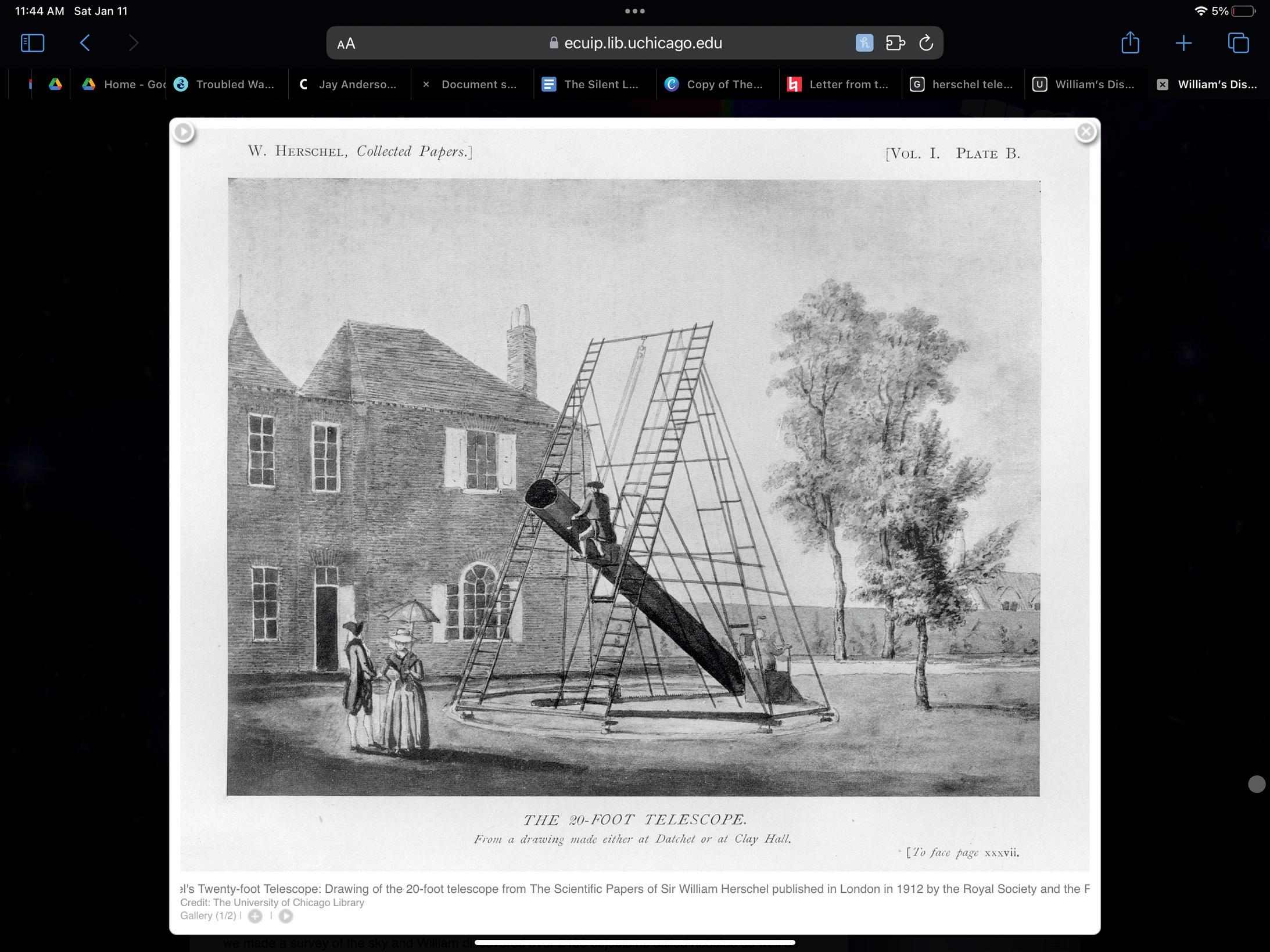
As a performing musician, William put his study of natural philosophy to use as it was of interest to many of his employers and patrons. In this Age of Enlightenment, natural philology was perceived as a polite topic. William’s innate curiousity of the study of nature and philosophy led him to such texts as Robert Smith’s Philosophy of musical sounds. Herschel was also drawn to Smith’s complete system of optics, which detailed telescope construction. Completely taken by this new field of student, He apprenticed himself to a local mirror builder and began work on his won telescope. He was assisted in the by his brother and sister who moved with him to England. He is said to have polished mirrors for up to 16 hour per day. And these would be inserted into a telescope tube. Repetitive practice on music must have developed his patience. Now, a turning point.

“An object is frequently not seen from not knowing how to see it, rather than from any deficit in the organ of vision. I will instruct you how to see them...“
- William Herschel
In 1781, he found the first planet to be discovered by telescope, the first to be discovered since ancient times. He originally named it after the king of England, George. He clearly wanted to curry favor. But the name was eventually changed to Uranus. He also made subsequent discoveries of two moons on Uranus in 1871. William’s sister Caroline Herschel aided him in many of his astronomical pursuits. After his discovery of Uranus, his motivation to compose increasingly diminished; this was most likely because he was granted a pension by King George III and didn’t have to worry about making it as a career. Caroline Herschel is also recognized during her time, becoming the first woman to pursue astronomy as a profession, and she made several important discoveries of her own and achieved great renown by the end of her life. In the late 1780s, William and Caroline set to work on the world’s largest telescope. At the time, it was a 40-foot monster, constructed under the patronage of George III.
In 1800, Herschel announced yet another scientific discovery of his own, that of infrared radiation. William was knighted in 1816 and thereby appointed as court astronomer. He died in Slough, England on August 25, 1822, having identified a new planet, discovered the moons of Uranus and Saturn, catalogued 145 double stars and discovered over 2500 new nebulae, all while composing 24 symphonies, 14 concerti, 87 pieces for organ, and various vocal works.
William Herschel’s musical contemporaries included Amadeus Mozart, Franz Joseph Haydn, Antonio Salieri, Carl Philip Emanuel and Johann Christian Bach. Herschel was very practical and scientific about his composing. He only wrote music that was directly related to his teaching, church work, and other music related employment. The 1769 sonatas for harpsichord, cello and violin were published to advertise himself in Bath, and his celebrated “Echo Catch” was composed for the Spring Gardens in Bath, alone with some other vocal part music and songs. His style is never predictable and, in some respects, yet he composed in time when music styles were changing rapidly. His musical form was often melodically and harmonically simple, with a clear structure emphasizing rationality instead of relying on a thematic development of a motive. He uses repetition to build a a sense of urgency and forcefulness. He often utilized the baroque device of the ritornello in his music. The classical styles of empfinsamer stil, which translates roughly to sensible sentimentality, and the popular galant had not settled in and orchestral practices and use of instruments within ensembles transformed as those instruments themselves evolved.
Herschel wrote a “Treatise on Music” that was never completed or published. In the text, he advocates for the enharmonic spellings of sharps and flats to aid the reading of key signatures: “To clear music as much as possible from superfluous signs, the composers were not content to have rid themselves so happily of all those which are annexed to the diatonic scale of the transposed modi, but they endeavoured likewise to cast off as many as possible of the accidental marks, but here their endeavours were not equally successful; for some of them employed means which rather puzzled than assisted the performance. The first of these is that they gave a power of continuance to the signs annexed to accidental notes, in any part of a piece equal to that of those put upon the lines. Hereby the memory of the executor is too much taken up, for as nothing can be easier than to recollect the signs upon the lines, because they leave all the notes in the diatonic, that is, the most natural situation; for nothing can be more burdensome than to carry in memory, the continuance of a sign superadded which puts the note it is annexed to out of the diatonic order.” The manuscript is kept at Edinburgh University Library.
After his discovery of Uranus, his career switch immediately claimed all of his time and attention; he abandoned his teaching and composing. The organ, chamber, and symphonic music of Herschel practically disappeared from public performances in the 19th and 20th centuries. Every now and then, a performance of his music will appear alongside a program of Mozart and Haydn.
BIBLIOGRAPHY
COWGILL R, WALTZ S. COSMIC HARMONIES: A SYMPOSIUM CELEBRATING THE LIFE, SCIENCE, MUSIC, AND LEGACY OF WILLIAM HERSCHEL (1738–1822) UNIVERSITY OF YORK, 19 JUNE 2022. EIGHTEENTH CENTURY MUSIC. 2023;20(1):122-124.
DUCKLES, VINCENT. “SIR WILLIAM HERSCHEL AS A COMPOSER.” PUBLICATIONS OF THE ASTRONOMICAL SOCIETY OF THE PACIFIC 74, NO. 436 (1962): 55–59.
MUSIC – HERSCHEL SOCIETY. (N.D.). HTTPS://HERSCHELSOCIETY.ORG.UK/MUSIC/
Logan Purcell
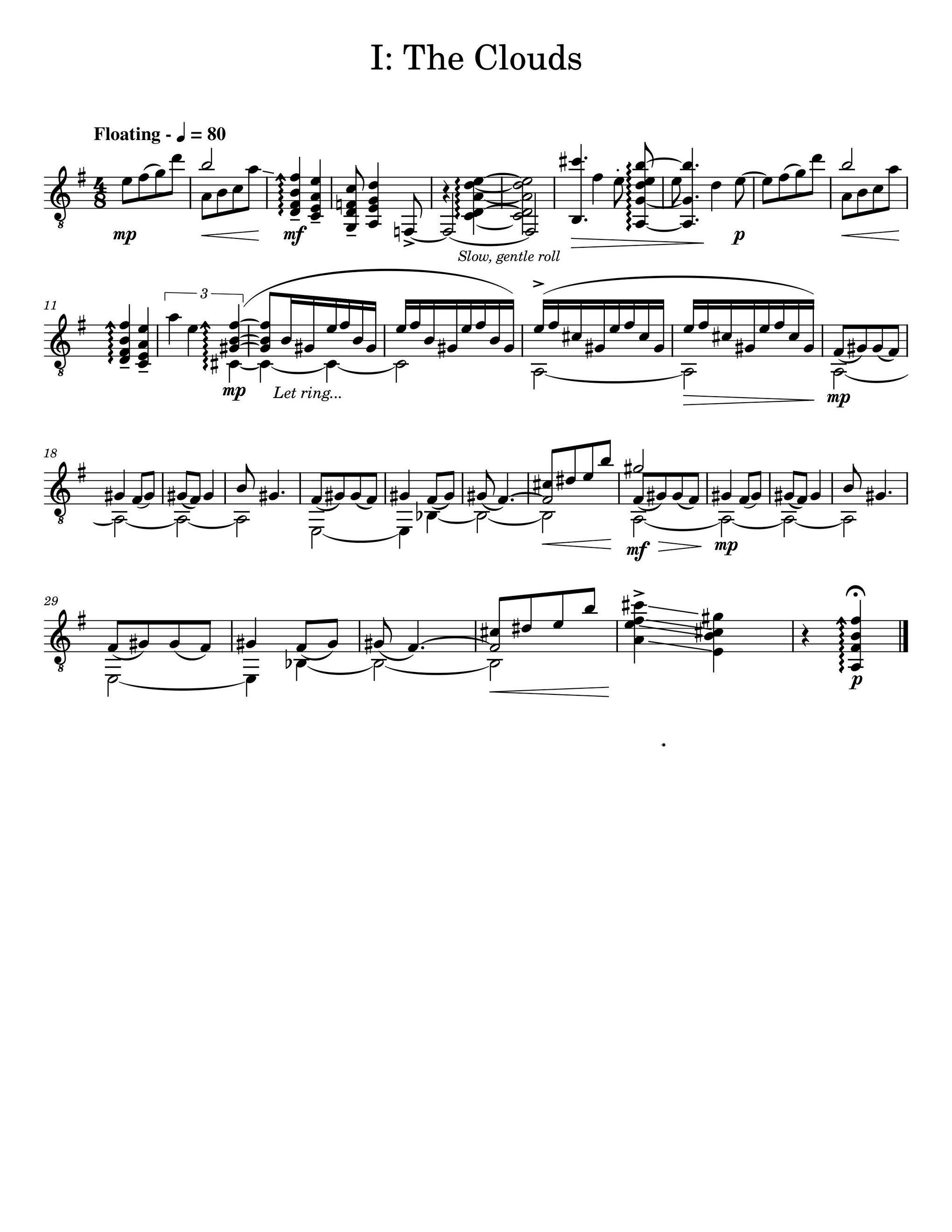
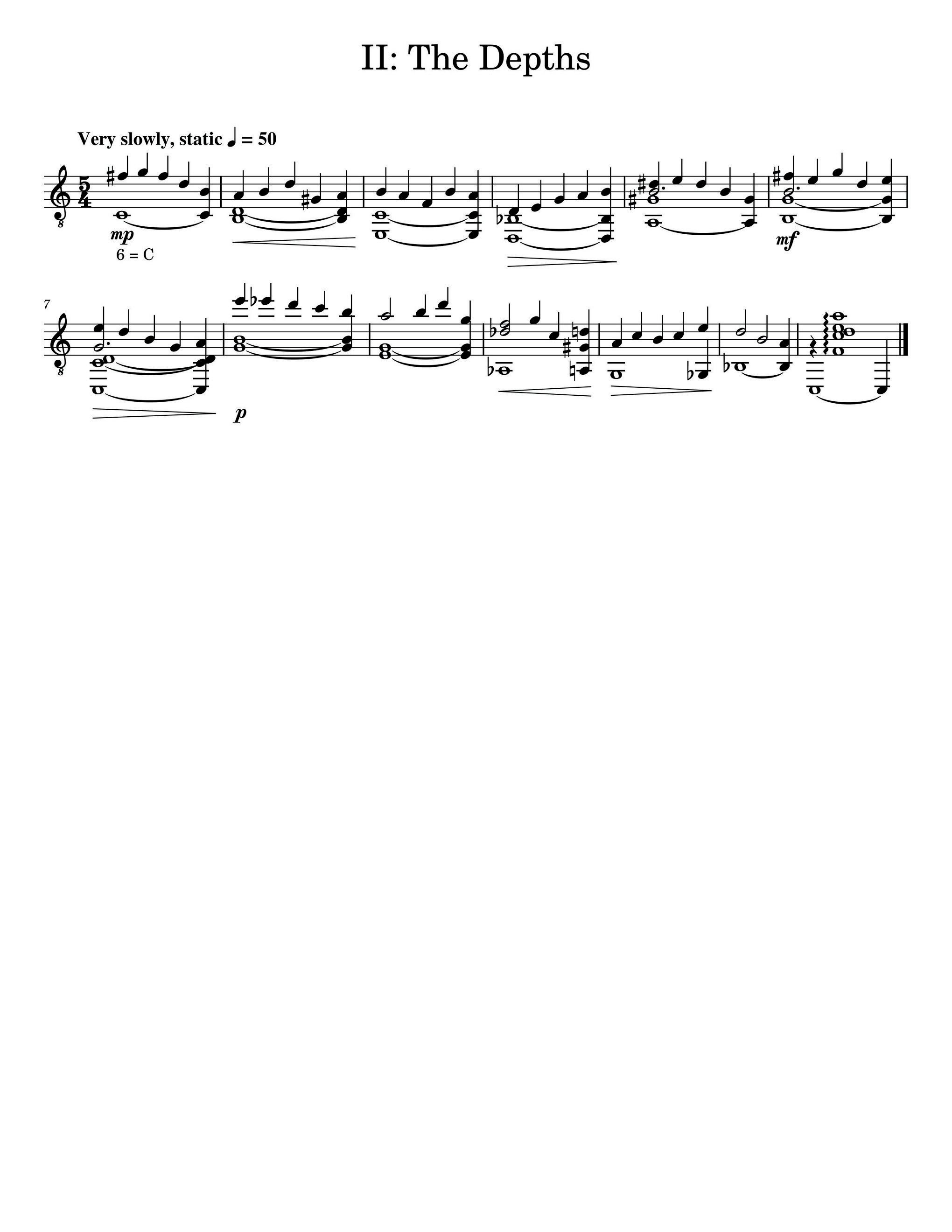
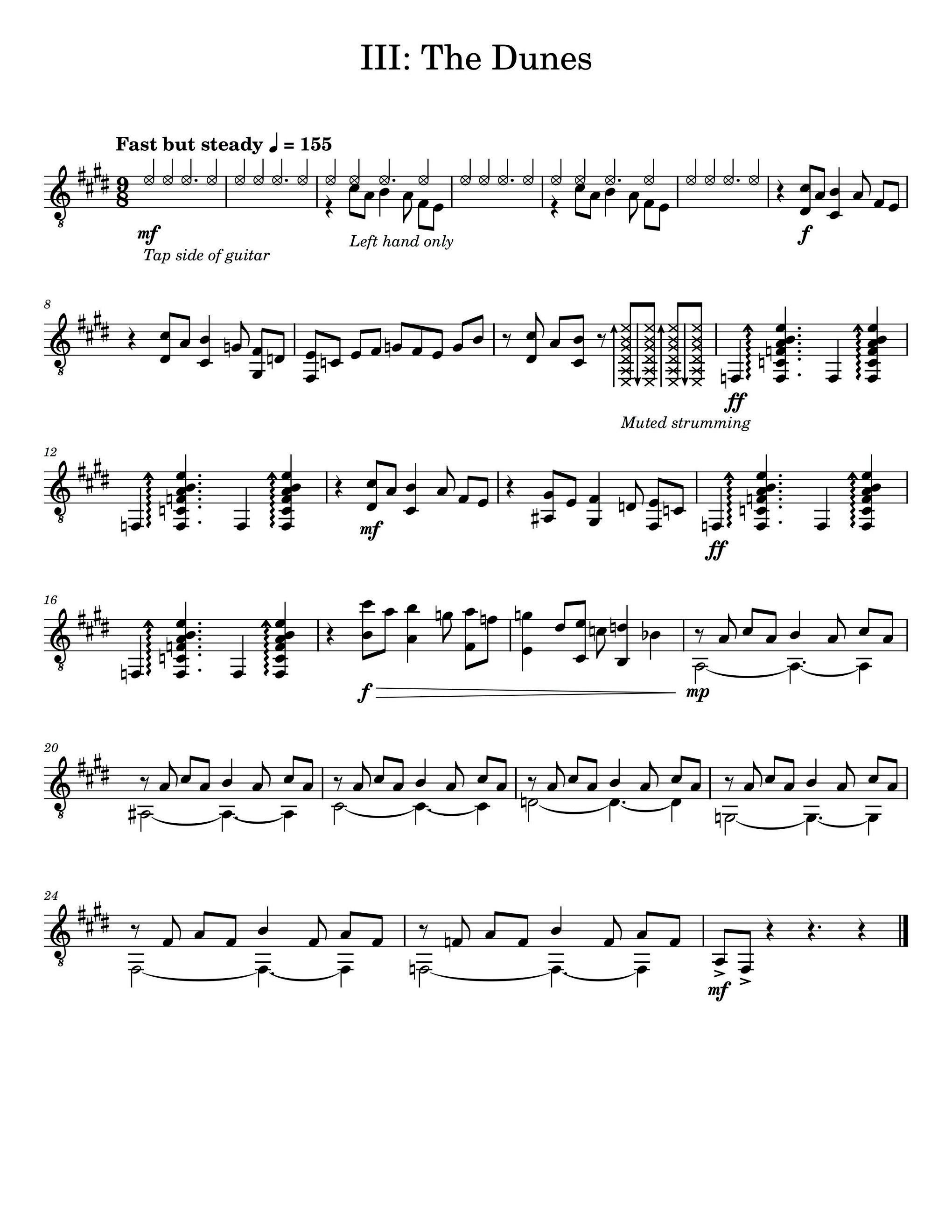
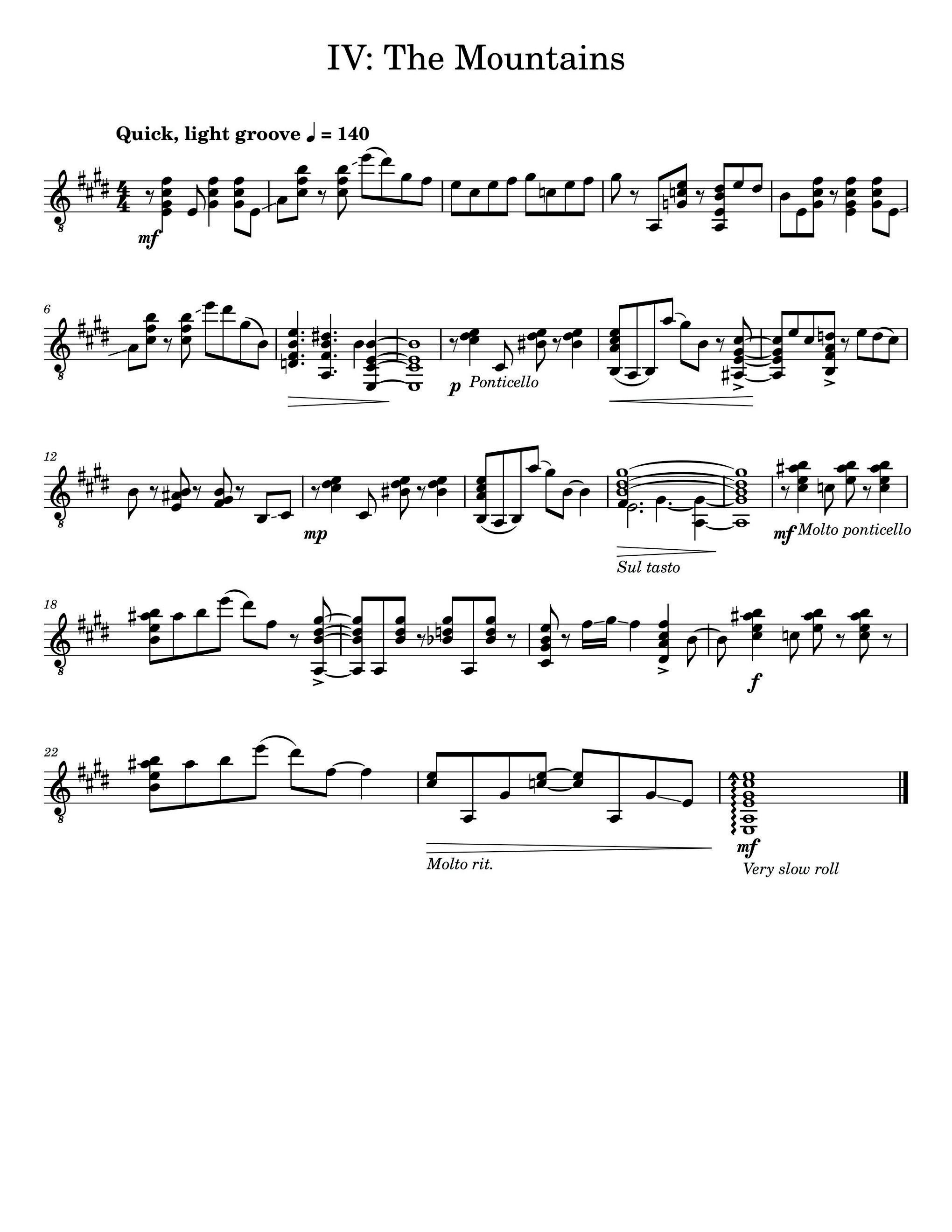
ECOLOGICAL REPORT BY WHITNEY YOERGER (COMMUNICATIONS & OUTREACH MANAGER, INDIANA AUDOBON)

For years, I've scoured the grounds of a Boone County business park, binoculars in hand, searching for birds. This unassuming landscape, dotted with warehouses, office buildings, and parking lots, has yielded its share of surprises –migrant sparrows, wintering waterfowl, and occasional raptors. Yet, one fall morning in October 2023, my friend and I stumbled upon an unexpected discovery: an American Barn Owl(1), hidden in a small, depressed plot of land between the steel and concrete. We were looking for elusive LeConte's and Nelson's sparrows, not one of Indiana's most iconic yet endangered owl species. But as we navigated the shrubs and grasses, we unwittingly flushed the owl from its day roost.
The bird's creamy plumage, infused with subtle rufous hues, flashed before us. Its ear-tuftless face and distinctive brownbordered facial disc left us speechless, our hearts racing with excitement. We exchanged disbelieving glances – had we really just seen what we thought we saw? Would anyone believe our sighting?

That serendipitous encounter ignited a deeper appreciation for the barn owl's tenuous existence in Indiana. Listed as State Endangered, these striking birds confront formidable challenges in a fragmented landscape. The Midwest, once a stronghold, has witnessed declines, with Indiana and neighboring states shouldering some of the steepest losses. Historically, vast grasslands and prairies provided ideal hunting grounds, abundant with meadow voles — their preferred prey.
Human presence has long shaped the barn owl's fate. As agriculture shifted from hay crops to row crops, prey vanished, and church steeples – once cozy nest sites – disappeared. Now, these cavity nesters adapt, seeking refuge in barn rafters, man-made nest boxes, and unexpected places. Yet, dangers lurk: rodenticide toxicity, collisions with cars, and electrocution threaten their fragile existence. Researchers note varying sensitivities to disturbance, highlighting the complex dance between humans and owls. As Indiana strives for a diverse, stable barn owl population, careful management and vigilance remain essential. Yet, amidst these challenges, a glimmer of resilience endures.
Indiana's Department of Natural Resources (DNR) spearheads conservation efforts through its innovative nest box program, actively installing and maintaining artificial nesting sites on private lands with known barn owl presence. This hands-on approach boosts occupancy rates, complemented by DNR surveys to monitor the species' progress. The DNR also engages the public through outreach programs, raising awareness and support for barn owl conservation.

Across southwestern Indiana's rolling landscape, where a gentler climate provides a haven, a quiet revival unfolds. Barn owl nests have risen from 43 in 2017 to 82 in 2022, according to the DNR's meticulous surveys. Every five years, researchers canvas the state, checking nest boxes for signs of life. The next census, slated for winter 2027-28, will reveal whether this tentative progress endures.
As the census approaches, the story of Indiana’s barn owls evolves. Meanwhile, tune in to the DNR’s nest box cam during their breeding season (March-October) at on.in.gov/barnowlnest for a glimpse into the intimate world of barn owl families. Supporting the Indiana DNR’s Nongame Wildlife Fund directly contributes to the nest box program. Collective action ensures the long-term viability of our barn owl population. As ambassadors of Indiana’s ecological richness, barn owls deserve our collective stewardship.
1) The Barn Owl, formerly considered a single species, has undergone a taxonomic revision, yielding three recognized species as of 2024: American Barn Owl (Tyto furcata), Eastern Barn Owl (Tyto javanica) and Western Barn Owl (Tyto alba).
POEM BY GAVIN O’TOOLE
{ A pulsating head burrows into lonely arms,
like heavy raindrops into cold sand. Itself submerged into grainy patterns of dense cotton, rubs the chilled neck with a shaky hand.
Pens falling pierce as sirens.
Tumultuous screams of thought pace quickly round, a prayer that not a soul shall inquire, never mind how gentle. Frightened shoulders muffle the outside, yet spiral inside’s sound.
Rows of neglected bones grind, like a ship tries smashing a city, serious effort.
Jaws burn more, matching the forehead and temples. Thin sheets of skin strictly restrain watery eyes: little comfort.
Thin wings tighten ‘round the depressed dome, like a boa constrictor to its victim. Frailty to that of fine china, much as a word could shatter.
Cracks have already formed, lights have already dimmed.
Time is sprinting quicker, the thread is running thin. }

The edge of the world is in Kansas.
Sunflowers and prairie grass and the pounding roar of tires over the endless highway into the water;
You will never understand the depth of the sky the breadth of the earth until you stand next to the split-rail fences and see nothing but everything under heaven for miles.
In the field far from anything close to everything when you can see the curvature of our little blue marble— hear the cows low— know that as deep as the ocean is, the sky is deeper.
POEM BY ROB FUNKHOUSER
September in Indianapolis
And we’re still discussing Ginsburg
Maybe I should listen
For some advice on how to make a city, Flat as a plane, Properly Cosmic
The Circle City of late Has been transformed Into an expanding sphere
Of possibility
There are violins, Polyrhythmic metronomes
The buzz of spaces
Preparing for rehearsals
And I have receipts 6:00 AM alarms born in fact
Rather than aspiration
Hours of recordings
The same AC unit underpinning Or sabotaging
Several universes of sound
I am captaining my old ship of Theseus, Metaphorically seaworthy, and literally in tune
Wondering if replacing every last bolt Will make me play like a new man
Perspective is expanding
And I am starting to question The role of a skyline in a flat place

What good is it when the only view is away Or on a hill of the dead
Amber waves of negligence
Give my yard a feeling
Of intent where there
Is only a lack of time
The neighbors cannot
Be bothered
And we have an unspoken accord
I pick up after their children
Loose promotional discs
Straws, general domestic detritus
They don’t call the city on my lawn
With the right audience
This particular kind of negligence
Can be read as patience
And if the grasshoppers are to be believed
I have created a masterpiece
A haven
A small paradise
I have only seen one praying mantis
This year
I’m pretty sure it was on pilgrimage
If spiders can hear,
Then we have a very outspoken treaty
Negotiated indoors and out
With the basic premise
That thou shalt not
Make a nursery of my house
Or venture upstairs
The inside spiders seem to keep to themselves
They stay downstairs
And I have no flies in my house
I also have no mice
I should probably survey their empire
The outside spiders are more Machiavellian
A cicada hanging on the porch
Its head on a spike
Dangling in a web of its undoing
There are tall ships
And short ships
Big ships
And small ships
But the best ships
Are friendships
Theseus doesn’t call home anymore
The candles used to be real
But the jazz never was
Now an absurd
Artifact of the swing revival
Of the early oughts
Sometimes a pop cover
Played by some cheddar big band
Movies, more recently in color, Playing on three monitors
A building where the sunsets used to be
A building where the parking lot used to be
A building where the carnival used to be I want to put this bar on 60 foot stilts and take it all back
My old house, now condemned, A stone’s throw away
The totem of a divorce that Failed to materialize
Of a family that failed to reconcile

The only time I’ve seen a cicada act silently
Was right before the spider found it
Of a person whose number was somehow hidden from Sarah Who texts me constantly about wanting to buy my house
The house in question was my introduction to nap
The big medium sleep
Full of people who think siestas are a foreign concept
A place I used to think of as the capital of Payless Shoes
My memory is still pretty good
And I have always listened to the old timers
Some say I’ve lived here since
The fountain was erected
Some would say I never lived there at all
I’m not sure it matters
What I do remember from the old days:
Art night with a man whose chest was exploding
Larry, still the height of a mere mortal
A guy skateboarding joyfully down a hallway
A man with a gallon bag of Tylenol trying to sell me Vicodin
A concert that reminded me of my destiny
A concert that made me question everything
Several concerts that pissed me off
Many more concerts that kept me going
The stiff cocktail of flea market art
Next to someone really doing it
Questioning how everyone actually made their money
Realizing things were very cheap
Lights in a storefront
Someone trying to teach me 7/16
After brushing up my circuit design
So much empty space
Squat buildings just far enough out to make room for the skyline