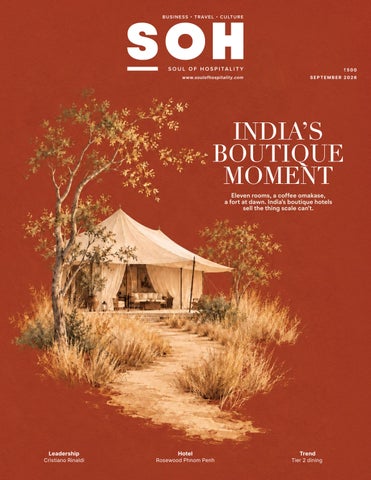
B U S I N E S S • T R AV E L • C U LT U R E
S O U L O F H O S P I TA L I T Y
A500
www.soulofhospitality.com
SEPTEMBER 2026
INDIA’S BOUTIQUE MOMENT Eleven rooms, a coffee omakase, a fort at dawn. India's boutique hotels sell the thing scale can't.
Leadership
Cristiano Rinaldi
Hotel
Rosewood Phnom Penh
Trend
Tier 2 dining
In Ayodhya, each day of the year brings with it the promise of a blessed beginning - making your celebration an auspicious start to forever. Ayodhyam, Ayodhya – IHCL SeleQtions blends enduring spirituality and quiet grandeur offering a setting where every ceremony feels a little more divine.
12
BRANDS
300+
HOTELS
400+
RESTAURANTS
100+ SPAS
Enjoy Member Exclusive Benefits with Taj InnerCircle - NeuPass
Email: book.ayodhya@seleqtionshotels.com | Phone: +91 5278372100 | Website: www.seleQtionshotels.com
Vitrium Design by Christian Werner
duravit.com
4
S O U L O F H O S P I TA L I T Y
FOUNDER'S NOTE
TWO YEARS IN
05.30pm: Sunset picnic drive
Two years ago, we made a decision that, at the time, felt almost counterintuitive. In an age of infinite screens, fleeting attention and content designed to disappear within seconds, we chose to build a magazine in print, not because we were looking backwards, but because we were looking ahead. Two years on, that instinct feels even more relevant. Print has proved more resilient than its obituary writers predicted. Perhaps after years of being asked to scroll, people are ready to pause again. SOH was never about print versus digital. It was always about substance over noise, wherever the story lives. We set out to look at hospitality differently, 01.30pm: Lunch at Van Bhoj not simply as an industry, but as a world where Restaurant business, people, places, culture, travel and A meal at Van Bhojintersect. is unique as it islens has taken us further ideas That prepared on than a wood which means wefire, imagined. there is a noticeable difference in the SOH has grown from a print magazine into taste and texture. This is a meal that is a multi-platform unhurried and takes time but ismedia worth brand. The numbers matter. But what matters the wait. Sample local delicacies and more is the access vegetables grown at the organic and trust wein-house have earned among the people garden, which ensurehospitality, the meal is fresh, shaping from hoteliers and founders light, and refreshing. The bakery chef to investors, policy makers, hotel owners, dishes out several winners and makes architects, chefs andlike destination-makers. some excellent tarts. A long meal this Somewhere along the way, we stopped simply certainly calls for an afternoon siesta; you won’t regret reporting it. on hospitality. We became part of the ecosystem we set out to understand. And that ecosystem is changing fast. Hospitality now sits at the intersection of real
Driving through quaint villages that showcase a slice of rural life in Samnapur Banda Tola, to reach Amalnala Dam. This is a serene place with a beautiful lake that is hugged by the periphery of the forests and mountains beyond. Quiet and calm, the only sounds you hear are of the birds returning home. The sunset that happens estate, investment, wellness, food, technology, just behind the lakebed swathes the landscape in all sustainability, and hotel identity. hues of culture orange. The teamThe laystraveller out a carpet and is changing. Expectations are changing. is small bites—sandwiches, samosas,India and tea—that make for confident a lovely picnic by the water. its becoming more in how it presents places, people and stories to the world. That makes our responsibility bigger. We never wanted SOH to be another magazine covering the industry. We wanted to understand it, question it and contribute to the conversation. 08.00pm: Candlelit Because reach can be measured. Influence dinner beneath the is earned. canopy of the banyan tree It is earned when a story starts a conversation. When an idea travels beyond the page. When Back at Tathastu Kanha, get ready someone sees their business, or where the team fordestination a special dinner industry differently because of something theya leafy banyan sets up a table under encountered through SOH. tree with lights hanging all around. setting That is the standard we The holddreamy ourselves to. is paired with a course-wise meal where the chef To everyone who has read an issue, dishes out an eclectic set of starters, followed a story, watched amain conversation, shared courses, and desserts—largely our work, partnered with us, or simply told cooked using woodusfire. that something we published made them think, thank you. The landscape ahead is bigger than the one we entered two years ago. Hospitality is evolving. Travel is being redefined. And Asia Pacific, with India at the centre of an increasingly consequential tourism story, is entering a 10.00pm: Stargazing new chapter. We intend to play a bigger role in it, not The clear skies and limited light simply documenting the change, but helping pollution mean that this is perfect shape what comes next. for star gazing. Ghanshyam, the experienced in-house naturalist, Two years in. We are only getting started. does a nice session as he points out constellations and regales you with stories; that is a great way to end a packed day at Kanha. Head back to rest for Day 2.
GURMEET KAUR SACHDEV gurmeetsachdev@soulinkkworldwidemedia.com
S EP MGB E2R JU L-TAEU 0 2260 2 6
251
Di Paise Ko Rafttaar
602A & 602B, Maker Maxity, 4 North Avenue BKC, Bandra East, Mumbai, Maharashtra, 400051, India
REDEFINE HOTEL INTERIORS WITH UNPARALLELED STYLE AND DURABILITY WITH FURNISHING FABRICS.
Experts in hotel projects AVAILABLE AT ALL LEADING FURNISHING STORES IN INDIA WWW.MAISHAA.COM
ED'S LETTER S O U L O F H O S P I TA L I T Y
SMALL HOTELS, BIG AMBITIONS I have always been a traveller who picks a boutique hotel over a regular four- or five-star, especially at leisure destinations. I hold warm memories of small, intimate places I've stayed. For instance, The Postcard Netravali, on the wild edges of Goa's Netravali sanctuary, offering uber-luxury and a window into a Goa few have explored. One of my best Rajasthan trips took me to Amanbagh, and then Aman-i-Khas, from quintessential village experience to tigerland. The architectural and quiet beauty of the first is wellknown, yet what I remember is a tigress nonchalantly leaping the wall and strolling past our open-air dinner while not a single staff member panicked at Aman-i-Khas. She was a regular; the guards on the macchan across the hotel had alerted the general manager of her arrival, and all we had to do was give her space. Boutique hotels offer experiences rarely found in cookiecutter big hotels. The segment is evolving, and big hospitality groups have spotted the opportunity. Our cover story takes you inside this fascinating world and its evolution. Cristiano Rinaldi, Marriott International's new Chief Lodging Product & Services Officer, Asia Pacific (excluding China), calls himself the guardian of brands: his job, he believes, is to protect what each promises long after the design drawings are signed off. He tells us what hotels of the future look like, and his pet peeves. In this issue, we bring back 36 Hours with Kanha National Park, a premier tiger reserve; explore how tier-2 cities are warming to experimental dining; and show how cultural festivals such as Jagannath Yatra draw not just pilgrims and travellers but hoteliers, who leverage them to build hotel infrastructure in parts of India that had none. We hope you enjoy the issue.
Warm regards, D E E PA L I N A N DWA N I , E D I TO R , S O H
Founder and Publisher Gurmeet Sachdev Editorial Editor Deepali Nandwani Managing Editor Rupali Sebastian Digital Editor Rachna Virdi Contributing Writers Chandreyi Bandyopadhyay Bindu Gopal Rao Veidehi Gite Kalpana Sunder Nainaa R Rajpaal Creative Creative Director Tanvi Shah Assistant Art Director Vinod Shinde Team Shiv Soni Business Head Vipin Yadav Delhi, +91 99998 85515 vipin@soulinkkworldwidemedia.com Sales Manager Deepa Rao Mumbai, +91 9136 000369 sales@soulinkkworldwidemedia.com Head of Events and Alliances Karishma Shah karishma@soulinkkworldwidemedia.com Office Manager Deepak Rao Accounts Head Amey Acharekar For queries: editorial@soulinkkworldwidemedia.com sales@soulinkkworldwidemedia.com info@soulinkkworldwidemedia.com
Printed and Published by Gurmeet Sachdev on behalf of Soulinkk World-Wide Media LLP. Registered office: 1/2, Old Anand Nagar, Nehru Road, Santacruz East, Mumbai, Maharashtra - 400055. Printed at Silverpoint Press Pvt. Ltd., A-403, TTC Industrial Area, Near Anthony Motors, Mahape, Navi Mumbai – 400709. Editor: Deepali Nandwani. All rights reserved worldwide. Reproducing in any manner without prior written permission prohibited. SOH takes no responsibility for unsolicited photographs or material all photographs, unless otherwise indicated, are used for illustrative purposes only. Unsolicited manuscripts will not be returned unless accompanied by a postage pre-paid envelope. All disputes are subject to the exclusive jurisdiction of competent courts and forums in Mumbai only. Copyright Soulinkk World-Wide Media LLP.
10
S O U L O F H O S P I TA L I T Y
CONTENTS
SEPTEMBER ISSUE
ISSUE
24
38
India’s Boutique Moment The country's growing appetite for intimate, experiential stays is creating new opportunities for boutique hotels and attracting major hospitality groups.
12
S O U L O F H O S P I TA L I T Y
ADVERTORIAL
A fresh approach
to cleanliness
Water instead of paper
Modern shower-toilets provide for greater hygiene and comfort in everyday use. Long a standard amenity in Asia, the shower-toilet is now gaining importance here. It cleanses with water, a more hygienic and gentler alternative to toilet paper, drawing attention from households modernising their bathrooms. Cleansing at the push of a button. A shower-toilet combines toilet and bidet, cleansing with an electronically controlled water jet. Temperature, intensity and shower position are set by remote control or app. On Duravit's SensoWash® Starck f, the technology is integrated into the ceramic body, so the toilet retains its clear, minimalist design. Details to enhance well-being. Many models add automatic lid opening, odor extraction and seat heating, making it a comfortable part of the daily routine.
DISCOVER THE RANGE AT duravit.com
Duravit offers a comprehensive range of showertoilets covering all design and convenience levels: from the modern entry-level SensoWash® D-Neo through the minimalist SensoWash® Classic to the premium-oriented SensoWash® Starck f line.
CONTENTS
32
86
Flavours Without Borders Indian ingredients reshape modern Asian cocktails.
The Chef Diary Chef Vikas Khanna recalls places that shaped him.
92 Global Footprint Rosewood Phnom Penh offers immersions into the destination.
18
10 0
Life Around Kanha Three days exploring forests, villages and local flavours.
Tables Turn Inland Fine dining finds confident new homes beyond metros.
64 Designing for Tomorrow Cristiano Rinaldi maps Marriott’s future across Asia Pacific.
26
28
Culture & Festivals Rath Yatra is an economic driver for Odisha's tourism.
The Luxury Pause CGH Earth finds luxury in space and stillness.
14
S O U L O F H O S P I TA L I T Y
Primo Platform
Your intuitive, customizable, and scalable access control solution
Mobile access and biometrics
Local site validation
Future-proof investment
Multi-site management
Comprehensive reporting
Discover the Primo advantage
Primo, our intelligent access control software solution which seamlessly integrates with a wide range of hardware, is designed for security managers and organizations of all sizes.
Intuitive usability
Customizable set-up
Scalable system
Advanced protection
Install fast, configure via user-friendly wizards, and onboard new users with a few clicks
Choose devices and credentials from a wide range, and tailor the Primo interface to your needs
Connect up to 10,000 doors, 1 million credentials and 250 sites with your growing digital world
Benefit from system resilience, advanced security protocols, and innovative biometric access
For more information, kindly reach us on info.saarc@assaabloy.com
assaabloy.com
ADVERTORIAL
FAITH, MADE EASIER Radisson Hotel Group's Spiritual Packages bring stays, meals and temple transfers together across India's most revered pilgrimage cities
India's pilgrimage trail has always drawn travellers in great numbers, and demand keeps growing. What has changed is how people want to make the journey. Today's pilgrim looks for faith, culture, comfort and convenience in equal measure. Radisson Hotel Group's Spiritual Packages meet that need at participating hotels across the country's key pilgrimage cities. Each package combines accommodation, breakfast, dining options and local transfers to temples, shrines and pilgrimage sites, so the planning is settled before the journey begins.
Where applicable, luggage storage and day-use facilities ease early arrivals, late departures and short stays. Families, solo seekers and groups are all well served. Spiritual travel now reaches beyond the temple gate, into heritage walks, local sightseeing and cultural immersion. With a comfortable base and movement handled, travellers spend less time on logistics and more on the purpose that brought them there. Faith leads the way. Radisson takes care of the rest.
Where the packages are live AMRITSAR Radisson Blu Amritsar, Park Inn by Radisson Amritsar AYODHYA Park Inn by Radisson Ayodhya GUWAHATI Radisson Blu Guwahati INDORE Radisson Blu Indore, Radisson RED Indore JAIPUR Radisson Hotel Jaipur, Radisson Blu Jaipur JAMMU Country Inn & Suites Jammu JODHPUR Radisson Hotel Jodhpur KOCHI Radisson Blu Hotel Kochi MOUNT ABU Radisson Resort Mount Abu NATHDWARA Radisson Hotel Nathdwara PRAYAGRAJ Radisson Hotel Prayagraj PURI Park Inn & Suites by Radisson, Puri SHIRDI Temple Tree Hotel Shirdi, Radisson Individuals VARANASI Radisson Hotel Varanasi VELLORE Park Inn by Radisson Vellore VRINDAVAN Radisson Hotel Vrindavan
JOURNEY WITHIN Find what stays with you. Experience the soul of India
Scan Now
radissonhotels.com Amritsar | Ayodhya | Guwahati | Indore | Jaipur | Jammu | Jodhpur | Mount Abu | Nathdwara | Prayagraj | Puri | Shirdi | Varanasi | Vellore | Vrindavan
36 HOURS
18
S O U L O F H O S P I TA L I T Y
36 HOURS
AN IMMERSIVE, NATUREFORWARD GUIDE TO KANHA The sal forests of Kanha Tiger Reserve, believed to have sparked Rudyard Kipling's imagination, remain a sanctuary for tigers, wild dogs, and the hard-ground swamp deer, which the park famously saved from extinction.
B I N D U G O PA L R AO
SEPTEMBER 2026
19
36 HOURS
D AY
1
Dawn comes up slowly over Kanha. Mist hangs on the maidans, the open meadows that interrupt the sal forest, and the first light turns the wet grass gold while a langur barks somewhere in the canopy. This is the forest readers have pictured since 1894, the green world of Mowgli and Baloo of the famous The Jungle Book, even if Rudyard Kipling never actually set foot in it. What he built from imagination and second-hand accounts, Kanha still delivers in the flesh. Located in Madhya Pradesh, Kanha Tiger Reserve is a forest whose beauty itself is completely alluring, and its denizens add to the charm. Spread over a total area of 2,074.31sq.km., the park is home to one of India’s most successful conservation stories of the barasingha or the swamp deer. The species had whittled down to a mere 66 in 1967, but consistent and scientific conservation has ensured the numbers are over 1050 to date. This guide to 36 hours (or 3 days) in Kanha covers nature, wildlife, culture, and the jungle itself.
Early morning: 05.30am: Safari at Kanha Tiger Reserve. Start your day early and be one of the first to enter the jungle. All safaris must be booked in advance (your resort can do this for you; mine was done by Tathastu Kanha), and you will need to carry your Aadhaar card for verification (which is also used to make the booking). The jeep safari is a great way to explore the jungle that is stunning with its evergreen sal trees that dominate the landscape. Interestingly, there are grasslands and rolling meadows, which make the habitat varied and exciting. Sightings of the tiger (usually best at the Mukki gate), leopards, gaur, swamp deer, barking deer, and spotted deer are quite common. The jungle also has amazing bird life, and you can also see the Indian pitta and white-rumped vultures here. A breakfast stop is usually during the middle of the safari, where I suggest you stop by the Kanha Museum that gives you a deep insight into the biodiversity of the jungle through interesting exhibits, dioramas, and animal skeletons.
11.00am: Sign up for a pottery session at Tathastu Kanha This involves learning from a traditional potter on the wheel, where you get your hands muddy as you learn to sculpt from an expert. The session is completely therapeutic, and the best part is you can also take your creation as a souvenir from the trip.
20
S O U L O F H O S P I TA L I T Y
05.30pm: Sunset picnic drive Driving through quaint villages that showcase a slice of rural life in Samnapur Banda Tola, to reach Amalnala Dam. This is a serene place with a beautiful lake that is hugged by the periphery of the forests and mountains beyond. Quiet and calm, the only sounds you hear are of the birds returning home. The sunset that happens just behind the lakebed swathes the landscape in all hues of orange. The hotel team lays out a carpet and small bites—sandwiches, samosas, and tea—that make for a lovely picnic by the water.
08.00pm: Candlelit dinner beneath the canopy of the banyan tree
01.30pm: Lunch at Van Bhoj Restaurant A meal at Van Bhoj is unique as it is prepared on a wood fire, which means there is a noticeable difference in the taste and texture. This is a meal that is unhurried and takes time but is worth the wait. Sample local delicacies and vegetables grown at the in-house organic garden, which ensure the meal is fresh, light, and refreshing. The bakery chef dishes out several winners and makes some excellent tarts. A long meal like this certainly calls for an afternoon siesta; you won’t regret it.
SEPTEMBER 2026
Back at Tathastu Kanha, get ready for a special dinner where the team sets up a table under a leafy banyan tree with lights hanging all around. The dreamy setting is paired with a course-wise meal where the chef dishes out an eclectic set of starters, main courses, and desserts—largely cooked using wood fire.
10.00pm: Stargazing The clear skies and limited light pollution mean that this is perfect for star gazing. Ghanshyam, the experienced in-house naturalist, does a nice session as he points out constellations and regales you with stories; that is a great way to end a packed day at Kanha. Head back to rest for Day 2.
21
36 HOURS
D AY
2
Early morning: 06.00am: a guided morning birdwatching trail Walking around the resort is a great way to observe the flora and fauna closely, especially with a naturalist. The morning hours are the best to see birds, and the place is abuzz with species like minivets, drongos, barbets, and langurs. You can see the locals waking up and going up and about at the start of their day as well. Do not miss the colourful butterflies here.
09.00am: Breakfast at Outpost 12 Head to a new-age luxury bio-lodge, Outpost 12 by Sinali Experiences, for a hearty breakfast at the river-facing poolside patio. Sample South Indian specialities (yes, they're well-made) with a twist of health. Swap the regular dosa, for instance, for a millet dosa. Special mention must be made of the fresh-baked assorted cakes, croissants, and breads that are soft, delectable, and a must-have, washed down with freshly squeezed fruit juices.
10.30am: Birdwatching at the hide If you are a bird lover or even just simply enjoy nature, there are two bird hides at Outpost 12 where you can observe several species of birds as well as photograph them. One of the hides overlooks a manmade water body and attracts several beeeaters and kingfishers. I also saw a cinnamon bittern here, a lifer for me. The other hide has a small water body that attracts several small birds, from scaly-breasted munias, Oriental white-eyes, and red-whiskered bulbuls as well as larger birds like the treepie and emerald dove. You can take great images as well without disturbing the birds.
11.30am: Relaxing spa session at Ilika Head to the in-house spa Ilika at Outpost 12 for a relaxing massage in their thoughtfully created wellness space. The Ilika aromatic massage is a good choice, as it is a calming treatment that is bound to remove the stress from your body and mind, allowing you to relax and rejuvenate. The session starts with a herbal steam bath and moves on to an invigorating massage that feels like just what the jungle ordered. A warm herbal tea and you are ready for the next safari.
02.00pm: Maikal Thali for Lunch If you are like me and enjoy local food, the Maikal thali at Outpost 12 is a hyper-local meal that is inspired by the surrounding Tilari and other villages. The food is a nod to timehonoured recipes that have been shared by the community and have been thoughtfully reimagined. Each dish on the plate tells a story that is deeply connected to the forest and the land here. Sample dishes include Cheech Bhaaji and Laal Bhaji, both made with local greens, and Dal Paak, a local chicken curry and the use of millets in the rice and breads. End with Kutki kheer, and I can promise this is a meal like no other.
22
08.00pm: Dinner at Brander's 12 at Outpost 12 At the in-house bar, the dinner setup is all things cosy. Located a level below the main restaurant, this space is a nod to Kanha’s most successful conservation story, the barasingha, or swamp deer. This is an unhurried meal that is served course by course. Try the marinated cucumber salad, Tomato Dhaniya Shorba, a selection of starters such as Coconut Seekh Kebab and Peanut Beetroot Kebab. The chef's kathal biryani is a definite highlight; you can be assured that you will not miss the meat version. The Malpua with Rabri is a nice way to end this meal on a sweet note.
09.30pm: Night walk
05.30pm: Sunset Wilderness drive Hop on to a specially designed vehicle by the team at Outpost 12 on a sunset drive that will take you on the banks of the Banjar River. Tuck into delectable snacks and watch the sunset, and then the fun part starts. Driving through the territorial forest, the naturalist team showed us some fantastic nightlife. From scorpions that glow under UV light to flying squirrels (I saw a pair) to jackals and owls, the night is when the forest is alive and buzzing. The team is fine-tuning what they call a 'sound safari experience', where you can listen to the sounds of the forest through headphones; that is a unique way to understand the forest.
SEPTEMBER 2026
A unique experience at Outpost 12 is the night walk that brings you up close with several kinds of moths and spiders. While the monsoon is the best time to see more of these species, there is always something to see. A special moth project here has identified hundreds of moth species. You can also see small lizards, insects, and butterflies and understand their behaviour too. Head back to rest for Day 3.
23
36 HOURS
D AY
11.00am: E-cycle safari
3
This is a fun way to explore the nearby sal forest. Keep your eyes peeled for birds and animals along the way and learn about the biodiversity of this amazing forest. The safari will take you to a treehouse where you can get a bird's-eye view of the surroundings.
01.30pm: Lunch at Taste of Jungle Head to the in-house Taste of Jungle restaurant that overlooks a man-made water body and order an à la carte meal from the extensive menu. From delectable local fare to crowd pleasers, they serve it all. Do keep in mind that the portion size here is quite large. Honey chilli potatoes and hara bhara kebab deserve special mention. Try the local thali as well; that can be prepared with prior intimation.
03.00pm: Safari in the buffer zone If you do a last-minute safari booking, chances are you may end up with one that takes you to the buffer zone. Don't fret though, as you can spot several mammals here, including big cats as well as the elusive four-horned antelope, chausingha.
06.00pm: Sunset Point The Sunset Point at Khuksar is a paid entrance where your vehicle takes you up to a point after which a moderate climb is required to reach the top. The short trek is worth the effort as the views of the seemingly endless green cover are stunning. A vantage point at the edge is a favourite with Instagrammers, and a watchtower here gives you unobstructed views of the landscape below.
08.30am: Breakfast at Sterling Kanha Start with a hearty buffet breakfast that serves a selection of South Indian staples. Think upma, idli, dosa, and medhu vada as well as North Indian parathas and puri subzi. Wash it down with fresh fruit juice, milkshakes and coffee or tea. The chilli cheese toast is an absolute delight here.
10.00am: Tribal Village visit Sterling Kanha organises visits to the nearby Baiga tribe village. You can interact with the villagers and also visit their homes to understand the ancient craft of bead-making. The women create beautiful bead neckpieces that you can buy as well. While the designs are new now, they show you the kind of pieces that were made in the past. Do not be surprised to see old coins from the British times as part of the necklace.
24
S O U L O F H O S P I TA L I T Y
WHERE TO S T AY Outpost 12 by Sinali Experiences A boutique nine-cottage luxury bio-lodge, Outpost 12 by Sinali Experiences, has stunning rooms that overlook the Banjar River. Expansive at 700sq.ft. with 375sq.ft. of private deck space, the rooms are aesthetic, and the décor is a nod to the land and has local elements. With sustainability part of the DNA, this has been set up by a team of naturalists and is the best way to experience Kanha.
Tathastu Kanha A premium wildlife lodge near the Mukki Gate, the retreat is spread over nine acres and has 20 rooms across Mongolian yurts, family rooms and cottages. In addition to an in-house spa, swimming pool, pottery, cricket, archery, stargazing, and nature walking activities, the resort also offers an excellent sundowner and assists with game drives as well.
Sterling Kanha An 8.5-acre resort in the village of Mocha, Sterling Kanha has 25 spacious rooms that offer views of the Sal Forest. Set amidst lush landscapes, the property has access to the Banjar River and had jungle safaris, birdwatching, and trekking as part of its activity list. The Holiday Activity Centre has a host of indoor games, and apart from archery, you can also enjoy an ATV ride here.
SEPTEMBER 2026
25
S O H | C U LT U R E
S O H | C U LT U R E
THE CHARIOT ECONOMY Every July, the Rath Yatra brings millions of pilgrims to Puri and pushes Odisha's hotels to near-full occupancy. Hotels have begun recognising the potential of the religious festival. C H A N D R E Y I B A N DYO PA D H YAY
Every July, the tourist traffic in Odisha changes character: buses packed to their roofs, families walking, the occasional group singing bhaktigeet in chorus. By the time the Grand Road of Puri comes into view, multi-storey-tall wooden chariots await its carriers—the pilgrims. The Jagannath Rath Yatra has often become a traveller’s first introduction to Odisha. Jagannath Yatra, the revered chariot procession in the beach town of Puri, surpasses many cultural phenomena in India, inviting millions of tourists seeking the blessing of the deity, believed to be an avatar of Lord Vishnu. As the story goes, the idol was carved by Vishwakarma, the divine architect, who left the work unfinished when the king broke his promise of not looking in before the sculpture was complete. Odia tradition, however,
26
doesn't read that as a flaw, but as a god who resists being fully rendered, in a state of perpetual impermanence. For nine days, the god leaves the sanctum and becomes part of the people. The chariots are pulled by hand, on ropes anyone can grab, and pilgrims who would ordinarily be barred from the temple's inner sanctum (by caste or
by circumstance), can stand beside the deity, forming the appeal of the unique festival to masses.
Big budgets The festival draws millions of visitors, filling hotels, homestays and guest houses. “It brings visitors to the state, but it also encourages them to experience Odisha more deeply. As a homegrown brand, it’s rewarding to be part of that journey and introduce guests to the warmth and character of the region,” says Sonal Sahoo, Co-founder, Lyfe Hotels & Resorts Bhubaneshwar. Recognised as an economic driver, the 2026-27 Odisha State budget set aside ₹1,000 crore for a Shree Jagannath Interpretation Centre, alongside funds to restore other key sites to appeal to tourists beyond the already popular beach, Konark Temple, Dhaulagiri stupa and the Udayagiri and Khandagiri caves. A coastal tourism project at Shamuka, tied to the upcoming Puri International Airport, is meant to extend that appeal well past the festival calendar. About 95% of rooms in the region were booked for the 2026
S O U L O F H O S P I TA L I T Y
Yatra. Taj Puri Resort & Spa welcomed a diverse mix of guests this year, including corporate leaders, entrepreneurs, HNIs, leisure groups and families for the 10-day period. “Many chose to extend their stay beyond the festival, combining the spiritual experience with wellness, regional gastronomy, beach time and explorations of Odisha's rich heritage,” says K Mohanchandran, Senior Vice President - Operations, Taj Puri Resort & Spa. From Bhubaneshwar to Puri, the impact of the event is far reaching. “While Puri is naturally the centre of the celebrations, Bhubaneswar benefits as the gateway to the state. Many guests begin or end their journey here, giving them time to explore the temples, museums and a growing food scene,” informs Sahoo.
Room for growth Tourism accounts for close to 13% of Odisha’s state GDP, and the Rath Yatra is a concentrated demonstration of that weight. In fact, the state tourism board recorded a 22% jump in visitor numbers with over 5.6 million in 2026, driven majorly by the event, reaffirming its tourism potential. Accor is expanding in eastern India, opening Novotel Bhubaneshwar Janpath in July 2026. “As the first internationally
SEPTEMBER 2026
branded hospitality destination in the Temple City, this marks an important milestone,” says General Manager Neelabh Sahay. Designed for families and business travellers, the hotel located near the Biju Patnaik International Airport offers great connectivity and convenience for movement between venues of the festival. Responding to cultural tourism growth, hotels such as The Belgadia Palace in Mayurbhanj exposes guests to the state's second most auspicious Rath Yatra, where only women have pulled Goddess Subhadra’s chariot for the past 50 years. “This is one of our most popular experiences booked out weeks in advance with a 10% year-on-year growth in inbound tourists,” says Akshita M Bhanjdeo, Co-Owner, The Belgadia Palace.
Since monsoon rains are an essential element of the festival period, it is not traditionally considered a tourist season. “We get additional bookings for spillover crowds around Bhubaneshwar at this time, but beyond the festival, the impact does not stay for long as we attempt to showcase the offbeat art and crafts and culture of Odisha that the hype crowd is not interested in,” informs Indrani Chakraborty, Founder, Svanir Wilderness Ecostay. For MAYFAIR Hotels & Resorts, which has three properties in Puri and adjoining areas, it translates directly into near-full occupancy during the festival window and one of their strongest yield periods of the year. Bjorn DeNiese, Managing Director, MAYFAIR Elixir says, “With travellers from across India and overseas, it creates a ripple effect way beyond the nine days of the festival. It benefits hotels, local businesses, artisans, and transport operators.” For an event that just lasts nine days, the Rath Yatra is increasingly influencing investment decisions that extend far beyond the festival itself.
27
SOH | DESIGN
ARCHITECTURE OF STILLNESS
Located on the border of Auroville, Sanctuary Amaidiyana does not announce itself. It withdraws; a calibrated convergence of architecture and philosophy held within a single experience. Conceived originally as an intimate guesthouse in 2007 by Nalin Patel, the property has since evolved into a contemplative retreat without abandoning its founding impulse: to hold stillness. Patel envisioned ambience rather than scale. His idea was precise. “My dream was to build a luxurious place which is also quiet and peaceful,” he says. Guests, he felt, should experience the same meditative feeling as the Aurobindo Ashram or the Matrimandir into their stay. The timing is deliberate. Sanctuary Amaidiyana belongs to CGH Earth, long associated with sustainability, sense of place and responsible tourism, and it reflects a change its leadership has been watching closely. “We have been observing a growing need among travellers not just to travel, but to pause,” says Michael Dominic, CEO, CGH Earth Experience Hotels. “While movement has increased, so has a certain mental and emotional fatigue.” The property was conceived in response to that shift: a place for people in high-intensity urban lives to slow down, recalibrate, and reconnect with a more grounded way of being. Roofs that think Mona Doctor Pingel, the architect behind the project, approached Amaidiyana without stylistic rigidity. She
Sanctuary Amaidiyana in Auroville redefines luxury through silence and space, a deeply immersive retreat led by architecture and nature. VEIDEHI GITE
ABOVE: Mangalore-tiled roofs, sourced from Kerala, give the buildings at Sanctuary Amaidiyana their distinctly Tamil vernacular character. RIGHT: Michael Dominic, CEO, CGH Earth Experience Hotels.
28
S O U L O F H O S P I TA L I T Y
kept it simple: Tamil vernacular, exposed materials, double-grooved sun-baked tiles with exacting execution. Every decision was structural rather than cosmetic. The signature roofs, crafted from Mangalore tiles sourced from Kerala, are engineered systems layered for durability, insulation and ecological performance rather than aesthetic gestures. “I had to make it termite-proof, snake-proof, ant-proof, squirrel-proof and mice-proof. Because that is where, you know, they love to live,” she says, recalling her early explorations. Beneath the tiles lie bison boards, thermocol, metal sheets and a carefully calibrated slope that removes the need for mechanical drainage. The architecture exposes itself knowingly. There is no concealment of beams, joints or load paths. “We do not hide things because we want guests to see how
ABOVE LEFT: An open-sided pavilion reflects architect Mona Doctor Pingel’s preference for simple, climate-responsive structures. ABOVE RIGHT: The property's individual buildings are connected by courtyards, gardens and pools. BELOW: Exposed teak wood beams and lime-plastered walls lend the cottage a simple, tactile interior, with the garden extending the room outdoors.
things are made,” Pingel notes. Electrical lines, water systems and structural alignments are resolved at inception rather than masked later, and the building feels finished even before ornamentation. Teak and reclaimed wood dominate, often sourced secondhand from demolished structures, and the patina is inherited.
Enveloped in ecology At Amaidiyana, the landscape is part of the architectural plan rather than an adjunct. Each room opens to a front and rear garden, dissolving the boundary between built and natural. Indigenous planting keeps intervention minimal, with frangipani, Ashoka, bamboo and Kamini creating density without clutter. “It’s about how much intention you put behind it,” notes General Manager Sam John. The result is a calibrated environment rather than a conventionally designed garden, one that shields, filters and frames experience. “Water, too, is integrated with intent. Rainwater harvesting, wastewater recycling, and natural filtration systems operate quietly beneath the surface,” he says. Even pest control is ecological, with ant channels filled with water forming invisible boundaries in place of chemicals.
SEPTEMBER 2026
29
SOH | DESIGN
For Dominic, wellness here is embedded in the experience rather than added to it, unfolding through yoga, meditation, Ayurveda and conscious waste practices. He traces the sensibility to the brand’s wider instinct. “Experiential hospitality, for us, is about presence rather than programming,” he says, the freedom to engage as much or as little as one wishes and to discover a place at one’s own pace.
Golden ratio Heiwa The most unexpected layer of Amaidiyana is its Japanese inflexion, most visible in the Heiwa suite. It reads as resonance rather than imitation. “Japanese is not something you set out to do; it is a sensitivity,” Pingel clarifies. The rock garden with a gong, designed by architect Poppo Pingel, works on principles of proportion and pause. Rocks are placed using the golden ratio, and the sand is raked for meditative engagement rather than for appearance. The space invites stillness without prescribing it, and guests may sit, rake the sand, or just observe. “There is no ritual imposed, only the possibility of one,” notes
30
S O U L O F H O S P I TA L I T Y
Pingel. Heiwa, meaning peace in Japanese, extends the philosophy inward, where a complex metal roof forms an interior that feels both rooted and abstract. The nearby Ayurveda Centre offers traditional therapies rooted in holistic healing, while the warm Watsu Pool extends the wellness experience.
Minimalism with intent
OPPOSITE PAGE: Existing trees, gardens and water are incorporated into the planning, alongside rainwater harvesting, wastewater recycling and natural filtration systems. ABOVE: The Classic Room is a generous 700sq.ft. accommodation, combining a comfortable queen-size bed with contemporary amenities. BELOW, LEFT AND RIGHT: The Heiwa Suite takes its name from the Japanese word for peace, with a contemplative rock garden designed by architect Poppo Pingel.
SEPTEMBER 2026
Amaidiyana’s defining quality is restraint. There are no grand lobbies, no performative opulence. Even lighting is subdued, designed to illuminate without intrusion, and the pools avoid polished tiles in favour of textured granite that reflects the sky. “If you are a person who has that quietness inside you, will you be able to apply that to physical structures?” Pingel reflects. The property becomes an externalisation of internal stillness. That restraint carries a deliberate argument about luxury itself. Hospitality has long equated value with abundance and activity, a measure CGH Earth is willing to question. “In an overstimulated world, the rarest offering is stillness,” says Dominic. Guests are encouraged to do less rather than more, an effort to redefine luxury as depth rather than distraction. He reads Amaidiyana as a sign of where the industry may be heading, with architecture itself becoming a primary wellness offering, a direction he considers particularly resonant in India, where traditional design systems have long understood the relationship between space and well-being. “As travellers become more discerning, they will seek environments that feel intuitively right,” he says. The responsibility, in his view, runs past stewardship and service to protecting the ecology and communities a property draws from. Nalin Patel’s original idea persists through every layer, its tailored hospitality, expansive spatial design and subdued atmosphere holding steady through expansion. Sanctuary Amaidiyana subtracts rather than distracts. It recalibrates.
31
SOH | DRINKS
AN INDIAN ROUTE TO A NEO-ASIAN BAR A new generation of Indian bars is putting tamarind, mahua and curry leaf through Japanese precision and Southeast Asian technique. C H A N D R E Y I B A N DYO PA D H YAY
A thread of tamarind, a ghost of local spice, the sharpness of curry leaf set against seaweed, galangal and soy: the familiar and the foreign are meeting behind bars in India, in a new push to foreground distinctive flavours from the subcontinent. Borrowing Japanese precision and the Southeast Asian layering of aromatics and fermented depth, these bars are hyperlocal in structure and philosophy, and ingredient-forward. They treat the Indian pantry with the same rigour Thai kitchen brings to basil, or a Japanese bar to its ice. Barbet & Pals began on the road. Co-founders Jeet Rana and Chirag Pal travelled to source ingredients before attempting a menu. Ingredients arrived from the hills of Uttarakhand and the far northeast. Gundrayani, a Himalayan root with no cocktail history, became a signature. “We typically taste an ingredient
32
in a culinary context first to understand its behaviour before bringing it to the bar,” says Rana. “Let the ingredient guide what the drink should become.” The process is unhurried. Some ingredients are finalised in days, while others, particularly those involving fermentation, take weeks. Barbet’s menu carries this sensibility throughout. “The ‘Asian’ identity comes through our approach rather than imitation,
focusing on fermentation, balance, clarity of flavours, and respect for ingredients,” Rana explains. At Manuscript Udaipur, dore by NISA Experience takes the ingredient-forward approach into regional history. Co-founder Sagar Neve built a menu like a cultural archive of the state. A whisky-based cocktail, Rao Bika ka Khichda, draws from an eponymous historical porridge. Another signature, Haldighati, uses gin infused with the aromatic Chaitri rose (which grows in Haldighati), vetiver and peach. The rose is the secret ingredient here. “We are not just using local ingredients, but distilling the very terroir of Rajasthan,” says Neve. He promises a wholesome Rajasthani experience with guests dining on plates with Usta art design, local ceramics and brass utensils with handcrafted runners on their table. Where NISA’s previous ventures, KMC and Bombay
S O U L O F H O S P I TA L I T Y
Daak, drew from different regions and cultures across India, dore narrows its focus to one state and goes deep. “First-time visitors will be immersed in the stories and cultural practices of Rajasthan with every sip”, Neve says. At JW Marriott Hotel New Delhi Aerocity, Adrift Kaya takes that philosophy a step further. Its latest cocktail programme traces the Silk Route from Japan to India, applying Edo-inspired techniques such as clarification, fermentation and fat-washing to ingredients like buransh, kahwa, jaggery and pickle. The result is a menu that marries Japanese precision with Indian flavour, reflecting a globally benchmarked approach to contemporary mixology. At UNO Izakaya at JW Marriott Hotel Bengaluru, Japanese
OPPOSITE PAGE: Atelier V's Piyo! blends gin, Gondhoraj lime, caramelised banana, and mango foam. ABOVE AND RIGHT: Chef Karan Bane; Thai-inspired cocktails at Seefah, where he is a Chef Partner. BELOW LEFT: Rush Hour at Juliette brings together tamarind, coffee and rum. BELOW RIGHT: Jeet Rana now has his second bar, Punchline in Mumbai.
culinary philosophy extends seamlessly to the bar. The cocktail programme looks beyond familiar highballs, drawing on ingredients such as miso, umeboshi, fresh wasabi and sakura to create savoury, ingredient-led drinks. Cocktails like the Miso Manhattan and The Golden Koi sit alongside a curated sake list, reinforcing a bar programme where Japanese flavours, technique and storytelling carry through from the kitchen to the glass.
spices but is structured like a refined highball. At Black Lacquer, the new bar inside Roswyn in Mumbai, the menu runs to sake and shochu, Japanese draft beer, and an extensive wine and Champagne selection, but the cocktails are clean, balanced, and built on familiar foundations. Classics like the Midori Slush and Old Boy are reworked with precision at this
Layered in restraint Kaustubh Sawardekar, mixologist at Mumbai’s Juliette Café & Bar, says Indian ingredients work well as flavour anchors rather than dominant notes. “The idea is to integrate elements like curry leaf or tamarind with Asian techniques: clarification, carbonation, or infusion, so the drink feels cohesive rather than confused. It’s all about harmony, not contrast.” For instance, his Bombay High uses vada pav
SEPTEMBER 2026
33
SOH | DRINKS
vinyl listening bar inside India’s first Morgans Originals address. The Theatre, a private space for just a few inside ZLB23 at The Leela Palace Bengaluru, pairs flavour knowledge with storytelling. Instead of a conventional menu, it unfolds as a four-act, performance-led tasting. It opens with Aperitivo, a Japanese whisky, strawberry and makrut lime vermouth cocktail with added effervescence; moves through Daisy Style’s citrus, agave and restrained mezcal smoke, and Red Snapper’s gin, tomato water, celery and spice; and closes on
Mary Pickford, a gentle finale. The progression is built to trace the palate across bitter, sour, savoury and sweet, with each act drawing on a different cultural or historical reference point, reinterpreted through ZLB23’s Kyoto-inflected lens. “In The Theatre, cocktails are brought to life with distinct personalities,” says Rajib Mukherjee, Head Mixologist, Bar Manager, ZLB23 and The Theatre, The Leela Palace Bengaluru. “While the opening menu explores taste as a narrative, the space itself is designed to evolve. Menus will continue to
CLOCKWISE FROM LEFT: Black Lacquer at Roswyn promises a vinyl-led listening room with craft precision cocktails; Schrödinger's Virtue at Circa 11 uses Earl Grey and Kashmiri Saffron infused Godawan whisky; The Theatre, inside ZLB23 at The Leela Palace Bengaluru, pairs flavour knowledge with storytelling; UNO Izakaya draws on ingredient-forward savoury cocktails.
34
S O U L O F H O S P I TA L I T Y
change, with themes developing around technique, fermentation, and cultural storytelling." At Circa 11 in Bengaluru, the approach becomes diagnostic. Chef and founder Pradyumna Harithsa frames balance as a technical question rather than a cultural one. “What is the ingredient doing in the drink?” he asks. “Once you start looking at flavour in terms of lift, length, heat, or structure, the distinction between ‘Indian’ and ‘pan-Asian’ begins to fall away.” Tamarind is used for what it does that citrus cannot: a deeper, more settled acidity. Kashmiri saffron works more as aroma than as
flavour. Sea buckthorn brings a longer, slower acidity. At Seefah, chef partner Karan Bane describes tamarind as “hitting the sweet spot, familiar enough to ease a guest in, layered enough to take the drink somewhere new. It stops being experimental and starts feeling personal.” At Gaijin in Bandra, head mixologist Denzil Franklin is sparing with spice. Cardamom might arrive as a subtle aromatic layer through a tincture or vapour rather than a dominant flavour. Curry leaf is distilled, expressed as oil, even carbonated. “The idea is to let the ingredient speak in a global language,” Franklin says, “rather than forcing it into a regional identity.”
Indian in soul Indian ingredients have found their place behind the bar. Now Indian spirits are doing the same. Mahua, feni and toddy surface here, but all three remain underrepresented. At Circa 11, mahua anchors +91 Unknown Caller alongside soy, chilli brine, lime, and celery tincture. At Atelier V in Indore, founder Vedant Newatia is taking a more direct approach with the mahua cocktail Madhara, which pairs with jamun, a local summer fruit. “The global bar world celebrates shochu and baijiu. Indian indigenous spirits deserve that same respect”, says Newatia. As Fay Barretto of Soraia Bombay puts it, “We haven’t exported our technique and philosophy, only the ingredients.” A course correction is underway. Drink by drink, a generation of bars is making the case for Indian flavour logic as a native language of contemporary Asian bartending, rather than a category apart. It never needed translation, only the confidence these bars are now showing.
SEPTEMBER 2026
35
SOH | DINING
A SEAT AT THE ROYAL TABLE From Patiala’s jewel-like chicken to Emperor Jehangir’s garlic kheer, The Silver Train serves up the recipes—and extraordinary stories—of India’s palace kitchens in an urban mall space in Mumbai.
D E E PA L I N A N DWA N I
Think of royal dining. Long tables, beautifully laid, laden with the choicest dishes. Many are recipes that have stayed within one royal family for generations, handed down through its khansamas. Others found their way into another kingdom's kitchens, adapted after a daughter of the house married in and travelled with her personal cook. Sometimes, a restaurant mines India's royal cuisine for recipes not just delicious but lush with historical reference. The Silver Train does so with a different
wager: a research-heavy, narrativefirst restaurant inside a luxury mall in India's most competitive dining city. "What convinced you that palace kitchens could work in Lower Parel?" I ask founder and CEO Shravan Juvvadi. "Palaces were never just home to royals; they were homes to diverse cultures, where different regions, ingredients, influences, and traditions converged and inspired exceptional recipes."
Stories that shape the space The name references the miniature silver train that sat on a dining table in Gwalior's Jai Vilas Palace. In 1906, Maharaja Madho Rao Scindia, who loved luxury trains, commissioned one cast in pure silver to ferry wine, liqueur and cigars to his guests along a conveyor belt. The Mumbai restaurant eschews any silver train in its interiors as a gimmick, focusing instead on the purity of the heirloom recipes. On one wall hang eight painted plates, each scene wilder than the last. The one titled Roshnara weds Bobby evokes Junagadh's grandest royal wedding: the king spent two crores, declared a state holiday, and sent an invitation to the viceroy of India. A silver palanquin carried the bedecked bride, with 25 groomsmen. The newlyweds were the Nawab's beloved dogs.
Juvvadi's brief to designer Sumessh Menon was to make it feel like "the cool wing of a palace", and Menon has delivered, with an engraved silver bar, Sabyasachi wallpaper, South Indian-style pillars and embossed grey-cobalt walls painted by artists, not painters.
Stories on the menu The blue-and-white menu, foliage and peacocks etched across its pages, is a romp through 26 palace kitchens. Take Maharaja Bhupinder Singh of Patiala, fabled for his feasts, who once wanted something 'extraordinary'. The stumped khansama glazed the chicken in cloves, cardamom and honey "until it gleamed like a jewel", and the enchanted Maharaja made it a banquet staple. Another tells of a ruler left heartbroken after he lost his khansama, a culinary genius, in a game of dice. The menu describes royal cuisine as one of 'boundless imagination'. "The Silver Train is an ode to those extraordinary celebrations," says Juvvadi. A common misconception is that royal Indian cuisine begins and ends in Rajasthan, all of it rich and ghee-laden. India's royal tables were far more diverse, shaped by geography, climate and trade. The Dahi Kebab is attributed to Jodha Bai; the Chanar Paturi, chenna in grated coconut slow-grilled
FAR LEFT: Shravan Juvvadi believes that royal cuisine is as much about stories as it is about recipes. LEFT: The Silver Train channels the "cool wing of a palace", without the royal pastiche.
36
in banana leaf, comes from the Murshidabadi zamindars. Among the meats, Maharaja Bubbles' Shami Kebab from Jaipur is tender panfried minced mutton; Thanjavur sends Mutton Kola Urandai, crisp golden spheres with a note of pepper. Two unusual finds: the Prince of Wales Fish Curry, a mildly spiced bhetki in coconut broth, beloved of a British royal on an India tour; and the rustic Maratha Kala Mutton in a dark, smoky masala. Even dessert carries a story: the Bennami Kheer, born when Emperor Jahangir's hakims prescribed garlic, boiled thrice in milk until the cloves melted into a silken kheer.
SEPTEMBER 2026
CLOCKWISE FROM TOP: The Silver Train's menu journeys through 26 palace kitchens across India; Lal Maas; Jamun Royale; The Silver Thali; Pudukottai Fish Fry; Jamun Royale
The Silver Train also brings the palace thali into an urban space. Every dish arrives singleserve, so you keep adding to your main silver thali one katori at a time. That is the idea behind the Ek, Do, Chaar format, drawn from courtly dining. "Mall goers in Mumbai often seek quick, independent meals," Juvvadi says. "Mumbai diners are mindful and value control over portion sizes, especially since Indian food is sometimes perceived as heavy." A seven-day rotating thali keeps it from settling into sameness. At the bar, the programme comes from Elevenses Hospitality by food writer Nikhil Merchant and F&B veteran Zamir Khan. There is a Jadi-booti Negroni scented with vetiver and betel leaf, and a faintly tropical milk punch nodding to the drink's colonial-India roots. Among the zero-ABV pours is the Chameli Bagh, a sharbat that conjures orchards laden with jasmine, jamun and lime. Wine, too, is poured "ek, do, chaar". Juvvadi says concept rests on more than one team's memory, its culinary authorship held by a creative team of 15-year veterans. He sees it as scalable; this Mumbai flagship is the first of several planned verticals. "Experiential dining moments pass," he says, "but a concept rooted in India's own diverse, living heritage has lasting power."
37
38
S O U L O F H O S P I TA L I T Y
C OV E R S TO RY OPPOSITE: Amanbagh draws on Rajasthan’s Mughal heritage to create an unmistakable sense of place. LEFT: Rhino & River Wildlife Retreat & Spa, Pobitora, roots its boutique experience in Assam’s wildlife and culture.
A generation of small, independent, design-led properties, promoted by passionate independent hoteliers, is reshaping Indian hospitality. Now the homegrown and global hospitality groups want in. Deepali Nandwani asks what happens to intimacy and individuality once boutique becomes big business.
THE
NEW ERA OF
BOUTIQUE HOTELS SEPTEMBER 2026
39
C OV E R S TO RY
IN ASSAGAO, Goa's old ‘Land of Flowers,’ where the blooms and pretty Indo-Portuguese houses have been replaced by luxury villas, urban restaurants and bars, stands Unseen, a small coffee-forward boutique hotel. Just 11 rooms and a penthouse, and big feels, especially for coffee lovers. The Coffee Culture café within the boutique puts out a coffee omakase experience, an intimate journey through several terroirs—the wellbalanced El Salvador volcanic coffee with a chocolate and nutty profile; Ethiopian coffee from its misty highlands; Colombian coffee from its floral valleys, and Panama's citrus-kissed brew. You begin slowly, listening to the barista, Rishikesh, who has represented India at the world championships, tell stories about the terroirs the coffees come from, the rituals of the making, and sampling the small bites that heighten each flavour. Somewhere in the sequence a cold brew appears that has been coaxed for 12 hours, tasting improbably of hops—grassy, green, with a floral finish. Each bit
40
S O U L O F H O S P I TA L I T Y
is curated to the last. In an Assagao that has largely swapped its stillness for expensive square footage, this is one of the few places you can still take slowness one pour at a time. Gaurav Narang, Founder, Coffee Culture & Unseen, says the property was built “not on a brief, but on a feeling”. The idea was to take the ritual around coffee, which had been the company’s world for close to two decades, and see what happens when it became part of hospitality. The hotel has a working roastery, café and coffee omakase, but a guest can also spend the afternoon by the pool, read a book, sleep or wander around Assagao. “We never wanted to make a coffeethemed hotel,” Narang says. “Coffee is the operating rhythm, not the wallpaper.” At MRS Group’s flagship property, Suryagarh, which stands just where the enormous Thar begins outside Jaisalmer, that script might begin at five in the morning, curled under a blanket at the ruined Khaba Fort, waiting as the first orange light spills over the hill and peacocks walk down to a village boy's whistle for its Breakfast with Peacocks experience. By night it moves to a sand dune lit by a million stars, game meat and kebabs, and Manganiyars singing the songs of the
CLOCKWISE FROM TOP LEFT: Villa Palladio Jaipur pairs Rajasthani craft with an exuberant design language; at Unseen Boutique Hotel, Assagao, Coffee Culture explores global terroirs through a coffee omakase; the 11-room Unseen puts coffee at the heart of the stay; Royal Heritage Haveli brings family-run intimacy to its Jaipur setting; at Relais & Châteaux member SUJÁN Sher Bagh, the wilderness leads, from safari to the Junglee Cooking Class.
SEPTEMBER 2026
41
C OV E R S TO RY
ABOVE LEFT: The Postcard in the Durrung Tea Estate, Assam, turns life on a 1,400-acre tea estate into an intimate boutique stay. ABOVE RIGHT: At Glenburn Tea Estate, Darjeeling’s tea heritage shapes the rituals of the stay, down to bed tea.
land. The havelis borrow from the Paliwal Brahmins, built, as Managing Director Manvendra Singh Shekhawat puts it, so that “stand under any structure in this region, and immediately, even in the harshest of summer, you feel a cool wind enveloping you.” Deeper into the state, in the leopard country of Jawai and the wilds of Ranthambore, SUJÁN writes a different kind of script, with luxury resorts of just 10 or 12 tents, where the safari is not an add-on but the reason for being there. Owner Jaisal Singh founded Sher Bagh in Ranthambore in 2000, on wilderness his family had called home for decades, and has never treated the two as separate pursuits. “When I founded Sher Bagh, I did not view conservation and hospitality as separate endeavours,” he says. The camp existed to give that wilderness greater value by letting people experience it meaningfully, and through that experience, care about its future. A guest, in his telling, is “invited to understand the wilderness and to become part of its protection”. Singh is candid about what sets the camps apart: every one should “belong unmistakably to its landscape and culture,” and the craft lies in letting “the landscape, not the hotel, remain the protagonist.” In West Bengal, Bari Kothi, at the Sheherwali mansion in Azimganj pulled back from collapse,
42
S O U L O F H O S P I TA L I T Y
Journeys by jeep into the Thar take guests at Relais & Châteaux member SUJÁN The Serai beyond the camp.
SEPTEMBER 2026
43
C OV E R S TO RY
guests wake up to the Bhagirathi lapping outside and chai poured as light filters through restored stained glass, before walking them through a seven-course vegetarian meal where each dish carries stories about the history of migration. “I define luxury in three ways,” says co-founder Darshan Dudhoria, “the quality of what you touch and feel, the quality of the people you interact with, and the quality of time spent in a place.” Its 30-member team is native to the region, and the family has deliberately built links with the wider community. Boatmen who take guests out on the river have seen their incomes increase substantially; artisans and other local businesses are part of the hotel's ecosystem. “If we had built everything ourselves and brought everything from outside, we would have been outsiders in our own land,” says Dudhoria. The family now hopes to restore five more Bari Kothis over the next five to seven years, using the experience as a model for heritage conservation and rural economic development. Further east, on the Brahmaputra, the 16-key Rhino & River Wildlife Retreat & Spa, now part of the Small Luxury Hotels (SLH) collection, leans on near-guaranteed rhino sightings in Pobitora, boatmen's songs at dinner, and an afternoon in the unsettling black-magic museum at Mayang, proof, as Managing Director Vikas Agarwal admits, that the retreat “couldn't be what [it has] become without the rhino or the river”. The hotel is the first resort on the Brahmaputra in this part of Assam, with stilted cottages designed for the region's floods and interiors that use materials and craftsmanship from the northeast. The idea was to make Pobitora and Mayang part of the experience rather than simply use the hotel as a base for a safari. Much of that experience revolves around a sanctuary most travellers overlook. Pobitora holds one of the world’s densest rhino populations in under 40 square kilometres, an hour from Guwahati, and Rhino & River has built its case around it. “Everyone knows Kaziranga, but very few people know Pobitora,” says Resort Manager Mani Gurung. “Here, rhino sightings are almost guaranteed, and the culture is ancient.” And in Darjeeling, Glenburn folds tea into everything, from the two-leaves-and-a-bud stitched onto the bed linen to the tea-smoked chicken at dinner, offering, in owner Husna-Tara Prakash's words, the chance to “live the grand life of a tea planter, but also get up close to the local community who are the heart and soul of what we do”. The 1,600acre estate, with its private forests, also gives the tea estate another source of income, helping sustain the estate and the communities around it.
44
S O U L O F H O S P I TA L I T Y
SO,
HOW BIG IS THE
OPPORTUNITY LEFT TO RIGHT: Restored after half a century, Bari Kothi in Azimganj gives a Sheherwali mansion new life; Rhino & River Wildlife Retreat & Spa, Pobitora brings Assam’s natural character into its guest rooms; Brunton Boatyard in Fort Kochi draws on the city’s maritime history; Relais & Châteaux member SUJÁN JAWAI’s Royal ‘Panthera’ Suite pairs privacy with proximity to the wild.
SEPTEMBER 2026
By HVS Anarock's India Hospitality Industry Overview 2025’s reckoning, rather large. India's hotel brand signings hit a record of roughly 64,000 keys across 586 properties in 2025, up 36% in a single year, and 42% of the hotels that opened that year were in leisure destinations rather than the metros. IHCL big boss, the ever-candid and outspoken Puneet Chhatwal recently mentioned in a podcast with Nikhil Kamath, “If I were to advice a young person looking to start an enterprise, I would advise him or her to forget AI, and start a small boutique or a green hotel. There is immense potential there.” Akash Datta, Managing Director (South Asia), HVS Anarock, says that the Indian travel industry is undergoing a remarkable transformation, shaped by shifting traveller preferences towards unique, experiential, and immersive journeys. “India's
45
C OV E R S TO RY
affluent consumer base has expanded considerably, while domestic leisure travel has become much more sophisticated. Importantly, the Indian luxury traveller is increasingly willing to spend meaningfully on experiences within the country. This has created a growing pool of consumers with both the ability and, increasingly, the willingness to spend time on differentiated luxury experiences.” Underpinning the shift is a change in what travellers want from a stay: the report notes that nearly 80% of Indian travellers now treat the stay itself as central to the trip rather than just a bed for the night, and a clear majority are actively seeking experiential, culturally rooted holidays.
46
HVS's own shorthand for what these guests are after is disarmingly simple: properties that feel “like somewhere rather than anywhere”. Offbeat and remote destinations are fundamental to the proposition of the boutique story. A compelling boutique hotel can sometimes create demand for a destination, and open up opportunities across India's coastline, mountains, wildlife destinations, heritage locations, plantations and culturally rich secondary destinations. “In boutique luxury, sometimes the guest chooses the hotel first and discovers the destination through it. Tier 3 and Tier 4 markets accounted for 45% of keys signed in H1 2026, increasing from 40% in H1 2025. The numbers
S O U L O F H O S P I TA L I T Y
TOP RIGHT PHOTO COURTESY: AVESH GAUR
reinforce the idea that hotel development is steadily moving beyond India's largest urban centres, creating a wider canvas of hospitality offerings. A subset of it is smaller-format, experiential and destination-led hospitality concepts,” adds Datta. Not everyone reads the numbers as an invitation to build. Jaisal Singh, whose SUJÁN camps sit inside two of India's most sought-after wildlife landscapes, is blunt about where the growth should not go. “Conservation-led hospitality can, and I wish would, grow in India, but not through the addition of more hotels and more rooms,” he says. In his view neither Ranthambore nor Jawai needs another hotel, and the country does not need more beds in its wildlife areas. The opportunity, as he sees it, is to scale a set of principles rather than keys: operating within a landscape's carrying capacity, reducing pressure on natural resources, and holding the hotels already inside these fragile areas to account for their impact. Amruda Nair, Founder, Araiya Hotels & Resorts, has watched the transformation of the boutique segment closely. After working on large hotels, including a 611-room project in Saudi Arabia, she returned to India wanting to move “from big box to something small and meaningful”. What she has seen since then, however, is a growing interest among Indians in discovering India itself. Younger travellers, she says, are returning to their roots, looking for villages, spiritual destinations, wellness and places that are difficult to access from the big cities. When Araiya first opened in Palampur, Nair remembers that people would confuse it with Palanpur. Today, the property has helped put the destination on the map for its source markets. The model also creates a multiplier effect in the destination. Araiya hires locally and works with organisations in Himachal Pradesh and Uttarakhand
OPPOSITE: Suryagarh’s Thar Apartments bring local textures and cultural references into a more private, residential-style stay. THIS PAGE, TOP TO BOTTOM: RAAS Chhatrasagar’s tented suites look across the reservoir, keeping the landscape firmly in view; Araiya Palampur’s Duplex Master pairs contemporary comfort with its Himalayan setting; Gulab Haveli, Mandawa – IHCL SeleQtions centres on an open-to-sky courtyard that preserves the character of the restored 19th-century haveli.
SEPTEMBER 2026
47
C OV E R S TO RY
BOTTOM: A drone view of Tree of Life Sariska Manor, Tehla reveals its low-rise footprint, a small-scale retreat now part of IHCL’s expanding boutique portfolio.
to source products such as oils made from apricots and walnuts. In Palampur, one young woman from a neighbouring village became a guide, earning her a safe source of employment and, Nair says, changing the way she was perceived within the village. “She became a representative of the destination to urban, international and celebrity guests, while bringing another income into her family.” International luxury travellers still tend to associate India with a narrow group of destinations— Rajasthan, Kerala and Agra. Yet the country has a cornucopia of attractions such as the Siang River and Pasighat, Kangra Valley, the Thar, central India and the northeast, where travel can be meaningful connection with the destination rather than spectacle or formulaic luxury. Postcard Hotels and Resorts recent property in Assam, at Durrung Tea Estate, is an example. The 1,400-acre estate is one of Assam's oldest tea estates, and the hotel has restored a 1960s plantation bungalow with its high ceilings and deep verandas, adding luxury chalets. For Kapil Chopra, Founder & CEO, The Postcard Hotel, it is a way of bringing the northeast into the luxury travel conversation through its landscape and tea. The opportunity is also visible in heritage enclaves. Joerg Drechsel, owner of the art-filled The Malabar House in Fort Kochi, (also a Delegate for the Indian Subcontinent, Greater China & Southeast Asia and Member of Board of Directors, Relais & Châteaux), remembers the time the hotel opened 30 years ago. “Our local friends asked: What is there in Fort Cochin, and who wants to go there? Today Fort Cochin is on the global must-see list. Guests reach us with multiple, often different perceptions. Heritage, design, cuisine, atmosphere, dialogue with the host—they all are part of the expectations. The individual mix of exploring
48
the surrounding world and cocooning creates different priorities.” Jehan Numa offers another example. The former palace in Bhopal was converted into a hotel in 1983, and the family later moved into wildlife hospitality with Reni Pani in Satpura. Faiz Rashid, Director, Jehan Numa Group of Hotels, says the family initially entered hospitality partly because it needed an income stream to maintain its historic properties. The group started with 16 rooms and gradually expanded. Reni Pani, the wildlife retreat, was established in Satpura at a time when the destination was not well known. Its 12 rooms and four tents sit in a buffer zone, with no fencing, and the experience is built around the forest rather than a concentration of conventional resort amenities. Most of its staff come from within five kilometres, tying employment to conservation and giving local communities a stake in the tourism economy. “For us, Bhopal's identity is really about the begums, who ruled for over 100 years and made the erstwhile kingdom quite unique and different to other princely states in the country. It is also about our unique cuisine,” he says about the experiences on offer. “Also, the family has a legacy of breeding horses at the Bhopal Stud, and we have incorporated that into our hospitality.” However, how many independent brands can scale up is rather difficult to tell. As Datta says, “The appeal of boutique and small format independent luxury hospitality lies in offering a strong sense of place, distinctive design and experiences that cannot easily be replicated elsewhere. However, this distinctiveness also means that the size and scale of the segment will always remain a small percentage of the overall supply, given that there exists an inherent tension between personalisation and scale.”
S O U L O F H O S P I TA L I T Y
THE
CORPORATISATION OF THE
SEGMENT HVS Anarock and hospitality majors had indicated the corporatisation of the boutique segment early. As far back as 2020, when the segment was barely visible here, HVS Anarock was flagging “significant untapped growth potential” in India's luxury boutique space, defining the category by customised service and an elevated, story-led guest experience, typically in a property of under 60 keys. Five years on, the big group agrees: IHCL's Accelerate 2030 push has seen it buy into boutique-experiential brands such as Brij and Tree of Life, exactly the small, characterful formats the majors once ignored.
SEPTEMBER 2026
Few feel the shift as directly as the owners already working in the landscapes the majors now want. Jaisal Singh has seen larger brands arrive around Ranthambore and circle Jawai, and he is unconvinced by their motives. “Many of the larger brands that keep appearing in Ranthambhore or that are now talking of opening in JAWAI are not doing so because of a longstanding connection to the landscape or a deeprooted commitment to protecting its wilderness,” he says. “They are coming because they recognise its commercial potential and want a share of what has been created here.” What capital cannot buy, in his
49
C OV E R S TO RY
LEFT: The Postcard Mandalay Hall’s lobby and library bring a residential intimacy to the stay. ABOVE: Pilibhit House, Haridwar – IHCL SeleQtions looks to the the sacred river, Ganga, from its riverfront deck.
reading, is time in a place. “Wilderness hospitality cannot be manufactured through design, branding or capital alone,” he says. “It depends upon an intimate knowledge of place, relationships built over decades.” SUJÁN, he points out, has “never opened somewhere simply because we identified a commercial opportunity, because a destination had become fashionable, or because others were moving into it.” The line he will not cross as the company grows is scale for its own sake: each camp, he insists, must earn its place by leaving “the wilderness stronger than we found it,” and by holding on to a human element no operating system can replicate. “Nothing can, or should, replace warm, genuine care and hospitality.” The obvious question is whether a boutique brand created inside a large hotel company can deliver what an owner-run original does. Seema Roy, Area Managing Director for South Asia, Middle East and Africa at Preferred Hotels & Resorts, reads the trend as an endorsement of the space independents have worked for decades. But she does believe that ownership changes the product. “Boutique brands created by large hospitality companies can deliver exceptional design,
50
S O U L O F H O S P I TA L I T Y
service, and highly curated guest experiences,” she says. “Independent hotels, however, are often guided and influenced by the vision, passion, and values of their owners, whether they are families, entrepreneurs, or long-term custodians of a destination, resulting in experiences that feel deeply personal. Their decisions are not driven by a brand playbook, but by a desire to create something distinctive.” And as the segment scales, Roy names the real danger: “The real risk is not in competition but sameness. The most successful boutique hotels will be those that grow and evolve while preserving their individuality and local relevance.” The large hotel companies are also learning that the appeal of boutique properties lies precisely in their differences. Deepika Rao, Executive Vice President, Select Service Business, IHCL, points to the evolution of IHCL's portfolio through amã Stays & Trails and Tree of Life. amã pioneered a branded homestay model built around heritage homes, villas, bungalows and private residences, growing from nine heritage bungalows in Coorg and Chikmagalur to more than 360 bungalows. Tree of Life has similarly expanded its boutique retreat portfolio, with an emphasis on destination character and unhurried stays. “Together, these brands complement IHCL’s leisure portfolio by offering guests authentic, intimate
stays rooted in their surroundings. As they expand, the focus remains on preserving individuality and sense of place, while delivering the trusted hospitality and service excellence that define IHCL.” Taljinder Singh, Senior Vice President & Brand Custodian, IHCL, makes a similar point about SeleQtions. “Heritage is not solely defined by the age of a building, but by the story it carries and its connection to the destination. IHCL SeleQtions is a platform that curates properties closely linked to the history, culture and evolution of the communities they are part of. It is this connection, along with the character of the property, that shapes its relevance today. Hotels such as Anand Kashi by the Ganges in Rishikesh or Gulab Haveli in Mandawa have long been part of the social and cultural fabric of their cities, reflecting the evolution of these destinations over the years.” That platform logic looks different from inside one of its hotels. Pilibhit House in Haridwar, a century-old aristocratic mansion and former royal residence on the Ganga, sits within SeleQtions with its own private ghat and a programme built around the city, from Mangla Arti at 6am to the evening Ganga Aarti at the ghat. For General Manager Mayank Mittal, the collection’s value is that it does not iron out that specificity. “At Pilibhit House, individuality is not a brand proposition; it is a living legacy,” he says. “The collection allows each property to retain its individual character rather than fitting every hotel into the same format.” What the group supplies sits underneath rather than on top. “The individuality is ours; the excellence is strengthened by IHCL.” Storii by ITC Hotels has been built around a similar idea. Its properties in mainstream Goa, Jaipur, Jaisalmer, Dharamshala and Manali start with the destination, with architecture, cuisine and guest experiences shaped
FAR LEFT: Storii by ITC Hotels Narindera Orchards, Kufri sits amid apple orchards and Himalayan landscapes. LEFT: Narendra Bhawan Bikaner, an SLH Hotel, channels the personality of its former royal resident.
SEPTEMBER 2026
51
C OV E R S TO RY
LEFT: The Khyber Himalayan Resort & Spa, Gulmarg turns its snowbound mountain setting into an essential part of the experience. BELOW: Storii by ITC Hotels Amoha Retreat, Dharamshala draws its intimate character from the landscape and quiet of the Dhauladhars.
by the history and character of the property. ITC's infrastructure sits behind the hotel: operational systems, culinary expertise, service training, sustainability practices, technology and distribution. Anil Chadha, Managing Director, ITC Hotels Limited, says, “As long as connectivity through road, rail, and air infrastructure continues to improve, boutique hotels will keep adding new destinations across India. We are already seeing this through the growth of the Storii portfolio, with distinctive properties. The segment will continue to evolve as more Indian travellers seek immersive, authentic and personalised experiences that differ from large-format hotels.” The Khyber Himalayan Resort & Spa in Gulmarg offers a counterpoint to the idea that boutique must necessarily mean tiny. At 85 rooms, it is larger than the traditional definition of a boutique hotel, but Associate Vice President & General Manager Vinit Kumar Chhabra argues that intimacy is not simply a function of room count. It is about the quality of interaction, attention and care. “For us, intimacy comes from the quality of interaction, attention to detail and the sense of being cared for—not simply from having fewer rooms,” he says. “And for those seeking a more private and secluded experience, The Khyber offers exclusive accommodation, providing a greater sense of privacy without compromising on the resort experience.” At The Khyber, Kashmir is not simply represented through carpets and Kashmiri art placed inside a generic luxury building. The food, the suppliers, the artisans and the staff are all part of the experience. “We understand that Kashmir cannot be reduced to its mountains, its beauty or its seasonality. There is a particular warmth to the people, an extraordinary cultural depth and a way of hosting that is deeply embedded in everyday life. For us, Kashmiriyat is
52
not simply a cultural label; it is a spirit of generosity, coexistence, dignity and belonging. It is reflected in the way people welcome one another, in the respect shown to different communities and traditions, and in the instinct to make a guest feel at home.” Not every version of scale flattens character. The collection model offers a gentler consolidation. When Small Luxury Hotels of the World (SLH) re-entered India after the pandemic, it did so through the Rajasthanbased MRS Group, bringing in properties such as Narendra Bhawan Bikaner and the very Suryagarh whose 5am fort breakfast opened this story. Its members interestingly plug into partner Hilton's loyalty programme and its 220-million-plus members for global reach, while Mark Wong, the group's Senior Vice President for Asia Pacific, is careful to note, “the hotel itself retains full control over its own pricing structure and inventory”. He sums the trade up in a line: “Global reach on tap, complete autonomy underneath.” The boutique hotel’s real advantage, then, may lie less in its size than in its ability to make a destination feel specific. As more hotel groups enter the category, the challenge will be to provide the reach, systems and investment that independent properties often lack without sanding away the character that brought guests there in the first place.
S O U L O F H O S P I TA L I T Y
THE LE ADERSHIP VOICES
ANIL CHADHA
MANAGING DIRECTOR, ITC HOTELS LIMITED
India is particularly well placed for the evolution of boutique properties. From mountains, forests and coastlines to heritage towns, spiritual destinations and culturally rich regions, there is an extraordinary variety of landscapes and stories waiting to be experienced. This creates significant potential for properties that can become a gateway to discovering these destinations in a more intimate way.”
AKASH DATTA
MANAGING DIRECTOR (SOUTH ASIA), HVS ANAROCK
MARK WONG
SENIOR VICE PRESIDENT, ASIA PACIFIC, SMALL LUXURY HOTELS OF THE WORLD (SLH)
The boutique hotel model generally needs a combination of strong pricing power, disciplined development costs, and a destination capable of supporting the promise sought by the guest. A boutique hotel may operate at a much lower occupancy than a conventional hotel yet deliver attractive economics if it commands the right rate and maintains an efficient cost structure. Ultimately, the strongest projects are those where the experience itself creates genuine commercial value, rather than simply providing an attractive aesthetic.”
SEPTEMBER 2026
What many international guests misunderstand about India is the idea of luxury beyond a grand lobby with crystal chandeliers and gold décor. What defines small luxury here is depth: a family that's run a haveli for generations, a former corporate executive building a retreat from the actual materials of the hillside it sits on, a lodge built around genuine wildlife conservation. There's also a slower, stiller register of luxury that India does exceptionally well but doesn't always get credit for.”
SEEMA ROY
AREA MANAGING DIRECTOR FOR SOUTH ASIA, MIDDLE EAST & AFRICA, PREFERRED HOTELS & RESORTS
There is however a clear distinction between a hotel that is designed to evoke a boutique sensibility and one that is shaped by independent ownership and vision. Boutique brands created by large hospitality companies can deliver exceptional design, service, and highly curated guest experiences, and many do so with great success. Independent hotels, however, are often guided and influenced by the vision, passion, and values of their owners.”
53
C OV E R S TO RY
DEEPIKA RAO
EXECUTIVE VICE PRESIDENT, SELECT SERVICE BUSINESS, IHCL
TALJINDER SINGH
IHCL’s brandscape has evolved with changing consumer preferences. amã Stays & Trails pioneered branded luxury homestays in India, while Tree of Life offers upscale boutique retreats rooted in the character and culture of their destinations. Together, they expand IHCL’s leisure portfolio with distinctive stays that retain a strong sense of place.”
SENIOR VICE PRESIDENT & BRAND CUSTODIAN, IHCL
VINIT KUMAR CHHABRA
ASSOCIATE VICE PRESIDENT & GM, THE KHYBER HIMALAYAN RESORT & SPA, GULMARG
Heritage is not solely defined by the age of a building, but by the story it carries and its connection to the destination. IHCL SeleQtions curates properties closely linked to the history, culture and evolution of the communities. It is this connection, along with the character of the property, that shapes its relevance today.”
There shouldn’t be any tension between building a hotel and nurturing the wildlife and a forest, if the conservation tourism model is right and there is a balance. If wildlife is not treated as an adjunct to hospitality, but as the reason for being there. That’s why at SUJÁN we deliberately operate small camps with just 10 or 12 tents. It is important to manage access carefully and ensure that every decision, from the design of a camp to the movement of vehicles, respects the rhythms and carrying capacity of the wilderness.” I believe the future of luxury in Kashmir should be shaped by the character of the destination, rather than Kashmir being reshaped to fit a global template. If we can grow while preserving that sense of warmth, respect and shared belonging, then we are not simply developing tourism; we are contributing to a more responsible future for the destination.”
JAISAL SINGH OWNER, SUJÁN
54
S O U L O F H O S P I TA L I T Y
JOERG DRECHSEL
OWNER, THE MALABAR HOUSE; DELEGATE, INDIAN SUBCONTINENT, GREATER CHINA & SOUTHEAST ASIA; MEMBER OF THE BOARD OF DIRECTORS, RELAIS & CHÂTEAUX
India offers a tremendously vast basket of heritage to the independent traveller. Preserving architectural heritage often requires adequate reuse. I think there will be a growth of heritage hotels and adequate growth of heritage tourism. At Malabar House, we work with UNESCO and are committed to preserving Kochi’s culinary biodiversity and helping protect oceans from overfishing.”
RITESH BHATT
AREA GENERAL MANAGER, AMANBAGH & AMAN-I-KHÁS
For us, privacy is about creating a sense of intimacy, space and exclusivity. Indian weddings are a wonderful example of how that philosophy can be expressed differently. They are naturally vibrant, emotional and full of family, music, food and celebration. At Amanbagh, the key is not to make the celebration smaller, but to make it personal and considered.”
AMRUDA NAIR FOUNDER, ARAIYA HOTELS & RESORTS
Younger Indian travellers are interested in going back to their roots—whether through spirituality, wellness or simply experiencing village life that is far removed from the city. There has also been a shift towards discovering lesser-known parts of India and putting them on the map. There is a real sense of pride in helping people discover a place they might otherwise never have known.”
MAYANK MITTAL
GENERAL MANAGER, PILIBHIT HOUSE, HARIDWAR, IHCL SELEQTIONS AND HARI GANGA NIWAS, HARIDWAR, IHCL SELEQTIONS
GAURAV NARANG
FOUNDER, COFFEE CULTURE & UNSEEN
At Pilibhit House, we are fortunate to be custodians of a heritage property in one of India’s spiritually significant cities, and that comes with a responsibility to give back to the destination that gives us so much. That responsibility extends to the Ganga and the community around us. Our hotel team regularly undertakes ghat-cleaning, while we also support the Rain Basera opposite the hotel by providing food to yatris and those in need.”
The danger with boutique hospitality is that it can sometimes become very photogenic and completely interchangeable. You could move the furniture from Goa to Bali to Tulum and nothing would fundamentally change. At Unseen, Assagao had to be present in ways that go beyond an aesthetic mood board.”
SEPTEMBER 2026
55
C OV E R S TO RY
THE BOUTIQUE NUMBERS
How big is India's boutique hotel market, really? By the reckoning of Grand View Research's Horizon databook, sizeable, and growing fast.
USD 740.6 million
USD 1,277.8 million
THE SIZE of India's boutique hotel market in 2024 (the base year for the estimate)
PROJECTED market revenue by 2030, close to double the 2024 figure.
9.6 per cent
2018– 2023
THE COMPOUND ANNUAL GROWTH RATE (CAGR) expected between 2025 and 2030.
THE HISTORICAL PERIOD the estimate is built on, with 2024 as the base year and 2025–2030 as the forecast window.
Grand View Research (Horizon Databook), India Boutique Hotel Market Outlook, 2025–2030. Figures are Grand View's proprietary estimates; boutique market-sizing varies by how each firm defines "boutique."
At RAAS Jodhpur, Studio Lotus weaves contemporary architecture into the fabric of the historic Walled City.
56
S O U L O F H O S P I TA L I T Y
PHOTO COURTESY: ANDRÉ J FANTHOME
THE HE ADLINE FIGURES
WHERE THE MONEY SITS LUXURY is also the fastestgrowing segment through the forecast period, so its lead is set to widen.
LUXURY is the largest segment, accounting for
50.24 per cent a
revenue share in 2024—just over half the entire market.
THE MARKET is tracked across three type segments—luxury, mid-scale and budget—a reminder that “boutique” now spans price points, not just the top end.
GRAND VIEW also segments the market by traveller type (leisure, business and others) and by booking mode (direct booking, travel agents and online travel agencies).
INDIA IN THE GLOBAL PICTURE INDIA ACCOUNTED for
2.8 per cent just
of the global boutique hotel market by revenue in 2024—a small share, and therefore a long runway
SEPTEMBER 2026
INDIA IS THE fastestgrowing regional market in Asia Pacific, projected to
USD 1,277.8 million reach
2030.
by
WITHIN ASIA PACIFIC, China is projected to lead the regional market by revenue in 2030, while the U.S. is expected to lead the global market.
57
C OV E R S TO RY
MARKETING TO THE
WORLD Small Luxury Hotels of the World (SLH), the curated collection that now spans more than 560 hotels across 90 countries, has 12 members in India, from Dolkhar in Ladakh to Terrah Hills Resort, each chosen, says Wong, for the story they tell, a story “you simply could not find anywhere else”. What the collection guards against is precisely the flattening that scale usually brings: an “anti-chain, anti-same” curation. The filter is specific. “It starts with independence of character,” says Wong. The hotel has to offer something distinctive through its ownership, architecture or relationship to the destination. Quality is then independently
LEFT: Dolkhar, an SLH Hotel in Leh, pairs Ladakhi craft with an environmental ethos. ABOVE: Relais & Châteaux member The Malabar House brings the layered history and cosmopolitan character of Fort Kochi into an intimate heritage hotel.
58
S O U L O F H O S P I TA L I T Y
assessed, with properties vetted before joining and inspected annually against a 700-point benchmark. The third criterion is the owner's willingness to be part of a community of hoteliers rather than simply use the platform as a distribution channel. Roy frames the Preferred proposition similarly. “We provide the advantages of a global hospitality brand, including global sales, marketing, distribution, revenue support, quality assurance, and the I Prefer Hotel Rewards loyalty program, while empowering each member hotel to express its own vision, character, and identity,” she says. What Wong thinks international guests still misunderstand about Indian luxury is its ‘over the top’ label. “There's an assumption that luxury in India means a grand lobby with crystal chandeliers and gold décor,” he says. “What defines small luxury here is depth.” A family that has run a haveli for generations, a former executive building a retreat from the actual materials of the hillside it sits on, a lodge wrapped around genuine wildlife conservation. There is, he adds, “a slower, stiller register of luxury that India does exceptionally well but doesn't always get credit for”. Guests who arrive expecting a shrunken version of a big chain, Wong warns, “can miss the point entirely, where the smallness can be a big value in itself”.
At Aman-i-Khás, the Grand Tented Pool Pavilion pairs the romance of the safari camp with the privacy of its own pool.
SEPTEMBER 2026
Relais & Chateaux members work with a quality charter, closely monitored by the association. “We have family-owned and operated members as well as members owned by corporates. The presence of an owner can make a difference to the guest, but so can an engaged GM interacting with them. It is hands-on, personalised hospitality when a guest walks in,” says Drechsel. Ritesh Bhatt, Area General Manager - Amanbagh & Aman-i-Khas, says the two properties allow guests to experience Rajasthan in very different ways, while retaining the same emphasis on privacy and a meaningful connection with the destination. “Domestic travel has continued to strengthen across both of our Indian properties, Aman-i-Khás and Amanbagh, and is expected to remain resilient through 2026, with Indian guests contributing an increasingly larger share of bookings compared to pre-pandemic levels. We have seen strong growth, specifically in terms of wellness travel as well as increase in weddings and interest in wildlife experiences.” SUJÁN, whose camps sit in the same pressured wildlife country, frames that responsibility as a first principle rather than a feature. “Conservation is not an amenity, a guest activity or a marketing narrative,” Singh says. “It is the foundation upon which the entire business must be built.” That foundation, he argues, has to reach the people who live alongside the wildlife. At SUJÁN JAWAI, where the leopards share a landscape with villages rather than a fenced reserve, the camp's community model runs to employment, education, healthcare and sanitation, on the reasoning that wildlife survives only when its protection makes economic sense to those who live with it. “We need to create genuine economic reasons for wildlife to be protected rather than destroyed,” he says. He is scathing about the alternative: communities “treated as part of the scenery rather than as partners in conservation,” and conservation reduced to a story with little measurable investment behind it. If there is a line between the real thing and ‘local’ used as a marketing layer, Roy locates it in intent. “Properties that embrace locality with conviction weave it into every aspect of the guest experience and business model,” she says. “It influences how they source ingredients, employ talent, engage with artisans, preserve traditions, and contribute to the communities around them.”
59
C OV E R S TO RY
RIGHT: Lalluji Luxe’s King Suite in Jaipur turns the guest room into a hand-painted 2D world, its monochrome interiors drawing on Rajasthani miniature art. BELOW: Amaya, an SLH Hotel in Himachal Pradesh, lets architecture recede into the forested Himalayan landscape.
WHAT HAPPENS WHEN BOUTIQUE BECOMES BIG? THE GROWTH OF THE SEGMENT does raise the question of whether the very qualities that created the demand can survive once the format becomes mainstream. A small independent hotel can make decisions quickly. An owner can change a menu, commission a local artist, move a breakfast experience outdoors or create a new excursion without negotiating a brand standard. But it can also lack the sales reach, technology, training infrastructure and operational systems of a large hotel company.
60
THE EMERGING COLLECTION and soft-brand models are an attempt to bridge that gap, giving independent or individual properties access to the infrastructure and reach of a larger organisation without necessarily imposing a uniform identity. The challenge, as the segment grows, will be to ensure that scale strengthens these hotels without standardising the very qualities that made them desirable in the first place.
S O U L O F H O S P I TA L I T Y
DESIGN-LED HOTELS WITH
PERSONALITY Villa Palladio in Kanota, Rajasthan, is an example of how far a boutique hotel can push a design idea without losing its relationship with its location. Kanota was once known as the trade route between Mughal Agra and Rajput Jaipur. Today it has become an unexpected hotspot for designers, architects and fashion photographers, largely because of Villa Palladio, the nine-room boutique hotel created by Swiss expatriate Barbara Miolini and Dutch designer Marie
Anne Oudejans. From outside, the property is relatively restrained. Inside, it is a riot of red. The salon has glossy red furniture, checkerboard floors, birds, flowers and leaves, striped corridors and painted details, with Italian references sitting alongside Mughal arches, Rajput jharokhas and the architecture of the original haveli-style structure. The original building dates to 1960 and was the residence of the nobleman of Kanota, Abhay Singh.
61
C OV E R S TO RY
Villa Palladio Jaipur makes a virtue of excess, its vivid reds, hand-painted patterns and theatrical interiors imparting the nine-room hotel an identity entirely its own.
Rather than treating its Indian architecture as a limitation, Miolini sees a relationship between Jaipur and Italy, both having been centres of royalty and medieval luxury. With the Villa, Miloini aimed to introduce some bright crimson to the pastel ochre colour that Jaipur is renowned for. "I wanted people to dream here of exotic lands; the colour scheme was all part of the mood boards, and somewhere red kept coming back. The jaunty stripes mix a bit of white and
62
S O U L O F H O S P I TA L I T Y
BELOW PHOTO COURTESY: AVESH GAUR
bubble-gum pink in the salon; the chevron patterns and the unusual motifs on the walls offset the "red effect." Raas Jodhpur takes its cue from the monument above it. The 1.5-acre boutique hotel, built for Walled City Hotels at the foot of the Mehrangarh Fort and designed by Delhi-based Studio Lotus, sets its low sandstone courtyards in deliberate conversation with the fort that towers over them. Rooms are screened with stonework lattice echoing the fort’s own, and finished in limestone mortar, local sandstone, handcarved furniture and pigmented cement terrazzo floors, so the hotel reads as functional and contemporary while staying rooted in the history around it. Ankur Choksi, Principal and Co-founder, Studio Lotus, describes it as a matter of working with a place rather than against it. “The project was challenging because we had a framework of tradition and history to work with, but it was equally fascinating because we ended up using local artisans and craftsmen to do the lattice work on walls, stone carving, furniture designs and other interior artefacts throughout the property, using locally sourced materials,” he says. Aman’s two Indian properties send their design in opposite directions. Amanbagh, in the former hunting grounds of the Alwar Maharaja, is Ed Tuttle’s reading of Rajasthan’s past in contemporary form: domes and turrets, a secluded courtyard around which the residences and villas turn, jharokhas and alcoves, and formal gardens planted with indigenous trees. The symmetry and the domes make the Mughal lineage plain. Aman-i-Khás, on the edge of Ranthambore, is French-Belgian architect Jean-Michel Gathy working in a different key: 10 Mughal-style tents in a palette
BELOW LEFT: Lchang Nang Retreat, an SLH Hotel in Nubra Valley, builds its cottages from mud, stone and wood, making local architecture and a lighter footprint part of the stay. BELOW RIGHT: At RAAS Jodhpur, old sandstone structures and Studio Lotus’s contemporary additions frame Mehrangarh Fort, making the dialogue between old and new visible.
SEPTEMBER 2026
of caramel, beige and rich brown, with leather and teakwood furniture, a daybed built like an Indian diwan, and billowing cotton screens dividing the sleeping, bathing and dressing areas. The camp is dismantled and rebuilt with the seasons. “Every May, the resort is closed for summer and the furniture is carted off, the tents brought down,” says General Manager Anand Singh Shekhawat. “Everything is a shade of beige or rich brown, with just a rug or two adding colour in the lounge tent.” The Khyber Himalayan Resort & Spa in Gulmarg, India’s first luxury ski resort, turns the demands of its site into its design language. Set in a pine valley in the Pir Panjal range, its design works within the constraints of the weather. Gable roofs shed the heavy Gulmarg snow and double as the building’s signature; hammered local stone was chosen for its strength against it; dormer windows were fitted with stained glass to throw colour across interiors that go grey in winter; and a screening wall shields guests from the valley’s fierce winds. Inside, the resort leans on Kashmiri wicker and cane, locally sourced pine, and Basohli painting, with a fourteen-foot circular Kashmiri seating area as its focal point. Haveli Dharampura in Purani Dilli (Old City) heritage in another direction. A decade after the restoration of the 200-year-old haveli established a benchmark for conservation in the Walled City, its sister property, Golden Haveli, has followed nearby. Haveli Dharampura became a successful hotel despite being in an area where expensive accommodation was once difficult to imagine, eventually winning a UNESCO Asia-Pacific Award for Cultural Heritage Conservation. Vidyun Goel, Director, Haveli Dharampura, recalls that the original project was not conceived as a hotel. Her father, Vijay Goel, had spent years advocating for the conservation of Delhi's Walled City and acquired the ruined haveli partly to demonstrate that restoration was possible. “The restoration retained original construction techniques and materials, including Lakhori bricks and lime mortar, while adapting the building for modern plumbing, wiring and air-conditioning. Golden Haveli, 50mts. away, has 12 suites and similarly works within the existing structure rather than imposing a new hotel aesthetic on it,” he says. Perhaps that is where the real opportunity for India’s boutique hotels lies. Not in becoming smaller versions of large hotels, nor in turning ‘local’ into another hospitality formula, but in remaining particular. The infrastructure can scale, the distribution can widen and the brands can grow. What cannot be standardised is the reason to travel there in the first place. If boutique hotels can grow without losing their individuality and sense of place, small may turn out to be a very big idea indeed.
63
INTERVIEW
THE BRAND
Cristiano Rinaldi, who has opened more than 40 luxury hotels, now steers Marriott's newly unified lodging function for Asia Pacific - excluding China. In an exclusive interview, he makes the case for restraint, localisation, and design that holds its value for owners, guests, and the brand alike.
ABOVE: The Millen Penang, Autograph Collection, where design reinforces a distinct sense of place.
D E E PA L I N A N DWA N I
RIGHT: Cristiano Rinaldi believes luxury is ultimately about how a hotel makes you feel.
64
S O U L O F H O S P I TA L I T Y
CUSTODIAN APRIL 2026
65
INTERVIEW
The candid, unassuming Cristiano Rinaldi, Chief Lodging Product & Services Officer, Asia Pacific excluding China, Marriott International, calls himself the ʻguardian of brands' and believes his job is to protect what each one promises long after the design drawings are signed off.
In a newly created role that unites operations, brand and global design into a single function across more than 760 hotels in the region, he treats a brand as a product to be shepherded through its entire lifecycle, from its values to the moment a guest checks out. Rinaldi’s instincts are those of an operator rather than an aesthete. Across three decades and more than 40 luxury openings with Ritz-Carlton, Bulgari, EDITION, One&Only and, most recently, Capella, he has learned that the distance between what is drawn and what is delivered is where reputations are won or lost. He fights for quality, distrusts anything merely 'trendy' and prizes design that tells a story and ages well. Yet for all his exacting standards, he is refreshingly human. He insists on calling the back of the house the 'heart of the house', and measures luxury less by rates than by the way a stay makes you feel.
66
S O U L O F H O S P I TA L I T Y
LEFT: JW Marriott Ranthambore’s safari dropoff signals a stay designed around encounters with the national park. ABOVE: Traditional Balinese references shape the villas at Mandapa.
SEPTEMBER 2026
67
INTERVIEW
In an exclusive with SOH, he shares his vision for the hotels of tomorrow, and what needs to change to make them truly future-ready. Some excerpts:
WITH
Cristiano Rinaldi CHIEF LODGING PRODUCT & SERVICES OFFICER, ASIA PACIFIC EXCLUDING CHINA, MARRIOTT INTERNATIONAL
Your role at Marriott brings together operations, brand and global design. How does that integration ultimately shape the way you approach a hotel project? Well, this was a necessary organisational change. We felt the brand needed to be treated like a product, with oversight of its entire lifecycle, from design and brand values to reputation and operational execution. It was critical to controlling the guest experience. Throughout my career, I’ve been fortunate to lead several hotel openings, and more often than not, what’s on paper isn’t executed as intended, whether it’s a design element or an operational detail. This new organisation gives us greater control over how we bring the brand to life, execute the product and design, and ultimately deliver the intended experience to our guests.
Having looked across the APEC portfolio, what has struck you most about its design, and where do you see the greatest opportunity to do things differently? Everything that has happened in the past has a reason and a history, and we need to respect that. But looking
68
at what we can do today, localisation is clearly critical to our brands and hotels. A strong sense of place— whether in India or elsewhere in APEC is essential, and we need to incorporate elements that matter to our guests. That’s why it’s important for us to be part of the entire guest journey. Localisation is a key part of that, while balancing what our owners want with what is true to the brand.
In Asia, localisation can sometimes lean heavily on craft and cultural motifs. How do you create a genuine sense of place while retaining the sophistication and restraint expected of a luxury hotel? You can look at localisation through two lenses. The first is the product: bringing in a sense of place while staying true to what the brand stands for, how it looks and what guests expect. But, most importantly, it’s about experiences—how that sense of place comes through in the food and beverage, the room experience and the hotel’s connection with the community. It’s about allowing guests to discover and explore the surroundings and engage with the local community.
S O U L O F H O S P I TA L I T Y
ABOVE: Varel Singapore takes leisure upwards, with its rooftop pool overlooking the city. BELOW: At Noormahal, India’s first Autograph Collection hotel, royal references meet contemporary hospitality.
SEPTEMBER 2026
69
INTERVIEW
The Millen Penang, Autograph Collection, frames the Andaman Sea from its guestrooms.
So, is it as much about about community and experiences as it is about design? It’s a combination of the two. And I have to say, something that I really enjoy when we work on projects in India is the rich cultural tapestry and seeing how local designers include these elements. Hospitality in India has always been about traditional, timeless luxury. Now we incorporate these elements into contemporary design. I can see how local talent is doing an exceptional job of creating the soft touches and elements that guests can enjoy throughout the guest room and public areas. At the same time, we bring to life experiences that allow them to indulge in what they enjoy the most.
How do you create a genuine sense of place within a global brand? We have multiple conversations internally about hyper-localising a sense of place. When it comes to room design, I think it’s critical to engage with local talent or designers who understand the destination and can weave storytelling through details, panels, lighting and soft touches. I find that food and beverage is a great way to connect with the local destination. You’d be surprised, but in the last few years we’ve been focusing on creating and executing impeccable regional dishes because the community is looking for local food. And the days of big partnerships with Michelin chefs and great names are long gone. We’re focusing on homegrown talent in our destinations. This is one of those elements that allows us to bring together the design, the sense of place and, ultimately, what guests take away as a memory.
70
When you’re working across so many cultures, how do you ensure vernacular design language is integrated into the hotel rather than simply being decoration on top? It would be very presumptuous of us to think that we can identify all elements of design or offering throughout a hotel and ensure that they’re authentic. It has happened so many times in my career that we sat across from an owner and thought we were presenting a design which has taken into consideration the locality and the sense of place. And I could see the horror on the owner’s face, who often wondered what the design was really representing, because there was no real connection to the place. And so, we work closely with our teams in every market. We work closely with our partners, with the design partners, architects, and marketing, the people we work with day in and day out. They are critical because they tell us what’s authentic, what’s original, what works in the market and what doesn’t. Ultimately, design needs to appeal and resonate with the local market.
Do you design for both owners and guests? How do their interests converge, and where might they differ? Certainly, timelines, owner investment and expectations on the product have an impact on design. But I think there’s a bit of a misconception about what spaces a guest truly needs and what could have an impact. More often than not, especially in India, we design hotels that are over-providing for our guests,
S O U L O F H O S P I TA L I T Y
which could be a little bit bigger than they need. We see it a lot in the F&B segment. We design very large restaurants to cater for the number of rooms and the breakfast that we serve, and then they don’t necessarily have a multipurpose or better use of the space after breakfast. So, we work very closely with the owner because there are ways to optimise the space without impacting the guest experience. The guest experience needs to start with room design, and the rest is about how we connect them to the destination.
Are there any design decisions that are difficult to justify to an owner on a spreadsheet, but you think are worth defending because they fundamentally improve the experience of the hotel?
minimalistic hotels, like The Tokyo EDITION, where the experience is in the public areas, and the design in the room is functional, almost bare. Design, really, is about storytelling to me. It’s not the layering, it’s not how complex it is; it’s really about the ability to constantly bring emotion and create those memorable memories that guests take back. That’s an incredible skill to have for us and the team, the design team, the overall organisation and the design partner that we work with. The design can be rich, theatrical or minimalistic, but the storytelling across the hotels is consistent from the moment you set foot in the hotel till your checkout, and every area, every space has a meaning, a connection. Like at the beautiful The Ritz-Carlton Maldives, Fari Islands,
To be very honest, it’s quality. Every brand that we manage under Marriott International, every one of our luxury or select brands, has very well-defined design elements, identity, what they represent as a brand, what they should be delivering and what kind of emotion they should evoke in our guests. But we constantly fight to make sure the quality is delivered, that the standards are not dropped, because ultimately our guests are used to our brands. They know what to expect, and a brand is all about reputation; it’s all about values. So, for us, it’s incredibly important that we don’t compromise on the guest experience. When they check in at one of our hotels, they experience exactly what they are expecting to find.
You’ve worked with minimalist hotels, and hotels which are rich and layered. What have they taught you, and what, in your view, makes a hotel memorable? Many believe that a minimalist design is long-lasting and a better investment. The reality is we have awardwinning hotels that are beautifully designed. One that comes to mind is JW Marriott in Phu Quoc, Vietnam, in partnership with Bill Bensley. And then we have very
“
Sheraton Johor Bahru gives a 30-year-old structure a new life as a contemporary hotel.
SEPTEMBER 2026
Every brand that we manage under Marriott International, every one of our luxury or select brands, has very well-defined design elements, identity, what they represent as a brand, what they should be delivering, and, what kind of emotion they should evoke in our guests.
71
INTERVIEW
somehow allows you to work with it over time and to enhance it. But a minimalist design needs to be impeccably executed in the finishing, in the selection, the lighting, and the panelling. What is timeless? If I think of some of our hotels in India specifically, there is The St. Regis Mumbai. It’s one of those hotels that’s been in the community for a long time. It has evolved with the brand, infusing it with timeless feel and luxury. But it’s not specific to the design. I think it’s specific to location, the story and the connection to the community.
Hotel rooms, in general, have surprisingly not changed much over the last decade. What do you think the room of the future will look and feel like? You’re absolutely right, the room has not changed in terms of layout. But a room is a little bit of a sanctuary. It needs to provide what you’re looking for, whether it’s comfort, privacy or a perfect night’s sleep. We recently launched the mindful rooms and the quiet floors, which is a new introduction to the JW brand, by rolling them out at our property in Tokyo. The idea is to start including some wellness elements, whether it’s circadian lights or extra filtering on AC, impeccable blackout curtains, making sure that there are no sources of light for an impeccable night of sleep. And those are elements that we see more and more in demand.
What assumption about hotel design that held a decade ago do you now believe is outdated? JW Marriott Hotel Tokyo’s Mindful Rooms turn the guestroom into a space for rest and renewal.
one of the last few projects from the late Australian architect Kerry Hill. The hotel is situated on very limited land, and it immerses with the surroundings. You focus less on the space and the villas and more on the water and the natural beauty of the Maldives. It’s somehow timeless and will always evoke emotion.
Which kind of design is the most difficult to refurbish: minimalist, or something rich and ostentatious? Which would start looking dated earlier—a classic heritage hotel or a minimal, modern one? Ironically, minimalist design is the hardest one to execute and maintain because the material is less forgiving. If the execution of every detail is not done impeccably, it will show over time. A richer design
72
Technology. And this is going to be a very unpopular opinion. I feel like I’ve been in the industry now for over 30 years, and we have gone through so many different rounds of technology. I think we’re still trying to find the perfect balance where technology is useful but not intrusive. When you look at some of the basics, all of us have been in rooms where we spend 15, 20 minutes trying to figure out the lighting, how we turn the lights on and off. Sometimes, especially in luxury hotels, you need to go back to basics—the ability to have one switch that you can control, dim the light, and not overcomplicate it, because that’s what the guests are looking for. They’re looking for a place to unwind, unplug, relax, and not necessarily a room that takes way too long to operate and enjoy.
Which of the hotel areas do you think will go through a design rethink in the next few years? I think it’s a combination of what we see happening in the market: increased development costs,
S O U L O F H O S P I TA L I T Y
“
Ironically, minimalist design is the hardest one to execute and maintain because the material is less forgiving. If the execution of every detail is not done impeccably, it will show over time.
challenges with labour and an overall lack of resources. So, it’s really the ability to combine all the challenges that the market presents to us and maximise this in design. What we would change at Marriott International hotels are all the dining spaces. The large 200- or 300-seat restaurants that serve breakfast to our guests need to be repurposed into micro-concepts. There could be a local restaurant, there could be a bakery, anything that maximises the usage because we’re also mindful of our investment. Wellness will play a large part in our transformation. We have already started including changes, particularly in our hydrothermal facilities and technology. Technology will once again play a key role, especially in dense markets, to help us deal with labour shortages. In terms of design, I believe guests need the freedom to unplug and reconnect, to make the room their own sanctuary or, when needed, a functional space.
What has Marriott learnt from India? And is there any Marriott hotel in India that you’ve been particularly excited about in terms of design that has evolved out of the culture? I’ve been very excited about how we are moving away from traditional opulent luxury that we experience with the palaces in India. Now, we’re incorporating these elements into more contemporary design and preserving the beauty and history of the country, while at the same time appealing to a new generation of domestic travellers who are demanding that type of space, as well as international travellers. The hotel I’m very excited about, and which also happens to be our 10,000th opening in India, is the JW Marriott Ranthambore. It’s a great example of how we integrate with the community. From a design perspective, it has luxury tents close to the national park that blend with the surroundings. But the experience is also about how we activate the hotel. We created a resident naturalist position, and he helps you connect with the surroundings.
SEPTEMBER 2026
Obviously, the tigers are the ultimate attraction when you go to Ranthambore, but it’s not the only one. Last time I was there, I met someone who had actually been involved in the life of the park for the last 30 years, and it’s absolutely fascinating to learn about what it was like before, how much it has grown since, and all the effort that the country has made to preserve the area. We want to share that knowledge with the customers staying with us at the JW Marriott. Most importantly, we want them to feel and experience an authentic stay, both from a design and an experience point of view.
Do you see AI improving the hospitality experience, or do you think there’s a danger that it could make hotels more generic? Like all technology, it will depend on how it’s integrated. Do I see AI supporting hospitality? Absolutely. It can help us understand preferences and create a seamless, end-to-end journey for our guests, so that we can plan their stay flawlessly. But ultimately, human interaction and the guest experience, especially in our luxury brands, are paramount, and we cannot compromise on that. While I see the benefits of technology and AI growing right across the environment, particularly in the back of house to relieve workloads, the intention is not to reduce costs or resources. It’s to free up our teams’ time so they can dedicate it to our guests and create the experiences we’ve been talking about.
What does luxury mean now, when guests have access to luxury globally? This is going to be the hardest question you can ask me right now. If you had asked me the same question five or 10 years ago, the answer would have been very different. Luxury now is very subjective. We look at different ways of travelling, at different generations of travellers. And I think the age of luxury as a consumer good has shifted into experiences and creating memories. To me, luxury at the moment is the ability to travel and still do what you want: to extend your lifestyle,
73
INTERVIEW
“
Design, really, is about storytelling. It’s about how you connect to the destination, how you connect to the brand, and how the design flows through the hotel.
to extend what you do day-to-day, not losing your routine, and yet at the same time being able to unplug, to connect with the community, or simply to close the door. So, it’s really shaped around what is personal, around what you want to achieve, and it’s no longer exclusively about high rates or an expensive hotel.
Hotels are increasingly experienced through phone screens. We have seen many hotels fall into the trap of creating ‘Instagrammable’ spaces. Would you draw a line between what’s Instagrammable and what’s great design? What’s Instagrammable is, I think, by definition, trendy. And I’m not a fan of the word trendy, because, as the word suggests, it’s a fleeting moment, something that will pass. We design hotels that are relevant to the brand, so the intention is to keep the brand true to its values, to its activation, to its reputation. And we constantly study generational travellers, because we want to understand what the different generations are looking for. Whether it’s well-being and wellness, multigenerational travel with family, solo travel or a digital detox, there are many different reasons to travel. We don’t really design specifically for Instagrammable moments, but we like to create them on property through activation, wellness, food and beverage, beautiful landscapes or stunningly designed rooms.
How has landscape design evolved? Significantly. We used to design landscape as a final thought, almost as an afterthought to a beautiful hotel execution. Now, more often than not, landscape works from the outside in, so we carry the landscape concept throughout the hotel. This is especially true of some brands where wellness and sustainability elements are very strong, like our Westins. And we find that landscape is a great way to separate and to activate. If you look at the JW as a brand, for instance, we have reinforced the JW Garden over the past few years, which is a wonderful experience, not only from a culinary perspective but as a way to connect: to connect with the environment, and to connect with our team.
74
Sustainability is a word that’s bandied about, but in a large-format luxury hotel, how do you achieve it through design? It’s still a very complicated process, to be honest. It requires a partnership from owners, from our associates and obviously the team, from ourselves as the people who maintain and protect the brand, and in many ways, from the guest side too. From a construction point of view, it’s critical to assess the needs and the architectural support so that there can really be an impact. Many more countries and governments are investing in sustainability grants and investing in development. From a design perspective, it’s really the choice of material. It’s being mindful of where resources and materials come from, of the impact on the environment, and also thinking about the future 10 or 20 years down the road, the ability to renovate and replace, and what the impact of that would be. These days, through technology, you can still deliver amazing quality while heavily reducing the impact you have on the environment.
Is there any hotel Marriott is currently constructing where sustainability has been woven into the design right from the start, rather than something to achieve at a later stage? Yes, absolutely. Without necessarily specifying the brand, we have a beautiful project coming up in Bali, Indonesia, that we intend to build as our first netzero project. From the conceptual stages and design drawings through to the execution of the hotel itself, the intention is for it to be our first net-zero property. And we’re very excited about it.
The back of the house is as important to a hotel’s operation as the front. What design changes have been made to ensure the working environment is seamless and efficient? I find the back of the house fascinating. If you walk into the back of the house of properties that are 15 or 20 years old, they’re probably three to four times larger than what we see now. Over time, with efficiencies and
S O U L O F H O S P I TA L I T Y
The Whale Bar at The St. Regis Maldives Vommuli Resort makes architecture part of the experience.
development costs, we realised that a lot of that space could have been used far better. In the early days, when I started in this industry, one sentence always stuck with me: "Smile, you're always on stage." And that's really what happens when you work in hospitality. You are on stage, and you have to make sure the experience you provide to guests is impeccable. The heart of the house, and I don't like to call it the back of the house, is where the life comes from, so it needs to be a relaxing, somehow homely space. It needs to be a place where our associates, our ladies and gentlemen, our teams can unplug, take off their costume for a moment and relax. It’s not really about the size of the spaces. It’s about making them warm spaces that meet all the needs but can feel domestic, almost residential. Good food, a great space to rest and relax, impeccably clean: that’s what matters most.
If you could remove one feature that hotels put in as a habit and add one that almost none of them have today, what would those features be? I have several daily battles I’m fighting. One of my biggest pet peeves, which I’m working on with the team—though I must admit I haven’t succeeded yet—are
SEPTEMBER 2026
the TVs in the rooms. Most of the content we consume these days is through our own devices. It’s really about being able to project your own content into the room without necessarily having a TV as a fixture. That’s a change I can see coming. Another change I’d like to make, though I’m not sure I’ll manage it, is for the room to be more of a sanctuary and less of a space, one where you only activate and connect digitally if you want to, rather than being connected all the time.
What would a Marriott design brand book look like, say, some time from now? With so many different brands, and so many different looks and feels and identities, I think I’d like it to be timeless above all. But ideally, I’d like it to go by brand.
Each brand? Each brand, yes. Because the hardest part of being the guardian of a brand is differentiation. It’s being able to have brands that connect to our guests emotionally in different ways. From a product perspective, it’s about being able to enter a room or walk into a public space and immediately feel and know where you are. And that’s why I think trying to consolidate it all into one book would be a disservice to the design work we do.
75
THE CRAFT BEHIND THE
Grandeur
↑
Bistrot makes a grand first impression, its soaring double-height volume framed by carved stone architraves and intricate inlay flooring. The scale establishes a sense of occasion from the moment guests enter the lounge. ← The contemporary façade of Taj Lucknow sets the stage for a hospitality experience rooted in the city's grandeur.
→
Intimate seating nooks sit beneath champagne-leaf ceilings and engraved stone arches, drawing on Lucknow's palatial vocabulary. The shift in scale creates quieter pockets within Bistrot's otherwise expansive volume.
↑
The grand entrance layers marble-and-metal inlay flooring, five-metre brass screens and carved stone walls into a contemporary reading of Lucknow's opulence. Art Deco references temper the more monumental architectural gestures.
↑
Spanning 45.4 sq m, the Boardroom brings a polished, technology-enabled setting to meetings of up to 18 guests.
←
Cast on site in structural steel, the sculptural staircase is wrapped in carved walnut and marble as it rises from Bistrot to the restaurant level.
→
A specially engineered glass ceiling rises above the dance floor, while glassfronted bar counters and dark wallcoverings heighten Shadow & Oak's theatrical after-dark character. Layered surfaces, reflected light and carefully detailed finishes underscore its moody edge.
↓
Shadow & Oak darker, more intimate character is shaped by rich wall finishes and a silver-leaf acoustic ceiling, designed to temper the energy and sound of the night-time venue.
↑
Warm timber, artistically patterned stone flooring and tailored detailing soften the formality of the Boardroom, giving the compact meeting space a more intimate, considered character. ↓
The artistry lies in the precision, from carefully resolved junctions to the consistency of materials and finishes.
↓
Spanning 754 sq m, the pillarless Grand Ballroom accommodates up to 995 guests beneath soaring five-metre ceilings.
→
Across 181 rooms and suites, natural textures, layered interiors and considered detailing create spaces that feel quietly elegant and residential in character, offering a calm counterpoint to the pace of the city.
→
The hotel's ‘Lost Forest’ narrative takes root at Machan, where forestgreen marble floors, carved stone columns and custom cane ceiling panels set the tone. Four-metretall timber screens bring an Art Deco inflection.
TAJ PALACE LUCKNOW
A MAGNUM OPUS An Offering from the Craftsmen of India
“
There are projects that mark the completion of an assignment, and there are those that become part of a company's history. Taj Palace, Lucknow is, for BNP Interiors, firmly the latter. I would first like to express my sincere gratitude to Mr Amit Singh and Mr Arpit Singh for the trust they placed in BNP Interiors, and for entrusting us with the execution of our first Taj Palace. It was both an extraordinary opportunity and an enormous responsibility. My gratitude extends equally to Mr Puneet Chhatwal, Managing Director & Chief Executive Officer, IHCL, and to the entire IHCL team. Our association with IHCL has grown over several years and across a number of remarkable projects. It was with Taj that BNP first entered the world of luxury hospitality, which makes the completion of Taj Palace, Lucknow particularly significant for us. At the hotel's launch, Mr Chhatwal personally shared with me his appreciation of the quality of execution and craftmanship, a gesture that made the occasion especially meaningful. To contribute, through our craft and execution, to an institution that has shaped Indian hospitality for generations is a privilege we value deeply. To Clint Nagata, Jom Patamapongse and the team at BLINK Design Studio, our thanks for an exceptional creative partnership. Great design may begin on paper, but its integrity ultimately depends upon hundreds of decisions made during execution. Over nearly two years, our task was to hold that original intent through every junction, finish, surface and detail a guest would eventually see and touch. That is where execution becomes craft. The scale of the undertaking demanded an infrastructure of its own. More than 400 people
worked on site, supported by a substantial backend team responsible for project programming, pan-India sourcing and off-site manufacturing. Different trades, materials and installation sequences had to work to a common programme while maintaining consistency across a project of considerable complexity. Furniture and joinery were manufactured away from site and brought in ready for installation, giving us greater control over precision and finish. At the same time, advanced fabrication capabilities were brought directly to the project. CNC stone-cutting technology enabled intricate decorative inlays to be executed with exceptional accuracy. Yet technology was only one part of the equation. Heavy carved-stone panels, stone bases and structural elements had to be engineered without allowing their physical weight to overwhelm the interiors. Curved metal screens, decorative motifs and bespoke joinery demanded their own combination of engineering, fabrication and hand finishing. The challenge was to bring these processes together so that the guest ultimately sees not the complexity of their making, but a coherent interior. Precision machinery can extend what is possible, but it does not replace the judgement of the craftsman. The success of a carved surface, an inlay, a polished edge or a perfectly resolved junction still rests upon knowledge of material and the sensitivity of the hand working with it. Behind Taj Palace, Lucknow is therefore a human story of which I am especially proud. Today, BNP works with a fraternity of nearly 5,000 craftspeople and specialists across the
many disciplines of interior fit-outs. A significant number come from Rajasthan's artisan communities, from towns and villages including Seelwa, Moolwas, Nokha, Bikaner, Nagaur, Jodhpur, Jaisalmer, Barmer, Sikar, Churu, Ganganagar, Ajmer, Jaipur and Jalore, among many others. In these communities, working with wood, stone and metal, and skills such as carving, inlay, polishing and upholstery, are not simply professions. Knowledge passes between generations, carrying with it an intimate understanding of materials, tools and techniques. These skills now travel to hospitality projects across India, adapting to new technologies and exacting contemporary standards without losing the knowledge from which they originated. On a project such as Taj Palace, Lucknow, inherited skills and contemporary technologies do not sit in opposition to one another. At their best, they strengthen each other. These craftspeople are the hands that translate drawings into the surfaces, details and spaces that guests eventually experience. As BNP Interiors moves into its next chapter, with a growing pipeline of luxury hospitality projects taking shape across India, Taj Palace, Lucknow will remain a defining milestone for us. Not simply because of its scale, but because of what it asked of us: greater precision, deeper collaboration, new technologies and the highest standards of craftsmanship. For me personally, this project has demanded heart and soul. Handing it over brings immense satisfaction, but also a renewed sense of possibility. Projects of this calibre challenge us to think further, build better and
continually expand what Indian execution and craftsmanship can achieve. Taj Palace, Lucknow is a project we are immensely proud to have helped realise, and a legacy to which we are privileged to have contributed. Above all, it belongs to the owners who entrusted it to us, the designers who imagined it, IHCL which will bring it to life through hospitality, and the hundreds of people whose skill, discipline and commitment made its execution possible. To each of them, my deepest gratitude.
PUNAM KULARIA
Managing Director, BNP Interiors
ON THIS PROJECT
Designed by
Designed by
Owned by
CLINT NAGATA
JOM PATAMAPONGSE
AMIT SINGH
Founder And Creative Partner, BLINK Design Group
Associate Director, BLINK Design Group
Director, Luxus Hospitality Private Limited
Owned by
Operated by
Executed by
ARPIT SINGH
THE INDIAN HOTELS COMPANY LIMITED (IHCL)
PUNAM KULARIA
Director, Luxus Hospitality Private Limited
Managing Director, BNP Interiors
750+ PROJECTS 35+ MILLION SQ. FT. | ISO-CERTIFIED PAN-INDIA
TRUSTED BY THE BEST IN HOSPITALITY
BOOK YOUR VISIT NOW I519-520, Laxmi Industrial Estate, Laxmi Mall, New Link Road, Andheri (W), Mumbai - 400053 punamkularia@bnpinteriors.com | +91 22 6157 0554
bnpinteriors
bnpinteriorsindia
www.bnpinteriors.com
S O H | VOYAG E S O F I N F L U E N C E
BELOW: Bungalow NYC: Chef Vikas’s flagship Indian restaurant in NYC’s East Village. RIGHT: For Chef Vikas Khanna food has always been about more than the plate.
THE JOURNEYS THAT MADE ME 86
S O U L O F H O S P I TA L I T Y
Celebrated chef Vikas Khanna, who won a Michelin for Junoon, NYC, talks about the cities that shaped his life, the challenges of reinventing tradition, and why being content always mattered more than ambition. A S TO L D TO N A I N A A R R A J PA A L
SEPTEMBER 2026
87
PHOTOS BY KAWALJIT-SINGH; SUBHASHIS DAS BOTH ON UNSPLASH
S O H | VOYAG E S O F I N F L U E N C E
For Vikas Khanna, a life in food has also been a life in motion. From the atta roasting in his childhood kitchen in Amritsar to the sweet shops of Kolkata, the monasteries of Kathmandu and Tibet, and the unforgiving kitchens of New York, each city and destination has left an impression: a flavour, a technique, a way of seeing. His memories of these places are deeply personal, shaped by the people he met, the food he discovered and the lessons he carried with him. Some taught him about cooking, others about faith, resilience and what success means. Travel, in many ways, became another kind of training. Looking back, Chef Khanna recalls the moments that have stayed with him.
88
S O U L O F H O S P I TA L I T Y
The destinations that are magical to me Punjab: For me, it’s a state of extreme nostalgia, poetry, energy and romance. Nothing transcends energy like Punjabi culture. Can you imagine the entire country dancing to Punjabi music even though they don’t understand the lyrics? Forget country, now I hear Punjabi music across the world too. Kathmandu: I’ve always been obsessed with Buddhism and its temples and monasteries in Nepal, especially Swayambhunath. The love of Nepal hasn’t left me. I always am grateful to the people of Nepal for everything they’ve done for me and how they’ve inspired me. New York: It is one of the greatest cities because it soaks in the energy of so many people around the world. After World War II, this was the city that came to define human civilisation. This is a city one can give their whole life to. Gladly! Bhutan: It literally changed my entire perspective of life. Bhutan seems like the perfect yardstick for most
CLOCKWISE FROM TOP LEFT: Kolkata’s old-world charm stands strong even today; The Golden Temple, Amritsar is a centre for culture and spirituality; Karah Prasad, an early memory of food, faith and Amritsar; Dubai, another city that helped shape the Chef's journey.
SEPTEMBER 2026
countries, though impossible to replicate because the people of Bhutan have a different DNA. Dubai: I am always inspired by this city because it has a strong vision of what it wants to be: the architecture, the colours of Dubai Marina, its old souks which stand so proudly against the modern landscape. One travel tip for anyone: Always say yes to an invitation to a local home. You’ll learn the true flavour of the culture.
Travelling for food My fondest memory of food is actually the roasting of atta in Amritsar when I was a child. The smell of ‘aata bhunna’ on hands still triggers something very emotional in me. The bhuna aata forms the base of karah prasad, and I think every Punjabi’s earliest food memory will be the same. As a Punjabi, food is inseparable from emotions— love, loss, festivities; everything begins and ends with food. And it’s no surprise that Punjabi food has become the gateway to Indian food for the world. It’s almost as if the food carries the energy, the chivalry, the music and the colours of the whole state. Punjabis were among the first few immigrants to the West, setting up lives in America, England, Canada, and Australia. It’s no wonder they have become a stereotype of what India really stands for. Food should always be evolving, just like one’s mind. But there’s a lot of responsibility and pressure on my shoulders to do it right. Modernising dishes is okay, but I am watched by three generations, so even if there are modifications, they must be done carefully and respectfully. Sometimes when I try to experiment, my own team feels betrayed. They ask, "How come you're becoming a white chef?" They feel you're their grandmother's representation; you're their community's representation. It is a tightrope walk, but I love it. My best training actually came from my travels. I was born in Punjab and trained in hotel management in Karnataka. My first job was with Taj Delhi, then came Mughal Sheraton in Agra and then Sea Rock Sheraton in Mumbai. Every city added another layer to my understanding of food. Kolkata, however, has my heart. I fell in love with kasundi, that sharp, pungent fermented mustard sauce that forms the backbone of Bengali cuisine. But my biggest takeaway, of course, was learning to make sandesh. It’s honestly the best invention in sweets. All it takes is chhena (cottage cheese), sugar and heat. Many of my Bengali friends tell me I make the best sandesh after their grandmothers. But most don’t know that it was the grandmothers in Kolkata who
89
PHOTO BY RAIMOND KLAVINS ON UNSPLASH
S O H | VOYAG E S O F I N F L U E N C E
trained me. There was a place, Mishti Bhandar, run entirely by women. It was there that I realised that the ingredients may be simple, but making sandesh involves a lot of strength. You have to use the pressure of your palm to make the sweets soft and tender. At my restaurant, Bungalow NYC, we serve desserts every night, complimentary—all thanks to my love for the sweets of Kolkata. Kathmandu introduced me to another world altogether. There was a restaurant called Al Fresco where I learnt some of the best Italian cooking of my life. Then there were the Buddhist temples, especially Swayambhunath, where I spent hours absorbing the city's spirituality. I travelled to Tibet for the Losar celebrations around Potala Palace. And one food I never expected to like was tsampa. It is made by kneading roasted barley flour, yak butter and salted butter tea. I remember eating it surrounded by Tibetan monks, mountains and warm people, and it became one of my favourite dishes ever. It was in New York that I understood how much everything I had learnt along the way would be tested. I am in New York because people pushed me hard. My sister, mostly. When I first arrived, it felt like my life was starting to crumble totally. At the same time, I was watching the city rebuild itself after 9/11. And that gave me hope. There is no other city like it. The creativity, the resilience to keep going on. When
90
I received a Michelin star in New York, it was still extremely rare for an Indian chef, and I went through so much scrutiny from everyone. Which is why I’m grateful to be here every day. There is a single-minded focus in me that God has given me this opportunity, and I am going to make the best use of it.
S O U L O F H O S P I TA L I T Y
My travels around the world have brought me closer to my faith. After the Wisconsin Gurdwara shooting in 2012, where members of the Sikh community were killed, President Obama's cultural team reached out to me. They reached out only because they knew I was very well-travelled and that I would be able to tell the story without prejudice. By then, I had already created Holy Kitchens, a documentary series exploring the connection between food and faith. One thing travel taught me is the power of plurality. To understand that there is not a single best culture, food, or community. You become empathetic to people. I went to Bhutan after the 2008 financial crisis. Everyone around me in the United States was consumed by what had been lost. Then I reached Bhutan and began to understand what wealth really meant. True wealth is contentment. That’s why I’m not an ambitious person. I speak to so many chefs, and they talk about wanting to open 900 restaurants that are worth $6 trillion. And when they ask me what my ambition is, it’s just surviving today’s dinner service. And truly enjoying opening the doors of my restaurant at sharp 4:45pm! But I’ve been blessed. It’s like when a person is standing motionless, the butterflies begin to sit on their shoulders. One place I’d love to serve a meal is on the shores of the Pacific Ocean, for my favourite characters, Andy and Red from The Shawshank Redemption. I would cook them seafood and have a heart-to-heart. It was a movie and a scene that helped me understand my emotions more than anything else.
SEPTEMBER 2026
CLOCKWISE FROM TOP LEFT: Swayambhunath represents a lifelong fascination with Buddhism and Nepal; Losar celebrations around Potala Palace, Tibet; New York City became central to Chef Vikas’s iconic journey; he spent a week with His Holiness the Dalai Lama for the Holy Kitchens; the Jodhpur Blue stole the Chef’s heart during his travels; Taj Mahal, New Delhi—one of his earliest training grounds; Chef Vikas joins a floating vegetable market in Srinagar.
91
G L O B A L F O OT P R I N T
Vertical Luxury
in the Cambodian Capital
High above the Mekong, Rosewood Phnom Penh turns a skyscraper into a showcase for Cambodian creativity, and makes the case for the capital as Southeast Asia's next luxury address.
K A L PA N A S U N D E R
92
S O U L O F H O S P I TA L I T Y
THIS SPREAD, LEFT TO RIGHT: Textile art by Pen Robit displayed at the hotel; the lofty hotel enjoys stunning city views; Rosewood Phnom Penh occupies the top 14 floors of the city’s first true skyscraper.
SEPTEMBER 2026
93
G L O B A L F O OT P R I N T
ABOVE: Wat Phnom is one of Phnom Penh's most popular touristic destinations and of immense spiritual significance for Buddhists. CENTRE: The hotel's unique Sky lobby at Level 35.
For decades, Phnom Penh, the capital of Cambodia, was the neglected sibling to Siem Reap, a working capital most travellers passed through on the way to Angkor Wat. But in the recent past, with the opening of the state-of-the-art Foster + Partners’ Techo International Airport in 2025, the city is finally coming into the limelight. When Vattanac Capital Tower opened on Monivong Boulevard in 2014, it announced the city's vertical ambition, and Rosewood's arrival on the tower's top floors in 2018 gave the skyline its first genuinely international hotel address. And now, after Phnom Penh has been named on BBC Travel's list of places to visit in 2026, the city finally has the connectivity to match its towers. Rosewood got to the city early, and much of the luxury hotels that have opened since are measured against it. Since then, the hotel and its rooftop bar, Sora, have become local landmarks: step in, and you find luxury with a soul, and art-filled interiors. The property frames its own arc in similar terms. When the property opened, says Andrew Moore, Managing Director, Rosewood Phnom Penh, it helped show that Cambodia could offer luxury hospitality on par with the world's leading destinations. “Today its role has grown past setting a benchmark, toward showcasing Cambodia's culture and creativity while
94
continuing to raise the bar. That plays out on the hotel's calendar. The annual Taste of Cambodia each September and the Phnom Penh Cocktail Festival early in the year put Cambodian chefs and bartenders alongside leading regional and international names, and the intent is for Rosewood to serve as both a place to stay and a gateway to a fast-changing city that stays rooted in Cambodian culture.” What Rosewood brings to that moment is a philosophy that predates the current luxury consensus around local authenticity. The brand trademarked 'A Sense of Place' when Caroline Rose Hunt founded it in 1979, and has held
S O U L O F H O S P I TA L I T Y
BEYOND THE STAY: IMMERSIONS INTO PHNOM PENH The hotel offers a range of immersive experiences beyond its walls. The most memorable is a private culinary journey with celebrated Cambodian chef Nak, who takes guests to the market and ends with lunch at her heritage home over traditional Khmer recipes. There is also a thoughtful mix of mixology classes, zero-waste cooking classes and a remork (Cambodian tuk-tuk) heritage tour of the city, plus an art trail of local galleries. Golfers can play an exclusive round at Vattanac Golf Resort, with its pristine greens and pro caddies, and younger travellers have the Rosewood Explorers programme designed just for them. You are in Phnom Penh but slightly removed from it. Back in your room, the noise and frenetic pace drop away. You see the traffic and the lights through the window, but you don't hear them, and the separation becomes the best part of the stay.
ABOVE: Founder Caroline Rose Hunt's 'A Sense of Place' philosophy continues to guide Rosewood hotels worldwide.
to the idea that a property should read as its location rather than as a house style, which is why there is almost no visible Rosewood branding inside the hotel. “A Sense of Place is something we approach through hundreds of thoughtful decisions rather than one defining initiative. Across the hotel, we work closely with Cambodian artists, makers and producers to ensure that local culture is woven into the guest experience, from the artworks displayed throughout the property, to the ingredients featured in our restaurants and bars. These partnerships not only create a more authentic experience for our guests but also help support and
SEPTEMBER 2026
celebrate Cambodia's pool of creative talent,” says Moore. That philosophy runs through the brand. Under CEO Sonia Cheng, the group operates as a collection of individual hotels rather than a uniform chain.
A hotel in the sky From its vantage point, the hotel overlooks Phnom Penh, Tonle Sap and the Mekong. Rooms and public spaces occupy the uppermost floors, so there is always a sense of light and distance. The building carries many cultural symbols: its form is drawn from a dragon, aligned east for prosperity, with feng shui principles and subtly worked-in Naga-inspired details. The design blends Khmer influences, French colonial heritage and Cambodian craft. In place of a standard glass entrance are rammed-earth walls inspired by Angkor's temple ruins. You arrive at street level, but the experience begins when you are lifted to the Sky Lobby on Level 35. The 175 rooms and suites are among the largest in the city and feel more like private apartments than hotel rooms, with floor-to-ceiling windows that frame rivers, rooftops and the constant motion below. Inside is a lived-in feel: coffee-table books, local crafts, wide tables by the windows, and expansive bathrooms with soaking tubs and
95
G L O B A L F O OT P R I N T
Beyond the Stay: IMMERSIONS INTO PHNOM PENH
The hotel offers a range of immersive experiences beyond its walls. The most memorable is a private culinary journey with celebrated Cambodian chef Nak, who takes guests to the market and ends with lunch at her heritage home over traditional Khmer recipes. There is also a thoughtful mix of mixology classes, zerowaste cooking classes and a
remork (Cambodian tuk-tuk) heritage tour of the city, plus an art trail of local galleries. Golfers can play an exclusive round at Vattanac Golf Resort, with its pristine greens and pro caddies, and younger travellers have the Rosewood Explorers programme designed just for them. You are in Phnom Penh but slightly removed from it. Back in your room, the noise and frenetic pace drop away. You see the traffic and the lights through the window, but you don't hear them, and the separation becomes the best part of the stay.
showers. A smart panel controls the blackout drapes and filtered curtains, and the lifts are futuristic, programmed in advance so there are no buttons inside. The Palatial Norodom House is the biggest suite, at 225sq.m. Despite the skyscraper setting, thoughtful pockets of green, vertical gardens and planted spaces break the sleekness and bring calm. Planted corridors, sky gardens and green pockets let in air and light at different levels, so you never feel indoors.
A full-fledged dining experience At Rosewood Phnom Penh, you are not short of options with five distinct restaurants and lounges, each with its own personality, from refined dining rooms to relaxed spaces. The Living Room on Level 35 is where you can settle with a book over artisan coffee, cakes or a drink. Zhan Liang, the Chinese restaurant in the basement of Vattanac Mall, offers Cantonese, Sichuan and northern dishes, along with a tea library and a private dining room with the largest Lazy Susan and karaoke. At Cuts, the steakhouse decorated in shades of red, premium cuts are paired with a collection of over 3,000 wines in an atmosphere of contemporary elegance. The Japanese restaurant Iza delivers high energy, its sushi and sashimi crafted with precision and an extensive sake menu enhancing the authenticity. The hotel is also popular for Sunday brunch at Brasserie Louis (which also serves breakfast), an extravagant buffet with seafood, cold cuts and a live pastry station.
TOP: The contemporary exhibition space on the 35th floor. CENTRE: Located on Level 35 at the Sky Lobby, these giant guardian statues were created by Korean artist Park Seung Mo. LEFT: Andrew Moore, Managing Director, Rosewood Phnom Penh.
96
S O U L O F H O S P I TA L I T Y
ABOVE: The award-winning Sora rooftop bar. BELOW: Luxury room at Rosewood Phnom Penh with Khmer accents.
SEPTEMBER 2026
97
G L O B A L F O OT P R I N T
ABOVE: Sense, A Rosewood Spa, revives ancient Khmer healing traditions through contemporary wellness rituals.
Drinks with altitude The cantilevered rooftop bar Sora, named for the Japanese word for sky, is Rosewood's showstopper, the best place to watch the sun set over cocktails as day shifts to night across the Mekong and the skyline. Ranked No. 65 on Asia's 50 Best Bars 2025, it sources over 70% of its ingredients locally, including from the hotel's own hydroponic garden, and hosts an annual Cocktail Week that brings bartenders from across Asia. Its whisky library holds one of Cambodia's largest single malt collections, and its latest menu of 16 drinks is inspired by Lego building bricks, replacing an earlier one built around anime.
Artful Encounters One of the things that lifts the property above the usual city-hotel template is what it does with art. The hotel champions a new Cambodian creative identity through local art and craft, and a collection of contemporary Cambodian and international artists. From its own gallery of rotating exhibitions on Level 35 to works at various levels and in guest corridors, this is a unique facet of the hotel.
98
ABOVE: Zhang Liang reinterprets Chinese cuisine with refined technique and contemporary presentation. CENTRE: Louis Brasserie serves modern French classic in an elegant, all-day setting.
South Korean artist Park Seung Mo's oversized Hanuman, crafted in stainless-steel wire, sets the tone at the entrance, followed by two large lions at the Level 35 reception. Installations, textile art, sculptures and mixed-media pieces adorn corridors and lounges. Chan Danya's coloured pencil shavings and glue on wood, and Burmese artist Htein Lin's paintings of urban Cambodia, are particularly striking, while abstract sculptures of old farming tools act as pops of colour along the corridors. Cuts displays a stainless-steel Khmer Alphabet tower, designed by a contemporary art space in the city.
Sustainability: subtle but present Sustainability doesn't announce itself loudly, but you notice it in energyconscious design, reduced plastic and a general effort to align luxury with responsibility. Hydroponic gardens grow many of the herbs and greens that go straight to the kitchens, and the hotel holds an annual Sora sustainability
S O U L O F H O S P I TA L I T Y
ABOVE: Cruising the Mekong is one of Phnom Penh's most memorable experiences.
summit on how bartenders can build sustainable practice into their operations. Around 83% of ingredients are sourced locally from Cambodian farmers and fishermen; the zero-waste menus repurpose peels and stems, and the bar programmes reuse ingredients, turning citrus peel into in-house vermouth. Around 90% of waste is composted, reused or donated. Sora has won the Ketel One Sustainable Bar Award 2025 for pioneering eco-mixology. Around 70% of waste is composted, donated or reused.
An escape within an escape The spa's calm, light-filled treatment rooms feel cocooned, the therapies drawn from Asian traditions at a pace that invites you to slow down completely. Treatments use local herbs, botanicals and traditional techniques, grounding wellness in culture: an Ancient Angkor Massage, or the Khmer Herbal Poultice with indigenous botanicals like lemongrass and ginger. Guests can recover from the city's heat with a 24K gold age-defying
SEPTEMBER 2026
facial that blends jasmine with gold, and there is a nail studio by Bastien Gonzalez, the renowned French pedicure-podiatrist, for high-end mani-pedis.
Wellness with a view The well-equipped gym is bright and open to the skyline, so you don't feel cut off from the city while working out. The long, clean indoor pool, with loungers and snacks, is made for serious laps rather than Instagram, its glass windows giving panoramic views.
99
DINING
THE TIER II TABLE
LEFT TO RIGHT: Flavours of the Levant at Hyatt Regency Ahmedabad; thali at Sawantwadi Palace; live cooking Under The Mango Tree at Jehan Numa Palace in Bhopal.
Tasting menus, wine pairings and reservation-only tables are no longer a big-city privilege. Across India’s smaller cities, fine dining has found a confident new home.
C H A N D R E Y I B A N DYO PA D H YAY
100
S O U L O F H O S P I TA L I T Y
The next impossible-to-secure dining reservation in India may well be in Lucknow, Indore or Mysuru. Fine dining, once a metropolitan privilege, has taken hold across Tier II India, thriving in luxury hotels and affluent neighbourhoods where diners want tasting menus, artisanal ingredients and unhurried service. In these smaller cities, a new generation of well-off consumers is celebrating milestones with dégustation menus, booking wine-paired dinners closer to home, and seeking out experiences that rival those in the country’s biggest metros. Fine dining is following its diners inland. As travellers grow more adventurous about food, properties such as The Bangala in Kanadukathan (Tamil Nadu), Coco Shambhala in Sindhudurg and Sawantwadi Palace in Sawantwadi have rebuilt their dining around guests who now plan trips specifically to eat well in out-of-the-way places. These boutique hotels also open their kitchens, teaching guests about ingredients and techniques through cooking classes. Coco Shambhala takes it furthest. “We have guests who have stayed with us for months and have come back and stayed almost an entire year. They become like family members. We spend evenings in conversations and watching movies. It is the slow, soulful kind of travel we encourage,” says Suhas Malewadkar, a key member of the management team. Something of an F&B whiz, Malewadkar checks in with guests about their eating habits and preferences, then customises their meals, much of it local, some of it global, cooked in the resort kitchen by local women and served course by course in the villas.
SEPTEMBER 2026
101
DINING
Shraddha Sawant Bhonsle, Sawantwadi’s mayor and the Yuvrani of Sawantwadi Palace, believes that people travel everywhere for food. “As young chefs in culinary school, Lakham (Khem Sawant Bhonsle, the Yuvraj of Sawantwadi) and I sometimes drove two hours just to eat at a good barbecue spot,” she reminisces. The couple restored their home as a heritage hotel in 2023, but what has made them popular is the food. “At first, I thought we'd only do thalis, because that's what people expect. But that didn't sit well with us. We're passionate about the food we do, and I am an emotional cook. I love to cook what I feel, so even with just six rooms, we have a huge menu spanning different cuisines, and we only make what is required, with pre-orders,” she explains.
The numbers hold According to Course Beyond Metros: Recipe for Growth (2025), a joint report by Grant Thornton Bharat and the National Restaurant Association of India (NRAI), 94% of restaurant operators plan to expand into Tier II and Tier III cities. Nearly 80% of these expect to recoup their investment within two years, faster than in the metros, helped by lower operating costs and a more premium-minded clientele. In Jaipur, Lucknow, Surat, Nagpur and Bhubaneswar, diners are showing they will spend on sophisticated meals close to home instead of travelling to a metro to find them. Bhonsle attests, saying, “We have our tables full, especially on weekends, with people coming from Goa, Kolhapur, Pune, and some even planning for a meal stop on the way from Mumbai to Goa. Hearing that people are coming specifically for the food we've curated is our biggest win.”
Where the hotels lead At Oudhyana in Taj Mahal Lucknow, the Awadhi menu is upstaged by an unlikely garlic kheer. At Sholla, in Welcomhotel Rama International in Chhatrapati Sambhajinagar, the kitchen reworks the local naan-qaliya into a more refined dish. For years, a good meal in a Tier II city meant heading to a luxury hotel, and with reason: an average diner could count on the range, the quality of ingredients and the kitchen hygiene in a way streetside places couldn’t always guarantee. That is changing fast. Discerning diners in Tier II cities are among the most well-travelled and well-informed consumers of food, says Rohit Joshi, Executive Chef, Taj Mahal Lucknow. They have experienced destination dining, chef-led concepts and tasting menus across metros and international markets, and naturally seek the same depth, authenticity and sophistication closer to home. This evolution has significantly elevated the dining landscape in Lucknow. “While deeply rooted in traditional culinary practices, Oudhyana offers an unexpected flavour journey that sparks curiosity and conversation while remaining authentically Awadhi. The challenge lies in surprising guests who have grown up with these flavours. To achieve this, we often revisit forgotten recipes, heirloom ingredients and royal culinary traditions that are not commonly found on contemporary menus,” Chef Joshi adds. Mrs Mage at Hyatt Ahmedabad turns its dining room into a stop on the fictional Mrs Mage’s travels, carrying recipes from around the world to the city’s tables. One edition, Passport to the Flavors of the Middle East, took diners to the Levant with a menu built in collaboration with Syrah at Hyatt Regency Delhi and led by Chef Abdulkarim Kurdieh. It drew from the cooking of Syria, Lebanon, Jordan, Palestine and southern Turkey, a style of fresh herbs and generous mezze meant for a larger table to share. Over
102
the 10-day showcase, Chef Karim served smoky grills and salads alongside his own specialities, among them lamb chops, samak meshwi and baklawa. The sprawling Jehan Numa Palace in Bhopal is built around courtyards, one of which holds its most sought-after restaurant. Under the Mango Tree sits, as the
S O U L O F H O S P I TA L I T Y
CLOCKWISE FROM TOP LEFT: Aesthetic interiors at Atelier V Indore; Chow Chow Aguachile at Neon Castle Mysuru; inside Millo Nagpur; Curry Leaf Poached Prawns at Coco Shambhala; garden aesthetics, both in ambience and on the plate, at Coco Shambhala again.
SEPTEMBER 2026
name promises, beneath a centuryold mango tree, an alfresco room serving regional favourites and the family’s own legacy dishes: Frontier Chapli Kebab, Fiery Jungli Maas, Filfora and Gulab Ke Kheer. “At a special offering called The General’s Table, some of the dishes served during our great-grandfather’s wedding have been recreated,” says Faiz Rashid, Director, Jehan Numa Group of Hotels. Elsewhere on the property, Shahnama is an all-day multicuisine restaurant, while Shergar, a safari-themed lounge, pairs drinks and small plates with wildlife portraiture on its walls. The shift tracks with where money is moving. Knight Frank’s Think India Think Retail report names Kochi, Chandigarh, Indore, Coimbatore and Jaipur among the country’s emerging retail centres, where mixed-use developments and organised retail give destination restaurants a place to land. As premium dining moves off the traditional high street, into these new lifestyle hubs, it is turning up in places long treated as peripheral to India’s food map. At Jehan Numa Retreat, for instance, the kitchen draws on the erstwhile royal repertoire and the property’s own farms for an ingredient-first menu. Chhatrapati Sambhajinagar is better known for the UNESCOlisted Ajanta and Ellora caves than for degustation menus, which is exactly what makes Accentuate Food Lab such a statement. Run by Chef Mohib Farooqui, a Le Cordon Bleu Sydney alumnus, the reservation-only, eight-seat food studio serves a nine-course ‘Modern Global’ tasting menu that pairs European technique with regional produce and changes constantly. Depending on the season, a meal might run from duck-confit gnocchi with crisp green apple through a North African-inspired vegetarian menu
103
DINING
INDUSTRY VOICES ON CREATING QUALITY DINING BEYOND METROS
VEDANT NEWATIA
RIDHI CHOUDHARY
CEO, THE PRIMO, AHMEDABAD “The menu at Sora interprets Asian and Peruvian influences through a modern, vegetarian lens, exploring techniques, textures, and flavours from both regions while remaining rooted in contemporary cooking. At its core, Sora is about balance: between bold flavours and quiet refinement, heritage and innovation.”
FAIZ RASHID
DIRECTOR, THE JEHAN NUMA GROUP OF HOTELS, BHOPAL
FOUNDER AND HEAD CHEF, ATELIER V & MASALA CODE, INDORE “We work with a small network of specialist vendors, source ingredients on a fixed weekly schedule, and build our menu around what we can procure consistently, not what simply sounds good on paper. Anything that doesn’t travel well, we make in-house.”
SUJIT MEHTA FOUNDER, MILLO, NAGPUR & MUMBAI
“At a special offering called The General’s Table, some of the dishes served during our greatgrandfather’s wedding have been recreated. Elsewhere on the property, Shahnama is an all-day multi-cuisine restaurant, while Shergar, a safari-themed lounge, pairs drinks and small plates with wildlife portraiture on its walls.”
“While rent in Tier II cities is significantly lower, those savings are often offset by higher logistics costs, inconsistent sourcing, and greater investment in staff training. The real challenge is delivering metrolevel consistency in an evolving market.”
SHRADDHA SAWANT BHONSLE CO-OWNER, SAWANTWADI PALACE YUVRANI AND MAYOR, SAWANTWADI
“We have our tables full, especially on weekends, with people coming from Goa, Kolhapur, Pune, and some even planning for a meal stop on the way from Mumbai to Goa. Hearing that people are coming specifically for the food we've curated is our biggest win.”
104
S O U L O F H O S P I TA L I T Y
and palate cleansers of cranberryhibiscus tea or watermelon with basil oil, to a pistachio tiramisu. Farooqui says running a fine-dining lab in Sambhajinagar gives them lower rent and capex, and a chance to lead the market, but itʼs not without pain points. “Sourcing in a Tier II city is tough, so weʼve made it our edge—most of our produce comes from within 100kms., which forces us to be seasonal, local, and precise,” he says. He adds that a low spending capacity actually strengthens his niche. “The guests who do choose us are loyal, they value what we do, and they stick with us without the constant churn you see in bigger cities.” Even with these constraints, the overall economics and the freedom to define what fine dining means here make it a smarter play for Farooqui than fighting for space and survival in a metro. The minimalist, Scandinavian-inspired room, minutes from Bibi ka Maqbara, is proof that diners will travel for a meal, or linger after the sightseeing for a meal that holds its own against the metros.
The rise of standalone fine dine Clustering several restaurants under one roof has become a useful model in smaller cities. In Ahmedabad's emerging luxury enclave of Ambli, The Primo gathers three chef-driven restaurants, Sora, Sahtain and Vyanj, plus a dessert bar, Miren, each built around a distinct cuisine but sharing an approach to craft and design. It took nearly two years to open, from menu development to interiors and construction, and builds on Mann & Salwa, the bespoke Ahmedabad catering brand behind it, now about a decade old. Soraʼs Asian-Peruvian menu grows out of the long exchange between Peru and East Asia, and
SEPTEMBER 2026
CLOCKWISE FROM TOP LEFT: Innovative plating at Accentuate Food Lab; Sora's Art Deco-inspired interiors; an artisanal dessert at Toquo.
specifically Nikkei cooking that came out of Japanese migration to Peru, says CEO Ridhi Choudhary. “The menu interprets those influences through a modern, vegetarian lens, exploring techniques, textures, and flavours from both regions while remaining rooted in thoughtful, contemporary cooking. At its core, Sora is about balance: between bold flavours and quiet refinement, heritage and innovation.” The 130-cover room carries the same sensibility in Art Deco: marble-topped tables in loose groupings behind clean-lined partitions, gold-lit arches along the walls, curving banquettes, and brass screens and warm wood under low golden light. Neon Castle in Mysuru brought the city its first ramen and runs on a ʻFood Adaptationʼ idea that rebuilds global dishes for local tastes. It sits in a restored 90-year-old house in Vani Vilas Mohalla, and has become a destination on the strength of its menu and its personal approach to cooking.
Making it work Behind the design and the tasting menus, the day-to-day is harder than it looks. Supply chains are the unglamorous part of running a fine-dining restaurant outside a metro, says Vedant Newatia, founder and head chef of Atelier V & Masala Code in Indore. “We work with a small network of specialist vendors rather than many transactional ones, source ingredients on a fixed weekly schedule, and build our menu around what we can procure consistently, not what simply sounds good on paper. Anything that doesnʼt travel well, we make in-house,” he says. If the produce isnʼt right, the dish comes off the menu that day. “Guests will forgive a missing dish, but not a compromised one.”
105
DINING
Sujit Mehta, founder of Millo in Nagpur, makes a similar point. “The economics in Tier II cities aren’t easier; they’re simply different. While rent is significantly lower, those savings are often offset by higher logistics costs, inconsistent sourcing, and greater investment in staff training. The real challenge is delivering metro-level consistency in an evolving market,” he says. Mehta’s company, We Serve, runs more than a dozen restaurants, among them Rangeen, Pepito, 650 The Global Kitchen, Coffeeverse and Millo, the last bringing international vegetarian cooking to diners in both Nagpur and Mumbai. Spread over two floors in Nagpur, Millo’s menu moves between cocktails like the Picante and plates of
tempura and sushi. “Tier II diners are increasingly willing to pay for premium experiences, especially for celebrations and special occasions. A strong brand rarely needs to subsidise occupancy; hence, rather than relying on discounts, we believe trust, consistency and a refined dining experience are what encourage guests to pay full price,” he says. Yash Dubey’s Toquo has been serving pan-Asian food and cocktails on par with any big-city bar in Nagpur since 2024. Its rooftop bar was recently listed by 30 Best Bars India, and Dubey wants to build several brands, in his words, “to serve up food even better than what people imagine in my city”.
Building the team
ABOVE: Fine dining is moving from culinary to sensory, backed by familiar flavours, at Oudhyana Lucknow. RIGHT: Sora in Ahmedabad serves cocktails in complex setups, thrilling patrons.
106
A fine-dining meal depends as much on how well the team is trained as on what reaches the table, and staffing is where Tier II restaurants have to work hardest. Newatia says that in a smaller city, you build experience in-house. “We treat training as a system. Everyone tastes everything, understands why a dish is built the way it is, and is encouraged to make mistakes during training rather than in front of a guest. Retention takes care of itself after that,” he adds. People don’t leave places where they can see themselves learning, he finds. Mehta agrees: “While leadership often comes with Tier I experience, long-term success depends on developing local talent. We focus on structured training, strong SOPs, and continuous skill development so the restaurant delivers consistent quality regardless of staff turnover.” Fine dining’s move beyond the metros says something about the confidence of India’s smaller cities, where higher incomes and changing tastes are reshaping what, and where, people expect to eat well.
S O U L O F H O S P I TA L I T Y
DATA
INDIA’S ALCOHOL MARKET IS ON TRACK TO DOUBLE BY THE 2030s The numbers behind a market that is drinking more, and better.
D E E PA L I N A N DWA N I
India was the fastestgrowing alcohol market among 20 major economies in the first half of 2025, the third year running according to IWSR (formerly International Wine and Spirits Record). The total volume rose 7% year on year and passed 440 million nine-litre cases in six months. While much of the world moderates, the numbers here point the other way, and towards more expensive, more experimental drinking. Spirits did most of the lifting. IWSR data put Indian whisky up 7% over the half, on sales above 130 million nine-litre cases, with
SEPTEMBER 2026
vodka the standout at 10%. Gin and genever rose 3% and rum 2%, beer matched the market at 7%, and wine held flat. Readyto-drink formats grew fastest of all at 11%, carried by younger urban buyers. The value is climbing faster than volume. Premium-and-above categories rose 8% in both volume and value, ahead of the overall market, and industry estimates describe a K-shaped market, with premium and super-premium spirits up 9 to 12% through 2025, while mass-market and rural segments moved erratically. For Diageo and Pernod Ricard, both
of which count India as their largest market by volume, the answer is a shift towards premium products and margin over sheer volume. Marketing heads at both have framed younger consumers' choices as drinking better: fewer, higher-quality pours and cocktails in place of the old whisky and soda. IWSR records the same "trading up" to better brands across the market. The trajectory is steep. IWSR expects India to pass Japan in total consumption by 2027 and Germany by 2033, which would rank it among the five largest markets in the world, after China,
1 07
DATA
BY THE NUMBERS +7%
440M+
3RD YEAR
TOTAL ALCOHOL VOLUME, H1 2025
NINE-LITRE CASES IN SIX MONTHS
RUNNING AS FASTEST OF 20 MARKETS
5TH LARGEST
20M
+11%
MARKET IN THE WORLD, BY 2033
REACH LEGAL DRINKING AGE A YEAR
READY-TO-DRINK, FASTEST CATEGORY
Sources: IWSR; industry estimates.
the United States, Brazil and Mexico. Sarah Campbell, the agency's Asia-Pacific head, has called India a "global hotspot for beverage innovation and growth." The base remains low, which is part of why the runway looks long. The World Health Organization put per-capita consumption at 4.9 litres in 2019, under the global average of 5.5, and projected 6.7 litres by 2030. About 31% of Indians are current drinkers on those figures, 40.9% of men against 20.8% of women, and consumption
India is set to surpass Japan in total alcohol consumption by 2027 and Germany by 2033, placing it among the world's five largest alcohol markets alongside China, the United States, Brazil and Mexico.
skews by region, higher in the south and north-east than the north-west. The on-trade tells the same story. What India Is Drinking (WIID) 2026, published by 30BestBarsIndia with the agency The Outlier, drew on bar owners, head bartenders and beverage leads at 125 bars across 17 cities. Premiumisation ran through every category the report examined, including non-alcoholic ones such as water. Homegrown spirits are taking shelf space once
VOLUME GROWTH BY CATEGORY, FIRST HALF OF 2025
+11%
READY-TO-DRINK
+10%
VODKA
INDIAN WHISKEY
+7%
BEER
+7%
+3%
GIN & GENEVER
+2%
RUM
WINE
FLAT TOTAL MARKET +7%
Source: IWSR, H1 2025.
108
S O U L O F H O S P I TA L I T Y
WHAT INDIAN CONSUMERS SAY THEY WANT
PREMIUM CAFE DRINKERS WHO
74%
CHOOSE FLAVOURED COFFEE
PREFER FAMILIAR
70%
OR LOCAL FLAVOURS
SEEK HEALTH BENEFITS EVEN
64%
IN INDULGENT PRODUCTS
SAY A FLAVOUR
63%
MUST FEEL 'EARNED'
PAY MORE FOR FUNCTIONAL
58%
DRINKS AT TASTE PARITY
PAY MORE FOR
55%
FUNCTIONAL BENEFITS
WANT MODERN FORMATS OF TRADITIONAL INGREDIENTS
45%
Source: MONIN Trends Report 2026-27, citing Mintel, Kantar, Euromonitor, Innova Market Insights.
reserved for global staples, with Indian single malts, craft gins and heritage liqueurs building followings of their own. Most 2024 category leaders held their ground into 2025. A second market is growing beside the spirits boom. The MONIN Trends Report 2026-27 values India's premium nonalcoholic beverage segment at about ₹15,000 crore and growing at 14% CAGR between 2025 and 2028, citing Euromonitor International and Market Xcel's Beverage Consumer Trends 2025. Its consumer readings, drawn from Mintel, Kantar, Innova
daytime out-of-home drinking occasions in urban India, even as 32% of Gen Z worldwide cut back on alcohol. Germain Araud, Managing Director, Monin India, reads the two currents as compatible rather than opposed. "India's low alcohol consumption was always a trend somehow," he says. "It was nothing new. Alcohol was a taboo topic." Spirits sales, he adds, are rising from a low base: "The alcohol sales are growing because it started as such a low consumption per consumer on average that it can only go up." No- and low-alcohol drinking
Market Insights, NielsenIQ and Bacardi, show where taste and spending are moving. The same report records a 35% rise in
holds its place at the same time. "Both somehow seem contradictory," he says, "but can be true at the same time."
SEPTEMBER 2026
Monin, founded in France in 1912 and selling in India since 1999, is backing both sides. The company employs close to 200 people in the country and has put more than ₹350 crore into the first phase of a 40-acre factory at Tilaknagar, near Hyderabad, its most advanced anywhere, due to open before the end of the year. An Indian research and development centre set up about six years ago adapts recipes to the local palate and to FSSAI requirements. The Indian range now runs past 70 flavours, led by a chai concentrate, a raw mango aam panna and a kala khatta take built on jamun, with Araud pointing to a wider jamun trend across both alcoholic and non-alcoholic drinks this year. The alcohol segment is not just going strong but also going desi. Reports referenced: IWSR, H1 2025 beverage alcohol data; Outlook Business, on the K-shaped premium/ mass divergence (industry estimates); What India Is Drinking (WIID) 2026, 30BestBarsIndia with The Outlier; MONIN Trends Report 2026-27, citing Euromonitor International, Market Xcel, Mintel, Kantar, Innova Market Insights, NielsenIQ and Bacardi; World Health Organization, Global status report on alcohol, per-capita and prevalence figures; Author interview with Germain Araud, Managing Director, Monin India, 1 September 2026.
109
THE BRAND EDIT
SOH decodes products, services and amenities that add value to the hospitality industry and redefine the guest experience.
1
2
EFFORTLESS BATHROOM EXPERIENCE
A NEW LUXURY ESSENTIAL
TOTO India’s Elongated One Piece Toilet combines contemporary design with advanced hygiene and water efficiency. Its Tornado Flushing technology helps conserve water while the CEFIONTECT ceramic glaze prevents waste and dirt from adhering to the surface. The rimless design eliminates areas where dirt can accumulate, making everyday cleaning easier. With its sleek form, the toilet suits all spaces.
Technogym’s Sand Stone collection brings a natureinspired aesthetic to high-performance fitness. Drawing from Mediterranean stone, its warm tones, tactile textures and sustainable materials transform cardio, strength, functional training and Pilates equipment into design-led statements. Created to integrate into luxury residences and wellness spaces, the collection combines aesthetics with professional-grade performance.
X-factor: Contemporary design with advanced hygiene and water efficiency. Website: in.toto.com Contact: jyoti@toto.com
X-factor: High-performance fitness, designed to belong in luxury spaces. Website: www.technogym.com Contact: akriti.khare@trinityht.com
110
S O U L O F H O S P I TA L I T Y
&PRODUCTS
PARTNERS
IN SPOTLIGHT
MOST SOUGHTAFTER PRODUCTS
3
4
ICONIC DESIGN WITH UNDERSTATED ELEGANCE
BUILT AROUND A PALETTE, NOT A PATTERN
Duravit’s Tulum faucet collection brings versatility and refined design to the modern bathroom, complementing a range of interior styles. The series spans washbasin, bidet, shower and bathtub faucets, available in classic chrome and contemporary matte black finishes. Thoughtful technologies enhance everyday comfort, while the collection’s clean aesthetic makes it equally suited to contemporary and timeless spaces.
Floor & Furnishings’ Jalore Collection brings together 23 designs in one earthy, tonal palette. From raised embroidery and looped weaves to soft florals, varied textures create depth without overwhelming a space. Inspired by sand, stone, pale grass and warm rusts, the collection is designed to furnish a room end to end — from seating to curtains — without everything having to match.
X-factor: Where refined design meets effortless functionality. Website: www.duravit.com Contact: nikhilkumar.mordhara@in.duravit.com
X-factor: An entire room, unified by one palette. Website: www.fandf.online Contact: marketing@fandf.in
SEPTEMBER 2026
111
SOH RECOMMENDS PRODUCT OF THE MONTH
ELEVATING THE INDIAN CANVAS As the Indian architecture and design community seeks international standards of sophistication, a landmark partnership has emerged to redefine the vertical surface. Greenply Industries brings Vescom’s global artistry to the Indian market. Greenply Industries brings Vescom’s Dutch design expertise to India, introducing highquality wall coverings to the premium contract interiors market. Moving beyond walls as mere boundaries, the collection brings together design, functionality and performance—offering architects and designers globally inspired surfaces for sophisticated spaces. X-factor: Dutch design expertise in high-quality wall coverings. Website: www.vescom.com/en Contact: vidit.mehrotra@greenply.com
112
S O U L O F H O S P I TA L I T Y
&PRODUCTS
PARTNERS
MADE IN INDIA
BEING VOCAL FOR LOCAL
SEPTEMBER 2026
DESIGNED FOR PLANTS, MADE FOR SPACES Bonasila creates FRP (Fiber Reinforced Plastic) planters that bring together form, finish and functionality. Lightweight, durable and highly versatile, FRP allows for greater freedom in scale, shape, texture and colour across indoor and outdoor spaces. Designed to work with architecture, furniture and material palettes, each planter is conceived as part of the space, not an afterthought. X-factor: 400+ SKUs | 45+ Designs | 58 Texture & Colour Finishes Website: www.bonasila.com Contact: yogi@bonasila.com
113
SOH NEWS
THE LATEST IN HOSPITALITY, TRAVEL, HOTELS, DESIGN & REAL ESTATE WORLDWIDE
India to build 100 new airports in 10-year connectivity push
India plans to develop 100 new airports over the next decade under the Centre's regional connectivity scheme, Udan, with an investment of around ₹30,000 crore. The announcement was made during the launch of India's third hub-and-spoke operation, signalling a significant expansion of the country's aviation infrastructure. Officials said the initiative marks a shift in focus from merely linking cities to connecting opportunities, spanning talent, tourism, trade, employment and communities. The ambitious rollout aims to deepen air access across underserved regions, boosting economic activity and mobility in smaller towns and remote areas. By widening the aviation network, the government hopes to unlock new avenues for growth, strengthen regional economies and make air travel more inclusive nationwide.
WEST BENGAL LINES UP ₹1,000-CRORE PUSH TO BOOST TOURISM The West Bengal Tourism Department has drawn up projects worth around ₹1,000 crore aimed at boosting tourism and positioning the state as a global travel destination. The ambitious plan focuses on developing new sightseeing hubs and strengthening infrastructure across Bengal's diverse offerings, from its hills and heritage sites to its coastline and cultural landmarks. The initiative signals the state government's intent to tap into growing domestic and international travel demand, diversify its tourism portfolio, and create fresh avenues for economic activity and employment.
114
Himachal CM pushes offbeat destinations, women-led tourism Himachal Pradesh's Chief Minister has urged tourism leaders to spotlight the state's lesser-known attractions, pointing to its breathtaking scenery and rich cultural heritage. With a focus on women-led tourism and experiential travel, the government is driving fresh initiatives to elevate the sector. Ongoing infrastructure projects, including airport upgrades and heliport installations, are set to improve access to the hill state and reinforce its status as a must-visit destination. The push aims to diversify tourist footfalls beyond popular hotspots, ease pressure on crowded circuits, and spread economic benefits to remoter regions.
LADAKH SET FOR NEW CIVIL AIR LINKS AT THOISE, KARGIL Civilian flight operations from Thoise Airport in Ladakh's Nubra Valley are expected to begin by December 2026, marking a significant step in improving air connectivity to the remote highaltitude region. The developments signal a concerted push to open up Ladakh's strategically located airfields to civilian travellers, boosting tourism, trade and accessibility. Enhanced air links are expected to ease travel to the picturesque region, drawing more visitors and strengthening economic prospects for local communities.
S O U L O F H O S P I TA L I T Y
Delhi's Master Plan 2047 widens scope for hospitality development
AIR INDIA, IHG JOIN HANDS IN LOYALTY TIE-UP Air India and IHG Hotels & Resorts have announced a loyalty partnership, linking their respective rewards programmes in a move set to benefit frequent flyers and hotel guests alike. The collaboration marks a deepening of ties between the aviation and hospitality sectors, offering members enhanced value across travel and stays. The tie-up reflects a growing industry trend of cross-sector loyalty alliances aimed at rewarding customers and strengthening brand engagement in an increasingly competitive market.
SEPTEMBER 2026
Delhi's Master Plan 2047 is set to open broader avenues for hospitality-related development across the capital. The proposed provisions extend beyond traditional commercial areas to include industrial zones, wholesale markets, transport hubs and transit-oriented development nodes. The move signals a more expansive approach to integrating hotels, guesthouses and allied hospitality infrastructure into the city's evolving urban fabric. The plan aims to meet rising demand from business and leisure travellers alike, while supporting Delhi's growth as a major commercial and tourism hub. The reforms could unlock fresh investment and accommodation options citywide.
TATA SONS CLEARS ₹10,000-CRORE FRESH INFUSION INTO AIR INDIA Tata Sons' board has granted in-principle approval for a fresh capital infusion of over ₹10,000 crore into Air India, marking one of the group's largest commitments to the carrier since its ₹18,000-crore acquisition in 2021. The move underscores the conglomerate's continued resolve to turn around the airline and accelerate its ambitious transformation programme. The funds are expected to support fleet expansion, service upgrades and integration efforts as Air India seeks to reclaim its position as a leading global carrier.
Mumbai sole Indian city on global workcation index Mumbai is the only Indian city to feature in IWG's 2026 ‘Work from Anywhere’ Index, ranking among the world's leading workcation destinations with a score of 77. Bangkok topped the list, followed by Tokyo and Barcelona. The index assesses destinations on parameters including climate, broadband, accommodation, transport, culture, food and the availability of flexible workspaces. Mumbai's inclusion highlights the growing role of remote working in shaping travel choices, as professionals increasingly blend work with leisure. The ranking underscores the city's appeal as a hub offering both connectivity and lifestyle for the rising community of digital nomads.
115
SOH | NEWS
MAKEMYTRIP, TOURISM MINISTRY COLLABORATE TO PROMOTE GUIDED TOURS
INDIA ROLLS OUT E-GROUP VISA FOR CRUISE TOURISTS India has introduced an e-Group visa for cruise tourists, a move aimed at streamlining entry for foreign travellers arriving by sea and giving the country's growing cruise sector a significant boost. The facility is expected to simplify immigration processes, cut waiting times and enhance the overall visitor experience at ports of call. The initiative reflects the government's push to strengthen cruise tourism, attract more international arrivals and position India as an increasingly accessible and attractive maritime travel destination.
116
MakeMyTrip has partnered with the Ministry of Tourism to encourage Indian travellers to explore ‘Incredible India’ through more than 350 guided tours across over 60 cities, bookable on its platform from August 15. The catalogue, set to expand further, spans walking, cycling, vehicle-based and multi-day formats, with prices starting at ₹500. Aligned with the ‘Dekho Apna Desh’ vision, the collaboration puts local guides and experts— long left out of online discovery— at the centre of the travel experience. Offerings range from tea tastings in Palampur and street photography in Kolkata to block printing with Jaipur artisans and a ghost walk in Mussoorie. A joint campaign and master film have been launched to mark the initiative this Independence Day.
Andhra's Bhogapuram International Airport opens as north coastal gateway Bhogapuram International Airport in Andhra Pradesh was inaugurated in August, creating a new aviation gateway for northern Andhra. The greenfield facility is set to strengthen air connectivity in the region while supporting tourism, trade, logistics and industrial development. Its opening marks a significant boost for coastal Andhra, opening up fresh avenues for economic growth and easier access for both business and leisure travellers. The airport is expected to catalyse investment, generate employment and enhance the region's integration with domestic and international travel networks, cementing its role as a key driver of northern Andhra's development.
Goa tourist arrivals surge past one crore mark
Goa has witnessed a sharp rise in tourist footfalls over the past five years, the State government informed the Legislative Assembly. Domestic arrivals climbed from around 70.19 lakh in 2022 to over 1.02 crore in 2025, marking a substantial jump in visitor numbers. International tourism also strengthened, with foreign arrivals crossing the 5 lakh mark last year. The figures point to a robust recovery and sustained growth in the state's tourism sector, reinforcing Goa's position as one of India's most sought-after travel destinations for both domestic and overseas visitors.
S O U L O F H O S P I TA L I T Y
GOA BACKS RURAL WOMEN TO TURN HOMES INTO HOMESTAYS The Goa government is encouraging rural women to transform their homes into welcoming stays for travellers. Through support and hospitality training, women can become local tourism entrepreneurs, while visitors get to experience Goa beyond its famous beaches, including village life, traditional food and local culture. The initiative aims to empower women economically while promoting authentic, community-led tourism. It offers travellers a deeper, more immersive glimpse into the state's heritage, reinforcing Goa's appeal as a destination rich in culture and rural charm.
RAJASTHAN TOURISM SHOWS TWO PARALLEL GROWTH TRENDS SEPTEMBER 2026
Spiritual, Southeast Asian getaways top Indian searches
Indian travellers are showing rising interest in spiritual destinations and Southeast Asian cities this September, according to Agoda's accommodation search data. Pachmarhi led the surge, recording nearly seven times the searches seen last year, followed by Ujjain, Puri, Varanasi and Tirupati, underscoring strong demand for pilgrimage and cultural travel. Overseas, Hanoi, Da Nang, Kuala Lumpur and Bali also saw higher search interest, reflecting appetite for spiritual, cultural, beach and city experiences. The trend points to a growing preference for meaningful and diverse journeys among Indian travellers, blending domestic spiritual sojourns with international escapes spanning heritage, coastline and vibrant urban getaways.
Lufthansa bets big on India for long-haul growth Lufthansa Group is making India a focus for its long-haul expansion, citing robust passenger numbers and a growing appetite for premium travel. The airline currently operates up to 80 flights a week to India, including two Airbus A380 routes. Encouraged by the strong growth in Indian passenger traffic over the past two years, the group sees significant potential in the market. A possible partnership with Air India could play a pivotal role in shaping Lufthansa's future strategy, positioning the carrier to tap deeper into one of the world's fastest-growing aviation markets.
Rajasthan's first-half tourism numbers point to two parallel trends. The domestic market is broadening into a mass segment increasingly spread across religious, heritage, wildlife and desert destinations. The international market, meanwhile, remains concentrated around the state's established heritage circuit but is beginning to show interest in newer destinations and experiences. The shift underscores Rajasthan's enduring appeal while highlighting fresh opportunities to develop lesser-known attractions.
117
FA S C I N AT I N G FAC T S
BY DEEP ALI NAN D WA NI
The world’s first vegetarian restaurant Even as the non-vegetarian v/s vegetarian debate rages in India, after a series of incidents—from the Prime Minister’s all-vegetarian dinner for high-power BRICS delegates to the banning (or not) of meat during the festive months of Jain Paryushan and the Shravan month—comes this little nugget of information. The first vegetarian restaurant in the world, apparently, wasn't in India. Hitli opened its doors to diners in Zurich as early as 1898, and it wasn’t an instant hit with locals. In fact, they called it the ‘vegetable hospital’. Ambrosius Hiltl, a tailor who suffered from rheumatism, was advised a vegetarian diet. It left him transformed.
So, what was the restaurant about The Hiltl family went beyond boiling the veggies. They experimented, read early cookbooks, and drew on vegetarian dishes inspired by European farm kitchens and Indian ashrams. The restaurant’s menu featured lentil curries, rice pulaos, nut roasts, and spiced stews, nothing that the Swiss had ever eaten. His wife, Martha, worked with Indian chefs to learn about Ayurveda, and guests were served turmeric, ghee and cardamomlaced dishes before wellness went mainstream. The restaurant survives even today as part of Zurich’s counterculture.
118
Tomato juice at 30,000 feet above sea level Are you one of those people who likes a drink or two on a long-haul flight? Then you may not have been ordering exactly the right thing. Researchers at Cornell University found that the noise of an aircraft cabin can alter how we perceive taste. In a study published in the Journal of Experimental Psychology: Human Perception and Performance, they found that loud cabin noise suppresses our perception of sweetness while enhancing umami, the savoury taste found in foods such as tomatoes. Which may explain why tomato juice, and by extension the Bloody Mary, has become something of an in-flight classic. At 30,000 feet, the combination of cabin noise and a taste naturally rich in umami makes it particularly appealing.
The minibar was born on a flight The next time you stare at the tiny bottles in a hotel minibar and wonder who thought this was a good idea, look to Hong Kong. In 1974, Robert Arnold, food and beverage manager at the Hong Kong Hilton, was flying back from Bangkok when a miniature bottle of whisky served on the plane sparked an idea: why not put similar bottles in the mini refrigerators in hotel rooms? The hotel tested the concept on one floor. It worked spectacularly. In-room drink sales reportedly jumped 500%, while the hotel’s annual revenue rose 5%.
S O U L O F H O S P I TA L I T Y
ILLUSTRATION BY SHASHANK GAUTAM
WERE YOU AWAR E?
EXPERIENCE INDIA IN ITS MOST BEAUTIFUL MOMENTS
Begin this festive season with a stay steeped in splendour. As the air fills with celebration, indulge in exquisite experiences and moments, curated for every occasion. 12
BRANDS
300+
HOTELS
400+
RESTAURANTS
100+ SPAS
Enjoy Member Exclusive Benefits with Taj InnerCircle - NeuPass
�8�� ��� 8�� | reservations@ihcltata.com | www.tajhotels.com