

![]()


There was a time when hospitality knew its place. It lived inside hotels—contained, well-defined, transactional. You arrived, you were served, you left. The industry measured itself in occupancy, in room nights, in the quiet efficiency of turnover. That idea now feels almost quaint.
What we are witnessing today is not an expansion of hospitality, but its migration. It is slipping out of the hotel and into the bloodstream of everyday life—into homes, workplaces, retail, airports—into the very architecture of how we experience the world. The most visible expression of this shift is the rise of branded residences. But to reduce this moment to a real estate trend would be to miss the point entirely. What is really being built is not property. It is continuity.
Across the world—from waterfront towers in Dubai to heritage conversions in Italy—brands are no longer content with hosting guests; they are inserting themselves into how people live. Not just hospitality brands, but fashion houses and automotive marques are entering this space, lending their cultural capital to residences that promise not just ownership, but identity. A home is no longer just a private space. It is a statement of alignment—with a brand, a philosophy, a way of living.
Closer to home, that shift is gathering momentum. Marriott International is extending the logic of the hotel stay into everyday life with developments like Westin Residences in Dwarka—where the promise is not just real estate, but a certain rhythm of living: wellnessled, service-driven, quietly orchestrated. Meanwhile, The Indian Hotels Company Limited is deepening its footprint through Taj-branded residences in Chennai and Noida, pushing the idea that luxury hospitality need not be episodic—it can be permanent.
But residences are only the beginning. Hospitality is starting to behave less like a sector and more like an operating system—layering itself across industries that were once distinct. Take retail. Luxury fashion houses, once defined by product, are now staging experiences.
Cafés, restaurants, dessert bars—these are no longer side ventures but deliberate extensions of brand worlds. The customer is invited not just to buy, but to linger, to inhabit the brand. The transaction stretches into time— into memory.
Or consider the rise of the “third space.” Between home and office, a new kind of social infrastructure is emerging—one that blends work, leisure, and community into a seamless continuum. Globally, this model has been refined by Soho House & Co., where membership is less about access and more about belonging. In India, this idea is being rapidly reinterpreted across cities like Delhi, Mumbai, and Goa. These are not clubs in the old sense. They are environments curated with the precision of a hotel and the intimacy of a home.
Even transit—once the most functional of experiences—is being reimagined through a hospitality lens. Airports today are no longer just points of departure. They are curated environments. The lounge has become a sanctuary; the retail mix, increasingly high-fashion; the food, chef-driven; the design, immersive. Time spent at an airport is no longer something to be endured, but something to be shaped.
At the heart of all of this is a single shift: the collapse of boundaries. The modern consumer no longer separates work from leisure, home from travel, ownership from experience. These categories have dissolved into each other. A residence must feel like a hotel. A hotel must feel like a home. A social club becomes an extension of both. Hospitality is what connects these worlds—it is no longer the final product, but the system beneath it all. For hospitality brands, this means a shift from occupancy to lifetime value; for real estate developers, from selling units to designing experiences; for consumers, a new expectation: to live inside a brand, not just visit it. Because what we are witnessing is not the growth of a segment. It is the quiet dissolution of categories. Hospitality is no longer where you go. It is how you live.

GURMEET KAUR SACHDEV gurmeetsachdev@soulinkkworldwidemedia.com


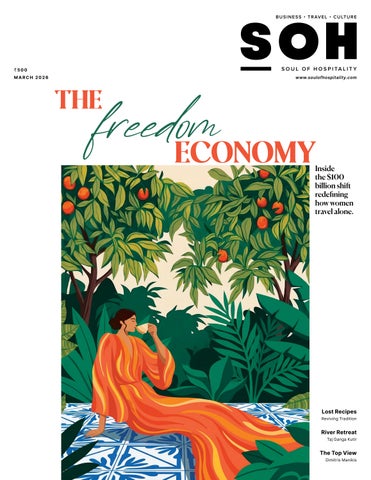
The global solo travel market is projected to reach $645 billion by 2026—but more striking is that over $100 billion of this spend is driven by women travelling alone. It signals a profound cultural shift from a time when women’s journeys largely meant visits to the maternal home or family holidays. Today, young Indian women are increasingly leading this change, shedding inhibitions to chart independent paths across some of the world’s most compelling destinations. By 2026, solo female travel has evolved from a perceived act of courage into a structural economic force. The transformation is not merely about participation; it reflects an industry recalibrating to meet her expectations. Our cover story explores this shift in depth.
Indian travellers, meanwhile, are rediscovering their roots through culinary heritage. Hotels are responding by reviving long-forgotten regional recipes and safeguarding techniques at risk of disappearing. These dishes are more than nostalgia; they are expressions of culture, memory and generational knowledge. Turn to our feature on living culinary archives.
Travel is also becoming a means of learning. From riding the rare Marwari horse and foraging in forests to pursuits such as scuba diving, surfing, pottery or linguistics, journeys are increasingly shaped by skill acquisition. Our skillcations feature examines how learning-led travel supports local crafts and brings visibility to lesser-known destinations.
Also in this edition: a conversation with Dimitris Manikis, President – EMEA, Wyndham Hotels & Resorts, alongside books, cruises and more.
Warm regards,
DEEPALI NANDWANI, EDITOR, SOH
Founder and Publisher
Gurmeet Sachdev
Editorial
Editor Deepali Nandwani
Managing Editor Rupali Sebastian
Contributing
Editor Suman Tarafdar
Digital Editor Rachna Virdi
Contributing Writer
Chandreyi Bandyopadhyay
Ruth Dsouza Prabhu
Radhika Singh
Creative
Creative Director Tanvi Shah Team Shiv Soni
Business Head
Vipin Yadav Delhi, +91 99998 85515 vipin@soulinkkworldwidemedia.com
Sales Manager Deepa Rao Mumbai, +91 9136 000369 sales@soulinkkworldwidemedia.com
Head of Events and Alliances Karishma Shah karishma@soulinkkworldwidemedia.com
Office Manager Deepak Rao
Accounts Head Amey Acharekar
For queries: editorial@soulinkkworldwidemedia.com sales@soulinkkworldwidemedia.com info@soulinkkworldwidemedia.com
Printed and Published by Gurmeet Sachdev on behalf of Soulinkk World-Wide Media LLP. Registered office: 1/2, Old Anand Nagar, Nehru Road, Santacruz East, Mumbai, Maharashtra - 400055. Printed at Silverpoint Press Pvt. Ltd., A-403, TTC Industrial Area, Near Anthony Motors, Mahape, Navi Mumbai – 400709. Editor: Deepali Nandwani. All rights reserved worldwide. Reproducing in any manner without prior written permission prohibited. SOH takes no responsibility for unsolicited photographs or material all photographs, unless otherwise indicated, are used for illustrative purposes only. Unsolicited manuscripts will not be returned unless accompanied by a postage pre-paid envelope. All disputes are subject to the exclusive jurisdiction of competent courts and forums in Mumbai only. Copyright Soulinkk World-Wide Media LLP.


Once a niche, the solo female traveller is now a defining force reshaping global travel demand, design, and decision-making.
High performing, professional sliding door system for wooden or metal doors weighing up to 120kg.


80
Travel by Numbers
Outbound surges even as inbound tourism recovery slows.

72
India, Seen Globally Dimitris Manikis reflects on India’s tourism paradox and promise.

58
Where the River Beckons Taj Ganga Kutir celebrates Raichak’s timeless riverside setting.

86
Voyages of Influence
Saif Ali Khan redefines travel as an act of stillness.

26


14 Bengaluru’s Quiet Table NĀVU proves word-ofmouth still builds lasting restaurants.
92 Skill Journeys
Today’s traveller values immersive encounters.
The Social Stage Arq By The Leela blends spirits, dining, and design.

102
Heritage on Plates
Chefs revive forgotten recipes from India’s royal kitchens.


In a city fuelled by hype and headlinemaking launches, NĀVU has grown quietly, powered purely by food and word of mouth.
RUTH DSOUZA PRABHU


In today’s era of social media blitzes leading up to the launch of a restaurant or bar , NĀVU (meaning ‘We’ in Kannada) in Bengaluru is perhaps an anomaly. It’s like watching good friends in chef–co-owners Kanishka Sharma and Pallavi Menon, grow from strength to strength, across spaces, buoyed largely by the power of the great food that they make, and that one thing all F&B establishments desire—popularity by word of mouth.
Sharma spent her early career in the pickling and preservation food business, growing to become a self-taught chef running supper clubs from her home. Menon followed an IHM-Aurangabad degree with a master's from Italy’s University of Gastronomic Sciences, and then worked at premium establishments across the country.
A chance meeting brought the two together. Their culinary journey has seen uniquely conceptualised supper clubs, gourmet catering and pandemictime takeaway menus. The duo took on restaurant operations at


TOP: With NĀVU, Chefs and CoOwners Kanishka Sharma (left) and Pallavi Menon (right) offer bistro food in a non-intimidating setting.
LEFT: The bar is new addition at NĀVU. It was the one thing the duo felt was missing from their earlier address.
ABOVE: The NĀVU Bresaola — a very Italian salad, made with very Indian ingredients.


LEFT: With the open kitchen the staff and guests have a chance to interact over dishes like the Hasselback Potatoes. BELOW: The Miso Aubergine is truly a mélange of flavours and textures on the palate. BOTTOM: The Parmesan Churro is the perfect example of turning the familiar on its head.

Bangalore International Centre (BIC), following which, they opened doors to their very own space for NĀVU in Domlur, with its signature yellow canopies, where they stayed for six years. And now, they have moved to a new pin code in the Central Business District just off MG Road, Bengaluru.
Growing with NĀVU has been a journey. “It’s like when you start life in a single-room and bathroom home. Domlur was one upgrade that reflected the comfort of a friend’s home, with its walls covered with pop-art frames, curio-filled wooden cupboards and flower pendant lighting fixtures. This new address is like the next, where you use your hard-earned money to create a
space thoughtfully,” says Sharma.
“We hired a designer.We brought in our old lights and frames, and refurbished the chairs. We are a 52-seater because that’s how many chairs we had,” she chuckles.
“The bar is an upgrade, because I definitely want to serve you alcohol when you visit my home.”
NĀVU began with the idea of elevating casual dining. The duo’s only request of their diners was to surrender at the door and be open to trying something new. That willingness to experiment ensured dishes such as Pissaladière with cured sardines served on brioche with olive tapenade, caramelised onion, and tomato jam, and the Cauliflower Crème Brulee with walnut chikki, crispy leeks, rocket and truffle oil, quickly became fan favourites.

“Today we call it ‘informal luxury’. Classic bistro food in a non-intimidating setting, without a hefty price or being restricted to just weekend indulgences,” says Menon. “About 30 per cent of the earlier menu continues.
People order two to three of their favourites and then experiment with something new,” she adds. Clearly, NĀVU has firmly instilled in their diners the confidence to let their palates explore.
Sharma and Menon have always wanted the NĀVU experience to be like dining in a friend’s living room. A thought that resonates with almost every diner who has experienced a similar trajectory of going from a one-room pad to a home that now proudly showcases all that growth. In a culinary scene punctuated by media blasts, influencer reels, and

week-long launch parties, NĀVU chose none of that and let its food do all the talking.
So, what is the language that NĀVU’s food speaks? It is cuisineagnostic but technique-heavy, and deeply rooted in seasonality. The food draws influences from around the world, and you will find a crossing of Mediterranean and Japanese influences across dishes and techniques.
“Those anchors have become our cornerstones. It is within that arena that we play, have developed our style and
continue building on it. With our expanding team, we train and mould them to express this philosophy, and their creativity shows on the menu. It is us, NĀVU, but it is also them,” says Menon. What their anchors have also done, say the chef-duo, is help hone their approach to the idea of sustainability. “To us, the concept is not just about ingredients but about sustaining communities, ensuring business to local butchers and vendors, and creating an ecosystem that allows specific farmers and producers to connect with us,” explains Menon, adding that finding and growing things seasonally supports local


communities and, in turn, brings in sustainability, which then becomes the bonus.
What the diner eats at NĀVU comes from Indian markets. “Given the perception around our food, people are surprised that we go to the market and pick up our fish. Why fly in frozen seafood when we can support a livelihood here? We have vendors who now call us in the morning to tell us what they have for us, and we handpick from the choices available, even getting them to wear NĀVU T-shirts!” says Sharma.
The team now has Himalayan Trout on the menu, which comes into Bengaluru thrice a week. It will remain on the board till the fishing season for it ends. Asparagus arrives in early March from Himachal, and the farmer calls the chefs when it is ready to ship. The restaurant’s grapefruit comes from a single vendor in Hunsur.
“Without calling it ingredientforward, there is a strong reliance on quality produce, which comes from finding specific people for particular things. Great produce doesn’t need excessive intervention. And when certain elements complement each other, it becomes a beautiful mélange on the plate,” believes Menon.
Placing NĀVU Bresaola in context, Sharma explains that

ABOVE: Pissaladière features cured sardines served on brioche soldiers with olive tapenade, caramelised onion, and tomato jam.
BELOW: Restraint rules: Baby beetroot salad dressed in onion vinaigrette.
BOTTOM: The Rib-eye Carpaccio proves that great produce doesn't need excessive intervention.
it begins with wine-cured beef that is then air-dried. “We pair it with locally sourced radicchio and grapefruit from Hunsur. Traditionally, you would add Parmesan. We didn’t want to take the cheese angle, so the dressing is made of grapefruit juice. It draws from a classic northern Italian bresaola, but everything we use is local—from the meat to the wine and the grapefruit.”
One can also enjoy dishes like the Ballotine—fried potato pavé, green apple and jus, the Crudo— cured fish in a celery coconut tiger’s milk served with green apple and black rice, or the Rib-Eye Carpaccio—sliced raw beef brushed with a koshu ponzu.


And not to miss the duo’s love for combining the unexpected. Think Mustard Icecream, Parmesan Churros and Bon Bons— chicken liver pate encased in white chocolate!
At a time when Bengaluru is witnessing a plethora of thematic restaurants, rapid multiplication of breweries, and also becoming the country’s cocktail capital, NĀVU is a quiet story of growth, heard loud and clear by a city that truly loves it.
As Gen Z chases #TFW, it is leading an entire transformation in travel trends.
SUMAN TARAFDAR
BELOW: Gen Z is happy to prioritise oneself, and savour each moment.
OPPOSITE PAGE, TOP: Trips can be shared around adventure activities such as watersports at Gokarna.
OPPOSITE PAGE, BELOW: Post COVID, travelling for concerts and music festivals has gained rapid traction. Seen here, the Ziro festival.

Is travel about experiencing new places, creating memories, the feeling of gratification from time well spent? Add Gen Z, the most disruptive generation in living memory, to the mix and the results get very interesting very fast. The tech the generation uses may have been made by their 'seniors', but the way Gen Z consumes it is uniquely its own.
Gen Z’s communication mediums seem almost like a secret language at times, designed specifically to exclude all others. Expanded disposable incomes have come with new priorities— discovering the self is paramount, it seems. Doing it while travelling and eating out, that’s just #chasingtfw.
‘Listen to the trees, learn how to be still when the path feels lost!’ is how @karuvadgraphy posted on Instagram, hashtag tfw. For @vitaminsea, it’s a terse, ‘I'm off now
– headin’ out, explorin’, livin’ life’.
For those flummoxed by this generation, ‘TFW’ or That Feeling When, is a much sought state of nirvana. Nostalgia? Wistfulness? Whatever it may identify as, the trend makes it impossible for the sectors hosting Gen Z (officially those born between 1997-2012) to ignore their spending patterns.
Yes, Gen Z’s communication may not be familiar, but what is unmistakable is that they are travelling more frequently, using tools hitherto unavailable to plan their trips, stays and meals, and completely reassessing the desirability of destinations and experiences. Easier accessibility and faster, deeper transport infrastructure to destinations— including hiking trails or ‘undiscovered’ beaches—are all providing alluring choices for the younger generation.

Travel for Gen Z is clearly about chasing a feeling or emotional moments that are worth sharing on social media. So travel becomes emotional, experiential and highly shareable.
Cleartrip’s Unpacked 2025 report, released late last year, notes a whopping 650% rise in Gen Z travellers over just one year. The report’s ‘flavour of the year’ is Gen Z, affordability and value! Gen Z isn’t staying put—they are just getting smart about how far their money can go, says Skyscanner in Gen Z Travel Trends 2026. “This generation is all about chasing inspiration from social media, using AI to plan trips, and taking feel-good trips that don't cost the earth. But with fewer years in the workforce, savvy spending is a priority.” Similarly, Klook’s Travel Pulse 2026 reveals strong international travel intent, rising experience-led spending, and a shift toward multi-destination journeys, with Asia Pacific travellers leading the way.
The Skyscanner report provides a fascinating peek into travel trends. E.g. value. According to the report, Gen Z Indians say they will go abroad more in 2026 but only 44% plan to spend more on accommodation. A third (32%) will look to go to lesser-touristed destinations to save money. The majority (56%) of Gen Z in India made financial sacrifices for their last holiday. Across the globe, 52% of Gen Z travellers take at least three leisure trips per year.
“This is a generation that scans flight prices like it’s second nature and knows that travelling more often doesn’t have to mean spending more,” it says. “They are not splashing cash, they are stretching it—swapping big-budget blowouts for smart, smaller adventures that add up to a life well-travelled.” Yes, #tfwlife.


Of course, it goes beyond. Even with a greater sense of pursuing one’s own path, there are clearly visible trends. One of the newest tools, regenerative AI, is being used extensively. Gen Z didn’t just notice AI, they welcomed it with open apps, according to Skyscanner. In a virtuous cycle of creation and consumption, Gen Z is not just consuming content—read Insta
reels—voraciously; it is posting even more content. “Whether it’s finding new places to go, planning the details, getting recommendations on where to eat and stay, social media plays a major role,” according to Skyscanner. Klook’s Travel Pulse 2026 says four in five travellers visited places and made bookings due to social media.
Rather than choosing between familiar destinations and new

BELOW:

ones, travellers are increasingly doing both in the same trip, says the Klook report. “Major cities are no longer the end goal; they are gateways that allow travellers to extend their journeys beyond familiar destinations. APAC Gen Z travellers are leading this shift. They favour faster-paced, densely packed itineraries, actively venture beyond mainstream hotspots, and show stronger intent to discover lesser-known locales.”
You may sneer at this let’spack-it-all-in trend—quite the opposite of the ‘slow travel’ that older generations espouse, but entire hospitality brands are being built around the Gen Z traveller. Think Aloft, Moxy, Canopy, Even, Tempo, Curio, Tru... Yes, even the names reflect changing feels. Move over pastels, for the stay, Gen Z is thinking vibrant hues, quirky furniture, shared tables and cozy nooks. #hotels4tfw.
While bleisure may have been the term of choice for millennials, for Gen Z, workcation is the vibe they are going for. “My work allows me to work from anywhere, and I am
travelling as much as I can while working,” says the 20-something copy writer Hemant Minocha. Connectivity is top priority as he worked from 14 different places over eight trips last year. His goal for this year: to see even more places, especially beyond India, though he is trying to ace the challenge of marrying differing time zones with work. “The feeling of visiting new places, meeting new people—who often have very different lives—is amazing.” Minocha saved up to attend international concerts last year. He made it to Lollapalooza India, which for him, “created memories for a lifetime, the feeling of seeing megastars live in India was unbeatable”. According to a report, for 62% of the generation in India, live music and cultural events are emerging as primary trip drivers. 93% of Gen Z find that travel improves their mental well-being, prioritising relaxation, yoga, and ‘dry’ holidays over nightlife. Sober curious much? Indeed, wellness and sustainability are more frequently searched than ever before in India, indicate the booking platforms.
Booking via apps is standard, with 62% using digital platforms for better deals. Over 30% book flights less than a week in advance. Planning and spontaneity seem to go hand in hand—finding those in the business of travel can ill afford to ignore. Perhaps reassuringly, despite their savvy money-saving and travel-planning skills, Gen Z is not immune to stress when planning trips! However, as Skyscanner points out, 64% of young Indian holiday makers are headed into 2026 without having booked travel as they were still deciding on dates to travel. Contradictory it might be to the finding that flight booking alerts are second nature to Gen Z, best to accept that both are true at once. #findingtfw.


From Candolim’s effortless energy to Palolem’s slow, sun-drenched calm, Sarovar Hotels presents a more nuanced way to experience Goa.
Goa has long outgrown its clichés. Beyond the familiar rhythm of beach shacks and nightlife, the destination today unfolds in layers — of quiet luxury, cultural nuance and deeply personal escapes. For the discerning traveller, it is no longer about going to Goa, but about discovering which Goa speaks to you. Sarovar Hotels’ curated presence across the state captures this evolving narrative with four distinctive addresses.
At Golden Tulip Candolim, North Goa’s easy glamour comes alive — sunlit rooms, languid poolside afternoons and the effortless proximity to Candolim’s vibrant shoreline.
A short drive away, Golden Tulip Vagator channels a more contemporary energy. Set near Vagator’s dramatic red cliffs, it feels attuned to Goa’s creative pulse — where sunsets blur into music-led evenings and the mood is quietly electric.
Further south, Sea Breeze Sarovar Portico offers a gentler cadence. Here, wide beaches and unhurried days invite you to linger, whether over long lunches or restorative moments by the water.
And at Sobit Sarovar Portico, Palolem, near one of Goa’s most picturesque bays, the experience turns intimate — a retreat shaped by soft design, coastal calm and the luxury of stillness.
In Goa, the true indulgence lies in choice — and in finding your own rhythm within it.

SUNIL KANT MUNJAL, AJAY SHRIRAM, AND NITAN KAPOOR
When a corporate head honcho—especially one known not only for boardroom acumen but also for a genuine patronage of the arts—writes a book, curiosity is almost inevitable. The name alone carries a certain gravitas into the literary world. Yet Table for Four: Delhi’s Dining Legacy is interesting for reasons that go well beyond the prominence of the names on its jacket.
Co-authored by Sunil Kant Munjal, CEO of Hero Enterprise, Ajay Shriram, Chairman of DCM Shriram Ltd., and entrepreneur Nitan Kapoor, the book is
The origins of the book are disarmingly simple. For 16 years, four friends, successful business leaders bound by curiosity and appetite, met once a month for lunch somewhere in Delhi. The ritual was modest: a table, a meal, conversation. Over time, these lunches evolved into informal restaurant critiques, digressions into food history, and reflections on work, friendship, and the city itself.
Out of that private tradition emerged something unexpectedly public: a chronicle of Delhi’s dining culture. The book features 27 restaurant reviews, 10 signature recipes, essays by chefs and restaurateurs, and brief histories of beloved dishes, from the soft-ascloud Daulat ki Chaat to the rise of butter chicken and the development of Punjabi restaurant culture.
What emerges is a portrait of restaurants not merely as businesses but as social institutions, places where memories are made, and ideas exchanged. In tracing Delhi’s journey from club dining and legacy eateries to chef-driven, experiential restaurants, the book becomes something rare: part restaurant guide, part memoir, part cultural history, and, quietly, a meditation on friendship.


Biting Off More Than I Can Chew, reads less like a conventional chef’s autobiography and more like a chronicle of how modern restaurant culture in India gradually took shape.
Akerkar traces his unlikely journey from a biochemistry student in the United States to the founder of Indigo—the Mumbai dining room that helped shift the city’s culinary centre of gravity away from five-star hotel restaurants toward independent,


chef-driven spaces. Along the way are stories of risk, partnership, ego, and reinvention. What emerges is not simply a personal narrative but a portrait of an industry learning to find its own voice.
The memoir captures a pivotal period when independent restaurants began challenging the long-standing dominance of hotel dining in India. When Indigo opened in 1999, its European fine-dining approach signalled a new possibility for the city’s restaurant scene. In that sense, the book also reads as an informal history of India’s early modern restaurant culture.
Written largely during the stillness of the COVID-19 pandemic, the memoir carries a reflective tone. Among its most candid passages is Akerkar’s account of building Indigo, navigating tensions with investors, and eventually walking away from the restaurant he created—an experience he describes as the strange act of passing by a place that once defined his life.
Threaded through the narrative is Chef Akerkar’s mixed Indian and German-Jewish heritage, which shaped both his worldview and a style of cooking that blends European technique with an Indian sensibility.
Few journeys in India are as dramatic as sailing to Barren Island, the country’s only active volcano, rising starkly from the Andaman Sea. A new cruise allows you to explore.


Barren Island, India’s only volcanic island, looks almost primordial. Counted among the most extraordinary destinations in the region, the island—located in the Andaman Sea, as part of the Andaman and Nicobar archipelago—is the only active volcano not just in India, but in the entire stretch from Myanmar to Sumatra.
A new fortnightly overnight cruise from Port Blair to Barren Island is now attracting curious locals and adventurous travellers. Operated by the Directorate of Shipping Services (DSS), the cruise offers views of the active volcano rising out of the sea, often shrouded in a plume of gas, steam, and volcanic ash.
Most trips begin from Port Blair or Havelock Island, located approximately 138 to 143 kms. from Barren Island—a three- to five-hour journey, depending on sea conditions. The open-sea voyage across the pristine, deep-blue waters of the Andaman Sea is scenic. Along the route, the cruise docks at a few other islands, including Baratang Island near Port Blair, home to limestone caves and mangrove forests, with occasional dolphin sightings.
Travellers often describe the exact moment when the island appears on the horizon as dramatic—a dark volcanic cone rising alone from the ocean. Boats circle the island slowly, allowing travellers to view the smoking volcanic crater, black lava beaches and jagged volcanic cliffs. On days when volcanic activity is more intense, visitors may even spot smoke plumes or a faint glow of lava.
Those who have visited often describe the island as ʻlunarʼ or ʻprehistoricʼ. The stark landscape has been shaped over centuries by volcanic activity: black volcanic rocks and ash, a steep conical volcano at the centre of the island rising about 354mts. above sea level, and barren crater slopes largely devoid of vegetation, though punctuated by occasional patches of green along the outer ridges.
The underwater world is spectacular
In contrast to the islandʼs barren, burnt-out surface, the underwater world around Barren Island is vibrant and thriving. Divers have reported healthy coral reefs teeming with marine life, including reef fish, manta rays and sharks, with exceptional visibility that often stretches deep to the seabed.

It’s expensive and logistically complex
Trips to Barren Island require special permits from the authorities and are typically conducted through chartered boats or private expeditions. Government vessels such as MV Sindhu and MV Nalanda depart from Haddo Wharf in Port Blair on Friday evenings around 9pm, reaching waters near Barren Island early the next morning, allowing passengers to view the rugged terrain and smoke rising from the islandʼs 8.34sq.km. volcanic landscape.
The cruise includes cabin accommodation, onboard meals, and a briefing on the volcanoʼs history. The ship also features a semi-submarine viewing deck where passengers can observe coral reefs and marine life through glass panels.
The Barren Island cruise is aimed at attracting discerning travellers to the Andaman and Nicobar archipelago in the Bay of Bengal. Although disembarkation on Barren Island is not permitted, the rare opportunity of viewing Indiaʼs only volcanic landscape promises an enriching experience.

At Arq By The Leela, luxury unfolds as an experience—through art, design, rare spirits, dining, and conversations that linger long after the evening ends.
DEEPALI NANDWANI
LEFT: A striking brass installation anchors the private dining corridor, its reflective surface offset by Sabyasachi’s patterned walls.
RIGHT: The vestibule reads as a composed threshold, where patterned floors, mirrored sightlines and warm lighting draw you inward.

There is a particular moment when the elevator doors open at Arq By The Leela which sets the tone for everything that follows. The experience begins in the most gracious manner. A glass of sparkling wine is offered, even if it happens to be early in the morning.
Woken up dehydrated after days of indulgence, the way I had? Perhaps coconut water would be better. Fresh lime soda might help too. Within moments, Dhruv Rastogi, the club manager, had arranged for fresh coconut water instead. The exchange captures something essential about Arq By The Leela. Luxury here is attentive, conversational and deeply personalised, unfolding naturally as guests move through the space.
What follows is an experience that feels deliberately immersive. Experiencing an ultra-exclusive private club often surpasses the experience of a luxurious hotel, offering a level of refinement, privilege and elevated access that few hospitality spaces can match.


SVP - OPERATIONS, SOUTH, AND HEAD OF SALES, THE LEELA PALACES, HOTELS AND RESORTS
“The core vision behind Arq By The Leela was to create a space where culture, conversation, and community intersect— encouraging both reflection and interaction among business leaders, creators, entrepreneurs, and cultural thinkers.”
Arq By The Leela at The Leela Palace Bengaluru is the first in a series of members-only clubs opening within some of The Leela Palaces, Hotels and Resorts' properties. The plush private members club is a space one visits for experiences and conversations—literary and otherwise; for its enviable wine and luxury spirits collection; for dining on a curated menu; for the ambience and design; for meetings and business deals; or to end the evening with a rare glass of wine or spirit and a selection of cigars.
The Bengaluru club spans more than 10,000sq.ft., composed of interconnected rooms designed with industry leaders, entrepreneurs and cultural thinkers in mind.
The interiors of Arq By The Leela were designed by New York design atelier AvroKO, the internationally recognised design firm known for hospitality projects around the world. The studio, which has outposts in Bangkok, San Francisco, London and Miami, makes its debut in India with this project. The atelier reimagines the traditional library, from a tranquil place of study into a vibrant, sophisticated playground of wonders, designed to spark curiosity and storytelling.
The concept reflects a broader shift in luxury hospitality where experiences matter as much as access. It is a redefining of the private membership club space, backed by a major hospitality group, which offers a dimension of luxury that’s beyond the ordinary. As Madhav Sehgal, SVP - Operations, South, and Head of Sales says, “The core vision behind Arq By The Leela was to create a space where culture, conversation, and community intersect in a way that feels distinctly contemporary yet rooted in Indian sensibilities. We recognised that while India has a long tradition of private clubs, many of them are either legacy institutions or hospitality spaces that serve a specific functional purpose. What felt missing was a thoughtfully designed environment where individuals from different disciplines—business leaders, creators, entrepreneurs, and cultural thinkers—could gather in a setting that encourages both reflection and interaction.”
Several shifts informed the development of Arq By The Leela. One is the growing interest in experience-led luxury, where individuals seek environments offering depth, storytelling and cultural context rather than simply access to premium services. “Another trend is the convergence of professional and social spaces,” Sehgal continues. “Increasingly, people prefer environments where business conversations, cultural engagement and leisure can coexist organically. Over the next decade, we expect private clubs in India to evolve into more experience-driven ecosystems. The most successful spaces will likely be those that combine strong design, curated programming and a genuine sense of community.”
During a walkthrough, the interiors reveal themselves gradually. Artworks by master Progressive Artist S.H. Raza line the walls. Udaipur marble appears across floors and architectural surfaces. Custom-made sconces illuminate jewel-box frames, both large and small.
A reception desk, crafted in wood with a green marble top, anchors the entrance lobby and centres the sensory experience. Behind it rise striking brass panels created by DIART Studio. Sculptures set into recesses incorporate fragments of natural coral. The lighting throughout the club is entirely custom-designed and fabricated.


THIS SPREAD, CLOCKWISE FROM TOP LEFT: Underfoot, a geometry of stone and pattern lends rhythm; in the Café Lounge, Ganesh Selvaraj’s abstract work builds in quiet layers, offering a contemplative counterpoint; layered in sodalite stone, cast glass and resin, the bar emerges as a luminous centrepiece—precise, tactile and quietly theatrical; a handcrafted door handle becomes a jungle vignette, with elephants in motion and delicate blue inlays; the Café Lounge acts as a social anchor, where material richness and soft lighting invite conversation and pause.


The club was conceived as as a ‘Living Library of Wonders’. The phrase is both conceptual and literal. The intention was to frame the club as a place of discovery rather than simply access. “The intent was to create an environment where design, art, and programming come together to support meaningful engagement. In that sense, Arq By The Leela is less about exclusivity as status and more about cultivating a shared ecosystem of ideas and experiences,” says Sehgal.
Spatial planning allows the club to accommodate both professional and social uses. Spaces such as the Cigar Dewan, Art Studio and private dining rooms allow members to shift seamlessly between work, conversation and leisure.
Experiences at Arq By the Leela extend beyond interiors and dining. Programming encourages dialogue through cultural conversations, thought-leadership panels and gatherings such as vinyl listening nights. Members also enjoy privileged access to cultural moments within The Leela ecosystem, including the annual Maharaja Sawai Man Singh Polo Cup held at The Leela Palace Jaipur.
Craft and materiality are central to how Arq By The Leela communicates its identity. “Many of the surfaces and architectural elements within the club, whether the brass panels, the marble compositions, or
the bespoke lighting are the result of collaboration with artisans and designers. These elements carry cultural meaning and texture. For example, materials such as Indian marble, lacquered wood, and brass have long histories within Indian architecture and craft traditions,” says Sehgal. “Reinterpreting them in a contemporary setting allows the club to feel both rooted and current. The artworks throughout the space also contribute to this narrative by adding intellectual and visual layers that encourage members to engage with the environment more closely.”


The interiors reference Indian design traditions through material palette and craftsmanship. Techniques such as stone carving, textile work and metal inlay narrate a story of Indian craft and luxury.
The architects collaborated with several design studios. DIART Studio, founded by Geetanjali Joshi, created the brass panels lining the entrance. Qorate Studio, led by Sarthak Bajaj, executed finishes including mother-of-pearl, liquid resin, gold leaf and faux tortoise shell. RIZO, founded by Dhara Mirani, produced bespoke cast glass elements including the custom resin bar and ceiling tiles. Milaaya Embroideries created intricate embroidery and hand-beaded textiles for furniture and cushions.
Even the wallpapers tell a story. The eco-friendly Sabyasachi for Nilaya wallpapers are bordered by green Udaipur stone and created using dried petals and vegetable dyes.
Sodalite blue stone appears across bar tops and tables. Exotic blue stones and lapis lazuli reappear throughout the space as visual markers linking each room together.
Art at Arq By The Leela moves between modern and contemporary, creating a layered narrative across the space. A striking installation appears at the entrance, where brass panels trace the journey of a voyager in search of meaning. The story begins with a sailor crossing oceans in pursuit of discovery. Emeralds and precious stones emerge across the panels, symbolising knowledge gathered along the way, before the voyage culminates at The Leela Palace.
This idea of exploration continues throughout the club. An understated underwater theme evokes depth and discovery, with fragments of coral set into sculptural niches and artefacts referencing navigation, direction and time. At the heart of the club lies the Library Lounge, where works by S.H. Raza anchor the room. Paintings inspired by his iconic Bindu—symbolising the origin of life—sit alongside works reflecting trees, earth and cosmic beginnings.
Vintage photographs, leatherbound books, and sunlit French windows complete the setting, encouraging slow conversations and unhurried evenings.
Adjacent to the library sits the café lounge, a space that functions as the club’s social anchor throughout the day. Members drift in for coffee, tea or informal meetings, often lingering longer than planned. At its centre stands an expansive coffee bar where barista Swapnil Roy roasts, blends and experiments—a small laboratory devoted to unusual coffees and tea infusions.
The bar itself is carefully considered. Bespoke handcrafted bevelled glass tiles by RIZO line

the counter, while a custom resin bar glows under thoughtfully designed lighting. Sodalite blue stone surfaces and handcrafted glass elements give the space a jewel-like presence.
Roy approaches beverages with curiosity and experimentation. One of his most intriguing creations is a drink he calls The Dirty, built on a cold brew, combining Indian masala chai with lapsang souchong. “It’s a mix of Indian masala tea and one of my favourite teas, lapsang souchong, which influses it with a really light smoky aroma,” he explains.
Roy then layers condensed milk onto the tea base, drawing inspiration from Southeast Asian tea traditions.“In Burma, they make a tea concoction, add just a spoonful of condensed milk and call it milk tea,” he says.


The drink is finished with chilled milk and a shot of espresso, creating shifting flavour notes with each sip. “The first sip has higher acidity and bitterness from the ristretto,” Roy says. “On the second sip you get a milder version where the milk and espresso meet. And at the end you get the sweetness from the condensed milk, along with the tea and the smokiness from the lapsang souchong.”
Dining at Arq By The Leela operates differently from a traditional restaurant. There is no printed menu. Instead, members speak with Chef Siddharth Pandey before their reservation to discuss what they feel like eating. The result is a personalised culinary experience,


where contemporary European techniques meet Indian ingredients and seasonal produce.
The beverage programme follows a similarly curated philosophy. Rather than operating like a typical hotel bar, Arq By The Leela focuses on rarity, provenance and bespoke service. The cellar features premium global wines and rare spirits, often presented through guided tastings.
In the humidor and cigar lounge, a back-lit cabinet displays exceptional bottles meant for slow drinking and pairing with cigars. Meanwhile, the cocktail programme draws on the expertise of ZLB23, the hotel's Kyoto-inspired speakeasy, with head mixologist Rajib Mukherjee collaborating to translate craft cocktail techniques into both alcoholic and nonalcoholic creations.
The Leela is reimagining luxury through private membership and shared experiences. Arq at The Leela represents a shift in luxury hospitality, moving beyond the traditional hotel stay towards curated, membershipdriven communities.
“It occupies a unique space between hospitality, culture and community. A member might host a meeting in the morning, attend a cultural conversation in the afternoon and enjoy a social gathering in the evening,” says Sehgal. “The ideal member values rarefied spaces and a community of paradigm shifters and change makers shaping business, culture and the creative industries.”
The Leela already plans to expand Arq By The Leela to Delhi, Chennai and Mumbai, with each club designed to reflect the cultural context of its city while building a strong sense of community
What was once a niche segment is now a powerful driver of global travel demand, a $100 billion economy powered by solo women travellers. They are a transformative force, pushing the industry to rethink and restrategise.
DEEPALI NANDWANI


OOn a sun-drenched morning in Goa, a woman checks into a boutique villa alone. No family t railing behind, no group itinerary, no compromises. She has chosen the room, the neighbourhood, the café she will visit, and the pace at which she will move. This is not rebellion. It is not even unusual anymore. She dines alone. She travels without compromise, without apology.
It is the new normal. The global solo travel economy is worth $645 billion today, of which solo women travellers account for $100 billion and are growing, as per US-headquartered Grand View Research and Custom Market Insights. Experts estimate that in another decade, solo women travellers will catch up with men, powered by an independent younger generation of women.
Across India, and increasingly, the world, travel itself is being redefined. Journeys are no longer just about movement; they are about meaning. Travellers are seeking reconnection with the destination, culture, and increasingly, with themselves. And few trends capture this shift more clearly than the rise of solo travel. “Women are choosing to travel independently, not just to explore new destinations but also to reconnect with themselves, pursue personal interests and experience the freedom that comes with planning a journey entirely on their own,” says Santosh Kumar, Regional Manager, South Asia, Booking.com. “This shift reflects a broader cultural change where travel is increasingly seen as a form of self-expression, personal growth and discovery.”
India, in many ways, offers the perfect backdrop. A country of contrasts, from bustling cities, quiet mountains, spiritual centres, to expansive coastlines, it allows a solo traveller to move between anonymity and belonging with unusual ease. What was once seen as a bold or even risky choice is now becoming a defining expression of independence, identity and economic agency.
Data confirms what hoteliers, airlines, and travel platforms are already seeing on the ground (see box): the solo female traveller is no longer a niche segment. She is one of the most powerful forces driving the future of travel.
For decades, luxury travel was constructed around togetherness: the honeymoon suite, the family villa, and the long dining table designed for multiplicity. Even solitude, when offered, was often aesthetic rather than genuine, curated rather than lived in.
But quietly, a different figure has entered the frame, and she is changing the game. Platforms, hostels, and luxury hotels report not only initial curiosity but also something more enduring: women travellers and guests often return if they enjoy the experience. Indian online travel platforms are registering this shift in real time.
This is no longer a niche movement or a fleeting trend. It is a structural shift redefining the very architecture of global travel demand. Women today account for 71% of solo travellers globally, according to Virtuoso’s luxury travel network, while nearly 40% are actively planning solo trips in 2026. More significantly, women influence over 80% of travel decisions worldwide, positioning them not merely as


participants but as the primary demand architects of the industry.
Within this global rebalancing, India is emerging as one of the fastest-growing markets for solo female travel, driven by rising financial independence, greater cultural confidence, and a hospitality ecosystem that is gradually adapting to their expectations. On Indian platforms, including MakeMyTrip, demand for solo women travel has reportedly risen by 30–40% over the past two years, indicating that what was once a niche preference is now scaling rapidly. The platform’s data further indicates that overall solo travel bookings have grown by over 20% year-on-year, signalling a behavioural shift that is now firmly entering the mainstream. That shift—from hesitation to certainty—is visible across newer formats of travel as well. “Over the past few years, we’ve seen a clear shift, from mere curiosity to group conviction,” says Sujal Patwardhan, Co-founder, Embarq, which helps organise guided
road trips across the world. “Earlier, women would ask if they could do a self-drive expedition. Now they sign up, assuming they absolutely can. The demand has grown not just in numbers but in the intensity of intent. Women want meaningful, interesting journeys, not just run-of-the-mill travel.” Choice, here, is not rhetorical. It is logistical, economic, and deeply personal.
And increasingly, this independence does not always manifest as isolation. “We’ve seen a steady rise in women-led bookings across our portfolio,” says Devendra Parulekar, Founder, SaffronStays. “While solo ‘digital detox’ trips are popular, there is a massive surge in purposeful group travel.” He reframes the idea of ‘solo’ itself: “Women are moving away from noisy clubs and crowded hotels for their big moments. Whether it’s a landmark 40th birthday, a sophisticated bachelorette, or a long-overdue reunion, the preference is shifting toward private villas—spaces where you can celebrate without interruption.”

For the travel and hospitality industry, the solo woman traveller represents one of the most under-leveraged opportunities in the market. This is a customer segment that is high-intent, high-value, and high-loyalty—planning extensively, spending meaningfully, and returning to brands that build trust. And yet, the industry is only beginning to respond in a structured way.

GROWTH
DEMOGRAPHICS
+135% growth in solo women travellers (industry estimates) 30% of Indian women travellers go solo (Airbnb India)
40.7% of solo female travellers are Gen Z women (industry data)
63.8% Solo travel accounts for of Indian outbound trips (industry travel data)
45–55% = largest adventure segment Women (~50%) (women travellers survey 2025; Aquaterra insights)
54–55% Women influence or design of leisure trips in India
(Thrillophilia Women & Travel Decisions Report 2025)
3x Apply more safety filters (Thrillophilia)
73% say women are more active in travel planning (Booking.com – How India Travels 2025)
9 Women book trips 9 days earlier (Thrillophilia Report 2025) 28% Choose more premium upgrades (Thrillophilia) 18% lower cancellation rates (Thrillophilia) 6% Keep spending within 6% of men (Thrillophilia)
17 nights (solo) vs 8–9 nights (Airbnb Travel Trends 2025)


Regional Manager, South Asia, Booking.com
What makes India’s solo female travel story particularly compelling is the contradiction at its core. On one hand, mobility data suggests that over 50% of women in urban India do not step out daily, compared to just 14% of men, highlighting deeprooted social and infrastructural constraints. On the other hand, a growing cohort of women across age groups is choosing to travel independently, often for the first time, and then returning to it several times. Increasingly, travel is not always alone in the traditional sense, but independently within the community. This is where formats such as private villas and curated homestays are quietly reshaping the landscape. “The location often dictates the mood,” Parulekar explains. “For milestone birthdays, guests choose mountain retreats like Dehradun or Kasauli for intimate dinners under the stars. Others head to coastal villas in Alibaug or Goa, where the sound of the waves becomes the soundtrack to a new decade.”
For reunions, proximity matters: “The drive-to belt—Lonavala, Karjat, Alibaug from Mumbai, or Kasauli and Rishikesh from Delhi—has become the go-to for quick, high-energy escapes,” he says. And for a different kind of celebration, quieter, more aesthetic destinations, such as “the leafy lanes of Assagao and Siolim in Goa offer a chic, slow environment for groups who want to lounge, unwind, and simply be,” adds Parulekar.
A big part of having women travel solo is removing the invisible barriers. “We handle route planning, safety protocols, vehicle support, and logistics so participants can focus on the experience. But equally important is the sense of community… travelling with other women creates a very reassuring environment,” says Patwardhan. This tension between restriction and aspiration is precisely what gives the movement its emotional charge.
“Women are choosing to travel independently, not just to explore new destinations but also to reconnect with themselves, pursue personal interests and experience the freedom that comes with planning a journey entirely on their own. This shift reflects a broader cultural change where travel is increasingly seen as a form of self expression, personal growth and discovery.”

Co-Founder, Embarq
Solo travel, for many Indian women, is not just a leisure activity. It is an act of reclaiming space. Anamika Vishwakarma, a social media professional, was 23 when she travelled solo for the first time. She lives in a joint family in Varanasi—parents, grandparents, brothers—where decisions are rarely individual. “In 2022, I travelled solo to Manali, 1,350 kilometres from my hometown,” she says. “It was a 15-day trip. It took me four days to convince my family that I could do it alone.”
The hesitation was not logistical. It was cultural. Safety, capability, and perception—each of these aspects had to be negotiated before the journey even began. For decades, Indian women have moved within frameworks of permission, with travel mediated by family and caution. A woman travelling alone was not just uncommon; it was, in many contexts, unthinkable.
And yet, to read this purely as a market opportunity would be to miss its deeper charge. Because what appears, on spreadsheets and in boardrooms, as a growth segment is, in lived experience, something quieter and more subversive. It is a reordering of permission, a redistribution of space, a refusal, increasingly, to be accompanied in order to just be able to experience travel.

“Women are far more decisive about the experiences they want. We’re seeing a growing willingness to choose journeys that are unconventional, whether it’s remote landscapes, cross-country drives, or destinations that aren’t typically on mainstream itineraries.”

In India, solo female travel is accelerating at an unprecedented pace. Platforms such as Zostel recorded over 92,000 solo female bookings in 2025, nearly tripling from 2018 levels, with strong postpandemic recovery and repeat travel behaviour emerging as a defining pattern. Meanwhile, travel fintech platform Scapia reports that solo travel among women has grown nearly ninefold year-on-year, reflecting a surge in confidence and control over travel decisions. MakeMyTrip’s reporting similarly points to a sharp rise in solo and premium travel behaviour, particularly in international bookings, reinforcing the idea that independent travel is increasingly linked to higher-value, experience-led consumption.
On platforms such as Airbnb, nearly 30% of Indian women travellers are now choosing to travel solo, while a similar share of hosts are women, collectively shaping both sides of the travel economy. Amanpreet Singh Bajaj, Airbnb’s Country Head for India and Southeast Asia, says, “Our data shows that women hosts are delivering exceptional hospitality while achieving financial independence, and women travellers are increasingly exploring the world with confidence. Not just hosts, but Indian women travellers too are embracing Airbnb for their myriad experiences and plans. Data shows that female Millennial travellers are leading the charge for bookings, followed by Gen Z. The majority of female travellers prefer to travel in pairs or in groups, typically taking trips lasting between two to six nights, reflecting a preference for short yet immersive experiences.”
Globally, the trajectory is just as pronounced. Nearly 40–45% of women now express intent to travel solo, with repeat travel behaviour and forward planning significantly higher than their male counterparts.
But alongside demand, supply is evolving too. “From a broader industry perspective, we are seeing a rise in women-friendly accommodation options and bespoke itineraries specifically curated for independent travellers,” Kumar notes. “Whether it’s celebrating a professional achievement or a personal breakthrough with a solo retreat… travel is increasingly becoming a way to mark personal milestones.”
This is not just travel. It is a ritual. A promotion becomes a journey. A transition becomes a retreat. A moment becomes a destination. And increasingly, platforms are being designed to enable this shift. “Our mission is to make it easier for everyone to plan every part of their journey seamlessly,” Kumar adds. “We are committed to helping them discover new destinations, connect with local cultures and explore the world with confidence and on their own terms.”


What sits beneath these numbers is not just cultural change, but commercial gravity. This is a multibillion-dollar segment in motion—high-spending, repeat-driven, and remarkably loyal. The solo female traveller researches more, stays longer, and often spends more per trip than her counterparts. She is not incidental to the system; she is beginning to reorganise it.
“Our 2025 travel trends data highlights a diverse range of motivations for solo exploration,” says Kumar. “Seventy per cent of women travellers plan solo trips to relax, 68% to immerse themselves in nature, and 41% to visit friends and family. More than half choose solo journeys to explore both domestic and international destinations.”
What appears, on spreadsheets, as behaviour is, in lived experience, something more layered: autonomy, intention, and self-direction. “Luxury isn’t just about material comfort,” says Joseph. “It’s about meaningful experiences. Women-only expeditions combine adventure, camaraderie, and personal discovery—which makes them incredibly powerful.” She pauses, then adds, almost as a prediction rather than a conclusion: “We believe this segment will grow steadily as more women look for travel that is both immersive and different.” Women are creating a new travel economy centred on autonomy.
Parulekar echoes this, but grounds it in how those milestones are experienced. “The beauty of a private villa celebration is that you don’t have to play host. Our on-ground teams handle the meals and logistics, so whether you’re celebrating a promotion or simply taking time off, you can actually enjoy the moment instead of managing it.”
Behavioural data reveals just how distinctive this traveller is. A recent Solo Traveler Reader Survey where over 80% of respondents were women, largely over the age of 55—offers a glimpse into a high-value, highly intentional segment. Nearly 43% reported taking three or more trips in a year, with another 22% taking at least two. Trips are longer—75% travel for


The shift of more women travelling solo, within boardrooms, is no longer anecdotal. At Zostel, India’s largest hostel network, the numbers have begun to speak with clarity. “Solo female bookings have grown exponentially over the past few years,” says Dharamveer Singh Chouhan, its co-founder. “But what’s more interesting is repeat behaviour. Once women start travelling solo, they don’t stop.”
Zostel, with its shared spaces and standardised safety protocols, has functioned as an entry point, a threshold across which hesitation becomes habit. “We didn’t set out to build for women specifically,” Chouhan adds. “But we realised early on that if women feel safe, everyone feels safe.” Safety, here, becomes not a feature but a foundation.
Elsewhere, the response becomes more spatial, almost philosophical. At Aman Hotels, space itself becomes the first gesture of reassurance. At Aman-iKhas, tents are placed with intention; distance is not emptiness but design. Movement slows, and silence is allowed to accumulate. For the solo woman traveller, privacy is not isolation. It is control.


If hostels democratised solo travel, luxury hospitality is now being asked to refine it. At CGH Earth, where properties are low-density and deeply local, the approach is almost invisible. Many solo women guests are not looking for activities; they are looking for environments where they can exist comfortably, without being watched, questioned, or managed. Staff are trained to read cues without intrusion. Spaces offer privacy without isolation. Experiences remain optional rather than insistent. It is, as they describe it, as much about emotional safety as physical safety.
At The Leela Palaces, Hotels and Resorts, the same shift is translated into behavioural design. The solo female traveller is one of the most discerning guests they have, attuned to everything from corridor lighting to the tone of interaction. Arrival is discreet. Room allocation considers visibility and proximity. Dining has evolved, and women are offered tables that do not stage solitude as spectacle. The objective is not to create separate spaces for women, but to design spaces that work better for them, and therefore, for everyone.
At RAAS Jodhpur, embedded within historic cityscapes, the emphasis is on permeability without exposure, allowing women to move between the hotel and the city with quiet confidence. In the Jaisalmer desert, at Suryagarh Jaisalmer, experience is carefully choreographed; excursions, dining, and movement are curated so exploration never feels uncertain.
At Six Senses Vana, structure becomes a form of freedom. Wellness schedules, communal dining, and guided routines remove the friction of decisionmaking while preserving solitude. Many women arrive hesitant. They leave transformed, not because of what is done for them, but because of what they allow themselves to claim.
Across these varied responses, a pattern begins to emerge. Rooms are no longer simply assigned; they are positioned. Floors are secured, but discreetly. Dining is redesigned so solitude does not feel like a spectacle. Experiences are curated not to limit movement, but to enable it with confidence. What is taking shape is a new grammar of hospitality, one that replaces overt protection with invisible assurance. Not safety as restriction, but safety as design. Not supervision, but freedom, held quietly in place by carefully constructed safety nets.
For the travel and hospitality industry, this represents one of the most under-leveraged opportunities in the market. This is a customer segment that is high-intent, high-value, and high-loyalty—planning extensively, spending meaningfully, and returning to brands that build trust. And yet, the industry is only beginning to respond in a structured way.
two weeks or more—and deeply considered. Price and safety remain the two most influential factors (77% and 76% respectively), followed by weather.
What is striking is not just the frequency, but mindset. Nearly 90% of respondents opt for guided or escorted tours at least some of the time, not out of dependence, but for access and ease: the ability to go places they might not otherwise feel confident navigating alone, and the freedom to outsource logistics while retaining control of the experience.
This is not a contradiction; it is calibration. Independence is not defined by doing everything alone, but by choosing how much support to accept. From hostels to luxury hotels, from platforms to policy, the industry is beginning to respond: safer infrastructures, more intuitive service, experiences that privilege choice over prescription.
But this economy is not built on consumption alone. It is built on autonomy, on the ability to move through the world without negotiation, on the expectation that space can be occupied without explanation. In that sense, what appears as economic force is also cultural intent.
This is a freedom economy, yes, but it is also, quietly, a social rebellion.
Women are also increasingly at the centre of travel decision-making, not just for themselves, but for others.
According to Booking.com’s How India Travels 2025 report, 73% of respondents believe women today play a more active role in planning trips than ever before. Four in 10 women report being more involved in travel decisions, while a third take the lead in planning and booking for their families or groups.
More recent data suggests that this influence is even more structural than it appears. According to Thrillophilia’s Women & Travel Decisions 2025 report, women now influence or design nearly 72% of all leisure trips across India. What began as subtle shifts within households has become a measurable reconfiguration of how India travels, from budgeting and booking to destination selection and experience design.


The patterns are telling. Women plan earlier—on average, nine days ahead of men—reducing exposure to dynamic pricing and lowering cancellation rates. They research more deeply, cross-checking reviews, studying images, and circulating itineraries within family networks before committing. The result is not just better planning, but smoother journeys.
Women are increasingly shaping higher-quality travel. They choose significantly more premium upgrades—boutique stays, wellness add-ons, curated experiences, and comfort-first transfers—while keeping overall spend almost on par with men. It is what the report describes as a “smart luxury aesthetic”: more thoughtful, less excessive; more

“We do have seasoned travellers and confident
drivers,
but
Embarq
increasingly
we’re
seeing women who may never have done a road trip. What draws them is the chance to try something bold in a supportive environment. Many come with an open sense of curiosity and leave with a new level of confidence.”
meaningful, less performative. Even in shared travel contexts, the shift is visible. While women lead planning decisions, a majority of payments on couple trips are still made by men, revealing a quiet but important divide between financial transactions and decision-making authority.
Safety, however, remains central. Women apply significantly more safety filters while planning, prioritising trusted drivers, verified accommodations, secure neighbourhoods, and structured itineraries. These decisions are not abstract; they translate into measurable outcomes, including fewer disruptions and lower distress signals during travel.

SaffronStays
This shift is reshaping where women travel. Domestically, destinations such as Rajasthan, Kerala, and Goa—places that combine culture, pace, and relative ease—continue to dominate. Internationally, choices reflect a balance of accessibility and aspiration: Dubai and Abu Dhabi, Bali, Singapore, Thailand, and Vietnam.
Perhaps most telling is where this change is coming from. Tier 2 cities such as Indore, Ahmedabad, Lucknow, Jaipur are emerging as some of the fastestgrowing hubs for women-led travel planning, signalling that this is no longer an urban, elite phenomenon. It is diffusing.
Wellness, sustainability, and immersion are no longer peripheral. They are central. In Kerala, Ayurveda retreats now draw global travellers for week-long, deeply structured healing programmes.
“Not just hosts, but Indian women travelers too are embracing Airbnb for their myriad experiences and plans. Data shows that female millennial travellers are leading the charge for bookings, followed by Gen Zs. The majority of female travellers prefer to travel as a pair of two or in groups, typically taking trips lasting between two to six nights, reflecting a preference for short yet immersive experiences.”
In Rishikesh, yoga schools continue to attract seekers looking not for sightseeing, but for stillness. Across Goa, Uttarakhand, and Rajasthan, luxury resorts are blending spa, nature, and mindfulness into integrated experiences.
For many women, particularly those travelling alone, these environments offer something more than relaxation. They offer structured spaces in which
decision fatigue dissolves, and self-direction becomes intuitive. At the same time, sustainability and cultural immersion are reshaping how journeys unfold. Travellers are choosing homestays over hotels, craft experiences over curated tours, and local engagement over passive observation. Village tourism, artisan-led workshops, and slow travel formats are no longer niche—they are preferred.

For the solo female traveller, safety is not a baseline expectation. It is the architecture upon which everything else rests. But increasingly, it is not experienced as restriction; it is experienced as design. “When women travel, safety is the foundation of comfort,” Parulekar says. “We provide a fully managed ecosystem—trained caretakers, on-ground support, and, in many homes, women-led hospitality teams.”
That last detail is subtle, but significant. “In properties like Araqila or Ovates by the Sea, women are actively involved in managing the guest experience. That presence creates an added layer of reassurance for women-only groups,” he adds. This is what the future of safety looks like: not visible control, but invisible assurance.


Even aviation is beginning to respond at the level of the interface. IndiGo, one of India’s largest airlines, recently introduced a feature that allows women to select seats next to other female passengers during booking. “IndiGo is proud to announce the introduction of a new feature that aims to make the travel experience more comfortable for our female passengers,” the airline said in a statement. “We are committed to providing an unparalleled travel experience for all our passengers, and this new feature is just one of the many steps we are taking towards achieving that goal.” Framed as part of its ‘#GirlPower ethos,’ the move signals a broader shift: safety is no longer reactive; it is being designed into the journey from the very first click.
Airlines experiment with such seat-selection features. State tourism boards introduce verified accommodations and safety certifications. Hotels invest in surveillance, training, and protocol. These are the visible systems. But the most effective safety mechanisms are the ones that recede into the background: a well-lit corridor that requires no second thought, a front desk that notices without questioning, and a hotel floor that feels intuitively navigable, even late at night.
This is what freedom with safety nets looks like in practice: not the elimination of risk, but the quiet presence of assurance. The solo female traveller is not seeking to be shielded from the world; she is seeking the confidence to move through it uninterrupted.


There is also a shift in how independence itself is understood. For many women, solo travel does not mean doing everything alone. It means choosing how and with whom to experience a journey. This is not a contradiction; it is calibration. And the environments they choose reflect this balance. “We’ve found that women travellers prioritise three things: safety, privacy, and aesthetics,” Parulekar says. He describes what that looks like in practice: “The appeal is the ‘private club’ feel—an entire estate that is yours. No shared elevators, no crowded buffets. Just your inner circle in a secure, gated space.”
Beyond safety, there is also the atmosphere. “From sprawling gardens for morning yoga to beautifully designed living spaces for late-night conversations, these homes are designed for making memories. They’re aesthetic, but also deeply personal.”
For decades, luxury was measured in scale, such as larger rooms, grander lobbies, and more elaborate offerings. Now, luxury has become the absence of friction. It is the presence of trust and the ability to move without negotiation, as well as the ability to choose your own company and your own solitude. Private villas, quiet retreats, small-group journeys, and solo itineraries are not alternatives to luxury. They are redefining it.
40-45% of solo travellers in India are women multiple industry reports, including Booking.com insights, Virtuoso Luxury Travel Network)
71% of solo travellers globally are women (Virtuoso Luxury Travel Network)
58–59% of global travellers plan to travel solo (Booking.com Travel Predictions 2025)
9% of women intend to travel solo again within a year (industry aggregated data)
30% of Indian women travellers now take solo trips (Airbnb India data)
+135% growth in solo female travel in India (industry estimates, 2023–2025)


70–80% of global travel decisions are influenced by women
(industry consensus across reports and Virtuoso Luxury Travel Network)
54–55% of global solo travel spending is driven by women (aggregated industry data)
68–70% of solo travellers in luxury/tour segments are women
(tour operators & luxury segment data)
30% of Airbnb hosts in India are women, who collectively earned approximately ₹2.6 billion in 2024
75%
Varanasi saw an over 75% increase in bookings compared to 2023, making it the top trending domestic destination for women, followed by Ahmedabad and Mathura (Airbnb)
145%
Tbilisi was the top trending international destination, with a nearly 145% increase in bookings compared to 2023, followed by Kuala Lumpur, Phuket, Bangkok, and Sydney (Airbnb)


What emerges, across these stories, is not just a pattern of travel, but a pattern of change. Women are earning more, moving more, and deciding more. Over the past decade, rising workforce participation and digital access have expanded not just income, but also imagination. Platforms, apps, and information have reduced dependency, and communities that welcome women have reduced hesitation.
What was once exceptional is becoming habitual. This is not a trend that will recede. It is a shift that will deepen. There will be more gender-sensitive design, more women-led travel businesses, more policylevel interventions, more nuanced understandings of safety, not as perimeter, but as experience. And threaded through all of it will be this evolving balance: the expansion of freedom, held steadily by increasingly sophisticated safety nets.
But perhaps the most significant change will be the linguistic one. Women will no longer be described as solo travellers. They will simply be travellers. And the act itself—once questioned, explained, and negotiated—will no longer feel exceptional. It will remain what it has quietly been all along, a reclamation of space, time, and self.
Not loud. Not declared. Just a quiet rebellion, checked into, one journey at a time.
“Not just hosts, but Indian women travelers too are embracing Airbnb for their myriad experiences and plans. Data shows that female millennial travellers are leading the charge for bookings, followed by Gen Zs. The majority of female travellers prefer to travel as a pair of two or in groups, typically taking trips lasting between two to six nights, reflecting a preference for short yet immersive experiences.”


Couched as a premium hospitality destination, the relaunched Taj Ganga Kutir is an unparalleled ode to the river.


“The bank of the Ganges welcomed me into its lap like a friend of a former birth. There, in front of the servants’ quarters, was a grove of guava trees; and, sitting in the verandah under the shade of these, gazing at the flowing current through the gaps between their trunks, my days would pass.”
- Gurudev Rabindranath Tagore, My Reminiscences, 1917.


Gurudev Rabindranath Tagore’s love for rivers, especially the Ganga and the Padma, is among the most iconic expressions of love in all of literature. At the newly renovated Taj Ganga Kutir Resort & Spa—erstwhile The Ffort Raichak by Ambuja Neotia Group—that spirit of love and admiration for the river imbues the resort, especially as the river, designated the Hugli here, is about a kilometre wide.
It is hard to tear oneself from the mesmerising flow of life on this massive waterway. The Haldia Petrochemicals Limited plant lies on the opposite bank, while Diamond Harbour Port is just a couple of kilometres downstream. This ensures riverine vessels of all shapes and sizes plying the river—barges carrying goods of varying shapes and sizes, often tucked below protective tarpaulin.
Fishermen come out pre-dawn in their wooden country boats, patiently perched for the day’s catch such as rohu, katla, mrigal, barramundi, catfish, shrimps and, of course, the hilsa. The Raichak–Kukrahati ferries cross the river every half hour or so, carrying not just humans scurrying to work, but also their worlds—luggage, hens, goats, groceries, motorbikes, screaming kids, and even fish.
Unfortunately, sand-mining boats are just as visible. While the siltladen waterway makes it impossible to spot fish in the river, birds— including some that prey on them, such as kites, harriers and kingfishers— can be regularly spotted.
Originally launched in 1997 as a weekend retreat for slow living amidst
the sylvan settings of southern West Bengal, its reputation as the region’s getaway grew over the decades, tied to the unique individual who envisioned it— Harshvardhan Neotia, Chairman of the Ambuja Neotia Group. The resort helped put Raichak on the map.
“I did not begin with the idea of a resort. In 1989, when I first stood at Raichak, there were no drawings, no hospitality plans, no commercial blueprint,” points out Neotia. “There was only the river. It was a quiet fishing village. Maa Ganga was majestic, patient, almost meditative. The moment I stood beside her waters, I felt I had returned to something older than memory. It felt less like discovery and more like homecoming. Friends asked what I would do in such stillness. But stillness was not emptiness. It was a presence.”
The renovated resort is expected to put Raichak firmly on the tourism map, especially after its association with Indian Hotels Company Limited (IHCL), India’s leading hospitality group. “Taj Hotels has a long legacy of shaping and establishing destinations across India,” points out Puneet Chhatwal, MD & CEO, IHCL.
“IHCL, with its iconic brand Taj, has helped shape global perceptions of Indian destinations like Rajasthan, Goa and Kerala by thoughtfully restoring heritage palaces and properties and creating authentic luxury experiences that resonate with travellers worldwide. These efforts have helped bring international attention to the cultural richness of these regions. At the same time, we are nurturing emerging destinations like the Andaman and Nicobar Islands, Lakshadweep and the Northeast India, with a focus on sustainability and community engagement.”
Chhatwal notes that as the world’s largest operator of palace hotels, IHCL has restored some of the country’s most significant royal residences and brought global recognition to them. “Like Taj Lake Palace, which continues to earn accolades, reaffirming its status as one of the finest heritage hotels
globally. Continuing this legacy, the company recently opened Taj Lalit Bagh and signed Pushpabanta Palace, a 1917 royal retreat, reflecting its ongoing efforts to revive historic landmarks and introduce new regions like the northeast to the global luxury travel circuit.”
Opportunities and challenges often intersect here. Getting to Raichak remains a challenge. National Highway 12—colloquially Diamond Harbour Road—is often more an obstacle course than a highway, extending travel time. Even though it is among the most soughtafter premium getaways from Kolkata, room rates in the east are often below those of comparable properties elsewhere in India.
“Around the year, we will be very happy if we touch 60–65% occupancy at a good price point, which I think is possible because there is a market looking to step out of Kolkata,” points out K Mohanchandran, Senior Vice President, IHCL. “A lot of opportunities are now popping up because guests, as they see the product, say maybe I will do an event here.”
In winter—the region’s peak season spanning Christmas, New Year and weddings—the hotel has clocked ADRs of about ₹18,000. Other seasonal spurts include Durga Puja and Pohela Boishakh.

Neotia’s love for the location is apparent. “The first thought was modest—a small club, a place for friends to gather, to swim, to share a meal, to sit by the river. The idea of investing in Raichak was not a calculated hospitality decision. Over time, that relationship deepened. Brick by brick, season by season, the club evolved. What began as a personal retreat became a destination. And eventually, it became a responsibility—to shape something meaningful along the banks of a sacred river. The investment was long-term, patient, and guided by the ebb and flow of the tide. When you build beside the Ganga, you do not impose. You listen.”
Ffort Raichak was originally planned in 1993 and opened in 1997. That was nearly 30 years ago, so naturally, many things are out of context today, both in terms of facilities, features, and general quality, points out K. Mohanchandran, Senior Vice President, Indian Hotels Company Limited (IHCL).


OPPOSITE PAGE: Installations, such as this imposing horse, are interspersed throughout.
BELOW: The resort abounds in meeting spaces, such as Royal Pavilion seen here.


“From the earlier inventory of about 100 rooms, we wanted it to be at least 150 to cater to conferences and weddings. So, we added one tower block with about 40 rooms, as well as some other rooms in other locations, to take the capacity to 155 keys. Then we had an embankment in front of the property, which was about three metres high. As a result, from the lawns, you could not see the river despite being on the riverfront. We had to raise that by about four metres to be a little above the embankment.”
The renovation was not just about expansion, points out Neotia. “Over the years, Raichak on the Ganges became a kind of muse. Artists, writers, photographers, architects—all felt something here. The next chapter had to preserve that spirit while elevating the experience. With Taj Ganga Kutir, the intent was clear—to refine tranquillity, not replace it, to strengthen the relationship between architecture and river, and to create spaces that breathe rather than overwhelm.
“The design language draws from memory and narrative. It carries a sense of layered history, as if the structure has always been part of the landscape. The rooms are intimate yet open to the vastness outside. The wellness philosophy acknowledges what the river already offers. The culinary experiences are meant to become reasons to travel, not merely amenities.”
The greatest challenge was balance, stresses Neotia. “How do you modernise without erasing memory? How do you elevate without disturbing the quiet dignity of the river? A riverine environment demands respect. Weather, tide, humidity, ecology— these are not variables you control. They are forces you must accommodate.
“There was also an emotional challenge. Raichak was not merely

‘‘
Raichak was not merely a project. It was personal. When something grows over three decades, it becomes part of your inner landscape. To renovate it is to revisit your own journey."


a project. It was personal. When something grows over three decades, it becomes part of your inner landscape. To renovate it is to revisit your own journey. But growth is also necessary. The river flows forward. It never stagnates. That philosophy guided us through the complexities.”
The extent of detailing is remarkable—beginning with its very conception and extending to the creation of a fictional backstory dating to 1783, involving General Watson, his daughter Caroline and Sergeant Huntly. If you haven’t already, let your curiosity (and appetite) be whetted to visit the resort and discover what became of them.
What this imaginative narrative ultimately led to in the 1990s was the creation of a mesmerising destination—where old bricks meet stark glass facades, giving the property a distinctive sense of place. Over time, it evolved into a favourite getaway for visitors from Kolkata and beyond.
In the interim, the country changed. Now there is this landmark resort, at a whopping upgrade tag of ₹350 crores—new hotels have been built for less. “It was almost like building a new hotel,” exclaims Mohanchandran. An entirely new ‘turret’ block for premium rooms has been added. Other additions include a nightclub, Footloose, a children’s play area, huge
activity areas including pickleball and padel courts and mini golf. The spa has been expanded and relocated. There is considerable emphasis on landscaping, with tens of thousands of plants and trees planted.
The hotel is part of a 100-acre estate, originally designed by Sri Lankan architect Channa Daswatte, who brought a vibe of tropical modernism. It comprises four units, each with its own distinctive design. “The look of each one has also been refreshed. In the two and a half years that it was closed, the hotel has been totally reimagined, retrofitted, redone and relaunched,” points out Indranil Ray, Cluster General Manager – Operations &
GM, Taj Ganga Kutir Resort & Spa. He also points to several venues spread over 70,000sq.ft. of banqueting space, including expansive lawns and indoor venues of various sizes. The South Lawns, for example, can host 3,000 people.
The Ffort Block (62 keys), the largest and original block, retains its original look to a great extent, though the interiors have been spruced-up with several new elements. Anayavasla (19 keys), offering duplex units, has a prominent central pool and is ideally suited for groups. Sundervasla (11 keys) is designed
around a lagoon and offers private duplex lagoon villa rooms. The most exclusive unit is Mahavasla (18 keys), offering the closest views of the Ganga.
The resort experiences
The resort offers an array of activities within its sprawling grounds. The river is almost omnipresent. A major draw is the daily Ganga aarti performed at sunset against the backdrop of the river, about a kilometre wide here, making for an arresting visual. The accompanying complimentary tea with goodies, including Bengal’s famous jhalmuri, makes it even more memorable.
In-house activities include a clay studio and art camp, sunrise yoga by the pool, crystal sound healing, Bengal Cultural Soiree, The Ganga Diaries and Whispers to the River. Multiple dining experiences are available, including celebration dining under the stars at scenic locations.
A beautiful phaeton fronted by an imposing white horse invites guests for a ride; a human-size chessboard stands ready to be played; and


“IHCL, with its iconic brand Taj, has helped shape global perceptions by creating authentic luxury experiences. Our efforts have helped bring international attention to the cultural richness of these Indian regions."
MANAGING DIRECTOR AND CHIEF EXECUTIVE OFFICER, IHCL


vintage-looking Bentleys transport guests around the resort. Of course, this being West Bengal, copious reading material is available— check the lounges. Also on offer is angling in a pond. Note, however, there is no access to the actual river from the resort.
The J Wellness Circle Spa here is a stunning space worth lingering in. Built around a tree-fountain courtyard, the serene splendour of the interiors matches the excellence of unhurried treatments. A well-appointed gym and four large pools—one in each unit—along


with smaller interspersed water bodies, add to the charm.
A planned initiative is to introduce the resort’s own boat, Pari, to pick up guests from a ghat in Kolkata and transfer them to the resort via the river.
The resort has made a particular effort to position itself as a culinary destination. “It’s a place where people can celebrate unique dining experiences,” points out Ray. “Apart from being a chefled gastronomic destination, it
Taj Ganga Kutir Resort & Spa is best experienced at a languid, unhurried pace. At the entrance, guests are welcomed with an elegant tulsi mala, even as a baul singer performs in the background. You almost linger just to hear his soulful songs.
With Chairman of the Ambuja Neotia Group Harshvardhan Neotia’s keen interest in art, the aesthetics of the resort are particularly noticeable.
The main block, originally designed by architect Prabir Mitra, famously used unique elements, including 130-yearold bricks sourced from the demolished Imperial Bank building in Kolkata. Thick brick walls, a surrounding moat with a bridge, arched windows and large balconies with river views remain its hallmarks.
“For the revamp, we did the entire master plan and changed the regrouping of the hard and soft spaces,” explains Vivek Singh Rathore, Founder Partner and Principal Architect, Salient Design Studio. “For example, we increased the height of the vast South Lawns by four metres and added a pavilion overlooking the Ganga. We also worked on complete revitalisation in terms of the interiors’ architecture and design, modulating the internal spaces of the common areas.”
For Rathore, the challenge lay in revitalising the existing structure. “In hospitality, it is not always about either pausing or moving. It is about the sequence of pausing and movement. We tried to add surprises and unpredictability to the design.
There is a predictable guestroom block; let the remaining spaces be unpredictable in terms of design experiences—quirky, almost museum-like, infusing the space with nostalgia and historic relevance.”
The Ffort block is akin to a living museum. Full of memorabilia— old rifles, cameras, miniature ships, vintage coins, installations, shil-noda (the traditional Bengali mortar and pestle), earthen pots and terracotta art—there is much to linger over and admire. Unsurprisingly, there is a plethora of wall art and installations. Note the stunning collection of flower paintings in the main block.
Studio Lotus, which worked on the upgradation of Mahavasla and Sundarvasla, built on the original work of Sri Lankan architect Channa Daswatte.
“We wanted to bring as much of that vocabulary into the interiors,” says Asha Sairam, Principal, Studio Lotus. “We were delighted to see how the river was situated. The surrounding Ganga and the Sundarbans forests became points of reference in our choice of art and textiles.
“Another key aspect of the intervention was to see how much of the inherited elements we could repurpose. From furniture and lamps to lighting, arts, crafts, wall treatments and beautiful batiks that we inherited, we explored how we could reinterpret and reuse them.
“For the rooms, we went for a very quiet, residential experience, especially in our choice of textiles and palette.”
Sairam credits Neotia for being such a thoughtful collector and says his guidance was invaluable in curating the different pieces.


also offers chef-curated, meticulously crafted menus.” An example is the Emperor’s Dining Menu, which has 30 courses. Multiple private dining options are spread across scenic locations.
Several of Taj’s marquee brands have been adapted here, including Shamiana, Machan and House of Ming. Machan, for example, has a continental menu similar to its Delhi counterpart and is located in the exclusive Mahavasla section. A vast Shamiana doubles as an all-day diner, while House of Ming is designed for exclusive dining options and features Chinese chef Sun Wenlin, with a focus on Szechwan, Cantonese and Hunan cuisine.
THIS PAGE: For the ‘bhojonbilashi’ i.e. the local gourmand, Taj Ganga Kutir places great emphasis on its dining options, including Machan and Shamiana. From irresistible Bengali platters to cuisines from around the world, the resort is geared to cater to a variety of palates.
Several relaxing venues—Ganga Lounge, Verandah Lounge and Riverside View Lounge—offer quiet spaces across the resort. Footloose is a newly created gastropub with a resident DJ and youthful energy. A pre-existing speciality Bengali restaurant, Sonar Tori, is expected to return in a new avatar in April.
For Neotia, the future of Raichak is not about scale. It is about depth.
“We will continue to shape it as a living ecosystem where hospitality, culture, river and community coexist harmoniously. There will be curated experiences rooted in Bengal’s traditions. More intimate engagements with the river, and thoughtful expansion where it adds meaning, not noise.
“Raichak on Ganga was always my love letter to the river. Taj Ganga Kutir is the next paragraph in that letter. Thirty-six years have passed since that first morning. Every time I stand beside Maa Ganga, I feel the same gratitude. The river flows on. And we will continue to build with humility along her banks.”
Taj Ganga Kutir is a quiet retreat on the Ganga, best experienced in person. As Ray puts it, “We cannot forget the land in which we thrive. We have to give back to that land with responsibility. So, responsible hoteliering, pioneering change, and creating value are what we do. Repetitive, rigorous, regimental, religiously doing the same thing in and the same thing out inspires all of us and our associates to ensure that this is the finest resort in the east. You come in as guests, you go back as families.”


Dimitris Manikis, President – EMEA, WYNDHAM Hotels & Resorts on talent, tourism and the untapped opportunity.
DEEPALI NANDWANI
SOH interviewed Dimitris Manikis, President – EMEA, Wyndham Hotels & Resorts, to discuss the paradoxes of India’s hospitality sector. From the striking ‘35 million vs. 10 million’ tourist gap to the unexpected stagnation of local talent in a nation renowned for exporting general managers globally, Manikis offers a candid, agendafree perspective on building a lasting brand in one of the world’s most dynamic economies.
What is your impression of the hospitality industry in India today?
I visit India about six times a year, and every visit fascinates me. The pace, perspective, and potential of this market are extraordinary. Each time I present India to my board, I realise that what I thought was happening three months earlier has already changed. That simply does not happen anywhere else in the world—and when it does, the change is often negative. Here, the changes are almost always positive.
At HOPE 2026, a presentation by Bain & Company’s Karan Singh highlighted the sheer scale of India’s economic transformation. Hospitality is only a small part of a much larger story. The scale of opportunity in India is staggering.

Wyndham Grand Udaipur Fateh Sagar Lake marks the brand’s entry into luxury in India—less a departure, more a calibrated expansion into a segment defined by scale and growing demand.
However, while the outlook is extremely positive, I always remind people that when the sun is shining in London, you still carry an umbrella because it may rain later. In other words, even in a booming market you must always think about the ʻwhat ifʼ and prepare alternative strategies for how things might evolve.
How does India compare to the West in terms of technology and the spirit of hospitality?
India is far ahead of the West in adopting technology within hospitality. At the same time, I believe the West has gradually lost touch with what hospitality truly means.
Asia, including India, has not only caught up, but in many ways, surpassed the West in delivering genuine hospitality. In the West, hospitality has increasingly become an industry people do not necessarily want to work in, and the returns are not what they once were.
In Asia, hospitality is understood at a deeper cultural level. It is not only about luxury—it exists everywhere: in the smiles, the warmth of the welcome, the friendliness of people. That spirit comes naturally.
I am Greek, and hospitality runs in our culture as well. When I come to India, I recognise the same instinct. It is one of the reasons India has been such a rewarding market for Wyndham.

Wyndham has traditionally dominated the mid-scale franchise space. What led to the decision to enter luxury with Wyndham Grand in Udaipur?
There is an old Irish saying: “When everyone fishes in your water, you fish in theirs.” The Indian hospitality market is evolving. About 75% of brands operating here are managed rather than franchised, and there is strong demand in the upper upscale segment.
However, we are not trying to enter traditional ultra-luxury in a rigid sense. Our philosophy with Wyndham Grand is to offer premium experiences at accessible prices. Think of it in retail terms. Why does Zara have Massimo Dutti? Why does Apple experiment with different types of devices? These may not be part of their core DNA, but they experiment because certain segments of the market want those experiences.
Our Wyndham Grand in Udaipur is essentially a test. We want to see how we can deliver premium hospitality while staying true to our roots of accessibility.
Wyndham has focused heavily on Tier 2 and Tier 3 cities. What do global investors still misunderstand about these markets?
Many global investors simply do not understand Tier 2 and Tier 3 India. A Tier 2 city here may have five million people. In most countries, that


“ I believe the West has gradually lost touch with what hospitality truly means. Asia, including India, has not only caught up but, in many ways, surpassed the West in delivering genuine hospitality.”
would already qualify as a Tier 1 city. We had an early realisation that these markets were fertile ground. We found entrepreneurial hoteliers in places that many competitors had not even considered. Infrastructure development has since caught up with that early intuition.
Take the Statue of Unity near Baroda. We were among the first hotel groups to establish a presence there. Today, it has become a global tourist destination. What was Tier 3 yesterday is Tier 2 today. Interestingly, we are now moving ʻbackwardsʼ into Tier 1 markets such as Delhi and Mumbai because we built our foundation from the ground up.
Many of your owners are family businesses rather than large conglomerates. How does that shape your partnerships?
About 80% of our ownership base consists of family businesses—often entrepreneurs building something that they hope will become a legacy for their children. We understand this culture well because in the United States, nearly 70% of our 6,500 hotels are owned by the Indian diaspora who built their businesses while pursuing the American dream.
We treat owners as partners and family members, not simply as entries in a spreadsheet. That approach has helped us maintain a 96% retention rate among owners.
We also structure agreements in a way that recognises the realities of early-stage hotel operations. We do not impose extremely high royalty
fees because we understand that profitability in new destinations can be fragile in the initial years.
What do Wyndham’s numbers look like in India after more than a decade?
We have been operating in India for about 12 years. Today we have 95 operational hotels and 55 more in the pipeline. That translates to roughly 7,000 operational rooms and another 6,500 under development.
But beyond the numbers, India has become an important learning ground for us. The work ethic and adaptability of Indian talent are extraordinary. At a conference in Europe, someone once suggested we were hiring more people in India simply because labour costs were lower. That assumption was completely wrong.
We hire here because the talent pool is exceptional and because the workforce demonstrates an impressive ability to adapt to new ideas and technologies.
What unique characteristics of the Indian market have surprised you?
India represents growth, talent and opportunity. One area where India is very different from Europe is food and beverage. In India, F&B contributes roughly 40% of total hotel revenues.
In Europe, many hotels barely discuss their restaurants or banquet halls. In India, the conversation revolves around ballrooms, weddings and social events. When I first started coming here, I had to learn what ʻwedding seasonʼ meant. In Greece we do not have such defined seasons, and we do not always get married with the same scale of celebration.
I actually lived in Bangalore in 1993 when I was quite young. Coming back decades later and seeing the transformation of India has been extraordinary.
Domestic tourism is booming in India, but inbound tourism remains relatively low. How would you assess the situation?
There is a fundamental paradox in Indian tourism. Greece, with a population of nine million, receives around 35 million tourists each year. India, with a population of 1.4 billion, receives roughly 10 million. That comparison highlights the challenge clearly.
India does not spend enough on international tourism promotion relative to its potential. Recently, I spoke with several Indian hoteliers and we all agreed that the industry cannot simply wait for government action. The private sector must take initiative.
For example, IndiGo has launched direct flights between Greece and India, and Aegean Airlines will follow soon. To support that, we are sending Indian chefs to Greek hotels during the winter months to introduce Indian cuisine and hospitality. This ensures that when Indian travellers arrive, hotels are already prepared to serve them properly.
Additionally, after the Greek Prime Minister’s recent visit with Prime Minister Modi, three new consulates are opening in major cities to streamline visa processing. These are the kinds of collaborative steps needed to grow tourism.
Beyond promotion, what structural barriers exist for inbound tourism?
One of the biggest surprises for me is the complexity of the entry process. India is a global

technology leader. Even street food vendors accept mobile payments. Yet when I arrive at the airport at 4am, I still spend hours navigating biometrics and documentation checks.
In destinations like Dubai, ‘Smart Gates’ allow travellers to pass through immigration almost instantly. India has introduced DigiYatra, but the experience is still fragmented. Travellers often face multiple checkpoints, even shortly before boarding.
For international visitors in particular, the process can be frustrating. There is also an interesting policy dimension. In a country with 1.4 billion people, job creation is a constant priority. If airports become fully automated overnight, that could eliminate thousands of jobs. In some cases, maintaining manual checkpoints may be a deliberate choice to preserve employment.

Given these challenges, how should the industry move forward?


The government has suggested closer collaboration between the public and private sectors, which is certainly important. However, the private sector must also take responsibility. We cannot expect governments to do everything for us. If the industry wants to promote India globally, we must invest in doing so ourselves.
How can global hotel groups contribute to this effort?
There is also an image challenge. Often, the international narrative around India does not reflect the pride that Indians feel about their country. Negative incidents quickly become global headlines.
The industry must proactively shape its own narrative. I still remember the ‘Incredible India’ campaign on London buses many years ago. It was powerful, but today ‘incredible’ alone is not enough. When people think of Italy, they think of romance. When they think of Thailand, they think of beaches.
When many people think of India, there is still no single, clear narrative. India should not try to compare destinations like Kashmir to Switzerland. Kashmir is unique and should be marketed as such. State governments also need to take greater ownership of tourism development because tourism creates jobs, which in turn drives economic growth.
Why has Indian hospitality not yet become a global reference point despite its strengths?
India possesses incredible assets: Ayurveda, spirituality, historic palaces and extraordinary culture. One reason the industry is not pushing harder internationally is that domestic tourism is already extremely strong. Many hotels
enjoy healthy occupancies driven by domestic travellers. In Greece, tourism contributes about 27% of GDP. If tourists stop coming, the economy suffers immediately. In India, the dependence on international tourism is much lower. As long as hotels are full, there is less urgency to distinguish between domestic and international guests.
How can large hotel chains use their global networks to attract more visitors to India?
Major international hotel groups collectively have access to nearly 500 million loyalty members. That is an enormous database of potential travellers. Our industry has the ability to connect people from all over the world. Cultural exchange is one of the most powerful tools for promoting destinations.
My wife recently visited Rajasthan and Agra. She tried street food and returned home talking endlessly about the experience. That kind of authentic storytelling is what inspires people to travel.
Social media often amplifies negative images of India. How can the industry counter that?
By telling better stories. India has some of the most vibrant cultural experiences in the world—Holi, Diwali, spiritual journeys, ancient temples. If influencers only show the worst aspects of a country, the industry should respond by inviting storytellers who genuinely appreciate the culture. One well-known influencer visiting museums in Cairo helped Egypt attract millions of visitors. India can do the same.
You mentioned that India’s talent situation surprised you. What are you observing?
For many years, I believed India had an unlimited supply of hospitality talent. But we are beginning to see stagnation. India has become a major exporter of hospitality professionals. Today there are probably more Indian general managers working abroad—in the Middle East, Europe and on cruise lines, than within India itself.
At the same time, the pace of hotel development in India is accelerating rapidly. Traditional institutions like the Taj and Oberoi schools are not producing enough graduates to keep up with the demand. The shortage is not only at entry-level positions but increasingly at leadership levels as well.
What other factors contribute to the talent challenge?
There are three major issues. First, hospitality education is not expanding quickly enough. Second, the industry does not pay competitively compared to other sectors. Third, younger professionals are less willing to wait for traditional career progression.
In the past, someone might work 20 years before becoming a general manager. Today’s generation wants faster growth. If they cannot see a clear path, they leave the industry.
What changes would you like to see in leadership development?
We need to recognise younger leaders. I have attended hospitality conferences in India for seven years and often see the same people on panels. Where is the next generation?
There is sometimes a cultural tendency for established leaders to hold onto the spotlight rather than create space for emerging voices. We need more examples like Deepika Rao at IHCL—leaders who rose through the ranks and now represent the next generation.
You have said that the restaurant sector in India appears more dynamic than hotels. Why?
The restaurant industry is currently one of the most dynamic sectors in India. Unlike hotels, restaurants do not operate under a rigid “one brand, one face” structure. Multiple personalities can shine. Chefs often become the stars, and in many cases they are also partners in the business.
Young talent receives immediate recognition, better financial incentives and creative freedom. Hotels, by contrast, often operate within strict corporate hierarchies that limit individual visibility.
Has the hotel industry’s focus on room revenue contributed to this?
Rooms generate the highest margins, so many hotels focus almost entirely on room revenue. Some operators think there is little point investing heavily in restaurants because guests may choose to dine elsewhere. That approach may work in mid-market properties, but it is a mistake in luxury hospitality. When guests stay at a luxury resort, they want to immerse themselves fully in the experience. Exceptional dining is an essential part of that experience.
“


When many people think of India, there is still no single, clear narrative. India should not compare destinations like Kashmir to Switzerland. Kashmir is unique and should be marketed as such.”

ABOVE: Grand in expression, but strategic in intent, Wyndham frames luxury within reach, aligning with a market where aspiration is outpacing definition.


How will technology reshape the guest experience?
We have invested around $350 million in technology, but technology should function as an enabler rather than replacing human interaction. My goal is to transform the role of the receptionist into what I call an ʻExperience Officer.ʼ
Today, during check-in, staff often focus on entering information into systems instead of engaging with guests. Technology should handle tasks such as credit card verification and passport scanning. That allows staff to look guests in the eye and say, “Thereʼs a great concert tonight—would you like tickets?”
How will AI reshape loyalty programs?
For years, the industry has collected enormous amounts of data but rarely used it effectively. AI will allow us to mine that data meaningfully. If a guest dislikes rooms near elevators or travels with pets, those preferences should automatically inform their future stays. When technology removes small frictions in the guest experience, hospitality moves from being a transaction to becoming a relationship.
What does success in India ultimately look like for Wyndham?
Success is not only about scale. Of course, it is encouraging that other companies are now adopting the franchise model we pioneered here. That tells us we are doing something right.
But for me, success is also about people. Last year, 92% of our team members said they were proud to work for Wyndham. That statistic means more to me than signing another hundred hotels.
I also think about the long-term potential. Around 150 million Indians are expected to travel internationally in the coming years. When those travellers visit places like Tbilisi—where Wyndham is currently the leading hotel group—I want them to stay with us because they recognise our brand from India.
What initiatives are you undertaking to showcase Indian culture abroad?
We are focusing heavily on cultural exchange. We recently sent Indian chefs to Greece to introduce Indian cuisine and hospitality there. We have also launched promotional campaigns in markets such as Tbilisi, where travel links with India are growing rapidly. International hotel groups should act as ambassadors for Indian culture, creating small touchpoints abroad that inspire travellers to eventually visit the country itself.
How do you balance catering to Indian travellers abroad while preserving local authenticity?
It is important not to turn every international hotel into a replica of India. People travel because they want to experience something different. Instead, we provide small touches that make Indian travellers comfortable. The goal is to deliver an authentic local experience while ensuring guests feel welcome.
What role should the private sector play in shaping the future of Indian hospitality?
The industry must take greater ownership of its future. We often talk about bureaucracy and expect the government to solve these problems. But the private sector should develop its own roadmap—a kind of Magna Carta for Indian hospitality. We can learn a great deal from the restaurant sector, which recognises talent quickly and rewards creativity. The hotel industry needs to become more flexible and dynamic if it wants to attract the next generation of professionals.
If you could leave the Indian hospitality industry with one message, what would it be?
India must move from being a good storyteller to being a great storyteller. The country has extraordinary culture, history and hospitality traditions. But to fully realise its tourism potential, the industry must take leadership in shaping its narrative. Travel today is no longer a luxury—it is becoming a universal aspiration. Our responsibility as hospitality professionals is to make travel accessible, human-centred and meaningful. And while the sun may be shining brightly on Indiaʼs economy today, it is always wise to keep an umbrella ready—just in case.
Annual inbound and outbound tourism figures for 2025 reveal contradictory patterns—both growth and decline—in different segments, even as domestic tourism continues to surge.
Indians are travelling as never before. For the first time ever, more than 3.2 million Indians travelled abroad in 2025. The final figures for domestic tourism are provisional; it is expected to top the 2024 figures of 2,948.19 million domestic tourist visits.
In 2023–24, the travel and
SUMAN TARAFDAR
tourism sector in India generated approximately 84.63 million jobs (including both direct and indirect employment). During the same period, the sector’s total contribution to India’s GDP stood at ₹15.73 lakh crore, translating to 5.22%, reflecting its significant role in the national economy.
Before COVID-19 impacted the world, Indian tourism had been rising rapidly on the back of double-digit growth in inbound numbers, better transport connectivity across roadways, civil aviation, and railways. Growing disposable incomes, notably from both metropolitan
90.2
327.1 LAKHS LAKHS
INBOUND TOURISM FOREIGN TOURIST ARRIVALS (FTAS)
OUTBOUND TOURISM INDIANS
Period: Provisional Data January-December 2025
FOREIGN EXCHANGE EARNINGS
` 273,638 CR
Source: Bureau of Immigration. Monthly FEE estimates are based on RBI BoP quartely data, adjusted for inflation and dollar exchnage rate variations.
$ 31.33 US BN
Source: Bureau of Immigration
areas and smaller towns, expanded the geographies that businesses in the sector began tapping into.
Social media raised aspirations, and domestic destinations—old and new—had a greater pull factor.
COVID-19 did put a temporary spanner in the works, but it was followed by an era of ‘revenge travel’ and the country, well, its residents haven’t looked back.
Both public and private sectors are investing record amounts in the sector, and this is already showing results.
Domestic travel has grown, with the federal government’s initiatives such as ‘Swadesh Darshan’ and ‘Swadesh Darshan 2.0’ seeing the implementation of over a hundred projects across socio-cultural themes, largely aimed at the domestic tourist.
The Sustainable and Responsible Tourism (SASCI) initiative has funded 40 projects across 23 states,
helping to bring awareness about the need for sustainable tourism.
Medical tourism, both domestic and inbound, has seen a spurt, especially in the southern states. According to the Ministry of Tourism, India saw 2,948.19 million domestic tourist visits in 2024, marking a 17.51% increase over 2508.82 million visits in 2023.
Taj Mahal unsurprisingly was the most popular destination, with visitor numbers for both domestic (6.26 million) and foreign (0.645 million) tourists in FY 2024-25. Other popular sites for domestic visitors include the Sun Temple, Konark (3.57 million) and Qutub Minar (3.20 million).
Outbound travel is rapidly increasing too, with a record number of 32.71 million Indians travelling across the world. Indians are travelling for pleasure and work, often combining the two. The top destinations remain
the usual suspects—the Persian Gulf region, the US, the UK, Canada, Singapore, and Thailand. There is a continuing slowdown for erstwhile destinations such as Europe, where lengthy visa delivery times have caused Indians to look elsewhere.
Thailand welcomed 2.48 million Indian tourists in 2025, an increase of 16% from 2024, while Vietnam saw a staggering 49% increase over the same period, as about 0.75 million travellers travelled to the country in the same period. Central Asian and Caucasian nations also witnessed record numbers of Indian travellers.
Indians travelling abroad has risen from a mere 1.94 million departures in 1991 to 26.92 million in 2019, and then again a spurt from 2023, reaching record numbers in 2025.
In 2024, leisure was the
Source: Bureau of Immigration
predominant reason for Indians travelling abroad, with 42.52% travellers reporting it as their reason for travel. VFR to the Indian diaspora came in next at 34.69%.
Business travel accounted for 14.92% of total departures, while pilgrimage (3.99%) and education (2.45%) were ranked next.
Inbound tourism, however, has not recovered, with 2025 recording fewer numbers (9 million), reporting not just annual numbers below 2019
(10.9 million, incidentally India’s best year ever), but also below 2024 (9.9 million) and even 2023 (9.2 million). The decline in the number of arrivals from Bangladesh from the middle of 2024 has, of course, impacted numbers, and data and opinions remain ambivalent over the resultant impact. The decline is despite India hosting a number of high-profile events such as the G20 summit and several concerts by global musicians, which led to
remarkable spurts in hotel ARRs in host cities.
India accounted for 1.4% of total international arrivals in 2024, contributing 2.02% to worldwide tourism receipts. By comparison, global tourism in 2025 increased, with international arrivals estimated to reach 1.52 billion, marking a 4% growth over 2024 and exceeding pre-pandemic levels.
In global tourism rankings published by the World Economic Forum in their biennial Travel and
Tourism Development Index (TTDI) 2024, India has been placed at the 39th position, reflecting the sector’s post-pandemic recovery.
Even as business-related inbound travel has been growing in recent years, FTA numbers indicate that most travel is for leisure, accounting for 45% of visits. Visits by the Indian Diaspora (OCI) formed the second largest segment at 28.49%, reflecting enduring personal and familial ties. Business travel
contributed another 10.52%, while medical tourism accounted for 6.48% of total arrivals.
In the past year, just two airports, Delhi and Mumbai, have handled 57.2% of all air FTAs, underscoring their crucial role. However, this also highlights the need for greater distribution of air connectivity.
A significant plus for India was the average length of stay by international travellers in 2024—18.12 days, spread across an
average of four destinations. For a major part of the world, India is considered a ‘long-haul’ oncein-a-lifetime destination, and visitors seem to want different aspects of the country. The number for the US stood at 23.8 days, for Australia at 23.9 days, and for Canada at 30.9.
Sources: India Tourism Data Compendium 2025, Ministry of Tourism; Research and Analytics (R&A) Division, Ministry of Tourism; World Economic Forum; UNWTO.

AS TOLD TO RADHIKA SINGH

There is a particular kind of traveller one encounters less and less now, the sort who arrives somewhere not to discover it, but to recognise it. Picture Saif Ali Khan: settled in a leather armchair by a rain-splattered window, his gaze distant, a book in hand—less a man in transit than one in quiet return.
Khan is not a traveller in the contemporary sense of the word. He does not chase destinations, nor does he curate experiences. Instead, his journeys are built around familiarity: London walks, the hush of Pataudi’s corridors, meals that are simple and well-made. Holidays, for him, are defined by a slower rhythm: reading, eating, and doing very little. In an age of constant movement, his idea of travel feels almost radical in its stillness, as if he is actively resisting the checklist-driven tourism of our times.


He says, “I’m not very interested in running around ticking places off a list. I’d rather spend time in one place and really enjoy it.” The sentence lingers, not because it resists the modern grammar of travel—lists, itineraries, proof—but because it proposes something older, slower, faintly aristocratic in its refusal. Travel, in his telling, is not performance. It is withdrawal. “Holidays should be about doing as little as possible,” Khan adds. “The best trips are the ones where you can slow down: read, think, and just be.” What he proposes is something almost subversive: that the value of travel lies not in how much one does, but in how completely one can inhabit
stillness. “I don’t understand stressful holidays,” he adds, almost as an aside. “I don’t like over-the-top holidays. I prefer places that have character and history.”
When Khan travels with his wife, Kareena Kapoor Khan, and their children, the philosophy remains intact, merely softened by the logistics of family. “Holidays now are about being together, keeping it simple, and making sure everyone is comfortable.”
London, revisited: “London is like a second home. I can walk around, go to bookstores, and watch a play; it’s very comforting. I don’t feel like a tourist there. I feel like I belong.” He consistently returns to London’s bookstores, many of them quiet,


CLOCKWISE FROM FAR LEFT: Haussmann architecture defines the instantly recognisable urban character of Paris—elegant boulevards lined with uniform stone buildings; Khan spends many family vacations in the Alpine enclave of Gstaad, Switzerland; the Kapoor family patronises the desi Chinese cuisine at Kuai Kitchen, Mumbai; Villa San Michele is housed in a former monastery with a façade attributed to Michelangelo; the Maldives, with its sylvan coastline, is a family favourite.

wood-panelled, slightly old-fashioned spaces where time slows down. London’s West End holds a particular appeal for him. “London for me is not about landmarks; it’s about mood.” Bookstores instead of shopping streets, theatre instead of nightlife, and walking instead of itineraries.

Pautadi, the geography of memory: For Khan, childhood holidays were rarely about discovering new places. They followed a quieter, more cyclical pattern, anchored in family and familiarity. “Growing up, holidays were often about going back to Pataudi… it wasn’t about going somewhere new, it was about going home.” Pataudi Palace appears less as a place than as a condition of being. “Pataudi is not a holiday, it’s a feeling. It’s where everything slows down.”
This is where corridors seem to hold time rather than measure it, where afternoons stretch into something unstructured and faintly golden. “There’s something about being there that connects you to who you are. It offers a sense of space and quiet that I’ve always associated with a good holiday,” he says, talking about how his childhood memories are tied to Pataudi.
Gstaad, luxury without display: “Luxury, for me, is space, silence, and time. I experience that in Gstaad, and the soft horizons of the Maldives. These are not destinations chosen for their spectacle but for their discretion. Places where
nothing much is required of you except presence,” he says.
It is tempting to call Khan's idea of travel old-world, though that phrase has been diluted by overuse. Yet there is something distinctly pre-digital in Khan’s rhythms: the absence of urgency, the resistance to novelty, the quiet faith in repetition. He returns to the same cities, the same rooms, the same kinds of meals.
Maldives, for family time: “It is an ideal destination for short, comfortable breaks. It offers seclusion, sea, and simplicity. I like it for spending time with family.”
Food, too, follows this logic of familiarity. Khan speaks of it not as discovery but as reassurance. “I enjoy simple food when I travel: good bread, cheese, a well-cooked meal.”

Among his favourite restaurants:
Trishna, Mumbai: The classic restaurant is known to serve the best seafood in the city. “I particularly enjoy their tandoori crab. It is delicious.”


an discovered Kuai Kitchen through Kareena, who often orders in Chinese food from this cosy little restaurant. “We always order Chinese takeout from here. Not just Kareena, but the entire Kapoor family loves Chinese food so much
TOP: Dining on delicious seafood at the heritage Brunton Boatyard in Kochi comes with picturesque views; LEFT: Le Poulet au Pot, a traditional French bistro in London, is known for its comforting Lyonnaise classics served in an intimate townhouse setting; RIGHT: Chez l’Ami Louis, Paris, is celebrated for its unapologetically rich classic cuisine and old-world charm.
OPPOSITE PAGE: TOP: Kareena and Saif in Italy, where exploring heritage is a journey through layered civilisations. BOTTOM: For Khan, Pataudi Palace is more than a childhood memory; it is home.
that they can eat it three times a day.” Of course, they are all fans of ‘Desi Chinese’. He says, “You know, real Chinese food nobody will like, I’m sorry. I know a lot of people who have been to China, and they’re like, ‘Dude, what is this? It’s not Chinese

food, we want Punjabi Chinese food,’ so it’s different.”
Villa San Michele, Florence: The restaurant, in a luxury hotel, once a monastery, boasts breathtaking views and ambience. Khan fondly recalls dining under a majestic arch, describing it as "the most amazing view and the most romantic table. With Italy's rich culinary heritage and the Renaissance city as a backdrop, this spot remains a cherished memory.”
Brunton Boatyard, Kochi: Dining at this heritage property involves views of the Kochi waterfront. “With its high ceilings, antique furniture and gentle sea breeze, the setting exudes nostalgia. Also, it serves the best seafood I have eaten.”
L'Ami Louis, Paris: The classic bistro is known for its rich French cuisine and A-list patrons. “It's very popular with the Kapoors, in fact, the family I married into,” he says, particularly for its signature dishes such as roast chicken and foie gras.
Le Poulet au Pot, London: When in London, Khan loves to dine at Le Poulet au Pot. “It is really beautiful, like a kitchen in the country, done up really well. It evokes images of warm candlelight, satisfying meals and laughter-filled moments.” The menu focuses on traditional French dishes with generous portion sizes.
The reader in transit Travel, in this sense, becomes indistinguishable from reading, which Khan does a great deal of. “I always carry a book. Travel without reading feels incomplete. Some of my best memories are of being in a beautiful place and just reading for hours.” I have often thought that the best journeys are the ones in which the external landscape and the internal one begin to blur, and his reading—Tolstoy, Fitzgerald, the light wit of Wodehouse—suggests
a traveller who is as attentive to interiority as he is to place. Even airports, those temples of modern haste, are recast in his imagination as spaces of stillness. “I quite like airports; there’s something anonymous about them. You can just sit, read, and watch people. Flying is one of the few times you’re forced to disconnect. That’s quite nice.”
At a time that rewards velocity and equates movement with meaning, here is a man who insists on the opposite: that travel can be a form of stillness, that the most meaningful journeys are often the least eventful.


What began as a global shift—travellers trading passive sightseeing for purposeful learning as part of experiential travel—has quietly found its footing in India.

ALEXIA LAINE DIRECTOR, COURCHEVEL TOURISM
“There has been a marked increase in international travellers, particularly from long-haul markets, visiting Courchevel to learn skiing in a structured, immersive environment.”
Long before "skillcation" entered the travel lexicon, journeys of apprenticeship shaped how we explored the world and shared skills. Archaeologists traverse continents to excavate ancient sites alongside masters, while artisans seek out guilds and ateliers in distant lands. As globalisation compressed the world, such purpose-led travel became mundane—a professional necessity, stripped of romance. Moving places to acquire work credentials felt obligatory rather than transformative. Until now.

Hilton's Travel Trends Report 2026 reveals that 72% of travellers want their time off to be about pursuing passions, trying something new, and coming home with stories that thrill and skills that stick. Travellers are reclaiming the art of learning on holiday, not as a career-building exercise but as intentional enrichment. They are also choosing trips based on ʻwhyʼ rather than "where," driven by emotional motivations such as a desire to grow. Itʼs not about résumé padding. Conscious immersion in new skills where discipline enhances relaxation rather than constraining it, is a philosophy that turns leisure into lasting growth.
Back in 2021, in the post-lockdown quiet of Visalam, a heritage Chettinad mansion by CGH Earth in Tamil Nadu, I went on a skillcation. Where crimson chillies dry on sun-drenched courtyards and brass vessels sing in ancestral kitchens—I learnt the secrets of Chettinad cuisine, from the source. Though cooking comes naturally to me, that afternoon transcended technique as I discovered the architecture of flavour, the grammar of aroma, the silent conversation between spice and heat that no written recipe can fully capture.
Skillcations are not limited to soft skills. In 2025, Courchevel in the French Alps, continued to witness continued to witness strong momentum, welcoming an estimated 1.68 million overnight stays across the ski


BELOW: From

season, reinforcing its position as one of the world’s most prestigious alpine destinations. “There has been a marked increase in international travellers, particularly from long-haul markets, who are visiting Courchevel to learn skiing in a structured, immersive environment,” informs Alexia Laine, Director, Courchevel Tourism. With the highest concentration of ski instructors in France, Courchevel delivers an exceptional level of instruction. Yet over the last decade, the traveller’s relationship with skiing has evolved. Once centred purely on the sport and perceived largely as an elite leisure pursuit, the destination has transformed into a holistic, purpose-driven mountain experience. “Visitors now seek a complete mountain lifestyle, combining sport, nature, wellbeing, culture, and alpine art de vivre—a trend particularly strong among younger travellers and international luxury audiences,” notes Laine.
Among skill-led destinations, New Zealand offers holidays deeply rooted in place and culture—from stargazing and astrophotography to Māori craft workshops that foster cultural connection, and foragingto-table experiences that showcase the country’s culinary traditions. These experiences turn passive tourism into active participation and lasting knowledge. Tourism New Zealand data shows that learning and
exploring new things is a key reason to visit for 38% of people actively considering a holiday to the country, rising to 48% among Indian travellers.
According to Dushyant Bhalla, Director and CEO, AABEE Travel, “Golf continues to be the most prominent driver of sport-skillled travel.” There is also strong interest in Ironman tournaments, as well as tennis- and footballled travel. “These formats appeal to travellers who want structure, purpose, and a sense of participation,” he adds.
Māori culture is integral to life in Aotearoa, New Zealand and forms a significant part of its tourism offering. Some operators share ancestral knowledge and skills through interactive cultural workshops, including pounamu (jade/greenstone) carving or jewellery making, weaving harakeke (native flax), and teaching haka or hāngī (traditional earthoven cooking).
New Zealand has 10 official dark sky places, and according to World Atlas, the Milky Way is visible from 96.5% of the country’s land area. “Stargazing is vital and significant among tribal groups with their own interpretations. If you remove their ability to see the sky from where they are, they lose an element of their unique culture,” explains Dr Rangi Matamua, a Māori astronomy academic. “Māori place names are connected to the earth, with mountains, rivers, and places named after stars. Our connection to the stars is in our genealogy. Our history is built on our love of the sky—it’s on our flag, in our songs, chants, haka, carvings, and every part of our culture. Therefore,
Amateur astronomy is a booming segment among curious travellers.
FAR RIGHT: Authentic cultural exposure matters for guests who prefer hands-on activities.
GENERAL MANAGER, JOALI MALDIVES
“We see a growing number of guests whose travels are guided by passion rather than place, whether it’s art, sustainability, or culinary exploration. Our art-immersive philosophy allows guests to develop skills meaningfully.”


preserving our dark skies is very important,” she elaborates. Interest in astrotourism remains high, with Dark Sky accreditation prompting international travel trade engagement, new itinerary development, and growing participation in astro-learning initiatives, including formal courses and early enquiries around major celestial events in New Zealand.
Varun Chadha, Chief Executive Officer, TIRUN Travel Marketing, believes skillcations should no longer remain a specialised offering. “Indian tourists are shifting from passive vacations to experience-rich, educationfocused trips as disposable incomes and exposure rise,” Chadha notes. “They want to return with more than just pictures—whether learning to sail in the Mediterranean, taking culinary classes in Europe, going on photography and wildlife expeditions in Alaska or Africa, or even attending polar exploration briefings on expedition ships,” he adds.
At Courchevel, an important shift has been the rise of multigenerational and first-time ski travellers, including families and individuals who see skiing as a lifelong skill rather than a seasonal indulgence. Family travel, in particular, is prompting curators to pay closer attention to crafting bespoke experiences for varied age groups.
An equestrian experience unfolded during a recent visit to the House of Rohet in Rajasthan, at the family’s long-held 400-year-old haveli in the village of Rohet. As non-riders, our morning began with training equivalent of a session with Siddharth Singh Rohet, who prizes his collection of Marwari horses. After an eye-opening two hours on horseback, Avijit Singh, Managing Director, House of Rohet, sat down to decode the shift they have observed among travellers seeking deeper value from a holiday. “Our equestrian programme is designed as a


serious engagement with the Marwari horse, suited to experienced riders who wish to refine balance, control, and horsemanship while understanding the breed’s cultural and historical significance,” he explains. “Grooming, tacking, and riding through rural landscapes are integral to the process, fostering respect for both animals and tradition. This depth ensures the experience remains purposeful rather than recreational,” he adds.
Years may pass, but my skill compass invariably points towards the kitchens wherever I go. This appetite for culinary immersion has taken me from Rim Tai Kitchen at Four Seasons Resort Chiang Mai—where I decoded Northern Thailand’s layered flavours—to the royal kitchens of Rohetgarh, where family recipes revealed themselves with subtle ease, belying their aristocratic origins. Along the way, I have learned to cook the perfect junglee maas with just five ingredients, rolled dough on a farm with Chef Amninder Sandhu in the forests of Yavatmal, Maharashtra, and built my own curriculum, one destination at a time.
At Rim Tai Kitchen, the experience began in the chef’s garden, selecting fresh herbs that form the aromatic foundation of Northern Thai cuisine. What set this workshop apart was its refusal to coddle. My partner Joydeep, typically a spectator in such settings, was handed his own station and expected to cook his meal alongside me. Later, he reflected, “I’d never truly understood how simple flavours could build something extraordinary until I did it myself. This lesson will stay with me every time I step into a kitchen.”
The Chiang Mai resort’s Chaan Baan cultural hub invites guests to discover crafts impossible to replicate elsewhere. Visitors can master Saa paper making—a centuries-old technique using mulberry bark, or learn to

CEO, MIIRO HOTELS AND EXECUTIVE DIRECTOR - GROUP STRATEGY AND INTERNATIONAL HOSPITALITY, INTERGLOBE ENTERPRISES
“Today’s guests appreciate design and desire authentic, culturally immersive experiences. We
curate for this mindset by collaborating with local partners and artisans. We empower our guests to go beyond the typical tourist experience.”
shape clay using pottery methods unique to Lan Na ceramics, or make traditional candles following Princess Dara Rasamee’s historic recipes, a royal art preserved nowhere else. Here, I learned to create tie-dye patterns rooted in hill tribe traditions using indigo, a skill I had long wanted to develop. Children can plant rice alongside farmers using generational techniques, while parents cook
with freshly harvested ingredients. Together, these activities connect families to living heritage, offering hands-on mastery of skills tied to a land’s cultural thread and freely imparting knowledge that exists only in that part of the world.
A similar shift is shaping travellers drawn to ‘purposeful travel’. At Pugdundee Safaris, this learning takes form through its ANAT and PRONAT programmes, run annually since 2018. Held for three weeks during the monsoon at Denwa Backwater Escape in Satpura, the field-based training builds on guests’ curiosity about nature and biodiversity. Consistently sold out, the programme has deepened many guests’ engagement with birdwatching and the wild, while offering travel-loving youngsters a clear pathway into careers as naturalists.
Even Four Seasons Resort Koh Samui—the White Lotus-famed hotel— enriches stays through opportunities to master crafts rooted in tradition. Guests can learn Muay Thai in an oceanfront ring, unlock the nuances of Thai massage, or craft jasmine garlands under expert guidance. For fitness enthusiasts, tennis clinics offer another structured avenue for skillbuilding.
From scuba diving to fly fishing, surfing to seaweed farming, pottery to linguistics, travel is increasingly propelled by a hunger to learn. Whether mastering traditional crafts in village workshops, attending writing retreats led by literary masters, or understanding agricultural practices that have sustained communities for generations, there are eager takers.
Skills have always quietly fuelled our desire to explore, but 2026 marks the moment this undercurrent becomes a defining wave. As


Hilton’s report reveals, with 70% of families now seeking experiences that connect them to local traditions, ‘skillcations’ are set to fundamentally reshape how younger generations define meaningful travel—turning vacations from passive escapes into active investments in personal growth. Wildlife photography has emerged as a primary segment within this category, with experts leading year-round phototours for amateurs. Such workshops blend cultural immersion with hands-on creativity, ensuring every guest departs with new skills, even if only at a foundational level.
Art history, anyone?
According to Preferred Hotels & Resorts’ recent Luxury Travel


Report, nine out of 10 travellers now seek historic experiences integrated into their journeys, with a vast majority wanting to engage closely and personally with the past. Miiro, the year-old lifestyle hotel brand located in the heart of Europe’s most vibrant neighbourhoods, is inspired by its surroundings and designed to connect guests deeply with local culture.
At Le Grand Hôtel Cayré in Paris, guests are invited to experience the city through the eyes of a collector or embark on a private tour led by renowned arts specialist Gilbert Kann. These curated experiences offer insider access to the Puces de Saint-Ouen or the Saint-Germain-des-Prés gallery district, where guests learn to identify rare pieces, understand provenance, and engage with the city’s decorative arts heritage— transforming Paris from a destination into a classroom shaped by connoisseurship.
At JOALI Maldives, art becomes a living, participatory experience. The resort functions as a living gallery, home to over 60 interactive art installations that invite guests to engage as participants rather than observers. Its Art Studio hosts daily workshops led by resident and visiting artists, where guests explore painting, mixed media, natural dyes, and sustainable craft practices inspired by the island’s natural environment. These sessions are intentionally designed to build creative confidence, sharpen observation, and encourage self-expression, leaving travellers with tangible skills, a deeper appreciation for process-led
LEFT: Looking inward while learning new skills adds value to personal travel style.
BELOW: Travellers are now seeking tactile skills such as cooking and foraging to understand the geography, society and values of a place and people.
“Post-pandemic, travellers want fewer but more meaningful journeys. There’s a growing appreciation for skills that take time and lineage to master. Learning directly from practitioners adds authenticity that no classroom can replicate.”


creativity, and a reflective practice they can carry home.
Shifaz Hassan, General Manager, JOALI Maldives, notes, “We are seeing a growing number of guests whose travels are guided by passion rather than place. Whether it’s art, sustainability, or culinary exploration, today’s travellers want to learn, create, and connect.”
This philosophy extends to younger travellers as well. A dedicated kids’ programme introduces children to Maldivian
culture through language lessons, traditional dance, palm-leaf weaving, coral conservation, and playful culinary sessions. These fun yet purposeful learning experiences help young guests develop essential life skills while fostering curiosity and empathy in a relaxed holiday setting.
The resort also places strong emphasis on inviting local Maldivian women artisans to lead art and craft sessions that celebrate storytelling, self-expression, and heritage techniques passed down through generations. Through these interactions, travellers learn directly from local communities, aligning with a growing global demand for cultural curiosity and purposeful travel—where heritage is not merely observed, but actively understood and sustained.
The sustainability of skillcations lies in intention, Singh points out. “When experiences are thoughtfully designed, culturally respectful, and


DIRECTOR AND CEO, AABEE TRAVEL
“On average, 60–70% of our clients incorporate some form of skill-based experience into their travel. This could be personal learning experiences like sports training, or creative learning workshops, either for themselves or for their children.”
led by practitioners rather than performers, they create value for both guest and host,” he notes. The shift is evident even in Goa, long viewed primarily as a party destination. Today, it is emerging as a space for purposeful learning, highlights Richa Sharma, founder of Wildflower Villas. “Screen-fatigued, achievement-oriented travellers are now seeking tactile, analogue skills such as cooking, foraging, and fermenting—learned from real practitioners rather than staged performances,” she explains. These experiences foster deeper connection and meaningful family bonding, blending work-fromanywhere lifestyles with hands-on tradition. “The true value lies in slow, specialised learning—one usable skill at a time, learned deeply, with space for reflection,” Sharma adds. Singh attributes this evolution to travel becoming more intentional in the post-pandemic world. “Travellers want fewer but more meaningful journeys, alongside a growing appreciation for craftsmanship—for skills that
require time, patience, and lineage to master,” he says. At its core, skill-building thrives on learning directly from practitioners within their own environments, adding a layer of authenticity no classroom or online tutorial can replicate. Skillbased travel also delivers tangible economic benefits, offering a meaningful boost to local crafts, skilled practitioners, and smaller destinations where there may be fewer sights to see, but much more to learn.


Dish by painstakingly rediscovered dish, India’s rich culinary heritage is being revived at premium hotels across the country as chefs delve into local heritage and tradition to revisit many a lost recipe.


Sure, India’s food heritage is vast and layered. From palace kitchens to fine-dining restaurants and vibrant street stalls, even an average mid-sized city offers extraordinary diversity—vada pav, fuchka, dosai, chaats and much, much more in myriad combinations. Premium restaurants, focused on heritage cuisine, continue to curate their own interpretations of traditional recipes.
Yet the recent surge in exploring India’s deeper culinary past is uncovering truly remarkable treasures. Hotels are at the forefront of this movement, perhaps responding to the rise of exceptional standalone restaurants across India that have challenged the dominance of ‘five-star’ dining. Effectively, hotels have quite literally looked backward. Before Loya was launched, Taj dispatched teams of chefs into the hinterlands of northern India to research lost recipes. ITC’s Royal Vega similarly revisited forgotten dishes, exploring cuisines across regions. Today, most major hotel chains maintain extensive recipe archives to ensure that even changes in personnel do not affect authenticity or quality.
These revived dishes often date back centuries. In the absence of modern techniques, traditional cooking relied on woodfire, smoking, brining and slow methods. Most originated in particular localised settings, though trade routes shaped them through the introduction of spices and ingredients from afar, including potatoes, tomatoes and chillies, which astonishingly were once foreign to Indian kitchens.
Even as most chefs agree on the importance of preserving these rare recipes, the local elements often bring out the native culture of the region. “Heritage recipes are not just about food—they are expressions of our
rich culture, traditions, and the culinary wisdom of generations,” says Executive Chef Arun Kumar Reddy, Taj Falaknuma Palace, Hyderabad. “They carry stories of royal kitchens, ancient techniques, and a time when food symbolised hospitality and grandeur. At Taj Falaknuma Palace, we take immense pride in preserving recipes from the Nizam’s royal repertoire. Each recreated dish is a tribute to that glorious past.”
Lipika Dudhoria, Co-owner, Bari Kothi Heritage Hotel in Azimganj, West Bengal, believes food is an unbroken thread connecting Indians to their roots, people and stories. “At Bari Kothi, preserving heritage recipes keeps alive the flavours that once graced the thalis of Jain households of Murshidabad. Each recipe carries not only ingredients but memories, rituals and emotions that shaped Bengal’s culture. By reviving the dishes, we ensure these stories continue to be told through taste, aroma and tradition.”
Executive Chef Hemant Rematiya, Taj Fateh Prakash Palace, Udaipur—born into a multi-generational family of chefs—recalls growing up amid the aromas and stories of Mewar’s royal kitchens. “Heritage recipes, to me, are living traditions, expressions of who we are and where we come from. They hold the soul of our ancestors, the intelligence of our soil, and the philosophy of balance that defined royal Indian gastronomy. Preserving them is not merely culinary; it is continuity.”
Across Rajasthan, kitchens have preserved history not just through words, but through food. Every region carries its own culinary memory. As Sunil Jajoria, Executive Chef, Anantara Jewel Bagh Jaipur, notes: “Many of these recipes were once part of royal hunts, desert survival, seasonal


living and slow cooking traditions. Over time, changing lifestyles and modern dining habits caused several to quietly disappear. Our journey is about reviving these long-forgotten dishes, understanding their cultural roots, nutritional value and historical relevance, and presenting them in a refined, contemporary form without losing their soul.”
Many revived recipes speak of migration, adaptation, rituals, festivals and ecosystems.
Executive Chef Assem Gupta, Taj Dal View, Srinagar, observes, “As globalisation reshapes our food habits, many traditional dishes risk fading away. Preserving them safeguards not just flavours but culinary wisdom—techniques, preservation methods, spice blends and philosophies around food and health.”
For Jeewan Singh Rawat, Executive Chef, Jehan Numa Palace, Bhopal, “Preserving heritage recipes keeps alive the culinary traditions of the Begums of Bhopal, a cuisine once confined to royal households and never commercialised. These dishes are living records of our city’s history, artistry and identity. In reviving and sharing them, we ensure Bhopal’s unique flavours are celebrated rather than lost to time.”
Preserving a lost heritage is never an easy game. “Our approach to preservation is both emotional and methodical,” says Chef Rematiya. “We begin with documentation, capturing recipes once shared only by word of mouth between master and apprentice in the royal kitchens of Mewar. Alongside this, we continue oral storytelling, ensuring every young chef understands the ‘why’ behind the ‘how’. To bring this heritage closer to guests, we have curated a bespoke ‘Royal and Rare

Recipes’ experience, an immersive journey showcasing dishes from the archives of Mewar’s royal kitchens. Each course tells a story of forgotten ingredients, ancient techniques and timeless flavours.”
At Royal Vega, recipes are carefully passed from one chef to the next. Says Vijay Malhotra, Area Executive Chef, East, ITC Hotels, “Each chef becomes a guardian, blending old wisdom with new insights. Thorough documentation captures precise methods and ingredient details, safeguarding flavours while enabling innovation. By merging oral traditions with written records, Royal Vega creates a living archive, preserving its rich culinary legacy while encouraging creativity and adaptation.”
Preserving culinary memory requires intent and continuity. Chef Aspan Singh of Taj Swarna, Amritsar, documents recipes, records stories, hosts festivals with demonstrations, uses traditional equipment—chulla, mitti ka bartan, tawa—and sources from artisans like brass makers in Jandiala Guru. “To preserve heritage Punjabi recipes, it is crucial to document traditional recipes, record stories associated with food, and pass down cooking methods to younger generations,” says Singh. “We organise food festivals at Taj Swarna and other Taj hotels, which feature cooking demonstrations and tastings of traditional dishes. We use ageold equipment which imparts unique flavours and textures to food. We purchase ingredients and products from local artisans who maintain traditional food practices to ensure that the skills and practices required for heritage recipes continue to thrive.”
For Chef Gupta, preservation is a systemised process, ensuring continuity. This includes recording oral histories from elders and community cooks who hold unwritten culinary knowledge, testing and standardising recipes to ensure they can be replicated accurately,

digitising family recipe books and converting handwritten notes into shareable formats.
Of course, finding these recipes, whose antecedents go back centuries, has not been easy. They predate not only the digital era but also a time when writing and literacy were the preserve of the elite. It would have been rare to find a literate Maharaj, Samayalkarar or Khansama (traditional cooks). Behind the scenes, some hotels have foraged relics—old diaries with handwritten recipes, pages falling apart, chef notings, kitchen inventory lists—now priceless treasures.
At Royal Vega, chefs delve into food culture of regular households and authentic regional practices, working with food historians to revive age-old recipes, says Chef Malhotra. “Once identified, these dishes are mindfully recreated to


retain original flavours. Families associated with them provide feedback to ensure authenticity and respect for tradition. Every recipe is designed following Ayurvedic principles, emphasising balance and wellness to harmonise mind, body and spirit.” This integration honours heritage while promoting a nourishing, flavourful dining experience.
At Jehan Numa, many chefs trained under the Kothi Khansamas or royal cooks of Shamla Kothi, elaborates Chef Rawat. “Around 30 to 32 heritage recipes have been documented, tested and practised to maintain their essence. Traditional techniques such as dum (slow cooking), layering of spices, and the use of copper and earthenware vessels continue.”
At Falaknuma, historians and researchers trace royal dishes. “We study manuscripts, reference Nizam-era records, and visit century-old restaurants,” says Chef Reddy. “Families of royal chefs remain invaluable sources. By understanding their stories and documenting processes, we restore authenticity. We also conduct detailed market surveys.”
Executive Chef Kumar Rishikesh Rai, Taj Nadesar Palace, Varanasi, cites oral traditions, temple kitchens, manuscripts and regional historians, alongside collaboration with cultural institutions and community elders. “We also collaborate with cultural institutions and elders in the community who generously share their knowledge and techniques.” At Bari Kothi, many recipes come from Sheherwali Jain merchant families of Murshidabad, blending Rajasthani, Bengali, Mughlai and Nawabi influences, says Dudhoria. “Some recipes are found in old family cookbooks, temple kitchens, and handwritten notes preserved by elders. We also rely on local historians and home cooks who help us rediscover forgotten flavours of the region.”
For Chef Rematiya, recipes come from family archives, “precious handwritten journals, culinary ledgers, and old cookbooks passed down
from my grandfather and father, both of whom served in Mewar’s royal kitchens. Over the years, we have also relied on oral histories, speaking to local custodians, royal aides, and keepers of culinary memory who recall the dishes that once defined festive banquets and ceremonial feasts. Some rediscoveries come from temple rituals and local folklore, which offer rare insight into how food shaped spiritual and social life.”
Preserving heritage cuisine is not just about recipes, but about passing on the knowledge, techniques and spirit behind them to the next generation of chefs. “At Taj Falaknuma Palace, we regularly organise hands-on cooking demonstrations where our culinary team learns traditional preparation methods—from slowcooking techniques to the correct balance of royal spices,” says Chef Reddy. “We invite chefs from other heritage palaces and hotels to share their expertise, allowing an exchange of culinary traditions.”
Chef Rai draws attention to the workshops and training sessions where chefs learn not just the recipe but the philosophy behind it. “We recreate traditional cooking environments when possible, adapting techniques with modern tools without compromising authenticity. Ingredient substitutions are carefully considered to maintain flavour integrity,” he elaborates.
Dishes are often imbued with local techniques. “We begin by sharing the story behind every dish—its purpose, seasonality and cultural relevance,” stresses Chef Rematiya. “Traditional Mewari cooking relied on instinct, gauging temperature by touch, aroma and rhythm. To recreate that, we use replicas of old tools, from stone grinders to copper deghs, or adapt modern equipment to achieve the
EXECUTIVE CHEF, TAJ FATEH PRAKASH PALACE, UDAIPUR
“Heritage recipes, to me, are living traditions, expressions of who we are and where we come from. They hold the soul of our ancestors, the intelligence of our soil, and the philosophy of balance that defined royal Indian gastronomy. Preserving them is not merely culinary; it is continuity.”
EXECUTIVE CHEF, TAJ FALAKNUMA PALACE, HYDERABAD
“Heritage recipes are not just about food—they are expressions of our rich culture, traditions, and the culinary wisdom of generations. They carry stories of royal kitchens, ancient techniques, and a time when food symbolised hospitality and grandeur.”


EXECUTIVE CHEF, ANANTARA JEWEL BAGH JAIPUR
“Many of the recipes we serve at Anantara Jaipur were once part of royal hunts, desert survival, seasonal living and slow cooking traditions. Over time, changing lifestyles and modern dining habits caused several to quietly disappear. Our journey is about reviving these long-forgotten dishes, understanding their cultural roots, nutritional value and historical relevance.”

AREA EXECUTIVE CHEF, EAST, ITC HOTELS
“Thorough documentation captures precise methods and ingredient details, safeguarding flavours while enabling innovation. By merging oral traditions with written records, Royal Vega creates a living archive, preserving its rich culinary legacy while encouraging creativity and adaptation.”


EXECUTIVE CHEF, JEHAN NUMA PALACE, BHOPAL
“These dishes are not just recipes; they are living records of our city’s history, artistry and identity. In reviving and sharing them, we ensure Bhopal’s unique flavours are celebrated rather than lost to time.”
CO-OWNER, BARI KOTHI HERITAGE HOTEL, AZIMGANJ
“At Bari Kothi, preserving heritage recipes keeps alive the flavours that once graced the thalis of Jain households of Murshidabad. Each recipe carries not only ingredients but memories, rituals and emotions that shaped Bengal’s culture. By reviving these dishes, we ensure these stories continue to be told through taste, aroma and tradition.”

EXECUTIVE CHEF, TAJ NADESAR PALACE, VARANASI
“We mine oral traditions, temple kitchens, manuscripts and regional historians, alongside collaboration with cultural institutions and community elders for the recipes. We also collaborate with cultural institutions and elders in the community who generously share their knowledge and techniques.”

same depth and consistency. Every substitution, whether in ingredient or process, is made with great care. What matters most is intent.”
Passing on these recipes is an art in itself. “Training begins with understanding the history and emotion behind each dish,” says Chef Rawat. “Chefs undergo periodic sessions in the royal kitchens, learning timing, spice balance and presentation from the khansamas. Modern equipment aids precision and hygiene, but brass and copper vessels are still used. The focus remains on patience, slow cooking and respecting the rhythm of ingredients.”
Chef Malhotra emphasises sourcing saffron from Pampore, Mamra almonds from the Kashmir valley and Reshampatti chilli to ensure authenticity while enabling adaptability.
Yes, while tucking into your Pindi Miriyam or Kobti, you are in effect experiencing a culinary museum experience. These dishes have bcome culinary repositories that deserve wider awareness and access. Someday, you could be delighting your guests with a home-cooked Vankaya Pachadi. Or Pakki Keru Ni Shaak. Or even Gucchi ki Sabzi! Till then, explore the marvellous delights that the hotels and their remarkable chefs have restored.
A rare Sheherwali delicacy, Kheere Ki Kachori beautifully represents the ingenuity of the region’s cuisine—light, flavourful, and perfectly suited to Bengal’s climate. Unlike the better-known sweet kachoris or the famous Khasta Kachori of Bengal, this one uses cucumber (kheera) as its hero ingredient, imparting a refreshing crunch and subtle aroma to the dish.
Ingredients
• Grated cucumber: 1 cup (lightly squeezed to remove excess water)
• Gram flour (besan): ½ cup
• Green chillies: 1–2, finely chopped
• Cumin seeds: ½ tsp
• Ginger paste: ½ tsp
• Salt: to taste
• Oil: for shallow frying
Method
• Mix grated cucumber, besan, cumin, ginger, chillies and salt into a soft batter.
• Heat oil in a flat pan; drop small spoonfuls to form mini patties.
• Cook on medium flame until golden and crisp on both sides.
• Serve hot with mint chutney or sweet tamarind relish.
The traditional Haleem is a slow-cooked delicacy from the royal kitchens of Hyderabad. Originally introduced from West Asia under the sixth Nizam, it has become a staple of Hyderabadi cuisine.

Ingredients
• Lamb Boti Boneless: 500gm.
• Brown onion (some for garnish and rest for cooking): 125gm.
• Broken wheat: 150gm.
• Mint (some for garnish and the rest for cooking): 25gm.
• Coriander (some for garnish and the rest for cooking): 25gm.
• Ginger-garlic paste: 50gm.
• Ghee: 0.5ltr.
• Bay leaf: 5gm.
• Kebab chini (tailed pepper): 25gm.
• Cashew nut, split in half: 50gm.
• Salt: to taste


• Green chillies, slit lengthwise: 15gm.
• Chana dal: 50gm.
• Urad dal: 50gm.
• Masoor dal: 50gm.
• Shah jeera: 10gm.
• Black cardamoms: 15gm.
• Garam masala powder: 25gm.
• Red chilli powder: 15gm.
Method
• In a thick-bottomed dekchi (a deep, heavy copper vessel), heat 400gm ghee.
• Add ginger-garlic paste, bay leaf, kebab chini, black cardamom, garam masala powder, shah jeera, red chilli powder, slit green chillies and brown onion; sauté for a couple of minutes.
• Add the lamb boti, broken wheat and all the lentils to the spice mix, season with salt, mix well and cook for 10 minutes.
• Pour in double the quantity of water and cook on a low flame.
• Continue cooking on a slow flame, stirring continuously, until the meat and lentils turn into a paste resembling a thick porridge—this takes three to four hours.
• Keep topping up with water to adjust consistency and check seasoning. For a spicier Haleem, add more slit green chillies.
• In a separate pan, roast cashew nuts in a tablespoon of ghee.
• Portion the Haleem into a serving bowl and garnish with the remaining brown onion, fresh chopped mint, fresh chopped coriander and gheeroasted cashew nuts.
• Serve hot with sheermal bread and a lemon wedge.
Murgh Bhopali Rizala is a royal chicken preparation once reserved for special family gatherings at the palace. It reflects the royal kitchens’ refined balance of richness and restraint, neither fiery nor heavy, but layered with subtle complexity. Revived from the Jehan Numa family’s handwritten archives and perfected under the guidance of the kothi khansamas, it represents the culinary soul of Bhopal—regal, aromatic and timeless.


Ingredients
• Ghee: 100gm.
• Chicken: 1kg.
• Raw onion paste: 100gm.
• Turmeric powder: 3gm.
• Ginger-garlic paste: 30gm.
• Curd: 100gm.
• Salt: to taste
• Fresh coriander: 400gm.
• Poppy seed paste: 50gm.
• Brown onion paste: 50gm.
• Lemon: 1
• Boil green chillies: 5 gm.
• Boiled egg: 1
• Homemade garam masala: 10gm.

Method
• Heat ghee in a heavybottomed pan.
• Add raw onion paste; sauté until light golden brown.
• Stir in turmeric powder; cook for a minute.
• Add ginger-garlic paste; cook for 2 minutes until fragrant.
• Add chicken pieces; roast for 5–6 minutes and season with salt.
• Lower the flame, add beaten curd; cook gently for 3–4 minutes.
• Mix in poppy seed paste and brown onion paste; cook for 2–3 minutes.
• Add whole green chillies and half the chopped coriander; roast for 5 minutes.
• Pour in a little chicken stock or water; simmer for 5 minutes.
• Add remaining coriander, cover and cook on low heat for 6–7 minutes until the chicken is tender.
• Remove from heat; finish with lemon juice and garam masala.
• Transfer to a serving dish; garnish with quartered boiled eggs and whole green chillies.
• Serve hot with freshly baked khameeri roti.
Khariya Mundi, a regional specialty of lamb brain, was a favourite part of royal feasts, especially during winters, because of the medicinal value of the dish and its spices. It keeps the body warm and energised during chilling winters, and the dish is often suggested to pregnant women.
• Mutton paya: 8 pieces
• Mundi (goat head): 1
• Thick yoghurt: 1 cup
• Ginger-garlic paste: 3 tbsp
• Coriander powder: 3 tbsp
• Green chilli: 4
• Green cardamom: 6
• Black pepper corn: 10
• Black cardamom: 3
• Cloves: 8
• Fennel seeds: ¼ tsp
• Star anise: 2
• Cinnamon stick: 2
• Cumin seeds: 1 tsp
• Turmeric: ½ tsp
• Garam masala powder: 1 tsp
• Salt: 2 tsp
• Red chilli powder: 2 tsp
• Onions: 2 large slices
• Water: 8 cups
• Ghee: ½ cup
• Fresh coriander: handful
For garnishing
• Fresh ginger: 1 inch (julienned)
• Green chillies: 5 (sliced)
• Lemon: 1 (sliced)


Method
• Heat ghee; add green cardamom, peppercorns, black cardamom, cloves, fennel seeds, cinnamon sticks, cumin seeds and star anise. Fry on low flame until aromatic.
• Add sliced onions and ginger-garlic paste; sauté on low flame until golden brown.
• Add coriander powder, salt, red chilli powder, turmeric and yoghurt; mix well. Add the paya and mundi; cook on a low flame until the oil separates.
• Add water and bring to a boil on high flame. Cover and cook on low flame for 1½ hours, or until the paya and mundi are tender.
• Add garam masala powder, green chillies and fresh coriander; cook on low flame for another 10 minutes.
• Serve hot, garnished with ginger, green chillies and lemon slices. Best enjoyed with khoba roti or steamed rice.
This slow-cooked Kashmiri duck dish, rooted in the culinary repertoire of the Kashmiri Pandits and present in the Valley’s Wazwan tradition, derives its name from the Persian language shab (night) and deg (pot)—meaning “the night-cooked dish.”
Traditionally sealed with dough and left over embers for 8–10 hours, it yields tender duck and turnips infused with spiced fat. Chef Hitesh Pant’s version stays true to tradition: skip garlic and heavy spices. “Fennel and dry ginger are the key flavour elements.”

Ingredients
• Duck leg pieces: 4


• Turnips: 200gm. (washed and diced)
• Mustard oil: 4 tbsp
• Ginger-garlic paste: 2 tbsp

• Curd: 1 cup (well-whisked)
• Tomato puree (paste)
• Onion slices: 200gm.
• Ginger powder: 1 tsp
• Fennel powder: 2 tsp
• Coriander powder: 2 tsp
• Kashmiri red chilli powder: 2 tsp
• Turmeric powder: ½ tsp
• Garam masalas: 1 tsp
• Black cardamom: 2
• Green cardamom: 4
• Cloves: 4
• Poppy seeds: 25gm.
• Red chilli paste: 50gm. Method
• Wash and pat dry the duck pieces. Season with salt
Ingredients
For boiling Nadru
• Nadru (lotus stem): 500gm.
• Water: an inch above the lotus stems
• Salt: ½ tsp
Traditionally, Nadru ki Yakhni was cooked during weddings and special occasions in brass vessels over wood fires. Now, it has been adapted for stovetop and non-reactive cookware. adding spices, or they will burn.
For making Nadru Ki Yakhni
• Curd: 2 cup
• Cumin seeds: 1 tsp
• Fennel powder: 2 tbsp
• Ginger powder: 1 tsp
• Cinnamon stick: 1 inch
• Green cardamom: 4
• Black cardamom: 1
• Cloves: 2
• Garam masala: 1 tsp
• Salt: to taste
• Ghee: 2 tbsp
Method
• Boil nadru, then cut into halves or thirds depending on length.
• Wash thoroughly, especially around the circular holes.
• Place in a pressure cooker with water and salt; boil for up to four whistles.
• Once tender, drain the water and remove the skin.
• Cut into desired round slices; keep aside.
• Heat oil in a wok/kadai until it smokes; switch off heat.
• Add cumin seeds, green cardamoms, black cardamom, cinnamon stick and cloves; sauté until the cumin splutters. Ensure the
• Add ginger powder; sauté.
• Whisk curd with fennel powder until lump-free; add to the kadai.
• Stir continuously until it begins to boil to prevent curdling.
• Cook the curd on a low flame for 5 minutes.
• Add salt and garam masala.
• Add nadru; mix well and simmer for 1–2 minutes. Cover for a few minutes.
• Nadur Ki Yakhni is ready to be served with rice.


• Heat mustard oil to smoking point; lower the flame and add hing and whole spices.
• Add brown cashew nut and poppy seeds paste.
• Pour in warm water; cover and cook on low flame for 45–60 minutes until tender.

• Add duck pieces; sear until lightly browned on all sides. Add onion slices; cook


• Lower the flame; slowly add whisked curd, stirring continuously.
• Add fennel powder, ginger
• Sprinkle garam masala and add diced turnips.
• Cover and cook for another 15–20 minutes, until forktender.

Nimona is more than a dish—it’s a memory. It is served with pride during traditional wedding spreads, where guests seek authentic flavours. A rustic delicacy from eastern Uttar Pradesh, Nimona is a vibrant green pea curry that captures the soul of Varanasi’s winter kitchens.
Ingredients
• Fresh green peas: 2 cup
• Cumin seeds: 1 tsp
• Coriander powder: 1 tsp
• Asafoetida: a pinch
• Ghee: 2 tbsp
• Ginger: 1 tbsp (finely chopped)
• Green chillies: 2 (chopped)
• Chilli powder: 1 tsp
• Boiled potatoes: 1 cup (diced)
• Coriander leaves
• Salt: to taste Method
• Grind the green peas.
• Heat oil; fry diced potatoes until golden and set aside.
• In the same oil, add cumin seeds and asafoetida.
• Add chopped onion, ginger and green chillies; fry until golden. Add coriander powder, chilli powder and salt; cook until the oil separates.
• Add ground peas; sauté on low flame for a few minutes.
• Add fried potatoes and about 2 cups of water; cover and simmer for 10–15 minutes until tender.
• Stir in garam masala and garnish with fresh coriander leaves.
Security expert Asutosh Mohapatra works discreetly behind the scenes, relying on instinct and quiet observation to ensure that safety is seamlessly felt and never seen.

Loss & Prevention
Mulberry Shades Bengaluru Nandi Hills
In a luxury resort, ease is carefully constructed, and security remains its unseen constant. For Asutosh Mohapatra, the role is less about enforcement than intuition. His work lives in the in-between—in a glance held a moment too long, a pattern slightly out of place. It does not announce itself; it prevents. Over a decade across Marriott, Le Méridien, Four Points, and Hyatt, Mohapatra has refined a quiet attentiveness, where the guest experiences only what feels effortless.
The idea of security: “If a guest never has to think about safety, I’ve done my job.” For Mohapatra, security is about preserving ease, creating an environment where comfort flows uninterrupted, and trust remains invisible yet assured.
A journey in vigilance: Pre-openings, transitions, and leadership roles have honed an instinct that now feels second nature. “Conflicts arise, situations evolve, but our goal is always to resolve them calmly, without escalation.” Close coordination with local authorities remains integral to maintaining safety within and beyond the property.
Reading the room: His craft is rooted in observation. “You learn to read behaviour— guests, staff, even the environment. Sometimes, the smallest cue signals something isn’t right.”
Calm in the unexpected: “Guest disputes, lost items, access control—each requires a balance of firmness and empathy.” During high-profile events or weddings, that balance becomes even more critical, demanding precision without disrupting the guest experience.
The invisible craft: “Security isn’t about authority. It’s about reassurance.” His role is to support and prevent, ensuring safety without intrusion.
Rhythms of the role: No two days are alike, but discipline anchors them—patrols, briefings, training, constant monitoring. “It’s about staying one step ahead.” Night shifts, he admits, sharpen that vigilance.
Looking ahead: “I want to deepen my expertise in risk and security management,” he says, “and contribute to building stronger safety frameworks for the industry.”


BY DEEPALI NANDWANI

Maharaja Umaid Singh was among the earliest princely rulers to recognise aviation as both strategy and symbol of modernity. Under his influence, Jodhpur developed an airfield that placed the desert state within emerging global air routes. This role intensified during the Second World War, when the British Royal Air Force expanded it into a critical transit hub linking the Middle East, Africa, and Southeast Asia. These were, in effect, international arrivals—military rather than commercial—foreshadowing a new kind of mobility. After Independence in 1947, the base was absorbed into the Indian Air Force, its strategic relevance enduring even as its story receded from view.
If Jodhpur anticipated the age of flight, older rhythms of movement persisted elsewhere. We often speak of the Silk Route, but quieter corridors ran alongside it. Nathu La Pass, high in the Himalayas, linked India with Tibet and Central Asia through a more intimate, precarious exchange. Traders carried wool, salt, horses, and textiles across this terrain, sustaining a rhythm that was steady rather than spectacular. The 20th century brought this flow to a halt as borders hardened; its limited reopening today feels less like revival and more like remembrance.
Further back, movement was not merely passage but design. Lothal, in Gujarat’s Bhal region, stands as one of the Indus Valley Civilisation’s most sophisticated trading centres. Its dockyard—considered the world’s earliest known—reflects a precise understanding of tides, engineering, and commerce nearly 5,000 years ago. From here, goods like beads, pottery, and jewellery travelled to regions such as Mesopotamia, while the city itself remained meticulously planned.
And sometimes, these movements left behind more than goods. Nearly 2,000 years ago, an Indian visitor named Cikai Korran etched his name in Old Tamil within Egypt’s Valley of the Kings. One of nearly 30 such inscriptions, his markings appear across multiple tombs, some placed high within their interiors— suggesting not just trade, but presence.


INDULGE IN A DAY OF PURE

Curated women-only day stays at our iconic hotels. Discover moments of pure bliss. Let the day be all about you.