

![]()


In hospitality, there is a tendency—especially in moments of rapid growth, to reduce the business to numbers. Pipeline. RevPAR. ROI. Listings. Scale. India, at this moment, offers every reason to do so. It is one of the few markets globally where demand is deep, capital is active, and expansion feels not just possible, but inevitable. And yet, after decades in this business, one truth continues to hold its ground: people do not choose hotels for what they are. They choose them for how they feel inside them.
That feeling is not abstract. It is built, deliberately and meticulously, across touchpoints that often go unmeasured. The first few minutes in a hotel are rarely about efficiency—they are about orientation. Does the space feel intuitive or imposing? Does the lobby invite you in or merely impress you from a distance? Is there a sense of calm, or a quiet dissonance you cannot quite place? Before a guest registers the mechanics of service, they have already registered the mood of the place. And that mood is shaped as much by design as by service.
A hotel is, at its core, a constructed experience. The width of a corridor, the play of light in a lobby, the acoustics of a restaurant, the scent that lingers without announcement, these are not aesthetic decisions alone. They are emotional cues. The best hotels understand this instinctively. Whether it is the restraint and proportion associated with The Oberoi Group, the layered warmth of Taj Hotels, or the theatrical, old-world character of Raffles Hotels & Resorts, design and service work in tandem to create something far more enduring than a stay— they create recall. But this principle is not the preserve of luxury alone.
It applies just as sharply to a business hotel in an industrial corridor as it does to a resort. In locations where travel is functional and choice appears limited, the assumption is often that price will dictate preference. In reality, the opposite frequently plays out. Place four comparable hotels in the same vicinity,
and a guest will return, not to the cheapest—but to the one that felt right. Even if it costs a little more. A room that offers ease over efficiency, a restaurant that feels considered rather than convenient, a staff interaction that carries memory rather than protocol—these are the margins that matter. In many ways, this is the industry’s enduring paradox.
At a time when hospitality in India is becoming more structured, more accountable to capital, more disciplined in its operations—the instinct is to become sharper, leaner, more clinical. And to an extent, that correction is necessary. The business cannot sustain itself on excess alone. Land costs, development cycles, and investor expectations demand a more rigorous approach to planning and execution. But hospitality is not a business that rewards reduction without consequence.
Unlike most industries, where profitability is engineered through control, hospitality derives its strength from amplification. The more precisely a brand can understand and deliver on the emotional dimension of a stay, the stronger its commercial outcomes tend to be. Loyalty, in this business, is not built on logic. It is built on memory.
A well-designed back-of-house can streamline operations. A thoughtfully engineered building can improve efficiency and sustainability. But these are enablers, not differentiators. The differentiation lies in how the guest feels, often in ways that are difficult to quantify, but impossible to ignore.
As India builds its next generation of hotels— across segments, across cities, across formats, the real opportunity is not just in scaling supply, but in sharpening sensibility. To recognise that design is not decoration, service is not transaction, and pricing is not the sole lever of choice. Because in the end, the most successful hotels will not be the ones that simply operate better.

They will be the ones that feel better, and are chosen, again and again, because of it.
GURMEET KAUR SACHDEV gurmeetsachdev@soulinkkworldwidemedia.com


settle. stretch.


A diverse portfolio, crafted with intent:
Premiere | Portico | Hometel | Golden Tulip | Royal Tulip
270+ hotels | 20,000+ keys


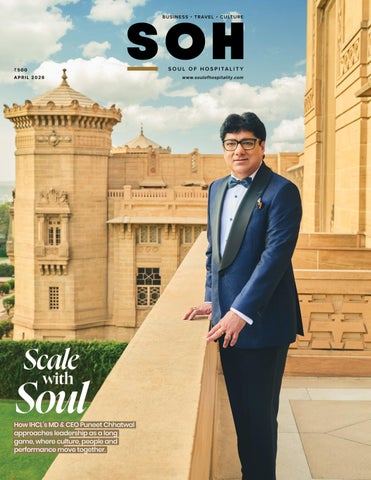
Nineteen issues ago, in SOH’s inaugural edition, we featured IHCL’s managing director and chief executive, Puneet Chhatwal—gregarious yet exacting, a leader tasked with renewing a legacy without diluting its character. Two years later, he returns to our cover. In a wide-ranging conversation set against the palatial sweep of Umaid Bhawan Palace, Jodhpur, Chhatwal reflects on IHCL’s evolution from a legacy hotel company into a diversified, multi-brand hospitality ecosystem. The conversation moves across the structural transformation of Indian hospitality, the country’s growing confidence as a global tourism force, and the discipline required to balance continuity with reinvention. The setting, like the conversation itself, reveals a leader focused not merely on scale, but on shaping the future grammar of Indian hospitality.
Elsewhere in the issue, a formidable lineup of restaurateurs answers a question that has launched many careers: what advice would they offer a 23-year-old hoping to open a restaurant today? Their reflections move between financial prudence and creative conviction, examining the interplay of capital, craft, credibility and endurance required to build something that lasts.
We also explore a generational shift redefining spiritual tourism in India, as Millennials and Gen Z move beyond ritual-led itineraries toward journeys shaped by meaning, immersion and cultural literacy. In Design, Hilton Hyderabad Genome Valley Resort and Spa reimagines the resort format for the Deccan plateau through climate-responsive architecture where water, landscape and regional material memory shape a quietly contextual expression of contemporary luxury.
Other stories examine the rise of hotel leasing as a defining industry shift, Imperial Hotel Kyoto’s first new property in three decades, and a new generation of design-forward bars that approach drinking as atmosphere and narrative.
We hope you enjoy the issue. As always, we welcome your thoughts.
Warm regards,
DEEPALI NANDWANI, EDITOR, SOH
Founder and Publisher
Gurmeet Sachdev
Editorial
Editor Deepali Nandwani
Managing Editor Rupali Sebastian
Contributing
Editor Suman Tarafdar
Digital Editor Rachna Virdi
Contributing Writer
Chandreyi Bandyopadhyay
Ruth Dsouza Prabhu
Radhika Singh
Creative
Creative Director Tanvi Shah
Team Shiv Soni
Business Head Vipin Yadav Delhi, +91 99998 85515 vipin@soulinkkworldwidemedia.com
Sales Manager Deepa Rao
Mumbai, +91 9136 000369 sales@soulinkkworldwidemedia.com
Head of Events and Alliances Karishma Shah karishma@soulinkkworldwidemedia.com
Office Manager Deepak Rao
Accounts Head Amey Acharekar
For queries: editorial@soulinkkworldwidemedia.com sales@soulinkkworldwidemedia.com info@soulinkkworldwidemedia.com
Printed and Published by Gurmeet Sachdev on behalf of Soulinkk World-Wide Media LLP. Registered office: 1/2, Old Anand Nagar, Nehru Road, Santacruz East, Mumbai, Maharashtra - 400055. Printed at Silverpoint Press Pvt. Ltd., A-403, TTC Industrial Area, Near Anthony Motors, Mahape, Navi Mumbai – 400709. Editor: Deepali Nandwani. All rights reserved worldwide. Reproducing in any manner without prior written permission prohibited. SOH takes no responsibility for unsolicited photographs or material all photographs, unless otherwise indicated, are used for illustrative purposes only. Unsolicited manuscripts will not be returned unless accompanied by a postage pre-paid envelope. All disputes are subject to the exclusive jurisdiction of competent courts and forums in Mumbai only. Copyright Soulinkk World-Wide Media LLP.


How Puneet Chhatwal is rewriting India’s Hospitality Playbook From legacy brand to market leader, IHCL’s transformation reflects a larger shift in Indian hospitality— towards scale, shareholder value, and a more confident, globally ambitious industry.


24
A Measured Arrival Imperial Hotel enters Kyoto with restraint and context.

42
Wellness, Served Daily Aujasya by The Leela reshapes how discerning guests eat.

94
New Faith Travel Spiritual journeys shift from ritual to cultural experience.

126

116 Risk and Return Leasing balances owner stability with operator flexibility.
The Real Business Restaurateurs share hard truths behind opening a restaurant.

84 Voyages of Influence Amitabh Bachchan reflects on cities, movement, and memory.

140
Deccan, Reimagined Hilton Hyderabad resort draws from climate, craft, and land.

32
The New Bar New spaces turn drinking into immersive spatial experiences.


The Japanese hospitality icon marks its fourth address with a deeply contextual Kyoto debut.
In Kyoto, the Imperial Hotel has accepted a custodianship. Somewhere between stepping through the southwest façade of the brand new hotel and the lantern-lit streets of Gion framed by floor-to-ceiling glass, the weight of the building's history becomes palpable. The property preserves and incorporates a portion of the Yasaka Kaikan, a nationally registered Tangible Cultural Property located

on the grounds of the Gion Kobu Kaburenjo, the district's legendary geiko and maiko theatre precinct. While inheriting its valuable legacy, the hotel breathes new life into the Yasaka Kaikan, a 90-yearold cherished landmark for the local community.
The Imperial Hotel Kyoto is the brand's first new property in thirty years, and only its fourth address worldwide—joining the flagship in Tokyo, the alpine retreat at Kamikochi, and its urban outpost in Osaka. For the group that was established in 1890 as a state guest house, hosted emperors and heads of state and weathered the full sweep of modern Japanese history, this expansion is significant.
General Manager Reiko Sakata explains, “This building was originally Yasaka Kaikan, a theater established by geiko and maiko. We built this hotel here in a way that respects and harmonises with the time that Gion has woven over the years.”
This philosophy is visible in the material choices. The 16,000 tiles on the exterior wall, salvaged from the original structure, have absorbed nearly a century of the neighbourhood. The pillars

and floors of the exclusive guest lounge are dressed in Tamina stone recovered from the Yasaka Kaikan's original VIP room. These are paired with terracotta reliefs of the same design as those of the second main building of Imperial Hotel in Tokyo, commonly known as the Wright Imperial.
THIS SPREAD: Sitting prominently in Gion district, the custodianship of heritage preservation gives Imperial Hotel an impetus to think differently.

With only 55 rooms across five categories, the hotel operates at a boutique scale as a statement of intent. Imperial's signature service philosophy translates here into something the brand describes with characteristic understatement. Guest preferences recorded at any of the group's properties travel with the guest to Kyoto, be it a preference for buckwheat hull pillows, a request for caffeine-free tea in the evening or spa choices.
“Precisely because we are a small hotel of just 55 rooms, our staff can embrace each guest's tastes and express our hospitality freely and fully,” says Sakata.
The rooms are distributed across three architecturally distinct

zones. The Main Building, Heritage, is preserved in original pillars, window frames and exposed structural elements from the Yasaka Kaikan. The interiors are layered with warm wood tones and gold accents. Floor-to-ceiling windows open onto panoramic city views, placing guests at the living centre of Gion. The Signature Suites— Imperial, Penthouse and Yasaka— range from just over a 1,000sq.ft. to nearly 1,400sq.ft., furnished with Japanese cedar, washi paper and handcrafted textiles, with outlooks across the lantern-strung streets or directly above the Kaburenjo's main gate.
The suites, also housed in the Heritage wing, run slightly smaller than the Signature Suites and retain the restored window frames and wooden pillars of the original building. Junior Suites offer a choice between mountain panoramas and close-up views of the Kaburenjo's sweeping roof, their interiors grounded in natural stone and locally inspired art.
The North Wing introduces tatami flooring for the first time

under the Imperial Hotel brand, offering a tranquil retreat that harmonises with the traditional streetscape. Grand Premier and Premier rooms embrace minimalist design with handcrafted ceramic accents, blending quiet geometry with the traditional Gion streetscape outside. It is a restrained but meaningful gesture, an acknowledgement that Kyoto demands its own vocabulary, even from a brand as assured as the Imperial.
The hotel's culinary programme is anchored by four distinct destinations. REN, an 18-seat chef's counter restaurant, is the most intimate. Executive Chef Koji Imajo, who joined Imperial in 1996 and honed his craft in France, presents French-Japanese tasting menus guided by Japan's twenty-four solar terms. YASAKA, a 54-seat all-day dining room on the second floor, is built around a custom wood and charcoal oven, its open kitchen theatrical with flame and fragrant smoke. OLD IMPERIAL BAR occupies the seventh floor, with zelkova-slab counter and low, deliberate lighting channeling


THE ULTIMATE WELLNESS TREATMENT EXPERIENCE
Multifunction bed with motors for face, body and massage treatments.
Metal structure covered with curved wooden structure. Height, backrest and legrest electrically adjustable. Skay Upholstery, soft touch, reproof, oil resistant. Equipped with lower accessory compartment with drawer.

Wellness Experience Center is our tribute to the Global Wellness and the Hospitality Industry. Wellness Spa India has been providing high quality reflects over 25 years of expertise in delivering advanced wellness solutions to leading luxury hospitality brands, bringing together innovation, performance and refined experience in a controlled, immersive environment where clients engage with the latest global wellness technologies.
Discover The Experience - Enquire Today : +91-9871066006 | +91-9810535952 | mail@wellnessspaindia.com | Website : https://www.wellnessspaindia.com C-103/104, C Block Rd, Block C, South City I, Sector 41, Gurugram, Haryana 122001


IMPERIAL HOTEL KYOTO AT A GLANCE
ROOM CONCEPTS: EXTENSION, PRESERVATION, RENOVATION
ARCHITECTURAL RESTORATION: OBAYASHI CORPORATION
INTERIOR DESIGN: NEW MATERIAL RESEARCH LABORATORY
HISTORIC LANDMARK: YASAKA KAIKAN (ESTABLISHED 1936)
CULTURAL DESIGNATION: REGISTERED TANGIBLE CULTURAL PROPERTY
AFFILIATION: THE LEADING HOTELS OF THE WORLD
WEBSITE: www.imperialhotel. co.jp/kyoto
THIS PAGE: Exclusive dining opportunities and wellness amenities elevate the overall experience at the hotel. Imperial Kyoto delivers a promise built over decades of exceptional hospitality.

the spirit of the Wright Building through Kyoto-inflected cocktails.
For in-house guests, THE ROOFTOP opens seasonally from late March to late November, with 24 seats under open sky at the heart of Gion and the skyline doing the rest. Wellness facilities include a spa, swimming pool and fitness gym.
In April 2025, the Imperial Hotel, Kyoto was welcomed into The Leading Hotels of the World, a recognition that positions it among a global cohort defined
by independence, heritage and a refusal of the generic.
What the property ultimately offers is rarer than luxury in the conventional sense, carving out a genuinely specific sense of place, built on grounds that geiko and maiko once made their own, inside walls that a community spent ninety years filling with meaning, now reimagined by a brand that has spent 135 years learning what it means to make a guest feel truly looked after.


At 51,000ft., somewhere between New Delhi and New York, the modern boardroom is no longer anchored to land. It is designed into the cabin of an aircraft such as the Gulfstream G700.
DEEPALI NANDWANI

Picture this: you are cruising 7,750 nautical miles, your airplane is powered by a RollsRoyce next gen engine, your team or your business partner/s are around to discuss the ins and outs of your company or business, while you sip on expensive single malts or wines. On hand are all the accoutrements of a business meeting, including wifi connection.
This is how the world’s biggest entrepreneurs conduct business aboard the business jet Gulfstream G700.
As India’s ultra-high-net-worth individuals expand their global footprint, business aviation is being viewed not merely as transport, but as an extension of lifestyle, productivity and personal space. The certification of the Gulfstream G700 by India’s Directorate General of Civil Aviation signals more than the arrival of a new aircraft. It reflects the growing maturity of India’s private aviation market and the evolving expectations of a globally mobile clientele.
Developed by Gulfstream Aerospace, the G700 sits at the very top tier of ultra-long-range business jets, designed to connect distant financial and cultural centres non-stop. With the ability to operate routes such as New Delhi–New York or Mumbai–London, the aircraft aligns with the increasingly international nature of Indian business and wealth.
For India’s globally mobile entrepreneurs, the new currency of luxury is time, privacy and productivity, making aircraft such as the Gulfstream G700 less a symbol of status and more an integrated environment for decision-making at 40,000 feet.
The business aviation jet Globally, business aviation is shifting from convenience to an integrated productivity ecosystem. In India, this transition is visible among family offices, technology entrepreneurs and promoters of globally active businesses who view time as a strategic asset.

Aircraft such as the Gulfstream G700 function as seamless extensions of office and home environments, allowing travellers to move between continents without interrupting workflow or personal routine. High-speed connectivity, quiet cabin acoustics and configurable interiors support continuous work, collaboration and rest within a single journey.
The G700’s performance capabilities reinforce this positioning. With a range of approximately 7,750 nautical miles and cruising speeds approaching Mach 0.90–0.935, the aircraft enables direct long-haul connections between major global hubs. Powered by Rolls-Royce Pearl 700 engines, it combines speed with improved fuel efficiency and lower cabin noise, allowing operators to maintain both performance and comfort on extended missions.
Operators such as Qatar Executive and Flexjet have already introduced the G700 into international charter fleets, reflecting growing global demand for ultra-long-range aircraft without the long-term commitments associated with ownership.
For many Indian users, this model offers the ability to experience flagship aircraft while maintaining capital efficiency. It
LEFT: A multi-zone cabin design for work and rest.
RIGHT: The Gulfstream G700 connects global business hubs through ultra-long-range, nonstop capability.
BELOW: Detailed cabinetry and enclosed layouts reflect hospitality-led design in private aviation.

also reflects a broader shift across luxury sectors, where access and experience increasingly take precedence over possession.
Large-cabin jets such as the G700 are particularly relevant in this context, offering the ability to operate ultra-long-haul routes without refuelling stops. This capability is increasingly valued in a business environment where time efficiency and scheduling flexibility are essential.
A defining aspect of the G700 lies in its spatial design, which reflects influences from luxury residential and hospitality environments. The aircraft can be configured into up to five distinct living areas, including lounge settings, dining or conference spaces and a private suite with optional shower. With a cabin length of approximately 56ft. and 20

panoramic oval windows, the aircraft emphasises natural light, openness and spatial continuity, qualities associated with contemporary luxury design. Alignment with hospitality sensibilities is visible in the aircraft’s ‘ultra-galley’, which allows restaurant-style dining preparation. As long-haul private aviation journeys resemble extended stays rather than transit experiences, onboard culinary capability has become an important differentiator.
The focus on wellbeing is seen in the cabin's circadian lighting systems that simulate natural daylight patterns, a 100% fresh air circulation system and a low cabin altitude of 2,840–2,900ft. These features aim to reduce fatigue and mitigate the physiological impact of long-haul travel. This emphasis reflects a wider shift across luxury categories, where comfort and functionality are being integrated into design rather than treated as secondary considerations.
At an estimated price point between $78 million and $82 million depending on configuration, the G700 sits firmly within the top tier of business aviation assets, appealing to individuals, corporations and governments seeking both performance capability and experiential refinement.


Design-forward drinking spaces that reimagine the bar as an experience.
RUPALI SEBASTIAN
For decades, the bar followed a familiar script. A long counter, rows of bottles, dim lighting and the steady rhythm of cocktails ordered and delivered across a polished surface. The formula worked—and still does. But in recent years, a handful of bars across India have begun quietly rewriting that spatial grammar.
Today’s most compelling bars are no longer just places to drink. They are environments that frame the act of drinking through architecture, narrative and spatial theatre. Counters spiral into the room, dissolve into sculptural installations, or disappear within surrealist stage sets. Guests wander through spaces designed to reveal themselves gradually rather than all at once.
This shift reflects a broader change in how hospitality design approaches the night. Earlier bars relied largely on lighting and music to define atmosphere. Newer spaces are exploring form, material and spatial choreography as equally powerful tools. Some lean into cinematic glamour; others favour shadowy intrigue, surreal playfulness or the quiet precision of craft.
What connects them is a shared understanding that the bar itself can become the protagonist of the evening.
Across Mumbai and Bengaluru, a new generation of bars is testing that idea through distinct design languages. From the seductive drama of Fielia to the shadowed intrigue of Paradox, the surreal playfulness of Dali & Gala and the geometric clarity of Naked & Famous, these spaces show how design can shape not just the room around the drink but the entire ritual of the night.

At Fielia, the evening begins quietly. The entry is almost ceremonial, allowing the space to reveal itself gradually before opening into warmth and depth. Designer Gauri Khan describes the approach as intentional—creating the sensation of stepping into a world that whispers rather than announces itself.
That atmosphere was central to the brief set by founders Afsana Verma, Amit Verma and Dhaval Udeshi, who envisioned Fielia as more than a cocktail bar. The idea was to create an environment where design and experience feel inseparable—where the room shapes the
rhythm of the evening as much as the drinks do. The interiors therefore lean into what Khan calls "nocturnal luxury: intimate yet grand, darker, sensual and immersive." One element remained non‑negotiable—the bar had to remain the gravitational centre of the room.
That centrality defines the spatial choreography. Conceived almost like a stage, the bar rises tall and sculptural, softly illuminated from within. Seating across the main floor and mezzanine preserves clear sightlines toward it, encouraging guests to watch the rhythm of bartenders at work. Rather than spectacle for its own sake, the intention is storytelling—the act of making drinks becomes part of the evening’s theatre.
Material choices deepen the atmosphere without overwhelming it. A palette of aged wood, distressed mirrors, marble, velvet and burnished metal gives the room tactile richness, while forest green, tobacco brown and oxblood red sit alongside antique brass finishes. These surfaces suggest time and memory, creating a space that feels indulgent yet welcoming.
Lighting quietly orchestrates the mood. Chandeliers soften into warm pools of illumination, wall sconces glow discreetly and table lamps create small islands of intimacy across the room. At the centre, the bar glows internally, anchoring the space in a chiaroscuro of shadow and light.
At Fielia, the room remains constant while the evening evolves around it—the bar acting as both anchor and stage.


Paradox occupies a former mill building, and the architecture it inherits becomes the starting point of the experience. The column grid, ceiling heights and structural proportions are largely fixed—conditions that might easily

have constrained the design. Instead, they became the framework through which the bar’s character emerged.
For Aditya Dugar, Director and Co‑Founder of Urban Gourmet India, the idea of a paradox felt inherent to the space. That tension guided the design interpretation by architect Ashiesh Shah, who approached the interiors through contrast: dark, enveloping surfaces set against reflective ones, dramatic gestures placed beside quieter tactile materials. "Paradox pulls inspiration from Mumbai's art Deco heritage, reimagined through a contemporary lens... from there on, the space reveals itself in layers," he notes.
The inherited structural grid allowed the layout to break into smaller zones, creating pockets of differing energy. Some areas feel lively and social, while others are more cocooned, with deeper seating and softer lighting.
Circulation becomes part of the narrative. Turning a corner reveals another perspective, another seating pocket, another shift in atmosphere. The experience is less about a single focal point and more about discovery—the sense that the evening reveals itself gradually as guests move through the bar.
Materiality helps maintain intimacy within this layered environment. Darker finishes absorb both light and sound, allowing the room to remain vibrant without becoming overwhelming. Textiles, wood and stone soften acoustics while adding depth to the interiors.
Shadow is used deliberately. Instead of illuminating every surface evenly, parts of the room remain in darkness, encouraging the eye to move slowly through the space and allowing details to emerge over time.
At Paradox, the night unfolds slowly, guided by architecture, material and shadow rather than spectacle.
Shadow does most of the work at Paradox, as architect Ashiesh Shah layers the space in shifting moods—rooms that unfold gradually as the night deepens.


If Salvador Dalí had designed a bar, it might have felt something like this—strange enough to intrigue, playful enough to keep the evening moving and just irreverent enough to raise an eyebrow.
At Dali & Gala, the inspiration comes from the famously unconventional relationship between the surrealist painter and his muse—who would eventually become his wife. The bar borrows less from Dalí’s paintings than from the spirit behind them—theatrical, mischievous and faintly scandalous.
The concept grew out of conversations between restaurateur Vipin Raman and artist Siddharth Kerkar. "Art is freedom," says Kerkar. "and that's what Dali & Gala is all about. Zero inhibitions, no rules. We want you to walk and feel like you're part of a celebration."
The intention was not to recreate Dalí’s world literally but to capture its sense of playful distortion—where

familiar things appear slightly altered and curiosity is rewarded. That idea translates into a layout designed for gradual discovery. Instead of a single dominant room, the bar unfolds in stages, encouraging guests to wander rather than remain rooted to one spot.
The journey begins at the Eye‑Bar, a copper counter embedded with dozens of hand‑beaten eyes that seem to watch the room with quiet suspicion. From here the space branches into adjoining pockets—the cheeky Rooster Room, quieter corners suited to long conversations and installations that appear unexpectedly as one moves through the interiors. Sculptural objects and surreal motifs guide movement without overwhelming the room. What remains is a bar that reveals its quirks slowly— sometimes after a second look, or a second drink.
At Dali & Gala, surrealism is not treated with reverence—it’s treated the way Dalí himself might have preferred: with curiosity, wit and a very good cocktail in hand—preferably a second one.


At Naked & Famous, the first instinct is to look toward the centre of the room. There, an octagonal bar anchors the space—a form rarely seen in Indian cocktail bars and one that immediately changes how the evening unfolds.
For Karthik Kumar and Priyesh Busetty, the geometry was never intended as spectacle. The goal was to create a bar where guests sit close enough to the action that the process of making a drink becomes part of the experience. The bar, therefore, functions as both stage and meeting point, encouraging conversation between guests and bartenders.
The structure of the octagon also informs the menu. Each side corresponds to a different cocktail technique— built, stirred, shaken and neat—allowing guests to explore drinks through the mechanics of how they are made rather than through rigid spirit categories.
From the centre of the counter rises a striking red installation—a tangle of metal forms that spirals upward toward the ceiling like a kinetic chandelier, adding visual drama while keeping the bar itself firmly at the heart of the room.
From this vantage point, the preparation of cocktails becomes the real performance. Bartenders measure, stir, shake and build drinks within arm’s reach of the guest, making the craft visible without turning it into spectacle.
At Naked & Famous, everything continues to orbit the octagonal bar—conversation, craft and the quiet pleasure of watching a drink come together.


The return of the Piprahwa jewel relics transforms archaeology into a meditation on memory and belonging. The Light and the Lotus exhibition reveals how faithshaped objects endure across millennia.


LEFT: This seated Buddha in bodhyanga mudrā, 2nd century CE, Gandhara, reflects early Buddhist iconography.
ABOVE INSET: Sacred bone relics of Buddha found in Piprahwa, Uttar Pradesh.
ABOVE CENTRE: This monastery with a stūpa at Piprahwa is the site of early Buddhist relic discovery.
Fragments of stone, crystal, gold and carnelian rarely arrive with the force of revelation. Yet the return of the Piprahwa jewel relics to India— repatriated in July 2025 after the Ministry of Culture secured them from a postponed Sotheby’s Hong Kong auction—has stirred something deeper than antiquarian curiosity. Once dispersed across continents, these objects now cohere into a narrative linking archaeology, devotion and cultural memory. The Light and the Lotus exhibition, organised by


ABOVE: An inscribed relic casket of Buddha, linked to Ashokan redistribution.
BELOW: The dome is a reconstructed interpretive model inspired by the Sanchi stupa, designed to house and display the sacred Piprahwa relics and repatriated gems of Lord Buddha.
bone fragments and jewel offerings associated with the historical Buddha.
the National Museum under the Ministry of Culture, reanimates the relics as living presences, reminding us that material culture often outlives the empires that displace it.
Curated by Dr Savita Kumari and Dr Abira Bhattacharya, the exhibition centres on the 1898 discovery of the Piprahwa stūpa in presentday Siddharthnagar, Uttar Pradesh—a find that shaped understanding of early Buddhism. Excavations revealed reliquaries,

These relics trace their origins to the centuries following the Buddha’s Mahāparinirvāṇa in the 5th century BCE, when his remains were divided among eight republics, including the Śākyas, his own clan, and enshrined in stupas that became sites of pilgrimage. Centuries later, Emperor Ashoka reopened many stupas and redistributed relics across the subcontinent, expanding devotional practice. The Piprahwa reliquary caskets, often dated to the Mauryan period of the 3rd century BCE, are widely understood within this Ashokan context.
The jewels placed alongside the relics—crafted from gold, silver, crystal, carnelian and mother of pearl—were not decorative but offerings shaped by sophisticated lapidary traditions. Their refinement suggests an aesthetic language in which craftsmanship became an extension of faith.
The exhibition’s narrative gained urgency when a group of jewels, long held by descendants of British landowner William Peppé, appeared on the international art market. Scholars argued that relic-associated objects cannot be separated from their spiritual significance. Their repatriation has come to symbolise broader efforts to return displaced heritage to its cultural context.
“These jewels are not simply artefacts,” notes Dr Savita Kumari.
“In the Buddhist tradition, relics embody the living presence of the Buddha. Their return allows us to restore an important chapter of India’s history.”


Kolkata, Lucknow and London, and private collections abroad— exemplify the trajectories of displaced heritage. “Repatriation is not only about recovering objects,” Dr Kumari observes. “It is about restoring context. When relics are brought back, they reconnect with the cultural landscape that gives
carnelian bead suggest meanings still under study.
ABOVE: Designed by The Design Factory, the pedagogical spatial design with muted lighting, immersive AV projections, and a central monolithic stone coffer, emphasises spiritual reverence.
CENTRE: This sculpture was among the hundreds of artefacts repatriated to India from the US in 2024.
ABOVE RIGHT: Elizabeth Brunner's Guardians of the Shwedagon depicts the golden stūpa in Yangon, Myanmar.
Among the most significant objects is a reliquary bearing a Brahmi inscription identifying the relics with the Buddha—rare epigraphic evidence strengthening confidence in the site’s antiquity. The reunited assemblage includes jewel offerings from collections in Kolkata and the Peppé family
The jewels also illuminate ancient trade routes. Several materials are not indigenous to the Piprahwa region, suggesting pilgrims and patrons travelled considerable distances to contribute offerings, reinforcing early Buddhism as a transregional network shaped by exchange.
Equally compelling is the exhibition’s engagement with repatriation as both ethical and intellectual inquiry. Over the past decade, India has intensified efforts to retrieve artefacts dispersed during the colonial period. The Piprahwa jewels—once divided among institutions in
The exhibition is staged at the Qila Rai Pithora Cultural Complex in Delhi, where a circular layout echoes the ritual act of pradakshina. Visitors move through seven thematic sections tracing the relics’ journey across time, anchored by a central installation referencing the Sanchi Stupa.
Set within the open environment of Qila Rai Pithora, the exhibition invites contemplation rather than spectacle. In an era marked by technological acceleration and cultural fragmentation, the Piprahwa jewels—modest in scale yet vast in significance— remind us that objects can carry memory across millennia. Their return is not merely restitution, but an opportunity to reconsider how heritage shapes collective identity.


Leela’s Aujasya has set a highbenchmarkinwellnesswithin hospita l ity . Its new offering, Sampoorna,couldchangehowyoueatin a hote


Tomatoes.
ABOVE LEFT: Ragi Idli.
ABOVE RIGHT: FAB Millet Dosa, where the batter is made of a flour of finger millet, amaranth, and barnyard millet.

unintentionally sometimes
I well remember a breakfast at The Leela Jaipur when I was encouraged to try some wellness focussed dishes—which were to become part of an upcoming menu.
The wellness trend was taking off across the country, and pioneering hotels were ahead of it.
As a long-time practitioner of the poori-paratha-pakoda options at hotel breakfasts, I was cajoled into trying the ‘Aujasya’ menu.
A millet dosa was followed by ragi idli, succeeded by Eggcelent Nourishment—boiled egg whites topped with sprouts and microgreens on a bed of beetroot hummus. Beautifully plated.
The FAB Pancake (made of a flour of finger millet, amaranth, barnyard millet) followed, living up to its name. By the time The Himalayan Earth Bowl came, the transformation was pretty much complete. Across stays in numerous Leela hotels, the Aujasya menu is now a must-do.
Wellness today has become an integral part of how guests wish to experience their stay. At The Leela this aligns naturally with our philosophy of hospitality, points out Anupam Dasgupta, Senior Vice President–Operations, North and Head of Wellness.
“Through Aujasya by The Leela, we approach wellbeing as a holistic journey centred on vitality, mindful movement, nourishing cuisine, restorative therapies and— importantly—the rediscovery of joy. Inspired by India’s timeless wellbeing practices, Aujasya allows us to create environments that feel like serene sanctuaries, even within the vibrant energy of our city hotels. Whether through thoughtfully crafted nutrition, moments of stillness and movement, or immersive cultural and sensory rituals, the programme offers guests opportunities to pause, restore and reconnect within the rhythm of modern travel.”
Since its launch in 2022, Aujasya

Aujasya by The Leela unfolds through three guiding pillars—Restore, Renew and Rejuvenate—each designed to nurture vitality while gently rekindling joy.
Restore is expressed through a thoughtful philosophy of nourishment. Cuisine here is guided by indigenous ingredients, time-honoured Indian culinary wisdom and mindful preparation techniques. Guests may experience curated meal programmes— including anti-inflammatory, detox and high-protein options—alongside dishes that celebrate clean, balanced flavours. The intention is not simply to offer “healthy food”, but to create dining experiences that are both nourishing and pleasurable.
Aujasya offers evidence-based, results-oriented menus, including Anti-Inflammatory, Detox, and HighProtein Low-Carb options.
Renew brings movement and cultural connection into the wellness journey. From sunrise yoga set against sweeping vistas and guided Pilates sessions to immersive forest walks, each experience is designed to restore rhythm to the body and mind. Complemented by intimate workshops celebrating traditional crafts such as pottery, weaving and Indian toy painting, these moments invite guests to reconnect with movement, creativity and a quiet sense of presence.
3
Rejuvenate finds expression through holistic spa therapies inspired by the spirit of each destination. The Leela will soon introduce the Aujasya Signature Ritual across its hotels—a multi-sensory wellness journey that weaves together thoughtful service touchpoints, from a welcome elixir and sound healing to targeted therapies, an Aujasya tea experience and a keepsake that extends the experience beyond the stay. Together, these elements reflect The Leela’s belief that true luxury lies in feeling restored, balanced and innately joyful.
has grown from a breakfast menu into a comprehensive programme. Developed by nutritionist Dr Ankita Jalori and brought to life in collaboration with The Leela’s chef and wellness teams, it blends nutritional science with culinary refinement. “Over time, it has garnered several notable accolades and, perhaps more meaningfully, has become a compelling reason for many of our guests to return— drawn by a wellness experience that is both purposeful and enjoyable,” says Dasgupta.
“I came on board in 2021, and we spent months perfecting the menu,” recollects Jalori. “As a lot of Leela’s clientele are business leaders who travel a lot, they often wanted a break from eating out. I was seeing leadership not being able to follow a wellness regime. They wanted something simple— ghar ka khana.”
One of the main challenges was designing the menu. Combating the impression that a healthy menu would be bland was important, says Jalori. “Food synergy, i.e. pairing ingredients in a manner that enhances absorption, was key. If we leaned too much into Indian traditional cuisine, the global traveller would feel left out—and vice versa. Leela is all about Indianness, so we blended Indian wisdom into a global framework. The problem with wellness food is that everybody is sceptical. Making them try a new dish with unfamiliar ingredients is not easy. For example, we had idli or dosa for the Indian traveller, toast and eggs for the international traveller—dishes they were familiar with. If I tell any Indian to have an idli, he won't hesitate. So we made idli out of ragi, jowar and other ingredients. Acceptability—that was our main motto.” Acceptability has come, indisputably. Today, Aujasya breakfast selections and à la carte options are available across The Leela hotels. Guests


ABOVE LEFT: The group has approached wellness holistically, including signature spa treatments.
ABOVE RIGHT: Art is an integral part of the renewal aim of Aujasya.
BELOW: Kiwi Camembert is just of the inventive desserts on the menu.
can also explore zero-proof cocktails and wellness-led snacks, creating opportunities to indulge responsibly while maintaining balance. The use of zero-calorie sweeteners, a range of millets, and both vegetarian and non-vegetarian options ensures a broad appeal.
A recent innovation has been the Aujasya Sampoorna curated meal plans. “Our endeavour is to ensure that we can integrate our offerings into the wellness practices our guests follow at
home, even while travelling,” says Dasgupta. “From high-protein and anti-inflammatory menus to thoughtfully designed dietary options, the programme is built around flexibility, customisation and refined service touchpoints.”
The programme offers evidencebased, results-oriented menus— including Anti-Inflammatory, Detox and High-Protein Low-Carb options.
along with focused face and head massage techniques. Designed as an immersive experience, it aims to release stress, stimulate circulation and guide the guest into a deeper state of relaxation.”


Aujasya began with a focus on nutrition, drawing from Indian culinary practices to create meals designed to restore vitality and balance. Over time, it has evolved into a broader wellbeing programme (see box).
The Leela’s spa experience builds on this philosophy, where restoration begins not only with treatments, but with a carefully orchestrated sensory journey.
“As the programme continues to evolve, we will also be introducing the Aujasya by The Leela Signature Ritual across our hotels,” reveals Dasgupta. “Rooted in ancient Indian healing wisdom, the ritual brings together synchronised movements with warm herb-infused oils,
Wellness as an offering within hospitality is one of the fastestgrowing segments. The India wellness tourism market size is expected to grow from $28.87 billion in 2025 to $30.95 billion in 2026 and reach $43.76 billion by 2031 at a 7.18% CAGR, according to Mordor Intelligence. Still largely fragmented, the market shows immense potential, and Indian luxury hospitality is well poised to capitalise on this as the number of HNIs grows.
With Aujasya, The Leela has taken an early and considered position in the space. At the annual Jaipur Literature Festival this year, Aujasya had a stall—and was very popular with visitors, says Jalori. “We are thinking of selling items like fruit infusion sachets.”
A signature spa treatment is in the works, and Aujasya retreats are in the offing. With several initiatives planned, Aujasya appears set to grow—both financially and as a holistic offering.


Decisive. Relentless. All in. IHCL's MD & CEO Puneet Chhatwal on translating ambition into sustained growth.
—a line that sounds aphoristic until one realises it is also a précis of his own career. In a sector often drawn to nostalgia and inherited grandeur, Chhatwal has shaped a leadership vocabulary anchored in resilience and compassion, tempered by commercial discipline. He treats culture not as an ornament but as an operating system. A self-described product of the East and the West, he combines the reflexes of a global hotelier with the instincts of an Indian institution-builder.
When he assumed leadership of Indian Hotels Company Limited (IHCL), the Tata Group’s century-old hospitality arm, its market capitalisation stood at just under ₹13,000 crore. Under his tenure, it has crossed ₹1 lakh crore, an expansion that reflects not only financial rigour but careful narrative repositioning.
Chhatwal has guided IHCL beyond the nostalgia for legacy assets towards a portfolio that balances heritage with momentum and a data-literate culture that still insists hospitality remains, at heart, a human act.
His leadership style is evangelical about learning: encouraging Ivy League programmes, cross-border exposure, and the belief that experience is the only durable competitive advantage. If relationship capital is hospitality’s true currency, Chhatwal has compounded it by building bridges across geographies, generations, and sensibilities, while demonstrating that scale, in the right hands, need not dilute soul.


the same behaviour pattern as you did at number 20 or 25 or 30. I think it is a continuous evolution process. The change in GDP growth, in the per capita income, and in disposable income is going to drive consumer sectors. And the consumer sectors include travel, tourism, hospitality, and aviation.
Given that India’s hospitality industry remains largely fragmented and unorganised, does the sector need to become more structured? And how can independent hotel groups still organise themselves around certain standards?
What is special about India is its unity in diversity. Whether small, medium, or large, everybody can find space in India. Also, the various states of India are not in the same economic zone. For example, Maharashtra, as the commercial state of India, with Mumbai as its capital, does not equate in the same correlation to many other states of India. When it comes to tourism, there are states such as Goa, UP, because of the Mahakumbh, or Kashmir, which thrive on tourism. But that is not true for many other states in India.
India is what it is, and I don’t think there will be a one-dimensional approach in any sector, including hospitality. There is enough space for small, medium, and large enterprises. Having said that, there is always one or two players that emerge as leaders or the largest in the sector, and we are very privileged to be one of those. And in our 100-plus-year legacy, we continue to drive the values of hospitality as leaders and as those who put hospitality on the map of India.
You’ve led a 120-year-old hospitality institution through enormous change and a lot of crises. When you consider the current state of the industry, do you believe we are entering a transformative phase for hospitality?
The hospitality sector today is definitely in a very different orbit than it was five, seven, or 10 years ago, or 20 or 30 years ago, the reason being that India has changed. The last 10 years have been transformative for India, its economy, and consumer behaviour. Given that it is a large domestic market of 1.5 billion people, everything else has to change with it, and hospitality is no exception. I believe hospitality has evolved beyond being purely customer-service driven. While service remains its core, the definition of what constitutes meaningful service has expanded to include many new dimensions. Some of those include creating shareholder value for all stakeholders—for employees, suppliers, partners, anybody who works in the hospitality ecosystem.
You cannot become the world’s fourth-largest economy, aspiring to become the third-largest, and have
Despite strong travel demand, supply growth in India’s top 10 destinations has not kept pace. Is this shortage of adequate supply the reason ARR remains elevated, particularly when compared with neighbouring countries?
There is a demand-supply gap as we speak today, but it has not been historically that way. The nature of demand and supply is such that if demand increases and supply lags behind, eventually it catches up. So I do not think that is such a serious issue. India is a large country that is benefiting from immense expenditure on infrastructure,
whether in Goa, Rajasthan, or any other part of India. I always call it the renaissance of train stations, millions of square kilometres of highways getting built, doubling of airports…all that is happening.
As a large economy, India’s cost of living is higher than in many other countries, which raises the cost of service and, in turn, the ability—and need—to charge higher rates. That will inevitably place prices above destinations such as Vietnam or Cambodia. But travellers do not come to Goa simply because it is inexpensive. They come for its multicultural character, its Portuguese history, and the way the state transforms into a beautiful place at Christmas. Destinations in India offer many such distinct facets that make them unique and special. It is difficult to compare them with much smaller countries, some of which are smaller than the size of our smallest state.
Do you think the apprehension that more Indians are travelling abroad instead of holidaying in their own country is valid?
Travel should not be construed as domestic only. Just as we want our share of foreign tourist arrivals, other countries also want to attract international tourists. We just need to find a balance in how many are coming in and how many are going out. The likelihood is that the number of people travelling out of India will always be higher than those coming in is because India represents such a large share of the world’s population. It is not an apples-to-apples comparison. The reality is that as Indians acquire the ability to spend money, they do not want to spend all of it in India. When you earn well, you do not put it all into real estate or gold. You may put some into the capital markets and other instruments. It is good that Indians gain awareness of how things work outside India. It is also good that they travel within India, so they understand how things work in the north of India, in Kanyakumari, Guwahati, or Jamnagar. Cultural understanding improves when there is exposure to different cultures.
You have often spoken about how conferences could shape the future of travel in India. With the government investing in large-scale convention infrastructure, are we attracting events at the
scale these venues were designed for, or is this still an early stage?
It’s a very good start. Those facilities are world-class, whether it is Bharat Mandapam (former Pragati Maidan) or Yashobhoomi (Dwarka), including centres built in Goa or in Mumbai with Jio. I think they have captured a latent demand, while also creating infrastructure that enables large organisations to host events in India. That is critical and has helped drive the growth of business events, especially in Delhi and Mumbai.
Do you see hospitality players continuing to develop venues specifically geared towards conferences?
I see at least 10 to 20 convention centres attached to hotels coming up over the next 10 years, at the maximum. Be it Goa or Guwahati, Delhi or Mumbai and Kochi—I think this is going to happen across India. We had a lot to catch up on, and we have got a good start with Mumbai and Delhi; the rest is following rapidly.
From your vantage point, beyond meeting demand, how do you see the hospitality sector evolving as traveller expectations continue to change?
I see hospitality and tourism contributing at least 10% to India’s GDP and over 10% of jobs. This is not a far-fetched number. Rajasthan already contributes around 17%, and Goa is also north of 17% in terms of GDP contribution. There are many destinations in India that have not yet reached their potential.
So, I think much of this will unfold over the next 20–25 years, and you can expect the hospitality sector to play a very important role in job creation, in skilling the nation, and in terms of financial contribution. The thing that has intrigued me post-COVID is that services in the Western hemisphere, from where we learned the business of hospitality, have declined because of an ageing population and rising cost structures. I see this as a significant opportunity for Asian hotel brands in general, and Indian luxury brands in particular, to travel with Indian customers outside India, to destinations they prefer, build hotels there, take Indian hospitality to the world, and make it a global benchmark.

The thing that has intrigued me post-COVID is that services in the Western hemisphere, from where we learned the business of hospitality, have declined because of an ageing population and rising cost structures. I see this as a significant opportunity for Asian hotel brands in general, and Indian luxury brands in particular, to travel with Indian customers outside India, to destinations they prefer, build hotels there, take Indian hospitality to the world, and make it a global benchmark.
That’s a very interesting thought, taking Indian hospitality and Indian hotel brands outside India. Do you see them also attracting international travellers in some way?
For any investment to make sense, you need a certain base business. If you can get it through your own travellers, why not leverage that? For decades, we have dreamt of Switzerland and seen it through the eyes of Bollywood. So why not have the first Indian-branded hotel in Switzerland, in one of those key destinations. I am sure you will get a base occupancy of 30, 40, 50% just from travellers from your home market. That then allows you to create a wow experience for other international travellers. This is how you put brands on the map and make Brand India stronger.
We are living in an increasingly volatile world shaped by geopolitical tensions, climate events, and recurring crises. Given these uncertainties, how do hospitality groups prepare for risks they cannot fully control while continuing to invest and expand?
Safety and security is of paramount importance to all Tata Group companies. Within that, we as the hospitality arm, are more exposed to geopolitical and terror risks. We experienced the 26/11 attack on the Taj Mahal Palace, Mumbai, and remain vulnerable to events around us. We also have three hotels in Dubai, a destination that has recently been in the news because of the Iran–Israel conflict. You do what you can within your circle of control.
The second important aspect is building sustainable and inclusive tourism. Many of our destinations are somewhat overbuilt. Around 70–80% of tourism is concentrated in 10–12 locations. So, the idea is to expand, to build infrastructure and create new destinations, new beach resorts. India has a very large coastline and extensive mountain ranges. We do not just have the Himalayas; we also have the Nilgiris and the Aravallis. In the first 75 years post-independence, growth was concentrated in certain destinations—the national capital, the commercial capital, the Golden Triangle with Rajasthan, as well as Goa and Kerala. But more new destinations and metros will emerge. Along the coast of Andhra there will be significant development. Odisha
will see considerable development. In the Northeast, whatever has happened can largely be attributed to one or two brands. Much more will happen in that part of the country, enabling new destinations and helping distribute demand across a wider network of locations. That, I think, will support more sustainable tourism. Finally, many unexplored areas will emerge, particularly those related to adventure tourism. The combination of these three factors will propel growth in a different way than we have seen in the last 20–30 years. A very important component will remain business tourism. When delegations come to India, they are likely to extend their stay by two or three days to see other parts of the country. For example, if a head of state comes to Delhi, the likelihood of also including Mumbai is high, and part of that delegation may then continue to Goa, Bengaluru, Chennai, or other destinations.
Are we mature enough to be considered a truly global hospitality market? Are we attracting large-scale international investments?
The tourism and hospitality sector is in a growth phase. It is not yet mature enough to attract large global institutional funding. Having said that, I think there is enough capital available in India. All we need is to improve the ease of doing business and reduce the number of permissions needed to build a hotel from 70+ to maybe 10+. The licences, whether a liquor licence, licence to operate, or fire licence—there are several permissions required before a hotel can be built, open, and operate. Also, look at how we can use land that is available with clear titles, and how states can work with the Centre to develop tourism in a mission mode, identifying
locations meant specifically for hotels, so that they are not priced at normal fair market value; that would help. These are the zones and hubs states will need to develop. The Honourable Finance Minister outlined in last year’s Budget speech about 50 new destinations to be developed in mission mode. I think that is good work in progress, but it needs to be expedited and pushed.
If there is one thing that the government should do in terms of policy to support the hospitality and travel industries, what would it be?
There is no one magic lever that can make tourism and hospitality part of the core strategy. However, reflecting on the last five to eight years of engaging with government officials and industry professionals, and looking at the challenges we have collectively faced. This is a sector that is evolving rapidly and can contribute strongly to Brand India.
Do you think the world truly understands India as a destination yet, or are we not telling the story right?
I would not agree to the statement that we are not telling the story right. We are not saying enough. Our international marketing budgets are quasi-non-existent. So, whatever story is being told has largely been through individual initiatives, at least in the recent past. We have been requesting the government to come up with a new version of the Incredible India campaign. That would do good for the nation. We are all working on it collectively with the Ministry of Tourism, and we hope to see some progress towards the end of this year.
Are valuations for the sector realistic, or is there a risk that the market is getting ahead of fundamentals?
Markets, in the opinion of many financial experts, are efficient. There is something called the efficient market hypothesis. When things are too low, they tend to rise, and when they go too high, they tend to correct and settle at the right level. My sole caution to hospitality investors— and also to journalists like yourself—is not to compare the PE ratios of hospitality companies in India with those in the rest of the world. Much of the world, especially in the Western Hemisphere, is largely dependent on a
capital-light model. In India, we have a unique sweet spot between capital-heavy and capital-light approaches, so that in good times you benefit from operating leverage derived from capital-heavy assets, while also achieving margin expansion through the capital-light model.
Let's deal with the technology question that everyone talks about. As a hotelier, how do you approach it? Is technology really that important in running great hotels, or is the emotional connection with guests far more important? A combination of both is needed; there is a need for technology and hospitality companies to work together. Technology is not just customer-centric. I will give you an example of artificial intelligence. With 600+ contracts in our system, we needed summaries that are easy to access, rather than reading hundreds of individual agreements just to operate hotels. AI can be used very effectively to generate structured contract summaries, with some manual fine-tuning required, as no two contracts are exactly alike.
Similarly, technology is critical for back-of-house operations, whether in ERP, cybersecurity, or many other areas where it drives efficiency and security in day-today business. Beyond contracts, technology also supports guest preferences, revenue platforms that enable direct bookings instead of incurring third-party costs, as well as proprietary websites and mobile apps for bookings. Loyalty programmes are another key area where technology plays an important role. Where capabilities need strengthening, companies must evaluate how best to approach it. Being part of the Tata Group, we were founding members of Tata Neu, which has helped us significantly build our loyalty customer base.
CONSOLIDATED FINANCIAL RESULTS FOR Q3 AND NINE MONTHS ENDED 31ST DECEMBER 2025 Q3 YoY Performance
Nine months ended December 31st YoY Performance
34% ₹2,425cr ₹7,127cr
₹1,485cr
PAT IS AFTER EXCEPTIONAL ITEMS, WHICH MAINLY INCLUDE PROFIT ON SALE OF ENTIRE EQUITY STAKE IN A JOINT VENTURE COMPANY OF ₹327 CRORES (NET OF TAX) AND AN IMPACT ON ACCOUNT OF NEW LABOUR CODES OF ₹37 CRORES (NET OF TAX). PY 9M PAT INCLUDED ONE-TIME EXCEPTIONAL GAIN OF ₹307 CRORES ON ACCOUNT OF TajSATS CONSOLIDATION.
16% EBITDA
7% PAT EBITDA %
Q3 FY2026 marks 15th consecutive quarter of record performance with a consolidated revenue of ₹ 2,900 crores , a 12% growth over the previous year, EBITDA of ₹ 1,134 crores and an EBITDA margin of 39.1% . The revenue in the quarter was driven by a strong same-store performance, not like-for-like growth, supported by a 17% growth in airline and institutional catering and 31% growth in New Businesses.”
MD & CEO, IHCL
IHCL HAS A GROSS CASH BALANCE OF ₹3,877 CRORES AS ON 31ST DECEMBER 2025
To reach a portfolio of 628 hotels led by strategic partnerships and acquisitions
with an inventory of over 32,000 rooms, following the opening and onboarding of 130 hotels.

Expanded its brandscape with the acquisition of controlling stake in Atmantan, an integrated wellness brand.
323cr
Entered into definitive agreements to acquire 51% stake in Brij, a boutique experiential leisure offering.
316cr
232cr

multiple formats.
Scaled the Ginger brand with 51% acquisition in ANK & Pride Hospitality.
TajSATS clocked a revenue of ₹323 crores, 17% growth over the previous year and EBITDA margin at 26%.
New Business revenue comprising of brands such as Ginger, Qmin, amã Stays &Trails and Tree of Life reported an enterprise revenue of ₹316 crores, a growth of 39% and consolidated revenue of ₹215 crores, a growth of 31%.
Enterprise revenue of Ginger stood at ₹232 crores with a strong EBITDAR margin of 47%.

370 bungalows, with 184 in pipeline.

Tree of Life is at a 34 resorts portfolio, with 8 in pipeline.
Anchored in six pillars covering environmental stewardship, social responsibility, governance, heritage conservation, value chain transformation and sustainable growth, Paathya continues to guide the organisation’s progress across key impact areas.
23.42%

83 skill centres have trained over 42,000 underprivileged youth. This is complemented by key milestones, including over 84 bottling plants across hotels, 53% water recycled, and 41% energy sourced from renewables.
Women account for 34% of new hires and 23.42% of the workforce, reflecting IHCL’s focus on Diversity, Inclusion and Equity (DIE). Additionally, 2,000 underprivileged women skilled.
PAATHYA HAS RECEIVED RECOGNITION INCLUDING BEING FEATURED AS A CASE STUDY BY THE INTERNATIONAL INSTITUTE FOR MANAGEMENT DEVELOPMENT (IMD BUSINESS SCHOOL), LAUSANNE, SWITZERLAND, HIGHLIGHTING IHCL’S APPROACH TO EMBEDDING SUSTAINABILITY WITHIN ITS ECOSYSTEM.
Eight years ago, IHCL was at a little under ₹ 13,000 crore market cap. We went much above ₹ 1 lakh crore, and then came down a little in the current crisis between Iran and Israel, as all stocks and capital markets are under pressure. But if you take an average over the last 12 months at around ₹ 1 lakh crore, it is a significant milestone. It defines the new positioning of hospitality sector stocks.


HCL has delivered 15 consecutive record quarters. At what point did you realise this was not just a post-pandemic rebound but a structural shift in the company’s trajectory?
The journey we embarked upon had started in early 2018 with Aspiration 2022, and we had already delivered nine consecutive record quarters till COVID struck. Those were the six quarters we lost, and the 15 that followed were again record quarters. I remain fairly optimistic that, no matter what happens, we will continue to navigate every storm, every difficulty, and keep delivering on the promise and guidance we have provided.
You have also crossed the ₹1 lakh crore market cap milestone. What does that moment mean for you as a company, and for the sector?
This is an unimaginable story because eight years ago, we were at a little under ₹13,000 crore market cap. We went much above ₹1 lakh crore, and then came down a little in the current crisis between Iran and Israel, as all stocks and capital markets are under pressure. But if you take an average over the last 12 months at around ₹1 lakh crore, it is a significant milestone. It defines the new positioning of hospitality sector stocks. More importantly, many companies have been listed in the last 18 months, which is unprecedented. India’s hospitality sector had not seen this before our strong run in the capital markets.
What do you think are the strategic decisions that created the most shareholder value?
I wish there was one magic recipe that makes it work. We have continuously delivered on growth of the top line, of
people, of the portfolio, and of our brands. That leads to the second point: for any kind of growth to happen, you need a foundation, and in hospitality, your foundation is your brandscape. With 10+ hospitality brands, plus two other brands—our flight catering business, TajSATS, and our homestay business, amã Stays & Trails—we cover all customer touchpoints that are relevant for India’s customers today and in the foreseeable future.
The third important aspect: is that growth is not only by brand but also by geography and by contract type. With the exception of Taj, we have no intention of taking all brands global. There may be one-off exceptions in the Indian subcontinent with Vivanta or Gateway within a flying distance of two to three hours, similar to flying from Delhi to Chennai or Delhi to Bengaluru. Beyond that, our international focus remains on the Taj brand.
By geography, our focus remains pan-India. By contract type, we were among the first movers in shifting the definition of asset-light to capital-light. There are certain brands and businesses where it does not make financial sense to simply adopt the Western asset-light model. So we moved to capital-light, including revenue share operating leases, especially for the Ginger brand, enabling greater value creation. These were key financial drivers.
Alongside this, is the growth of people, ensuring we have the ability to absorb growth. We have grown talent from within, built over 80 skilling centres in India, trained and skilled over 40,000 youth in the last five years, and created a strong talent pipeline for the future—general managers, food and beverage managers, HR talent, and growth talent. All of this reflects a clear philosophy and strategy around people, because ultimately it is people who make the difference.
We have not forgotten the community. As defined by Jamsetji Tata, the founder of the Tata Group, the community is not just another stakeholder but the very purpose of the existence of our business. The core values that define Taj across all brands are T for the trust of all stakeholders, A for the awareness of our communities, and J for the joy in what we do, which ultimately reflects in our customer centricity in the form of Tajness. Tajness is also a leadership attribute, a way of life, and part of our DNA. Practising this authentically every day differentiates us from the rest of the world.
The combination of all these elements ultimately translates into financial performance and capital market performance.
Your earlier answers lead me to two questions. One is about geography—from a hotelier’s perspective, which states or destinations have been real game changers for IHCL? And what has made these markets real game changers?
The number one market for us has always been Mumbai. That is where we started, and with The Taj Mahal Palace alone in the ₹800+ crore club, marching steadily towards ₹1,000 crore revenue from a single hotel, it is obviously a very important property. It is well supported by Taj Land’s End,Taj The Trees, by the Gingers, President as IHCL SeleQtions, and management contracts such as Taj Santacruz. So Mumbai remains our number one, followed by Rajasthan as number two, Delhi as number three, and Goa as number four.
In terms of the number of properties, Rajasthan and Goa are among the most important, especially when I start counting the homestays. Who would have believed that we have more than 50 operational units in Goa across hotels and homestays?
What has truly been a game-changer for India and for hospitality is what Taj did 51 years ago in Goa by building Fort Aguada. A few years later, we followed in Kerala, in God’s Own Country, putting the state on the map. More recently, we have put Havelock in the Andamans on the map. As we speak today, we have received approval to start construction on the islands of Lakshadweep—Suheli and Kadmat, where, for our partners, we are already running a small resort on the island of Bangaram. Nation building, which has always been part of the ethos of the Tata Group, is strongly reflected by Indian Hotels, and especially the Taj brand, in building new destinations where few have gone before.
Ten years ago, we opened the first well-invested hotel with our own capital in Guwahati, a Vivanta. Recently, we received permission to acquire the land next to it so that the development can evolve into a Taj-branded property for the northeast. It would be unfair to cherrypick single assets, but the journey began in 1903 with the Taj Mahal Palace in Mumbai. The second hotel was Rambagh Palace, followed by Taj Lake Palace in Udaipur.
More recent additions, such as Taj Chia Kutir in Kurseong, Taj Guras Kutir in Gangtok, Taj Ganga Kutir in Raichak with the Ambuja Neotia Group, our hotels in Dubai, and the forthcoming Taj Hessischer Hof in Frankfurt, together create a diverse bouquet of Taj properties that make the brand very unique.
IHCL is currently net cash positive with strong cash flows. How do you intend to deploy capital over the next five years, and where?
We are close to ₹4,000 crores of cash reserves. There was a time three to four years ago, when we had ₹3,600 crores of debt. Today, neither the properties nor the corporation has debt, and we have cash reserves.
We have communicated an estimated outlay of upto ₹5,000 cr towards existing properties and identified expansion projects over the next five years.
We are also under construction, or have just started construction, on the Taj in Ranchi, another capital city in the state of Jharkhand, and have made a sliver investment in the upgradation of the Taj in Frankfurt. Many of these activities will continue. Putting the right amount of capital in India is the core of our strategy. Internationally, it will be very selective, but definitely not for any single asset acquisition.
Sustaining momentum after such growth is often a challenge. What internal disciplines have you built to ensure this performance is not just cyclical, but long-term?
It is interesting you ask this question. If you look at our recent acquisitions, they were not driven by simply adding dots on the map or more rooms to our portfolio; they were driven by a focus on our brands. If we take the ANK Hotels and Pride Hospitality acquisitions together, they allowed us to add 100+ Ginger hotels to our existing portfolio, taking the brand to a leadership position in the mid-market segment.
Similarly, when we entered wellness, we acquired a majority stake in Atmantan. This is where the beauty of hedging across volatility and extending cyclicality in the business comes in. Cyclicality will always exist, but what you can do is extend the cycle. Wellness demand tends to remain strong irrespective of market conditions. Likewise, the mid-market segment is far

I believe that when India’s constitution was written, hospitality could not, and should not, have been part of the Concurrent List. Once it can find a place there, the rest will follow. It is an uphill task because it requires majority approval to amend the Constitution, but at some point it needs to be done in the interest of the nation, this is a sector that is evolving rapidly and can contribute strongly to Brand India.
more resilient. It may not deliver the highest returns, but there will always be demand from travellers, whether for business or leisure.
The most important point is that these leadership teams are in place. We have put our capital behind talent. We have not just acquired portfolios of hotels or new brands; we have also brought in talent and given them the capital they may have been missing to grow further, supported by our ecosystem, commercial structure, governance structure, development and real estate teams, and project teams. Much of this is already in motion and in practice, shaping how business is being conducted across these acquisitions as well as in our traditional business.
Would you say that IHCL’s performance is driven not so much by the broader travel boom, but by the strategic repositioning you have undertaken over the last few years?
Performance is never driven by a single factor. It certainly helps to have a favourable demand-supply balance, where demand is outpacing supply. Another element is our comprehensive asset management strategy. We have renovated many of our older assets, and today they command a premium. The best example that comes to mind is Taj Mahal, New Delhi, where revenues increased significantly. The revenue share for NDMC went up by 80%. We invested around ₹300 crores in the property, and today we generate 2.5x more revenue than before.
Has this come only because of asset management?
No. It is also because demand has increased, and because the way we renovated was very clever and very thoughtful. There is an art and a science to renovation. Finally, you retain the core. We preserved the essence of House of Ming, Machan, and Emperor’s Lounge, while taking some of the newer concepts to another level, especially our private membership club, The Chambers, which has helped reshape how a private membership club functions, both within the Taj brand and in India.
You are building a broader hospitality ecosystem through both your own brands and acquisitions. How important is it for a hospitality
group to create an ecosystem, rather than simply operate hotels?
There is no single recipe that works for all companies; there is no one-size-fits-all. As a 123-year- old company, we are in a mature phase. We have the means and the patronage of the Tata Group, which allows us to do things somewhat differently, and we are fortunate to have these advantages working for us.
With changing needs and wants in India, and a growing base of around 300 million people moving towards 500 million, who will use hotels for business or leisure, the opportunity is immense while supply remains constrained. We entered at the right time with aggressive growth strategies, and they seem to have worked well for us.
Is there a segment that has surprised you with its growth beyond your flagship brand, Taj? And is brand amã a deliberate strategy or an experiment?
We have divided our company into two businesses—the traditional business and the new business, which is more like a startup that includes the reimagined Ginger, amã, Tree of Life, and Qmin. The traditional business is driven strongly by Taj. We also have three brands together— SeleQtions as a collection platform, The Gateway, and Vivanta. Atmantan operates separately. The Taj offering will be complemented going forward with luxury boutique offerings driven by both Claridges Collection as well as Brij.
So, there are three fundamental businesses: absolute luxury with boutique luxury; traditional upscale; and upper-upscale hotels with Gateway, Vivanta, and SeleQtions. The new businesses allow the company to keep experimenting. More specifically, on amã, it came purely by chance. There was no strategy initially to grow into the homestay business. It began with two villas in Goa, which, on one of my trips, I accidentally found being use—one as a skilling centre and the other as a piggery. I could not believe we had such villas in such beautiful locations being used that way. The idea was to renovate and sell them. While doing that, Tata Coffee asked if we could help with nine of their villas, followed by Tata Power with four more. Suddenly, we had 15–16 villas, and then COVID hit. That is when we created the brand amã.
It helped significantly during the pandemic, when people preferred homestays and villas over hotels. Today, we are proud to have more than 350 homestay properties either in operation or under development. It is still a small business and will become significant once we reach at least 1,000 homestays. But building a business with zero upfront capital is very unique.
The upcoming Taj Bandstand stands on the former Sea Rock site, a location deeply tied to Mumbai’s memory. How significant is this project for you, and how do you design a hotel that becomes part of a city’s cultural fabric in the way the Taj Mahal Palace has?
In this century, Taj Bandstand will definitely be an iconic asset for India and an icon on the other side of Mumbai; that is what Bandstand stands for. It is a phenomenal development, around 164 to 169 metres tall, depending on where you start measuring the height. We have all clearances in place, construction has commenced, and excavations are underway.
How do we plan such assets? It comes from years of experience and taking inspiration from other iconic developments, whether Marina Bay Sands in Singapore, Burj Al Arab in Dubai, or our own iconic asset, the Taj Mahal Tower at the Gateway of India. We study what we got right decades ago, what others may not have got right, and what we can learn—from architecture to connectivity through the sea link, the coastal road, ingress, egress, and design. Every element will be unique.
We invited four international designers to bid for the design of the property. Architecturally, we are done, and the interior design phase is underway. We will keep communicating progress over the next four to five years, as that is the kind of time required. The location requires building a significant portion of the structure in water, which means going very deep for the foundations. For such a tall structure, just the foundation itself will take a couple of years. We therefore have the time needed to design it well and create something that India will be proud of, and that can be showcased to the world.
The last two years have seen an unprecedented pricing cycle in the hotel sector. Has ADR growth
peaked, or does the industry still have room to move further up the value chain?
I would like to believe there is room for further growth. For many years, from 2009 to 2019, ADR in India was flat or even below inflation levels. What we are seeing now, even after adjusting for real inflation from 2009 to 2026, suggests that we are either in line with, or still marginally below, where we should be. There is a difference between real and nominal inflation, and if you consider what was relevant between 2009 and 2012 and aggregate those figures, we remain partially or marginally below the expected level. With the anticipated increase in inflation due to rising oil and other input costs, I believe rates should continue to keep pace with other commodities.
With more than 100 million members on the Tata Neu platform, you are effectively sitting on a significant opportunity. How do you plan to leverage this?
Tata Neu has more than 100 million loyalty members, and within that, the share of Indian Hotels has exceeded 15 million active users across four different categories. This has been an absolute game-changer for us. As a hospitality ecosystem, we would not have had the digital capability, the investment, or the know-how required to build such a platform independently. We are very pleased that we were founding members of Tata Neu and among the first to join the platform, and we are satisfied with the progress we have made.
Before Tata Neu, it took us 15 years to reach 2 million members. In less than four years since the launch of Tata Neu, we have grown more than sevenfold to nearly 15 million. I believe that within the next 15 to 22 months, we could cross 25 million members, making it one of the largest loyalty platforms in any hospitality ecosystem in the subcontinent.
For hotel groups with established brands that already attract strong guest loyalty, how does a programme like this add further value?
It is very interesting because we are not just building a loyalty programme. Tata Neu is a platform that also includes other Tata Group businesses. This gives us the opportunity to access customers from brands such as Tanishq or Croma, where customers are purchasing

jewellery or electronics. The initial earning of points may happen more through hotels, while redemption may occur elsewhere, perhaps for an iPad or an iPhone. That may appear to be a short-term view, but over the long term the customer base expands, and eventually customers return to redeem points within the hotel ecosystem as well.
It is beneficial to partner, whether with group companies or external partners. It brings group companies closer together, as marketing teams begin to collaborate, creating additional business opportunities.
In terms of loyalty behaviour, at the luxury end, loyalty is relatively less important. We are sitting here in Umaid Bhawan Palace, and it is rare for guests to come here specifically to redeem loyalty points or purely to earn them. A palace experience is not typically driven by loyalty programmes; almost 90% of guests are non-loyalty members. The programme serves more as an enabler for a small segment of customers who may not otherwise choose to spend at that level, but can experience a palace stay through accumulated points. That is the exception rather than the rule. However, loyalty becomes very important in segments such as Ginger, Gateway, and Vivanta, where customer stickiness is highly relevant. In these segments, loyalty programmes play a significant role, and we are proud to be competitive while offering strong value propositions.
Beyond numbers, how do you ensure a legacy brand such as Taj remains relevant without diluting its soul?
Brands go through different phases of their life cycle and need to evolve constantly. But when it comes to our flagship brand, I always say Taj is an emotion, and you do not play with that emotion. You keep the core and stimulate progress, and that is what we have been doing with the brand. Eight years ago, Taj had 33 hotels in operation. Today, it has 96 in operation and 46 in the pipeline. The evolution is in scale and in global recognition. Brand Finance has rated it the World’s Strongest Hotel Brand for four of the last five years; once it was ranked number two. It has also been India’s Strongest Brand across sectors for five consecutive years. Progressing the brand every day is both an art and a science. It is an art because you cannot be too overt;
you do it through a compelling proposition, walking the talk, and delivering on the brand promise. It is a science because many things must happen to remain relevant. You may not remain relevant if you are not present in resort destinations, creating new destinations, or defining new styles of service. What you did five or 10 years ago will inevitably be replicated by others. What remains truly unique is the palace proposition, the living legacies of the Taj. No one else in the world has that. We have a strong opportunity to take this palace service proposition to the rest of the world, while remaining mindful of returns. We describe it as moving from roses to ROCE— from the rose petal welcome in our palaces to return on capital employed.
Are you planning on adding any more palace properties to your portfolio?
We have been consistently adding to the portfolio. We added a palace within the grounds of a palace—Sawai Man Mahal at Rambagh Palace. We added Gorbandh Palace in Jaisalmer with Shri Ji Huzoor Maharaj Lakshyaraj Ji, and Fateh Prakash in Udaipur. We have also completely renovated Usha Kiran Palace. We are constantly evaluating palace opportunities, and one of the recent signings—the first palace in the northeast—will be Pushpabanta Palace in Agartala. Growth in this segment will not be at the pace of 10 palaces a year; it may be one palace every two years or so. But because this is our USP, something no one else in the world has, we want to maintain that position, strengthen it, and take it to the next level, including internationally.
Transforming a company like IHCL often requires decisions that may affect people or legacy structures. Were there any difficult decisions you had to make?
None of my decisions was without consensus or would be perceived as tough. We approached the transformation journey of IHCL in a way not described in any textbook. We retained all our people, believing the existing talent was outstanding and capable of delivering on the new strategy. That was perhaps the toughest positive decision we took, and it helped us significantly.
Second, we did not begin by changing Taj. We first focused on TajSATS and Ginger, as at that point, not
many people paid attention to those businesses. Today, TajSATS is our second most important pillar, and Ginger is about to become the third. TajSATS crossed ₹1,000 crore in revenue last year and is growing at around 20% per annum, and Ginger is expected to reach ₹1,000 crore in the next 12 to 14 months. This was somewhat unconventional, as many would have expected changes to begin with the flagship Taj properties for quicker impact. At the time, Ginger was even seen as a challenging business, and prior to my joining, there had been discussions around possibly exiting it.
The third challenging decision related to brand structure. Before I joined IHCL, there had been a move towards a mono-brand strategy. I believed we needed to reverse that and return to a multi-brand approach, as the company had done earlier with Vivanta, Gateway, and Ginger. Given India’s heterogeneous market, this felt like the logical direction. Reversing a previously approved strategy is never easy and I must acknowledge the board’s unanimous support, which is why we stand where we do today.
Your turnaround has become a Harvard Business School case study. When future researchers study IHCL’s transformation, what decision do you hope they identify as the inflexion point?
There is no single decision because transformation is a journey. A journey is not defined by one point; it is a continuous path with many points along the way, and the culmination of those points leads to transformation.
It is not like a 100m. race, a 200m. race, or even a marathon, where once you cross the finish line, the goal is achieved. Even today, we are still in the middle of the journey. We continue to evolve, reimagine ourselves, restructure the portfolio, and re-engineer our margins. There is no fixed startpoint and no fixed end point. Transformation is continuous, evolution is progressive, and the endgame depends on many factors, some of which may lie beyond our circle of control. What remains within our circle of influence and control, we navigate to the best of our ability.
Eight years ago, IHCL was at a little under ₹13,000 crore market cap. We went much above ₹1 lakh crore, and then came down a little in the current crisis between
Iran and Israel, as all stocks and capital markets are under pressure. But if you take an average over the last 12 months at around ₹1 lakh crore, it is a significant milestone. It defines the new positioning of hospitality sector stocks.
You have provided international exposure opportunities to many of your colleagues. What was the thinking behind this, and how has it benefited the group?
Any kind of exposure is fundamental to gaining knowledge. And as I am a product of the East and the West, I do believe that the journey to the western part of the world did shape me in the way I am today. So why limit it to myself? When I returned to India, I thought of sharing the platform reforms that I was privileged to experience with all colleagues in the company. And one thing led to the other.
So from the topmost management to junior-most management, we created a lot of programs, not just offering certification but also real-life experience—from advanced management programs for the top leadership of the company at Ivy League, INSEAD, Harvard, Stanford, etc., to Executive MBA programs with La Roche-Glion, ESSEC, Bocconi, including with TMTC, that’s the Tata Training Center, as well as exchange programs with our hotels in Dubai, so that people could go to Dubai and experience our wonderful cuisines there, and for people in Dubai to come and experience Indian cuisines in India.. Contd on Page 81
One hotel ritual that should never disappear
Rose petal rain while entering the ‘Living Legacies’ of the Taj, its palace hotels
A city that always inspires you
Paris
The most underrated department in a hotel
Housekeeping
One hospitality trend you secretly hope disappears
Standing in the lobby and just receiving or seeing off customers, especially those who are in important positions.
A hotel scent
The new scent we have launched at The Chambers, our private membership club.
What kind of traveller are you
Hectic. In holidays, as well as in business.
One dish at your hotels which impressed you
I had forgotten there was something called lal maas. Not only has it impressed me, it has also ensured that I gain weight.
One travel item you never leave home without
My bag of toiletries.
If you were to design a hotel that was inspired by your own passion, what would that hotel look like
In an ideal world, if we had beautiful outdoors like those of Gleneagles
in Scotland, the lawns of Umaid Bhawan Palace in Jodhpur, Lake Pichola around Taj Lake Palace in Udaipur, the harbourfacing lobby at the Kowloon in Hong Kong, or the picturesque mountain views from the tea gardens of Darjeeling and Assam — perhaps even paired with river cruises on the Nile or the Ganga flowing close to the hotel—that would do the trick.
One life lesson the hotel industry teaches better than any business school
Compassion.
What is your passion
Wines—my collection ranges from very nice Italian and Californian reds to Pinot Noir. A very underrated wine grape, especially in India, is the Gewürztraminer, a spicy variety which goes best with Indian food.
If hotels had a secret mantra, what would it be
Adapting to the needs and wants of guests coming from all over the world through AI, so that people don't have to think, remember, make a note, and find out what the guests’ choices and preferences are.
Street food or fine dining
Fine dining, any day, any time.
One Indian destination that will surprise the world in the next decade
Andaman and Nicobar Islands, and within that, Havelock Island.
Favourite cuisine
Italian, followed by Japanese, or sometimes Japanese followed by Italian.
Cricket or football
In India, cricket. In Europe, soccer.
If you were not in hospitality, what would you be doing
Either I would be playing cricket or serving in the armed forces.
Your favourite airport
If you're landing in a destination like Hong Kong or Copenhagen, you get a feeling that you're going to and in water. The most practical airport is Frankfurt. Flying in the night over Munich, one of the best-designed airports in the world.
Sunrise walk or a latenight coffee
Sunrise walk.
Suit and tie or a relaxed linen jacket
Always suit and tie.
Room with a view or room with a bathtub
Room with a view.
Breakfast in bed or in a restaurant
No dining in bed!
Early morning hustle or late-night strategy
Both.
LinkedIn or Instagram
I'm not on Insta, so LinkedIn is okay.
A hotel space you personally obsess over the most
The arrival experience. The moment you pull up on the porch and what you see first — for me, that is the most important impression a hotel leaves.
Luxury is... complete the sentence
Luxury is to see without being shown, to feel without being told, to be timeless, elegant, and always surprised.
The first hotel you ever fell in love with
Taj Mahal, New Delhi
A global city where hospitality feels effortless
The state of Rajasthan.
A hotel bar with unforgettable energy
The Long Bar at Raffles in Singapore.
Your go-to stress reset
I would always go to a steam room.
A book you like to carry while travelling
Ideally, short books that would take just 40 to 50 minutes to read, like Who Moved My Cheese or I Moved Your Cheese. They are an easy and fun read.

The best advice you have received
Never ever give up.
Your favourite Indian city
A destination I have visited most often in the last 8 years is Goa.
A hidden spot in Goa
The Aguada Jail.
Room service at midnight or a long restaurant dinner
A long restaurant dinner.
Which is that one hotel you wouldn’t mind spending the rest of your life in
The best we have - Taj Wellington Mews in Mumbai. I have also personally lived here for almost two years
Your guilty pleasure while travelling
Having one glass of wine more than I should have had.
One piece of advice for a startup
Think about cash flows.
What is that one overrated restaurant trend
The hype that gets created through social media. It doesn’t last because the next one that does it better gets ahead.
What would be an ideal day for you
I would wake up at 6:00am and then go to the gym for a 20 to 30-minute cardio session, get dressed and be in the office by 8:30am. Ideally, I'm not travelling that day. I would call it a day at 6:30 or 7pm, drive back home and have dinner with the family.
Your best jet lag tricks
Have a nice bath, soak your feet for some time in water with some salts, and then go to sleep.
The best compliment that you have received
That you've achieved a lot, but you're still grounded.
The one Indian dish that should be on menus worldwide
Bombay chaat. And the reason I say that is the word ‘Bombay’ sells internationally. That's why we have a brand called Bombay Brasserie.
What does success mean to you
Making a difference in whatever you do.
A piece of advice you would give your younger self
Don't be so brash, don't take so many risks. Things may not go the way you expect them to.
The one quality you admire most in people
People who are calm, poised, reserved, and measured, everything that I am not. However, it takes away spontaneity and authenticity. I prefer to be authentic and spontaneous.
I see hospitality and tourism contributing at least 10% to India’s GDP and over 10% of jobs. This is not a far-fetched number. Rajasthan already contributes around 17%, and Goa is also north of 17% in terms of GDP contribution. There are many destinations in India that have not yet even started running, forget reaching their potential.
You once said success in hospitality requires a clear strategy backed by action, not optimism alone. How has that philosophy guided you as a leader?
As I mentioned on one of the other platforms, strategy talks, but execution walks. It's very important to execute on the plans that you have had, unless circumstances force you to freeze execution, which happens once in 30, 40, 50 years, like in a pandemic or a war situation. I have personally believed you go in for execution. What does not work, you correct later. But the important thing is to start, and there is no right time to start. The best time to start is now, and that has worked very well in my life. I have tried to inculcate that idea in my colleagues, in the people I work with, and I work for.
How do you balance culture, instinct, and data when leading a global hospitality organisation?
I always say in lighter moments that culture eats strategy—not just for breakfast, but for breakfast, lunch, high tea, and dinner. Culture is really the bedrock of any kind of business, and within hospitality, culture plays a very important role because you're being a host, and at the same time, you have to use all the business tools provided to you. So I think one thing does not exclude the other. Customer centricity driven by good culture and some kind of science of business parameters is an unbeatable combination, and I would encourage everyone to practice those with their heart and soul.
And what has travel itself taught you about people and cultures that leadership textbooks never could?
There's something about travel—some words which I think describe travel, whether you call it teachings or you call it experience. But for me, number one is exposure, number two is tolerance, and number three is resilience. So ETR—E for exposure or experience you gain while travelling; T for tolerance for various cultures, various situations, and for all that happens around you and how you go about dealing with it; and R for resilience.
I think nothing builds a better resilience model than travel, and that has been aptly demonstrated during and post-COVID. If there is one sector that was once declared
gone forever yet could bounce back with great elan, it is tourism and hospitality.
How has your leadership style evolved over the years?
The professional keeps evolving, and every chapter of your journey is important and different. When you start as a management trainee or in some form of management training, the needs are very different. When you become a young manager, when you become an international manager, and then when you head a company, it is all very different. So I have not done anything differently today. But when you are leading an organisation of 45,000+ people, you cannot act as a young manager or a young trainee. I think each chapter is important. Each person who mentored you, who guided you, is an important part of that chapter. And ultimately, you reach a point where you have to lead, and you cannot take as many risks as you might have taken in your 20s and 30s.
If a young hotelier asked you to name one thing about the industry that nobody tells you when you start, what would your answer be?
I would say this is a sector in which you have to lead with compassion, and everything else is business of common sense, hard work, dedication and focus. But never forget the compassion. Be it for guests, for your customers, for your employees, associates, stakeholders, suppliers, and the entire ecosystem of stakeholders that you're dealing with.
You've spoken about hospitality as a business built on relationship capital. What does that mean in practice for hotel leaders like you?
I think relationship capital is fundamental to succeeding in any business, especially those directly related to customers. If you cannot build a relationship or that bond with your customers, with the people you work with, then this is not the business for you. You need to be able to build bridges with all the people you work with and you work for, including the ones you serve. And whenever you serve, serve with care, because that builds the bridge or the relationship. Compassion and caring have no substitutes in the world of hospitality.

Mumbai
Ashford Chambers, Old Citylight Theatre | Lady Jamshedji Road | 400 016 Mahim, Mumbai 022 2446 7750/51/52/54 | mumbai@pluschliving.com
Bangalore No 37, 4th B Cross, 5th Block | Industrial Layout Koramangala | 560 095 Bengaluru 080 2550 4444 | bengaluru@pluschliving.com
Hyderabad
Plot No, 761, Rd Number 39 | CBI Colony, Jubilee Hills | 500 033 Hyderabad +91 82972 25491 | hyderabad@pluschliving com
Delhi
F 3/1, Okhla Industrial Area | Phase 1, Near Crowne Plaza | 110 020 New Delhi 011-41553333/6789 | delhi@pluschliving.com

BNP INTERIORS: DEFINING LUXURY THROUGH PRECISION, CRAFT, AND TIMELESS EXECUTION


At the helm of BNP Interiors, Punam D. Kularia exemplifies a rare blend of craftsmanship, vision, and entrepreneurial discipline, transforming a modest venture into a benchmark for luxury interior contracting. With over 750 projects across sectors, BNP stands as a testament to precision-led execution and trust-driven growth, where every space reflects a seamless fusion of form, function, and enduring design excellence.


Travel, for Amitabh Bachchan, has never been merely the act of moving across distance, but a gradual accumulation of impressions—riverbanks at dawn in Prayagraj, the contemplative anonymity of Kolkata, and the restless momentum of Mumbai. His journeys suggest that places are first experienced quietly, almost privately, before they reappear as memory
AS TOLD TO RADHIKA SINGH


Long before Amitabh Bachchan became the most recognisable voice in Indian cinema, he moved through the country as an observer of quieter geographies: a boy between the riverine calm of Prayagraj and the cloistered discipline of Nainital, a young professional acquiring the grammar of independence in Kolkata, and finally an uncertain migrant arriving in Mumbai with little more than a resonant baritone and an appetite for persistence. His itinerary was not the conspicuous circuit of leisure but a slow mapping of post-Independence India, where movement itself was a form of apprenticeship.
“My entire childhood was spent here… we would leave before dawn, sometimes at four in the morning, to go to the Sangam,” he says of Allahabad, now Prayagraj, a city whose intellectual cadence seems to echo even in the actor’s famously measured speech. The influence of
his father, Harivansh Rai Bachchan, endowed the household with a reverence for language that felt almost architectural; words, like rivers, appeared to have currents of their own. “In Allahabad, the gate of our house was always open… one never felt the need to lock doors. There was a trust, a quiet civility.” The recollection carries the gravity of lived experience rather than nostalgia. Bachchan’s reflections often arrive in sentences that feel both intimate and public, as though addressed simultaneously to a confidant and an unseen audience. “Everything becomes still pictures eventually,” he observes, the remark landing with the cadence of a closing monologue.
Allahabad / Prayagraj: rivers and beginnings Prayagraj unfolds in his memory as a confluence not merely of the Ganga and Yamuna but of intellectual and spiritual


ABOVE: Tram bells marked time in Kolkata, in a city the actor remembers as thinking aloud.
BELOW LEFT: Nainital is where Bachchan spent some of his educational years, at Sherwood College.
BELOW RIGHT: Victoria Memorial, Kolkata returns in Bachchan's memory as part of the city's visual grammar.


BELOW: Sangam, Prayagraj is where Bachchan’s


inheritances. The Kumbh, with its ephemeral pontoon bridges and temporary cities, introduced him early to the choreography of mass gatherings long before cinema familiarised him with spectacle. “We would walk across those bridges at first light… they seemed to appear overnight, as if assembled by faith itself.” The imagery anticipates the actor’s lifelong fascination with transient structures—film sets, crowds, public rituals—environments that exist intensely and then dissolve.
Kolkata: the professional interlude Before cinema, there was Kolkata. Employed as a freight broker at Bird & Company, Bachchan inhabited a version of adulthood rarely dramatised in film mythology: salaried routine, modest accommodation, anonymity within a city negotiating intellectual and political change. “When I first arrived in Calcutta by train, I was fascinated by the cabway at Howrah Railway Station—you could step out of the train and
almost directly into a waiting car. It seemed improbably efficient, almost theatrical.”
Kolkata, he recalls, was a city that appeared to think aloud. Tram bells marked time; debates unfolded across café tables with the seriousness of parliamentary sessions. Returning years later during the filming of Piku, he revisited places that felt suspended between memory and continuity: the football grounds of Mohun Bagan Super Giant, whose historic 1911 victory once resonated with nationalist symbolism, and the luminous white marble of the Victoria Memorial. “Victoria Memorial, Howrah Bridge, Durga Puja, football and its rivalries, mishti doi, ilish, trams, rickshaws, the yellow Ambassador taxis… all of this is Kolkata,” he says, the list unfolding like a catalogue of sensory impressions.
Mumbai: the city of arrival
Mumbai’s mythology as a city of migrants finds one of its most enduring embodiments in Bachchan’s journey. Before public
recognition altered the terms of movement, he encountered the city through its shared spaces: suburban trains, pavements, seafronts, environments that permit observation before they demand performance. Stories of travelling pressed against the doors of local trains now read like urban folklore, reminders that aspiration often begins in discomfort.
“I cannot but recommend its seafronts,” he says, referring to the long arc of Marine Drive, where anonymity and observation coexist. The devotional rhythms of Siddhivinayak Temple, the Gothic silhouettes of South Mumbai, and the gradual acquisition of permanence—from rented rooms to the now-iconic residences Prateeksha and Jalsa—compose
BELOW: One&Only Reethi Rah marks a family celebration for the actor, set against sea and horizon.
RIGHT: A square in Wrocław named after his father turns travel into memory and legacy.


the geography of arrival. “Struggle is a part of life. Without struggle, there is no progress,” he says, the sentiment delivered not as an aphorism but as recollection. “Mumbai has given me everything.” Bachchan has also spoken of airports as contemplative environments, neutral territories of transit where strangers briefly coexist. “Airports are places where you encounter many lives in passage… each traveller carries a story, even if one never hears it.” The remark suggests a sensibility attuned less to spectacle than to observation.
Cinema extended Bachchan’s journeys far beyond India, though his preferences reveal a traveller attentive to comfort as much as atmosphere. “London, Switzerland, New York, the Maldives… these have been family destinations,” he notes, mentioning a fondness for St. James' Court, A Taj Hotel, located within walking distance of Buckingham Palace. Another memorable stay was at The Venetian Macao, whose theatrical scale—canals, gondolas, suites expansive enough to resemble apartments—seemed to appeal to his appreciation for grandeur tempered by functionality. “I have reached an age where comfort is a necessity,” he remarks, “and there


one finds both style and ease.”
A family celebration took him to One&Only Reethi Rah, an island resort defined by privacy and horizon. “I love the sea,” he says simply, the understatement characteristic of his speaking style. Travels have also carried him to Wrocław, where a square was named after his father, and across Poland’s architectural landscapes—from Wawel Royal Castle to Malbork Castle—sites whose endurance contrasts with the impermanence of film sets.
In India, he often returns to Goa,
drawn to its layered architecture, churches, temples, and a tempo of life that appears resistant to haste. Bachchan returns repeatedly to the idea that travel is less about distance than accumulation.
Journeys, in his telling, gather quietly until they form an interior archive: riverbanks at dawn, railway platforms at dusk, studio floors constructed to resemble other worlds. “Everything becomes still pictures eventually,” he says again, the words suggesting that memory, like cinema, edits experience into enduring frames.


At Vantara Niwas, Lutron shapes light with quiet precision, creating an atmosphere that feels seamless, calm, and effortlessly considered.
At Vantara Niwas, the experience begins quietly. It’s not just what you see, but how the space responds to you—subtle, intuitive, and deeply calming. Set within the landscape of Jamnagar, the retreat brings together nature, heritage, and modern design in a way that feels effortless rather than orchestrated.
Light, Perfected
What stays with you is the quality of light. It shifts gently through the day—soft in the morning, measured by afternoon, and warm by evening. Nothing feels abrupt. This ease is shaped by Lutron, whose integrated lighting and shading systems work quietly in the background, allowing each space to evolve naturally. You don’t notice the technology—you notice how comfortable everything feels.
Intelligence, Unseen
There’s a quiet intelligence to the way Vantara Niwas functions. Rooms adapt, settings feel just right, and interactions remain simple and intuitive. Lutron’s system brings everything together seamlessly, ensuring that comfort is consistent without ever being intrusive.
In the end, it’s this restraint that defines the experience. Nothing demands attention, yet everything feels considered—leaving you with a sense of calm that lingers long after you leave.


Vantara Niwas was envisioned as a harmonious blend of heritage, nature, and modernity. Our intent was to create a destination that feels deeply connected to its surroundings yet effortlessly refined in its experience.
KUSH PAREKH Director, Gnosis Hospitality

Luxury hospitality is defined by how seamlessly a space responds to guest and environment. At Vantara Niwas, lighting and shading work with natural daylight to enhance comfort and optimize energy use. The system is intuitive for all ages, with tactile keypads enabling effortless control, creating an experience that feels natural, inclusive, and quietly intelligent.
NIKHIL PATEL
Hospitality Business Lead- Lutron electronics -India & South Asia region

“Executing a project of this scale, with multiple systems and integrations, demands harmony across every layer—not just making systems work, but ensuring they work seamlessly together to create an effortless, cohesive experience.
From Dev Deepawali in Varanasi to Theyyam in Kerala, faith for young Indians is evolving into an immersive, festival-led travel experience, driven less by ritual obligation and more by cultural engagement.
SHWETA DRAVID
At sunrise, on the ghats of Varanasi, the scene unfolds as it has for centuries: the sacred river Ganga glowing gold in the early light, aarti lamps flickering, and conch shells echoing through the morning mist. But look closer at the crowds gathering along the riverbanks, and something has shifted. Alongside elderly pilgrims and multigenerational families are young Indians in their 20s and 30s. They've come not just to perform rituals, but to experience them, to understand the stories woven into these sacred spaces, and find their own meaning within them.
This shift is being closely observed by those working in the hospitality industry. As Udit Kumar, Co-founder, Brij Hotels, which is now partnering with IHCL, points out. “Spiritual destinations are no longer defined by a single age group or intent. Increasingly, they are drawing a younger, more mindful traveller, often in their late 20s to early 40s, who is not driven by ritual obligation alone but by a deeper search for meaning, context, and connection.”


Today, Millennials and Gen Z are reshaping faith-driven travel, seeking journeys that go beyond prescribed rituals. Destinations like Varanasi, Rishikesh, Bodh Gaya, and Ayodhya are no longer visited only for darshan or prayer, but for the layered experiences they offer—heritage walks, river ceremonies, meditation retreats, and cultural festivals that invite deeper engagement.
Spiritual events, too, are taking on a new energy. Dev Deepawali in Varanasi has evolved from a local religious event into a spectacular cultural extravaganza, drawing over a million visitors, many of them young travellers. The Maha Kumbh Mela, one of the largest human gatherings on earth, is now seeing a growing influx of first-time pilgrims, solo travellers, and international visitors approaching faith with curiosity rather than convention.
What links these journeys is how they are experienced. For young India, spiritual travel is about immersion and reflection. This evolving approach is quietly transforming not just how faith is practised, but how an entire travel ecosystem, from hotels to airlines and OTAs, is responding, positioning spiritual tourism as one of the strongest drivers of India's travel economy. Here's a closer look at how this generational shift is redefining spiritual journeys and the industries built around them.
Spiritual tourism today dominates India’s domestic travel landscape. According to a KPMG report, faithlinked journeys accounted for over 60% of all domestic travel in 2024, underlining how deeply spiritual movement is woven into the country’s travel economy.
What is driving this scale, however, is not tradition alone.
Recent travel patterns point to a clear generational shift, with young Indians emerging as a powerful force behind the surge. In destinations such as Varanasi, the transformation is striking. In 2025, the city recorded 72.6 million visitors, with reports indicating that nearly 80% were young travellers, signalling that spiritual travel is no longer the preserve of older generations.
This demographic shift is carrying significant economic weight. Projections from the Ministry of Tourism estimate that India’s spiritual tourism sector could grow into a $59 billion industry by 2028, with the potential to generate millions of jobs across hospitality, transport, events, and allied services by the end of the decade.
This change is being felt across hospitality. Akshay Thusoo, Senior Vice President – Commercial, Sarovar Hotels, says, “At Sarovar Hotels, we are witnessing a decisive shift in the age profile of travellers to spiritual destinations. While traditional pilgrims continue to form a strong and stable base, the last five years have seen a marked increase in younger travellers, particularly Millennials and Gen Z.”
Online travel platforms echo this change, too. “In the past few years, we’ve witnessed a profound transformation in India’s spiritual tourism landscape and at the heart of this shift is young India,” notes Karan Agarwal, Director, Cox & Kings. “What was once seen as a largely age-driven or ritual-centric form of travel has evolved into a more mindful journey rooted in self-reflection, wellness, and emotional reset.”
Millions of diyas illuminate the ghats during Dev Deepawali, transforming the riverfront into a shimmering corridor of light, ritual, and collective awe.


Step into a living legend: a 19th-century Durbar Hall once graced by Bhopal's Begums and Nawabs, now reborn as Central India's one-of-a-kind boutique heritage hotel. Where every corridor tells a story, Sadar Manzil invites you to experience a refined blend of heritage and modern comfort — crafted with care, and brought to life with heartfelt hospitality.

This sheer scale and youth participation signal a paradigm shift in how India's cultural heritage is being experienced and reimagined by a generation that values engagement over ritualistic observance.
Spiritual travel among young Indians is not confined to a fixed pilgrimage circuit anymore. What was once a predictable journey centred on temples and rituals is now unfolding across a wider, more dynamic map shaped by festivals, retreats, and heritage-led storytelling. Dr. Abhay Arvind Bedekar, Additional Managing Director, Madhya Pradesh Tourism Board, explains: "On our platform, young travellers are no longer searching only for darshan-led visits—they are increasingly looking for experience-driven, storytelling-led itineraries that allow them to connect with spirituality in a more immersive way." He adds that younger travellers "are drawn to hybrid spiritual journeys, where faith is complemented by engagement and discovery. Experiences such as guided temple walks, curated spiritual circuits, river-based experiences, and adventure add-ons like skydiving in Ujjain reflect how spirituality and experience are coming together for younger travellers".
Kumar observes a similar pattern at BrijRama Palace, Varanasi: "These guests arrive with questions, not checklists. They are curious about the stories behind the rituals, the cadence of life along the ghats, and the philosophy that underpins the city's timeless rhythm."
Increasingly, it is spiritual events rather than just destinations that are shaping how and when young Indians travel. Agarwal observes: "Instead of simply visiting a shrine, they are planning trips around events like Dev Deepawali in Varanasi or immersive experiences such as heritage walks, Ganga aarti, and


Pilibhit House, HaridwarIHCL SeleQtions
Discover India’s spiritual heart, where inner peace and quiet wisdom unite. With Soulful Abodes, embark on thoughtfully curated journeys and experience faith, reflection and renewal unfold effortlessly.

Find your stay among our thoughtfully curated spiritual destinations Ajmer | Amritsar | Ayodhya | Dwarka | Guwahati | Haridwar | Katra | Madurai | Nashik | Puri | Rishikesh | Tirupati | Varanasi | Vrindavan

1800 111 825 | reservations@ihcltata.com |www.tajhotels.com


local storytelling." Dr. Bedekar reinforces this point: "Tourism planning in the state is now closely aligned with a spiritual and cultural calendar, where festivals and sacred occasions themselves become the primary travel triggers."
Dev Deepawali in Varanasi is one of the clearest examples of this shift. Once a largely local religious observance, the festival has evolved into a significant cultural and spiritual spectacle. Held on the full moon of Kartik, the ghats are illuminated with millions of diyas, while synchronised aartis, classical performances, and river rituals unfold across the city. In recent years, Dev Deepawali has drawn an influx of young domestic travellers, photographers, and solo visitors who plan their trips around the event, staying longer to experience the city beyond the main ritual night. For many, the draw lies as much in the atmosphere and visual scale as in the spiritual significance.
Devendra Parulekar, Founder, SaffronStays, notes how younger guests are engaging differently with these destinations: "In cities like Varanasi and Rishikesh, younger guests are spending more time engaging with the destination, not just visiting a single site and leaving. They want sunrise moments on the ghats, conversations, local walks, yoga and meditation, and a deeper sense of what the place stands for."
The Maha Kumbh Mela represents this transformation on an even larger scale. Traditionally associated with ascetics and lifelong devotees,
the Kumbh is now attracting a growing number of first-time pilgrims in their twenties and thirties. Santosh Kumar, Regional Manager, South Asia at Booking. com, notes the scale of interest: "The Maha Kumbh Mela earlier last year captured this shift, with searches for Prayagraj surging 35-fold, while Varanasi saw a 70% year-on-year increase, and nearby cities like Vrindavan and Lucknow experienced similar momentum." These young travellers arrive with curiosity to witness this spectacle. They experience this spiritual extravaganza through guided experiences, cultural walks, photography workshops, and interactions with monks and sadhus
Ashish Vohra, Founder & CEO, Onora Hospitality Pvt. Ltd., which operates brands such as jüSTa Hotels & Resorts, explains what's driving this shift: "Over the last few years, we have seen a very clear demographic shift at spiritual destinations. Today, a significant proportion of visitors are young—particularly Gen Z and Millennials. What's driving this is curiosity and a deeper urge to explore, rather than ritualistic obligation alone. This generation values experiences over assets." He adds: "Improved infrastructure has also played a huge role—better roads, more comfortable vehicles and overall ease of travel have made destinations like Varanasi or Rishikesh far more accessible. Spiritually inclined travel is no longer seen as slow, austere or intimidating. It has become a natural extension of a modern lifestyle."
Elsewhere, festivals rooted in regional spirituality are also drawing young travellers. Holi in Vrindavan and Barsana has become a major draw for travellers. Beyond the exuberance of colour and music, young travellers seek out guided temple walks, storytelling sessions that decode Braj folklore, and evenings of devotional music and kirtan that place the festival within its spiritual context. Many extend their trips to include visits to Govardhan, Nandgaon, and Mathura, walking pilgrimage routes and exploring the region's sacred geography.
Durga Puja in Kolkata offers another powerful example of how faithdriven events are being reinterpreted. While worship remains central, the festival has evolved into a city-wide, multi-sensory experience. Young travellers enjoy Durga Puja through guided pandal walks, curated neighbourhood trails, and storytelling sessions that deep dive into the festival's history and symbolism. Food trails exploring festive delicacies, from bhog to street-side specialties, add another layer of cultural immersion, while late-night performances and community gatherings extend the experience well beyond the rituals.
In North Kerala, the ancient ritual of Theyyam is drawing young travellers seeking raw, intimate, and deeply rooted spiritual experiences. Performed in village shrines and sacred groves between October and May, Theyyam is not a festival in the conventional sense but a ritual practice where performers are believed to embody the deity itself. Beyond the spiritual connection, it is a visual spectacle that attracts many young travellers, including photographers and journalists. They plan their trip around specific Theyyam performances, arriving before sunrise to witness rituals that unfold over several hours. They stay in village homestays near the shrines, move between temples with local guides, and spend time observing how the ritual is prepared—from costumes and makeup to music and movement. During this time, photography workshops are also held to capture the grandeur of the Theyyam performers.
As faith finds new expression through these events, young India is quietly redefining not just where it travels, but how spiritual journeys are experienced. Parulekar captures this shift: "Over the last five years, we have seen spiritual destinations move from being viewed primarily as 'pilgrimage-only' to becoming a form of purposeful travel for young India. Millennials and Gen Z are showing up in far greater numbers, and their intent is noticeably different." He adds, "The mindset is not only devotion, but also being part of a collective cultural moment. What this tells me is simple: young India is not moving away from spirituality. They are redefining how they relate to it. They want authenticity, clarity, and experiences that feel grounded."

As young Indians reshape spiritual travel, the industry is recalibrating in response. Hotels, OTAs, and tourism boards are increasingly aligning their strategies with India's spiritual festival calendar rather than treating pilgrimage travel as a niche segment.
Online Travel Agencies (OTAs) are seeing a clear change in trend. Agarwal notes that "industry data indicates that spiritual and pilgrimage travel has grown close to 18-20% year-on-year, with Millennials and Gen Z emerging as a key growth driver." He adds that "industry data indicates that nearly 80% of Indian Millennials and Gen Z now prioritise experiences, cultural narratives, and festivals over destination-only travel".


DR. ABHAY ARVIND BEDEKAR
ADDITIONAL MANAGING DIRECTOR, MADHYA PRADESH TOURISM BOARD
“Young travellers are increasingly looking for experience-driven, storytellingled itineraries that allow them to connect with spirituality in a more immersive way.”

“The last five years has seen spiritual destinations move from being viewed primarily as ‘pilgrimage-only’ to becoming a form of purposeful travel for young India.”
BY

UDIT KUMAR CO-FOUNDER, BRIJ HOTELS
“Spiritual destinations are drawing a younger, more mindful traveller not driven by ritual obligation alone but by a deeper search for meaning, context, and connection.”

ASHISH VOHRA FOUNDER & CEO, ONORA HOSPITALITY PVT. LTD. (JÜSTA HOTELS & RESORTS)
“Today, a significant proportion of visitors are young— particularly Gen Z and Millennials… driven by curiosity and a deeper urge to explore, rather than ritualistic obligation alone.”
NIKHIL SHARMA MANAGING DIRECTOR & COO, SOUTH ASIA, RADISSON HOTEL GROUP
“Alongside traditional pilgrims, we are seeing an increase in the number of younger travellers, families and multi-generational groups who combine faith with wellness, culture, and short leisure breaks.”

SANTOSH KUMAR REGIONAL MANAGER, SOUTH ASIA, BOOKING.COM
“Spiritual tourism has emerged as one of the country's fastest-growing segments, now representing a $59 billion opportunity, with demand rising across age groups and regions.”


AKSHAY THUSOO
SENIOR VICE PRESIDENT –COMMERCIAL, SAROVAR HOTELS
“While traditional pilgrims continue to form a strong and stable base, the last five years have seen a marked increase in younger travellers, particularly Millennials and Gen Z.”

KARAN AGARWAL DIRECTOR, COX & KINGS
“What was once seen as a largely age-driven or ritual-centric form of travel has evolved into a more mindful journey rooted in self-reflection, wellness, and emotional reset.”

This shift is validated by data from Booking.com, with Santosh Kumar of Booking.com revealing that "one-third of Indian travellers were planning a spiritual trip in 2025 and interestingly, this intent cut across younger cohorts, with 32% of Millennials and 34% of Gen Z actively seeking these journeys". He further notes that "spiritual tourism has emerged as one of the country's fastest-growing segments, now representing a $59-billion opportunity, with demand rising across age groups and regions. While 50% of travellers say religious events influence their plans, 62% now demand premium accommodations".
Platforms such as MakeMyTrip have begun treating spiritual and pilgrimage travel as a core growth segment rather than a side

category. According to MakeMyTrip's Pilgrimage Travel Trends 2024–25, accommodation bookings across 56 pilgrimage destinations grew by 19%, with 34 destinations recording double-digit growth and 15 above 25%, underscoring broad momentum across the country's spiritual map. In fact, MakeMyTrip is now curating over 600 specialised packages, mapping more than 200 festivals and designing hotel collections tagged ‘Loved by Devotees’. These hotels are located near religious sites and offer travellers modern amenities, signalling a shift to calendar-based promotional planning.
The surge in spiritual travel is also reshaping where and how accommodation is being built and marketed. Hospitality chains are strategically expanding their footprint in pilgrimage hubs. Nikhil Sharma, Managing Director & COO, South Asia, Radisson Hotel Group, states: "Spiritual destinations have emerged as a powerful growth engine for Radisson Hotel Group in India. We were among the first international hotel operators to establish a presence in culturally significant markets, such as Prayagraj and Ayodhya. Now, we are further strengthening our footprint across fast-growing spiritual hubs, including Shirdi, Puri, Indore, and Ujjain." He adds: "Over the past five years, the profile of travellers visiting spiritual destinations has evolved significantly. Alongside traditional pilgrims, we are seeing an increase in the number of younger travellers, families and multi-generational groups who combine faith with wellness, culture, and short leisure breaks."


Meanwhile, OYO announced plans to introduce approximately 500 new hotels across India's major religious centres in 2025, with a significant focus on destinations such as Ayodhya, Varanasi, Prayagraj, Haridwar, Puri, Mathura, Vrindavan, Amritsar, Ujjain, Ajmer, Nasik, and Tirupati, all destinations of major spiritual events and festivals. These new properties are often situated within walking distance of key temples and ghats, allowing travellers to maximise time at the festival.
Hotels are evolving from accommodation providers to experience facilitators. Vohra observes: "In spiritual destinations, especially, hotels can no longer function as just places to sleep. Guests are actively looking for wellcurated, all-inclusive experiences
and they are very comfortable paying a premium for that convenience and quality." He explains that "experiences such as a boat ride on the Ganges, witnessing the Ganga aarti from the ghats, a Kathak dance performance or even a visit to a traditional silk weaving unit allow guests to truly absorb the cultural and spiritual essence of the city."
Thusoo echoes this sentiment: "Today's guests expect hotels to play an enabling role in their spiritual journey, not merely function as accommodation." He notes that "across Sarovar properties in these markets, the focus is on facilitating authentic yet accessible engagement from guided temple visits and ritual support to curated festival access and in-hotel cultural experiences".
Many properties now bundle early check-in/out options, guided tours to ritual sites and the festivals, vegetarian meal plans, and shuttle services to major event venues, effectively positioning themselves as partners in the spiritual journey rather than mere overnight stops. Kumar explains: "At BrijRama Palace, the hotel becomes a threshold between the guest and the sacred landscape of Varanasi. Through curated rituals, guided walks, and unhurried moments overlooking the Ganga, we help guests engage with the destination in a way that feels authentic and respectful."
Large spiritual events have become central to business planning. Parulekar confirms: "Large spiritual events have moved from being occasional spikes to becoming predictable planning cycles for hospitality in India." He notes that "these periods are now a central part of annual business planning. They influence staffing calendars, inventory allocation, partnerships, and service playbooks".
Thusoo explains the operational implications: "In destinations such as Badrinath, Haridwar, and Vrindavan, peak religious seasons require enhanced staffing, streamlined yet efficient food and beverage offerings, and disciplined guest-flow management. Commercially, pricing and inventory are calibrated to reflect strong demand while remaining sensitive to the spiritual context."
From a state tourism perspective, Dr. Bedekar explains the infrastructure being built to support this shift: "A major enabler of this shift is the development of 26 thematic spiritual precincts or 'Loks' across Madhya Pradesh. These purpose-built precincts strengthen storytelling, enhance pilgrim infrastructure, and allow visitors to engage with spirituality in a more immersive and organised manner."
If hotels are aligning their offerings around India's spiritual calendar, airlines are doing the same, adding more routes during spiritual events and converting once-seasonal pilgrimage routes into high-priority corridors. For example, Air India launched daily flights between Delhi and Prayagraj for the festival period to meet the surge in demand. Even Akasa Air and SpiceJet had daily flights from major metro cities to Prayagraj for the festival period. These moves illustrate how airlines are increasingly using festival calendars to capitalise on India's growth in spiritual tourism. By integrating these events into their network strategy, carriers are also enabling travellers to access sacred cities with a level of convenience that was unheard of just a few years ago.
India's spiritual landscape has always been expansive, but how it is being explored is clearly evolving. By travelling for events rather than fixed destinations, young Indians are bringing greater curiosity and choice to faith-led journeys. In response, the travel industry is recalibrating its strategies around this shift—one that is quietly reshaping the contours of India's travel story.


Clockwise from left (spread): Dining beneath the ocean at Ithaa Undersea Restaurant, Conrad Maldives Rangali Island, where marine life creates an immersive experience; at Three Kitchens Restaurant and Bar, The Ritz-Carlton, Pune an all-day dining space shaped by interactive kitchens and global flavours; at Seb’s Farm, RAAYA by Atmosphere a garden-led approach brings fresh produce from farm to table; at Tao-Fu, JW Marriott Hotel Pune, bold architecture and glowing interiors define a contemporary Asian dining experience; Designer Dining at Anantara Veli Maldives Resort offers intimate beachfront experiences with bespoke menus.


Ventive Hospitality positions restaurants and bars not as supporting elements, but as the very core of its hospitality experience. Across India and the Maldives, each dining venue is conceived as a destination where culinary craft, design, and atmosphere come together to shape how guests engage with a place. This philosophy is central to the Company’s business model, with over 70 food and beverage offerings contributing significantly to revenue over 50% in Pune and more than 30% in the Maldives while attracting both in-house guests and a strong base of non-resident patrons.
At the heart of Ventive’s strategy is a focus on differentiated, experience-led dining concepts, enhanced by curated culinary programming and global collaborations. These not only strengthen brand positioning but also increase onproperty spend and drive repeat visitation. The result is strong guest advocacy, with

many venues ranked among the top dining destinations in their cities.
“Hospitality has the power to shape experiences that stay with people for life. We believe that truly exceptional culinary experiences are shaped by a diversity of voices and perspectives. When dining concepts bring together strong identity, creativity, and cultural expression, they become destinations in themselves, places that foster connection, engagement, and lasting memories.”
—
Ranjit Batra, CEO, Ventive Hospitality Limited
In Pune, this philosophy comes to life across flagship properties—from Aasmana’s refined rooftop Indian dining and Ukiyo’s precise Japanese experience, to Paasha, which specialises in Northwest Frontier cuisine. Complemented by Tao Fu, Alto Vino, Sorriso, Three Kitchens, and Spice Kitchen, these venues have helped shape the city’s contemporary dining culture. In Bangalore,


Ventive continues this approach by building vibrant, design-led dining destinations that resonate with the city’s dynamic, global audience.
In the Maldives, dining becomes immersive—from Ithaa, the world’s first undersea restaurant, to lagoon and sandbank experiences across Anantara properties. The Michelin Star Guest Chef Series further elevates this ecosystem, bringing world-class culinary talent through curated, collaborative engagements.
This philosophy extends to personalised dining at Naladhu, sustainability-led concepts like RAAYA, and culturally rooted experiences in Goa and Mumbai while upcoming developments in Varanasi and Sri Lanka will further expand Ventive’s culinary-led luxury footprint. Across all destinations, Ventive continues to evolve its portfolio, ensuring each restaurant remains dynamic, distinctive, and deeply connected to its location.
Delhi NCR is rapidly emerging as India’s most dynamic market for branded residences, with global luxury labels, hospitality majors, and personalitydriven brands staking their claim to the region’s skyline. From watchmaker-led developments such as Jacob & Co. Residences to internationally recognised names like Trump Towers Delhi NCR, and hospitality-backed offerings from IHCL and Marriott International, the capital region today hosts the country’s most concentrated pipeline of branded living projects.
Once a niche concept associated with markets such as Dubai, Miami and London, branded residences are gaining traction among India’s high-net-worth buyers. In NCR, demand is driven by a large base of entrepreneurs, business families and professionals who increasingly view branded homes much like other luxury assets, including watches and automobiles.
Branded residences in Gurugram and Noida are seeing particularly strong traction, offering HNIfocused living with hotel-style services, curated amenities and designer-led interiors. Key projects, such as The Westin Residences Gurugram by Whiteland, Trump Towers Delhi NCR, Elie Saabbranded residences by M3M, and Taj-branded homes, are largely concentrated along the Dwarka Expressway and Golf Course Extension Road. For hospitality companies, branded homes extend their service ethos into residential living, offering operational expertise, brand trust and long-term asset value. With multiple projects underway and more global brands exploring partnerships, Delhi NCR is set to remain the focal point of India’s branded residences growth story.
Artificial intelligence is emerging as a new competitive pressure for global hotel majors, with Hilton and Marriott International flagging large language models as a potential risk in recent SEC filings. Rather than viewing AI solely as an operational advantage, both companies warn that AIpowered travel platforms could divert bookings from direct channels, weaken loyalty and increase dependence on intermediaries.
The concern highlights how generative AI tools are increasingly shaping how travellers search, compare and book hotels, potentially becoming the next powerful gatekeepers in distribution— much like online travel agencies did over the past two decades. As travellers rely more on AI assistants to plan trips end-to-end, brand websites and apps may see declining traffic, challenging one of the most valuable assets: direct customer relationships.
Having invested heavily in loyalty ecosystems to drive repeat bookings and personalised engagement, hotel groups now face the possibility that AI-led discovery models prioritising convenience and price transparency could dilute brand affinity, signalling a structural shift in travel distribution dynamics.
India is strengthening regional air connectivity with a $3.06 billion government-backed programme, part of the Government of India’s UDAN (Ude Desh ka Aam Nagrik) scheme, which seeks to make flying more accessible while improving connectivity across Tier 2 and Tier 3 cities. The programme will support the development of new airports, heliports and upgraded aerodromes, helping link emerging tourism markets to the main aviation network. As the world’s fastest-growing aviation market, India is relying on improved air connectivity to drive balanced regional development and unlock new economic corridors. However, industry stakeholders continue to highlight infrastructure gaps and taxation challenges that impact operational efficiency.
The Oberoi Group is set to expand its presence in northern India with a new Trident Hotels property in Amritsar, following an MoU facilitated by the Punjab government through Invest Punjab. The proposed ₹400 crore project will feature around 150 rooms and is expected to come up on the Amritsar–Tarn Taran Road, approximately 3km. from the Golden Temple, one of India’s most visited spiritual destinations.
The hotel will be developed in partnership with Springedge Solutions Pvt Ltd and is expected to generate about 350 jobs, strengthening premium hospitality infrastructure in the city. Construction is likely to begin in July 2026, with completion targeted by March 2029. The project marks the first Tridentbranded hotel in Punjab and reflects growing investor interest in pilgrimage-led destinations, where rising domestic travel demand is driving the need for highquality accommodation and branded hospitality offerings.
Rising tensions linked to the Iran–Israel conflict are beginning to disrupt India’s aviation sector, with an HSBC report warning of significant capacity cuts on routes to Europe and the Middle East.
According to the brokerage, cancellations linked to airspace closures could affect around 20% of capacity at IndiGo, 32% at SpiceJet and more than 40% at Air India, underscoring the strategic importance of West Asian corridors for international connectivity. With key air routes impacted, airlines are either cancelling flights or operating longer diversions, increasing fuel burn, flight time and operational costs. The situation highlights the vulnerability of international networks to geopolitical volatility, even as Indian carriers continue to expand aggressively across Europe and beyond, reinforcing the importance of diversified routing strategies and cost resilience.


Savills and Hotelivate have joined forces to launch a new platform, long anticipated by the region’s hospitality advisory industry, where real estate and hospitality expertise meet to deliver comprehensive solutions.
SOH TEAM
Something has been shifting in the way the world's capital looks at hotels.
For years, hospitality sat at the margins of institutional real estate—too operationally complex, too cyclical, too dependent on management contracts and brand relationships—aspects that most real estate investors didn't fully understand. It was a sector that attracted specialists and enthusiasts, rather than the broad, patient capital that typically flows into offices, logistics, or retail.
That has changed. Across South Asia and the Middle East, hotel assets are being underwritten,
traded and valued with the same rigour as any other institutional real estate class. RevPAR growth is strong. Branded supply is expanding rapidly, well beyond the gateway cities that once defined investment conversations. Cross-border capital from the Gulf, from Singapore, from global private equity is flowing into the region with a conviction and scale that would have been difficult to imagine a decade ago.
The industry, in short, has matured. However, the advisory ecosystem around faces a quiet but urgent question: has it kept pace?

ANURAG MATHUR CEO, SAVILLS INDIA
“The tailwinds across South Asia’s hospitality sector are both real and structural. As domestic travel grows, international tourism rebounds, and institutional investor interest deepens, the need for more integrated advisory becomes increasingly evident."

MANAV THADANI MRICS, FOUNDER CHAIRMAN, HOTELIVATE
“We built Hotelivate because we believed this industry needed a platform with genuine depth and genuine relationships—one that could sit with a client at the beginning of a project and still be relevant at every stage that followed. What Savills brings is the ability to do that at a scale and with a reach that we simply couldn’t access alone."
Hospitality advisory in the region has historically been delivered in fragments. Consulting firms usually handled feasibility and strategy, while brokerage firms handled transactions. Global real estate platforms had hospitality desks, but rarely the depth of sector knowledge that owners and investors increasingly demanded. The result was an ecosystem of specialists— excellent within their lanes but rarely able to accompany a client across the full arc of an asset's life, from land acquisition and concept strategy to operator selection, capital structuring, transaction and longterm asset management.
It is precisely this gap that Hotelivate was founded to fill. Established in 2017 by Manav
The timing is perfect. Savills has spent the past decade building its India platform to a scale that makes selective, strategic investment in specialist capabilities both possible and necessary. Hospitality, given the sector's trajectory across the region, was a natural focus. The question was not whether to move, but who to move with.
For Anurag Mathur, CEO of Savills India, “This marks an important step in the evolution of Savills in India. Eight years into our journey, we have reached the scale and organisational maturity to invest selectively in specialist capabilities aligned with where the market is heading. Hotelivate stood out
Thadani, Megha Tuli and Achin Khanna, the firm set out with a clear conviction: that hospitality advisory in South Asia deserved a platform built entirely around sector depth, relationships and a genuine understanding of how hotels work, both as businesses and assets.
Eight years later, that conviction has been validated by the market in the most tangible way possible. Savills, one of the world's leading international property consultants, has acquired a significant stake in Hotelivate, forming Hotelivate-Savills, a scaled, institutional hospitality advisory platform with offices across Delhi, Mumbai, Bangkok, Dubai and Jakarta, and access to Savills' network spanning more than 70 countries.
not just for the quality of its advisory work, but for what the firm represents—deep sector expertise, strong relationships and the trust it has built across the industry.”
On the timing of the move, Mathur is equally clear: “The tailwinds across South Asia’s hospitality sector are both real and structural. As domestic travel grows, international tourism rebounds, and institutional investor interest deepens, the need for more integrated advisory becomes increasingly evident. This investment allows us to strengthen our offering and deliver more cohesive, end-to-end solutions to clients across the region.”
To understand what Hotelivate-Savills represents, it is imperative to understand what Hotelivate built in the eight years before this moment.
The firm's advisory work spans the full hospitality lifecycle—strategy, feasibility, operator selection, asset management, transaction advisory and executive search. Its client base includes some of the region's most significant owners, developers and institutional investors. But perhaps more than any single mandate, what defined Hotelivate's standing in the industry was its role as a convener.
HICSA, or the Hotel Investment Conference South Asia, has become the most influential gathering of hospitality capital
in the region. THINC, its counterpart across Dubai, Bali and Sri Lanka, has extended that community across the Middle East and Southeast Asia. Together, these platforms gave Hotelivate something that no advisory firm could manufacture: a position at the centre of the industry's conversation.
For Manav Thadani, Founder and Chairman of Hotelivate, this context matters enormously when he describes what the Savills investment means."We didn't build Hotelivate to sell it. We built it because we believed this industry needed a platform with genuine depth and genuine relationships— one that could sit with a client at the beginning of a project and still be relevant at every stage that followed. What Savills brings is the ability to do that at a scale and with a reach that we simply couldn't access alone."
Asked what he is most protective of as the firm enters this new chapter, Thadani doesn't hesitate: "Our point of view. The willingness to tell a client what we actually think, not what they want to hear. That is what people come to us for. That stays."
As real estate and hospitality continue to converge, in capital, in development strategy, and in the expectations of a new generation of institutional investors, the case for what Hotelivate-Savills represents only grows stronger.
The markets it serves are, by any measure, at the beginning of something significant. Branded supply is expanding at a pace not seen before. Capital is arriving from directions—sovereign funds, family
offices, global private equity—that would have seemed unlikely a decade ago. And the appetite shows no sign of slowing.
Hotelivate spent eight years building the platform and the relationships to be at the centre of that story. With Savills behind it, it now has the scale to match the moment.
Hotelivate-Savills operates across Delhi, Mumbai, Bangkok, Dubai and Jakarta. For more information, visit hotelivate.com
The leasing model in Indian hospitality, could well be a game changer. However, there are pitfalls to note for both owners and operators.
SUMAN TARAFDAR
If REITs are here, can leasing be far behind? The answer, at least for India, is predictable. No, leasing—with caveats—is becoming a preferred choice. While the share of branded hotels operating on the leased model in India is still a minuscule percentage, it is increasing in popularity.
The lease model, which, of course, extends beyond hospitality and offers a range of choices, has been gaining popularity globally for the past few decades. Leading global players such as NASDAQlisted Pandox own 192 hotels with a total of approximately 42,500 rooms in 11 countries. According to its value statement, “Leases are the core of our business.”
With the record-breaking growth of the hospitality industry in India in recent years, especially with the arrival of REITs in 2019, the market for the lease model has opened up. Embassy Office Parks REIT, India's first REIT, includes the 230-key Four Seasons Hotel at Embassy One in Bengaluru and other operational hospitality assets. Nexus Select Trust, a retail-led REIT with 19 malls, includes three hotel assets totalling 450 keys.
Industry reports indicate that management contracts dominate the sector, making up 81% to 89% of all new branded room signings. The franchise model comes next with roughly 8% to 14% of new signings. Leases and revenue share still represent only 3% to 5% of the signed pipeline.
Hotel leasing is rapidly transforming, particularly in India, with over 307 hotels operating under lease or revenue-sharing arrangements by early 2025, positioning this model as a major industry trend, according to KPMG. In 2025, leased and revenueshare agreements accounted for approximately 3% to 5% of new branded hotel room signings in the period leading into 2025, according to JLL.


NEELENDRA SINGH
MANAGING DIRECTOR & CHIEF
EXECUTIVE OFFICER, LEMON TREE HOTELS LTD
“Leasing has gained traction because it bridges the gap between asset owners who have a steady, yield-generating asset and operators who want to scale fast. Today, we are seeing a maturity in the real estate market where owners recognise that a hotel is a specialised asset.”
EXECUTIVE VICE PRESIDENT, REAL ESTATE & DEVELOPMENT, IHCL
“IHCL has a portfolio of 620 hotels in a combination of capital light with 67% and capital heavy at 33%. Capital heavy is a combination of freehold and leasehold assets with leases across land leases to fully fitted operating leases. With our pioneering legacy of building destinations, the tenure of the leases is on a long-term basis.”


MEGHA TULI PARTNER & CO-FOUNDER, HOTELIVATE
“For operators, leasing confers complete operational control, removing the friction of owner approvals and enabling faster, more consistent brand execution.”

AKASH DATTA
MANAGING DIRECTOR (SOUTH ASIA), HVS ANAROCK
“Historically, fixed leases were widely used to secure predictable cash flows, effectively positioning hospitality assets as annuity-like real estate. However, their limited upside and inherent rigidity, especially during disruptions, led to a loss of favour in the postpandemic environment.”


In its simplest form, in a leased hotel model, the owner of the property leases it to a tenant— which could be a corporation, a chain, or an individual hotel—for a fixed period, ranging from 15 to 30 years (typically 20 in the hospitality sector). The tenant runs and manages the hotel, operating as it sees fit, managing staffing, marketing, pricing, and other aspects. The tenant pays a pre-fixed rent, or a share of the net revenue.
Leasing has gained traction because it bridges the gap between asset owners who have a steady, yield-generating asset and operators who want to scale fast, says Neelendra Singh, Managing Director & Chief Executive Officer, Lemon Tree Hotels Ltd. “Historically, Indian hospitality was operated in an 'OwnerOperator' silo. Today, we are seeing a maturity in the real estate market where owners recognise that a hotel is a specialised asset. They prefer the security of a long-term lease with a credible, listed brand like Lemon Tree over the volatility of running it themselves.”
The leasing model's primary appeal is income certainty for owners—a fixed rental or
guaranteed minimum shields them from RevPAR volatility regardless of trading conditions, says Megha Tuli, Partner & Co-Founder, Hotelivate. “For operators, leasing confers complete operational control, removing the friction of owner approvals and enabling faster, more consistent brand execution. It also aligns incentives more genuinely than a management contract: because the operator bears the full P&L, their returns are tied directly to business performance rather than a fee on topline revenue.”
Leasing in India is increasingly emerging as a hybrid structure now, offering owners the stability of fixed income while retaining participation in operating upside. Akash Datta, Managing Director (South Asia), HVS ANAROCK, points out, “Historically, fixed leases were widely used to secure predictable cash flows, effectively positioning hospitality assets as annuity-like real estate. However, their limited upside and inherent rigidity, especially during disruptions, led to a loss of favour in the post-pandemic environment.”
India's hotel ownership landscape is diverse, and a particular growing cohort has
no interest in the business of running hotels. Tuli adds, “They are asset owners seeking yield— much as they would expect from a commercial office, retail, or industrial property, with no appetite for P&L responsibility, operational complexity, or the cyclicality that comes with it. For this cohort, the lease model is a natural fit: it converts a hospitality asset into an income-generating instrument with predictable returns, leaving the operational risk entirely with the lessee. As India's real estate ownership base has broadened to include family offices, developers, and institutional investors who think in terms of yield and capital appreciation rather than hotel operations, the pool of owners receptive to leasing has grown substantially.”
On the operator side, intensifying competition for quality properties has pushed brands—particularly domestic operators and select mid-scale international players—to accept lease risk as a market entry and expansion tool, says Tuli. “The post-pandemic recovery in travel demand, India's infrastructure push into new airports and tourism corridors, and the entry of institutional capital seeking stable, lease-backed hospitality
Leasing in India is increasingly emerging as a hybrid structure now, offering owners the stability of fixed income while retaining participation in operating upside.
Model Name Description
Fixed Lease (Fixed Rent Model)
Variable Lease (Revenue Share Model)
Minimum Guaranteed Lease
Sale-Leaseback Model
The operator pays the owner a predetermined rent, often indexed to inflation, regardless of the hotel’s daily performance.
Pros: Low risk and stable income for the owner.
Cons: Owner does not share in high-performance profits.
The rent is calculated as a percentage of the hotel's revenue (top line) or net operating income.
Pros: Higher return potential for the owner when the hotel performs well.
Cons: Lower income if hotel performance is weak.
A combination of a base fixed rent with an additional variable component linked to performance (e.g., revenue share). This offers a balance between income security and growth.
A type of variable lease where the operator guarantees a minimum rent, or a percentage of revenue, whichever is higher.
An owner-operator sells the hotel property to an investor but immediately leases it back to continue operations, freeing up capital while retaining control.
Key differences between the models
Lowest risk, income-focused for the owner.
Higher risk, reward-focused for the owner.
Balanced risk and reward.
Sources: Hotelivate, EY, Agilysis
returns have together created conditions where leasing has moved from a niche arrangement to an increasingly mainstream structuring option.”
Unlike fixed leases, revenuesharing leases enable operators to benefit directly from topline revenues, often capturing around 20% of room revenue or a share split across rooms, F&B, and banquet revenues, Nikhil Shah, Senior Director – Capital Markets & Investment Services – Hospitality, Colliers India, pointed out last year.
Leasing remains underpenetrated in India, largely due to the dominance of international operators that continue to favour asset-light models and are generally unwilling to take on balance sheet risk through fixed or minimum guarantee structures, says Datta.
Globally, market structures vary: Europe has long adopted fixed lease models, particularly in the midscale segment; the US remains largely franchiseled, points out Datta. “India, by contrast, is still early in this transition. However, domestic operators are increasingly driving the adoption of lease-led growth models. Notable examples include IHCL scaling the Ginger brand through leases, Lemon Tree expanding its portfolio through a balanced mix of owned, managed, and leased assets, and Bloom actively deploying revenue share and hybrid lease structures across its portfolio.”
As India’s real estate ownership base has broadened to include family offices, developers, and institutional investors who think in terms of yield and capital appreciation rather than hotel operations, the pool of owners receptive to leasing has grown substantially.
Leasing in the hotel industry in India is still coming of age, opines Singh. “Fundamentally, it brings together fixed returns-seeking asset owners with hotel operators. The owner tends to maximise their returns (and protect their downside) by maximising the fixed lease rent component. On the other side, the hotel brand/operator ideally wants a lower fixed component in order to protect their downside. So, their interests are in opposite directions. The win-win is a model where both parties agree to a fully variable lease, so that the asset owner and the hotel brands share the returns over a long cycle. In the structural shift that India is going through, this will be easier to implement with the owners who look at the potential of India, hospitality and a specific hotel brand in the same way as the hotel brand itself.”
IHCL, which operates India’s largest hospitality brand, Taj, has opted for the leasing model, particularly for its midscale brands such as Ginger. “IHCL has a portfolio of 620 hotels in a combination of capital light with 67% and capital heavy at 33%,” points out Suma Venkatesh, Executive Vice President, Real Estate & Development, IHCL. “Capital heavy is a combination
of freehold and leasehold assets with leases across land leases to fully fitted operating leases. With our pioneering legacy of building destinations, the tenure of the leases is on a long-term basis. This diversification allows us to maximise operating leverage from capital-heavy assets and drive margins through the fee-based capital-light portfolio.”
Ginger is now signing fully fitted leases, whereby owner partners are building the hotel to the brand’s specifications and giving it to the brand for an extended period. The brand then does the full operation, and pays rent in return. The brand plans to grow through operating leases, selective investments and strategic management contracts with an India focus.
Lemon Tree, which has operated a hybrid model since its founding more than two decades ago, is currently in the midst of a major strategic pivot. “In terms of performance, our owned and leased portfolio (which we are moving towards consolidating under Fleur Hotels) provides the long-term value and high EBITDA margins,” says Singh. “However, when you look at Return on Capital Employed (ROCE), the asset-light management model is


From a 1000-guests banquet to last-minute improvisation, Chef Amit Kumar reflects on scale, referrals, and the operational discipline behind consistently delivering wedding dining at its best.

In large-format celebrations, weddings are often remembered by their food. Chef Amit Kumar, Chef de Cuisine – Banquets, Radisson Resort & Spa, Lonavala, has led over 100 weddings, crafting menus that balance cultural authenticity with precision.
Beginnings: I come from Himachal Pradesh, where food is both memory and inheritance. My earliest fascination was not simply with flavour, but with the way meals gathered people together. After completing a diploma in Food Preparation and Culinary Arts from the Imperial Institute of Management, Chandigarh, I began my journey in professional kitchens with curiosity and discipline.
Building a wedding table: Weddings contribute nearly half of the revenue at the property, and every menu must reflect cultural understanding as much as culinary precision. Today, nearly 80% of our wedding business comes through referrals, often driven by the food itself.
The energy of scale: Banquets are orchestration. We have executed events for over a thousand guests, often at three times our usual capacity, without compromising quality. The complexity excites me.
Lessons in adaptation: Unpredictability is part of the profession. Once, faced with a last-minute ingredient shortage, I created a beetroot and walnut mousse with goat cheese for a canapé. It became a signature.
Comfort and continuity: After a long shift, I return to dal chawal—simple, grounding, familiar. My aspiration is to become an Executive Chef, mentor young talent and present Indian cuisine globally with integrity and innovation.
The challenges: Banquet operations involve countless moving parts, coordinating large teams, managing last-minute changes, tailoring menus to diverse preferences, and maintaining consistency under pressure. Each challenge pushes me to grow as a leader.
Future aspirations: I want to mentor young chefs, develop sustainable culinary practices, and showcase Indian cuisine on a global stage.
One dish guests often order: Our Dal Baati Churma is a chef’s special. A traditional Rajasthani delicacy, it’s rich in flavour, soul-satisfying, and a frequent highlight on our banquet menus.

CaratRED Technologies is redefining the financial and compliance infrastructure of the hospitality industry through purpose-built automation platforms. Established in 2016 in Hyderabad by Rambabu Talluri, the company was founded on a simple but powerful insight: while hotels invest heavily in guest-facing technologies, the critical financial systems operating behind the scenes remain fragmented, manual, and prone to error. CaratRED set out to transform this operational backbone with intelligent, hotel-specific solutions.
Today, the company supports 500+ luxury and premium hotels across India and Southeast Asia, including global brands such as Marriott, Accor, IHG, Hyatt, and Radisson. Its solutions are engineered to seamlessly integrate with the
• Effortless,

existing hotel ecosystem—PMS, POS, payment gateways, EDC terminals, bank settlement systems, and regulatory portals—ensuring flawless financial accuracy without disrupting front-office operations.
At the centre of CaratRED’s offerings is the ezySuite, a comprehensive financial automation and compliance platform. ezyInvoicing, its flagship product, enables automatic generation of government-compliant e-invoices directly from hotel systems, eliminating manual processes and ensuring real-time accuracy. This is complemented by ezyGST, which manages the entire GST lifecycle—from data validation and reconciliation to return filing and input tax credit verification— bringing structure and transparency to one of the most complex hotel functions.
CaratRED’s portfolio also includes advanced workflow and reconciliation systems. ezyAR simplifies accounts receivable by consolidating invoices and generating audit-ready billing documentation. ezyForms digitises approvals with customisable, trackable digital workflows, replacing cumbersome paper trails. ezyRecon delivers deep reconciliation intelligence by integrating data from banks, OTAs, payment gateways, and internal systems to shorten settlement cycles and eliminate discrepancies.
What distinguishes CaratRED is its deep hospitality domain expertise. Rather than adapting generic software, the company builds solutions uniquely suited to the operational realities, compliance pressures, and multi-system dependencies of hotels.
As CaratRED expands into Malaysia, Singapore, UAE, and other emerging markets, it continues to strengthen its position as the trusted digital backbone for hotel finance and compliance worldwide.
In a conversation with SOH, Rambabu Talluri dwells on the spark behind caratRED, the critical gap it fills in hotel financial automation, and the lifestyle shifts it could bring in the next decade.
How did the idea of caratRED come about? What gap does caratRED aim to fill in the hospitality market?
The turning point was witnessing the gap between hotel operations and compliance from within. Working across the hospitality ecosystem, I saw teams constantly firefighting— manual reconciliations, fragmented systems, and last-minute compliance pressures. Technology existed, but none addressed real operational pain. I realised that understanding the system—its bottlenecks, regulatory demands, and integration challenges— put us in a unique position to redesign it. The leap wasn’t about entrepreneurship, it was about creating solutions aligned with hospitality realities. I wanted to reduce checkout friction, simplify compliance, and bring financial clarity. caratRED emerged from this conviction: deep domain insight can become scalable, purposebuilt technology.
Which milestones or achievements of caratRED are you most proud of?
caratRED’s journey is defined by growth, innovation and impact. We have consistently created opportunities for our people— upskilling, training, and enabling them to contribute meaningfully to the hospitality technology

“Our ability to adapt to diverse operational requirements has helped us serve 500+ hotels across India and beyond. Today, caratRED has evolved into a trusted technology partner for leading hospitality chains.
ecosystem. Over 100 skilled resources have been developed inhouse through this model. On the client front, our ability to adapt to diverse operational requirements has helped us serve 500+ hotels across India and beyond. Today, caratRED has evolved into a trusted technology partner for leading hospitality chains, known for delivering solutions that strengthen operations, enhance compliance, and support the industry’s digital transformation.
If caratRED could influence one cultural or lifestyle shift in the next decade, what would it be?
Global hospitality sector is experiencing structural growth driven by leisure and business travel, rising discretionary spending, and improved connectivity. Consistent demand from leisure, MICE, destination weddings, and spiritual tourism along with rateled growth and expanding Tier-2 and -3 footprints, is reshaping the industry. As hotels scale, regulatory compliance, audit readiness, and data security have become essential.
caratRED is well positioned to support this evolution with finance and compliance automation. Its ezySuite platform delivers automated invoicing, reconciliations, and statutory compliance at scale, reducing manual effort. By enabling accurate billing, faster closures, and stronger financial controls, caratRED supports hotels in maximising revenue, improving governance, and sustaining profitable growth in a rapidly evolving hospitality landscape.
The restaurant business is among the most glamorous in hospitality—a gilded allure that has turned chefs and restaurateurs into household names in urban India. Yet beneath the cinematic sheen lies a demanding, highrisk enterprise, sustained by discipline, consistency, and an unrelenting attention to detail. For those dreaming of opening their first restaurant, the gap between perception and reality can be vast. We speak to some of India’s leading restaurateurs for their candid advice to a 23-year-old at the starting line— insights shaped by experience, and worth returning to more than once.


ROHIT
KHATTAR, Founder-Chairman, EHV
International (Indian Accent, Comorin, Hosa, Fireback, Drift Café Bar)
“
My advice for 23-year-olds could fill a few pages, but assuming they have studied hotel and restaurant management or spent time in restaurants, we can leave those learnings aside. So, considering they are ready to open a restaurant, I would say: a strong, differentiated concept has more longevity than chasing trends. Location really does matter. Keep capital expenses as low as possible, but don’t skimp on good design and kitchen equipment. Create a restaurant you would want to visit more than once.

Founder-Managing Director, Olive Group of Restaurants
(Olive Bar & Kitchen, Olive Beach, Olive Bistro & Bar, SodaBottleOpenerWala, Monkey Bar, The Fatty Bao, Ek Bar, Guppy, The Grammar Room, Olly, Olive Café & Bar, The Love Hotel, Cantan, Toast & Tonic, Siren, Serai, The Hoppery)
“It’s a glamorous, exciting business, but full of ups and downs. First: enter it only if you love it; that makes it worthwhile. Second: starting out carries the highest risk of failure. Don’t risk your family’s money. Instead, take a franchise, partner with a good brand, or work with one to learn the ropes for a few years, and only then explore your own concepts and ideas.

Food Matters (The Table Colaba, Kaspers, Magazine St. Kitchen, Mag St. Bread Co, Mag St. Restaurant, Iktara Mumbai)
“
Gauri Devidayal: My practical advice: work in a restaurant before opening one. Most people don’t understand what they’re getting into. Shadow an owner for a week, or work on the floor if you’re a chef planning to open a restaurant. And whatever your budget, double it.
Jay Yousuf: Make sure you want to do this and are ready for 24x7. Double the time and the money. Things can go wrong, and you will overshoot your budget.


Chef-Owner, Gaa, Bangkok (two Michelinstarred); Partner, BANNG, Mumbai & Gurugram

“At 23, give yourself the time to learn before you build. Choose five skill sets you want to master that will help you run a restaurant. For instance, if you are a chef, pick up butchery, baking, French cuisine, patisserie... Give one year to each skill set. Work tirelessly, and anywhere you can learn the most, whether free, as an intern, or paid. Your perspective will evolve with time, exposure, and mistakes; let it. Opening a restaurant is an expression of everything you’ve built and understood along the way. In the sixth year, open your restaurant. You will actually be one of the best chefs in the world—straight away.
Hunger Inc. Hospitality (The Bombay Canteen, O Pedro, Bombay Sweet Shop, Veronica's, Papa’s)

“Sameer Seth: My honest advice: go work in a restaurant to understand the physical intensity. Being a guest is one thing; standing a 10-hour shift, feeling your body at the end, and doing it day after day is entirely different.
Yash Bhanage: I’ll be a yin to Sam’s yang. I believe in what he says, but it’s inspiring to
see people prove us wrong. What Akhil Iyer and his wife Shriya, have done with Benne Dosa in Mumbai is remarkable for someone with no restaurant experience. Spend an hour with Akhil and you see his love for the dosa, the research, the hands-on work to perfect the product, and constant attention to the guest experience. He’s made Gen Z queue, stand, and eat dosas the traditional way.


Urban Gourmet (Masque, Bar Paradox, TwentySeven Bakehouse, Circle Sixty Nine, Sage & Saffron)
Spend time understanding the why behind your concept before thinking about the what. Hospitality is a marathon of consistency, and at 23 it’s easy to get swept up in trends. Focus on building a resilient foundation, from mastering your supply chain to nurturing a team that shares your vision. Dream big. Start small. Stay curious. Never compromise on ingredient integrity. Begin with a focused menu you can execute well. Don’t chase virality; chase clarity—who you serve and why you’re unique.


Massive Restaurants (Masala Library, Farzi Café, Pa Pa Ya, Made in Punjab, Bo-Tai, Louis Burger, Slyce, Swan)


“Don’t enter the restaurant business as an extension of a drawing room. Only do it if you’re ready to make it a lifestyle— no weekends, late nights, Sundays at work. If you’re truly passionate and can honestly ask yourself, ‘Would I do this for free?’—then make it your career.
Founder, The Spicy Venue, Coffee Sangam & Theta Theta Telugu (T3)
If money, fame, or the ‘coolness’ of running a restaurant are the primary motivations, I wouldn’t encourage it. Spend a couple of years working in operations to understand how a restaurant’s back-end systems function—this alone can significantly reduce the chances of failure. Start small and understand the finer nuances before scaling or opening multiple outlets. Don’t follow trends blindly. Begin with a clear intent—to solve a real gap or introduce something distinctive, rather than moving with the herd.
Founder, Lupa and Single Thread

Understand your working capital. Be realistic and don’t lose sight of the business. Ignore every selfproclaimed expert or WhatsApp guru and focus on your team and guests. Mind your economics; don’t run 70% food costs or chase six-year reservation hype. Be hospitable, welcoming, and work hard.

Founder, DU Hospitality (Gigi Bombay, Scarlett House Bombay, Kaia Goa, Donna Deli Bombay, Shy Cafe and Bar)
“
Be ready to work relentlessly without expecting immediate results. Consistency compounds. Don’t chase trends; build a point of view. Cash flow matters more than creativity. One great dish isn’t enough; the system must be great. Your team will make or break you. If you can’t live in the details, don’t open. Aesthetics fade but consistency lasts.


Founder, Pass Code Hospitality (PCO, Jamun, Mister Merchant’s, Merchant & Me, Raki, Saz, Saz on the Beach, Ping’s Café Orient, Ping’s Bîa Hói, Maya Pistola Agavepura, Klarify, Director’s Room at PCO)

“Start small. Obsess over one thing—food, drinks, or service. Test relentlessly, hire people smarter than you, and don’t scale an unproven concept. Cash runway and unit economics matter more than Instagram moments. Above all, relentlessly create experiences guests want to return to.


Founder & Brand Head, Mezcalita, Mumbai & Bengaluru
“If you’re 23 and dreaming of opening a restaurant, that’s a beautiful thought. But first, get your hands dirty. Work a slammed Saturday night, deal with a broken AC mid-service, handle a guest complaint, and still find a way to smile through it. If you enjoy that chaos, you’re not romanticising hospitality—you’re ready for it.
Surround yourself with people better than you. No great restaurant is built by a single visionary; it’s built by a team that believes in the same dream. Invest in them, celebrate them, and give them room to grow, because when your people thrive, so does your restaurant. Before opening your doors, learn how to run a business. Understand your numbers, respect operations, and value consistency as much as creativity.
Cavatina by Avinash Martins, Janôt and Table in the Hills
“First, congratulations—we need more Goans wanting to work and set up shop. Second, keep all senses open. Learn constantly; you won’t hit it out of the park on day one. Understand your customer. If they want reggae, don’t give rock. Chefs can be egoistic, but ‘my way or the highway’ doesn’t work. Third, balance your team and guests. Treat guests like family, because without them, nothing really matters.


KARAN BANE, Partner-Chef, Seefah
“Spend time inside restaurants before opening one. Work in different roles. Don’t rush to open something big. Start small, test your idea, and understand your customers. Many focus on design and hype, but what keeps a restaurant alive is good food, fair pricing, and a consistent experience. Build the right team and culture. Restaurants are teamwork, and success depends on the people behind the place. Respect and trust within the team are essential. Be patient and resilient.
Chef & Co-Founder, Titlie Goa, Khi Khi Delhi, Street Storyss Bengaluru
“
Start with clarity. Know why your restaurant should exist beyond passion. Learn the business as deeply as the food—margins, people, and consistency will define you. Stay small, stay sharp. Focus beats scale in the early years. And remember, resilience matters more than talent in this industry. Most importantly, be honest. This is one industry you can’t fake.
Chef-Partner,
“


Soka and Kalpaney, Bengaluru
Make sure you love the process, not just the idea of owning a restaurant. Spend time in kitchens and on the floor. Understand how service flows, how teams work together, and how the business runs—what’s served to the consumer is only one part of it. Keep your first concept simple and clear. Do a few things really well instead of trying to do everything. Creativity matters, but discipline matters just as much. Most importantly, stay patient—things will go wrong; what matters is how you learn, adapt, and keep showing up.


CEO, Atelier House Hospitality (Injaa, Camillo’s in India, and 21 other restaurants across the world)
“ Lead with passion, but anchor yourself in patience. The era of opening a restaurant, watching it succeed, and expecting it to sustain itself is well behind us. Today, success demands unwavering attention, immense dedication, genuine love for the craft, and a willingness to remain deeply involved every single day. Equally important is cultivating a thick skin, because criticism is inevitable—whether about food, service, or the people behind it. Learn to receive it with perspective, grow through it, and trust that each day offers a fresh opportunity to refine, evolve, and do better.


RAJAN SETHI,
Managing Director, Bright Hospitality (Ikk Punjab, AMPM Coffee & Cocktail Bar, Wild & Raw, Espressos Anyday, The GT Road, Chandigarh)
“Don’t rush into it. Spend time working in different restaurants, including ones unlike what you want to build. Work the floor, bar, kitchen, and service. There’s no substitute for understanding the grind— early mornings, broken equipment, staff shortages, supplier issues, and the effort of showing up every day.
Build a reputation first. Before starting a brand, you need to be one. When you’ve put in time as an operator, bartender, chef, or service professional, you begin with credibility, not just an idea. Fall in love with the business, not just the idea. Restaurants may seem romantic, but they are about consistency, systems, and discipline.


NEIL
D'SOUZA,
Partner-Founder, Slow Tide, Goa
“Without a story, there’s no soul. Build your restaurant around a narrative rooted in place—its food, drink, festivals, and people— because that’s what deepens the experience. In our case, that story came from Goa, but the principle holds: let your concept emerge from something real.
Your staff are ambassadors of the restaurant. Every role reflects your standards, so build a culture grounded in empathy, respect, and professionalism. Give people the freedom to take responsibility.
Decide who you want to serve. You can try to cater to everyone, or be selective and stay true to your beliefs. The latter takes longer, but arrives with greater certainty.
KISHORE DF, Owner, Tanjore Tiffin Room & Founder, The Penang Table
Our world starts with the guest—get their experience right, and the numbers will follow. Study the market closely; it’s volatile, so build a strong, differentiated concept with longevity. Start small, stay hands-on, and give yourself a few years to learn the business. Scale only when you truly understand what works. Numbers matter, but they come second; get the guest right and the business will follow.

KCK Foods, Chatti New York
Passion alone isn’t enough. You need experience handling tough situations. The challenge isn’t ideas—it’s navigating and managing hard moments. Master that, and you can succeed.


VAISHALI KARAD, Founder, Paashh Mumbai & Pune
Begin with clarity of purpose. This industry demands discipline, resilience, and the courage to stay aligned with your vision even when it feels difficult. Trends shift, opinions change, distractions appear, but a strong point of view holds its ground. Build a foundation that respects your team, understands the business, and stays anchored in intention. When your work carries purpose and conviction, it moves beyond a meal to become an experience people return to.


Founder & CEO, TCSC Hospitality (The Sassy Spoon, House of Mandarin, Baraza, Asian Bistro by HOM,
“

Understand that running a restaurant is as much about discipline and systems as it is about passion and creativity. Focus on fundamentals: food, consistency, team, and cost control matter more than trends. Spend time on the floor, learn your customer deeply, and be ready to adapt constantly. Most importantly, be patient— building a successful restaurant is a marathon, not a sprint.


At Hilton Hyderabad Genome Valley Resort and Spa, designed by architect Tony Joseph-helmed Stapati, architecture, water and landscape negotiate climate through restraint rather than spectacle—crafting a contemporary resort rooted in Telangana’s spatial memory.

Water
and
Hyderabad’s hospitality landscape has expanded steadily over the past decade, but true resort-format properties remain relatively rare. Beyond the city’s denser precincts, towards Genome Valley, the terrain shifts into a semi-rural Deccan register—flat stretches of land, scattered village clusters, hard afternoon light and open sky. It is here that Hilton Hyderabad Genome Valley Resort and Spa takes its ground.
The property sits within a 20-acre parcel, though the built footprint occupies only a portion of it. A long, winding driveway moves through land that remains planted and held back—trees and saplings nurtured over years, shaped by ownership that has cared deeply about vegetation. The driveway culminates in a large, commodious porch before opening into a lobby that establishes the project’s temperament early: expansive yet composed, rooted without being ornamental.
The first impression of the lobby is not of décor, but of volume: the pitched ceiling lifts, and timber trusses exposed and structured rather than concealed. Light travels deep into the space. Directly ahead, water stretches across the arrival court, visually stitching together a series of pavilion-like structures linked by semi-open corridors. For a moment, it is difficult to tell where interior ends and exterior begins.
At the centre of the lobby stands a clay sculptural installation that immediately claims attention. Fabricated in Jaipur, the piece draws from the stepped massing and rhythmic geometry of the Thousand Pillar Temple in Warangal—one of the most significant monuments of the Kakatiya dynasty, which shaped much of present-day Telangana’s
architectural vocabulary. The reference is not literal replication but abstraction; tiered and architectonic in form, the sculpture echoes the temple’s plinth-based solidity and columnar rhythm without reproducing ornament. The reception desk sits to the side, set against a patterned backdrop that abstracts Kakatiya stone motifs into a contemporary graphic language rather than carved relief.
Above, an oversized woven chandelier hangs within the timber volume, its textured surface diffusing a warm glow. It fills the vertical expanse without overwhelming it. The material palette remains disciplined—stone underfoot, brass accents, textured surfaces that carry regional memory without tipping into nostalgia.
BELOW LEFT: Reflective pools extend the lobby outward, visually stitching together pavilion-like volumes— water operating as spatial device rather than ornament.
BELOW RIGHT: Open lawn and restrained planting temper the built footprint, allowing the architecture to be read as dispersed clusters within landscape rather than a single consolidated mass.


ABOVE: In the lobby, a clay installation—abstracted from the plinth geometry of Warangal’s Thousand Pillar Temple—anchors the arrival space.
BELOW: Large-format gatherings are handled with measured lighting and a disciplined material palette.


It is this clarity that points to the architectural hand behind the project. Designed by Stapati, under the leadership of its founder architect Tony Joseph, the resort draws from the spatial and climatic intelligence of the Deccan plateau—courtyard clustering, shaded thresholds and tectonic massing—rather than from superficial ornament. “Rather than designing a standard resort and subsequently layering cultural elements onto it, the concept evolved with regional identity as a foundational framework,” the architect explains.
For Tony Joseph, the starting point was spatial intent. The Deccan condition—heat, glare and hard horizon—demands negotiation. The masterplan responds through clustering rather than sprawl. The resort is organised into nine low-rise, pitched-roofed blocks housing 102 rooms, including 12 pool villas and a Presidential villa. All structures are ground plus one, deliberately restrained to preserve horizontality and reduce heat gain. “The low-rise clustering emerges from both climatic and cultural logic,” he notes. “In surrounding villages, built form evolves directly from the climate.”
Built mass is dispersed rather than consolidated. Courtyards temper heat and create pause, and the resort’s low plinths and layered thresholds

CENTRE: The Pool Villa pairs a private plunge pool with a shaded court and gazebo, shaping an intimate retreat.
OPPOSITE PAGE: The Balcony Water View Rooms overlook greenery and the creek landscape.
Sustainability at Hilton Hyderabad Genome Valley Resort and Spa is embedded in planning rather than expressed through technological display. The low-rise clustering reduces heat gain, while shaded corridors and layered thresholds temper the Deccan glare before guests step into conditioned interiors. Courtyards break built mass and encourage airflow, functioning as climatic devices rather than decorative inserts.
Water plays a central environmental role. Reflective pools at arrival and the linear creek that threads through the site contribute to microclimatic cooling, softening ambient temperature across the public realm. Their placement is strategic rather than ornamental.
Landscape strategy reinforces this approach. Existing trees were retained, and new planting introduced in calibrated densities to reduce glare and support biodiversity.
lend the blocks a grounded, tectonic quality rather than a lightweight resort aesthetic. Shaded corridors soften transitions between volumes. The architecture feels settled into its terrain rather than imposed upon it.
Material selection reinforces this reading. Kadappa stone, widely used across the Deccan, forms a key flooring surface—chosen not only for contextual relevance but for durability. Oxide flooring, brass detailing and jaali screens further root the project in regional craft traditions. Yet each material was evaluated against international hospitality performance benchmarks, ensuring life-cycle suitability and ease of maintenance within a demanding operational environment.
In a resort distributed across multiple low-rise blocks, circulation becomes as critical as form. Service movement has been planned as a parallel system, with a separate entry and discreet back-of-house routes connecting key functions such as the restaurants and conference halls. Guests rarely encounter this network, not visually and not acoustically.
Equal consideration was given to staff comfort. Circulation distances were studied carefully, and restrooms and service points are distributed across the property so that staff do not have to traverse the entire site during a shift. In a spread-out masterplan, this becomes essential. Planning for staff efficiency was embedded into the layout from the outset rather than resolved later.
In master planning, considerations such as vastu also formed part of the dialogue. Alignments and orientations—particularly in relation to the mandapam and event spaces—were studied with care, allowing cultural expectations to be accommodated without compromising architectural clarity.
This calibration between context and contemporary performance is not treated as a constraint. “The goal is not to replicate the past, but to interpret it meaningfully,” Tony Joseph says. “Creating architecture that feels rooted, yet unmistakably contemporary.”
If the masterplan establishes this discipline at scale, it becomes more tactile in movement.
Contd on Page 151
The creek now supports fish, which in turn attract birdlife— an ecological loop that signals the landscape’s functioning beyond aesthetics.
Material choices were equally deliberate. Kadappa stone and oxide flooring were selected for durability and long life cycles, evaluated against international hospitality performance benchmarks to ensure resilience in a high-use environment.
Environmental performance here is less about display and more about discipline— rooted in climate, calibrated through design and sustained through use.


That climatic intelligence becomes more evident in movement. Circulation across the resort is rarely direct. Deep overhangs, recessed entries and semi-open corridors create a sequence of compression and release. You step out of glare into shade before entering conditioned interiors. You cross a court before arriving at a room.
Accommodation blocks follow the same discipline. Balconies extend rooms outward but remain protected by overhangs and screens. In the villas, plunge pools sit within contained courts rather than on exposed decks, preserving privacy while maintaining openness to sky.
These are not aesthetic decisions alone. Heat is managed through depth. Glare is filtered rather than blocked. Shade becomes one of architecture’s most consistent materials.


“Water was treated not merely as a decorative landscape feature but as an architectural medium in itself,” Stapati’s founder says. “It plays a crucial role in climatic moderation, helping to cool the surroundings and create its own microclimate. At the same time, it defines space and enhances spatial perception through reflections that visually amplify the built form.”
At the arrival forecourt, the reception block and adjoining F&B outlets—Gingerfire, the all-day dining restaurant; Grid, the bar; and Drip, the café—sit abutting reflective pools. Through the day, the water surfaces carry a gentle ripple, keeping the court in motion. By evening, when the water is allowed to settle, the transformation is striking. The pavilions appear to hover; their outlines double in the surface below.
Tree silhouettes sharpen. Light from within the structures spills outward and returns as reflection. Architecture and water become indistinguishable for a moment, the court suspended between built form and image.
Running roughly parallel to the arrival pools, a linear creek forms the resort’s second water spine. Guest accommodation blocks are deployed along its banks,


CLOCKWISE FROM LEFT: At dusk, when the water surface stills, the reflective pool doubles Grid 78’s pavilion form; planting is layered around water and stone, allowing the built form to sit within a dense, tropical landscape; inside Gingerfire, contemporary chandeliers reinterpret Etikoppaka lacquer craft from Andhra Pradesh.
Laharika Reddy of Laharika Reddy Design Studio joined the project early, before final plans were locked in. The landscape was not applied after the architecture; it evolved alongside it.
If the architecture negotiates the Deccan climate through clustering and shaded thresholds, the landscape extends that negotiation outward. The driveway mirrors this logic. As one moves inward, planting thickens gradually. Existing trees frame the approach. Boulders begin to surface. The shift is incremental rather than abrupt, easing visitors from exposure into enclosure.The transition begins before arrival, recalibrating the mind even before the porch comes into view.
ensuring that rooms overlook water rather than turning inward toward corridors. Small pavilions punctuate its edge, creating moments of pause.The pool villas, by contrast, are positioned away from this central spine, each organised around its own contained plunge pool.
At one end, the creek culminates in a mandapam positioned for wedding ceremonies. Directly across from it, on the opposite bank, sits the elevated main pool. The pool deck sits beside Nero, the Mediterranean restaurant, forming a distinct hospitality cluster at this end of the site.
Hyderabad’s association with monumental granite outcrops surfaces subtly across the site. Existing boulders were retained, and additional ones were carefully oriented and set in place, allowing the terrain to feel anchored rather than decorated “The landscape concept was not driven by vernacular tradition,” Reddy says. “It responded to the site and to the architectural language that was emerging.”
Planting is calibrated rather than lush for its own sake. Along the creek, density increases strategically, softening glare while preserving views from the guest rooms. The green landscape is mated deliberately with the water bodies, lowering ambient temperature and strengthening the site’s microclimate.
Flowering species were introduced to attract pollinators and birdlife. Fish introduced into the creek have, in turn, drawn fishing birds to the site, reinforcing a functional ecological chain. “Over time, we began to see bird activity increase. That was important—it meant the landscape was functioning ecologically, not just visually.”
Each courtyard is handled individually. At Gingerfire, red ginger provides tonal emphasis. At Yuzu, the composition is more restrained. The ficus court near the banquet spaces has matured into a shaded enclosure that now supports nesting birds within its canopy.
None of the existing trees were removed during construction; new species were woven around them. Retaining mature canopy allowed the resort to avoid the staged quality that often marks newly developed landscapes.
Reddy also acknowledges the owner’s sustained involvement. “His interest in greenery pushed us to think beyond the ordinary. He encouraged density and was very particular about quality.”
Guest accommodation is oriented toward water and planting, drawing the landscape into the private realm. The guest blocks are named after bird species observed on site—Blue Jay, Malkoha, Prinia, Parakeet, Jacana, Silverbill, Lapwing, Egret and Oriole—an understated gesture that anchors habitation to habitat. Inside, the same material restraint continues. Stone floors ground the rooms. Timber detailing and muted textiles soften

the palette. Proportions are comfortable rather than dramatic; even in larger categories, volume is handled with control. Balconies extend into shade rather than glare. Openings are generous but calibrated, framing water or foliage without exposing the room to the full intensity of the Deccan sun.
In the villas, private plunge pools sit within walled courts, offering sky and openness without sacrificing privacy.


“Hyderabad had strong urban hotels, but there was limited supply in the international resort category,” says General Manager Amandeep Singh Grover. The initial momentum came from leisure demand and destination weddings, which quickly positioned the property within the city’s celebration circuit.
Corporate demand from Genome Valley followed. “We are already seeing strong engagement across leadership retreats and strategic meetings,” Grover notes, pointing to a shift in how companies approach off-sites. Increasingly, business travel is expected to integrate wellness, recreation and curated dining rather than separate work from experience.
One of the more encouraging trends has been short-break demand. “Guests increasingly view the drive as part of the
experience,” he says. Pool villas, in particular, have performed strongly.
Perhaps most telling is the willingness of guests to travel specifically for dining or wellness. “When the offering is meaningful, guests are willing to invest both time and distance,” Grover observes.
The demand mix today spans corporate, MICE, leisure and social segments— but increasingly, these categories overlap. Corporate travellers extend stays. Wedding guests seek experiential layers beyond ceremony. “Whether it is a wedding, a corporate retreat or a social celebration, we believe in hand holding our guests from the very beginning,” Grover says. That personalised, handson approach has become central to building longterm trust in an evolving Hyderabad market.
“ The intent is not replication but resonance—so the resort embodies an international standard of luxury shaped unmistakably by its local cultural ground."
Food and beverage at Hilton Hyderabad Genome Valley Resort and Spa operates as a parallel narrative rather than an appendage to accommodation. Over 60% of the produce is locally sourced, extending the resort’s regional grounding beyond architecture. Each venue carries a distinct register while remaining aligned with the resort’s broader spatial logic.
At arrival, Gingerfire sets the tone with regional conviction. Breakfast moves beyond standardisation—a Gongura Pancake carries the sour-green sharpness of the local leaf, while Khagina with soft buns and a well-brewed Irani chai reference Hyderabad’s morning rituals. By lunch, Tomato Pappu, Bagara Baigan and Kori Pulao reinforce that flavour is not moderated for neutrality. On occasion, a biryani drawn from the owner’s family recipe appears—less staple, more inheritance.


Yuzu shifts the register toward Japanese-led precision. Salmon Aburi arrives lightly torched and glazed with yuzu soy; Charcoal Jiaozi arrive in unexpected black, a visual interruption to the usual pale dumpling palette; ramen carries measured warmth. Even dessert—a Yuzu Semifreddo—leans towards citrus restraint rather than sweetness.
Beside the elevated pool deck, Nero extends the leisure narrative into Mediterranean territory. Millets and Avocado Salad, a Duo Flower Steak, Yoghurt Roll sharpened with Coorg pepper and burnt green apple relish, Chicken Souvlaki and Fiery Jumbo Prawns together create a menu that feels lighter without being insubstantial—attuned to afternoons that stretch into evening.
Grid 78 anchors the bar programme, while Drip operates as a transitional café just off reception. Further along the creek, private cabanas allow dining to unfold within foliage and water.


FOUNDER AND PRINCIPAL ARCHITECT, LAHARIKA REDDY DESIGN STUDIO
“
The landscape was envisioned as a forest-like retreat, where water, stone and planting work together to create an experience that complements the architecture."


Wellness is housed within Hilton’s signature eforea spa, marking the brand’s first eforea presence in India, positioned as an inward counterpoint to the resort’s more public water courts. The experience is deliberately contained. Light is softened, surfaces muted, circulation hushed. There is no dramatic reveal, no ornamental excess— only a steady lowering of tempo. A small herb garden sits adjacent to the spa, doubling as a no-device
zone, reinforcing the shift from social engagement to personal retreat. If the larger resort negotiates climate through water and shade, the spa negotiates it through enclosure and quiet.
For Tony Joseph, luxury in this project is not defined by spectacle. “Luxury is not visual opulence. It is fundamentally experiential. It is about how a space makes you feel rather than how it tries to impress you.”
Across the resort, that philosophy translates into proportion rather than excess, natural light that is calibrated rather than theatrical, materials that feel authentic, and an intuitive connection between architecture, water and landscape. “Ultimately,” he says, “luxury is the ability of a space to offer calm, privacy and emotional comfort. Our intention was to create a place where guests can truly relax—a setting that feels composed, balanced and quietly refined.”
As HICSA’s scale accelerates, the search for a venue reveals a larger truth: India’s hospitality ambition is outpacing the infrastructure built to host it.
Twenty-one editions in, HICSA is no longer simply growing; it is surging. The conference has welcomed over 600 participants annually for the past three to four years, with the last two editions each crossing the 750 mark. Sponsor participation has followed the same upward arc. Growth like this is something to celebrate for sure, but finding a room to put everyone in? That's a different story entirely.
land to the highest bidder without fully accounting for the long-term value that an attached hotel would bring, in terms of the venue's usability and the economics of hospitality at scale. The cost of development has to make sense for hotel developers too. The result is a constellation of world-class spaces— Yashobhoomi (India International Convention & Expo Centre), Bharat Mandapam, Jio World Centre, Bengaluru International Exhibition Centre—that are spectacular in scale but arrive without a room to sleep in.

MANAV THADANI , MRICS, FOUNDER CHAIRMAN, HOTELIVATE
Hosting a large-scale MICE event of global standards is not simply a matter of finding a big ballroom. The perfect venue requires a rare and uncompromising trifecta: a grand, expansive ballroom that doesn't make 750 hospitality professionals feel like they're attending a school assembly; a generous pre-function area that gives sponsors and exhibitors the space to shine rather than compete for elbow room; and a strong suite of breakout rooms which are large enough, numerous enough, and ideally not doubling as networking break venues. Conveniently located hotels would have to be there too, because no one wants a 45-minute commute between sessions and their morning coffee.
Now, convention centres that tick some of these boxes with magnificent, sprawling spaces built for exactly this kind of scale do exist. The catch? Most of them sit entirely on their own, with rarely a hotel in sight. And so, as much as we'd love to think outside the box, we remain firmly, inescapably inside the hotel.
India has seen an impressive wave of large convention centre development in recent years, yet a persistent gap remains. When developers build, the instinct is often to auction adjacent
Which brings us to the uncomfortable truth: when you stack up every criterion, the capacity, the pre-function space, the breakout rooms, and the connected accommodation, the list of venues in India that genuinely qualify becomes startlingly short. We're talking about Grand Hyatt Mumbai Hotel & Residences, Taj Palace, New Delhi, ITC Grand Chola, Chennai, Grand Hyatt Kochi Bolgatty, JW Marriott Bengaluru Prestige Golfshire Resort & Spa, and The Leela Ambience Gurugram Hotel & Residences—properties you can count on one hand. For a conference that has grown as boldly as HICSA, the venue shortlist has some serious catching up to do.
The irony is not lost on us. An industry that prides itself on building world-class experiences, on crafting spaces that inspire, impress, and endure, finds itself constrained by the very infrastructure it champions. HICSA will continue to grow; of that, there is little doubt. The question that now sits squarely on the table, perhaps most fittingly, at a conference attended by the very people who have the vision and the means to answer it: will India's hospitality landscape rise to meet that ambition?
The next great HICSA venue is waiting to be built. The industry need only decide to build it.
Manav Thadani is the Founder-Chairman of Hotelivate, which also conceptualises, curates and manages HICSA.
H I C SA
2005 HILTON TOWERS M U M B A I
NOTABLE SPEAKER
Marilyn Carlson Nelson, Chairman & CEO Carlson Companies
2006 TAJ LANDS END, MU M BAI
NOTABLE SPEAKERS
Amitabh Kant, Joint secretary, Department of Tourism, Government of India
Michael Issenberg, President Accor Asia Pacific
Raymond Bickson, MD Indian Hotels Company Ltd
2007 GRAND HYATT, MU M BAI
NOTABLE SPEAKERS
Ho Kwon Ping, Executive Chairman, Banyan Tree Holdings
Nakul Anand, Divisional Chief Exceutive, ITC Hotels
Stelios Haji-laonnou, Chairman, EasyGroup
2008 GRAND HYATT, MU M BAI
NOTABLE SPEAKERS
Ed Fuller, President & MD, Marriott International
Giles Pelisson, Group Ceo - Accor Hotels
PRS Oberoi, Chairman & Chief Executive - The Oberoi Group
2009 GRAND HYATT , M UMBAI
NOTABLE SPEAKERS
Arne Sorenson, President & COO - Marriott International
Gerald Lawless, Executive Chairman, Jumeirah Group
Jean Gabriel Pérès, President and CEO, Mövenpick Hotels & Resorts
2010 GRAND HYATT, MU M BAI
NOTABLE SPEAKERS
Capt. CP Krishnan Nair, Chairman, The Leela Palaces Hotels & Resorts
Eric Danziger, President & CEO Wyndham Hotel Group
Frits Van Paasschen, President & CEO, Starwood Hotels and Resorts
2
NOTABLE SPEAKER
Christopher J Nassetta, President & CEO, Hilton Worldwide
Denis Hennequin, Chairman and Chief Executive Officer, Accor
Frits Van Paasschen, President & CEO, Starwood Hotels and Resorts
2012 GRAND HYATT , M UMBAI
NOTABLE SPEAKERS
Deepak Parikh, Chairman, HDFC Limited
Donald Trump Junior, EVP The Trump Organisation
Hubert Joly, President and Chief Executive Officer, Carlson
2013 GRAND HYATT , M UMBAI
NOTABLE SPEAKERS
Arne M Sorenson, President & CEO, Marriott International Mark Hoplamazian, President & CEO, Hyatt Hotels Corporation
Trudy Rautio, President & CEO Carlson
2014 GRAND HYATT , M UMBAI
NOTABLE SPEAKERS
Diana L Nelson, Chairman, Carlson
Richard Solomons, CEO InterContinental Hotels Group
Sebastien Bazin, Chairman & CEO Accor
2015
JW MARRIOT T AE R OCITY, NEW DEL H I
NOTABLE SPEAKERS
497
Amitabh Kant, Secretary, dept of Industrial Policy & Prommotion Ministry of Commerce & Industry, GOI
Arne Sorenson, President & CEO, Marriott International
2016
NOTABLE SPEAKERS
David P Berg, CEO Carlson Hopitality Group
Kapil Chopra, President, The Oberoi Group
Christopher J Nassetta, President & CEO Hilton Worldwide
Dr. Ajit B Kerkar, Chairman, V Hotels
Mark S Hoplamazian, President & CEO Hyatt Hotels Corporation
NOTABLE SPEAKERS
Arne Sorenson, President & CEO, Marriott International
Deep Kalra, Chairman and Group CEO, MakeMyTrip
Mark S Hoplamazian, President & CEO Hyatt Hotels Corporation
NOTABLE SPEAKERS
Ratan Tata, Chairman, Tata Trusts
Raymon Bickson, Principal & CEO, Bickson Hospitality
Sébastien Bazin, Chairman & CEO Accor
NOTABLE SPEAKERS
Federico J. González, President and CEO, Radisson Hotel Group
Nakul Anand, Executive Director, ITC Limited
NOTABLE SPEAKERS
Anthony Capuano, President & CEO, Marriott International
Christopher J Nassetta, President & CEO, Hilton Worldwide
Puneet Chhatwal, Managing Director & CEO, IHCL
2024 JW MARRIOT, BENGALURU PRESTIGE GOLFSHIRE RESORT & SPA
NOTABLE SPEAKERS
Federico J. González, Executive Vice President - Radisson Hotel Group
Mark Hoplamaziano, President & CEO - Hyatt Hotels Corporation
Sébastien Bazin, Chairman & CEO - Accor 738
2025 WESTIN HOTELS & RESORTS, MUMBAI
NOTABLE SPEAKERS
Kevin Goh, Chief Executive Officer, Lodging, CapitaLand Investment Ltd. & CEO, The Ascott Limited
Sébastien Bazin, Chairman & CEO - Accor
Vikram Oberoi, Chief Executive Officer & MD, The Oberoi Group
2026 GRAND HYATT MUMBAI
NOTABLE SPEAKERS
Anil Chadha, Managing Director, ITC Hotels Limited
Arjun Oberoi, Executive Chairman, EIH Limited
Puneet Chhatwal, Managing Director & CEO, IHCL
William E. Heinecke, Founder & Chairman, Minor International ~800
BY DEEPALI NANDWANI

The debate over the first restaurants centres on Song Dynasty China (960–1279) and 18th-century Paris. Many historians argue that China pioneered restaurant culture centuries earlier: cities such as Hangzhou and Kaifeng offered written menus, regional dishes, and flexible dining hours for merchants and scholars. France, however, shaped the modern restaurant model. In 1765, Parisian vendor A. Boulanger helped introduce individual tables and greater menu choice, followed by refined establishments such as La Grande Taverne de Londres. China pioneered menu-based dining, while France formalised the restaurant as a social institution central to gastronomy.
The restaurant as we know it today is widely believed to have originated in Paris around 1765, when a soup vendor named A. Boulanger began serving restaurants—restorative broths intended to revive the body. Unlike taverns or inns that offered fixed meals, Boulanger helped introduce individual tables and the freedom to choose dishes, shifting dining into a more personal experience. By the 1780s, establishments such as La Grande Taverne de Londres refined the concept with elegant service and curated menus, helping position France at the centre of global gastronomy and shaping the restaurant culture we recognise today.
Founded in 1837 by Swiss immigrants Giovanni and Pietro Delmonico, Delmonico’s is widely regarded as America’s first fine-dining restaurant. Inspired by European traditions, it introduced the à la carte menu, allowing guests to choose individual dishes rather than eat fixed meals. Delmonico’s became synonymous with culinary innovation, with classics such as Lobster Newburg and Eggs Benedict linked to its kitchens. During the 19th century, it emerged as a gathering place for influential figures, including Mark Twain and J.P. Morgan, shaping New York’s early fine dining culture.
One of India’s earliest modern restaurants emerged in colonial Calcutta, then the capital of British India. Establishments such as Firpo’s (1906) introduced European-style menus, table service, and refined dining rooms, attracting officials, merchants, and travellers. Earlier venues, such as Spence’s Hotel Restaurant in the 19th century, also offered formal meals for European patrons, positioning the city as the centre of India’s restaurant culture. While India had long traditions of inns, temple kitchens, and Mughal culinary patronage, the restaurant as a commercial social space developed under colonial influence, blending European formats with regional flavours and shaping the country’s evolving dining landscape.
world-class sleep meets timeless design. Crafted w i th orthopaedic precision and backed b y decades of research, every mattress delivers a per f ect balance of comfort and support . Guests may forget the lobby lights or the minibar— b ut they remember a great night's sleep . Make sure your rooms leave an impression that last s well beyond checkout. Sealy mattresse s offers that ensure your guests experience the comf o rt and support they need for a restfu l night's sleep .


