
Sotheby's Magazine October 2025 Issue

Page 1


JULIAN SCHNABEL
cd: ROBB AARON GORDON

PROLOGUE

ACT 2

Italian venture capitalist and philanthropist

Jean Pigozzi reveals how a chance encounter sparked his eclectic collection of more than 10,000 pieces—the world’s largest collection of contemporaryAfrican art.

A curator and a psychologist delve into what it means psychologically to share one’s collection with the public.

Oscar Peterson’s soulful life in sound and style: How the late Canadian jazz legend overcame racial barriers to become a global icon of virtuosity and elegance. By Kelly Peterson, as told to James Haldane Photography by Henry Leutwyler

The Francis Bacon that hung in Lucian Freud’s bedroom—and its place in the two artists’ rivalry. By Lucas

ACT 3

A 13th-century Cistercian monastery on Mallorca becomes the backdrop for this season’s soft silhouettes.

Photography by Quentin de Briey

Styling by Tony Irvine

From top: Julian Schnabel in his West Village studio in New York City; Peter Marino stands in front of a selection of Andy Warhol works at the Peter Marino Art Foundation in Southampton, New York; 1950s pink gold Patek Philippe chronometer, gifted by Norman Granz to jazz pianist and composer Oscar Peterson.

74 JULIAN SCHNABEL

A critical force in the emergence of neoexpressionism, the pioneering artist and filmmaker continues to reinvent himself.

Photography by Sean Thomas

84

THELMA GOLDEN

The Studio Museum in Harlem moves into a brand-new home thanks to its visionary director and chief curator of 20 years.

By Thessaly La Force

Photography by Tyler Mitchell

90 PETER MARINO

The scope of the New York architect’s major creations is matched only by that of his deeply informed collections.

Photography by Jeremy Liebman

98 JEN RUBIO

The Away co-founder has built a wideranging collection and joined the Whitney’s board as its youngest member. By Hannah Marriott

Photography by Pamela Hanson

102 JON BATISTE

The musician’s latest album attests to his virtuosic talents and all-embracing curiosity, part of an artistic mindset that infuses his life.

Photography by Tyrell Hampton

EPILOGUE

108 EXTRAORDINARY PROPERTIES

Partner content by Sotheby’s International Realty.

116 GOING, GOING, GONE

The rise of the auction paddle. By James Haldane on the covers

From left to right:

Julian Schnabel, photographed by Sean Thomas; Thelma Golden, photographed by Tyler Mitchell; Peter Marino, photographed by Jeremy Liebman; Jen Rubio, photographed by Pamela Hanson; Jon Batiste, photographed by Tyrell Hampton. follow @sothebys on all platforms

From top: Paris Starn’s riff on a linzer torte; Jon Batiste plays a melodica at Colorado’s Red Rocks Park & Amphitheatre; Lennon Sorrenti wears a Carolina Herrera skirt, Fleur du Mal lingerie and Maison Margiela boots.

From top: Courtesy of Paris Starn; photography by Tyrell Hampton; photography by Quentin de Briey.

The Editor’s Letter

From studio to stage, home to museum, we spotlight the makers and patrons shaping today’s cultural dialogue— each one blurring the lines between artistic vision and curatorial intent.

Creators and ColleCtors are the twin engines of the art world, and more often than not, one leads to the other. As we were sending this issue to press, Sotheby’s announced two remarkable collections set to anchor our marquee November sales in New York: The Cindy and Jay Pritzker Collection and the Leonard A. Lauder Collection. Both were assembled by individuals who understood creativity as a transformative force—culturally, personally and philanthropically.

Their legacy is one of stewardship and vision, and their generosity is a model Sotheby’s is proud to reflect as we prepare to open the doors to our new cultural home at The Breuer. As profiled in our last issue, the landmark Marcel Breuer building is being reimagined as a place where creativity and collecting meet the public. This season, it will debut with a series of significant sales, including a standout Frida Kahlo painting, its vivid palette echoing through the visual language of this issue.

To mark the moment, the magazine is launching Creators & Collectors, a new annual issue dedicated to cultural figures shaping and reshaping our creative landscape. This inaugural edition spans disciplines and generations, with five visionary talents, each appearing on their own cover. Artists, curators, musicians, designers and entrepreneurs— each a force in their own right.

Julian Schnabel, the legendary painter and filmmaker, welcomes us into his studio at Palazzo Chupi, the vibrant pink building he dreamed up in the West Vil-

Frida Kahlo, “El sueño; La cama,” 1940. $40,000,000-$60,000,000, “Exquisite Corpus: Surrealist Treasures from a Private Collection,” Sotheby’s New York, November 20.

lage. Over five decades, Schnabel’s work has challenged conventions, both on canvas and on screen. As we learn, he occasionally reacquires early pieces, including his first plate painting, reconnecting with past moments of invention.

We visit Thelma Golden at the Studio Museum in Harlem, where she has served as director and chief curator for 20 years. As the museum prepares to move into its long-awaited, purpose-built space in November, Golden reflects on her mission: expanding the canon by centering artists of African descent and exploring the lasting influence of Black culture.

Peter Marino is widely known for designing some of the most storied retail spaces in the world, but fewer know the depth of his personal art collection. At his foundation in Southampton, New York, Marino shares insights on his collecting practice.

We meet Jen Rubio, entrepreneur, art patron and the youngest board member of the Whitney Museum of American Art.

Known for co-founding Away, Rubio has used her platform to support access to the arts, most notably through the museum’s Free Friday Nights program, which has attracted a much younger, more diverse audience.

On the road, we catch up with Grammy- and Oscar-winning musician Jon Batiste at the historic Red Rocks Amphitheatre in Colorado. Between sound checks, Batiste discusses the eclectic instruments he collects, from the accordion to the oud, and his belief in the persuasive power of music.

These stories reveal that creating and collecting are never solitary acts. They build on what came before and shape what comes next.

Kristina O’Neill, Editor in Chief @kristina_oneill

the unique

The Contributors

Writer Sarah Medford

Photographer Sean Thomas

Creators & Collectors: Julian Schnabel, p74.

Writer Thessaly La Force

Photographer Tyler Mitchell

Creators & Collectors: Thelma Golden, p84.

The Masthead

Editor in Chief – Kristina O’Neill

Creative Director – Magnus Berger

Editorial Director – Julie Coe

Director of Editorial Operations –Rachel Bres Mahar

Executive Editor – James Haldane

Visuals Director – Jennifer Pastore

Design Director – Henrik Zachrisson

Entertainment Director –Andrea Oliveri for Special Projects

Editorial Assistant – Max Saada

CONTRIBUTING EDITORS

Akari Endo-Gaut, Frank Everett, Cary Leitzes, Sarah Medford, Lucas Oliver Mill

CULTURESHOCK

Chief Executive Officer – Phil Allison

Chief Operating Officer – Patrick Kelly

Head of Creative – Tess Savina

Production Editors – Rachel Potts, Antonia Wilson, Emma Nicklin

Picture Editor – Catharine Page

Art Editor – Gabriela Matuszyk

Designers – Ieva Misiukonytė, Betsy Greaves

Chief Subeditor – Mark Grassick

Subeditors – Lucy Frith, Emily Hawkes, Bobby McGee

PARTNERSHIPS

Head of Global Partnerships –Eleonore Dethier

Writer Marisa Meltzer

Photographer Jeremy Liebman

Creators & Collectors: Peter Marino, p90.

Writer Hannah Marriott

Photographer Pamela Hanson

Creators & Collectors: Jen Rubio, p98.

Writer Clover Hope

Photographer Tyrell Hampton

Creators & Collectors: Jon Batiste, p102.

PUBLISHING

US (New York and Northeast) Fashion – Judi Sanders LGR Media Plus judi@lgrplus.com

US (New York and Northeast)

Jewelry & Watches – Lisa Fields lisa.fields.consultant@sothebys.com

US (New York and Northeast) Design – Angela Okenica aokenica@gmail.com

US (Southeast and West Coast) Mark Cooper TL Cooper Media markcooper@tlcoopermedia.com

US Galleries and Museums – Ian Scott TL Cooper Media ian.scott.consultant@sothebys.com

UK and France

Charlotte Regan Cultureshock charlotte@cultureshockmedia.co.uk

Italy Bernard Kedzierski and Paolo Cassano K. Media bernard.kedzierski@kmedianet.com paolo.cassano@kmedianet.com

Switzerland

Neil Sartori

Media Interlink neil.sartori@mediainterlink.com

France

Guglielmo Bava Kapture Media gpb@kapture-media.com

India and GCC Region Marzban Patel Mediascope marzban.patel@mediascope.co.in

SOTHEBY’S

Chief Executive Officer – Charles F. Stewart

Chief Marketing Officer – Gareth Jones

General Inquiries sothebysmagazine@sothebys.com

Please note that all lots are being offered for sale subject to Sotheby’s Conditions of Business for Buyers (which include our Authenticity Guarantee), which can be found on the relevant sale page on www.sothebys.com. Sotheby’s, Inc. License No. 1216058. © Sotheby’s, Inc. 2025. Information here within is correct at the time of printing. All content in this magazine is protected by copyright and may not be reproduced, published or redistributed without the permission of the relevant copyright owner. Every effort has been made to identify and contact copyright holders and obtain permission to reproduce the material. Please get in touch relating to any omission or enquiry.

Chief Public Relations Officer – Karina Sokolovsky

Global Head of Brand – Jacqueline King

Global Head of Content and Campaigns – Nick Marino

Global Head of Growth – Tracy Heller

Global Head of Social Media and Editorial – Anne Johnson

Global Head of Video Production – Rachel Roderman

Head of Events and Preferred, Americas – Richard Drake

Head of Events, UK – Lydia Soundy

Head of Procurement – Eduardo Guerra

Production Manager – Stephen J. Stanger

Top, from left: Taylor Jewell; Courtesy of Thessaly La Force; Jamie Magnifico; Courtesy of Hannah Marriott;
Fahnon Bennett. Bottom, from left: James Naylor; © Tyler Mitchell; Victoria Hely-Hutchinson; Darrick Harris; Courtesy of Tyrell Hampton.

Unpredictable

The Auction Highlights

MUNICH

OCTOBER 18

RM SOTHEBY’S MUNICH

Presenting a stellar array ranging from classics to supercars.

1966 Porsche 906 Carrera 6. €1,800,000-€2,200,000,

1966 Porsche 906 Carrera 6. €1,800,000-€2,200,000, “RM Sotheby’s Munich.”

PARIS

NOVEMBER 25

DESIGN

Remarkable creations by artistic greats of 20th-century design.

LONDON NOVEMBER 4-19

NOBLE & PRIVATE COLLECTIONS

Celebrating where history and artistry come together in furniture and the decorative arts.

LONDON

OCTOBER 28-29

ISLAMIC, INDIAN & MIDDLE EASTERN ART

Sought-after art and objects spanning centuries and continents.

A pair of impressive carved giltwood wall mirrors in the form of military trophies. £5,000-£8,000, “Noble & Private Collections: Featuring the Storied Contents of Corby Castle.”

PARIS

OCTOBER 24

THE PARIS SALES

Presenting works by titans of the 20th and 21st centuries.

Marc Newson, “Event Horizon Chop Top” Table, 1992. €80,000-€120,000, “Important Design.”

René Magritte, “La Magie Noire,” 1934. €5,000,000-€7,000,000, “Surrealism and its Legacy.”

Bishan Singh, “Maharaja Ranjit Singh in Procession, Riding on an Elephant Through a Bazaar,” circa 1860-70. £200,000-£300,000, “Arts of the Islamic World & India.”

NEW YORK

NOVEMBER 8-21

THE NEW YORK SALES

Works from modern and contemporary masters and designers.

Mark Rothko, “Untitled,” 1967. $3,000,000$5,000,000, “Modern Evening Auction.”

LONDON OCTOBER 16-17

THE LONDON SALES

Trailblazing works from modern and contemporary masters and designers.

LONDON NOVEMBER 1-7

GENEVA NOVEMBER 9-20

LUXURY WEEK

Presenting exceptional jewelry, clocks, watches, handbags and accessories.

Cartier Portico Mystery clock, circa 1925, from the Gunter Sachs Collection. CHF3,000,000CHF5,000,000, “Important Watches: Part I.”

ASIAN ART

Fine art and objects from China, Japan and beyond.

An imperial embroidered kesi panel of Puxian, Qing dynasty, Qianlong period. £150,000-£250,000, “Chinese Art.”

Francis Bacon, “Portrait of a Dwarf,” 1975. £6,000,000£9,000,000, “Contemporary Evening Auction.”

BEAUNE NOVEMBER 16

HOSPICES DE BEAUNE

The world’s oldest and most-renowned wine charity auction.

Clos de Vougeot Grand Cru, Cuvée François Faiveley, 2025. Estimate upon request, “165e Vente des Vins des Hospices de Beaune.”

PARIS NOVEMBER 5-7

THE MANNY DAVIDSON COLLECTION

More than 500 marvels of European art and design, from Chippendale dining chairs to a rediscovered Rubens with a counterpart hanging in the Louvre.

Gold and enamel snuff box, Jean Moynat, Paris, 1745-46. €250,000-€350,000, “The Manny Davidson Collection—Evening Sale.”

The Watch Specialist

Rolex’s first water-resistant watch surfaced on the wrist of the first British woman to swim the English Channel.

When I joIned the watch department in London in 2000, my colleagues were still buzzing about a 1926 Rolex that had sold a few months earlier at Christie’s. At the time, most watches at auction fetched between £2,000 and £5,000, with the coveted Paul Newman Daytona typically reaching around £8,000. But this particular Rolex, an early Oyster, had sold for an astonishing £17,000. Despite knowing it was histori‑ cally significant, I couldn’t quite grasp why it had achieved such a record price.

Today, I would argue that this time‑ piece is not only one of the most important watches Rolex ever made, but that it helped define the company’s entire future. It was the very first Rolex Oyster, the brand’s pio‑ neering waterproof wristwatch. It set the stage for Rolex’s approach to marketing, underscored its relentless focus on techni‑

cal innovation and crystallized a key idea that still drives the brand nearly a century later: celebrating human achievement.

In 1927, Hans Wilsdorf, Rolex’s visionary founder, contacted Mercedes Gleitze— a 26‑year‑old stenographer and accom‑ plished long‑distance swimmer from Brighton, England—to offer her the oppor‑ tunity to wear his new Oyster watch during her second “vindication” attempt to swim the channel following her successful cross‑ ing on October 7, 1927. The water was significantly colder than before and, after nearly 10 hours, she was ultimately forced to abandon the attempt. Yet her extraor‑ dinary endurance in the frigid conditions silenced her critics, reinforced her status as the first British woman to conquer the Channel and showcased the Rolex Oyster’s own resilience under pressure.

With this single event, Rolex had not only proven the robustness of its new waterproof case—it had found its first ambassador. Gleitze’s feat made front‑ page news, and Rolex capitalized on it masterfully. Wilsdorf paid £10,000 for

a full‑page advertisement on the front page of The Daily Mail, emblazoning headlines like “The Greatest Triumph in Watchmak‑ ing” and “The Wonder Watch That Defies the Elements.” It marked the start of a rev‑ olutionary strategy: aligning Rolex not just with timekeeping, but with endurance, excellence and the human spirit.

Technically, the Oyster case was a major leap forward. Its innovative design allowed the caseback, bezel and winding crown to screw tightly into the middle case, effec tively sealing the movement like an oyster shell. In 1931, Rolex pushed the concept further with the Automatic Calibre, which enhanced water resistance even more. Thanks to the self‑winding rotor, the crown no longer needed to be unscrewed to wind the watch, allowing it to remain sealed shut.

To appreciate just how radical this was, consider the era. Before the 1920s, the pocket watch remained the standard, tucked safely inside waistcoats, protected from the elements. A wristwatch, by con trast, was exposed to dust, moisture and shocks. For Rolex to focus entirely on this format, and to strive to make it both reliable and robust, was a bold move. But it paid off.

That 1927 swim marked a turning point. From that moment forward, Rolex aligned itself with the pursuits of adventurers, ath‑ letes and professionals operating in the most demanding environments on Earth. Gleitze’s Channel crossing, nearly a cen tury ago, laid the foundation for what would become a legacy of tool watches built for real‑world performance: the Sub mariner, the Explorer, the GMT‑Master and the Sea‑Dweller. Each of these models is a descendant of that first Oyster—a watch that proved time could be worn not only on the wrist, but into history.

1926 Mercedes Gleitze Rolex Oyster. In excess of CHF 1,000,000, “Important Watches: Part I,” November 9, Sotheby’s Geneva.

by

Photo
Henry Leutwyler for Sotheby’s Magazine.

Request your private consultation

Arrive recharged and ready in the all-new Gulfstream G700™ .

The Post-Impressionist Specialist

Exhibited in Van Gogh’s debut public show, this still life—a window into his literary world—announced the arrival of a new artistic voice.

Vincent Van GoGh was an artist steeped in the literary life of Paris at the end of the 19th century. He read voraciously and corresponded endlessly. His still lifes—a genre he revolutionized—are more than studies of objects; they’re emotional and intellectual self-portraits. The open book in the foreground of this exceptional 1887 painting, surrounded by French novels of the day in their iconic thick yellow bindings, serves as an invitation into his inner world. “Romans Parisiens” allows us to glimpse not just the painter but the reader, the writer and the thinker.

It is without question one of the finest still lifes to appear on the market in decades. Often we sell a study for a major picture held in a museum, but in this case we have the final version, with the study—currently on view at the “Kiefer / Van Gogh” exhibition at the

Royal Academy in London—belonging to the Van Gogh Museum in Amsterdam. I remember the landmark moment when, in 1987, a painting from his “Sunflowers” series sold in London for £24.75 million, setting a new world record for a work of art sold at auction. I was a university student and recall sitting in the common room, reading the front-page news. The excitement generated was one of the moments that drew me into the thrill of handling great works of art.

This painting was created in Paris just months before Van Gogh embarked on his celebrated “Sunflowers,” which he painted in Arles in 1888-89, and marks an important turning point as he moved away from academic conventions. The palette is striking, grounded by the signature yellow-green tones that would come to define some of his most iconic works, including “The Bedroom,” “The Yellow House” and the wheat fields series. In a letter to his brother, Theo, written after completing the famous bedroom painting in October 1888, Van Gogh himself referred back to “Romans Parisiens” painted a few months earlier. He writes: “This bedroom is something like that still life of French novels with yellow, pink, green covers, you’ll recall.”

The work was also painted at a pivotal moment in the evolution of the Dutch artist’s paint handling. Looking closely, the delicate flower and the background of Eastern-patterned textiles are rendered in wonderfully lively, dry, dynamic brushstrokes full of movement, variation and life. The French for still life is “nature morte”—dead nature—but this composition feels incredibly vibrant, immediate and personal.

The painting comes from the collection of Cindy and Jay Pritzker, where it was prominently displayed in the heart of the late Chicago collectors’ home.

Van Gogh’s admiration for authors such as Émile Zola and Gustave Flaubert resonated deeply with Cindy’s own lifelong passion for literature and her conviction that education—like art—is essential to enriching public life.

Van Gogh’s universal appeal is reflected in the success of the “Van Gogh: Poets and Lovers” exhibition at the National Gallery in London earlier this year, which attracted over 300,000 visitors and became the most popular ticketed exhibition in the gallery’s 200-year history. Beyond its distinguished provenance and autobiographical significance, “Romans Parisiens” holds a special place in Van Gogh’s career: it was one of only three works he chose to exhibit at his first official public showing at the Salon des Indépendants in Paris in March 1888. Quietly radical and deeply personal, it offers a rare glimpse of Van Gogh as he saw himself—and as he first wished to be seen. As told to James Haldane

Vincent van Gogh, “Romans Parisiens (Les Livres Jaunes),” November-December 1887. $40,000,000-$60,000,000, “The Cindy and Jay Pritzker Collection,” November 20, Sotheby’s New York.

RM 35-03 Rafael Nadal

Skeletonised automatic winding calibre

55-hour power reserve (± 10%)

Baseplate and bridges in grade 5 titanium

Function selector

Patented butterfly rotor

Case in Blue and Pastel Blue Quartz TPT®

A Racing Machine On The Wrist

ACT ONE

The Opening Bid, in which we present news from the worlds of art, books, culture, design, fashion, food, philanthropy and travel. Alongside is the Global Agenda, which highlights not-to-be-missed exhibitions opening in October and November.

The Opening Bid

THIS YEAR HAS BEEN challenging for Kelly Wearstler, the designer behind Proper Hotel Group, the restaurant at Bergdorf Goodman and free-spirited private homes worldwide. In January, while she and her family were out of the country, their longtime Malibu beach house burned to the ground in the LA fires. As she moves forward with rebuilding, another personal project has offered a welcome distraction. Aptly named Side Hustle, it’s a new approach to exhibiting art and design.

“From the beginning,” Wearstler says, “I envisioned it as a curatorial platform existing both online and in the physical—but more than that, it’s evolved into a space of exchange, where creatives can experiment and reimagine how audiences encounter their work.” The first iteration debuted October 17 in the pool house of Wearstler’s own Beverly Hills home. Titled “Again, Differently,” the by-appointment set-up explores new meanings that can emerge from repetition and reimagining, with an international creative roster that includes Nynke Koster, Es Devlin and Dozie Kanu. The contribution of Koster is surprisingly intimate: she’s made furniture from rubber and polyurethane castings of architectural details in Wearstler’s 1926 mansion, once home to Barbara and Albert “Cubby” Broccoli of the James Bond franchise. sidehustlegallery.com—Sarah Medford

Jimo

Zürich; Philip

&

(18102025); Wingu Tingima, “Pukara,” 2004. © Wingu Tingima/Copyright Agency, 2024,

Kelly Wearstler with pieces by Dutch artist Nynke Koster.
A calendar of museum
Gilbert and George: 21st Century Pictures opens at the Hayward Gallery in London.
Nigerian Modernism opens at Tate Modern in London.
George Condo opens at the Musée d’Art Moderne de Paris. Peter Doig: House of Music opens at Serpentine in London.
Left:
Photo: Lorenzo Cisi. Opposite, from left: Alyson Shotz, Untitled, 2022 © Alyson Shotz; courtesy of Akris. Far right:
Photo: Stéphane Ruchaud. Below from left: Gilbert & George, “FUNKY,” 2020. © Gilbert
George;
Akolo, “Fulani Horsemen,” 1962. © reserved, courtesy of Bristol Museum and Art Gallery; George Condo, “Rodrigo,” 2008. © ADAGP 2025, courtesy of Galerie Andrea Caratsch,
Guston, “Untitled,” 1980. © The Estate of Philip Guston, © The Guston Foundation; Gerhard Richter, “Apfelbäume [Apple Trees],” 1987. © Gerhard Richter 2025
photo by Christian Markel/NGV.

Akris Turns an Artist’s Cyanotype into an Elegant Textile Pattern for Fall

The Akris fAll 2025 collection, done almost exclusively in a navyand-black palette, is an ode to dusk’s “blue hour,” per the Swiss brand’s creative director, Albert Kriemler. One of the expressive ways the twilight mood is set is via cyanotype, the blue-toned photogram made using a photographic technique invented in 1842. A few years ago, American artist Alyson Shotz constructed a series of diaphanous sculptures that she used to generate 12 untitled cyanotypes, all swirls and wisps in endless varieties of blue. One of Shotz’s images now features on five of this season’s Akris pieces; it’s a chic pattern for a mix of skirts, dresses and coats that work well from day into night.

SITTING PRETTY

Handcrafted in the French Alps, the new Drift chair from design gallery Theoreme Editions differs from classic silhouettes thanks to its cantilevered seat. It’s the vision of BrichetZiegler, a Paris-based studio whose lighting has graced the desk of the French president at the Elysée Palace.

Drift chair, from $3,280; theoremeeditions.com

Above: Alyson Shotz’s untitled cyanotype (2022), featured in Akris’ fall 2025 collection. Right: Double-face wool midi dress in Shotz’s cyanotype print, $4,190; akris.com
Philip Guston: The Irony of History opens at the Musée Picasso in Paris. PAD London opens.
Gerhard Richter opens at the Fondation Louis Vuitton in Paris. 17
The Stars We Do Not See: Australian Indigenous Art opens at the National Gallery of Art in Washington, D.C.
The Eight Directions of the Wind: Edmund de Waal at the Huntington opens in San Marino, California.
Frieze London and Frieze Masters open.

Stay Cool

in the london neighborhood of Fitzrovia, a new hotel is taking its cues from the area’s bohemian leanings, harking back to the days when Virginia Woolf lived nearby and George Orwell frequented local cafes. Opening later this year, The Newman is an 81-room property designed by Lind + Almond, a London-based studio also known

for doing the Hotel Sanders in Copenhagen. Poet-activist Nancy Cunard, an early 20th-century denizen of Fitzrovia, influenced the designers’ vision for the rooms. A mix of art deco and Victorian motifs also surface throughout, a nod to the district’s architectural make-up. A ground-floor restaurant, Brasserie Adalana, makes a lively addition to the surrounding dining scene, and downstairs, the Gambit Bar gets its mystic nature by taking after occultist Aleister Crowley, another Fitzrovia habitué.

FULL PLATES

a discussion with paris starn, the New York-based chef, food stylist, recipe creator and author of the Substack “Playing With Food.”

What’s a recent dish you had the most fun creating? Lately, for Substack, I’ve been putting a twist on some of my favorite fall desserts. I reimagined the aesthetics and flavors of a linzer torte as a cake, and I reworked the components of an apple strudel into a dome-shaped

dessert inspired by my mile-high apple pie recipe. In the strudel, the dough cascades, like the ruffled tablecloth it is served on.

You have a degree in art history, which often plays out in your dishes. What movements, periods or works do you find yourself referencing the most? I love still-life paintings. My wedding was inspired by some of my favorite Northern Renaissance paintings, with their bunched tablecloths, whole vegetables farcis and the swan pies I modeled my wedding cake after. This summer, I was inspired by Cézanne’s “Still Life with Cherries and Peaches.” In that work, the bunching of the tablecloth offers two angles on the fruit; this is something I have started applying to my food styling, so viewers can see the finished product from different perspectives.

How much does visual presentation affect your approach? Do you ever start with a visual concept and work backward to the flavors? Absolutely! For an Ellsworth Kelly opening, I took inspiration from his painting “Yellow Relief,” which features two conjoined vibrantyellow panels, looking like one canvas split down the middle. I immediately thought of doing a banana split, of course, and I turned the iconic dessert into a visual imitation of the artwork.

Many of your creations play on classic recipes, like shortcake or PB&J. How do you balance nostalgia with innovation? No one creates art—or food—in a vacuum, and I have fun making familiar things feel completely new. PB&Js and s’mores are joyful flavor combinations from my childhood, so it’s not surprising they have served as a nostalgic entry for recipe development and newness.

Clockwise from left: Paris Starn with one of her creations; vegetables farcis inspired by northern Renaissance still-lifes; Wedding cakes, also cribbed from northern Renaissance paintings.

Grace Farms, in the backcountry of southern Connecticut, is a cultural center that invites visitors to build deeper connections with art, nature and one another. Since its founding a decade ago, increasingly ambitious programming has drawn crowds to its 80 public acres, which culminate at a sinuous glass pavilion designed by the Japanese firm SANAA. This fall, a new landmark arrives: “ParaPosition” (2024), a monumental sculpture by the Polish-born artist Alicja Kwade, will crown the highest point on campus and mark the center’s 10th birthday. Composed of interlocking steel frames cradling four sizable boulders and a bronze chair, the piece suggests a balance between man and nature at once immeasurable and fragile. “‘ParaPosition’ invites viewers to shift perspectives, to become aware of their place and to reconsider it again and again, which makes Grace Farms a perfect context for this work,” says Kwade, who joins a small but esteemed group of artists, including Teresita Fernández, Beatriz Milhazes, Olafur Eliasson and Thomas Demand, who are already in the collection. Though founder and CEO Sharon Prince insists she has no designs on creating a sculpture park, the installation of Kwade’s piece is unquestionably a sign of arrival—and, at the very least, a slice of optimism for more good things to come. —S.M.

From top: Artist Alicja Kwade holds a model of “ParaPosition,” her new work for Grace Farms in New Canaan, Connecticut; “ParaPosition” on site at Grace Farms.
Right, from left: Grace Farms chief strategic officer Chelsea Thatcher, Kwade and Grace Farms CEO and founder Sharon Prince at Kwade’s Berlin studio.
Wright of Derby: From the Shadows opens at the National Gallery in London.
Art X Lagos opens in Nigeria.
Cologne opens in Germany.
The Performa 2025 Biennial opens in New York City.
Of Light and Air: Winslow Homer in Watercolor opens at the MFA Boston.
Tokyo opens.
Left: All photos: Melanie Lust and Julie Bidwell.
right:
Photo: Eric Poitevin. Below, from left: Winslow Homer, “The Blue Boat,” 1892. Photo © Museum of Fine Arts, Boston; Joseph Wright of Derby, “The Blacksmith’s Shop,” 1771. © The National Gallery, London; KAWS “SPACE”, 2021. Courtesy of artist; Model of The Grand Budapest Hotel © Thierry Stefanopoulos –La Cinémathèque française.

BEST SHOTS

“Seydou Keïta: A Tactile Lens,” at the Brooklyn Museum through March 8, has assembled a vast selection of the Malian photographer’s work, including unpublished images on loan from his family.”

Untitled Seydou Keïta photographs from 1953-57.

NEW COLLECTIBLES

Silver Linings

The Tableware—a Tray, a pitcher, tumblers and napkin rings—has the form of corrugated cardboard, some slightly crushed at the edges, circular coffee-cup stains visible on the tray base. Yet, its argentine glint gives it away: It’s sterling silver. If this mismatch of material and object seems familiar, it’s because it has long been a throughline of artist Rachel Whiteread’s work, as seen in her facsimiles of houses in concrete or hot-water bottles in plaster. French silversmith Puiforcat initiated the collaboration with Whiteread for “Silver Set 2025,” which, like all of the Hermès-owned brand’s offerings, is handmade by the artisans at its workshops in suburban Paris.

From $975; puiforcat.com

VIEW FINDER
Wes Anderson: The Archives opens at the Design Museum in London. Glenn Ligon opens at the Aspen Art Museum in Colorado.
KAWS: Family opens at the San Francisco Museum of Modern Art.
The Abu Dhabi Art fair opens.
Paris Photo opens.

WORLDLY APPETITES

a new globe-spanning series of Insider Journeys from Sotheby’s and Indagare offers collectors bespoke, hosted itineraries centered around exceptional access to art and culture. The debut trip this December provides VIP entry to the glamor of Abu Dhabi Collectors’ Week, and next October, there’s a culinary journey in Modena, Italy, with chef Massimo Bottura. Future stops? Think the timeless beauty of Venice, the rich heritage of Saudi Arabia and beyond.—James Haldane

Inside Story

“robert stilin: new work” (Vendome Press, $75) focuses on the latest projects from the New York-based designer, picking up where his first book, from 2019, left off. The featured interiors, whether Howard Schultz’s Seattle office or a Montana chalet, are never formulaic but all share a studied eclecticism. Stilin even includes his own Brooklyn apartment and East Hampton “getaway.” Of the latter he writes, perhaps summing up his broader philosophy, “Vintage and contemporary, unattributed and finely pedigreed, the mix runs the gamut. What can I say other than I like what I like?”

The Louis Vuitton Monterey is a limited-edition update of the house’s first wristwatches, LV I and LV II, which were designed by Gae Aulenti in the late ’80s.

$53,000; louisvuitton.com

Photo: Marco Poderi, courtesy Francescana at Casa Maria Luigia.
Left:
Photo: Tim Lenz; Courtesy of Louis Vuitton. Below, from left: Caravaggio (Michelangelo Merisi),
Chefs Massimo Bottura and Jessica Rosval at Casa Maria Luigia in Modena, Italy.
The living room of a New York apartment designed by Robert Stilin.
Turner and Constable opens at Tate Britain in London.

TECHNOGYM REFORM

THE PILATES DESIGN REVOLUTION

Design meets performance to offer an unparalleled Pilates experience developed with top instructors from around the world. Whether at home or in studios, Technogym Reform offers smooth, fluid movements and seamless training. Unlock exclusive on-demand workouts on the Technogym App.

Call (646) 578-8001 (US)

+44 20 3907 5000 (UK)

+39 0547 650111 (Rest of the world) or visit technogym.com

WINGS OF DESIRE

The name of Tiffany & Co designer Jean Schlumberger’s iconic “Bird on a Rock” brooch is a bit tongue-in-cheek: that’s no ordinary hunk of mineral the diamond-bedecked fledgling perches upon but an impressive gemstone, different in each iteration, that almost dwarfs the delicate creature. The piece’s witty nature is part of the appeal that made it a classic, beloved by celebrities and tastemakers—most famously, philanthropist and collector Bunny Mellon, whose version was anchored by a lapis lazuli. Now Tiffany’s chief artistic officer, Nathalie Verdeille, has envisioned parallel high and fine jewelry collections that both riff on

Schlumberger’s 1965 design. Verdeille and her team carefully analyzed avian anatomy to get the in-flight aerodynamics just right. Plumage, formed from platinum and rose gold and embedded with diamonds, is the main motif of the fine jewelry Wings offerings, while the high jewelry pieces spin off the brooch into other styles, such as necklaces and earrings. The ring below features an open band whose tip is engraved with a quill, while the fine feathered friend on its top has sapphire eyes that seem to twinkle with a magpie-like energy.

“Bird on a

Courtesy of Fujio Emura
Rock” by Tiffany Bird Ring in platinum and gold with diamonds, price on request; available at select Tiffany & Co locations.

Why Settle for Midsize?

Fly the Challenger 3500 with Airshare for the same cost.

Fractional ownership offers the freedom your business needs. But why compromise with a midsize jet? For a similar investment, Airshare puts you in the award-winning Challenger 3500, the most popular super-midsize jet in its class.

The difference is clear:

• Stretch out in a larger, quieter cabin

• Enjoy premium fit and finishes

• Bring more with seating for nine passengers

• Go farther with greater nonstop range

• Count on industry-leading reliability

Experience the Challenger 3500 at the same price or less, along with unlimited hours*. Save with superior operational efficiency, unmatched flexibility and best-in-class service. Whether you’re interested in fractional ownership or our EMBARK jet card, your business will be making the smart decision.

Step up to the Challenger 3500 with Airshare.

ACT TWO

In which we delve into the making and stewarding of art, tracking the place it has on our walls, discussing the long-sought works that got away, learning from artists’ well-loved tools of the trade and parsing the psychology behind it all.

Jean Pigozzi Says Editing is the Toughest Part of Collecting.

The Italian venture capitalist and philanthropist, who claims to have invented the selfie, reveals how a chance encounter sparked his eclectic collection of more than 10,000 pieces—the world’s largest assemblage of contemporary African art.

Below: A selfie by Jean Pigozzi at his home in Cap d’Antibes, France, with Calixte Dakpogan’s “L’Éléphant,” 2005. Opposite, from top: Robert Frank, “U.S. 90 En Route to Del Rio,” 1955; Ed Ruscha, “Untitled Study for L.A. County Museum on Fire,” 1968.

Why do you collect? It’s a disease. They haven’t founded Collectors Anonymous yet, but I have the disease.

Describe your collection in three words. Eclectic, colorful, fun.

How has your taste changed through time? When I was at Harvard in the early ’70s, I used to go to galleries in New York on the weekends. I started buying things—a Clemente, a Warhol, a LeWitt—until I had the collection of a good dentist. In 1989, I went by chance to an exhibition called “Magiciens de la Terre” at the Centre Pompidou. I thought African art was what you saw at the Met or the British Museum—beautiful wooden or gold sculptures—but this contemporary exhibition was different. It mixed Western works with art from Africa, Indonesia, India and the Pacific. I contacted the organizers, who introduced me to André Magnin, the curator of the African section. I hired him and, for 23 years, André went up and down sub-Saharan Africa and together we assembled a collection. At over 10,000 pieces, it’s the largest collection of contemporary African art in the world. I have a collection of contemporary Japanese art, too.

Do you have any rules for collecting? For my African collection, the artists had to be Black, living and located in sub-Saharan Africa. I bought contemporary because there’s so much fake historic art. To avoid this, in nearly every instance, I knew the artist and I paid them directly. This way, I also knew that they were not being forced to sell. For my Japanese collection, they had to live in Japan, though I bought a little from diasporic artists, and they had to be born after 1985.

Favorite artistic medium and why? Paintings make up 90 percent of what I own, but I collect the Congolese artist Bodys Isek Kingelez, who made incredible models of futuristic cities out of found packaging materials.

What is your favorite art fair and why? Art Basel. It’s like walking into a museum.

Which museum would you like to be locked in overnight? The Met. It covers it all, from Egyptian art to furniture from Versailles to photography, so you would never be bored. People used to lock themselves in the toilets and then wander around until they got caught. I think the museum is wiser now.

Who is the most unjustly overlooked artist? I’m mainly interested in contemporary art, but now that I spend a lot of time in Rome, I’m starting to go see paintings done 400 years ago. They have so much imagination—they’re so twisted, weird and intense. I went to the Caravaggio show this spring, like everybody else. The works are well known in art history but, for me, it was a discovery.

Best art gift, given or received? Around 1978, I bought a small Ed Ruscha drawing called “Museum on Fire,” showing LACMA. It came in a very bad wooden frame. Years later, Ed came to my house, and I pointed out the atrocious frame. “Yes, it’s bad,” he said, “but you should keep it. I made it.” For me, that was a gift from Ed. I loaned the drawing to the big Ruscha show two years ago, which went to LACMA. When the curator came to see it, he

said, “Jean, you know we love this. But can we change the frame?” I told the story and he immediately put on white gloves.

Most important art historical figure? Picasso. From the age of 10 until he died, he changed style 20 times. I don’t think any artist in any art form—rock ’n’ roll, dance, architecture—has ever been so dominant and for so long.

How do you live with your collection? I like mixing high and low. I’m amazed when you go to someone’s house and they have nothing on their walls. It doesn’t have to be Warhols, you could have Jimi Hendrix posters, but I’ve never had a bare wall.

Which collectors do you admire? Charles Saatchi taught me everything. He goes deep with what he likes. A lot of collectors won’t take a chance, but he wasn’t nervous about putting on a show for a 22-year-old kid straight out of art school. It’s much harder to collect unknowns. →

Favorite work of architecture and why? La Cité Radieuse in Marseille by Le Corbusier. It’s an incredible design constructed in 1952 with the crazy idea of building everything in—a supermarket, a school, a restaurant, a hotel. In 2023, there was a show of Rigobert Nimi, a Congolese artist I collect, at the MaMo Arts Center on the building’s rooftop.

Which piece doesn’t ‘fit’ in your collection but still works? I have about 300 photographs by Weegee. This guy was not afraid. He would go to murder scenes and take pictures of gangsters. It wasn’t like being in an air-conditioned studio with seven assistants and a beautiful model.

How has your career influenced your collecting and vice versa? My main business is investing in tech companies. I’ve attended many high-tech funerals, but some of them did well and gave me enough money to buy paintings. I always took chances, and I’ve done the same thing in my collecting. I never considered it an investment, and I’ve rarely paid more than $10,000 for any artwork.

What’s the piece that got away? In 1982, I bought a Basquiat from his first solo show at Annina Nosei Gallery. It cost $1,250. Like an idiot, I only bought one but I sold it many years ago for a lot of money. Later in the ’80s, when he’d become friends with Rei Kawakubo, Basquiat called me up and said, “Johnny, I’d like to buy a suit from Comme des Garçons. Come to the studio.”

I went and he told me the suit he wanted was $520, and offered me a painting. It was made using color Xeroxes, so I didn’t buy it. I saw the same work a year ago for $32 million.

What’s the one piece you’ll never part with? The Robert Frank photograph, “U.S. 90 En Route to Del Rio.” It shows a car, focusing on one headlight, with a woman sitting inside. I’d keep it even if everything else had to go.

What ‘tools of the trade’ do you use to keep building your collection? I’ve been to quite a few artist studios. If it’s a friend, I love it, but it’s a difficult experience if you go in blind. I’ve been to a million galleries and to every art fair—there are more fairs than cities in the world. At auction, I usually leave a fixed price, and I’ve won some good things because my taste is odd. About 20 years ago, I bought a supermarket cart called “Less Than Ten Items” by Maurizio Cattelan. The estimate was $50,000 or so, and it didn’t sell, so I called up and offered $30,000. The woman who answered said, “Your offer is vulgar.” I replied, “I’m sorry, that’s my price.” A day later, she called back and said, “We accept your vulgar offer.” I still love the piece, and actually my first job was selling carts.

Who is your collecting wingman? When I spent more time in New York, I would go to every gallery in the city each Saturday with my friend Cary Leitzes. In Paris, I go alone. In London, I used to go with Charles Saatchi. He used to get a black cab and we’d drive around for hours. I remember watching the meter. →

Photo:
From left: Wall painting by Esther Mahlangu; painted wooden figures: Nicolas Damas, “Dancing the Twist,” 1997. Below: Seydou Keïta, Untitled, 1957, vintage gelatin silver print.

Gerhard Richter David

“I like mixing high and low. I’m amazed when you go to someone’s house and they have nothing on their walls. It doesn’t have to be Warhols, you could have Jimi Hendrix posters, but I’ve never had a bare wall.”
—Jean Pigozzi

What tips do you have for collectors just starting out? The classic: buy what you like. People also have to realize that art is not very liquid. It’s not like buying IBM shares.

What non-art object do you find most beautiful? I’m obsessed with nature. I spend three months each year on my island in Panama. I knew nothing about it until 30 years ago—going to Central Park was nature—then I got a boat and I started respecting the sea and the wind. They’re the boss, not you. Then I bought the island and learned about leafcutter ants, monkeys, snakes and birds. I’m becoming less and less urban.

Favorite art-related book? I’m dyslexic, so although I have thousands of art books, I never read the texts. The most important is the “Magiciens de la Terre” catalog because it reflects the time spent canvassing the world to find interesting artists, from Aboriginal Australians to people in Alaska. Things have changed with the internet. People find incredible artists on Instagram.

Best impulse buy? My photographs by Seydou Keïta. I discovered an exhibition in New York in the early ’90s. In a corner, there were two black-and-white photos, labeled “Unknown photographer, Mali.” I faxed the catalog pages to André and told him to try to find the photographer. He arrived in Mali, hired an old taxi and after two days of driving around, a lady said, “The guy is down there. He’s repairing motorcycles.” When

André went into Keïta’s shop, he found a trunk containing 10,000 negatives. Many were rotten due to the humidity, or eaten by rats, but about 2,000 were in good shape. I feel I have preserved this stuff. Among the work of artists and curators, that’s my contribution.

What’s the most difficult aspect of collecting? Editing. When you become obsessed, you eventually run out of either money or space. There was a myth that S.I. Newhouse only owned paintings that would fit in his house. If he wanted to buy a new one, he’d have to get rid of an old one. I asked him and it wasn’t true— he had a warehouse—but it’s an interesting idea. The collection would get better and better.

What artwork or object have you restored back to life? Lots of wooden sculptures arrived at my warehouse infested with insects, so we had to send them to be irradiated. Otherwise the creatures would have eaten everything.

What’s the best compliment someone has paid to your collection? In 2019, when I gave 45 pieces to the MoMA, Glenn Lowry wrote me a letter that said, “This is a transformative gift.” That’s a big word for him. We worked together for one year, and I told the museum, “You know what people want to see, you know how this would fit with your other stuff. Go to my warehouse and choose what you want.” •

Joan Mitchell

What is the psychology behind making a private collection public?

In an ongoing column, a curator and a psychologist delve into the various meanings behind the act of collecting, exploring its significance both for individuals and for society as a whole.

In november 1967, in the pages of “Flash Art,” the Italian art historian Germano Celant published “Arte Povera: Notes for a Guerrilla War,” a manifesto for the then-burgeoning movement. In it, Celant renounced the art market’s growing appetite for commodification, as well as the notion of the artist as a producer for consumption. Emerging from the social and political turmoil of the 1960s, arte povera stood in opposition to the artistic trends of the time, such as pop and minimalism, advocating an ethos of resistance through a turn to “poor” materials.

Recently, we spoke with Nancy Olnick and Giorgio Spanu, holders of one of the largest arte povera collections in the US.

“Whatever you do, please don’t call us collectors,” Spanu stated upfront—perhaps a startling place to begin. Yet in understanding arte povera as both an artistic and sociopolitical project, one can begin to grasp why normative ideas of collecting might fail to resonate with the couple.

“Nancy and I decided that whatever we are fortunate enough to be able to acquire had to be shared with others,” Spanu explained, “and that could not be further apart from the world of collecting.” As we talked, it became clear that they don’t just collect the work of arte povera, they also live by its principles.

Magazzino Italian Art, Olnick and Spanu’s museum and research center, was founded to house their collection and exhibit artists who are, as they say, “telling a new story with existing materials.”

Located in Cold Spring, New York, Magazzino feels like a physical manifestation of the couple’s collecting philosophy. From the range of art on view—shows featuring

the work of Piero Manzoni and Yoichi Ohira are up through March—to the corral of Sardinian donkeys on the grounds, Magazzino embodies arte povera’s desire for life and art to converge.

“It felt like a genre that would always stay fresh,” Olnick said of their decision to collect arte povera, “because it was dealing with the phenomenological experience of people on how they encounter everyday life, gravity, the center of the earth.” Reflecting on their preference to share their collection, the couple stressed that founding Magazzino felt “much more gratifying than just being a collector,” thanks to the enthusiasm it generates within the community.

Through Magazzino, Olnick and Spanu have been able to redefine collecting away from possession toward a commitment to public good, education and shared experience. On a psychological level, this is a clear expression of the difference between a more primitive defensive function and sublimation. Freud wrote that the infant’s earliest psychical decisions surround the desire to take in (incorporate, eat, possess) versus expel or keep out. From a Freudian lens, we can interpret the urge to possess and collect as a way of mastering or controlling the object by making it part of the subject. Tracing the infant’s stages of development, Freud discusses a period of infancy during which questions around retention versus expulsion come to the fore. He dubbed this the “anal stage,” when the child begins to assert control by either holding in or letting go. Hoarding can be linked to these early impulses to grab ahold of the concrete as a stand-in for lost objects. Collecting is a way of taking in things that help maintain a sense of control and identity. Possessive-

ness is therefore an attachment strategy: keeping the object to oneself.

One can become fixated in certain stages of development and use more early or primitive defenses; this can manifest as being overly attached to keeping—objects, money, psychological content—and resisting sharing. Sharing or letting go requires tolerating loss and the inner resources to trust that giving something up does not mean losing the self.

Olnick and Spanu’s shared desire to make their collection public can be interpreted as their ability to renounce narcissistic possession of their art in favor of contributing to the world around us. Healthy sharing—we could call it reciprocal relatedness—emerges when self-object needs are adequately met and the self feels cohesive enough to enter mutuality rather than to experience others purely as resources there for the self.

Arte povera aimed to deconstruct universalized artistic values of permanence, possession and marketability, all inherent in traditional understandings of collecting. The arte povera artists deliberately chose simple, accessible materials, from industrial detritus to natural or ephemeral substances such as charcoal, cotton, earth and water. In the aftermath of 1968, the movement became interested in “dematerialized” art, stressing process and contingency rather than a fixed, permanent product.

Much like arte povera’s subversion of traditional notions of the art object, Olnick and Spanu are invested in destabilizing normative concepts of what collecting is and does. Per Spanu, “You should buy a piece of art for the beauty it is going to give to your life.” •

Charles Wilson Peale, “The Artist in his Museum,” 1822.

Oscar Peterson’s soulful life in sound and style

The late Canadian jazz legend, dubbed the “Maharaja of the keyboard,” overcame racial barriers to become a global icon of virtuosity and elegance. In this intimate reflection—published in the year that would have marked his 100th birthday—his wife, Kelly Peterson, shares how respect, craftsmanship and soul defined not only his music but his life off stage as well.

For oscar, music was more than sound—it was a matter of respect, craft and unwavering dedication, reflected as much in his daily rituals as in his legendary performances. And, of course, he wasn’t just a pianist. He was a composer. And a prolific one at that. People sometimes forget that. But composing was a deep part of his everyday life. He’d get very excited about something, sit down at the piano and just create.

He composed everywhere, but the Bösendorfer in our living room was central. With its extra bass notes and rich sound, it let him express the full range of what he heard in his head. He chose the bench specifically, and Oscar always knew what worked for him. The piano also came with a beautiful key with a gothic-style letter “B,” so you could lock the keyboard. But he never did. The key would instead sit in a little box of odds and ends. He had lots of those—small boxes of doodads, carefully arranged.

He loved technology, anything mechanical or well made. That was the through-line in so many of the things he kept: cameras, tape recorders, microphones, even fishing gear. It all had to be top of the line. Before we were married, he built a studio in what became our home, probably in the late 1970s. It had a composition room with his synthesizers and other equipment, and a separate sound booth with a giant mixing board and a professional twoinch multitrack tape deck.

Later, after he had a stroke, we built another space right beside the Bösendorfer so he wouldn’t have to move too far. His original studio had soundproofing, a booth, everything. He recorded “The Personal Touch” there, a project featuring Canadian composers. He even sang on it—I found the test pressing after he passed away in 2007.

There was a time when people didn’t think jazz belonged in concert halls, alongside classical music, presented with seriousness and ceremony. But Oscar and his promoter and mentor, Norman Granz, believed otherwise. In the 1940s, they began touring with “Jazz at the Philharmonic,” an influential series of international concerts. They felt that if you wanted the music to be respected, you had to show respect for it yourself. That meant performing with grace and dressing the part.

Oscar almost always wore suits on stage, often tuxedos. It wasn’t just style, it was a statement. His shoes, for example, were all custom-made by Foster & Son in London. Every pair— loafers, boots, formal shoes—was crafted specifically for him. They made lasts of his feet, so he could just call and say what he needed, choose the style and leather on one trip, and pick them up on the next. His shirts and ties came from Turnbull & Asser: bow ties for concerts, long ties for everyday, and always a flash of color in his pocket, even with a sports jacket. Oscar loved British tailoring. He even bought his shaving soap in London.

When we got married in 1990, I started helping with his tour packing. At first, it took forever to match suits, shirts, ties and pocket squares. But it was fun. And as he traveled more, his style just expanded. He had a real eye for color and texture. His favorite color was purple, so you’ll see that appear often. Getting dressed was, in some quiet way, part of his creative process.

He also admired Norman Granz’s elegance. Oscar called him “Smedley,” a nod to his love of fine tailoring and the brand John Smedley. It reflected the care they both brought to presenting jazz. It wasn’t just about looking good, it was sending a message: This music matters. It belongs here. •

UNLOCKING A GENIUS

The key for Peterson’s Vienna-made Bösendorfer piano, renowned for the manufacturer’s signature extended bass strings.

TOOLS OF THE TRADE

The handwritten manuscript for the bass line to “Hymn to Freedom,” composed during a 1962 session with bassist Ray Brown and drummer Ed Thigpen of the Oscar Peterson Trio. Opposite, clockwise from left: The master tape to Peterson’s Toronto-inspired jazz ballet “City Lights;” Sennheiser studio microphone; test pressing of “The Personal Touch,” discovered only after Peterson’s passing; Bösendorfer piano bench.
STYLE ON STAGE
Shoe trees, part of an extensive sartorial kit purchased from top London outlets.
Opposite: A favored pipe, the one accessory Peterson would not take on stage; Turnbull & Asser bow ties; a Dunhill lighter, gifted by Ella Fitzgerald and engraved with his initials; paisley handkerchiefs from the Jermyn Street shirtmaker.

The Francis Bacon that hung in Lucian Freud’s bedroom.

The tangled journey of a painting at the center of the two artists’ rivalry.

In 1953, In the garage of a cottage in Henley-on-Thames, England, Francis Bacon set to work on what would become one of his most confrontational paintings to date. The cottage belonged to his then-lover, Peter Lacy, a former fighter pilot, whose volatile presence fed the artist’s extremes of passion and violence. At the time, Bacon was immersed in the studies of Eadweard Muybridge, the Victorian pioneer of motion photography, and was particularly drawn to his sequential images of wrestlers. From these chronophotographs, Bacon conjured up something altogether more haunting: a ghostly vision of two men entangled on a bed, their bodies blurred into a single mass of flesh. “Two Figures,” with its unflinching depiction of male desire, would prove controversial from the second it left the garage. Bacon once recalled how his dealer, Erica Brausen, reacted in horror, exclaiming: “Darling, don’t bring that shit in here!” When he tried to explain that it was based on Muybridge’s photographs, she cut him off: “I don’t care where it comes from. I don’t want the police in here!” Brausen, deeming the work virtually unsellable, took little action to place it with a collector. However, the painter Lucian Freud, intrigued and seemingly unfazed by the work’s viscerality, bought it for the small sum of just £80, through the art critic and part-time dealer David Sylvester. It was one of nine Bacons that Freud acquired and owned in the 1950s, at a time when the friendship between the two artists began to blossom. Bacon even gave Freud a painting as a wedding present when he married Lady Caroline Blackwood. In William Feaver’s biography “The Lives of Lucian Freud,” Feaver quotes Anne Dunn, one of Freud’s former lovers, as saying, “Lucian had this sort of crush on Francis—non-sexual—and Lucian, who was never very generous in the years I knew him, would run after Francis with great wads of banknotes and give them to Francis to go gambling with.” Bacon’s vice, other than his dangerous obsession with Lacy, was gambling. Freud came to know Bacon early on for his “raucous roulette sessions,” as Feaver describes them, which Bacon hosted in his studio in South Kensington. Freud developed his own temptations with gambling, playing cards with his friend Tim Willoughby at The Clermont Club. There, Freud would regularly wipe out all his earnings, even reaching a point where he had to strike a deal with the club’s owner allowing him to trade in his paintings—at £400 a piece—so he could continue to play.

In the 1960s, as Freud’s gambling continued and he suffered a sudden slump in sales, he had to resort to other means to address his mounting debt. One tactic he came up with was to pawn off his various belongings. In 1964, Freud pawned Bacon’s “Two Figures” to a man named Keith Lichtenstein for £2,400.

Lichtenstein, a prominent figure in Chelsea nightlife, began as a film producer and later reinvented himself as a restaurateur with The Casserole, a buzzy King’s Road dining spot frequented by The Rolling Stones, The Beatles and the fashionable set in the 1960s.

Lichtenstein’s apartment was directly upstairs. The moody, candlelit interiors, filled with a curious combination of Roman busts and Bacon paintings, were designed by his friend, David Hicks. A patterned rug, reminiscent of the legendary hexagon-patterned one Hicks designed for Stanley Kubrick’s “The Shining,” ran throughout. In Lichtenstein’s dining room, “Two Figures” hung ominously on the wall alongside another Bacon. Hicks’s son, Ashley, recalls his late father’s description of the scene: “Bacon would often turn up to Lichtenstein’s apartment, very drunk, to get cash for whatever works he had in the studio.”

“Two Figures” did not remain with Lichtenstein for long. With money from his father, Freud managed to buy it back. Despite this, soon enough Freud needed to sell it again, placing it now with Lady Jane Willoughby, one of his oldest friends and patrons. He struck an unusual arrangement with Willoughby: while it became her property, she would allow Freud to hang it in his home.

By the 1980s, Freud’s bond with Bacon began to fray. Bacon, whom Freud once called the “the wildest and wisest” man he had ever encountered, became embittered when Freud refused to lend out “Two Figures” for Bacon’s 1985 Tate retrospective. Many assumed that Freud chose to lock the painting away out of sheer jealousy. However, according to the Feaver biography, the artist offered his own practical explanation: “For the first 20 years I had it, it was traveling round the world; it came back from one of the tours hanging out of the frame… I’m really rather worried.”

“Two Figures” did not leave Freud’s home for the rest of his life. The painting hung at the foot of his bed. It was the last thing he saw at night and the first when he woke. For Freud, the painting was not only one of Bacon’s greatest creations, but it had also witnessed many stages of his life. After Freud’s death in 2011, it was returned to Lady Willoughby. •

Above: Lucian Freud at home in his bedroom, with Bacon’s “Two Figures” hanging behind him. Freud kept the painting until his death in 2011.
Right: The dining room of Keith Lichtenstein’s apartment. Two Francis Bacon paintings hang on the wall, including “Two Figures,” on the right.

ACT THREE

In which we unveil our first annual “Creators & Collectors” roster, highlighting the enormous talents, curious minds and generous spirits of Julian Schnabel, Thelma Golden, Peter Marino, Jen Rubio and Jon Batiste.

The Artist Portfolio by Quentin de Briey

Set on a hillside between Mallorca’s Deià and Valldemossa, a 13th-century Cistercian monastery—once a missionary school of Ramon Llull and now part of a UNESCO World Heritage site—becomes the backdrop for this season’s soft silhouettes.

STYLING BY TONY IRVINE

BOTANICAL EASE

Model Lennon Sorrenti wears a Ferragamo dress and Maison Margiela boots.
RUSTIC GLOW
Prada shirt and skirt and Intimissimi bra. Opposite: A sun-bleached village along the Tramuntana mountain.
EMBRACE LACE
Chloé dress and boots and La Perla underwear.
Opposite: At Valldemossa’s Església de Sant Bartomeu, history lingers in every layer.

QUIET BOLDNESS

Palma’s Banys Àrabs, where arches echo with the past. Opposite: Chanel jacket, Fleur du Mal dress, La Perla bra and briefs. Below: Collina Strada dress and Carel shoes.
NATURAL INTIMACY
Patou tank top, Fleur du Mal lingerie and Givenchy earrings. Opposite: Crushed figs on a Deià sidewalk.

SOFT VIBRANCE

Sweet summer still lifes. Right: Valentino dress and La Perla bra. Opposite: Ralph Lauren dress and Intimissimi bra.

FRAMED THOUGHTS

Givenchy dress, Maison Margiela boots and veil, stylist’s own. Opposite: Sacred inscriptions set the tone.

Left: A 13th-century Cistercian monastery. Below: Loewe dress and Carel shoes. Opposite: Nili Lotan jacket and blouse, La Perla underwear and Maison Margiela boots. Photographer: Quentin de Briey; stylist: Tony Irvine; makeup: Tina Hofmann; hair: Rachel Lee; model: Lennon Sorrenti.

Creators & Collectors

JULIAN SCHNABEL

Nearly five decades into his career, the pioneering artist and filmmaker—a critical force in the emergence of neo-expressionism— continues to reinvent himself, fusing bold material experimentation with cinematic storytelling that defies convention.

PHOTOGRAPHY
The artist in his New York City studio, a space transformed from a former stable.

It takes some chutzpah to station a 17-foot-tall sculpture by the name “Idiota” on the lawn outside your dining room window. The title, a put-down in several languages, is no inside joke: it’s scrawled in 24-inch letters across the top of the work, which is cast in bronze and shaped like a battle standard. As an amuse-bouche, it’s an attention-getter.

Julian Schnabel, never short on chutzpah, made “Idiota” in 1988 on the grounds of a Spanish monastery that had been forcibly converted into military barracks in the 19th century and later abandoned. Framed up from found wood planks and later cast, the sculpture is totemic, gloomy and weirdly compelling. On a grassy lawn in Montauk, New York—Schnabel’s grassy lawn—it’s also slightly comical. Who’s the idiot? And whose names are those painted on its pole?

They belong to the assistants who helped Schnabel fabricate the piece, a gracious move by a public figure known, past and present, for his ambition and self-reflecting persona. But Schnabel has never been an artist without contradiction.

Now 73, he became prominent in his mid-20s with paintings that welcomed certain roped-off aspects of art-making back into the club; among them gesture, touch, bodies, history and romance. The novelty of these subjects in late 1970s art didn’t prepare viewers for what came next: paintings on cracked plates, paintings on distended velvet, paintings on cowhide or sails or tarps drenched in pond green, inky purple or a wan, boiled egg-yolk color that Schnabel identifies as Naples yellow—all of which still deliver a jolt and induce collectors to reach for their Apple wallets.

This fall, Schnabel’s wide-ranging work is being reassessed alongside that of more than 20 other artists in “Downtown/ Uptown: New York in the Eighties,” organized by Mary Boone in collaboration with Lévy Gorvy Dayan gallery in New York. Mnuchin Gallery is planning a survey of his plate paintings and Chateau La Coste, Paddy McKillen’s art center and vineyard in the south of France, has a show scheduled for next summer. Its curator is Donatien Grau,

Schnabel’s tactile, elemental approach to painting—one that embraces the uncertainty of physical expression— has become a defining hallmark of neo-expressionism.

head of contemporary programs at Musée du Louvre, Paris. Grau explains that the eight monumental paintings to be installed in a former wine-storage vault will be just a taste of the whole: “Julian’s work, like his person, his way of inhabiting the world, is very vast. It takes different forms—it consistently invents itself.”

Forty years ago, Grau says, Schnabel presented himself as “a young American painter looking towards Europe as opposed to at conceptualism,” the flinty, inward-gazing movement that had seduced the New York art vanguard. A decade later, audiences encountered a self-taught painter/filmmaker with the 1996 release of “Basquiat,” his directorial debut. (Schnabel has just completed his seventh feature).

And today, Grau suggests, the artist’s relevance can be found in “the multiplicity of his perception. You can just feel his extraordinary drive towards freedom. That, I think, is exceptionally inspiring.”

A Schnabel for every age?

The artist’s latest movie, “In the Hand of Dante,” premiered in September at the Venice Film Festival after a 17-year gestation period. It’s been a family effort: Schnabel co-authored the screenplay with his wife, Louise Kugelberg, and his sons Vito and Olmo Schnabel are among its producers (Schnabel has seven children from four relationships). The film, which stars Oscar Isaac and Gal Gadot and is loosely based on Nick Tosches’ 2002 novel of the same name, follows an academic who discovers what may be an original manuscript of “The Divine Comedy,” Dante’s greatest epic. Parallel storylines are intercut across centuries, and the script registers Schnabel’s major themes in art and film: creation, redemption, posterity.

ice. It’s hard to picture these torn coveralls and trashed Keds being superceded in a few days by a tuxedo and pumps—he was about to become the recipient of the prestigious Cartier Glory to the Filmmaker Award— but such must be the vastness of Schnabel’s world. “We imagine, when somebody’s art comes to some sort of perfection, that their life is perfect, too,” he says of Dante. “But being an artist, I wanted to put it out there that it’s not like that.”

The message will be familiar to audiences of Schnabel’s previous films on Jean-Michel Basquiat and Vincent Van Gogh, and it squares with his own experience. Born in Brooklyn in 1951, he moved with his family

months and eventually settled in Manhattan, getting by as a restaurant line cook and painting at night. He played around with wax, resin and bronze and began building up wood panels with Bondo, a putty-like adhesive used in repairing auto bodies, into which he cemented shards of plates, as if setting dentures. “I wanted to make something that was exploding as much as I wanted to make something that was cohesive,” Schnabel later wrote of his process. As a platform for painting, plates made for a pretty gnarly wave. The new works were raw, impudent and an immediate hit. Two sold-out shows at New York’s Mary Boone Gallery in 1979 were followed by an equally successful Boone/Leo Castelli show in 1981, and then by Schnabel’s debut at Pace Gallery in 1984. Apart from a 14-year hiatus at Gagosian Gallery, he’s been with Pace ever since.

“Julian Schnabel was the hottest artist of the Eighties,” Pace founder Arne Glimcher gloated to the writer Annie Cohen-Salal in 2008. “He wanted to be in the gallery that was showing Picasso and Dubuffet. The first year, I made nine million dollars on Schnabel. Leo was very angry and hardly spoke to me after that.”

With each successive show, the critical takes—and take-downs—of Schnabel’s work, now branded as neo-expressionism, seeped farther into the art world’s collective psyche. Reviewing the 1981 Boone/Castelli show in Newsweek, Mark Stevens lobbed the ultimate backhanded compliment. The paintings, he wrote, were “vulgar in the extreme— melodramatic, derivative, rhetorical, kitschy—some of the most important aspects of contemporary culture.”

“I think the actual story of Dante— I mean, his work is a masterwork. His life was a mess,” Schnabel says when we meet in Montauk just before he heads off to Ven-

to Brownsville, Texas, a border town on the Gulf Coast, when he was 14. Music and surfing were his escapes, and the experience of making his own longboards was a precursor to mixing and pouring fiberglass onto painting surfaces a decade later. Schnabel earned a BFA from the University of Houston, but things didn’t heat up for him until he entered the Whitney Museum’s Independent Study Program in 1973 (on an application submitted, in part, between slices of white bread. Did it help? He shrugs).

Following his first exhibition at the Contemporary Art Museum Houston in 1976, Schnabel traveled through Europe for six

Schnabel’s precocity wasn’t limited to paintings. His loud mouth and louche dress echoed the spikiness and self-indulgence of 1980s New York, from the rap boasts of LL Cool J to the greed-is-good preening of Reagan-era Wall Streeters—and he wasn’t the only misbehaving artist on the scene. But his attitude didn’t go over well with the art establishment, and his reputation wilted as his public persona bloomed. It wasn’t until 2015 that the Museum of Modern Art in New York acquired a major Schnabel painting, seven years after his film “The Diving Bell and the Butterfly” had entered its archive. (MoMA now owns several

Schnabel’s 1982 painting, “Winter (or Rose Garden That Jacqueline Built When She Was a Little Girl).” Opposite: Two works from “The Sky of Illimitableness series,” featuring a surrealistically outsized goat.

The studios at Palazzo Chupi are a temple to paint, experimentation and representation. Schnabel reacquired his first plate painting, “The Patients and the Doctors” (this page, top left), displayed near Andy Warhol’s 1982 triptych of portraits of the artist (this page, bottom right). The artist continues to explore umbrella pine trees as a recurring motif, rendered in plate paintings and overlaid across reproduced details of historic maps.

This page, bottom right: Julian Schnabel by Andy Warhol, © 2025
“I think you can analyze what you do later, but as you’re doing it you have to somehow escape judgment.”
—Julian Schnabel

works and, in 2024, accepted Schnabel’s gift of a plate portrait of philanthropist and MoMA Life Trustee Agnes Gund.

As Schnabel has gotten older, his prodigious output and dedication to process and discovery have granted him new respect. Paintings and movies, surfboards and records, dinner tables and neo-baroque swimming pools and a Venetian-style highrise—he’s made them all, with minimal slacking off. As he told an interviewer in 2017: “Every seven years I can make a film. But I paint all the time.”

If there is a constant in Schnabel’s work, it lies in his investigation of found materials, which many critics consider his most enduring contribution to contemporary painting. In 2018, Max Hollein, now director of the Metropolitan Museum of Art and then director of San Francisco’s Legion of Honor museum, curated an outdoor exhibition of Schnabel’s large-scale abstractions, each 24 feet square. The sunfaded Mexican tarpaulins he co-opted for the works yielded unmixable ground colors and diaphanous effects, mediated by his searching brush marks. “In one sense, Schnabel does not develop his own personal language as much as locate himself in the language of the everyday,” Hollein wrote in his catalogue essay. “The artist’s work constitutes an intensely idiosyncratic selection from this grander lexicon, as he transforms the mundane into something ambiguous, emotionally charged, and overwhelming to the senses.”

Curator Alison Gingeras isn’t alone in drawing connections between Schnabel’s work and the “drop-cloth aesthetic” of art-market headliners such as Urs Fischer, Oscar Murillo and Joe Bradley.

Schnabel has painted over found artwork (his “Big Girl” series started this way), his

own previous efforts (“Jack The Bellboy/A Season in Hell,” 1975), and flipped finished paintings around to mark the stained back side (his spray paint series of 2014). Even the downtown Manhattan building he’s called home since 2008, Palazzo Chupi, is runnily streaked in carmine red over pink over thickly stuccoed brick. It’s all a rebuff to the concept of fixed meaning—and to finality itself.

“I think you can analyze what you do later, but as you’re doing it, you have to somehow escape judgment,” Schnabel says quietly. “The judgment that prevents you from moving forward.”

Plein air painting, in Montauk and elsewhere, has allowed him the ultimate freedom to experiment with surface effects, like dragging a canvas from a jeep or dousing a hose in gesso and lassoing the flat canvas. Even now, he leaves unfinished work out in a thunderstorm without a second thought. His conversion to working in daylight dates back to his early all-nighters in Manhattan. After selling his first plate painting, “The Patients and the Doctors,” to the dealer Annina Nosei for $3,500, Schnabel delivered the piece to her townhouse one morning. Out on the sidewalk, “It looked like a woman who put her makeup on in a bathroom without the correct light,” he says with a dry laugh. He’s relied on natural light ever since.

Lately, he’s been painting on enlargements of 18th-century maps, revisiting the navigational imagery he’s explored repeatedly since the 1980s. In Ansedonia, in southern Tuscany, Schnabel studied the ubiquitous umbrella pines and captured their bristled arms by painting with a brush at the end of a stick. The subject was new to him, and he was excited by similarities between maps, trees and human anatomy. “There’s the energy in these things and also

the brokenness,” he says. “The way they configure I found compelling.”

There have also been new plate paintings, including a mesmerizing portrait of a dark-haired woman in a flowered dress that sits on an easel in Schnabel’s Montauk studio. When art dealer Robert Mnuchin approached him recently about revisiting the series in depth, he agreed. “I called Julian and he was very amenable,” says Mnuchin, who has known the artist for decades. “I bought a plate painting myself at the very beginning. I mean, literally the beginning, probably among the first five or so.” He sold it at some point, and the heavily impastoed work traded hands again in 2016 for just over a million dollars. “It was a wonderful painting—it was called, ‘What Once Denoted Chaos is Now a Matter of Record,’” Mnuchin recalls, pausing for a minute. “Great title, isn’t it?”

Among the unfinished works in Schnabel’s studio are two triangular plate paintings. A first for him, and not portraits but landscapes. “I’d never seen a triangular landscape before,” he says, glancing over at them. “There’s something that’s pictorial, but there’s something also that is absolutely artificial about it. And so you get the sense of observing observation.” They’re ominous, these paintings, with cracked cobalt skies receding above mountains of dark shale.

“It’s interesting what you could do with paint,” Schnabel says, turning away from the studio toward the house. He phrases it not as an achievement, but as a proposition.

“I mean, paint’s great.” •

Opposite: The ever-experimenting artist with a painting created on tarpaulin sourced from an outdoor market in Mexico.

Creators & Collectors

THELMA GOLDEN

The Studio Museum in Harlem moves into a brandnew home this fall, thanks in large part to the visionary leadership of its director and chief curator of 20 years.

BY THESSALY LA FORCE
PHOTOGRAPHY BY TYLER MITCHELL STYLING BY JULIE RAGOLIA
Thelma Golden at the new Studio Museum building, wearing an Akris dress, Tiffany & Co. bracelet and her own rings.

Thelma Golden doesn’t collect art, at least not in the way we might define it in the art world today. “I live with some art, but not a lot,” the Studio Museum in Harlem director and chief curator tells me, a few rows of her bookshelves visible behind her during our Zoom on a late-summer afternoon. “I often say that I get the pleasure of living in a museum.” Last year, in an interview with The New Yorker’s Calvin Tomkins, Golden declined to share what art she lives with, adding that she thinks of her home as “her sanctuary.” A few years earlier, however, she revealed to The Financial Times that if she could collect any artist, it would be the 20th-century Black painter Alma Thomas. The two share a birthday—September 22—and, Golden explained, “I feel a connection to her spirit.” Golden first discovered Thomas when she was an intern at the Studio Museum, and she credits this discovery to setting her on the path to where she is today.

At a young age, Golden knew she wanted to be a curator. When she was 10, she was given the board game Masterpiece, which came with postcard-sized versions of artworks from the Art Institute of Chicago. The game interested her less than the small reproductions of art; she began arranging them on her bedroom wall with Fun-Tak. Golden can’t remember the precise moment she first visited the Studio Museum, but it was during her childhood in Queens. Her father, an insurance broker, and her mother, who volunteered with the NAACP, were deeply invested in educating Golden and her brother about culture. As a family, they often went into Manhattan to go to museums, dance performances, the theater and more. When she was 15, Golden began visiting museums on her own. She also interned at the Metropolitan Museum of Art, where her obsession with art took professional root. “What I am

doing right now began when I was a young person in the city,” she tells me. “I look back and I see how much of it informed not simply my role as a curator and the director of a museum, but my belief in the importance of cultural institutions.”

This year marks Golden’s 25th anniversary at the Studio Museum in Harlem, and 20th as its director and chief curator. In November, the institution is unveiling a new building—a project that has been many years in the making and will have cost some $300 million to build. With 82,000 square feet, it will feature a theater, a studio for artists in residence, an education center, a rooftop terrace and a cafe—as well as increased exhibition space and public areas. It was designed by Adjaye Associates, with Cooper Robertson as the executive architect. (The Studio Museum cut its association with David Adjaye after allegations of sexual harassment and misconduct were made public; Adjaye has denied them.) The new building takes its

inspiration from the neighborhood’s vibrant cultural life and architecture. More than just a museum, it will serve as an incubator and a community hub.

“With the new Studio Museum in Harlem building, Thelma has achieved what most people would think of—and treat— as their life’s achievement. But she’s just getting started,” says the writer Hilton Als, who first met Golden when she was a young curator at the Whitney Museum of American Art in the 1990s.

“It’s profound,” Golden says of this next chapter for the Studio Museum. “I just met our summer interns a week ago. I said to them, ‘I was an intern here.’ If you had said to me then, ‘Oh, and then you will be the director...’” In so many ways, the new building reflects the incredible arc of Golden’s career, though she is the first to point out that in no way would any of this be possible without the help of countless friends of the museum, board members, staff, volunteers, collaborators and others.

The Studio Museum founders, from left, Eleanor Holmes Norton, Carter Burden, Charles E. Inniss, Campbell Wylly, Betty Blayton-Taylor and Frank Donnelly at the opening in September 1968.
Photo: Jill Krementz.
photo: Sherman Bryce.

The artist Glenn Ligon, a longtime friend of Golden’s, doesn’t disagree, but adds, “To build a museum from scratch means you not only have to hold in your head what the museum needs on the first day it is open, but also what the institution will need to be 10, 20, 30 years in the future. Thelma’s unique ability is to see and anticipate both things simultaneously.”

The word “collector” has Latin roots, originally meaning “someone who gathers” objects or items (or, as was often the case, taxes). Golden is first and foremost a curator, but she doesn’t deny that her job requires a similar acumen for gathering. “We are all operating from a similar mission—whether it’s individual or institutional—and I’m intrigued by the many different ways this passion

evidences itself, whether in a private collection, someone’s home or in a public institution,” she says.

As the director of the Studio Museum, she sees collecting as being not dissimilar to being a steward—a steady hand to guide the museum to where it needs to go, while also still being mindful of its history. “For me, that means imagining the narratives we want to create through our collection that will not only be a way to honor the voice and vision of artists, but also tell a story of the collective ideas, thoughts, hopes and imaginings of an artist’s community at a particular moment,” she says.

This perspective is clear in Golden’s decision to mount a retrospective of the artist Tom Lloyd for the Studio Museum’s new building opening. Lloyd was one of the inaugural artists featured in

the museum, with the solo exhibition, “Electronic Refractions II,” when it first opened its doors in 1968. Lloyd was an early pioneer in electrical lights, collaborating in the 1960s with the Radio Corporation of America (RCA). His pieces are beautiful, soulful wall-mounted sculptures made of electronically programmed flashing lights that possess their own geometric language, precise and colorful at once. Lloyd, who died in 1996, was also an educator, an activist and the founder of the Store Front Museum, the first art museum in Queens; he’s a fitting and complex figure for the museum to highlight. At the same time, an Artist-in-Residence Alumni exhibition will also go on view, featuring new works on paper from dozens of artists, such as Kevin Beasley, Wangechi Mutu, Nari Ward, Noah Jemisin and Cynthia Hawkins, who have passed through the Studio Museum’s residency program and continued on to be successful in their own right.

In many ways, Golden says, she sees herself as an “interlocutor between the artist, the object and the audience.” Early on, she understood her love for art did not translate to being an artist. But that doesn’t mean her work is devoid of creativity. “I do think curatorial work is a kind of authorship. I’m striving to be in conversations with artists,

Clockwise from above: Golden on “Charlie Rose” in 2001; with Glenn Ligon at the Whitney Gala in 2009; the new Studio Museum building, which opens in November; the original space circa 1993.
“I do think curatorial work is a kind of authorship. I strive to be in conversations with artists.”
—Thelma Golden

and sometimes that ends up becoming an exhibition. Sometimes that means writing about the work,” she says. “As a curator, I don’t always feel you can name the place at which your curatorial practice is or how it’s going to play out in every exhibition. For me, it is different every time. It is found around deep research, lots of looking, incredibly engaged thinking and as a collaboration either between those objects or the artists themselves.”

Golden made a name for herself early in her career. In 1991, when she was 26, she was hired by Whitney Museum director David A. Ross as the museum’s first Black curator. At the time, work by Black artists was noticeably segregated in the art world, rarely appearing in major institutions and galleries. Golden mounted a series of exhibitions between 1991 and 1993 at the Whitney’s Philip Morris branch, in the atrium of the Philip Morris building, on Park Avenue, showcasing the work of artists whose work she found most promising, regardless of race. Many of those names—Lorna Simpson, Alison Saar, Gary Simmons— are recognizable today. In 1993, she was one of the curators named for the Whitney Biennial, which set out to define the next generation of conceptual art, incorporating newer mediums like film, media, found footage and more. One of the more memorable works was the 10-minute tape filmed

by a plumbing salesman named George Holliday of Rodney King being beaten by a police officer, a seminal moment in recent American history that set off the Los Angeles riots of 1992, and is to this day a horrifying example of police brutality. The contemporary response from establishment critics at Time and The New York Times was close to contempt. Today, the 1993 biennial is a benchmark in art history, a show that is still discussed and examined in contemporary art discourse.

Ligon—whom Golden championed at the Philip Morris building and in the biennial— remembers Golden from that time and how much he believed in her. “Thelma was a model curator in that she was concerned first about the direction you wanted to take your work, before thinking about what was best for the institution,” he recalls. “For example, I showed paintings in the 1991 Whitney Biennial, but when Thelma invited me to be in the 1993 biennial, I proposed a photo-text piece exploring Robert Mapplethorpe’s photos of Black men entitled ‘Notes on the Margin of the Black Book.’ Everyone thought I was ‘ruining’ my career as a painter, but Thelma took the long view: She foresaw that ‘Notes’ would become a touchstone of my early career. She was right, of course.”

Over the years, despite persistent rumors that Golden was potentially being tapped to replace MoMA director Glenn Lowry, she has remained true to her vision and

her role at the Studio Museum. (Lowry stepped down in September; Christophe Cherix was named as his successor.) Her celebrity and influence have also grown significantly; in 2014, for example, Golden was seated next to President Obama at a White House State dinner. Last year, she was on Time’s 100 list. She is one of the few individuals to have been profiled by The New Yorker twice. She is as much of a name—if not more—in the art world as many of the artists she has mentored and championed, such as Julie Mehretu, Carrie Mae Weems and David Hammons.

Soon, the new building for the Studio Museum will be open, available for the world to experience for themselves. Until now, Golden has relied on her imagination. “A lot of what I do now is stand in those spaces, but imagine them in real use,” she says. “I am standing in the classroom space, imagining two classes in there, having a hands-on workshop with our amazing educators. I’m imagining the galleries with works that have been in our collection for years and works that have come in recently. I’m imagining our public on our beautiful roof and just getting a moment of respite from 125th Street with all of its hustle and bustle.” It can be hard to describe the magic of the curator and museum director—so much of the job is interpersonal, forging connections, pushing everyone and everything else forward—but Golden has her touch. •

Golden in a Gucci dress and her own rings. Hair, Roddi Walters; makeup, Whittany Robinson; production, Partner Films; retouching, May Six.

Creators & Collectors

PETER MARINO

The scope of the New York architect’s creations—major projects for prestigious brands and high-profile individuals across the globe— is matched only by that of his deeply informed collections, which he shares with the world at his Southampton foundation.

At the Peter Marino Art Foundation in Southampton, New York, Marino sits on a François-Xavier Lalanne piece, “Vache Bien Établie II,” 1995. Behind him is Andy Warhol’s “Knives,” 1981-82, and another Warhol, “Shadows,” 1980, hangs in the right corner.

“I’m kind of a black sheep in many ways. I don’t look like other architects, and I don’t collect like other people collect,” says Peter Marino. And it’s true. Marino is inarguably the architect most associated with fashion, with both Tiffany & Co.’s The Landmark in New York City and Dior’s 30 Avenue Montaigne in Paris in his portfolio, not to mention countless private residences and corporate headquarters. But he does things his own way, dressed like a biker daddy in black-leather outfits, police caps and rings that look like talons—all of which he designs himself. In fact he designs a lot of things himself: lights, furniture, textiles, glassware and big bronze boxes.

And Marino collects art in his own way, too. “I always collect high and low,” he says. It was something that began early on. The New York City native, whose father was an engineer and mother a secretary, was an art major in high school—he had drawn and painted from a young age—and began buying dishes and other French ceramics at flea markets in New York and Paris. Over the years, he’s built a collection of more than 1,200 pieces, and he still loves visiting flea markets, seeing them as places to find things that are overlooked or that people have turned up their noses at.

Marino enrolled in the architecture program at Cornell University and, after graduation, began his career at Skidmore, Owings & Merrill. It was at 22 that he made his first major purchase: two works by Lucas Samaras. “I’ve collected ever since,” he says.

A chance introduction helped inform both his career and his collecting. A Cornell program allowed fourth-year students to attend class in Manhattan, on 17th Street at Union Square. That

Marino in front of Anselm Kiefer’s “Yezi’at Mizrayim,” 2020-2021.

was also the location, in the 1970s, of Andy Warhol’s Factory and the legendary restaurant Max’s Kansas City. He and two friends from school would eat at Max’s, where they met people who worked at the Factory, including Vincent Fremont, Pat Hackett, Bob Colacello and eventually Warhol himself. “Very few people realize that [Warhol] had a real background in classic art,” says Marino. “He was very knowledgeable about art history.”

Marino’s first solo project was for Fred Hughes, Warhol’s business manager. When Warhol bought his townhouse on East 66th Street, he asked Marino if he wanted to do it. “I got from him the idea that everything was art and most things were very beautiful and not to be pooh-poohed and looked over,” Marino recalls.

This overriding philosophy of collecting—omnivorously, far and wide—is more reminiscent of the broad collections of past centuries than of the tight curations of today. “I find so many collectors act as if they have horse blinders on, they’re very narrow in their scope, saying ‘I just collect modern art.’ And I go, ‘Well that’s nice. What else? What kind of furniture do you have?’ ‘Oh, I don’t care about furniture.’ ‘Well, what kind of carpets do you have?’ ‘I don’t care about carpets.’ ‘What kind of lamps?’” Marino says with a laugh. “I collect everything from Egyptian art to 17th-century French books to bronze to French furniture to photography to modern painting and modern sculpture.”

And for the record, his own carpets are Ukrainian Bessarabian rugs. “They’re very, very beautiful and they’re hard to get

Artwork © Anselm Kiefer.

now,” he says, “but in the ’80s, there were quite a lot of them.” He also collects 17th- and 18th-century French books because, as he says, “In those days they didn’t have cameras, so when they had parties, the king would hire someone to make lithographs of all the guests and how they were seated. Your distance from the king indicates your social standing, which is something I think Trump is trying to revive.” Marino loves bronze because, like glass blowing, casting hasn’t changed or been mechanized.

M“In Southampton, there’s nothing like me. There’s nothing like me on the rest of Long Island, and I’m very happy to hear people say there’s nothing else like me in the world.”
—Peter Marino

arino’s career as an architect included positions at George Nelson and I. M. Pei/Cossutta & Ponte before he opened his own firm in 1978. Through the Factory crowd, he also met prominent families such as the Rothschilds and the Agnellis and fashion-world folks like Valentino and Pierre Bergé and Yves Saint Laurent, all of whom Marino designed residential spaces for. The Pressman family, which owned Barneys New York, hired him to design the women’s retail store and then 17 Barneys locations around the world. Eventually Chanel, Donna Karan, Fendi, Calvin Klein, Giorgio Armani, Hublot and Louis Vuitton all became clients.

Today, he’s speaking to me from Seoul, where he is building two private homes and a Chanel store. “I have got to bring home the bacon,” he says wryly, of his constant stream of international projects. Marino is hyperarticulate, choosing his words carefully and speaking confidently and a little softly.

And no detail seems to escape his notice. In Seoul, he’s impressed with the investments that corporations have made

in collecting art, with seemingly every major company having its own foundation. “We used to have it in America,” he says. “Do you remember when we had companies like Pepsi-Cola and they would have the campus full of paintings and, of course, the Ford Foundation?”

His answer to that, in a sense, is his own private Peter Marino Art Foundation, in Southampton, New York. “I show paintings, furniture and sculpture from all centuries reflecting a few thousand years of human art history,” he says, describing his approach to curation. The space opened in 2021 in a 19th-century building, previously the Rogers Memorial Library. (He particularly loves places with what he calls “good book karma.”) “I like the idea of a foundation where I summer because it’s a special time,” he explains. “I have this fantasy about things that happen in the summer that don’t happen during normal times. And if I did the foundation in Manhattan, let’s face it, there are 112 other ones. You would be just number 113. Whereas in Southampton, there’s nothing like me. There’s nothing like me on the rest of Long Island, frankly, and I’m very happy to hear people say there’s nothing else like me in the world.”

He calls it a house museum; others have compared it to the Frick Collection. Marino didn’t want it to have white walls and wood floors, to be indistinguishable from other art museums and galleries. Instead, his space has Venetian stucco and parquet floors and even—gasp—curtains. What started out as a fun idea has become all-consuming—as all-consuming as it can be for someone who is juggling dozens of projects at any given time— but he’s loved the role of museum director.

Opposite, clockwise from top left: A Baccio Bandinelli work; Giovanni Domenico Tiepolo’s “Venus in the Forge of Vulcan;” Tiepolo’s “The Good Samaritan;” Roe Etheridge’s “Portrait of Peter Marino,” 2023; Erwin Wurm’s “One Minute Forever (Peter Marino),” 2014. This page: Marino reclines at his foundation in Southampton, NY.

It’s also exposed him to a slice of the public that doesn’t keep up with starchitects or the fashion crowd—in a sense.

“Some of the questions people ask the gals who give the tours include, ‘Is Peter Marino still alive?’ If that gives any indication,” he says with a cackle.

“And then the number two question, which could only be in America, is, ‘So what’s his money from?’”

For Marino, the foundation has also been a good way to meet dealers, which begets more collecting. He wishes he had more Cy Twomblys. “I pass up on opportunities,” he says. “I have two beautiful ones, but I wish I had more—something that I remember passing up because it was always too expensive. I wish I had a Joan Mitchell, because that’s another one that I passed up.”

His pieces rotate among his residences in New York City, Aspen and Southampton, storage warehouses and the foundation. When asked if there is anything he’d like to keep solely for his own viewing, he quips, “You mean the porn? No, I’m sorry, I didn’t say that—I don’t want to be run out of Southampton. You have to be a little sensitive to the audience.”

Shows are planned out for the next three years. In 2026, Marino will stage a show of his trove of Betty Parsons paintings, at the same time that Bard College is slated to run a retrospective of Parsons’ work and that of artists she represented at her namesake gallery, including Barnett Newman and Jackson Pollock. “I’m just showing [Parsons’] paintings,” Marino explains, “but I’ll have them in a very long gallery, and en face there will be paintings from the Italian artist Carla Accardi, who painted at the same time. And it’s so interesting because there are clear sensibilities in decades that cross the ocean.” There are also plans for his col-

lection of aesthetic movement Tiffany & Co. silver, from the late 19th century, which will be featured in a Phaidon book out next May.

The foundation often showcases the deep relationships Marino has with the contemporary artists whose works he collects, people like Tom Sachs, Richard Deacon, Erwin Wurm and Michal Rovner, who come out east for regular “Brunch with Bob” artist talks with Bob Colacello. Marino’s deep and fluid relationship to collecting extends to commissioning artists, such as Rashid Johnson, James Turrell, Vik Muniz, Sarah Sze, Julian Schnabel and Richard Prince, for his projects. “These are really interesting people, in touch with the times in which we live. I learn a great deal from them,” he says. Marino himself has become the subject of portraits, including by Julian Schnabel and Francesco Clemente. “Julian plays all of his music on his Spotify station,” Marino says of the sitting experience, “and Francesco is much more zen—you hear a little Tibetan bell once an hour or something.”

Marino wonders if the collecting will be his legacy. “I became an architect because I wanted to produce work that would last. But in my lifetime, so many things that I built have been destroyed. My Giorgio Armani building that won tons of awards on Madison Avenue, for instance, was knocked down. You know, those things really hurt because as an architect you think, Well, I’m creating something for generations, and that didn’t even make it 20 years,” he says. “So I’m actually telling you architecture is really impermanent.” He pauses and sounds a little wistful. “If you have your portrait done, people save art. So maybe in 50 years, that’s all that’s going to be left of me,” he says. “Those bronze boxes and maybe a few of my portraits are what will last—and hopefully the foundation.”

From Andy Warhol’s “Flowers” series, 1974.
Marino with Johan Creten’s “Paysage Niçoise II,” 1993, perched behind him, and Betty Parsons’ “Autumn Snow,” 1978, at top.

Creators & Collectors

JEN RUBIO

In less than a decade, the Away co-founder has quickly built an ambitious, wide-ranging collection, alongside her husband, Stewart Butterfield. She’s also stepped up as a philanthropist, joining the Whitney’s board as its youngest member.

Rubio at her West Village home. Hanging on the back wall, from the left corner, are Yayoi Kusama’s “Green Plain,” 2012; Jean-Michel Basquiat’s “Mosquito Coil,” 1982; and Hiroshi Sugimoto’s “Pietà, by Michelangelo,” 2016. François-Xavier Lalanne’s “Singe II,” 1992, sits on the mantel.

PHOTOGRAPHY BY

One of the first artworks that Jen Rubio acquired was an Ed Ruscha lithograph depicting a marmalade-hued, snow-capped mountain amid an intense, televisual sunset. In front of that landscape, its sky fading from deep plum to tangerine, are the words JET BABY—an appropriate phrase, given Rubio’s career.

Rubio, after all, is best-known as the co-founder of Away, a suitcase brand that debuted in 2016 and quickly became so popular among style-conscious travelers that it had reached a valuation of $1.4 billion by 2019. It wasn’t long after the 2016 launch that Rubio tried to acquire the Ruscha lithograph, at which time she was so unfamiliar with the process of buying a major artwork that she called Gagosian and asked if she could purchase one from them.

“It’s funny how naïve I was about the whole thing,” she says now, laughing. “Obviously that’s not how it works, but I will give them credit. The guy I spoke to on the phone was very sweet.” A year later Rubio’s then-boyfriend, Slack co-founder Stewart Butterfield, also a co-founder of Flickr, found one at auction and surprised her with it. “That was the beginning,” she says.

Almost a decade later, Rubio and Butterfield are married with two children. Together they have amassed more than 1,000 artworks, their collection spanning rising contemporary stars and old masters—including Kara Walker, Simone Leigh, Joan Mitchell, Vija Celmins, Alicja Kwade, Louis Fratino, Ewa Juszkiewicz, Salman Toor, Nan Goldin, Richard Prince, Robert Rauschenberg, Cy Twombly, Alexander Calder, George Condo and Jan Brueghel the Elder.

The pair have also become significant voices, and philanthropists, in the art world. Rubio is currently the youngest member of the board of trustees at the Whitney Museum of American Art, where she co-funds the Free Friday Nights program. “Jen’s laser-focused vision to expand access to art inspires me every day,” says Paul Arnhold, a fellow Whitney board member. “Working alongside her to co-fund Free Friday Nights has been one of the most meaningful collaborations of my life. Jen turns vision into impact—she’s a powerhouse, and I feel lucky to be her partner in crime on this mission.”

Art was part of Rubio and Butterfield’s relationship from the beginning. One of their earliest dates was spent at a San Francisco Art Fair. At the time, Butterfield was building a huge office space, for which he had an art budget, so they decided to try to buy some of that art themselves. “It ended up being one of the best days,” Rubio recalls. “Just walking around this art fair, seeing what we liked, not really having a master plan. I’d been interested in art before, but I wasn’t really in a position to collect. As we found some success, it was fun to realize: Hey, we can actually acquire some of these things.”

The artists in their collection hail from more than three dozen countries. Around half of the artists represented are from the Global South, which, Rubio says, was never an intentional choice but happened organically. She and Butterfield have quite different tastes. “I’m drawn to emotional resonance and narrative and the visual beauty of things,” she notes. “Stewart is a philosopher, and he is also very scientific. He gravitates towards conceptual rigor and systems, and the technicality of things.” It is Stewart who goes for older pieces and Old Masters, while Rubio’s taste skews towards contemporary and, increasingly, modern art.

Recently, Rubio has developed an interest in women surrealists like Dorothea Tanning, Leonora Carrington and Gertrude Abercrombie. The couple’s collection now includes Abercrombie’s circa 1945 “The Countess Nerona” and the 1951 “Countess Nerona #4 (Countess Nerona from the Haunted Hotel),” studies of a ghostly female figure reclining on a chaise, inspired by the character of Countess Narona from Wilkie Collins’ 1878 novel “The Haunted Hotel.” It was one of those paintings, Rubio says, “that we randomly found years ago. That opened me up to this whole world of overlooked female artists who are now getting their due.”

The couple’s only collecting rule, says Rubio, is “we don’t hang anything in our house that doesn’t mean something to us.” The couple tries to “live with every piece,” which means rotating the works four or five times a year. (Some are in storage, but Rubio estimates that at any given time, 10 to 15% of their collection is on loan to museums.) She tries not to

get caught up in market trends. “We work with advisors, but we don’t have advisors who say: here’s what’s in the market,” she says. “They are incredible, more academic. We will find something and send it to them, and they’ll send back tons of sources and references; we will learn so much about the artist or the period.”

Sometimes Rubio or Butterfield buy something they love, even if the other is not as keen. Though “for major acquisitions, big pieces, we both have to love it,” Rubio explains. “Even though we collect such different things, shared themes often emerge. There are a lot of depictions of family and domestic relationships. And the best part of it is, through each other, we’ve discovered art that we’d never have engaged with alone.”

When we talk over Zoom, Rubio is in the grey-walled office of her West Village home. Her neat black sleeveless top is the ideal counterpoint to a large pendant, which, it turns out, is a Tiffany & Co. Elsa Peretti perfume bottle from 1961. “It’s very rare to find one that has the top,” Rubio says, detaching the stopper to show me a little wand underneath, designed to dab on fragrance. She loves these objects that, she says, “you can wear, take them with you. And they have so much energy from their previous owners. The stories are amazing.”

Collecting jewelry is part of an expansion in Rubio’s collecting; she has dipped a toe, too, into haute couture fashion. She recently acquired a Versace dress worn by Naomi Campbell in 1999, though she has yet to wear it. “It’s really long, otherwise it fits. I was going to wear it to a premiere at the Cannes Film Festival, but I was too scared to because I didn’t want anyone to step on it on the red carpet.”

She cites Pauline Karpidas’ collection, auctioned at Sotheby’s in September, as an inspiration for another burgeoning interest, this time in decorative objects. “You look at the photos of [Karpidas’] townhouse in London, and everything’s so stunning, because it’s not just paintings hanging on the wall. It’s objects on a coffee table, the bookshelves,” Rubio says. In that vein, she’s built a large jewelry box collection. Her first find was an intricate 17th-century carved box she discovered at TEFAF Maastricht. These

items, used in people’s everyday lives for so many years, she says, “carry so much meaning and significance.”

Also in Rubio’s office is a photo from Carrie Mae Weems’ “Kitchen Table Series.” The work, “Untitled (Eating Lobster),” 1990, is one of the items in her collection that she says speaks to her the most. Rubio describes it as “a gorgeous photo of this couple at their kitchen table. The husband’s eating, and his wife is holding his head in her hands. Right after I got this and hung it on my wall, I saw Carrie Mae Weems speak at a benefit in New York. It was so moving. She’s so talented—her perspective on her life and work was just so incredible.” It amazes her, Rubio says, that “someone like me, who didn’t grow up with any art, can sit on a Zoom call and look over and that’s there!”

Rubio was born in the Philippines and moved to New Jersey when she was seven years old. Art, she says, “is not something that I really grew up around. My parents were very much into the sciences and math and other things, not so much into art.” She studied supplychain management at Penn State University and worked at eyewear brand Warby Parker and fashion company All Saints before launching Away with a former Warby Parker colleague. Though Rubio stepped down as Away’s CEO earlier this year, she remains the board’s executive chair.

a really incredible wave of institutions being more progressive in terms of how they think about who they appeal to, who goes to museums and why they are raising money.”

Rubio considers art philanthropy important on an existential level. “That’s how these institutions survive, right?” she says. “There is never enough funding for the arts.” She is careful, then, about

a Friday has become 40% more diverse, the average age 10 years younger.

Rubio also supports the Aspen Art Museum, where she co-chaired the ArtCrush Gala and auction this summer.

“Jen’s relationships with artists are unparalleled,” says Nicola Lees, the museum’s director. “She approaches every exchange with curiosity, care, and respect. Her commitment to centering artists sparks lasting connections that continue to strengthen Aspen’s community and the field more broadly.”

As is well-established, access is a challenge in the art world. “It can feel really insular, really opaque, overly market-driven, and very speculative,” Rubio says. Even so, she believes that this has recently shifted: “There has been

how her donations are used. “We do a lot of work with funding the less sexy things in the art world.” Rather than putting her name on a big marble staircase, for example, she has instead endowed a curatorial position focusing on Latinx art and a fellowship for emerging curators at the Whitney, along with the Free Fridays program. Since the latter’s launch, she proudly notes, the pool of visitors on

Neither Rubio nor Butterfield, who grew up in British Columbia, lived near major museums as children. “We didn’t really have access to these institutions,” Rubio recalls. “That’s partly why I’m so passionate about the programs we support, which give access and exposure to families, to younger children.” Through access to art, she says, “even in the last 10 years, I’ve learned so much. It’s really changed my perspective on a lot of things. I always wonder, what would have changed if I’d had that earlier in life.”

As a founder, Rubio says, she often felt that there was a right way and a wrong way of doing things. “I think the reason I love collecting so much is that my approach has been just the opposite,” she notes. “It has really been an escape for me and my husband from the very intense other part of our life that is work and our companies.”

“All the skills that have made Jen a respected entrepreneur apply to her collecting and philanthropy—she’s savvy, smart and successful,” says Robert Denning, a member of the Metropolitan Museum of Art’s board and a friend of Rubio’s. “She brings a formidable intelligence to everything she does. On top of that, she has great taste and brings the fun and joy, too.”

Rubio with two of François-Xavier Lalanne’s “Mouton de Laine,” circa 1965-1986. On the wall behind is Urs Fischer’s “Blue Poppy,” 2024. Hair, Isaac Davidson; makeup, Jocelyn Biga.

JON BATISTE

The Grammy- and Oscar-winning musician’s latest album, “Big Money,” attests to his virtuosic talents and all-embracing curiosity. It’s part of an artistic mindset that infuses every aspect of his life.

Batiste plays
melodica at Colorado’s Red Rocks Park & Amphitheatre.

“Sometimes you get folks who it unexpectedly reaches in that deep place, and they find themselves in tears,” Batiste says of attendees at his “Big Money” concerts.

“It’s almost like magic, the way the rhythm and the chords make people want to agree.”
—Jon Batiste

Jon Batiste had never played the fiddle or mandolin before. But once a melody gets stuck in his head, he has to pick up an instrument and follow the rhythm. This happened while he was recording his ninth studio album, “Big Money,” a lean, acoustic-filled spin on roots music. He found himself singing a folk tune—“Dandelions and pickled vegetables/Swim in the ocean/What’s left of her”—and wondering how to make it work.

“I started to feel like there was this sound growing out of the dirt and becoming a song,” he explains. Ultimately, the fiddle and mandolin felt like the perfect backdrop for lyrics about climate destruction. Although, Batiste says, “bluegrass is not necessarily considered to be Black music,” he points to “Boil Them Cabbage Down,” one of the oldest known fiddle songs, which is believed to have originated in Niger. (It was later popularized by white folk singers in the early 1900s.) Batiste quickly learned the song’s fiddle riff, worked it into his recording and titled the track “Petrichor,” named after the earthy scent in the air after it rains.

The New Orleans musician, 38, has been widely recognized as a jazz traditionalist, late-night bandleader, Grammy- and Oscar-winning pop collaborator and film composer but never as a folk singer. “Big Money” is a straightforward statement record about blues as a foundational element of Americana, much less subtle than his 2024 release, “Beethoven Blues (Batiste Piano Series, Vol. 1),” a soft, piano-driven symphony. Batiste describes “Big Money” as “explicitly drenched in blues,” a continuation of his ongoing effort to showcase some of the world’s most popular genres as traditionally Black musical expressions. The album is also part of a larger cultural reclamation by artists such as Rissi Palmer, Shaboozey and Beyoncé, who tapped Batiste to co-write and co-produce a track for her country album,

“Cowboy Carter.” “We’re being forthright about the identity and origin of those sounds,” he says. “We can’t separate those sounds from where they come from.”

Even as he dips into the past, Batiste is clear that his artistic work—which he’s labeled “social music” since the start of his career—always speaks to contemporary strains. Lately, this means tackling human rights violations, environmental collapse and a rising sense of nihilism around capitalism, a message he conveys handily on the album’s celebratory title track, over a playful, handclapped beat: “Everybody’s chasing that big, big money.”

“It’s funny watching the response of folks when we play a song like ‘Big Money’ or ‘Petrichor,’ about the environment, and the lyrics are so direct. It charges the air. I like that,” Batiste says, speaking from a Las Vegas hotel amid a nationwide tour for the album. “It’ll be an audience where you’d think they wouldn’t necessarily get on board. But it’s almost like magic, the way the rhythm and the chords make them want to agree.”

The tour kicked off in Kansas City, Missouri, a week after the album’s August release, and took Batiste to Morrison, Colorado’s Red Rocks Amphitheatre for the first time. Performing at the famed Santa Fe Opera, in the middle of the New Mexico desert, felt particularly spiritual to Batiste. Some have told him the show reminds them of old tent revivals. “Sometimes you get folks who it unexpectedly reaches in that deep place, and they find themselves in tears,” he says. “Even the ones who didn’t come up in that tradition.”

Strip blues music down to its core and you’ll find the pentatonic scale, which comes alive when you add the so-called blues note tritone on top—the “devil’s interval” that church leaders once tried to ban. “You heard the pentatonic scale and blues inflection in folk music all across the history of the world, going back to drum circles in Africa,” Batiste notes. “It was like

somebody took a thing that everybody felt but didn’t know how to say and said it the way that everybody wanted to say it. It’s such a deep form because it’s inherently a Black American expression, but it’s also the most universal expression of humanity. Blues will never die because of that.”

Last year, a tour stop at Nashville’s Ryman Auditorium—and the camaraderie with local musicians backstage—inspired Batiste to adopt a simpler approach to recording. “There was such a purity to the energy around that show,” he recalls. “It’s how I imagined those golden eras of music-making, where everybody would be playing on each other’s recordings and hanging out in a non-transactional way.”

He wondered if he could transfer that feeling into the studio, so he allowed himself to loosen up, recording the album’s seven tracks over two weeks in Los Angeles, mostly in single takes. He enlisted Andra Day for the precious, Sly Stonetinged ballad “Lean On My Love” and cold-called Randy Newman (they bonded over scoring Pixar films) for a cover of Ray Charles’ 1956 hit “Lonely Avenue.” Batiste sat at a piano in Newman’s living room, trading verses, with the elder legend singing in his signature husky croon and Batiste scatting like Charles. “Ray Charles was a real architect of sound in the sense of building his own identity, using elements of country, jazz, every form of Black American folk music and Americana,” Batiste says. “So the idea that Randy and I would be playing a Ray Charles song is very deep.”

The process itself challenged Batiste to remove distractions. The plucky ballad “At All” opens with him singing, “I ain’t gonna take this flight to London tomorrow,” which is literal. “That song is actually about me extending the recording session because I had an engagement in London that I was advised that I couldn’t miss, but we were in such a great flow that I didn’t want the art to suffer,” Batiste says. So, he kept recording. “You change your philosophy about what perfection is, and you evolve to understand that the moment is perfect. So you don’t have to do anything.”

You can see how much Batiste values heritage by spending time at the Brooklyn home he shares with his wife, writer Suleika Jaouad. In their living room, there’s a large structure made from water bottles—a piece by artist Willie Cole, turned

into a stunning chandelier. “Folks won’t even notice, until they look up, that it’s not diamonds or something,” Batiste says. “It’s very ironic. But it also speaks to our values. That’s one of my favorite pieces.”

The couple got married in that same living room last year while Jaouad was undergoing treatment for leukemia. They chronicled that chapter of their life in the Netflix documentary “American Symphony.” What started as a film about Batiste composing a symphony eventually evolved into a tribute to his wife and their creative partnership, whose theme of resilience resonated. “There’s always life that’s happening and, a lot of times, we don’t feel empowered to share that or to be open and vulnerable about it,” Batiste says. “People are going through different life interruptions, and it’s encouraging to see how they figure out how to deal with that and find peace with being vulnerable and sharing that. It’s been inspiring because we didn’t know how it would turn out.”

Their house is like a shrine to their respective upbringings, filled with sentimental objects that reflect what the New Orleans-raised Batiste calls “a global sense of home.” Growing up, Jaouad moved between Tunisia, Ethiopia and Switzerland. “For me, being in New Orleans, having different aspects of African, French, Spanish and Caribbean culture, connecting in one city,” Batiste says, “I didn’t realize how global it was until I left. I’d go places and be like, this reminds me of something we had in New Orleans. We realized that there were a lot of common threads, even though it was completely across the world from each other. We started to try to collect pieces that were at the connection point of all of these cultures, and that’s how we built out the house.”

There are pianos in every room, but the parlor level is where Batiste keeps his collection of instruments, from the accordion to the oud, within reach. “I have lots of different melodicas, tons of guitars and stringed instruments. I have my saxophones and lots of vintage keyboards,” Batiste says. “Not the digital ones, but the analog keyboards, like the Farfisa, which Sly and the Family Stone made famous.”

One of his most treasured possessions is his father’s Fender Precision Bass from the ’60s, gifted to Batiste when he was a kid. “That bass has got a spirit to it. That’s like, if folks pass on a wedding dress. It’s one of those things that’s not

even something you use all the time,” he says. “Beyond the monetary value, it’s very, very deeply rooted in my lineage.” He’s actively continuing a tradition he admires in Louis Armstrong, whose former home in Corona, Queens, is now a museum with recordings, handwritten letters and collages made from magazine scraps. “People would come and visit him in his study den, and he would record for hours and hours,” Batiste says. “I was very conscious of that, so I keep an archive.” Those instruments and recordings are all part of his own evolving artistic legacy, a work-in-progress museum, if you will.

Batiste drew on his love of music history as bandleader on “The Late Show with Stephen Colbert,” a role he held for seven years. In Batiste’s early discussions with Colbert, they expressed a mutual interest in bringing jazz into the late-night format. When CBS announced the show’s cancellation this past summer, Batiste attributed it to “big money” influences. “[Colbert] facilitated a very incredible iteration of ‘The Late Show’ as an institution,” Batiste says, adding that every late-night house band in the format has championed a unique style. “The bandleaders had an approach that was electrifying in their own way, like Paul Schaefer and the World’s Most Dangerous Band. His whole vision was to bring rock and top 40 music to the format. The Roots brought hip-hop.”

Batiste is elated that he and his longtime band, Stay Human, were able to introduce audiences to a broad spectrum of styles, working with everyone from Mavis Staples to Yo-Yo Ma. “It was such a thing to hear music from Beethoven and Mozart to New Orleans folk to indigenous African chants,” he says. “We had a week where Wayne Shorter was a guest, and then Roy Haynes, Benny Golson—all of these jazz musicians who weren’t usually on television.”

That streak of collaborations, for him, is the ultimate expression of music as a living artifact. “It’s an unusual artifact,” Batiste says. “You can’t hold music. And unlike a physical artifact, it can’t be improved upon in a way that’s better than what was in the past. It’s only a continuum. It continues to expand. But it’s not like one song that’s made in 2025 is better than something that was made in 1925.” You can’t hoard it in a studio, but certain songs, of course, develop a patina. “When you first hear it, even if it’s from another time,” he says, “it is brand new to you.” •

“You can’t hold music,” says Batiste

“You can’t hold music,” says Batiste.

“It can’t be improved upon in a way

“It can’t be upon in a way that’s better than what was in the past that’s better than what was in the past. It’s only a continuum. It continues It’s a continuum. It continues to expand ” Hair: Donato

to expand.”

grooming:

Smith;
Hair: Donato Smith;
Lauren Chemin Lauren Chemin.

Find your one.

Explore

Waiheke Island, Auckland, New Zealand

sothebysrealty.com/id/kphplb

New Zealand

Sotheby’s International Realty Pene Milne: +64 21 919 940 pene.milne@sothebysrealty.com

$12,900,000 NZD

Bungalow in Maharani Bagh

This ready-to-move-in bungalow, with its 665-square-meter plot, offers five bedrooms, lush lawns and ample parking. Surrounded by greenery and superbly connected, it’s a rare find for those who are seeking a refined lifestyle.

New Delhi, India

sothebysrealty.com/id/NT6GZR

India

Sotheby’s International Realty Atul Goyal: +91 886 064 1995 atul.goyal@sothebysrealty.in

Price Upon Request

Villa in Assagao

This fully furnished home offers three bedrooms, a private pool, sunlit terrace and lounge areas. Set in an exclusive gated community, the villa is well connected to the city’s top cafes and boutiques.

Duplex Apartments in Bandra

These sea-facing apartments feature elegant interiors, four bedrooms and double-height living spaces. With stunning Arabian Sea views, sophisticated coastal living is ensured. *Furniture is virtually staged.

Mumbai, Maharashtra, India

sothebysrealty.com/id/HWMQSF

India

Sotheby’s International Realty

Simone Jaggi: +91 981 958 2018 simone.jaggi@sothebysrealty.in

Price Upon Request

North Goa, India

sothebysrealty.com/id/8PWVT5

India

Sotheby’s International Realty

Shilpa Khanna: +91 981 107 7915 shilpa.khanna@sothebysrealty.in

Price Upon Request

Sapphire Residences on Galle Face, CBD

This collection of 132 luxury apartments and penthouses has panoramic views of the Indian Ocean and Beira Lake. It is designed by Gensler with interiors by Yoo, inspired by Philippe Starck.

Colombo, Sri Lanka

sothebysrealty.com/id/GCSBN6

Sri Lanka

Sotheby’s International Realty

Neluka De Alwis: +94 773 327 766 neluka@srilankasir.com

Price Upon Request

One of the Finest Equestrian Estates

Wingberry Farms offers a remarkable opportunity: 75 acres of scenic, rolling land with open paddocks and three distinct homes. Train horses here, host clinics, breed or land-bank for the future. Toronto is just 90 minutes away.

King City, Ontario, Canada

sothebysrealty.com/id/2K7SM7

Canada

Sotheby’s International Realty

Paul Maranger | Christian Vermast

Valerie Smith | Katrina Elliston: +1 416 960 9995 paulandchristianassociates@ sothebysrealty.ca

$18,800,000 CAN

Seafair

An architectural triumph, Seafair is a breathtaking three-story oceanfront estate perfectly positioned on the famous Pink Sands Beach in Harbour Island, offering direct access to one of the most stunning beaches in the world.

An Unrivaled Masterpiece

This gated estate in Forest Hill is one of three in a private enclave. Across four levels of pure luxury, every detail has been meticulously crafted and set on majestic grounds.

Toronto, Ontario, Canada sothebysrealty.com/id/GBFBC5

Canada

Sotheby’s International Realty

Christian Vermast | Paul Maranger: +1 416 960 9995

paulandchristianassociates @sothebysrealty.ca

$32,800,000 CAN

Harbour Island, Eleuthera, The Bahamas

sirbahamas.com/id/61421

Bahamas

Sotheby’s International Realty

Colleen Carey: +1 242 818 6038 colleen.carey@sirbahamas.com

$15,950,000 USD

Experience

La Dolce Vita

This North Scottsdale custom masterpiece features six en-suite bedrooms, nine bathrooms, a chef’s kitchen, movie theater, wine cellar, cigar bar, game room, gym and elegant living spaces designed for grand entertaining.

Scottsdale, Arizona

sothebysrealty.com/id/JJ85PH

Russ Lyon

Sotheby’s International Realty

Frank Aazami: +1 480 266 0240 frank.aazami@sir.com

$14,500,000

Little Lake Lodge: 74-acre Aspen Estate

Incomparable 74-acre compound, 1 mile from downtown. Private ecosystem lake, trails and river frontage. Grand 18,466-square-foot residence plus approved 19,750 square foot new construction entitlements. An opportunity unlikely to occur again in the great Mountain West.

Aspen, Colorado

sothebysrealty.com/id/MZY8YJ

Aspen Snowmass

Sotheby’s International Realty

Mandy Welgos: +1 970 274 3334 mandy.welgos@ aspensnowmasssir.com

$300,000,000

Eco Luxury Estate on Kauai’s South Shore

Experience modern Hawai’i living within Kukui’ula on Kaua’i’s sun drenched South Shore. Fronting the 9th fairway of Tom Weiskopf’s championship golf course, this six bedroom residence blends minimalist architecture with regional materials. Designed by Kelly & Stone in partnership with award winning Noe Studio, the home uses structural insulated panels to create a solid building envelope—promoting energy efficiency and indoor air quality. Inside, imported Italian cabinetry and doors from Nova Cucina, Pianca, and Barausse complement neutral colors and natural textures; the open concept kitchen flows into spacious living and dining areas, and a separate media room, spa, gym, and guest suites provide flexibility for hosting.

Koloa, Hawaii

KauaiLuxHome.com

Aloha

Sotheby’s International Realty

Jay Rao: License RS-84952 +1 808 755 8132 jay.rao@alohasir.com

$9,750,000

Remarkably Modern

A private, 39-acre mid-century sanctuary in Greenfield Hill, once home to composer Richard Rodgers. Bespoke details abound: a hidden theater, Moroccan lounge, barn-style pool house, guest cottage, and soaring interiors—just one hour from Manhattan.

Fairfield, Connecticut

4800CongressStreet.com

William Pitt

Sotheby’s International Realty

Leslie Razook | Cyd Hamer: +1 203 918 4452 lrazook@williampitt.com

$15,000,000

House

Once home to heiress Huguette Clark, this 52-acre estate blends grand proportions with modern elegance, offering trails, a pool, tennis and rare privacy near New York City.

New Canaan, Connecticut

104DansHwy.com

William Pitt

Sotheby’s International Realty

Leslie Razook | Tony Cutugno: +1 203 918 4452 lrazook@williampitt.com

$25,500,000

Clark

Unmatched Hamptons Waterfront Compound

Rare Hamptons opportunity:

three contiguous lots on Jule Pond Drive totaling about eight and three-quarter acres with nearly a quarter mile of water frontage.

Over 15,000 square foot of living space, pools, tennis and room to expand—create the ultimate private waterfront compound.

Water Mill, New York

JulePondCompound.com

Sotheby’s International Realty Southampton Brokerage Harald Grant | Bruce Grant: +1 516 527 7712 harald.grant@sothebys.realty

$49,995,000

Timeless Pre-War Estate in the Heart of Riverdale

Welcome to this exquisite pre-war residence, gracefully situated on the west side of Riverdale, New York, overlooking the Hudson River. Built in 1935, this architecturally distinctive home features a classic slate roof and a beautifully crafted stone façade.

Riverdale, New York

800w231stStreet.com

Julia B. Fee

Sotheby’s International Realty

Alice Regan | James Endress: +1 914 980 1675

alice.regan@juliabfee.com

$2,950,000

111 West 57th Street

Quadplex 80

The most iconic of all Manhattan addresses is now the location of the grandest residence of all. Across four floors, Quadplex 80 offers 11,480 square feet of meticulously designed interior space and 618 square feet of breathtaking southfacing exterior terraces.

New York, New York

Quadplex80.com

Sotheby’s International Realty

East Side Manhattan Brokerage

Nikki Field | Benjamin Pofcher

Jeanne H. Bucknam: +1 212 606 7669 nikki.field@sothebys.realty

$110,000,000

Aquidneck Estate

Inside the gates of the prestigious Aquidneck Club, an exceptional waterfront estate that offers an unparalleled lifestyle of luxury, privacy and elegance.

Portsmouth, Rhode Island

sothebysrealty.com/id/3ZZ52F

Mott & Chace

Sotheby’s International Realty

Alexandra Thursby: +1 401 266 9900

alex.thursby@mottandchace.com

$6,595,000

Ocean Drive’s Twin Ledges

Secluded seaside four-bedroom home with enclosed porch overlooking beautiful grounds and the ocean beyond. Custom-built shingle style on almost four acres boasting four levels of living space.

Coastal Brutalist Estate

This stunning home is a masterstroke of architectural vision, with a focus on space, light and ocean vistas, blending sculptural architecture with refined, natural finishes and luxury.

Little Compton, Rhode Island

sothebysrealty.com/id/GVNVRV

Mott & Chace

Sotheby’s International Realty

Cherry Arnold: +1 401 864 5401

cherry.arnold@mottandchace.com

$4,450,000

Newport, Rhode Island

sothebysrealty.com/id/ZL5L43

Gustave White

Sotheby’s International Realty

+1 401 849 3000

gustavewhite@gustavewhite.com

$8,700,000

Aque’ne — Waterfront Treasure

A winding drive leads to this fourbedroom with dock and mooring on park-like grounds. The centerpiece of this majestic estate is a two-story living room with stone fireplace and glass wall.

Jamestown, Rhode Island

sothebysrealty.com/id/YR9Q5S

Gustave White

Sotheby’s International Realty

+1 401 849 3000

gustavewhite@gustavewhite.com

$8,650,000

The rise of the auction paddle

Recalling when Sotheby’s introduced the auction paddle into regular use in the 1980s—a key moment in bidding etiquette, announced with a witty 1933 cartoon by H. M. Bateman.

While there’s no official record of an accidental sneeze ever securing a painting, the choreography of bidding has grown markedly more formal over time. The numbered auction paddles familiar today came into widespread use at Sotheby’s in the late 1980s, as a swelling tide of interest—fueled by a rising art market and headline sales such as the Elton John and Andy Warhol collections of 1988—began to fill sale rooms with an increasing number of unfamiliar faces.

From their 18th-century beginnings through the 1950s, major art auctions were the domain of dealers and gallerists, professionals who bought on behalf of clients and recognized one another as easily by gesture as by name. In these well-acquainted circles, a raised eyebrow or slight incline of the head sufficed. Creditworthiness, like bidding intent, was largely implicit.

The arrival of private collectors and a parallel shift toward preregistration called for new protocols. Numbered bid cards—and later their more wieldy cousin, the paddle—emerged as practical tools for a changing sale room.

To mark the shift, Sotheby’s produced a poster borrowing from the artwork of the past: a 1933 Punch magazine cartoon by H. M. Bateman, once a household name famed for his observations of social gaffes among Britain’s upper classes. Though not a dealer himself, Bateman had early exposure to the art world, having staged his first solo exhibition in Mayfair at age 14.

The poster was a fitting gesture for a modernizing moment, announced with a wink to the anxieties of tradition.

—James Haldane

A copy of the poster is held at the Rijksmuseum, Amsterdam—fittingly donated by the late antiquarian book and print dealer Simon Emmering, first active in the mid-20th century, before the paddle’s arrival.

Courtesy of Sotheby’s

Turn static files into dynamic content formats.
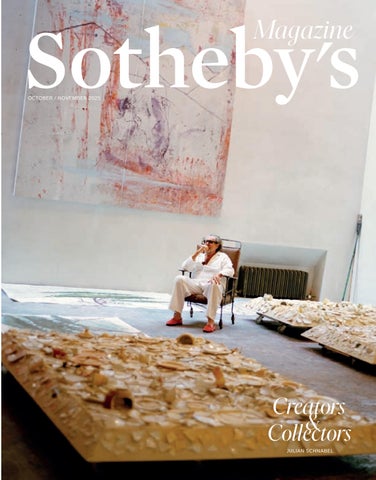
Create a flipbook