
MARIACARLA BOSCONO IN ATHENS
cd: ROBB AARON GORDON
© Marc Quinn, Burning Desire, 2011

Must-see exhibitions opening in
Philanthropist and collector Batia Ofer, chair of the Royal Academy Trust, collects to champion artists, education and social impact.
By James Haldane
The curator of one of the largest-ever gifts to the British public, the Gilbert Collection, explores its highlights at its home in the V&A. By Alice Minter, as told to James Haldane Photography by Henry Leutwyler
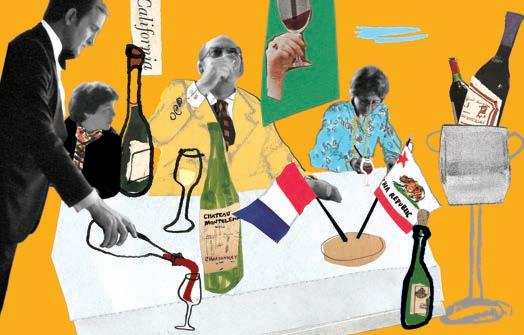
Half a century after a blind tasting in Paris shook the world, the California wines that bested Burgundies and Bordeaux are in the limelight once again. By Jay Cheshes
Illustration by Joanna Neborsky
A chance discovery at an antiques market in 1970s Paris marked the beginning of Terry de Gunzburg’s
By Lucas Oliver Mill


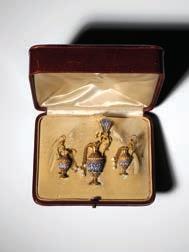
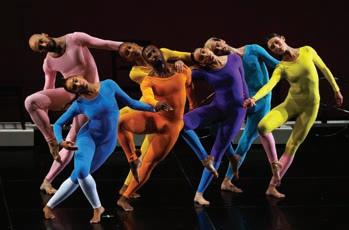
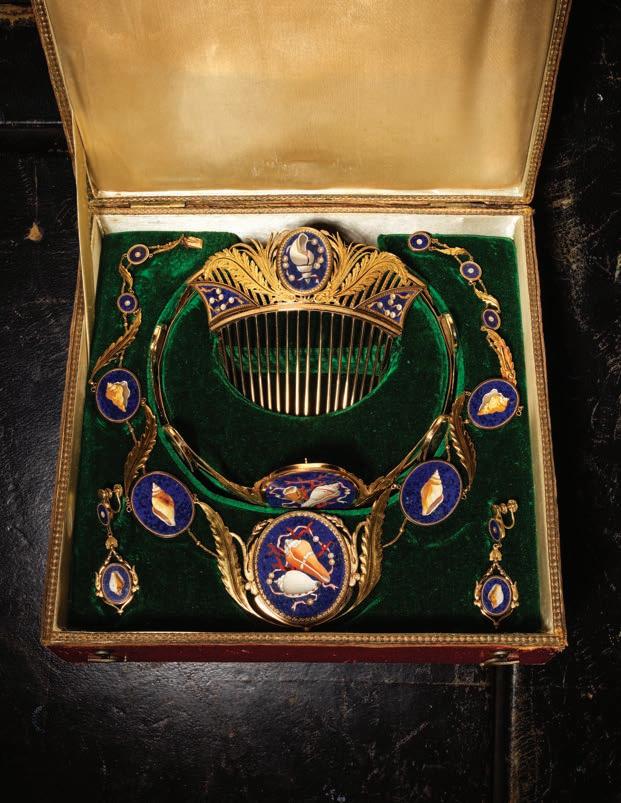
Above: Frida Kahlo painting her father’s portrait, 1951. Right: Pendant and earrings in the shape of ewers, circa 1870, decorated with intricate micromosaics, from the Gilbert Collection, V&A Museum, London. Below: “Dancing with Bob: Rauschenberg, Brown & Cunningham Onstage,” part of Dance Reflections by Van Cleef & Arpels.
60 THEARTISTPORTFOLIO
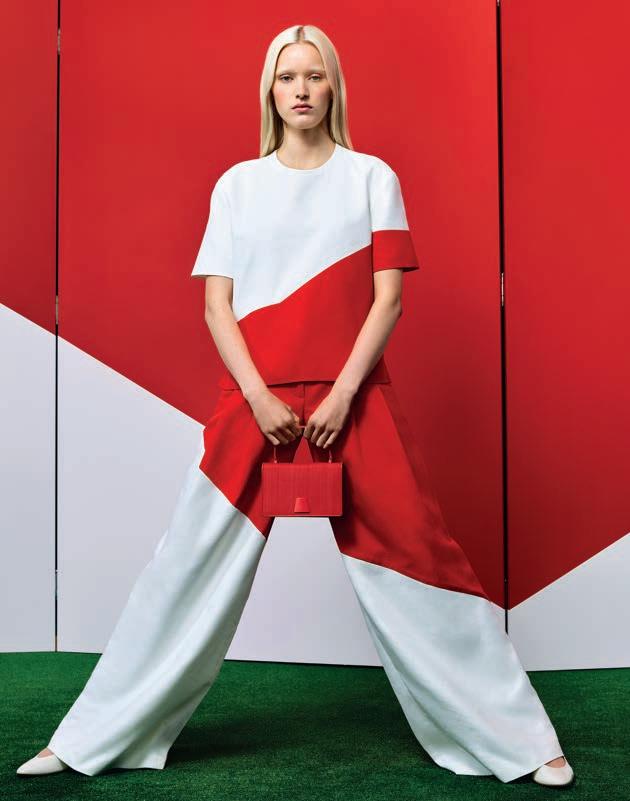
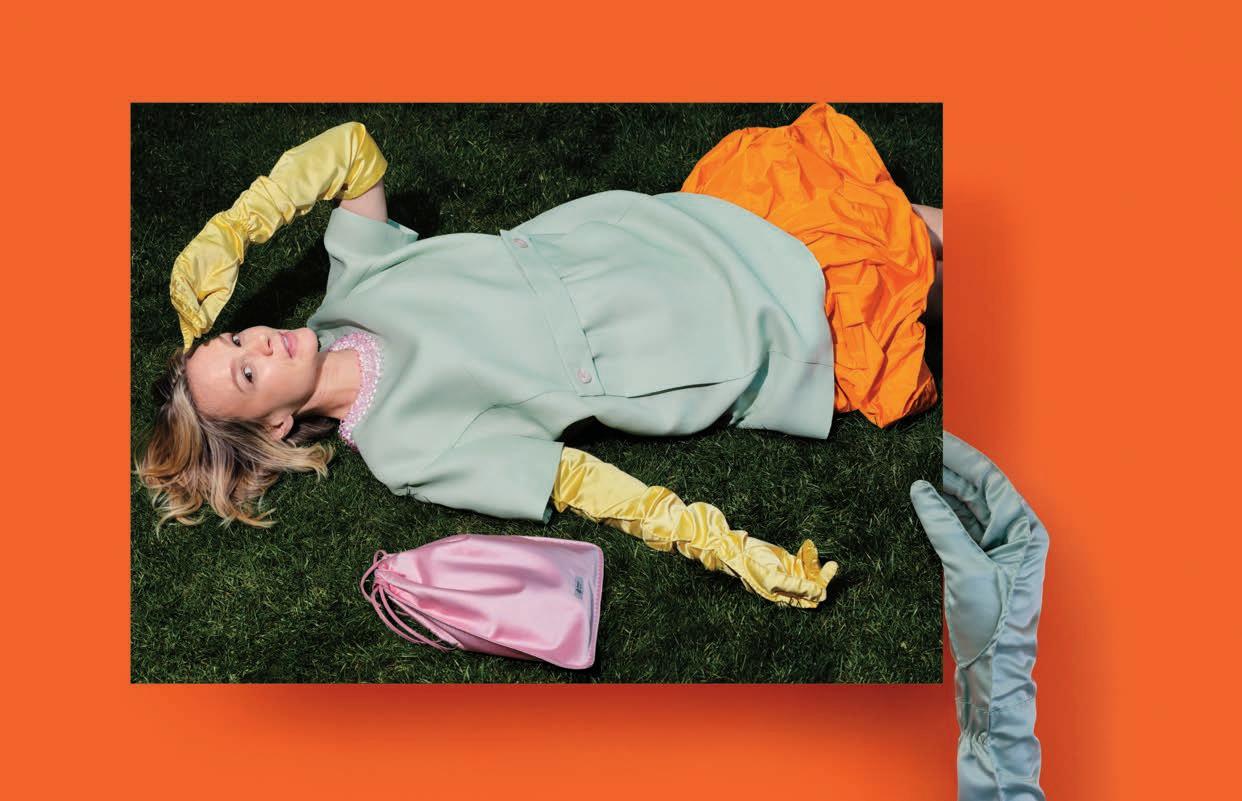
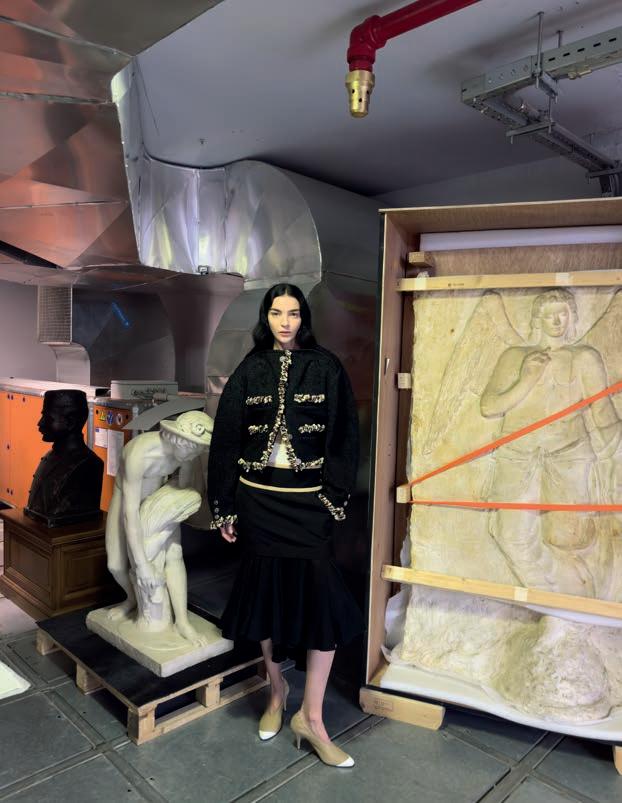
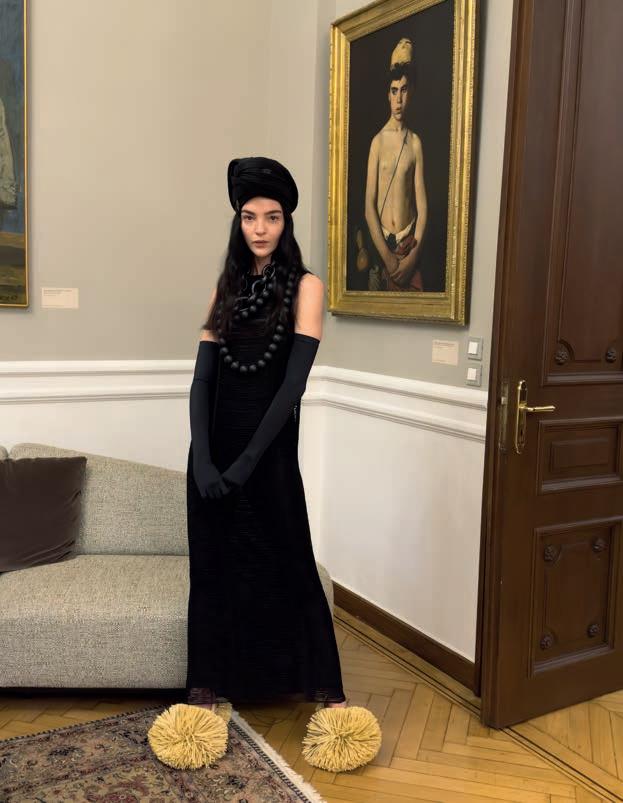
Set against the charged backdrop of Athens, bold color, sculptural silhouettes and a spirit of experimentation define the spring season. The story unfolds alongside Juergen Teller’s exhibition at Onassis Ready—an extension of the Onassis Foundation’s cultural vision—creating a dynamic dialogue between fashion, art and the city itself.
Photography by Juergen Teller
Creative partner, Dovile Drizyte
Styling by Sissy Vian
A house passed down through Frida Kahlo’s family and recently converted into a museum is the subject of a new book that explores its role as the artist’s “spiritual home.”
By Natalia Rachlin
88
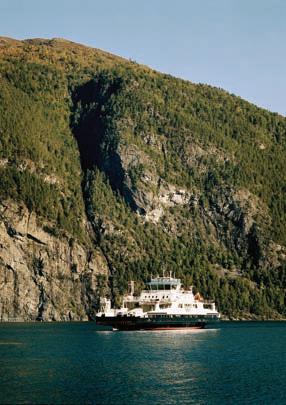
Norway’s Sunnmøre region is a hot spot of the summer “coolcation” trend. But its natural beauty and outdoor pleasures are abundant any time of year.
By Julie Coe
Photography by James Harvey-Kelly
98 THEWARDROBE OFZAHAHADID
A visit to the late architect’s clothing archive—featuring avant-garde gowns and sculptural, battle-ready coats—reveals her command of form at a human scale.
By Priya Khanchandani
Photography by Matthieu Lavanchy
Styling by Alex Carl
106
Partner content by Sotheby’s International Realty.
An ancient Egyptian sculpture of Sekhmet—a relic of an 1822 auction mysteriously forgotten or unsold— remains Sotheby’s unofficial mascot.
By James Haldane
on the cover
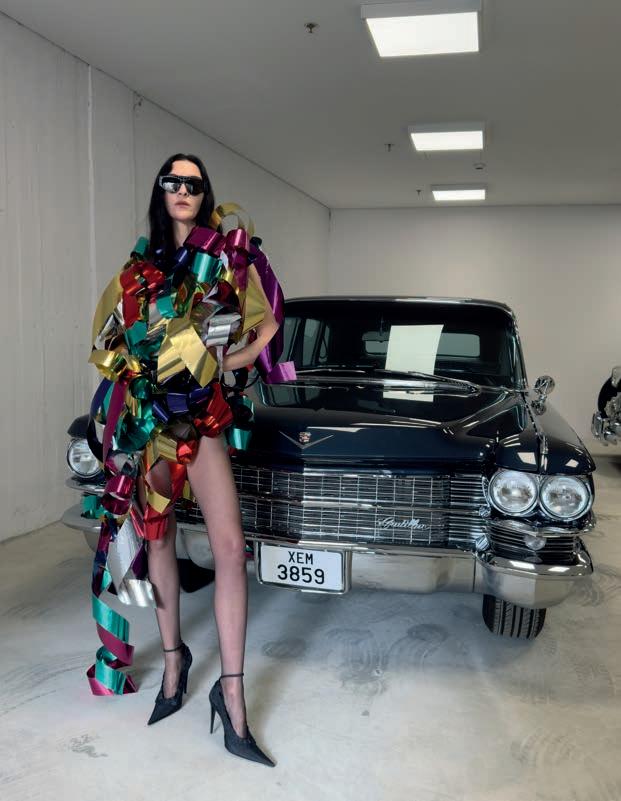
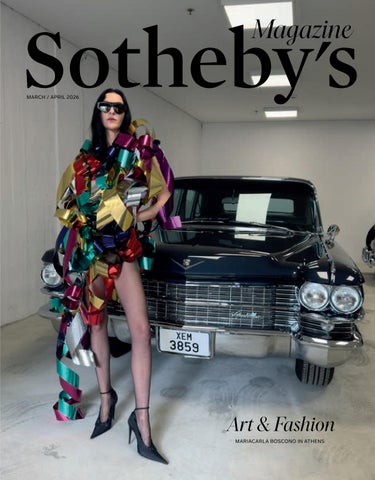
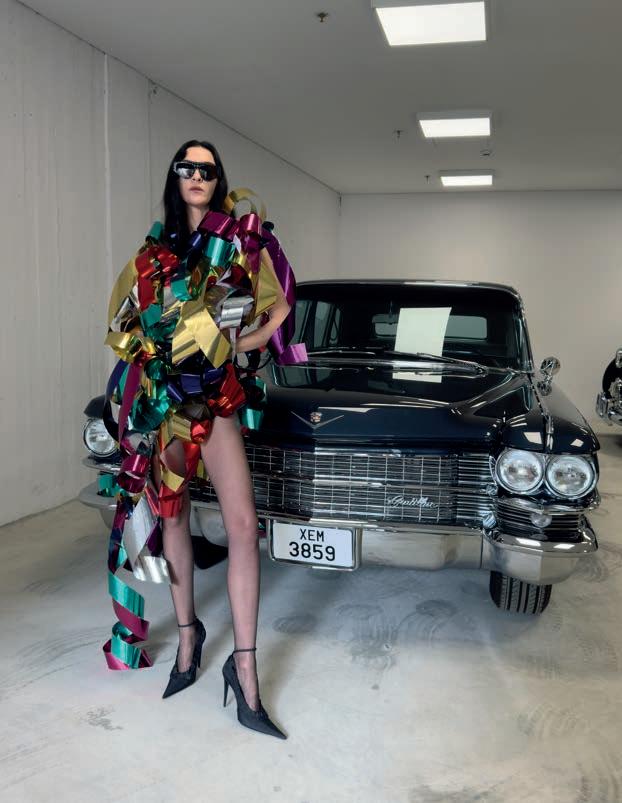
Mariacarla Boscono in front of Aristotle Onassis’ 1963 Cadillac Fleetwood Seventy-Five Limousine, Onassis Collection. Area dress, Alaïa sunglasses, Falke tights and Saint Laurent by Anthony Vaccarello heels.
Photography by Juergen Teller
Creative partner, Dovile Drizyte
Styling by Sissy Vian
follow @sothebys on all platforms











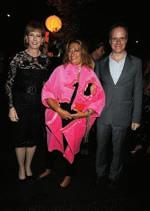
From above: Blind tasting at The Judgement of Paris in 1976; boarding a ferry in the fjords of western Norway; Van Cleef & Arpels, Diamond clip, foliate design. €40,000-€60,000, “Fine Jewelry,” Sotheby’s Paris, March 31; Julia PeytonJones, Zaha Hadid and Hans Ulrich Obrist attend the Serpentine Gallery Summer Party in London on September 9, 2008.



This issue turns the spotlight on family—by blood, by choice and by shared passions— exploring how kinship shapes art, culture and legacy.
Founded by shipping magnate Aristotle Onassis, the Onassis Foundation began as a family affair. Since 1975, it has nurtured culture, education and healthcare innovation in Athens and beyond. When the foundation’s curators contemplated opening the new Onassis Ready contemporary art space—created in a former plastics factory on the city’s outskirts—they invited German photographer Juergen Teller and his creative partner and wife, Dovile Drizyte, to bring their vision to life. The resulting retrospective, “you are invited,” ran from the space’s mid-October opening through the end of the year. While the exhibition was still on view, we sent Teller to Athens to produce our latest Artist Portfolio, largely shot at Onassis Ready, yielding a meta edition that captures the latest fashion looks amid the display of Teller’s own previous work. The museum’s wider 2025-26 theme of “families” only added further resonance. “Family is the core of my work. It makes complete sense,” Teller told us. His enduring connection with Italian model Mariacarla Boscono is also emblematic: “It was important to me to work with Mariacarla, who I first photographed in 1998. We’ve been close friends ever since.”
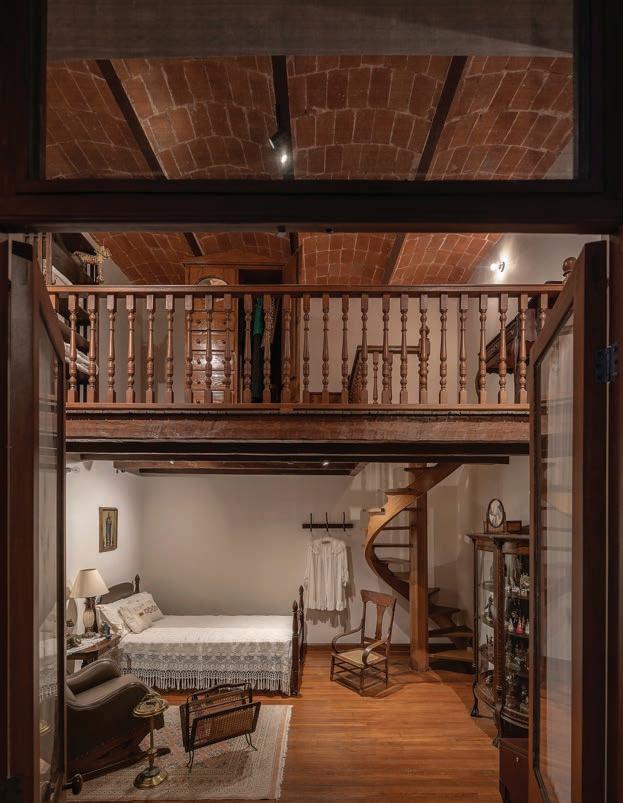
In Mexico City, Casa Kahlo—Frida Kahlo’s family home—opened to the public in late September. Paired with the new book “Casa Kahlo: Frida Kahlo’s Home and Sanctuary,” written by her greatniece along with her daughters, the house offers a rare glimpse into private life. Frida Hentschel, Kahlo’s great-grandniece, notes, “If you go to Casa Azul, you’ll find Frida’s story as Diego Rivera’s wife.” By contrast, this other home’s opening is, as writer Natalia Rachlin observes, “an attempt to protect and reclaim a more personal and private side of Kahlo’s story.
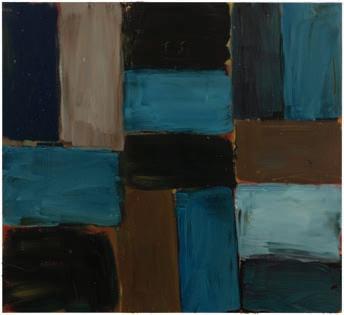
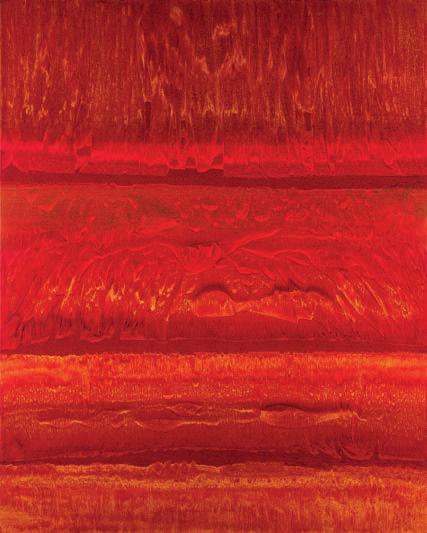
Sean Scully, “Tappan Deep Brown Blue,” 2025. £600,000-£800,000, “Modern & Contemporary Evening Auction,” Sotheby’s London, March 4.
Back across the Atlantic, in Norway’s Sunnmøre region, we meet another brood turning heritage into experience. Amid the “coolcation” trend that’s drawing more and more travelers to the fjords, the Flakk family has invested in high-end hospitality that allows visitors to experience Sunnmøre’s serenity year round.
In our Collected Wisdom Q&A, philanthropist Batia Ofer reflects on the interplay of family and collecting. Chair of the Royal Academy Trust, she discusses her tactics for expanding her multigenerational art collection in a way that honors tradition while engaging with the social issues of today. The Sean Scully painting shown here—a work that will feature in March auctions at Sotheby’s London to support the RA Schools’ tuition-free programs—attests to a commitment among contemporary Academicians to nurture the next generation.
Among our other stories, stretching from a peek into the cataloguing work underway at the Zaha Hadid fashion archive to the 50th anniversary of the
so-called “Judgement of Paris” wine tasting that shook the oenophilic world, we visit the Rosalinde and Arthur Gilbert Collection at the V&A. Assembled by the couple with shared passion over decades, its 1996 donation to the British nation was a landmark event. This month, the singular trove of decorative arts is being reinstalled in expanded and renovated galleries where it will continue to enjoy its unique curatorial freedoms as a private collection within a public institution. “Nowhere else in the museum do we allow for a collector’s expression of taste and individuality such free reign,” says V&A director Sir Tristram Hunt. Its uniqueness, he adds, “lies in its celebration of the role of the collector.” After all, it is often family that gives a collection both its heart and its story.
Kristina O’neill, Editor in Chief @kristina_oneill





























































Priya Khanchandani Writer
Priya Khanchandani is a curator and writer on contemporary design and visual culture. Former head of curatorial at London’s Design Museum and editor in chief of Icon, she contributes to The Financial Times, The World of Interiors and the BBC. Her exhibitions include “The Offbeat Sari,” which was accompanied by a book of the same title. The Wardrobe of Zaha Hadid, p98.
Editor in Chief – Kristina O’Neill
Creative Director – Magnus Berger
Editorial Director – Julie Coe
Director of Editorial Operations –Rachel Bres Mahar
Executive Editor – James Haldane
Visuals Director – Dana Kien
Design Director – Henrik Zachrisson
Entertainment Director –Andrea Oliveri for Special Projects
Editorial Assistant – Max Saada
CONTRIBUTING EDITORS
Akari Endo-Gaut, Frank Everett, Cary Leitzes, Sarah Medford, Lucas Oliver Mill
CULTURESHOCK
Chief Executive Officer – Phil Allison
Chief Operating Officer – Patrick Kelly
Head of Creative – Tess Savina
Production Editors – Rachel Potts, Antonia Wilson, Emma Nicklin
Picture Editor – Catharine Page
Art Editor – Gabriela Matuszyk
Designers – Ieva Misiukonytė, Michael Kelly
Chief Subeditor – Mark Grassick
Subeditors – Evan Hughes, Hannah Jones, Sean McGeady, Bobby McGee
Swiss-born photographer
Matthieu Lavanchy collaborates with leading fashion houses such as Hermès, Chanel and The Row as well as cultural institutions like the Yves Saint Laurent Foundation and the Loewe Craft Prize. He was awarded the Grand Prix du Jury at the Hyères Festival and has been a recipient at the Swiss Design Awards. The Wardrobe of Zaha Hadid, p98.
Sissy Vian began her career at Vogue Italia before establishing herself as a leading international stylist and contributing to magazines such as Vogue Italia, Vogue Japan, W Magazine and Harper’s Bazaar. She served as creative fashion director of Flair and currently shapes the visual identity of Harper’s Bazaar Italia as its creative fashion director. The Artist Portfolio, p60.
James Harvey-Kelly is a Londonborn photographer whose work encompasses fashion, travel, portraiture and reportage. He aims to create imagery that feels intimate, timeless and carefully observed, with a strong sense of narrative. His clients include Ralph Lauren, Canali, Four Seasons, Gant, The Financial Times, GQ and Vogue. Magnetic North, p88.
PARTNERSHIPS
Head of Global Partnerships –Eleonore Dethier
PUBLISHING
US (New York and Northeast) Fashion – Judi Sanders LGR Media Plus judi@lgrplus.com
Jewelry & Watches – Lisa Fields lisa.fields.consultant@sothebys.com
Design – Angela Okenica aokenica@gmail.com
Galleries and Museums – Ian Scott ian.scott.consultant@sothebys.com
US (Southeast and West Coast) Mark Cooper TL Cooper Media markcooper@tlcoopermedia.com
UK and France
Charlotte Regan Cultureshock charlotte@cultureshockmedia.co.uk
France Guglielmo Bava Kapture Media gpb@kapture-media.com
Italy Bernard Kedzierski and Paolo Cassano K. Media bernard.kedzierski@kmedianet.com paolo.cassano@kmedianet.com
Switzerland
Neil Sartori Media Interlink neil.sartori@mediainterlink.com
India and GCC Region Marzban Patel Mediascope marzban.patel@mediascope.co.in
Asia
Matthew Farrar Mezzomedia mfarrar@mezzogroup.com
SOTHEBY’S
Chief Executive Officer – Charles F. Stewart Chief Marketing Officer – Gareth Jones
General Inquiries
sothebysmagazine@sothebys.com
Please note that all lots are being offered for sale subject to Sotheby’s Conditions of Business for Buyers (which include our Authenticity Guarantee), which can be found on the relevant sale page on www.sothebys.com. Sotheby’s, Inc. License No. 1216058. © Sotheby’s, Inc. 2026. Information here within is correct at the time of printing. All content in this magazine is protected by copyright and may not be reproduced, published or redistributed without the permission of the relevant copyright owner. Every effort has been made to identify and contact copyright holders and obtain permission to reproduce the material. Please get in touch relating to any omission or inquiry.
Chief Public Relations Officer – Karina Sokolovsky
Global Head of Brand – Jacqueline King
Global Head of Content and Campaigns – Nick Marino
Global Head of Growth – Tracy Heller
Global Head of Social Media and Editorial – Anne Johnson
Global Head of Video Production – Rachel Roderman
Head of Events and Preferred, Americas – Richard Drake
Head of Events, UK – Lydia Soundy
Head of Procurement – Eduardo Guerra
Production Manager – Stephen J. Stanger



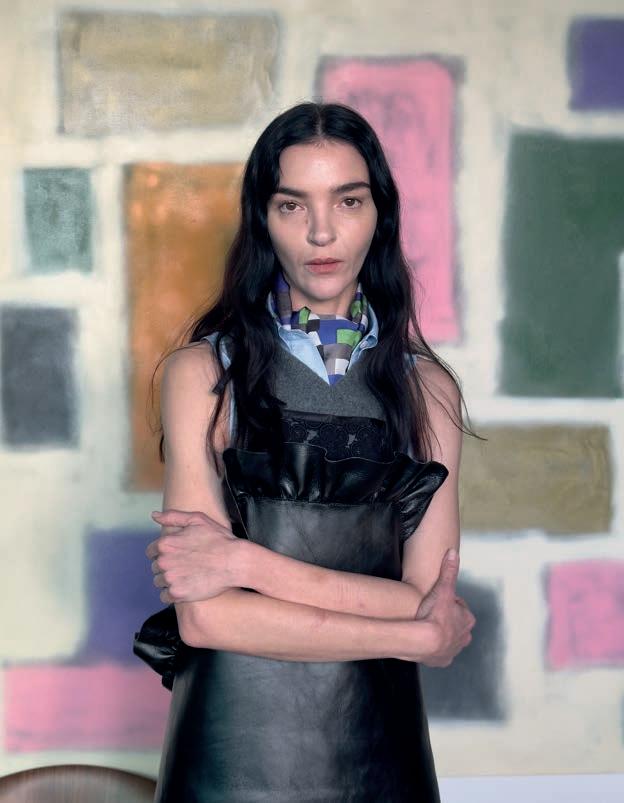
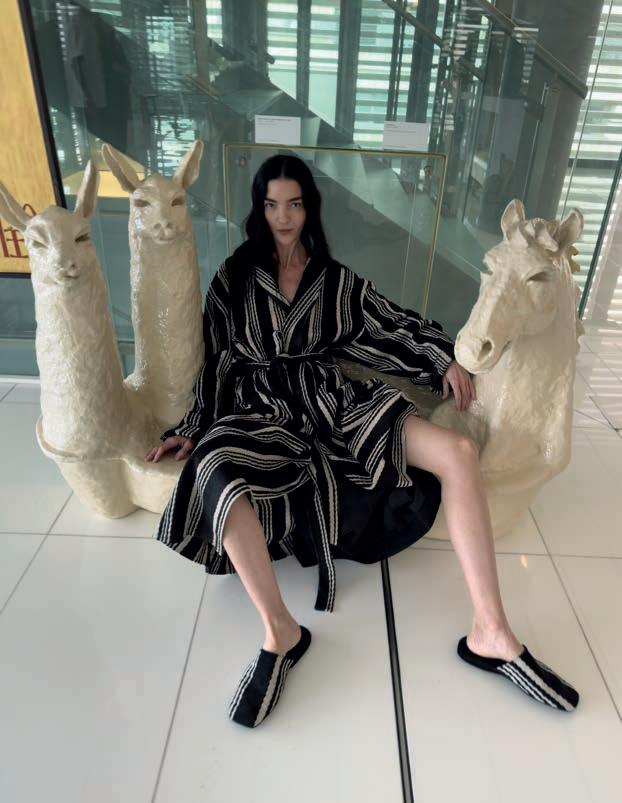
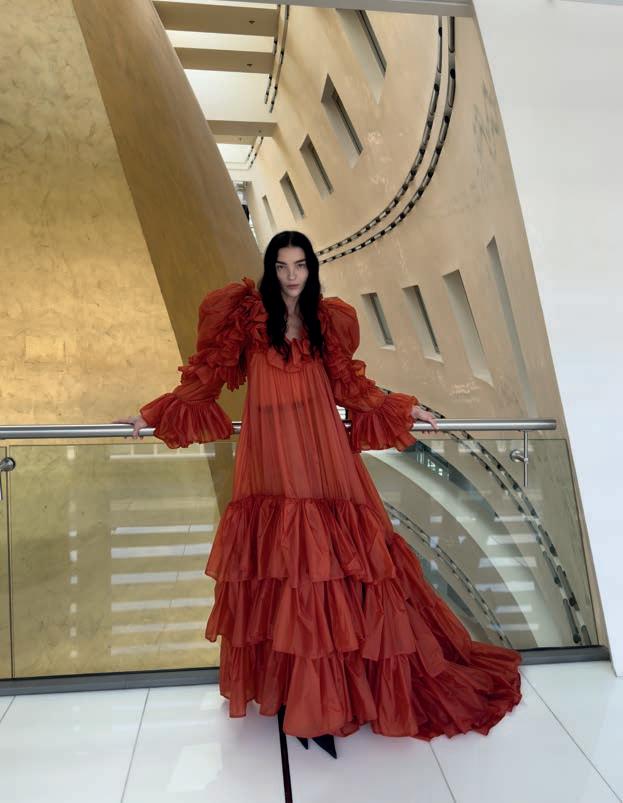
Juergen Teller gets meta with his dear friend Mariacarla Boscono, shooting the model in this season’s standout looks amid his own retrospective, which launched the Onassis Foundation’s new space on the edges of Athens.
BY AMANDA RANDONE

To Theworld, Aristotle Onassis was an august shipping magnate whose business dealings were high in stakes, and whose relationships were even higher in profile. To those who knew him intimately, he was a man with a sense of humor.
“He would be sitting somewhere listening to bouzouki music and drinking the cheapest whiskey, having the singer on one side and Maria Callas on the other,” says Afroditi Panagiotakou, artistic director of the namesake foundation Onassis created in 1975. The mogul was on a plane when he penned its guiding principles, underlining the words “aid, progress and development.” Since then, the Onassis Foundation has bolstered medical research and access to Greece’s public health system, established thousands of educational programs, and, at its Athens galleries, hosted and supported both local and international artists.
It’s serious work from an organization that doesn’t take itself too seriously because, just as humor was in Onassis’ DNA, it runs through that of his
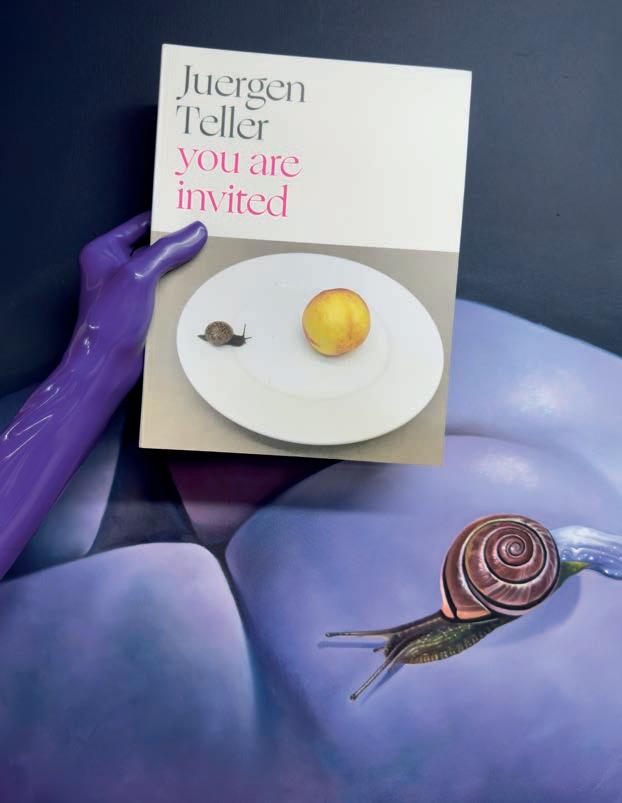
philanthropic endeavors as well. So, when the foundation’s curators were contemplating how to open the new Onassis Ready contemporary art space—formerly a plastics factory on Athens’ outskirts—German photographer Juergen Teller and his creative partner and wife, Dovile Drizyte, came to mind. Teller adopts a playful and candid approach to capturing even the most glamorous subjects, from an immense Shaquille O’Neal hiding behind a satirically trim tree to an unsmiling Victoria Beckham trapped in a Marc Jacobs shopping bag. Teller titled his retrospective “you are invited,” which ran from October through December last year, after a church leaflet he received in the mail. Flirting with sarcasm, the name captures the spirit of a foundation that likes to have fun, seeking to embrace rather than alienate. That the final result saw “people taking selfies next to Juergen’s naked butt,” Panagiotakou quips, was exactly the point.
“The Onassis team were very enthusiastic and had an attitude that everything is possible, and actually they made every-
thing possible,” Teller says.As for aligning himself with the museum’s 2025-26 theme of “families,” he says, “Family is the core of my work. It makes complete sense.” It is also why Teller, returning to the foundation for Sotheby’s Magazine, wanted to shoot Italian model Mariacarla Boscono. “It was important to me to work with Mariacarla, who I first photographed in 1998,” he says. “We’ve been close friends ever since.”
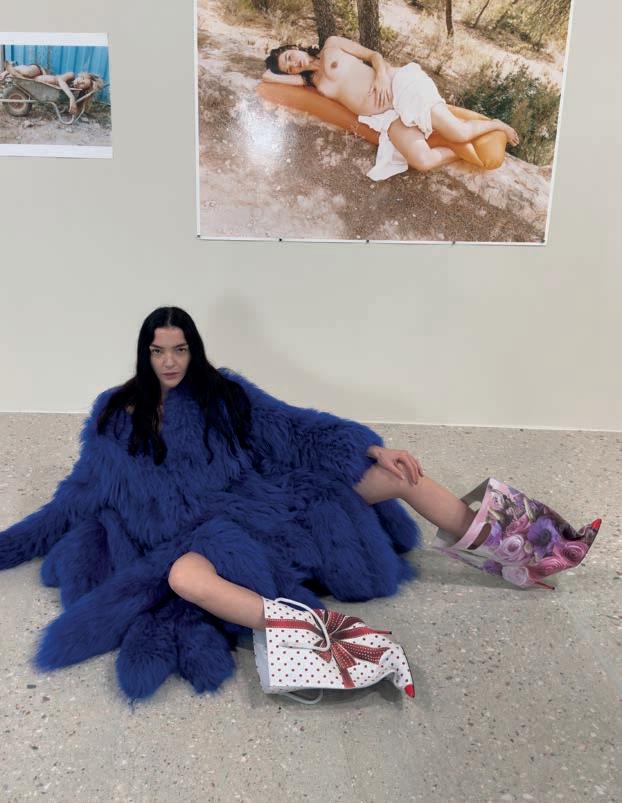
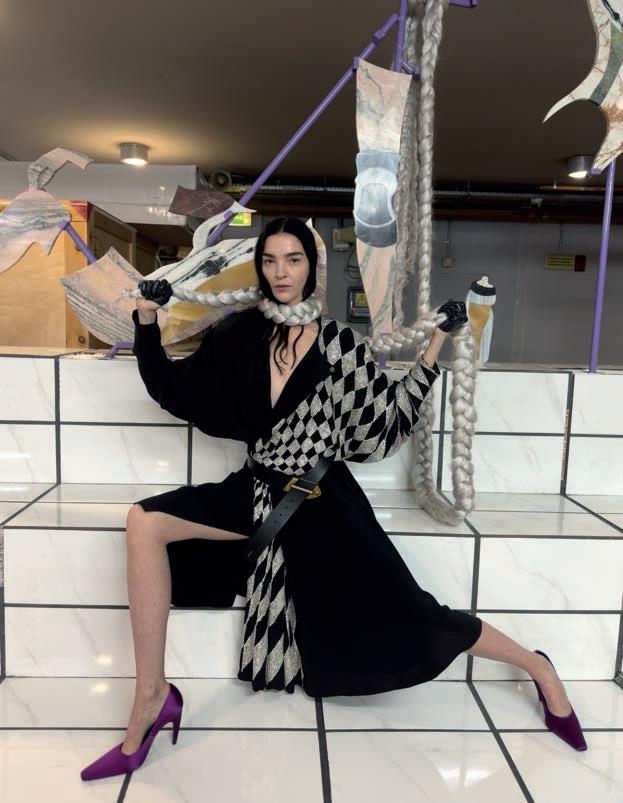
In Teller’s Artist Portfolio, which starts on page 60, Boscono reclines alongside a bust of Alexander the Great, poses in front of Onassis’ 1950s Rolls-Royce and straddles a toppled column by Andreas Angelidakis, the artist representing Greece at the 2026 Venice Biennale. She even appears with herself, sprawled on the floor beneath a 2012 portrait Teller snapped of her in Ibiza. This oscillation between old and new is a continuation of the centuries-old cultural conversation that sets Athens apart.
“Here we are again, with new people,” Panagiotakou says, “and we created something for the archeologists of the future.”

NEW YORK
FEBRUARY 25
An exceptional array of works from postwar masters and today’s cutting-edge artists.
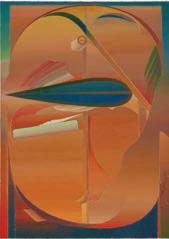
Miyoko Ito, “Nagisa,” 1977. $200,000-$300,000, “Contemporary Curated.”
LONDON APRIL 28-30
Presenting sought-after art and objects spanning centuries and continents.

An Iznik pottery dish, Turkey, second half of the 16th century. £50,000-£80,000, “Arts of the Islamic World & India.”
CORAL GABLES, FLORIDA FEBRUARY 27
The official auction of ModaMiami, featuring collectibles from almost every age of motoring.


2020 Aston Martin DB4GT Zagato Continuation. $1,500,000-$2,000,000, “RM Sotheby’s Miami.”
PARIS MARCH 13 - APRIL 1
Showcasing the finest jewelry, wine, handbags and accessories.
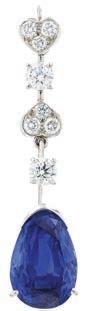
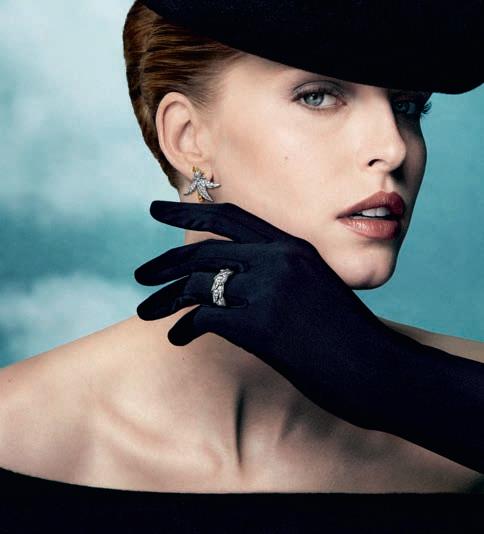
Cartier, Sapphire and diamond pendant. €140,000-€220,000, “Fine Jewelry.”
PARIS APRIL 16-17
Works by celebrated artists of the 20th and 21st centuries.
Marc Chagall, an important original gouache for the series “Cirque.” Estimate upon request, “Art Moderne et Contemporain Evening Auction.”
PARIS
MARCH 10-11

A tribute to a Faubourg Saint-Honoré icon, spanning 18th-century furniture to contemporary works.
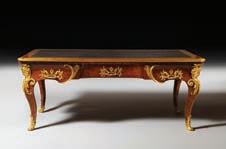
A Régence lacquered-bronze mounted kingwood parquetry bureau plat “à têtes de femmes,” circa 1720-30, attributed to Noël Gérard. €200,000-€300,000, “Collection Jean-Marie Rossi.”
HONG KONG MARCH 29-30
Presenting modern and contemporary works from Asian and global masters.
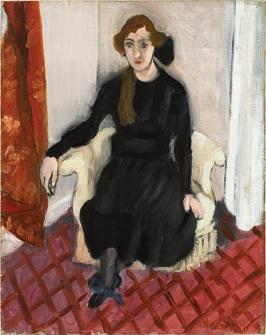
Henri Matisse, “Jeune Fille en Noir,” 1919. HK$7,000,000-HK$9,000,000, “Modern & Contemporary Evening Auction.”
NEW YORK
MARCH 2-10
Featuring the most significant personal artifacts from one of the most decorated and influential careers in basketball history.
Scottie Pippen “Last Dance” Chicago Bulls 1998NBA Finals Championship Clinching Game-Worn Jersey. $250,000-$300,000, “The Scottie Pippen Collection.”


NEW YORK MARCH 24-31
Works spanning the neolithic period to the present day.
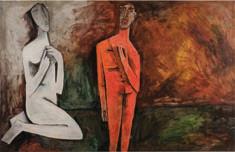
Maqbool Fida Husain, “Second Act,” 1958. $2,800,000-$3,500,000, “Modern & Contemporary South Asian Art.”
LONDON MARCH 4-6
Trailblazing works from modern and contemporary masters and designers.


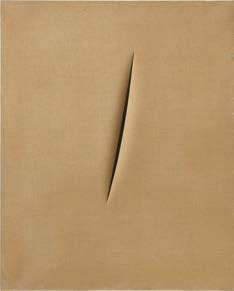
Lucio Fontana, “Concetto spaziale, Attesa,” 1960. £1,500,000-£2,000,000, “Modern & Contemporary Evening Auction.”
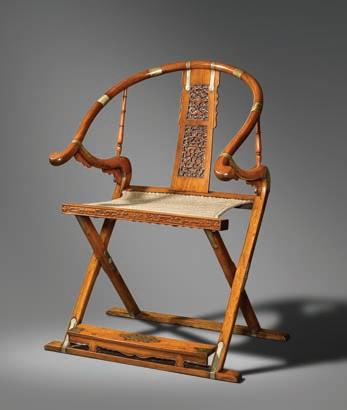
A rare 17th-century Ming folding chair reflects a culture of craftsmanship that inspired 20th-century design masters.
Fewer than 30 huanghuali horseshoe-backed folding chairs from the Ming dynasty are known to survive, yet each offers a remarkable window into this era of extraordinary craftsmanship and refinement. It was this period—central to our understanding of Chinese art and material culture—that first sparked my personal interest in the field. Known as the empire of “Great Brightness,” the Ming ruled China from 1368 to 1644, following the collapse of the Mongol-led Yuan dynasty. Its founding marked a renewed emphasis
on Confucian values, classical learning and cultural continuity. For later generations, the Ming became a cultural touchstone, its art embodying balance, restraint and moral clarity.
These ideals are clearest in the arts of everyday life. Nowhere is this more evident than in furniture, which reached a synthesis of elegance, functionality and craftsmanship. This folding chair, known as a jiaoyi and crafted from prized huanghuali wood, is one of the most notable survivals of Ming material culture, a tangible connection to the cultivated interiors of scholars, collectors and courtly elites, spaces for reading, conversation and contemplation.
Today, classical Chinese furniture is highly prized again, noted for its use of dense hardwoods such as huanghuali, zitan and jichimu, materials valued for

BY ANGELA McATEER International Head of Department, Chinese Works of Art, Americas & Europe
their strength and rich grain. Rather than relying on applied ornament or surface decoration, Ming furniture emphasized purity of form, structural clarity and the highest standards of workmanship. Beauty lay in proportion, subtle curves, and the wood’s expressive character. Huanghuali, in particular, was prized for its texture and striking grain, ranging from honey-gold to deep russet tones, lending a quiet sense of luxury to restrained designs.
The chair’s U-shaped crest rail, known as a “horseshoe back,” is one of the most recognizable forms of classical Chinese furniture, later inspiring 20th-century designers Hans Wegner, George Nakashima and Finn Juhl. The folding version of the horseshoe-back chair was first developed during the Song dynasty, around the 12th century, and represents a uniquely Chinese solution that combines mobility with a dignified presence. When folded, the front seat rail fits within the curved supporting arms—an ingenious detail reflecting technical mastery and aesthetic restraint. Discreet metal bracing strengthens the joints without disrupting the visual harmony.
Yet the folding mechanism’s complexity made it vulnerable to damage. Today, few survive, most preserved in museum collections. One celebrated example was sold in our Hong Kong rooms in 2022 as part of the collection of Sir Joseph Hotung, where it realized the equivalent of $15.8 million, setting a world auction record for a Chinese chair and the third highest price for any chair sold at auction. In every curve and joint, these chairs tell the story of a time when form, function and philosophy were inseparable.
A very rare and important “huanghuali” folding horseshoe-back armchair (Jiaoyi), late Ming or early Qing dynasty, 17th century. $1,200,000$1,500,000, “Huanghuali for the Scholar’s Studio: An Important Private Collection of Classical Chinese Furniture,” March 25, Sotheby’s New York.









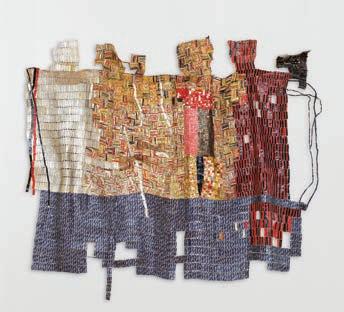
An enormous metallic tapestry supports the Royal Academy Schools, reflecting creativity as a fabric woven from education, history and collective making.
My first introduction to Ghanaian sculptor El Anatsui was in 2013—one of those formative encounters that changes everything. “TSIATSIA—Searching for Connection,” his contribution to the Royal Academy’s Summer Exhibition, draped across the 1720s Palladian façade of Burlington House on London’s Piccadilly. A vast metallic cloth of thousands of recycled bottle tops, it was audacious yet tender—a technical and poetic feat, enveloping the institution in something alive.
Over a decade on, that moment finds elegant reprise. Anatsui’s “G6,” from 2023, will be offered in support of the Royal Academy Schools, whose tuition-free, three-year program has long been the U.K. capital’s rarest and most radical gift to students worldwide. His gesture now feeds
directly into the Schools’ lifeblood—studios and critiques, lectures and exhibitions, the making and debating behind those historic walls—sustaining the program housed within the building his work once adorned.
Back in 2013, I was studying sculpture and art history at Newcastle University, stomping around in a fireproof jumpsuit, steel-capped boots and full PPE as if always on my way to extinguish a small blaze. I spent my days casting, carving and welding. Sculpture fascinated me for how objects behave around bodies. I immersed myself in the theoretical writings on phenomenology, and my dissertation circled the hulking gestures of 1960s minimalist sculpture— those cool, declarative forms that insist you reckon with your own physical presence. While I looked back, something extraordinary was happening in the present.
“TSIATSIA” caught my imagination because it declared Anatsui’s unique grammar of making. His invented technique bends traditional processes to yield improbable forms—pushing metal to behave like cloth. Through cutting, folding, piercing and stitching, he alchemizes the detritus of global consumption into works of profound

BY MACKIE HAYDEN-COOK Specialist, Contemporary Art
beauty. After the Summer Exhibition, accolades followed, and in 2014 he was elected an Honorary Royal Academician. Yet what lingers is not the tally of distinctions, but the recognition of an artist articulating, at monumental scale, the very principles art school tries to teach—attention, precision, experimentation, trust, risk, patience; faith in materials, process and one’s own ability.
“G6” presents itself as a vibrant field of color and texture: ivory, gold, scarlet, black and deep indigo coalesce into rhythms between abstraction and figuration. From afar, it reads as a sumptuous mantle; up close, its construction reveals flattened, pierced fragments of metal, each carrying traces of a former life. Within this vertical composition, six ghostly figures emerge. The materials seduce, yet they also speak. In West Africa, liquor bottles and alcohol hold complex social meanings and, under colonial trade, became potent commodities. Anatsui’s bottle caps are thus freighted with histories of circulation between Africa, Europe and the Americas. Like all of his mature wall sculptures, “G6” exists in a state of perpetual becoming, its final form shaped by gravity, installation and the choreography of folds and seams that take on a life of their own.
Few experiences shape both career and character as profoundly as art school. Years later, when I began working at Sotheby’s, Anatsui’s works appeared first in the Modern and Contemporary African sales before migrating into marquee Contemporary auctions. After all that movement and making, I found myself once again in his orbit. “G6” feels like a reunion and the cleanest kind of circuit: the market in service of mentorship, brilliance underwriting access and transformation sustaining the very structures from which new practices emerge.
El Anatsui, “G6,” 2023. £800,000-£1,200,000, “Modern & Contemporary Evening Auction,” March 4, Sotheby’s London.


The Opening Bid, in which we present news from the worlds of art, books, culture, design, fashion, food, philanthropy and travel —alongside the Global Agenda, which highlights not-to-be-missed exhibitions opening in March and April.
noguchi saw artistic opportunity everywhere: in the studio, onstage, at a lantern shop, while walking a city street. Two spring shows highlight the range and impact of his long career, which flourished between 1922 and his death in 1988 and culminated in his founding of the Isamu Noguchi Foundation and Garden Museum, in Long Island City, Queens.
Through September 13, the museum delves into the ways the city transformed the artist and vice versa with “Noguchi’s New York,” a fitting subject in our politicized present. “It was in New York that Noguchi cultivated a sense of civic and social responsibility,” curator Kate Wiener explains. “He talked about finding himself ‘bitten by some kind of an idealism’— coming to believe that he could sculpt the city and world into a better place.”
Edited by Julie Coe

From April 10, “Isamu Noguchi: ‘I am not a designer’” at Atlanta’s High Museum of Art explores the conceptual overlaps between function and sculpture in the artist’s work. Visitors may come for his Akari light sculptures, but they’ll stay for his playground equipment, a rarely seen Martha Graham stage set and a model of a house he designed with architect Kazumi Adachi.
Despite their fragility, Noguchi’s utilitarian and affordable Akari paper lanterns are back in vogue and collectible today. The series dates to 1952 and is still in production in Japan, though some of the 200 or so models have been retired. “The

gallery
market has a material prejudice—i.e. bronze over paper—but that may be falling away,” says New York private dealer Patrick Parrish. “Serious collectors are willing to buy a paper sculpture, acknowledging that if it is vintage, it may need conservation at some point.” Consider that when Noguchi was chosen to represent the U.S. at the 1986 Venice Biennale, alongside his marble and steel sculptures, he filled an entire gallery with Akari.
–Sarah Medford




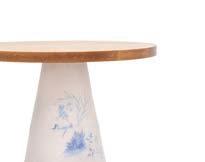
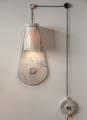
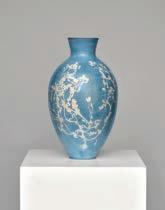
(1) Ditsy Delft Tiles by deVOL, from $12 per tile; devolkitchens.com. (2) BDDW Lotch table, from $30,000; bddw.com. (3) BDDW Knob and Tube wall light, from $12,500; bddw.com. (4) Studio Glithero Blueware vase, $5,390; glithero.com. (5) Kevin Quale tea cup, part of the “What’s the Tea” set, $5,500; kevinquale.com.


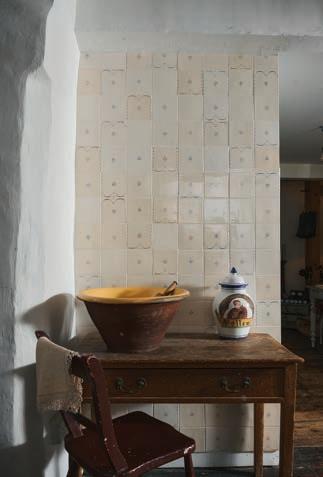
The delicate blue-and-white pottery style, famous from Dutch tilework, is inspiring fresh tableware and furniture designs that embrace its sprightly energy.








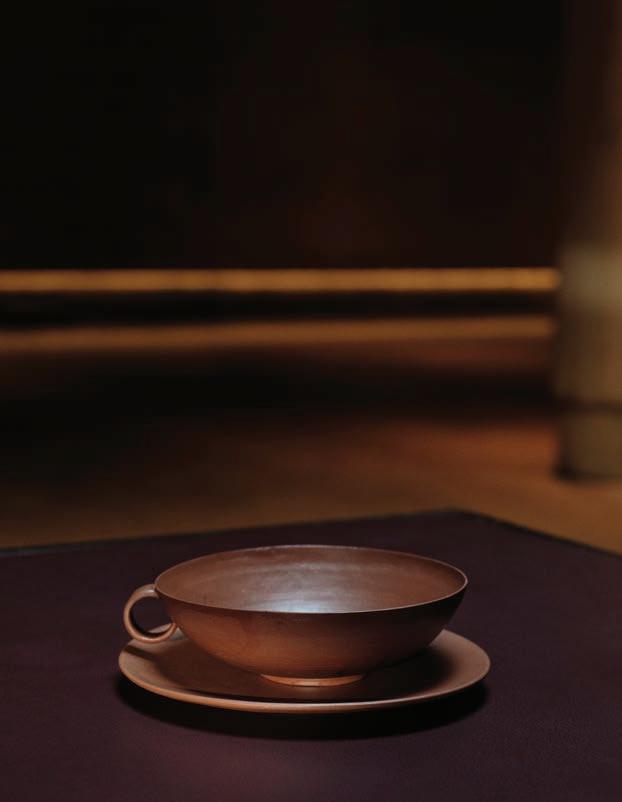
As the swiss-AustriAn Alps area increasingly becomes a magnet for new museums and galleries, alternative arts venues are cropping up too, often in unlikely settings. Take the car park at the Hotel Almhof Schneider, a fourth-generation winter resort in Lech am Arlberg, Austria. Through April 6, important works by Frank Auerbach, Lucie Rie, Le Corbusier and Pierre Jeanneret are on view against the backdrop of its futuristic underground garage and oak-lined public rooms, ready for guests and visitors to discover—and maybe drive away with, for the right price.
“Provenance,” curated by the Londonbased collector Rajan Bijlani, explores the migration of modernism across continents and cultures, from Eastern Europe to Britain and from western Europe to the Himalayan foothills of India. Taking Bijlani’s holdings of early furniture by
Le Corbusier and Pierre Jeanneret for Chandigarh, India, as a starting point, the show tracks the relationships between place, time and experience in the formation of an artistic self.
Among the key works are German-born Auerbach’s urgent 1951 charcoal drawing of a seated figure and Austrian émigré Rie’s Platonic ideal of an earthenware cup, from 1936. A 1954 Chandigarh desk is a marvel of simplicity, with cantilevers and other Corbusian hallmarks. For Bijlani, the sophistication of the Almhof Schneider seemed like reason enough to take on the ambitious project. “That car park—well, it took me right back to Chandigarh,” he says of the immaculate space, conceived by Japanese designer Shinichiro Ogata. “The concrete, the sandy color, the slant light from above. Amazing.” rajanbijlani.com—S.M.



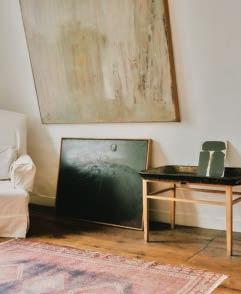

for a modest house museum on a quiet street in Cambridge, England, Kettle’s Yard has earned an outsized reputation among artists, leading to an exhibition program that punches far above its weight. The former home of Tate curator Jim Ede and his wife, Helen (and now part of Cambridge University), Kettle’s Yard mixes contemporary and modern art with the Edes’ personal effects in an unassuming, delectably intimate way— paintings and pebbles on the windowsills, ancient pottery on the stairs. Opened in 1957, it expanded with new gallery space for contemporary exhibitions in 2018. To fund its endowment, the museum has organized a benefit exhibition titled “Artists for Kettle’s Yard,” running March 14 through April 12 and featuring over 75 pieces by Chantal Joffe, Antony Gormley, Celia Paul, Ai Weiwei, Anni Albers, Magdalene Odundo and others. Works will be sold onsite, online and at Sotheby’s as part of a modern and contemporary sale in June.—S.M.

Vignettes from Kettle’s Yard, a house museum in Cambridge, England. At top are two Anni Albers screenprints from 1985, part of the “Artists for Kettle’s Yard” sale. Above is an Antony Gormley cast-iron sculpture from 2025, also part of the sale.


Hurvin Anderson opens at the Tate Britain in London. Splendors of the Baroque: Paintings from the Hispanic Society of America opens at the Musée Jacquemart André in Paris.
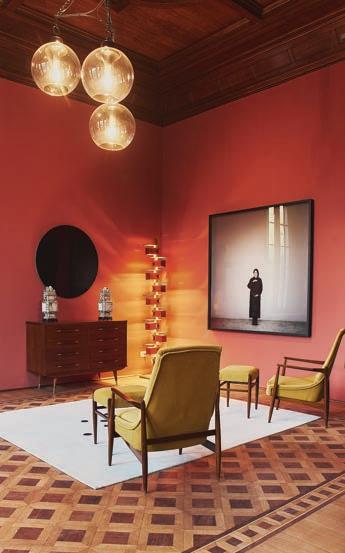
The founders of Passalacqua ranked the top hotel in Europe by the World’s 50 Best—and its sister property, the Grand Hotel Tremezzo, have added to their Lake Como mini-empire: Casabianca is a new art space from Paolo and Antonella De Santis, featuring the couple’s collection of modern and contemporary works amassed over the past 40 years. Set in a 1930s marble-clad townhouse, the threefloor gallery displays pieces by artists like Vanessa Beecroft, Marina Abramović and William Kentridge in a home-like setting full of mid-century furnishings. A wiry Anselm Kiefer sculpture stands against windows framing striking views of the surrounding hillsides, while Alfredo Jaar’s neon “Si ballava e ancora si sperava” speaks of dancing and hope from the wall of a chic living-room area. Arte povera in particular and the last half-century of Italian art more generally are well represented in works by Alighiero Boetti, Jannis Kounellis and Michelangelo Pistoletto. The De Santises curated Casabianca themselves, with the idea of changing things up frequently and inviting guest exhibitions. On the ground floor is an outpost of the Milan bakery Cova, where works on paper by Mario Merz hang above the dining tables, and for those looking to experience the famous De Santis hospitality, three guest suites will open on the top floor, just in time for the summer season. casabiancacomo.com/it
The salotto, or living room at Casabianca, featuring “Holding Emptiness” (2012) by Marina Abramović.

Fashion Becomes Art opens at the V&A South Kensington in London. The Antwerp Six opens at MoMu in Antwerp, Belgium.


Below, from left: Portrait of Elsa Schiaparelli by Man Ray, 1933. SFMOMA, The Helen Crocker Russell and William H. and Ethel W. Crocker Family Funds purchase, © 2025 Man Ray 2015 Trust, DACS, London; Raphael, “Portrait of a Lady with a Unicorn,” 1505-6. Galleria Borghese, Rome (371), © Galleria Borghese, photo by Mauro Coen; Stephen Tayo, “Models Holding Hands, Lagos, Nigeria,” 2019. Courtesy of Lagos Fashion Week; Henry Taylor, “Queen & King,” 2013. Marciano Art Foundation, Los Angeles, © Henry Taylor, courtesy of the artist and Hauser & Wirth, photo by Sam Kahn; Bicycle Wheel, 1951 (third version, after lost original of 1913). The Museum of Modern Art, New York; Michelangelo, “Esclave mourant,” 1513-15. Musée du Louvre, © 2022 Musée du Louvre, distributed by GrandPalaisRmn, photo by Hervé Lewandowski.


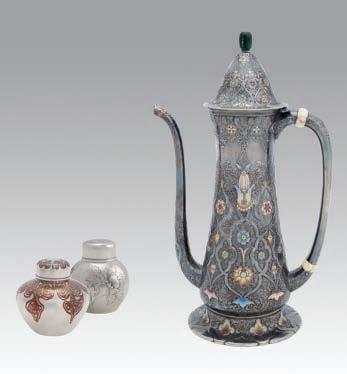
when peter marino first started collecting Tiffany & Co. silver in the 1980s, it most certainly wasn’t in style. But the architect, known for working with the world’s top fashion brands, doesn’t really care if things are fashionable. If anything, that just adds to the appeal, he explains in the new book, “Tiffany Silver: The Peter Marino Collection” (Phaidon). He found that the Aesthetic movement silver had all the hallmarks of great art: endless fascination, revelations of truth and expert craftsmanship. His holdings, which are particularly deep in examples of Japanese-inspired designs, run from a tray overlaid with a larger-than-life spider and its web to a jardiniere dotted with baby turtles, demonstrating the natural-world synchronicity and technical prowess of Tiffany’s 19th-century silversmiths. In a full-circle moment, after Marino created Tiffany & Co.’s New York flagship in 2023, he was able to display his collection there.
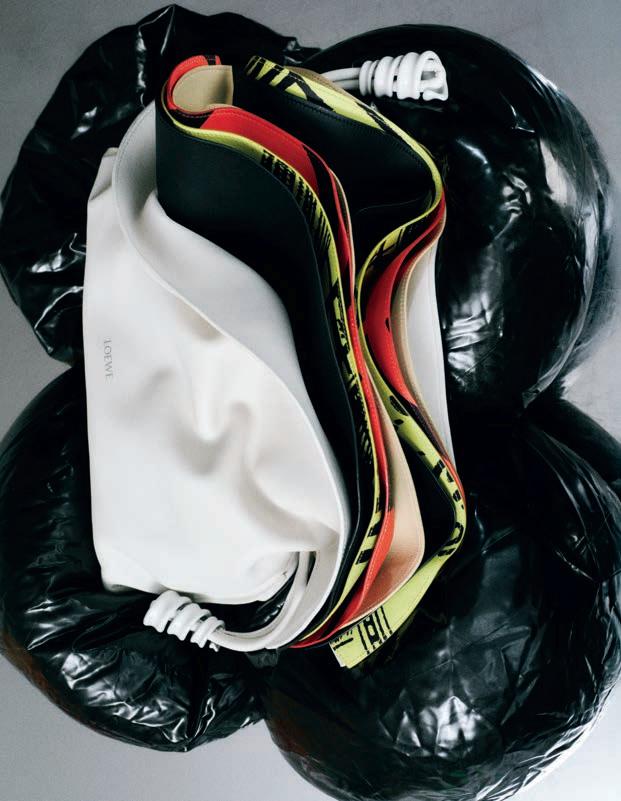
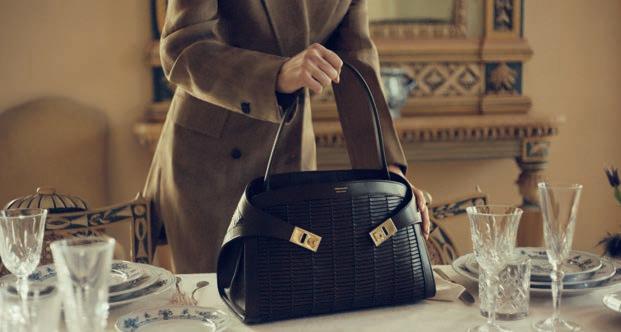
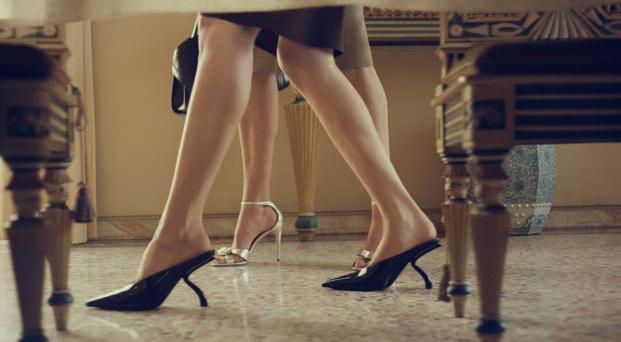
With a silhouette that recalls a cinched waist, Givenchy’s new Snatch Bag lives up to its name. Created by designer Sarah Burton, it comes in three sizes and a variety of shades.
APRIL



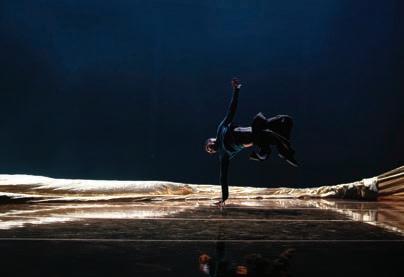
Dance Reflections by Van Cleef & Arpels brings 20 dynamic performances, including nine U.S. premieres, to New York this winter. The festival, which runs across multiple venues from February 19 through March 21, was created in 2020 by the French jewelry house to support contemporary dance around the world. This year’s New York program presents works by renowned choreographers such as Benjamin Millepied and Trisha Brown, as well as by up-and-comers like Soa Ratsifandrihana and Noé Soulier; it also features more than 20 workshops open to all levels. Dance Reflections has its roots in Van Cleef & Arpels history: a member of its founding family, Louis Arpels, was an avid balletgoer, inspiring the creation, in the 1940s, of the iconic ballerina clip— part of the company’s DNA ever since.

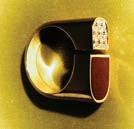
In addition to her day job as a womenswear director at Prada, Ilaria Icardi designs jewelry for her namesake line. Her latest offering, Series 05, draws on ’70s vibes and her own family histories.
The 18-karat gold “Otto” ring, with carnelian and diamond, $5,690; ilariaicardi.com
A forthcoming book traces the career of architect Kulapat Yantrasast and his firm, WHY, known for its innovative museum projects across the globe.
“Why WHY? Where Architecture Loves People,” $62; hatjecantz.com



Collectors with a taste for la dolce vita, take note. Sotheby’s and Indagare present a new Insider Journey to Venice, September 24‑27—four days exploring Biennale highlights and the secrets of La Serenissima. Sotheby’s expert Lorenzo Rebecchini will guide an intimate group through top pavilions, the Peggy Guggenheim Collection and AMA Venezia, including time with its founder, Laurent Asscher. With the storied Gritti Palace as your base, overlooking the Grand Canal and Santa Maria della Salute, expect Venetian splendor expertly unlocked.

MARINA ABRAMOVIĆ
Marina Abramović will make history as the first woman honored with a major exhibition at the Gallerie dell’Accademia, marking her 80th birthday. “Transforming Energy” presents early performances alongside new works, exploring endurance, vulner‑ ability and transcendence. Reflecting on her first encounter with Venice at 14, she remembers stepping off the train from Belgrade, weeping at the city’s incomparable splendor: “It was so incredibly beautiful—unlike anything I had ever seen.”
This May, the world’s oldest and most prestigious art biennale returns for its 61st edition with “In Minor Keys,” honoring the vision of the late curator Koyo Kouoh. Beyond the central exhibition, Venice comes alive with openings, events, and surprises around every canal.—James Haldane
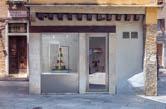

Laguna‑B fuses centuries‑old glassmaking knowledge with contemporary design under the vision of its art director, Venice‑raised Marcantonio Brandolini d’Adda, continuing the studio that his mother founded in 1994. The brand will unveil installations at its Dorsoduro concept store, where visitors can experience the ritual of drinking from its distinctive vessels firsthand.
The UAE has chosen Bana Kattan, curator and associate head of exhibitions at the eagerly awaited Guggenheim Abu Dhabi, designed by the late Frank Gehry, to lead its 15th Venice Biennale appearance. Born in Abu Dhabi and seasoned in Chicago, Kattan is crafting a showcase that, in her words, “reflects the UAE’s vibrant artistic landscape while engaging with broader histories, complexities and conversations.”
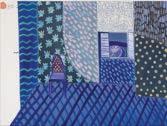
Once a docent at the Hong Kong Pavilion, the late Chinese‑Canadian painter returns to Venice posthumously with “Matthew Wong: Interiors,” a solo exhibition at Palazzo Tiepolo Passi. Presenting some 35 rarely seen and never‑before‑exhibited works, curated by his former mentor, gallerist John Cheim, the show underscores Venice’s enduring influence on Wong’s celebrated synthesis of color, space and form.
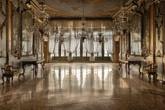
Fondazione Dries Van Noten opens in April within the ornate rococo interiors of 15th‑century Palazzo Pisani Moretta. Conceived by Dries Van Noten and his partner, Patrick Vangheluwe, the foundation celebrates craftsmanship across art, fashion and design. According to Van Noten and Vangheluwe, the palazzo was chosen “not as a monument frozen in time, but as a stage for creativity.”

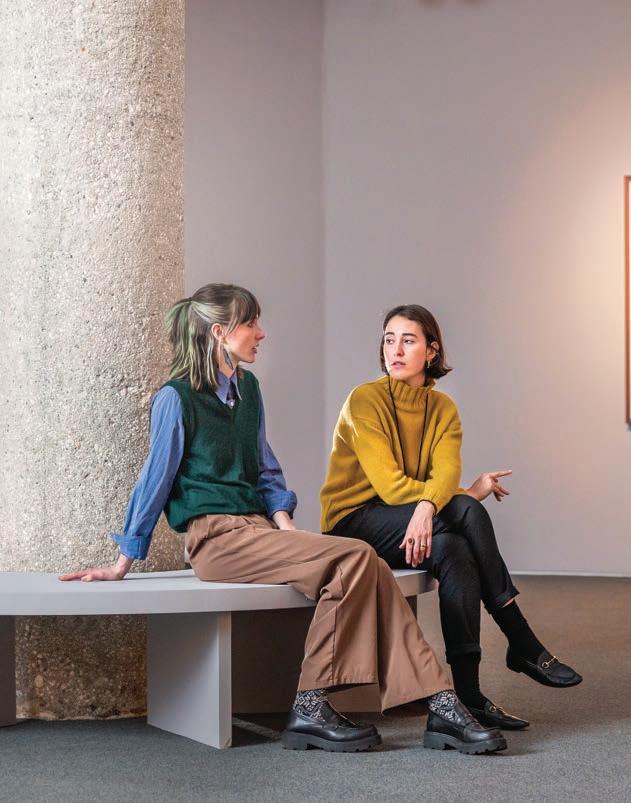


In which we delve into creating and collecting, tracking the place art has on our walls, discussing the long-sought works that got away, learning from the unconventional treasures of collectors and exploring the world of wine connoisseurship.
The U.K.-based philanthropist and collector chairs the Royal Academy Trust, supporting emerging talent and occasionally lending paintbrushes to Kerry James Marshall—all while expanding a multi-generational family art collection in response to contemporary issues.
BY JAMES HALDANE
Why do you collect? It’s a fire in me, my biggest love after my husband, Idan, and my children. I sometimes describe myself as an activist collector because I make acquisitions that are tied to important issues. I have work by Sigmar Polke, made after the first Kyoto Protocol, for example, and a sculpture in my home in Madrid from Ghada Amer’s “My Body My Choice” series, which I bought in 2022 after the overturning of Roe v. Wade. I also curate my collection to reflect themes. In the wake of the murder of George Floyd, I put Philip Guston’s “Remorse,” one of a series of 1970s paintings depicting Ku Klux Klan members, bought from Sotheby’s, opposite a 1969 David Hammons body print with the American flag, a work centered on civil rights.
Best impulse buy? A Jadé Fadojutimi that I bought at the last Frieze London from Gisela Capitain Gallery in Cologne. It’s not even a gallery that I usually work with—I just happened to walk by this beautiful painting.
How do you live with your collection? I love being surrounded by as much art as possible. I always think there’s no possibility to fit in any more and then somehow manage to find space. That said, each work deserves room to breathe. I lend a lot to exhibitions, too, so I’m constantly rehanging.
What was your very first collection, maybe as a child or a teenager? When I was around 10, I had a collection of paper
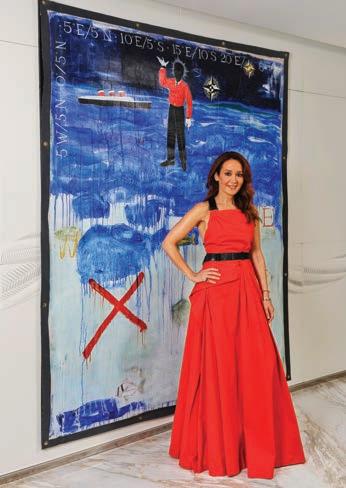
Photo: Jonathan Glynn-Smith; Artwork: © Kerry James Marshall. Courtesy of the artist and Jack Shainman Gallery, New York. Right: both courtesy of Sotheby’s.
napkins—I’ve actually never made the connection with my art collecting before. If we went out to dinner and there were nice napkins there, beautifully decorated with florals or patterns, I would keep one. I gathered them all in a box and I loved looking at them.
Why is philanthropy important? I chair the Royal Academy Trust, which has the core remit of fundraising for the RA, an organization established in 1768 by artists and architects who wanted to open an art school. They devised an annual exhibition to support it—the Summer Exhibition— and secured George III as their original patron. It’s still an independent institution that receives no government funding, so we’re on a campaign to secure its next 250 years, with the current Academicians joining us on the journey. In addition to exhibitions and public programs, we support the RA Schools’ tuition-free, three-year postgraduate program and will have great works in The London Sales at Sotheby’s in March, from Sean Scully and El Anatsui to Tony Cragg.
How do you galvanize the global collecting community? It’s about making sure people understand and fall in love with the RA as an institution like no other. Alongside amazing exhibitions from Kerry James Marshall and Mrinalini Mukherjee and her circle, we have students producing new art. When Kerry came over for his opening last September, he needed a paintbrush to add a signature to one of his works, so he went down to the Schools. He spent a couple of hours with the students—what a priceless experience to have with one of the world’s art titans. That interaction with artists is an experience that you get nowhere else.
What’s the best compliment someone has paid to your collection? We inherited half of an amazing collection assembled by my husband’s late father, Sammy Ofer, begun over 100 years ago. We’ve taken it forward. I’m always pleased when someone says that it feels like one collection.
What aspect of collecting gives you the biggest thrill? I make a point of buying from graduate shows and supporting younger artists. I bought a piece by Rachel Jones, who graduated from the RA, from her Dulwich Picture Gallery

William Kentridge, “You Whom I Could Not Save, Listen to Me,” 2023. £150,000-£200,000, “Contemporary Day Auction,” Sotheby’s London, March 4.
exhibition last summer. I look at work by quality, not if it is by a blue-chip name. I have a Kapwani Kiwanga, for example, that I bought from a small gallery before she went on to represent Canada at the 2024 Venice Biennale.
What’s the one piece you’ll never part with? A Georg Baselitz painting from 1975 of him and his wife, Elke, that hangs in the entrance to our London apartment. Even though it’s not my husband and me, it symbolizes us as a couple and what we’ve done in terms of collecting.
What’s the most difficult aspect of collecting? You have to have your finger on the pulse because there are so many new artists. I don’t collect for business, but I always want to know what’s going on in market terms. Then, knowing all of that, it’s getting rid of the distraction and the noise, and staying true to what you want to collect.
Who is the most unjustly overlooked artist? Sigmar Polke. Overlooked perhaps isn’t the right word, but people don’t understand his importance in history. He was one of the geniuses of 20th-century art—not only one of the most experimental, but he also influenced so many artists.
What exhibition are you looking forward to visiting? Marcel Duchamp at MoMA in April. He revolutionized the way we look at art, proclaiming in a speech in 1957, “the creative act is not performed by the artist alone; the spectator brings the work in contact with the external world.”
Which collectors do you admire? Leo Castelli. He was a pioneer and a trailblazer, showing works by De Kooning, Rauschenberg, Kandinsky, Pollock, Twombly, Lichtenstein, Ruscha and Johns, before turning toward pop art. Do I need to say any more?
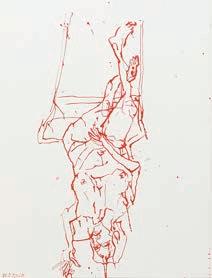
What “tools of the trade” do you use to build your collection? I have very good relationships with the galleries, auction houses and advisers. It is all relationship-based.
Georg Baselitz, “Untitled,” 2023. £80,000-£120,000, “Contemporary Day Auction,” Sotheby’s London, March 4.
Best art gift, given or received? A Joel Mesler work called “Burning Love” that I commissioned to give to my husband for our 10-year wedding anniversary, when we did a Burning Man-style party.
What tips do you have for collectors just starting out? Take an art course, visit as many galleries as possible and speak to curators as well as collectors. Then listen to your gut about what resonates—only you can know that. As Jack Kerouac is said to have remarked, “Great things are not accomplished by those who yield to trends and fads and popular opinion.” •
BY ALICE MINTER, AS TOLD TO JAMES HALDANE PHOTOGRAPHY BY HENRY LEUTWYLER
One of the largest-ever gifts to the British public, the Gilbert Collection—an assembly of over 1,000 objects, spanning gold boxes to micromosaics—has its own endowment, board of trustees and, this March, newly expanded galleries. Its curator guides us through a living collection.
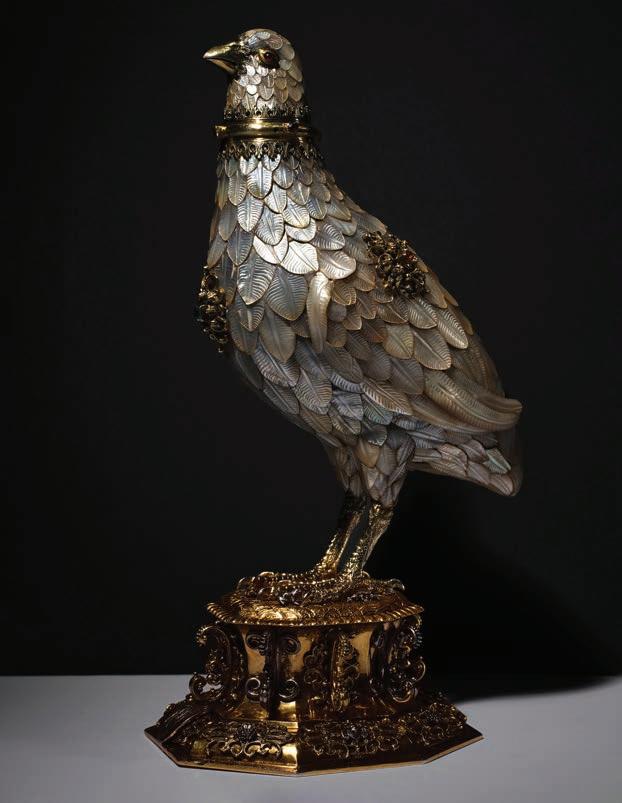
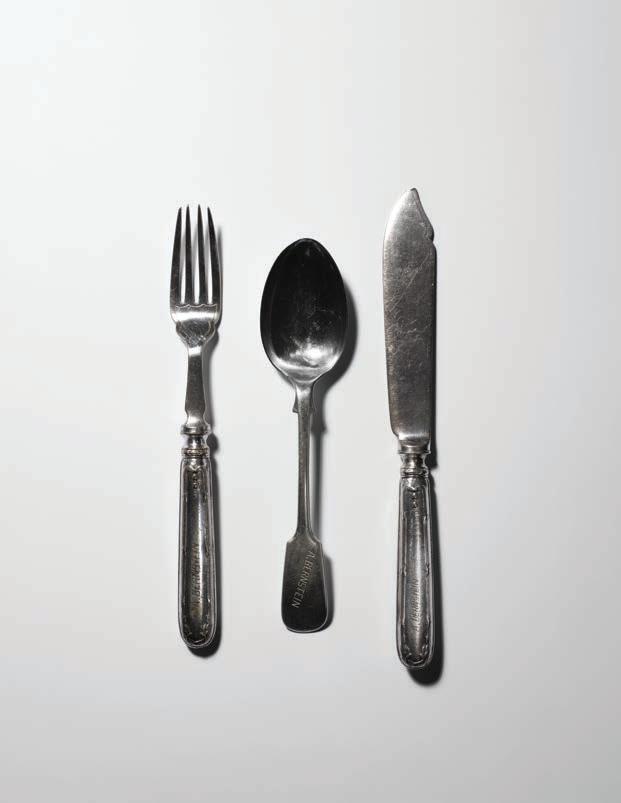
An early 17th-century mother-of-pearl and silver-gilt cup in the shape of a partridge that inspired Arthur Gilbert’s armorial when he was knighted in 2001. Opposite: Cutlery used by Arthur during his school days, engraved with his birth name, Abraham Bernstein. Though friends and family called him Arthur from childhood, he later adopted Rosalinde’s surname after they established their fashion business.
Arthur And rosAlinde Gilbert were remarkable partners in every sense, in life and in collecting. Both were born in London to Jewish families that had emigrated from Eastern Europe in the 1890s—Rosalinde’s parents were tailors, while Arthur’s father ran a thriving fur business. The couple met at a ball held at Madame Tussauds and married in December 1934. The following year, they combined their talents to establish Rosalinde Gilbert Ltd, a womenswear label producing ready-to-wear clothing in London. Even during fabric rationing, their designs were elegant, revealing a keen eye for style and quality.
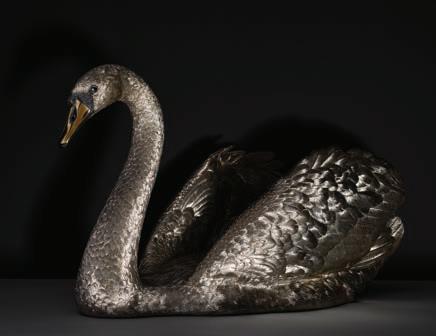
In 1949, they relocated to Los Angeles, selling their fashion business and allowing Arthur to establish himself as a highly successful property developer. The profits from his ventures enabled them, by the late 1960s, to begin collecting in earnest. They lived with their collections, using them in daily life and hosting frequently. Their life-size sterling silver swan by Asprey, for instance, would sit on a table in the drawing room, ready to be filled with flowers and moved to the dining room when entertaining. Objects were chosen to be handled, admired and enjoyed, not placed out of reach.
Arthur and Rosalinde developed a particular interest in pieces that demonstrated extraordinary craftsmanship, expanding their collecting across five principal areas: silverware, gold boxes, enamel portrait miniatures, micromosaics and stone mosaics (pietre dure).
The collection’s journey to the Victoria and Albert Museum was a winding one. Items from the collection were first loaned to the Los Angeles Museum of Art in the late 1970s, but in time, Arthur sought more space. In the 1990s, the late Lord Jacob Rothschild was chairman of Somerset House, then an empty shell on the
Strand in London, which he was seeking to transform. After Rosalinde’s death in 1995, Arthur donated the bulk of the collection to the British nation the following year. It was first displayed in a suite of galleries at Somerset House from 2000, before finding its long-term home at the V&A, the world’s largest museum of decorative arts and design, in 2008.
Today, the Gilbert Collection’s position at the V&A remains unique. With a dedicated board of trustees and accompanying endowment, it is a living collection, thanks to a crucial clause in the gift requiring continued acquisition. Rather than merely expanding the existing holdings, we select acquisitions that will animate them and build connections. In 2023, for example, we acquired from Sotheby’s a table by Giacomo Raffaelli—the father of micromosaics. The table has a specimen stone top, composed entirely of different stones, a material central to the Gilberts’ taste. These additions help build bridges between the different crafts represented.
The new, expanded galleries, opening to the public on March 14, allow the collection to be experienced more fully than ever before. Visitors can see not only extraordinary craft, but also the care, taste and generosity that shaped it. We have made particular efforts to highlight Rosalinde’s role, showing how she influenced acquisitions alongside Arthur. One story captures their partnership perfectly: Arthur often bought items from the antique dealer S. J. Phillips, founded in 1869. Jonathan Norton, a great-grandson of the founder, told me that he had twice offered Arthur a gold box once owned by Frederick II of Prussia, to no avail. On the third occasion, Rosalinde insisted, “If you don’t buy it, I will.” •
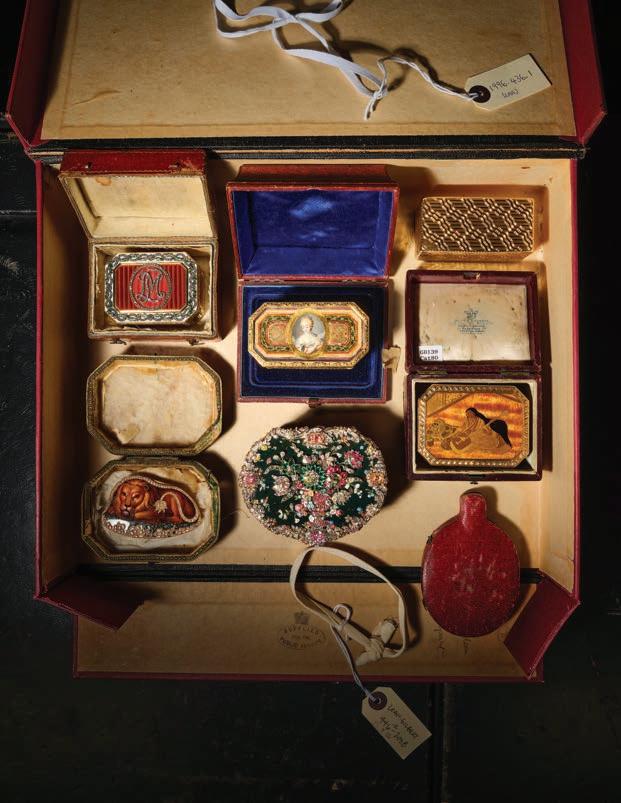
BOXED BRILLIANCE
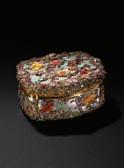
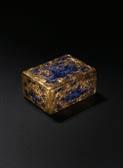
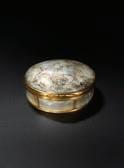
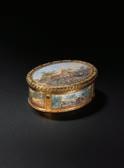
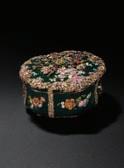
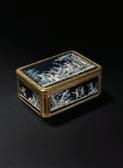
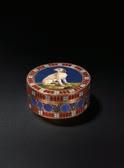
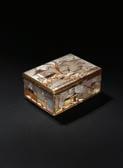
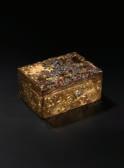
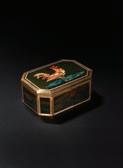
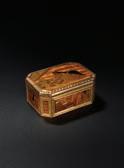

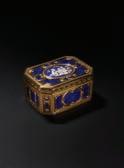

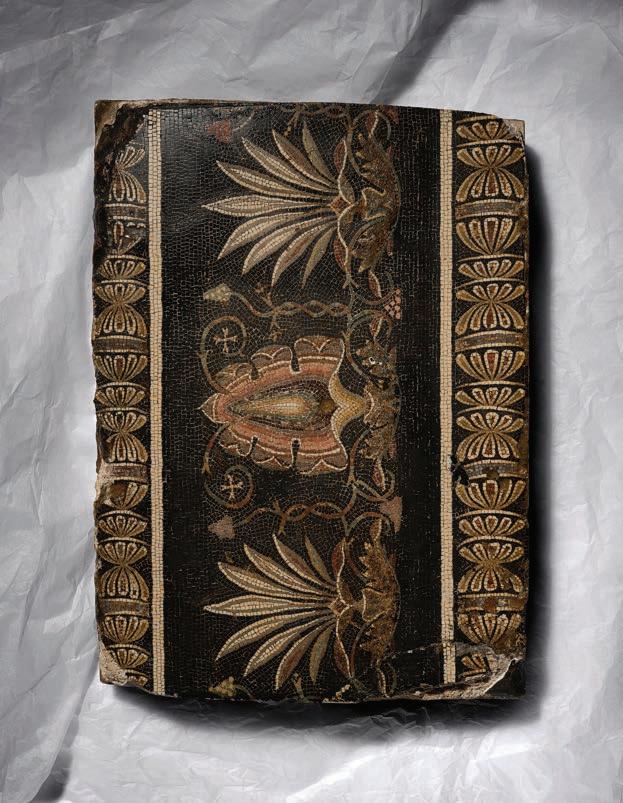
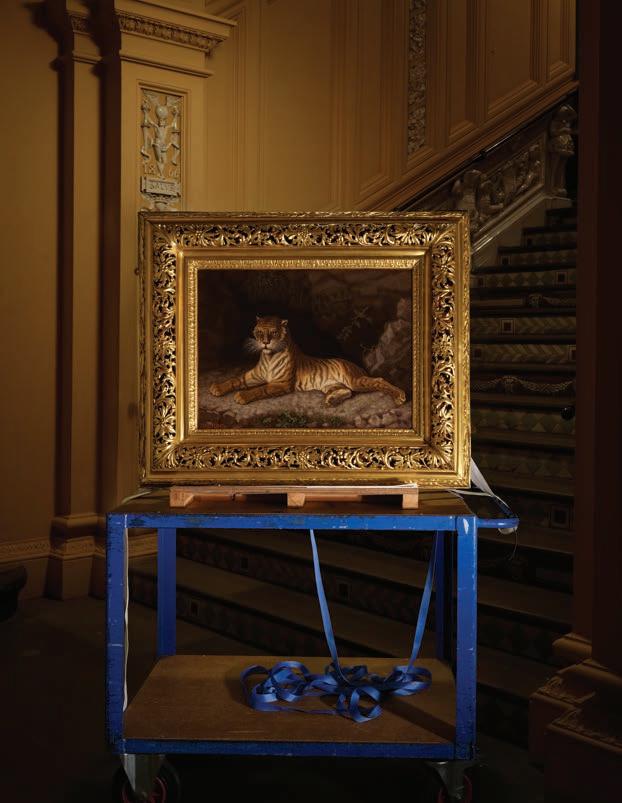
Decio Podio’s “The Tigress,” circa 1880-1910—nicknamed the Tiger Lisa by Rosalinde Gilbert—on the V&A’s Ceramic Staircase. Opposite: a fragment from the border of the 2nd-century “The Doves of Pliny” mosaic, discovered near Hadrian’s Villa in Tivoli in 1737.
Though not part of the Gilbert Collection, it will be displayed in the new galleries to provide context for the discussion of materials.
Five decades after the blind tasting that shook the world, the California wines that bested Burgundies and Bordeaux are in the limelight once again.
BY JAY CHESHES
ILLUSTRATION BY JOANNA NEBORSKY
It’s been 50 years since a blind tasting in Paris turned the wine world upside down. Back then, in 1976, French wine was king; France’s wine regions set the standard for the rest of the world. In California, serious winemaking was just getting started. As the US prepared to celebrate its bicentennial that summer, Steven Spurrier, a British expat with a small wine school in Paris, L’Académie du Vin, and an adjacent wine shop, Les Caves de la Madeleine, devised a marketing scheme to mark the milestone —a deliberately provocative tasting, pitting upstart California wineries against top French producers.
On the afternoon of May 24, 1976, Spurrier gathered a panel of nine French judges—wine critics, sommeliers and restaurant professionals—at the Intercontinental Hotel in Paris. After a visit to California wine country, Spurrier had selected six chardonnays and six cabernet sauvignons from Napa and Sonoma; he chose an equal number of Bordeaux reds and Burgundy whites. All were decanted to obscure their identities.
Seated at a long table, with spectators on a balcony above, the judges sipped, swirled, and spat, expecting an easy French rout. The event might have garnered little attention beyond Parisian wine circles if an American writer, George Taber, hadn’t been in the audience—the only journalist present—as the Californians proceeded to annihilate the French.
When the scores were tallied, a chardonnay from Chateau Montelena, in Calistoga, California, had beaten a Meursault Charmes from Burgundy to take the top spot among the whites. A cabernet sauvignon from Napa’s Stag’s Leap Wine Cellars had come in first among the reds, with a Château Mouton Rothschild behind it.
The California winemakers learned of their underdog victories two weeks later, when Time magazine published a small article by Taber under the headline “Judgement of Paris,” extolling the moment “the unthinkable happened: California defeated all Gaul.”
Taber’s four-paragraph story was later picked up by the French press and ricocheted around the world. The Judgement of Paris, as the tasting became known, turned into a cultural touchstone, a catalyst ushering in a golden age for New World wines. “The tasting,” says Jonathan Lai, a voracious collector whose cellar ranges from Bordeaux to Napa to the Andean foothills in Chile, “paved the way for New World Wines in general to compete at the highest level.”
“It was a historic moment in time—the French were resting on their laurels, not paying much attention to wines of other regions,”
says Nick Pegna, Global Head of Wine & Spirits at Sotheby’s. “This was a wake-up call.”
At Chateau Montelena, winemaker Mike Grgich’s winning 1973 white was only the second chardonnay vintage the winery had ever released. “My father at first couldn’t believe it,” says Violet Grgich of his victory. She was just 10 years old at the time. “They were still trying to figure things out,” says Matthew Crafton, current head winemaker at Chateau Montelena. “This was a story of unexpected greatness. And I think it shaped our culture and our decision-making and how we look at the world, even though it was 50 years ago.”
Both the winning red and white wine are now in the permanent collection of the Smithsonian’s National Museum of American History in Washington, displayed alongside Julia Child’s TV kitchen. They’re highly prized as collectibles and increasingly scarce.
You might expect a few more bottles than usual of those wines to emerge from cellars this year. “I think people who have these bottles, who have been sitting on them and who are thinking of selling, this would be the moment to do it,” says Pegna.
Of the 14 remaining bottles of ’73 chardonnay still in the cellars at Chateau Montelena, one entered the market at the start of the year as part of the $200,000 Judgement of Paris package—which included a private winery tour, vertical tasting and dinner—sold by the winery in partnership with Robb Report magazine.
Stag’s Leap Wine Cellars has a deeper reserve of its winning red, the ’73 Stag’s Leap Vineyard Cabernet Sauvignon. “We probably have about 40 bottles left,” says the current head winemaker, Marcus Notaro. He hopes to open a few at dinners he’ll host at top restaurants around the US this year, to mark the anniversary of the Paris rout. “I have had the honor of tasting that wine several times through the years,” says Notaro, who started at the winery in 2013. “It’s fun, especially aromatically. It still has some liveliness to it, some of the black currants and violets and tobacco notes.”
Both winning wineries are releasing special Judgement of Paris bottlings this year. Chateau Montelena has sourced grapes from the same vineyards as the 1973 chardonnay for a sparkling wine, brandy and 50th-anniversary chardonnay. Stag’s Leap’s commemorative bottle, of 2023 Stag’s Leap Vineyard Cabernet Sauvignon, will come in magnum only, in a limited run of 1,973 bottles, produced from old vines planted in 1972. “Although the wine isn’t from the time of the tasting, the 1970s, it’s from vines of that era,” says Notaro.
Violet Grgich, who today runs Grgich Hills Estate, the winery founded by her late father after he left Chateau Montelena, is also releasing a 50th-anniversary bottle, a new edition of the Paris Tasting Commemorative Chardonnay first introduced on her father’s 90th birthday in 2010. “For us it was always about celebrating the fact that America, and Napa Valley in particular, was able to make wine of the highest quality,” she says, “not necessarily that we beat the French.”
Taber, eventually, expanded his small article into a 312-page nonfiction book, a deep dive into the birth of the California wine scene, culminating in the showdown in Paris, first published in 2005. The book helped inspire a Hollywood film, “Bottle Shock,” a light comedy released in 2008, starring Alan Rickman as Spurrier and Chris Pine as a young Bo Barrett, a rebellious “cellar rat,” as he’s portrayed onscreen, whose father ran Chateau Montelena in 1976. (Today Bo Barrett is the winery’s CEO.)
This summer, those and other key figures from the ’76 tasting will appear as characters in a comedic opera, from composer Jake Heggie, premiering in July at Festival Napa Valley. “Truly great ideas for comic operas are very hard to come by,” says Heggie, “but this story just spoke to me immediately.”
The production, staged at the Charles Krug winery in St. Helena, will include Greek and Roman gods, along with singing winemakers. “The opera has a very strong mythological component,” says Charles Letourneau, artistic director of Festival Napa Valley. “There’s a role for Zeus and a role for Venus. Here in Napa, we feel in a way that the gods intervened in our favor.”
There will be plenty of dinners and tastings honoring the Judgement of Paris in California wine country, and across the US, this year. (An amateur enthusiast has created a website, judgementofparis50.com, as a central clearinghouse for commemorative events.) The biggest celebrations, though, won’t arrive until the fall, when Stag’s Leap will host a big party, inviting winemakers from around the world who, early in their careers, spent time working in their vineyards and cellars. “After the Paris tasting, a lot of people wanted to work here, to see what the magic was about,” says Notaro. “And a lot of them went on to make big names for themselves.”
The most ambitious event might be the Judgement of Napa, which wine concierge Angela Duerr, of Cultured Vine in Napa, is planning for fall. This blind tasting, with spectators and a seated banquet (tickets start at $2,000), will pit recent vintages of California cabernet sauvignon and chardonnay against wines from around the world. “We’ve chosen Italian, French, Chilean, Australian, whatever works that’s on par, that can compete,” says Duerr.
With the passing, in recent years, of so many key figures of the Judgement of Paris—Spurrier died in 2021, Mike Grgich in 2023 and Stag’s Leap founder Warren Winiarski last year—the Paris tasting has begun to fade into history. Increasingly, visitors to Chateau Montelena haven’t heard the story before. “We have to reintroduce the story constantly,” says Crafton. “The more people learn about it, the more they realize it’s recent history, in the grand scheme of things. It’s a story they can believe in. They not only fall in love with the story, but also fall in love with wine in general.” •
A chance discovery at an antiques market in 1970s Paris marked the beginning of Terry de Gunzburg’s life with art. Part of the collection she and her husband, Jean, have assembled comes to auction at Sotheby’s this spring.
BY LUCAS OLIVER MILL
Paris, 1970s. On weekend mornings, Parisians drifted north, crossing the Périphérique toward Les Puces de Paris Saint-Ouen, the vast flea and antiques market that spread through the streets of Saint-Ouen. The market—its origins tracing back to the 1870s—was rougher and more improvised than the polished destination it would later become. Stalls were tightly packed, objects piled on tables or leaning against walls, the air thick with dust and cigarette smoke.
Terry de Gunzburg, a precocious 20year-old medical student, would visit the market when she could, using spare money earned from part-time jobs—working for a florist, in a department store, at a school —balanced alongside her studies. During one visit, she stopped at a dealer’s table where a plate caught her eye. It was the image that held her first: the delicate outline of a woman’s face. She turned the plate over. On the back was the name “Picasso.”
Terry’s parents were not collectors, but they were intellectuals, and visits to museums had been an integral part of her upbringing. She had grown up seeing Picasso’s paintings and sculptures around the world, yet the idea of owning even a small work by the artist in ceramic form felt both exciting and unfamiliar. She seized the opportunity, even though the price was not insignificant for a young student. It was an early awakening of two of her lifelong affinities: Picasso and ceramics.
A second formative encounter in Terry’s 20s was meeting the French interior
designer Jacques Grange, whose star was very much on the rise. He would soon begin working on the legendary rue de Babylone apartment of Yves Saint Laurent—a figure Terry would later be linked to professionally when she went on to lead Yves Saint Laurent Beauté and develop the highlighter Touche Éclat, which cemented her reputation as a defining figure of the beauty industry. Grange would become her lifelong confidant, and the two would later collaborate on the homes she shared with her husband, Jean de Gunzburg—in Paris, London, New York, Saint-Rémy-de-Provence and Tel Aviv— shaping the environments in which her collection would live.
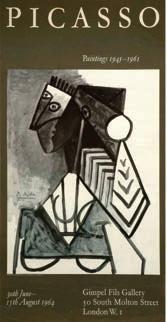
Later, in 1999, the de Gunzburgs were approached by their close friend Dominique Lévy, who was then leading private sales at Christie’s and had come across Picasso’s 1955 “Buste de Femme,” a sharp, architectural female portrait rendered in black and gray, hanging in a private New York collection. Lévy immediately thought of the couple. “Knowing their passion for sculpture and ceramics, I was keen to show it to them,” she recalled.
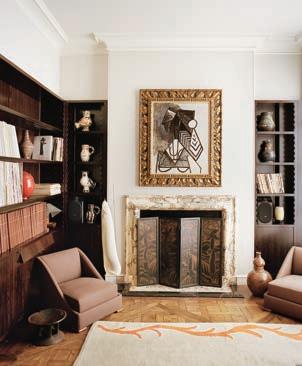
The piece carried an unexpected coincidence: It was painted the same year both de Gunzburgs were born. “We bought it as a sort of mutual birthday gift,” Terry told me, laughing as she remembered the moment. After acquiring the work, they installed it in their New York apartment, designed, as ever, in collaboration with Grange. There, it hangs in an intimate
corner above a fireplace (unused, of course) and an exquisite Alexandre Noll four-panel screen from 1925. A series of ceramics line the wood-paneled bookshelves surrounding it. It has remained in the same spot ever since.
In many ways, the painting reaffirmed something already present decades earlier. Terry still responded first to the same element that had stopped her in the ’70s at the antiques market: the human face. “What really caught my eye when I first saw that plate at the market was the face of the woman,” she said.
The original Picasso plate, meanwhile, did not survive. It was broken by a nephew during a birthday party. Terry recounts this with characteristic lightness: “It’s fine. I bought two of the same plates later at auction to replace it.” •
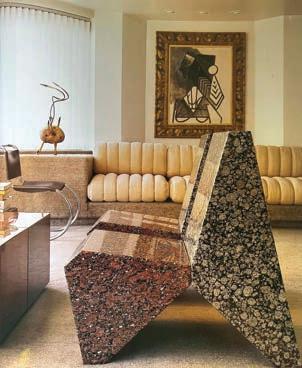
Pablo Picasso’s “Buste de Femme,” 1955, in an anonymous collector’s Park Avenue apartment in New York, photographed by John Hall, circa late ’90s. A pair of Scott Burton chairs stands in the foreground. Opposite: A 1964 Gimpel Fils Gallery poster featuring the Picasso.
THREE
In which we tour Athens’ art spaces with photographer Juergen Teller, visit Frida Kahlo’s family home, peek inside the closet of the late architect—and fashion collector—Zaha Hadid and travel to the fords of western Norway. and travel to the fords
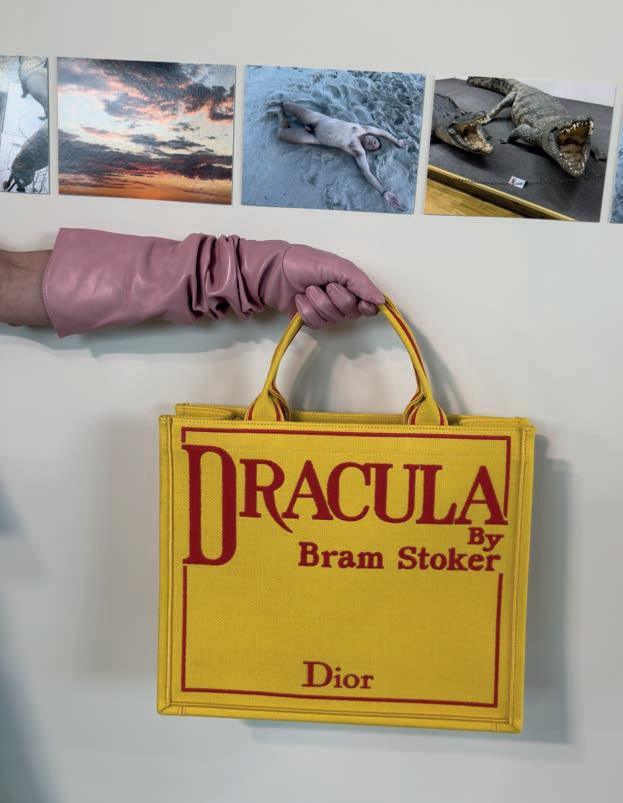
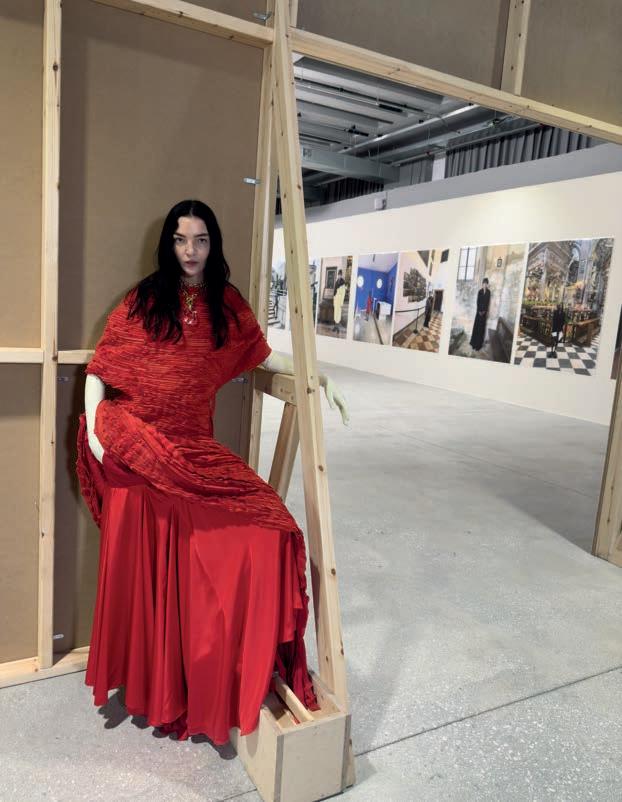
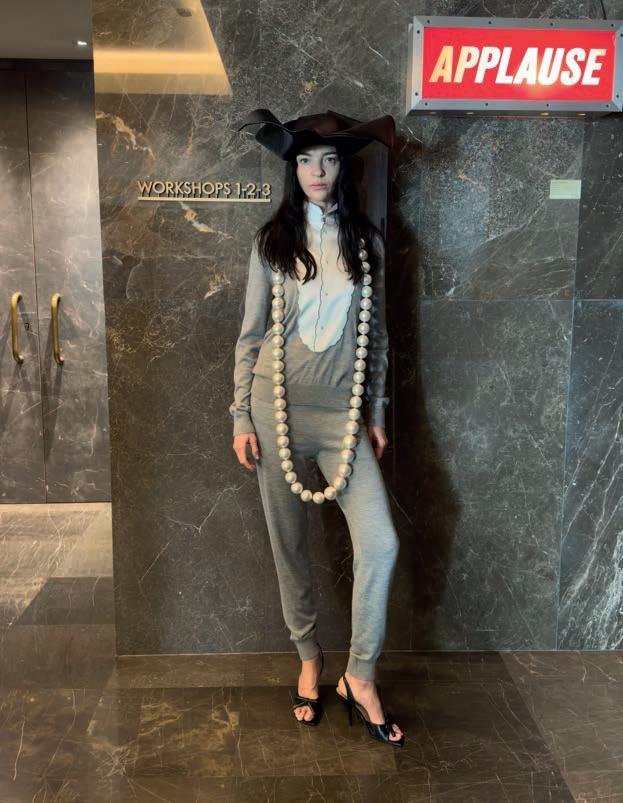
Set against the charged backdrop of Athens, bold color, sculptural silhouettes and a spirit of experimentation define the spring season. The story unfolds alongside Juergen Teller’s exhibition at Onassis Ready—an extension of the Onassis Foundation’s cultural vision—creating a dynamic dialogue between fashion, art and the city itself.
WELCOME IN
FBLD
catalogue,
The Stegi’s commanding architecture is a fitting locale for Boscono’s Saint Laurent by Anthony Vaccarello dress, tights, pleated taffetas and heels.
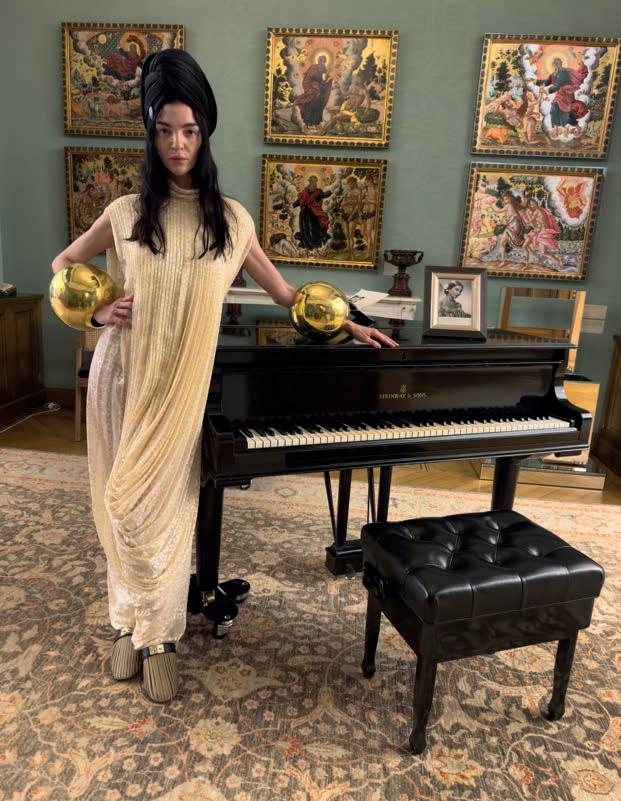
Opposite: The Steinway & Sons Baby Grand Piano “S,” 1954—purchased for Maria Callas’ rehearsal sessions on the yacht Christina—stands in the Onassis Library in front of a collection of paintings by Theodore Poulakis (circa 1620-92). Louis Vuitton jumpsuit, turban and mules and Saeni bracelets.
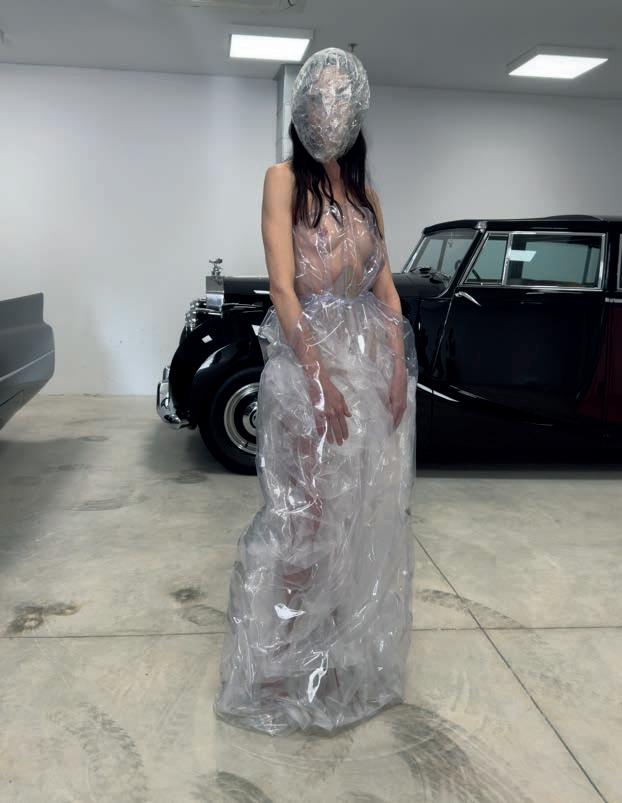
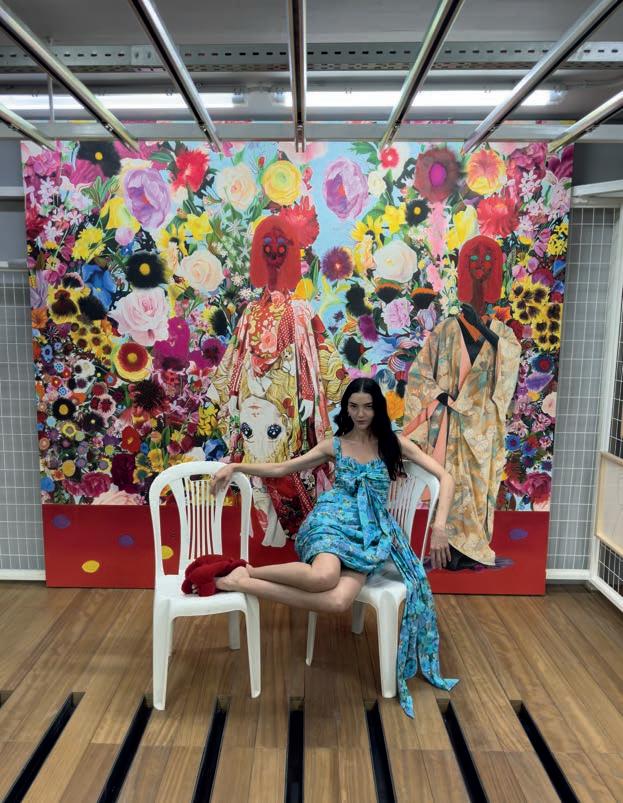
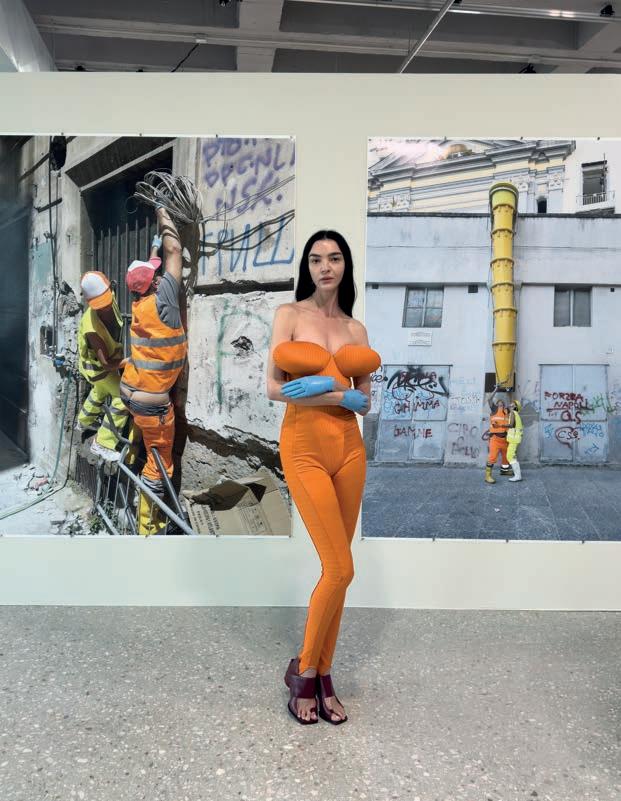
modern provocation Boscono wears a Jean Paul Gaultier jumpsuit and sandals; Balenciaga earrings from the Old Macdonald Had An Archive; and Atsuko Kudo gloves at Onassis Ready, featuring Juergen Teller, “We Are Building Our Future Together No.54 and No.83, Napoli, 2021.” Opposite: In the Onassis Library, Georgios Jakobides, “The Little Shepherd Boy,” circa 1877, peers over Boscono in an Akris dress, Louis Vuitton turban, Monies Delhi link necklace, MOY Paris pearl necklace, vintage Balenciaga gloves and Moschino shoes.
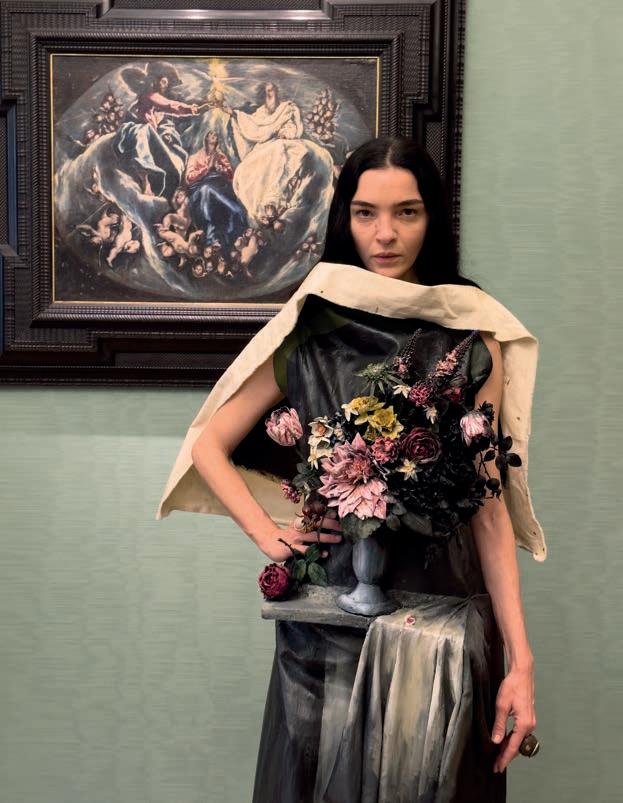
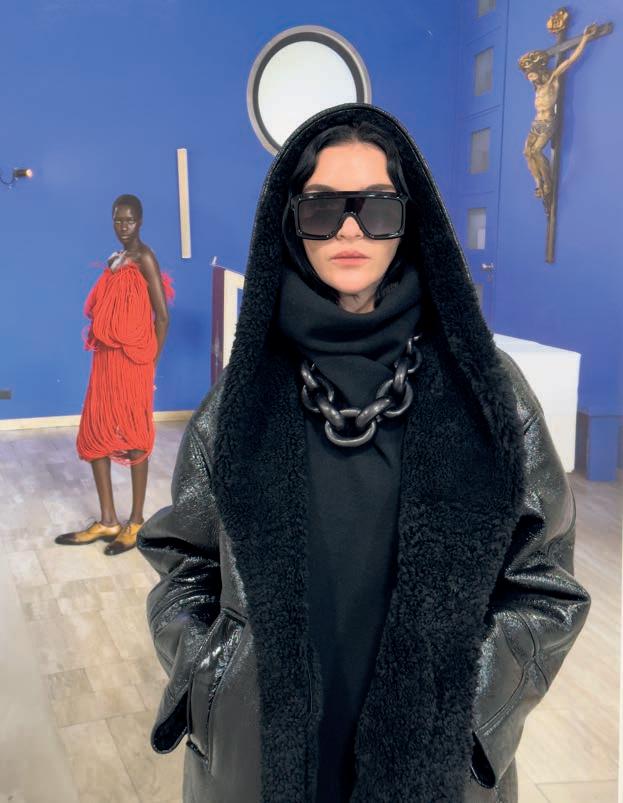
Boscono looks picture perfect in a Thevxlley dress and Roberto Cavalli rings in front of Domenicos Theotokopoulos (El Greco), “The Coronation of the Virgin,” circa 1603-5, Onassis Collection. Opposite: Ferragamo blouse, Parisi Gloves and Miu Miu heels in the Onassis Collection Vault. Andreas Angelidakis, “Anarchaeological Anaparastasis,” 2025, Onassis Collection. Ariana Papademetropoulos, “Psychic Specific,” 2024, Onassis Collection.
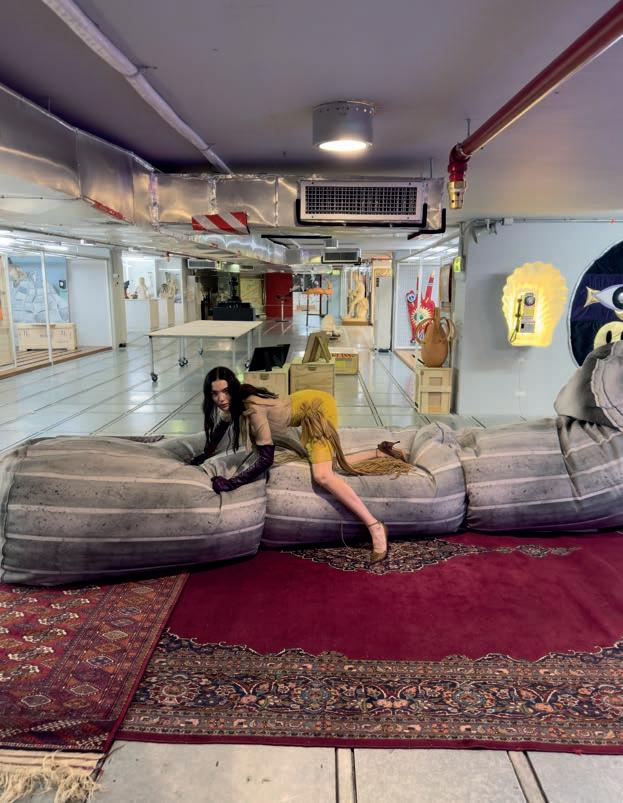
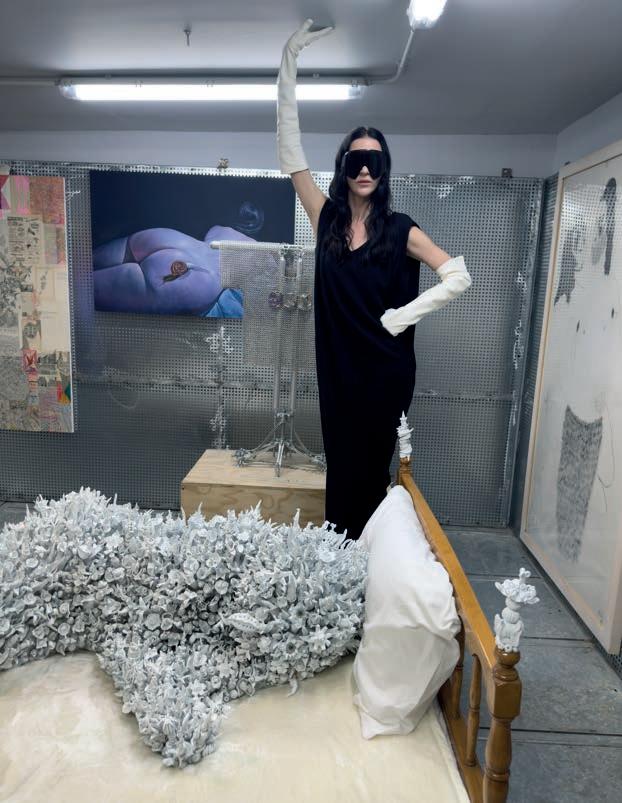
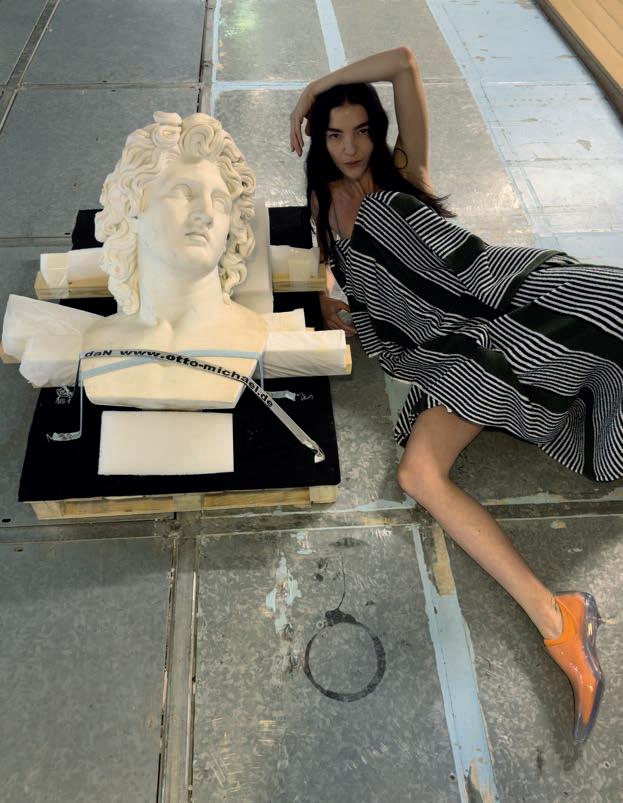
Boscono kicks back in a Loewe dress and shoes in the Onassis Collection Vault with Leone Clerici’s “Alexander the Great,” 1875.
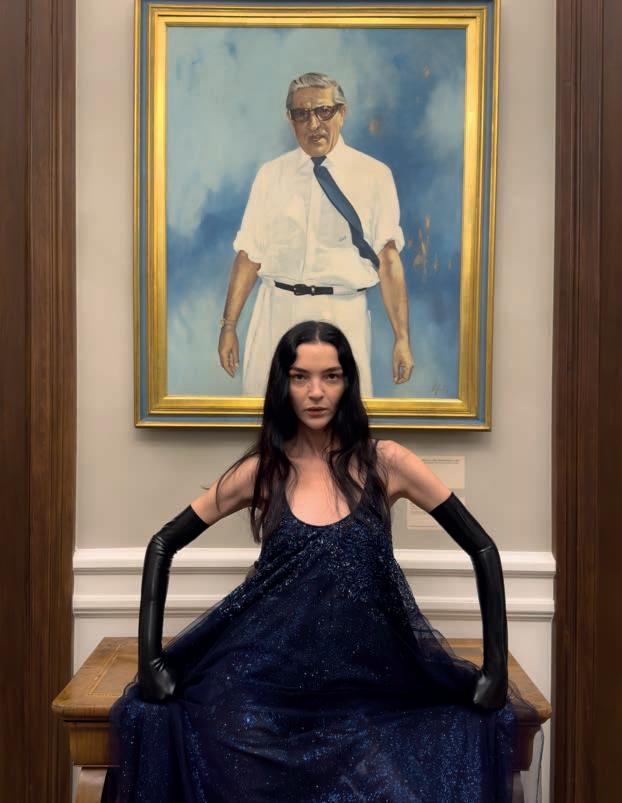
Opposite: Balenciaga dress and mask, and Parisi Gloves in the Onassis Collection Vault. Ariana Papademetropoulos, “A Landscape Painting,” 2024, Onassis Collection. Byron Kalomamas, “Sleeper Soldier,” 2025, Onassis Collection. Malvina Panagiotidi and Panagiotis Loukas, “The Gates of Horn and Ivory,” 2016, Onassis Collection. Antonis Ntonef, “Untitled,” 2025, Onassis Collection. Jannis Varelas, “Jake and Lola,” 2003, Onassis Collection.
META VERSE
Art imitates art when Boscono poses in front of her own portrait by Juergen Teller at the Onassis Ready. Gucci coat and ABRA boots. Juergen Teller, “Kate Moss No.12,” Gloucestershire, 2010. Juergen Teller, “Mariacarla Boscono,” Ibiza, 2012. Opposite: Versace dress and belt, Balenciaga earrings, Atsuko Kudo gloves and JUDE heels. Evi Kalogiropoulou, “Speculations on a Battle Outcome,” 2019, Onassis Collection. Model, Mariacarla Boscono at Women Management; hairstylist, Pierpaolo Lai; makeup artist, Sophia Kossada; manicurist, Matthaios Theodoridis; production, Cinq Étoiles Productions.
BY NATALIA RACHLIN
A house passed down through Frida Kahlo’s family and recently converted into a museum is the subject of a forthcoming book that explores its role as the artist’s “spiritual home.”
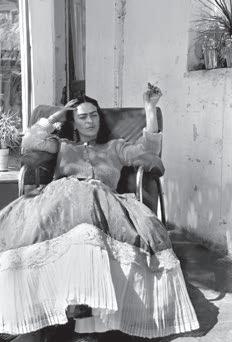
For decades, the great 20th-century Mexican painter Frida Kahlo has captured the collective imagination, her work and persona becoming a symbol of strength and perseverance while her face seemed to enter the public domain, co-opted by merch culture and emblazoned on T-shirts and tote bags, tea towels and key rings. There’s not much that has not already been revealed or written about Kahlo: From illustrated children’s books and dense biographies to diaries and catalogues raisonnés, hundreds of titles explore her life and art with varying degrees of accuracy and grace. The Kahlo canon, if you will, is well-stocked, perhaps oversaturated, but a new book, “Casa Kahlo: Frida Kahlo’s Home and Sanctuary,” out this spring from Rizzoli Electa, proffers something novel: an attempt to protect and reclaim a more personal and private side of Kahlo’s story, all in the name of family.
Written and curated by Kahlo’s greatniece, Mara Romeo Kahlo, and her two daughters, Mara de Anda and Frida Hentschel, this is the first book to celebrate Casa Kahlo, a substantial terracotta-colored house in the Coyoacán area of Mexico City. Originally purchased in 1930 by Frida Kahlo’s parents, Matilde Calderón and Guillermo Kahlo, this became a family home for generations— most recently occupied by Romeo Kahlo.
Now, Casa Kahlo has been reimagined as a museum: an homage to Frida as an artist, sure, but also as a daughter, sister and aunt, her existence shaped deeply by those who came before her and contextualized by those who followed.
During the 1930s, when Kahlo lived just a few blocks away with her husband, the painter Diego Rivera, at Casa Azul—her childhood home—she would often visit her parents and three sisters at Casa Kahlo. It was an escape from the complexities of a blossoming career and an infamously volatile marriage. Over the years, Kahlo taught countless students in the garden of Casa Kahlo, and she maintained a small studio in the basement, which the Russian revolutionary Leon Trotsky used as an occasional hiding place during his political exile in the ’30s.
The book makes the argument that while Casa Azul was a public space— a gathering place for the creative class of
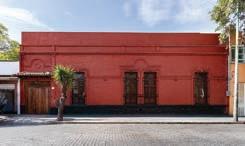
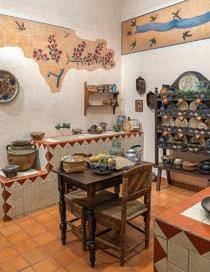
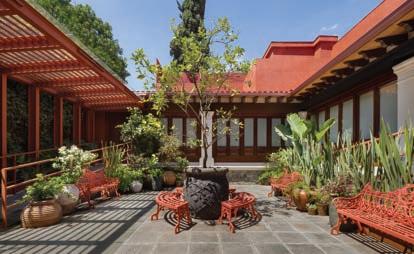
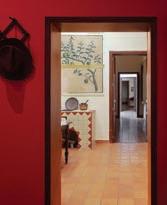

The Casa Kahlo facade, kitchen, table setting and view from the darkroom: all courtesy of the Kahlo family; interior courtyard: Rafael Gamo for Rockwell Group; book: © “Casa Kahlo: Frida Kahlo’s Home and Sanctuary” by Mara Romeo Kahlo and Mara de Anda Romeo and Frida Hentschel Romeo.
the time—Casa Kahlo was Kahlo’s “spiritual home,” the place where she was really herself. “If you go to Caza Azul, you’ll find Frida’s story as Diego Rivera’s wife,” says Hentschel of the fabled cobalt-blue house that has operated as a museum since 1957, funded by a trust that Rivera created after Kahlo’s untimely death in 1954, at age 47. “That house was not his to give away, it was the family’s, and since the museum’s creation in the late ’50s, the family voice has always been secondary,” Hentschel adds. “What we want to do is bring Frida back to her tribe and make sure that everything that is made in her name or image carries the values that she represented: ‘Más amor, más familia, más México’ [more love, more family, more Mexico]. That’s what we’re trying to share, and this book actually gives us the voice to do that.”
The book, much like Casa Kahlo itself, collates a trove of never-beforeseen documents, artworks, photographs and memorabilia: recipes from Kahlo’s mother’s cookbooks; postcards sent to friends; a bottle of Kahlo’s nail polish (Revlon’s “Plumb Beautiful,” a deep berry red); a collection of earrings that once punctuated her spectacular outfits. Its pages invite readers to find meaning in the ordinary as they consider the backdrop where the intimate minutiae of the everyday unfolded: Here is the kitchen where meals were cooked and shared, where Kahlo painted a mural of plants and birds; the bathroom where wounds were tended and lipstick applied; the bedrooms where rest was found and dreams encountered—a reminder that even extraordinary lives are composed of small, universal mundanities, often witnessed only by family.
Across its seven chapters, the comprehensive tome details Kahlo’s life in the context of both kin and kinship. It recounts how her father, who was an accomplished photographer and artist, sowed the seeds of creativity in his daughter. It reveals her inseparable relationship to her sister Cristina, 11 months younger, who became her lifelong confidant and carer. Romeo Kahlo, Cristina’s granddaughter, notes that much has been written about an alleged affair between her grandmother and Diego
Rivera, a notorious womanizer—a rumor she has not been able to confirm. Instead she underscores the longevity of the sisters’ relationship, which only strengthened over time.
One chapter considers the evolution of Kahlo’s iconic, colorful style, which boldly toyed with notions of culture and gender; another highlights the many fruitful friendships and professional relationships that captured her sweet and sometimes vulnerable nature—she signs a 1933 letter written to Georgia O’Keeffe: “I would be so happy if you could write me even two words. I like you very much Georgia.” The book also chronicles Kahlo’s lasting effect on her students—including the painter and muralist Arturo Estrada Hernández, who became one of the most celebrated of Kahlo’s protégés, collectively known as “Los Fridos”—and how the ripples of fame continue to affect her family, even generations later. It is a complicated inheritance, but also often eventful: De Anda recalls that her grandmother, Isolda (Cristina Kahlo’s oldest daughter), called her one day in the late 1980s to tell her that someone named Madonna was ringing at her front door. The singer wanted to make a film about Frida Kahlo, so she had turned up unannounced at the doorstep of Frida’s closest living relative; de Anda, who was in sixth grade at the time, got an autograph and was thrilled. She admits that, to her preteen self, Madonna’s celebrity felt much more exciting than being the descendant of Frida Kahlo.
The appetite for Kahlo’s work and the curiosity surrounding her persona has hardly waned in the decades since that encounter. Her 1940 masterpiece “El sueño (La cama),” “The Dream (The Bed),” set new records at Sotheby’s in November, selling for $54.7 million (or $55 million with fees), making it the most expensive artwork by a woman artist ever auctioned and breaking her own record. And 2026 alone sees several major venues consider Kahlo anew. “Frida: The Making of an Icon,” which opened at the Museum of Fine Arts, Houston in January and travels to the Tate Modern in London in June, traces Kahlo’s posthumous rise from “relatively unknown painter to global
brand.” Meanwhile, in New York City, MoMA will open “Frida and Diego: The Last Dream” on March 21. The exhibition presents works by both artists as part of an installation designed by Jon Bausor, who is also the set and co-costume designer for “El Último Sueño de Frida y Diego,” a magical-realist portrait of the creative couple from composer Gabriela Lena Frank and playwright Nilo Cruz debuting at the Metropolitan Opera in May.
At home in mexico and beyond, the Kahlo family is embarking on another legacy project, a creator platform and licensing program that would ensure that reproducing Kahlo’s likeness also gives back to the local community, capturing Kahlo’s passion for her country and its people. Hentschel and de Anda admit that it is a gargantuan task and part of that process is also acknowledging that the proliferation of her image is too widespread to be contained. “But we can invite people to do it the right way going forward,” says Hentschel, adding that the family is, of course, buoyed by Kahlo’s ability to transcend culture and demographic, to remain firmly ingrained in the mainstream consciousness, beloved both near and far—especially during a time of global tumult, there’s certainly beauty to be found in that.
“I think the interest in Frida only grows because people can see themselves in her: She had so many layers, and people can relate to her as a woman, as a person who had physical difficulties, as someone who had a troublesome relationship, as someone who endured and expressed herself through art in so many ways,” says Hentschel. “She is a symbol of courage, resilience and success, and I think that’s a story everybody would like to be associated with.” •


BY JULIE COE
The Sunnmøre region, in western Norway, is a hot spot of the summer “coolcation” trend. But its natural beauty and outdoor pleasures are abundant any time of year.
MOst evenings at the Union Øye hotel, guests assemble in the living room to hear a staff member tell the tale of Linda, the resident ghost. The hotel, which is hidden deep at the end of the Norangsfjord, has stood in the shadow of Norway’s Sunnmøre Alps since 1891. Around the turn of the 20th century, it was a frequent summer destination for German emperor Kaiser Wilhelm II. During one of these stays, a hotel maid named Linda fell in love with a soldier in the Kaiser’s service. The couple got engaged and promised to marry on the Kaiser’s return. But it wasn’t to be: the soldier died in the interim, and when Linda learned of his fate, she threw herself into the fjord. She has haunted the property ever since.
As Union Øye’s storytellers spin this yarn, they often weave in accounts of their own lives among the fjords. One night, a young woman whose impeccable Californian accent belied her Øye roots spoke of her childhood in the tiny village, where she was one of five children on the local school bus. She also delivered a Seinfeldian riff on a grocery run gone awry due to a rare breakdown in the regional car ferry system, a snafu that required her to search her phone in vain for the PDF of alternate routes. It was a purposely ifyouknowyouknow bit of humor, somewhat opaque to outsiders, but flashing a glimpse of everyday life beyond the setting’s fairytale architecture and imperious peaks.
who topped off the roof with dragon’shead finials. The whole building was transported in pieces by boat along the fjord.
After languishing some years as a midrange hotel and falling into general disrepair, the Union Øye was purchased in 2009 by the Flakk family, local entrepreneurs who are involved in hospitality, textiles, renewable energy and other areas. Their company, 62°Nord, owns two other Sunnmøre properties:
dating back to 1891,” says Erika June Flakk, a coowner of the Flakk Group and daughter of its CEO, Knut Flakk. “At Øye, the mountains rise so steeply they feel as though they nearly close in above you, creating an intimate and almost mythical atmosphere.”
FOr the nOrwegian tOurism industry, the “coolcation” trend has proved both an opportunity and a challenge, as more people seek out milder climes to avoid the scorching weather in traditional summer destinations. “From our side in Norway, the increased interest is very real,” says Ann Kristin Ytrevik, 62°Nord’s chief brand officer. “Summer demand for bespoke fjord journeys has grown meaningfully year on year since 2022.” Likewise, travel company Red Savannah has seen a 29% increase in Norway inquiries year on year.
The Sunnmøre Alps, in western Norway, have long attracted visitors, such as Arthur Conan Doyle, Henrik Ibsen, Roald Amundsen and Edvard Grieg— all of whom, like the Kaiser, stayed at the Union Øye. The hotel itself is an ornate confection, a prefabricated structure done in Sveitserstil, or Swiss chalet style. It was designed by innovative Norwegian architect Christian Thams,
the Staurneset Guesthouse on Giske island and the Storfjord Hotel in Glomset. Among the family’s other holdings are Devold, the classic Norwegian knitwear brand, and its more fashionforward offshoot, O.A.D., whose patterned sweaters are sold at 62°Nord hotels.
“It was my mother and father who discovered the potential in both Union Øye and Storfjord. What immediately drew them in was the combination of dramatic natural surroundings and, in the case of Union Øye, its extraordinary history
Amid the enthusiasm over the country’s increasing popularity, though, concerns around the potential for overtourism are creeping in. Last summer, The New York Times ran a story titled “In Norway, Are ‘Coolcations’ Taking a Toll?” describing fjords full of cruise ships and small towns overrun with tour groups. “Overtourism is something we take seriously,” says Ytrevik, “but it’s important to distinguish between Norway as a whole and specific pressure points. Sunnmøre is not experiencing mass tourism in the way some European destinations are.”
Even so, many travelers are starting to shift their trips to other times of year instead. Red Savannah, for instance, has seen requests for shoulder season trips increase from 60% to 71% year over year. “Norway is increasingly known for its wealth of activities, many of which can be enjoyed from spring until autumn,” says Red Savannah Europe specialist Clare Watkins. →
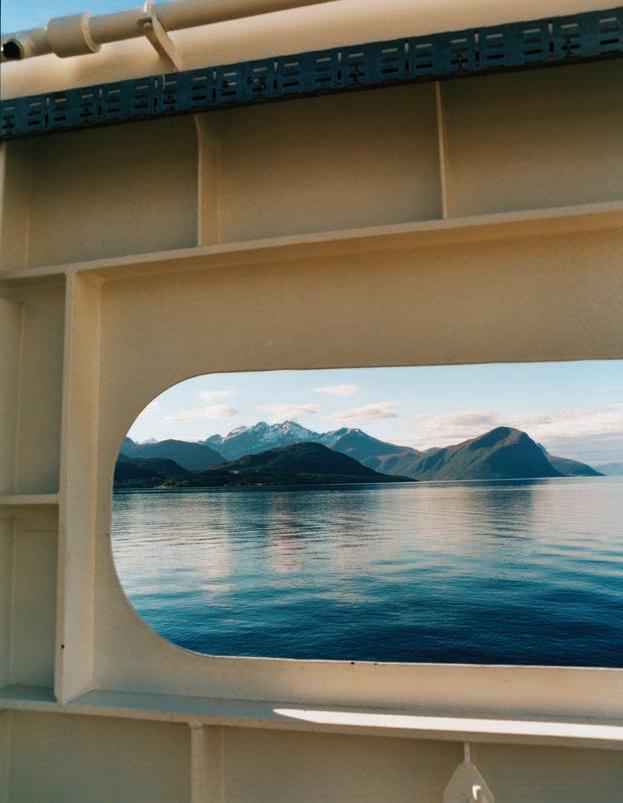
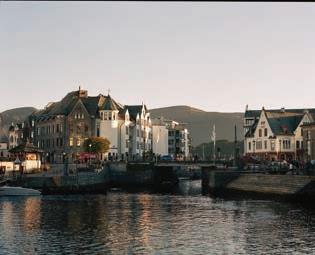
Clockwise from above: The Brosundet Canal winds through Ålesund; one of the port city’s characteristic art nouveau buildings; the view on descent; Molja Fyr, a lighthouse at the entrance to the fjords from Ålesund; sunset over the water; a view across the Brosundet.

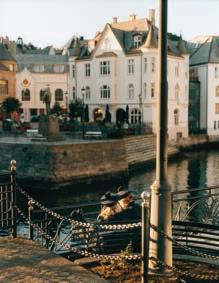
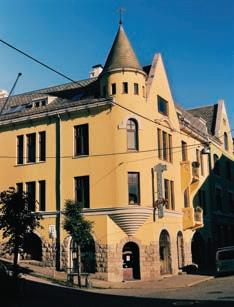
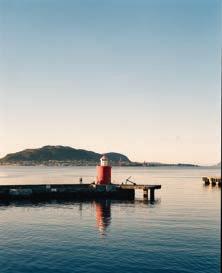

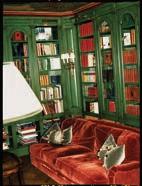

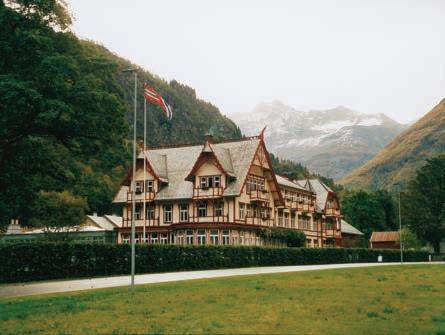

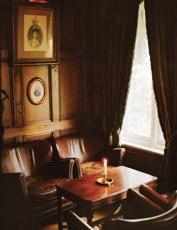
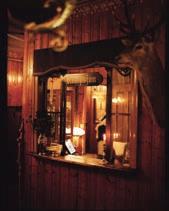
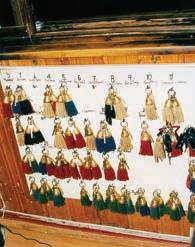
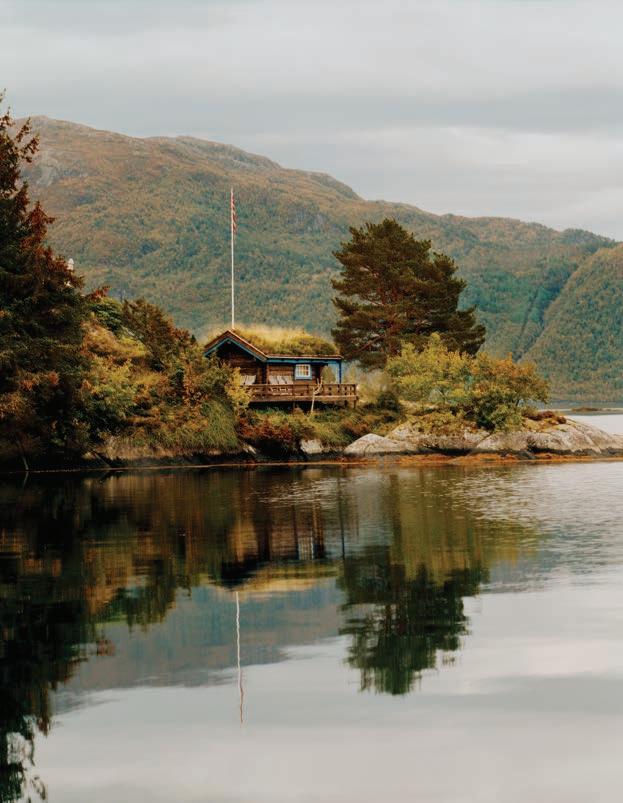
The Norwegian principle of friluftsliv, or “free-air living,” which means taking time every day to be out in nature, is a year-round ethos that doesn’t end when days get shorter and the air gets crisper. “It is the rough weather that shaped our region, and us, that I have always loved,” says Erika June Flakk, of the Sunnmøre region. “It’s a place that instills resilience, humility and a deep respect for nature.” Hiking; “wild swimming” (followed by a rustic sauna); downhill, cross-country and off-piste skiing; kayaking; fishing; and biking are all activities offered by 62°Nord.
And for visitors determined to see summer’s midnight sun, Ytrevik notes, “timing and access matter. Early mornings, evenings and private transport make a significant difference. We favor lesserknown fjords, private boats and routes that are simply not viable for group travel. Traveling with local guides who understand daily patterns, not just landmarks, is often the deciding factor between a busy experience and a quiet one.”
The gateway to the Sunnmøre Alps is the city of Ålesund, an hour’s flight northwest of Oslo. Ålesund has long been an important center of fish packing and shipping, and the industry remains a significant part of the local economy. Along the Brosundet canal that winds through the city stands the statue of the sildekona, or “herring lady,” a tribute to the women who worked in the city’s fisheries. The kerchiefed figure, created by sculptor Tore Bjørn Skjølsvik in 1991, pulls salted fillets from a barrel and packs them into a box.
A short walk and a whole world away from the herring lady is Sjøbua, an elegant fish-forward restaurant that’s also part of the 62°Nord family. The word sjøbua means seashack, a playful misnomer. Here the classic chip-and-dip combo becomes a gastronomic adventure: goat cheese topped with arctic char roe and eaten with crispy salt-cod skins. Traditional recipes like lutefisk (lyesoaked cod) and krumkake (delicate waffle cookies) are put to fresh use. As Norwegian gastronomy has risen in stature and complexity, it’s become a year-round interest for tourists. “We see a number of visitors attracted to Norway’s increasingly popular culinary scene,” says Watkins, “and autumn is the best time to visit from a gastronomic perspective.”
Once a fish warehouse itself, the nearby Hotel Brosundet is an example of Ålesund’s hallmark art nouveau architecture. After a fire tore through Ålesund one night in January 1904, the city was left in ashes, and 10,000 people were without shelter. Ålesund was re-envisioned and rebuilt by architects from Trondheim and Berlin, who brought in their cosmopolitan outlook. As a result, the city’s canal is lined with elegant gabled structures in earthy pastels—markedly different from the half-timbered Hanseatic-era architecture that characterizes other Norwegian metropoles, like Bergen.
Norway’s broader art nouveau heritage comes into kaleidoscopic focus at Ålesund’s Jugendstilsenteret, a jewel-box of a museum in an old pharmacy, through the work of artists little known outside the country: Marius Hammer’s Viking ship bowls, colorful plique-à-jour enamel pieces with dragon’s heads at the prow, for example, or the fin de siècle birchwood cabinet by furniture maker and sculptor Valentin Kielland, with cabinet doors featuring two women at different life stages; the younger one inhaling the scent of a blooming lily, the older one examining its drooping blossom.
The specifically Norwegian dragestil, or dragon style—rooted in Norse mythology, Viking culture and medieval stave-church architecture—is well represented here, especially in the furniture of local artist Lars Kinsarvik, whose work at the Møre Folk school in the Sunnmøre city of Ørsta was highly influential. His pieces often refer back to the 900-year-old Urnes church and its intricate, meandering carvings full of serpents, lions and dragons. In the field of historic design, Norway is often overshadowed by its Nordic neighbors, particularly Sweden and Denmark, but the Jugendstilsenteret’s collection taps a rich tradition that’s ripe for discovery.
Along thewinding road from Øye to the Storfjord Hotel in Glomset, one finds a series of neatly kept grassroofed huts banked in the mountainside. These are seter, or summer farms, for those tending the livestock grazing on summer pastures. Historically, these houses were mostly populated by dairymaids. One hundred fifty years ago, the British mountaineer William Cecil Slingsby encountered them as an early tourist in the Sunnmøre region. In his book “Norway, the Northern
Playground,” he described the young women hard at work. “One girl often has to milk 30 or 40 cows, and as many goats,” he wrote, “and then has to make nearly the whole of the milk into cheese for winter consumption and for sale.”
Slingsby, who eventually had a Norwegian mountain and glacier named after him, was one of the few outsiders traveling in Sunnmøre at the time. He wrote that, according to local recordkeeping, only five travelers had entered the area between 1853 and 1876. “Tourists were then unknown,” he wrote, “and strangers were suspicious characters.” It was an insular place, socially and topographically isolated. Seter culture, now recognized by UNESCO on its Intangible Cultural Heritage of Humanity list, continues on in present-day forms, but the humble cabins recall the hardscrabble world of Slingsby’s era.
Continuing onward, past the epic view of the Geirangerfjord from the Ljøen Observation Deck, one eventually reaches the Sykkylven-Magerholm ferry, which traverses the Storfjord. Inside the ferry are blond-wood tables and chairs arranged in front of picture windows, and a snack bar stocked with several brands of salted licorice. Modern comfort and functional infrastructure abound, and the ferry glides flawlessly to the other side–no need for a PDF map.
At the Storfjord Hotel, there are also sod roofs. The seven structures at this forested site overlooking the namesake fjord were built from solid logs using traditional Norwegian techniques. In the mossy woods there’s a tent called a lavvo for special fireside meals. Hiking paths connect the property with the nearby town, and people pass by on their way home or to work, in full friluftsliv mode. No matter that it’s private property: Norway’s allemannsretten, or “everyone’s right,” gives all people recreational access to natural spaces, regardless of who owns them.
“Storfjord,” says Flakk, “is defined by its vast openness—a sweeping landscape of ‘giants’ that feels powerful and untamed.” Kayaking through the waves, the landscape becomes almost immersive, as the water spreads out all around and the mountains rise up. It’s a thrilling feeling, seemingly unchanged from what Slingsby wrote a century and half ago, envisioning steaming through the fjords: “In all probability the deck-tied passenger will have some lovely though distant peeps of the sharply serrated [Sunnmøre] peaks, which beckon him in a most tantalizing manner and make him long for freedom.” •
“It’s a place that instills resilience, humility and a deep respect for nature.”
—Erika June
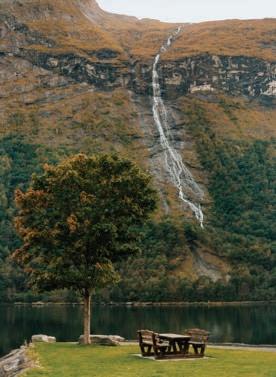

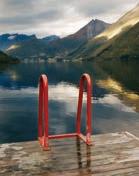
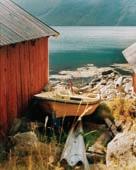


AA
BY PRIYA KHANCHANDANI
PHOTOGRAPHY
BY
MATTHIEU LAVANCHY STYLING
BY ALEXANDRA
CARL PROP STYLING
BY AMY
STICKLAND
visit to the late architect’s clothing archive—featuring avant-garde gowns and sculptural, battle-ready coats—reveals her command of form at a human scale.
decade on from the death of the British-Iraqi architect on March 31, 2016, the Zaha Hadid Foundation continues to preserve, study and exhibit her monumental body of work and legacy. In 2013, Hadid acquired its base, a 1930s former banana warehouse in Shad Thames, London, which had been converted in the 1980s to serve as the original location of the Design Museum. She planned to store and display her extensive collections in the modernist-lined building and to construct an apartment above it, a home overlooking the Thames. Tragically, she did not have enough time to realize this vision.
Today, the foundation offers public exhibitions and talks, and Hadid’s belongings are stored across two floors of former gallery space. The lower level is filled with architectural objects stacked on shelves: racks, boxes, labels encapsulating the life of a woman who changed architecture as we know it. The upper floor is where her personal belongings are kept. Along one side of the vast room are rails of clothes cloaked in white dust covers, each one tagged by her team during her life with the designer’s name and an image. There are 1,200 pieces, the archivist tells me, not including accessories. Following initial estate disputes,
the contents of the archive are still being cataloged—a trove that continues to yield insights into her life and creative process.
We unzip one of the dust covers to reveal a yellow satin cape by Prada, which Hadid wore, accessorized with striking black sleeves, when she received the Stirling Prize in 2010. It lies flat, devoid of shape without the body that once held it with such gravitas. On a nearby table sits a set of connected PVC circles that unfolds into an extraordinary armor-like cape by Junya Watanabe. One of the few items mounted on a mannequin is a hot-pink coat with two frilled openings, designed by Rei Kawakubo, that Hadid wore at the Serpentine Gallery’s summer party in 2008. In 2000, she designed a temporary pavilion for the gallery’s 30th-anniversary gala, inaugurating the annual tradition celebrating its 25th commission this summer.
Other dust covers are labelled with a mix of established names—Issey Miyake, Simone Rocha, Claude Montana—and lesser-known designers including Thomas Tait and Florencia Kozuch, and stores such as Apoc. They strike me less as components of a wardrobe than as a long, meticulous argument about form. A kind of self-portrait rendered through clothes.
It’s tempting to treat Hadid’s fashion as an amusing footnote to her career as a “starchitect.” The first woman to have won the Pritzker Prize, in 2004, she created an impressive, impactful body of work: the 1993 Vitra Fire Station in Weil am Rhein, Germany, her first major built project, displaying many of the ideas she would later develop; the 2009 MAXXI Museum in Rome, which earned her the Stirling Prize; the 2010 Guangzhou Opera House in China, named that year’s “Best Public Project” by Architectural Record; and the London Aquatics Centre, which drew the world’s eye during the 2012 Olympics, to name just a few. But standing among the rails, it becomes clear that clothing was a creative preoccupation she cared about as she did architectural form, and that one was an extension of another.
On the opposite wall, shelves of brown boxes rise in eight regular stories. The archivist explains that Hadid’s shoes will be stored here, and opens one box to show a pair of heels nestled in a custom-made support, produced by the foundation’s in-house technician, as the collection is carefully conserved and prepared for museum loans. Another box contains shoes by Roksanda, one of several London-based
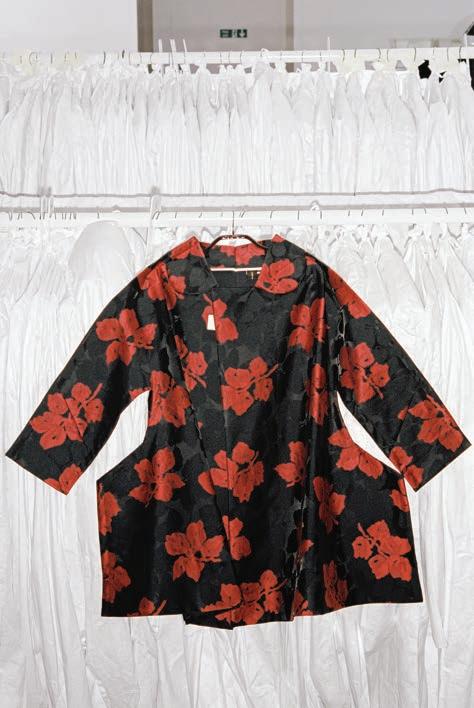
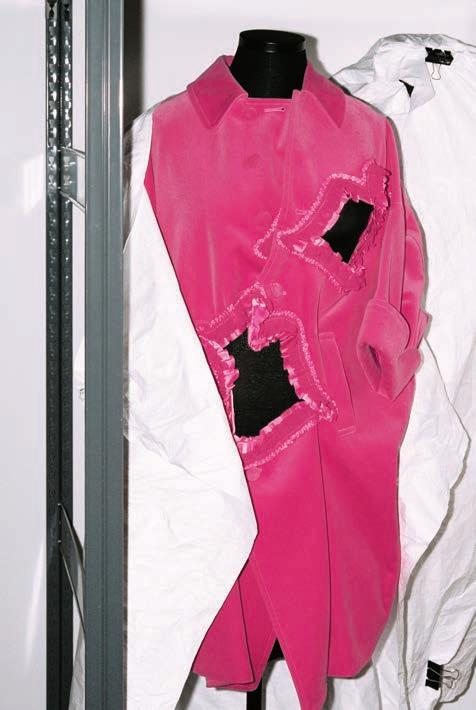

designers, along with Christopher Kane, Thomas Tait and Phoebe English, whose designs Hadid wore in their early careers.
Alexandra Carl, a stylist who spent months gaining access to Hadid’s shoe collection for her 2024 book, “Collecting Fashion: Nostalgia, Passion, Obsession,” recalls the archive as “super low-fi” when she first visited. Opening boxes without knowing what she would find, she was struck that the pieces felt lived-in. She came to understand that Hadid’s fashion was not performative, but the wardrobe of a working life. “I love that the items featured in the book are real items; you can see how they’ve been loved and worn,” she tells me.
Being there takes me back to meeting Hadid around 12 years ago, at her gallery in Clerkenwell, a space she opened in 2013 to show furniture, design and other collaborations. I was working at the V&A, and she allowed us to bring patrons to visit. I remember her unforgettable presence. She seemed to occupy the room decisively and without apology. Of all the objects she showed us, one pair of shoes was unlike anything I’d seen before: tiered platforms painted in rose gold, like small buildings for feet. To my surprise, she came over and suggested that I try them on. I slid my feet into them and rose nine or 10 inches. They were sculptures more than shoes, and it felt empowering to wear them, though I didn’t dare walk too far. Only later did I learn that Hadid had designed
Opposite: A Comme des Garçons coat, from 2008, is one of few items mounted on a mannequin. Left: Zaha Hadid in her London studio in 1987; items from Hadid’s shoe collection, featured in stylist Alexandra Carl’s 2024 book “Collecting Fashion: Nostalgia, Passion, Obsession” (Rizzoli).
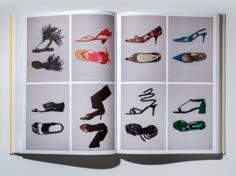
the distinctively cantilevered heels in collaboration with Rem Koolhaas for United Nude. It made sense that she would be preoccupied with footwear. The shoe is the most intimate structure we trust with our weight. It’s architecture at the scale of balance and motion.
People who worked closely with Hadid describe her wardrobe as a system. May Yee, who worked as her private assistant and EA for nine years, remembers it as extensive and highly ordered. “She had photos of her clothes,” Yee says, “so in a loose way her pieces were cataloged.”
Hadid didn’t have a stylist but did have a housekeeper who organized her wardrobe, and Yee would assist by surveying the shops that Hadid liked and bringing her items to try on and then either buy or return.
Often Hadid would begin with a base outfit of a black dress and leggings, and then build outwards from there. These under-garments were typically made by a tailor and replicated once she found a shape she liked, creating a canvas for the coats, jackets and dresses she wore on top. These outer layers were designed for maximal transformation.
It’s revealing that hadid’s relationship with fashion was characterized by playfulness as much as a play on form. John Vidal, her hairdresser and close friend, began working with her in the early
2000s and recalls being struck by her intense passion for clothes and drive for a concept. “It needs an idea,” Vidal recalls her saying, not just about hair, but about everything. “There was a juxtaposition,” he says, “where she wore very structured garments, but she wanted quite soft hair.” On one occasion, when Vidal was unsure whether a new approach was working, Hadid looked up into the mirror and said to him, “I love you, but this isn’t one of your finest moments.”
As their friendship deepened, Vidal introduced his friend to shows during London Fashion Week and beyond, and at home they would stage informal runways so that he could give opinions. “That’s all we ever talked about: clothes,” he says. Hadid would giggle when she tried things on. “Like a child.” It wasn’t frivolity but openness. “She was open to wonderment,” Vidal recalls, “open to the idea anything was possible.” It’s a crucial corrective to the caricature of Hadid as purely formidable—an iconoclast defined by a steely character and not without controversy. There is a quietly tragic air to the archive: a decade has passed since Hadid’s death, yet a sense of joy persists, the pleasure she took in transformation and the freedom clothes afforded her.
That’s not to say that her fashion was entirely distinct from her architecture. In reality, there was a synergy between the two. Her fascination with Issey Miyake,
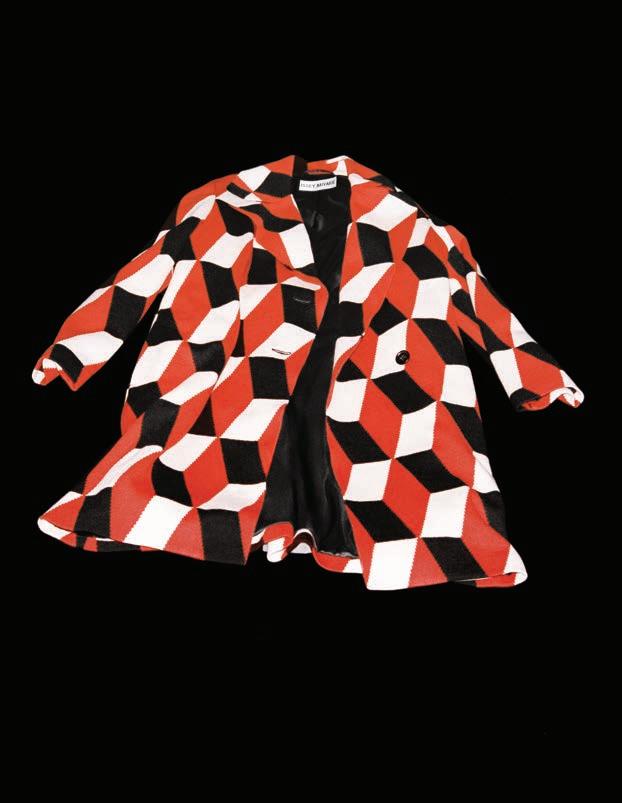
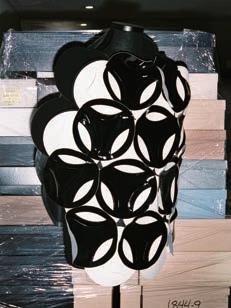
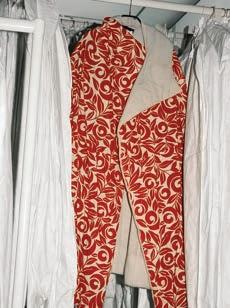
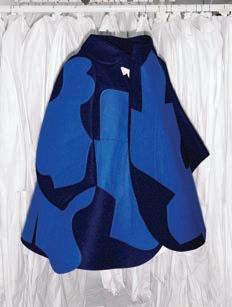
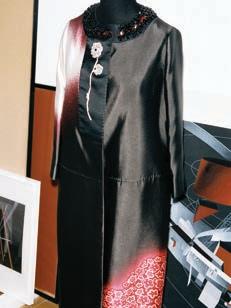
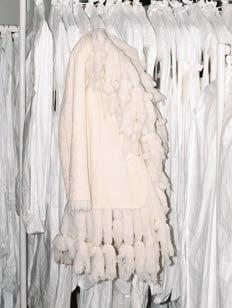
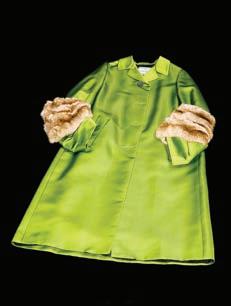
for instance, can be read as practical— as Miyake’s pleats travel well and resist creases in an almost miraculous way, ideal for a woman constantly in motion. But the fascination must also have been conceptual—pleats are an engineered device that allows fabric to expand and contract, to animate the body without constricting it.
Hadid’s buildings often do something similar, even when made from steel or concrete. It’s hard not to draw parallels with the pleated metal façade of the Eli and Edythe Broad Art Museum—opened in 2012 on the campus of Michigan State University—whose planes fold and angle to respond to circulation around the site, or the tiered, undulating surfaces of the Al Janoub Stadium in Qatar, inaugurated in 2019. These are architectures that look fluid but are choreographed; shaped by the movement of people, light and context.
Melodie leung, who worked closely with Hadid and is now a director at the practice, recalls that the architect would take members of staff
shopping. A trip to Margiela in New York or Miami was not retail therapy so much as research. It opened, Leung says, “a whole level of creativity.” The gesture suggests a way of mentoring: rather than telling people what to think, Hadid put them in front of objects that demanded thought.
Leung remembers a Yohji Yamamoto scarf, a square with ribbons designed to be tied in multiple ways, that Hadid twisted and reconfigured into a halter top. The point was not about styling but about form: fabric as something mutable, capable of being redirected into new structures. In workshops, she explored similar ideas through paper origami with students. How could something be twisted, peeled, folded? What other shape was latent within it?
Hadid’s language evolved constantly in response to culture, technology and art. Though she was renowned as the “Queen of the Curve,” her work was never just about curves versus straight lines. It was about the fold, the pleat, the shift—the inherent properties and capabilities of
materials. For her, the same properties that were inherent in fabric were also possible in architecture.
Her fashion collaborations, such as her jewelry for Georg Jensen, bags for Fendi and Louis Vuitton, and a ring for Bulgari, could simplistically be framed as the predictable outcome of celebrity. But seen alongside her personal archive, they read differently. They are a continuation of the visual language of her architectural work— test sites where ideas could be employed at a smaller scale, with the intimacy that fashion allows.
Hadid’s absence from the architectural landscape (even though her studio lives on) feels like a void, like the enlivening form absent from the garments. Yee recalls being in a New York shop and telling Hadid that she liked a bag because it looked “so ’80s.” She still remembers her reply: “I like the ’80s too, but you’ve got to keep doing something new.” Standing in the archive, with Hadid’s vision palpable in every object, it feels less like advice than an expression of creative hunger. •
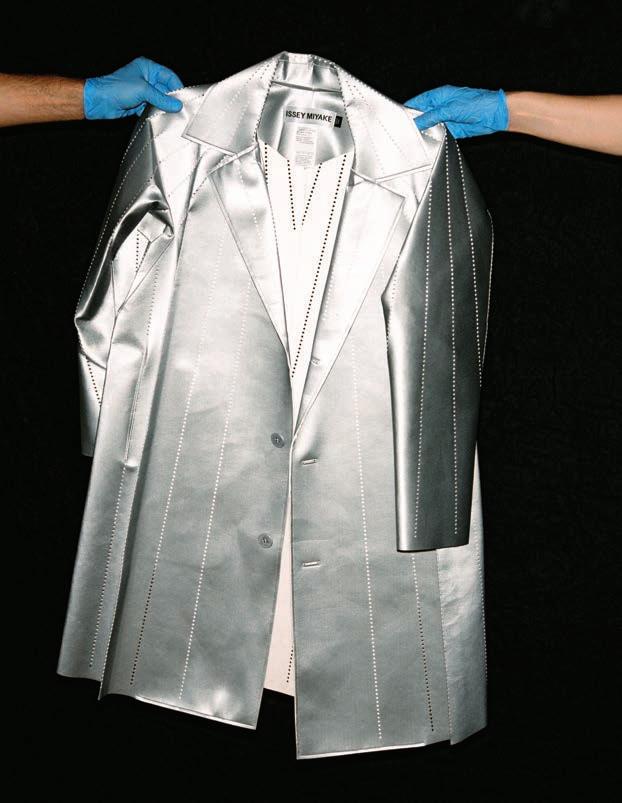
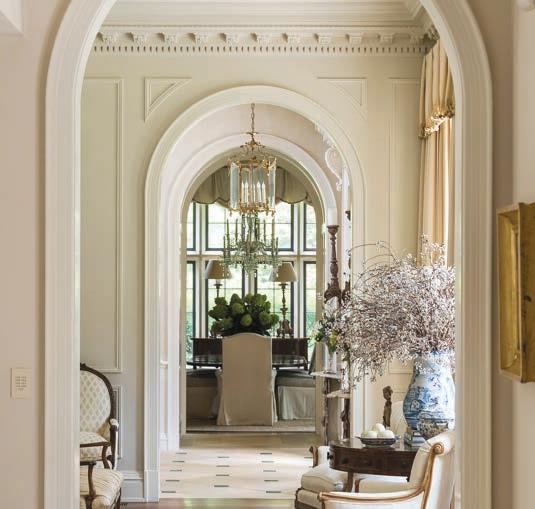


Rare independent bungalow in the prestigious Lutyens Bungalow Zone. Set within a secure gated colony, the rectangular plot offers privacy and abundant greenery. *Image is an indicative artistic impression.
New Delhi, Delhi, India
sothebysrealty.com/id/WG7ER4
India Sotheby’s International Realty Atul Goyal: +91 886 064 1995 atul.goyal@sothebysrealty.in
Price Upon Request
North Goa, Goa, India
This exclusive five-bedroom villa offers luxury, privacy and thoughtful design. Featuring laterite stone architecture, lush gardens, an infinity pool and serene views, it’s ideal as a private holiday retreat.
sothebysrealty.com/id/49MDVL
India Sotheby’s International Realty Tushar Ahuja: +91 956 0043 863 tushar.ahuja@sothebysrealty.in
Price Upon Request
This lake-touch estate sits along Mulshi Lake and is set against the Sahyadri Hills. It includes a private villa with five bedrooms, expansive lawns including a rose garden and mature trees.
sothebysrealty.com/id/LSDTQK
India Sotheby’s International Realty
Simone Jaggi: +91 981 958 2018 simone.jaggi@sothebysrealty.in
$7,559,629 USD

Uttarakhand, India
A luxury mountain villa with stunning Himalayan views, featuring a main residence, five private cottages, wellness facilities, lush gardens and seamless indoor-outdoor living. A tranquil and ideal choice.
sothebysrealty.com/id/G4T7J4
India Sotheby’s International Realty
Sameer Chadha: +91 965 091 7996 sameer.chadha@sothebysrealty.in
$2,219,193 USD
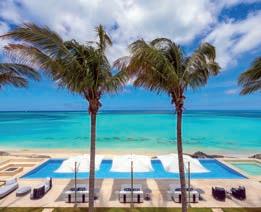

Located in the exclusive community of Old Fort Bay, this ultra-private beachfront retreat offers six bedrooms plus four bedroom staff quarters. Gym, sauna, steam room.
Old Fort Bay, Nassau, The Bahamas
sothebysrealty.com/id/567ZRL
Bahamas
Sotheby’s International Realty Nick Damianos: +1 242 376 1841 nick.damianos@sirbahamas.com
$56,000,000

Newport Estate
A classic stone-and-shingle estate in prestigious Ocean Lawn offers refined New England luxury, chef’s kitchen, fireplaces, pool and spa, eight bedrooms, and prime Newport location.
Newport, Rhode Island
sothebysrealty.com/id/XTZCKV
Mott & Chace
Sotheby’s International Realty
Joseph Costa: +1 508 951 4799 joe.costa@mottandchace.com
$8,395,000
An unparalleled oceanfront estate offering privacy and space with a guest house, maids cottage, and main residence with views of the Mokulua Islands from nearly every vantage point.
Kailua, Hawaii
1240Mokulua.com
List
Sotheby’s International Realty Drew Read: +1 808 782 3636 drewread@listsir.com
$31,000,000

A trophy seven-acre gated estate offering rare privacy, refined design, and resort-style amenities, featuring a reimagined main residence, saltwater pool, studio, and expansive garages.
North Kingstown, Rhode Island
sothebysrealty.com/id/D293VD
Mott & Chace
Sotheby’s International Realty
Jennifer Crellin | Kylie McCollough: +1 401 338 5188 jennifer.crellin@mottandchace.com
$11,500,000
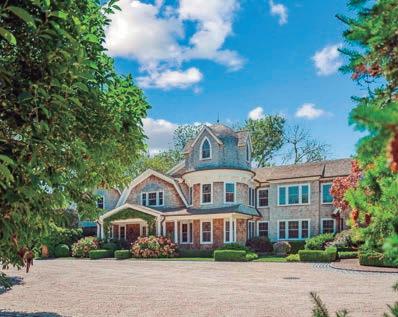
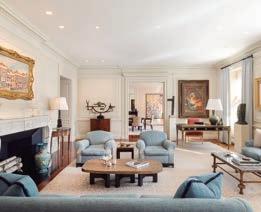
720 Park Avenue, 10A
Step into a world of refined elegance and architectural mastery in this sun-drenched, 11 room, four bedroom, four full- and three halfbath residence at 720 Park Avenue, designed by acclaimed Peter Marino.
New York, New York
720ParkAve10A.com
Sotheby’s International Realty East Side Manhattan Brokerage Nikki Field | E. Helen Marcos: +1 212 606 7669
nikki.field@sothebys.realty
$17,000,000
59 Boyesen Road
Timeless Southampton compound on almost three acres with tennis, heated Gunite pool, spa, and guest house. Designed by John David Rose, the 10,800 sq. ft. shingle-style home offers eight bedrooms, elegant interiors, and resort-style grounds near village and ocean beaches.
Southampton, New York
59BoyesenRoad.com
Sotheby’s International Realty
Southampton Brokerage
Michaela Keszler | Paulina Keszler: +1 631 525 3810
michaela.keszler@sothebys.realty
Price Upon Request
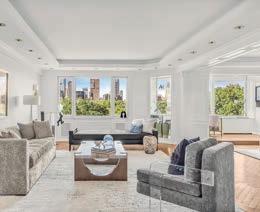
860 Fifth Avenue, 9/10JK
A high floor, large 10 room duplex cooperative residence with spectacular direct Central Park views from huge picture windows located on Fifth Avenue’s Gold Coast on the Upper East Side.
New York, New York
860Fifth9-10JK.com
Sotheby’s International Realty East Side Manhattan Brokerage Nikki Field | Jeanne H. Bucknam: +1 212 606 7669
nikki.field@sothebys.realty
$6,950,000
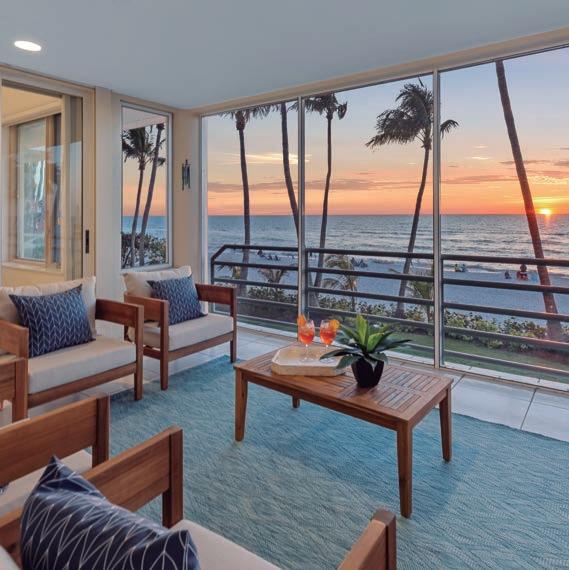
Where Architecture
Meets the Horizon
Extraordinary beachfront estate on almost seven-tenths of an acre with 169 ft. of pristine shoreline, panoramic Gulf views, and private beach access, designed for artful living in an iconic coastal setting.

Where Resort Living Meets Refined Coastal Design
Newly built six-bedroom, seven-andone-half bath waterfront estate offering 167 ft. of pristine frontage, a private spa and wellness wing, and spaces designed for effortless entertaining and retreat.
Marco Island, Florida
sothebysrealty.com/id/SZ6D2G
Premier Sotheby’s International Realty
Michelle Thomas:+1 239 860 7176 michelle.thomas@premiersir.com
$11,500,000
387 Ocean Boulevard - Atlantic Oceanfront Masterpiece
Experience beachfront living at its finest with 150 ft. of private ocean frontage, breathtaking Atlantic views, and 11,599 sq. ft. of refined living on a 41,750 sq. ft. oceanfront lot.
145 Harbour Way - Rare Double Lot with Marina Views
Rare 25,720 sq. ft. double lot in guard-gated Bal Harbour Village with park and marina views. Art Deco home with terrazzo floors, high ceilings, pool, and walking distance to shops and beach.
Bal Harbour, Florida
sothebysrealty.com/id/9GF3KG
ONE
Sotheby’s International Realty
Lydia Eskenazi | Jonathan Bigelman: +1 305 785 0440 lydia@onesothebysrealty.com
$13,500,000
Golden Beach, Florida
387OceanBlvd.com
ONE
Sotheby’s International Realty
Lydia Eskenazi | Jonathan Bigelman: +1 305 785 0440
lydia@onesothebysrealty.com
$39,000,000

Elegant Home in Burlingame
Amazing location and value in prestigious Burlingame. Elegant and spacious home has the essentials. Family home or investment property in one of the most desirable neighborhoods in the country.
Burlingame, California
733Fairfield-10.com
Golden Gate
Sotheby’s International Realty
Emily Smith-Silvestri: +1 650 346 1361
e.smith@ggsir.com
$1,200,000
An ancient Egyptian sculpture of Sekhmet—a relic of an 1822 auction mysteriously forgotten or unsold —remains Sotheby’s unofficial mascot.

Top, from left:
A sculpture of the lion-headed goddess Sekhmet, dating from the 14th century BCE, installed above the entrance to Sotheby’s London, where it remains today; a row of partially ruined Sekhmet statues at the Temple of Mut, built by Pharaoh Amenhotep III, who is now believed to have reigned from around 1390 to 1352 BCE. Many were defaced during the religious reforms of his son and successor, Amenhotep IV, later known as Akhenaten.
Bruce Chatwin’s essay in the 1966 edition of “Ivory Hammer,” an annual publication produced by Sotheby’s in the 1960s showcasing star lots and specialist expertise.
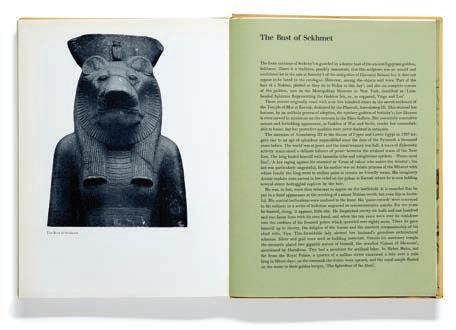
For more than a century, a bust of Sekhmet has presided over the front entrance of Sotheby’s London. Carved from diorite around 1320 BCE, the lion-headed goddess predates the building, the firm and the market she oversees. A quiet fixture of New Bond Street, the sculpture has long been Sotheby’s unofficial mascot. Though often overlooked by shoppers, the effigy has earned mention in volumes by art-world figures from Charles Saatchi to Simon de Pury as one of the capital’s cultural talismans. She is believed to have been offered in June 1822 as part of the collection of the early Egyptian explorer and excavator Giovanni Belzoni. Some accounts suggest the bust sold but was never collected, while others hold that it failed to find a buyer and was abandoned by its consignor. What is known is that the orphaned
object was adopted by staff and traveled with them when Sotheby’s moved premises in 1917 from Wellington Street, off the Strand, to New Bond Street.
In 1966, Bruce Chatwin—then a cataloger, years before becoming one of Britain’s most influential writers—wrote about the sculpture in what would be his first published piece. By then, its uncertain status was already part of the story.
Likely one of about 600 statues of the goddess that once surrounded the Temple of Mut at Karnak, near Luxor, the bust was never intended to be unique. In London, Sekhmet became precisely that—the city’s oldest outdoor statue. Arguably, Sotheby’s most enduring lot remains the one that never left the block.—James Haldane