local garage bands
REVIEW BY PENELOPE
MATHIS
Sopris Stars Correspondent
Rock bands are popping up all over the valley again, bringing back the classic mix of skate, rock and rebellious culture. Garage bands capture the spirit of youth — making music with friends and filling neighborhoods with the raw energy only live rock can deliver. These humble beginnings often spark lifelong passions and even music careers.
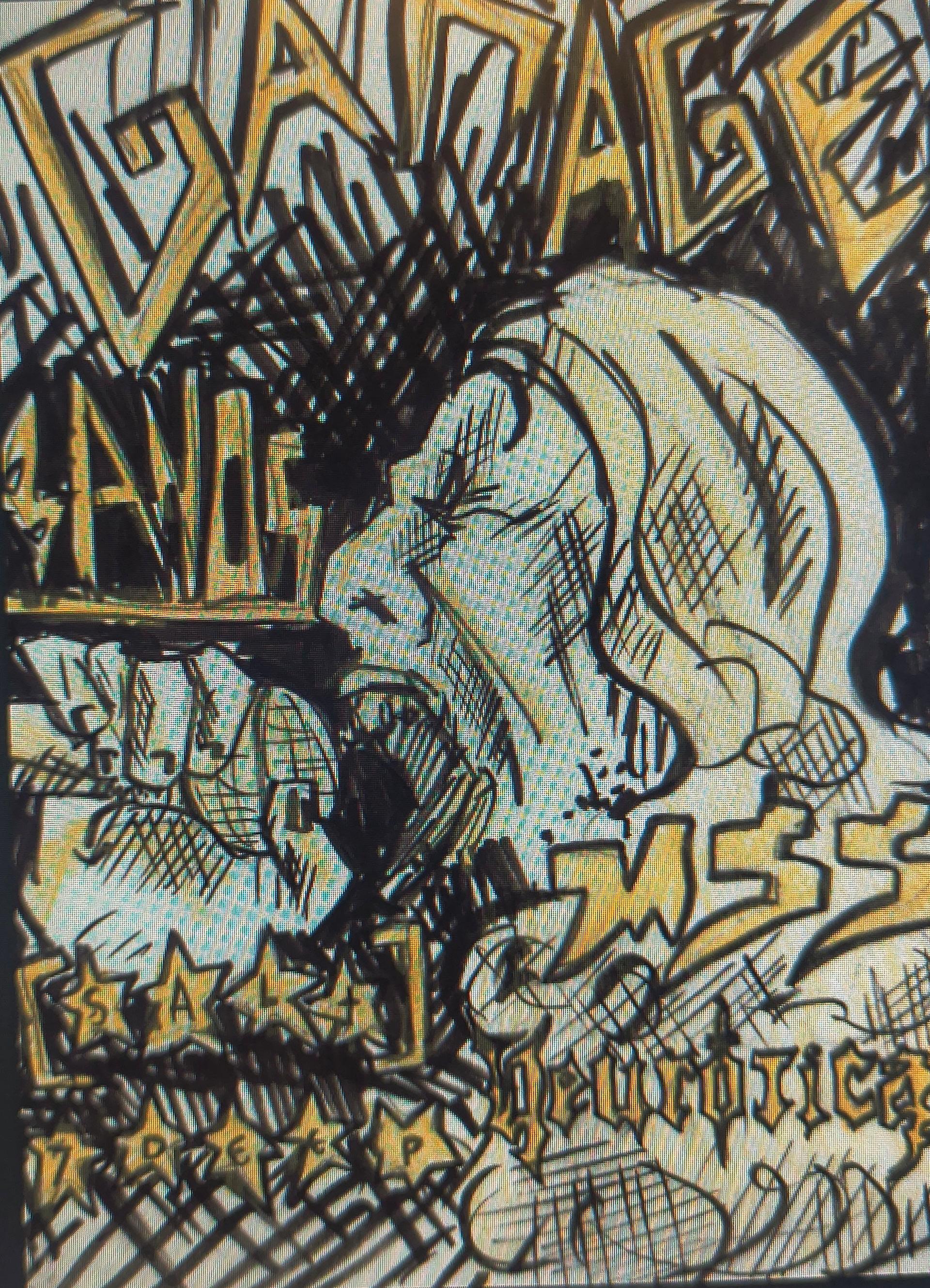
The Sopris Stars recently interviewed the bands [SALT], Neurotica and Mid Sentence Silence (MSS), each of which brings its own unique sound to the local music scene.
[SALT] didn't start as a band, They started as kids at the local Rock and Roll Academy and simply refused to stop jamming. Eventually, their riffs, half-done songs and ideas sparked a dream that needed a name and a stage.
“We had jammed so much and written so many songs that we were itching to do something more, so we became [SALT],” the band said. [SALT], I would say, is the easiest to get into, even if you don't listen to rock. Their songs lean into punk energy and are fast-paced and catchy. If moshing is your thing, then they have a show on May 18 in Colorado Springs and May 22 at Deathslope Festival in Grand Junction. And if you aren't willing to commute anywhere, you can support them by tuning in to Spotify or YouTube to hear their new release, “7 Deep,” or visiting their website, salttheband.com
If [SALT] is the gateway drug, Neurotica is the full plunge into clas-
sic metal — no soft edges, just riffs, drums and pure energy. Their history is classic garage band nostalgia.
“Noah, the guitarist, and Danniel, the drummer, friends since elementary school, decided to put their guitar interest to use in 2020,” a spokesperson for the band said.
It started as friends messing around with instruments, brothers joining in and then the lineup shifting (a lot), but the band finally landed where it is now. This includes the new addition of a singer: Cami.
Neurotica is heavy, technical and unapologetically loud. To find them, you can look on Instagram at @neurotica.official.band But if you want to get the full experience, they are playing on May 2 at the MayFest Battle of the Bands in Parachute, and on May 21 at Deathslope.
Where Neurotica leans into classic metal’s instrumental ferocity, MSS brings a grungier, deeper vocal style that sets them apart. They are also classic metal, with heavy songs and long riffs, but have softer, mellower songs, like “Kiss Me Goodnight.”
Their creative process is almost chaotic by design. It’s improvisational and messy; the kind of songwriting that feels like it’s pulled straight from the floor of a garage covered in cables and half- empty energy drinks.
“Matt will usually just start playing random notes, and everyone just follows along,” a band member said.
MSS is also gearing up for the MayFest on May 2, and a DIY anniversary show in Rifle on June 6. Plus, they’re working on a new single and a debut EP they hope to release by
PROM: The history behind a night to remember
PAGE 2
Model UN delegates discuss big-world problems
PAGE 3
The Anglophone Crisis: A war swept under the rug of international attention
PAGE 4
the end of the year. Their first single, “Kiss Me Goodnight,” is already available everywhere. You can keep up with MSS by following their Instagram, @midsentencesilence What makes these three bands special? It’s the way they represent different corners of the same musical world. [SALT] brings the fun. MSS brings the grit. Neurotica
brings the fire. Together, they form a snapshot of a valley where musicians are building something real, one show, one riff and one garage at a time.
If you want to hear the future of local rock, you don’t need to look far. It’s already here — loud, sweaty, and ready to blow the doors off their next venue.
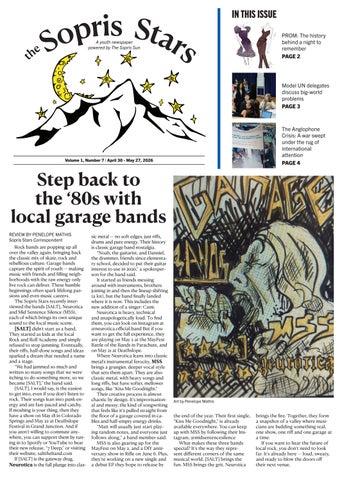
Art by Penelope Mathis
Digging holes while singing
Our lives have no foreshadowing. We exist in a parable composed in messy handwriting and screenshots.
We have no editor.
No backspace.
We cannot do or be anything we please, and instead wander in the vague direction of our childhood aspirations.
Every parable has a moral — a lesson deemed worthy of our attention.
But what about stories with no foreseeable end? What about our stories — the ones we are literally in right now? What's the moral of the story we tell ourselves about who we want to be?
OPINION
If a little girl decides that when she is grown she would like to fly through outer space, does her aspiration orbit around determination or is it that she is drawn to scale and weightlessness? Maybe the weight of the world is already crushing her a little, and she sees a way out. She dreams of an adulthood where she can witness infinity and float within it without being compressed. Maybe she will find it in astrophysics. Or maybe in art or music or architecture.
By Vivienne Shapiro
That child who wore tiaras and decorated her room with DIY canopies? It wasn't about the dress, nor even the extravagance or privilege. Perhaps she simply wished to be chosen. Perhaps she longed for the certainty that someday the world would look at her and really see her “for the first time in forever” — shoutout, Elsa.
I am captured by the particularity of what young kids want to be when they grow up. It's a specificity many of us wish we had now, sitting down to plan the rest of our lives all in the span of third period. Not “something creative,” or “something that pays well,” but a firefighter, a veterinarian, Taylor Swift. Why is it that we are so specific when we are so young — our eyes clear enough to be a metaphor — yet so vague by the ninth grade? How is it that at the age of 6, I was so sure I would be a dirt princess when I grew up, yet, now, I’m not even sure which classes to sign up for next semester?
Fashion Alert
At 6, “impossible” has yet to dawn on you. Everything you desire is formed from things you’ve seen. For me, I took two things I loved and mashed them into my own invention. Dirt cakes and Elsa’s castle seemed so contrary, it scared me. So I mashed them together into a dirt castle in which I ruled.
My dream was pure because it existed long before the noise. The all encapsulating murmur of the outside world. Guidance counselors, teachers, parents … they can take that clarity from you. It’s not intentional, of course. They’re not trying to talk you out of it, but rather teaching you to think critically until it gets to a point when you talk yourself out of what previously felt true. I became adept at questioning everything in a world often void of answers, living a thousand lives and thinking a thousand things all at once.
Was I flawed when I was so sure? Or am I flawed now? Is the mistake in the questions or in the lack of answers?
But the kids who didn’t become what they said they would most certainly didn’t lose their way or fall short. And the ideas they had to start with were never imperfect. They simply became mistranslated. Tangled in the webs of reality and “growing up.”
It’s the difference between determinedly digging holes to find your proverbial “song,” versus singing while you do it. Instead of locking in on an objective and molding yourself toward it, experiment along the way, mess around and see what else reveals itself. Translating the dreams at age 6 into our goals now takes time, and it most certainly takes longer than third period.
Perchance that girl who yearned for weightlessness is sitting in the dark writing this column. Finding weightlessness in words. A craft as raw as her being, but so much more malleable. A place in which all her words are her own but the ability to rephrase is promised. Perhaps her goal was never to reach the stars, but to dig for them in the ground and mold them to her liking.
Our dreams shape shift, but our hunger is perpetual.
Breaking the bank to slay at prom
The history behind a night to remember
GISELLE "GIGI" RASCON
Sopris Stars Columnist
“… Today’s proms are big business: According to a 2015 Visa survey, the average cost of prom was $919 per person, which includes everything from attire and flowers to dinner, tickets, limo services, photography and after parties, as well as the phenomenon of ‘promposals.’ The survey found that American households spent an average of $324 alone on this practice of making elaborate, over-the-top invitations to the dance,” reads a statement from history.com on the evolution of proms, their origin and overall history. What does that look like now — hardly a decade later? With inflation and prom continuing to be a carefully curated event for upperclassmen in high school, those numbers have likely increased. And with fashion evolving rapidly, how has that aspect of prom flourished?
Like many lavish happenings, prom has always been
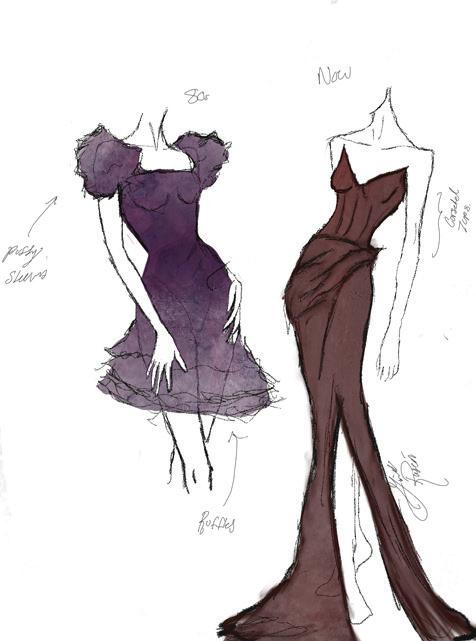
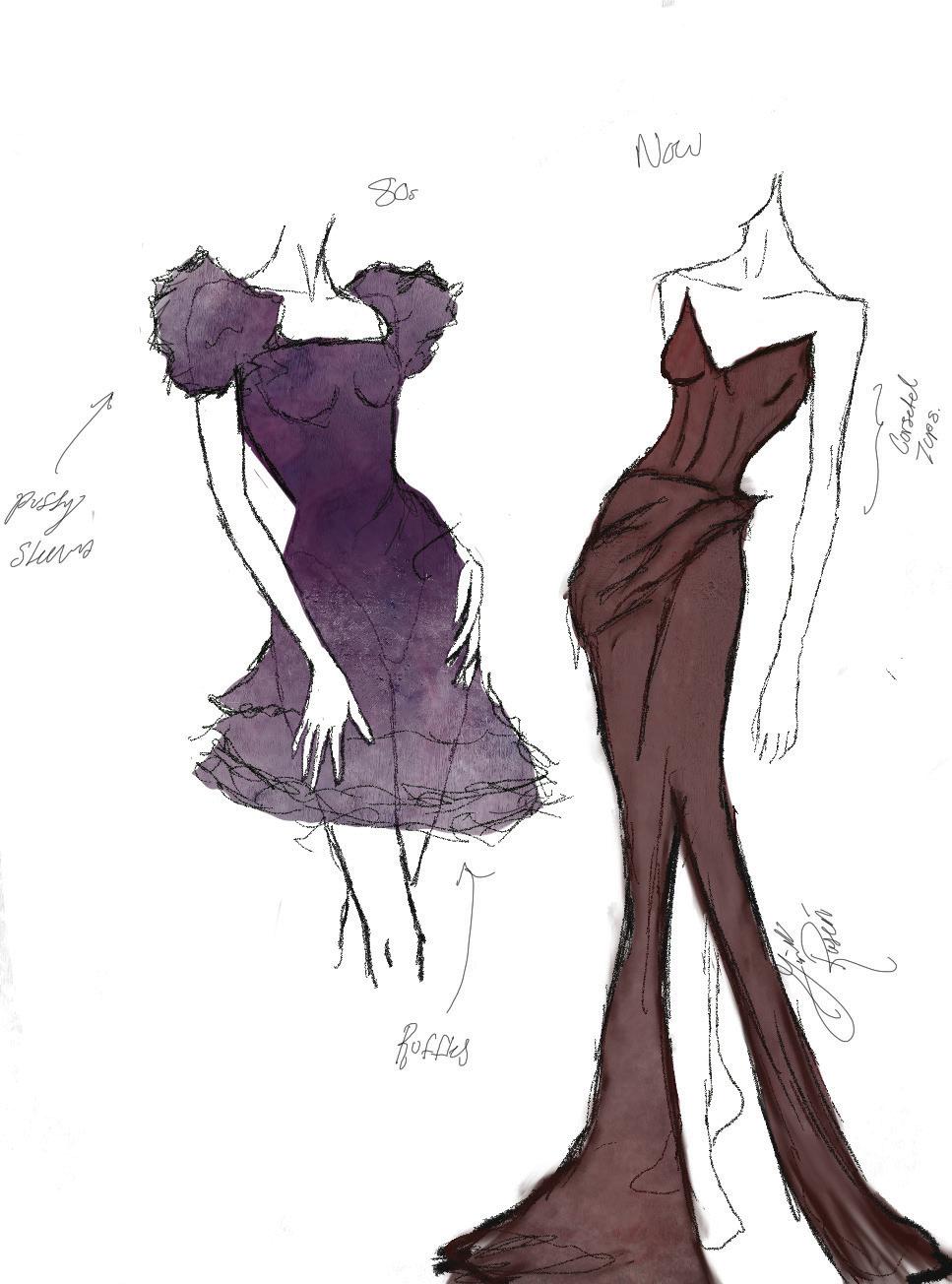
a reflection of the style at a given time. The ‘80s embraced puffy princess sleeves and layers of colorful tulle cut to hit either right at the knee caps or just above the ankles. The 2000’s offered extraordinarily bright colors with a hint — or a splash — of animal print (most likely zebra) and a hefty amount of sequins. Today, prom dresses have a more Hollywood-inspired touch, featuring corseted v-tops and sleek satin fabrics. Rather than dresses being cut short like past trends, the modern gowns we girls are now attracted to lean towards “must have” elements, like a more tailored silhouette that accentuates the body for a contoured look, with a high slit on one leg. Meanwhile, the boys’ biggest challenge tends to be far simpler: coordinating a tie to match the color of their date’s dress, and constructing an extravagant invitation that makes you say “yes” without having to think about it.
We've moved on from playful Barbie-doll-like colored dresses to gowns that feel more refined and mature. It's as if we’ve begun to slowly let go of the idea of enjoying our youth in the simplest, most playful ways, which once characterized our lives in some manner. But maybe that's also a factor that makes prom what it is, marking the closing chapter of adolescence and serving as a rite of passage towards adulthood and independence as we disperse into college or directly into an occupation.
In the long run, the evolution of prom fashion mirrors the expansion of prom itself and its reasoning behind it. As the event has grown more elaborate and expensive, it has also become a highlighting event for personal style in some ways and cultural influence in others.
Regardless of whether it was the playful, over-thetop details of the ‘80s, the bold factors of the 2000s or today’s sleek Hollywood glamour, each generation has
the Sopris Stars
Youth Editor Lou Gall lou@soprissun.com
Anna Sophia Brown anna@soprissun.com
Arthur Cherith arthur@soprissun.com
Hana Creyts hana@soprissun.com
Aurora Egan aurora@soprissun.com
Kate Ott katelynn@soprissun.com
Giselle “Gigi” Rascon giselle@soprissun.com
Vivienne Shapiro vivienne@soprissun.com
Youth Journalism Director
James Steindler james@soprissun.com
Youth Journalism Instructor
Skyler Stark-Ragsdale
Graphic Designer
Terri Ritchie
The Sopris Sun, Inc. is a 501(c)(3) nonprofit corporation with a mission to inform, inspire and build community by fostering diverse and independent journalism. Donations are fully tax deductible. The Sopris Stars is made possible thanks to The Sopris Sun.
Support The Sopris Stars Youth News Bureau by making a donation at www.soprissun.com/donate
left its distin guished mark on this antic ipated night in terms of fashion.
prom isn't just about the dresses of the decade or the trends that make it what it is. While in many ways prom has shifted in regards to uniforms, its memory-making purpose remains.
This year, I hope you reminded yourself of what
awaits you as we finish this hell (or heaven, if you were lucky enough) of a journey, and of the promises that await us as we transition into this new chapter.
Art by Giselle "Gigi" Rascon
The 3Rs: An ongoing community discussion on sex education in schools
ANNA SOPHIA BROWN Sopris Stars Correspondant
Roaring Fork School District’s (RFSD) implemented sex education curriculum has recently sparked controversy.
For the past three months, tensions have continued to heighten among parents and community members as they attend school board meetings, write public comments and engage online, offering support or disdain for the K-12 sexual education program adopted three years ago. Community members in Feb. 25, March 18 and April 15 school board meetings claimed the 3Rs curriculum — Rights, Respect, Responsibility — was developmentally inappropriate and politically charged.
“Unfortunately, the ways in which this board, this superintendent and the senior leadership team has handled the valid and heartfelt concerns regarding content in the sex education curriculum — the lack of transparency with its introduction and the opt-out process and the dismissive and patronizing manner that you have treated those with concerns — has eroded all public trust in the RFSD,” Jamie Goscha, a parent with two children previously in district schools, said in March.
After several meetings with dissenters, the board has not announced whether they will be maintaining or discarding the curriculum. They did, however, make the curriculum more accessible on their website.
The 3Rs curriculum includes lessons for elementary grades that prioritize healthy relationships and boundaries, “good touch” and “bad touch,” reproductive anatomy and consent; then, in later grades, safe sexual protection methods, STD and STI prevention, birth control, reproduction, sexual assault and abuse information, sexual orientation and
ly abused or assaulted. The committee studied Colorado’s Comprehensive Human Sexuality Education requirements.
The mission of Colorado's Comprehensive Human Sexuality Education is to provide instruction based on scientific evidence that is appropriate to the age and developmental level of young people. This curriculum includes “anatomy,
school,” Cole said. “So that is why we ultimately landed on this set of lessons to recommend and require. I would say that at the same time, we recognized this is controversial, and a lot of families are not okay with us teaching their kids this, and so we wanted to make sure that we had an opt-out process that felt clear and transparent.”
“SEX EDUCATION, AND WHETHER IT BELONGS IN SCHOOLS, CAN BE A VERY CONTROVERSIAL TOPIC ... I THINK IT REALLY COMES UP AGAINST FAMILIES' VALUES, RELIGIOUS VALUES AND WHAT WE THINK THE PURPOSE OF PUBLIC EDUCATION IS."
responsible technology usage. The approved, required and suggested lessons are available on the RFSD website.
“Sex education, and whether it belongs in schools, can be a very controversial topic,”
Dr. Anna Cole, the district’s superintendent, said. “I think it really comes up against families' values, religious values and what we think the purpose of public education is.”
Cole explained that she was a key actor in the adoption of the 3Rs curriculum. The school board assembled a committee of current health educators, school nurses, nurses and pediatric specialists from Mountain Valley Health Center, as well as a representative from Riverbridge Regional Center — a nonprofit that supports children who have been sexual-
- Superintendent Dr. Anna Cole
puberty and adolescent development, healthy relationships and consent, sexual orientation and gender identity, reproduction and sexually transmitted infections [and] safety.”
Cole explained that not all districts are required to teach sexual education, but if they do, they must incorporate these aspects.
Cole said the goals of the committee were children’s safety, finding a curriculum that was available in English and Spanish and adhering to research on best practices preventing child sexual abuse and Colorado’s guidelines.
“The leading ‘why’ is that research tells us that kids who understand their own bodies and what is safe and unsafe are going to be better protected and better able to thrive in
Several parents, including some who are a part of a parents’ rights activist group, claim there is not enough transparency and that the curriculum is inappropriate for the younger age group. After he found information about the health curriculum in his kindergarten son's take-home folder, Tanner Gianinetti, a local parent and fourth-generation Carbondale rancher, had serious concerns about sex education in RFSD, which he outlined in a YouTube video posted by Elevation Lifestyle Network titled “Removing Broader Gender Theory Radicalized Health Curriculum at Roaring Fork School District RE-1.” He said the anatomical terminology was really “that of a high school biological textbook.”
In Gianinetti social media posts and public comments, he and other community members have voiced their concerns that the curriculum is developmentally inappropriate. Gianinetti, Amelia Eshelman and others cited a second-grade lesson titled “Understanding our Bodies.”
“The vagina has great elasticity, and can adjust to the size of a penis or allow a fully developed fetus to pass from the uterus out of the body,” Eshelmen quoted from the lesson. “It’s sickening.” She also emphasized her Christian faith and how deeply she cares about protecting children from corruption.
Cole, however, maintains that the proper information is being introduced at the right time.
“National and state statistics show that young children can often demonstrate inappropriate sexualized behavior as young as preschool and kindergarten,” she said. “With smartphones, children are accessing pornography at very young ages. And we also know that sexual assault is real. Teen relationships often deal with sexual violence and sexual assault … Those are national trends, and we are absolutely not immune to those things here in the Valley.”
Hattie Johnson submitted an online public comment, stating, “When I first read through the lesson plans shared by the school, I was
Model UN delegates discuss big-world problems
Sopris Stars Correspondent
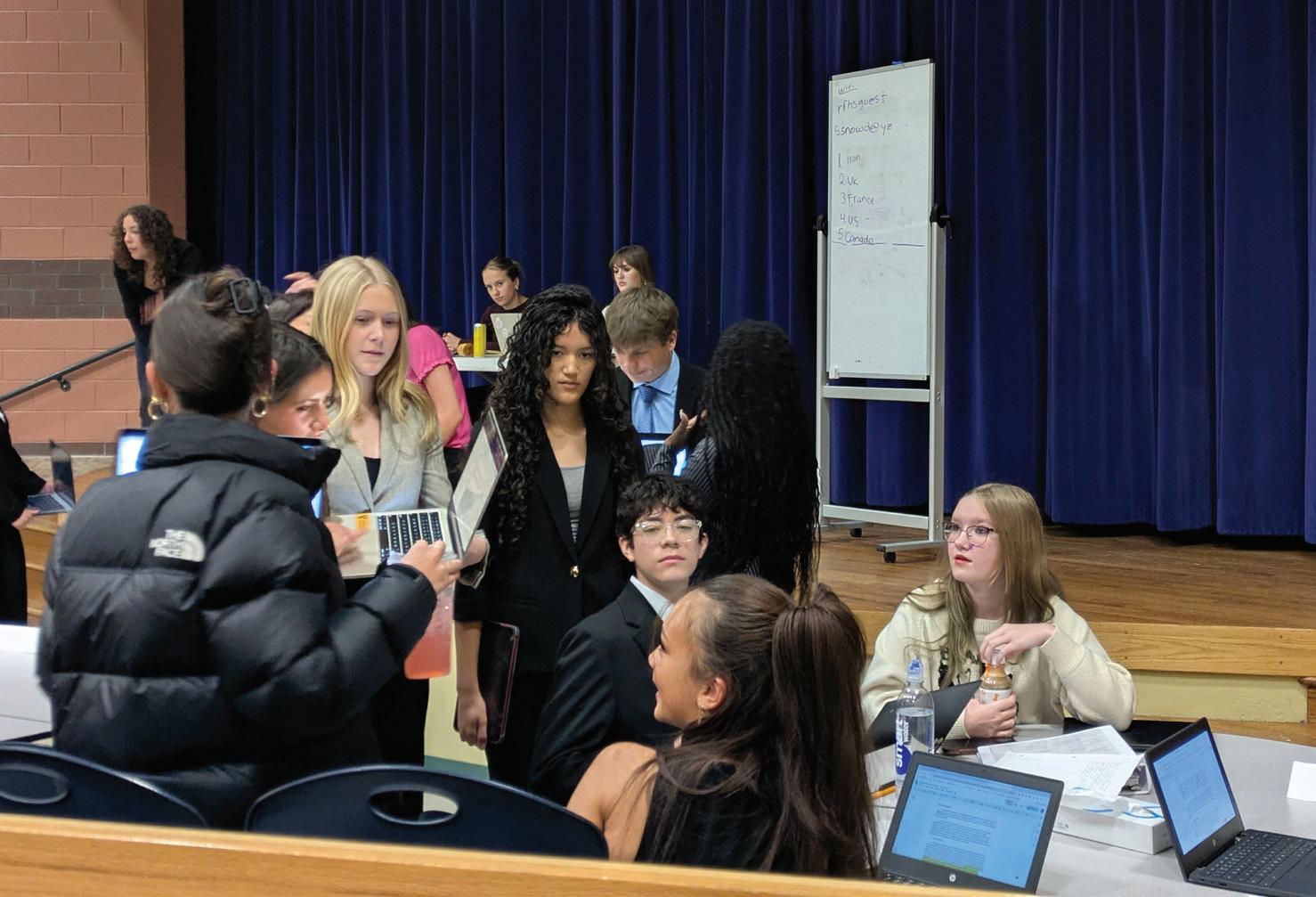
In April, Model United Nations was hosted at Roaring Fork High School, with students from neighboring Colorado Rocky Mountain School also participating. In this session, students — or delegates, rather — debated as part of the simulated Disarmament and International Security Council. Each delegate represented a different country around the world.
The topic of debate was “Emerging Technologies and Artificial Intelligence (AI),” which is particularly relevant in the world today. The delegates placed emphasis on the role of AI and its possible impacts on warfare, military intelligence and international relations.
The spread of misinformation, and the fact that AI can be used for the wrong reasons, was discussed among the representatives. The most common argument, however, was the possible impact of AI in warfare, mil-
itary intelligence and the creation of weapons — such as missiles. Another component of this conversation was that only some countries have access to such advanced military technology.
The theme of accountability and AI showed up multiple times during the debate. If the algorithm makes a mistake, who is held responsible for its actions?
“If no one is accountable, no one is safe,” a student representing Iran stated. At the end of the session, solutions to this problem included: ensuring human input in deciding how AI should be used by each delegate (as proposed by the Canadian delegate); that every country deserves the right to access this technology that should only be used for defensive purposes; and regulating AI as a weapon (as proposed the delegate for Iran).
A common theme was that AI can intensify international warfare and make mistakes, for which no one may
take responsibility, leading to possibly increased violence.
“Humans must remain the final
said.
HANA CREYTS
decision makers in the use of AI in warfare,” the student representing Canada
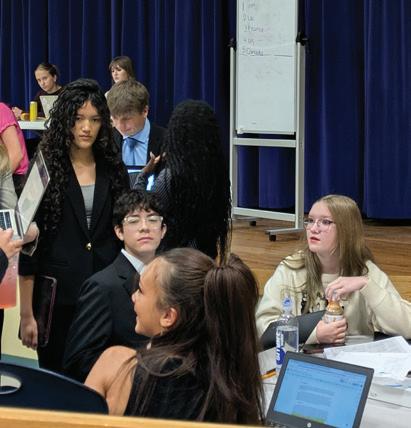
Students convene for a Model UN debate at Roaring Fork High School. Photo by Hana Creyts
continued on page 4
The Anglophone Crisis:
A war swept under the rug of international attention
AURORA EGAN
Sopris Stars Correspondent
The Anglophone Crisis, a war in Cameroon that has been escalating for the past 10 years, has gone vastly under-reported, earning little attention from international media.
What started as protests against the Cameroonian government has quickly developed into an official conflict.
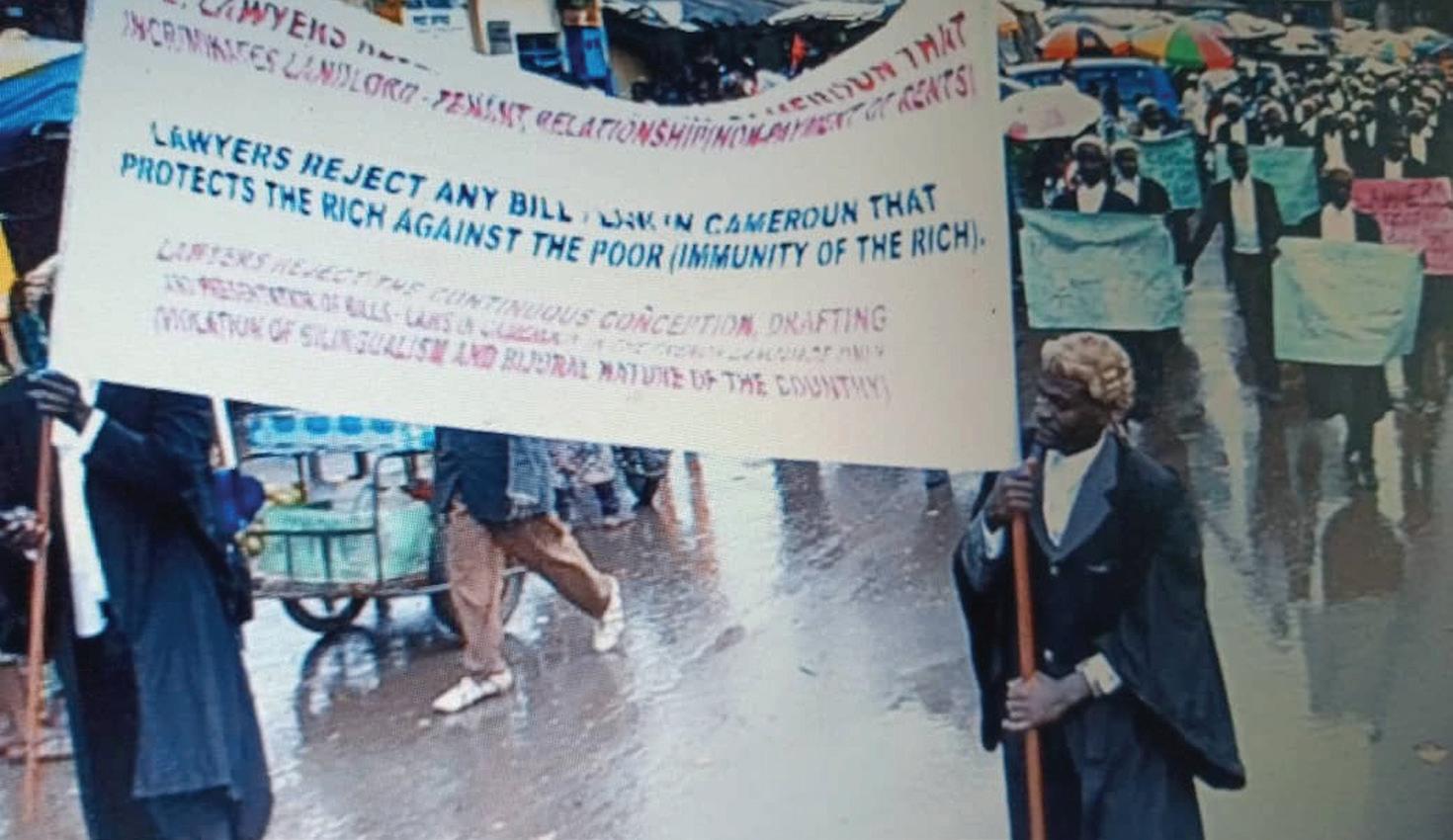
Yinyu Divine Mburi, a citizen and lawyer of Cameroon and a past resident of the Roaring Fork Valley, shared his and others' personal experiences and grievances with the Anglophone Crisis.
Beginning in October 2016, Anglophone (the English-speaking minority of Cameroon) students, teachers and lawyers began protests against the Francophone (French-speaking) government, with Mburi taking part in the first day of protests.
Anglophone citizens believed the government was marginalizing them by forcing the French language in schools and civil law in Anglophone courts, in addition to the absence of proper care across English-speaking areas in Cameroon.
“Another glaring impact of marginalization is the lack of quality basic social amenities in the English part of the country,” Mburi said, “The regime had almost abandoned Anglophones to themselves.”
As an Anglophone Cameroonian, Mburi and others have also been forced to take University subjects in full French, even though they had been brought up speaking English. Often, Mburi has been refused service at public offices because of the language difference, being told to “go and speak your dialect in your place or village.”
Mburi also stated that the government has attempted to assimilate the French language into English-speaking schools and courts. In these classrooms, Anglophone students have received half-baked and incorrect information, Mburi said.
Mburi continued, saying that the protesters desired to solve this dilemma peacefully, and in response, the government began severe repression and crackdowns, such as sending troops and soldiers into towns.
During these crackdowns on civilian populations, Mburi saw violent acts on civilians, such as wanton killings, burning of villages and looting.
The government continued to employ excessive force by mass-arresting protesters, classifying them as terrorist groups and shutting off the internet to stop the spread of information. A blackout in 2017 in an Anglophone region, for example, lasted for months.
The crisis quickly continued to escalate. Because of the government crackdowns, many Anglophones have resorted to violence, forming separatist groups such as the Ambazonia Defense Forces, which came out of the Ambazonia Governing Council.
Anglophone protesters asserted their desire for independence from the French-dominated regime as the Federal Republic of Ambazonia. Citizens began strikes and boycotts, continued to protest and armed separatist groups began to fight for independence. In 2017, the Federal Republic of Ambazonia was self-declared.
In December 2017, the Cameroon government officially declared war on the separatists.
Since the crisis began, Mburi has
Letters to the Editor
CORRECTION: The Sopris Stars apologize for the missing boxes in last month's crossword puzzle. Yes, Cleopatra, the "Baddie from Egypt," is a nine-letter word.
Happy belated
Happy belated birthday to Mabel Shapiro (April 5).
Vivienne Shapiro
Carbondale
Keep going!
Great job on your recent publication. My brother, William, and I read it while we were on the road. We also had a ton of fun doing the “Ides of March” crossword! Great theme! Great clues! I must admit that we did some googling when the answers we thought we knew didn’t fit in the boxes. This was truly a hilarious experience! Thank you! But a note… our dad always recommended reading our writing before submitting it. I think the same idea can be applied to puzzles. Play before sharing! Or were y’all just messing with us?! Seriously, keep going! We love it!
Alice Steindler
Crystal Valley
observed millions of internally and externally displaced Cameroonians. Mburi and his family have been internally displaced, being forced to leave their home and move to another town. With this displacement, Mburi said that his family had to adapt to a whole new lifestyle. Notably, they struggled financially to find a place to rent and find food, as Mburi said that everything in Cameroon is growing more expensive. They also struggled with switching school lessons from English to French in this new town.
Mburi described how many parts of Anglophone Cameroon, including his own village, became cut off due to armed separatist fighters and military checkpoints. Because of which, Mburi struggled to transport his mother back to his village for burial, after she passed away in a medical facility. He still faces difficulty just to return to place flowers at her grave.
Mburi added that the culture in Cameroon has been affected by the crisis, with people having to leave home also having to abandon cultural traditions. When asked why he believes the Anglophone Crisis has been so under-reported, Mburi expressed his frustration and shock at the lack of me-
GENDER from page 3
surprised to see this was subject matter appropriate for kindergarten. I began searching for more information on the age appropriateness of anatomical lessons and found sources such as the American Association of Pediatricians and the National Children’s Hospital citing the benefits of understanding anatomically correct language for genitalia as a protection against sexual abuse. Knowledge of correct terms portrays a level of education to abusers, and can help in abuse reporting by allowing children to be clear in what happened to them.”
Gender theory
Some believe that if the school board is trying to teach scientific anatomy and sex, it should be binary based.
“It was an extremely deceptive curriculum that actually introduced into this broader gender theory [and] drove home non-binary for kindergarten-aged kids,” Gianinetti said in the YouTube video.
Ashley Stahl, a mother of an RFSD student and the executive director of PFLAG Roaring Fork Valley, supported the 3Rs curriculum when it was first considered and regularly visits Gender & Sexuality Alliance school clubs throughout the Valley. She said that several young queer people have told her that this is the first time a sex-ed curriculum has acknowledged them.
dia coverage, along with concerns that the government might be lobbying the international media to keep it quiet.
Mburi also said that he believes that the international community has little concern for Cameroon as a whole.
“It would appear some international bodies and sponsors and lobby groups, and even governments, do not have a direct interest in Cameroon and in the English-speaking [Cameroonians],” Mburi said.
As a former resident of the Roaring Fork Valley, Mburi believes that although the cultures of the two places are drastically different, the people are the same, with good hearts and intentions. The real problem in both areas is the government, Mbrui said.
Mburi encouraged residents in the Roaring Fork Valley to create awareness and urge members of Congress to use their influence for aid. Being a lawyer, Mburi said that financial support cannot be ignored for many who cannot afford legal fees, as he attends court to help vulnerable detainees, some of whom were arrested at street protests.
“We have to make it known,” he said. “But I pray that we don’t have to die in millions before the world knows. I don’t want people to die just for that purpose.”
“Not celebrated them, not centered them, just acknowledged that they are real,” she said during the March 18 school board meeting. “That’s how low the bar was before 2023.”
Academic standing
At the same meeting, Susan Tribble, another community member, addressed the board and stated that faulty leadership and the adoption of this curriculum is to blame for low test scores and decreasing enrollment.
“The truth is, you are no longer focused on creating a well-educated society,” Tribble said. “Your curriculum choices appear more about dumbing down our children and sexually stimulating them at the earliest age possible than it is about educating them on the fundamentals.”
However, according to the Keystone Policy Center, RFSD proficiency rates in literacy and math match, or are higher than, Colorado’s public school averages. National proficiency averages plummeted after the pandemic, and across Colorado the gap between English learners and first-language speakers persists.
“We need to improve overall student academic achievements, but student outcomes really has nothing to do with the 3Rs.” Cole said “It’s a pretty small part of a student’s life and our academic program.”
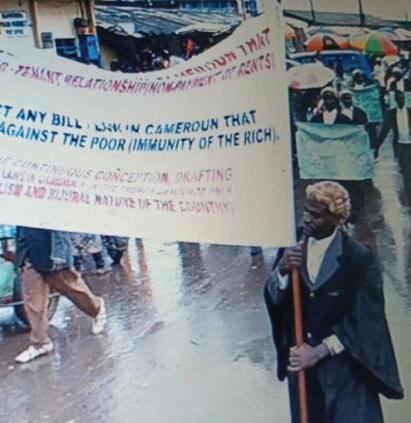
Yinyu Mburi, holding the banner on the right, takes part in a 2016 protest in Cameroon. Courtesy photo