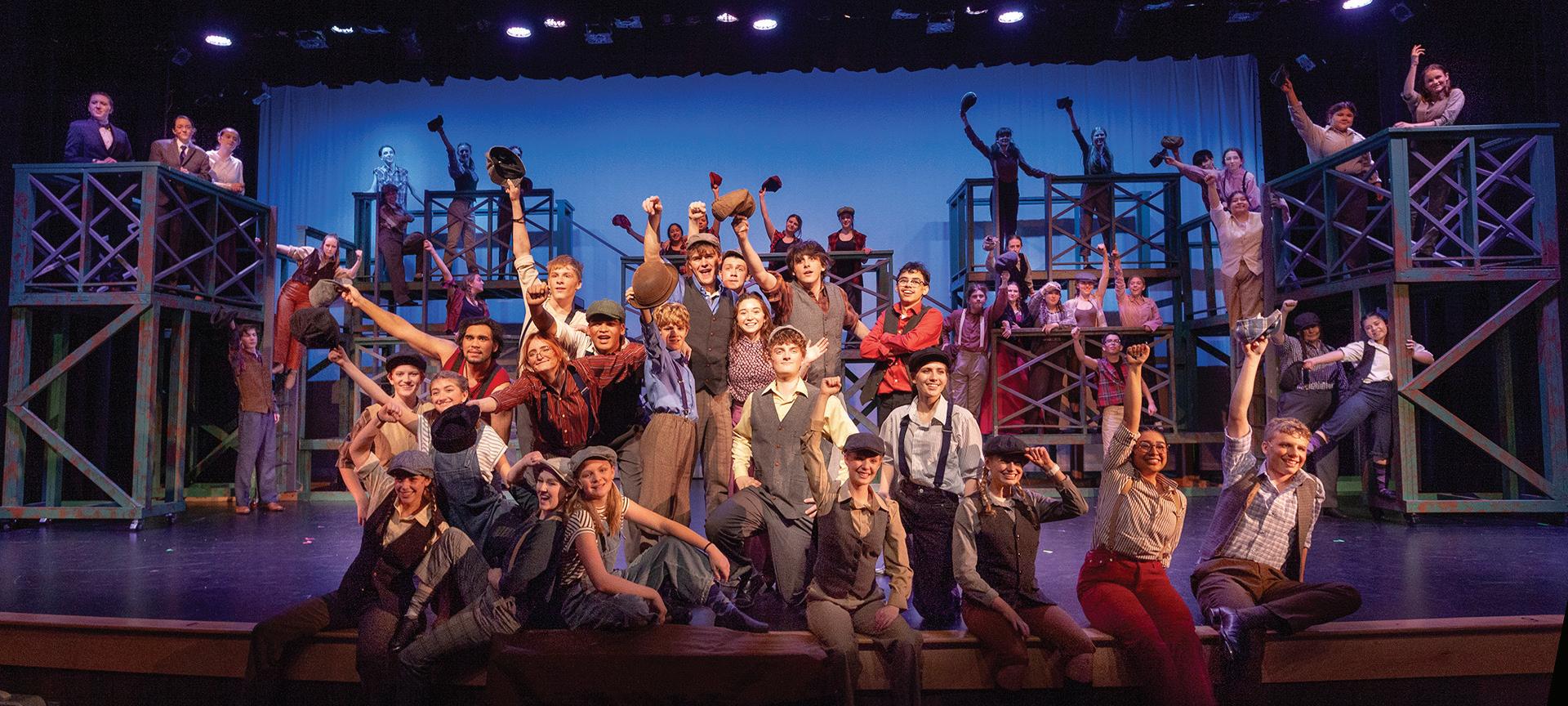
The Theater Department at Glenwood Springs High School (GSHS) has officially brought “Newsies” to the Valley. The play, written by Harvey Fierstein, is certainly one that many theater critics have come across, but these local high schoolers brought the already heartfelt script to a whole new level of life.
“Newsies” is based on the newsboys’ strike of 1899, a movement facilitated by young people in retaliation against unfair pay by newspaper publishers, specifically Joseph Pulitzer and William Randolph Hearst.
The story follows a group of young boys and teens
selling papers. The antagonist, Pulitzer, runs the newspaper and doesn't believe the papers are sensationalist enough. In order to afford catchy photos in the paper, what we might call click-bait today, he raised the price of papers and reduced the newsboys’ already slim paychecks.
Scared but also relentless and fierce the youngsters fight for change, despite the risks. The story doesn't solely follow the strike, which is not so much glorified as portrayed with sincerity. While the characters battle to overcome fear and their own hesitancy, the show also rings with hope.
Don’t get this critic wrong, the show is a gas — playful
but also honest and with an easy-flowing plot that pulls the audience in.
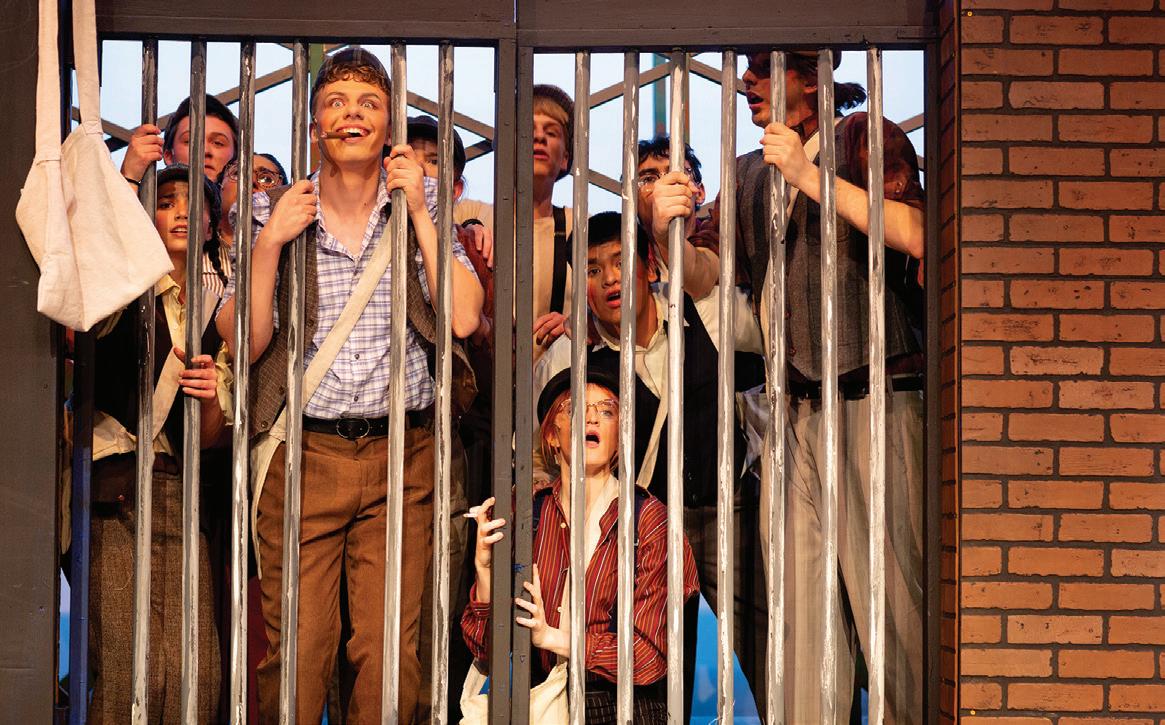
The beauty of the GSHS production lifted the already deeply in-depth storyline. One particularly intriguing aspect was the background of each character and the execution by the cast. Body language, attention to detail, interaction with the set and props was like watching a scene unfold in real life, just naturally beautiful. They weren't acting on the stage, they lived on it.
The amount of passion these teens brought, both on and off stage, was inspiring. And, best of all, it seemed as though they were genuinely having a lot of fun.
The lights, set design and choreography took this performance to the beyond. The entirety of the theater was at play with newspapers thrown to the audience and newsies running through seating. Scene changes were graceful and the lighting perfectly illuminated each precious moment.
All in all, every fun, creative detail added a world of life.
The musical sensation only runs one more weekend (Feb. 27 to March 1) with Friday and Saturday shows at 7pm and Sunday at 2pm. Tickets can be purchased at www.tinyurl.com/ NewsiesGSHS
Photo courtesy of Klaus Kocher
A youth newspaper powered by The Sopris Sun
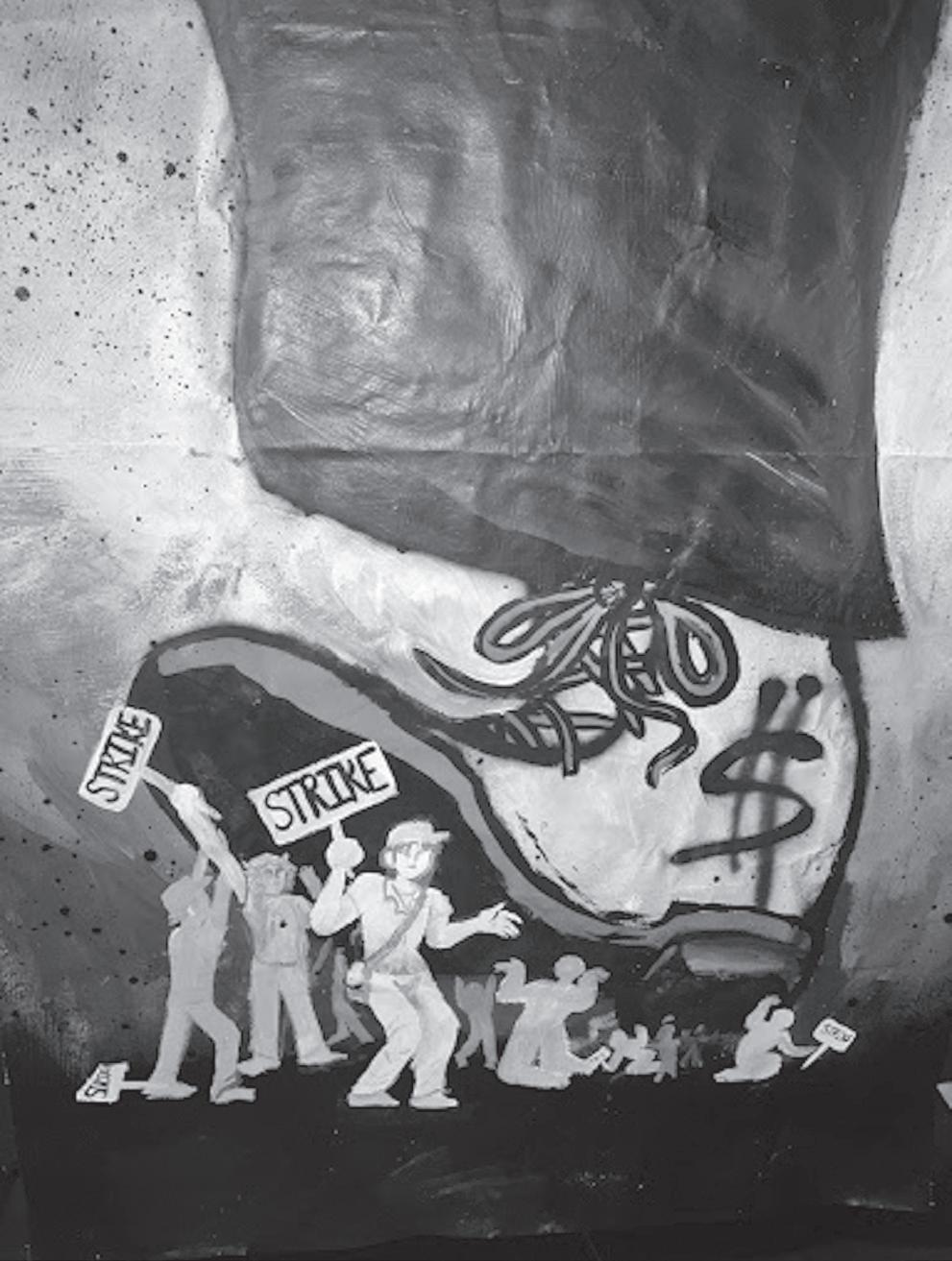
Arthur Cherith, The Sopris Stars’ new theater critic, also spraypainted this art piece used in the production, which, in actuality, is about six-feet tall.
Photo courtesy of Klaus Kocher
An ode to Youth In Nature
Roaring Fork Outdoor Volunteers’ (RFOV) paid internship, Youth in Nature, became my anticipated monthly highlight as a sophomore. The internship nurtured my passion for the outdoors, yet, all the while, I learned not just about our local ecosystems but about myself, too. The application to participate next school year is still open, until April 4 that is, and I encourage other young people to apply.
At the beginning of orientation, my cohort was reserved. We were from different schools across the Valley and none of us were very familiar with one another. But by the second day of the hut trip, I felt as though I’d found lifelong friends. The hike to Margy’s Hut was strenuous, but it was our first taste of how a challenge (and exhaustion) would bring us closer together. We made burn piles, stocked the woodshed for winter and got our hands on pruning loppers for the first of many times that year. As we would all come to realize, the physical labor was a catalyst for our laughter.
presence of my friends, but also by obnoxious fun and days that were truly challenging. After my first real breakup, a trip to Maroon Bells served as a refreshing reminder of how much beauty there is in the world. I challenged my fear of heights on mountain summits, in the Colorado Monument canyoneering and in Rifle, where I regained confidence to rock climb. I was able to discover new places that had surrounded me my whole life, but that I had never explored.
OPINION
By Anna Sophia Brown
Youth in Nature forged so many moments I’ll always cherish. That first night at Margy’s, we lay in a circle, with our heads joined in the middle trying to pick out the constellations we knew. Vibrant stars saturated the Milky Way. We became astronomers in our own minds, finding snails and lengthy dragons twirling across the sky. Our chests hurt from laughing. Three nights disappeared into memory, cementing themselves as wistful reminders of the beauty of connection. The typical social separations imposed in education dissolved, and we became a mosaic of personality.
Encouraged to abandon our phones and take advantage of “slow fun,” the hut trip was a grounding experience. I clearly remember being asked to sit alone for 15 minutes and just pay attention. I became acutely aware of the smell of sweet vanilla seeping out of ponderosa pines, and the little pine siskin that hopped in the nearby underbrush. Like many moments on that trip, I reflected on how often my mind is everywhere but the present.
Throughout the year with Youth in Nature, none of my favorite moments followed the same structure. I was delighted in the quiet
Fashion Alert
By the time Saturday rolled around, I often found myself hesitant, tired or maybe even a little lazy, but I was always surprised by how much happier and energized I was by my cohort. Ben Sherman, RFOV’s education director, fueled my passion for biology through his endless plant facts. He was always understanding and supportive. While I may have been lucky with an especially good group, the environment created during our adventures was always positive. Our mistakes, fears and embarrassments transformed into light-hearted inside jokes.
Perhaps the most important relationship I gained from Youth in Nature was with the land. I grew up hiking, climbing and rafting. I loved being in beautiful places, but, until the internship, I had no idea how much effort sustainable outdoor recreation required.
For many of us living in the Roaring Fork Valley, access to nature has been a given. The hours of behind-the-scenes work can go unnoticed until you have the chance to be a part of it. Outdoor recreation is essential to our economy and culture, and I realized how important conservation efforts are in maintaining our local ecosystems.
Every time I participate in RFOV programs, I leave joyful and with a sense of achievement. As the application deadline approaches, and the volunteer season begins, I could not speak more highly of this organization. Their stewardship projects foster community while giving back to the incredible natural spaces we get to call home.
To apply for Youth In Nature, visit www.rfov.org/youth-in-nature
A passion for fashion
GISELLE "GIGI" RASCON Sopris Stars Columnist
I now have empathy for voodoo dolls. Not in a literal sense, but the constant pricking with needles in hopes of making a masterpiece slightly warmed my heart towards them.
As Carbondale's annual fashion show grows closer by the day, so are deadlines. Those with a ticket in hand can't wait to see dancers weave their movement with structured silhouettes cascading down the runway. Yet what you won’t see are the bleeding fingers, sore muscles, the moments of staring into fabric like it personally offended you, the twitching eyes and the constant whisper of “What am I doing?” murmuring like a cricket in your ear at every stage of the process.
And yet everyone's excitement to witness this grand happening is what fuels every working hand behind it all. Let alone the passion. At least that's what keeps the fabric gliding beneath my fingertips.
Attendees' oohs and ahhs, vocalizing from their throats in admiration is really what keeps this continuously happening. But what really goes behind the planning, let alone the pieces? And the person stepping on the pedal?
There’s something powerful and beautiful about translating a visual be-
hind your eyes (I personally refer to this as delusion) into something real. And I'd personally say that it's not the final product itself that makes it special, but knowing the process was worth it.
When I was 15, I applied for an apprenticeship that Carbondale Arts was offering to local youth, supported by Reina Katzenberger’s mentorship. There were six of us, and infinite opinions. Deadlines did not care about our creative blocks. Life was getting in the way — school, friends, family, you name it. The garments we created held together, though, and probably better than we all did.
As stressful as it was, that experience taught me a lesson essential to working with a team of creative minds: it's not easy. It's brutal and beautiful. Merging six voices into a reasonably cohesive direction is an art in itself.
This year’s “carnival” theme feels like stepping directly inside a designer’s head. The juggling ideas, the roaring doubts, the colors. A concept that perfectly aligns with it all is making sense at midnight and turning questionable once the sun rises.
I figured it felt this way because this demanding process is still relatively new to me, despite having a slight taste of it. I interviewed a couple of my peer designers at Colorado Mountain
College (CMC), including someone who has been in the industry for years: CMC’s Fashion Program instructor, Cecilia Metheny. When I asked her whether her perspective on design has changed through this year’s experience, she responded: “Yes. It’s changed me in [turning] what’s in my mind into reality.”
Another participant, 13-year-old Elizebeth Shaw, hopes that people walk out the door keeping in mind “how creative people are in the process … how much work we all put into it.”
Within the fashion industry, especially when designers present to an audience, there’s often little room for error in the standard we set for ourselves. Designers can be perfectionists who romanticize chaos and roll with it,
the Sopris Stars
Youth Editor Lou Gall lou@soprissun.com
Anna Sophia Brown anna@soprissun.com
Arthur Cherith arthur@soprissun.com
Hana Creyts hana@soprissun.com
Aurora Egan aurora@soprissun.com
Kate Ott katelynn@soprissun.com
Giselle “Gigi” Rascon giselle@soprissun.com
Vivienne Shapiro vivienne@soprissun.com
Youth Journalism Director
James Steindler james@soprissun.com
Youth Journalism Instructor
Skyler Stark-Ragsdale
Graphic Designer
Terri Ritchie
The Sopris Sun, Inc. is a 501(c)(3) nonprofit corporation with a mission to inform, inspire and build community by fostering diverse and independent journalism. Donations are fully tax deductible. The Sopris Stars is made possible thanks to The Sopris Sun. Support The Sopris Stars Youth News Bureau by making a donation at www.soprissun.com/donate
while constantly reminding themselves that imperfection is what makes it feel valuable and surreal.
A crooked stitch can feel human. A slightly uneven hem can feel lived in. Yet it's the bumps on the road where you realize that fabric has its own personality and sometimes refuses to work with you. All the broken needles and the faint fiber pieces on the floor. It all means trusting what you're capable of doing and pushing yourself past the edge further than you already have, and truly believing in yourself in the mess you're caught in.
Behind every look that walks the runway is a designer who doubted it, and themselves, many times.
So when the lights hit and the music starts, know this: You’re not just seeing a garment. You’re witnessing resilience. Collaboration. Negotiation. A shared stress and passion to make it all happen.
You’re experiencing the outcome of what occurs when a room full of local creatives decided to believe in something invisible long enough to make it real.
So yes, maybe I do feel for voodoo dolls. Because sometimes creating something tangible means being poked at, tested and stretched, over and over again, until it feels right and delivers what is expected, and more.
But unlike the doll, we choose it.
The CMC line and many others hit the Carbondale Fashion Show runway March 12-14.
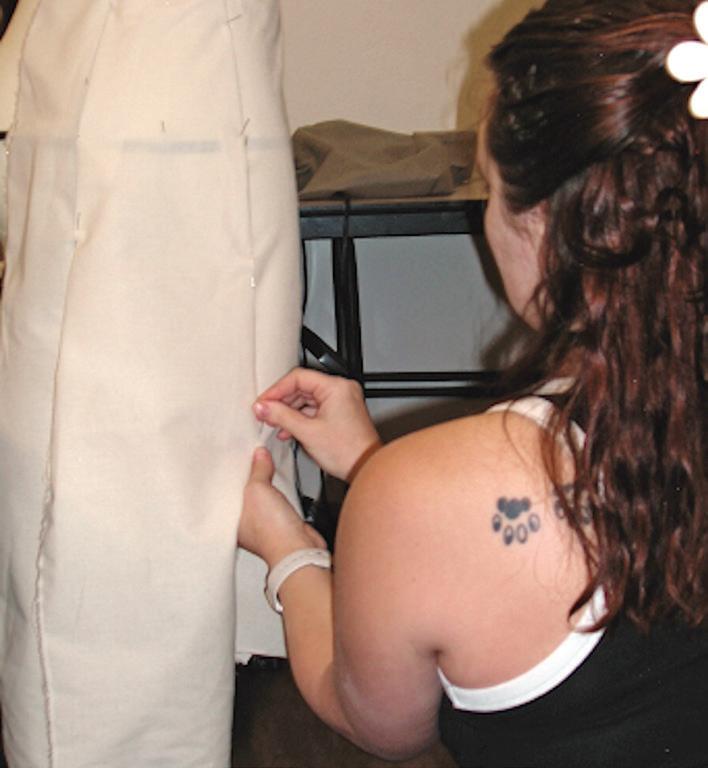
Juliana Reese draping onto a bodice.
Photo by Giselle "Gigi" Rascon
‘Everyone's a Ram’
VIVIENNE SHAPIRO
Sopris Stars Correspondent
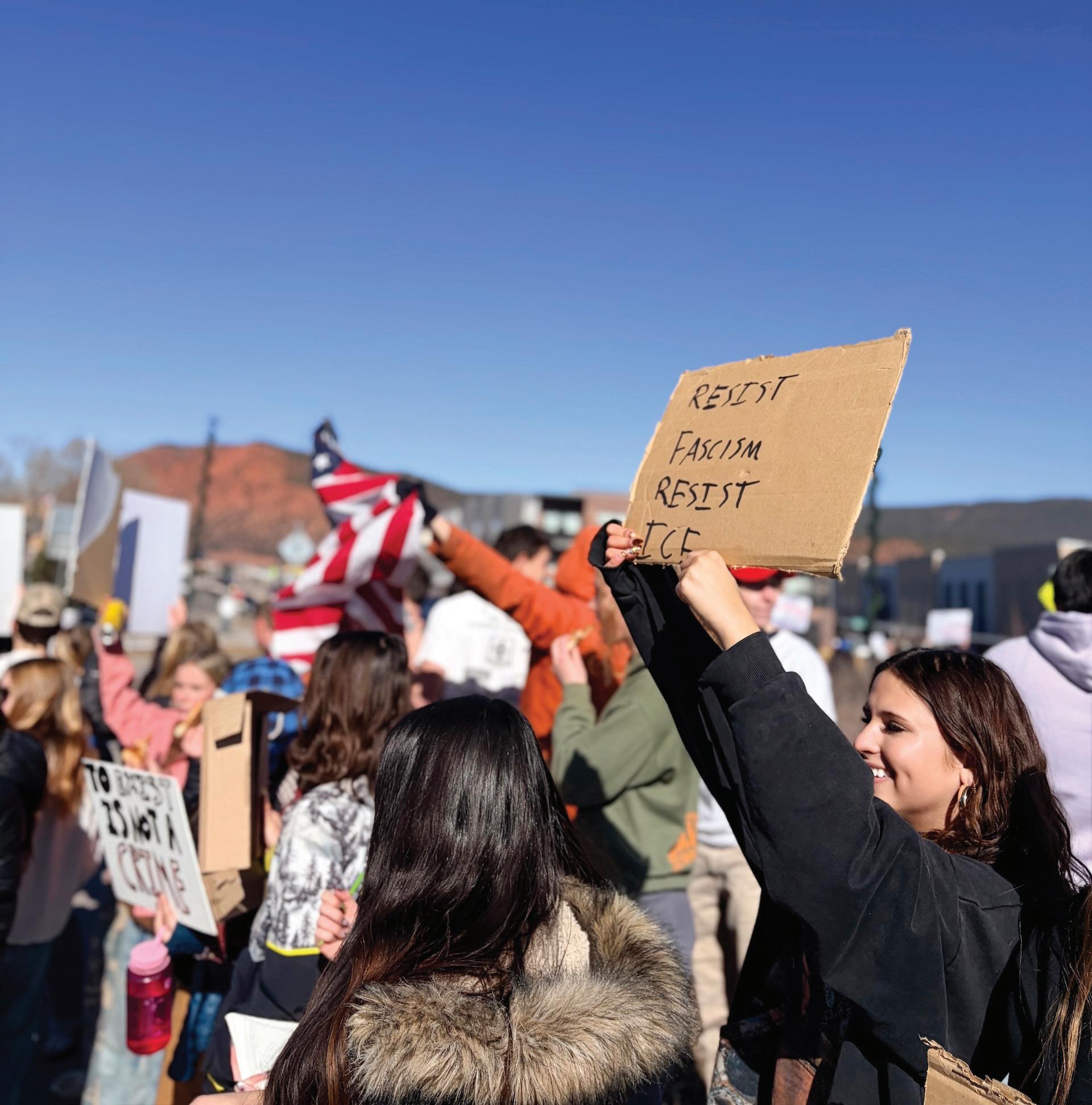
Chairs skidded over the floors and backpacks were zipped shut as hundreds of students left Roaring Fork High School (RFHS) on Jan. 30 during lunch, a customary practice, yet nothing was customary on this occasion. In mere minutes, hundreds of students filled what was empty space along the roundabout near 7/11 in Carbondale. They raised their voices and doodle-etched hands in protest against Immigration and Customs Enforcement (ICE) and demanded to be heard.
It started peacefully.
Glenwood and Roaring Fork students met at the roundabout, held signs and played music as cars drove by. Before long, about 50 more from Colorado Rocky Mountain School walked along the road to join the growing group. It was a spectacle to behold, the intermingling of young people with many differences but common values — private school and public school students, theater kids and jocks.
“I think what [protest] does is it helps people who feel attacked, helps people who feel isolated feel a lot less lonely,” RFHS senior Sam Stableford told The Sopris Stars. “And it has very little to do with politics and actually a lot to do with making sure that people feel loved and supported.”
Just after noon, the police were tasked with a feat of convincing the scores of teenagers to relocate. Officers clearly stated that their right to assembly would be respected, but explained that gathering on the island in the middle of the roundabout was prohibited.
As time crawled on, passive protest was tested. Drivers made derogatory gestures and insults paraded down. While the majority of students retorted exclusively with verbal recourse, one threw a snowball at an SUV after a driver allegedly flashed the middle finger. The police intervened, reinstating that in order for protest to remain peaceful, physical altercation of any degree would not be tolerated.
Frieda Wallison of Pitkin Country Republicans later reflected on the effectiveness of assembly and
ICE procedures in an interview with The Stars.
“Our legal immigration system is broken,” she said. “In many cases, the form of protest is counterproductive”. She provided the example of Renee Nicole Good, who was shot and killed by ICE agents in Minnesota. “It seemed to me that many of the protesters were acting in a violent manner, especially the woman who was killed … The [ICE] officers were threatened.”
While some Roaring Fork Valley residents disapproved of the student protest, more questioned teacher involvement. Many teachers took paid time off at Glenwood Springs High School, resulting in the closure of the school. Superintendent Dr. Anna Cole described the process of making the call to cancel school the night before.
“It was probably 10pm and we were kind of saying, ‘What's the status? What are you hearing? How many staff do you have? How many subs do you have? Can we cross over? Can we send more people? What are our options to keep school open? Can we do this?’” she said. “What we ultimately decided as a team was that we did not have enough adults who could be present in the building to ensure a safe environment for the day.”
In the following days, complaints from parents were not exclusively of the district's response to the events, but aired more on the side of teachers choosing not to go to work. One resident said on Facebook that "Teachers should model how to critically think through important events occurring in our country — including those that are politically biased. This involves teaching about these events, not advocating for them, while maintaining neutrality …”
Stableford, the son of a teacher, had a different take. “I think that educators, specifically, [being] able to voice their political opinion is not something that should be looked down upon,” he said.
At Roaring Fork, a group of teachers gathered together where students were being dropped off in front of the school in the morning, holding signs in support of all students, regardless of citizenship. Carmen McCracken
Accepting New Patients!
was one of these teachers. When asked if she supported the student approach to these issues, she said, “I support students using their voice in order to create a change that they feel is necessary … I think that a part of being a citizen in a democracy is making your voice heard.” She also clarified, “I don’t, of course, support students who take that opportunity to [just] skip class.”
There was a little skepticism about some students’ motivation to join the walkout.
“Did some people just do the walkout to walk out of school?”
Stableford wondered. “Did some people go because they were feeling angry? Did some people go because they were feeling scared? Did some people go because they genuinely
Letters to the Editor
Have something to shout about?
believe in the cause?”
Student absences were not excused for the walkout, and some students were surprised and disappointed by this. But this, perhaps, gives deeper meaning to the power behind protest.
“Part of protest is we do it because we understand the consequences and we’re willing to take [the] sacrifice, right?” Cole said. “It makes a big statement when you accept those consequences. Rosa Parks didn't think she was just going to go get some cute photos of herself sitting on the front of the bus and become famous. She went to jail [and] she knew that.”
Before closing out the interview, the superintendent said that “everyone’s a Ram” at Roaring Fork High School, no matter their political affiliation or immigration status.
Email letters to the editor for publication in The Sopris Stars to youthnews@soprissun.com
On Jan. 30, students from across the Valley gathered at the roundabout in Carbondale after participating in a nationwide walk-out in protest of Immigration & Customs Enforcement.
Photo by Vivienne Shapiro
Infatuation to inflation
HANA CREYTS
Sopris Stars Correspondent
Every February, Valentine’s Day comes around. It’s 24-hours filled with love — both platonic and romantic — but the cost of the holiday can add up.
In 2009, spending on Valentine’s Day reached $14.7 billion nationwide, according to Statista, a global data analysis company. Since then that figure has increased steadily, with $29.1 billion spent this year, according to the site. This increase rate has been relatively steady, with the exception of Valentine’s Day 2020, when the number spiked during COVID to $27.4 billion. With spending skyrocketing by 97% between 2009 to 2026, some Roaring Fork Valley high school students expressed concern about the consumer-shrouded culture of Valentine's Day.
married couples against the emperor’s orders — which cost him his life. Apparently, it wasn’t until the 1800s rolled around when Valentine’s Day had turned towards sentimental, tangible gifts and love notes, and the Industrial Revolution soon fueled its consumerism.
“THE OVERCONSUMPTION IS NOT SOMETHING I HAVE EVER TAKEN PART IN."
- Kaila Ethridge, Basalt High School
Today, Valentine’s Day comes with many social media posts and couples uploading shared moments with their significant other with flowers and chocolate in frame. An inverse effect can be that others are left feeling envious or maybe even sparks a competition to purchase the most elaborate gifts for loved ones and exhibit it online. Where does this leave the people who don’t celebrate this holiday?
YES OR NO
Are they “just a friend?”
Do you kiss sometimes?
Are you “not dating?”
Do you hang out all the time?
Is it “complicated?”
Do you have attachment issues?
Are you seeing other people?
Do you lack long-term plans?
Are plans with them inconsistent?
Is one of you more interested than the other?
Do they put pressure on you emotionally?
Have they love-bombed you?
Do they consume your thoughts?
Are you unable to move on?
Do they text you good morning and good night?
Have they soft ghosted you?
Have they posted you?
Do you get gym pics?
Have you met the parents?
Do they introduce you as a friend?
Are all of your dates private?
“I think that Valentine’s Day is a worldwide celebration that celebrates love — not just romantic love, but also friendship,” Basalt High School (BHS) senior Hector Corrales said. At the same time, he added, “It seems like, in the modern day, it is more like a business.”
According to 6ABC in Philadelphia, the average American was projected to dole out an average of about $200 on Valentine’s Day this year. According to the article, 10% of that spending is on candy and flowers, chocolate is at about 30% and jewelry at about 40% (if you’re of drinking age, wine factors in at about 11%).
Factoring in both sources, the math breaks down to approximately $11.6 billion spent nationwide on jewelry, $2.9 million on candy and flowers, $8.7 billion on chocolate and $3.19 billion on wine! Valentine’s Day as we know it originated in ancient Roman times, when folks gathered and celebrated fertility rites and were paired up through lotteries, an online blog from The Boutique COO detailed. It goes on that later, also in Rome, Saint Valentine secretly
Not everyone has a job that provides a steady income to be able to spend a lot of money on Valentine’s Day. Some people aren’t in relationships, or might be experiencing a break up. A prime example that comes to mind is teenagers.
“This Valentine’s Day was my first actual time celebrating the holiday,” said Kaila Ethridge, another senior at BHS. “The overconsumption is not something I have ever taken part in,” she added, echoing Corrales’ sentiment.
Sophomore Cristina Solis-Ruiz said that love isn’t only celebrated once a year. “Valentine’s Day I feel like is a very overrated holiday that is talking about love, when you can do that every single day,” she said. When asked how much she spends on Valentine’s Day, she replied, “I don’t spend that much on Valentine’s Day just because I don’t think it’s that necessary."
Overall, Valentine’s Day can be costly, but it also doesn't have to be. At BHS, students may not feel the need to spend too much on the holiday, while also appreciating an opportunity to celebrate love in all its forms.
The bottom line this reporter took is that everyone can show that they care about their friends, family and significant others all year — not just Feb. 14.
Do your loved ones dislike them?
Have they avoided telling friends?
Is it “not that serious?”
Do they depend on you emotionally?
Are you/they avoiding labels?
Have they told you they’re in love with you?
Have you made a playlist for them?
Do they randomly text you at night?
Do they call you for hours daily?
Have you ever fallen asleep while on the phone with them ?
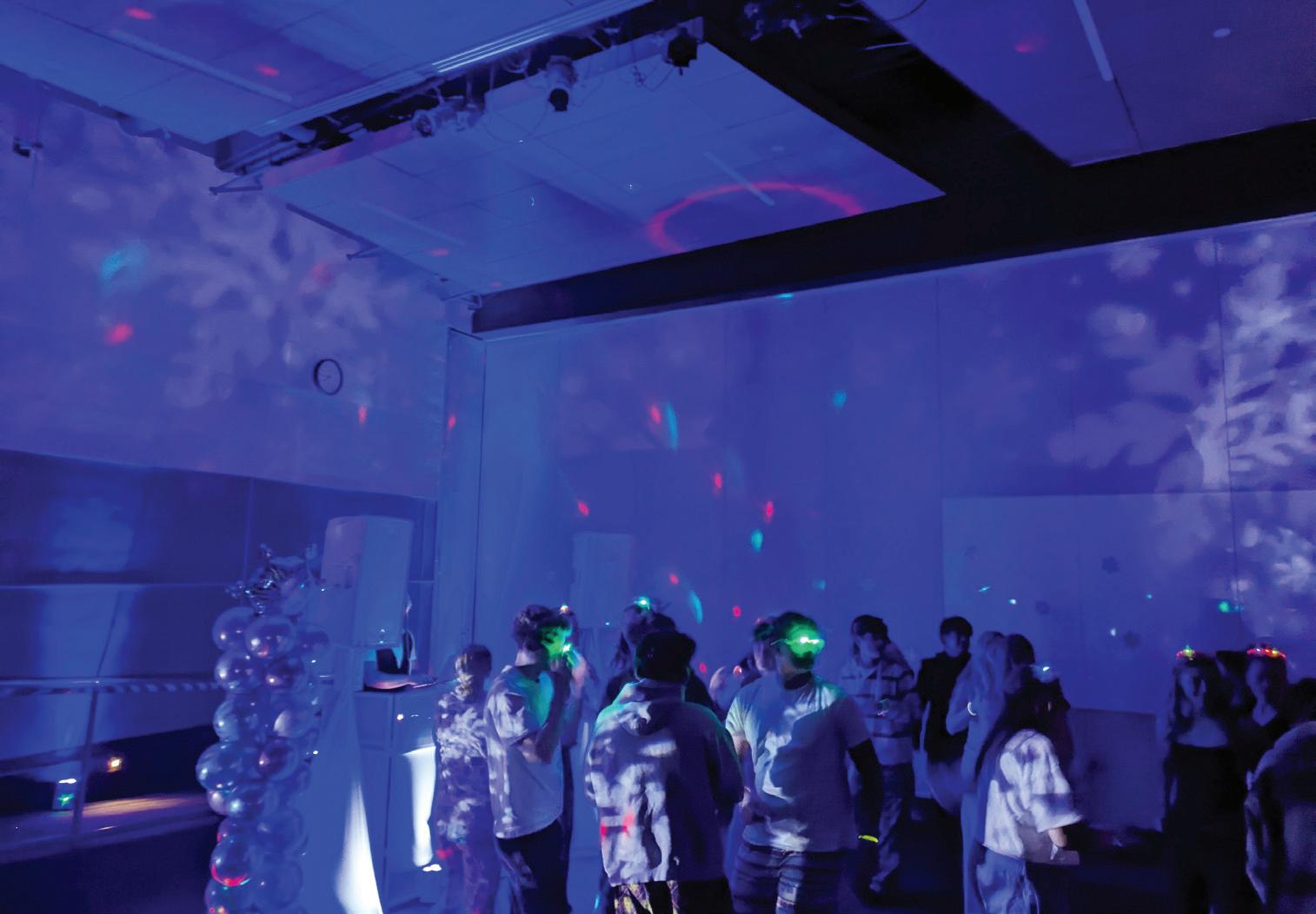
Basalt High School held its Snowcoming dance a week ahead of Valentine's Day.