


 By James Steindler
Contributing Editor
By James Steindler
Contributing Editor


As of April 3, after two decades of sweat and tears, the Thompson Divide was guaranteed protection from future mineral leasing — well, at least for the next 20 years.


Teamwork makes the dream work
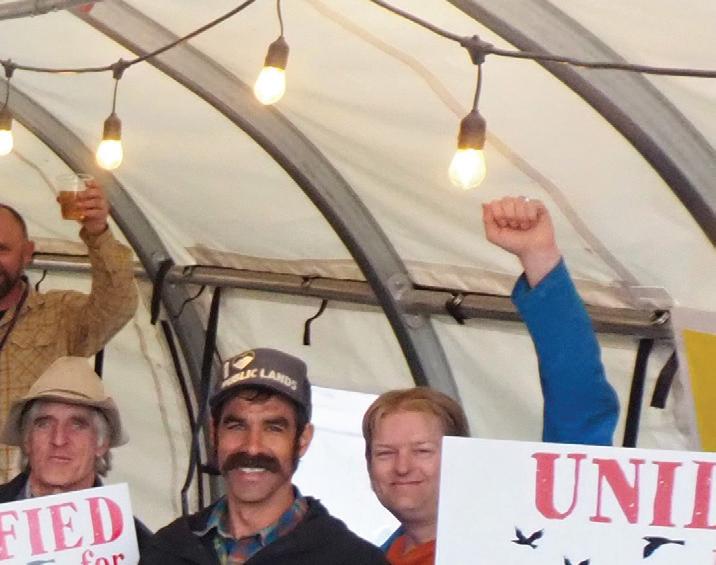
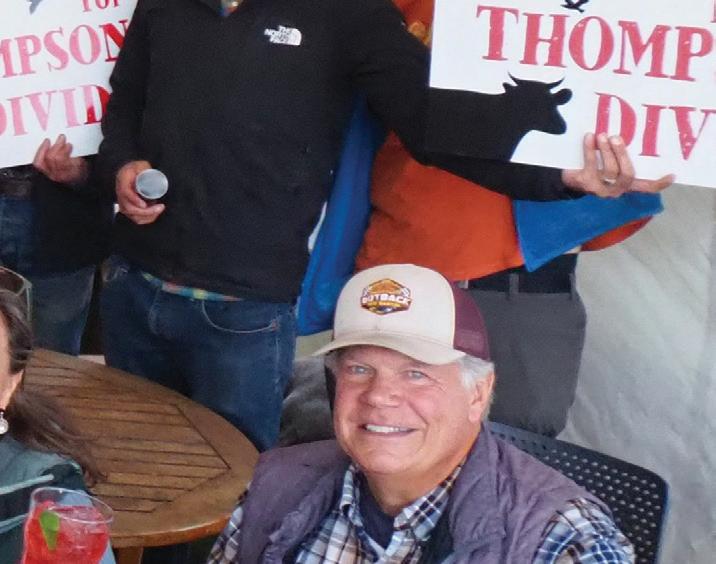

Part of the expansive community that's been at the heart of the effort to protect the Thompson Divide celebrated the 20-year administrative mineral withdrawal at Carbondale Beer Works on April 5.
“The Biden-Harris administration today [April 3] took action to finalize protections for the Thompson Divide area in central Colorado, one of the state’s most cherished landscapes, known for its ranching heritage and grazing lands, important wildlife habitat, recreation opportunities and clean water,” read a press release from the U.S. Department of the Interior.
“Federal law provides the Secretary of the Interior authority to administratively withdraw lands from mining and oil and gas leasing for a period of up to 20 years,” a press release from Wilderness Workshop (WW) clarified. That is exactly what the department did in the case of the Thompson Divide.
Peter Hart, an attorney with WW since 2007, recalled the formative days of the Thompson Divide Coalition which grew from a myriad of folks from different walks of life.
In the late 1990s, WW was conducting inventories of local public lands to better engage in an ongoing revision of the Forest Plan. Through that process, Sloan Shoemaker, WW's first full-time employee, and others began to really understand the ecological value of the Thompson Divide.
"It was this big swath of mid-elevation forest land with large chunks that hadn’t been torn up or fragmented by roads,” said Hart. "That is an increasingly rare combination in this state."
In 2002, after the Forest Service instituted its new Forest Plan and former President George W. Bush was elected, there was a “leasing frenzy,” according to Hart, including the Bush administration selling “a bunch of oil and gas leases up in the Thompson Divide.”
“Those oil and gas leases captured the attention of the local community as well,” said Hart. “People more broadly than just WW began to understand the threat posed to this landscape … and the local people’s way of life.”
“I think the most telling thing … is how unified the broader community was behind this issue,” he continued. “When the Thompson Divide Coalition began it was a coalition of strange bedfellows.” Public lands advocates, water advocates, ranchers, snowmobilers, hunters and fishers, Republicans and Democrats, along with other interest groups continue to make up the Thompson Divide Coalition.
Their efforts have been steady and have resulted in milestones of success over the years. Hart pointed out that there used to be a lot more leases (roughly 80) in the Thompson Divide than there are today.
“There has not been a lease sale for any acreage in the Thompson Divide since 2007,” he stated. Those most recent leases were purchased by Gunnison Energy in the Upper North Fork and Clear Creek area.
There are still about nine exploratory oil and gas leases within the administrative withdrawal boundary. However, most of these leases only partially overlap the boundary with large portions outside of it.
There are another 11 storage leases associated with the Wolf Creek Storage Field. The storage leases are a result of drilling in the 1970s and wells that eventually dried up. Today, the Wolf Creek facility stores natural gas produced further west in the Piceance Basin. The gas is stored through the summer and distributed in the winter to help heat people’s homes in the Valley. The coalition has not contested the site because it’s already existing infrastructure.
Likewise, “The administrative withdrawal is subject to all valid existing rights,” clarified Hart. “That basically means that that storage facility won’t be impacted. Neither will the handful of leases that still exist. If an operator wants to come in and drill those exploratory leases and they’re valid existing rights, they have the right to do that.” He added that there is some controversy as to whether or not all of the existing leases are valid.
Your nonprofit community newspaper Volume 16, Number 9 | April 11 - April 17, 2024 This Week: 5 ~ Spring Valley 9 ~ Health 10-11 ~ Calendar 13-16 ~ Español 19 ~ Eclipse!
continues on page 18
Photo by Raleigh Burleigh
'Theater Magic' OPINIÓN





VOICES Radio Hour
By Gabrielle Bailes
Gabrielle Bailes is a theater artist from Louisiana and has lived in the Roaring Fork Valley for eight years. She has performed and designed with TRTC and VOICES. Gabrielle holds a Bachelor of Arts in Theater from Marietta College and is a Board Member of VOICES. She is a big believer in the arts.
When I was in my first year of studying theater at Marietta College, my classmates and I went to see a production of “Seven Guitars” by August Wilson at Carnegie Mellon University. By that time, I hadn’t seen many live productions at all — in fact, I could have counted them all on one hand.
I loved Wilson’s “Fences,” which I had seen a filmed version of, so I was especially thrilled to be seeing another of his plays, but live. We sat relatively close to the stage, maybe seven to 10 rows back. Our professors tried to use the opportunity to teach the greener
LETTERS
Correction: Last week’s feature about Mountain Valley Developmental Services mistakenly dropped the “al” from that nonprofit’s name.
Re: USFS
I hope the octagonal porthole window above the west entrance got saved and given to Carbondale as an historical remembrance to be displayed in the town center, but it likely wasn't. What a shame.
Nancy Morey, Glenwood Springs
Red flags
As a publicly funded institution, Colorado Mountain College (CMC) deserves scrutiny and oversight, and the recent announcements regarding the presidential search have raised more than a few red flags.
The position of CMC president is a massive undertaking — with a budget in the millions, 11 campuses, and around 2,000 employees. A significant amount of time and energy should be devoted to bringing a leader into this role that not only has experience in a similar role, but can bring an innovative lens to an institution that is critical to our mountain communities. An internal “search” of less than two weeks seems hardly enough time to adequately identify people that have the skills and qualifications to take on such a role. Additionally, soliciting public feedback at the same time as said “search” is nonsensical if the public’s opinion is actually
students about theater etiquette.
I remember looking around the theater trying to see if I could tell what kind of lights were being used, which ones were on and what colors there were. I tried to note as many details about the set as possible before the show even started. I remember the costumes vividly and loved the colors. I was particularly impressed with the skill of each actor.
While I do tend to study sets before the opening line, I also love going into plays blind. I love it when every moment is a surprise.
My mother gets frustrated when we watch movies together, because I can generally guess how it will go and can’t help but spoil it. Fortunately, live theater tends to surprise audiences a lot more often.
There are so many beautiful moments that happen. And with a trained eye one can detect production choices, from the way a character moves to how quiet or loud they are to the textures of clothing and set pieces.
I don’t know if it’s simply from sharing a physical space, whether all audience members’ heartbeats sync up or if it’s a chemical romance that permeates the air, but some moments stay with the audience.
What really took me aback during Wilson’s show, and inspired a feeling within me that remains to this day, was the climactic moment when there was a confrontation. The audience could tell that something physical was going to happen. I expected that for the major blow there would be a blackout and that the audience
going to be taken into consideration.
The search process for the next CMC president should not just be internal. As a former CMC employee, much work needs to be done in building a healthy work environment, which many staff are afraid to speak up about for fear of retaliation. Internal hires are known to perpetuate unhealthy work environments and will keep CMC in a place of “same old, same old” rather than innovating in the ways that need to be done to meet the changing needs of our communities, campuses, and landscape of higher education.
We have an obligation to taxpayers across the mountain region and an opportunity to recruit great candidates through a nationwide search that can bring innovation and a breath of fresh air to CMC.
Jess Hedden, New Castle
Rhea concedes
Thank you to everyone who voted in the trustee election, and (wink) especially those who voted for me.
I did not win, but those who did need our continued support.
I’m still in the game, working on clean energy for Carbondale (Fred Porter and I have persuaded the Forest Service to use electric heat pumps in the new building), pushing Town priorities for our delightful new aquatics facility (again, all electric), helping Age-Friendly Carbondale bring inclusive accessibility to all Town facilities and new projects, and supporting the arts,
wouldn’t actually see any violence. But alas, the moment was as colorful as the rest of the play, leaving little up for interpretation, for the audience could plainly see the swing, the impact and a spurt of blood that soared through the air. Then came the blackout.
When I saw the way the actor moved his body and the blood shooting in the air, I was stunned. It felt so real. I inhaled and held it in as I pushed myself all the way back against my chair. I stayed like that for about a full minute; I could not breathe. I was frozen in awe: In awe of the performance, in awe of the technical skill and in awe of how all of that came together to convey a formidable and impactful story.
I’m usually a crier at shows or movies. I can reach an emotional place easily. This one though, this was different. I think there was something extra that happened because of that moment. I would not have felt that way watching a film. And I love films! It’s just that we’ve all seen violence and drama on screen that’s far more intense. But when it’s real people in front of you, there’s that extra something that leaves a deeper and longer lasting impression. That’s theater magic.
“Women’s VOICES: Theater Magic” from VOICES Radio Hour will air on KDNK on Friday, April 12 from 6 to 7pm. You can listen to past episodes of VOICES Radio Hour at www.voicesrfv.org/voicesradio-hour To buy tickets to the 2024 Women's VOICES Theater Project, visit www.voicesrfv.org
music, festivals, and plants of Carbondale. I love it here!
I know many of you care strongly about how Carbondale moves forward. You can make a significant difference by serving on one of our many commissions. In a small town, an individual can make a big impact. Please find the time and passion to put yourself in there, helping direct the changes that will happen. Go to the following link and see how you can plug in: www.bit.ly/CdaleGov
Be well my friends, and take care of each other. See ya on the trails —
Susan Rhea, Carbondale
Words matter
I just noticed that our humble grassroots nonprofit newspaper has four proofreaders listed on the masthead! As a former English major, I can’t tell you how happy that makes me. Meanwhile, the corporate chain newspaper just down the road has constant, sometimes very embarrassing, grammatical and spelling mistakes, often even in the headlines on the front page! Gotta love that nonprofit model. Just sayin’. By the way, I really loved the chocolate chip cookie reviews a couple weeks ago. I’ll have to check those out. Does anybody remember the chocolate chip cookies the monks at the Snowmass Monastery used to make? They were a little bigger than bitesized and only cost a buck. Back in the ‘80s you could only get them at Local’s Corner in
continued on page 26

Editor Raleigh Burleigh 970-510-3003 news@soprissun.com Contributing & Digital Editor James Steindler Sol del Valle Editora Bianca Godina bianca@soprissun.com Editorial Designer Hattie Rensberry Advertising Designer Emily Blong Delivery Frederic Kischbaum Hank van Berlo Bartlett Proofreaders Lee Beck Tracy Kallassy Ken Pletcher Hank van Berlo Executive Director Todd Chamberlin 970-510-0246 adsales@soprissun.com Board Members / Mesa Directiva board@soprissun.com Klaus Kocher • Kay Clarke Lee Beck • Donna Dayton Eric Smith • Roger Berliner Elizabeth Phillips • Jessi Rochel Andrew Travers • Anna Huntington The Sopris Sun Board meets at 6:30 p.m. on second Thursdays at the Third Street Center. The Sopris Sun, Inc. is a 501(c)(3) nonprofit corporation with a mission to inform, inspire and build community by fostering diverse and independent journalism. Donations are fully tax deductible. Sincerest thanks to our Honorary Publishers for their annual commitment of $1,000+ Lee Beck & John Stickney Kay Brunnier Frances Dudley Michelle & Ed Buchman Sue Edelstein & Bill Spence Deborah & Shane Evans Greg & Kathy Feinsinger Gary & Jill Knaus Eric Smith Peter and Mike Gilbert Patti
& George Stranahan
Elizabeth Wysong
Alpine Bank
Emily & George Bohmfalk
Kathy & Carter Barger
Sandy & Paul Chamberlin
Karen & Roger Berliner
&
Donna & Ken Riley Gayle
Dick Wells
wishes.
Lilly
by mail or online: P.O. Box 399 Carbondale, CO 81623 520 S. Third Street #26-B 970-510-3003 soprissun.com/Donate
Sopris Sun, Inc. is a proud member of the Carbondale Creative District 2 • THE SOPRIS SUN • soprissun.com • April 11 - April 17, 2024
Legacy Givers for including us in their final
Mary
Donate
The
Our Underwriters and Nonprofit Partners!


RJ Paddywacks
Cool Bricks Studio
White River Books
Alpine Animal Hospital
Aspen Valley Hospital
Mid-Valley Storage
Colorado Mountain College
Hillary Porterfield
Jaime Maybon
All Creatures Veterinary Care
Carbondale Rotary
Nonprofit Partners
Basalt Library
Colorado Animal Rescue
Carbondale Arts
Interested in becoming an Underwriter or Nonprofit Partner in 2024? Email Todd@soprissun.com or call 970-987-9866
SCUTTLEBUTT
Healthy cooking
Laura Van Deusen will offer healthy cooking classes in Carbondale on Saturdays, April 13 and 20 and May 4. The bilingual curriculum is based on the 21-Day Vegan Kickstart program designed to help reduce cholesterol, control diabetes and lower blood pressure. For more information visit www.bit.ly/cdalecooking or contact rootboundcooking@gmail.com
I-70 delays
Motorists should anticipate traffic delays on westbound I-70, Monday through Friday, from April 15 to April 26 in the Glenwood Canyon. Crews will reconstruct rockfall protection near Mile Point 123, the Shoshone Power Plant exit. Eastbound traffic will not be affected.
Glenwood accident
A car accident in Glenwood Springs on April 5 left two drivers hospitalized. Kat Gruetzner was hit head-on by a Jeep speeding in the wrong lane at Grand Avenue and 15th Street. She is in stable condition, though hospitalized in Denver. A GoFundMe page has been established to help cover her medical expenses. Find it at www.bit.ly/4aNRbB7
Rifle homicide
On April 2, four people were charged in connection with the death of Raul Perez, whose remains were found near Fravert Reservoir off of County Road 244 on Dec. 26, 2023. According to a Garfield County Sheriff’s Department press release, Garfield County Search and Rescue was looking for the body of a missing person when they found remains that were later identified as Perez. Information obtained from the Garfield County coroner indicated that the body had been left there since mid-summer. The investigation then continued as a homicide. Suspects
Angel Luis Cosme-Marquez and Manuela Zapata-Castillo are currently in the Mesa County Detention Facility. Suspects Phillip Allen Johnson and Joseph Patrick Moffat are housed in the Garfield County jail. Charges range from murder in the first degree, conspiracy to commit murder in the first degree,
Library Lovers’ Party
We are grateful to you, our patrons and friends, who support our programs and collections. What better way to say thank you than to open the doors and celebrate together!
The
in 2013 and continues today thanks to The Center for Human Flourishing, Carbondale Parks and Rec and Carbondale Arts.
tampering with a deceased human body to distribution of a controlled substance (fentanyl), tampering with physical evidence and more.
Wolf depredation
Colorado Parks and Wildlife (CPW) confirmed a wolf depredation case in Jackson County. A dead calf was discovered with injuries consistent with a wolf attack, including a partially consumed hindquarter. Wolf tracks were found nearby. This is the second CPW confirmed wolf depredation instance in the state within a week. A similar investigation came to the same conclusion on April 2 in Grand County. For more information, including a map that monitors areas where collared wolves have been active, visit www. tinyurl.com/COWolves
APR props!
On April 6, during the Colorado Broadcasters Association’s annual Awards of Excellence Gala, Aspen Public Radio (APR) was awarded four awards of excellence (first place equivalent) and four certificates of merit (second place) for the organization’s 2023 broadcast reporting. “This team of reporters is so passionate about their craft and

work hard to produce stories that are important to our community,” said APR news director Kelsey Brunner.
LEAP
April 30 is the last day to apply for Colorado’s Low-income Energy Assistance Program (LEAP). LEAP helps eligible individuals and families pay a portion of winter home heating costs by making a one-time payment directly to the utility company on their behalf. This year, households can receive between $200 and $1,000 in energy assistance. To learn more, visit cdhs.colorado.gov/leap
They say it’s your birthday! Folks celebrating another trip around the sun this week include: Krys Greenwood and Iris Nott (April 11); Brandon McDuffey and Susan Shirley (April 12); Diane Kenney, Nicole Levesque, Brad Moore, Jane Munsell, Vicki Peterson and Bill Shepherd (April 13); James Armstrong, Ed Brown, Dino Baldizan, Mark Giesecke and Roberta McGowan (April 14); Aisha Weinhold, Deloras Pulver and KDNK (April 15); Rachel Connor, Ylice Golden and Emma Rose (April 16); Monica Groom, HP Hansen and Doug Stewart (April 17).

What's the word on the street? Let us know at news@soprissun.com
14 Midland Avenue | Basalt Colorado 81621 | 970.927.4311 | basaltlibrary.org
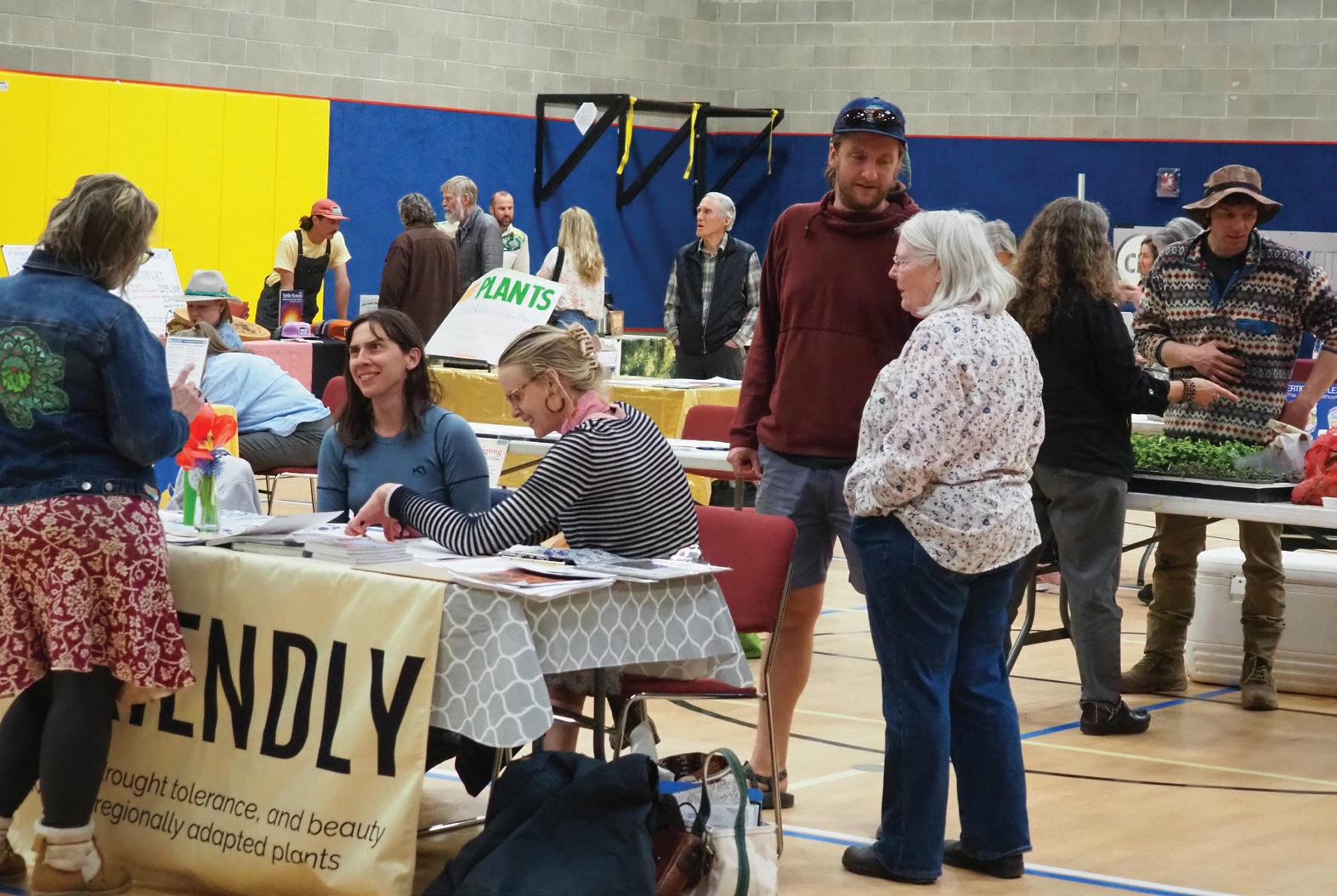
Carbondale Rec Center gym abounded with wellness on First Friday, April 5. Over 50 businesses and nonprofits hosted booths showcasing their unique offerings for healthy living. The “Spring into Wellness” First Friday tradition began
Photo by Raleigh Burleigh
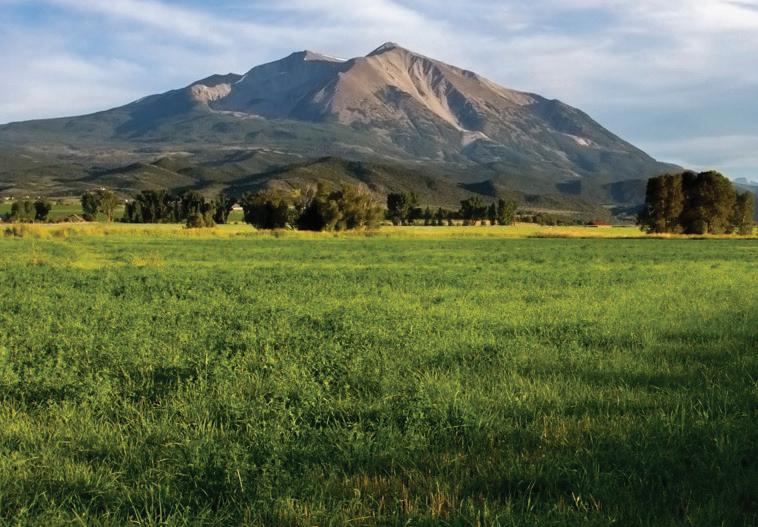
FOOD | DRINKS | MUSIC | ACTIVITIES | AND MORE! FRI, APR. 19, 6-8PM ORDER ONLINE WWW.NIESLANIKBEEF.COM Locally Sourced Colorado Grown No Hormones No Antibiotics THE SOPRIS SUN • Your weekly community connector • April 11 - April 17, 2024 • 3
Digital SATs: No more pencils as RFSD testing goes online
By Jeanne Souldern Sopris Sun Correspondent
Gone are the days of filling in multiple-choice answer bubbles using freshly sharpened #2 pencils. Students across the United States will welcome the digital age as they take the Scholastic Assessment Test (SAT) online.
Roaring Fork School District (RFSD) SAT testing day for Basalt and Glenwood Springs High Schools is April 16 and for Bridges and Roaring Fork High Schools is April 17. Students unable to attend their testing session can do makeup testing on April 26.
The College Board, which conducts SAT testing, states the exam evaluates students' problemsolving abilities and measures literacy, numeracy and writing skills needed for college success.
The Sopris Sun recently spoke with Cammie Newmyer, RFSD director of data and assessment, about transitioning to the digital test-taking format.
Newmyer explained that the Bluebook testing platform is already downloaded on district-issued laptops. Students who want to take the SAT on their personal laptops must have the app downloaded

before arriving for testing.
Students who have taken Advanced Placement (AP) examinations offered by the College Board have already used Bluebooks, a digital testing platform, Newmyer shared.
“Last fall, we took the PSAT [Preliminary SAT] National Merit student qualifying tests digitally and there was a bit of a learning curve. But the technology was able to handle it, and the students did well as far as interacting with the test,” Newmyer said.
“Basically, it's the same



environment as what they did for the written test,” she said. That includes trained proctors — certified RFSD teachers who have completed special training — monitoring the testing environment.
"Cell phones and tablets are prohibited during testing, except for students with medical needs, such as glucose monitoring," Newmyer explained. Each student is assigned a unique ticket number and may only have pencils and district-provided scratch paper on their desk.





A few benefits of the digital test are:
• The digital SAT assessments are shorter, lasting 2 hours and 14 minutes compared to the previous 3-hour paper tests.
• Test-takers have more time per question, emphasizing skills over speed.
• Scores will be available faster — within days.
• Additionally, digital score reports will provide information on local two-year colleges, workforce training programs and career options.
• Going digital enhances test security by providing each student with a unique test form, minimizing the risk of answer sharing.
The digital SAT uses a Multistage Adaptive Testing (MST) methodology, which tailors the difficulty of questions based on a testtaker's performance. The test starts with questions of moderate difficulty to gauge the test-taker's ability. Based on responses, subsequent questions adjust in difficulty with correct answers eliciting harder


questions and incorrect answers prompting easier questions.
The final SAT score reflects the test-taker’s performance across all difficulty levels, allowing for a more precise evaluation of their ability compared to conventional tests.
Students with special needs will take an alternative assessment, Newmyer shared, or, for example, support for students with disabilities might include taking a break between testing sections or scheduling testing over two sessions.
“We will test our internet capacity because we will have other digital testing in the elementary schools at the same time as SAT testing,” she said. Tech support will be on-site at each school and the test platform will cache data should there be internet connectivity issues.
Newmyer underscored the importance of testing data in monitoring a student’s academic growth from year to year.
“We use growth and achievement data to see where our strengths are and help guide us to know where we need to work. It’s important to see how our programs are functioning. If we get good data from a broad spectrum of students, we get a better picture and can narrow that down. Once we get data, we can target. A good baseline is a great place to start,” Newmyer concluded.















4 • THE SOPRIS SUN • soprissun.com • April 11 - April 17, 2024
Art by Sofie Koski
Spring Valley Ranch: From sagebrush to second homes
By Amy Hadden Marsh Sopris Sun Correspondent
Like some of the wide open spaces and prime elk winter range in and around the Roaring Fork Valley, the 5,909-acre Spring Valley Ranch, east of Highway 82 between Glenwood Springs and Carbondale, is on the chopping block. Georgia-based Storied Development LLC’s revision of an existing Planned Unit Development (PUD) is under review by the Garfield County Planning Department and the land is under contract.
At the first of four meetings this week for Spring Valley residents, Storied Development (SD) representatives spelled out the Spring Valley Ranch PUD amendment with poster boards, hand-outs and a presentation followed by a Q&A session. Tuesday morning’s meeting drew about 20 locals.
SD bills itself as a “high-end private residential community developer” with a portfolio of work in Canada, the Caribbean, the continental U.S. and Hawaii. Each exclusive community comes with amenities such as golf courses, swimming pools, a club house, tennis courts, a wellness center and, depending on the location, private skiing.
The Spring Valley Ranch project proposes all of the above plus 577 homes, public trails, a general store at the intersection of County Roads 114 and 115, and a wildlife habitat reserve. “Eighty-six percent of the homes will be second homes,” said Kathleen Wanatowicz, project outreach coordinator.
The plan also proposes 75 deed-restricted housing units, a fire station serving Spring Valley, a wildfire mitigation plan, a 2% real estate transfer fee, and road improvements, including an upgrade of the intersection of County Road 114 (CMC turn-off ) and Highway 82.
“We're going to do the infrastructure. We will build the amenities. We don't build houses,” said Jeff Butterworth, SD development president, at Tuesday’s meeting. SD said it hopes to attract local contractors to the project.
Local concerns
According to SD, the project provides many benefits. The PUD amendment consolidates the land plan, reduces average lot size and doubles dedicated open space to 55% of the total property, including 700 acres of public open space and 15-20 miles of hiking and biking trails. Elk and deer get 1,100 acres of a habitat reserve. SD will build the fire station to serve Spring Valley since the area is not under the jurisdiction of local fire departments. The proposed general store could reduce trips to Carbondale or Glenwood Springs for groceries and other necessities.
Wanatowicz told The Sopris Sun that the project is significant for Garfield County. “It's going to create a transfer fee with all the real estate property,” she explained. “That fee [will] go into a
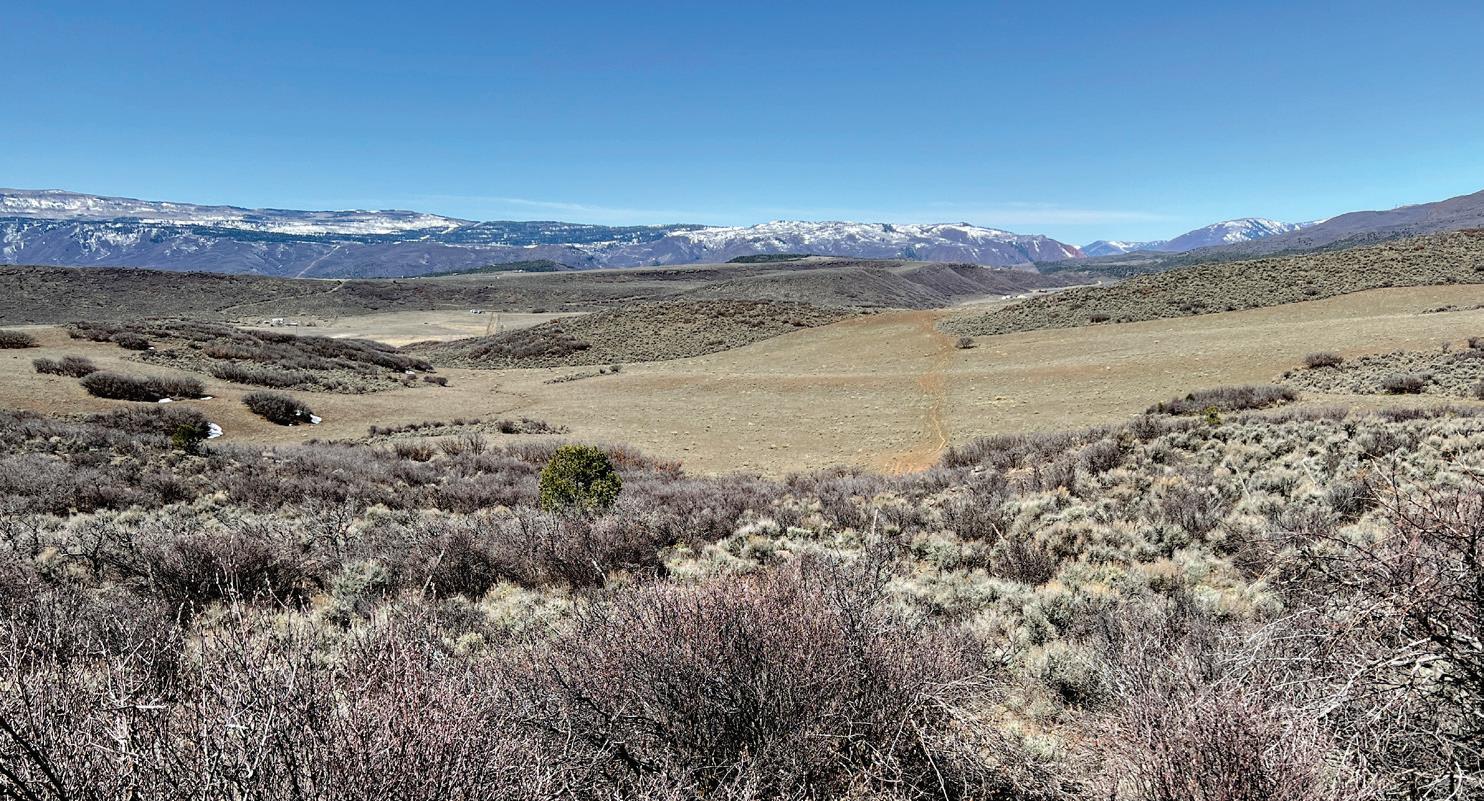
West of CR114/CR115 intersection, this area is approximately where the workforce housing neighborhood will be located, within the 160-acre “bowl” shaped landform. The area beyond this on the valley floor is one of the designated wildlife habitat reserves, and portions of that valley floor area will continue to be used for agricultural pasture and hay production. Photo by Amy Hadden Marsh
community foundation, which will then create about a million dollars each year to go back out into the community.” She added that building the project will create jobs. “One of the initiatives from the Colorado River Valley Economic Group is to keep jobs closer to home,” she said. “This is an opportunity for our construction workers.”
But Mary Beth Minion, who organized the Spring Valley Coalition, disagrees. “We’re not trying to stand on a soap box,” she explained, “but putting 27 holes of golf and a ski area, sports courts, a restaurant, overnight facilities and a whole commercial zone — it’s not consistent with the sage and juniper and pinon forest or the higher up elevations.”
Wanatowicz clarified that there are no plans for retail, big box stores or an all-night convenience store. Overnight facilities will be a few rooms for prospective buyers.
The citizens group is also looking at the project’s water supply and demand, disruption of critical wildlife habitat and migration corridors, light pollution, traffic and how the PUD could exacerbate the existing housing shortage with its target market of second-home owners.
PUD water basics
The Spring Valley Ranch PUD will have its own water system that comes from senior water rights from Landis Creek and Hopkins Reservoir plus supplemental water rights from the Spring Valley Aquifer. Well permits are also in place. According to SD, total water storage capacity is 68,000 to 105,000 acre feet, including the Spring Valley Aquifer and its upland tributary area.
continues on page 23




What is Wealth?
In this service, we will invite you to ponder the question: “What is Wealth?” To what do we ascribe the greatest value in our lives and our society? What does it mean to be truly wealthy? How does our definition of wealth shape our personal experience of life? How does our definition of wealth affect our communities and ecosystem , our politics and relationships? How does our definition vary between the different domains of life–the physical, the mental, the emotional, the spiritual? Come delight in the mystery as we explore these questions together.

On the second and third Sundays of each month, Aaron Brown will be speaking in-person at Third Street Center. Aaron Brown received his Master’s in Theological Studies from Iliff School of Theology. He develops coaching and leadership programs for a global consulting firm and has spoken intermittently over the last 12 years at TRUU. He is the father of two teenagers, one who recently started college, the other in 10th grade. He is delighted and honored to be joining the congregation this year as a guest speaker.
Aspen Valley Hospital Clinics Aspen HospitaValley l Aspen Valley Hospital Clinics Aspen HospitaValley l Aspen Valley Primary Care offers a full complement of services for adults, children and infants in two convenient locations near you. Aspen | Basalt Virtual visits available Exceptional care in your neighborhood 0401 Castle Creek Road, ASPEN | 1460 East Valley Road, Suite 103, BASALT 970.279.4111 | aspenhospital.org | AspenValleyHospital AS PE N VA LLE Y PR IMARY CARE AS PE N VALLE Y HOSPITAL ACCEPTING NEW PATIENTS 970.279.4111 Join Zoom Meeting - https://us06web.zoom.us/j/82605258305 Meeting ID: 826
- Passcode: chalice truu.org Sunday,
Room @ Third Street Center
0525 8305
April 14th, 10am at Two Rivers Unitarian Universalist Community
in Carbondale or via Zoom (scan QR code)
THE SOPRIS SUN • Your weekly community connector • April 11 - April 17, 2024 • 5
Roaring Fork rafters paddle for USA
By Will Buzzerd Sopris Sun Correspondent
This summer, two rafting teams from the Roaring Fork Valley will hit the whitewater of Bosnia to compete as Team USA for 2024’s World Rafting Championship (WRC). Local teams Riff Raft Racing and Rapid Fire Racing will compete with rafters from across the globe during the event, hosted by the International Rafting Federation (IRF) on the Vrbas (pronounced verb-ahss) River, from May 28 to June 2.
“We’re super stoked to be representing the U.S.” said Riff Raft captain Conrad Niven. “It’s a pretty wild thing and we’re hyped on it.”
Candidates for the WRC are selected during the U.S. Rafting Association National Championships, held in 2023 on the Arkansas River near Canon City. Riff Raft secured their spot to compete in Bosnia after taking first in the men’s open, and Rapid Fire took second to the Red Ladies in the women’s open.
After the Red Ladies decided on taking a little break and abstaining from the WRC, Rapid Fire was asked if they’d like to represent the United States in Bosnia.
“It happened very quickly, and
it was kind of a rally decision where we all came together and asked, ‘Hey, do we want to do this?’” explained Rapid Fire team captain Bean Hancock. “Everyone said ‘Absolutely, 100%! It sounds like a life-changing opportunity that we simply cannot pass up.’”
This is the first world championship for both teams and is the first time rafting in that part of the world for each of the paddlers. The race represents a big milestone for both of the newly formed teams.
While many of the teammates on Rapid Fire have been racing for several years, the team only formally came together less than a year ago. Similarly, Riff Raft has been an established racing team for just two years, but the crew has been informally boating together for around four. Many other teams around the world, on the other hand, have been boating together for decades.
Other international teams also have a leg up in terms of training conditions. While some countries have runnable whitewater flows yearround, Riff Raft and Rapid Fire have to do a good amount of their winter training in the gym or paddling in the Snowmass Rec Center’s pool.
However, both teams will have some time to warm up on actual
whitewater before the worldwide competition. They’re each heading to Nationals on the Clackamas River in Oregon, May 17-19. The teams will have a few practice days built into their schedule to familiarize themselves with the Vrbas’s best lines, and also to explore a new part of the world.
While the IRF organizes the event, it’s up to the rafters to cough up the dough for airfare and accommodations. Rapid Fire and Riff Raft have hosted some fun fundraising events in Snowmass and Aspen this spring, but are still on the lookout for partnership opportunities with local businesses.
“We’re really grateful to the community. We’ve got such a great community of whitewater people in the Valley, and everyone’s really stoked on it and psyched to help us out,” said Niven.
Rapid Fire is working with local schools to get female students on the river to learn about conservation, outdoor career paths and to show them that, though the sport is maledominated, the water is for everyone.
“Women are allowed to take up space in this community,” said Hancock. “And it’s a really wonderful thing when we do and we can achieve amazing and outstanding things — like representing your country in a world championship.”
Both teams are planning on throwing another fundraiser in June after returning from the WRC to celebrate the milestone, share about

a
their experience with some photos and footage and hopefully show off a few medals. Those event details are still to be determined.
For more information on Rift Raft, visit www.riffraftracing. com; as for Rapid Fire, visit www. rapidfireracing.squarespace.com





























6 • THE SOPRIS SUN • soprissun.com • April 11 - April 17, 2024
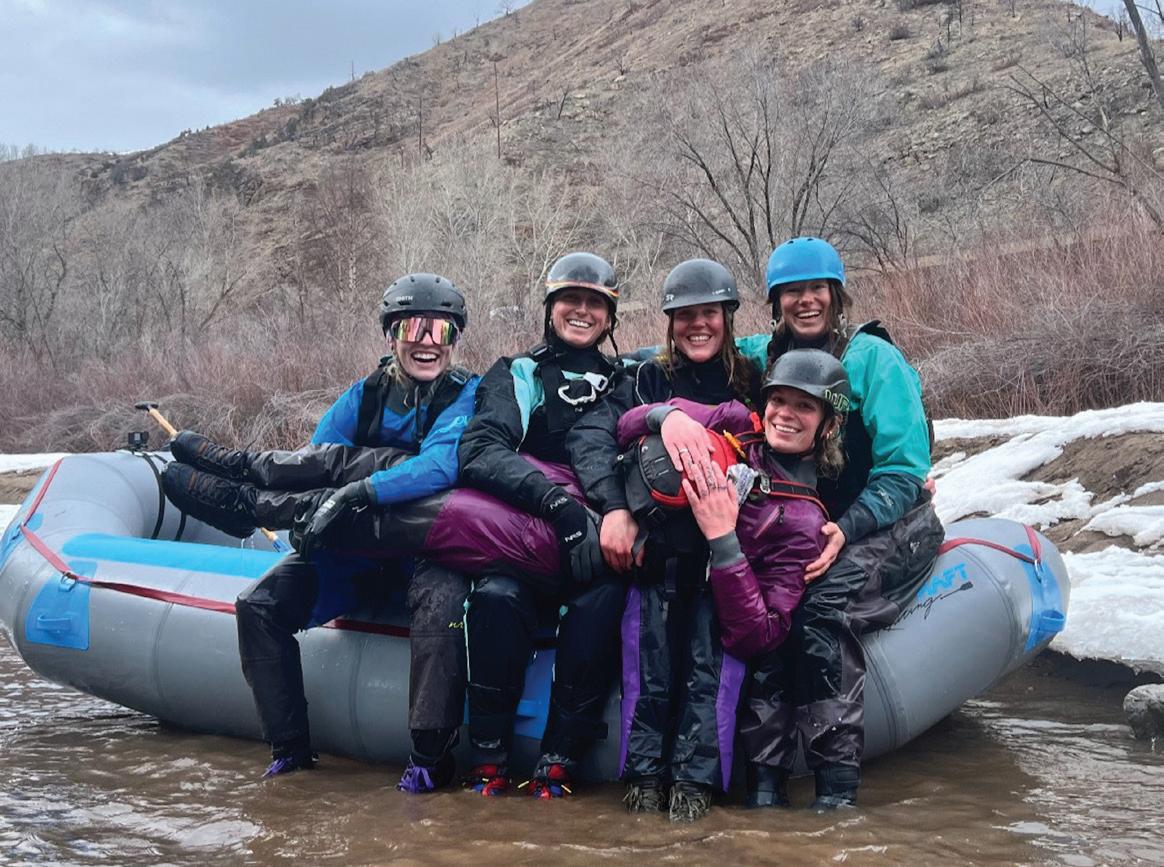
Team Rapid Fire is stoked to show the Valley and the world how women row. Courtesy photo
After
successful 2023 season, Riff Raft is ready to take it to the world stage. Courtesy photo
Carbondale’s Carrie Vickers inducted into Colorado Running Hall of Fame
By John Stroud Sopris Sun Correspondent
They became known as the “Steeple Chicks,” a self-branded title of a group of post-collegiate female runners who became the pioneers of the women’s steeplechase event in track and field back in the mid-2000s.
For her part, Carrie Messner-Vickers of Carbondale, a four-time All-American cross country and track athlete at the University of Colorado Boulder, would go on to take third place in the 3000-meter steeplechase at the 2004 Olympic trials at storied Hayward Field in Eugene, Oregon.
Though it was only an “exhibition” sport that year ahead of the 2004 Summer Games in the birthplace of the Olympics, Athens, Greece, the stage was set for women to compete at steeple.
The unique track event involves jumping over 28 barriers, each 30 inches high for the women (3 feet for the men) and seven water jumps on the track for a distance of 3000 meters.
Messner-Vickers made the finals in the inaugural women’s steeplechase at the 2005 World Championships in Helsinki, Finland, finishing 15th. The next year she would take ninth in the World Athletics final of the event.
And she would give it a go two years later at the Olympic trials, when the women’s steeplechase finally became an official event, for the 2008 Summer Games in Beijing, China. She didn’t qualify, but by then she had certainly made her mark in the sport.
In recognition of that contribution, Messner-Vickers was inducted into the

Colorado Running Hall of Fame on Tuesday, April 9 at the Denver Athletic Club.
“It’s exciting, and quite an honor,”
Messner-Vickers said from her home outside of Carbondale, where she and husband Matt are raising three daughters: Jen, 13, and 11-year-old twins Tillie and Ray.
Joining her for Tuesday’s induction were the likes of “Marathon Marvel” Edna Kiplagat of Longmont, who started racing as a junior-level athlete in 1996 and is still at the top of women’s elite racing; high school and college coach Del Hessel; and Dennis Giannangeli, a past owner of the Runner’s Roost running store franchise.
“The great thing is it’s not just recognizing what we did back then, but the major contributions to running we’ve made over the years,” Messner-Vickers said. “I retired from competing quite some time ago, but I’m still in the running world.”
Messner-Vickers started the cross country running program for both boys and girls at Ross Montessori School in Carbondale five years ago as part of the Access After School programs. The program has blossomed, and other middle school programs have since started up serving as feeders for the area high school cross country and track programs.
Professionally, Messner-Vickers has been a longtime pilates instructor at Studio 360 in Willits, and she performs with the Mt Cirque Entertainment aerial dance troupe and is an instructor and artistic director for the Sopris Soarers Aerial Academy for youth.
Look for her at the Cirque d’Sopris youth fashion and dance show happening this
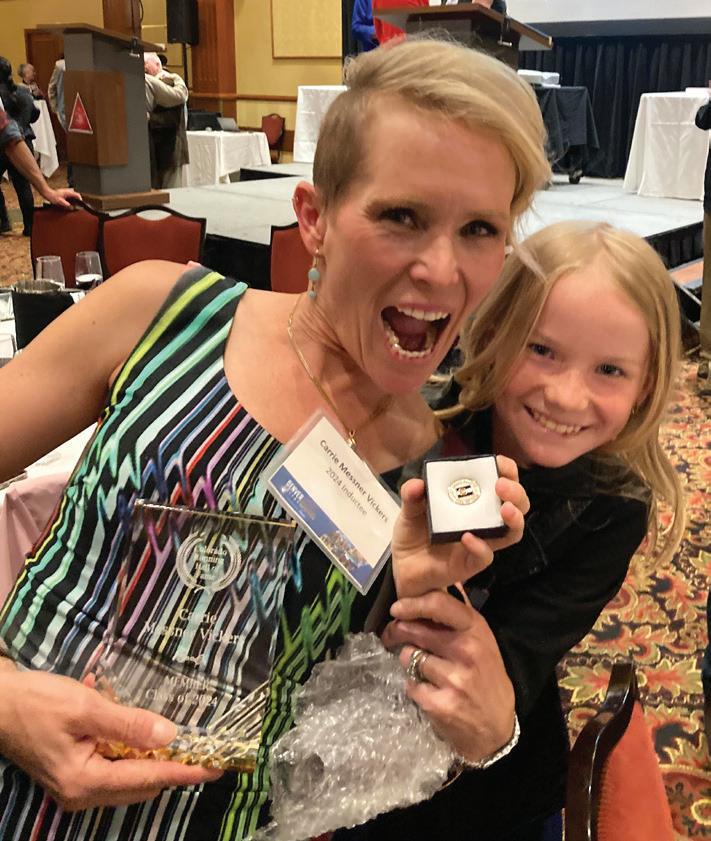
Carrie Messner-Vickers shows off her award at the Colorado Running Hall of Fame Induction Banquet with her daughter, Rae, on Tuesday night at the event hosted by the Denver Running Club. Courtesy photo.
Friday and Saturday, April 12-13, at Roaring Fork High School at 6pm both evenings.
Although she didn’t make the Olympics in 2008, Messner-Vickers said the “golden egg” of that summer was being able to pace Roaring Fork Valley native and former CU teammate Zeke Tiernan to second place in his first Leadville 100 ultramarathon. It was Tiernan who had introduced Carrie and Matt to each other before they got engaged at those same 2005 World Championships where Carrie ran the steeplechase, and then encouraged them to relocate to the Valley.

Messner-Vickers, now 46, was a cross country and track state champion for Mullen High School in Denver before going on to CU, where she specialized in the 1500 meters and the indoor 800 meters and mile. When injuries plagued her in those shorter events, she followed in the footsteps of CU alum Shayne Culpepper, an eventual Olympic 1500-meter runner who was one of the first women to start running the steeple.
“Shayne is someone I really looked up to,” Messner-Vickers told the Boulder Daily Camera’s Mike Sandrock in a recent article about her Running Hall of Fame induction. “She was one of the forerunners and was always a big support.”







LESS STRESS FOR YOUR PET WE MAKE HOUSE CALLS FROM ASPEN TO RIFLE Oneal Bogan DVM Lindsey Brooks DVM mountainpawsvet.com Ph. 970-309-2403 -wellness and geriatric care -lab work -health certificates -acupuncture, chiropractic and cold laser -end of life care
THE SOPRIS SUN • Your weekly community connector • April 11 - April 17, 2024 • 7
Messner-Vickers' "Wall of Fame" at her home in Cattle Creek, outside of Carbondale. Photo by Jane Bachrach
Strut for Mutts 5K brings animal lovers together for its 11th year
By Jessica Peterson Sopris Sun Correspondent
Ready, set, woof! On Saturday, April 20, Journey Home Animal Care Center will host its 11th Annual Strut for Mutts 5K fundraiser at Deerfield Park in Rifle. Executive Director Heather Grant wrote in an email to The Sopris Sun that such fundraising events are crucial to the shelter’s success.
“The past couple of years, our organization has had an increase in animals that need more extensive medical or behavioral care,” noted Grant. “We can provide this needed care because of wonderful donors and fundraisers.”
Grant relayed that the average cost of care for an animal is $400. All Strut for Mutts proceeds will go toward animal needs for food, vaccinations, medical care and daily enrichment.
In 2020, Journey Home saw the effects of budget cuts within Garfield County which specifically resulted in doing away with Animal Control. Grant described this as a huge step back for animal welfare in the county.
When it comes to addressing animals at large, that responsibility has been put in the hands of residents, Grant stated. “There isn't anyone in the county … trained in picking up animals running at large.”

By the same token, she added that thanks to funding from the board of county commissioners the shelter can continue to support the needs of lost and found animals in West Garfield.
According to Journey Home’s impact statement, in 2023, it: Reunited 279 stray animals with their families; maintained a 41% return-to-owner rate; vaccinated 1,672 community-owned animals; adopted out 1,071 animals; took in and cared for 1,370 animals; and spayed and neutered 1,178 pets.
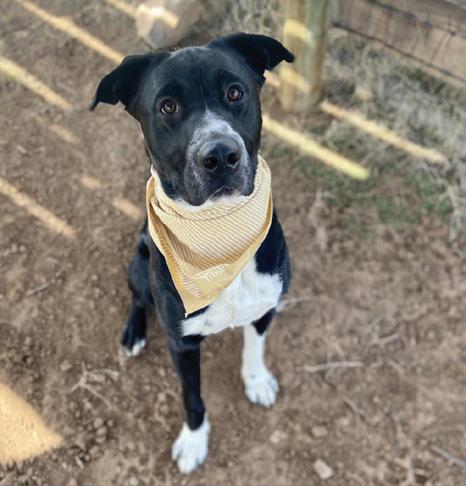
I'm Junior, the dog with boundless energy and a heart full of love for my human pals and furry playmates.” Courtesy photo
Ros Hatch is a volunteer at Journey Home and will be helping with race setup the day of the event. Hatch is in her third year of volunteering with the shelter and was on the “Penny’s Peeps” racing team a few years back (named after her family’s dog Penny). Penny passed from old age, and the group
will be racing again this year in her name.
Last year, Hatch said families showed up to the race along with one or two of their dogs. She also remembered a couple who brought their cat in a baby carriage.
Journey Home puts on multiple fundraising events, from the 5K to a comedy show and even a meal for community members where a classic Italian staple is served, known as the “Spayghetti and No Balls Dinner.” That last event raises funds specifically to support the affordable spaying and neutering services.
“I need to volunteer for the animals because they can’t help themselves,” Hatch stated.
Grant is on the same page as Hatch when it comes to showing up for animals. She wrote that the event is a great way to meld spending time outdoors with supporting temporarily homeless animals.
“It is awesome to see so many families out enjoying their four-legged family members and helping the shelter at the same time,” Grant shared.
All 5K participants will receive an event t-shirt as well as a swag bag on race day. Bringing along a dog (or cat) is encouraged but not required. After all, those who attend the race without an animal just might end up bringing one home. Grant confirmed there will be dogs eligible for adoption at the race.
One of those pups is named Junior — currently the shelter’s longest resident. Junior came to the shelter in July of 2023. He is a male mutt and just over two years old.
Registration for the Strut for Mutts 5K is currently open. Visit www.jhacc.org for registration and more information.

CLEAN-UP & RECYCLING

• Textile recycling (must be in bags for recycling)
• Mattress recycling ($20 per mattress)
Hazard waste, i
NO prescription drug drop-off at this event but it is scheduled for April 27 from 10-2p at the Carbondale Police Dept. SPRING



• General household trash (furniture/fencing, etc.)


• Metal recycling
• Wood recycling




every-other weekend through September This event is located at 4th & Colorado, 9a-noon. Town residents only.)
• Check, cash, debit/credit card accepted.







Town of Carbondale resident drop-off items for the vendors listed below are free (until the Town subsidy has been met)
Out-of-Town resident drop-off items for the vendors listed below are Not Free and applicable fees will be charged.
Blue Star Recyclers
• TV’s: Flat screen, CRT display and projector tv’s, cords and power supplies Cameras, recording equipment, radios, routers, hubs, tablets, keyboards, mice, copiers, printers, microwave, DVR/DVD/CD players ($0.65/lb)
• MEDIA: CD/DVD/tapes ($3/lb)
• ALKALINE BATTERIES & NON-RECHARGABLE ONLY (AA, AAA, C, D, 9V) NO other battery types are accepted due to transportation and fire issues.
• Refrigerator/freezer with freon ($40 per unit) • Air conditioning unit ($50/unit) All customers will be responsible for charges related to refrigerators and other freon items. JLM Tires:
• LIGHT BULBS: Fluorescent tubes ($0 25/ft), Incandescent, CFL, U-tubes, Halogen ($0.75/ea), LED straight tubes ($4.50 ea), HID and LED bulbs ($2.50 ea), UV lights ($5/ea)
http://www.bluestarrecyclers.org
• No charge for Town residents for the first 100 tires, up to 18” w/o rims.
• There is a limit of 8 tires per customer
• A fee of $8 per tire will be paid by customer after the limit. LOCATED IN THE PARKING LOT AT 4TH & COLORADO
• Crews will alternate lunches between noon and 1pm. Unloading may take additional time during this time-frame. Please plan accordingly.
• Proof of Town of Carbondale residency required for waiver of fees until the subsidy has been met for each vendor.
• The Town website and “Town of Carbondale, CO Public Works” Facebook page will have current updates.
8 • THE SOPRIS SUN • soprissun.com • April 11 - April 17, 2024
Entry Fees for Household Waste Drop-off at entry gate at 4th & Colorado: Proof of Town of Carbondale residency required for gate/recycling fees
Recycling Vendors: Household
Junior will be an honored guest at the Strut for Mutts 5K and is the longest current resident at Journey Home. He is still available for adoption. His bio reads, in part, “Woof,
Special
Waste and Mountain Waste: Mattress recycling ($20/mattress paid at entry gate) Refrigerator/freezer with freon - $40 per unit (paid at entry gate) Air conditioning unit - $50/unit (paid at entry gate) Town of Carbondale (resident) $10 Non-resident $30 Load with trailer (resident) $20 Non-resident $60 Mountain Waste:
LOCATED IN THE PARKING LOT BEHIND TOWN HALL Entry Fees per Load:
NOT
ACCEPTED
Yard waste and
will
be
this
waste and
2” or
in
be
the seasonal Yard Waste event that
on
e , oil, paint, cleaning fluids/canisters, car liquids, propane bottles
branches
NOT
accepted at
event. (Yard
branches
less
diameter will
accepted at
begins
April 20, 2024, and
EVENT LOCATED IN THE PARKING LOT AT 4TH & COLORADO
• ELECTRONIC WASTE: Computers, hard drives, cell phones.
te Drop-of h do: P APRIL 13th L , 8AM-2PM Entry Gate: 4th & Colorado in Carbondale
CEF leads fundraising campaign for Roaring Fork High School clinic
By Jeanne Souldern Sopris Sun Correspondent
The newly-established Carbondale Education Foundation (CEF), a nonprofit dedicated to education, aims to raise $40,000 to construct a new health clinic at Roaring Fork High School (RFHS). The upgraded facility, run by Mountain Family Health Centers, will provide children and adolescents year-round access to medical, dental and mental health services.
CEF funds will support Carbondale's public schools, which include RFHS, Crystal River Elementary, Carbondale Middle, Carbondale Community and Ross Montessori schools.
According to their website, CEF’s mission is “to raise funds in support of Carbondale's public education system for the betterment of our community.”
Inspired by nonprofit education foundations in Basalt and Glenwood Springs, CEF board president Jamie Nims believes that community support for Carbondale schools warrants the creation of a similar foundation. In late November, he and a few others met to discuss the concept.
“Parents from all our schools have been interested in finding a way to help education in Carbondale through an outlet that works with their schedules. Most everyone on the crew right now has day jobs, making it harder to be involved in dayto-day school stuff and volunteering,” he said.
As the head of school at Two Rivers Community School in Glenwood Springs, Nims, who has two daughters who attend Carbondale schools, faces challenges in being involved due to his work schedule. However, through CEF, he can support their schools in a way that accommodates his work schedule.
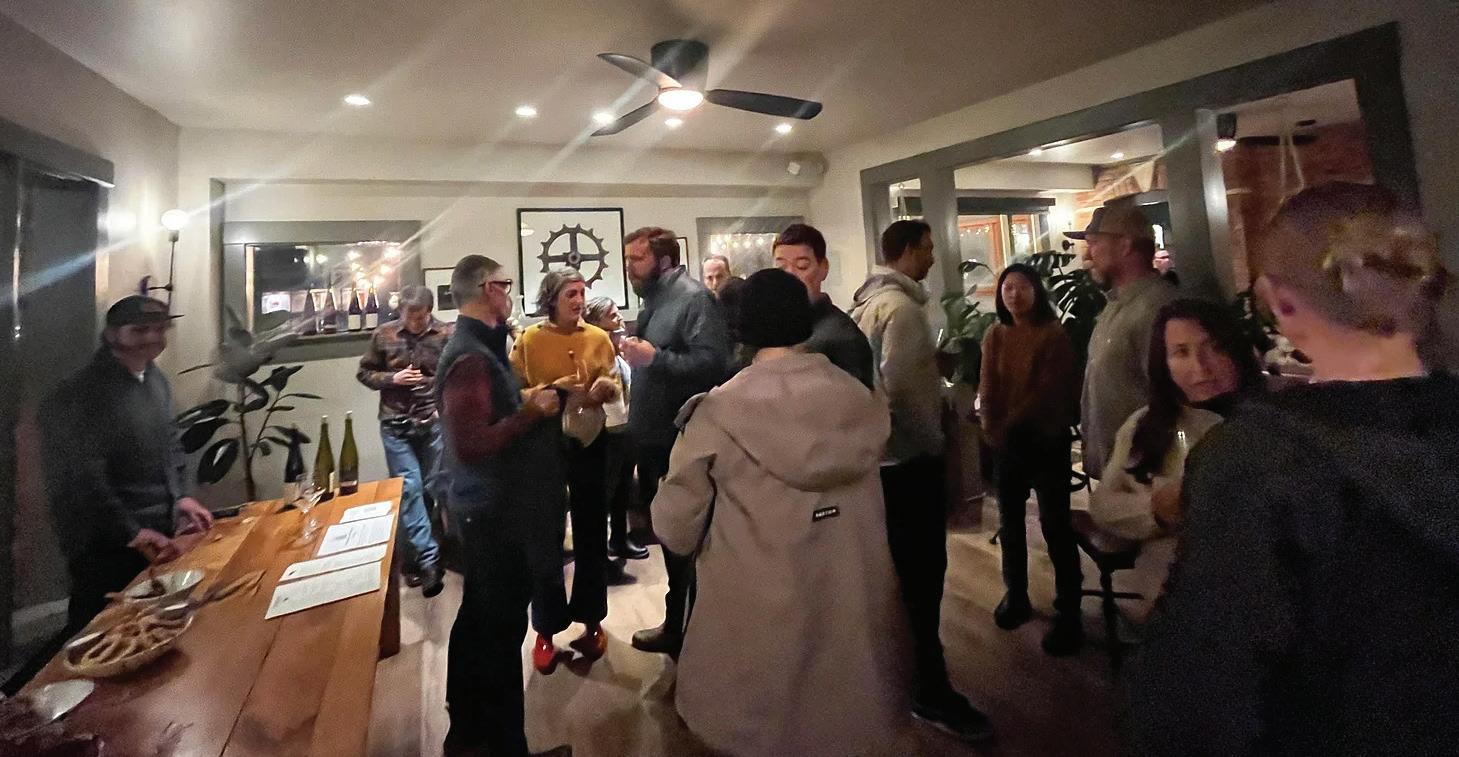
In February, during Carbondale’s First Friday, CEF held an event at the Painted Pig restaurant to announce its formation, share its mission with the community and discuss planned projects for 2024.
“We had a really good turnout, and it was a good chance for us to chat with people and for them to learn a bit about what we're doing,” Nims said.
You'll find CEF supporters at a booth during First Friday in May. "We aim to engage with community members and gather input from visitors to the booth," Nims explained. "Having a presence there will help spread awareness about our foundation."
Working Together For Pets And Their People 2801 CR 114 Glenwood Springs, (970)947-9173CO

RFHS clinic
CEF’s first initiative is to raise funds for a new school-based health center (SBHC) run by Mountain Family Health Centers, at RFHS. The existing health center at RFHS is limited in capacity compared to centers in Basalt and Glenwood Springs.
“As far as a unifying goal, it seemed like a good fit for us,” Nims explained. “We already have a target that's needed right here — the clinic — and all we have to do is jump in and get support to make it happen.”
He continued, “We are seeking to raise $40,000 and have a match campaign that is running live right now.” Two anonymous donors have offered dollar-for-dollar matches on donations, up to $25,000, received through June 1.
Nims believes that having conversations about public education is beneficial because it encourages community engagement and dialogue. He foresees opportunities to partner with the Glenwood Springs and Basalt foundations. “Together, we can brainstorm events or initiatives that showcase community support for the entire school district," he said.
“We hope to have as much impact on projects as possible. As we get further down the road, we'll have more opportunities to see where we can be helpful and learn more about what our schools really need.”
CEF is currently offering corporate sponsorships, beginning at $500, to anyone interested in having their logo featured on their website and marketing materials. Presently, the board convenes biweekly on Tuesday evenings in Carbondale. If you want to attend a board meeting or volunteer, contact nimsjam@gmail.com
For more information about CEF, visit www.carbondaleeducationfoundation.org







CARE has 9&dogs, 7 cats available for adoption.




























RJ PADDYWACKS offers a “C.A.R.E. package” for new adoptive including a “Paws for and a first time 15% discount for your new pet.









RJ PADDYWACKS offers a “C.A.R.E. package” for new adoptive families, including a “Paws for Points” plan and a first time 15% discount for your new pet. Kodi here, prepared to steal your heart! At just one year old, this fella has a life full of cuddles and adventure ahead of him. He enjoys other friendly dogs and might even be ok living with a cat!



May28-September17,2024




RJ Paddywacks

RJ Paddywacks

400 E Valley Rd. # I/J

Next in El Jebel 970.963.1700






Next to City Market in El Jebel 970.963.1700 rjpaddywacks.com







18WEEKSOFFARM-FRESHBOUQUETS
beautiful j local j long-lasting JOINOURFLOWERCSA
PickupabouqueteachTuesday
atSoprisLiquorinCarbondale




Signupnowtoreserveoneofourlimitedshares:

www.zephyrosfarmandgarden.com










 The Painted Pig hosted a small fundraising event in support of CEF. Guests learned more about the mission and funding initiatives while enjoying discounted wine tastings. Courtesy photo
THE SOPRIS SUN • Your weekly community connector • April 11 - April 17, 2024 • 9





LAW WEEK.
4/27 THROUGH 4/30 2024
4/27 THROUGH 4/30 2024
Glenwood Springs Community Concert Association’s
THURSDAY, APRIL 11
CODING CLUB
The Aspen Science Center teaches coding to teens at 3:45pm at the Carbondale Library.
BANNED BOOK CLUB
ART OPENING
A joint art opening for local mixedmedia artist Ashley Mosher’s exhibit, “Intimate Landscapes,” and a 5Point Adventure Film exhibit featuring works from Tre’lan Michael and Renan Öztürk begins at 5pm at the Launchpad.
CIRQUE D’SOPRIS
DEL 27
4/27 THROUGH 4/30 2024
DEL 27 AL 30 DE ABRIL DE 2024
AL 30 DE ABRIL DE 2024
A free, bilingual event for our community Un evento gratuito y bilingüe para nuestra comunidad
DEL 27 AL 30 DE ABRIL DE 2024
Basalt Library’s Banned Book Club discusses Stephen King’s “Carrie” from 5 to 6pm.
AW WEEK SEMANA DE DERECHO
RIVER STOP
LAW WEEK SEMANA DE DERECHO
SEMANA DE DERECHO

Semana del Derecho en Roaring Fork Valley
Cirque d’Sopris presents “The Little Prince” — a youth show of design, daring and dance — at Roaring Fork High School tonight and tomorrow at 6pm. Tickets at www.soltheatrecompany.org
DJ EXTRAVAGANZA
Semana del Derecho en Roaring Fork Valley

Semana del Derecho en Roaring Fork Valley
Join us for this informative event offering both in-person and virtual sessions in English and Spanish. Topics include family


Saturday, April 27 through Tuesday, April 30, 2024
Join us for this informative event offering both in-person and virtual sessions in English and Spanish. Topics include family law, immigration, employment law, civil rights, housing law, and elder law. Don't miss this opportunity to expand your knowledge of the law and empower yourself with essential legal information!
Saturday, April 27 through Tuesday, April 30, 2024
del Derecho en Roaring Fork Valley
Derecho en Roaring Fork Valley April 27 through Tuesday, April 30, 2024 sábado 27 de abril al martes 30 de abril de 2024 Law” presentations / Presentaciones “Conozca la ley”
Saturday, April 27 through Tuesday, April 30, 2024

4/27 THROUGH 4/30 2024
Del sábado 27 de abril al martes 30 de abril de 2024
Del sábado 27 de abril al martes 30 de abril de 2024


April 27 through Tuesday, April 30, 2024 sábado 27 de abril al martes 30 de abril de 2024

DEL 27 AL 30 DE ABRIL DE 2024
Del sábado 27 de abril al martes 30 de abril de 2024
“Know the Law” presentations / Presentaciones “Conozca la ley” Elder Law, Housing, Immigration, Employment Law, Civil Rights Derecho de la Tercera Edad, Vivienda, Inmigración,

Acompáñenos en este evento informativo que ofrece sesiones presenciales y virtuales en inglés y español. Los temas incluyen derecho de familia, inmigración, derecho laboral, derechos civiles, derecho de vivienda y derecho de las personas mayores. No se pierda esta oportunidad de ampliar su conocimiento de la ley y empoderarse con información legal esencial!
scan to register escanea para registrarte SEMANA DE DERECHO
Acompáñenos en este evento informativo que ofrece sesiones presenciales y virtuales en inglés y español. Los temas incluyen derecho de familia, inmigración, derecho laboral, derechos civiles, derecho de vivienda y derecho de las personas mayores. No se pierda esta oportunidad de ampliar su conocimiento de la ley y empoderarse con información legal esencial!
Acompáñenos en este evento informativo que ofrece sesiones presenciales y virtuales en inglés y español. Los temas incluyen derecho de familia, inmigración, derecho laboral, derechos civiles, derecho de vivienda y derecho de las personas mayores. No se pierda esta oportunidad de ampliar su conocimiento de la ley y empoderarse con información legal esencial!
The Middle Colorado Watershed Council holds the final of its 2024 speaker series events at the River Stop rest area in Rifle from 5:30 to 7:30pm. Jackie Corday, a water and land attorney, will present on low-tech stream restoration techniques together with Abby Burk, senior manager of the Audubon Society’s Western Rivers Program. To register, visit www. midcowatershed.org/events
“Know the Law” presentations / Presentaciones “Conozca la ley”
“Know the Law” presentations / Presentaciones “Conozca la ley”
BOUQUET IT
Watch KDNK staff members battle it out in 30-minute DJ sessions at Mountain Heart Brewing starting at 6pm. This KDNK membership drive event is presented by Music Gumbo Productions. Ten percent of beer sales will go to KDNK.
RECOVERY YOGA
presentations / Presentaciones “Conozca la ley” Housing, Immigration, Employment Law, Civil Rights Edad, Vivienda, Inmigración, Derecho Laboral, Derechos Civiles Location
Elder Law, Housing, Immigration, Employment Law, Civil Rights Derecho de la Tercera Edad, Vivienda, Inmigración, Derecho Laboral, Derechos Civiles
Elder Law, Housing, Immigration, Employment Law, Civil Rights Derecho de la Tercera Edad, Vivienda, Inmigración, Derecho Laboral, Derechos
to register by phone / para registrarse por teléfono: 970-945-8858 or visit / o visite: https://rflawweek2024.eventbrite.com/
Immigration / Inmigración 10am - 12pm
APRIL 27
Acompáñenos en este evento informativo que ofrece sesiones presenciales y virtuales en inglés y español. Los temas incluyen derecho de familia, inmigración, derecho laboral, derechos civiles, derecho de vivienda y derecho de las personas mayores. No se pierda esta oportunidad de ampliar su conocimiento de la ley y empoderarse con información legal esencial!
Immigration / Inmigración 10am - 12pm
27 DE ABRIL
Employment Law / Derecho Laboral Civil Rights / Derechos
Employment Law / Derecho Laboral
- 12pm Laboral 1pm - 3pm 9am - 3pm Elder Law / Derecho de las personas mayores 10am - 12pm offering both in-person and Spanish. Topics include employment law, civil rights, miss this opportunity to and empower yourself
lunch and daycare provided
Housing, Immigration, Employment Law, Civil Rights Tercera Edad, Vivienda, Inmigración, Derecho Laboral, Derechos Civiles Location / Ubicación: Commons, Glenwood Springs or via webinar / o vía webinar free, bilingual event provided to our community by: bilingüe y gratuito ofrecido a nuestra comunidad por:
Isabel Stone Studios guides a flower arranging workshop at the Cocoa Club from 6 to 9pm. Visit www. pollinatorchocolate.com to sign up. All materials will be provided.
People in recovery are invited to a weekly yoga session at The Meeting Place in Carbondale every Friday at 6pm and Tuesday at 8am. For a list of additional recovery meetings, visit www.meetingplacecarbondale.org
Employment Law / Derecho Laboral
Civil Rights / Derechos Civiles 1pm - 3pm
Housing / Vivienda
Immigration / Inmigración 10am - 12pm
9am - 3pm
BREATHWORK
THEATER
A free, bilingual event provided to our community by: Evento bilingüe y gratuito ofrecido a nuestra comunidad por:
Elder Law / Derecho de las personas mayores 10am - 12pm 1pm - 3pm
Civil Rights / Derechos Civiles 1pm - 3pm
Housing / Vivienda
APRIL 29
Elder Law / Derecho de las personas mayores 10am - 12pm 1pm - 3pm
A free, bilingual event provided to our community by: Evento bilingüe y gratuito ofrecido a nuestra comunidad por:
A free, bilingual event provided to our community by: Evento bilingüe y gratuito ofrecido a nuestra comunidad por:
29 DE ABRIL
Eagle Sponsor Patrocinador Legal Eagle
Logo Here

lunch and daycare provided for in-person attendees
Se proporcionará almuerzo y cuidado de niños para los asistentes presenciales
Your Logo Here Community Sponsors and Presenters Patrocinadores y Expositores de la Comunidad
9am - 3pm

Davis Cowles leads a men’s ceremonial breathwork circle at True Nature at 6pm. Register at www.truenaturehealingarts.com
CRYSTAL THEATRE
Community Sponsors and Presenters Patrocinadores y Expositores de la Comunidad
Justice Advocate Sponsor Patrocinador del Defensor de la Justicia
Sponsor
Defensor de la Justicia

The Crystal Theatre screens “Wicked Little Letters” tonight, tomorrow and Saturday at 7pm and on Sunday at 5pm. “One Life” shows on Saturday at 4:30pm.
COMEDY
Sopris Theatre Company presents “The Book of Will” at CMC’s New Space Theatre (Spring Valley) at 7pm tonight, tomorrow and next Friday and Saturday. Sunday matinees take place at 2pm. For tickets, visit www.bit.ly/SoprisTheatreTix or call the box office: 970-947-8177.
FREE CONCERT
Enjoy a free concert with JW Francis and Paul Cherry at TACAW at 8pm by registering in advance at www.tacaw.org
SATURDAY, APRIL 13

Community Sponsors & Presenters Patrocinadores y presentadores comunitarios





To register visit / para inscribirse, visite: https://RFLawWeek2024.eventbrite.com
Steve’s Guitars presents one final Patio Night Live! show featuring Beth Brandon and Miller Ford at 8pm. Tickets at www.stevesguitars.net
FRIDAY, APRIL 12
MINI GREENHOUSES
Learn how to build a miniature greenhouse for your seed starts using old CD cases at Basalt Library from 3 to 5pm. More info at www.basaltlibrary.org
SPRING CLEANING
Carbondale’s annual spring cleanup and recycling event takes place from 8am to 2pm at 4th Street and Colorado with discounted rates for residents. General trash, metal, wood, mattresses, textiles, electronics, batteries and tires will all be accepted. Hazard waste and yard waste will not.
10 • THE SOPRIS SUN • soprissun.com • April 11 - April 17, 2024 CALENDAR Visit soprissun.com to submit events
season finale features cello and vocal duo Branden & James with special guest Effie Passero (as seen on American Idol and Postmodern Jukebox) performing at the Glenwood Springs High School on April 17 at 7pm. Courtesy photo
Location / Ubicación: Morgridge Commons, Glenwood Springs or via webinar / o vía webinar
Civiles
Evento
y gratuito
ROARING FORK VALLEY LAW WEEK Legal Eagle Sponsor Patrocinador Legal Eagle Justice Advocate Sponsor Patrocinador del Defensor de la Justicia Community Sponsors & Presenters Patrocinadores y presentadores comunitarios To register by phone call / Para inscribirse por teléfono: 970-945-8858 To register visit / para inscribirse, visite: https://RFLawWeek2024.eventbrite.com Your Logo Here A free, bilingual event for our community Un evento gratuito y bilingüe para nuestra comunidad Morgridge Commons 2nd Floor 815 Cooper Ave, Glenwood Springs Morgridge Commons 2nd Floor 815 Cooper Ave, Glenwood Springs Legal Eagle Sponsor Patrocinador Legal Eagle Justice Advocate Sponsor Patrocinador Defensor de la Justicia Semana del Derecho en Roaring Fork Valley Saturday, April 27 through Tuesday, April 30, 2024 Del sábado 27 de abril al martes 30 de abril de 2024 “Know the Law” presentations / Presentaciones “Conozca la ley” Elder Law, Housing, Immigration, Employment Law, Civil Rights Derecho de la Tercera Edad, Vivienda, Inmigración, Derecho Laboral, Derechos Civiles Location / Ubicación: Morgridge Commons, Glenwood Springs or via webinar / o vía webinar A free, bilingual event provided to our community by: Evento bilingüe y gratuito ofrecido a nuestra comunidad por: ROARING FORK VALLEY LAW WEEK Legal Eagle Sponsor Patrocinador Legal Eagle Justice Advocate Sponsor Patrocinador del Defensor de la Justicia Community Sponsors & Presenters Patrocinadores y presentadores comunitarios / Para inscribirse por teléfono: To register visit / para inscribirse, visite: https://RFLawWeek2024.eventbrite.com Your Logo Here Community Sponsors and Presenters Patrocinadores y Expositores de la Comunidad lunch and daycare provided for in-person attendees Se proporcionará almuerzo y cuidado de niños para los asistentes presenciales Morgridge Commons 2nd Floor 815 Cooper Ave, Glenwood Springs Morgridge Commons 2nd Floor 815 Cooper Ave, Glenwood Springs Legal Eagle Sponsor Patrocinador Legal Eagle Justice Advocate Sponsor Patrocinador Defensor de la Justicia
WEEK
4/27 THROUGH 4/30 2024 DEL 27 AL 30 DE ABRIL DE 2024 Immigration / Inmigración 10am - 12pm Employment Law / Derecho Laboral Rights / Derechos Civiles 1pm - 3pm Housing / Vivienda 9am - 3pm Elder Law / Derecho de las personas mayores 10am - 12pm 1pm - 3pm us for this informative event offering both
virtual sessions in English and Spanish.
family law, immigration,
housing law, and elder law.
expand your knowledge of the
essential legal
A free, bilingual event provided to our community by:
bilingüe
ofrecido a nuestra comunidad por:
AW
SEMANA DE DERECHO
in-person
Topics include
employment law, civil rights,
Don't miss this opportunity to
law and empower yourself
information!
Derecho Laboral,
Civiles Location / Ubicación: Morgridge Commons, Glenwood Springs or via webinar / o vía webinar
free, bilingual event provided to our community by: Evento bilingüe y gratuito
ROARING FORK VALLEY LAW WEEK Legal Eagle Sponsor Patrocinador Legal Eagle Justice Advocate Sponsor Patrocinador del Defensor de la Justicia Community Sponsors & Presenters Patrocinadores y presentadores comunitarios To register by phone call / Para inscribirse por teléfono: 970-945-8858 To register
https://RFLawWeek2024.eventbrite.com Your Logo Here
event for our community Un evento gratuito
Morgridge Commons 2nd Floor 815 Cooper Ave, Glenwood Springs Morgridge Commons 2nd Floor 815 Cooper Ave, Glenwood Springs Legal Eagle Sponsor Patrocinador Legal Eagle Justice Advocate Sponsor Patrocinador Defensor de la Justicia Semana del Derecho en Roaring Fork Valley Saturday, April 27 through Tuesday, April 30, 2024 Del sábado 27 de abril al martes 30 de abril de 2024 “Know the Law” presentations / Presentaciones
Elder Law, Housing, Immigration, Employment
Rights Derecho de la Tercera Edad, Vivienda, Inmigración, Derecho
Derechos
Location / Ubicación:
Derechos
A
ofrecido a nuestra comunidad por:
visit / para inscribirse, visite:
A free, bilingual
y bilingüe para nuestra comunidad
“Conozca la ley”
Law, Civil
Laboral,
Civiles
Morgridge Commons, Glenwood Springs or via webinar / o vía webinar
Legal Eagle Sponsor Patrocinador Legal Eagle Justice Advocate Sponsor Patrocinador del Defensor de la Justicia Community Sponsors & Presenters Patrocinadores y presentadores
To register by
call / Para inscribirse por teléfono: 970-945-8858
ROARING FORK VALLEY LAW WEEK
comunitarios
phone
for in-person attendees Se proporcionará almuerzo y cuidado de niños para los asistentes presenciales Community Sponsors and Presenters Patrocinadores y Expositores de la Comunidad
K
/ Ubicación: Commons, Glenwood Springs or via webinar / o vía webinar
event provided to our community by: bilingüe y gratuito
Sponsor Legal Eagle Justice Advocate Sponsor Patrocinador del Defensor de la Justicia Community
Patrocinadores
visit / para inscribirse, visite: https://RFLawWeek2024.eventbrite.com Logo Here
Morgridge
2nd Floor 815 Cooper Ave, Glenwood Springs Commons 2nd Floor Glenwood Springs
ROARING
bilingual
ofrecido a nuestra comunidad por: FORK VALLEY WEEK
Sponsors & Presenters
y presentadores comunitarios
free, bilingual event for our community evento gratuito y bilingüe para nuestra comunidad
Commons
Justice Advocate
Patrocinador
del
Law,
FORK VALLEY WEEK
Civiles 1pm - 3pm Housing / Vivienda
- 3pm Elder Law / Derecho de las personas mayores 10am - 12pm 1pm - 3pm
9am
with
law, immigration, employment law, civil rights, housing law, and elder law. Don't miss this opportunity to expand your knowledge of the law and empower yourself
essential legal information!
Location / Ubicación: Morgridge Commons, Glenwood Springs or via webinar / o vía webinar
Legal Eagle Sponsor Patrocinador Legal Eagle Justice Advocate Sponsor Patrocinador del Defensor de la Justicia Community Sponsors & Presenters Patrocinadores y presentadores comunitarios To register by phone call / Para inscribirse por teléfono: 970-945-8858 To register visit / para inscribirse, visite: https://RFLawWeek2024.eventbrite.com Your Logo Here
for our community Un evento gratuito y bilingüe para nuestra comunidad Morgridge Commons 2nd Floor 815 Cooper Ave, Glenwood Springs Morgridge Commons 2nd Floor 815 Cooper Ave, Glenwood Springs Legal Eagle Sponsor Patrocinador Legal Eagle Justice Advocate Sponsor Patrocinador Defensor de la Justicia Semana del Derecho en Roaring Fork Valley Saturday, April 27 through Tuesday, April 30, 2024 Del sábado 27 de abril al martes 30 de abril de 2024 “Know the Law” presentations / Presentaciones
Elder
ROARING FORK VALLEY LAW WEEK
A free, bilingual event
“Conozca la ley”
Law, Housing, Immigration, Employment Law, Civil Rights Derecho de la Tercera Edad, Vivienda, Inmigración, Derecho Laboral, Derechos Civiles Location / Ubicación: Morgridge Commons, Glenwood Springs or via webinar / o vía webinar
Eagle Sponsor Patrocinador Legal Eagle Justice Advocate Sponsor Patrocinador del Defensor de la Justicia Community Sponsors & Presenters Patrocinadores y presentadores comunitarios To register by phone call / Para inscribirse por teléfono: 970-945-8858 To register visit / para inscribirse, visite: https://RFLawWeek2024.eventbrite.com Your Logo Here Community Sponsors and Presenters Patrocinadores y Expositores de la Comunidad lunch and daycare provided for in-person attendees Se proporcionará almuerzo y cuidado de niños para los asistentes presenciales OBJECTS IN MIRROR AN ORIGINAL THEATER PROJECT April 19, 7:30pm April 20, 7:30pm April 21, 2:00pm Thunder river theatre voicesrfv.org HabráinterpretaciónenvivodelinglésalespañolporpartedeConveyLanguageSolutions.
ROARING FORK VALLEY LAW WEEK Legal
BURRITO SALE
Beginning at 8am, the local American Legion Auxiliary will be selling hot burritos with meat and veggie options for folks dropping off rubbish during Carbondale’s spring cleaning event at 4th and Colorado — while supplies last!
AI DL
Author Ilia Delio, a double-doctorate holding “theologian futurist,” gives a daylong presentation at the Aspen Chapel called “Why AI Needs Spirituality” from 9am to 3pm. The presentation will also be live streamed. More info at www.aspenchapel.org
TRUE OR FALSE?
Learn how to identify false information on the internet and social media at the Basalt Library at 11am. This is a bilingual event. Register at www.basaltlibrary.org
SPRING RECITAL
Jennifer Gary, flute and Karen Tafejian, piano present a free evening of light classical music at the Carbondale Library at 6pm.
RIVER BRIDGE BENEFIT
River Bridge Regional Center hosts its Ninth Annual “Imagine” Fundraiser at Spring Creeks Ranch in Carbondale from 6 to 9pm. Tickets at www. tinyurl.com/ImagineRiverBridge
ASPEN ROCKS
The Inspire Aspen Foundation and Wheeler Opera House present a music competition featuring six student finalists at 6:30pm. Tickets at www.aspenshowtix.com
SIERRA HULL
Sierra Hull performs at Harris Concert Hall in Aspen at 7pm. Tickets at www.aspenshowtix.com
T SWIFT
TACAW hosts “Let’s Sing Taylor,” a live band experience celebrating Taylor Swift, at 7:30pm. Tickets are sold out!
SUNDAY, APRIL 14
SONG CIRCLE
Sweet Root convenes a song circle at the Third Street Center at 3pm.
SUNDAY SESSIONS
El Dorado presents KDNK DJ Grateful Ed spinnin’ tunes from 4 to 7pm.
BLISSFUL HIPS
Cari Eisenson teaches “Bliss Your Hips” at Kula from 5:30 to 7pm. To register, visit www.kulayogaonmain.com
MONDAY, APRIL 15
APOCALYPSE SURVIVAL
Are you prepared to live without electricity for a week, a month or more? Sue Gray teaches survival basics at the Carbondale Library at 6pm.
PIRATE RADIO
Celebrating 41 years on the airwaves, KDNK screens “Pirate Radio” at the Crystal Theatre at 7pm. Costumes encouraged!
TUESDAY, APRIL 16
YOUTH RADIO
Andy Zanca Youth Empowerment Program tells teens at Basalt Library what youth radio is all about from 4 to 6pm. Registration and more info at www.basaltlibrary.org
BROTHERHOOD
Kyle Jason Leitzke leads a men’s group at Basalt Library exploring “accountability” from 5:30 to 7pm.
DOUBLE FUNDRAISER
YouthZone and Valley Settlement benefit from a Bay Equity Home Loans “restaurant takeover” at Frida’s in Glenwood Springs at 5:30pm and 7:30pm. To make reservations, call 970-309-5213.
WEDNESDAY, APRIL 17
ATMOSPHERE
The Aspen Chapel Gallery presents a new mixed-media exhibit with an opening reception from 4 to 7pm. The exhibit will remain on display through May 22 and 10% of all sales benefit High Rockies Harm Reduction.
CLUB DE ESPAÑOL
El Club de Español, practicing conversational Spanish, meets at Bodegón every Wednesday from 5 to 7pm.
BROTHERHOOD 2
Kyle Jason Leitzke leads a men’s group at True Nature exploring “integrity” from 6 to 7:30pm.
COMMUNITY CONCERT
Glenwood Springs Community Concert Association presents Branden & James with Effie Passero at the Glenwood Springs High School at 7pm. Attend the concert for free when you buy a pass for next season’s shows. For more info, visit www.gsconcertassn.org
THURSDAY, APRIL 18
BOOK CLUB
The Third Thursday Book Club discusses various fiction and nonfiction favorites at the Carbondale Library at 2pm.
POWER OF PERSPECTIVE
Atis, a certified peer support specialist with Mind Springs Health, guides a writing and discussion workshop, “The Power of Perspective,” at the Basalt Library at 5pm. More info at www.basaltlibrary.org
LOUNGE SESSION
HeadQuarters hosts its monthly lounge session where participants discuss a book and journal or draw in a social setting at 6pm. This month through June, the group will discuss “Scars to Stars: Stories of Vulnerability, Resilience and Overcoming Adversity.” More info at www.headq.org
EL DORADO MUSIC
Western Slope singer-songwriter
Courtney Grieger performs at El Dorado at 7pm. Grieger’s new single, “Dead Man’s Hand,” is out now.
STEVE’S GUITARS
Pierre Bensusan performs at Steve’s Guitars at 8pm. Tickets at www.stevesguitars.net
FRIDAY, APRIL 19
LOVE OF THE LETTER
Explore techniques for letting appreciation flow and saying what you need to say to loved ones at the Carbondale Library at 4pm. Cards and stamps will be provided.
LIBRARY PARTY
Calling all library lovers! Basalt Library will host a community party open to all from 6 to 8pm. More info at www.basaltlibrary.org
LISTENING PARTY
TACAW hosts
The LP (Listening Party) for advocates of music discovery to enjoy community and refreshments while listening to a new or cherished record selected by a guest curator. “Dark Matter” will kick it off at 6:30pm.
WOMEN’S VOICES
VOICES presents “Objects In Mirror,” an original Women’s VOICES Theater Project, at the Thunder River Theatre tonight and tomorrow at 7:30pm and Sunday at 2pm. For tickets, visit www.voicesrfv.org
SATURDAY, APRIL 20
MIND & BODY
HeadQuarters and Roaring Fork
Crossfit team up to teach mental and physical fitness at 9am. Register at www.headq.org/support/events
Community Education in Carbondale
APOCALYPSE 101
SURVIVING A LONG EMERGENCY
How to survive local disasters, or a national/global catastrophe.
Saturday, 10am-1pm, 5/18
ACRYLIC PAINTING FOR BEGINNERS
Basic exercises to introduce this medium, and creating finished pieces from the first class. Tues, 1:30-4:30pm, 5/21-6/18
PHOTOGRAPHY 101
Learn to capture and process dynamic photographs and become a more confident photographer with Joe Lavine. Tues, 6-8:30pm, 5/21-6/11
BEGINNING SWING DANCE
Learn the basics of Jitterbugsteps, turns, spins, dips - and get ready for your your next event. Wed, 6-8:30pm, 5/22-6/12
BALANCE AND MOBILITY
Consciously activate balance with strength, reflex, flexibility, sensory awareness, and concentration exercises.
Thurs, 1:30-2:20pm, 5/30-8/15
ZUMBA WITH MIMI
Burn lots of calories in this fun cardio fitness dance program with Latin music and rhythms.
Thurs, 6:30-7:30pm, 5/30-8/8
RELATIONSHIP READY
Explore the nature of thought, the purpose of emotions, and your ‘state of being’ to improve your relationships to self and others.
Mondays, 6-7:30pm, 6/3-7/8
BIPARTISAN PROBLEM SOLVING
Based on the CMC Common Reader, “The Bill of Obligations” by Richard Haas, topics will include Staying Open to Compromise, Remain Civil, Promote the Common Good, and Put Country First. Tuesdays, 6-8pm, 6/4-6/25
MICROSOFT EXCEL
Spreadsheet basics and tricks. Tues, 8:30am-12:30pm, 6/4-6/11
THE ART OF VISIBLE HAND MENDING
Repair, renew and reuse the clothes you love with decorative Japanese stitching styles. Fridays, 11am-1pm, 6/7-7/19
FOR MORE INFO AND TO REGISTER
Carbondale Lappala Center 690 Colorado Ave 970.963.2172


FAMILY FILM PROGRAM
SUNDAY, APRIL 28, 12:00 PM
AT THE CARBONDALE REC CENTER
Adventure is for everyone! A selection of the best outdoor films for the young and ‘young at heart’. Join us for a free Sundae Artisan Ice Cream social and community art activities following the screening.
Pay by donation. Registration is recommended.
Presented by Sundae Artisan Ice Cream and Garfield County


Summer Registration is Open!
. . .
THE SOPRIS SUN • Your weekly community connector • April 11 - April 17, 2024 • 11
VOICES presents ‘Objects In Mirror’
By Myki Jones Sopris Sun Correspondent
VOICES opens its third installment of the Women’s VOICES Theater Project, “Objects In Mirror,” on April 19 at 7:30pm at Thunder River Theatre (TRTC). The piece “is a mosaic of expression inspired by the memories, mirages and messaging that make up our lives,” reads a press release for the production. “Incorporating music, humor, storytelling and movement, local creatives take the audience on a powerful journey of human experience.”
This year’s production features five local women: Gabriela Mejia, Jen Campbell, Kayla Henley, Kami Miranda and Lana Greengrass. Each story is rooted in the lived experiences of these women.
“Sometimes stories surface that surprise storytellers — even the ones they are ready to tell,” VOICES Executive Director MinTze Wu told The Sopris Sun. “The audience is in for a raw, honest and vulnerable production.” She added that most of the stories are being told for the first time.
In addition to an all-female cast, the crew is mostly women as well, with Dani Taylor-Moxon as stage Manager; Bineke Kiernan on prop, set and costume design;


and Gabrielle Bailes on sound design. Cassidy Willey is directing the show.
“The audience is in for a deep dive into the sacred feminine, set in this mystical and woodsy world where these women gather to tell their stories. There are definitely going to be moments of humor [and] wonder,” stated Willey, as well as “some really tender, vulnerable and brave [ones] which people are putting on the stage.”
When asked about the theme of the



production, Willey had this to say:
“The guiding theme is reclamation and returning to the natural — a theme explored in many stories and folklore,” she explained. “It has been fun to go there with these women and hear their own spin on that idea of reclamation.”
Henley, Mejia and Miranda have all been involved with theater for many years, but more often are off in the wings
helping execute a production. Mejia and Henley both agreed that there is a sense of empowerment in being the storyteller and in being the listener.
“I'm really looking forward to getting to switch roles and experience a different side of the theater, especially in a medium that allows me to tell a different story in a



























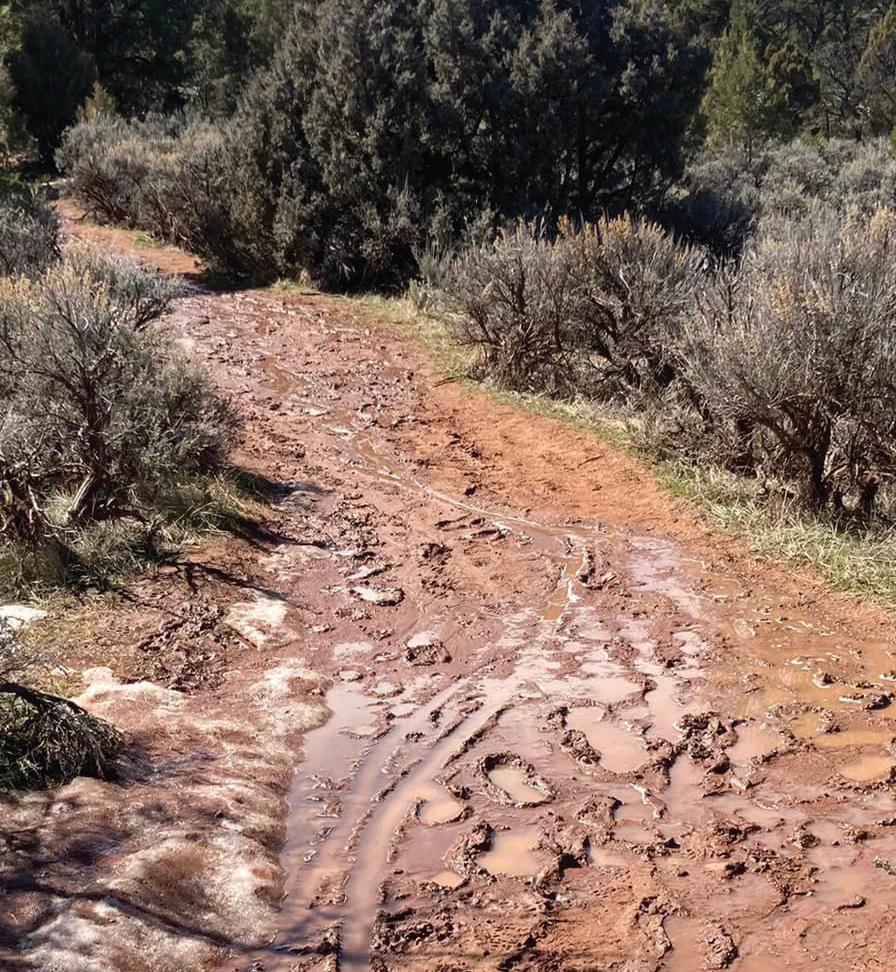
12 • THE SOPRIS SUN • soprissun.com • April 11 - April 17, 2024
The cast and crew of "Women's VOICES: Objects In Mirror." Photo by Heather Pinnow-Bayer
All
Glenwood Springs High School Viernes
Agradecemosanuestrossponsors THE SCOTT DILLARD TEAM continues on
23
Concurso de Talentos 2024
Valley Talent Show
12 de Abril
page
Sol del Valle el
VOICES presenta "Objetos en el espejo”
Por Myki Jones Traducción por Dolores Duarte
VOICES estrena su tercera entrega del Proyecto de Teatro para Mujeres VOICES, "Objetos en el espejo", el 19 de abril a las 7:30pm en el Thunder River Theatre (TRTC). La obra "es un mosaico de expresión inspirado en los recuerdos, espejismos y mensajes que componen nuestras vidas", puedes leer en un comunicado de prensa sobre la producción. "Incorporando música, humor, narrativa y movimiento, creativas locales llevan al público a un poderoso viaje por la experiencia humana".
La producción de este año cuenta con cinco mujeres locales: Gabriela Mejia, Jen Campbell, Kayla Henley, Kami Miranda y Lana Greengrass. Cada historia se basa en las experiencias vividas por estas mujeres.
"A veces surgen historias que sorprenden a los narradores, incluso las que están dispuestos a contar", dijo MinTze Wu, directora ejecutiva de VOICES, a The Sopris Sun. "Al público le espera una producción cruda, honesta y vulnerable". Añadió que la mayoría de las historias son contadas por primera vez.
Además de un reparto exclusivamente femenino, el equipo también está formado en su mayoría por mujeres, con Dani Taylor-Moxon como directora de escena; Bineke Kiernan en el diseño de utilería, escenografía y vestuario; y Gabrielle Bailes en el diseño de sonido. La dirección corre a cuenta de Cassidy Willey.
"Al público le espera una inmersión profunda en lo sagrado femenino, ambientada en este mundo místico y boscoso donde estas mujeres se reúnen para contar sus historias. Sin duda habrá momentos de humor y asombro", declaró Willey, así como "algunos realmente tiernos, vulnerables y valientes que la gente está poniendo en escena".
Cuando se le preguntó por el tema de la producción, Willey dijo lo siguiente:
"El tema principal es la recuperación y el retorno a lo natural, un tema explorado en muchas historias y el saber popular", explicó. "Ha sido divertido ir allí con estas mujeres y escuchar su propio giro en esa idea de recuperación".
Henley, Mejia y Miranda llevan muchos años dedicados al teatro, pero lo más habitual es que estén entre bastidores, ayudando en el desarrollo de una producción. Mejia y Henley coinciden en que ser el narrador y el oyente da una sensación de poder.
"Tengo muchas ganas de cambiar de papel y experimentar una faceta diferente del teatro, especialmente en un medio que me permite contar una historia diferente de una manera profunda", dijo Henley.
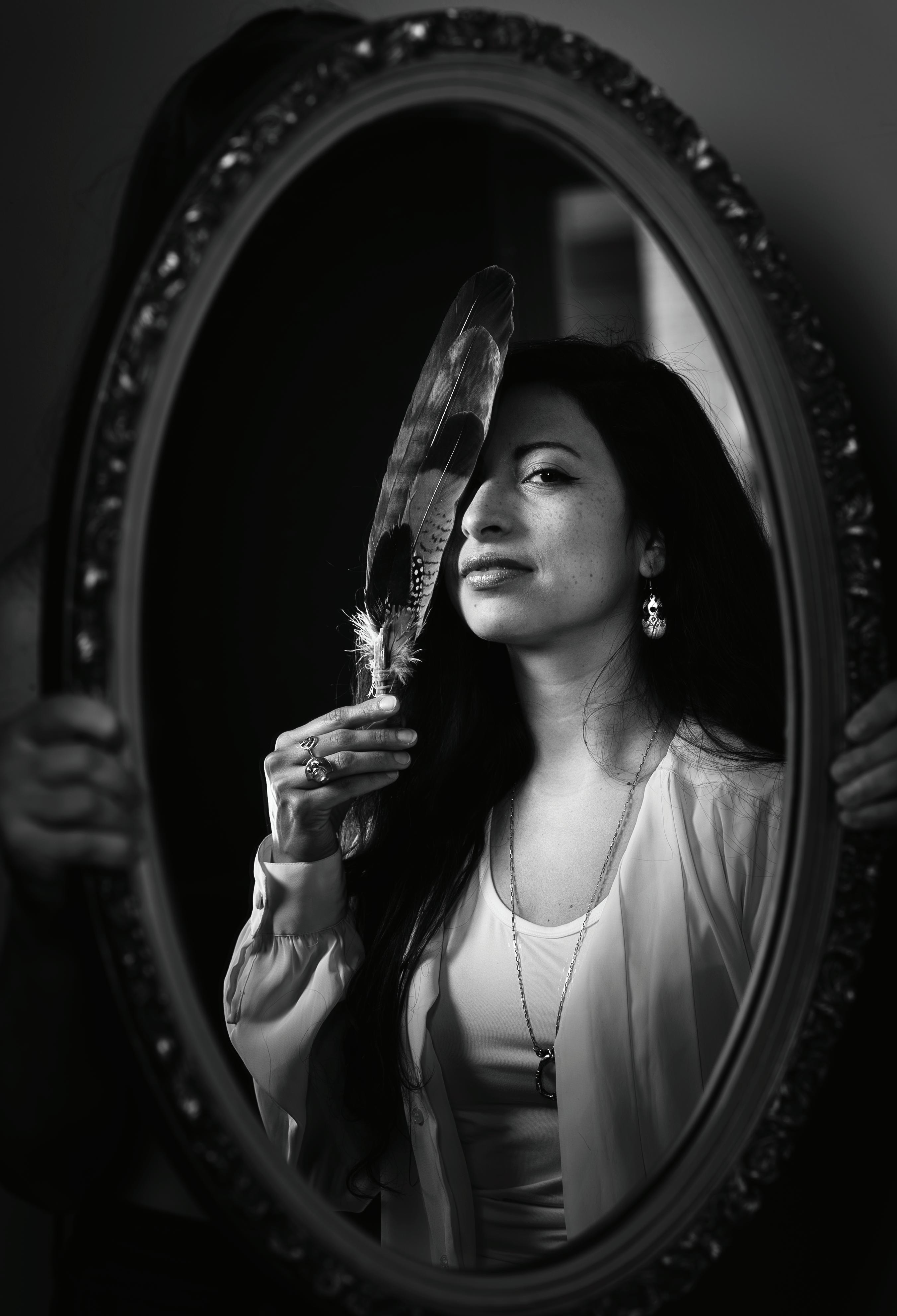
Mejia ha estado involucrada con VOICES durante tres años, principalmente trabajando en utilería. Cuando Willey le propuso este proyecto, aunque al principio dudó, Mejia accedió a compartir su historia. "Estar tras bastidores fue especial porque pude ver el proceso de otras mujeres que
también han pasado por los mismos ciclos de expresión", dijo Mejia. "Cassidy quería que formara parte del elenco durante un tiempo ... Mi resistencia vino porque he hecho teatro antes y no era algo que disfrutara porque estaba actuando, siguiendo un guion o una historia que no me identificaba con ella. Ésta es un poco diferente porque soy yo. Estoy explorando lo más profundo de mí misma en el escenario".
Hay tres oportunidades para ver "Objetos en el espejo" 19 y 20 de abril a las 7:30pm y 21 de abril a las 2pm. Todas las presentaciones son en el Thunder River Theatre. Para comprar entradas, visite www.voicesrfv.org
Volumen 3, Número 7 | 11 de abril - 17 de abril de 2024 Conectando comunidades desde 2021
Gabriela E. Mejia, foto de Heather Pinnow-Bayer
Descubriendo el amor por el arte OPINIÓN









 Rojas
Rojas
Elisabet Rojas Capilla: Nacida en Granada, España, tierra del flamenco y artistas como Picasso y Velázquez. Estudió Bellas Artes y enseñó artes en escuelas públicas en España. Luego estudió Educación Primaria y se mudó a Carbondale en 2012. Recientemente completó una Maestría en Enseñanza de Español como Lengua Extranjera y enseña español en Roaring Fork High School.
Hablar del teatro es como abrir un baúl lleno de tesoros en mi memoria, porque desde aquellos primeros pasos en la escuela primaria hasta los años universitarios, ha sido una presencia constante y transformadora en mi vida.
Todo empezó en tercer grado de la escuela primaria. Recuerdo como si fuera ayer cuando me apunté a una
actividad extraescolar que cambiaría mi perspectiva para siempre: el teatro. Aquellos primeros encuentros con la expresión corporal y las técnicas de relajación me maravillaron. Ver cómo mi cuerpo se expandía y se movía al compás de la música o los tonos relajantes era mágico. Aunque era solo una niña, ya soñaba con estudiar arte dramático.
Pero fue en la escuela secundaria cuando el teatro volvió a mí de una manera más seria y profunda. Esta vez, los ensayos semanales estaban llenos de significado, interpretamos y estudiamos al gran poeta de mi ciudad natal, Federico García Lorca, en obras como Un poeta en Nueva York, La casa de Bernarda Alba o Yerma. Aquella experiencia culminó en un evento inolvidable: nuestro grupo de teatro fue seleccionado para participar en un certamen juvenil en Grenoble, Francia. Imagina, a mis 16 años, rodeada de estudiantes de toda Europa, inmersa en un ambiente multicultural y con el teatro callejero como protagonista. Fue entonces cuando supe que el arte sería mi camino, mi futuro académico y, esperaba, también profesional.
Decidí dedicarme por completo al arte y durante los últimos dos años de la educación secundaria asistí a una escuela de artes plásticas. Luego, ingresé a la facultad de Bellas Artes en Granada, donde conocí a mi gran amiga Irene. No era casualidad que su padre dirigiera el Teatro Alhambra,
4/27 THROUGH 4/30 2024
4/27 THROUGH 4/30 2024
nombre que hace eco a la octava maravilla del mundo, la Alhambra o fortaleza roja en árabe, símbolo de la riqueza cultural de la Granada árabe y nazarí. Este teatro se convirtió en mi refugio, un lugar donde presencié las actuaciones más impresionantes de compañías independientes de toda Europa que llenaban mis planes cada viernes por la noche.
guiándome y alimentando mi pasión por las artes escénicas.
Hoy, después de 25 años desde aquel certamen en Francia, el teatro
"AGRADEZCO
Pero si hay un momento que marcó mi amor por el teatro, fueron mis años universitarios. En esos cuatro años estudiando Bellas Artes, conocí a Gustavo Cañas, un maestro que dejó una huella imborrable en mi corazón. Jamás me olvidaré de él, originario de Cali Colombia, un enamorado del arte barroco en todas sus manifestaciones, dramaturgo y poeta. Fue el mejor profesor de teatro que jamás tuve, un bohemio intelectual de aspecto espigado y ojos de negro azabache profundo, en su mirada siempre se le veía soñando y creando sin parar. Con él aprendí todo, me conectó con su amor hacia Cali, hacia el barroco latinoamericano, con la virgen de Guadalupe y con Octavio Paz. Con él, interpreté mi primer monólogo sobre la vida de Alonso Cano, un artista de Granada contemporáneo de Velázquez. Gustavo Cañas fue quien aseguró y ensanchó ese amor y admiración hacia el teatro. Aunque nunca estudié arte dramático formalmente, siempre ha sido una parte esencial de mi vida,
sigue siendo un faro en mis recuerdos. Con su magia y su capacidad de transformar realidades, continúa siendo un pilar en mi vida. Agradezco cada momento, cada interpretación, cada ensayo, porque cada uno de ellos ha contribuido a formar la persona que soy hoy. El teatro junto con las artes plásticas y la educación seguirán siendo mi inspiración, mi refugio y mi pasión, siempre.
VOICES Radio Hour- Women's VOICES: Theatre Magic se transmitirá por KDNK el viernes 12 de abril de 6 a 7pm. Puede escuchar episodios anteriores de VOICES Radio Hour en voicesrfv.org/voicesradio-hour. Para comprar entradas para la función de Women's VOICES 2024, visite voicesrfv.org
FORK VALLEY WEEK
DEL 27 AL 30 DE ABRIL DE 2024
4/27 THROUGH 4/30 2024
DEL 27 AL 30 DE ABRIL DE 2024
AW WEEK SEMANA DE DERECHO
DEL 27 AL 30 DE ABRIL DE 2024
Un evento gratuito y bilingüe para nuestra comunidad
SEMANA DE DERECHO
Semana del Derecho en Roaring Fork Valley
Semana del Derecho en Roaring Fork Valley
Semana del Derecho en Roaring Fork Valley
Join us for this informative event offering both in-person and virtual sessions in English and Spanish. Topics include family law, immigration, employment law, civil rights,

Semana del Derecho en Roaring Fork Valley
Saturday, April 27 through Tuesday, April 30, 2024
Saturday, April 27 through Tuesday, April 30, 2024
del Derecho en Roaring Fork Valley
Saturday, April 27 through Tuesday, April 30, 2024
Join us for this informative event offering both in-person and virtual sessions in English and Spanish. Topics include family law, immigration, employment law, civil rights, housing law, and elder law. Don't miss this opportunity to expand your knowledge of the law and empower yourself with essential legal information!

Del sábado 27 de abril al martes 30 de abril de 2024
4/27 THROUGH 4/30 2024
Del sábado 27 de abril al martes 30 de abril de 2024


Del sábado 27 de abril al martes 30 de abril de 2024
April 27 through Tuesday, April 30, 2024 sábado 27 de abril al martes 30 de abril de 2024
Saturday, April 27 through Tuesday, April 30, 2024 Del sábado 27 de abril al martes 30 de abril de 2024
DEL 27 AL 30 DE ABRIL DE 2024
“Know the Law” presentations / Presentaciones “Conozca la ley”

scan to register escanea para registrarte SEMANA DE DERECHO
Acompáñenos en este evento informativo que ofrece sesiones presenciales y virtuales en inglés y español. Los temas incluyen derecho de familia, inmigración, derecho laboral, derechos civiles, derecho de vivienda y derecho de las personas mayores. No se pierda esta oportunidad de ampliar su conocimiento de la ley y empoderarse con información legal esencial!
April 27 through Tuesday, April 30, 2024 sábado 27 de abril al martes 30 de abril de 2024 Law” presentations / Presentaciones “Conozca la ley” Law, Housing, Immigration, Employment Law, Civil Rights
“Know the Law” presentations / Presentaciones “Conozca la ley”
Acompáñenos en este evento informativo que ofrece sesiones presenciales y virtuales en inglés y español. Los temas incluyen derecho de familia, inmigración, derecho laboral, derechos civiles, derecho de vivienda y derecho de las personas mayores. No se pierda esta oportunidad de ampliar su conocimiento de la ley y empoderarse con información legal esencial!
Acompáñenos en este evento informativo que ofrece sesiones presenciales y virtuales en inglés y español. Los temas incluyen derecho de familia, inmigración, derecho laboral, derechos civiles, derecho de vivienda y derecho de las personas mayores. No se pierda esta oportunidad de ampliar su conocimiento de la ley y empoderarse con información legal esencial!
presentations / Presentaciones “Conozca la ley”
“Know the Law” presentations / Presentaciones “Conozca la ley”
Elder Law, Housing, Immigration, Employment Law, Civil Rights Derecho de la Tercera Edad, Vivienda, Inmigración, Derecho Laboral, Derechos Civiles
“Know the Law” presentations / Presentaciones “Conozca la ley”
Elder Law, Housing, Immigration, Employment Law, Civil Rights Derecho de la Tercera Edad,
Elder Law, Housing, Immigration, Employment Law, Civil Rights Derecho de la Tercera Edad, Vivienda, Inmigración, Derecho Laboral, Derechos Civiles Location
Immigration / Inmigración 10am - 12pm
APRIL 27
27 DE
or visit / o visite: https://rflawweek2024.eventbrite.com/
Immigration / Inmigración 10am - 12pm Employment Law / Derecho Laboral
Inmigración, Derecho Laboral, Derechos Civiles
Employment Law / Derecho Laboral
Housing /
- 12pm Laboral 1pm - 3pm 9am - 3pm Elder Law / Derecho de las personas mayores 10am - 12pm offering both in-person and Spanish. Topics include employment law, civil rights, miss this opportunity to and empower yourself
Acompáñenos en este evento informativo que ofrece sesiones presenciales y virtuales en inglés y español. Los temas incluyen derecho de familia, inmigración, derecho laboral, derechos civiles, derecho de vivienda y derecho de las personas mayores. No se pierda esta oportunidad de ampliar su conocimiento de la ley y empoderarse con información legal esencial!
Elder Law, Housing, Immigration, Employment Law, Civil Rights Derecho de la Tercera Edad, Vivienda, Inmigración, Derecho Laboral, Derechos Civiles
Edad, Vivienda, Inmigración, Derecho Laboral, Derechos Civiles Location / Ubicación: Commons, Glenwood Springs or via webinar / o vía webinar free, bilingual event provided to our community by: bilingüe y gratuito ofrecido a nuestra comunidad por:
las personas mayores 10am - 12pm 1pm - 3pm LAW

Location / Ubicación: Morgridge Commons, Glenwood Springs or via webinar / o vía webinar
Civil Rights / Derechos Civiles 1pm - 3pm
Housing / Vivienda
A
Civil Rights / Derechos Civiles 1pm - 3pm
A free, bilingual event provided to our community by: Evento bilingüe y gratuito ofrecido a nuestra comunidad por:
por:
A free, bilingual event provided to our community by: Evento bilingüe y gratuito ofrecido a nuestra comunidad por: ROARING FORK VALLEY
Eagle Sponsor Patrocinador Legal Eagle
Elder Law / Derecho de las personas mayores 10am - 12pm 1pm - 3pm
9am - 3pm
El radón es un gas radiactivo canceroso que entra a hogares a través del suelo. La única manera de saber si su casa tiene radón es hacer la prueba. Salud Pública del Condado Garfield está ofreciendo pruebas gratuitas. Recoja su kit:

Your Logo Here Community Sponsors and Presenters Patrocinadores y Expositores de la Comunidad lunch and daycare provided for in-person attendees Se proporcionará
de niños para los asistentes presenciales
lunch and daycare provided for in-person attendees Se proporcionará almuerzo y cuidado de niños para los asistentes presenciales
Legal Eagle Sponsor Patrocinador Legal Eagle Justice Advocate Sponsor Patrocinador del Defensor de la Justicia
Justice Advocate Sponsor Patrocinador del Defensor de la Justicia
Community Sponsors & Presenters Patrocinadores y presentadores comunitarios
Logo Here Community Sponsors and Presenters Patrocinadores y Expositores de la Comunidad
40% de los hogares en el Condado Garfield han probado por encima del límite de acción de radón de la EPA.
Community Sponsors & Presenters Patrocinadores y presentadores comunitarios
To register by phone call / Para inscribirse por
To register visit / para inscribirse, visite: https://RFLawWeek2024.eventbrite.com
inscribirse, visite: https://RFLawWeek2024.eventbrite.com
14 • el Sol del Valle • soprissun.com/espanol/ • 11 de abril - 17 de abril de 2024
www.garfield-county.com
necesita vivir en el
Por Eli
VOICES Radio Hour
No
Condado Garfield para obtener una prueba.
KITS DE PRUEBA PARA RADÓN GRATIS Salud Pública 2014 Blake Avenue Glenwood Springs 970-665-6383 Salud Pública 195 West 14th Street Rifle 970-665-6383 Oficina CLEER 520 S.
Carbondale
Third Street, #7
970-704-9200
free, bilingual event for our community
A
LAW WEEK.
Immigration / Inmigración 10am
Employment Law / Derecho Laboral Civil Rights / Derechos Civiles 1pm - 3pm Housing / Vivienda
29
9am -
Elder Law / Derecho
ABRIL
- 12pm
APRIL
29 DE ABRIL
3pm
de
WEEK SEMANA DE DERECHO
Ubicación: Morgridge Commons, Glenwood Springs or via webinar / o vía webinar
Vivienda, Inmigración, Derecho Laboral, Derechos Civiles Location /
Evento
y gratuito ofrecido a nuestra comunidad por: ROARING FORK VALLEY LAW WEEK Legal Eagle Sponsor Patrocinador Legal Eagle Justice Advocate Sponsor Patrocinador del Defensor de la Justicia Community Sponsors & Presenters Patrocinadores y presentadores comunitarios To register by phone call / Para inscribirse por teléfono: 970-945-8858 To register visit / para inscribirse, visite: https://RFLawWeek2024.eventbrite.com Your Logo Here A free, bilingual event for our community Un evento gratuito y bilingüe para nuestra comunidad Morgridge Commons 2nd Floor 815 Cooper Ave, Glenwood Springs Morgridge Commons 2nd Floor 815 Cooper Ave, Glenwood Springs Legal Eagle Sponsor Patrocinador Legal Eagle Justice Advocate Sponsor Patrocinador Defensor de la Justicia Semana del Derecho en Roaring Fork Valley Saturday, April 27 through Tuesday, April 30, 2024 Del sábado 27 de abril al martes 30 de abril de 2024 “Know the Law” presentations / Presentaciones “Conozca la ley” Elder Law, Housing, Immigration, Employment Law, Civil Rights Derecho de la Tercera Edad, Vivienda, Inmigración, Derecho Laboral, Derechos Civiles Location / Ubicación: Morgridge Commons, Glenwood Springs or via webinar / o vía webinar A free, bilingual event provided to our community by: Evento bilingüe y gratuito ofrecido a nuestra comunidad por: ROARING FORK VALLEY LAW WEEK Legal Eagle Sponsor Patrocinador Legal Eagle Justice Advocate Sponsor Patrocinador del Defensor de la Justicia Community Sponsors & Presenters Patrocinadores y presentadores comunitarios To register visit / para inscribirse, visite: https://RFLawWeek2024.eventbrite.com Your Logo Here Community Sponsors and Presenters Patrocinadores y Expositores de la Comunidad lunch and daycare provided for in-person attendees Se proporcionará almuerzo y cuidado de niños para los asistentes presenciales Morgridge Commons 2nd Floor 815 Cooper Ave, Glenwood Springs Morgridge Commons 2nd Floor 815 Cooper Ave, Glenwood Springs Legal Eagle Sponsor Patrocinador Legal Eagle Justice Advocate Sponsor Patrocinador Defensor de la Justicia AW WEEK SEMANA DE DERECHO 4/27 THROUGH 4/30 2024 DEL 27 AL 30 DE ABRIL DE 2024 Immigration / Inmigración 10am - 12pm Employment Law / Derecho Laboral Rights / Derechos Civiles 1pm - 3pm Housing / Vivienda 9am - 3pm Elder Law / Derecho de las personas mayores 10am - 12pm 1pm - 3pm us for this
virtual sessions in
family law, immigration,
housing law, and
law.
expand your
essential
A free, bilingual event provided to our community by:
bilingüe
informative event offering both in-person
English and Spanish. Topics include
employment law, civil rights,
elder
Don't miss this opportunity to
knowledge of the law and empower yourself
legal information!
Location / Ubicación: Morgridge Commons, Glenwood Springs or via webinar / o vía webinar
free, bilingual event
to our
Evento bilingüe
Legal Eagle Sponsor Patrocinador Legal Eagle Justice Advocate Sponsor Patrocinador del Defensor de la Justicia Community Sponsors & Presenters Patrocinadores
A
provided
community by:
y gratuito ofrecido a nuestra comunidad por: ROARING FORK VALLEY LAW WEEK
y presentadores comunitarios
970-945-8858
Your Logo Here
Morgridge Commons 2nd Floor 815 Cooper Ave, Glenwood Springs Morgridge Commons 2nd Floor 815 Cooper Ave, Glenwood Springs Legal Eagle Sponsor Patrocinador Legal Eagle Justice Advocate Sponsor Patrocinador Defensor de la Justicia Semana del Derecho en Roaring Fork Valley Saturday, April 27 through Tuesday, April 30, 2024 Del sábado 27 de abril al martes 30 de abril de 2024 “Know the Law” presentations / Presentaciones “Conozca la ley”
Morgridge
teléfono:
To register visit / para inscribirse, visite: https://RFLawWeek2024.eventbrite.com
A free, bilingual event for our community Un evento gratuito y bilingüe para nuestra comunidad
Elder Law, Housing, Immigration, Employment Law, Civil Rights Derecho de la Tercera Edad, Vivienda, Inmigración, Derecho Laboral, Derechos Civiles Location / Ubicación:
Commons, Glenwood Springs or via webinar / o vía webinar
Advocate Sponsor Patrocinador del Defensor de la Justicia Community Sponsors & Presenters Patrocinadores y presentadores comunitarios To register by phone call / Para inscribirse por teléfono: 970-945-8858 To register visit / para
ROARING FORK VALLEY LAW WEEK Legal Eagle Sponsor Patrocinador Legal Eagle Justice
almuerzo y cuidado de niños para los asistentes presenciales Community Sponsors and Presenters Patrocinadores y Expositores de la Comunidad
970-945-8858
K
to register by phone / para registrarse por teléfono:
FORK
Patrocinador
Defensor
Justicia Community Sponsors
Patrocinadores
visit / para inscribirse,
Logo Here free,
Morgridge Commons 2nd Floor 815 Cooper Ave, Glenwood Springs Commons 2nd Floor Glenwood Springs Justice
Housing, Immigration, Employment Law, Civil Rights Edad, Vivienda,
Location / Ubicación: Commons, Glenwood Springs or via webinar / o vía webinar bilingual event provided to our community by: bilingüe y gratuito ofrecido a nuestra comunidad por:
VALLEY WEEK Sponsor Legal Eagle Justice Advocate Sponsor
del
de la
& Presenters
y presentadores comunitarios
visite: https://RFLawWeek2024.eventbrite.com
bilingual event for our community evento gratuito y bilingüe para nuestra comunidad
Advocate Sponsor Patrocinador Defensor de la Justicia del Derecho en Roaring Fork Valley
ROARING
Tercera
Vivienda
Elder
las
9am - 3pm
Law / Derecho de
personas mayores 10am - 12pm 1pm - 3pm
with
housing law, and elder law. Don't miss this opportunity to expand your knowledge of the law and empower yourself
essential legal information!
Morgridge Commons, Glenwood Springs
via
vía
/ Ubicación:
or
webinar / o
webinar
Legal Eagle Sponsor Patrocinador Legal Eagle Justice Advocate Sponsor Patrocinador del Defensor de la Justicia Community Sponsors & Presenters Patrocinadores y presentadores
teléfono:
free, bilingual event provided to our community by: Evento bilingüe y gratuito ofrecido a nuestra comunidad
ROARING FORK VALLEY LAW WEEK
comunitarios To register by phone call / Para inscribirse por
970-945-8858
Your Logo Here
Morgridge Commons 2nd Floor 815 Cooper Ave, Glenwood Springs Morgridge Commons 2nd Floor 815 Cooper Ave, Glenwood Springs Legal Eagle Sponsor Patrocinador Legal Eagle Justice Advocate Sponsor Patrocinador Defensor de la Justicia
A free, bilingual event for our community Un evento gratuito y bilingüe para nuestra comunidad
LAW WEEK
To register by phone call / Para inscribirse por teléfono: 970-945-8858 To register visit / para inscribirse, visite: https://RFLawWeek2024.eventbrite.com
Your Logo Here Community Sponsors and Presenters Patrocinadores y Expositores de la Comunidad lunch and daycare provided for in-person attendees Se proporcionará almuerzo y cuidado
CADA
CONTRIBUIDO
MOMENTO, CADA INTERPRETACIÓN, CADA ENSAYO, PORQUE CADA UNO DE ELLOS HA
A FORMAR LA PERSONA QUE SOY HOY."
OPINION
Elevando el Futuro
Por Melissa Lopez
En el caos de una familia grande, entre risas, destacaba una niña que manejaba una pizarra imaginaria y recibía lecciones con autoridad. Esa niña era yo. Desde muy chiquita, el sueño de ser maestra se estableció en mi corazón. Jugar a ser maestra con mis hermanos no era sólo un juego; fue como ver mi futuro, un futuro en el que podría compartir conocimientos y comprensión con los demás. El trayecto para hacer realidad este sueño no estuvo exento de obstáculos. Al crecer en una familia diversa, anhelaba una maestra que entendiera y apreciara mi lugar de origen. Alguien que pueda identificarse con mis antecedentes y experiencias. Lamentablemente, esa conexión siguió siendo difícil de alcanzar durante mis años escolares. Fue una lucha constante navegar en un sistema que a menudo parecía fuera de contacto con las realidades de estudiantes como yo.



Del sueño infantil a la realización: el viaje de una maestra
Me encontré anhelando algo más que orientación académica; Ansiaba que mis profesores me comprendieran y mostraran empatía, pero lamentablemente estas cualidades parecían estar ausentes en muchos de ellos. Cada día se sentía como una batalla, mientras me esforzaba por reconciliar mi identidad cultural con las expectativas que se me imponían.
A pesar de mis mejores esfuerzos, a menudo me sentía invisible y no escuchada, y mis experiencias fueron descartadas o incomprendidas. Sin embargo, en medio de la frustración y la desilusión, quedaba un rayo de esperanza: la creencia de que algún día encontraría mi voz y marcaría una diferencia en las vidas de otros estudiantes.
Luego llegó un momento crucial: un rayo de esperanza llamado Upward Bound. Al unirme a este programa transformador como estudiante de segundo año en la secundaria, me vi inmersa en un ambiente que promovía la ambición y valoraba la diversidad. Fue aquí, en medio de mentores y compañeros, donde el camino a seguir quedó claro. Ser maestra no fue simplemente un deseo breve; era mi verdadero camino.




LUEGO LLEGÓ UN MOMENTO CRUCIAL: UN RAYO DE ESPERANZA LLAMADO UPWARD BOUND.
A pesar de las dudas de algunos que creían que ser maestra no era una carrera satisfactoria, seguí mi pasión. Al inscribirme en el colegio de Colorado Mountain College, comencé un viaje hacia una licenciatura en educación. La experiencia fue reveladora. Aprender rodeada de las majestuosas montañas de Colorado mientras equilibraba el trabajo y los estudios me enseñó la importancia de la resiliencia y la determinación.
Después de graduarme de la universidad, me contrataron en el distrito en el que crecí. Actualmente soy maestra de 5to grado en Highland Elementary School en Rifle. Estaba ansiosa por comenzar mi carrera como maestra. Al entrar a mi salón de clases por primera vez, sentí una profunda sensación de propósito. Por fin tuve la oportunidad de ser el tipo de maestra que deseaba cuando era estudiante. Podía apoyar y guiar a




mis alumnos en formas que iban más allá de lo académico. Fue una oportunidad para conectar con ellos a nivel personal, ofreciéndoles comprensión y apoyo que iban mucho más allá de las paredes de mi salón de clase.
Mientras navego mi tercer año de ser maestra, reflexioné sobre el profundo impacto que mis alumnos tuvieron en mí. Sus diversos orígenes enriquecieron mi perspectiva del mundo, mientras que su fortaleza y dedicación me han motivado constantemente. Cada relación que he formado en mi salón de clase es una prueba del poder de la educación para derribar barreras y comprender diferentes diversidades. Cada relación en mi salón de clases fue un testimonio del poder de la educación para superar diferencias y promover la empatía.
Hoy, rodeada por las risas y la energía vibrante de mi salón de clases, me siento honrada por el viaje que me trajo hasta aquí. Siempre estaré agradecida por las oportunidades de formar mentes jóvenes y agradecida por los colegas que comparten mi pasión y dedicación. Mi historia –del sueño infantil a la realización: el viaje de una maestra– es un testimonio del poder duradero de la educación y de la fe inquebrantable en el propósito de cada uno.













el Sol del Valle • Conector de comunidad • 11 de abril - 17 de abril de 2024 • 15
NOVEDADES
Traducción por Jacquelinne Castro
Accidente de Glenwood
Un accidente de carro en Glenwood Springs el 5 de abril dejó a dos conductores hospitalizados. Kat Gruetzner fue impactada de frente por un Jeep a exceso de velocidad en el carril equivocado en Grand y la calle 15. Ella está en condición estable, pero hospitalizada en Denver. Una página de GoFundMe fue establecida para ayudar a cubrir gastos médicos. Puede encontrar la página en www.bit.ly/4aNRbB7
Retrasos en la I-70
Los motoristas deben anticipar retrasos de tráfico en dirección al oeste en la I-70, de lunes a viernes del 15 de abril al 25 de abril en el cañón de Glenwood. El equipo reconstruirá la protección contra caída de rocas en el punto de milla 123, la salida de Shoshone Power Plant. El tráfico con dirección al este no será afectado.
¡Felicidades APR!
El 6 de abril, durante la Gala de Premiación Excelencia Anual de la Asociación de Comentaristas de Colorado, Aspen Public Radio (APR por sus siglas en inglés) recibió cuatro premios de excelencia (equivalente a primer lugar) y cuatro certificados de mérito (segundo lugar) por

los reportes de comentarios del 2023 de la organización. “Este equipo de reporteros es muy apasionado por su oficio y trabajo
duro para producir historias que son importantes en nuestra comunidad”, dijo el director de noticias de APR, Kelsey Brunner.
LEAP
El 30 de abril es el último día para inscribirse para el Programa de Asistencia de Energía de Bajos Ingresos de Colorado (LEAP por sus siglas en inglés). LEAP ayuda a individuos elegibles y sus familias a pagar una porción de los costos de calefacción de invierno de su hogar al hacer un pago de una sola vez dirigido a la compañía de servicios públicos de su parte. Este año, los hogares pueden recibir entre $200 y $1,000 en asistencia de energía. Para saber más, visite cdhs.colorado.gov/leap
Cocinando saludable
Laura Van Deusen ofrecerá clases de cocina saludable en Carbondale los sábados el 13, 20 de abril y el 4 de mayo. El currículum bilingüe está basado en el programa vegano de 21 días designado para ayudar a bajar el colesterol, controlar la diabetes y bajar la presión sanguínea. Para más información, visite www. bit.ly/cdalecooking o contacte a rootboundcooking@gmail.com

EVENTO DE LIMPIEZA Y RECICLAJE DE PRIMAVERA
13 DE ABRIL, DE 8AM-2PM
Cuotas de recepción de residuos domésticos en la puerta de entrada en la 4th y Colorado: Se requiere prueba de residencia en la ciudad de Carbondale para las tarifas de recepción /reciclaje.
Ciudad de Carbondale (residente) $10 No residente $30
Carga con remolque (residente) $20 No residente $60
Reciclaje de colchones ($20 por colchón pagado en la puerta de entrada)
Refrigerador/congelador con freón - $40 por unidad (pagado en la puerta de entrada)
Unidad de aire acondicionado - $50/unidad (pagado en la puerta de entrada)
Mountain Waste:
Basura doméstica general (muebles/cercas, etc.)
Reciclaje de metales
Reciclaje de madera
Reciclaje de colchones ($20 por colchón)
Reciclaje de textiles (deben estar en bolsas para el reciclaje)
Todos los clientes serán responsables de los cargos relacionados con refrigeradores y otros artículos con freón.
Refrigerador/congelador con freón - $40 por unidad
Unidad de aire acondicionado - $50 por unidad
SITUADO EN EL ESTACIONAMIENTO DE LA 4TH Y COLORADO
ARTÍCULOS NO ACEPTADOS: Residuos peligrosos, ejemplos: aceite, pintura, líquidos de limpieza/envases, líquidos para autos, botellas de propano. NO habrá recepción de medicamentos recetados en este evento, pero está programado para el 27 de abril de 10am-2pm en el Departamento de Policía de Carbondale.
Deshechos de jardín y ramas NO serán aceptados en este evento.
Deshechos de jardín y ramas de 2" o menos de diámetro serán aceptados en la temporada de residuos de jardín que inicia el 20 de abril de 2024, y cada quince días hasta septiembre. Este evento está localizado en la 4th & Colorado, 9am-12pm. Sólo para residentes de la ciudad.
La recepción de artículos por parte de los residentes de Carbondale a proveedores que se indican a continuación es gratuita hasta que el subsidio de la ciudad se haya cumplido, a partir de entonces, se cobrarán las tarifas que figuran a continuación.
La recepción de artículos por parte de no-residentes a proveedores que se indican a continuación NO ES GRATUITA y se cobrarán las tarifas correspondientes.
Blue Star Recyclers:
RESIDUOS ELECTRÓNICOS: Computadoras, discos duros, teléfonos móviles.
TELEVISORES: Televisores de pantalla plana, CRT y proyectores, cables y fuentes de alimentación.
Cámaras, equipos de grabación, radios, routers, hubs, tablets, teclados, mouses, fotocopiadoras, impresoras, microondas, reproductores de DVR/DVD/CD ($0.65 /lb)
MEDIA: CD/DVD/cintas ($3 /lb)
SÓLO BATERIAS ALCALINAS Y NO RECARGABLES (AA, AAA, C, D, 9V) NO se aceptan otros tipos de baterías debido a problemas de transporte e incendios.
BOMBILLAS: Tubos fluorescentes ($ 0.25 /ft), incandescentes, CFL, tubos en U, halógenas ($ 0.75 /ea), Tubos rectos LED ($4.50 /unidad), Bombillas HID y LED ($2.50 /unidad), Luces UV ($5 /unidad)
http://bluestarrecyclers.org/
LOCALIZADO EN EL ESTACIONAMIENTO DETRÁS DEL AYUNTAMIENTO
JLM Tires:
Sin costo para los residentes de la ciudad en los primeros 100 neumáticos, hasta 18 "con o sin rin.
Límite de 8 neumáticos gratis por cliente.
Un costo de $10 por neumático será cobrado a todos los clientes después de que el límite del presupuesto de la ciudad haya sido alcanzado.
LOCALIZADO EN EL ESTACIONAMIENTO DE 4TH & COLORADO
16 • el Sol del Valle • soprissun.com/espanol/ • 11 de abril - 17 de abril de 2024
Arte de Jacquelinne Castro
Rams ladies soccer, lacrosse pick up key wins
By John Stroud Sopris Sun Correspondent
April showers (and snow squalls) have brought some wins for the Roaring Fork High School ladies soccer and lacrosse teams over the last week.
Playing at Basalt on Tuesday, the Lady Rams soccer team scored a 6-1 win to improve to 4-1-1 overall on the season and 1-0-1 in the 3A Western Slope League.
Roaring Fork got three goals from junior Carley Crownhart, two from junior Emma Charters and one from junior Lexy Sanchez in the local rivalry contest.
It came on the heels of a 10-0 win over Colorado Rocky Mountain School during Saturday’s cold and occasionally snowy conditions, and a 2-0 win last Thursday over Coal Ridge at home.
Scoring against Coal Ridge were Charters and Crownhart, and in the CRMS game, Crownhart, Charters, Sanchez, juniors Annika Anslyn and Maddie Anderson, senior Mia Cubias and freshman Kennedy Arnold.
The Rams are on the road Thursday, April 11 at Moffat County, and then back home on Saturday versus Mullen. Game time is 10am.
Girls lacrosse
The Lady Rams picked up a 22-12 win over 4A Mountain East foe Summit High on the road Tuesday, improving to 3-2 overall and 1-0 in league play.
The combined Roaring Fork/ Basalt/Glenwood team had nine goals from junior Josie McKinleyKitchell, four from sophomore Jordan Miller, three from senior Grace Garcia, and two each from junior Hailey Wolfe, senior Lucianna Phillips and sophomore Juliana Pittz for the win.
The lacrosse team also picked up a 9-8 win over Steamboat Springs at home on Saturday, with goals again coming from Wolfe (four), Miller (three) and McKinley-Kitchell (two).
Support the lacrosse ladies at Rams Stadium versus Aspen in another crucial league matchup at 5:30pm Thursday evening (April 11).
Baseball
Hosting their annual Trent Goscha Memorial Tournament last weekend, the Rams baseball team dropped two and won one to take a 3-8 overall record into the 3A Western Slope League opener Wednesday, April 10, at home versus
Olathe. The game result was not available by press time.
In tournament action, Roaring Fork fell 11-0 to MontezumaCortez last Thursday, April 4, and 12-6 to Grand Junction Central that Friday, before rallying in extra innings to beat Pagosa Springs 5-4 on Saturday morning.
Pagosa took an early 1-0 lead in the first inning, before the teams played five-and-a-half scoreless innings into the seventh. Pagosa garnered three more runs in the top of the seventh, but the Rams answered with four in the bottom half to tie it.
Roaring Fork then scored in the bottom half of the eighth for the walk-off win.
Boys lacrosse
The combined school Glenwood Springs boys lacrosse team fell to 2-3 overall and 1-2 in the 4A Western Slope League with an 11-6 loss at home to Steamboat Springs on Monday. Goals were scored by Ian Cole and Tristen Bledsaw (two each), with one each coming from Kiko Pena and Sawyer Harrington.
The Demons also lost 9-6 at home last Thursday to Vail Mountain. Next up is a road contest at Aspen on Thursday, April 11 at 6:30pm.
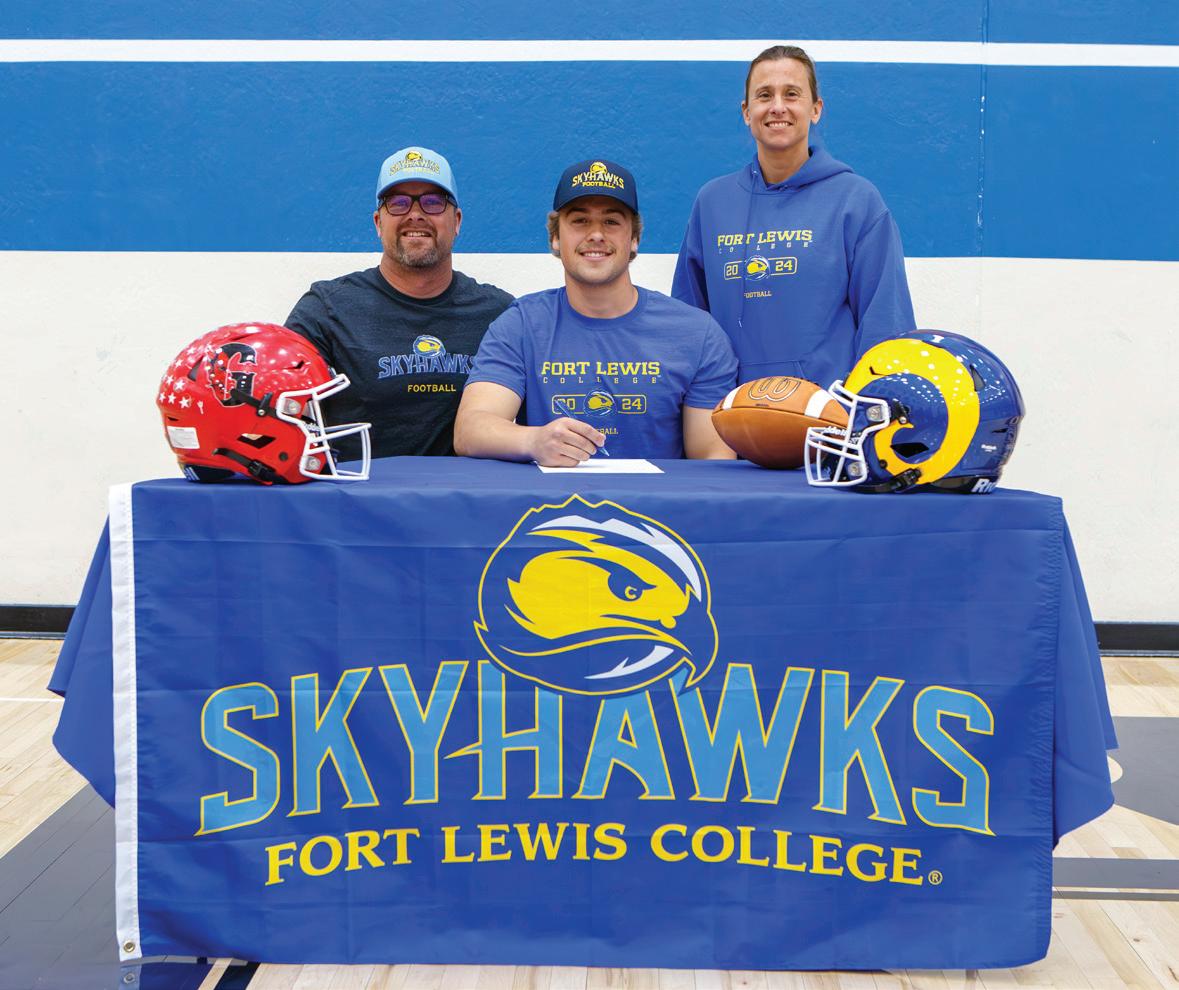
Track & Field
Roaring Fork’s coed track and field team was at the Eagle Valley Invitational last Saturday, April 6.
Finishing in the top eight in their events and scoring points for the Lady Rams were sophomore Nikki Tardif, third 400-meter dash (1 minute, 3.76 seconds), and fifth 200-meter dash (29.52 seconds); senior Kyra Reeds, second 100-meter hurdles (18.02), and seventh 300 hurdles (1:00.64); junior Isabella Moon, eighth 1600 meters (6:03.19); and the 4x200 relay team of Tardif, Reeds, Evi Keating and Elizabeth Fullerton, seventh (2:00.86).
Top finishers for the boys were seniors David Finley and Mateo Ledezma, tied for 19th in the 100-meter dash (wind-aided 12.87). Next up is the Glenwood Springs Demon Invitational, starting at 9am and running all day Saturday, April 13.
Girls tennis
Playing at Delta on Tuesday, the combined Basalt and Roaring Fork girls tennis team fell seven matches to none. Next up, the Longhorns take to the courts at Cedaredge on Saturday, April 13 and at Glenwood Springs on Monday, April 15.
¡SE AP XIMA EL DÍA DE LA MAD !
Invitamos a todas las madres con bebes nacidos dentro del último año que tomen un retrato profesional con nosotros para la edición especial del Sopris Sun, el 9 de mayo.




Llame a 970-510-3003 o mande un correo electrónico a raleigh@soprissun.com para hacer una reservación en el Third Street Center (520 S 3rd St, Carbondale) para el 6 o 13 de abril de 9am a mediodía























 Max Bollock signs a letter of intent to play football at Fort Lewis College as his parents, Eric and Amy Bollock look on. Photo by Sue Rollyson
¡ Gratis!
THE SOPRIS SUN • Your weekly community connector • April 11 - April 17, 2024 • 17
Community celebrates Thompson Divide win, but isn’t losing steam
continued from cover
A lease expires after 10 years if exploration has not commenced within that time. Once oil or gas is discovered, the lease holder can maintain that lease as long as production continues. Around 2012, developers began filing drilling proposals, possibly in hopes that the federal agencies would suspend the deadlines. The coalition pushed back, which ultimately resulted in the cancellation of many of the leases. However, a few suspensions were granted.
The Forest Service manages the surface lands and the Bureau of Land Management (BLM) manages the subsurface. “So, moving forward, if a lease holder wanted to drill on those exploratory leases, the Forest Service would have to approve a surface use plan of operations and the BLM would have to approve the drilling operations,” explained Hart.
“This is a long-term administrative protection. It’s protection from the threat of future leasing — more protection than the Divide has had before,” Hart said of the federal administrative withdrawal. But, he added, “We still haven't achieved the ultimate goal. The ultimate goal is to secure a congressional withdrawal that would be permanent.”
The Colorado Outdoor Recreation and Economy (CORE) Act, which includes permanent protection of the Thompson Divide, has yet to pass congress after multiple attempts initiated by Senator Michael Bennet and Representative Joe Neguse.
“The administrative withdrawal gives us 20 years of certainty that there will be no new leases issued, and it gives us 20 years to secure that permanent protection,” concluded Hart.
“This withdrawal is the culmination of a 17 year grassroots effort and is fantastic news for our community,” said Carbondale rancher Bill Fales. “It will protect the Thompson Divide which is so important to our Valley. This withdrawal will preserve the grazing so vital to our ranches. It will save our wildlife from additional pressures. It will protect the water supply for our towns and ranches and this withdrawal will protect the beauty of this area that is so vital to our recreation economy. We owe a huge debt of gratitude to our senators, especially Senator Bennet, who has worked on this for so long and to Senator Hickenlooper and Congressman Neguse for advancing the legislation so far. While we
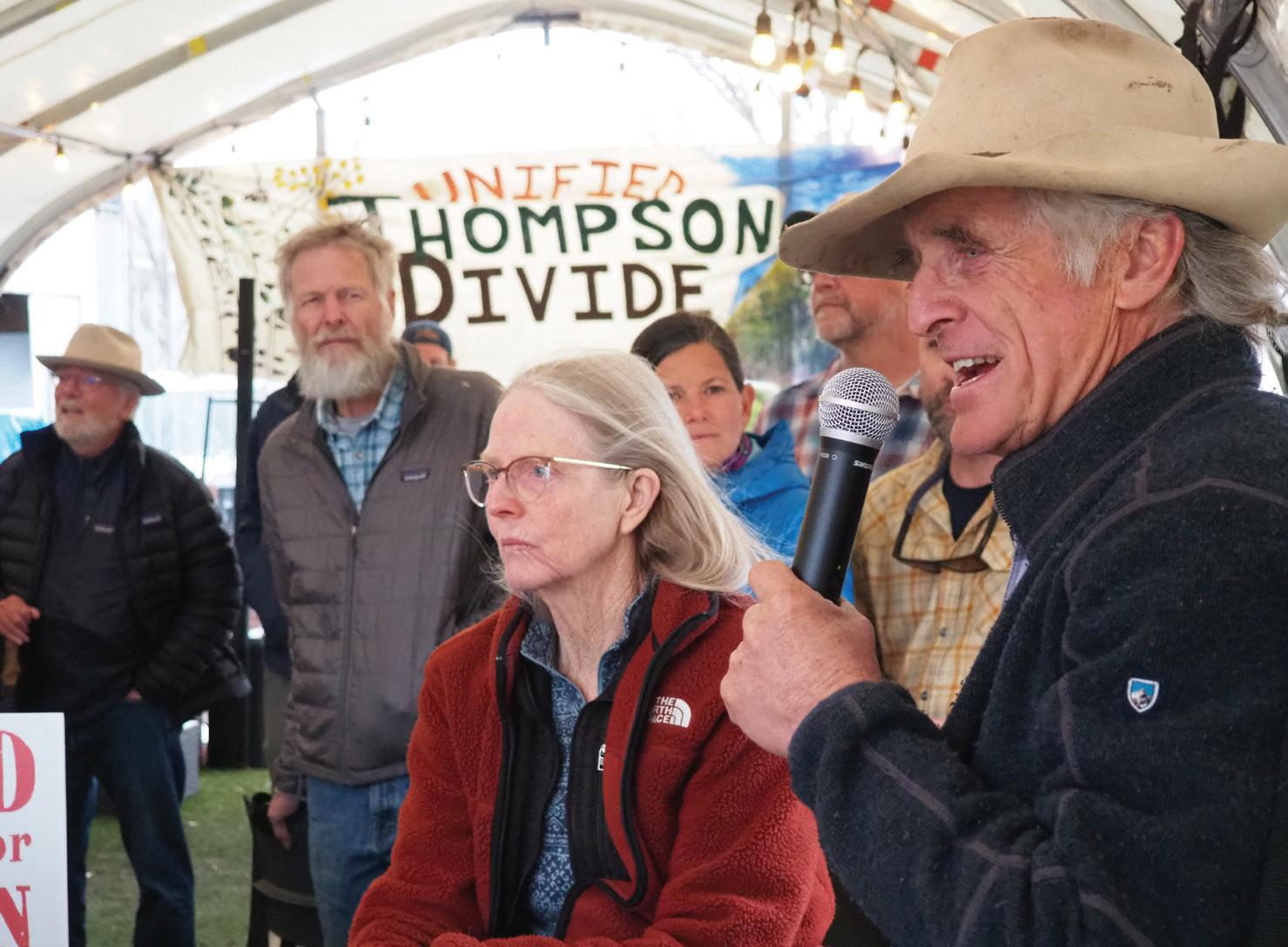
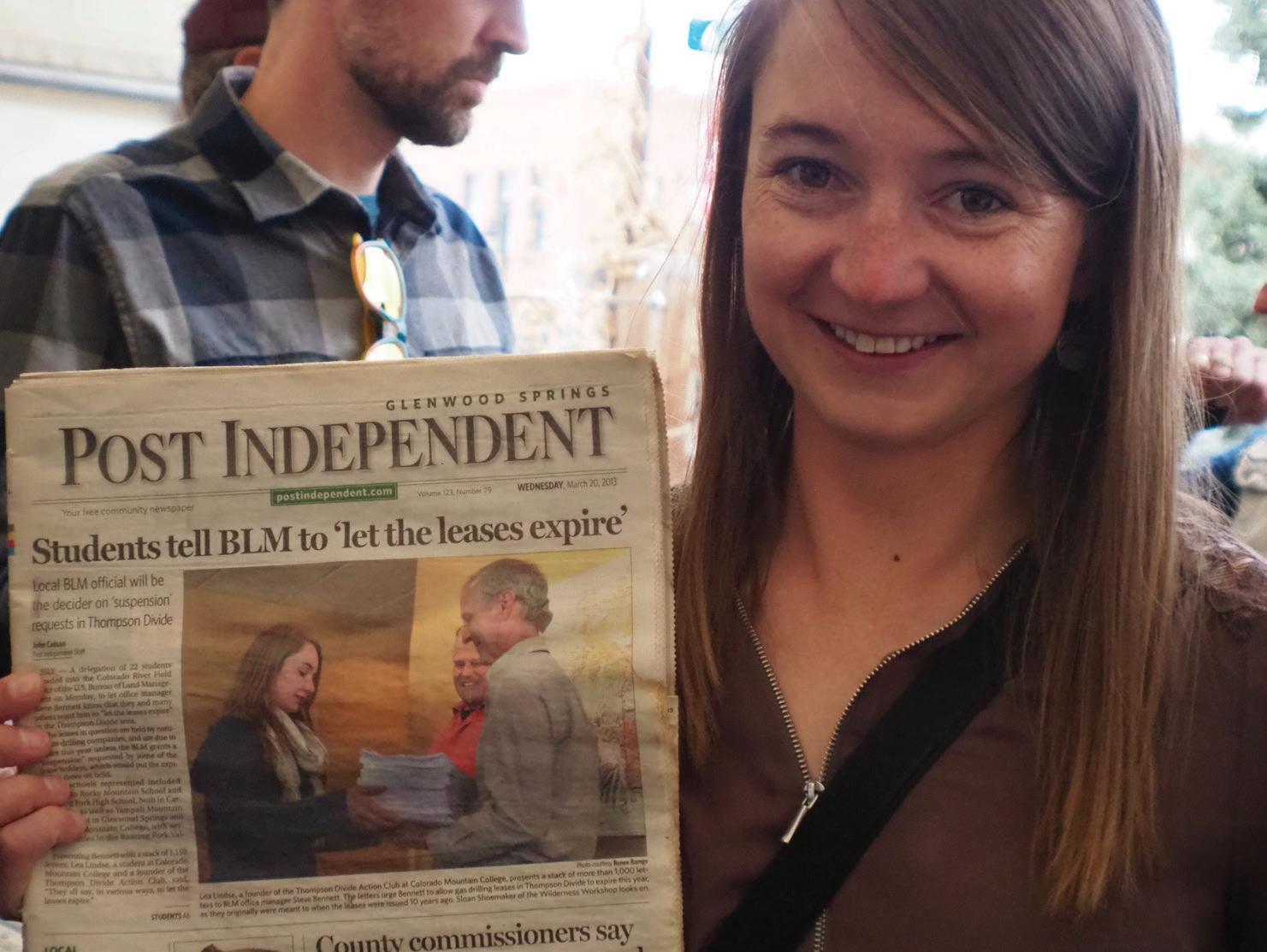
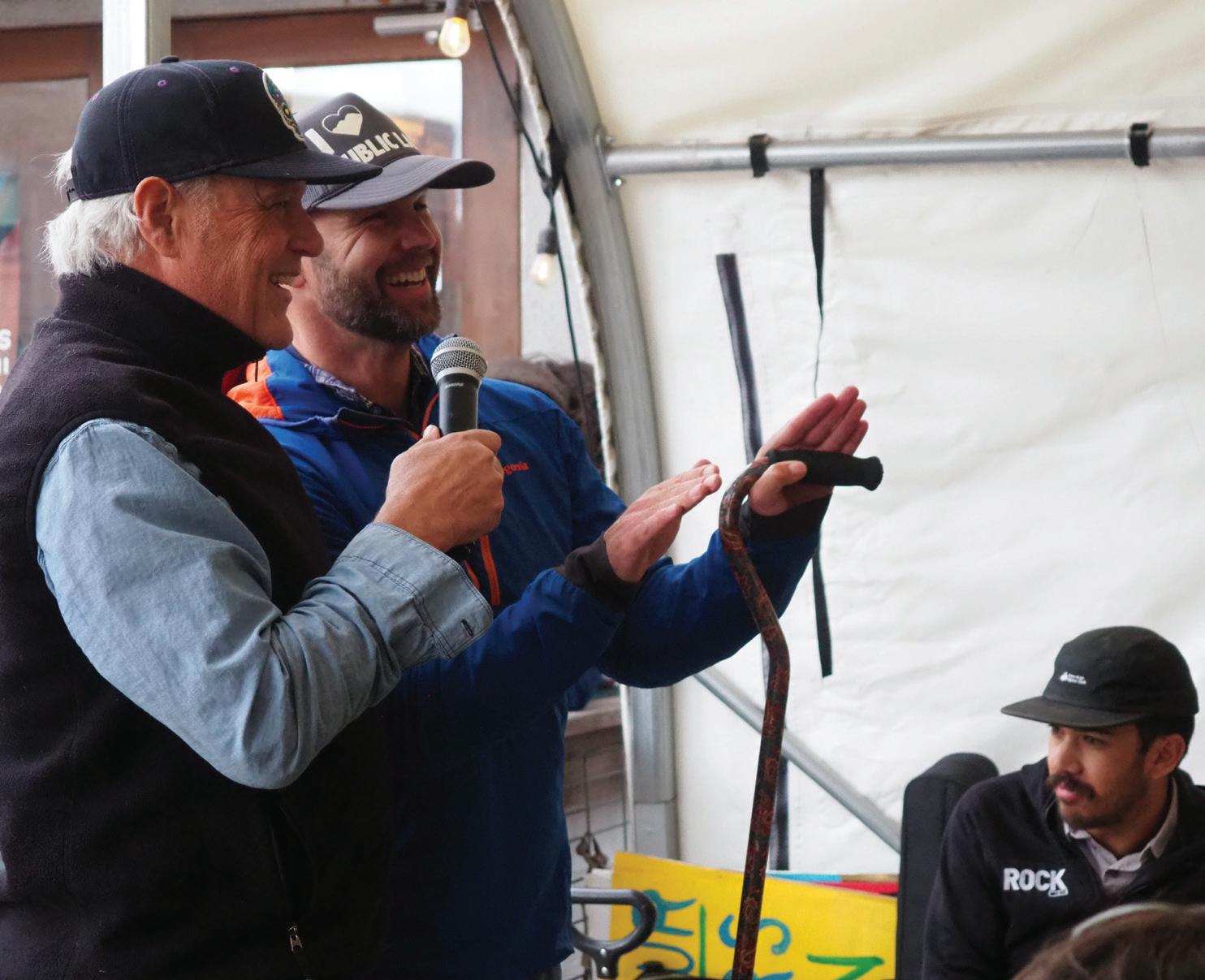
celebrate this milestone, we also look forward to the day when we can achieve permanent protection for the Thompson Divide.”
It’s certainly been, and will continue to be, a team effort.
For more on the Thompson Divide Coalition, visit www.thompsondivide.org

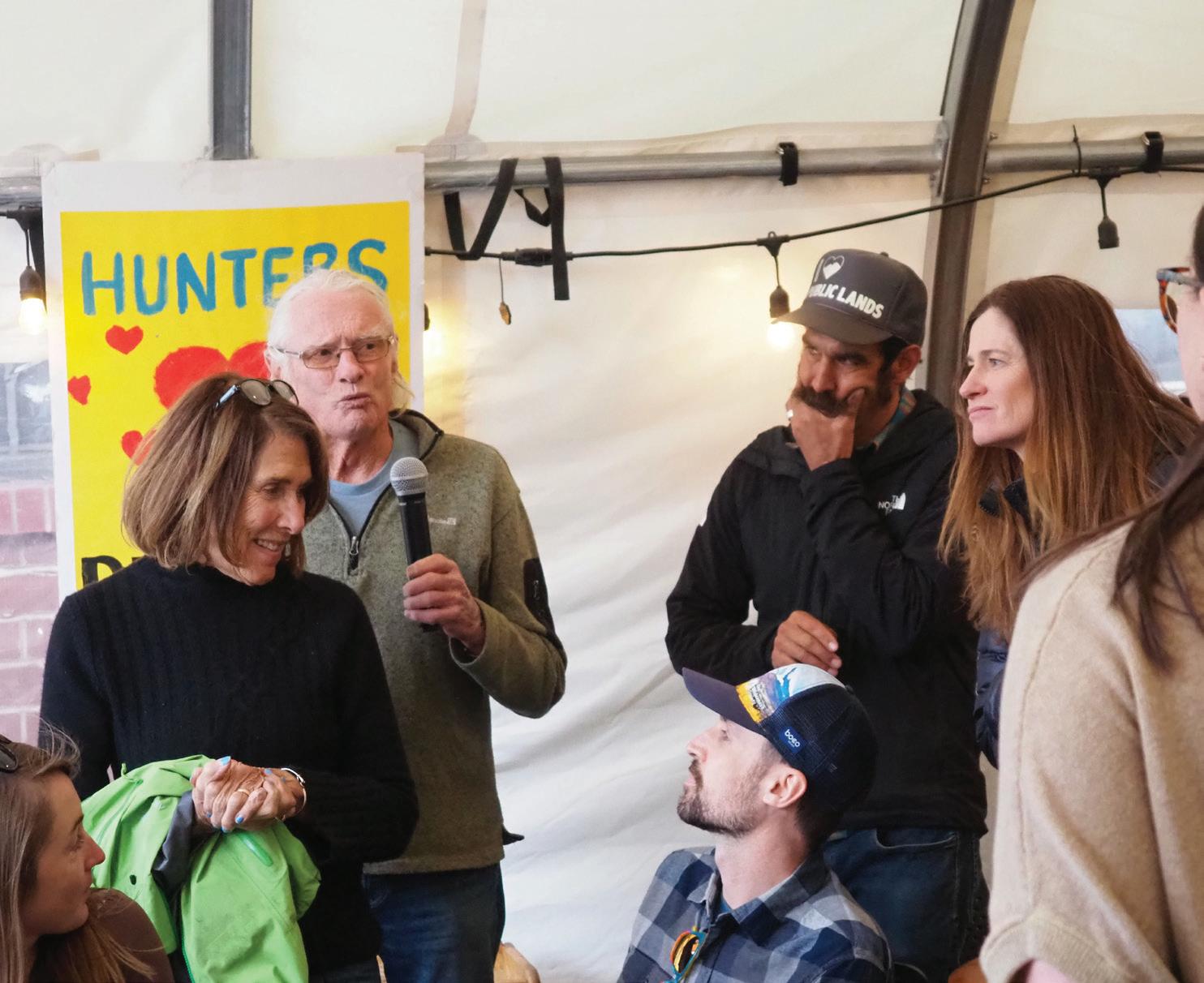
18 • THE SOPRIS SUN • soprissun.com • April 11 - April 17, 2024
Lea Linse, now an employee of EcoFlight, poses with a Post Independent cover from March 20, 2023 when she appeared as a student presenting over 1,000 letters to BLM office manager Steve Bennett urging for gas-drilling leases to be allowed to expire.
Photo by Raleigh Burleigh
Sloan Shoemaker and Peter Hart address the crowd at a celebration at Beer Works on April 5.
Photo by Raleigh Burleigh
Rancher Bill Fales shares stories from the Unified for the Thompson Divide movement. Photo by Raleigh Burleigh
Supporters from throughout the years enjoy reminiscing in celebration. Photo by Raleigh Burleigh
Thompson Divide Coalition board secretary Clare Bastable fires up supporters during her speech.
Photo by Raleigh Burleigh
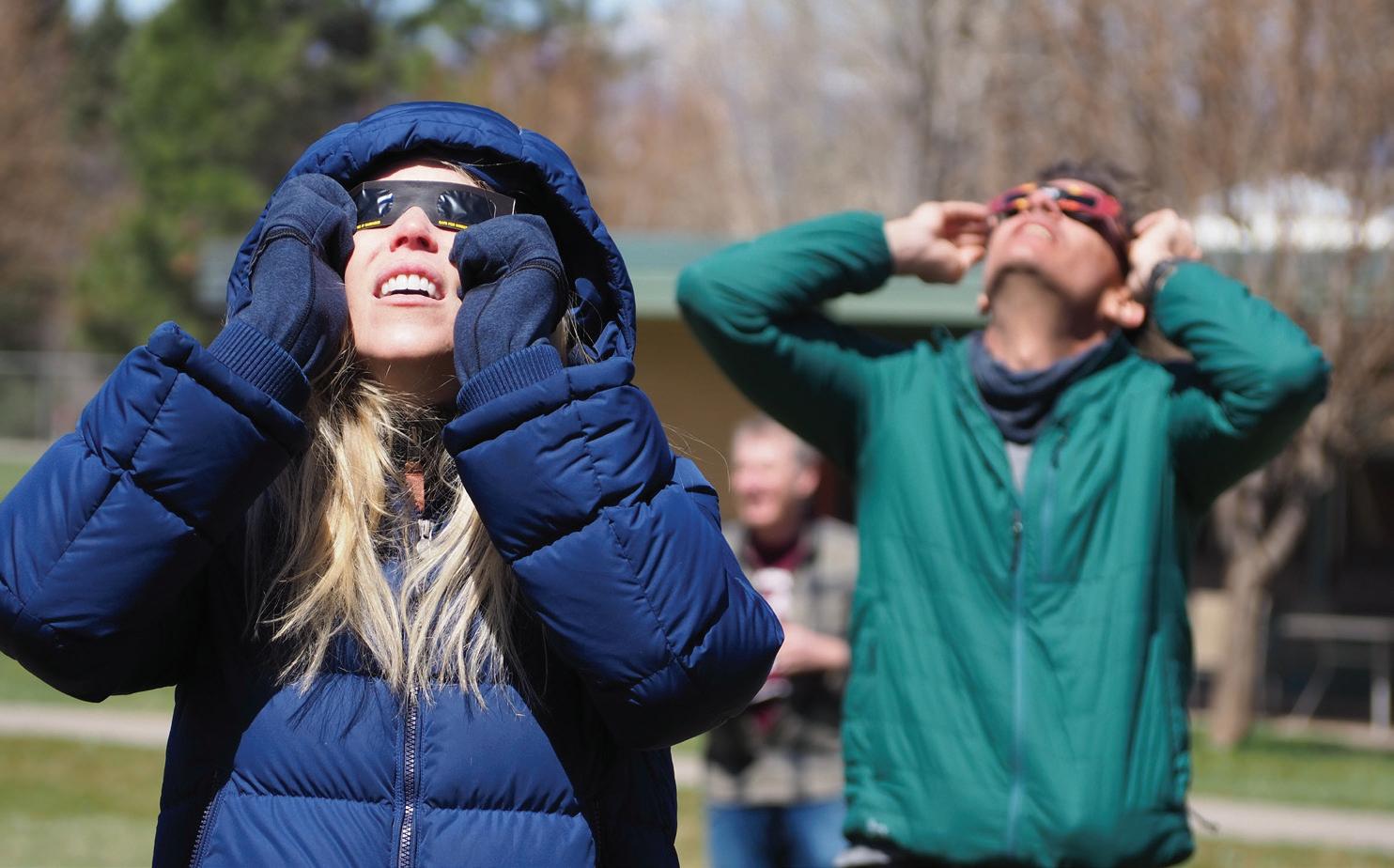
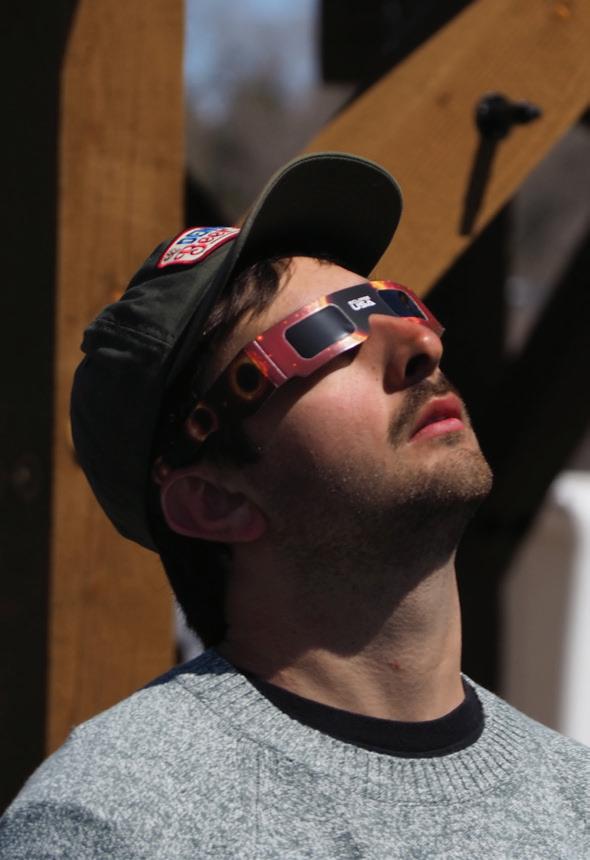
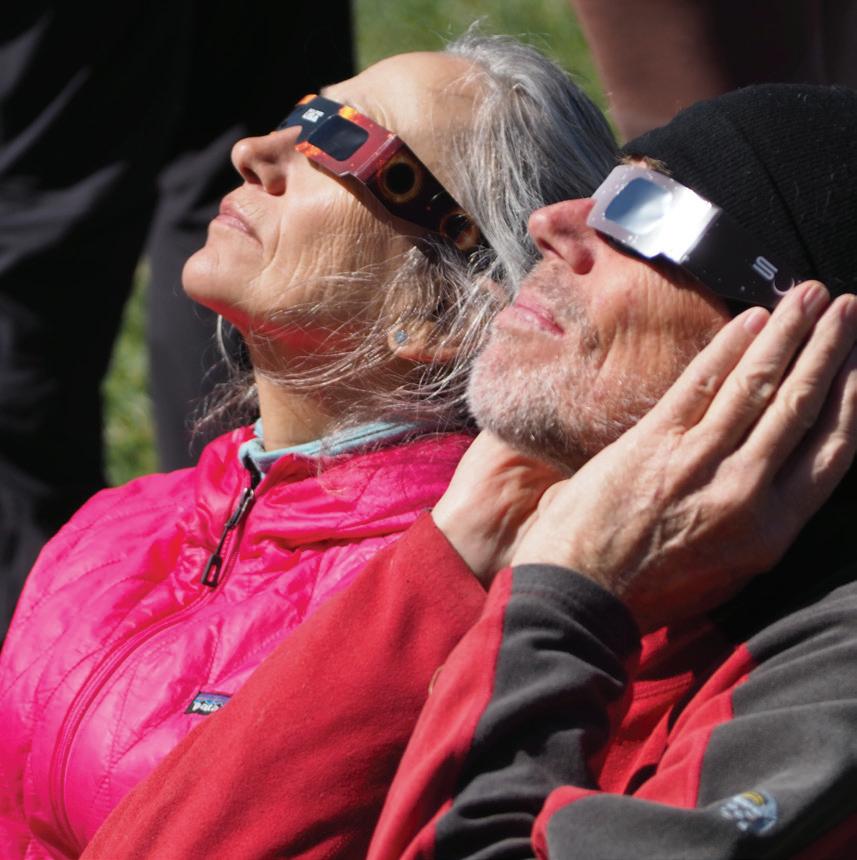

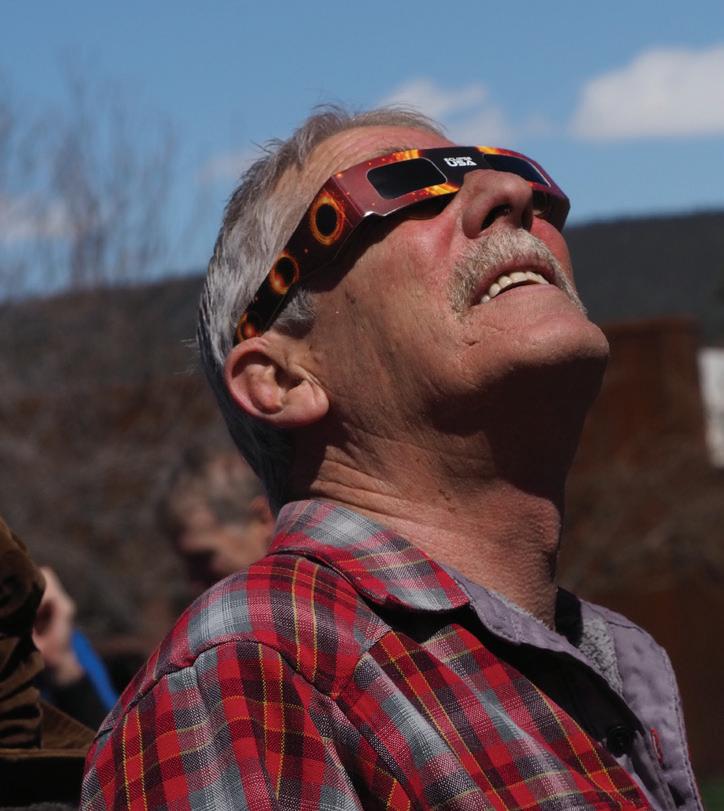
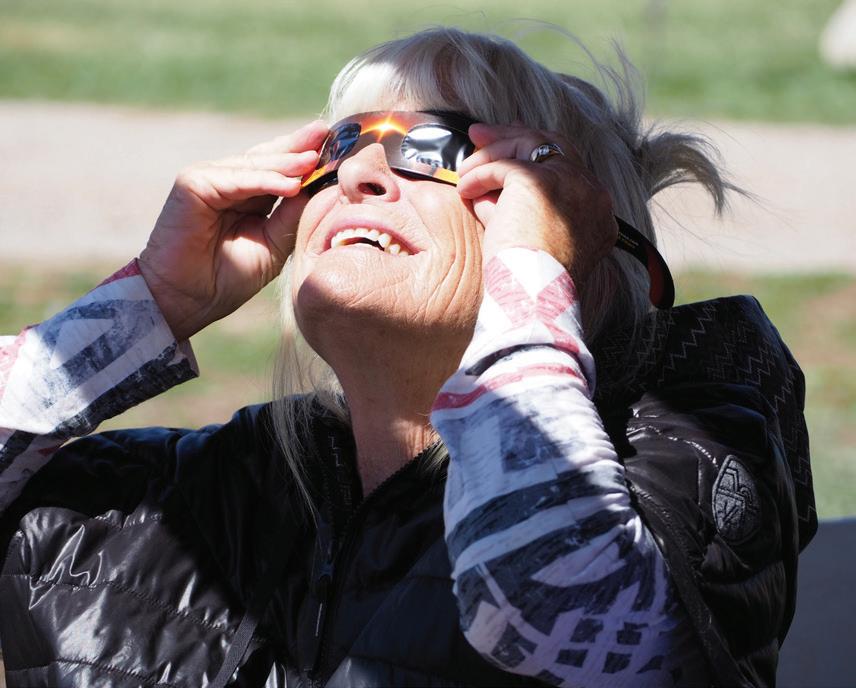


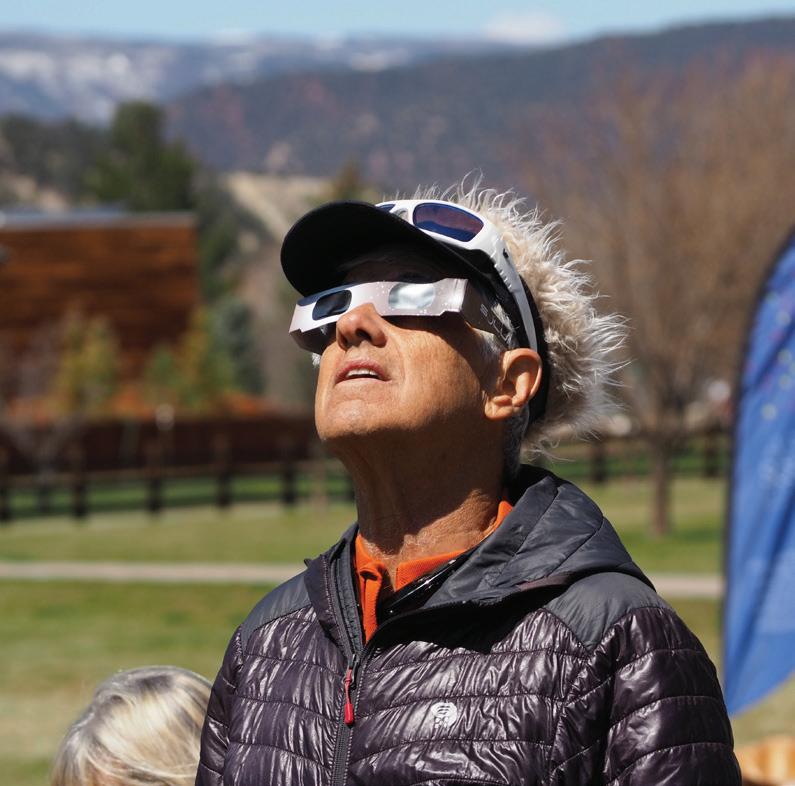


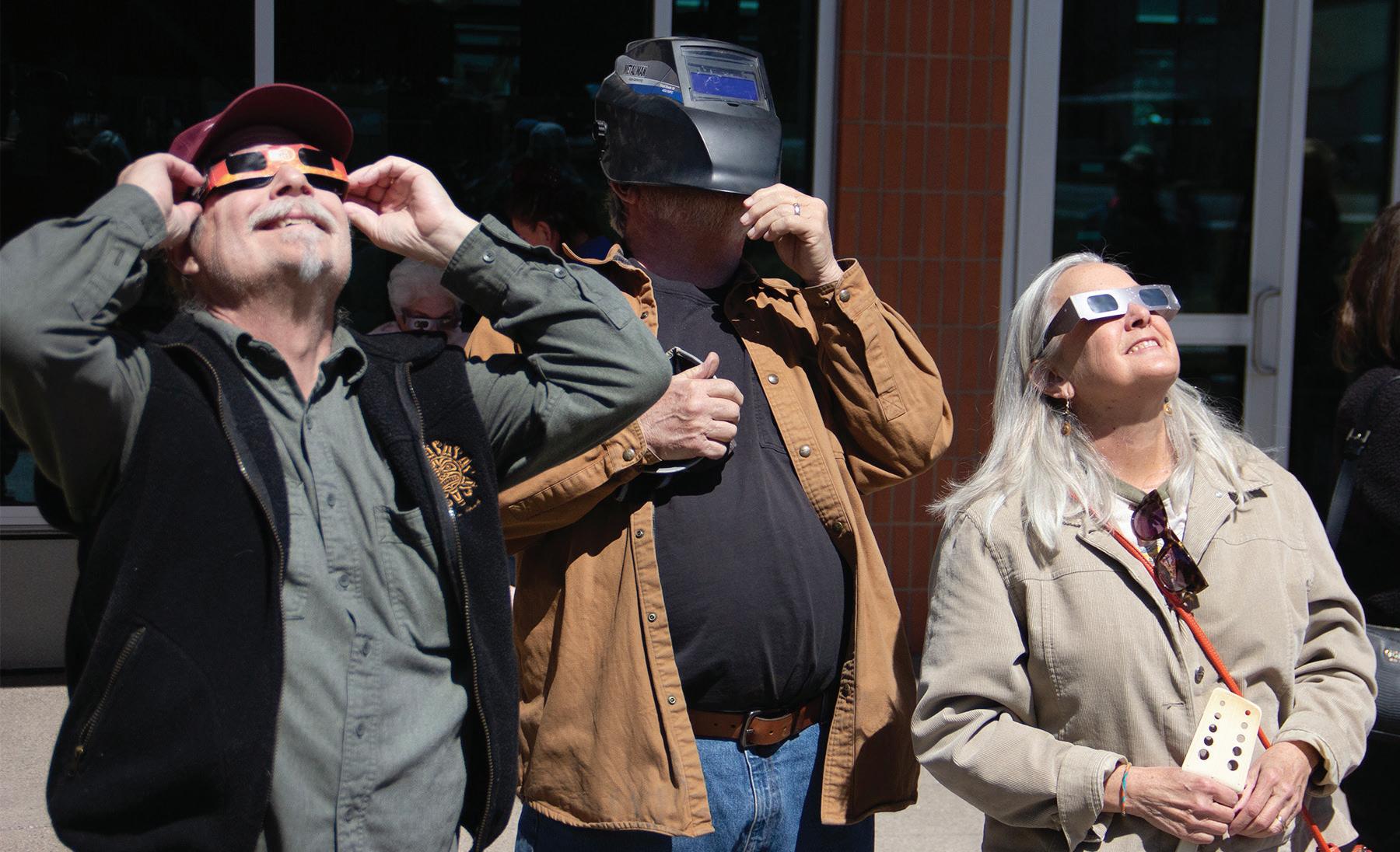
 Locals unable to travel to totality enjoyed gawking at Monday's eclipse (61.6% in Carbondale) all the same. Both the Carbondale Library and Third Street Center hosted educational watch parties. Aspen Science Center invited children of all ages to learn the physics behind this awesome phenomena and passed around special glasses for safe viewing. A future eclipse will bring totality across Colorado in August of 2045, so store those glasses somewhere safe.
Photos by Jane Bachrach (on right) and Raleigh Burleigh (on left)
Locals unable to travel to totality enjoyed gawking at Monday's eclipse (61.6% in Carbondale) all the same. Both the Carbondale Library and Third Street Center hosted educational watch parties. Aspen Science Center invited children of all ages to learn the physics behind this awesome phenomena and passed around special glasses for safe viewing. A future eclipse will bring totality across Colorado in August of 2045, so store those glasses somewhere safe.
Photos by Jane Bachrach (on right) and Raleigh Burleigh (on left)
Things are looking up!
THE SOPRIS SUN • Your weekly community connector • April 11 - April 17, 2024 • 19
David Smith, Roaring Fork School District PreCollegiate program director, set up a telescope at Bridges High School.
STR license denial appeal granted
By Raleigh Burleigh Sopris Sun Editor
Tuesday’s meeting began with student of the month awards. Upon receiving his certificate, third grader Noah Korah of Ross Montessori informed the public: “I like Godzilla.”
The week’s consent agenda included accounts payable, reappointment of David Clair to the Bicycle Pedestrian and Trails Commission and liquor license renewals for New York Pizza and the Pour House. Town Clerk Jessica Markham noted that she is unaware of whether the Pour House plans to reopen anytime soon, but transferring a liquor license is easier than obtaining a new one, so it was a sensible move. The Sopris Sun reached out to Sue Anschutz-Rodgers, owner of the Pour House, to try and learn more.
Once again, proponents of a ceasefire resolution to end the now six-month war in Gaza filled the meeting room, this time wearing green as a show of solidarity. A number of Colorado Rocky Mountain School students attending the meeting as part of a civics lesson raised their hands when the crowd was asked who supported the resolution being added to a future agenda by Will Hodges, organizer with the local Ceasefire Now group.
“A million people are starving,” Hodges remarked, “and headlines are falling off the front page.” He added, “114 cities have passed such a resolution … Carbondale could be the 115th.”
Two other members of Ceasefire Now RFV, both residents of Glenwood Springs,
also spoke. Jess Richardson pointed out that 874 Gazans have been killed by weapons paid for with U.S. tax dollars since the last time this group asked Carbondale trustees to consider a resolution. She acknowledged Carbondale’s adoption of a resolution alone wouldn’t change the scenario, however many such resolutions across the country “could carry enough weight to do so.”
During general trustee comments, Luis Yllanes thanked the group for speaking up. “I think we should bring this up to discussion for the resolution,” he stated.
Colin Laird clarified that three trustees must agree to put such an item on the agenda. Given the complicated and challenging nature of such an item, “We’re unlikely to debate it at this level,” he said.
Town Manager Lauren Gister gave an update on the response to a sudden influx of unhoused migrants, stating that things are slowly closing down with temporary shelters now vacated but overnight car camping still allowed in the Town-owned lots surrounding Thunder River Theatre, as well as shower vouchers for the Rec Center. “It’s gone quite well,” she said.
Rob Stein, a star volunteer with the effort, stated that a plan is coalescing for a regional response, but a guiding organization has yet to be determined. Many partners, however, are performing a role with case management, counseling, legal assistance, English lessons and more. He said that between 35 and 40 of the group which numbered over 100 in December remain in the Valley, as far as they’re aware, and all but
GARFIELD COUNTY REPORT
County finance department wins national award, landfill hours change
By Amy Hadden Marsh Sopris Sun Correspondent
Monday’s Garfield County commissioners’ (BOCC) meeting lasted all of an hour, including an executive session looking at legal issues involving two cases: the U.S. District Court case of the Estate of Oscar Canas v. Garfield County and the Garfield County District Court Case of Madrid v. BOCC. Dustin Moyer, the new CEO of Mountain Family Health Centers, started off the meeting by introducing himself during the open public comment period.
As for items on the agenda, Garfield County Sheriff Lou Vallario finally struck gold with a solution to the department’s patrol vehicle upfitting challenge. He told the BOCC, in this case John Martin and Mike Samson, that he found a local company, GreyCo Customs in Rifle, to upfit patrol vehicles.
According to a letter from the sheriff’s department, supply chain shortages have pushed back the date of upfitted vehicles from the county’s regular vendor on the Front Range to March 2025. Vallario said that GreyCo Customs has upfitted vehicles
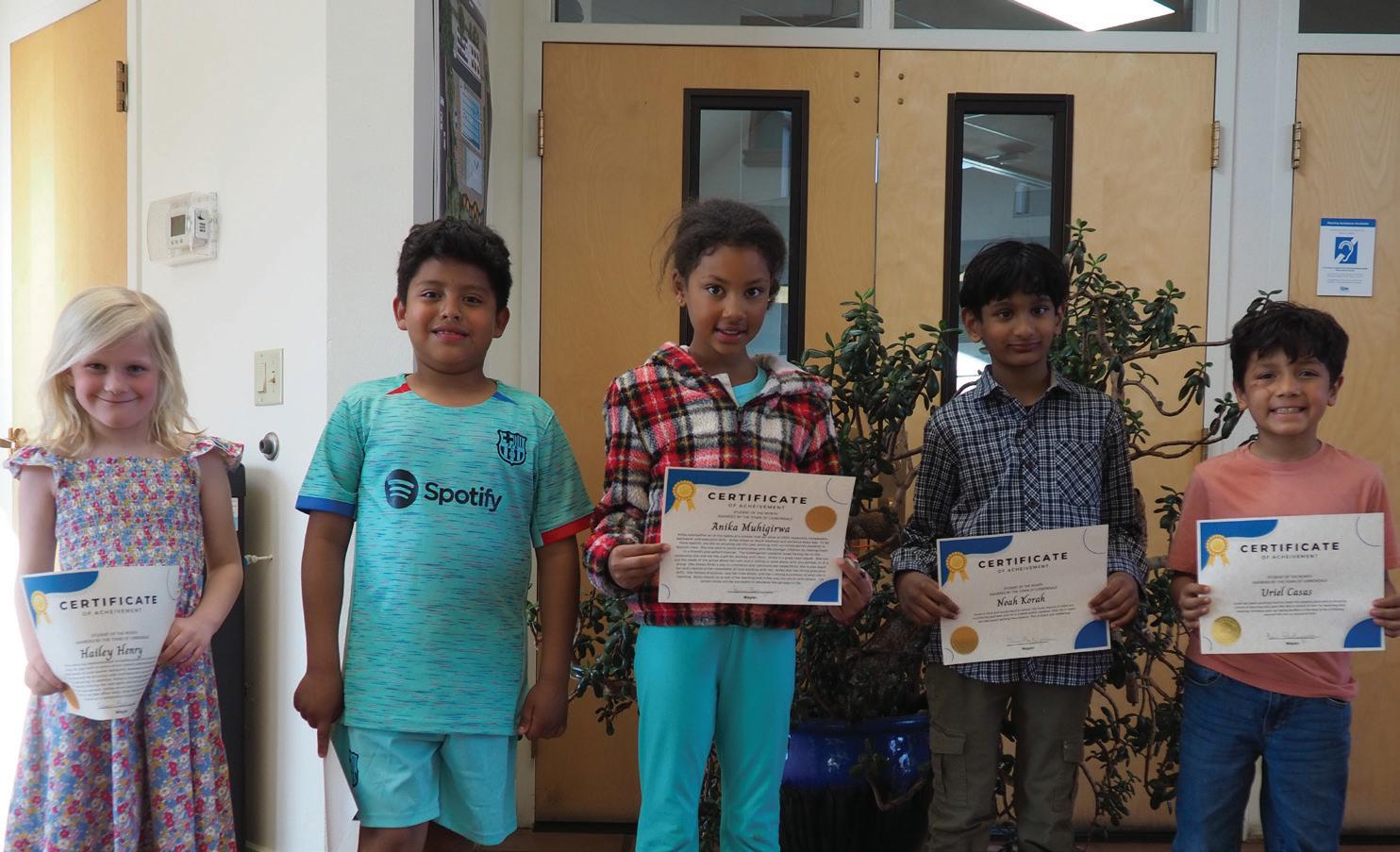
a dozen have found housing.
The meeting proceeded with a resolution acknowledging April as Parkinson’s Awareness Month, approval of permits for May 3 First Friday festivities and final approval of documents for the 111 Main Street food truck court discussed at the previous meeting.
Lastly, time was dedicated to hearing an appeal of a staff decision to deny a shortterm rental (STR) license for a home on Oak Run Road. The STR had been operating for more than eight years but no longer qualified with new rules allowing for STRs only within the Historic Commercial Core zone district unless they are also the primary residence of the owner. Established STRs in good standing were given the opportunity to be grandfathered in, around these new rules, but this individual lives in Boulder and missed the notice.
After hearing from the owner as well as Town staff, trustees determined that staff was correct to deny the license in accordance with the new rules, however, communication to the owners of all operating STRs about the rule changes was imperfect. Therefore, the license denial was overturned in this instance.
Mayor Ben Bohmfalk cited “compliance at every turn” and no evidence of trying to get around regulations, saying “it feels like we missed something” by not directly informing this STR operator of the opportunity to be grandfathered in.
Next week’s work session has been canceled as the board prepares to transition. New trustees Ross Kribbs, Christina Montemayor and Jess Robison will be sworn in at the next regular meeting on April 23. Outgoing trustees Lani Kitching, Marty Silverstein and Yllanes will be thanked for their service.
for the Rifle and Silt Police Departments, and that the company could begin upfitting the county patrol cars in October. He added that, even though the finances have not yet been finalized, it looks like an emergency contract with GreyCo Customs would save the county $27,000. Commissioner Samson said, “If we can do it locally and cheaper, I’m all for it.” The contract was approved.
Richard McIntyre, representing the East Mesa Water Company (EMWC), asked the BOCC for a letter of support for a grant request to the Colorado River District for fixing sinkhole damage to the East Mesa Ditch, about two miles southeast of Carbondale. The 30-foot sinkhole appeared in September 2023, cutting off water to downstream irrigators. A geophysical survey has been completed. Now, the EMWC needs to pipe the ditch and relocate it away from the sinkhole.
McIntyre ended his presentation with comments on the contentiousness and unpredictability of water in the Upper Colorado River Basin and across the West, based on findings from the third Colorado State University Climate Change in Colorado Assessment. His comments included how climate change is human-

"A chicken taco and your speeding ticket."
caused from burning fossil fuels to which Martin took exception.
“Climate change is a cycle. And, you know, one of the climate changes we had, we had no humans whatsoever on earth and it wiped out a whole bunch of things,” he opined. “It goes in a cycle and it’s not just fossil fuels that cause it; it's all kinds of other things.” The BOCC unanimously approved the requested letter of support.
Commissioners also approved liquor licenses for the Elk Creek Campground and for WindWalkers Equine Assisted Learning and Therapy Center for the annual Kentucky Derby fundraiser on Saturday, May 5. They approved the consent agenda and the annual gift basket to the 4-H Shamrock Shindig fundraiser. Finally, they honored the county financial team, who received another Certificate of Achievement for Excellence in Financial Reporting from the Government Finance Officers’ Association for the county’s annual comprehensive financial report for fiscal year ending Dec. 31, 2022.
Deputy County Manager Bentley Henderson announced that the landfill
hours have now gone to seven days a week from 8am to 4pm. Discount coupons worth $15 off one load can be found on the county website through April 30.
Toward the meeting’s end, County Manager Fred Jarman reviewed the organizational framework for the April 30 library trustee candidate interviews. He stated that the meeting will be in-person and on Zoom, but he expects candidates to appear in-person. Commissioners and Adrian Rippy-Sheehy, president of the library board, will ask questions of the candidates. He added that the questions will be the same for each candidate and that candidates will be interviewed one at a time. The meeting, which starts at 1pm, is public, although no audience comments will be accepted. Sixteen people have submitted applications for one library trustee position representing the Rifle area. Commissioners will make a decision on the trustee appointment at their regular meeting following April 30. The organizational framework, however, is subject to change.
20 • THE SOPRIS SUN • soprissun.com • April 11 - April 17, 2024
Students of the month (left to right): Hailey Henry, Iker Medina Compos, Anika Muhigirwa, Noah Korah and Uriel Casas. Photo by Raleigh Burleigh
CARBONDALE REPORT
Votes are in!
By Will Buzzerd Sopris Sun Correspondent
Unofficial election results
Election Day came on April 2 for Basalt’s 2024 municipal election. Since then, the votes have been tallied and the unofficial results have come back. Although the results need to be reviewed to account for scanned, received-late or ineligible ballots, Basalt can say hello to the candidates most likely to be sworn in during the April 23 meeting.
Councilor David Knight ran uncontested for the mayoral seat — with 523 votes, Knight will be ascending to the mayoral seat for the next four years.
The three apparently successful candidates for Town Council are Hannah Berman with 460 votes, Angèle Dupré-Butchart with 423 votes and Richard Stevens with 360 votes.
As the ballots are reviewed, the exact vote number is subject to change. However, barring a significant change, the top three candidates are likely to be sworn into office in two weeks’ time, complete with a speech by outgoing mayor Bill Kane.
Tobacco tax
April 26 marks the deadline for this year’s cycle to apply for Basalt’s Tobacco Tax Grant. This year, Basalt will be granting $80,000 total — capped at $10,000 per applicant — for tax-exempt entities seeking funds to finance tobacco related education and health issues, as well as general substance abuse mitigation. Applicants must also outline how their plan will align with one or more strategic purpose areas: environment, community, built environment and the local economy.
Tobacco tax funds have previously been used to support mental and behavioral health programs at Basalt’s schools, Aspen Hope Center and other programs aimed at keeping our community happy, healthy and addiction-free. More information to apply can be found on the Town of Basalt’s website: www.basalt.net
Regular meeting
Beginning with council comments, Councilor Ryan Slack asked staff what this spring’s fire mitigation will look like, especially after a recent storm performed a bit of free pruning across town. Town Manager Ryan Mahoney stated that, much like the leaf collection in the fall, the Town will be setting up sites with dumpsters for vegetation as opposed to door-to-door curbside collection.
Town arborist Chris Beiser is in the
On April 23, David Knight will say goodbye to his four-year term as a member of Basalt Town Council and will be sworn in as the Town's next mayor. Courtesy photo
process of organizing collection sites and preparing flyers. For now, Basalt residents can collect their fallen branches in advance but shouldn’t expect to see them disappear from their curbs automatically. According to Mahoney, collection should begin in May, and those looking to get rid of their piles beforehand will need to haul them off to the landfill independently.
Town Council interviewed two candidates competing for a seat on the Basalt Affordable Community Housing group (BACH). With six of seven seats already filled, Town Council had to make the difficult decision between candidates Kaja L. Rumney and Elizabeth Stewart to fill
the final spot. Historically, the Town of Basalt has had difficulty filling its boards, but due to the hard work of staff, this meeting marked the first time in six years that the council had to choose between candidates.
Although they would have loved to appoint both candidates — bemoaning that this might be one of the most difficult decisions they’ve had to make as elected officials — the council selected Rumney for the seat.
Planning director Michelle Thibeault reminded the council that seats are constantly rotating for BACH and the council urged Stewart to remain in the loop for whenever the next position becomes available.
They took two actions, amending sections of the municipal code. The first simply changed formatting and syntax of the Town’s recently altered sustainability code in order to make the section more user-friendly for building officials, and these changes were unanimously approved for a second reading.
The next portion of the municipal code to be amended provided definitions for types of streets, specifically to determine setback and street parking requirements. Upon a second reading, the council approved this amendment unanimously as well.

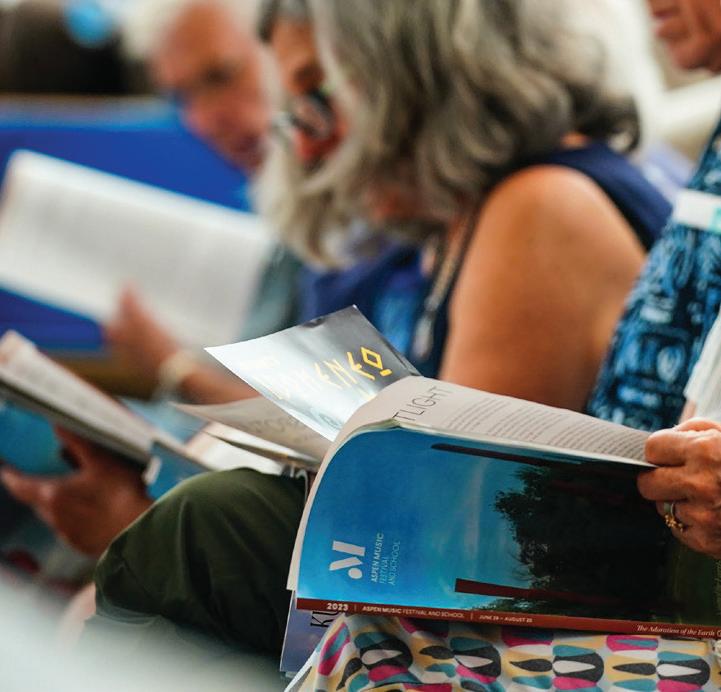








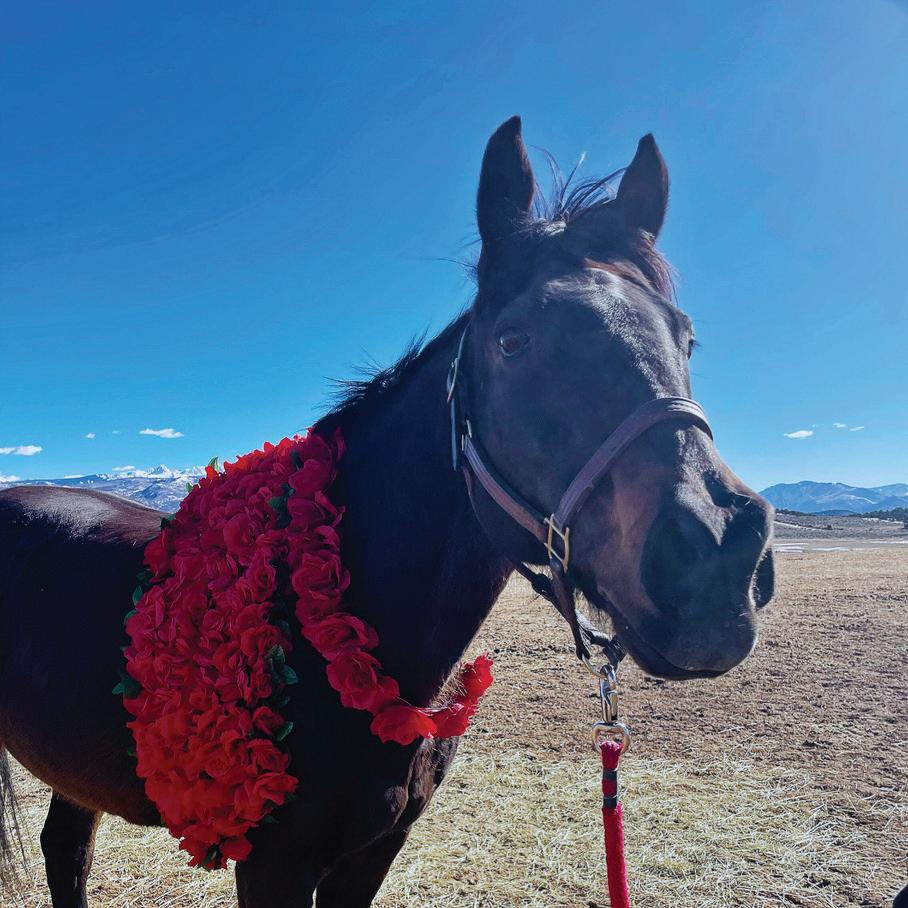


















21 • THE SOPRIS SUN • soprissun.com • April 11 - April 17, 2024 ADVERTISE in the Aspen Music Festival and School’s 2024 SUMMER PROGRAM BOOK In 2024, the Festival’s elevated artists and programming will entice special attention from new arrivals and frequent Festival attendees alike. Local advertisers receive an automatic discount (except covers and premium pages). A price incentive is STILL available for space reserved by April 26. CONTACT SARA SHAW Advertising Sales Manager adsales@aspenmusic.org 603 491 1630 Ladies GentsCouples! ~talk Derby to me~ Watch Party P S a t u r d a y , M a y 4 t h 2 0 2 4 2 P M - 6 P M S P R I N G C R E E K S R A N C H , C A R B O N D A L E SIGNATURE COCKTAILS, SOUTHERN STYLE BUFFET & WATCH PARTY MULTIPLE PRIZES TO LADIES: BEST IN HAT GENTS: BEST IN BOWTIE, HAT OR JACKET COUPLES: BEST DRESSED Thank you to our sponsors! For tickets visit WindWalkers org/events
BASALT REPORT Cada vez que usas tu tarjeta de débito Loyalty*, Alpine Bank dona diez centavos a las causas comunitarias que son importantes para ti. *Las tarjetas de débito de Alpine Bank están disponibles sin cuota anual para personas con una cuenta de cheques de Alpine Bank. INDEPENDENCIA • COMUNIDAD • COMPASIÓN • INTEGRIDAD • LEALTAD ES.ALPINEBANK.COM • MEMBER FDIC ¡Solicita tu tarjeta hoy mismo!
Local yoga teacher coauthors new anthology
By Myki Jones Sopris Sun Correspondent
Amy Harris, a local yoga teacher and energy and embodiment mentor in the Valley, has coauthored an anthology book which tells the stories of eight master students of Teo Alfero, a renowned spiritual teacher and shamanic practitioner who spearheaded the collaboration.
“Transmission: An Anthology of Consciousness, Dreaming and Heart” also features the stories of Jen Ziegner, Nicholette Routhier, Lauren Jane Heller, Stefanie Menack, Wendy Cirello, Erin Kinney and Janet Douglas. The book dives into each author’s experience and touches upon Alfero’s specific technique for teaching practical consciousness known as recapitulation. Harris described it as a life assessment where events and relationships are viewed energetically to better understand them.
“What we're hearing from our readers is the different perspectives and versions of the journey helps people find themselves in the process. I'm really proud of it, and us,” she said.



The book is available in digital and physical forms via Amazon. Courtesy graphic















 By Annalise Grueter
opinion — probably sometime in my teens, I don’t specifically remember. It’s one thing to objectively support the opportunity for people to move to nations other than where they were born, for whatever myriad reasons. It’s quite another to understand, viscerally, how it feels to find an apartment, open a bank account, complete the required bureaucratic hoop-jumping — all without mastery of the language, nuances of the local culture or a strong support system.
Forgive me if this sounds privileged: I’ve come to think that form of understanding is as invaluable as working in service or retail for a time. There is a degree of patience and grace that is developed when you’ve stood in the shoes of hoping that a translation app isn’t missing crucial contextual details, or the embarrassment and fear that comes from being turned away from a bank for having the wrong ID to open an account. Try attempting sentences in your new language and being laughed at or misunderstood because of your accent.
Harris described the project as a journey filled with ups and downs, but rewarding, due to the nature of the stories presented. “The communication between all of us was precisely what we needed,” she stated. “Personally, the hardest part is that there's a lot of vulnerable stuff in the stories. To show up and say ‘look at how wild my life is’ is hard.”
No stranger to spirituality or methods to deepen one’s consciousness, Harris said she has been practicing for the majority of her life. She now holds a master’s degree in spiritual science. She then began her career as a yoga teacher and started working with Alfero in 2020.
“I did my first personal growth seminar when I was 8 years old,” she said. “My mom is really into spirituality, so it's been something infused into my world for a long time — I've been immersed in spiritual endeavors in a practical way. It's
continues on page 26

I didn’t study abroad in college. Instead, I spent three months in the woods playing “escape from the technological world,” similar to Henry David Thoreau (but more on that another time). I had dreamed of living in another country before then, and dreamed of it again after. But it took another seven years before I even explored another country solo.
In late 2022, I finally made good on that overseas aspiration. I’m now 17 months into the adventure of being a student auslander in Germany. When taking this kind of leap, one expects to learn unexpected lessons. But of course, the journey always turns out to be richer and more surprising than anticipated.
I’d like to think that living here is increasing the depth of my empathetic capacity. It is bar none the scariest thing I’ve ever done (and that’s a list that includes climbing up glaciers and steep narrow tongues of snow and extraordinarily chossy high alpine rock).
I’ve felt pro-immigrant ever since I thought about the topic long enough to develop an




My master’s program is called Social Transformation. We examine the concept via the fields of politics, philosophy, economics and leadership. I find myself wondering, how could we, humanity as a whole, increase and incentivize exchange programs, not just for privileged teens or young adults, but for whomever was so inclined to apply? Less like Peace Corps and more like a study or work exchange, but for six to twelve to twenty-four months rather than just three, with an emphasis on the trickier parts of immigration and integration.
Would something like that further increase cross-cultural understanding? Compassion? Might it finally break the English-speaking nations of our bizarre, irrational pride in monolingualism?







22 • THE SOPRIS SUN • soprissun.com • April 11 - April 17, 2024
Moving abroad alone
COLUMN • Hearing and tinnitus exam • Nasal and sinus surgery • Sleep apnea surgery • Head and neck surgery • Facial trauma care • Voice evaluation • Comprehensive medical and surgical services for adults and children Start your healthy journey here. Ear, Nose and Throat Care for the Whole Family AS PE N VA LLE Y HOSPITAL CENTER FOR MEDICAL CARE aspenhospital.org | AspenValleyHospital Melissa Somers, MD Otolaryngology (ENT), Head and Neck Surgery Call to schedule an appointment. 970.544.1460 Aspen Valley Otolaryngology (ENT) Clinic Monday-Friday, 8:30 am-5:00 pm 0401 Castle Creek Road Aspen, Colorado 81611 Get to know Dr. Melissa Somers
GUEST
Michael Jon Raaum
May 11, 1951 –
March 21, 2024
Michael Raaum of Basalt passed away unexpectedly while on vacation in Palm Springs, California on March 21. He was 72 years old.
Born in Williston, North Dakota to Berger and Mary Raaum, Michael grew up in Jamestown, North Dakota. His father, Berger, died when Michael was very young. His mother eventually remarried to John Hillerson.
Michael met his future wife, Ilene Schmidt, the first day of 10th grade at Jamestown High School. She was new to the school. He walked up, introduced himself, shook her hand and the friendship began which lasted a lifetime. After high school, the romance began. They were together 54 years, married for 45 years — true soul mates.
Michael received a master’s of fine arts in painting from the University of Minnesota, Minneapolis. Their interests then took them to Colorado. Michael was hired by Colorado Mountain College, Aspen to be the academic advisor and art instructor. As an art instructor, he enjoyed teaching and helping students learn to "see" art and accomplish their artistic skills. As the advisor, he had a genuine concern for students, assisting them in their career choices and course of action to achieve their goals.







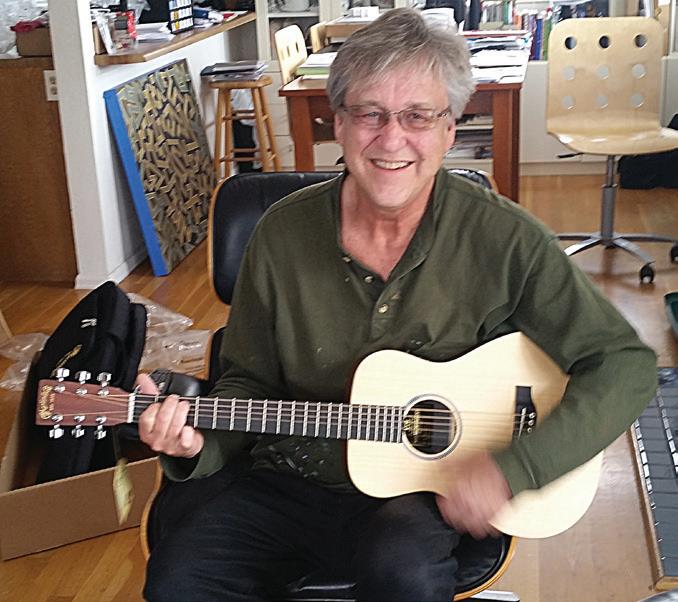
Michael was a brilliant artist, exhibiting in many galleries and museums in the Roaring Fork Valley, Denver, Los Angeles, Minneapolis and others. He was included in the monograph, “Colorado Abstract: Painting and Sculpture,” a survey of contemporary abstract artists in Colorado. Art, music, travel, skiing, scuba adventures were loves of Michael's life. After retirement, he called it "graduation," Michael and Ilene traveled to many art and music centers throughout the U.S., the Caribbean and Europe.
Michael is survived by his wife, Ilene Schmidt; brothers, David Raaum (Kathy Harlan), William Raaum; step-brothers, James Hillerson (Lydia Jean), Chuck Hillerson (Carol), Gordon Hillerson (Dee), David Hillerson (Rosemary); step-sister, Mary Abbot (Jim); mother-in-law, Julie Schmidt; brother-in-law, David Schmidt; and many nieces, nephews and cousins.
The family would like those who knew Michael to keep him in their memories. If they wish to share any stories/pictures, please send them to c/o Schmidt, PO Box 785, Basalt, CO 81621 or email them to mraaum@ michaelraaum.com













SD also said that annual water demand from the project is estimated at less than what has been approved and that aquifer recharge exceeds water demands. Sewage will be managed by the Spring Valley Sanitation District Wastewater Treatment Plant.
Citizen concerns included evaporation, snowmaking, possible conflicts with well water levels and what happens to the land when historic irrigation water goes away.
Longtime rancher Jim Nieslanik and his family use the Spring Valley Ranch for haying, livestock grazing and branding. He told The Sopris Sun that he’s worried about what will happen to the business if this project gets off the ground. “My boys will have to cut way down to half the number of cows that we run,” he said. “Because you can’t run cows on the golf course. You can’t run cows when you got 500 homes.”
He gets a chuckle out of the proposed south-facing ski area, but water is no laughing matter. “You take water for the houses and the lawns and the golf course, you don’t have crops,” he said. “Nothing grows without water.”
How all of this will play out is still anyone’s guess. Once the PUD amendment is reviewed by Garfield County planning staff, it will be subject to public hearings and a decision from the Garfield County Commissioners. If approved, the project proceeds to the preliminary plan review, which could take a year, according to information provided by SD. The company expects construction on the first phase to start in 2026 and total project build-out to take 10 to 12 years.
All planning documents are available at the Garfield County website.



(970) 963-3013 APPOINTMENTS OFFERED MONDAY-THURSDAY 9A-4P WE OFFER: • Dentistry for the whole family • Implant dentistry • Same day crowns • Veneers • Wisdom teeth • Twilight / sleep dentistry (IV sedation) • Clear aligner brace s 60 S 8th ST, #201 Carbondale, CO 81623 Scan To Visit Our Website
Your Local Family Dental Office
OBITUARY Objects in Mirror continued from page 12
mid-valleyselfstorage.com
818 INDUSTRY PLACE Carbondale, CO 8’ x 20’ & 8’ x 40’ Units Trailer & RV Parking! THE SOPRIS SUN • Your weekly community connector • April 11 - April 17, 2024 • 23
Spring Valley continued from page 5
970.989.4203
Pages of the Past: Celebrating 50 years of
By Will Grandbois Sopris Sun Historian
This look back at this month in history is drawn from the newspaper archive at the Carbondale Branch Library. Digitization efforts are underway, with 1975 through 1982 expected to be available at www. coloradohistoricnewspapers.org this summer. Contact tkallassy@ gcpld.org if you’re interested in supporting the project.
Meanwhile, The Sun is in the process of binding issues from 2018 to present, and needs your help tracking down the following Volume 11 (2019) issues: 4 (March 7), 7 (March 28), 11 (April 15), 12 (May 2), 17 (June 6), 19 (June 17), 20 (June 27), 22 (July 11), 26 (Aug. 8); as well as issues 50 (Jan. 17) and 53 (Feb. 7) of Volume 10. Please email news@ soprissun.com if you can help!
April 4, 1974
“Good morning, Carbondale,” the Roaring Fork Review — the town’s first newspaper in decades — declared on its inaugural cover, alongside a hazy sunrise shot and a thank you to the Sage Reminder, Roaring Fork Bank and Circle Super for making it all possible. Editors Pat Noel and Rebecca Young acknowledged
their newcomer status, but vowed to “make every attempt to incorporate as many of those in the community into this paper as possible.” The first issue included coverage of the municipal elections in which John M. Fleet was elected mayor, a bond proposal that would lead to the construction of the Roaring Fork and Basalt High School buildings that now serve as middle schools, and the launch of the Retired Senior Volunteer Program.
April 19, 1984
A fierce debate was underway around a proposed ordinance that would protect solar access for homeowners’ rooftops. It was championed by the Carbondale Energy Review Board, drawn up by Town Planner Mark Chain and opposed by prominent local developers.
“I’m not against solar,” Ernie Gianinetti asserted, “I am against any legislation that forces people to do things.” The paper itself held with those in favor, editorializing that the law “is simple, it will not make life insurmountably difficult for developers as some seem to feel, and it will guarantee future generations the ability to use the sun to heat their homes, grow their food in winter, heat their water and power their appliances.”
April 14, 1994
Mid-Continent Resources received approval to liquidate all assets, more than two years after attempting to sell the Dutch Creek

coal mine near Redstone and ultimately filing for bankruptcy instead. Formerly one of the largest employers in Western Colorado, the company had gone from an asset to a liability due to the cost of reclamation. With money freed up by the sales, work on the 333-acres disturbed by four decades of mining was projected to wrap up in 1996.
April 1, 2004
The Valley Journal got in the April Fools’ spirit with a not-so-subtly edited cover photo of President George W. Bush, “whose popularity in Carbondale is well documented,” leaving the Black Nugget “on his way to campaign for several candidates in the Carbondale municipal election.” The illustration was courtesy of “The Cosmos” and more information was reportedly available on page 37 of the 36-page paper.
April 17, 2014
Four different proposals were vying for Town approval to make use of the old Gordon Cooper Library building. The space had previously been slated for transformation into a museum featuring the works of local sculptor James Surls, until financial backing fell apart. The Carbondale Chamber of Commerce liked the idea of relocating their Third Street Center office back to Main Street, Jim Breasted advocated for a hostel and newly elected trustee A.J. Hobbs recused himself at his first meeting to push for a cafe and community events space. Ultimately, the board supported a partnership between the Carbondale Council on Arts and Humanities and Dance Initiative for a combined dance facility and arts center which would become The Launchpad.

• Only properties or spaces with a rental rate of $5000 or less will be considered.
• A site visit is required before listing the property or space.
If you or someone you know has a property you would like to list, please contact the Hospital at 970.404.1678 or email us at EmployeeHousingDepartment@aspenhospital.org and provide full name, phone number and email address. Our new Employee Housing Portal offers you the possibility to list your property or space available for rent to our Aspen Valley Hospital employees and traveler nurses in need of housing.






24 • THE SOPRIS SUN • soprissun.com • April 11 - April 17, 2024
Carbondale election officials in 1974: Marion Jacobs (left) and Martha Witchey (right).
Photo by Rebecca Young
Professionally Representing You with 16 Years of Experience Your Mid-Valley Real Estate Expert Call me, I love to talk real estate! 970.319.5757 • hilary@hilaryporterfield.com • roaringfork-homes.com HILARY PORTERFIELD ©2023 Engel & Völkers. All rights reserved. Each brokerage is independently owned and operated. LEAP can help heat your home. (Low-Income Energy Assistance Program) JOIN US to LEARN about LEAP & HOW TO APPLY*. Open to All | Food Served | Spanish Translation (*LEAP is accepting applications NOV. 1 - APRIL 30) LEAP puede ayudar a calentar su casa. (LEAP = Programa de asistencia energética para personas de bajos ingresos) ÚNASE A NOSOTROS para APRENDER sobre LEAP y CÓMO SOLICITAR*. Abierto a Todos | Comida Servida | Se Habla Español (*LEAP aceptando Solicitudes 1 Nov. - 30 Abril) 970.920.5235 PITKINCOUNTY.COM / HUMANSERVICES Pitkin County Cares Let us help you find the resources you need. Pitkin County Human Services: Community Resources: (970) 920-5235 pitkincounty.com/humanservices CDHS.COLORADO.GOV/LEAP ASPEN Wed., 4/17/24 Noon - 7:00p Health & Human Services Building BASALT Wed., 4/24/24 5:30-7:00p Basalt Regional Library aspenhospital.org | AspenValleyHospital
Carbondale newspapers
Have Something Available for Rent? Help House Our AVH Employees

Share your works in progress with readers by emailing illustrations, creative writings and poetry to fiction@soprissun.com
Miraculum
Words by Janis Taylor, Glenwood Springs
Artwork by Amy Bidelman, Aspen
Will I ever forget
Shoveling manure
Into grandma’s garden
Tying parallel strings
Scooping out soil in
The Unforgettable Laugh
By Deborah Holt Williams Glenwood Springs
His laugh never dies.
In moments and memories
His laugh hikes through time.
Careful, straight lines?
Mother placed an envelope
Containing corn kernels
In small skeptical hands
That hovered over a
Mound of mud
While worries blurred
Through my brain,
Eyes stared in disbelief
At shriveled seeds and soil,
Agonizing as gentle fingers
Pushed improbable purple triads
One point five inches underground
Too deep to feel sun?
Will shallow waters
Wash them away?
What about distance
From the ditch?

Comparte tus proyectos creativos aún en proceso con nuestros lectores. Puedes enviarnos un correo electrónico con tus ilustraciones, creaciones literarias y poesía a fiction@soprissun.com

Can seedlings grow Upside down or Sideways?
How long before They discover my Mistakes?
I faked nonchalant
Indifference to mask
My fears.
I noted bare ground as Each day passed
Until at last Joy burst through in Bright green leaves.
MOTHER’S DAY IS RAPIDLY APP A ING
All local mothers who have welcomed a baby into their lives this past year are invited to have a portrait taken to run in The Sopris Sun’s May 9 edition.




Our professional photographer will be setting up at the Third Street Center (520 S. 3rd Street, Carbondale) on April 6 and 13 with additional dates added if necessary.






Please email raleigh@soprissun.com or call 970-510-3003 to coordinate.



THE SOPRIS SUN • Your weekly community connector • April 11 - April 17, 2024 • 25


Aspen. They were the best, ever. Even though I’m an avowed pagan, I would say a thousand Hail Marys if they would give me that recipe. Someone needs to procure it before that place becomes a trophy ranch.
Luke Nestler, Carbondale
Equinox reading
MANA Foods celebrated spring with our bi-annual yoga event. We completed a 72hour mantra reading through the Equinox. This makes 16 times in 8 years that Sotantar has organized this event. Each year, people participate in this Valley-wide, showing up to pray changes. Some readers have participated from the beginning. This past season participants blossomed to over 30 readers.
The Equinox is a special time of the year as our sunlight splits the day and night in half and the next season begins. This spring Equinox was special to me as our community experiences a new season of all the best fruits and veggies this region has to offer, all organic. By doing our event on this sun alignment, our intent was to raise our voices in gratitude for our families, our country, our planet earth, and God. We value that each one of us has a voice to make our community a better place for all.
It is a weird thing for a grocery store to do such a yoga project of a 72-hour reading, yet our lives are more than just the food we put in our bodies. MANA Foods is more than just a food store, it supports local farmers, ranchers, and regional food makers. Everyone who eats organic foods supports their brain and overall happier moods for each one of us. The readings also support mental health and open the possibility for improved physical health.
Anyone can call and make an appointment to read. Otherwise, the next Equinox is in September, so come and have an enlightening experience.
This was my eighth season reading. I have many stories to share about the people who have participated in the readings, so stop in MANA Foods on a Sunday and just ask for Roop. Paramroop S. Khalsa, MANA Foods
Re: Downtowner
Hmmm … the Town trustees voted to spend $181,500 on a six-month trial for the free Downtowner transportation service, and will consider spending up to $726,000 for yearround service in 2025, according to the April 4 Sopris Sun.
Ok. Seems to me the decision to pay $181,500 for the Downtowner trial service could use some “Whereas’s,” like usually accompany ordinances. Off the top of my head, the “Whereas’s” could include such declarations as:
• Whereas some Carbondale residents
Anthology
don’t own vehicles, even junkers;
• Whereas the Downtowner will also benefit many under-age youth who have no way to escape their parents, other than to hoof it out of their house;
• Whereas it’s a mile or two from south Carbondale to City Market, Roaring Fork Family Physicians, Peppino’s Pizza and the Cowen Center car wash;
• Whereas the Downtowner will keep cars from clogging the Town’s busy thoroughfares, roundabout and parking lot across from the Crystal Theatre;
• Whereas dogs will benefit from the Downtowner because their owners can more readily get them to the big dog park, and Carbondale is a dog-friendly town;
• Whereas the Downtowner will improve the town’s air quality and directly combat climate change;
• Be it now ordained that the $181,500 Downtowner expense is darn well worth it.
The Sopris Sun article quoted Mayor Ben Bohmfalk saying “ … We’re going to have to get a pretty quick read on whether we want to fund it for the next year.” He said the 2025 budget process begins in August.
Lynn “Jake” Burton, Glenwood Springs
MVDS
Mountain Valley Developmental Services would like to thank the Defiance Thrift Store for their recent generous donation. Again this year, we are thrilled to have been chosen by the Defiance Thrift Store for their continued financial support. In addition to supporting us financially, the store also provides work opportunities for many people- some who may not otherwise have been given a chance at being competitively employed.
The employees and board members of the Defiance Thrift Store understand the importance of building people up and are dedicated investors in our community. Please help this investment continue by donating your gently used clothing and household goods to them for resale.
Thank you again, for the important work you do, which helps Mountain Valley Developmental Services do our work!
Sara Sims, Executive Director
Letters policy: The Sopris Sun welcomes local letters to the editor. Shorter letters stand a better chance of being printed. Letters exclusive to The Sopris Sun (not appearing in other papers) are particularly welcome. Please cite your facts and include your name and place of residence or association. Letters are due to news@soprissun.com by noon on the Monday before we go to print.
continued from page 22
always been a very practical set of questions I’ve asked throughout my life: ‘How does this actually matter on earth?’ ‘How does this actually impact my life and the people I connect with?’”
The title of the book is a reference to the transmission of energy in all settings. It also represents the transmissions of each coauthor’s personal energy, depicted with nine symbols forming a circle on the book’s cover.
“Each of those symbols is as close as we can get to a symbol of each person's transmission,” Harris said. “For example, Teo [Alfero] runs a wolf sanctuary and does wolf therapy and has done that for over 15 years. His transmission is very wolf-like.”
For upcoming projects, Harris mentioned she is already in dialogue with her coauthors and Alfero about conducting a workshop based on the book. She hopes to do this in collaboration with a yoga studio based in Carbondale.
To keep up with Amy Harris and her classes, visit www.theamyh.com
To sign up for an online course with a four-day retreat taught by Harris and Alfero, visit www.teoalfero.com/thethreshold
26 • THE SOPRIS SUN • soprissun.com • April 11 - April 17, 2024
from page 2
LETTERS
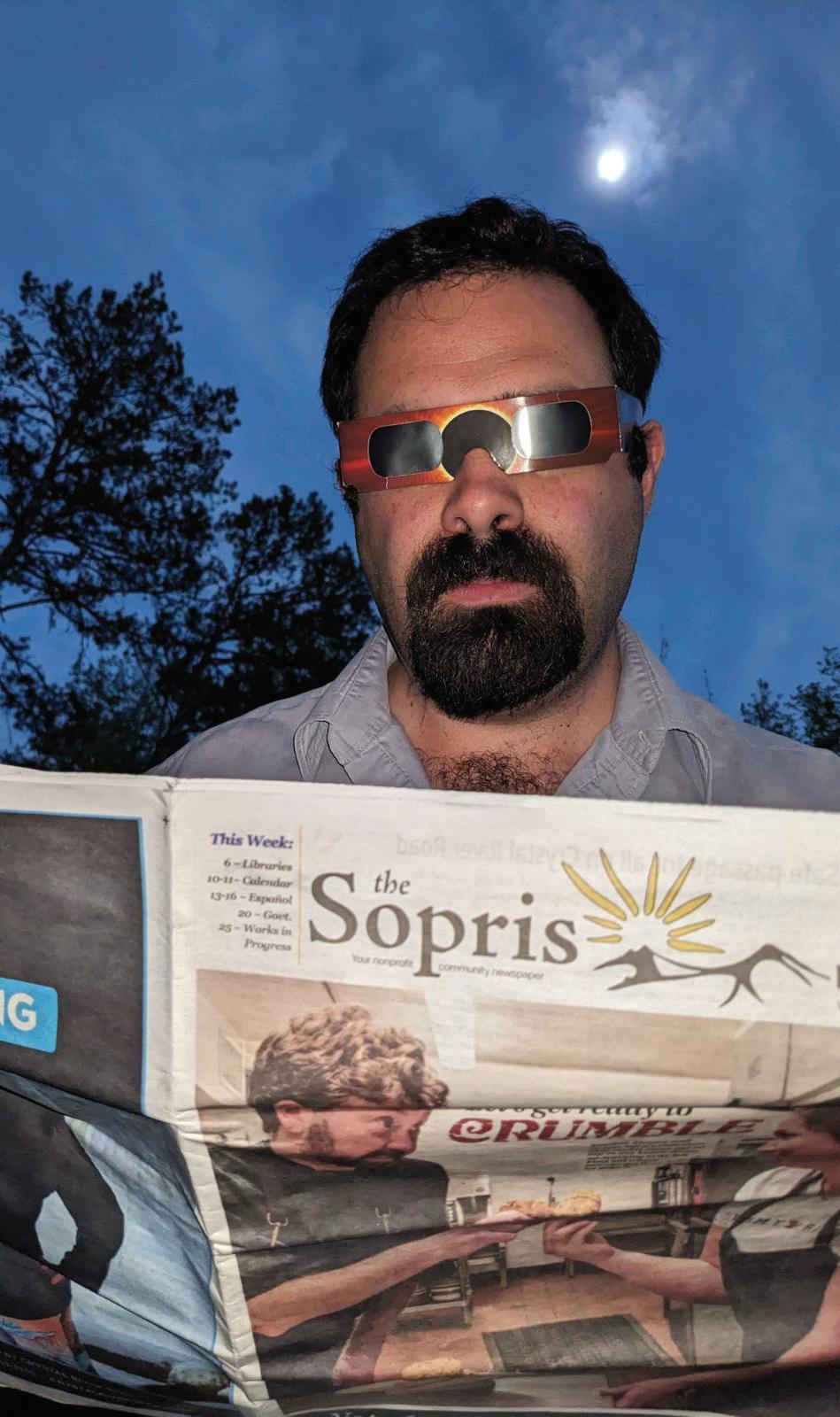









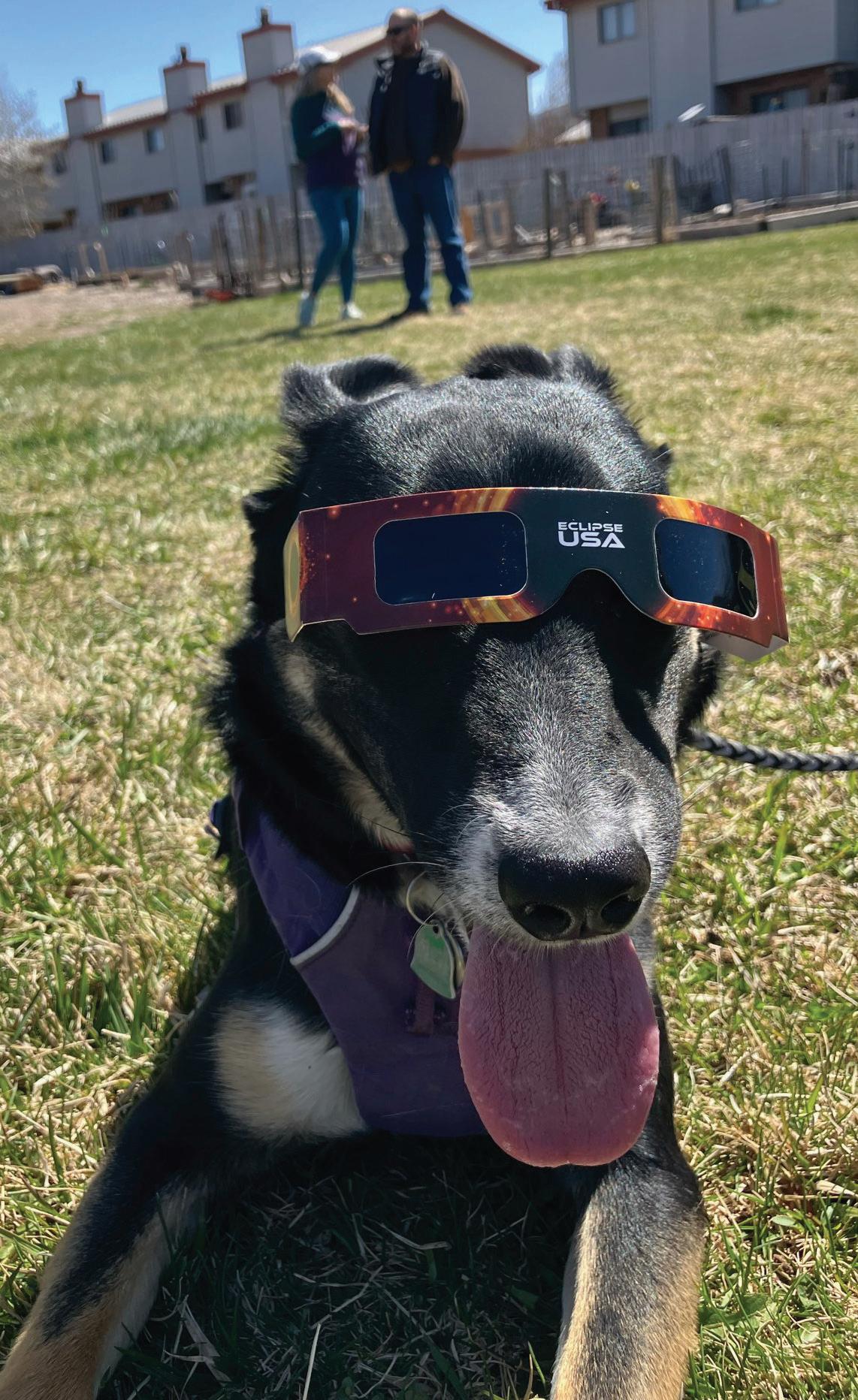
SERVICE DIRECTORY
PARTING SHOTS
GARDEN SPACE AVAILABLE 3 raised beds 8'x16'. Good organic amended soils, irrigation water, great sun. Hoop tenting is simple. These beds have provided high quality produce for many years. Please call 970-963-1910. HELP WANTED TRANSPORTATION/CAR MODEL/YEAR Provide Copies of: Drivers License, Auto & Health Age: 35 yrs to 55 yrs Bilingual & List of references required. ***CALL RENEE @ 970-510-5596*** Light housekeeping and gardening. WEEKLY: TUESDAYS & FRIDAYS 3 hour minimum, more as needed RATE: $25.00 per hour 289 MAIN STREET (970) 963-2826 CARBONDALEAH@GMAIL.COM Locally owned. Accepting new patients. Offering: Dentistry Surgery Wellness Geriatric Care Chiropractic Acupuncture Cold Laser
(Above) As totality approached in Ozark National Forest, Will Grandbois was disappointed to find his glasses did not help him see The Sun. Photo by Rebecca Young
(Right) Gloria Tortilla Harvey represents for all canine astronomers on Monday during the eclipse.
Photo by Allyn Harvey
(Above) The tiny gaps between leaves are like pinhole cameras, projecting the dance of the sun and the moon on the ground. Photo by Amy Hadden Marsh
THE SOPRIS SUN • Your weekly community connector • April 11 - April 17, 2024 • 27
(Above) Photo by Sue Rollyson



Community Rewards
An Easy Way for you to Help Fund the Sun
At No Cost to You
Every Time you Buy Groceries


Step 1: Create your Digital City Market Account

Step 2: Go to COMMUNITY ---> City Market Community Rewards
Step 3: Choose SOPRIS SUN LLC as your preferred nonprofit
Step 4: Shop as you normally do
City Market then makes a donation to the Sopris Sun

The Power of Community:
10 Sign ups would support a weekly column
100 Sign ups would support our annual Youth Journalism Program
1,000 Sign ups would support the Annual Cost of our local Government Oversight - a journalist covering every local City/Town, County, School Board, Library Board meeting for a full year.
2,500 Sign ups would support the annual printing costs of the Sopris Sun and el Sol del Valle.
City Market Community Rewards Program™

Dr. Scott Tesoro is back in Carbondale and is accepting a limited number of new patients.
WE OFFER:
Chiropractic Care for Sports and Wellness
Dry Needle Therapy
Massage therapy
Physical Therapy and Injury Rehabilitation
Mental Health Support and Coaching
WE ACCEPT SOME INSURANCE PLANS.
While our new o ce in La Fontana Plaza is under construction, we are at a temporary location 1378 Main Street just West of ACE Hardware.
(970) 927-9204
• www.soprischiropractic.com

28 • THE SOPRIS SUN • soprissun.com • April 11 - April 17, 2024
SOPRIS CHIROPRACTIC
2 FOR 1 CONTACT TODD CHAMBERLIN AT 970-987-9866 OR EMAIL ADSALES @ SOPRISSUN.COM BUY ONE ENGLISH AD GET ONE SPANISH AD FREE PLUS FREE DESIGN AND FREE TRANSLATION SOPRIS SUN ADVERTISING SPECIAL DOUBLE DEAL DOUBLE DEAL
