


JON WATERMAN
Sopris Sun Contributor
EDITOR’S NOTE: The Cattle Creek Confluence Coalition — www.cattlecreekcc.com — is holding a public meeting on this topic on Thursday, Nov. 6, at 6:30pm in the Glenwood Springs Library community room.
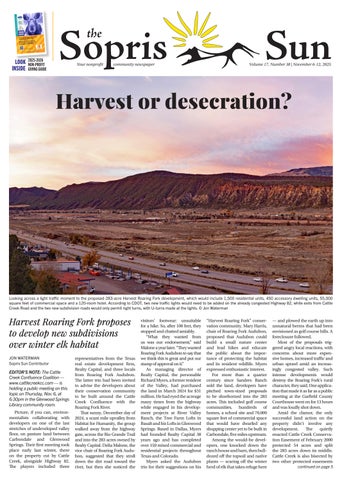
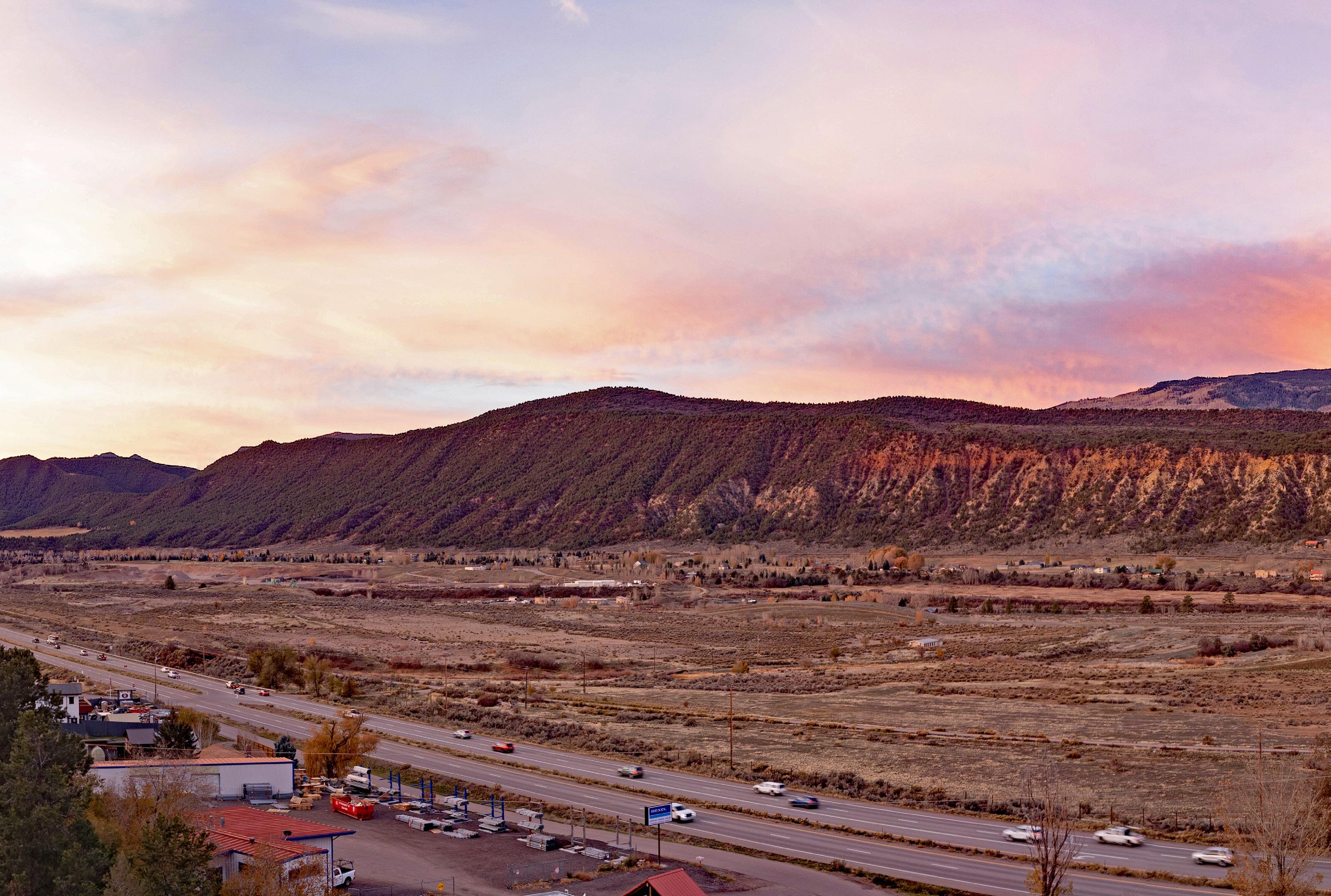
Picture, if you can, environmentalists collaborating with developers on one of the last stretches of undeveloped valley floor, on pasture land between Carbondale and Glenwood Springs. Their first meeting took place early last winter, there on the property cut by Cattle Creek, alongside Highway 82. The players included three
representatives from the Texas real estate development firm, Realty Capital, and three locals from Roaring Fork Audubon. The latter trio had been invited to advise the developers about their conservation community to be built around the Cattle Creek Confluence with the Roaring Fork River.
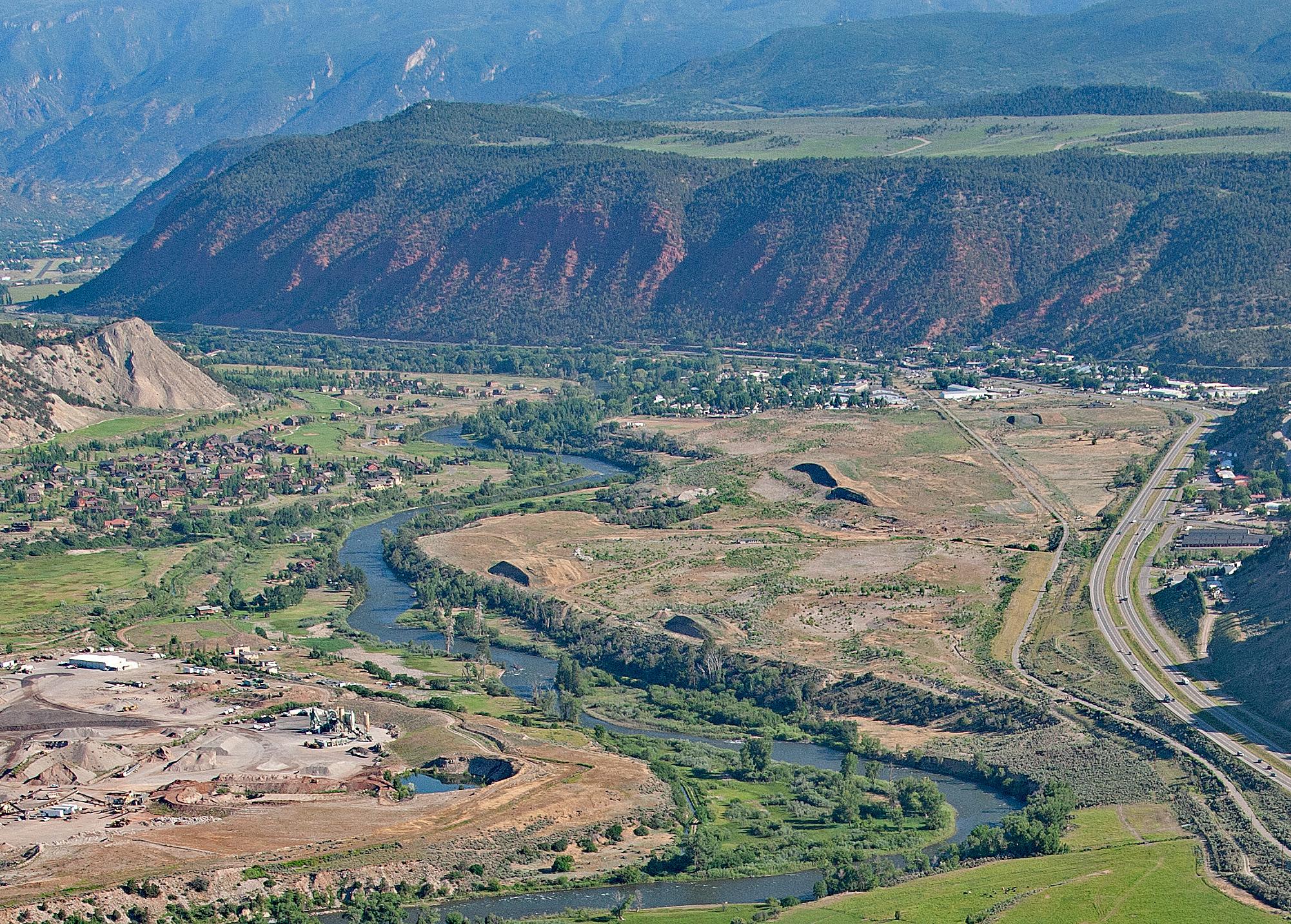
That sunny, December day of 2024, a scant mile upvalley from Habitat for Humanity, the group walked away from the highway gate, across the Rio Grande Trail and into the 283 acres owned by Realty Capital. Delia Malone, the vice chair of Roaring Fork Audubon, suggested that they stroll down the dirt road toward the river, but then she noticed the
visitors’ footwear: unsuitable for a hike. So, after 100 feet, they stopped and chatted amiably.
“What they wanted from us was our endorsement,” said Malone a year later. “They wanted Roaring Fork Audubon to say that we think this is great and put our stamp of approval on it.”
As managing director of Realty Capital, the personable Richard Myers, a former resident of the Valley, had purchased the land in March 2024 for $31 million. He had eyed the acreage many times from the highway while engaged in his development projects at River Valley Ranch, the Tree Farm Lofts in Basalt and his Lofts in Glenwood Springs. Based in Dallas, Myers had founded Realty Capital 38 years ago and has completed over 150 mixed commercial and residential projects throughout Texas and Colorado.
Myers asked the Audubon trio for their suggestions on his
“Harvest Roaring Fork” conservation community. Mary Harris, chair of Roaring Fork Audubon, proposed that Audubon could build a small nature center and lead hikes and educate the public about the importance of protecting the habitat and its resident wildlife. Myers expressed enthusiastic interest.
For more than a quarter century since Sanders Ranch sold the land, developers have pitched town-sized proposals to be shoehorned into the 283 acres. This included golf course communities, hundreds of homes, a school site and 70,000 square feet of commercial space that would have dwarfed any shopping center yet to be built in Carbondale, five miles upstream.
Among the would-be developers, one knocked down the ranch house and barn, then bulldozed off the topsoil and native plants — scaring off the winter herd of elk that takes refuge here
— and plowed the earth up into unnatural berms that had been envisioned as golf course hills. A foreclosure followed.
Most of the proposals triggered angry local reactions, with concerns about more expensive homes, increased traffic and urban sprawl amid an increasingly congested valley. Such intense developments would destroy the Roaring Fork’s rural character, they said. One application that made it as far as a public meeting at the Garfield County Courthouse went on for 13 hours and was loudly shot down.
Amid the clamor, the only successful land action on the property didn’t involve any development. The quietly enacted Cattle Creek Conservation Easement of February 2000 protected 54 acres and split the 283 acres down its middle. Cattle Creek is also bisected by two other protected easements
continued on page 5
My first paying job was as the Little League baseball reporter in my small south Texas hometown when I aged out of playing. For the princely sum of 10 bucks a week, I endured often boring games thrice each week in Texas heat and humidity before biking home in the dark and handwriting stirring accounts for that week’s paper. I’m sure readers jumped to those reports before learning about that week’s city council meeting. I was our town’s sports section while the high school teams were on summer break.
Dear America
President Trump has unexpectedly stirred in me a long-dormant love of country and flag. For the first time, I feel truly patriotic — but perhaps not in the way you might think.
As our democracy seems to be slipping away, faster than any of us imagined, my love for our nation’s ideals has been rekindled. Who knew our democracy was so fragile? And who imagined that a second Trump term would awaken complacent Americans, motivating “We The People” to defend the freedoms that we hold dear?
Freedom of speech is a cornerstone of our democracy. Any leader who threatens this freedom is profoundly un-American. We have always known who the “bad guys” are: nations where dissent is silenced, where only one party is allowed and where dictators rig elections. I ask you, America: Is our president leading us down that same path?
Editor Raleigh Burleigh 970-510-3003 news@soprissun.com
Contributing Editor
James Steindler
Sol del Valle Editora Bianca Godina bianca@soldelvalle.org
Digital Editor Ingrid Celeste Zúniga ingrid@soldelvalle.org
Lead Editorial Designer Terri Ritchie
Partnerships & Engagement Manager Luise Wollesen
By George Bohmfalk
I’ve had an affection for small town papers and journalism ever since. Why are they important? We have myriad outlets for state, national and world news. But those papers don’t have reporters at our town trustee, county commission, library board or RFTA meetings. They don’t cover Mountain Fair, Dandelion Day, Día de los Muertos or Potato Day. They haven’t reached out to bridge divides with the large Spanish-speaking population with whom we share our enviable lives here. They don’t nurture the next generation of journalists by mentoring student writers and reporters. The Sopris Sun does all of that.
And The Sun is good at it, regularly winning awards and the admiration and envy of small-town newspaper producers across the country. We can be proud of our local paper.
All of that costs a lot of money. Even sharing resources with other Valley outlets, like Aspen Daily News and KDNK, there’s no way that advertising revenue can cover production costs. There has long been an unwritten agreement among Valley publications to provide local news to our lucky audiences for free. The Sun does not propose to change that.
So The Sun needs community support beyond paid ads. There’s no charge for listing your events in the calendar, posting obituaries, sharing your literary efforts or expressing your opinion in letters. The Sun is our newspaper. Please join me in nurturing it. If every reader supported with just $100 each year, it would be in strong financial shape. Not everyone can do that, but many of us can do much more. I hope you’ll make a commitment to regular ongoing support and even name The Sopris Sun as a beneficiary in your will. Together, we can keep our Sun shining forever.
EXECUTIVE DIRECTOR’S NOTE: Colorado Gives Day is on Dec. 10. Contributions made through ColoradoGives.org on this day (or scheduled in advance) will be enhanced by a generous incentive fund from the Colorado Gives Foundation and FirstBank. Give today at www.coloradogives.org/TheSoprisSun
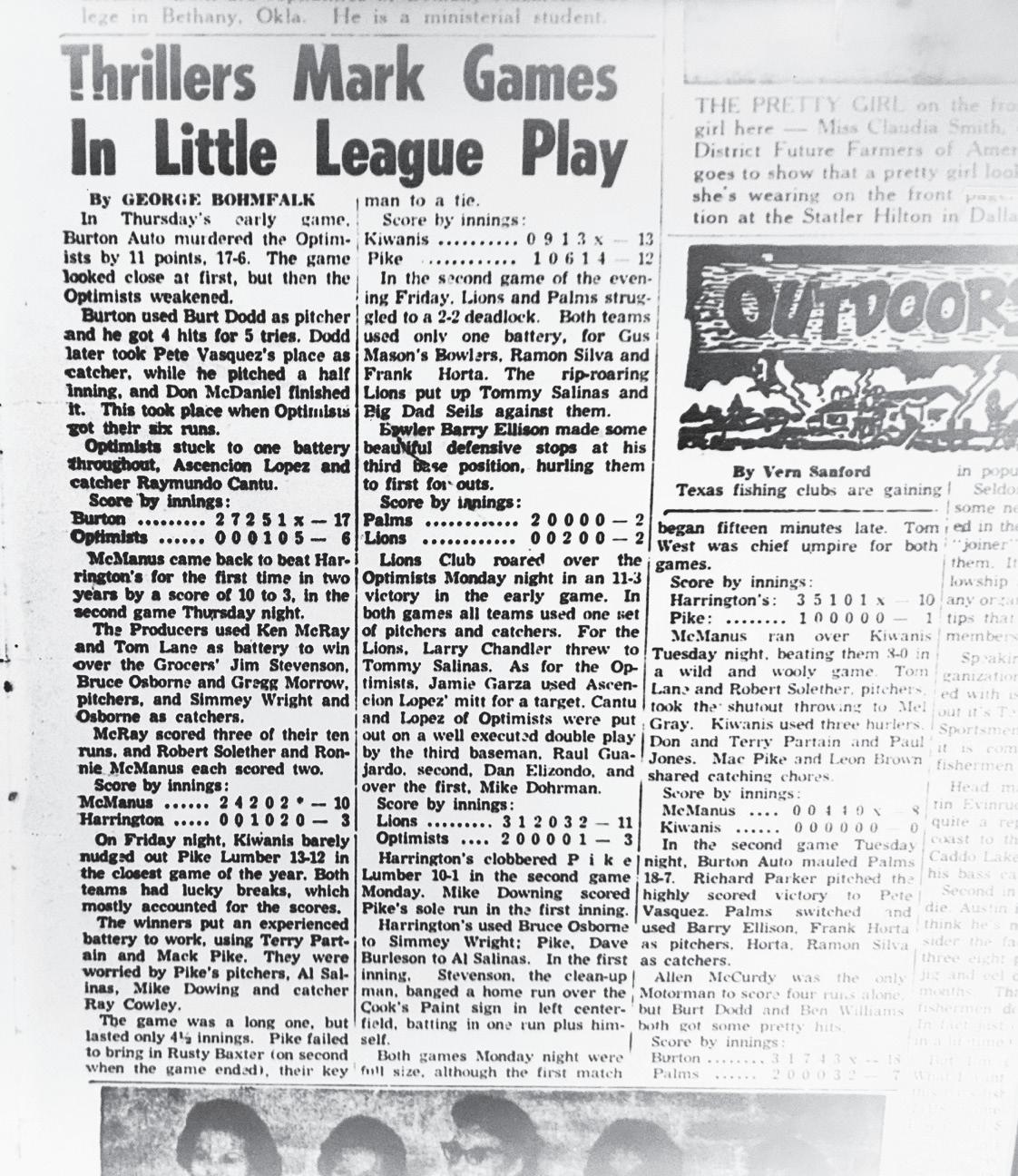
Look closely and you’ll see a young George Bohmfalk’s byline in his Texas hometown newspaper. Courtesy graphic
Our freedoms are under threat. For 250 years, Americans have stood up to defend democracy at home and abroad. Today, we face another such moment. Now is the time for Republicans, Democrats and independents to come together. Now is the time for Americans of every race and background to unite against this threat, just as we always have, in the name of freedom.
This is our time.
Michael Podmore New Castle
On behalf of the VOICES board and staff, I am writing to express our sincere gratitude to the Aspen Thrift Shop for recently awarding our organization generous grant funding that will help us continue propelling our mission into the community. We believe that now, more than ever, amplifying the voices of our neighbors is critical to moving our region forward with compassion, connection and understanding the deep power of our shared humanity. We are proud and honored to know that the Aspen Thrift Shop supports this vision.
If you are not already familiar with VOICES, we are a Carbondale-based nonprofit serving the Aspen-to-Parachute region through storytelling, arts and music programming in schools, in community and on stage. Maybe you have listened to a story told from our mobile ARTery Tiny Stage, attended one of our biannual devised theater productions, tuned into an episode of our VOICES Radio Hour podcast or enjoyed a song performed by your child in one of our school-based music residencies. These programs and more are ongoing, year-round. This work would not be possible without funding from grantors like the Aspen Thrift Shop, which champions our mission to amplify voices through the arts. To learn more about our work or how you can support or get involved, please visit www.VOICESrfv.org
MinTze Wu VOICES
Seniors’ Resource Fair
When the community comes together, good things truly happen — especially when it comes to supporting our older adults. In that spirit, I would like to share with Roaring Fork Valley seniors and their families that we are hosting our third annual Seniors’ Resource Fair on Thursday, Nov. 13 from 11am to 1pm at the Carbondale & Rural Fire Protection District station.
To attend is free, and many local organizations have generously agreed to come and share what they offer for seniors living in the area. This includes Roaring Fork Valley professionals offering essential resources for older adults, including hospice, home care, health services, fitness and more. For seniors and families, it is a great way to meet with so many organizations, build connections and support one another. We hope to see you there. Many thanks to the Carbondale Fire for allowing us to gather at their space for the day.
Marie Herr Sopris Lodge
at Carbondale
The volunteers and staff of the Carbondale Bike Project (CPB) sincerely thank the Aspen Thrift Shop for awarding us the 2025 grant funds for general operating support. Your generosity directly strengthens our mission to keep bicycles out of landfills, provide educational opportunities for youth and the broader community and ensure access to bikes for those in need.
Advertising Department adsales@soprissun.com
Sol del Valle Marketing and Development Manager
Margarita Alvarez margarita@soldelvalle.org
Advertising Designer Emily Blong
Delivery Frederic Kischbaum
Youth Journalism Instructor
Skyler Stark-Ragsdale
Proofreaders
Lee Beck
Tracy Kallassy
Ken Pletcher
Hank van Berlo
Executive Director
Todd Chamberlin 970-510-0246
todd@soprissun.com
Board Members / Mesa Directiva board@soprissun.com
Klaus Kocher • Kay Clarke
Donna Dayton • Eric Smith
Roger Berliner • Elizabeth Phillips
Jessi Rochel • Andrew Travers
Anna Huntington • Loren Jenkins
Carlos Ramos • Gayle Wells
The Sopris Sun Board meets at 6pm on second Thursdays at the Third Street Center.
The Sopris Sun, Inc. is a 501(c)(3) nonprofit corporation with a mission to inform, inspire and build community by fostering diverse and independent journalism. Donations are fully tax deductible.
Sincerest thanks to our Honorary Publishers for their annual commitment of $1,000+
Lee Beck & John Stickney
Kay Brunnier
Frances Dudley
Michelle & Ed Buchman
Sue Edelstein & Bill Spence
Deborah & Shane Evans
Greg & Kathy Feinsinger
Gary & Jill Knaus
Eric Smith
Peter and Mike Gilbert
Patti & George Stranahan
Elizabeth Wysong
Alpine Bank
Emily & George Bohmfalk
Kathy & Carter Barger
Sandy & Paul Chamberlin
Karen & Roger Berliner
Donna & Ken Riley
Gayle & Dick Wells
Legacy Givers for including us in their final wishes. Mary Lilly
Donate by mail or online: P.O. Box 399 Carbondale, CO 81623
520 S. Third Street #26-B 970-510-3003
soprissun.com/Donate
The Sopris Sun, Inc.
is a proud member of the Carbondale Creative District





FirstBank
Alpine Bank
Colorado Mountain College
Nordic Gardens
Hilary Porterfield
Basalt Library
NONPROFIT PARTNERS
Two Rivers
Unitarian Universalist
Carbondale Arts
Carbondale Rotary Club
Colorado Animal Rescue
Interested in becoming an Underwriter or Nonprofit Partner?
Email Todd@soprissun.com or call 970-987-9866
As of Wednesday, Nov. 5, Tammy Nimmo and Kathryn Kuhlenberg had clear victories in the Re-1 Board of Directors race, earning 69.95% and 72% of the vote, respectively. Ballot Issue 7A , establishing a special taxing district with a .25% sales tax to help bolster child care in Garfield, Pitkin and southwestern Eagle counties, passed with 60.2% of the vote. Both of the Carbondale and Rural Fire Protection District issues also passed , entailing a new 1.5% sales tax and allowing the issuance of a $30 million bond. Colorado Mountain College’s measure , allowing the college to set its mill levy above the state property tax limit, as it had previous to 2024, passed with 72% of the vote. Basalt Library’s measure , renewing a mill levy, passed with 77.8% , and the Town of Basalt’s proposal to increase lodging taxes to help fund affordable housing passed with 68.3% All Aspen and Pitkin County ballot items also passed.
Food drive
On behalf of Lift-Up, Carbondale Beer Works is organizing a food and household necessities drive, accepting donations of gift cards and cash as well, on Nov. 8 from 11am to 2pm. Phat Thai and Downtown Liquors will also be receiving donations.
‘Heads and Tails’
Steve’s Guitars celebrated Day of the Deadheads on Nov. 2 with “Heads and Tales,” an evening of live music with local band Dead Reckoning and stories from audience members all about the Grateful Dead. Find the archive here: www.bit.ly/Dead-Stories
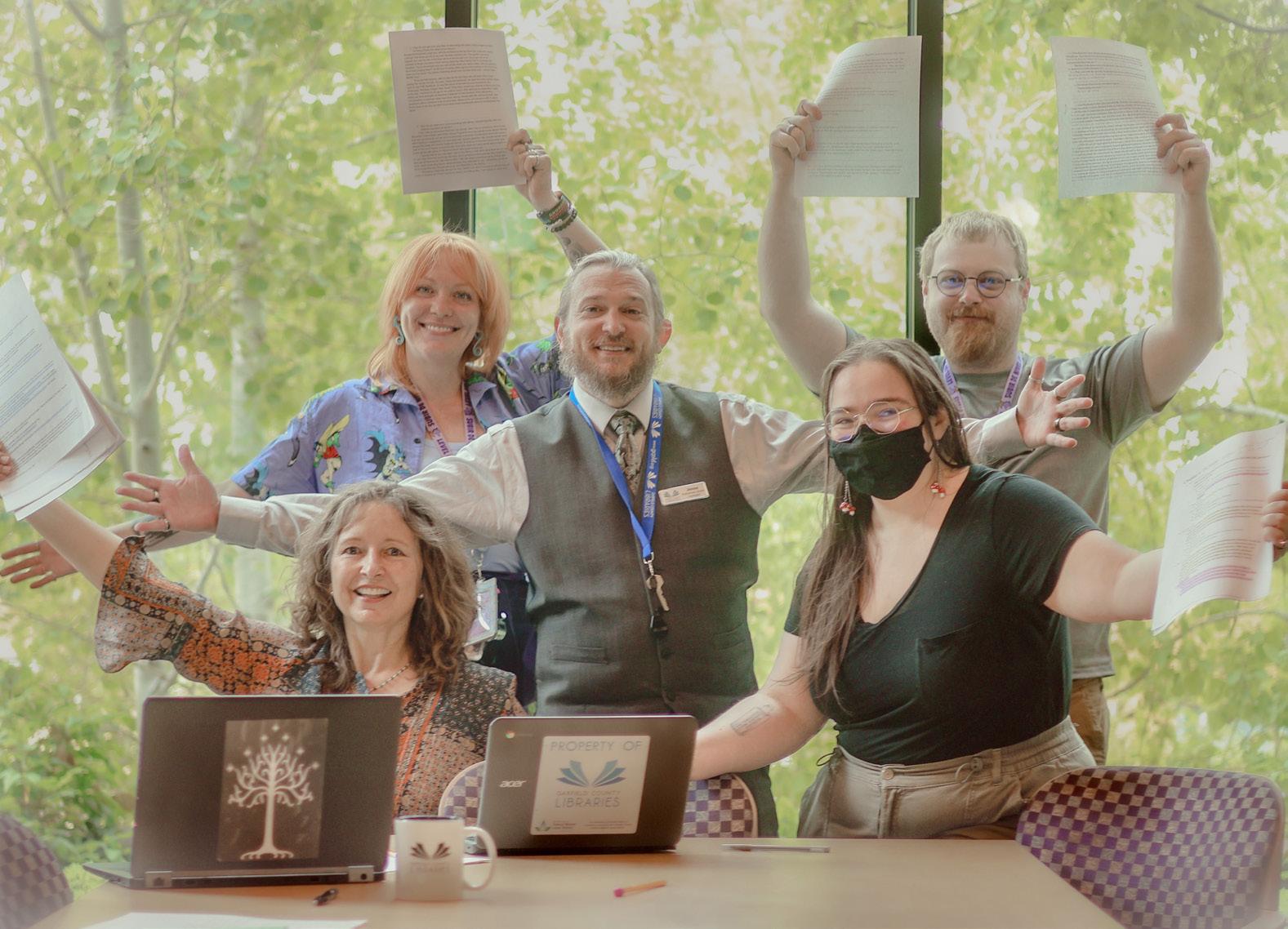
The contest is open to all ages, with a limit of two entries per person. No AI-assistance allowed, of course! Send submissions to tlamee@gcpld.org and svail@ gcpld.org by Nov. 30. Winners and prizes will be announced on Dec. 4. Courtesy photo
Valley Visual Art Show
The 47th annual Valley Visual Art Show is accepting entries from local artists. Anyone living within an “816” area code is welcome to submit two pieces created within the past year for consideration. Find details at www.bit.ly/VVAS2026
Photography contest
Roaring Fork Conservancy’s 2025 Photo Contest is underway with amateur and professional divisions for two categories: major rivers and tributary streams, both within the Roaring Fork Watershed. Entries are due by Nov. 17; find details at www.bit.ly/2025RFV
Congrats!
Carbondale resident Ron Baar was recently inducted into Western Colorado University’s Mountaineer Sports Hall of Fame along with his team which finished second in the 1966 NCAA National Ski Championships — the highest finish by any Rocky Mountain Athletic Conference team in any sport in Western Colorado University history. “The induction ceremony and banquet was really nice,” Barr told The Sopris Sun. “I felt honored to be a part of it.”
GWS Community Survey
The City of Glenwood Springs is inviting

residents to share their feedback on local issues, city services and priorities. All responses are confidential and the deadline is Nov. 1. Find the survey in English and Spanish at gwsco.info/NCS
The final day for Carbondale residents to drop off leaves and yard waste at 4th and Colorado is Friday, Nov. 7, from 9am to noon.
WE-cycle services have concluded in Aspen and Snowmass Village for the winter season. The Carbondale system remains open year-round and the midvalley system continues through November. For the first time in WE-cycle history, trips in one year have surpassed 300,000!
They say it’s your birthday! Folks celebrating another trip around the sun this week include: Beth Broome, Murry Daniels and Greg Watts (Nov. 6); Lee Beck, Brett Nelson and Noreen Steiner (Nov. 7); Rick Carlson and Mira Winograd (Nov. 8); Wolfy Draper and Stephen Molloy (Nov. 9); Tim Ireland and Nuni Zee (Nov. 10); Jacquelinne Castro and Nicolette Toussaint (Nov. 11); Alex Achterhoff, Kelsey Freeman, Estefania Montoya and Lance Quint (Nov. 12).




JAMES STEINDLER
Contributing Editor
Dos Gringos Burritos and Café Olé has been rolling up chow and serving to-order coffee drinks for the better part of a quarter century now; Nov. 11 is Dos’ official 25th anniversary. The establishment has become a sort of beacon in Carbondale and the Valley, enticing early-morning commuters or midday lunch runners with its glow.
The business was born somewhat through a series of happenstance. A young Nelson and Julie Oldham met on the Big Burn chairlift on Snowmass back in 1992, after the latter had moved to the Valley and while Nelson was vacationing. Julie said she had planned to move to the mountains from Michigan by the fourth grade, “It just took a little while.” They formed a personal union and made a go of it in the Valley. Eventually, Nelson tired of working carpentry jobs, and Julie tired of his griping and happened to have a background in marketing.
After settling into a home in Carbondale, the duo opened Dos Gringos in 2000 in the then-new La Fontana Plaza. While a lot has changed in Carbondale, Julie said that the spirit is still the same and Dos has kept up with the growth and mirrored those values, while providing a hub for the community to gather.
Whether people are rearranging the furniture for an impromptu work or social meeting, hanging a personal piece of art or returning for breakfast and lunch every day, the team appreciates the reciprocal cohesion. “One thing I’ve always really loved about our customers is that they really feel like this place is theirs,” Julie said. “We all love that.”
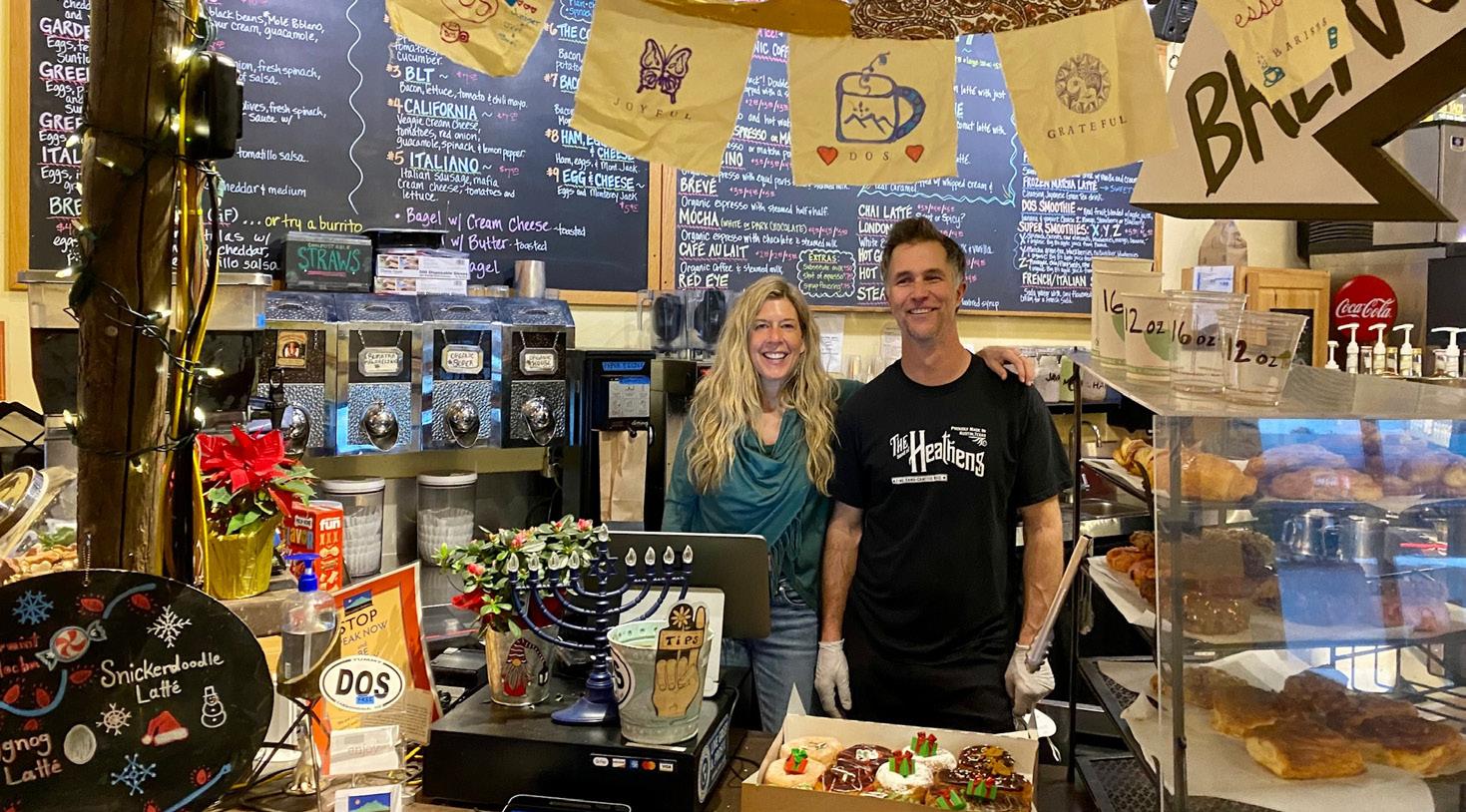
The menu hasn’t changed since the beginning, at least for the most part, and was fun to come up with while keeping the diversity of Carbondale in mind, Julie said. They shelled out recipes and names for each unique burrito, and listened to customers, one of which suggested the fixings for the Spud Love.
Nelson said that more so than the food it’s about the people for him, including the team that pulls the strings of the operation. The crew is like family, and not just Nelson and Julie’s kids, who continue to work there when they’re home.
“It’s not really about food. We could be making widgets, you know?,” Nelson quipped. “If I can bring out the best in a person and have them leave with the campfire rule that they are better off after they leave than when they got here, that’s what’s
been really rewarding.”
Of the team’s camaraderie, he said, “It’s super inclusive. Whether you’re 45, male, female, Latino or gay, nobody seems to care.”
To show its gratitude, Dos has donated the icing of profits and its space to nonprofits. For its 20th year, the duo donated a portion each week to a different nonprofit. During the pandemic, seeing where there was some substantial need, they donated to local domestic violence resources and the Food Bank of the Rockies. Since then, they have doubled down supporting the Food Bank of the Rockies, acknowledging that while they do their best to keep prices low, some people still can’t afford to go out.
From the 2008 recession to the 2020 pandemic, Dos has weathered many a storm alongside its community with optimism, a smile and even rollerskates
— at least during COVID restrictions. On a personal level, Nelson and Julie separated about eight years ago, which of course wasn’t easy for them or the business, but, with the support of the same community, came out the other side as devoted friends and coparents to their Dos baby.
Julie recently met a franchise kingpin, a fellow passenger on an airplane, who referred to Dos as a “unicorn,” and suggested that it could be franchised. Her response was that it is one of a kind. She told The Sun that the last thing they’d want to see is it become corporate, or “anything that took the soul away from this place and what people love about it.”
Nelson chimed in, “It’s about as far from a corporate place as you can get.”
Lucky for us, they intend to keep it local and healthy, sourcing their barbacoa from the Nieslaniks, as well as local eggs and Colorado-based chicken.
Julie said she’s “a Gringo girl,” when it comes to her go-to “burrito a day.” Nelson added that after 25 years of eating there every day, he, too, still loves the food.
While the owners may step back little by little over time, Julie said, “Hopefully Dos lives on no matter what … We have no plans to go anywhere.”
For the 25th, the restaurant is launching a “Dos in the Wild” campaign, where friends of Dos can send photos of Dos merch — stickers, t-shirts, mugs, etc. — in various places. Submitters will have a chance to win periodic gift cards. And don’t forget to stop by Dos Gringos on Nov. 11 to wish the crew a happy anniversary!


from the cover on the property: the popular Rio Grande Trail and the Glenwood Ditch. The Cattle Creek Conservation Easement — protected in perpetuity — is managed by the Roaring Fork Conservancy and was owned by Carbondale Investments, yet another Texas developer that had a go at the 283 acres. Although they didn’t actually build anything, they doubled their investment by selling to Realty Capital (now owners of the Easement). It is described by the Roaring Fork Conservancy as a “varied landscape of wetlands, upland hillsides, pastures and riparian vegetation [that] serves an equally diverse array of wildlife.”
Delia Malone made her first visit down into the Easement more than 20 years ago during a stream survey, and to a real estate developer, you couldn’t find a more qualified naturalist to rubber-stamp or help greenwash your operation. She taught conservation biology and ecology at CMC; she worked as an ecologist with the Colorado Natural Heritage Program at CSU. She knows as much about the plants, plains, wildlife and wetlands of the Roaring Fork biosphere as anyone alive and has worked throughout the Valley over 35 years for conservation nonprofits and government agencies. Unlike many New Age, digitized field biology specialists, Malone is an old-school ecologist, a scientist interested in the big picture of sustainable habitats, so she avoided specialization and became a Renaissance woman of natural Colorado ecosystems, adept at identifying birds, tracking furbearers and keying out plants.
One of her self-described “yee-haw” experiences as an ecologist took place down inside the Easement in 2005. Over the previous decade, she had diligently searched river banks throughout Western
Colorado for a rare orchid. The Ute ladies’-tresses is listed on the federal register as threatened due to “habitat loss and modification due to water development and urbanization” in the West.
“When you’re looking for a flower,” Malone explained, “you look for the habitat. [The tresses] like a very specific environment, along streams and wetlands.” And during her August survey in 2005, treading gently on the sandy bank of the Roaring Fork River where it meets Cattle Creek in the Easement, she laid eyes on tiny white flowers, clustered on a stem, reminiscent of a woman’s braided hair. She described her discovery as a happy, joyful moment.
Still, she knew that the Easement wouldn’t necessarily protect the sensitive habitat from any intensive development proposals up above. If a town for instance were to be built on the land surrounding the creek, it would only be a matter of time before someone trampled the fragile flowers, let alone drove off the nesting great blue herons.
Carefully giving wide berth to the great blue heron rookery in the cottonwoods, she noted other birds, including swallows nesting in the steep banks above the creek, along with a kestrel, a dipper, sparrows and a northern harrier. Most of the wetland had been taken over by non-native, canary reed grass, planted by ranchers for cattle grazing decades earlier, unpalatable to elk and deer.
Nineteen years later, on the uplands with the Realty Capital folks, Richard Myers asked about the elk. Malone suggested that she would show protection zones and a migration corridor for the elk on a map that she would create. Myers said he’d look forward to seeing it. Harris and Malone also asked if they could come back to do a wildlife survey
and a Christmas bird count. Myers happily consented. (They obtained permission from the Roaring Fork Conservancy, too.)
When she returned, Malone made another discovery down in the Easement. Beavers had recently entered the confluence wetlands and, as ecosystem engineers, beavers would increase the health of the habitat and expand wildlife diversity.
Up above, on non-Easement land once torn apart by bulldozers, she observed that the soil, undisturbed for two decades, had begun to revegetate with native sage and wheat grass — essential graze and winter habitat for the 120 elk that she watched, lolling on the plain, out of sight and sound from the traffic on Highway 82. “Without this essential winter habitat,” she said, “the elk would have nowhere else to go. This is the last place for the elk in the lower valley.”
After making a GIS map that showed a protected zone for the winter elk habitat, along with a

migration corridor in and out of the 283 acres, Malone sent it to Realty Capital. In April, she and Harris met with Myers again on the property. Instead of discussing her map, he unveiled his own. He extolled the virtues of his development, just as Realty Capital does on its website, www.harvestrfv. com, with its promise to look after local workers and address the “housing crisis while prioritizing environmental stewardship and community well-being. Harvest will have a mix of affordable and attainable homes.”
The development plans would also land within the 573-page application on the Garfield County website. The map lays out eight subdivision neighborhoods and details 1,500 residential units, with a potential 450 additional Accessory Dwelling Units, 55,000 square feet of commercial space and a 120-room hotel — with no provision for any elk, as if the narrow Cattle Creek Conservation Easement with
its invasive grasses would suffice. (While their website advertises a mile of homes on “the riverfront,” the riverfront is all Conservation Easement, closed to development and human access.)
Harris and Malone were speechless.
Instead of a conservation community, Realty Capital has envisioned a new town between Carbondale and Glenwood, bigger than any previous proposal. With nearly nine “dwelling units” per acre (nearby Aspen Glen holds one house per 1.43 acres), it would add thousands more people to the Valley, traffic jams and two new stop lights on Highway 82. Malone was stunned. She felt duped. And Roaring Fork Audubon had no choice but to part ways with Harvest Roaring Fork.
Jon Waterman has made the Roaring Fork Valley his home for 37 years. He is the author of 17 books and lives on Cattle Creek Road.
WILL BUZZERD
Sopris Sun Correspondent
EDITOR’S NOTE: As of Wednesday, Nov. 5, in response to a court order, the Trump administration planned to use money from an Agriculture Department contingency fund to pay out half of the SNAP benefits people typically receive. “Even if we get immediate guidance, it will unfortunately be delayed while states get the money out,” Trump posted on Truth Social.
This November, hungry families across the Western Slope stood to lose $1.1 million in food benefits as a result of SNAP delays during the government shutdown. In response, the Mountain Coalition for Food and Nutrition Security (MCFNS) — a coalition of local hunger relief nonprofits, county human services departments and other state partners — convened on Oct. 29 to both share with the community how lack of benefits will dramatically affect hunger relief efforts and to discuss possible ways to support their operations in the face of adversity.
Hunger relief nonprofit Lift-Up, which is headquartered in Glenwood Springs and operates pantries across the Roaring Fork and Colorado River valleys, hosted the MCFNS “Cultivate” event at River Valley Ranch in Carbondale. The event featured MCFNS board members and leaders of other local food organizations educating the public about how SNAP cuts and the government shutdown will affect those who rely on their services, and to call for community collaboration as securing nutritious food becomes more challenging.
That afternoon, the same MCFNS leaders gathered for a media roundtable to answer questions, to discuss their experiences thus far and to consider possible next steps.
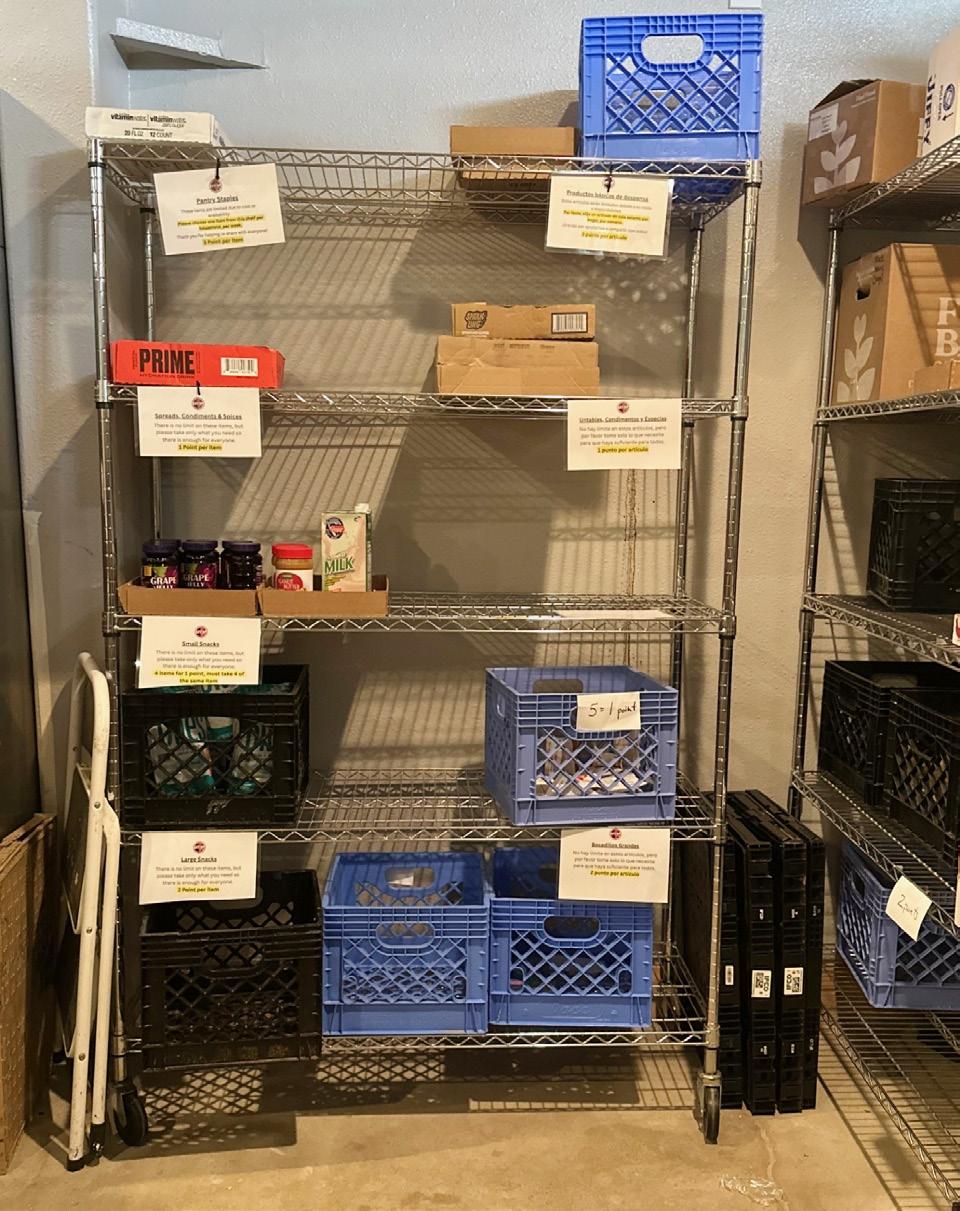
In the first day of operation for Lift-Up with SNAP benefits hanging in the balance, Parachute had 27 people in line when the pantry opened with four new signups in the first five minutes and a total of nine new signups. Carbondale had 10 new signups. A communication for Elyse Hottel assured the depleted Parachute pantry would be restocked by Thursday, its next day of operation. Courtesy photo
Leaders of Eagle County Community Foundation, Food Bank of the Rockies, Harvest for Hunger, Lift-Up, Valley Meals and Pitkin, Eagle and Garfield County human services departments all convened for the roundtable. MCFNS is coordinated and convened by the West Mountain Regional Health Alliance (WMRHA), which steered the conversation on Wednesday.
In Garfield County alone, approximately 4,000 individuals utilize SNAP to supplement their diets, totaling $750,000 to $800,000 in monthly benefits. Of those
4,000, half are children. In Eagle County, 1,402 individuals depend on over $270,000 in monthly benefits and in Pitkin County, 302 individuals rely on approximately $66,000 in monthly benefits.
In total, that’s about 5,700 people receiving roughly $1.1 million in grocery money per month — a sum exceeding yearly funding for most nonprofit organizations participating in MCFNS.
Sharon Longhurst-Pritt, director of human services for Garfield County, stated that in the event that the federal budget is passed in November and SNAP benefits are fully restored, it would take approximately seven days for participants to receive their benefits. And, even if that does occur, SNAP participants will need to rely on local nonprofits to put food on the table.
While private grants remain an option for food organizations seeking funding, competition for these grants has increased nationwide as a result of increasing demand. By collaborating through the MCFNS, participating organizations hope to both increase “buying power” for these grants as well as ensure that partnering organizations aren’t stepping on one another’s feet for the same grant funding.
Food Bank of the Rockies outlined a greater need for funding than food donations. Much of their food is sourced directly from agricultural partners, manufacturers and retailers. Food Bank of the Rockies has already experienced a 7% decrease in total food supply as a result of federal and state budget cuts. Eagle Valley Community Foundation, Lift-Up and Harvest for Hunger emphasized their continued need for donations and volunteers.
Lift-Up interim executive director Elyse Hottel and Yulisa Almarez of Eagle Valley Community Foundation both stated that their teams have been busier than ever receiving guests and distributing food in the past few weeks. Almarez stated she had seen lines out the door without reprieve, and emphasized her organization’s need for more volunteers to support their overwhelmed teams as demand continues to increase.
Hottel noted that philanthropic donations have steadily decreased year by year since the COVID-19
continued on page 18

SECTION 1: READERSHIP
How often do you read The Sopris Sun?
Every issue
A few times a month
Occasionally Rarely / Never
Where do you usually read The Sopris Sun? (Select all that apply)
Print edition
Website
Email newsletter
Social media (Facebook, Instagram, etc.)
Shared by friends/family
SECTION 2: CONTENT & COVERAGE
Which sections do you read most? (Select all that apply)
Local news & civic issues
Arts & culture
Features & profiles
Opinion / guest columns
Youth Journalism Program stories
How satisfied are you with our coverage of local issues?
Very satisfied
Somewhat satisfied
Neutral
Somewhat dissatisfied
Very dissatisfied
What topics would you like to see more of? (Check all that apply)
Housing & affordability
Education & schools
Environment & sustainability
Business & economy
Local government & policy
Arts & culture
Other (please specify)
SECTION 3: COMMUNITY IMPACT
Do you feel The Sopris Sun… (Select all that apply)
Keeps you informed about important local issues
Strengthens community connections
Reflects diverse voices in the valley
Supports youth and emerging journalists
Other (please specify)
Have you ever taken action (attended an event, donated, volunteered, contacted an official, etc.) because of something you read in The Sopris Sun?
Yes → Please share an example
No
SECTION 4: ENGAGEMENT & SUPPORT
How much do you trust The Sopris Sun to provide accurate, fair, and independent news?
Completely trust
Mostly trust
Neutral
Somewhat distrust
Do not trust at all
How likely are you to recommend The Sopris Sun to a friend or colleague? (circle one)
1 2 3 4 5 6 7 8 9 10
Have you ever supported
The Sopris Sun financially?
Yes, I am a SUNstainer
Yes, through a one-time gift
Yes, as a sponsor/advertiser
Not yet
SECTION 5: ABOUT YOU
What is your age group?
Under 18
18–24
25–34
35–44
45–54
55–64
65+
Which community do you live in?
Aspen Basalt
Carbondale
Glenwood Springs
New Castle Rifle
Crystal River Valley
Other (please specify)
SECTION 6: FEEDBACK
What’s one thing we could do to improve The Sopris Sun?
Is there a location where you think we should distribute The Sopris Sun?
Any additional comments or suggestions?
Do you read Sol del Valle?
If Yes:
SECTION 1: READERSHIP
How often do you read Sol del Valle?
Every issue
A few times a month
Occasionally
Rarely / Never
Where do you usually read Sol del Valle?
(Select all that apply)
Print edition
Website
Email newsletter
Social media (Facebook, Instagram, WhatsApp, etc.)
Shared by friends/family
SECTION 2: CONTENT & COVERAGE
Which sections do you read most? (Select all that apply)
Local news & civic issues
Arts & culture
Features & profiles
Opinion / guest columns
Community events & resources
How satisfied are you with our coverage of Latino community issues?
Very satisfied
Somewhat satisfied
Neutral
Somewhat dissatisfied
Very dissatisfied
What topics would you like to see more of?
(Check all that apply)
Immigration resources
Education & schools
Housing & affordability
Jobs & local economy
Health & wellness
Arts & culture
Other (please specify)
SECTION 3: COMMUNITY IMPACT
Do you feel Sol del Valle… (Select all that apply)
Keeps you informed about important local issues
Strengthens community connections
Reflects Latino voices in the valley

Have you ever taken action (attended an event, accessed a resource, contacted someone, etc.) because of something you read in Sol del Valle?
Yes → Please share an example
No
SECTION 4: ENGAGEMENT & SUPPORT
How much do you trust Sol del Valle to provide accurate, fair, and independent news?
Completely trust
Mostly trust
Neutral
Somewhat distrust
Do not trust at all
How likely are you to recommend Sol del Valle to a friend or colleague? (circle one) 1 2 3 4 5 6 7 8 9 10
Have you ever supported Sol del Valle financially?
Yes, as a SUNstainer
Yes, through a one-time gift
Yes, as a sponsor/advertiser
Not yet
SECTION 5: ABOUT YOU
What language do you primarily speak at home?
Spanish
English
Both equally
Other (please specify)
Which community do you live in?
Aspen
Basalt
Carbondale
Glenwood Springs
New Castle
Rifle
Other (please specify)
SECTION 6: FEEDBACK
What’s one thing we could do to improve Sol del Valle?
Any additional comments or suggestions?
Is there a location where you think we should distribute Sol del Valle?
Do you read Sopris Sun?
Go to Sopris Sun questions if taking the Sol del Valle Survey


For over 100 years, we’ve been providing the Roaring Fork Valley with exceptional care. Today, our Surgical Specialists team offers leading-edge technology, including preventative care and procedures related to gastrointestinal (GI) wellness.
Common
Foregut
• Gastroesophageal Reflux Disease (GERD)
• Hiatal hernias
• Surgical weight loss for obesity
• Robotic
General Surgery
• Colonoscopy
• Endoscopy
• Colon cancer
• Abdominal wall and inguinal hernias
• Advanced endoscopy including EndoFLIP, Bravo pH, Manometry
• Colonoscopy with AI polyp detection

AMY HADDEN MARSH Sopris Sun Correspondent
Garfield County commissioners (BOCC) got an earful of fiery public comments at the beginning of Monday’s meeting.
Citizens concerned about the appointment process for county library trustees responded to a call to action on Facebook over the weekend, urging the community to speak at the meeting.
Sixteen commenters talked about issues ranging from the current intergovernmental agreement (IGA) between the BOCC and the library board and books on the shelves that may be inappropriate for children to the library director’s salary, a clash of values in the county, culture wars fomenting library discussions and more.
Robin Robinson of Silt commented about the current cultural divide plaguing the nation. “[It] started with the Equal Rights Amendment because it — back in the ‘60s — was about having sex with children,” she proclaimed. “It was about doing whatever you wanted with children way back then.” She added that this mindset has continued to grow.
The Equal Rights Amendment was introduced in 1923 and passed by Congress in 1972.
It amends the U.S. Constitution to guarantee equal rights for all, regardless of sex. It has been ratified by the requisite 38 states but has not been codified.
Former library trustee Susan Use mentioned the IGA — still a burr under the saddle of both the county and the library district. On Oct. 6, commissioners considered an updated version of the IGA that prevents them from challenging the library board’s recommended trustee reappointments unless there is good cause. At that meet ing, the BOCC decided to shelve the document. “There was not a vote on the IGA and it was kind of quietly tabled,” observed Use. “But yet there was not a vote on tabling it either.”
In an email to The Sopris Sun, library district director Jamie LaRue said that he considers this behavior a dereliction of the BOCC’s statutory responsibilities.
“A revised IGA, submitted by the library to the BOCC, was tabled when [Commissioner] Mike Samson insisted that every posi tion, even the people selected
and appointed by [the trustees], would have to re-apply after each term,” he wrote. “At that time, Samson claimed that the delays were caused by the library’s failure to notify them of vacancies. That simply isn’t true.”
The library trustee position for the Rifle area has been vacant since former trustee Myrna Fletchall officially left the board
on July 12. LaRue told The Sopris Sun that Fletchall announced her resignation on June 20 at which time he sent an email to the county along with Fletchall’s resignation letter.
LaRue said that, in August, he “prompted [county manager] Fred Jarman about the continued vacancy.” He added that this was when Jarman suggested to the BOCC that they “wait until the end of the year to advertise and interview for three positions.” (New Castle and Parachute/ Battlement Mesa positions open up Dec. 31.)
The library board did not want to wait six months to fill the RIfle seat. So, according to LaRue, the library requested that commissioners move the timeline up for Rifle, which they did, but the interview meeting was cancelled.
He added that the county ran four advertisements in September and told him that they did not receive any direct applications.
But, said LaRue,“I had forwarded one interested party to Jarman, complete with letter of interest and resumé, in early August.” He added that “Jarman says

he emailed her to ask if she was still interested.”
In an email to The Sopris Sun, Jarman confirmed “the library director forwarded an interested candidate to the county on Oct. 1.” Jarman said the county reached out to the applicant a week later and, “We heard nothing back.”
At Monday’s meeting, New Castle resident Carole O’Brien said, “I’m not sure exactly what happened; although I think there should have been more diligence on the part of the commissioners or commissioners’ staff to pursue this applicant.”
The applicant (name withheld) has not responded to a request for comment from The Sopris Sun.
The BOCC got to the first agenda item around 9:20am. They unanimously approved a letter to U.S. Senators Michael Bennet and John Hickenlooper, both Democrats, demanding they re-open the government “without delay.” As of Wednesday afternoon, the federal government has been shut down for 35 days.
Citing 4,000 Garfield County residents who stand to lose Supplemental Nutrition Assistance Program (SNAP) benefits and 1,400 Special Supplemental
continued on page 19




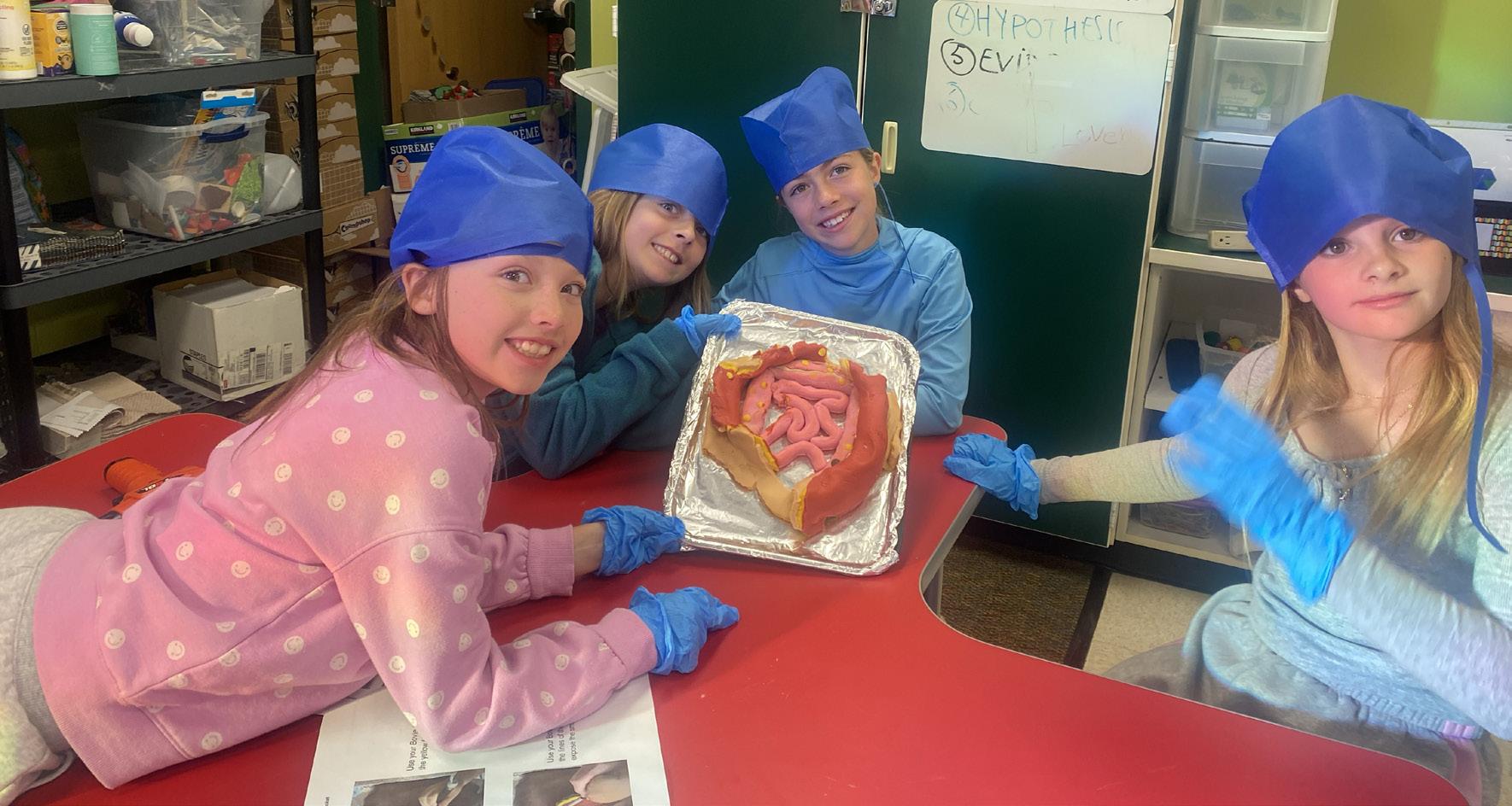
Little Pigs” story, testing durability.
The latter has been done by some groups already in recent sessions. “In our ‘Three Little Pigs’ challenge, we read the book but in Spanish,” McIntyre shared, and said it was also a lesson for students in different types of learning. “The librarian said, ‘This is such a great moment for the English-speaking kids to see how their Spanish-speaking peers are learning all the time.’” McIntyre: “We’re really trying to focus on things that will be both fun and age-appropriate for the kids.” And the response

from the kids has been positive, she said. “During the last session, one of the students came up and said, ‘Wow, you really challenged us.’ Something that’s been so cool with these kids at Sopris is how they’re so willing to keep trying, even when learning difficult concepts like the engineering design process.”
ASC also runs programs at libraries throughout the Roaring Fork Valley to make science, technology, engineering and math engaging and accessible for kids and families. The 20-year-old organization has
ADV MONO LASER - Clark at AS Open to community members and senior Tuition Discount applies. Call campus for registration information. Tues, 3:30-7:20pm, 11/11-12/9
BUILD A CONSULTING CAREER
been steadily expanding their programs. According to the ASC website, as of 2024, the organization’s accomplishments include 4,292 youth engaged with hands-on STEM experiences, 2,951 adults enriched through STEM education, 323 programs from Parachute to Aspen, 49 donors and partnerships with local businesses and 1,500 paid intern hours for high school and college students.
To learn more about ASC programming, visit www.aspensciencecenter.org
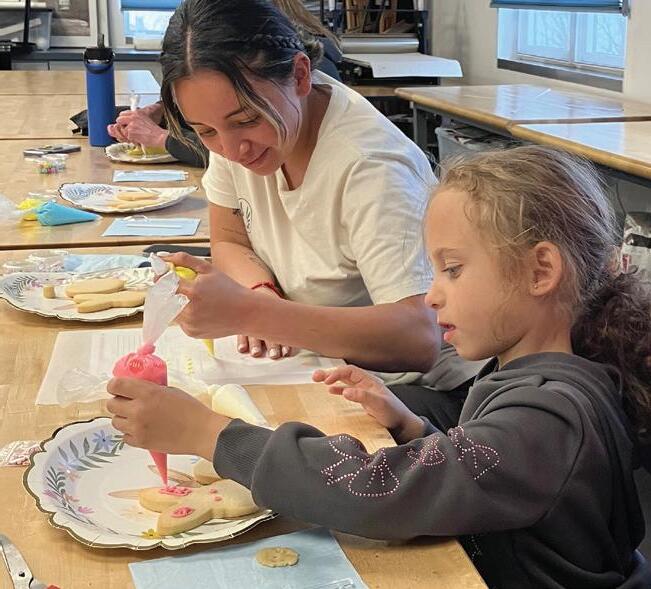
Tools to maximize your life and career experiences into a viable consulting business. Online Tue, 5:30-7:30pm, 11/11-18
CHOCOLATE - COCOA CLUB

History, cultivation, and tasting followed by hands-on chocolate making.
Thursdays, 5-7pm, 12/4-12/11
PAPER WINDOW STARS

Fold colored wax paper in patterns of varying translucency to create colorful stars to decorate and/or gift.
Sat, 9:30am-12:30pm, 12/6
PAPER ROSE WINDOWS
Fold tissue paper in colorful sunburst patterns that imitate stained glass windows. Sat, 9:30am-12:30pm, 12/13
CHRISTMAS COOKIE DECORATING Wednesday, 3-5pm, 12/3
PAPER WINDOW STARS Wednesday, 3-4:45pm, 12/10
GINGERBREAD CONSTRUCTION Saturday, 1-4pm, 12/13
INTRODUCCIÓN A LA FOTOGRAFÍA
Martes, 6-8:30pm, 11/11-12/2
Now listed online and registration opens 11/17
CROSS-COUNTRY SKI LESSONS AT SPRING GULCH
Fridays/Saturdays in January
JOHN STROUD
Sopris Sun Correspondent
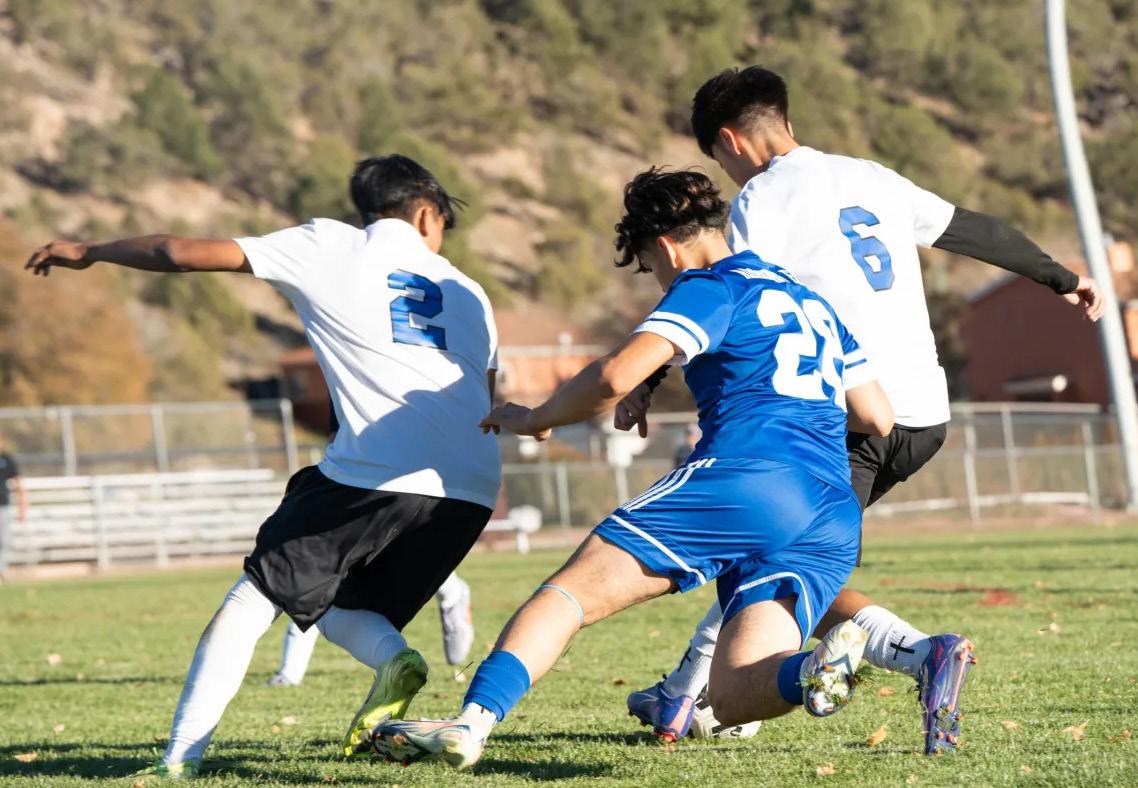
Roaring Fork High School’s 16th-seeded boys soccer team played the No. 1 seed Colorado Academy to a 1-1 tie through regulation and double overtime of a second-round 3A state playoff in Denver Tuesday.
All the way down to the final kicks of a shootout, the Rams were on the verge of a major upset — but for one miss.
Roaring Fork was one kick away from advancing to the quarterfinals, but in the end it was Colorado Academy claiming victory with a 5-4 tally.
The Rams cracked it open late in the first half when junior Cristian Turcios scored to make it 1-0. They then held the Mustangs at bay until 10 minutes left in regulation when the host team evened it up.
Two scoreless overtime periods proved Roaring Fork worthy of keeping with the top seed.
“Penalties [penalty kicks] are a coin toss and a terrible way to decide a tie, but that’s what we got,” Rams head coach Nick Forbes said in a text message shortly after the conclusion of the game.
Instead of taking it to the next round, Roaring Fork ends the season at 10-5-2, and bids farewell to a slate of seniors.
“I’m disappointed for the boys, who
played great, but now we celebrate some seniors who have been pillars of the program, then take a rest and start planning for next season,” Forbes said. “Hopefully this feeds our belief and our desire for next fall.”
Roaring Fork advanced by downing Rocky Mountain Prep SMART 3-2 at Rams Field in Carbondale on Oct. 29.
In that one, the Rams collected goals from sophomore Alan Rodriguez and junior Cal Stone in the first half, and held a 2-1 advantage at halftime. Stone struck again in the second half to secure the win.
A contingent of runners from the combined Basalt and Roaring Fork high school cross country team, and from Carbondale’s Colorado Rocky Mountain School, represented at the Colorado High School Cross Country Championships in Colorado Springs on Saturday, Nov. 1.
The area’s top finisher was Basalt senior Towler Scott in the Class 3A boys race, taking seventh place overall to claim a coveted podium spot.
Scott covered the five-kilometer course at the Norris Penrose Event Center in 16 minutes, 26.2 seconds — 31 seconds off the winning pace established by Vanguard School’s Max Miller. It was also
an improvement over Scott’s 20th-place finish at last year’s state meet.
Roaring Fork sophomore Levi Friday ran 18:05.1 to finish 79th out of 153 runners.
The Basalt girls, who qualified as a team, sent seven runners to state. Finishing in order out of 148 runners were Basalt freshman Scarlett Jones, 48th (21:16.6); Basalt senior Addison Raymond, 69th (21:53.2); Roaring Fork senior Caroline Cole, 80th (22:10.5); Basalt freshman Jude Tiernan, 82nd (22:18.8); Roaring Fork junior Sadie Silcox, 86th (22:25.3); Roaring Fork freshman Maggie Cole, 88th (22:30.4); and Roaring Fork junior Miley Stuart, 95th (22:39.3).
The CRMS girls also qualified as a team
in the Class 2A division, which featured 132 runners. The Pearls were represented by sophomore Kayla Steele, 11th (19:51.9); sophomore Abigail O’Keefe, 51st (22:00.1); freshman Ayla Perry, 102nd (24:07); junior Tacie Simmons, 105th (24:23.8); senior India Picard, 112th (24:34.4); and freshman Sabina Davies, 121st (25:35.5).
Basalt enters the Class 2A state football playoffs as the 16th seed in the 16-team field, after going 6-3 on the season and 4-0 in the Western Slope League to defend their conference title.
The Town of Carbondale developed the Carbondale Revolving Loan Fund (CRLF) to enhance the ability of local busine secure the necessary capital to finance start-ups, operations, or expansion The loan fund was set up in 2002 with a partnership with the USDA The Town and USDA both contributed $50,000 In addition to providing access to cap CRLF is designed to help stimulate job creation and retention Loans are available to new or established businesses within the town limits of the Town of Carbondale To-date, the fund has $150,000 to loan to for-profit and no businesses based in Carbondale
Loan proceeds may be used for business reasons, including real estate acquisition, construction, and equipment
Funds cannot be used for the refinancing of existing debt Applications will be considered on the basis of the character of the applicant, the applicant’s capacity to repay the loan, collateral and/or other sources of capital, and conditions affecting the applicant’s ability to repay the loan
The guideline for the amount to be requested is $5,000 to $25,000 The interest rate will depend on several factors such as the type of collateral, financial strength of the applicant, and the overall risk Fixed rates of interest will range from 3% to 5%
The term of each loan will depend on repayment capabilities and the purpose of the loan Repayment is monthly and loans are usually no longer than a 36-month term (3 years)
Scan QR code for more information or contact the Carbondale Chamber: 970-963-1890, chamber@carbondale com

The CRLF is made possible by the Town of Carbondale The Carbondale Chamber is not affiliated with the Town of Carbondale, rather assisting the Town by overseeing the marketing & promotion, and certain aspects of the administration of this program The loan funds are in no way exchanged with the Carbondale Chamber





THURSDAY, NOVEMBER 6
RECOVERY MEDITATION
Practice the 11th step of prayer and meditation at the Glenwood Springs Library from 9 to 10:15am every Thursday.
SENSORY STORYTIME
The Glenwood Springs Library hosts a sensory-friendly story hour for preschool and school-aged neurodivergent students at noon on Thursdays.
10,000 VILLAGES
The 10,000 Villages Fair Trade International Craft Fair returns to the Good Shepherd Lutheran Church in Glenwood Springs from noon to 6pm today, 10am to 6pm tomorrow, 10am to 5pm Saturday and noon to 4pm Sunday. All proceeds benefit the artisans.
OLD TOWN RESIDENTIAL
Carbondale’s Historic Preservation Commission is hosting an open house for Old Town Residential zone district guideline changes at Town Hall at 6pm.
FLUID LANDSCAPES
Artist Cassidy Willey presents her abstract landscapes at Carbondale’s Main Street Gallery with a reception from 5 to 7pm and an artist talk at 6pm.
VOICES STORY CIRCLE
Share and listen to stories in a safe, supportive space at the Basalt Library from 5 to 6pm. This event is facilitated by VOICES.
SACRED WATER
Roaring Fork Conservancy and The Nature Conservancy present “Sacred Water, Wondrous River” with Lorelei Cloud, a Southern Ute Tribe member, and Johnny Le Coq, an avid fly fisherman and founder of the company Fishpond. The conversation takes place at TACAW beginning at 5:15pm. Tickets at www.tacaw.org
FOCUSEDKIDS FALL FLING
FocusedKids hosts its Fall Fling fundraiser at the Old Thompson Barn in River Valley Ranch from 5:30 to 8pm. Register at www.focusedkids.org
HIGH SCHOOL PLAY
Glenwood Springs Library for “Your Life, Your Story, a supportive offering intended to further participants’ writing goals, every first Friday from 10am to noon.
MUSICAL STORYTIME
Caregivers and their young children are invited to musical storytime, facilitated by Ms. Holly, from 10:30am to noon at the Carbondale Library.
SKETCH, PAINT, PLAY
Every First Friday, the Carbondale Library invites patrons to work on art projects together with other adults from 1 to 3pm.
PRE-PROCESSION
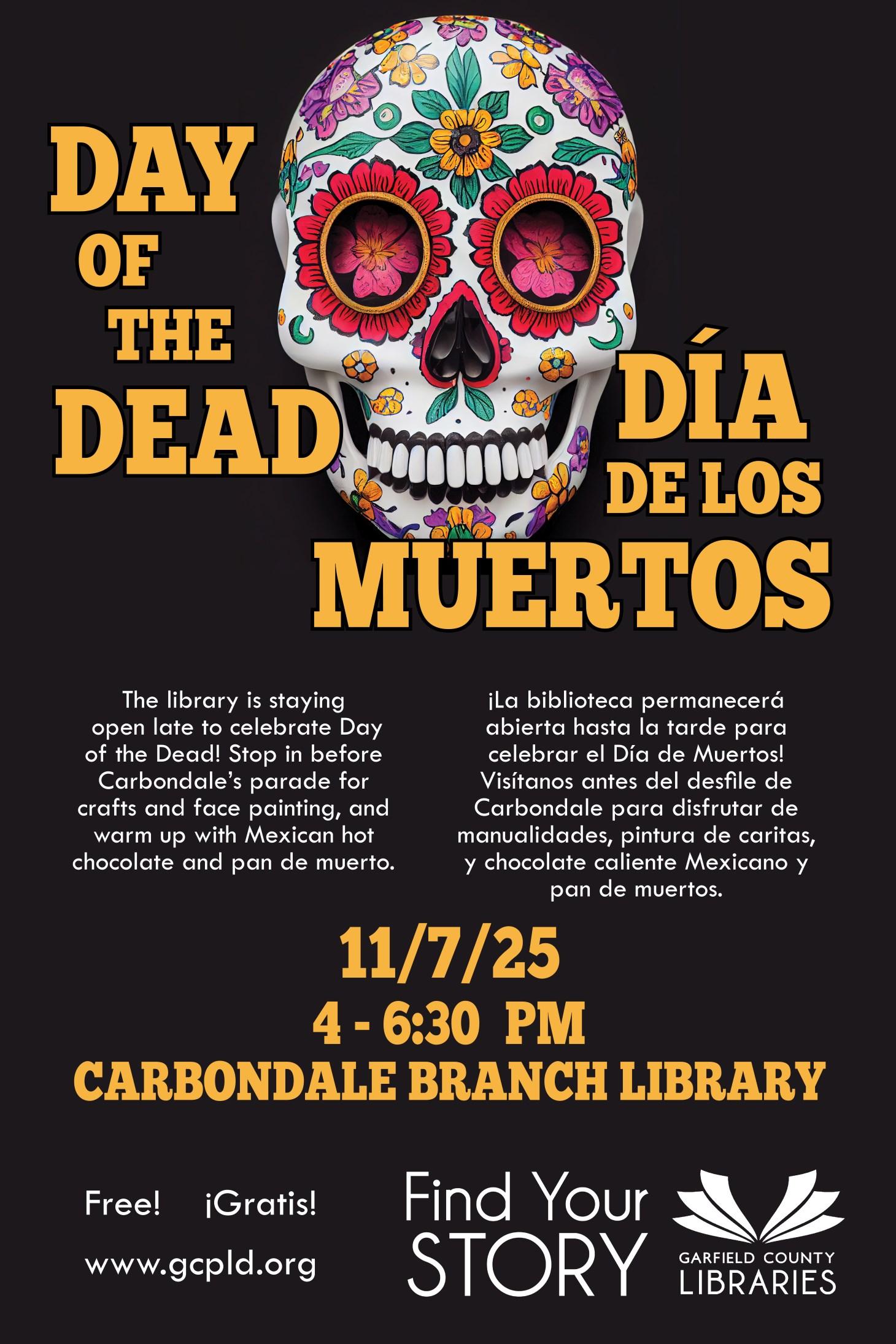
Stop by the Carbondale Library for crafts and face painting, from 4 to 6:30pm, before the big Día de los Muertos procession down to Main Street.
‘JOIN OR DIE’
The Basalt Library screens “Join or Die,” a documentary film about American democracy and the importance of civic engagement, at 5:30pm followed by a discussion with the director via Zoom at 7:15pm.
FIRST FRIDAY
Carbondale hosts the Valley’s largest Día de los Muertos celebration with performances, face-painting, a community procession and performances by Aspen Santa Fe Ballet Folklórico, Mezcla Socials Dance, Roaring Fork Youth Orchestra and more. The procession begins at the Third Street Center at 6pm. Details at www.carbondalearts.com
CRYSTAL THEATRE
The Crystal Theatre shows “Bugonia” today and tomorrow at 7pm. Sunday’s captioned show is at 5pm.
LOCAL COMEDY
TACAW presents a local comedy showcase at 8pm. Tickets at www.tacaw.org
TOMMY THE ANIMAL
Whiskey Stomp opens for Tommy the Animal at the Belly Up Aspen at 8:30pm. Tickets at www.bellyupaspen.com
RIVER SPELL































Roaring Fork High School’s theater club, Upstage Productions, presents “The 39 Steps,” adapted from the novel by John Buchan and film by Alfred Hitchcock, tonight, tomorrow and Saturday at 6pm.
WRITING GROUP
River Spell, a band featuring local Zack Ritchie on the drums, returns to the Black Nugget for a show at 9:30pm. More info at www.riverspellmusic.com
SATURDAY, NOVEMBER 8
SPELUNKER STORIES


























Local writers share their work and get feedback from fellow participants before locking in for some writing time at the Glenwood Springs Library every Thursday this month from 6 to 8pm.
Local cave guide Khloe Everett presents on caves and the history of caving in Colorado at the Glenwood Library at 10:30am as part of a free speaker series presented by the Glenwood Springs Historical Society.





CATTLE CREEK CONFLUENCE
FOOD DRIVE









The Cattle Creek Confluence hosts a public meeting at the Glenwood Library from 6:30 to 8pm, offering an in-depth look at the proposed Harvest Roaring Fork development.
SPANISH CLUB
Beginner and intermediate Spanish learners practice together at the Carbondale Library every first and third Thursday from 6:30 to 8pm.
‘ORNANDA’
The Aspen Valley Ski and Snowboard Club presents a film about the Armada at 7pm with swag and an appearance by athlete Torin Yater Wallace.
‘AN ILIAD’
Thunder River Theatre Company presents “An Iliad” by Lisa Peterson and Denis O’Hare, this weekend only, at 7:30pm tonight, tomorrow and Saturday and at 2pm on Sunday.
FRIDAY, NOVEMBER 7
‘YOUR STORY, YOUR LIFE’ Journalers, poets and writers gather at the
Donations of non-perishable foods, gift cards and cash can be dropped off at Beer Works, Phat Thai and Downtown Liquors between 11am and 2pm.
‘SNO-CIETY’
Sunlight Mountain Resort presents a screening of Warren Miller’s new film, “Sno-Ciety,” at the Glenwood Vaudeville Revue at 6pm.
‘THE TASTE’
The Basalt Education Foundation hosts its largest fundraiser of the year, “The Taste,” at the Roaring Fork Club members lodge (100 Arbaney Ranch Road, Basalt) at 6:30pm. Tickets at www.givebutter.com /c/the-taste-2025
SUNDAY, NOVEMBER 9
PRISON POETRY
A Spiritual Center presents John Kleinwachter sharing poetry inspired by a federal prison inmate, with glimpses into joy, grace, frailties and humor in everyday life, from 10 to 11:30am at the Third Street Center (Room 31).
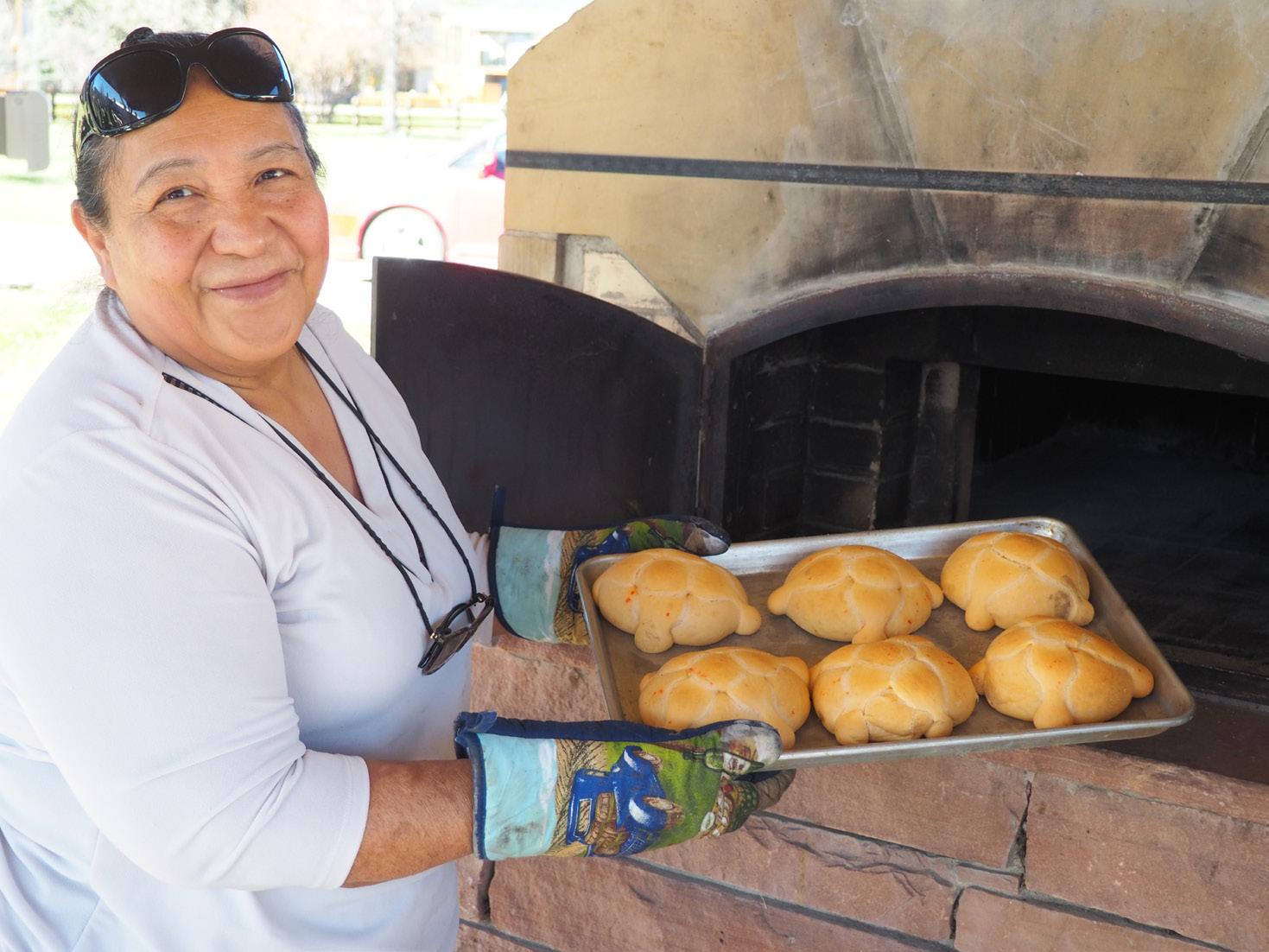
Martha Cruz Rodriguez again churned out pan de muerto, a traditional Mexican sweet bread, at the Carbondale Community Oven on Sunday, Nov. 2. The event was hosted by Garfield County Libraries and saw a few dozen participants. Local Día de los Muertos festivities crescendo this First Friday, Nov. 7, with a procession from the Third Street Center to Chacos Park beginning at 6pm.
by Raleigh Burleigh
MONDAY, NOVEMBER 10
JOKESTERS
TACAW hosts a comedy workshop for middle school students at 4:15 every day this week. For details, visit www.tacaw.org
SACRED BROTHERHOOD
Kyle Jason Leitzke guides the Sacred Brotherhood conversation series at True Nature from 6 to 7:30pm.
URBAN LINE DANCING
Dance Initiative presents Urban Line Dancing with Queen every Monday through Dec. 15 at the Third Street Center at 6:15pm.
TUESDAY, NOVEMBER 11
VETERANS DAY
Many government offices will be closed in observance of Veterans Day. Veterans and active military get free entry into Colorado state parks.
WALDORF TOUR
Waldorf School on the Roaring Fork offers an adults-only campus tour for prospective parents from 9 to 11am. Sign up at www. waldorfschoolrf.com
ARTIST LECTURE
Anderson Ranch visiting artist Brian Rochefort gives a lecture at 4:30pm. Details at www.andersonranch.org/events
CREATIVE WRITING
Jessica Barnum teaches a creative writing workshop as part of the Garfield County Libraries’ GarCoWriMo series at the Glenwood Library from 5 to 8pm.
VETERANS DINNER
The American Legion hosts a Veterans Day dinner beginning at 5pm, serving hot turkey sandwiches, mashed potatoes, gravy and sides, free for all veterans and service members, $12 for others.
DRAWING CLUB
The Roaring Fork Drawing Club turns 8 with a little party at the Cocoa Club at 6:30pm.
ACTIVIST FILM
Mountain Action Indivisible shows “The Last Class” at the Crystal Theatre at 7pm.
WEDNESDAY, NOVEMBER 12
WRITING CLUB
Jessica Barnum leads a creative writing club at the Glenwood Library from 2:30 to 3:30pm.
‘FIRST DRAFT’
Mitzi Rapkin records an episode of her “First Draft” podcast at TACAW featuring author Devon O’Neil at 6:30pm. RSVP for free at www.tacaw.org
TRIVIA NIGHT
El Dorado hosts trivia every Wednesday at 7:30pm.
THURSDAY, NOVEMBER 13
SENIOR RESOURCES
Sopris Lodge sponsors a free resource fair for seniors at the Carbondale Fire Station (300 Meadowood Drive) from 11am to 1pm with experts in hospice, home care, health, fitness, lifestyle and more, plus complimentary blood pressure checks.
GLENWOOD GARDEN CLUB
The Glenwood Springs Garden Club meets at the U.S. Bank (1901 Grand Avenue) at 1pm. A speaker from the Eagle County Conservation District will present on xeriscaping.
NONFICTION BOOK CLUB
The Carbondale Library invites patrons to come discuss a book of their choice around the theme of communication from 2 to 3:30pm.
‘UNCHARITABLE’
TACAW presents “Uncharitable,” a film about the power of philanthropy, at 6:30pm followed by a panel discussion. RSVP for free at www.tacaw.org
‘PRESSURE DROP’
Teton Gravity Research presents “Pressure Drop” at the Crystal Theatre at 7pm.
5POINT IN ASPEN
Celebrate the opening of a new Arc’teryx store in Aspen with a 5Point film showing at the Isis Theatre at 7pm. All proceeds benefit Mountain Rescue Aspen.
‘RUMORS’
Aspen Community Theatre presents “Rumors” this weekend at the Wheeler Opera House, at 7pm tonight, tomorrow and Saturday, and at 2pm on Sunday. Next weekend, the show will travel to the Ute Theater in Rifle, at 7pm on Friday and Saturday, and 2pm on Sunday.
FRIDAY, NOVEMBER 14
FEEDING GIANTS
The Glenwood Caverns Adventure Park hosts Feeding Giants for a concert from 4:30 to 7:30pm.
ALCOHOLICS ANONYMOUS
The Meeting Place in Carbondale (981 Cowen Drive) offers “Hole in the Donut AA,” Monday through Saturday at 6:45am, plus “Daily Reprieve” at noon on Mondays, Tuesdays, Wednesdays and Fridays. Find a full schedule at www.meetingplacecarbondale.org
ROARING FORK ZEN
A new Zen meditation community based in Carbondale gathers at True Nature to sit from 8 to 9am on Mondays weekly.
TAI CHI
Community tai chi sessions are hosted every Monday, Wednesday and Friday from 9 to 10am at the Third Street Center. Newcomers are welcome. For details, email jhof@rof.net
MOMMY MEET-UP
The Glenwood Springs Library hosts a “mommy meet-up” on Mondays from 11am to 12:30pm for mothers and their babies ages 0 to 3. There will be play items provided for the little ones and coffee and conversation for the moms.
PARKINSON’S EXERCISES
An exercise class for people living with Parkinson’s Disease, MS or any other neuromuscular conditions is offered at the Glenwood Springs Library every Monday from 1 to 2pm. For more details, email dnovak@parkinsonrockies.org or call 866-718-2996.
IN STITCHES
The In Stitches Knitting Club meets at the Carbondale Library every Monday at 1:30pm.
BOARD GAMES
Kids (5 and up) play board games in the Treehouse Room at the Basalt Library Mondays at 4pm. Snacks provided.
RAGING GRANNIES
All are welcome to join the Raging Grannies, singing for a healthy planet and a kind world, on Wednesdays at the Two Rivers Unitarian Universalists office at the Third Street Center from 4:30 to 5:45pm.
CRYSTAL RIVER AIKIKAI
Crystal River Aikikai offers aikido classes for kids from 4:45 to 5:45pm and teens and adults from 6 to 7pm on Mondays at 13 Moons Ranch, south of Carbondale.
ENGLISH IN ACTION
Volunteer English tutors and developing learners meet for informal conversational practice at the Carbondale Library every Monday at 6:30pm. Interested in becoming a tutor? Email angela@ englishinaction.org or call 970-963-9200.
AFRICAN DANCE
Dance to live drumming by the Carbondale Rhythm Collective at the Glenwood Springs Library on Mondays from 6:30 to 8pm.
ZUMBA
Dance Initiative presents “Zumba with Andrea” every Saturday at the Third Street Center from 10:30 to 11:30am.
COSMIC WHOLENESS
Micha Schoepe leads Cosmic Wholeness, an embodied movement and meditation offering that explores patterns found in nature, the cosmos and our inner lives, at The Third Street Center every Sunday from 2:45 to 3:45pm. More details at www. michaelschoepe.com/cosmic-wholeness
GENEALOGY
Join a welcoming group of people working together to solve family mysteries, share research tips and discover stories from the past on the first Friday of each month at the Glenwood Springs Library from noon to 1:30pm.





MYKI JONES
Arts Correspondent
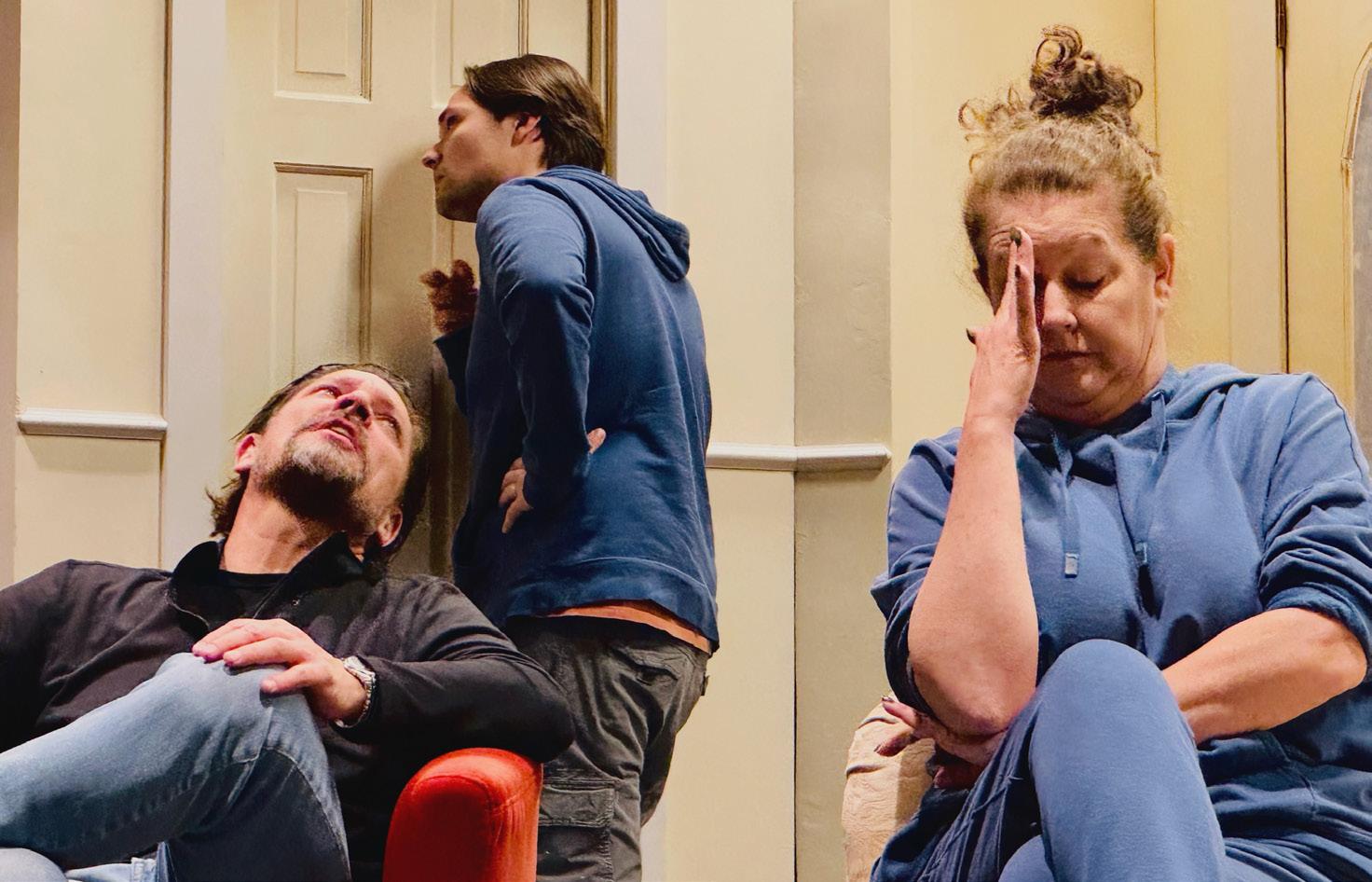
This month, Aspen Community Theatre (ACT) will perform the farcical classic “Rumors” by Neil Simon at the Wheeler Opera House for the first leg (Nov. 13-16) before taking it to the Ute Theater in downtown Rifle (Nov. 21-13). This marks a return to non-musical theater for the company and comes on the heels of the organization’s 50th anniversary.
Director Wendy Tennis said discussions of extending the run and bringing the production to the Colorado River Valley began over the summer, when she and longtime ACT producer and actor Travis Lane McDiffett brainstormed how to make theater viewing — and acting — more accessible down valley.
Gorman), Rebecca Horn of Glenwood Springs (Claire Ganz), Mircea Oprea of Aspen/Basalt (Lenny Ganz), Christopher Wheatley of Woody Creek (Ernie Cusack), Sheri Brinker of Glenwood Springs (Cookie Cusack), Scott Elmore of New Castle (Glenn Cooper), Cynthia Newby of Carbondale (Cassie Cooper), Michael Banks of Rifle (Officer Welch) and Katherine Ayala Arias of Glenwood Springs (Officer Pudgney).
There are a lot of challenges and darkness in the world right now, and we wanted something that was going to be nothing but laughs.
- Travis Lane McDiffett
“ACT always produces such quality work, and we thought this production should be shared. With only one weekend of performances at The Wheeler, more shows would [also] benefit actors and production staff,” said Tennis. “The Ute is an ideal venue and a great opportunity to extend the run. It was time for a change, and this has also opened up opportunities for actors who prefer a play to a musical.”
The cast for “Rumors” comes from Rifle all the way to Woody Creek, including: Hensley Gregg of Basalt (Chris Gorman), Gerald DeLisser of Basalt (Ken
“It’s been exciting to have a cast from Rifle to Aspen work together onstage. It’s a huge commitment with different rehearsal locations,” said Tennis. “Support from all communities has been overwhelming. We hope community members up and down the Valley will come and see the show.”
Her sentiments were echoed by McDiffett, who is thrilled for the actors, who he said all deserve to be on the stage, and for the audience members who may not have been able to catch the production had it been scheduled only at the Wheeler or the Black Box stage at Aspen Elementary School, as has typically been the case.
“We’re hoping that this comedy is appealing to audiences throughout the Valley, and that the crowds in Rifle and beyond who come to see the show will be receptive and excited to have something of this quality,” said McDiffett. “Not just
the quality of the show because of who wrote it, but also just the performance level that these actors are putting out.”
Tennis and McDiffett also agreed that people need a good laugh. With “Rumors’” fast-paced timing and a plot line that makes heads spin, ACT hopes that audiences will be left with a feeling of joy after laughing through this production.
“There are a lot of challenges and darkness in the world right now, and we wanted something that was going to be nothing but laughs,” said McDiffett. “This whole farce that we’re putting on, it’s one calamity after another, and all of it done in a fast, rapid-fire presentation that we hope
IN A NUTSHELL
What: “Rumors”
When/Where:
Wheeler Opera House: Nov. 13-15 at 7pm and Nov. 16 at 2pm
The Ute Theater Nov. 21-22 at 7pm and Nov. 23 at 2pm.
Tickets: www.aspencommunitytheatre.org
engages the audience and keeps them distracted from the troubles that might exist in their outside world, and leaves them at the end of the night with a smile.”

MYKI JONES Arts Correspondent
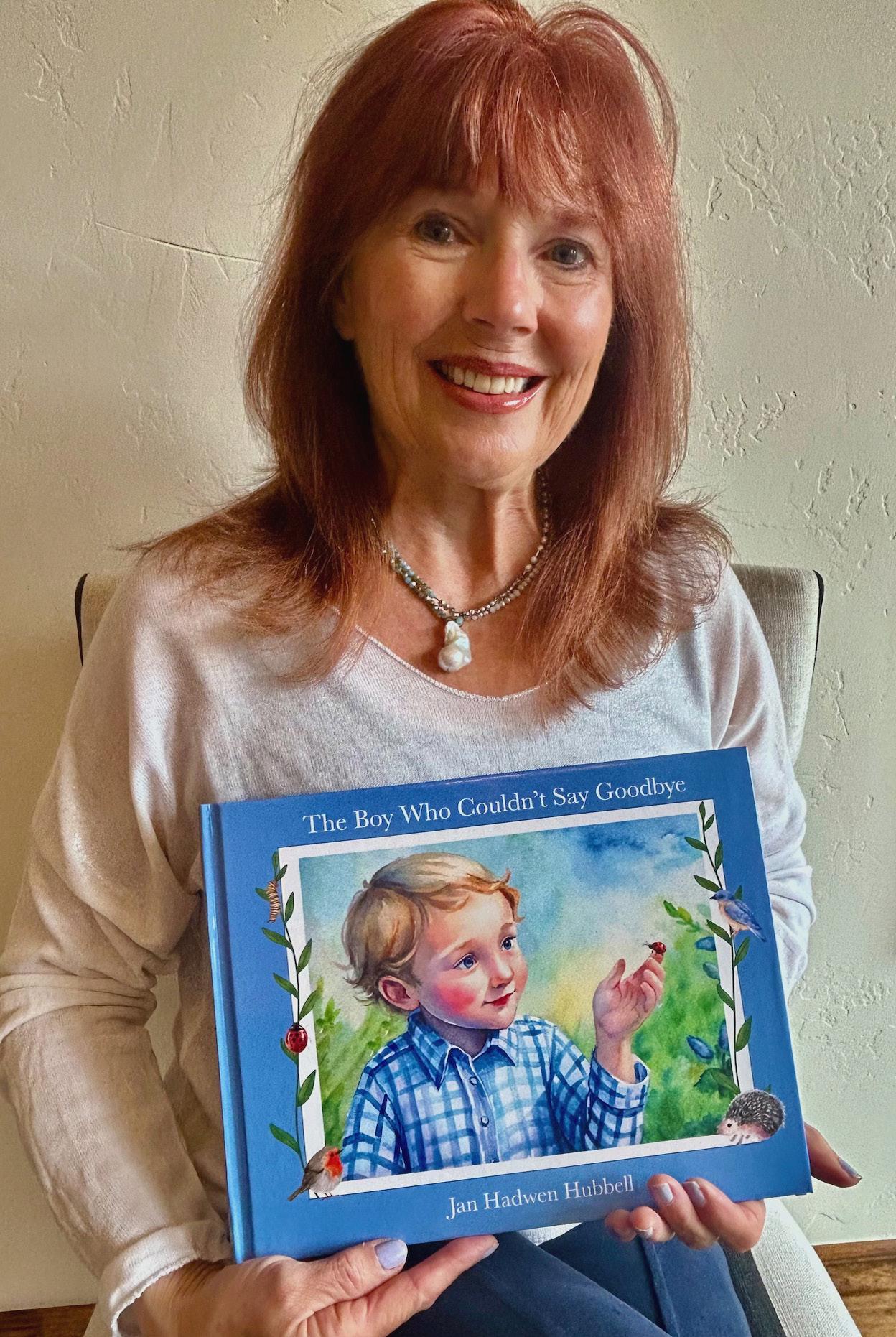
Jan Hadwen Hubbell, an acclaimed screenplay writer, long-time local, former English teacher at Colorado Mountain College and now published children’s book author, is excited to have her newest story, “The Boy Who Couldn’t Say Goodbye,” available to children not only in the Roaring Fork Valley, but internationally as well. Her book tells the story of a young boy named Henry who struggles with transitions in his life. Throughout the story, he develops new skills and vocabulary to find acceptance and make life’s moments of change easier.
Hubbell shared how her background in poetry influenced her writing process for this book, which aims to convey big messages in few words and features an easyto-follow plot, catering to the children between the ages of 2 and 8.
“[Poetry] informed the writing of this book,” Hubbell shared, “which is pretty interesting because you don’t have a lot of words to get across to the child the story, the plot and the characters. It’s not just about the plot, but it’s about creating a character and his emotions. Particularly with [Henry], he has trouble controlling his emotions when he has to transition from one activity to another, which is a prevalent theme with children.”
She explained how this story was inspired by her grandson, who once struggled with the same. In particular, Henry struggled with having to say goodbye to Hubbell at the end of family visits.
“The character was based on my 5-year-old grandson, who had trouble with smoothing into those transitions. That inspired the character of Henry and brought the question of: ‘How do you smooth out those transitions?’ Henry has a hard time saying goodbye; he doesn’t want to say goodbye because he thinks it’s the end of

everything. His hardest goodbye is when he has to say goodbye to his grandmother. So there’s a lot of emotion in the character here,” she explained.
Hubbell’s daughter also played a significant role in bringing the book to visual fruition. Together, they discussed and designed the book’s visuals, then commissioned an artist to watercolor paint these designs, bringing them to life. She expressed deep gratitude for this due to the rapidly changing technology in the world of writing.
“These are hand-painted watercolors, which I have to say, is a small club in children’s books today. Many of them are designed by [artificial intelligence], and all the people in them and everything else look the same. To have actual hand-painted watercolors is incredible to me,” Hubbell shared.
Since its release, “The Boy Who Couldn’t Say Goodbye” has been published in India, England, Australia, Germany and parts of the Middle East. Although the book is published in English, Hubbell hopes to have translations printed for non-English readers, so that each child who has the chance to read this story with their parents can understand the messages within it.
“This behavior with children is so common because when they are in the middle of something, they can’t foresee that they can do the next thing and then might be able to return to what they were already doing another time. Mothers are always looking for a way to pull their child away from swinging and go to have dinner. It’s hard because they don’t want to change to the next thing. They’re not flexible, and so this will help. It doesn’t matter what country you’re from, where you are in the world. It helps it,” Hubbell expressed. She continued, “The cool thing is, it helps both the mother and the child with the transitions and how to

say goodbye. That is a hard thing to do, even adults don’t like to say goodbye to certain things. With my book, I am trying to take away the finality of the word, and differentiate the serious ones from the not-so-serious ones.”
Hubbell’s book is available for purchase at White River Books in Carbondale, as well as on Amazon and at Barnes & Noble, in both paperback and hardback editions.













MIKE DE LA ROSA
Arts Correspondent
The Powers Art Center in Carbondale recently celebrated its 11th anniversary and continues to grow as a community resource. Like the Frick in New York City, it is an unusual art institution that has spawned from the quirks of a single private art collection. Founded by Kimiko Powers to commemorate her husband John’s life, the Center holds works (mainly Pop Art) the couple collected as prominent figures in the art world from the 1960s through the 1980s.
Downstairs, visitors will encounter a rotation of Pop Art heavyweights including Warhol, Oldenburg, Rauschenberg and Lichtenstein. Upstairs is permanently devoted to Jasper Johns, a curatorial homage based on the relationship between the Powers and the artist. One Jasper Johns work on display is inscribed “To Kimiko,” a gesture of friendship and intimacy. Their engagement extends to the rest of the Pop crew: Kimiko famously appears in one of Warhol’s screenprints, which he later used as the promotional image for an exhibition at Colorado State University in 1981.
If the Center’s collection reflects a life in art appreciation, what distinguishes the Center today is the evolution of its mission. Initially founded with a somewhat narrow curatorial scope — one exhibition per year, always Pop Art, strictly from the private collection — the Powers has expanded its reach through education and accessibility.
Over the past four years, under the leadership of Museum Director Sonya Taylor, formerly the head of general programming, the Center’s educational initiatives have greatly expanded. One local educator affectionately described her as “the Martha Stewart of teaching kids art.”
The Center offers free registration for school tours and has hosted every school in the Roaring Fork Valley this year. “As far as schools we’ve reached, we’ve worked with groups from Aspen to Glenwood Springs and as far as Grand Junction and Denver,” said Community Engagement Manager Megan Rusby.
Teachers consistently note how the Center is accommodating. “The communication is direct, with a real love for our community,” said Alida Haslett of Yampah High School. “Whatever time we have, Sonya makes it work. I don’t know how. It’s magical.”
Taylor, who previously worked in K–12 education, designs the tours herself around the Center’s “Power Packs,” guided activities tailored to different age groups that help students connect with Pop Art’s unique visual language. Given how much media culture has evolved since the ‘60s, Pop Art requires careful context for contemporary audiences to
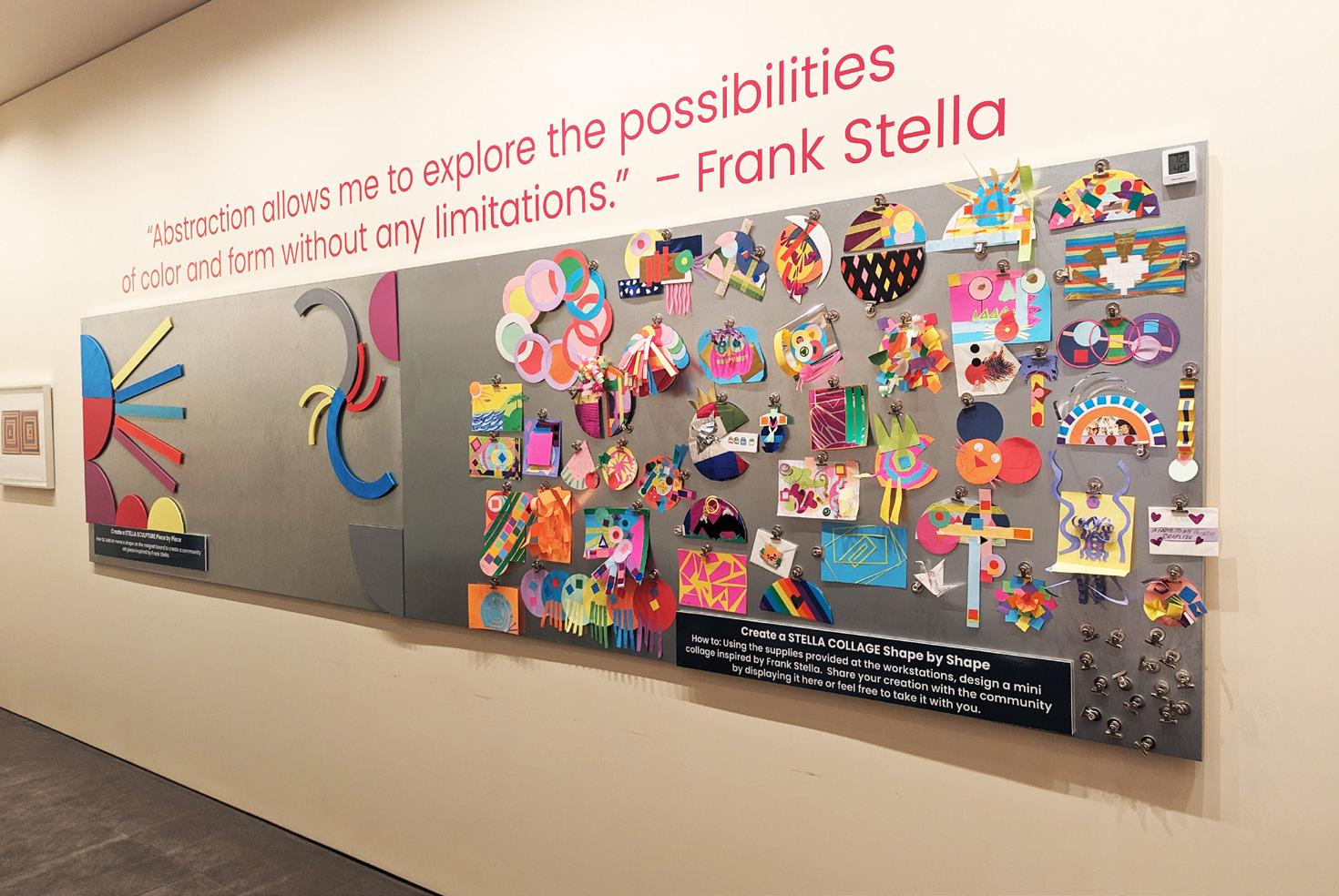
reclaim the original emphasis on immediacy. Once considered pulp, many of its references now live mainly in the canon of art history, with Pop Art’s own fame sometimes eclipsing the targets of its appropriation. Still, the Center finds ways to maintain its themes playful and punchy. In the Learning Lab, for example, visitors collage colorful cutouts on a growing magnetic wall display inspired by Frank Stella’s exuberance.
The Powers campus, a 400-acre ranch housing a collection valued at around $291 million, commands a certain intensity that leaves a lasting impression. Haslett, whose classroom is for students that face social and emotional challenges, described their visits: “They grumble on the bus, complaining until we get there. Then they see the grounds and say, ‘This place is fancy.’ They move quietly through the activities, and by the time we leave, they’re psyched to make art.”
The Center remains firmly committed to its mission. “We’re a well-rounded team,” said Rusby. “We’re focused on using our resources to deliver, through the field trip program, free admission and community, access to a truly high caliber of artists.”
Looking ahead, Rusby is organizing a children’s art exhibition this spring at the Center. A recently announced documentary, “The Powers: A Life in Art” directed by Tyler Oliver, will explore the legacy of the Powers collectors. On Dec. 2, the Center opens its next exhibition, “Jasper Johns: Not Mine but Taken,” a show that, as always, welcomes everyone.


We still have in stock winter squash, onions, greens, apples and pears throughout the fall and Holiday season.

Healthy sack lunches for all SNAP card carriers. Bring your card to Mana and recieve up to two lunches a week. Through November. Vegetarian and meat options.
FOODS NATURAL FOODS STORE

792 Hwy 133, Carbondale Open 7 days a week 10-6:30 / Phone: 970-963-1137

I’ve been calling Congressman Jeff Hurd’s office on a regular basis — and no, not just when I’m drunk. The last aide I spoke with was named Carter. He sounded rather bored, then he audibly yawned while on the phone with me.
“Wow,” I said, thinking, “This feels very dystopian. Most Americans are just trying to hold it together and think of something to be thankful for on Thanksgiving, while our leaders at the Capitol refuse to work and we all watch the White House being demolished on a hideous $300 million golden whim.”
“What?” Carter had stopped talking.
“Oh! Did I say that out loud? I’m just wondering how long Congress is going to play chicken with itself … Are you getting paid right now, Carter?”
“No.”
“How can you afford to work without pay? How will you pay your mortgage?”
“Well, there’s been talk of back-pay.”
By Jeannie Perry
Mm, hm. “There it is,” I thought (this time) to myself.
I thanked Carter for his time and hung up with Chris Elliott’s voice in my head, “Each day is better than the next …”
The Republicans are hell bent on kowtowing to Trump and his billionaire-tax-bracket-avoiding cronies by squeezing more money and benefits from the American people, most of whom are already poking an extra hole in our belt to keep our hand-me-down pants from falling off. These clowns are obviously not concerned with protecting our American way of life, as evidenced by their treatment of farmers, veterans and working moms. It would only take one brave Trumpublican to go first and denounce the lot of them, but here we are, watching the destruction of our country: crickets.
And don’t even get me started on the Democrats! These chuckleheads are still dressing up like they
have an office to go to!
And don’t even get me started on the Democrats! These chuckleheads are still dressing up like they have an office to go to. If you thought Bernie Sanders was too liberal, you should go sit down and think about how we got here. By not reacting viscerally to this tyranny, i.e. by trying to take the well-worn path across the aisle and play by Capitalism’s rules — or rather, lack thereof, the Democratic party has thrown us right under their EV tax credit bus. Both parties pole dance for the almighty dollar, Democrats just like it to take a little longer. Meanwhile Republicans have decided they can’t wait another minute! They’ve gone on a bender, tearing the whole place apart. “Politics is burlesque,” as Chris Hedges said. While Democrats were happy to watch America strip slowly, doing a little dance to the tune of betraying working Americans by repealing the Glass-Steagall Act, Republicans like the fast and furious pace of anarchy — oligarchs up on stage, dancing to the song “Maniac.” In both cases the money flows one way: up, up and away from the American people.
Who on Earth — other than Congress — gets paid for being on strike?! Can you imagine a stripper sitting on a chair filing her nails while the dollar bills continue to fly through the air? No. This shutdown is pathetic. What do these members of Congress think is the main job of government? To go out to lunch with Richie Rich, that’s what. And Richie Rich and his pals, a.k.a. private equity firms, are insatiable eaters. They eat industries built with public funds and then sell us the necessity we already paid for. They can’t get enough: roads, hospitals, electric companies, etcetera. And, of course, they lobby like mad to avoid paying their share of taxes.
Imagine what a world it would be with genuine representation for the people, instead of these ghouls selling us the Band-Aid to stop the bleeding after securing the government subsidy for all knife-wound remedies. The system is rigged for the corporations, meanwhile we have to contribute to GoFundMes for art in school and public radio.
As I mentioned, a favorite pastime of local middle-aged women these days is calling our Congress members while listening to KDNK and enjoying a glass of wine. One of my friends was talking to an aide of Representative Hurd (Carter?) about the elimination of funding for public media. Specifically, she asked him how he thought we would stay informed about wildfires, flooding and other disasters without public radio. Once again: crickets.
SNAP from page 6
pandemic. Simultaneously, other leaders stated that the increasingly dire situation appears to have catalyzed increased donations and relief efforts in the past month, and they are grateful for continued community support.
“I think it’s like a hurricane,” said Gray Warr, executive director of Pitkin County’s Harvest for Hunger. “When a hurricane hits, people step forward.”
WMRHA has assembled the specific needs of each MCFNS partner organization into a handy spreadsheet outlining both who donors can contact and how community members can get involved. This spreadsheet is found with a community call-to-action at www.bit.ly/MCFNS-donate
William (Bill) Montague Ferry Jr. was born in Denver, Colorado, to parents William Ferry Sr. and Nancy Hickerson. Bill spent his childhood in Nashville, Tennessee, then attended the University of Denver. During this time, he realized his love for the mountains and lifestyle out West, choosing to make Colorado his forever home.
Bill spent every spare second he had outdoors. His hobbies included Nordic and downhill skiing and biking the rest of the year. After college, he helped to found the Front Rangers Cycling Club, which raises money and provides bikes for kids in need. These passions followed Bill and shaped his identity and love for Colorado.
Bill lived in Carbondale for 26 years, where he raised his family, sharing his love for the outdoors with them. He was an incredibly devoted and hardworking person. Bill spent the last part of his career at Aspen Valley Hospital in the IT department. Through these experiences, he created long-lasting bonds with those in the Roaring Fork Valley.
Bill will be remembered by many for his sense of humor, adventurous soul, huge heart and his love for Dos Gringos burritos. Throughout his life, Bill devoted much of his time and energy to those around him, whether it was family, friends or
colleagues. He found much joy in the simple act of walking through the neighborhood, stopping to check on friends, share a laugh or lend a helping hand. His presence brought warmth and connection to those around him.
He is survived by his two sisters, Nancy Hinds and Caroline Brewer. His former wife, Sue Jacobsen, and his two daughters, Nikki and Samantha Ferry.
In late July, Bill was diagnosed with stage four pancreatic cancer. He fought strong and hard throughout the past few months, never losing his sense of hope or humor, even in the face of this immense challenge. His resilience during this time was a deep reflection of his personality. Bill will be greatly missed by those who had the privilege of knowing him. His name lives on in the hearts of everyone who shared time, laughter and unforgettable memories with him. Next time you grab a bite at Dos Gringos or carve down a ski run, carry Bill with you, in spirit, in memory and in love.
In lieu of flowers, please send a donation to Mt Sopris Nordic Council in honor of Bill Ferry.
Nutrition Program for Women, Infants and Children (WIC) recipients, the letter was supported by discussion with Sharon Longhurst-Pritt, county human services director, and Joshua Williams, county public health director. They emphasized problems some county residents would likely face if they did not receive their benefits.
Longhurst-Pritt said that SNAP benefits have not been loaded into accounts as of Nov. 1. Williams said WIC payments are good through November, thanks to the state’s recent $10 million subsidy. Both agreed that even though every bit helps, $10 million won’t go very far. Longhurst-Pritt predicted the county may have to pitch in.
The BOCC did not send a similar letter to Congressman Jeff Hurd (R-CD3). “Because the vote is in the Senate,” said Commissioner Perry WIll in an email. “And we have been in contact with Rep. Hurd. He supports getting the government back going [sic] and has said so publicly many times.”
Glenwood Springs Mayor Marco Dehm, accompanied by the assistant city engineer and an attorney for the City, presented the new plans for the South Bridge Project, including how a portion of the Jackson Ranch could be condemned to make way for the infrastructure. The Jackson Ranch has been held in conservation easements for three decades, put in place by the late rancher and veterinarian Carter Jackson. “For 17 years, [the Jackson family] has been operating under the shadow of [South Bridge] potentially bisecting their property and disrupting important and rapidly decreasing deer, elk, migratory bird and wetland habitat along the Roaring Fork River,” said Aspen Valley Land Trust (AVLT) director Suzanne Stephens in an email to The Sopris Sun.
She said that AVLT understands the need for emergency egress but it would isolate the northern portion of the ranch, sever irrigation systems and access to the manager’s home. She pointed to new access roads and driveways, increased noise, traffic and pollution that would also encroach upon the southern portion of the ranch. “These changes would significantly impair both the ranch’s operations and the ecological integrity of the area,” said Stephens. “Our local ranchers and producers already face mounting challenges and their numbers are declining without the added strain of imposed development fragmenting the lands they depend on.”



This FREE event brings together Roaring Fork Valley professionals offering essential resources for older adults, including hospice, home care, health services, fitness, and more. Complimentary blood pressure checks will be available.










Participants
• Anne Wolf – Restorative Massage and Integrative Trauma Coach
• Carbondale Branch Library
• Carbondale & Rural Fire Protection District
• Chris Klug Foundation
• Colorado Animal Rescue
• Elise Anderson – Financial Advisor, Merrill Lynch
• Gar eld County Senior Services
• Heritage Park Care Center
• HomeCare & Hospice of the Valley
• Pitkin County Senior Services
• Right at Home
• Roaring Fork Home Care
• Sopris Lodge at Carbondale
• The Spine Center at Valley View
• Valley View Hospital Palliative Care
• Whitcomb Terrace
A journey through history, beliefs and the remembrance of those who are gone
Every late October, when the cold begins to bite and the leaves fall like tiny symbols of passing time, the American continent prepares to celebrate one of its oldest and most universal rituals: a dialogue with death.
It is not a cult of darkness, but an affirmation of life, of that invisible bond that links the living with those who have departed. A tradition that, though it takes on different faces in each country, reminds us of one enduring truth: There is no future without memory.
In North America, the origin lies in the ancient Celtic festival of Samhain, celebrated more than 2,000 years ago in Ireland and Scotland. It marked the end of the harvest and the beginning of the “dark half of the year,” when, according to the Druid, the veil between the world of the living and the dead grew thinner.
With the spread of Christianity, Samhain became All Hallows’ Eve, which later evolved into Halloween.
Irish immigrants brought this tradition to the United States in the 19th century. There, over time, it blended with elements of African American and Indigenous cultures. Today, illuminated pumpkins, costumes and trick or treating are its most visible expressions.
But behind the color and fun persists the same ancient symbol: a reminder that death walks with us, not against us.
kites, multicolored creations up to 65 feet wide. The wind carries messages to ancestors and purifies the air among the living. In both traditions, the message is the same: Death does not break the bond, it only transforms it.
Food as a bridge, laughter as prayer
In the Andes, the commemoration of the Day of the Dead is celebrated with flavor and memory.

By Zulma Astrid Guarín Sol del Valle
In New Orleans, the ritual took on a unique form: jazz funerals — processions that begin with a mournful march and end with joyful music. For African descendants, the drum frees the spirit of the deceased. For the community, it is a way to dance once more with the one who departed. A vibrant metaphor for shared mourning: to weep, and then to celebrate life.
Mesoamerica: The dead return home
In the heart of Mexico and Central America, death is not feared. It is welcomed with flowers, bread and candles.
Day of the Dead (Día de los Muertos), recognized by UNESCO as an Intangible Cultural Heritage of Humanity, is the result of a fusion between Indigenous worldviews and the Catholic calendar.
Before the arrival of the Spanish, the Nahua peoples already held festivals dedicated to Mictecacíhuatl, the “Lady of Death,” and to Mictlantecuhtli, the lord of the underworld. Families offered food, flowers and music to guide the souls back home.
With colonization, these dates merged with All Saints’ Day (Nov. 1) and All Souls’ Day (Nov. 2).
Thus was born the custom of setting up altars of offerings, with photographs, cut-paper decorations, water, salt, candles, copal incense, sugar skulls, “pan de muerto” and the golden cempasúchil flower, whose glow lights the path of return.
In Guatemala, the sky itself becomes an altar: In the towns of Sumpango and Santiago Sacatepéquez, people fly giant
In Ecuador, whole families share colada morada, a thick purple corn drink with fruit and spices, accompanied by “guaguas de pan,” bread figures shaped like children. Eating together becomes communion. The act of sharing food is a way of saying, “You are still here.”
In Bolivia, death has a face. During the Day of the Ñatitas, Aymara families decorate human skulls with flowers, cigarettes or sunglasses. They talk to them, ask for favors and offer thanks. For them, death is not an end, but a protective companion.
Meanwhile, in Haiti, the Fèt Gede summons the Guédé spirits, guardians of the dead, with music, rum and drums. The dead dance with the living; the cemetery becomes a festival.
A continent unafraid of the other side
In Europe, death is often hidden behind silence or cold marble. In the Americas, by contrast, people speak with it.
Every altar, every kite, every farewell song reaffirms something our ancestors knew well: To honor death is to honor life.
Across all these traditions, from the streets of New Orleans to the Andean villages, the message is the same: Love does not die, it only changes its place.
And that place is memory, family and the living flame that does not go out with absence.
Each Nov. 1 and 2, the Americas remember that death should not be feared, but understood; that to look to the past is not to live in it, but to recognize ourselves in a chain of names, stories and affections that continue to sustain us.
Perhaps that is why, when we light a candle, hear a drum or watch the wind move a cempasúchil flower, we feel that someone is with us. It is not superstition, it is identity. Because to remember the dead is, deep down, to remember that we are still alive. And as long as there is someone to name them, no loved one ever truly dies.
Share your works in progress with readers by emailing illustrations, creative writings and poetry to fiction@soprissun.com

By Daniel Torres
Translated
by Freda Barron
“Poetry is the territory of loss, and that assumption condemns the poet to a constant vigil.”
- Eduardo Milán
Lost for the love of letters; they injected me with the habit of life that my enthusiasm so desperately needs to keep me afloat. What would become of me if I didn’t have you? I would be someone insignificant, like those who have once made me feel pity. With jazz and these words, my innermost self reclaims the thirst of the primal me, the first of all; the Word, like Adam assigning names to all living creatures, rivers and seas he saw, to the fruits, the mountains, plateaus and valleys. Adam is the first poet, also the first to be cursed.
As for me, I have always preferred to be one of those, another Adam, naming the things around me, sprinkling them with words, filling them with stories and tales; always eating from the tree of knowledge of good and evil, not letting myself be seduced by the serpent, listening to it, ignoring it, perhaps only sometimes letting it in and nourishing myself with its words.
Lost for the love of letters like Solomon, filled with songs within, flooded by the longing to always keep the pen with me, memories of a notso-distant past flowing from my left hand of a more poetic country of my own, of a reality of mine filled with
sighs into the air, where the everyday becomes poetic imagination.
My calling has always been creation, the act of imagining it differently, of capturing that scene of the child and his father on the bus, of a father teaching his son to read. The transmission of knowledge as a memory is not what makes it poetry; that very action itself is poetry, living poetry. Starting from that and achieving the creative act, having enough subtlety, the instinct, that thing some call a gift, is what turns that poetic act in itself — invisible to the eyes of the insignificant being — into a visible poetic act; a translation from one being to another, a bridge between realities, a love for letters, a poetic love, the true love, a cursed love, forever condemned.
Forever condemned to a constant vigil, with that filter of imaginary reality. Along the way, many decide to start ignoring the filter, they discard it, they set it aside, overlooking the fragrance that certain events emanate. Always nourishing themselves with experiences, with life itself, so that the poet can continue with the arduous task, with an endless stream of translations and interpretations of the moments themselves, like revealing the negatives of a photograph, which later everyone can see and understand. So that everyone can see the poet and poetry.
Comparte tus proyectos creativos aún en proceso con nuestros lectores. Puedes enviarnos un correo electrónico con tus ilustraciones, creaciones literarias y poesía a fiction@soprissun.com
Linda Helmich October 2017
Could anything be more lovely than October?
When the leaves are blowing in the wind, tossed willy-nilly about
Happy to be free of their moorings, eager to lie down at last Having completed their task?
They brought hope in the spring, dressed in lemony green
When they first appeared as buds. (How the world rejoiced to see those buds!)
And soon after, dressed like the solid, vibrant green of summer, giving texture and refreshment,
Holding in check the solar glare, swathing the hillsides with joy.
Even on gray-sky rainy days, that color alone was a promise, a sure promise, of all the good things to come.
But October, when the golden aspen leaves shimmer like the facets of a diamond competing with the sun for attention...
And the cerulean sky provides the perfect backdrop, still and serene...
October, with its halcyon days and chilly nights...
October, with its long lists of things to do before winter ... and its too-beautiful-to-doanything persuasion.
I would hold October in my heart to enjoy through all of the silent snowy days ahead,
Listening intently for the breath of the wind, and the gentle rustle of the leaves,
Like the passing by of a great lady in a taffeta skirt.
By Kitty Riley Carbondale
Hey, look at me.
Up here. Top of the pole.
I’m waving at you.
Do you see who I am?
A symbol with stars, stripes and a square; With red, white and blue. Not just one shape. Not just one color.
A pattern of differences. An echo of you.
Be proud of who you are.



The CPB is run by dedicated volunteers and sustained through bike sales, donations and grants. Support from the Aspen Thrift Shop plays an essential role in maintaining our operations and expanding our
The ongoing challenges surrounding the Garfield County libraries stem from the action of the county commissioners (BOCC). The issue has consumed significant time for both the BOCC and the library board, when the BOCC lacks broad public support and has politicized the matter.
At the Oct. 6 BOCC meeting, it became evident that the commissioners have absolutely no intent of negotiating with the library trustees. The intergovernmental agreement (IGA), intended as a framework for cooperation between the BOCC and the library board, remains at a stalemate. The IGA was an action item on the Oct. 6 agenda to be voted on, but, instead, after a 30-minute discussion, the item was tabled for further consideration. Who is dragging their feet?
Instead of seeking compromise, the BOCC is now proposing changes to the library board bylaws specifically suggesting that trustee terms be reduced from five years to three. The library board controls the bylaws, not the BOCC. Should a trustee serve two terms, that would be 10 years on the library board. That is too much time for one board member to be in that position — a suggestion, coming from Mike Sampson, who has served for 16 years as a commissioner and is now beginning his fifth four-year term. My math tells me he will have served as a county commissioner
I suggest you take a look at the recorded segment of the Oct. 6 BOCC meeting by visiting www.tinyurl.com/BOCCLibraryIGA The county commissioners show their true colors. Jocelyn Durrance
With Thanksgiving rapidly approaching, thoughts turn to Black Friday: The day after that retailers hope to see maximum sales, using it as a benchmark for estimates of profit for the oncoming Christmas season.
This year, there is a push to use Black Friday as a tool to voice consumer and voter dissatisfaction with the current federal government’s failure to back many of the U.S. Constitution’s mandates, which every federal government member has a sworn duty to uphold. Black Friday is now becoming Buy Nothing Day, which would put a chill in boardrooms across the country and underscore Americans’ purchasing power where it hits home, in Corporate pocketbooks.
Since big corporations obviously don’t understand anything except money, this is the only way to get many of them to sit up and listen to Americans’ needs and hopes for the future of our great country. Withholding our spending is a powerful way to make corporate bigwigs pay attention, as was exemplified by Disney’s attempt to stifle Jimmy Kimmel in September, which failed miserably, causing their market shares to drop $4 billion in only two days. (They are still losing money over that one).
Personally, I think the idea of withholding money from big corporations, like (fill in the
blank), is a good one, but only if we consider that we could better spend our money elsewhere, specifically at mom-and-pop operations, which are not the enemy here. Black Friday can become a way to gig greedy corporations, while at the same time benefitting local retailers who don’t necessarily line up with the big corporations’ ideals, or lack thereof.
The upshot: Spend wisely, support local business and sock it to the Man — all at the same time.
Roger D. Miller Glenwood Springs
“I think law and order is something that’s important to all of us as Americans,” said our representative, Jeff Hurd, speaking about ICE rounding up undocumented people. However, he seems willing to let unidentified people in masks do the work, arresting people without judicial warrants and who sometimes are citizens, which is in itself illegal. He also seems to allow the Trump administration to break the law in other ways.
Why is he not speaking out about:
• The 35% of court orders Trump ignores? (including $6 billion the courts ordered Trump to release for SNAP assistance in November).
• The detention of people without bond or charges?
• Deploying National Guard troops to Democratic cities for virtually no reason? (They have lower crime rates than previously and seem targeted only to cause unrest).
• Using the Department of Justice as his personal revenge machine?
Yes, Representative Hurd, law and order are important and we hope you start holding this administration responsible!
Peter Westcott Missouri Heights Re: ‘1946’
I read the story “At Carbondale Library, ‘1946’ film prompts reflection on scripture and inclusion,” and I couldn’t help but shake my head. Some Bible scholars will perform all sorts of logical and hermeneutical gymnastics to make it seem as if the Bible affirms homosexual conduct. It does not. According to Scripture, homosexual acts are sinful. Period (Leviticus 18:22; 20:13; Romans 1:26-27; 1 Corinthians 6:9; 1 Timothy 1:9-10).
The Bible offers good news, however. All who repent of their sins and put their faith in Jesus Christ will be saved (Acts 2:38; Romans 10:13). Everyone has sinned — both homosexuals and heterosexuals. But the sacrificial work of Jesus Christ on the cross brings forgiveness to all who call on Him. If you are a practicing homosexual, it’s not too late.
So the film was disappointing but not altogether surprising. What really bothered me was that people right here in our valley, people who claim to be Christians, could call something good that the Bible clearly calls evil. To take up the name of Christ and then affirm people in their sins is a grievous mistake. Those “Christians” need to repent. They need to find churches that teach the Bible, and they need to become a light in this dark world — rather than remain part of the darkness itself.
Chris Moon Redstone
NOTICE OF PUBLIC HEARING
CONCERNING LUC-24-00008, A LAND USE CHANGE PERMIT APPLICATION FOR MINOR IMPACT LAND USE CHANGE PURSUANT TO LUR SECTION 6-102:A 2-4 UNITS TO PROJECTS THAT PROPOSE MORE THAN THREE RESIDENTIAL UNITS ON A SINGLE PARCEL AND LUR SECTION 13-105:G IMPACT CLASSIFICATION AND REQUIRED FINDINGS FOR COVERAGE EXCEEDING STANDARD AT THE PROPERTIES OWNED BY TREASURE MOUNTAIN RANCH INC., COMMONLY KNOWN AS 3881 FOREST SERVICE ROAD 314, CRYSTAL TOWNSITE VICINITY; LEGALLY DESCRIBED AS INEZ 4 LODE MINING CLAIM MS 11450, CRYSTAL MILL SITE, MS 5708B, HOME AND PROTECTION LODE MINING CLAIMS, MS 7085, WANDEROR, MS 7849, GRAY COPPER MILL SITE, MS 5209B, LOST HORSE MILL SITE, MS 6239B; AND LOTS 1 AND 2, BLOCK B, LOTS 1-8, BLOCK C AND LOTS 7 AND 8, BLOCK D, JOHNSON’S ADDITION TO THE TOWN OF CRYSTAL, COUNTY OF GUNNISON, COLORADO
HEARING DATE, TIME AND LOCATION: The Gunnison County Planning Commission will conduct a public hearing on November 20, 2025 at 9:00 a.m. in the meeting room upstairs in the Gunnison County Courthouse at 200 E. Virginia Avenue Gunnison, CO 81230 and/or by ZOOM meeting. If attending by Zoom please go to the online meetings tab at https://www.gunnisoncounty.org/144/ Community-and-Economic-Development for the ZOOM meeting link to hear public comments concerning this land use change permit application.
APPLICANT: Stuart Gillespie, Treasurer, Treasure Mountain Ranch Inc., represented by Law of the Rockies, Headwaters Planning, and DHM (“Applicant”)
PARCEL LOCATION: 3881 FOREST SERVICE ROAD 314, CRYSTAL TOWNSITE VICINITY; LEGALLY DESCRIBED AS INEZ 4 LODE MINING CLAIM MS 11450, CRYSTAL MILL SITE, MS 5708B, HOME AND PROTECTION LODE MINING CLAIMS, MS 7085, WANDEROR, MS 7849, GRAY COPPER MILL SITE, MS 5209B, LOST HORSE MILL SITE, MS 6239B; AND LOTS 1 AND 2, BLOCK B, LOTS 1-8, BLOCK C AND LOTS 7 AND 8, BLOCK D, JOHNSON’S ADDITION TO THE TOWN OF CRYSTAL, COUNTY OF GUNNISON, COLORADO
PROPOSAL: Treasure Mountain Ranch, Inc. has applied for a Minor Impact Land Use Change to consolidate 16 parcels into 9, complete three boundary line adjustments, and cluster new development within a 1.9-acre building envelope in the Crystal townsite. Treasure Mountain Ranch, who owns 700 acres over the 16 parcels, proposes to retire four structures, construct a 4,900 sq. ft. maintenance barn, and build four new cabins totaling approximately 5,000 sq. ft. to replace four decommissioned cabins in the townsite. The proposal includes wayfinding and interpretive signage for the historic Crystal Mill site and the intention of pursuing landmark designation for six structures.
HOW TO VIEW THE APPLICATION:
A copy of the application is available online at: https:// www.gunnisoncounty.org/436/Permit-Database. Select “projects” and type LUC-24-00008 in the application number field. If you have questions or issues accessing the files, contact the Community Development Department at (970) 641-0360.
PUBLIC PARTICIPATION: The public is invited to submit oral or written comments at the hearing, or to submit written comments by email: planning@gunnisoncounty.org, or by letter (Community Development, 221 N. Wisconsin, Suite D, Gunnison, CO 81230), so long as they are received by 5 p.m. the afternoon before the date of the meeting so that they may be submitted for the public record during the hearing. A copy of the application is available in the Community Development Department, 221 N. Wisconsin, Suite D, Gunnison, CO; additional information may be obtained by calling the Planning Office (970) 641-0360.
ADA ACCOMMODATIONS: Anyone needing special accommodations as determined by the American Disabilities Act may contact the Community Development Department prior to the day of the hearing.
/s/ Hillary I. Seminick, ACIP Planning Director
Gunnison County Community Development Department
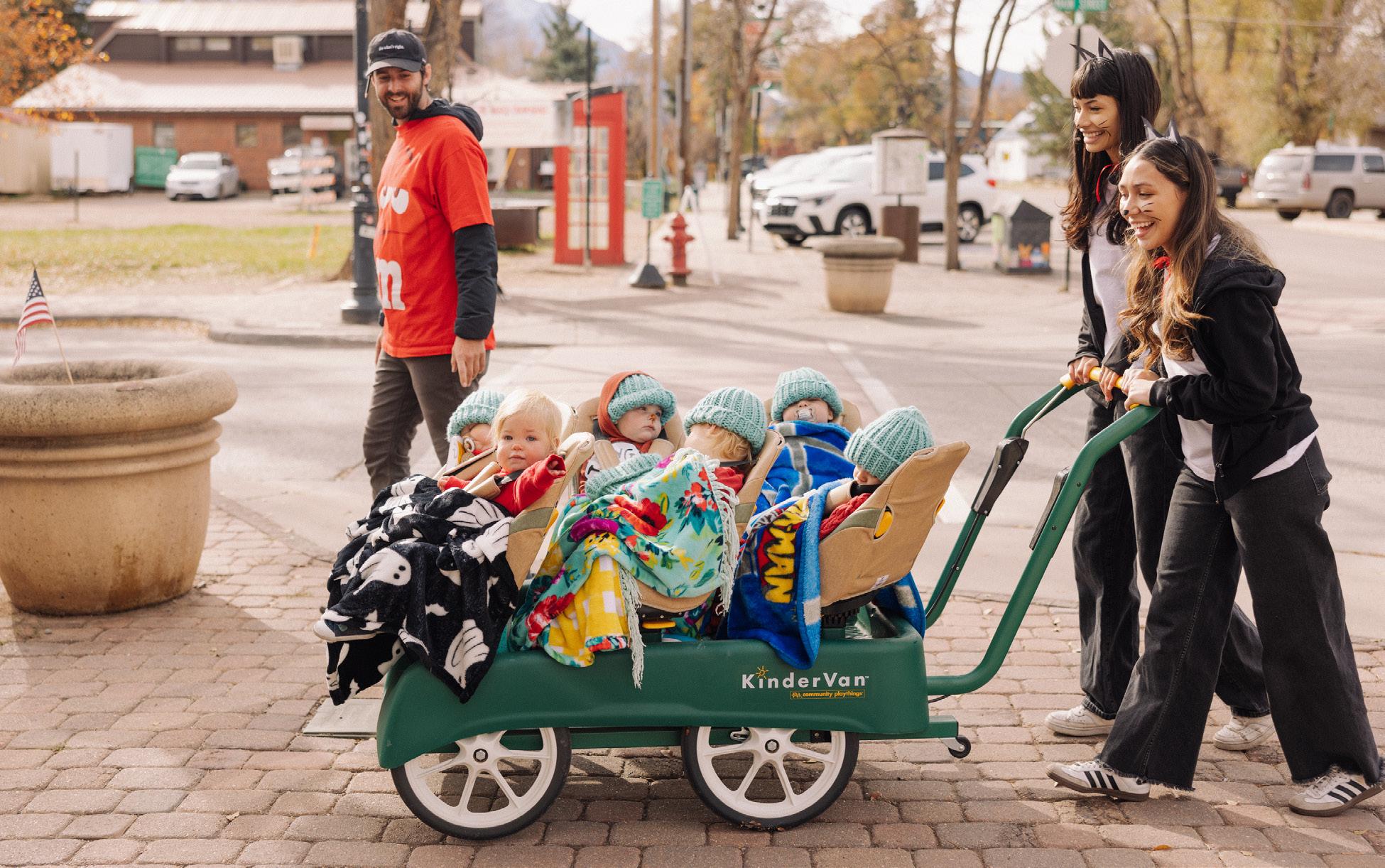
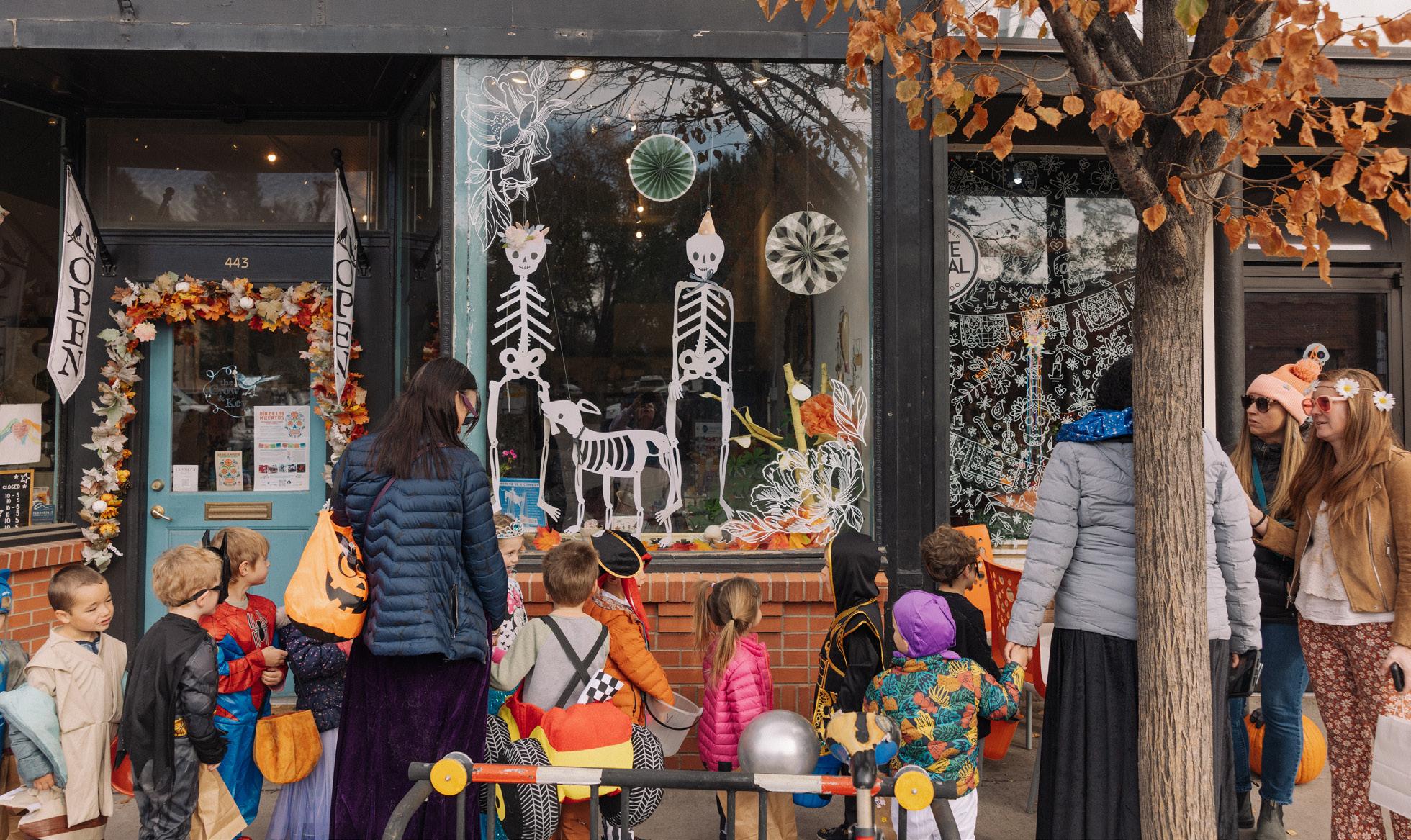
The classes at Little Blue Preschool love to trick-or-treat at Carbondale businesses and parents’ offices, showing off their fantastic costumes to passersby during their annual Halloween parade down Main Street. Kids, teachers and parents dress the part.
Notice is hereby given that on November 12th, 2025, at 12:00 pm final settlement will be made with BRYAN CONSTRUCTION INC. (BCI), 4700 Innovation Dr, Bldg C, Fort Collins, CO, 80525 by the TOWN OF CARBONDALE, 511 Colorado Ave, Carbondale, CO, on a contract for labor and materials for a project known as NIESLANIK AVE PEDESTRIAN CROSSING PROJECT and that any person, co-partnership, company, association of persons, or corporation who has an unpaid claim against BCI, or its subcontractors, for labor and materials, may, at any time, up to closing of business the last work day prior to final settlement, that is, by November 12th, 2025, file a verified statement of the amount due with the TOWN OF CARBONDALE (Attn. Kevin Schorzman) kschorzman@carbondaleco.net pursuant to Section 38-26-107, CRS, as amended.
Failure on the part of the Claimant to make such verified statement, prior to the final settlement on the contract with BCI, will relieve the TOWN OF CARBONDALE from any liability for such Claimant’s claim.
PUBLISHED BY THE ORDER OF TOWN OF CARBONDALE.
Published in The Sopris Sun November 6, 2025.
Little Blue Preschool thanks all the local businesses that participate, helping show what community means to our youngest residents!
Photos by Kersten Vasey
Notice is hereby given that Maria Juventina Flores filed with the Garfield County Court on Oct. 22, 2025, Case #25C136, to legally change her name to Maria Juventina Membreno de Flores.
6, 2025.






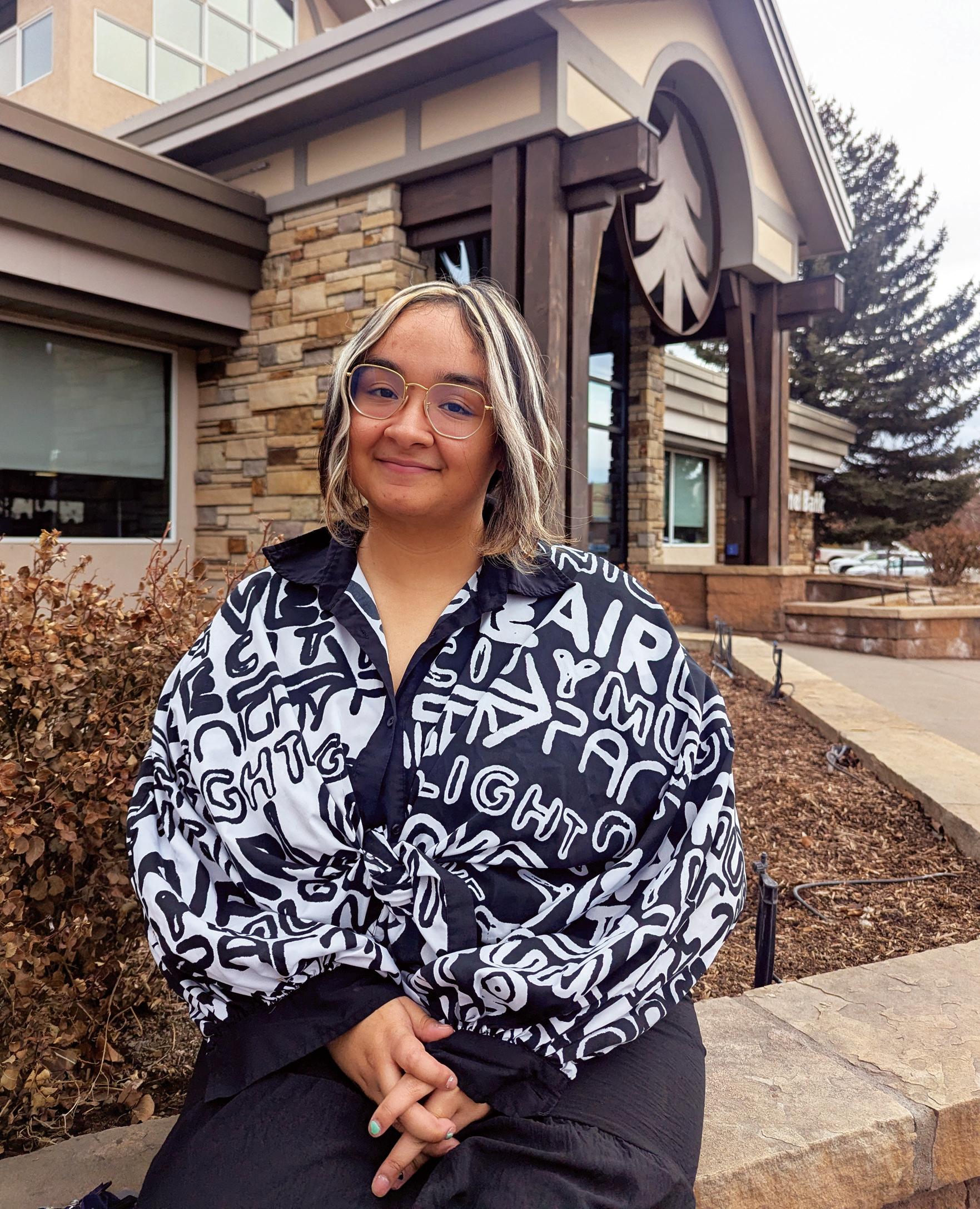

SEO and AI:
How the online & digital landscape is changing, and how to prepare your business
Presented by: Marcus Thackston, Blend Web Marketing, Owner/Web Design, Marketing and Business Operations Specialist
Join us for an insightful presentation on the evolving world of SEO in the age of artificial intelligence (AI) Learn how AI and large language models (LLM) are reshaping online search, browsers, and digital visibility This session will provide a high-level overview of today s most popular SEO tools, the growing influence of AI summaries in search results and practical ways to leverage AI responsibly to enhance your business’s online presence and control how your information appears across platforms

Jeannett is a Personal Banking Representative at the Carbondale branch and has been with the bank for over two years.

She cares about creating connection in our community through artistic expression, that's why you might see her volunteering at the Aspen Cares Fashion Show.