There is a certain kind of summer heat in St. Louis that doesn’t just sit in the air — it presses on ambition. It is the kind of season where big ideas feel both slightly unreasonable and entirely inevitable. July and August have always been that stretch of the year when I find myself thinking less about comfort and more about scale. Not comfort in the physical sense, but comfort with risk, uncertainty and the idea that the next chapter may require something far larger than the last.
We live in a region often underestimated, which is exactly why it produces people and companies that refuse to stay in their lane. The pattern repeats itself in business, design, food, sports and even in how we navigate the river and the ocean beyond it. The most interesting stories almost always begin with someone deciding the current map is not sufficient.
Take the story of Clayco. What began as an upstart construction firm in St. Louis has become a multibillion-dollar platform with a national footprint and an appetite for scale that once seemed unrealistic. Clayco didn’t grow by being careful. It grew by being precise about what it wanted to become and structuring every decision around that destination. Scale is not an accident — it is a design choice made repeatedly, long before the outside world agrees with it.
That same mindset shows up far from construction sites. Two brothers from St. Louis launched a yogurt brand — Culture Club — with no legacy infrastructure, only conviction. Today it is outperforming expectations in a brutally competitive category. They didn’t ask permission or wait for perfect timing. They asked whether they could build something better — and then proved it. That kind of low-ego execution is its own regional signature.
I think about those stories alongside offshore sailing. The Gulf Stream does not negotiate. It is a moving system of temperature and chaos that demands respect. You don’t conquer it — you prepare, adapt and make decisions in motion. On our Valiant 40 Va Bene, the difference between a good passage and a hard one is rarely luck; it is discipline applied long before conditions change.
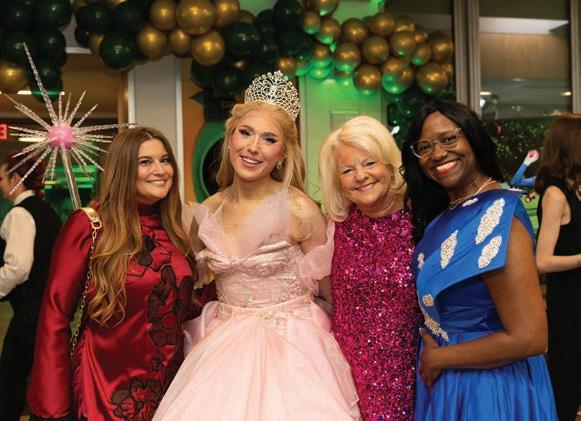
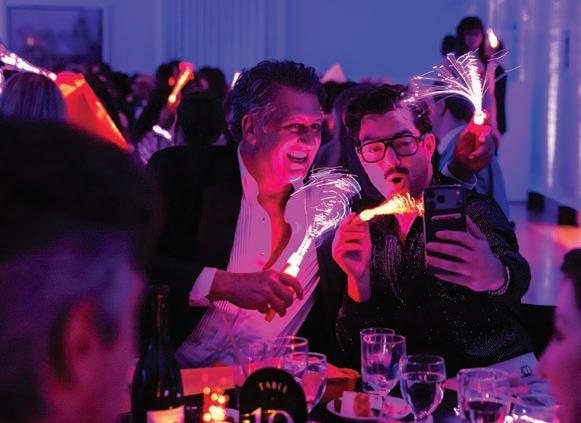
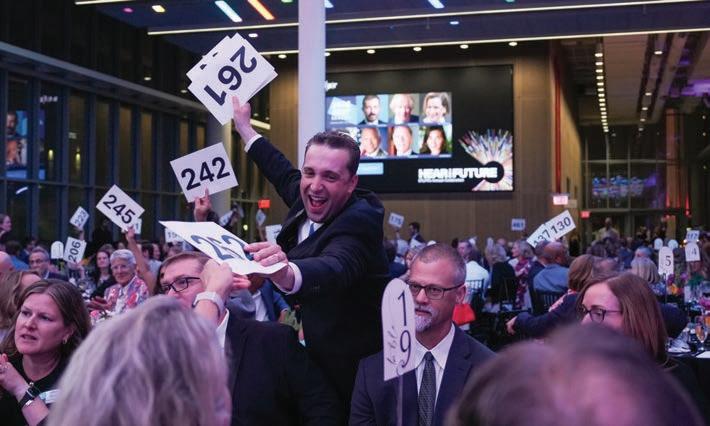
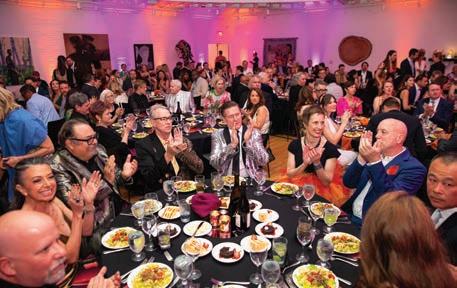
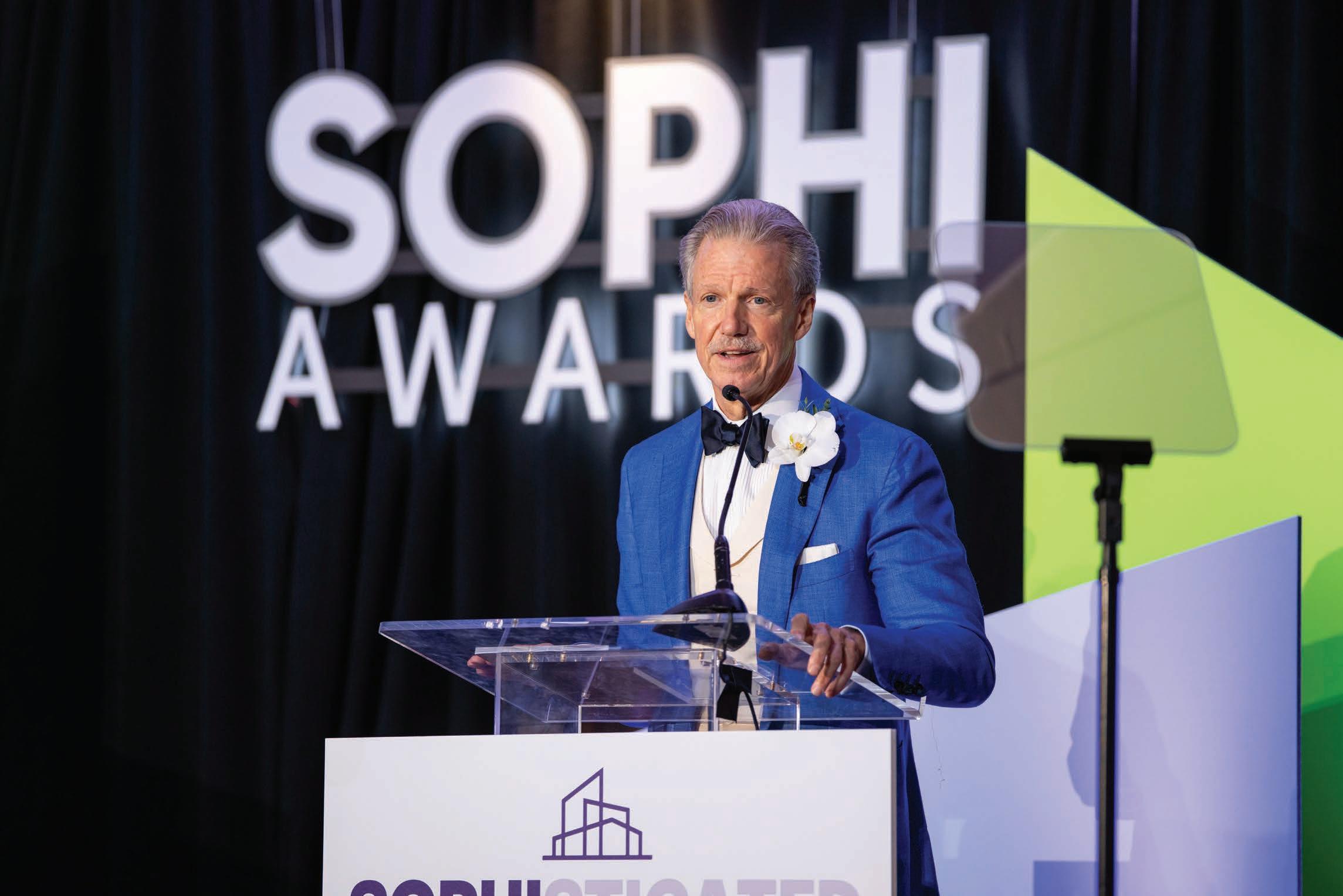
There is also a parallel in how we gather as a creative community. This November, the 2026 SOPHI Awards will move to the Missouri Botanical Garden on November 12 to accommodate a larger audience and expanded experience — growth by design, not by accident. The evening will again be guided by the return of designer Marshall Watson as emcee, whose presence has become closely tied to the tone of the event. We are also honored to welcome Stifel as Honorary Sponsor, underscoring the alignment of institutions that understand scale as culture, not just size.
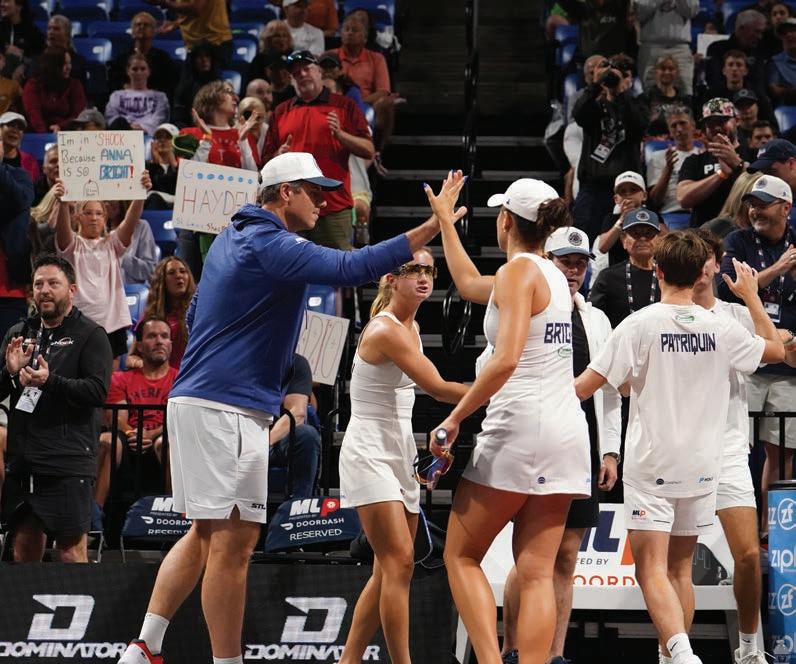
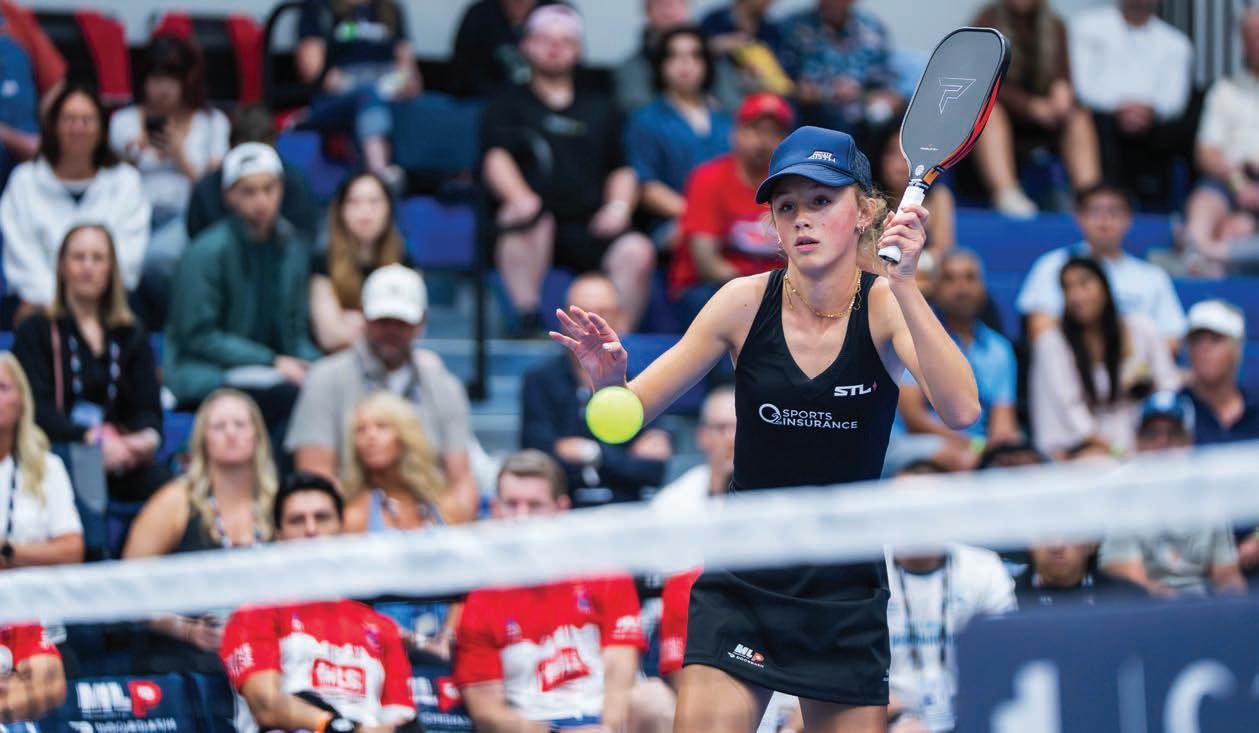
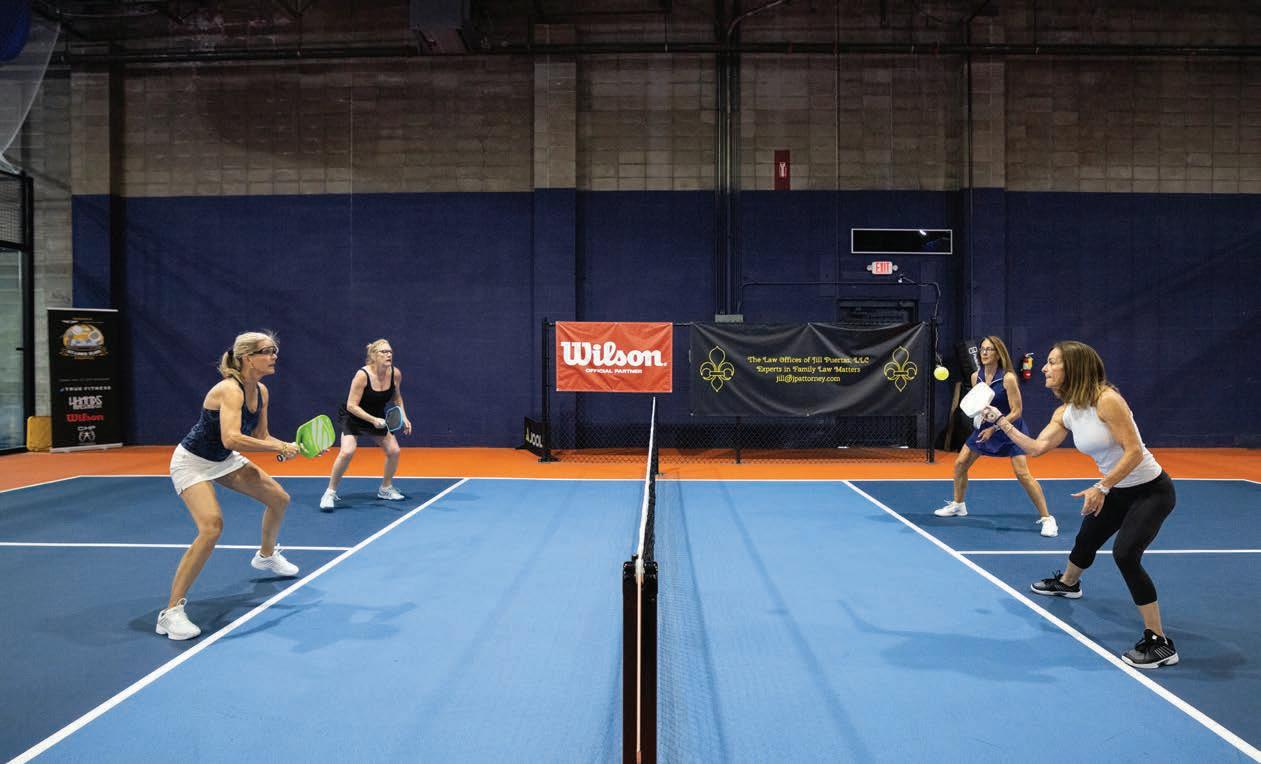
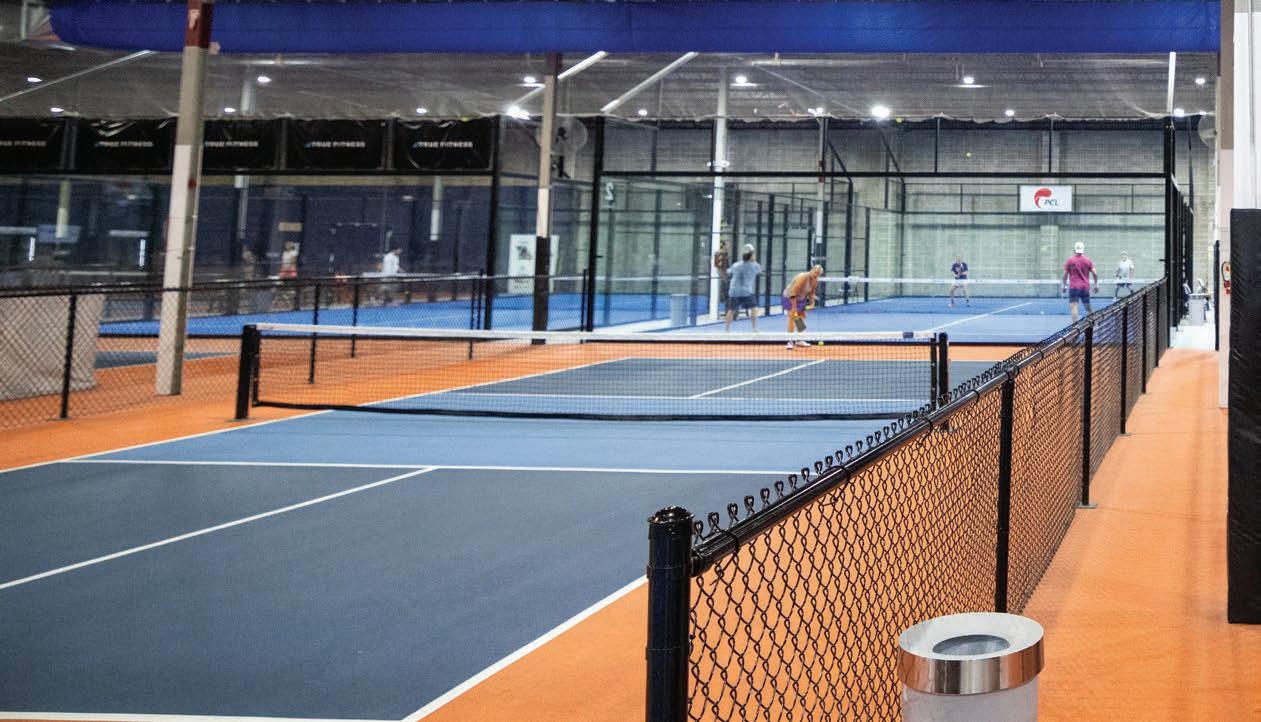
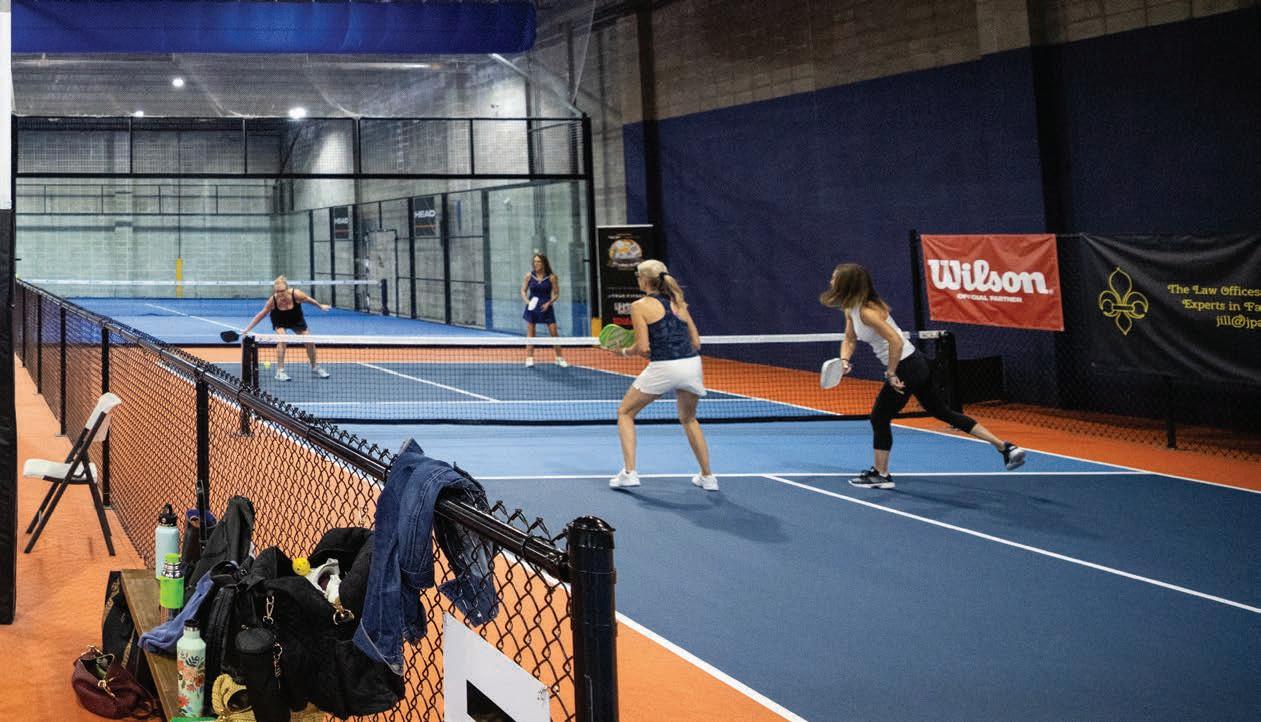
This year also marks the launch of something new: our expansion into professional sports with the formation of our St. Louis professional pickleball team, The Shock, and a fast-growing league that reflects how sport itself is evolving — more accessible, more global and more competitive than ever. Like everything else we admire, it is not about novelty, but about building structure around momentum and showing up where culture is moving next.
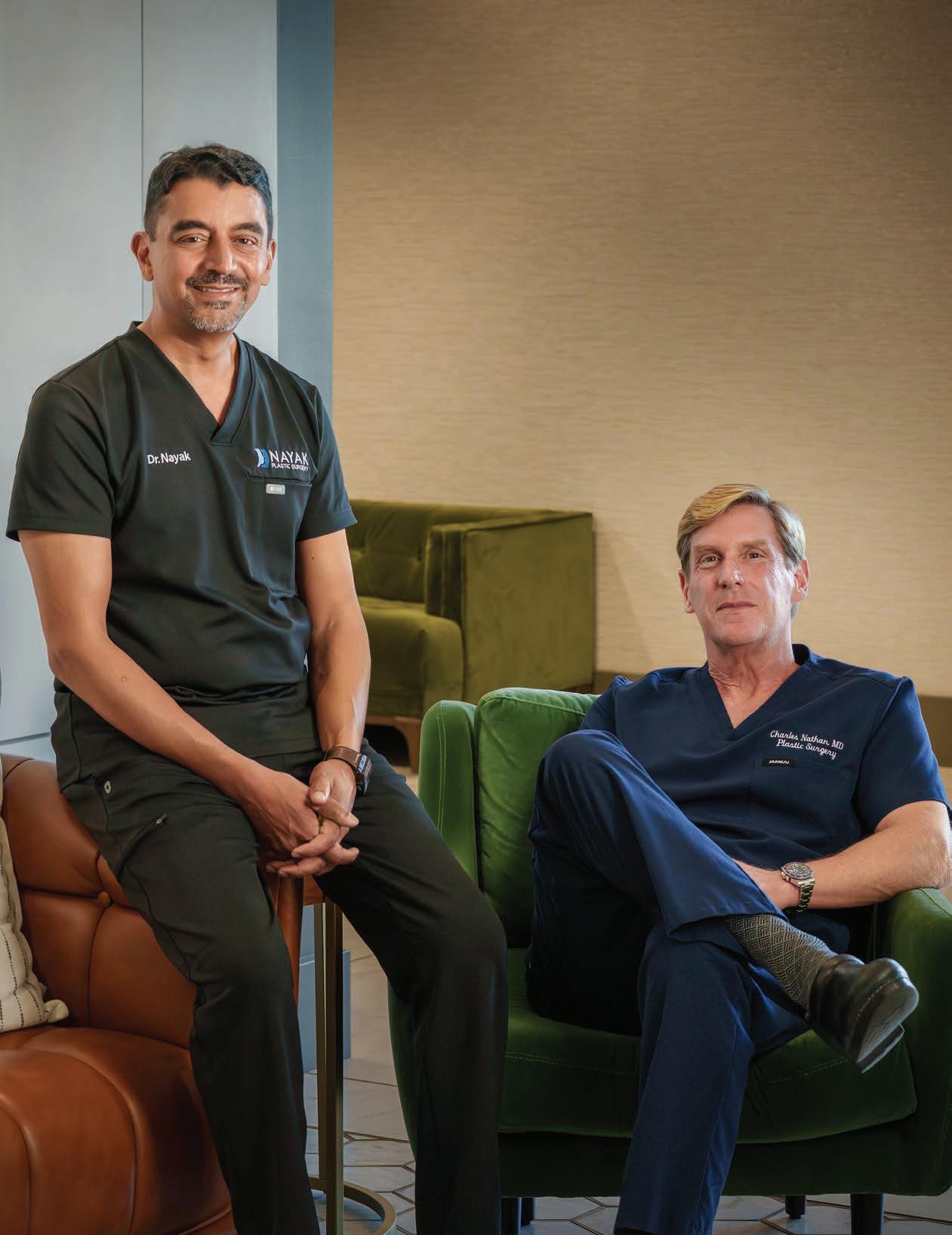
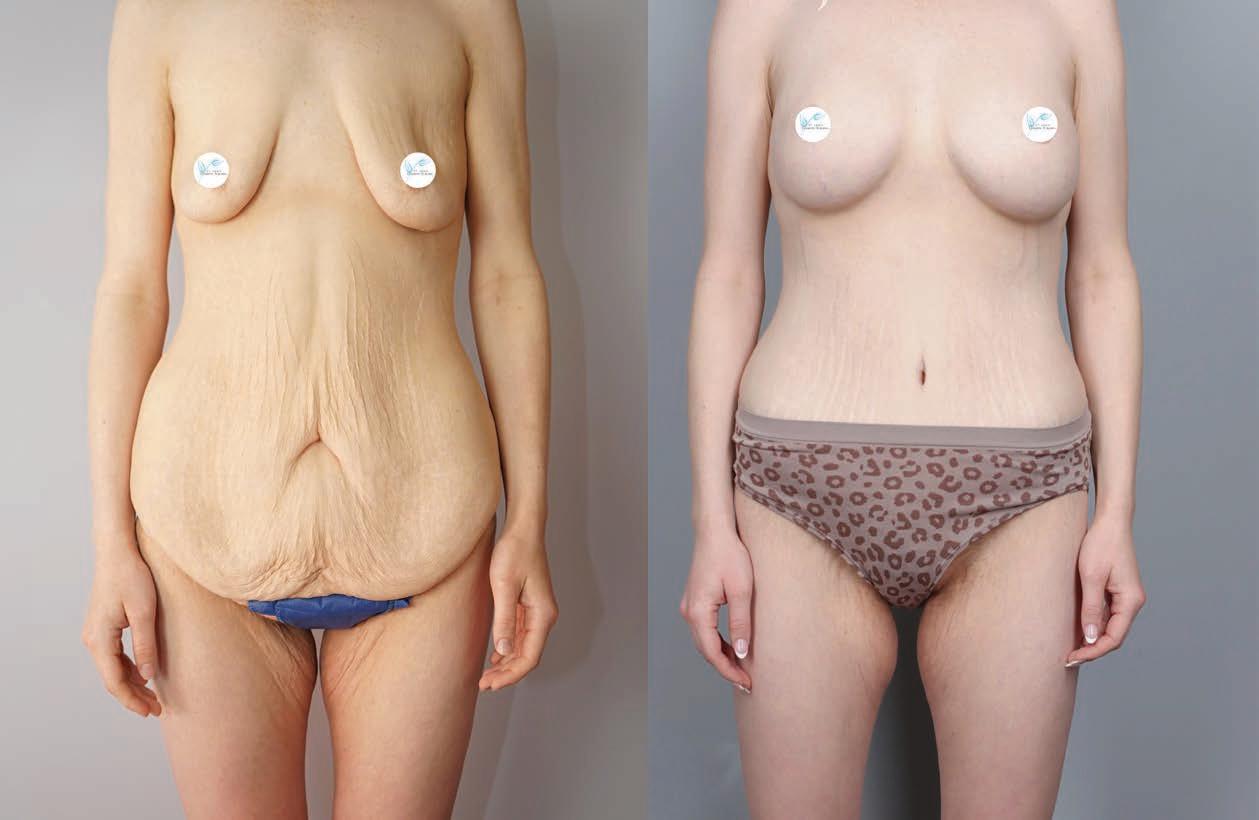
At the same time, we are living through another quiet but profound shift. The rise of GLP-1 receptor–driven weight loss therapies has created a ripple effect across aesthetics and medicine. As people experience rapid and significant transformation, there has been a noticeable increase in demand for advanced plastic surgery and regenerative cosmetic procedures. It is a reminder that when one system changes behavior at scale, entirely new industries emerge in its wake — often faster than anyone predicts.
What connects Clayco, a Nashville yogurt startup, offshore sailing, a growing sports franchise and even shifts in medical aesthetics is not industry or outcome. It is mindset. It is the willingness to set goals that feel slightly out of reach and behave as if they are already inevitable — structured optimism, not blind ambition.
St. Louis has always been a place where that mindset quietly thrives. We build first
and explain later. When you zoom out, you see the pattern: companies that become national leaders, institutions that punch above their weight, entrepreneurs who leave and return with something larger than what they carried out.
The temptation in uncertain moments is to shrink goals to something safe. Smaller goals are easier to explain and easier to achieve, but they rarely change anything. The organizations that shape industries are those willing to tolerate a stretch between what is and what they are determined to make true.
That stretch is where everything interesting happens.
In publishing, business, sport, sailing and life, the edge is never comfortable — but it is clarifying. You learn what matters, who can operate under pressure and how ambition behaves when it is properly built. It is not reckless. It is responsibility at scale.
As we move through summer, I keep returning to that idea. Not the fantasy of big outcomes, but the discipline behind them. The systems that make scale possible. The teams willing to commit before certainty arrives. The sailors leaving the dock knowing the Gulf Stream will not adjust itself. The founders building without waiting for permission.
Wildly aggressive goals are not about volume. They are about alignment. They require honesty about what is possible, patience with what is not yet visible and a refusal to confuse comfort with progress.
In a region like ours, that mindset is not unusual — it is just understated. But it is there in boardrooms, studios, kitchens, on the water and now on the court — quietly shaping outcomes that look, from a distance, like they happened quickly. They rarely do.
So as you read this issue, I hope you see not just success, but intention. People and companies who decided early that their ceiling would not be defined by their starting point — and who are willing to live, for a time, in the space between what is and what could be.
That space is where everything worth building begins.
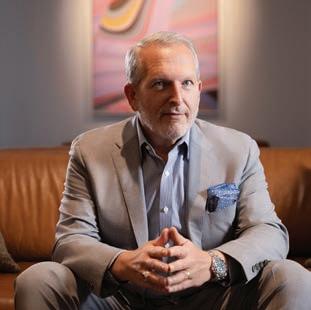
Craig M. Kaminer, Publisher craig@slmag.net
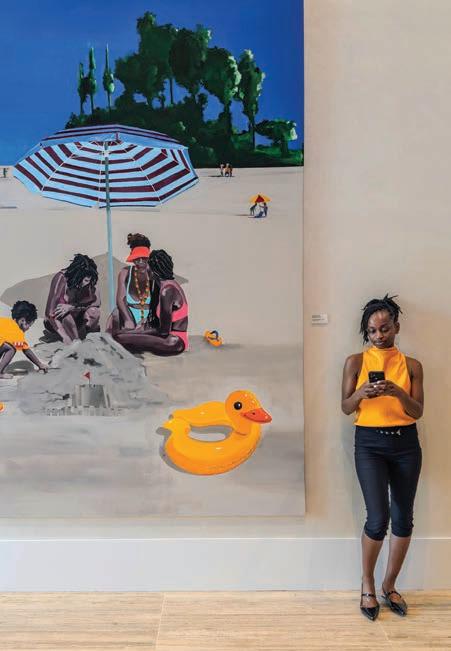
ARTHUR OSVER
Arthur Osver, GP8-73, oil on canvas, 60 x 60 inches, 1973
A Marriage at Sea
Written and photos by Craig Kaminer
There are certain moments in life when the horizon changes permanently. For my wife Debbie and me, that horizon was literal.
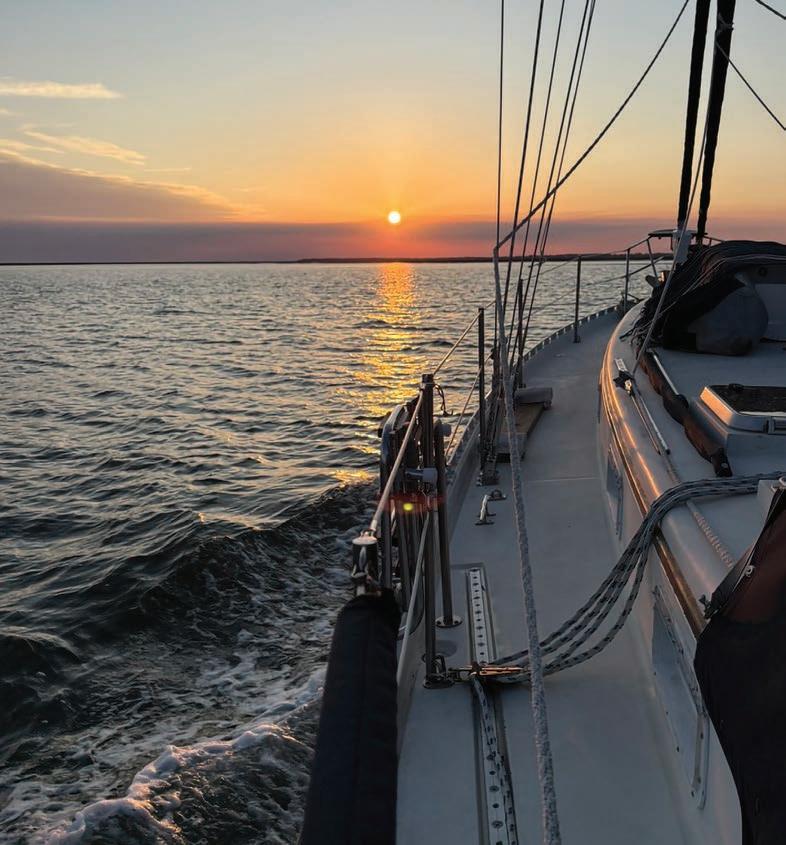
What began as my fascination with offshore sailing eventually became one of the most meaningful chapters of our marriage. Along the way came spectacular sunsets, unforgettable anchorages, exhausting overnight passages, chaos in the Gulf Stream and countless moments that tested both our judgment and resilience.
To be clear, offshore sailing was always my dream. Debbie came along because she loves me. That distinction matters.
While I became consumed with weather routing, passage planning and the romance of crossing open water under sail, Debbie appreciated sailing in a very different way. She loved the beauty, the quiet anchorages and the shared experiences, though she would probably still rank stable floors, reliable air
conditioning and predictable showers fairly high on any vacation list.
And honestly, that tension is part of what makes this story real. Because this isn’t just a story about sailing. It’s a story about marriage. It’s about what happens when one person pursues a dream and the other chooses to support it — not because it’s necessarily her dream, but because she believes in the person chasing it.
At sea, there’s nowhere to hide. Every emotion becomes amplified. Every weakness gets exposed. Every strength matters. And somewhere between sailing school, charter boats and offshore passages, Debbie and I discovered that a marriage can actually deepen when two people willingly step into discomfort together.
Unlike many sailors, I didn’t grow up racing boats or spending summers at yacht clubs. I grew up in the Bronx. My earliest memories of sailing came at summer camp,
where I first learned the basics in small sailboats like Sunfish and Hobie catamarans. Even then, there was something magical about harnessing wind power and quietly moving across the water under your own control. That early fascination stayed dormant for years until offshore sailing arrived later in life after both our boys were born (now aged 35 and 33). At first it was curiosity. Then fascination. Then something much deeper.
I became captivated by the idea of self-sufficiency at sea. The challenge. The seamanship. The romance of navigating by weather, wind and instinct. There’s something deeply appealing about disconnecting from modern life and relying on skill, preparation and judgment to move across open water. The more I learned, the more consumed I became. Debbie, meanwhile, observed this evolution with a mixture of support, amusement and occasional concern.
Photo this page: Adobe Stock
When I suggested we go to sailing school in the early 1990s so we could charter bigger boats, she agreed with admirable enthusiasm considering she had absolutely no reason to believe this hobby would quickly become expensive, uncomfortable and mildly dangerous. As it turns out, it became all three.
The first lessons grounded us. Sailing has its own language, systems and culture. Halyards. Sheets. Points of sail. Navigation rules. Docking procedures. Anchoring techniques. Small craft advisories. Diesel maintenance. Even making the beds require agility and skill. Very quickly I realized sailing is part sport, part engineering, part meteorology and part psychology. And Debbie realized this was definitely not going to be a casual weekend hobby. Still, she embraced it — or at least tolerated it exceptionally well.
Weekends on Carlyle Lake with our two young boys became the foundation of something much bigger. Our first sailboat was modest by any standard, but to us it represented freedom, adventure and possibility. Carlyle Lake may not have had turquoise water or Caribbean trade winds, but it gave us the opportunity to learn together as a family.
Like every sailor, we learned many lessons the hard way. We ran aground more than once, and even a couple of times recently moving our boat from Florida to the Chesapeake. Sometimes softly in mud. Sometimes not so softly. At first, running aground was embarrassing. Eventually we realized it was practically a rite of passage. If you sail long enough, especially in
unfamiliar waters, you experience the good, the bad and the ugly. You make mistakes. You misjudge depths (especially when your depth gauge stops working). You discover that charts, tides and reality occasionally have very different opinions. And every sailor who claims they’ve never gone aground is either lying or hasn’t sailed enough.
Over time, weekends on Carlyle evolved into Coast Guard certifications. Certifications became charters. Charters evolved into boat ownership and longer passages. Before long, I found myself studying weather models over morning coffee while Debbie politely pretended not to notice that some of our vacations were becoming increasingly centered around marinas.
Over the years we’ve chartered sailboats throughout Florida, the Great Lakes, the Virgin Islands, the Pacific Northwest and even Lake Austin in Texas. Each destination offered a completely different kind of sailing and a completely different set of lessons.
The Virgin Islands gave us postcardperfect trade winds, turquoise anchorages and the kind of easy island sailing that seduces people into believing sailing is always glamorous. The Pacific Northwest was entirely different — colder, moodier, dramatic and deeply beautiful, with changing weather patterns and breathtaking scenery that felt almost cinematic.
In New England we encountered hard bottoms, fog and very expensive fuel. Florida taught us humility. Shifting shoals,
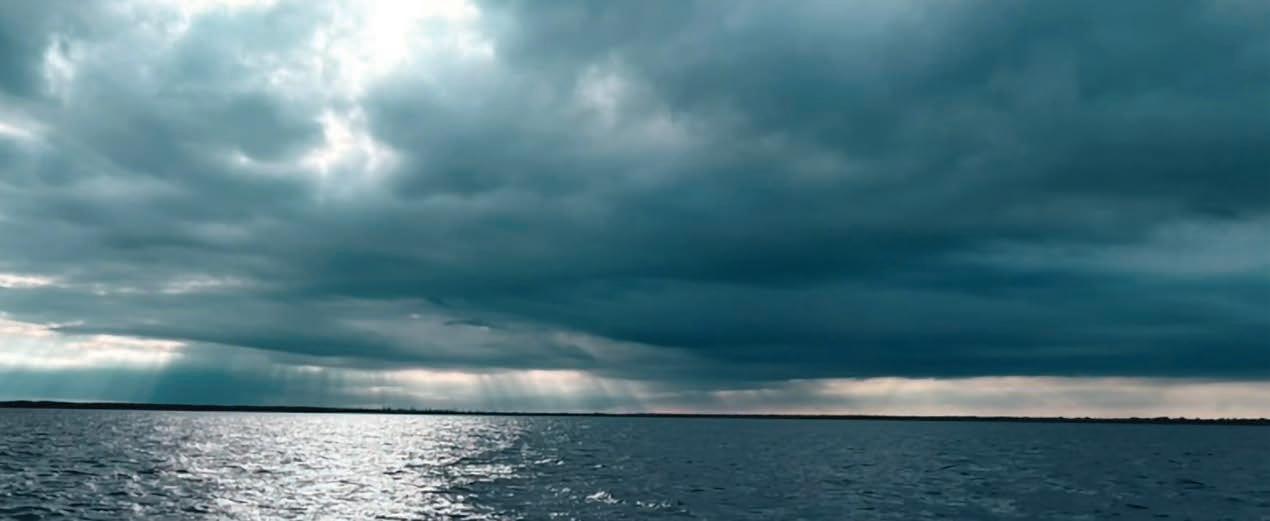
Below: Recovering in Jacksonville, Florida, after the rough ride in the Gulf Stream. Right: Ominous clouds headed our way in the Intracoastal Waterway
crowded inlets, tricky weather windows and unpredictable Gulf Stream conditions have a way of exposing overconfidence quickly. The Great Lakes can change from calm to treacherous faster than the wreck of the Edmund Fitzgerald.
And Lake Austin reminded us that even casual sailing days can create unforgettable family memories. To her credit, Debbie never tried to pull me away from any of it.
People romanticize sailing endlessly. And some of that romance is absolutely deserved. There are evenings offshore where the boat glides effortlessly beneath a pink sunset while dolphins surf the bow wave. There are anchorages so beautiful they feel almost fictional. There are nights under the stars that genuinely change your perspective on life.
But offshore sailing also contains a less glamorous reality. Broken sleep. Mechanical failures. Unexpected squalls. Trying to prepare meals while heeled over at 20 degrees. Docking with an audience. And discovering that the ocean has very little interest in your comfort.
I gradually fell in love with all of it — the beauty and the hardship alike. Debbie appreciated the beauty somewhat more than the hardship. That said, she possesses a resilience that deserves enormous credit. While offshore sailing may not have been her personal dream, she committed herself to learning the skills, standing watches, managing stressful situations and becoming a genuine partner while underway.
And there’s an important difference between tolerating something and showing up fully for it. Debbie showed up fully.
Nothing tested us more than our recent six-day attempted passage from Palm Beach toward Annapolis. The plan appeared straightforward enough. Monitor the weather carefully. Choose the proper departure window. Stay disciplined.
But offshore sailing has a way of reminding you that nature always retains the final vote.
The Gulf Stream can be magnificent under stable conditions. But when strong northerly winds oppose that powerful northbound current, the sea becomes steep, violent and confused with astonishing speed. That’s exactly what happened to us. What began as manageable conditions quickly deteriorated into complete chaos. The waves weren’t rolling cleanly in one direction. They were stacked, breaking and slamming the boat from awkward angles that made movement exhausting and sleep impossible. Spray exploded over the deck. The boat crashed into troughs hard enough to rattle everything onboard.
At some point offshore, you realize conditions are no longer simply uncomfortable — they’ve become serious. When that moment arrives, the destination stops mattering entirely. Your focus narrows to the next wave, the next hour, the next decision. And no matter what anyone says, the Coast Guard does not respond to a VHF
call when you’re 100 miles offshore. And then came the realization that we were still nearly 12 hours from reaching the relative protection of the Intracoastal Waterway.
There’s something profoundly humbling about realizing the person beside you willingly entered discomfort, fear and exhaustion simply because she loves you enough to support what matters to you.
But there she was anyway — nervous, exhausted and fully committed to getting through it together.
One of the reasons the situation never spiraled emotionally was the remarkable calm of our friend Dr. Adam Sky, a prominent psychiatrist and pilot, who was onboard with us. Dr. Sky brought a kind of stoicism to the moment that diffused the intensity of the situation. While the rest of us wrestled internally with fatigue, fear and uncertainty, he remained measured, calm and steady. Offshore sailing has a way of exposing personalities quickly, and Dr. Sky’s composure helped stabilize the emotional temperature onboard when we needed it most.
And here’s where the truth of our marriage revealed itself. I was out there chasing a dream. Debbie was out there because she believed in me. That reality hit me harder than the waves.
That passage taught me many things about sailing, but more importantly, it taught me something about marriage. Support is easy when conditions are beautiful. Real partnership reveals itself in chaos.
People joke that assembling furniture tests a relationship. Try docking a 40-foot sailboat in crosswinds after 12 hours offshore. Sailing exposes communication styles, stress responses, patience levels and emotional resilience almost immediately. Fatigue magnifies everything. Fear magnifies everything even more.
And yet, somewhere inside that pressure, Debbie and I found a rhythm. We learned how to communicate concisely. We learned when encouragement helped and when silence was better. We learned that calm is contagious.
We also learned how differently we view adventure. For me, adventure often involves uncertainty. Challenge. Exposure to risk. Pushing boundaries. Offshore sailing scratches some deeply internal itch I can’t entirely explain. For Debbie, adventure is
Some days were perfect. Others less so.
sailing tends to reward unpretentiousness more than status. At marinas and anchorages, experienced sailors help complete strangers with dock lines, weather advice, repairs and local knowledge. There’s an unspoken understanding that eventually everyone needs help.
more about beauty, comfort and connection than surviving rough seas or reviewing life raft procedures. Frankly, her approach has tremendous merit.
But somehow, despite our different definitions of adventure, we found common ground. And along the way, we accumulated stories that will probably outlive us both. Running aground. Anchors refusing to cooperate. Weather forecasts that turned out hilariously inaccurate. Equipment failures arriving at the least convenient possible moments. And the occasional marital debate conducted while trying to reef sails in rising wind.
If you can’t laugh while sailing, you’re doing it wrong.
One of the biggest surprises for both of us was the sailing community itself. Unlike many luxury pursuits driven by exclusivity,
The ocean equalizes people. We met retired couples crossing oceans, engineers obsessed with systems optimization, adventurous families homeschooling children aboard catamarans and former executives chasing freedom after decades of structured lives.
What united them wasn’t profession or wealth. It was curiosity. And courage. To sail offshore willingly is to accept uncertainty. That attracts a very particular kind of person. By the summer of 2026, we’ve come a long way from our sailing-school weekends at the Colgate School of Sailing. What once felt intimidating has become familiar: passage planning, marine forecasts, offshore watches, evaluating weather windows and preparing for longer adventures.
For me, offshore sailing remains deeply compelling. There’s still nothing quite like watching the shoreline disappear astern while realizing your tiny world has been reduced to wind, weather, seamanship and trust. For Debbie, I think the rewards are
more nuanced. She loves the beauty. She loves the sunsets. She loves the moments of peace at anchor. And perhaps most importantly, she loves seeing me pursue something that genuinely inspires me.
That doesn’t mean she suddenly dreams about overnight passages through confused seas. But somewhere along the way, sailing stopped being simply my dream and became part of our shared story.
And while Debbie still loves reminding friends about the things that went wrong — the groundings, docking disasters and weather mistakes — she’s also become one of the first people to tell the stories. The good and the bad have become woven into our conversations with friends and family and ultimately into the fabric of our marriage itself.
For me, sailing became an obsession, a challenge and a dream fulfilled. For Debbie, it became something arguably even more meaningful: an act of love.
The truth is, the greatest thing about our sailing adventures isn’t the destinations we’ve reached or the 13,000-plus nautical miles we’ve logged. It’s the realization that marriage sometimes means willingly stepping aboard someone else’s dream — even when you’d personally prefer calmer seas. Somewhere between sailing school and the chaos of the Gulf Stream, Debbie and I discovered something enduring: A great marriage, like offshore sailing, isn’t about avoiding storms. It’s about deciding who you want beside you when they arrive. sl
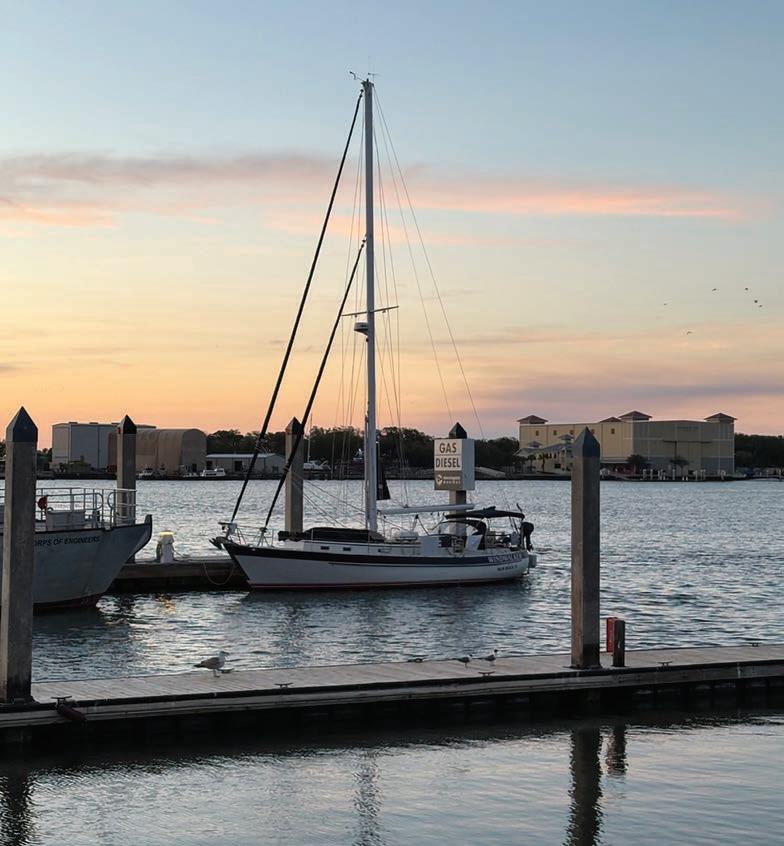
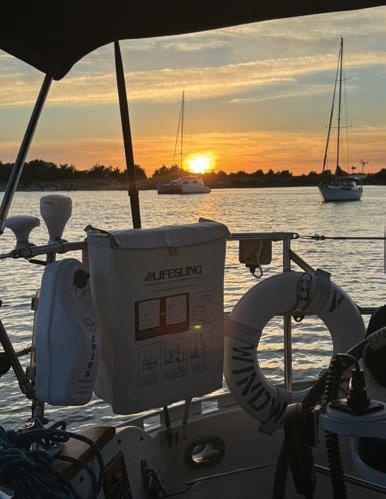
Above: At anchorage after a 12 hour day.
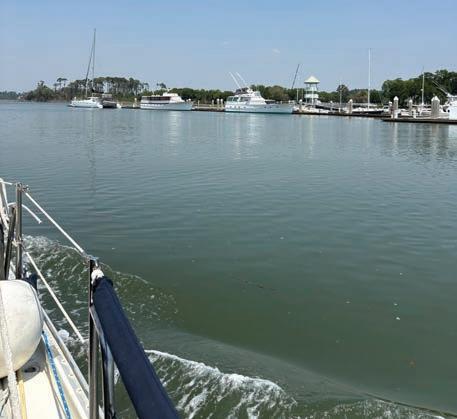
Top: Va Bene now in Deale, Maryland, getting repaired and polished.
MAKING DREAMS COME TRUE
A Ladue residence is transformed from postmodern gloom into a luminous expression of elegance, joy and devotion.
By John Marshall Watson
by Luke White
“Please make her dreams come true.”
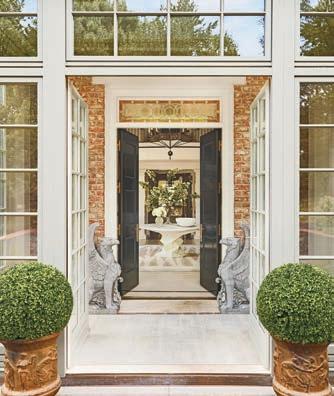
In all my years designing homes around the world, I cannot recall receiving a more direct, heartfelt or generous commission. The request came from a husband whose admiration for his wife was evident in every word. He was not asking for a renovation. He was not requesting a new color palette or a refreshed collection of furnishings. He was asking for something far more meaningful: a home that reflected the spirit of the woman he loved.
The residence, located in one of Ladue’s most gracious enclaves, possessed all the practical virtues a family could desire. It was substantial, beautifully sited and capable of accommodating generations of family gatherings. The exterior, inspired by the architecture of an Italian villa, conveyed a certain timeless grandeur. Our all-star team was complimented by architect Brian Smith, contractor Scott Pozzo and Laurie Fromm’s masterful cabinetry.
Yet inside, the home told an entirely different story. Maroons, blacks and deep ochres dominated the palette. Rooms seemed disconnected from one another and, perhaps more importantly, disconnected from the personality of the family who lived there.
Photos
Most especially, they were disconnected from the lady of the house. She is one of those rare individuals whose optimism seems to illuminate every room she enters. Effortlessly gracious and genuinely warm, she possesses a natural elegance that is neither contrived nor performative. Her aesthetic sensibility is equally distinctive. Where the home embodied earth and fire, she gravitated toward air and water. She loved light, movement, reflection, softness and color. The existing interiors felt heavy and somber to her — a daily reminder of what the house was not.
Her husband understood this completely. And so, with a single sentence, he established our mission. “Please make her dreams come true.”
For a designer, such a request is both liberating and deeply inspiring. It invites creativity while imposing a profound responsibility. The goal is not simply to create beauty. The goal is to create beauty that feels personal, authentic and transformative.
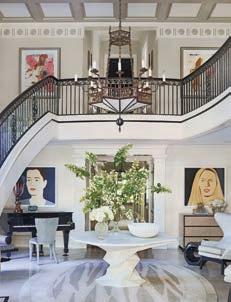
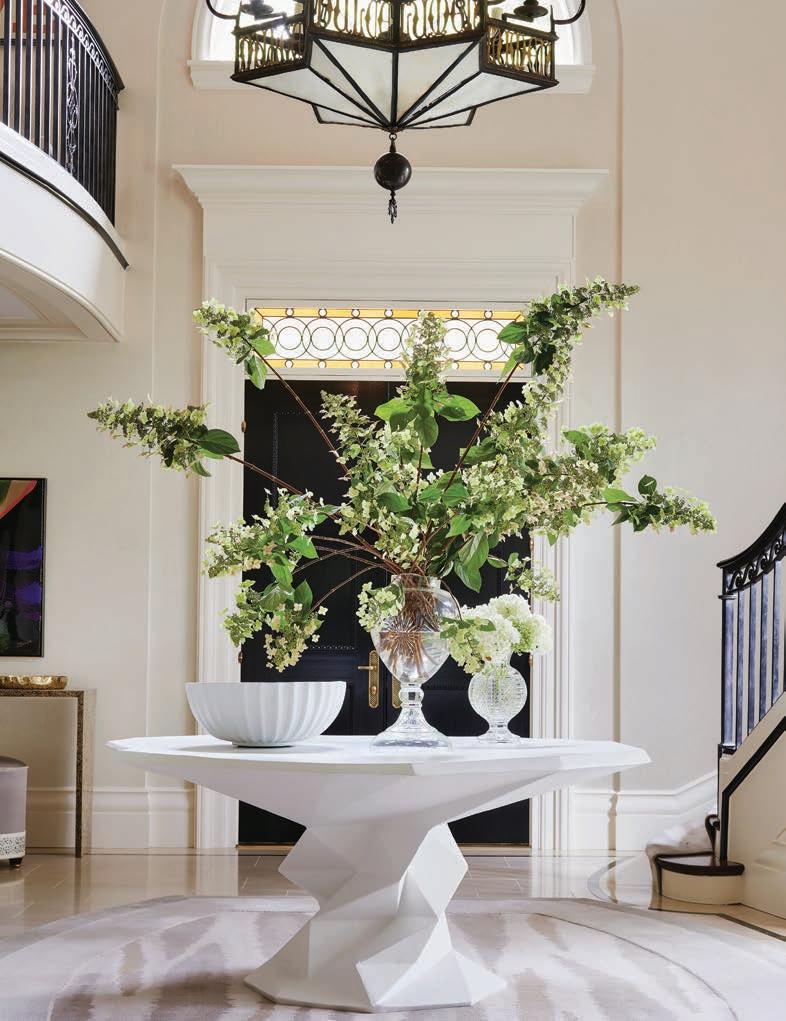
The first challenge was the entrance hall. I have long believed that the arrival experience establishes the emotional tone for an entire home. It is the overture before the symphony begins. Unfortunately, the existing entry was less invitation than intimidation. A towering double-height volume and muscular architectural framework created a space that felt cold and impersonal.
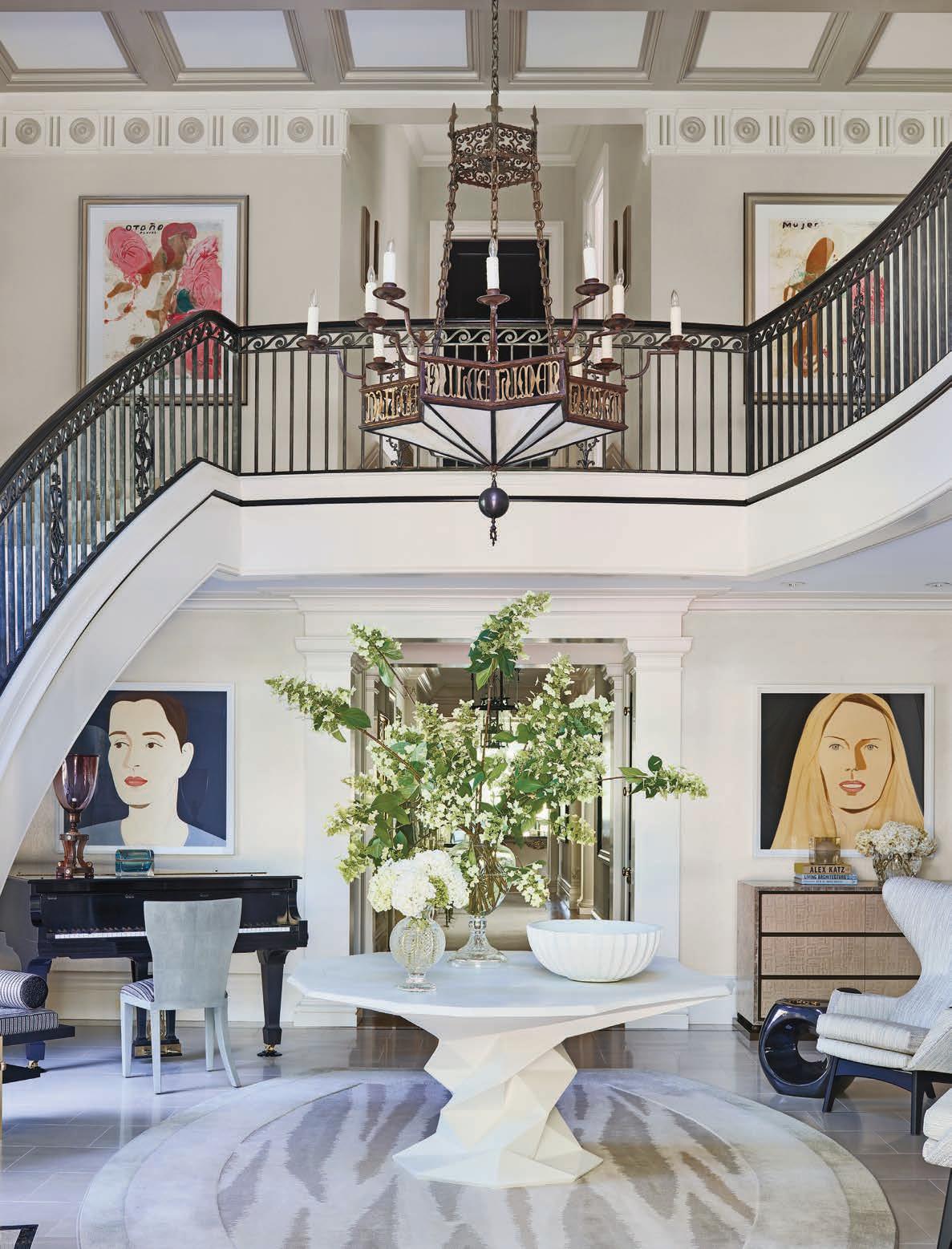
Rather than resist its scale, we chose to soften and reinterpret it. A sweeping custom carpet introduces movement through a series of fluid, undulating forms rendered in sophisticated shades of gray. At its center sits a sculptural plaster table created by celebrated artisan Stephen Antonson. Its twisting Cubist-inspired base echoes the graceful curve of the grand staircase, creating a visual conversation between architecture and furnishings.
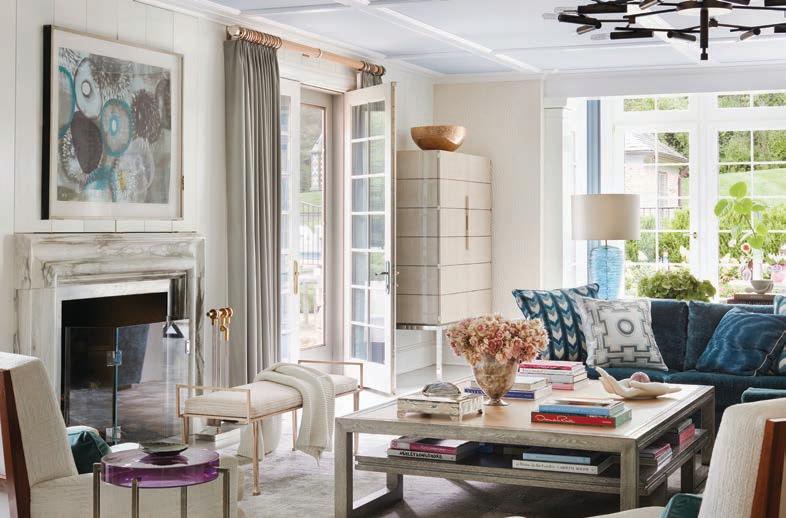
Left top: Stunning living room with Ross Blechner print over the fire place.
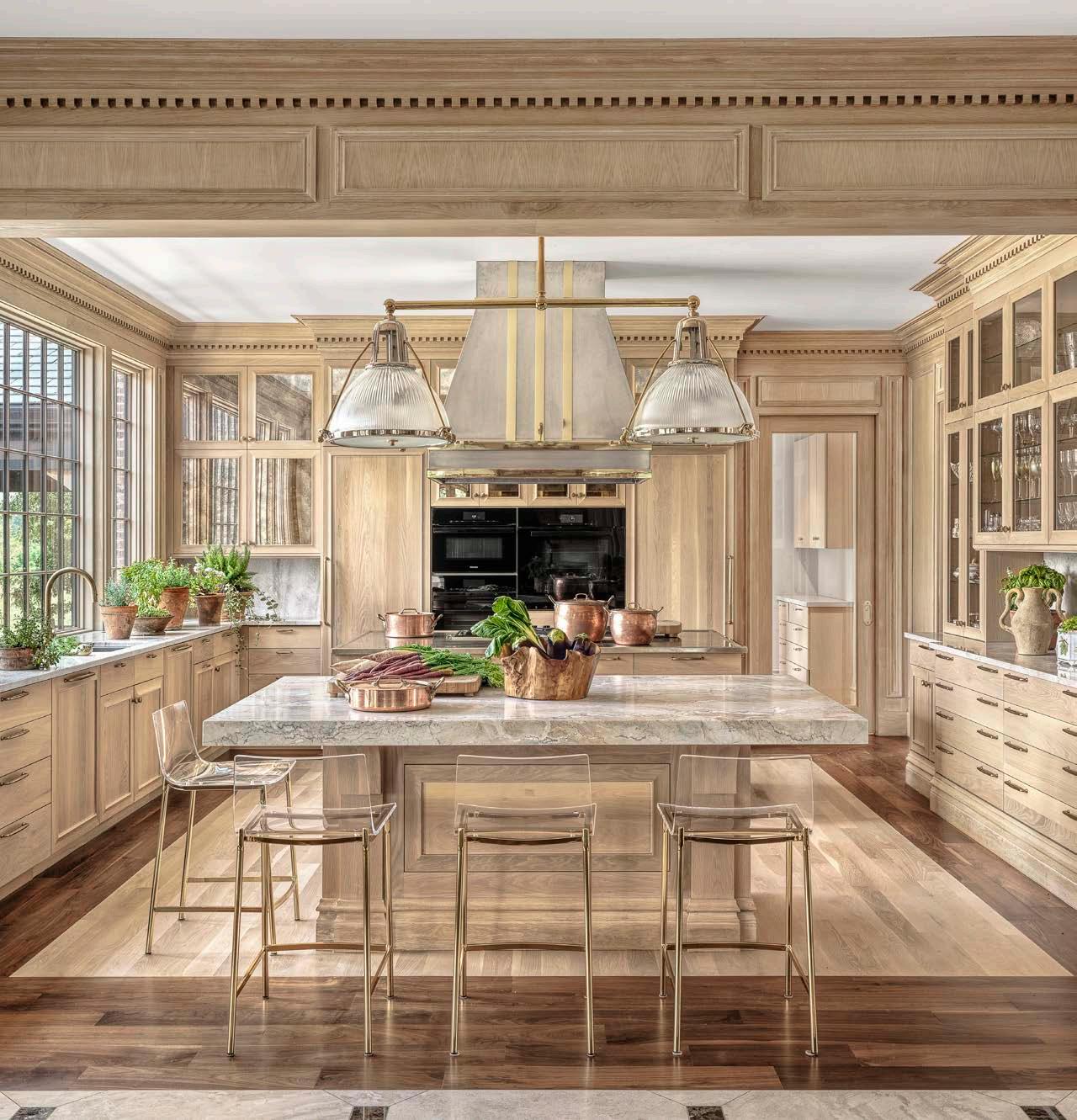
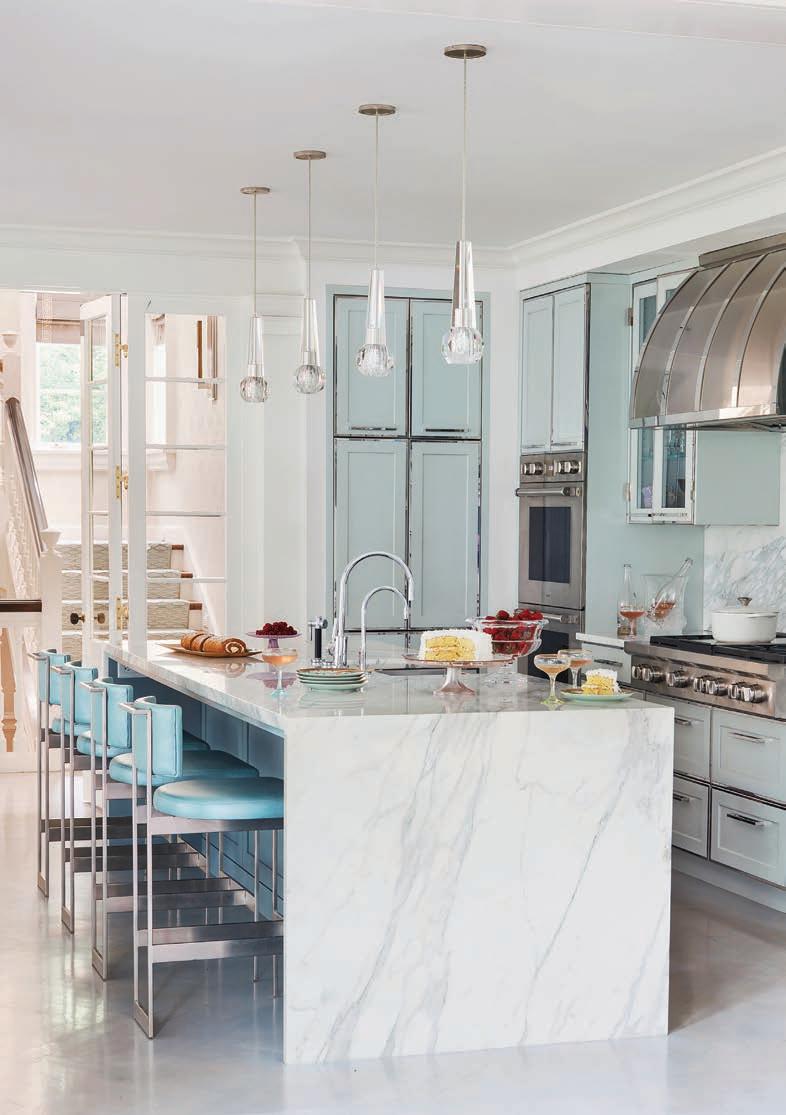
Below: State-of-the-art kitchen with waterfall island.
The table’s matte plaster finish finds resonance in the honed limestone flooring that replaced the original polished marble surfaces. Together they establish a quieter, more tactile luxury.
Graphic portraits by artist Alex Katz flank the central portal, introducing both personality and visual energy. Contemporary wing chairs provide places to pause, while an expressionistic chandelier animates the volume overhead.
The transformation is dramatic. What was once imposing now feels welcoming. What was once austere now feels alive. The entrance suggests precisely what the homeowners hoped their guests would experience: a family that is sophisticated without being formal, stylish without being self-conscious and elegant without sacrificing warmth.
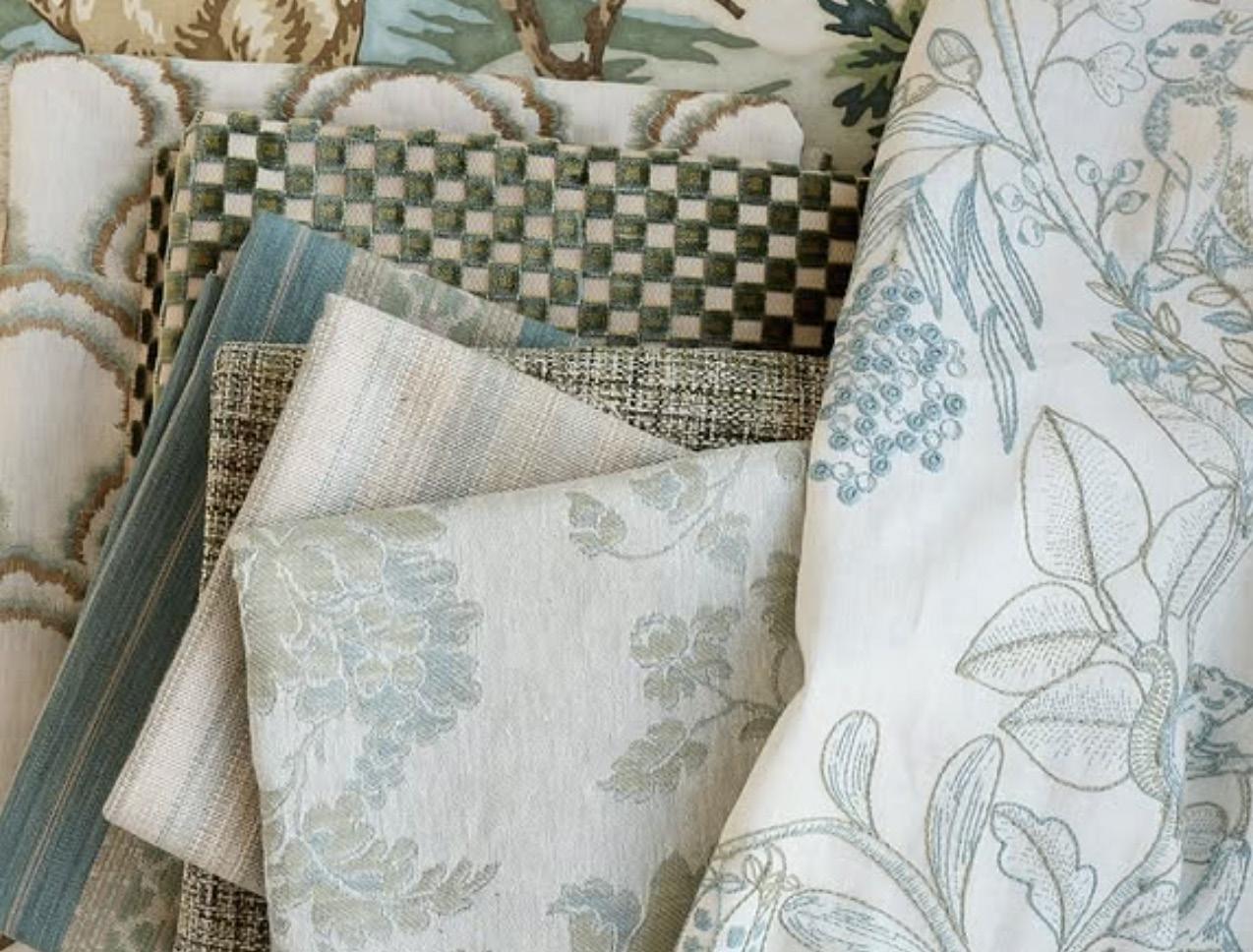
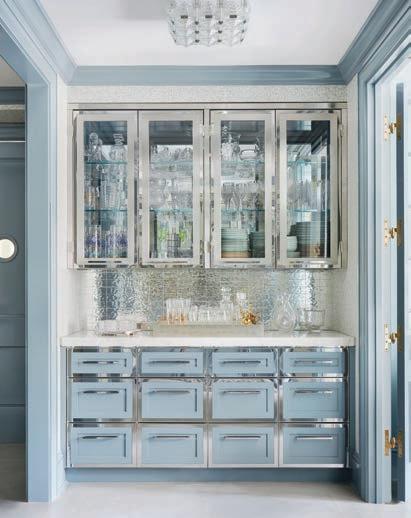
From there, the design unfolds into the home’s public spaces, where the true personality of the owner begins to reveal itself. The family room, dining room, kitchen and butler’s pantry had previously been defined by darkness and weight. To create an environment that reflected our client’s optimistic nature, we developed an entirely new decorative language built around pale blues, silvers, soft lavenders, creamy whites and subtle iridescent finishes.
The inspiration was simple. I wanted the rooms to feel like the world after a spring rain — fresh, luminous and quietly sparkling. Architecture played a critical role
in achieving that vision. French doors were introduced to draw natural light deeper into the home. A glass-enclosed portico establishes a seamless connection between interior and garden. Beyond, exuberant landscaping reinforces the sense of openness and vitality.
Pale wood flooring provides a light and graceful foundation throughout. Richly patterned silk carpets add texture and sophistication without visual heaviness. Upholstered furnishings are visually deep, comfortable and contemporary, encouraging family life rather than mere admiration.
The family room became the emotional center of the home.
It embodies what I often describe as comfortable glamour. Nearly every major piece of furniture was custom designed by our studio, including the mantelpiece that anchors the room. Handcrafted wall panels and dimpled paper finishes introduce depth and texture, while a palette of silvers and blues captures the freshness that so perfectly mirrors our client’s character. The room achieves a balance that is surprisingly difficult to attain: luxury without stiffness, elegance without preciousness.
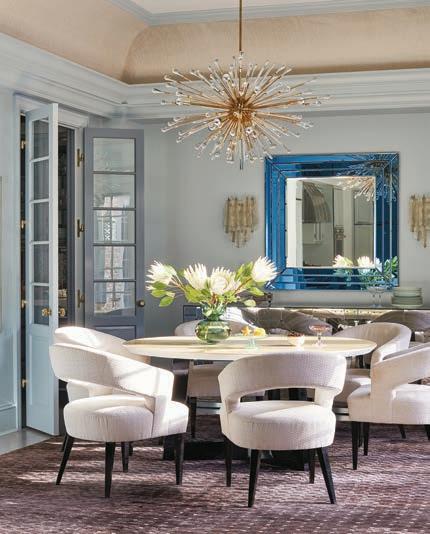
Nearby, the dining room presents a more theatrical expression of refinement.
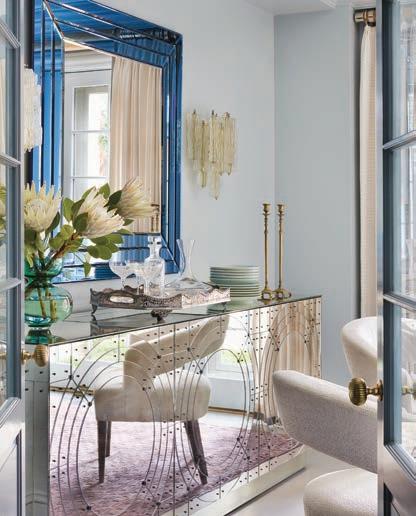
A Sputnik chandelier commands attention overhead, while a mirrored credenza reflects light throughout the space. Vintage Italian sconces contribute a touch of mid-century sophistication. Curvilinear dining chairs introduce movement and softness, their
a room that feels celebratory by nature — equally suited to intimate dinners and festive gatherings. If the family room serves as the heart of the house, the kitchen serves as its pulse. Today’s kitchens must perform multiple roles simultaneously. They are workspaces, gathering places, entertaining venues and visual focal points. This one was designed to accomplish all of those objectives while maintaining a sense of glamour.
An ultra-high-gloss gray cerused oak floor brings extraordinary life and reflection to the room. Custom cabinetry articulated in polished and matte nickel introduces crisp definition and craftsmanship. Rippled mirrored tile backsplashes and translucent quartzite countertops capture and scatter light throughout the space. The effect is undeniably luxurious, yet never intimidating. One might describe it as glamour with a human face.
forms echoed by interlocking circular motifs on the credenza. The result is
Butler’s pantry, mirrored buffet and spectacular dining room.
Serenity
Throughout the home, continuity remains a guiding principle. One of the defining characteristics of my work is the use of subtle repetition — small visual echoes that create cohesion and harmony from room to room. Materials, shapes, textures and finishes reappear in different forms, creating a sense of narrative continuity.
In this residence, however, the unifying element is something more nuanced. It is a contradiction. The entrance explodes with bold energy and dramatic architectural gestures. Beyond that initial moment, the house gradually softens. The experience becomes quieter, more intimate and increasingly personal. I often think of it as the trajectory of a Roman candle: an exuberant burst followed by a cascade of shimmering light.
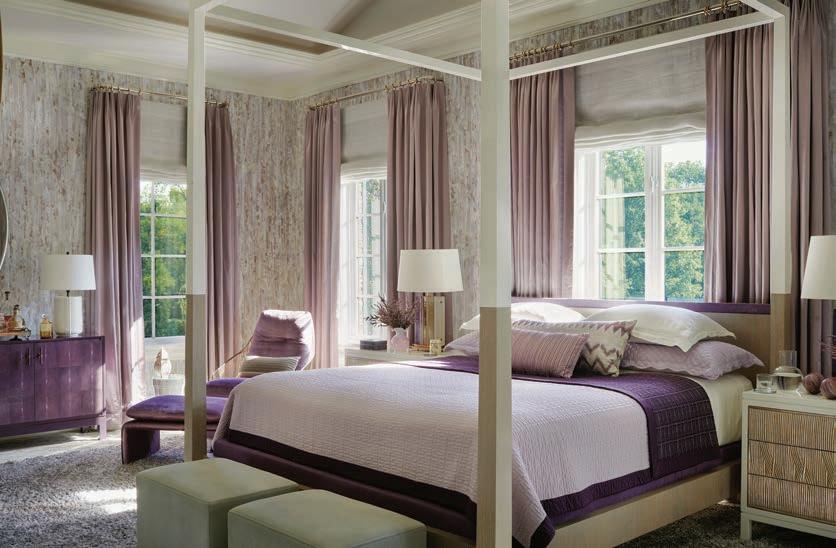
Nowhere is that progression more evident than in the primary suite. Here, the atmosphere shifts entirely toward serenity. The bedroom is enveloped in shades of amethyst, aubergine, soft ivory and lustrous silver. Beneath a domed ceiling, handpainted wallpaper creates the immersive illusion of a cascading waterfall. The room feels less decorated than experienced.
A custom bed crafted of cerused oak anchors the space, its upper surfaces lacquered in reflective crème finishes. Reeded and gilded nightstands introduce delicate detail, while a luxurious deep-pile carpet provides an extraordinary tactile experience underfoot.
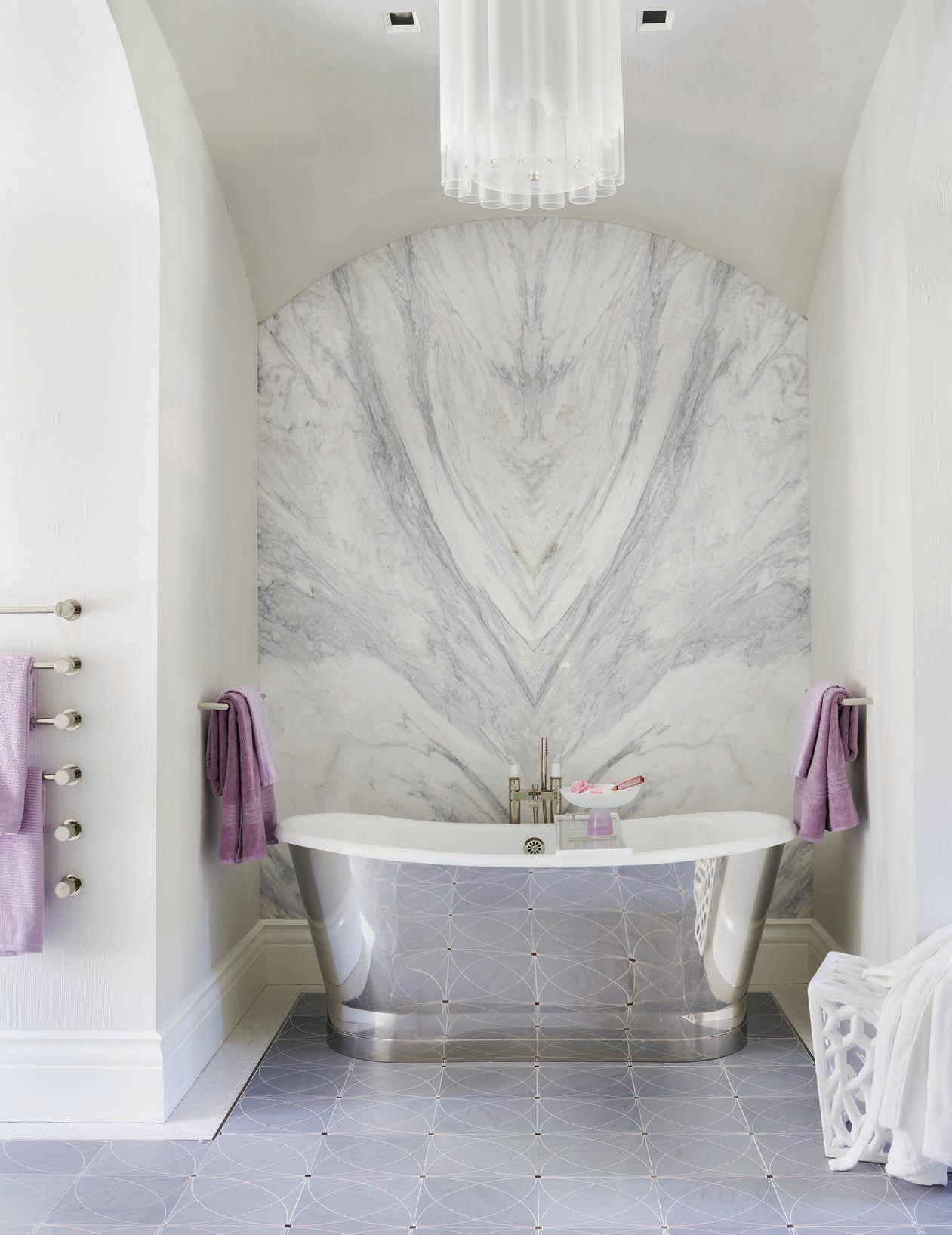
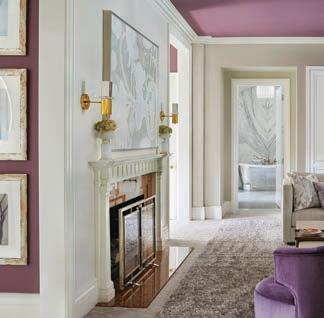
The accompanying sitting room offers a more relaxed retreat. Layered carpets, comfortable seating and carefully calibrated lighting encourage conversation and contemplation. From here, one enjoys a view into the remarkable primary bath beyond. There, a monumental book-matched Carrara marble wall serves as both architecture and artwork. A polished steel bathtub sits before it like a sculptural object, reflecting the arabesques etched into the marble floor below. The interplay between stone, metal, reflection and light creates a space that feels simultaneously modern and timeless.
Throughout the residence, customdesigned furnishings further reinforce the home’s unique identity. Pieces conceived as “art furniture” blur the line between sculpture and function. A brass-and-suede chaise demonstrates both craftsmanship and whimsy. Another seating piece appears to float effortlessly above a discreet acrylic base. These bespoke creations contribute to an environment that could never be mistaken for anyone else’s home. Which, ultimately, was the point. The greatest luxury in design is not rarity. It is individuality. Looking back, what makes this project memorable is not simply the scale of the transformation. It is the emotional foundation upon which it was built. Every decision — from the limestone floors in the entry to the shimmering quartzite in
the kitchen and the waterfall-inspired walls of the primary bedroom — was guided by a singular objective: creating a home that reflected the spirit of its owner.
The husband’s request seemed simple enough when he first uttered it. “Please make her dreams come true.” Yet hidden within those words was an extraordinary expression of devotion. This home stands as a testament not only to design, craftsmanship and beauty, but also to love itself. And in the end, that may be the most elegant design element of all. sl
Primary suite from various angles.
by Tony Montano
BUILT TO LEAD
As Clayco crosses the $10 billion mark in annual revenue, a new generation of leaders is guiding one of America’s most ambitious builders into the AI era while founder Bob Clark turns his attention toward philanthropy, civic leadership and creating impact beyond buildings.
By Craig Kaminer / Photos by Zach Dalin and courtesy of Clayco
There is a certain intensity that surrounds Clayco. You feel it the moment you walk into one of its offices. It is in the pace, the language, the ambition, the scale of the work and, perhaps most of all, the people themselves. Few companies in America still possess the entrepreneurial energy of a startup while simultaneously operating at the scale of a national powerhouse. Yet somehow, Clayco continues to exist in both worlds at once.
I first experienced that culture nearly a decade ago. In 2018, founder Bob Clark told me the company was likely to exceed $2 billion in annual revenue. At the time, that figure seemed enormous — almost difficult to comprehend for a construction company that began in St. Louis. Today, Clayco expects to surpass $10 billion in revenue in 2026.
Yet for all of the company’s remarkable growth, the most consequential story
unfolding inside Clayco may not be the projects it is building, but the leaders now guiding its future.
As Anthony Johnson, Ryan McGuire, Shawn Clark and Justin Lienemann assume large responsibility across the enterprise, Clayco is demonstrating something increasingly rare in American business: a founder-led company successfully transitioning to a new generation of leadership while preserving the entrepreneurial culture that fueled its rise.
Anthony Johnson’s leadership reflects a company increasingly focused on talent, innovation and operational excellence.
Ryan McGuire is helping position Clayco at the center of the artificial intelligence and digital infrastructure revolution through its rapidly expanding data center business. Shawn Clark continues to shape long-term strategy, connecting the firm’s development,
technology and investment platforms to industries transforming the global economy. Justin Lienemann’s leadership has strengthened Clayco’s operational discipline and execution capabilities as projects grow larger, more complex and more technologically sophisticated. Together, they represent a leadership team built not simply to preserve Clayco’s success, but to accelerate it.
The company was an early force in industrial construction. Then came advanced manufacturing. During the pandemic, e-commerce exploded, and Clayco became deeply embedded in Amazon’s nationwide logistics expansion. At the same time, the company quietly scaled its data center business, positioning itself directly inside today’s AI boom. Few companies have navigated so many market shifts so successfully over multiple decades.
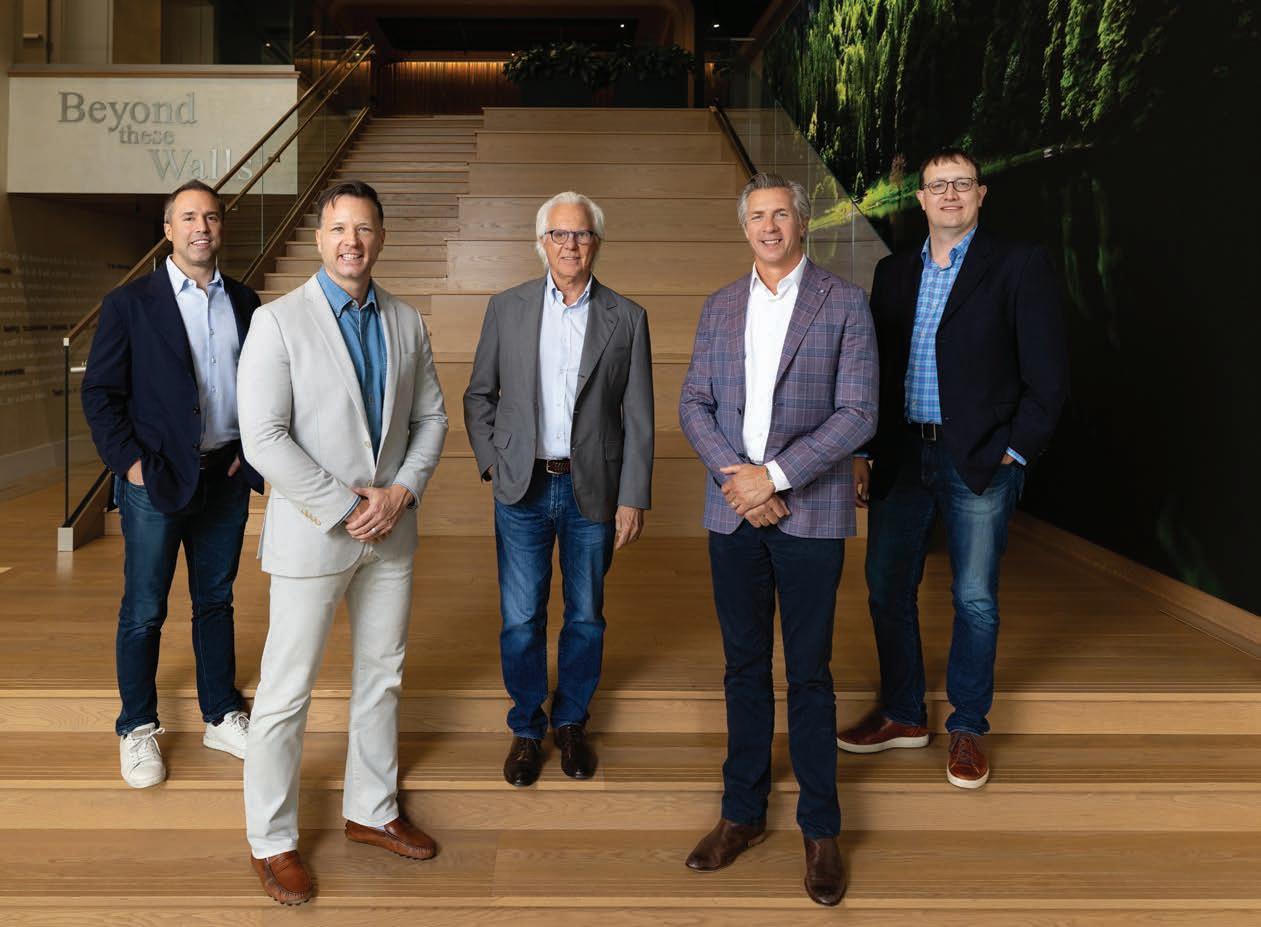
From left: Shawn Clark, Ryan McGuire, Bob Clark, Anthony Johnson and Justin Lienemann.
Anthony Johnson, who recently stepped into the CEO role, believes the underlying culture has remained remarkably consistent throughout all of it.
“There has been tremendous evolution, tremendous innovation and tremendous change,” Johnson says. “But the foundation upon which all of that has happened has stayed the same.”
Johnson points to three guiding principles: hire the best people, treat others according to the Golden Rule and align with the right customers and industries.
That first principle — talent — surfaced repeatedly throughout every conversation.
“The investment in our people has made all the difference,” Johnson says. “When we seek out the best talent that’s out there, those are people who get excited to get out of bed every day and do things differently.”
That culture of empowerment is something Bob Clark believes increasingly
matters to younger generations. “Talent doesn’t want to work for just a paycheck anymore,” Clark says. “People want to work for a company that’s doing good work in the community.” That realization is helping shape the next phase of Clayco’s identity.
Eight years ago, Clayco’s explosive growth centered around logistics and e-commerce infrastructure. Today, the company is building hyperscale data centers and highly sophisticated technology facilities powering artificial intelligence, cloud computing, quantum at scale and advanced manufacturing.
According to Ryan McGuire, who leads Clayco Compute, the company’s dedicated mission critical and data center group, the mission remains fundamentally unchanged.
“The business has always been about the client,” McGuire says. “It’s about asking: What are the most important companies in the world doing today and
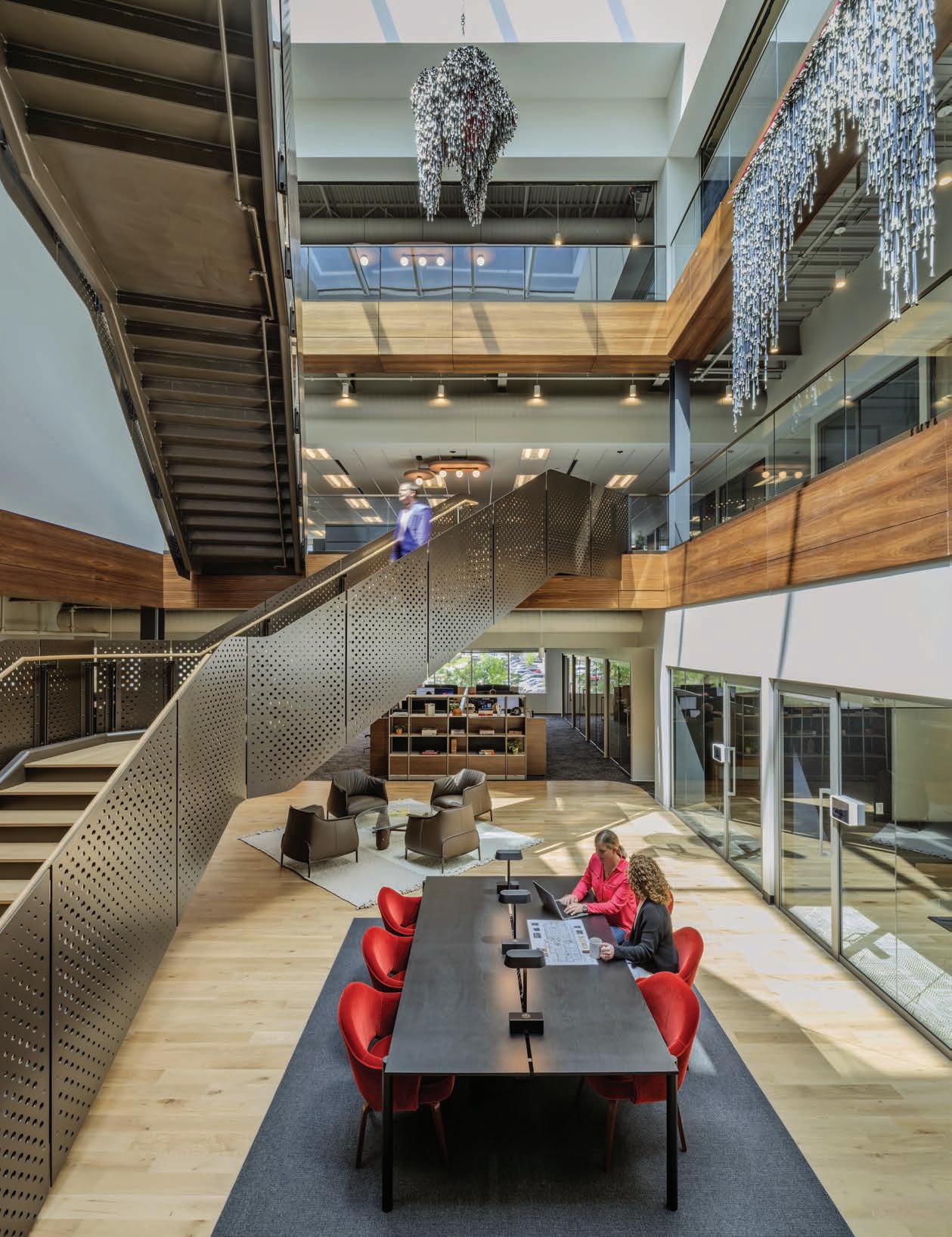
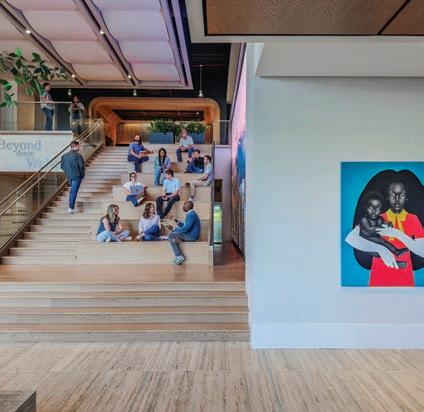
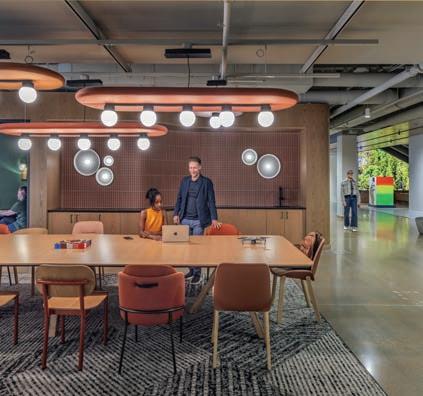
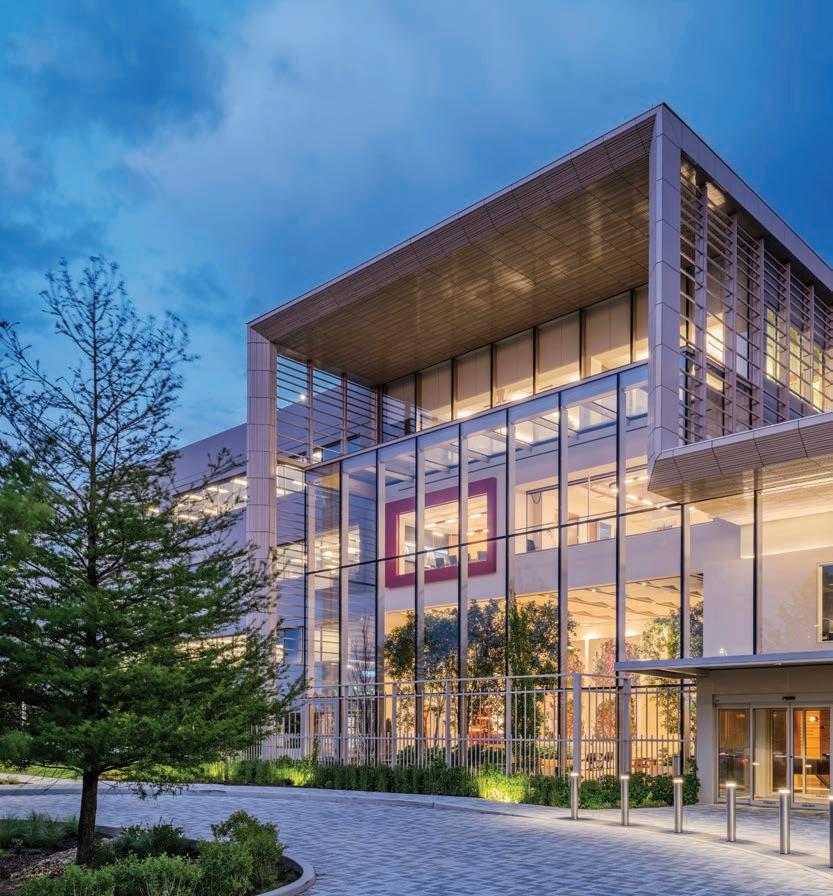
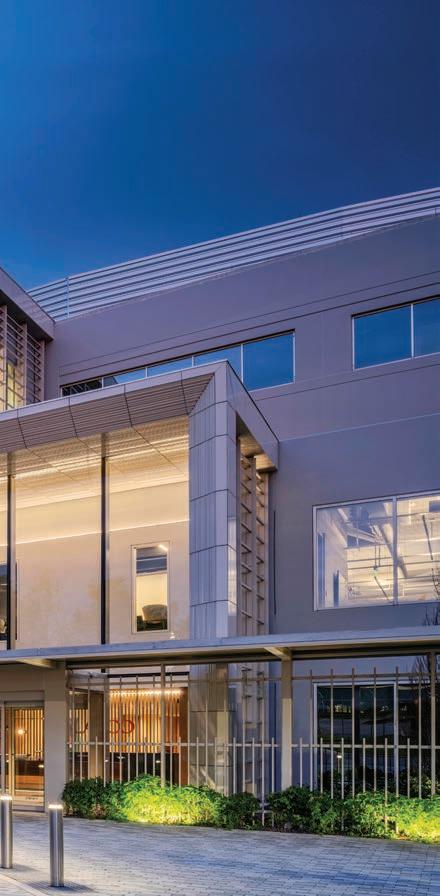
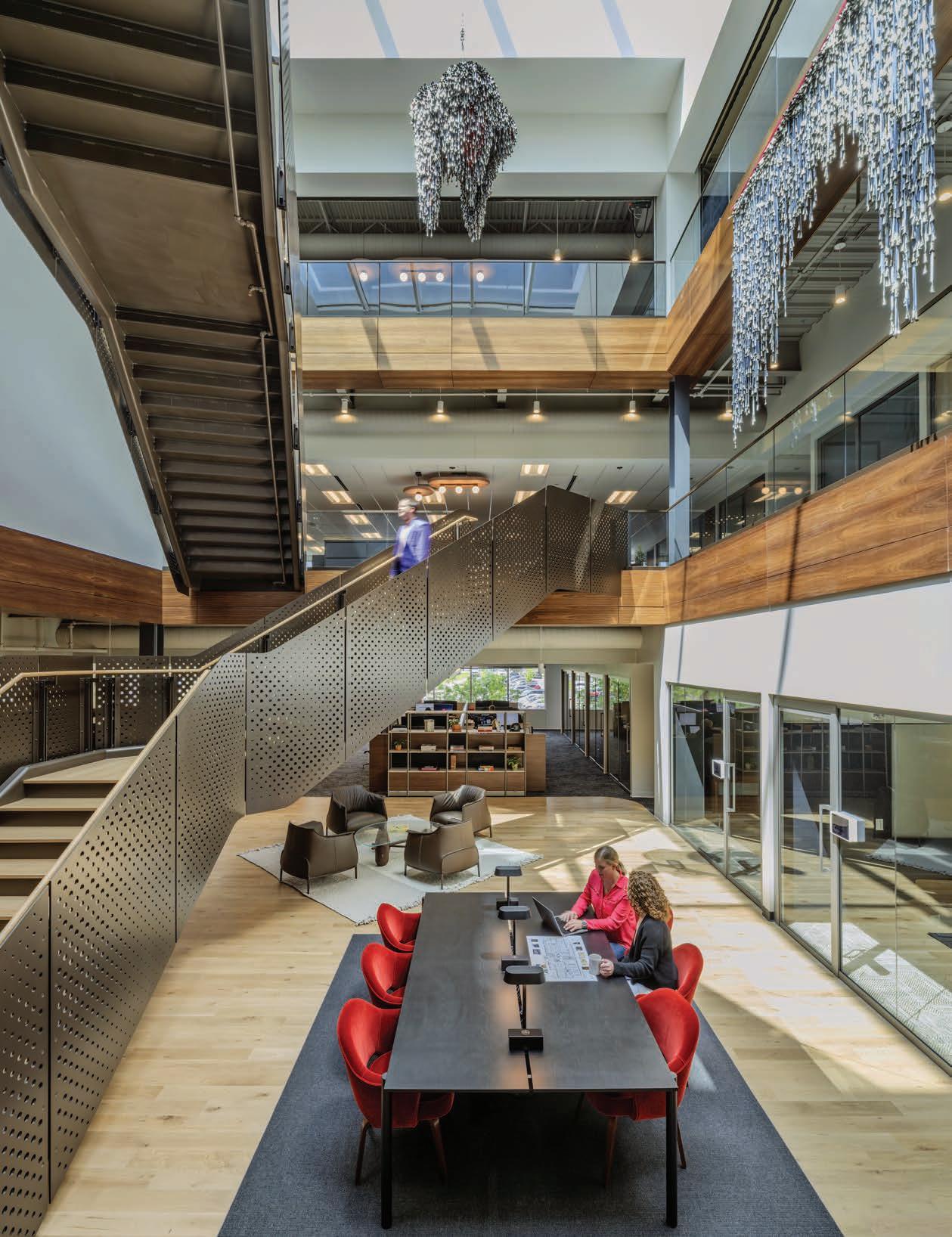
Various photos of St. Louis headquarters and art-filled open workspaces.
how can Clayco help them?” That mindset has pushed Clayco into some of the most technically demanding projects in America.
The rise of artificial intelligence has created unprecedented demand for facilities requiring massive computing power, highly advanced cooling systems, extraordinary energy infrastructure and accelerated delivery schedules.
“The labor challenge is completely real,” McGuire says. “Projects are happening in remote locations where you might have to take two flights and drive an hour just to get there.”
To solve those challenges, Clayco increasingly relies on prefabrication, offsite manufacturing and AI-assisted project management. McGuire describes one remote Texas data center project where nearly half of traditional on-site labor hours were shifted into manufacturing environments before components were
transported to the job site. “When you think about schedule, quality and safety, those are strategies you have to implement,” he says. It is construction, but not construction in the traditional sense. Factories now manufacture portions of buildings. Artificial intelligence helps optimize schedules and quality control. Automation is becoming embedded throughout project delivery. Clayco intends to remain at the forefront of that evolution.
For many industries, AI has become synonymous with disruption and uncertainty. Clayco’s leadership sees it differently. “I think AI is a tool that will absolutely amplify and be a force multiplier for every employee across the organization,” Johnson says. “It helps everybody do their job more efficiently and at a higher level of quality.”
Shawn Clark, CEO of CRG and Chief Strategy Officer of Clayco, believes AI will fundamentally reshape not only software, but the physical world itself. “There are going to be two kinds of machine building,” Clark says. “The AI that makes AI and the AI that makes things that make other things.” That statement captures the scale of what is unfolding.
Factories, robotics facilities, semiconductor plants, autonomous systems and data centers are converging into one of the largest transformations of the built environment in modern history. Clayco’s
leadership believes the company is uniquely positioned within that moment.
Even Bob Clark, whose career was built long before AI existed, speaks about the technology with enthusiasm. “I think we’ll find cures for cancer,” Clark says. “I think there’s going to be incredible scientific discovery because of artificial intelligence.” Clark points to breakthroughs in medical research as early examples of AI’s potential impact. Through the Clark Family Foundation, he hopes to help connect researchers with leading AI platforms capable of accelerating discoveries that improve and save lives. “My grandchildren are already using AI to learn how to read,” he says. “It’s going to change everything.”
That optimism is reflected in Clayco’s national branding campaign, which prominently features the phrase: Built by humans who use AI. It is both a technological statement and a philosophical one.
What stands out most about Clayco’s leadership team is the absence of visible ego. The executives defer to one another constantly, build upon one another’s ideas and speak openly about collaboration. Johnson describes leadership as a team sport. “We have incredibly open, real-time communication,” he says. “We always know what each other is working on — what’s going great and, more importantly, what’s not going great.”
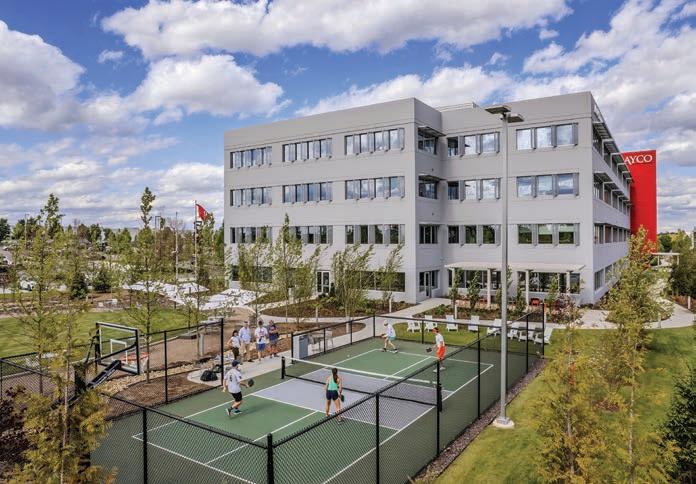
Exercise and recreation is part of the Clayco culture.
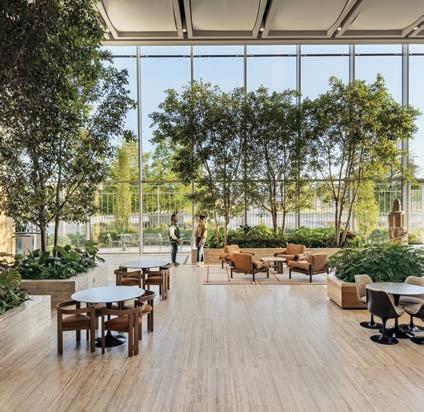
Natural light and collaborative work space adds to the collegial environment making Clayco one of the best places to work.
That collaborative style appears increasingly important as Clayco expands nationally and enters more technologically sophisticated sectors.
The Clayco of today is vastly different from the Clayco of 20 years ago. Yet the leadership team seems deeply aware that preserving entrepreneurial energy while building institutional sophistication is one of the defining challenges ahead.
Even as a new generation assumes operational leadership, Bob Clark’s influence remains everywhere. To understand Clayco, one must understand Clark himself — his obsession with quality, aesthetics, branding and relentless innovation. Long before designbuild became an industry buzzword, Clark was envisioning a fully integrated enterprise where development, architecture, engineering and construction existed under one roof.
But increasingly, his focus extends beyond business itself. Clayco operates at the intersection of artificial intelligence, advanced manufacturing, logistics, energy and technology infrastructure.
At the same time, the successful transition to a new leadership generation has created something else: the opportunity for Bob Clark to devote greater attention to what he believes may become his most important work.
As Executive Chairman, Clark remains deeply engaged in Clayco’s long-term vision.
Yet increasingly, his attention is focused on philanthropy, civic leadership and creating impact far beyond the buildings his company constructs.
Rather than concentrating on preserving family wealth, Clark has made clear that the overwhelming majority of the wealth created during his lifetime will ultimately be directed toward public benefit through the Clayco Foundation and the Clark Family Foundation. “It was never my goal to have my legacy be the buildings we constructed,” Clark says.
That philosophy was shaped in part through conversations with his late wife, Ellen Clark, and leaders including former President Barack Obama, with whom Clark has developed a friendship rooted in civic engagement, economic opportunity and the role private citizens can play in strengthening communities.
Today, Clark’s philanthropic vision centers on five areas he believes will define the future: arts, science, education, economic development and democracy.
He believes scientific research, particularly when paired with emerging AI technologies, has the potential to accelerate breakthroughs in medicine and human health. He sees education as the key to expanding opportunity and preparing future generations for a rapidly changing economy. He remains a passionate advocate
for the arts, viewing creativity as an essential ingredient of innovation and human progress. And he continues to champion economic development initiatives that create jobs, attract investment and strengthen communities.
In many ways, the story of Clayco today is a story of two futures unfolding simultaneously. One future is being led by Anthony Johnson, Ryan McGuire, Shawn Clark, Justin Lienemann and a new generation of executives building the physical infrastructure that will power artificial intelligence, advanced manufacturing and the next era of the American economy. The other is being shaped by a founder increasingly focused on philanthropy, civic leadership and ensuring that the wealth created through business success generates lasting public benefit.
Together, they represent a company entering perhaps its most influential chapter yet — one building not only the structures that define the future, but also the leaders, ideas and institutions that will help shape it. sl
Clayco’s world-class art collection and technology on display at every turn.
Your trust inspires our performance
Sotheby’s International Realty proudly celebrates 50 years of excellence. As the 7th affiliate office to join what has grown into a global network of more than 5,000 offices, Dielmann Sotheby’s International Realty is proud to celebrate 21 years as part of the Sotheby’s International Realty brand.
THE POWER OF CULTURE
For founders PJ and Bear Kaminer, yogurt is just the beginning.
By Melissa Mahanes
On June 5 in Nashville, St. Louis brothers, PJ and Bear Kaminer, launched a chef-inspired fresh and frozen Greek yogurt cafe named Culture Club, designed for how people increasingly want to live today — healthier, more connected, more intentional, yet still appreciative of life’s guilty pleasures.
As the brothers witnessed a renaissance in premium yogurt concepts across America — and the lack of great options in Nashville and other high-growth, midmarket cities — they imagined something unique which curated a healthier product (most frozen yogurt barely has any yogurt
in it), with chef-inspired ingredients sourced from around the world, a café environment with an elevated interior design and an eye to building community through genuine hospitality.
What specialty coffee was to the 1990s and craft ice cream became in the 2010s, high-end yogurt destinations are increasingly becoming a venue for a new generation of health-conscious consumers. From Manhattan’s SoHo and Upper East Side to Los Angeles’ Silver Lake and Venice Beach and throughout Miami’s Design District and Coconut Grove, a new breed of yogurt cafés has emerged.
Photos by Eli Millner
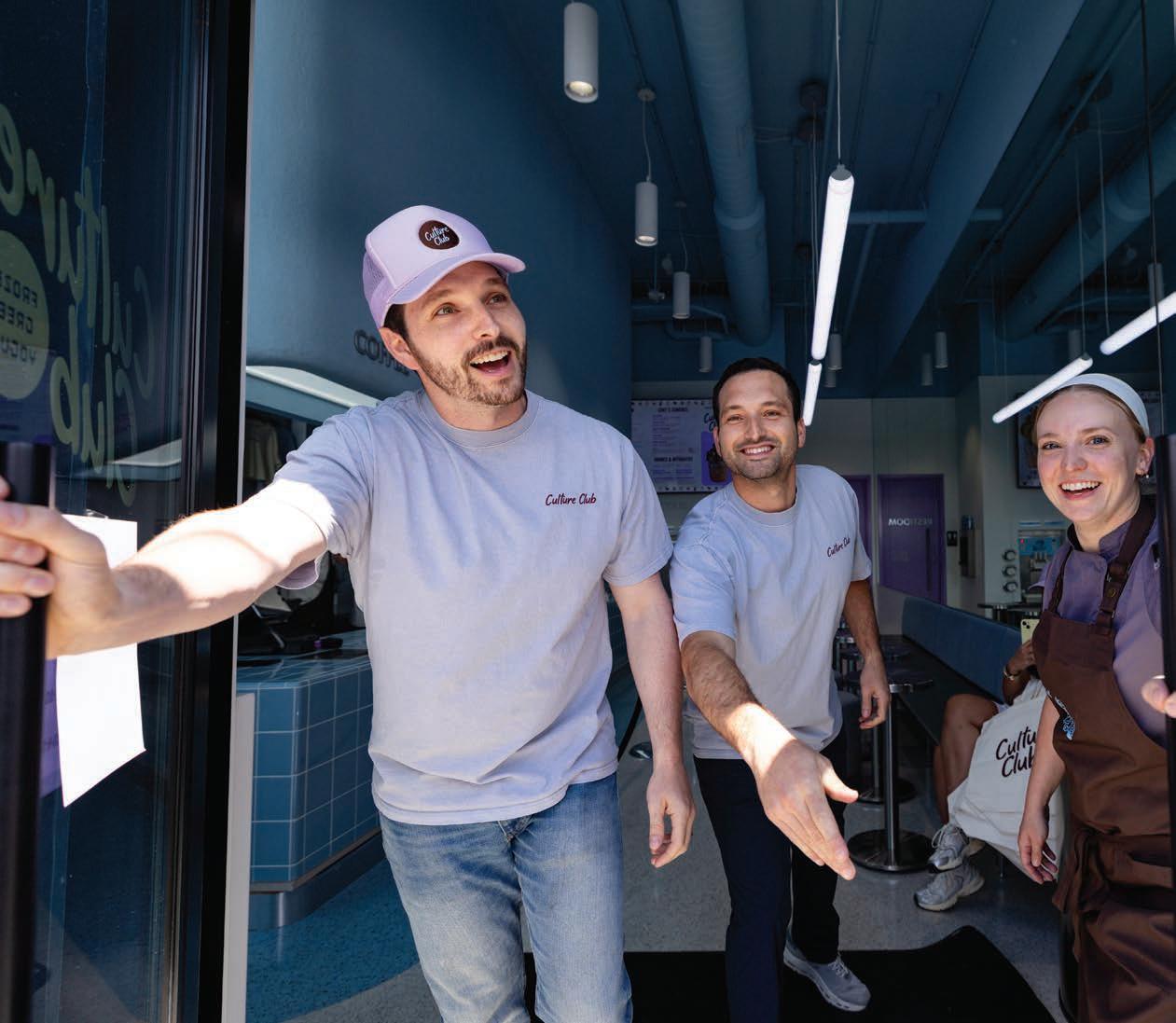
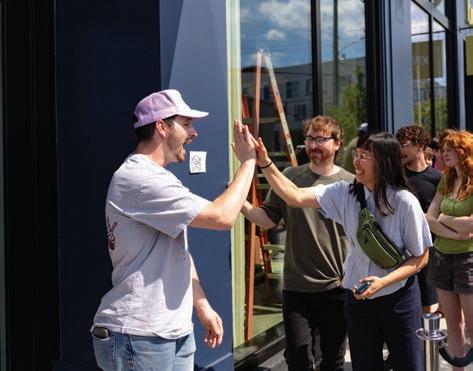
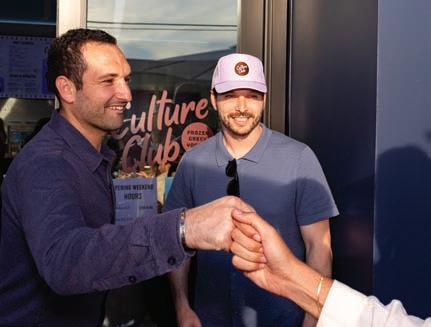
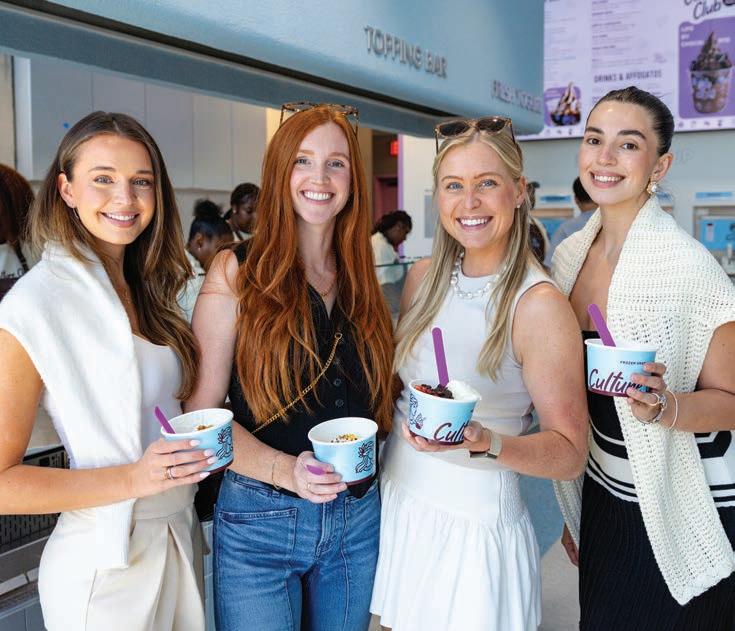
Brothers Bear and PJ Kaminer, and Noelle Marchetti welcome long lines of guests.
Rather than rows of dispensers and endless toppings, the concept embraces culinary craftsmanship, clean ingredients, elevated hospitality and thoughtful design. The result feels closer to a European café than a traditional frozen yogurt shop.
Consumers who once lined up for cupcakes, macarons and froyo are gravitating toward products that feel both indulgent and nutritionally relevant. Greek yogurt checks all the boxes. “The category has evolved,” says Bear Kaminer. “People still want something delicious, but they also want to feel good about what they’re eating.”
The Kaminer brothers recognized that while coffee culture, smoothie brands and health-focused fast casual concepts have exploded over the past decade, premium yogurt remained surprisingly underdeveloped. Most Americans still associate frozen yogurt with self-serve chains and candy bars from the early 2000s.
Culture Club is betting consumers are ready for something more sophisticated. “We weren’t interested in recreating what existed before,” says PJ Kaminer. “We wanted to build the yogurt place we wished existed.”
The story began years earlier in St. Louis, where the brothers were raised by parents whose contrasting approaches to food would ultimately shape the company’s DNA. Their mother emphasized wellness, nutrition and healthy living long before wellness became a cultural movement. Their father, meanwhile, embraced dining as one of life’s great pleasures, introducing them to memorable restaurants, indulgent desserts and the emotional power of hospitality.
The brothers absorbed both philosophies. “We grew up between those two worlds,” Bear says. “Health and indulgence were never opposites in our house. The best experiences combined both.” That balance became Culture Club’s guiding
principle: create an experience that feels nourishing and indulgent at the same time. Growing up in St. Louis, food was never simply fuel. It was connection, ritual and experience. The brothers learned early that what people remember most often is not the meal itself but how it made them feel.
That lesson was reinforced by an early favorite book: restaurateur Danny Meyer’s “Setting the Table.” The hospitality classic helped shape their belief that great businesses are built as much on relationships and emotional connection as they are on products. Their educational experiences further expanded that worldview. Years spent at Community School and later John Burroughs School encouraged creativity, intellectual curiosity and independent thinking. PJ’s time at the University of Texas immersed him in Austin’s entrepreneurial culture while Bear’s education at Amherst College provided a liberal arts perspective rooted in communication, analysis and human behavior.
Some of the most influential lessons, however, came outside the classroom. As teenagers, both brothers worked at Companion Bakery, one of St. Louis’ pioneering artisan food businesses. Long before “craft” became a marketing buzzword, Companion had built its reputation on quality ingredients, consistency and meticulous execution. Working there exposed them to the discipline behind hospitality — the early mornings, relentless standards, customer interactions and
attention to detail required to build a beloved brand.
Just as important, they saw how food businesses become woven into the fabric of communities. Daily rituals — morning coffee, fresh bread, familiar faces — create loyalty that transcends products. That understanding now echoes throughout the Culture Club vision.
Bear later gained another perspective through an internship at the legendary Carlyle Hotel in New York. There, he observed how a world-class hospitality brand balances operational excellence with emotional resonance, creating experiences that guests remember long after they leave. Together, those experiences helped shape Culture Club’s unusually sophisticated approach to what might otherwise seem like a simple dessert concept.
The brothers also bring complementary professional backgrounds that strengthen the business. PJ comes from real estate and development, giving him a deep understanding of placemaking, neighborhood dynamics and how physical environments influence behavior. He understands that successful hospitality concepts are not simply about menus but about creating spaces people want to return to repeatedly. Bear built his career in consumer branding, including roles with Delos Living and GolfForever, where storytelling, identity and audience engagement drive growth. His expertise helps position Culture Club as more than a
food business — it is a lifestyle brand. One understands place. The other understands brand. That combination is evident throughout the concept.
The timing is particularly compelling. Today’s consumers increasingly reject rigid definitions of “healthy food” and “cheat meals.” Instead, they seek balance — products that taste exceptional while aligning with contemporary wellness values. Greek yogurt occupies that sweet spot perfectly.
The brothers credit family friend Todd Siwak with helping them better understand the category’s broader potential. Yet they quickly realized the opportunity extended beyond yogurt itself. Across the country, hospitality concepts have evolved into lifestyle ecosystems. Coffee shops became co-working spaces. Boutique hotels became social clubs. Restaurants became cultural gathering places. Modern consumers increasingly seek environments that feel curated, communal and emotionally engaging. Culture Club is designed to live in that world.
The concept’s first locations are in Nashville, a city whose rapid growth and creative energy have made it fertile ground for highly designed hospitality brands. Musicians, entrepreneurs, wellness companies and culinary innovators continue to reshape the city, creating an audience eager for fresh experiences.
At its core, Culture Club revolves around frozen Greek yogurt — tangy, creamy, high in protein and intentionally
elevated beyond traditional frozen yogurt. The yogurt serves as a canvas.
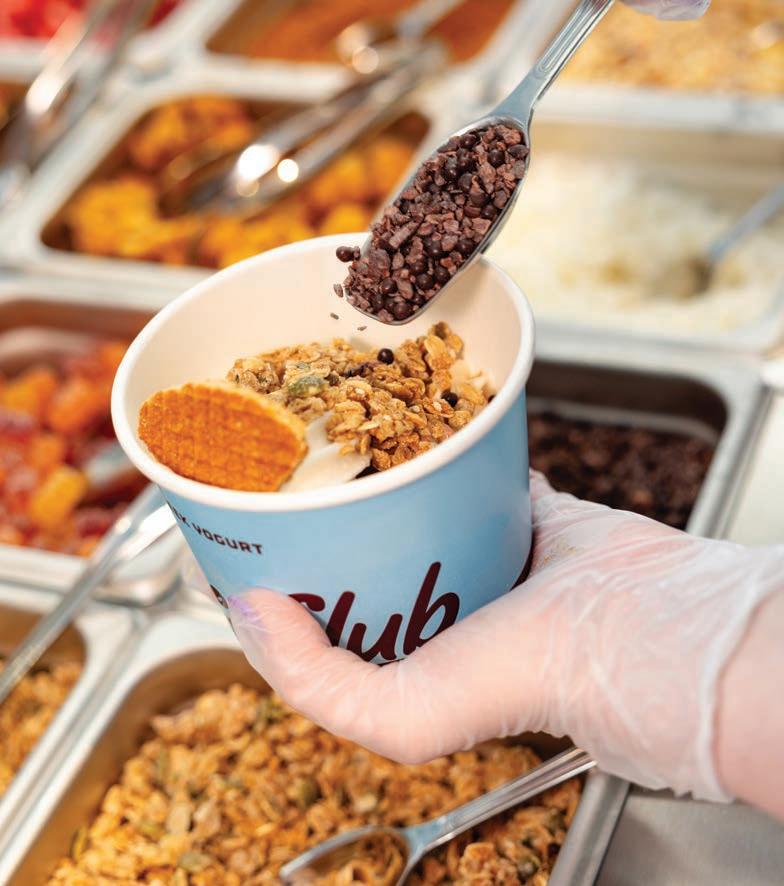
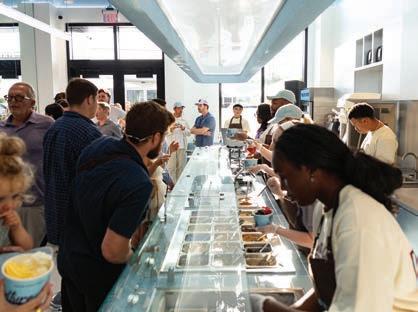
Helping define that culinary vision is acclaimed pastry chef Noelle Marchetti, who leads the concept’s chef-driven toppings program. Rather than relying on mass-market candy and predictable add-ons, Culture Club emphasizes fresh fruit compotes, artisanal granolas, toasted nuts, house-made sauces, Mediterranean influences and rotating seasonal creations. Marchetti’s involvement signals that Culture Club intends to operate more like an elevated café than a conventional frozen yogurt chain. Her approach also reinforces the brand’s central philosophy: indulgence and wellness do not have to exist in opposition.
That culinary sophistication extends to one of the concept’s most distinctive features — the affogato bar. Traditionally an Italian dessert consisting of espresso poured over gelato, the affogato perfectly captures Culture Club’s blending of European café culture and contemporary wellness. By pairing rich espresso with frozen Greek yogurt, the concept creates a unique offering that feels both decadent and surprisingly balanced.
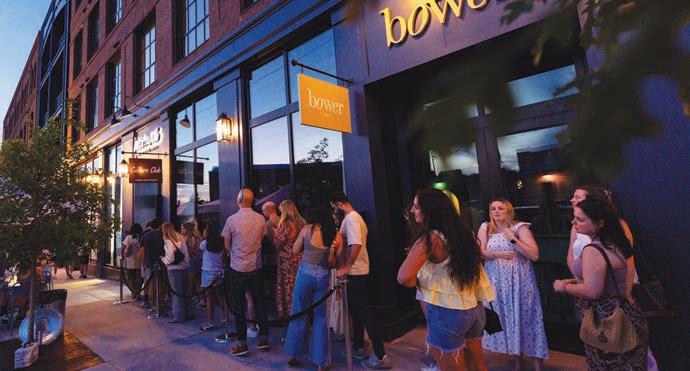
Opposite page to right: Extensive chef-inspired topping bar created by award winning chef Noelle Marchetti. The lines continued until close.
The affogato bar also broadens the brand’s appeal throughout the day. Morning coffee customers can transition into afternoon wellness seekers, remote workers, families, post-workout visitors and evening social crowds looking for a lighter indulgence. From a hospitality standpoint, that versatility is invaluable.
Equally important is the atmosphere the Kaminer brothers hope to create. The name “Culture Club” operates on multiple levels. It references the live cultures found in yogurt, while also suggesting creativity, belonging and community. The word “club” implies membership, ritual and connection — the feeling that customers are participating in something larger than a transaction.
That emotional dimension matters more than ever. Consumers today are overwhelmed with choices. Increasingly, what distinguishes successful hospitality brands is not simply what they serve but how they make people feel.
The most successful modern concepts understand that atmosphere has become a product unto itself. Culture Club appears keenly aware of that reality. The interiors are designed to reflect the brand’s values through natural materials, warm lighting, clean lines and European café influences. Every design
decision reinforces a sense of wellness, sophistication, comfort and accessibility.
The brothers understand that indulgence is often emotional. People do not simply crave sweetness or caffeine. They crave ritual, reward, escape and connection. A beautifully crafted affogato after dinner. Frozen yogurt on a summer evening with friends. A midday coffee break that turns into an unexpected conversation. Great hospitality brands create those moments consistently.
There is also something contemporary about Culture Club’s approach. Earlier generations often separated health and pleasure into opposing categories. Health food was austere. Desserts were guilty pleasures. Today’s consumers increasingly reject that binary. They want experiences that feel joyful without feeling excessive. They want products that align with their values without sacrificing flavor or fun. Culture Club reflects that cultural shift quite elegantly.
Importantly, the brand avoids becoming preachy or overly clinical — a trap many wellness-focused concepts fall into. The emphasis is not restriction but elevation. Not deprivation but thoughtful indulgence. The Kaminer brothers are entering a crowded hospitality landscape where authenticity matters. Consumers want to know where
concepts come from and why they exist. Culture Club possesses a genuine origin story rooted in family influence, Midwestern values, wellness awareness, food culture and complementary professional expertise. That authenticity gives the brand credibility. It also creates opportunities for thoughtful expansion. Seasonal collaborations, specialty coffee programs, wellness events, branded products, local partnerships and community programming all feel like natural extensions of the platform. Yet despite its contemporary sophistication, the underlying idea remains timeless in practice.
People have always gathered around food. They have always sought places that feel welcoming, aspirational and communal. PJ and Bear Kaminer understand that instinctively. With Nashville serving as its launch pad, Culture Club is positioning itself not simply as a frozen yogurt brand but as a modern cultural café built around experience, atmosphere and everyday rituals elevated thoughtfully.
In a hospitality landscape crowded with fleeting trends, Culture Club feels grounded in something more enduring: the simple but powerful idea that people still crave places where they can gather comfortably, feel good about what they’re consuming and indulge beautifully all at once. sl
Opening day saw pent up demand for frozen Greek yogurt. Instagram and food influencers drove much of the excitement for the grand opening.
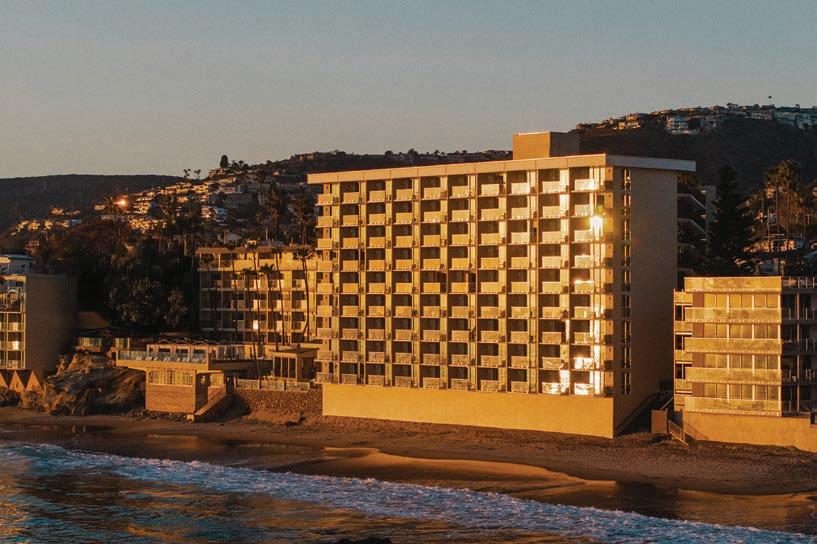
Although we’re often told not to judge a book by its cover, it’s still hard not to. A recent visit to Surf & Sand (surfandsandresort.com) in Laguna Beach, California, located halfway between Los Angeles and San Diego, reminded me why this adage rings true. A member of Historic Hotels of America and Preferred Hotels and Resorts, the property was built in 1948. to accommodate the booming number of vacationers and artists flocking to the Southern California coast in the post-World War II era. Today, except for the supercars neatly arranged by the valet just beyond the portico, the linear mid-century architecture, with its exterior corridors and stairways, belies the beauty of a gleaming interior transformation unveiled in June of 2025.
A VIEW TO A THRILL
Newly transformed, the historic Surf & Sand in Laguna Beach celebrates its primo Pacific positioning with an elevated, ocean-inspired aesthetic and luxury amenities.
Written by Bridget Cottrell
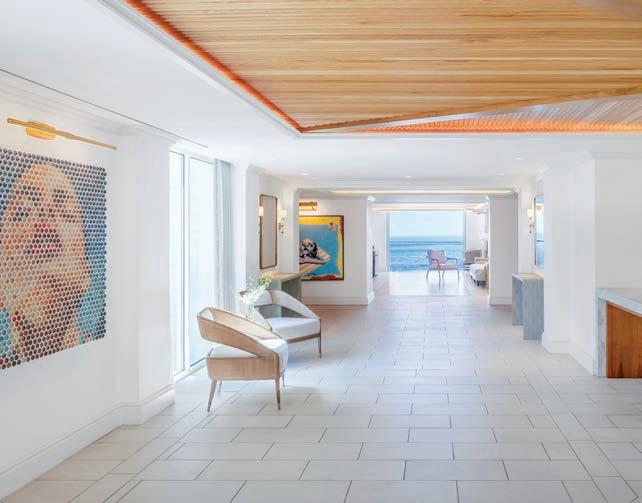
Situated between the South Coast Highway and 500 feet of pristine sand, the open-air reception area sets the tone for the revitalized spaces with loads of colorful original art from notable names, including Dale Chihuly, Kelsey Irvin, Geoffrey Gersten, Eric Zener, and Ran Ortner, juxtaposed with gallery-white walls and expansive use of floor-to-ceiling glass to highlight the panoramic ocean views. The installations reflect Laguna Beach’s vibrant art community— the first of its 80-plus galleries opened in 1918. Today, the community is home to some 400 working artists.
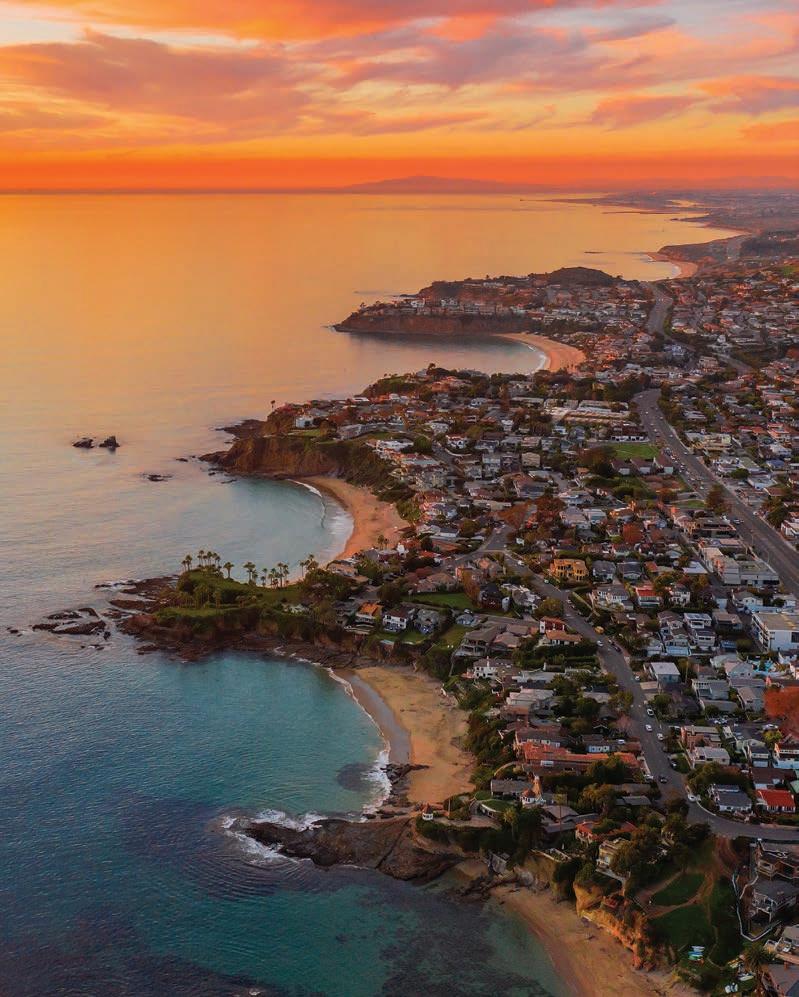
Above, Laguna Beach features a stunning, 7-mile stretch of protected Southern California coastline boasting over 20 unique beaches and coves. Image courtesy of Visit Laguna Beach.
Surf & Sand is steps from the golden sands of the Pacific and a short distance from the heart of downtown Laguna Beach.
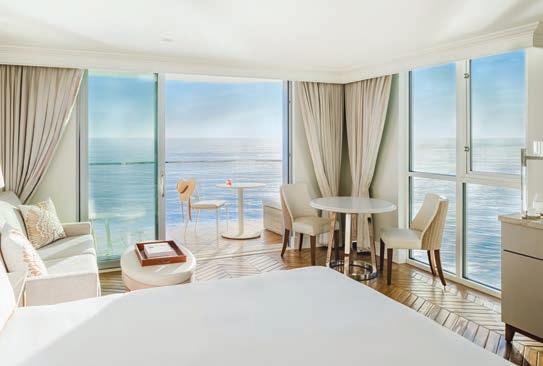
Opt for a corner room on a high floor to fully experience the sensation of floating above the Pacific.
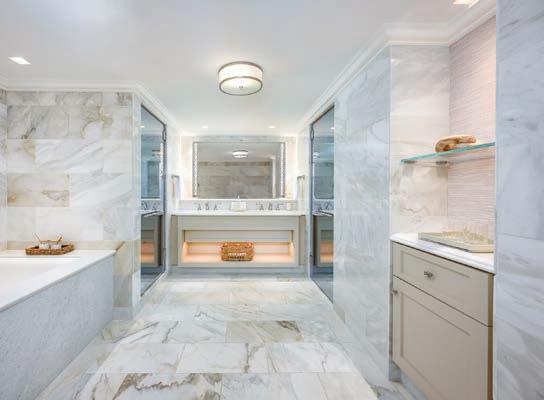
In Room 190, a tightly edited color palette in varying shades of white and wheat chaff emphasized a mosaic of blue, created by the beachfront pool on one side and the Pacific on the other. Patterns are limited to the drapery tape and accent pillows. The room’s parquet wood-like floor tiles carry over onto the balcony, whose doors were almost always open so we could listen to the surf and the laughter of families playing in the waves. A sliding divider above the tub in the spacious Italian marble-clad bath keeps the view front and center, should you choose. Judicious use of mirrored and chrome accents mimics the effect of sunlight-dappled waves. Butterysoft linens dressed the bed, which sat opposite a handsome shagreen dresser. The latest in smart-room technology delights technophiles and is user-friendly enough for the less inclined.
Southern California is worldrenowned for its food culture, blending deep Mexican roots, Asian culinary traditions, and locally sourced ingredients, and all of these are elevated by Surf & Sand’s Executive Chef Ron Fougeray. Arriving on our first day in time for brunch,
we made a beeline for Splashes Bar for avocado toast (one of about six I savored over the course of three days). Open all day, Splashes Restaurant is crowned by a handblown glass Chihuly chandelier that took two weeks to install. Offering a superior sunset view, glass doors across the rear of the dining room are left open so that the only thing separating patrons from the Pacific is a half-pane of glass.
While Splashes could easily rest on the laurels of its lovely looks, the service and cuisine are equally elevated. An extended conversation about tea with our server at breakfast resulted in a surprise delivery later that afternoon of several varieties of Tea Forté we’d yet to try. During dinner, an intuitive server inquired if I’d like to commence our evening with my preferred apéritif. We enjoyed the theatre provided by the tableside lobster bisque, followed by perfectly crisped Spanish octopus, olive oilpoached sea trout, and a delectably spiced Liberty Ducks breast. As this is California, there are ample vegetarian options, zeroproof cocktails, and a willingness to accommodate dietary restrictions.
Prior to dinner each evening, we enjoyed watching the sunset from the Bella Vista Terrace, comfortably settled into one of several banquettes that surround firepits. The arrangement is conducive to conversing with fellow guests and a doggie or two, as the property allows up to two dogs per room, each up to 40 pounds.
Above: Oceanfront Vista Suite room and bath.
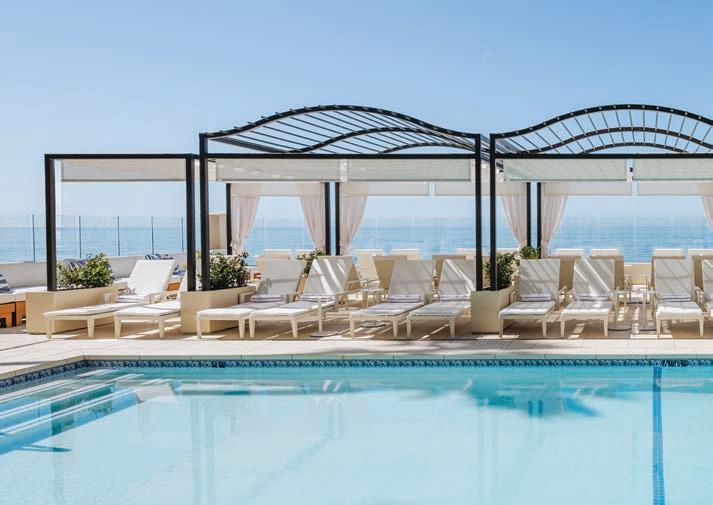
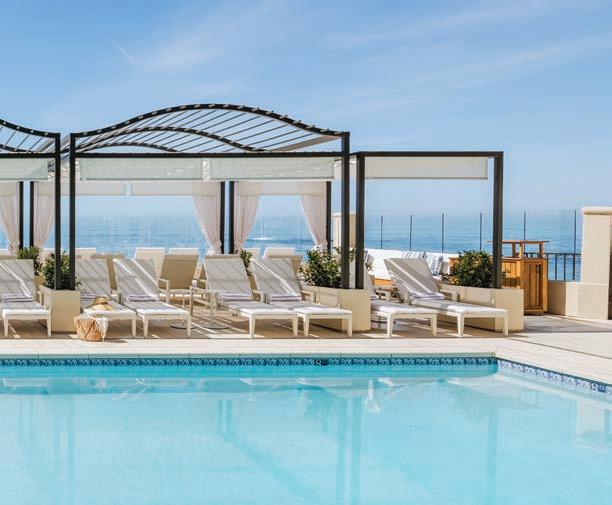
Photo by Nick Garcia/ Reel City Films. Spread: The oceanfront pool at Surf & Sand. Photo by Tanveer Badal
Opposite page above right: To the left in the lobby is New Blue, 2020 a photography, glass spheres, and resin artwork on wooden canvas by Nemo Jantzen. Photo by Tanveer Badal
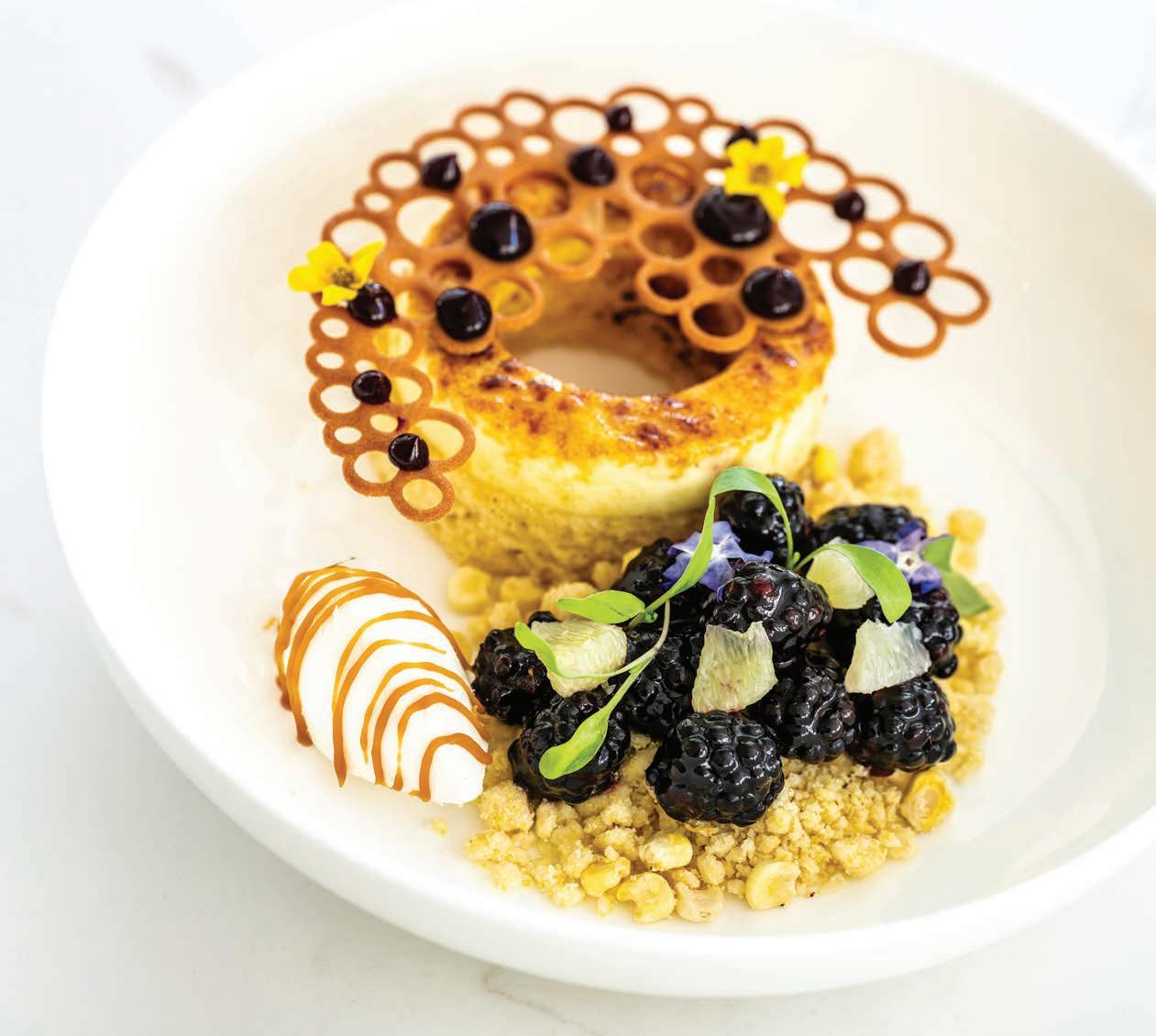
Lower: Sweet Corn Crema Catalana at Splashes Restaurant.
Photo by Anthony Secker
Ethereal guestroom aesthetics carry over to the eight treatment rooms, an ocean-view couples’ treatment room, and Nail Nook of the Aquaterra Spa. The facility encompasses gender-specific lounges, each with a eucalyptus steam room and outdoor jacuzzi, along with a co-ed space and Recovery Lounge, and a large, well-equipped fitness facility. Intended to meld aspects of “Aqua” (sea) and “Terra” (earth), the spa’s lineup of face and body offerings includes organic ingredients, native botanicals, and marine extracts.
Surf & Sand’s ideal location meant we could walk to a host of area amenities. The entirety of Laguna Beach’s 7-mile coastline is part of California's Marine Protected Areas (MPAs), making it one of the most ecologically rich shorelines in the Golden State. The city boasts nearly one acre of protected land per resident, with 22,000 acres spanning tidepools to steep cliffs, many of which are dotted with multi-million-dollar homes that seem to defy the laws of physics and gravity to maximize their pricey views.
In addition to a rich visual arts community, The Laguna Playhouse (lagunaplayhouse. com) holds the designation of being the oldest, continuously operating Playhouse on the West Coast. Established during the Great Depression, the Festival of Arts is best known for its annual Pageant of the Masters (foapom.com), a world-renowned outdoor summer theatrical production where famous classical and contemporary works of art are brought to life through tableaux vivants("living pictures"). Opening July 9 and running through September 4, 2026, this year’s production, “The Greatest of All Time,” will feature approximately twenty of history’s most recognizable and influential artists. Laguna Beach’s summer calendar is packed with art festivals (see visitlagunabeach.com for more).
When a planned surf lesson with La Vida Laguna (lavidalaguna.com) was canceled due to flat surf, we headed out on the trails to walk off my disappointment. My mood was completely elevated by the time we completed a breathless trek from the beach to Laguna’s most famous hike, Top of the World, where our effort was rewarded with stunning views of Catalina Island and the Santa Ana Mountains.
We rewarded our efforts by availing ourselves of Laguna’s diverse dining scene, from a stiff drink at The Sandpiper Lounge, a classic dive bar, to dinner at South of Nick’s Restaurant (nicksrestaurants.com), where the highly recommended La Tablita proved to be an elevated Mexican-inspired feast of epic proportions. With more than 100 restaurants, from artisanal coffee to traditional Omakase, chances are you won’t have a bad meal. And, just like Surf & Sand, no matter where you are, you’re never far from an amazing view. sl
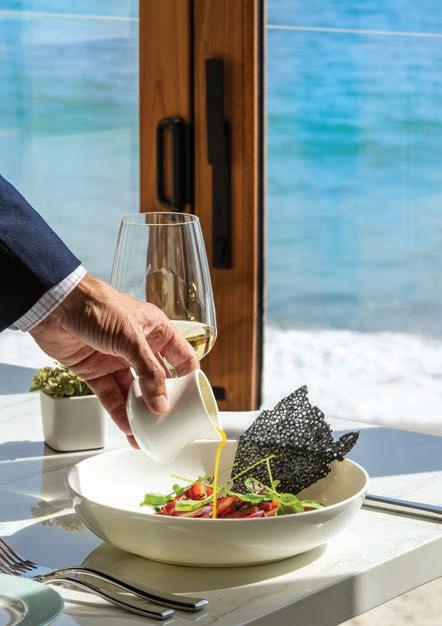
Ahi Tuna Crudo at Splashes Restaurant
Photo by Anthony Secker / Loriant Studio
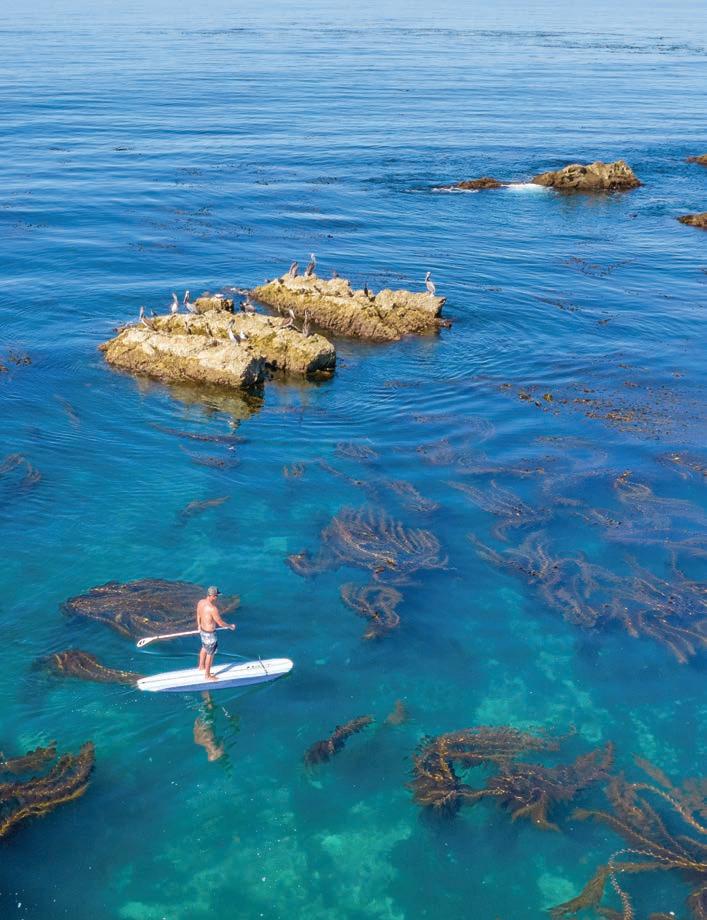
Renowned for its dramatic sea cliffs, crystal-clear waters, and rich tide pools, Laguna Beach’s entire shoreline operates as a designated Marine Protected Area. Photo courtesy of Visit Laguna Beach.
Of note...
The Greater Outdoors
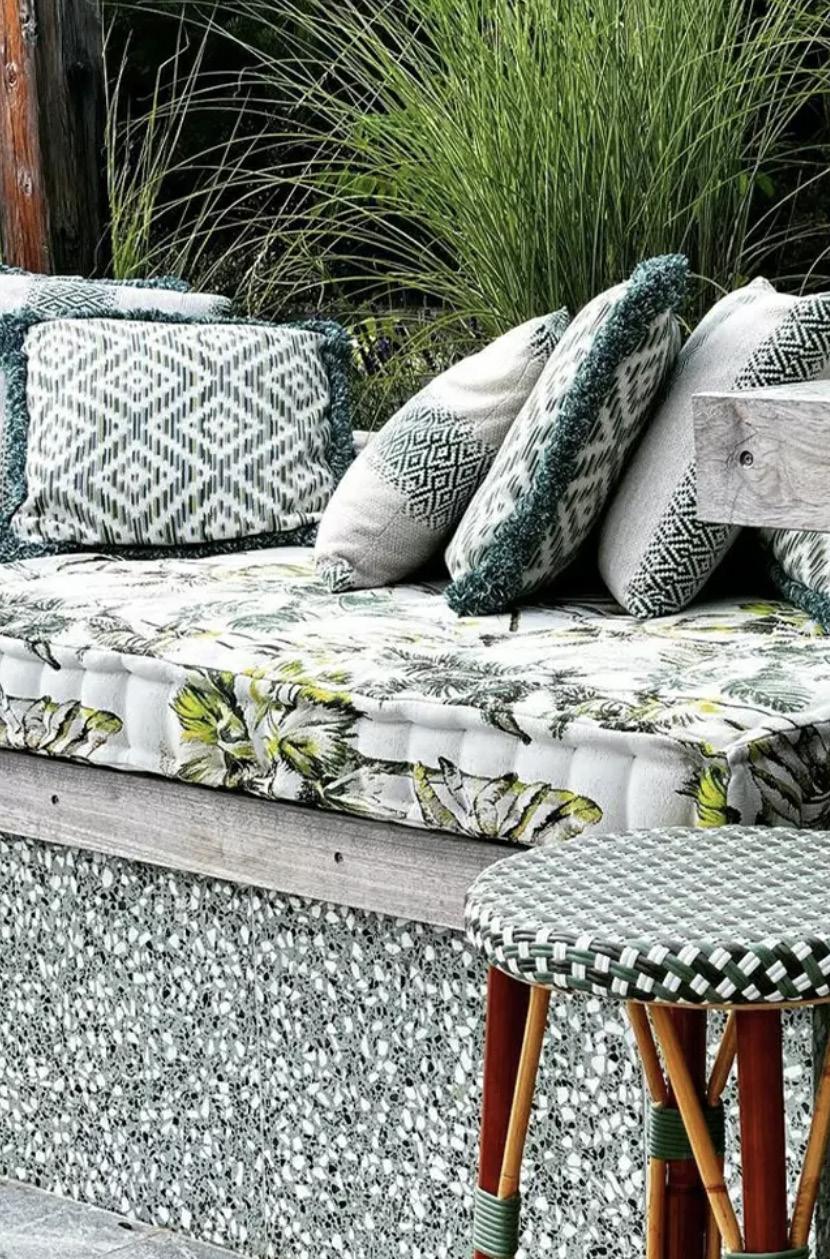
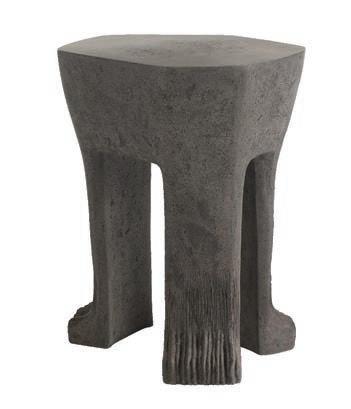
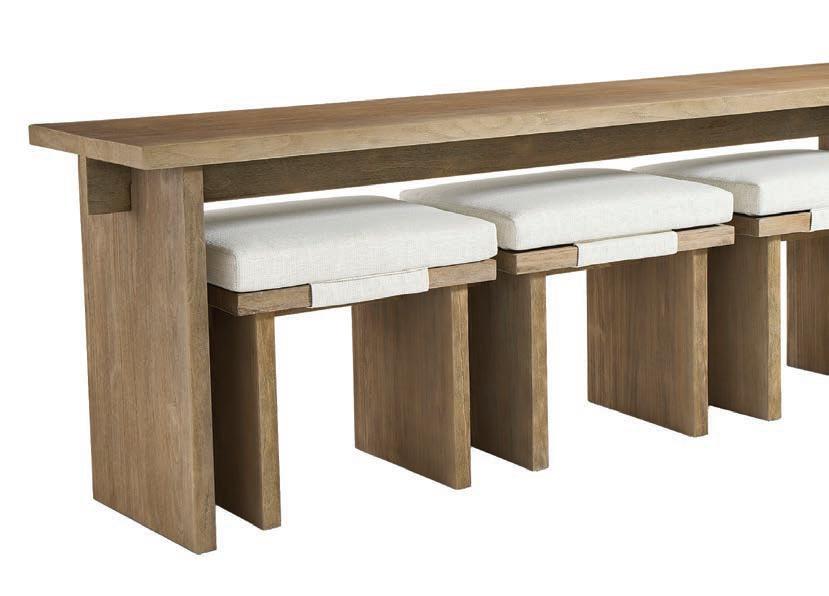
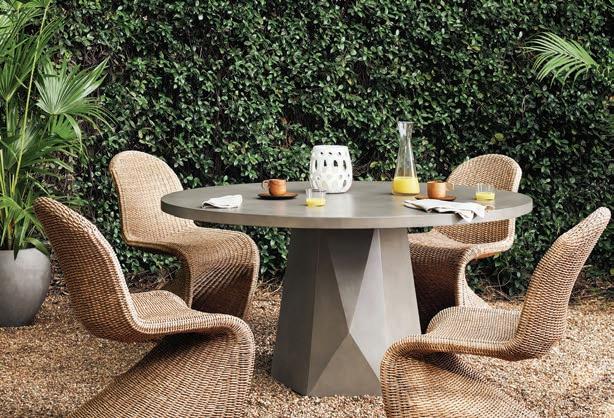
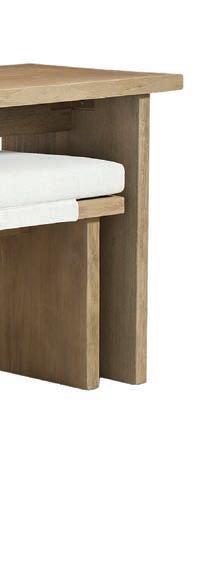
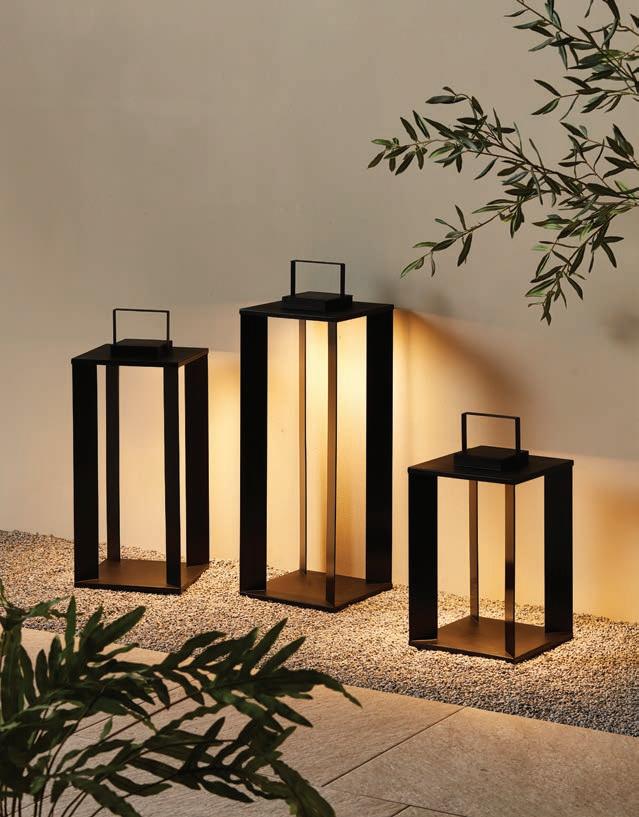
Bernhardt Outdoor Counter Console and Stools (bernhardt.com) Brown
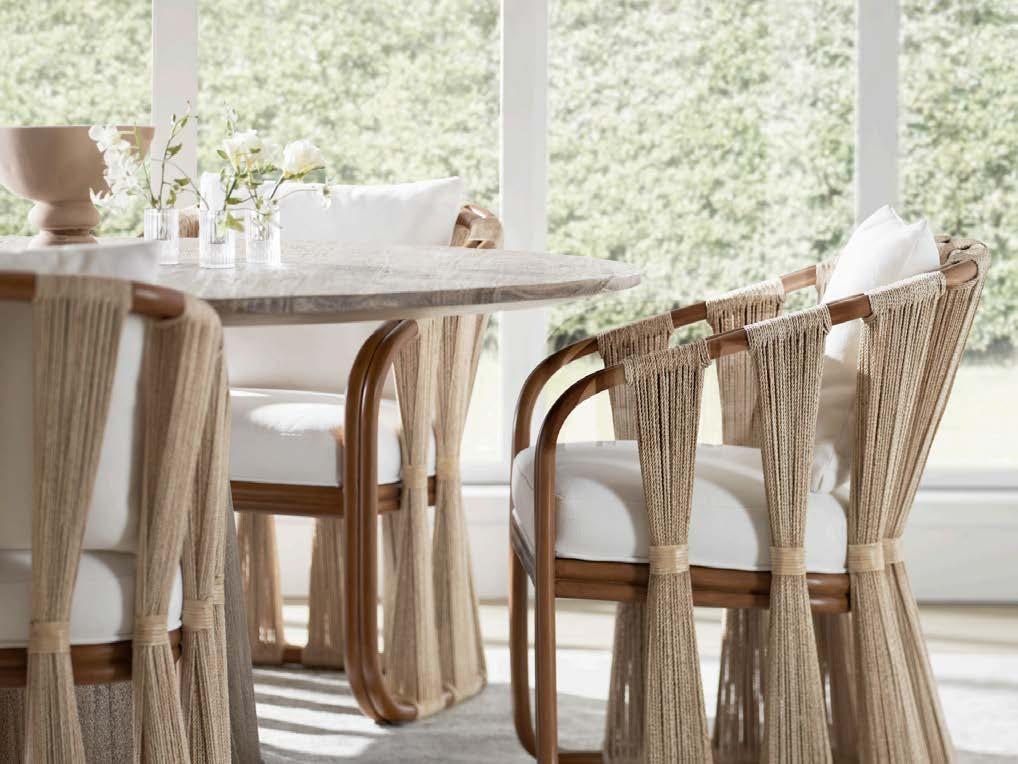
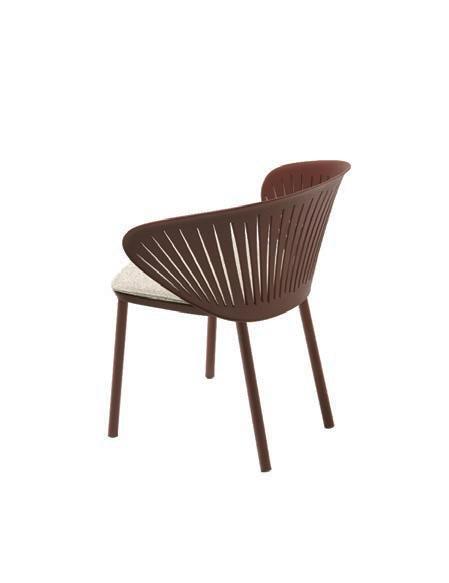
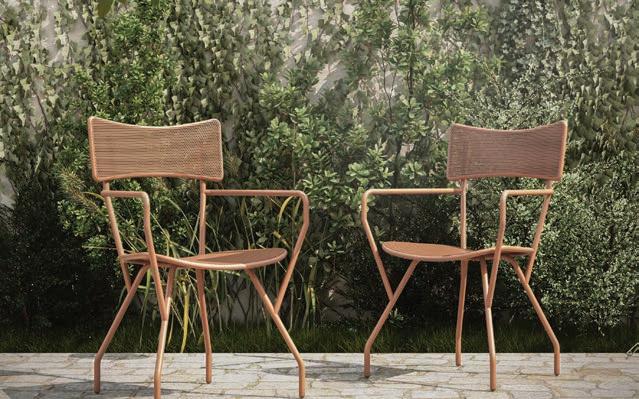
FAST Estea Armchair (fastspa.com)
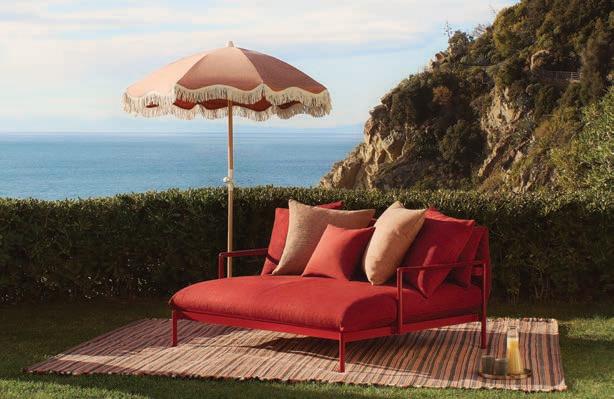
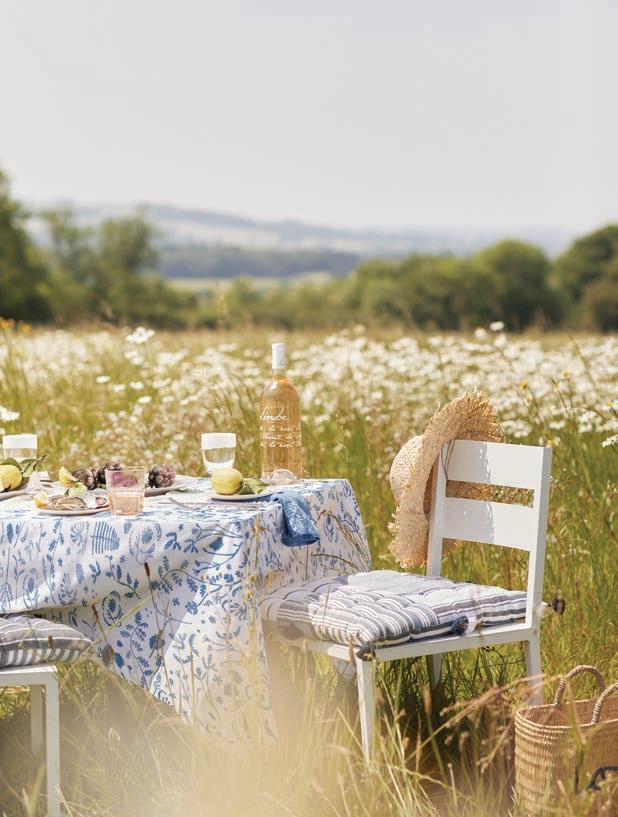
Daylesford Deal Stripe Chair Cushion and Wildflower Tablecloth and Napkins (daylesford.com)
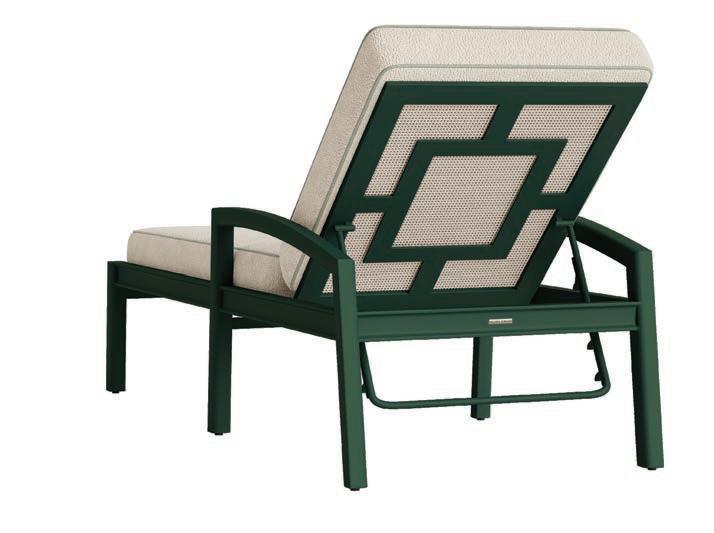
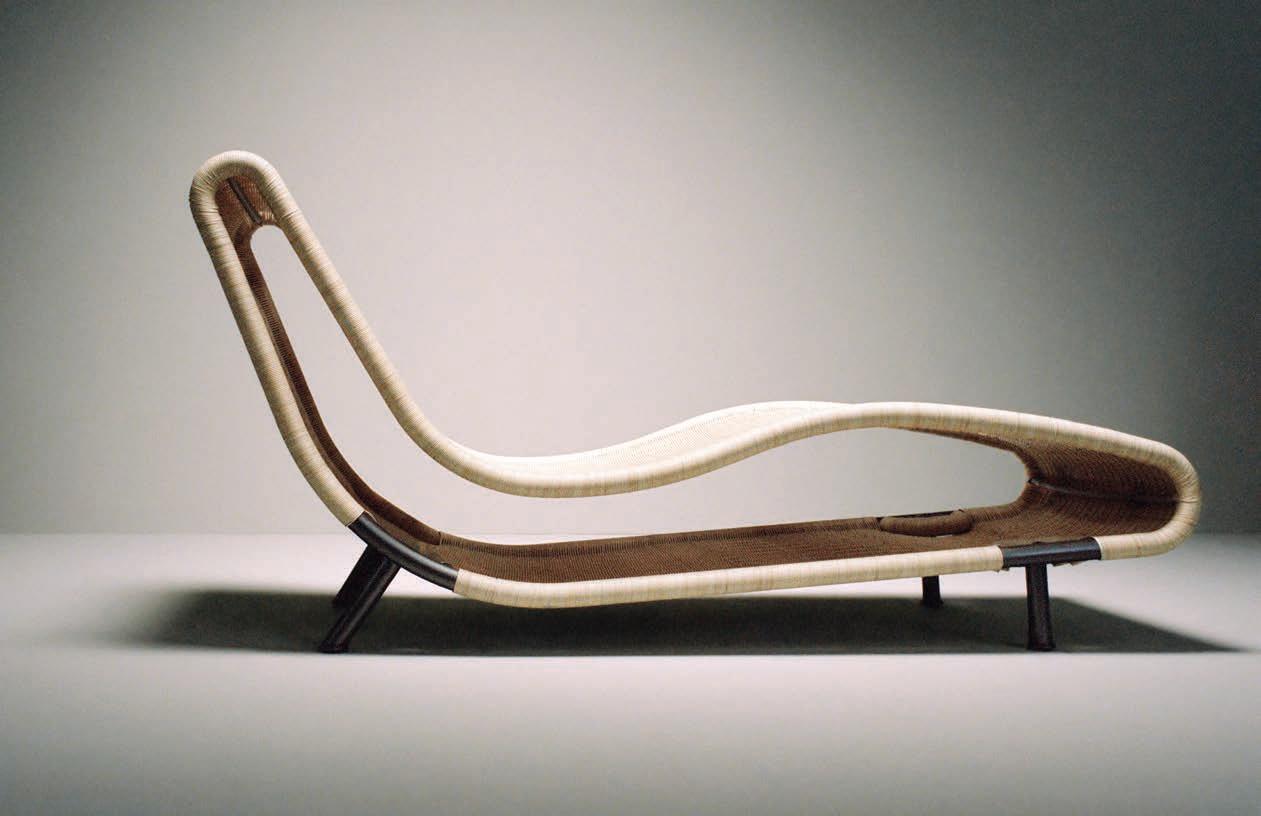
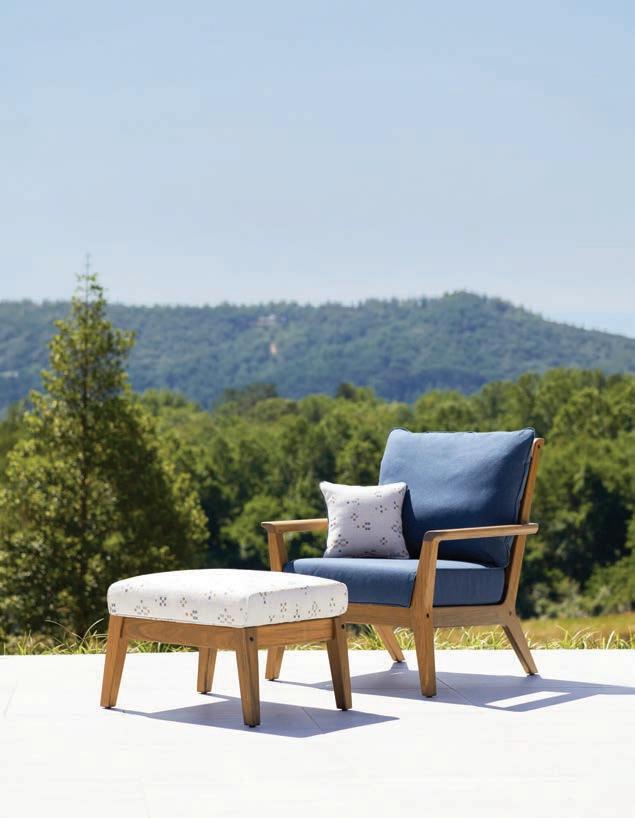
Jensen Outdoor Sky Lounge Chair and Soleo Ottoman (jensenoutdoor.com)
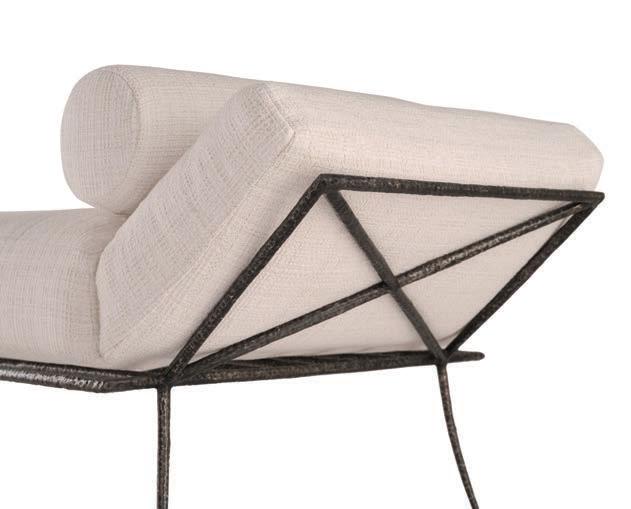
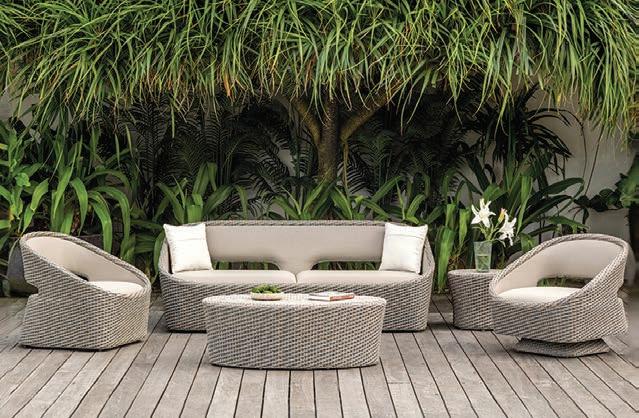
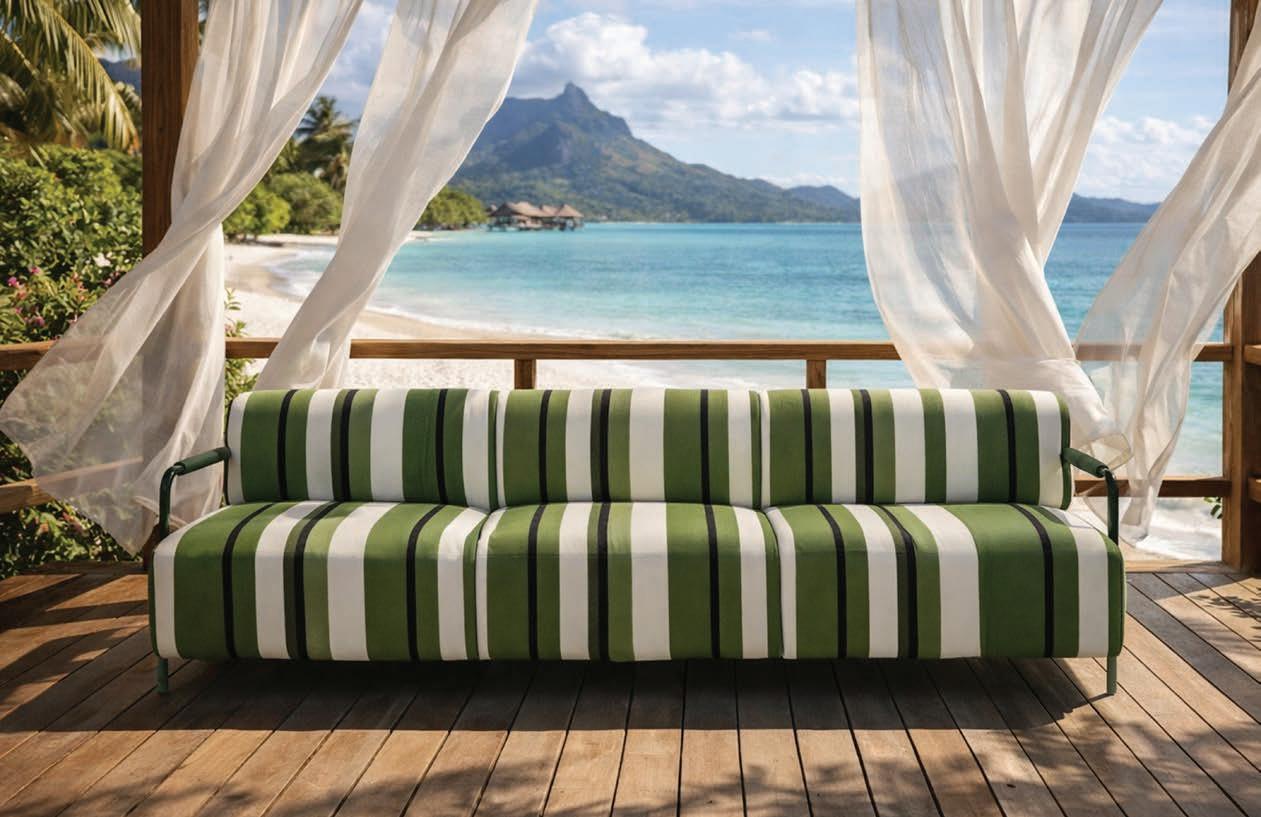
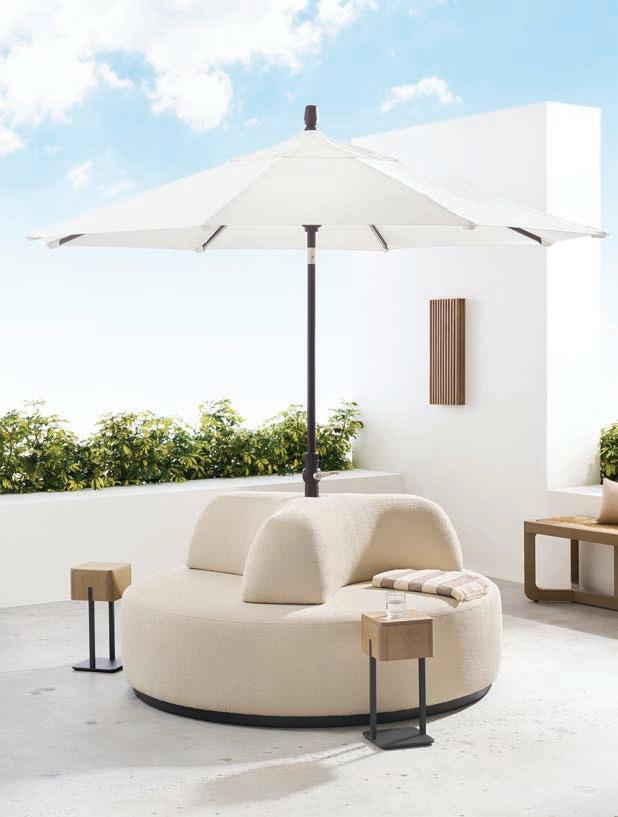
Sunset Collection outdoor sofa from Diviana (diviana.in)
TOP DOWN ROUNDUP
Edited by Matthew Cottrell
Bentley Continental GT Convertible S: Sporting performance and dramatic presence
Inspired by the limited-edition Supersports and extending the breadth of choice in the Continental line-up, the S models are aimed squarely at the performance-focused driver by combining dramatic visual presence with the latest hybrid powertrain and the Continental GT Speed’s chassis technology. The fourth-generation Continental GT S models are the fastest and most powerful yet to carry the S badge.
At 680 PS and 930 Nm, the new S models’ High Performance Hybrid powertrain is 130 PS more powerful than that of the previous generation GT S. Fully deployed, it delivers 0-60mph in just 3.3 seconds and powers on to a top speed of 190mph, accompanied all the while by the thrilling soundtrack of a sports exhaust that accentuates the 4.0-liter V8’s “crossplane” beat (the iconic, deep, uneven
exhaust rumble of a V8 engine that uses a cross-plane crankshaft). Demonstrating its advanced powertrain engineering, the High-Performance Hybrid even outperforms the previous generation’s W12 Speed powertrain on all power, torque, and performance parameters –while also being capable of up to 50 miles in pure electric mode.
A unique package of exterior design, interior specification, and a dynamic chassis places the new Continental GT S models in a distinctive niche within the range. With their sporting aesthetic and emphasis on the sheer enjoyment of driving, the S models extend the breadth of choice offered by the definitive grand tourer.
BMW Z4 Final Edition: a very limited edition Z4 M40i marking the end of the two-seat roadster’s production. Since its introduction in 2002, the BMW Z4 Roadster has been thrilling enthusiasts
with its unique combination of classic proportions, a purist driving experience, and sporty dynamics. The Z4 Final Edition, characterized by its exclusive BMW Individual paint, unique interior accents, and commemorative badging on the door sill plates, is a special Z4 M40i commemorating the end of production of the iconic 2-seat Roadster.
The BMW Z4 Final Edition will be produced in very small numbers from February to April of 2026 in a single, wellequipped configuration. Customers need only choose between a 6-speed manual or an 8-speed Steptronic transmission.
Contrasting red stitching in the cabin of the Z4 Final Edition provides a literal common thread that ties together the instrument panel, center console, door panels, and M Sport seats, which are trimmed in Vernasca leather and Alcantara. The floor mats feature red piping, and the special door sill plates are inscribed with
“Z4 FINAL EDITION”. The seatbelts are trimmed in the M tricolor.
The Z4 Final Edition comes standard with a full range of comfort, convenience, and safety features, including the Driving Assistance Package, the Premium Package, and a Harman Kardon surround-sound audio system.
Chevrolet Corvette 2027 Grand Sport X: blending heritage-inspired design with a next-generation V8 engine producing more torque than any other naturally aspirated V8 predecessor. Born in the early 1960s as a limited run of five C2 race cars that competed at tracks like Sebring International Raceway, Grand Sport has long stood for lightweight, trackfocused Corvettes that look as fast as they drive. Road-going Grand Sport models have added to the formula of the name with every generation, borrowing features from the fastest cars in each Corvette
generation, while maintaining heritage colors, distinct striping, and signature fender hash-marks that once served as ways to tell the original race cars apart.
At the core of every 2027 Corvette Grand Sport X is the next-generation LS6 6.7L V8, which is now Corvette’s primary engine – powering the 2027 Stingray as well. Launching General Motors’ next generation of V8s, LS6 raises the bar for performance thanks to engine architecture upgrades that will soon benefit other V8-powered Chevrolets.
Delivering 535 horsepower and 520 lb-ft of torque, this naturally aspirated engine sees increases in power and torque across the rev band compared to its predecessor. A larger 6.7L displacement and 13.0:1 compression ratio sharpen response, while a 95-mm throttle body and tunnel ram intake with high-velocity ports move more air to unlock additional power. An eight-speed dual-clutch transmission routes all this power to the wheels.
The Corvette Grand Sport X expands the Grand Sport formula with all-wheel drive, creating a chest-compressing 721hp2 express. It pairs the LS6 V8 at the rear axle with a front-axle electric motor and compact battery pack from the recordsetting Corvette ZR1X to create an eAWD
Corvette that is as confident in challenging weather as it is on a dry track.
GM’s Bowling Green Assembly will start building the Grand Sport lineup with US and globally sourced parts this summer.
Lamborghini Fenomeno Roadster: the most powerful open-top ever created by Lamborghini
In April, Automobili Lamborghini presented its latest Few Off model, the Fenomeno Roadster. With a limited production of 15 units, the company says the roadster “represents moments when engineering, design, and pure driving emotion converge without compromise. Radical in concept and striking in appearance, these cars transform performance into an experience that is both visceral and unforgettable.”
The roots of the Few Off tradition can be traced back to the 1968 Miura Roadster, a unique interpretation of the revolutionary car created by Bertone that embodied Lamborghini’s ambition to challenge conventions and explore new possibilities. Decades later, the first true expression of this vision was the Reventón Roadster, which marked the beginning of a lineage of exceptional open top Few Off models. It was followed by the Veneno Roadster, the Centenario Roadster, and the Sián Roadster.
The Fenomeno name follows Lamborghini’s tradition of drawing inspiration from legendary, courageous bulls. In both Italian and Spanish, Fenomeno means “phenomenal”, a name that embodies the power and exclusivity of this extraordinary model, which delivers a combined system output of 1080 CV from a 6.5-liter naturally aspirated V12 that is linked to three electric motors. Capable of accelerating from 0–100 km/h in 2.4 seconds, from 0–200 km/h in 6.8 seconds, and reaching over 340 km/h, it combines extreme performance with cutting-edge hybrid technology. It is the most powerful open-top model ever produced by Lamborghini.
“Fenomeno Roadster represents the purest expression of our brand values: visionary design, uncompromising performance, and absolute exclusivity,” Stephan Winkelmann, President and CEO of Automobili Lamborghini S.p.A., said at the launch event. “It is a unique interpretation of driving emotion, created for a select group of customers who seek something truly beyond convention. Each example is conceived as a collectible masterpiece, where engineering excellence meets true bespoke craftsmanship.”
Pagani Utopia Roadster: Blending retro-inspired design with extreme mechanical performance
The Pagani Utopia Roadster is the third creation from the 30-year-old company founded by Horacio Pagani, an Argentine Italian from a humble background. At age 28, he moved to Europe, securing a position with Lamborghini as a sweeper and mechanic, where he quickly worked his way up to become a chief engineer, championing the use of carbon fiber composites and playing a leading role in the development of the Lamborghini Countach Evoluzione.
Horacio Pagani says he designed the Utopia as a direct response to customer demands for simplification, lightness, and a purer, analog driving experience in an overly digital automotive age. Moving away from the heavily aero-focused, spoiler-heavy designs of past cars like the Zonda, the Utopia utilizes over 40 composite material formulations and advanced Carbo-Titanium to deliver a flowing silhouette that delivers openair exhilaration without sacrificing the structural rigidity, weight, or performance of its coupé sibling. Utopia is powered by a bespoke 864-horsepower, 6.0-liter twin-turbo V12 engine developed by
Mercedes-AMG, producing a prodigious 1,100 Nm of torque.
True to Pagani's philosophy of blending timeless aesthetics with cuttingedge technology, the hypercar features an exposed manual transmission and highly detailed mechanical dials inside. The opentop driving experience is enhanced by active aerodynamics, an advanced suspension system, and innovative Pirelli Cyber Tire sensors that relay real-time conditions to the car's driving dynamics controls.
Porsche 911 GT3 S/C: Focused squarely on people who prize visceral, open-air driving. The 2027 911 GT3 S/C delivers a pure driving experience and combines the lightweight components of the 911 S/T with the naturally aspirated 4.0-liter boxer engine of the 911 GT3, producing 502 hp and 331 lb.-ft. torque. of torque.
The striking carbon-fiber fenders and doors of the 911 S/T, in combination with the black windshield frame, imbue it with an unmistakable look. In line with its positioning as a driver's car, it is only available with the short-ratio and lightweight six-speed GT Sport manual transmission.
The 911 GT3 S/C is the only opentop variant of the current 911 range that is also a pure two-seater – reminiscent of the 911 Speedster from 2019, but in contrast to its predecessor, the 911 GT3 S/C is not a limited production model. For the first time, a Street Style Package is available for the 911 GT3 S/C, allowing you to further adapt the vehicle to your personal taste.
Lamborghini Fenomeno Roadster
Chevrolet Corvette 2027 Grand Sport X
"The new 911 GT3 S/C responds to our customers' desire for sports cars that are particularly fun to drive," said Frank Moser, Vice President 911 and 718 model line.
Rolls-Royce Project Nightingale: an ultra-exclusive, fully electric two-seater open-top convertible
The storied marque’s first issue of its Coachbuild Collection, Project Nightingale, is named after Le Rossignol, French for ‘the nightingale’, and the name of the designers’ and engineers’ house near Henry Royce’s winter home on the Côte d’Azur. While drawing inspiration from high-speed experimental ‘EX’ RollsRoyces of the 1920s and 1930s, this forward-thinking production concept
is constructed using the Rolls-Royce Architecture of Luxury aluminum spaceframe and powered by a fully electric drivetrain that delivers a uniquely silent open-top experience.
“Some of the most discerning RollsRoyce clients in the world asked us for our most ambitious work,” said Chris Brownridge, Chief Executive, RollsRoyce Motor Car. “We responded by bringing three things together that have never coexisted within our brand: the complete design freedom of coachbuilding, our powerful, near-silent all-electric powertrain, and a uniquely potent yet serene expression of open-top motoring – an experience that only this technology makes possible. Achieving
this required the same audacious mindset that drove our co-founder, Sir Henry Royce, to create his radically different experimental ‘EX’ motor cars of the 1920s. Project Nightingale shares the spirit of those landmark projects and is the most extravagant expression of what Rolls-Royce is capable of today.”
Limited to 100 examples, it’s available to purchase by invitation only to aestheteminded clients with a deep affinity for Rolls-Royce design. These select few have begun participating in a multi-year program of private gatherings, curated by Rolls-Royce around the world, that immerse them in the creative and technical development of their motor car in advance of its 2028 delivery. sl
BMW Z4 Final Edition
Pagani Utopia Roadster
Rolls-Royce Project Nightingale
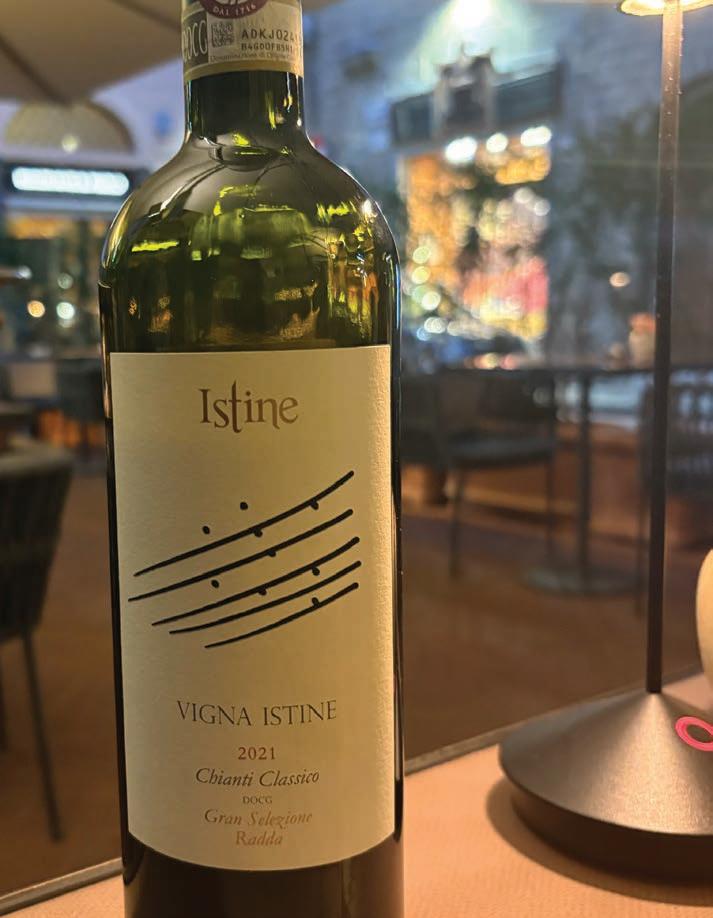
THE ULTIMATE SUMMER CELLAR
Denig
Hi there, Sophisticated Living! My name is Vicki Denig, and I’m a wine / travel journalist, as well as a Certified Specialist of Wine, based between New York and Paris. You’ll find me here in every edition of the magazine, as I proudly hold the title of Sophisticated Living’s official wine correspondent! With this edition, I’m excited to share five bottles with you that have recently made an impression on me—and if you snag them for yourself, I think they’ll resonate with you, too. Check them out below and feel free to follow my personal travel / tasting adventures at @vickidenig on Instagram or at www.vickidenig.com.
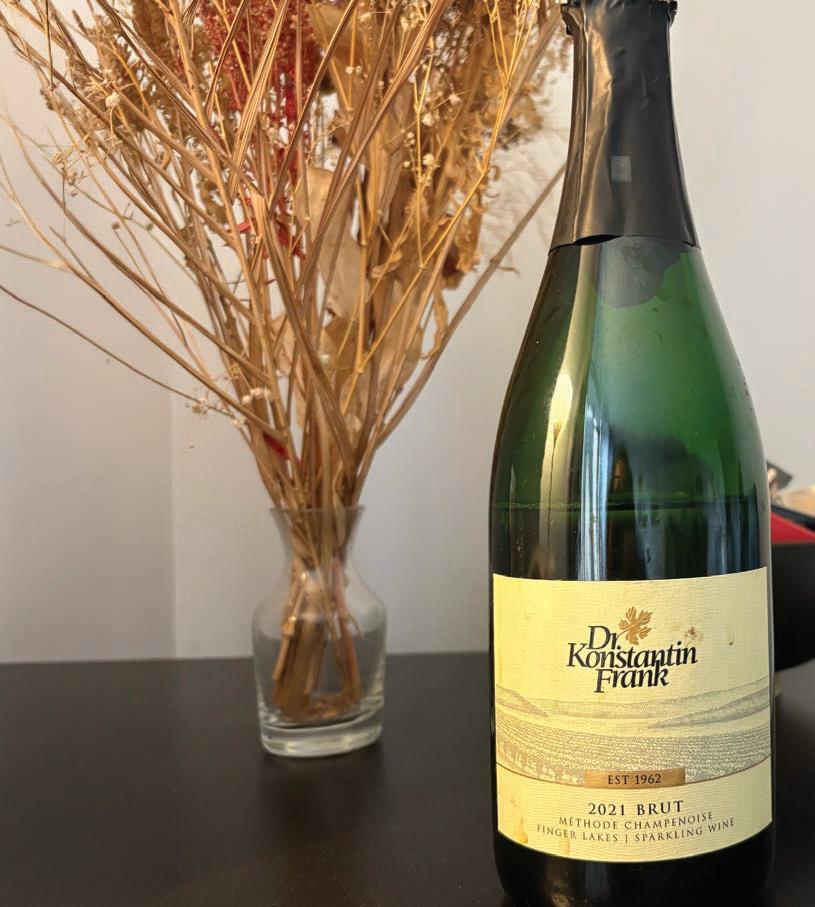
Dr. Konstantin Frank Brut 2021 (Finger Lakes, New York, USA — SRP: $32.00)
Although many wine drinkers save sparkling wine for special occasions, I’m
in the camp of “there’s never a bad time for bubbly.” However, finding a balance between pricey Champagne and cheap, big-brand alternatives is key—and this bottle from the Finger Lakes offers the perfect solution. Born in Ukraine, Dr. Konstantin Frank is widely considered to be a great hero of American viticulture, as he was the first to plant vinifera vines on the eastern coast of the country. Drinking a bottle of the winery’s flagship Brut cuvée is kind of like drinking a piece of history! Produced from a blend of 55% Chardonnay, 40% Pinot Noir, and 5% Pinot Meunier, the wine is vinified using the same technique that’s implemented in Champagne, though it is aged twice as long (24 months in total) as required by the latter. Expressive and flavor-packed, the wine’s creamy texture is balanced by bright red apple flavors and invigorating acidity.
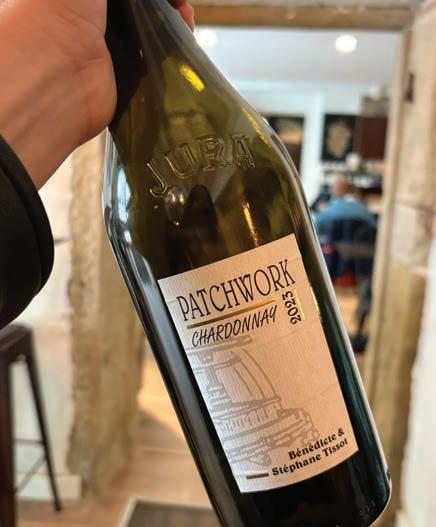
Fans of French Chardonnay almost always reach for Burgundy, though the neighboring Jura region produces equally thoughtprovoking wines. Bénédicte & Stéphane Tissot are pillars within the region, having taken the reins from Stéphane’s parents back in 1989. Since their earliest days, the pair have been fervent pioneers of biodynamic farming (certified in 2004, far before it was as fashionable as it is today) and lowintervention winemaking. Their ‘Patchwork’ Chardonnay is fermented with indigenous yeasts and aged for 12 months in oak, with just a touch of new oak. The wine strikes a hard-to-achieve balance between creamy and refreshing, with notes of yellow apple, tart lemon zest, marzipan, and a touch of smoke.
Figuière Côtes de Provence 'Première' Rosé
(Provence, France — SRP: $30.00)
There’s truly no better feeling than sipping an inaugural glass of spring rosé, especially if said glass is enjoyed with breathtaking views over the rooftops of Paris. After
Written and photographed by Vicki
a seemingly never-ending winter, I practically jumped out of bed and sprinted to the nearest rooftop bar on the first warm day of the season. Pictured here is a glass of Figuière’s Côtes de Provence 'Première' rosé, made from a regional blend
of Cinsault, Grenache, and Mourvèdre. Refreshing and tangy, the wine’s pale pink hue and bright flavors of wild strawberry, citrus, and wet stone were everything I could’ve wanted on a warm April evening, especially against this unbeatable backdrop (photo taken from the Maggie Rooftop Bar at Hôtel Rochechouart).
Miguel Torres 'La Causa' País 2022 (Itata Valley, Chile — SRP: $25.00)
Having a lineup of budget-friendly reds on hand is always a good idea—and shaking up your selection beyond standard go-to grapes (Pinot Noir, Cabernet Sauvignon, etc.) makes things even more exciting.
Admittedly, I rarely drink Chilean wines, though this bottle of País from Miguel
Torres had me reassessing my habits. The País grape first arrived in Chile via Spanish conquistadors in the late 16th century. In recent years, the grape has become a preferred choice for winemakers in the Maule and Itata Valleys, thanks to its ability to withstand heat and drought. Fruit for this wine comes from a dry-farmed vineyard planted in 1987. In the cellar, the wine was fermented with native yeasts and whole bunches prior to aging for four months in neutral French oak barrels. I loved this wine for its harmonious flavors of red berries, dried herbs, and a touch of smoke. There’s a whole lot happening here for just $25!
Istine 'Vigna Istine' Chianti
Classico Gran Selezione 2021 (Tuscany, Italy — SRP: $70.00)
Chianti may be one of the most well-known Italian wine regions in the world, though not all bottles are created equal. Beyond the area’s entry-level expressions, a few highertier categories exist, each with its own unique regulations on quality and aging. For example, Gran Selezione—what we’re working with here—is the cream of the crop. Wines under this designation must contain a minimum of 90% Sangiovese from a single vineyard (or an estate’s top selection), as well as be aged for a minimum of 30 months. While traveling through Florence last month, I reached for this special bottle from Istine while perched on the terrace at Osteria Pagliazza, located at the Hotel Brunelleschi. The wine flawlessly fit the moment, exuding concentrated yet balanced flavors of red berries, blood orange, lavender, and a touch of truffle. I’m a big fan of drinking locally when traveling, so this Chianti Classico produced just an hour away was the perfect pick! sl
Vicki Denig is a wine / travel journalist based between New York and Paris. Her work regularly appears in various industry publications, including Decanter, Food & Wine, and WineSearcher. In addition to journalism, Vicki also works with a handful of wine-focused clients, including Paris Wine Company, High Road Wine & Spirits, and more. When not writing, she enjoys running, indoor cycling classes, petting dogs, and popping bottles on her rooftop with friends.
SUN, SURF, AND SPARKLE
Elevated fine jewelry for seaside escapes
Compiled by Bridget Cottrell
Nadri Boujee Beads Long Necklace (nadri.com). Never Not ‘Always Yours’ Suitcase. Available through Diamond Cellar in Nashville and nevernot.co.uk. Ray Griffiths Branch Coral Bead Necklace (raygriffiths.com). Jacquie Aiche Carved Shell Triple Step Charm. Available through Moyer Fine Jewelersin Indianapolis and jacquieaiche.com.
Longines Primaluna 34mm. Available through Richter & Phillips Jewelers in Cincinnati, Moyer Fine Jewelers in Indianapolis, Davis Jewelers in Louisville and longines.com. Jessica McCormack Hello Sailor Earrings (jessicamccormack.com). Tanya Farah Seahorse Ring (tanyafarah.com). Sorellina Limoncello Earrings. Available through Reis-Nichols Jewelers in Indianapolis and sorellinanyc.com. Yvonne Leon Coral Crayfish Earrings (yvonneleon.com). Jennifer Meyer Jewelry Palm Tree Earrings (jennifermeyer.com). Eden Presley In the Black Swedish Fish Earrings. Available through Moyer Fine Jewelers in Indianapolis and edenpresley.com. Renna Jewels Octopus Caspian Ring (rennajewels.com). Marlo Laz Sol Oriente Pendant (marlolaz.com). David Yurman Petite Pave Shell Amulet. Available through Moyer Fine Jewelers and Reis-Nichols Jewelers in Indianapolis, Schiffman’s Jewelers in Lexington, Davis Jewelers in Louisville, Diamond Cellar in Nashville, Clarkson Jewelers in St. Louis, and davidyurman.com. Joanna Laura Constantine Statement Seashell Cuff (joannalauraconstantine.com). Cece Jewellery Method to the Madness Ring (cecejewellery.com). Harwell Godfrey x Ashley Longshore Press for Champagne Ring (harwellgodfrey.com). Barbara Heinrch Studio Bracelet. Available through Elleard Heffern in St. Louis and barbaraheinrichstudio.com. Kavouri packlock from KIL NYC (kil-nyc.com). Opposite page: Adina Reyter Pearl Necklace with Seashell Bead. Available through Hearth & Soul in St. Louis and adinareyter.com. Patricia Marie Sun Pendant. Availavle through Gus Mayer in Nashville and patriciamariefinejewelry.com
OCEAN KEY RESORT & SPA
Vibrant luxury where you least expect it
By Tracy Cottrell
/ Photography Courtesy of Ocean Key Resort & Spa
Ocean Key Resort’s Sunset Pier offers breathtaking views, flavorful tropical-inspired cuisine, and live daily music.
Crowds gather at the southernmost point in the United States each evening for a show whose run far exceeds even the most successful Broadway production. Local lore attributes the ritual's roots to the famous playwright Tennessee Williams, who in the mid-20th century would visit the docks daily with a gin and tonic in hand to watch the sun dip below the horizon. Since the 1960s, the phrase “See
you at sunset!” has served as a come-one, come-all invitation for locals and visitors to gather at Mallory Square in Key West for a daily bohemian-style celebration marked by magicians, jugglers, storytellers, clowns, psychics, local musicians, artists, and food vendors. The tradition is so ingrained in the community that local laws require large cruise ships to depart port at least two hours before sunset to ensure an unobstructed view of the horizon.
Located at the unique address of -0Duvall Street, the award-winning Ocean Key Resort offers an enviable bird’s-eye view of this evening ritual, complemented by luxurious amenities, attentive, informed service, and a sophisticated and uniquely Key West design sensibility. A recently completed renovation has ushered in a new era, beginning with the lobby and Sweet Bird Bar, the hotel’s most guest-centric areas, where enhancements are centered on an artisan-crafted fountain that adds beauty and inspires relaxation. Custom wallcovering, arched mosaic tiles, richly textured fabric, and shimmering glass pendants reflect the theme of tropical birds and lush flora, enhancing the first-class welcome extended to every guest upon arrival.
Under the decade-long direction of Executive Chef Scott Mauer, Hot Tin Roof is the heart of culinary experiences at Ocean Key Resort from breakfast through dinner. Blending local seafood with Latin and Caribbean flavors, Mauer’s “Floribbean” cuisine has garnered both an AAA Four-Diamond Award and the Wine Spectator Award of Excellence. Also open all day, the playful Sweet Bird Bar, situated near the lobby, underwent a recent colorful, retro-inspired makeover inspired by Tennessee Williams’ Sweet Bird of Youth
Marked by a trio of cabanas with dip-dyed drapery mimicking the colors of the ocean, the intimate pier-side waterfront pool offers an ideal idyll for observing marine traffic as it glides past. Add a tropical-inspired cocktail from the LIQUID Pool Bar & Lounge, the occasional dip in the water, and relaxation becomes a layered experience. Take the serenity up a notch at SpaTerre, where bespoke aromatherapy complements tropical-inspired treatments such as the Tropical Essence Massage, organic seaweed-based treatments, and the Coconut Crush Body Renewal.
Marked by a trio of cabanas whose dip-dyed drapery mimics the colors of the ocean, the intimate pier-side waterfront pool offers an ideal idyll for observing marine traffic as it glides past.
In true Key West fashion, guests are encouraged to pursue whatever feels right. If lounging starts to lose its appeal, there is much to be enjoyed just a short stroll away.
Key West is passionately proud of its past. Ernest Hemingway was a resident from 1928 to 1940, during which time the adventurous, fiercely masculine writer notably wrote the classics To Have and Have Not and The Snows of Kilimanjaro. He and
his family resided at 907 Whitehead Street, now the site of the Ernest Hemingway Home & Museum. An unexpected but integral part of the property’s attraction is an abundance, nearly sixty at last count, of polydactyl cats. Hemingway fell in love with the six-toed mousers after a ship captain, who believed they were good luck, gifted one to his sons, Patrick and Gregory. Today, museum admissions support the tabbies'
Clockwise from top left: A recently completed renovation at Ocean Key Resort has ushered in a new era. Busker Will Soto walks a tightrope at the sunset celebration at Mallory Square. Photo by Bob Krist/ Florida Keys News Bureau. Café Marquesa anchors the boutique Marquesa Hotel. Only in Key West, Fla. do “bulls” roll down Duval Street chased by a crowd of Hemingway look-alikes in sneakers and fishing shirts.
The famously lighthearted event spoofs the famed bull runs of Pamplona, Spain, which author Ernest Hemingway helped make famous through his fiction. The Running of the Bulls returns during Hemingway Days, set for July 22-26, 2026. Photo by Mark Hedden/Florida Keys News Bureau.
care, enabling them to roam freely on the one-acre property, where they continue to fascinate visitors, who frequently pose for pictures with them.
Within walking distance of the Hemingway Home & Museum is the Key West Butterfly & Nature Conservancy. The enthusiastic staff readily describe the lifecycle of butterflies and their importance as key pollinators in our
ecosystems. The undisputed stars of the Conservancy, however, are the winged beauties themselves. Within the indoor habitat, an Eden-like paradise of plants and preferred food, visitors have a chance to experience the delicate splendor of butterflies in their dream environment.
No matter where the day takes you, Ocean Key always beckons at sunset, where guests have options for savoring the
sun as it slides into the ocean, rendering the sky every shade of gold and carmine until it disappears, and the night sky reveals itself. The resort’s aptly named Sunset Pier is Key West’s largest, with food and live music as much a draw as the view. At the onset of the evening, dinner plans take center stage, and the abundance of excellent restaurants in Key West seems limitless. For fine dining, Café Marquesa (marquesa.com/dine/cafe-marquesa) tops the list. An elegant, discreet haven of culinary skill and a favorite of locals, Café Marquesa is a quick and leisurely walk from Ocean Key. Drawing inspiration from the ocean’s bounty and Key West culture, the restaurant’s Curated Occasion is a culinary tour de force spread over seven expertly crafted tasting courses. The ambiance here is low-key luxury and quiet elegance.
Key West is both famous and infamous, brilliant in its uniqueness and commitment to its rich history. As Ocean Key Resort & Spa so beautifully demonstrates, Key West also knows how to do elegance and luxury. sl
For more about Ocean Key Resort & Spa, visit oceankey.com.
Left: Breakfast at Café Marquesa Below: Hot Tin Roof Bar
ALL FUN & GAMES
Fine jewelry has entered the arena
Compiled by Bridget Cottrell
Clockwise from top left: Audemars Piguet + Swatch Royal Pop Pocket Watch (swatch.com). Heavenly Vices Tennis Racket Necklace (heavenlyvicesfinejewelery.com). Anita Ko Diamond Baby Whistle with Colombian Emerald (anitako.com). Sydney Evan Men's Collection Football Necklace (sydneyevan.com). Roberto Coin Tiny Treasures Diamond Necklace. Available through Reis-Nichols Jewelers in Indianapolis, Schiffman’s Jewelers in Lexington, Davis Jewelers in Louisville, Diamond Cellar in Nashville, Simons Jewelers and Clarkson Jewelers in St. Louis and us.robertocoin.com. Lucky Symbols Color Block Mixed Gemstones Tennis Necklace by Milestones by Ashleigh Bergman (ashleighbergman.com).
The Destroyer Ring from Francesa Villa (francescavilla.it). Mined & Found XOXO Pendant. Available through Metalmark Fine Jewelry in Indianapolis and minedandfound.com. AMEDEO Thor CameoCap with 45mm hand carved sardonyx shell cameo (amedeo.shop). David Gotlib Gloves Cufflinks (davidgotlib.com). Alison Lou Tiny Bunny Stud Earring (alisonlou.com). NeverNot Let’s Play Chess Ring. Available through Diamond Cellar in Nashville and nevernot.co.uk. TAG Heuer Carrera Chronograph Extreme Sport Twin-Time. Available through Reis-Nichols Jewelers in Indianapolis, Davis Jewelers in Louisville and tagheuer.com. Breitling Superocean Heritage B31 Automatic 40 Kelly Slater Limited Edition. Available through Richter & Phillips Jewelers in Cincinnati, Moyer Fine Jewelers and Reis-Nichols Jewelers in Indianapolis, Davis Jewelers in Louisville, Geneis Diamonds in Nashville, Clarkson Jeweler in St. Louis and breitling.com. Opposite page: Marie Lichtenberg Large Buck Ring (marielichtenberg.com)
PRESERVING PARADISE
Jamaica Inn fuses 1950s jet-set charm with purposeful travel
Written by Bridget Cottrell
Marilyn Monroe would have turned 100 this past June, and although her physical presence left us 64 years ago, her spirit continues to loom large, through a regular cycle of new books and podcasts, memorabilia auctions, and memoirs of people keen to capitalize on even the most minuscule affiliation. While Monroe died 11 years before I was born, I count myself among the throngs who’ve succumbed to the palpable pull of the starlet’s complicated and tragic story. A few months ago, I came face-to-face with the icon in the library of the Jamaica Inn in Ocho Rios. The candid black and white image—casually mixed among photos of four generations of the Morrow family, and other famous Jamaica Inn guests, including Winston Churchill and Ian Fleming—was snapped during Monroe’s January 1957 honeymoon with Arthur Miller. The complete lack of pretense is intentional and refreshing, as is the resort’s Old Hollywood meets British Colonial style, allowing guests to slip into a bygone era, when Jamaica was
an exclusive, relaxed “jet-set" playground, and before mass commercial travel took over.
The timelessness is felt in ocean-facing rooms whose oversized verandas with beefy balustrades are elegantly outfitted with creamcolored slipcovered sofas and wingback chairs, inviting refined repose. The resort's modest oval pool and croquet lawn are where they’ve always been, and repeat guests (of which there are many) like it that way.
Stop and listen. In the rustle of palm trees and the clinking of glasses, you can still glean the essence of a time where leisurely afternoons were spent not scrolling, but socializing, where after dinner, a crooner might take to the piano, and lovers would rendezvous under the moonlight. These traditions are carried forward today, with nattily attired guests mingling at the weekly manager’s cocktail party held before a lavish Beach Gala replete with traditional Jamaican specialties. There’s also live music every evening during candlelit dinner at the open-air Terrace Restaurant (where a dress
code at dinner is a refreshing change from the predominance of leisurewear), complete with servers sporting red coats with gold shoulder lapels and a bowtie, and weekly screenings of Bond films on the beach.
During a cocktail reception this past spring, staff freely mingled with guests, underscoring an air of familiarity that carries over to the croquet lawn. During his welcome remarks at the reception, Managing Director Kyle Mais said he feels like the curator of a living museum. “We are fortunate to preserve this beautiful gem as we try to forget that unruly lady whose name begins with an ‘M’,” he added. That “M.” of course, is Hurricane Melissa, the scars of which are still clearly visible throughout the island, a portion of which was still without power some four months after the strongest hurricane in Atlantic history. Sherlene Hickling, guest services manager, also referenced Melissa, telling guests, “The best support you can give us is to be here, which helps to rebuild our beautiful Jamaica.”
Just two minutes from downtown Ocho Rios, Jamaica Inn’s 55 classic suites and private cottages are spread among eight oceanfront acres with a 700-foot crescent-shaped private beach that’s naturally bookended by rocky bluffs. Children over 10 are welcome. The hotel’s footprint hasn’t changed since its inception, meaning that the bedroom and baths in classic suites are cozy, which I didn’t mind at all as I spent most of my idle hours on the covered veranda of my Deluxe Suite just steps from the beach’s champagne-colored sand. The décor is classic British Colonial, with a two-poster bed and accents of export blue-and-white porcelain. Even the in-room coffee makers are old school French-press, an ideal ritual befitting the prized Jamaican Blue Mountain coffee. One concession to modernity is the USB plugs in the outlets on either side of the bed.
The Jamaica Inn’s seven cottages are larger and more contemporary in their décor, including original art by Jamaican artists, but like the suites, are purposefully
absent of clocks, televisions, or radios to encourage life on island time. Suite 21, often referred to as the “Marilyn Suite,” was also favored by Winston Churchill. The famous British Prime Minister’s designated painting desk on the property still retains smudges of color from his artistic sessions, almost always accompanied by his signature smoke. Situated on its own private peninsula, Suite 21 offers 180-degree ocean views, a luxurious marble bathroom with a rolltop tub, and an expansive terrace with a private plunge pool and direct ocean access. Competition for this room is fierce; a long-time guest books it for 40 nights each spring.
Affable and free-spirited Jamaican natives Eric and Belinda Morrow are the third-generation operators of the Jamaica Inn, with Belinda’s role focused on the Jamaica Inn Foundation. Their daughters, Olivia and Eloise, have recently joined as co-managers. And as charismatic as they all are, it’s no match for the star power of “Shadow,” the resident black Labrador holding the honorary title of “Social Director”. Jamaica Inn has kept a sequence of black Labradors named Shadow since the 1970s, and true to her name, this iteration is often found at Belinda’s heels, even accompanying her on paddleboarding excursions.
Clockwise below: There’s live music every evening during candlelit dinner at the open-air Terrace Restaurant. Vignette from the Premier Veranah Suite. Founded in 2017, JACANA is a sustainable 100-acre organic agricultural estate in St. Ann known for cultivating medical-grade cannabis and botanical wellness products. Opposite page: Aerial view of the beach at Jamaica Inn, a pristine, crescent-shaped, 700-foot private stretch of golden champagne-colored sand.
Belinda’s affinity for the sea is evident in her dedication to the White River Fish Sanctuary, a major initiative of the Jamaica Inn Foundation. Projects include coral planting and anti-bleaching efforts, mangrove restoration, supporting local fishermen, monitoring and protecting endangered Hawksbill turtle nesting sites, and providing ocean swimming lessons for local children for safety, sport, and enjoyment. “Who knows,” said Belinda, a huge smile spreading across her face, “we could inspire the Usain Bolt of the sea!” The Foundation funds the Teddy Tucker Scholarship Fund, which helps local families provide tourism and hospitality training for their children. To complement the Foundation’s efforts to equip local schools with essential technology, like Starlink internet kits, guests are encouraged to bring school supplies for distribution.
Closer to home, Jamaica Inn has eliminated Styrofoam and single-use plastic bottles from its operations, has invested in solar power, maintains an active organic garden and composting program, and was the first resort in Jamaica to install electric vehicle charging stations.
The resort offers a robust program of daily complimentary activities, many of which highlight local culture and culinary traditions. As part of their “Artisan Sundays,” we participated in a weaving workshop with Mr. Richard, who has been creating utilitarian and woven works of art since he was eight years old. Referring to himself as “part of a dying breed,” he is keen on passing down his skills to younger generations and proved to be an incredibly patient teacher, correcting our gaffes with a warm smile and a word of encouragement.
There is ample opportunity for exploration on land and at sea, and Jamaica Inn offers a variety of off-property excursions that can be easily arranged by the resort's concierge. We giggled like teenagers on the way to a half-day excursion that included learning how to roll a Jamaican spliff at JACANA (jacanawellness.com), a 100acre farm and botanical sanctuary in the mountains of St. Ann, known as “The Garden Parish.” The 30-minute drive took us up into the hills where more than 300 species of ferns and trees created a verdant tapestry.
“This is where nature is nurtured,” said Raihn Sibblies, JACANA’s
commercial manager, as she welcomed our group. We quickly learned that while cannabis gets the most attention (and JACANA is the only USDA-certified organic cannabis farm in Jamaica), it’s not the only star of the show in this Eden-like oasis that celebrates the long history of medicinal plant usage on the island. It was fascinating to hear from the women running the company about their own experiences with the various plants, especially the Noni fruit, which elicited a collective “yuck” face from all of them at its mention. “It has traumatized every child in Jamaica,” joked Raihn.
Clockwise from top left: Raihn Sibblies leading an organic body scrub making session at JACANA. The croquet lawn at Jamaica Inn captures the resort's timeless charm and refined grace. Hawksbill sea turtle nests on Jamaica Inn’s Beach are monitored with care and provide an opporunity to educate guests about the critically endangered species. Take Jamaica Inn's local fishing boat 'Little Children', for a cruise down the coast to Dunns River Falls.
Our half-day itinerary included making an all-natural body scrub using organic ingredients sourced from the farm; learning that a “spliff” refers to the process, not the joint itself; enjoying a deliciously satisfying “Stush in the Bush” lunch; and finally, a relaxing sound bath in a natural bamboo grove. The upscale, environmentally conscious experience, which extends to JACANA’s packaging that performs like plastic but is plant-based, was a sea change from the long-held notions about Jamaica’s ganja industry.
Back at Jamaica Inn, after realizing that no one in our group had visited Dunn’s River Falls, the concierge arranged for a boat to pick us up at the resort and drop us off where the falls meet the Caribbean. From there, we enjoyed another laughter-filled excursion as we slipped and slid our way up the famous cascades, and again as a pop-up downpour added a memorable element to what would have otherwise been a scenic cruise.
We capped off the memorable day with a massage at The Ocean Spa, recognized as Jamaica's Best Hotel Spa as part of the 2025 World Spa Awards. Perched atop a rock outcropping, there is no piped-in soundtrack necessary in the oceanfront treatment rooms, as the rhythmic thrashing of the waves against the rocks is enough to coax even a tippy-top Type A into a blissful parasympathetic state.
Walking back to my room following the massage, I reflected on the day and the trip. At Jamaica Inn, change is calculated; by intentionally embracing history, the resort offers a true sense of escape, transporting guests to a simpler time often yearned for in this crazy, connected era. sl For more information, visit jamaicainn.com.
Clockwise from center: Jamaica Inn's Ocean Spa’s placement atop a rock outcropping at the water’s edge provides a soothing surf soundtrack. Photo by Nigel Lord. Open for lunch daily and dinner three nights a week, the “Wood Fyah” pizza is popular at Teddy’s Beach Grill. Photos by Nigel Lord. Daily fish feeding near the Terrace restaurant allows guests to view tropical fish, no snorkel required.
bib 'li' o 'taph, [bib-lee-uhtaf, -tahf]: a person who caches or hoards books
Venice: La Serenissima by Assouline is a lavish visual tribute chronicling a millennium of history, art, and architecture through 60 defining moments. Part of the Ultimate Collection, it features a cover photograph of the 1951 Beistegui Ball by Cecil Beaton and brings together iconic imagery with text by Venetian historian Alberto Toso Fei and an introduction from architect Peter Marino.
Measuring a striking 19x19 inches, limited to 200 copies and retailing for $3,500, the Venice: La Serenissima Richelieu Special Edition (shown) is housed in a handcrafted wooden clamshell mimicking Venice's foundational timber piles, with a case swathed in radiant indigo blue and gold metallic Fortuny Richelieu fabric and crowned with a hand-painted Lion of Venice crest. (assouline.com)
Scott Fitzgerald’s classic, The Great Gatsby, features 13 full-color, full-page illustrations by Yuko Shimizu. A stunning addition to any bibliophile’s collection, the book is bound in teal cloth with screen-printed and blocked designs, and comes with a matching slipcase. It features a foreword exploring the novel's themes and an afterword by author Chuck Palahniuk. A numbered, limited edition of 500 copies features goatskin leather binding and green foil details (foliosociety.com).
Launching on September 15, Flamingo Estate has partnered with Chronicle Books to create a modern-day almanac offering practical wisdom and quiet inspiration for creating a deeper connection with the natural world—by planting, harvesting, cooking, and returning to our own senses. Gleaning inspiration from his home and garden in the hills of LA, author and Flamingo Estate founder Richard Christiansen guides readers through the seasons month by month, sharing stories, recipes, rituals, and practical wisdom for all those who want to live a little closer to the earth.
Discover how to cultivate and capture the intoxicating scent of jasmine. Invite birds, bees, and butterflies into your garden by knowing what to plant. Infuse your honey with fragrant honeysuckle. Make a calming lavender dream spray. String marigolds into a garland, and then make pasta with the leftovers. Host a tomato-inspired garden party. In all of it, learn the history, mythology, and botanical significance of these plants and why caring for them matters.
Brimming with hundreds of beautiful images and essential wisdom on countless plants, flowers, trees, and pollinators, Pleasure Principles: An Almanac from the Garden is a call to delight in the radical pleasures of Mother Nature (chroniclebooks.com).
TEQUILA & SUNSHINE
The Ultimate Summer Margarita Guide
Written by Jennifer Brian / Photos by Photo by Jennifer Brian nd Jessie Kriech Higdon
Oh, the glorious growing season of summer! The farmers’ market season is my favorite time of summer. Just browsing the booths to see what's fresh every week brings so many ideas for yummy cocktails and dishes. Simplicity is what we are looking for, and the ingredients during the growing season are always the stars of the show.
One of my quintessential summer cocktails is the margarita. The great thing about classic cocktails is that you can make so many variations with little effort. Margaritas are a crowd pleaser for a reason. The translation of Margarita in Spanish is “Daisy.” A daisy is comprised of a sour, a spirit, citrus, a sweetener, water (from ice dilution), and sometimes curacao. While bourbon is my first love, tequila runs a close second.
Distilled from the Blue Weber agave plant, Tequila is a region-specific product of Mexico. According to the Normas Oficial Mexicana of Tequila (NOM), the regulations governing
the production of tequila, 51% of the sugar used must come from the Blue Weber agave. Additionally, the agave must be grown on a registered plantation and processed, fermented, distilled, and aged by an authorized producer in one of 180 municipalities located in five states: Jalisco, Nayarit, Guanajuato, Michoacán, and Tamaulipas. In fact, bottling is the only activity permitted outside one of these approved areas.
Tequila does not have to be 100% blue agave, but that is 100% what I recommend. You do not want any additives in your tequila. There are three main types of tequila. Blanco tequila (silver) is made by adding only has water to it to dilute it to the desired proof and then bottling it. Reposado (“rested”) has been aged in oak barrels for at least two months, and Añejo (“old”), which has been aged in oak barrels for at least one to three years.
This trio of margarita variations can be made quickly and batch beautifully. Let me know which one is your favorite! sl
THE MARGARITA
Glass: Rocks glass
Served: On the rocks
Yield: 1 drink
2 oz Blanco tequila
1 oz lime juice
1 oz orange curacao or other orange liqueur such as Cointreau or Grand Marnier
Prepare your glass by rimming it with a mixture of 1 cup of sugar and 1 Tbsp of kosher salt. Run a lime wedge around the rim of the glass, then dip the glass into the salt/sugar mixture. Add ingredients to a cocktail shaker with ice. Shake until very cold. Strain into your prepared rocks glass with fresh ice. Garnish with a wedge of lime.
WATERMELON MARGARITA
Glass: Rocks glass
Served: On the rocks
Yield: 1 drink
2 oz Blanco Tequila
1 cup cubed seedless watermelon
1 oz Make & Muddle 2 Pepper Agave or 1 oz Simple Syrup or 1 oz orange curacao or liqueur
.5 oz lime juice
.5 oz water
Add watermelon to a blender or food processor and process until very smooth. Strain solids out and use the remaining watermelon juice in the recipe. You should have approximately .5 cups of juice. You can also take 4 or 5 cubes of watermelon and muddle it in the bottom of the cocktail shaker before adding the ingredients if you would rather not use the blender. Add ingredients to a cocktail shaker with ice and shake until very cold. Prepare your glass by rimming it with a mixture of 1 cup of sugar and 1 Tbsp of kosher salt. Run a lime wedge around the rim of the glass, then dip the glass into the salt/sugar mixture. Strain onto fresh ice in your favorite prepared rocks glass. Garnish with a watermelon cube and a sprig of fresh mint on a pick.
STRAWBERRY MARGARITA
Glass: Rocks glass
Served: On the rocks
Yield: 1 drink
2.0 oz Reposado Tequila
1.5 oz Make & Muddle Strawberry Basil Solution or *Strawberry syrup
.5 oz lime juice
Shake and strain into a glass over fresh ice. You can also take 3 or 4 fresh strawberries and muddle them in the bottom of the cocktail shaker before adding the ingredients if you would rather not make the syrup. Garnish with a fresh basil leaf and a strawberry pick.
*Strawberry Syrup
1 quart of fresh or frozen strawberries, stems removed and halved. Place strawberries, 2 cups of sugar, and one cup of water into a saucepan and bring to a boil. Cut the heat to low and simmer until strawberries are falling apart. You can also add a handful of fresh basil or rosemary when simmering the syrup for an added pop of fresh herbs. Cool, then strain through a fine-mesh strainer. Store in an airtight container for up to 30 days.
Discover how getting away can bring you together.
The Omni Homestead Resort & Spa offers a picturesque backdrop for creating lasting memories. With stunning natural scenery and a range of activities, including golf, hiking, and a luxurious spa, there is something for everyone to enjoy. Evenings by the fire pit, sharing stories under the stars, or discovering the resort’s history enrich the family experience. Every moment at
The Omni Homestead becomes a cherished memory.
ST. LOUIS ENTERS A NEW RACQUET-SPORTS ERA
By Lou Ann Wilcox / Photos by Zach Dalin and courtesy of the
Not long ago, pickleball still carried the reputation of being a quirky retirementcommunity pastime — a recreational diversion associated more with Florida condos than serious athletic culture. That perception no longer exists.
Today, pickleball is the fastest-growing sport in the United States, reshaping the recreational, social and even professional sports landscape across the country. Increasingly, St. Louis finds itself not merely participating in the trend, but helping define what the next chapter of racquet sports in America may look like.
Since Sophisticated Living last explored the rise of pickleball in 2022, the sport has exploded in virtually every measurable category. Participation has soared. Facilities have multiplied. Professional leagues have emerged. Younger players have flooded into the game. Developers, hospitality groups and private investors have begun building entire business models around it.
St. Louis Shock
Playing padel, recently introduced to St. Louis, at Padel + Pickle
The St. Louis Shock play at Chaifetz Arena.
At the same time, another rapidly emerging international racquet sport — padel — has quietly arrived in St. Louis, bringing with it a more global, luxury-oriented energy that many believe could eventually follow a trajectory similar to pickleball’s.
Together, the two sports are transforming the region’s athletic and social culture in ways that would have seemed unlikely only a few years ago. And perhaps no American city is better positioned for the moment than St. Louis.
According to the Sports & Fitness Industry Association, pickleball participation in the United States has surged from 8.9 million players in 2022 to approximately 24.4 million today — a staggering increase in just a few years. Facilities have expanded just as rapidly, with dedicated pickleball venues growing dramatically nationwide.
Equally significant is who is playing. The sport that once skewed overwhelmingly older now looks quite different. The average pickleball player is younger than 35, and nearly 20 percent of participants are under age 18. Teenagers currently represent the fastest-growing segment in the sport.
That generational shift has altered not only pickleball’s image, but its entire cultural identity. Families now play together across generations. Young professionals organize leagues and social events. Corporate teams schedule tournaments. Teenagers compete in developmental systems resembling traditional youth sports pipelines.
The national trend is unmistakably reflected in St. Louis. Courts are full throughout the metro area. Facilities continue opening at a rapid pace. What was once considered a curiosity has become mainstream.
St. Louis’ long-standing racquetsports tradition may help explain why the region embraced the movement so naturally. Long before pickleball arrived, St. Louis had already established itself as one of America’s strongest racquet-sports communities. Tennis has deep roots here. Squash thrived for decades within the city’s club culture. Platform tennis and racquetball each experienced periods of popularity and produced world-ranked players. The social and competitive structures that support racquet sports — clubs, leagues, instructors and facilities — already existed.
Unlike many cities that had to build a racquet-sports culture from scratch, St. Louis possessed both the infrastructure and mindset necessary to absorb pickleball quickly. Few people have observed the transformation more closely than John Callahan, one of the city’s early pickleball pioneers, a nationally respected coach, Hall of Fame inductee and author of a bestselling instructional pickleball book.
Callahan believes accessibility is the central reason for pickleball’s extraordinary growth. “All you really need is a pair of tennis shoes,” he says. “You can buy a paddle almost anywhere now. You don’t need an expensive club membership and you don’t need years of instruction before you can enjoy yourself.” That simplicity removes many of the traditional barriers associated with other sports. “You can come out and have fun within minutes,” Callahan says. “It doesn’t matter what your athletic background is.”
Those economics matter. While elite paddles and premium club experiences certainly exist, the sport remains unusually accessible relative to many organized recreational activities. Public courts are
Thirteen-year-old Elsie Hendershot is the youngest player on the St. Louis Shock.
plentiful. Municipal programming is expanding. Community centers continue adding facilities. Indoor venues increasingly offer low-cost introductory sessions and open play.
Perhaps the clearest indicator that pickleball has permanently shifted into the mainstream is the rapid growth of younger players. Across St. Louis, teenagers and young adults are becoming some of the sport’s most enthusiastic participants.
High schools throughout the region have begun forming unofficial pickleball clubs and leagues, despite the fact that the Missouri State High School Activities Association has not yet recognized the sport as an official championship activity. Kirkwood High School hosts a studentrun pickleball club designed to introduce students to recreational play.
Private schools recently launched the inaugural Metro Catholic Conference Pickleball League, creating organized winter competition among several local schools. Earlier this spring, Saint Louis University High School’s “PickleBills”
generated buzz after defeating Chaminade in a notable upset.
Competitive opportunities continue expanding even without formal state governance. Organizations such as STL Pickleball have partnered with Dynamic Universal Pickleball Rating to organize tournaments and rankings, including the Missouri State Championship. Facilities like Missouri Pickleball Club and Vetta Sports now offer structured youth and high school competition.
If one development accelerated pickleball’s visibility in St. Louis more than any other, it may have been the arrival of the St. Louis Shock. Owned by the Chaifetz family, the Major League Pickleball franchise launched in 2023 and almost immediately became one of the sport’s premier organizations.
Winning certainly helped. The Shock captured the 2025 MLP Regular Season Championship with a dominant 24-1 record and quickly established itself as one of the league’s elite franchises. But the organization’s impact extends far beyond victories.
From the beginning, the franchise approached pickleball not simply as a professional sports team, but as a community-building platform designed to connect directly with local players and fans of the sport.
According to Chief Operating Officer Andrew Haines, the market response has dramatically exceeded initial expectations. “We knew pickleball was an emerging product,” Haines says. “We expected it would take time for St. Louis to embrace a new professional franchise. What we’ve seen instead is rapid adoption across every metric we track.” Attendance at Chaifetz Arena events has grown steadily. Sponsor interest continues increasing. Community engagement programs have become central to the organization’s strategy.
“There are still people who don’t know we exist,” Haines admits. “But the conversation has changed dramatically over the past two years. Initially, we were explaining what Major League Pickleball was. Now businesses are coming to us asking how they can partner.”
Pickleball at one of eight courts at Padel + Pickle in Olivette
The city’s sports culture has helped significantly. “St. Louis is a sports town,” Haines says. “People here support their teams with a loyalty that’s difficult to match elsewhere.” Hosting top professional players at Chaifetz Arena has given local fans direct access to elite-level competition rarely available in emerging sports.
Perhaps the most fascinating aspect of the Shock’s strategy is its emphasis on player development and grassroots participation. Rather than focusing exclusively on professional events, the organization has invested heavily in Minor League Pickleball — known as MiLP — a developmental system designed to create competitive pathways for amateur players.
The program launched in 2025 with roughly 110 participants. Today, it includes more than 300 players, with expectations of surpassing 1,000 within the next year. Callahan serves as one of the Shock’s professional coaches and minor league trainers. “We have about 70 players in our group right now,” he says. “Their ages range from 13 to 70.”
The Shock’s youthful roster has also become one of the organization’s greatest
marketing advantages. At the center of that movement is 13-year-old standout Elsie Hendershot, whose emergence has helped reshape public perceptions of the sport. “When kids see someone their age competing on national broadcasts and then meeting her at a local clinic a week later, the sport suddenly feels possible,” Haines says.
That approachability distinguishes pickleball from many traditional professional sports. “Our athletes are actually present in the community,” he says. “Young fans can meet them, play with them and learn from them.”
The growth of pickleball in St. Louis would not be possible without a corresponding surge in facilities and infrastructure investment. New courts and renovated venues continue appearing across the metro area. Communities including Chesterfield, Brentwood, Fenton, Manchester, Affton, Maryland Heights and St. Charles County have all expanded pickleball offerings. Public parks have converted underused tennis courts into dedicated pickleball courts. Private operators continue opening indoor venues designed specifically around organized leagues and social play.
Even as pickleball continues its rapid expansion, another racquet sport has begun establishing itself in St. Louis. Padel — pronounced “pah-del” — combines elements of tennis and squash on an enclosed glass-walled court slightly smaller than a traditional tennis court.
Globally, the sport is enormous. In Spain, padel trails only soccer in popularity. The game has exploded throughout Argentina, Mexico, the Middle East and parts of Europe and Latin America. Increasingly, it is growing in the United States, particularly in markets such as Miami, Southern California, Texas and New York City.
St. Louis may seem like an unlikely addition to that list. Yet the city has positioned itself ahead of much of the Midwest through the emergence of Padel + Pickle in Olivette. The facility bills itself as one of the nation’s largest indoor padel and pickleball venues, featuring six dedicated padel courts alongside extensive pickleball offerings.
The project represents far more than simple court rental. Its founders — Mike Puertas, Nathan Dugan and Mark Heather — are highly respected former squash
Glass-enclosed padel court.
professionals originally from the United Kingdom. Each built substantial careers within elite American club squash before pivoting toward padel and pickleball.
Puertas spent approximately 10 years at the Missouri Athletic Club before serving roughly 17 years as Director of Squash at the Racquet Club of St. Louis. Collectively, the founders appear to be importing the British squash-club model into the emerging American padel market.
The concept blends racquet sports, hospitality, spectatorship, leagues, social culture, food and beverage programming and recurring membership into a single integrated experience.
According to Puertas, Padel + Pickle currently reports roughly 900 members, including approximately 300 active padel players. The facility plans to add a fitness center while expanding marketing and social-media outreach. In addition to teaching a new sport, it is attempting to build an entirely new community around it.
While pickleball emphasizes accessibility and broad demographic reach, padel currently occupies a somewhat different cultural space. Nationally, the sport skews younger, more
affluent, more urban and more internationally connected. Many early adopters are former tennis players. Others are young professionals attracted to the sport’s social and spectatororiented atmosphere.
The enclosed glass courts create an interactive environment. Matches feel faster, louder and more communal than traditional tennis. And unlike pickleball, which often spread through public parks and municipal recreation systems, padel’s American growth has largely emerged through premium club environments.
Many industry observers believe padel will eventually become closely associated with luxury residential developments, hospitality concepts and upscale athletic clubs. Padel’s explosive growth worldwide has already attracted support from luxury and lifestyle brands. Earlier this year, Rolex signed world No. 1 padel player Arturo Coello to its elite roster of athletes, placing padel alongside the brand’s long-standing support of tennis, golf and motor racing.
So where are pickleball and padel heading in St. Louis? Pickleball will likely continue segmenting into multiple categories. One tier will remain municipal and
community-based recreation involving public parks, schools and low-cost participation. Another will involve commercial facilities competing through leagues, convenience and organized indoor play. A third category will center on hospitality-driven athletic clubs built around food, beverage, networking, wellness and aspirational branding. Padel will likely occupy much of that premium tier as awareness continues expanding.
The city’s combination of strong racquet-sports traditions, affluent suburban corridors, adaptive real estate, active club culture and weather conditions favoring indoor play provide unusually strong conditions for long-term growth.
And that growth appears to be about far more than recreation alone. Pickleball and padel now intersect with youth development, hospitality, real estate, professional sports, corporate culture, wellness and social networking.
In a city long defined by its passion for sports and community identity, St. Louis may ultimately become a model for the future of racquet sports in America itself. sl
Thank you to pickleball players Barb Combs, Laurie Garland, Debbie Kaminer, Laurie Malvern and padel players Robert Bortuzzo, Tony Sansone, Paul Stastny, Chris Wideman
THE OZEMPIC AFTERMATH
How the GLP-1 Revolution is Creating a Golden Age for Plastic Surgery
By Craig Kaminer / Photos by John Lore
A decade ago, few people outside endocrinology circles had heard of GLP-1 medications. Today, drugs such as Ozempic, Wegovy, Mounjaro and Zepbound have become cultural phenomena, transforming not only waistlines but the broader conversation around health, aging and self-image. For millions of Americans, these medications have succeeded where diets, exercise programs and countless weight-loss trends failed, producing dramatic and sustained weight loss that was once nearly impossible to achieve without bariatric surgery.
But as patients celebrate dropping 30, 50, 70 or even more than 100 pounds, many are discovering an unexpected reality: the weight may be gone, but the physical evidence of carrying it often remains. Loose skin, facial volume loss, sagging tissue and changes in body contour have created an entirely new challenge — one that is driving a surge in demand for plastic surgery across the country.
Drs. Michael Nayak and Charles Nathan discuss their booming plastic surgery practices resulting from the widespread weight loss of GLP-1 medications.
Few physicians have observed the phenomenon more closely than St. Louis surgeons Dr. Charles Nathan and Dr. Michael Nayak. While Nathan focuses primarily on body contouring and breast surgery, Nayak is internationally known for facial rejuvenation. Together, they represent the two sides of the post-weight-loss transformation, helping patients align their appearance with the healthier lives they have worked so hard to achieve.
“We’ve seen a huge increase in patients who come in bothered by the amount of loose skin they have,” says Nathan. “For years, people simply couldn’t lose significant amounts of weight without bariatric surgery. Diet and exercise, personal trainers, all the things we promoted, just didn’t have great long-term success rates. Now people are easily losing 30, 40, 50, 60, even 70 pounds and sometimes it’s happening rapidly. With that
rapid weight loss comes significant skin laxity and once that occurs, it’s not going away.”
The irony is striking. For decades, physicians encouraged weight loss as the solution to countless health concerns. Today, patients are finally achieving that goal in unprecedented numbers, only to discover that reaching a healthy weight is often just the first chapter of the story. The second chapter begins when they look in the mirror.
The abdomen hangs lower than expected. Breasts lose volume. Arms and thighs develop excess skin. The buttocks flatten. Faces appear hollow. Necks lose definition. Patients who feel younger, healthier and more energetic than they have in years sometimes find themselves struggling with an appearance that doesn’t reflect how they feel.
The transformation has created what both surgeons describe as an entirely new
category of patient. Some never considered plastic surgery before. Others always wanted it but were not healthy enough to qualify.
“Some people who never would have considered plastic surgery are now considering it,” says Nayak. “But there’s another group that’s equally important — people who always wanted surgery but weren’t healthy enough to have it. The GLP boom has enabled a lot of people who were previously boxed out. They lose weight, their blood pressure improves, their diabetes improves, their sleep apnea improves and suddenly they’re candidates for surgeries they wanted all along.”
Nathan has seen the same phenomenon unfold in his practice. Prior to the GLP-1 era, many patients seeking body contouring procedures carried enough excess weight that even technically successful surgery would have produced limited results. Today, many arrive leaner, healthier and better positioned for exceptional outcomes.
“We used to see patients who were carrying a lot of thick fatty tissue,” he explains. “Maybe they’d be safe enough for surgery, but they weren’t going to get a great result. Now they come in lean. The skin is loose, but the tissue underneath is thin. You can see the muscle structure. The results are dramatically better.”
Nowhere is the impact more evident than in the rise of comprehensive bodycontouring procedures. Nathan says today’s post-GLP patients are rarely concerned with a single problem area. Instead, they are experiencing changes throughout their bodies.
Opposite page: Before and after photos of full body lifts by Dr. Nathan. Left: Dr. Nayak’s exam room.
“We’re seeing much more 360-degree laxity,” he explains. “The breasts droop. The arm skin loosens. There’s laxity in the lower abdomen, hips, flanks and buttocks. The butt sags. It gets flatter. People lose some muscle mass along with fat if they aren’t maintaining protein intake and exercising properly.”
As a result, procedures such as circumferential body lifts and 360-degree tummy tucks have become some of the fastest-growing segments of his practice.
“We’ve seen a significant increase in the number of 360-degree tummy tucks we perform,” Nathan says. “Those procedures address the abdomen, hips, flanks and even lift the butt to some degree. That has gone up dramatically because of the GLP drugs.”
What surprises Nathan most is how profoundly loose skin affects patients psychologically. Many arrive believing that weight loss alone would solve their concerns, only to find themselves struggling with a new source of self-consciousness.
“People who have had significant weight loss are often more bothered by the loose skin than they were by being overweight,” he says. “They describe it as wearing a skin suit. All this extra skin hanging on them. They’re healthy, they’re proud of the weight they’ve lost, but they don’t feel finished.”
While Nathan’s patients are focused primarily on the body, Nayak is seeing the facial effects of dramatic weight loss play out every day. Popular culture has embraced the term “Ozempic Face,” but he believes the phrase oversimplifies what is actually happening.
“It’s really volume loss,” he explains. “Particularly through the mid-cheeks and temples.” His explanation of facial aging has become one of the most memorable analogies he shares with patients. “All facial aging lands in the neck,” he says. “It doesn’t matter where the looseness originates — the temples, the cheeks, the jawline. All the runoff from both mountainsides eventually ends up in the low jaw and neck.”
Patients often arrive focused on the neck because that is where the effects become most visible. In reality, the process begins much earlier and higher on the face. As volume disappears from the cheeks and temples, tissues descend, creating jowls, neck laxity and a more aged appearance. “They point to the neck and say that’s what bothers them,” Nayak says. “But what they’re really seeing is aging and volume loss throughout the entire face.”
The modern facelift, however, bears little resemblance to the procedures of previous generations. When Nayak began
his career, most facial rejuvenation focused on tightening. Today, restoring lost volume is equally important. “In the 1990s, we really weren’t thinking much about volume,” he says. “Everything was about tightening and lifting. Then the concept of volume restoration emerged and eventually consumers became very educated about volume loss.”
For today’s GLP-1 patients, volume restoration often presents unique challenges. The same weight loss that creates facial hollowing can leave surgeons with fewer options for fat grafting. “We’re building an arts-and-crafts project out of the supplies people bring us,” Nayak says with a smile. “One of the necessary supplies is often fat, but many of these patients are so lean there isn’t much harvestable fat left. You can’t borrow from accounts that don’t have a balance in them.”
As a result, modern facial rejuvenation increasingly requires a sophisticated combination of techniques. Facelifts, neck lifts, fat grafting, fillers and implants are often used together to restore balance rather than simply tighten loose skin. “A wellexecuted restoration requires a paintbrush and a screwdriver and a hammer and a saw,” Nayak says. “Volume is part of it. Lifting is part of it. Everything has to work together.”
Contrary to popular stereotypes, neither surgeon believes vanity is the primary force driving the trend. In fact, both are quick to point out that the best candidates are rarely trying to impress someone else.
“If someone tells me they’re doing it for a husband or boyfriend, that’s a red flag,” Nathan says. “This has to be for them. It should be something that makes them feel better about themselves.” For many women, confidence comes from feeling comfortable in clothing, swimsuits and intimate situations. For men, it may mean finally feeling comfortable taking off a shirt at the pool or beach. The motivation, both surgeons say, is intensely personal.
Left: Exam room with model to show before and after results of face lift.
Nayak hears a similar message from facial rejuvenation patients. Rarely do they say they want to look younger. More often, they want their appearance to match how they feel. “People tell me they’re tired of looking tired,” he says. “They’re tired of looking angry when they’re not angry. Their spouse thinks they’re upset all the time. Their coworkers think they’re exhausted.” With characteristic humor, he jokes that one common social-media acronym has a different meaning in his office. “You’ve heard of RBF?” he asks. “I call it ‘Recommend Brow Lift Face.’”
The influence of social media and technology cannot be ignored. Previous generations might have seen photographs of themselves a handful of times each year. Today’s consumers see themselves constantly through Zoom meetings, FaceTime calls, smartphone cameras and social media posts.
“Now people see themselves on screens several times a day, Nayak says.“They’re much more aware of how they look under different lighting conditions and from different angles.”
Yet both surgeons caution patients against viewing GLP-1 medications as a shortcut. Maintaining muscle mass, exercising regularly and consuming adequate protein remain essential to achieving healthy, attractive results. “Some people get too skinny,” Nathan says. “They look older. They look deflated. If you’re going to do it, do it right. You still need weight-bearing exercise. You still need adequate protein. You still need healthy habits.”
Nathan admits he was initially skeptical when the medications first appeared. “I thought it would be another weight-loss fad,” he says. “I was wrong. One hundred percent changed my mind. I’m a huge proponent of these medications when they’re used properly and safely.”
Ultimately, both physicians believe the story extends far beyond aesthetics. While the surge in facelifts and body-contouring procedures has been remarkable, they see those changes as merely one visible consequence of a much larger healthcare transformation. Research continues to suggest significant benefits for cardiovascular health, diabetes management and overall longevity.
“If you could reduce heart attacks, strokes and mortality by 20 percent in millions of Americans, that’s enormous,”
Nayak says. “What we’re seeing in plastic surgery is only a small part of a much bigger story.”
That broader perspective may be the most important takeaway. The GLP-1 revolution is not fundamentally about looking younger, thinner or more attractive. It is about people becoming healthier, more active and more confident. Plastic surgery simply helps many patients finish a journey they have already begun.
For Nathan and Nayak, the most rewarding moments come not from dramatic before-and-after photographs but from watching patients finally see themselves the way they always hoped they could.
The medication may be the start of the transformation. For an increasing number of Americans, surgery is helping complete it. sl
Map illustrating where patients are coming from to seek out plastic surgeons in St. Louis.
Range of facial products prescribed by plastic surgeons and med spas.
Smaller Airports. More Freedom.
Private travel customized for where you want to go.
Seating for up to twelve, because the best experiences are the ones you share.
SOPHISTICATED CELEBRATIONS
July
1 - 31 Celebrate the 150th anniversary of Forest Park, MO History Museum
ALTBALL 2026: ICON, held on May 15 at The Sovereign in Grand Center, transformed the space into a runway for rebellion with 30 local designers channeling music’s most fearless fashion icons in an electrifying evening of avant-garde fashion, live music and performance. Emcee Tiélere Cheatem opened the night to a roaring crowd. The evening featured a showcase from Utica Queen (“RuPaul’s Drag Race,” “Project Runway”), a powerhouse vocal performance from Lady Stout and a vogue ball directed by Maven Lee in collaboration with ATE! Now in its third year, ALTBALL has become one of St. Louis’ most anticipated creative events with all proceeds benefiting DOORWAYS’ housing and supportive services for individuals and families affected by HIV, illness and poverty. Reserved seating sold out months in advance, with sponsors and patrons packing the venue for a night that cemented ALTBALL as a cultural force in the region. sl
1. Bjorn Wallander, Ash Hever, Charles Smith, Annie Brahler, Adam Day, Ronnie Vinton, Joshua Allen Spangler
2. Lindsey Okafor wearing Utica Queen
3. Kelly Bagwe and Alexis Austin in Shanna Britta
4. Emcee Tiélere Cheatem opens the show
5. Josh Ortega wearing CallieCo Couture
6. Karma Valentino wearing Saint Patrik
7. Harriet Fitzpatrick, Bianca Fitzpatrick
8. Jeff Foster, Don Foster, Keith Thompson
9. Ali Breitbach, Alice Sydow
10. Kristin Thompson, Kyle Crocker, Rachel Quirk, Ryan Falk, Dylan Kennedy, Blake Anderson
11. Blu Miyake Mugler and Moo Moo Ebony compete in the vogue ball
Photos by Joan Fisher, Nadia
Abusoud, Ryan Falk, Sam Simon, Sam Wright
SINCE 2015, WE HAVE HELPED RAISE MORE THAN $5-MILLION AND GARNERED MUCH NEEDED AWARENESS FOR ST. LOUIS NONPROFITS.
ON-LINE DONATIONS | MATCHES WITH CORPORATE DONORS
REPORTS ON GIVING TRENDS IN ST. LOUIS | ADVICE FROM DONOR-ADVISED FUNDS
There are more than 19,000 nonprofits in St. Louis. Sophisticated Giving helps them stand out.
IN THESE DIVISIVE AND UNPREDICTABLE TIMES, IT IS MORE IMPORTANT THAN EVER THAT WE SUPPORT ST. LOUIS’ NONPROFITS TO ENSURE THEY BOTH SURVIVE AND THRIVE. BY STATING THE ORGANIZATION’S HISTORY, PURPOSE, GOALS, AND NEEDS, ORGANIZATIONS — FROM THE ARTS TO EDUCATION, PUBLIC WELFARE AND FAR BEYOND, YOU CAN LEARN MORE ABOUT THOSE GROUPS WHO ARE HELPING OUR CITY HELP OTHERS. THE STORIES THEY TELL EDUCATE US ON WHAT IS BEING DONE AND WHAT IS STILL NEEDED.
HELP US WRITE ANOTHER STORY
TELL US ABOUT YOUR FAVORITE NON-PROFITS SO WE CAN FEATURE THEM IN THE 2025 - 2026 SOPHISTICATED GIVING CHARITY REGISTER. AND PLEASE CONSIDER DONATING SO WE CAN PROFILE AS MANY NONPROFITS AS POSSIBLE AT NO COST TO THE NONPROFITS.
THANK YOU
Bach Society Gala
The Bach Society of Saint Louis’ Anniversary Gala was an elegant evening of celebration commemorating 85 seasons of the organization and 40 years of visionary leadership under Maestro A. Dennis Sparger as Music Director and Conductor. Led by event Co-chairs Anne von der Heydt and Carolyn Farrell, over 250 guests gathered in the stunning ballroom of the Missouri Athletic Club. The highlight of the night was an intimate and powerful performance by The Bach Society Chorus, a fitting tribute to the Society’s enduring legacy of musical excellence in the St. Louis community. sl
1. Bach Society Gala entry
2. Andrew Martin and Barry Kirk (Board Chair)
3. Board Chair, Barry Kirk making a toast
4. Dan and Kristi Denner, Rebekah and Jean-Christophe Coste
5. Denise and Ryan Wilson
6. Maestro A. Dennis Sparger, conducting BSSL chorus
7. Event Co-chairs Anne von der Heydt and Carolyn Farrell
8. Ken and Mary Bower
9. Music Director and Conductor A. Dennis Sparger and Executive Director Melissa Payton
Photos by Silly Goose
by
CAM 2026 Gala
The Contemporary Art Museum gathered its most brilliant supporters for Spark: CAM’s 2026 Gala on April 17. The event generated over $415,000, making it one of the most successful events in the museum’s history. This year’s theme celebrated art as a beacon of creativity and possibility across the St. Louis region. Executive Director Lisa Melandri set the tone for the evening, while Gala Chairs Jane and Bob Clark recognized the sponsors and supporters who made the night possible. CAM paused to honor the memory of Emeritus Board Member John H. Ferring IV. Honorary Gala Chairs Alexis M. Cossé and Erik Karanik took the stage to celebrate CAM as a place where worldclass art and community care exist side by side. The night concluded in the Spark Lounge with the luminous sounds of local saxophonist Rhoda G. sl
1. The Spark: CAM’s 2026 Gala Dinner
2. Spark Gala Chairs Bob and Jane Clark
3. Ted Wight and Phil Lyall with sparklers
4. Maeve Toolan
5. Ted Wight, Andy Arnold, Dean Van Meter, Amanda Perkins, Jay Perez, Brooke Meek, Rachael Lindeval, Charles Houska, Phillip Lyall, Kyle West
6. Amber Howlett Bayoc, Cbabi Bayoc
7. Jacob Reby, Susan Meltz
8. Jay Perez, Susan Sherman, Matt Mercer
9. Bob and Jane Clark with Kim and Bruce Olsen
10. Amy Bantle, Annie Castellano
Photos
Justin Solomon
COCAcabana
This year’s COCAcabana’s theme was There’s No Place Like COCA - Celebrating 40 Years: Our Ruby Anniversary. The annual fundraising event helps to ensure access to arts programming for our creative community. Held on April 24, more than 600 business and community leaders gathered for an Oz-inspired party with artistic performances, imaginative photo experiences, dinner, cocktails and dancing. Guests, as always, were supportive of the silent and live auctions, committing to COCA’s mission of enriching lives and building community through the arts. The event raised over $1.4 million. Those funds account for nearly 20 percent of COCA’s annual contributed revenue. sl
1. Henry & Courtney Scott, Justin & Ali Rand, Indigo Sams, Amy Drummond, Bill Carson, Anna Tegethoff, Katie Lee
2. Barbara Archer, John Howell, Susan Lynch
3. Sean Platter
4. Cathy Manion, Ricky Nix, Kim Cella
5. Daron Hendrix, Ali Schroeder, Virginia Howell, Indigo Sams
8. Ron Kruszewski, Virginia Howell, Camilla Fuller, Bear Reisinger
9. Mark Anthony Green, Madison Wright, Karen Green, Sheila Little-Forrest
10. Kyra Pearson, Abby Lewis
Photos by Ann Aurbach, Ryan Archer, Grand Martell, Nicholas Powell
Flower Power Tower Grove Park
Flower Power once again brought together a loyal community of supporters in celebration of Tower Grove Park, highlighting the artistry of local floral designers, an engaging program and the individuals whose dedication and generosity continue to sustain and enrich the Park year after year. Guest speaker and landscape architect Thomas Rainer offered a fresh perspective and an inspiring presentation on how plant communities interact, encouraging guests to rethink the role of gardens in shaping resilient, living landscapes within Tower Grove Park and at home. Flower Power continues to flourish as one of St. Louis’ most anticipated events. This year, 250 guests raised $95,000, with support from more than 20 talented florists. Proceeds support the Park’s gardens, enhance visitor experiences and help preserve this historic landscape for generations to come. sl
1. Clayton Garden Club and friends
2. Diana Haydon, Janice Edwards, Carolyn McAvoy
3. Mayor Cara Spencer, Alderwoman Daniela Velázquez
4. Sarah and Evan Kelly
5. Tower Grove Park Director of Community Programs Stephanie Perry
6. Guests inside the Piper Palm House
7. Tower Grove Park Board President Bob Holmes, John Lounglin, John Loughlin, Tower Grove Park Executive Director Bill Reininger
8. Kyle Hundsdorfer, Kseniya Zonova, Kyla Pollard, Jenny Holzer, Bob Holmes
9. Jason Hensley, Elizabeth Wolkoff, Jeff Olearczyk
10. Co-chair Bridget Sliney, Executive Director Bill Reininger, Co-chair Dede Fratt
11. Leslie Wilson, Board Treasurer Allie Willibrand, Han Sauer
Photos by Mark Moore
slmag.net
of Sophisticated Living. On Us.
For over a decade, Sophisticated Living has landed in your mailbox—elegant, inspiring, and free.
Now, we’re asking you to support the magazine you love.
If our stories, photography, and celebration of life well-lived have meant something to you, become a subscriber today. It's just $25 a year—and it keeps independent publishing alive in St. Louis.
Subscribe now. Stay Sophisticated. Or visit: Sophisticatedstlouis.com/subscribe
{St.Louis'Finest}
Mar/Apr2025 fivedollars
{St.Louis'Finest}
The Haven of Grace
The Haven of Grace’s annual MOMentous Luncheon brought together more than 425 civic, philanthropic, business and community leaders on May 6, 2026, at the Missouri Athletic Club for an afternoon of mission, gratitude and shared commitment to mothers and children. Chaired by Bonnie Gipson and Yolanda Lankford, with Board Chair Lesa Steward representing the Board of Directors and Rene Knott serving as master of ceremonies, the luncheon reflected the continued leadership of President and CEO Patricia R. Bosman, whose vision is advancing The Haven’s work beyond immediate shelter to greater stability, opportunity and long-term impact for mothers and their children. Guests enjoyed music by Jeff Anderson and The First Call Band and a special performance by Tish Haynes, while the program recognized Honorary Co-chair William C. Harris Jr. and honored founder Sally Lemkemeier, whose vision and more than 40 years of dedication remain deeply woven into The Haven’s story. At the heart of the afternoon was The Haven’s vital mission of providing safe housing, support and opportunity for women who are young, pregnant and unhoused, and the community’s investment in helping families move from crisis toward brighter futures for generations to come. sl
1. Dwight Bosman, Brian Hastings, Dwayne Bosman and Dan Schettler
2. Laura Williams, Aleeza Granote
3. Leslie Gill, Lee Haynes, Ali Hogan
4. Maureen Strasheim and Guests
5. Supporters raise cards to donate
6. Master of Ceremonies Rene Knott
7. Sandy Egertson and Janet Ford
8. William C. Harris Jr. Patricia Bosman, Bonnie Gipson, Yolanda Lankford
9. John Dickshot, Matt Schwartz, Steve Lampe, Tracy Swartz. Dustin Swartz
10. Mary Wimbley, Grayling Holmes
St. Louis Public Radio
Hear the Future Gala
More than 400 supporters of St. Louis Public Radio gathered at Energizer Park on May 1 for Hear the Future, St. Louis Public Radio’s annual celebration. The event included a cocktail reception and gourmet meal overlooking the soccer pitch, along with live music from Kudda & Friends, live and silent auctions and an on-stage conversation between Abby Llorico, morning newscaster and host of The Gateway podcast, and special guest and native St. Louisan Bobby Carter, host and series producer of NPR’s Tiny Desk Concerts. Attendees raised $456,000, a record for this event, proving that the St. Louis region believes in strong and independent local journalism. sl
1. Shelley Norton
2. Lechelle Hall
3. Event Chair and Friends of KWMU Board Member Kit Sundararaman and Dhoruba, sitting in as drummer for Kudda & Friends
4. Friends of KWMU board members
5. Board member Eriko Clevenger Pope, Mina Charepoo, Andrea Hagemann
6. St. Louis Public Radio morning newscaster and host of The Gateway podcast Abby Llorico
7. Host and producer of NPR’s Tiny Desk Concerts, Bobby Carter, Abby Llorico
8. Everything Gala Fundraising Auctioneer and Ambassador Harrison Backer
9. St. Louis Public Radio staff
10. Alex Gutierrez, Joan Lipkin, Friends of KWMU Board Member Russell Jackson
Photos by Christina Flete Mach, Joan Berkman, Russell Jackson
e Night Excellence Takes Center STAGE
Celebrate achievement. Inspire greatness. Experience the SOPHI Awards
LOCALLY
CAPACITY FOR ANY OCCASION
From weekday meal prep to weekend entertaining, experience