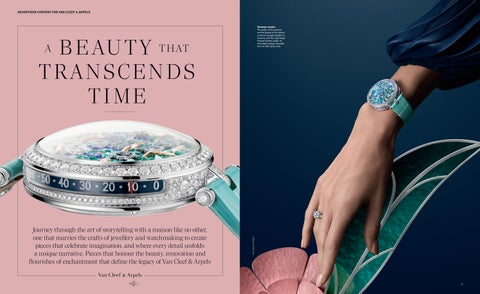
Journey through the art of storytelling with a maison like no other, one that marries the crafts of jewellery and watchmaking to create pieces that celebrate imagination, and where every detail unfolds a unique narrative. Pieces that honour the beauty, innovation and flourishes of enchantment that define the legacy of Van Cleef & Arpels
Timeless
Two lovers meet on a bridge; a young couple have their first kiss surrounded by twinkling lights and stars. Fairies grace the skies, ballerinas dance across dials and flowers flutter in an imagined breeze. Romance, enchantment and the beauty of nature have been part of the world of Van Cleef & Arpels since its beginnings.
There is a reason why this maison sees time differently, using stories as a way of examining our relationship with its passage rather than adhering to the constraints of 12-hour markers and sweeping seconds. Van Cleef & Arpelsâs romantic view of time is an integral part of its identity. Because as well as being a story about time, Van Cleef & Arpelsâs story is also about love.
The maison evolved out of the marriage of Alfred Van Cleef and Estelle Arpels, both of whom came from families of jewellery merchants, in Paris in 1895. This was the Paris of the Belle Epoque about to give way to that of the Art Nouveau.
In this era of optimism, progress and artistic innovation, Paris subsequently attracted charismatic individuals from all over the world who took up residence at the Ritz, where, across the Place VendĂŽme, Van Cleef & Arpels opened its first boutique in 1906; a boutique whose first piece sold, according to the sales register, was a heart set with diamonds.
Timepieces followed in 1906, cementing Van Cleef & Arpels as a pioneer in both crafts, forging the synergy between high jewellery and haute horlogerie that continues today.
âThe Poetic Complications collection perfectly embodies the Van Cleef & Arpels vision that time is not linear, but rather a poetic journey, made up of emotion and moments to remember,â explains Catherine Renier, president and chief executive of Van Cleef & Arpels. âThrough these watches, the maison offers a form of escape from the time of Cronos, an enchanted detour on which the minutes stop for a moment of contemplation.â
THE PHILOSOPHY OF BEAUTY
How a marriage, Paris and a new century made Van Cleef & Arpels the maison it is today. By Laura McCreddie-Doak
Floral tribute The intricate case of the Lady Arpels Heures Florales watch, below, continues the theme of nature marking the passing of time; the masterful attention to detail can be found in its engraving on the back of the case, left
These first two decades at the turn of the century were when Van Cleef & Arpels started to experiment with technical innovations; itâs a process of horological evolution that follows a direct lineage to the Poetic Complications pieces of today.
The double retrograde function, where two separate indicators move linearly to an end point before returning to their starting point, is a maison signature that first appeared in 1927 on a pocket watch on which a magicianâs arms were used to indicate the hours and minutes.
Its gem expertise was also honed during these early years, with exquisitely set cocktail timepieces such as the Cadenas watch, as well as the development of the Mystery Set technique in the 1930s, where the metal in which the gemstones were positioned seems to disappear under a sea of sparkle. It was also the period that defined its design language.
The influence of Japonisme, the Chinese art representations of nature, the shifting aesthetics of the period from Art Nouveau to the more stylised and abstract forms of Art Deco are all still present in its collections. The love of ballet and the world of dance comes from this period too. Long before Claude Arpels befriended legendary choreographer George Balanchine of the New York City Ballet, leading to a triptych of dances created by Balanchine in 1967 called Jewels, Louis Arpels would take his nephew Claude to the Opera Garnier to revel in the romance of ballet. It is a fitting discipline in which to seek inspiration because, like Van Cleef & Arpelsâs Poetic Complications collection, all the viewer sees is the beauty of the creation â the effort needed to create the spectacle is all but hidden from view.
âAutomaton watches are complex to make because they must reliably express the functions that indicate the passing of time,â
explains Rainer Bernard, head of watchmaking research and development for Van Cleef & Arpels. âOurs are even more complex because we add extra elements.
These watches are complex to create, but rewarding once they are finished and working beautifully
This complex dance of co-ordinating the most skilled in their respective arts is something that has been part of the maison since its inception. Today its exceptionally talented craftspeople are busy creating astonishing and arresting enchantments in time across ateliers in Paris and Geneva â alongside experienced experts in specific disciplines who bring their talent to these works.
Les Ateliers Horlogers de Van Cleef & Arpels, the maisonâs atelier in Geneva, Switzerland, is where time itself turns into timeless poetry â a poetry drawn from the many skilled hands dedicated to achieving the heights of technical excellence and craftmanship. Itâs a poetry also drawn from the jewels, gems and precious metals embedded in each manufacture.
Here, traditional crafts meet a spirit of invention that is as compelling and as delicate as the spectacle of time created on the dials of each watch. Together, all these core elements form the ecosystem that results in the beauty and elegance of the Poetic Complications collection.
This is what makes Van Cleef & Arpels so unique. Everything it creates is about time as a romantic concept â something to cherish because of the moments it affords us, whether that is noticing the flutter of a butterflyâs wing, being swept away on the pirouette of a dancer or remembering your first kiss.
There is a lightness to every story its dials tell, even if the philosophical questions it asks us to contemplate while looking at them are anything but.
Every model in the Van Cleef & Arpels Poetic Complications collection asks of us just one important thing: to live in time and take a moment to enjoy it.
Collection
Ballet has always been an important source of inspiration for the maison, and this is one of the first of its Ballerina brooches. It is also an art form that Van Cleef & Arpels has supported throughout its history. In recent years it has facilitated the creation of contemporary works as well as, through its Dance Reflections programme, globally supporting dance companies and institutions.
Horology rooted in creativity and the highest level of precision results in beautifully crafted scenes unfolding through time
When Van Cleef & Arpels started making watches in the 1900s, it brought to the world âdes bijoux qui donnent lâheureâ, or âjewels that tell the timeâ, writes Laura McCreddie-Doak
It is a theme and purpose indicative of the maisonâs desire to not see watches as merely functional objects but as jewels that are as precious as time itself. Nowhere is that philosophy more evident than in its Poetic Complications collection. Each timepiece is a story brought to life by the talents of skilled craftspeople. This is watchmaking in a class of its own; one that elevates emotion and romance over mere mechanics, turning the art of telling the time into an act of transformative poetry.
âThe poetry of time is telling time by telling a story and not just through the traditional means of watchmaking,â says Rainer Bernard, head of watchmaking research and development. He and the team are the magicians behind these intricate creations. âBy depicting a garden whose flowers open and close, or a shooting star you can actually see on the dial â itâs a secret way of telling time. You must hold the poetic key
We rely on the creativity of every designer, engineer, craftsperson and watchmaker
and pause to read the time. At first glance, a magnificent scene is revealed. Then a second look shows the beauty of passing time.â
The Poetic Complications dials tell a story, but they are also meditations on moments in time. Each watch acts as a reminder that romance exists in the everyday as well as in the exceptional. But what is particularly exceptional is the way these watches are made and the way the watchmakers at Van Cleef & Arpels manipulate mechanics and material science in order to create these poetic worlds in miniature.
It makes sense then that, at Van Cleef & Arpels, technology is at the service of creativity. Each timepiece starts with a creative idea rooted in one of the maisonâs worlds, be that love stories, âPoetic Astronomyâ, âEnchanting Natureâ or ballet and fairies. Its experts in research and development and its engineers then have to find a mechanical solution to bring this creative vision to life using specific mechanisms and bespoke complications.
Take, for example, the latest in the Pont des Amoureux series, which started with two lovers who kiss on a bridge at noon and midnight, that Van Cleef & Arpels unveiled in 2010.
and invention that goes in to developing the watchâs mechanics and grisaille enamel artistry, left
Making time The Lady Arpels Pont des Amoureux watch, above, distils the story of a lady in Paris who falls in love with a young man. They arrange a meeting on a bridge across the Seine, recreating a timeless story that recurs daily, at noon and at midnight, thanks to the skill
A moment of fleeting romance created by using a retrograde function, where the hands â the man and woman â do not make a complete turn of the dial, but instead return to their starting points and begin running again after covering the entire measurement segment, which here is the bridge.
All that innovation, coupled with the time it takes to assemble, was dedicated to the simple, beautiful moment of a loversâ kiss.
The skills required to conjure these worlds that inhabit 38mm cases are equally impressive and innovative.
âWatchmaking offers a wonderful opportunity to invent new techniques while enriching traditional crafts,â says Bernard.
âWe have especially deepened our knowledge of the enamelling techniques.â There are more than 15 different techniques
The art of grisaille enamelling
This rare craft was popular on watches in the 17th century and was particularly prominent in Geneva. Van Cleef & Arpels has been instrumental in reviving this technique. The process involves using a fine brush to apply layers of colour, often starting with the darker tones and gradually building up to the lighter shades, with each colour requiring a specific firing temperature.
Istarted with a sketch of large-headed flowers on a delicate stem, writes Laura McCreddieDoak A flower that is uncommon in nature, but which looked beautiful when drawn for a watch dial. âWhen I first saw it, I had to think for a moment,â says Rainer Bernard, head of watchmaking research and development at Van Cleef & Arpels. âI had to ask, âIs this possible mechanically?â No, but can we invent a system to make it happen? Maybe.â
Any other maison would ask the designer to go back to the drawing board. Van Cleef & Arpels is no ordinary maison.
Bernard and the team embraced the challenge and, over the succeeding four years, would find a way of bringing it to life.
âWe wanted to create a garden in summer, in morning light, with butterflies and delicate flowers moving in a breeze,â he says when asked what the original idea was for the timepiece.
âIt was about poetry, about showing how precious these fleeting moments are. The maison also wanted to see if we
On point Painting in enamel for a detail of the Lady Arpels
could create, mechanically, the effect of a breeze through the flowers.â
This may be whimsical, bending gear trains and escape wheels to the service of a story, but as Bernard explains, when it comes to bringing these dials to life there is no blueprint; this is high-level mechanics. âWe donât have a book for our complications. We have to invent them ourselves,â he says. For this summer garden, that meant working out not only how to create the irregular movement of the flowers when animated, but also how to move those top-heavy blooms on stalks too fragile to bear their weight. To do this, the team realised that in order for the flowers to move, they couldnât use the stem. Instead they would have to find a way to manipulate the blooms instead. And this being Van Cleef & Arpels, it all had to remain hidden in order to maintain the illusion. âWe created an automaton that sat under the base of the flower and pushed it,â says Bernard. âWe made the flower move, not the stem.â
Thatâs not the only technical marvel. Van Cleef & Arpelsâs Poetic Complications watches are works of art, but they are also precise. âIt takes 10 seconds for the butterfly to do a tour of the garden,â says Bernard. âIt wouldnât make sense for it to return to its previous position, so it comes to rest 10 seconds from where it started, and therefore it doesnât lose time.â To do this Bernard and the team had to create the gearing from scratch. The result is breathtakingly romantic. When the pusher at eight oâclock is pressed, the garden springs to life â flowers sway in the breeze in a graceful yet irregular motion, while the butterflies float around the outside. It is magical, elegant and playful.
To adorn the blooms, conical-shaped holes were created in the flowers set with the garnets before being reheated so that the enamel flowed back around the precious stones.
I had to ask, is this possible mechanically? No, but can we invent a system to make it happen? Maybe
âThe base for all our creativity is curiosity,â says Bernard when asked how the maison devises these complex solutions in order to make the dewdrops glisten on sculpted enamel petals.
âWe always design our watches to hide the mechanics. Even when you turn the watch over, the oscillating weight is there to hide the movement.â
Sleight of hand is the essence of Van Cleef & Arpels. These may function as timepieces, but they are not traditional watches. They are works of art and high craft, with time itself at their heart, its mechanics discretely hidden from view.
âSince the foundation of the maison, creativity has always been a central aspect of its identity,â say Bernard. âWe explore new ideas and stories all the time, and to bring them to life we innovate. But we never develop a new technique without knowing what to do with it later. Innovation is part of the creative process to realise a story. Our innovations of
casing, above
today are therefore always influencing our creations of tomorrow.â
Craft, tradition and innovation combine to ensure that Van Cleef & Arpels exists in a class of one. This is a maison that has been recognised 15 times by the Grand Prix dâHorlogerie de GenĂšve, the Oscars of the watch industry â including eight wins for Poetic Complications â with watches unlike any others. It has created timepieces that indicate the hour with opening flower heads, or feature a miniature recreation of planetary movements across the skies in real time. It has been awarded for an automaton on which gold and enamel lily pads float on rock crystal and chalcedony water that ripples as if stirred by a breeze, recreating the tender courtship of two lovebirds. The stunning Fontaine aux Oiseaux automaton took a team of experts in 20 fields 25,500 hours to create. There are timepieces with fluttering butterflies, the speed of the wing movements dictated by the wearerâs movements. It is a level of creativity most brands do not dream about, let alone attempt to replicate.
Maybe that is the real difference between Van Cleef & Arpels and other watchmakers â while they are competing to fill their dials and cases with complex constructions that are front and centre, this maison turns its focus on how to turn time into poetry, and in doing so bring a dose of wonder into the world.
Deep dive into the Poetry of Time at vancleefarpels.com
Since the foundation of the maison, creativity has been a central aspect of its identity