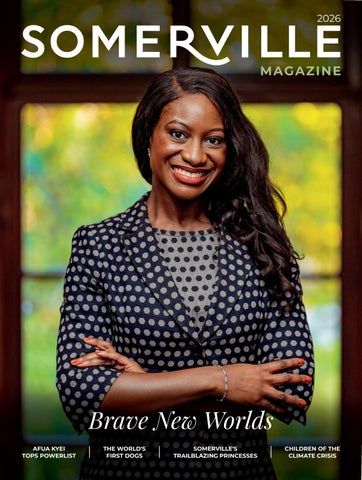
Brave New Worlds AFUA KYEI TOPS POWERLIST
THE WORLD'S FIRST DOGS
SOMERVILLE'S TRAILBLAZING PRINCESSES
CHILDREN OF THE CLIMATE CRISIS
2 SOMERVILLE MAGAZINE
Contents Foreword
3
News and People
4
The Year in Review
5
Igniting Change with Afua Kyei
6
Somerville and the Last Princesses of the Punjab with Faridah Zaman
10
Ashima Gulati on Children and the Climate Crisis
12
John Ingram on Our Uncertain Food Futures
14
Lachie Scarsbrook on the Ancient Genomes Revealing our Early Relationship with Dogs
16
Interview: Playwright Ella Road talks Robota
20
Bread and Hope on Ukraine’s frontline, with Felicity Spector
22
A Literary History of Silence with Kate McLoughlin
24
The Schmidt Fellowship: Partnering for More Equal AI
26
Thatcher at 100 with Zoya Yasmine
28
Profile: JCR Access and Admissions Officer Livia Demetriou
30
On Our Bookshelf: The Top Somerville Reads of 2026
31
Woodstock Road OX2 6HD Telephone +44 (0)1865 270600 www.some.ox.ac.uk Charity Registration number: 1139440
Cover: Afua Kyei, CFO of the Bank of England, on the day she was announced as the most influential Black Briton - see p6. Photo: TwinsDntBeg Editorial: Matt Phipps and Em Pritchard Design: Laura Hart Contact: communications@some.ox.ac.uk
SOMERVILLE MAGAZINE 3
Principal’s Message It is my great pleasure to welcome you to this year’s Somerville Magazine at the end of my first year as Principal.
I
must admit that it still feels faintly surreal referring to myself as Principal. I remember so vividly arriving here as a rather gauche girl from a Midlands comprehensive. Then as now, what got me through my first year were the very inspiring people around me – most of all, the Principal at the time, Daphne Park. She encouraged me to believe that I could pursue a career at the Foreign Office and embark on the adventures which, in due course, brought me full circle back to Somerville. My focus now is to help today’s Somervillians thrive and contribute to meeting the new challenges of the world we live in. By today’s Somervillians I don’t just mean our students. Our staff and our academics – particularly those in the early years of their careers – also need to be nurtured and encouraged. Our alumni and wider support network are exemplary in their commitment to Somerville, and it is a privilege to head that community as Principal. So how am I approaching the job? You may not be surprised to learn that at lunch on day one I was advised not to change anything. That’s the Oxford way: it’s worked like this for hundreds of years, so why change? But getting beyond that myth, I think we all recognise that Somerville has changed and adapted very successfully, and will continue to do so. I am fortunate to have taken over from Jan Royall, who steered Somerville to great success. In 2026, we find ourselves in a stable position financially, our academic delivery is world-class and, perhaps most importantly, Somerville knows what it stands for. For me, this is captured by the fact that we led the entire university towards sanctuary status, delivering on our founding promise to include the excluded with courage and conviction.
Credit: Oxford Atelier
So, we are building on solid foundations – but there is more to do. When the fees we receive from students only cover half our costs, we must find a way to move from stable to sustainable finances. We need to guarantee the future of our academic positions, and thereby the excellence of our offer in teaching and research, while nurturing young talent. We are on the RISE, but the campaign has more to deliver. Beyond these tangible needs, we must also meet the challenge of staying true to our values and focused on our core mission of education and intellectual advancement in a world where facts and freedoms are increasingly under attack. Somerville was born from a desire for women to be allowed to reach their full potential, and college still needs to shape future generations who can change things for the better. In the pages that follow you’ll see examples of Somervillians working to those ends not just here in Oxford, but around the world. You’ll read about the exciting research bringing us new understanding of prehistoric lives and of empire. You’ll meet the Thatcher Scholar who has deduced lessons from the Thatcher premiership for the generations that never knew her, and the researchers who are using AI to advance social justice and the fight against climate change. Elsewhere, our alumni highlight the beauty and fragility of our world. You will learn about the literary history of silence, how baking is keeping hope alive on the frontlines of Ukraine and why a brilliant young chemist chose to dedicate herself to working for the public good as CFO of the Bank of England. There is always more to do. But Somerville as a college and as a community continues to change the world – and that’s not going to change any time soon. Catherine Royle, Principal
4 SOMERVILLE MAGAZINE
The Richard Stone Scholarship in Engineering Science was created, in collaboration with Nicolas Geiger (2004, Engineering Science), to continue Professor Stone’s legacy at Somerville.
The Ratan Tata Building groundbreaking at Somerville College, September 2025
NEWS Building work commenced on the Ratan Tata Building, following a groundbreaking ceremony in September 2025. Somerville College Choir released ‘Divine Light’ in August 2025 and ‘Moonrise’ in May 2026, which was chosen as Georgia Mann’s Essential Classics Album of the Week on Radio 3. The celebrated composer and conductor Eric Whitacre was announced as Musician in Residence at College for the next academic year.
FELLOWS AND STAFF Our Senior Research Fellow in Linguistics, Professor Aditi Lahiri, was awarded the Linguistic Society of Germany’s Wilhelm von Humboldt Award for Lifetime Achievements in Linguistics. Former Principal Baroness Jan Royall was awarded an Honorary Fellowship in recognition of her extraordinary service to College during her eight years as principal. Mr Natarajan Chandrasekaran, Chairman of Tata Sons, was elected as a Foundation Fellow of Somerville College, in recognition of his instrumental role in enabling the Ratan Tata Building. Our Tutorial Fellow in Philosophy, Professor Karen Margrethe Nielsen, was awarded the title of full professor in the University of Oxford’s Recognition of Distinction scheme 2025. The 28th Anglo-German Colloquium was hosted at Somerville College in September, convened by Somerville’s Tutorial Fellow in German, Professor Almut Suerbaum.
Professor Patricia Owens, our Fellow and Tutor in International Relations, was awarded a three-year Major Research Fellowship by the Leverhulme Trust, and has also been elected as a fellow of the British Academy. Our Fellow and Tutor in Biochemistry, Professor Elena Seiradake, was elected as an EMBO Member, recognising her outstanding achievements in the life sciences. In this year’s Vice-Chancellor’s Awards, Claire Cockcroft and the Skills Hub were highly commended for the Support for Students Award, and our Senior Research Fellow, Professor Patricia Kingori was shortlisted for the Making a Difference Globally Award. Our Senior Research Fellow Professor Rajesh Thakker received the Association for Bone and Mineral Research (ASBMR)’s William F. Neuman Award.
ALUMNI Three Somervillians were elected as Honorary Fellows in June 2025: Professor Kamila Hawthorne OBE (née Ebrahim, 1978, Medicine), Chair of the Royal College of General Practitioners; Dr Anne Makena (2012, DPhil Chemical Biology), Co-Director of the University of Oxford’s AfOx Initiative; and Professor Emma Smith (1988, English), Oxford University’s Professor of Shakespeare Studies.
Dr Katerina Kaouri (1999, MSc and DPhil, Applied Mathematics) received the Hedy Lamarr Prize from the Institute of Mathematics and its Applications. Dawn Ohlson (1990, Engineering and Computer Science) was elected President of the Institution for Engineering and Technology. Professor Julia Aglionby (1988, Biology) has been appointed a life peer in the House of Lords.
STUDENTS Reuben Smith (2023, Chemistry) and Ishani Mookherjee (2022, Law) were announced the winners of the 2025 Pat Harris Spirit of Somerville Award. Evan Garg (2025, Engineering) and Reyna Bulchandani (2025, Maths and CompSci) were co-winners of Oxford Edge’s 2026 Hackathon with their app which uses machine learning to help small scale farmers in Kenya plant the right crops at the right time. Somerville College Boat Club maintained the top rank in the number of bumps per crew at Summer VIIIs, achieving 17 bumps from 5 crews. DPhil student Nethmi Kariyawasam and her teammates were European co-winners of the Global Sustainability Challenge for their design of net-zero Data Centres. Sophie Stewart (2024, German) and Anwen Jones (2024, French and German) worked with undergraduates from Queen’s College to translate and publish fragments by Ingeborg Bachmann in a collection published by Taylor Editions.
Honorary Fellow Afua Kyei (2000, MChem) was named the UK’s most influential Black person in the 2026 Powerlist, in recognition of her work as CFO for the Bank of England (see feature, p6). Honorary Fellow Professor Dame Elan Closs Stephens (1966, English) became the first woman President of the Learned Society of Wales. Susie Dent (1983, Modern Languages) returned to Somerville alongside national treasure Alan Carr to film their Channel 4 quiz show ‘Secret Genius’.
Alan Carr and Susie Dent at Somerville for ‘Secret Genius’ filming, June 2025
It’s been a packed year at Somerville, with a new Principal, a new building underway and much more besides. Here’s a whistle-stop tour of the highlights. 09 DECEMBER
07 FEBRUARY
03 MARCH Behind the Lines We welcomed former diplomat Arthur Snell for a recording of his podcast ‘Behind the Lines’, featuring Sanctuary Scholars, Hadeel Abdelseid and Nikita Vorobiov in a conversation about resistance and human rights.
Alumni Carol Concert
Supporters’ Lunch
Somerville College Choir were as sublime as ever at our annual carol service organised by The London Group, which this year took place amid the medieval splendour of Temple Church.
Thanking our supporters is always a pleasure, this time with a research showcase from our Junior Research Fellows, and a moving speech by Sanctuary Scholar Zeinab Mohamed over lunch in Hall.
10 MARCH
14 MARCH
21-22 MARCH
Spring Meeting and Sanctuary Concert
History Day and Barbara Harvey Memorial
We welcomed guest speakers Gill Bennett OBE (1969, History) and Sir John Scarlett KCMG for a compelling discussion on Russia, followed by a concert fundraising for our Sanctuary Fund.
History alumni enjoyed a research showcase from students and academics, and celebrated the endowment of the Liz Cooke Fellowship, followed by a memorial for Fellow Emerita Barbara Harvey.
23 MAY
30 MAY
Dorothy Hodgkin Memorial Lecture Noted science writer Georgina Ferry delivered a fascinating lecture on the legacy of Dorothy Crowfoot Hodgkin, our Nobel Prize-winning alumna and College’s first Tutor in Chemistry.
15 MAY
Penrose Society Lunch We celebrated the generosity of the Penrose Society with a talk by Professor Kate McLoughlin (1988, English, see p24), a concert by the Somerville and St John’s College Orchestra, and a delicious lunch in Hall.
James Bryce Memorial Lecture The James Bryce Lecture made a triumphant return, as Dame Karen Pierce compared her diplomatic career to that of James Bryce, who, like her, served as British ambassador to Washington.
Lightroom London Networking Evening Alumni of all ages were lucky enough to attend the Lightroom London show ‘David Bowie: You’re Not Alone’ following a special introduction from curator and Lightroom director Tommy Wide (2003, Classics and Oriental Studies).
6 SOMERVILLE MAGAZINE
SOMERVILLE MAGAZINE 7
AFUA KYEI:
Igniting Change Afua Kyei is Chief Financial Officer of the Bank of England, an Honorary Fellow of Somerville College and was named #1 on the Powerlist 2026. She joined us to explain the motivations behind her extraordinary career.
I
f there is a golden thread running through Afua Kyei’s life, it’s the drive to find new ways of helping others.
It first began when Afua was a teenager, volunteering at Oxfam and giving out sandwiches to the homeless with her auntie. Behind those practical efforts lay her long-standing desire to become a doctor, inspired by her mum’s example as an NHS midwife. Once Afua reached her A levels, her mum was there again, this time to remind Afua that she could consider careers beyond medicine. Afua was showing real promise in chemistry by this point, having won the chemistry prize at school. “I had an amazing teacher and I thought, well, rather than being a doctor, if I become a chemist, perhaps I’ll be able to help create a drug to help with the effort to cure cancer.”
Continued on page 8
8 SOMERVILLE MAGAZINE
In her fourth year, Afua was chosen to join the research group of the Waynflete Professor of Chemistry Sir Jack Baldwin for her Part II research project. This was a great accolade, but not without pressure – and for the first six months none of Afua’s experiments produced new breakthroughs. It was here, when things looked like they might go wrong, that Afua learned some of her most important lessons. “The Part II taught me the importance of persevering, of looking at a problem from multiple angles, but also having the humility to talk to other people when you get stuck.” It was by talking to Professor Baldwin, and his colleagues Dr Victor Lee and Dr Rob Baldwin, that Afua broke her research deadlock. She created 70 new anti-tumorous molecules that year, and her Part II work was published in an international journal. More importantly, Afua’s experiences on the Part II created a blueprint for problem-solving that she still relies on today. “I think the scientific method I learned at Oxford translates well to finance because it’s evidence-based and data-driven, but you also learn to be creative, to try new things without fear of failure and distil complex problems into narratives that can be easily communicated.”
Afua arrives for an interview with Sky News. Credit: TwinsDntBeg
The Part II taught me the importance of persevering
If Afua was going to read Chemistry, there was only one place to do it. “I wanted to study at Oxford because I knew it had the most intense chemistry degree in the UK, respected around the world for the quality of the intellect and innovation it produces. I also liked the fact that, beyond the core fundamentals like quantum mechanics and organic chemistry, I could take options in the history and philosophy of science, as well as some German.” Afua arrived at Somerville in 2000, and loved the next four years. She paints a picture of a vibrant intellectual scene: learning to hold her own in tutorials with multi-talented tutorial partners, exploring the curriculum, and relishing the opportunity to work alongside world-famous chemists, postdocs and students at other colleges.
Following a Junior Research Fellowship at Princeton, Afua set to work applying these lessons. She qualified as a Chartered Accountant with Ernst & Young in 2007, after which her progress was meteoric: five years as an investment banker at UBS, then seven years at Barclays, where she rose to Chief Financial Officer, Mortgages. In 2019, Afua was appointed Chief Financial Officer of the Bank of England. She was just 36 years old, making her the Bank’s youngest executive Director and first Black executive director in over 332 years. The years since Afua joined the Bank may have been characterised by turmoil in the outside world, but within its walls there has been steady forward progress. One of Afua’s proudest achievements, she says, was modernising the loss-making historic funding mechanism by which the Bank covered its policy costs. In its place, Afua proposed the groundbreaking “Bank of England levy”, which required primary legislation. This means that the Bank is now able to recover 98% of its costs while giving its stakeholders greater transparency around the charges they pay.
SOMERVILLE MAGAZINE 9
“Negotiating the levy required a great deal of stakeholder management, working with our Markets division across the Treasury and banks, but the result is a system that works better for everyone.” Afua’s successful creation of the levy embodies all the learning from her years at Oxford. But how does a role in finance link back to the girl who dreamed of being a doctor, or the student who wanted to cure cancer? One answer is that Afua has advocated tirelessly for diversity and equality over the years. She currently serves as the Bank’s Executive Co-Sponsor for both DEI and Climate Change disclosure, and works hard to ensure that the financial sector truly reflects the diversity of our society. A better answer is that Afua feels that the work she does for the Bank is the best way by which she can help the most people. “I’m very conscious that we’re here to serve society. The decisions we make influence every household, every business and British society as a whole, so the work feels deeply purposeful.” Earlier this year, the Powerlist recognised Afua’s professional and cultural contribution
Afua and friends in her Somerville days
by naming her the most influential Black person in the UK. With typical generosity, Afua’s reflections on this accolade focus on how her story might benefit others. “I thought it was great that somebody from the business world was recognised, because that’s something tangible young people can relate to. I think it showed that, even if you are doing a normal job, you can use your influence to help others.”
Afua at the Powerlist Awards ceremony with her family, including husband Robert Dickinson (2000, History)
The decisions we make influence every household, every business and society across the UK
10 SOMERVILLE MAGAZINE
Somerville and the
Duleep Singh Sisters Dr Faridah Zaman is Associate Professor of the History of Britain and the World, and Fellow and Tutor of Modern History at Somerville. Her research interests include political and intellectual history in global and imperial contexts, and the role of religion in the history of ideas.
T
he University of Oxford has witnessed many seismic changes over its long and storied history, including the founding of its first women’s colleges in the late nineteenth century. Among them was Somerville: not only one of the first women’s halls, but also the first to be founded as a non-denominational institution. We note this fact whenever we discuss Somerville’s establishment, but we rarely ask what this meant in the context of late-nineteenth-century Oxford. Until the Universities Tests Act of 1871, individuals could not take higher degrees or hold fellowships and professorships at Oxford or Cambridge if they did not subscribe to the thirtynine articles (the ‘religion tests’) of the Church of England. The abolition of tests in 1871 was therefore a significant milestone, confirming the University’s liberalising intent. It was regarded by many as a victory for a broad-minded vision of the British nation itself. While this moment was important in opening the University to people of all faiths and none within Britain – especially non-Anglican Christians and Jews – my research suggests that it was also crucial for another group: students from outside Europe. It was only from the 1870s onward that students from India and elsewhere began to appear in alumni registers. Many of these non-European students joined colleges, but a considerable number were ‘non-collegiate’ – they could study and earn degrees, but remained outside the privileges of college life. Some colleges argued that the presence of too many Indian students threatened the harmony of the student body. Non-collegiate students, in turn, bitterly regretted their inferior treatment. This history might cast a different light on Somerville’s early years in several ways. First, it reinforces the significance of its founding as a non-denominational college. Secondly, it helps to reframe the experiences of several Indian women at Somerville in the 1880s and 1890s. They joined Oxford at a time when the presence of students from India and other parts of Asia and the Middle East was no longer a novelty, but when questions of race and nationality now operated in more informal – and perhaps more pernicious – ways. Though women as a whole, of course, experienced other, arguably more profound exclusions at the University, Indian women at Somerville were able to enjoy student life in a way sometimes denied to their male compatriots.
For the historian, the Duleep Singh sisters resist easy categorisation
SOMERVILLE MAGAZINE 11
Somerville Hall 1891 - the Duleep Singh sisters are front left, with Cornelia Sorabji behind them. Credit: Somerville College Archives.
Two notable early Somervillians were the sisters Bamba and Catherine Duleep Singh, daughters of Maharaja Duleep Singh, the last ruler of the Sikh Empire in Punjab. Both studied Modern Languages in Somerville from 1890 to 1894. We don’t know precisely how they regarded their positions in Oxford, but for the historian, they resist easy categorisation. They were Indian – the daughters of an Indian ruler – but their father had been deposed by the East India Company in 1849 and virtually exiled to Britain thereafter. The sisters were born and raised in Britain and were, in many respects, model English women. What’s more, though they were the descendants of the last Sikh Empire, their father had converted – possibly under duress – to Christianity as a child. He subsequently married a woman of Ethiopian German heritage, who was herself raised by missionaries in Egypt. Their children were raised as devout Christians.
to ‘return’ to India, settling in the Punjabi capital, Lahore. She spent much of her life attempting, unsuccessfully, to recover her father’s birthright. The liminality present in even this brief account of Bamba and Catherine’s lives suggests that to see them as simply two ‘Indian princesses’ at Somerville would be to overlook the considerable complexity that underlay their lives, both within Oxford and beyond it. And though their lives were atypical, they highlight a wider lesson for writing histories of Britain in this period. British life was a composite of different peoples; the sisters remind us that those peoples, in turn, carried composite histories of their own.
Considerations of class and privilege add further complexity. The sisters enjoyed an aristocratic upbringing in Elveden Hall in Suffolk, which the Maharaja had remodelled to resemble a Mughal palace. But by the time they arrived in Somerville, their fortunes were devastatingly transformed: their father had left the family to return to India in an attempt to reclaim his throne, and their mother had died shortly afterwards. After Somerville, Bamba and Catherine, along with their younger sister Sophia Duleep Singh, ‘came out’ at a debutantes’ ball in Buckingham Palace in 1895. But thereafter, they charted their own courses as women in a changing Britain – and, indeed, a changing British Empire.
The Duleep Singhs’ lovingly decorated study on the top-floor of ‘West’, now Park. Credit: Somerville College Archives
In the early twentieth century, the three sisters were variously involved in suffrage politics, anticolonialism, and the support of Jewish refugees from Germany. Bamba, as the eldest daughter of the last Maharaja, was the only sibling
Read more of Faridah’s research in ‘Provincialising Oxford: Empire, Religion, and the Idea of the University’, English Historical Review (forthcoming). The Last Princesses of the Punjab exhibition is on at Kensington Palace until 8th November.
12 SOMERVILLE MAGAZINE
Children who took part in the Chintan Climate Youth Club in New Delhi
THE QUESTIONS I BROUGHT TO SOMERVILLE:
Children, Climate Change and Education Somerville’s Indira Gandhi Scholar Ashima Gulati (2024, MSc in Sustainability, Enterprise and the Environment) is a policy consultant working at the intersection of education, healthcare, and climate change to improve the well-being of marginalised communities.
W
hat does climate change look like when you begin not with a graph, treaty or target, but with a child simply describing the place where they live? This is the question that has followed me from New Delhi to Oxford, driving my research into public policy and sustainability. Before coming to Somerville, I worked with children in New Delhi, first as a teacher and later through climate change education programmes in low-income communities. Some of this work was with children living near the Bhalswa landfill, one of Asia’s largest landfill sites. For many families who work in waste-picking and recycling in these areas, waste is
both a source of livelihood and a source of continued risk, shaping the air they breathe, the water they use and the conditions in which their children grow up. I had started at the programme using language such as emissions, global warming, adaptation and resilience. These words are important in helping us describe a complex planetary crisis. But the children I worked with were not facing climate change in the abstract. They knew it through the smoke from landfill fires that entered their homes and classrooms. They knew it through the smell of the waste, the extreme heat, the rare access to drinking water, their illnesses, and the absence of a safe space to play.
SOMERVILLE MAGAZINE 13
The lived experiences of these children made me realise how environmental and climate risks cannot be separated into discrete categories. A child might begin by talking about the smell from the landfill, and then move to a parent’s work sorting waste, then to coughing, then to the difficulty of studying in the heat. The conversations did not follow the clean structure of a curriculum, but the struggles of their everyday lives. The children already had knowledge of their surroundings, their health, and the changes they wanted to see. What surprised me most was not that the children had this knowledge, but how quickly the quality of the discussions changed once we began from their own lives instead of climate science. When climate education was presented in a standard template, children could repeat facts such as “greenhouse gases trap heat”, and “plastic causes pollution”. But when we asked them to map their neighbourhoods, describe the hottest parts of the day, or identify what made some families or areas more exposed than others, the conversations became difficult and more honest. The children began to draw connections between waste and work, between heat and their concentration in class, between the places where wealthier people lived and places where the city’s
An illustration from the picture book created by the children, depicting life in the Bhalswa landfill.
waste was dumped. They began asking why some neighbourhoods seemed to have more trees, cleaner roads and better public facilities than others. They also started wondering who was responsible for fixing these problems.
Children cannot recycle their way out of already polluted air Ashima at the Bhalswa landfill during her time working with the community there.
This made me think differently about climate education. Most mainstream climate education is framed as an awareness tool to teach children climate science, encourage them to change their behaviours and influence their families, and shape them into environmentally responsible adults. These are important objectives. But awareness alone is an inadequate response where children are already living with the consequences. Children cannot recycle their way out of already polluted air. They cannot solve extreme heat in a crowded classroom without fans, shade, water or reliable electricity. These children cannot and should not be asked to carry the moral weight of “saving the planet” when the systems around them continue to distribute the risk unequally in the society. This does not mean that climate education should leave children feeling powerless or that it should avoid scientific knowledge. It means that it should be honest about responsibility and reality. Climate education should help children understand what they can do, but also what they should not be expected to solve alone. It should give them language for what
they are experiencing, while making clear that governments, businesses and communities have duties towards them. This balance between agency and responsibility was highlighted when we co-created a storybook with the children about waste, pollution and climate, based on their own observations and imagination. The storybook did not present the children as helpless victims, but neither did it turn them into young heroes who could individually transform their neighbourhood. Instead, the story held together the complicated truth that children could have ideas, agency and voice – and that meaningful change is still dependent upon collective action by adults and institutions. What would climate education look like if it began with children’s lived realities, especially of those who are already facing environmental and climate injustice? And what might climate policy learn if children were treated not only as a vulnerable group to be protected, but also as observers, storytellers and public voices with something important to say? As I continue my work on climate change, education and child well-being, these are the questions to which I return.
14 SOMERVILLE MAGAZINE
NAVIGATING OUR UNCERTAIN FOOD FUTURE Above: John visits Gloucester Green Market, Oxford, July 2026.
Associate Professor John Ingram is the founder of the Food Systems Programme at the Environmental Change Institute and a Senior Research Fellow of Somerville College.
T The value of stress-testing increases with the richness of stories developed
he food system is fundamental to society. In addition to providing our food, it sustains livelihoods and businesses from primary production to processing, logistics, retail and hospitality. It also generates complex debates over its impacts upon anthropogenic greenhouse emissions, environmental degradation, animal welfare, land use and health. So, while the present benefits and challenges are well documented, there is growing concern about the sustainability and resilience of our food system in the face of an uncertain future, and in particular the impact of various economic, social and environmental stresses and shocks.
We have seen these stresses and shocks unfold in real time over the past decade. Brexit, COVID-19, disruption to global trade agreements and conflict in Ukraine and the Middle East have all been significant shocks, overlaid by stresses due to, for example, changes in demography and the emergence of populist politics. These shocks and stresses are further compounded by climate change leading to droughts and floods. But what more is coming down the track, and how do we formulate strategies to ensure a future balance across health, other social and economic priorities and the environment, given the uncertainty of the future?
SOMERVILLE MAGAZINE 15
One approach now gaining traction in private and public sectors is to develop plausible stories of future conditions. Such stories – ‘scenarios’ – aim to capture key uncertainties which are anticipated to have a significant impact on our food system. Scenarios are based on combinations of such uncertainties. As mentioned above, there are numerous uncertainties that will impact our food futures.
Exploring food futures The World Economic Forum’s Global Risks Report 2026 lists geo-economic confrontation and extreme weather as the top concerns over the short and longer terms, respectively. Both of these clearly pose significant risks to our food system, and their magnitude and/or speed of manifestation is unknown. Based on these, we can therefore imagine four plausible futures characterised by either major or moderate geo-economic confrontation, coupled with either major or moderate increase in the incidents and severity of extreme weather. Four scenario storylines A-D can then be developed, which each describes one of these four combinations. Now imagine two of the four combinations. First, a world characterised by major geo-economic confrontation and a major increase in extreme weather. In this future, there would be significant disruption to food trade either by blocking logistics and/ or undermining trade partnerships. As the UK imports about 50% of our
The UK's fresh fruit and vegetable market is highly dependent on complex, international supply chains. Credit: Gary Davies/Alamy
food from areas of the world where production is likely to be adversely affected by extreme weather, this would have a major impact on our food security. Strategies should therefore aim to maximize domestic production. Second, imagine a different trajectory characterised by minor geo-economic confrontation and only a minor increase in extreme weather. This would be very different in terms of food system disruption compared to the first scenario. In this case, strategies could assume a relatively status quo situation in terms of importing food, so strategies to boost domestic production would go ‘on the back burner’. While we may prefer the latter to the former, both are plausible, although the trajectory of change for each is uncertain. The value of developing these scenarios is not the stories themselves, but the opportunity to consider the viability of a proposed strategy or policy within each future world. If the success of the given food trade strategy in our original example is dependent on a low risk of geo-economic confrontation, coupled with a low likelihood of extreme weather disrupting agricultural production in the world’s bread baskets, it is probably not a robust strategy, as this more benign world may not transpire. It would therefore be better to develop, and test, a given strategy(s) against the conditions of all four worlds to determine
its efficacy across a range of plausible futures. The value of this ‘stress testing’ increases with the ‘richness’ of the stories developed for each scenario, as many details related to the principal uncertainties may also impinge on the efficacy of the particular strategy. Another important aspect of the method is to co-develop the storylines with stakeholders. This makes the exercise more useful as they are better able to imagine how the conditions in the future worlds would unfold and hence affect their strategies. This strong stakeholder engagement for scenario analysis has been the backbone of the research I have undertaken as part of the Foresight4Food international initiative, hosted by the University of Oxford’s Environmental Change Institute. In my experience, it is the very process of co-producing scenarios that is most valuable. This is because it helps diverse stakeholders build relationships by exploring options together in the ‘safe space’ of hypothetical futures. This can be particularly useful when involving both government and private sector stakeholders, as scenario exercises in the UK and in numerous countries around the world have shown. Conducted rigorously, scenario exercises help planners and strategists navigate the profound uncertainties of the future for our food systems.
Old Dogs, New Tricks
SOMERVILLE MAGAZINE 17
Somerville’s Junior Research Fellow Dr Lachie Scarsbrook, a geneticist from Aotearoa New Zealand, is taking the archaeological world by storm with his pioneering research on the relationship between ancient dogs and humans. Rapidly becoming known as ‘the dog guy’, with major publications in both Nature and Science, it's clear that Lachie is just getting started.
A
ncient DNA is the closest thing we have to time travel. The fact that I can take a bone from an animal that died thousands of years ago, sequence its genome and understand where it came from, and how it interacted with the world, is truly incredible. I discovered the field of Bioarchaeology by accident. As an undergraduate I studied Geology and Zoology, and started looking for a way to combine the two. The obvious choice was Palaeontology, so I signed up for a master’s to work on fossil dolphins, but my heart wasn’t in it. While excavating a moa skeleton in Central Otago, I met a guy who, despite the heat, showed up in a full body clean suit, mask and gloves. He told me he was there to sample ancient DNA and I immediately thought: ‘now that’s what I want to do’. So I jumped ship, kept my supervisor in Geology, got a new one in Zoology – and the rest is (ancient) history. Bioarchaeology was the perfect marriage of my two degrees.
Continued on page 18
Left: Artistic reconstruction of Pınarbaşı c.15,800 years ago based on evidence from archaeological excavations by University of Liverpool. The illustration shows dogs living alongside humans, sharing food, and being buried alongside human remains. Illustration by Kathryn Killackey.
18 SOMERVILLE MAGAZINE
Lachie Scarsbrook with an exact replica of the 15,000-year-old dog mandible from Gough’s Cave, UK.
Humans and wolves had to find ways to get along – or die.
(Continued from page 16.)
I started my research in Bioarcheology by focusing on reconstructing Aotearoa’s lost ecosystems. However, moving to Oxford for my DPhil changed the scale of my research, allowing global collaborations like the one that led to our recent front-cover of Nature. Using ancient DNA, we identified the world’s earliest known dogs at archaeological sites in the UK and Türkiye. These dogs lived alongside Late Upper Palaeolithic hunter-gatherers, approximately 16,000–14,000 years ago, which is millennia before any other domestic animals or plants. Pushing back the earliest evidence of dogs by over 5,000 years was a huge discovery, but what I find remarkable is that humans had already established a deep connection with these early dogs.
They were being treated, both in life and death, like people. Now that we know dogs had been domesticated by 16,000 years ago, we begin to pinpoint the timing and catalyst of this enduring relationship. The process certainly didn’t happen overnight. We estimate that it must have started around 25-20,000 years ago, leaving enough time for dogs to become genetically, morphologically and behaviourally distinct from wolves. This timing coincides with the last Ice Age, when northern Eurasia was covered in kilometre-thick ice sheets, and everything had to migrate south into refuges that were optimal for living. My theory is that, forced into close contact, humans and wolves had to find ways to get along – or die.
SOMERVILLE MAGAZINE 19
extinct species like moa, which have no living close relatives. In either case, it’s like trying to do a jigsaw puzzle without a picture: you’re missing half the pieces, and have “contaminant” pieces from many other boxes – complicated, but possible.
Nature, March 2026
At that point in time, there was no concept of domestication, or theory of natural selection, so the transition from wolves to dogs would have been slow and gradual, with no one in the driver’s seat. Wolves that lived at the fringes of human encampments that were less likely to harm people would have been free to roam, but more aggressive individuals would have been killed. Over time, this tolerance must have had some mutual benefit.
For my next project, I’m researching when and why humans started selectively breeding dogs. In a recent paper, we discovered that small-brained dogs, like terriers, started appearing in the Neolithic, but it was the Romans who first bred dogs for aesthetic purposes. In both classical artworks, and the archaeological record, we see specialised types of dogs emerge – hunting dogs, guard dogs, and even lap dogs. Today’s breeds, however, were only ‘invented’ in the Victorian era, entangled with the dark history of eugenics. I’m interested in examining the roles dogs have played in human societies over the last 10,000 years, and how this selection has shaped their genomes. With so much left to uncover about humans and their canine companions, the dog days certainly aren't over yet.
Reconstructing ancient DNA is like trying to do a jigsaw puzzle without a picture
One of the earliest uses of dogs would have been as camp guards, barking when predators or rival bands of huntergatherers approached. Later, when the climate warmed, and humans crafted new kinds of stone tools to hunt smaller animals, dogs likely became useful in retrieving wounded prey that humans couldn’t see in the forest. Early dogs might also have been used as living blankets – in the same way that some Aboriginal communities today still use dingoes to keep warm overnight. The stories we can tell using ancient DNA fascinate me, but the process of recovering and reconstructing these sequences is compelling in itself. Unlike DNA in living cells, ancient DNA is broken into tiny fragments, which we have to stitch back together computationally into genomes. This often involves using a modern genome as a guide. Though this is hard for dogs, it’s much easier than for
Lachie and his MSc student Alex take a sample of kurī (Polynesian dog) hair from a Māori kaitaka cloak at the Cambridge Museum of Archaeology and Anthropology.
20 SOMERVILLE MAGAZINE
ELLA ROAD
Talks
Robota
Award-winning playwright Ella Road (2010, English) joined us to talk about her experience writing and staging Robota, the first play ever staged at the Schwarzman Centre for the Humanities. Adapted from Karel Čapek’s 1920 play R.U.R., Robota asks urgent questions about big tech, the uncanny valley of AI, and how everything, even our relationships, is governed by algorithm. Robota on stage. © Helen Murray
Your plays often put big ideas front and centre, whether that’s AI, gender in sport or genetic ethics. Do you think that art can change anything by engaging with topics like these? I think theatre has always been the forum where we discuss things that feel relevant to being alive, whether that’s love or war or an ailing king. Historically, people went to the theatre to be educated, and I think it still serves that function today. At the same time, I don’t know if it is important for art to change the world. It’s more that it’s a necessary part of our culture as humans to tell stories and explore alternate realities in order to understand what we want to do or should do, or dream of doing. The theatre is a place where everyone can explore that.
AI is a reflection of ourselves, so we need to make some pretty quick changes to our society if we want to live with it
How did your research into AI shape how you felt about the character and themes of the play? I got really fascinated by trying to drill down into what the difference is between the way that we think and how the algorithms that we’ve programmed think. And the more research I did – including speaking to philosophers at the Schwarzman – the more I realised that you can’t ever know what consciousness is and no one has actually ever come up with a satisfactory definition or way of testing it. So I was fascinated by the idea that, even though I know that I am different to an AI, I can’t prove it.
SOMERVILLE MAGAZINE 21
Did your research influence your decision to focus more on the possibility of a gendered exploitation of AI? I’m thinking here about the gendered ending of the title and the blurring of the human and robot female leads. Definitely. I think that the fact that the gender politics in the original play are so dated spurred me on to explore gender as a central theme, and the research bore out the assumption that living in a patriarchy means that the people who are disproportionately impacted by AI are women. I did some deep dives in my research into deep fake pornography, and I particularly recommend Laura Bates’ The New Age of Sexism. Even the fact that the AI is coded overwhelmingly by men and based off inherently misogynistic datasets from the public domain means that, as a woman, you are essentially on the receiving end of discrimination all the time from this technology. Are you troubled by the thought of a post-human intelligence that replaces humanity or do you embrace it as Robota perhaps does? As a human being, I feel very uncomfortable about the idea of a post-human society and I imagine that’s a natural biological aversion. But I also think it’s too late to have that aversion, because we’re already sharing our society with another intelligent non-human being. There seems to be a lot of disagreement as to whether Artificial General Intelligence is a year away, four years away or already here. But either way, the horse has already bolted, you know? That means it’s not about being for or against AI. It’s about how we choose to interact with it, collaborate with it, or mitigate its influence. Ultimately, of course, AI is a reflection of ourselves, so if we want to live with it, we need to make some pretty quick, pretty far-reaching changes to the society we’re living in.
Ronke Adékoluéjó and Umi Myers in ‘Robota’, © Helen Murray
And are you confident about our governments’ or the tech sector’s ability to regulate AI? I’m generally fairly cynical about our ability to regulate those sorts of oligarchical structures. You know, have we managed to regulate oil or curb climate change? We’re never going to win against big tech through debate or voluntary self-regulation, because of the profit imperative. It has to be regulation, and we’ll have to force it from the bottom up. How did reading English at Somerville influence your development as a writer and performer?
Umi Myers, Ian Drysdale, Ronke Adékoluéjó in ‘Robota’ © Helen Murray
Well, I definitely spent a lot of time making plays when I probably should have been in the library! But my tutors, Fiona Stafford and Annie Sutherland, were also incredibly supportive. I used to tell them all about the plays I was doing. Then, when I won my place at the Oxford School of Drama, Somerville was brilliant: they gave me a grant to support me pursuing this slightly crazy creative dream, and it massively helped. It was a very encouraging sort of goodbye and good luck!
22 SOMERVILLE MAGAZINE
FELICITY SPECTOR:
BREAD and WAR ITN Journalist Felicity Spector (1985, PPE) helped organise her first convoy of bakery equipment into Ukraine in 2022. Last year, her book Bread and War revealed how baking acts as a lifeline for Ukrainian identity and resistance. Four years into Russia’s invasion, she provides a despatch from Ukraine today.
T
he highway from Mykolaiv to Kherson tells the story of Russia’s war in Ukraine in a single journey. First, you will drive through the city, past the Silpo supermarket, past couples walking their dogs, past cafes and tyre repair places and shops selling military gear. Next come the small village houses wrecked by shelling, petrol stations burned to ruins. Sometimes, under the treeline, you make out mobile fire teams, soldiers manning machine guns mounted on pick-up trucks, ready to shoot down any incoming drones.
Felicity Spector in Ukraine
Soon you enter a tunnel made of fishing nets and metal frames: it stretches above the road as far as you can see. There will be a traffic light, where green means no imminent danger from FPV drones. These are the latest deadly Russian threat to frontline cities like Kherson: small drones carrying an explosive payload, stalking civilians in their cars or on bikes or in buses. The fishing nets provide some protection, while people who can afford it clutch a drone detector. The most popular brand is called Chuika, which means ‘sixth sense’.
A 'Sixth Sense' drone detector
Next you will pull up at a military blockpost where you sign a form accepting that your journey now involves “risk to life”. You pass the famous monument at the city entrance, but it seems unwise to jump out for a photo. You will not encounter much traffic. You will not wear a seatbelt. You will swerve past entire blocks with windows boarded up, a furniture store reduced to a burned-out shell, concrete bomb shelters next to bus shelters. You will stare at the screen of the drone detector like your life depends on it, because it does. The last time I went to Kherson was in May, with my friend Oleksiy and his colleagues from the Integra charity. They were transporting generators to local authorities, to keep key services going during blackouts. It had taken a huge amount of organisation, from getting the donated equipment through customs to finding a lorry driver willing to make the dangerous journey from Kyiv. The generators were gratefully received: the head of the city council made a thank-you speech, while the warehouse staff unloaded everything
SOMERVILLE MAGAZINE 23
Scenes from Felicity's journey to Kherson, including Serhiy and Svitlana preparing food that day.
with calm efficiency. The foreman carried a drone detector under his arm: health and safety, Kherson-style. On a previous trip in December, with chef Oleg Bibikov from the Iskra Dobra charity, I visited a hot food kitchen in the suburb of Chornobaivka. Svitlana and Serhiy were busy portioning out chicken wings, fresh bread and macaroni into polystyrene tubs, ready to be loaded into a van. We followed as Serhiy drove at breakneck speed through the city centre, heading to a humanitarian hub in the Dniprovsky district, an area plagued with FPV drones. A small crowd of elderly people were waiting patiently in the basement: all of them had fled their homes in nearby Antonivka, which had been largely destroyed by Russian shelling. Once the food had been distributed, the guys went outside for a cigarette. Almost immediately there was a distinctive whining, buzzing sound and the shout of “Drone!” As everyone clattered down to the basement there was an explosion: whether the thing had landed or been shot down was not immediately clear.
The drive back to the Chornobaivka kitchen was nervy and brisk, Serhiy shouting directions as we rattled across tram tracks and down deserted streets. Svitlana offered us plates of leftover chicken and macaroni, and impossibly strong instant coffee. The men ate standing up, posed for a photo together under a Ukrainian flag, and got their cigarette break at last. A few weeks later Oleg told me that Serhiy had been rushed to hospital in critical condition. He had been on his way to the humanitarian hub, when he was targeted by a drone. He had taught himself to cook so that he could be of more help to others. He had driven across a frontline city every day, under increasingly lethal skies. The surgeons managed to save his life, but they could not save his leg. “He was the big bear of our team,” Oleg said, distraught. Exhausting, stressful, challenging, with occasional flashes of dark humour: this is how life looks during these long years of Russia’s war. No-one likes the word “resilience”, but what it means in practice is the people who keep things going, who get up before dawn to stir
huge pots of buckwheat, who hustle for donations to spend on tyre repairs and generator fuel. They spend their weekends mending broken windows in broken houses and driving fast, down net-covered roads. They support those in uniform who defend the frontlines and the skies. And they are the heart and the soul of Ukraine. Felicity Spector will appear in conversation with Luke Harding for the Somerville London Group on 15 October 2026. To support Bake for Ukraine visit https:// bakeforukraine.org/donate
24 SOMERVILLE MAGAZINE
Silence:
A (VERY SHORT) LITERARY HISTORY Professor Kate McLoughlin (1988, English) is a transhistorical literary scholar and fellow of Harris Manchester College. Her new book, Silence: A Literary History, explores how silence has often articulated the “profoundest aspects of our existence”. Described by The Literary Review as “one long lyric poem”, Professor McLoughlin’s new book is introduced here by its author.
A
literary history of silence? You must be joking. Literature expresses complex and nuanced ideas, the powerful feelings that define us as human beings, the detailed observations that illuminate all aspects of our lives. And it does so with words, words put together with consummate skill. Surely silence is a nothingness, an affront to the communication of both rational argument and strong emotion: literature’s opposite, even its anathema?
If silence has a starting-point in English literary history, it’s a man at sea
Well, no. In Silence: A Literary History, published this March by Oxford University Press, I’ve set out to show that, over twelve hundred years, English literature has spoken to us—and spoken to us eloquently—through silences as well as through words. Without silences, formal and thematic, we wouldn’t have the exquisite hush of medieval lullabies or the suspenseful secrets of the realist novel or the jagged fragmentation of modernist poetry. We would lose implicitness, a good deal of ambiguity, much precision, a powerful mode of protest and a variety of moods. Iago would explain exactly why he wanted to destroy Othello, Keats’s Grecian Urn would be a bride of something other than quietness, the dog in the Sherlock Holmes story would bark in the nighttime and D. H. Lawrence’s sex scenes would come with a running commentary.
If silence has a starting-point in English literary history, it’s a man at sea. The ninth-century Wanderer poem, composed in the language of the Anglo-Saxons, communicates the sheer strangeness of silence via an alien grey seascape in which the protagonist is utterly alone. This silence is composed, not of complete noiselessness, for the hail beats on the waves and a sea-bird occasionally mews, but of an intense and total absence of human voices. The poem conveys the difficulty of this silence, its wretched, aching loneliness, its perpetual reminder of lost happiness. But it also portrays silence as a duty, the mark of a seasoned warrior forged by Graeco-Roman Stoicism, the Germanic hero ethos and Christian asceticism. And it confronts readers, here at the very beginnings of English literature, with a silent inner voice: the necessary basis of an interior life.
SOMERVILLE MAGAZINE 25
Silences penetrate the profoundest aspects of our existence Noticing silences in literature makes us better readers. We come to recognise that some things are better left unsaid; indeed, that there are some things that can’t be said. Our antennae become attuned to literature’s stock-in-trade: the indirect and the inexplicit. We appreciate the incomplete and the absent. We become aware of who hasn’t spoken. Our powers of imagination and empathy extend beyond words. We gain a better understanding of what communication is and how we interact with other people. Our reading acquires a new, slower tempo and a new rhythm. Our interpretations change.
Kate McLoughlin at the Bodleian Library. Credit: John Cairns.
Scroll on 1,200 years, taking in the tongue-tied silences of Renaissance love poetry, the quiet style of early modern religious lyrics, the green silences of eighteenth-century pastoral, the dumbfounded wonder of the Romantic sublime, Tennyson’s great epic of speechless grief, In Memoriam, the social silences—from the hilariously awkward to the emotionally profound— of the Victorian novel, the fascismbordering silences of Modernism, and twentieth-century experiments with visual, acoustic and dramatic silences. We arrive at the genre-defying, multimedia poetry collection that is Jay Bernard’s Surge (2019). In 2016, Bernard took up a residency at the George Padmore Institute, an archive dedicated to radical Black history in Britain. The New Cross Fire, which in 1981 had killed thirteen young Black people, was playing on their mind. And
then, on 14 June 2017, as Bernard puts it, “Grenfell happened”. Bernard was sickened by the similarities: “the lack of closure, the lack of responsibility and the lack of accountability” at the centre of both conflagrations. Their response, Surge, takes its title from a remark by the Black activist Darcus Howe, one of the organisers of the Black People’s Day of Action in 1981: “When you surge and you don’t deal with the question, barbarism expresses itself”. Speaking over the barbarism, Surge registers a gamut of other silences as it winds between the New Cross and Grenfell Fires and historic and ongoing injustices to Black people: the “muffling” of the New Cross Fire by the police; the details that were literally “tippex’d out” of the file; the silence of the media; and the weighty silences of the ghostly dead.
Through silences, literary works penetrate the profoundest aspects of our existence: our understanding of what makes a self; our sense of sacredness; our most powerful and intimate feelings of love and grief; our understanding of our place in the natural world; our sense of wonder. All we have to do … is notice.
Silence: A Literary History is available now.
26 SOMERVILLE MAGAZINE
The SCH FELLOW Partnering for Narhitya Nawal introduces us to the newly created Schmidt Fellowships in AI, which aim to advance innovation at the intersection of artificial intelligence, science and site-specific expertise.
I
n the great AI gold rush, the hottest commodity often appears to be novelty. But as AI races forward, we risk leaving behind the researchers who spend their days on the hard science that tackles our planet’s greatest challenges. The Eric and Wendy Schmidt AI in Science Postdoctoral Fellowship was created to help bridge the gap between AI and science with purpose. Delivered in partnership by the Oxford India Centre for Sustainable Development (OICSD), the Africa Oxford Initiative (AfOx), and the Doctoral Training Centre (DTC), and supported by Schmidt Sciences, the scheme rests on a simple but long overdue recognition. The Global South must be apprehended as a site of knowledge, where thinking is forged in continuous encounter with the lived realities of climate change – with the experience of living alongside cyclones, landslides, water scarcity, and fragile food systems. At the heart of the Schmidt Fellowship lies a commitment to partner with early career faculty who remain rooted
in their home institutions in India and Africa. Instead of exporting intellectual manpower to serve distant agendas, this model supports the projects that researchers are already leading and brings Oxford mentors and AI expertise into dialogue with them. The aspiration is straightforward: by learning together, across different universities and landscapes, we can find ways for AI to address shared crises like climate change without loosening the ties between innovation and the communities it can benefit.
mark the passing years, led Dr Das to pursue a career in atmospheric science. Now an Assistant Professor of Physics at the Indian Institute of Information Technology Kalyani, Dr Das’ research spans space and atmospheric physics, including atmospheric dynamics, climate-linked processes, and the effects of change in the terrestrial atmosphere. For all her fascination with the sky, Dr Das is adamant that research should benefit those on the ground. Within the fellowship, she is exploring how machine learning and AI can improve prediction in atmospheric science, including in relation to cyclones and fog. This gives her work a clear relevance for climate resilience: better forecasting can support
Two fellows joined Somerville College in the Schmidt Fellowship’s inaugural year. Dr Uma Das and Dr Theofrida Maginga both conduct research that begins not with abstract models, but the reality of the natural world – whether that's stormclouds over Andhra Pradesh or soil slipping from Tanzanian hillsides. Dr Uma Das grew up in Bhimavaram, a small town in Andhra Pradesh, where, as she puts it, “simple questions about the world around me” were her starting point. A curiosity about clouds and seasons, the small shifts in weather that
Dr Das with her PHD students
SOMERVILLE MAGAZINE 27
HMIDT WSHIPS More Equal AI preparedness, reduce risk, and sharpen understanding of increasingly unstable weather systems. Inspired by the opportunity to follow in the footsteps of Somerville’s famous women scientists, Dr Das hopes to learn and to contribute to a community that supports students not just intellectually but as people with their own stories and journeys. “I want my students to feel that their questions about the sky above them are worth asking, and worth answering,” she says. If Uma’s work looks up, Theofrida Maginga’s begins underfoot. Dr Theofrida Maginga’s journey began in Morogoro, Tanzania, where the relationship between landscape,
Dr Maginga conducting fieldwork in Tanzania
agriculture, and natural resources first shaped her interests. She recalls noticing how decisions about land use and farming were often based on experience and intuition alone, despite the growing availability of data that might support more sustainable choices. From that early insight she found a lasting determination to use technology to address practical problems in a manner that is accessible and meaningful to local communities. Currently a lecturer and researcher at Sokoine University of Agriculture, Dr Maginga works across embedded computing systems, AI, and geospatial technologies, with a particular focus on precision agriculture and climate resilience. In this fellowship, her project examines soil erosion risk and sustainable land use in Tanzania’s Uluguru Mountains. By applying AI and climate geospatial data machine learning to environmental management, Dr Maginga will improve land stewardship, agricultural sustainability, and the long-term security of food and water systems in vulnerable regions. For Dr Maginga, the Schmidt Fellowship is also about building lasting collaborations. She sees it as a chance to exchange ideas across disciplines, learn from a global scholarly community, and strengthen her ability to translate research into evidence-based solutions. Somerville appeals to her for similar
I want my students to feel that questions about the sky are worth asking, and worth answering reasons; she describes it as “an inspiring place for a woman in science to join”. Together, Uma and Theofrida bring into focus the immense potential of this new fellowship. In welcoming these fellows, Somerville is hosting scholars whose work combines technical imagination with public purpose in ways that speak dynamically to its own values. Perhaps most importantly, the fellowship proposes a different starting point for thinking about what “global” means in a global crisis: not a view from nowhere, but a plurality of views brought into vibrant conversation.
Background image: Lone Thomasky & Bits&Bäume / https://betterimagesofai.org / https://creativecommons.org/licenses/by/4.0/
28 SOMERVILLE MAGAZINE
Margaret Thatcher hands over a copy of the deed to 39 Amersham Road, Harold Hill, to its to its new owners. Credit: PA Images/Alamy
Zoya Yasmine is a DPhil student in the Faculty of Law and an Oxford Thatcher Scholar at Somerville College. Here she considers how a nuanced appraisal of Margaret Thatcher’s legacy can inform our response to politics today.
I
Zoya Yasmine. Credit: Em Pritchard
Only a third of those alive today were alive when Thatcher left office
t is now over one hundred years since Margaret Thatcher was born. Only a third of those alive today were adults when she left Downing Street in 1990. This means that a considerable proportion of the British population did not live through the Thatcher premiership, and those reading about her impact today will discover a legacy that is both divisive and far-reaching.
The value of such comparisons is especially relevant because we are now living through an era of economic and social decline remarkably similar to that of the late seventies and eighties. My contention is that, by understanding the approaches Thatcher pursued, whether it be their flaws, merits, limits or unforeseen consequences, we can learn something about how we got here and where we want to go.
For my generation, commonly referred to as Gen Z, Britain’s political landscape, and the social, legal and economic conditions that derive from it, can appear set in stone. To realise that major political ideologies rooted in individualism and neoliberalism were once new disruptive movements integrated into society by Thatcher is therefore profoundly revealing.
There is not enough space here to conduct a full evaluation of Thatcher’s legacy or engage with some of her government's more controversial policies. Instead, I will consider two areas of Thatcher’s premiership that are less frequently commented upon, both as an analytic model and for the light they shed on our current moment.
SOMERVILLE MAGAZINE 29
1. The Housing Market Today, millions of Britons face housing insecurity. Indeed, Oxford is one of the least affordable places for housing in the UK, pushing people into poverty and homelessness. One driving factor of this is the decline in the number of social-rent homes, many of which are lost to Right to Buy sales. The Thatcher Government introduced the Right to Buy scheme in the Housing Act 1980, allowing millions of council homes to be sold to tenants at an average discount of 44% of market value. There was no legal obligation for councils to use receipts from housing sales for the construction of new social housing. So, while the scheme helped many into home ownership, it also shrank public wealth in favour of private pockets and hindered the council’s ability to discharge its social mission. The ideological origins of Right to Buy were based on the capitalist aspiration to own and the liberation of the housing market in favour of individual benefit, as opposed to social infrastructure. Those aspirations remain ingrained in the stark realities of today’s housing crisis. Right to Buy remains a live debate, with some regions continuing to float similar schemes, others pushing back to protect social housing stock, and Wales and Scotland abolishing the scheme outright. We must learn from Thatcher’s approach and the implications of her
focus on individual benefit at the expense of public welfare to better understand how to address today’s circumstances. This can help us to understand the challenges and limits of market-based housing policies and explore more fundamental, structural solutions in public housing provisions.
Thatcher was one of the first world leaders to warn publicly about the dangers of global warming 2. Scientific Research In June of this year, Oxford’s Radcliffe Meteorological Station recorded soaring temperatures approaching 35 degrees in the city. These extreme heat waves serve as another reminder of the very real implications of climate change and the need for political responses to cut fossil fuel emissions. Thatcher was one of the first world leaders to warn publicly about the dangers of global warming, first during a speech to the Royal Society in 1988, then again the following year at the UN. While this celebrated speech drew early
Margaret Thatcher visits the Somerville College centenary celebrations with her former tutor Dorothy Hodgkin.
Margaret Thatcher unveils her portrait at Somerville, 2005.
attention to the increase in greenhouse gases and the implications for climatic instability, Thatcher’s background in Chemistry (which she studied at Somerville) gave her the confidence and knowledge to platform scientific research in political spheres. Her speech also drew attention to the need to support fundamental scientific research through public finance, while acknowledging that its outputs can be unpredictable, take time, and cannot be measured by economic output. As the UK Government has aggressively backed AI research, Thatcher’s own views may invite us to reflect on how subject-matter expertise and empirical evidence, as opposed to economic productivity and politics, should drive funding and policy decisions. Furthermore, her speech about the environment reminds us of the need to consider the environmental implications of AI, and whether neoliberal logics are themselves a driver of AI-induced climate change. Building data centres for AI, for example, is driving energy and water demands, threatening to exacerbate the climate crisis as opposed to solving it. Thatcher may not have agreed with all my conclusions, but that is surely the point. Indeed, she once stated: ‘I don’t expect anyone just to sit there and agree with me, that’s not their job.’ Asking how the Thatcher premiership shaped the nation in which we live today, and reaching our own nuanced conclusions, will help my generation have more meaningful conversations about how we move forward.
30 SOMERVILLE MAGAZINE
SOMERVILLE MAGAZINE 30
“Somerville sounds like the place for you” THE CYCLE OF ACCESS AT SOMERVILLE Livia Demetriou Erdal (2025, PPE) is the JCR Access and Admissions Officer at Somerville.
Livia outside Somerville College Library. Credit: Em Pritchard
I
arrived at the Oxford for North East access event with one goal: to find which college satisfied all the criteria on my ‘Ideal College’ spreadsheet. My non-negotiables were a welcoming, inclusive atmosphere, and great teaching for PPE. An Outreach Officer I spoke to, Jackie, immediately directed me towards Somerville – a college I had never heard of, but which was soon to define the most exhilarating years of my life. When I visited Somerville at the 2024 Open Day, I quickly got the sense that Jackie was right. There I met Aarthee, a PPE Subject Ambassador, who was
Livia and fellow ambassador Lucy Pollock on Somerville’s recent Open Day. Credit: Em Pritchard
simply overjoyed to share her love for the subject. Two years later, I am the JCR Access Officer at Somerville, whilst Aarthee works as the Access and Outreach Officer for the college – both of us driven to encourage more people to apply here. As a prospective applicant from a single-parent migrant household, I felt that Oxford was uniquely successful in delivering access and outreach. From city-wide scavenger hunts to ‘speed friending,’ access at Oxford was always fun. When I got my Oxford offer, I knew I wanted to give back to the programmes that I had benefited from. As JCR Access Officer, I have thoroughly enjoyed delivering presentations, tours, and Q&A sessions to prospective applicants. And I always make sure to lead with the fun aspects of life at Somerville. Working closely with the Access Team, we’ve puzzled over ‘Access metrics’, because it is so hard to measure the effectiveness of events like Access Roadshows and Open Days. This is in part because access cannot be reduced to quantifiable tick-boxes. Having been on the receiving end, I know the effects
of access reverberate long after the event has ended and the feedback form has been completed. While my time in post is drawing to a close, I now realise that access is so much more than a defined position. Access work happens in every unique perspective brought to a college tour by one of Somerville’s incredible ambassadors, and in every time someone shares their academic or social struggles. Access is about representation and visibility, both within and beyond current Oxford students. So, motivated by my background, and equipped with my ever-growing toolkit of Oxford experiences, I am elated to continue welcoming people to the university and college I love so dearly. It has been a pleasure to deliver talks about Somerville’s quirks on the Access Roadshow, and to answer prospective applicants’ questions at the Open Day. Most of all, I feel honoured to be one of the passing figures in someone’s Oxford trajectory, just as so many people were central to mine. I am forever grateful I get to be the person who can truthfully say: “Somerville sounds like the place for you.”
SOMERVILLE MAGAZINE 31
Somervillian writers have once again been pulling out all the stops this year. With new releases ranging from the history of wine to the wellness industry, we think we might just have found your next read for you. To let us know about your forthcoming book, please contact communications@some.ox.ac.uk.
Constable’s Year
The Mystery of Hinxford Court
Susan Owens
Jamie Costello
A Radio 4 Book of the Week, Constable’s Year blends art history, biography, and nature writing to create a vivid portrait of John Constable, 250 years after his birth. Susan Owens (1990, English) does a tremendous job of grounding us in both the work and the landscapes Constable loved.
When Amy moves to the village where her aunt vanished forty years previously, strange and frightening things begin to happen… Compellingly described as ‘The Picture of Dorian Grey meets Stranger Things’, this is a tense time-travelling murder mystery by Laura Wilson (English, 1982).
Make Me Well
South Riding
Xand van Tulleken
Winifred Holtby
In this deep dive into the wild west of the wellness industry, Xand van Tulleken (1996, Physiological Sciences) demystifies supplements, blood testing, and wearable technology, asking how much we should trust the products that make big promises – and even bigger profits.
To celebrate South Riding’s 90th anniversary, Virago are publishing a beautiful new edition of this expansive evocation of a Yorkshire community between the wars. Winifred Holtby (1917, Modern History) generously left her royalties to Somerville, giving the College an extra-special connection to the novel.
Regina: A New History of Women and Power
Noble Nine: The Story and Science of the World’s Favourite Wines
Kate Williams
Andrew Wood
This is an epic new history of royal women, from Hatshepsut and Cleopatra all the way through to Princess Diana. Alumna Kate Williams gives us fascinating insight into the world of queens, empresses, and mistresses, exploring both their trials and their triumphs with fresh eyes.
Expert wine biologist Dr Andrew Wood (2017, Biology) takes us through the stories and the science behind bestselling wines, from Chardonnay to Sauvignon Blanc, touching on everything from ‘noble rot’ to the use of climate data to optimise harvests. This book will fill the cup of any wine lover!
32 SOMERVILLE MAGAZINE
Forthcoming Events
Highlights from another packed year at Somerville
SEPTEMBER 2026
DECEMBER 2026
3/4 1966 Diamond Reunion
7 Alumni Carol Concert in the College Chapel
5
Family Day
8
5
Gaudy: 2008-2013
Alumni Carol Concert at All Saints, Margaret St, London
17/18 1976 Golden Reunion
FEBRUARY 2027
18/20
Meeting Minds Oxford
6 Supporters Lunch
19
1986 Ruby Reunion and 1996 30th Reunion Lunch
MARCH 2027
19
Alumni Formal Hall
6
OCTOBER 2026 6 Somerville Entrepreneurs and Investors Network 15
Somerville London Group: Felicity Spector (1985) and Luke Harding discuss Ukraine
31
Xand van Tulleken (1996): Make Me Well
NOVEMBER 2026 6 Monica Fooks Memorial Lecture with Rachel Upthegrove 14
Economics Day: Celebrating Judith Heyer
19
Cedar Circle Meeting (online)
Medics Day
9 Dorothy Hodgkin Memorial Lecture 13
Spring Meeting
MAY 2027 18
John Stuart Mill Lecture
22
Penrose Lunch
29
Boat Club Dinner
JUNE 2027 12
Commemoration Service
For the full list of Somerville College events, please visit www.some.ox.ac.uk/news-events/events
Woodstock Road, Oxford OX2 6HD E: communications@some.ox.ac.uk T: +44 (0) 1865 270600 www.some.ox.ac.uk/alumni
Somerville is a registered charity. Charity Registration number: 1139440