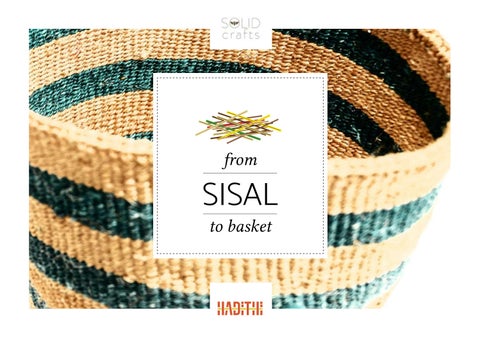
from
SISAL to basket
“Let’s rise by lifting others”
Always wanted to know how a sisal leave can transform in a gorgeous basket? Teresia Mulinge shows you.
M
eet Teresia Mulinga, a member of the Kisimenyi basket weaver group, weaving one of her many baskets. Showing you the process starting from sisal and ending with a gorgeous basket. These unique baskets are made out of sisal which is grown either on farms belonging to the basket weavers, or else purchased from sisal estates. Sisal is an exceptionally durable and strong material, and grows well in harsh Kenyan climates.
1. the sisal plant. The weaver ladies either grow sisal plants (Agave Sisalana, Mexican origin) on their farms or else buy sisal fibres from the sisal estates in Mwatate. Sisal is an exceptionally durable and strong material, and grows well in harsh Kenyan climates. No pesticides nor chemical fertilizers are needed in sisal agriculture.
2. Down to fibres The sisal leaves are decorticated (process by which outer parts of the plant are removed) until only the fibres remain. These fibres are typically 0.5 to 1 m long. Stiff sisal fibre is used to make a vast array of products, everything from twine, rope, dartboards, cat scratching posts, lumbar support belts, rugs, slippers, cloths, disc buffers… and of course baskets! Though in Kenya traditionally Sanseveria and baobab fibres have been used for basket weaving, now the ladies rely on sisal because of its suitability and vast availability.
3. Dyeing & Drying The sisal fibres are coloured by adding them to the desired dye and bringing them up to the boil. They are then left out in the shade to dry. Traditionally ladies have used natural colorants like certain tree bark or soil to create earthen shades of black, brown, grey and pale pinks and yellows. Textile dyes are now broadly being used in order to obtain bright colours.
4. Rolling the Twine Using sisal fibres, the ladies have to roll it to produce twine. This requires amazing skill since it necessitates the women to roll, upon their bare legs, consistent amounts of sisal fibres into each other to obtain a good quality twine that has the same thickness all over. This is probably the most time consuming element of the entire basket making process.
5. Ready, Steady, Weave! Finally only once the lady has enough twine in the colour she wants, can begin weaving her basket. The weaving starts at the centre of the bottom of the basket.
6. Halfway Here you see Teresia Mulinga, a member of the Kisimenyi basket weaver group, weaving one of her many baskets. Though you may wonder how long it takes for her to weave a single basket, in fact this is not a simple question to answer. Not even Teresia herself can provide a precise estimate because of the vast number of variables it depends upon, for example how thin you roll the twine, how complicated the design, and how much time Teresia has between her daily tasks as a mother, a farmer, a wife, a community member…
7. Ready Teresia shows off her work – she will make just a single basket in this beautiful design…next time she will try out a different one – but it will be equally as beautiful!
Contact Address: Solid Crafts Kortrijksesteenweg 697 9000 Gent - Belgium Office telephone number: +32 (0)15 45 98 19 Solid helps people in the South to take their life in their own hands.
crafts@solidinternational.be www.solidinternational.be Instagram account: solid.crafts