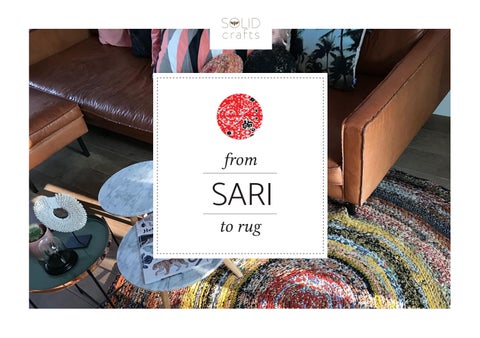
from
SARI to rug
1. The sari
A
n iconic item of clothing that can be found in every woman’s wardrobe in India, it is worn to occasions such as weddings and festivals as well as being an everyday staple. It is also the clothing item of choice for most of the artisans in Rampur. The vast array of colours and designs of the draped fabric are part of what makes walking the streets in India such a treat for the eyes. Crochet rugs give a second life to this ubiquitous garment, meaning that their colours and patterns can continue to be enjoyed.
Once a sari has become worn or faded, if a woman can’t find a use for it herself, she can give it to a passing fabric-wala to be recycled. The saris are gathered and sorted according to the material and the amount of wear and tear, where they can then be purchased for re-purposing. Cotton and silk second-hand saris are delivered to the workshop to begin their transformation.
2. Washing up
O
n arrival at the workshop, the bundles of saris are un-wrapped to reveal a new display of patterns and colours, each folded piece different from its neighbours and predecessors. The saris are washed by hand by the artisans and the long swathes of fabric, of 6 to 8 meters long, are hung out to dry on the roof in the warm Indian sunshine.
3. Combining colours
W
ith the saris now out-stretched to display their full potential, the most complete pieces and beautiful designs are selected to create kantas, traditional blankets created from hand-stitching saris together. The remaining saris are then carefully selected and sorted into colour combinations. Around 20 saris will need to be selected to create a medium sized rug 150 centimetres in diameter.
Saris are almost never one block of colour and the variety of tones and shades within and amongst the saris can make selecting harmonious colour combinations tricky, but it is also what makes each rug unique. The artisan carefully eyes up the saris, grouping them together and considering the final effect of the colours.
4. Ripping into ribbons
N
ext, the saris need to be turned into ribbons so that they can be crocheted. At one end of the sari, the artisan makes small cuts at 7 cm intervals and then rips the fabric by hand, creating multi-coloured ribbons of fabric. Here, intricate embroidery work gets in the way of the ripping; this is why pieces with embroidery will usually be selected for another use, such as for kantas or patching.
5. Crocheting
S
tarting with a single ribbon that will form the centre, the artisan takes the wooden crochet needle to start knotting the fabric into a chain that then curves round itself to form a snail shell like centre. The crocheting continues round in a spiral, hooking through the sides as it grows outwards.
When the end of a ribbon is reached, the artisan simply takes the next ribbon and knots it into the end of the previous one; securing it in and continuing the coiling curve. Maintaining tension is the key challenge at this stage. Should the stitches become too loose, holes will appear in the weave, too tight, and the flat textile will start to curve upwards into a bowl shape.
6. The completed rug
E
ach day, the artisan will come to the workshop to work on her rug until it is complete. When starting out, weaving a medium rug may take around 6 days; as the artisan grows more confident in her skills and she gains experience, it takes her around 3 days to produce a carefully hand-crafted rug.
Finally, the finished effect of the colours dancing through the rug are revealed. Thanks to the celebrated variety of colours and designs used in saris, no other rug will be the same as this one, but each one is equally as beautiful.
Contact Solid helps people in the South to take their life in their own hands.
Address: Solid Crafts Kortrijksesteenweg 697 9000 Gent - Belgium Office telephone number: +32 (0)15 45 98 19 crafts@solidinternational.be www.solidinternational.be Instagram account: solid.crafts