Army Benevolent Fund is an incorporated charity registered with the Charity Commission for England and Wales with Charity No. 1146420, and in Scotland with the Office of the Scottish Charity Regulator with Scottish Charity Register No. SC039189.
Army Benevolent Fund is a company limited by guarantee in England and Wales (07974609) and was incorporated on 2nd March 2012.
It is a great honour to chair the Army Benevolent Fund. It is a mark of our continuing and central importance as the Army’s national charity that, in FY25-26 alone, we delivered support to more than 74,000 people in 51 countries through our grants to individuals and funding for 94 other organisations and charities. I could not be prouder of the difference we make on a daily basis to the lives of those who need and deserve our support.
Delivery of this impact would not be possible without the dedication of my fellow trustees and our tremendous professional team, the selfless commitment of our volunteers, and the generosity of those who support us financially. This year’s Annual Report reflects a charity in good health, with a clear and extremely well-considered plan both for the immediate and longer-term future, and an absolute focus on delivering against its enduring purpose.
In terms of governance, this year saw us undertake a formal independent board evaluation, conducted as part of triennial pattern of board reviews, considering the principles of good governance and the Charity Governance Code for Larger Charities. The headline view is that the ABF Board is wellfunctioning, with well-defined purpose, vision, and values, a structured approach to governance, an open and inclusive culture, and a firm commitment to continuous improvement.
Also this year at Board level, we said farewell to three trustees and welcomed two new Board members. We are grateful to James Rous, who served as a trustee for nine years; his
contribution at Main Board and as a member of the Finance & Investment Committee has been considered, effective, and highly valued. In a wider sense, James has made a significant contribution through his support at fundraising events, on assurance visits, and through his personal fundraising efforts, including running the London Marathon for the charity. Major General Sam Humphris made an equally telling contribution at Main Board and, despite the pressures of his role as the Army’s Director of Personnel, found the time to complete the Cateran Yomp, bringing with him his outer office team, who no doubt were delighted to support him over the 54 miles across the Scottish Highlands. We wish Sam well and are delighted to welcome his successor, Major General Jo Chesnutt, to the Board. And we also said farewell and thank you to Major General (Ret’d) Chris Hughes CBE, who played a considerable role in shaping the strategic direction of the Charity’s benevolence strategy, and who brought sagacity and rigour to Main Board. We know that his successor, Brigadier (Ret’d) Clare Phillips CBE, will add enormous value to the Main Board and Benevolence Committee.
2025 marked the 80th anniversary of the end of World War Two. The moving commemorations of VE and VJ days served to remind us of the sacrifices made by the generation that defeated tyranny, and restored freedom to Europe and the wider world. The Army Benevolent Fund was forged in August 1944, exactly one year before VJ Day, to ensure the soldiers returning from the Second World War, and the families of the bereaved, would receive the support they needed and deserved.
The current global context underscores the enduring relevance and importance of Army’s role in defending the nation, its interests, and its values; and the commitment made by those who choose to serve, and their families. As the Army’s national charity, we are determined to ensure a lifetime of support is available to our soldiers – past, present, and future – and their families, wherever and whenever it is needed.
Sarah Booth Chair
WELCOME FROM THE CHIEF EXECUTIVE
FY25-26 saw the Army Benevolent Fund spend over £9.5m in benevolence, supporting more than 74,000 members of the Army family in 51 countries around the world. Our youngest beneficiary was one year old; our oldest was 104. As ever, this stands testament to our commitment to be here for soldiers, for life.
We continue to deliver that support through our in-year benevolence programme, which is the result of two inextricably linked streams of activity.
+ First, the grants we make to individuals; supporting the regimental and corps charities to meet the immediate requirements of those falling into need of support. This remains our priority, with the ABF reacting within 48 hours of receiving the casework that evidences the need and how best to address it. Of note, October 2025 saw the highest demand (number and cost of cases) on our individual grants programme since 2019.
+ Second, our partnerships with charities and organisations providing specific outcomes for members of the Army family. This sees us, centrally and on behalf of the Army and its regimental and corps charities, take a targeted approach to funding the delivery of impact. Often, those whose immediate needs have been met through our individual grants programme, then receive follow-on and more long-term support through this stream of our funding. Once again this year, the number of partners we funded increased, from 93 in FY24-25 (itself an increase from 86 in FY23-24) to 94 in FY25-26.
In delivering all of this, our overall charitable expenditure increased by 4% this year.
Looking ahead, the FY26-27 Plan is founded upon the iterative and evidence-led enhancement delivered over the course of the previous three years. Importantly, the FY2627 Plan is reinforced with deliberate investment, funded from our reserves, in measures designed specifically to treat benevolence need proactively, enhance our income in the medium to long term, and broaden awareness and engagement through strategic communications campaigns.
The combination of assured delivery of the in-year programme and the measures designed to make long-term improvement to the Charity’s three core activities (benevolence, fundraising, and raising awareness), links the charity’s operational plan to our strategic programmes:
+ First, ensuring we are positioned, through allocation of funds from our financial reserve and in terms of contingency planning, such as to enable the Charity to respond to a significant change in operating conditions (such as a major conflict involving the British Army) or benevolence need.
+ Second, the Benevolence Strategy; a formal programme of preventative measures, funded from our financial reserve and delivered in partnership with the Army, aimed at addressing the underlying causes of need and thus reducing, over the longer term, the number of the Army family who fall into need in the first place.
+ Third, a formal investment strategy review, to ensure we are positioned financially for the long-term.
Taken together, this deliberate approach positions the ABF to provide enduring support to the Army and its people in an era of geopolitical and economic uncertainty. That uncertainty makes our founding purpose ever more important: to provide a lifetime of support to serving soldiers, former soldiers, and their immediate families (including the bereaved) when they are in need, such they can avoid hardship and live with independence and dignity.
Major General (Ret’d) Tim Hyams CB OBE Chief Executive
STRATEGIC REPORT OF THE TRUSTEES
Our vision
All serving soldiers, veterans, and their immediate families should have the opportunity to avoid hardship and live with independence and dignity.
Our mission
We are the Army’s national charity, giving a lifetime of support to serving soldiers, former soldiers, and their immediate families when they are in need.
Charitable objects
Since our formation in 1944, our charitable objects have been to benefit persons who are serving or who have served in the British Army, or their dependants, in any charitable way by the provision of grants, loans, gifts, pensions or otherwise. We work with veterans of every conflict, from the Second World War to the most recent operations, whether they live in the British Isles or overseas.
Public benefit
When reviewing the Army Benevolent Fund’s aims and objectives, and when setting grant making policy and planning for the future, the trustees have carefully considered the Charity Commission’s guidance on public benefit. The Army Benevolent Fund provides a public benefit in that it supports the Army community, contributing to the defence of the UK and its interests. Through its external grants programme, the Army Benevolent Fund also enables other charities to maximise their public benefit, in support of the Army family.
Equality, diversity & inclusion
We are committed to championing equality, diversity, and inclusion on our Board, amongst our workforce, and in all our behaviours. As the Army’s national charity, it is vital we remain relevant and reflective of our varied Army community and of society more broadly. We are particularly proud of our diverse workforce, both in the national office and across all 9 regional offices; and we are committed to creating a culture where everyone is celebrated, regardless of gender, sexual orientation, disability, neurodiversity, ethnic background, nationality, religion, or belief. We recognise there is still work to be done and are committed to continuous improvement to ensure we remain best placed to serve the Army community, both here in the UK and around the world.
01 After leaving the Army, Roxanne faced periods of homelessness, mental health challenges, and ongoing pain from an old injury. With support from Lothians Veterans Centre (LVC), a charity funded by the Army Benevolent Fund, she found safe housing, help with her medical needs, and a community that has helped her rebuild her life.
02 Jit joined the Brigade of Gurkhas at the age of 18 and served for 13 years. A serious injury meant he had to have a below-knee amputation, which affected his mobility and independence. Our grant of £1,150 towards the cost of an electronically propelled vehicle has given him his life back.
03 H enry is the disabled son of Army veterans Tania and Anthony. He has a rare genetic condition which means he
has significant learning and developmental issues, as well as poor speech, vision, and hearing. As he gets older, Henry’s condition increasingly is affecting his behaviour, which can be challenging. When he has meltdowns, the best thing is for Henry to move to a different environment where he can calm down and regulate his feelings. But, in their busy family home with four children, there was limited opportunity for Henry to have his own space.
The ABF was delighted to make a grant of £6,000 to create a sensory room within a specially designed garden log cabin, which is fitted with specialist sensory equipment and lighting, to cater for Henry’s needs.
04 Running the TCS London Marathon for the ABF.
CHARITABLE ACTIVITIES OVERVIEW
As the Army’s national charity, the welfare of soldiers, veterans, and their immediate families (including the bereaved) has always been at the heart of everything we do.
Our purpose has remained the same since 1944: to ensure that every soldier, past, present and future, and their immediate families, can avoid hardship and live with independence and dignity.
In the past year, we have supported over 74,000 members of the Army family in 51 countries across the globe. This has been achieved via our individual grants programme, through which we have supported over 3,450 individual cases, and by providing essential funding to 94 other charities and organisations to enable them to deliver specialist services to the Army family.
In addition to these two key grants programmes, we have also funded Army-related casework and the pan-sector digital platform that enables grants to be paid out quickly and securely; and collaborated with key sector stakeholders, including the government, other charities and the Army, to ensure we are as well placed as possible to support soldiers, veterans, and their immediate families. By supporting us, you truly do support the whole Army family.
In FY25-26, our charitable expenditure was over £9.5m. As one of the largest funders in the military charity sector, our aim is to ensure a complete spectrum of support to the Army family in the areas it is needed most. The overall scale, breadth and variety of our support is vast: helping Army families, including the bereaved; improving mental wellbeing; enabling independent living; caring for the elderly; training and education to increase employability; and securing the provision of suitable housing.
As ever, we pride ourselves on acting immediately when help is needed and providing true through-life support.
Daisy is the disabled daughter of Army veteran Stephen and his wife Sally. She has a rare chromosome disorder which means she has difficulty swallowing, had retinoblastoma (a rare type of eye cancer that mostly affects children under the age of five), and has developmental delays. Thanks to the ABF’s funding of £5,000 towards a specialist allterrain wheelchair, Daisy now enjoys joining in with school, social and family outdoor activities.
OUR STATS
In FY25-26 we spent over £9.5M supporting 74,000 members of the Army family
The youngest person we supported was ONE YEAR OLD, the eldest was 104
We funded 94 OTHER CHARITIES AND ORGANISATIONS that provide support to the Army family
SUPPORTING THE ARMY FAMILY
We are here to support the Army family through all of life’s challenges, including bereavement, injury, getting back to work, elderly care, and much more besides.
Our support is truly for life, with individuals supported in FY25-26 aged from one year old to 104.
We are never judgemental, and we always adopt an integrated approach to the person or family in need of support. Sometimes, an individual in need may receive an initial grant from us, delivered through their regimental or corps charity; then be referred to a specialist charity that we have funded. They may then receive support from other partner charities – with assistance from us at every stage.
Throughout, we rigorously focus on their need and allocate our support accordingly across a wide range of charity partners. We give grants to support other charities and organisations both large and small, local and international, depending on our assessment of where the need is. Our grants programme is continually evolving, with an increasing focus on treating benevolence
need proactively, as described in the Chief Executive’s foreword; and all cases are based on evidenced need, with rigorous due diligence checks on the effect of our expenditure.
Finally, and crucially, we act with speed. When we are alerted that a person or family needs help, we aim to make the relevant grant within 48 hours.
We are here for all members of the Army family when they need us. Our support is available for soldiers at the start of their careers and continues for life – long after service is over.
OUR THREE MECHANISMS FOR PROVIDING SUPPORT
We make grants to individuals, through their regimental or corps charities.
We make grants to other charities and organisations that deliver specialist support to soldiers, veterans, and their families.
We have supported the British Army family in 51 COUNTRIES all over the world
Around 14% OF OUR GRANTS expenditure benefited the serving Army We spend around £61,000 A WEEK on grants to individuals
We play a key role in the military welfare ecosystem by: funding organisations that carry out Army-related casework (particularly SSAFA The Armed Forces Charity); investing in the Casework Management System (to ensure grants are reviewed and disbursed quickly); and collaborating with and providing advice and support to other military charities and organisations such as Cobseo and Veterans Scotland.
FUNDRAISING
We are extremely thankful to our very generous donors who raised £9.1m in FY25-26 (£34.7m in FY24-25).
The variance between this year’s fundraising income and that received in the previous year essentially is due to a highly generous legacy of nearly £25m received in FY24-25; the impact of which has been to enable our Benevolence Strategy and its formal programme of preventative measures.
Having during FY24-25 conducted a formal Fundraising Review, and based on the Board of Trustee’s endorsement of its recommendations, work over the past 18 months has been aimed at putting in place the plans, ways of working, and structures to deliver success in terms of fundraising outcomes required to achieve ABF Plan objectives, now and over time. The FY25-26 Fundraising Plan reflects that work, and deliberately is set in context of the multi-year approach taken to the charity’s operational planning as set out in the ABF Plan, which looks to achieve incrementally the near term intended outcomes, whilst at the same time setting conditions for the longer term and sustainable successful operation of the Charity.
As with previous years, we remain extremely grateful for the continued support of those organisations close to the Army family; including the Army Dependants’ Trust, which donated £800k this year, and the regimental and corps charities, which contributed nearly £867k over the same period.
Individual supporters and legacy giving
Every year, thousands of individuals help us by giving a monthly regular gift or one-off donation, taking part in our raffle, or remembering us in their Will. We remain extremely grateful to each and every one of them.
Corporate partnerships and philanthropy
We partner with a broad range of UK businesses, high net worth individuals, trusts and foundations, enabling our ongoing work to support soldiers, veterans, and their families.
We are extremely fortunate for the sustained support of our philanthropic donors Azad Ayub, The Edward Gostling Foundation, The Mike Gooley Trailfinders Charity, National Garden Scheme, PF Charitable Trust, The Royal Edinburgh Military Tattoo, The Wimbledon Foundation and our generous anonymous donors. We are also grateful for the significant support we have received this past year from The Ian Fleming Charitable Trust, John Scott Charitable Trust, Monday Charitable Trust, Moondance Foundation, Peacock Charitable Trust, Princes Exchange Foundation, and the Scott (Eredine) Charitable Trust.
We also received support from corporate partners, including AdvantageGo, Ascot, Aviva, Babcock International Group, BAE Systems, Clarion Defence UK, Clogau, Corps Security, Data Edge Analytics, Howmet Aerospace, Leonardo UK, Level Peaks, MBDA, RIFT Group and The Thales Charitable Trust; this enabling our ongoing work to support soldiers, veterans and their families.
Community and events
We work hard to build relationships and generate financial support via events such as the London Marathon, Cateran Yomp, The Lord Mayor’s Big Curry Lunch, Frontline Walks, golf days and Christmas Carol Concerts, to name just a few. Those relationships and that support is national, regional, and local in nature. It speaks to our status as a truly national charity, and stands testament to the significant contribution made by those who so generously volunteer their time to support our fundraising and engagement activities. Of particular note in that regard is our network of county committees across England, Wales and Northern Ireland, and our network of advocates in Scotland.
Fundraising standards
We adhere to the highest fundraising standards. Our fundraising success is directly related to our reputation, and we go to great lengths to protect the public, including vulnerable people, by avoiding any practices that are not in line with the Army Benevolent Fund’s values. We are committed to the Fundraising Regulator’s Code of Fundraising Practice to ensure we meet the highest standards, so supporters and volunteers can give and fundraise with confidence and trust.
ABF supporters in the North West taking on Born Survivor to help raise funds for soldiers, veterans, and their families.
Our behaviour
We promise to always show respect and never pressure anyone to make a donation. We want the decision to give to always be an active choice on the part of the giver and we are particularly sensitive when dealing with vulnerable people. We have a comprehensive supporter-engagement policy, which incorporates all elements of fundraising and associated activities. We do not sell personal details to other charities or other third parties. We only share personal information with suppliers that we engage to process data on our behalf; such processing is only conducted under formal data processing agreements.
Information systems
We continue to modernise and raise the standard of our technical processes and infrastructure that support fundraising. Having, last year, upgraded and modernised our client relationship management database to Salesforce CRM, this year we have achieved the same for our financial management information system, upgrading to Oracle NetSuite. We have continued to make significant strides towards using data analysis, better to understand our supporter base and thus communicate more effectively with them. We have also continued to ensure that our data holdings, and wider IT infrastructure, are secure and robust in terms of countering the cyber threat.
Safeguarding
The Army Benevolent Fund is proactively committed to safeguarding children, young people and vulnerable adults with whom staff, or any organisation acting on our behalf, come into contact with during fundraising, benevolence or outreach activities. We regularly review our safeguarding policy, including a full annual Board of Trustee review, to ensure it is fully up-to-date and fit for purpose. We take all reasonable care to protect
our beneficiaries, supporters and staff, and comply with all relevant legal obligations and statutory guidance. Safeguarding is integral to our recruiting process and all new staff members are DBS checked. There is also a documented procedure for reporting serious incidents to the Charity Commission and relevant statutory bodies. In FY25-26 there were no such matters to report.
Accessibility
We make it easy for people to get in touch with us either by phone, letter or email. Whether someone wants to ask a question about our work or how we spend donations, or find out about an event we are organising, or update their communication preferences, we pride ourselves on being responsive and accessible. And, of course, we have a complaints process in place, should any supporter be unhappy or express concerns about our activity. The Charity received no complaints in FY25-26.
Relationships with agencies and commercial providers
We have a small in-house fundraising team and employ external agencies to add additional expertise or capacity; for example, event-management companies when we are organising large-scale events. This is more cost effective than trying to do everything ourselves. We always ensure signed contracts are in place and regularly monitor their performance in line with these agreements.
The professional face to face fundraising agencies we work with provide value and expertise and allow us to engage with new audiences. We recognise the need to monitor their performance and compliance. We input into their training, and our quality assurance includes regular reviews of complaints – of which we received none in FY25-26 – and other feedback.
FINANCIAL HIGHLIGHTS OVERVIEW
Total income was £13.7m (FY24-25: £38.7m); a decrease of £25m from the previous year. This was due to higher legacy income of £28.2m received in FY2425. Other income streams increased by a total of 6%.
Income received from donations was higher at £3.4m (FY24-25: £3.3m). Income from the Army, which comprises donations from individuals, regimental and corps charities and the Army Dependants’ Trust, increased to £1.81m (FY24-25: £1.75m). Income from trading activities was higher at £3.3m (FY24-25: £3.2m). The investment income was £2.6m (FY24-25: £2.3m).
Of the £2.6m of investment income received, £1.6m represented cash dividends and interest receivable, with the remaining £1m being represented by additional investment units, which further bolster the Charity’s investment portfolio to provide rising income over time. This is set out in more detail in the investment management section.
Total expenditure for the year increased to £16.9m (FY24-25: £16m). Our charitable expenditure delivering benevolence, including individual and charitable grants to those in need was £9.5m (FY24-25 £9.2m). Costs of raising funds increased to £7.4m (FY24-25: £6.8m) as we continue to invest in donor recruitment.
Overall, the accounts for the year ended with a net expenditure of £463k, which includes gains on investments of £2.7m (FY24-25: net income of 20.6m included losses on investments of £2.2m).
CAME FROM WHERE OUR FUNDING
Income from investments £2.6m
£1.8m
Donations from regimental and corps charities and individuals in Army Units
£13.7m
HOW WE SPENT
Other trading activities
£3.4m
Donations and appeals
£3.3m Legacies £2.6m
AND ALLOCATED MONEY
£16.9m
Other costs of raising funds
£9.5m
Charitable activities
£4.8m Cost of trading activities £2.6m
HOW WE SUPPORTED
THE ARMY FAMILY
£9.5m
£1.9m Grants to other charities and organisations
Supporting the military welfare ecosystem
£3.1m
£4.5m Grants to individuals
Investment management
Our overall investment objective is focused on the capital growth of our investments in real terms, with an appropriate return from our income units. The performance objective of the fund is to provide capital growth and rising income over time. The Charity invests funds that are required over the medium to long term. At the year end, the Charity held investments with a market value of £70.6m and cash deposits of £34.8m (FY24-25: £76.8m and £20.5m respectively).
Our investment performance and holdings are reviewed regularly by the Finance & Investment Committee against our investment objectives and its benchmarks. Our investments are held in line with our investment policy, which lays out guidelines for risk, as well as ensuring there are appropriate ethical policies in place.
Reserves
Our reserve is based on three imperatives:
1. To manage, on behalf of the nation, a series of designated and restricted funds, that support veterans who have served in particular conflicts and their immediate family members.
2. To provide an operational reserve in the immediacy of a 12 to 36-month period, to ensure the Charity can continue delivering benevolence to the Army family in the event of financial risks identified in the Risk Register materialising.
3. To provide a strategic reserve for the delivery of benevolence to the Army family in a more enduring sense, enabling the Charity to respond to a significant change in operating conditions (such as a major conflict) or benevolence need.
A proportion of our funds is ringfenced and administered on behalf of the nation to help veterans and families in need from conflicts such as Afghanistan and the Falklands Conflict. They will be disbursed over many years until the last eligible soldier or family member is no longer alive.
Our operational reserve ensures we can continue delivering benevolence to the Army family in the immediacy of a 12 to 36-month period, should we face a significant fall in income. The operational reserve has been established through the work to place a monetary value on risk, together with sensible provision for other probable contingencies and the Charity’s working capital. The risk-based approach provides a rationale that leads to a justified level of operational reserves, based on the drivers of sufficient working capital to get through cyclical fluctuations; an estimate of the potential
value of the foreseeable inherent and residual risks derived from the risk register; and an estimate of the amount required by the Charity to fulfil its long-term ABF Plan.
We also hold a strategic reserve to ensure that we can deliver benevolence to the Army family in the long term, despite any changes that may occur in the operating environment (for example, future conflicts). Part of this picture includes meeting our responsibility for ensuring the regimental and corps charities can provide appropriate benevolence support, when called upon, in perpetuity. Essentially, the Army’s national charity needs to ensure that the whole Army family’s needs can be met, for as long as there is an Army.
The Charity has in place a Reserves Policy, which aims to ensure that its ongoing activities are protected from fluctuations in income and expenditure. The Board of Trustees reviews this policy annually to ensure it continues to comply with Charity Commission guidance.
The total value of funds held at year end was £118m (FY2425: £118.5m). There are restricted funds of £6.54m (FY2425: £6.2m), unrestricted funds of £111.32m (FY23-24: £112.1m) and endowment funds of £175k (FY24-25: £200k). The unrestricted funds include both general funds of £104.5m (FY24-25: £104.8m) and designated funds of £6.8m (FY2425: £7.3m). Of the £104.5m general unrestricted funds, £437k represents fixed assets that can only be realised by disposing the assets, leaving £104.1m free reserves (FY2425: £104.4m), which is above the target of £86.6m (FY24-25: £80.5m). The level of free reserves allows the Charity to be resilient, to continue to focus on its charitable activities, and to adopt a necessarily agile approach in responding to the changing economic and wider strategic environment. In parallel, the residual free reserve (the £17.5m above the target of £86.6m) affords the Board of Trustees the ability to invest in long-term benevolence projects, through the formal Benevolence Strategy, with the stated intent of using at least an element of the residual free reserves to invest in a programme aimed at addressing underlying causation through a series of preventative measures.
Risks and uncertainties
The Army Benevolent Fund has a proactive, thorough, and balanced approach to risk management through its integrated and coherent Enterprise Risk Management architecture and processes. The Board of Trustees reviews major risks at each meeting and ensures that its subordinate trustee-led committees and the senior management team have taken all reasonable measures to manage these risks and have the flexibility to seize opportunities as they appear.
CONTINUED
Risks are graded by likelihood and severity, and include full descriptions of the actions and measures underway or required to attend to them. Key risks are also monetised, with an appropriate amount of the Charity’s reserve annotated as allocated if required. This process allows us to measure the correct amount of operational reserve to hold, as well as being a prudent and effective way of managing the risks.
As a result, the Charity has a clear view both on the key risks to its operation over the short and long terms, and the means by which they will be mitigated.
The risk of a reduced ability to raise sufficient funds in a global, national, and indeed personal environment of constrained discretionary spending is specifically mitigated by the multi-year approach taken to operational planning, set out in the ABF Plan, which is described in greater detail in the next section. The risk of not being positioned to respond effectively to the changing nature of the Army, its veteran community, and their increasing integration into wider society is mitigated actively and constantly by the executive’s proactive horizon scanning, in collaboration with both government (Ministry of Defence; not least, the Office for Veterans’ Affairs), the Army, and sector (not least, Cobseo, Veterans Scotland, and FiMT) stakeholders, and through the Benevolence Strategy. The risk to our investments of significant fluctuations in global markets is mitigated by maintaining a balanced portfolio, consisting of an appropriate mix of income and accumulation units, across two major fund managers, under the regular and expert oversight of a trustee-led Finance & Investment Committee.
In the event of a major situation involving or otherwise affecting the Army Benevolent Fund, business continuity and disaster recovery plans are in place. Trustees also place considerable importance on achieving compliance with employment, health and safety, and other relevant legislation.
The Army Benevolent Fund’s solicitors review our principal policies on a regular basis, and all other policies are reviewed periodically by the senior management team on at least an annual basis. The key ones, such as Safeguarding and AntiFraud, are also annually reviewed by the Board of Trustees.
In the certain knowledge that we will need to continue to provide support to soldiers, veterans and their immediate families for many decades, we regularly update and review our financial plan, reserves and investment policies. Internal financial controls are reviewed by the Finance & Investment Committee on a regular basis.
We continue to conduct routine and regular end-to-end audit processes. This allows the Charity dynamically to confirm that its financial and technical control procedures remain effective and fit for purpose; or, if they are not, to improve them quickly. The trustees have declared themselves satisfied that major risks have been identified and adequately mitigated, wherever reasonably practicable. It is recognised that systems can only provide reasonable rather than absolute assurance that major risks have been adequately managed.
Plans for future periods
Since the end of COVID in 2022, the ABF has been operating in a challenging economic environment. The legacies of the pandemic and Brexit, themselves persistent, increasingly have been exacerbated by global and national rises in commodity prices resultant from conflicts in Ukraine and the Middle East, and by wider geopolitical and economic uncertainty. Throughout, the UK has seen stubbornly persistent inflation, interest rates, and low growth. The net result has been public caution over non-essential personal spending.
With the Office for Budgetary Responsibility, and most informed observers, now suggesting that UK inflation will remain above the Bank of England target for some time, leading to slower interest rates cuts and elevated borrowing costs, we expect that the impact of this combination of issues, exacerbated by more broad geopolitical factors, will continue to be felt through FY26-27.
Our response
Against this challenging context, the Army Benevolent Fund remains in a relatively strong position, continuing to reflect the manner in which we were set up in 1944: to act as the Army’s strategic reserve, or second line of benevolence support, behind the first line activity of the regimental and corps charities. Conscious of this role, over the years we deliberately have configured our operations to protect that responsibility. We remain focused entirely on grant making and have no direct delivery responsibilities; we make no grant commitments beyond in-year; and we husband our free reserves for the long haul, whilst also being prepared to make strategic interventions where appropriate. Prudent measures to increase our liquidity provide adequate cash well into the next Financial Year, and our investments are held in very broad and diverse funds.
Set against that context, at an operational level, our return to long-term planning, in the shape of the ABF Plan, saw us take significant strides in FY22-23 (Year 0) towards setting the conditions for success; with the removal of the artificial divide between national and regional fundraising, the reset of the People Plan, and a redefinition of the regional contribution being notable achievements.
Thereafter, FY23-24 (Year 1) saw continuing refinement, with particular emphasis on understanding the drivers behind, return on investment from, and opportunities afforded by volunteer-led community fundraising activity and the wider programme of staff-led community fundraising events delivered across the country. It also saw us measure the impact of the levers being pulled in-year; specifically, the investment in face-to-face fundraising, a more coherent pan-charity approach to events, and a similarly coherent and increasingly programmatic approach to trusts, major donors, and corporates. In parallel, FY23-24 saw significant improvements in our inter-relationship with the Army, and the coherence, both internal and external, of our communications. It also saw the highly successful refreshment of our brand.
Building on those foundations, FY24-25 (Year 2) was one of further iterative and evidence-led enhancement, particularly in terms of the longer lead time areas of direct marketing and legacy giving. In parallel, we have conducted a fresh eye, evidence-driven, review of fundraising, which has set the baseline for our fundraising approach in FY25-26 and into FY26-27. FY24-25 also saw much progress in terms of leveraging the extremely successful re-brand and our more assured relationship with Army Media & Communications, and harnessing more productively the associated, available, resource through a more strategic, campaign-led, approach to brand awareness and audience engagement. In the background, there has been a continuation of our drive to minimise overhead costs, with the long-term agreement on tenancy in Mountbarrow House being, by way of example, a cost saver as well as a creator of efficiency.
FY25-26 (Year 3) was a year of exploitation of previous groundwork.
+ We continued to increase benevolence spend in line with need, tempered by affordability. In the background, we initiated a formal Benevolence Strategy, in order to position the Charity to attend to the requirement to tune its existing grants programme to emergent patterns of need and the dynamics of the delivery landscape, whilst in parallel taking forward a deliberate programme of activity, funded from the residual free reserves, aimed directly at addressing the underlying causes of need and thus reducing need over time.
+ We delivered on the endorsed outcomes of the Fundraising Review; enacting the measures relating to methodology, structure, resource, and further investment, in order to deliver success in terms of the fundraising outcomes required to achieve ABF Plan objectives and end state.
+ The more strategic, campaign-led, approach to brand awareness and audience engagement has continued to be at the heart of the communications and marketing operation. At the same time, overheads have been maintained as low as inflation renders practical.
+ We have bedded in Salesforce CRM, and are now integrating it with Oracle NetSuite, our new financial MIS. This process will continue and evolve throughout FY26-27 (Year 4), and further will drive efficiency.
Our overall operational level intent remains to continue to refine and improve the ABF Plan’s underpinning methodology and logic rather than to steer a different course. Conscious always that it is healthy for a charity to maintain a modest annual deficit to ensure we are spending our generously donated money on benevolence, we nevertheless continue to aim, by the end of Year 9, to be closer to breaking even than has historically been the case. In addition to the ongoing work to enhance the income streams referred to previously, Year 4 and beyond will see continuing emphasis on longer lead time streams, such as legacy giving. We will continue to enhance our investment in face-to-face giving and our new Weekly Lottery product, seeking to increase regular donations and signed up supporters, whilst also seeking to diversify our individual giving. And, in parallel, we will provide an improved and nuanced corporate and wider high value relationship offering, particularly for those corporate entities with existing relationships with the Army.
In all of this, coordination with the Armed Forces Covenant Trust (AFCT) and the other single service benevolent funds will continue to be necessary such as to capitalise on the opportunity for greater efficiency and effectiveness in the delivery of outcomes for those in need. This coordination very much is set in context of our position at the heart of the Army’s charitable ecosystem and in the wider service charitable sector, working coherently and effectively with the other key charities.
At the same time, it is essential that, as the Army’s national charity, we take a strategic view of how to respond over the longer-term. The receipt last year of a highly significant and generous legacy of nearly £25m has reinforced our financial reserve such as to afford the Army Benevolent Fund the opportunity not only to respond to the geopolitical and economic challenges that lie ahead, but also to act proactively, through a deliberate programme of preventative measures articulated in our Benevolence Strategy, such as to reduce, over the long-term, the number of soldiers, veterans and their families who fall into need of support.
Subsidiary and associated company
Soldiers’ Trading Limited is a wholly owned subsidiary of the Army Benevolent Fund. Its purpose is to raise money for the Charity through commercial partnerships.
The Soldiers Fund, based in the United States, is an associate of the Army Benevolent Fund. It makes grants in support of soldiers and veterans from the US Army and British Army.
STRUCTURES, GOVERNANCE AND MANAGEMENT
Reference and administrative details
The Army Benevolent Fund is a Company limited by guarantee not having a share capital (Company No. 07974609), governed by the Articles of Association of the Army Benevolent Fund. The Army Benevolent Fund is registered with the Charity Commission (Charity No. 1146420). It is also registered with the Office of the Scottish Charity Regulator; the registration number is SC039189.
The Army Benevolent Fund is governed by the Board of Trustees, which is ultimately responsible for the organisation’s strategic direction. The Board of Trustees is assisted by four trustee-led committees: the Governance Committee, which is responsible for governance policies and procedures; the Finance & Investment Committee, which is responsible for oversight of all aspects of the Army Benevolent Fund’s financial policies and operations; the Grants Committee, which provides direction to and scrutiny of all grant-giving; and the Fundraising & Marketing Committee, which provides expert guidance on the Army Benevolent Fund’s approach to fundraising and marketing.
Trustees are appointed for an initial period of three years, which can be extended for up to two further three-year periods. No trustee can serve for a consecutive period of more than nine years, except when approved by a majority of the other trustees by special resolution.
On appointment, each Trustee undergoes an induction programme tailored to their knowledge and experience. All trustees are offered briefings on charity governance, charity finance and their individual and collective legal responsibilities. A register of trustees’ interests is held centrally, and trustees are required to disclose all relevant interests, register them with the Secretary to the Board of Trustees, and in accordance with the Army Benevolent Fund’s policy, withdraw from decisions where a conflict of interest arises. Trustees receive no remuneration or benefits in-kind, but are reimbursed for their expenses as noted in the accounts. Trustees receive and review regular reports from the committees and senior management team.
The Board of Trustees met five times in the FY25-26, including their annual, strategy-focused, full day meeting.
The Chief Executive and senior management team are responsible for the day-to-day management of the Army Benevolent Fund’s affairs and for implementing the strategies and policies agreed by the Board of Trustees.
The Army Benevolent Fund provides support for the Army family through a range of other charities and organisations. The trustees are grateful to these bodies, and especially the unpaid caseworkers and other volunteers, without whom we would be unable to meet the needs of our beneficiaries.
The Charity is firmly aligned with the Charity Governance Code, closely adhering to the code’s seven principles, applying the recommended practices and thus able continually to demonstrate good governance.
Staff remuneration policy
Making effective decisions in relation to remuneration and reward is crucial to the continued success of the Army Benevolent Fund. We aim to pay competitively against our relevant comparators in the voluntary sector. We draw our benchmark data from Croner’s Charity Rewards, which gives indicative median salaries for all roles and grades from a very wide selection of national charities. All positions in the Army Benevolent Fund are assessed and placed within an appropriate generic pay band. Like the Army we support, we believe in the principle that we are all of one company; thus, people doing similar jobs are paid at similar rates and in accordance with the relative complexity and responsibility of the appointment they hold. We do not pay bonuses or retention inducements.
We also aim to enhance the organisation’s competitive positioning by promoting a total-reward approach, recognising that other aspects of the employment package (such as working patterns, benefits and development opportunities, as well as the intrinsic moral value of working for a charity) are also valuable to employees.
Staff remuneration review and annual pay award
Consistent with the approach adopted in the previous three years, the Board of Trustees approached the FY2526 pay review from the point of view of maintaining two key principles. First, to retain, to the greatest extent possible, our all-of-one-company ethos; seeking to ensure pay parity within pay bands was retained, and no gap appeared between departments, or individual members of staff. Second, to seek to retain our position as broadly comparable with other similar charities, noting the impact of pay settlements across the sector had impacted adversely on our relative position in that regard. And in a wider sense, both principles were set in the context of the economic
situation that, whilst less severe than the last three years, continued to apply pressure to all members of staff.
Against that context, the Board again this year concluded there was merit in applying blanket increases within bands rather than pan-Charity; and in so doing, this allowed the Charity to target slightly higher settlements at those more junior pay bands furthest from the Croner sector median. This resulted in an outcome that saw pay rises of between 0.5% and 9% depending upon which pay band an individual was in, with an average across the charity of a 2.89% increase.
In accordance with the Charities Statement of Recommended Practice (Charities SORP), the Army Benevolent Fund discloses all payments to trustees (our trustees do not receive remuneration but are reimbursed for valid transport and subsistence expenses) and the number of staff in receipt of more than £60,000 in salary and other benefits (notes 9 and 10).
Statement of trustees’ responsibilities
The trustees (who are also directors of the Army Benevolent Fund for the purposes of company law) are responsible for preparing the Trustees’ Report and the financial statements in accordance with applicable law and United Kingdom Accounting Standards (United Kingdom Generally Accepted Accounting Practice). Company law requires the trustees to prepare the financial statements for each financial year.
Under company law the trustees must not approve the financial statements unless they are satisfied that they give a true and fair view of the state of affairs of the charitable company and the group and of the incoming resources and application of resources, including the income and expenditure of the charitable group, for that period.
In preparing these financial statements, the trustees are required to:
+ Select suitable accounting policies and then apply them consistently
+ Observe the methods and principles of the Charities SORP.
+ Make judgements and estimates that are reasonable and prudent.
+ State whether applicable UK accounting standards have been followed, subject to any material departures disclosed and explained in the financial statements.
+ Prepare the financial statements on the going concern basis unless it is inappropriate to presume that the Army Benevolent Fund will continue in business.
The trustees are responsible for keeping adequate accounting records that are sufficient to show and explain the charitable company’s transactions and disclose with reasonable accuracy at any time the financial position of the charitable company and enable them to ensure that the financial statements have been prepared in accordance with ‘Accounting and Reporting by Charities: Statement of Recommended Practice’ applicable to charities preparing their accounts in accordance with the Financial Reporting Standard applicable in the UK and Republic of Ireland (FRS 102) – (Charities SORP), the Financial Reporting Standard applicable in the UK and Republic of Ireland (FRS 102), the Charities and Trustee Investment (Scotland) Act 2005 and the Companies Act 2006.
They are also responsible for safeguarding the assets of the charitable company and the group and hence for taking reasonable steps for the prevention and detection of fraud and other irregularities.
In so far as the trustees are aware:
+ There is no relevant material audit information of which the charitable company’s auditor is unaware; and
+ Trustees have taken the necessary steps to make themselves aware of any relevant audit information and to establish that the auditor is aware of that information.
The Report of the Trustees, which incorporates the requirements of the Strategic Report and the Directors’ Report as set out in the Companies Act 2006 (Strategic Report and Directors’ Report) Regulations 2013, was approved by the Board, in their capacity as Trustees and company directors, and signed on its behalf on 22nd July 2026.
Sarah Booth Chair
INDEPENDENT AUDITOR’S REPORT TO THE MEMBERS AND TRUSTEES OF THE ARMY BENEVOLENT FUND
Opinion on the financial statements
We have audited the financial statements of Army Benevolent Fund (“the Parent Charitable Company”) and its subsidiaries (“the Group”) for the year ended 31 March 2026 which comprise the consolidated statement of financial activities, the charity statement of financial activities, the consolidated and charity balance sheet, the consolidated cash flow statement and notes to the financial statements, including a summary of significant accounting policies. The financial reporting framework that has been applied in their preparation is applicable law and United Kingdom Accounting Standards, including Financial Reporting Standard 102 The Financial Reporting Standard applicable in the UK and Republic of Ireland (United Kingdom Generally Accepted Accounting Practice).
In our opinion, the financial statements:
+ give a true and fair view of the state of the Group’s and of the Parent Charitable Company’s affairs as at 31 March 2026 and of the Group’s incoming resources and application of resources and the Parent Charitable Company’s incoming resources and application of resources for the year then ended;
+ have been properly prepared in accordance with United Kingdom Generally Accepted Accounting Practice; and
+ have been prepared in accordance with the requirements of the Companies Act 2006, the Charities and Trustee Investment (Scotland) Act 2005 and regulations 6 and 8 of the Charities Accounts (Scotland) Regulations 2006, as amended.
Basis for opinion
We conducted our audit in accordance with International Standards on Auditing (UK) (ISAs (UK)) and applicable law. Our responsibilities under those standards are further described in the Auditor’s responsibilities for the audit of the financial statements section of our report. We believe that the audit evidence we have obtained is sufficient and appropriate to provide a basis for our opinion.
Independence
We remain independent of the Group and the Parent Charitable Company in accordance with the ethical requirements relevant to our audit of the financial statements in the UK, including the FRC’s Ethical Standard, and we have fulfilled our other ethical responsibilities in accordance with these requirements.
Conclusions related to going concern
In auditing the financial statements, we have concluded that the Trustees’ use of the going concern basis of accounting in the preparation of the financial statements is appropriate.
Based on the work we have performed, we have not identified any material uncertainties relating to events or conditions that, individually or collectively, may cast significant doubt on the Group and the Parent Charitable Company’s ability to continue as a going concern for a period of at least twelve months from when the financial statements are authorised for issue.
Our responsibilities and the responsibilities of the Trustees with respect to going concern are described in the relevant sections of this report.
Other information
The Trustees are responsible for the other information. The other information comprises the information included in the Annual Report, other than the financial statements and our auditor’s report thereon. Our opinion on the financial statements does not cover the other information and, except to the extent otherwise explicitly stated in our report, we do not express any form of assurance conclusion thereon. Our responsibility is to read the other information and, in doing so, consider whether the other information is materially inconsistent with the financial statements or our knowledge obtained in the audit or otherwise appears to be materially misstated. If we identify such material inconsistencies or apparent material misstatements, we are required to determine whether there is a material misstatement in the financial statements or a material
misstatement of the other information. If, based on the work we have performed, we conclude that there is a material misstatement of this other information, we are required to report that fact.
We have nothing to report in this regard.
Other companies act 2006 reporting
In our opinion, based on the work undertaken in the course of the audit:
+ the information given in the Trustees’ Report, which includes the Directors’ Report and the Strategic report prepared for the purposes of Company Law, for the financial year for which the financial statements are prepared is consistent with the financial statements; and
+ the Strategic report and the Directors’ Report, which are included in the Trustees’ Report, have been prepared in accordance with applicable legal requirements.
In the light of the knowledge and understanding of the Group and the Parent Charitable Company and its environment obtained in the course of the audit, we have not identified material misstatement in the Strategic report or the Trustees’ report.
We have nothing to report in respect of the following matters in relation to which the Companies Act 2006 and the Charities Accounts (Scotland) Regulations 2006 requires us to report to you if, in our opinion:
+ proper and adequate accounting records have not been kept by the Parent Charitable Company, or returns adequate for our audit have not been received from branches not visited by us; or
+ the Parent Charitable Company financial statements are not in agreement with the accounting records and returns; or
+ certain disclosures of Directors’ remuneration specified by law are not made; or
+ we have not received all the information and explanations we require for our audit.
Responsibilities of Trustees
As explained more fully in the Trustees’ responsibilities statement, the Trustees (who are also the directors of the charitable company for the purposes of company law) are responsible for the preparation of the financial statements and for being satisfied that they give a true and fair view, and for such internal control as the Trustees determines is necessary to enable the preparation of financial statements that are free from material misstatement, whether due to fraud or error.
In preparing the financial statements, the Trustees are responsible for assessing the Group’s and the Parent Charitable Company’s ability to continue as a going concern, disclosing, as applicable, matters related to going concern and using the going concern basis of accounting unless the Trustees either intend to liquidate the Group or the Parent Charitable Company or to cease operations, or have no realistic alternative but to do so.
Auditor’s responsibilities for the audit of the financial statements
We have been appointed as auditor under section 44(1) (c) of the Charities and Trustee Investment (Scotland) Act 2005 and under the Companies Act 2006 and report in accordance with the Acts and relevant regulations made or having effect thereunder.
Our objectives are to obtain reasonable assurance about whether the financial statements as a whole are free from material misstatement, whether due to fraud or error, and to issue an auditor’s report that includes our opinion. Reasonable assurance is a high level of assurance, but is not a guarantee that an audit conducted in accordance with ISAs (UK) will always detect a material misstatement when it exists. Misstatements can arise from fraud or error and are considered material if, individually or in the aggregate, they could reasonably be expected to influence the economic decisions of users taken on the basis of these financial statements.
Extent to which the audit was capable of detecting irregularities, including fraud
Irregularities, including fraud, are instances of noncompliance with laws and regulations. We design procedures in line with our responsibilities, outlined above, to detect material misstatements in respect of irregularities, including fraud. The extent to which our procedures are capable of detecting irregularities, including fraud is detailed below:
Non-compliance with laws and regulations
Based on:
+ Our understanding of the Group and Parent Charitable Company and the sector in which it operates;
+ Discussion with management and those charged with governance, including Audit & Risk Committee, legal counsel and internal audit; and
+ Obtaining an understanding of the Group’s and the Parent Charitable Company’s policies and procedures regarding compliance with laws and regulations;
CONTINUED
We considered the significant laws and regulations to be the Financial Reporting Standard applicable in the UK and Republic of Ireland (FRS102), the Charities SORP (FRS 102), Charities Act 2011, Companies Act 2006, the Charities and Trustee Investment (Scotland) Act 2005 and UK tax legislation. The Group is also subject to laws and regulations where the consequence of non-compliance could have a material effect on the amount or disclosures in the financial statements, for example through the imposition of fines or litigations. We identified such laws and regulations to be Health and Safety Act 1974, Data Protection Act 2018, Employment Rights Act 1996, and the Bribery Act 2010.
Our procedures in respect of the above included:
+ Review of financial statement disclosures and agreeing to supporting documentation;
+ Review of minutes of meeting of those charged with governance for any instances of non-compliance with laws and regulations;
+ Review of correspondence with regulatory and tax authorities for any instances of non-compliance with laws and regulations; and
+ Review of legal expenditure accounts to understand the nature of expenditure incurred.
Fraud
We assessed the susceptibility of the financial statements to material misstatement, including fraud. Our risk assessment procedures included:
+ Enquiry with management and those charged with governance regarding any known or suspected instances of fraud;
+ Obtaining an understanding of the Group’s and Parent Charitable Company’s policies and procedures relating to:
• Detecting and responding to the risks of fraud; and
• Internal controls established to mitigate risks related to fraud.
• Review of minutes of meeting of those charged with governance for any known or suspected instances of fraud;
• Discussion amongst the engagement team as to how and where fraud might occur in the financial statements;
• Performing analytical procedures to identify any unusual or unexpected relationships that may indicate risks of material misstatement due to fraud.
For former Army physical training instructor, Tom, sport was a huge part of his personal and professional life until he suffered a severe stroke. This left Tom with limited mobility and unable to work again. The Army Benevolent Fund’s grant of £3,000 towards a bespoke wheelchair trike has transformed his fitness and independence.
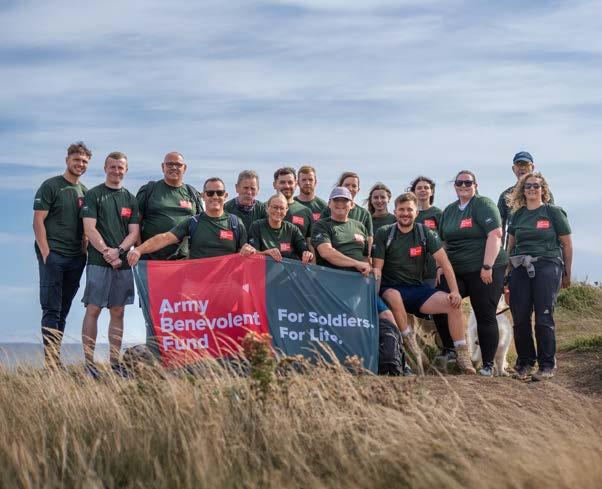
Nearly 1,100 people gathered in the Cairngorms on Friday 6th June 2025, the anniversary of D-Day, to take on the Cateran Yomp – walking non-stop for up to 54 miles over 24 hours, to support soldiers, veterans and their families.
Based on our risk assessment, we considered the areas most susceptible to fraud to be to be journals and key estimates and judgements.
Our procedures in respect of the above included:
+ Testing a sample of journal entries throughout the year, which met a defined risk criteria, by agreeing to supporting documentation;
+ Assessing significant estimates and judgements made by management for bias, including the recognition of legacy income and the allocation of costs;
+ Testing the existence and accuracy of income recognised in the year.
We also communicated relevant identified laws and regulations We also communicated relevant identified laws and regulations and potential fraud risks to all engagement team members and remained alert to any indications of fraud or non-compliance with laws and regulations throughout the audit.
Our audit procedures were designed to respond to risks of material misstatement in the financial statements, recognising that the risk of not detecting a material misstatement due to fraud is higher than the risk of not detecting one resulting from error, as fraud may involve deliberate concealment by, for example, forgery, misrepresentations or through collusion. There are inherent limitations in the audit procedures performed and the further removed non-compliance with laws and regulations is from the events and transactions reflected in the financial statements, the less likely we are to become aware of it.
A further description of our responsibilities for the audit of the financial statements is located at the Financial Reporting Council’s (“FRC’s”) website at: frc.org.uk/ auditorsresponsibilities. This description forms part of our auditor’s report.
Use of our report
This report is made solely to the Charitable Company’s members, as a body, in accordance with Chapter 3 of Part 16 of the Companies Act 2006, and to the Charitable Company’s trustees, as a body, in accordance with the Charities and Trustee Investment (Scotland) Act 2005. Our audit has been undertaken so that we might state to the Charitable Company’s members and trustees those matters we are required to state to them in an auditor’s report and for no other purpose. To the fullest extent permitted by law, we do not accept or assume responsibility to anyone other than the Charitable Company, the Charitable Company’s members as a body and the Charitable Company’s trustees as a body, for our audit work, for this report, or for the opinions we have formed.
Tracey Moore BFP ACA (Senior Statutory Auditor)
For and on behalf of UHY Hacker Young Chartered Accountants Statutory Auditors Thames House, Roman Square, Sittingbourne, Kent
22 July 2026
ARMY BENEVOLENT FUND
Consolidated statement of financial activities for the year to 31 March 2026
(note 19)
(note 20)
(note 21)
(note 22)
Income and endowments from: Donations and legacies
The public Donations and Appeals Income Legacies
Army personnel
From individuals in Army Units
Regimental and Corps Benevolent Funds
Army Dependants Trust
Investments
Other trading activities
Total Income
Expenditure on:
Trading activities
Other costs of raising funds
Charitable activities
Grants to Regiments and Corps for the benefit of individuals
Grants to other charities
Grant making and other support costs
Total expenditure
Net (expenditure)/income before net gains/(losses) on investments
Net gains/(losses) on investments
Net (expenditure)/income for the year
Net interest in the results for the year in associates
Consolidated summary income and expenditure account for the year to 31 March 2026
Income
Gains/(losses) on investments
Gross income in the reporting period
Expenditure
Total expenditure in the reporting period
Net (expenditure)/income before tax for the reporting period
Tax payable
Net (expenditure)/income for the financial year
The income and expenditure account is derived from the Statement of Financial Activities with movements in endowment funds excluded to comply with company law. All activities relate to continuing operations.
ARMY BENEVOLENT FUND
Group and charity balance sheets as at 31 March 2026
Cash at bank and in hand Liabilities
Creditors: amounts falling due within one year
current assets
less current liabilities
Approved by the Board of Trustees and signed on their behalf
Sarah Booth Chair
22nd July 2026
Anthony Scott Chartered FSCI Honorary Treasurer
ARMY BENEVOLENT FUND
Consolidated statement of cash flows for the year to 31 March 2026
Cash flows from operating activities:
Net cash provided by operating activities
Cash flows from investing activities:
Dividends, interest and rents from investments
Purchase of equipment
Proceeds from the sale of investments
Purchase of investments
Net cash provided by investing activities
Change in cash in the reporting period
Cash at the beginning of the reporting period
Cash at the end of the reporting period
Reconciliation of (expenditure)/income to net cash flow from operating activities
Net (expenditure)/income for the reporting period (as per the statement of financial activities)
Consolidated statement of cash flows for the year to 31 March 2026
Analysis of cash
Cash in hand
Notice deposits (less than three months)
Total cash
Analysis of changes in net debt
Cash in hand
Notice deposits (less than three months)
Total cash
ARMY BENEVOLENT FUND
Notes to the financial statements for the year ended 31 March 2026
1. ACCOUNTING POLICIES
ACCOUNTING CONVENTION
The financial statements have been prepared on a going concern basis under the historical cost convention, unless otherwise stated in the relevant accounting policy note, in accordance with Accounting and Reporting by Charities: Statement of Recommended Practice applicable to charities preparing their accounts in accordance with the Financial Reporting Standard applicable in the UK and Republic of Ireland (FRS 102) (effective 1 January 2019) – (Charities SORP (FRS 102)) including the Financial Reporting Standard applicable in the UK and Republic of Ireland (FRS 102), the Charities and Trustee Investment (Scotland) Act 2005 and the Companies Act 2006.
The financial statements are presented in sterling which is the functional currency of the Charity and rounded to the nearest £1,000.
Army Benevolent Fund (‘the Charity’) has taken advantage of the exemption to prepare a charity-only Statement of Cash Flows on the basis that it is a qualifying entity. The consolidated Statement of Cash Flows, within the financial statements, includes the Charity’s cash flows.
The Charity constitutes a public benefit entity as defined by FRS 102.
CONSOLIDATION
The financial statements consolidate Army Benevolent Fund and its trading subsidiary company, Soldiers’ Trading Limited on a line-by-line basis.
INCOME
All income is recognised once the Charity has entitlement to the income, it is probable that the income will be received, and the amount of income receivable can be measured reliably.
Donations and income from fundraising events are recorded in the financial statements when receivable. Income received from events is recognised in the period in which the event takes place. Income from legacies is taken into the Statement of Financial Activities when received or when receipt is probable, and the value can be measured with sufficient reliability. Where legacies have been notified to the Charity, or the Charity is aware of the granting of probate, and the criteria for income recognition have not been met, then the legacy is treated as a contingent asset and disclosed if material. Investment income is recognised when receivable. Grants are included as income when these are receivable.
COSTS OF RAISING FUNDS
Costs of raising funds comprise those incurred in seeking voluntary income and costs incurred in generating income from trading activities. Fundraising costs include advertising, producing publications, printing, and mailing fundraising material, associated staff costs and an appropriate allocation of support costs.
CHARITABLE EXPENDITURE
Grants payable in furtherance of the Charity’s objects are recognised as expenditure in the year in which the grant is formally approved by the Charity and has been communicated to the recipient, except to the extent that it is subject to conditions that enable the Charity to revoke the award. Any refunds of grants are credited to the line in which they were originally allocated in the financial statements.
GRANT MAKING AND OTHER SUPPORT COSTS
Grant making costs are those costs incurred in support of the Charity’s primary objective of paying grants to those in need. Other support to charities reflects the support given to other charities in terms of management and staff time; other associated infrastructure costs and in certain circumstances subsidies for accommodation costs for office space occupied at Mountbarrow House. Governance costs represent those costs associated with the governance arrangements of the Charity which relate to the general running of the Charity. Such costs include external audit fees, legal costs, related trustee costs and costs associated with compliance with statutory requirements.
INVESTMENTS IN ASSOCIATES
Investments in associates are measured in accordance with Section 14 of FRS 102. As such, investments in associates are initially recognised at the transaction price and are subsequently adjusted to reflect the Charity’s share of the surplus, other comprehensive income, and equity of the associate.
ARMY BENEVOLENT FUND
Notes to the financial statements for the year ended 31 March 2026
INVESTMENTS
Investments are a form of basic financial instrument and are initially recognised at their transaction value and subsequently measured at their fair value as at the balance sheet date using the closing quoted market price. The Statement of Financial Activities includes the net gains and losses arising on revaluation and disposals throughout the year. The investment portfolio does not acquire put options, derivatives, or other complex financial instruments. The main form of financial risk faced by the Charity is that of volatility in equity markets and investment markets due to wider economic conditions, the attitude of investors to investment risk, and changes in sentiment concerning equities and within particular sectors or sub sectors. All gains and losses are taken to the Statement of Financial Activities as they arise. Realised gains and losses on investments are calculated as the difference between sales proceeds and their opening carrying value or their purchase value if acquired subsequent to the first day of the financial year. Unrealised gains and losses are calculated as the difference between the fair value at the year end and their carrying value. Realised and unrealised investment gains and losses are combined in the Statement of Financial Activities. Dividends from accumulating units are recognised as investment income and reinvested for capital growth.
Rental income is recognised in the period to which it relates.
INTANGIBLE FIXED ASSETS AND AMORTISATION
Intangible assets costing £1,000 or more are capitalised and recognised when future economic benefits are probable and the cost or value of the asset can be measured reliably.
Intangible assets are initially recognised at cost. After recognition, under the cost model, intangible assets are measured at cost less any accumulated amortisation and any accumulated impairment losses.
Amortisation is provided on intangible assets at rates calculated to write off the cost of each asset on a straightline basis over its expected useful life. Computer software is amortised over eight years.
TANGIBLE FIXED ASSETS AND DEPRECIATION
Tangible fixed assets costing more than £1,000 are capitalised and included at cost, including any incidental expenses relating to the acquisition. Depreciation is provided for all tangible fixed assets so as to write off their cost in equal instalments over their expected useful lives as follows:
Computer equipment 3 years
Operating software 8 years
Office furniture and fittings 3-5 years
Leasehold improvements Over the term of the lease
The carrying values of tangible fixed assets are reviewed for impairment if events or changes in circumstances indicate that the carrying value may not be recoverable.
GOING CONCERN
The trustees have assessed whether there are material uncertainties related to events or conditions that may cast significant doubt on the ability of the Charity to continue as a going concern. The trustees have made this assessment in respect of a period of at least one year from the date of the approval of the financial statements.
The trustees receive forecasts and financial projections that detail variations in the level and timing of future income and funding and have considered the short- and longerterm financial projections and other risks that may affect the Charity. They have considered the key risks that could negatively impact the going concern of Army Benevolent Fund and have considered budgets and forecasts, cashflow projections, reserves levels and contingency and recovery plans. These continue to be regularly monitored by the trustees and senior management team.
The trustees have concluded that there is a reasonable expectation that the Charity has adequate resources to continue in operational existence for the foreseeable future. The trustees believe that, whilst uncertainty exists, this does not pose a material uncertainty that would cast doubt on the Charity’s ability to continue as a going concern. The Charity therefore continues to adopt the going concern basis in preparing its financial statements.
DEBTORS
Trade and other debtors are recognised at the settlement amount due after any trade discount offered. Prepayments are valued at the amount prepaid net of any trade discounts due.
CASH AT BANK AND IN HAND
Cash at bank and in hand includes cash and short term highly liquid investments with a short maturity of three months or less from the date of acquisition or opening of the deposit or similar account.
ARMY BENEVOLENT FUND
STOCK
Stocks are valued at the lower of cost and net realisable value after making due allowance for obsolete and slowmoving stocks.
CREDITORS AND PROVISIONS
Creditors and provisions are recognised where the Charity has a present obligation resulting from a past event that will probably result in a transfer of funds to a third party and the amount due to settle the obligation can be measured reliably. Creditors and provisions are normally recognised at their settlement amount after allowing for any trade discounts due.
OPERATING LEASES
Rentals payable under operating leases are charged to the Statement of Financial Activities as incurred over the period of the lease.
PENSION COSTS
Eligible employees are automatically enrolled into a Group Personal Pension scheme which is operated on a contributory basis. The assets of the Group Personal Pension Scheme are held separately from those of the Charity and contributions payable by the Charity are charged in the Statement of Financial Activities in the year in which they are payable.
FOREIGN CURRENCY
Transactions denominated in foreign currencies are recorded at the exchange rates ruling at the date of the transaction.
Monetary assets and liabilities denominated in foreign currencies are converted to Sterling at the rates of exchange ruling at the balance sheet date. The financial statements of overseas operations are translated to Sterling at the approximate rates of exchange ruling at the balance sheet date. All differences are recorded in the Statement of Financial Activities.
VOLUNTEERS
The Charity benefits greatly from the involvement and enthusiastic support of its volunteers. These include our president, trustees, and regional fundraising groups. In accordance with FRS 102 and the Charities SORP (FRS 102), the economic contribution of general volunteers is not included in the financial statements.
ACCOUNTING ESTIMATES AND JUDGEMENTS
Judgements and estimates are continually evaluated and are based on historical experience as well as other factors, including expectations of future events that are believed to be reasonable under the circumstances. The Group makes estimates and assumptions concerning the future. The resulting accounting estimates will, by definition, seldom equal the related actual results.
The matters considered below are considered to be the most important in understanding the judgements that are involved in preparing the financial statements and the uncertainties that could impact the amounts reported in the results of operations, financial position and cash flows.
A. COST ALLOCATION
Support costs not attributable to a single charitable activity are allocated or apportioned on a basis consistent with identified cost drivers for that cost category. Cost drivers utilised include head count, staff time allocation, and effort and judgement is exercised in applying cost drivers to cost categories.
B. LEGACY INCOME ACCRUAL
Legacy income is recognised in accordance with the income recognition policy. In calculating the level of legacy accrual, management is required to exercise estimation and judgement, particularly in determining the amount and probability of receipt.
ARMY BENEVOLENT FUND
Notes to the financial statements for the year ended 31 March 2026
2. SUBSIDIARY COMPANY’S RESULTS
SOLDIERS’ TRADING LIMITED
Included in Donations and appeals income in Income, is general purpose trading income arising in Soldiers’ Trading Limited. The results were as follows:
Turnover
Cost of Sales
Gross Profit
Administrative expenses
Profit on ordinary activities
Tax on profit
Profit after tax and for the financial year
Opening retained earnings
Payment to parent charity under Gift Aid
Closing retained earnings
ARMY BENEVOLENT FUND
TRADING ACTIVITIES
Fundraising
Notes to the financial statements for the year ended 31 March 2026 Other Costs of raising
ARMY BENEVOLENT FUND
Notes to the financial statements for the year ended 31 March 2026
6. GRANTS FOR THE BENEFIT OF INDIVIDUALS
All grants made for the benefit of soldiers, former soldiers and their immediate families are paid through their parent regimental or corps charities. The total value of these grants made during the year was £3,050k (2025: £3,097k).
7. GRANTS TO OTHER CHARITIES AND ORGANISATIONS
The Charity, on behalf of the partnership of Army charitable funds, makes grants to national charities and occasionally other organisations which support soldiers, former soldiers, and their immediate families.
By the nature of Service charities and other charities supporting serving and former soldiers, many of Army Benevolent Fund’s trustees and senior management work closely with, or serve as trustees for, some of the charities listed below that receive grants from us. Where this applies, the trustee or member of the management team will not take part in the grant making decision process.
The total values of the grants made during the year for the Group and Charity were:
GRANTS FROM GENERAL FUNDS:
ELDERLY
Age In Spain
Age UK Lancashire
Age UK Waltham Forest
Broughton House
Care for Veterans (Queen Alexandra Hospital Home)
Erskine Hospital
Royal Commonwealth Ex-Services League
Royal Hospital Chelsea
Royal Star & Garter Home
EMPLOYMENT
AND TRAINING
AFC Fylde Community Foundation
Building Heroes Education Foundation
Heritage Crafts Association
Highground
Mission Motorsport
On Course Foundation
Prisoners Education Trust
Recruit for Spouses
Forces Employment Charity
Royal British Veterans Enterprise Ltd
The Open University
The Poppy Factory
Turn to Starboard (T2S)
Veterans into Logistics
X-Forces
ARMY BENEVOLENT FUND
Notes to the financial statements for the year ended 31 March 2026
7. GRANTS TO OTHER CHARITIES AND ORGANISATIONS (CONTINUED)
GRANTS FROM GENERAL FUNDS (CONTINUED):
FAMILY
Army Families Federation
Army Welfare Service
Army Widows’ Association
Aurora New Dawn
Children First (Royal Scottish Society for Prevention of Cruelty to Children)
Clervaux Trust
COBSEO, The Confederation of Service Charities
Dandelion Military Families
Families Activity Breaks
Forces Children Scotland
Give Us Time
Hong Kong LEP Trust
Little Troopers/ My Daddy is a Soldier Adventures
National Gulf Veterans & Families Association
Queen Elizabeth Hospital Birmingham - Fisher House
Reading Force
Re-Vitalise
SafeLives (CAADA)
Scotty’s Little Soldiers
Shared Parenting Scotland
SSAFA Central Offices
SSAFA CMS Costs
Style For Soldiers
Veterans Scotland
Veterans with Dogs
HOUSING
Armed Forces & Veterans Launchpad
Armed Forces Outreach Service (Gateshead Council)
Haig Homes
Help for Homeless Veterans
Royal British Legion Industries
Scottish Veterans Residences
Sir Oswald Stoll Foundation (Stoll)
ARMY BENEVOLENT FUND
Notes to the financial statements for the year ended 31 March 2026
7. GRANTS TO OTHER CHARITIES AND ORGANISATIONS (CONTINUED)
GRANTS FROM GENERAL FUNDS
(CONTINUED):
WELLBEING
Alabaré
AFC Fylde Community Foundation
Anxious Minds
Armed Forces Equine Charity
Army - Beyond the Warzone
Aurora New Dawn
Bay Veteran’s Association
Bound by Veterans
Blackpool FC Community Trust
Brooke House Health and Wellbeing centre
Change Mental Health Ltd
Climb2Recovery
COBSEO, The Confederation of Service Charities
Combat Stress
Community Drug and Alcohol Recovery Services
Defence Medical Welfare Service
Dundee Therapy Garden
East Durham Veterans Trust
Vector24 (formerly Fares4Free)
Fighting With Pride (FWP)
Glen Art/Bravehound
Highground
HorseBack UK
Hounds for Heroes
Humankind (Waythrough Charity)
Icarus
Improving Lives Plymouth
James’ Place Charity
Jersey Joint Services Veterans Assoc (JJSVA)
Lord Kitchener Memorial Holiday Centre
Lothian Veterans Centre
Music in Hospitals and Care
Orchestra of the Swan
PTSD Resolution CIO
Rock 2 Recovery
Root Cause Project
Rural Veterans Hubs Kirklees
SafeLives
Service Dogs UK
Smart Savings
Notes to the financial statements for the year ended 31 March 2026
7. GRANTS TO OTHER CHARITIES AND ORGANISATIONS (CONTINUED) ARMY
WELLBEING (CONTINUED)
Spinal Injuries Association
SSAFA CMS Costs
SSAFA Forces Help
Start360
Step Together Volunteering
Style for Soldiers
Taxi Charity for Military Veterans
The Bolton Guild of Help
The Bridge for Heroes
The Gwennili Trust
The Not Forgotten Association
The Prison Radio Association
The Ripple Pond
The Warrior Programme
Thistle Health and Wellbeing
Together Co
Valley Veterans
VC Gallery
Veterans Contact Point
Veterans’ Growth
Veterans Outdoors
Veterans Outreach Support
Veterans Scotland
Veterans Support Garden
Vine Centre
Walking with The Wounded
Waterloo Uncovered
We Are With You
Woody’s Lodge
ARMY BENEVOLENT FUND
Notes to the financial statements for the year ended 31 March 2026
7. GRANTS TO OTHER CHARITIES AND ORGANISATIONS (CONTINUED)
Notes to the financial statements for the year ended 31 March 2026
9. STAFF COSTS - GROUP AND CHARITY
TOTAL STAFF COSTS COMPRISED:
Wages and salaries
Social security costs
Pensions contributions
The Charity employed an average staff of 90 (13 part-time) (2025: 84 including 11 part-time) of whom 58 (2025: 55) were employed at the Charity’s head office. A small number of these individuals were on short-term contracts to cover vacant posts and also from time to time we engage a limited number of contract and agency staff. There is £96k included in staff costs related to settlement (2025: £11k).
The number of employees whose employee benefits exceeded £60,000 was:
£60,001 - £70,000
£70,001 - £80,000
£80,001 - £90,000
£90,001 - £100,000
£100,001 - £110,000
£140,001 - £150,000
The key management personnel for the Charity comprise the trustees and the executive board (senior management board). The trustees received no remuneration or benefitsin-kind during the year (2025: £nil). They were reimbursed expenses during the year as stated in note 10.
10. RELATED PARTY TRANSACTIONS
No trustees have been remunerated for their role as a trustee. Nine trustees were reimbursed £4k for travel expenses which had been directly incurred during the year under review (2025: £3k to eight trustees).
During the year, trustees made nil donations to the charity (2025: £5k). Business interests of one of the trustees donated £12k to the charity (2025: £10k). These donations were received without conditions.
Trustees and members of key management of the Army Benevolent Fund hold trustee positions and have connections with other organisations with military
The total remuneration, including employer’s pension contributions and employer’s National Insurance contributions paid to the executive board, amounted to £733k (2025: £721k).
connections. Grants may be made to these charities by the Army Benevolent Fund. These are made in accordance with the charity’s normal processes and within the parameters of its conflicts of interests policy.
During the year ending 31 March 2026, the Charity charged its subsidiary £5k for management fees relating to Soldiers’ Trading Limited’s activities (2025: £5k). Soldiers’ Trading Limited donated £15k to Army Benevolent Fund from its profits (2025: £11k). At 31 March 2026, there was a balance of £36k (2025: £34k) owed to Army Benevolent Fund by Soldiers’ Trading Limited.
ARMY BENEVOLENT FUND
Notes to the financial statements for the year ended 31 March 2026
11. INTANGIBLE FIXED ASSETS – GROUP AND CHARITY
At 1 April
Additions during the year
At 31 March
Amortisation
At 1 April
Charge for the year
At 31 March
Net book value at 31 March
12.
TANGIBLE FIXED ASSETS – GROUP AND CHARITY
At 1 April
Charge for the year
Disposals for the year At 31 March
Net book value at 31 March
ARMY BENEVOLENT FUND
Notes to the financial statements for the year ended 31 March 2026
13. INVESTMENTS – GROUP AND CHARITY
Market value 1 April 2025
Purchase of investments
Sale of investments
Net gains on investments
Market value 31 March 2026
Cost
At 31 March 2026
At 31 March 2025
All of the investments listed above are held by the Charity, including 100% of the issued share capital of Soldiers’ Trading Limited. Both the cost and valuation of this shareholding is £1.
The investment portfolio comprises the following at market value:
BLACKROCK – ARMED FORCES
Income units
Accumulation units
CCLA – COIF
Accumulation units
Market value 31 March 2026
ARMY BENEVOLENT FUND
Notes to the financial statements for the year ended 31 March 2026
14. ASSOCIATES
The Soldiers’ Fund (TSF) was incorporated as a tax-exempt charity in the United States in 2012, its primary purpose being to raise funds for British Army personnel, past and present, and their families in times of need. As the Army Benevolent Fund can appoint three of the eleven directors of TSF, it is treated as an associate undertaking for the purposes of the consolidated financial statements. The Charity’s share of TSF’s deficit as at 31 March 2026 was £2k (2025: surplus, £1k). The Charity’s share of TSF’s net assets was £10k (2025: £12k).
15. OTHER DEBTORS AND PREPAYMENTS
Prepayments and accrued income
Other debtors
Due from subsidiary
Total
16. CREDITORS: AMOUNTS FALLING DUE WITHIN ONE YEAR
Deferred income
At 1 April
Arising during the year
Released during the year
At 31 March
Trade creditors
Accrued expenses
Social security costs
Other creditors
Total
ARMY BENEVOLENT FUND
Notes to the financial statements for the year ended 31 March 2026
17. PROVISIONS FOR LIABILITIES – GROUP AND CHARITY
At 1 April
Amounts provided for Amounts released
At 31 March
The Charity renewed an eight-year lease to January 2032 with the current landlord. The new lease signed 28 June 2024 sets out that no dilapidations will be payable by the Charity. Accordingly, the dilapidations provision was released in the prior year.
18. ANALYSIS OF NET ASSETS BETWEEN FUNDS
GROUP
General Funds
Designated Funds
Afghanistan Fund
Current Operations Fund
Restricted Funds
Commandos Benevolent
DEFLOG VQ Trust
Falklands Fund
George Purse Trust Fund
Expendable endowment
Edward Gostling Fund
2,131 6,536 175 118,028
ARMY BENEVOLENT FUND
Notes to the financial statements for the year ended 31 March 2026
18. ANALYSIS OF NET ASSETS BETWEEN FUNDS (CONTINUED)
BENEVOLENT FUND
Notes to the financial statements for the year ended 31 March 2026
18. ANALYSIS
OF NET ASSETS BETWEEN FUNDS (CONTINUED)
ARMY BENEVOLENT FUND
Notes to the financial statements for the year ended 31 March 2026
19. GENERAL FUNDS FINANCIAL ACTIVITY – GROUP AND CHARITY
At 1 April
Income and interest in associate Expenditure
Gains/(Losses) At 31 March
ARMY BENEVOLENT FUND
Notes to the financial statements for the year ended 31 March 2026
20. DESIGNATED FUNDS FINANCIAL ACTIVITY – GROUP AND CHARITY
Income
Income from charitable activities
Income from investments
Total income
Expenditure
Grants to other charities
Grants for the benefit of individuals
Grant making and other support costs
Total expenditure
Net (expenditure)/gains before net gains on investments
Net gains on investments
NNet (expenditure)/gains for the year
Net movement in funds
Fund balances at 1 April Fund
at 31 March
(544) (544) 7,319 6,775
ARMY BENEVOLENT FUND
Notes to the financial statements for the year ended 31 March 2026
20. DESIGNATED FUNDS FINANCIAL ACTIVITY – GROUP AND CHARITY (CONTINUED)
Income
Income from charitable activities
Income from investments
Total income
Expenditure
Grants to other charities
Grants for the benefit of individuals
Grant making and other support costs
Total expenditure
Net (expenditure) before net gains/ (losses) on investments
Net gains/(losses) on investments
Net (expenditure) for the year
Net
at 1 April
Designated Funds, within Unrestricted Funds, are set aside at the discretion of the trustees for specific purposes and time. The Designated Funds now consist of the Current Operations Fund (COF) and the Afghanistan Fund.
+ The Current Operations Fund was established in 2007 to provide a continuing fund for soldiers, former soldiers, and their dependants in times of need who are suffering distress as a result of military operations being undertaken at that time and all subsequent military operations. It will continue in place until such time as all eligible beneficiaries no longer survive.
+ The Afghanistan Fund was set up to support Army families affected by the Afghanistan campaign. Similarly, this will be time limited.
ARMY BENEVOLENT FUND
Notes to the financial statements for the year ended 31 March 2026
21. RESTRICTED FUNDS FINANCIAL ACTIVITY –
Income
Income from charitable activities
Income from investments
Total income
Expenditure
Grants to other charities
Grants for the benefit of individuals
Grant making and other support costs
Total expenditure
Net (expenditure)/gains before net gains on investments
Net gains on investments
Net (expenditure)/gains for the year
Net movement in funds
Fund balances at 1 April
Fund balances at 31 March
ARMY BENEVOLENT FUND
Notes to the financial statements for the year ended 31 March 2026
21. RESTRICTED FUNDS FINANCIAL ACTIVITY – GROUP AND CHARITY (CONTINUED)
Income
Income from charitable activities
Income from investments
Total income
Expenditure
Grants to other charities
Grants for the benefit of individuals
Grant making and other support costs
Total expenditure
Net (expenditure)/gains before net losses on investments
Net (losses) on investments
Net (expenditure) for the year
Net movement in funds Fund balances at 1 April
balances at 31 March
The Restricted Funds consist of:
+ The Army Commandos’ Benevolent Fund gave the bulk of its winding up funds as a grant to the Amy Benevolent Fund for the assistance of any such persons who have served in the Commandos and in making grants to charitable organisations which directly or indirectly benefits the persons or dependents of persons who have served in the Commandos. There have been no cases presented this year where an individual met the criteria for eligibility for funding from the Commandos fund.
+ The DEFLOG VQ Trust was set up from the funds received from The DEFLOG VQ Trust, which folded into the Army Benevolent Fund four years ago. The funds are restricted to advance education and training and to relieve unemployment; and relieve the needs of people who are at risk of becoming socially excluded, through the promotion of social inclusion.
+ The Falklands Fund, which exists to meet the needs of soldiers, former soldiers and their dependants who have suffered distress as a result of the Falklands conflict.
+ The George Purse Trust Fund which exists to make grants that would not otherwise be provided out of Charity Unrestricted funds to support the welfare needs of exArmy personnel, dependants and carers residing in the former boundaries of the counties of Glamorgan and Monmouthshire.
ARMY BENEVOLENT FUND
Notes to the financial statements for the year ended 31 March 2026
22. ENDOWMENT FUNDS FINANCIAL ACTIVITY – GROUP AND CHARITY
Income
Income from charitable activities
Income from investments
Total income
Expenditure
Grants to other charities
Grants for the benefit of individuals
Grant making and other support costs
Total expenditure
Net (expenditure)/income before net gains/(losses) on investments
Net gains/(losses) on investments
Net expenditure for the year
Transfer to the General Fund
Net movement in funds
Fund balances at 1 April
Fund balances at 31 March
The expendable endowment was a donation of £250,000 from the Edward Gostling Foundation. The fund will be used to provide grants to soldiers, former soldiers and their families over a period of ten years from 2024 to enable independent living.
ARMY BENEVOLENT FUND
Notes to the financial statements for the year ended 31 March 2026
23. FINANCIAL INSTRUMENTS
Financial assets
Financial assets measured at fair value through income and expenditure
Financial assets measured at fair value comprise listed investments.
24. PENSION COSTS
Army Benevolent Fund Group Pension Plan
Employer contributions to the auto enrolment scheme during the year to 31 March 2026 amounted to £215k (2025: £190k).
There was no outstanding pension contribution as at 31 March 2026 (2025: £nil).
ARMY BENEVOLENT FUND
Notes to the financial statements for the year ended 31 March 2026
25. OPERATING LEASE COMMITMENTS
At 31 March 2026 the Charity had future minimum lease payments under non-cancellable operating leases for each of the following periods:
Not later than one year
Later than one year and not later than five years
Later than five years
Not later than one year
Later than one year and not later than five years
Later than five years
The lease between the Army Benevolent Fund and Grosvenor Estate Belgravia covers part of the first and second floors, and the entire third floor at Mountbarrow House.
26. CAPITAL COMMITMENTS
At 31 March 2025, the Army Benevolent Fund had capital commitments in respect of its CRM software.
ARMY BENEVOLENT FUND
Notes to the financial statements for the year ended 31 March 2026
27. COMPARATIVE CONSOLIDATED STATEMENT OF FINANCIAL ACTIVITIES
Income and endowments from: Donations and legacies
The public Donations and Appeals Income
Legacies
Army personnel
From individuals in Army Units
Regimental and Corps Benevolent Funds
Army Dependants Trust
Investments
Other trading activities
Total Income
Expenditure on:
Trading activities
Other costs of raising funds
Charitable activities
Grants to Regiments and Corps for the benefit of individuals
Grants to other charities
Grant making and other support costs
Total expenditure
Net (expenditure)/income before net gains/(losses) on investments
Net gains/(losses) on investments
Net (expenditure)/income for the year
Net interest in the results for the year in associates
Net movement in funds Fund balances at 1 April Fund balances at 31 March