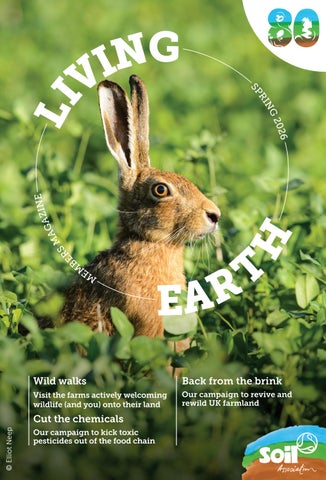
Living Earth Spring 2026

Page 1


LIVING EARTH ENIZAGAMSREBMEM

Wild walks

Visit the farms actively welcoming wildlife (and you) onto their land

Cut the chemicals

Our campaign to kick toxic pesticides out of the food chain

SPRING 2026

Back from the brink

Our campaign to revive and rewild UK farmland

Welcome

to the spring issue of Living Earth

Spring is a time of renewal and celebration as nature bursts into life after the cold winter months. And we have even more to celebrate this year, as the Soil Association marks its 80th anniversary.

In the last decade, attitudes and awareness towards organic and nature-friendly farming have shifted, and it feels as though we are making more progress now than at any time through our long history. The importance of reversing the decline in biodiversity, allowing nature to help solve our climate and water problems, and the focus on soils as crucial to the future of humanity are all issues that many people, from policymakers and businesses to farmers and citizens, are now engaging with.

Our role is now to turn that positive sentiment and desire for change into effective, lasting solutions. We have something very special to offer the world: 80 years of practical experience. We know there are no silver bullets, but rather a need to work on a whole range of issues, to allow the system to evolve in a fairer and healthier direction.

In our 80th year, we’re committed to reviving nature by helping farmers shift to sustainable ways of working, reshaping the food system so healthy choices are the easy ones, and making sure social justice, alongside our environmental goals, is at the heart of everything we do.

We will not be satisfied until every farm has access to a resilient, ethical, naturefriendly future, until every forest is valued and protected, and until every child can eat well in a way that supports the planet. These goals aren’t wishful thinking –they’re within our grasp, if we work together to make them happen.

Thank you, as always, for supporting us to make the future a more positive one. Your support keeps me hopeful and excited for what we can achieve.

With warmest wishes,

Issue: 278

To everyone who made this possible, we can’t thank you enough.

We did it!

A tree-mendous success

Our recent agroforestry appeal to support farmers to plant more trees on their farms raised an incredible £82,000, which will be used to give a nature and biodiversity boost to farms across the UK. Since October 2025, our Agroforestry Team has already talked to 150 farmers looking to make their farms more productive, resilient and sustainable. As we head into our 80th year with a focus on reviving nature, we look forward to a time where the countryside is criss-crossed with hedgerows and studded with a variety of trees again, and your donations have brought us so much closer to achieving that goal.

A better life for farm animals

Your support has also helped to improve life for farm animals through our campaigns for better welfare for dairy cows, pigs and chickens.

In response to sustained pressure for higher welfare standards, the government has committed to improving the lives of millions of animals in its Animal Welfare Strategy. This includes promises to phase out enriched cages for laying hens and farrowing crates for pigs. They have also committed to exploring food labelling that reveals the reality of farm animals’ lives and ending the practice of painful mutilations such as tail docking and beak trimming.

If you’re interested in making an even bigger impact, please phone us on 0300 330 0022, or send us an email at memb@soilassociation.org

Making healthy food accessible for all

The Soil Association’s Whole Truth campaign has exposed the ultraprocessed food (UPF) industry’s persistent lobbying of the UK government to protect their interests and block attempts to get retailers to make healthy foods more affordable.

Working in partnership with Wildlife & Countryside Link, Obesity Health Alliance, Sustain, Eating Better and Plant-Based Food Alliance, we are asking the government to update dietary guidelines in support of whole foods and minimally processed diets.

Our policy report includes a series of recommendations for the government’s food strategy and has been endorsed by over 200 organisations. This is accompanied by a petition, signed by more than 20,000 supporters, that calls on the UK government to resist the influence of the ultra-processed food industry and make minimally processed food accessible to all.

Our investigation prompted MPs across the political spectrum to ask questions in parliament, and it was also discussed in a Health and Social Care Committee evidence session in the House of Lords.

In Scotland, the Health and Social Care Committee has recommended action on UPFs and the promotion of whole, minimally processed foods.

In Wales, members of the Senedd, health groups and the Future Generations Commissioner, supported by us, are also calling for action on UPFs, including in school meals.

A recent report from the British Medical Association placed reducing UPFs at the centre of the need to improve the UK’s food environment, while our Food for Life and Sustainable Food Places programmes continue to provide a blueprint for change.

Thank you for supporting this critical work to rebalance Britain’s diet.

Cut the chemicals from our nature and food

Despite all our knowledge about their harmful effects on nature, wildlife and human health, EU-banned pesticides continue to be used widely on UK farms. We’re launching a new campaign to redress the balance and cut carcinogenic glyphosates out of the food chain for good.

Right now, the UK government is negotiating a trade agreement that would require us to align with European Union (EU) rules on pesticide use.

This is good news. Since the UK left the EU, national protections around pesticides have weakened. However, lobbyists for the pesticide industry are pushing hard to keep EU-banned pesticides in use on British farms.

Analysis in Unearthed, Greenpeace’s award-winning journalism project, found that pesticides identified by the lobby group CropLife as ‘essential’ to British farming had been outlawed in the EU. This was after scientific reviews found them to be carcinogenic, toxic to reproduction or endocrine disruptors that interfere with hormones.

In a recent article in The Times, the Soil Association’s Policy Director, Brendan Costello, said:

“It’s shocking that chemicals which pose risks to everything from unborn babies to birds are still permitted in the UK, and it is clearly in the public interest to ban them."

The pesticide companies pushing for them to be exempt from regulatory alignment with the EU seem to only be doing so out of naked commercial self-interest.

Buying organic means no chemical residues on the foods you purchase

Nature-friendly farming, including organic farming, already produces food without these risks – and yet, reducing farmer reliance on chemicals such as pesticides continues to be contentious.

Glyphosate, the chemical found in popular weedkillers like Roundup, has been categorised by the World Health Organization as “probably carcinogenic”, and yet it is often sprayed on cereal crops just before harvest. Not to tackle weeds, but to simply dry the crops out so they can be harvested more easily.

When used in this way, it leaves residues in our food, like beer, bread and breakfast cereals, as well as on the surrounding landscape. And crucially: this practice isn’t necessary. Farmers are already proving that they can grow and dry their crops successfully without it.

At the Soil Association, we have long called for an end to this practice and for farmers to be supported by government, retailers and other businesses to transition to more nature-friendly production.

Among those phasing glyphosate out is Emily Aitchison, one of our Farming Ambassadors, who runs a farm and bakery in Suffolk.

“We would never use glyphosate on a croppable field because we don’t want residues in the bread our customers eat,” she explains. “It’s also a real priority for us to create more biodiversity on our farm and reduce chemical use. The key thing for me is education. Farmers are open to changing their practices if they can understand how they can reduce glyphosate use and have alternative, effective methods.”

The government knows it must act on pesticides. We need to pile on the pressure to make the government prioritise actions that benefit nature and the planet. With your support, we will campaign for a pesticide-free future.

To read more about our campaign go to soilassociation.co/glyphosate

Better together

Our work with partner organisations is helping us to achieve so much more than we can alone. We asked four of our policy team to reveal how they’re forging new alliances to drive meaningful change.

Stronger systems for Wales

Soil Association Cymru worked with the Welsh Organic Forum, Food Policy Alliance Cymru, and Coed Cadw (the Woodland Trust in Wales) to strengthen food and farming policy in Wales. The aim across these partnerships was to secure better support for organic farming, strengthen the case for a Welsh food strategy and influence tree planting policy. We coordinated the Forum’s 2024 campaign, helping win the reinstatement of support payments for organic farmers, commissioned legal advice that confirmed that the Welsh food system needed fresh legislation and co-funded modelling to assess Welsh Government's tree planting targets.

Tuddenham, Head of Policy, Wales

Winner, winner, nutritious school dinners

The Soil Association partnered with more than 40 organisations through the School Food Review group. Our shared objective was to influence England’s mandatory food standards to ensure children receive healthier, more sustainable school meals. Acting as the chair of the standards working party, we shared practical insight from our work with schools and caterers. We also lobbied for freshly prepared meals, with more beans and pulses and less but better meat,

Saying no to nitrogen fertilisers

The Sustainable Nitrogen Alliance, which the Soil Association established with a range of partners, including WWF, Plantlife, Woodland Trust, RSPB and health organisations, tackles the harmful impacts of nitrogen fertiliser overuse on nature, rivers, air quality and the climate. Working together, we commissioned research and have promoted a UK Nitrogen Balance Sheet, tracking how nitrogen flows through the economy and environment. Our evidence to a House of Lords Inquiry highlighted the need for ‘nitrogen budgets’ and a national strategy to tackle this issue, and these ideas are gaining traction. Public support, including a petition to cut nitrogen fertilisers with over 20,000 signatures, has further strengthened the case for change.

Water has turned green from nitrogen run-off

Starting a tree-planting revolution in Scotland

Soil Association Scotland partnered with Woodland Trust Scotland to build support for integrating more trees on Scottish farms and crofts. The aim was to strengthen policy and funding for agroforestry, which can help farm businesses build resilience and adapt to climate change. The benefits include providing shelter for livestock, boosting biodiversity, improving soil structure, preventing run-off and erosion and managing water flows. At the beginning of the parliamentary term in 2021, we created a joint policy report outlining the benefits and barriers, then worked with farmers and crofters to design policy and payment options, presented at the Royal Highland Show. Together, we secured backing from key farming bodies and environmental NGOs, influencing the 2024 budget asks, and pitched for more support for agroforestry in the 2026 Scottish election manifestos.

McKay, Soil Association Scotland Co-Director, Policy Unit

Future of Food Science Museum

A new exhibition at The Science Museum in London examines our food system against the backdrop of the climate and nature emergencies. Emma Cashmore met up with the exhibition’s curator, Rupert Cole, to find out more.

Why is our food system wrecking the planet, and what can we do to fix it? This is the question the Science Museum’s Future of Food exhibition sets out to answer. Rupert Cole told us,

The

concept

at the heart of the

exhibition

is that we need a new future

for food. Our current system is not sustainable.

As we wander around the thoughtprovoking displays, from a satirical children’s playset based on a factory farm to a beautiful jigsaw representing an agroecological vision of farmers, Rupert explains that scientists have divergent visions for the future of food. A key part of

the exhibition’s narrative is that visitors are invited to weave between two different visions for a more sustainable future for future. “One approach is centred around biotechnology (think precision fermentation, cell-grown meat and genetic engineering),” explains Rupert, “and the other approach is focussed on ecology, exploring agroecology, sustainable fishing and concepts like seed sovereignty.”

Visitors are encouraged to pick and mix their way through these competing approaches to food production. An interactive game invites visitors to design their own future of food production over a projected landscape and seascape, choosing from conventional, biotech and ecological methods of food production. These choices impact their scores on climate, nature and food produced.

We didn’t want to give people the answers, we wanted to give them the debate and the tools to make up their own minds.

One of Rupert’s first recruits to the exhibition’s advisory panel was the Soil Association’s Chief Executive, Helen Browning, who was selected to represent the organic movement. “It is the first time the organic food and farming movement has been featured at the Science Museum,” says Rupert.

The exhibition also features a copy of the book, The Living Soil, by the Soil Association’s co-founder, Lady Eve Balfour. But this is not just any copy –it is signed by Balfour, and was found by Sarah Langford while perusing

the shelves of an Oxfam bookshop. Balfour’s book inspired Langford to become an organic farmer.

The exhibition took three and a half years to put together and Rupert describes many inspiring projects he learnt about while researching it. Among his favourite objects are a woodblock print of a La Via Campesina food sovereignty poster designed by Rosanna Morris, a traditional Mexican olotera tool used for deseeding maize and a cooking pot from community cooking school Made in Hackney.

The exhibition is one of Rupert’s career highlights, he said,

"I was uncertain what people would think when it first opened, but it turned out to be such a joyous experience. I was so proud to see the reaction from the people whose work features in the show and to hear that I represented their story right."

The Future of Food exhibition is free and runs until September 2026. For more information and to book, go to: sciencemuseum.org.uk/see-and-do/future-of-food

All e thic ally source d and Soil Asso cia tion cer tifie d. CHOOSE FROM OVER 80 PRODUCTS IN THE LARGEST RANGE OF ORGANIC

No drought about it

As climate change presents unprecedented challenges for farmers, we’ve set out our vision for a new approach that works with nature to increase resilience and maintain the UK’s food security.

Once considered a distant threat to UK farming, climate change is now putting livelihoods and food security at risk. In 2025, the UK experienced its warmest spring and summer on record, resulting in early harvests and major yield losses.

Faced with more frequent extreme weather events, from floods and droughts to summer heatwaves, farmers are dealing with unprecedented challenges. Often, several extreme weather events occur within the same year, damaging crops, harming livestock and leaving farmers counting the cost.

Beyond the UK, our wider food chain is also exposed due to our reliance on imports from some of the most climate-vulnerable countries. Consumers are already feeling the impacts through rising food prices.

Under the circumstances, it’s clear we need a fundamental shift in our farming system to make it more

resilient to extreme weather events while maintaining our food security.

That’s why we created our new report, No Drought About It: Farming Agroecologically for Climate Resilience. This document sets out our vision for a whole-system approach that works with nature, not against it, with a 10-point plan to build climate resilience into the UK’s farming system.

The current food system encourages intensive production, heavy reliance on synthetic fertilisers and pesticides and high concentrations of livestock. These factors undermine resilience by driving pollution and harming nature. Intensive animal agriculture is also reliant on imported feed, leaving farmers vulnerable to price shocks.

In contrast, agroecology (sustainable farming that works with nature) offers an alternative, nature-friendly solution, while organic farming demonstrates a tried-and-tested model for delivery.

Agroecology offers an alternative, naturefriendly solution, while organic farming demonstrates a tried-and-tested model for delivery.

Together, they can help build a resilient and sustainable food system fit for the future, with environmental, economic and social benefits baked in.

This approach prioritises whole foods such as beans and pulses – healthy sources of protein, which fix nitrogen and boost soil health. And it promotes mixed farming systems, rotating livestock with diverse crops to enable a shift towards a reduction in meat production, with a greater focus on quality.

A truly resilient farm has healthy soils that hold water during dry periods and

drain better in heavy rain. It doesn’t rely on expensive synthetic and fossil-fuelbased inputs, which are vulnerable to price shocks and supply disruption. It supports wildlife and natural processes that help crops and livestock. And it grows a wider diversity of crops, reducing the risk of total crop failure.

However, resilience also depends on fair supply chains and localised infrastructure, which is why policy change is also needed. Through advocacy, research and practical programmes, we champion organic and agroecological farming and support those adopting it. These methods present credible solutions to climate change, biodiversity loss and food insecurity.

To read the report, go to soilassociation.co/4bNCaBC

Embark on a transformative educational journey by studying on one of our practical academic postgraduate courses drawing on over 50 years of experience in sustainability. Courses explore interdisciplinary subjects from ecology and energy to architecture and beyond.

The EU bans six A full ban on DDT pesticides is implemented in the UK after years The Soil Association Certification

Our first annual conference is held, spreading the word about how important soil is

The Soil Association is one of five founding members of IFOAM

Farmers is Soil is recognised as Soil Association Exchange was set

Back from the brink

As a new government report reveals the risks of global biodiversity loss to our food production and national security, we’re asking for your support to revive the UK’s farmland.

The rapid decline of biodiversity in the UK and overseas is threatening ecosystem collapse, accelerating climate change and threatening food security, according to a new UK government assessment.

The report, Global Biodiversity Loss, Ecosystem Collapse and National Security, published in January, combines a review of global ecosystem decline with a series of doomsday scenarios if current trends continue unabated.

Among the alarming statistics quoted in the report is a 73% reduction in monitored wildlife populations between 1970 and 2020 and a 68% decline in vertebrate species over the

same period. While food production is highlighted as the primary cause of biodiversity loss on land, it’s predicted that this will only worsen as we struggle to feed a growing population. In turn, biodiversity loss and climate change are identified as the biggest medium-to-long-term threats to domestic food production due to depleted soils, loss of pollinators, droughts and floods.

According to the report, the potential consequences of unchecked biodiversity decline include everything from crop failures, intensified natural disasters and outbreaks of infectious diseases to political instability and erosion of global economic prosperity.

Here in the UK, ecosystem collapse will leave us more heavily dependent on imported food, just as increasingly scarce natural resources globally increase competition and conflict.

So, what can we do to prevent this worst-case scenario from becoming reality? On our 80th anniversary year, our focus is on working with farmers to bring wildlife back to our farms. As the guardians of 70% of the UK’s countryside, our farmers hold the key to restoring our natural habitats and reversing this decline.

Using Woodoaks as a case study, we will deliver training and raise awareness to help more farms replicate these successes, and we’ll campaign to secure government policies supporting farmers to create wildlife habitats across the UK.

But we can’t do this alone. To fund this vital work, we’re launching our Earth Raise appeal on 22 April, in which all donations will be doubled as part of this year’s Big Give.

Together, we’ll bring our natural habitats back from the brink.

We know organic farming can increase species abundance by 50%, and we support and train farmers to restore habitats and boost biodiversity on their land. At Woodoaks Farm, owned by the Soil Association Land Trust, wildlife thrives alongside food production, demonstrating what can be achieved with the right approach. This includes planting and caring for hedges, trees and woodland, adding flowering plants to grassland and crop fields (see page 24 to find out more). To support the appeal, please visit soilassociation.co/LE.

Come and celebrate nature’s revival on farms committed to restoring precious wildlife habitats

Falkland Estate, KY15 7AF

Low Sizergh Barn, LA8 8AE

Woodoaks farm, WD3 9XQ

Fordhall Organic Farm, TF9 3PS

Rhug Estate, LL21 0EH

Eastbrook farm, SN6 8PP

Bore Place, TN8 7AR

Tolhurst Organic, RG8 7RA

Nature-friendly farming supports a wide range of wildlife. Leaving field margins uncut, reducing or avoiding chemical inputs, and growing mixed crops are just some of the practices that provide vital food, shelter, and resources for many species. Here are a few to look out for this summer:

Harvest mouse

Britain’s smallest rodent, is hard to spot, but its tennis-ball-sized woven grass nests can sometimes be seen

Brown hare

The brown hare is a distinctive farmland mammal that is larger than a rabbit, with long black-tipped ears and

Yellowhammer

The Yellowhammer is a bright splash of colour on farmland, easily recognised by the vivid yellow head and face of

Suzanne Smith Woodoaks Farm volunteer

Meet the team

We headed to our Hertfordshire farm to meet volunteer Suzanne Smith and discuss how her spur-of-themoment retirement has helped her learn new skills and enjoy life-affirming experiences in nature.

What inspired you to volunteer at Woodoaks Farm?

I had been working at a school for 22 years and was thinking about my retirement when I saw an advertisement for volunteers. The farm is just down the road, and I thought it sounded like an interesting opportunity. Before I knew it, I’d handed in my notice at work. I just took the plunge and haven’t looked

back. That was three and a half years ago now.

How would you describe a typical day on the farm?

I don’t think there is a typical day. One week we’re preparing beds or helping with the vegetable garden, and the next week we could be weeding the hedgerows or working in the woodlands.

Photo credits: Eliot Ely

To explore our latest volunteering opportunities at Woodoaks Farm, go to woodoaksfarm.com

I’ve been taught how to make bird boxes, and I’ve developed my carpentry skills, so I’m better with a drill than my husband these days! It’s the variety I love.

What has been your highlight so far?

During my first summer at Woodoaks, we were clearing footpaths in the rewilding area. It was beautiful, full of wild marjoram and thyme, all silvery and gold, with butterflies and bees everywhere. And as we were clearing, we came across this big drift of toadflax wildflowers. It was almost like a scene in a film where someone is walking through a meadow and the sun catches the cobwebs. I hadn’t had a moment like that in nature since I was a child, so it was a very special for me. It reminded me of my granddad, as he would teach me about the plants growing in the hedgerows and the sounds of birds when I was growing up.

What wildlife have you seen living on the farm?

We’ve got all kinds of wildlife living here, from Skylarks and Little Owls to butterflies and bees. We’ve even had Lapwings this year, which is exciting because they are disappearing. We had a lovely dawn chorus walk in early summer last year, and spotted over 30 species of birds between us.

What would you say to other people thinking about volunteering on a farm?

Go for it! You will always be greeted with a smile and made to feel welcome. You don’t have to know anything about farming or conservation. You can just escape from it all, have a cup of tea at the end of the day and come away knowing you've made new friends.

Meet our chair of the board

Change for good

Faced with continued environmental, political and economic turmoil, we have never had a greater need or opportunity to influence policymakers and champion nature-friendly solutions, says our new Chair of the Board of Trustees, Phil Fearnley

I’m truly honoured to step into the role of Chair of the Soil Association’s Board of Trustees. Although I was only appointed in November, my connection to the charity goes back many years. In my previous roles as a Trustee, Deputy Chair, Chair of the Governance Committee and founding Director of the Soil Association Exchange, I’ve seen first-hand the ingenuity, commitment and impact that define this remarkable organisation.

In my professional life, I’ve worked at two of the big five consultancies and had senior change leadership roles at the BBC and HSBC. Today, I run an advertising agency in Soho. But it is the time I’ve spent with my wife and five children restoring a small plot of land in Hampshire that opened my eyes to the power and challenges of maintaining healthy soils, biodiversity and sustainable growing. Even on a small scale, the difference that naturefriendly practices make is extraordinary.

I want to pay tribute to my predecessor, Martin Nye, whose leadership since 2019 has been

exceptional. His stewardship through the pandemic, along with his role in launching the Soil Association Exchange, creating the Innovative Farmers network and taking on the stewardship of Woodoaks Farm, leaves a remarkable legacy.

This is a pivotal moment. The challenges facing our food, farming and natural world are immense, but so too is the opportunity for change.

The Soil Association will continue to champion practical, evidence based, nature positive solutions, but we cannot do it alone. To all our supporters, partners and communities: thank you. Your commitment makes our work possible, and together we can drive the transformation our world urgently needs.

A trio of new trustees

Introducing the newest members of our Board of Trustees, responsible for ensuring the charity is working well, financially secure and delivering its charitable aims.

Kirsty Shaw

Neil Morris

Neil is the founder and chairman of Kelpi, a UK technology start-up enabling some of the world’s largest food and drink companies to replace plastic packaging with a sustainable, biodegradable alternative made from seaweed. “Joining the Board of the Soil Association in its 80th year is a huge privilege,” he says. Having worked at the intersection of climate solutions and food-tech and agri-tech for some time, it is exciting to be able to bring perspectives on innovation and new technology to such a well-established organisation.”

Kirsty has worked in central government for the last 25 years with roles in DEFRA, Food Standards Agency, Natural England, Animal Health and health regulation. “I am delighted to take up a trustee role for the Association,” she says. “It has such an important role to play in helping ensure we create a thriving, sustainable sector well understood by consumers, and I am excited to be able to contribute in a small way.”

S A VETHE DATE AGM 12 Nov 2026 7-8.30pm

Victoria Stevens

Victoria is a Partner at Bramble Partners, a strategic advisory and investment firm which is building a thriving food system that restores the environment and provides nourishing food. Before this, she was a Partner at Bain & Company. Vicky is a mum to two young boys and is closely involved with a family farm in New Zealand.

2024/2025

Our Charity’s financial performance

This is a summary of the charity’s financial performance taken from the 2024/25 audited statutory accounts of The Soil Association Limited. Full copies of The Soil Association Charity and Consolidated Group Annual Report and Financial Statements for the year ended 31 March 2025 are available on request or can be accessed on soilassociation.org/accounts. Alternatively, you can find them on the websites of the Charity Commission and Companies House.

Income received by the charity is classified as either unrestricted or restricted. Unrestricted funds are those that our trustees may spend as they see fit in the delivery of the charity’s objectives. Restricted funds are those

that must be spent as specified by the donor or grant funder.

Charitable giving from individual supporters through donations, legacies and memberships totalled £3,448k, an increase of £1,589k on the prior financial year due, principally, to a one-off corporate donation of £1,200k.

Restricted grant funding was £2,493k (down from £3,405k in the previous year). This funded key areas of our programmatic work including Food for Life Scotland, Innovative Farmers, Sustainable Food Places and Whole Farm Tree Plans. Grant funding can vary from year to year, in part, due to charity income recognition rules, which often require us to recognise income in full at

the point of award, but also because of variations in the availability of this form of funding.

Income earned from providing contract and consultancy services in the public and private sectors was £1,207k. This includes income earned from providing services, principally associated with our Food for Life programmes to local authorities and caterers and was at a similar level to the previous year (£1,328k).

Income received from the charity’s trading subsidiaries increased significantly to £2,452k, from £1,514k in the previous year. This reflected increases in both the licence fees for the charity’s subsidiaries’ right to use its name and logo and profitability from SA Certification and SA Sales and Services.

The charity’s expenditure in the year was £9,416k, which was an increase of £1,417k on the previous year. However, £690k of the increase reflects that the previous year’s expenditure level had

been flattered by the write-off of a provision that had previously been held for a liability that, fortunately, failed to crystallise. The balance of the increase in expenditure, of £727,000, reflected both an increase in the level of charitable work funded and the impact of inflation.

Overall, the Group recorded a small net surplus of income over expenditure of £233k, which compares with a modest net deficit of £141k, in the previous year.

The Group’s ‘free’ reserves increased from £932,000 at the beginning of the 24/25 financial year, to £1,102,000 on 31 March 2025, which is within the targeted range of free reserves set by the trustees (a minimum level to provide the charity with financial resilience in the event of unforeseen circumstances and a maximum level to ensure that delivery of charitable impact is sustained at the right level). Our reserves are generated by and held for the benefit of the charitable purpose of the Soil Association. As a separate charity the Soil Association Land Trust holds its own reserves.

A life well lived

A true pioneer of the organic movement and one of our original licensees, Mehr Fardoonji inspired countless growers through her passion and quiet dedication at Oakcroft Garden in Cheshire. If you wanted a shining example of a life well lived, you would be hard pushed to find a better one than Mehr Fardoonji, who passed away aged 95 on January 11th 2026. Born in Lahore in 1930, Mehr Fardoonji came to England at 7 years old with her mother after her father died. She returned to India in the 1950s and lived in the foothills of the Himalayas, working with the Gandhiinspired Land Gift Movement.

Although she would have liked to stay in India, she returned to Manchester, where she had spent most of her childhood, to be with her family. She took possession of Oakcroft Garden in Malpas, Cheshire, in 1962, adhering to organic principles, and was one of the very first licensees of the Soil Association. The garden has remained certified organic ever since. She managed it with the help of Peter Speed, whom she took on as a 15-year-old and continued to employ until he died in 2005.

I first met Mehr while working over the border at the Welsh College of Horticulture in the early 2000s. My wife worked at the Cheese Shop in Chester, which was the drop-off point for some of Mehr’s vegetable box customers. I found her utterly inspiring, emanating a quiet truth that connected immediately with me. She also introduced me to the wonders of the mobile greenhouse, Oakcroft having a great wooden example that allowed Mehr to increase

the productivity and health of her protected cropping system.

I subsequently joined the Soil Association and was able to work with her for nearly 20 years, supporting her search for a successor to manage Oakcroft, once she had retired to care for her husband.

As if growing vegetables for 45 years was not enough, Mehr was a cook, a philosopher and a potter. She also practised and taught yoga until the end. During her years spent at Oakcroft, she inspired hundreds, if not thousands, of people through her teaching, training and hosting volunteers.

Mehr was way ahead of her time and lived a grounded and principled life. Considering her many achievements, I was always struck by her humbleness. Mehr was a guiding star, and I feel unbelievably privileged to have known her.

Oakcroft has been pledged to the Soil Association Land Trust, and so her legacy will be safe for many years to come.

To find out more about Oakcroft organic gardens, go to oakcroft.org.uk

RAINFOREST RECOVERY

Can you spot Dartmoor’s rainforest species?

EMPOWER WOMEN STRENGTHEN COMMUNITIES

Alice Kouassi Aya, a cocoa farmer in Ivory Coast, has transformed her life as a member of ECOOKIM, a co-operative supported by Shared Interest for nearly ten years. Before joining ECOOKIM, cocoa failed to provide financial stability, but now Alice enjoys a reliable income.

Established in 2004, ECOOKIM is one of the largest Fairtrade-certified cocoa organisations in Ivory Coast, with over 37,000 members. Shared Interest provides fair finance to ECOOKIM, enabling them to reach more farmers, purchase more cocoa and invest in essential vehicles, equipment and training.

Alice told us:

“With the [Fairtrade] bonus money I received, I built my new house.”

By joining our community of 11,800 members, your investment makes stories like Alice’s possible – not just once, but again and again.

ALICE KOUASSI AYA, COCOA FARMER FROM IVORY COAST

• Buy shares from just £100

• Earn inflation-beating annual return

• We’re UK leaders in using only ethically-sourced solar panels The Big Solar Co-op is a not-for-profit and 100% member owned. We’re installing solar on large commercial and community rooftops across the UK to push fossil fuels off the grid, fast.

Organic Japanese

Turn static files into dynamic content formats.

Create a flipbook
Living Earth Spring 2026 by soilassociationcharity - Issuu