Chapter 1
The Society for the Suppression of Vice would have you believe crime doesn’t pay. Certainly not thieving.
It does, of course.
One glance around the spacious dormered practice room— with countertops heaped with stolen finery, from jeweled pins to pocket watches, and fourteen women practicing their dodges upon each other—would tell you so.
“I felt that, Kit,” Mary said, and my fingers stilled on the necklace I was trying to lift.
“You didn’t,” I said, pulling back.
“I did,” she insisted, touching her nape below the chignon of fair hair. “Your fingers, here.”
“Try again,” Amelia said, looking over from instructing Bea on nicking a pocket watch one-handed. “Use the side of your thumb.”
Her tone was sharpish, without its usual good humor.
“What’s wrong with Amelia?” Mary kept her face toward the window and her voice low. “You don’t think it’s because I’m going back out today, do you?”
I felt her anxiousness, pin-sharp inside my own ribs.
“I doubt it,” I replied. “She’s riled over something. But likely it’s Harriet and Elsie.”
They’d both nearly been caught by constables the previous week, which is why the air in the room was subdued, and our practice more intent than usual. While we thieves shoved our fears down far enough to step over them, we also took a warning from anyone else’s narrow escape. This was earlier in autumn than we usually changed over to doving, but we always shifted to the theaters and music halls during election season, when city officials needed the support of the West End shopkeepers and pushed the police to reallocate uniformed constables to Mayfair and Marylebone. After the votes were tallied and the officials safely in their seats, the coppers would slink back to their usual boroughs, and we’d return to the shops.
“Why don’t you have a go,” I said to Mary, over her shoulder. “Nicking a necklace is harder than pockets.”
“It’s because your hands are cold,” Mary said.
Because this whole room is cold, I thought. The bustling taproom on the ground floor of the Elephant and Castle Inn was warm, but the practice room was two full stories up, and the heat didn’t rise through the thick old plank floors. A coal fire burned in the potbellied black corner stove, and the room held the heat of us thieves, but the unseasonable chill this August afternoon shoved in around the leaded windowpanes.
I rubbed my palms together and blew on my fingertips.
From behind one of the reproductions of wood-and-glass store cabinets, Josie called out, a sly laugh edging her voice. “Robbie downstairs’ll warm ’em up for you, Kit!”
“Robbie downstairs is an eejit,” I replied in the same singsong, curling and straightening my fingers. “It’s not fair,” I said to Mary, as I jostled her elbow lightly and undid the clasp, taking care to drop the loose end on top of her collar instead of on bare skin. “You know I’m coming.”
“I’m playing fair, I promise,” she protested. “See? I’m looking out the window, letting myself be distracted like a lady watching a show. There’s Sophie, going into the bakery . . . and Mr. Ardle heading toward his shop.”
I showed her the necklace. “There.”
Her blue eyes widened in approval. “Oh, that was bloody good.”
I grinned. “Your turn now.” I clasped the necklace around my own neck and turned to face the room.
Spread across the mock shop counters were four lacquered trays of necklaces, watches, handkerchiefs, earrings, reticules, brooches, and pins—all objects easily nicked from the theater crowd and passed to the fences of Vine Street. We were in pairs, each working with our usual jenny, taking turns at playing the mark, as Amelia walked among us, showing us new ways to distract, directing our hands, reshaping the positions of our fingers. Fanny was showing her new jenny how to tuck a bracelet inside her hat brim. Another new girl watched carefully as Charlotte demonstrated how to palm an earring and slip it into her hairnet. They say there’s no honor among our sort, but there’s a certain thickness to us thieves.
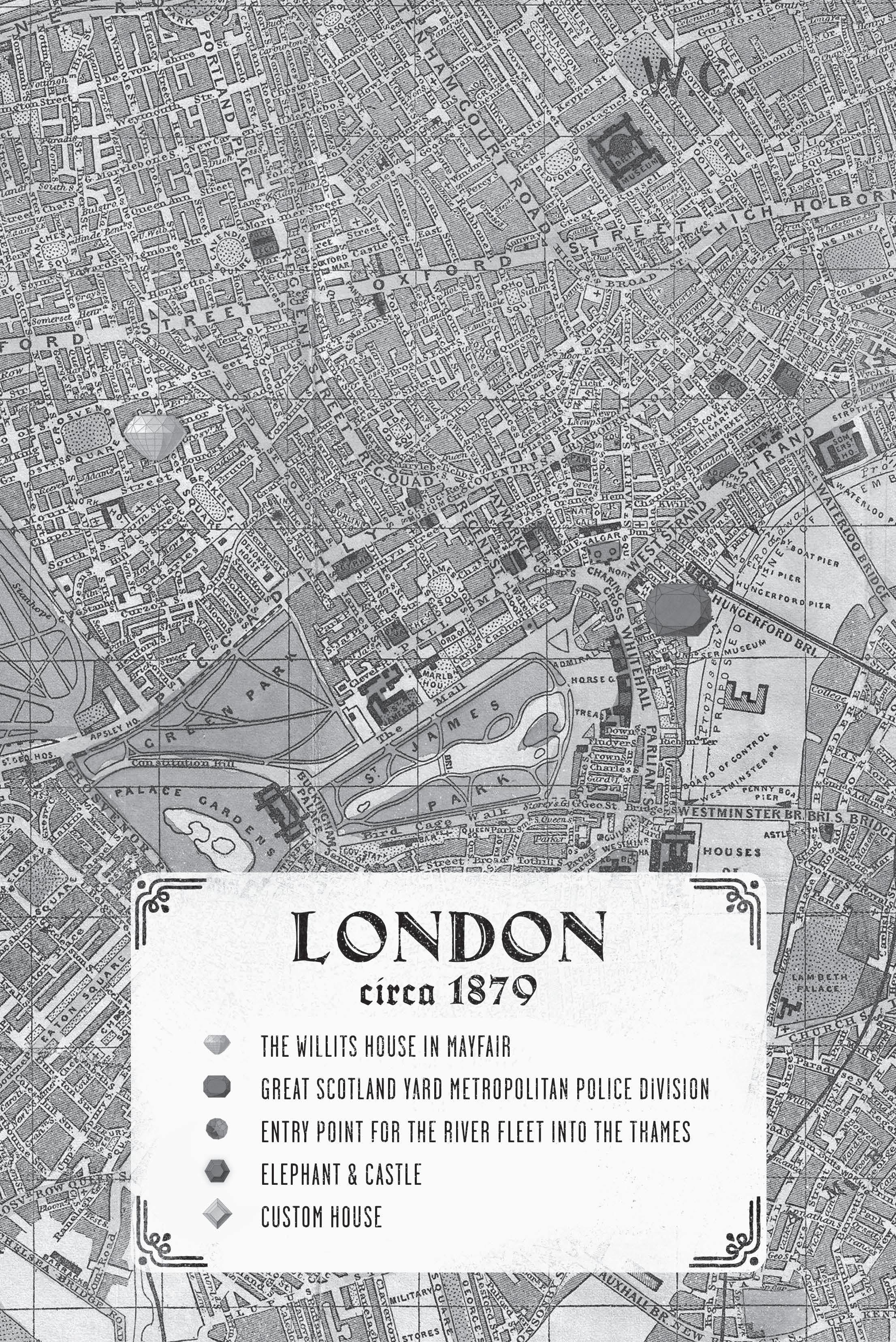
On the other side of the room, in front of a large printed wall map of London with Amelia’s pins in it, Josie swung a silver-headed walking stick she’d nicked the day before. “Look at me, like one of the music hall toffs, singing about how the ladies love my big stick.” She swung her hips back and forth, drawling the words long, and her jenny, Bea, burst out laughing.
The necklace slid along my neck. “Felt that,” I said.
“Argh,” Mary said. “Are my fingers cold?”
“No. The chain moved.” I tapped my collarbone. “Here.”
“Ah, right.”
Here we are again, I thought, recalling the first week we practiced our tooling in this room, slipping our hands into each other’s pockets, when I was fresh to all of it and Mary only a few months along. The difference now was we knew each other, down to a darted side-eye toward a plainclothesman, a long breath to sketch a warning, a shilling-thin shoulder lift when the dodge was done. It takes time to earn that sort of knowledge. We’d been each other’s regular jennies for almost four years, and I counted myself lucky Amelia had paired us early on. I wouldn’t have done so well with any of the others. Not that they weren’t good thieves, just not the sort I’d ever truly trust, the sort who’d play every card she had to be sure I got away.
“There,” Mary said, dangling the necklace between her thumb and forefinger. “Did you truly not feel it?”
“Not a thing,” I said honestly. “You’re better at touch work.”
At the center of the room, Amelia clapped her hands crisply. “That’s enough for today, yeah?” We all broke off, and amid the chatter that burst out after several hours of intense concentration, we emptied our pockets, reticules, and hairnets of practice objects. Amelia laid the four trays on her desk, filling them with goods. We all started toward the stairs that led down to the first story, which was divided between the goods room, where we unloaded our poke each day, and the costumes room, where we stored our thieving clothes. Josie gave one last twirl of the walking stick before she vanished through the door.
“Kit,” Amelia said as I reached the threshold. I stepped back. Mary shot me a meaningful look that I
returned—Don’t worry—and Mary departed with the rest, shutting the heavy door behind her.
The afternoon sun coming through the window caught the silver threads in Amelia’s dark hair, the fine lines around her mouth. She laid the last of the bracelets on the third tray and tucked it into the hidden wall safe before she met my gaze. Her blue-gray eyes were steady. “Well? Is Mary ready?”
“Aye,” I said. “It’s been four months, and she says she’ll go stark raving if she’s kept out much longer. She’s used to working.”
“I know.” Amelia transferred the fourth tray, handkerchiefs and reticules, into the safe, spun the lock, and shut the wooden panel. “But it won’t do her or you any good, if her nerves aren’t steady.”
The thought of Mary’s mother knifed twice under the ribs and left to die in an alley still unsteadied my nerves, if I let myself think on it.
“You can skip today, if you want,” Amelia said. “Given the constables.”
“We’re fine,” I said. Even if Mary wasn’t quite ready, she was a skilled thief, and I wanted to let her return in the shops, where we’d succeeded a hundred times. Besides, I’d be the lead today; Mary was the decoy. Even if she was caught, they’d find nothing on her.
“I don’t want you covering for her, Kit,” Amelia added. “And they’ve just stationed a plainclothes at Bradley’s, so take Pickford’s instead, yeah?”
Amelia had a source at the Yard.
“When will we begin doving?” I asked.
“Soon,” she said. “After tomorrow, I’m pulling you all out of the West End.”
Recalling her sharp tone during our practice, I asked, “Is something the matter? Besides the extra constables?”
A flicker in her eyes came and went. “No.” She tucked a dark lock of hair back into her hairnet. “Just being cautious. Elsie had to run for it, and Harriet would’ve been caught if not for Gus.”
That hair tuck was Amelia’s tell. But the set of her jaw told me I’d get nothing more, so I said only, “That’s what I heard. Gus set his dog on the constable.” Harriet had told the story for a laugh in the pub room, but her voice had held a shrill note.
“Aye.” Amelia glanced up at the clock, and I followed her gaze. Half past one. Three hours before people headed home for tea, the crowds thinned, and thieving was harder. “All right, then,” she said.
I took it as a dismissal and started for the door.
“Wait, Kit. How’s Sarah? Is she doing better?”
I turned back, feeling a warm glow of gratitude at her concern. Amelia knew my younger sister had just taken a position as a scullery maid, where the work was hard. “I think so, but—well, she hasn’t sent her usual letter, though she’s home tomorrow.”
Amelia saw my worry. “No doubt she’s busy working,” she said reassuringly. “And knowing her, she’s likely making friends with any time left over.”
I smiled. “Thanks, Amelia.”
“Ádh mór ort,” she replied with a wave of her fingers.
The ring’s founder, Patty Wirth, had been Irish, and though she’d been dead these fourteen years, this phrase was still how we wished each other luck.
Downstairs in the taproom, I found Mary sitting at a
corner table with Josie and Bea, who were drinking pots of golden ale with a thin layer of froth, drawn fresh from the taps. Mary was not; we never drank before a dodge, not even ale. As I approached, Mary rose and stepped away from the table.
“She asked about me?” Mary murmured.
“She did, but there’s something else troubling her,” I replied, my voice low. “She wouldn’t say.”
“Hm. Well.” Mary turned to beckon to her nephew Sid, her palm up, her quick fingers folding in twice. He slouched away from the table where he sat with other boys.
“What?” he asked.
She rumpled his hair, and he ducked away.
“Pickford’s at half past three,” I said. “Don’t be late.”
“Yah.” He sniffed and turned away and went back to his friends.
Mary turned to me, rolling her eyes, half annoyed, half amused. “Let’s get ready.” We went upstairs to the costume room, where racks held dresses with thieving pockets that reached to the bottom of the crinolines, coats lined with fisherman’s netting that easily caught jewelry, trousers with adjustable turnups, two-sided cloaks, paste jewelry good enough to pass for genuine, hats, spectacles, paste-on moles, and such. Mary carefully braided my brown hair tight to my scalp to fit under the wheat-colored wig. We each chose a cloak, a reticule, gloves, and a hat, then set out for the West End.
Chapter 2
From the far street corner, I eyed our mark for the day.
The roofline of Pickford’s rose against the cornflower sky. Like every other building on this street, the department store had a white façade interrupted by arched windows, like high-and-mighty eyebrows. If our borough of Southwark was the pickpocket of London, Kensington was the bride, regal and fair.
Ahead of me, Mary reached the door and vanished inside at twenty past three. I dallied on the pavement, the sun warm through my dress and cloak, watching the horses, omnibuses, cabs, and carriages pass, counting out three minutes so no clerk would think, even looking back, that we’d entered together. Approaching Pickford’s, I cast one final look for a uniformed constable before I crossed the street. Usually I smiled at sweeps, even offered a coin, but this boy I ignored, to prevent him from taking notice of me, and upon reaching the opposite curb, laid my hand on the shining brass doorknob, stepped in, and drew in a breath. People say that dry goods are pretty to look at, but I liked the smell of these brightly lit shops, with the leather, silk, linen, felt, feathers, and ribbons, and the waxy linseed oil used to polish the wooden cabinets. We timed the dodge for midafternoon, so the shop would be busy. There were five—no, six—men and nine women,
some with their maids in attendance, making selections at the various counters. Mary was one of three looking at men’s neckwear, and the clerk had taken out half a dozen cravats, laying them on the wooden counter to be examined. Mary was very pretty, taller than I, with a creamy complexion, fair hair, and blue eyes; I was plainer, with brown eyes, which I dimmed behind spectacles, and though we always traded off as decoy—Mary wanting to divide the risk fairly—the role fell more naturally to her. I worked my way along the counter on the opposite side of the store, gazing at the women’s hats for three minutes, and then halting by the gloves case. The clerk obligingly pulled several pairs from behind the counter, along with different silk ribbons to match. The tall case clock in the corner chimed once for half past three.
We have rules for thieving, and one of them is to never, ever look at one’s jenny. So I kept my attention focused on the gloves, hiding my annoyance that Sid was now late. The longer Mary and I stayed, the more risk we’d be recognized later. Ideally, this dodge took less than a quarter of an hour. The clerk’s mouth twitched with impatience as I peered through my spectacles and tried on this pair of gloves, then that one, fidgeting with my gold band—the mark of a husband’s ability to purchase—all the while.
From across the room, Mary’s anxiety came like heat on my own back. When I saw Sid tonight, I was going to smack the bloody little bugger. Another minute or two, and we’d have to call it off. It had been years since I’d given in to those early lurches between fear and frustration, but wanting this to go well for Mary, I felt them now. Damn it, where is he?
The front door swung open and closed. I had positioned myself so I could see the entrance in the looking glass behind
the clerk, and my nerves eased. With his cap pulled low, Sid appeared and vanished out of its gilded frame. His darkcoated figure would be strolling toward Mary—ten seconds, then five—and then came Mary’s scream.
Like everyone else, I spun to see her hands up—“My reticule! It’s been stolen!” she cried, whirling about and peering around the shop desperately before she put her hand to her side, shrieked “Oh,” as if in sudden pain, and slumped to the ground in a spectacular fashion.
It was exactly the way she’d always done it, and relief rolled over me.
The gloves clerk edged around the counter and pushed past me, rustling my skirts. Together with other clerks, he crouched down, bending over Mary’s limp form as the customers gathered around.
“A glass of water! Smelling salts!” cried the cravat clerk. “And catch that rascal! He went out there!” The gloves clerk leapt up from Mary’s side and headed for the side door to give chase.
With all eyes on Mary, no one paid me a whit of attention. My hands were already slipping ribbons and gloves into my thieving pockets, four feet long inside my skirts, the length of my crinolines.
I was stashing the fourth pair of gloves when a man in a brown suit stepped out from behind a pillar. His eyes weren’t on Mary; they darted around the shop. Even as I noted his features—medium height, a bit thick around the middle, dark wavy hair, clean-shaven, a rounded chin, forty years of age or thereabouts—I clasped my empty hands before me and peered worriedly at Mary, like everyone else.
A few moments later, the gloves clerk burst back into the
shop, breathless. I wasn’t worried he’d catch Sid, who would have already handed Mary’s purse to Harry, who would stash it inside his waistcoat and stroll on. Even if Sid was nabbed— which was unlikely, as he’d have stuffed his cap into a pocket and slowed to an amble immediately after fleeing the shop— he wouldn’t have the reticule. No evidence, no arrest.
I longed to snatch one more look at the brown-suited man, to determine whether he was a Yard plainclothes detective or a shop-hired privy. But I wouldn’t have risked meeting his eyes for the world. As I kept my gaze on Mary and the cravat clerk, her would-be rescuer—who was running his hand over her breast, pretending to feel for her heartbeat, the filthy git—a woman who had been trying on hats approached me. Her jowly chin shook with indignation. “It’s dreadful! London’s full of devils these days, vicious wretches who will steal anything!”
“Devils and wretches,” I murmured in agreement. I was, after all, one of them.
Chapter 3
Outside, I rounded the corner, flipping my cloak from blue silk to black for good measure. It had been a narrower escape than I liked. My heart beat out of time until the next street, where I forced it back into order.
I strolled south and east, the weight in my thieving pocket lying heavy along the crinoline. We were all used to being offkilter, accustomed to hiding the limp it gave us. Better to have a limp from the pocket than to be a man and limp between the pockets, as Josie would say.
I reached the west end of the Charing Cross rail footbridge and started across the Thames, knowing Mary would have taken the Waterloo. I paused, resting my hands on the parapet, looking east, for it was one of the rare days in London when the sun cast the shadow of the bridge onto the river and scattered gold across the chop from dozens of boats. From below rose the rank smells of rotting fish and tangy brine, of filthy old stone and molding green muck crawling up the pillars.
From behind me came the distant blare of a locomotive whistle followed by a screech of brakes as a train drew into the London and South Western station. The sound was lost in the grind of a motor as a tugboat avoided ramming a lighter not fifty yards from me. I shaded my eyes to watch as a coal carrier plowed its way along, its flaring blast overwhelming
the sound of the tug. That’s the way London was, one sound drowning another. I walked on and waited for Mary at our usual corner on Waterloo Road. As she appeared, I was gratified to see lightness in her step and a quietly confident smile on her face.
I felt a moment of misgiving at the thought of deflating her spirits by telling her about the brown-suited man who’d escaped her notice. But Mary and I told each other the truth.
“That was neat,” I said as she looped her hand through my elbow.
“Except for Sid, the little wretch. Another few minutes and I was going to call it off.”
“We’ll box his ears tonight,” I said.
She let out a groan. “It’s the bloody dice, Kit. He’s running a game on Water Street. He probably lost track of time.”
My steps slowed. “What? He’s running a game? Here?”
Southwark was Silas Pike’s patch, not just for gaming but for gambling, extortion, and receiving stolen goods. For Silas Pike, Sid running a game meant he was old enough to be punished for it, no matter if he was only twelve.
“I’ve tried warning him, believe me,” Mary said.
“How much is he bringing in?”
Her eyebrows rose. “Two or three pounds a week. Now he won’t leave off it, and with my ma gone, he doesn’t mind me.”
It gladdened me to catch Mary slipping in the mention of her ma. She’d done it several times lately, as if testing her ability to say that syllable without her voice breaking. The first month after her mother died, Mary had folded in on herself with grief, sobbing so hard in my arms that I begged her to breathe. Eventually, her grief had softened, along with her need to know why her mother was killed. A murdered
woman from this part of London didn’t hold the attention of detectives for long.
Not like us thieves.
I drew Mary into the alcove doorway of an abandoned shop with the glass panes broken, the empty window frames covered by splintered wooden planks. “Mary, there was a detective in Pickford’s.”
Her jaw sagged in dismay. “What? I didn’t see—”
“There’s no way you could’ve,” I interrupted. “He was in plainclothes and out of sight until you fell.”
Her eyes darted as she retraced the shop in her head. “The wide pillar in the back corner, by the table linens.”
I nodded.
“Damn.” She bit her lower lip white. “How did you see him?”
“He stepped in front of the pillar. He wasn’t watching you. He was looking for me.”
Mary drew a breath. “You’re sure he didn’t make you?”
“I was staring at you by the time he turned in my direction.”
“Bloody hell,” she whispered, and her gaze drifted across the muddy rutted road toward the Three Boars pub, with its crooked shutters and a two-bit boardinghouse on the upper floor. I kept silent until she nodded, slowly at first then more firmly. Her eyes returned to mine. “You didn’t keep it from me.”
“You said you were ready. That means I tell you, like we always do.”
Her look of gratitude pinched at my heart.
“I am not, however, telling Amelia,” I added. “There was no harm done, and I don’t want her wondering if you should’ve seen him.”
“Thanks for that.” She looped her hand through my arm, and we walked on to the corner. We paused, waiting for two carriages to pass, and she gave a little shake of her head, as if to put the detective out of her mind. “Sarah’s home tomorrow night, isn’t she?”
The sudden shriek of a railway engine made us press our hands to our ears.
As the noise subsided, Mary spoke over it. “We could have tea together before she goes back, with Sid.” Sid and Sarah had grown up together, and they got on. He never mocked her for the wine-colored birthmark by her temple like other boys did. “I could make a cake for us, special,” she added as we paused at the corner of Granby Street. “Mrs. Jonas has me baking pound—”
The screech of railway brakes drowned the rest of her sentence. Again, we covered our ears, I nodded agreement, and we hurried south to leave the noise of the station behind.
To St. George’s Circus and onto London Road; past Marshall Street, with Seamus Ardle’s pawn shop where I worked, and the Trunk Lodging House in York Street, where Mary and I roomed together since Sarah went out in service two months ago.
At the end of London Road sprawled the cobblestoned quadrangle where six old stagecoach roads coming from as far as Dover and Canterbury met in front of the Elephant and Castle. Together Mary and I approached the square front of the inn with the famous motif above the door: a left-facing elephant with the crenellated tower on its back.
Dusk had fallen, and the light from the windows feathered onto the cobbles. To the side of the inn lurked a few Castle men—Billy, Tommy, Jake, and Nick—in a rough scrum,
talking in low voices. If the Castle men were dogs, always scavenging for more, these were the four most dangerous, the sort who would maul a mark half to death if he fought back. Some of the younger ones, standing slightly apart, were friendlier with us, more like pups, all horseplay and boasting talk. Although even pups could cause trouble, as any woman knows.
Fanny’s brother Caleb, a card sharp who ran a spieler of vingt-et-un in rooms nearby, called out to Mary, “Good take today?”
“Aye,” she called back noncommittally. To the Castle men, anything more might sound smug.
Still, Jake’s eyes had latched on to us, his face sour, his mouth twisted. Two years ago, our ring was clearing three times what the men were from dead lurking and dragging luggage off cabs, and Amelia had taken the inn’s upper stories for our own. Jake had been the one who’d resented it most, throwing a brick through our goods room window one night when he was in his cups. Amelia had a word with Silas Pike, who ran the Vine Street fences that received most of our take, and from then on Jake only growled; he didn’t bite.
I pulled open the door. As we stepped inside, the warmth of the room and the tang of ale from the taps came at us in a wave.
I started up the stairs to the goods room, while Mary, with nothing in her pockets, stayed below to have a pint. I pushed open the door to find Amelia seated at the desk, recording the day’s take in her neat hand, with the bottle of ink and an open ledger before her. Nell was loading boxes of goods into the dumbwaiter, which would be lowered to the ground floor, where the goods would be retrieved by one of Pike’s
henchmen. For secrecy, this occurred on different nights each week.
Before the drawn curtains stood other thieves—Josie and Bea, Fanny and her new jenny, Cathy—in various states of undress, having doffed their thieving garb. Here in this room, the danger that kept us keenly watching our backs dropped away. Wordlessly, I turned so Nell could undo the buttons at my nape.
“How are you?” I murmured over my shoulder.
Nell’s fingers paused, and I felt a stab of regret. I was never sure if I should ask, in case I recalled her grief at a moment when she wasn’t thinking on it. Mary’s mother, Rose, had been Nell’s cousin and dear friend, and Rose’s murder had hit her hard.
Nell’s fingers restarted on my buttons. “Some days I can’t stop thinking about her.”
The cool air chilled my shoulder blades. “Sorry.”
“Mary all right?”
“Perfect.”
Nell’s hands continued down my back as I watched Cathy roll the long stem of a silver hatpin between her thumb and forefinger, her eyes fixed on its sparkle in the lamplight. My mouth twitched in sympathy. We’d all felt longings like that when we started, some fancying the pretty trinkets, others hoping someday to be the sort of woman who could wear one in public without anyone wondering if she’d stolen it.
Well, we all want things, I thought.
I’d never longed to keep the items I stole, even the pretty ones. They were just fripperies that turned into money for necessities—the extra rent so Sarah could stay in my room without having to work for Amelia, food, tea, a full scuttle
of coal, warm clothes, boots because Sarah’s feet grew a size every six months, a rag rug for warmth, a new feather pillow. Between my take from thieving and wages I’d earned, I had some money put by, a collection of coins in a small pouch under a floorboard in my room, a decoy for a larger pouch hidden in yet another compartment beneath the first. But no matter how heavy those pouches, my fears were heavier. Sarah depended on me, and we had no one else. What would happen if I got sick for a spell? If, God forbid, I was caught? Or if she needed a doctor for weeks on end, like when she had whooping cough? When Ma lay dying, our money had dwindled until we’d scrounged for halfpennies. I took to visiting the butcher at day’s end for scraps, and Sarah fixed her eyes on the pavement to avoid seeing the bread loaves in the bakery windows. I never wanted to return to that. No, I wanted enough money that I needn’t worry ever again, though I wasn’t sure if there was such an amount.
Nell’s hands finished unbuttoning and shifted the fabric over my shoulders, and I shimmied out of the dress.
“Cor, look at the filigree work,” Josie said, eyeing the hatpin Cathy held. “That bit o’ peridot is gorgeous, ain’t it?”
“Aye,” Cathy agreed, setting it on the table with reluctant fingers.
Amelia paused in her writing and her mouth tightened; some of the girls tried her patience. Her gaze shifted to me. “Ready?”
“Yes.” I laid the dress on the table, like a corpse in a casket, and Bea’s hands slid below the hand-sized false pocket into the large thieving one.
“Four sets of gloves, fine kid,” she said as she withdrew them, and Amelia noted it. “Satin ribbons, six. And . . .”
Bea’s eyebrows rose as she examined the coins. “And two pounds, ten?”
“The clerk’s pocket.” I grinned and laid the back of my hand theatrically to my forehead. “He was overcome with distress over Mary. Easy mark as he pushed by me.”
Bea laughed.
“Hmm,” Josie said, leaning over with a sly look. “Anything else worth grabbin’ in his pocket?”
“Ach,” I replied with a shrug. “’Twas too small, couldn’t find it.”
Josie threw back her head, giving her bright laugh, and continued chuckling as she headed downstairs. Fanny and Cathy grinned as they followed, but Bea’s face was pinched as she left the room. Clear as day, there was something amiss between Josie and Bea. I looked to see if Amelia had caught it, but she was writing down my poke. Well, it wasn’t for me to say anything. Amelia turned up the wick on the lamp and slid the ledger toward me so I could put my initials beside each item for tallying at month’s end. I handed back the pen, wondering how many times I’d scribbled KJ on these pages in the last few years.
I stepped into my own dress, and Nell buttoned me and slipped away as I sat to put on my boots. Knowing Amelia would ask about my afternoon, I took my time fastening them.
Amelia was giving one final look over the goods book. The corners of her mouth were tucked in concentration; her left forefinger slid down the side of the page as her right hand made quick notations in the margins.
Fourteen years ago, when I was six and Sarah wasn’t even born, Patty Wirth, on her deathbed, had passed the ring to
Amelia Lyle, her niece, who had only improved it. She made sure her thieves knew how to read and do simple ciphering, how to add grace to their walks, soften their expressions, and tuck their vowels up their noses when the occasion required. Now, over a dozen of us lived in rooms near the inn, paid for by the ring. Amelia was a good mistress, practical and unexcitable, who gave us a fair cut, so even after paying for our board and other necessities, most of us earned a nice amount each month.
Amelia blotted her last few handwritten lines, closed the ledger, and stowed it on the shelf, then gestured for me to take the chair across the large wooden desk. From a cupboard concealed in the wall’s panels, she took out a bottle of wine, poured a crimson inch into two glasses, and set one in front of me.
Her hands moved with their usual steadiness. Still, her expression made me ask, “What’s the matter?”
“Mary was good?”
“She was fine,” I said. “A fainting spell worthy of Drury Lane.”
Amelia sipped her wine. “Anything unusual at the shop?”
I studied her. Her tone told me that this second question was why she’d held me back.
I drank the wine—bitter to my tongue—and thumbed the corners of my mouth to remove any purplish stain. Mary and I would deal with Sid, so there was no need to mention him being late. And if I told Amelia about the detective, Amelia might wonder if Mary was fit to work. “No,” I lied.
“Did you see more constables than usual?”
I answered, honestly, “We didn’t see any.”
“Good.” Amelia’s face relaxed into a smile. In silence, we
finished our wine, and she corked the wine bottle, putting it back inside the cupboard along with our glasses after wiping them with a towel. It was supper hour, and the jolly rowdiness rose through the floorboards. Amelia flapped her hand toward the door. “Get on with you, now. Have some fun, yeah?”
I made my way downstairs, pausing at the landing to observe the pub room below. A bright fire threw light fitfully, forming and dissipating shadows upon the beamed ceiling, the tattered chairs closest to the hearth, and the three long wooden tables that crossed the room, where men, women, and children crowded the benches. Card players sat at the square tables along the far wall. We thieves gathered by the fireplace. Sid watched worshipfully as Caleb drew a grand arc in the air with his glass of ale, telling a story that brought shouts of laughter. Mary watched him from the bar, her expression amused. He caught her eye and winked. Caleb flirted relentlessly with Mary, who was friendly with everyone, but she saw him for what he was—a fine-looking bloke, but shiftless, like most of the Castle men.
I started toward Mary and the bar, where people stood two deep. The barkeep, Pat Hollings, passed glasses of ale across the high wooden plank to open hands, the tattoos on his forearms rippling as he worked the taps, his thick fingers quick but not sloppy. While I waited my turn, I surveyed the room. It wasn’t family, but it was familiar to me.
Except at one of the tables sat a striking woman, new to the inn. She was about forty years of age, decently dressed in blue wool, her thick dark hair threaded with gray but still lustrous. Her countenance was lined around the mouth and at the brow, as if her life had been hard, but even so it was evident she’d once
been a beauty, with large dark eyes under well-shaped brows, high cheekbones, a firm chin, and a full mouth. It was an arresting face, handsome rather than merely pretty. I might not recall people’s names, but I have a peculiar memory for faces, and I’d seen hers once before. Not here, and only briefly, some months ago, somewhere dim, as if I’d passed her on a bridge in the late afternoon or observed her in a market.
She sat at the end of a long table with a group of four women who gathered there daily, joining the conversation, laughing at their remarks, leaning in with her chin in her palm, as if she’d done it every Friday night since forever.
Her pretense of belonging made me wary.
I’m not one to ignore that feeling. I attend to it, for more than once it has kept me from choosing a poor mark or showing too much of my hand. Having the mother I did, I’m quick to detect when folks are acting a part or passing lies.
Perhaps the woman felt my stare, for suddenly she returned it. Her gaze sharpened, held, shifted away for a moment, then settled back on me, hardened, as if she recognized me somehow, or at least knew a good bit about me.
It set a chill like a cold finger at my neck.
Then she gave a bland, indifferent smile and turned back to her new friends, making me wonder if I’d imagined it.
Beside me, Mary nudged my arm. “What’s the matter?”
I started. “Ah, nothing.” I looked pointedly at Mary’s halfempty pot. “None for me?” I teased.
“I didn’t know how long Amelia would keep you. She asked about me?”
“Of course,” I said. “But she was more concerned about constables.”
“Constables?” She drew back. “I didn’t see any.”
“I didn’t either. That’s what I told her.”
“Ah.” She raised her pot with a smile. “Well, get yours and come on.”
“I will.” I turned toward the bar. Like a tide, people shifted forward and back to make room for others, and I nudged in between old Connors, already well into his cups, his greeting to me sloshy, and Mrs. Wiggins, whose upper lip with its dark hairs held droplets of ale. Connors flung an arm around me, but I was ready and slithered away before he could squeeze my arse. Pat winked at me with his one good eye—the other having been put out years before in a ship’s brawl—and passed me a glass of ale, hoppy and bitter at once, which I drank down thirstily until it was half gone. Mrs. Wiggins stepped away and James Kinnon materialized beside me, his hazel eyes bright with laughter. “Hullo, Kit.”
“Hullo,” I replied. “Haven’t seen you in weeks.”
“I’ve been working extra.” He set his empty glass on the bar. “Took the afternoon off to help Emma fetch a shipment from the wharf.” He leaned in close with a show of sharing a confidence, though he had to speak up to make himself heard over the clamor. “Josie says you’re sticking your hands in men’s pockets now. It has Robbie all excited.” One side of his mouth curved up, and his voice was sly with teasing.
I rolled my eyes. “You can tell Robbie I won’t be sticking my hand in his pocket. I’m sure I’d be disappointed.”
He laughed and set his elbows beside mine, avoiding the spots sticky with spills. “How’ve you been? How’s Sarah?” He’d always had a soft spot for my sister. “Is she getting along?”
“From what I can tell, the work is hard, but she doesn’t complain. I think she’s afraid I might make her quit.”
“She probably likes earning a wage,” James replied. “Makes
her feel like she’s grown, and she’s helping you, after all you’ve done.”
“I haven’t done much,” I said dismissively.
He left that alone, caught Pat’s eye, and pointed at his glass. “Another?” he asked me, and I nodded.
As our full glasses appeared, Pat leaned over the bar toward James, raising his voice to be heard. “You’re staying with Emma tonight? I’ve some chairs that need mending.”
“Aye, I’ll come by in the morning,” James replied and put down coins for our glasses. Pat made to wave them off, the drinks part of an easy exchange of favors, but James shook his head and shoved them toward the till.
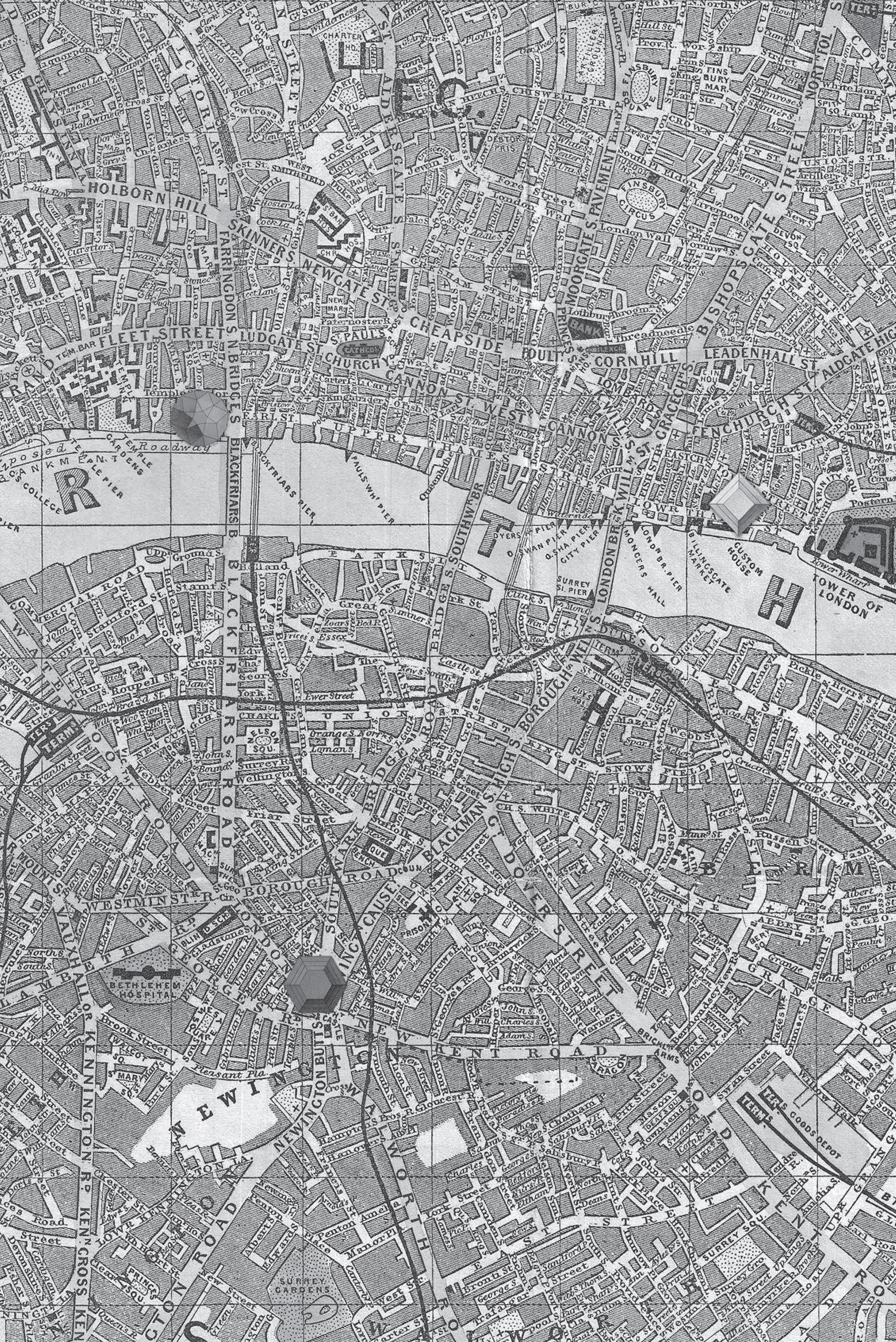
We backed away from the bar to make space for others, and James gave me an inquiring look and raised his glass toward a small round table in the corner. I nodded and followed in his wake as he threaded his way between tables, greeting people he knew. James was one of the few Castle men who’d left and found legitimate work—at the Custom House, in his case, after being in prison for smuggling. I asked Emma once how he’d wrangled that, and she’d shrugged and said she had no idea. Rumor was he’d ratted out other smugglers, but I never believed it. James might be a rogue, but he was no copper’s nark.
Though he lived north of the river now, James came around to the inn most Fridays, joining the group of us by the fire. I wondered why he was pulling me aside. As I sat in one slatted wooden chair, James turned his sideways so he could rest his forearm along the top rail. “Emma says you’ve been helping her a good deal.”
“Well, someone had to. She had two trousseaus to finish last week,” I replied. “Needed by some West Ender in a hurry, as usual.”
One eyebrow rose. “She told me about some woman who changed her train three times.”
I snorted. “It wasn’t just her train—she couldn’t decide if she wanted her flounces gathered, box pleated, or fluted. She drove Emma half distracted.” I sipped my ale. “How is the Custom House?”
“Good,” he said. “Busy.”
“You miss smuggling? The dodges?”
He spun his glass on the table. “Nae. Clerking’s easier.”
I eyed his hand. The thick calluses along his thumb and forefinger weren’t from clerking.
“I thought you were on weights and measures,” I said.
“Started there, but I’m on records now,” he said. “Most days it’s like trying to catch a runaway train. We work till after dark—and there’s still ships lined up to be unloaded and counted the next morning, with the captains cussing at the delay. But they come from all over, Kit. The East Indies, Egypt, Spain, France.” He reached into his pocket. “Look here.” He chose a coin from the half dozen in his palm and held it out. “It’s from Greece.”
I took it, peering at the circle of silver with a young, straight-nosed man in profile on one side and on the other wheat sheaves encircling a word. “AERTON,” I puzzled out. “What is it?”
“One lepton,” he said. “Their letters are close but not the same.”
“Does it make you want to go places?” To my surprise, a note of envy crept into my voice.
“Sure,” he said. “Though some of the stories they tell of pirates make me happy to be right here.” I made to give the coin back, and he waved it back toward me. “Keep it. It’s a
curiosity. Can’t spend it.” He drained his glass and smiled at me. “What would you say to a proper night out? We could go to a music hall, see a show.”
I drew back. “With you?”
“Aye, why not?” he asked, unperturbed. “We’ve been friends a good while.”
I was silent.
James raked his dark curls back from his forehead. “Stop it, Kit. You’re looking at me like I’m running a confidence game.”
I laughed. “Do you know how to do anything else?”
He gave me a mock-wounded look and laid a hand across his chest as if I’d stabbed him. “Humor me. What’s the harm in a night at Wilton’s?”
“There was a man murdered there last year,” I reminded him. It had been in all the papers. A violinist had leapt into the crowd, fists flying, and landed a blow that sent the spectator down, his head smacking the floor, with blood everywhere, and the performer had been tried and thrown in prison.
He laughed. “You’re right. Tell you what,” he said, drawing a pack of cards from his pocket. “We’ll play. If I win, you have dinner with me.”
I rolled my eyes. “Everything is a game with you.”
He shrugged and dealt the cards.
Five hands later, I laid down rummy with two left over.
He laid down his cards, played the eight of spades on my run and had only an ace left over. His eyes brightened with triumph. “Saturday night, then.”
“I can’t. Sarah’s here.”
“Sunday?”
“I walk Sarah back to work.”
“What time?”
“Around five o’clock.”
“So, we could have dinner on the north shore.”
Still, I hesitated. He was a Castle man, born and raised, who’d been in prison. If those calluses on his hands were to be believed, he was still rowing at least a few nights a week, which meant he was back to smuggling.
He leaned forward, his dark eyebrows raised. “It’s just dinner, Kit.”
“All right. I’ll meet you around seven,” I said.
He opened his mouth to protest, then shrugged. “As you like.” He rose from his chair and pulled on his coat. “The Silver Plover.” He gave me the address and took up his empty glass to return it to the bar. “I’ve something to do for Emma. See you Sunday.”
He gave a cheerful grin, and I watched him leave, the burly shoulders under his rough brown coat, the dark hair that curled over the collar. He paused at a table, where a cluster of men urged him to stay for another drink. With a mix of familiarity and deference, he rested a hand on old Dick Yellen’s shoulder, one of the men who had known him since he was “Jimmy” and “boy.”
I couldn’t help but think of the last badger scheme we’d pulled together, the week before Amelia invited me into the ring.
The mark that night was married, which I knew not just because of the ring he wore, a gold band I could fence easily at Mr. Ardle’s. I’d seen him at the inn before with his wife on his arm. This time he was alone and blinked rapidly when I asked if he wanted company. I could tell he was a safe mark; there were some who were flat-out dangerous, the ones who stared bold as brass, smirking as if they expected your attentions all
along. This bloke was about thirty or so, with weepy mustaches and a shy, uncertain manner. He finished his supper hastily, and I brought him to Mrs. Donnelly’s lodging house next door, up the stairs to the room James and I rented for a shilling for the hour we needed it.
I eased the mark out of his coat—a bit worn, four shillings—and undid his cravat—another two—and came close, letting him peck me a bit as I shook out my hair. Like most men, he took it as an invitation to run his fingers into it, kissing my neck. I flinched and pulled back.
“What’s wrong?” he asked.
“Oh, no matter,” I said. “Just your ring caught my hair. Here, let’s put it in your pocket, and you can play with my hair all you like.”
He hurriedly slid the ring off and tucked it away, and we went back to kissing, which gave me ample time to transfer the items in his pocket into my own. His hands ran over my back and down to my arse—
“Take off your trousers,” I whispered. “Let me sit on your lap a bit.”
He was out of them faster than a greyhound coursing a rabbit, dropping them in a heap on the carpet.
Trousers nice, almost new, a neat label inside. Six shillings.
I sat down on his lap, put my arms around his neck, held my breath against the scent of Macassar oil in his hair, and kissed him again.
Suddenly there were heavy footsteps in the hallway outside—the knob turned—and James flung open the door, slamming it into the wall behind.
“Who the devil are you?” James bellowed, his eyes blazing, his cheeks red. “And what are you doing with my wife?”
The man leapt up, dumping me unceremoniously onto the floor. James took a step toward me, his hands reaching, leaving the path to the door clear. This mark had the presence of mind to snatch up his trousers and boots before he raced off, his bare feet pounding down the hall.
Damn it, I thought. There went six shillings and four more for the boots.
James closed the door, grinning. “That was an easy one.” I put out a hand for him to pull me up, rubbing my hip where I’d landed. “Easy for you,” I grumbled.
“What’d you get?”
I drew the poke from my pocket—the gold ring, six pounds and a few shillings in coins and notes, and a silver pocket watch. I examined it closely. There was a monogram, SRB, but that could be churched. Plate, not real silver, but Mr. Ardle would take it.
James picked up the gold ring. “I can’t believe these fools fall for you saying it gets tangled in your hair.”
“They’re not thinking with their brains,” I reminded him. “A few kisses and you’re all fools.”
He had thrown back his head and laughed. “You’re right, we are.”
It was the same laugh James was giving now, with Dick Yellen and the other men. Unreserved and buoyant and easy. Nearly everyone liked James, perhaps because he genuinely liked most people. He had more faith in them than I did. Then again, he didn’t grow up with a ma who made a fussy show of locking the door carefully at night, as if she wouldn’t open it later for Jack McShane. Who topped up the gin bottle with water, to make it appear she hadn’t been drinking all afternoon. Who looked shocked at coins missing
from the tin cup, as if she hadn’t filched my meager wages for herself.
One last loud guffaw from the men and James turned away and pulled open the door. Unexpectedly, he turned and caught me looking. A roguish grin creased the skin at the corners of his eyes. With a quick lift of his chin in farewell, he closed the door behind him, leaving me rolling my eyes. He might work away from the Castle now, but he was the same as ever.