Sustainable values from family forestry
Annual and Sustainability Report
Sustainable values from family forestry
Annual and Sustainability Report
2025 was a year that put us to the test – but also demonstrated the strength of our association. Södra is based on a simple but powerful idea: forest owners are stronger together. By owning forest and industrial operations, we can leverage the entire value chain and create added value that benefits members. Södra’s strength lies in maintaining a balance between growing forests and competitive industrial operations. This provides security and long-term returns. To strengthen the business, we invest in mills, develop new products and identify solutions that allow us to make more from every tree – so that the value can continue to grow over time.
Södra’s presence is felt at every stage – from the family forest owner who manages their forest to the consumer who uses products made from the forest. The members of Södra own more than half of all privately owned forest in southern Sweden. In our jointly owned industrial operations, we process the sustainable raw material into products with a low carbon footprint that benefit people’s lives and our customers worldwide. Our product areas and some examples of the end-products they are used for are listed below.
Biofuels for heating, renewable electricity and liquid biofuels
Biochemicals for cleaning agents and cosmetics
Biomaterials for bedding, construction panels and mulch
Building systems for housing, industrial facilities and public buildings
Dissolving pulp for textiles and biochemicals
Electricity Green electricity
Paper pulp for tissue, packaging and specialty papers
Seedlings
Spruce, pine and other deciduous and coniferous trees
Forest Forestry services and advisory services
Wood products
Structural timber, decking and cladding
Heating District heating for the local community
3
and care for each other every step of the way 4 The year in figures
6 The year in brief
8 Comment from the President and CEO HOW SÖDRA
10 How Södra generates value 12 Profitability of Södra forest estate at record-high level
13 The Board’s profit distribution proposal
14 Södra’s Group-wide strategy – from one family to another 15 Our strategy stands firm in an evolving world
at the centre
26 Business areas for today and tomorrow 27 Together for sustainable and profitable forestry
28 The value that grows in forests and industrial operations
29 The Södra Model strengthens forest ownership 30 Everyday products from family forestry 31 Biofuels and Biochemicals
32 Biomaterials and Building systems
35
profitability for forest estates
124 Leading offer for our customers and consumers
125 Optimised value chain from forest owner to customer and consumer 127 Sustainable use of the forest and earth’s resources 138 GRI Content Index 141 Assurance report 142 Sustainability Report in accordance with the Swedish Annual Accounts
Occupational health and safety (OHS) is an integral part of our responsibilities. We strive to ensure that every second of the day counts when it comes to security, care for each other, and safety. No one should ever be exposed to health risks in the forest or at work – and every workplace injury is one too many. We have a zero accident vision. All accidents are preventable, and we work systematically to ensure sustainable and safe daily operations for members, employees and contractors. We work safely or not at all. We apply behaviour-based safety (BBS), which is based on identifying risky behaviours, reinforcing safe behaviours and reducing unsafe behaviours.
During the year, we continued to develop Safe Member (Sw: Säker medlem), an initiative that provides support and information to all forest workers. The focus is on risk prevention and creating safe behaviours through:
» A toolkit with checklists, digital courses and practical advice.
» Chainsaw and clearing saw operator licenses in collaboration with Safe Forestry (Sw: Säker Skog) – an industry-wide organisation that strives to enhance chainsaw, clearing saw and ATV safety.
» Redoubled efforts focused on behaviour-based safety and risk assessment, especially in conjunction with lone work.
» Customised first-aid training and expanded communication on life-saving procedures.
We also initiated development of the Tryggve app, which aims to make lone work in the forest safer. In a first step, Södra employees will test the app, with the plan to make it available to members and forest owners in 2026.
S – Stop. Think through the situation and what has to be done. Make sure you have the right knowledge, permit, equipment and personal protective equipment for the job.
K – Know yourself. How do I feel today? Am I stressed, unfocused, tired? What does the rest of my day look like?
O – Orient yourself. Look around. Are there any other risks? Soil, weather, road, power lines. Does anybody know that I am working alone?
G – Get the job done safely!
As part of the Safe Member initiative, we conducted an online survey in which more than 400 forest owners shared their experiences of accidents and injuries. The findings clearly show where the risks are most prevalent:
» Operating a chainsaw is the most common hazard.
» Misjudgement, fatigue and a “I’ll just do this quickly” mindset are the reasons for more than half of the accidents.
» Personal protective equipment is widely used, but there are shortcomings when it comes to high-vis clothing, gloves and first aid.
The insights gained via the survey are now being used to target actions where they are needed the most. We want to equip the new generation of forest owners with the right tools and safe behaviours from the start, while supporting them with our extensive experience. Through training, shared learning and collaboration with Safe Forestry, we assume responsibility for ensuring that no one is seriously injured in the forest.
Improving safety in the forest creates security for people and conditions for pursuing long-term and responsible forestry. This never stops – and we do it together. For more information, checklists and tips, visit: www.sodra.com/saker-medlem (Swedish only)
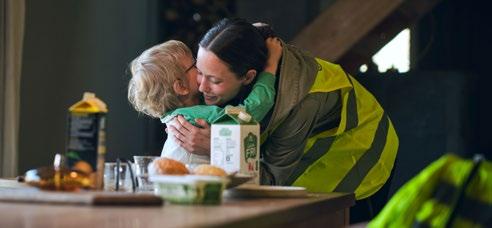
“I just wanted to remove a branch stuck in the brush-cutter blade and cut my thumb.”
“I was cutting a windthrow without delimbing it first, but I didn’t see that it was under high tension. The section that I hadn’t delimbed rebounded and hit my left knee, causing a fracture. I was in a cast for six weeks.”
“I was loading timber and discovered a branch on a trunk that I had missed in the delimbing process. I sawed it off without putting on a helmet and visor, and got a wood splinter in my eye.”
Some of our most important figures and key indicators for 2025.
Pulp mill
Pressure treatment plant
Grinding facility
Further processing Pellets factory
Factory for cross-laminated timber (CLT)
Sawmill Nursery
Head office
Refers to production units at 31 December 2025
3,234
24
Average no. of employees Forestry member teams in Götaland
3 Pulp mills
7 Sawmills
1) As of the
2) Proposed profit distribution, including bonus issue.
3) We are exploring the possibility of using remotely sensed data for the affiliated forest area. In conjunction with this, the definition of forest land may be amended and impact the estimate.
4) New definition from 2024: includes number of actual hours worked divided by the number of scheduled hours for a full-time employee. The comparative figures for 2023 have been restated
5) CO₂eq=carbon dioxide equivalents.
6) LTA (lost time accident): number of occupational injuries with absence.
7) LTAR (lost time accident rate): no. of occupational injuries with absence per million hours worked.
The past year has put us to the test, presenting challenges requiring both strength and determination. Here are some glimpses of the past year that show how we are continuing to strive to increase member value, strengthen the Södra brand and create long-term competitiveness.
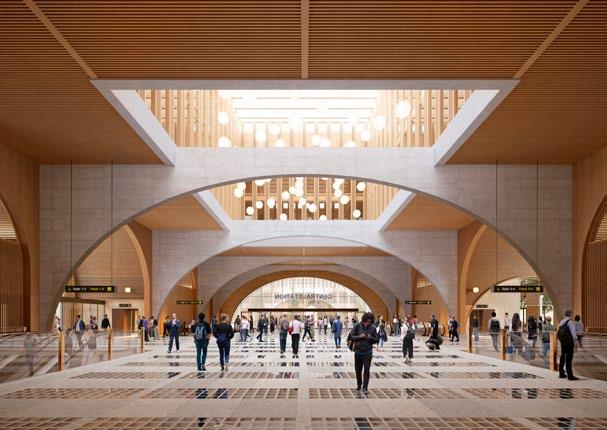
During the year, Södra supplied 9,100 m² of cross-laminated timber (CLT) for the construction of Gothenburg Grand Central. The project has a clear focus on sustainability and a low climate impact. Most of the building’s structure is made of wood, which is combined with recycled bricks, climate-improved concrete and recycled steel.
In November, it was decided to launch a carbon capture pilot project at the Värö combined plant with planned start-up in 2026. The aim is to accumulate expertise in the technology and explore how biogenic carbon dioxide (CO₂) can become a valuable raw material.
The pilot is part of the strategy to increase the value of every tree, strengthen competitiveness and support more profitable forest estates. By testing new technology to capture biogenic CO₂ in an industrial setting, we want to explore how this resource can be refined and used in new applications without increasing forest harvesting.
Södra blue S is a new paper pulp based on pulpwood and local agricultural residues. After two successful test runs, customers globally have trialled the product and the results show that we can combine performance with increased resource efficiency. The ambition is to scale up production in the years ahead.
In the autumn, Södra reached an agreement to divest its forest holding in the Baltics to the Ingka Group’s investment company Ingka Investments for EUR 720 million.
“The 153,000 hectares of land in Estonia and Latvia have been a good financial investment for Södra. But our mission is to increase the value of our members’ forests and not about being a forest owner,” said Peter Karlsson, President of the Södra Skog business area.
The divestment was concluded in the first quarter of 2026 following a competitive review and approval by local authorities.
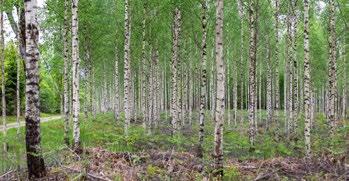
Construction commences on Södra’s new kraft lignin plant
28 May marked the start of construction of Södra’s new kraft lignin plant at the combined facility in Mönsterås. The plant is scheduled for completion in 2027 and will then be the first commercial plant of its kind in Sweden and the world’s largest producer of kraft lignin. It will support the green transition and strengthen the labour market in the region.
The investment is an important step in Södra’s strategy to make more from every tree and develop its business by adding new bio-based products. The investment has been funded with support from the Swedish Energy Agency as part of the EU’s Recovery and Resilience Facility (RRF), which is the centrepiece of the NextGenerationEU package.
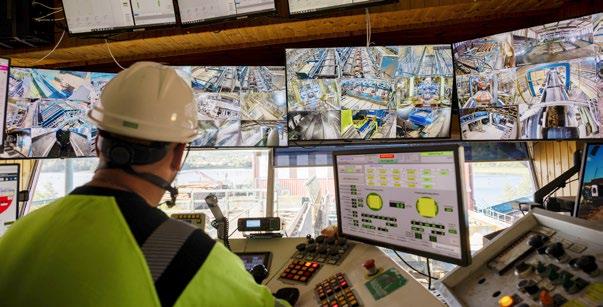
During the autumn, the Board of Directors decided to invest more than a billion SEK in the sawmill in Kinda. The decision represents one of the largest investments in the association’s sawmill history. Once the facility has been completed in 2028, capacity will increase by 50 percent to 300,000 m³ of sawn wood per year. In addition, a new pellet mill with capacity to produce 25,000 tonnes of pellets is being built, which also opens for new business, such as biochar and other value-added energy products.
In Götaland, nature conservation measures are important for the preservation and promotion of biodiversity. In 2025, we reached the highest level in over a decade, with 3,086 hectares of member forests subject to nature conservation measures. These are important initiatives to strengthen forest biodiversity.
Medlemsel discontinued
During the autumn, a decision was made to discontinue our consumer electricity business and, in parallel, develop a new long-term partnership with Jämtkraft. The partnership enables us to offer members the opportunity to retain their current contract terms with electricity from Södra’s production facilities but as a direct customer of Jämtkraft.
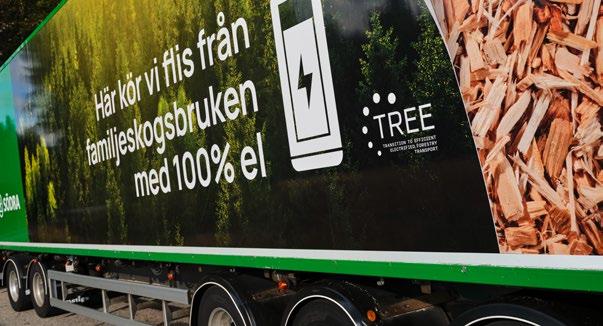
In September, our first electric wood chip truck was put into operation. The truck will operate in Småland and Blekinge and can be charged at several of Södra’s mills. The wood chip truck is one of the test pilots in the TREE project coordinated by the Forestry Research Institute of Sweden (Skogforsk). The pilots aim to evaluate the challenges and opportunities of electric transportation in the forest industry.
At an Extraordinary General Meeting on 25 November, delegates decided, by more than a two-thirds majority, to approve the Board’s proposal to amend the Articles of Association, enabling the Profit-distribution Policy to be updated. The amendment strengthens the link between profit distribution and timber deliveries.
The amendment to the Articles of Association means that the bonus issue can also be determined based on timber deliveries. This provides the Board with another tool to balance profit distribution between last year’s deliveries and accumulated deliveries from previous years when proposing profit distribution to the Annual General Meeting.
The amendment will apply as of 2026 and will not impact profit distribution for 2025.
The Södra Leap action programme reduces
During the summer, the Södra Leap (Sw: Södraklivet) was initiated, a far-reaching action programme to strengthen profitability and longterm competitiveness in a time of major transition. Global markets remain turbulent, impacted by tariffs, conflicts and a weak economy. While high wood prices have benefited forest estates, they have put immense pressure on industrial operations. Accordingly, with the Södra Leap we have focused on increasing profitability and competitiveness – always with safety top of mind.
The aim is to improve earnings by at least SEK 1 billion, at the same time as the Södra Leap will help make Södra even better by developing new ways of working, closer collaboration and greater focus on AI and digital opportunities. As part of the programme, notice of redundancy was announced for 200 roles and, following negotiations and redeployment, the workforce was reduced by 180 roles. The focus of the Södra Leap is mainly on overheads, but initiatives to boost revenue are also reflected in the activities undertaken in the business.
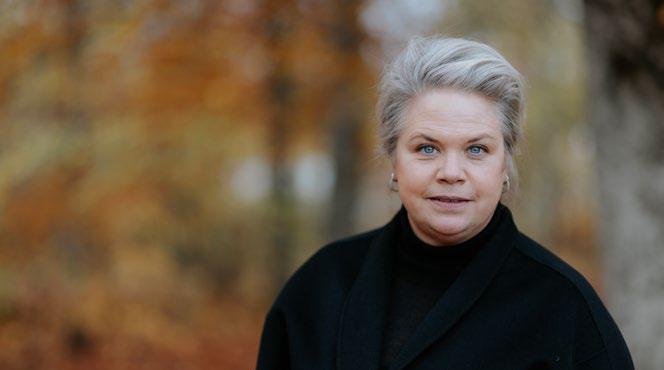
Lotta Lyrå President & CEO
2025 posed challenges for Södra. It was a year that tested our long-term model – a model based on the balance and profitability of two components: the forest estate and the joint industrial operations. These are interdependent, and this balance specifically was put to the test during the year. The underlying reason is a triple effect of rapid currency fluctuations, challenging market conditions and an imbalance between raw material prices and the prices of our products. The combined effect of this on our earnings was sharply negative. In parallel, our members experienced positive growth in value, with the profitability of the model forest estate improving by SeK 240 per hectare compared with the preceding year. This is a positive trend and fully aligned with our mission. But for the good of the forest estate over time, there must be a balance between competitive wood prices and industrial operations that have the necessary resources to invest, develop and sell the products processed from the members’ raw material. This is crucial if Södra is to create long-term value, both today and tomorrow.
Södra reported a sharp decline in earnings for 2025 compared with the preceding year. Our sales amounted to SEK 28,302 million and we posted an operating loss of SEK 1,290 million. Factors underlying the deterioration in earnings mainly included exchange rate effects of approximately SEK 1,780 million, a negative price trend for our products of around SEK 300 million and higher raw material costs of about SEK 2,200 million. Taken together, this has put pressure on the industrial structure, which is also reflected in our contribution margin, which fell from 33 percent to 24 percent.
In response to these challenges, we have focused intently on what we ourselves can influence, and several initiatives are helping to reduce the shortfall in earnings. Our improvement programme, World-class Efficiency, achieved its annual target, yielding savings of SEK 518 million, of which SEK 340 million in operational efficiency – the highest level since the launch of the programme.
The action programme, which commenced in the summer, encompasses all our activities. As part of the initiative, we imple -
mented cost cuts and organisational restructuring, resulting in a reduction in the number of consultants corresponding to 100 roles. We also issued redundancy notices and following the conclusion of negotiations, the organisation was reduced by 180 roles. We have focused on enhancing efficiency and improving working practices, in addition to increasing digitisation, AI and automation. We have done all of this while maintaining our emphasis on safety, our main priority. Thanks to everyone’s hard work and strong commitment to Södra, we have responsibly reduced our overheads in real terms by SEK 380 million. During the year, our industrial operations also produced record levels of pulp. However, we have not quite reached our goal yet. The effects of the initiatives will continue to support earnings in 2026 at the same time as our efforts will continue unabated to improve long-term earnings by at least SEK 1 billion. The dedication and hard work of employees in this context cannot be emphasised enough.
Weak demand dominated the markets for our products during the year. For paper pulp, we faced declining demand in Europe, while volumes to Asia increased, resulting in lower profitability.
The current assessment is that price levels will rise slightly in early 2026. However, we must continue to adapt and develop the business to address the rapid developments taking place in China as well as the global increase of eucalyptus as a substitute. The economic situation challenged the sawn timber market during the year and, combined with higher prices for saw logs, the business has been under pressure. We are continuing to strengthen our competitiveness through various initiatives, with one example being an increase in the sawing yield and another the investment in the Kinda sawmill. The cross-laminated timber (CLT) business was affected by the slow pace of construction, but deliveries to several public construction projects supported growth. When the market recovers, we will be ready. It was another good year for Södra’s biomethanol, with record production and good demand, while weaker demand was noted for other bioproducts as a result of seasonal variations and the macro-environment. Generally speaking, we believe that 2026 will be another difficult year as it will take time to recover from the factors impacting Södra and the entire forest industry.
Despite the difficult situation, Södra has a stable financial foundation on which to stand. Over the past five years, we have surpassed our financial targets, enabling us to create value for members even in challenging times. Accordingly, the Board proposes a profit distribution of SEK 616 million. At the same time, we have made important strides for the future, not least in the form of the investment in the Kinda sawmill and the start of construction of the kraft lignin plant. Both support our long-term earnings capacity and main strategic direction – to make more from every tree.
These represent investments in industrial operations as a whole, in the potential offered by forest raw materials and in creating long-term value for the forest estate and our customers. Combined, they also strengthen our customer offer. Through a higher level of processing, increased capacity and the development of new bio-based products, we can provide greater flexibility and more sustainable solutions to our customers. This means we can capture a clearer position as a leading partner that combines robust delivery capability with innovation, quality and responsibility – all the way from the forest to the end customer. By remaining committed to our financial targets of an equity ratio of 55 percent and a return on capital employed of 10 percent, we are also taking responsibility for Södra’s robustness going forward.
During the autumn, we reached an agreement to divest the forest holding in the Baltics. This decision aligns with our mission, which is to increase the value of the forest estate and not for Södra to be a forest owner. The transaction was finalised in January 2026.
Södra is about people. That’s why safety must always be top of mind in everything we do. In 2025, we took important steps, implementing policies, directives and guidelines and developing a Södra-wide approach to take our safety culture to the next level with the introduction of behaviour-based safety (BBS).
We conducted training and continued to work towards our vision of zero workplace accidents. Despite our efforts, we did not reach our target, and our LTAR was 8. Going forward, we will make every effort to ensure that all tools developed are used in day-to-day operations.
In the forest, the year was characterised by high demand and continued competition in the timber market. Södra adjusted prices on six occasions during the year to offer competitive prices for members’ raw material. At the same time, we further developed the member offer and launched, for example, the Forest Owner Agreement (Sw: skogsägaravtalet) and Harvester measurement with log price (Sw: skördarmätning med stamnetto). A third and very important milestone is that in 2025, we reached the environmental target of 3,000 hectares of forest land subject to nature conservation measures. This achievement enhances biodiversity and demonstrates the long-term commitment and responsibility of family forestry.
During the year, our business policy efforts had a strong focus on the Forestry Inquiry and the EU’s Bioeconomy Strategy. This important work takes place as part of dialogues and in meeting rooms where Södra has a seat at the table, contributing knowledge and perspectives on many key issues. We now look forward to the Forestry Inquiry’s proposals becoming reality so that legal certainty for forest owners is strengthened at the same time as forest owners and our industrial operations are given a greater opportunity to contribute even more to the Swedish economy and growth. The EU Bioeconomy Strategy is fully in line with our ambitions to make more from every tree, and its implementation will be a crucial step to mobilise the green transition and strengthen Europe’s competitiveness. Our business policy activities focus on both the big picture and the important details. We know our contributions are important when setting the direction and formulating laws and regulations. Södra has been a signatory to the UN Global Compact since 2020. We have committed to the Ten Principles for corporate sustainability and report our sustainability performance every year.
Södra is to provide good conditions for current and future members. With viable industrial operations that create a market dynamic that strengthens the value of family forestry over time. This requires financial strength that facilitates development and investment. And a balanced relationship between competitive wood prices and profitable industrial operations so that we can continue to manage rapidly changing conditions. In the forest and in our external environment. And our employees are equally crucial. Their expertise and ability to develop working methods and capitalise on business opportunities are a critical part of our long-term strength. At its core, it is about the vitality of the association. About a Södra in balance where we – members, industrial operations and employees – create strength together.
Member-owned forests Industrial operations
Forestry services | Research and innovation | Purchase of goods and services from suppliers
Renewable products with a low carbon footprint
Value chain
Forest carbon sink
The trees in members’ forests absorb and store carbon dioxide from the atmosphere.
Wood raw material
Profit distribution to forest owners/members
Biodiversity
Social benefit
Value chain emissions
The remaining fossil emissions in our value chain.
Responsible forest management
Nature conservation measures, general environmental considerations and voluntary set-asides.
Source of income | Jobs & competence | Infrastructure
Substitution
When our renewable products are used to replace products with a higher climate impact, a potential substitution effect is created and fossil emissions are avoided.
Customers who further process and sell endproducts
Södra’s total climate effect
Net change in forest carbon stock, minus our fossil emissions, plus using our forest-based products to replace products with a higher climate impact, gives us a positive total climate effect.
The profitability of the model forest estate, our way of looking at the financial performance of the forest estate, is currently SeK 1,465 per hectare higher than a decade ago. This is a positive trend based on high demand for raw materials combined with the value added by industrial operations in recent years. This is what Södra is all about – refining and renewing family forestry.
We calculate the profitability of forest estates every year. The calculation is based on a fictitious model forest estate of 100 hectares, that follows a green forest management plan and applies Södra’s forest management method. The model estate’s profitability also includes the Board’s profit distribution proposal.
In 2025, the model forest estate’s profitability amounted to SEK 2,920 per hectare (ha), compared with SEK 2,680 in the preceding year. Profitability is calculated by adding net forest income (the forest estate’s revenue less costs) to the dividends paid for both wood deliveries and contributed capital (see the table below).
Net forest income – SEK 2,659 per hectare
550 m³ was harvested on the model forest estate, of which thinning accounted for 34 percent. We calculate income from wood sales at an average wood price for member deliveries during the year. The costs include the total of harvesting costs, forest management and other expenses (such as road maintenance and insurance). The harvesting cost is based on an average price for all harvesting operations in Södra. The calculation also includes an estimate of SEK 131 1) per hectare for the effects of wildlife browsing on profitability (calculated on the basis of damage that exceeds the forest management target of at least seven of ten undamaged stems).
— SEK 261 per hectare
For the model forest estate, we base our calculation on the average contributed capital per member hectare. The dividend on wood deliveries is calculated on the basis of the model forest estate’s harvesting (550 m³, of which thinning accounts for 34 percent). The profit distribution, based on the Board’s proposed dividend for 2025, consists of:
» Dividend on wood deliveries – SEK 261/ha allocated to Standard saw logs: SEK 87/m³sub, Pulpwood: SEK 45/m³sub, Other ranges: 6 % of delivered wood value.
There is another form of profit distribution in addition to the dividend paid on contributed capital – a bonus issue. This helps the capital contributed by members to continue growing in Södra, and contributes to future dividends. The bonus issue for 2025 is 2 percent of a member’s paid-in contributed capital at year-end. That adds up to SEK 20 per hectare for the model forest estate.
as a member of Södra, the value of the raw material continues to grow even when it is removed from the forest estate, since you – as an owner of the industrial operations – share in the value created by the cooperative. The profit distribution is calculated on your wood deliveries, and your contributed capital in Södra.
The cooperative business model is based on the participation and involvement of members. By delivering wood, you are helping to supply the jointly owned industrial facilities and thereby contributing to Södra’s financial results.
Well-invested and competitive industrial operations are a key condition for ensuring efficient processing of members’ forest raw material. Some of the added value generated by the industrial operations is therefore used for investments and development to keep Södra financially strong.
Södra’s
According to Södra’s Profit-distribution Policy, profit distribution should corre -
spond to 50 percent of profit over time. The average profit distribution over the past ten years has been 52 percent. The Board of Directors’ profit distribution proposal for 2025 consists of:
» Dividend on wood deliveries
» Bonus issue on paid-up contributed capital.
Södra’s Board has reviewed the policy following input from the 2024 owner dialogue and motions from the 2025 Annual General Meeting. The review resulted in a proposal to add a bonus issue on wood deliveries as a further basis for profit distribution, which was adopted by an Extraordinary General Meeting on 25 November 2025.
In a market with a structural deficit of raw material, members’ wood deliveries to the association become even more important. The basis is a market-based price for wood. In 2025, we continued to see higher price levels, which is reflected in the profitability of the model forest estate.
In addition to the wood price, Södra can reward wood deliveries by paying dividends. For a long time, the dividend on wood deliveries has comprised a percentage increase on the value of the delivered wood. The Articles of Association also allow for the possibility of calculating the dividend in SEK per delivered m³, which –just like in 2024 – has now been proposed for standard saw logs and pulpwood.
Södra serves as the bridge between the forest estate and consumers. We are always striving to maximise the value of forests, and the customer benefits generated by the products and services we create. That is how members and employees improve and renew the value of forest estates. Each forest estate benefits from the added value we create and our cooperative form of ownership leads to a unique commitment and a long-term approach. Our joint strategy addresses how we connect forest owners with customers and consumers in five key areas — from one family to another
Strategic framework with five key areas
DEN NATURLIGA PARTNERN
INKLUDERANDE
INNOVATIONSDRIVEN KULTUR
OPTIMISED VALUE CHAIN FROM FOREST OWNER TO CUSTOMER AND CONSUMER
EN OPTIMERAD VÄRDEKEDJA
DEN NATURLIGA PARTNERN
Target Equity ratio
Return on capital employed (ROCE)
ETT ATTRAKTIVT ERBJUDANDE
EN OPTIMERAD VÄRDEKEDJA
STRENGTHENED FAMILY FORESTRY AND PROFITABILITY FOR FOREST ESTATES
Target
Profitability of the model forest estate
PEOPLE AND CULTURE AT THE CENTRE
LEADING OFFER FOR OUR CUSTOMERS AND CONSUMERS
Target
Customer satisfaction
Target
Lost time accident rate — LTAR
EN OPTIMERAD VÄRDEKEDJA
SUSTAINABLE USE OF THE FOREST AND EARTH’S RESOURCES
Target
Fossil emissions in the value chain
ETT ATTRAKTIVT ERBJUDANDE
The world is changing rapidly. Geopolitical tensions and the emergence of a new trade climate are making the flow of goods and raw materials more uncertain. Global developments have altered the way countries and companies act and trade, paving the way for new markets to increase in significance. The triple effect of weak global demand, currency fluctuations and the imbalance between raw material prices and selling prices is also driving increased substitution and competition from other operators. This development requires us to:
» Ensure that the business is robust and that the product portfolio is adapted to new needs and rapid changes
» Strengthen supply chain resilience and keep costs under control.
We are continuing to strengthen our capacity to manage rapid change, create stability and increase competitiveness.
Climate change impacts supply chains, business models and financial systems. Companies need to understand climate risks and manage them – climate adaptation and resilience are decisive for long-term, robust competitiveness. The EU highlights the importance of forests in climate neutrality, but different approaches create uncertainty about future regulations and business models. The requirements of circularity, sustainable use of resources and biodiversity preservation are growing in importance for both legislation and the market. Therefore, it is important to:
» Continue to work proactively on climate adaptation and circular solutions
» Develop methods to measure, monitor and report climate and environmental impact.
We are strengthening our capacity to meet the demands of our operating environment and create lasting solutions.
Digitisation and AI continue to rapidly reshape the forest industry. Value-driven digitisation and the smart use of AI are unlocking new potential for analytics, automation and decision support. During the year, the position of the bioeconomy in the EU strategy has been strengthened, which puts us in a good position for being part of developments going forward. We are investing in:
» Digital tools, automation, high level of cybersecurity and competence development
» Development of biomethanol, lignin, tannin and other products based on forest raw materials, and development projects in the carbon-based business of the future.
These investments are strengthening our role in the transition to a circular and bio-based economy. We are investing to be at the forefront and generate new value for the future.

The labour market and forest ownership are impacted by changes in demographics and increased urbanisation. The shortage of business-critical skills is becoming increasingly evident. The expectations of the role that forests should play in society have increased – they should offer climate benefits, raw materials and biodiversity. This results in conflicting goals and more polarised opinions. We strive to:
» Develop strategies for competence supply and lifelong learning
» Support the balance between the economic, environmental and social values of the forest
» Create security and long-term profitability for Södra’s members.
We are a responsible partner in the dialogue to identify lasting solutions.
Södra is about people. That is why we are working to strengthen health and safety, cultivate a values-driven leadership approach and promote diversity, equity and inclusion. With clear initiatives and shared ways of working, we are creating the foundation for learning, participation and respect. This builds a secure and sustainable workplace.
At Södra, we strive for a work environment in which security, care for each other and safety are a constant presence. This serves as the foundation, enabling us to pursue a sustainable business – for employees and forest owners. Several important steps were taken during the year to strengthen our safety culture and create a more coherent health and safety structure.
One of the most significant initiatives has been the implementation of the Allocation of Tasks, meaning delegation documents detailing responsibilities and authorities for health and safety management, which creates clarity and enables a more systematic approach. This plays a key part in our endeavour to reach our long-term target of reducing the lost time accident rate (LTAR) – a target that requires us to work safely, or not at all. This year’s LTAR result is on a par with 2024 and shows the importance of continuous and proactive health and safety work.
We have pooled our resources by merging HR and health and safety into a single function. This provides a better platform for collaboration and a more comprehensive approach, strengthening our capacity to manage the physical and psychosocial work environment.
During the year, we developed a Södra-wide approach to behaviour-based safety (BBS). This is a concrete example of how we can collaborate to develop solutions that make a difference in our day-to-day work. By shining the spotlight on behaviours and attitudes in the work environment, we can prevent risks and create a safety culture that is a natural part of operations.
Looking ahead, we will continue to focus on:
» Completing ongoing activities in the area
» Fully implementing the behaviour-based safety approach
» Developing activities related to organisational and social health.
We will also continue to develop Safe Member (Sw: Säker medlem), an initiative that provides support and information to all forest workers. By continuing to build a strong safety culture, we create a safer workplace – and a more sustainable Södra.
Read more about how we are working with Health and Safety on page 3.
To meet future demands and boost competitiveness, Södra continued to develop its values-driven leadership and business-driven approach to competence supply with deep roots in our cooperative form of organisation. At a time when competence is a critical strategic resource and leadership is the key to change, we have taken important steps to develop this work.
We have introduced a company-wide model for strategic competence supply. As part of this, each business area has identified the key roles and areas where competence needs to be strengthened. This has resulted in the development of joint succession plans for the entire Group, giving us plenty of time to prepare the next generation of managers and thus
strengthen our long-term capabilities. In parallel, we launched a new framework that clarifies what good leadership means at Södra – core values as the foundation, focus on the mission and people and culture at the centre.
During the year, nearly 300 managers attended regional leadership days, during which they shared experiences and dilemmas to put the framework into practice. The Grow leadership development program remained a cornerstone, with over 460 participants since its inception. We have also strengthened collaboration with academia, for example, in The Bridge partnership together with IKEA and Linnaeus University. This has resulted in training programmes and research projects developing the forestry skills of the future. We have improved our recruitment capacity by taking a more data-driven approach and through a stronger employer brand. The trainee programme initiated in 2024 has been concluded, and the participants have shared the new mindsets and methods they learned during the programme with colleagues and managers. In the employee survey, meaningfulness and involvement, as well as relationships with colleagues and managers scored the highest –a sign that our cultural shift is bearing fruit.
We are continuing to make progress in the area via the Södra Leap (Sw: Södraklivet) action programme, and a continued focus on change management, internal mobility and learning. People and culture at the centre is more than a core value – it is our path forward. Skilled and committed employees and managers, who act on the basis of our values, can deliver higher value and create products and services that make a real difference and strengthen customer and member benefits.
Södra is to be a workplace and association where everyone feels welcome, respected and valued. During the year, we continued to foster an inclusive culture where diversity is embraced as a strength, inclusion is a matter of course, and gender equality is a given. This is crucial for our long-term competitiveness and our capacity to attract talent, and to remain relevant to members and employees.
In total, about 100 training sessions for employees and elected representatives have been held at various Södra units and digitally. The e-learning course “Södra's approach to diversity, equity and inclusion” has been launched. We also participated in Pride events, and marked important days such as International Women’s Day, Men’s Day and Domestic Violence Awareness Week.
The association’s Nomination Committees have received recruitment training and we are actively working to ensure that at least 40 percent of our elected representatives are women. A survey has shown that employees have a high level of confidence in their managers on issues related to diversity, equity and inclusion, although women generally score equity lower than men. We can also see that a safe and inclusive work environment fosters psychosocial security.
During the year, we developed a Group-wide directive and associated guidelines that strengthen our work to combat discrimination and promote equal rights. We have also been nominated for the Swedish Gender Equality Award (Sw: Svenska jämställdhetspriset) and were highlighted as a good example by the Swedish Association of Industrial Employers.
» Lost time accident rate (LTAR): less than 6
» LTAR: 8
LTAR: Number of occupational injuries with absence per million hours worked.
» Health and safety
» Values-driven leadership and competence supply
» Diversity, equity and inclusion
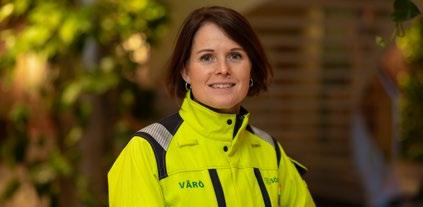
We work safely or not at all. During the year, we developed our behaviour-based safety (BBS) approach to promote safety. Not all risks can be eliminated, and our actions impact our own work environment as well as the work environment of others. Jenny Gotthardsson, Mill Manager at Södra Cell Värö, has led the project together with a cross-functional team of representatives from across Södra. The method is now ready to be rolled out in all operations.
The method has been trialled in several pilot projects and is based on managers and employees jointly identifying hazardous operations, agreeing on common behaviours so that the work can be carried out safely, and following up to ensure that these are effective in practice. The approach includes training for managers and key personnel, as well as training BBS coaches who will support the teams throughout the process.
“When we recognise and reinforce good safety behaviours, we help each other to reduce risks and we ensure a safer workplace,” said Jenny Gotthardsson. Implementation is the next step, which will commence in February 2026 and will be ongoing throughout the year. Our goal is to ensure that every second of the day at our workplaces counts when it comes to caring for each other and promoting security and safety – for everyone.
Södra’s mission is to refine and renew family forestry. as a member, you are not only a forest owner but also part owner of the industrial operations that process the raw material. It is a well-balanced relationship between competitive wood prices and profitable industrial operations. It should be an attractive proposition to be a member of and deliver wood to Södra. By creating more opportunities for engagement, knowledge and influence, we help people, the cooperative and the value of family forestry to grow.
Cooperative of
2025 was the UN International Year of Cooperatives. Södra should be an association that promotes engagement, where members feel a sense of involvement, and where it should be easy to contribute. During the year, together with elected representatives, we developed working methods that strengthen local cooperative activities and create a stronger basis for collaboration between members and the operational organisation.
We took important steps to clarify roles, responsibilities and expectations in cooperative activities. A new proposal for terms of reference for the district councils in the forestry districts has been developed and has been circulated for consultation. Meanwhile, several projects have been conducted to make it easier for elected representatives to work, for example by developing a shared digital workspace and a new remuneration system, which are expected to be ready in 2026.
The development of Södra’s knowledge offering is determined by members’ needs. The module on continuous cover forestry, offered via the Södra School (Sw: Södraskolan) training concept, has quickly become popular, and a course in association management is being developed.
During the autumn, efforts began to make the Södra Model, our financial model, more accessible and easy to understand. The ambition is to develop educational tools that clearly explain what the model means and how it works. It will improve understanding of how Södra is run and how each member can exert an influence.
The cooperative development journey continues. The aim is to decide on the proposed direction in 2026 and subsequently support the district councils as they work according to the new structures.
We want to highlight the value of being a member, owner and business partner of Södra. This is the foundation of a strong commitment and a long-term relationship. During the year, we continued to develop a competitive and future-oriented offer that strengthens forest ownership and generates benefits for members.
As a member, you interact with Södra through advisors, forest owner support and other key individuals. Our approach and services are based on the guiding principles of security, participation and inspiration, with the aim of creating even greater value for you and your forest estate. An important step was the launch of the Forest Owner Agreement (Sw: Skogsägaravtal), strengthening the member’s management of the forest estate through structured goal-setting reviews, planning and follow-up with the support of a coach.
We have introduced a new form of business in conjunction with final harvesting – harvester measurement with log price. In this form of business, both cost and payment are based on the diameter of the harvested tree and measurement is performed directly when the tree passes through the harvester head.
To further strengthen confidence, the complaints process has been subject to quality assurance. As a member, you should feel secure doing business with Södra and know that we assume responsibility for remedying any shortcomings. In 2026, we will continue to
develop the offer and strengthen the link between the member offer and raw material supply to Södra’s member-owned industrial operations.
A growing forest forms the basis for profitability and climate benefit. As forests grow and are used, they absorb carbon dioxide, and the higher the growth rate, the greater the climate benefit – both in the form of carbon sequestration in forests and products, and through the capacity to replace fossil materials.
We continued our efforts to strengthen forest growth through several important initiatives during the year. As part of the industry-wide Regeneration Check (Sw: Föryngringskollen) project, we have gained a clear picture of the quality of the planting service. This provides us with a better basis for making decisions on future improvements.
Our BraSatt development project is now in the final stages. We have developed an assembly for inversion scarification, a method during which the topsoil is flipped thereby exposing the mineral soil underneath for better planting conditions, and a digital tool for smart planting logic. Alongside planting seedlings according to coordinates on a grid, this enhances planting efficiency and lays the foundation for future mechanisation and self-driving machines.
Several of BraSatt’s results are now being developed further in the new AutoSatt project, which is being conducted by machine manufacturers in collaboration with Södra and others. In 2026, we also intend to test our decision support for planting logic in manual planting – a step towards even more viable forests.
As part of the Nordic Forestry Automation (NFA) project, we have developed digital support for thinning that provides the harvester operator with real-time data on stand density. This helps the harvester operator to optimise thinning intensity and provide the forest owner with better feedback. The system is now installed on two machines in Södra and function and quality are being continuously evaluated for potentially large-scale implementation in 2026.
Forest tree breeding has taken a major step forward. The pine and spruce in our own production are derived from third generation breeding, yielding on average 22 percent higher growth for pine and 25 percent for spruce. This ultimately increases forest growth for the forest owner, while the breeding cost is low in relation to the investment.
We want to increase awareness about how forest management and wildlife populations are interlinked and how multi-species management can ensure a balance. This means simultaneously showing consideration for multiple wildlife species, resulting in more sustainable management and reducing forest damage. We will also study different ways of protecting forests and measuring damage. To develop the forest and wild game domain, Södra initiated a wildlife research programme that will be run by the Swedish University of Agricultural Sciences (SLU) and the Forestry Research Institute of Sweden (Skogforsk). The first phase includes field studies, after which doctoral students will be engaged to analyse the data collected from the field.
» Profitability of the model forest estate: SEK 1,987/hectare
» Profitability of the model forest estate: SEK 2,920/hectare
Profitability of the model forest estate: Read more on page 12.
» Cooperative of the future
» Forest estates’ offer and business
» Vigorous high-growth forests
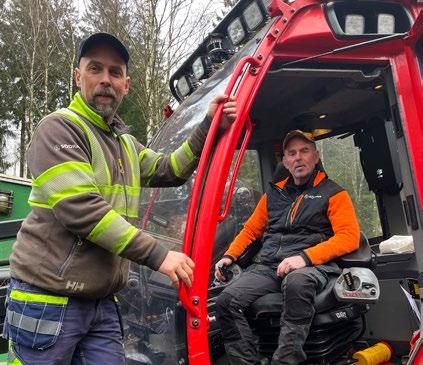
With Nordic Forestry Automation (NFA), Södra is taking a major step towards more data-driven forestry. The new technology, which will soon be ready for implementation, will make thinning more precise and more profitable.
“NFA is both a technical tool and a way to create strong, vigorous forests for the future. Providing drivers with the best possible support means that every decision in the forest can be the right one, which benefits both the members’ finances and the development of the forest,” said Jonas Hafmar, Project Manager for the NFA project.
With NFA , contractors gain access to operator support that makes their jobs easier and more enjoyable.
Max Bengtsén and Klas-Erik Andersson, thinning harvester operators and part of the Oskarström team at Södra Avverkning, have been testing the system for two years and find that it provides good planning and production support.
“It saves me time in manual planning thanks to the strip road support it provides,” said Max.
“NFA gives us immediate confirmation that the job is being done right,” said Klas-Erik.
Both feel they have played a part in the future of thinning and look forward to more operators experiencing the same confidence and precision in the forest.
The forest has many values that our value chain helps to realise. We highlight how engagement with the forest is converted into solutions that make a difference – from the home to the green transition – by maintaining a close approach that demonstrates how the forest and products derived from the forest benefit customers, consumers and society at large. Using new digital tools, innovative products such as the blue S paper pulp and initiatives to reduce fossil fuels used in transportation, we are building trust, increasing the value from the forest and creating opportunities for the future.
We aim to be a long-term and proactive partner to our customers. We strengthen our competitiveness and meet customer needs by ensuring that our product portfolio can adapt to new demands and rapid changes. It involves developing sustainable business opportunities, products, services, processes and methods, with the forest and forest raw materials at the heart. During the year, we deepened our collaborations in technology, innovation, sustainability and communication – always with the forest as a starting point.
We continued the development of blue S – a paper pulp made from pulpwood and agricultural by-products. Two pilot batches have been made and the product has been dispatched to customers globally for evaluation. The ambition is to scale up production in the years ahead. This exemplifies how we create more value from forest raw material and strengthen profitability for members. We must continue to adapt and develop the pulp business in response to increasing global competition from other fibre alternatives.
During the year, we offered our paper pulp and bioproduct customers the option to avail of our Conscious Delivery service – an initiative that promotes smarter logistics solutions and a reduction in the use of fossil fuels for transportation. By working with customers and carriers, we see that we can reduce the transport carbon footprint in Europe by 50 – 85 percent.
We also focused on educating about and raising awareness of family forestry among customers and partners. We arranged forest tours to show how Södra views forestry and biodiversity. This has been particularly important in discussions with the construction sector, where continuous cover methods are often highlighted as
the only solution. We have demonstrated that sustainable forest management can be achieved in several ways.
Interest in sustainable forestry is growing. We see the potential to develop a premium cross-laminated timber (CLT) product based on Södra’s family-owned forests. This could create further incentives for forest owners to implement sustainable forest management at the same time as we meet customer demand for timber with higher sustainability performance.
Regarding wood products, we have focused on increasing the sawing yield, meaning the part of the log that becomes sawn timber, thereby adding more value for the forest estate and better matching customer needs. We have also standardised package sizes, leading to more efficient logistics and a lower carbon footprint.
Sustainability topics, particularly linked to the EU Deforestation Regulation (EUDR), have been in focus during the year. We arranged seminars and engaged in dialogue to support customers, and we can see that the need for communication in this area will increase moving forward.
Two initiatives that strengthen our position in the green transition include the start of construction of a kraft lignin plant in Mönsterås and a tannin plant at Värö. Lignin and tannin, which are extracted from the forest raw material, provide new opportunities for producing fossil-free materials, and there is significant interest from the market. We also noted record biomethanol sales, thereby helping reduce customers’ carbon footprint.
During the year, we continued to supply dissolving pulp also for specialty products, such as microcrystalline cellulose (MCC) used in pharmaceuticals. OnceMore®, our dissolving pulp made from forest raw material combined with recycled textile waste, welcomed two new partners in 2025: Selected and Pinewood.
In an era of rapid change for both technology and society, communication plays a crucial role in strengthening Södra’s competitiveness. In 2025, we took important steps to speak with a clear and united voice – close to our members, customers and consumers. This included the development of common messages and visual expressions.
Towards the end of the year, we launched the NÄRA communication concept, demonstrating how engagement in the forest can be turned into sustainable solutions that make a real difference –
at home, in society and in the green transition. The concept is based on closeness, responsibility and relevance, and allows family forestry to be connected with the users of our products. This strengthens confidence in Södra and makes it easier to recognise – both in Sweden and abroad. The concept will be launched in 2026.
In recent years, we have worked purposefully to create more coherent and strategic communication, including through the launch of a new product-oriented website. It is now easier to use, provides a clearer presentation of our product offer, and facilitates relationship-building and business development.
During the year, we conducted a brand survey that showed that awareness of family forestry is low, but that attitudes are positive as awareness increases. It provides us with a clear path forward – to keep informing and engaging with consumers.
The partnership with the Scouts is an example of how we are strengthening the link between the forest and the community. By contributing to their Support Fund, more children and young people have the opportunity to experience Swedish forests – an initiative that combines sustainability, social benefit and confidence in the future.
Internationally, we have launched the “Keep calm and choose family forestry” campaign, targeting consumers in five major cities. The campaign highlights sustainability, family forestry and the transition to fossil-fuel independence, and has reached a wide audience.
The results of this year’s activities are evident in the increased awareness and engagement surrounding our shared messages. We have laid the foundations for a more data-driven approach, facilitating more relevant and personalised communication. Digitisation is evolving rapidly and AI is a strong driver. While this creates new opportunities to communicate and reach the right audiences, it also poses challenges.
Södra is about people. The commitment of family forest owners meets the needs of customers and consumers in a value chain that supports climate solutions, biodiversity and a fossil-free society. It all starts in the forest and with the family forest owner – and ends in the home, with the family living in, building with and using what the forest provides. Close to the forest, close to the customer, close to you.
Customer satisfaction:
» Södra Wood: 80
» Södra Cell: 85
Customer satisfaction:
» Södra Wood: 80
» Södra Cell: 84.8
Customer satisfaction: An index for measuring customer satisfaction.
» Customer-oriented offer
» Communication and position
Our future product portfolio consists of five core business areas:
Sawn timber – more efficient and a higher level of processing of the available raw material from members in a profitable and modern production process with realised economies of scale.
Pulp – continue to be a world-leading supplier of softwood, hardwood and dissolving pulp.
Building systems – the basis for a profitable CLT business, and established partnerships with standardised solutions for both projects and industry.
Energy and chemicals – maximise value of all raw material by processing it into biochemicals and energy, making a clear contribution to the profitability of forest estates.
Carbon – a driving player in the climate transition, and carbon from members’ forests is captured from the smokestacks of our mills and either used or stored in products (Bio- CCUS)
Blue S is a new type of paper pulp developed by Södra, combining traditional pulpwood with local agricultural by-products to create a resource-efficient and sustainable product that strengthens the profitability of family forestry and supports a more circular economy.
The new pulp has attracted significant interest, and Södra is working together with several customers on projects in different segments.
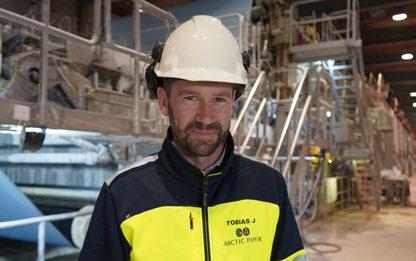
“We have received many inquiries. Arctic Paper Munkedal was the first customer to use the new pulp in production and everything has worked perfectly, which I’m delighted about,” said Maria Staxhammar, Sales Director at Södra Cell.
“The production process went very smoothly and product quality is on a par with conventional pulp. The blue S pulp also features improved tensile strength,” said Tobias Jacobsson, Purchasing Manager Sweden at Arctic Paper.
The paper produced by Arctic Paper Munkedal from blue S was used to print this year’s second issue of the member magazine Södrakontakt.
In 2025, we took major steps to strengthen competitiveness and future-proof the value chain – from family forestry owner to consumer. Through efficiency and digital growing power, we are creating smarter ways of working, increased digital know-how and robust digital solutions. We are building stronger industrial operations and a digital landscape that creates more value for members and customers through collaboration and innovation, and by embracing change.
Digital growing power is a strategic area that reinforces the entire value chain – from family forestry to consumer – through a coherent digital landscape. In 2025, Södra took important steps to increase its digital capabilities, focusing on security, efficiency and tomorrow’s technologies.
The year was dominated by a clear transition in which information security, competence development and efficiency improvements took centre stage. A coordinating function staffed by new roles has been established to drive the entire digital area forward. Several cost optimisation initiatives have been implemented through the Södra Leap action programme, including the renegotiation of contracts, consolidation of suppliers and decommissioning of systems.
Procedures, training and proactive work to combat new threats have strengthened information security. Because information is viewed as the business’s most important asset, we have therefore prioritised information management. Meanwhile, we have improved our portfolio management for digital development, meaning how we prioritise and manage our digital projects to gain maximum business value. This ensures better control and coordination.
During the year, we delivered several concrete solutions:
» Developed commercial forms and conditions for the forest estates’ offer and business
» Integration of Viol 3 (timber trading and logistics system) with Södra’s business system for accurate reporting to members and industrial operations
» Improved pulp product with quality data (Q-data)
» Support to address the EU Deforestation Regulation (EUDR)
» Digital training administration within the cooperative.
The result of these measures is increased safety, better control and more efficient use of resources. The organisation has prevented several potential cyberthreats in time, which has strengthened confidence in our protection capabilities. Training and more process-oriented approaches have increased process maturity. Operational efficiency has improved through coordination around workflows and resources.
Moving forward, we will continue to work to deepen the digital transformation. The focus is on data-driven solutions, smarter AI capabilities and enhancing digital skills across Södra. A shared target architecture for our systems will support the strategic shifts, and we are developing portfolio management to maximise value. Information security and compliance remain priorities, as well as streamlining and automation to unlock resources and increase business resilience.
Södra continued to develop its industrial competitiveness during the year to address the increasingly intense competition for wood raw material while strengthening profitability. Rapid change in the pulp market also requires us to adapt our business.
Through the World-class Efficiency programme – our way of realising continuous improvement and efficiency enhancements – we have established a foundation for more systematic, evidence-based improvement work that permeates the entire organisation.
In 2025, we shifted our focus from individual units to the entire Group. We have been able to make greater strides forward through collaboration between different parts of the organisation. A clear example of this is the raw material flow, where joint initiatives between the Skog business area and Södra’s functions have led to major efficiency improvements.
World-class Efficiency has evolved to include more assignment types and stronger cross-functional collaboration. Södra’s Digital and Tech function has achieved its established goals through focused change management. At the sawmills, we have made improvements with a focus on increased raw material optimisation, particularly in relation to sawing yield (the part of the log that becomes sawn timber).
For change to be successful, we need to strengthen our capacity to drive change together. That is why we have continued to invest in strengthening our employees’ ability to lead and embrace change. Inclusion and collaboration have played a key role, and since its inception, more than 700 employees have participated in Worldclass Efficiency.
The result is clear: SEK 518 million in improvement potential was implemented during the year. At year-end, almost 200 initiatives comprising more than 1,600 activities were ongoing. But it is not just about the numbers – we are also seeing a cultural shift in which digitisation, improvement activities and security in times of change have become a natural part of everyday life.
Moving ahead, we will continue to focus on what we ourselves can control. We are accelerating our World-class Efficiency programme and investing in AI and a holistic mindset to generate even more value. Through cross-functional efforts and targeted AI initiatives, we are streamlining working methods and processes. We are developing our employees’ digital and analytical skills and building on an inclusive culture of change where collaboration and sharing of best practices are at the heart of everything we do.
The objective is clear: Södra is to be the most competitive company in the industry – and we must be ready to adapt quickly and leverage new business opportunities.
» Equity ratio: more than 55%
» Return on capital employed: 10%
» Equity ratio: 56%
» Return on capital employed : –5%
Equity ratio: The percentage of assets that are financed by equity.
Return on capital employed (ROCE): Measures how efficiently a company is using its capital. The calculation shows how much profit is generated for each SEK of capital invested.
» Digital growing power
» Competitive industry
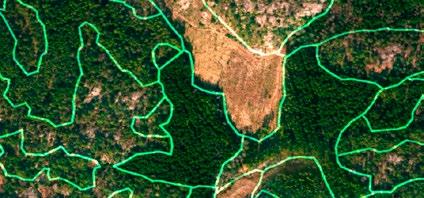
Planning is at the core of the forest management plan –a key tool to facilitate planning and decisions about the forest. Södra is now taking a technological leap together with the AI company Terra Labs to provide members with better and more up-to-date information about their forests.
A new planning app for tablets streamlines work and reduces the need for field measurements. The app combines remote sensing and automated forestry data with AI models trained in close collaboration with Terra Labs. This provides high accuracy and frequent data updates, bringing a whole new level of precision.
“Empowering our members in their forest ownership and decision-making is a key part of our mission, and we aim to create even better decision support for forest owners,” said Peter Karlsson, President of the Södra Skog business area. The initiative enables:
» Improved planning efficiency with digital tools
» High-quality, automated forestry data
» Making more information available via My Forest Estate (Sw: Min skogsgård).
The forest is more than a raw material – it is a habitat, a climate solution and inspires hope for the future. We promote sustainable forestry that will stand strong in times of change by nurturing biodiversity and driving the transition towards climate neutrality and circularity. Through commitment, innovation and collaboration, we are building value for nature, customers, employees and members of Södra.
Climate change is one of the greatest challenges of our time, impacting society, forestry and our industrial operations. Successfully achieving the transition requires rapid emission reductions and a circular and efficient use of resources. The forest plays a key role – it stores carbon dioxide and provides raw material for products that replace fossil-based materials. We promote a more sustainable society by assuming responsibility across the value chain.
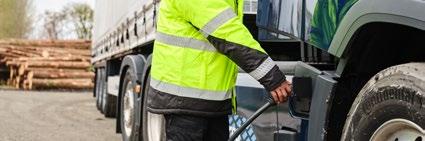
During the year, we took important steps towards climate neutrality. As one of Sweden’s largest transport buyers and electricity producers, we are in a unique position to drive electrification forward. We have received delivery of our first electric wood chip truck and charging infrastructure has been built at several sites. The battery-electric wood chip truck is part of the Forestry Research Institute of Sweden’s TREE research project, which aims to help ensure that half of all new trucks in the forestry industry are electrically powered by 2030. This is a concrete example of how we, together with other stakeholders, create solutions that make a difference.
We have also commenced construction of a kraft lignin plant in Mönsterås. Lignin is a bio-based raw material that can be used in plastics, adhesives, carbon fibre and battery components. It creates new opportunities for our customers to reduce their emissions and strengthens our role as a supplier of materials with a low climate impact. In parallel, we have continued to develop Conscious Delivery – a collaboration with suppliers and customers to reduce fossil fuels in the logistics chain. These initiatives are
enabling us to create value for the climate and for members of Södra. The results show that our direct and indirect emissions from purchased energy have decreased compared with the 2020 base year due to lower consumption of fossil fuels and our purchases of fossil-free electricity for some of the foreign companies. Our other indirect emissions have increased compared to the base year. One reason is the changes to the blending obligation, meaning the legal requirement to mix liquid biofuels into petrol and diesel to reduce the climate impact. In addition, emissions are affected by changes in geographical markets for Södra’s products, as emissions from transportation represent a significant share of the total. We strive to work more closely with our customers to support them in their ambitions to reduce their greenhouse gas emissions in our shared value chain. The climate action plan for each business area has been updated with clear initiatives to reach the targets. We are participating in collaboration projects and accumulating knowledge to enable the systemic change required. This is a long-term effort that combines innovation with practical solutions.
During the year, we held a series of sustainability webinars targeting customers and employees. These had three different themes: Södra’s sustainability work, climate work and responsibly managed forests (nature conservation).
Looking ahead, we will continue to pursue electrification, energy efficiency and substitution. We are developing fossil-free harvesting operations and strengthening cooperation with suppliers to enhance data quality and pursue shared emissions reduction targets. By acting now, we are creating the prerequisites for climate-neutral and circular forestry – and a future in which the forest makes a difference.
Biodiversity is a prerequisite for sustainable forestry and for the longterm sustainability of our business model. As we support the climate transition with renewable products, it is also our duty to ensure that species found in the forest landscape today are preserved for future generations. Robust nature conservation activities enable a forest that is more resilient to climate change and strengthen competitiveness at a time when preserving natural values is increasingly important.
The biodiversity agenda is based on the members’ voluntary set-asides, nature conservation measures and the environmental consideration to which all forestry measures are subject. The forest land of southern Sweden boasts a wide variety of habitats, creating a rich environment. Many of these values are dependent on active management for its preservation and development. That is why we have set a target to carry out nature conservation measures (NS) on 3,000 hectares annually. In 2025, activities were intensified compared with the preceding year, and this has borne fruit – in 2025, 3,086 hectares were subject to nature conservation measures (NS). Through these efforts, Södra and its members have made an important contribution to biodiversity.
We have also sharpened our focus on priority species, meaning species that require special considerations. Some 340 species have been identified and their habitat requirements have been compiled. The next step is to group them according to their needs and adapt our environmental considerations accordingly. The analysis of priority biotopes is ongoing. This provides us with a better basis for targeting our interventions to where they can add the most value.
To create new opportunities, as part of our membership of the Swedish Biocredit Alliance we have participated in the development of a standard for biodiversity credits in which certificates are linked to activities to conserve and enhance biodiversity. During the year, efforts continued on monitoring, reporting and third-party verification requirements – an important part of building a credible market. This opens the way for business models that make investing in biodiversity profitable.
Knowledge and collaboration are decisive factors. In the spring, we held a sustainability webinar to showcase how we work with nature conservation and engage in dialogue with customers (part of a series of three sustainability webinars). Furthermore, together with the Swedish University of Agricultural Sciences (SLU), we received funding for a collaborative doctoral student who will study the effects of different forms of forest management on sensitive species. The purpose is to identify the environmental factors that influence the species’ response and provide a better decision-making basis. We are also involved in a standardisation project as part of ISO to develop measurements for biodiversity in managed forest landscapes. The aim is to create a shared and credible method for measuring and monitoring biodiversity so that forest management can be transparently compared and improved.
In 2026, we will develop a nature conservation programme outlining an action plan to promote richer biodiversity. Regarding efforts relating to priority species, we will work to build broad consensus among authorities, researchers and environmental organisations. This is a long-term endeavour that requires commitment from all parts of the organisation. By combining voluntary interventions, research and new business models, we can help ensure that forests remain a habitat for a multitude of species – today and in the future.
» Direct and indirect fossil emissions from the generation of purchased energy: 77 kt CO₂eq
» Customer engagement target: 50%
» Other indirect fossil emissions: 650 kt CO₂eq
» Direct and indirect fossil emissions from the generation of purchased energy: 73 kt CO₂eq
» Customer engagement target: 38%
» Other indirect fossil emissions: 733 kt CO₂eq
Total fossil emissions in the value chain: 2.5 Mt CO₂eq
» Climate neutrality and circularity
» Biodiversity
Climate action plans that make a difference
The forest plays a key role in the green transition. It stores carbon dioxide and provides raw material for products that store carbon dioxide and replace fossil materials. Södra’s climate targets are aligned with the Paris Agreement: halve direct and indirect emissions of fossil GHG emissions by 2030 compared to 2020. To achieve this, each business area has a climate action plan that sets out concrete measures and which is updated annually.
“The plans describe the required measures to reduce emissions and are updated every year. This approach enables climate activities to become a natural part of operational and tactical plans,” said Agata Andersson, convener of Södra’s climate team.
Examples of actions include:
» Electrified vehicles – wood chip truck and internal working machinery
» About 450 charging points at sites and offices
» Energy optimisation and renewable fuels
» Cooperate with suppliers to reduce emissions.
Members also receive advice and training on climate adaptation of forests – from selection of tree species to practices that enhance carbon sinks and biodiversity.
We develop services and products in biofuels, biochemicals, biomaterials, building systems, dissolving pulp, electricity, paper pulp, seedlings, wood products and heating — all based on the forest raw material supplied by members. We also provide forestry services to members. Södra has five business areas – Skog, Wood, Cell, Building Systems and Bioproducts.
Södra Skog
» Forestry and advisory services for members of Södra
» Purchases forest raw material from members and delivers the material to Södra’s mills
» Forest management and contractor development
» Management of Södra’s forests
» External trade with wood raw material
» 24 local member teams
» Two nurseries with seedling sales
» Haulage operations
Non-current assets per segment
Södra Skog 35%
Södra Wood 10 %
Södra Cell 51 %
Södra Wood
» Wood products – sawn, planed, pressure-treated and coated
» Production of biofuels, biomaterials and heat
» Seven sawmills in Sweden and Finland
» Two timber treatment facilities and one planing mill in Sweden
» Four timber treatment facilities in the UK and Ireland
» Grinding facility
Södra Building Systems 4 %
Other segments 0 %
per business area
Södra Skog 23 %
Södra Wood 23 %
Södra Cell 53 %
Södra Building Systems 1 %
Other 0 %
in the amount of SEK 3,553 million.
Södra Cell
» Production of paper pulp, dissolving pulp, biofuels, biochemicals, biomaterials, green electricity and heat
» Paper pulp sales
» Three Swedish pulp mills
» Port
Södra Building Systems
» Timber frame building systems – CLT and glulam
» Wood products for façades and interiors
» CLT facility at Värö
Södra Bioproducts
Sales of:
» Biofuels, biochemicals and biomaterials
» Dissolving pulp
» Green electricity and heating
“The year was dominated by weak demand in the markets for our products, with the triple effect of rapid currency fluctuations, challenging market conditions and an imbalance between raw material and product prices having a significant negative impact on earnings. Given the uncertainty in the business environment, the recovery is expected to take time. Accordingly, we believe that 2026 will be another challenging year.”
Lotta Lyrå President & CEO
Södra
as a member of Södra, you gain access to forestry services, advisory services and digital tools that make it easier for you to responsibly and profitably manage the forest. the services cover the entire forest life cycle – from planting and thinning to harvesting and long-term planning of forest estate management. the cooperative form of organisation empowers members, giving them a voice through association democracy. together, we create security and strengthen the basis for sustainable family forestry across generations.
Member of Södra
The cooperative development journey has been ongoing during the year with the aim of strengthening cooperation and clarifying the tasks and working methods of the local district councils in four areas: meeting hubs, active learning, joint advocacy and member democracy.
52,262
no. of members
821
course participants in the Södra School (Sw: Södraskolan) training concept
2.86
million hectares, affiliated forest area*
450
local activities in the forestry districts
Year in review – forestry services
» Six price adjustments for wood.
» Long-term cooperation agreements that provide increased opportunities to develop forest ownership through the Forest Owner Agreement (Sw:Skogsägaravtalet).
» Introduction of harvester measurement with log price.
» New forest owner support, with high satisfaction among members.
» Development of forest management plans using AI and remote data.
Wood sales
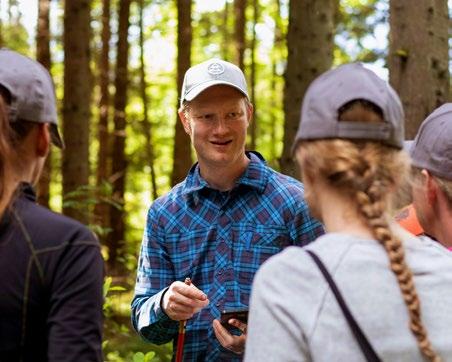
*We are exploring the possibility of using remotely sensed data for the affiliated forest area. In conjunction with this, the definition of forest land may be amended and could impact the estimate.
Examples of services
» Forestry advice
» Forestry measures
» Continuous cover harvesting
» Advice on change of ownership
in Södra’s forests
Södra’s own forests comprise 136,619 hectares of productive forest land in Sweden and the Baltics.
As a member of Södra, you stand firmly on two legs – your forest estate and the added value created in our joint industrial operations.
As a member of Södra, you are part of something bigger. through your forest estate and the value created in our industrial operations, you stand firmly on two legs. as the forest grows, it provides security and long-term returns. in parallel, the raw material is processed into products that are sought after in global markets. this means that you gain value from both parts.
Wood prices were high during the year, thereby strengthening the profitability of the forest estate. Conversely, industrial operations faced challenges, with weaker markets and squeezed margins.
We continued to invest for the future, remaining focused on creating value and building financial strength by:
» Ensuring competitive wood prices and a stable yield from your forest estate
» Processing the raw material in our joint industrial operations to create more value for you to share in
» Investing in innovation and efficiency to enhance long-term profitability
» Building robust finances that provide security even in times of change.
By combining forest growth with the processing power of industrial operations, we create a unique model that provides double the strength. This is fundamental so that you can feel confident in the future and view your forest as a long-term and profitable investment.
Once the wood raw material leaves the forest, the next step begins – processing. This is the very essence of the Södra Model. You benefit from the entire value chain, from forest to finished product. Forest raw material is unique and versatile –it can become wood products for houses and buildings, paper pulp for packaging, dissolving pulp for clothing, as well as a wide range of other products that replace fossil alternatives. We are working tirelessly to create more value from each tree.
We are investing in our industrial operations to create value –not only for current, but also for future generations. We took important steps during the year, including planning of the investment in the Kinda sawmill and the kraft lignin plant, which is being built in Mönsterås. These investments will allow
us to maximise the potential of the forest and develop new products that will meet future needs. It strengthens industrial operations, providing members with a more secure business overall.
Membership of Södra offers so much more than financial benefits and added value – it strengthens the forest estate in numerous ways:
» Influence over the association’s direction and future initiatives
» Access to advisory services, support and networks that make forestry more profitable and sustainable
» The security of having a stable business partner that assumes responsibility for the entire chain – from forest to market
» Joint innovation and nature conservation efforts that strengthen the role of forests in the green transition
» Active business policy lobbying that pursues agendas for competitive and sustainable family forestry.
Södra creates value in the forest, in industrial operations and for you, the forest owner – right by your side in your day-to-day work and long-term for the future.
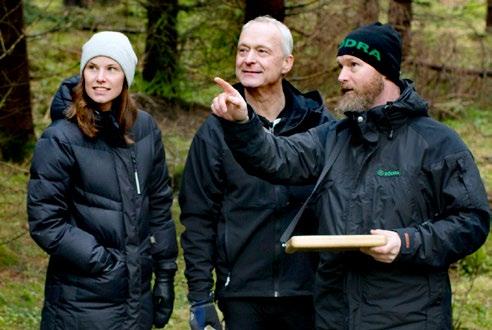
Members who deliver wood to Södra are not only paid a market price, but are also owners who are eligible for additional returns from our jointly owned industrial operations. over a business cycle, you and all of Södra’s other members share half of the profit generated by our mills. the other half of the profits go to investments and development to keep Södra financially strong and create continued growth.
1. Members’ combined timber sales
Members’ wood sales to Södra at market prices lay the foundation for creating added value in the industrial operations and thus profit distribution. 2 or 4 percent (each member chooses their own level) of the wood price is allocated to your paid-up contributed capital, which is accumulated over time.
2. Added value
Your wood is delivered to Södra’s mills where it is processed into renewable products such as pulp, timber, building systems, energy and biochemicals.
3. Profit distribution and industrial investments
50 percent of profits over time are allocated to members as profit distribution. The other 50 percent is used to invest in and develop our joint industrial operations.
Profit distribution is based on the deliveries you have made during the year or previous years and may take the form of a dividend (paid out directly) or a bonus issue (added to the contributed capital and retained by Södra).
Södra’s Board submits a proposal for profit distribution, which the Annual General Meeting subsequently resolves on.
Investments and development for the future
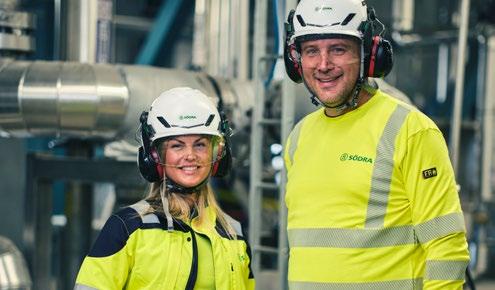
Different tools can be used for profit distribution:
4a. Profit distribution, deliveries for the year
Profit distribution calculated on the value and/or volume of the forest-based products you delivered during the year:
» Dividend as a percentage or SEK amount on the value or volume of your deliveries
» Bonus issue, profit distribution that gives you issued contributed capital. New tool that will not be utilised until 2026 profit distribution at the earliest.
4b. Past deliveries (contributed capital)
Profit distribution on your contributed capital, accumulated from previous deliveries:
» Dividend as a percentage on your paid-in contributed capital
» Dividend as a percentage on your issued contributed capital
» Bonus issue that gives you issued contributed capital.
Bonus issue is the transfer of jointly owned capital in Södra to individual capital, on which members are entitled to dividends.
Many of the products that we use every day come from the forest. toilet paper, hygiene items, wooden decking, cleaning agents, clothing, high-rise timber-framed buildings and fuel are some of the everyday items that can be made from this fantastic forest raw material when we use the whole tree. Many of our products are sold to customers around the world who process them, while others reach the end consumer in the same form as when they leave Södra.
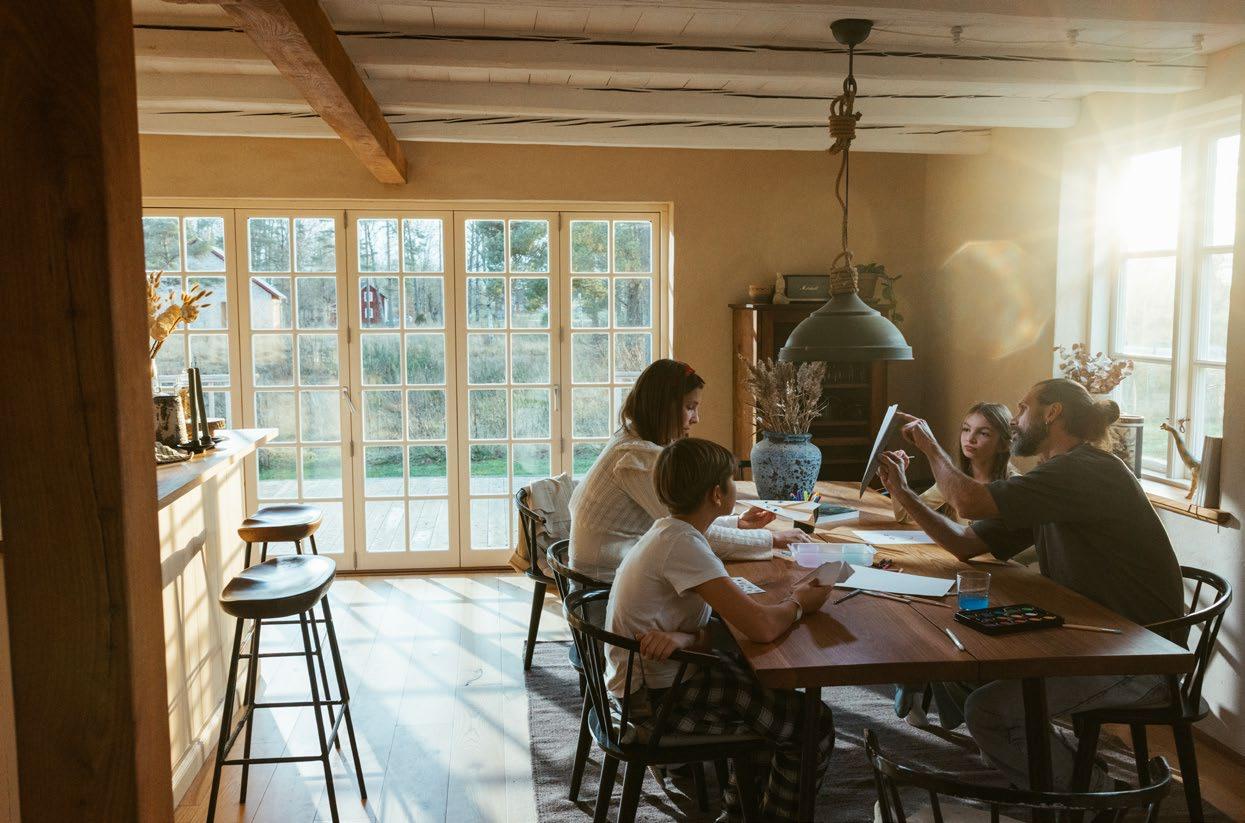
1.9+1.6
The pulp mills produced 1.9 million tonnes of paper and dissolving pulp and the sawmills produced 1.6 million m³ of sawn timber.
SEK 19.7 billion
The export value includes net sales of the processed products, geographically distributed to where we have our end customers.
— for heating, renewable electricity and liquid biofuels
Biofuels from family forestry’s forest raw material are used to produce heat, renewable electricity and liquid biofuels. that enables us to make more from every tree, across the chain from the forest to our sawmills and pulp mills.
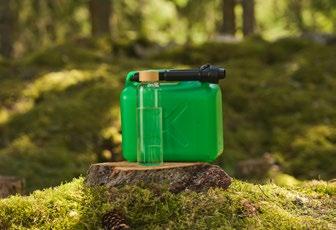
3,500
The year in brief
» More destinations with Conscious Delivery, our offer to reduce the climate impact of transportation.
Solid biofuels are used in a variety of ways in Södra’s value chain. Forest residues (branches and treetops) is a product of harvesting and used as fuel in thermal power stations. Bark from the pulp mills is used for internal energy generation and sold on the market as biofuel. The sawmills contribute with bark, wood chips and sawdust. The diagram shows the division between biofuels from the forest and biofuels from mills, about 3,500 GWh in total.
Examples of products
» Biomethanol
» Fuel wood
» Pellets
» Wood briquettes
» During the year, we increased deliveries of biomethanol and also made our first delivery to a ship that services wind turbines off the coast of northern Germany.
— for cleaning agents and cosmetics
Biochemicals from the forest can replace fossil raw materials and support the environmental certification of industrial processes and end products. this means that they can play a crucial role in the transition to products with a low climate impact. Biochemicals can also be used in the production of cleaning agents and cosmetics, for example, and in the flavour and fragrance industry.
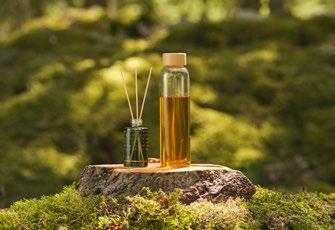
35,000 tonnes biochemicals produced
The year in brief
» Conducted customer survey
» Start of construction of tannin and kraft lignin plants.
Examples of products
» Biomethanol
» Dissolving pulp
» Tall oil
» Turpentine
— bedding, construction panels and mulch
the products in biomaterials mainly come from our sawmills. in this area, our products include bedding materials for livestock, sawdust for the pellet and board industries and bark (mulch) for covering material.
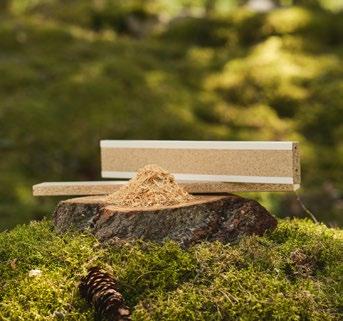
Examples of products
» Bark
» Wood chips
» Wood shavings
» Sawdust
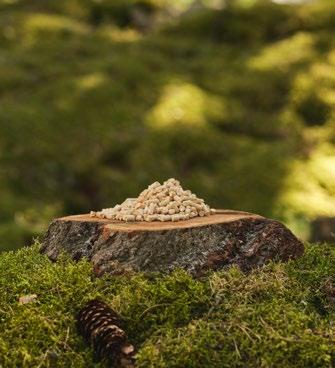
0.4 million tonnes biomaterials delivered
The year in brief
» Södra’s investment in the sawmill and a new pellet factory in Kinda will produce an additional about 25,000 tonnes of pellets per year.
— for housing, industrial facilities and public buildings
our structural components in cross-laminated timber (CLt) enable the construction of large high-rise buildings for residential, industrial and public use. Södra’s CLt is made from layers of planed spruce from family forestry that are finger-jointed and glued together into lamellae. these are then cross-laminated to form a strong and rigid structural component that is precision machined according to the customer’s specifications.
Examples of products
» Cross-laminated timber
» Products for façades and interiors
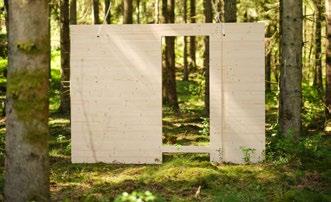
24,000 m³ production volume
The year in brief
» Delivered CLT to two of the largest construction projects in Gothenburg with a focus on sustainability.
» Initiated partnerships with leading industry players to drive sustainable development in construction.
» Increased production rates and raw material utilisation at the CLT mill.
— for textiles
dissolving pulp from Södra comes mainly from birch and is primarily used in the textile industry to produce viscose and lyocell. in our onceMore® product, we also mix in textile waste comprising a cotton and polyester blend. We separate the polyester from the cotton in the process and can recycle the cotton, which is then combined with wood fibres.
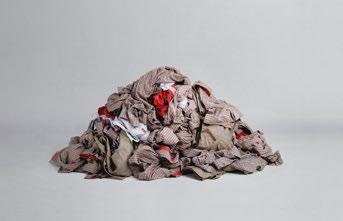
Examples of products
» OnceMore®
» Södra Orange
» Södra Purple
» Södra Purple F
0.16
The year in brief
» New OnceMore® partnerships with the Pinewood and Selected brands.
» OnceMore® was showcased at Milan Fashion Week in collaboration with Avavav.
— green electricity and members’ electricity
Södra is a major producer of green electricity from biomass, wind and water, and thereby contributes to the supply of electricity in southern Sweden. the total amount of excess electricity that we supply corresponds to the domestic electricity consumed by just over 50,000 detached houses per year, or the average consumption of just over 120,000 electric vehicles per year.
Examples of products
» Green electricity
» Support services for the electricity grid
» Guarantees of Origin (verifies the source of the electricity)
1,700
The year in brief
» Södra connected to the electricity ancillary services market, which includes the new battery in Orrefors.
» Decision to discontinue our consumer electricity business (Medlemsel) and develop a new long-term partnership with Jämtkraft.
— for tissue, packaging and specialty papers
our pulp mills produce softwood and hardwood pulp of the highest quality. the largest share is used for tissue, but the pulp is also used for specialty products, printing and publishing paper, and packaging. products made from our pulp are used every day to make people’s lives easier.

» Mill trials to produce paper pulp made from pulpwood and local agricultural residues (Södra blue S)
Source: AFRY
Examples of products
» Södra black
» Södra blue
» Södra gold birch Z
» Södra green
» Conscious Delivery customer offer to reduce the climate impact of transportation.
» Collaboration with customers in the areas of sustainability, innovation, communication and technology.
— spruce, pine and other coniferous and deciduous trees
We have been working with seedling production for more than 50 years. We have invested in research into tree breeding material and development of the business to produce the best seedlings for conditions in southern Sweden. Södra’s nurseries offer seedlings that are robust, provide rapid growth with high-quality wood and have a high survival rate. the seedlings are mainly spruce and pine, but also other species of deciduous and conifer trees.
Number
Examples of products
» Container-grown seedlings
» PluggPlusEtt seedlings
» Bare-root seedlings
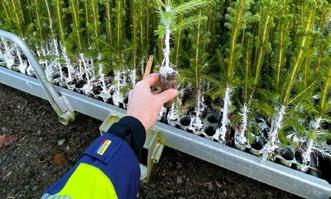
» More than one million deciduous seedlings sold and every third container-grown seedling was pine.
» Drone technology for regular site evaluation.
» The share of biological plant protection products has increased.
» New seeding line at the Falkenberg nursery facilitates mechanical handling of more seed varieties.
— structural timber, decking and cladding
Structural timber accounts for the highest proportion of our sales, but wood products have many applications. Customers are mainly in the construction, packaging and wood processing industries. Södra is one of the leading producers of wood products in europe, with seven sawmills in Sweden and Finland where we produce high-quality wood products. all sawmills have a high level of processing and several have integrated planing mills and coating facilities.
Sales per market
Examples of products
» Structural timber
» Sawn wood products
» Decking
» Cladding
district heating for the local community
district heating from Södra mainly consists of excess energy from our mills. We supply district heating to locations close to our industrial facilities corresponding to the heating requirements of almost 25,000 homes.
1.6
The year in brief
» Decision on investment in and expansion of the sawmill in Kinda. Initial procurements completed.
Södra delivers district heating from the pulp mills at Mönsterås, Mörrum and Värö, and the sawmills at Kinda and Hamina, to neighbouring communities. External district heating deliveries were 450 GWh in 2025. Nearly two thirds of external district heating deliveries comprised excess heat from industrial processes. District heating is also delivered internally within Södra. The pulp mills at Mönsterås and Värö supply the combined facilities with district heating.
Examples of products
» District heating
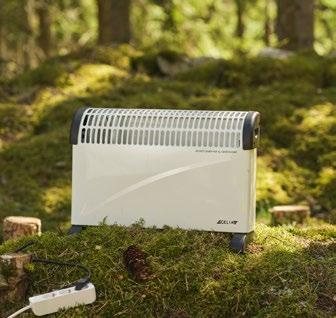
450 GWh district heating deliveries
The year in brief
» Södra’s investment in the sawmill in Kinda has secured supplies of district heating to the local area together with our customer Tekniska Verken in Linköping.


in 2025, södra posted an operating loss of seK 1,290 million (profit: 2,630) and net sales amounted to seK 28,302 million (29,487) the deterioration in the operating result was mainly due to unfavourable exchange rate trend combined with higher raw material costs. this was partly offset by lower overheads as a result of the action programme initiated at mid-year. the earnings trend reflects the challenges and the continued market uncertainty in terms of geopolitical volatility, the economic situation and a raw material shortage. the proposed profit distribution is seK 616 million.
56%
Södra stands stable with an equity ratio of 56 percent, exceeding the long-term target of 55 percent.
Proposed profit distribution for 2025 for adoption by the 2026 AGM −5 % Return on capital employed is below the long-term target of 10 percent.
616 million
1) Reclassification of assets and liabilities in accordance with IFRS 5 has not been taken into account in the calculation. The calculation is made on the entire Group.
2) As of the current financial year, average capital employed is calculated on the basis of the current and previous four quarters. Comparative figures for previous periods have been restated.
3) As of the current financial year, average capital employed is calculated on the basis of the current and previous four quarters. Adjusted operating profit is calculated on the current and previous three quarters. Comparative figures for previous periods have been restated.
4) LTA (lost time accident): number of occupational injuries with absence.
5) LTAR (lost time accident rate): no. of occupational injuries with absence per million hours worked.
6) Proposed profit distribution, including bonus issue.
7) We are exploring the possibility of using remotely sensed data for the affiliated forest area. In conjunction with this, the definition of forest land may be amended and impact the estimate.
8) New definition from 2024: includes number of actual hours worked divided by the number of scheduled hours for a full-time employee. The comparative figures for 2023 have been restated
Södra manages its operations by analysing key indicators. Some of these financial key indicators are defined or specified in applicable regulations for financial information, or by other applicable laws. All others are referred to as alternative performance measures. Södra uses the following alternative performance measures and believes they provide valuable complementary information for analysing Södra’s performance. The effect of assets held for sale is presented in the Consolidated statement of comprehensive income and Consolidated statement of financial position. The effect of assets held for sale is not included in the Consolidated statement of cash flows nor is it taken into account in calculated key indicators, which is not directly apparent from the income statement and balance sheet presented, since Södra uses these factors to manage all of its operations. Comparative figures for prior years have not been restated for the above-mentioned effect (from 2019 and earlier), but are reconcilable with historical reports.
NET SALES, CHANGE
SEK
Explanation
Shows Södra’s growth.
Definition
Net sales for the year relative to the previous year’s net sales.
OPERATING PROFIT BEFORE DEPRECIATION, AMORTISATION AND IMPAIRMENT
Explanation
A complement to operating profit/loss, which shows the items on the income statement that affect cash flow.
Definition
Operating profit/loss excluding depreciation, amortisation and impairment of property, plant and equipment and intangible assets.
EBITDA MARGIN
Explanation
The EBITDA margin shows the percentage of surplus on each SEK earned less operating costs, but before depreciation, amortisation and impairment. This measure gives an overall view of the cash flow generated. The measure is used to produce an overall trend analysis of Södra’s performance, and for comparison with other companies.
Definition
Operating profit/loss excluding depreciation and amortisation of property, plant and equipment and intangible assets expressed as a percentage of net sales.
OPERATING PROFIT/LOSS
Explanation
Operating profit/loss shows the surplus on each sales SEK less operating costs, including depreciation, amortisation and impairment. This is an essential measure for producing a trend analysis of Södra’s performance, and for comparison with other companies.
Definition
Net sales and other revenue less operating costs including depreciation, amortisation and impairment.
OPERATING MARGIN
Explanation
The operating margin is a measurement of the proportion of surplus on each SEK earned less operating costs, including depreciation. This surplus is used to cover interest expense and tax, and to generate an acceptable profit. The measure is used to produce an overall trend analysis of Södra’s performance, and for comparison with other companies.
Definition
Operating profit/loss expressed as a percentage of net sales.
Explanation
Return on equity is a measure of the interest that Södra pays on its members’ capital.
Definition
Profit after net financial items less standard tax in relation to average equity.
*Reclassification of assets and liabilities in accordance with IFRS® 5 has not been taken into account in the calculation of Net debt. The calculation is made on the entire Group.
Explanation
Shows Södra’s financial strength through the relationship between current investments and cash and cash equivalents compared with borrowings.
Definition
Interest-bearing liabilities less interest-bearing assets and cash and cash equivalents.
DEBT/EQUITY RATIO
*Reclassification of assets and liabilities in accordance with IFRS 5 has not been taken into account in the calculation of the debt/equity ratio. The calculation is made on the entire Group.
Explanation
The debt/equity ratio is used to measure Södra’s financial strength and, in combination with the equity ratio, is the measurement most frequently used by management to monitor the Group’s financial leverage.
Definition
Net debt in relation to equity.
Return on operating capital
Operating profit in relation to average operating capital.
Equity
Consolidated equity is equal to taxed equity increased by the equity portion of untaxed provisions and non-controlling interests. Equity consists of member contributions, both paid-in and issued, and the earnings that have accumulated over the years and not been allocated to the members.
Operating capital
Property, plant and equipment and intangible assets, biological assets, inventories and other operating assets less operating liabilities and also, as of 2014, Group contributions.
Dividends
Includes dividends on paid-up contributed capital, through bonus issues and on wood deliveries.
Goodwill
Goodwill represents the difference between the cost of a business combination and the fair value of acquired identifiable assets, assumed liabilities and contingent liabilities. Goodwill impairment does not affect the statement of cash flows.
1) Not considered in the calculation of Operating capital.
2) Reclassification of assets and liabilities in accordance with IFRS 5 has not been taken into account in the calculation of Capital employed. The calculation is made on the entire Group.
3) As of the current financial year, average capital employed is calculated on the basis of the current and previous four quarters. Comparative figures for previous periods have been restated.
Explanation
Capital employed shows the capital used by Södra and is a component of Return on capital employed.
Definition
Property, plant and equipment and intangible assets, biological assets, inventories and other operating assets, less operating liabilities and net tax liability. Alternatively expressed as total assets less financial assets, provisions, tax and operating liabilities.
RETURN ON CAPITAL EMPLOYED
*As of the current financial year, average capital employed is calculated on the basis of the current and previous four quarters. Adjusted operating profit is calculated on the current and previous three quarters. Comparative figures for previous periods have been restated.
Explanation
Return on capital employed is a measure of the interest that Södra pays on capital tied up in operations.
Definition
Operating profit expressed as a percentage of average capital employed.
EQUITY
Explanation
An established and key measure of Södra’s financial strength. Measures the proportion of total assets financed by equity. The measure indicates the ability to pay long-term liabilities, since any future losses will be deducted from equity.
Definition
Equity expressed as a percentage of total assets.
the Board of Directors and President of södra skogsägarna ekonomisk förening (corporate identity number 729500-3789) hereby submit the annual accounts and consolidated financial statements for the 2025 financial year.
2025 was a year that posed challenges for södra. the underlying reason is a triple effect of rapid currency fluctuations, challenging market conditions and an imbalance between raw material prices and the prices of our products. the combined effect of this on our earnings was strongly negative. net sales for the full-year amounted to seK 28,302 million (29,487), with operating loss of seK 1,290 million (profit: 2,630) Return on capital employed was a negative 5 percent (pos: 10) at 31 December 2025, the equity ratio was 56 percent (62)
södra innovation was previously reported as a business area and included the operations for timber building systems and research and development. as of this year, the operations for timber building systems are reported in the södra Building s ystems business area, and the remaining operations in Group-wide functions. comparative figures for previous periods have been restated. södra Bioproducts is monitored solely based on sales and delivered volumes for bioproducts. sales, costs and results for bioproducts continue to be included in the other business areas.
Södra is a member-owned global forest industry group and Sweden’s largest forest-owner association with 52,262 members, where approximately 80 percent of the processed products are exported.
Södra’s overall assignment is to secure markets for its members’ forest raw material and to promote the profitability of their forest estates. By providing advice and support, Södra helps its members to manage their forests in a long-term, responsible and sustainable manner.
The wood delivered by members is processed at Södra’s mills into mainly sawn timber and pulp. Södra has one of the largest sawmill operations in Europe, and is one of the biggest European suppliers of softwood sulphate pulp. Dissolving pulp is also produced from hardwood. The forest raw material is also processed through the production of, for example, biomethanol and cross-laminated timber (CLT). At its pulp mills, wind turbines and hydropower plant, Södra produces nearly 2 TWh of electricity and supplies other energy producers with raw material.
MARKET SITUATION
The start of 2025 was marked by headwinds for the global economy, partly as a result of the extensive tariffs imposed by the Trump administration.
Foreign exchange rates
EUR/SEK
USD/SEK
GBP/SEK (average rate) (average rate) (average rate)
The diagram shows the annual average exchange rate.
Source: ECB
prices
The trade conflict escalated faster than expected during the spring, changing the prospects for a global economic recovery. However, some storm clouds began to clear during the summer. In July, the US and the EU agreed on the basis for a new trade deal, and there was a slight improvement in relations between the US and China. There were also much-needed signs of easing on the inflation front. For a number of countries, this meant that the economic downturn was less severe than expected at the beginning of the year, and growth was slightly better.
In 2025, the US economy slowed to a more moderate pace. The deceleration in GDP growth was mainly related to business investment and the manufacturing industry, which were negatively impacted by global trade uncertainty. The US housing market also showed signs of slowing during the year. One glimmer of light was household consumption, which remained relatively healthy due to a strong labour market. As price increases slowed, the US Federal Reserve (Fed) could continue to cut interest rates in the second half of the year.
Europe successfully avoided a major economic downturn in 2025. The eurozone recorded a slight uptick in growth over the year as a whole. The labour market remained a bright spot, with EU unemployment dropping to its lowest level in decades. Structural problems in industry, not least
Delivery prices for sawn timber
The price of bleached softwood sulphate pulp in USD rose during the year. The diagram shows the average prices for softwood sulphate pulp delivered to European customers.
Source: FOEX PIX and Södra
The diagram shows delivery prices for sawn timber in the most important currencies.
Source: Södra
in the automotive sector, have continued to plague Germany’s economy. As a result, Germany’s growth lagged behind, dragging down the eurozone average.
At the beginning of the year, the SEK was close to historical lows against both the EUR and the USD. The turbulence of the spring, however, strengthened the SEK , which otherwise tends to weaken in the face of global uncertainty. The SEK benefited from the fall in interest rates abroad, particularly in the US. Meanwhile, the strengthening of the SEK was also underpinned by Sweden’s public finances, which were strong by international standards.
In 2025, the USD, EUR and GBP weakened against the SEK measured by the average exchange rate, compared with the preceding year. Currency fluctuations impact Södra. The USD is relevant for pulp product prices, and the GBP rate has a major impact on the sawmill business, since the UK is a major export market for wood products.
Demand for pulpwood was favourable during the year. For sawlogs, demand was good for the full-year, but declined in the second half. The level of forestry activities was high and the supply in Götaland was in line with the preceding year. For the energy ranges of fuel wood and forest chips, demand declined during the year. The wood volume for the full-year was slightly lower year-on-year, linked to demand for sawlogs and energy ranges.
Wood products market
In the first half of the year, prices for sawn timber increased due to higher raw material prices and increased market demand. In the second half of the year, the market price developed negatively, reflecting reduced demand for sawn timber in several of our core markets. Overall, delivery prices increased by just over 5 percent for the year. During the year, the Swedish building materials trade remained at a stable low level, but with falling inflation and interest rates, demand is expected to rise slightly in 2026. The markets in Poland and the Netherlands remained strong during the year. The situation in the UK , our largest market, was challenging due to lower demand and high inflows of goods from Nordic sawmills during the year. The US market stagnated as a result of a weak construction market. The higher tariffs imposed by the US on Canada and the EU led to an increase in imports and thus created an oversupply. Activity in China was at a low level and the sawn timber market was dominated by exports from Russia. During the year, raw material costs increased due to the supply situation in the market for spruce logs.
Pulp market
Demand for paper pulp was relatively weak at the end of the year and it is expected to take time before it returns to a high level. Combined with lower global supply due to pulp capacity closures and extended maintenance shutdowns in several pulp mills, the market equilibrium has improved, however. This in turn led to a slight increase in the average price for softwood sulphate pulp during the year compared with 2024. The pulp market was not as cyclical as the market for sawn timber for the construction industry. The global economy remained uncertain during the year. The triple effect of weak global demand, currency fluctuations and the imbalance between raw material prices and selling prices underpinned increased substitution and competition from other market operators. Delivery volumes in 2025 were higher year-on-year.
Demand for electricity and district heating products remained at about the same level as last year, but electricity deliveries increased at the end of the year. The markets for biomethanol and turpentine were strong, and tall oil is growing but from a low level. For liquid bioproducts, the market was in line with the preceding year.
For dissolving pulp, demand was favourable and deliveries slightly higher than last year. Deliveries of unprocessed energy products were lower than last year due to reduced demand. However, deliveries of pellets increased by more than 11 percent during the year.
Consolidated net sales amounted to SEK 28,302 million (29,487). The negative sales trend for the full year was primarily due to unfavourable exchange rate developments and also negative market price developments.
Operating loss totalled SEK 1,290 million (profit:2,630). Södra operating loss declined, mainly due to an unfavourable exchange rate trend combined with higher raw material costs. This was partly offset by lower overheads as a result of the action programme initiated at mid-year. The earnings trend reflects the challenges and the continued market uncertainty in terms of geopolitical volatility, the economic situation and a raw material shortage in the market.
Tax expense for the year was SEK 117 million (240). The Group’s net financial items amounted to income of SEK 84 million (98). Return on capital employed was a negative 5 percent (pos: 10)
Södra Bioproducts’ revenue of SEK 3,553 million (3,818) is included in the other business areas.
SEK 28,302 million in total, excluding internal deliveries. Södra Bioproducts is included in the other business areas in the amount of SEK 3,553 million.
Södra Skog’s operating loss totalled SEK 14 million (profit: 513), including the remeasurement of biological assets. The remeasurement effect for biological assets amounted to SEK 52 million (631). Sales amounted to SEK 6,606 million (6,817), an effect of price increases for sawlogs and pulpwood, and a slightly lower volume during the year.
The total outbound delivery volume for sawlogs, pulpwood and energy products was 16.7 million m³sub (17.5), comprising 61 percent pulpwood, 28 percent sawlogs and 11 percent biofuels.
The earnings trend was impacted by slightly lower volumes, mainly from sales of energy products. Demand for sawlogs and pulpwood was high and stable during the year, though declining towards the end of the year with the exception of spruce logs. Södra’s biological assets were impacted by slightly higher prices for forest land and forest raw material, higher costs for harvesting and forest management, estimated harvest rates and negative exchange rate effects.
Södra Wood’s operating loss totalled SEK 463 million (profit: 23)
Sales amounted to SEK 6,458 million (6,258), attributable to higher delivery prices but lower delivery volumes during the year.
The total production volume of sawn timber was 1,642 thousand m³sw (1,770). Outbound deliveries of sawn timber
amounted to 1,761 thousand m³sw, compared with 1,872 thousand m³sw in the preceding year. The earnings trend was mainly attributable to higher delivery prices for materials, lower production and delivery volumes and significantly higher sawlog costs. Operating profit/loss and return on
Södra Cell’s operating loss totalled SEK 258 million (profit: 2,867) Sales amounted to SEK 14,919 million (16,121), an effect of unfavourable exchange rate developments, despite stable market prices in USD, and a higher delivery volume.
Total production volume of pulp amounted to 1,906 ktonnes (1,842), comprising 1,667 ktonnes (1,599) of softwood sulphate pulp, 83 ktonnes (93) of hardwood sulphate pulp and 156 ktonnes (150) of dissolving pulp. Outbound deliveries of pulp amounted to 1,895 ktonnes, compared with 1,820 ktonnes in the preceding year.
The earnings trend during the year was mainly explained by unfavourable exchange rate developments and increased raw material costs.
Electricity generated at the pulp mills, the wind turbines and hydropower plant amounted to 1,686 GWh (1,683) during the year. Excess electricity amounted to 373 GWh (397). The excess represented about 22 percent of the generated volume and was sold both within Södra and on the open market.
Södra Building Systems’ operating loss totalled SEK 168 million (loss: 157). Sales amounted to SEK 235 million (207), with increased sales of own-produced products and decreased sales of purchased goods.
Total production volume of CLT amounted to 24,159 m³ (13,327) Outbound deliveries of CLT amounted to 21,094 m³ (13,178).
The earnings trend was mainly due to higher raw material costs, partly offset by price increases, higher invoicing volumes and continued good cost control. CLT’s share of sales and the order book increased compared with the year-earlier period and the beginning of the year. Operating profit/loss and return
Directors’ Report, cont.
Södra Bioproducts sales amounted to SEK 3,553 million (3,818) Sales of solid bioproducts decreased, while liquid bioproducts, electricity and district heating increased during the year. Outbound
deliveries of dissolving pulp were slightly higher than the preceding year, but price competition burdened income.
CASH FLOW AND LIQUIDITY
Cash flow was SEK 242 million (3,547) before investments, and a negative SEK 1,921 million (pos: 1,820) after investments. At year-end, cash and cash equivalents and current investments amounted to SEK 10,632 million (11,728)
INVESTMENTS, ACQUISITIONS AND DIVESTMENTS
Investments totalled SEK 2,248 million (1,948), of which SEK 138 million (253) pertained to Södra Skog, SEK 339 million (348) to Södra Wood, SEK 1,734 million (1,290) to Södra Cell and SEK 23 million (46) to Södra Building Systems. The investments were mainly focused on energy, productivity and the environment.
Cash flow after investments
The Group’s R&D costs amounted to SEK 161 million (178), corresponding to 1 percent (1) of operating expenses. This amount includes costs for Södra’s own operations, support for external research projects. Innovation, research and development is conducted in the areas of forestry, wood products, paper, textiles, chemicals and energy. Knowledge building through research is mainly conducted in partnerships with research institutes, colleges and universities, while development and innovation takes place both internally and in external collaborations and networks together with companies that are usually further upstream in various value chains.
The overall objective of forestry and wood products is to promote quality-assured, efficient and diverse forestry that is sustainable in
At 31 December 2025, equity amounted to SEK 24,910 million (27,803), of which paid-up and issued contributed capital accounted for SEK 6,842 million (6,476). Total assets declined to SEK 44,634 million (45,034). At 31 December 2025, the equity ratio was 56 percent (62). Södra’s borrowings comprised loans of SEK 12,433 million (9,755) from members and a loan of SEK 68 million (200) from the Nordic Investment Bank that matures in April 2026. Södra has a credit agreement in the form of a club agreement, enabling Södra to borrow up to SEK 3,000 million until December 2030. The debt/equity ratio was 0.1 times (–0.1)
Due to the international and capital-intensive nature of its operations, Södra is constantly exposed to financial risks, such as market risk, credit risk and liquidity and financing risk. The Group’s Financial Policy for handling financial risks, as adopted by the Board, provides a framework of guidelines and rules in the form of risk mandates and limits for financial activities.
For more information, refer to Note 24 for financial risk management.
the long term, and to develop solutions for simple and sustainable use of wood. In the other areas, the focus lies on the development of products and processes in existing business, and the development of new business for Södra. In new business, Södra works with everything from biomethanol and textile recycling to new sustainable biochemicals, such as lignin, tannin and carbon dioxide.
Södra also supports research through the Södra Foundation for Research, Development and Education. The Foundation grants funding for research projects and training programmes that promote forest management and forest industry operations in southern Sweden. During the year, the Foundation granted more than SEK 16 million to 17 different projects.
Of Södra’s net sales, 78 percent (80) are subject to permits or mandatory notification requirements under the Swedish Environmental Code. At year-end, Södra conducted 50 activities (55) that were subject to permit or notification requirements in Sweden. Activities requiring a permit are conducted at Södra’s pulp mills, sawmills, timber treatment facilities, peat bogs, the port in Mönsterås and the Karlshammar hydropower plant. Facilities subject to notification requirements are wood and biofuel terminals and wind turbines. The permits contain conditions for activities, such as limits for emissions to air and water, and noise.
In 2025, one peat bog (Drakamyr) was divested and operations at the Stilleryd and Rävsmåla terminals were discontinued. The sawmill in Kinda submitted an application to the Land and Environment Court in Växjö regarding an increase in the production volume of sawn and processed wood products, including purchased semi-manufactured goods and coated wood products. The application also included the construction of a pellet factory and a new solid fuel boiler. The sawmill in Orrefors revoked an amendment to its existing permit regarding an expansion of the forestry operations area and adjusted operating hours. The operations in the form of a planing mill, joinery and building materials trade in Torsås was divested. The pulp mill in Mönsterås began the process of applying for a new operating permit under the Environmental Code. The Halland County Administrative Board decided to allow the extraction of tannin in the pulp mill at Värö as part of the continued development of operations. In 2024, the main hearing regarding final conditions for emissions to water and nitrogen oxides to air for the pulp mill at Värö was held at the Land and Environmental Court of Appeal in Stockholm. The judgement was announced and Södra decided to appeal and request leave to appeal in the Supreme Court. At the end of 2025, the Supreme Court announced that leave to appeal would not be granted. Södra is now working on studies to reduce emissions to water and nitrogen oxides to air.
There were no other significant changes regarding permits in 2025.
SUSTAINABILITY REPORT IN ACCORDANCE WITH THE SWEDISH ANNUAL ACCOUNTS ACT
Södra has prepared a Sustainability Report in accordance with the Swedish Annual Accounts Act. The Sustainability Report contains relevant information about Södra’s work and results in the areas of environment, social conditions and employment, human rights and anti-corruption. In accordance with the Swedish Annual Accounts Act Chapter 6, Section 11, Södra Skogsägarna ekonomisk förening has elected to prepare a Sustainability Report that is separate from the Annual Report. The scope of the Sustainability Report is presented on page 142.
EVENTS AFTER THE CLOSE OF THE PERIOD
See Note 43
EMPLOYEES
The average number of employees was 3,234 (3,195), of whom 25 percent were women (24)
on economic growth and demand, albeit from a low level. Electricity prices were higher during the quarter compared with the preceding quarter, and continued to show more stability than in recent years. However, it is difficult to predict the long-term price trend.
Weaker growth was reported for pulp prices in the fourth quarter due to lower demand. Seasonally adjusted demand in Europe was lower than in prior years. Moving forward, the price level in USD is expected to remain relatively stable, with indications of some upward movement. For sawn timber, the price scenario remained weak during the quarter, particularly in some geographical markets, while other products showed a more stable trend. Rising raw material costs and supply that now better matches demand support the premise that price levels are not expected to fall further. However, there is increasing demand for wood as a construction material.
Operating profit was negatively impacted during the quarter. Reasons included a stronger SEK and weak demand, which led to a negative price trend. Future demand and price trends in Europe, Asia and the US are subject of considerable uncertainty. The flow of goods may be impacted by factors such as economic uncertainty and the introduction of tariffs. The long-term outlook for Södra’s core products is considered favourable. Global economic growth will bolster the underlying demand for sustainable forest-based products. Tightened emissions reduction targets are also driving the transition towards a more sustainable bioeconomy.
Net sales decreased to SEK 26,038 million (27,326) and the operating result decreased to a loss of SEK 1,739 million (profit: 1,698). Loss after financial items amounted to SEK 1,538 million (profit: 1,816)
Significant events during the year
During the year, Södra Silva Holding AB was merged into the Parent Company. The purpose of the merger was to simplify the Group structure and streamline administration. There have been no significant changes in the scope or performance of the business following the merger.
Members
The number of members was 52,262 (52,116). The affiliated forest area increased by approximately 27,000 hectares to 2.86 million hectares (2.83). In 2026, contribution repayments to members who had left the association by 31 December 2025 will amount to SEK 41 million (57)
Proposed appropriation of profits
The Board proposes that the profits at the disposal of Södra’s AGM, an amount of SEK 6,337,338,514, be appropriated as follows:
The total dividend on wood deliveries as set out below amounts to SEK 559,493,460. The dividend is calculated on the value of members’ wood deliveries from 1 January 2025 to 31 December 2025 and on all ranges, excluding sold standing forest.
A dividend of SEK 87/m³sub for standard saw logs will be paid to members, totalling SEK 189,609,775
Dividend to members of SEK 45/m³sub of pulpwood, totalling SEK 161,474,881
Dividend to members of 6 percent of the value of other wood deliveries, totalling SEK 208,408,804
To members’ contribution capital accounts through a bonus issue SEK 56,080,502
The bonus issue represents 2 percent of available paid-up contributed capital at 31 December 2025
Amount carried forward
The rate of inflation, and thus interest rates, remained relatively stable in the fourth quarter. While uncertainty about the interest rate trajectory moving forward has increased slightly, inflation expectations are relatively stable. Lower interest rates will have a positive effect
SEK 5,721,764,552
SEK 6,337,338,514
For additional information, refer to Note 23 Equity and Note 11 concerning other comprehensive income.
For additional information related to change in liabilities attributable to financing activities, refer to Note 25.
Profit for the year matches Comprehensive income for the year.
For additional information, refer to Note 23 Equity. Profit for the year matches Comprehensive income for the year.
Södra Skogsägarna ekonomisk förening (corp. ID number 729500 3789) is a Swedish registered economic association with its registered office in Växjö, Sweden. The head office is located at Skogsudden, Växjö, Sweden. The consolidated financial statements for 2024 consist of the Parent Company and its subsidiaries, jointly named the Group. The Group also includes shares owned in asso ciates.
The purpose of Södra Skogsägarna ekonomisk förening is to promote the economic interests of its members by trading and pro cessing forest raw material; securing a market for its members’ for est-based products at market prices; promoting high value, advanced forest production that integrates nature and cultural considerations; supporting and developing private forestry; monitoring and lobbying the business policy interests of its members; and conducting opera tions otherwise compatible with the above.
Södra is a forest industry group that offers forestry services, sawn timber, timber building systems and pulp for the pulp market. The Group consists of five business areas: Södra Skog, Södra Wood, Södra Cell, Södra Building Systems and Södra Bioproducts.
The annual accounts and consolidated financial statements for the 2025 financial year were approved for publication by the Board of Directors and President on 11 February 2026. The consolidated state ment of comprehensive income and statement of financial position, and the Parent Company earnings and balance sheet, are subject to adoption by the AGM on 2 June 2026.
Overall accounting policies and new accounting standards are described below. Other significant accounting policies are presented under each Note. The same policies are normally applied by both the Parent Company and the Group. In cases where the Parent Company applies other policies than the Group, these policies are specified under the respective Note for the Parent Company.
The consolidated financial statements are prepared in SEK , which is the Parent Company’s functional currency and presentation cur rency. All amounts are in SEK million, unless otherwise indicated.
All figures in the report have been rounded off to the nearest million, unless otherwise stated. As a result, some percentages and figures in the report may not correspond with the total shown, and may also differ from previously published information.
The consolidated financial statements have been prepared in accor dance with the International Financial Reporting Standards (IFRS®) issued by the International Accounting Standards Board (IASB ®) and interpretations of the International Financial Reporting Interpreta tions Committee (IFRIC®) and the European Commission, with certain supplementary requirements in the Swedish Annual Accounts Act. The standards and interpretations applied are those that were in force and adopted by the EU on 1 January 2024. The Swedish Financial Reporting Board’s recommendation RFR 1 Supplementary accounting rules for groups has also been applied.
The following accounting policies have, with the exceptions described below, been applied consistently to all periods presented in the consolidated financial statements. The Group’s accounting policies were also consistently applied by Group companies and associates.
The Parent Company has prepared its Annual Report in accordance with the Annual Accounts Act (1995:1554) and the recommendation of the Swedish Financial Reporting Board RFR 2 Accounting for legal entities. The Parent Company applies the same accounting policies as the Group except as specified in the section Parent Company’s accounting policies and valuation principles.
Assets and liabilities are recognised at historic cost, except for certain financial assets and liabilities and biological assets that are measured at fair value. The financial assets and liabilities measured at fair value, either through other comprehensive income or through profit or loss, consist of derivative instruments, current investments and other shares and participations.
New or revised accounting standards applied
When initial application of a new or amended IFRS® has an effect on the current period or any prior period, or might have an effect on future periods, the company shall disclose this information in accordance with IAS® 8 Accounting Policies, Changes in Accounting Estimates and Errors. The amended standards that were applied for the first time in the consolidated financial statements in the annual reporting period beginning on 1 January 2025 are described below.
New requirements were introduced in IAS 21 regarding the assess ment of when a currency is not translatable and how to determine an estimated exchange rate. Södra has assessed that this has no material impact on the consolidated financial statements. Previous amendments to IAS 1 relating to the classification of debt as current or non-current and disclosure requirements for loan liabilities with covenants continue to apply. Södra has already confirmed that these do not have a material impact on the financial statements.
In December 2021, the OECD released a Pillar Two framework: Inclusive Framework on BEPS. These rules are designed to ensure that large multinational enterprises pay a minimum level of tax on the income arising in each of the jurisdictions where they operate. Södra has elected to apply the Grace Period developed by the OECD and Inclusive Framework that is intended to allow for a gradual inclusion. For Södra, this means that current and deferred tax is calculated in the same way as before. The assessment of the Group’s Pillar Two exposure based on its latest financial statements per country is that there is no significant exposure to extra taxation in 2026.
A number of new or revised standards and interpretations are not yet effective, and have not been applied in advance in the preparation of these financial statements. The Group has not yet been able to assess the full impact of these standards and interpretations on the financial statements upon initial application, but will evaluate this for future financial years.
During spring 2024, IASB ® issued IFRS® 18 Presentation and Disclo sure in Financial Statements which is expected to replace IAS® 1 for reporting periods beginning on or after 1 January 2027. The objective of the new standard is to increase comparability between the finan cial statements of different companies, while also making financial statements more useful by ensuring that both adequately detailed information is provided and that immaterial information does not obscure material information. At the same time as IFRS® comes into force, certain amendments to IAS® 7 Statement of Cash Flows and IAS® 34 Interim Financial Reporting must also be applied.
In May 2024, amendments to IFRS® 9 and IFRS® 7 were issued regard ing the classification and measurement of financial instruments. The amendments address issues such as the settlement date for the derecognition of a financial liability and provide further guidance on the use of electronic payment systems. The amendments also clarify how an entity should assess the contractual cash flows of a financial asset with non-recourse features, such as those related to sustain ability-linked agreements. The amendments also include additional disclosure requirements for contractually linked instruments, and
Note 1, cont.
equity instruments designated at fair value through other compre hensive income. The amendments are effective for annual reporting periods beginning on or after 1 January 2026.
IASB also published IFRS® 19 Subsidiaries without Public Account ability: Disclosures, that allows for simplified disclosure requirements for subsidiaries without public accountability. This will come into effect on 1 January 2027.
CONSOLIDATION POLICIES
Subsidiaries are entities over which the Parent Company Södra Skogsägarna ekonomisk förening has a controlling influence. A con trolling influence is achieved when the Group is exposed or entitled to variable returns from its commitments in the company and can influ ence the returns by exercising its controlling influence. Such influence arises when the Group has existing rights that allow it to control the relevant operations, meaning the operations that significantly influence the company’s returns. Potential voting shares that can be immediately utilised or converted are taken into consideration when assessing whether a controlling influence exists.
CHANGES IN NON-CONTROLLING INTERESTS
Acquisitions and divestments of non-controlling interests are rec ognised as transactions in equity, i.e. between owners of the Parent (in retained earnings) and non-controlling interests.
FINANCIAL STATEMENTS OF FOREIGN ENTITIES
Assets and liabilities of foreign entities, including goodwill and other consolidated surplus values, are translated from the functional currency of the foreign entity into the Group’s presentation currency, SEK , at the closing rate. Revenue and expenses in a foreign entity are translated into SEK at an average rate that represents an approxima tion of the exchange rates at each transaction date.
RECEIVABLES AND LIABILITIES IN FOREIGN CURRENCY
Forward contracts are used to hedge receivables or liabilities against exchange-rate risk. Hedge accounting is not applied to protect against foreign exchange risk, since a financial hedge is reflected in the accounts by the underlying receivable or liability and the hedging instrument being carried at the closing rate and the changes in exchange rates are recognised in the consolidated statement of comprehensive income.
ACCOUNTING POLICIES
The Parent Company has prepared its Annual Report in accordance with the Annual Accounts Act (1995: 1554) and the recommendation
Södra’s operations are divided into operating segments based on how the association’s highest executive decision-makers monitor the operations. An operating segment is an essential part of the Group that engages in activities that generate revenue and incur costs, which are reported as independent financial information. The follow-up of the segments focuses on net sales, operating profit/ loss, operating margin, operating capital and returns, cash flow after investments and investments.
The Group has five main business areas; Södra Skog, Södra Wood, Södra Cell, Södra Building Systems and Södra Bioproducts. The Group’s business areas represent reported operating segments, with the exception of Södra Bioproducts where only sales and delivered volumes of bioproducts are followed up, in accordance with IFRS® 8. Sales, costs and earnings attributable to bioproducts continue to be recognised in other segments.
of the Swedish Financial Reporting Board’s RFR 2 Accounting for legal entities. RFR 2 specifies that the Parent Company in the annual report of the legal entity is to apply all IFRS® and statements adopted by the EU to the extent possible within the framework of the Annual Accounts Act and the Pension Obligations Vesting Act, and with regard to the relationship between accounting and taxation. The recommendation sets out the exemptions from, and amendments to, IFRS® that apply.
DIFFERENCES BETWEEN ACCOUNTING POLICIES FOR THE GROUP AND PARENT COMPANY
Differences between accounting policies for the Group and Parent Company are presented below. The accounting policies described below for the Parent Company have been applied consistently to all periods in the financial statements of the Parent Company.
The Parent Company’s income statement and balance sheet are presented in accordance with the Annual Accounts Act layouts. This means that assets held for sale and liabilities relating to such a disposal group are not presented separately as an individual item in the Parent Company’s balance sheet and income statement. These items are only disclosed separately in the consolidated accounts, in accordance with IFRS® 5.
Shares in subsidiaries and associates are recognised in the Parent Company at cost less any cumulative impairment. The recoverable amount of the subsidiary or associate is calculated where there is an indication of impairment. Impairment is recognised when the carrying amount of the subsidiary or associate exceeds the recoverable amount. An impairment is recognised as a loss on the income statement. The recoverable amount is the higher of fair value less costs to sell and the value-in-use. When calculating the value in use, future cash flows are discounted using a discount rate that reflects the risk-free interest rate and the risk associated with the specific subsidiary and associate.
The merger has been recognised in accordance with applicable rules in the Annual Accounts Act and generally accepted accounting principles. The merger was completed using the group valuation method (Sw: kon cernvärdemetoden), meaning that assets and liabilities were acquired at the carrying amount from the transferring company. Any difference between the carrying amount of the acquired net assets and the carry ing amount of the shares in the transferring company was recognised as an adjustment to equity. Fair value has not been restated.
Södra Innovation was previously reported as a business area and included the operations for timber building systems and research and development. As of this year, the operations for timber building systems are reported in the Södra Building Systems business area, and the remaining operations in Group-wide functions. Comparative figures for previous periods have been restated.
Södra Skog purchases forest raw material from its members and delivers it to Södra’s mills, and conducts external trade with wood raw material and biofuels. Södra Skog provides forestry services and, on behalf of members of Södra, manages the entire ecosystem of their forests – from planting and forest management to regeneration harvesting, site preparation and replanting for future-generation forestry.
Södra Wood, with sawmills in Sweden and Finland, produces sawn
and planed timber products for high-quality applications. Customers are primarily in the building materials trade and the prefab housing, packaging and wood processing industries.
With its three pulp mills at Värö, Mörrum and Mönsterås, Södra Cell is one of Europe’s leading manufacturers of pulp for the pulp market. The paper pulp product range consists of both softwood and hardwood pulp.
Södra Building Systems produces building systems in cross-lami nated timber (CLT) and products for façades and interiors
Södra Skog 23 %
Södra Wood 23 %
Södra Cell 53 %
Södra Building Systems 1 %
Other 0 %
Segment profit and assets include directly attributable items. Operat ing profit, return on operating capital and cash flow per segment are monitored by the chief operating decision‑maker.
Assets and investments for the period in property, plant and equipment and intangible assets are grouped geographically by where the assets are located. Investments comprise property, plant and equipment and intangible assets, as well as biological assets. Assets deemed to be held or used in the operation for a minimum of 12 months are recognised as non current assets.
The non-current assets are mainly distributed between the geographic markets of Sweden, SEK 16,395 million (15,923), Finland, SEK 124 million (146), the UK SEK 47 million (56) and Denmark SEK
Södra Bioproducts is responsible for the sale and marketing of the carbon, chemical and energy products that Södra produces at its industrial facilities or directly from family forestry.
‘Other’ information refers to Group-wide functions and other activ ities that are not included in the segment reporting.
The Swedish operations in Södra Skog, Södra Wood, Södra Cell and Södra Building Systems are reported under the Parent Company.
Södra Skog 35%
Södra Wood 10 %
Södra Cell 51 %
Södra Building Systems 4 %
Other segments 0 %
72 %
24 %
3 %
1 %
14 million (15). Assets held for sale in accordance with IFRS® 5 are dis tributed between the geographic markets of Latvia SEK 5,550 million (5,561) and Estonia 706 (703).
The investments are mainly distributed between the geographic markets of Sweden, SEK 2,176 million (1,810), Latvia, SEK 23 million (87), the UK SEK 7 million (3) and Finland SEK 3 million (30)
The Parent Company does not recognise segments based on the same allocation and scope as the Group, but discloses the allocation of net sales and other revenue based on the revenue types and geographic markets of the Parent Company.
Revenue from sales of goods for the main operations, comprising sawlogs, pulp, energy products, CLT and sawn, planed and pres sure-treated timber. Softwood, hardwood and dissolving pulp are rec ognised when the buyer obtains control of an asset (goods or service) Control is obtained when the customer can distribute the asset and receive all future economic benefits embodied in the asset. Revenue from service assignments, primarily forestry services such as har vesting, transportation, forest management plans, site preparation, etc., is recognised in net profit or loss according to the same principle as for sales of goods meaning when control of the service transfers to the customer. Any promise to transfer an asset to a customer that can be separated from other promises in a contract represents a performance obligation. Every distinct performance obligation is recognised separately and an obligation is considered fulfilled when the customer obtains control of the asset.
Control of goods or services can be transferred to the buyer either at a point in time, or over time. Whether each distinct performance obligation in a contract will be satisfied at a point in time or over time is determined at the start of the contract. For sales of forestry services, revenue is recognised over time since the customer is able to obtain the asset and simultaneously realise all of its remaining benefits. For sales of the company’s other core activities, revenue is recognised at a point in time. Södra considers this point in time to be when the goods are delivered to the customer under the current delivery terms of contractual agreements.
Revenue is recognised at transaction price, which is the consid eration to which the Group expects to be entitled in exchange for those goods or services. When determining the transaction price, consideration is mainly made for any discounts but also for the time value of money for long-term agreements. The transaction price is not adjusted to reflect the customer’s credit risk, but any impairment of a consideration is made in accordance with IFRS® 9 and the credit loss is recognised in profit or loss as an impairment loss. For those perfor mance obligations for which revenue is recognised over time, Södra assesses that an output method is most appropriate for determining the degree of completion and thereby the amount recognised on the balance-sheet date. As a practical solution, since it essentially leads to a correct determination of the degree of completion, revenue is recognised in the same amount to which the company is entitled to invoice the customer.
Payment is made on the basis of agreed payment terms in con tractual agreements, which is normally on a date occurring after deliv ery has taken place. The Södra Group does not have any financing solutions.
Net sales includes revenue related to primary activities. Most of the Group’s revenue is generated by sales of manufactured goods. Net sales also include revenue derived from electricity and district heating, sold and delivered electricity certificates, emission permits, remuneration for delivery costs and sales commissions.
Revenue is recognised excluding value-added tax, since the Group does not collect tax on its own account, but acts as a representative for the state.
CONSOLIDATED NET SALES BY GEOGRAPHIC MARKET
The table shows total external net sales according to the invoice recipient’s geographic location.
CONSOLIDATED NET SALES OF PROCESSED PRODUCTS BY END CUSTOMER’S GEOGRAPHIC MARKET
The table shows net sales of processed products from sales to those countries where Södra’s end customers are.
GEOGRAPHIC SEGMENTS
Net sales by geographic market are shown as revenue grouped by the location of the invoice recipient.
PARENT COMPANY NET SALES BY GEOGRAPHIC MARKET
Revenue from activities outside the company’s core operations is recognised as other revenue. This mainly comprises rental and lease income, other remuneration and capital gains on property, plant and equipment.
Other revenue also includes exchange-rate gains on operating receivables and liabilities arising from translation to the closing rate, gains on unhedged derivatives, and changes in the carrying amount of biological assets when the effects are credited to Södra’s result.
Other government grants of SEK 33 million (16) are reported under Group, and mainly relate to contributions of SEK 7 million (4) for forest management, SEK 1 million (1) for employees and SEK 25 million (9) for research and development.
* Of which estimated variable remuneration of SEK 2.6 million (2)
1) Fixed Board fees pertain to fees adopted by the AGM
2) Variable remuneration to Board members pertains to the hourly and per diem fees according to remuneration levels adopted by the AGM
3) Salary including holiday compensation, changes in holiday pay liability and the estimated variable remuneration for Group Senior Management.
4) Pension cost including special employer’s contribution.
5) Applicable benefits are company cars, cleaning services and accommodation.
total compensation ratio between the Group’s highest paid individual and the median for all other employees
between percentage change in annual total remuneration of the Group’s highest paid individual and the median percentage change for all other employees
The calculations include all employees with gross salaries paid during the year. Salaries and benefits are included. Sickness absence, leave of absence and parental leave are deducted.
Hannele Arvonen
Berggren
Pål Börjesson
35 254
144 478
95 429 Håkan Larsson
181 515 Mikaela Johnsson
Eriksson
Leif Hultman
No remuneration is paid for committee assignments. No Board fees were paid for subsidiaries in 2024 or 2025.
99 433
74 379
33 231
44
SALARIES AND REMUNERATION OF SENIOR MANAGEMENT
Senior Management
Senior Management in this Note refers to Group Senior Management, which consists of the President and CEO, Business Area Presidents and Heads of Group functions. Members of Group Senior Management may be employed in the Parent Company or in subsidiaries. In 2025, Senior Management consisted of 10 people (11)
The President /CEO has a fixed salary only. In addition to fixed salaries, other members of Senior Management receive variable remuneration in accordance with the Group -wide policy (maximum of one month’s salary). The President /CEO has a personal pension solution, while other members of Senior Management have a defined-contribution pension, ITP 1, with a supplementary personal pension to compen sate for the income ceiling in ITP 1 or ITP 2.
Preparation and proposal process prior to determination of remuneration to Senior Management
The Fees and Benefits Committee is appointed by the Board and comprises at least three Board members, although not the President. In addition to preparing matters and principles for remuneration and other terms of employment for Group Senior Management, the Com mittee also regularly approves compilations of expenses in relation to the Board, Chair and Vice Chair, and personal expenses in relation to the President.
Between Södra and the President /CEO and for members of Senior Management, a notice period of six months applies for termination of employment by the company, and six months for termination by the employee. Should Södra terminate the employment, the employee receives termination payment plus a redundancy payment amount ing to 12 months’ salary. Redundancy payments are deducted in the event of new employment.
Of the Parent Company’s future lease payments, time-charter vessels accounted for SEK 84 million (137), machinery and equipment for SEK 61 million (67) and rents for SEK 27 million (24). The amount of future lease payments for rented premises is based on the consumer price index. No variable fees otherwise occur.
R&D costs of SEK 68 million (89) are included in employee expenses, and R&D costs of SEK 27 million (26) are included in amortisation. Other expenses include costs of SEK 315 million (528) for scheduled maintenance shutdowns at the Group’s pulp mills.
OPERATING EXPENSES
LEASES WHERE SÖDRA IS LESSEE.
Auditing assignments refer to reviews of the annual report and accounting records as well as the management of the Board and the President, any other duties delegated to the company’s auditor, and consultation or other advisory services in connection with findings observed in such reviews or the performance of such duties.
The fees specified above pertain to the following: P wC Sweden, auditing assignments SEK 3,979 thousand (3,563) and other services SEK 580 thousand (842)
Impairment
The Group’s recognised assets are tested regularly to determine whether there is any indication of impairment.
The recoverable amounts of assets must be calculated when there is an indicator of impairment. An asset is impaired if its carrying amount exceeds its recoverable amount. Losses arising from impair ment are recognised in the consolidated statement of comprehensive income.
The recoverable amount is the higher of fair value less costs to sell and the value-in-use. When value-in-use is calculated, future cash flow is discounted using a discount factor that reflects the risk-free interest rate and risk associated with the specific asset.
Impairment reversals
An impairment loss on assets covered by IAS® 36 is reversed if there are indications that an impairment loss may no longer exist and there has been a change in the assumptions that formed the basis for cal culation of the recoverable amount. Impairment of goodwill is never reversed. A reversal is only made to the extent that the asset’s car rying amount after reversal does not exceed the amount that would otherwise have been recognised, less any depreciation/amortisation, had it not been impaired.
Depreciation/amortisation
Depreciation/amortisation is made straight-line over the estimated useful life of assets. The Group applies component depreciation/ amortisation, which means that depreciation/amortisation is based on the estimated useful life of the individual components. Machinery and other technical facilities comprise components with different useful lives. They are recognised and depreciated as separate compo
nents. Factory buildings consist of two components grouped under buildings and land. There is no depreciation on the land component as the useful life is considered indefinite.
ESTIMATED USEFUL LIVES
turbines
mills
The Group’s head office consists of components with different useful lives as follows:
Structural additions, internal walls, etc.
Installations: heating, electricity, sanitation, ventilation, etc. 25 years
External surface: façades, roof, etc. 25 years
Inner surface, mechanical equipment, etc. 25 years
Depreciation methods, residual values and useful lives are reviewed at the end of each financial year.
Associates in which Södra has a significant influence are recognised using the equity method, which means that the Group’s share of profit in the associates is recognised in the Consolidated statement of comprehensive income, adjusted for any depreciation/amortisation, impairment losses and reversals of acquired surplus or deficits. Share in profits less dividends received from associates represents the main change in the carrying amount of the shares in associates.
Any difference arising from the acquisition between cost of the holding and the owner’s share of the net fair value of the associate’s identifiable assets, liabilities and contingent liabilities is recognised using the same principles as for the acquisition of subsidiaries.
When the Group’s share of recognised losses in the associate exceeds the carrying amount of the shares in the Group, the value of the shares is reduced to zero. Losses are also settled against non-cur rent, unsecured financial dealings, which in economic terms represents part of the owner’s net investment in the associate. Continuing losses are only recognised if the Group has provided guarantees to cover them. The equity method is applied until the date that control ceases.
The following information pertains to associates in full.
SPECIFICATION OF ASSOCIATES /JOINT ARRANGEMENTS
The information is based on the reports available at the time of Södra’s reporting. During the year, the participations in Prestige
Homes Ltd were divested and Södra’s share up until the divestment date amounted to SEK 0 million.
Financial income and expenses consist of interest income and expenses, dividend income and fair value remeasurements of certain financial instruments, as well as realised and unrealised exchangerate gains and losses attributable to financial operations. Interest income on receivables and interest expenses on liabilities are calculated using the effective interest method. Dividend income is recognised when the dividend has been determined and the right to receive payment is established. Issue expenses and arrangement fees for loans are accrued over the term of the loan, using the effective interest method. For measurement principles, refer to Note 13 Finan cial instruments.
In the Parent Company, financial assets are measured at cost less any impairment, and current assets according to the lowest value principle. The cost of interest-bearing instruments is adjusted for the accrued difference between the original price paid, less transaction costs, and the amount due on maturity (premium and discount, respectively)
The value of shares in Group companies is tested for impairment. When equity in the Group company is less than the value of the shares and future earnings cannot be demonstrated, the value of the Parent Company’s shares is downgraded.
The Group’s total tax consists of current tax and deferred tax. Income taxes are recognised in net profit or loss except when the underly ing transaction is recognised in other comprehensive income or in equity, in which case the associated tax effect is recognised in other comprehensive income or equity.
Current tax is tax that is to be paid or received pertaining to the current year, with application of the tax rates that are enacted or sub stantively enacted at the balance-sheet date. Adjustments of current tax relating to previous periods are also recognised here.
The rules for economic associations were applied for the cal culation of current tax. These mean that the dividend proposal for the financial year (which will be paid out in the following year) is tax deductible in the current year and has been treated as a deduction in the calculation of current tax. The deduction has affected the tax expense recognised in net profit or loss for the year.
Deferred tax is calculated using the liability method, based on the temporary difference between the carrying amount of assets and lia bilities and their tax base. Temporary differences arising on initial rec ognition of goodwill or on initial recognition of assets and liabilities that are not business combinations that at the time of the transaction do not affect either accounting or taxable earnings are not taken into account. Nor are temporary differences pertaining to shares in subsidiaries and associates that are not expected to be reversed in the foreseeable future taken into account. Measurement of deferred tax is based on how the underlying assets or liabilities are expected to be capitalised or settled. Deferred tax is determined using tax rates and laws that have been enacted or substantially enacted at the balance-sheet date.
Deferred tax assets related to deductible temporary differences and tax loss carryforwards are recognised only to the extent it is prob able they can be used in the future. The value of deferred tax assets is reduced when it is no longer considered likely they can be utilised.
The Group has tax loss carryforwards of SEK 2,345 million (loss: 103) for which no deferred tax asset was recognised, as it is not considered likely that these can be utilised against future taxable sur pluses. This does not include loss carryforwards in foreign subsidiar ies as tax losses in foreign subsidiaries cannot be utilised in the Group. The losses can be attributed to the respective Constituent Entity, in accordance with the Swedish Tax Agency’s guidance for Pillar Two calculations. The losses have no due date. Please note that require ments may be stricter in other jurisdictions.
The assessment of the Group’s Pillar Two exposure based on its latest financial statements per country is that there is no significant exposure to extra taxation in 2026.
Unlike the Group, the Parent Company recognises untaxed reserves in the balance sheet without division into equity and deferred tax lia bility. Similarly, there is no allocation in the Parent Company income statement for appropriations to be partially transferred to deferred tax expense.
RECOGNISED TAX EXPENSE
Remeasurement
1) According to the tax rules for economic associations, dividends paid in the second year (pertaining to the prior year) are tax deductible in the first year. This means that the Board’s proposed dividend to be paid in the following year has been treated as a deduction in the calculation of current tax for the current year.
2) Loss carryforwards can be used indefinitely.
Income tax relating to components of other comprehensive income is presented in Note 11 Other comprehensive income.
FAIR VALUE THROUGH OTHER COMPREHENSIVE INCOME
Assets held to collect contractual cash flows and for selling are measured at fair value through other comprehensive income, refer to Note 13 Financial Instruments. Changes in the carrying amount are recognised through other comprehensive income, except for the recognition of interest income, exchange-rate differences and impair ment losses, which are recognised in profit or loss. When the financial asset is removed from the balance sheet, the cumulative gain or loss previously recognised in other comprehensive income is reclassified from equity to profit or loss.
Translation differences on the translation of currency of foreign entities are recognised in other comprehensive income and accumu lated in the translation reserve in equity. Refer to Note 13, Financial instruments. When a foreign entity is divested, the cumulative trans lation differences attributable to the divested foreign operation are reclassified from equity to net profit or loss as an adjustment on the same date on which the gain or loss from the sale is recognised.
TRANSLATION RESERVE
The translation reserve includes all foreign exchange gains and losses that arise in translating financial statements from foreign operations that have prepared their financial statements in a currency other than that used in the consolidated financial statements. The Parent Com pany and the Group present their financial statements in SEK .
REVALUATION RESERVE
The revaluation reserve refers to the revaluation effect for forest land in Sweden.
FAIR VALUE RESERVE
The fair value reserve includes the cumulative net change in fair value of available-for-sale financial assets until the asset is removed from the statement of financial position.
Business combinations
Subsidiaries are recognised using the purchase method. This method means that the acquisition of a subsidiary is viewed as a transaction whereby the Group indirectly obtains the subsidiary’s assets and assumes its liabilities. The acquisition analysis establishes the fair value of the identifiable assets acquired and liabilities assumed, as well as any non-controlling interest, at the date of acquisition. Transaction expenses, except those attributable to the issue of equity or debt instru ments, are recognised directly in net profit or loss for the year.
In business combinations where the consideration transferred, any non-controlling interests and fair value of previously owned participa tions (in step acquisitions) exceed the fair value of acquired assets and assumed liabilities that are recognised separately, the difference is rec ognised as goodwill. A negative difference, known as a bargain purchase, is recognised directly in net profit or loss.
Consideration transferred on acquisition does not include payments pertaining to the settlement of earlier business relationships. Such settlement is recognised in profit or loss.
Contingent consideration is measured at fair value at the date of acquisition. When the contingent consideration is classified as an equity instrument, no remeasurement is carried out and settlement takes place in equity. Other contingent considerations are remeasured at each reporting date and the change is recognised in net profit or loss.
Non-controlling interests arise for acquisitions not involving 100 percent ownership of the subsidiary. The are two options available for recognition: Recognising the non-controlling interest’s proportionate share of net assets, or measuring the non-controlling interest at fair value, meaning that the non-controlling interest has a share of goodwill. The choice between the options for recognising non-controlling interests are made by Södra on an acquisition-by-acquisition basis.
For step acquisitions, goodwill is determined on the date on which the controlling influence arises. Previous interests are measured at fair value and the change in value is recognised in net profit or loss.
For divestments leading to the loss of a controlling influence but where a residual holding exists, the holding is measured at fair value and the change in value is recognised in net profit or loss.
The financial statements of subsidiaries are included in the consoli dated financial statements from the acquisition date until the date that control ceases.
In cases where the subsidiary’s accounting policies are not consistent with the Group’s accounting policies, adjustments have been made to comply with the Group’s accounting policies.
Losses attributable to non-controlling interests are allocated to non-controlling interests, even when the non-controlling interests will be recognised as a debit item under equity.
The determination of whether an acquisition represents a business combination or an asset acquisition is based on assumptions and assess ments made by management on the acquisition date. A critical factor for the determination is whether the return from the acquisition is substan tially generated by the acquired business or the acquired assets.
On 6 May, Södra acquired all outstanding shares and thereby gained control of Smartt Timber Holding B.V. and its subsidiaries.
Details of the consideration, acquired net assets and goodwill are presented below. On 2 October, SLH No 1 Ltd and SLH No 2 Ltd were divested.
The carrying amounts of assets and liabilities on the date of the sale are presented below.
ACQUISITIONS/DIVESTMENTS 2024
There were no material acquisitions or divestments during the financial year.
A financial asset or financial liability is recognised in the consolidated statement of financial position when the company becomes party to the contractual terms of the instrument.
Classification
Financial assets are classified into the categories of financial assets measured at fair value through either other comprehensive income or profit or loss, and financial assets measured at amortised cost. For investments in equity instruments that are not held for trading, recog nition depends on whether or not the Group, on the date of acquiring the instruments, has made an irrevocable choice to recognise equity instruments at fair value through other comprehensive income.
Measurement
The fair value presented is based on official market quotations at the balance-sheet date as well as the generally accepted methods for
unquoted financial instruments. Translation to SEK has been made at the exchange rate quoted at the balance-sheet date.
Södra classifies investments in debt instruments into three measure ment categories:
Assets that do not meet the conditions for recognition at amortised cost, or fair value through other comprehensive income, are mea sured at fair value through profit or loss.
This category has two subgroups: available-for-sale financial assets, and other financial assets, which are initially placed in this cat egory based on Södra’s business model. The latter subgroup includes shares, share index bonds and share index certificates. Management reviews the fair value of shares, share index bonds and share index certificates on a regular basis through information in the monthly
financial report. Assets in this category are regularly measured at fair value with changes in value recognised in profit or loss for the year. Interest on debt instruments, dividend income and exchange-rate effects are recognised in net profit or loss.
Assets held to collect the contractual cash flows and for trading are measured at fair value through other comprehensive income. Changes in the carrying amount are recognised through other comprehensive income, except for the recognition of interest income, exchange-rate differences and impairment losses, which are recognised in profit or
loss. When the financial asset is removed from the balance sheet, the cumulative gain or loss previously recognised in other comprehensive income is reclassified from equity to profit or loss.
Assets held to collect contractual cash flows and where these cash flows consist solely of payments of principal and interest, are mea sured at amortised cost using the effective interest rate calculated on the date of acquisition. This measurement category includes loans and receivables with fixed or determinable payments that are not quoted in an active market.
Other shares and participations consist of shares and participations in external companies.
Current investments comprise interest-bearing investments with a duration of more than three months from the date of acquisition, share index bonds, share index certificates and shares in listed com panies.
Cash and cash equivalents consist of bank balances and current investments with a duration of up to three months from the date of acquisition with insignificant risk of value fluctuation and unsubstan tial interest-rate risk.
The following summarises the methods and assumptions that are primarily used to determine fair value of the financial instruments presented in the table above:
INVESTMENTS
Fair value of listed securities is based on the quoted price of the asset on the balance-sheet date without addition of transaction costs on the date of acquisition. Potential transaction costs are not taken into account upon divestment of an asset.
The fair value of unquoted shares measured at cost due to the difficulty in determining a reliable market value is represented by the carrying amount in the above table.
The fair value of currency derivatives is based on quoted prices, when available. In the absence of such prices, fair value is calculated by dis counting the difference between the contracted forward rate and the
forward rate available on the balance-sheet date for the remaining period of the contract. Discounting is done using the risk free interest based on government bonds.
Fair value of pulp price derivatives, oil price derivatives and timber price derivatives is based on the valuation of the intermediary credit institution, and fairness tested by discounting expected future cash flows based on the market rate for similar instruments at the balance-sheet date. Cash flows are based on the best judgements of management.
For trade receivables and trade creditors with a remaining life of less than six months, carrying amount is deemed to reflect fair value.
The fair value of other financial assets and liabilities is based on future cash flows of payments of capital and interest, discounted using the current market rate at the balance-sheet date.
Discounting is based on the current government borrowing rate plus the appropriate interest spread.
The following tables present information about how fair value is determined for the financial instruments that are measured at fair value in the statement of financial position. Allocation of fair value determination is based on three levels.
Level 1: Based on prices quoted in active markets for identical instruments.
Level 2: Based on direct or indirect observable market data not included in level 1.
Level 3: Based on inputs that are unobservable in the market.
1) Customer
The following table presents a reconciliation of opening and closing balances for financial instruments measured at fair value in the consoli dated report of financial position using a valuation method based on unobservable inputs (level 3).
Goodwill represents the difference between the cost of a business combination and the fair value of acquired identifiable assets, assumed liabilities and contingent liabilities. Assets with a finite useful life are amortised on a straight-line basis over each asset’s estimated useful live. The useful life of an asset is retested every year. Direct development costs are only capitalised in conjunction with major projects if they are deemed to create an identifiable asset that is controlled by the Group and expected to generate future economic benefits.
Major investments in IT systems and licences are also recognised as intangible assets. Intangible assets are measured at cost less cumula tive amortisation and impairment.
PARENT COMPANY
Research and development
All expenditure for scientific research and development is expensed on the income statement.
Södra Wood is the cash-generating unit to which goodwill has been allocated. Following acquisition, acquired operations are integrated into the Group’s existing business areas in order to generate the intended synergy effects. The integration also pertains to attribut able cash flows.
In such cases where acquired cash-generating units have been integrated with existing business areas, goodwill is tested for impair ment at business area level, since this is where goodwill is monitored internally.
The recoverable amounts of the business areas builds on the value-in-use that is based on cash flow forecasts, where the forecasts
of individual business area management pertaining to revenue, operating profit, working capital and investments form the basis for discounting cash flows. Thereafter, cash flow growth of approximately 2 percent (2) per year has been adopted. Growth rate and operating margins have been determined on the basis of historic experience and judgements of future economic trends that draw on both external and internal sources of information. Cash flow was discounted using an average pre-tax discount rate of about 7.3 percent (7). The most significant valuation parameter is the discount rate, and if this was changed by ± 0.25 percentage points, the value of the underlying asset would be impacted by SEK −129/+SEK 144 million.
For other cash-generating units, no changes in key assumptions in the calculation of value-in-use are expected to lead to impairment.
Property, plant and equipment are recognised on a consolidated basis at cost less accumulated depreciation and any impairment. The cost includes the purchase price plus any costs directly attributable to bringing the asset to the location and condition necessary for it to be capable of operating in the manner intended by management.
The cost of own-generated non-current assets includes expenses for material, for remuneration of employees, if applicable, other man ufacturing expenses directly attributable to the non-current asset, and the estimated costs of dismantling and removing the item and restoring the site on which it is located.
Property, plant and equipment consisting of parts with different useful lives are treated as separate components of property, plant and equipment.
The carrying amount for a material facility is derecognised from the consolidated statement of financial position at disposal or divest ments or when no future financial advantages is expected from use or disposal/divestment of the asset. The gain or loss arising on the divestment or disposal of an asset represents the difference between the costs to sell and the carrying amount of the asset less direct selling costs. The gain and loss are recognised as other revenue/ expenses.
Property, plant and equipment are tested for impairment if there is any indication of a decline in the asset’s market value. During the year, an indication of a possible impairment was identified in the Södra Wood business area, and Södra Building Systems, which are cash generating units where impairment testing was carried out in the fourth quarter. Based on cash flow forecasting, the recoverable amount was calculated by discounting these cash flows by approx imately 7.3 percent before tax. The calculation of value-in-use did not lead to any general impairment. For information on sensitivity analysis, see Note 14
Additional expenses are added to the cost only if it is probable that the future economic benefits associated with the asset will benefit
the company and the cost can be reliably estimated. Other additional expenses are expensed in the period they are incurred.
An additional expense is added to the cost if the expense relates to the exchange of identified components or parts thereof. The expense is also added to the cost in situations where new components are cre ated. Any undepreciated carrying amount on exchanged components, or parts of components, are disposed and expensed in conjunction with the exchange. Repairs are expensed on an ongoing basis.
The Group’s leased assets mainly comprise vessels, premises/ buildings and vehicles. The Group recognises all right-of-use assets and lease liabilities attributable to leases on the balance sheet with application of the simplification rules stipulated in IFRS® 16. Under this approach, the lessee has the right to use an asset for a period of time in exchange for consideration from the commencement of the lease. When assessing leases, lease components are separated from nonlease components, and when determining the lease term, any options to extend or terminate the lease prematurely are taken into account.
Lease liabilities are initially recognised at the present value of the lease payments that are not paid at that date, discounted using the Group’s incremental borrowing rate. Lease payments included in the liability comprise fixed payments, variable lease payments that depend on an index or a rate, and payments of penalties for terminating the lease. The right-of-use asset is initially measured at amortised cost, which is the same amount as the initial measurement of the liability. The Group applies the low-value and short-term lease exemptions, which means that these leases are recognised as an expense on a straight-line basis over the lease term.
Deferred tax is recognised net on the balance sheet and in supple mentary disclosures.
For the Parent Company, all leases are recognised as operating leases.
1)
Note 15, cont.
1) Remeasurement recognised in Other comprehensive income, refer to Notes 11 and 23.
2) Reclassifications predominantly relate to capitalised work in
Note 15, cont.
1) Reclassifications predominantly relate
Södra recognises assets and liabilities for operating leases where Södra is the lessee. Lease payments are recognised as depreciation for right-of-use assets and interest expense for lease liabilities. Deferred tax gives rise to temporary differences in relation to rightof-use assets. Refer to Note 1 for a description of deferred tax on right of use assets.
In 2025, the Group entered into agreements for SEK 833 million (2,661) pertaining to future acquisitions of property, plant and equipment. Södra continuously renews leasing agreements to the extent the business deems appropriate.
In 2025, the Parent Company entered into agreements for SEK 824 million (2,661) pertaining to future acquisitions of property, plant and equipment.
Forest assets are divided into standing timber and land assets. Standing timber is recognised as a biological asset according to IAS® 41 Agriculture. Land assets are recognised as property, plant and equipment according to IAS® 16 Property, plant and equipment.
When measuring biological assets at fair value in Sweden, a market valuation is carried out to determine the fair value of the Swedish forest holding. The market valuation means that the total forest value is based on market transactions involving forest land in the areas where Södra owns forest assets. Land assets are measured at fair value using the revaluation model in IAS® 16.31 for the Swedish holding. The change in value of land is recognised as other comprehensive income and does not affect profit or loss for the year. In the Baltics, standing timber is recognised at fair value discounted to the present value of future expected cash flows from the standing timber. The land that the forest is growing on is measured at cost.
When measuring biological assets at fair value in the Baltics, the present value of expected future cash flows before tax is estimated based on current harvest plans and estimates of forest growth, wood prices, harvesting costs and forestry costs. These future cash flows, net of costs to sell, are discounted using estimated weighted average cost of capital (WACC), based on a production cycle of 100 years. Future price and cost trends have been taken into account and provisions have been made for environmental considerations.
The value of biological assets and forest land is measured in accordance with the Swedish Annual Accounts Act. This means that biological assets and forest land classified as fixed assets are measured at cost less any impairment.
At 31 December 2025, Södra’s forest holding amounted to 136,619 hectares (137,200) of productive forest land. The volume of standing timber was 18.9 million m³fo (18.3). The total value of the forest holding was SEK 7,229 million (7,220). Of this amount, SEK 1,797 million (1,865) pertained to forest land. Of the total value of the forest holding, the Swedish holding accounted for SEK 1,025 million and the Baltic holding for SEK 6,204 million. During the year, the change in value of standing timber was SEK 52 million (631), which was recognised in profit or loss. Of this amount, change in fair value accounted for SEK 295 million (490), and translation differences for a negative SEK 243 million (pos: 141)
The valuation in the Baltics is based on estimated harvest cycles for Södra’s harvest volumes, product range and growth assumptions based on current harvest plans. Future price and cost trends have been estimated at 2 percent (2) per year and provisions have been made for environmental considerations.
The calculation of cash flow for forest assets in Estonia was discounted using a pre-tax interest rate of 6.5 percent (6.5), and in Latvia using a pre-tax interest rate of 6.5 percent (6.4). Södra believes
that this interest rate should reflect the long-term cost of capital for an investment in forest assets, and not be affected by short-term adjustments to market rates. A 100-year time frame was used for discounting the value of future cash flows in the Baltics. A harvest cycle of 70 years was applied for the forest holding in the Baltics. A provision for deferred tax is calculated in accordance with IAS® 12 on the value of the biological asset in accordance with IAS® 41. Deferred tax is calculated as the difference between the carrying amount of the estates and their tax base.
The valuation in Sweden is based on all sales over the past five years in the areas where Södra owns forest assets, where the consideration derived from forest land exceeded 75 percent of the total consideration. The selection also excludes estates of less than 50 hectares, based on Södra’s view that market rationality is declining. In addition, the forestry parameters must be known through prospectuses to be included in the selection. The market price calculated is based on forest land transactions over the past five years. The market price is a weighted average price that amounted to SEK 726/m³fo (750) for 2025 and forms the basis for the total average value per m³fo of Södra’s forest assets in Sweden. The value of land assets has been measured at 20 percent of the total value. The total value of the land assets was SEK 205 million (157)
The change in value of standing timber can be divided into the following components:
The following sensitivity analysis shows how the value of standing timber would be affected if the key valuation parameters were attributed other values than those that form the basis of the current valuation.
Change in value after tax, SEK million
Discount rate in the Baltics ± 0.25 percentage points −115/+115
Wood price in the Baltics ± 2%, real ± 92
Market price per m³fo in Sweden ± 2% ±16 Exchange rate fluctuation, EUR ± SEK 0.25
A financial asset or financial liability is recognised in the consolidated statement of financial position when the company becomes party to the contractual terms of the instrument.
Classification
Financial assets are classified into the categories of financial assets measured at fair value through either other comprehensive income or profit or loss, and financial assets measured at amortised cost. The classification of investments in debt instruments depends on Södra’s business model for managing financial assets and their contractual cash flow characteristics. The Group only reclassifies debt instruments when its business model for managing those instruments changes.
For investments in equity instruments that are not held for trading, recognition depends on whether or not the Group, on the date of acquiring the instruments, has made an irrevocable choice to recognise equity instruments at fair value through other comprehensive income.
The fair value presented is based on official market quotations at the balance-sheet date as well as the generally accepted methods for unquoted financial instruments. Translation to SEK has been made at the exchange rate quoted at the balance-sheet date.
Assets that do not meet the conditions for recognition at amortised cost, or fair value through other comprehensive income, are measured at fair value through profit or loss.
This category has two subgroups: available-for-sale financial assets, and other financial assets, which are initially placed in this category based on Södra’s business model. The latter subgroup includes shares, share index bonds and share index certificates. Management reviews the fair value of shares, share index bonds and share index
certificates on a regular basis through information in the monthly financial report. Assets in this category are regularly measured at fair value with changes in value recognised in profit or loss for the year. Interest on debt instruments, dividend income and exchange-rate effects are recognised in net profit or loss.
Non-current financial assets comprise unlisted shares and participations measured at cost since a reliable market value could not be determined. If objective evidence of impairment exists, this is taken into account. Södra does not intend to divest any of the financial assets in 2025.
The financial assets of commercial papers and other interest-bearing securities are measured at fair value through net profit or loss for the Group since the purpose, according to Södra’s business model, is to actively sell the instruments The fair value of these assets is based on quoted prices in an active market.
Interest-bearing securities measured at fair value through profit or loss have a fixed interest rate of between 1.95 percent (2.52) and 3.24 percent (4.27). The receivables have maturities of up to five years.
Deferred tax is calculated using the liability method, based on the temporary difference between the carrying amount of assets and liabilities and their tax base. Temporary differences arising on initial recognition of goodwill or on initial recognition of assets and liabilities that are not business combinations that at the time of the transaction do not affect either accounting or taxable earnings are not taken into account. Nor are temporary differences pertaining to shares in subsidiaries and associates that are not expected to be reversed in the foreseeable future taken into account. Measurement of deferred tax is based on how the underlying assets or liabilities are expected
to be capitalised or settled. Deferred tax is determined using tax rates and laws that have been enacted or substantially enacted at the balance-sheet date.
Deferred tax assets related to deductible temporary differences and tax loss carryforwards are recognised only to the extent it is probable they can be used in the future. The value of deferred tax assets is reduced when it is no longer considered likely they can be utilised. For right-of-use assets and lease liabilities, deferred tax is recognised in accordance with IAS® 12. For more information, refer to Note 1.
Of the Group’s deferred tax liabilities, SEK 1,529 million (1,527) is attributable to depreciation and amortisation in excess of plan.
Inventories are measured at the lower of cost and net realisable value. Obsolescence risk is thus taken into account. Cost is determined using the first-in, first-out (FIFO) method and comprises costs incurred in acquiring inventory assets and transporting them to their current location and condition. The cost of finished goods and work in progress includes a reasonable proportion of indirect costs based on normal operating capacity. Net realisable value is the estimated selling price in the ordinary course of business, less the estimated costs of completion and the estimated costs necessary to make the sale.
ELECTRICITY CERTIFICATES
In 2003, a system of electricity certificates was introduced in Sweden in order to promote the use of renewable energy sources for electricity generation. Plants involved in the system receive electricity certificates at no cost from Svenska Kraftnät (Swedish National Grid) in proportion to the certificate-entitled electricity generated. Received electricity certificates are recognised at zero cost. Stock-onhand of allocated electricity certificates is recognised at zero value. No allocated electricity certificates have been sold on contract for future deliveries. At the balance-sheet date, inventories of allocated electricity certificates not deemed necessary to cover the Group’s quota obligation had a market value of SEK 0 million (2024: 0, 2023: 0, 2022: 0)
Södra participates in the European emissions trading system, which aims to reduce emissions of the greenhouse gas carbon dioxide. The affected plants are allocated permits free of charge by the Swedish Environmental Protection Agency. Allocated permits are recognised at zero cost. Purchased permits are recognised as inventories under current assets at cost, less cumulative impairment losses, where applicable.
As long as own holding of permits covers own emission commitments, no provision in value is made for emissions liability. If emission commitments exceed own holdings of permits, a liability provision is made corresponding to the requisite number of permits measured at market value. The value of permits not deemed necessary to cover actual emissions is recognised at zero and, at the balance-sheet date, had a market value of SEK 728 million (2024: 464, 2023: 301, 2022: 212) No permits were sold on contract for future deliveries.
Under IFRS® 9, the entity’s overall business model and characteristics of an asset impact the classification and measurement of financial assets in the form of debt instruments, including trade receivables, loan receivables and investments in bonds. IFRS® 9 also requires that a provision for expected credit losses be recognised for receivables and other types of debt instruments. In order to recognise both the expected and actual credit losses, Södra made an impairment assessment of trade receivables and other receivables, which did not result in any material transition effect compared with the previous method of recognition and measurement.
Trade receivables are recognised less estimated expected and actual credit losses. They are measured in the amounts expected to be received. Trade receivables in foreign currency are measured at the closing rate. The value of uncertain receivables is based on individual estimates.
The risk of customers not fulfilling their obligations, in other words payment not being received, represents a customer credit risk. Customer credit is checked using information on their financial position from various credit-rating agencies. The basic principle is that security is required for customers with a bad credit score or weak credit history. To the extent that sufficient security is not obtained, an individual assessment is carried out in accordance with the Financial Policy to determine whether delivery with the associated credit risk should go ahead. Södra estimates expected credit losses by grouping trade receivables on the basis of shared credit risk and the calculation of historical loss rate.
Prepaid expenses and accrued income for the Parent Company include prepaid rental charges of SEK 8 million (8), prepaid
premiums of SEK 19 million (17), accrued interest
of
million (50), accrued income of SEK 10 million (6) and other prepaid expenses of SEK 212 million (118)
CUSTOMER CREDIT RISK
Analysis of the credit risk exposure in trade
Provision for uncertain receivables
of the
Reversal of unutilised amount Carrying amount at the end of the
Cash and cash equivalents include cash in hand, deposits held at call with banks and similar institutions, and other short-term liquid investments with original maturity of three months or less from the date of acquisition which are exposed to only an immaterial risk of value fluctuations.
Of total cash and cash equivalents of SEK 2,548 million at the balance-sheet date, SEK 285 million refers to cash and cash equivalents included in assets held for sale. This is recognised separately in the balance sheet but is included in cash and cash equivalents in statement of cash flows.
Södra’s Articles of Association states that an AGM resolution is to precede the disbursement of contributed capital. Södra thereby classifies contributed capital as equity.
Wood purchases from members are based on market-value pricing. Dividends based on wood deliveries are classified as dividends and recognised in equity.
1) Remeasurement of biological assets, refer to Note 11 and Note 16.
Board policy provides that the Group’s financial objective is to have a strong financial position that contributes to retaining the confidence of members, creditors and the market and creating a foundation for ongoing development of the business, while also generating satisfactory long-term profit. Due to the cyclical risks that the Group’s business areas are exposed to, the target for the minimum equity ratio for the Group is 55 percent. The profitability target is a return on capital employed of not less than 10 percent over a business cycle.
Södra operates in a cyclical industry, which contributes to variations in earnings over the years. The possibility and scope for profit
distribution therefore also vary between years. A long-term balance of the proportion of profit distribution provides an opportunity to even out variations over time and contribute to stable profitability for the forest estate. The aim is to achieve an overall profit distribution over time of 50 percent of profit before tax. Each year, the Board proposes a distribution that takes into account Södra’s profitability, future investment plans and financial position (equity ratio and liquidity). Profit distribution is to reward those members who promote the association by delivering their raw material over the long term to Södra. The ability of members to deliver raw material differs each year. A balance is therefore needed in profit distribution between last year’s delivery and accumulated deliveries from previous years, which are reflected in the members’ contributed capital.
Södra has a credit agreement in the form of a club agreement, enabling Södra to borrow up to SEK 3,000 million until December 2030. The loan agreements have two Covenants – Södra’s equity ratio, and the debt/equity ratio – whereby the lenders are entitled to renegotiate the loan commitment should Södra’s equity ratio fall below 40 percent, or the debt /equity ratio exceed 0.7 times.
In 2026, contribution repayments to members who had left the association by 31 December 2025 will amount to SEK 45 million (58)
Due to the international and capital-intensive nature of its operations, Södra is constantly exposed to financial risks, such as market risk, credit risk and liquidity and financing risk. There are correlations between certain risk variables. The Group’s Financial Policy for handling financial risks, as adopted by the Board, provides a framework of guidelines and rules in the form of risk mandates and limits for financial activities.
Södra’s financial risk management is centralised to the Treasury function in the Parent Company. This enables economies of scale and synergy effects. The overall objective is to provide cost-effective financing and liquidity management, while minimising the negative effects of market risks on consolidated profit. The financial risks are continuously measured and compliance with the Financial Policy is monitored. The key aspects of financial risk management within the Group are described below.
Market risk entails the risk that the fair value of, or future cash flow from, a financial instrument will change due to fluctuating market prices. The risk comprises foreign exchange risk, interest risk and other price risks. The market risks that primarily affect the Group are foreign exchange risk and raw material price risk.
Södra is exposed to different types of foreign exchange risk. The primary exposure arises from the Group’s sales and purchases in foreign currencies. These foreign exchange risks consist partly of the risk of fluctuations in the value of financial instruments and trade receiv-
ables and payables, and partly of foreign exchange risk in anticipated or contracted payment flows (transaction exposure)
There is also risk in translation of the assets and liabilities of foreign subsidiaries to the presentation currency of the Group (translation exposure). The Group is also exposed to foreign exchange risk in terms of investments in foreign currency (financial exposure)
Consolidated income includes negative exchange-rate changes of SEK 383 million (pos: 218) in operating profit, and a negative change of SEK 25 million (neg: 5) in net financial items.
A substantial part of revenue is related to customers outside Sweden and most of the company’s products are invoiced in local currency or USD. Input goods are largely imported in foreign currency. These factors mean that changing foreign exchange rates have a major impact on Södra. To manage Södra’s net transaction exposure, forecast currency flows can be hedged with currency derivatives. As in the prior year, none of these exposures were hedged at year-end.
Currency exposure is hedged in accordance with the Financial Policy. Temporarily attractive levels or specific factors can make it desirable to deviate from the hedging norms. The hedging interval determines the risk mandate that Södra Treasury has to follow for deviations from hedging norms. The currency hedging component of pulp hedges is included in the overall currency risk mandate. Under the policy, standardised forward contracts, currency swaps and acquired foreign exchange options may be used for hedging purposes. Hedge accounting is used when the demands for this are met.
Note 24, cont. TRANSACTION
AT 31 DECEMBER 2025 (PER MAJOR CURRENCY)
1) The currency hedging component of pulp price hedges is included in forecast net influxes.
TRANSACTION EXPOSURES AT 31 DECEMBER 2024 (PER MAJOR CURRENCY)
1) The currency hedging component of pulp price hedges is included in forecast net influxes.
TRANSLATION EXPOSURE
Translation exposure refers to the net value in foreign subsidiaries. The basic principle is to not currency hedge this exposure. The most significant translation exposures pertain to equity and excess returns in the following local currencies: EUR 131 million (344), NOK 55 million (54), GBP 8 million (7) and DKK 54 million (57). Currency swaps equivalent to EUR 3 million (22) were signed to hedge some of the Group’s translation exposure in EUR . The currency swaps are contracted using the SEK 67 million (200) loan from the Nordic Investment Bank as the interest rate benchmark. The aim of the hedges is to reduce the effects of a changed EUR /SEK exchange rate, where a stronger SEK would have a negative impact on consolidated equity, which is offset by contracted currency swaps. These effects are recognised in other comprehensive income until the asset and the currency swap are settled. The strategy for this currency hedging is to reduce the risk of material translation effects. The time-to-maturity of the currency swap is 2026 for the loan with Nordic Investment Bank, and repayment commenced in 2019.
NET INVESTMENT IN FOREIGN OPERATIONS
Interest risk
Interest risk represents the negative changes in market value that can arise with interest fluctuations in the yield curve (market rates for different terms). According to the Financial Policy, the difference in fixed rates for asset and liability management may not exceed nine months. At 31 December 2025, the fixed-rate term of the financial liability was three months (three). The fixed-rate term is an average where the frequency of interest-rate reset matches the interest rate of the financial liability. The interest rate for member deposits is adjusted on a regular basis following a decision by the President taking into account the Riksbank’s benchmark interest rate. For other loans, the interest rate is adjusted with the change in STIBOR for each contracted fixed-rate period, except when fixed rates have been contracted.
Trading with fixed-rate instruments is permitted under the Financial Policy. At 31 December 2025, no specific interest rate hedges had been entered into. At 31 December 2025, Södra had positive net debt of SEK 1,754 million (neg: SEK 1,532 million). Based on a general decrease of 1 percentage point in market rates on net debt, consolidated profit would be negatively impacted by SEK 18 million.
The Financial Policy specifies how the interest-rate risk on the Group’s interest-bearing investments must be limited by allocating investments across a mix of fixed-rate periods. The basic idea is that the maturity structure of subscribed fixed-income instruments is to counter forecast cash flow fluctuations. At 31 December 2025, the fixed-rate term for interest-bearing investments was 3 months (3)
Price risk
Price risk pertains to the change in price of products or input goods and the subsequent effect on profit.
Pulp price risk is the risk of the average price received for pulp being less than the expected price. To reduce pulp price risk, Södra Treasury can trade in quoted pulp forward contracts, forward contracts or swap contracts on the OTC market. Södra hedges pulp price risk in two ways: hedging of cash flow risk from the future sale of Södra’s pulp, and hedging of fair value risk in fixed price customer contracts.
Cash flow risk from the future sale of own production of pulp arises through cyclical variations in pulp price, expressed in foreign currency, which, in conjunction with variations in exchange rates, can mean the pulp price that Södra receives measured in SEK is less than the pulp price expected by the Group in the long term. The main strategy is to be restrictive with this kind of hedge and no hedges were in place at year-end.
Fair value risk arises when Södra, through the value-added service PulpServices Hedging, utilises its financial competence in the field of pulp price risk, and offers pulp supplies to buyers at a fixed price. To ensure the fixed prices contracted with customers will not deviate negatively from the prevailing market prices at the time of delivery, the fixed price contract is swapped to a variable price. Fixed price contracts may be signed for not more than 50 percent of the total delivery volume to individual customers. The contract period may not exceed 24 months. Business cycles, market price level, demand for fixed price contracts and the potential to sign swap contracts on acceptable terms are factors that, over time, affect current hedging levels.
PULP PRICE DERIVATIVES
31 December 2025 2026 2027 Fair value hedges, ktonnes 16 0% 0%
31 December 2024 2025 2026
value hedges, ktonnes 0% 0%
Electricity price risk
Södra has business areas with both excess and deficit electricity. Södra Wood is at risk of sharp price hikes for purchased electricity,
Note 24, cont.
leading to lower margins and a weaker competitive position. For Södra Cell, a net seller of electricity, the effect will be the opposite. Södra as a whole is also a net seller of electricity.
Södra’s hedging strategy favours continuous management through delivery against spot electricity market prices rather than continuous price hedging.
There is no electricity price hedging for 2025 onwards.
Oil price risk
Most purchases are related to the spot market for each oil-related product. Since these markets are volatile, there is a risk of undesirable earnings fluctuations. Buying and selling oil-related products in financial markets enables Södra to limit this risk. The permitted hedging instruments consist of forward contracts and options.
Oil-related products that may be hedged are diesel, fuel oil and Brent crude. Hedging may be done for an 18-month period with the following purchasing volumes for each six-month period: 0 – 6 months 0 –75 percent, 7–12 months 0 –50 percent and 13 –18 months 0 –25 percent. Because of Södra’s total energy exposure, consolidated profit is positively correlated with energy prices.
There is no oil price hedging for 2025 onwards.
Share price risk
Under certain conditions, Södra has opportunities for positive exposure to shares or share-based products. Södra is exposed to price risk through its holding of shares, share index certificates, share index bonds and share funds (refer to Note 17 Financial investments).
Financial credit risk
Södra’s financial transactions create exposure to credit risk relative to financial counterparties. The Financial Policy specifies that transactions should only be undertaken with parties that have good credit ratings and that are subject to continuous review. To further limit counterparty risk, ISDA contracts (netting contracts) have been taken out with several banks.
At 31 December 2025, the Södra Group’s total counterparty exposure amounted to SEK 10,632 million (11,728). At 31 December, all counterparties were within the parameters set in Södra’s Financial Policy with regard to limits, durations and rating requirements.
The risk of customers not fulfilling their obligations, in other words payment not being received, represents a customer credit risk. Customer credit is checked using information on their financial position from various credit-rating agencies. The basic principle is that security is required for customers with a bad credit score or weak credit history. To the extent that sufficient security is not obtained, an individual assessment is carried out in accordance with the Financial Policy to determine whether delivery with the associated credit risk should go ahead. Södra estimates expected credit losses by grouping trade receivables on the basis of shared credit risk and the calculation of historical loss rate. Customer credit risk is described in more detail in Note 18 Non-current operating receivables and Note 21 Current operating receivables.
Maximum credit risk
Södra’s financial assets with credit risk exposure are grouped as follows:
FINANCIAL ASSETS BY CATEGORY
Refer to Note 21, Current operating receivables and information about a loan loss provision of SEK 164 million (185) in trade receivables.
LIQUIDITY AND FINANCING RISK
Liquidity and financing risk is the risk of the Group having problems fulfilling its obligations associated with financial liabilities. Corporate financial planning, which comprises all Group entities, is used to identify and counter liquidity risks and minimise corporate financing costs. The objective is for the Group to be able to meet its financial commitments in positive and negative business cycles without substantial unforeseen costs. Group policy is to minimise its borrowing requirements by using surplus liquidity in the Group in cash pools. Liquidity risks are managed on a central basis by Södra Treasury for the Group as a whole. The liquidity reserve, which consists of loan commitments and the company’s cash and cash equivalents, is to represent at least 20 percent of forecast rolling 12-month revenue.
Liquid assets are mainly invested in current interest-bearing securities. Investments can also be made in highly liquid assets that are negotiable within three days.
To cover future financing requirements, Södra aims to have account credits, loan limits or other binding loan commitments that guarantee access to liquidity in the coming two-year period.
A substantial part of loan financing consists of loans from members through member accounts and payment plans. Södra has a credit agreement in the form of a club agreement, enabling Södra to borrow up to SEK 3,000 million until December 2029. The loan agreement has two covenants – Södra’s equity ratio, and the debt/equity ratio –whereby the lenders are entitled to renegotiate the loan commitment should Södra’s equity ratio fall below 40 percent, or the debt /equity ratio exceed 0.7 times. The debt/equity ratio was 0.1 (–0.1). The loan commitment was unutilised at the balance-sheet date.
The covenants also apply to the loan of SEK 200 million from the Nordic Investment Bank. The interest rate is based on the six-month STIBOR rate plus a fixed surcharge. On the balance-sheet date, the liquidity reserve totalled SEK 13,632 million (14,728), corresponding to 48 percent (50) of consolidated annual sales. All loan commitments were unutilised at the balance-sheet date.
24, cont.
Interest-bearing investments amounted to SEK 8,369 million (8,384),
between one and five years and 0 percent (0) of longer than five
Quoted shares have no fixed
Historical statistics indicate that they are current over a business cycle.
– UNDISCOUNTED CASH FLOWS
1) Relates to applicable interest rate at the balance-sheet date.
2) Fall due on request. Historical statistics indicate that they are non-current over a business cycle.
SENSITIVITY ANALYSIS
Södra is subject to major earnings fluctuations. Several of the Group’s businesses are highly cyclical, and currency-dependent. However, it is primarily the upswings and downswings in the pulp market that give rise to earnings fluctuations at Group level.
Södra Skog’s earnings are particularly sensitive to changing price margins in the wood trade and acquired volumes. Sawmill earnings are mainly affected by changes in the sawn timber price, sawlog cost and wood chip price. For Södra Cell, changes in pulp prices, currency, volume and fibre costs have the greatest impact. The table shows the effect on earnings had the values been higher or lower than the actual outcome. (Pertains to 12-month profit based on average conditions during the financial year.)
When calculating the earnings effect, the effects of the specified changes on hedging instruments for currencies and pulp prices have been taken into account. The effects that would have been realised during the year, and the unrealised effects that would have arisen by year-end, are taken into account in the specified earnings effect.
The table shows individual sensitivity for each variable. In reality, the change in one variable often affects other variables, but with a certain time delay. For example, a strengthening or weakening of a currency could affect the market price. There is no simple rule of thumb for calculating a “net income effect” since the relationships are complicated, and vary depending on market conditions and other factors.
Non-derivative financial instruments are initially measured at cost corresponding to the fair value of the instrument, plus transaction costs.
A financial liability, or part thereof, is derecognised from the consolidated statement of financial position when the contractual obligations are fulfilled or otherwise extinguished.
A financial asset and financial liability are offset and the net amount presented in the consolidated statement of financial position only when there is a legally enforceable right to set off the amount, combined with an intention to settle on a net basis or to realise the asset and settle the liability simultaneously.
1) Historical statistics indicate that they are non-current over a business cycle.
For lease accounting principles, refer to Note 15 Property, plant and equipment.
Within the Group, there are a number of defined-contribution plans as well as defined-benefit pension plans.
Defined-contribution pension plans
Defined-contribution pension plans are classified as pension plans under which the company’s obligation is limited to the contributions the company has committed to pay. Under such plans, the size of an employee pension is based on the contributions the company pays to the plan or an insurance company and the capital yield generated by the contributions. Consequently, it is the employee who bears the actuarial risk (that the payment will be lower than expected) and the investment risk (that the investment assets will be inadequate to provide the expected benefits). The company’s obligation to make payments to the defined-contribution plans is recognised as an expense in net profit or loss at the rate they are earned through services provided by the employees over a period. Pension obligations secured through endowment policies are recognised net in the Group.
Defined-benefit pension plans
The Group’s net obligation in terms of defined-benefit pension plans is calculated separately for each plan by estimating the future benefit that employees have earned in current and previous periods. This benefit is discounted to a present value. The discount rate is the interest on the balance-sheet date on a mortgage bond with a duration equivalent to the Group’s pension obligations. The calculation is made by a qualified actuary using the Projected Unit Credit Method. The fair value of any plan assets is also calculated at the report date.
Actuarial gains and losses are recognised as revenue or expense in other comprehensive income.
In the consolidated statement of financial position, the carrying amount for pensions and similar obligations represents the present value of the obligation at the end of the financial year, less the fair value of plan assets.
When the calculation leads to an asset for the Group, the carrying amount of the asset is limited to the net of unrecognised costs for service in earlier periods and the present value of future repayments from the plan or reduced future payments to the plan. When benefits in a plan are improved, the share of the increase in benefit attributable to past service is recognised as an expense in the consolidated statement of comprehensive income and allocated straight-line over the average period until the benefit is fully earned. If the benefit is fully earned, the total expense is recognised directly in net profit or loss.
When there is a difference between how pension costs are determined in a legal entity and Group, a provision or asset for special employer’s contribution is recognised based on this difference. The provision or asset is not calculated at present value.
The net of the interest on pension liabilities and expected return on the associated plan assets is recognised in net financial items. Other components are recognised in operating profit or loss.
The value of pension obligations for defined-benefit pension plans is based on actuarial calculations based on assumptions of discount interest, future salary increases, inflation and demographic circumstances. These assumptions are normally updated on an annual basis. Changes in these assumptions affect the amount of the recognised pension liability and recognised equity in the Group.
Most salaried employees in Sweden and almost all employees in Germany are covered by defined-benefit pension plans. Most other employees are covered by defined-contribution pension plans. The pension plans mainly cover retirement pension and, for some categories, disability and family pension.
Benefit-based pension obligations are primarily secured through a pension foundation with assets separate from Södra, but also through provisions in the consolidated statement of financial position. The Södra Pension Foundation of 2003 secures most of the Parent Company’s and other Group obligations in Sweden. The Board of the Pension Foundation is responsible for management of the Foundation’s plan assets. The Foundation’s required return is 2.9 percent in real terms and this should match the liability trend of the pension obligations. Södra’s defined-benefit pension obligations and plan assets in the Pension Foundation are regulated by the Swedish Act on Safeguarding of Pension Commitments.
Pension obligations in Sweden are also credit-insured in the Swedish pension guarantee mutual insurance company, PRI Pensionsgaranti.
Defined-benefit plans expose Södra to various types of risk, attributable to increased lifetime expectancy, inflation and salary increases. The plan assets are impacted by changes in value, particularly in the stock market.
The ITP 2 plan, which constitutes the vast majority of reported defined-benefit plans, is a defined-benefit pension plan in which the benefit is based on the employee’s final salary. ITP 2 is the pension plan used for employees born in 1978 or earlier. The retirement pension is 10 percent of salaries below 7.5 income base amounts, 65 percent between 7.5 and 20 income base amounts and 32.5 percent between 20 and 30 income base amounts.
Pension obligations for defined-contribution plans are paid as insurance premiums. The size of the premium is based on the salary.
The total cost of Södra pension obligations is presented below.
OBLIGATIONS AND PLAN ASSETS FOR THE DEFINED-BENEFIT PLANS
Group
Defined-benefit plans and value of plan assets Fully or partially funded obligations
Net amount is presented in the consolidated statement of financial position under the heading: Surplus in funded pension plans (asset) − / Provision for pensions (liability) +
amount in Consolidated statement of financial position (surplus − / obligations +)
Net amount is allocated between plans in the following countries:
in Consolidated statement of
1) Of which change in demographic assumptions accounted for
Equity instruments plus hedge funds and bonds comprise the asset classes with prices quoted primarily in active markets.
The tables below comprises the Swedish liability, which accounts for 98 percent of the recognised pension liability.
The following significant actuarial assumptions have been applied in calculations (weighted average values)
Assumptions of life expectancy are based on official statistics and experience from mortality surveys in each country, and are set in consultation with actuarial expertise.
DUS23 is applied for the Swedish pension plans.
SENSITIVITY ANALYSIS OF THE PENSION OBLIGATION
The sensitivity analysis is performed by changing one actuarial assumption, while other assumptions remain unchanged. This is a simplified method, since the other actuarial assumptions are usually correlated. The method shows the sensitivity of the pension obligation to the change of a single assumption. The duration is 15 years (15). The expected pension payments in the forthcoming year amount to SEK 65 million (64)
Where plan assets exceed pension liabilities, the excess amount is not recognised. In 2025, the unrecognised surplus in the Pension Foundation was SEK 448 million (404).
Note 27, cont.
In 2025, anticipated pension payments amounted to
lion (66)
PARENT COMPANY
Defined-benefit plans
The Parent Company uses another basis for calculating defined-benefit plans than that specified in IAS® 19. The Parent Company follows the regulations of the Pension Obligations Vesting Act and the Financial Supervisory Authority as required for tax deductibility. The key differences compared with the rules in IAS® 19 relate to how discount interest is determined, that calculation of the obligations of the defined-benefit plan are based on current salary level without regard to future salary increases, and that all actuarial profits and losses are recognised in profit or loss when they arise.
A provision is recognised in the Consolidated statement of financial position when a legal or informal obligation arises as a result of past events and it is probable that an outflow of resources will be required to settle the obligation, and the amount has been reliably estimated. Provisions are made based on the best estimate of the amount required to settle the obligation on the balance-sheet date. When the effect of the timing of the payment is important, provisions are estimated by discounting the expected future cash flow at a pre-tax rate that reflects current market assessments of the time value of money.
An expense for benefits on termination of employees is only recognised if the company is demonstrably committed to a detailed formal plan, without realistic possibility of withdrawal, for terminating employment before the normal date. When benefits are paid as an offer to encourage voluntary redundancy, an expense is recognised if it is probable the offer will be accepted and the number of employees that will accept the offer can be reliably estimated.
Group
Provisions made during the
Utilised amount during the year −84
Carrying amount at the end of the
of which non-current provisions
of which current provision, refer to Note 30
Provision has been made for future environmental remediation in amounts deemed reasonable, based on the information available. Given Södra’s extensive business operations, it is unavoidable that
Group
Provisions made during the period
Utilised amount during the year
Carrying amount at the end of the year
of which non-current provisions
of which current provision, refer to Note 30
certain disputes arise. Provisions have been made in the financial statements in amounts deemed reasonable. Provisions for guarantee and warranty commitments have been made in amounts deemed reasonable, based on experience.
Provisions made during the
Utilised amount during the year
Carrying amount at the end of
of which current provision, refer to Note 30
OTHER PROVISIONS
Other provisions described above also pertain to the Parent Company.
The fair value of currency derivatives is based on quoted prices.
The fair value of currency derivatives is based on quoted prices. Fair value of pulp price derivatives is based on the valuation of the intermediary credit institution, and fairness is tested by discounting
estimated future cash flows and based on the market rate for similar instruments at the balance-sheet date. Cash flows are based on the best judgements of management.
At the balance-sheet date, the Group classified the following assets as well as related liabilities held for sale in accordance with IFRS® 5. An agreement covering the sale of biological assets in Estonia and Latvia was concluded in October 2025 and the transaction was completed on 29 January 2026. The impact on Södra’s earnings will be reported in the first quarter of 2026.
During the year, Södra Silva Holding AB was merged into the Parent Company.
During the year, Södra Metsad OÜ was established and shares in Sodra Latvia SIA (formerly Sodra Granmark SIA) were acquired from Sodra Forest Latvia SIA . During the year, Smartt Timber Holding B.V. and its subsidiaries were also acquired.
In the Parent Company, financial assets are measured at cost less any impairment, and current assets according to the lowest value principle. The cost of interest-bearing instruments is adjusted for the accrued difference between the original price paid, less transaction costs, and the amount due on maturity (premium and discount, respectively)
INTEREST-BEARING RECEIVABLES FROM GROUP COMPANIES
Intra-Group receivables and liabilities, revenue or expenses and unrealised gains or losses in transactions between Group companies are eliminated in their entirety when the consolidated financial statements are prepared. Unrealised profits in transactions with
associates are eliminated to the extent they represent the Group’s ownership in the company. Unrealised losses are eliminated in the same way as unrealised gains.
Deferred tax in untaxed reserves amounted to SEK 1,513 million (1,518), which is not recognised on the Parent Company’s balance sheet.
Restoration obligations
The future closure of part or parts of the operation could lead to a requirement for decontamination or other restoration work. This work is considered to be in the distant future and any expenses cannot be reliably calculated. No provision for expenses has been made. Provision has been made for future environmental remediation in amounts deemed reasonable, based on the information available. Future remediation measures are dependent on several unknown
The Parent Company is deemed a related party in relation to its subsidiaries and associates, as presented in Note 33 Group companies and Note 8 Shares in associates.
Of the Parent Company’s total purchases and sales denominated in SEK million, 2 percent (2) of purchases and 8 percent (7) of sales pertained to other Group companies.
Through its representation on the Boards of the Södra Pension Foundation of 2003 and the Södra Foundation for Research, Development and Education, the Parent Company is considered a related party to these foundations. Through their right to participate in decisions affecting the Parent Company’s strategies, its Board members have a significant influence over the Parent Company and are thus considered related parties. A Board member who is also
variables and therefore difficult to estimate. Accordingly, it is not possible to rule out whether the Group will be charged with additional costs for such measures in the future.
In the scope of Södra’s operations, differences of opinion arise between companies within the Södra Group and various counterparties with regard to the size of compensation, results achieved, lines of responsibility, etc. Most of these differences can be solved on a commercial basis, while some will be subject to arbitration or court proceedings. Provisions have been made in the financial statements in amounts deemed reasonable.
Contingent liabilities described above also relate to the Parent Company.
a member of Södra plays an active role in the business operations through their business relationship with the company and, from time to time, has significant financial dealings with the company. An economic association is intended to promote the economic interests of its members through financial operations in which the members participate. Accordingly, purchases and sales of goods and services during the financial year have occurred between the Parent Company and individual Board members who are members of the association. Similarly, individual Board members participate in the financing of the association through their contributions. These transactions occurred in accordance with the association’s purpose, whereby the association’s pricing and other conditions applied.
For information about salaries, agreements for redundancy payments, and so forth for employees in senior positions, refer to Note 5 Employee expenses. Other information relating to transactions between Group companies is presented in Note 40 Contingent liabilities.
After the balance-sheet date, Södra implemented changes to the Group structure regarding the operations in the Baltics. During the period, the Group divested the majority of its Baltic subsidiaries except for one subsidiary, which continues to be owned by and consolidated in the Group. In conjunction with the divestments, the biological assets associated with these operations have also been divested. The remaining subsidiary and the newly formed subsidiary in the region do not own any biological assets.
These events are classified as non-adjusting events under IAS 10 Events after the Reporting Period as the conditions did not exist at the balance-sheet date. Accordingly, divestments and formations of new companies do not impact the carrying amounts in these financial statements. The effects will be recognised in the consolidated income statement and balance sheet for the 2026 financial year.
The Board proposes that the profits at the disposal of Södra’s AGM, an amount of SEK 6,337,338,514, be appropriated as follows:
The total dividend on wood deliveries as set out below amounts to SEK 559,493,460. The dividend is calculated on the value of members’ wood deliveries from 1 January 2025 to 31 December 2025 and on all ranges, excluding sold standing forest.
A dividend of SEK 87/m³sub for standard saw logs will be paid to members, totalling
A dividend of SEK 45/m³sub for pulpwood will be paid to members, totalling
Dividend to members of 6 percent of the value of other wood deliveries, totalling
To members’ contribution capital accounts through a bonus issue
The bonus issue represents 2 percent of available paid-up contributed capital at 31 December 2025
Amount carried forward
189,609,775
161,474,881
208,408,804
56,080,502
5,721,764,552
6,337,338,514
As a basis for its profit appropriation proposal, the Board has evaluated the consolidation needs, liquidity and financial position of the Parent Company and the Group, pursuant to Chapter 12, Section 4 of the Swedish Economic Associations Act. In making this evaluation, the Board has considered all known circumstance that could be significant for the financial position of the Parent Company and the Group. The proposed appropriation of profits does not limit the Group’s ability to invest or need for liquidity, and the Board’s assessment is that the proposed appropriation of profits is well-balanced and justifiable taking into account the requirements that the nature, scope and risks of the business place on the amount of equity, and in view of the consolidation needs, liquidity and financial position of the Parent Company and the Group.
The consolidated accounts and annual report have been prepared in accordance with International Financial Reporting Standards as referred to in Regulation No. 1606/2002 of the European Parliament and of the Council of 19 July 2002 on the application of international accounting standards and generally accepted accounting principles in Sweden and provides a true and fair view of the position and performance of the Group and the Parent Company.
The Directors’ Report for the Parent Company and the Group provides a true and fair view of the development of the operations, position and performance of the Parent Company and Group and describes significant risks and uncertainties faced by the Parent Company and the companies in the Group.
The annual report was adopted on 11 February 2026 Växjö on the date indicated by electronic signature
Magnus Hall Chair
Charlotte Eriksson Board member
Mikaela Johnsson Board member
Paul Christensson Vice Chair
Hans Berggren Board member
Ann-Sofi Petersson Employee representative
Lotta Lyrå President and CEO
Kristina Alsér Board member
Pål Börjesson Board member
Håkan Larsson Board member
Teddy Hedlund Employee representative
Pontus Johansson Employee representative
Leif Hultman Board member
Madeleine Edberg Authorised Public Accountant Auditor-in-Charge
Our audit report was submitted on the date indicated by our electronic signature
Erik Bergh Authorised Public Accountant
Öhrlings PricewaterhouseCoopers AB
Anette Westerlund Member Representative Auditor
Roger Johansson Member Representative Auditor
To the general meeting of Södra Skogsägarna ekonomisk förening, corporate identity number 729500 -3789
OPINIONS
We have audited the annual accounts and consolidated accounts of Södra Skogsägarna ekonomisk förening for the year 2025, except for the statutory sustainability report on pages 102-140. The annual accounts and consolidated accounts of the association are included on pages 37-97 in this document.
In our opinion, the annual accounts have been prepared in accordance with the Annual Accounts Act and present fairly, in all material respects, the financial position of parent association as of 31 December 2025 and its financial performance and cash flow for the year then ended in accordance with the Annual Accounts Act. The consolidated accounts have been prepared in accordance with the Annual Accounts Act and present fairly, in all material respects, the financial position of the group as of 31 December 2025 and their financial performance and cash flow for the year then ended in accordance with International Financial Reporting Standards (IFRS), as adopted by the EU, and the Annual Accounts Act. Our opinions do not cover the statutory sustainability report on pages 102-140. The statutory administration report is consistent with the other parts of the annual accounts and consolidated accounts.
We therefore recommend that the general meeting adopts the income statement and balance sheet for the parent association and the group.
BASIS
We conducted our audit in accordance with generally accepted auditing standards in Sweden. Our responsibilities under those standards are further described in the Authorised public accountants’ section and in the Member representative auditors’ section. We are independent of the parent association and the group in accordance with professional ethics for accountants in Sweden and have otherwise fulfilled our ethical responsibilities in accordance with these requirements.
We believe that the audit evidence we have obtained is sufficient and appropriate to provide a basis for our opinions.
We designed our audit by determining materiality and assessing the risks of material misstatement in the consolidated financial statements. In particular, we considered where management made subjective judgements; for example, in respect of significant accounting estimates that involved making assumptions and considering future events that are inherently uncertain. As in all of our audits, we also addressed the risk of management override of internal controls, including among other matters consideration of whether there was evidence of bias that represented a risk of material misstatement due to fraud.
We tailored the scope of our audit in order to perform sufficient work to enable us to provide an opinion on the consolidated financial statements as a whole, taking into account the structure of the Group, the accounting processes and controls, and the industry in which the group operates.
The scope of our audit was influenced by our application of materiality. An audit is designed to obtain reasonable assurance whether the financial statements are free from material misstatement. Misstatements may arise due to fraud or error. They are considered material if individually or in aggregate, they could reasonably be expected to influence the economic decisions of users taken on the basis of the consolidated financial statements.
Based on our professional judgement, we determined certain quantitative thresholds for materiality, including the overall group materiality for the consolidated financial statements as a whole. These, together with qualitative considerations, helped us to determine the scope of our audit and the nature, timing and extent of our audit procedures and to evaluate the effect of misstatements, both individually and in aggregate on the financial statements as a whole.
KEY AUDIT MATTERS
Key audit matters of the audit are those matters that, in our professional judgment, were of most significance in our audit of the annual accounts and consolidated accounts of the current period. These matters were addressed in the context of our audit of, and in forming our opinion thereon, the annual accounts and consolidated accounts as a whole, but we do not provide a separate opinion on these matters.
Valuation and reporting of intangible assets, property, plant and equipment & biological assets ( refer to the group’s accounting principles in Note 7 and in Notes 14–16)
In the consolidated statement of financial position as at 31 December 2025, intangible assets, property, plant and equipment & biological assets total MSEK 22 872 and MSEK 15 344 in the parent association’s balance sheet. The valuation and reporting of property, plant and equipment comprised a Key Audit Matter in our audit due to the significance of the amounts in relation to the group’s and parent association’s financial position, and in consideration of the complexity of the investment projects within the industry.
The group’s and parent association’s investments in intangible assets, property, plant and equipment & biological assets during the financial year amounted to MSEK 2 145, respective MSEK 2 054. The group has established processes for its investment decision-making. A number of executed investments involve both several sub-projects, as well as a delineation between items to be reported in the balance sheet, respective those to be seen to comprise reparation and maintenance costs.
The starting point of the valuation of intangible assets and property, plant and equipment takes into consideration any possible impairment requirements. In the case there are indications of a writedown requirement, the book values are tested against the assets’ calculated recoverable amount. A write-down is reported when an asset’s reported value is consistently in excess of its recoverable amount. The recoverable amount is determined through a calculation of the value in use for the respective cash-generating units and is comprised of the present value of future cash flows for the unit. The calculation of the recoverable amount involves a number of assumptions and judgements, amongst others, as regards the discount factor applied and as regards future cash flows. As seen in Note 14 in the annual financial statements, during 2022 the association executing write-down tests regarding Södra Wood. No need for write-downs have been identified in relation to intangible and tangible fixed assets.
In terms of biological assets, the valuation aims at establishing a market value in accordance with prevailing regulations. The valuations of the Swedish holdings are based on observed market prices in the region where the forest assets are placed.
Transactions with the association’s members (refer to Note 23 )
During financial year 2025, the group and parent association undertook a large number of repetitive transactions with members in the form of the purchase of timber from the members and as regards the sale of forestry services. In addition, the parent association undertook a large number of transactions with members referring to contributed capital, contribution accounts and dividends and final price adjustments on delivered timber. Transactions with the association’s members are significant to the operations and it is important that these transactions take place in accordance with the Board’s and senior members of management’s adopted guidelines and according to the allocation principles adopted by the annual general meeting.
In our audit, we have evaluated the association’s processes for managing and controlling investments from the point of the Board decision through to implementation and commissioning. Based on randomly selected samples, we have reviewed capitalized amounts against the established criteria for capitalization versus expensing. In addition, we have examined the disclosures provided in the Notes to the annual financial statements to ensure that they reflect the principles applied by the association in determining investment projects. As regards impairment testing, we have evaluated the association’s calculation models and reasonability of adopted assumptions. We have examined the process for identifying cash-generating units against established criteria and have compared this with the association’s follow-up of the operations in order verify that these agree. We have also assessed whether the disclosures presented in the annual financial statements provide a true and fair view of the association’s work with impairment testing.
In terms of the valuation of biological assets and forest land, we have evaluated the models used by the association when calculating the values and based on randomly selected samples reviewed the transactions which forms the basis for the calculated market value. Further, we have reviewed the accounting resulting from the model and the disclosures in connection with this. KEY
In our audit, we have evaluated the system and processes for handling transactions with the association’s members. Furthermore, we have executed a reconciliation of dividends and final price adjustments on the delivery of timber paid to members based on the applied allocation grounds and on the resolutions by the annual general meeting of the association. We have also audited the framework for the purchase of timber from members and the sale of forestry services to members and how these are applied in the operations through sample testing in connection with testing of revenue and expenses.
OTHER INFORMATION THAN THE ANNUAL ACCOUNTS AND CONSOLIDATED ACCOUNTS
This document also contains other information than the annual accounts and consolidated accounts and is found on pages 1–35 and 102–164. Other information does not comprise the annual accounts, except from the statutory sustainability report, and the auditor’s report. The Board of Directors and the Managing Director are responsible for this other information.
Our opinion on the annual accounts and consolidated accounts does not cover this other information and we do not express any form of assurance conclusion regarding this other information. In connection with our audit of the annual accounts and consolidated accounts, our responsibility is to read the information identified above and consider whether the information is materially inconsistent with the annual accounts and consolidated accounts. In this procedure we also take into account our knowledge otherwise obtained in the audit and assess whether the information otherwise appears to be materially misstated.
If we, based on the work performed concerning this information, conclude that there is a material misstatement of this other information, we are required to report that fact. We have nothing to report in this regard.
RESPONSIBILITIES OF THE BOARD OF DIRECTORS AND THE MANAGING DIRECTOR
The Board of Directors and the Managing Director are responsible for the preparation of the annual accounts and consolidated accounts and that they give a fair presentation in accordance with the Annual Accounts Act and, concerning the consolidated accounts, in accordance with IFRS as adopted by the EU. The Board of Directors and the Managing Director are also responsible for such internal control as they determine is necessary to enable the preparation of annual accounts and consolidated accounts that are free from material misstatement, whether due to fraud or error.
In preparing the annual accounts and consolidated accounts, The Board of Directors and the Managing Director are responsible for the assessment of the company’s and the group’s ability to continue as a going concern. They disclose, as applicable, matters related to going concern and using the going concern basis of accounting. The going concern basis of accounting is however not applied if the Board of Directors and the Managing Director intends to liquidate the association, to cease operations, or has no realistic alternative but to do so. The Audit Committee shall, without prejudice to the Board of Director’s responsibilities and tasks in general, among other things oversee the association’s financial reporting process.
Our objectives are to obtain reasonable assurance about whether the annual accounts and consolidated accounts as a whole are free from material misstatement, whether due to fraud or error, and to issue an auditor’s report that includes our opinions. Reasonable assurance is a high level of assurance, but is not a guarantee that an audit conducted in accordance with ISA s and generally accepted auditing standards in Sweden will always detect a material misstatement when it exists. Misstatements can arise from fraud or error and are considered material if, individually or in the aggregate, they could reasonably be expected to influence the economic decisions of users taken on the basis of these annual accounts and consolidated accounts. As part of an audit in accordance with ISA s, the auditor exercises professional judgment and maintains professional skepticism throughout the audit. The auditor also:
» Identifies and assesses the risks of material misstatement in the annual accounts and consolidated accounts, whether due to fraud or error, designs and performs audit procedures responsive to those risks, and obtains audit evidence that is sufficient and appropriate to provide a basis for the opinions. The risk of not detecting a material misstatement resulting from fraud is
higher than for one resulting from error, as fraud may involve collusion, forgery, intentional omissions, misrepresentations, or the override of internal control.
» Obtains an understanding of the company’s internal control relevant to the audit in order to design audit procedures that are appropriate in the circumstances, but not for the purpose of expressing an opinion on the effectiveness of the company’s internal control.
» Evaluates the appropriateness of accounting policies used and the reasonableness of accounting estimates and related disclosures made by the Board of Directors and, where applicable, the Managing Director.
» Concludes on the appropriateness of the Board of Directors’ and the Managing Director’s use of the going concern basis of accounting in preparing the annual accounts and consolidated accounts. The auditor also draws a conclusion, based on the audit evidence obtained, as to whether any material uncertainty exists related to events or conditions that may cast significant doubt on the company’s and the group’s ability to continue as a going concern. If the auditor concludes that a material uncertainty exists, the latter is required to draw attention in the auditor’s report to the related disclosures in the annual accounts and consolidated accounts or, if such disclosures are inadequate, to modify the opinion about the annual accounts and consolidated accounts. The auditor’s conclusions are based on the audit evidence obtained up to the date of the auditor’s report. However, future events or conditions may cause a company and a group to cease to continue as a going concern.
» Evaluates the overall presentation, structure and content of the annual accounts and consolidated accounts, including the disclosures, and whether the annual accounts and consolidated accounts represent the underlying transactions and events in a manner that achieves fair presentation.
» Obtains sufficient and appropriate audit evidence regarding the financial information of the entities or business activities within the group to express an opinion on the consolidated accounts. The auditor is responsible for the direction, supervision and performance of the group audit. The auditor remains solely responsible for the opinions.
The auditor must inform the Board of Directors of, among other matters, the planned scope and timing of the audit. The auditor must also inform the Board of Directors of significant audit findings during the audit, including any significant deficiencies in internal control that the auditor identified.
The auditor also has to provide the Board of Directors with a statement that the auditor has complied with relevant ethical requirements regarding independence, and communicate all relationships and other matters that may reasonably be thought to bear on the auditor’s independence, and where applicable, related safeguards.
From the matters communicated with the Board of Directors, the auditor determines those matters that were of most significance in the audit of the annual accounts and consolidated accounts, including the most important assessed risks for material misstatement, and that are therefore the key audit matters. The auditor describes these matters in the auditor’s report unless law or regulation precludes disclosure about the matter.
Our objectives is to perform an audit in accordance with Auditing Act and consequently in accordance with generally accepted auditing standards in Sweden. Our objectives are to obtain reasonable assurance about whether the annual accounts and consolidated accounts have been prepared in accordance with the Annual Accounts Act and that the annual accounts and consolidated accounts fairly present the financial performance and financial position of the association and group.
OPINIONS
In addition to our audit of the annual accounts and consolidated accounts, we have also audited the administration of the Board of Directors and the Managing Director of Södra Skogsägarna ekonomisk förening for the year 2025 and the proposed appropriations of the association’s profit or loss.
We recommend to the general meeting that the profit be appropriated in accordance with the proposal in the statutory administration report and that the members of the Board of Directors and the Managing Director be discharged from liability for the financial year.
BASIS FOR OPINIONS
We conducted the audit in accordance with generally accepted auditing standards in Sweden. Our responsibilities under those standards are further described in the Auditor’s Responsibilities section. We are independent of the parent association and the group in accordance with professional ethics for accountants in Sweden and have otherwise fulfilled our ethical responsibilities in accordance with these requirements.
We believe that the audit evidence we have obtained is sufficient and appropriate to provide a basis for our opinions.
RESPONSIBILITIES OF THE BOARD OF DIRECTORS AND THE MANAGING DIRECTOR
The Board of Directors is responsible for the proposal for appropriations of the association’s profit or loss. At the proposal of a dividend, this includes an assessment of whether the dividend is justifiable considering the requirements which the association's and the group’s type of operations, size and risks place on the size of the parent association's and the group’s equity, consolidation requirements, liquidity and position in general.
The Board of Directors is responsible for the association’s organization and the administration of the association’s affairs. This includes among other things continuous assessment of the association’s and the group’s financial situation and ensuring that the association's organization is designed so that the accounting, management of assets and the association’s financial affairs otherwise are controlled in a reassuring manner. The Managing Director shall manage the ongoing administration according to the Board of Directors’ guidelines and instructions and among other matters take measures that are necessary to fulfill the association’s accounting
in accordance with law and handle the management of assets in a reassuring manner.
Our objective concerning the audit of the administration, and thereby our opinion about discharge from liability, is to obtain audit evidence to assess with a reasonable degree of assurance whether any member of the Board of Directors or the Managing Director in any material respect:
» has undertaken any action or been guilty of any omission which can give rise to liability to the association, or
» in any other way has acted in contravention of the Co-operative Societies’ Act, the Annual Accounts Act or the Articles of Association.
Our objective concerning the audit of the proposed appropriations of the association’s profit or loss, and thereby our opinion about this, is to assess with reasonable degree of assurance whether the proposal is in accordance with the Co-operative Societies’ Act.
Reasonable assurance is a high level of assurance, but is not a guarantee that an audit conducted in accordance with generally accepted auditing standards in Sweden will always detect actions or omissions that can give rise to liability to the association, or that the proposed appropriations of the association’s profit or loss are not in accordance with the Co-operative Societies’ Act.
As part of an audit in accordance with generally accepted auditing standards in Sweden, we exercise professional judgment and maintain professional scepticism throughout the audit. The examination of the administration and the proposed appropriations of the association’s profit or loss is based primarily on the audit of the accounts. Additional audit procedures performed are based on our professional judgment with starting point in risk and materiality. This means that we focus the examination on such actions, areas and relationships that are material for the operations and where deviations and violations would have particular importance for the association’s situation. We examine and test decisions undertaken, support for decisions, actions taken and other circumstances that are relevant to our opinion concerning discharge from liability. As a basis for our opinion on the Board of Directors’ proposed appropriations of the association’s profit or loss we examined whether the proposal is in accordance with the Co-operative Societies’ Act.
The annual report was adopted on 11 February 2026
Växjö on the date indicated by electronic signature
Our audit report was submitted on the date indicated by our electronic signature
Madeleine Edberg
Authorised Public Accountant
Engagement Partner
Öhrlings PricewaterhouseCoopers AB
Anette Westerlund
Member Representative Auditor
Erik Bergh
Authorised Public Accountant
Öhrlings PricewaterhouseCoopers AB
Roger Johansson
Member Representative Auditor
Forestry is an important key to a sustainable society and we have a great responsibility to take advantage of the thousands of opportunities provided by the forest. We are working hard to find new solutions to reduce our climate impact and use resources sustainably. We take care of the forest so that it can take care of us, now and in the future. Sustainability is integrated with the Group-wide strategy, where we connect forest owners with customers and consumers in five key areas. We focus our efforts on the material sustainability topics, where our ability to affect the economy, the environment and people is greatest.
By focusing on people and culture at the centre, we are creating Södra’s future together. We shall offer a safe, secure and caring workplace with a zero accident vision. We want to be a learning organisation with curiosity about the future and an ability to adapt to, and drive, change. The commitment of our employees is key to our success as an attractive and responsible employer. We are working in several ways to break down traditional cultural barriers by increasing diversity, equity and inclusion. We create both direct and indirect employment, and help to build vibrant rural areas.
Strengthened family forestry and profitability for forest estates lay the foundation for us to continue running a sustainable business. Vigorous high-growth forests play a key role, where we work to develop forestry that can withstand a changing climate, focusing on resilient ecosystems and long-term production capacity. We want to create the best possible member experience through a relevant, profitable and sustainable offer.
The forest raw material is delivered from members’ forests and processed in our mills. Through existing products and new innovations, we are meeting the growing demand for sustainable products with a low carbon footprint in the growing circular bioeconomy. The significance of certifications and labelling is increasing.
chain from forest owner to customer and consumer
Södra serves as the bridge between forest estates and consumers. We prioritise sustainability across our entire value chain, in every aspect of our business operations, and in our social engagement. Economic, environmental and social sustainability have equal significance. The fact that we demand responsibility from our employees and suppliers is therefore natural and obvious. We develop our sustainability practices in partnership with our suppliers and customers through in-depth dialogue and cooperation. Our sustainability efforts also extend to the local community and its development.
Sustainable forestry is obvious for members of Södra. There is a desire to hand over a forest with even more value than it has today to future generations – not only financial value, but also from other perspectives. This requires a balance between higher forest growth, not harvesting more than forest growth over time, and preserving and developing biodiversity, and the cultural environments and social values of forests. Climate change is the greatest challenge of our time. We need to adapt our forestry and industrial operations to the changing climate while our bio-based products are part of the solution to this challenge. Reducing the fossil greenhouse gas (GHG) emissions in our value chain and transitioning to net zero are high on the agenda. By optimising the way we use our resources, we are reducing our own environmental impact and creating demand for alternatives to fossil-based products. Continued development of circular value chains is important.
Read more about the Group-wide strategy on pages 14 –25.
although we are well-positioned to contribute to several of the Sustainable Development Goals (SDGs) under the 2030 agenda, we also have a negative impact. our work has the greatest effect on seven of the goals and we are working continuously to integrate these across our entire operations. this requires an understanding of what we must do to reduce the risk of negative impacts and what we must scale-up to increase our positive contributions to the achievement of the goals. Södra’s own targets are well-aligned with the 2030 agenda.
HIGHER LEVEL OF IMPACT
7 Sustainable energy for all
8 Decent work and economic growth
9 Industry, innovation and infrastructure
11 Sustainable cities and communities
12 Responsible consumption and production
13 Climate action
15 Life on land
LOWER LEVEL OF IMPACT
3 Good health and well-being
5 Equal opportunity
6 Clean water and sanitation
10 Reduced inequalities
14 Life below water
16 Peace, justice and strong institutions
17 Partnerships for the goals
INDIRECT IMPACT
1 No poverty
2 Zero hunger
4 Quality education
The figures refer to the number of the SDG in the 2030 Agenda.
THE UN SUSTAINABLE DEVELOPMENT GOALS IMPACT AND CONTRIBUTION

AFFORDABLE AND CLEAN ENERGY

DECENT WORK AND ECONOMIC GROWTH

INDUSTRY, INNOVATION AND INFRASTRUCTURE

SUSTAINABLE CITIES AND COMMUNITIES

RESPONSIBLE CONSUMPTION AND PRODUCTION
CLIMATE ACTION


LIFE ON LAND
+ Deliveries of bio-based energy (electricity, district heating, solid biofuels) and liquid bioproducts (tall oil, biomethanol), p. 124.
+ Systematic efforts to reduce electricity and heating consumption, pp. 133 –135.
– Energy-intensive industrial processes and transportation, pp. 133 –135.
+ Zero accident vision – a focus on preventive measures, p. 119.
+ Supplier risk assessment and audit with a focus on working conditions, etc. pp. 125 –126.
+ Continued investments and focus on innovation, pp. 6 –7, 20 –21, 28, 31–35.
– Health and safety risks in the workplace and supply chain, pp. 119, 126.
+ Effective use of wood raw material, p. 133.
+ Production of new, sustainable products and services for a bio-based society, pp. 20 –21, 28, 30 –35.
+ Collaborative business development and innovation, pp. 20 –21, 31–35.
+ Development of timber building systems, p. 32.
+ Access to outdoor recreation, and consideration for the cultural environments and social values of forests, p. 128-129.
– Risk of negative impact on urban forests and cultural remains, p. 112–113, 127–129.
+ Systematic efforts to reduce emissions to air and water from industrial activities, p. 136.
+ New applications for Södra’s products, pp. 20 –21, 31–35.
– Risk of negative environmental impact of emissions to air and water from industrial activities, p. 136.
+ Long and short-term initiatives to reduce GHG emissions in the value chain, p. 130 –131.
+ Forest-based products with a low climate impact are used to replace products with a higher climate impact, p. 129 –130.
+ Initiatives to increase forest growth, p. 123.
– Industrial production and transportation using fossil fuels, pp. 134 –135.
+ Sustainable forestry – balance between production and environmental considerations, pp. 127–129.
+ Nature conservation measures and areas set aside to promote biodiversity, pp. 127–128.
– Risk of negative impacts on ecosystems and biodiversity, pp. 112–113, 127–129.
Södra Skogsägarna ekonomisk förening has prepared this report in accordance with the Global Reporting Initiative (GRI) Standards for the period of 1 January 2025 to 31 December 2025. Södra uses the calendar year as its financial year. Södra’s Sustainability Report is part of the Group’s Annual and Sustainability Report for 2025, which was published in February 2026. The Sustainability Report has been reviewed by auditors on behalf of the Board of Södra Skogsägarna ekonomisk förening.
Scope and content of the Sustainability Report
The Sustainability Report covers Södra Skogsägarna ekonomisk förening and its subsidiaries (refer to Note 33 for a summary of the Group companies included). Associates are not included, refer to Note 8, with the exception of other indirect GHG emissions (Scope 3, Category 15, Investments). Acquisitions, divestments and closures are included in the Sustainability Report from their respective date of acquisition, divestment or closure. The comparative figures have not been restated. In the Skog business area, one peat bog was divested and no peat bog activities were carried out on the remaining bogs. Operations at the Stilleryd and Rävsmåla terminals were discontinued. As part of the change in the industrial structure of the Wood business area, the remaining portion of the unit in Torsås was divested. The changes described had no material impact on Södra’s Sustainability Report.
Södra mainly conducts operations in Sweden. From a sustainability perspective, the Swedish operations are most relevant due to their scope and their nature. Disclosures related to employees, anti-corruption and anti-competitive behaviour are generally reported for the Parent Company and its subsidiaries with employees, with any exceptions specified in each table or diagram. The number of employees was calculated at 31 December 2025. The supplier assessment covers Södra’s suppliers, but not sub-contractors (suppliers’ suppliers) or members. Refer to the specific scope in the Suppliers section on page 126. Disclosures related to other material sustainability topics are reported for operations involved in production. The impact of other activities is considered zero or negligible. For calculation principles, refer to pages 116 –118.
Changes and restatement of information compared with previous reports
Changes compared with previous reports have been made to the reporting principles for supplier review and GHG emissions.
» The number of harvesting assignments and wood deliveries was previously based on the number of forest estates. As of 2025, the number of members is used instead. A forest estate can be owned by several members.
» Previously, a general distance for all employees was used to estimate the annual commuting distance by car from home and work. As of 2025, information from HR systems about the employee’s home address and workplace address is used together with automated distance calculation and an assumption of the number of working days at the workplace based on the distance to the workplace and the contractual category to which the employee belongs. Comparative figures have not been restated.
The data for previous years have been restated. The reasons for these restatements include errors in the reported data and calculations. All restatements are minor and have no material impact on Södra’s sustainability reporting.
» Forest growth has been restated for 2024.
» The percentage of certified products has been restated for 2023 and 2024.
» In 2024, a corporate fine of SEK 14,000,000 was paid for the fatal accident at Södra’s workplace in Orrefors in 2022. The Sustainability Report for 2024 incorrectly stated that the fine was not paid during the year.
» The harvest rate has been restated for 2024.
» The climate effect has been restated for 2024.
» Fossil emissions in the value chain have been restated for 2024.
» The percentage of company cars that were electric or plug-in hybrids has been restated for 2024.
» Emissions of biogenic carbon dioxide have been restated for 2024.
» Heating consumption for pulp has been restated for 2024.
To identify Södra’s most material sustainability topics, a materiality assessment is carried out on a regular basis to identify the most significant impacts on the economy, environment and people, including human rights. The assessment forms the basis for sustainability management and the content of the Sustainability Report. The materiality assessment reported was conducted in 2022. The material sustainability topics for 2025, including boundaries, are set out in the table on the next page. In 2025, a review was conducted of Södra’s strategy that led to changes in the strategic areas. Climate change, new requirements from customers and society, increased competition for raw materials and technological developments affect our opportunities and priorities. Key elements of the review included assessing the progress of the strategy and how well we have achieved our goals in the current strategic areas, together with a recognition of a new business environment with significant geopolitical tensions. The update of the strategy impacted how the material sustainability topics are handled within Södra and also the key indicator for a material sustainability issue. In addition, a Group-wide target linked to Södra’s material sustainability topics was changed. As of 2025, the former strategy area includes Climate-adapted forests with high growth including the material sustainability topic Forest growth, in the main strategic area Strengthened family forestry and profitability for forest estates, under the new strategic area Vigorous high-growth forests. The change was made to enable a comprehensive approach to climate-adapted forest management in order to create resilient forests with high growth. As a result of the change, the material sustainability topic Sustainable harvest rate was transferred to the strategic area Biodiversity. The same strategic area also includes The social values of forests as the strategic area Positive social impact was removed. The strategic area New and sustainable offers was merged with Customer-oriented offer. A key indicator was changed in the material sustainability topic Diversity, equity and inclusion. Instead
of following up and reporting the metric for women in newly appointed senior positions, a metric for women in staff management positions is followed up and reported. The new key indicator better reflects how well Södra succeeds in attracting, retaining and developing female leaders over time. The Group-wide target in Sustainable use of the forest and earth’s resources for Increased positive climate effect was removed and replaced by Fossil emissions in the value chain. The new target focuses on the part of the climate effect where Södra has the greatest potential to influence. The climate effect as a whole will continue to be followed up and reported as a key indicator.
In the materiality assessment in 2022, Södra’s value chain, activities and business relationships were mapped. Several different stakeholders were interviewed and Södra’s actual and potential positive and negative impacts were identified by assessing internal and external information. The impact was evaluated and prioritised quantitatively. The significance of positive impact was assessed on the basis of scale and magnitude. The significance of negative impact was assessed on the basis of severity –a combination of scale, scope and remediability. The potential impact also accounted for probability. Material sustainability topics were identified by engaging with internal and external sustainability experts. Validation was carried out by the sustainability management team and the HR function.
In 2025, the Board resolved that Södra should voluntarily implement the Corporate Sustainability Reporting Directive (CSRD) based on how the Directive has been incorporated into the Swedish Annual Accounts Act. Refer to page 143 for more information.
Reporting
Södra’s material sustainability topics are presented in the GRI Content Index on pages 138 –140. The connection between Södra’s material sustainability topics and selected GRI standards is presented in the table below. Södra’s own standards and disclosures for material sustainability topics that do not correspond to a GRI Standard are defined on page 107. The GRI Reporting Principles for defining report content (stakeholder inclusiveness, sustainability context, materiality and completeness) have determined the scope and content of this Sustainability Report.
Events after the close of the period
After the balance-sheet date, Södra divested most of its subsidiaries in the Baltics. These changes had no impact on the year’s Sustainability Report. For more information, see Note 43.
Cooperation for sustainable development
Södra contributes to sustainable development through membership and involvement in various initiatives and organisations, and in research collaborations with universities and colleges.
» Södra has committed to working actively with the Ten Principles of the UN Global Compact on human rights, labour, environment and anti-corruption.
» Södra’s emissions reduction targets for 2030 have been validated by the Science Based Targets initiative.
» Södra is a member of Fossil Free Sweden, the f3 Innovation Cluster for Sustainable Biofuels, the Closer collaboration platform for increased transport efficiency and the research and innovation
People and culture at the centre
Health and safety
Health and safety
Diversity, equity and inclusion
Diversity, equity and inclusion
Values-driven leadership and competence supply
Competence supply
Jobs
Organisational culture and values
Södra, suppliers
Södra, suppliers
Södra, suppliers, customers, society
Södra, suppliers
Södra
Strengthened family forestry and profitability for forest estates
Vigorous high-growth forests
Forest growth
Leading offer for our customers and consumers
Customer-oriented offer
Sustainable products
Södra, suppliers
Södra, customers, society
Optimised value chain from forest owner to customer and consumer
Business conduct and anti-corruption
Responsible value chain
Sustainable use of the forest and earth’s resources
Biodiversity
Biodiversity
Sustainable harvest rate
Södra, suppliers, customers, society
Södra, suppliers, customers, society
Södra, suppliers, customers, society
Södra
The social values of forests Södra, society
Climate neutrality and circularity
Climate effect
Emissions to air,
Södra, suppliers, customers, society
Health and safety
Diversity and equal opportunity
Training and education
Employment
Organisational culture and values
Forest growth
Forest certification and certified products
Anti-competitive behaviour
Supplier environmental assessment
Biodiversity
Sustainable harvest rate
The social values of forests
Economic performance
Climate effect
Södra, suppliers, customers,
project Transition to eff icient electrified forestry transport (TREE), which is coordinated by the Forestry Research Institute of Sweden with the aim of accelerating the electrification of forestry road transport. During the year, an accelerator in the Combient network focused on reducing Scope 3 GHG emissions was concluded.
» Södra is represented on the Swedish Boards of both PEFC and FSC®.*
» Södra is a member of Business@Biodiversity Sweden, a sustainability network with a focus on biodiversity for large corporations.
» Södra is participating in the Swedish Biocredit Alliance’s collaboration project, which has developed a global standard for biocredits in production landscapes.
» Södra is participating in the EU project Grip on Life with the Swedish Forest Agency as coordinator. The aim is to combine active forest management with respect for water and wetlands.
» Södra is a member of the Responsible Shipping Initiative (RSI), which aims to promote working conditions, health and the environmental performance of vessels operating in the Baltic and North Sea.
» Södra plays an active role in the forest industry’s Equality Council and is a member of Diversity Charter Sweden, the world’s largest diversity and inclusion network.
Stakeholder dialogue
Södra’s stakeholders contribute to the Group’s development. The stakeholders were identified through a structured analysis and prioritisation. The stakeholders with the greatest impact on, and that are most impacted by Södra’s activities and the decisions that Södra makes are customers, owners/members, employees, business partners and a number of social stakeholders. Ongoing stakeholder dialogue takes place in various forms, and with varying frequency, throughout the year. Refer to the table below.
During the year, Södra organised three digital seminars, with a total of approximately 400 participants, to strengthen knowledge about sustainability issues for customers and employees. The theme of the seminars was: Södra’s overall sustainability work and the EU Deforestation Regulation (EUDR); Forest certification and biodiversity; Climate targets and action plans for reduced emissions and climate adaptation of the forest.
In addition to these memberships and engagements, Södra also plays an active role in several national and international organisations that are focused on issues relevant to Södra. These include the Federation of Swedish Farmers (LRF), the Forestry Research Institute of Sweden, Swedish Wood, the Swedish Forest Industries Federation, Recycling Industries, TEKO, the Energy Research Institute of Sweden, Svebio, Bioenergy Europe and the Swedish Institute for Standards.
* Södra is certified according to PEFC and FSC – license numbers PEFC/05 -22-11 and FSC -C014930.
Stakeholder group Stakeholder dialogue 2025 Key topics from stakeholders
Customers - Customer contacts (meetings, surveys)
- Research and development projects
- Knowledge building and partnerships
Owners/Members - Annual General Meeting, Administrative Council meetings, district council meetings, member meetings, member surveys, owner dialogue
- Product performance (quality, safety, price, development)
- Traceability
- Business ethics
- Profitability
- Sustainable forestry
- Climate change and environmental impact
- Working conditions and human rights
- New legislation
- Profitability and profit distribution
- Social impact and opinion
- Market for wood raw material
- Forestry services
- Business ethics
- Sustainable forestry
- Climate change and environmental impact
- Working conditions and human rights
- New legislation
Employees - Regular dialogue
- Performance reviews
- Employee surveys - Unionisation
Business partners
Society at large (capital market, local residents, policy makers and salaried employees, public bodies, interest groups, other companies)
- Research and development projects
- Unionisation
- Monitoring compliance with Supplier Code
- Dialogue and cooperation - Research and development projects
- Working conditions and human rights
- Personal development - Sustainable forestry - Climate change and environmental impact
- Business ethics
- Sustainability requirements in the Supplier Code
- Contract terms
- Profitability
- Sustainable forestry - Climate change and environmental impact
- Working conditions and human rights
- New legislation
- Sustainable business (economic, environmental and social responsibility)
- Community engagement
- Transparency - Industry-specific issues
- New legislation
How Södra handles the topics
- Process and product development
- Innovation
- Sustainability partnerships with selected customers
- Management systems
- Certifications and labelling
- Policies, Code of Conduct and Supplier Code
- Targets and key indicators
- Annual and Sustainability Report
- Targets and key indicators
- Business policy activities
- Research and development
- Development of service offers (forestry services, forest certification)
- Policies, Code of Conduct and Supplier Code
- Management systems
- Annual and Sustainability Report
- Policies, Code of Conduct and Supplier Code
- Incident reporting system
- Benefits - Training programmes
- Management systems
- Management systems
- Incident reporting system
- Policies, Code of Conduct and Supplier Code
- Assessment and monitoring based on the Supplier Code
- Forest contractor certification
- Policies, targets, management systems, risk management
- Employer
- Membership and involvement in various organisations and initiatives
- Environmental permits for industrial processes
- Annual and Sustainability Report
not all material sustainability topics correspond to a Gri Standard. Södra has therefore elected to report a number of its own material sustainability topics with related disclosures. in some cases, Södra has supplemented some Gri Standards with its own disclosures.
GRI 406 Non-discrimination:
Training in diversity, equity and inclusion
Södra is to be an inclusive workplace where everyone feels welcome, respected and valued. This means showing respect for each other regardless of sex, gender identity or expression, ethnicity, religion or belief, disability, sexual orientation, age or any other similar personal factors. Every employee is responsible for maintaining a workplace free from victimisation. This disclosure is used to report the proportion of Södra’s employees that have completed training in Södra’s approach to diversity, equity and inclusion and as of 2025 the proportion of managers who complete training in handling suspected victimisation, discrimination, threats, violence and extortion.
Organisational culture and values:
Employees who would recommend Södra Södra works purposefully and systematically to build a strong organisational culture where our values permeate our entire operations. By attracting, developing and retaining the right competencies, we create the conditions for commitment, job satisfaction and long-term success. As a forest company of the future, Södra wants to be a workplace where employees feel a sense of meaningfulness and pride, and where leadership is distinguished by consideration, inclusion and development. This disclosure is used to report the eNPS (employee Net Promoter Score), which is a measure of how likely employees are to recommend Södra as a good place to work. It offers valuable insights into how well our corporate culture and strategic initiatives create commitment and loyalty among employees.
Forest growth:
Annual rate of forest growth on members’ estates
Growing forests store carbon dioxide from the atmosphere through photosynthesis, and help to combat climate change. This disclosure is used to report the rate of forest growth in forests owned by members of Södra.
Forest certification and certified products:
Certified affiliated forest area
Certified products
Forest certification is an important tool for ensuring that members manage their forests responsibly. Södra offers products of certified forest raw material. The certifications guarantee that the wood raw material is a product of responsible forestry, and that its origin has been verified. This disclosure is used to report the percentage of affiliated forest area in Södra with forest certification and the percentage of certified products.
The social values of forests:
Promotion of the social values of forests
The estates owned by members of Södra have often been in the family for many generations. That creates a strong emotional tie to the forest. Forests are an important place for relaxation, recovery and recreation for their owners as well as other people. This disclosure is used to report Södra’s activities to protect the social values of forests.
Sustainable harvest rate:
Harvest rate on land owned by members
Forests are a resource that should be used responsibly. Harvesting should be within sustainable harvest rates. This disclosure is used to report the harvest rate in forests owned by members of Södra.
Climate effect:
Positive climate effect
The climate benefits of forests are often reduced to the fact that growing trees absorb large amounts of carbon dioxide. Substitution creates potential for climate benefits when products based on renewable forest raw material are used to replace products with a higher climate impact, such as steel, concrete, plastic and energy from fossil sources. At the same time, there are still fossil GHG emissions in the value chain. This disclosure is used to report Södra’s positive climate effect.
Sustainability framework
Södra’s values – how we act:
» Feet on the ground
» Ears to the wind
» Eyes on the horizon
The values, combined with stated competencies for both employees and leaders, help us keep step with our ever-changing business environment. We are confident in what we as an organisation and as employees want to achieve through our vision Rooted in the forest, we grow the future
All employees are responsible for acting in line with the values.
Södra has six Group-wide targets. These have been set to balance taking care of each other (lower lost time accident rate), protecting members (profitability of the model forest estate), the desire to deliver a leading customer offer (customer satisfaction), securing a financially sustainable value chain (return on capital employed and equity ratio) and caring for the planet (lower fossil GHG emissions). Prioritised areas in sustainability with long-term targets are a zero accident vision, more women in staff management positions, a higher rate of forest growth, promotion of biodiversity and reduced fossil GHG emissions, see pages 119 –120, 123, 127 and 131.
The Sustainability Policy governs and guides Södra’s sustainability practices and comprises key strategic areas:
» Care for people throughout the value chain
» Responsible business
» Sustainable use of the forest and earth’s resources
» Transparency and open dialogue
We apply the precautionary approach to prevent and mitigate environmental impacts.
The Södra Code of Conduct and Supplier Code are also key elements of Södra’s sustainability framework. Södra’s policies, codes, directives and guidelines apply to everyone who works for Södra. Södra’s Board resolves on policies and renews these once per year. Employees and business partners are informed about these documents via the intranet and sodra.com, where any major changes are also communicated.
Södra’s sustainability framework is inspired by several principles and standards: The UN Global Compact, Sweden’s national environmental objectives, the Swedish government’s action plan for business and human rights, the Universal Declaration of Human Rights, the ILO core conventions and the OECD Guidelines for Multinational Enterprises. Södra became a signatory to the UN Global Compact in 2020. Despite not signing other aforementioned external charters, principles and initiatives, Södra strives to follow them. The Paris Agreement and European Green Deal with policy initiatives for a green transition in the EU also influence the focus of the framework. Södra’s sustainability targets are aligned with the UN Sustainable Development Goals. Read more on page 103. The framework is regularly reviewed to ensure its relevance.
Södra’s Group-wide sustainability function is part of the functional cluster for Member and Strategy. The Head of Member and Strategy is a member of Group Senior Management. At central level, the Sustainability function consists of the Director of Sustainability and six employees who are responsible for coordinating the Group’s sustainability practices, driving and supporting development issues and projects, working with the Sustainability Policy and monitoring targets in prioritised areas. The management team for the
Sustainability function consists of the Director of Sustainability and representatives from the business areas and communication. The team’s mission is to lead and develop Södra’s sustainability practices.
Södra’s entire organisation works with sustainability topics – in the business areas, as well as functions. Direct responsibility for sustainability topics is delegated within the line organisation, from the President to each Business Area President. Södra’s targets are continuously monitored by Group Senior Management and followed up in detail on a half-yearly basis. Decisions are then made regarding further action.
An innovation project for the implementation of systems support for sustainability data is ongoing. The system handles Södra’s direct and indirect GHG emissions from the generation of purchased energy. Implementation of the system for all of Södra’s other indirect GHG emissions is ongoing. The aim of automating the collection and calculation of sustainability data is to achieve more efficient processes, higher quality data and more frequent data updates, which are essential for in-depth analyses. It should be easier to include sustainability in both decision-making and follow-ups.
During the year, a feasibility study was also concluded to explore the possibility of a shared internal platform for all sustainability information where analyses, modelling and reporting of sustainability data can be carried out to comply with internal and external requirements.
At Södra, every second of the day should be characterised by safety, security and taking care of each other to create a safe, healthy and secure workplace. Södra shall be a learning organisation with an inclusive culture that ensures diversity and competence supply. Södra’s values guide how we act. All employees are equal and have the same rights and obligations. Södra’s policies, directives and guidelines in social responsibility include health and safety, salaries and benefits, talent management and diversity, equity and inclusion. The HR , health and safety process is conducted coherently via a Group-wide function.
Occupational health and safety (OHS) is a key part of Södra’s sustainability practices. Södra has an explicit zero accident vision and the target is to create a workplace that is sustainable – physically, mentally, organisationally and socially. All of Södra’s units create their own health and safety targets based on their own focus, requirements and needs. The starting point is the Health and Safety Policy and Group-wide targets and key indicators. During the year, directives and guidelines were established in this area and the organisation was clarified. There is a clearly delegated allocation of tasks from the President to managers with responsibility for employees and to individuals and roles with particular responsibilities. Expert support for operations is provided by the HR/Health and Safety function and Occupational Health Services. For coordination within Södra, the management team for the function has established specific councils. The Personal Protective Equipment Council is to ensure that the correct protective equipment is used based on the risks of the activity. A council (the IA Council) exists to coordinate issues related to the reporting of adverse events and the process tool used by Södra.
A systematic approach to OHS management (Sw: SAM) is conducted in accordance with current legal requirements (AFS 2001:1) and includes investigation, risk assessment, actions and follow-up in collaboration with employees and safety representatives to prevent accidents and ill health and achieve a good and satisfactory workplace. To ensure a safe and healthy workplace, Södra has a range of management systems that cover all employ-
ees. The business areas use business management systems that gather procedures and processes. The systems refer to Södra’s HR portal, which contains Group-wide information, policies and guidelines for areas such as health and safety. The management systems enable planning, implementation, control, monitoring and evaluation, and are crucial to Södra’s continuous improvement in workplace health and safety. The Cell business area holds ISO 45001 certification. This year’s internal and external audits identified areas for improvement, particularly in the follow-up of actions, documentation and systematic OHS management. A consistent impression is that safety remains a top priority and that the principle to work safely or not all is firmly established in the organisation.
OHS -related issues are managed close to activities through local safety committees and safety inspections. Issues that cannot be solved locally are escalated to Business Area Councils or the Group-wide Health and Safety Committee. This ensures that strategic issues are addressed in dialogue between employers and union parties. Södra is responsible for coordinating this under the Swedish Work Environment Act (AML). All activities in the workplace are planned to minimise risks to employees, consultants and contractors. The SSG On site tool is used to provide up-to-date safety information. Contractors are always responsible for their own employees, which means they are obligated to take the measures that are required to prevent accidents and ill health. Designated people serve as links between clients and contractors to coordinate the work related to these issues. Through the Supplier Code, we require suppliers to provide a secure workplace. Read more about the Supplier Code on pages 111–112.
To identify, report and control accidents, incidents, dangerous occurrences and hazards in the workplace, Södra uses the Group -wide web-based IA system (Health and Safety Information System, AFA Försäkring). Every adverse event is reported and then follows a pre - defined flow that manages both the reactive (occurred events) and proactive (planned measures, such as safety inspections and risk assessments) health and safety measures. Training on the IA system is mandatory for all managers with responsibility for occupational health and safety. During the year, parts of the IA system were standardised to achieve uniform incident reporting and to improve the use of statistics. Employees and contractors are urged to report adverse events with an emphasis on risk observations. The reporting of risk observations is a component of variable remuneration for employees. Employees are protected against reprisals in governance documents. Operations use a risk matrix with consequence and probability to determine the severity of the events. Events can be registered in several ways – on Södra’s intranet, during safety inspections or via a mobile app. The system also provides clear action plans for different levels, enabling risk assessments. This ensures that all events are handled systematically and enables continuous improvement. Employees can suggest measures and give feedback on the measures taken. Preventive health measures are carried out at both Group-wide and local level. All employees are offered preventive healthcare and rehabilitation through Occupational Health Services that are both in-house and external. The initiatives provide support for rehabilitation and preventive healthcare with risk assessments, a review of workplace ergonomics, health discussions and statutory surveys. All employees are offered regular health checks to create motivation for good health and well-being. Wellness allowances, counselling and health insurance, life and accident insurance cover, and cover for children are offered. A new key indicator was introduced for health, based on three areas of the employee survey. It is developed based on a weight-of-evidence assessment of employee responses to how they perceive health, workload and the existence of violations. The aim is to provide an overall picture of the psychosocial work environment and identify risk areas.
Health and safety training is implemented on a regular basis and handled via the Group’s Competency Toolkit. Training can be linked to the physical workplace, such as chemical handling, production stoppages, personal protective equipment and fire safety training, or to the psychosocial risk factors in the workplace with issues such as workload, stress and working hours. For managers with responsibility for occupational health and safety, there are a number of compulsory health and safety training courses, such as Better health and safety (Sw: BAM) and Behaviour-based safety (BBS) The proportion of managers with approved training in BAM was 75 percent. In total, Södra’s employees completed 24,000 hours of health and safety
training in 2025, corresponding to seven hours of training per employee. Courses categorised under health and safety in Södra’s Competency Toolkit are included. For more information about training in the Södra Code of Conduct, refer to page 125.
Work to enhance our safety culture through behaviour-based safety was developed during the year in order to become an integral part of systematic OHS management. A Safety Culture Index is measured every second year. The aim is to gain an overview of Södra’s safety culture in order to enable and follow a strategic shift. The measurement of safety observations was introduced across much of the organisation during the year.
Diversity, equity and inclusion
Diversity, equity and inclusion is essential for a positive work environment, well-being and sustainable growth. The aim is to encourage new perspectives and realise the potential of every individual. Södra aims to offer an equal and inclusive culture where everyone feels welcome, respected and valued. This work strengthens competitiveness and supports the goal of being an attractive employer and a good corporate citizen. Every employee’s competence and resources shall be used in the best possible way under equal conditions regardless of sex, gender identity or gender expression, ethnicity, religion or belief, disability, sexual orientation, age or any other similar personal factors. Södra’s work with diversity, equity and inclusion is based on the Employee Policy and is complemented with the Diversity, Equality and Inclusion Directive, which was adopted by Group Senior Management during the year. The directive describes the ambition, direction and scope of discrimination work and how Södra complies with the Discrimination Act (Sw: diskrimineringslagen) and other relevant laws. During the year, Guidelines on Active Measures were also implemented under the Discrimination Act, trade union cooperation and handling of suspected victimisation, discrimination, threats, violence and extortion. Training in diversity, equity and inclusion is included in Södra’s onboarding programme. During the year, the programme organisation for the strategic area of diversity, equity and inclusion continued its work throughout the value chain – from member to consumer. The organisation consists of a programme leader and a working group, and the programme has a spokesperson in Group Senior Management.
The membership organisation works to increase the percentage of women employees among elected representatives. In 2025, a training initiative was provided for Södra’s nomination committees in recruitment, with a focus on diversity. Södra plays an active role in the forest industry’s Equality Council. During the year, the research review “Gender and forest ownership – knowledge for paths towards equal opportunities forest ownership” was conducted to promote equality in individual forest ownership.
A review of active measures is carried out every year, as well as salary surveys. The active measures mandated by the Swedish Discrimination Act are aimed at preventing discrimination at both general and structural levels. The prohibition of discrimination in the Act is aimed at preventing discrimination with concrete actions in individual cases and the active measures serve to prevent discrimination and promote equal rights and opportunities for all grounds of discrimination. Work with active measures takes place continuously in joint working groups. The salary survey for the year showed five positions with unjustified pay gaps between women and men and the delayed salary survey for 2024, which was completed in 2025, showed 17 positions. Action plans were developed and implemented for the identified non-compliances. During the year, preparations began to meet requirements in the EU Pay Transparency Directive, including new system support.
Södra’s leadership is based on putting safety first, showing care and creating conditions for learning and development. Leaders should harness the potential of each individual through feedback and continuous learning. In order to provide leaders with both structural and cultural conditions, we offer leadership development, coaching and networking meetings. Each business area and function conducts organisational performance reviews every year to identify needs for support in structure, culture and competence and to strengthen business-driven talent management with a focus on added value. During the year, this support was simplified with
increased ownership in operations and better calibration across Södra. Key strategic areas were visualised, which resulted in the identification of more talents and fewer gaps in Södra’s succession planning. During the year, the leadership framework was further developed with clearer expectations, roles and a long-term ambition. The framework is integrated into recruitment, leadership development and skills planning. Personal development is encouraged through manager/employee dialogue in performance reviews that are followed up in the Competency Toolkit.
Södra has Group-wide competencies for both employees and managers. These competencies are an important starting point for personal and organisational development. Södra’s competence matrix was used during the year to identify critical positions and future competence needs linked to strategic shifts. The work also includes external collaborations and education and labour market forecasts. The focus has been on future-proofing competences throughout the value chain and strengthening Södra’s employer brand. Competence development takes place through external and internal training and digital learning resources that strengthen both professional competence and leadership.
Södra offers various types of support when terminating employment. For employees who are retiring, advisory services and planning is provided to transition to a life outside the workplace. If employment is terminated for reasons other than the employee’s own resignation, reorientation support is offered via providers to which Södra is affiliated. The support is individually adapted and could include career counselling, job search services, competence development, supportive counselling and other initiatives as required.
The Grow leadership development programme remains at the core of Södra’s leadership development, equipping leaders to manage change and drive developments in line with the strategy. During the year, a further 25 managers started the programme, which means that more than 460 managers have participated since it started in 2021. Grow is based on everyday learning and reflection within cross-functional learning teams. The programme was further developed during the year with Södra’s approach to leadership and support in change management and transformation.
Södra’s trainee programme is a strategic initiative that aims to strengthen the employer brand and the organisation, and to contribute to Södra’s talent management. The 2024 trainee programme concluded during the year, and the participants have shared the new mindsets and methods they learned during the programme with colleagues and managers.
Södra has continued to develop The Bridge, a strategic collaboration for development of research and knowledge with IKEA and Linnaeus University. This collaboration led to two Master’s programmes: “Innovation through business, engineering and design” and “Forestry for green sustainable development”. Going forward, the focus is on needs-driven knowledge development linked to the forest value chain, sustainability and innovation. Södra’s employees take part in Career Days, give lectures and offer field trips, internships and degree projects with a focus on the regions where operations are conducted. These initiatives strengthen long-term competence supply and the employer brand. By taking part in digital fairs, students are given an opportunity to meet Södra wherever they are.
Employee surveys in the form of pulse surveys are conducted annually. The aim is to receive continuous feedback on employees’ perception of their work situation and of Södra, to identify areas for development. The employee survey is one of the most important tools for receiving feedback from employees. The results are used to identify areas for improvement and to take action at both a general and individual level. The results can be monitored digitally over time.
Strengthened family forestry and profitability for forest estates
Strengthened family forestry and profitability for forest estates lay the foundation for us to continue running a sustainable business. Diverse forests with high growth that are adapted to climate change are an important part of our advisory services.
Vigorous high-growth forests
A higher rate of forest growth helps to maintain and develop many of the values of family forestry, including its profitability. In Södra’s roadmap for
higher forest growth, key areas are identified: a higher seedling survival rate, effective stand management, forest tree breeding, site adaptation (forest management adapted to the conditions of each site, such as selection of tree species) and damage reduction. Continued investment in research and development (R&D) is also required to implement the changes.
Södra applies a long-term approach when developing forest management measures for a higher rate of forest growth, with advice for members on active forest management. Forest management must be adapted to climate change in view of the ongoing global warming. Planting the right tree in the right place is an important tool to adapt forestry to a warmer and drier climate and means that members of Södra are increasing the proportion of regeneration stands with pine and reducing the proportion with spruce. Pine is resistant to droughts and storms, making pine forests more resilient in a changing climate. Pine is also a key species in the promotion of biodiversity. An increased share of pine combined with nature conservation measures enhances the robustness of ecosystems and their biological values. To spread risk in a more uncertain future we are also working to increase the number of tree species used in forestry. Measures must always go hand in hand with a wildlife population adapted to the amount of forage available. Active utilisation of forest tree breeding ensures faster adaptation to a warmer climate with longer periods of dry weather, while selective breeding can also contribute to the development of forest reproductive material over time with higher resistance to drought and diseases. Knowledge and learning are important for enabling members to make well-informed decisions about their forestry.
Leading offer for our customers and consumers
Södra shall deliver a strong and leading offer for our customers and consumers. By offering high-quality products with a low carbon footprint, certifications and labelling, we are maximising the value of members’ forest raw material. We assess the sustainability of investments and new products and services.
Customer-oriented offer
Södra uses several different schemes for certification and labelling. Chainof-Custody certification ensures that the wood raw material and forest products in Södra’s value chain come from responsibly managed forests, and labelling is a tool for ensuring high environmental and sustainability performance for Södra’s processes and products. Life cycle assessments (LCA) and Environmental Product Declarations (EPD) will remain a priority for Södra, particularly due to customer demand.
In the assessment of major investments and new products and services, the positive and negative impacts for a number of sustainability aspects are identified and quantified: responsible forestry, material efficiency, energy efficiency, water use, waste and recycling, a circular and bio-based economy, use of chemicals, emissions to land and water, emissions to air, fossil GHG emissions, legal and regulatory compliance in the value chain, health and safety, working conditions, business ethics and anti-corruption. Both the direct impact of Södra’s operations and the indirect impact of Södra’s value chain are assessed. If negative impacts arise in any part of the value chain, mitigation measures should be taken, if possible, and then followed up. For investments, the impact on Södra’s climate effect is also calculated as changes in net positive change in forest carbon stock, fossil GHG emissions in the value chain and the potential for avoided fossil emissions through substitution. Health and safety due diligence is carried out for investments. The assessment analyses reported risk observations and nearmisses to ensure that existing risks in the operations are taken into account.
Södra prioritises sustainability in every aspect of its operations, and expects employees and suppliers to meet their respective responsibilities as set out in policies, codes, directives and guidelines. During the year, further development of the method for assessing, reporting and monitoring risks continued. The method includes risk assessment in relation to regulatory compliance, including business conduct.
Business conduct and anti-corruption
Södra’s business ethics programme, based on the Code of Conduct, provides a business ethics framework for employees. The programme is based on a number of basic building blocks that together describe the process for identifying and handling legal and business ethics risks linked to identified key areas of Södra’s operations. This is a continuously ongoing process and the programme is regularly updated on the basis of changed legal requirements, but also evaluations, audits and investigations that are carried out to ensure that the programme is, and remains, relevant in relation to Södra’s business ethics risks. The business ethics programme includes several directives, guidelines and business processes. The aim is to help employees understand why and how we should interact with the world around us in a manner that safeguards our culture and thereby achieves our objectives while we live by our values. A key building block in the programme is dialogue and training, and key employees at Södra have received in-depth training in competition law, anti-corruption, conflicts of interest, financial sanctions and money laundering. During the year, there was a particular focus on conflicts of interest and the processing of personal data. Group Senior Management adopted a Conflict of Interest Directive to clarify Södra’s handling of conflicts of interest. All employees were offered online training on the protection of privacy and the GDPR. Over the next year, further guidelines and processes will be developed and training initiatives will be provided.
The Code of Conduct translates our values into concrete guidelines and behaviours. This applies to everyone who works for Södra and we expect our business partners and anyone else who represent us to have values and rules that correspond to Södra’s. The Code of Conduct is summarised as follows:
» Show respect for people throughout the entire value chain
» Engage in responsible business with our feet on the ground
» Protect Södra’s assets and interests
» Use the forest and the earth’s resources with our eyes on the horizon
» Keep our ears to the wind through open dialogue
The Code of Conduct contains guidance for health and safety, discrimination and harassment, working conditions and freedom of association, child labour and forced labour, anti-corruption, competition law, trade rules and restrictions, conflicts of interest, protection of confidential information, Södra’s assets, information security and protection of personal data, the environment, climate and circularity, sustainable forestry, community engagement and stakeholder dialogue. Suspected breaches of the Code of Conduct should be reported to the immediate supervisor in the first instance or, alternatively, to a senior member of staff, the HR department or a union representative.
Employees, members and other people who have a working relationship with Södra can use Södra’s whistleblowing system to report irregularities related to Södra’s activities. The whistleblowing system is a web-based reporting channel handled by an independent third party, together with designated internal recipients. Reports can be submitted in writing, orally or by booking a physical meeting via the reporting channel. The reporter always has the right to remain anonymous. Whistleblowing cases are communicated to Södra’s Board via the Audit Committee.
For elected representatives at Södra, a Cooperative Code of Ethics serves as a guide for their work in Södra. The Cooperative Code of Ethics is summarised as follows:
» We operate on the basis of cooperative principles of long-term benefits for members, democracy, collaboration and equal treatment
» We show care for each other by focusing on security, inclusion and service
» We are representatives and role models, and promote Södra’s interests
» We develop and learn together
In addition, the Code emphasises Södra’s zero-tolerance approach to discrimination and harassment. The Code is a natural part of the Nomination Committees’ work, the introduction of newly elected representatives, the dialogue between elected representatives, and the Administrative Council’s annual follow-ups. The aim of Södra’s Cooperative Ethics Council is to provide support in particularly difficult situations, and recommendations and guidance on matters of principle. In the same way as employees and other people who work with Södra, elected representatives can use Södra’s whistleblowing system to report irregularities related to Södra’s operations.
Södra works actively to ensure a responsible value chain through risk assessment and follow-up of suppliers and customers to meet both internal and external sustainability requirements and legislation. Södra has processes in place to ensure that suppliers and customers are not subject to financial sanctions. Södra identifies whether products that are bought and sold are subject to specific export or import rules and restrictions and conducts risk-based controls in order to comply with applicable legislation.
The Supplier Code contains guidelines for the obligations and responsibilities of Södra’s suppliers in the same areas as the Code of Conduct. Södra’s suppliers are assessed on the basis of selected sustainability criteria: geographic risk, supply chain complexity and the supplier’s assessed ability to comply with the Södra Supplier Code. Suppliers with a high assessed risk of non-compliance with the requirements of the Södra Supplier Code are evaluated at least once over a three-year period through a self-assessment or sustainability audit. After a sustainability audit, the supplier receives a report with feedback, an action plan is drawn up, if necessary, and the actions are monitored. Self-assessments as a tool are also used as part of the due diligence process for large procurements and when onboarding new suppliers. Most of Södra’s foreign companies are also covered by this process. For vessel audits, shipping companies are monitored within the framework of the Responsible Shipping Initiative (RSI)
Södra purchases large volumes of wood raw material from its members. They are private forest owners whose deliveries, harvesting assignments and wood deliveries are not covered by the general Supplier Code. During the year, the Board adopted a Supplier Code for members. The Code applies to members and other forest owners/users who supply forest raw materials to, or purchase services from, Södra. The Code is simplified compared to the general Supplier Code but still contains clear guidelines for obligations and responsibilities towards Södra. The Code also applies to any subcontractors used by the forest owner/user. The wood raw material delivered by these members is also checked in accordance with PEFC and FSC® certification requirements. This applies to both certified and non-certified members who have delivered wood to Södra during the year.
As part of Södra’s work with due diligence in the value chain, Södra performs continuous risk assessments of customers. The assessments are based on publicly accessible information with a focus on sustainability. The
aim of the assessments is to identify any sustainability-related risks linked to downstream relationships in Södra’s value chain.
Sustainable use of the forest and earth’s resources
Södra shall be a leader in the social transition to climate neutrality, work to increase circularity and resource efficiency and to promote richer biodiversity to generate value for future generations.
Members of Södra are highly committed to sustainable forestry and Södra contributes by offering a range of advisory and other services to support forest estate management and administration. PEFC and FSC® certifications are important tools for responsible forest management. Forest owners can become certified under Södra’s group certification and undertake to comply with the certification requirements and monitoring through annual audits. Certification involves extra commitments since the forest owner takes greater consideration of all of the forest’s values than that required under law. As compensation, Södra therefore pays a special certification premium when wood is delivered to Södra.
Our offers also include the Södra School, which aims to raise awareness of sustainable forestry and inspire active forest management for a higher rate of growth and profitability while preserving and promoting all of the values of the forest. The Södra School evolves in line with members’ needs for information and training. During the year, a training course was developed for forest owners on crosscutting and wood preparation. The aim is to provide self-employed forest owners with greater awareness of the factors that affect timber value when harvesting and how the value can be maximised through proper handling. Crosscutting entails cutting and sorting logs to maximise their value (length, dimension and quality) and wood preparation refers to the process of handling and preparing wood after felling (such as delimbing and sorting). Active dialogue with members around nature conservation and considerations, forest certification and the social values of forests, is conducted via various communication channels and through participation in member meetings, Forest Days and Forest Nights.
The balance between production, economics, and conservation, cultural environments and social considerations in forestry are summarised in the guideline Environmental considerations, Södra Skog – strategic direction. The guideline covers the advice and forestry measures carried out by Södra, but also specifies what applies to wood delivered to Södra, both from members and from external wood suppliers, including imports. Södra’s strategic direction on richer biodiversity in Götaland is in line with the global goal in the Kunming-Montreal Global Biodiversity Framework (GBF), to halt and reverse the loss of biodiversity. Södra supports the work of the GBF to reduce threats to biodiversity and to ensure people’s needs through sustainable use of natural resources. However, most of Södra’s policy documents were produced before the GBF was adopted and therefore do not refer to the targets listed there. Södra’s strategic plan for richer biodiversity focuses on four main areas: active management to promote conservation values, new business models for increased biodiversity, the development of measurement methods to evaluate positive and negative impacts as well as collaboration with various stakeholders. In 2026, a roadmap will be summarised in a nature conservation programme. Södra’s employees undergo continuous training via the internal Environmental considerations Södra course, which includes application of the guideline with the same name. During the year, training in nature conservation measures and considerations for cultural and ancient remains also continued for Södra’s employees.
Södra’s green forest management plans have been drawn up for a large part of the affiliated forest area. The plan sets long-term management objectives for each forest stand. The objectives are divided into four classes with detailed descriptions for each stand. The green forest management plans help to maintain a balance between valuable wood production and the preservation or new creation of biodiversity and social considerations. They also include blue management targets in which watercourses are assessed, and the ambition for aquatic environment considerations is specified. For forest owners with more than 20 hectares of productive forest land, a green forest management plan is mandatory for forest certification. When
drawing up forest management plans, Södra uses forest conservation value regions as a strategic tool to integrate a landscape perspective into forest management. These regions are divided on the basis of natural conditions (flora, fauna, biotopes) and serve as planning data for nature conservation priorities from a landscape perspective on the individual property. The aim is to see both the whole and the component parts at the same time, which is particularly important in family forestry where ownership is small-scale.
In all forestry operations, Södra applies general environmental considerations to combine production with nature conservation, cultural environments and social values. This means that forestry operations are planned and performed taking into account biodiversity, cultural environments and people’s needs. The social values of the forest are highlighted and enhanced both for the forest owner and for the needs of other people. Some examples of general environmental considerations include:
» Sensitive habitats such as watercourses, screes and other areas with high conservation values are preserved and developed
» Buffer zones towards lakes and watercourses where deciduous trees and shrubs are left to create layered and uneven-aged environments
» High-conservation-value tree and dead wood are saved and favoured to promote species that depend on these structures
» Preventing damage to cultural environments and cultural remains
» In urban forests and along paths and trails, measures are adapted to promote the preservation of values linked to outdoor recreation.
To meet the interests of forest owners in different management methods and to promote more values than wood production, the Continuous Cover Harvesting service has been available since 2024. Together with the Swedish University of Agricultural Sciences (SLU), Södra appointed an industrial PhD student during the year to focus on the response of species to clear-cutting and continuous cover forestry.
The preservation of forests with high conservation values is important for Södra. Not all forest owners have the same conditions in this regard, depending on their management history, the nature of their land and the conditions of their estate. This means that many forest owners set aside a higher proportion of their estate for nature conservation than is required by forest certification schemes. To reward the value of these members’ contributions to biodiversity, Södra applies a nature conservation premium, whereby an extra bonus is paid for yields of wood from their entire estate. The nature conservation premium increases relative to the percentage of land set aside, but is capped at SEK 25 extra per m³ solid volume underbark. Since the nature conservation premium was introduced in 2022 Södra has noted a higher interest in increasing the percentage of voluntary set-asides.
Biocredits are an opportunity for businesses to promote biodiversity, while creating new business opportunities for landowners. Since 2024, Södra has participated in the Swedish Biocredit Alliance’s collaboration project with the overall goal of creating a framework and market conditions for sustainable and transparent investments from the business community in biodiversity. The project has developed a global standard for biocredits adapted to the production landscape, developed and tested review processes, and created guidelines for the validation and verification of biocredit projects. The project ended at the end of the year, but collaboration is continuing in another form.
In its nature conservation activities, Södra has historically worked with a variety of environments, substrates and structures to protect the various species that live in forest environments. Recently, the focus on certain species and their survival has increased. Analysis of priority biotopes is in progress. Södra has developed a tool for the inclusion of known species in nature conservation activities. We also continued a project to identify particular priority species, which are defined as threatened or near-threatened forest species, with a habitat that spans across large parts of Götaland. In order to strengthen forestry workers, calibration exercises were performed on conservation value assessments. In 2023, a study commenced into the environmental considerations that are needed to promote the Goodyera orchid when harvesting, in collaboration with SLU. A number of harvesting
objects with the Goodyera orchid will be followed for a few years to see how the orchid copes with various forestry operations and is affected by the environmental considerations that are applied. It is still too early to draw any conclusions from the study.
Contractors who perform forestry measures on behalf of Södra must meet the requirements of the PEFC and FSC® standards. The contractors’ employees must be aware of the environmental considerations that apply for forest management. For forestry operations in aquatic environments, such as ditch clearing, expertise in the management of aquatic environments in forests is also required. The aim of business development appraisals with contractors is to develop the contractors in areas related to the environment, cultural environments and social issues. Södra provides continuous training for forestry workers and contractors in, for example, the industry-wide objectives for good environmental considerations in forestry operations. The forest industry’s joint objectives for good environmental considerations provide guidance on how environmental considerations should be integrated with forest management measures and practises in production forests. The objectives have been developed in broad cooperation based on prevailing forest policy and best available evidence on the practical aspects of forestry.
Every year, the considerations applied in regeneration harvests, thinning operations, nature conservation measures and regeneration operations are audited and rated in Södra’s Green Balance Sheet. Young stand thinning is also included as of 2025. The handling of forest residues (branches and treetops), which are attractive habitats for many species – especially insects and fungi – is also assessed. Regeneration operations are followed up 1–2 years after harvesting, including an assessment of the soil scarification and planting performed, and whether special considerations were applied for cultural remains, buffer zones and sensitive habitats. The field work is carried out by Södra’s forest management auditors.
The business management system for Södra’s forestry operations undergoes internal and external audits every year. During the management’s review, annual outcomes are evaluated and steps are taken to achieve continuous improvement. In a third-party audit to verify that all PEFC and FSC® forest certification requirements were met, more than 70 randomly selected forest owners were visited. Four major non-compliances were noted for the group certification as a whole and four major non-compliances were noted against individual forest owners. The non-compliances concerned lack of consideration in buffer zones, rutting, selection/classification of nature conservation set-asides, lack of expertise and the forest management plan not meeting the requirements of the standards. The observations and less serious incidences of non-compliance that were identified were mainly related to shortcomings in regard to administrative processes and general considerations. Corrective and remedial action in the form of changed procedures and work methods was implemented.
Responsible and sustainable forestry is based on key basic principles for timber harvesting and handling. Forests are a resource that should be used responsibly. A sustainable harvest rate is a prerequisite for maintaining and increasing the positive net change in forest carbon stock over time. Södra verifies the origin of the wood and rejects deliveries of timber that have been illegally harvested, from forest areas where traditional or civil rights are violated, from forests where high conservation values are threatened, from forests that have been converted to industrial tree plantations on a large scale, and from genetically modified trees. This applies to all wood purchases from members and external suppliers in Sweden as well as for imports. According to FSC® Interpretation on GMOs (Genetically Modified Organisms) FSC- POL-30 - 602 (2000) EN, genetically modified organisms are biological organisms which have been induced by various means to consist of genetic structural changes.
Södra’s total climate impact is illustrated in a model with three input parameters: net positive change in forest carbon stock, fossil GHG emissions in the value chain and potential for avoided fossil emissions through substitution. The model shows the total climate impact of forests and forest-based products. The substitution effect should be considered a potential for reduced emissions, with the reduction taking place in other sectors. The substitution
effect arises when forest-based products are used to replace products with a higher carbon impact. An international standard for the model was developed in 2025 and Södra’s implementation will take place in 2026. By optimising the use of our resources, we are reducing environmental impact. That means that we are also increasing our competitiveness, efficiency and profitability. By working with energy efficiencies, deliveries of green energy and different types of biochemicals and biomaterial are expected to increase moving forward. Research and development leads to new products that can replace products with a higher climate impact.
The emissions reduction targets, which have been validated by the Science Based Targets initiative, involve an extensive process that has been endorsed by the Board and Group Senior Management, and Group-wide activities that are coordinated through a central working group. Södra’s action plan for reduced GHG emissions is based on three parts: efficiency gains in production and logistics, substitution (replacing energy from fossil sources with renewable energy) and strategic systems change (such as large-scale electrification of operational machinery and trucks). Activities in these three parts are expected to yield positive results both long and short term, and generate new business opportunities in society’s transition and attractive customer offerings. Research and development is needed in all three areas. Each business area has a climate action plan to reduce emissions that is updated annually. Internal carbon pricing is used to put a financial value on the climate impact of major investments and selected purchasing categories. The transition is an extensive process that requires long-term, external partnerships in supply and demand for biofuels and liquid biofuels, as well as political advocacy. Through the Conscious Delivery offer, we collaborate to reduce fossil GHG emissions in the logistics chain.
There are several policy instruments aimed at reducing GHG emissions and promoting renewable electricity generation. The Cell business area participates in the European Union Emissions Trading System (EU ETS 1)
The aim of the trading system is to reduce Europe’s GHG emissions in a cost-efficient manner. Södra is awarded a number of emission permits, where each permit allows the holder to emit 1 tonne of fossil carbon dioxide (CO₂). Since Södra’s pulp mills are largely run on biofuels, Södra has a surplus of emission permits which are sold to others in the trading system. The trading system is under development and from 2026, Södra will no longer be included in ETS 1 and not therefore be granted any free emission permits. This is because Södra’s share of biogenic emissions is higher than the maximum ceiling within the system, 95 percent. Instead, Södra will be included in EU ETS 2, where facilities that leave ETS 1 are transferred. The system will start in 2028. The Cell business area is awarded electricity certificates for some of the electricity it generates. The electricity certificate system is a support system that aims to increase renewable electricity generation. Renewable electricity producers can sell electricity certificates on the open market where the buyers are players with a quota obligation who are required to purchase a certain percentage of electricity certificates in relation to their electricity sales or electricity consumption. Guarantees of Origin are electronic certificates used to guarantee the origin of electricity. Electricity generators, including Södra, are issued certificates by the state for each megawatt hour of electricity generated. The certificate can then be traded on an open market. Electricity consumed by the Södra Group and by customers of Södra Medlemsel are covered by green or fossil-free Guarantee of Origin certificates.
Environmental permits control a major part of the industrial activities, such as emissions to air and water, and management systems are used to ensure that the activities complies with the permit. Water court rulings have been issued for all industries that extract raw water, to regulate their withdrawals and prevent any significantly negative effects from their activities. Södra’s activities are governed by many laws and regulations, most significantly the Swedish Forestry Act, the Swedish Environmental Code and chemicals legislation. Södra applies the precautionary approach and other general rules of consideration set out in the Swedish Environmental Code for permit applications, and in its ongoing environmental work. Regulatory and permit compliance is regularly inspected by authorities and Södra reports events in line with procedures. The business management systems have procedures for handling environmental incidents or accidents. Read more about regulated activities on page 47.
Södra’s environmental and energy initiatives are based on the Sustainability Policy which, in combination with targets and guidelines, govern the Group’s efforts in this area. In the Cell business area, there are groups that coordinate issues related to the environment, energy and chemicals. Environmental and energy issues are addressed within the framework of each business area’s business management system. Most of the Group’s environmental management systems are ISO 14001-certified. The energy management systems of the pulp mills are ISO 50001-certified. Chain-of-Custody certification according to PEFC and FSC® is applied for most of Södra’s physical products. Internal and external audits of management systems are performed annually. Each business area works towards targets in selected areas to achieve continuous improvement in environment and energy performance. Targets are followed up in business areas and units. Management performs regular reviews to ensure that management systems remain appropriate, adequate and effective.
In the Skog business area, one serious non-compliance and several minor non-compliances were recorded during an external ISO 14001 audit. The non-compliances were mainly linked to the handling of non-compliances. In addition, non-compliances were noted in relation to the consideration of climate change and risks and opportunities related to environmental aspects. One non-compliance was directed at the lack of an inspection programme at a nursery and the lack of an action plan for environmental objectives in one member team. The non-compliances were managed by developing procedures and working methods, and an inspection programme was also established at the nursery.
In the Wood business area, two minor non-compliances were noted related to procedures and training requirements in external audits for traceability (PEFC and FSC®). The two non-compliances were addressed through updated procedures, and a new plan for online courses. The organisation was enhanced with a traceability officer. No non-compliance was recorded during an external ISO 14001 audit. The auditing firm’s benchmark showed improvements in management, handling of corrective measures and continuous improvements. The audit also highlighted high levels of commitment, increased employee insight, good cooperation and a clear focus on safety.
In the Cell business area, this year’s internal and external audits of the business management systems continued to identify areas for improvement, particularly in the follow-up of actions and documentation. Targeted initiatives are underway to strengthen these areas, including through increased coordination, best-practice sharing and development of procedures and instructions. The audits showed a strong willingness to change and an active commitment to continuous improvement in day-to-day operations, where both management and employees contribute to the development of the business towards set goals.
In the Building Systems business area, no non-compliances were recorded by third-party audits of traceability (PEFC and FSC®). In ISO 14001, a minor non-compliance was recorded regarding the process for documentation when handling non-compliances. The non-compliance was addressed through established procedures and work methods.
Water supply and water use are key issues for Södra. In order to use water resource-efficiently, the pulp mills use a range of water-conservation measures when washing pulp. Most sawmills recirculate the water used for wetting down logs. Efficient irrigation systems that adjust the amount of water to the evaporation rate help to conserve water. Every year, the Cell business area presents a Water footprint for its pulp products. Södra is a member of water organisations across Götaland, whose purpose is that stakeholders in each water area can assist authorities with knowledge and perform proposed measures at local level. Emissions to air and water are regulated in environmental permits and self-assessment programmes are prepared to ensure compliance with the permits.
By creating new solutions for material and energy recovery, the amount of waste generated by Södra’s operations is reduced. Pulp mills account for the vast majority of waste generated by Södra. Inorganic material, such as green liquor, ash and lime sludge, comes from the boilers and is sent to Södra’s own landfills. Other waste is handled by operators who are authorised (where applicable) or have otherwise notified the county administrative board (where required).

Area Why is this important for Södra?
People and culture at the centre
- Health and safety
- Diversity, equity and inclusion
- Values-driven leadership and competence supply
Strengthened family forestry and profitability for forest estates
- Vigorous highgrowth forests
Leading offer for our customers and consumers
- Customer-oriented offer
Optimised value chain from forest owner to customer and consumer
Sustainable use of the forest and earth’s resources
- Biodiversity
- Climate neutrality and circularity
Södra wants to have committed employees with the right competence who take responsibility for inclusion, development and health and safety.
Södra therefore works with a safe, secure and healthy work environment and a learning organisation with an inclusive culture that ensures diversity and talent management. The values are: Feet on the ground, Ears to the wind, Eyes on the horizon
Strengthened family forestry and profitability for forest estates lay the foundation for us to continue running a sustainable business. Diverse forests with high growth that are adapted to climate change are an important part of our advisory services.
More and more customers and consumers are demanding traceability and raw material from responsibly managed forests. Products with a low carbon footprint, certifications and labelling contribute to our customer offer and together with sustainability assessments of investments and new products and services, we are maximising the value of members’ forest raw material.
Södra places high demands on its employees and suppliers in regard to business ethics, working conditions, human rights and the environment.
Sound business ethics and integrity make Södra an attractive and credible business partner.
Sustainable forestry forms the basis of Södra’s operations. Responsible forest management ensures regrowth for coming generations and future needs. Considerations during forestry operations are essential for maintaining and promoting the multiple values of forests. Södra pursues strategic innovation to meet the growing need for more sustainable products based on renewable, recyclable and biodegradable forest raw material. Growing forests, the use of wood and deliveries of renewable energy play a key role in combatting climate change and the transition to a circular bioeconomy. Efficient use of resources is helping to strengthen Södra’s competitiveness and profitability. It also benefits society and reduces negative impacts on the climate and the environment.
Södra’s governance tools
- Group-wide strategy
- Code of Conduct
- Business ethics programme
- Sustainability Policy
- Health and Safety Policy
- Employee Policy
- Targets: zero accident vision and more women in staff management positions
- Sustainability assessment of investments and the innovation process and in-depth assessment of health and safety
- Group-wide strategy
- Code of Conduct and Supplier Code
- Business ethics programme
- Sustainability Policy
- Forest growth
- Roadmap to increase forest growth
- Sustainability assessment of investments and the innovation process
- Advisory and other services for members
- Group-wide strategy
- Code of Conduct
- Business ethics programme
- Sustainability Policy
- Investment Policy and Purchasing Policy
- Research and development in forestry, wood products, paper, textiles, chemicals and energy.
- Group-wide strategy
- Code of Conduct and Supplier Code
- Business ethics programme
- Whistleblowing system
- Sustainability Policy
- Purchasing Policy
- Group-wide strategy
- Code of Conduct and Supplier Code
- Business ethics programme
- Sustainability Policy
- Environmental considerations, Södra Skog – strategic focus area
- Target: promotion of biodiversity and reduction in fossil GHG emissions
- Action plan for reduced GHG emissions
- Investment Policy and Purchasing Policy
- Sustainability assessment of investments and the innovation process
- Advisory and other services for members
- Preventive work for better health and safety
- Projects and initiatives to improve diversity, equity and inclusion
- Training for employees
- Management systems
- Business area and local targets
- Green forest management plan
- Business policy lobbying
- Partnerships with universities, research institutes and companies in the value chain
- Training for members and employees
- Management systems
- Business area targets
- Sustainability assessment of investments and the innovation process
- Certifications and labelling
- Training for employees
- Management systems
- Training for employees and contractors
- Management systems
- Business area and local targets
- PEFC or FSC® forest certification
- Certifications and nature conservation premium
- Green forest management plan
- Business policy lobbying
- Partnerships with customers, universities, research institutes and companies in the value chain
- Environmental permits for industrial processes
- European policy instruments for greenhouse gas emissions and renewable electricity
- Training for members and employees
- Management systems
- Business area and local targets
Data for the Sustainability Report is gathered in a variety of ways. The function for HR /Health and safety is responsible for employee data and the Economy function gathers information about the gender and age diversity of Boards and management teams. Information about suppliers is gathered by each purchasing organisation and compiled centrally by the purchasing function. The Skog business area is responsible for rate of forest growth, biodiversity, sustainable harvesting and net change in forest carbon stock. Information about raw materials, energy, products, emissions to air and water and waste is gathered in Södra’s annual environmental inventory and compiled centrally by the Sustainability function. The direct GHG emissions, indirect GHG emissions from the generation of purchased energy and parts of all other indirect GHG emissions (Category 3.2: Capital goods, Category 3.3: Upstream emissions from production and distribution of fuel and energy-related activities, Category 3.6: Business travel, 3.7 Employee commuting, Category 3.11 Use of sold energy products and 3.15 Investments) are monitored using systems support.
Information about employees is gathered by the central HR system, which covers all of Södra’s units in Sweden. In Sweden, occupational safety and health (OHS) statistics are reported in the IA system (AFA Försäkring) and compiled. Foreign units report using digital tools and forms. Employees are reported in the Sustainability Report as number of employees at year-end. In the Annual Report, employees are also reported as the average number of employees. Information about subcontracted personnel (people who work on behalf of Södra and are not employed by Södra, but for whom Södra has a work-environment responsibility) is gathered via the HR managers of the business areas and units. Health and safety is reported for Södra’s employees. Health and safety for contractors is handled by their respective employer. However, occupational injuries and near-misses related to contractors are reported in Södra’s incident reporting system to improve health and safety at Södra’s workplaces. Södra reports LTAR (lost time accident rate), number of occupational injuries with absence per million hours worked. Days of absence from work are counted per working day, excluding the day of injury, and are reported as the number of days of absence from work per occupational injury. Absence due to occupational diseases is not included in days of absence from work for occupational injuries.
Information about the gender and age distribution on Boards and in management teams (Note 5), is obtained from the registration certificate of each Group company (Note 33), and from surveys of the business areas.
Forest growth is based on statistics from the National Forest Inventory’s sample plots on members’ estates. The map data was updated in 2022. Forest growth for 2025 refers to annual increment, and is a mean of the annual growth rings from 2019 –2023.
Information about Södra’s suppliers is gathered from supplier agreements and invoices in Södra’s accounting system. Suppliers are risk-assessed by the responsible purchaser and categorised on the basis of geographic risk, estimated complexity in the supply chain and assessed ability to comply with the Södra Supplier Code.
Information about protected areas and measures to preserve and promote biodiversity, such as considerations in regeneration harvesting and nature conservation measures, is obtained from official statistics, forest management plans, member statistics, production monitoring systems and Green Balance Sheets
The harvest rate is based on statistics from the National Forest Inventory for Götaland. The harvest rate for 2025 is a mean of three seasons, from first bud burst in 2021 to first bud burst in 2024. Calculation of the long-term sustainable harvest rate is based on the forestry impact assessments carried out by the Swedish Forest Agency and the Swedish University of Agricultural Sciences (SLU) The most recent analysis was carried out in 2022 and Södra chose Today’s forestry (Sw: Dagens skogsbruk) as its scenario, since it best reflects Södra’s forest management strategy.
Södra’s climate impact is calculated in a model with three input parameters: net positive change in forest carbon stock (positive impact), fossil GHG emissions in the value chain (negative impact) and potential for avoided fossil emissions through substitution (positive impact). Net change in forest carbon stock is calculated for forest land on members’ estates, and for Södra’s forest holding in the Baltics, as an annual increase in growing stock. Biological growth, biomass extraction through harvesting, and losses due to biological processes or forest fires are taken into account. For members of Södra, statistics from the National Forest Inventory’s sample plots on members’ estates, and a linear trend for ten years of the five-year averages for the growing stock, are used. The map data was updated in 2022. Internal annual data is used for Södra’s forest holdings in the Baltics.
Fossil GHG emissions in the value chain include Scopes 1, 2 and 3, with the same boundaries described in the section on GHG emissions. An addition has been made for the fossil GHG emissions from forestry operations linked to the forest raw material that members use themselves, or that they sell to other forest industries.
The substitution effect of Södra’s products arises when they are used to replace products with a higher climate impact. The effect is calculated on the basis of products produced and sold, and a substitution factor in the following product categories: wood raw material, biomaterials, sawn timber, paper pulp, dissolving pulp, as well as energy and biochemicals. The substitution factors are based on scientific publications in the field and give a conservative estimate of the substitution effect’s potential. There is major variation in the size of the factors between different publications and the factors will be adjusted as new research findings are presented. An international standard for the model was developed in 2025 and Södra’s implementation will take place in 2026.
Greenhouse gas (GHG) emissions
Direct and indirect GHG emissions are reported using the base year of 2020, which is the same base year used for Södra’s GHG emissions-reduction target in line with the SBTi’s criteria. The emissions are calculated using the Greenhouse Gas (GHG) Protocol. Deviations are presented below under the description of each scope. Global Warming Potentials (GWP) are taken from the IPCC report released in 2021: 29 for methane, and 273 for nitrous oxide. The comparative figures for prior years were calculated with earlier GWP versions. Refrigerants are included in emissions and the GWP values of refrigerants are obtained from refrigerant reports for the freezing and chilling systems used by Södra.
Direct (Scope 1) GHG emissions refer to direct emissions from the sources that are financially controlled by Södra, including leased vehicles. Emissions from boiler combustion, operational machinery and vehicles are calculated on the basis of fuel consumption using calorific values and emission factors. Emissions from transportation where fuel consumption has not been monitored are calculated on the basis of transport mode, transported volume and transport distance. Emissions from leased company cars are calculated on the basis of driven distance, fuel consumption, calorific values and emission factors. Emissions of methane and nitrous oxide from the pulp mills are calculated on a standard basis using sector-wide emission factors. Process emissions from calcination and biological treatment are calculated for the pulp mills. Fugitive emissions of refrigerants are calculated as refilled amount of refrigerant in freezing and chilling systems. Scope 1 included refrigerants for external chilling systems for seedlings up to 2023, after which no external chilling systems were used for seedlings.
Södra is a net supplier of electricity to the market and electricity is mainly generated by the pulp mills. GHG emissions from electricity generation are therefore included in Scope 1. Electricity purchased via Södra’s electricity supply contract and where Södra uses its own green Guarantee of Origin certificates does not contribute to any additional GHG emissions. For the electricity purchased by Södra that is covered by fossil-free Guarantee of Origin certificates, indirect emissions associated with purchased energy (Scope 2) are calculated using a market-based method based on the purchased amount of electricity and emission factors for the electricity. For other electricity, emission factors for the residual mix in each country are used. Emissions from leased company cars are calculated on the basis of distance driven, electricity consumption and emission factors. Emissions calculated using a location-based method are presented for comparison. GHG emissions from purchased district heating are calculated on the basis of district heating volume and emission factors. Purchased electricity and district heating for small units in Södra’s operations, such as offices, are partly included in Scope 2.
GHG emissions intensity refers to fossil carbon dioxide emissions from production and operational machinery, and is reported per tonne pulp.
Other indirect (Scope 3) GHG emissions in the value chain comprise the categories of purchased goods and services, capital goods, upstream emissions from fuel and energy-related activities, upstream and downstream transportation, waste, business travel, employee commuting, processing of sold products, use of sold energy products, end-of-life treatment of sold products, and investments. The selection of Scope 3 activities is based on the criteria set out in the GHG Protocol Guidance, including the ability to influence emissions.
» 3.1 Emissions from the production of purchased goods and services are calculated based on the quantity of goods or services consumed and emission factors (life cycle emissions). Purchased goods and services are limited to forestry and other contractor services, external wood purchases, production chemicals and packaging materials.
» 3.2 Emissions from the production of capital goods is calculated on the basis of total investment (SEK million) and emission factors.
» 3.3 Upstream emissions from production and distribution of fuel and energy-related activities are calculated on the basis of fuel, electricity and district heating consumption, as well as calorific values and emission factors.
» 3.4 and 3.9 Emissions from upstream and downstream transportation are calculated on the basis of fuel consumption, electricity consumption, transport mode, transported volume, transport distance and emission factors. Emissions from production and distribution of fuel and electricity are included. Upstream and downstream transportation is not reported separately.
» 3.5 The emissions from waste are calculated on the basis of waste volume and emission factors for end-of-life treatment. Emissions from transportation of waste are included.
» 3.6 Business travel includes emissions from business travel with rented and own car, and by rail and air. The emissions are calculated on the basis of distance driven and/or travelled, fuel and electricity consumption, calorific values, emission factors or, as of 2024, directly through emission figures from travel providers. Emissions from production and distribution of fuel and electricity are included. As of 2024, emissions from hotel nights have been included in business travel. The emissions are calculated on the basis of hotel nights and emission factors.
» 3.7 Emissions from employee commuting are calculated on the basis of number of employees, estimated annual commuting distance by car from home to work, Swedish car fleet statistics, fuel and electricity consumption, calorific values and emission factors. To estimate the annual commuting distance by car from home to work, as of 2025 information from HR systems on employees’ home address and workplace address is used, automated distance calculation and assumptions about the number of working days at the workplace based on distance to workplace and to which contract category the employee belongs.
» 3.10 Processing of sold products includes emissions from processing of paper pulp and dissolving pulp. The emissions are calculated on the basis of sold pulp in various categories, and representative Scope 1 and 2 emissions for each category, for processing of the pulp by customers.
» 3.11 Use of sold energy products includes emissions from the use of solid biofuels, energy peat and fuel sold externally from Södra’s filling stations. The emissions are calculated on the basis of fuel volume, calorific values and emission factors. In Scope 3.11, emissions from the use of peat for material purposes are not included in the inventory. Emissions were 70,000 tonnes of CO₂e in 2020 and 2021, 90,000 tonnes of CO₂e in 2022, 60,000 tonnes of CO₂e in 2023 and 50,000 tonnes of CO₂e in 2024 and 0 tonnes of CO₂e in 2025. Due to the discontinuation of Södra’s peat activities, emissions from 2020 –2025 will be reported separately, instead of in the other inventory. In 2025, one peat bog was
divested and no peat bog activities were carried out. The remaining peat bogs are being re-wetted or discussions are in progress for divestment.
» 3.12 Emissions from end-of-life treatment of sold products are calculated on the basis of the product volume, an estimated distance to end-of-life treatment and emission factors for waste transportation.
» 3.15 Investments include Scope 1 and 2 emissions from Södra’s associates. The emissions are calculated on the basis of the associates’ emissions and Södra’s ownership stake.
The conversion figures are obtained from various sources, including historical figures, suppliers, customers, NTM (Network for transport measures) and the Swedish Environmental Protection Agency.
Fossil carbon dioxide from production and transportation
GHG emissions for Scopes 1, 2 and 3 are presented from 2020. Tenyear data for fossil carbon dioxide from production and transportation based on the previous reporting principle is also presented on page 131. Fossil carbon dioxide from production, operational machinery and internal transportation as well as other transportation includes a limited amount of the emissions included in the reporting of Scope 1, 2 and 3 GHG emissions. The following are not included in the reporting of fossil carbon dioxide from production, operational machinery and internal transportation as well as other transportation, as presented in the table on page 131:
» Emissions of methane, nitrous oxide and refrigerants
» Emissions from biological treatment in the pulp mills
» Emissions from the generation of purchased electricity outside Södra’s electricity supply contract, and the production of district heating
» Emissions from the production of purchased goods and services in addition to forestry and other contractors working on behalf of Södra
» Emissions from the production of capital goods
» Upstream emissions from the production of external fuel and energy-related activities
» Upstream emissions from the production and distribution of fuels used for transportation and business travel
» Emissions from pulp transportation where Södra is not responsible for the transport
» Emissions from external waste treatment
» Emissions from employee commuting
» Emissions from processing of sold products
» Emissions from the use of sold energy products, except for fuel sold externally from Södra’s filling stations
» Emissions from end-of-life treatment of sold products
» Emissions from investments
In 2021, changes were made to the reporting principles for fossil carbon dioxide from production and transportation. Therefore, from 2021 onwards, emissions from the transportation of pulp to customers where Södra is not responsible for the transportation are included. In addition, there was a change in calculation of emissions from fuel consumption. Previously, emissions were calculated on the basis of liquid biofuel blends, depending on the type of fuel.
From 2021 onwards, emissions are calculated using either average liquid biofuel blend or pure liquid biofuel.
Information about energy consumption within and outside Södra is obtained in various ways: direct measurements of electricity and heating, actual or standard calculations of fuel and electricity consumption, calculations based on transport mode, transported volume and transport distance, or calculations based on distance driven or travelled. The conversion figures have different origins and varying accuracy: measurement of biofuels’ calorific values, specific calorific values from suppliers, general calorific values from the Swedish Environmental Protection Agency, sector-wide factors, transportation factors from carriers, and standard values for transportation factors from the Network for Transport Measures (NTM) and the Swedish Environmental Protection Agency. Internally generated heating and cooling are reported solely as fuel consumption. Energy consumption outside the organisation is limited to forestry and other contractors working on behalf of Södra (part of Category 3.1 emissions), upstream and downstream transportation and distribution (Categories 3.4 and 3.9), transportation of waste (part of Category 3.5), business travel (Category 3.6) and fuel sold externally from Södra’s filling stations (part of Category 3.11). Upstream energy consumption for production and distribution of fuels, electricity and district heating is not included. Energy intensity, electricity and heat, are recognised per tonne pulp and per m³ sawn timber, and limited to energy consumption within Södra.
Other emissions to air (nitrogen oxides, sulphur compounds, dust and volatile organic compounds) are reported as direct and indirect emissions. Direct emissions correspond to Scope 1 GHG emissions, and indirect emissions correspond to Scope 3 GHG emissions, with the same boundary as energy consumption outside the organisation. The emissions are based on measured values and calculations based on fuel and electricity consumption, transportation or distance driven or travelled. The information was obtained from carriers, and the standard values for emission factors from NTM and the Swedish Environmental Protection Agency.
Water withdrawal is measured and monitored for each water-consuming unit. Emissions to water are measured and analysed at the pulp mills with varying frequency. Both continuous and manual measurements in the form of sampling occur. The mills’ accredited laboratories are responsible for measurements and analyses, and some analyses are performed by external laboratories.
Waste volume refers to the amount of waste disposed of by either an external party or in Södra’s own landfill. The amounts are monitored by each operation by registering waste sent to own landfill and reports from external waste recipients. Waste volumes stored temporarily pending removal are not monitored at Group level. Non-hazardous waste is classified according to treatment method: materials recovery, energy recovery and landfill. Waste to materials recovery includes waste for re-use, recycling and composting. All waste that is incinerated is assumed to be used for energy recovery where electricity and/or district heating is generated. Hazardous waste is not classified according to treatment method.
By focusing on people and culture at the centre, we are creating Södra’s future together. Every second of the day counts when it comes to safety, security and taking care of each other. We are working to break down traditional cultural barriers by increasing diversity, equity and inclusion.
The health and safety of our employees is a top priority. Healthy attendance during the year was 97 percent (97). Södra shall offer a safe and secure workplace for employees and contractors, with a zero accident vision. The number of lost time accidents was 41 (44) and the lost time accident rate measured as the number of occupational injuries with absence per million hours worked was 8 (8)
Systematic OHS (Occupational Health and Safety) management, with proactive measures, investigations and continuous learning, is an ongoing process that requires a steadfast focus. Work continued during the year to enhance the safety culture through behaviour-based safety (BBS) to reduce accidents and ill health. Training initiatives were carried out, including on organisational and social work environment (OSA), and the OSA question of the month was introduced to stimulate dialogue on health and well-being.
A new key indicator was introduced for health, based on three areas of the employee survey. The key indicator is developed based on a weight-of-evidence assessment of employee
OCCUPATIONAL INJURIES — TARGET AND OUTCOME
We have a zero accident vision and the target was a lost time accident rate (LTAR) of six or less in 2025, and two or less by 2032. In 2025, Södra had 41 lost time accidents (LTA) (44) and the LTAR was 8 (8). A number of initiatives took place during the year to achieve a healthy and injury-free workplace.
Occupational injuries
responses to how they perceive health, workload and the existence of violations. The result is normalised to a five-point scale, where five is the highest value. The result was 4.0 (3.9) and a breakdown of the key indicator shows that all areas remain prioritised for development.
We continued work on developing digital tools in health and safety, with the AI bot Jörgen being one example. Jörgen helps managers and employees in the important process of analysing data and giving insights and trends and this helps us to predict and avoid accidents. An app for lone working – called Tryggve – was developed during the year. Our ambition is that Tryggve will be available from 2026 for those who work alone in the forest or spend a lot of time on the road. The app includes a feature to activate a timer for hazardous operations. If the timer does not end in time, an alarm with coordinates is sent to the emergency contacts chosen by the person. As part of the Safe Member (Sw: Säker medlem) initiative we provide support and information on safer forestry work to members and others who are active in their own forestry.
The year’s results show the importance of a continuous, proactive and systematic approach to health and safety for reducing occupational injuries and achieving our zero accident vision. Occupational injuries most often occur during operational disruptions that lead to maintenance measures. In 2026, the Secure work order flow will be widely implemented in Södra. The aim of the initiative is to systematise risk management during operational disruptions.
Comments
» Healthy attendance and lost time accidents for employees at Södra Bioproducts are included under Södra Cell.
» Some of the most common workplace hazards that can cause accidents are samelevel falls, striking a fixed object and acute overexertion. The most common hazards that led to sickness absence in 2025 were same-level falls, falls from a height and contact with a sharp object.
We are continuing work to break down traditional cultural barriers and increasing diversity, equity and inclusion (DEI). During the year, the focus was on raising knowledge about this area in the organisation. A new online course in Södra’s approach to diversity, equity and inclusion was launched for all employees during the year and 73 percent of employees completed the course. The course provides a basic understanding of the concepts and links them to everyday situations. Managers were offered two training sessions in Swedish and English focused on addressing suspected bullying, discrimination, threats, violence and extortion. The proportion of managers who completed the course was 7 percent. More training sessions will be offered in 2026. The DEI programme team conducted several workshops and lectures in the organisation, during staff days in Mönsterås, Mörrum, Varberg and Växjö and at departmental meetings across operations. In total, some 100 workshops and training sessions were held during the year for employees, managers and leaders as well as elected representatives. A wide range of webinars are also available continuously through internal production and through the regional and national collaborations in which Södra participates.
During the year, Södra participated in several external contexts to share our work with DEI: a presentation for students at the Swedish University of Agricultural Sciences in Alnarp, an operational visit by the Swedish Association of Industrial Employers, participation in the annual conference of NYKS (Network for Professional Women and Non-Binary People in Forestry) and a panel discussion with forestry students in Skinnskatteberg.
As part of efforts to combat discrimination and increase the inclusion of LGBTQI (lesbian, gay, bisexual, transgender, queer and intersex) people in the workplace, awareness-raising workshops were held and we took part in pride parades in Växjö, Sölvesborg, Varberg and Kalmar. The International Day Against Homophobia, Transphobia and Biphobia was observed. In conjunction with the International Women’s Day and Men’s
WOMEN IN STAFF MANAGEMENT POSITIONS — TARGET AND OUTCOME
Södra’s target is to increase the proportion of women in staff management positions to 35 percent by 2028. The aim of this target is to improve equal opportunity at Södra over time. For 2025, the target was 28 percent and the result was 28 percent (27). This year’s result is due to a recruitment process with a clear focus on diversity, equity and inclusion. Women in staff management positions Women in
management positions.
and safety, no.
Information about health and safety is presented to Södra’s employees.
1) Healthy attendance is defined as 100 percent less sickness absence.
2) A weighted average of perceived health, workload and existence of violations, normalised to a five-point scale, where five is the highest value.
3) LTA (lost time accidents): number of occupational injuries with absence.
4) LTAR (lost time accident rate): no. of occupational injuries with absence per million hours worked.
Day, lectures were held on the topic of Gender equality in the workplace. Södra also observed Orange Week by raising awareness and encouraging action when a colleague is suspected of being a victim of violence.
Södra strives for greater gender balance in the organisation and new targets were developed during the year by the programme group together with various parts of the operations. The target is to reach 35 percent of women in staff management positions by 2028. To achieve this, Södra envisages a gradual change with a target of 28 percent for 2025. In 2025, the proportion of women in staff management positions was 28 percent (27). The target for Södra’s membership organisation is that at least 40 percent of the elected representatives are women. In 2025, the proportion of women in the forestry districts’ district councils was 34 percent (33). The proportion of employees with a foreign background is followed-up every third year. The most recent follow-up was conducted in 2024 with a result of 7.4 percent.
Employees with collective agreements, all employees
Employees with collective agreements,
Wages, salaries and social security contributions, SEK
1) Number of employees relates to the number of employees at year-end. Seasonal variations in number of employees is just over 0.5 percent of total employees.
2) For employees without collective agreements, terms of employment and benefits are determined on the basis of legislation in each country, Groupwide guidelines and individual adaptations.
3) Employee turnover is calculated as new employees plus departures, divided by two and divided by the average number of employees.
» As part of the Södra Leap action programme, Södra reduced its organisation by a total of 180 positions during the year. The impact will be visible in 2026. Several contracts were also terminated for subcontracted personnel (for whom Södra has a work-environment responsibility). At the end of the year, there were 49 (155) subcontracted personnel. Subcontracted personnel work in areas such as production, cleaning and project management. Their contracts can be both long-term and short-term.
Södra has zero tolerance of victimisation and all forms of discrimination. In the year’s employee survey, which was conducted in March, 164 employees (177), or around 6 percent (6) of the number of responses, say they had experienced bullying or victimisation. The response rate was 84 percent (79)
The Your voice on diversity, equity and inclusion survey (Sw: Din röst om mångfald, jämställdhet och inkludering) was conducted in October with a response rate of 55 percent (60) The survey showed that 79 percent (77) of respondents express a high level of confidence in their manager’s ability to handle these issues. In particular, men generally perceive gender equality more positively than women, that exclusionary jargon is still perceived as a problem by 11 percent (12) of respondents, and that 5 percent (5) experience narrow social norms.
In the survey, 2 percent (2) responded that they do not feel free from sexual harassment.
Södra remains a member of Diversity Charter Sweden, a network that promotes diversity and inclusion in the workplace by offering knowledge and support to companies and organisations. All employees can access a knowledge bank as well as new lectures every month. Södra also takes part in gender equality networks in Blekinge and Kalmar counties for best-practice sharing and to contribute to local gender equality efforts.
Södra was nominated for the Swedish Gender Equality Award (Sw: Svenska jämställdhetspriset), which is presented by Forum Jämställdhet. The Swedish Gender Equality Award is a national prize given annually to an actor who has contributed to a more gender equal society through their activities.
Permanent: 3,353 employees (3,367), of whom 75 percent (75) were men and 25 percent (25) women.
Sweden: 3,186 employees (3,189), other countries: 167 employees (178)
Temporary: 133 employees (158), of whom 53 percent (54) were men and 47 percent (46) women.
Sweden: 132 employees (157), other countries: 1 employee (1)
New employees and departures
Full-time: 3,403 employees (3,419), of whom 75 percent (75) were men and 25 percent (25) women.
Sweden: 3,244 employees (3,244), other countries: 159 employees (175)
Part-time: 83 employees (106), of whom 45 percent (58) were men and 55 percent (42) women.
Sweden: 74 employees (102), other countries: 9 employees (4)
Refers to the average number of employees during the year, in total and for men and women, respectively. In 2023, payroll systems were replaced. Data for 2023 is therefore calculated using the June-December follow-up.
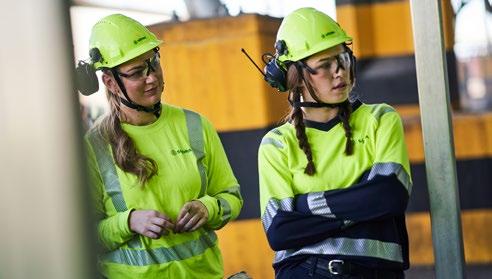
Attracting, developing and retaining skills is crucial to Södra’s success and ability to meet the challenges of tomorrow. During the year, we continued to build a learning organisation, with a focus on people and culture. Our ambition is to create the conditions for development in everyday work and to offer employees an opportunity to take control of their own competence development.
To strengthen leadership and clearly link it to our values, during the year we clarified Södra’s view of leadership through an updated framework with long-term ambition, leadership concept and clear expectations. Leadership days were held for
managers focusing on values-driven leadership, behaviourbased safety and inclusive culture.
In 2025, 72 percent (63) of Södra’s employees completed performance reviews. The aim of performance reviews is to provide simple support for continued learning and to strengthen the link between strategy and everyday life for each employee. Digitisation and the rapid pace of social development is also increasing the need for competence development for those employees who stay in the same role. During the year, the number of training hours per employee was 14 (14)
Södra strives to create a workplace where people and culture are at the centre, and means that we promote collaboration, commitment and daring to think in new ways to create the conditions for long-term competitiveness in a world marked by uncertainty and change.
The result of the employee survey in March showed a continuing high level of commitment among Södra’s employees. The survey shows the highest ratings in the areas of meaning-
fulness and participation, relationships with colleagues and managers, and the lowest ratings in the area of health. The Leadership Index is stable at 4.1. The Employee Net Promoter Score (eNPS), that measures how likely employees are to recommend Södra as a good place to work, was 16, which is a positive trend year-on-year (15). A score above 0 indicates a good employee experience and the benchmark value for other companies using the same tool is 12.
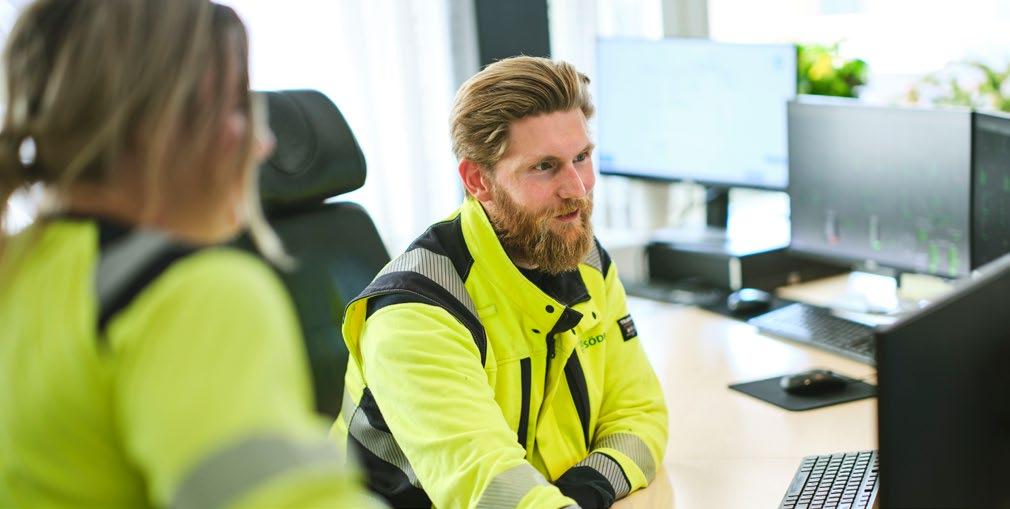
Södra’s mission is to strengthen forest ownership and increase the profitability of forest estates. By offering more opportunities for engagement, knowledge and influence, Södra wants to make membership more attractive. Vigorous forests with high growth form the basis for profitability and climate benefit. We work to develop forestry that is resilient to a changing climate focusing on resilient ecosystems and long-term production capacity.
Södra’s target is that the annual rate of forest growth on its members’ estates shall be 20 percent higher in 2050 compared with the base year of 2015. We have introduced many initiatives to increase forest growth responsibly:
» Forest tree breeding projects to adapt tomorrow’s forests to changing climate conditions, promote higher forest growth and improve pest resistance.
» Development of a concept for nutrient recycling with bio-ash from Södra’s mills and from external thermal power stations.
» Development of tomorrow’s system for effective and gentle forest regeneration.
» Support for research into forestry and forest technology for higher efficiency and lower intensity.
» Advisory and services for members, where effective forest management methods for wildlife damage and control are key elements.
» A strategic and long-term approach to forest and wild game.
» Adaptation of tree species to climate change, which is leading to a higher proportion of pine, spruce on suitable sites and well-managed forests with the aim of being better equipped for a warmer climate and longer dry periods.
Important activities during the year:
» Supply of pine and spruce seedlings from highly refined material thanks to investments in own seed orchards that are now producing good harvests. This will lead to increased growth for the future pine forest compared to natural regeneration with seeds from the plant site.
» Continued investment in indoor seed orchards with the aim of increasing genetic variation and exploiting traits such as disease and pest resistance and faster growth.
» Continuation of projects related to vegetative propagation, aimed at faster exploitation of the latest knowledge in plant breeding.
Södra’s target is that the annual rate of forest growth on its members’ estates shall be 20 percent higher in 2050 compared with the base year of 2015. There is major variations from year to year and extreme weather conditions, such as the hot and dry summer of 2018 and subsequent spruce bark beetle damage, can affect the outcome. Growth is also highly dependent on the amount of precipitation during the vegetation period. The trend should therefore be followed over a longer period of time. Forest growth at national level has declined over the last 10 –15 years. For Södra’s member estates, this has been visible over the past five years. This year’s statistics from the National Forest Inventory show a slight increase in growth compared with the previous year, indicating that the downward trend in growth in recent years may have been broken.
» Calculation of the economic benefit for forest owners of using selective breeding material. Compared to using unprocessed breeding material, the calculations show large gains in the form of increased wood volume and economic value. Selective breeding material began to be used by Södra on a large scale in the early 2000s.
» Increased knowledge of the quality of the planting service through participation in the industry-wide Regeneration Check (Sw: Föryngringskollen) project.
» Dialogue with the Forestry Research Institute of Sweden on a deeper collaboration for future breeding material in southern Sweden. The aim is to achieve climate-adapted forest management to ensure high growth in future forests, for example by testing pine and spruce seedlings in central Europe where the climate is similar to the future climate in southern Sweden. Since last year, a PhD project is in progress in collaboration with the Swedish University of Agricultural Sciences (SLU) and Sveaskog focused on forest management of Douglas fir –an interesting tree species for a warmer climate.
» Continued development of a more efficient forest rejuvenation method within the BraSatt project, which entered its final phase during the year. Collaboration with machinery manufacturers, forest companies and engineering companies continued to enable the next steps to develop some of the technological advances made with various partner companies. To work on the mechanization of forest rejuvenation work, the Autosatt project was started in collaboration with machine manufacturers and forest companies. Södra is already participating in the joint Autoplant project together with ten other players in the forest industry with the aim of developing autonomous soil scarification and planting.
» Further development of decision support for thinning. New technology using laser radar (LIDAR: light detection and ranging) provides harvester operators with real-time forest data. The equipment is being tested on two of Södra’s forest machines. The aim is to control the yield of wood during thinning with greater precision and thereby reduce the risk of making removals that are too large, leading to reduced forest growth after thinning, or removals that are too small and have a negative economic impact. The equipment will be implemented gradually for all contractors who perform thinning for Södra.
Growth for 2025 refers to the average growth rate in 2019 –2023, which is the most recent value available. Forest growth is based on information from the National Forest Inventory for members’ estates.
the members’ forestry forms the basis of Södra’s operations and our customer offer. through certifications, we ensure traceability from wood raw material to finished product, and product labels enable our customers and consumers to make informed choices. together, we are contributing to a more sustainable society.
More and more customers and consumers are demanding traceability and raw material from responsibly managed forests. Having control over the origin of the wood raw material has therefore become increasingly important in our contact with both suppliers and customers. Södra offers products of certified forest raw material with Chain of Custody certification
Products and services from Södra
Products from Södra 1)
(from
Forestry services from Södra
1) Products relate to products produced within Södra intended for external delivery.
2) Peat for material resource use relates to peat litter, horticultural peat and block peat.
3) Sawn timber is presented excluding subcontracting.
4) Biomaterials refer to wood chips and sawdust for material purposes.
5) Harvest volume refers to harvested roundwood from the field organisations in Sweden and the Baltics.
6) Forest management relates to forestry operations, excluding regeneration harvesting.
Products with either PEFC or FSC® certification 2025 2024 2023
Products with either PEFC or FSC® certification 59% 62%
The percentage of Södra’s revenue from external sales of physical products derived from sales of products with either PEFC or FSC® certification. The percentage of certified products was lower in 2025 compared with the preceding year, as markets outside of Europe and the US, where demand for certified products is lower, accounted for a larger total share of sales in 2025.
French company EcoVadis, which conducts Corporate Social Responsibility (CSR) assessments of companies, placed Södra in the top 3 percent of all companies that were assessed. In 2025, Södra’s score was 81 (80) of a maximum of 100, and the company received a gold medal. For the past four years, Södra has been awarded a platinum medal and been in the top 1 percent of all companies evaluated. This year’s results still indicate that Södra’s sustainability work has moved in a positive direction during the year, with a higher score compared with the previous year.
from PEFC or FSC®. In 2025, the percentage of PEFC or FSC®-certified products was 59 percent (62). The percentage of certified products is dependent on the availability of certified wood raw material and customer demand for certified products. Members of Södra supply wood raw material to Södra and the percentage of certified affiliated forest area in Södra’s group certification is presented on page 128.
» Environmental product declarations describe the environmental performance of a product from a life cycle perspective and are available for a number of Södra’s products: sawn, planed, coated and pressure-treated timber, pellets and cross-laminated timber. The environmental product declaration for cross-laminated timber was updated during the year.
» The Wood business area has building product assessments for wood products and the products are registered in Basta and Sunda Hus – tools that promote sustainable building product choices.
» All grades of paper pulp produced by the Cell business area are approved for the production of eco -labelled paper products under the Nordic Swan and EU Ecolabels, and hold Asthma Allergy Nordic certification (an international allergy label). All paper pulp is also approved for the production of paper and cardboard that may come into contact with food, according to German (BfR) and US (FDA) food standards. Every year, as part of its customer offer, the Cell business area communicates the origins of its wood raw material as well as environmental data, including carbon dioxide emissions and water footprint, at product level.
» Södra is certified according to the Recycled Claim Standard (RCS) and can produce and sell certified OnceMore® dissolving pulp. The certification is used to communicate that the product contains at least 5 percent recycled material. Södra holds Control Union certification (CU 1059293)
» As of 2025, Södra’s cross-laminated timber is CE-marked according to ETA -24/1212.
» Tall oil and biomethanol from Södra’s pulp mills holds International Sustainability and Carbon Certification (ISCC EU). The certification verifies that tall oil and biomethanol comply with the legal requirements for sustainability and greenhouse gas emission saving criteria for sustainable fuels under the EU Renewable Energy Directive (RED III). The certification also covers additional ecological and social requirements.
» Södra holds Sustainable Biomass Programme (SBP) certification and supplies certified solid biofuels from the forest and Södra’s mills. The certification is used to show that the solid biofuel comes from legal and sustainable sources.
Södra serves as the bridge between forest estates and consumers. our commitment to sustainability permeates every aspect of our operations and in our entire value chain. We demand responsibility and develop sustainability work through in-depth dialogue and collaboration.
The Södra Code of Conduct applies to everyone who works for Södra and translates our values into more concrete guidelines and behaviours. To raise awareness of the Code of Conduct, every employee must complete a compulsory online course. At the end of 2025, 87 percent (71) of Södra’s employees and 100 percent (69) of Södra’s Group Senior Management had completed the e-learning course for the Code of Conduct. In addition to online training, specifically designated roles at Södra will complete a mandatory instructor-led in-depth training in business conduct focusing on competition law, anti-corruption and conflicts of interest. By the end of 2025, around 650 employees had completed the training since its launch in 2023.
In 2025, 16 cases of potential gross misconduct in Södra’s operations were reported to the whistleblowing system. Seven of these reports were initially assessed as potential whistleblowing cases. Following investigations, none of the seven cases was considered to be a whistleblowing case. Following investigations, all cases reported were either addressed internally or did not require any action. In 2024, 12 reports were received. One of the cases related to non-compliance with guidelines and laws and was a whistleblowing case and measures were taken by the whistleblowing system. All other cases were handled internally.
In 2025, there were no health and safety-related incidents that resulted in legal sanctions during the year. In 2024, one incident occurred that resulted in legal sanctions during in 2025. A discharge of chlorine dioxide water from the pulp mill at Mörrum exposed employees to chlorine dioxide gas and chlorine gas and led to a corporate fine of SEK 300,000 that was paid in 2025. In 2024, a corporate fine of SEK 14,000,000 was paid for the fatal accident at Södra’s workplace in Orrefors in 2022 as well as a further penalty fee of SEK 15,000 for an event that occurred in 2023.
In the external environment, two incidents (four in 2024) led to legal sanctions in the form of corporate fines and environmental penalties totalling SEK 160,000 (SEK 81,000 in 2024),
which were paid during the year. Both incidents concerned Södra’s industrial activities: oil discharges and late waste reporting.
An investigation into a work environment crime is in progress regarding a fatal accident at Södra’s workplace at Värö in 2022. The Accident Investigation Authority delivered its report and the Swedish Work Environment Authority concluded its inspection due to the accident.
An assessment of risks was carried out during the year, including corruption risks. The risk assessment covered all of Södra’s operations and was carried out by Group Senior Management. No significant risk of corruption was identified by the assessment.
In 2025, there were no confirmed cases of termination of contract with a business partner due to a corruption-related breach, which was unchanged compared with 2024.
In 2025, there were no ongoing legal actions against Södra in relation to anti-competitive or monopoly practices, which was unchanged compared with 2024.
We place high demands on our suppliers and the Södra Supplier Code contains guidelines for how they should act in order for our partnership to work. The Supplier Code must be included in all supplier contracts and is available in Swedish, English, Estonian and Latvian. Most of our suppliers and contractors are based in Sweden or the EU, which makes evaluation and control easier. Purchasing managers undergo regular training in the Supplier Code and an online course is available in both Swedish and English.
The percentage of suppliers who had signed the Södra Supplier Code was 98 percent (89), corresponding to 96 percent (95) of the purchasing value. 100 percent (100) of the suppliers were risk-assessed. 84 percent (96) of the suppliers assessed as high-risk were reviewed by performing a self-assessment or being monitored on-site.
Purchasing and suppliers – purchasing category
Wood raw material (sawlogs, pulpwood and sawn timber)
Forestry contracting services (independent contractors)
Transport services 2) (transportation of wood raw material and products)
Input products 2) (process chemicals, fuels, energy and packaging materials)
Indirect material and services 2) (investments, operating materials, vehicles, IT, travel, office supplies and services)
The table includes suppliers with active agreements.
No. of suppliers
Purchasing costs per geographic location for contracting party
32,525 1) 89% Sweden, 6% other Nordic countries and 5% rest of Europe.
492 91% Sweden, and 9% rest of Europe.
133 68% Sweden, 8% other Nordic countries and 24% rest of Europe.
62 50% Sweden, 14% other Nordic countries and 36% rest of Europe.
326 93% Sweden, 2% other Nordic countries and 5% rest of Europe.
1) 20,046 harvesting assignments, 12,355 wood deliveries and 124 external suppliers. Harvesting assignments and wood deliveries are not covered by Södra’s general Supplier Code. From 2025, a Supplier Code is also available for members that covers harvesting assignments and wood deliveries. The number of harvesting assignments and wood deliveries is higher for 2025 compared with earlier years. This is because enforcement is carried out on members rather than forest estates. A forest estate can be owned by several members.
2) Central purchasing and Södra’s operations in Finland encompass suppliers with annual sales to Södra of more than SEK 1,000,000.
Comments
» Södra’s largest purchasing categories are wood raw material, contracting and transport services, input products and indirect material and services.
» In 2025, Södra’s operations in Finland implemented supplier monitoring processes in respect of suppliers, the Supplier Code and risk assessments. For 2025, Building Systems and Södra’s operations in the UK , Ireland, Estonia and Latvia are included in all key indicators linked to a responsible value chain. Södra’s operations in Finland are included in key indicators for suppliers and the Supplier Code. For 2024, Building Systems and Södra’s operations in the UK , Ireland, Estonia and Latvia are included in key indicators for suppliers and the Supplier Code but not in the key indicator for supplier assessments. For 2023, Building Systems and Södra’s foreign companies are not included in any key indicators linked to a responsible value chain.
» Södra’s contracted suppliers are predominantly based in Sweden and the EU. In 2025, minor shifts were made towards a higher percentage of European suppliers.
Comments
» Reviews this year focused on requirements imposed by suppliers on sub-contractors and sub-suppliers in the value chain. A major review was conducted of sub-contractors in the scaffolding construction category.
» In total, more suppliers were reviewed in 2025 than in 2024 and one case of supplier non-compliance was identified. The non-compliance was linked to internal procedures for alcohol and drug checks.
» As of 2024, supplier assessment through self-assessments of low-risk suppliers are included in the reviews. Business development appraisals were only included in 2023.
Supplier Code, risk assessment and supplier assessments based on risk
Suppliers that have signed the Södra Supplier Code
Södra’s purchasing value for which suppliers had signed the Supplier Code
Södra’s purchasing value for which a risk assessment of suppliers was performed
Comments
» Suppliers who have signed the Södra Supplier Code account for a major share of Södra’s purchases.
» In 2025, the number of suppliers assessed as high risk refers to a risk assessment carried out at the end of 2024. The same applies to 2024 (end of 2023) and 2023 (end of 2022)
» The table shows the percentage of suppliers assessed as high risk who completed a self-assessment or underwent a sustainability audit. Assessments performed in the past three years are included.
a common denominator for members of Södra is the desire to hand over something with even greater value to the next generation – not only financial value, but also natural, cultural environments and social value. While our bio-based products are part of the solution to enabling the global climate transition, we will also need to continuously adapt our forestry and industrial operations to the changing climate. lower grenhouse gas emissions and efficient use of resources are high on the agenda.
Much of the forest’s conservation value in Götaland is dependent on recurring disruption processes, such as grazing and natural fires. To preserve and promote these values, we need to continue managing our forests responsibly. By adopting a holistic approach, where we are always trying to balance production with environmental, cultural environments and social values as far as possible, we can create a win-win situation for forests, forest owners and society. Examples include conservation setasides or conservation stands that require active management where spruce must be controlled in order to preserve and develop nature conservation, cultural environments and social values. The area of nature conservation measures must be aligned with the need for measures in the voluntary setasides with the management target “nature conservation measures” in the members’ forest management plans. The aim is to apply nature conservation measures on 3,000 hectares by 2025. The outcome for 2025 was 3,086 hectares (2,310), meaning that the target was achieved. Expanding nature conservation measures has been in focus in recent years and several initiatives to raise awareness and change working methods have been undertaken. During the year, best practices were identified and the results show, for example, that a good dialogue with the forest owner as well as
an up-to-date forest management plan and long-term planning are key elements. In addition, the contractor’s commitment and interest in nature conservation measures is a success factor in the work. For several years now, Södra has been coaching contractors to promote good environmental considerations in forest management. To increase the focus on, and quality of, nature conservation measures, about 100 people from Södra’s own field organisation and contractors underwent training during the year.
Every year, Södra compiles a Green Balance Sheet where forest management auditors review and determine how well regeneration harvests, thinning, young stand thinning, nature conservation measures and regeneration operations have met the requirements for sustainable forestry. In 2025, a total of 480 sites (443) were audited in the Green Balance Sheet, corresponding to 2,145 hectares (2,685). The aim is that all regeneration harvests will achieve an acceptable result (100 percent) for sensitive habitats, wasteland, buffer zones and protection zones, impacts on soil and water, and cultural environments. For other main functions, the aim is a satisfactory result for 95 percent.
The Green Balance Sheet report is available at sodra.com.
Södra works to preserve and promote biodiversity – a process under continuous development. The aim is that Södra will pursue a richer biodiversity for future generations. In Götaland, nature conservation measures are important for the preservation and promotion of biodiversity. Södra’s target for nature conservation measures is an area corresponding to 3,000 hectares per year until 2025. The outcome for 2025 was 3,086 hectares (2,310). For 2026, the target of 3,000 hectares of nature conservation measures remains. More key indicators for measuring the effects of measures to preserve and promote biodiversity are under development.
Percentage of acceptable sites in the Green Balance Sheet, where the main function was assessed, for each main function. There are still challenges in reaching the target of approved ratings in the Green balance sheet. During the year, competence development of contractors was intensified to ensure a high level of awareness of consideration measures in the forest. A training programme with regular refresher training will be introduced in 2026. Local action plans will also be developed to improve performance and coaching will continue of contractors.
Nature conservation measures area. The target level for the area of nature conservation measures is set based on an analysis of the need for measures for the voluntary set-asides with the management target “nature conservation measures (NS)” that are in the members’ forest management plans. Nature conservation
Certified affiliated forest area in Södra’s group certification 2025 2024 2023
The certified affiliated forest area has remained stable. Private forest owners appreciate the added value provided by forest certification. Certified wood raw material means that it is possible to deliver certified products to customers who request certified products. The percentage of certified products is presented on page 124. The certified area for 2025 was higher compared with 2024 as more forest owners joined Södra’s group certification. In addition, areas included in Södra’s group certification that are located outside Södra’s forestry operations area and areas that were previously missed for technical reasons have been included. During 2024, Södra performed an analysis in which several member estates with overestimated hectares were identified. The area had been overestimated due to errors in property data from Lantmäteriet (the Swedish mapping, cadastral and land registration authority). It is not technically possible to adjust the areas for earlier years in the system.
Consideration areas – areas in Götaland on estates owned by members of Södra 2025 2024 2023 Wooded wasteland 1) area 2), ha
of wooded forest land
Formal site protection (reserve, habitat protection) area, ha
Voluntary set-asides NO/NS) 3)
Management target K (combined production and environmental objectives in addition to general considerations) 4) area, ha
General considerations in regeneration harvests
1) Wooded wasteland is low-productive land with some degree of high conservation value.
2) The same percentage of wooded wasteland as in Götaland in its entirety has been used.
3) The voluntary set-aside area relates to members with forest certification. NO refers to ‘nature conservation, to be left untouched,’ and NS refers to ‘nature conservation measures.’ Approximately 3,000 hectares of voluntary set-asides are protected by temporary nature conservation agreements.
4) The area with management target K relates to members with forest certification. Under management target K , a production target applies for 60 percent of the area, and a nature conservation target for 40 percent.
Forest certification is an important tool for ensuring that members’ forests are managed responsibly. Forest owners can become certified under Södra’s group certification and sign an agreement to comply with the certification requirements. These include preparing a green forest management plan. Monitoring takes the form of annual audits.
Södra holds PEFC and FSC® certification with license numbers:
PEFC/05 -22-11
PEFC/05 -35 - 48
PEFC/05 -32-20
PEFC/05 -35 -306
FSC®- C014930
FSC®- C006947
FSC®- C015771
FSC®- C197323
Wooded forest land consists of productive forest land and wooded wasteland. The productive forest land grows by at least one m³ per hectare and year, while wooded wasteland is low-productive woodland and not used for wood production. Productive forest land consists of production stands – areas in which wood production is the primary objective, combined with general considerations in forestry measures – and various types of nature conservation areas. Formal types of site protection are nature reserves, habitat protection and nature conservation agreements. Nature reserves are formed by county administrative boards or municipalities to protect a connected area. Habitat protection and nature conservation agreements on forest land are formed by the Swedish Forest Agency or a county administrative board to protect small areas. Nature reserves, habitat protection areas or nature conservation agreements on a member’s estate are covered by agreements between individual members and the Swedish Forest Agency or county administrative board. There are regulations for formally protected areas describing why the site is protected and any forestry measures. General considerations apply to all forestry operations. These may include buffer zones, sensitive habitats and groups of trees. In addition to general considerations, forest owners set aside stands voluntarily to preserve and promote nature conservation values. These stands should amount to at least 5 percent of the estate, according to the forest certification requirements. NO (nature conservation, to be left untouched) designates areas where nature conservation values are best preserved and promoted if the forest is left to develop freely. NS (nature conservation, requiring management) designates the areas where special management methods are required to preserve and promote the nature conservation values. There are also K stands (combined targets) with targets for both wood production and nature conservation, and where nature conservation values apply to a higher percentage of the stand than in production stands. In combination, formal protection, voluntary set-aside stands and general considerations all contribute to the national environmental objective of vibrant forests. The green forest management plan for each member estate contains descriptions with objectives and measures for preserving and promoting nature conservation values.
Forests are an important place for relaxation, recovery and recreation. We work continuously to promote the social values of forests and support the sector-wide objectives for good environmental considerations. This means that we work to maintain accessibility and preserve the experience values of forests, based on the unique conditions of each area. Good communication with the people who use the area is key to these efforts.
VALUE OF FOREST LAND, VOLUNTARY SET-ASIDES 2025
The area of voluntary set-asides for nature conservation (NO/NS) on PEFC-certified members’ estates amounts to 159,000 hectares. The total value of this forest area was SEK 33 billion, with a variation ranging from SEK 21– 45 billion. The price range is based on average prices for forest land according to price statistics from Ludvig & Co and the average price for redeemed land (habitat protection) from the Swedish Forest Agency.
There are traces of past human activity in forests, such as clearance cairns, house foundations, tar pits and charcoal kilns. To avoid damaging these remains in connection with forestry operations, 1.3-metre high cultural heritage stumps are used as markers. We monitor considerations for cultural and ancient remains in the Green Balance Sheet. Considerations are hampered by the fact that many remains are not registered in cartographic material, but new technologies may provide opportunities for improvement in the future. In 2025, a comprehensive training course in consideration for cultural remains was completed by around 1,100 people, including both Södra’s employees and contractors.
Södra and ecosystem services
Ecosystem services are all the products and services that ecosystems provide to humans and that contribute to our well-being and quality of life.
Type of ecosystem service
Supporting service
Supplying service
Regulating service
Cultural service
Basic functions that enable other services: photosynthesis, soil formation, habitats
Direct benefits: food, drinking water, wood, bioenergy
Nature’s way of balancing and cleaning: pollination, water purification, climate regulation
Experiences and values: recreation, outdoor recreation, natural and cultural heritage
Examples of Södra’s work
General considerations and nature conservation measures for the preservation and promotion of habitats and biodiversity. Advisory and other services for members including forest certification.
Bio-based products with low carbon footprint from sustainably managed forests where the wood raw material is used efficiently. Consideration of aquatic environments in forest management plans and forestry operations
Carbon sink in members’ forests and potential to avoid fossil emissions when Södra’s products replace products with higher climate impact. Consideration of aquatic environments in forest management plans and forestry operations
Adapted management in urban forests and open spaces to promote recreation. Consideration for cultural and ancient remains in forestry operations.
Wetlands are multifunctional environments that contribute to biodiversity, water purification, forest fire buffers and climate regulation. All are important ecosystem services that we humans depend on. For a considerable period of time, humans have drained wetlands and straightened naturally meandering watercourses to facilitate agriculture and forestry, but also dammed water to create artificial reservoirs. Overall, this has meant that unaffected wetlands and untouched streams have become increasingly rare. During the year, two rewetting projects were launched on land owned by members of Södra in collaboration with Vattenriket in Kristianstad. To spread awareness and create interest in forestry and water, including rewetting, a digital forest evening was held together with other Swedish forest-owner associations. Södra is also participating in the EU project Grip on Life with the Swedish Forest Agency as coordinator. The aim is to combine active forest management with respect for water and wetlands. The project involves the restoration of wetlands and watercourses and the dissemination of knowledge through training and demonstration areas. Members of Södra developed water loops that are used for water-themed activities for members, excursions with other stakeholders and for school classes.
Forests are a resource that should be used responsibly. The basic principle is that the harvest rate over time should not be higher than forest growth. The sustainable harvest rate for members of Södra is 5.8 –7.1 m³fo per hectare and year, corresponding to a total of 14 –17 million m³sub per year, based on the current affiliated forest area. In 2025, Södra’s harvest rate was 5.4 m³fo per hectare and year (5.9). The harvest rate has been high for several years due to the boom in demand for sawn timber. As the economy has slowed, the harvest rate has also decreased. The harvest rate for 2025 was lower than what Södra defines as a long-term sustainable harvest rate for optimal utilisation of members’ forest raw material.
Sustainable harvest rate
fo/ha and year
2025 refers to the mean for 2021–2023, in the same way as for other years. As of 2022, the sustainable harvest rate is based on the forestry impact assessment carried out by the Swedish Forest Agency and Swedish University of Agricultural Sciences in 2022 (SKA 22). The harvest rate is based on the National Forest Inventory’s data for Götaland.
Södra’s total climate impact is illustrated in a model with three input parameters: net change in forest carbon stock, fossil GHG emissions in the value chain and potential for avoided fossil emissions through substitution.
Growing forests absorb carbon dioxide from the atmosphere, especially when they are managed sustainably and responsibly. The long-term trend in Sweden is that forest growth is increasing and we now have more growing stock than ever before, despite the fact that the growth rate has started to level off somewhat. Site adaptation (planting the right tree in the right place), being proactive and taking the right measures are all important for meeting the challenges of climate change, while also promoting biodiversity.
Our industrial operations convert forest raw material into biofuels, biochemicals, biomaterials, building systems, dissolving pulp, electricity, wood products, paper pulp, seedlings and heat. These products generate very small net carbon dioxide emissions, and when products based on renewable forest raw material replace fossil raw materials
Growing stock on members’ estates
The growing stock on forest land on members’ estates is based on statistics from the National Forest Inventory. The growing stock has increased over a long period of time. Research and development, and the high ambitions of forest owners when it comes to forest management have contributed to this high rate of growth. The growth rate has been lower in recent years, which the National Forest Inventory also shows for the whole of Götaland, while the harvest rate has been high, but has now fallen slightly. One explanation for the lower growth could be the severe drought in 2018 and its subsequent effects but even at national level growth has declined over the last 10 –15 years. This year’s statistics from the National Forest Inventory show a slight increase in growth compared with the previous year, indicating that the downward trend in growth in recent years may have been broken. The margin between growth and harvesting in Götaland will not be as great in the future, which could lead to less growing stock and subsequently net CO₂ emissions for individual years. Over time, however, there will still be a positive net change in forest carbon stock.
or products manufactured with energy from fossil sources, they are contributing to a lower climate impact through substitution. Through innovation and by processing our products, we are meeting the growing demand for sustainable and renewable products in the evolving circular bioeconomy. In 2025, the positive climate effect was 8.5 million tonnes of CO₂e (10.2). The outcome was due to a lower net change in forest carbon stock and lower deliveries of sawn timber compared with earlier years.
Net change in forest carbon stock minus our fossil emissions in the value chain, plus the use of our forestbased products to replace products with a higher climate impact, gives us Södra’s total climate effect.
Due to ambitious forest management, the rate of forest growth on members’ estates has increased since the beginning of the 1900s and also, therefore, carbon sequestration. In recent years, however, growth has slowed while the harvest rate has remained high. As the economy has slowed, the harvest rate has also decreased. The net change in forest carbon stock is dependent on growth and harvest rate. Variations between years are therefore affected by both weather conditions and demand for Södra’s products. The assessment is that the net change in forest carbon stock will increase in the coming years as the harvest rate decreases and growth increases. The long-term trend
is an average CO₂ uptake of 2.5 million tonnes of CO₂e per year (4.0) in members’ forests, calculated as a linear trend for ten years, five-year averages. For 2025, calculated as the difference between the two latest available five-year averages for growing stock, the growing stock decreased, which led to net emissions of 8.1 million tonnes of CO₂e per year (net emissions in 2024 were 3.9). However, the growing stock in 2025 was still higher than in 2019. For more information about the growing stock trend, refer to the diagram on page 129.
The net change in forest carbon stock in the Group’s forests was 0.5 million tonnes of CO₂e (0.5)
Fossil emissions in the value chain are presented on pages 131–132. The climate effect also includes fossil GHG emissions from forestry operations linked to the forest raw material that members use themselves, or that they sell to other forest industries. Total emissions were unchanged compared with earlier years.
Substitution creates climate benefits when products based on renewable forest raw material are used to replace products with a higher climate impact, such as steel, concrete, plastic and energy from fossil sources. The potential for avoided fossil emissions through substitution was 8.0 million tonnes of CO₂e (8.2). The outcome was due to lower deliveries of sawn timber compared with earlier years.
Forest carbon sink
The trees in members’ forests absorb and store carbon dioxide from the atmosphere.
A potential substitution effect is created and fossil emissions are avoided when our renewable products are used to replace products with a higher climate impact. 3.0
Value chain emissions
The remaining fossil emissions in our value chain.
Mt CO₂ 2025 8.5 8.0
Södra’s total climate effect
Net change in forest carbon stock minus our fossil emissions plus the use of our forest-based products to replace products with a higher climate impact, gives us a positive total climate effect.
The model for climate effect shows the total climate impact of forests and forest-based products, signalling the importance of active forest management. The substitution effect should be considered a potential for avoided emissions, with the reduction taking place in other sectors. The substitution factors are conservative and based on scientific publications and there is a major variation between different publications. An international standard for the model was developed in 2025 and Södra’s implementation will take place in 2026. The implementation may involve an adjustment of the substitution factors. Read more about the calculation method in the report at www.sodra.com. Forest-based product Substitution factor, tonne of fossil carbon replaced per tonne of biogenic carbon in the forest-based product
Södra’s emissions-reduction targets are validated by the Science Based Targets initiative (SBTi). The aim of the targets is to reduce GHG emissions by 50 percent by 2030, compared with the base year of 2020. For emissions from the processing of sold products, we have an engagement target whereby customers corresponding to 70 percent of the emissions will have set their own science-based targets by 2027. The next step is to set targets for net zero emissions and FLAG (Forest, Land and Agriculture). The aim was to set these targets in 2025, but SBTi has temporarily paused FLAG target validations for timber and wood fibres. The pause is expected to be lifted in 2026. Our production processes are almost entirely powered by biofuels. Our own operational machinery and vehicles in mills and forests run mainly on HVO fuel – a bio-based alternative to petrodiesel – and we are working to increase the electrification of, for example, forklifts. During the year, an electric internal operational machine was commissioned at the sawmill at Värö. The remaining fossil GHG emissions in Södra’s mills come from
fossil fuel oil that is mainly used during maintenance shutdowns and operational disruptions, but also from the use of input products in the pulp mills. Biofuel combustion, like all combustion, emits methane and nitrous oxide, which contribute to global warming.
Through various partnerships, we are working actively to reduce emissions from freight transport by, for example, using rail freight instead of road haulage, and to stimulate technological advances. Investments in liquid biofuel development and production through biomethanol and SunPine are helping to increase both the volume and varieties of liquid biofuel.
Emissions from purchased goods and services are derived from production of the input products required for pulp production, but also from contractor services for forestry operations. Partnerships in the value chain, combined with evaluation and selection of goods and services with a low climate impact, are key measures for reducing these emissions.
To promote commuting with electric vehicles, there are now about 450 charging points at our facilities and offices. In 2025, around 70 charging points were installed. Under Södra’s company car regulations, employees are offered a wide range of electric vehicles and plug-in hybrids, and electric vehicles must be the first choice. About 180 new electric vehicles and plug-in hybrids were leased during the year. Of the total number of company cars, 100 percent (96) were electric or plug-in hybrids at the end of 2025.
Customers use our paper and dissolving pulp as the raw material for a wide range of products. In 2025, emissions arising from the use of fossil fuels and electricity in customers’ production processes accounted for two-thirds of Södra’s total fossil GHG emissions. We strive to work more closely with our customers to support them in their ambitions to reduce their GHG emissions in our shared value chain. During the year, Södra’s paper and dissolving pulp customers were asked about their GHG emissions and their ambitions and targets for reducing them.
A continued focus on efficiencies, substitution and strategic systems changes is of the utmost importance for achieving the GHG emissions reduction targets. Several activities were carried out during the year that will reduce GHG emissions in both Södra and our value chain in the long and the short term:
» Efficiency gains from packaging at the sawmill at Värö, resulting in a reduced need for internal transportation and lower consumption of plastic.
» Switch to defoamers based on bio-based and recycled materials at Södra’s three pulp mills.
» Switch to ammonium sulphate as a source of nitrogen in biological treatment processes in the pulp mill at Mörrum. Ammonium sulphate is a source of nitrogen with a lower
carbon footprint than current nitrate nitrogen. Trial runs are ongoing in the pulp mill at Värö.
» Implementation of an agreement for fossil-free harvesting for a member with a large forest holding.
» Participation in the project “Mass Balance Approach in the Transport Market – Dead-end or effective method to accelerate the transition to fossil-free freight transport?” (Sw: Massbalansprincip på transportmarknaden – Återvändsgränd eller effektiv metod för att accelerera omställningen till fossilfria godstransporter?) The project is led by IVL Swedish Environmental Research Institute and funded by Triple F – Fossil Free Freight, a research and innovation initiative from the Swedish Transport Administration.
» Continued development of the Conscious Delivery offer together with suppliers and customers. The aim of the initiative is to reduce the use of fossil fuels in the logistics chain to customers.
» Södra’s first electric wood chip truck began operating in September. The battery-electric wood chip truck is part of the TREE project and operates regular routes in Blekinge and eastern Småland. Charging infrastructure is built at several of Södra’s units – Orrefors, Långasjö, Mönsterås and Mörrum, with support from the Swedish Energy Agency. In parallel, Orrefors invested in a battery that is connected to the electricity ancillary services market.
» Start-up of a pilot project to test Svante Technologies’ bioenergy with carbon capture, utilisation and storage (bio- CCUS) technology in the pulp mill at Värö. The project is carried out with the support from the Swedish Energy Agency through Industriklivet.
» Total fossil GHG emissions in Scopes 1, 2 and 3 were 2,486 ktonnes of CO₂e (2,474)
» The target is that GHG emissions in Scopes 1 and 2 shall be halved by 2030 compared with the base year of 2020*. The outcome for 2025 was 73 ktonnes of CO₂e (85), down 7 percent compared with base year 2020. Compared to the preceding year, emissions are lower due to reduced consumption of fossil fuels and the purchase of fossil-free electricity for some of the foreign companies.
» The target is that customers corresponding to 70 percent of Södra’s Scope 3, Category 10 (Processing of sold products) GHG emissions will have set their own science-based targets by 2027. The outcome for 2025 was that 38 percent (41) of the emissions were derived from customers who had either set their own science-based targets, or had committed to setting their own targets. The outcome reflects the fact that a higher share of paper and dissolving pulp was sold outside Europe, where the proportion of customers that have set their own targets is low or where information on such targets is not available.
» The target is that other indirect (Scope 3) GHG emissions (excluding Category 2: Capital goods, and Category 10: Processing of sold products) shall be halved by 2030*. The outcome for 2025 was 733 ktonnes of CO₂e (719), up 18 percent compared with base year 2020. Emissions were slightly higher year-on-year. A higher proportion of paper and dissolving pulp was sold outside of Europe which led to longer transport distances and therefore increased fuel consumption and emissions.
* The target covers land use-related biogenic emissions from biomass combustion and uptake from the production of biomass that is combusted. These emissions and uptake are assumed to offset each other based on the fact that we have a positive net change in forest carbon stock in Sweden’s forests and that purchased solid and liquid biofuels have a certificate of sustainability.
Fossil carbon dioxide from production and transportation Fossil carbon dioxide, ktonnes
Fossil emissions in the value chain CO₂e, ktonnes
(Scope 2) emissions from the generation of
(Scope 3)
The emissions include fossil carbon dioxide, methane, nitrous oxide and refrigerants. A market-based method was used for electricity for Scope 2.
Fossil carbon dioxide from production includes emissions from production, operational machinery (including external forestry and other contractors working on behalf of Södra) and internal transportation. Transportation includes emissions from other transportation, including Södra’s own haulage operations. Production and transportation account for a limited amount of the emissions included in Scope 1, 2 and 3 GHG emissions. For more detailed information about calculation principles, refer to pages 116 –118.
Carbon dioxide equivalents (CO₂e) is a metrics for greenhouse gases. Each type of greenhouse gas has a different global warming effect. When emissions are reported as CO₂e, all greenhouse gases are included as if they were carbon dioxide. Scope 1 refers to direct GHG emissions that occur from sources that are financially controlled by Södra. Scope 2 refers to indirect emissions associated with the purchase of energy. Scope 3 refers to other indirect emissions.
GHG emissions
CO₂e, ktonnes
of
– of which fossil carbon dioxide
of which other greenhouse gases
of which
– of which Scope 2 – of which
Other greenhouse gases includes methane, nitrous oxide and refrigerants. For Scopes 2 and 3, classifying emissions as either fossil carbon dioxide or other greenhouse gases is not possible due to direct reporting of CO₂ equivalents for many purchased goods. Biogenic sources of carbon dioxide are not reported in Scope 2.
Direct (Scope 1) GHG emissions
CO₂e, ktonnes 2025 2024 2023
Fossil carbon dioxide emissions from production and operational machinery 2025 2024 2023
Fossil carbon dioxide emissions
dioxide emissions per m³ sawn timber are therefore very low.
Comments
» Södra mainly uses biofuels in production processes, which means that biogenic carbon dioxide emissions are higher than fossil carbon dioxide emissions and other GHG in Scopes 1, 2 and 3.
Scope 1 refers to direct GHG emissions that occur from sources that are financially controlled by Södra, including leased vehicles.
Indirect (Scope 2) GHG emissions from the generation of purchased energy
CO₂e, ktonnes
2
– of which from purchased electricity in foreign companies
– of which from other purchased electricity and district heating
Scope 2 refers to indirect GHG emissions from the generation of purchased energy. A market-based method was used for electricity. Using a location-based method, Scope 2 emissions were 1.1 ktonnes (0.8)
Other indirect (Scope 3) GHG emissions
Scope 1 emissions are direct greenhouse gas emissions derived from the use of fossil fuels and input products in Södra’s pulp mills, and the transportation of wood and pulp with vehicles owned or leased by Södra. In addition other GHG emissions arise from the combustion of biofuels.
Comments
Comments
» In 2025, the use of fossil fuel oil in the pulp mills was lower yearon-year due to fewer operational disruptions. Emissions from input products and leased vehicles were also lower.
» The indirect GHG emissions in Scope 2 are minor since Södra is largely energy self-sufficient. Emissions from the generation of electricity and heating are therefore included in Scope 1.
» For 2025, Södra purchased fossil-free Guarantee of Origin certificates for some of the electricity consumed by foreign companies, resulting in lower emissions in Scope 2.
3, Category 3. Using a location-based method, Scope 3.3 emissions were 20 ktonnes (20). There was no impact on total Scope 3 emissions.
Comments
Purchased goods and services 10 % Waste < 0.1 %
Upstream emissions, fuels, and energy 0.8 %
Upstream and downstream transportation 17 %
Business trips < 0.1 %
Employee commuting 0.3 %
Further processing of sold products 67 %
Customersʼ use of energy products 2 % Capital goods 3 %
Disposal of sold products 0.3 %
Investments < 0.1 %
» In Scope 3, Category 1, the production of input products for pulp mills and forestry contractor services is considerable. In 2025, emissions from the production of input products for pulp mills were lower compared with previous years due to changes to emission factors.
» In Scope 3, Categories 4 and 9, sea transportation of products to customers accounts for most of the emissions. Emissions from transportation were higher compared with earlier years as a higher proportion of paper and dissolving pulp was sold outside of Europe which led to longer transport distances and therefore increased fuel consumption and increased emissions.
» In Scope 3, Category 10 accounts for two thirds of Södra’s total GHG emissions. Emissions are estimated based on representative emissions for different types of processing of the pulp by customers. For 2025, a higher share of customer-specific emission factors was used compared to previous years, leading to a higher level of accuracy in the estimation of emissions in this category.
We mainly use the following raw materials in the production processes at our mills: wood raw material, sawn timber, chemicals, packaging materials and water. Efficient use of raw materials reduces environmental impacts and costs, which strengthened profitability. This area is therefore important if we want to become more competitive and is an important part of our strategy to make more from every tree. Several research and development projects are currently taking place with the aim of creating more benefits and added value from a material and energy perspective from the increasingly limited forest raw material, in both future and existing production processes.
In addition to sawn timber and pulp, our industries generate several other products from the whole tree. They are used in building materials, as biofuels, for the production of liquid biofuels and as raw materials in the chemical industry. One example is biomethanol, which is extracted from the crude methanol produced in the pulping process. The crude methanol in the pulp mill at Mönsterås was previously used as an internal fuel but is now purified and sold to customers as biomethanol. Another example is that some of the bio-ash from the pulping process at the mills is recycled by using the nutrient-rich ashes to promote forest growth. Another example in new materials and processes for the circular bioeconomy is OnceMore®, which enables large -scale recycling of textiles that would otherwise become waste. It is instead used for
the production of new textiles. We also participate in the BioGlue Centre, which is aimed at accelerating the development of a biobased adhesive. During the year, construction began on the new kraft lignin plant at the combined plant at Mönsterås. The lignin is currently used to generate energy. But with the refinement process that Södra is now investing in, some of the lignin in the wood raw material will be used to replace fossil materials in adhesives, batteries, rubber and plastics, for example, and form the basis for new biostimulants. The initiative will also enable new energy efficiencies at the pulp mill and provide opportunities for circular production of other chemicals from residual streams. Implementation continued of a production line at the combined plant at Värö to create a vegetable tanning agent from bark – tannin – a product that can be used to process leather.
In recent years, southern Sweden has experienced periods of abnormally low precipitation, resulting in low river flows and low groundwater levels. Water is a strategic resource and will receive a greater focus moving forward. Water supply and water use are key issues for Södra. Most of the water used in our operations is freshwater taken from surface water sources, but a small amount of groundwater and municipal water is also used. Water also comes into our processes through the wood raw material, and with chemicals.
1) Wood raw material and sawn timber are renewable raw materials, while chemicals, packaging materials and other raw materials are largely fossil-derived. Measurement and monitoring of the renewable percentage is not available for chemicals and packaging materials.
2) Wood raw material includes sawlogs, pulpwood, fuel wood and forest residue, which is used in Södra’s industrial operations.
3) Sawn timber relates to external purchasing that is processed within Södra to varying degrees.
4) Chemicals relates to purchased chemicals. Consumption mainly takes place in the pulp mills, in digesters and bleachers. The alkaline cooking chemicals are almost completely recovered, while energy is also generated. Chemicals for bleaching are partly manufactured on site, but also purchased on an ongoing basis. The hazard categories of the chemicals vary, but are mostly corrosive, oxidising and toxic.
We are almost self-sufficient in energy for our own industrial operations. The energy is generated in our pulp mills and sawmills and mainly derived from wood raw material. If needed, energy requirements are supplemented by purchasing biofuels and, to a limited extent, fossil fuels. Our various industrial operations also generate large amounts of excess green energy that is delivered to external customers in the form of renewable electricity, district heating and biofuels. Electricity generation for the year exceeded electricity use, allowing us to deliver large amounts of excess electricity to the local community.
Through Södra Medlemsel, members, employees and partners have been able to purchase green electricity from Södra’s pulp mills, wind turbines and hydropower plant. At the end of the year, a decision was made to discontinue the consumer electricity business at year-end. Customers are offered the opportunity to retain
Comments
» The pulp mills use surface water from the Emån, Mörrum and Viskan rivers. Only a minor share (< 1 percent) of Södra’s water withdrawal comes from groundwater or municipal water. Water use has remained stable in recent years.
» Water also enters Södra’s processes via incoming raw materials, mainly with wood raw material and chemicals, totalling 6 million m³ (6)
their current contract terms with electricity from Södra’s production facilities but as a direct customer of Jämtkraft. To ensure that the electricity is renewable and produced by Södra, Jämtkraft purchases guarantees of origin from Södra’s production.
During the year, construction began on a new condensing turbine in the pulp mill at Mörrum. The condensing turbine will increase electricity production and optimise the energy yield from the process by generating more electricity from the same amount of raw material. The pulp mill at Mönsterås began constructing a new switchgear to complement the facility’s existing electrical infrastructure. The investment will enable increased electrification with high availability. The switchgear uses technical air as an insulating medium instead of sulphur hexafluoride, which is a greenhouse gas.
– for transportation, business travel and fuel sold externally from Södra’s filling stations (outside Södra)
fossil fuels (within Södra)
Fuel consumption takes place within and outside Södra. Within Södra comprises production, operational machinery and transportation (corresponding to Scope 1 GHG emissions). Outside Södra comprises forestry and other contractors (part of Category 3.1), transportation (Categories 3.4 and 3.9), transportation of waste (part of Category 3.5), business travel (
) and fuel sold externally from Södra’s filling stations (part of Category 3.11). Refer to the calculation principles on page 118 for details.
Comments
» Södra has a duty to report under the Sustainability Criteria for Biofuels, Bioliquids and Biomass Fuels Act (2010:598) and therefore reports the geographic origin of biofuels used.
» The internal black liquor and solid biofuels (internal and purchased) consumed in Sweden are more than 99 percent Swedish and less than 1 percent Norwegian in origin. Consumption in Sweden accounts for more than 99 percent of the total amount consumed. Consumption in Finland accounts for less than 1 percent, and has 100 percent Finnish origin. The fuels belong to the forest biomass, including by-products from forestry and other by-product or waste categories.
» Internal liquid biofuels come from Sweden and belong to the categories of crude tall oil and crude methanol.
» Purchased liquid biofuels belongs to the categories of tall oil pitch, mixed fatty acids (MFA) and cashew nut shell liquid (CNSL). The geographic origin is shown in the diagram below.
Geographic origin of purchased liquid biofuels (bio-oils) 2025
solid and liquid biofuels
Södra consumed fuel equivalent to 14.8 TWh for industrial production. 0.6 percent of this figure was fossil fuel, mainly fuel oil. Otherwise, biofuels were used, most of which comprised the wood substances (lignin) released in the production process at the pulp mills. The pulp mills recycle the cooking chemicals used in pulp production, while simultaneously generating energy. The sawmills burn bark and other biofuels to produce heat for drying wood.
and
During the year, 387 GWh of purchased liquid biofuels (bio-oils) in total was consumed. The bio-oils originated from several countries, predominantly Finland, the US and Latvia. The other countries category comprises Austria, Belgium, Côte d’Ivoire, Czech Republic, Denmark, Egypt, Germany, Hungary, Iceland, Indonesia, Ireland, Malaysia, Morocco, Portugal, Serbia, South Africa, Turkey and the UK
Comments
» More than 99 percent of the electricity generated by Södra comes from renewable energy sources. Electricity is generated in the pulp mills at Mönsterås, Mörrum and Värö, in six wind turbines located at Mönsterås, in a hydropower plant at Karlshammar, and via solar panels at the head office in Växjö.
» In 2025, electricity generated was in line with the preceding year. There was low availability in two of the pulp mills’ turbines. Electricity use was also higher compared with preceding years due to higher pulp production. In total, this led to lower external deliveries of electricity compared with earlier years.
» District heating deliveries were higher compared with 2024. Demand and, therefore, deliveries are weather-dependent.
1) Electricity use and purchasing of electricity within and outside Södra. Within Södra comprises production, operational machinery and transportation (corresponding to Scope 1 GHG emissions). Outside Södra comprises forestry and other contractors (part of Category 3.1), transportation (Categories 3.4 and 3.9), transportation of waste (part of Category 3.5), business travel (Category 3.6) and fuel sold externally from Södra’s filling stations (part of Category 3.11). Refer to the calculation principles on page 118 for details.
2) District heating relates to external purchasing and external sales.
3) Secondary heat is excess heat from the process. No additional fuel is required.
Electricity use and electricity generation
Electricity and heating consumption — Pulp
Electricity and heating consumption — Sawn timber kWh/m³ sawn
Electricity generated continued to exceed electricity use, net electricity deliveries were 254 GWh. Net electricity deliveries are calculated as the difference between electricity generation and electricity use, or the difference between electricity sold and electricity purchased within Södra. Refer to the table on page 134.
Electricity consumption for pulp was lower compared with earlier years due to efficiency enhancements. Heating consumption was higher due to operational disruptions in turbines at the pulp mills and the production of more heat-intensive products.
Heating consumption for sawn timber was lower compared with earlier years. The reason for this was that the lower production volume enabled a higher proportion of drying in more heat-efficient kilns and that the saw line at the sawmill in Klevshult was closed down.
Energy is consumed within and outside Södra. Within Södra comprises production, operational machinery and transportation (corresponding to Scope 1 GHG emissions). Outside Södra comprises forestry and other contractors (part of Category 3.1), transportation (Categories 3.4 and 3.9), transportation of waste (part of Category 3.5), business travel (Category 3.6) and fuel sold externally from Södra’s filling stations (part of Category 3.11). Södra also makes external deliveries of energy in the form of electricity and district heating. Refer to the calculation principles on page 118 for details.
Comments
» Renewable fuels are mainly used within Södra in the pulp mills’ operations.
» Fossil fuels are mainly used outside Södra for the transportation of raw materials to industry and products to customers.
» Consumption of fossil fuels was higher in 2025 compared with the preceding year. A higher proportion of paper and dissolving pulp was sold outside of Europe which led to longer transport distances and therefore increased fuel consumption.
Solid biofuels (forest fuel, bark, sawdust and pellets for energy purposes)
In 2025, external energy deliveries totalled approximately 4,200 GWh
Södra delivers district heating from the pulp mills at Mönsterås, Mörrum and Värö, and the sawmills at Kinda and Hamina, to neighbouring communities. In 2025, external district heating deliveries were 451 GWh. Nearly two thirds of external district heating deliveries comprised excess heat from industrial processes. District heating is also delivered internally within Södra. The pulp mills at Mönsterås and Värö supply the combined facilities with district heating.
Solid biofuels are used in a variety of ways in Södra’s value chain. Forest residues (branches and treetops) is a product of harvesting and used as fuel in thermal power stations. Bark from the pulp mills is used for internal energy generation and sold on the market as biofuel. The sawmills contribute with bark, wood chips and sawdust. The diagram shows the division between solid biofuels from forests and the mills, respectively, a total of about 3,500 GWh
Emissions to air, land and water
Resource efficiency requires determined efforts to consistently reduce the environmental impact of emissions to air, land and water. The emissions are mainly derived from our pulp mills and transportation. The emissions to water are mainly attributable to the pulp mills and wastewater is treated in the mills’ internal wastewater treatment systems. Surrounding areas may be affected by odours, dust and noise from our industrial and forestry operations. The pulp mill at Mönsterås has a research facility for the cultivation of microalgae. The facility is part of a
research project in collaboration with Linnaeus University, and is funded by Södra. The aim is to investigate the potential of microalgae as a solution for circular residual streams from a pulp mill. The removal of carbon dioxide and nitrogen oxides from a lime kiln’s flue gases is being investigated together with the potential to purify various types of process water from nitrogen and phosphorus. The uptake occurs as the algae grows and the biomass that is produced can be further processed into animal or fish feed, or biofuels.
Comments
» The pulp mills account for the largest share of direct emissions of nitrogen oxides, sulphur compounds, dust and volatile organic compounds. Nitrogen oxide emissions were higher compared with preceding years due to higher pulp production. Emissions of sulphur compounds were lower due to reduced flaring of Concentrated Non-Condensable Gases (CNCG). Emissions of dust were lower due to increased focus on maintenance of equipment for flue gas cleaning.
Direct emissions correspond to Scope 1 GHG emissions and energy consumption within Södra. Indirect emissions correspond to parts of Scope 3 GHG emissions and energy consumption outside Södra. Refer to the calculation principles on page 118 for details.
» The indirect emissions of these substances are mainly derived from the transportation of products to customers. In 2025, a higher proportion of paper and dissolving pulp was sold outside of Europe which led to longer transport distances and therefore increased fuel consumption and increased emissions to air.
Emissions to air from production and operational machinery
Emissions to water 2025 2024 2023
Wastewater 1,000 m³ 78,100 75,900 81,700
AOX (halogenated organic compounds) tonnes 86 81 83
TOC (total organic carbon) tonnes 6,632 6,870 7,549
COD (chemical oxygen demand) tonnes 18,592 19,195 21,052
BOD 7 (biochemical oxygen demand) tonnes 1,050 1,211 1,019
TSS (total suspended solids) tonnes 1,036 1,151 1,402
Total- N (nitrogen) tonnes 172 218 211
Total- P (phosphorus) tonnes 19 20 21
Chlorate tonnes 68 88 87
Emissions to water from pulp mills are presented in the table. Wastewater is mainly treated in the mills’ internal wastewater treatment systems. Treated wastewater maintains high quality and complies with the EU’s Industrial Emissions Directive. Following treatment, the wastewater is discharged into the Kattegatt or Baltic seas and not reused. A small percentage (< 1 %) of the wastewater goes to municipal water treatment plants.
Comments
» Emissions of organic substances (TOC and COD) and chlorates were lower year-on-year due to a better balance in the biological wastewater treatment plants.
» Emissions of suspended solids, nitrogen and phosphorus were lower year-on-year due to a stronger focus on the function of wastewater treatment systems and the switch of the source of nitrogen at one of the pulp mills. Emissions to water
Resource efficiency also requires efforts to reduce waste volumes, and create new solutions for recycling and energy recovery instead. The waste that nevertheless arises is dealt with to reduce environmental impacts. These impacts can include leachate from own landfills at the pulp mills, emissions to air from the incineration of waste by external recipients and emissions to air from transporting waste. During the year, the working group on residual streams at pulp mills continued its work to increase circularity and reduce landfill. Activities included investigating recycling solutions together with external partners, testing residual streams as raw materials for new operations and industries, developing work on nutrient recycling to forest land and investigating opportunities to improve handling of heavy metals in pulp mill processes.
Waste, ktonnes
It is assumed that energy is recovered from all waste incineration.
Södra owns, or has owned, properties contaminated by earlier industrial production, mainly discontinued sawmills and former timber-treatment facilities. Remediation measures are prioritised on the basis of risk to human health and the environment. During the year, remediation measures in various stages of completion continued on several estates:
» At the abandoned nursery in Brattfors (Ockelbo Municipality), the extent of DDT contamination was more extensive than expected. Further sampling is planned.
» For the discontinued sawmills at Lidhult (Ljungby Municipality) and Hjortsberga (Alvesta Municipality), additional soil and water samples were collected and preparatory activities were performed ahead of the remediation of chlorophenols in soil and groundwater.
» At the former sawmill site and adjacent bark waste yard in Fagered (Falkenberg Municipality), the completed remediation was approved by the supervisory authority. The supervisory authority imposed further requirements on the remediation of PCBs and dioxins in a nearby ditch, which was remediated during the autumn. Approval from the supervisory authority remains before the project can be considered complete.
» At the former sawmill site in Korsberga ( Vetlanda Municipality), the supervisory authority announced that the surveys undertaken are deemed sufficient at present.
» At the discontinued sawmill site in Långasjö (Emmaboda Municipality), additional soil and groundwater samples were collected to test for DDT and metals, following a request from the supervisory authority.
» For the former sawmill area in Bolmen (Ljungby Municipality), funding was approved from the Swedish Environmental Protection Agency and preparatory activities began.
» In connection with the closure of Södra’s timber-treatment facility in Åtvidaberg, copper, chromium and arsenic were remediated from parts of the property. Further measures will be carried out.
» Preparatory activities were conducted at the former timber-treatment facility in Hultsfred, aimed at making a decision about the treatment method that is required to remove the creosote found deep in the soil.
» For the former pulp and paper mills in Strömsnäsbruk (Markaryd Municipality) and Delary (Älmhult Municipality), soil sampling plans were approved by the supervisory authority and sampling took place at both sites.
» At the former paper mill site with adjacent sedimentation ponds and landfills at Emsfors (Oskarshamn Municipality), a preliminary liability investigation was received at the end of the year.
Waste treatment 2025
Non-hazardous landfill waste, wet 66 %
Non-hazardous waste to materials recycling 22 %
Non-hazardous waste to energy recovery 5 %
Hazardous waste 7 %
Non-hazardous landfill waste is mainly sent to Södra’s own landfill sites and comprises inorganic materials, such as green liquor sludge, ash and lime sludge from the pulp mills. Hazardous waste is mainly comprised of oily wastes. In 2025, the total weight of Södra’s waste was 68,045 tonnes. This year’s results indicate a shift towards more landfill waste and less waste to materials recovery. The reason is variations between years and the possibility for final cover of landfills. The amount of hazardous waste was higher compared with earlier years due to the remediation of contaminated material at one of the pulp mills and larger-than-normal volumes of oily water following operational disruptions at one of the pulp mills.
» For the former pulp and paper mill in Fridafors (Tingsryd Municipality), a soil sampling plan was prepared, submitted to and approved by the supervisory authority.
» At the former house manufacturing plant in Hultsfred, the supervisory authority issued an injunction concerning the preparation of a soil sampling plan for the site.
» During the year, Södra’s industrial activities received 36 (39) external complaints. Most were related to noise and odours from the Cell business area’s three pulp mills. The complaints were managed in accordance with the environmental management systems of the operations. The complainant receives feedback if requested. The complaints are also reported to the relevant supervisory authority.
» During the year, Södra’s forestry operations received 90 (107) external comments, mainly related to the occurrence of threatened or protected species according to the Species Protection Ordinance. Dialogue meetings with authorities and interest groups were arranged on a few occasions during the year.
Environmental permits for Södra’s industrial operations regulate emissions to air and water and noise, using guideline values, limit values and/or constraints. Any exceedance of the guideline values must be reported to the supervisory authority and an action plan is required to avoid future exceedances. Exceedance of limit values is subject to criminal liability. A constraint is considered a limit value from the moment it is exceeded.
During the year, 13 (15) guideline values for Södra’s activities were exceeded. No constraints were exceeded, which was unchanged compared with the preceding year. Södra Skog exceeded the guideline value for emissions of suspended solids to water in four peat bogs, guideline value for emissions of biochemical oxygen demand to water at one terminal, and guideline values for emissions of nitrogen and phosphorus to water at one filling station. Södra Wood Långasjö exceeded the guideline values for emissions of nitrogen oxides and carbon monoxide to air. Södra Wood Mönsterås exceeded the guideline value for noise at night. Södra Cell Mörrum exceeded the guideline value for emissions of suspended solids to water and noise.
In addition to these exceedances, several other environmental incidents were reported to the relevant supervisory authority in 2025, including fire, oil and chemical discharges, and operational disruptions in purification equipment.
GRI
The organisation and its reporting practices
GRI 2: General disclosures
2
2
2
2
GRI 2: General disclosures
2
2
2
Governance
GRI 2: General disclosures
2
2
2
2
2
2
2
2
2
2
2
GRI
Södra Skogsägarna ekonomisk förening has reported
Omission of disclosures for employees who are paid on an hourly basis, no data is available.
Economic performance
GRI 3: Material topics 2021 3 -3
GRI 201: Economic performance 2016
Anti-corruption
GRI 3: Material topics 2021 3 -3
GRI 205: Anti-corruption
GRI
GRI
GRI
GRI
GRI
GRI
GRI
GRI
GRI
Employment
GRI 3: Material topics
GRI
Omission of the quantification of expected future revenue and costs arising from Södra’s climate-change risks and opportunities, no data is available. In the Group-wide strategy, Södra’s climate-change risks and opportunities are a top priority, entailing intensified efforts to increase positive impacts and minimise negative impacts, collection and quantification of data, and presentation and reporting.
Omission of number of Board members who completed web training, no data is available. Omission of division per employee category, no data is available. Omission of division per region, immaterial.
GRI 3: Material topics
GRI 403: Occupational health and safety
Competence supply
GRI
GRI
GRI
GRI
GRI
GRI
GRI
Forest growth
GRI 3: Material topics
GRI
GRI
GRI
Climate effect
GRI 3: Material topics
403 -1
403
403
403
403
403
403
auditor’s limited assurance report on Södra Skogsägarna ekonomisk förening’s Sustainability report.
To Södra Skogsägarna ekonomisk förening, Corp. ID No. 729500 -3789
Introduction
We have been engaged by the Board of Directors of Södra Skogsägarna ekonomisk förening to undertake a limited assurance of Södra Skogsägarna ekonomisk förening’s Sustainability Report for the year 2025. The company has defined the scope of the sustainability report on page 2 in this document.
Responsibilities of the Board and Group Management for the sustainability report
The Board of Directors and Group Management are responsible for the preparation of the Sustainability Report, including the statutory sustainability report, in accordance with the applicable criteria and the Annual Accounts Act. The criteria is described on pages 104 –105 and 107 of the Sustainability Report, and consists of the parts of the GRI (Global Reporting Initiative) Sustainability Reporting Standards which are applicable to the Sustainability Report, as well as the company’s own reporting and calculation principles. This responsibility also includes the internal control which is deemed necessary to establish a sustainability report that does not contain material misstatement, whether due to fraud or error.
Our responsibility is to express a conclusion on the Sustainability Report based on the limited assurance procedures we have performed. Our assignment is limited to the historical information that is presented and thus does not include future-oriented information.
We conducted limited assurance procedures in accordance with ISAE 3000 (revised) Assurance Engagements Other than Audits or Reviews of Historical Financial Information. A limited assurance engagement consists of making inquiries, primarily of persons responsible for the preparation of the Sustainability
Report, and applying analytical and other limited assurance procedures. A limited assurance engagement has a different focus and a considerably smaller scope compared to the focus and scope of an audit in accordance with International Standards on Auditing and generally accepted auditing standards in Sweden.
The audit firm applies ISQC 1 (International Standard on Quality Control 1) and accordingly maintains a comprehensive system of quality control including documented policies and procedures regarding compliance with ethical requirements, professional standards and applicable legal and regulatory requirements. We are independent in relation to Södra Skogsägarna ekonomisk förening according to generally accepted auditing standards in Sweden and have fulfilled our professional ethics responsibility according to these requirements.
The procedures performed in a limited assurance engagement do not allow us to obtain such assurance that we would become aware of all significant matters that could have been identified if an audit was performed. The conclusion based on a limited assurance engagement, therefore, does not provide the same level of assurance as a conclusion based on an audit has.
Our procedures are based on the criteria defined by the Board of Directors and the Group Management as described above. We consider these criteria suitable for the preparation of the Sustainability Report.
We believe that the evidence we have obtained is sufficient and appropriate to provide a basis for our conclusion below.
Based on the limited assurance procedures we have performed, nothing has come to our attention that causes us to believe that the Sustainability Report is not prepared, in all material respects, in accordance with the criteria defined by the Board of Directors and Group Management.
Växjö 2026 on the date indicated by electronic signature
Madeleine Edberg Authorised Public Accountant Engagement Partner Öhrlings PricewaterhouseCoopers AB
Erik Bergh Authorised Public Accountant Öhrlings PricewaterhouseCoopers AB
Södra has prepared a Sustainability Report in accordance with the Swedish Annual Accounts Act. The Sustainability Report contains relevant information about Södra’s work and performance in areas including the environment, social conditions and employment, human rights and anti- corruption.
Sustainability topics Reference
Environment
Social conditions and employment
Human rights
Anti-corruption
The statutory sustainability report consists of the following pages and areas:
» Business model: pp. 10 –11
» Risks and risk management: pp. 153 –155
» Sustainability topics: 108 –115, 119 –137
Policies and governance: 108 –115
Results: see the table below
» Other sustainability disclosures (including materiality assessment): pp. 104 –107, 116 –118
For more information about where the various sustainabilityrelated disclosures can be found, refer to the GRI Content Index on pages 138 –140.
Strengthened family forestry and profitability for forest estates: p. 123
Leading offer for our customers and consumers: p. 124
Optimised value chain from forest owner to customer and consumer: pp. 125 –126
Sustainable use of the forest and earth’s resources: pp. 127–137
People and culture at the centre: pp. 119 –122
Optimised value chain from forest owner to customer and consumer: pp. 125 –126
People and culture at the centre: pp. 119 –122
Optimised value chain from forest owner to customer and consumer: pp. 125 –126
The reporting on human rights relates to Södra’s operations and value chain on the basis of work with the Code of Conduct and Supplier Code.
Optimised value chain from forest owner to customer and consumer: pp. 125 –126
To the general meeting of Södra Skogsägarna ekonomisk förening, Corp. ID. No. 729500 -3789
The Board of Directors is responsible for the sustainability report for the year 2025 and that it has been prepared in accordance with the Swedish Annual Accounts Act, in accordance with the previous version that applied before 1 July 2024.
Our examination has been conducted in accordance with FAR’s auditing standard RevR 12 , The auditor’s opinion on the statutory sustainability report. This means that our examination of the statutory sustainability report is substantially different and less in scope than an audit conducted in accordance with International Standards on Auditing and generally accepted auditing standards in Sweden. We believe that the examination has provided us with sufficient basis for our opinion.
A statutory sustainability report has been prepared.
Växjö 2026 on the date indicated by electronic signature
Madeleine Edberg
Authorised Public Accountant
Engagement Partner Öhrlings
PricewaterhouseCoopers AB
Anette Westerlund
Member Representative Auditor
Erik Bergh
Authorised Public Accountant Öhrlings PricewaterhouseCoopers AB
Roger Johansson
Member Representative Auditor
As an economic association, Södra is not covered by the legal requirement to implement Corporate Sustainability Reporting Directive (CSRD) but determines that the directive provides good conditions for Södra to strengthen and streamline its sustainability work. The Swedish Annual Accounts Act allows companies to prepare a sustainability report voluntarily, even if they are not subject to the reporting requirements. A sustainability report means that the company applies and reports in accordance with the European Sustainability Reporting Standards (ESRS) and the EU Taxonomy Regulation. A voluntarily sustainability report must also be reviewed by an authorised public accountant appointed by the association at the Annual General Meeting.
In early 2025, the Board resolved that Södra should voluntarily implement the CSRD from the 2026 financial year based on how the Directive has been incorporated into the Swedish Annual Accounts Act. At the same time, Södra’s material sustainability topics were established based on the double materiality assessment carried out in 2024. In addition, a number of informative matters were established that are important to Södra and our stakeholders, but that are not deemed material sustainability topics. The double materiality assessment confirms the results of the earlier materiality assessment.
In 2025, significant changes were made to the EU regulatory framework, mainly through the Omnibus package presented by the European Commission in February. A key part of the package is the “stop the clock” directive, which delays the reporting deadlines for certain companies. Södra’s subsidiary in Finland, Södra Wood Ab, is subject to the CSRD in accordance with Finnish law. Previously, the implementation of the directive was required to take place in 2025, but the change postponed this to 2027. Due to these changes, the Board resolved in January 2026 to postpone the voluntary implementation of the CSRD until the 2027 financial year. Södra Wood Ab will be included in Södra’s Group-wide timeline for sustainability reporting under the CSRD
Activities in 2025 to implement the CSRD include:
» The establishment of a project team with broad cross-functional expertise to ensure effective implementation. A steering committee is linked to the project with members from the Group Senior Management.
» Continued identification and description of Södra’s sustainability-related impacts, risks and opportunities and where in the value chain they occur.
» A gap analysis linked to both governance and processes as well as specific disclosure requirements in the ESRS Based on this analysis, an action plan will be developed to close the identified gaps.
» An intensification of efforts to integrate climate risks into strategy and reporting. Using IPCC climate scenarios to identify physical and transition risks throughout the value chain in the short and long term. The analysis includes risks related to biodiversity and raw material supply.
In 2026, Södra will continue the implementation of the CSRD This includes an analysis of the changes introduced by the Omnibus package and the adjustments to the CSRD and ESRS are one key component.
The aim of the EU Taxonomy Regulation is to identify environmentally sustainable activities. In 2022, a criteria analysis commenced of how identified taxonomy-eligible activities affect the EU Taxonomy’s first two environmental objectives: climate change mitigation and climate change adaptation. An assessment remains of the other four environmental objectives: sustainable use and protection of water and marine resources, transition to a circular economy, pollution prevention and control and protection and restoration of biodiversity and ecosystems. This work will be integrated with Södra’s implementation of the CSRD
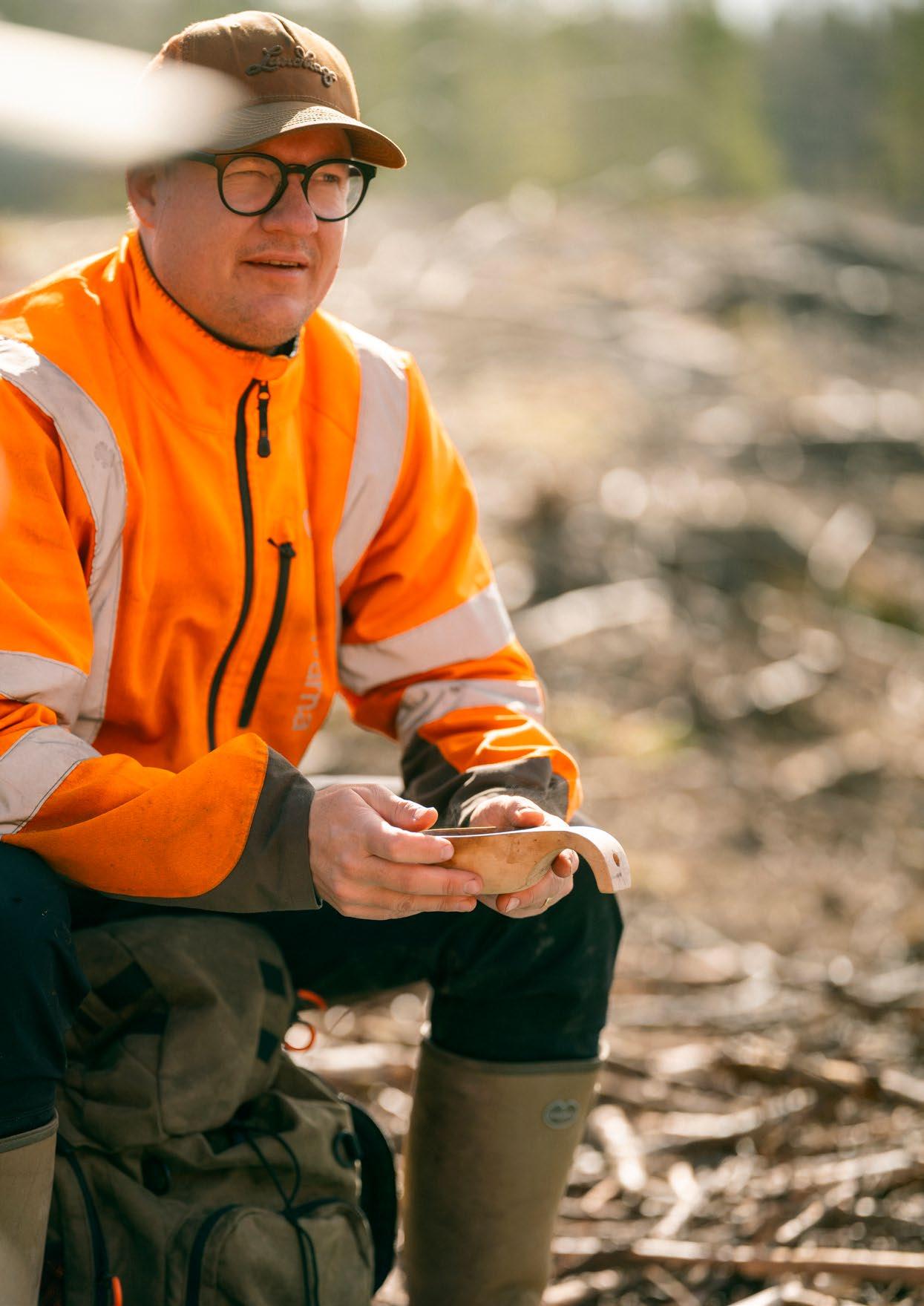
We refine and renew family forestry. For almost a century, we have been working together in Södra to increase the value of forests.
52,262 forest owners were members of Södra at year-end. 36 The members are organised into 36 forestry districts.
SEK 2.86 million
The purpose of Södra is to promote family forestry
Our mission is to create the dynamics in the wood market that benefit family forestry in the long term and to pursue the issues that are important for the forest estate so that all members can conduct responsible, profitable and long-term forestry – today and in the future. Over time, this mission has enabled us to establish world-class industrial operations that we own and operate together in the association. These industrial operations belong to the members, and the balance between the forest and the industrial operations is a fundamental part of Södra’s strength.
The interaction between the forest estate’s finances and the association’s performance is a fundamental principle that governs how we build long-term value, both today and in the future. The profitability of the model forest estate, our way of looking at the financial performance of the forest estate, is currently SEK 1,465 per hectare higher than ten years ago, and wood-supplying members have, over the past five years, benefited from an increase in wood value of SEK 10.7 billion. This is an incredible achievement and a result of high demand for the raw material combined with significant value added by industrial operations over the same period.
In 2025, however, the situation was turned on its head and the association was put to the test. Our assessment is that this may continue for some time to come. In this context, it is crucial that we, in our work, look at the big picture and think along the lines of multiple time perspectives. For this reason, the Board always needs to balance the long-term stability of the association and industrial operations with the net forest income when making major decisions and drafting our dividend proposal to members. Three relevant examples of this in 2025 are:
» We have chosen to leave our required return unchanged and prioritise future investments that build competitiveness. The investment decision in the Kinda sawmill and the start of construction of the kraft lignin plant are in line with our strategy of making more from every tree and strengthen the capacity of the industrial operations to deliver value to the forest estate over time.
» We must ensure that Södra’s capital is managed in the best way possible, and our decision to divest the forest holding in the Baltics both delivers on our mission to focus on members’ forests and, once the transaction is closed, strengthens our balance sheet.
» We want to continue to promote the active participation of members in the association’s value creation, including the value created during the year and the value that has built our business over time. Following the majority decision of the Extraordinary General Meeting, we are further strengthening this possibility by providing the option of issuing a bonus issue on the value and/or volume of forest-based products that members have delivered to the association during the past one or two financial years.
Long-term balance point
We are now entering a 2026 still dominated by uncertainty. The triple effect we experienced in 2025 with rapid currency fluctuations, challenging market conditions and an imbalance between the price of raw materials and the price of our products continues to impact us. Accordingly, we expect weaker profitability in our industrial operations. Meanwhile, investments to boost competitiveness, not least through the development of the product portfolio, must continue and this requires capital. What we must do now is find a long-term sustainable balance point that provides an attractive forest net and enables the industrial operations to be paid well for what we produce. Ultimately, it is about safeguarding Södra’s resilience over time, so that it remains a force that refines our raw material and a guarantor for members in times of crises.
The year’s profit distribution
Against this background, the Board of Directors has made an cumulative assessment aimed at optimising the dividend proposal, taking responsibility for stability and the current situation. We have therefore proposed a dividend of SEK 616 million, divided into SEK 560 million on wood deliveries (SEK 87 per m³ for standard saw logs, SEK 45 per m³ for pulpwood and 6 percent for other timber ranges) and SEK 56 million on bonus issue (2 percent of paid-up contributed capital). With this proposal, we are safeguarding the stability of wood deliveries without compromising on the importance of active participation in the association’s value creation while also distributing value to members and protecting Södra in a challenging situation.
Business policy lobbying a core mission
2026 will also be an important year in terms of business policy. Pursuing important issues for forest estates is a core mission for Södra, and is particularly significant in an election year when
important decisions affecting the forest are pending. We need the Forest Inquiry (Sw: Skogsutredning) to take action to secure raw material supply and sustainable production in the future. The Inquiry shows that we can strike a balance between production and environmental objectives, and the proposals on strengthening property rights, equal treatment and compensation are crucial for future investments. For us forest owners, it is about security and legal certainty. For society, it is about jobs, welfare and continued forward momentum in the green transition. We need political decisions that will make a difference, and we are proactively striving for Södra to be a strong player in relation to these issues.
At Södra, we put safety first. This creates security for people and conditions for pursuing long-term and responsible forestry. During the year, we continued to develop Safe Member (Sw: Säker medlem), an initiative that provides good support and information for all of us who work in the forest. This is something we most do together, and everyone needs to take responsibility.
We summarise a year in which a great deal has happened at Södra. It is at times like these that our resilience is put to the test. A great deal of work has been done and this will need to continue as we enter a new year that will bring both opportunities and challenges. But when we stick together, take responsibility and keep pushing forward, we create scope for the action needed to turn things around. Södra’s strength lies in what we achieve together.
Magnus Hall Chair of the board
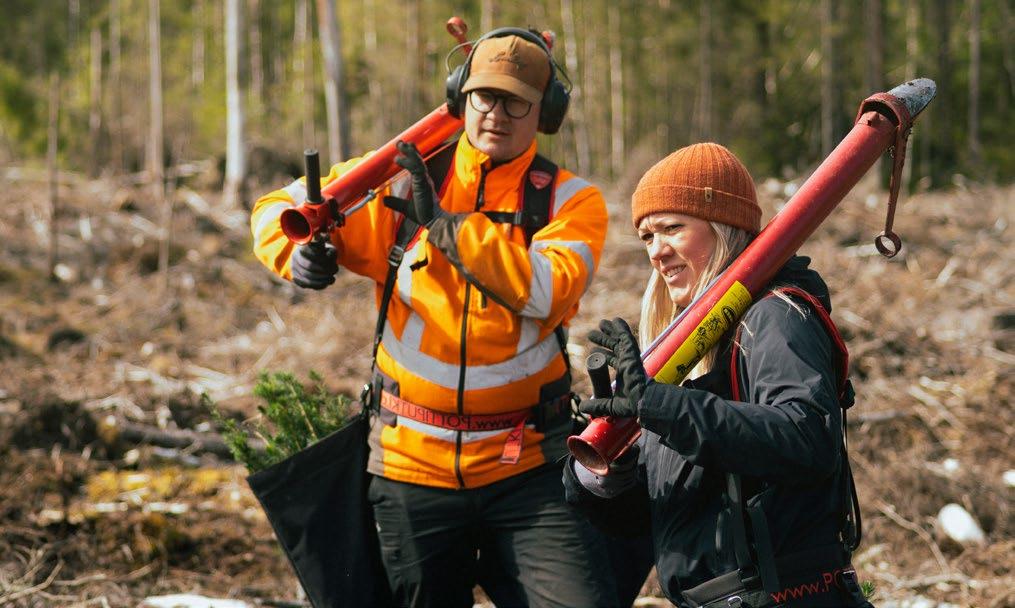
effective corporate governance and internal control are key components of a successful organisation and essential for upholding the trust of members, customers, authorities and other stakeholders. effective corporate governance essentially ensures that systematic decisionmaking processes are in place, with a clear division of responsibilities between the various decision-making bodies. the Board and other corporate bodies need to work together to ensure effective governance and management of the company. Södra’s governance proceeds from the association’s articles of association, and the Swedish economic associations act.
Södra applies the specific cooperative principles of Objectives and benefits for members, Democratic processes and Participation of the members in the enterprise’s value creation, pursuant to the Swedish Code for the Governance of Cooperative and Mutual Enterprises. Södra also applies appropriate parts of the Swedish Corporate Governance Code, since the Code is based on the Swedish model of corporate governance and provides guidance on what is considered good corporate governance.
The purpose of Södra Skogsägarna ekonomisk förening is to promote the financial interests of its members, which includes trading in, and processing of, the forest and forest-based products, mainly from the association’s members, and conducting production, industrial and/or financing activities. The association also aims to achieve a secure and appropriate market for members’ forest raw material at market prices, to promote high and valuable forest production integrated with nature and cultural considerations, support and develop members’ forestry with services and training, increase understanding of the cooperative form of enterprise and conduct business policy lobbying. The assignment can be summarised as: We refine and renew family forestry.
Södra Skogsägarna ekonomisk förening is the Parent Company of a forest industry group that offers forestry services and products in pulp, wood, building systems, energy and chemicals. Operations are conducted in five business areas: Södra Skog, Södra Wood, Södra Cell, Södra Building Systems and Södra Bioproducts. There are also a
number of subsidiaries. Refer to the list on page 94.
Södra is owned by more than 50,000 forest owners in southern Sweden. The owners are members of the economic association, and contributed capital comprising at one contribution for each hectare of productive forest land, although more than 200 contributions are voluntary. One contribution is SEK 900. Every member is entitled to one vote, regardless of contributed capital or size of their forest estate. At year-end, the number of members was 52,262, an increase of 146.
Members of Södra are organised into 36 forestry districts, and a member’s opportunities for direct influence are greatest in their forestry district. The views of members are otherwise represented by elected representatives. Each forestry district appoints a district council and a nomination committee at its local annual meeting. The local annual meetings also appoint delegates to the Annual General Meeting (AGM) Members are entitled to submit motions to the local annual meeting, which may decide to submit the motion to the AGM. Members may submit motions directly to the AGM In addition, all members are entitled to submit proposals directly to the district council or the Board. At the local annual meeting, the district council reviews the activities of the past year and presents a new business plan for the current year. The local annual meeting of the forestry district is held not later than three months after the end of the financial year. Notice of the ordinary local annual meeting or an
extraordinary local annual meeting is to be in writing, and issued not later than one week prior to the meeting, and each district council is responsible for giving notice. Between 17 March and 6 April 2025, Södra’s 36 forestry districts held their local annual meetings.
The forestry districts’ nomination committees play an important role in Södra’s democratic organisation and governance. The local annual meeting’s election of members to the forestry district’s district council and delegates to the AGM must be prepared via a structured process that enables well-informed decision-making. The main purpose of the local nomination committees is to make recommendations for these elections. Members of the nomination committee must have good insight into Södra, the foundations and values of the cooperative, and a broad network of contacts in the forestry district. The AGM has adopted Terms of Reference for the nomination committees in the forestry districts. According to the Terms of Reference, the nomination committees must work actively to increase the diversity of the elected representatives in order to future-proof Södra and adapt to changes in the association’s membership and business environment. District councils, nomination committees and delegates should strive for an even gender balance. In their recommendations for elections, the nomination committees should take particular account of the Södra cooperative’s Code of Ethics. The nomination committees’ assignment and work are also deepened through nomination committee forums and complementary guidance for the nomination committees.
Members can nominate for district councils, delegates and the Nomination Committee.
Motions from members are addressed at local annual meetings and the AGM Nominations
Delegates
36 local annual meetings
36 forestry districts
Board of Directors
The Board appoints the President and addresses long-term and strategic issues.
36 district councils Responsible for local co-operative activities. Elected at the local annual meeting
200 representatives, of whom 36 are district council chairs. President Annual General Meeting Delegates 200 representatives.
Administrative Council 36 district council chairs.
The Chairs of the district councils form the Administrative Council, which serves as an advisory body to the Board and creates member buy-in for important decisions.
District councils
At the local annual meeting, each forestry district elects a district council that is responsible for the cooperative activities of the forestry district. This includes member activities, training courses and monitoring local business policy. The district council also appoints special representatives to deal with critical issues, such as a health and safety representative, nature conservation representative and wildlife representative. The members of the district council play an important role in member dialogue and the development of Södra.
The district council must have at least five and not more than twelve members. More members may be elected in larger forestry districts, but no more than 15.
The 36 Chairs of the district councils form the Administrative Council, which is an advisory body to the Board and the AGM in strategic issues. The Administrative Council shall also work to ensure that Södra’s strategic direction and decisions are well supported by members, and issue an opin-
ion on the Board’s profit-distribution policy. As part of this process, the Administrative Council meets Södra’s Board and management for in-depth information and open dialogue, including through work in various groups and forums.
The Administrative Council appoints the members of the Administrative Council’s nomination team from amongst its own ranks. One of the tasks of the nomination team is to prepare the AGM’s election of members of the AGM Election Committee.
In 2025, the Administrative Council held four physical meetings and ten brief online meetings.
The Annual General Meeting (AGM) is Södra’s supreme decision-making body. The meeting consists of the 200 delegates elected at the local annual meetings, who each have one vote. Members of the Administrative Council are always included in the delegates. The AGM adopts the financial statements and appropriation of profits, and appoints Board members, auditors and the Nomination Committee. Board mem-
bers, the President and auditors are entitled to participate in the Meeting’s discussions and present proposals.
The AGM is held not later than six months after the end of the financial year. Written notice of an Ordinary General Meeting or Extraordinary Meeting shall be sent to each delegate not less than six weeks, and not later than two weeks before the Meeting.
The 2025 AGM was held in Växjö on 3 June. The AGM proceedings were sent via Södra’s website.
The AGM resolved on the appropriation of profits and addressed 34 motions that had been discussed by the delegates at digital motion meetings beforehand. The motions were related to matters including forests and wild game, Södra’s profit distribution, further processing of hardwood and non-native tree species, and certification.
In 2025, the Nomination Committee proposed that ten members be elected to the Board. An Extraordinary General Meeting was held online on 25 November 2025. The Extraordinary General Meeting addressed the Board’s proposal to amend Article 36.2 (bonus issue) of the Articles of Association.
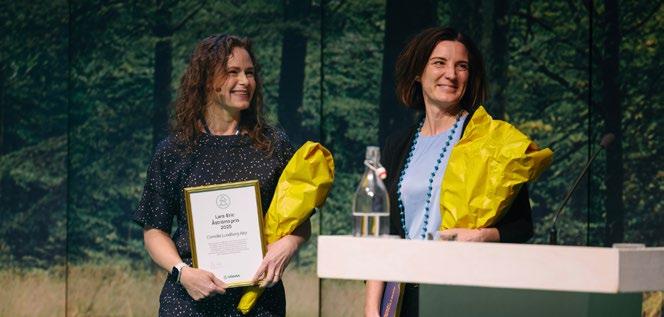
The Meeting adopted the Articles of Association with the amendment proposed by the Board.
The AGM’s Nomination Committee presents recommendations for Board members, Chair of the Board and auditors. In addition, the Nomination Committee proposes fees for members of the Board and the Administrative Council, AGM delegates, elected representatives and auditors. The Administrative Council’s nomination team prepares the AGM’s election of members for inclusion in the Nomination Committee. The AGM’s Nomination Committee, which is to consist of five to seven members, must be composed so that it can evaluate the Board’s composition, skills and performance, as well as the personal contribution of Board members to the Board’s work.
The Nomination Committee’s work continues throughout the year and includes gathering knowledge about the association’s development and future, and the performance of the Board as well as
assessing the need for any changes. The Nomination Committee also reviews the evaluation of the performance of the Board, which is carried out regularly with the help of an external party. This provides a basis for the identification of suitable candidates. Members and elected representatives may submit regular proposals to the Nomination Committee regarding candidates, both external and members.
At the 2025 AGM, Magnus Johansson, Christer Andersson, Maria Åkesson, Gunnar A Johansson (left in September 2025) and Sonny Schön were re-elected and Jesper Bengtsson was elected as a new member. At the first meeting of the Nomination Committee, Magnus Johansson was elected to chair the Committee.
The Board shall consist of seven to ten ordinary members who are elected by the AGM and three members who are appointed by employees. Of the elected Board members, at least two-thirds must be members of the association, and the combined competencies of the Board members must serve the
association’s needs. The composition of the Board shall ensure its ability to manage the association’s affairs with integrity and efficiency. The Board shall have an appropriate composition, with respect to the cooperative form of ownership and the association’s activities, industrial structure, stage of development and other circumstances, that is characterised by diversity and breadth in terms of the skills, experience and background of the members elected by the AGM. An even gender distribution shall be sought. The Board members’ skills are continuously developed through, for example, training courses and field trips. The President is not a member of the Board.
The Board manages Södra’s affairs in the Group based on the interests of the owners and is responsible for ensuring that appropriate targets, plans, strategies and policies are in place to meet the demands and expectations of the owners. The Board shall continuously monitor and evaluate the company’s performance and assess the Group’s financial situation. The Board shall ensure that fund management, internal control and risk management are adequate,
and is responsible for ensuring that the organisation of the company is appropriate.
In addition to the statutory meeting, the Board is to hold at least six meetings during the year. In 2025, the Board held 17 meetings, including one statutory meeting. New business, strategy, business plans and investment decisions were some of the key Board matters in 2025. The Vice Chair of the Board is appointed at the statutory meeting after the AGM
The Board has detailed Terms of Reference setting out the Board’s duties and meetings, and the ordinary agenda items that must be included. These are described in a one-year pie chart, see further down on this page. The Board also appointed three committees to prepare matters.
The Board appointed three committees from within its ranks and established a Terms of Reference for each committee:
» the Audit Committee
November
» The Södra Leap action programme
» Södra Skog – follow-up of raw material strategy
» Cooperative development journey
» Extraordinary General Meeting
October
» Q3 report
» Amendment to the statutes, bonus issue, adoption
September
» Investment decision, trimmer, Södra Wood Mönsterås
» Investment decision, turbine, Södra Cell Mönsterås
» Adoption, Profitdistribution Policy
» Board trip, Germany
» THEME: Forest
August
» Investment decision, Kinda X
» Implementation plan, Profit-distribution Policy
July
» Q2 report
» The Södra Leap action programme
» Long-term financial analysis
» the Fees and Benefits Committee
» the Cooperative Committee
The Audit Committee monitors and reviews the financial reporting, internal control, risk management and sustainability reporting, and monitors and evaluates regulatory compliance, information security and whistleblowing cases. In 2025, the Committee consisted of Hans Berggren, Pål Börjesson, Hannele Arvonen (part of the year), Carina Olson (part of the year) and Leif Hultman (part of the year).
The Fees and Benefits Committee prepares matters related to remuneration principles and guidelines, and other terms of employment for management. The Committee has also been assigned to monitor and evaluate the application of the remuneration principles and guidelines and other terms of employment determined by the Board, and the company’s remuneration structures and levels. In 2025, the Committee consisted of
December
» Södra Cell, product portfolio of the future
» Business plan 2026-2028, including adoption of investment frameworks
» Succession planning Group Senior Management
» Adoption of Code of Conduct and Supplier Code
» Adoption of all policies
Magnus Hall, Kristina Alsér (part of the year), Mikaela Johnsson (part of the year) and Leif Hultman (part of the year).
The Cooperative Committee prepares cooperative development issues and decisions for further handling by the Board. These included evaluation of the company’s cooperative interaction and the Södra Model, the need to amend the Articles of Association, development of the Board’s work with the Administrative Council, and recommendations regarding the Corporate Governance Report and the handling of motions to the AGM. In 2025, the Committee consisted of Paul Christensson, Mikaela Johnsson (part of the year), Kristina Alsér (part of the year), Charlotte Eriksson (part of the year) and Håkan Larsson
According to the Swedish Corporate Governance Code, a majority of the members of the Board, its Audit Committee and Nomination Committee must be inde-
January
» Profit distribution proposal
February
» Q 4 report /annual accounts
» Decision on profit distribution proposal
» Kinda X
» Follow-up of investment in biomethanol in Mönsterås
March
» Profit-distribution Policy
April
» Review of motions
» Profit-distribution Policy
» Baltics, Project Faunas
» Industrial structure, Södra Wood and Kinda
» FSC®
» Q1 report
» Raw material supply strategy – business terms members, decision
» Nomination Committee’s report
May
» Baltics, Project Faunas
» Profit-distribution Policy
June
» Annual General Meeting
» Statutory meeting
» THEME: Södra Wood
» Södra Skog’s journey of change
» AGM follow-up
» Macro-economic analysis
» Risk management in the Group
» Adoption of Board Policy
pendent of the company. The members of the Fees and Benefits Committee shall be independent, except for the Chair of the Board, should they be a member of the Committee. Significant business relationships or other significant financial dealings with the company are one of the factors that are considered when assessing a member’s independence. Two thirds of the Board must consist of members, whereas the Audit Committee and Fees and Benefits Committee may solely consist of members. The Nomination Committee generally consist of members of the Administrative Council, who are all therefore members. Members play an active role in the operations through their business relationship with the company and both Board and Nomination Committee members have had significant financial dealings with the company from time to time. The independence requirement cannot therefore be met in this respect. The Terms of Reference for the Board contains clear rules regarding conflicts of interest. Agreements are concluded between Södra and members of the Board, and Södra and members of the Administrative Council, in a special arrangement.
The performance of the Board and the President was evaluated in the fourth quarter with the help of an external party. The remuneration guidelines for Senior Management were adopted by the AGM
Group Senior Management usually meets once a month and consists of the President, Business Area Presidents and Functional Cluster Managers. Recurring agenda items are health and safety, strategy, economy and cooperative issues. Plans and fol-
low-ups for each business area and function are also prepared at quarterly meetings. The President is responsible for the ongoing management in accordance with the Board’s guidelines and instructions. The Board has established a Terms of Reference for the President.
Risk control – Södra’s risk control function is responsible for the structure and coordination of the company’s strategic risk reporting. Södra’s Finance Centre is responsible for the management of financial risk based on, for example, Södra’s Financial Policy.
control – The Finance Centre serves as Södra’s internal control function and reports to Group Senior Management and the Audit Committee.
The function works to develop, improve and ensure the Group’s internal control over financial reporting, both pro-actively by focusing on the internal control environment, and by examining the effectiveness of internal control.
Compliance – Södra runs a business ethics programme that includes structured management and monitoring of the area with a particular focus on issues related to competition, anti-corruption, conflicts of interest and sanctions.
The responsibility of the Board and the President for internal control is regulated by the Swedish Economic Associations Act. The internal control process provides the Board, management and other employees with reasonable assurance regarding achieve-
Functions
Business support: HR , Health & Safety, Communication, Worldclass Efficiency, Sales and operations planning (S& OP) Economy & Finance: Finance, Procurement, Legal Affairs, Compliance & Risk Digital & Tech: IT, Data & analytics, Project Office, ERP, Safety Members & strategy: Cooperation, Business policy, Sustainability, Innovation & strategy
ment of the company’s objectives in relation to effectiveness, the reliability of financial reporting, and compliance with applicable laws and regulations.
Södra’s internal control is linked to the financial reporting system. Internal control over financial reporting is designed to provide reasonable assurance regarding the reliability of external financial reporting in the form of interim reports, year-end reports and annual reports, and that the external financial reporting is prepared in accordance with the law, applicable accounting standards and other requirements on economic associations.
The aim of Södra’s risk assessment is to identify and assess the most significant risks, including the risk of fraud and the risk of significant changes, which affect internal control over financial reporting in the Group’s companies, business areas and processes. The risk assessment is updated annually and the results are reported to the Audit Committee, the Board and Group Senior Management.
Auditors are appointed by the AGM. The Auditors’ overall responsibility is to examine the Annual and Sustainability Report, the consolidated financial statements and accounting, and the management of the Board and the President. Two of the four ordinary auditors are member representative auditors.
At the 2025 AGM, the auditing firm Öhrlings PricewaterhouseCoopers AB was elected as auditor and Roger Johansson (re-election) and Anette Westerlund (new election) as member representative auditors. The Meeting established Terms of Reference for the member representative auditors.
Other The Södra Pension Foundation Foundation for Research, Development and Education
Södra operates in a global market and is affected by geopolitics, climate change, economic trends and currency fluctuations, as well as industry and company-specific factors. Södra applies a systematic approach to risk management with the aim of protecting the Group from damage, uncertainty and lost opportunities. The risk management process follows a one-year cycle in conjunction with strategic and business planning processes. The risk assessment framework comprises a risk universe, a common assessment model and an action monitoring structure.
The process of identifying, assessing and managing risks is an integral and important part of Södra’s business management. Strategic risks are assessed and managed by the Board, Group Senior Management, the Strategy function and the business planning process. Södra Finance Centre manages financial risk in accordance with a Financial Policy established by the Board. For more information, see Note 24, page 84. Operational risks are managed by the President, Group Senior Management and employees, in accordance with the Group’s policies, directives and guidelines.
» Risk section in Annual and Sustainability Report
» Risk input to the business planning
» Follow-up of risk reduction measures
» Follow-up of risk reduction measures
» Risk inventory business area/function
» Group Senior Management calibrates the Group’s risk map
» Risk report to the Board
Strategic risks are related to business development, long-term planning and Södra’s competitiveness. The Board of Directors and Group Senior Management conduct an assessment of the strategic risks within the framework of strategy activities and in conjunction with important business decisions.
Climate and nature. Climate change affects Södra’s operations due to more extreme weather situations, reduced water availability, more pests, increased fire risk and changed growing conditions. Biological risks such as wildlife damage and fungal disease affect forest owners and, ultimately, Södra. Forest management measures such as planting the right tree in the right place, thinning at the right time and stump treatment against root rot reduce the impacts and are communicated to forest owners. The Södra School offers large-scale training initiatives. Södra has a crisis organisation and flexible logistics for handling storm-damaged trees and other extraordinary events. Forest owners insure their standing timber against fire damage. The mills conduct climate risk assessments for investment projects and ensure local sources of freshwater for the pulp mills. Gradual changes are addressed with adaptations in forest seed orchards and advisory services for forest owners. Efforts to limit spruce bark beetle damage and national initiatives to combat wildlife damage are also included. Södra is working to reduce its own climate impact by establishing targets for a higher rate of forest growth and reduced greenhouse gas (GHG) emissions.
Economy. Södra’s earnings are strongly affected by the economic climate, which is reflected in changed prices and sales volumes. Negative economic growth can affect Södra’s sales and result in the same direction. A more globalised market approach with sales to many countries reduces vulnerability. In addition to investments in core markets, ranges are developed to be attractive in new markets. The focus remains on innovation and strategic initiatives in energy, chemicals and building systems.
Competition. The pulp and sawn timber industries are highly competitive. Price pressure intensifies when production capacity increases, when there is greater competition from other fibre alternatives, or in conjunction with weak economic conditions. In some segments, this is further reinforced by changing con-
In the day-to-day operations, there are risks that are managed in operating activities. These operational risks are often controllable and their management is regulated by policies and guidelines. Operational risk areas include physical assets, organisation and employees, and the risks are often insurable.
Raw material supply risks. Södra’s industrial capacity requirements and market competition require efficient forest management and high delivery loyalty from members. The flow of wood raw material from members is complemented with external wood purchases, including imported wood, and is dependent on a functioning logistics chain. The competitiveness of
sumption patterns, such as increasing digitisation and demand for packaging materials. The construction sector is affected by competition from non-timber materials. The social transition to combat climate change is also setting new rules. The strategy, From one family to another, is guiding Södra’s progress towards increased competitiveness. The focus on increased efficiency in the core business is strengthening Södra’s market position. The focus on innovation and new business is securing future competitiveness. Further development of strategic customer relationships through longer agreements is reducing vulnerability and improving long-term planning.
Political risks. Södra operates in an industry with a high degree of regulation, where political decisions on taxes, environmental laws and forest policy, for example, can have a direct impact on the operations. There is also a risk of negative public opinion. Södra works actively with business policy initiatives to ensure good conditions for family forestry and the cooperative form of enterprise, in collaboration with the Swedish Forest Industries Federation, the Federation of Swedish Farmers (LRF) and the Confederation of Forest Owners (CEPF). In 2025, the focus was on forestry and forest products as enablers of the green transition, as well as the importance of increased competitiveness for Sweden and Europe. Södra has been active and has participated in several high-level meetings with policy makers at national and EU level. In terms of sectoral policy, business policy lobbying was focused on the 2024 Forestry Inquiry, the Species Protection Inquiry, the Deforestation Regulation and the implementation of the Nature Restoration Law.
Information security and IT. Society’s and Södra’s dependence on IT and digital tools in production and communication expose the Group to IT/cybersecurity risks. Threats such as malware, system outages, data quality deficiencies and information leaks can lead to major costs, higher workloads and loss of trust. Administrative and technical controls are continuously updated to maintain digital security. Redundant environments and a modern backup-system have been implemented, and cybersecurity training is offered to all employees. Crisis management capabilities are maintained through methodology development and practical exercises. There are also strategic plans in place for digital development.
Södra’s core products – pulp and sawn timber – is dependent on PEFC and/or FSC® certification of the forest raw material. Södra holds forest management and Chain of Custody certification for PEFC (PEFC/05 -22-11) and FSC® (FSC®- C014930). Input prices are market driven and have a strong impact on competitiveness. Forestry advisory services, active member dialogue and training services support members’ forestry. Södra works to secure transportation capacity and robust logistics chains. Forest management certification and traceability requirements are verified through follow-ups. Input prices are continually monitored and purchasing takes place centrally using indexbased contracts.
Facilities. Unforeseen events can damage facilities, cause production losses and damage goods in transit. The production facilities have adequate perimeter protection. Preventive maintenance is carried out systematically. Property and business interruption insurance protects production facilities at their replacement cost. Business interruption insurance provides financial protection for production losses, and goods in transit are insured at current value. The value of forest seed orchards is hedged through geographic distribution and cross-ownership.
Health and safety. Södra’s operations have facilities where the physical and psychosocial work environment could pose a health risk. The Group applies a systematic approach to OHS management under the motto “Safety first”, with a focus on continuous improvement and increased safety. The pulp mills are certified according to the ISO 45001 occupational health and safety standard. Södra’s Occupational Health Services and wellness initiatives help to create a healthy workplace, and employee surveys are implemented on a regular basis. The Code of Conduct and Supplier Code contain health and safety guidelines, and both managers and employees undergo BAM (Better health and safety) training.
Security and preparedness. Like all companies, Södra is impacted by the increased threat posed by a deteriorating geopolitical climate as well as hybrid warfare and organised crime. Risks include sabotage and work-related crime, which may impact the physical security of operations and the capacity to maintain stable operations. In 2025, a far-reaching security analysis was performed and a security task force was established to strengthen coordination and strategic governance. Furthermore, contingency and business continuity planning is essential to ensure operational resilience in the event of disruptions and crises.
Environmental risks. Environmental impact is caused by the consumption of water, energy and raw materials, and emissions from transportation. Emissions to air, water and soil affect the environment and local communities. Södra complies with environmental legislation and works continuously to improve energy efficiency. The Supplier Code (which is included in supplier agreements) and the Code of Conduct contain environmental guidelines and requirements. The focus lies on preventive measures, and the precautionary approach is applied. Responsibility is taken for the remediation of contaminated soil and financial resources are set aside for this purpose. Many initiatives are reducing Södra’s environmental impact, such as fossil-free operation of the pulping process and electrification of the vehicle fleet.
Product safety. Södra’s products for the food and construction industries comply with strict safety and liability regulations. Any product defects could affect customers and consumers. All business areas work with quality issues in their respective business management systems. Södra Cell holds ISO 9001 certification. The products have been approved for the food industry (FDA , BfR) and the construction industry (CE marking). There are procedures in place for information and recall in case of defects. Global liability insurance covers product liability.
Competence supply. Södra is dependent on recruiting, developing and retaining skilled employees. A shortage of the right skills could have a negative impact on the business. Södra’s strategy puts people and culture at the centre, which increases the company’s attractiveness. Resources are invested in recruitment, learning, HR communication, diversity, equity and inclusion programmes, and a trainee programme for future leaders.
Södra is subject to strict environmental and regulatory requirements. The introduction of new laws, rules and regulations, or new or tougher regulatory requirements could affect the Group’s operating profit and the quality of its financial reporting. Compliance and regulatory risk covers both internal compliance with governance documents and external compliance with laws, rules and regulations. The Group’s policy framework was further developed during the year.
Business ethics. Södra operates in a national and international market through several different buying and selling channels.
Corruption risks vary but are always present. The Södra Code of Conduct, Supplier Code and Business Ethics Policy place clear demands on business ethics. Purchasing is managed by the Group’s purchasing departments and all suppliers are to be covered by the Supplier Code. A supplier monitoring process is linked to the Supplier Code. There is also a Supplier Code for members. Sales agents are also required to follow the Code of Conduct. Internal control and whistleblowing systems are in place. Södra’s business ethics programme includes management of business ethics, import and export control, competition and anti-corruption.
Information and communication risks refer to the risks associated with Södra’s reporting (both financial and non-financial) External communication risks are related to financial information, such as annual and interim reports, while non-financial information refers to sustainability information and other external communication. Internal information and communication risks include systems and processes that help to ensure
that information is identified, distributed and documented in a way that enables employees to perform their work effectively. External and internal communication is supported by the Brand Policy. A more detailed description of Södra’s work with internal control over financial reporting can be found in the Corporate Governance Report.
For information about financial risk and a sensitivity analysis, refer to Note 24 on page 84.
Södra applies the specific cooperative principles of the Swedish Code for the governance of Cooperative and Mutual enterprises — objectives and benefits for members, Democratic processes and participation of the members in the enterprise’s value creation.
» Objectives and benefits for members The Board shall ensure that the company’s objectives, set of values and strategy are based on the members’ best interests and that the company delivers long-term benefits for members. The Board shall ensure that the company maintains open communication with members, employees and other stakeholders, established guidelines for the company’s conduct and specifies the regulatory frameworks and principles that apply to the company.
» Democratic processes Cooperative companies have democratic processes where every member’s voice matters. The processes shall promote the participation of members in various forums in an open and transparent manner and provide opportunities for influence and transparency in the business. The members also appoint representatives to the highest decision-making body. The Board shall continuously evaluate the company’s democratic organisation and initiate changes if necessary.
» Participation of the members in the enterprise’s value creation The cooperative business model is based on participation of the members in the enterprise’s value creation via two roles, a business relationship and an owner relationship. The Board shall ensure that these relationships are designed to promote the economy, engagement and loyalty of the members.
The activities undertaken during the year with a specific connection to the cooperative principles are presented below.
Owner
In Autumn 2024, an owner dialogue was carried out and in 2025 work was ongoing to process the comments and suggestions received. The Södra Model and Södra’s profit distribution engage many members. This takes the form of motions to the AGM, letters to the Board and dialogues at annual and member meetings. Accordingly, the Board decided to review the Profit-distribution Policy. As a result of this review, which was conducted during 2025, the Board decided that the policy needed to be modified and that the Södra Model needed to be updated. The Board presented various options to a reference group from the Administrative Council, and these options were subsequently discussed by the full Administrative Council.
The Board’s final proposal was that wood deliveries – in addition to paid-up contributed capital – could form the basis for a bonus issue. To enable this, it would be necessary to make an amendment to the association’s Articles of Association. In view of this, the Board decided to convene an Extraordinary General Meeting on 25 November to discuss changes to Article 36.2 of the Articles of Association. Ahead of the Extraordinary General Meeting, two information sessions were held with the delegates to allow for questions and discussion. The Extraordinary General Meeting decided by an 80 percent majority to amend the Articles of Association in accordance with the Board’s proposal.
In order to more clearly describe the Södra Model, a project has been initiated to review communication around the model. A working group with representation from the Administrative Council is developing various tools to clearly and thoroughly explain how the Södra Model works.
Work on the cooperative development journey has been ongoing during the year with the aim of clarifying the tasks and working methods of the district councils with terms of reference for each district council. A framework for these terms of reference has been developed. The cooperative development journey has four core areas for the district councils to work on locally: meeting hubs, active learning, joint advocacy and member democracy.
Meeting hubs is about organising member activities and meetings. Active learning describes the process of learning and sharing best practices. Joint advocacy relates to local business policy and member democracy is about the democratic rights of the member, such as AGMs and the possibility to influence the association. A coordinator for each area is to be appointed in the district councils to organise work and ensure that the right conditions are in place to move issues forward.
» The Cooperative Code of Ethics was adopted in 2024 by the Board, after which the important work of implementing the Code in the cooperative organisation commenced. The district councils work with the Code at meetings and gatherings. The Administrative Council addresses the Code annually, and it is raised at nomination committee forums where members discuss different cases they have faced and how the Code can support them in their day-to-day activities. Södra has also established a Cooperative Ethics Council, the aim of which is to provide support in particularly difficult situations, and recommendations and guidance on matters. In 2025, the Council held two meetings. The Council is composed of one representative from the Board, two from the Administrative Council, one member appointed by the CEO and one member appointed by the Director of Members and Strategy. Carina Olson was appointed by the Board as Chair of the Council until August after which Kristina Alsér was appointed.
» The Administrative Council has an advisory role and a shift is currently taking place to enable the Council to play a greater role in strategic issues, and several working groups were active during the year. Examples of the issues discussed in working groups are the development of transaction forms and business terms, the principle of equal treatment, organisational change in the Södra Skog business area, and work with the district councils’ assignments and working methods.
» A focus on the nomination committees continued in 2025. A nomination committee forum was held in September, among other activities. A particular focus was placed on issues related to diversity, equity and inclusion.
» During the year, the motion process was clarified and a motion period was introduced, extending from 1 October to 31 January. In the past, members have been able to submit motions throughout the year, meaning that a motion could be submitted in February to be addressed at the annual meeting the following year. By that time, the motion raised may be out of date or already been addressed.
» During the year, a Supplier Code for members was developed in cooperation with the Administrative Council and adopted by the Board on 9 December. For more information on the Supplier Code, see page 112.
External:
» Swedish Economic Associations Act
» Swedish Code for the Governance of Cooperative and Mutual Enterprises
» Swedish Corporate Governance Code
» Annual Accounts Act
» Companies Act
Internal
» The association’s Articles of Association
» AGM resolutions
» Terms of Reference for the Board
» Instructions regarding the division of tasks and responsibilities between the Board and the President
» Instructions regarding financial reporting to the Board
» Codes, policies, directives and guidelines
To the general meeting of Södra Skogsägarna ekonomisk förening, Corp. ID No. 729500 -3789
Engagement and responsibility
The Board is responsible for the 2025 Corporate Governance Report on pages 148 –157.
Focus and scope of the audit
Our audit was conducted in accordance with FAR’s auditing standard RevR 16 The auditor’s examination of the corporate governance statement. This means that our examination of the Corporate Governance Report has another focus and is substantially less in scope compared with the focus and scope
of an audit in accordance with International Standards on Auditing and generally accepted auditing standards in Sweden. We believe that this examination has provided a sufficient basis for our opinions.
Opinion
A Corporate Governance Report has been prepared. We believe that the information in the Corporate Governance Report is consistent with the annual accounts and consolidated financial statements for 2025
The annual report was adopted on 11 February 2026 Växjö on the date indicated by electronic signature
Our audit report was submitted on the date indicated by our electronic signature
Madeleine Edberg Authorised Public Accountant Engagement Partner Öhrlings PricewaterhouseCoopers AB
Erik Bergh Authorised Public Accountant Öhrlings PricewaterhouseCoopers AB
Chair. Born 1959.
Board member 2020 and Chair 2022. Term of office expires in 2026. Former CEO of Vattenfall. Chair of Höganäs AB, NTM media group and Göta Kanalbolaget. Board member of Byggpartnergruppen.
Forest holding: 1) 66 hectares of productive forest land. Total contributed capital in Södra: SEK 3,757.
Born 1962.
Board member since 2017. Term of office expires in 2026. Agronomist and professor of environmental and energy systems at the Faculty of Engineering at Lund University. Fellow of the Royal Academy of Agriculture and Forestry.
Forest holding: 136 hectares of productive forest land. Total contributed capital in Södra: SEK 1,577,197.
Born 1956.
Board member since 2020. Term of office expires in 2026. Partner and Board member of Mercatus Engineering. Chair of Arkitektbolaget AB and the Kamprad Family Foundation for Entrepreneurship, Research & Charity. Fellow of the Royal Academy of Engineering Science. Honorary doctorate from Linnaeus University.
Forest holding: 1) 31 hectares of productive forest land. Total contributed capital in Södra: SEK 103,026.
Vice Chair. Born 1959.
Board member since 2010. Term of office expires in 2026. Vice Chair of LRF’s Executive Committee and Swedish Cooperative, Chair of the Federation of Swedish Farmers (LRF)
Forest holding: 1) 203 hectares of productive forest land. Total contributed capital in Södra: SEK 1,098,157.
Born 1956.
Board member since 2015. Term of office expires in 2026. Agronomist. Former CEO and President of Sveriges Stärkelseproducenter economic association. Chair of SolEdits AB, Board member of SLU Holding.
Forest holding: 1) 397 hectares of productive forest land. Total contributed capital in Södra: SEK 319,043.
Born 1976.
Board member since 2025. Term of office expires in 2026. CEO Generate Group.
Forest holding: 0 ha. Total contributed capital in Södra: SEK 0.
Holding of total contributed capital pertains to conditions on 31 December 2025.
1) Jointly owned.
Born 1968.
Alternate 2015, Board member since 2023. Employee representative for the Swedish Federation of Salaried Employees in Industry and Services (PTK). Chair of Unionen trade union at Södra’s head office. Member of Södra’s Group Council. Member of Unionen’s delegation to the Swedish Association of Industrial Employers.
Forest holding: 0 ha. Total contributed capital in Södra: SEK 0.
Mikaela Johnsson
Born 1982.
Board member since 2022. Term of office expires in 2026. Agricultural technologist.
Board member of LRF’s National Board of Directors. Owns and operates a farm and forest estate.
Forest holding: 1) 478 hectares of productive forest land. Total contributed capital in Södra: SEK 80,899.
Born 1960.
Board member since 2025. Term of office expires in 2026. Chair of Inter IKEA Systems B.V. Netherlands.
Forest holding: 0 ha. Total contributed capital in Södra: SEK 0.
Born 1980.
Alternate 2015, Board member since 2017. Employee representative of the Swedish Trade Union Confederation (LO). Chair of the GS club at Södra Wood in Mönsterås. Member of Södra’s Group Council.
Forest holding: 0 ha. Total contributed capital in Södra: SEK 0.
Born 1967.
Board member since 2024. Term of office expires in 2026. Chairman Swedish PEFC . Strategy and management team development consultant.
Forest holding: 162 hectares of productive forest land. Total contributed capital in Södra: SEK 1,507,915.
ALTERNATES — EMPLOYEE REPRESENTATIVES
1) Jointly owned.
Robert Andersson
Born 1968.
Alternate since 2023. Employee representative for the Swedish Federation of Salaried Employees in Industry and Services (PTK) Chair of SSF- Ledarna Södra Skog. Member of Södra’s Group Council.
Born 1974.
Board member since 2023. Employee representative of the Swedish Trade Union Confederation (LO). Chair of Paper department 34.
Forest holding: 0 ha. Total contributed capital in Södra: SEK 0.
Patrik Birgersson
Born 1970.
Alternate since 2023.
Employee representative of the Swedish Trade Union Confederation (LO). Chair of the GS club at Södra Wood/ SBS Värö. Member of Södra’s Group Council.
Jan-Åke Friskvik
Born 1964.
Alternate since 2024.
Employee representative of the Swedish Trade Union Confederation (LO). Chair of division 9 of the Swedish Pulp and Paper Workers’ Union at Södra Cell Värö. Member of Södra’s Group Council.
President and CEO. Born 1975.
MBA , Stockholm School of Economics. Employed 2020. Member of Group Senior Management since 2020.
Previous experience: McKinsey, senior positions at Södra and IKEA Group. Most recently President and CEO of Clas Ohlson.
Other assignments: Chair of the Swedish Forest Industries Federation, Chair of GreenIron.
Forest holding: 0 ha. Total contributed capital in Södra: 0.
Director of Members and Strategy. Born 1969.
MSc in Forestry, Swedish University of Agricultural Sciences, Umeå and Ludwig Maximilian University of Munich. Employed 2021. Member of Group Senior Management since 2021.
Previous experience: Sawmill Manager and Site Manager, Kährs in Nybro. Head of business area for sawmills, components and furniture facilities, and most recently head of Solid Wood division, at IKEA Industry.
Forest holding: 220 hectares of productive forest land. Total contributed capital in Södra: SEK 196,066.
Business Area President, Södra Bioproducts. Born 1979.
Doctor of Technology in Forest Products Chemical Engineering, Chalmers University of Technology. MSc in Chemical Engineering, Chalmers University of Technology. Employed 2008. Member of Group Senior Management since 2024.
Previous experience: Various positions in Södra Cell and Södra Innovation.
Forest holding: 0 ha. Total contributed capital in Södra: 0.

Chief Digital Information Officer (CDIO) Born 1974.
Systems Engineer, IHM Master in Management, MBA studies, Heriot-Watt University. Employed 2025. Member of Group Senior Management since 2025.
Previous experience: CIO Bravida Group, CIO Svevia and senior positions at PostNord, Norsk Hydro and Unilever.
Forest holding: 0 ha. Total contributed capital in Södra: 0.
Business Area President, Södra Building Systems. Born 1975.
MSc, Faculty of Engineering at Lund University. Employed 2022. Member of Group Senior Management since 2024.
Previous experience: Accenture and various positions in Kährs Group, most recently as CCO for the commercial segment.
Forest holding: 0 ha. Total contributed capital in Södra: 0.
President of Södra Cell business area. Born 1970.
Doctor of Technology in Pulp Engineering, Royal Institute of Technology. MSc in Chemical Engineering, Chalmers University of Technology. Employed 2014. Member of Group Senior Management since 2017.
Previous experience: President of Södra Innovation business area, process engineering manager at Södra Cell Värö, Head of Production BillerudKorsnäs Gruvöns mill, laboratory manager at Kvaerner Pulping and research engineer at Stora Enso.
Forest holding: 0 ha. Total contributed capital in Södra: 0.
Holding of total contributed capital pertains to conditions on 31 December 2025.
President of Södra Skog business area. Born 1976.
MBA . Employed 2016. Member of Group Senior Management since 2019.
Previous experience: Various positions within Södra, including CFO, President of Södra Interiör, CFO of Elajo Invest and senior finance positions in the manufacturing industry.
Forest holding: 0 ha. Total contributed capital in Södra: 0.
Secretary and Executive Assistant. Born 1972.
Employed 2021. Member of Group Senior Management since 2021.
Previous experience: Long-standing experience as administrator and team manager at PwC. Formerly employed in the hotel industry, Nordic Choice Hotels.
Forest holding: 0 ha. Total contributed capital in Södra: 0.
Business Support Manager. Born 1982.
Human resources specialist, HR degree with a focus on organisational psychology.
Employed 2022. Member of Group Senior Management since 2022.
Previous experience: Managerial roles, leadership and organisational development, with companies including HK Scan and Ballingslöv AB
Forest holding: 0 ha. Total contributed capital in Södra: 0.
President of Södra Wood business area. Born 1977.
MSc from Chalmers University of Technology in Gothenburg and MBA from Stockholm School of Economics. Employed 2005. Member of Group Senior Management since 2023.
Previous experience: Various roles in several business areas at Södra, including Mill Manager for Södra Cell Värö and Södra Wood Värö.
Forest holding: 0 ha. Total contributed capital in Södra: 0.
CFO. Born 1965.
Stockholm School of Economics. Employed 2023. Member of Group Senior Management since 2023.
Previous experience: CFO of SAS and Saab AB, as well as CFO and other financial roles at ABB
Forest holding: 0 ha. Total contributed capital in Södra: 0.
Changes during the year Stewen Nilsson left his position.
Emil Dahlin, CDIO as of 1 March 2025.
Isabella Wärvik in new role as Business Support Manager as of 1 January 2025.
Henrik Andersson in new role as Director of Members and Strategy as of 1 May 2025.
Biodiversity
Biodiversity is a collective term for the variability within and between species and ecosystems on the earth. High biodiversity means that we have a landscape with many different types of habitats and species, and high genetic diversity within species. For more information, refer to the UN Convention on Biological Diversity (CBD)
Bioeconomy
Bioeconomy refers to all economic activity derived from knowledge of biological processes and biotechnology, with the aim of achieving a sustainable way of living without depleting the earth’s finite resources.
Biofuels
Biofuels can be solid, liquid and gaseous. Solid biofuels include firewood, wood chips, pellets and briquettes. Liquid biofuels include ethanol, methanol, biodiesel and bio-oil. Gaseous biofuels include biogas, dimethyl ether and biomethane.
Biogenic carbon dioxide
Biogenic carbon dioxide contains carbon included in the biological ecosystem. Fossil carbon dioxide, however, contains carbon from fossil stocks.
Biomass
According to the EU Renewable Energy Directive (2009/28/EC), biomass means the biodegradable fraction of products, waste and residues from biological origin from agriculture (including vegetal and animal substances), forestry and related industries including fisheries and aquaculture, as well as the biodegradable fraction of industrial and municipal waste.
Bioproducts
Södra’s bioproducts in the Bioproducts business area include biofuels, biomaterials, biochemicals, electricity, dissolving pulp and heat.
Blue management targets
Blue management targets mean that the value of watercourses is assessed, and that the consideration ambition for aquatic environments is indicated with management targets in the green forest management plan.
Carbon dioxide equivalents
A standard unit for measuring greenhouse gas (GHG) emissions. Each type of greenhouse gas has a different global warming effect. When emissions are reported as carbon dioxide equivalents, all greenhouse gases are included as if they were carbon dioxide.
Carbon sink
Uptake of carbon dioxide – in a growing forest, for example.
Chemicals
A general term for the chemical products used in Södra’s operations.
Contributed capital
Capital contributed by the association’s members.
Cooking chemicals
Chemicals used in the digester at pulp mills to dissolve the lignin in the wood.
Cross-laminated timber (CLT)
A strong and rigid structural component with good dimensional stability. Södra’s CLT consists of PEFC and/or FSC®-certified raw material and is qualified for the Swedish market.
Dissolving pulp
Dissolving pulp is mainly produced from birch wood and used for textile applications such as the production of viscose and lyocell. During the production of textile fibres, the cellulose is dissolved in the pulp.
Electricity certificates
The electricity certificate system is a market-based support scheme for the cost- effective expansion of electricity generation from renewable sources.
Energy units
1 Terawatt hour (TWh) = 1,000 Gigawatt hours (GWh) = 1,000,000 Megawatt hours (MWh) = 1,000,000,000 kilowatt hours (kWh)
eNPS
Employee Net Promoter Score. Measures the likelihood that a company’s employees would be willing to recommend their employer to a friend. The result divides the employees into three groups: promoters, passively satisfied and detractors, where the eNPS is calculated by subtracting the percentage of detractors from the percentage of promoters.
Environmental Product Declaration (EPD)
Information about the environmental performance of a product over its lifetime. EPDs are published by an EPD programme and verified by an independent third party.
Forest residues
Branches and treetops – harvesting residues that can be used. Used as biofuel for power plants, for example.
Forestry impact assessment
In collaboration with the Swedish University of Agricultural Sciences, the Swedish Forest Agency conducts regular forestry impact assessments. Based on a range of different scenarios, in which Swedish forests are utilised and managed in various ways, the subsequent impacts of these scenarios in 100 years from now are assessed. The assessments provide detailed information about the state of the forest. The information can then be used for decisions related to the long-term use of forests. The most recent forestry impact assessment (SKA 22) was conducted in 2022.
FSC®
The Forest Stewardship Council® is an independent, international membership organisation that promotes an environmentally appropriate, socially beneficial and economically viable management of the world’s forests and has developed principles for forest management certification.
Fossil fuels
Unlike renewable fuels, fossil fuels – such as coal, oil and natural gas – are formed slowly.
Green Balance Sheet
Södra compiles a Green Balance Sheet on an annual basis. Södra Skog’s auditors assess whether regeneration harvesting, thinning operations, nature conservation measures and regeneration stands comply with PEFC and FSC® requirements for general considerations, and whether Södra has complied with its own policies and procedures for environmental considerations.
Green electricity
In everyday language, electricity produced from renewable sources such as biofuels, wind and hydro.
Green forest management plan
The green forest management plan is an important tool, and provides support for economical and environmentally appropriate forestry that integrates environmental considerations with production. The green forest management plan also contains blue management targets for aquatic environments. Also used for forest estate certification.
Greenhouse gas (GHG)
Gases that are the cause of global warming, such as carbon dioxide, methane and nitrous oxide.
GRI – Global Reporting Initiative
GRI is an international organisation that develops Sustainability Reporting Standards (GRI Standards) to help organisations increase their transparency and communicate their economic, environmental and social impacts.
Guarantee of Origin certificates
Guarantee of Origin certificates are issued by the Swedish government and show the energy source of the electricity generation. Guarantee of Origin certificates can then be sold by electricity generators on the open market.
Ha Hectares. An area equivalent to 10,000 m².
ISO 14001
An international standard for environmental management systems.
ISO 45001
An international standard for occupational health and safety management systems.
ISO 50001
An international standard for energy management systems.
Lignin
Lignin is the substance that acts as a binding agent, and binds the cellulose fibres in wood. Valuable product from pulp production that can replace fossil materials in adhesives, batteries, rubber, composites, and form the basis for new biofuels and biostimulants.
Liquid biofuels
Vehicle fuels produced from renewable biomass, such as biodiesel and HVO diesel.
LTA
Lost time accident.
Occupational injury with absence.
LTAR Lost time accident rate. Number of occupational injuries with absence per million hours worked.
m³fo
Forest cubic meters. Refers to the volume of the entire trunk above the stump, including tops and bark, but excluding branches. Generally used as a measure of standing timber.
m³l
Cubic metres of loose volume. Refers to the outer dimensions of the material and is used for wood chips, for example.
m³sub
Cubic metres solid volume underbark. Refers to volume of a tree trunk, excluding bark and treetops. Generally used as a measure in harvesting and the timber trade.
m³sw
Cubic metres of sawn wood.
OnceMore®
The dissolving pulp produced in the OnceMore® process consists of cellulose from two separate sources – textile waste, and wood from sustainable forests.
PEFC
The Programme for the Endorsement of Forest Certification is an international organisation dedicated to promoting sustainable forest management through independent third-party certification.
Profit distribution
Under Södra’s profit distribution model, members receive returns on the wood they have delivered, and the capital they have contributed. The concept therefore includes dividends on wood deliveries and contributed capital, but also a bonus issue. The bonus issue increases the members’ contributed capital and is a special form of value transfer that converts collectively owned equity into individually owned capital.
Process chemicals
Chemicals used in the production processes of Södra’s mills.
Pulp
Södra produces paper pulp – both softwood and hardwood sulphate pulp – as well as dissolving pulp, which are sold on the pulp market to customers worldwide.
Recycled Claim Standard (RCS)
The aim of RCS is to increase the use of recycled materials. Products certified to RCS contain recycled materials that has been verified at each stage of the supply chain, from the source to the final product. Through RCS certification, Södra can produce and manufacture RCS - certified OnceMore® dissolving pulp.
Regeneration harvesting
A system of harvesting where nearly all oldgrowth trees in a forest stand are removed to make room for the next generation. Also called final harvesting.
Right tree, right place principle
Forest management is adapted to the conditions of each site, such as selecting the right tree species.
Scope (1, 2, 3)
The GHG Protocol defines three ‘scopes’ for classifying and reporting a company’s greenhouse gas (GHG) emissions: Scope 1 –direct GHG emissions that occur from sources that are owned or controlled by the company, Scope 2 – indirect emissions from the generation of purchased energy, and Scope 3 –other indirect emissions.
Sensitive habitat
A physical environment that, due to its distinctive features, provides a habitat for plant or animal species that are sensitive to external factors.
Substitution
Substitution refers to replacing one thing with another. Substitution creates climate benefits when products based on renewable forest raw material drive back products with a higher climate impact, such as steel, concrete, plastic and energy from fossil sources.
Substitution factor
The substitution factor varies for each type of material. What we measure is the amount of the fossil carbon emissions that are replaced per unit of biogenic carbon in forest-based products.
Tall oil
Product from the pulp mills that can be used to replace fossil raw materials. Uses include the production of crude tall diesel and chemicals.
Textile pulp
See Dissolving pulp.
Reporting calendar
Quarterly reports will be published on the following dates:
Q1 22 April 2026
Q2 17 July 2026
Q3 22 October 2026
Q4/ Year-end report February 2027
The Annual General Meeting for the 2025 financial year will be held on 2 June 2026 in Jönköping, Sweden.
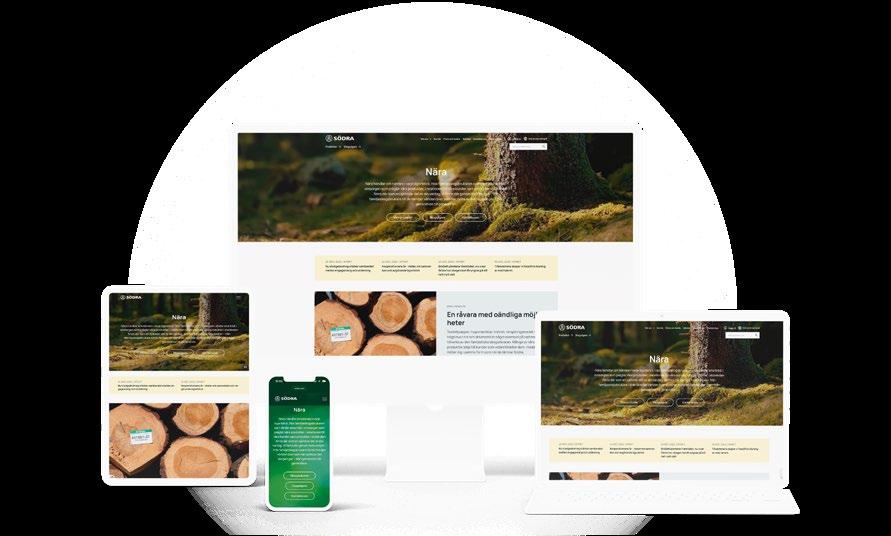
The reports, as well as other information about Södra, are available at sodra.com/financials
for more information, visit: sodra.com/contact
SÖDRA SKOGSÄGARNA EKONOMISK FÖRENING
Postal address: SE-351 89 Växjö, Sweden Street address: Skogsuddevägen 40, Växjö +46 470 890 00 info@sodra.com
For questions about the Annual and Sustainability Report, please contact: CFO Magnus Örnberg Telephone: +46 470 891 88 E-mail: magnus.ornberg@sodra.com
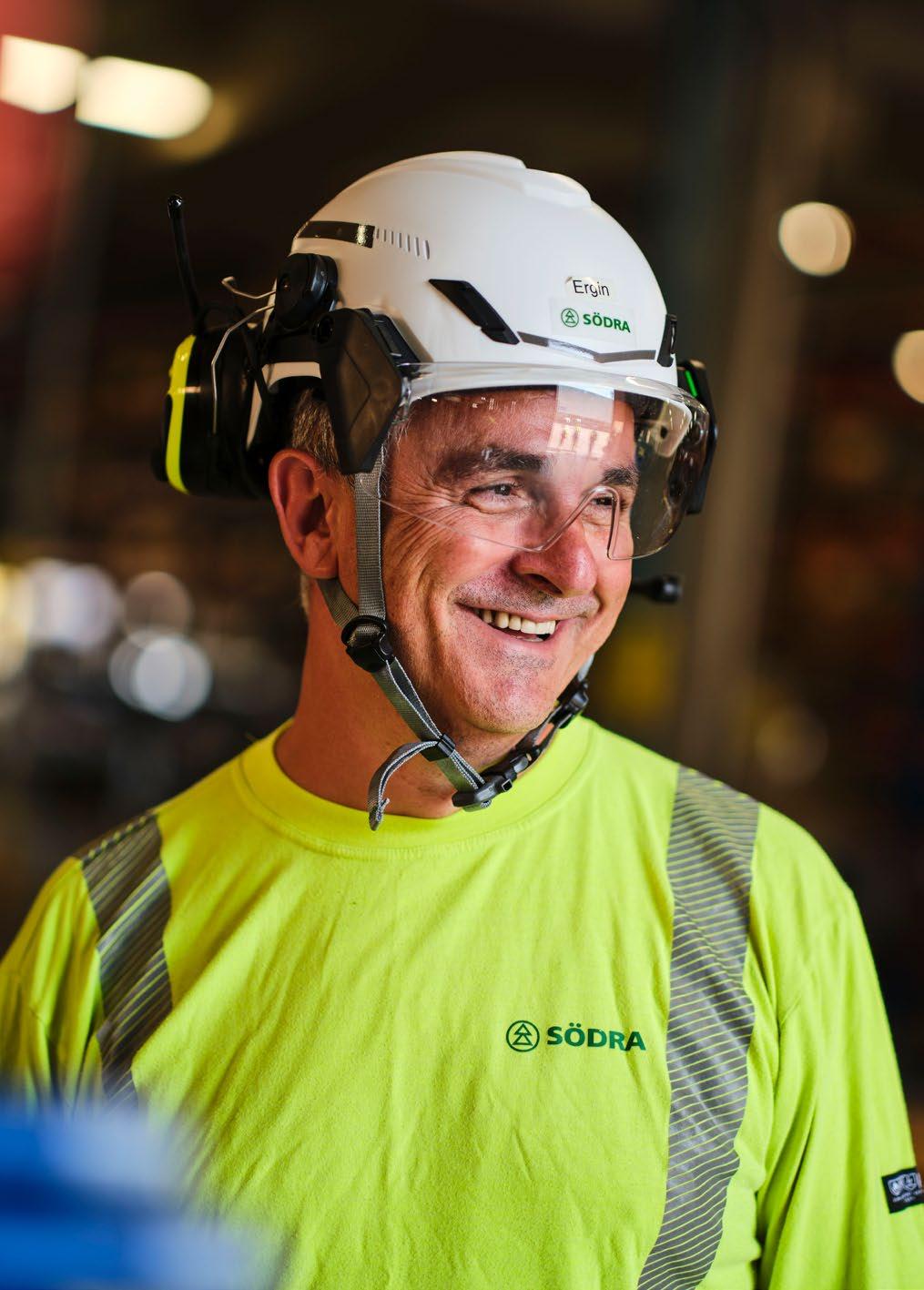
Image on front cover: Forest roads make a difference Forest roads play an essential role in the management and preservation of the forest, and in ensuring a safe work environment. They facilitate the transportation of wood and provide access for hunting, outdoor recreation and nature experiences. But the significance of forest roads goes beyond that. In the event of fires, accidents or crises, they are an integral part of Sweden’s preparedness, enabling the rapid movement of people, vehicles and equipment. Forest roads are more than just roads in the forest. They are part of a robust, well-functioning society.
Rooted in the forest, we grow the future. Södra was founded in 1938 on the idea that we are stronger together. Södra is now the largest forest-owner association in Sweden, with more than 50,000 family forest owners as members. Together, the members of Södra own a world-leading industrial operation that processes forest raw material into renewable products such as pulp, timber, building systems, energy and biochemicals.
Södra Skogsägarna ekonomisk förening
address SE-351 89 Växjö telephone +46 470 890 00 e-mail info@sodra.com website sodra.com