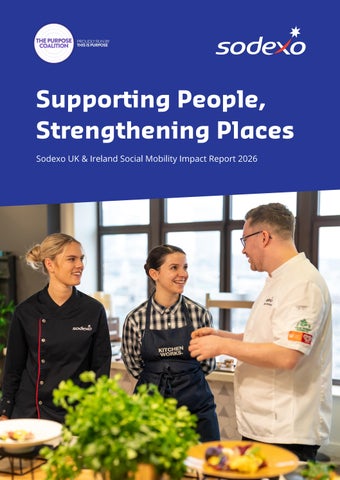

Supporting People, Strengthening Places
Sodexo UK & Ireland Social Mobility Impact Report 2026


Contents
0. Executive Summary
1. Forewords
Rt Hon Justine Greening, Chair of The Purpose Coalition; Jean Renton, Chief Executive Officer, Sodexo UK & Ireland
2. An Overview of Sodexo and its Purpose
3. Sodexo’s Journey So Far
4. Mapping Sodexo’s Activity Against the Purpose Goals
5. Analysis
6. Key Community Opportunity Barriers
7. Looking Ahead
0. Executive Summary
Sodexo is one of the UK and Ireland’s leading food services and facilities management companies, employing more than 30,000 colleagues across workplaces, schools, universities, hospitals, justice settings, defence sites, government contracts and sports & leisure venues, such as stadia, airport lounges and cultural destinations.
As it marks 60 years globally, Sodexo continues to embed its purpose through its Social Impact Pledge 2030: Everyone, Every Day, Everywhere; a strategy centred on People, Planet, Places and Partners. Rather than viewing social impact as separate from business performance, Sodexo has positioned opportunity, sustainability and
inclusion as central to how it operates.
This report represents the second major collaboration between Sodexo and the Purpose Coalition since the publication of its first impact report in 2022. It demonstrates the progress made over the past four years, highlighting the Purpose Goals where Sodexo is making its greatest contribution and identifying opportunities to deepen this impact in the years ahead.

Fair Career Progression
Sodexo is creating clearer and more accessible routes for colleagues to build long-term careers. Through structured career pathways, leadership programmes and apprenticeships, the organisation is ensuring progression is based on talent and potential. This commitment has been recognised nationally through awards including Employer of the Year at the British Business Awards and consecutive recognition as one of the UK’s Top 75 Employers for Social Mobility.
Investment in skills is central to this approach. More than 700 colleagues are currently undertaking apprenticeships, with apprenticeship starts having increased by 35% over the past year and levy utilisation rising from 53% to 97%. Development opportunities now span every stage of a career, from entry-level qualifications through to senior leadership programmes, ensuring colleagues can continue learning and progressing throughout their working lives.
Widening Access to Opportunity
Sodexo recognises that widening opportunity requires targeted action for people who face barriers to employment. Initiatives supporting women, veterans, prison leavers, care leavers and people with disabilities are creating more inclusive pathways into work and progression once employed. Policies such as Ban the Box, Disability Confident and enhanced carers’ leave further reinforce this commitment to equitable employment.
The organisation is also investing in the next generation through work experience, virtual learning programmes, partnerships with schools and universities, and initiatives such as Cook for Change, helping young people develop skills and confidence while showcasing the breadth of careers available within hospitality and facilities management.

Strengthening Communities
Beyond its own workforce, Sodexo is helping create opportunity across the communities it serves. Through the Stop Hunger Foundation, partnerships with charities, local authorities and education providers, and programmes supporting young people, care leavers and those furthest from the labour market, the organisation is addressing the root causes of inequality and helping individuals develop the confidence and skills needed to thrive.
These initiatives demonstrate how a major employer can use its local presence to create lasting social value, extending the impact of its business well beyond the services it delivers every day.
Driving Sustainable Growth
Sodexo recognises that environmental sustainability and social mobility are closely connected. Its commitment to achieving Net Zero by 2040 and embedding sustainable practices across its operations all demonstrate how the organisation is supporting the transition to a greener economy and creating new skills and opportunities for colleagues and clients.
Its Social Impact Pledge also extends into the supply chain, with commitments to spend more than £1 billion with SMEs and diverse suppliers by 2030, ensuring procurement supports inclusive economic growth while strengthening resilient local economies.
Partnership
Collaboration underpins Sodexo’s approach to breaking down barriers. From its partnership with the Purpose Coalition to its work alongside schools, charities, clients, local authorities and community organisations, the business recognises that long-term social impact depends upon organisations working together to create opportunity at scale.
This report demonstrates how Sodexo is embedding social impact across every aspect of its business. The organisation is creating measurable opportunities for colleagues, customers and communities alike by aligning workforce development, community investment, environmental sustainability and partnership around a shared purpose.
Sodexo’s journey demonstrates how a purpose-led business can be a powerful driver of social mobility. With opportunity placed at the heart of its strategy, Sodexo is helping to strengthen communities and ensure more people can access the skills, employment and support needed to fulfil their potential.
Sodexo UK & Ireland at a Glance
Supporting People, Strengthening Places. Creating opportunity.
We use our scale, partnerships and expertise to open doors to education, skills and work –creating inclusive workplaces and stronger communities.
Our scale in the UK & Ireland
30,000+ colleagues
2,000+ sites
Millions of people served every day
£1.0bn+
UK & Ireland SMEs and diverse supplier spend by 2030
60% of spend with SMEs
Net Zero by 2040 across operations
Our focus: Community needs we’re addressing
Poverty
Tackling cost of living and food insecurity
Skills
Building skills and improving employability
Jobs
Creating fair access to quality work and careers
Wellbeing
Supporting physical, mental and financial wellbeing
Inclusivity
Championing culture and belonging for all
Where we create impact across the life journey
Inspire
Early exposure to opportunity and aspiration
Schools, colleges and community programmes
Enter
Opening doors to employment and work experience
Entry level roles
Traineeships and apprenticeships
Progress
Developing skills and supporting career progression
Learning, mentoring and internal mobility
Thrive Inclusive workplaces where colleagues can thrive
Wellbeing support Networks and recognition
Lead
Future leaders reflecting our diverse communities
Leadership development and succession
Our impact so far:
Schools & Education
• Foundation Apprenticeships
• Career education & experiences
• 500+ school partnerships
12,000+ young people reached
Entry Level Opportunities
• Apprenticeships
• Traineeships & internships
• Fair start recruitment
2,200+ apprentices and trainees since our last report
Learning & Development
• 1M+ learning hours
• Leadership programmes
• Digital & green skills
80%+ colleagues with regular L&D
Employee Networks
• 7 colleague networks
• Allyship & engagement
• Inclusive culture training
20,000+ network members
Inclusion Initiatives
• Starting Fresh
• Ban the Box Employer
• Signed Care Leavers Covenant
• Disability Confident Employer
1,000+ Starting Fresh opportunities
Partnerships multiply our impact
We work with charities, social enterprises, public sector and local partners to address barriers and create change.
Recognition & Wellbeing
• Recognition programmes
• Wellbeing support & resources
• Financial wellbeing tools
75%+ engagement score
1. Foreword
Rt Hon Justine Greening Chair of the Purpose Coalition

At a time when Britain continues to grapple with deep and persistent inequalities, organisations have a vital role to play in widening access to opportunity. Breaking down barriers is not simply about good intentions. It is about showing, clearly and credibly, where progress is being made, where challenges remain, and how business can act as a force for change in the lives of colleagues, customers and communities. It is also about building a stronger economy: developing talent, strengthening workforce resilience, supporting social mobility and ensuring businesses can access the diverse skills and perspectives they need to grow and succeed in the long term.
That is why this report matters.
Sodexo is a business with real scale, deep roots in communities across the UK and Ireland, and a reach that extends into many of the places that shape people’s daily lives: schools, hospitals, workplaces, justice settings and public spaces. With that reach comes the ability to make a meaningful difference, not only through the services it provides, but through the opportunities it creates, the partnerships it builds and the standards it sets. In doing so, Sodexo is also helping to strengthen local economies, develop future talent pipelines and address some of the workforce challenges facing employers and communities alike.
This report shows how Sodexo is translating that potential into practical action. It highlights a business thinking seriously about what fair career progression looks like, how opportunity can be opened up to people who are too often excluded, how the transition to a greener economy can be harnessed in a way that is inclusive, and how partnership can amplify impact far beyond the boundaries of any one organisation. It also demonstrates a clear understanding that inclusive growth and economic growth go hand in hand: when more people are able to access quality work, skills development and progression opportunities, businesses are better placed to innovate and grow sustainably.
What stands out in particular is Sodexo’s understanding that social impact is strongest when it is embedded, not bolted on. Whether through apprenticeships, support for people with convictions, action on food insecurity, investment in diverse suppliers or its wider work to create inclusive workplaces, Sodexo is demonstrating that breaking down barriers requires long-term commitment and a willingness to connect purpose with delivery. This approach reflects Sodexo’s long-standing commitment to being a responsible business, embodied in its Social Impact Pledge 2030. Launched in 2025 and building on more than a decade of transparent reporting and action since its original Public Service Pledge, it sets out ambitious commitments across People, Planet, Places and Partners to create meaningful change for colleagues, customers, communities and the wider economy.
Importantly, this is not a report that suggests the job is done. The strongest organisations are those prepared to assess their progress honestly, celebrate what is working and stay ambitious about what comes next.
The Purpose Coalition exists to bring together organisations that are serious about measurable impact and serious about opportunity. Sodexo’s work is an important example of how employers can use their influence, insight and partnerships to help shape a fairer and more inclusive country. Crucially, it also shows why this agenda makes strong business sense: organisations that invest in people, skills and opportunity are better equipped to attract and retain talent, drive productivity and contribute to long-term economic growth.
I am pleased to introduce this report and to recognise the progress Sodexo has made so far. I hope it will encourage others to think boldly about the role they can play in breaking down Britain’s barriers and building a society in which opportunity is spread more widely and more fairly.

Jean Renton Chief Executive Officer, Sodexo UK & Ireland
At Sodexo our purpose is to shape better everyday experiences at every moment in life. For me, that starts by creating client and customer experiences, opportunities for people to thrive, and giving back to the communities in which we operate.
We believe that when people are given the opportunity to succeed, everyone benefits. As one of the UK & Ireland’s largest employers, with around 30,000 colleagues working across more than 2,000 sites, we see every day the positive impact that employment, skills and opportunity can have on individuals, businesses and communities.
Together with our clients, we create pathways into work, help people develop new skills and support long-term, fulfilling careers. We work alongside our charity partners to tackle food insecurity and help people overcome barriers to employment. We invest in our suppliers, particularly SMEs, helping them grow, innovate and unlock their potential. And we support the communities where we operate because strong businesses and strong communities go hand in hand.
None of this happens in isolation. Our clients and partners choose to work with us because they want to make a positive difference too, and together we can achieve far more than either of us could alone.
As our business grows, so too does our ability to create positive social impact. Growth enables us to employ more people, support more apprentices, work with more local suppliers, strengthen more communities and create even more opportunities for those who need them most. That’s the positive ripple effect this report is all about.
The report brings that story to life and demonstrates what’s possible when businesses put opportunity at the heart of their growth. It showcases the progress we’ve made, often in partnership with others. This includes supporting more than 700 apprentices, expanding our Starting Fresh campaign for prison leavers, helping thousands of young people experience the world of work, investing in SMEs, and strengthening communities through our Stop Hunger Foundation and charity partnerships.
We’re proud of the progress we’ve made, but we know there is still much more to do. By continuing to work together with our clients, partners, suppliers, charities and communities, we can help more people fulfil their potential, strengthen local economies and create a better every day for everyone.

2. An Overview of Sodexo and its Purpose
An Introduction to Sodexo
Sodexo is a global services company with a long-standing presence in the UK and Ireland, dedicated to shaping better everyday experiences through the range of services it provides across many different sectors including the workplace, schools & universities, health & care settings to Government contracts. From nutritious catering and facilities management to tailored hospitality and wellbeing programmes, Sodexo’s work is deeply embedded in the daily lives of millions of people across the communities it serves.
Founded in 1966, this year marks Sodexo’s 60th anniversary: a milestone reflecting six decades of growth, innovation and sustained commitment to enriching the environments where people live and work. Over this
period, the organisation has evolved into one of the UK and Ireland’s most significant providers of food and support services, done brilliantly together, with thousands of colleagues working across sectors and regions to deliver positive experiences and outcomes for clients, customers and communities.
Central to Sodexo’s identity is a purpose-led approach that goes beyond commercial success. The company believes that its services should not simply meet operational needs, but should also contribute positively to society and the environment, helping to make people’s lives better every day. This ethos underpins Sodexo’s strategy, partnerships and the behaviours it encourages across its workforce and supply chain.
Sodexo’s Purpose
Sodexo’s purpose is centred around the belief that businesses have a vital role to play in addressing societal challenges and driving meaningful, measurable social impact. This belief is most clearly articulated through Sodexo’s ‘Social Impact Pledge 2030: Everyone, Every Day, Everywhere’, a five-year strategy launched in 2025 that sets out ambitious commitments to deliver positive change across four interconnected impact pathways: People, Planet, Places and Partners.
• People - Sodexo aims to nurture inclusive and equitable workplaces that support social mobility and opportunity for all. As a major UK and Ireland employer of more than 30,000 people, the company recognises its potential to drive fair access to employment, skills development, apprenticeships and career progression, especially for individuals facing barriers to opportunity. Progress is tracked, in part, through external benchmarks such as the Social Mobility Employer Index.
• Planet - Environmental stewardship is a central pillar of Sodexo’s purpose. The company continues its journey toward Net Zero 2040, committing to significant reductions in greenhouse gas emissions (including a 55% reduction target across key scopes by 2030). By embedding sustainable practices into operations and working collaboratively with clients and supply partners, Sodexo seeks to minimise its environmental footprint and support broader climate action.
• Places - Sodexo’s commitment to places is closely linked to its charitable work through the Stop Hunger Foundation. By 2030, the Foundation is projected to have supported more than 12.5 million people in local communities through direct and indirect interventions aimed at fighting food insecurity and its root causes. In addition to grants and fundraising, colleagues are empowered to volunteer, strengthening connections between the company and the communities in which it operates.
• Partners - Recognising that collective action magnifies impact, Sodexo’s Social Impact Pledge also includes commitments to increase diversity in its supply chain, including plans to spend over £1 billion with SMEs and diverse suppliers by 2030. This commitment aims to support inclusive economic growth, foster innovation and embed sustainable practices throughout the value chain.
Across all of these pathways, Sodexo emphasises transparent reporting and accountability. The company publishes annual social impact reports that provide data, examples and progress updates against its strategic goals, reinforcing a culture of evidence-based decision-making and continuous improvement.
The Social Impact Pledge 2030 established a new benchmark for the sector, making Sodexo the first organisation in the hospitality and facilities management industry to publish a comprehensive Social Impact Pledge. More than a statement of intent, it provides a clear framework for measuring and reporting progress, ensuring social impact is embedded across every part of the organisation and held to the same level of accountability as business performance.
Sodexo’s purpose is to shape better everyday experiences, while helping to build a more equitable, sustainable and inclusive future, ensuring that positive social impact is integral to how the business operates and contributes to UK and Irish societies.

David Fox, Chief Executive Officer, Sodexo Ireland
“As Chief Executive of Sodexo Ireland, I’m proud of the difference our teams are making across communities nationwide. We believe opportunity is key to social mobility, breaking down barriers and enabling people from all backgrounds to thrive. Through partnerships like A Lust for Life and our focus on inclusion, wellbeing, and employability, we are helping to create lasting social value across Ireland.
What sets this apart is our people. Every day, our colleagues champion inclusion, support those facing barriers to work, and give back to their communities. The impact is clear from expanding access to youth wellbeing programmes to strengthening belonging and representation across our workforce. By continuing to work alongside our clients and partners, we are helping to build a more inclusive and equitable Ireland for future generations.”

3. Sodexo’s Journey So Far
The Purpose Goals
The Purpose Coalition measures organisations against a set of sector-relevant social impact criteria. The Purpose Goals outline 15 interconnected barriers to opportunity, spanning key life stages and challenges faced across the UK. By drawing on expertise provided by academia and business, the goals are designed to specifically address some of the unique challenges facing the UK.
The Coalition’s cross-party work brings together the UK’s most innovative leaders, Parliament and organisations to improve, share best practice and develop solutions for improving the role that organisations can play for their customers, colleagues and communities by breaking down barriers to opportunity.
The Purpose Coalition is chaired by Rt Hon Justine Greening, the UK’s former Secretary of State for Education, Transport and International Development.
The Goals were designed following Justine’s experience as Secretary of State for International Development,
leading the UK’s delegation to the convention of the United Nations (UN) that established the 2015 UN Sustainable Development Goals (SDGs). The Purpose Goals apply the SDGs in a UK context.
The SDGs as interlinked goals emphasised the interdependent environmental, social and economic aspects of development and centralised the role of sustainability. At the time, Justine recognised how transformative a common set of accessible but ambitious goals could be in galvanising action to effect change. After leaving Government in 2019, Justine established the Purpose Coalition and Social Mobility Pledge with the intention of galvanising UK economic and social actors to improve social mobility in the UK.
The Purpose Goals focus on key life stages and highlight the main issues that need to be resolved to break down barriers to opportunity in the UK. The Goals are intended to guide ambition, provoke action and measure progress.
Sodexo’s
Progress so far
This report represents the second major collaboration between Sodexo and the Purpose Coalition, building on the organisation’s first Impact Report, published in 2022. Over the past four years, Sodexo has significantly expanded the scale and ambition of its social impact activity, embedding opportunity more deeply across its people strategy, operations and partnerships.
Progress has been driven through a series of practical initiatives that are creating clearer pathways into employment, strengthening career progression and extending opportunity into the communities where Sodexo operates. Since the first report, the organisation has:
• Launched an end-to-end career development pathway, accessed by more than 5,000 colleagues, making career progression visible and accessible across every role in the business.
• Expanded its Grow Apprenticeship Programme, supporting around 200 first-line managers identified as future leaders, while introducing new AI, Digital and Data apprenticeships to equip colleagues with future-focused skills.
• Refreshed its Culinary Academy, creating enhanced development opportunities for chefs at every stage of their careers through apprenticeships, mentoring and specialist training.
• Targeted Apprenticeship Levy transfers towards organisations operating in IMD 1-3 communities, widening access to vocational learning where it can have the greatest social impact.
• Launched a virtual work experience programme with Unifrog, engaging more than 1,700 young people to date and inspiring the next generation to consider careers across hospitality and facilities management.
• Introduced Release on Temporary Licence (ROTL) apprenticeships, expanded the Starting Fresh campaign, joined the Bright Future Co-operative supporting survivors of modern slavery, and signed the Care Leavers Covenant, strengthening support for people facing barriers to employment.
• Delivered Purpose Labs with clients and partners, including at the University of Glasgow and HMP Peterborough, helping shape place-based approaches to widening opportunity, while developing a new Place Strategy focused on responsible business activity and community impact.
• Published its Net Zero Report and continued to accelerate environmental progress, reducing food waste by more than 50%, alongside launching its 2025 Gender and Ethnicity Pay Report to strengthen transparency and accountability.
• Became the first organisation to achieve Ambassador status under the Social Recruitment Advocacy Group Chartermark, while launching initiatives such as Food of Black Origin (FOBO) through its Origins employee network to celebrate diversity and belonging across the workforce.
Alongside these achievements, Sodexo and the Purpose Coalition have begun the next phase of their partnership through a series of Purpose Labs across the organisation’s justice estate, engaging people in custody, employers and local partners to identify practical solutions that improve pathways into sustainable employment. The findings will inform future recommendations for both government and business, reinforcing Sodexo’s ambition to combine commercial success with measurable social impact.
These developments demonstrate how Sodexo has moved from establishing a strong foundation for social impact to embedding opportunity, inclusion and sustainability more deeply across its business. The following chapters explore the areas where this progress has been strongest and identify opportunities to build on this momentum in the years ahead.
4. Mapping Sodexo’s Activity Against the Purpose Goals
Goal 6: Fair Career Progression
• Creating clear pathways for progression: Structured career frameworks and leadership programmes help colleagues understand how they can progress into new roles and build long-term careers within Sodexo.
• Investing in lifelong skills development: Apprenticeships, management training and early careers programmes provide accessible opportunities for people of all ages and backgrounds to gain qualifications and progress into higher-skilled roles.
• Removing barriers to career success: Targeted initiatives supporting women, care leavers, veterans, prison leavers and other underrepresented groups help ensure progression is based on talent and potential.
• Extending opportunity beyond the organisation: Partnerships with schools, charities, SMEs and industry organisations create pathways into employment, widening access to skilled careers across the communities Sodexo serves.
For career progression to be truly fair, it must be visible, accessible and supported at every stage of employment. Entry-level opportunities alone do not create social mobility; what matters is whether individuals can see a future for themselves and are equipped with the support to move towards it. At Sodexo, fair progression is embedded within its broader Social Impact Pledge 2030, which places people at the centre of its strategy.
Under this pledge, Sodexo has committed to nurturing inclusive and equitable workplaces, measuring its performance through recognised benchmarks such as the Social Mobility Employer Index. This focus reflects a belief that large employers have both the scale and responsibility to act as engines of opportunity within the communities they serve.
This commitment has received significant external recognition. In 2026, Sodexo was named Employer of the Year at the British Business Awards, one of the UK’s leading business awards programmes. The award recognised the organisation’s commitment to creating inclusive workplaces, investing in skills and career progression, supporting colleagues from diverse backgrounds and embedding social impact throughout its people strategy. This builds on Sodexo’s wider recognition as one of the UK’s Top 75 Employers for Social Mobility for two consecutive years, reflecting the organisation’s sustained commitment to widening opportunity through employment, progression and inclusive workplace practices. Together, these accolades reinforce Sodexo’s belief that creating opportunity for colleagues is not only the right thing to do, but also fundamental to building a resilient, highperforming business.
Sodexo’s approach to progression is founded on the belief that talent exists across every business segment and at every level of the organisation. Across its diverse operations, from hospitals and schools to justice settings, defence sites and corporate workplaces, colleagues join Sodexo at different stages of life, bringing varied lived experiences, skills and experience.
Many colleagues begin in frontline roles and progress through apprenticeships, internal career mobility or supported development pathways. This includes creating opportunities for people who may have faced barriers to employment, including individuals with criminal convictions, veterans and those transitioning from military service into civilian careers.
Sodexo recognises that fair progression must account for different starting points. Creating equity means not only opening access to employment opportunities, but ensuring colleagues can see a future for themselves within the organisation, supported by clear development pathways, learning opportunities and inclusive leadership. Operating across thousands of sites, Sodexo recognises that its workforce represents one of its most powerful levers for advancing social mobility by creating jobs and ensuring those jobs lead to meaningful careers.
At Sodexo, colleagues are encouraged to belong, act and thrive, building rewarding careers from wherever they start, with the support, opportunities and purpose to grow and make a positive difference every day.

In 2026, Sodexo was named Employer of the Year at the British Business Awards
Pathways to Progression
A consistent challenge in large, multi-site organisations is ensuring that career progression is understandable and achievable, regardless of where someone begins. Sodexo has responded by placing visibility and clarity at the heart of its progression approach. Clear pathways matter because they reduce ambiguity: colleagues can see what roles exist beyond their current position and what competencies are needed to move them forward. By making expectations transparent, Sodexo helps employees to plan, rather than rely on chance opportunities.
In September 2025, Sodexo launched an end-to-end career development pathway spanning first-line roles through to executive leadership. This pathway was designed to be accessible to colleagues across all roles, linking progression to learning opportunities. The intention is straightforward: anyone should be able to identify a future destination in the business and understand the practical stages required to reach it. Early engagement suggests strong interestaround 5,000 people have accessed the pathway to date indicating the value of a clearer internal progression framework.
Alongside this broader pathway, targeted programmes support colleagues at key transition points. A prominent example is the Aspiring Front Line Manager programme, which has attracted more than 200 participants. As part of Sodexo’s ‘Grow’ Apprenticeship Programme, it is aimed at colleagues in first-line management roles or those identified as having the potential to move into a leadership role. Delivered over six months, the programme blends theory with hands-on application, helping participants build confidence in leading teams and navigating the responsibilities that come with supervisory positions. Graduates are often recognised at internal events, reinforcing that progression is celebrated and that investment in learning is valued. Participant feedback emphasises the practical strength of the programme and its usefulness for those seeking to advance into management.
The organisation’s broader management training offer is positioned as a ‘ladder’ that responds to skills gaps at different levels. At entry supervisory level, Aspiring Front Line Managers addresses operational leadership, compliance and core people management, ensuring new supervisors have the foundations for safe, effective team leadership. At mid-management
level, Grow with Sodexo provides structured apprenticeships, such as Level 3 Team Leading and Level 5 Operational Management, designed to strengthen strategic thinking, financial understanding and inclusive leadership, while aligning with Sodexo priorities and compliance requirements. At senior levels, the Talent Development Leadership Framework focuses on capabilities such as resilience, emotional intelligence and stakeholder management, combining strategic projects with immersive learning to strengthen succession planning and reduce reliance on external recruitment.
Sodexo also reinforces progression through recognition of long-term commitment. High retention and internal growth are treated as organisational strengths, and the business makes space to celebrate colleagues who build long careers over decades. Long Service Awards mark milestones such as 20, 30, 40 and even 50 years of service through celebratory events. Colleagues are therefore encouraged to see Sodexo as a place to build a career over time, with loyalty and development visibly acknowledged.

Tracey Smith, CEO, UK Schools & Universities, Sodexo
“Education settings play a unique role in shaping life chances. Every day we have the opportunity to support environments where young people can learn, develop confidence and broaden their aspirations.
A nutritious meal is a vital part of that. Good food helps young people to concentrate, learn, thrive and reach their full potential, while creating positive habits that can last a lifetime.
Through our work in schools and universities, we are committed to creating experiences that support wellbeing, encourage ambition and help young people access the opportunities they need to fulfil their potential.”
Apprenticeships
Apprenticeships are one of Sodexo’s most significant mechanisms for building fair progression, expanding access to accredited learning and creating clear, structured routes into skilled roles. They are not a standalone initiative, but a core element of Sodexo’s workforce strategy, supporting both early careers entrants and existing colleagues to retrain, upskill and progress in response to evolving business needs.
The impact of this approach is reflected in strong programme growth and retention. Apprenticeship starts have increased by 35% during the current financial year, while learner leaver rates have reduced, demonstrating both increased access and an improved learner experience. At the same time, apprenticeship levy utilisation has increased significantly from 53% to 97%, helping maximise investment in workforce development.
This commitment has also been recognised nationally, with Sodexo named among the UK’s Top 100 Apprenticeship Employers. The recognition reflects the organisation’s sustained commitment to developing future talent through accessible, high-quality vocational learning. Building on this momentum, Sodexo has also committed to creating 100 Foundation Apprenticeships for 16 to 21-year-olds, supporting the UK Government’s ambition to expand high-quality vocational pathways for young people and helping more young people take their first step into skilled employment.
The breadth of provision is central to Sodexo’s approach. More than 700 colleagues are currently undertaking apprenticeships across key operational and professional functions including catering, facilities management, hospitality, business administration and digital roles, spanning Levels 2 through to Level 7. This creates multiple entry and progression points, enabling individuals to begin with GCSE-equivalent learning or progress into advanced specialist pathways. This includes emerging areas such as data and artificial intelligence, where more than 60 learners are currently undertaking apprenticeships to develop future-focused skills.
Sodexo’s approach actively removes barriers to opportunity. Apprenticeships are designed to be accessible to frontline colleagues as well as office-based employees, supported by proactive on-site engagement that ensures individuals without regular access to digital platforms can participate. There is no narrow age assumption attached to learning and development. Participation spans from age 16 through to colleagues in their sixties, reinforcing the principle that progression and learning should be available throughout a career.
Beyond its own workforce, Sodexo is also using apprenticeship funding to widen opportunity across communities. Through its Apprenticeship Levy transfer programme, the organisation is increasingly prioritising support for employers operating in communities within Indices of Multiple Deprivation (IMD) bands 1 to 3. By directing investment towards organisations creating high-quality apprenticeship opportunities in areas facing some of the greatest barriers to social mobility, Sodexo is helping to strengthen local skills pipelines, support inclusive economic growth and expand access to rewarding careers where they can have the greatest impact.
This accessibility is matched by strong alignment to organisational need. Apprenticeships are developed alongside training providers to address skills shortages and reduce reliance on external recruitment, while targeted academies focused on areas such as culinary skills, artificial intelligence and multi-skilling help build critical capability from within. By ensuring structured development opportunities are accessible to colleagues from all backgrounds, Sodexo enables progression based on potential and capability rather than prior access to opportunity. This is particularly important in sectors where many colleagues may not have followed traditional academic pathways into work.
As a Silver member of The 5% Club, Sodexo has also committed to expanding “earn and learn” opportunities, demonstrating its belief that apprenticeships and vocational learning are central to building future skills, strengthening local economies and improving social mobility.

Peter Siddle, Talent & Learning Director, Sodexo UK & Ireland
“Skills development is one of the most powerful tools for widening opportunity. Whether someone is taking their first step into employment, changing career or preparing for leadership, learning should be accessible, relevant and linked to real progression. By investing in apprenticeships, leadership development and lifelong learning, we are helping colleagues build the confidence and capabilities needed to succeed.”
Culinary Academy and Cook for Change
Developing culinary talent has long been central to Sodexo’s approach to career progression. Through its refreshed Culinary Academy, the organisation provides chefs at every stage of their careers with structured learning, recognised qualifications and hands-on development opportunities that support long-term progression. Delivered in partnership with HIT Training, the Academy creates clear pathways from early-career commis chefs through to experienced senior chefs, combining formal apprenticeships with practical experience, expert mentoring and specialist masterclasses. The Academy reflects Sodexo’s commitment to investing in culinary excellence while ensuring colleagues have the skills, confidence and opportunities to build rewarding long-term careers.
As part of this wider commitment to nurturing culinary talent, Sodexo also hosts Cook for Change, its annual international culinary competition that celebrates creativity, sustainability and innovation. Bringing together talented chefs from across Sodexo’s global business, the competition encourages participants to
develop their technical skills while demonstrating how responsible, sustainable cooking can help shape the future of hospitality.
The competition provides finalists with opportunities to learn from industry leaders, showcase their abilities on an international stage and exchange ideas with colleagues from around the world. More than recognising culinary excellence, Cook for Change highlights the breadth of career opportunities available within hospitality while inspiring participants to continue developing their skills and ambitions.
The 2026 competition culminated in an international final hosted in London, that celebrated innovative approaches to sustainable cooking, recognising chefs who demonstrated exceptional creativity while making the most of seasonal ingredients and reducing food waste. In doing so, Cook for Change reinforces Sodexo’s belief that culinary excellence and sustainability go hand in hand, supporting the organisation’s wider ambitions around skills development, environmental responsibility and social impact.


Winning the Innovation Award at Cook for Change was a surreal moment for Gordon Carberry - especially because, at first, he didn’t even realise the judges, which included Anna Haugh, Executive Head Chef and owner of Myrtle Restaurant in London, were describing his dish.
“To be honest with you, when Anna got up and started talking, I didn’t actually think she was talking about my dish. Hearing someone of Anna’s calibre speak about something you created like that… it was amazing. I was buzzing.”
For Gordon, the recognition meant more than simply winning an award. As a self-confessed perfectionist, he admits he often only sees the flaws in his own work.
“You spend so much time working on a dish that sometimes all you can see are the bits you’d change. So hearing that level of praise was huge - especially for the innovation side of it. That part meant the most to me because it was about taking something ordinary and completely rethinking it.”
The inspiration behind his award-winning dish came from a simple idea: taking a humble Irish ingredient and pushing it as far as possible.
“I wanted to take something really normalsomething we all grew up eating - and see how far we could go with it. I settled on parsnip and thought: right, let’s see what we can actually do with this.”
Reflecting on the wider impact of competitions like Cook for Change, Gordon believes they’re helping to reshape industry thinking around sustainability and creativity.
“As chefs, we have a responsibility to lead from the front because we work with produce every day. If we can show people what’s possible with ingredients that would normally go to waste, then that can make a real difference.”
And for Gordon, the growing interest in sustainable cooking is something that gives him real optimism for the future.
“Seeing hundreds of chefs wanting to be part of something like this is brilliant. It shows things are moving in the right direction. It’s exciting to see how creative people can be - especially when they’re creating something beautiful out of what others might see as waste.”
Case Study: Gordon Carberry on his Cook for Change journey

Case Study: Phoebe
Phoebe’s progression illustrates how apprenticeships can open pathways not only into high-impact roles. Beginning as a Level 3 Business Administration apprentice in Sodexo’s Apprenticeships & Early Careers team, she contributed quickly by redesigning and simplifying processes. One of her early improvements - creating an apprenticeship nomination form - reduced the burden of a previously time-intensive system and supported higher participation, showing how early-career colleagues can deliver meaningful operational value.
Her development did not stall within one function. Phoebe later moved into Sodexo’s Digital Learning team and then onto a major client account (Nestlé), where she now works as a Digital Analyst. In this role she supports data governance, system development and technology training across 13 UK sites, introducing practical tools that strengthen decision-making and improve how teams access information, such as real-time KPI reporting, a centralised SharePoint resource hub and business intelligence reporting that accelerates insight for leadership teams.
Phoebe’s story also highlights progression through values-led contribution. Alongside her formal role, she volunteers as a Culture & Belonging Champion, helping to coordinate fundraising and volunteering activity throughout the year. Her achievements are especially notable given significant personal challenges, including dyslexia and a serious illness that restricted her mobility. Rather than limiting her ambition, these experiences have strengthened her resilience and drive. She has represented apprentices at the House of Lords, speaking publicly about the value of vocational routes. Her next steps include further development through advanced apprenticeships and technical training such as Power BI, reinforcing the idea that progression is ongoing rather than a single leap.

Case Study: Faye
Faye’s journey demonstrates what happens when apprenticeship design aligns with workforce planning and on-the-job coaching. Joining Sodexo as the first chef apprentice at Colchester PFI - a large Defence site supporting thousands of soldiers and Sodexo colleagues - Faye entered a high-volume, fast-paced environment with multiple kitchens and a central production unit. Her apprenticeship role was created as part of a strategy to rebuild culinary talent pipelines after the disruption of the COVID pandemic.
Faye progressed through her Level 2 Chef Apprenticeship by rotating across kitchens, participating in masterclasses through HIT Training and receiving structured coaching from an Executive Head Chef. Completing the programme with a Distinction in May 2024, she secured a permanent role in the Officers’ Mess. Soon after, she chose to continue her progression by starting a Level 3 Commis Chef Apprenticeship, developing new technical skills and beginning to take on early supervisory responsibilities.
Her awards and recognition, including medals at the International Salon Culinaire, local Apprentice of the Year, and multiple wins at the Colchester Salon Culinaire, reflect her individual capability and the impact of structured development. Her progress has been supported alongside learning support needs, demonstrating that apprenticeships can be inclusive while still maintaining high standards. Faye is now part of Sodexo’s talent pipeline and is expected to contribute to the development of future apprentices through the site’s Chef Academy. Her stated ambition to become a Head Chef within five years shows how apprenticeships can create credible routes into senior skilled roles.
Creating a Diverse Workforce
For Sodexo, building a diverse workforce is about creating a culture where colleagues feel respected, supported and able to progress. The organisation’s approach increasingly focuses on belonging: ensuring people from different backgrounds can see a future for themselves within the business and feel confident accessing development opportunities. This is especially important for colleagues who may have experienced exclusion from the labour market or barriers to stable employment in the past.
A fair progression system must be equitable. Sodexo’s approach therefore includes targeted action to expand who accesses development and leadership pathways, particularly where representation gaps exist.
Women’s progression is one such focus. Initiatives like Women in Leadership and programmes such as SheLeads and SheWorks aim to address structural and cultural barriers by providing the kinds of support that often accelerates progression: mentoring circles for female middle managers and job shadowing opportunities in areas of the business where women are under-represented.
This focus on women’s development is reinforced through EmpowerHer, a programme delivered with Pilotlight and designed for women leaders at Sodexo. In its first year, EmpowerHer supported two charities while giving participants an opportunity to develop their skills outside their usual working environment and apply expertise in a new context. 72.7% of participants reported increased confidence in using research, analysis and subject-matter expertise creatively and 63.6% reported more frequent demonstration of inclusive working and appreciation of different perspectives. The same proportion reported higher confidence in navigating complex situations, collaborating across functions and building cohesive teams under time pressure. These outcomes matter for fair progression because they strengthen the competencies typically associated with senior leadership readiness.
Partnerships reinforce this commitment: Sodexo has joined the Bright Future Co-op to support survivors of modern slavery into work placements that can
lead to permanent roles and works with New Futures Network on prison leaver programmes. The organisation is also developing pilots with partners such as University College London Hospitals NHS Foundation Trust to support care leavers locally and is in the process of signing the Care Leavers Covenant. In Kent, Sodexo’s Stop Hunger Foundation is funding a programme that supports care leavers into employment, reflecting the role of philanthropic investment in widening access to progression routes.
Sodexo also signals inclusivity through policy: in addition to operating a Forces Friendly policy, it is a Ban the Box employer and runs a Disability Confident interview scheme. In addition, an enhanced carers leave policy supports colleagues who have caring responsibilities, helping to reduce the risk that caring duties become a barrier to staying and progressing at work.
Case Study: Building Futures
Building Futures is a place-based programme supporting 16-25-year-olds in Kent who are care leavers or NEET. Over six structured days, up to 12 participants receive group workshops and one-to-one support covering career planning, CV development, interview preparation, budgeting, communication, teamwork and confidence-building. Two practical cookery sessions strengthen wellbeing and financial resilience, with each participant receiving a slow cooker to encourage continued healthy, low-cost cooking at home.
Those ready for work are supported into interviews with local employers, while others are directed towards volunteering or education routes. The programme is grounded in partnership between Sodexo, Kent County Council’s care leaving service and Social Enterprise Kent, ensuring the offer reflects local need in an area with particularly high numbers of care leavers.
Case Study: Achieve More Together
Achieve More Together was created to address a recurring barrier identified by employment support charity Môn CF: many unemployed people are practically capable but leave school with few qualifications. Launched in 2022, the programme provides vocational training for pupils aged 14-16 who are at risk of leaving school without qualifications, combining accredited learning with employability skills such as teamwork, confidence-building and first aid.
In 2025, Sodexo’s Stop Hunger Foundation supported the programme and 91 qualifications were achieved, with many pupils progressing into apprenticeships, work or further education. Môn CF now intends to expand the programme to a third high school on the Isle of Anglesey, reaching an additional 24 learners.
Case
Study: Creating Pathways into Sustainable Employment through Partnership
For people facing barriers to employment, finding not just a job but a pathway to a long-term career can be a significant challenge. Through the long-standing partnership between Sodexo’s team at Northumbria University and Northern Rights Social Enterprise, meaningful opportunities are being created for people from diverse and often disadvantaged backgrounds to enter, progress and thrive in the workplace.
Northern Rights’ Restart Programme supports people who have struggled to access or sustain employment due to limited work experience, low confidence, learning difficulties or a lack of career direction. Through tailored employability coaching, interview preparation and confidence-building, participants are equipped with the skills needed to take their next step into work.
Over the past five years, Sodexo’s Northumbria University team has recruited more than 100 people through the Restart Programme into its summer commercial cleaning programme. These roles provide a valuable first step into employment through structured onboarding, training, qualifications and experience within a large organisation.

Supporting Opportunity through Schools and Universities
Across its Schools and Universities business, Sodexo creates environments where people can learn and thrive while also using these settings to create opportunities for local communities.
Alongside delivering food services, facilities management and student accommodation services, Sodexo works with education partners to create employment pathways for local residents and those who may face barriers to finding a job. Through partnerships with specialist employability organisations, its education sites help provide sustainable routes into work for people who might otherwise struggle to access the labour market.
Although many roles begin on a casual basis, the partnership creates pathways into longer-term employment. Training in health and safety and risk assessments, combined with ongoing support, enables individuals to build confidence and develop sustainable careers, with several progressing into permanent roles.
Jackie’s journey demonstrates this progression. She joined Sodexo in 2022 as a temporary cleaner through Northern Rights before returning the following summer and securing a permanent cleaning role. After taking on supervisory responsibilities during the 2024 and 2025 summer programmes, she successfully applied for a Customer Service Assistant role in 2026.
“With the help of Northern Rights, I gained a temporary cleaning job with Sodexo in 2022. I returned the following summer before securing a permanent role as a cleaner in December 2023. During the summers of 2024 and 2025 I was given the opportunity to work as a cleaning supervisor, and in 2026 I successfully applied for a Customer Service Assistant role back at Trinity Square where I first started.
I feel like I’ve come full circle, and I will be forever grateful to Sodexo and Northern Rights for the opportunities they have provided me.”
Jackie, Customer Service Assistant at Sodexo said:
The partnership succeeds because of close collaboration. Northern Rights supports every stage of the recruitment journey, from sharing vacancies and preparing candidates to inductions and ongoing support. During peak periods, more than 50 candidates have been recruited through a single coordinated intake.
David Graham of Northern Rights said:
“Sodexo has proved to be a fantastic employment partner for us. So far, they have given over 100 people on our Restart Programme the chance to start work and enhance their quality of life.
Sodexo has always ensured a smooth process from vacancy sharing through to induction, training and employment. Sodexo is a real asset to us and we look forward to working in partnership for many years to come.”
Early Careers
Fair progression also depends on early exposure: young people need to be able to see what work looks like and to understand the options available to them. Sodexo’s early careers activity includes work experience designed to provide practical insight into roles and workplace environments. A key initiative is a virtual work experience programme featuring a young woman in the business to help inspire more girls and young women to consider culinary careers. The programme aims to engage 2,000 students, with a target that 25% of participants come from schools and communities in IMD bands 1-3. Sodexo is also aiming for 4,000 interactions with work experience content each year and has partnered with Unifrog to extend reach. Early careers opportunities are further promoted through channels such as Youth Employment UK.
Sodexo also recognises that recruitment and onboarding are part of progression fairness. For new early-career starters, the organisation is working to improve how candidates experience the process from application through to settling into role. This includes reviewing job postings to ensure they are accessible and transparent, mapping timelines for each stage and offering multiple application routes to support candidates who may not be digitally confident. Sodexo has identified onboarding as an organisational gap, particularly where busy hiring managers
may not know what great onboarding looks like for different groups and is working to standardise onboarding while still enabling tailored support. For example, individuals who have been in prison for a long time may need additional training around changes in technology and modern workplace systems; supporting managers to anticipate these needs is part of making progression sustainable.
From a talent and inclusion perspective, candidates are also able to request reasonable adjustments during recruitment, which are then carried through into onboarding support with managers. This continuity matters as adjustments that are accommodated early reduce barriers that might otherwise affect retention and confidence, especially in the first months of employment.
Recognising that inclusive progression is also about workplace culture, Sodexo has paid attention to the experience of younger colleagues and the management approaches that help them thrive. The business has run listening sessions with Gen Z colleagues, using the insights to develop a report shared back into the organisation. This work is intended to support managers, particularly where there may be a significant age gap, by encouraging more responsive leadership that reflects what different employees value in their work and development.
Opening Pathways to Training and Employment
Sodexo’s progression approach extends beyond its own workforce through efforts to widen access to apprenticeship training in the wider economy. Sodexo’s commitment to widening opportunity extends beyond its own workforce through the strategic transfer of Apprenticeship Levy funding. To date, the organisation has transferred more than £3 million of levy funding to SMEs, charities and purposeled organisations, helping employers who may otherwise be unable to invest in apprenticeship programmes. This includes ring-fenced funding for organisations recruiting people with convictions, supporting fair chance employment, alongside a dedicated £250,000 investment to help address critical skills shortages across the hospitality sector. By directing levy funding where it can have the greatest social impact, Sodexo is strengthening local skills pipelines, supporting inclusive economic growth and creating opportunities that extend far beyond its own business.
Through levy transfer, Sodexo has so far supported 126 apprentices in SMEs, demonstrating a tangible mechanism for extending opportunity outside the organisation. For example, levy transfers have supported a nursery provider that had exhausted its levy, as well as support to police forces and other SMEs in local communities, reflecting a place-based approach to social mobility.
Partnerships also play a major role in widening access to careers. Sodexo’s long-standing relationship with The Springboard Charity supports pathways into hospitality, leisure and tourism, including placements and industry events that frame hospitality as a viable long-term career. Sodexo also supports apprenticeship and skills-based routes into hospitality careers through this partnership, helping demonstrate that vocational training can provide credible long-term progression opportunities for young people and career changers alike. This approach demonstrates strong retention: around 85% of those offered roles through Springboard stay with the company. Sodexo also supports Springboard FutureChef, a national school-based culinary competition designed to develop life skills and inspire young people towards hospitality careers. The partnership includes tailored delivery in settings supporting pupils with additional needs, including Down Syndrome or autism, demonstrating an inclusive approach to talent development.
Sodexo engages with early exposure programmes like The Switch, which introduce children to employability skills, financial literacy and confidence-building at a young age. These interventions, while external to
Sodexo’s direct workforce, contribute to the broader conditions that make fair progression possible, helping young people develop the capabilities and expectations that later support entry into training, work and long-term career development.
Sodexo extends this commitment to developing talent through place-based partnerships. At the Royal Botanic Garden Edinburgh, for example, Sodexo Live! works closely with Social Bite through its Jobs First initiative to create meaningful employment opportunities for people who have experienced homelessness or significant barriers to work. Through referrals from Social Bite, individuals gain practical workplace experience and structured support, helping them build confidence, develop skills and progress into sustainable employment. Around 13 people have secured full-time roles with Sodexo Live! at the Royal Botanic Garden Edinburgh through the partnership, with colleagues continuing to progress their careers across the business. Similar partnerships, including work with the Newcastle United Foundation, demonstrate how Sodexo collaborates with local organisations to provide careers advice, employability support and direct pathways into paid hospitality roles, helping people build confidence and access long-term employment opportunities.
Case Study: Creating Pathways into Employment through Social Bite
For people who have experienced homelessness or faced significant barriers to employment, securing sustainable work often requires more than access to vacancies alone. Confidence, workplace experience and ongoing support can be equally important in enabling individuals to rebuild their careers. Through its partnership at the Royal Botanic Garden Edinburgh, Sodexo Live! works alongside Social Bite to create supported pathways into long-term employment within hospitality.
Social Bite’s Jobs First initiative connects employers with people who have experienced homelessness or other significant barriers to work. Through referrals into Sodexo Live! participants gain practical workplace experience alongside structured employment opportunities that enable them to develop skills and establish sustainable careers.
Around 13 people have progressed into full-time employment with Sodexo Live! at the Royal Botanic Garden Edinburgh through the partnership. Several colleagues have continued to build successful careers after joining through the programme. Shirzai Hussini has progressed through a range of operational opportunities since joining Sodexo Live! most recently supporting delivery of the 2026 Genesis Scottish Open. Yusuf Akinlabi initially joined the Gateway Café in a front of house position before progressing into a kitchen role as he continues to develop his culinary skills.
The partnership illustrates how targeted employability support can combine to create long-term employment outcomes for people who may otherwise remain excluded from the labour market.
13: Harness the Energy Transition
• Driving progress towards Net Zero: A science-based decarbonisation strategy is helping reduce emissions across operations, transport and the wider supply chain.
• Embedding sustainability into everyday operations: Investment in renewable energy, fleet decarbonisation and energy efficiency is reducing environmental impact while improving operational performance.
• Reducing food waste through innovation: Data-led initiatives such as WasteWatch are cutting food waste and redistributing surplus food to support people experiencing food insecurity.
• Working collaboratively to accelerate change: Close partnerships with suppliers, clients and community organisations are extending environmental impact beyond Sodexo’s own operations and encouraging more sustainable practices across the value chain.

The transition to a low-carbon economy is one of the defining challenges facing businesses today, particularly for organisations operating across food services, facilities management and complex supply chains. Achieving meaningful progress requires coordinated action across operations, suppliers and communities to reduce emissions, improve resource efficiency and support more sustainable systems.
Sodexo has embedded environmental responsibility into its long-term strategy through its Social Impact Pledge 2030, within which the Planet pathway outlines the company’s commitment to climate action, sustainable food systems and resource efficiency.
Central to this approach is Sodexo’s ambition to achieve net zero emissions by 2040, supported by science-based targets, operational decarbonisation and supply chain engagement. As outlined in Sodexo’s Net Zero 2040 overview published in 2026, the organisation sees businesses as having an important role in accelerating the transition to more sustainable workplaces and food systems.
Case Study: Nuffield Health
Sodexo has worked closely with healthcare provider Nuffield Health to reduce food waste across hospital catering services. By implementing WasteWatch technology and analysing kitchen data, Sodexo teams identified areas where production and portion sizes could be adjusted to better match patient demand.
Regular collaboration between catering teams and healthcare staff has helped to address the reasons behind uneaten meals, enabling targeted improvements in menu planning and service delivery. As a result, significant reductions in patient food waste have been achieved, demonstrating how data-driven insights can improve both operational efficiency and patient experience.
Harness the energy transition
Journey to Net Zero
Sodexo’s pathway to net zero is underpinned by a comprehensive carbon reduction strategy covering Scope 1, 2 and 3 emissions. The organisation established a 2017 baseline and became the first food services business to secure Science Based Targets initiative (SBTi)-validated emissions reduction targets, aligning its approach with climate science.
The scale of the challenge is significant, with approximately 98% of Sodexo’s emissions sitting within Scope 3, including supply chain activity, client site energy use and employee commuting. This means progress depends not only on operational changes within Sodexo itself, but also on collaboration with suppliers and clients.
By the end of the 2025 reporting period, Sodexo had reduced Scope 1, 2 and 3 emissions by approximately 44.5% against its 2017 baseline, surpassing its interim target of a 34% reduction by 2025. Scope 1 and 2 emissions alone fell by 68.9%, exceeding the organisation’s 2030 sciencebased target several years early. These reductions have been driven through operational efficiency measures, fleet decarbonisation and renewable energy sourcing.
Fleet transformation has played an important role, with 98% of company cars and almost half of the wider fleet now hybrid or electric, contributing to a 79.4% reduction in fleet emissions. Sodexo has also transitioned to 100% renewable electricity across its direct operations and implemented energy efficiency improvements identified through Energy Saving Opportunity Scheme audits. These initiatives have already delivered measurable savings, including 638 MWh of energy reductions across operations.
Supply chain engagement is another key component of Sodexo’s strategy. By 2025, suppliers representing more than 78% of in-scope supply chain emissions had science-based targets in place, while almost all in-scope suppliers were actively engaged in Sodexo’s Net Zero Supply Chain Engagement Strategy. This reflects the organisation’s emphasis on collaborative climate action rather than focusing solely on direct operations.
Transparency also remains central to Sodexo’s approach. The company publicly reports greenhouse gas emissions and carbon reduction progress, enabling stakeholders and clients to monitor performance against stated targets. Sodexo additionally supports clients in reducing emissions through more sustainable catering, facilities management and procurement practices.
The organisation’s wider sustainability performance has also received external recognition. In 2026, Sodexo achieved a top-tier EcoVadis sustainability rating, placing within
the 97th percentile globally for environmental and social performance, while also maintaining CDP ‘A’ List status for climate leadership.
This leadership has also been recognised through major industry awards. In 2026, Sodexo won the Waste Prevention & Management Award at the Foodservice Footprint Awards, recognising the impact of its WasteWatch programme and wider approach to reducing food waste across its operations. The organisation was also named Sustainable Business of the Year at the 2025 Cateys, with judges praising its ambitious progress on decarbonisation, halving food waste, reducing supply chain emissions and embedding sustainability across every aspect of the business.
Food Waste
Reducing food waste is a major component of Sodexo’s climate strategy because food systems account for a substantial proportion of global greenhouse gas emissions. As part of its wider net zero roadmap, Sodexo committed to halving food waste by the end of 2025 and introduced WasteWatch, a data-driven system that enables kitchen teams to track and analyse food waste in real time.
WasteWatch has now been implemented across hundreds of sites and has contributed to a 50.2% reduction in food waste compared with Sodexo’s 2017 baseline, enabling the organisation to meet the United Nations Sustainable Development Goal 12.3 target five years ahead of schedule. The programme has also helped avoid more than 561 tonnes of pre-consumer food waste, equivalent to over one million meals.
Operational improvements supporting this progress include enhanced forecasting, more accurate menu planning and better ingredient utilisation. Sodexo’s DRIVE forecasting platform helps kitchen teams align food production more closely with demand, reducing overproduction and unnecessary waste. Behavioural change also plays an important role, with colleagues encouraged through campaigns and training to adopt more resource-efficient practices. Culinary initiatives such as Cook for Change further support lower-carbon cooking approaches and increased use of plant-forward dishes.
Alongside environmental benefits, Sodexo’s food waste strategy also incorporates social impact. Surplus food that cannot be prevented is redistributed through initiatives supported by the Sodexo Stop Hunger Foundation, which works with charities and community partners to address food insecurity. Partnerships with organisations such as The Bread and Butter Thing have enabled hundreds of thousands of meals to be redistributed to households across the UK rather than becoming waste.
Goal 14: Opportunity for All: Everyone Everywhere
• Creating a culture of belonging: Inclusive policies, employee networks and wellbeing initiatives help ensure colleagues feel supported and able to thrive regardless of their background or personal circumstances.
• Improving equality through transparency and action: Gender and ethnicity pay gap reporting and inclusive recruitment practices are helping strengthen representation across the organisation.
• Opening doors for people facing barriers to work: Dedicated programmes supporting veterans, people with criminal convictions, people with disabilities and other underrepresented groups are creating more accessible routes into employment.
• Listening to colleagues to strengthen inclusion: Employee networks and opportunities for feedback ensure colleagues have a voice in shaping their working environment.
Sodexo is committed to creating workplaces where everyone has the opportunity to succeed, regardless of background or personal circumstance. At the heart of this ambition is the belief that an inclusive working environment enables individuals to perform at their best and contribute fully to the organisation’s purpose. By fostering a culture of belonging and fairness, Sodexo aims to ensure that all employees feel valued, respected and able to bring their authentic selves to work.
This commitment is embedded across Sodexo’s people strategy. The company recognises that opportunity is strengthened when barriers to participation are removed and when diverse perspectives are actively encouraged.

Through inclusive policies, employee networks and targeted programmes, Sodexo works to ensure fair access to development and career progression across its global workforce.
Across the business, five core Culture and Belonging dimensions guide this approach: disability, sexual orientation and gender identity, gender equality, cultures and origins, and generational diversity. Together, these priorities help Sodexo create workplaces where every colleague can thrive and where opportunity is accessible to all. Sodexo’s approach also extends to people who can face additional barriers to employment, including veterans and people with criminal convictions, recognising that inclusion must be practical as well as cultural.
This commitment has been recognised externally, with Sodexo named among The Times Top 50 Employers for Gender Equality, reflecting the breadth of its work to create inclusive workplaces and improve representation at every level of the organisation.
Sodexo also reinforces this culture through its annual Spirit of Sodexo Awards, one of the organisation’s flagship colleague recognition programmes. The awards celebrate individuals and teams who have gone above and beyond in demonstrating Sodexo’s values, recognising achievements across areas including service excellence, sustainability, innovation, community impact and inclusion. By shining a spotlight on colleagues who make a difference every day, the awards help foster a strong sense of belonging and reinforce the behaviours that underpin an inclusive workplace culture.
Narrowing the Gap: Gender and Ethnicity Pay Gaps
Transparency is central to Sodexo’s approach to equality in the workplace. In the UK and Ireland, the company publicly reports on its gender pay gap and has also chosen to voluntarily disclose its ethnicity pay gap, demonstrating accountability and enabling meaningful progress towards reducing disparities. By publishing this data and tracking progress over time, Sodexo is able to better understand where barriers remain and identify targeted actions that support fairer outcomes across its workforce.
The 2025 Gender and Ethnicity Pay Report highlights both progress and continued focus areas. Across the organisation, the overall mean gender pay gap stood at 13.04%, while the median gender pay gap was 10.73%. The data reflects the composition of the workforce across different grades and functions, rather than unequal pay for equal work, and provides insight into representation at different levels of the organisation. Women represented 43% of colleagues within the upper pay quartile and 66% of colleagues within the lower pay quartile, reinforcing the importance of continuing efforts to strengthen progression into senior and higher-paid roles.
Alongside gender reporting, Sodexo was the first organisation in the hospitality and facilities management sector to voluntarily publish an Ethnicity Pay Gap Report, underlining its commitment to transparency and helping drive greater understanding of representation and progression across its workforce. The 2025 report recorded an overall mean ethnicity pay gap of 5.25% and a median ethnicity pay gap of 1.92%, providing valuable
insight into representation and progression outcomes for colleagues from different ethnic backgrounds. The organisation recognises that transparency is an important step in identifying structural barriers and ensuring that career development opportunities are accessible to all.
Reporting alone is not enough. Sodexo has embedded pay equity within its Social Impact Pledge 2030 and continues to strengthen the programmes and policies designed to improve representation and progression. This includes expanding apprenticeships and skills development opportunities, strengthening familyfriendly and carers’ policies, broadening access to bonus and reward schemes, and adopting a more intersectional approach that considers gender, ethnicity and social mobility together when assessing barriers to progression.
These efforts sit alongside initiatives such as SheWorks, SheLeads, the SoTogether gender network, the Origins network and participation in programmes such as 10,000 Black Interns. Together, these interventions are designed to strengthen diverse talent pipelines, improve representation at leadership levels and ensure that colleagues from all backgrounds can access the opportunities, development and support needed to progress. Through this combination of transparency, accountability and targeted action, Sodexo is working towards a workforce and leadership population that increasingly reflects the diversity of the communities it serves.
2025 Pay Gap Highlights
gender pay gap
Celebrating Differences
Sodexo recognises that a diverse workforce is a key strength and actively celebrates the different backgrounds and experiences of its colleagues. The organisation seeks to build an inclusive culture where employees are respected for who they are and where everyone has equal access to opportunities and support.
Inclusion is strengthened by recognising the contribution every colleague makes to Sodexo’s success. Through initiatives such as Recognising You, colleagues can celebrate peers who demonstrate Sodexo’s values in their everyday work, reinforcing a culture of appreciation and belonging across teams and locations. This peer-to-peer recognition helps ensure that positive behaviours are acknowledged throughout the organisation.
At a national level, the annual Spirit of Sodexo Awards celebrate outstanding colleagues and teams from across the UK and Ireland. Alongside these flagship awards, Long Service Awards and local site recognition initiatives celebrate dedication and everyday excellence, ensuring colleagues at every stage of their careers feel valued for the contribution they make.
One way Sodexo encourages awareness and understanding is through initiatives such as its annual Faiths, Festivals and Wellbeing calendar, which highlights key cultural, religious and awareness dates throughout the year. The calendar reflects the diversity of Sodexo’s workforce and encourages employees to learn about different identities and traditions while promoting inclusive practices across teams.
Health and wellbeing are also considered integral to culture and belonging. Sodexo continues to strengthen its workplace support programmes, including maintaining its status as an endometriosis-friendly employer and achieving Menopause Friendly Accreditation in recognition of the support provided to colleagues experiencing menopause. Initiatives such as menopause cafés, awareness campaigns and guidance for managers help create a supportive environment where employees feel comfortable discussing health issues that may affect their working lives.
The company’s approach to inclusion spans several key areas. Gender equality remains a central priority, with Sodexo working to increase representation of women at all levels of the organisation. Through its global SoTogether advisory board and more than 20 local gender networks, the company promotes career development and mentoring programmes such as SheWorks and SheLeads.

Sodexo also seeks to elevate cultural and ethnic inclusion. Actions to address unconscious bias, promote fair recruitment practices and support diverse talent pipelines are supported by initiatives such as the 10,000 Black Interns programme, which provides paid internships aimed at increasing representation and opportunity for underrepresented groups. The organisation’s progress in this area has been recognised externally, with Sodexo UK and Ireland named among the Top 25 companies for race and ethnic inclusion in the workplace through Investing in Ethnicity’s Maturity Matrix.
Disability inclusion is another important focus. Sodexo has retained its Disability Confident Leader status, demonstrating its commitment to supporting employees with both visible and non-visible disabilities. The company’s Ability employee network plays a key role in raising awareness and promoting inclusive practices across the workforce. Initiatives such as the Neurodiversity Café provide opportunities for colleagues to learn from experts and share experiences, helping to foster greater understanding of neurodiversity.
Sodexo also works to ensure that employees of all sexual orientations and gender identities feel welcome and supported. Through its global Sodexo Pride networks and partnerships with organisations such as Workplace Pride and Out & Equal Workplace Advocates, the company provides professional development opportunities and promotes inclusive practices across its operations.
Finally, the organisation recognises the value of generational diversity within its workforce. By supporting employees at different stages of their careers, from early talent to long-serving colleagues, Sodexo encourages knowledge sharing and collaboration between generations. Its generational networks provide opportunities for mentoring, career development and intergenerational dialogue, ensuring that all employees feel empowered to contribute their perspectives.
Case Study: Food of Black Origin competition
Sodexo’s commitment to celebrating cultural diversity can be seen in initiatives such as the Food of Black Origin (FOBO) competition, organised by the Origins employee network in collaboration with Sodexo’s culinary teams. Created to mark Black History Month, the competition invited employees across the UK and Ireland to create dishes inspired by Black culinary traditions.
Participants compete in both novice and professional categories, showcasing creativity and culinary skill while highlighting the rich cultural heritage behind the dishes. The most recent live final, held at Manchester’s Food Sorcery cookery school, brought together finalists to prepare their recipes in a cook-off judged by culinary experts. The event not only celebrated food and culture but also encouraged greater understanding of the traditions that shape Sodexo’s diverse workforce and communities.

Case Study: Opening Doors to Opportunity in Ireland
Across its operations in Ireland, Sodexo is helping to create a more inclusive labour market by opening pathways into employment for people who face barriers to work.
As a founding member of Ireland’s Open Doors Initiative, Sodexo has played an active role in supporting access to meaningful employment for people who are traditionally underrepresented in the workforce, particularly people with disabilities. Through workplace mentoring, inclusive recruitment and collaboration with specialist organisations, Sodexo is helping to demonstrate the positive impact employers can have in breaking down barriers to opportunity.
Working with organisations including COPE Foundation, Career LEAP and Ability@Work, Sodexo Ireland provides meaningful employment opportunities for people with disabilities across a range of roles. Many colleagues who joined the business through these partnerships have built long and successful careers with Sodexo, with several progressing into promoted positions over the past year. Their success highlights the value of creating workplaces where talent and potential are recognised and nurtured.
In partnership with one of its pharmaceutical clients in Ireland, Sodexo has also developed an employment and training programme for young people with learning disabilities and autistic people. By combining practical workplace experience with tailored support, the programme equips participants with the skills, confidence and experience needed to take the next step in their careers.
Sodexo’s commitment to opportunity for all is particularly visible in its work to support people who can face exclusion from the labour market. This includes targeted activity for people with criminal convictions and veterans, both of which reflect Sodexo’s belief that talent, resilience and potential exist across all backgrounds.
This commitment is reflected across multiple sites, where operational teams work closely with local charities and disability organisations to provide internships and work placements for people with disabilities. These placements help participants develop employability skills while creating a sustainable pipeline of diverse talent for Sodexo’s business.
Through these partnerships, Sodexo Ireland is demonstrating how inclusive employment practices can strengthen communities, widen access to opportunity and ensure that ability, rather than circumstance, shapes career success.
Expanding Opportunity for People Facing Barriers to Work
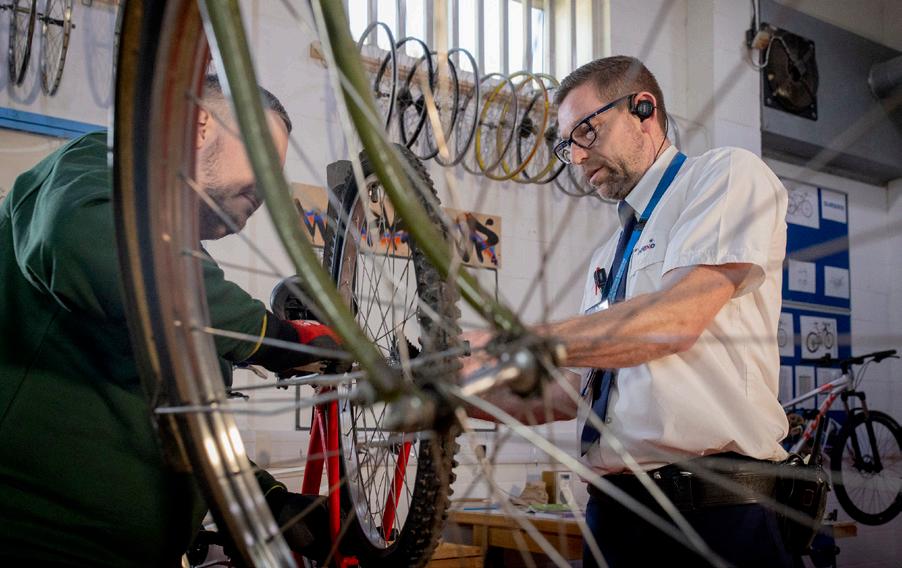
Launched in 2023, Starting Fresh draws on Sodexo’s more than 30 years of experience managing prisons in the UK and aims to help employers better understand the value and potential of recruiting people with convictions. The campaign combines direct recruitment pathways with wider advocacy and practical support for employers, including toolkits, guidance and employer engagement activity designed to challenge stigma and increase confidence around fair chance hiring. In its first year, Starting Fresh helped support the creation of more than 300 employment opportunities through partnerships with organisations including Marriott Hotels, Burger King and Iceland. Employer engagement days hosted within prisons have also enabled businesses to meet candidates directly and better understand the skills, qualifications and work-readiness many prison leavers can bring into the workforce.
Starting Fresh is also intended to strengthen workplace culture and belonging. Rather than viewing fair chance hiring as a one-off recruitment intervention, Sodexo’s approach focuses on helping colleagues with convictions integrate successfully and progress over time. The organisation works with more than 20 charities and specialist organisations, including New Futures Network, Clean Sheet, Novus Works and The Oswin Project, to strengthen support pathways and reduce barriers to sustainable employment. Sodexo is also exploring apprenticeship placements for individuals released on temporary licence, identifying sites that can offer supportive temporary roles as stepping stones into stable employment and long-term career progression. The organisation’s broader approach is shaped by a belief in rehabilitation and dignity, recognising that stable employment can play an important role in reducing reoffending and improving long-term outcomes.
Sodexo’s leadership in inclusive employment has also received external recognition. In 2025, the organisation became the first employer to achieve Ambassador Charter
Mark status from the Social Recruitment Advocacy Group (SRAG), the highest level of recognition awarded by the employer-led network founded by PeoplePlus. The award recognised Sodexo’s commitment to creating opportunities for people facing barriers to employment, including individuals with criminal convictions, veterans, reservists and military families. It also highlighted initiatives such as Starting Fresh, guaranteed interviews for ex-offenders, support for unpaid carers and the contribution of the Sodexo Stop Hunger Foundation. Through its involvement with SRAG, Sodexo is helping to shape wider employer practice, sharing learning and advocating for more inclusive approaches to recruitment and workforce development across the UK. Supporting Lunch and Learn Webinars, Sodexo is sharing its journey, expertise, and insight to help support other businesses in developing their inclusive recruitment strategies.
Sodexo’s work with veterans similarly reflects a focus on belonging, transferable skills and long-term career development. The organisation recognises that many veterans bring strong leadership, resilience, teamwork and operational experience, but may still face challenges transitioning into civilian employment. Through its Forces Friendly approach, veteran-focused recruitment activity and peer support networks, Sodexo aims to create an environment where former service personnel feel understood and supported as they adapt to new roles and career pathways.
Sodexo’s commitment is underpinned by more than 30 years of working alongside the Armed Forces community and supporting military personnel both during and after service. Today, the organisation employs more than 500 veterans and reservists, alongside thousands of people from serving military families, across a diverse range of roles, locations and business areas. This breadth of opportunity enables veterans to transfer skills developed during military service into long-term civilian careers across facilities management, catering, operations, leadership and corporate functions.
To support successful transitions into civilian employment, Sodexo offers guaranteed interviews for veterans who meet role requirements through skills and experience gained during military service. The organisation also provides additional support for reservists through a dedicated reservist policy, including additional paid leave to balance military commitments alongside civilian careers. These measures are designed to ensure military experience is recognised and valued throughout recruitment and employment.
Creating a sense of belonging is an important part of this approach. Sodexo’s Military Connections employee network brings together veterans, reservists and military families, providing opportunities for colleagues to share experiences, support one another and help those transitioning from military to civilian careers. This peer-topeer support helps strengthen retention and progression while ensuring members of the Armed Forces community remain connected within the workplace.
The organisation’s commitment has received significant external recognition. Sodexo was an early signatory of the Armed Forces Covenant and was one of the first organisations to receive the Ministry of Defence’s Gold Employer Recognition Award.
Case Study: From Barriers to Opportunity: Jonathan’s Journey Back to Work
After facing significant barriers to employment, Jonathan was determined to rebuild his career and regain a sense of purpose. In May 2024, he connected with the Starting Fresh campaign - an initiative designed to support individuals into meaningful employment by removing barriers and creating inclusive opportunities.
At the time, Jonathan was ready to return to work but found that traditional recruitment routes were no longer accessible. With support from the programme, he began a new chapter in his journey - focused on resilience, persistence, and possibility.
Over the following year, Jonathan worked closely with the programme, exploring a range of roles aligned with his experience in finance. While several opportunities came close, setbacks meant that success didn’t come immediately.
Despite this, Jonathan remained focused. With encouragement, tailored support, and access to the right opportunities, he continued to build confidence and refine his approach.
Jonathan’s breakthrough came when his profile was proactively shared within the hiring team for an applicable role. What started as a missed opportunity elsewhere turned into a new possibility.
Following a competitive interview process, Jonathan secured the role.
More recently, it has been recognised as one of the UK’s 50 GREAT British Employers of Veterans, reflecting its ongoing commitment to creating meaningful employment pathways and support structures for veterans, reservists and military families.
Beyond employment, Sodexo also supports the wider Armed Forces community through charitable partnerships. Through the Sodexo Stop Hunger Foundation, more than £500,000 has been contributed to SSAFA’s Homelessness Fund, while colleagues regularly support military charities through volunteering, fundraising and mentoring activity. This reflects a broader commitment to supporting the wellbeing and long-term resilience of the Armed Forces community beyond the workplace.
Reflecting on receiving the offer, he described it as a moment of overwhelming pride and emotion: a turning point that marked the start of a new beginning.
Now back in employment, Jonathan has successfully transitioned into his role and is thriving. He describes a welcoming and supportive team environment, where colleagues have helped him settle in quickly and confidently.
For Jonathan, returning to work is about much more than employment - it’s about reclaiming independence, rebuilding self-belief, and looking ahead with renewed optimism.
“I feel like I’ve regained my spark,” he reflects. “It’s given me a real sense of purpose again.”
Jonathan’s story highlights the power of inclusive recruitment and the importance of looking beyond past circumstances to recognise people’s potential.
With the right support and opportunity, individuals can overcome barriers, re-enter the workforce, and make meaningful contributions to their organisations and communities.
Today, Jonathan is not only back in work, but he is also excited about his future and what he can achieve next.
His journey is a powerful reminder that, with the right support, it’s never too late to start again.
Empowering Colleagues
Ensuring that colleagues have a voice within the organisation is a key element of Sodexo’s inclusive culture. The company has established a number of employee resource groups and networks that provide opportunities for employees with shared interests or experiences to connect and influence organisational priorities.
These networks operate across five key pillars- gender, LGBTQ+, disability, cultures and origins, and generationsand are often supported by executive sponsors. Examples include the SoTogether gender network, Sodexo Pride, the Generations network and the Origins cultural diversity network. Each group develops an annual plan outlining its objectives and activities, ensuring that initiatives remain focused and aligned with broader organisational goals.
The networks play a significant role in shaping workplace culture. For example, the Ability network leads initiatives to promote disability inclusion and neurodiversity awareness, including the Neurodiversity Café and training programmes designed to help managers better support neurodivergent colleagues. These activities encourage open discussion and help create a workplace where individuals feel understood and supported.
Sodexo also reinforces this inclusive culture through initiatives such as the annual Spirit of Sodexo Awards and the Recognising You programme, ensuring colleagues across the UK and Ireland are celebrated and rewarded for living the organisation’s values and making a positive difference to their teams, customers and communities.

Sodexo actively gathers feedback from its workforce through its Employee Voice survey. Open to all employees, the survey enables colleagues to share their views and experiences. The results are analysed carefully, and leaders are responsible for implementing actions based on the feedback received. Progress is tracked to ensure that concerns are addressed and improvements are made.
Sodexo has worked with the Purpose Coalition on the Social Mobility Schools Project. This project asks employees to voluntarily identify which secondary school they went to, which helps identify trends in socioeconomic backgrounds and the social mobility journey any Sodexo journey has been on.
Insights from this information have already led to practical improvements across sites. For example, requests from colleagues have informed the provision of prayer rooms, adjustments to catering options to accommodate dietary requirements and other small but meaningful workplace adaptations. These actions demonstrate Sodexo’s commitment to listening to its workforce and responding in ways that foster inclusion.
In addition, Sodexo has launched a community fund that allows employees to apply for financial support for charities that are meaningful to them. This initiative empowers colleagues to contribute to causes they care about while strengthening Sodexo’s connection with the communities it serves.

Bill Buchan, HR Director, Sodexo UK & Ireland
“Creating opportunity means more than opening the door into employment. It means ensuring every colleague can see a pathway to develop, progress and build a long-term career. At Sodexo, we are focused on creating an environment where talent can thrive, regardless of background, by combining clear progression routes, inclusive leadership and access to meaningful development opportunities.”
• Building partnerships to maximise social impact: Long-term collaboration with charities, clients, suppliers and community organisations enables Sodexo to tackle complex social and environmental challenges more effectively.
• Supporting communities through the Stop Hunger Foundation: Strategic partnerships help address food insecurity while investing in employability, wellbeing and long-term community resilience.
• Creating opportunity through shared expertise: Partnerships across education, skills, employment and leadership development help widen access to training, careers and social mobility for people across the UK and Ireland.
• Using supply chains as a force for inclusive growth: Investment in SMEs and social enterprises helps strengthen local economies while embedding social value throughout Sodexo’s wider business ecosystem.

Delivering meaningful social impact requires collaboration. While Sodexo has established clear social impact commitments through its Social Impact Pledge 2030, the organisation recognises that achieving lasting change cannot be accomplished alone. Long-term partnerships with charities, clients, supply partners, local authorities, educational institutions and community organisations are essential to addressing complex social, economic and environmental challenges.
For Sodexo, partnership is not simply about extending reach. It is about combining expertise, resources and influence to create outcomes that would be difficult for any single organisation to achieve independently. This collaborative approach underpins activity across the business, from tackling food insecurity and supporting employability programmes to advancing sustainability goals and strengthening local economies.
The scale of this approach is reflected in Sodexo’s supply chain. Across the UK and Ireland, the organisation works with approximately 2,756 small and medium-sized enterprises (SMEs) and 37 social enterprises, with these organisations accounting for around 40% of total supply chain spend. By directing significant investment towards smaller and purpose-led organisations, Sodexo is helping to create economic opportunity, support local growth and embed social value throughout its wider business ecosystem.
This commitment to partnership extends beyond procurement. Through initiatives such as the Stop Hunger Foundation, strategic charity partnerships, skills-based volunteering, apprenticeship levy transfers and collaborative programmes with clients and community organisations, Sodexo seeks to create a multiplier effect where shared action delivers greater impact than any organisation could achieve alone.

Jade Boggust, Managing Director, Corporate Services, Sodexo UK
“The scale of the challenges facing communities today means no organisation can deliver meaningful change alone. Our role is to bring together clients, suppliers, colleagues and community partners around shared goals, using our collective expertise and reach to create lasting social impact. Strong partnerships allow us to deliver outcomes that go far beyond what any one organisation could achieve independently.”
Stop Hunger Foundation

Partnership sits at the heart of the Sodexo Stop Hunger Foundation, which marked its twentieth anniversary in the UK and Ireland in 2025. The Foundation is a registered charity dedicated to tackling food insecurity and its root causes through fundraising, grant-giving, volunteering and long-term partnerships with charities and community organisations. Since 2005, it has supported almost 11 million people, worked with more than 470 charities and recorded over 54,000 volunteering hours from Sodexo colleagues, clients and supply partners.
Celebrating and strengthening these partnerships is a core part of Sodexo’s approach. In 2025, Sodexo UK & Ireland welcomed more than 40 strategic supply partners to Brighton & Hove Albion’s American Express Stadium for its third annual Partners with Purpose conference. The event brought together representatives from across Sodexo’s supply chain, including SMEs, social enterprises and voluntary, community and social enterprise (VCSE) organisations, to discuss shared priorities and opportunities for collaboration.
The conference focused on three key themes: deepening understanding of Sodexo’s operations, encouraging collaboration and innovation across the supply chain, and recognising shared progress on sustainability and social impact programmes. Senior leaders from across Sodexo delivered sessions on areas such as supply management, growth enablement, digital transformation in facilities management and the evolving ambitions for the company’s food brands.
Through initiatives such as these, Sodexo demonstrates how collaboration across sectors can accelerate progress towards shared sustainability and social impact goals.
In the UK and Ireland, the Foundation focuses on both emergency support and long-term solutions linked to poverty, employability, financial resilience and wellbeing. Its work is aligned with Sodexo’s Social Impact Pledge 2030, including an ambition to support more than 12.5 million people in local communities by 2030. A defining feature of the Foundation is that it is employee-led, with colleagues able to use up to three paid volunteering days each year to support initiatives connected to Stop Hunger’s mission.
Grant-giving is a central part of the Foundation’s approach, with almost £400,000 awarded in 2026 to nine charities and projects tackling food insecurity across the UK and Ireland. The Foundation is one of the few charitable organisations to provide multi-year funding, helping partners focus on long-term impact rather than short-term delivery. This includes renewed three-year funding for Trussell’s Help through Hardship helpline, delivered with Citizens Advice, which provides support around emergency food access, benefits, debt and mental health. Other long-term partners include The Bread and Butter Thing, A Lust for Life, Oasis, Smart Works Scotland and Breaking Barriers, reflecting the Foundation’s emphasis on tackling the wider causes of poverty and exclusion.
Stop Hunger also promotes opportunity and social mobility through partnerships such as The Switch, SheWorks and Enactus, which support employability, confidence-building and pathways into work. Alongside funding, Sodexo colleagues, clients and supply partners contribute through volunteering and skills-based support, reinforcing a collaborative approach to creating lasting social impact.
Trussell
Through the Stop Hunger Foundation, Sodexo works in partnership with Trussell to support individuals and families experiencing financial hardship and food insecurity. This partnership reflects a shared commitment to addressing both the immediate challenges faced by people in crisis and the longer-term barriers that can prevent individuals from achieving financial stability.
As part of its wider funding programme, the Stop Hunger Foundation has provided support to initiatives that help individuals access practical advice, emergency assistance and pathways towards greater resilience. This includes backing services that help people navigate periods of financial difficulty while also connecting them with longer-term support designed to improve wellbeing, confidence and independence.
The partnership aligns closely with Sodexo’s broader social impact ambitions. By supporting organisations such as Trussell, the company is helping to address one of the most significant barriers to opportunity in the UK today. Food insecurity can have profound effects on health, educational attainment, employment prospects and overall quality of life. Through collaborative action, Sodexo and Trussell are working to ensure that individuals facing hardship can access the support they need while helping to create the conditions for longerterm social mobility and economic participation.
This work forms part of the Stop Hunger Foundation’s wider approach to tackling food insecurity through a combination of funding, volunteering, skills-based support and strategic partnerships. By bringing together charities, community organisations, suppliers and colleagues, Sodexo seeks to create sustainable solutions that address both immediate need and the underlying causes of disadvantage.
Sodexo and Trussell came together late 2025 to explore the root cause of poverty = social mobility. Each working together on both the causal factors and supporting factors that will take individuals, families and communities from crisis to stability to sustained employment. They are working with Purpose Coalition partners such as the Wise Group and E.ON to broaden the collaborative approach to demonstrating, by working together, leveraging our expertise and strengths in a more co-ordinated way – change can happen, sustained change.
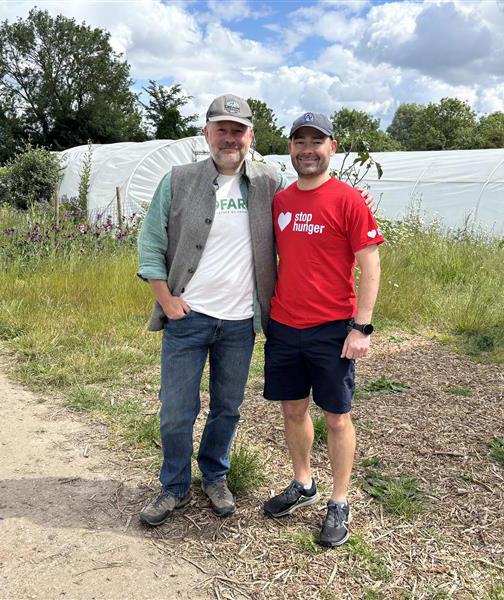
One of the Foundation’s longest-standing partnerships is with FareShare, the UK’s national network for redistributing surplus food to charities and community organisations. Sodexo has supported FareShare for more than eleven years through financial contributions and employee volunteering.
Through this partnership, surplus food that would otherwise go to waste is redistributed to community groups supporting people experiencing food insecurity. Sodexo employees regularly volunteer at FareShare regional centres, helping to sort, pack and distribute food, as well as supporting national initiatives such as the annual Tesco Neighbourhood Food Collection.
The partnership has also included direct funding. For example, a recent £84,000 grant from the Stop Hunger Foundation enabled FareShare to expand its operations during periods of increased demand, helping to cover transport and logistics costs so that larger volumes of food could reach communities in need.
The collaboration reflects strong alignment between the two organisations. Both prioritise sustainability, food waste reduction and tackling hunger, allowing them to amplify their collective impact through coordinated action.
FareShare
Chapter One
Sodexo’s Stop Hunger Foundation is also a Platinum Partner of Chapter One, a charity focused on improving literacy among primary school children. The partnership recognises that poor literacy can limit future employment opportunities and increase the risk of longterm poverty and food insecurity.
Through the programme, Sodexo colleagues volunteer as online reading mentors, delivering weekly 30-minute one-to-one sessions with children who require additional support. As of 2024-25, more than 130 Sodexo volunteers were participating in the initiative.
Teachers identify pupils who would benefit most from the programme, ensuring targeted support for children attending schools with higher-than-average levels of free school meal eligibility. The mentoring sessions support phonics development, build reading confidence and encourage enjoyment of reading.
The partnership has delivered measurable outcomes. Over 1,400 reading sessions have been recorded, while employee-led book drives have donated more than 2,250 books to participating schools. A £10,000 grant from the Foundation also supported a pilot book club initiative that significantly increased engagement with reading, with the number of children who viewed themselves as strong readers increasing by 27 percentage points.
Creative engagement has also been encouraged through initiatives such as a joint storytelling and poetry competition, which received the Children’s Voice Award in 2024.
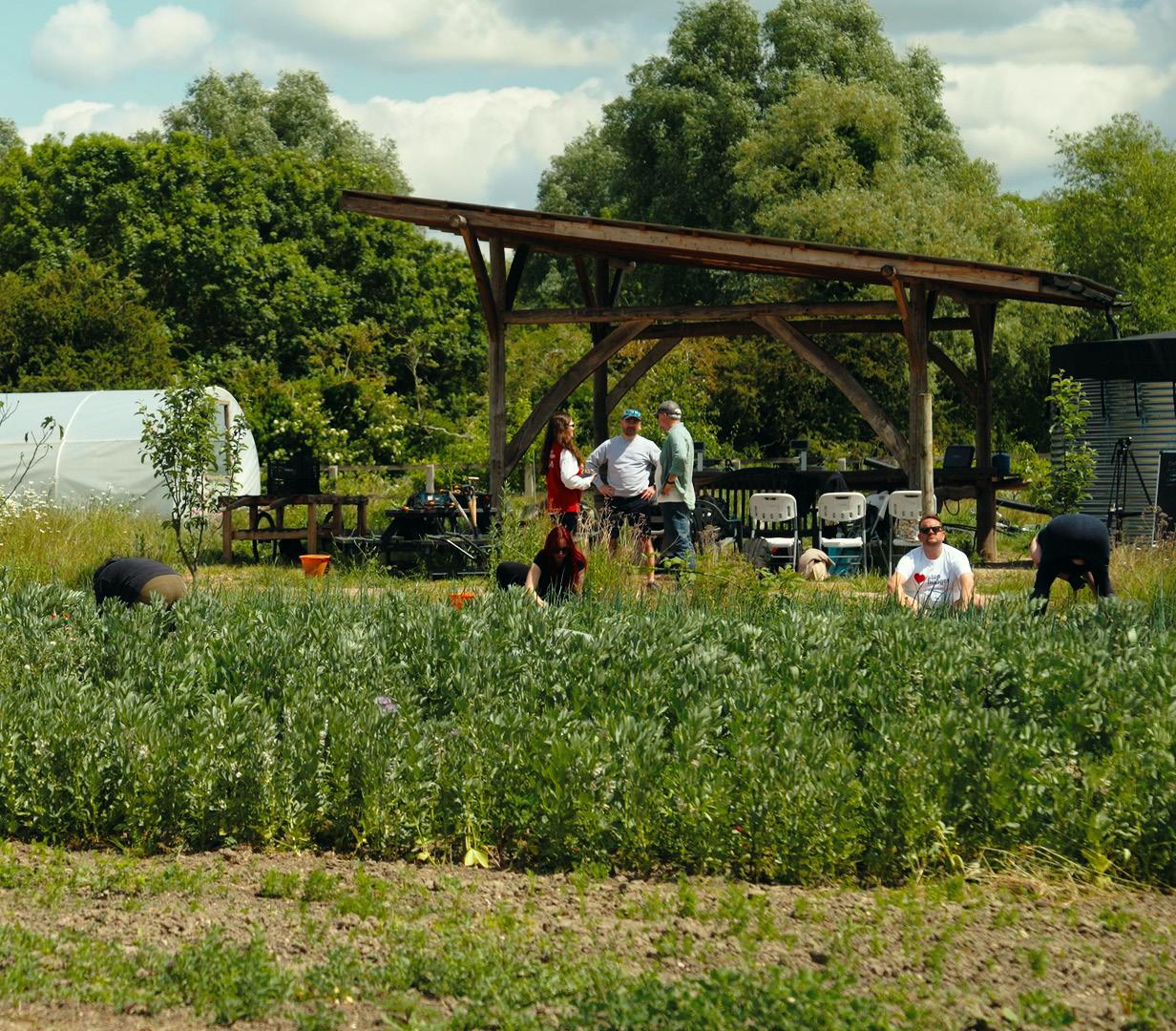
Pilotlight
Sodexo partners with Pilotlight, a charity that connects businesses with charitable organisations to provide strategic, skills-based support that strengthens leadership capability and organisational resilience across the voluntary sector.
Now in its third year, Sodexo’s Explore Further programme continues to provide meaningful support to charities across the United Kingdom while creating distinctive development opportunities for emerging leaders within the business. In 2026, the programme was further strengthened through collaboration with the Sodexo Stop Hunger Foundation, helping to align leadership development with the organisation’s wider social impact ambitions.
Explore Further combines experiential learning with community impact, enabling participants to apply their skills to real-world challenges faced by charitable organisations. Through structured projects and cross-sector collaboration, participants develop leadership capabilities while contributing practical solutions to organisations working on some of society’s most pressing issues.
The most recent cohort delivered particularly strong outcomes. All participants reported increased confidence in collaborating across functions, while 90% reported increased confidence in translating vision into actionable plans and applying creative problem-solving techniques to complex challenges. These outcomes demonstrate how development programmes can simultaneously build organisational capability and create positive social impact.
The programme has also received wider recognition. Sodexo and Pilotlight recently showcased the partnership as an example of best practice at the World of Learning Conference, demonstrating how learning and development programmes can be used as a tool to strengthen leadership capability while creating meaningful value within communities.
These engagements create mutual benefit. Charities gain access to professional expertise, strategic support and fresh perspectives, while Sodexo colleagues strengthen leadership skills, broaden their understanding of social challenges and develop capabilities that can be applied across the organisation. The partnership reflects Sodexo’s wider belief that skills-based volunteering and collaborative leadership development can play an important role in creating positive social impact while supporting colleague growth and progression.
Bright Future Co-Op
Sodexo has partnered with Bright Future Co-op, a not-forprofit organisation that helps survivors of modern slavery rebuild their lives through access to employment.
Bright Future connects survivors with businesses that can provide work placements and long-term employment opportunities. Individuals are offered a four-week work placement which, if successful, leads to a non-competitive interview and the opportunity for permanent employment.
The initiative responds to a significant societal challenge. In 2023 alone, more than 17,000 victims of modern slavery were identified in the UK, with estimates suggesting that over 130,000 individuals may currently be exploited. Since its creation in 2021, Bright Future has supported more than 100 survivors into secure employment.
Skills England
Sodexo also collaborates with national education and employment initiatives such as Skills England, contributing an employer perspective to discussions around vocational education and skills development.
Through engagement with the Department for Education and other stakeholders, Sodexo helps shape conversations around emerging qualification pathways, including vocational routes. The company also supports outreach programmes designed to connect young people with apprenticeships and career opportunities.
For example, Sodexo participates in the Apprentice Ambassador Network, which promotes apprenticeships to schools and colleges across the country. Through these visits, ambassadors share insights into career pathways and help address barriers that prevent young people from entering employment or training.


Purpose Lab
Sodexo’s partnership with the Purpose Coalition’s Purpose Lab demonstrates how collaboration with people and communities can help shape more inclusive and responsive services. Through structured engagement with students, communities and those with lived experience, Purpose Lab enables organisations to better understand barriers to opportunity and identify practical solutions that improve outcomes.
As part of the initiative, leaders from Sodexo’s Schools & Universities business met with Purpose Lab Ambassadors from universities across the UK to gain direct insight into the experiences and priorities of students. The sessions created an opportunity for students to share practical feedback on campus life, accommodation, catering and wellbeing, ensuring that the people using Sodexo’s services are able to influence how they are designed and delivered.
Building on this partnership, Sodexo is now working with the Purpose Coalition to develop Purpose Lab: Lives On Track, including Purpose Lab Justice, which will bring together prison leaders, employers, policymakers and people with lived experience to explore how businesses can strengthen rehabilitation, skills, employment and reintegration, while continuing to support young people and communities to stay on track through improved wellbeing, opportunity and local partnerships. The programme will generate practical insights to inform future services, partnerships and policy, strengthening Sodexo’s role in creating pathways into opportunity.
Together, these programmes reflect Sodexo’s commitment to listening as well as delivering. Rather than making assumptions about the needs of students, communities or people rebuilding their lives after prison, Sodexo ensures lived experience helps inform service design, strengthen partnerships and create lasting social impact.
Supply Chain
Sodexo recognises that procurement decisions can be a powerful driver of social mobility and inclusive economic growth. Beyond delivering goods and services, suppliers play an important role in creating jobs, supporting local economies and strengthening community resilience. Through its procurement strategy, Sodexo seeks to ensure that social value is embedded throughout its supply chain, creating opportunities that extend well beyond the organisation’s direct workforce.
This approach is reflected in a deliberate focus on supporting smaller and purpose-led organisations. By working with SMEs and social enterprises across the UK and Ireland, Sodexo helps to broaden access to commercial opportunities, encourage innovation and support the growth of businesses that generate positive social impact within their communities.
The company works closely with suppliers to align sustainability objectives, share best practice and create opportunities for collaboration across environmental and social initiatives. Through programmes such as the Partners with Purpose conference and the Net Zero Supply Chain Engagement Strategy, Sodexo encourages suppliers to contribute to climate action, responsible business practices and social value outcomes while building stronger and more resilient business relationships.
Many suppliers also support Stop Hunger activities, participating in fundraising, volunteering and community initiatives alongside Sodexo employees. This collaborative model ensures that social impact extends beyond the organisation itself, creating a multiplier effect through shared action and reinforcing Sodexo’s belief that business can be a force for positive change.
By using its purchasing power to support inclusive growth, strengthen local economies and create opportunities for diverse businesses, Sodexo demonstrates how supply chains can contribute not only to commercial success but also to wider social mobility outcomes.
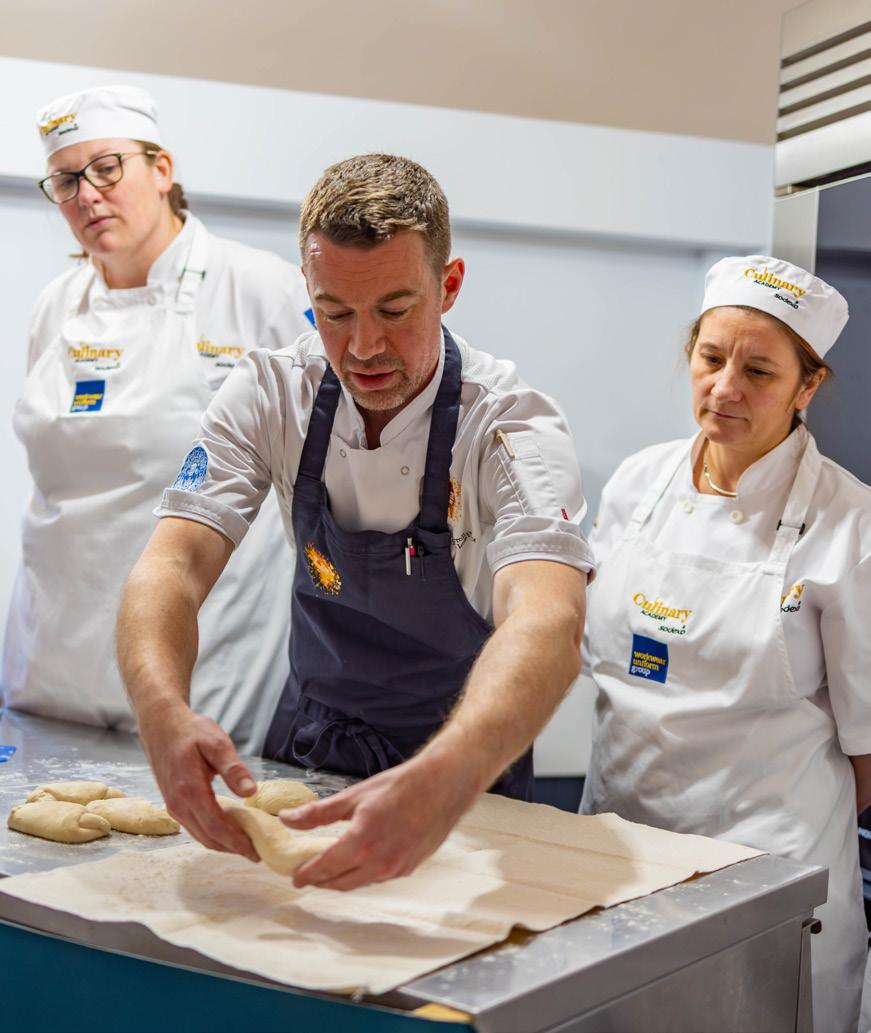
Alongside structured partnerships, Sodexo also offers pro-bono professional coaching to external charities. This support focuses on career development and leadership coaching.
Current partners include the Cystic Fibrosis Trust, Trussell, Student Minds and Pilotlight, among others. By sharing professional expertise with the voluntary sector, Sodexo helps charities strengthen their leadership capabilities while supporting the career progression of individuals working within these organisations.
The scale of this contribution continues to grow. To date, Sodexo coaches have supported over 600 through structured coaching programmes, delivering more than 4,800 hours of coaching support. A further 158 coaching relationships are currently in progress, demonstrating sustained demand for this offer across the charity and voluntary sectors. Through this skills-based volunteering model, Sodexo is able to share leadership expertise, strengthen organisational capability and support individuals to build confidence, resilience and professional development pathways.
Coaching Partnerships for Success
5. Analysis
Sodexo’s work demonstrates how a major employer and service provider can use its scale, partnerships and everyday operations to widen opportunity across communities.
Across its workforce, supply chain, client sites and charitable activity, Sodexo addresses several of the barriers that shape social mobility in the UK & Ireland: access to skills, fair progression, inclusive employment, food insecurity, sustainability and local economic resilience.
By embedding social impact into its Social Impact Pledge 2030, Sodexo is moving beyond isolated initiatives. Its model aligns with wider national priorities including workforce participation, skills development, inclusive growth, net zero, food insecurity and stronger communities.

Angela Halliday, Director of Responsible Business and Partnerships, Sodexo UK & Ireland
“At Sodexo we know that social mobility is shaped as much by place as it is by potential. People’s opportunities are influenced by where they live, the networks they can access, and the local conditions that enable or restrict their progression. We recognise the need to better understand these dynamics and respond with intent.
By connecting insight to action, we can more effectively contribute to the ambitions of our clients, our people, and the communities we serve, underpinning our ongoing commitment to learning, collaboration and driving impact at scale.”

Supporting Parliament’s Opportunity Agenda
For Members of Parliament, many of the issues addressed in this report are familiar constituency concerns: access to good work, skills shortages, food insecurity, barriers faced by care leavers and prison leavers, support for veterans and the need for employers to create fairer routes into progression.
Sodexo’s activity responds directly to these challenges. Through apprenticeships, early careers programmes and structured progression pathways, the company helps people access training and develop long-term careers. Its focus on frontline progression is particularly important because social mobility depends not only on entering work, but on whether that work leads somewhere meaningful.
Campaigns such as Starting Fresh show how Sodexo is also targeting groups who can face additional barriers to employment. These initiatives complement policy priorities around rehabilitation, reducing reoffending, supporting care leavers, improving skills and helping more people participate in the labour market.
In this way, Sodexo’s work provides an example of how large employers can support Parliament’s wider ambition to break down barriers to opportunity.
Strengthening Local Economies and Workforce Resilience
Sodexo’s approach to social impact is increasingly place based, recognising that barriers to opportunity vary significantly between communities. By using data, local partnerships and the Indices of Multiple Deprivation (IMD), the organisation is targeting investment, skills programmes and employment initiatives towards communities facing the greatest social and economic disadvantage. This targeted approach helps ensure that social value activity supports local workforce resilience, strengthens regional economies and creates pathways into opportunity where they are needed most.
By creating progression routes within its own workforce, Sodexo helps retain talent and build skills in the communities where it operates. Apprenticeships, management development and internal career pathways support workforce resilience by enabling colleagues to move into skilled and leadership roles rather than relying solely on external recruitment.
The company’s use of apprenticeship levy transfer also extends this impact beyond Sodexo itself, supporting SMEs and local employers to fund apprenticeships and strengthening wider talent pipelines to contribute to local economic growth.
Its supply chain work has a similar effect. Commitments to spend with SMEs and diverse suppliers help spread economic opportunity more widely, while partnerships with suppliers around sustainability and social value ensure impact reaches beyond Sodexo’s direct operations.
Building Inclusive Workplaces and Cultures of Belonging
Sodexo’s social impact is not limited to external programmes. A central part of its contribution is the way it seeks to shape its own workplace culture.
The company’s focus on culture and belonging recognises that opportunity is not created by recruitment alone. People need to feel respected, supported and able to progress once they are in work. This is reflected in Sodexo’s employee networks, pay gap reporting, disability inclusion activity, menopause and endometriosis support, LGBTQ+ inclusion, cultural awareness initiatives and generational diversity work.
The emphasis on listening is also important. Employee Voice, the Social Mobility Schools Project and local workplace adaptations show a willingness to use data and colleague feedback to understand barriers more clearly. This strengthens accountability and enables more targeted action.
Through its work combining inclusive policies with practical progression routes, Sodexo is modelling the kind of employer behaviour that can help widen opportunity across sectors.
Partnership as a Multiplier of Impact
Partnership is one of the strongest themes across Sodexo’s activity. Many of the examples in this report depend on collaboration with charities, suppliers, clients, schools, local authorities and community organisations.
Sodexo’s commitment to partnership also extends to shaping the national conversation on social value. Angela Halliday, Director of Responsible Business and Partnerships, serves as Co-Chair of the National Social Value Taskforce UK and the Social Impact Advisory Council alongside Rt Hon Justine Greening. Through these leadership roles, Sodexo helps bring together business, policymakers and civil society to share best practice, influence thinking and strengthen the role of responsible business in improving social mobility and delivering measurable social value.
The Stop Hunger Foundation demonstrates this most clearly. Through grants, volunteering and long-term charity partnerships, Sodexo is able to support both immediate food needs and the underlying causes of food insecurity. Partnerships with organisations such as FareShare, Chapter One, Pilotlight and The Bread and Butter Thing show how business resources can be combined with specialist community expertise.
This partnership model allows Sodexo to reach further than it could alone. It also helps ensure that interventions are grounded in local need and informed by organisations with direct experience of the communities they serve.
Overall, Sodexo’s work demonstrates the role that a large purpose-led business can play in breaking down barriers to opportunity. Its strongest contribution lies in connecting employment, skills, inclusion, sustainability and community partnership into a coherent model of social impact.
6. Key Community Opportunity Barriers
At the heart of our work is a commitment to understanding the unique challenges faced by communities. To achieve this, we use the Indices of Multiple Deprivation (IMD) as the foundation for our place-based data assessments.
The IMD provides a comprehensive and reliable measure of deprivation, helping us identify areas where barriers to opportunity are most pronounced, and more specifically where Sodexo delivers services for its clients, and has central hubs located.
By analysing the data across the IMDs seven domains, we gain valuable insights into the factors affecting income, employment, education, health, housing, and more.
This data-driven approach ensures that our strategies are focused, equitable, and impactful, enabling us to address deprivation effectively and support communities where it’s needed most.
Understanding the Indices of Multiple Deprivation (IMD)
The IMD is made up of seven ‘domains’, or areas of life, that affect people’s well-being. It is a tool used by governments, charities, and other organisations to decide where to focus their help.
1. Income: measures the number of people with very low incomes, including those who struggle to pay for basics like food and housing.
2. Employment: measures how many people of working age are out of work due to unemployment, health problems, or other reasons they can’t control.
3. Education, skills and training: focuses on low school results, limited qualifications, and a lack of learning of training opportunities for adults.
4. Health deprivation and disability: checks how poor physical and mental health, or a higher chance of dying early, affects people’s lives in an area.
5. Crime: measures how often people and property are affected by crime like violence, theft, or vandalism in the community.
6. Barriers to housing and services: looks at how hard it is for people to afford housing or access important services like shops, schools, or doctors.
7. Living environment: assesses the quality of homes and the local area, including housing conditions, air quality, and road safety.
There is also an ‘overall’ measure, which combines the information from all seven domains to give a complete picture of how deprived an area is compared to others. Sodexo operates in communities across the UK and Ireland. The following section highlights five example local authority areas where the organisation has a significant workforce presence, illustrating how place-based insight can help identify local barriers to opportunity and inform targeted action.
This section focuses on Manchester, Wiltshire, Newcastle upon Tyne, Liverpool and Buckinghamshire because, upon an examination of Sodexo employee data, these are the five local authority areas with the largest concentrations of Sodexo employees.
Together, they are home to 5,210 Sodexo colleagues, representing more than 13% of the organisation’s total workforce. Manchester alone is home to 1,697 employees. These concentrations give Sodexo a significant local presence and create a strong basis for targeted, place-based action.
The purpose of the analysis is not to suggest that these are the five most deprived local authorities in the country. Some areas will be less deprived than others overall. But each area faces its own unique challenges. So this data exists to examine the precise barriers to opportunity for employees in the places where Sodexo has the greatest direct workforce reach. By combining employee location data with the Indices of Multiple Deprivation, Sodexo can better understand the local conditions affecting substantial numbers of its colleagues and their communities.
This approach helps connect national programmes to local need. It provides a stronger evidence base for deciding where activity such as apprenticeships, progression pathways, inclusive recruitment, employee wellbeing support, community investment and local partnerships could have the greatest reach and relevance.
In the following tables, we define communities as meaning Lower Super Output Areas, a type of statistical geography comprising between 400 and 1,200 households that usually have a resident population of between 1,000 and 3,000 persons.
Buckinghamshire is home to 795 of Sodexo’s workforce, 2% of its total, making it the fifth-largest local authority concentration of Sodexo employees.
The below tables offer a summary of the domains of deprivation across Buckinghamshire. Each community within has been individually scored in the below domains of deprivation. The scores have been averaged, after weighting for population, and then ranked. A lower rank means the area is more deprived. For instance, the most deprived local authority in England using this methodology is Blackpool, with a rank of 1.
Overall, we can say that 0.00% of Buckinghamshire’s communities fall within the most deprived 10% of communities nationally. We also use a weighted sliding scale that considers the most deprived 30% of areas nationally, in order to provide a clearer picture of deprivation across deciles. Using this measure, we can see that 2.09% of Buckinghamshire’s population live within the most deprived 30% of communities.
Liverpool is home to 797 of Sodexo’s workforce, 2.01% of its total, making it the fourth-largest local authority concentration of Sodexo employees.
The below tables offer a summary of the domains of deprivation across Liverpool. Each community within has been individually scored in the below domains of deprivation. The scores have been averaged, after weighting for population, and then ranked. A lower rank means the area is more deprived. For instance, the most deprived local authority in England using this methodology is Blackpool, with a rank of 1.
9/296 24/296 7/296 32/296 2/296 28/296 283/296 36/296 14/296 15/296
Overall, we can say that 36.75% of Liverpool’s communities fall within the most deprived 10% of communities nationally. We also use a weighted sliding scale that considers the most deprived 30% of areas nationally, in order to provide a clearer picture of deprivation across deciles. Using this measure, we can see that 54.02% of Liverpool’s population live within the most deprived 30% of communities.
Manchester is home to 1,697 of Sodexo’s workforce, 4.27% of its total, making it the largest local authority concentration of Sodexo employees.
The below tables offer a summary of the domains of deprivation across Manchester. Each community within has been individually scored in the below domains of deprivation. The scores have been averaged, after weighting for population, and then ranked. A lower rank means the area is more deprived. For instance, the most deprived local authority in England using this methodology is Blackpool, with a rank of 1.
Overall, we can say that 40.68% of Manchester’s communities fall within the most deprived 10% of communities nationally. We also use a weighted sliding scale that considers the most deprived 30% of areas nationally, in order to provide a clearer picture of deprivation across deciles. Using this measure, we can see that 58.77% of Manchester’s population live within the most deprived 30% of communities.
Newcastle upon Tyne is home to 916 of Sodexo’s workforce, 2.30% of its total, making it the third-largest local authority concentration of Sodexo employees.
The below tables offer a summary of the domains of deprivation across Newcastle upon Tyne. Each community within has been individually scored in the below domains of deprivation. The scores have been averaged, after weighting for population, and then ranked. A lower rank means the area is more deprived. For instance, the most deprived local authority in England using this methodology is Blackpool, with a rank of 1.
48/296 57/296 63/296 53/296 36/296 48/296 231/296 92/296 50/296 38/296
Overall, we can say that 26.11% of Newcastle upon Tyne’s communities fall within the most deprived 10% of communities nationally. We also use a weighted sliding scale that considers the most deprived 30% of areas nationally, in order to provide a clearer picture of deprivation across deciles. Using this measure, we can see that 36.67% of Newcastle upon Tyne’s population live within the most deprived 30% of communities.
Local Authority Code: E06000054 Wiltshire
Wiltshire is home to 1,005 of Sodexo’s workforce, 2.53% of its total, making it the second-largest local authority concentration of Sodexo employees.
The below tables offer a summary of the domains of deprivation across Wiltshire. Each community within has been individually scored in the below domains of deprivation. The scores have been averaged, after weighting for population, and then ranked. A lower rank means the area is more deprived. For instance, the most deprived local authority in England using this methodology is Blackpool, with a rank of 1.
Overall, we can say that 0.65% of Wiltshire’s communities fall within the most deprived 10% of communities nationally. We also use a weighted sliding scale that considers the most deprived 30% of areas nationally, in order to provide a clearer picture of deprivation across deciles. Using this measure, we can see that 2.87% of Wiltshire’s population live within the most deprived 30% of communities.
Importance of data to drive decision making, and action
Taken together, the workforce and deprivation data show both the scale and relevance of Sodexo’s social impact activity. Manchester, Wiltshire, Newcastle upon Tyne, Liverpool and Buckinghamshire are home to 5,210 Sodexo employees, representing more than 13% of the organisation’s workforce. Manchester alone is home to 1,697 colleagues, while more than 790 employees live in each of the other four areas. These concentrations give Sodexo substantial reach into the communities examined in this section.
The local data also demonstrates why a broad and interconnected approach is needed. Manchester and Liverpool experience particularly concentrated deprivation. In Manchester, 40.68% of neighbourhoods fall within the most deprived 10% nationally, while 58.77% of its population lives within the most deprived 30% of communities. The city ranks among the most deprived local authorities for overall deprivation, health, crime and income deprivation affecting children and older people. Liverpool also ranks among England’s most deprived local authorities and has one of the country’s highest concentrations of neighbourhoods within the most deprived decile. These figures show that substantial numbers of Sodexo colleagues live in communities where several barriers to opportunity overlap.
This gives particular importance to Sodexo’s investment in apprenticeships and career progression. More than 700 colleagues are currently undertaking apprenticeships, with opportunities extending from entry-level qualifications to advanced technical and leadership development. The end-to-end career pathway, Aspiring Front Line Manager programme and wider Grow offer create structured routes through which colleagues can build skills and progress.
In an area such as Manchester, where Sodexo employs nearly 1,700 people and education, employment and income barriers remain significant, this investment has the potential to benefit not only individuals but a substantial local workforce and the households connected to it.
The data similarly supports Sodexo’s inclusive recruitment and employment programmes. Starting Fresh, Ban the Box, guaranteed interviews for veterans, disabilityinclusive recruitment and partnerships supporting people who have faced exclusion from the labour market all widen access to employment. Sodexo’s emphasis on reasonable adjustments, employee networks, belonging and fair progression strengthens that initial opportunity by helping people develop sustainable careers. This combination is especially relevant in places where the deprivation data identifies connected challenges involving employment, income and health.
Newcastle upon Tyne provides a practical example of this approach. Around 22% of the city’s neighbourhoods were among the most deprived 10% nationally under the 2019 Index of Multiple Deprivation. Sodexo’s partnership with Northern Rights at Northumbria University has recruited more than 100 people who had previously struggled to access or sustain employment. Participants receive employability support, structured onboarding, training and opportunities to move from temporary roles into permanent employment and progression. The partnership demonstrates how Sodexo’s operational presence can be used to respond directly and positively to the circumstances of a local community.
The income deprivation recorded in Manchester, Liverpool and parts of Newcastle upon Tyne also gives added relevance to the work of the Stop Hunger Foundation. Through partnerships with Trussell, FareShare and The Bread and Butter Thing, Sodexo combines immediate support for food insecurity with advice, employability activity and action addressing its underlying causes. Since 2005, the Foundation has supported almost 11 million people and worked with more than 470 charities. Its scale reflects an understanding that food insecurity is closely connected to wider questions of income, health, confidence and access to opportunity.
Wiltshire and Buckinghamshire provide an important contrast. Overall deprivation is much less concentrated than in Manchester or Liverpool. In Wiltshire, only 0.65% of neighbourhoods fall within the most deprived 10% nationally and 2.87% of the population lives within the most deprived 30%. However, the data still identifies relative pressures involving access to housing and services. This demonstrates the value of Sodexo’s place-based approach: its programmes are sufficiently broad to remain relevant across areas with very different social and economic profiles.
Sodexo’s partnerships and supply-chain activity extend this impact beyond its direct workforce. The organisation works with approximately 2,756 SMEs and 37 social enterprises, while more than £3 million of Apprenticeship Levy funding has been transferred to SMEs, charities and purpose-led organisations. This supports skills, employment and local economic activity in the wider communities where Sodexo colleagues live. The Stop Hunger Foundation, employee volunteering and partnerships with schools, charities, local authorities and employability organisations create further routes through which Sodexo’s scale can generate local value.
The data therefore provides clear support for the work highlighted throughout this report. Apprenticeships and career pathways contribute to skills and progression. Inclusive recruitment opens employment to people who
have faced additional barriers. Workplace support helps colleagues remain and thrive in work. Stop Hunger partnerships address food insecurity and its wider causes. Levy transfer, local suppliers and community partnerships extend opportunity beyond Sodexo itself.
Most importantly, the analysis shows that these programmes are not detached corporate commitments. They are directly relevant to the places where thousands of Sodexo employees and their families live. By combining national scale with local evidence and established partnerships, Sodexo is well placed to continue delivering social value that reflects the different needs and opportunities present across its communities.
Social Return on Investment
Sodexo, alongside several of its clients apply social value frameworks to better understand the difference it is making in communities. One example of a social value framework is the TOMs (Themes, Outcomes and Measures). In 2026, Sodexo applied this framework to a select range of activities it is delivering for People, Planet and Places across the UK. Moving forward this will be dis-aggregated in alignment with its Place-based strategy, where understanding, responding to, and helping shape activity at a local level is increasingly become more vital to ensure equity of opportunity is given to local communities.

Guy Battle, CEO – Social Value Portal, Co-Chair of the National Social Value Taskforce, alongside Sodexo’s Angela Halliday, Director, Responsible Business UK & Ireland
“Sodexo’s Social Value achievements are outstanding: £728.2 million delivered, equal to 51p for every pound of turnover. That figure represents real impact, including 140,000+ tonnes of CO2e reduction, 14,000+ hours of staff volunteering, and £315 million spent with local small and medium enterprises. These figures are independently validated by Social Value Portal, and they show what’s possible when businesses take Social Value seriously. Major businesses and employers should follow Sodexo’s lead and design their operations around the economic, social, and environmental thriving of the communities they serve. We’re proud to work with Sodexo, and we look forward to seeing what they achieve next.”

7. Looking Ahead
This report demonstrates the significant contribution Sodexo is making towards improving social mobility across the UK and Ireland. Through investment in skills, inclusive employment, career progression, community partnerships and environmental sustainability, the organisation is helping to create the conditions that enable more people to fulfil their potential, regardless of their background or circumstances.
The progress outlined throughout this report provides a strong foundation for the next phase of Sodexo’s journey. From expanding apprenticeship opportunities and supporting fair chance hiring, to tackling food insecurity and strengthening local partnerships, Sodexo has shown how a large employer can play an active role in breaking down barriers to opportunity.
These interventions not only support individuals to access work and progress in their careers, but also contribute to stronger communities and more inclusive economic growth.
Looking ahead, Sodexo’s Social Impact Pledge 2030 provides a clear framework for deepening this impact. Through its focus on People, Planet, Places and Partners, the organisation is well positioned to continue creating pathways into employment, supporting progression within the workplace and helping communities to thrive. As labour market demands evolve and the transition to
a greener economy accelerates, there will be increasing opportunities to connect skills development, inclusive recruitment and sustainable growth.
The findings of this report also highlight the importance of place. Opportunity is shaped by local circumstances, access to networks, availability of jobs and the support systems that exist within communities. Sodexo’s national reach, combined with its strong local presence and partnerships, gives the organisation a unique ability to respond to these challenges in ways that are practical, targeted and impactful.
Partnership will remain central to this ambition. The most effective social mobility interventions are rarely delivered by a single organisation. Through collaboration with clients, suppliers, charities, educational institutions and community organisations, Sodexo can continue to extend its reach and create opportunities for people who may otherwise be excluded from them.
Ultimately, social mobility is about ensuring that where a person starts in life does not determine where they can go. Through its Social Impact Pledge 2030, Sodexo has established a clear framework for turning that ambition into action. By continuing to invest in people, strengthen communities and create pathways to opportunity, the organisation is well placed to build on its progress and help create a fairer, more inclusive and more prosperous society.