TheSocialist
PaPer of the SocialiSt Party
iSSue 147
july / auguSt 2022
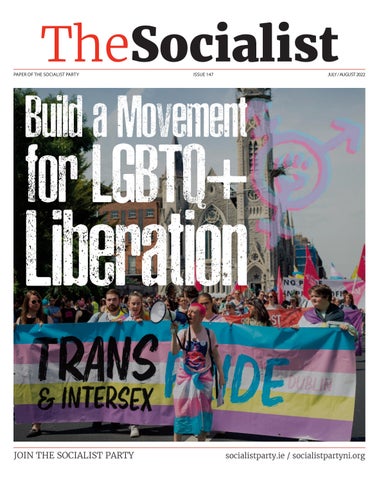
Build a Movement
for LGBTQ+
Liberation join The socialisT parTy
socialistparty.ie / socialistpartyni.org
2
Cost of living
The socialist
south: Big business profits, working people suffer By conor Payne
T
he cosT-of-living crisis is having a devastating effect on working-class people. official inflation is at a 38-year high, but this understates the reality of the crisis for many. And this crisis is only poised to get worse. A new round of electricity and gas price hikes will be imposed in August, with Electric Ireland increasing their gas prices by almost 30%. Parents will face back to school costs, averaging €1,518 for a secondary school student and €1,195 for a primary school student. The government has stubbornly ruled out substantial action before the budget. They moved the budget forward by two weeks but the budget will not contain the transformative measures which are necessary to deal with this crisis. To win real change, we are going to need a major movement across the country, rooted in communities and workplaces. Stop the profiteering
The government, and most of the capitalist establishment indicate that not much can be done about this crisis without risking making things worse. For example, they suggest that if workers demand big pay increases, this will cause
a ‘wage-price spiral’ where prices will only be driven up further. But this crisis is not the result of wages rising, nor is it some inevitable natural disaster. It is a one-sided class war being waged by big business, aimed at preserving their profits. Huge profits are being made by the energy companies, supermarkets, and others who are increasing prices. In Britain, a study by UNITE found that profits were responsible for 58% of inflation, wages for just 8%. But wages are being kept down, and price increases are used to pass the burden of the crisis onto ordinary people. A fightback is needed to demand measures to take on the profiteers and transfer the wealth to working class people. These include: l Stopping the profiteering: under the Consumer Protection Act 2007 the Government can freeze prices for energy, food, and fuel. Similarly emergency legislation must be introduced to cut and freeze rents. l Raise the minimum wage to €15 an hour. l Tax the rich and big business, and provide an emergency payment of €2,000 to every household. l Fight for pay rises for all workers: stagnating wages really mean pay cuts.
Workers should organise for doubledigit pay rises which match inflation. How can a fightback happen?
We can take a stand on the cost of living: we just need to get organised. In Britain, rail workers went on strike to demand a decent pay increase, and other workers are now looking at following their example, including teachers, postal workers, and workers at BT. During the strike, opinion polls showed a major shift of public opinion in favour of the rail workers and their action and the media interventions of the RMT’s Mick Lynch were warmly received. In the North, strike action by workers at Interface won a 15% pay rise. Here, talks on pay between the unions and government have broken down. The union leaders should be preparing strike action by workers in pursuit of the pay rises they need. But the record of the union leaders here, their unwillingness to contemplate serious action in defence of workers, means that we cannot wait on this. If workers want to fight for inflation-busting pay rises, it will require organising to pressure the trade union leadership to take action and if necessary, taking unofficial strike action in defiance of that leadership. Seven years ago, the water charges
price-gouging energy companies should be nationalised!
showed that a mass movement could be developed quickly by working-class people organising themselves in their communities. Now, again, working-class people need to organise in their workplaces and communities to demand action on this crisis. This government is in a weakened position. While it won the recent no-confidence vote, it has lost its Dail majority and polls show its support is declining. This is in no small part due to its inaction on the cost of living. A new movement of resistance could put the coalition under real pressure or even fundamentally undermine it.
A
sTudy from the esRi in June reported that in the south of ireland, up to 43% of all households are in energy poverty. When that report was heard in the electric ireland boardroom (whose parent company esB made profits of €679 million in 2021 up 10% on 2020) it was evidently taken as a challenge – ‘we can get those figures up’. starting on 1 August, electric ireland is providing customers with the bank holiday gift of a 29.2% hike in the price of gas, and a 10.9% hike for electricity!
Relentless hikes
This will mark the fourth such price hike since 2021, bringing the total price hike since last year from the company to 67%! They are not alone in this, other companies in the energy sector such as Bord Gáis, whose parent company, the
Britain-based Centrica, made profits of £948 million last year, has already brought prices up in April by 27% for electricity and 39% for gas, and it is likely they will follow Electric Ireland’s course in raising prices again soon enough. Of course as we get closer to the winter the energy pressures felt by working-class people will become even worse. These price hikes come on top of a worsening cost of living crisis, with the worst inflation since 1984 at 9.1% in June. This is hitting working-class people in the pockets on all fronts – between utilities, petrol, food and rent to name a few. The government, which under pressure has brought the budget forward to September, has promised nothing more than cuts to the tax rate of electricity prices, and another €200 energy credit for households to go straight into the pockets of the energy companies. They have no interest in stopping the pricegouging of the electricity companies – or
any other profiteering companies which are the actual drivers of inflation. Take profit out
Instead of leaving electricity provision to the private market (which incidentally didn’t electrify Ireland in the first place, the state did) the profit motive has to be taken out of it entirely. This begins with the nationalisation of all energy companies operating here. With a publicly owned, democratically-run energy sector we could drastically reduce the costs faced by working-class people and massively speed up the transition from fossil fuels and to renewable energy, creating thousands of high-quality green jobs for workers across the country. For the capitalist establishment, including all the main political parties, this would be intolerable because the right of the energy companies’ to profit is more important to them, but for working-class people the choice is clear.
This cost-of-living crisis is the product of a deeply unequal capitalist system that puts the profits of a few over the basic needs of the many. It is only one of the myriad crises which this system has visited upon us – including a climate crisis, the growing threat of militarisation and war and an ongoing global pandemic. We need socialist change now more than ever; taking the wealth and resources out of the hands of profiteering big business and bringing them into democratic public ownership and control for the benefit of all.
Back-to-school anxiety amid cost crisis
By andrea Murray By robert cosgrave
System change needed
EDUCATION IN Ireland is supposed to be free but each year back-to-school costs are rising for families. Never has September been so dreaded by struggling families. a survey carried out by irish league of credit unions (ilcu) revealed that expenses incurred by parents of children in second level education is almost double that of parents with children in primary level. it costs on average €1,518 to send a child to first year in secondary. the number of parents getting into debt for back-to-school costs is estimated to have risen by 5% to 29%, and 10% of parents are considering using an illegal money lender. Measures not good enough government has had its hand forced to put in place extra measures to curb costs. School transport fees are
set to be scrapped for the school year 2022-23. an additional €100 has been added to the Back to School footwear & clothing allowance, raising it to €260 per child up to 11 years and €385 per child over the age of 12. While these measures are a help to families who qualify, many struggling families don’t qualify. Such allowances should be increased further, and made universal through progressive taxation measures on profits and wealth. the "Voluntary contribution", which can range anywhere between €100-300 and in reality is far from voluntary, has to be abolished – by ensuring all schools are fully resourced by the state. teachers unions and parents have to demand the government massively increase funding of education to make it genuinely free, so that every child has an equal chance rather than it being about what parents can afford to pay.
tRade Unions
3
The socialist
follow the RMt example: Unions must take action to defend workers’ living standards By Mick Barry tD
T
he inflATion crisis has sharply posed the question: how can the living standards of workingclass people, the vast majority in society, be defended? Public opinion has put the Micheál Martin Government under pressure to deliver cost of living relief measures – pressure that will only intensify in the run-up to the Budget on 27 September. The Socialist Party will help build cost of living street protests both before and after the Budget. At the same time we will campaign for action by the trade union movement to mobilise workers' power to defend living standards. Trade union action
The potential impact of such a stance is currently being shown in Britain by the actions of the rail workers and other trade unionists. Rail workers in the RMT union took strike action in late June for cost of living pay increases as well as defence of jobs and conditions. The strikes won 62% public support and a new round of work stoppages will take place now on 27 July, 18 August and 20 August. A key to winning public support has been to politicise the issue by showing that pay is being held down for all working people at a time of record profits, and
that a victory for rail workers is a victory for all. As RMT general secretary Mick Lynch says: "The super rich are getting richer and richer. Workers are getting poorer and poorer. We refuse to be poor anymore." Powerful example
Government warnings of a "wage-price spiral" are undermined by the contrast between stagnant wages and booming profits and the evident hypocrisy in always asking workers to make sacrifices while never asking bosses to increase pay without hiking prices. But workers' confidence has increased on the back of the rail workers' defiance. Train drivers in Britain are now set to strike on 30 July, while white collar transport workers and post office workers are taking action too. Mick Lynch put it well when he said: "You have the power. A wheel doesn't turn, a light doesn't go on without us". This working-class power must be fully realised by co-ordinating the strikes, building mass rallies and protests on strike days and stepping up the actions. Take on political establishment
Coinciding with the strikes, the Tory Government has been convulsed by crisis, but all the leadership contenders are
united in their opposition to the RMT’s action. Not only has the Government opposed the strikes, it plans to escalate its offensive against trade unionism with new anti-strike laws. "Minimum staffing level" legislation would aim to force a significant percentage of workers who vote for strike to pass pickets and break their own strike. In contrast, Labour has betrayed its proclaimed constituency and has refused to back the strikes. Labour leader Sir Keir Starmer threatened to discipline frontbenchers who attended picket lines. Ironically, 120 years ago, rail workers played a key role in establishing the Labour Party (then led by a very different Keir, Keir Hardy) after the courts were used to break a rail strike. Labour's current-day abandonment of the rail workers shows the pressing need for a new Left party of struggle and solidarity to defend working people and their interests. Leaders must be forced to act
It's a real sign of the major deficits in trade union leadership in the south of Ireland that RMT-style strikes have not been placed on the agenda here in the middle of the greatest cost of living crisis in 40 years. But it's also a sign of the appetite for change that there has been such a posi-
tive and enthusiastic response from trade unionists and working people generally for the combatative media performances of Mick Lynch. Both of these indicators show the need to now step up pressure for change from below. That means firstly building
BT / openreach strike Fight for a double-digit wage increase By Paddy Meehan, communications worker
A
Whopping 95.8% and 91.5% vote for strike action in openreach and BT respectively with a huge mandate for action with the vast majority of members voting. even in the smaller ee line of business a decisive yes vote was returned and only missed the legal threshold by 8 votes. now BT and openreach workers will be striking on 29th July and 1st August in rejection of the companies below inflation and imposed pay offer. This action will bring out over 40k communications workers who have kept homes connected during the pandemic and rolling out the essential fibre infrastructure. All this has made huge profits for the company, this year alone of £1.3billion - £700 million of which was paid out to shareholders. The CEO Philip Jansen has imposed a £1500 blanket pay increase while taking home a whopping £3.5 million. The BT Group CEO has been a particularly odious character throughout presiding over food banks in his own workplaces, ignoring the union and imposing a deal and dismissing opposition to his policies as only a handful of disgruntled employees. This will be difficult to stand over as so many BT Group employees have voted for and will participate in industrial action. This will be the first strike of workers in BT since 1987, the vote for action
shows a strong willingness among members to take decisive action. It should built upon by organising meeting open to all members to ensure the largest possible turn out during the strike including at picket lines and to ensure that members are fully involved democratic decisions about where the strike goes next with the building of a clear plan of industrial action that can build confidence of members and show BT management that workers are serious about winning real pay rises. CWU members in Royal Mail have also returned a ballot of 97.6% on a 77% turn out. In total over 150k communication workers will be out in the coming weeks. Alongside transport, manufacturing and logistics workers and the public and health sector in the autumn millions of workers could be taking action against the cost of living. As inflation continues to rise and here to stay workers need to take action to ensure they are not losing huge chunks of their wages to energy, food, housing and general living expenses price hikes. The CWU alongside other unions prepared to take action can play a key role now in coordinating action to fight the cost of living crisis and make sure workers are not made to pay. Protests and rallies with common days of strike and inviting other sectors of workers to participate could give momentum and confidence for more sections of workers to come out. The summer action could be linked to a campaign to bring as
much pressure to bear on the company and generalise the action. Intransigent senior management and a corporate climate of hostility to wage increases are likely to mean two days action will not be enough. The CWU
for the cost of living street protests in September. It means increasing pressure on the union leaderships by organising workers to demand that the rail workers' example be followed here and a real fight waged to defend workers' living standards.
Interface workers win inflationbusting deal after strike action
Telecoms leadership must show their commitment to fighting for a real pay rise by announcing a significant escalation with multiple strike dates to show Mr Jansen communication workers won’t back down.
Workers at Interface Europe, a flooring manufacturer based in Craigavon, have won a 15.25% pay increase after taking a week of effective strike action which shut down production at the site. Neil Moore, the Unite regional officer representing the workers and a Socialist Party member said of the workers’ victory: “This inflation-busting deal was won through militant, effective strike action which shut down production & forced bosses to share their profits with our members.” With inflation surging past 11.7 percent, the company originally rejected the workers’ demands for an inflationary pay increase and instead offered a paltry 5.25%. Interface workers had seen their pay stagnate for years, falling behind other workplaces. Meanwhile, Interface turned a £3.7 million profit in 2020 with the director earning 40 times workers’ basic pay. Check out an interview with one of the workers at: socialistpartyni.org
4 inteRnational
The so
This year so far has been marked by new heights of crisis for the disastrous and chaotic system of global capitalism. While there is no real end in sight to the Covid-19 pandemic, working people have been faced with a new brutal war in Ukraine, new levels of tensions between the U.S. and China, the highest inflation in decades, a right-wing offensive against women and LGBTQ+ people, and a deepening of the ongoing economic crisis which workers and the poor globally bear the brunt of. THE LARGEST corporations in the world netted $5 trillion in profits and the richest people are planning their next trips into space. At the same time parts of the planet are facing heat levels not seen in over a century and new records of environmental disasters. the horrors of the war in ukraine are already changing the way global capitalism sees itself going forward. capitalist governments are investing historic amounts in militarisation. fears of nuclear war have returned, with weapon technology and destructive power far exceeding what it was at the height of the last cold War. Polarisation is growing globally, as can be seen by the dangers of far-right and rightwing populists growing in many parts of the world. the right-wing uses the legit-
imate anger of the working class and poor to push their divisive false solutions based around racism, sexism, homophobia and xenophobia. however, there is also a mood amongst working people for radical change and mass disillusionment from mainstream corporate politicians.as big businesses and the capitalist governments look to unload their crises onto ordinary people worldwide, the working class and poor people are fighting back. ISA’s work on the ground With the worsening environmental crisis and the complete failure of this system to carry out even modest tasks to fight it, we demand massive public investment in a socialist green new deal to create tens of millions of well-paid quality
jobs worldwide, seizing the wealth of the billionaires to fund a real fightback against climate change. in November 2021, international Socialist alternative mobilised hundreds of its members from all continents to glasgow to protest the inaction of the coP26 climate conference. continuing our work in the climate movement, we organised another international contingent to join the Swedish section of iSa in the protests around the Stockholm+50 conference this june. We have organised and participated in protests, rallies, pickets, and other solidarity actions against the war in ukraine. Socialists in russia, who have long been opposing Putin’s reactionary government, reacted immediately by intervening in the spontaneous anti-war protests in russia, where many faced arrest and prison. one of our members, Dzhavid Mamedov, after serving two monthlong sentences just for speaking out against the war faced criminal charges and possibly long imprisonment. a very effective international solidarity campaign helped to ensure that Dzhavid is now in safety. in the u.S. last December we defeated, yet again, an undemocratic attempt by big business and the right wing to remove Seattle councilmember Kshama Sawant, the only Marxist elected representative in the u.S. our Kshama Solidarity campaign showed again — when we fight, we can win! We need support to help build the struggle — Donate to ISA! in order for us to build on our work and make a bigger impact on events, we are launching a financial appeal with a target of €75,000. capitalism is a global system and therefore we need a global fightback. that is why it is a priority for us to build a strong international organisation with central resources to be able to build and help coordinate our work around the world. this financial appeal will go towards building campaigns, mobilising our forces, and play a role in key struggles by working class people in many countries. that is why the iSa completely relies on contributions from our members and supporters. can you take a minute right now to make a donation and help us reach our target and improve our work around the world in the period ahead? go to: internationalsocialist.net/en/donate/
A CAPITALIS
HELP BUILD TH
roe overturned: no going bac
d
evAsTATing foR the millions of women and pregnant people who will be affected by it, the overturning of Roe v. Wade in the us marks a huge victory for the christian fundamentalist right-wing. This brutal rolling back of a seminal victory in second wave feminism will be a potential filip to the anti-choice extremists everywhere and must be countered with mass feminist struggle and working class solidarity on a global level. At the time of writing, abortion is now illegal in nine states across the US, and this is likely to increase in the coming months. This will affect all women and pregnant people, but working-class people, people of colour and LGBTQ+ people most acutely. Even before this ruling, poor women and pregnant people often had to travel hundreds of miles, sometimes out of state, to obtain an abortion: not only incurring the cost of the journey, but also the cost of missing work. Legal challenges to abortion bans are going through the courts, but in the ab-
sence of a mass movement, it is likely the judicial system will not provide real relief to the millions of people who will be forced to travel or access abortion illegally, if it all. Moreover, anti-choice groups will not stop at the overturning of Roe - they want a nationwide ban, and perhaps a federal constitutional amendment outlawing abortion. For now, the anti-choice brigade have their sights set on attempting to pass legislation across a number of states in which abortion is banned to prevent pregnant people from travelling out of state to obtain an abortion, as well as from accessing abortion pills. Medical abortion currently constitutes 54% of abortions in the US, and is an essential lifeline particularly to those who are in essence already barred from travelling to access abortion due to poverty. The Dobbs’ ruling which revoked Roe on the basis that abortion is an unenumerated right that the US Constitution does not uphold, also poses a danger to the right to contraception, marriage
planet burns in record heatwave: capitalist rulers throw fuel on the fire By jonathan Diebold
d
RoughTs, WildfiRes, 40degree temperatures and thousands of directly related deaths: this is not the apocalyptic warning of future climate catastrophe, nor the latest disaster in a far flung corner of the globe, but the impact of the latest european heatwave. On Monday the 18 July, the temperature in Ireland reached a climax with a of 33°C in Dublin's Phoenix Park, making it the hottest day in a century in the South, and at 31.2°C in Derrylin, Fermanagh, it was just a tenth of a degree off the highest temperature ever recorded in the North. Parts of Britain meanwhile topped 40°C for the first time ever.
Records shattered globally
Similar records were set across Europe, the peak of which was a 47°C recording in Pinhão, Portugal. Forest fires continue to rage in Spain, Portugal, Italy and France — where 14,000 people have been evacuated. Thousands of hectares of land have been burnt. Italy is facing its worst drought in 70 years, with states of emergency being declared in several regions across the Po Valley and Tuscany, major agricultural regions of the country. Already, thousands of deaths have been recorded due to the heatwave. In Germany 1,636 excess deaths were recorded between 14 and 20 June alone. 1,063 died in Portugal in June. In Spain, 829 died in June and another 510 so far in July, for a total of 1,339.
This is the impact climate change is having in Europe in 2022, but as always in the unequal capitalist world we live in, things are much worse in the global south. In Eastern Africa, across Ethiopia, Somalia and Kenya, an estimated 16.7 million are facing food insecurity, having not seen a rainy season since 2020. Floods have devastated Bangladesh and northeast India since May, with over 166,000 hectares of farmland flooded and 9 million people impacted. In the southern cone of South America, this year’s summer heatwave broke records across Argentina, Uruguay, Paraguay, and Brazil. Response from capitalist rulers
What has been the reaction of the political establishment to this climate chaos?
In Britain, Tory Party leadership candidates have expressed their government’s (nominal) commitment to net zero emissions by 2050, a target that already falls far short of what is needed. More broadly, rather than turning towards renewable energy, fossil fuel investment is at an alltime high. Key industrial nations like Germany and the US have made a turn back towards coal, with 34 nations currently planning to open new coal power plants. Deforestation in the Amazon Rainforest is up 68% this year. The government in the south of Ireland continues to greenlight data centres, hugely wasteful structures which are predicted to soak up a third of Ireland’s electricity by 2030. Currently the country’s 70 data centres account for 11% of energy
usage, versus a global average of 2%, but nearly 50 more are at some stage in the development process already. Since the COP26 summit last year, the most important climate conference to date, only 11 countries out of 196 have submitted plans in line with the goals set out at that conference. In such a context, with governments doing little in the face of climate change or actively regressing, it is easy to understand the demoralisation and fear that many people are feeling. Our planet is burning, and the clock is ticking fast on climate change. Socialist change now!
But there is a force on this planet right now with the power to exact change. Working-class and young people have the
inteRnational
ocialist
5
Neither Truss nor Sunak! Build a movement to bring down the Tories
ST WORLD IN CRISIS:
HE SOCIALIST ALTERNATIVE!
By Kevin henry
ck – socialist feminist fightback needed equality, and interracial marriage. Despite the recent onslaught of the right-wing, the Supreme Court ruling does not reflect the views of the majority of the American population. A YouGov poll showed 60% of respondents and two thirds of women disapproved of the ruling, and 58% said they would approve of a federal law making abortion legal. Unfortunately, liberal-led feminist organisations in the US have failed to mobilise the seething opposition to the Supreme Court bigotry, and instead have pathetically attempted to funnel energy into encouraging votes for the Democrats. In fact, the success of the right on this occasion speaks to the failures of Democratic Party that refused to codify Roe and actually helped enact the Hyde Amendment in 1980, which prevented federal funds from being used to provide abortion. Biden could sign executive orders right now to expand and guarantee access to medical abortion across the US. The idea that as long as Democrats are
elected, the United States will steadily become more progressive has been decisively proven a fiction. Liberal feminism which seeks to propel a handful of wealthy women to the same heights of wealthy men, is not interested in equality for working class and poor women, but now cannot even guarantee the right to abortion. The ruling reflects a fundamental reality of the capitalist system: even when we fight and we win, our rights will always be under threat in a system reliant upon oppression and exploitation. The pandemic, the climate crisis, systemic racism and misogyny, increasing inflation, and the cost of living crisis are what capitalism has on offer for working class people. The overlapping and increasingly serious crises of capitalism can only lead to revolt, and a mass movement of protests, walkouts, strikes is the only thing that can win. We must not only fight against oppression and exploitation as it stands, but also for a socialist society that is not ruled by the ruthless pursuit of profit and in which real equality can be achieved.
power to change society, just look at the uprising that overthrew the corrupt, autocratic Rajapaksa regime in Sri Lanka in July. If we are to end climate change and the capitalist system that is destroying our ecosystem we must organise now. This means fighting for demands like free and much extended public transport, retrofitting of all homes and buildings, and 100% renewable energy. This needs to be linked to a struggle to take the key sectors of the economy out of the private ownership of the profiteers — the banks, the fossil fuel companies, big agribusiness and big tech — and bring them into democratic public ownership, under workers’ control. Together, we can collectively build a socialist world based on human need and safeguarding our planet.
THE LEADERSHIP election in the Tories has now come down to Rishi Sunak or Liz Truss. Workers and young people happy to see the back of Johnson will look on in dismay at the options left to be prime minister. In the context of corruption and a regime built on one law for the rich and one for the poor, Sunak has been damaged by his wife’s “non-dom” status, allowing for ‘legal’ tax avoidance of millions. The alternative is another oxbridge educated tory. The “anti-woke” agenda Many of the candidates including those now eliminated have tried to market themselves as the anti-woke candidate. candidates who believe the “good and bad” of the British empire should be taught in schools and follow the right wing in the united States hand book in wanting to ‘ban’ what is dubbed critical race theory in school. however, it has been on transgender rights, particarly the right for people to self identify their gender that candidates have been seeking to outdo each other. in this the tories are seeking to tap into the backlash whipped up by the press against the movement for trans rights. it is also a reflection of how much a section of the tory party has been trumpified, where only years ago the tories comically tried to argue they stood for lgBtQ rights they have unceremoniously dropped the rainbow flags. Division over economic strategy the debates also reflect real division in the tory party over the way forward for a crisis ridden British capitalism. a British capitalism that is likely to be the worst hit in the coming recession and faces a multitude of crises including on the national question particularly in Scotland, which raises an existential question over the future of the uK. on issues such as Britain’s relation with the eu there are real differences, typified by the contrasting approaches to the Ni protocol. Sunak represents the section concerned about provoking a trade war and truss reflecting the more hawkish section of the tory brexiters.
likewise there are differences over economic strategy, with Sunak reflecting a nervousness about implementing massive tax cuts which could plunge the uK into recession, whereas, truss and others are enthusiastic about such tax cuts. this is reflected by Boris johnson, at his last Prime minister questions, where he strongly backed the need for tax cuts, a parting shot against Sunak and seen as an endorsement of truss. Sunak, the former thatcherite hard liner, has even been labelled a ‘socialist’ by his opponents in the tories and he in return has labelled truss’‘something for nothing’ economics as socialist. Both of course further capitalist economic policies which are proving incapable of stopping Britain and the global economy entering recession. Workers strike back added to this is the important strike wave we are beginning to see on the cost of living crisis. the strike of rMt workers will not be joined by the other key railway unions and the strike has seen an increase in support among the public. there will also be industrial action of workers in Bt, postal workers and nurses will be balloted for strike action. the nervousness this is causing is reflected in the comment of one tory minister who said “if we get this wrong, we risk a de facto general strike.” just as the tories can’t afford to get it wrong neither can the workers movement. there is a need to coordinate action on the cost of living crisis and to expand action to other sectors, in order to take on the tories while they are weakened and divided. a mass movement can ensure it's not just johnson that is removed from power but the tories. it also poses the need for the building of a working class alternative. that wont come from Starmer’s labour who have been focused on looking respectable and as far away from striking workers as possible. the recent forde report also illustrates the length the apparatus of the labour Party went to in order to undermine jeremy corbyn. a real alternative can be built with and by the very layers the tories hate- workers. By workers and young people moving into struggle.
6
inteRnational
The socialist
sri lanka: Uprising sweeps away Rajapaksa rule
By Daniel o’Brien
o
n sATuRdAy, 9 July the rule of the corrupt, despotic war criminal gotabaya Rajapaksa came to end. his presidential palace in sri lanka’s capital colombo was stormed by a mass protest of ordinary people sickened by the rule of the Rajapaksa dynasty, which has brought economic ruin to the country. images of poor protesters entering his lavish residence and swimming in his personal pool went viral. More broadly, this movement is a testament to the power of the workingclass and poor when they based themselves on their own initiative. A rotten regime
Clearly, Rajapaksa and the cronies surrounding him have enjoyed a standard of living light years removed from the lives of most people in Sri Lanka. In their period in office from 2004-2014 the Rajapaksa family syphoned off to India an estimated $19 billion. The ending of its rule will be met by a collective sense of joy and relief, not least by Sri Lanka’s minority Tamil population, which endured a brutal war of genocide by this regime in 2009, resulting in the death of an estimated 70,000 Tamils. This outcome was the culmination of mass protests and strikes, and the be-
ginning of a revolutionary process that has engulfed the island since March of this year around the slogan and social media hashtag #GoHomeGota. It has become popularly known as the “Aragalaya”, the Sinhalese word for ‘struggle’. This upheaval also forced the resignation of Gotabaya’s brother, Mahinda Rajapaksa, as Prime Minister, along with his entire cabinet. Economic catastrophe
The protests and strikes have been fuelled by the desperate conditions that haveinflicted upon the Sri Lankan masses over the last number of months, resulting from capitalism’s deep malaise. Sri Lanka’s debt stands at $51stands at $51 billion, money that is owed to global capitalist interests which are seeking to dominate and exploit its resources. This includes China, which is building a new port in Colombo as part of its ‘Belt and Road Initiative’, and at the same time engaging in that familiar method of imperialism of “debt trap diplomacy”. On the other handthe other hand, the vultures of the IMF (International Monetary Fund) are waiting to sweepwaiting to sweep in and impose further misery in the form of cuts to social expenditure and asset sales. This ballooning debt has forced Sri Lanka to default for the first time in its history. This has meant enormous hardship for its poor population. There are
Marxist journal of the Socialist Party:
Socialist Alternative no.15
now enormous shortages of fuel, food and vital medicines resulting in daily blackouts. Devastatingly, this will continue as long as capitalism and imperialism, on which Rajapaksa and his ilk rest, continues to exist. Revolutionary change
The courage and revolutionary energy of the workers and young people in Sri Lanka needs to be organised and directed into a movement that can fully overthrow this order. Concretely, this means building committees of organised self-defence against the potential repression of the new President Ranil Wickremesinghe, and more broadly fighting to form democratically elected and controlled assemblies of the Aragalaya, which can be the basis for a new government of the working class and poor. Such a government would repudiate Sri Lanka’s odious debt and seize its wealth and resources, taking them into public ownership. It would also guarantee the national rights of the Tamil minority, including the right to form their own separate state. A socialist Sri Lanka could be an impetus for and link with a wider struggle to transform south Asia, where the system of capitalism, landlordism and imperialism has enshrined misery, and must be smashed and its people liberated in a struggle for socialist change.
S CIALIST Marxist Journal of the Socialist Party Issue 15 Summer 2022 €4 / £4
includes articles on: l resisting the right-wing backlash – building a movement for lgBtQ liberation l imperialism & war – outgrowth of global capitalist competition l the cWi & socialist feminism – redressing a checkered history l North: from ‘historic election’ to new crisis at Stormont l organising the unorganised – lessons from workers past and present l universal basic income – what do socialists say? l ‘War against Bolshevism’ – civil war in ireland, 1922-23 l reviews of Derry Girls, Over the Bridge, An Cailin Ciuin’ and A Spectre, Haunting
€4 / £4 get a copy from any Socialist Party member or order online or subscribe at: socialistparty.ie
The Uber Files: The criminality & exploitation behind the app
INSIDE
Imperialism & war – the outgrowth of global capitalist competition Organising the unorganised: Lessons from workers past and present ’War against Bolshevism’ – Civil War in Ireland, 1922-23
By Manus lenihan THE HYPE around the ‘ride-sharing’ app Uber has always been shadowed by protests and scandals. But now the Uber Files, released by a whistleblower, have revealed that under the grand phrases about ‘the sharing economy’ there was rampant crime and exploitation. across the world, regulations and union contracts have grown up around the taxi industry to protect workers and the public. then uber was hyped up as a brilliant new ‘ride-sharing app’ offering convenience and cheaper fares. But the real selling point had nothing to do with technology or innovation. it was about ignoring laws and workers’ rights. Uber ‘innovation’: extra exploitation uber was a race to the bottom, undercutting taxis, making drivers stay on the road for 12-hour days. the company gave its drivers no protections and no rights, as they were not technically employees. those who signed up to drive for uber generally did so because they didn’t have a better option. they have found their livelihoods at the mercy of an app. uber’s motto should be ‘better to beg forgiveness than permission,’ as they went into each new territory and grabbed as much of the local market as possible before regulators and competitors could respond. Breaking the law was such a consistent part of uber’s operations that it had a ‘kill switch’ to delete evidence when the police came knocking. Socialists, unions, taxi drivers and app-based drivers warned about all this at the time, but bosses and high-ranking politicians bought into the hype. as one driver wrote way back in 2016: ‘cities and mayors are just cowering in fear before uber. i mean, these companies, they set up and break the law and cities just look the other way.’
Whistleblower’s account uber’s empire was resisted at every stage of its growth by protests, especially by taxi drivers. But the company’s bosses welcomed the conflict, even as clashes occurred: ‘violence guarantees success.’ they knew exactly what they were doing. Mark Mcgann used to be uber’s highest-profile lobbyist. Now having turned whistleblower he has had a change of heart. he says that he sympathises with anti-uber protesters, including those who subjected him to death threats! in his view, they were trying to protect their livelihoods, which uber was seeking to destroy for profit. the whole process was smoothed over by a systematic lobbying operation. for example, french President Macron, whose aim was to turn france into a ‘start-up nation,’ secretly aided uber. he gave it frequent and direct access to him as economy minister. he was delighted to let uber take a battering ram to the conditions of drivers. Don’t believe the hype We were promised that ‘start-ups’ and entrepreneur capitalists would lead us to a high-tech utopia. But when the bosses look at the wonderful potential of new technology, all they see is new ways to scam, to spy, to hawk, to exploit. the uber files scandal is one part of a growing realisation that ‘the emperor has no clothes.’ uber, in twelve years of existence, only turned a profit in 2021. the same goes for so many companies whose bosses are hailed as geniuses but which run on hype. the only way we can ensure that technology is used to improve our livelihoods without ruining others, is by taking big tech companies, and the resources generally of society, out of the hands of the profiteers and into democratic public ownership. through democratic planning of these resources we can put human ingenuity to use to make all our lives and our environment infinitely better.
soCialist feMinisM
7
The socialist
Working-class struggle & solidarity key to achieving trans liberation By rebecca McMonagle
R
Aised flAgs of pink and blue waved their way through dublin on 16 saturday July as more than 5,000 people took to the street for the city’s first Trans and intersex pride march in two years. from the crowd came demands for trans healthcare, the separation of church and state, and an apology from RTe for its blatant broadcast of transphobic hate speech, as well as signs which read, “10 years for life saving care? The system is Killing us!” and “True feminism is Trans-inclusive”. Despite transgender people’s tireless fight to live free from oppression and discrimination, and the resulting positive shift in public attitude towards transgender people as displayed at trans pride, trans people still struggle to have their fundamental needs met across many areas of society due to the unwillingness or indifference of policy makers to enact change. In Northern Ireland, transphobia is not recognised on the Housing Executive’s housing application form as a means to gain social housing points, making it extremely difficult; one in three employers in the UK say they wouldn’t hire a trans person; and the wait to attend the Gender Identity Clinic in Belfast is up to two years, with access to cross sex hormones on the NHS taking nine months.
Building unity
The issues faced by transgender people are unique, however many of the areas in which trans people and their allies struggle against, such as injustices within housing, the workplace, healthcare, and education, are the same issues most working-class people struggle against. The tiny but ludicrously wealthy capitalist class relies on not only the oppression of trans people, but all LGBTQ+ people, disabled people, people of colour, and women, in order to divide and continue to exploit the working-class majority. We must take inspiration from those that linked LGBTQ+ struggles with the wider battle fought by working-class people, such as Lesbian and Gays Support the Miners (LGSM). Through this campaign (depicted in the excellent film Pride) members of the LGBTQ+ community supported the National Union of Mineworkers during their fight against Thatcherism and their 19841985 strike by raising money to sustain striking miners and their families. Not only did this group identify their common struggle and unite under it, but the LGBTQ+ community used the opportunity to tackle prejudice in the mining communities. Likewise, the Stonewall uprising in New York in 1969 reminds us of the power the oppressed under capitalism have when united against those who try to divide us. The Stonewall uprising
took inspiration from the movement for women’s liberation, the US civil rights struggle, and the struggle against the imperialist war in Vietnam. The Gay Liberation movement born out of Stonewall also showed solidarity with striking workers such as the boycott of Coors in the gay community when those workers went on strike.
Socialist change
While major multinationals increasingly seek to co-opt the LGBTQ+ movement with rainbow advertising for pride month, they say and do little concrete in response to the backlash against trans people, or all the other oppressions that pervade society. To really challenge the system that perpetuates LGBTQphobia
requires the building of united multiethnic, multi-gendered working-class movement which seeks to build a socialist society without transphobia, homophobia, ableism, racism or sexism, and where the needs of all are met because the vast majority not the tiny minority own and control society’s wealth and resources.
care not prison: release caitlin corcoran & drop all charges! By caitríona Ní chathain
u
pon leARning of the jail sentence for caitlin corcoran, a 23-year-old woman from Waterford, for the tragic death of her new-born infant, activists and members of RosA socialist-feminist Movement and the socialist party wish to share their solidarity with caitlin and her family, and outrage at this senseless and harmful court ruling. On the day of the tragedy, during an examination by a doctor, Caitlin went into a bathroom and spent thirteen minutes giving birth without telling anybody, an unimaginably traumatising event. Unsurprisingly, Caitlin is currently suffering from depression and post traumatic symptoms, yet this entire trial has shown little concern for her physical and mental wellbeing. Lack of compassion
It is highly concerning that the DPP would consider criminalising a young woman who clearly gave birth in shock. To give a custodial sentence under these circumstances is not only futile, but it breaks with previous compassionate views in similar cases. In most instances, we hear of Gardaí making appeals for the woman to come forward with the promise of compassion and privacy. This was not the case for Caitlin, however, who has had the full weight of the law come down on her, with a so-called “nominal” prison sentence (three
months in jail, with three years suspended) for charges of “manslaughter” and “neglect” offences. Even if the state were to argue that the Infanticide Act (1949) was appropriately enacted, it is a law that clearly belongs to a bygone era and fails to take into account the well-researched mental health dangers during the peri-natal and neo-natal stages of pregnancy and birth. Both stages are a time of increased vulnerability for women with psychiatric disorders and poor postpartum mental health is widely known to be especially fatal. In the UK and Ireland, suicide is the leading cause of maternal death in the first year after a pregnancy. Ireland’s perinatal mental health services are wholly inadequate, creating unnecessary suffering and risk during this complex period. State-approved misogyny
Caitlin is a victim of domestic abuse, which no doubt contributed to her poor mental health. During the trial, she spoke of being beaten and punched by her father and getting bullied at school, something that can have a lasting effect on a survivor. Instead of further interrogating this, the courts took a moralistic tone, overlooking not only Caitlin’s fragile mental health, but also the social and material realities of raising a child, something to which the state offers almost no support, and places the full burden of responsibility on the parents, quite often the mother.
carity associated with raising a family under capitalism is a modern-day nightmare for many working-class women and non-binary people. Caitlin, a survivor of bullying and abuse, will likely not see justice for the harm that was done to her. And instead of receiving compassionate care, she is being incarcerated. This unjust ruling must be situated in a capitalist society where violence against women is normalised by the media and the courts; where our bodily autonomy is at the mercy of judges and doctors; and where companies ruthlessly profit off the backs of our labour. We call for:
Sadly, this kind of state-approved misogyny has given way to a history of concealment of pregnancy. In recent years, there are numerous reports of newborn infants found, or bodies of newborn infants found in public areas, with stories in The Irish Times of twenty-four found (live and newborn) over the space of ten years (1996 – 2005). There are immediate actions the state could take in order to alleviate this situation. The removal of all obstacles around access to timely abortions is one major factor. Also, laws in France and Germany allow women and pregnant people to give birth almost completely anonymously. However, this would require a complete ideology shift from the austerity and historic misogyny at the
heart of the government and its institutions. Women kept in state of fear and subservience
Indeed, the state must yet fully atone for the shameful treatment of pregnant women, when countless unmarried expectant mothers were forced to work and give birth in ‘Mother and Baby Homes’ in the last century. These were places where women’s human rights were abused and taken away from them. The trafficking of newborn babies and the free labour done for the enrichment of the Church was accepted in a society where women were considered ‘sinners’ for transgressing strict religious norms. The threat of social stigma, violence and abuse, along with the very real pre-
l The immediate release of Caitlin Corcoran and all charges against her dropped. l Change the Infanticide Law to reflect modern medical science and the social realities of pregnancy and birth. l Increased funding in mental health services, including free trauma informed counselling services for all those who need it l A roll-out of objective, consentbased, pro-LGBTQ+ sex education in all schools. l A mass roll-out of public housing that will benefit lone parents and the wider working class. l Free universal childcare & healthcare. l A full-scale inquiry into the detrimental, societal impacts of the penal system in Ireland, and more funding for community services to prevent crime.
TheSocialist
PaPer of the SocialiSt Party
iSSue 147
july / auguSt 2022
Skyrocketing inflation = Wage cutS
Unions must organise & coordinate strike action!
join The socialisT parTy
socialistparty.ie / socialistpartyni.org