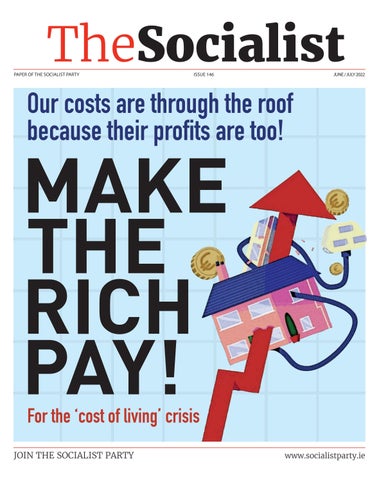
TheSocialist
PaPer of the SocialiSt Party
iSSue 146
June / July 2022
Our costs are through the roof because their profits are too!
Make the rich pay! For the ‘cost of living’ crisis
join The socialisT parTy
www.socialistparty.ie
2
inequality
The socialist
By James Fleming
Oxfam’s ‘Profiting From Pain’ report The coronavirus pandemic has been among “the best times in recorded history for the billionaire class”, according to Oxfam in their ‘Profiting From Pain’ report.
263 million pushed into ‘acute poverty’ in 2022 While increasing numbers of working-class and poor people have been sacrificing meals, warmth, healthcare and other necessities, the billionaires have been making a killing – literally. one person is dying every minute from hunger. food prices are up more than 30% on last year and will push an additional 263 million people “into acute poverty” – earning less than $1.90 per day – in 2022; that’s more than the populations of Germany,
france, Britain, and Spain combined.
Irish billionaire ‘bonanza’ hundreds of thousands of irish people face deprivation this summer, including 200,000 children. The Irish Times wrote, “the pandemic and now the steep increases in food and energy prices have, simply put, been a bonanza” – for the billionaire entrepreneurs. ireland’s nine billionaires increased their wealth by €15.5 billion since 2020, to a total of €51 billion.
10 men have more wealth than 40% of the world according to Forbes, there are now 2,668 billionaires globally with an
inconceivable wealth of $12.7 trillion ($12,700,000,000,000). Bezos, Musk and other plutocrats within the world’s top ten rich list have hoarded “more wealth than the bottom 40% of humanity, or 3.1 billion people.”
Workers pay the cost the incredible wealth of a few and the generalised poverty among billions of people are not separate issues. oxfam reports that “the rapid rise in billionaire wealth and the cost-of-living crisis faced by billions of people are one and the same phenomenon.” Decades of pro-corporate, neoliberal policies “have ripped away public services into private ownership and have encouraged … massive concentration of corporate power and tax avoidance on a huge scale. these policies have worked to deliberately erode workers’ rights and… have… opened up the environment to levels of exploitation far above what our planet can bear.”
Oxfam’s modest proposals oxfam made three proposals to curb social and economic misery in their report: l an urgent pandemic excess profits tax on the world’s largest corporations l urgent one-off solidarity wealth taxes on new billionaire wealth
l a permanent wealth tax these are progressive measures that could “lift 2.3 billion people out of poverty”, but the reality is that they are not nearly radical enough. even if elon Musk was taxed 99% of his wealth, he would “still be in the top 0.0001% of the world’s richest people”, still be a multi-billionaire.
Make capitalism history! So what is the solution? Well as long as capitalists exist, and privately own the economy, the land, the resources, the media etc. they’ll also control the governments, which all amounts to the power to continue to oppress the people and destroy
the planet. this is the power we have to take out of their greedy hands. that means making capitalists history! it means taking their wealth and resources into public ownership, where they can be used – as part of a democratic plan for the economy – for the benefit of humanity and the environment. What can we hope for under a continuation of capitalism? economic crises, inequality, climate change and war are its current consequences, and it is only going to get worse. capitalism offers no prospects for working-class people because it is a system based on the exploitation – the systematic rip-off – of the working class.
Government housing policy: homelessness for some, poverty for others By Martina Stafford
T
HE PROFOUNDLY detrimental impact the housing crisis is having on working-class families, young people, lone parents, migrants and travellers is impossible to convey. It is clear that there is untold stress and hardship caused by the inadequate and insecure nature of housing access and quality across the country. Latest figures suggest that the housing waiting list of 60,000 could be double that in reality, if those in receipt of HAP (state payments to private landlords) are included – which of course they must be. A new low
According to a new study which examined poverty risk in the context of the cost of living crisis; one-fifth of the population is living below the poverty line after housing costs are factored in, and half of all one-parent families are in poverty after they pay their housing costs! You can be sure that this is the same section of the population who are lowpaid essential workers, women and young people who kept society afloat throughout the pandemic. This is the section of the population that is absolutely disregarded by this government or any government confined by the logic of privatisation and profiteering.
Homelessness and abuse
The housing crisis worsens the impact of domestic violence and gender-based violence by trapping victims in abusive relationships. A study of women who left their homes due to violence found that one in three had become homeless due to domestic violence and half reported that they had returned to live in an abusive situation due to homelessness, or to keep their children in a home. Taking gender violence seriously means tackling the crisis of skyrocketing rents, evictions and the lack of public housing. Capitalist housing policies create huge power imbalances, most appallingly highlighted by certain landlords using the housing crisis to sexually exploit women seeking a roof over their head. Landlords/developers prioritised
Government policy on housing has amounted to the gifting of public land and public money to private developers and investors via public private partnerships and rent schemes like HAP. Incentivising investors and paying off landlords whose rents are unaffordable for the majority of working-class people are the key priorities of government politicians. They are extremely slow to actually build any social or affordable housing directly, because this would interfere with the interests of the developers and investors whom they serve.
The housing crisis is going from bad to worse under this coalition government Stepping into Action
As long as the production and supply of housing is dominated by the interests of developers, investors, bankers and landlords; the right to housing will not exist. But we absolutely can change this reality if we get organised in our communities, workplaces and colleges around our interests. The reason capitalist politicians won’t act is because they are
part of the minority that benefit from this system and are completely blind to any alternative. Increasing numbers of people, especially young people, are looking for alternatives because they understand that this system does not benefit them, or offer any sort of decent future! We need to build a movement that demands public homes on public land,
real rent controls which bring down the cost of rent, a ban on evictions and an end to all profiteering from the housing crisis. This government, which includes many landlords, will resist all such moves, but like we did in other mass movements – such as water charges and repeal – we can force even the most right-wing parties to bow to mass pressure from below.
Cost of living
3
The socialist
cost of living crisis:
tax the rich to fund emergency measures By Jonathan Diebold
P
RICE INCREASE after price increase has struck Irish households at a rate unprecedented in the last 40 years. Inflation in Ireland, now at 7.8%, is an intolerable burden on workingclass people. By April, food prices were up 3.5% over last year, and it’s expected it rose by over half again, to 5.5% in May. But it’s essential foods like milk, bread, pasta, flour, sugar, and butter that are rising the fastest, with increases of over 10%. Then there’s the cost of electricity, fuel, gas, heating and transport, all of which are rising in the region of 20-40%. The impact of rising energy costs and grocery shopping alone is expected to be €1,400 per annum per household. Ireland’s ongoing housing and healthcare crises only add to the problem, and all this while summer looms, and the inevitable strain increased childcare costs will bring – not to mention back to
school costs in the Autumn. What is needed?
Emergency measures are needed now. Working-class people literally cannot afford to wait. The Socialist Party calls for a €2,000 payment for every household as a stopgap measure, as well as rent cuts, price freezes, and a €15 an hour minimum wage. How can we pay for this? Emergency taxes are needed on the super-rich and big business. The suffering of ordinary people is directly correlated with record breaking profits. In 2021, across Ireland and the UK, Tesco – the second largest supermarket in Ireland – doubled profits to £2.2 billion, and supermarket sales generally are up 12% over pre-pandemic levels. The ESB, a state-owned company, made record profits of €679 in 2021, while Centrica, the UK-based parent company of Bord Gáis, made £948. All this while cranking up prices. There are endless examples of this
Free, reliable and frequent public transport now!
We need emergency measures becuase for many people it’s a cost of ‘surviving’ crisis
profiteering. It should be stopped once and for all by taking these major companies into public ownership, under dem-
ocratic workers’ control. In this way, the resources and operations of these companies can be planned and the huge
transferral of wealth is needed to alleviate the crises – that the capitalist market has caused – organised.
End the model of state-subsidised, private profit childcare By caitríona ní chatháin DISGRACEFULLY, THE Irish State currently spends a pitiful 0.1% of its GDP on childcare. Ireland is also an outlier among wealthier countries because childcare is exclusively private and largely for-profit with state subsidies. in spite of these subsidies we have some of the highest costs for childcare in the world, with the average cost €175.24 per week. however, there is a huge regional disparity. in cork city the cost of two young children in full time childcare is over €1,400 a month!
By conor Burke
T
HE GOVERNMENT'S recent decision to reduce fares for public transport by 20% was immediately offset by inflation and the rising cost of living. In reality, it was a token measure that falls far short of what should have been implemented. Privatisation model
The resources exist for a public transport system that is free at the point of use, which is a vital measure to slash CO2 emissions. However, such a move would most certainly cut across the privatisation model that the right-wing political establishment are ideologically committed to. Transport companies that are privately run for profit will naturally oppose such a system. A number of cities around the world have introduced free public transport in order to reduce congestion, thus lowering air pollution and carbon emissions. Given that Ireland is already way off track to meet the government’s own emissions reduction target of 51% by 2030, it is clear that the time for halfmeasures has long passed. Transport is the second largest contributor to carbon
emissions in Ireland after agriculture. Therefore, the introduction of free fares would be a big step in the right direction. Failure of the Greens
The Green Party received substantial support at the last general election, reflecting a desire for action on climate change. The fact that it is seeking to accomplish this by adhering to free market policies such as carbon taxes that don’t target the actual polluters, but instead put the burden on consumers is a total cop out. As well as making public transport free, we also need major investment to upgrade and vastly expand our bus and rail networks. These measures are an important part of the social transformation required to tackle climate change. Privatisation of public transport must be ended, and a quality service maintained with all transport workers on proper pay and working conditions. The failure of the Greens to take on the real sources of environmental destruction is a clear example of why we need anti-capitalist, socialist policies that will protect and defend workers, while taking the fight to the big polluters and profiteers.
Low pay, high cost model Meanwhile, for the 30,000 plus staff who work in the childcare sector, a survey by SiPtu shows that 90% of them said they struggle to make ends meet, while only 10% said they get paid maternity leave. the average hourly wage of childcare staff is €12.45. yet this current model is responsible for massive profits from some of the big players in the childcare industry, not to mention allowing abuses and a lack of accountability to go unchecked. Giraffe childcare, a chain of crèches, paid its shareholders dividends of €1.66 million in 2020 after receiving covid-19 grants of almost €6.7 million. in spite of the poor pay and exorbitant costs in the childcare sector, this private profit model is one that the state point-blank refuses to break with. a recent government report on a new funding model for early years (commissioned by former children’s Minister Katherine Zappone) outlined the many problems faced by the forprofit, subsidised model of funding but refused to consider an alternative, concluding that they were not allowed to recommend a publicly-
Childcare costs are like a second mortgage for working class households
funded model of child care! on the back of that report, the newly announced package of subsidies, called core funding, includes a deal to improve rates of pay for child care workers. however, this is contingent on an agreed minimum wage across all childcare providers. So far this has not been agreed upon and a recommendation of €13 an hour falls far short of what is acceptable. Subsidised model the state has shown its true colours in refusing to make childcare affordable and accessible for working-class families. this is unacceptable in an era when working-class people have no
choice but to delay dreams of starting a family, have fewer children or no children at all because of the associated financial toll. childcare workers and the families that rely on this essential service must use their collective power to show the government that they will no longer settle for this piecemeal approach to such an essential public service. trade unions must step forward and lead the fight for decent wages and working conditions for workers in the childcare sector. in order to combat the spiralling cost of childcare the state must roll out community-based child care which is fully funded, childcentred and free at the point of use.
4
health
The socialist
inhuman working hours: Junior doctors ballot for industrial action By Mick Barry tD
H
SE JUNIOR doctors are expected to vote by a decisive majority to take industrial action. The inhuman and unrealistic hours they are demanded to work lie at the root of it. According to the Non-Consultant Hospital Doctors committee of the Irish Medical Organisation (IMO), junior doctors are regularly asked to work 7080 hours per week. Thirty-six hour shifts without a break are not unusual. Nor are the doctors being paid for all the hours they work.
By catherine finnegan
Long working hours
Many find themselves unable to take full annual leave or to avail of their full study time entitlements. The hours many junior doctors are being forced to work are in breach of the European Working Time Directive. The Directive states that 24 hours should be the maximum work shift and 48 hours the maximum working week. Even the HSE admits that they are in breach of the 48-hour rule in 16% of cases – a figure challenged by junior doctors as a massive underestimate. Four out of five junior doctors recently polled felt they were at risk of burnout as a result of working conditions. According to the University of New South Wales and the Black Dog Institute junior doctors working more than 55 hours a week are at greater risk of developing mental health problems and experiencing suicidal ideation. Working conditions are also driving
Like other healthcare workers junior doctors are bearing the brunt of our underfunded health service
junior doctors out of the country – in a 9 month period from July 2021 to March 2022 more than 400 doctors were granted skilled visas they had applied for in Australia. Fill vacancies
There are currently 837 HSE consultant posts unfilled on a permanent basis – and the junior doctors are being used to fill the breach. The State should insist that all vacancies are filled by consultants who agree to work exclusively for the public health system. However, they then need to fix a rate of pay which will manage to both recruit and retain the new consultants.
Meanwhile, junior doctors must be allocated hours which are in compliance with the law, must be paid for every hour worked and then must be allowed sufficient time off both for annual leave and for study. Negotiations will now get underway between the HSE and the junior doctors. It says a lot about this government that it takes a strike ballot to bring them to the negotiating table. But if the government doesn’t take relatively swift action on the hours issue junior doctors will need to be prepared to act on their mandate. Meanwhile, the strike ballot may be a further indication of an important
change in the psychology of health workers more generally. Like the medical scientists who went on strike in May, the junior doctors parked a long-standing grievance for the duration of the Covid crisis. Now that Covid pressures have been lifted somewhat, the bottled-up grievances are beginning not only to be voiced but acted upon. Many other health service workers – not least among them nurses – will no doubt be watching the junior doctors’ campaign with great interest. The medical scientists and the junior doctors may be the first to challenge the government. But they are unlikely to be the last.
sharpening mental health crisis results in record dropout from third level By finn McKenna
H
UMAN BEINGS are social creatures. The meaning that we derive from life and the world is rooted in our interaction with our friends, our family, our peers, and society generally. As much as a truism and a cliché it is to say, the pandemic dislocated human connection and has caused immeasurable damage to every strata of society except the very wealthy. Young people were particularly affected. Impact on university life
Rates of non-progression through university and college are rising and have been rising throughout the pandemic. Concurrent to the increased rates of drop-out, there is a sharp increase in demand for essential mental health services throughout third-level institutes. An Irish Times article published on the 28 May revealed: “Psychological counsellors in Higher Education Ireland, a representative body for counselling services at third-level estimates that demand for services have climbed between 23% and 70% this year” On the same day a separate article was published in which Treasa Fox, head of student counselling in Athlone, noted:
CAMHS beds closures: youth mental health services are on their knees
“The canteen was much quieter . There were fewer groups of students. Many attending lectures went straight home after class. Student societies struggled to keep students engaged.” Both snippets reveal a negative transformation of universities; they’ve become emptier, less social, and the demand for contingency mental health services that is being cried out by students is not being met by colleges or the state. Mental health professionals and college faculties have commented on how record numbers of students are presenting with anxiety, low mood and loneliness. This in large measure can be understood as an effect of the pandemic’s succession of lockdowns. Growing precarity
It also speaks to the volatility in the world and how young people’s existence is more and more defined by a sharpening precarity. Young people are faced with no prospect of stable housing or job security, the expectation that a two-hour commute each way from college is parfor-the-course, and to top it all off, a world on fire set alight by capitalism. The deepening alienation and mental health epidemic experienced by young people needs an emergency economic and social action plan, which would include:
We need major public investment in free and accessible mental healthcare services
l A major and rapid expansion of counselling services for all those who need it, free at the point of use. l Making student accommodation accessible and affordable for all. Take private student accommodation complexes into public ownership, and provide public funds for more on-campus accommodation with genuinely affordable rents. l Scrapping of college fees and the introduction of student grants for all.
Such measures must be implemented immediately. The mental health crisis is reflective of a deteriorating social and economic system with exploitation, oppression, and neglect at its root. Young people’s social and interpersonal development is being hampered by capitalism in a thousand different respects. To bloom and leap forward, society must remove the chains of the profit-motive that weighs like a nightmare on the young.
ALMOST HALF of all beds in the Linn Dara, Child and Adolescent Mental Health Unit in Cherry Orchard are closed due to staff shortages. The HSE has confirmed that 11 of the meagre 23 beds will be closed until at least September. The Psychiatric Nurses Association (PNA) has strongly condemned this move by the HSE, pointing to a similar decision made in 2017 highlighting that little has been learned in the intervening years. it is recommended that 100 beds be available for children and adolescents requiring mental health treatment and this move means only 56 will be available. a consequence of this will be that an increased number of children and adolescents requiring specialised mental health care will be forced into adult mental health units which simply cannot provide the care that these young people need. Understaffed services the in-patient unit in cherry orchard requires a staffing of 51 nurses and there are currently only 24. this shocking level of staff shortage is not an anomaly but rather becoming the norm across the health service. there is a severe recruitment and retention crisis in the health service as chronically overworked and under-paid health care workers seek to emigrate for better pay and conditions, which in turn exacerbates the pressure and poor conditions faced by the workers who cannot or choose not to emigrate. The Irish Times reported in 2021 that there were 2,000 children and young people awaiting cahMS (child & adolescent Mental health Service) and 10,000 awaiting primary care psychology, the majority of whom are children. it is simply impossible for these disgraceful waiting lists to be reduced while beds are being closed. of course the staffing crisis in the health service is nothing new, and yet nothing is being done about it. Public investment is crucial the budget for mental health services must be significantly increased – just €37 million was allocated in Budget 2022 to deal with this major societal crisis. Mental health centres that are open 24/7 must be established, professionally staffed and fully resourced in all communities. the healthcare workers, the community groups and those who use these services must have oversight and input into how the services are run. young people should not be reliant on the private sector for counselling services, which are generally unaffordable. they should be easily accessed as part of a public national health service, free at the point of use.
north
5
The socialist
thousands march for irish language: fight for real language rights for all By eóin Dawson & Maitiú de hál
F
IVE YEARS after the historic An Dream Dearg [the Red Crowd] march for Irish language rights, they repeated their Lá Dearg [Red Day] event on 21 May 2022, demanding ‘Cearta, Cothromas agus Cóir’ [Rights, Respect and Recognition]. The sequel is being lauded as an even greater success, with 17,000 marching from An Culturlann to Belfast City Hall. The crowd was made up of activists from across the island of Ireland, with over 20 buses from both North and South. In attendance were school children, many from local Gaelscoileanna (Irish medium schools), parents, teachers, youth and other Irish medium sector workers and other Irish speakers and supporters. The largest contingents however were made up of young people, who are increasingly radicalised by the consistent failure of politicians to meet their demands. Red with anger
While politicians might use language as a bargaining chip, as part of their divide and rule strategy, participants were clearly conscious of the need for sensitivity. Organisers ensured that the crowd were mainly adorned with the group’s distinctive red, avoiding symbols traditionally associated with political republicanism or nationalism. The mood of the march was vibrant and hopeful, but without the passing of legislation, the Irish language community will remain “dearg le fearg” [red with anger]. Speakers talked of no longer being invisible and seeing the passing of legislation, giving Irish legal status in Northern Ireland, as a key step along the road to language rights. With the passing of such legislation through Westminster in sight, it seems likely that
17,000 marched for language rights in Belfast in May 2022
the next stage will unfold, moving from largely symbolic legal recognition to concrete demands. Cearta teanga, cearta daonna
The battle cry of the marchers; cearta teanga, cearta daonna is entirely correct, language rights are indeed human rights. Those rights extended to the Irish language sector, as many in the Irish language movement would attest, must be extended to Ulster-Scots as the other native language of the North. Rights which ensure the ability of foreign nationals to communicate and fully participate in society must also be promoted and protected. Human rights must be unqualified, with individuals and communities free to exercise them
in whatever way they see fit, whilst respecting the rights of those who prefer not to participate. While passing of legislation through Westminster is to be welcomed, the struggle for a fully funded plan to protect languages in the North is far from won. Such a struggle will inevitably bring activists into conflict with capitalism, which systematically represses minority languages. As far as some within An Dream Dearg are concerned, debate over the cost of provision of services “is over”. That remains to be seen. The struggle for Irish language rights is the struggle for a fully funded education system, with adequate spaces in appropriate, permanent build, safe schools for all
children. It is funding for the arts, community and voluntary sector, with permanent jobs on decent wages for workers to sustainable deliver services. This would mean a confrontation not just with parties like the DUP which opposes language rights and has implemented callous cuts to the sector, but with all Northern Ireland executive parties, including Sinn Fein. All five main parties’ ministers have in the past implemented cuts that have disproportionately affected workers and Irish language services. For language rights, against sectarianism
In the struggle for rights and recognition, Irish speakers are not alone. The
struggles for decent education and a vibrant art, community and voluntary sector are relevant to all working-class people, regardless of cultural heritage or language background. The Ulster-Scots community must also be involved in the struggle for language rights. While recognizing that different speaking communities have different aspirations, both indigenous languages must be freed from the narrow confines of sectarianism if we are to have a brighter future. These languages do not belong to one community, orange or green. That means challenging forces on both sides of the sectarian divide, who seek to use language to divide. It also means where there is difference around the use of language for example of signage it should be resolved not on the basis of confrontation but dialogue and democratic discussions involving ordinary people and residents. Often Ulster-Scots is dismissed, as is Irish. These insults come from a misunderstanding of what language is and are only a step backwards. It is not a threat to any language community to advance another, indigenous or newcomer, but the opposite. These disputes are based on the cult of scarcity, spread to divide us. The best way to win these demands is through unity in struggle. This doesn’t mean prioritising one group’s demands over another, or minority groups being drowned out by the majority. Nor does it mean complete uniformity of demands. Language communities within a broader movement can remain unified, regardless of differing aspirations. Struggle underpinned by and organised around the principles of solidarity and democracy offer an avenue by which Irish, Ulster-Scots, other minority language and English speakers can win real gains.
oppose Tories’ legacy bill #Billofshame
T
HE TORIES’ Northern Ireland Troubles (Legacy and Reconciliation) Bill is a historic act of cowardice from the Tories and a slap in the face to anyone who has lost a loved one to the unspeakable violence of the Troubles. The Bill, introduced by Northern Irish Secretary Brandon Lewis, shuts down inquests and inquiries, civil cases brought by victims’ families, Police Ombudsman investigations and criminal prosecutions relating to the Troubles. In their place will be a new body, the Independent Commission for Reconciliation and Information Recovery, which will conduct its own investigations. Scandalously, immunity from prosecution will be granted to implicated individuals who cooperate with the ICRIR.
ject the Bill. As such, the Tories have disingenuously presented the reworking of the amnesty issue as a move away from prosecution and toward “information sharing”. In reality, the Bill represents a rotten and corrupt state keen to hide its own sins as well as the crimes against humanity committed by state forces and paramilitaries. The Bill was introduced in the House of Commons on the same day as the anniversary of the Dublin and Monaghan bombings, in which UVF bombings killed 33 civilians. Evidence has been taken seriously by inquiries indicating these attacks were some of countless cases of collusion between British security forces and paramilitary terrorist organisations.
Protecting the state’s dirty secrets
No justice
The Tories’ earlier intentions to usher in blanket amnesties for veterans of the Troubles were met with a wave of rejection from the majority in Northern Ireland. The five main political parties in the North as well as the Labour Party re-
This #BillOfShame has rightfully been the source of anger from families, victims and survivors groups and human rights organisations; with protests in Belfast, Derry and Westminister. For many, they have been campaigning for decades and in the overwhelming majority of cases
justice has not been delivered. This is due to the unwillingness of the British state and sectarian parties in Northern Ireland to open themselves up to scrutiny in their role in the deaths of innocent people. It is also due to the uphill battle that is the capitalist courts system, a painstakingly slow and uncertain process at best. There can be no true justice under this system which places endless technical roadblocks in front of victims and their families taking cases against perpetrators of sectarian violence against them. Genuine, democratic inquiries
Inquests and inquiries can play an important role in this context for scrutinising the role of the state in relation to the atrocities of the Troubles. Just last year the Ballymurphy Inquest confirmed what has been known for decades: that the ten murdered by British soldiers were “entirely innocent”. To acknowledge the legacy of the Troubles and look toward true reconciliation what is needed is a robust system of inquests and inquiries. Importantly,
The British state is seeking to whitewash the dirty war it waged during the Troubles
these inquiries should not be in the hands of the state or establishment parties, but instead of ordinary workingclass people through bodies made up of trade unionists with records of cam-
paigning with on these issues, human rights organisations and victims and survivors groups. True justice and reconciliation starts with real accountability.
6 speCial feature The Stockholm+50 climate conference took place in early June to commemorate the 1972 UN Conference on the Environment. While the ruling class is meeting to “celebrate 50 years of global environmental action“, thousands of workers and young people protested the hypocrisy and inaction of these international bodies, write Philipp Chmel and Bill Hopwood.
T
HE CAPITALIST ruling class, their governments and international talk-shop bodies are driving the world to climate catastrophe. However, there is reason for hope. An international climate movement of youth, workers, Indigenous people, farmers and poor people would be capable of overthrowing this deadly capitalist system and replacing it with an egalitarian and democratic socialist system. The UN’s environmental history The 1972 United Nations Conference on the Environment in Stockholm was the first world conference to make the environment a major issue. Back then, the main concern was not climate catastrophe from global heating, but industrial pollution, nuclear radiation, and the destruction of entire ecosystems in different countries. General critique of the economic system and its inherent growth imperative (in terms of GDP not human well-being) were an important feature of this early phase of international discourse on climate and environmental protection. The 1972 Club of Rome Report “Limits to Growth” was one of the key publications and influenced that phase. The authors of “Limits to Growth” pointed to the absurdity of endless growth – extract more resources, use more energy and produce more things (commodities) and waste – on a finite planet. However as their outlook was bound by capitalism,
they drew pessimistic conclusions talking of “limits to growth.” They never envisaged a rationally planned cooperative economy where the ingenuity and skill of humanity would benefit all, while recognizing planetary boundaries and the laws of nature. Since the 1970s, official language and discourse around climate and environmental protection has changed drastically. With terminology like “sustainable development” or “Green economy”, the UN conferences increasingly pushed the idea that there could be an harmonious coexistence between economic growth, equity and the environment. The neoliberal era also left its mark. There was a shift away from a more political approach that emphasized public planning to a technocratic ideology that pushed a reliance on markets. This emphasis on market approaches means relying on the very forces that have driven society towards an ecological disaster: the pursuit of profits. Capitalism is rooted in the exploitation of labor and expropriation (robbery) of nature. Stockholm+50: an ill-fitting fig leaf With the COP (Conference of Parties) climate conferences, which started in 1995 and flowed from the UN conferences on the environment, it has become increasingly clear that they are not the place for change. Despite the various Kyoto, Paris & Co agreements reached, global emissions have kept rising
The so throughout except for the year of 2020. This dip in emissions is not a result of successful climate protection policies, however, but a direct result of the economic recession triggered by the Corona pandemic. In 2021, “global energy-related carbon dioxide emissions rose by 6%” according to the International Energy Agency (IEA). In absolute terms this is an increase by over 2 billion tonnes, the largest annual increase ever. This was before the horrible invasion and war in Ukraine. The fossil rollback – replacing Russian gas by increasing coal and liquified natural gas imports – spells full-on disaster for the fight against the climate crisis. The war in Ukraine is adding to ecological as well as humanitarian disaster. Scientists say there is a 50% risk that we will cross the critical 1.5°C mark of global heating within the next five years. To stand a remote chance to stay below 1.5°C in the long term, carbon emissions would need to be cut in half by 2030, but the opposite is the case, they are projected to rise by 14%. Moreover, as a Guardian report reveals, the biggest “fossil fuel companies are quietly planning scores of “carbon bomb” oil and gas projects that would drive the climate past internationally agreed temperature limits with catastrophic global impacts”. Until 2030, the 12 biggest oil companies are on the path to spend $103 million every single day on exploiting new oil and gas fields. In the face of looming disaster and without any tangible plan on how to avoid the worst climate crisis scenarios, the international climate conferences are in a sort of cul-de-sac. In order to keep face, the Stockholm+50 conference is trying to take the bull by the horns and give the appearance of action. The name of the conference – Stockholm+50: A Healthy Planet for the Prosperity of All – Our Responsibility, Our Opportunity – sets the tone. It implies the climate disaster is all humanity’s “Responsibility.” Yet it is the super rich and corporations who are responsible for the absolute majority of emissions. Oxfam reported in 2020 that the “richest 1% of the world’s population are responsible for more than twice as much carbon pollution as the poorest half of humanity.” On the website, they then claim that the “Stockholm+50 will commemorate the 1972 United Nations Conference on the Human Environment and celebrate 50 years of global environmental action.” With this, they are unintentionally clear about the true nature of this forum as everybody can clearly see that the UN climate and environmental conferences have failed. There is no reason for “celebrating 50 years of global environmental action” and it doesn’t take much to see through this charade and recognize this event for what it is – “a global north greenwash festival“, to borrow a phrase Greta Thunberg used to describe last year’s COP26 climate conference. Building a climate movement to win The fact that the climate crisis cannot be solved by capitalism and that UN conferences are not the place where the necessary change will happen has become increasingly clear to most people. The mood at the protests around COP26 are a case in point, expressed pointedly by Greta Thunberg: “We say no more ‘blah blah blah’, no more exploitation of people and nature and the planet. No more whatever the fuck they’re doing in there. We’re sick and tired of it and we’re gonna make the change whether they like it or not.”
Capitalism is burning our planet
Protesting
5 decades & the social
the war & the clim By Jonas Brannberg
W
AR AND militarism are among the most obvious expressions of how today’s capitalist system is a total failure. More and more of society’s resources are being spent on blowing people to pieces, forcing millions to flee, flattening cities and villages, while exacerbating the environmental and climate crisis, as if it were not acute enough anyway. At a moment when a transition of society to tackle the climate crisis is absolutely urgent, the world’s major powers have their focus elsewhere — on an escalating nationalist and imperialist power struggle that is unsettling the world and sabotaging real climate action. The food shortage caused by a war between two of the world’s biggest grain producers is also in itself a harbinger of things to come if climate change is not tackled. Already way behind targets The latest IPCC report states that global climate investment will have to increase three to six fold by 2030 to have any chance of keeping the global mean temperature rise to between 1.5 and 2 degrees. The increasingly hot Cold War between the world’s major powers, of which the Ukraine war is increasingly an expression, has instead meant that investment is going towards weapons of mass destruction. According to SIPRI, the world’s total military spending rose to
$2113 billion last year — equivalent to about 2.3% of world GDP. According to the latest IPCC estimates, world military spending alone would be enough for between 44 and 88% of the total global climate investment needed annually to meet the 1.5 degrees target (including investments in energy production, energy efficiency improvements, transport, agriculture and forestry). The transition is of course not just about money for climate investments. Under capitalism, capitalist competition and lack of planning means that all investments become inefficient and the focus is shifted away from needs to profit and power — while capitalism’s continued environmental degradation, class divisions and wars counteract the potential of the investments that are made. While the Swedish government, which is hosting the Stockholm +50 environmental summit, was able to cough up SEK 30 billion for new arms purchases overnight, climate investment is lagging far behind. Sweden, for example, has the potential to easily reduce energy demand from buildings by 36%, but without sufficient investment, less than a third of that potential is being realized. Even the global climate investment fund to help poorer countries adapt has still not reached the $100 billion a year promised back at the Copenhagen climate summit in 2009. While the US is pumping tens of billions of dollars worth of arms into Ukraine, in what increas-
speCial feature
ocialist
7
It’s time to get rid of capitalism – the urgent need for socialism
g Stockholm+50:
of climate failure list change we need
mate “Missing in action” ingly looks like a proxy war between Russia and the US, only one billion was added to the global climate investment fund, far short of the already inadequate 11.4 billion Biden has promised. The main adversary of US imperialism on the world stage, Chinese imperialism, plans in its new five-year energy strategy to increase the production of coal, oil and gas, in order to ‘secure’ its energy supply in the new Cold War era. War and militarism demonstrate with devastating force what the main interest of the ruling elite is — to strengthen its power at any cost, including the survival of human civilisation, and to make the super-rich even richer. To fight militarism is to fight the inherent logic of capitalism. Tipping points in climate and consciousness The war also takes from us what we may have the least of — time. The focus on war, rearmament and devoting all resources to fighting one’s opponent in the imperialist power struggle means that what little was planned to reduce emissions and mitigate the effects of climate change falls even further down the priority list. However, climate change waits for nothing, not even war. In the shadow of war, scientists have measured atmospheric carbon dioxide at 420 ppm — the highest level in human history. We are getting closer to new tipping points, such
as the loss of the Arctic ice cap and Greenland glaciers and the transition of the Amazon from rainforest to savannah. Within a few years, there is a 50% chance that global temperatures will rise above 1.5 degrees, at least temporarily. But climate change and its devastating consequences in a society also ripped to pieces by extreme class divisions and wars also mean other tipping points — tipping points in the consciousness of the world’s workers, young people and oppressed masses. Already we are seeing uprisings against inflation and food shortages — like in Sri Lanka and Peru — and
protests against reactionary attacks on human rights, such as the abortion rights struggle in the US, anti-war protests in Russia and the feminist wave in China. Anti-capitalism is becoming more widespread, both in the climate movement and in society as a whole. It is in these human tipping points that the seeds of change are sown. By uniting environmental and climate struggles with other workers’ and youth movements — which are also fundamentally opposed to the total bankruptcy of the capitalist system — we will have the strength to turn the tide.
By Manus lenihan WITH CLIMATE change, war and disease, it’s easy to grow numb to all the bad news stories. But just when you think nothing can shock you, the world finds a way to twist the knife, for example with the latest massacre of children in the United States. How is this still happening? thirty years ago our leaders assured us that the victory of capitalism in the cold War would open up an era of progress. capitalism has had a clear run for those thirty years. it has brought us to the point where there is a breakdown in the global food supply system. to take a less obvious example, it has brought us to the point where there is now a measles outbreak in Brazil, a country which wiped out measles decades ago. after years where there has been some progress for women and lGBtQ people, we are now seeing anti-trans hysteria and the overturning of abortion in the uS and china. Why is the world in such chaos? Why are things getting worse instead of better? Capitalism in decay Many of these problems are due to capitalism, the system under which we live, where vast wealth is owned by rich people and big companies, and invested for the sake of profit. as workers we are exploited, as consumers we are ripped off, and as citizens we are lied to and kept away from any real power. the housing crisis in ireland is one example. Why hasn’t it been fixed? Because our capitalist politicians came up with a capitalist solution: tempt the big funds and the big corporations to come here and build houses. But these parasites have just driven prices up, and they have built too few houses to help the 10,000plus homeless. everywhere we look we can see the profit motive causing huge problems. the stock prices of arms companies go up dramatically whenever there’s a war or a school shooting. the most powerful energy companies are profiting from the destruction of the environment. the soaring bills for fuel, energy, groceries, etc, have a number of causes. But these all come back to capitalism: profiteering, imperialist
war, and the fragile ‘just in time’ supply chains built up by a small number of powerful corporations. Most politicians serve these corporate interests. that goes for the socalled ‘liberal centre,’ the Macrons, Bidens and Varadkars, as well as the far right, the trumps and le Pens. these two sides perform a phony culture war, each trying to rile up some kind of base of support even though they have nothing to offer working people. in response, some people switch off and stop caring about politics. others go down a rabbit hole of bigoted ideas, and lose touch with reality. this is how the political culture of a system in decay promotes racist and sexist ideas. not every problem in the world is simply, one-to-one, caused by capitalism. But the system is rotten and set up on every level to reward powerful people for doing bad things. it’s not the fault of working or poor people. it’s not ‘human nature,’ it’s the nature of a system designed to maximise profit. Socialist alternative there is an alternative: Socialism. this would mean the biggest companies being brought into public ownership and placed under democratic control. it would mean all of us having a say in what those companies invest in, as part of an overarching plan for the economy. instead of burning more fossil fuels, or blowing up stupid bubbles like Bitcoin, working people would choose to invest in green energy, transport, health and education. instead of maximising profit, we could maximise human welfare. new technology would lighten the workload without loss of pay, instead of creating unemployment. Public housing could be built at cost price. We could control food and fuel prices. We could take over the fossil-fuel and arms industries, retraining their workers and repurposing their machines. this would obviously not solve all problems overnight. But socialism would give people a sense of progress and common purpose, and weaken the grip of sadism, paranoia and despair. it would enable us to start really pushing back against climate change, against far-right politics, against the warmongers and war profiteers.
8
international
The socialist
a brutal war of attrition:
Bloodshed in Ukraine continues By Stephen Boyd
P
UTIN’S ORIGINAL war aim of a quick Ukrainian capitulation, with Russian troops being greeted as liberators in some areas, has been dealt a decisive blow. Failing to occupy Kyiv, Russian forces are now concentrated in the Donbas region. Fighting in trenches reminiscent of the First World War, with Ukrainian forces receiving significant military and economic aid from NATO. Weakness of Russian imperialism
The war has exposed the limitations of the Russian army and state, with the Economist describing the invasion of Ukraine as “a disaster for Russia’s armed forces”. Tens of thousands of soldiers have been killed on both sides, 21,000 civilian casualties and up to 14 million refugees. The Economist (9 May 2022) quoted Leon Trotsky when explaining the current crisis facing Russia’s armed forces; “the army is a copy of society and suffers from all its diseases, usually at a higher temperature”. Retired Colonel and military analyst Mikhail Khodarenok, speaking on the Russian state TV programme 60 minutes, gave what was seen as a shocking alternative view to that of the Putin regime’s propaganda. He warned "the situation [for Russia] will clearly get worse" as Ukraine receives additional military assistance from the West and "the Ukrainian army can arm a million people”.
A new cold war
with predictions that 44 million face starvation.
The war can only be understood if it is viewed against the backdrop of the new “cold war” between the US and its allies and China with Russia as a junior accomplice. There are two wars being fought. One being waged by the Ukrainian people against the brutal Russian invasion – the Socialist Party supports this right to self defence and argues for it to be independent of the rotten, pro-Western imperialist Zelensky regime. The other war is a proxy war between Russian Imperialism, claiming to be fighting NATO expansion and US Imperialism. On the other hand NATO is aiming to weaken Russia and use Ukraine as the battlefield. Sweden and Finland’s decision to join NATO exposes the futility of Putin’s strategy, his act of aggression has strengthened not weakened NATO. A prolonged war of attrition, with the Ukrainian people as the victims, now seems most likely.
Biden’s hypocrisy
Impact of sanctions
The impact of sanctions on Russia have been somewhat alleviated by the significant increase in the price of oil and gas. According to Bloomberg, Russia's total revenue from energy earnings will be $321 billion, the previous high was $230 billion in 2019. The EU, which has imposed new sanctions on the importing of Russian oil, is paying Russia €1 billion a day – which is more than its daily war expenditure estimated to be between $650-$900 million.
So far 21,000 civilians have been killed in the war in Ukraine
However, Russian GDP is expected to fall by between 8% and 12% this year, the worst performance in 30 years. Support for the war is weakest amongst the youth and those struggling most to make ends meet as inflation moves towards 20%. The impact of the war globally is
being felt by working-class people as the cost of living crisis intensifies. Ukraine has only been able to plant 75% of its usual crops. Some economists now predict that the price of oil may rise to $160 a barrel. The working class and poor in the neo-colonial world are hardest hit,
As Biden imposes severe sanctions on Russia and aims to make it a pariah state, he is planning to repair relations with Saudi Arabia, who he had previously condemned as a pariah state in order to woo them into increasing oil production to make up for the shortfalls from Russia. Yet Saudi Arabia has been conducting a war in Yemen for seven years where there have been over 377,000 deaths – with 60% of them the result of hunger, lack of healthcare and unsafe water. Over 10,000 children have been killed or wounded. Yet Biden and his NATO allies, including the UK and the EU, are prepared to turn a blind eye to Saudi Arabia’s barbaric war in order to help them economically fight their proxy war against Putin. The Socialist Party completely opposes the invasion and occupation of Ukraine by the Putin regime. We support the right of self-determination and self-defence for the Ukrainian working class. We also oppose NATO’s proxy war, along with its general expansion in Eastern Europe, which will only bring more militarisation and suffering, not only for the Ukrainian people but for working-class people globally. It is only through working-class solidarity against the war and a struggle to overthrow the rotten capitalist and imperialist systems that the horror of war can be ended.
the murder of journalist Shereen abu aqleh Killed in the struggle to expose the reality of the israeli occupation AL JAZEERA journalist Shereen Abu Aqleh was shot to death during a military raid at the Palestinian refugee camp in Jenin on 11 May, and during her funeral march in East Jerusalem her casket was almost dropped due to the actions of Israeli police. Below we reprint an abridged version of an article produced in a personal capacity by Ariel Gottlieb, who is a Member of the Executive Board of Union of Journalists in Israel and a member of Socialist Struggle Movement (the sister organisation of the Socialist Party in Palestine and Israel.) For the full version of the article please visit: internationalsocialist.net the vicious attack by the israeli Defense forces (iDf) on 11 May, during which abu aqleh was shot in the head and her producer ali alSamoudi injured by shots to his back, is one of too many cases in which Palestinian journalists documenting the reality of the occupation have been attacked. this april, the Palestinian Journalists’ Syndicate and the international federation of Journalists have filed an official complaint to the international criminal court (icc)
Shereen Abu Aqleh was murdered in cold blood by the Israeli State
in the hague outlining the systematic repression of Palestinian journalists, including the killings of 50 media workers since 2000.
“it might not be easy to change reality, but at least i could bring their voice to the world", abu aqleh was quoted from the archives. She was
born under the occupation in east Jerusalem and had been an al Jazeera reporter for 25 years. During her professional and dedicated work abu aqleh exposed many lies and cover ups by the iDf Spokesperson, and was known in every household in the West Bank and throughout the Middle east. her death in the struggle to expose the horrors of the occupation has angered many in the Middle east and throughout the world, and protests took place both inside israel and Palestine. the iDf has already declared,with the pending approval of the Military attorney, that no official investigation will take place. as the yesh Din (Volunteers for human rights) organization responded, “the iDf law enforcement is no longer even bothering to provide the appearance of an investigation. 80% of complaints are dismissed without any criminal investigation.” impressively, thousands participated in the funeral march on friday, 13 May. the Jerusalem police added insult to injury when they attacked the participants, including the pallbearers, and almost caused the casket to fall. the shocking images have
reflected not only an extreme lack of sensitivity and a Jewish supremacist attitude, but also an attempt to prevent any type of Palestinian protest in the public sphere of east Jerusalem. ultimately, while it is correct to demand an independent investigation by journalist organizations, trade unions and international experts, it is important to bear in mind that abu aqleh was killed during an israeli military invasion of a Palestinian refugee camp, in the context of an occupation forced upon millions of Palestinians deprived of rights. the destruction of the media building that hosted the al Jazeera office during the attack on Gaza in May 2021 was a graphic example of the barbaric war against documenting, reporting and exposing the reality on the ground by the defenders of the status quo of the occupation, siege, poverty and inequality. the israeli regime in recent years has shut down Palestinian media, arrested reporters, attacked and even shot and killed journalists — including two who reported on the heavy military oppression against the demonstrations near the fence surrounding the Gaza Strip in 2018.
lgBtq+
9
The socialist
the dire state of trans healthcare in ireland By ollie Bell
D
ESPITE IRELAND winning many gains for the LGBTQ+ community such as Marriage Equality and the Gender Recognition Act in 2015, the fight for LGBTQ+ rights isn’t over. Currently the trans community is facing the ever-growing crisis of the trans healthcare system in Ireland. No services for young people
For transgender youth, sometimes puberty blockers are given at the start of puberty to temporarily suppress puberty, though this is very uncommon. They are used to just give a young person some time to solidify their gender and decrease any gender dysphoria they may have. Not a lot of trans youth are given the option to go on puberty blockers so most trans youth have to wait until they’re 18 to get HRT. This is due to medical transphobia which believes trans youth are confused or going through a phase, lack of family support and the misinformation spread by transphobes and trans-exclusionary radical feminists about the ‘dangers’ of puberty blockers. This is despite the fact that puberty blockers are given to cisgender children who start puberty abnormally early, yet the same fear mongering is absent. The Gender Identity adolescent clinic in Crumlin Hospital is no longer running as of January 2021. Young trans people are still being referred to this clinic despite it no longer operating. From the age of 17 onwards they can be referred to the adult clinic in Loughlinstown. The waiting list for Loughlinstown is 6-10 years.
There are currently two endocrinologists in Ireland that can prescribe HRT to trans people. They both require trans people to undergo a psychiatric evaluation and get a diagnosis of gender dysphoria. The Loughlinstown clinic operates under a psychotic model of care despite the WHO declassfying being transgender as a mental disorder in 2019, and this model of care going against international best practices as put forth by World Professional Association for Transgender Health (WPATH). Outdated, damaging models
Once a trans person gets their first appointment in Loughlinstown, they go through a three-hour long process with an eight-minute break. They’re asked invasive, personal questions about their family, childhood, relationships and any trauma they may have gone through. These questions are often highly sexualised. Trans people are asked about their porn habits, sexual history, their thoughts during oral sex and if wearing certain clothes turns them on. These questions are based on the outdated and debunked idea that trans people, especially trans women, are fetishists who are turned on by presenting as their preferred gender. There’s no recognition of non-binary trans people, forcing many to pretend they’re trans men or trans women in order to access HRT. Patients have been denied access to HRT for multiple reasons such as having a diagnosis of autism, ADHD or a personality disorder, if they refuse to answer any of the questions or if they don’t bring a family member with them.
We need trans healthcare as an essential part of a fully funded, one-tier public health service
The dehumanising treatment and long waiting lists force many trans people to find other alternatives to seeking HRT. For those who can afford it, private services like GenderGP are available, but quite expensive. Other trans people buy hormones online and admistrate it themselves under no medical supervision. There are no public options for gender-affirming surgeries, forcing many trans people to set up fundraisers to cover the costs of surgery and travelling abroad.
A proper public health service
How did it get this bad? Well, the state of trans healthcare in Ireland can't be detached from the crumbling HSE that's had its funding stripped away over many years. Long waiting lists are just characteristic of the Irish healthcare system. Along with this is the fear from medical professionals of trans people regretting transitioning and detransiting if an informed consent model is put in place. Detransition rates are low, and in any case often not because a person realises
they're not trans. Lack of family support, threats of violence and medical issues are some of the biggest reasons. It's clear that the National Gender Service won't be fixed by more funding or staff. Rather the NGS and the model of care it uses should be abolished in favour of a GP-led, consent-based model which empowers trans people to take agency over their bodies and provides them with all the care and treatments they need as part of a free, quality public health system.
lGBTQ+ rights – we need a fighting pride month! By Marie o’toole, Socialist alternative, iSa in the uS QUEER PEOPLE across the country are on the defensive against an onslaught of hate crimes and legislative attacks. Florida Gov. Ron Desantis recently signed the “Don’t Say Gay” bill into law which bans discussion around gender or sexual identity in schools, justifying the legislation by referring to our lives as “woke gender ideology.” He has claimed that age-appropriate books for children explaining who we are as gay and trans people are “pornographic material.” More than a dozen states have put forward similar bills to “Don’t Say Gay.” Many more have considered or succeeded in restricting access to genderaffirming care for minors, passing bathroom bills, and banning trans students playing on sports teams that correspond to their gender identity. attacks on the rights and safety of lGBtQ people are part of an even larger reactionary assault. the recent draft Supreme court decision that would overturn roe v Wade also points toward potential threats to gay marriage and previous victories over anti-sodomy laws. The radical roots of Pride Pride’s origins lie in the christopher
nies really work to protect is their shareholders. case in point: as attacks on lGBtQ people, particularly trans youth, have gained steam, companies are beginning to abandon their rainbow-themed aesthetics. Days after announcing it, insurance company State farm trashed a program to distribute lGBtQ-themed books to community centers and libraries. the company’s chief diversity officer wrote in an email, “conversations about gender and identity should happen at home with parents. We don’t support required curriculum in schools on this topic.”
Street liberation Day march called by the Gay liberation front in 1970 to commemorate the one year anniversary of the Stonewall rebellion. the year before, the anger of new york city’s lGBtQ community had boiled over at the Greenwich Village gay bar, the Stonewall inn. Police harassment and arrests were an all too common feature of life in the lGBtQ community at the time. But eventually came the last straw, which led to an uprising which saw six days of demonstrations, protests, and rioting against the police and gay oppression more broadly. those six days would lead to the formation of many activist groups, most prominently the Gay liberation front, who fought for queer liberation in the context of the mass civil rights and anti-war movements. today’s Pride events usually look very little like the original. they are dominated by floats and contingents representing banks and corporations while working-class queer people stand on the sidelines, in some places not even able to freely march in what should be our events. LGBT friendly veneer wears off every June these companies see dollar signs where queer struggle should be and work tirelessly to make their brands look progressive. But compa-
More and more LGBTQ+ people are rejecting "rainbow capitalism"
nies like Starbucks will put together their own contingent while also investing in intense union-busting campaigns against their many queer
workers. Disney puts out “celebrate Pride” tV spots but then financially backs the sponsors of the Don’t Say Gay bill. the only group these compa-
Capitalism and discrimination if we’re going to put together the kind of fightback needed to defend and advance our rights, then we are going to have to connect it with broader battles of the working class. We should build labor contingents at Pride marches that include organizing Starbucks and amazon workers. instead it should call into question the foundations of the capitalist system built on inequality and division, and fight for socialism and a world free of homophobia, transphobia, and all forms of oppression. this is an edited version of an article which can be found on: www.internationalsocialist.net
10
The socialist
us: Deadly mass shootings expose broken system
By Grace fors, Socialist alternative uS
I
N TEN days in the U.S., two highprofile acts of mass slaughter have stunned millions and created unimaginable grief and fear. On 14 May, an 18 year-old armed white supremacist targeted a grocery store in a predominantly Black community in Buffalo, New York. Ten were killed, three were injured, a majority of them Black. The circumstances of the attack and the shooter’s 180-page unhinged “manifesto” made clear the shocking threat of far-right radicalization and racist violence. Not two weeks later, disaster struck again, this time across the country in the small town of Uvalde, Texas. A lone gunman, also just 18 years old, entered an elementary school and went on a senseless rampage. Nineteen students, trapped in their fourth-grade classroom at Robb Elementary School, were murdered along with two of their teachers. Parents waited hours to hear news of whether their child was dead or alive. It’s been painfully hard to keep the news on, but even harder to look away. This is especially so when experience tells us that nothing will fundamentally change. It is clear to all that this shouldn’t be happening. The U.S. has seen more than 200 mass shootings in 2022. Twenty seven have been school shootings. But the miles-long list of those killed, injured, or traumatized by Columbine, Sandy Hook, Las Vegas,
Pulse Nightclub, Parkland, and countless others has proven time and again that politicians will not stand up for our safety. Enough talk – do something!
The response has been outrage, much of it directed at Republicans who continue to guzzle money from the NRA in exchange for other people’s lives. If Republicans have blood on their hands, the Democrats bloody theirs when they reach across the aisle. After the Buffalo massacre, Biden refused to take executive action on gun control. In his remarks following Uvalde, he asked “When in God’s name are we going to stand up to the gun lobby?” We can only imagine why he would address this question to millions of viewers instead of himself and his own party that is in power. Although information is still coming to light, what has been revealed about Uvalde’s police’s response to the active shooter has exposed shocking, cruel disregard for students’ lives, and for many people nationwide this will further undermine trust in police to keep us safe. Nevertheless, Biden has refused to call an investigation of police conduct, saying he has “the utmost respect for the men and women of law enforcement,” who in this case allegedly failed to stop the shooter from entering the school, lied about their response, tased and handcuffed parents, and caused the death of at least one child with their negligence.
Marxist journal of the Socialist Party:
Socialist Alternative no.14
What we stand for
We don’t support the seizure of all arms by the state – the force that shoots unarmed Black people and bears down on peaceful protests with military-grade weapons. However, the current situation is unacceptable. Common-sense gun control measures are needed to alleviate the terror working people face in their everyday lives – at their jobs, in school, or in public. These include bans on semiautomatic weapons, universal background checks with good cause and a democratic appeals process, waiting periods for all gun sales, and closing the gun show loophole. While these measures would undoubtedly save countless lives, they will not solve the crisis of gun violence. That must be addressed at its roots. Whenever this happens, politicians and the mainstream media will talk of mental health as an underlying cause – often to direct blame toward individuals who take violent action and to draw attention away from the system that breeds them. Alienation and polarization are real factors in these events, but this is a much broader social crisis with collective implications that demands a collective response. With poverty, inequality, and deep unrest only worsening, the situation will not improve without real gains on these fronts. Social services, quality jobs and housing, and economic relief would all be enormously helpful in addressing the root causes of violence in society.
S CIALIST Marxist Journal of the Socialist Party Issue 14 Spring 2022 €3 / £3
includes articles on: l no to War in ukraine! Build a Mass anti-war & anti-imperialist Movement l a Watershed Moment: the Murder of ashling Murphy and Why We Must Demand “not one More!” l Sinn féin in the South – Preparing for Power? l climate change: Do We need the ‘nuclear option’? l expropriating the expropriators: Why We call for nationalisation & Public ownership l capitalism, oppression & the Patriarchal family l 50 years Since Bloody Sunday l an Gorta Mór: the legacy of the irish famine
€3 / £3 Get a copy from any Socialist Party member or order online or subscribe at: socialistparty.ie
INSIDE
Sinn Féin in the South: preparing for power? Climate change: Do we need to go for the ‘nuclear option’? 175 years since Black 47: A Marxist analysis of the Irish Famine
analysis & theory
Socialism 101 series #6 how would a planned economy work?
By James Mccabe WE’VE BEEN told for so long that the capitalist system is the most efficient way for us to organise our society. In theory, the competition between corporations is supposed to create a strong economy in which “a rising tide will lift all boats”. In practice, however, the real-world experience of capitalism today is one of more poverty, more housing precarity, and less security. Most of society’s resources are owned and controlled by private corporations, whose goals are not to produce goods or services per se but to produce profits for wealthy shareholders. If you take a step back and investigate how capitalism actually functions, it’s more chaos than efficiency. Across the world, the ruling classes admit that the current scale of fossil fuel usage is destroying the planet; yet, there has been a significant decline in private investment in renewable energy since 2016. The system is also typified by obscene levels of wastefulness: l Supermarkets and agribusiness dump mountains of good food. l Manufacturers use a strategy of “planned obsolescence” wherein they deliberately build products that break or wear out quickly. l Hundreds of billions of dollars are invested in destructive industries, such as the armaments or advertising. Not to mention the luxury goods industry that builds super-yachts and private jets for oligarchs across the world. l If you buy an apple in your local shop or supermarket in Ireland, there’s a 95% chance that it has been shipped here from either Chile, South Africa, or New Zealand; despite the fact that there are 68 varieties of Irish apples. It’s often more profitable to ship food across the globe than to produce it locally. So much for the “efficiency of the market”! There is an alternative to the chaos of the market; it lies in democratic socialist planning of the economic resources of society by the working class. Defenders of the status quo argue that socialism couldn’t work because large-scale economic planning, especially of
something as complex as a modern economy, doesn’t work. However, large-scale economic planning already takes place across the world on a daily basis. If you take the 200 largest economic entities in the world by revenue, 157 are corporations and 43 are nation-states. These corporations have vast internally planned economies. The book People’s Republic of Walmart outlines this phenomenon. It documents how the internal functioning of corporations such as Walmart relies upon cooperation and sharing of information through the use of information technology. Walmart employs a workforce of 1.5 million in the US alone. Its physical network of supply chains, from overseas suppliers to 11,000 stores, requires planning on a global scale. The daily functioning of these companies proves that large-scale planning is possible, although they are run in an authoritarian manner. However, each corporation is focused solely on its own selfinterested plans, and operates in competition with other similarly self-interested corporations, which leads to all sorts of duplication, waste and damage to society and the environment. Hence the need to bring all the major corporations, which control so much economic power, into public ownership — under the control and management of their workforces, operating in conjunction with the broader working class to develop an overarching plan of production and distribution to meet the needs of society and the planet. Real socialist planning would require participatory democracy at all levels of the economy, beginning with individual workplaces. This would necessitate a major reduction in the working week to give people the time and space to really engage, combined with education and training to empower them, and unleash all the untapped human ingenuity. This type of rational planning of resources, whether local or international, while obviously complex is eminently possible. More importantly, it’s the only way to safeguard our planet from the destruction of capitalism.
soCialist feMinisM
11
The socialist
Depp / heard verdict a travesty
– socialist feminist movement against gender violence urgently needed By Steph lacey & laura fitzgerald
O
N 1 June 2022 a jury of five men and two women took away Amber Heard’s right to call herself a victim. Being found guilty of defamation is not the same as lying about domestic violence, but like every other aspect of this trial, the online commentary contrasts sharply with the actual evidence in court. Sexist double standards
While Heard was present in court to hear how, even though she has already proven in court that she’s a survivor of abuse, she’s not allowed to say it, Johnny Depp was over at the other side of the world playing gigs. And much like his behaviour in court, if that had been Heard she would have been destroyed online in an example of the sexist double standards rife in the media and social media circus surrounding the trial. It was already legally determined that Johnny Depp was an abuser. This suit just says that Heard doesn’t have the right to talk about it because it will cost Depp work and money. Heard already has rulings from a London court in a previous libel case that deemed that Depp had abused Heard in at least 12 incidents. Depp funds smear campaign
This wasn’t a trial, it was a smear campaign. The “DARVO” tactic of abuse perpetrators has been taken to a new level in the hands of a rich and powerful movie star – able to use his wealth and fame to “deny, attack and reverse victim and offender” in front of the world. In fact, Depp and his team have weaponised the internet on a level we have never seen. All the social media corporations who’ve profited from this are complicit. Depp, who is purported to be worth
hundreds of millions of dollars, was able to use his vast wealth to employ a topnotch unscrupulous legal and social media retinue to vilify Heard, and spread damaging myths about the dynamics of abuse in the process, on an unprecedented scale. This includes perpetuating the dangerous idea that if you’re charming and popular you cannot be an abuser. And by the same token that if you’re an imperfect person whose behaviour or moral character can be questioned, you cannot be a victim of abuse – in essence, a thinly veiled notion that you deserve it, or were asking for it. Amber Heard may be easy prey in this regard – but follow the misogynistic logic and, in essence, claims of “mutual abuse” will be what every victim of intimate partner violence is met with, because the flawless victim is just as much of a myth as is the impossibility of a charming perpetrator.
more than ever. The power of #MeToo in allowing a space for the millions and millions of survivors to speak their truth individually and collectively in solidarity with one another was groundbreaking. Depp’s narcissistic campaign and its victory constitute a significant backlash that has to be met with a deeper and more radical mass struggle. Deeper socialist feminist struggle needed
Retrograde step for all victims
The outcome in which Amber Heard has to pay ten million dollars in damages to Depp for defamation – in an Op Ed in which she didn’t name him but mentioned being a victim of domestic violence, harrowingly and presciently entitled, “I spoke up against sexual violence – and faced our culture’s wrath. That has to change.” – is a retrograde step for victims of domestic violence of all genders. The jury was not sequestered, meaning they were bombarded like everyone else by the vicious online propaganda. One juror’s wife had texted him before the trial saying, “Amber Heard is psychotic.” When asked if that would affect his decision, he said no, and he was then picked to sit on the jury. While footage of Depp celebrating with the court stenographer and shaking
The trial was used by right-wing misogynists to attack the gains of the #MeToo movement
hands with the courtroom security circulate, we are painfully reminded that no amount of evidence seems to be enough to counter powerful, well-loved rich men in a legal system that is deliberately designed in favour of them. The only outcome this trial will have is to further silence victims and empower abusers, especially ones who have money, power and time on their hands to further their abuse through courts that were never designed to deliver justice. The verdict of this case has set a chilling precedent. If a woman sues for gender descrimination, sexual assault or harassment then they can be successfully countersued if the man feels wronged, and has power and money. Moreover, this verdict is emblematic
of capitalist society being more concerned with protecting men from allegations of violence than it is with protecting women from actual violence. Silence of liberal feminists
There is much talk about this verdict being the death of #MeToo. What it must be is a wake up call. Amber Heard publicly supported #MeToo and #TimesUp. Despite this, the silence, for the most part, of liberal feminist organisations and figures that she was met with during the ordeal of this public show trial and verdict is itself a comment on the limits of a tame feminism that stays within the parameters of the capitalist system. We need socialist feminism, now
Our movement to end gender-based violence must be rooted in an anti-capitalism that fights for universal access to quality, affordable public housing; free healthcare, including mental health care, abortion and gender affirming care; universal, progressive, consent-based LGBTQ-inclusive sex education for all youth in a secular and integrated public system; and more. It must be a struggle built on mass action – demonstrations, marches, occupations, strikes – that can deliver real change for the working-class and young people driving it, and that can fight for democratic control over the media, the courts and the police to end the misogynistic, racist, LGBTQ-phobic and anti working-class biases embedded in them. For socialist feminists, building a movement to end gender-based violence has to be inextricably linked to the broader necessity for a movement that unites the whole working class and oppressed for socialist change. By eliminating the class divide at the heart of the profit system, a socialist alternative to capitalism would provide the basis to build a society free from all oppression. The struggle for this type of change cannot happen without ensuring all forms of oppression, including genderbased violence and abuse, are relentlessly fought at every turn.
savita’s 10th anniversary – why we must march By ruth coppinger
2
022 WILL mark the decade anniversary of the tragic, untimely death of Savita Halappanavar. In October 2012 Savita died from sepsis in a Galway hospital after being refused an abortion. It was a personal catastrophe for her family and friends. For the general public, it sparked outrage, igniting a new abortion rights movement and, after a campaign for five years, the agreement to hold a referendum to repeal the 8th amendment. ROSA is proposing a demonstration to mark the tenth anniversary of the death of Savita, both to commemorate her and to restate what we vowed following her death – ‘Never Again’. The issues that flowed from Savita’s death are still pressing. Repeal and the subsequent abortion law has been a seminal achievement, providing over 6,000 women and pregnant people annually with the right to have abortions in our own country. Restrictions on abortion rights
However, limits in the law and access are leaving people behind. Notably, 375 people had to travel for abortions to England and Wales in 2019, including some
with medical diagnoses. Only one in ten GPs are providing abortion services and, scandalously, only ten of the 19 maternity hospitals. Some counties have no services at all. Most worryingly, maintaining abortion as a criminal offence is having a chilling effect on doctors carrying out abortions on health grounds. Under the new law only 24 abortions have been provided each year for risk to life / health – no change on the previous PLDP Act. Savita’s death was a major impetus for change but there is no guarantee of another Savita not happening. There has also been the continued abysmal failure of the Irish capitalist establishment to in any way separate church and state in education or health. The debacle of the National Maternity Hospital – where the state will pay the full cost of a hospital on land owned and leased by the church and with one-third of the hospital board representing a religious order – shows that Fianna Fáil, Fine Gael and the Greens are unwilling to stand up to the church. Epic fail for social progress
The controversy it generated, however, showed that the majority of working and young people want the church to have
no say over healthcare and particularly so over the health of women or trans people. Repeal was also meant to be accompanied by sex education and free contraception. This was agreed by all the all party Oireachtas Committee. But despite an epidemic of gender based and homophobic violence, as we’ve seen graphically this year with the murders of Ashling Murphy, Michael Snee and Aidan Moffitt, nothing has been done. Global backlash right wing backlash
We also need to march for international reasons. Rights that were taken for granted can be taken away. Globally there is a pushback against abortion and bodily autonomy, nowhere more so than the US, where the 50-year abortion law Roe V Wade is being dismantled and LGBT+ rights are being attacked by an emboldened religious right. For all these reasons, we should mark Savita’s anniversary. Savita’s family made an impassioned intervention into the referendum, calling on the Irish people to vote Yes as the best way to honour her memory. We should mark Savita’s anniversary with an active demonstration that respectfully remembers her life and
We need a mass demonstration to mark Savita's tragic death
demands that anyone who is pregnant who asks for an abortion can get one in a timely fashion without barriers, that
neither priests or politicians decide women’s fate and we want full separation of church and state in Ireland.
TheSocialist
PaPer of the SocialiSt Party
iSSue 146
June / July 2022
Resist the Right-Wing Backlash
Trans Liberation Now! What the socialist party stands for: “The day has passed for patching up the capitalist system; it must go.” — James Connolly was right. The immense social, political and economic crises that dominate life in the 21st century all testify to this truth, but the climate emergency gives added urgency to its meaning. That’s why the Socialist Party stands for revolutionary socialist change, and why we are organising to bring it about. We support every right and reform that can improve life for working-class people, while fighting for what’s needed. We say: if capitalism can’t afford to provide for our needs then we can’t afford capitalism. Workplace • All workers need double-digit wage rises. For a €15 an hour minimum wage. • End precarity and bogus self-employment. For guaranteed hours with permanent contracts for all workers. • A four-day work week with no loss of pay. • Reduce the pension age to 60. A guaranteed decent pension for all. • No layoffs. Open up the books and take large job shedding companies into public ownership, under democratic workers’ control and management, with compensation paid only on the basis of proven need. • Repeal the Industrial Relations Act. For the
right to organise and effective action. • For a fighting trade union movement that organises the unorganised and mobilises the power of its membership. All officials should be elected, subject to recall and live on the wages of the workers they represent. Housing • Reduce and freeze rents at affordable levels. Ban evictions. • For a massive programme to build public homes. Take the major construction companies into public ownership. Seize vacant properties and unused land being hoarded for profit. • Provide culturally appropriate accommodation for Travellers. • Nationalise the banks and repudiate the odious debt. Reduce mortgage payments to affordable levels. Public services • End church control of schools and hospitals – full separation of church and state. • For a major public works programme to build public schools, hospitals and childcare facilities. • For a one-tier, national health service free at the point of use. Bring all private hospitals, nursing homes and pharmaceutical companies into public ownership. • Free publicly-run childcare scheme for
join The socialisT parTy
every community. Extend fully-paid parental leave to two years and provide high quality early-years education. • For 24-hour free counselling services and education programmes to begin to tackle the mental health crisis. • Free education and training for all. Abolish the Leaving Cert system and provide a Third-level place for all who want one, with a living grant for all students. Build affordable, accessible student accommodation. Environment • For substantial investment in an expanded, reliable and free public transport system. • End the reliance on fossil fuels — keep them in the ground. For extensive state investment in renewable energy, retrofitting homes and public buildings, and green jobs. • For a just transition to a zero carbon economy, with no job losses or regressive carbon taxes. • Take the fossil fuel companies, big agribusinesses and corporations into democratic public ownership to stop the destruction of our planet for profit. Equal rights for all • Oppose all forms of racism, sexism, homophobia and transphobia.
• For LGBTQ-inclusive, consent-based sex education in schools. Fully fund trans healthcare. • Reduce the voting age to 16. • Defend the right to asylum. End Direct Provision. Abolish all racist immigration laws. • Black lives matter! Oppose far-right division. • Fight to end gender violence, abuse and harassment in all its forms. • For a socialist feminist movement that unites the whole working class in the struggle against oppression. For workers’ unity in Ireland • For the unity of the working class, Protestant and Catholic, North and South, in opposition to all forms of sectarianism, paramilitarism and state repression. • For a socialist Ireland, with no coercion and the rights of minorities guaranteed, as part of a free, equal and voluntary socialist federation of Ireland, Scotland, England and Wales, as part of a socialist Europe. End the rule of the billionaires • Take the wealth off the 1%. For real progressive taxation on incomes, assets and profits to fund public services. Stop tax avoidance and evasion by the wealthy. • Double corporation tax. End corporate
welfare policies. • No to all forms of privatisation in health, education, transport, housing, energy, sanitation, water and broadband provision. For socialist change • Capitalism produces inequality, environmental destruction and war. We need an international struggle against this system. • Solidarity with the struggles of workers and oppressed peoples internationally. • Oppose all imperialist powers, wars and occupations. No to NATO and EU militarisation. US military out of Shannon. • No to corporate “free trade” agreements. No to the bosses’ EU and “Fortress Europe”. • Build a new mass party that organises workers and young people in struggle against all injustices and for a socialist alternative. For a working-class movement to bring about a left, socialist government that breaks with capitalism. • Take the key sectors of the economy — the monopolies in banking, industry, services, agriculture and big tech — into public ownership under the democratic control of the working class. • Replace the capitalist market with a democratic socialist plan for the economy based on the interests of the overwhelming majority of people and the environment.
www.socialistparty.ie / www.socialistpartyni.org