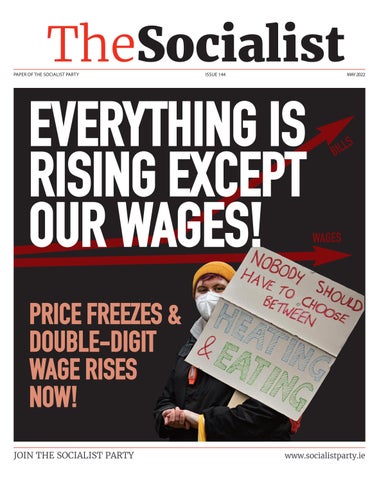
TheSocialist
PaPer of the SocialiSt Party
iSSue 144
EvErything is rising ExcEpt our wagEs!
May 2022
s l l bi
wagEs
pricE frEEzEs & doublE-digit wagE risEs now! join The socialisT parTy
www.socialistparty.ie
2
exposé
The socialist
World’s richest man: The complete charlatan Elon Musk Casting a cold eye the news that the world’s richest man is to take control of his favourite social media network for an obscene $44 billion (€42bn) has reopened debate over who should own and control the media. While some liberals may be particularly horrified at the prospect of Musk (an odious, reactionary transphobe threatening to open the right-wing sewage sluices under the cause of ‘free speech’) taking over and replacing more ‘palatable’ billionaire owners, socialists will look at it all with a colder eye.
Rags to riches? elon Musk, like virtually all Silicon Valley billionaires, isn’t very original
when it comes to his origin story. there’s the rags-to-riches aspect (apparently in the early days of moving stateside he claims to have slept in his office and showered at the yMca), the dropping out of college to build the start-up (he says he was doing a PhD in Stanford, but left after two days). his playing the poor mouth is largely undercut by his ivy league education and his father being a multi-millionaire property developer and engineer, who won contracts from the South african apartheid regime’s airforce, among others. he also owned half a Zambian emerald mine.
driven itself across the uS, coast to coast; he was going to land mice on Mars; there would be robot taxis by now. he’s spoken repeatedly of his plans to build a hyperloop (a much less efficient and more elitist subway) for $6 billion. experts put the price at €60 billion. the closest he’s gotten is building a short, pointless tunnel under las Vegas where you can be driven slowly between convention centres by a tesla. it makes lyle lanley and his ‘Monorail’ look like a good investment.
The fibs keep on coming
the la times calculated that up until 2017 the total state investment in tesla in the form of tax breaks, grants, ultra-cheap loans, regulatory credits, etc. was almost $5 billion, with further billions hoovered up since. as hard as it is to stomach for him and his cultists, without these public funds and government schemes, tesla would definitively not exist. the largesse to corporate america doled out by the obama administration in 2008 saved the company when it was on death’s door.
according to Musk: by 2017 an autonomous tesla vehicle would have
By Pádraig O’Flynn
Benefiting from corporate welfare
Malfunctioning cars... road travel is a hazardous enough activity as it is without the addition of malfunctions as catastrophic as those that have bedevilled teslas. Many of these are not just run-of-
the-mill reliability issues, but appear unique to what is, according to its propagandists, the most technologically advanced cars in the world.
...and exploding batteries another infamous flaw has been the propensity for tesla’s lithium-ion batteries to burst into flames (which can’t be quenched with water), usually following a crash (minor or otherwise). this scenario is made all the more horrifying when allied with elon’s beloved, futuristic, retractable and all-electrical door handles, which stop working when their power source is ablaze.
Free speech for all... except my workers, whistleblowers or critics in March of last year, the National labour relations Board upheld a 2019 ruling that tesla had illegally fired a worker involved in union organising and that Musk had illegally threatened workers with the loss of stock options if they unionised. tesla’s factory in fremont, california, is the only non-union plant in the u.S. operated by a major american automaker. from workers’ testimony the atmosphere is one of deepseated fear, akin to living under the rule of a deranged dictator.
shysters profiting from misery: aramark’s ugly record By Peter McGregor
A
RAMARK, A US multinational, has been awarded the contract to provide meals to centres for refugees fleeing the war in Ukraine. This comes after the company received a contract worth €7.5 million from the National Gallery of Ireland to run its cafe. Staff at the gallery have written an open letter to its management demanding that this be rescinded – trade unions representing these workers must back this principled stance. Direct Provision
The Government gave these contracts without going through any procurement process and will know of Aramark's shoddy record providing food for asylum seekers in Direct Provision (DP) centres, which the government paid €5.2 million for in 2016. In one case a meal consisted of two bread rolls and a splash of what seemed to be pasta sauce. They were also forced to apologise after refusing to give a slice of bread to a sick child! The treatment of asylum seekers in DP has been abysmal, with the average time in centres being 24 months, but in some cases people are there for up to 12 years. In 2020, a group of DP residents in the Skellig Star Hotel in Kerry were forced to go on hunger strike. This was
due to many residents being moved from four centres in Dublin on a day's notice, cramped rooms, no functioning boiler, insufficient water levels and a case of Covid-19, which led to an outbreak, being known but hidden by the HSE. Despite knowing and seeing the horrific treatment of asylum seekers in DP centres, Aramark is still happy to profit from the system, whilst also contributing to the poor conditions. Profiteering off human misery
A look into Aramark's history in the US shows it has a tarnished history there as well, with an investigation showing that "at the Los Alamos National Laboratory's cafeteria, Aramark had withheld back-pay and fringe wages, and had failed to pay some workers for lunch hours. As a result of the investigation, Aramark was forced to pay out over $100,000". A worker was fired in Michigan for reporting rat droppings and mice in a freezer, and a prison, also in Michigan, cancelled its contract with Aramark due to food shortages and maggots in food among other issues. Aramark epitomises capitalism today: poor on workers rights and conditions, a sub-par service, and profiteering from people's suffering – all whilst recording revenues of $14 billion in 2018. The fact that the government entered
Aramark have made mega bucks off human misery in Ireland and internationally
into a marriage of convenience with Aramark to provide meals to those fleeing war in Ukraine without any proper process shows the half-baked nature of the government's response. It said it "had to move quickly", but using Aramark's services despite knowing its terrible record tells us a lot about this government and Minister Roderic O'Gorman's response. After the release of the White Paper
on ending DP surely a bit more inflection on the failures of the system, one of which certainly being Aramark's involvement, would've made O'Gorman think twice about giving it the contract. A united struggle
What is needed is proper facilitation of those fleeing the war in Ukraine, not the risk of terrible meals, or 'housing' refugees in tents. The entire DP system
must also be ended, with a strategy that goes well beyond the White Paper and ensures the humane treatment of asylum seekers. We need major investment in decent, public housing for all. This can be achieved by working class people coming together, including those in DP and Ukrainian refugees, to wage a battle against private profiteers, the governments which facilitate them and the capitalist system which breeds them.
Cost of living
3
The socialist
stop profiteering from energy crisis – we need public ownership now! UST AS we felt that the peak of the pandemic had passed, we were hit with more crises. Not least of which is the fact that the cost of our most basic needs are shooting up. Our rents, our food, our heating and electricity costs have steeply risen, with no wage increases to match.
forcing working people to shoulder their price hikes, the only reason for which is to make their shareholders richer. Electricity bills could be slashed if the energy companies were run on a not-forprofit or break-even basis, starting with the ESB which is already owned by the state. All energy companies should be brought into democratic public ownership.
End profiteering
Prioritising people and planet
The latest figures from Eurostat on energy prices across Europe show that electricity prices in Ireland are 26% above the EU average. Energy companies introduced dozens of price hikes last year. And the price increases for electricity and gas that Bord Gáis have planned for this year will add a further €700 to the annual bill of an average family. There is nothing natural or inevitable about price rises, they are the result of capitalists refusing to take a hit to their profits. Centrica, the UK-based parent company of Bord Gáis made £942 million in 2021, while the ESB made record profits of €679 million in the same year. Before these two companies were partly or fully privatised, they were publicly owned, and their prices were controlled, i.e. deliberately kept low. Now that they have to compete with other private companies and generate profits for wealthy shareholders, they are
Thousands of people die every winter in Ireland due to fuel poverty. A study across 14 EU countries found that excess winter deaths were higher in countries with relatively mild winters such as Spain, Portugal and Ireland. These are countries with less thermal efficient homes. Much colder Scandinavian countries have more heat efficient homes, and consequently far fewer excess winter deaths. The major construction companies also need to be brought into public ownership to ensure that all new homes are built with high energy efficiency standards. State investment in retrofitting all homes is needed, alongside a real plan to rapidly shift from fossil fuels to renewable energy across the economy. To guarantee these changes we need socialist change, where wealth and resources are in public hands and organised for need, not profit.
By James Mccabe
J
Marketisation of the energy sector has resulted in prices shooting up
The urgent need for price freezes By caitríona Ní chatháin
“The wages won’t cover the costs” – Childcare worker speaks out
A
PERFECT storm is brewing for working-class families. Inflation is running at a 30-year high, and expected to rise again over the Summer. The price of basics such as food and fuel are seeing the greatest increase. This, compounded by the introduction of a Carbon Tax on home heating fuels, means that those who live in low quality and poorly insulated accommodation will once again pay the highest price.
By ana Mitra
Record profits
The factors contributing to this economic chaos and financial hardship are now familiar themes: the disruption of global supply chains due to the pandemic, and the decrease in Russian fuel exports due to the war in Ukraine. However, it is hard not to point out the glaringly obvious fact that profits have never been so high for the very industries that are ratcheting up their prices. For example, Kerry Group, the major Irish-based food company, saw revenues rise to €7.4 billion. Dairygold, the State's third largest milk processor saw revenue jump by 15% to €1.17 billion. The price of basics such as pasta and potatoes explode, yet supermarket have never had it so good. Aldi's profits rose 46% last year to €71.2 million. Meanwhile, Minister for Public Expenditure and Reform Michael McGrath insists that government is not in a position to offset the impact that inflation will have
Price rises in basic foodstuffs are hitting the poorest of society the hardest
on ordinary people, stating that it is simply “not possible”. This is untrue, rather, they would prefer to cushion shareholders and make the working-class people pay. Action that can be taken
The reality is that there are many steps the Government can take immediately in order to shield working-class people from further hardship. One obvious one being to use Section 61 of the Consumer Protection Act 2007, under which the Government can freeze prices for energy, food and fuel. Price freezes on key utilities and consumer goods would put an end to profi-
teering and speculation of essential items such as food, housing and fuel. The necessities of working families would be met with prices that they can afford. The government should also bring in emergency legislation to cut and freeze rents at affordable levels. In light of the outrageous profits made on the backs of an often poorlypaid workforce, we must also demand immediate action from the state to tax the profits of big business which is making a killing from this crisis. This could be used to fund essential, high-quality services such as free public childcare, free public transport and public housing for all who need it.
I’ve been living in Dublin since 2018, and it really wasn’t an affordable place to be as a student but now, 4 years later, as a full-time employee, it’s only gotten worse. rent was never affordable, but with the current housing crisis and private landlord rule it’s gotten harder and harder. i’m 28 years old, i work up to 47 hours a week as a childcare worker, and i can’t afford the independence of not sharing my living space. Groceries cost double Groceries that cost me €100-€120 a month now cost me almost double that. electricity bills are boring a hole through my account balance which ends up at negative euros by week three after payday almost every single month. travel costs add up as well, plus the lack of bus route connectivity means spending 1.5 hours in a bus for what should be a 20minute journey.
i don’t drive because i can’t afford a car, fuel, or even driving lessons, but more importantly, i shouldn’t need to; in the middle of a climate crisis, i want for free and better connected public transport, not a car. Pitiful pay rises the cost of living is climbing everyday, and the wages don’t even cover the cost of survival. the minimum wage is an absolute insult. Pay rises, if any, don’t match the rate of true inflation. i can’t afford to take sick days, because the government does not mandate sick pay for a respectable number of days. as a woman and non-european worker working in a sector run by majority immigrant women just ensures that every little i can get is made just a little bit harder to get. living in Dublin under this capitalist system is entirely unsustainable and all that the Government does is throw a glittering cent or two in our direction to placate us.
4
Cost of living
The socialist
cost of living crisis:
Trade unions have to act! in the private sector. Attention should be paid to the situation at Bausch and Lomb in Waterford where a 1,500 strong workforce has voted 87% to strike to improve pay. These workers are very determined given that they were forced to accept pay cuts and extra hours eight years ago – concessions that have never been reversed by a hugely profitable employer.
By Mick Barry tD
"W
E ARE looking at three years of high inflation" – AIB Chief Economist Oliver Mangan, Irish Times, 9 March It is becoming increasingly clear that the inflation crisis is going to be around for quite some time. It is also becoming increasingly clear that the Government's measures come nowhere near addressing the crisis in household finances. These two facts raise the question – what action can working-class people take to directly tackle the crisis?
Facing low pay & high rent
Workers take action in North
In Northern Ireland workers have taken strike action to defend living standards. In recent weeks action has been taken by Caterpillar workers, bin workers, classroom assistants, workers in the housing services executive, education welfare officers and school meals staff. In more than 25 workplaces in Britain and the North, ‘cost of living’ pay increases have been won in recent months by workers who are members of UNITE either striking or threatening to strike. Now is the time for this approach to be taken here too. Every union should submit pay claims for increases that protect against the price surge. This means claims which are double digit, 10% at a minimum. Unions should ballot for strike action to show the Government and employers that workers mean business.
Unite in the North and Britain has given a lead in the fight for inflation-busting wage rises Strike action will be needed
If claims are not conceded by a named date then strike action should commence and a strike wave unleashed. The state's largest union, SIPTU, announced on 11 April that it intends to submit ‘cost of living’ pay claims and to renegotiate deals which fall short of fully protecting workers against inflation. This is a good starting position but
must now be followed up with an approach similar to the one outlined above. Union power is most strongly concentrated in the public sector. The public sector unions should not allow themselves to be drawn into a lengthy negotiation process at the same time the Government is ruling out cost of living increases. Breaching the pay wall
The Government should be told that the
inequality: ceo pay doubles as workers get paltry pay increases
By alanna taylor
C
HIEF EXECUTIVE Officers (CEO) of top-listed Irish companies have seen wages almost double from pre-Covid levels. These rapid increases have been largely fueled by bonuses. Many of these companies received funding from the Government and Central Bank to stay afloat during Covid; funding which was supposed to prevent job losses, not to stuff the pockets of greedy CEOs. To add insult to injury, much of the funding was given without any actual
conditions relating to retaining staff ! Yet more cosy deals for bosses with no protections for workers. Soaring inequality
The CEO of a Dublin-listed company broke records last year, receiving a €13.9 million wage. This is equivalent to what 314 workers are paid yearly, based on the average industrial wage; or what over 600 workers are paid yearly based on the minimum wage. Globally at a time when living costs are increasing rapidly and the workingclass struggles to stay afloat, the pay gap
between CEOs and workers continues to widen. Inflation means that the same euro doesn’t stretch as far as it did previously and amounts to a pay cut for workers. CEOs could have increased workers’ wages in accordance with inflation, but chose to give themselves bonuses instead. The quality of life of the masses is not a priority for those who profit from this system. Wage inequality is a symptom of an unequal capitalist system. This is a deeply parasitic system in which a small minority of bosses live off the hard work of the working-class majority. We can do better.
unions' bottom lines are that workers wages must be fully protected and that strike action will be commenced on a named date if they are not prepared to accept that principle. Attempts by the capitalist media to divide public sector workers from private sector workers should be met head on by making it clear that a victory for public sector workers can breach the pay wall and open the way for workers' progress
A victory for the Bausch and Lomb workers could show the way forward in the private sector and result in other workers joining unions to fight for pay increases. Special steps should be taken to protect the interests of young workers in this crisis. Many young workers are hit by a deadly combination of sky-high rents on the one hand and low pay on the other. How are they meant to get by in this situation? There would be a huge response from workers generally, and young lowpaid workers in particular, if the trade union movement were to now launch a serious campaign to increase the national minimum wage to €15 an hour. Today's union leaders tend to be far removed from the financial pressures on workers (particularly the lower paid) and, with some honourable exceptions, from the fighting, socialist traditions of Connolly and Larkin. That's why workers must organise to exert real pressure on the leaders to take the steps necessary to defend workers' living standards.
The widening wealth gap in Ireland
The laTesT briefing paper from social Justice Ireland published at the beginning of May represents a damning criticism of the Government's policy on tackling poverty. The paper says that the tax and welfare policies implemented in budget 2022 have served to widen the rich-poor gap in Irish society — by €154 per annum. the report says the gap has widened by €1,550 (from €50,800 per annum to €52,350 per annum) since 2014. Social Justice ireland ceo Seán healy says: "the choices that the Government has made in recent Budgets will see the number of people in poverty grow." capitalist market economics is widening the gap between the rich and the poor and instead of reversing the trend the Government is actually making the situation worse. it's not just the socialist left that is saying this, it's a point that is being backed up by serious research from respected analysts and commentators. one vital immediate measure is to increase social welfare payments across the board, paid for by wealth taxes levied on the super-rich. this wealth should also be used to invest in public homes for all, high quality and free public childcare, free public transport and a one-tier national public health service free at the point of use.
oppression
5
The socialist
We’ve waited long enough
lgBtQ-inclusive sex education now! By harper cleves
I
N APRIL of this year, Aidan Moffit (aged 42) and Michael Snee (aged 58) were found tragically murdered in their homes in Sligo. These killings and another attack were found to be homophobic in nature. Systemic LGBTQphobia
While these killings were the work of a sick individual, they also cannot be disconnected from the spate of homophobic, transphobic, and misogynistic attacks happening at the state level across the world – from limiting access to gender-affirming health care, to abortion bans, to allowing conversion therapy for trans youth. Governments, media, churches and big companies might not condone violent acts and murder; however, the normalisation of ‘gay jokes,’ the condemnation of same sex marriage and adoption, the villification of contraception and sex, if taken to their most extreme conclusions, can end in violence and death. The systemic issues behind the recent attacks in Sligo make it all the more urgent that we continue the fight for separation of church and state, the desegregation of gendered schools, and inclusive LGBTQIA+ sex education, in order to begin to cut across one of the many sources of such vile homophobia. The state of sex education today
Sex education today in Ireland varies
drastically from school to school. Nearly 60% of students are in Catholic post-primary schools, where religiously controlled school boards can block teachers from educating young people about contraception, LGBTQI relationships, and abortion on the basis of ‘promoting the school ethos.’ BeLonGTo – an LGBTQIA+ youth organisation – conducted a study in 2019, which found that 68% of LGBTI students weren’t taught anything positive about their identities. This is a fact that comes as no surprise in a country where anachronistic, homophobic, and even blatantly false information about abortion and contraception is allowed to be taught by conservative religious groups in schools. It is clear that Catholic-run schools are not fit for purpose. The movement necessary
In 2018, the Objective Sex Education bill was introduced to the Dáil by Socialist Party TDs, which would have guaranteed the right of students to receive factual, LGBTQIA+ inclusive and objective relationship and sex education without regard to the Catholic ethos of the school. This bill passed the second stage, despite objections from conservative elements in the Dáil. However, it was blocked cynically at the third stage using a ‘money order’ which is a bureaucratic manoeuvre that suggests there is no money to enact the legislation. The government – despite all of its gestures towards progress in the light of these recent murders – is
The Government has used bureaucratic Dáil procedure to block Sex Education Bill brought forward by Socialist Party TDs
unwilling to implement such a bill, because it would weaken ties with the Church, which takes on much of the spending that would otherwise be allotted to the state, nevermind the violent and dire consequences such inaction could result in.
The young people that led the marriage equality movement, Repeal, as well as the recent climate strikes and Black Lives Matter protests – alongside the trade union movement – have a vital role to play in building a movement to demand action.
North: Ban the vile practice of conversion therapy of access to mental health and gender affirming health services, increased rates of gendered violence and vilification from the media which borrows transphobic propaganda from terf (trans exclusionary “radical feminist”) groups. lGBtQ+ youth are also disproportionately affected by homelessness 3'2%'+ 2%# ) $#2# (' # & -#$'+' $ 2% 2 2 (--# 2%# &' 2 2#$ +(2 (+& % +(2%'+* 2( 2%# ! )'2amount +" as an alarming of young peo2%# ()) # #" +( 3($#+ &" 3( 2%# ('2 $ 0( '# '+ 2%# 3 (- # & *#+"# '2 ' #,)&('2#" (- &&from ple are ostracised their families or 1#+ 2 .+"# !% +*# '1# 2%# * ##+3 %'+* 2( + 2'(+ & !( )( 2'(+ +" ! )'2 &' 2 )(&'2'!' $.&2'+ due communities to their gender '+* ( 2#$ (- '2 #!(&(*'! & ! '$# -#$'+' / +' % 2%#' 2#$ .'&2 (+ ()) # '(+ ' + "'/# '- '+* 2%# #&'2# '+ identity or sexuality. 2 2%# 2() 2( '2'! ! )'2 &' 2 !& 2%# ) 22#$)2
By roise Mccann afTer years of lGbTQ+ community campaigns demanding an end to the legalised practice of conversion therapy; the Tory party has finally signalled flimsy intentions to ban conversion therapy for gay, lesbian and bisexual people. however, in a flagrant act of discrimination, its ministers have ruled out the ban applying to trans people. This announcement prompted surges of protests led by lGbTQ+ groups in cities across the UK, receiving significant support from young and working-class people. conversion therapy or “cure / reparative therapy” refers to forms of socalled treatment seeking to change a person’s sexual orientation or suppress their gender identity. in reality, it involves harmful practices rooted in pseudoscience and / or religious beliefs, often amounting to abuse and in extreme cases torture. the practice is condemned by all major psychotherapy bodies, including the NhS, but it is still conducted by some practitioners. a degrading and inhumane practice conversion therapy is a degrading and inhumane practice. young lGBtQ+ people are the most at risk to this form of abuse. it is crucial that there is a complete ban which extends to everyone, especially trans people who are dispro-
2#$ ' -.#&&'+* # +3%'&# 2%#' !&'+* (+ 2( '2 )(3# +2' -#$'+' $ '*%2 # !2'(+ 2% 2 % .2 & ! &&'+* ! " 2 + )%( ' +" !' $
Protests throughout Britain in the wake of Tory failure to fully ban conversion therapy
portionately targeted. Stonewall reported that one in five trans people have felt pressured into accessing services to suppress their gender identity while going through health services. trans people are faced with abysmal standards of healthcare
across the uK and ireland, many trans people report being traumatised while attempting to access care. at ireland’s National Gender Service there is now a six-year waiting list for services. there is a mental health crisis amongst trans people, compounded by a lack
Capitalism and rigid gender roles # 2'$# % !($# + '"# 3%( oppresses 2 -#$'+' $ ' +that capitalism is (!'a &'system !& '(+ ! && -( ' .$$'+* .) 2%' '"# 2%' ) $)% 2'(+ 2 .**&# +" ( * +' rigid 2 !2'(+ through (!' &' 2 -#$'+' all working-class people and heteronormative and cisnormative gender roles, poor working and living conditions and inaccess to healthcare. trans and non-binary people bear the brunt of the most violent and oppressive symptoms of capitalism; both physcial and systemic. a collective movement of young people, workers and members of the lGBtQ+ community is needed to fight against attacks on trans rights. this includes banning conversion therapy, but also the buidling of social housing and investment in accessible and quality gender affirming healthcare and mental health services. it is only through collective struggle that we can break from capitalism as the systemic root of all oppression and build toward a socialist future based on solidarity and equality.
Winning separation of church and state, and gender inclusive schools and sex education programmes is a crucial step in taking on the class divided system which is at the root of LGBTQI+ phobia, misogyny, and all forms of oppression and exploitation.
New pamphlet: Socialist Feminism – Now More Than Ever # " .2 *'/# .
'/# .
(3
( # 2((
(!' &' 2 '+%'+ $/# #$ (#
$)% ) (".!#"
4 (!' &' 2 #$'+' 2
(/#$#+2
This pamphlet, produced by ROSA – Socialist Feminist Movement, makes the case for a working-class and socialist feminism, and for organising for socialist change, as the only way forward for the global feminist wave. Pamphlets cost €3. Get in touch with ROSA to get a copy. Text “Pamphlet” to 087 6418519
6 speCial feature Article after article in the mainstream corporate media in recent weeks has stated that the war in Ukraine has accelerated a radical realignment in the world economy that is termed “deglobalization.” Tom Crean writes.
M
ARTIN WOLF, the chief economics editor of the Financial Times stated recently that “…the emergence of two blocs with deep splits between them is likely, as is an accelerating reversal of globalisation and sacrifice of business interests to geopolitics.” (FT, March 16) Larry Fink, CEO of BlackRock the world’s largest “asset manager,” was even more blunt: “The Russian invasion of Ukraine has put an end to the globalisation we have experienced over the past three decades.” The war in Ukraine is indeed having massive impacts on the world economy with major implications for the future. But to understand deglobalisation we have to go further back. Globalization and capitalism
Capitalism since its birth as a social system has shown a tendency to bring all parts of the world into a global market with a developed division of labor. This tendency which Karl Marx described in the 19th century can be broadly termed “globalisation.” However, capitalism’s drive to create a world market and a world economy run up against the limits of the nation state. It is the political form that the capitalist class cannot escape as it is the means through which they dominate society ideologically and if necessary with force. Marx and his collaborator Friedrich Engels identified the nation state as the key obstacle to capitalism’s ability to further develop human society’s productive forces in a harmonious way. In the late 19th century there was a period marked by a high degree of globalisation including lower tariffs on trade, ease of travel, etc. This was also a period of steady economic growth. But this was not sustainable and by the beginning of the 20th century it was replaced by increasing competition between the key imperialist countries which culminated in World War I. After WWI, and especially in the 1930s there was intense deglobali-
sation as inter-imperialist conflict continued marked by a very high degree of protectionism (high tariffs). This did not begin to change until the long period of growth after World War II. The neoliberal era that began in the early 1980s and that we are now exiting was also characterized, like the late 19th century, by an exceptional level of globalisation. Barriers to trade and the movement of capital were systematically reduced through extensive trade deals like NAFTA. Supply chains became longer, more complex, and more integrated as corporations sought to reduce the costs of production to a minimum. It was an era of low inflation, low interest rates, and cheap imports. While many poor countries experienced partial industrialisation to service the global market, rich countries like the U.S. experienced a partial de-industrialisation. The corporate elite made incredible profits and inequality increased to levels not seen in a century. The crisis of neoliberalism
The current retreat from globalisation is rooted in the crisis of capitalism at the end of the neoliberal era. This was first expressed in the deep global recession in 2007-8. Despite amassing huge wealth, the capitalists were increasingly unable to make profit from investing in expanding production. Capital was instead invested in the global casino of the financial markets leading to a series of speculative bubbles that burst dramatically and brought the real economy down with it. As always it was working people who were made to pay with mass unemployment, millions of foreclosures and endless cuts to social spending. The result was that neoliberalism became associated with savage austerity and was increasingly opposed by ordinary people around the world. During the following decade the steam went out of globalisation. Between 2008 and 2019 world trade relative to global GDP fell by about five percentage points according to the Economist.
The so It was also during this decade that the conflicting interests of U.S. imperialism and rising Chinese imperialism began to point towards a new Cold War. Donald Trump levied extensive tariffs against Chinese goods but tariffs and protectionism were also rising globally. The U.S. and China from being drivers of globalisation became drivers of deglobalisation. FDI flows between the U.S. and China were $30 billion per year five years ago. Now they are down to $5 billion. The U.S. banned Chinese telecommunications giant Huawei from government contracts and then pushed hard for its “allies” to keep Huawei out of the construction of 5G networks. The new Cold War and deglobalisation have certainly been accelerated by the pandemic and now the war in Ukraine. The pandemic dramatically showed the vulnerabilities of vast global supply chains. Both the Chinese and U.S. governments are seeking to “reshore” strategic sectors of production like semiconductors. The decoupling of the U.S. and Chinese economies is clearly underway. There is a massive military buildup underway in the Western Pacific pointing towards conflict over Taiwan. The world economy is dividing increasingly into two blocs centered on the U.S. and China. The European Union and Japan are increasingly pulled behind the U.S. while Russia and China have formed a very close alliance. War as accelerant
The war in Ukraine brought everything to a head. We stand with the people of Ukraine and demand that Russia withdraw all its forces but we also oppose the interests of all imperialist powers and the slide towards an even more dangerous global conflict. We oppose the Western sanctions that are hitting working people in Russia hardest and that are themselves an act of war. The radical move to push Russia out of the world financial system is effectively a fast paced decoupling of the world’s 11th biggest economy from the U.S. /EU / Japan economic sphere. It points towards Russia and China creating their own arrangements outside the “global institutions” like the World Trade Organization, World Bank, etc. All nations are increasingly being asked to “take a side” in a conflict which is described as being between “democracy and autocracy” but is really a clash between imperialist interests like the clash between Britain and Germany before World War I. This is truly the end of globalization as we have known it for the past 30 years. Of course it doesn’t mean the end of trade or an international division of labor. But it points to a serious reorganisation where the national economy plays a far bigger role than before. The future
The Cold War betweeen the US and China has been escalating over the last decade
how deg reshaping t
Some may welcome the decline of globalisation which certainly was linked to a ruthless corporate agenda that rode roughshod over the rights of workers, indigenous people, and contributed massively to climate change, all in the name of creating an ever more “free” market. However what will replace it will be even worse as long as capitalism exists. We now see the reassertion of reactionary nationalism, military buildup and growing inflation. As a result of the war in Ukraine and climate disasters, the world now faces the biggest food crisis since World War II. Instead of “deglobalisation” or a return to neoliberal globalisation, we need an international working-class alternative that points to achieving the promise of a world economy based on a rational democratic plan.
Climate change, wa By Dan o’rourke
T
HE RISK of drought caused by climate change is now combining with effects of the war in Ukraine to create a disastrous multi-country famine which would affect tens of millions. However, the issue is not a scarcity of food or resources, but the current economic system which puts profit above all else. Food production under capitalism means mountains of food rotting n landfill, while millions face starvation. According to the World Food Program (WFP), about 20 million people in Eastern Africa could starve as delayed rains worsen extreme drought amid a shortfall in humanitarian aid. Meanwhile, 12% of global calorie intake is directly dependent on grain from the Ukraine and Russia and the world is critically reliant on the region for fertiliser. The production and transport of both commodities have been halted as the spring planting season is interrupted, port blockades are severing food supplies and sanctions are interrupting fertiliser production. The UN has warned of the potential for global famine as a direct result. Disaster in Africa – again
Somalia, already brought to ruin by famine in the past, is now facing the worst effects of both climate change and the war in Ukraine. Almost three years of little or no rain, and a recent shortfall of
humanitarian aid is likely to bring famine in the next few months, NGOs agencies have warned. Although India is not facing a famine, a heat wave there is causing untold suffering for tens of millions, with local governments stocking up on rehydration kits for children, and shutting schools to mitigate the worst effects. The heatwave has also caused a drop in crop yields, meaning the shortfall from the war in Ukraine will be harder to close. Food wastage
Even with the shortfall in grain, we still have enough food to feed everyone. But almost 1.3 billion tons of food a year, nearly 30% of total global production, is wasted. Less than a quarter of this amount could end extreme hunger. However, creating a plan to tackle this is impossible under capitalism, as rational cooperative planning to provide food on the basis of need is the contrary to capitalism’s system of anarchic competition and profit seeking. Moreover, up to 10% of global greenhouse gas emissions come from food waste. Key global suppliers
In general, most of Russia and Ukraine’s grain is bought by states already enduring precarious food supplies. Lebanon, Yemen, Bangladesh and Pakistan import at least 50% of their grain from the region. Wealthier countries, though better
speCial feature
ocialist
7
Solidarity with refugees – demand homes & services for all
eglobalisation is the world Economy
ar & the risk of global famine
12% of global calorie intake is directly dependent on grain from the Ukraine and Russia
able to stockpile commodities, will also be hit by shocks to supplies, inflicting hardship on day-to-day life for millions of working-class people. Climate change and war, combined with other capitalist crises (Covid, inflation, supply chain tangles), is likely to spark social upheaval on a global scale. Food shortages were a significant factor in the 2019 social uprising in Sudan, and the 2011 Arab Spring. Democratic control of production
Innovations in farming machinery and
fertiliser since the 1950s are some of the most important technological achievements in the history of humanity. We now produce more than enough to feed everyone. However, capitalism has created a contradiction of overproduction — as mountains of food go to landfill, and absurd amounts of grain goes to feed more profitable livestock, while millions starve everyday. Even when shortages strike, farms could continue to produce enough to feed the world, but if profit margins are low, we will not be able to stave off famine, as
investment is directed elsewhere. In order to ensure technologies and land are used for the benefit of all, they must be publicly owned and democratically controlled by the working-class majority, not private corporations. After workers seized control of Limerick city in 1919, they wrote “we make bread, not profits”, on the walls of the city’s newly expropriated bakery. This is precisely what's needed today on a global scale to withstand the turmoil caused by capitalism’s war and climate crisis.
By Jonathan Diebold PUTIn’s blooDy war in Ukraine has unleashed untold hardship on the country’s 44 million people. It has also created europe’s largest refugee crisis since World War II and is the fastest growing refugee crisis in the world today. over 5 million have already left the country, with a further 7.7 million displaced internally. these refugees have been met by a wave of support and solidarity, in ireland and internationally. Workingclass people have opened their homes, and many communities and organisations have organised donation drives. racist immigration policies even governments throughout europe, traditionally hostile to refugees, have introduced significant measures to provide refugees with access to essentials like housing, healthcare, and education. laudable as such actions are on the surface, the creation of a two-tier system for refugees – one tier for those coming from a european country, and another for those coming from places like Syria or afghanistan – reveals the racist and divisive nature of refugee laws in europe. in ireland, ukrainian refugees have been exempt from the deplorable direct provision system and given numerous supports unavailable to other refugees. Such instances demonstrate that these policies were never necessary in the first place. Crisis on top of crisis While these policies are certainly unnecessary, capitalism as an economic system is a poor tool for grappling with crises such as this. already the government is running up against its limits. Minister roderic o’Gorman has said that the state has probably reached its limit of hotels for ukrainian refugees, where the vast majority of the 13,000 refugees currently here are being housed. in other words, they can no longer rely on leveraging the private market to meet their commitments. in recent days the government has
even planned to expand the amount of vacant social housing being brought back into use – a longstanding demand of housing activists. this still won’t be enough, however. ireland is a country that has been devastated by a housing crisis. What’s needed is the construction of massive amounts of public housing, to house both refugees and those already living in ireland. there are other issues too: Justice Minister helen Mcentee, who had offered to house refugees in her own home, has since admitted that this offer is unfeasible considering that she lives in a rural area with no public transport (another glaring failure of her government it must be added). this is not an uncommon situation, with over half of people who made similar offers withdrawing, many citing similar reasonings. oppose exploitation of refugees trade unions here must ensure that refugees are not exploited as a form of cheap labour. With the current shortage in fields such as hospitality, it’s likely many businesses will see this as an opportunity to make money. Migrants are already overrepresented in low-paid work and refugees are particularly vulnerable to these unscrupulous business practices. the government, which has stood over the housing crisis, the cost of living crisis, and indeed direct provision, is not housing these refugees out of the goodness of its heart. there is of course huge pressure on the government to support ukrainian refugees, but it is also cynically attempting to use the invasion of ukraine to undermine ireland’s position of military “neutrality” and further its integration into eu military structures – which it knows is opposed by the vast majority of the population. as well as demanding the government acts urgently on the refugee and general housing crisis – by taking the necessary wealth, land and resources from the super-rich profiteers and vultures – we must oppose their ulterior motives in favour of militarisation.
8
international
The socialist
Us: Defend roe V Wade – we won’t be dragged backwards!
abortion rights now! By conor Payne
A
draft US Supreme Court decision leaked to the media indicates that the Court is preparing to overturn the Roe V Wade decision, which legalised abortion across the US in 1973 – off the back of enormous struggle of the second feminist wave. Such a decision by the Court would have immediate, disastrous effects for women and pregnant people. Thirteen US states have passed ‘’trigger laws’’ which would immediately ban abortion as soon as Roe V Wade is overturned. It is estimated that 26 states in total would pass abortion bans. In September, Texas introduced legislation which bans abortion after six weeks and actually allows private individuals to sue abortion patients and providers. Oklahoma’s proposed law threatens abortion providers with up to ten years in prison. Devastating impact
If abortion is banned in large parts of the US the impact will be devastating for everyone who needs abortion access, but especially for working-class women and women of colour. Black women in the US are nearly three times as likely to die in pregnancy. The attack on Roe V Wade opens up the possibilities for a broader reactionary offensive through the courts. The precedent set by the decision could open the door to rolling back LGBTQ+ rights, contraception access and much more.
Polls consistently show the majority in the US support abortion rights and Roe V Wade. It's completely undemocratic that an unaccountable elite of nine people with lifetime appointments are able simply to make pronouncements which attack the lives and rights of millions of people. Failure of Democrats
Of course, the key driver of the offensive against abortion rights in the US is the Republican Party, packed to the rafters with misogynists and religious fundamentalists. But the Democrats, despite controlling all sections of the government on numerous occasions over the last decades, have failed to do anything to guarantee abortion rights. The Democrats control the Presidency, the House and the Senate now, and could act to codify the Roe V Wade decision into national law. Instead they respond by telling people to vote for them, while offering no action now to defend the right to choose. This reflects the reality that the Democratic Party is a party for the super-rich and the corporations too, and innately hostile to the building of movements which challenge the status quo. Neither the political establishment nor the courts can be relied on. Instead a fighting mass movement from below needs to be built. The leak from the Supreme Court offers a window to bring massive pressure to bear to force the judges to reverse course and keep Roe V Wade.
Abortion rights were not granted in the US in 1973 because of the benevolence of the courts but because of the impact of the women’s movement, mass struggle and a groundswell from below. Similarly, we have recently seen abortion bans brought to an end here in Ireland, but also in Latin America because of mass struggles by women, gender nonconforming people and working-class people. Mass protests erupt
Already protests of thousands have taken place across the US, with many having been called by the Socialist Party’s sister organisation in the US, Socialist Alternative. We need mass protests now, including internationally in solidarity. But spontaneous protests are just a starting point, they won’t be enough. An organised movement of resistance, based on the involvement of masses of women, young people and workers is key. This should include walkouts from schools and colleges and strike action in workplaces. The failure of the Democrats to defend abortion rights points to the need to build a new multi-racial, multi-gendered, working-class party that opposes opppression, exploitation and the capitalist status quo. We need system change
Capitalism is a system based on oppression and inequality. It requires the oppression of women to exist. Any rights we won under this system are only temporary; there is always the danger of new
Mass protest can stop Supreme Court from reversing Roe V Wade
reactionary offensives to try and take them away. While fighting everywhere to defend and extend abortion rights, we should also fight for a society where they can be genuinely guaranteed. This means a
democratic socialist society based on equality and solidarity, where wealth, resources and power are taken out of the hands of the super-rich and big business and put into the hands of the workingclass majority in society.
French elections:
far right lose out, but no enthusiasm for Macron By Myriam Poizat
O
n 24 April 2022, Emmanuel Macron was elected president of France for the second time in a row. While the headline figures show a vote of 58.8%, the number of people who abstained reached a record 28% (not including 4.6% blank and 1.6% invalid votes). In reality, Macron only won with 37.9% of registered voters, making him the worst scoring president of the Fifth Republic since 1969. Additionally, 42% of those who voted for him said they did to stop the far-right candidate, Marine Le Pen. This means Macron’s real ‘following’ is limited to 15.9% of the population. Not very popular then! A growth in polarisation
Macron’s first term was marked by sharp attacks on labour legislation, workers and trade union rights, as well racist scapegoating of migrants and refugees for the problems his government has presided over. Le Pen, leader of the far right ‘Rassemblement National’ (National Rally), was emboldened by Macron’s own racist and antisocial agenda, which has not only helped normalise her divisive and racist rhetoric, it also allowed her to present herself as the champion of
working people in contrast to Macron, who is widely seen as being a president of the rich and out of touch. Her campaign tapped into real anger over the rise in the cost of living and her vote was the highest ever achieved by a far-right candidate.
the Popular Unity, a new unity that we must continue to expand.” He has initiated a new left coalition called Popular Unity, which the French Communist Party and smaller left groupings have joined. It has a real potential to tap into the anger against Macron’s regime. Unfortunately, Melenchon has also reached out to the largely discredited and pro-capitalist (not to mention misnamed) Socialist Party (PS) to join the Popular Unity coalition. Any new left party, needs to take an unambiguous opposition to pro-big business parties.
Strong vote for Melenchon
Jean-Luc Mélenchon, leader of the left organisation “France Insoumise”, also experienced a significant surge in popularity. Mélenchon’s score in the first round (just 1% behind Le Pen) reflected a rejection of the other parties’ policies and support for his will to break with pro-capitalist consensus. If anything, his exceptional score could have translated into beating Le Pen in the first round, if other left parties, such as the French Communist Party (PCF), had decided to strengthen the momentum behind Mélenchon’s campaign rather than stand against him. While 60% of Mélenchon voters were split between those who voted to block Macron and those who voted to block Le Pen, the other 40% didn’t bother to vote in the second round, showing their opposition to both candidates. It is clear that the majority of working-class people do not have strong illusions in Macron; and while there is a danger for the far right to be further emboldened
Break with the system
A sizeable portion of the electorate did not vote for either Macron or Le Pen in the Second Round
and grow, there is real potential for a left wing alternative around Melenchon. “A Third Round” on the streets
After the results of the second round,
Mélenchon immediately stated: “The voters can still defeat Macron and choose a different path. On 12 and 19 June, another world is still possible if [they] elect a majority of deputies from
Workers need to follow the steps of the working-class movements and strike actions that exploded prior to the outbreak of the pandemic in France and urgently organise all forces in workplaces, communities and schools. This is where Melenchon must build a left wing alternative – in the struggles of the working class and young people. This needs to be linked with the building of a socialist alternative that breaks with capitalism, where key sectors of the economy are brought into democratic public ownership and planned in the interests of people and the planet, not left to be run by Macron’s super-rich and corporate cronies.
nortH
9
The socialist
Historic election marks new era of crisis for ‘peace process’ By Kevin henry
T
HIS YEAR’S Assembly election was historic with Sinn Féin emerging as the largest party, the first non-Unionist party to do so in the 101year history of the state. As a BBC commentator noted, “Northern Ireland was literally designed, so that that wouldn't happen.” However, while a nationalist party is now the largest party, the largest political designation in Stormont, although splintered, remains Unionism. The DUP lost 6.7% of its vote, but given how it was projected to do in recent polls actually made something of a recovery. Primarily they lost votes to the hard-line TUV which received over 65,000 votes, including challenging for several seats. This has been an important pressure on the DUP, alongside broader discontent in protestant communities, particularly as a result of the protocol, and this election will only intensify that. DUP gift election to Sinn Féin
Despite being in government for nearly quarter of a century and being prepare implement attacks on working-class people, Sinn Féin’s main slogan was “vote for real change”, and near the end of the campaign to vote for a “first minister for everyone” as they sought to turn the election into a presidential-style vote. But it was neither its clever campaigning
nor any enthusiasm for Sinn Féin’s record, but the approach of the DUP, which was seen as intransigent among Catholics, that gave Sinn Féin its victory. While ‘historic’ this election resolves nothing. If anything, the crisis facing the ‘peace process’ will intensify. As key figures in the Orange Order put it, “Unionism now has a mandate” not to join the executive short of significant movement on the Northern Ireland protocol. Pressure is also mounting on the British cabinet, which is divided on this issue, to move towards unilaterally tearing up the protocol, which could provoke a trade war with the European Union and even raise again the issue of hardening the border on the island of Ireland, which would not be acceptable to anyone. Alliance surge – no alternative
The other story of this election was the Alliance surge. While most pronounced in Protestant middle-class areas, which are pro-Union but voted against Brexit, Alliance's vote increased across the board and saw its number of seats more than double. For a section of young people, the Alliance Party is considered to be a ‘progressive’ break with the politics of Orange and Green. Far from being a progressive, however, its record is that of an establishment party which has often been enthusiastic about attacking workers and young people — from the introduction of the
Sinn Féin became the largest party in the Northern Assembly in a historic first
hated welfare reform to advocating increasing student fees. Most recently, Alliance was decisive in voting down Gerry Carroll’s bill to repeal Thatcher's antiunion laws. The smaller so-called moderate parties of the SDLP and UUP lost out to Sinn Fein and DUP in the battle for First Minister, and to Alliance as a better reflection of “moderate” politics. SDLP was hardest hit losing four seats, and it no longer has the number of seats necessary to take part in the Executive. As the larger parties hoover up their voter base, these parties, which dominated the early days of the peace process, now face existential crisis. Similarly, the Greens fell victim to the
Alliance surge losing both its seats to Alliance. Likewise People Before Profit, which succeeded in retaining Gerry Carroll’s seat in West Belfast, saw its vote significantly decline in its core areas as Sinn Féin galvanised the vote in Catholic communities. This should be taken as a warning of the dangers of building a political project based on a one-sided position on the national question, which will not be able to compete with the main sectarian parties. Build a socialist alternative
Young trade union activists Neil Moore and Amy Ferguson ran in South Belfast and West Tyrone for the Socialist Party. Our votes were modest, but our
main reason for running was to put down a marker for the workers' movement and for young activists that there must be a cross-community socialist challenge to the Executive parties in Stormont. Our campaign was successful in its key aim of connecting with young people and workers interested in building that alternative. Importantly, most of the election campaign was dominated by discussion about the ‘cost of living’, which saw workers in the public and private sector take industrial action. It is among these struggles, and young people fighting oppression, climate crisis and exploitation, that a significant cross-community socialist alternative can be built.
growing strike wave to win real pay rises The CUrrenT wave of industrial unrest in northern Ireland is a reflection of the fact that workers will not sit idly by while their living standards are eroded by inflation. In a short couple of months thousands of workers have participated in strikes and other forms of industrial action. There is an opportunity now, for this momentum to be built upon and serious gains won for working-class people. These strikes, which united Protestant and Catholic workers in common struggle, took place against the backdrop of the sectarian and polarised elections to the northern assembly.
Local authority workers have had enough By ann Katrin orr local authority workers – in refuse collection, street cleaning, security, leisure centres, special needs assistants, school transport workers, housing executive maintenance and others – have been engaged in strike action across the North. the workers that have taken action are all organised by unite the union and have all been working throughout the pandemic.
movement coordinate actions across different sectors and disputes and build public demonstrations to express the public support that exists for workers challenging poverty pay and exploitative working conditions.
Caterpillar workers reject pay insult By Sean Burns
Inflation, precarity and low pay inflation in the North stands at 8% – energy prices and the cost of basic foods have increased even more. in this context the pay offer made to local authority workers of 1.75% is simply insulting. low wages and precarious conditions are rife in this sector with the common exploitation of goodwill of workers to ensure uninterrupted service delivery. yet, as posts are not being filled, workloads are increasing and wage increases being swiftly wiped away by costs, workers have had to take stand. other unions must take action it is unfortunate that unite is alone in taking action among all the unions that organise workers in this sector, in-
cluding the GMB, NiPSa and unison. if the strike involved all unions it would be immediately more impactful. these workers are not just fighting for a pay increase for themselves but also for essential public services. a common reported theme is that agency staff and short-term and precarious contracts are habitual. this is one way employers have attempted to undermine union organising. organise agency workers it must be actively challenged by the union movement by recruiting agency workers to unions and fighting for their direct employment which would not only benefit agency workers but also lift terms and conditions of all workers. it is also essential that the union
Workers in caterpillar, at both larne and the Belfast sites have engaged in two weeks of strike action with plans being put in place for at least four more weeks. the company offer on pay fell well below what workers required in the context of soaring inflation. it was also tied to a threat of compulsory overtime and an attempt to divide the bargaining unit, weaking the unions negotiating power. height of disrespect coming out of the worst of the pandemic where workers were expected to put their health at risk, with rushed reopenings and inadequate health and safety measures in place. having been applauded as essential workers, putting their health at risk, to be met with such an unsatisfactory offer is the height of disrespect. Workers in the North are now on average £20 a week worse off than
the same period a year earlier. it’s also £108 below the uK average of £235. inflation continues to rise, as the cost of energy spirals out of control. this is the context in which derisory pay offers are being meted out, and why workers cannot accept them! a profitable company caterpillar may plead poverty, but their profits paint a different picture. the company reported operating profits of just over £7 million last year, on turnover of £439m in 2020 and is sitting on cash of some $9.3 billion (over £7 billion) and paid out $2.3 billion to shareholders. the pickets are having a real effect. Delivery trucks are turning away and production is being impacted. to undermine the strike, the company is utilising scab labor, bringing workers over from england, putting them up in the very lavish Grand central hotel. this is a conscious tactic on the companies part to break the morale of the workers. Going forward, preventing scab labour coming in will be crucial in winning the dispute. solidarity is crucial to win this dispute solidarity is crucial. the wider trade union movement must also rally behind the caterpillar workers, using the collective power of the movement to hit both the employer and the politcians who stand squarely behind the bosses
10
The socialist
review: Heartstopper directed by euros lyn
revieW & tHeory
Socialism 101 series #5 Why are socialists internationalists?
By Darragh o’Dwyer reviewed by ollie Bell EARTSTOPPER IS a Netflix series based on Alice Oseman’s comics of the same name. It is an uplifting LGBTQ+ drama about friendships and young romance. It depicts two British students, Charlie Spring and Nick Nelson, as they meet, become friends, and develop feelings for each other. The show and the comics both portray the struggles of Nick figuring out and accepting his bisexuality while Charlie deals with homophobic bullying for being an out gay young man in an all-boys school. Heartstopper has been praised by the LGBTQ+ community for its honest portrayal of a young queer romance, jam-packed with longing looks, secret kisses and teenage pining, which is often only seen in heterosexual relationships. LGBTQ+ youth often grow up feeling isolated and alienated from their fellow peers due to the stigma that still exists in society. It’s quite difficult to find positive queer representation in media. Often LGBTQ+ characters are there for tokenistic representation or just stereotypical. Heartstopper gives young LGBTQ+
H
people a representation of themselves in a growing toxic climate. Internationally, LGBTQ+ rights, especially trans rights, are under attack. The Florida ‘Don’t Say Gay’ bill and other bills out right ban the discussion of sexuality and gender in classrooms, furthering the shame and isolation young LGBTQ+ students face in schools. Heartstopper gives LGBTQ+ young people a way of seeing themselves in a positive light. It has also given LGBTQ+ fans the courage to be themselves. One fan even used a scene of Nick coming out to his mam as a way to come out as queer to their parents. While Heartstopper displays the joys of romance, it also portrays the challenges young LGBTQ+ students face. Both Charlie and Tara, a young trans girl, deal with homophobic and transphobic bullying in school, which is fostered by the school being separated into boys and girls. Charlie has mental health issues like anxiety and low selfesteem because of this bullying, which is all too common for LGBTQ+ youth in Ireland. BeLonGTo’s ‘Life in Lockdown: One Year Later 2020’ survey found 97% of young LGBTQ+ people were dealing with anxiety, stress, and depression. When Nick Googles ‘Am I Gay’,
Marxist journal of the Socialist Party:
Socialist Alternative no.14
news articles about homophobia and LGBTQ+ discrimination flash in between ‘Signs You Might Be Gay’ listicles. Showing how despite the progression of LGBTQ+ rights, homophobic attacks and conversion therapy are still prevalent today. It must be acknowledged that while Heartstopper is a positive show, Netflix has been complicit in having transphobic shows on their platform. Last October, Netflix staff protested the transphobic Dave Chappelle comedy show in which he stated that LGBTQ+ people were too sensitive and declared himself ‘Team TERF’. It shows how Netflix is perfectly fine with capitalising off homophobia and transphobia when it suits them while also profiting off much needed LGBTQ+ representation. Along with that Netflix has the habit of cancelling shows focusing on LGBTQ+ people like I’m Not Okay With This and Everything Sucks. Heartstopper is a refreshing look at LGBTQ+ students as they navigate growing up and exploring their sexuality. When media depictions of positive LGBTQ+ people are lacking, shows like Heartstopper are important to giving young queer people a voice and helping them come out.
S CIALIST Marxist Journal of the Socialist Party Issue 14 Spring 2022 €3 / £3
includes articles on: l No to War in ukraine! Build a Mass anti-war & anti-imperialist Movement l a Watershed Moment: the Murder of ashling Murphy and Why We Must Demand “Not one More!” l Sinn féin in the South – Preparing for Power? l climate change: Do We Need the ‘Nuclear option’? l expropriating the expropriators: Why We call for Nationalisation & Public ownership l capitalism, oppression & the Patriarchal family l 50 years Since Bloody Sunday l an Gorta Mór: the legacy of the irish famine
€3 / £3 Get a copy from any Socialist Party member or order online or subscribe at: socialistparty.ie
INSIDE
Sinn Féin in the South: preparing for power? Climate change: Do we need to go for the ‘nuclear option’? 175 years since Black 47: A Marxist analysis of the Irish Famine
Climate catastrophe, wars, pandemics and wealth inequality – these are global problems that all cry out for global solutions. The world is faced with multiple and interlinked crises, all of which are the by-product of the economic, social and political order that rules our planet; capitalism. The internationalism of socialists stems from our understanding that there needs to be an international struggle to end this system. Ultimately, socialism is international, or it is nothing. While any given country will have distinct characteristics they all form part of an indivisible world economy. As capitalism took hold as the dominant economic system through a blood-soaked process of colonial plunder and dispossession, it bound the world together through trade and commerce. Marx wrote in the Communist Manifesto: “In place of the old local and national seclusion and selfsufficiency, we have intercourse in every direction, universal interdependence of nations.” We need to have a scientific understanding of the system we are fighting if we want to develop a program and strategy to overthrow it. That’s why socialists look at things through a world perspective. To put it simply, we cannot grasp events in one country without first beginning from a global analysis. The most class conscious workers have always understood that an injury to one is an injury to all regardless of gender, ethnicity or nationality. The working class is a global class and history is full of examples of inspiring solidarity action across borders. From 19841987 Dunnes Stores workers in Dublin, predominantly young women, took strike action refusing to handle goods from apartheid South Africa. Today, new technology and social media contributes to an even greater internationalist consciousness, particularly amongst young people. The murder of George Floyd ignited a
social rebellion in the US but quickly spread to every continent; similarly the climate strikes led by school students; the new global feminist wave likewise shares lessons, slogans and tactics. However, an interconnected world is not the same as a cooperative one. Contrary to the internationalism of the working class, the capitalist class is ultimately national, in constant competition with other capitalists and nation states for markets and resources. We see this today with the rise of protectionism, deglobalisation and the outbreak of war. We also witnessed this in the scramble for vaccines, where rich countries bought huge reserves at the expense of poorer countries. What’s more, as many young people are now instinctively aware, the climate crisis requires an international solution. Like many of the horrors generated by capitalism – poverty, disease, hunger – there is no solution on a mere national basis. Only through the development of an international plan of production and distribution, where the wealth, resources, technology and knowledge are organised on a co-operative basis, can catastrophe be averted. That may sound utopian, but, as explained above, the class struggle is international and revolution contagious. While a socialist revolution in Ireland would be an enormously positive development, its survival would ultimately depend on revolution spreading elsewhere. Imperialist powers across the world would sabotage any project that threatened their system. Appeals for international action would be key in this regard, a call for workers to resist the actions of ‘their own’ ruling classes. A key part of winning socialist change is organising to achieve it, in the form of a global revolutionary organisation. Malcolm X once said that “tomorrow belongs to those who prepare for it today” – join us to help us win the future free from capitalism that we so desperately need.
HealtH & environMent
11
The socialist
nMH must be 100% public, secular & progressive
T
HE RESOUNDING twothirds majority vote in the 2018 repeal referendum vote was undeniably a vote for both abortion rights, and more generally for a progressive, secular Ireland. Building on the Marriage Equality vote that affirmed LGBTQ rights, it represented a watershed rejection of the cruel church-state nexus of repression of the past.
have not washed. Add to this the consistent campaigning by ‘Make NMH Ours’ activists has exerted pressure on the Government, causing wobbles within Government, embarrassing some female ministers and Green Party TDs in particular. But the movement needs to be stepped up, including with a significant demonstrations backed and built for by all feminist, LGBTQ and migrant rights activists and trade unionists to demand a scrapping of the deal and a 100% publicly owned, secular and democratic new NMH.
A total insult
The very idea that in the 2020s, most especially after the grassroots abortion rights mass movement achieved such a victory, that there is even a possibility that a newly built National Maternity Hospital would be anything other than 100% public, secular and progressive is outrageous, and it emphasises the continued backwardness of the political establishment in this state. Furthermore, an elite cabal in the medical and media establishment has, ostrich-like, ignored all the warning signs that something’s awry with the dodgy deal with the Sisters of Charity – of Magdalene Laundry infamy – illustrating the fair-weather nature of the friends of the movement one will find in establishment feminism, as this ilk does include a handful of figures who were vocal for repeal. Government assurances that the Sisters of Charity and Catholic Church would have no influence on the new hospital always rang hollow but now they’ve been utterly exposed. Campaign-
Cumpulsory seizure order
The plan for the new NMH is another major insult to women in Ireland
ers have uncovered the fact that the much lauded €10 per annum lease of St. Vincent Holdings to the state can be ratcheted up to €850,000 by St. Vincent’s if any term is breached. Two years ago the Sisters of Charity were being feted by Government spokespeople for gifting the land to the state! It has also been uncovered that the correspondence from the Vatican to the Sisters of Char-
ity about this deal is totally secret and the Government is blindly entering an agreement without knowledge of the same. It’s scandalous! Attempts to undermine the timely truth-telling interventions from Dr. Peter Boylan to repeatedly insist that vital procedures for women and trans people of course will not be carried out while the Church can stick their oar in,
Talk of compulsory purchase orders of the potential NMH land in Elm Park that means compensation to the church based on market value is problematic. Why should significant public funds be handed over to a religious order sitting on such prime located land? How can this possibly be justified? A compulsory seizure order of this land by the state with no compensation for an institution that has caused so much pain and suffering to women, the LGBTQ community and working-class people generally, would be more appropriate. Or else the hospital could be located on public land beside Tallaght University Hospital or Connolly Hospital. The NMH scandal has exposed the political establishment yet again. Alongside the housing crisis, climate catastrophe caused by a for-profit system, it points to the urgent need for radical change. We need to build a united move-
ment of the working class and oppressed to fight against a capitalist system built on oppression, backward ideas and rule of private profit. If you want to build a socialist alternative to this rotten set up, then join us today. We say:
l Public, secular and progressive NMH – it must be 100% publicly owned. l NMH should be democratically run – no establishment figures, church representatives nor political appointees on the board – it should be made up of trade union representatives of the medical and ancillary staff; of users of the service, including migrant and Traveller women representatives, and representatives of the trans community. l For the full separation of church and state. All church owned land on which public services, or potential public services reside, along with all private hospitals, should be brought into public ownership, with no compensation. For a secular, public, one-tier national public health service. l Build a united working-class movement that fights against this cowardly and backward political establishment and against the rule of their oppressive capitalist system. Fight for a democratic, secular and socialist society, built on solidarity and compassion, where its wealth is democratically and publicly owned and used for the benefit of all.
emissions targets missed: The reckless climate policies of the coalition government By cathal curran
I
RELAND IS to once again set to fall well short of its carbon emissions reduction target. The state has committed to a reduction of 4.8% in carbon emissions each year between 2021 and 2025, with an 8.3% reduction being the goal in the remaining years of the decade. Estimates for 2021 emissions reveal that they actually fell by between 1.8% and 3.4%, well below the meagre targets and this despite the fact that 2021 featured multiple lockdowns which would have resulted in a natural emissions reduction due to people not commuting to work, not going on holidays etc. Once again the coalition government, including the Green Party, is proving that it is all climate talk but no climate action. Polluter interests prioritised
In the majority of high-polluting sectors, emissions are up from the previous year. Each atom of carbon above the target emitted into our atmosphere is a result of Irish government policy. Electricity generation produced 20% more emissions in 2021 than in the previous year, despite the many months of stay-at-home orders. It is undoubted that the increase of data centres in this country has contributed a lot to this increase in power consumption. It was recently revealed that electricity consumption by data centres has tripled over the last six years and now consumes
more power than every rural home put together! The Irish state has abandoned its climate goals to appease private corporate entities. Data centres do not provide much meaningful, long-term employment to the regions they are in. For sure, some data infrastructure is necessary for the continuing functioning of technology we all rely on but the majority of data stored by these servers, by most websites, is personal information used exclusively to advertise products to individual persons. Criminal government inaction
Transport emissions were also up 6% on the previous year. This is also the result and culmination of decades of government policy that encouraged and incentivised private car ownership over any decent public transport infrastructure. The majority of people in this country do not have access to any form of public transport, and the majority of those who do would be unlikely to describe their access as easy and reliable. The government is going all in on electric cars which, while not as bad for the environment as diesel spluttering cars, will still require and lead to an increase in electricity consumption. Agriculture emissions have also risen year on year. Although exact figures are not provided, many farmers have shifted from beef farming to dairy farming. Dairy cows tend to be bigger and produce more waste, require more feed and fertilisers and are generally farmed more
intensively so usually have a worse environmental impact. Again, this is a deliberate choice made by the government which provides subsidies for dairy farmers to sell milk powder to China, to sell yoghurts to Russia and to sell butter to America, amongst others. A capitalist catastrophe
These failures come in the context of the latest IPCC report which stated that “GHG (Greenhouse Gases) emissions are projected to rise beyond 2025, leading to a median global warming of 3.2 [2.2 to 3.5] °C by 2100.” Scientists have repeatedly stated that a rise of anything over 1.5 °C would be absolutely catastrophic to the prospects of life on earth, and according to the IPCC we are on track for more than double that. This report, approved by governments from all over the world, if taken to its logical conclusion – which it stops short of doing – proves that we need complete system overhaul in a relatively tiny matter of time. Yet the greed of capitalists would never allow their system, which protects their profits, privileges and power, to be touched – even if it means the survival of our species. The conservatism of the establishment parties, such as those in Ireland, stems from this logic too. Any politician or organisation that refuses to explicitly name capitalism as the problem does not want to seriously tackle climate change.
Green Party in government is presiding over woeful climate action policies The fight is on
Peter Kalmus, NASA scientist, summarises the report as follows: “We know what to do, we know how to do it – it requires taking toys away from the rich, and world leaders aren’t doing it.” The rich and powerful feel that no matter how bad climate change gets, that they will be sheltered from it, and they may well be right.
In that context they are happy to continue living their lives in luxury and watch the world burn around them. We need an engaged, militant and organised working class – the vast majority of the planet – to take power into our own hands, through which we can organise society around the interests of people rather than the profits of a select few. The future of the planet literally rests on it.
TheSocialist
PaPer of the SocialiSt Party
iSSue 144
May 2022
nMh must be 100%:
l public l secular l progressive What the socialist party stands for: “The day has passed for patching up the capitalist system; it must go.” — James Connolly was right. The immense social, political and economic crises that dominate life in the 21st century all testify to this truth, but the climate emergency gives added urgency to its meaning. That’s why the Socialist Party stands for revolutionary socialist change, and why we are organising to bring it about. We support every right and reform that can improve life for working-class people, while fighting for what’s needed. We say: if capitalism can’t afford to provide for our needs then we can’t afford capitalism. Workplace • All workers need double-digit wage rises. For a €15 an hour minimum wage. • End precarity and bogus self-employment. For guaranteed hours with permanent contracts for all workers. • A four-day work week with no loss of pay. • Reduce the pension age to 60. A guaranteed decent pension for all. • No layoffs. Open up the books and take large job shedding companies into public ownership, under democratic workers’ control and management, with compensation paid only on the basis of proven need. • Repeal the Industrial Relations Act. For the
right to organise and effective action. • For a fighting trade union movement that organises the unorganised and mobilises the power of its membership. All officials should be elected, subject to recall and live on the wages of the workers they represent. Housing • Reduce and freeze rents at affordable levels. Ban evictions. • For a massive programme to build public homes. Take the major construction companies into public ownership. Seize vacant properties and unused land being hoarded for profit. • Provide culturally appropriate accommodation for Travellers. • Nationalise the banks and repudiate the odious debt. Reduce mortgage payments to affordable levels. Public services • End church control of schools and hospitals – full separation of church and state. • For a major public works programme to build public schools, hospitals and childcare facilities. • For a one-tier, national health service free at the point of use. Bring all private hospitals, nursing homes and pharmaceutical companies into public ownership. • Free publicly-run childcare scheme for
join The socialisT parTy
every community. Extend fully-paid parental leave to two years and provide high quality early-years education. • For 24-hour free counselling services and education programmes to begin to tackle the mental health crisis. • Free education and training for all. Abolish the Leaving Cert system and provide a Third-level place for all who want one, with a living grant for all students. Build affordable, accessible student accommodation. Environment • For substantial investment in an expanded, reliable and free public transport system. • End the reliance on fossil fuels — keep them in the ground. For extensive state investment in renewable energy, retrofitting homes and public buildings, and green jobs. • For a just transition to a zero carbon economy, with no job losses or regressive carbon taxes. • Take the fossil fuel companies, big agribusinesses and corporations into democratic public ownership to stop the destruction of our planet for profit. Equal rights for all • Oppose all forms of racism, sexism, homophobia and transphobia.
• For LGBTQ-inclusive, consent-based sex education in schools. Fully fund trans healthcare. • Reduce the voting age to 16. • Defend the right to asylum. End Direct Provision. Abolish all racist immigration laws. • Black lives matter! Oppose far-right division. • Fight to end gender violence, abuse and harassment in all its forms. • For a socialist feminist movement that unites the whole working class in the struggle against oppression. For workers’ unity in Ireland • For the unity of the working class, Protestant and Catholic, North and South, in opposition to all forms of sectarianism, paramilitarism and state repression. • For a socialist Ireland, with no coercion and the rights of minorities guaranteed, as part of a free, equal and voluntary socialist federation of Ireland, Scotland, England and Wales, as part of a socialist Europe. End the rule of the billionaires • Take the wealth off the 1%. For real progressive taxation on incomes, assets and profits to fund public services. Stop tax avoidance and evasion by the wealthy. • Double corporation tax. End corporate
welfare policies. • No to all forms of privatisation in health, education, transport, housing, energy, sanitation, water and broadband provision. For socialist change • Capitalism produces inequality, environmental destruction and war. We need an international struggle against this system. • Solidarity with the struggles of workers and oppressed peoples internationally. • Oppose all imperialist powers, wars and occupations. No to NATO and EU militarisation. US military out of Shannon. • No to corporate “free trade” agreements. No to the bosses’ EU and “Fortress Europe”. • Build a new mass party that organises workers and young people in struggle against all injustices and for a socialist alternative. For a working-class movement to bring about a left, socialist government that breaks with capitalism. • Take the key sectors of the economy — the monopolies in banking, industry, services, agriculture and big tech — into public ownership under the democratic control of the working class. • Replace the capitalist market with a democratic socialist plan for the economy based on the interests of the overwhelming majority of people and the environment.
www.socialistparty.ie / www.socialistpartyni.org