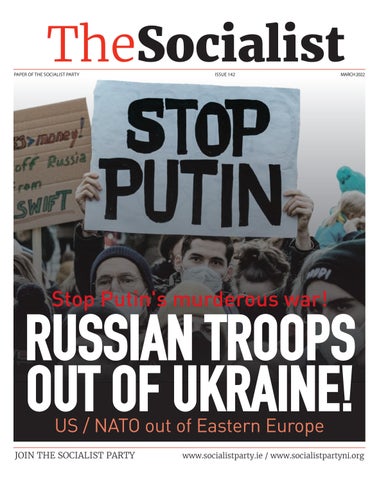
TheSocialist
PaPer of the SocialiSt Party
iSSue 142
March 2022
Stop Putin's murderous war!
Russian TRoops ouT of ukRaine! US / NATO out of Eastern Europe
join The socialisT parTy
www.socialistparty.ie / www.socialistpartyni.org
2
Cost-of-living Crisis
The socialist
Behind the stats: The human reality of the cost-of-living crisis Key concern the cost-of-living crisis is now at the forefront of people’s minds. Permanent tSB's latest "reflecting ireland" survey reveals that it is a concern for 62% of respondents, with the price of housing and access to healthcare also major issues, at 47% and 46% respectively.
“Emigration time” Many have taken to social media to share their experiences of the costof-living crisis: "We’re both teachers and we can’t afford a house where we are from even with a decent mortgage."
"Had to cancel my broadband and I’m walking 30 minutes to work as I can’t afford diesel."
has around €25 left. that money goes back towards electricity or on bread and milk.
"It’s emigration time.”
Soaring rents
Struggling to put food on the table Wednesdays are difficult for Shirley Kilbride, the lone parent told rtÉ. it’s the day before she gets paid, so she spends it figuring out how she will feed her three children. at times she can stretch to chicken nuggets and chips for them, while she has beans on toast. She finds the rising cost of living a struggle and putting food on the table is getting harder. By the time she pays her bills, she
By Jonathan Diebold
the number of children experiencing homelessness has risen by over 400 in the last six months, to 2,563. focus ireland ceo, Pat Dennigan, said: “there are children in families who mostly lost their homes in the private rented sector as they could not keep up with rising rents and in other cases, the landlord could be selling the property so the family can be evicted. Many low-income families are dependent on housing assistance payments (haP), yet haP has not increased in over five years.
Heat or eat? Barnardos Project Worker Danielle Perry told rtÉ: "We have families who possibly wouldn't be able to have the electricity on. they wouldn't be able to have the electricity for the cooker to heat the food or to cook the food. So, it is choosing between what they can or cannot do. there is a lot of additional strain on families who are already under pressure.” in a survey commissioned by Barnardos, amarach found that 10% of parents skip meals in an average week to feed the children in their care, while 9% of parents said they felt "close" to food poverty.
Way above average inflation Many common groceries have risen in price faster than the rate of inflation. in the last ten years, the cost of a loaf of Brennans is up 10%. an 80 pack of Barry’s tea is up 11%. a 500g bag of shop-brand pasta is up 20%.
“I eat once a day” More quotes from social media: "Barely getting by, bills are tough and need juggling. Travelling for work is killing us." "Have to choose between food and heat as the rent has to be paid."
"I’ve had to get a part-time job to help my parents pay for food shopping. I’m 17." "I eat once a day."
The absolute neck... Junior finance minister Seán fleming said in a radio interview last month that, “it takes effort to shop and switch and if people make an effort they can save a lot of money. rather than just complaining on what the Government is going to do for me, you could actually have a serious impact on your own finances but it involves people having to do some work themselves.”
north: end fuel poverty – nationalise the energy companies
THESE ARE just some of the headlines we have become all too familiar with over the past few months. They are only telling us what our bank accounts already show. We are paying significantly more for our gas, electricity and petrol than we did a few years ago. and because businesses are paying more as well, the additional cost is passed on to the consumer leading to higher prices of food and other essentials. inflation in the uK is now forecasted to hit 8% by april. this isn’t just a blip, the Northern ireland utility regulator warned that the high gas prices are likely to remain for at least three years.
ance and planned tax rises could lead to the sharpest fall in uK living standards since 1956. With 43% of households receiving universal credit described as food insecure, the increase in the cost of living is forcing ever more people to choose to heat or eat. for the more than one million people in the uK facing destitution, it’s often neither of these. a worldwide squeeze on energy supplies has pushed the price of gas up to unprecedented levels. russia has been playing politics with the gas supply to europe, reducing supply by 25% over the past year, undermining europe’s storage capacity to deal with winter surges in demand. increased demand in other parts of the world has also pushed the price up. Putin’s invasion of ukraine will further destabilise the market. the market volatility highlights a structural weakness in the overreliance on imported gas. this ‘market’ is inherent to capitalism, the idea that everything is a commodity that can be used to generate massive profits for multinational corporations and their shareholders.
Major squeeze Meanwhile, in real terms the basic rate of out-of-work benefits is at its lowest for 30 years after adjusting for inflation. a perfect storm of inflation, higher energy bills, increase in national insur-
Privatisation bonanza thatcher was the first in europe to open up the energy sector to big business. the eu states followed suit in the late 1990s and privatised and / or sold their national public sector companies.
By Dagmar Walgraeve “Power NI becomes latest energy provider to announce major price hike” “Firmus energy 33.57% gas price hike” “Budget Energy and SSE Airtricity announce further increases to electricity prices”
Privately-owned energy companies are making a killing from rising fuel prices
the real beneficiaries of the deregulated energy markets have been a few large private corporations. these monopolies dominate a captive market, supplying totally uniform goods. electricity bills have gone up by a third and gas by half in real terms since the mid-90s. european gas transmission operators and their parent companies made €4 billion in profits in the first six months of 2021. British Gas profits increased by 44% to 118 million, while its
parent company’s profits doubled to £948 million in 2021. SSe meanwhile forecasts profits of nearly £1 billion. Public ownership now Maximising profits also means underinvestment in infrastructure such as storage facilities and low carbon technologies to meet future needs. While a windfall tax on those enormous profits could alleviate the sharp increase in energy prices now, it is clear that energy
should not be subject to the volatility of the capitalist market. the entire industry should be re-nationalised and the profit motive removed from our essential services. Massive investment is needed in renewable energy and energy efficiency such as insulation in our homes. We need democratic public ownership and control over our energy systems to end energy poverty, while also safeguarding our environment.
Cost-of-living Crisis
3
The socialist
south:
it’s a ‘cost-of-survival’ crisis By conor Burke
I
n a short period of time, the cost of essentials such as food and fuel have skyrocketed. Working-class people are faced with a cost-of-living, or more accurately a cost-of-survival crisis, in their daily lives. Rising prices come on top of rising rents and property prices, which have been a consistent crisis in our lives for eight years now. This crisis has been perpetuated by successive governments' commitment to the private market, allowing property developers, landlords and vulture funds to reap huge profits at the expense of ordinary people. Bosses profiteering
The key reason why inflation is skyrocketing is simply that the bosses are passing on the extra costs they face to working-class consumers. On top of this we are now seeing a massive spike in energy costs which have now been exacerbated by the war in Ukraine. Again, privately-owned and run energy companies are unwilling to take a reduction in profit, so we pay the price. Prior to Christmas the Government announced a €100 payment for household electric bills to be paid directly to energy suppliers, but given the speed at
which inflation is rising they were forced to double this amount within weeks of its announcement. Ireland is now the fourth most expensive country in the western world, yet wages and government assistance payments lag way behind in relation to rising costs. Despite this, they shamefully slashed the Pandemic Unemployment Payment from €350 to €250, and now it is set to be reduced to €208 by the end of March.
What we need: The inflation spiral is a consequence of the instability and chaos of the capitalist system. There are certain things that can be done to alleviate the burden on workers and young people: l increasing the minimum wage to €15 per hour would immediately help low-paid workers to cover basic costs. l Slash and freeze rents at affordable levels. commence a public housing programme building tens of thousands of homes on stateowned land. l introduce free public transport and invest in an expansive, reliable public transport system throughout the country. l take the energy suppliers into public ownership so that costs can be made affordable. for a major programme to retrofit all homes in the state. l Break with the capitalist market: take the key wealth-producing sectors of the economy into democratic public ownership so we can plan the economy to cater for the needs of people not the profits of the bosses.
Stealth taxes fuel crisis
Despite attempts by the government parties to say that inflation is being perpetuated by external factors, clearly there are certain elements that are unique to the Irish economy that are driving inflation rates here higher. In fact, the Government is directly responsible for some of them. It imposed a minimum pricing on alcohol, introduced the sugar tax, both of which hit poorer sections of society hardest. They brought in the greenwashing Carbon Tax, which imposes unjust expense on those who can’t afford an electric car and who have no option but to drive older vehicles. In reality, this measure does nothing to address climate change. Meanwhile, they have allowed the housing crisis to go from bad to worse.
Cost of living rise has eroded living standards of the poorest
south: We have a poverty-inducing minimum wage: €15 an hour now!
South: Eating up our incomes – slash rents now!
By Myriam Poizat By aoife coppinger
n
oWadays, young people in Ireland are entering adulthood in a world where most have no prospect of owning a house, the cost of fuel, electricity and other necessities continues to rapidly inflate and the environment is being consciously destroyed by huge multinational corporations due to their never-ending drive for profit. It is increasingly becoming impossible for young working-class people to survive independently, especially due to the ridiculous minimum wage in place. The recent increase of ¢30 to €10.50 was an insult by the government to ordinary people as it is nowhere near the necessary rise needed.
As rents and commodity prices continue to rapidly inflate, while wages stay virtually stagnant, workers’ wages are essentially cut, as there’s a rise in the cost of living but no wage increase to match that. The government and employers are well aware of this, but of course it benefits them to uphold this form of exploitation. The power of struggle
However, when working-class people organise around these issues, pressure can be exerted on governments and corporations to make concessions. Recently, in Britain and Northern Ireland, Unite the Union won cost-of-living pay increases after striking or threatening to strike. In the US, Starbucks workers, less than a month after union-
ising, went on strike demanding proper Covid safety protocols to be put in place. Like so many hospitality workers, who are often young people, they were traditionally unorganised. However, in both struggles, an organised approach meant that the workers were better able to challenge the exploitation they were enduring and fight for change. This is why Socialist Party TD Mick Barry put forward a motion in the Dáil for a €15 minimum wage and called for it to be index-linked to inflation, which would mean that all working-class people are receiving a living wage. Inspiration can be taken from the struggles outlined above on how pressure can be put on the government to force them implement this.
THE HOUSING crisis has been a major issue in Irish society for as long as millennials and Gen Z can remember. And while most might have hoped it couldn’t get worse, daft.ie reported on 1 February 2022 that Ireland has reached the lowest amount of homes available to rent since 2006! yet housing is not only becoming increasingly scarce, it is also unaffordable for the majority with the national average rent now reaching €1,524 – 10.3% increase in a year. An intolerable burden this also comes in the context of a skyrocketing cost-of-living crisis. as a matter of fact, wages are the only thing not set to increase. households
have therefore had to spend an average of €3,000 to €4,000 more compared to last year. for all the young people looking to rent (or buy!) their first home, it is a never ending nightmare. While fianna fail, fine Gael and the Greens should be awarded an oscar for their barefaced attempts to deny responsibility for the housing crisis, it is their neoliberal policies that have allowed landlords, speculators, vulture funds and “build to rent” developers to continuously exploit housing as a profit-making commodity. ordinary working-class people’s needs should come before the interests of greedy landlords. it is time to put mass pressure on the government for real rent controls, where rents are reduced to affordable levels, and frozen at those levels.
4
north AnAlysis
The socialist
Assembly elections 2022: Build a cross-community socialist alternative By Sean Burns
n
earLy 25 years after the good Friday agreement, the need to build a movement that unites young people and workers in a struggle for a future free from sectarianism and poverty is more urgent than ever. the cost-of-living crisis is quickly spiralling out of control as the cost of gas, oil and other products soars. the health service is on the brink of collapse as years of funding cuts and staff shortages are culminating in huge waiting lists and low bed capacity. the spectre of conflict and sectarian division continues to haunt the streets of the north and young people see little prospects for a future. Capitalism has failed working-class people. We need to build a socialist alternative. Sectarian battleground
The backdrop of the election will be the ongoing battle over the NI protocol. The DUP have withdrawn their First Minister from the Executive in protest at the implementation of the east/west border. A decision taken under mounting pressure from Unionist voters for action against the protocol. All the green and orange parties will enter this election campaign intent upon taking advantage of this situation. Both the DUP and Sinn Féin will vie for dominance presenting themselves as the best champions of the respective communities in the North The path presented by unionism and nationalism is a path of shared misery and conflict for workers of all creeds. For years they have presided over an administration that has protected the interests of profit over people. They have come together, in common cause to implement
cutbacks in public services, destroy jobs and demand lower taxes for multi-billion pound corporations. Meanwhile workers have faced stagnating wages, housing shortages and a rising cost of living. Capitalism, and by extension the green and orange parties are incapable of resolving the conflict over national aspirations in any meaningful way. The solutions presented by Unionism and Nationalism, be it a border poll or a maintenance of the status quo amount to trampling over the rights of either community without their consent. This is a recipe for conflict and division. A real solution requires building a movement against those forces with a vested interest in maintaining sectarian division – whether they be Green or Orange. Only by building a movement which unites Protestant and Catholic workers and youth around their common interests and in opposition to the capitalist establishment can we begin to break down the sectarian barriers between our communities. For a working-class party
However, the increased sectarian polarisation is only one side of development in Northern Ireland. There have also been important movements that have brought people together from protests in response to the climate crisis, for action on gender-violence and most recently in response to the war in Ukraine. As The Socialist has covered there has also been an important wave of strike action and ballots for strike action from workers in both private and public sector, which will continue during this election. These movements need a political expression that can unite working-class
The Socialist Party will be standing Neil Moore and Amy Ferguson in the upcoming election
people and to take on the sectarian parties and the capitalist system they represent. The Socialist Party stands for the building of such a party. We look to work with all genuine cross-community left activists, trade unionists and young people to make this possible. In this election we encourage people to vote for any genuine cross-community and left candidate.
Socialist candidates
The Socilaist Party is standing two trade union activists in this election: Amy Ferguson, a young trade unionist. She works as a barista and is the secretary of Unite's Northern Ireland Hospitality branch, representing workers in cafes, bars and restaurants. She is a member of
Omagh Trade Union Council. And Neil Moore, a trade unionist who has led important strikes such as in Glen Dimplex. We are contesting this election to put forward socialist ideas and contribute to the building of a real working-class, socialist alternative to this crisis-ridden, sectarian system.
Mounting evidence exposes “systemic” collusion under its cover name “Ulster Freedom Fighters” in the early 90s in the South Belfast area. This included the infamous attack on the Sean Graham bookies in which five people were brutally massacred, as well as other vicious sectarian murders, often justified as “retaliation” for sectarian actions by republican paramilitaries. The Ombudsman report highlighted that “collusive behaviour” was happening at “systemic” levels in the RUC. This litany included the fact that eight UDA members linked to murders and attempted murders of 27 people were police informants, and that there was a failure to investigate those involved in importing weapons used in these attacks because many involved in this importation and distribution were police informants. There was routine destruction of evidence and documentation. Special Branch also gave “deactivated” weapons to UDA members whom they knew could reactivate the same weapons. On several occasions, the RUC failed to notify those who were subjects of death threats that their life was in danger.
By Kevin henry
M
artIn o’Hagan was a journalist and trade unionist murdered in 2001. He was murdered for bravely writing, despite death threats, articles exposing of the loyalist paramilitaries, particularly the murderous sectarian gang known as the Loyalist Volunteer Force (LVF). At the time the police promised to do everything to find his killers, yet over 20 years later no one has been convicted. A recent Spotlight programme has exposed a list of things that weren’t done to find the killers, including when a witness involved in assisting the killers came forward. There were allegations from someone claiming to be an army intelligence officer working undercover in the LVF passed on information that O’Hagan was to be shot which wasn’t acted upon. The O’Hagan family and his union, the National Union of Journalists, have rightly called for a new investigation. Ombudsman report
This is just the latest in a growing mountain of evidence and published material that exposes the role of the British state during the Troubles. After decades of fighting for justice by the
Martin O’Hagan was a courageous journalist murdered by the LVF
families of the victims, finally a 344page report has been published by the
Police Ombudsman into the murder of 11 people in eight attacks by the UDA,
Half-truth is not enough
One family member described this report as providing “half-truth and halfjustice” after 30 years. This sums up the
attitude of many families who have been the victim of loyalist, republican or state violence during the Troubles. The Socialist Party supports the rights of all families to independent inquiries and inquests into atrocities committed during the Troubles. The recent “amnesty” proposed by the Tories is an attempt to cover up atrocities and a denial of those families' right to truth and justice. However, families deserve more than “halftruth and half-justice,” yet that will not come from forces who have a vested interest in ensuring the role of the state or various paramilitary groups are not properly brought out and scrutinised. As well as individual inquiries, the Socialist Party argues for a proper independent inquiry into the role of state and paramilitaries during the Troubles. The main political forces and the state however cannot be trusted and do not have the authority to conduct such an inquiry. But there are forces in our society with such authority, this includes trade unionists who organised against the tit for tat killing in the early 90s and have campaigned for justice for their colleague Martin O’Hagan. As well as providing truth and justice for victims of the Troubles, such an inquiry would shine a light on the role of all actors during the conflict.
gender violenCe
5
The socialist
the misogyny of the irish state – why the establishment parties are no allies of women The political establishment’s indifference towards Irish women over the years is evident in their dangerous policies, and can also be seen in the catastrophic consequences of their ‘oversights’. Following the fall-out of the CervicalCheck scandal, it was revealed that meetings between officials from CervicalCheck, the HSE and the Department of Health had been aware of 209 ‘false negatives’ for at least seven months, from late 2015 to mid-2016 but the then-Health Minister, Simon Harris, and former Health Minister, Leo Varadkar, claimed to have been none the wiser. Let us not forget that it was also under these establishment parties that the inconceivable cruelty of the Magdalene Laundries and other industrial schools continued to operate right up until 1996.
By isidora Duran Stewart
W
HILe tHe public response to the murders of sabina nessa, sarah everard, ashling Murphy and more has been astronomical, the same questions are being posed: why are things getting worse and not better? Why have cases of gender-based violence skyrocketed in severity and consistency? In a country marred by the longstanding alliance between church and state, the statutory grip held around women’s lives has been brutal and the track record of Fianna Fail and Fine Gael shows increasingly creative methods employed to maintain it. The political establishment in Ireland is up to its neck in misogyny. A century of oppression
The policies implemented by Cumann na nGaedheal and then Fianna Fail, Fine Gael, Labour over the past century illuminate a concerted effort to stagnate women’s liberation and maintain and further entrench the patriarchal status quo. In 1925 Irish women were barred from taking Civil Service exams. In 1926, a committee on ‘evil literature’ was established which recommended the ban of any publications that included information on contraception. The following year, all women were removed from juries (not to be returned until 1976). Fianna Fail’s government in the 1930s ensured that women lost their jobs upon marriage (1932), appointed the Arch-
Socialist feminism The saga around the ownership of the National Maternity Hospital is the latest example of the sexism of the Irish state
bishop of Dublin and the Westland Row parish priest as chairs of the National Maternity Hospital (1936) and inserted a divorce ban into the constitution (1937). Public campaigns began to grow, particularly in the fight for reproductive rights, but were continually pushed back. In 1980, despite being opposed by Fianna Fail, the ‘Family Planning’ Act was signed into law which ensured that contraceptives could be sold but only to married couples who held a prescription. 1983 saw Fine Gael and Labour introduce the 8th amendment to the con-
There is no acceptable level of sexual harrasment
End sexism in hospitality industry
stitution that equated a woman’s life with a foetus (supported by Fianna Fail) that engendered a long battle for repeal ending with victory in 2018. This win was the result of decades of campaigning, protests and social struggle, the most intense wave of which was sparked by the tragic and needless death of Savita Halappanavar a decade ago this October. This movement that ROSA Socialist Feminist Movement and the Socialist Party played a major role in, including with civil disobedience actions with abortion pills, eventually forced the gov-
ernment to back down, despite Leo Varadkar and Michael Martin both publicly supporting the 8th amendment up until the eleventh hour. Although some concessions were won, new barriers were still being erected to hinder women’s freedom. In 2013, Fine Gael/Labour gave the green light to pharmacists to refuse supplying emergency contraception on ‘moral grounds’ and did similar in the wake of Repeal, given continuing problems with the legislation that are still providing barriers to access.
A socialist and working class feminism standing squarely against this rotten misogynistic state and political establishment with their grubby history and deeply conservative ways is the most effective way to struggle for change. The young women and young LGBTQ folk who have been at the forefront of social struggle that has forced progressive change in recent years; the women workers who have been on the frontline and are increasingly on the breadline; are all integral to the type of working class and socialist political alternative and challenge that must be built en masse.
north: stalking Bill final stages — keep up the pressure to end gender-based violence By roise Mccann
L
The Socialist spoke to Amy Ferguson, Socialist Party member and Unite Hospitality branch chair about the launch of a joint campaign between ROSA and Unite Hospitality to tackle sexism and harassment in hospitality: “Sexual harrasment has been a longterm issue in the hospitality industry. last year we saw a huge rise in spikings with the reopening of the industry. But even in 2018 a unite survey found that nine in ten hospitality workers have been sexually harrased at work, and a 2021 survey found that only 9% of hospitality workers had faith in their employers to adequate deal with a complaint
of sexual harrasment. the employers and politicians have done nothing about this. they have sat on their hands and allowed these issues to fester. this makes a dangerous work environment for hospitality workers and a dangerous environment for customers to visit unite hospitality has linked up with roSa – Socialist femminist Movement to try and build a movement to challenge sexual harraseement in the hospitality industry but also to tackle the systemic root causes. Going forward from the launch of our charter we want to fight both on the industrial and political fields to make our workplaces safe for everyone.”
ast Week the Protection from stalking Bill passed its final stage in the stormont assembly, making stalking a specific offence. the legislation also contains stalking Protection orders and positive measures meaning victims and survivors will have automatic eligibility for special measures, such as the use of live links or screens when giving evidence in court. the need for the latter had also been raised by the gillen review following the ulster rugby rape trial – a review that only happened because of the protest movement against victim blaming that happened in the aftermath of this trial. Women’s Aid describes stalking as a pattern of persistent and unwanted attention that makes you feel pestered, scared, anxious or harassed. Stalking by ex-partners accounts for the largest group of stalking victims, with the vast majority of these victims being women. It is reported that 18% of women have experienced stalking by the age of 16. More fundamental change
Fighting for legal changes is an important aspect of the ongoing struggle for gender equality. This law comes at a time in which twelve women in Northern Ireland have been murdered since
the beginning of the Covid-19 lockdown period. Domestic abuse calls to the PSNI have increased massively as have reports of spikings. In January of this year, the murder of schoolteacher Ashling Murphy sparked protests and vigils North and South. These protests exerted huge pressure on the establishment to take action. Unfortunately, we must be clear that the sexist legal system or the police cannot end stalking or other forms of gender violence. This was underlined by the reports last month that the PSNI are investigating 25 complaints of sexual misconduct againt their officers which are reported to include rape and other forms of abuse. We also cannot leave the struggle to end gender violence up to politicians who have dragged their heels every step of the way. Instead democratic control over how and where
resources are allocated is essential. We say that must include funding for support services, emergency accommodation and access to safe housing. It must also include investment in measures to prevent gender violence. Furthermore, the state, including the police and courts, has not acted in the interests of women or of working-class people. Instead it consistently defends the wealth and privileges of the capitalist elite. We need genuine democratic control by the working-class and oppressed majority over these institutions. Those that have taken to the streets to protest the prevalence of gendered violence have shown that we have had enough. We must keep up the pressure and build a strong and active movement of young people and workers of all genders to end the shadow pandemic of gender violence.
6 speCiAl feAtUre As we go to press we are seeing a serious and savage new phase of Putin’s war open up, FINGHIN KELLY reports.
P
utIn Had hoped for a quick victory. Instead, he is facing a heroic and determined resistance spearheaded by ordinary ukrainian people. this war has been marked by images of ordinary people taking up arms, directly protesting against advancing russian troops, confronting them individually and even standing in front of tanks. Humanitarian disaster
Putin is responding to this resistance with brutal methods, including heavy shelling of civilian areas – some reports point to the use of particularly vicious cluster and thermobaric bombs. We have also seen dangerous sabre rattling about nuclear conflict and even shelling close to Europe’s largest nuclear power plant. The Russian military seems to be pursuing a method of encircling cities to cut off food, water, electricity and vital supplies – this is an odious mix of medieval war methods with a high tech war machine. Life is becoming more and more unbearable for people caught in the conflict. Casualties are mounting and could climb exponentially in the coming weeks. To date over 2 million people have fled Ukraine. This will increase as the war continues. The UNHCR estimates that up to 4 million people could be displaced by this war. We are seeing the largest refugee crisis in Europe since the Second World War. The suffering of those fleeing the conflict is seeing an outpouring of solidarity and support from working people globally. This sentiment is forcing the EU to allow Ukrainians enter the EU and be given certain rights. Working-class resistance
Putin is a brutal despot. He has launched this war to boost the position of Russian imperialism in the region and to attempt
to shore up his own position domestically. He claims to be there to defend the rights of the Russian-speaking minorities in Ukraine – Putin has no interest in the rights of minorities – he denies such democratic rights to minorities in Russia. Socialists are not neutral in this war. We stand on the side of working class people in Ukraine, in Russia and the wider region. The people of Ukraine have a right to self defence and to organise and repel this invasion, including with arms. This armed struggle needs to be from below, with working-class people and soldiers democratically forming committees to defend their areas and to repel the invasion. Such committees should be independent of NATO, the EU and also the Ukrainian capitalist class – whose own oligarch capitalism has seen the impoverishment of the Ukrainian population. No trust in imperialism
NATO and the EU have been quick to donate arms and equipment to the Ukrainian army. Many people in Ukraine and around the globe, seeing the desperation of the Ukrainian people up against a well-resourced army and wanting to see them defend themselves, have supported these arms going to Ukraine. However, NATO and the EU do not have the interests of working-class people of Ukraine at heart. NATO is a military alliance dominated by US imperialism, which is steeped in blood – from the invasions in Iraq and Afghanistan this century. The EU is a capitalist trade block that brings together European capitalist powers to further their interests – inside Europe and globally. The war sees for the first time the EU itself give arms in a war. This represents a turning point and is part of a conscious push from those such as
The so Macron, but also backed by German capitalism, to back up European economic power with military power. For NATO and the EU their interest in Ukraine is motivated by their own interests – not the rights or well-being of people in Ukraine. As with Putin it is part of a geopolitical game of winning power and influence and the right to exploit different parts of the world. It is why we have seen a boosting of NATO bases, troops and missiles in Eastern Europe. Arms coming from NATO and the EU will come with strings attached. The people of Ukraine can of course exploit interimperialist rivalries in order to arm themselves, however they need to be wary and reject any interference from NATO or EU in how those arms are used, or in a post-war Ukraine. Democratic committees of workers in Ukraine should be the ones determining how the arms are used and not NATO or the EU. The only force for peace
History also teaches us that it is mass movements from below, of workers and young people that stops war. The First world war was stopped by mass strike waves and revolution across Europe – starting in Russia. Wars are not stopped by backing one imperial power against another. It is extremely significant that there has been an explosion from below of anti-war protests in Russia itself. Despite mass arrests, tens of thousands have come out onto the streets across Russia. A million people have signed a petition against the war within days of the war starting. If that million people can be organised and can come out onto the streets and take strike action this can end the war and be the beginning of the end of the Putin regime itself. Workers in Ukraine defending themselves from attack can win over Russian workers and young people. Working people of all countries in the region have an interest in toppling Putin and the oligarch capitalism that he represents. This gangster capitalism has destroyed the lives of workers in Russia, Ukraine and the whole region. Along with Putin, autocrats and oligarchs across the former Soviet Union need to be toppled and the wealth that they plundered brought back into the ownership and control of working people. Internationalism is the way
UN estimates that as many as four million refugees will be forced to flee Ukraine
Should sanctions be supported? Sanctions are a blunt instrument. Capitalism is structured in a way that will see working-class and poor people bear the brunt of them while the billionaires and oligarchs can by and large find ways around them. There are headlines popping up of authorities in France and Italy seizing super yachts of Russian billionaires. However, governments and banks across the West have blatantly facilitated Russian oligarchs from dodging previous sanctions through a myriad of special financial vehicles and brass plate operations. The collapse of the ruble and of the banking system in Russia will mean working people in Russia will see the price of essentials sky-rocket. You can see how they can be used by Putin to gain support and they can therefore be counterproductive. Sanctions have shown themselves to have this effect in Iraq, Serbia and many other places in the past.
To create such a movement, it is essential that the movement in Ukraine adopts a programme that can appeal to Russians in Russia, to Russian soldiers in Ukraine and also to Russian-speaking and other minorities in Ukraine. Such a programme should guarantee democratic rights for all minorities, including linguistic rights for all minority languages and the right of self determination, and for the building of a voluntary socialist federation of peoples in the region. There are already indications of at least some ordinary soldiers in the Russian army being reluctant to fight and even abandoning their posts. An appeal directly to rank and file soldiers not to fight can be decisive in weakening the ability of Putin to wage this war. Working-class and young people around the world can play their part in the anti-war movement. Already we have seen massive protests around the globe. We have also seen workers in various ports around the world refuse to unload Russian oil. Members of the Unite trade union in Liverpool are one such example; they blocked oil from being brought ashore at Stanlow Oil Refinery and in doing so prevented the refinery from exploiting a loophole to get around sanctions.
We say:
l No to war in Ukraine! For the right of Ukrainians to decide their own future, including self-determination for minorities. l Withdraw Russian troops now! l No to US/NATO imperialism. NATO out of Eastern Europe. l No to the EU’s racist refugee policies! Open safe and legal routes for all refugees. Demand access to decent housing, health services and work or benefits for all. l No illusions in diplomacy by the war-mongers. Build a massive anti-war and anti-imperialist movement linking up workers and youth over borders. l For an internationalist socialist alternative to capitalist conflict that leads to war.
puti
War
Us / nAto: hypocrites & By conor Payne
P
utIn’s InVasIon of ukraine has horrified the world because of the brutal bombardment of cities, the creation of a new refugee crisis and because of the clear imperialist ambitions which underlie the whole project. at the same time we have seen the extremely impressive resistance of the ordinary people of ukraine, as well as the bravery of many in russia who have taken to the streets against the war. Likewise, there has been mass solidarity with Ukraine all across the world and a desire to do everything possible to assist the people of Ukraine. For some, this will understandably mean supporting the involvement of the US and NATO, as the only possible counterweight to the power of the Russian military and state. No trust in US / NATO
However, the US and NATO are false friends and cannot be trusted. The US and the other main powers which make up NATO – e.g. Britain, France and Germany – are no defenders of democracy, peace or national rights. The US is the world’s biggest imperialist power, which regularly deposes governments, including elected governments, that do not suit its interests. It acts on the world stage in the interest of the biggest US capitalists including banks, energy companies and arms companies. The US and Britain launched the un-
provoked invasion in Iraq in 2003, which led to the deaths of up to one million people. They have only recently ended (in defeat) their disastrous 20-year long occupation of Afghanistan, leaving that country with an impending famine. While they denounce the invasion of Ukraine, they actively support the no less brutal Saudi war against Yemen and the Israeli occupation of the Palestinians. So much for ‘international law’, ‘national sovereignty’, ‘territorial integrity’ and all the other phrases they use when it suits them. Imperialist rivalry
For both the US and Russia, this is a great power rivalry over whose so-called ‘sphere of influence’ Ukraine and other Eastern European countries should fall into, and this is all in the context of a new cold war between the US and China. NATO is a US-led military alliance, originally founded to combat the Soviet Union. In the wake of that state’s collapse, NATO expanded eastwards, taking in Eastern European countries, including Poland and the Baltic States, bringing NATO right up to the borders of Russia. The planned incorporation of Ukraine and Georgia would have significantly advanced this process. Putin’s complaints about this ring hollow, however, as he has made clear he considers Ukraine merely as his “backyard” without any authentic rights to national self-determination. Notwithstanding this, it is a reality that NATO expansion contributed to the
speCiAl feAtUre
ocialist
7
New anti-war movement emerges in Russia & worldwide
in’s Murderous
r on ukraine
& false friends of Ukrainian people
US imperialism has brought misery to the people of Iraq, Libya and Afghanistan in recent years
development of this conflict and, most importantly, that ordinary people in Russia generally don’t trust the US or NATO. Therefore, any involvement by the US and NATO in this conflict will actually undermine the developing opposition to the war within Russia and will assist Putin’s regime in stoking up nationalism to buttress its policies, something which it has so far struggled to do. At the same time, the NATO powers’ ‘support’ for Ukraine will only extend as far as their own narrow imperial interests.
Workers’ anti-war movement
There is a real danger of escalating tensions between the blocs and increased militarisation on all sides. We are hearing calls for more arms spending, for increased EU militarisation, for more NATO troops and weapons in the region. None of this will lead to peace. Instead it poses the danger of a further escalation of this war, with disastrous consequences for the world. Nuclear war is once again an all-too-real threat. Working-class people cannot rely on
any of the different sets of capitalist rulers to resolve this conflict. Instead we need a global anti-war and anti-imperialist movement from below, in solidarity with the working people of Ukraine and their right to defend themselves. A movement which could really defeat the war machine would involve mass mobilisations, including in Russia, as well as workers’ action, for example refusing to transport weapons or in other ways obstructing Putin’s war effort. This is the alternative we need to fight for.
By ann orr WITHIN HOURS of the invasion of Ukraine, workers and young people in Russia were protesting against it. Protesting in Russia comes with significant risks including police brutality; arrest; detention and being sacked. Regardless, people have protested in over 147 towns and cities to date. Putin's authoritarian regime has banned most forms of protests, making the photographs of hundreds and even thousands on marches and in squares against the war very significant. At the time of writing 13,000 people have reportedly been arrested. Putin's regime is not unshakable and already significant opposition exists. People Vs oligarchs these protests are an expression of solidarity with the masses in ukraine, horror at what has already happened and fear of what is yet to come. they also speak to a growing discontent at Putin's regime and the conditions faced by ordinary people in russia. Putin is flexing his muscles and pushing tensions between the key global players up by several notches, but for him there are many risks, not least the potential for working-class people in russia to revolt and organise to challenge his regime. like elsewhere, wealth inequality has significantly increased in russia and ordinary people are now being asked to sacrifice living standards and risk their lives for Putin and the oligarchs' war. Since the onset of the covid pandemic, russia's 500 richest people have increased their wealth by a staggering 45%. their combined wealth is now estimated at $640 billion, which means that they can easily withstand the billions which have been frozen in accounts as a result of sanctions. Not so for the russian masses. Global movement Significant mobilisations have also happened internationally. While expressing full solidarity with workingclass people in ukraine and calling for the immediate withdrawal of russian troops, we cannot trust Nato or any representatives of uS or Western imperialism. they do not act
in the interest of working-class people anywhere. an active, international anti-war movement is needed. in the strongest traditions of antiwar movements of the past — such as against the Vietnam war and the invasion of iraq — young workers, college and school students have an important role to play. Mass mobilisations against the war should be backed up by the international trade union movement. it could effectively organise practical assistance and transport for refugees as well as efforts to support the resistance of ordinary people in ukraine. in russia, petitions against the war are being shared in workplaces and online. People signing these petitions are risking their jobs. there have been reports of teachers and others already being sacked for refusing to withdraw their signatures. Building on these initiatives, workers must organise collectively. the working-class in russia has the power to really undercut Putin's military efforts. Anti-capitalism is key anti-capitalism is essential to building an effective global anti-war movement. War goes hand in hand with this system that is based on maximising the profits of a few, regardless of the human and environmental cost. as with every crisis of the capitalist system, some are benefiting. Share prices of arms companies soared after the German government announced a €100bn (£85bn) special military spending package. But for ordinary people, particularly in ukraine, the cost of this war is unfathomable. as the revolutionary socialist, clara Zetkin, said about WW1: "the workers have nothing to gain from this war, but they stand to lose everything that is dear to them”. the threat to lose everything we hold is very real once again. this war has sharpened it but the backdrop was already provided by covid, the global economic crisis — now reflected in the massive cost-of-living spike — and the unfolding climate catastrophe. this makes building revolutionary forces internationally even more urgent, and that is what international Socialist alternative is doing.
8
internAtionAl
The socialist
Us: starbucks workers organise from coast to coast most overworked and underpaid. Members of Socialist Alternative (SA), the sister oganisation of the Socialist Party in the US, have been actively building support for the Starbucks workers and have been assisting organising efforts in several of the company’s shops. Kshama Sawant, Seattle City Councilmember, who only draws the salary of a worker’s wage, has donated $10,000 from her excess solidarity fund to Starbucks Workers United.
By Sam Belton
s
tarBuCks Workers in the us are engaging in a historic nation-wide union drive. the drive started in a starbucks store in Buffalo, new york, when, in response to becoming increasingly overworked but ignored by the company, 19 of 27 voted to join the newly-founded and militant ‘starbucks Workers united’ in december. In doing so, they are courageously taking on one of the giants of corporate america. Starbucks has a history of ruthlessly stamping out any efforts by its workers to unionise. When asked, it claims that it is not anti-union and that it only dispatches top Starbucks executives to bully workers out of unionising because it does not want unions slowing it down in rapidly meeting workers’ needs. Meanwhile, as their deplorable union-busting attempts continue, over 100 stores in at least 20 states have now filed for union election – the most recent victory being in a Starbucks store located over 2,000 km away from Buffalo in Mesa, Arizona. What are workers demanding?
As one barista pointed out, a $20 an hour starting wage tied to inflation should be a bare minimum, given that Starbucks CEO Kevin Johnson saw his pay rise to $20 million last year. This is wealth which simply would not exist
What is needed?
Starbucks stores across the US are seeing workers vote to unionise
without the hard graft put in by the workers on the shop floor. Workers also want an end to benefits audits. For instance, employee health insurance, which workers in the US are especially dependent on due to the highly privatised health system, is tied to the number of hours they work per week. Guaranteed hours per week are therefore also essential. They also want an end to retaliatory
firings of workers who attempt to organise union drives. This is in the context of the illegal firing of an entire sevenworker union organising committee (“the Memphis 7”) in a store in Memphis in February. Growing support for unions
As conditions for workers are worsening throughout the US, we are seeing trends such as the “Great Resignation” – where
south africa: clover workers wage heroic struggle to defend jobs
roughly four million workers are quitting their jobs every month. But, as illustrated by the Starbucks workers, we are also seeing a growing upswing in workers’ struggle, with hundreds of thousands of workers – from nurses to auto workers – engaging in sporadic nation-wide strike actions. Support for trade unions is now at a record high of 65% in the US, and is even higher amongst millennials and Gen Z workers, who are among the
SA has argued that winning a union in each workplace is only a first step towards winning a contract with decent wages and conditions. Winning such a victory means organising the power of workers from below and actively involving them in a struggle to win their demands. It is the organised struggle of the workforce that will determine what is won on the bargaining table with the bosses. Union-busting efforts must be met with vigorous campaigns of solidarity and strike action by workers, with the support of the wider union movement and working-class communities Successfully organising Starbucks workers will be a significant contribution towards building a fighting workingclass movement in the US. This is crucial at a time where workers are facing a huge squeeze in their living standards, while the bosses rake it in.
Victory for abortion rights in Columbia
By robert cosgrave
F
aCed WItH the grim prospect of their livelihoods being robbed, 5,000 workers in Clover, a south african food and drinks company, have been out on strike since 22 november 2021. south africa has one of the highest unemployment rates in the world and the workers are refusing to take these attacks lying down. In 2019, Clover was bought up by Milco, a consortium led by the Central Bottling Company, an Israeli company with very profitable operations throughout Palestinian Occupied Territories. The takeover was embellished with promises of hundreds of new jobs. However, the years since the takeover have consisted of asset stripping and profit making on the back of its workforce. Intimidation tactics
The workers have endured intimidation and attacks by hired thugs, along with attempts to bog the struggle down in the courts and the use of scab labour. Yet they have shown they are more than the match of these vultures. They have forced Clover to backtrack on the loss of 800 jobs, but there is still more to fight for in this strike. The trade union movement in South Africa — arguably the strongest on the
By ais flattery
Thousands of workers at Clover are on strike and calling for a boycott of the company
African continent — needs to recognise the importance of this struggle and mobilise in support of Clover workers. A victory for the workers would be a clear sign to employers that workers will not let their jobs and conditions go to the chopping board as a result of the current crisis. On the other hand, a defeat for the workers would give the employers across the board the confidence to launch a general industrial counter-offensive.
Workers must take control
Members of The Socialist Party’s sister organisation in South Africa, the Workers and Socialist Party (WASP), are playing a leading organising role in this crucial battle. We are arguing that this company must be taken off its asset-stripping owners and brought into public ownership. Instead of being run by the cabal of crooks, the workers should democratically control and manage the company.
COLOMBIA HAS decriminalised abortion during the first 24 weeks of pregnancy. During 2020, at least 26,223 unsafe abortions were carried out across Colombia’s according to campaigners so this a vital victory for women’s / pregnant people’s health and lives. this ruling by the colombian constitutional court indicates a huge move forward in consciousness, and could not have been won without tireless campaigners fighting for years and the massive feminist wave that has taken root in the country, including the formation of the ‘causa Justa Por el aborto’ movement, comprising of over 200 feminist organisations and activists. although there is obvious jubilation over the strengthening of reproductive rights in colombia, activists have been explicit in the fact that the new legal ruling is not enough – colombia needs to fully legalise and crucially guarantee access for all to free abortion services. their message is clear; no pregnant person can be left behind.
WorkplACe north
9
The socialist
regina Coeli staff dismissed: Bring the hostel into public ownership! By rebecca Jane McMonagle
e
MPLoyees oF regina Coeli House in West Belfast were dismissed on Friday, 25 February, just two days before their date of redundancy and seven weeks into their 24-7 work-in. The workers occupied the hostel in January following news that the facility would close permanently on 27 February due to alleged structural issues, and a lack of money for repairs. The hostel’s management claims that these structural issues are outlined in an unpublished report still yet to be made public. The report has not even been seen by the Legion of Mary, who own the building. The five employees each received a letter of dismissal on 25 February despite assurances made the day before by the Chair and a Trustee of the management committee that a decision regarding disciplinary action would not be made before 28 February. Cruel attack on most vulnerable
This news of Regina Coeli House closure, and the workers dismissal, is a blatant attack on both vulnerable women and workers. Over the past seven weeks of the work-in, residents who chose to remain at the hostel were issued letters threatening eviction, despite concerns from these vulnerable residents around
the lack of suitable alternative facilities. Regina Coeli House is the only femaleonly facility in Northern Ireland which offers shelter and on-site support, such as counselling services for women experiencing homelessness, mental health difficulties, addiction problems, and abuse and domestic violence. As of last week, one resident remains at the hostel due to lack of appropriate alternative accommodation. These services are needed now more than ever; reports of domestic violence and abuse are at a 15-year high in Northern Ireland, with more than 32,000 incidents reported to the PSNI between June 2019 and July 2020. Callous acts by religious order
The staff who continued providing these essential services to residents, a Legion of Mary volunteer, and a homeless woman were threatened with legal action from the management committee on week five of the work-in. Yet despite the threats, verbal abuse, and suspensions handed down from representatives of this committee, the workers continued their work-in. The fact that a management committee of a religious, supposedly “charitable” organisation, who themselves have not been on-site during the first six weeks of the work-in nor had enquired about res-
The closing of Regina Coeli Hostel is an attack on the most vulnerable section of society
idents well-being during this time, would try to charge minimum wage workers, a volunteer, and a homeless person with legal action is a disgrace. Then furthermore they dismiss these workers two days before their redundancy, denying them of their payments. State must take over the service
Although Regina Coeli House is funded
Spirit Aerospace ballot shows: We need a socialist industrial strategy AT THE time of writing, workers in Spirit Aerospace are balloting for industrial action over pay. The Socialist Party sends our full support to the workers engaged in this ballot. Their fight for fair pay is a fight that workers in every sector are facing. The Socialist spoke to SUSAN FITZGERALD, Socialist Party member and Unite Regional Officer, in a personal capacity, who is playing a key role in organising the dispute. “Well over two thousands workers, members of unite and the GMB are balloting for strike action following one unsatisfactory pay offer after another. this is the first ballot of its kind in more than a decade, workers are worried about endless cost of living increases and fully understand that the only chance they and their families have is to fight for better pay at work. there is a hugely determined mood, this is a highly skilled and well organised workforce who are angry at the near constant contractions due to years of outsourcing and off shoring and more recently significant attacks to the pension scheme”.
What would a socialist industrial plan look like? By Sean Burns
The Socialist Party stands for the implementation of a ‘socialist industrial plan’. We argue for the nationalisation, not just of struggling companies, but of the major corporations which dominate our economy and all the key sectors which are vital for its functioning. We stand for democratic control over these industries by the workers within them and the wider working class, not top-down control by bureaucrats with no understanding of how they function on the ground. on this basis, the huge wealth which exists in society – currently hoarded by a parasitic elite – could be used in a planned and democratic way to invest in manufacturing, infrastructure and public services which society needs, creating secure jobs with living wages while improving the standard of living for the vast majority. Skilled
workers like those in Spirit, harland and Wolff and so on would be treated with the respect and recognition they deserve. through a socialist industrial strategy, these skills would safeguarded and developed in the interests of society, with the training of new generations of apprentices, giving young people a decent future. one obvious use to which the skills of workers like those at Spirit could be directed would be in tackling the imminent threat of climate change, building wind turbines and other projects which could help us rapidly shift away from fossil fuels to renewable energy and avert catastrophe. this requires an urgent and co-ordinated plan of action and investment which capitalism simply will not deliver. We cannot wait for ‘the market’ to learn that there are no profits on a dead planet.
by the Northern Ireland Housing Executive (NIHE) through its Supporting People programme, the facility is owned by the Legion of Mary. We cannot allow essential services such as those provided by Regina Coeli Hostel to remain in the hands of religious organisations, nor should the existence of these services rely on voluntary organisations, charities, or limited gov-
ernment funding. Unite the Union has called for the Legion of Mary to hand the building over to the NIHE. The wide public support for the workers undertaking the work-in, and their success in keeping the hostel running ‘business as usual’ despite legal threats, clearly demonstrates the workers ability to continue to run the hostel democratically themselves.
local government ballot – coordinate the action to win
By Niall Dooris
L
oCaL goVernMent workers across the uk are staging targeted industrial action in March after rejecting a petty 1.75% increase. the ballot of unite’s members in this sector included workers from more than 300 local authorities. More than 80% of unite’s 70,000 members, who voted in nearly 400 separate ballots, were in favour of industrial action over the 1.75% offer made by the Local government association. Unite has said that the offer is ‘completely unacceptable’, given that the RPI rate of inflation has rocketed to 7.8% recently. This means in real terms this is a pay cut, a familiar situation for most workers, especially since the pandemic. The workers involved include refuse workers, care workers, youth and com-
munity workers. These are some of the key workers who kept public services running through the pandemic. The government has proven before that initiatives like “clap for our carers” will remain an empty gesture while they continue to offer below-inflation pay offers, such as the measly 3%/1% pay offer to nurses last year. United action is key
Disputes like this will not be solved by cordial discussion with politicians. The successful ballot of Unite workers shows that they recognise that strike action is necessary. A squeeze on living costs as workers are caught between soaring prices and stagnant pay is felt throughout the workforce. Public sector workers should strategically link with each other, cooperation between workers across all sectors would be a powerful tactic in winning a fair deal.
10
theory
The socialist
economics: do wage rises fuel inflation?
By Michael o’Brien
F
roM tHe point of view of the bosses there is never a good time for a pay rise! In the context of inflation being at its highest in decades, a particular line of argument from employers, echoed in the media by establishment politicians and mainstream economists, is that wage rises demanded from workers will fuel inflation. The subtext of this argument is that it is futile for workers and their unions to press for wage rises that will meet or exceed the rising cost of living. This argument can be taken apart on a number of levels. Supply chain bottlenecks Firstly, the origins of the current inflation rate clearly does not stem from rising wages. Certainly in an Irish context, average wages have been rising in recent years in the public and private sector since the austerity years of 2008-2016. However, during the pandemic it has tended to be low single-digit percentage rises, similar to the average annual inflation rate of 2% that pertained over the same period. It is basically uncontested that the current bout of inflation arises from a number of supply chain bottlenecks both in terms of components, like semiconductors, as well as logistical and transport related problems linked to the impact of
the Covid pandemic. Along with the upending of these global supply chains, migration patterns have been cut across — giving rise to labour shortages, such as drivers in the road haulage sector. However, the impact of rising wages has quite a different relationship to prices. The ‘added value’ that takes place in the production process between all the inputs into a good or service and the end product, is human labour. When this added value is realised through the eventual sale on the market, the proceeds are divided between wages for the worker and profits for the capitalist. Who takes the hit? Therefore a rise in wages obtained by workers, enabling them to meet the rising cost of living or better still to improve their standard of living, comes at the cost of less profit per unit of output for the capitalist. This means they have less to spend on their own private consumption and / or to reinvest and expand production beyond what they have already produced. But why cannot the capitalist simply raise the price of their products in line with the wages rises they have been forced to concede? In most circumstances, the competitive pressures between rival capitalists in all sectors force a general alignment between the price of products and the above mentioned inputs of living labour and raw materi-
Marxist journal of the Socialist Party:
Socialist Alternative no.14 includes articles on: l No to War in ukraine! Build a Mass anti-war & anti-imperialist Movement l a Watershed Moment: the Murder of ashling Murphy and Why We Must Demand “Not one More!” l Sinn féin in the South – Preparing for Power? l climate change: Do We Need the ‘Nuclear option’? l expropriating the expropriators: Why We call for Nationalisation & Public ownership l capitalism, oppression & the Patriarchal family l 50 years Since Bloody Sunday l an Gorta Mór: the legacy of the irish famine
€3 / £3 Get a copy from any Socialist Party member or order online or subscribe at: www.socialistparty.ie
als, energy, machine depreciation etc. These competitive pressures are more or less present in all branches of the capitalist economy. In consumer goods and many services they tend to be most present. Where there are monopoly aspects to some goods, such as intellectual property or real estate, this can be less the case. Ireland: Wages down, profits up Finally, if you take an economy-wide view of how the proceeds of all economic activity is shared between wages on the one hand and profits on the other, there has been a near constant decline in the former since the mid 1970s in Ireland and beyond. In 1975, wages accounted for an astonishing 92% of GDP in Ireland. By the early 1990s, it was down to 75%. In 2009, it had fallen to 55% and in recent years it has hovered around 50%. This decline took place despite the massive growth of the workforce in Ireland. To sum it up, a growing workforce collectively has been receiving a shrinking share of an expanding economy over the last half-century. This observation alone makes total nonsense of the idea that rising wages to meet the recent rise in inflation will do anything other than claw back some of the profits that have been creamed in recent decades. Arguments to the contrary are used only to serve the rule of the bosses.
Socialism 101 series #2 is war inherent to capitalism?
By Kevin McLoughlin Virtually everyone supports the idea of ‘world peace’, yet today in 2022 there are nearly 40 different wars or conflicts ongoing. And with the Russian invasion of Ukraine the threat of nuclear war, and the annihilation of us all, is greater now than it has been for decades. But why is this so? The fact is that despite what their propaganda says, war is inherent to capitalism because it is a system based on profit, competition and the constant need to expand, which inevitably comes at the expense of competitors – there can’t be peaceful coexistence. Any capitalist that wants to get ahead has to squeeze as much as possible from their workers – by working them harder and longer and paying them less. But they have to do so ahead of their capitalist rivals, to secure their share of the market or control of resources. Now while capitalists may often have recourse to various underhanded acts against their rivals, they don't engage in violent conflict against one another because the capitalist state has a monopoly on violence with its control of armed forces such as the police and army – it can arbitrate disputes between capitalists within the same state. However, capitalism is an international system and the market is global but divided between nations with their own capitalist states, which act to protect and where possible advance the interests of their own capitalist classes. The most powerful states exert their influence on the world stage as imperialist powers, dominating all others but competing with each other – as tensions continually ratchet up. This competition between nation states representing rival capitalist classes is the ultimate source of the wars, which vary in scale and intensity, that plague our world. Of course war is also big business. Wars are waged not for great ideals, but for land and resources, e.g. the war in Iraq was about access to oil for US
companies, not Saddam Hussein’s brutality. Almost $2 trillion is now spent annually on ‘defence’, an amount that has risen each year for the last eight years and is now expected to increase dramatically. Even at the height of the pandemic economic crash in 2020, the 100 biggest arms companies reached record sales of $531 billion. Aside from private armaments companies themselves, the only interests served by this defence spending are those of the capitalists classes – in protecting their property from foreign competitors, but also from their own working classes, who have no interest whatsoever in any capitalist war. In fact the working class is the sure loser in any such war, regardless of the outcome. That’s why socialists are the most consistent opponents of imperialist war. At the same time we are not pacifists. Pacifism, regardless of how genuine, isn't really an appropriate or practical response to war because, if attacked, people have a right to defend themselves, and organised working-class resistance to war can be powerful. Seeking peace by hoping to convince capitalist warmongers to renounce violence in their pursuit of profits and power is futile. We oppose imperialist wars, because none of the major powers – the US, the EU, the UK, China or Russia – offer anything but continued inequality, oppression, environmental destruction and war. The nationalism they promote to whip up support for their adventures must be rejected. Any notion that we should back our rulers in wars against people in other countries is a ruse to deflect from the class war they are waging against us. The Communist Manifesto said it best: “Workers of all countries, unite!” International working-class struggle and solidarity have always been the most vital weapons in the arsenal of the anti-war movement. And a socialist world, based on real democracy and public ownership and planning of the economy, is the only way to win world peace.
repression & revieW
11
The socialist
case dismissed against limerick socialist feminist activist By aislinn o’Keeffe
I
n May 2021 I received a fine in the post from an garda síochana to the tune of €500. With this fine, gardaí alleged that I was an ‘event organiser’ under the Covid emergency legislation put in place by the government. Thinking back over my months of isolation during lockdown, I wondered if I had unwittingly organised a party, say, at a large hotel with free-flowing wine and rounds of golf for guests. But no, the ‘event’ in question was in fact a small, outdoor, socially-distanced stand out called by ROSA to highlight the issue of gender violence after the murder of Sarah Everard by a police officer in London in March 2021, and to demand action on the issue from the Irish government. An essential protest
This stand out of about ten people was demonstrably Covid-safe and importantly, raised an urgent issue of public health and safety. As urgent, in fact, as the Covid pandemic itself – the UN has declared the rising instance of gender violence a ‘shadow pandemic’. ROSA activists who attended on the day and I, did not have the luxury of thinking about how we might enjoy ourselves during lockdown. Rather, we were forced by the matter of the increasing
threats to our safety, wellbeing and our lives to take action in the face of state inaction. Backed by ROSA, I made the decision that I would not pay the ensuing fine on principle, and instead we began a campaign which called on the Gardaí to drop the fine which was clearly unjust and an abuse of their authority. Shameless Gardaí
On a Sunday morning in late January of this year, a uniformed Garda arrived at the door of my home and issued me with a court summons pertaining to this same charge of ‘event organiser’ with a court date set for 25 February 2022. In the subsequent days and weeks, I thought about all of the instances of male violence that both myself and the women and gender non-conforming people in my life have been subject to. I thought of how in every instance the perpetrators of these crimes have not, and will never, have a Garda arrive at their door. I thought about how they have never had a day in court. And yet, as a woman and ROSA activist, I have been subject to both of those for merely highlighting this issue of male violence and demanding government action. I realised that had I rang 999 seeking help having suffered intimate partner violence during lockdown, I would have received far less attention from the Gar-
daí. In fact, it’s likely that my call would have been cancelled as evidenced by the routine cancelling of over 3,000 calls relating to domestic violence by the same Gardaí. Energetic campaign
ROSA Limerick waged a campaign locally to put pressure on the state to drop the charges. This campaign was supported and highlighted by ROSA and Socialist Party repesentative Ruth Coppinger, Socialist Party TD Mick Barry who raised the issue in the Dáil, feminist campaigner Ailbhe Smyth, and Liam Herrick and the Irish Council for Civil Liberties with legal representation provided by Damien Coffey solicitor of Sheehan and Partners. This campaign raised huge support from the public in Limerick who were outraged at the charges and who joined us on protests, public meetings, who leafleted the city, hung posters, and other activities demanding the charges be dropped. This included a significant demonstration outside the courthouse last Friday morning with passing motorists beeping their horns in support. When the case was called before the court on Friday, Judge Carol-Anne Coolican was informed by a Garda that the Director of Public Prosecutions had made the decision to withdraw the charges and the case was dismissed.
Aislinn and supporters, including Mick Barry TD, gather outside the courthouse Victory
This outcome is a huge victory for ROSA and for activists raising the issue of gender-based violence. Without the efforts of countless people over the last year, and especially over the last month, who came together with ROSA to chal-
review: and Breathe normally directed by Ísold Uggadóttir review by James fleming
u
tILIty BILLs and notices are overflowing from an apartment’s postbox. “Mommy, we forgot to get our mail yesterday. and also the day before that.” so says six-year-old eldar at the beginning of And Breathe Normally. Clearly, the child does not understand why his single mother, Lara, ignores their letters. Nor does he know what the “secret adventure” they are about to go on is. The truth is that Lara can no longer afford rent, and despite gaining a new job as a border guard at Keflavik airport in Iceland, they are forced to sleep in their tiny old hatchback. Lara is a recovering addict and queer woman. Her almost impossible situation increases her difficulty in staying off drugs. Despite all her challenges, she is keen to do well at her new job. She studies hard to understand the rules and technicalities the role requires. As a new border guard, Lara’s professionalism and eagerness to impress leads her to spot a fake passport that was missed by her colleague. Its holder is Adja, our second protagonist, a lesbian fleeing from brutal repression in Guinea-Bissau. Adja is sentenced to 30 days in prison. On release, she is brought to a detention centre for asylum seekers. The film takes place on the desolate Reykjanes peninsula, so it’s not long before Lara and Adja come across each other again and again. Eventually, they
lenge these charges it would not have been possible to defeat them. While the singling out of one activist may have been an attempt at intimidation by Gardaí, we have shown that solidarity and collective action provides the antidote to these tactics. If we don’t fight, we don’t win.
Drop the charges against climate activists! By Peter McGregor
get to know each other and understand one another’s difficulties. The film is permeated by moments of acute stress and relief for the protagonists; losing an apartment and gaining a job for Lara, release from prison and going into a detention centre for Adja are among such moments. We see a side of Iceland not seen in the tourist brochures. Its harsh, lonely climate underlines the vulnerability of the protagonists; Adja walking through
the cold rain without cover; Eldars talking with his Mam at night in their cold car about the warm places the planes fly to and wearing shorts in Benidorm. The film deals with many social issues: class, addiction, sexuality, sexism, racism, inequality, bureaucracy, and others. But importantly, it addresses these issues not as unrelated and separate problems, but holistically, connected as they are to social conditions and economics. The film explores the unequal rela-
tionships of everyday life, particularly for working-class women, in a nuanced way. Examples include the interactions between boss and employee, men and women, experienced and inexperienced workers, border guards and refugees. And Breathe Normally is an obscure gem of a film that shows that workingclass people can ultimately only be saved by each other. And Breathe Normally is currently available to watch on Netflix.
CLIMATE ACTIVISTS Orla Murphy and Zac Lumley have been charged with criminal damage for their involvement in a video that was live-streamed of the Department of Foreign Affairs building in Dublin being spray painted with “no more empty promises” in March 2021. this was an act of protest to highlight the burning issue of our time: climate change. the truth is that empty promises have been made by the irish government and all governments, from the Paris climate accord to coP26, and action needs to be taken now. Not only is the prosecution of these two activists a waste of resources, it is also an attack on the right to protest. instead of orla and Zac being thrown in jail, what is really needed is proper action on climate change. the charges should be dropped immediately, and focus should be turned towards the real criminals in our society – the capitalist polluters causing untold damage to our world, and the governments who sit on their hands while ecological collapse draws nearer.
TheSocialist
PaPer of the SocialiSt Party
iSSue 142
March 2022
end fuel poveRTy! BRing eneRgy CoMpanies inTo puBliC oWneRship in this issue:
police ombudsman report: Mounting evidence of “systemic” collusion
join The socialisT parTy
Misogyny of the irish state – why the establishment is no ally of women
economics: Do wage rises fuel inflation?
www.socialistparty.ie / www.socialistpartyni.org