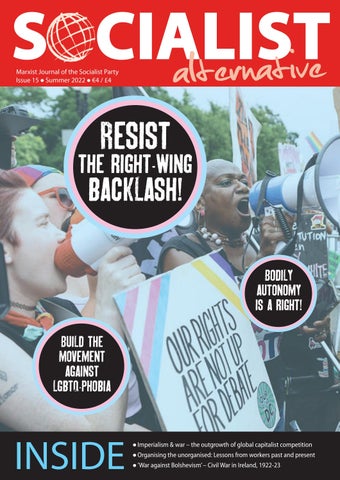
S cialiSt alternative Marxist Journal of the Socialist Party Issue 15 l Summer 2022 l €4 / £4
Resist
the right-wing
backlash!
Bodily autonomy is a right! Build the movement against lgbtq-phobia
INSIDE
l Imperialism & war – the outgrowth of global capitalist competition l Organising the unorganised: Lessons from workers past and present l ’War against Bolshevism’ – Civil War in Ireland, 1922-23
S cialiSt alternative Marxist Journal of the Socialist Party Issue 15 l Summer 2022
iN thiS iSSue
No.15
SOCIALIST ALTERNATIVE is the political and theoretical journal of the Socialist Party.
Feature Resisting the backlash – building for LGBTQ liberation BY CONOR PAYNE 2 Imperialism & war – outgrowth of global capitalism BY FINN MCKENNA
7
From ‘historic election’ to new crisis at Stormont BY KEVIN HENRY
12
Redressing a checkered history The CWI & socialist feminism BY LAURA FITZGERALD
16
24
Universal Basic Income – what do socialists say? BY MICHAEL O’BRIEN
28
Civil War in Ireland, 1922-23 BY MANUS LENIHAN
31
review Derry Girls created by Lisa McGee REVIEWED BY REBECCA MCMONAGLE
Get a subscription to Socialist Alternative and The Socialist, the monthly paper of the Socialist Party. Text “Subscribe” to 087 2400331
coNtact the SocialiSt party
Lessons from workers past & present Organising the unorganised BY AMY FERGUSON
SubScribe Now!
36
North: 07821058319 South: 0873141986 info@socialistparty.net
iNterNatioNal The Socialist Party is the Irish section of International Socialist Alternative (ISA), a socialist organisation with groups in over 30 countries. www.internationalsocialist.net carries reports of struggles, analysis and a programme for the fight against capitalism.
Over the Bridge by Sam Thompson REVIEWED BY CHRIS STEWART
37
An Cailín Ciúin directed by Colm Bairéad REVIEWED BY EÓIN DAWSON
38
A Spectre, Haunting by China Miéville REVIEWED BY EDDIE MCCABE
39
www.socialistparty.ie / www.socialistpartyni.org
internationalsocialist.net
lGbtQ liberation
Resisting the Backlash & building the movement for LGBTQ liberation
there is a developing right-wing backlash against the rights of the lGbtQ community, particularly trans people, here in ireland and globally. conor payne analyses this phenomena, and how homophobia and transphobia are bound up with the existence of capitalism. In April 2022, two gay men, Aidan Moffitt and Michael Snee were murdered within 24 hours of each other in Sligo; murders seemingly motivated by homophobic hatred. Well attended vigils took place across the island to stand in solidarity with the loved ones of Aidan and Michael and to show opposition to homophobic and transphobic bigotry. These brutal killings brought home a reality – that just being LGBTQ+ can still put you at risk of potentially deadly violence. This spate of murders was sadly not an isolated incident. In fact it takes place in the context of an apparent rise in homophobic and transphobic violence. The same week Evan Somers was brutally beaten in Dublin City Centre after being subjected to homophobic verbal abuse. In May, a lesbian couple was assaulted in Dublin. In the North, the number of homophobic and transphobic hate crimes recorded by the PSNI in 2021 was higher than it has ever been before. Three hundred and thirty six homophobic and 42 transphobic crimes were recorded in that year,1 2 l SocialiSt alterNative l SuMMEr 2022
although clearly many such crimes will not be reported to the police. Jennifer, a trans woman in Belfast, spoke to the BBC about experiencing six years of ‘soul destroying’ attacks on her home.2 Britain also saw a sharp rise in hate crimes against LGBTQ+ people in 2020 and 2021.3 In 2021, Gary Jenkins was murdered in Cardiff by three people in a homophobic hate crime. The prosecutor in his opening comments to the Jury engaged in blatant victim blaming, telling them: “His sexual proclivities were to be his undoing. By engaging in that activity he rendered himself hopelessly vulnerable and was an easy target as he wandered about Bute Park. By its nature the activity he engaged in was risky.”4
worrying international trend This rise in violence comes in a context of increasing attacks on the rights of LGBTQ+ people in many countries, in particular fueled by an emboldened reactionary right. In the US, Florida’s ‘Don’t Say Gay’ law seeks to ban LGBTQ+ inclusive education in schools. Versions of this law have now been proposed in 20 states. Fifteen states have passed bans on trans youth participating in sport.5 In Texas, the governor has issued a directive that parents who support trans young people in transition are guilty of “child abuse” and at least three families were placed under criminal investigation before the directive was put on hold pending adjudication in the courts.6
In Britain, the Tory government consciously excluded trans people from its ban on conversion therapy and is increasingly adopting transphobic rhetoric and positions amidst a growing moral panic in the media and political establishments against trans people. The Attorney General Suella Braverman openly called for schools to take a “much firmer line” against trans young people: “Schools don’t have to say, ‘OK, we’re going to let you change your pronoun or let you wear a skirt or call yourself a girl’s name.’”7 In Hungary, far right ruler Viktor Orban called an anti-LGBTQ referendum as part of his campaign for reelection, although the vote failed after less than the required 50% of voters cast a ballot. In China, there are growing indications of a crackdown against the LGBTQ+ community with thousands of LGBTQ+ accounts deleted from messaging app WeChat; broadcasters ordered to “resolutely put an end to sissy men and other abnormal aesthetics” appearing on TV; and one of the country’s leading LGBTQ+ organisations shut down. It is no coincidence that the increasingly bold and aggressive rhetoric of the right has a particular focus on trans people. They recognise that a transformation has taken place in public attitudes and see that it isn’t easy to reverse measures such as marriage equality. They understand that trans people are a more oppressed and less widely understood section of LGBTQ+ people and think they gain traction by whipping up fear and hate relating to trans people in public bathrooms, participation in sport by trans people, trans children and young people etc. Undoubtedly, however, they have their sights set on the rights and status of all LGBTQ+ people.
Trans rights are a particular focus of the right-wing offensive
progress won through struggle Ireland is not immune from these trends. Sections of Irish media have already begun to push a phoney “debate” on trans rights giving an outsized platform to voices opposing trans rights. This was most graphically illustrated when RTE’s Liveline dedicated three programmes to giving sympathetic coverage to antitrans campaign groups and views. Much of this coverage was completely distorted. For example, a group of campaigners which had announced in advance that they planned to disrupt a National Women’s Council of Ireland event were presented as having been excluded simply for ‘asking questions’. Under the cover of calling for a debate, sections of the media establishment are trying to create a damaging moral panic against trans people. While the far right has not gained the levels of support electorally that it has in other European countries, it is increasingly emboldened, organised and seeking to capitalise on the discontent and alienation of many from the establishment. A particularly sinister example of this was their homophobic campaign, including public protests, targeting Minister for Children Roderic O’Gorman in 2020. And despite the current progressive veneer of the ‘mainstream’ Irish establishment, their real record tells a different story. Trans people face waits of up to ten years to access trans healthcare, while adolescent care has ceased entirely.8 Those who do access the National Gender Service at Loughlinstown in Dublin will be faced with a completely outdated model of care based on the pathologisation of trans people. Patients have faced very personal and intrusive questions about their sex lives and experiences of abuse. Adult patients have been required to bring a parent to assessments.9 Schools remain dominated by the Catholic Church and there is no guarantee of access to LGBTQ+ inclusive sex education for young people. The state has just gifted the new National Maternity Hospital to a churchrun organisation. Of course, in recent years there have been major legal improvements and a huge positive change in social attitudes to LGBTQ+ people in Ireland and in many other countries. These gains were the result of decades of determined campaigning by LGBTQ+ people and others. In Ireland, this included the referendum on marriage equality where the mass involvement of LGBTQ+ people, young people and working-class people as a whole delivered a 62% Yes vote. They were not granted from above. Most establishment politicians who now brand themselves as progressive and liberal only came to support demands like marriage equality after a sea change in social attitudes had already been affected. Barack Obama publicly opposed marriage equality until 2012, Hillary Clinton until 2015. Even Leo Varadkar told the Dáil in 2010: “Every child has the right to a mother and father and, as much as is possible, the State should vindicate that right. That is a much more important right than that of two men or women having a family.”10 SuMMEr 2022 l SocialiSt alterNative l 3
lGbtQ liberation
rights can’t be taken for granted Nonetheless, the struggles and gains won have created a situation where much bigger sections of the establishment than before trade on their support for LGBTQ+ equality, even if this rhetoric is often not matched by their real policies. Many corporations are also falling over themselves to market themselves as LGBTQ+ friendly, now that it is safe to do so. The hollowness of this can be seen in the recent campaign to unionise Starbucks in the US; a company which stresses its inclusivity and employs many LGBTQ+ workers is now using every trick in the book to try to crush these same workers when they organise to fight for decent conditions at work. However, these victories should not give rise to illusions in a slow and steady progress, where bigotry simply fades away over time. Whenever women, LGBTQ+ peole and people of colour have made gains, there has also come a backlash which attempts to roll back those gains. That backlash is now taking place on all fronts – the outrageous overturning of Roe v Wade in the US, the attacks on the Black Lives Matter movement, as well as the rise in homophobia and transphobia. “Rainbow Capitalism’’ can neither tackle the roots of inequality – because it is based on a system which has inequality in its DNA – nor provide the strategy to fight back against attacks on our rights. The main LGBTQ+ organisations have generally adopted a limited and conservative political outlook, viewing it as their job not to pressurise establishment politicians but to lobby and build connections with them. Rather than trying to build a mass movement based on mobilisation from below, they have turned Pride in many places into an apolitical ‘celebration’. Rather than build solidarity with the struggles of other oppressed groups and of workers, which was a feature of earlier LGBTQ+ movements, they have stressed that their cause poses no threat to the established order. This approach now needs to be challenged. It is completely inadequate to an era where a new reactionary threat is developing, and where capitalism is more and more seen to offer not progress but only increasing misery for the majority.
exploitation or inequality, including gender inequality. All labour, including the care of children, was a collective responsibility of the community. The development of agriculture meant the accrual of a surplus of goods and created the basis for the specialisation of labour; for the first some were able to be freed up from the daily struggle to provide the group with the necessities of life. Over time this meant the development of class society, with a ruling class who expropriated the surplus wealth of society and a majority who laboured to produce it. Maintaining this new system of private property required some things which had not been necessary before – including a state to forcibly maintain the privilege of the new ruling class but also a patriarchal family based on male dominance over women. This enabled a system of inheritance to pass down land, property and privileges. The development of the systemic oppression of women inevitably brought with it an ideology which promoted the fundamentally different natures of men and women and punished anyone who deviated from their prescribed gender roles, or whose relationships didn’t fit within the mandated family structure. In that sense, homophobia and transphobia are linked intrinsically with the oppression of women. Obviously this ‘ideal’ family structure has changed many times, including with the development of capitalism in the modern era. In pre-capitalist societies, most economic production took place within the family structure itself; capitalism transformed this with the development of mass production and industrialisation. This did not mean the liberation of women – rather for many working-class women it meant working for wages in a factory, office or shop while continuing to do the unpaid domestic labour of cooking, cleaning, caring for children and other family members, all essential to
women’s and lGbtQ+ oppression Capitalism and class society are bound up with homophobia and transphobia. For most of human history, humans lived in hunter gatherer societies. While life in these societies often meant a struggle for survival, there was also no basis for systematic 4 l SocialiSt alterNative l SuMMEr 2022
Starbucks, like many corporations, will claim to support their LGBTQ workers, just as long as those workers don’t try to organise in a union!
the daily functioning of capitalist society. Under capitalism the idealised family unit became the ‘nuclear family’; one man, one woman and children, largely atomised from wider family and community.
returning to radical roots According to Oxfam, the value of women’s unpaid work is $10.9 trillion a year worldwide.11 The gender pay gap and the devaluing of paid work in sectors dominated by women, such as care, also adds massively to capitalist profitability. At the same time, while the ‘traditional’ family has largely broken down in the lives of many people, it maintains an ideological importance for capitalism, which uses it to stress that care for Protesters took to the streets of New York in the aftermath of the Stonewall riots, 1969 children and the vulnerable are the responsibility of family members, the way to liberation that social problems can be blamed on bad parenting etc. And clearly for the right wing today, restoring the But we are in a new era of capitalism and this approach idyllic past of traditional families, traditional cannot see us through. Capitalism has brought us a masculinity and femininity are key touchstones. world in deep crisis; economic, political and ecological. It's inevitable that any such system will also entail Millions around the world are again drawing antithe oppression of LGBTQ+ people whose very existence capitalist and socialist conclusions, especially young stands as a refutation of the inevitability of rigid gender people. Working-class people have never recovered roles and patriarchal family structures. their living standards from the crash of 2008 and now This connection between homophobia and face a new economic and cost of living crisis. This capitalism was relatively widely understood in the inevitably means social explosions and revolts which earlier LGBTQ+ struggles, which emerged in particular can shake this system. At the same time, new after the Stonewall riot in 1969. These struggles movements against oppression have developed; developed alongside the radicalisation of the 60s and including a new feminist wave and the anti-racist 70s, the anti-Vietnam war movement, the Civil Rights uprising of 2020 in the US which also brought people Movement, the women’s movement. LGBTQ+ people onto the streets across the world. also faced at this time an unmistakably hostile system At the other end of things, we are seeing increased with overt police repression and media demonisation. repression and authoritarianism in response. We are Socialist ideas had real influence and sections of the also seeing the growth of a new populist and movement sought consciously to link up with workers’ reactionary right which seeks to capitalise on popular struggles. An inspiring example of this occurred in the discontent and channel it not against the system but 1984-5 Miners’ Strike in Britain where ‘Lesbians and against the left, against minorities, in defence of Gays Support the Miners’ built real links with miners ‘traditional values’. Every reserve of prejudice and and their communities. The results included the bigotry is dredged up in the service of maintaining a participation of a contingent of miners in the London social system which cannot offer genuine Pride parade and the backing of the NUM to change improvements or solutions. the Labour Party’s policy to support LGBTQ+ rights. There are definite limits to the support that can be However, while the struggles of LGBTQ+ people won for this kind of reactionary agenda – it is still the eventually won significant changes, capitalism case that in Ireland for example the vast majority are continued. The rise of neoliberalism, the knocking back supportive of LGBTQ+ people and our rights. And of working-class organisation across many countries these politics are absolutely repellent to the majority of and the ideological triumphalism of capitalism after the young people in particular. But it will only be decisively collapse of the Stalinist states in the former Soviet defeated if young people, oppressed people and Union also meant that the best radical traditions of the workers are organised and mobilised to confront it. LGBTQ+ liberation struggle were seriously weakened. The rise in homophobic and transphobic violence, The leaders of the main LGBT organisations sought to the attacks on trans people in politics and the press, the integrate themselves with the system and make growth of the far right – there are more than enough progress within its confines, not to challenge it. reasons that we need a new movement in defence of SuMMEr 2022 l SocialiSt alterNative l 5
lGbtQ liberation
LGBTQ+ rights, on a new and different basis. We need a movement based on some key hallmarks: l Mass mobilisation and strikes: mass mobilisation on the streets and across society is needed to confront right-wing attacks on LGBTQ+ rights. Such mobilisations were a key element in winning repeal and marriage equality. In the US, students and teachers have walked out of schools to protest the ‘Don’t Say Gay’ bills. A starting point would be turning Pride – which now mobilises tens of thousands annually in Dublin alone – back into an occasion of real protest. This means breaking with the strategy of lobbying and building connections with the capitalist The LGBTQ movement must return to its radical roots of mass mobilisations against right-wing attacks establishment and state. Mass movements can put politicians under real and effective l Fighting for democratic socialist change: taking the pressure and win gains like a LGBTQ inclusive sex wealth, resources and industry out of the hands of big education system. Workers in sectors like education business and the super-rich and bringing it into public and healthcare are at the frontline of many new ownership under the democratic control of working homophobic and transphobic measures and can use class people would lay the basis for a whole new way of their power as workers to withdraw their labour in the organising society. It would mean replacing a system fight against them. which relies on division and inequality with one based on genuine solidarity and cooperation between people. l Linking with all struggles against oppression and It would not need rigid gender roles or backward inequality: the forces attacking LGBTQ+ rights are also prejudices to prop it up. The massive resources which attacking women’s rights, immigrants and people of are now squandered in the interest of profit could be colour, the environment and the working class. There used to ensure the liberation of all and the genuine free can be no ‘apolitical’ or ‘single issue’ politics in this development of every individual. In such a world, context. We can fight these attacks by linking the LGBTQ liberation could become a reality.n struggles of LGBTQ+ people with the other struggles for justice and equality in society, and seeking to build a united struggle of all those oppressed and exploited by this system. l Opposing the rule of capitalism: ‘Rainbow capitalism’ will not deliver equality or liberation. Big corporations – which are often paying workers poverty wages and wrecking our planet for profit – should not be welcomed at Pride. We need the exact opposite approach: one that confronts this whole system of profiteering at the expense of peoples’ rights and dignity. Being anti-capitalist should be more than a rhetorical flourish. It means developing a strategy based on mobilising the power of working class and demands which go against the whole logic of this system. Fighting for trans healthcare should also mean fighting for a fully public and secular health service, free at the point of use. It also means ending the private ownership and control of the pharmaceutical industry which profits off the medical needs of LGBTQ+ people, as well as everyone else. 6 l SocialiSt alterNative l SuMMEr 2022
Notes 1 PSNI, 31 Mar 2022, ‘Incidents and Crimes with a Hate Motivation recorded by the Police in Northern Ireland’, www.psni.police.uk l 2 BBC, 19 May 2022, “Belfast trans woman endures six years of 'soul-destroying' attacks”, www.bbc.com l 3 Léonie Chao-Fong, 3 Dec 2021, “recorded homophobic hate crimes soared in pandemic, figures show”, www.guardian.co.uk l 4 ruth Mosalski, 3 Feb 2022, “Crown Prosecution Service apologises after being accused of victim blaming in Bute Park murder trial”, www.walesonline.co.uk l 5 Kate Sosin, 21 Apr 2022, “In some states, versions of ‘Don’t Say Gay’ bills have been around for awhile”, www.pbs.org l 6 Brad Brooks, 2 Mar 2022, “Texas investigating parents of transgender youth for child abuse”, www.reuters.com l 7 Steven Swinford, 27 May 2022, “Teachers should not pander to trans pupils, says Suella Braverman”, www.times.co.uk l 8 Lilith Ferreyra-Carroll, 21 Oct 2021, “A state of collapse: Trans healthcare in Ireland is a national emergency”, www.gcn.ie l 9 Peter Dunne, 24 Jul 2020, “Irish National Gender Service now insists adult patients' parents be present at assessments, warns trans activist”, www.gcn.ie l 10 Dáil Éireann debate, 27 Jan 2010, www.oireachtas.ie l 11 G. Wezerek & Kr. Ghodsee, 5 Mar 2020, “Women’s unpaid Labor is Worth $10,900,000,000,000”, www.nytimes.com
Imperialism & war The outgrowth of global capitalist competition
war in ukraine and the growing geopolitical rivalry between the u.S. and china, which is tantamount to a new cold war, are examples of the effect of imperialism on the world today. Finn McKenna reviews the Marxist understanding of imperialism as a by-product of capitalist development. Defenders of capitalism argue that empires are a phenomena of a by-gone era; that imperialism was brought to an end in the second half of the 20th century. This, they insist (particularly historians of the de-colonisation of Britain’s former empire), occurred with the natural, basically peaceful, progression of the system, when national independence was granted to former colonies. They thus ignore both the brutal repression meted out to national liberation struggles, particularly in the post-war period, and the violence inherent to colonialism. In countries such as Algeria, Vietnam, India, Angola and Mozambique, the heroic revolutionary struggle of the colonial peoples brought to an end, in some cases centuries of, direct rule by European imperialists over large sections of Africa and Asia. This resistance was met with brutality, torture and massacres – all of which characterised European rule from the onset. Today, this epoch of colonial rule and the repulsive racist ideology that it spawned, has become increasingly detested by large swathes of working-class and young people. During the Black Lives Matter upsurge in the Summer of 2020, the statues of many of the architects of colonial rule, along with the profiteers of the slave trade, were rightfully toppled. Among them were those of King Leopold I of Belgium
who personally ‘owned’ what is today the Democratic Republic of Congo (DRC) and personified the horrors of European colonialism in Africa. Over the course of 20 years from 1890 to 1919, Belgian imperialism was responsible for the murder of an estimated ten million Congolese people and the mutilation of many others, pillaging enormous wealth from its natural resources and its rubber industry built on slavery. This anti-colonial consciousness speaks to a wider progressive outlook about oppression and its links to capitalism today. Unsurprisingly, it is not a viewpoint shared by the representatives of the ruling classes of different hues. In 2005, then future British Prime Minister, Gordon Brown opined that, “The days of Britain having to apologise for its colonial history are over.”1 More recently, the Tory Education Secretary, Nadhim Zahawi, argued that school children in Britain should be taught about the “positive impacts of the British Empire.”2 A cursory glance at this history, not least in Ireland, will tell of a different story – assuming famine, plunder, massacres and the fermenting of sectarian division are not considered “positive impacts”, ones which still scar these societies today.
Global capitalism and imperialism The defence of imperial history is not simply about sanitising or whitewashing past crimes. It speaks to the fact that imperialism is not an episode in capitalism’s history, confined to the previous two centuries, as the brutalised populations of Iraq and Afghanistan can attest in the case of U.S. imperialism, likewise the people of Ukraine in the case of Russian imperialism.3 We live in a world dominated by imperialist powers. The largest of whom, the United States, has 750 military bases in over 80 countries – an informal SuMMEr 2022 l SocialiSt alterNative l 7
imperialism & war
imperial presence used to maintain its economic domination of the world, which is now being challenged by the rise of Chinese imperialism. Occasionally, this relationship between economic dominance and military / geo-political might, which lies at the heart of imperialism, is acknowledged by the mouthpieces of the system. For example, the prominent liberal journalist Thomas Friedman wrote in March 1999, at the height of the US empire’s power: ‘...the hidden hand of the market will never work without a hidden fist.... The hidden fist that keeps the world safe for Silicon Valley’s tech-nologies is called the United States Army, Air Force, Navy and Marine Corps.4
“The newly constructed railroads, lauded as institutional safeguards against famine, were instead used by merchants to ship grain inventories from outlying drought-stricken districts to central depots for hoarding… Likewise the telegraph ensured that price hikes were coordinated in a thousand towns at once, regardless of local supply trends.”6 Imperialism was a disaster for the peoples of the colonial world, and remains so for the peoples of the neo-colonial world today. The exploitation and oppression that was an integral part of imperialist rule left a legacy of economic underdevelopment, ethnic divisions and the impoverishment of billions of people.
ruthless competition For Marxists, imperialism is a systemic outgrowth of global capitalism and goes beyond military occupations and direct colonisation, or the bullying of weaker states by stronger ones. It is a system that stems from the drive of a handful of capitalist powers, in the form of big corporations, financial institutions and the states that defend their rule, to gain supremacy in the world of market competition, through the exploitation and domination of economies – the natural, industrial and human resources – of underdeveloped countries. The exploitative relationship between developed and underdeveloped parts of the world reflects the nature of capitalist development, which happens in an uneven but combined manner. The system not only creates inequality between classes, it does so between nation and regions as well.
enforced inequality The notion that countries of the Global South will ever develop to the economic level of the more advanced capitalist countries, such as those in Europe and the United States, is a fallacy. The economic power of the latter countries were built precisely on the underdevelopment of those in Africa, Latin America and much of Asia – this is the only way that powerful capitalist states were able to emerge historically. This point is exemplified by the experience of colonial rule in India. At the turn of the 18th century its share of global GDP was 22.6%, while Europe’s stood at 23.3%. By 1890, at the peak of imperialist expansion, these figures stood at 11% and 40.3% respectively.5 In his work Late Victorian Holocausts, the Marxist historian and writer Mike Davis charts the history of the famines and droughts that engulfed India and China in the period 1870 to 1914, when colonial rule expanded in Africa and Asia, resulting in the deaths of an estimated 30-50 million people. Colonial plunder of these regions was a crucial factor in creating these catastrophes through the theft of food reserves and destruction of its agricultural systems. Davis demolishes the myth that colonialism brought progress to places like India. Quite the opposite, in fact, as demonstrated during the famine in 1876:
8 l SocialiSt alterNative l SuMMEr 2022
Imperialism is a product of the capitalism’s ruthlessness, its barbarity and its deeply competitive nature, as Rosa Luxemburg pointed out: “The essence of imperialism consists precisely in the expansion of capital from the old capitalist countries into new regions and the competitive economic and political struggle among [imperialist countries] for those new areas.”7 In essence, the drive for profit on the part of big business, and the necessity to expand beyond their national borders, results in the drive for geo-political and military domination by the states in which they are based. This was the case with those in Germany and Britain at the turn of the 20th century, who then constituted the main imperialist powers, and it is true of the U.S. and China today. Imperialism has over the course of 100 years changed in form, but not in content. Rosa Luxemburg was one of the first Marxists to theorise the development of imperialism in The Accumulation of Capital in 1913. This was developed by the Russian revolutionaries Vladimir Lenin and Nikolai Bukharin during the First World War in their respective works Imperialism: the Highest Stage of Capitalism (1916) and Imperialism and the World Economy (1917). For them, this marked a new period of capitalist development which was crucial to understanding the nature of colonialism in the latter part of the 19th century and the material basis for the outbreak of the world war.
19th century turning point In 1876, 10% of the African continent was under the rule of European states; by 1900 the figure was 90%. Over the course of a quarter century, France, Britain, Italy, Germany, Portugal and Belgium carved up the continent to exploit its natural resources and create new markets for their capital and commodities. The rights of its peoples never came into the equation. The straight lines on maps that constitute the borders between different African states are a real scar of this policy, one that was formalised at the Congress of Berlin in 1884-1885 at a meeting of Europe’s most powerful capitalist states under the auspices of
Germany’s premier, Otto Von Bismarck. A similar carve up of the Middle East between British and French imperialism took place in 1916, this time in secret, with the Sykes-Picot Treaty. Again, the arbitrary nature of this region’s borders is testament to the division of the colonial spoils by their former imperialist rulers.
a new phase of capitalism For much of the 19th century British imperialism was the largely unchallenged and hegemonic economic and military power. With its advanced industry it was the proverbial “workshop of the world”, and it had established an empire whose tentacles reached across the globe. This supremacy ensured the establishment of a world capitalist order based on free competition and free trade. However, new factors would conspire to bring this period of capitalist development to an end. By the 1860s onwards, Britain’s dominance was being challenged by the emergence of two rival powers, Germany and the U.S.. The former was successfully unified into one nation state in 1871 and the latter’s capitalist class had emerged decisively strengthened from the U.S. civil war in 1865. Neither country's development was to mimic the stages of British capitalism’s pioneering development. Lagging behind Britain, German and US capitalism used the latest technology and business practices to grow their economies, allowing them to catch up and eventually outstrip British capitalism. Leon Trotsky, writing in 1930, explained how: “The privilege of historic backwardness – and such a privilege exists – permits, or rather compels, the adoption of whatever is ready in advance of any specified date, skipping a whole series of intermediate stages...The fact that Germany and the United States have now economically outstripped England was made possible by the very backwardness of their capitalist development.”8 From 1870 onwards capitalism entered a new period of what is now referred to as the ‘Second Industrial Revolution’, a period of globalisation and economic expansion, notwithstanding the cyclical crises of boom and slump that also featured. There was a notable development of the means of communication via railway, telegraph, and telephone, thus facilitating a greater integration of the world economy, along with other new scientific and technological developments such as those in chemicals, electrification and automotives. Another feature of capitalist economies in this period was the growing role of the state, notably in Germany, in directing the economy, with greater levels of state ownership.
Monopolisation Linked to the above was the greater trend towards monopolisation of industry and banking. Economic expansion and technological innovation were combined with greater centralisation and concentration of capital,
The European imperialist ‘Scramble for Africa’
with a smaller number of firms exercising control over vast swathes of the economy. The emergence of what Lenin termed “monopoly capitalism” took different forms in different countries. U.S. capitalism saw the emergence of trust companies, which took control of entire sectors, exemplified by the infamous business magnate John D Rockeller’s United Oil Company, which had control over North America’s oil industry. Rockefeller emerged as a key figure of capitalist industry in the latter part of the 19th century alongside others such as JP Morgan and Andrew Carnegie In Germany, the development of cartels in different sectors of the economy also played a crucial role in this process of monopolisation of capital. Lenin wrote: “Cartels come to an agreement on the terms of sale, dates of payment, etc. They divide the markets among themselves. They fix the quantity of goods to be produced. They fix prices. They divide the profits among the various enterprises, etc.”9 The scale of concentration meant that by 1907 in Germany 1% of the large-scale enterprises accounted for 40% of the total industrial workforce. In the U.S. in 1909, 1% of enterprises accounted for 30% of the workforce and produced 48% of its total industrial production. Bukharin described how this level of concentration could be seen globally: “…out of 500 billion francs invested in the industrial enterprises of all the countries of the world, as 255 billion, i.e., almost one-half, aye invested in production organised in cartels and trusts. (This capital is distributed in the various countries as follows: United States, 200 billion francs; Germany, 50 billion francs; France, 30 billion francs; Austria-Hungary, 25 billion francs, etc.-all these figures being estimated below the actual ones.”10 SuMMEr 2022 l SocialiSt alterNative l 9
imperialism & war
The monopolisation of industry emerged from crises and the inherent necessity to crush rival capitalist firms, to capture and hold the largest share of the market. The winners could centralise and concentrate even more capital. Such monopolisation can be seen clearly today in the tech industry with the likes of Google, Facebook, Amazon, Apple and Netflix. While sections of the capitalist class and its representatives may bemoan this development, and argue it contradicts the idea of a free market, it is, unfortunately for them, the very real logic of their own system. The growth of monopolies does not, however, remove competition – or result in a more rational and planned system, as might seem possible in theory – it merely results in competition becoming more intense between the biggest capitalist firms and the states that defend their interests. This can be seen in the battles between the U.S. and China and their respective tech companies, for instance in the scramble over 5G technology.
Finance capital The monopolisation of capital within the banking sector was to fundamentally transform its role in this same period. This had been analysed by the socialist Rudolph Hilferding in his book Finance Capital, in which he described how: “the bank is compelled to place an ever growing part of its capital in industry. In this way the bank becomes to an ever increasing degree an industrial capitalist. Bank capital, i.e., capital in money form, which has thus been in reality transformed into industrial capital, I call finance capital.”11 Lenin had referred to the traditional role of banks as being that of “modest middleman”, meaning that they acted as mere intermediaries in the financial transactions of different individuals and industrial groupings.12 Now, finance capital began to exercise greater and greater control over the economy. Bukharin summarised this new role: “Thus by means of various forms of credit, by owning stocks and bonds, and by directly promoting enterprises, banking capital appears in the role of an organiser of industry. This organisation of the combined production of a whole country is the stronger, the greater; on the one hand, the concentration of industry, on the other, the concentration of banking.”13 They had become in his words “the monopoly of monopoly making”. There was a significant crossover between those who ran the banks and the major industries, signifying how the two had merged. In Germany in 1903, six banks held 751 seats on the supervising councils of industrial stock companies and, conversely, 51 representatives of industry on the supervising councils of banks. Finance capital was to play an important role in the 10 l SocialiSt alterNative l SuMMEr 2021
The First World War was the inevitable result of the rise of imperialism
process of colonisation via the method of “debt trap diplomacy”, a “rentier capitalism” that spoke to the increasingly parasitic nature of the system. Egypt was one of its victims. In the period from 1863 to 1876, its debt of rose from £3 million to £68.5 million, and the servicing of this debt crippled its finances forcing it to give up its control of the Suez Canal, still today a vital shipping lane, which at the time was crucial for Britain’s trade with India.14 British imperialism eventually seized control of Egypt in 1882 after a national uprising against its increasing domination. Rosa Luxemburg described the impact of this new colonial rule on the lives of its populace: “The greater the debt to European capital became, the more had to be extorted from the peasants... All over Upper Egypt people were leaving the villages, demolished their dwellings and no longer tilled their land – only to avoid payment of taxes…North of Siut, 10,000 fellaheen are said to have starved in 1879 because they could no longer raise the irrigation tax for their fields and had killed their cattle to avoid paying tax on it.”15
expropriating natural resources The colonies of Africa and Asia became the new spheres of exploitation for the capitalist monopolies and finance houses of the industrialised imperialist countries. The economies of the colonies would be geared towards furnishing the advanced capitalist countries with the raw materials to produce their manufactured goods. Bukharin explained how the disparities within capitalist economies, particularly in the disparity between industry and agriculture, meant that big business needed: “…greater and greater volumes of raw materials, namely wood (paper industry, building trades, cabinet making, railroad construction, etc.), animal products (hides, wool, bristles, horsehair, furs, bones, intestines, animal fats of all sorts, meat as material for the manufacturing of foods, etc.), raw materials
for the textile industry (cotton, flax, hemp, etc.), finally such commodities as rubber, which plays a colossal part in all phases of industrial life, etc.”16
and oversee and police ‘globalisation’ – i.e. the spread of capitalist social relations to every corner of the world.”18
Rubber, oil, copper, cotton and different foodstuffs were all ruthlessly extracted by the imperialist powers from the nations of Africa, Asia and Latin America. This was combined with the expropriation of vast amounts of land in Africa by European settlers to exploit. In countries such as South Africa, Kenya and Zimbabwe (then called Southern Rhodesia) the black African population were thrown off their land and segregated into “reservations” where the land was not conducive to farming. They were used as a source of cheap labour for these large settler farmers and capitalist companies. In Kenya, white British settlers were given 999-year leases on some of the most arable farming land.17 The late 19th century saw the beginning of the criminal exploitation of Africa’s land, resources and people by imperialist powers that continues to this day, with Chinese and Russian imperialism entering the fray in the last two decades.
However, in the last couple of decades U.S. imperialism has faced a considerable challenge from the rise of Chinese imperialism, both in terms of its economy, which now produces greater high-value goods, and through its military build-up (still way behind that of the U.S.). It is not a coincidence that the rivalry between these capitalist powers has intensified in the last decade, against the backdrop of economic, political and social crises faced by U.S. and world capitalism. This is the material basis for the emergence of a new cold war and a reversal of the process of globalisation. Lenin wrote that “politics is concentrated economics”. This is true of geo-politics as well. The tensions between China and the US over the fate of Taiwan, for example, are a concentrated expression of the broader economic rivalry between these two powers. This intensified rivalry, which is seeing the world increasingly divided into two main blocs, comes at a time when there is an urgent need for co-operation between states given the threats faced by humanity, in the form of climate change but also the potential emergence of new pandemics. Ironically, these challenges will only deepen this division, as illustrated by the ‘vaccine nationalism’ displayed during Covid. Capitalist imperialist rule will lead to more wars, environmental destruction and the immiseration of the mass of humanity. It poses in the starkest terms the urgent need for socialist change – the overthrow of our capitalist rulers who are leading us to extinction. In place of their system of competition and exploitation, the working-class and oppressed majority – through new democratic institutions brought about through common struggle – must build a system based on cooperation, solidarity and planning of the world’s resources to meet the needs of all people and the planet.n
war and militarisation The greater integration of the world economy in the period 1870 to 1914, the first era of globalisation, coincided with the intensification of imperialist rivalry. The competition to stake claims on the riches of the non-capitalist world led inexorably to the greater militarisation. Major increases in arms expenditure and the build-up of huge standing armies followed, which was necessitated in any case for colonial conquest. As did geo-political sabre rattling and the development of proxy wars such as the Balkan Wars of 1912-1913, and eventually to the outbreak of the First World War itself. Economic crisis and stagnation meant that the world that had been divided between imperialist powers now had to be redivided in favour of the stronger imperialist bloc, and war was the only means to achieve this. To what extent does inter-imperialist rivalry, and geopolitical and military tensions that go with it, exist today? For much of the period following the Second World War, U.S. imperialism’s superiority remained largely unchallenged by other capitalist powers (although it did face a formidable counter-weight from the Soviet Union whose economy was based on nationalised planning), having emerged triumphant from the War. Its economic rivals in Europe and Japan remained basically subservient to it militarily and geo-politically. This essentially remains the case today, as seen in the domination of NATO by the U.S. and the fact that it possesses military bases and even nuclear weaponry in many European countries. This has led some on the left to conclude that with the hegemony of U.S. imperialism, the epoch of geo-political and military rivalry is over. This was the view of Leo Panitch and Sam Gindin who, writing in 2006, argued that the Marxist left needed to: “[understand] how the American state developed the capacity to eventually incorporate its capitalist rivals,
Notes 1 independent, 16 Mar 2005, “An imperial history lesson for Mr Brown”, www.independent.co.uk l 2 the times, 28 Mar 2022, “Teach pupils the benefits of the British Empire, says Nadhim Zahawi”, www.thetimes.co.uk/ l 3 M. Hussein & M.Haddad,10 Sept 2021, “Infographic: uS military presence around the world”, ww.aljazeera.com l 4 Quoted in L. Panitch & S. Gindin, 2006, “Global Capitalism And American Empire”, Socialist register, www.socialistregister l 5 Tariq Ali, 2022, Winston churchill: His times. His crimes, Verso, p. 266 l 6 Mike Davis, 2001, late victorian Holocausts, p. 31 l 7 Quoted in the complete Works of rosa luxemburg, volume ii: economic Writings 2, Edited by Peter Hudis and Paul Le Blanc (2015), p.362-363 l 8 Leon Trotsky, 1932, History of the russian revolution, p.27 l 9 VI Lenin, 1916, imperialism: the Highest Stage of capitalism, p.38 l 10 Nikolai Bukharin, 1917, imperialism and the World economy, p.71 l 11 Quoted in Bukharin, p.71 l 12 Neil Harding, 1983, lenin’s Political thought, volume 2, p.50 l 13 Bukharin, p. 71 l 14 Eric Toussaint, 2005, “Debt as an instrument of the colonial conquest of Egypt”, www.cadtm.org l 15 Quoted in Hadas Thier, 2020, a Peoples Guide to capitalism, p. 221 l 16 Bukharin, p. 90 l 17 Editorial Team, 28 June 2020, Black History Month, “The Colonisation of Kenya”, www.blackhistorymonth.org.uk l 18 L. Panitch & S. Gindin, 2006
SuMMEr 2022 l SocialiSt alterNative l 11
New crisis at Stormont
From ‘historic election’ to new crisis at Stormont this year’s assembly election was historic, with Sinn Féin emerging as the largest party, the first non-unionist party to do so in the 101-year history of the state. as lewis Goodwall, policy editor for bbc Newsnight put it, “Northern ireland was literally designed, its borders were designed, so that that wouldn’t happen.”1 the largest political designation in Stormont, however, remains unionism. the Stormont institutions have since been plunged into a fresh crisis, as the Dup refuses to allow the assembly or executive to function without “significant movement on the protocol.” Kevin henry looks at developments in this election and since, including the crisis around the protocol and the rising tide of workers’ struggles. Despite being in government for nearly a quarter of a century and being prepared to implement attacks on working-class people, Sinn Féin’s main slogan in the election was “vote for real change”. Towards the end of the campaign, they appealed to voters to elect a “First Minister for everyone”, as they sought to turn the election into a presidential-style vote. But it was neither its clever campaigning nor any enthusiasm for Sinn 12 l SocialiSt alterNative l SuMMEr 2022
Féin’s record, but the approach of the DUP – which was seen as intransigent by most Catholics – that gave Sinn Féin its victory. The other story of this election was the Alliance surge. While most pronounced in Protestant middleclass areas, which are pro-Union but voted against Brexit, Alliance’s vote increased across the board and saw its number of seats more than double. For a section of young people, the Alliance Party is considered to represent a ‘progressive’ break with the politics of Orange and Green. Far from being progressive, however, Alliance’s record is that of an establishment party which has often been the most enthusiastic about attacking workers and young people – from backing the introduction of the hated welfare reform, to arguing for water charges, to advocating increasing student fees. Most recently, Alliance was decisive in voting down Gerry Carroll MLA’s bill to repeal Thatcher’s anti-union laws. Similarly, the Alliance Party has been vocal in supporting a hawkish approach to the war on Ukraine, including advocating a no fly-zone, which would be a serious escalation of the conflict.2 The smaller so-called moderate parties of nationalism and Unionism, the SDLP and UUP, lost out to Sinn Féin and the DUP respectively, and to Alliance as a better reflection of “moderate” politics. The SDLP was hardest hit, losing four seats, and it no longer has the number of seats necessary to take part in the Executive. As the larger parties hoover up their voter base, these parties, which dominated the early
days of the peace process, now face an existential crisis. Similarly, the Greens fell victim to the Alliance surge, losing both their seats to Alliance. Likewise, People Before Profit, which succeeded in retaining Gerry Carroll’s seat in West Belfast and stood more widely, saw its vote significantly decline in its core areas as Sinn Féin galvanised the vote in Catholic communities.
a manufactured crisis? The DUP was reduced from 28.1% in 2017 to 21.3% in 2022. However, given how it was projected to do in recent polls, it actually made something of a recovery. Primarily, it lost votes to the hard-line Traditional Unionist Voice which received over 65,000 votes, challenging for several seats. This was an important pressure on the DUP, alongside broader discontent in Protestant communities, particularly as a result of the protocol, and this election will only intensify that. As key figures in the Orange Order put it, Unionism now has a mandate not to join the Executive short of significant movement on the Northern Ireland protocol, the current arrangement which in reality creates a regulatory border in the Irish Sea. For many, the anger over the protocol may appear “manufactured”, as US diplomat Richard Neal put it.3 This has also been echoed by some on the left. For example, in a recent contribution in the Dáil, People Before Profit’s Brid Smith agreed with the Road Haulage Association that this was a “logistical crisis, not a political crisis”, and went on to add that it was a result of the “DUP and the Tories (trying) to whip up a constitutional crisis that they hope will mask the crisis in Unionism."4 This analysis and the broader idea of Unionism being in some sort of terminal crisis is not rooted in reality. Political Unionism, and particularly its largest political party, has been in flux as it struggles to best position itself in the context of a very changed situation, including the protocol and more fundamentally the demographic shifts. But as long as politics is dominated by the sectarian blocs of Unionism and nationalism, and as long as an antisectarian working-class alternative to both is not built, it will maintain a significant basis of support, even with demographic changes. Not only does Unionism remain the largest designation at Stormont, but an illustration of the strength of feeling in Protestant communities and its capacity to mobilise can be seen in the 125,000 who participated in the recent Orange Order commemoration of the centenary of the Northern state. It can also be seen in opinion polls which show 76% of Unionist voters and 92% of those who recently voted for the DUP support the stance of not returning the Assembly or Executive without significant changes to the protocol.5
crisis for british ruling class Nor is it a crisis whipped up by the Tory leadership to distract from their internal problems, as Sinn Féin and Alliance representatives have argued. For the Tories and
Mistaken demand: Trade unions call for Stormont to ‘get back to work’
the British ruling class, the protocol poses serious problems. On the one hand, they are nervous about a growing “constitutional crisis”, i.e. that the situation in the North could unraval in a context where the national question, particularly the growing support for Scottish independence, raises the prospect of the British state disintegrating, which would further undermine its already diminished global influence. So a section of the Tories desired to trigger Article 16 of the protocol, which allows either side to in reality to suspend aspects of the treaty if major economic and political problems arise. On the other hand, scrapping the protocol risks provoking a trade war with the European Union at a time when there is a push for greater unity among Western imperialism in the context of the war in Ukraine and the escalating cold war with Russia and China. It also can seriously undermine trade agreements Tory ministers are trying to agree across the world, especially with the United States. The approach of the Tories is to attempt to walk a tightrope, not scrapping the protocol but introducing legislation which significantly, and in a unilateral manner, overrides large parts of it. As experts have pointed out, this goes much further than the previous Internal Market Bill which Tory ministers admitted broke ‘international law’ in a “specific and limited” way. Rather than a welcome distraction from internal problems, the protocol risks deepening divisions in the Tories, with key figures like former Prime Minister Theresa May saying the plans do not achieve their aims and will further diminish the UK “in the eyes of the world”. The DUP will now have to decide if this change is enough to allow them to return to the Assembly, with speculation this could happen in the autumn, given there has been some discussion regarding a programme for government. Formally, the DUP’s position is to assess whether what the Tories have done is in keeping with their broad sweeping “seven tests” for any arrangement. In reality, the DUP will no doubt SuMMEr 2022 l SocialiSt alterNative l 13
New crisis at Stormont
be trying to work out the mood among its voters and the wider Protestant community. That is not straightforward for the DUP, however, as 37% of Unionists and 40% of DUP voters are against a return to Stormont unless the protocol is completely scrapped. The TUV and loyalist figures like Jamie Bryson have reflected that mood, arguing that what the Tories are doing does not go far enough. In part, this reflects the reality that, for most Unionists, the heart of the issue of the protocol is not the effect on trade, but that it is seen as part of the process of inching them away from the Union and towards a united Ireland against their will. This sense has existed for a long time but will be compounded by the growth of Sinn Féin, both North and South. As the Socialist Party has consistently argued, we should oppose any mechanism that leads to a strengthening of sectarian division by hardening borders, either north-south or in the Irish Sea. It is a serious mistake for the trade union leaders and groups like People Before Profit to defend the protocol as the lesser evil. The protocol is a product of an agreement between British imperialism and the various capitalist interests reflected in the EU. Nowhere in the negotiations was there a force that represented the interests of working-class people, especially those in Northern Ireland. Nor has the workers’ movement independently sought to stamp its mark on this process by bringing together representatives of workers across the sectarian divide, north-south and east-west, to discuss these issues.
‘peace process’ in a new era Both sides on the question of the protocol claim to be defending the Good Friday Agreement. Ironically, despite their history, it has been Unionism that has most utilised the rhetoric of defending “crosscommunity consensus” and, also ironically despite their history, it has been the nationalists who have emphasised the majority in Stormont and broader in favour of the protocol, with 57% against unilaterally changing the protocol. The role of the various governments as so-called neutral arbiters in the ‘peace process’ has also been seriously undermined, particularly by Brexit and sharp differences on the protocol. The British government, the Irish government, and even the EU and US government were never really neutral arbiters in the peace process. The recent intervention by Boris Johnson during his visit to Northern Ireland has no pretensions of being neutral, aggressively pushing forward not just with his plans regarding the protocol but also his legacy bill, aimed at whitewashing the Troubles, allowing significant amnesties in order to protect the interest of the British state, despite being opposed by the vast majority in Northern Ireland across the sectarian divide. Meanwhile, you have the equally crass intervention of the US delegation led by Richard Neale, sent to put pressure on the British government not to move forward with protocol. These ‘diplomats’ 14 l SocialiSt alterNative l SuMMEr 2022
succeeded only in alienating Unionists by dismissing their concerns as manufactured, with Neale referring to Protestants in an interview as ‘planters’ – a sectarian slur. All this is reflective of a new era for the ‘peace process’, which is now a quarter of a century old. At its outset, the Socialist Party warned a peace process which was reliant on institutionalising sectarianism could not provide a lasting solution. The peace process has been based on bringing together sectarian leaders at the top while maintaining sectarian division in society. It has been riddled with crisis, with institutions collapsing when sectarian pressure heightens, followed by deals to cobble things back together again at a later point, largely based on agreeing to disagree, rather than finding real solutions to the issues that have divided ordinary people. Increasingly, however, the conflicts that are emerging are on the central issue of the border and the national question. This is evident in the crisis around the protocol but it will also be reflected in demands for a border poll. Sinn Féin in particular has stressed the need to now prepare for a border poll. As the Socialist Party has argued elsewhere, such a poll is not a solution to the national question in Ireland but would “polarise society and be little more than a sectarian headcount, with people overwhelmingly lining up into two camps based primarily on their community background.”6 It would amount to the coercion of one community by another, either in the form of the Catholic population’s continuing imprisonment within the status quo of the Northern state, or of the coercion of Protestants into a capitalist united Ireland against their will. Whoever emerged as the ‘winner’, the ‘losing’ community would not simply accept their fate, laying the basis for sectarian conflict. We also have to add that the denial of a border poll on the part of the British government, which alone has the power to call one, is not a solution either. The British ruling class will fight tooth and nail to defend the “United Kingdom” in the context of increasing demands for independence in Scotland and, to lesser extent, Wales. Such a denial will only incense Catholics who were promised under the Good Friday Agreement a constitutional road to achieve their national aspirations.
working-class struggle Left to the capitalist establishment and with a divided working class, either a border poll or its denial would not just fail to resolve the national question, it could dramatically enflame sectarian division. Fortunately, there is another side to developments in the North – the important workers’ struggles that have erupted in public and private sector workplaces. Even the mainstream press in the North has spoken of a “summer of discontent.”7 A key driver of these struggles is the cost-of-living crisis. One survey found that 85% of people in the North are worried about energy prices, a huge increase from 52% last year.8 Left
to the anarchy of capitalism in crisis, experts are also telling us that price rises will be the new norm. A reflection of this was that, in spite of the sectarian nature of the election, most of the campaign was dominated by discussion about the ‘cost of living’, with political parties being forced to ‘adapt’ their messages to be seen to address it. Already, we have seen a significant increase in strike ballots, with important action by local authority workers, Caterpillar workers and university staff. Translink workers also got a significantly improved offer when they threatened strike action. We are likely to see more and more workers being forced to take action as the cost-ofliving crisis continues to bite, with ballots underway in many sectors, including Royal Mail, BT, teaching, manufacturing, and even staff who work in the Northern Ireland Assembly. In Britain, the rail strike has had an electrifying effect, showing the power workers have and that they would be widely supported in taking action. Despite the fanatical propaganda from the Tory press, 58% support the rail strike, including 72% of young people.9 In the context of increased sectarian polarisation, these workers’ struggles point to another important process of class polarisation and struggles that unite workers – be they Protestant, Catholic or neither – in common struggle. These contradictory processes of united struggle and sectarian polarisation can continue and intensify at the same time for a period. The history of the North shows, however, that ultimately one will push the other back decisively, at least for a period. An important factor to ensuring that class struggle wins out is the lead given to those struggles emerging, and also whether a political alternative capable of uniting working-class people is built. Unfortunately, what we have seen from the leadership of the trade union movement is largely an abdication of responsibility. No effort so far has been made to consciously coordinate strikes of workers and to seek to expand struggles. The main focus of the trade union leaders, as reflected in a recent ‘cost of living’ rally, is to simply demand that politicians get back to work. This has been the bankrupt strategy of the union bureaucracy for decades, which the Socialist Party has consistently warned is "not just a waste of time but is actually a mistake, sowing illusions that these politicians can deliver either on peace or the day-today living conditions of working-class people, and on neither are they capable of delivering."10 If that was true in the past, it should be absolutely clear today, given the role of Unionist, nationalist and Alliance politicians in implementing austerity and serving the interests of big business. In the last year, Stormont parties have imposed a miserly 3% pay rise on health workers who were on the frontline throughout the pandemic – well below inflation – and voted against a 10% rent cut. The approach of the trade union leaders is even worse in the context of the current Stormont crisis,
The upsurge in industrial action in the north points a way forward
with the strength of feeling that exists on the protocol. It can send a message to Protestant members that the trade unions don’t care about their concerns. In recent years, we have seen similarly insensitive approaches taken to sensitive issues that have resulted in members leaving the unions.11 What is necessary is a fundamentally different approach. One that looks to develop and generalise the struggles of working-class people, including mass protests aimed at putting the politicians under real pressure, coordinating the various workers’ struggles underway and fighting to organise those workers currently unorganised. Such a fighting approach would strengthen the unity of working-class people. It would assist in developing a workers’ movement that could, as we have seen in the past, intervene to cut across increased sectarian division and lay the basis for a working-class challenge to the parties of Unionism, nationalism and the Alliance Party.n
Notes 1 BBC Politics, 7 May 2022, @BBCPolitics, www.twitter.com l 2 Christopher Leebody, 6 Mar 2022, ‘No-fly zone in ukraine should ‘not be taken off the table’, says Alliance leader Naomi Long’, www.belfasttelegraph.co.uk l 3 Simon Carswell, 24 May 2022, ‘Dispute over NI protocol appears ‘manufactured’ – richard Neal’, www.irishtimes.com l 4 Dáil Éireann debate, 25 May 2022, Vol. 1022, ‘recent Developments in Northern Ireland: Statements’ www.oireachtas.ie l 5 Suzanne Breen, 7 Jun 2022, ‘DuP’s return should only be after NI Protocol is resolved, insist three-quarters of unionist voters’, www.belfasttelegraph.co.uk l 6 See Daniel Waldron, Introduction to trouble times, 2021, www.socialistpartyni.org l 7 Gary McDonald, 12 Apr 2022, ‘Summer of discontent? Cost-of-living crisis prompts surge in pay disputes’, www.irishnews.com l 8 John Breslin, 30 Mar 2022, ‘Cost of living crisis: 30% in Northern Ireland report they would struggle with an unexpected £300 bill’, www.belfasttelegraph.co.uk l 9 Andrew Woodcock, 21 Jun 2022, ‘Majority of voters think rail strikes ‘justified’ and Boris Johnson not doing enough to prevent them’, www.independent.co.uk l 10 Peter Hadden speaking at Socialism 2006 on St. Andrew’s Agreement, www.youtube.com l 11 See ‘unison Members’ Backlash: How should trade unionists respond?’, www.socialistpartyni.org
SuMMEr 2022 l SocialiSt alterNative l 15
the cwi & Socialist Feminism
laura Fitzgerald explores the evolution of the socialist feminist work of the Socialist party and the international organisation to which we belong, including assessing the roots of an ignominious split away by a minority in a leadership position in 2019, on account of its opposition to the irish section’s role in roSa – Socialist Feminist Movement. The Socialist Party took a turn towards radicalising leftleaning, feminist youth in in the early 2010s, as well as a growing abortion rights movement, including through our leading female and LGBTQ members initiating ‘ROSA – Socialist Feminist Movement’ on International Women’s Day, 2013. Rather than consciously rejecting weak spots in our tradition, our approach emanated from applying ourselves to a concrete development and utilising every tool available to us: looking again at theoretical contributions on Marxism and gender oppression; drawing lessons from previous feminist waves; developing out a strategy to build the movement that could win abortion rights; consciously seeking to build the socialist feminist wing of the growing pro-choice movement in order to cohere both a working-class, struggle-based feminism in opposition to liberal feminism, and also to draw around us those radical youth and working-class women and LGBTQ people from which we could build the forces of revolutionary socialism. 16 l SocialiSt alterNative l SuMMEr 2022
In hindsight, this was a changed approach in our tradition – a necessary one. The Socialist Party in Ireland and its forerunner, Militant, have a history of taking principled stances in opposing all forms of discrimination, and taking initiatives such as inviting gay rights speakers to Labour Youth summer camps in the 1980s that were attended by many hundreds; standing up to anti-choice groups like SPUC, and being part of abortion rights protests, all at a time when it was ‘unpopular’ to do so. However this work was mostly reactive, piecemeal and not sufficently routed in a socialist feminist perspective. This is evident in a review of decades of Militant and Socialist Party Conference documents, rife with frequent omissions in relation to socialist feminism – a deficiency evident in our late decision to positively embrace the term itself, done at a Socialist Party Conference in the early 2010s. In 2018, a major dispute broke out in the Committee for a Workers’ International (CWI), with the central leading body, the International Secretariat (IS) launching an attack on the Irish section, the Socialist Party, on account of its socialist feminist work, in spite of, and perhaps because of, the success of the ROSA’s intervention into the abortion rights movement. A major internal dispute enveloped the CWI, with a minority who remained loyal to the IS splitting away in 2019, with the majority renaming the organisation as International Socialist Alternative (ISA). The IS and the executive of the England and Wales section had much crossover. Throughout the CWI, there was never a uniform approach on socialist feminism, with some sections having a decades-long
proud tradition of knitting it into all aspects of its work. This review will make reference in detail to the England and Wales section of the CWI – both because of its importance in the Trotskyist movement, but also because its political approach was reflected inside the IS across the decades. In a shameful example of its current trajectory, the minority around Peter Taaffe and Hannah Sell which split away – the “refounded” CWI – is open to coalescing with the increasingly transphobic George Galloway.1 The roots of the very worst attitudes displayed at the height of the bitter dispute that enveloped the International in 2018 – namely a thinly-veiled, myopic and conservative suspicion of feminist struggle at the heart of the IS – can be traced back over decades. The congenital deficiencies in the CWI related to a Marxist approach to women’s oppression have expressed themselves in our theory, perspectives and practical work in different ways over our history. During the 2018-2019 dispute, the ex-members wrote that there was a “grain of truth” in the ‘postfeminist’ idea that “women were on the verge of winning equality… in many countries”. This proposition, as well as being imbued with crass insensitivity to the prevalence of gender-based violence in every country in the world which has been a vital driver of the feminist wave that has emerged since the 2010s, seems to at least be pointing away from the idea that gender-based oppression and capitalism are so intertwined that the latter has to be dispensed with to begin to end the former. In departing in some way from the foundational point that capitalism is utterly incapable of ending gender-based oppression, or using formulations that implied being anything less than crystal clear on this question, did represent a departure from our tradition on behalf of the IS Majority. Rather than representing some qualitative change in their position, however, this departure was a product of the lack of a systematic, integrated and serious approach to our socialist feminist work over decades.
lacklustre theoretical approach on gender- and sexuality-based oppression Women’s oppression is part and parcel of capitalism. Hence feminist movements and struggle have been a feature of capitalism throughout its history. The development of capitalism heralded opportunities for women to organise in struggle, as well as developing new ways in which women’s and LGBTQ oppression would manifest itself and be reproduced. In contrast to feminist ideas or concepts, Hal Draper located the first examples of women organising for feminist demands as taking place in tandem with the French Revolution’s “upswing from 1789-1793, and above all in its left
ROSA in Ireland played a vital role in the struggle for abortion rights, particularly in the use of direct actions with abortion pills
wing.”2 A crucial part of the liberatory potential for women contained in the onset of capitalism was tied to that of the working class as a whole. It was precisely the creation of the working class, a social force with the power to be capitalism’s ‘gravedigger’, which allowed for the possibility of socialist change and the elimination of the material basis for all exploitation and oppression. In our history and tradition in the CWI, the contribution of Engels has been correctly highlighted. In a taboo-busting and extraordinarily enlightened contribution for its time, Origin of the Family, Private Property and the State made a number of contentions that generally hold up, including backed up by more accurate anthropological research and findings that have become available since Engels’ time.3 The central thesis: that gender-based oppression didn’t always exist and therefore was not immutable and could be ended, was and remains vital. Citing the beginning of classdivided societies linked to developments in agriculture circa 10,000 years ago as the ‘world-historic defeat of the female sex’, Engels’ claimed that the ‘primitive communism’ of early hunter-gatherer societies show that the model of the patriarchal family, including monogamous marriage (with the emphasis being with the woman’s monogamy), was not the natural way of things but was a socially-imposed means to pass on private property through a male line. Understanding the connection between the beginning of gender- and sexuality-based oppression and class-divided societies means understanding that a society without classes – where the economy is socially owned and democratically planned – could be one without oppression; making the socialist struggle inextricably linked to the struggle for women’s and LGBTQ freedom and vice versa. This is a key foundation of a Marxist analysis of gender-based oppression and formed the central plank of the analysis of the CWI throughout its history. SuMMEr 2022 l SocialiSt alterNative l 17
the cwi & Socialist Feminism
However, even on this question, there was a lack of deeper engagement. For example, Marx’s notebooks from later in his life, which were not published until after Stalin’s death, writings that were the subject of many debates and discussions on the left regarding socialist feminism, were not really considered or delved into in the CWI tradition. This work from Marx illustrated a heightened sensitivity to different questions of oppression, to their importance as an impetus for class struggle, and how important it was for socialists to take the right approach in order to be able to build a united class struggle. These writings also gave an insight into the ongoing discussions, collaboration and fine-tuning of political analysis and positions of Engels and Marx over decades – as opposed to there being some ‘final word’ in one text on women’s oppression.4 Engels himself did a number of revisions of the Origin text as more information became available to him – one could not credibly argue that the spirit of this was the tradition embodied in our theoretical work on women’s oppression throughout the CWI. The work of Clara Zetkin, who pioneered a workingclass and socialist feminist approach via her work on the left-wing of the SPD in Germany, was not sufficiently highlighted in the CWI’s tradition. Similarly, the work of female revolutionary leaders in seeking to establish an International Communist Women’s Conference and elected leadership as part of the work of the Communist International, as well as the work of the Zhenotdel after the Russian Revolution, which sought to wage a struggle to further women’s emancipation in every respect, were not sufficiently discussed or considered a central basis to our work. The indisputable fact that women played a vital role in the Russian Revolution itself – tens of thousands of women workers were the first to rise up during the February Revolution – was a huge boost to the female cadre in the Marxist movement who were pushing for a revolutionary, working-class feminism. The Stalinist counter-revolution consciously sought to attack the gains made in the revolution, disorganising and demoralising the working-class women’s movement. Trotsky details this in the chapter, “Family, Youth and Culture” in The Revolution Betrayed precisely because socialist feminism was as integral to the revolution as the attack on it was to the counter-revolution.5
lack of theoretical struggle While Engels’ contribution was of course brilliant and foundational, there were naturally many gaps that a number of academic Marxists have sought to fill. If central to women’s oppression is the role of the traditional family and the passing of private property through a male line, what does this mean for the working-class masses who are ‘property-less’? If capitalism inherited women’s oppression from previous incarnations of class-divided societies, how has it been reproduced and ingrained in different ways throughout capitalism’s history? It was to the detriment of the CWI that we did not sufficiently engage in this theoretical 18 l SocialiSt alterNative l SuMMEr 2022
struggle ourselves, as evidenced in weaknesses in our perspectives related to women’s oppression and feminist struggle over the decades, but most clearly seen in insufficient attention to the special impact of neoliberalism on working-class and poor women – something that is part of the material basis for the new feminist wave of the 2010s and beyond. Some trends within the school of social reproduction theory (SRT) have made useful insights in relation to these questions. Those around the Feminism for the 99% pamphlet have played a role in popularising some basic left feminism – namely the need for a conscious split from and opposition to bourgeois, establishment feminism – and this has been informed by strands of SRT.6 The most pertinent idea behind SRT is that the oppression of women under capitalism is connected to the particular role that women, especially working-class and poor women, play in reproducing the labour force for capitalism. This reproduction of the workforce for capitalism is done via unpaid labour of poor and working-class women, especially in the domestic sphere, and also by elements of the capitalist state where women predominate as workers, such as schools and hospitals. By honing in on the particular role that women play as underpaid care workers and as unpaid carers under capitalism (something rooted in the ideology of the patriarchal family), which is vital to maintaining and reproducing capitalism’s labour force from which surplus value is extracted, they succinctly and clearly sum up an inextricable connection between exploitation and oppression in capitalism. While you can find formulations that are in line with this insight in CWI material including from the 1990s, it mostly lacked the same precision.
Second wave feminism barely a footnote If you scour the material of the CWI historically on women, there are a number of facts that present themselves, as well as some political themes. Firstly, it’s the lack of material that is striking. Gender oppression is absent from the founding documents of the CWI, written in 1970, an important year of the second feminist wave. The main theoretical journal of Militant, the Militant International Review, had only one theoretical article on women’s oppression between 1969 and March / April 1994. The final issue in 1995 contained the only article on gay rights. Given that feminist mass struggles of the second wave, as well as the gay liberation movement, were contemporaneous to this material, the absence of comment and analysis of the same is telling. If one goes back to the roots and early days of the CWI, particularly when one looks at the material of Ted Grant and the attitudes that lie behind this material, clear problems present themselves. This includes a dismissive attitude to struggles against oppression outside the labour movement. Unfortunately it also includes a suspicion of gay rights activism and even an implication that this is a petit bourgeois concern.
Echoes of crude economic determinism and a patronising attitude to struggles against oppression is something that has persisted in the IMT (founded by Ted Grant and Alan Woods after the split in 1992) organisation over the decades. Another feature you will find in early CWI material is a somewhat patronising and contradictory attitude in relation to working-class women. It’s usually contended that they are a more backward section of the working class, which is capable in times of revolution of great sacrifice and radicalism, but whose role is perhaps questionable at other times. The origins of the CWI were based on a necessary break with forces within the Trotskyist Left that had developed a wrong, disorientating perspective in the post-war period. Within the USFI, a position developed that at root placed a major question mark over the revolutionary potential of vital sections of the working class within the advanced capitalist countries, and in doing so, over revolutionary working class leadership and potential full stop. In this way, the USFI leadership not only looked to, but often ‘tail-ended’ student, feminist and anti-colonial movements to try to fill the gap. In orientating to important social struggles, it failed to raise the revolutionary socialist programme, key to which is the need to link up with the organised working class, and the working class as a whole to build the social weight and power to make revolutionary change. This approach had very serious real-life consequences for the socialist struggle. Notably, the organisation was ill-prepared for the working-class revolutionary general strike in May 1968 in France and failed to make the impact it could have in a revolutionary situation in a huge industrialised capitalist country in a year of revolution. The CWI’s necessary foundations in rejecting this approach and perspective, however, failed to contain a readjusted Marxist perspective on questions of oppression – one that was inextricably intertwined in the whole programme and perspective for working class consciousness, agency and power. This then tended to mean that the CWI’s approach to anti-oppression struggles was characterised too much by what it was (correctly) rejecting, and not enough based on a developed and proactive Marxist analysis and perspective towards the same. This particularly pertained to issues of feminism and LGBTQ liberation.
LGBT+ issues that left us trailing behind other organisations on the left, once LGBT comrades ‘took the bull by the horns’, in general, there was no block to the caucus developing this aspect of work. Nevertheless, how much more effective could our intervention have been into the exploding movements of LGBT+ people in the 1980s and 90s had this aspect of work been led from the top and integrated into our national perspectives and strategy.” Peter Taaffe did reference in a limited way some mistakes regarding the LGBTQ struggle in the past in an article in Socialism Today, and also in a defensive way in the Marxism in Today’s World pamphlet. But this was not sufficient. Recognising mistakes should be done in a more systematic and political fashion in which the organisation is enabled and empowered to fully draw out lessons, or mistakes will be repeated. While the IS frequently referenced Lesbians and Gays Support the Miners (LGSM) – an inspiring display of solidarity from the defining class battle that was the 1984-5 British miners strike – but they never owned up to an uncomfortable reality, namely that one founding member of LGSM was in Militant and has stated that “I’d been in the Militant for 10 years – though they didn’t support or even acknowledge LGSM and had a very dismissive attitude on gay rights.”7 Some of the economistic and dismissive attitudes referenced above are found in material well into the 1980s. For example in 1985 Ted Grant wrote in an internal bulletin: “The American SWP exaggerates support for liberal middle class issues… ‘as women’s liberation’ and ‘gay liberation’. It is of course correct to fight against any persecution of homosexuals and to work for equal rights for women. But it is necessary to fight for working class women’s struggles and to
lGbtQ rights – corrected position but without sufficient review Ted Grant’s appalling position on gay rights, while never the official position of the organisation, was later rejected in Militant and the Socialist Party, but this was done in a haphazard fashion. LGBTQ members were vital agents in pushing this. Helen Redwood, who was a founding member of the LGBT caucus in Britain and went on to become the national LGBT organiser, said about the same that, “whilst we should be critical of the poverty of our earlier analysis and neglect of work on
Ted Grant, a leading founder of the CWI, had particularly conservative views concerning LGBTQ oppression SuMMEr 2022 l SocialiSt alterNative l 19
the cwi & Socialist Feminism
concentrate on the working class issues as the main work of Marxists...”8 How callous when you consider the historical context, namely the heartwrenching discrimination and suffering that the gay community was being subjected to during the AIDS epidemic. Politically, it utterly separates out economic questions, “the working class issues”, from questions of oppression. It ridiculously implies that issues of oppression, sexual repression etc. are middle-class concerns. It fails to understand that the intersection of exploitation and oppression can be especially radicalising. Implicit is the idea of a defensive position on these issues – that we oppose repression / oppression, but that we don’t concern ourselves with proactive calls for increased freedom and liberation for the oppressed. This can be directly contrasted with a Bolshevik approach to fighting oppression that’s exemplified in Lenin’s What Is To Be Done (1902). In raising class consciousness, Lenin advocates for all socialist worker activists to be ‘tribunes of the people’ who speak up against all forms of injustice that the system metes out no matter what class is affected, in an effort to truly agitate against the system and build working-class agency, consciousness and power. The notion that working-class women are a more backward section of the working class is evident in the 1985 British perspectives document that states that, “conditions of life under capitalism are the cause of the political backwardness of women… They try to find a road out of the problems of life under capitalism by building their own little nests, separate and apart from the struggle of the working class. But as soon as they come to realise the impossibility of opting out of the struggle under capitalism… From this layer will come some of the best fighters.”9 It’s not necessary to spend time parsing this quote that sits so incongruously in any document in 2022. Suffice to say, actually reviewing where such attitudes derived from with a view to fully correcting mistakes so we can hone and refine our Marxist analysis and programme for today, is absolutely necessary. Notwithstanding the above, the real experience of Militant in Britain in the 1980s – still an outlier in terms of what Trotskyists achieved in building an organisation of thousands at the cutting edge of a highpitched class struggle – inevitably was far richer. Working-class women revolutionaries were forged in inspiring working-class struggles with strong socialist feminist elements, including the Militant-led 1983 Lady at Lord John strike in Liverpool against sexual harassment, and the seminal British miners’ strike. Increasingly, women in the regions intervened into the women’s sections of the Labour Party, and began to organise themselves in Militant, including very importantly laying the groundwork for the establishment of a National Women’s Bureau in the earlier part of the decade. These factors were important precursors to the fact that from the 1990s, a more open approach was taken to socialist feminist initiatives. During the dispute with 20 l SocialiSt alterNative l SuMMEr 2022
the IS Majority, the existence of the Campaign Against Domestic Violence (CADV) was held up, not only as an inspiring initiative from the past, but as ‘proof’ that the IS and British NC Majority were beyond reproach on these issues. This way in which it was referenced actually spoke to the opposite – their deficiencies; given that an initiative from a quarter of a century ago was all they could point to, albeit an important one. There was also a certain dishonesty in how CADV was referenced. The truth is that this initiative emanated not from the IS or British EC – but from women who were mostly outside the central leadership. Certain tensions over a protracted period that existed between the same have been documented by Margaret Creear, former national women’s work ‘fulltimer’ and central organiser of the CADV, in her PHD.10 Details documented in her study speak to many of the strengths of Militant and the Socialist Party regarding socialist feminism, as well as the weaknesses.
caDv – better approach came from outside central leadership Some of the most striking features of the campaign included the strong written material regarding intimate partner and family-based violence and its development into a significant broad-based campaign with annual conferences and many interventions into trade unions and communities. It also had a positive internal influence in the organisation, including pushing an internal code of conduct to challenge sexism and abuse as it may arise within the organisation, and its work was also the basis upon which the member who was designated as the national women’s organiser was included on the Executive Committee (EC), albeit belatedly and probably reluctantly, according to the memory of some current ISA activists. As well as the CADV initiative, the CWI took a necessary stance in the 1990s of rejecting so-called ‘post feminism’ – a neo-liberal concept that contended that equality was within the grasp of women if they strove to reach for it as individuals. As a campaign of the 1990s, the CADV existed in a very different era to today. Any current socialist feminist campaign against gender violence would more easily be able to raise a broader socialist programme. This is because of the mood and consciousness of the working-class and young women who are unwilling to accept any vestige of sexism and oppression; who are already making links organically between different issues, from housing and homelessness, to climate crisis, to systemic racism, to state and interpersonal violence. One interesting point to note is that in Sweden, the ‘Refuse to be Called a Slut’ campaign was established in the Swedish section in 1998, also at a time of broader retreat of the labour movement, social struggle etc. It had a different orientation to CADV. It was a campaign in the schools against sexism. Like CADV, it was an initiative that broadened into a real and lively campaign that was led by CWI activists, but attracted
quite a broad periphery. The key difference with CADV was the fact that it was primarily orientated to very young people, young women in particular – teenagers in high school who wanted to fight against the sexism they experienced there. In summary, centrally – amongst key figures in the IS over decades – certain weaknesses persisted in relation to a Marxist approach to fighting women’s oppression. This was often not elaborated, but rather was indicated in a lack of political material, a lack of campaigning or internal 15% of women workers today are in industry, compared to 27% of men workers initiatives, or when important initiatives were developed, for 30 years there has been a 20% increase in female example the CADV, the fact that they were pioneered labour force participation in OECD countries;11 the and pushed from outside the central leadership, with nature of increased female labour participation in the an often luke-warm reception followed by eventual neoliberal era, e.g. increased women factory workers in acceptance of the facts on the ground – of good work the east, increased low-paid service sector workers in that had to be recognised. the west, where women predominate and the use of less organised, part-time, casual women workers is a Gender oppression absent from analysis means to increase exploitation; the neoliberal attack on already insufficient public amenities, meaning Theoretical weaknesses will inevitably affect and limit increased exploitation for workers in these sectors an organisation’s analysis and points of action in the where women workers also tend to predominate, current. A low point for this was when the draft World entwined with the knock-on negative consequences for Perspectives document for the December 2017 women who continue to bear the brunt of unpaid care International Executive Committee (IEC) included work; the effects of a certain ideological backlash from nothing on gender oppression. This was the year that the 1990s against gains of previous feminist and started with the women’s marches on Trump’s labour mass struggles with a proliferation of sexist Inauguration Day which marked the single biggest day tropes in mass culture. Furthermore, the political of protest in US history up to that point, as well as consequences of the Great Recession itself: of increased inspiring solidarity protests in cities and towns all polarisation, and a turn away from the political around the world. It was the year that ended with the establishment, also contains the threat of the growth of #MeToo social media explosion that reverberated the far right, posing a threat to women and oppressed amongst many different social layers across the world, groups but also potentially fuelling further becoming a slogan for workers fighting sexual radicalisation of them. harassment in their jobs, and is still an iconic reference The above gives merely a glimpse into some of the point today. processes happening over decades that have fed into This telling omission prompted Swedish delegates to feminist movements and consciousness of the 2010s propose a motion to affirm that all our perspectives and 2020s. It’s also important to mention that the documents should include analysis in relation to increased visibility and activism of the trans gender- and sexuality-based oppression, consciousness community has especially been a feature of the past and struggles. Fundamentally, if our perspectives decade. The brutal reality of capitalism and its inability analysis is a guide to action, the real test is to analyse to deliver basic rights, such as housing and healthcare; how they fared in preparing us for the feminist its racism that is tied so much with class; its awakening and waves of struggle of the 2010s onwards. destruction of the environment that threatens human While there was some reference in material to the life as we know it; are also all factors driving the impact of the neoliberal era on working-class women, it material basis for a working-class feminism to emerge. was not sufficiently analysed such that points of action The CWI failed to sufficiently analyse the above for our work were drawn out. In reality, for a period of processes and draw out a perspective from the same. decades, the roots of today’s radicalisation and struggles We did not predict the scale and depth of the have been expanding. These include: increased female movements and consciousness that have emerged. In participation in capitalism’s workforce, e.g. in the past SuMMEr 2022 l SocialiSt alterNative l 21
the cwi & Socialist Feminism
fact the minority that split away now, still called the CWI, continued to downplay and understate the movements even as the facts on the ground were already established. They were further impeded in their ability to see what was actually unfolding by their economistic tendency to dismiss the significance of the issue of gender violence. This issue, inextricably linked to the question of the right to bodily autonomy, has been a key theme in the global feminist revolt of the 2010s up to the present day, and will continue to be so. It is the most extreme expression of gender inequality and oppression. Without a sufficient analysis of Over 5 million workers joined the strike in the Spanish state on International Women’s Day 2019 what processes in capitalism meant for women, and most of all for some of the most open to fight and struggle against working-class and poor women’s lives and Putin – there was no serious, collective drawing out of consciousness, there was inevitably a dearth of the lessons on an international basis. conclusions drawn either in terms of mapping out potential flashpoints for struggle, or in terms of Sexism inside the movement concrete initiatives of the CWI linked to these. The From very early in the ISA, a conscious approach was success of ROSA in Ireland was a certain inspiration to taken to the question of waging a struggle internally to launch Campaign ROSA in Belgium, an initiative that foster the most conducive culture possible for the full has made an impression in a growing feminist participation and political development of all comrades, movement placing a working-class and socialist with special attention given to supporting and assisting feminist approach in an influential position vis a vis those members who suffer different forms of other trends. oppression, and with consciously reviewing and Had an international ROSA – socialist feminist rejecting the lack of sufficient attention to the same in initiative been considered, even in 2016 alongside the CWI.12 Campaign Rosa in Belgium, it would have anticipated A key part of this is raising the consciousness and the openness to anti-capitalist feminism and the strong understanding of our membership regarding all forms consciousness for organising on an international basis of sexism, harassment and abuse, and to build a zero that has been widespread in the movement, aiding the tolerance approach to these inside our organisations, shaping of its socialist feminist wing, in opposition to including codifying this in policies and procedures. liberal feminism. Weaknesses and mistakes made over the years on these questions of course cut across the engagement and development of female, LGBTQ and people of No longer at the margins colour members. The struggle to thread socialist An International Women’s Bureau (IWB) structure was feminism and anti-oppression through all our work only established with the inception of the ISA. There requires a conscious effort in every regard, including was never such a structure in the CWI. Sometimes ad inside all our movements. hoc meetings of women comrades were convened literally at the margins of international events – during Festering behind it all? lunch breaks, or at unreasonably late hours after mammoth sessions of the official agenda had finished. A noticeable trend when reviewing weaknesses in the This was emblematic of the low priority attached to the CWI’s history in relation to socialist feminism was the socialist feminist work on behalf of the IS members tendency to crudely separate worker and class who were setting the agendas. exploitation from questions of oppression. As well as While members in Brazil were playing a lead role in suffering exploitation and oppression as a member of the PSOL Women’s Sector, a potentially important left the working class, the majority of working-class people plank in the PSOL party as a whole; while US members on a global level will be affected by one or multiple over the course of a decade were fine-tuning their forms of particular oppression, be it racial, gender or thoughtful policies to fight sexism inside the socialist sexuality-based oppression, ableism etc. Of course their movement; while Russian members were testing out radicalisation will be affected by all of their experiences more and more socialist feminist initiatives as they of being degraded, hurt and hemmed in by the system were learning that female and gender-queer youth were of capitalism. 22 l SocialiSt alterNative l SuMMEr 2022
Making a social revolution against the system will involve exploiting every fault line, agitating against every single cruelty and injustice that the system metes out and seeking to build a struggle and movement capable of drawing in the widest possible layers of the exploited and oppressed. Suffice to say the working class, if active, organised and imbued with a socialist consciousness, uniquely has the power to take down capitalism. The unpaid labour of workers is the source of all profits, and by withdrawing their labour workers can shut down the entire profit system. Making a revolution against capitalism will require seizing the key levers of the economy, and naturally workers concentrated in those industries have a strategic role to play, not only in disempowering the capitalist class but also in constructing a workers’ state. The following quote from the England and Wales Majority in the ‘Name Change Debate’ in 1996 is illustrative of a problem, however: “...a Marxist organisation [needs] to recognise that it will be a mass movement of the working class, within which the industrial working class will play a key role, which will draw behind it those youth, blacks and Asians, lesbian and gay activists who are presently scattered in single-issue campaigns.”13 Statements such as this are unfortunately guilty of failing to recognise the inter-connection of questions of exploitation and oppression for women workers, workers of colour etc. While purporting to argue the opposite, inherent in the quote is a denigration of struggles on questions of oppression. These are merely ‘single-issue campaigns’. These struggles and these oppressed layers will be ‘drawn behind’ the industrial working class, we’re told. Even the insensitive use of this language is symptomatic of not really trying to win oppressed layers over to socialist and Marxist politics. Sections of society who’ve been systematically told to ‘go to the back’ will not take kindly to any organisation that may display even a hint of such an attitude. Fundamentally, though, in advocating for the key role of the working class, what’s implied is a view that the most powerful sections of the working class are mainly male, presumably straight, maybe white etc. This was never true, and it’s certainly not true today. The most powerful sections of workers do of course particularly include industrial workers, whose labour contributes so directly to profits for the capitalist class. Millions upon millions of these workers are women, are migrants, are people of colour! Other sectors of the working class are also powerful – retail workers, sanitation workers, transport workers, healthcare workers – the latter not so much because of the direct role their labour has in creating surplus value, but rather because of the role that their labour plays in ensuring the reproduction of a healthy workforce for capitalism. Looking around the world at the working class today only serves to highlight how anachronistic this conservative view of the working class is.
the revolutionary potential Another unspoken attitude seemed to be a fear that anti-oppression struggles would be divisive within the working class, impeding the working class in building the type of united movement necessary. The opposite is true. Failure to fight sexism, racism, LGBTQ oppression as integal to the working-class and socialist programme would spell a failure to build the type of united class struggle needed. It will also allow liberal feminists to assume leadership positions in movements, derailing these struggles and neutering their potential. Of course, in the midst of working-class struggle, not to mention in the throes of making a social revolution against the whole system, every perceived wisdom and all existing prejudices and ideas will be called into question. Perhaps the most brilliant and succinct elucidation of a Marxist approach to fighting oppression was given by Irish socialist James Connolly. He was speaking in 1915 about the suffrage movement, and imploring the whole labour movement to get behind it. Extraordinary human that he was, empathy and respect for those suffering oppression exuded from every fibre of his being, and was inextricable from his revolutionary socialism: "None so fitted to break the chains as they who wear them, none so well equipped to decide what is a fetter. In its march towards freedom, the working class of Ireland must cheer on the efforts of those women who, feeling on their souls and bodies the fetters of the ages, have arisen to strike them off, and cheer all the louder if in its hatred of thraldom and passion for freedom the women’s army forges ahead of the militant army of Labour. But whosoever carries the outworks of the citadel of oppression, the working class alone can raze it to the ground."n
Notes 1 Editorial, 7 Mar 2022, ‘The message from Erdington’, the Socialist, issue 1170, www.socialistparty.org.uk l 2 Hal Draper, 1976, Women and class: towards a Socialist Feminism, p. 7 l 3 Friedrich Engels, 1884, origin of the Family, Private Property and the State, www.marxists.org l 4 See Kevin B. Anderson, 2016, Marx at the Margins, for further analysis on this question l 5 Leon Trotsky, 1936, the revolution Betrayed, www.marxists.org l 6 C. Arruzza, T. Bhattacharya, and N. Fraser, 2019, Feminism for the 99%: a Manifesto, Verso l 7 Colin Wilson, 21 Sept 2014, ‘Dear Love of Comrades: The politics of Lesbians and Gays Support the Miners’, www.rs21.org.uk l 8 George Edwards, ‘Marxism Against Sectarianism’, the Bulletin of Marxist Studies, Summer 1985 l 9 Militant, 1985, ‘Capitalism at an Impasse: Marxists Perspectives for Britain’ l 10 Margaret Creear, 2010, Gender & class: a Study of Political activism in north West labour Women’s organisation and Militant in the 1980s, Keele university l 11 Emma Dowling, 2021, the care crisis: What caused it and How can it Be ended, Verso l 12 ISA, 27 Sept 2020, ‘France: Victim of Sexual Abuse Speaks Out’, www.internationalsocialist.net l 13 From the Majority in The Name Change Debate III, 1996, ‘For the Socialist Party Proposal’ , www.marxist.net l 14 James Connolly, 1915, the reconquest of ireland, www.marxists.org
SuMMEr 2022 l SocialiSt alterNative l 23
organising the unorganised
Organising the Unorganised lessons from workers past & present the last year has seen important campaigns to organise workers, most notably in amazon and Starbucks in the united States. amy Ferguson looks at the lessons we can take from these campaigns and the history of campaigns to organise workers into the ranks of the trade union movement, both in ireland and internationally. The battles waged to organise the unorganised have ignited political and industrial explosions throughout history. This was a defining feature of the era of Connolly and Larkin: of the 1907 Dockers and Carter’s Strike, the 1913 Dublin Lockout and the 1919 Belfast Engineering Strike. There were many lesser-known strikes such as the 1906 strike wave of linen workers across Ulster.
women workers get organised On 14 May 1906, during their breakfast hour, teenage women workers at the York Street Mill in Belfast were growing increasingly frustrated, determined, and vocal. A deputation of spinners had met factory directors in the days before asking for a shilling-per-week increase in their wage packets. Instead, the directors responded with non-committal “promises” that their demands would be “carefully considered”, after boasting of the “extraordinary improvement” made in the profit margins of their industry, with the possibility of even “greater strides” to be made.1 24 l SocialiSt alterNative l SuMMEr 2022
It appeared clear to many of these young women that the factory directors ‘considering’ their conditions would make very little difference to their situation. Hence 700 workers staged a walkout from the mill and marched down to Henry Street for a spontaneous demonstration.2 As a sign of what was to come, the strikers instinctively understood the importance of appealing to their counterparts elsewhere to join them in their actions. Such tactics were rapidly developing amongst unskilled workers at this point. If the dispute was to continue indefinitely, such appeals could help to avoid the prospect of undercutting, scab labour, and a potential divide and rule narrative from their employers. Thus, the strikers made their way to the York Road Mill (which was situated just less than a mile away), where those inside enthusiastically embraced their appeals for assistance. Subsequently, operations at a second mill were shut down for the day.3 Such approaches, of indefinite strikes and calls for other workers to join disputes came to be a defining feature of what was known as ‘new unionism’ in Ireland and Britain – where unions organised all workers rather than those of particular craft or skill. Within two days these workers had won their pay rise.4 The radical fever sweeping the mills did not end there. Days later, inspired by the success of this dispute, workers at the mills on the Falls and Springfield roads also engaged in spontaneous strike action, during which 12,000 workers paraded the streets demanding a pay rise. These workers also won a rise after initially rejecting an offer of 6% from their employers.
Throughout the remainder of the year, mill workers in Lisburn, Bessbrook, Banbridge, and Dungannon fought for similar pay rises using similar tactics. For the majority of workers engaged in these actions, this represented their first encounter with the trade union movement. That their success was borne out of militant industrial action and agitation, outside of but with the help of the official union structures, was a vital learning experience for these workers.
a changing tide This wave reflected a changing tide in the perspectives and politics of the trade union movement, and was in conflict with the approach of many of the trade union leaders. In 1901, Alexander Bowman addressed the Annual ITUC (Irish Trade Union Congress) Conference stating that workers and the capitalist class must “join hands” and form a “union between the classes” to protect local trade interests.5 Don’t such words feel reminiscent of the era of social partnership and ‘national unity’ trade unionism of the modern-day bureaucracies? By the 1912 Conference, however, the then president of the ITUC, Michael O’Lehane, in his address, reflected a shift in approach: “The workers have learned that it is only by demonstrating their discontent that those who are responsible for such conditions make any serious attempt to remedy them.” O’Lehane also declares that Irish workers are now “quite capable” of working out “their own salvation”, indicating that they must no longer rely upon the same representatives of the capitalist class as they did years prior.6 Rather than appealing to the (virtually non-existent) moral compass of the capitalist class, these more radical groups of workers understood that their employers were only rich because they profited off their hard work, and that they would continue to grow rich at the expense of the working class unless they and their system were challenged directly. Considering this, Belfast worker Fredrick McGinley recalled that during the rise of new unionism, linen workers were “well-read and deep thinking” and “not unacquainted with Karl Marx.”7 Indicative of the reach of this new approach to trade unionism is the membership figures. The Irish Transport and General Workers’ Union (ITGWU), the radical union of pioneering figures like Larkin and Connolly, had grown from 5,000 members in 1916 to 120,000 members by 1921. Moreover, unions that organised amongst the newer layer of 'unskilled’ workers – logistics workers, women workers, and others in the textiles industry – also enjoyed healthy membership numbers. For instance, by 1920 the Flax Roughers and Yarn Spinners' Trade Union reached 10,000 members, the National Union of Railwaymen reached 19,938. Conversely, the 1921 membership of the Municipal Employees Trades Union, a union with which Bowman was associated, sat at 1,500. On top of this, the carpenters’ unions across Ireland, which dominated the ITUC in craft unionism’s hay-day, represented a total membership of 8,885 by the same year.8
Connolly (far left) and Larkin (seated right) brought new unionism to Ireland
reigniting the Spark There is a lot we can learn from the new unionism era – on questions of tactics, strategy, and the role of socialist politics. Obviously we are operating in a different context 100 years on. The technological advances have in many ways made organising and reaching your trade union easier. But importantly, whilst the ‘unskilled’ working-class radicals a century ago were fighting in a period of capitalist boom, today we are building the fightback in an era of crisis and decline. Regardless, one thing that remains the same is the huge and growing wealth gap that has fuelled class anger, particularly among the youngest and most precarious workers. A bold approach to organising unorganised workers today is essential for workers to fight back. A prime example of this has been the campaigns in the U.S of Amazon workers building their union. While Jeff Bezos’ personal wealth sits at about $190 billion (which is about the same as the annual GDP of Greece); while in 2020 alone Amazon’s shipping increased by 20%; and while it built 220 new facilities across the U.S; Amazon workers made an average of $10,000 less than a living wage, with many taking on second or third jobs to meet the rising cost of living. Bezos’ empire is built on the intensive exploitation and burnout of Amazon employees. In the warehouses, turnover rates sit at 150% per year. One HR executive even described their work culture as ‘purposeful darwinism’. Similarly, workers at Starbucks who are plagued with poverty wages and growing workloads (whilst previous CEO Howard Schultz raked up a huge $3.6 billion net worth off their labour), are also fighting for a union across the U.S.
taking stock for the next round There have so far been three union votes in different Amazon facilities, two losses and one incredibly impressive victory. If we are to rebuild a new and fighting workers’ movement, we must learn from our SuMMEr 2022 l SocialiSt alterNative l 25
organising the unorganised
defeats as well as celebrate our successes. Therefore, it is important we compare and contrast the union drives by the RWDSU in Bessemer (which unfortunately lost) and the ALU in Staten Island (which pulled an impressive victory). Of course, recognising the limitations of certain campaign aspects is in no way a suggestion that such campaigns have been anything other than historic and admirable. We can summarise the differences in the campaigns into 3 different categories. 1) worker-led campaigns and democracy Whilst the RWDSU in Bessemer, to its credit, took on a campaign that other unions had marked as impossible for so long, its approach took the form of the typical full-time organiser-driven campaigns that are common for recent union campaigning. Meaning, it was union staffers who stood outside the facilities with leaflets trying to talk to workers, and it was union staffers who were responsible for the formulation of demands and strategy. In short, there was little organic relationship between the shop floor and the campaign centre. This pushed a reliance on media, celeb endorsements, and politicians' statements. This dynamic underpins a number of other problems with the RWDSU’s approach that we’ll get to later on. In contrast, the ALU campaign in Staten Island was workers-run and led. On every shift an elected organising committee ensured that there were union supporters talking to coworkers about the campaign; it held frequent meetings that shaped and decided demands and focus, down to where they should set up on campaign days; it even organised reading groups on how workers in the U.S. previously organised unorganised sectors; it printed new leaflets daily dealing with the lies Amazon was spreading in the workplace, which they were able to do because they were driven by workers on the shop floor, not staffers outside the gates. This connection also is reflected in the decision by ALU that all those in elected union positions, including the president, be on the average wage of the workforce. This is vital in fighting bureaucratisation and the conservatism that comes with it. This factor was significant also in effectively tackling union-busting. One part of that was being able to counter Amazon’s lies and manipulations on the shop floor on a daily basis. As well as this, it also cut across the company’s main line of argument – namely, the idea that a union represents an interfering third party which is only out for workers’ dues, rather than the collective organisation and power of the workers themselves. You could see why this argument would get more of a hearing when the main people arguing for unionising weren’t your coworkers but union staffers. 2) clear and concrete demands One thing that defined the RWDSU campaign was the 26 l SocialiSt alterNative l SuMMEr 2022
avoidance of formulating demands that are based upon the material conditions of the workers and on the issues they’re talking about. This is connected to the idea of the necessity for worker-led campaigns; nobody knows the issues in a workplace better than those working there. RWDSU relied upon vague platitudes like demanding ‘respect at work’, or ‘a voice on the job’. When it was asked why they weren’t connecting the idea of fighting for a pay rise with unionising, they cited a fear of ‘making promises they can’t keep’ which reflects a lack of confidence in workers to actually fight for and win bold demands. Why couldn’t they keep such modest promises? This approach becomes a self-fulfilling prophecy; they run an unfocused campaign that can’t play the job of empowering workers to take action. Unfortunately, at times the Starbucks Workers’ United campaign has also avoided centering concrete demands in their campaigns for union recognition. A lot of material has repeated similar sentiments as in the RWDSU about “the right to real partnership” or “making Starbucks listen”. Such campaigns relied quite heavily on ideological appeals to the concept of trade unionism. And this can and has got them somewhere, especially considering the demographic of baristas and Amazon workers: young people, black people, queer people. Many of which have been radicalised by the likes of the Sanders campaign and movements against oppression and do, from that experience, generally view unions favourably. However, that is not enough for most people; when the majority of the workforce has had little to no experience of trade unionism before — the unions and their activists are going to have to prove that unionising is something that will make a difference in their ability to put food on the table, pay the bills, reduce their stress and instability. But also, awkwardly, this avoidance of talking about demands, of talking about what could be won with a union, meant that the companies themselves swept in first of all, to claim that staff benefits would be lost, and
second, to outline ways in which they were going to — cynically and minimally as possible — try improve things for workers without that pesky union; stuff like tokenistic pay rises, stock shares etc. In contrast to this, workers with the ALU were approaching people with politicised slogans like “Do you support ALU? We’re fighting for a $30/hr starting wage”. Their leaflets demanded an end to unpaid overtime, longer breaks, job security, and paid time off. And these types of campaign angles, again, were developed organically from conversations between workers. So it aimed to actually connect the stuff the workforce was frustrated with, to the idea of empowering the workforce to not just to vote for the union but to prepare for active struggle to secure these demands, which is a vital lesson for workers engaging in union activity for the first time. 3) Naming the enemy – a class struggle strategy As far as what a union could mean for workers the RWDSU alludes to a partnership type approach to trade unionism. It implies workers and bosses just need to work together, that if workers could only get a seat at the table then all their problems would be solved. These notions sow illusions in the idea that workers could ever genuinely be equals in a capitalist work environment, and in doing so it fails to actually prepare workers for the huge anti-union drives and hostility they’ll face by the company during the campaign. If you go to the RWDSU Amazon website and have a scroll through their ‘Why Join a Union?’ tab, they pose it as being a legalistic aid: “Amazon sometimes addresses issues at work but it’s all temporary. A union contract is in writing, negotiated upon, and Amazon would need to legally follow the guidelines and there are mechanisms to hold them legally accountable to us as workers.” When Amazon is violating legal guidelines in their union-busting campaign left, right and centre this line of argument becomes particularly weak. In contrast, ALU’s material consistently spoke in the language of class struggle, naming the enemy clearly and unapologetically. It highlighted the direct link between the immense wealth of Bezos and the conditions of the workers. Understanding this relationship between bosses and workers is essential to developing the right tactics and strategy to win. From day one, the ALU made it clear that a fight for a union would put them in direct conflict with Amazon, because the company and the workers had conflicting interests. While these three lessons can’t cover absolutely all the nuances in the campaigns, it is nevertheless important to recognise how interdependent they all are, and how they underpin the workforce’s ability to challenge union-busting. A genuinely workers-led campaign will be able to come up with clear demands and tactics that prove to their coworkers the need to get involved in the union vote and struggle against the employer, and underpinning that again needs to be an understanding that workers and bosses have irreconcilable class interests.
organising the unorganised in ireland The impact these newly-organised workers have extends far beyond their own workplace conditions. As experience shows, the influx of newly-radicalised young workers has important consequences for the workings of the unions. Their very existence and the application of the militant strategies they've learnt begins to challenge the bureaucracies at the union tops that have grown comfortable with casual acceptance of the status quo. They also play a vital role in inspiring their counterparts elsewhere to take similar action. For instance, members of the Socialist Party and Unite Hospitality have been organising ‘walkarounds’ where activists visit cafes with the aim of talking to workers about the importance of trade union organisation. At a growing number of these venues, the baristas have positively cited the actions of Starbucks workers across the sea in challenging the hyper-exploitative conditions of the hospitality industry. It is critical that the unions here capitalise on a growing positive attitude that young and unorganised workers have towards the question of unionisation and challenging dodgy work practices, and take seriously their responsibility in fighting the cost of living crisis. This requires devoting serious resources and developing a long-term strategy to organise in key sectors, including: l Those that are strategically vital to the capitalist system, such as in logistics. The particular power of those workers when they withdraw their labour could be decisive in securing important demands for the labour movement; l Those dominated by young people who are growlingly sympathetic towards the unions and the necessity of collective action in counteracting the symptoms of capitalism, such as hospitality, retail and call centres. Organising this section of workers is also part of challenging the race to the bottom. l Agency workers in the public service. This again is vital to the question of tackling the race to the bottom, as well as in protecting the efficiency of industrial action within the public sector; whilst a big chunk of workers can’t engage in strike action because they aren’t union members, it undermines the effectiveness of the action.n
Notes 1 Belfast newsletter, 3 May, 1906 l 2 evening echo, 15 May 1906 l 3 Belfast newsletter, 15 May 1906 l 4 cork examiner, 21 May 1906 l 5 ITuC, ‘8th Annual report’, 1901, pp. 4-11 l 6 ITuC, ‘19th Annual report’, 1912, pp. 5-11 l 7 Printed memoir of Mr Fredrick McGinley's early and working life, 1900-1914, P.r.O.N.I. T3580/1 l 8 F.A. D'Arcy, 2006, 'Larkin and the Dublin Lock-Out', in Nevin, D. (ed.) lion of the Fold, Gill & Macmillan, p. 41, and ITuC, ‘26th Annual report’, 1920, pp. 145-159.
SuMMEr 2022 l SocialiSt alterNative l 27
universal basic income
Universal Basic Income What do socialists say? From right-wing billionaires like elon Musk, to sections of the left, universal basic income (ubi) has gained cross-spectrum support in the past decade. Michael o’brien explains what ubi is and outlines what the attitude of socialists to it should be. The concept of Universal Basic Income (UBI), in various guises, has been around for over half a century. However, in recent years it has gained more currency in political discourse. It is commonly viewed as a policy of the left. For example, former Finance Minister in the Greek Syriza government Yanis Varoufakis (using the term Universal Basic Dividend instead of UBI) said: “Why is such a UBD necessary? For three reasons: First, because safety nets often entrap those who fall into it while offering no protection to the millions forced to join the ranks of the precariat – or those who do important, but unwaged, care work. Secondly, a poor person’s trust fund (a UBD!) would prove, today, far more effective in boosting workers’ severely diminished bargaining power than even a sizable Green New Deal. And, thirdly, because without a UBD to fall back on, an otherwise laudable jobs guarantee program may degenerate into a latter-day Victorian workhouse.”1 However, it has also found support in recent years from right-wing billionaires like Elon Musk2 and Richard Branson3. How is it possible for a welfare type policy to command support from apparently radically different quarters?
what is ubi? A starting point in this discussion is establishing a definition of UBI. Traditionally welfare benefits and public services have been administered in two forms, universal or means tested. Universal benefits, as the 28 l SocialiSt alterNative l SuMMEr 2022
name suggests, are meted out regardless of one’s income. In a southern Irish context Child Benefit stands out as an example. The traditional argument in favour of universality over means testing, which would be supported by socialists and left social democrats, tends to be threefold. To stay with the Child Benefit example, firstly, it is administratively simpler and cost effective to give the same benefit for every child rather than having a means testing apparatus of form filling, periodic checks on the recipient’s changing or unchanging income levels and the staff required to supervise eligibility. Secondly, universality serves to cut across the stigmatisation of the poor and low income who receive the benefit. If everyone receives the same benefit regardless of income or circumstance it undermines the ability of better off reactionaries to denigrate workingclass recipients if they themselves are beneficiaries. People like Michael O’Leary4 have publicly made a big play of saying that the likes of his family ought not to receive child benefit as a means of downplaying universal payments. Thirdly, and this links with the second argument, is the idea that universal benefits and public services should be funded through progressive taxation. By contrast according to one commentator in favour of Universal Benefits: “Means testing always hurts people who are neither rich or very poor. Because there's always a cut off point, some who are far from well off and who would "genuinely" benefit from them are excluded.”5 UBI more specifically is a type of payment that is proposed to be given to all adults regardless of whether or not they are in work. The rationale behind it, on the part of its progressive proponents, incorporates to a degree the above mentioned arguments for universality. However, additional to this there is a particular emphasis on assisting recipients making the transition
from unemployment to work being able to retain the payment and thus serving to reduce the obstacles that can make taking up, in particular, low-paid jobs, difficult or impossible — the so-called ‘welfare trap’. Again, means tested and time framed versions of this policy exist in a southern Irish context such as the Working Family Payment (formerly Family Income Supplement), One Parent Family Payment and the Back to Work Family Dividend (formerly the Back to Work Scheme).
international examples Internationally there have been numerous localised experiments in forms of UBI gong back as far as the 1960s in the US and Canada,6 but to date UBI has never been implemented in a durable form Many advocates of UBI fear the effects of automation on jobs for the working class across any society. Pandemic style payments during Covid have been This is not a new argument although it is now cited to boost the case being made for UBI by some couched in more pessimistic terms. There was a time, coming from a Keynesian economic perspective, seeing particularly during the postwar boom, when proit as a means to support demand. For example, Social capitalist commentators predicted that automation Justice Ireland concluded: would be a route to providing more leisure time for workers, as opposed to posing a threat to jobs. “Ireland’s society is structured in such a way that the Away from the clickbait-y utterances of Elon Musk only way most people can live life with dignity is by there is a whole field of academic study examining the having paid employment, or by living in a household real impacts within capitalism of automation. The where someone is in paid employment. Yet we have dominant conclusion in that field of study, which chimes seen time and again how quickly that paid with what has actually taken place within capitalism employment can disappear, most starkly with the throughout its history, is that the “jobs market” current Covid-19 crisis. If paid employment cannot constantly undergoes a phenomenon they term “Skills provide the basic floor for all citizens to live a life Biased Technology Change” (SBTC). SBTC sums up a with dignity, then we must find an alternative. That scenario which does not discount that automation can alternative is the introduction of a UBI system in 7 cause some jobs to either disappear or become de-skilled Ireland.” because parts of the work process become automated. However this is heavily qualified by the observation Some proponents of Modern Monetary Theory 8 that the impact of new technologies is vastly uneven (MMT), which lays an emphasis on money supply as a across the economy. For example, it has been observed means for governments to support effective demand that jobs in financial services, and some factory and eliminate debt, have also sought to marry this 9 scenarios have been particularly vulnerable to this concept to UBI. process but the legal professions, hospitality, medicine, The support from the billionaires Musk and Branson and construction less so. On top of this capitalism arises from their dystopian perspective that automation constantly throws up new arenas of economic activity, will progressively give rise to a vast “surplus population” unimaginable in the past, which have served to absorb that the capitalist system, which they support, will be workers that would have been employed in sectors that incapable of ever providing employment to. Therefore have become redundant, automated or relocated. the only function they will play is that of consumers. Musk is quoted:
a socialist perspective “During a Thursday presentation on artificial intelligence (AI) hosted by Tesla, Musk said he is working on creating a "Tesla Bot," or a robot that would do "dangerous, repetitive, and boring tasks" so humans don't have to. But Musk recognized that the creation of this robot might take the place of jobs that people are currently getting paid for, which is why he said a guaranteed income will likely be necessary in the future.”10
In critiquing UBI socialists’ starting point begins with an understanding of how wealth is created in society in the first instance.11 Marxists locate wealth creation in human labour. Successive cycles of mass production over the lifespan of capitalism have brought humanity to a point where there is an abundance of commodities, but the exploitative and crisis prone nature of the system causes massive disparities in wealth and incomes, as well as periodic mass unemployment and precarity. SuMMEr 2022 l SocialiSt alterNative l 29
universal basic income
This is not a process without limits, though the limits are only becoming apparent to everyone in light of the climate and extinction crisis. The state under the present system is fundamentally tasked with supporting the conditions for capital accumulation regardless of consequences for the majority of humanity and the planet itself. Besides its repressive functions the state oversees, although not always directly provides, services and welfare that ensures both that the capitalist class has a relatively healthy and educated workforce to meet their needs, but also that for those that the system cannot absorb into the workforce at particular junctures there is welfare provision to ensure a bottom line level of social cohesion. This is particularly the case in the advanced capitalist countries. So viewed in the above context UBI is a redistributive measure that is preceded by and predicated on a system of workplace exploitation for profit. Even for those proponents coming from a “progressive” perspective, as can be seen from the earlier quotes from Varoufakis and Social Justice Ireland, it is clear that they take capitalism as a given and do not place great store in workers’ struggle as a route to boosting incomes and reducing the rate of exploitation under the system so that the needs of the working class can be met through their pay packets, let alone having a perspective of replacing the system. It also, sometimes tacitly sometimes explicitly, accepts the right of employers to pay a non-living wage to workers, or is resigned to that as an unchanging reality.
who pays? The question is how is the redistribution to be done and this cannot be separated from the overall question of how taxation is organised in capitalist society. If UBI measures are to be funded on the basis, for example, of a wealth tax on millionaires or increasing taxes on corporation profits that have been gained through exploitation, then like any other progressive tax measure it is supportable. But a better position remains one that supports a living wage that comes directly from bosses profits. If, however, the redistribution for a UBI policy is to be done on the basis of taxation of middle income workers to effectively ensure a living income for superexploited workers that should be exposed and opposed. This happens to be the parameters in which redistributive policies are typically discussed and implemented in capitalist society, sowing the seeds of division between low and middle income workers. A particular rationale for UBI in an Irish context is that the money can be used to assist lone parents pay for childcare so that they can take up low-paid employment opportunities. Again, the underlying assumption is that expensive private for-profit childcare is a fixture and therefore UBI effectively would serve as a public subsidy for it.
removing the profit motive Socialists would instead make the argument for public 30 l SocialiSt alterNative l SuMMEr 2022
childcare provision where the profit motive would be eradicated as a better means to remove the obstacles felt by parents from taking up paid employment, including decently paid employment. Such a principle should extend to all public services including health, education, occupational pensions and public transport, all of which, even those parts that are in public ownership, have been effectively commodified at the point of use. While holding to criticism of UBI it does not follow the socialists call for the abolition of the current benefits for working people on low incomes, which many thousands depend on to make ends meet. The best argument socialists can make is the substitution of these payments by a struggle for a real living wage and public childcare along with other state funded universal public services. Such a struggle has to be linked to a democratic socialist re-ordering of the economy. This would be done by nationalisation of the key sectors of the economy under workers’ control and rationally planning for the essential needs of people in society while also averting climate catastrophe. From this premise the work involved in producing the goods and services to meet those needs would be divided among the active population. On this basis livable incomes with far shorter average working weeks would be then achievable, fulfilling the predictions long abandoned by capitalist commentators. In such a society the inevitable further advances in technology would not pose the threat they do today in the hands of the likes of Elon Musk. Rather, such advances would permit either the progressive further reduction of the working week without any drop in income or an increase in incomes, or a combination of both as society would democratically decide.n
Notes 1 Yanis Varoufakis, 11 Jun 2021, “Is universal Basic Income a good idea? My debate with Daron Acemoglou on Pairagraph”, www.yanisvaroufakis.eu l 2 Business Insider, 20 Aug 2021, “Elon Musk says we need universal basic income because 'in the future, physical work will be a choice”, www.businessinsider.com l 3 Catherine Clifford, 2 July 2018, “Billionaire richard Branson: America should give out free cash to fix income inequality”, www.cnbc.com l 4 Michael O’Leary, 21 Nov 2011, ‘Child benefit is “subsidising people to have sex”’, www.journal.ie l 5 Peter Beresford, 14 Jan 2013, “Why means testing benefits is not efficient or fair”, www.guardian.com l 6 Wikipedia contains a useful list of the various uBI initiatives l 7 Social Justice Ireland, 27 Apr 2020, “Post-Covid-19: Basic Income, How it’s paid for and how to get there”, www.socialjustice.ie l 8 For a Marxist refutation of MMT: Tony Gong, 19 Mar 2021, “Winning the Green New Deal and Medicare for All: Modern Monetary Theory or Marxism?” www.socialistalternative.org l 9 Nikayla Naidu, 15 Sept 2021, “Why We Need Modern Monetary Theory (MMT) and Why It Needs universal Basic Income (uBI)”, www.spii.org.za/ l 10 Ayelet Sheffey, 20 Aug 2021, ‘Elon Musk says we need universal basic income because “in the future, physical work will be a choice”’, www.businessinsider.com l 11 A fully adequate introductory explanation of the Labour Theory of Value and Marxist Crisis Theory is beyond the scope of this article. There is an abundance of online and book resources that can provide this. a People’s Guide to capitalism by Hadas Thier, for example, is a readable and contemporary guide
“War Against Bolshevism”
The Irish Civil War, 1922-23 June 2020 marked 100 years since the outbreak of the irish civil war. the british prime minister threatened ‘terrible war’ unless the anglo-irish treaty was signed. ‘terrible war’ came anyway – only it was fought by men in green uniforms instead of british khaki. here, Manus lenihan gives an account of this bleak final act of a period of revolutionary upheaval in ireland. One hundred years ago Tipperary town was the site of a conflict. But it was class war, not the struggle over the Treaty. 400 creamery workers had struck against a wage cut, occupied their workplace, raised the red flag and declared a ‘Soviet.’ They seized £42,000 from the bank, along with coal from a local aristocrat to fuel the town gas works – which were ‘sovietised’ under the red flag.1 In August the pro-treaty National Army (NA) seized Tipperary after heavy fighting with anti-treaty forces. The NA, the new armed forces of the Irish Free State, put an end to the Soviet movement in the town, as they did all over the country as they advanced.2 The antitreaty forces, the Irish Republican Army (IRA), burned down the creamery before they retreated, leaving the militant workforce unemployed. This local episode in some ways represents the Civil War in miniature. On the part of the pro-treaty forces, we see repression in the interests of the wealthy. On the part of the anti-treaty forces, we see a stubborn resistance but a complete lack of strategy, leading to
destructive actions. On the part of the organised workers’ movement we see great power and potential. But the labour movement was let down by its leadership over several years, then defeated during and after the Civil War by the violence of the pro-treaty forces. Around 1,500 people lost their lives in the conflict, after the deaths of several thousand in the struggles of the years 1916-1921. For many, the Civil War is a particularly depressing and confusing episode. What was it all for? How could former comrades turn on each other? This article seeks to answer these questions from a socialist and working-class perspective. The British government was not a neutral, honest broker in the Civil War. To begin with, we should make it clear that British imperialism bears direct responsibility for it.
british empire triggers the civil war By 1921 the struggle for independence had reached a dead-end. There had been huge potential for a movement of the working class and poor in which socialism and national liberation were linked. This could have appealed to working-class and poor Protestants in the North. Instead Sinn Féin offered an independent capitalist Ireland which appealed to the Church and the wealthier classes. The leadership of the labour movement modestly stepped back and allowed them to take the lead, instead of boldly offering an alternative. Sinn Féin fought for this programme with a guerrilla strategy that, while heroic, had no chance of success in and of itself.3 This created the conditions for Civil War between SuMMEr SPrING 2022 l SocialiSt alterNative l 31 27
irish civil war
Explosion at the Four Courts in Dublin after being shelled by pro-treaty forces
those who were willing to sign the Anglo-Irish Treaty and those who believed the struggle was unfinished. There followed a tense period, with shootouts and hundreds of armed robberies. From April the antitreaty leadership occupied the Four Courts in Dublin. But over six months passed between the signing of the Treaty and the outbreak of war. War was not inevitable and the split was partly healed. Negotiations averted a battle in Limerick city. In May the two factions made a pact. In June they contested the general election under a common slate, and agreed in advance to form a joint cabinet. This was mere days before the outbreak of the Civil War. But the British government viewed the pact as an ‘outrage’ and a ‘farce.’ Every time the Free State politicians tried to make peace, they were summoned to London like bold schoolchildren and lectured for days on end by Churchill, Lloyd George and co. The British politicians’ tone was ‘grave and even menacing’ when they discussed border clashes between the Free State and Northern Ireland. They had some nerve; forces armed by Westminster were carrying out a wave of sectarian violence across Northern Ireland. These crucial events, known as the ‘First Troubles,’ are dealt with more fully elsewhere.4 With the Four Courts occupation dragging on, Churchill insisted the Free State ‘must assert itself or perish and be replaced by some other form of control.’5 This was an implicit threat to re-invade Ireland. On other occasions he stood up in parliament and threatened war. Churchill was not just concerned about the Four Courts, but about scenes of class struggle and land struggle in Ireland which he said reminded him of the 32 l SocialiSt alterNative l SuMMEr 2022
French Revolution.6 A more hard-line wing of the Free Staters agreed, warning that ‘red flag elements were taking advantage of the situation.’7 For months, British troops had been gradually withdrawing from Ireland. But in response to the pact, the British army suspended the withdrawals and threatened war. There were in fact 5,000 British soldiers in barracks in Dublin right up to December 1922. On 22 June – very soon after the election, with the pact still in force – two rogue IRA members shot dead General Henry Wilson on the streets of London. The British government claimed to have evidence that the gunmen were carrying out orders sent from the Four Courts. This was a useful lie. They ordered the 5,000 British soldiers in Dublin to seize the Four Courts using tanks, planes and artillery. General MacReady judged that the politicians had lost the plot. He delayed implementing this order. In that time the pro-treaty forces finally gave in to the pressure from London and attacked the Four Courts themselves, shelling their own capital city with British guns. When a shell hit an ammunition store, a mushroom cloud rose over the Dublin quays. There was certainly potential for civil war to break out anyway. But as we have seen, the British government had piled up combustible material for months, then lit a match and threatened to drop it. The Civil War was, like the guns which opened fire on the Four Courts, a parting gift from the Empire.
From street fighting to guerrilla struggle The war unfolded in three stages. First there was a week of street fighting in Dublin. Anti-treaty forces
took over various buildings in the city, and the Free State forces crushed them one by one. It appears the anti-treaty side hoped their comrades in other parts of the country would converge on Dublin and rescue them, but this was not a serious plan as they lacked the capacity to carry it out. The second stage consisted of six weeks of conventional war in July and August. At first the antitreaty side drove the NA out of areas such as the ‘Munster Republic.’ But the NA had armoured cars, artillery, machine-guns and a small air force, all supplied by the British state. They even carried out coastal landings. Without charts, threatening to shoot the civilian pilot, breaking the terms of the Anglo-Irish treaty, and using among other vessels the Helga (which had shelled Dublin in 1916), they landed 456 men and an 18-pound gun near Cork City.8 In contrast to this boldness and initiative, the IRA were confused, passive and defensive. On 19 August, driven out of every city and town, the IRA leadership ordered a switch to guerrilla warfare. The third stage was a guerrilla war lasting from August 1922 to May 1923. This phase claimed fewer lives than the previous two but cast a long shadow. The hardliners were now in charge of the Free State. President WT Cosgrave rejected all peace offers because his goal was to wipe out the anti-treaty forces. By May 1923 he had achieved his goal: there were fewer than 20 active-duty IRA members left in Dublin, along with scattered groups of 10-15 hiding out in the rocks along the western seaboard. The war ended not with a treaty or a peace process, but with an order to the remaining guerrillas to ‘dump arms.’
terror The Free State had spent the first six months of 1922 building up a new army. Former IRA elements were only a small component of the new NA; for the most part it consisted of First World War veterans and of jobless workers. Twelve shillings a week plus bed and board made a huge difference during the unemployment crisis of the time. By late August the British government had supplied 27,000 rifles, hundreds of machine-guns and thousands of grenades. It’s fair to ask whether the Free State’s war effort would have had a leg to stand on without British support. The early National Army was undisciplined, slovenly, mutinous and plagued with drink and venereal disease. It was delayed more by poor communications and transport than by enemy resistance. The civilian leaders of the Free State were keen to wipe out the anti-treaty forces. But the military men were less bellicose. The rank-and-file would often fire over the heads of the ‘enemy.’ NA officers would carry on unauthorised negotiations. There was even a ‘Neutral IRA’ which claimed 20,000 members and called for a peace conference. But many NA units gained a reputation for brutality and abuses, especially as the war dragged on. The
Despite its power, the labour movement failed to chart an independent course, and was suppressed by the new Free State
Dublin Brigade under Paddy O’Daly carried out the most infamous massacres of the war, at Ballyseedy, Cahirciveen and Killarney in County Kerry. They tied up prisoners and detonated mines under them, eighteen prisoners in all. There were other less wellknown atrocities. For example three officers, allegedly including O’Daly himself, abducted and tortured two young women in Kerry. Apparently this was a reprisal against their father, a local doctor, who had raised concerns about the conduct of NA soldiers.9 In autumn 1922, the Free State began to carry out executions without trial. The Free State would claim that the executions were ‘inevitable if Ireland was to be saved from a descent into Bolshevism’ and that they ‘saved many lives and shortened the conflict.’ The security minister Kevin O’Higgins insisted that ‘there should be executions in every county.’ WT Cosgrave said that he would be willing to kill ten thousand people.10 By the end of the war the Free Staters had executed 81 of their former comrades. This campaign of state terrorism took other forms as well. An unknown number were abducted, tortured and murdered by the Criminal Investigations Department (CID). In October 1922, for example, they dumped the tortured bodies of three teenage boys in west Dublin. Twelve thousand were interned over the course of the war, and the press was banned from reporting on the brutality and squalor they often endured in the camps. This reign of terror reached into the workplace: Christy Ferguson, an 18-year-old boilermaker at the Inchicore works, shouted ‘Up the Republic’ at work. He was taken to a barracks. There an officer beat him, saying, ‘I’ll give you up the ****ing Republic, you ****ing little Robert Emmett.’ The officer fired a pistol next to Ferguson’s head, then threw him into solitary confinement for days.11 SuMMEr 2022 l SocialiSt alterNative l 33
irish civil war
Meanwhile the IRA was attempting to wage a guerrilla war without public support. It funded itself through armed robbery and declared that railway workers were military targets. There are plenty of documented examples of antiTreaty IRA members committing atrocities. They helped the bosses to suppress many strikes, including with rifle-butts, warning shots and the threat of bayonets.12
labour At the start of this article we described workers’ power in Tipperary town. The Tipperary creamery was just one of 100 creameries occupied at the same time.13 This gives a sense of the vast scale of the labour movement between 1918 and 1923. The footnotes below suggest further reading. Particularly good are Haugh, Kostick and O’Connor. The year leading up to the Civil War was a window of relative peace, and a remarkable period during which the police, courts and army did not function. The liquidation of the colonial state led not to a Mad Max situation but to an upsurge of collective action by workers and poor farmers. 1922-1923 saw new heights in the centuries-long land struggle. Those who had been left behind by the partial reform won in the Land War now seized their chance to catch up. There were land seizures and burnings of landlord property. These years were also a high point of involvement by women in political activism. This was reflected even during the tragedy of the Civil War. Three quarters of the IRA rejected the Treaty. But among Cumann na mBan (the women’s auxiliary to the IRA), the result was even more decisive: 12,000 members, or 86% of the membership, opposed the Treaty. They would go on to participate in the Civil War, to face internment and to take part in hunger strikes. According to prominent Free Staters these women were ‘not normal beings, with normal human mentality.’ They were scapegoated for starting the war.14 With all this abuse, it’s no surprise that for decades after the Civil War, women were rarely seen in Irish politics. By 1922 the Labour leadership had missed many opportunities to take the lead and inspire the struggle for independence with a socialist programme. When Thomas Johnson was asked about the creamery occupations, his response was typical: ‘Labour [is] unconnected with it and [has] no general policy of the kind.’15 Not long before, Johnson had been calling for an Irish Soviet Republic; now he couldn’t bring himself to support a Soviet creamery. 34 l SocialiSt alterNative l SuMMEr 2022
Anti-treaty forces on patrol during the civil war
With such a complex situation and such poor leadership, the Labour rank-and-file were showing signs of confusion and exhaustion. But the workers’ movement still possessed tremendous strength. There was a mood of resolute opposition to the Free State within the Labour movement but this is very hard to quantify. One indication, perhaps a confused and contradictory one, is the large minority which voted to abstain from the 1922 General Election at the February 18th Labour Party and Trades Union Congress.16 In the election itself Labour showed massive potential when it ran for 18 seats, won 17, and missed the 18th by just 13 votes.17 An example of both strength and weakness is the April 1922 general strike ‘against militarism.’ This was the fourth general strike in five years. But in this case, the strength of the movement was applied to a point with zero leverage. It was a de facto demonstration in favour of the Free State. It was a strike ‘against militarism’ in name, but in nature it was a strike in support of the militarists. The Labour leaders gave expression to the disgust felt by workers at the war. It was Labour which demanded a ceasefire to evacuate civilians when the Four Courts were being shelled (Arthur Griffith rejected the idea). It was Labour TDs who condemned executions and internment in the Dáil. By contrast, the Catholic Church hierarchy went all guns blazing in support of the Free State, and refused to condemn the executions. The Soviets of Munster, as we have seen, were suppressed by the Free State. But 1922-3 saw a postal strike, a farm labourers’ strike in Waterford and a dock workers’ strike in Dublin. These were all major class battles.18 The new postmaster-general JJ Walsh declared that Irish workers were lazy and would have to be
‘smashed’ as a ‘salutary lesson to the and Watchword of Labour certainly did not “the irish bourgeoisie general indiscipline.’19 The great use ‘Bolshevik’ as a swear word but as a labelled as ‘bolshevism’ strikes of 1922-3 were indeed defeated badge of honour. everything they hated, with brute military force. The potential The winning side in the Civil War such as robberies and for a Workers’ Republic, or even for a consisted of those who wished to put an ‘gunmen,’ but much strong trade union and labour end to all this ‘Bolshevism,’ in every sense. else besides, including movement in the new capitalist The losing side consisted of a wide range Ireland, was massively undermined. of forces which, on behalf of a variety of strikes, the sharing of The ITGWU, the largest and most causes, resisted. land and the militant union, collapsed from The Free Staters saw themselves as the participation of women 120,000 members in 1920 to 11,000 ‘rational,’ ‘scientific,’ ‘prudent’ side in the in politics. it also had a by 1931. Meanwhile Labour’s vote conflict. But the regime they set up was more specific meaning: one of poverty, underdevelopment and collapsed in the 1923 General working-class culture Election.20 religious extremism. For example, Labour Some socialists attempted to appeal TDs attempted to insert a clause in the in ireland in this period to IRA members. Peadar O’Donnell, a new constitution recognising the equality was sympathetic to the member of the Communist Party of of men and women, but this was rejected russian revolution, as Ireland, was also on the anti-Treaty by the Free Staters, particularly Kevin seen in the IRA executive. Liam O’Flaherty, later a O’Higgins.22 proliferation of Over 400,000 people emigrated in the famous writer, and Roddy Connolly, ‘Soviets’ and the son of James, were two of over a 1920s, including many who had taken part hundred socialists who fought on the in the revolution. The anti-treaty side came growing appetite for anti-treaty side during the battle for from a political tradition which, from Cú socialist ideas.” Dublin. Their courage should not Chulainn to Pádraig Pearse, celebrated blind us to the fact that their strategy heroic failure. Thus many politicians, even those who lost the war, were able to dine out on the was a disaster. The Revolutionary Socialist Party memory of the Civil War for a century afterwards. But a pursued a better policy, leading the Munster soviet lifetime of silence and shame followed for many rankmovement. But both parties were very small and and-file veterans of labour, national or women’s underdeveloped, and it appears both were dealt fatal struggles. blows by the Civil War and the repression that followed. Ferriter notes that in 1931 4,830 tenements in General Eoin O’Duffy, third-in-command of the Free State forces, feared socialism. In his opinion, any peace Dublin housed 25,320 families. In such conditions, the deal would only benefit ‘the Bolsheviks.’ ‘The Labour Irish Times commented, ‘It is almost a miracle that element and Red Flaggers are at the back of all moves communism has not flourished.’ In fact, revolutionary socialism did ‘flourish’ in 1917-1923. The Civil War and towards “Peace” [...] if the Government can break the its aftermath were the final stage in the defeat of this back of this revolt, any attempts at revolt by labour in movement, and from the point of view of those living the future will be futile.’21 O’Duffy went on to a storied in the slums that was surely a tragedy and not a career: Garda commissioner, leader of the semi-fascist Blueshirts, founder of Fine Gael, and a soldier of miracle.n Franco in the Spanish Civil War.
the fear of revolution On the eve of the war the Free State cabinet complained that the anti-treaty side ‘were not prepared to wage war against Bolshevism sheltering under the name of Republicanism.’ Historian Peter Hart, quoting these words, clarifies that ‘Bolshevism’ simply meant ‘criminal violence.’ It is true that right-wingers used ‘Bolshevism’ as a political curse-word, but as the O’Duffy quote above shows, ‘Bolshevism’ did not simply mean ‘criminal violence.’ The Irish bourgeoisie labelled as ‘Bolshevism’ everything they hated, such as robberies and ‘gunmen,’ but much else besides, including strikes, the sharing of land and the participation of women in politics. It also had a more specific meaning: working-class culture in Ireland in this period was sympathetic to the Russian Revolution, as seen in the proliferation of ‘Soviets’ and the growing appetite for socialist ideas. Popular trade union papers of the time such as the Voice of Labour
Notes 1 Emmet O’Connor, reds and the Green, uCD Press, 2004, Chapter 3, ‘Civil War Communism’ l 2 Emmet O’Connor, a labour History of ireland 1824-1960, Gill & Macmillan, 1992, p 113 l 3 For more on this, see Kevin McLoughlin, ‘The War of Independence, the Working Class and the Struggle for Socialism,’ ireland’s lost revolution, 2016 l 4 See Ciaran Mulholland, ireland’s lost revolution 1916-1923, Kevin Henry, July 17 2020, ‘100 years since the Belfast pogroms: A warning from history,’ socialistparty.ie l 5 Diarmuid Ferriter, Between two Hells: the irish civil War, Profile Books, 2021, p 2 l 6 Townsend, p 404 l 7 Ibid p 39 l 8 Peter Cottrell, the irish civil War 1922-23, Osprey, 2008. P 62 l 9 Ferriter, 105 l 10 Ferriter p 94-95 l 11 Ferriter, p 53 l 12 For example, see Ferriter p 53, 94, 105 l 13 Conor Kostick, revolution in ireland: Popular Militancy 1913-1923, Cork university Press, 1996 (2009), p 202 l 14 Ferriter, p 79 l 15 Kostick, p 204 l 16 O’Connor, reds and the Green, p 60 l 17 Kostick, p 193 l 18 For a detailed account, see Kostick p 204-213 l 19 Ferriter, p 73 l 20 Dominic Haugh, ‘More than a taste of power,’ in Let us rise: The Dublin Lockout – its impact and legacy, Socialist Party, 2013, 96 l 21 Townsend, p 432 l 22 John P McCarthy, Kevin O’Higgins: Builder of the Irish Free State, Irish Academic Press, 2006, p 79
SuMMEr 2022 l SocialiSt alterNative l 35
review
Derry Girls Created by Lisa McGee Channel 4, 2022 reviewed by rebecca McMonagle
Channel 4’s Derry Girls returned for its third and final season of post-ceasefire mischief and mayhem. For her final season Lisa McGee pulled no punches, cramming it jammed packed with what it means to be from Derry – from train trips to Barry’s, to Halloween at St. Columbs Hall, to a night spent in the place us Derry ones all secretly wish we were from (Donegal). Aside from all the nods to Stoke City and its Teenage Kicks national anthem, Derry Girls, though portraying an arguably rose-tinted look at working-class life in Derry, delivers a refreshingly candid look at young womanhood, where the girls are as funny as they are serious, and as daft as they are smart. The almost exclusively female protagonists have their own hopes and dreams – there’s Erin, pen in hand ready at any moment to become the world’s newest literary genius; Orla, dancing her way to Strictly (give her five years); Claire, shiteing herself through every exam she aces; and Michelle doing “whatever the f**k she wants to!” Lisa McGee spares us tropes like off-the-handle teen girl hormones and daddy-daughter resentment in favour of touching moments like that between Claire and her da as he moves mountains (and literally a Halloween parade) to get the gang to FatBoy Slim on time. Not only does Lisa McGee give us this realistic look into young womanhood, but she also gives us mothers with their own personality and agency. Women who fight back against the societal norms of servitude to the family, such as Mary when she decides to read Wuthering Heights instead of jumping to the whims of her family. These characters feel so real in many ways, and I love seeing these kinds of girls – the sisters, cousins, best friends and mammy – that I grew up with alive on the screen before me. Cutting across the comedy of the Derry girls and the wee English fella is the very serious reality of Northern Ireland in the 1990s. TV clips of the ceasefire, bombings, and contentious peace agreements are the background noise of the characters lives. By the mid-90s, over 3,000 had been killed in the ‘Troubles’. And though checkpoints and bomb scares became normalised to the point of nuisance, the people of Northern Ireland desperately wanted an end to the violence. Derry Girl’s penultimate 45-minute long episode sees the characters grapple with the Agreement, now known as the Good Friday Agreement or Belfast Agreement. While Granda Joe struggles to read past the introduction of the overly convoluted pamphlet 36 l SocialiSt alterNative l SuMMEr 2022
designed to help explain the Agreement, other characters try to come to terms with what the implementation of the Agreement would mean for people of Northern Ireland. Ma Mary and Aunt Sarah consider the handiness of two passports and “becoming bi”, while Erin and Michelle wrestle with the early release of political prisoners like Michelle’s brother. In the end the Yes vote in favour of the Agreement is portrayed as the only way forward, the end to the violence, with the episode closing (if we choose to forget the Chelsea Clinton scene) with toddler Anna Quinn jumping her way out of the polling station door towards a future of peace. In reality the impetus for peace did not come from politicians but from the action of working-class people against paramilitary violence and state repression. The 1990s saw working-class Protestants and Catholics unite in protest against sectarian violence – trade unionists led strikes and demonstrations in the wake of the IrA’s sectarian massacre in Teebane, and tens of thousands protested in response to Loyalist atrocities like the Greysteel massacre. Later, when the paramilitaries broke their ceasefire, thousands marched to say “no going back!” Twenty years on and the idea that the Agreement could be a genuine solution to sectarian violence continues to unravel at its seams. The Anna Quinns of Northern Ireland, the ceasefire babies too young to remember checkpoints, are now in their twenties. Though we have experienced a relatively peaceful two decades, we have also grown up alongside a Stormont Assembly which has been riddled with crisis and a society in which childrens’ education is segregated, and likewise most working-class communities – divided by twice as many peace walls as when Derry Girls was set.
The current crisis is a warning that society can be thrown further back unless an alternative, a united working-class and socilaist alternative, is built. We need a new movement based around the ordinary working-class people and communities, such as those depicted (in comedic fashion) in Derry Girls, fighting for their common interests, to ensure no return to the
violence of the Troubles. Only with such a movement can we break with a system that thrives on sectarian division and create a society where in the words of Granda Joe, “What all this is is a ghost story you’ll tell your waines someday, a ghost story they’ll hardly believe.”n
Over the Bridge Written by Sam Thompson Produced by Bright Umbrella reviewed by Chris Steward
In celebration of the 60th anniversary of socialist playwright Sam Thompson’s shipyard drama over the Bridge, a production of the play by East Belfast’s Bright umbrella theatre company was performed in Belfast, Dublin and Omagh. The play, once banned as it was deemed too controversial for the Northern Ireland establishment, is set in the Belfast shipyard in the 1950s and shows the dilemma faced by a group of trade unionists when sectarian tensions begin to rise amongst the workforce. Today, it stands as a stark warning of the dangers of sectarianism and of the need for the worker’s movement to proactively fight for workingclass unity. The play depicts a sectarian dispute that emerges between workers on the yard, centring around Peter O’Boyle – a Catholic worker – who becomes the target of a whispering campaign with allegations that he is a member of the IrA. When an accidental substation explosion kills a worker, rumours spread that this was caused by an IrA time-bomb and Catholic workers are threatened with violence if they come into work. What ensues is a sectarian crisis that threatens the very foundations of the union. The play’s main characters are the shipyard’s shop stewards. The “ould hands” – Davy Mitchell and rabbie White – have worked for decades at the shipyard, building the union's strength to the point where they have a closed shop. The power of the union is obvious, as the elected officers see to the functioning of the yard and negotiate directly with the head foreman – much to his frustration. The play's strength is its immersion within the history of both class struggle in the North as well as its polar opposite, sectarian reaction. rabbie and Davy speak of the past struggles of the shipyard workers, and the trade union principles that built a strong union: “unity, tolerance and loyalty” between the workers. But they also speak of the dark
days of sectarian pogroms in the shipyard in the 1920s, when thousands of Catholic workers were violently driven out of their jobs. It is through their own experience in the class struggle that these workers abhor sectarian division and intimidation. "Sectarianism is a disease," one character says, "it has a tendency to spread". For their anti-sectarian stance, one bigoted worker declares them to be "half-baked prods". This itself is reminiscent of the 1920s, when along with the Catholic workers 3,000 so-called “rotten prods” were also pushed out of the shipyard. These were Protestant workers who were socialists and trade unionists, many of them having played a leading role in the historic 1918 engineering strike in Belfast which saw Catholic and Protestant workers across Belfast stand together against the bosses. The play is a vivid depiction of the cancerous role sectarian division can play in the workers’ movement if left unchecked, as sectarian forces seek to inject it into the daily life of the workers – turning them against each other. Thompson, himself born in Ballymacarrett in Belfast in 1916, worked on the shipyard as a painter from the age of 14. His dialogue is patterned with Belfast's SuMMEr 2022 l SocialiSt alterNative l 37
review
unique slang and sense of humour. As a shop-steward, Thompson lost his job for standing against sectarian division. over the Bridge draws on his experiences in the trade union movement, and of the sectarian violence that gripped Belfast at different points throughout his life. It is said that the play was banned in its day due to the personal intervention of the head of CEMA, who was a golfing pal of the unionist Prime Minister Lord Brookeborough. Despite the ban, Thompson persisted and the play was finally shown in 1960. In six weeks it was seen by approximately 42,000 people and would go on to be seen by tens of thousands more across Ireland. Thousands of those who saw it were shipyard workers themselves, who dubbed it “our play, our story”. It is no wonder that the unionist establishment in Belfast wanted to ban the play. For one, the unionist state had historically played a significant role in whipping up sectarian tensions, even facilitating pogroms of workers from the yard. But aside from merely showing the dangers of sectarian violence, the play shows that the working class – united and fighting in our common interests – is the only force that can stand up to and resist
sectarian intimidation and violence. While the play portrays an example of the kind of tragedy that can unfold when “the disease of sectarianism” is left unchecked, the decade after the play’s first showing would show an example of the opposite. In 1969, when sectarian violence engulfed Belfast, and Catholics were being driven from their homes, there was an attempt to recreate the 1920s pogrom in the shipyard. In response to rising sectarian tensions, the shop stewards in the yard called a mass meeting of 9,000 workers and a resolution was passed condemning any sectarian intimidation. And so while the history of Northern Ireland is most often presented as an unremitting litany of sectarian conflict, Thompson's play contains a reminder that the organised working class can and must act as a counterweight to division. With all of Thompson's wit and angst, every page of over the Bridge screams a prescient warning to the workers’ movement today. If we do not build a strong movement of working-class people against sectarian division, a slide towards conflict – pushed ferociously by sectarian bigots – can swallow us all up.n
An Cailín Ciúin Directed by Colm Bairéad Inscéal / Fís Éireann TG4, 2021 reviewed by Eóin Dawson
When an cailín ciúin [The Quiet Girl] went up against Oscar winner, Belfast, at the Irish Film and Television Academy awards, many assumed the €1.2 million budget Irish language film would walk away with little more than its nominations. Few would have guessed it would take seven prizes. The film adaptation of Claire Keegan's novella, Foster, follows ten year old Cáit (played by newcomer Catherine Clinch) who is left with relatives by her neglectful parents while her mother has a baby. The story opens on scenes of rural poverty. Viewers soon meet Cáit, wandering and struggling compared to her classmates. Subtle use of lighting hides Cáit's parents in darkness. Her coarse father is revealed to be a drinker, a gambler and too proud to accept even the simplest acts of charity despite his farm failing and family living in poverty. Less is revealed of her mother, but her emotional distance and indifference is clear to Cáit and viewers alike. Cáit is sent to live with her mother's cousin and her husband. An older couple, Seán and Eibhlín. After a long drive she is greeted by warm smiles and 38 l SocialiSt alterNative l SuMMEr 2022
welcoming words; "bí ar do shuaimhneas" [be at ease]. unlike her parents, Seán and Eibhlín stand in full view, in warmly lit scenes. This is in stark contrast to her father, who suggests she work for her keep before leaving her with nothing more than the clothes on her back. Over the course of the film, the relationship between Cáit and her foster parents only grows closer.
Cáit quickly warms to Eibhlín whose kindness shows her something she never knew she needed. Eibhlín reassures her that she'll "get used to it". While it takes a little longer for Cáit to get to know Seán, a biscuit on a bench says all she needs to hear. And while her new home is not perfect, nor her foster parents without a past, the bond between neglected child and loving foster parents stays strong. Most importantly we see Cáit beginning to recover from her trauma. Despite the narrow focus of an cailín ciúin, the film is laden with meaning. The emotional neglect and abuse suffered by Cáit at the hands of her parents, echoes the abuses depicted in the Magdalene Sisters (2002) and Song for a raggy Boy (2003). The same abuse suffered by thousands of Irish women and children. Ireland's history of failure to protect and care for its children casts a long shadow in an cailín ciúin. Perhaps more subtle, class also plays an important role in an cailín ciúin. Cáit's parents struggle financially and with her father's alcohol and gambling addiction. Meanwhile her foster family live in comfort, able to provide a more stable foundation for Cáit. The standard of life in rural Ireland might also come as a surprise to some viewers. Despite being set in the early 1980s, like many of their era, even Cáit's relatively comfortable foster parents rely on a well for their water. At its core, however, an cailín ciúin speaks of
that most fundamental human need; to feel loved. While money can't buy love, viewers will recognise what a difference it can make in making life and love easier. an cailín ciúin comes just three years after the highly acclaimed famine period drama, arracht [Monster], and many are proclaiming a new era for Irish language film. Attitudes towards the language in Ireland have shifted and there is growing interest in Irish language media, particularly amongst younger people. In comparison to many of their English language counterparts, Irish medium filmmakers appear more free in their art, receiving financing from state funds. Perhaps films like these provide a glimpse of what's possible with an arts sector free from the narrow demands of the capitalist market. regardless of how his follow up is funded, many will watch with keen interest for Bairéad's next outing. an cailín ciúin is beautifully shot and paced and Catherine Clinch's break out performance as Cáit jerks more than a few tears. She's supported by a small cast of equally talented actors who fill every scene with their presence, while still permitting Clinch to shine. The script is a mixture of both Irish and English, one of the many refreshing and novel aspects of this wonderful film. To paraphrase the stoic Seán when he commented on an cailín ciúin herself, "may there be many like it."n
A Spectre, Haunting
“Every political generation must encounter the Manifesto anew”, Miéville writes in the introduction, noting the resurging interest in socialism and even ‘communism’ among young people. In a world in which the supposed superiority of capitalism is less convincing by the day, it’s hardly surprising that increasing numbers are inquiring about the system's old enemy, socialism, whose demise was evidently greatly exaggerated. Even the Stalinist model, bureaucratic dictatorship and all, is oddly proving attractive to some by comparison to what capitalism has on offer. And for anyone questioning capitalism or looking for alternatives, the communist Manifesto is an obvious place to start, and a pretty good one. It remains a blistering but incredibly insightful critique of the capitalist system – a fact even acknowledged by many right-wing economists, who will at the same time dismiss its revolutionary theory and programme, however nervously. The Manifesto was written for a broad audience of workers and radicals of the mid-19th century, so is short and accessible, but still weighty. For new readers, an edition such as the annotated version edited by Phil Gasper is particularly useful, but as any socialist activist of any longevity can attest, returning to the Manifesto – in light of new experiences – never fails to bear fruit. It’s arguably for such readers that Miéville’s book is best suited.
By China Miéville Head of Zeus, 2022 reviewed by Eddie McCabe
the communist Manifesto is the paramount revolutionary pamphlet. And that’s not just because it’s had such a profound effect on so many revolutionary movements and events in history. rather, it’s because it will have such a profound effect on so many revolutionary movements and events in the future. Over 500 million copies have been sold since its first publication in 1848, with countless editions available. And as China Miéville notes, sales of the Manifesto spike with every new crisis of the capitalist system. And given the certainty of such crises recurring, it needs no additional promotion from the likes of Miéville. Nonetheless Miéville has produced a work of value in a Spectre, Haunting, which is all about the communist Manifesto and includes the full text of the Manifesto as well as the four prefaces written by the authors in subsequent editions from 1872 to 1888.
SuMMEr 2022 l SocialiSt alterNative l 39
review
Chapter One is a discussion on the ‘Manifesto Form’, which looks at the influence of other manifestos on Marx and Engels’, as well as theirs on subsequent ones. It also looks at the effectiveness of the stylistic flourishes in the Manifesto alongside its penetrating analysis, which compliment each other, but need to be understood for what they are, i.e. it’s silly to scrutinise their calls to action (including statements and predictions that have proven to be inaccurate) in the same way as you might their historical overview — as so many disingenuous critics do. Chapter Two discusses the Manifesto ‘in its time’, placing it in the context of Europe post-French revolution, into which Marx and Engels were born and in which they formed their ideas. The Manifesto’s clarity is a product of their collaboration over the preceding years critically engaging with other socialist and revolutionary ideas, as well as those of the most insightful political economists. Chapters Three, Four and Five titled ‘An Outline of the Manifesto’, ‘Evaluating the Manifesto’ and ‘Criticisms of the Manifesto’ respectively, cover an in-depth engagement with the text and its key themes. In relation to criticisms, Miéville gives short shrift to the right-wing criticisms, which are generally too disingenuous to be taken seriously. Far more space is given to shortcomings in the Manifesto that have been pointed to by those more sympathetic to its purpose. In many cases these are shortcomings that could only really be seen in light of developments in the history of capitalism and the socialist movement in the decades following the Manifesto, for example the underestimation of the influence of nationalism on the working class, or the importance of the patriarchal family to the functioning of the system. Others are issues that Marx and Engels themselves corrected in subsequent writings, for example the theory of immiseration – which sees wages as continually declining. Grappling with questions such as these is essential for those who seek to use the Manifesto for revolutionary purposes today, which is the subject of the final chapter. Anyone who’s read any of Miéville’s other works will know that he’s an excellent writer, which makes for enjoyable reading even when disagreeing with certain political takes, or when he gets a bit carried away – such as in his concluding section on the importance or otherwise of ‘hate’ as a political motivator. But for those who, in Miéville’s words, have “fidelity” to the Manifesto, there’s not a lot to take issue with. Partly due to Miéville’s approach in the book of posing and probing problems, referring to other writers' positions, often without coming to very firm conclusions.
40 l SocialiSt alterNative l SuMMEr 2022
You get the slight impression that Miéville set out with the intention (given his clear distaste for what he sees as dogmatism on the left – often manifested in an overly optimistic disposition) of being more critical of the Manifesto than he turned out to be. With a possibly semi-conscious example of the ability of Manifesto to continue to inspire, Miéville concludes his afterword, ‘A Communist Catechism (After Engels)’: “Yes we will change the existing state of things. Not we will in the sense of it is inevitable but in the sense of it is not impossible, in the sense that it is necessary, that it is utterly worth the wager and the fight. In the sense that living with that Yes smouldering at the core of you, next to, as strong as, ultimately stronger than the also smouldering no of necessary hate, is the only way to come close to existing, to living as a human, in so foul and monstrous and in- and antihuman a system. Yes. Yes we will change the existing state of things.” A final point worth making is that anyone who wants a physical copy of the book should try to get their hands on the Head of Zues version, with its attractive cover and printing on the fore edge, rather than the version with a ugly new cover being published by Haymarket Books in September 2022.n
S cialiSt alternative S CIALIST Political Journal of the Socialist Party Issue 1 Winter 2015-2016 €3 / £2
S CIALIST Political Journal of the Socialist Party Issue 2 Summer 2016 €3 / £2
Never miss aN issue! S CIALIST Political Journal of the Socialist Party Issue 5 Autumn / Winter 2017 €3 / £2
New movements of the left...
INSIDE
The living legacy of the
Why C APITALISM must be challenged
October Revolution
Socialists & the National Question
Women’s & LGBT Liberation in Revolutionary Russia Repealing the 8th & Womens’ Emancipation Today
INSIDE
S CIALIST Political Journal of the Socialist Party Issue 6 Spring 2018 €3 / £2
Support Rising For Socialism In The US A New Feminist Wave? ¡A Las Barricadas! 80 years on: Spain’s Revolutionary Struggle
S CIALIST Political Journal of the Socialist Party Issue 8 Spring 2019 €3 / £2
INSIDE
Art & the Russian Revolution – A Tidal Wave of Creativity Unleashed Abortion Rights, Liberation & Socialism Counter-revolution in Venezuela: What Now for the Chavista Movement?
S CIALIST Political Journal of the Socialist Party Issue 10 Summer 2020 €3 / £2
THE GLOBAL MOVEMENT TO SAVE THE GLOBE @ 200
Karl Marx Theory of Class Struggle: The working class & revolution
INSIDE
#StandWithSurvivors: Misogyny, Sexism & Capitalism in the Dock The Rise of Corbynism & Its Challenges Ireland 1918: When Working-Class Power Defeated Conscription
S CIALIST Marxist Journal of the Socialist Party Issue 13 Autumn / Winter 2021 €3 / £3
INSIDE
The Brexit Calamity & the Role of the Workers’ Movement The Revolutionary Ideas of Rosa Luxemburg Venezuela: Once Again in the Crosshairs of Imperialism
S CIALIST Marxist Journal of the Socialist Party Issue 14 Spring 2022 €3 / £3
INSIDE
Capitalist Rivalry, Trade Wars & Globalisation Today Lessons from the Victorious Harland & Wolff Occupation The Socialist Manifesto by Bhaskar Sunkara: Reviewed
SubScribe Now! Get a year’s subscription to SOCIALIST ALTERNATIVE and The Socialist, the monthly newspaper of the Socialist Party, for just €20 / £15.
INSIDE
Irish capitalism & the unending housing crisis The national question & the imperative of workers’ unity Palestinian liberation: Lessons from the First Intifada
INSIDE
Sinn Féin in the South: preparing for power? Climate change: Do we need to go for the ‘nuclear option’? 175 years since Black 47: A Marxist analysis of the Irish Famine
Contact: Eddie McCabe eddiefmc@gmail.com
www.socialistparty.ie n www.socialistpartyni.org
www.socialistparty.ie www.socialistpartyni.org
S cialiSt alternative