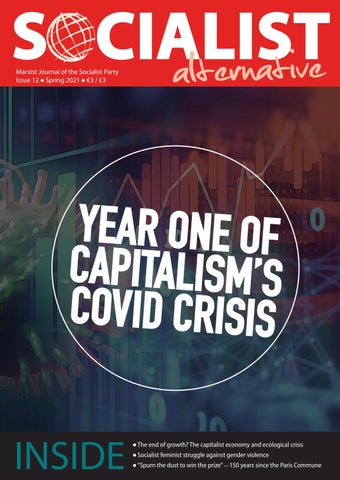
S cialiSt alternative Marxist Journal of the Socialist Party Issue 12 l Spring 2021 l €3 / £3
Year one of capitalism’s covid crisis INSIDE
l The end of growth? The capitalist economy and ecological crisis l Socialist feminist struggle against gender violence l “Spurn the dust to win the prize” —150 years since the Paris Commune
S cialiSt alternative Marxist Journal of the Socialist Party Issue 12 l Spring 2021
iN thiS iSSue
No.12
SOCIALIST ALTERNATIVE is the political and theoretical journal of the Socialist Party.
Feature Year One of Capitalism’s Covid Crisis EDITORIAL
2
SubScribe Now!
6
Get a subscription to Socialist Alternative and The Socialist, the monthly newspaper of the Socialist Party. Text “Subscribe” to 087 2400331
China: The Unreal World of Xi Jinping BY VINCENT KOLO
Scottish Independence: What Do Socialists Say? BY THOMAS CARMICHAEL
11 15
coNtact the SocialiSt party
19
North: 07821058319 South: 0873141986 info@socialistparty.net
The End of Growth? Capitalism & Ecological Crisis BY CONOR PAYNE & CHRIS STEWART
India: Workers & Farmers Resist Modi’s Regime BY MARTINA STAFFORD
Socialist Feminist Struggle Against Gender Violence BY LAURA FITZGERALD
23
Schools & Education Under Capitalism BY HARITHA OLAGANATHAN & TY NOLAN
27
150 Years Since the Paris Commune BY HARPER CLEVES
31
review
iNterNatioNal The Socialist Party is the Irish section of International Socialist Alternative (ISA), a socialist organisation with groups in over 30 countries. www.internationalsocialist.net carries reports of struggles, analysis and a programme for the fight against capitalism.
Stalingrad by Vasily Grossman REVIEWED BY MANUS LENIHAN
36
Moxie directed by Amy Poehler REVIEWED BY AISLINN FLATTERY & MYRIAM POIZAT
37
The Living Flame by Paul Le Blanc REVIEWED BY AISLINN O’KEEFFE
38
The People Want to Overthrow the System by Cedric Gérôme REVIEWED BY PETER MCGREGOR 39
internationalsocialist.net
coviD criSiS
Year one of capitalism’s covid crisis one year on from the declaration by the world health organisation that the new coronavirus, SarS-cov-2, was a global pandemic, we assess the damage, and the particular ways that the capitalist system has made everything so much worse. Stepping back to assess the damage of the first year of the coronavirus pandemic is sobering. As of March 2021, there have been 123 million confirmed cases and a staggering 2.7 million deaths worldwide. That’s equivalent to the entire population of Chicago city or Manchester being wiped out in the space of a year. If there was any doubt about the ferocity of Covid-19 as a disease, these figures, which are undoubtedly an underestimation and in any case only a snapshot in a rapidly escalating total, speak to its real, unabating threat. We should be clear, however, that what’s now summed up as the ‘Covid crisis’ — encompassing the health, economic, political and social chaos being experienced — is a distinctively capitalist crisis. That is to say that such calamitous and tragic consequences are not the inevitable effects of a pandemic, it didn’t have to be this way. The policies adopted by governments, 2 l SocialiSt alterNative l SPrING 2021
overwhelmingly made up of right-wing parties whose overriding concern is for the interests of businesses and not public health, are to blame for the exceptional severity of this crisis.
“Social murder” What’s been demonstrated by the varying responses to the pandemic is that policies that impinged on the natural functioning of the capitalist market prevented deaths, and vice versa — proving again that the ‘free market’ doesn’t provide for human needs. In that sense, capitalist ideology is arguably the real danger in this public health emergency. While plain incompetence and sociopathic indifference played their part in some cases (most notably in the U.S. and Brazil), the primary factor in bad policy making decisions everywhere was fear about the effect it would have on the economy, and especially on the profits of big business. This very point was articulated in an editorial in none other than the British Medical Journal in February. “Murder is an emotive word”, wrote Dr. Kamran Abbasi: “How could ‘murder’ apply to failures of a pandemic response? Perhaps it can’t, and never will, but it is worth considering. When politicians and experts say that they are willing to allow tens of thousands of
premature deaths for the sake of population immunity or in the hope of propping up the economy, is that not premeditated and reckless indifference to human life? If policy failures lead to recurrent and mistimed lockdowns, who is responsible for the resulting non-covid excess deaths? When politicians wilfully neglect scientific advice, international and historical experience, and their own alarming statistics and modelling because to act goes against their political strategy or ideology, is that lawful? Is inaction, action?”1 Dr. Abbasi went on to evoke Friedrich Engels and his use of the term “social murder” to describe the premature and unnatural deaths of the poor due to abject working and housing conditions — the result of policies that served the capitalist class in 19th century England. “The ‘social murder’ of populations is more than a relic of a bygone age”, he said. “It is very real today, exposed and magnified by covid-19… State failures that led us to two million deaths are ‘actions’ and ‘inactions’ that should shame us all.”
Systemic inequalities
economy and those that are exploited, and in turn underdeveloped, by these powers. For the most part countries of the Global South don’t have the technology or industry needed to develop and produce vaccines themselves, or even when they do, such as in India, the output goes to those with contracts with the manufacturuers, which again is mainly those wealthy states. It is grotesque that countries in Africa, South America and much of Asia are at the mercy of those that exploit and impoverish them to receive vaccines. The COVAX programme organised by the World Health Organisation to give vaccines to poorer regions will only cover 20% of the countries that are part of the scheme. In South America, where deaths now exceed 500,000 (mostly in Brazil), less than 5% of the population has been vaccinated. In Africa, less than 1% of the population has received a dose. Ultimately, the lives of the masses of the neocolonial world are dispensable as far as the capitalist and imperialist elite are concerned. A general contempt for the poor and oppressed, and not a little racism, typifies their collective outlook. But as well as being morally reprehensible, vaccine hoarding is utterly counterproductive, even from their self-interested point of view. While a vaccine apartheid may exist, an equivalent in terms of the virus obviously does not. The longer the globe’s population goes unvaccinated the greater the number of mutations and strains of Covid that can emerge. Writing in Foreign Affairs, Michael T. Osterholm, Director of the Center for Infectious Disease Research and Policy at the University of Minnesota, made this point well:
From its outset, Covid-19 exposed, aggravated and deepened the myriad of systemic inequalities on which capitalism is based. The economic effects illustrate this point. In 2020, working hours lost to the economic impact of the pandemic amounted to 255 million fulltime jobs, four times greater than during the global financial crisis in 2009.2 Of course lower-paid workers, women and young people were worst affected. The cumulative loss in earnings for workers globally has “Vaccine nationalism — the understandable desire amounted to $3.7 trillion.3 At the same time, and not at to tend to one’s own citizens first before worrying all unrelated, the billionaires of the world increased 4 about others — won’t save wealthy countries if new their wealth by $3.9 trillion dollars, approaching a variants of the disease prolong suffering and record total of $12 trillion — more than the combined 5 disruption elsewhere. Collective action to immunize GDPs of Britain, Germany, France and Spain. the world from COVID-19 may sound idealistic, but The rollout of the vaccination programme is the 7 it is a practical necessity.” latest major example of this inequality. As various vaccines were being developed the states of the advanced capitalist world rushed to corner their share of the market, invariably doing so at the expense of countries of the Global South. As early as September 2020, Oxfam reported that wealthy states accounting for 13% of the planet’s population had secured 50% of the vaccines.6 In many cases the amounts are far in excess of their respective populations. The EU ordered 1.6 billion vaccines despite having an adult population of 375 million. Likewise the U.K. with an adult population of 54 million ordered 219 million vaccines. This meant that by the end of February, 75% of the world’s vaccinations had taken place in ten of the richest countries. These obscene disparities are indicative of the structural division that lies between the Food banks in many countries struggle to cope with the unprecedented demand imperialist nations that dominate the global
SPrING 2021 l SocialiSt alterNative l 3
coviD criSiS
capitalist competition The capitalist system, however, is not one based on rational operating, but rather on ruthless competition. The pandemic emerged against the backdrop of deepening tensions between various capitalist states, most clearly exemplified by the developing Cold War between a rising China and a declining United States. This has been accompanied by a jingoism propagated by their respective capitalist establishments — most obnoxiously by Donald Trump who consistently referred to Covid-19 as the “China virus”. In the United States itself this has contributed to anti-Asian racism which (combined with misogyny) was likley a factor in the horrific murder of six Asian-American women (and two men) in Atlanta, Georgia on 18 March. Now this capitalist rivalry has manifested itself in states seeking to weaponize their store of vaccines to bolster their influence and prestige on the world stage. This is particularly true of the emerging imperialist powers. For example, the Chinese state plans to give 463 million doses of its Sinovac and Sinopharm vaccines to countries in South America, Africa and Europe. This has elicited a response from the Indian government, worried about China’s growing influence in south and south-east Asia. India is now sending its ‘excess’ vaccines to Myanmar, Bangladesh and Nepal, despite the fact that its own population is one of the worst affected in terms of cases and deaths, and is currently dealing with a significant second wave.8 Representatives of Western capitalist powers are likewise sensitive to the need to offset China’s growing influence. This was shown by the comments of Emmanuel Macron in February, who called upon Europe and the United States to give their excess vaccines to poorer states. Macron is particularly worried about a threat to the influence of French imperialism in Africa.
it hopes to influence such as Montenegro and Republika Srpska — the autonomous Bosnian Serb Republic that is part of the Bosnian State. Clearly the Serbian ruling class is seeking to enhance its position within the Balkans. The most cynical exercise in what has been dubbed “vaccine diplomacy” has been implemented by the Israeli government. It has engaged in much selfadulation about the success of its vaccination programme, which has seen half of its population receive at least one dose. The corrupt and beleaguered regime of Benjamin Netanyahu was determined to use this success to win the recent elections in Israel. At the same time it is criminally rationing out meagre doses of vaccines to Palestinians living under the horrendous occupation, where latest data shows that there have been more than 251,600 confirmed cases and more than 2,670 deaths among Palestinians in the West Bank, Gaza and East Jerusalem, which are now in the throes of a third, most severe wave to date. Despite this the Israeli regime is actually exporting vaccines to countries such as the Czech Republic and Honduras. The quid pro quo of this arrangement is that states give recognition to Jerusalem as the capital of Israel, thus giving legitimacy to its annexation of East Jerusalem.10
the system can’t deliver A critical barrier to the rollout of the vaccines is the dominant role of big pharmaceutical companies. Having been enormously subsidised through public expenditure by states, several of the world’s largest pharmaceutical companies were able to develop effective vaccines. The development of a new vaccine from lab to market typically takes 10 to 15 years, and the fastest ever, the mumps vaccine in the 1960s, took four years. That multiple vaccines for Covid-19 were developed in less than a year is a testament to the
vaccine diplomacy The use of vaccines as a “soft power” has manifested itself in Europe too, where many countries are falling short of supplies. Tensions between the E.U. and U.K. have been mounting over production and distribution agreements for the AstraZeneca vaccine. And at the beginning of March, Italy, backed by France, blocked the export of 250,000 AstraZeneca vaccines to Australia. In precisely this context of disarray, Russia has supplied Hungary with its Sputnik IV vaccine and China has sent one million of its Sinopharm vaccine to Serbia.9 The latter is in turn using its excess vaccines to supply neighbouring countries, namely North Macedonia and other states
Less than 1% of the population in Africa has received a vaccine as of March 2021
4 l SocialiSt alterNative l SPrING 2021
incredible potential for new scientific breakthroughs when the funding and resources are made available. A corollary of this is how much potential is never achieved because of the perpetual under-funding of scientific research under capitalism. In 2018, the year before Covid-19 emerged, for example, funding for research into coronaviruses was a mere $36 million.11 By contrast, big pharma spends over $30 billion on marketing each year in the U.S. alone.12 Hence the madness of the profit system, which is also undermining the vaccination progress in many ways. The pharmaceutical Big pharma profits from pandemic: Pfizer set to take in $15 billion in revenue this year companies are motivated not by a desire to cure diseases, but demand free, quality, public healthcare. overwhelmingly, to maximise profit. Pfizer alone More fundamentally, the problems in the vaccine expects to garner $15 billion in revenue this year from rollout are symptomatic of the overarching problem of its vaccine, and this figure may rise as the company the economic and social system that dominates the signs new contracts. world. The stunning contrast between the enormous The patenting of vaccines is key to their business technological and scientific advancements of recent plans. Patents act as legal protection for big pharma, decades, and the poverty and deprivation still faced by and allow them to make super-profits by blocking billions of people is damning. In many ways, competition from other companies, be they publicly or capitalism, with its business practices damaging privately owned, and the production of cheaper, generic ecosystems, is responsible for unleashing this virus, variants of their vaccines or drugs. Hence, we can have and in even more ways it’s responsible for the scale of no confidence in these companies, nor the political the destruction it’s caused. To stop further suffering establishment they influence directly through lobbying from this pandemic, and prevent new outbreaks, and indirectly through their immense economic power, capitalism has to go.n to resolve this crisis – certainly not in a timely or equitable way.
working class must take control
Notes
Real cooperation to tackle Covid-19 and vaccinate the bulk of humanity in a speedy and efficient manner could only come by taking these companies out of the hands of profiteers and into democratic public ownership. The obscenity of patents and profiting from a pandemic should be eradicated, allowing for the mass production of the most effective vaccines by any labs and facilities with the capacity to do so. This means requisitioning, and bringing into public ownership the major resources, plants and technology of big pharma globally. We can’t rely on capitalist governments or institutions to manage these vaccination programmes. Doing so is sure to result in unnecessary sickness and deaths. Rather they should be democratically controlled and managed by committees of workers from the health sector, and from the broader working class, with the trade union movement facilitating international coordination. On top of that, working-class organisations and social movements must organise to
1 Kamran Abbasi, 4 Feb 2021, ‘Covid-19: Social murder, they wrote— elected, unaccountable, and unrepentant’, BMJ, www.bmj.com l 2 ILO Monitor: COVID-19 and the world of work. Seventh edition, www.ilo.org l 3 Juliana Kaplan, 25 Jan 2021, ‘Workers lost $3.7 trillion in earnings during the pandemic. Women and Gen Z saw the biggest losses’, www.businessinsider.com l 4 Juliana Kaplan, 26 Jan 2021, ‘Billionaires made $3.9 trillion during the pandemic — enough to pay for everyone's vaccine’, www.businessinsider.com l 5 BBC News, 25 Jan 2021, 'Wealth increase of 10 men during pandemic could buy vaccines for all', www.bbc.com l 6 Oxfam, 17 Sept 2020, ‘Small group of rich nations have bought up more than half the future supply of leading COVID-19 vaccine contenders’, www.oxfam.org l 7 Michael T. Osterholm & Mark Olshaker, 8 Mar 2021, ‘The Pandemic That Won’t End’, Foreign affairs, www.foreignaffairs.com l 8 Mint, 8 Mar 2021, ‘India plans to ramp up vaccine production to counter China’s vaccine diplomacy, www.livemint.com l 9 Michael Safi , 19 Feb 2021, ‘Vaccine diplomacy: west falling behind in race for influence’, the Guardian, www.theguardian.com l 10 Patrick Kingsley, 23 Feb 2021, ‘Israel Gives Vaccine to Far-Off Allies, as Palestinians Wait’, new York times, www.nytimes.com l 11 Jessica Davis Plüss, “With no prospects for profits, big pharma neglects new infectious diseases”, 6 Mar, 2020, www.swissinfo.ch l 12 Lisa M. Schwartz & Steven Woloshin, “Medical Marketing in the United States, 1997-2016”, 8 Jan 2019, www.jamanetwork.com
SPrING 2021 l SocialiSt alterNative l 5
china
CHINA:
The unreal world of Xi Jinping
there is a huge gap between reality and how the chinese dictatorship presents reality. with the 100th anniversary of the founding of the communist party (ccp) approaching in July and china’s dictator Xi Jinping needing an endless run of “victories” to secure his position in advance of next year’s regime reshuffle; the state’s propaganda machine has gone into overdrive. viNceNt Kolo from chinaworker.info looks beyond the propaganda to the reality of the chinese regime. The grotesque personality cult that has been built around Xi has reached new heights. In February, the People’s Daily mentioned Xi’s name 139 times in one article celebrating China’s “complete victory” in eradicating poverty. As we shall show, Xi’s anti-poverty campaign is yet another triumph of propaganda over reality. The extreme prickliness of Xi’s regime is revealed by the latest topic to be banned by internet censors: the Chinese character for “emerald” began to spread as a form of online protest because it can also be read as “Xi dies twice”. Xi faces multiple challenges at home and abroad. It is an unprecedented and possibly existential crisis for his regime and the CCP-state. This is shown by a number of new policies and pronouncements relating to “curbing financial risks” (China’s debt levels now exceed Japan’s at their highest point), fast-tracking the creation of a “fully modern military” by the year 2027 6 l SocialiSt alterNative l SPrING 2021
(to counter US pressure which will certainly continue under Biden), and also Xi’s overly complicated “dual circulation strategy” which aims to boost China’s consumer spending as a way to offset de-globalization and anti-China protectionist policies.
20th ccp congress Xi is also facing challenges from within the party-state. The key issue is next year’s 20th CCP Congress and Xi’s aim to break with traditional power limits and extend his rule for a third term – and beyond – as both CCP general secretary and president. His plan is to be ruler for life. During his first term, 2012-2017, Xi partly succeeded in quelling top-level factional power struggles by waging China’s biggest ever anticorruption sweep. Actually this was a cover for a factionally targeted purge to eliminate his enemies and consolidate unprecedented power in Xi’s hands. The Chinese regime morphed from “one-party dictatorship” into “one-man dictatorship”. But CCP infighting has flared up again as a result of the crisis in society and in international relations. Today, this power struggle is the most severe since the period of the 1989 Tiananmen square massacre. Xi will likely succeed in extending his rule, growing discontent and factional manoeuvring in the upper reaches of the party-state could force him into making compromises. The period after the 2022 Congress could see a different alignment of forces and greater intra-CCP instability. Ultimately, conflicts within the ruling class reflect social processes and the rising tide of working class discontent. The lines of division inside the party-state are not
clearly defined or settled, they are not ultimately about political ideas but about power: the CCP’s top ranks are an assemblage of capitalist oligarchs controlling vast business empires. Within these layers there is a growing pessimism about the future. Some anti-Xi factions are uneasy with his ultranationalistic and imperial ‘wolf warrior’ diplomacy used to strong-arm other governments as shown by disputes with Australia, Canada, India and Taiwan. This section of the ruling class would prefer a return to the more discreet and pragmatic “hide and bide” foreign policy doctrine of Deng Xiaoping (“hide your capacities and bide your time”) as a means to de-escalate global tensions especially with the US. Instead, Xi’s regime exaggerates its economic strength and global capabilities, partly as a tool of diplomacy, but more importantly still to reinforce the aura of Han nationalist ‘strongman.’ China’s aggressive foreign policy – over the disputed border with India, the escalation of military exercises in the Taiwan Strait and South China Sea, the detention of two Canadian citizens in retaliation for Huawei heiress Meng Wanzhou’s detention in Vancouver – these all serve a dual purpose: to pressure foreign governments but also to feed the domestic propaganda machine.
Cai, who defected to the US in 2020, is close to some of the CCP’s princelings – China’s “red nobility” – which forms the core of the capitalist class. This layer initially supported Xi, himself a princeling, but have become increasingly disaffected. Cai claims that Xi’s ruling faction enjoys hard-core support from only around 10% of the CCP’s officialdom at middle and higher level. The majority are unwilling to openly oppose Xi at this stage; their “support” is passive. While her account of the internal balance of forces may be exaggerated for factional purposes, other important developments confirm the existence of widespread but muted – we could even say “passive aggressive” – dissent at various levels of the party-state. A fourth cause of ferment is that Xi’s extreme police state measures have the effect of incapacitating the regime’s ability to predict and deal with new crises. This was shown with devastating worldwide repercussions when the coronavirus outbreak began in Wuhan. Despite a subsequent cover up, the truth is that during the crucial weeks leading up to 20 January 2020, Xi’s regime was blindsided by the party-state’s obsession with secrecy and the actions of its security apparatus, which with brutal efficiency stamped on every attempt to sound the alarm.
Doubling down on repression
china’s system is “superior”
Another source of unease is the relentless increase in repression. This has been the most striking feature of Xi’s rule. The anti-Xi factions are hardly wishy-washy liberals. None of them would balk at ordering police to crackdown on street protests or workers’ strikes. But Xi’s brutal crackdowns in Hong Kong, Inner Mongolia and especially Xinjiang, and his ‘default position’ which is to double down whenever his hardline policies meet resistance, these are becoming increasingly counterproductive. This is for at least four reasons. Firstly, vicious repression, which in Xinjiang’s case has reached Orwellian levels, does not create “stability” which is the stated aim. Ultimately it is pushing China towards revolutionary explosions and sections of the CCP hierarchy fear this. Hong Kong’s mass democracy protests in 2019 gave a foretaste, on a local scale, of where China could be heading. Secondly, this gives Biden and other Western rulers ammunition with which to sway global public opinion and hide their Cold War strategies against China behind a narrative of “human rights” and “democracy”. Thirdly, the tyranny of Xi’s regime has taken on a different character even compared with the past, because it is also directed internally into monitoring and policing the CCP elite. Cai Xia, a former professor at the CCP’s prestigious Central Party School (the incubator for future top officials), says China under Xi has entered an “exquisite totalitarian era” that has surpassed the totalitarianism of Mao and even Hitler. “The use of advanced technology. Strict surveillance enabled by big data. He can precisely monitor everyone. He can put you under 24/7 close surveillance.”
Only the tragicomic pandemic responses of Western governments under the pressure of big business allowed Xi to shift attention and partially recover from the Wuhan episode. Wuhan was not an isolated example of government paralysis in the face of sudden crises. The eruption of million-plus demonstrations in Hong Kong, beginning in June 2019, and the first trade war attacks of Trump’s administration a year earlier, are two developments that were unforeseen by Xi’s regime and were initially met with stunned inaction. A key theme of CCP propaganda is the “superiority” of China’s (totalitarian) political system as compared to “Western-style democracy”. This is shown by China’s
Brutal crackdown on protesters in Hong Kong ni 2019 SPrING 2021 l SocialiSt alterNative l 7
china
“vaccine diplomacy”, shipping vast quantities of Chinese-made vaccines to poorer countries, which is used to upstage and shame the callous stance of Western imperialism. Clearly, the deep crisis of bourgeois democracy everywhere, but especially in the US, with the emergence of an unstable and authoritarian figure like Trump, has gifted CCP propaganda. Despite some downsides, including the political rights won by workers to organise in trade unions and political parties, capitalists in general prefer a “democratic” system because this offers a more stable form of rule. A “multiparty system” (in which almost all are capitalist parties) can act as a safety valve to release mass pressure. The institutions of parliamentary democracy, the press, the judiciary, contain “checks and balances” to control the ruling group and prevent it from straying too far from the interests of capital. Totalitarian regimes by contrast, especially in an era of economic crisis and heightened class tensions, tend towards blow up and collapse. No significant section of the CCP and Chinese capitalist class favour a shift to a bourgeois democratic model. Capitalism was restored in China after the crushing of the Tiananmen Square mass democracy movement (with mass movements and strikes in more than 300 cities), but the regime of Deng Xiaoping consciously chose a path to capitalism that preserved significant state controls and rejected bourgeois democracy. The CCP’s liberal elements at most advocate a modified dictatorship – “political reform” – with less repression and fewer political and social controls. But there are surely protagonists in the ongoing CCP power struggle who envy the US ruling class, which by means of an election were able to deal with their “Trump problem”, while for “China’s Trump” this is not an option.
excluded that a limited process of détente may occur but it will be fragile and temporary. On the home front we can expect a succession of “victories” to be celebrated, all of course engineered by Xi personally. This includes the economy. China has the distinction of being the only major economy to grow in 2020, albeit at the weakest rate since 1976. As is always the case some statistical manipulation has been used. Still, going by the official numbers, China’s economy grew by 2.3% last year while Germany’s contracted by 5% and the US by 3.5%. This year, China’s GDP is forecast to expand by 8%. While that would be eye-catching, this year’s GDP data will be flattered by the low base effect from 2020. Taken over two years even this would amount to a compound rate of growth below 6%, a continued slowdown from 2019 (6.1%) in other words.
K-shaped recovery Moreover, China has experienced a K-shaped recovery. Those earning more than 300,000 yuan (around $48,400) per year – barely 5% of the population – saw their wealth increase according to the China Household Finance Survey. But at least two-thirds of the population saw their incomes fall in real terms. Household debt levels, after quadrupling in the past five years, increased to 62.2% of GDP in 2020. This compares to 76% in the US. Here, the rate of catch up is astonishing: In 2008, China’s household debt-toGDP ratio was 18% compared to 99% in the US. More than anything this is down to the bubble in the Chinese property market, which is among the most expensive in the world. Shanghai, Shenzhen and Beijing have the fourth, fifth and sixth most expensive housing in the world, according to China Daily. Hong Kong is first.
100th anniversary The 100th anniversary of the CCP will see a Niagara of nationalistic propaganda to drum home the message that without the CCP dictatorship, China is lost. But there is another side to the celebrations: they will be hijacked by Xi’s faction as a weapon in the internal power struggle. The personality cult will reach new levels to cement Xi’s status as the “greatest leader since Mao”. The ideas that inspired the CCP’s pioneers a century ago – class struggle, anti-capitalism, democracy, internationalism and the Russian Revolution – these are all subversive topics for today’s rulers. They will be buried underneath nationalist themes like resisting “anti-China forces”, and realising “the great rejuvenation of the Chinese nation”. With the 20th Congress in mind, Xi cannot afford any serious setbacks in the coming twelve months – no new Hong Kong-style eruptions. After a campaign of pressure in the first weeks of Biden’s term, over Taiwan, the South China Sea and the CCP’s political strangulation of Hong Kong, Beijing may attempt to ease tensions by offering cooperation at least in some specific areas such as climate change. It can’t be 8 l SocialiSt alterNative l SPrING 2021
Xi Jinping is tightening his grip on the CCP
For the first time since 2009, not a single province increased the minimum wage last year. All the indications are that this wage freeze will be extended in 2021. This explains why percapita consumption, after adjusting for inflation, dropped 4% in 2020, the first such fall since 1969. The only sector to buck the trend was the luxury goods market which grew by nearly 50% last year. Therefore, the GDP growth achieved in 2020 was not based on stronger consumption, which is the core objective of Xi’s “dual circulation strategy”, China’s exports rose by 3.6% in 2020 but rather on the very factors conventional Maoism; rather this has become a generic this so-called strategy was devised to avoid: higher debt term for a multiplicity of leftist ideas. levels, greater export dependency, and a housing bubble. Many young Maoists in China support Exports rose by 3.6% in 2020 based on the windfall internationalism, feminism, LGBTQ and ethnic effect created by the pandemic and successive minority rights. These youth are deeply critical of and lockdowns in other countries. China’s exports of Covideven oppose outright the CCP regime as a capitalist 19-critical medical products more than tripled in the regime, although for obvious reasons such criticism is first half of the year, from 18 billion to 55 billion US expressed in a guarded way. They have a diametrically dollars. There was a similar surge in electronic exports opposite standpoint in other words to some Maoists and especially work-from-home products. These internationally who slavishly support the Xi regime and windfall gains are unlikely to be repeated. its repressive policies in Xinjiang, Hong Kong, and More worrying is the jump in already severe debt against workers’ strikes. levels, with China’s combined public sector, corporate “During the 2020 pandemic I noticed that young and household debt reaching 280% of GDP in 2020. people in China are moving far to left,” says Liang, a This rises to about 295% of GDP when foreign debt is supporter of International Socialist Alternative(ISA) in included. It follows that China’s modest growth was China. He says the growth of anti-establishment achieved by its biggest ever increase in debt. This is not consciousness is now widespread in society, which sustainable. The strains in China’s bond markets, with a includes but is not confined to Maoism. “A decade ago string of defaults by some big state-owned enterprises, the most vocal ideology on China’s internet was points to the first serious cracks in the financial system. liberalism. Now the left is dominant. Just a few years ago [Alibaba owner] Jack Ma was revered as ‘Father Ma’, Growth of left ideas now he’s called a vampire and a bloodsucking For the super-rich however, most of whom are CCP capitalist,” says Liang. Anger over the gaping rich-poor members, 2020 saw the “fastest growth ever” divide and especially the miserable treatment of 290 according to the Shanghai-based Hurun list. China million migrant workers from China’s poorer inland minted 257 new billionaires during the course of the provinces is a major driver of today’s political year, a rate of five new billionaires every week. Their radicalisation. combined wealth rose by 60% to $4 trillion. China “pulls away from the USA” with 1,058 eradicating poverty billionaires to America’s 696. The CCP’s 100th The celebrations of Xi Jinping’s “complete victory” in anniversary will see Xi’s regime performing political eradicating poverty are an attempt to shift attention contortions to obscure the reality that the class from these realities. Not only has the regime character and politics of the 1920s Communists were proclaimed this “miracle on earth”, it has even deleted the polar opposite of today’s authoritarian capitalist the word “poverty” from the official name of the antioligarchy. poverty agency, raising the possibility that all references The growing political radicalisation of Chinese to “poverty” will be prohibited in future. youth, and most notably the explosive growth of “panChen Hongtao, one of the editors of Maoist website leftism” and particularly “Maoism” is a troublesome, Red China, was arrested in February for posting an potentially ruinous development for the CCP. article exposing the fraudulent nature of the poverty Ironically, what we are seeing in China’s case is not SPrING 2021 l SocialiSt alterNative l 9
china
eradication campaign. On this topic as with many others the claims of the regime are widely disbelieved, especially by the left in China, while neo-Stalinist “lefts” internationally seem happy to swallow these absurdities. Xi’s campaign was launched in 2013 with the express aim of lifting the remaining 100 million people out of “extreme poverty” by the end of 2020. Given that his personal prestige was invested in this enterprise there was no possibility this deadline would be missed. Reality, once again, is rewritten in the service of the dictatorship. The government allocated 1.6 trillion yuan to poverty relief, which was used for investments in roads and infrastructure in some extremely poor China is using its vaccine programme to extend its geo-political influence regions and the relocation of 10 million The Chinese vaccines, which so far have only been people. That was one side of the story. The other is approved for people under 60 years of age, have not widespread forgery of data, coercion, and faking of performed well in comparisons with Western achievements by local governments to meet their antialternatives. Sinovac’s vaccine achieved an efficacy rate poverty targets. The campaign used a very low base to of just 50.4 percent in trials in Brazil, and 65.3 percent define “extreme poverty” set at $2.30 per person per day. in Indonesia. This compares to an efficacy rate of 95 This is lower than the $3.20 per day poverty line the percent for Pfizer’s vaccine and 94.1 percent for World Bank applies to India, and is less than half the Moderna’s (both US companies). The Financial Times level it recommends for an upper-middle income reported production delays at Sinovac’s factories in country like China. China and a shortage of imported glass vials needed to store the vaccines. Scepticism towards the Chinese vaccine backlash vaccines has also knocked some of the shine off its Another area where regime propaganda obscures global diplomatic offensive. In December, Cambodia’s reality is China’s fight against Covid-19. Xi Jinping dictator Hun Sen, normally a slavish CCP supporter, declared “victory” over the pandemic at a Beijing refused to accept the Chinese vaccines unless they were awards ceremony on 8 September last year. This was given WHO approval. premature and new outbreaks have since occurred. Although the WHO is still evaluating China’s While the numbers of new infections have been low by vaccines, the Cambodian government took delivery of its international standards this has brought forth several first batch in January. But Hun, who is 68, had to forego large-scale lockdowns. his own vaccination on the advice of Chinese officials. Currently, the regime’s vaccine rollout is beset by “The safety and efficacy of the vaccine for people over 60 problems. While China has gained some ground with years old are still being studied,” he said. its global “vaccine diplomacy”, exporting to 80 mostly Hungary is the only EU country to use the Chinese low- and middle-income countries that have been coldvaccines and this is of course connected to the anti-EU shouldered by the Western powers and their vaccine grandstanding of the right wing Orban government. companies, its domestic vaccine program is going But a survey in February showed only 27% of badly. China has shipped more vaccines abroad than it Hungarians are willing to take the Chinese shots. has administered to its own people, 46 million as against 40.5 million. Not only does China face the challenge of vaccinating a population four times greater than that of the US, it is encountering widespread public distrust. This is because of numerous scandals involving unsafe, expired, and contaminated vaccines, drugs and food products over the past decades. Lack of transparency and the refusal of China’s vaccine makers to disclose some trial data has deepened misgivings among the public. A survey in Shanghai showed that half the population did not plan to get vaccinated. Among medical workers in Zhejiang province this number fell to 28% according to another survey. 10 l SocialiSt alterNative l SPrING 2021
reality checks Despite its bravado, and concern that nothing should be allowed to “spoil the party” as the CCP celebrates its centenary, Xi’s regime will face a number of reality checks. The debt crisis, the continuing Cold War with the US, and fears that faster vaccine rollouts in several Western countries could tilt the scales against China, these challenges point to a turbulent period ahead. Growing discontent among workers and youth mean that new outbreaks of struggle are inevitable and that genuine socialist ideas will meet an even more receptive audience.n
Increasing support for Scottish independence What do socialists say? in an era marked by capitalist crisis and the emergence of mass movements in every corner of the world, all the pre-existing contradictions of the system are thrown into sharper focus. the debate over Scottish independence is no exception, with many commenters even raising a question mark over the future of ‘united Kingdom’ itself. thomaS carmichael looks at this question and how socialists should respond. In the last two years, more than 20 opinion polls in Scotland have returned a majority in favour of independence, with the Scottish National Party (SNP) promising to legislate for a second referendum in the event that they win the upcoming elections to the Scottish Parliament. A second referendum is unlikely to receive the green light from Westminster, however, with Boris Johnson recently stating that another referendum should not be held earlier than the 2050s, as the 2014 referendum was a “once in a generation” event.1 Under growing pressure from workers and young people, from whom the bulk of support for independence comes, the SNP have said they will “vigorously oppose” any legal challenge from Westminster, but have not gone as far as to commit to a Catalonia-style illegal referendum, an idea from which SNP leader and First Minister, Nicola Sturgeon, has previously distanced herself. This external pressure on the SNP to take on the Tories is now also reflected by internal pressure from the likes of the Common Weal group, a left-leaning caucus within the SNP who at the most recent conference
criticised the leadership and won seats on the NEC. These tensions were also reflected in the battle between opposing factions in its leadership, based around Sturgeon and former-First Minister, Alex Salmond, who has now gone as far as to launch his own new party. Salmond has recently been in court on charges of attempted rape, sexual assault and indecent assault. Regardless of his formal acquittal in court, he is clearly guilty of vile, sexist and predatory behaviour towards women. Nevertheless he has cynically construed the allegations as an organized conspiracy waged against him by Sturgeon and her cabal of loyalists. In attempting to land blows on Sturgeon he has exploited some of the faultlines within the SNP and presented an image of standing to Sturgeon’s left.
what’s behind the rise in support? The implications of a Yes vote in Scotland for the British state would be vast and far-reaching. It would be a major blow to the international prestige of British capitalism, given its history as a significant imperialist power, and would have implications for the national question in every part of the United Kingdom, including bolstering support for a border poll in Ireland. Such a poll would be of a completely different character to a referendum on Scottish independence: it would ultimately amount to a sectarian headcount and would substantially increase sectarian divisions and conflicts — the brunt of which would be borne by working-class people. The Socialist Party has been clear that we oppose any attempt to coerce either community into either maintaining the capitalist status quo, or into another capitalist alternative, against their will. We believe that it is only by building the unity of working class people in the struggle for a SPrING 2021 l SocialiSt alterNative l 11
Scottish independence
society where the rights and needs of everyone are fully respected and provided for — a democratic socialist society — that a real and lasting solution can be found. As previously stated, the groundswell of support for independence comes largely from the working class and youth of Scotland. This has not, however, always been the case. Prior to Thatcherism the desire for independence in Scotland was largely associated with those of middle-class or rural backgrounds, something that was reflected in the voter base and policies of the SNP and their nickname, the ‘Tartan Tories’. At this time, the Scottish working class was at the heart of the wider British labour movement and viewed its class interests as being intrinsically linked with those of its English and Welsh counterparts, and pinned its political aspirations largely on the British Labour Party. However, with the advent of Thatcherism, and the brutal defeats that the Labour movement would suffer during this period, working-class Scots increasingly looked for an alternative political path — particularly as they became some of the hardest hit communities by Thatcher’s economic policies with 20% of the Scottish workforce losing their jobs between 1981 and 1983.2 While support for independence was boosted significantly by the advent of Thatcher (opinion polling on independence by MORI returned 14% in favour in March 1979 followed by 25% in February 1981), it still remained a minority position overall for the remainder of the 20th century, with devolution being a far more popular option. Support for independence took a noticeable dip within weeks of Thatcher’s resignation in November 1990. Between the advent of devolution (voted for by referendum in 1997 and implemented in 1999) and the 2008 financial crash, opinion polling on Scottish independence continued to suggest that devolution was the more popular option with support for independence fluctuating between a high of 35% and a low of 24%, according to the Scottish Social Attitudes survey. While the SNP first became the largest party in the Scottish Parliament in 2007, they took only one more seat than Labour and had to rely on the Green Party to form a minority government with Alex Salmond as first minister. In the subsequent 2010 general election they failed to surpass Labour to become the largest Scottish party in Westminster. Their real electoral breakthrough came in 2011 when they took a landslide of 69 seats. This came almost exactly 12 months after the formation of the Cameron / Clegg coalition, strongly indicating that support for Scottish independence is driven not by anti-English sentiment, but by anti-Tory sentiment and despair at the effects of vicious Tory policy on the Scottish working class. While support for independence in 2014 was largely working class in composition, voters earning under £20,000 a year were far and away the most likely to vote Yes. This was not reflected in the mainstream campaign itself which was not working class in character, being dominated almost entirely by the SNP who presented a thoroughly capitalist programme for an independent 12 l SocialiSt alterNative l SPrING 2021
Scotland with proposals to keep Scotland in the EU, keep the link with the pound and even maintain the monarchy. The ISA (then CWI) in Scotland at the time promoted the need for an independent working-class campaign for a YES vote, arguing for internationalism, a united struggle of English, Scottish and Welsh workers against the Tories and capitalism, and for an independent socialist Scotland to be part of a voluntary socialist federation and a socialist Europe.
SNp: an establishment party The SNP over the last ten years (with the exception of the 2017 GE) have been the main political benefactors of the anti-Tory mood in Scotland, but this has not always been the case. Over the last decade or more they have exploited the absence of a mass, left party of the working class in Scotland and posed themselves as anti-austerity, left-populist light. However, closer inspection, particularly of the party in the post referendum period, reveals an organisation thoroughly wedded to the economic status quo. They have continuously implemented cuts and austerity from Holyrood, claiming that they have no choice and that the real culprits are the Tories in Westminster, while figures released by the Scottish government in 2019 reveal that a little over a million Scots live in relative poverty. Recent events in Scotland, as we shall see in a moment, show no lack of appetite for a working-class fightback against the Tories and austerity. If the SNP were truly committed to ending austerity, they could utilise this appetite to organise a real pushback, and yet they do not. The status quo tendencies of the SNP were further put on show during the 2016 EU referendum, during which they uncritically endorsed the ‘Remain’ camp and championed the neoliberal EU as a progressive institution. While Scotland did vote to Remain overall, working-class areas from which the SNP largely drew its support were more likely to vote Leave. This was reflected in the 2017 general election, as a section of their working-class voter base punished them for endorsing the EU and their left-wing veneer paled in comparison to the left reformist program of Jeremy Corbyn. Overall, the SNP lost 21 seats and close to half a million votes. Corbyn would have gained an even bigger echo if he wasn’t hamstrung by a mistaken view on Scottish independence, which he not only opposed as an idea, but also any further referendums on the question. In 2018 Sturgeon published the Sustainable Growth Commission’s report, outlining their vision for an independent Scotland that would be neoliberal to its core, proposing the slashing of both corporation tax and public spending. 2018 also saw the inspiring Glasgow ‘Equal Pay Strike’ in which 8500 workers went on strike to demand pay parity for women from the SNP controlled Glasgow City Council. The SNP initially opposed the strike claiming it would have “a devastating impact and there’s no need for it”, but were forced to back down from this position when the strike was received with huge positivity by working-class people across Scotland.3
80,000 people marched in support of independence in 2020, more than double the amount in 2018
As the SNP continue to shift to the right, rifts are beginning to emerge in the broader independence movement as well. Many young and working-class supporters of independence have been inspired by, and drawn increasingly radical and militant conclusions from the events that unfolded in Catalonia in 2017. Sturgeon, however, has distanced herself and her party from the idea of holding a similar illegal referendum in the event of the Tories denying the Scottish people a second referendum, for fear that it might unleash a similar wave of mass protests that could result in the SNP losing control of the independence movement. This incongruity between the SNP and popular consciousness surrounding independence was on full display during the annual march for independence in Glasgow in 2018, which was organised by All Under One Banner and was not formally endorsed by the SNP, yet drew 35,000 people onto the streets. Since then, the ultimate failure of Corbynism (brought about partly by his own mistakes on the Scottish national question), the largest Tory majority since Thatcher and a Brexit deal that ushered in further attacks on workers has only accelerated the growing, radical mood around independence with a staggering 80,000 taking to the streets for the 2020 independence march, more than double the already impressive 2018 turnout. The outbreak of the Covid-19 pandemic initially provided a boost to the SNP who were able to portray themselves as competent and responsible in handling it compared with the response of the Tories, which has been continuously and spectacularly disastrous. However, they still ultimately embarked on a course of action that put profit over lives. Care homes in particular
were ravaged by the virus as more than 1,000 elderly patients were transferred from overburdened hospitals without being tested first. The crisis has only sharpened the Scottish national question by laying bare the contradictions inherent in the capitalist system and amplifying an already strong anti-Tory mood to even greater levels. The most recent polls show support for independence at an all-time high of 58%, with support among young people now standing at an overwhelming 79%. The most recent polls have shown the case for independence slightly damaged by the crisis in SNP but still at record levels. It is in this context that significant pressure has been put on Nicola Sturgeon to back down from her previous refusal to consider a ‘Plan B’, i.e. a route to holding an independence referendum even if Johnson refuses to grant one. Sturgeon has now acquiesced to this pressure and advocated a form of Plan B albeit still predicated on not being challenged by Westminster in the supreme court and done in a manner favourable to the European Union, i.e. strictly within legalistic restraints.
a socialist approach Socialists in Scotland need to navigate around two key potential mistakes. Firstly, the Corbyn mistake of opposing independence or even the right of the Scottish people to self-determination in a new referendum, and secondly, a stageist approach that views independence for Scotland on the basis of capitalism as a prerequisite first stage that defers the fight to socialism to a later date. The dangers of the first mistake are self-evident. The working class in Scotland abandoned Corbyn, and the SNP were able to claw back the gains Labour had made SPrING 2021 l SocialiSt alterNative l 13
Scottish independence
from them in 2017. Those socialists who make the second mistake often display a tendency towards lining up behind the SNP at key junctures and championing it as the force that will bring about independence, downplaying and overlooking the role of the working class — this has included calling for votes for the SNP in key elections. Alongside this we need to highlight a socialist program that promotes the need for a fundamental break with capitalism in order for there to be real independence, and crucially, real improvement in the quality of life of working-class people; a Tensions in the SNP have led to a split with former leader Alex Salmond launching a new party: Alba programme that doesn’t sow Similarly of course, talk of increased devolution will illusions in the SNP as a progressive force in Scotland, likely be a major part of the British ruling class’s tactics or portray Scottish capitalism as a lesser evil to to stave off independence. This will amount to little Westminster rule. To that end socialists need to draw out more than an attempt to give the status-quo a makeover conclusions about what an independent Scotland under without implementing any meaningful change. capitalism will likely look like. Both English and Scottish However, given the motivations for independence being capitalism are currently opposed to independence, but rooted in the decades of Tory austerity, this is likely to be potentially, if independence seems to become an too little too late and will convince few if any workers, inevitability, they may accept this and seek to adapt, as particularly given that devolution to Scotland is already with Brexit, and ensure that an independent Scotland is substantial. Despite this, the SNP’s neoliberal vision of created on the basis of as little change as possible in an independent Scotland cannot effectively cut across order to suit their interests. these tactics. In order to do this a separate, socialist A capitalist Scotland would be a tiny speck in global campaign for independence is needed. capitalism. This being the case, the ruling class would This campaign needs to link the problems driving likely push an assault on wages, conditions, rights and support for independence — austerity, poverty etc. — organised labour in order to make Scotland competitive squarely to capitalism, and make the point that breaking with other similarly-sized European economies such as with the Union while retaining capitalism will ultimately Ireland or Greece, both of which have seen workers and be an empty victory for the working class. In that regard, young people suffer under austerity since the financial an approach of political independence from the SNP is crash of 2008. This prediction is not alarmist needed. As Socialist Alternative has put it: “An organised doomsaying, it is exactly what the SNP outlined as their mass movement for Scottish self-determination must be vision for an independent Scotland in the consciously built, one that adopts class-struggle methods aforementioned Sustainable Growth Commission and mobilises the strength of the working class in a report, and it is not what working-class supporters of struggle for democratic rights.” Such a campaign would independence are envisioning for their futures. also need to be international in character and call for an The business-friendly approach to independence of independent socialist Scotland to ultimately become part the SNP will potentially be alienating for sections of the of a free and voluntary socialist federation with England, working class but ultimately is more likely to alienate Wales and Ireland, as part of a socialist Europe.n them from the SNP than from independence itself. Similarly the SNP’s plan for independence envisages Scotland re-joining the EU. Socialist Alternative (ISA in Scotland) has warned this would only be “on the basis of Notes the convergence criteria (without any of the ‘opt outs’ negotiated by successive UK governments) and as a 1 www.ft.com, 3 Jan 2021, ‘UK prime minister rebuffs fresh calls for small nation on the fringes of the Union, Scotland could Scottish referendum ’, Financial times l 2 Annie Brown, 9 Apr 2013, ‘Margaret Thatcher's time in power destroyed industries in Scotland quickly find itself subjected to the similar austerity and still casts a shadow over the country’, Daily record, www.daipolicies to those inflicted on Greece during its ‘Euro lyrecord.co.uk l 3 News, 23 Oct 2018, ‘Glasgow equal pay strike's Crisis.’” 'devastating' ‘, clyde Bank Post, impactwww.clydebankpost.co.uk 14 l SocialiSt alterNative l SPrING 2021
The End of Growth?
The capitalist economy & ecological crisis the question of economic growth and its relation to the climate crisis is a subject of increasing discussion. coNor payNe and chriS Stewart delve into this question and offer a marxist view on this critical issue for the environmental movement. Many ecologists, activists and academics argue that an obsession with economic growth is the cause of our current ecological crisis and a commitment to “degrowing” the economy is the solution. Too often, however, this discussion lacks a sufficient class or anti-capitalist content and workers are blamed for our supposedly destructive “consumption patterns”. Instead, socialists should be clear that the cause of the climate crisis is the capitalist system and its incessant drive to accumulate profits, and that the only way to solve the crisis is to struggle for a socialist world where human need, including a sustainable relation to nature, comes before private greed.
capitalism’s ‘’boom and bust’’cycle Under capitalism, the driving force of the economy is the pursuit of profit. The competition between companies and even different capitalist powers for markets and resources means that this drive for profit is relentless and expansive. Therefore, capitalism also involves a continuous quest for economic growth.
At the same time, these companies will seek to ‘’externalise’’ the cost of their activities, to leave them to be paid by someone else. The capitalist firm doesn’t care on what basis it grows; whether its products are useful or cause harm, or if its activities are environmentally sustainable. Capitalism is a system of contradictions. The capitalists get their profits by exploiting workers, as well as the resources extracted from nature in the labour process. The constant need to accumulate more profits means capitalism extracts more and more resources in increasingly destructive ways, ultimately leading to the depletion of soils, minerals, forests, the life in our oceans etc — which undermines the system's own sources of wealth. Capitalism is increasingly coming up against the ecological barrier to its unrestrained development, as seen in mounting natural disasters, the recent shutdown of the power system in Texas, and a global pandemic, all at least partly attributable to humanity’s increasing incursions into nature. As well as this, capitalism is a system that primarily organises investment through the chaos of the stock market, where investment is motivated only by the pursuit of profit. Today, capitalists increasingly choose to speculate with their wealth through complex financial products that have little relation to actual value in society - what Marx termed “fictitious capital”. This is because they can make more short-term profits here than they can through actual productive investment. SPrING 2021 l SocialiSt alterNative l 15
the end of Growth?
At the same time, the desire of the capitalists to drive down the share of wealth which goes to the working class means that workers collectively are not able to buy all the goods the capitalists put to market. This is one way that capitalist growth eventually comes up against its limits and throws the system into crisis and recession. We are now experiencing this process of crisis in Ireland and internationally for the second time in just over a Half of all CO2 emissions have been produced since 1990 decade. consequences of the economic system they have When growth has been rooted in productive profited from. As unprecedentedly low temperatures investment, it has often led also to increases in working drove catastrophic power outages in Texas, workingclass living standards, although workers’ gains are class, poor and minority neighbourhoods bore the usually dwarfed by those of corporations and the rich. brunt of the power cuts while empty skyscrapers lit up Periods of economic growth, for example in the the city skyline. decades following World War 2, were also sometimes Karl Marx said that under capitalism: “Accumulation used by capitalist governments to grant social reforms of wealth at one pole is, therefore, at the same time in the interests of working people, such as pensions, accumulation of misery, agony of toil slavery, public health and education services, welfare ignorance, brutality, mental degradation, at the protections etc. This was done not out of any innate opposite pole.”2 This sums up the capitalist economy kindness but as a mechanism to stave off potential today. At the same time, of course, workers are still revolutionary challenges to the system from the liable to pay the price when the system goes into working class. recession. The reality is that at no stage in its cycle of However, in the preceding decades of neo-liberal boom and bust, does the capitalist economy operate in capitalism, the basis for growth has been precisely the the interests of the working class. reduction of the share of wealth going to the working class. Capitalism has suppressed wages, gutted public an economy for need not greed services, eroded economic security. Inequality has exploded as the gains of economic growth congealed at While economic growth undoubtedly drives carbon the top. At the same time, the capitalists have promoted emissions and all forms of environmental destruction, more and more consumption fuelled in significant contraction on a capitalist basis does not deliver an measure by debt. This means that today capitalist equivalent let up in environmental intensity. According economic growth often means little real gain for to one study, examining 150 countries over the period working class people. of 1960-2008, a 1% increase in GDP meant on average The recovery from the great recession of '08 was a 0.73% increase in carbon emissions, while a 1% largely a joyless one. This was illustrated graphically decline in GDP meant only a 0.4% decrease in carbon here in Ireland in the 2020 election when the emissions.3 This is because the environmentally establishment did not benefit from any 'feel good' inefficient goods and infrastructure created during a factor whatsoever — in fact suffering a historic defeat. boom generally continue in use during a downturn. This was despite nominally impressive growth rates in Less consumption in itself can never deliver the the preceding years. The recovery did not alter the necessary reduction in carbon emissions. Instead we reality of low pay, precarity and housing distress. In need a fundamental change in how we produce. Britain, the Office of National Statistics found that, This means that without a planned transition to a despite a decade of ‘growth’, real wages only recovered sustainable means of life the tendency will be for ever to the level of 2008 at the end of 2019 — just in time increasing emissions. So the debate about growth and for the next crisis! At the same time, the numbers on degrowth is useless unless linked to the need to bring zero hours contracts were the highest on record, at just an end to the chaos of the capitalist market. under a million workers.1 The purpose of the capitalist economy is to deliver Meanwhile, the mounting burden of ecological increased profit for the bosses. The purpose of the breakdown will not be shared equally; as those with economy under socialism would be to fulfill human wealth move to insulate themselves from the need in a sustainable way. This means taking the key 16 l SocialiSt alterNative l SPrING 2021
sectors of the economy out of the hands of big business and bringing them into public ownership, under democratic control. This means we can reorganise the energy industry, transport, agribusiness and production overall on a planned basis, in the interests of both people and the planet. Socialists want a better life for the vast majority on this earth. We know many, even in the richer countries, are in poverty or barely keeping their heads above water, do not have access to decent housing or healthcare, or have no economic security for the future. We believe this to be completely unjustifiable in a world of incredible abundance. For this reason, we reject attacks on working-class living standards, even those which are introduced with an environmental veneer, e.g. water charges, or carbon taxes. The vast majority of the world’s population are responsible for very little in terms of carbon emissions. A recent UN report shows that globally the top 1% of earners are responsible for a yearly per capita average of 74 tons of C02 per year. Meanwhile for the bottom 50% of earners the figure is 0.7 tons.4 In much of the world a socialist system would need to increase production on a sustainable basis and redistribute wealth. Even in the wealthier capitalist countries many sectors that are not prioritised for capitalist investment would need to be expanded under a socialist system, not reduced — healthcare, housing, renewable energy for a start.
a world of waste At the same time, capitalist production involves enormous waste. We should not underestimate the extent of this:
possible or to buy one identical brand of a product over another, often preying on our anxieties and insecurities in order to create false needs in our minds that can be ‘solved’ through consumption. l Because capitalism doesn’t produce for need but for profit, advertising and marketing become bound up with the process of production itself. The packaging industry is now the third largest on earth and much packaging is not mainly functional but a form of product promotion. Packaging costs amount to somewhere between 10% and 40% of total product cost.8 l Planned obsolescence means that products are consciously not built to be durable and must be frequently replaced by consumers. This includes fast fashion made from low quality material and electronics with batteries which can’t be replaced, contributing to 500 million tonnes of E-waste in 2019.9 l There are a plethora of other industries and products of no use to working-class people: from the armaments industry producing weapons of death, to luxury goods like private jets — an industry which has benefitted from a raft of new, wealthy customers seeking to avoid commercial flights during the pandemic. As a result of yet another capitalist speculative bubble, the cryptocurrency Bitcoin now consumes more energy than all of Argentina, a country of 45 million people. l Competition between firms means that research and development efforts are often duplicated.
l 690 million people around the world went hungry in 2019, with the UN Food and Agriculture Organisation projecting that the impact of the pandemic could add a further 132 million people to that number.5 Yet, during the pandemic, the closure of restaurants and other disruptions cause the widespread dumping of perfectly good produce. Even in ‘normal’ times, while the world already produces enough food to feed everyone, a minimum of one third of this food is lost or wasted. Many things cause this but the status of food as a commodity to be sold for profit is at the centre of the problem. Agribusiness leaves food to rot in the fields to keep prices high, supermarkets throw out edible food they don’t think they can sell, good food is even discarded because its size or shape makes it ‘unmarketable’.6 l In 2020, approximately $569 billion was spent on advertising, projected to grow to $612 billion this year.7 You can add to this, the resources spent on sales promotion, public relations, ‘direct marketing’ and other forms of corporate self-promotion. The vast bulk of this money is wasted, spent not to inform us but to convince us to buy as much as
A third of the food produced in the world for human consumption every year — approximately 1.3 billion tons — gets lost or wasted SPrING 2021 l SocialiSt alterNative l 17
the end of Growth?
As we can see, the mountains of waste produced under capitalism are not a product mainly of the demands of consumers, but instead serve the needs of capitalist profiteering. The structure of capitalist society itself also partly conditions our consumer needs. Those who don’t live near reliable public transport ‘need’ to buy cars, people on low incomes will ‘choose’ to buy fast fashion etc. To create more and more products which aren’t needed or will be sent rapidly to landfill, or to generate more and more artificial demand is all ‘growth’ in capitalist terms, but it isn’t human progress. A democratic, planned economy could do ‘more with less’ as part of a planned ecological transition — retooling useless or destructive industries, eliminating duplication, overproduction and planned obsolescence, focusing on fulfilling needs not generating artificial wants and transforming agriculture, transport and energy production on a sustainable Students demand action on climate change in Lisbon, Portugal, 2019 basis. In such a system whole industries, communities and cities would be planned Socialist planning can ensure the rational democratically and on a completely different basis, development of the quality of our lives without putting an end to capitalist overproduction and waste increasing environmental intensity. Only on this basis and allowing for a more rational allocation of resources. can we restructure our society around need, not profit, creating countless socially necessary jobs in pursuit of Sustainable future means socialist planning building a sustainable system. Some argue that a simple transition to renewable Socialists stand for massive investment in low energy will solve the ecological problems we face. This carbon jobs and sustainable infrastructure, as well as transition is both necessary and possible, but won’t be the introduction of a four-day work week with no loss of done under capitalism which will extract every source pay. This would not only solve the problem of of fossil fuels down to the last, so long as there is profit permanent unemployment under capitalism by to be made from them. distributing work to all those who need it, but would But even if this was achieved, we would still face a also free workers up to participate in political and range of looming ecological catastrophes. The fact is economic decision-making, and would achieve a better that capitalism is already exceeding a number of balance between work, our social lives and leisure. planetary boundaries for safeguarding a safe This will still pose complex questions about how environment for human civilisation on earth. products, industries and practices can be maintained, These include species extinction, soil degradation but these are best resolved on the basis of democratic and deforestation, to name only a few. Their common discussion in a society founded on equality and source is the increasing scale and intensity of solidarity.n humanity’s incursions into nature, which are now undermining the basis of our own existence on the planet. Notes Nor will technological changes alone solve the problem of a sustainable relationship with nature. 1 richard Partington, 18 Feb 2020 ‘Average Wages Top Pre-Financial Under capitalism, the opposite is the case: while Crisis Levels’, the Guardian, www.theguardian.com l 2 Karl Marx, capital volume 1, www.marxists.org l 3 richard York, 7 Oct 2012, technological changes result in the more efficient use ‘Asymmetric effects of economic growth and decline on CO2 emisof energy, this then creates the basis for further sions’, Nature Climate Change, www.nature.com l 4 UN Environexpansion and so paradoxically technological ment Programme ‘Emissions Gap report 2020’, 9 Dec 2020 l 5 development often results in a net increase in the UN Food and Agriculture Organisation, 13 July 2020, ‘As more go hungry and malnutrition persists, achieving Zero Hunger by 2030 in amount of energy used.10 doubt, UN report warns’, www.fao.org l 6 Andrew Smolski, 29 Mar While technology may alter to some degree what the 2017, ‘Capital’s Hunger in Abundance’, Jacobin, jacobinmag.com l 7 limits are, we have to accept the reality that ‘’you can’t Brad Adgate, 14 Dec 2020, ‘Ad Agency Forecast: Expect The Advertishave infinite growth on a finite planet’’. Capitalism ing Market To rebound In 2021’, Forbes, www.forbes.com l 8 John Bellamy Foster and Brett Clark, 2020, the robbery of nature: means an increasingly destructive and frantic search capitalism and the ecological rift, Monthly review Press, p. 364 l 9 for resources which can be extracted and land which John Harris, 15 Apr 2020, ‘Planned obsolescence: the outrage of our can be developed, with the benefits of this activity more electronic waste mountain’, the Guardian, www.theguardian.com l and more concentrated in the hands of the few. 10 Foster and Clark, 2020, p.352-3. 18 l SocialiSt alterNative l SPrING 2021
iNDia: Workers & farmers resist Modi’s brutal regime
india saw the world’s largest ever general strike in 2020 with hundreads of millions of workers and trade unionists supporting farmers in their struggle against the rightwing policies of the modi government. martiNa StaFForD reports on this mass movement. India’s capitalist government is led by the reactionary Hindu fundamentalist Bharatiya Janata Party (BJP), headed by Prime Minister Narendra Modi. In September 2020, the Modi Government passed three laws that would dismantle the very little protections and regulations in place to provide some degree of security for small farmers. One of the new laws would, in reality, repeal the minimum support price (MSP), a minimum price set for crops like rice, cotton and wheat, at which the government promises to buy produce from small farmers as a basic protection. As well as the fact that the provisions of these laws are highly skewed in favour of private capital already, with no limits on stockholding and restrictions of government interventions, there is also limited recourse available through any independent grievance mechanism. Soon after the farm bills were passed by parliament, farmer unions began holding local protests mostly in the state of Punjab. After two months of protests, some
farmer unions began a movement called ‘Dilhi Chalo’, meaning: ‘Let’s go to Delhi’. This initiative led to tens of thousands of farmer union members marching toward the nation’s capital, Delhi, on 25 November. The Indian government, however, ordered law enforcement to prevent the protesters from entering Delhi by means of water canons, batons and tear gas. On the 26 November, a nationwide general strike of 250 million workers took place in support of the farmers and to fight against proposed changes to labour laws, with some states witnessing a complete shutdown. The unions alleged that BJP members, with the "tacit support" of the party-led government in Tripura, tried unsuccessfully to open shops. Failing that they attacked and ransacked the offices of the trade unions and the Left parties which supported the strike. Numerous trade union leaders and activists were arrested in several different states, illustrating the authoritarian nature of the Modi regime and the Indian state generally
No future for small farmers In a population of 1.4 billion, those employed in agriculture make up over half of the labour force. In the 1960s, the ‘Green Revolution’ brought US advisors into India to modernise farming to help boost the production of rice and wheat. This led to an overuse of chemical fertilisers, pesticides and irrigation which caused large plots of land to become infertile. Many SPrING 2021 l SocialiSt alterNative l 19
india
Barriers set up at one of the borders to Delhi to stop protesters getting through
crops suffered, some nearly disappeared, but rice and wheat production soared which quickly led to a food surplus which continues to this day. Of course this “surplus” is not surplus to the needs of the 189.1 million people who are undernourished in India1. As of July 2020, there were over 91 million metric tons of foodgrain surplus lying with the government, very little of which was distributed for free.2 Social scientist Jeff Dreze poignantly points out that if these sacks were lined up in a row, they would reach to the moon three times over.3 In India and many other neo-colonial countries, the International Monetary Fund (IMF) intervenes to assist big agribusiness in monopolising the agricultural market so that companies can then control supply and demand, and manipulate prices to their own advantage at the expense of small farmers. Small and marginal farmers have shifted to cash crops over the past three to four decades, pushed by promises that hard currency would mean liberation from poverty. However, if farmers are growing a cash crop like vanilla which has no local market and which is meant for export, the corporation can drop their price and the farmer has no real way of challenging this action. During the lockdown in April 2020, crops were either lying unsold or, if perishable, died in the fields. With so much land dedicated to the precariousness of cash crop economics, and the erratic weather patterns looming due to climate change, this points to an alarming degree of mass vulnerability and insecurity. India has witnessed an epidemic of suicide among farmers with an estimated 315,000 farmers having taken their own lives between 1995 and 2018. Researchers report that smaller farmers who cultivate 20 l SocialiSt alterNative l SPrING 2021
capital-intensive cash crops, which are subject to price fluctuations, are most likely to have debts that they are unable to pay back, and are therefore at greater risk of committing suicide. Some observers have suggested that the introduction of genetically modified varieties of crops since “liberalisation” has considerably worsened the situation: the cultivation of such crops is “ecologically vulnerable since it is based on monoculture of introduced varieties and on nonsustainable practices of chemically intensive farming”. The fundamental point of agriculture should be to take care of the basic needs of the population first and foremost and furthermore to ensure sustainable and robust methods are employed with the utilisation of the best science. Farmers need to be supported to do this, not punished if they don’t live up to the tasks of the utter madness of capitalist economics.
capitalist inequality exposed The Covid-19 pandemic has brutally exposed the contradictions of capitalism in India. Tens of millions of migrants attempting to return to their villages from the cities and towns after the prime minister gave the population of a state of just under 1.4 billion four hours notice to total lockdown! With public transport shut down, some walked over a thousand kilometres to reach their villages whereupon many were arrested for violating the lockdown, after being apprehended at inter-state borders. Sixteen migrants were killed after a freight train ran over them while they were sleeping on the tracks, exhausted from walking. In a country where over 80% of the workforce is informal, the lockdown drove hundreds of millions into joblessness and hunger overnight.
India has only around one hospital bed for every 2,000 people,4 one of the lowest ratios in the world, and one doctor for every 10,000 patients – ten times less than the numbers recommended by the WHO. However, India ranks third worldwide for pharmaceutical production by volume and 14th by value.5 Yet 38 million people in the country were pushed below the poverty line in a single year (20112012) solely due to spending on medicines.6 Of India’s more than 2.3 million annual deaths among children, about 334,000 are attributable to diarrhoeal diseases.7 There is absolutely no reason why every single person in India couldn’t have access to sufficient nutrition and quality healthcare. With huge wealth and a food surplus to reach to the moon, the barriers are clearly not the lack of wealth or resources. Instead of using the existing wealth in the interest of the majority of the people, policies since the early 1990s have instead been aimed at strengthening private profit. In the early ‘90s, India started liberalising its economy in all major sectors. One aspect of this was the establishment of Special Economic Zones (SEZs), which allowed multinational investors to avoid export tariffs and bypass labour regulations. This created a new layer of contract workers with very few rights. The workforce are sometimes 70-80% contract workers, versus a small percentage of permanent workers. Contract workers are often migrants without local roots or connections, who have less legal protection and rights, and are paid far less than permanent workers. The bosses have a ready supply of migrant labour to take the place of other workers, which strengthens the ability of bosses to break strikes or at the least to sow division between permanent and temporary labour. Nevertheless, there are many examples of workers overcoming these kinds of divisions in struggle. Labour researcher, Immanuel Ness, describes the example of the struggle of Maruti Suzuki auto workers in New Delhi’s industrial belt.8 After rounds of firings and the replacement of permanent workers with contract workers, the former concluded that in order to win their struggle for union recognition they would need to unite with the contract workers. Their demands included “employer recognition of their union, elimination of tiered wages and reclassification of informal workers as permanent employees.” The permanent workers refused to accept a deal that did not apply equally to all workers, and the contract workers fought alongside permanent workers in their struggle for union recognition. In the course of this struggle, the workers discovered that they were not just fighting their employer. In fact, their employer also had the backing of the state, the media, and even the union leadership. Sometimes this backing was passive, such as turning a blind eye to the use of hired company thugs. At other times, the state intervened directly on behalf of the capitalist class, using police or military force to brutally put down the workers.
protests challenge bJp rule The government has engaged in 11 rounds of talks with farmers and offered to hold off implementing the reforms for 18 months, but the farmers insist they must be withdrawn. In early February, the government erected metal barricades, cement walls, iron spikes and barbed fences at the roads leading to the three main borders to block protesters from entering Delhi by vehicle or on foot.9 On the other side of these fences, large protest sites organised by farmers’ organisations have developed, with makeshift kitchens deployed to meet the food needs of the thousands of farmers. Along with these kitchens, a makeshift school has been set up at the camp, mostly for children who are unable to attend school due to financial issues and the ongoing pandemic. At the Singhu border, farmers have installed eight CCTV cameras to keep a watch on the protest site and combat government attempts to smear the farmers as violent or anti-social. The Union Minister for Food, Railway and Consumer Affairs, Piyush Goyal, has described the protesting farmers as "Leftist and Maoist", stating they have been "hijacked" by unknown conspirators.10 BJP MLA Surendra Singh said, "this is a sponsored agitation by anti-national forces and has foreign funding”. The farmers are right to be concerned about sinister divisive counter narratives being posed by the media which is owned by large corporations whose interest – aligning with the BJP – is certainly in squashing the movement. The BJP and the capitalist class regularly use religious, caste and other divisions to help maintain their rule. In these protests, we have seen the potential for unity across these lines. Dalit labour rights activists Nodeep Kaur and Shiv Kumar – who had been mobilising support for the ongoing farmers’ agitation by highlighting the need for farmer-worker unity – were arrested and tortured while in custody. In the Varna system of Hinduism, Dalit people are considered to belong to the lowest Varna (or caste) which generally manifests as extreme poverty, segregation and discrimination for Dalit people. Nodeep Kaur organised 2,000 labourers in December where she was working in a factory and marched to the Singhu border. Here are her words: “This not just a farmer’s struggle, but the struggle of labourers and students as well, until we come together, neither the farmer is going to be successful nor anybody else, we will close down all their factories and get the labourers to join the farmers.”11
overcoming division through struggle The recent citizenship amendments, which exclude muslims from four neighbouring countries from gaining citizenship, demonstrates what the BJP are all about: sowing division. This discrimination is not limited to Muslims. Sri Lankan Tamils, who are predominantly Hindu, are also excluded from gaining citizenship. Western Uttar Pradesh’s sizeable Muslim SPrING 2021 l SocialiSt alterNative l 21
india
population, whose opposition to the Modi government’s citizenship laws in 2019 was quietened by heavy-handed policing, has now allied with Hindu farm leaders to join the ongoing protests. The policies of communal division are meeting the mass opposition of hundreds of thousands, with young people and women at the forefront. An inspiring protest led by women began in December 2019 in Shaheen Bagh in Delhi, where hundreds of women blocked a main road and began a sit-in demonstration that lasted for 101 days.12 Protesters agitated against the new divisive citizenship laws but also against police brutality, unemployment, poverty and for women’s safety. The protesters also supported labour unions by opposing the government's anti-labour policies. Similar female-led sit-ins cropped up across the country, including in Kolkata’s Circus Maidan park. Shafqat Rahim, a 25-year-old law student from a conservative Muslim family said, “The Women, including widows and relatives of farmers who were believed to have killed protests are shaping up like a revolution themselves over debt attend a protest against farm bill where women have taken the leading roles”. This could include a programme for small farmers: On International Women’s Day, more than 20,000 rejecting cash crop economics and instead advocating women farmers joined protest sites just outside Delhi, agriculture for the benefit of people, with collaboration highlighting their rightful place at the forefront of the between farmers, facilitated by the nationalisation of struggle.13 As the protests continue, the need to look the banking system under the democratic control by beyond Delhi and to organise nationally has become workers, farmers and users to provide credit. It could increasingly apparent. The movement must strategize unite farmers and workers – rejecting sexism, to avoid being isolated and less vulnerable to divisive communal division and caste prejudices to pose the attacks by the government and its allies. There have idea of fighting for socialist change; to wrest political been local protests outside Delhi in several northern and economic power from the wealthy minority and for states, including Punjab, Uttar Pradesh, Haryana, a democratically planned economy where inequality Rajastan and others, but these need to be stepped up and oppression are abolished and the needs of the and spread to the south as well. This is not necessarily masses are fully met.n an easy task but for the movement to be successful, it needs mass mobilisations in the vast majority of the country. Furthermore, the farmers need the support of Notes the workers and the workers need the farmers to win, or they will face an emboldened BJP intent on 1 www.indiafoodbanking.org/hunger l 2 P. Sainath, 14 Aug 2021, privatising railways, banks, ports, insurance companies ‘We didn’t bleed him enough’, Frontline, www.frontline.thehindu.com and more. Joint action committees of farmers, workers l 3 Jean Drèze, 29 Mar 2019, ‘Food subsidies do not keep the poor and young people could help to strengthen the spine of from starving’, www.scroll.in l 4 Kennedy & King, 2014, Globalization and Health, http://www.globalizationandhealth.com l 5 India the movement, facilitating democratic discussion and Brand Equity Foundation, 28 Feb 2021, ‘Indian Pharmaceuticals Indusorganisation.
where Now for the movement? Modi and the BJP have no qualms with provocations and violence, and they can get away with it if no political alternative is built. The supposed main opposition to the BJP – The Indian National Congress – overwhelmingly supports the same policies as the BJP. The Communist parties retain a significant base. However, they have been seeking alliances with the discredited Congress party. A working-class party that broke with this approach and offered a clear and independent socialist alternative for workers and farmers could now attract mass support. 22 l SocialiSt alterNative l SPrING 2021
try report’, www.ibef.org l 6 Newsclick report, 13 Jun 2018, ‘38 Million Indians Impoverished Because Of Buying Medicines In A Single Year, Says Study’, www.newsclick.in l 7 Bulletin of the World Health Organization, ‘rotavirus mortality in India: estimates based on a nationally representative survey of diarrhoeal deaths’, www.who.int l 8 Immanuel Ness, 2016, Southern insurgency: the coming of the Global Working class, Pluto Press l 9 Aljazeera, 3 Feb 2021, ‘Iron spikes, concrete walls at India farmer protest sites’, www.aljazeera.com l 10 Amil Bhatnagar, 27 Dec 2020, ‘Month on, as protest grows, farmers install CCTVs to keep eye on crowd’, the indian express, www.indianexpress.com l 11 Pawanjot Kaur, 3 Feb 2021, ‘Nodeep Kaur, Who Fought for Workers' rights, Faced Custodial Torture, Alleges Family’, www.thewire.in l 12 Express Web Desk, 24 Mar 2020, ‘Shaheen Bagh’s 101-day protest: Timeline of sit-in against CAA’, the indian express, www.indianexpress.com l 13 Hannah Ellis-Petersen & Shaikh Azizur rahman, 21 Jan 2020, 'Modi is afraid': women take lead in India's citizenship protests’, the Guardian, www.theguardian.com
Socialist Feminist Struggle Against Gender Violence! the murder of Sarah everard in london in march 2021 resonated with women and gender non-conforming folk the world over. as well as heartbreak for Sarah, for those whose existence is marred with the threat of violence there is also a mood of anger and an unwillingness to take it anymore. with 97% of young women in britain experiencing sexual assault according to the uN, and the backdrop of the “shadow pandemic” of increased gender violence everywhere, we are re-publishing an abridged version of the 2019 statement of the international Socialist alternative on building a socialist feminist struggle against gender violence, written by laura FitzGeralD. #MeToo lifted the lid on the prevalence of gender and family violence, harassment and abuse. Its reverbrance has been earth-shattering, taking down powerful business-men and politicians; and inspiring survivors in every walk of life, from athletes in the sporting world, to students in the universities, to workers in workplaces as diverse as agri-business, hospitality, factories, entertainment and tech, to speak up. #MeToo has focused the spotlight on the systemic nature of gender-based violence, and the reality that all or almost all women and gender non-conforming people
experience some form of sexual harassment at some time in their lives. The bravery of individual survivors coming forward with their personal stories has brought the question into the public sphere on an unprecedented scale making some impression in every country on earth, and giving a huge impetus to the building of collective struggle against gender violence. Gender violence rife in the capitalist system Furthermore, be it Harvey Weinstein, Jeffrey Epstein or Donald Trump, #MeToo has emphasised for millions, the enormous sense of entitlement to abuse and harass with impunity, that rich and powerful individuals in the ruling class exude. These individuals are a personification of the need to fight the capitalist system itself, as we rise up against gender violence in all its forms, including the most common form of abuse which comes from a partner or ex-partner. The statistics alone are an indictment of the system. One in three of women worldwide have experienced either physical and/or sexual intimate partner violence or non-partner sexual violence in their lifetime. The same macho ideas that feed into violence against women and children, feed into violence against the LGBTQ community, most sharply the trans and gender nonconforming community. It’s impossible to measure the toll that widespread gender and family violence and abuse takes, with often life-long financial, mental and physical health implications for survivors. The explosion of struggles onto the streets is the most powerful antidote to the violence, abuse and harassment that is the antithesis to the working class solidarity and collective action needed to change society. SPrING 2021 l SocialiSt alterNative l 23
against Gender violence
workplace sexual harassment Part of the movements that have developed in the recent years include workers organising against sexual harassment in their workplace. Eighty percent of Bangladeshi garment workers, the large majority of whom are women and girls, have either seen or directly experienced sexual harassment at work, and this issue has been a major contributor to a drive by garment workers to unionise. Google workers took coordinated action in countries around the world on 1 November 2018 on the issue of pay-offs for top executives accused of sexual harassment, as well as the question of racist discrimination in the workplace. Not only did this action Google workers took action around the world against sexual harassments, November 2018 result in concessions from management, it has been integral to general strike action. Rank and file women trade the first steps towards unionisation of workers within unionists, and young women across the country moved this notoriously non-union corporation. In South Africa into action to flesh out a resolution passed at the trade In June 2019, 200 predominantly male miners took union congress about the same, not only ensuring it courageous strike action, including refusing food while happened, but delivering biggest mass mobilisation occupying a mine for a number of days in protest and workers’ action in decades. The deep desire for against the sexual harassment by a boss of their female change was also apparent in the movement in colleague. Strikes of workers in hospitality called under December 2018 in Israel that inspiringly united Jews the #MeToo banner were a brilliant step towards and Palestinians in a “women’s strike” and protests of concretising the struggle against gender violence and tens of thousands against femicide. In September harassment flowing from the outpouring of individual 2019, a Palestinian women’s group defied brutal #MeToo stories on social media. repression by the Israeli state and organised protests Bringing the struggle on the question of gender against femicide in the West Bank, Gaza and in Israel. violence into the workplace is particularly powerful The “feminist strike” actions, as well as the mass because being in collective struggle with your fellow occupations of universities in Chile, and squares in workers , not only has the economic power, via strike Argentina which has been a feature of the mass action, to exert massive pressure on companies to fire movement against femicide across Latin America, “Ni sleazy managers, or to bring in the necessary Una Menos” , or “Not One Less”, show the movement procedures for workers to ensure zero tolerance to taking on the most powerful weapons of the labour sexual harassment at work, but also because the very movement, strikes and occupations, in a development act of struggle raises the consciousness of workers of inevitably uncomfortable even for the most radical of all genders about issues in relation to gender violence, pro-capitalist and establishment feminists given the sharpening a sense of solidarity in opposition to gender working class methods of struggle employed and the violence in all its forms which in and of itself is a inspiration provided to the whole working class of the dynamic challenge to sexist and misogynistic behaviour power of mass action, most especially the general and attitudes. Workers’ most basic demand for dignity strike. and safety at work — as well as being a demand for Like the climate youth movement, it’s noteworthy decent pay and conditions for all workers — by that there’s no single issue consciousness within these necessity is also a demand for a workplace free from struggles. It’s correct and entirely necessary that the sexual harassment. movement in opposition to gender violence takes on austerity measures against existing public services and our answer is mass struggle poverty wages, fights for public housing and against gentrification of our cities , challenges lone parent and The other major development in the feminist pension poverty, and takes on a sexist, racist and anti movement of recent years is that of the ‘feminist strike’ working class court and legal system, and fights for — at its most developed with up to 7 million workers in climate justice — given the way in which gender the Spanish state on 8 March 2019 taking action violence and harassment impacts on the lives of around a range of demands from equal and decent pay, working class and poor, it’s all one struggle. Therefore to the reversal of austerity measures, to the ending of waging an effective fight against gender violence gender violence. On 14 June 2019 in Switzerland, half a necessitates a strict break with the ‘Lean In’ feminism million took to the streets in a similar ‘feminist strike’, 24 l SocialiSt alterNative l SPrING 2021
of female CEOs like Sheryl Sandberg, and liberal feminists in the political and business establishment in general — precisely because their class interests inevitably clash with these broader demands that are essential for the working and poor female masses around the globe.
we must put capitalism in the dock
Fundamentally, the very fabric of the system, the very nature of the capitalist state, is founded upon violence — how can interpersonal violence be ended in a world in which capitalist and imperialist armies are employed by the ruling class to at times violently repress and to wage war? Linked to this is the fact that refugees created by war are some of the human beings most vulnerable to experiencing sexual violence in the world.
Women and LGBTQ oppression, and therefore its most graphic expression, gender violence, is in-built into the violence and sexism of the capitalist state capitalist system. Historically, capitalism as a system from its outset fostered the backward ideology of the In Hong Kong, a mass social movement for democracy patriarchal family as a tool for its ascendancy. Today, has been subject to violent state repression, including according to an Oxfam study, unpaid work done by live ammunition being fired at protesting teenagers. women across the world amounts to a staggering USD Similar tactics are being used against the masses in 10 trillion a year, 43 times the annual turnover of Apple, Catalonia. This is an example of capitalist state violence in an example as to how the oppression of women is in employed to protect the status quo. Given this aspect of the DNA of the system — specifically, this unpaid care the capitalist state, as well as the inextricable work is a vital tool for capitalism in maintaining and connection between capitalism and imperialism and renewing its workforce whose labour creates profit for war, the existence of macho and racist attitudes within the capitalist class, in a clear illustration of how police and armed forces is in fact useful and necessary capitalism needs women’s oppression, as did earlier for the system. This reality is reflected back in statistics. types of class divided societies. Societies which rely on For example, in the US, studies have indicated that at and perpetuate women’s oppression by their nature least 50% of male veterans with combat related mental seek to control women’s sexuality, for example through health issues commit intimate partner and family the patriarchal family structure. Gender and sexual violence, and also that at least 40% of police officer violence are part of the coercion into this structure, as families experience domestic violence, in contrast to well as for example, the state’s limiting of access to 10% of the general population. Furthermore, out and reproductive rights. Different forms of gender violence out victim-blaming in court proceedings is a feature of are connected, from sexual harassment up to rape sexual violence cases the world over. itself, with the objectification of women’s bodies as a common basis. international socialist feminist struggle The fight for a socialist society, in which the Around the world, our siblings in the International patriarchal family structure is cut across and really Socialist Alternative are helping to build the socialist becomes a thing of the past, in which housing, feminist wing of the movement. By this, we mean childcare, elder care, jobs and shorter working week, breaking decisively with any strand of feminism that are all public, quality and completely accessible to seeks to accommodate itself to the interests of the everyone, is a vital aspect of the struggle for women’s capitalist establishment and big business elite. Socialist and LGBTQ liberation. Under capitalism, it’s also the case that, as Marx explained, everything becomes a commodity, and the bodies of women and girls are often objectified and commercialised by the profitsystem. Billion dollar industries such as the porn and sex industry inevitably reflect, perpetuate and profit from gender inequality, and therefore are an enemy of genuine sexual liberation and freedom. Capitalist states reaction to these industries is often to mete out reprehensible repression of the majority women and gender nonconforming people, often migrant and people of colour, working in the industry, rather than challenging the business mogul sleazes making the profits. ‘A Rapist in Your Path’ being performed by women in Chile SPrING 2021 l SocialiSt alterNative l 25
against Gender violence
feminism is collective struggle. It’s solidarity. It’s allying ourselves with the working class, poor and oppressed of the world of all genders and nationalities in a common struggle against capitalism. Stepping up the movement to end gender violence that has already brought millions onto the streets around the world is urgently necessary, and for socialist feminists is inextricably linked with the building of a mass movement of the working class and oppressed for socialist change. In Hong Kong, the mass pro-democracy revolt that has broken out has been accompanied by women organising #MeToo protests taking on state and gender violence. In Lebanon, where struggle exploded onto the streets against poverty in October 2019, women protesters have been tweeting that they are revolutionaries, not “babes” in response to the sexist treatment they’ve received in the media. As the Bread and Roses song about the strike of women garment workers in Lowell, USA in 1912 proclaimed, “the rising of the women means the rising of us all”. Let’s rise up against gender violence, and let’s rise up against the capitalist system that allows a handful of billionaires to call the shots, profits from women’s oppression, and seeks to divide up the working class along whatever lines it can from gender to race in order to stave off a united fightback. A socialist alternative would take the key wealth and resources, from banks to major corporations, out of private hands, and into democratic working class ownership and control, to plan the economy for human and planet need, not profit. Such a society, based on solidarity, human cooperation and equality, would remove the roots of oppression and begin to build a world in which we can really ensure that there’s “ni una menos” or not one less life lost, or mental or physical health shattered due to gender violence.n
members of international socialist alternative (isa) are part of building rosa - international socialist feminists
l Ni Una Menos —Not One Less — no more lives must be lost due to gender violence; no more mental health or physical health damaged — we fight to end gender violence, abuse and harassment in all its forms and everywhere it takes place, the workplace, the home, schools and universities, state institutions, on the street, online. l Seize the wealth of the capitalist elite to fund a massive expansion of public services, including; free healthcare including access to free contraception and abortion on request; free childcare; specialized domestic violence and sexual violence services available locally to everyone who needs them. Mental healthcare should include local access to the counselling and therapy required by victims, as well as specialised psychological assessments and treatment for perpetrators. l Real rent controls and the building of public housing en masse — everyone has the right to a safe, affordable and peaceful home. l For free, quality, public, secular education with progressive, age-appropriate, LGBTQ inclusive, sex education that has a focus on consent. l The trade unions must lead a real struggle to unionise, to fight for an end to precarious work, for a living wage for all workers, and against sexual harassment in the workplace — such a movement could take the lead in fighting all forms of sexism , misogyny, racism, homophobia and transphobia to build a united working class struggle. l End the courts reproducing sexism, discrimination and victim blaming. Every part of the state and welfare service that comes in contact with victims and perpetrators should be educated about the issue of gender violence and trained to ensure that complainants and victims are treated with respect. We fight for a state that is democratically governed by the working class from below, removing the current bias in favour of the ruling classes as well as eliminating the presence of racism, sexism and discrimination in the state and judicial systems once and for all. l End war and fight for climate justice — end racist immigration policies — for the democratic right to asylum. l Democratic public ownership of the key levers of the economy, of the main wealth and resources; for working class democratic control and ownership over the same; for a democratic socialist plan of the economy to provide for the needs of people and planet, not profit. l We fight for bread and we fight for roses too — for a socialist society whereby the patriarchal family structure is truly a thing of the past — for a socialist world free from class division, oppression, war and violence in which every person has the right to a good quality standard of living, and has the freedom to enjoy life!
26 l SocialiSt alterNative l SPrING 2021
Schools & education under capitalism
Unequal, unfit & unsatisfactory as the covid-19 continues to rage, 87% of economists expect a long-term increase in income inequality because of the pandemic. Students globally are experiencing the effects of deepening disparities in education. however, these disparities are not new – they are an essential component of capitalism which thrives on the reproduction of inequality, haritha olaGaNathaN & ty NolaN explore this vital issue. Many countries have shifted towards online learning to protect students and staff. While this move is necessary from a health and safety point of view, it leaves many students unable to continue coursework. Students from less advantaged backgrounds are substantially less likely to have internet access or a quiet place to study at home. This is especially stark in the global south: in South Africa, only 22% of households have a computer and only 10% have broadband. This has sparked several struggles against the discriminatory staples of the education system. In Ireland, students and teachers have twice resisted the government’s attempts to force students to sit the Leaving Certificate, a points-based exam used to determine whether students receive a place in thirdlevel education. Students in the UK protested against
their exam results being downgraded, with the vast majority of those affected being from “disadvantaged backgrounds”. These exams are not designed to measure students' ability. They are a solution to the chronic underfunding of third-level education and the lack of places available for students. Students from the wealthiest areas of Dublin, for example, are 14 times more likely to go to university than students from the poorest areas. It is clear which students are most affected by the points system and lack of places. The pandemic has exposed long-existing inequalities in the education system. While remote learning won’t be an issue after the pandemic, many students will continue to be placed at a disadvantage. The education system does not exist independently from the rest of society. Just like all institutions, it is managed for and by capitalism for its own benefit and against the best interests of the majority.
the myth of meritocracy Students are often told that, “Receiving high-grades and going on to top universities and high-paying jobs is a matter of natural ability and hard-work. Your socioeconomic background is irrelevant when everyone is taking the same exams.” And if you fail to achieve highgrades? “Sorry, school is not for everybody. Some are just more gifted than others, and it was your own fault for being so lazy.” This neglects the reality that meritocracy is SPrING 2021 l SocialiSt alterNative l 27
capitalism & education
impossible in a world characterised by inequality. A child born into a wealthy family is immediately placed at an advantage compared to their impoverished counterpart. Wealthier families can afford to put thousands of euro towards private tuition, and are able to pour money into their children’s education at a rate most families will never be able to match. In Ireland, the wealthiest 20% of parents spend seven times more on their children every year than the poorest 20% of parents! And this only accounts for money spent on education outside of school hours. Currently, the world's billionaires have more wealth than over half of the planet. The myth of meritocracy in schools is used to justify this extreme inequality. Low grades are perceived to be a failure of the individual rather than the failure of the system itself, legitimising inequality by teaching us that the most gifted and hardworking students will become billionaires and world leaders. In reality, their wealth is largely inherited and their success in school is largely a result of their socioeconomic position. A truly merit based system will not exist until class inequalities are overturned and education is restructured.
Divide and rule The transfer tests in Northern Ireland marking the end of primary school refute this myth. The 2008 cancellation of the eleven-plus exams solved nothing. The Sinn Fein Education Minister, bowing to pressure from the Catholic Church and the party’s DUP executive colleagues, replaced it with a system which continued to allow grammar schools to determine entry on basis of new transfer tests. In order to stream eleven and twelve year-olds into schools 'suited to their academic ability', Catholic schools utilise the GL exam from the Post Primary Transfer Consortium whilst state schools are AQE-based, so even the exams which school students take now are broken down in a sectarian manner. The tests are often justified as allowing a few students from low-income backgrounds to attend feepaying grammar schools when their households wouldn't be able to otherwise afford them. But statistics refute this notion of social mobility — less than one fifth of students entitled to free school meals attend grammar schools. And whilst this small proportion gain access to better-funded schools whose grades often exponentially outperform state schools, the majority of working-class students are dubbed 'not bright enough' and left behind. The separation of transfer tests is one of many examples of sectarianism drilled into the minds of young people in the North. These roots have profound effects — a 2019 poll reported that 58% of 18-34 year olds in Northern Ireland had few or no friends on the other side of the religious divide. Still, studies have consistently shown that over 70% of parents today support crosscommunity merging of school bodies. When local communities and parents are given referendums on changing the character of schools to integrated schools 28 l SocialiSt alterNative l SPrING 2021
they receive overwhelming support. Most recently, Seaview Primary school in Antrim has become the first Catholic school to become integrated despite the active opposition of the education minister and education authority. The Stormont Executive’s unwillingness to commit to integration was made crystal clear when the £50 million fund assigned to assist in the merging of schools in 2017 was left almost untouched. Despite the fact that effectively running two education systems costs the state hundreds of millions of pounds a year, it is more profitable for the Northern capitalist establishment to ostracise elements of the working class from each other. This is one thing on which the hierarchies of unionism, nationalism and the catholic church have been able to agree. Socialists argue for a fully integrated education system. At the same time we oppose those who wish to use the issue of integration as the basis for education cuts, in fact we need more money for education, more efficiently used. Historically, during periods of high class struggle sectarian division has been low. The climate strikes in 2019 provided a glimpse of this, as students recognised the power of organising across religious lines. This unity of the working class is the biggest threat to the gross wealth of the super-rich, and internal divisions prevent young people from identifying the true root of inequalities — the rotten capitalist system. In the North, this is a system that allows for the billionaire heiress Baroness Ballyedmond to own almost 50,000 times the wealth of her employees' average annual salaries.
the functions of education under capitalism For centuries, education was the privilege of an elite few and the majority went their whole lives with little to no formal education. Then with the industrial revolution and subsequent advancements in technology, capitalists needed a more educated workforce. Suddenly, it was in the interests of the capitalists to offer greater access to education. Even in Ireland, where free second-level education was not introduced until 1967, increasing access to education coincided with periods of economic expansion. Places in third-level were expanded during the 1990s to fit the needs of a changing economy. Education is seen as a means to train the next generation of workers and increase the profits of an elite few. Accessibility is only offered when it suits these needs. School structures are meant to prepare future generations of workers for life in the workplace. In the current system, students’ primary motivation is to achieve high-grades. They are taught it will lead to a place in a third-level institution and ultimately a highpaying job. Instead of developing an appreciation and joy for learning, young people stress over attaining high-grades. Likewise, workers do not have the opportunity to truly enjoy their work. Instead, they have to focus on receiving a wage, or face the threat of homelessness and starvation. The threat of an unstable
future lingers over the heads of students and workers and undoubtedly contributes to the ongoing mental health crisis.
Separate church and state It is impossible to discuss the southern Irish education system isolated from the stronghold of the Catholic Church. From the ages of four or five, 90% of primary school children in the South are taught to sing its praises, during which non-Catholic pupils whose parents or guardians choose to ‘opt-out’ of religious teaching are most often segregated to the back of the class with a book or sweeping brush in hand. This can School students in London protest against proposed grading system for A-Levels in 2020 be an alienating experience, as increased protests against dress codes organised Christian values are upheld above all else, instead of independently by school students. From Carlow to approaching philosophical thought with an inquisitive Québec, youth have defied uniform policies to take a and critical eye. stand against sexism and transphobia. The state’s kneel to the Church is fulfilled by Similarly, the rising anti-racist mood has sparked patronage, which forks out the responsibility of further conversation on racism rampant in Irish running over half of secondary schools to local secondary schools. Not only do immigrant students and parishes. Religion can provide peace and comfort to those of colour experience acts of violence and people personally, but the intertwining of religion and microaggressions from peers, but many black students education at a state level is not done to care, but have reported English teachers and white students control. Christianity is embedded into most school speaking the N-word aloud when reading from texts. walls, suggesting that it is as true as the facts in The almost-complete absence of people of colour, textbooks. Dissenters are other and not as worthy. In immigrants and Travellers in whitewashed curricula is this way, religion is used to uphold the iron grip of jarring, but sits alongside the absence of women, queer capitalism; religious fear can make the unequal order people and even working-class history generally! harder to defy, as youth are raised to be obedient and Students do not explore the power of movements from unquestioning workers. below nor embrace the potential to organise against inequalities today. Of course not — capitalism doesn’t open doors to oppression benefit from exposing children to the deep-rooted The vested interests of the clergy in the British Empire cracks in its system or inspiring them with the need for and colonialism has left its mark on Irish secondary collective action. It doesn’t benefit from encouraging schools. With ties to an institution that preyed on students to think critically and broadly. bringing 'Christian civilisation' to the 'dark continents' of Africa and Asia, but also has a murky history of oppressing women and LGBTQ+ folk, the alarming acceptance of racism, sexism, and queerphobia in schools is unsurprising. Seventy three percent of LGBTQ+ students feel unsafe at school. This combined with the fact that almost all misogyny-affected people will experience sexual harassment in their lifetime speaks to the importance of teaching youth to challenge inequalities, not peddle them. Yet the pressures of more 'important' examinable content means that the majority of students don’t receive lessons on gender, sexuality, or healthy relationships from an inclusive and non-abstinencebased standpoint, and 65% aren't taught about consent. Instead, sex ed is carried out through uniform policies and dress codes that teach girls to hide their bodies in shame. These morals do not match with the forward consciousness of young people generally, seen through
"No one is going to give you the education you need to overthrow them. Nobody is going to teach your true history, teach you your true heroes, if they know that that knowledge will help set you free." — Assata Shakur
road to revolutionary change Fully funded, free and inclusive education sounds like a pipe dream to many today. Yet over a hundred years ago, when primary school completion wasn’t a given in most countries, Argentinian university students organised mass strikes against a backwards, expensive and Church-run university system that consistently ignored the students’ voice. They joined arms with the unions and struck together, understanding that workers’ withdrawal of labour brings countries to a SPrING 2021 l SocialiSt alterNative l 29
capitalism & education
halt, which allowed them to force their demands louder. Months of struggle resulted in a modernisation of universities, which detached them from the Jesuits and made them free for all students, with student representatives on all governing education councils. These gains won in 1918 are still not seen in the majority of countries, including Ireland, a century later. Still, then-leader President Yrigoyen is usually credited for these reforms, despite opposing the students’ movement and making many attempts to suppress it. This erases the dedicated struggles of students, suggesting that progressive change comes from the top, not from movements from below. The Argentinian student strikes proved the latter, and this demonstrates our ability to quickly and forcefully challenge inequalities School students in Greece protest and occupy buildings in opposition to when organised. Revolutionary Russia provides deficient health and safety measures in 2020 another example of this: the world’s first workers’ state made myriad rapid progressions for The centrality of young people in the fight against women, workers and all oppressed groups, with capitalist oppression speaks to our intelligence and changes to education among the most significant. The capability to make decisions for the betterment of pervasive illiteracy under the Tsar was overturned as all society. This creative, questioning and fighting spirit is forms of education — crèches to university lectures — repressed today. Inspiring student activism in Ireland were made entirely free. This accessibility meant that this year has challenged the traditions of the Leaving students went to school to develop themselves and Certificate, yet these spontaneous actions can go society. Learning was no longer abstract and centred further. Students and teachers should join hands to not around absorbing facts at a surface level. Instead, it only fight for control over a free and inclusive allowed for greater depth and understanding by being education system without religious influences, but also applied to the world of work. for a world that liberates workers, youth, and all Past strides in education give us insight into the oppressed groups — a socialist world.n potential for change. This year, the crisis in the Leaving Cert has ripped open the wounds of the education system in the same way Covid has capitalism, exposing Notes the lack of interest of governments internationally in the mental and physical health of working-class people. 1 Oxfam, 25 Jan 2021, “Mega-rich recoup COVID-losses in recordThis has pushed layers of students and teachers into time yet billions will live in poverty for at least a decade”, www.oxfam.org l 2 Amnesty International, 15 Feb 2021, ‘South action against school reopenings and exams rigged Africa: COVID-19 pushes inequality in schools to crippling new level, against the working class. The fighting will of young risks a lost generation of learners’, www.amnesty.org l 3 Carl people in Greece was demonstrated in Autumn last O’Brien et al., 4 Dec 2018, “Affluent students 14 times more likely to go year, when school students bravely occupied 700 school to university than disadvantaged peers”, the irish times, www.irishtimes.com l 4 Kathleen Lynch, 30 Sept 2020, “Opinion: Class and buildings due to unsafe class sizes and health and wealth, not merit, are rewarded in Ireland’s education system”, safety provisions. www.thejournal.ie l 5 Oxfam, 20 Jan 2020, “World’s billionaires Outside of education, the deep anger of youth has have more wealth than 4.6 billion people”, www.oxfam.org l 6 been charged through protests against a system rooted Luke Sibieta, 12 Mar 2016, ‘Can grammar schools improve social mobility?’, Institute for Fiscal Studies, www.ifs.org.uk l 7 Adam McGibin inequality. Young people played a key role in the bon, 9 Sept 2029, "Northern Ireland's Schools Still Aren't Integrated", BLM movement internationally last year, which showed the nation, www.thenation.com l 8 Integration Education Fund, 22 the power of solidarity as working-class people of all Mar 2018, ‘Poll shows NI parents want education reform’, ethnicities demanded change. This was preceded by a www.ief.org.uk l 9 robbie Meredith, ‘Seaview Primary: Catholic school to transform to integrated in NI first’, www.bbc.co.uk l 10 year of mass climate strikes centred around school Simon Doyle, 6th February 2017, "Almost all of £50 million pot for students’ understanding of the urgency for change as shared education returned to Treasury", the irish news, www.irishcapitalism is reaching its boiling point — not only in news.com l 11 Claire O'Neilly, 25 March 2019, "Lady Ballyedmond the exploitation of people but in its destruction of the still Northern Ireland richest with £1.6bn", Belfast telegraph, www.belfasttelegraph.co.uk l 12 BeLonG To, "The 2019 School Cliplanet too. Young people have also struggled for mate Survey - Key Findings", www.belongto.org l 13 Evelyn ring, 2 abortion rights in Ireland and abroad, and put the May 2018, "Students' experiences of sex education 'terrible'", irish exoppression of women and queer people on the agenda aminer, www.irishexaminer.com l 14 Susana Medeiros, 15 Oct in wider movements too. Last year also saw months of 2012, "Argentinian students force university reforms, 1918’, Global Nonviolent Action Database, nvdatabase.swarthmore.edu l 15 mass protests bravely organised by school students in robert Stevens, John Vassilopoulos, 30 Sept 2020, ‘700 Greek schools Thailand against the military junta and the disgusting occupied by students protesting unsafe return to classes’, wealth hoarded by the monarchy. www.wsws.org 30 l SocialiSt alterNative l SPrING 2021
“Spurn the dust to win the prize”
150 years since the Paris Commune the first workers’ revolution happened 150 years ago in paris. at a time of war and crises in France, when those in power offered nothing but betrayal and misery, working-class people rose up to take over the running of society. harper cleveS looks at the lessons from this heroic event. 150 years ago, history was made when working-class Parisians established the Paris Commune on 18 March 1871. This represented the first example of a society run by and for the working class — a workers’ state. While the Commune lasted for only 72 days, it was able to implement social change that improved the lives of working-class men and women across Paris. Many of the changes achieved in a matter of weeks in a city run by ordinary Parisians in 1871, are changes that we are still fighting for in many parts of the world today.
revolutions by the workers In order to understand the consciousness of the radical working class of Paris in 1871, it is important to look back at the disappointed revolutionary efforts of the French working class in the preceding century. The
Great French Revolution of 1789 that overthrew France’s feudal order was forged by the third estate — the self-proclaimed ‘common people’ of France — in opposition to the first and second estates; the clergy and aristocracy. The third estate was not only composed of the property-owning bourgeoisie, but also the peasantry, the radical middle class, artisans, and the nascent working class. Unlike other bourgeois revolutions that had preceded it, such as the American Revolution, the “lower orders” of this estate (its nonbourgeois sections), organised around the Sans-culottes, managed to play a much more prominent and leading role in events. The Sans-culottes, allied with the radical bourgeoisie in the Jacobins, had effective political power from 1792 until 1794 after the establishment of the first French Republic. The participation of the masses of French society in revolutionary struggle and in a revolutionary government in this period would leave an indelible mark on their consciousness and those of future generations, both in France and throughout Europe. The early utopian socialists, such as François-Noël Babeuf and Henri de Saint-Simon, who saw workers’ control and an end to class exploitation as a further democratic extension of the republican goals emerged from the left-wing of this movement. SPrING 2021 l SocialiSt alterNative l 31
the paris commune @ 150
Fast forward to 1848, and in February, amidst a wave of uprisings across Europe, the French monarch Louis Phillipe was overthrown and the Second Republic established. In June, following a conservative turn by the newly elected government, the working class of Paris revolted. The revolutionary movements of the 1830s — famously depicted in Victor Hugo’s Les Miserables — that preceded the 1848 revolution had revealed the true allegiances of the bourgeoisie, who had overwhelmingly favoured monarchy as a response to social unrest and the growing power of the working class. It was now clear that the French bourgeoisie could not claim to be among the ‘common people of France’ as had been suggested in the politics of the third estate in 1789. The bloody 1848 rebellion was ultimately unsuccessful, and Louis Napoleon (nephew of Napoleon Bonaparte) was elected president. Three years later he suspended the elected assembly and declared the second French Empire under his reign as Emperor Napoleon III.
a revolution for the workers The Franco-Prussian War, instigated by Napoleon III in a failed effort to prove the strength of the French Empire, ended with a long and difficult siege on Paris. The new French government, headed by Adolphe Thiers, surrendered to the Prussian army and quickly attempted to disarm Paris, particularly the National Guard, which was overwhelmingly working-class in its composition. This was no accident as Paris was a city composed of a working class that had been the driving force of all recent revolutionary efforts in France, whose material conditions continued to worsen at the hands of monarchs and elected officials alike, and who had just weathered a brutal attack by the Prussian forces. The working class of Paris posed a threat to the state and therefore had to be disarmed. When the French troops attempted to remove canons from predominantly working-class and radical arrondissements (districts) such as Montmartre, thousands of women, men and children thwarted them, building barricades and driving the troops out of the city. The ‘Commune’, which had been on the lips of revolutionaries in the preceding unrest, was now declared. Paris would be run by and for workers.
Gains made by the commune Immediately, the newly-formed Commune set to work at creating a Paris that was run to serve rather than exploit its people. The revolutionaries within the Commune understood that in order to truly transform the social landscape of Paris, they required the mass involvement of the oppressed and exploited. On 26 March, a new election was held to elect a General Council that reflected the new values of the Commune. Two hundred thousand French men voted and a third of those elected were members of the First International to which Marx and Engels also belonged. The results were met with huge celebrations. Progressive changes that immediately improved the 32 l SocialiSt alterNative l SPrING 2021
lives of ordinary working-class Parisians began to be implemented. First, in order to ensure that elected representatives and bureaucrats were not of a different class background and therefore placed above the average Parisian, it was decided that state functionaries would be paid an average workers’ wage, and were subject to immediate recall. Furthermore, foreigners living in the Commune were given immediate citizenship and allowed to vote. Church and state were separated and religion was made the private choice of the individual rather than the one imposed by the governing bodies. Particular emphasis was placed on removing church influences from schools. Hiring drives for secular teachers began, and women who were hired were paid equal to their male counterparts. Positions normally operated by privileged bureaucrats were turned over to manual workers with experience in the sector. In order to ease the burdens on the working class evictions were banned, public canteens were set up, pawn shops — which were a predatory force in times of hardship in Paris where poor people felt compelled to sell off their items in order to put food on the table — were also banned. Working-class Parisians for the first time had the opportunity to experience fine art, music and theatre, which had previously been exclusively the remit of the wealthy French bourgeoisie. Art began to be made publicly available. Mere days before the fall of the Commune, free and affordable concerts were being performed to public audiences, where people of all backgrounds could be seen mixing. Parisians also sought to rid their city of the symbols of the previous regime. In a spontaneous action led by women, workers in Paris confiscated the guillotine, broke it down to pieces, and burned it. Today the guillotine is often seen as a symbol of the left, representing the end of cruel tyrants and monarchs, but at the time the guillotine was most often used against the radical middle class, working class, and poor. In destroying it, working-class women and men were destroying a symbol of state violence, overwhelmingly wielded against the exploited and oppressed. Furthermore, in May of the Paris Commune, not long before its fall, the Vendôme Column was toppled. This column was a statue of Napoleon I and celebrated his military achievements, and the event was witnessed and celebrated by the working class and poor of Paris. Its toppling reflected an opposition to militarism and the colonial adventures of the French state. The renowned anthem, The Internationalé by Eugène Pottier, was written in this context of the burgeoning artistic achievements and shifting values of a Paris run by everyday Parisians. The English translation of the song seems to nearly recall the toppling of landmarks in these lines: “Servile masses, arise, arise! We’ll change henceforth the old tradition and spurn the dust to win the prize!”1 The values of a city being run based on human need, and with an eye to the workers of the world, were being written onto the landscape itself.
Communards at the barricades during the Paris Commune
the role of women Working-class and socialist women, who are often confined to the sidelines of historical memory, were absolutely central to the enormous progress represented in the events of the Paris Commune. From the sudden emergence of the Commune, led by women blocking cannons and forming barricades, to the efforts women revolutionaries made to cut across the isolation of Paris: it is clear that women played a pivotal role in nearly every aspect of the Commune’s successes. Many of the most progressive reforms instigated within the Commune were in part the product of socialist and left-wing women organising in the years preceding 1871. The First International, also known as the International Workingmen’s Association, was a heterogeneous organisation that represented many different tendencies of left-wing thought. Anarchists, socialists, trade unions, and what would later be deemed Marxists — revolutionary socialists who saw the working class as the central agent of social change. The French section of the International was influenced by the anarchist Pierre-Joseph Proudhon who theorised women’s weakness, stupidness and immorality.2 In 1866, delegates influenced by these ideas passed a motion which stated: “From a physical, moral, and social viewpoint, women’s work outside the home should be energetically condemned as the cause of the degeneration of the race and as one of the agents used by the capitalist class.”3 It should be said, however, these deeply sexist arguments were made in opposition to many of the prominent socialists who would later become leading communards.
This led to the need for prominent women socialists to challenge these backwards ideas, and begin organising in their own circles and collectives, while also working closely with the male socialists who fought back against these ideas in the French section of the International. André Leo, for instance, a novelist who wrote extensively on the oppression of women, in 1866 hosted the inaugural meeting of a new feminist group that would include many prominent citoyennes of the Commune: Paule Mink, Louise Michel, Eliska Vincent, and Noémi Reclus. They focused on improving the education of working-class girls. The work they did on this issue laid much of the groundwork for the removal of Church influence from schools, and the hiring of secular women teachers under the Commune.4 The Union of Women for the Defense of Paris, formed in response to the French government declaring war on Paris, was one of the most impactful organisations within the Commune and was born from these ideas discussed in political clubs, feminist groups, and working-class collectives even before the Commune. The Union provided staff for caregiving facilities for the elderly and children, as well as recruiting nurses. It also saw its task as political. It was the first French women’s organisation to describe gender discrimination as a tool that the ruling class used to foment its own power.6 Elisabeth Dmitrieff, one of the main leaders of the Union, was one of the original Russian signatories of the founding document of the International and she was in frequent communication with Marx throughout the duration of the Commune. SPrING 2021 l SocialiSt alterNative l 33
the paris commune @ 150
When the Commune fell, women experienced some of the most vicious attacks. They were raped and violated indiscriminately. Their bodies were disrobed by soldiers to be left exposed in the streets. In media depictions they were either hypersexualised and described in haughty, animalistic language, or made masculine and thus ‘unnatural.’ The ‘natural’ predilections of women imposed by the gender binary were used to discredit women who fought on behalf of the Commune.7 The breadth of attention paid to women communards by the French state demonstrated the threat they posed to the stability of the class-based society they were rebuilding from the ashes of the Paris they had ravaged.
backlash from the French state
What happened instead was that the state under the authority of Thiers responded with an almost unfathomable brutality. A conservative estimate suggests that 20,000 were murdered by the French state in the backlash. About 38,000 were arrested and more than 7,000 were deported.9 Against all international treaties, Thiers authorised for impromptu “trials” when hostages were being taken, allowing troops to kill indiscriminately without any tangible proof. Working-class accents almost guaranteed slaughter, and women and children were not spared. Bodies were left on the street even following the end of the official battle as a warning to those that remained. The ruling class was effectively waging a genocidal class war against revolutionary Parisian workers. Interestingly, women communards took a firmer stance on the state in the early days of the Commune and throughout. When Versailles Troops marched on Paris on 2 April, one of the women’s papers wrote, “Let’s tell Versailles that Paris has made ready to defend herself because people tried to take her by surprise and disarm her. Let’s tell Versailles that the Assembly is not the law, Paris is.”10 When taking up arms to defend the Commune, they referenced the women’s march on Versailles in 1789 when a huge storm of starving Parisians led by women sieged the Palace of Versailles and captured King Louis XVI and his family. Louise Michel, one of the leading women revolutionaries and the daughter of an unmarried servant, was one of the most ardent supporters of the siege of Versailles, knowing that if the Thiers government was not crushed, their efforts to overthrow the Commune would never abate.
It was inevitable that a revolutionary moment of such a groundbreaking nature would involve significant mistakes, as there were few if any previous historical examples to draw on. One of the most often cited mistakes today is that the leaders of the Commune underestimated the hostility of the French state. While there could be no guarantees for the long-term survival of workers’ Paris, if the National Guard had immediately marched on the government in Versailles, taken control of the Bank of France (which contained enormous wealth belonging to the capitalist class), and made one of its main priorities to make connections with the working class and poor of France and other neighboring European countries, the chances for the longevity of the Commune would have increased significantly. In fact Marx and Engels’ one amendment to later editions of the Communist Manifesto was based on the experiences of the Paris Commune. In this amendment they pointed to the true nature of the capitalist state, and that in order to transition towards a truly communist society the capitalist state must be overthrown completely, and all of its functions put in the hands of the working class en route to a further decentralisation of power — an idea further theorised in Lenin’s State and Revolution.8 The statue of Napoleon I was pulled down along with the Vendome Column on which it stood 34 l SocialiSt alterNative l SPrING 2021
lessons for today In The Civil War in France which was released following the fall of the Paris Commune, Marx wrote: “Working men’s Paris, with its Commune, will be forever celebrated as the glorious harbinger of a new society. Its martyrs are enshrined in the great heart of the working class.”11 The accomplishments of the Commune, achieved in a mere 72 days of workers’ control, demonstrated what society could look like if ordinary working people were in charge. The granting of citizenship to foreigners and the separation of church and state, both achieved in a matter of weeks under workers’ control, constitute reforms still fought for in many countries today. The rue de Rivoli after the fights and the fires of the Paris Commune The events in Paris in 1871, showed that the working class is not only capable of “This first success was a new source of passivity. The running society successfully for the good of all, but also enemy had fled to Versailles. Wasn’t that a victory? At that it is the primary agent for change. The endless that moment the governmental band could have exploitation of the working class in the name of been crushed almost without the spilling of blood. profiteering for the few cannot last indefinitely. In Paris, all the ministers, with Thiers at their head, Revolutionary struggle, even as a spontaneous reaction could have been taken prisoner. Nobody would have of the exploited, is an inevitable outcome of capitalist raised a hand to defend them. It was not done. There excavation. was no organisation of a centralised party, having a In the last 150 years, capitalism has created the rounded view of things and special organs for conditions for countless revolutionary upheavals, some realising its decisions.”12 of which have seriously threatened its rule. Just like the men and women that brought the Paris Commune into A revolutionary party, having “a rounded view of existence, millions of working-class and poor people things”, would have recognised the necessity of have sought to end the misery of their exploitation crushing the old French capitalist state and seizing its through collective struggle, and have faced the same wealth and resources, as well as the need to spread the reaction from those in power. A vital lesson of these revolution to other parts of France and beyond. These movements, all of which had the potential to win, is lessons were assimilated by Lenin and the Bolsheviks, that the absence of a mass, cohesive, revolutionary and ensured their success in Russia in 1917. party — which could lead — has prevented the working Today we are in a unique position. Not only do we class from taking power and transforming society along have the benefit of access to the historical lessons of the socialist lines. revolutionary Paris Commune, the Russian Revolution, Does the fact that the Parisian working class took and numerous other revolutionary events, we also have power in 1871 without such a party contradict this a vastly strengthened working class. A working class lesson? Not at all. The workers in Paris were the first to that is more internationalised, numerous, diverse and take such an audacious insurrectionary initiative, educated than it ever has been. The legacy of the though they did so only in one city (for just ten weeks), Commune lives on today, as the crises of capitalism and for that alone they should be celebrated and deepen and globally the exploited rise up to defend their honoured by all workers today. But it’s not just workers dignity and struggle for a society worthy of them.n who learnt from the experience of the Commune, the rulers the world-over did too. The revolution in Paris began with little initial resistance from the French Notes ruling class — still reeling from the defeat of the Franco-Prussian war — who mounted a tactical retreat 1 Eugène Pottier, 1871, ‘The Internationale’, www.marxists.org l 2 Hal Draper with Anne Lipow, 1976, Women and class, ‘Phobic Antito the outskirts of Paris where they waited to regroup Feminism: The Case of the Father of Anarchism’, www.marxists.org l their armed forces before they struck back mercilessly. 3 Judy Cox, 2021, “Genderquake: socialist women and the Paris ComThe importance of a revolutionary party lies not just mune,” international Socialism, Issue 169 l 4 Ibid l 5 John Merriin leading the working class to seize power, but also, man, 2014, Massacre: the life and Death of the Paris commune, Yale University Press, p.104-106 l 6 Judy Cox, 2021 l 7 John Merricrucially, in maintaining it. Writing about the Paris man, 2014, p. 237 l 8 Vladimir Lenin, 1917, State and revolution, Commune Leon Trotsky explained how the absence of www.marxists.org l 9 John Merriman, 2014, p. 6-9 l 10 Judy Cox, such a force was a decisive impediment in the 2021 l 11 Karl Marx, 1871, the civil War in France, www.marxists.org aftermath of the Commune’s initial victory: l 12 Leon Trotsky, 1921, ‘Lessons of the Paris Commune’, www.marxists.org
SPrING 2021 l SocialiSt alterNative l 35
review
Stalingrad By Vasily Grossman Vintage Publishing, 2019 reviewed by Manus Lenihan
Vasily Grossman’s Stalingrad was originally published in the Soviet Union in 1952. Grossman finished the sequel life and Fate in the 1960s, but the state suppressed the novel because it told the truth about the horrors of Stalinism (See our review in Issue 8). life and Fate was published in the west years later and hailed as a masterpiece. But Stalingrad was forgotten; western critics considered it a work of dull propaganda. So Stalingrad was ignored by publishers in the west and life and Fate was suppressed by publishers in the east for essentially the same reason: because those in power objected to the politics. At long last Stalingrad was published in English in 2019 to extraordinary acclaim. It is definitely as good as its sequel. Editor and translator richard Chandler did a brilliant job and, to his credit, admits that his previous dismissal of Stalingrad was mistaken. This is a book about war, but combat and violence are rarely at the forefront. It’s about women as much as it is about men, about refugees as well as soldiers, about theoretical physics as well as grand strategy. It shows how any modern war effort would be impossible without mines, fields and factories, canteens, clinics and orphanages. Miners and childcare workers are portrayed as being every bit as heroic as soldiers. The descriptions of combat are powerful because they are grounded in this portrait of an entire society. The story makes us appreciate the humanity of every individual soldier and the labour embodied in every tank and shell, every brick and sheet of corrugated tin lying in the ruins. When Stalingrad was published, Stalin was still alive and his terror campaigns still raging. Its contents reflect the fear of censorship or even arrest. life and Fate was written later, when Grossman (incorrectly) believed that space for free speech had opened up after Stalin’s death. Thus the politics of the sequel are far harder-hitting. The forced collectivization of agriculture is remembered in life and Fate as a catastrophe but idealized in Stalingrad. A small point says a lot: Trotsky, the murdered opponent of Stalin, is referred to again and again in Life and Fate, but never mentioned in Stalingrad. It would be a fair criticism to point out that the characters are mostly Soviet professionals, managers and military officers, with only a minority of workers, collective farmers and rank-and-file soldiers. This is true also of life and Fate. Stalingrad presents one glowing portrait after another of real-life red Army generals, which readers may roll their eyes at. But overall, while you can point out this or that omission or imbalance, no part of the 36 l SocialiSt alterNative l SPrING 2021
novel seems fake or manipulative. In spite of being written in the shadow of state terror, it is in fact more critical and nuanced than many British or American stories about the war, which ignore events such as the starvation in Bengal or the annihilation of civilians through bombing. The failure to publish Stalingrad for so many years was completely unjustified. Because of the strength of Grossman’s critique of Stalinism, many readers in the west assume that he was pro-capitalist. But Stalingrad leaves no room for doubt. Only a genuine socialist could have written this book. Both Stalingrad and life and Fate combine support for the Soviet social and economic system with a piercing critique of the political regime. Stalingrad places more emphasis on the defense while life and Fate places more emphasis on the criticism. Either one is incomplete without the other. Krymov, leading a force of red Army soldiers who are trapped behind enemy lines, thinks about the source of their courage and strength: “They had never seen a private landowner or factoryowner; they could not even conceive of buying bread in a private bakery, being treated in a private hospital, or working on some landowner’s estate or in factories that belonged to some businessman. Krymov could see that the pre-revolutionary order was simply incomprehensible to these young men. And now they found themselves on land occupied by German invaders, and these invaders were preparing to bring back those strange ways, to reintroduce the old order on Soviet soil.” These soldiers fight to defend the social and economic order established by the revolution. What makes this defence possible is the planned economy; later the narrator tells us of “hundreds of new factories’ built on mountains and in snowy wastes with incredible speed. ‘If this vast amount of work has, to many, seemed
insignificant, it is because it is the vastest things that most often escape our notice. The people’s rage, the people’s pain and suffering, was transformed into steel...” This is all summed up at a crucial point in the story, when a character is about to relay news from Stalingrad to a crowd of miners. He suddenly forgets his speech and finds himself instead telling a story from his childhood in pre-revolutionary times: “The mine owner
had fired my father and locked us out of our room. He’d thrown all our belongings out onto the street… It was autumn, just like now. Guards came, and police...” The miners listening to him understand. To them, the connection between that memory and the current battle is obvious: both represent the struggle of working people against cruel oppression and for a better future.n
Moxie Directed by Amy Poehler Netflix, 2020 reviewed by Aislinn Flattery & Myriam Poizat
Moxie is a ‘feminist coming-of-age movie’ starring Hadley robinson as ‘Vivian’, a meek teenage girl who flies under the radar and avoids the attentions of misogynist football captain, Mitchell, and his friends who rule over the school with sexist comments and actions. These include compiling ‘the list’ — a virtual catalog that assigns female students at the school titles like ‘best ass’ and ‘most bangable.’ A practice that is allowed to continue by the laissez-faire attitude of the school’s staff who acclaim the football team and particularly its captain. This is despite the team’s inability to win a game, while the girls’ team is successful with no recognition. Vivian initially brushes off the sexist behaviour going on in the school. She later reverses this stance when her name is put on ‘the list’, accompanied by a demeaning title, and, inspired by her mother’s involvement in the ‘riot grrl’ scene in the 1980s, starts anonymously producing a feminist zine ‘Moxie’ — the name coming from her principal’s calls for students to show school pride. The film is wide-reaching and touches on issues such as the policing of women’s bodies, misogyny in sports and education, toxic masculinity, rape culture and sexual assault, especially in initimate teenage relationships. The film addresses many of these serious issues in a way that comes off as natural and realistic. You can often feel the pain the character is enduring and their experiences are portrayed in a way that is achingly relatable. The film addresses how dangerous it is to leave misogynistic attitudes unchallenged. While Moxie truly exposes how girls are told from a young age to keep their head down and ignore harassment or unpleasing comments, it also exposes how young boys' behaviour, seen as 'boys will be boys' is widely accepted over the discomfort they cause to their female peers. However, all of this changes when the new girl, Lucy, shows up. When Vivian tells her to keep her head down, she
correctly replies that misogynistic behaviours aren't just annoying but dangerous — a fact that will be revealed to be true at the end of the movie when Mitchell is exposed as a rapist. This whole scene sets the tone for what will be shown as needed: collective and organised actions to challenge any form of misogynistic and backwards attitudes from body policing, catcalling, to rape — to declare even the tiniest sexist joke as not tolerable anymore and winning justice for Mitchell's victims. The film is particularly relevant and poignant in the context of Irish schools today where archaic religious-based standards, that predominantly affect girls, are still enforced. An example of which would be the demeaning practice of making girls kneel to ensure their skirts stretch beyond their knees, which is common practice in church-owned girls’ schools. Or the habit of taking girls out of classes to attempt to wash their fake tan off, and in many cases, when a girl cannot get their tan off or refuse to, they are sent home. At one point in the film, enraged by their outdated dress code, the students stage a demonstration by wearing clothes that go against the school’s body shaming rules. This is similar to what took place in SPrING 2021 l SocialiSt alterNative l 37
review
Carlow Presentation College in 2020, where students, including male students, wore skirts and leggings to challenge the school’s misogynistic way of enforcing uniform rules, following an instruction from school management for students to stop wearing leggings to PE because it apparently shows off the “female anatomy” and “distracting”. The role of school management in maintaining the status quo is seen in Principal Shelly, a woman who has been assimilated into the system and chooses to enforce old fashioned regulations, rather than dealing with the issues plaguing her school. But it is also evident that collective actions have an undeniable impact in changing attitudes. This was illustrated in the movie not only when Mitchell was eventually being sanctioned for his acts, but also when the teacher, Mr. Davies, who would have originally been passive towards sexist comments, eventually supported the students' walkout action.
Despite being a relatively progressive film, Moxie fails to avoid the pitfall of tokenism: there are LGBTQ, Black and disabled characters but this isn't significantly developed or given substance. Another issue to take with this film is that it was made by Netflix, a multibillion dollar company which picks and chooses when they are progressive and when they are platforming shows with misogynistic and bigoted jokes. Nonetheless, Moxie reflects the surge of people who experience misogyny who have been empowered to speak up against their oppression, the floods of people who have found the strength to speak on their experiences following the killing of Sarah Everard, the Mother and Baby home scandal, the repeal campaign and the #MeToo movement, to name a few of the countless rebellions against women’s oppression that have erupted so far in the 21st century. This film demonstrates that popular media is not changing our minds, we are changing theirs.n
The Living Flame By Paul Le Blanc Published by Haymarket Books, 2020 reviewed by Aislinn O’Keeffe
Paul Le Blanc’s recent publication, the living Flame: the revolutionary passion of rosa luxemburg, comprises a series of essays written over a four-decade period on the revolutionary ideas and contribution to Marxism of Polish-born socialist, rosa Luxemburg. Luxemburg was born on 5 March 1871 in russiancontrolled Poland to a Jewish family who encouraged her intellectual development from a young age. At 15 she had already joined the Polish revolutionary movement and was active with intellectuals and workers, many of whom were imprisoned and killed for their participation in strikes and insurrections. She went on to study economics at the University of Zurich, but remained active in the struggle to liberate the working class from their conditions under capitalism. She eventually moved to Germany to take part in the movement there and joined the Social Democratic Party (SDP). The work of Karl Marx was central to Luxemburg’s revolutionary writings and activity. It was her contention that workers, who produced the wealth in society, should be the people to direct society rather than a highly privileged capitalist minority. She also agreed that the working class should organise themselves in trade unions — for offensive as well as defensive purposes — but warned that without revolutionary political organisation and consistent 38 l SocialiSt alterNative l SPrING 2021
action in struggle, trade unions were at risk of becoming highly bureaucratised and conservative. Luxemburg suffered much anti-semitism in her lifetime, causing her to feel an affinity with the oppressed peoples of colonised nations. She recognised that the oppression of Jews was a feature of the unequal imperialist and capitalist system along with the racism experienced by colonised nations saying, ‘I am at home wherever in the world there are clouds, birds and human tears’. In her book The Accumulation of Capital she tracks the expansion of
European capitalism into Asia, Africa and the Americas at the cost of the destruction and obliteration of indigenous peoples and their culture. This, at a time when imperialist powers attempted to frame this desecration as a form of ‘civilising’ of supposed savages, demonstrating how racist attitudes serve to mask and justify capitalist crimes. One of Luxemburg’s biggest contributions to Marxist theory was her pamphlet reform or revolution?. In this publication, she tackles one of the big questions of working-class organisation: can capitalism be slowly reformed, or is revolutionary organisation the only way to achieve a socialist society? Luxemburg firmly agreed with the latter position. In her astute observation: ‘the very nature of capitalism... involved maximising profits for the capitalist minority through a relentless exploitation of the working-class majority’. Therefore, the capitalist system could not be reformed as exploitation and inequality lay at its heart. Additionally, any attempts to work within the system for change would result in capitulation to the status quo and the watering down, and eventual loss, of socialist demands. Her warnings were borne out when the reformist leaders of the SDP sided with imperial powers and supported World War I, leading to the mass annihilation of millions of working-class people throughout Europe. Another aspect of Luxemburg’s contribution is her determination to enjoy every aspect of life as a Mensch (a person) incorporating this principle into her more ‘serious’ political work. In her own words, “being a Mensch means happily throwing one’s life on ‘fate’s great scale’ if necessary, but, at the same time, enjoying every bright day and every beautiful cloud” and “one must live as a full person at all times”. It is worth tying
Luxemburg’s approach to Marx’s concept of alienation, that is, that under capitalism, humanity becomes alienated from themselves, society at large, and from the natural world. The ideal worker under capitalism lives an ascetic life devoid of the joys that are intrinsic to humanity – reading, the arts, love, community etc. in favour of saving money and time, consuming commodities, and spending the bulk of their lives struggling to make ends meet. This insistence in living her humanity to its fullest is a concern that can often understandably be overlooked in contemporary organisation due to the weight and urgency of today’s plethora of political issues. In her lifetime, she came to be highly respected by many, including russian revolutionary Vladimir Lenin with whom she didn’t always agree but who nonetheless remained one of the people she really respected. To reactionaries however, she remained a threat to the status quo for her involvement in revolutionary activity and for her sexual relationships with men – she was branded a ‘Jewish slut’ and ‘bloody rosa’. During the German revolution in 1919 Luxemburg was murdered at the hands of Freikorps paramilitaries under the orders of leading SDP members, a move which weakened the workers’ movement considerably, and in that sense contributed to the rise of the Nazis in the following decade. Le Blanc’s short book acts as a great introduction to the life, politics and legacy of rosa Luxemburg. Her ideas are presented in an accessible way, and they remain relevant today for both their sharp insight into the workings of the capitalist system and for activists navigating similar questions of reformism and opportunism in the course of today’s struggles.n
The People Want To Overthrow The System
The trigger for the revolution was the self immolation of Mohamed Bouazizi, a street vendor who had his goods confiscated by police, but, Gérôme argues, this wasn't the sole cause. The important tinder that made the revolutionary flame was years of repression and poor conditions faced by the Tunisian masses. The dictator Ben Ali had been president of Tunisia since 1987 when he led a coup against his predecessor, Bourguiba. He presided over the neoliberalization of Tunisia’s economy, which resulted in his extended families controlling around 40% of the economy. In several governorates the rate of illiteracy was 50%, Tunisian youth were unemployed at three times the national average, elections were systematically fixed and people could not talk openly about politics. The Tunisian masses were putting forward demands to end the dictatorship. However, as Gérôme outlines: “this was not only a revolution against authoritarian rule, but also one against unemployment, starvation wages, the lack of medical facilities, the obscene gap
By Cedric Gérôme Published by International Socialist Alternative, 2020 reviewed by Peter McGregor
This book delves into the revolutionary and counterrevolutionary processes that unfolded in Tunisia between 2010 and 2013. Gérôme, a leading ISA member who was on the ground during much of these events, explains and analyses the various factors that led up to the revolution, its character and what lessons to draw from it. Gerome’s first hand experience adds much to the book, although he steers clear of a personal anecdotal recount.
SPrING 2021 l SocialiSt alterNative l 39
review
between the poor and the luxurious lifestyle of the corrupt cabal ruling the country”. The revolution toppled Ben Ali after 27 days, however, the masses weren’t done there. Capitalists and counter-revolutionaries quickly scrambled to get a hold of the situation and Mohammed Ghannouchi, Ben Ali’s Prime Minister, formed a ‘National Unity’ government. This formation had eight members of the previous government, all of whom were members of Ben Ali’s party rassemblement Constitutionnel Démocratique (rCD). The true nature of this government was easy to see, and as Gerome notes: “right from the night of Ben Ali’s departure, there were continuous protests outside the Interior Ministry in Tunis and in many other regions, calling for Ghannouchi’s immediate resignation and the ousting of all supporters of the rCD and the old regime from the government.” Even after a cabinet reshuffle, “They demanded the resignation of Ghannouchi’s government” and a “democratic election of a Constituent Assembly.” Following the fall of Ghannouchi, Beji Caid Essebsi, “a political dinosaur” but a skillful politician who was part of the old regime but not in the inner circle was hand picked by the ruling class to head the provisional government. Gérôme argues that for the different forces on the left, a revolution is “a litmus test of their aptitude to respond to the challenges of the hour”. In Tunisia, “neighbourhood committees, defence committees, revolutionary committees for the protection of the revolution” had been set up. The determination of the masses to continue was there, however the leadership, which should’ve come from the left, was not. The mainstream ‘left’ were in bed with Ben Ali for years and could not be trusted at all. The biggest real left forces, the Parti Communiste des Ouvriers de Tunisie (PCOT) and the Democratic Patriot Movement (‘Al Watad’) adhered to the narrow minded ‘revolutions by stages’ approach. For this reason they could not be trusted to be the leaders who pointed a way forward, as their approach “went entirely against the lived experience of the unfolding revolutionary and counter-revolutionary struggle taking place on the ground”. The PCOT, ‘Al Watad’ and the ostensibly Trotskyist Ligue de la Gauche Ouvrière (LGO) formed the 14th January Front. A principled party of the working class fighting for a continuation of the revolution past the fall of Ben Ali and adhering to the wishes of the Tunisian masses would’ve been a huge development. Gérôme looks at the opportunities posed and the unfortunate failure to seize the opportunities to build such a force. The Popular Front formed in 2012 in advance of the new elections was a chance for the left to revive itself, but, “The Popular Front leaders’ betrayal of the summer 2013 and their flirtation with Nidaa Tounes totally sidetracked the development of a mass, independent
40 l SocialiSt alterNative l SPrING 2021
political alternative articulating on a national scale the interests of the labour movement, small farmers and revolutionary youth, and challenging the fake binary choice on offer”. Now in Tunisia, capitalism has taken a firm hold and despite the obvious victories of free elections and freedom of political expression, “70 Tunisian billionaires have accumulated a fortune equivalent to 37 times the national state budget” and “according to UGTT figures, working families have lost 40 percent of their purchasing power since Ben Ali’s departure.“ Gérôme also details how the failures of the left to provide a political alternative, which allowed the vacuum to be filled by political Islam with the likes of the Ennahda, who took power after the first elections after Ben Ali, and the even more reactionary ideas of Salafism. Despite the failures of the left in the last ten years the Tunisian masses are fed up with a rigged system, and now we have seen new protests against police brutality and unemployment. An anti-party mood has emerged and “young people are greatly disaffected from political parties, none of which have matched their dreams and aspirations”, however that does not discredit the need for a revolutionary party, rather it clarifies the fact that a revolutionary party must be built on principled lines which offer a true alternative to the oppressive capitalist system. As the last few paragraphs of this inspiring and informative book put it: “this tumultuous process is crying out for a genuine political expression, a mass party that would, to use Lenin’s expression, ‘concentrate all these drops and streamlets of popular resentment and combine them into a single gigantic torrent.’”n
S cialiSt alternative S CIAalteLrnISative T Political Journal of the Socialist Party Issue 1 Winter 2015-2016 €3 / £2
S CIALIST Political Journal of the Socialist Party Issue 2 Summer 2016 €3 / £2
Never miss aN issue! S CIALIST Political Journal of the Socialist Party Issue 5 Autumn / Winter 2017 €3 / £2
New movements of the left...
INSIDE
The living legacy of the
Why C APITALISM must be challenged
October Revolution
Socialists & the National Question
Women’s & LGBT Liberation in Revolutionary Russia Repealing the 8th & Women’s Emancipation Today
INSIDE
S CIALIST Political Journal of the Socialist Party Issue 6 Spring 2018 €3 / £2
Support Rising For Socialism In The US A New Feminist Wave? ¡A Las Barricadas! 80 years on: Spain’s Revolutionary Struggle
S CIALIST Political Journal of the Socialist Party Issue 7 Winter 2018 / 2019 €3 / £2
RESISTING
INSIDE
Art & the Russian Revolution – A Tidal Wave of Creativity Unleashed Abortion Rights, Liberation & Socialism Counter-revolution in Venezuela: What Now for the Chavista Movement?
S CIALIST Political Journal of the Socialist Party Issue 8 Spring 2019 €3 / £2
THE GLOBAL MOVEMENT TO SAVE THE GLOBE
@ 200
Karl Marx Theory of Class Struggle: The working class & revolution
INSIDE
#StandWithSurvivors: Misogyny, Sexism & Capitalism in the Dock The Rise of Corbynism & Its Challenges Ireland 1918: When Working-Class Power Defeated Conscription
S CIALIST Political Journal of the Socialist Party Issue 9 Autumn 2019 €3 / £2
THE FAR-RIGHT THREAT INSIDE Precarity in the Workplace: A New Generation Must Organise 50 Years On: The Real History of the Prague Spring Opposing Anti-Semitism & the Israeli State
S CIALIST Political Journal of the Socialist Party Issue 10 Summer 2020 €3 / £2
SAVE THE
PLANET EXTINGUISH
Capitalist Rivalry, Trade Wars & Globalisation Today Lessons from the Victorious Harland & Wolff Occupation The Socialist Manifesto by Bhaskar Sunkara: Reviewed
The Brexit Calamity & the Role of the Workers’ Movement The Revolutionary Ideas of Rosa Luxemburg Venezuela: Once Again in the Crosshairs of Imperialism
SubScribe Now! Get a year’s subscription to SOCIALIST ALTERNATIVE and The Socialist, the monthly newspaper of the Socialist Party, for just €20 / £15.
CAPITALISM
INSIDE
INSIDE
INSIDE
Capitalist Rivalry, Trade Wars & Globalisation Today Lessons from the Victorious Harland & Wolff Occupation The Socialist Manifesto by Bhaskar Sunkara: Reviewed
Contact: Eddie McCabe eddiefmc@gmail.com
www.socialistparty.ie n www.socialistpartyni.org
www.socialistparty.ie www.socialistpartyni.org
S cialiSt alternative