TheSocialist
PaPer of the SocialiSt Party
iSSue 141
January / february 2022
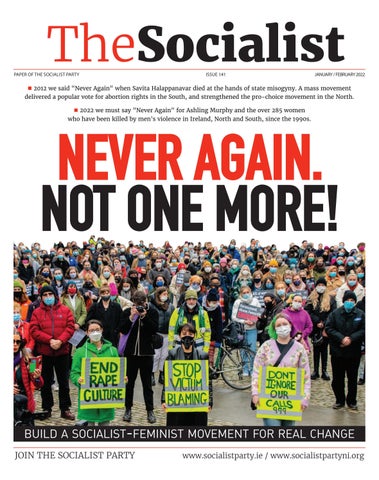
n 2012 we said "Never Again" when Savita Halappanavar died at the hands of state misogyny. A mass movement delivered a popular vote for abortion rights in the South, and strengthened the pro-choice movement in the North. n 2022 we must say "Never Again" for Ashling Murphy and the over 285 women who have been killed by men's violence in Ireland, North and South, since the 1990s.
NEVER AGAIN. NOT ONE MORE!
build a socialist-feminist movement for real change join The socialisT parTy
www.socialistparty.ie / www.socialistpartyni.org
2
HeAltH
The socialist
By Myriam Poizat
Global vaccine inequality What’s needed the World health organisation (Who) estimates that at least 70% of the world population must be vaccinated in order to reach the end of the covid-19 pandemic.
...what exists yet, only 52.35% of the world population has been vaccinated to date, and only 44 countries out of 195 (22.56%), the wealthiest countries, have reached a 70% vaccination rate. Pitifully low vaccination rates in african countries such as Mali (1.9%), South Sudan (1.4%), chad (0.5%) exist at the moment. the unequal distribution globally not only increases the risk of new variants like Delta and omicron to emerge, but also for a new variants which could be resistant to the current vaccines.
Corporate welfare for big pharma... in reality, protecting patents means protecting the uK, uS and eu’s pharmaceutical and biotech capital. against all ‘conventional beliefs’ i.e. big business propaganda, research funding for vaccines does not come from the private pharmaceutical industry itself. While biotech and pharmaceutical companies have historically appropriated the research and the profits of important technological and scientific breakthroughs, mass public funding and pharmaceutical workers are at the roots of important innovations. in the case of covid-19 vaccine research developed by pharmaceuti-
cal giants such as biontech, Moderna, Pfizer, astraZeneca, Johnson & Johnson and others, between 60100% of funding came from public finances.
... means big bucks nevertheless it is pharmaceutical companies that will have added $60 billion to their turnover during 2020, 2021 and 2022. Public investment in private uS, eu and uK companies was not driven by the sole will of governments to solve the pandemic and save lives, but also to create a vaccine bonus for their big pharma industries whose huge profits would supposedly boost their respective economies and competitiveness on the inter-
Defending patents for profit, not lives last year, french President Macron acknowledged the major disparity of vaccine distribution internationally. yet he and many other eu, uK and uS political leaders offered no solution. Despite having agreed in 2001 with the World trade organisation to relax intellectual property rights in cases of public health emergencies, their rhetoric has been to protect patents at all cost.
no one is safe from covid until the world is
all patents on vaccines must be scrapped
national market. instead, the world could have brought together of the best researchers and resources to come up with generic vaccines to be equitably and rapidly distributed globally, which could have halted the mutations and further spreads which have prolonged the pandemic. unfortunately, however, companies need profit to survive in a capitalist economy, so patents exist as a way to monopolise profit and improve competitiveness. a system such as this cannot deliver real solutions to end covid-19 or prevent future pandemics, which are prone to develop in a society where ecosystems are decimated daily in the pursuit of profit.
safe
Too many tragedies: Mental health epidemic must be urgently addressed by finn McKenna
T
he recenT tragic, untimely death of Shane O'connor, son of musicians Donal Lunny and Shuhada Sadaqat / Sineád O'connor, reverberated throughout society. The profile of the musicians has no doubt contributed to the widespread response and outpouring of grief. Failure of the state
However, the particular tragic case of Shane O'Connor and the southern state’s failure to uphold a duty of care to protect him resonated with many people because this tragedy, like so many suicides, was preventable. Of course such devastating events occur due to a multitude of factors, including deeply personal ones, but their prevalence indicates a serious social problem; one that has been effectively highlighted and campaigned on for decades now. Yet the state continues to oversee a mental health crisis going from bad to worse. Clear for anyone to see, the pandemic and its impact on society has significantly exacerbated the problem, yet in the south a measly €37 million in additional funds for mental healthcare was included in Budget 2022.
State bodies uncontactable, services unreachable
Following Shane O'Connor's death, public discussion has ensued, particularly on social media, about access to emergency mental health services and care provision. It is widely understood that attempting to access mental health services via public channels is in many instances a cumbersome, fruitless endeavour. For example, adults who present themselves as suicidal at A&E will be dismissed without thorough examination or care unless a suicide attempt has been made. Access to essential treatment for those with Borderline Personality Disorder (BPD) often means a year-long waiting list for dialectical behavioural therapy. Cognitive Behavioural Therapy may be the most easily-accessed form of therapy and useful for some, but a one-size-fits all approach is wholly insufficient. Affluent people who have money to spare can access private services. However, for those stuck in poverty, and for many workers living on an average wage, accessing essential services via the private sector is simply not an affordable option, neither should it be necessary. State investment now!
This time last year (23 Jan 2021), The Irish Times ran an article titled, ‘Ire-
The case for socialist policies not only do we need patents to be immediately lifted so that factories in countries around the world can start producing their own vaccines and properly tackle this pandemic, but the system that puts profit before our lives has to be uprooted. the biotech and pharmaceutical companies have to be taken into democratic public ownership, under the control of the workers who develop and produce the goods. only in this way, can resources be utilised to ensure each and every country is provided with the necessary equipment and medicines to treat the unwell, and crucially, the vaccines to stop covid-19 in its tracks.
What we need: l Major investment in mental health services and training staff. This means that there should be enough workers to match the case-loads. l No one should have to pay to see a professional therapist. We need 24/7 mental health centres, including on call counselling and emergency services, in every community. l Rollout comprehensive evidenced-based education programmes on mental health awareness and care in schools, colleges and workplaces.
land's Mental Health Pandemic: From Crisis to Emergency’; where it accounted for 2,000 children and young people waiting for Child and Mental Health Services (CAHMS), and 10,000 people waiting for primary care psychology — the majority of whom are children The shortage of staff and the government's refusal to invest in both staff and essential mental health services that are so desperately required must be seen as
a political issue. The Irish economy exists to a large extent as a tax haven for international finance capital to launder money through tax-dodging loopholes. The reality and social implications of such a low corporation tax model combined with financiers exploiting tax loopholes means that necessary and fundamental social services, such as mental health and child protection, are deprioritised and underfunded. This is utterly unacceptable.
l Healthcare workers, community groups, mental health campaigners and those that use these services must have oversight and input into addressing this crisis that has worsened since the pandemic. l Make the super-rich and corporations pay to fund a single-tier national public health-service that is free at the point of use and that leaves no child nor adult without assistance in times of mental health crisis.
CovId CrISIS
3
The socialist
Britain: Johnson government rocked by “bring your own booze” scandal
by caitríona ní chatháin, tui school steward (pers cap.)
by connor rosoman
I
n recenT weeks, Boris Johnson’s government has faced a mounting crisis, with public support crumbling amid a series of devastating scandals over government ministers breaching their own cOVID-19 regulations. These scandals have come at the same time as COVID-19 case numbers have skyrocketed, and the cost of living crisis threatens a bleak 2022 for working class households. Leaked email
Most recently, a leaked email has emerged showing over 100 people invited by Martin Reynolds, head of Johnson’s office at no.10, to a “bring your own booze” garden party at Downing Street in May 2020. More than 40 people are reported to have attended, including Boris Johnson and Health Secretary Matt Hancock, to celebrate “beating back the virus”. Boris Johnson has since admitted that he attended this party. That this party took place directly after a press conference where the government restated that social mixing was still to be limited to one person outdoors, only reinforces the sentiment of many working class people that there has been “one rule for us, another for them”. Only two days later, Dominic Cummings sparked mass outrage after his own flouting of Covid restrictions. Will Boris Johnson last?
Johnson’s approval ratings have plummeted, with polls ranging from 56-67% support for his resignation.
But while many people, socialists included, would be glad to see the back of Johnson, we should not rely on the thoroughly rotten Tory party to deliver any change. The seeds for the government’s catastrophic handling of the pandemic have been sown by successive Conservative and Blairite governments grinding down health and social care services and presiding over declining standards of living for working class people for more than a decade. Kick out Johnson and the Tories
That Johnson has stayed in power this long is testament to the failure of Labour under Keir Starmer to offer any serious opposition to this government, and their refusal to mount a genuine challenge to the status quo. The total inaction of
Starmer, summed up in the vapid slogan “Security, Prosperity, Respect” offering more of the same as millions seek out radical solutions, provides an easy recipe for the Tories to recover. An independent investigation is needed made up of healthcare workers, trade unions and the families of victims into breaches of Covid restrictions by government ministers as well as their handling of the pandemic as a whole. Alongside this, we need to fight for full public ownership and democratic control of health services, including testing and vaccine production to begin to address the catastrophic covid response that the Tories have overseen, with the highest death toll in all of Europe. At the same time, we need to fight for a real living wage of £15/hr, bringing the
privatised utilities back into public ownership along with the banks and financial institutions in order to plan the economy in the interests of working class people as part of a socialist green new deal that can tackle rising costs of living. What alternative?
The market and the capitalist system the Tories uphold has been totally exposed by this pandemic as a system that at best, works in the interests of the super-rich, and at worst barely works at all, as evidenced by the supply chain crisis still gripping Britain. Only by building the struggle against this system itself, and to replace it with a democratically-planned, socialist economy can we begin to plot a way out of the endless crises we are faced with today.
leaving cert: end competition for third-level education unnecessary battle with their peers. Even in pre-pandemic times, the LC had a debilitating impact on students. The UN Committee on the rights of children has described it as traumatic!
by councillor leah Whelan
T
here IS huge uncertainty about what the next months will bring for exam year students and teachers. Despite Covid having a major impact on students’ ability to learn, the government wants to plough ahead with a traditional exam this summer. The cut to in-person teaching over the course of three school years has left current sixthyear students without a full, uninterrupted year of school since the junior cycle. Clearly, this has an effect on the students’ ability to complete vital coursework, and ultimately, sit a traditional LC exam. The previous sixth-year students, who faced exams in 2020 and 2021, had to mount a challenge and put significant pressure on the Ministers for Education and the government to win changes to the examination. This resulted in students not being forced to sit the traditional LC. Competition for third-level
Those students organised through different initiatives such as social media storms, mass email campaigns and raising students’ voices through social media. Although they won important changes on the exams from the pressure applied, there were still problems. The predicted grade system leaves teachers with the re-
Covid in schools is a workplacesafety scandal
What’s needed
The traditional Leaving Cert puts enormous stress on students
sponsibility of grading their own students. In previous years, this has created point inflation, leaving many students without a college place anyway, due to a lack of spaces. The predicted grade/hybrid system does not address the key issue, which is the chronic underfunding of third level: with a mere 0.06% of GDP invested into colleges and universities. The under-resourcing has a domino
effect on the Central Application Office (CAO). The CAO offers roughly 55,000 places for 80,000 applicants. This is what drives competition in schools. The idea of competition is a necessary aspect of the LC that allows the government to kick the can down the road on what’s actually needed overall to address the issues in third level. The stress and pressure created by the scarcity of places put students into an
What is needed is for the Irish state to allocate proper resources to colleges that allow students to progress their education if they wish to. We need a system of open access that will allow all students to get a place in third level, ensuring that the funding is provided. In addition, students should be provided with a living grant and affordable accommodation where necessary. This would require billions in extra funding, which can be raised through taxes on super-wealthy individuals and corporations that have profited massively during the pandemic. Billionaires in Ireland increased their wealth by €18.3 billion during the pandemic. Young people strike & protest
This year’s sixth-year students have witnessed sixth years before them put pressure on the government for changes. However, this year is the first time we will see students organise in-person protests, strikes and other actions. The government can be pushed back again, but it will need real pressure from below. Indeed work to organise this has already begun.
THE CATASTROPHIC and dangerous handling of mitigation in schools is a product of the government’s emphasis on “business as usual” above all else, even in the midst of a raging pandemic. along with the absence of basic safety measures such as the existence of hePa filters, overcrowded schools are a crucial factor in exacerbating the covid crisis. this has caused untold stress and anxiety for extremely high-risk teachers, Snas and other school workers. the narrative of the government that “schools are safe” has lost all credibility. there is now acknowledgement that schools are major drivers of the pandemic globally. covid-19 spreads just as much among children as it does among adults. it seems that children also suffer more from omicron than other variants. teachers, Snas and all school staff will advocate for the health of pupils. however, they must organise to protect themselves, and utilise the power they hold if they decide to withhold their essential labour and engage in industrial action, which could see improvements made for all in the communities that they serve. In light of the current phase of the pandemic, school workers and their unions must call for: l an immediate rolling out of contact tracing in schools overseen by the public health system. l free, unlimited antigen tests and fPP2 masks at the reception of all school buildings. l a centralised roll out of ventilation in all schools to be carried out by specialists employed directly by the Department of education. l Paid leave for all workers in all sectors who have to isolate themselves, or with their children. l Workplace health and safety protocols negotiated and agreed upon by members of the school community. l fast track the construction of new school buildings and the retrofitting of old buildings for improved ventilation and functionality. cut out the profiteers, bring the major construction companies into public ownership so that schools, homes and hospitals can be built at cost price. l Permanent contracts for ancillary school staff such as cleaners, caretakers and secretaries. an end to the outsourcing of cleaners. l end the outsourcing of occupational health in education. l Scale back the curriculum to focus on student wellbeing and adjust state exams to reflect this. Scrap the leaving cert. Provide free access (with no fees) to third level to all those who want it. l requisition the resources of big pharma. for a global, patent-free vaccine accessible to all to save lives and slow the mutation of further covid-19 variants.
4
SoutH ANAlySIS
The socialist
editorial: Government recklessly allows Covid cases to soar
T
he BegInnIng of a new year saw an unprecedented, sharp spike in covid cases. Both here in Ireland and globally, this new wave of the pandemic fuelled by the Omicron variant is resulting in rising hospitalisations and major disruptions to the lives of working-class people. Herd immunity policy
The Irish government, which has consistently failed to prepare for and respond to new dynamics in the battle with Covid, is to blame for this new surge and the damage it is causing. g It has failed repeatedly to put the necessary resources into our health service to deal with a rise in cases. This is once again putting enormous strain on the service and its staff. It also has a knock-on effect, with a further suspension or cancellation of elective surgery in the state. g It has recklessly proceeded with reopening schools, sending one million children and teenagers and 100,000 teachers, SNAs and other school staff to work in overcrowded, poorly ventilated buildings, with inadequate filtration systems. It has refused to reverse its decision not to put a proper test and tracing system in place for schools. g It failed to maintain the testing infrastructure in the state, which has been overwhelmed by the new surge and remains so. Everyone should have immediate access to free, quality antigen tests and PCR testing should be significantly ramped up.
g It has done nothing to safeguard workers’ health and safety in the context of this spike. At the behest of the bosses, it is seriously considering lowering the number of days people who test positive for Covid but don’t have symptoms must self-isolate. Similar measures have been introduced in the United States, after pressure from big business — not for the first time workers are forced to work in treacherous conditions in the interests of private profit. g Despite another rise in the numbers of people who will be out of work, it has done nothing to put support measures in place, such as reversing the reduction in the PUP from €350, which should be reinstated at a minimum. In allowing case numbers to soar, with no meaningful measures put in place to stop this, the government has essentially adopted a policy of herd immunity — allowing the virus to spread throughout the population regardless of the effects — which has had disastrous impacts elsewhere. It has displayed a shameful indifference to the health, both physical and mental, of key frontline workers, particularly those in the health service. What we need:
l Ramp up the testing system. PCR and antigen tests must be made freely and readily available for all those who need it. l Nationalise the private hospitals and their resources without compensation,
The government has not put in the necessary investment into a system of PCR testing, leading to inaccurate figures
and keep them in public ownership as part of a one–tier health service. l Immediate and major investment in a free, publicly owned health service to cope with a surge in cases and tackle the backlog of elective surgeries. Tax the super-rich and big business to fund this. l Workers should decide when it is safe to work, and have the right to work at home if possible. These decisions cannot be left in the hands of profit-hungry bosses. With the full backing of the trade union movement, workers must assert their right to dem-
ocratically decide on all health and safety measures. l Defend health and safety in schools. All schools should have HEPA filters and ventilation systems. Free antigen tests and FPP2 masks at the reception of all school buildings. Fast track the construction of new school buildings and the retrofitting of old buildings for improved ventilation and functionality, so that class sizes can be cut. No school should be open until it has been made safe. l Defend our living standards. Restore the PUP to €350. Ban all evictions and
slash rents to affordable levels. For a €15 an hour minimum wage. l No one is safe until everyone is safe. End global vaccine apartheid. Abolish patents. Bring big pharma into democratic public ownership, end the rule of the profiteers. l Fight for a democratic socialist alternative. To defend our health, living standards and planet we must break with the capitalist market system. Take the key sections of the economy into public ownership, with the working class, which makes society function, at the heart of its management.
Minimum alcohol pricing: attack on poor & windfall to drinks industry by Dan o’rourke
T
he gOVernmenT’S new pricing rules on low-cost alcohol took effect in January. The measure is a blunt instrument that will provide substantial profits to certain sectors of the drinks industry, while functioning as a vicious attack on poorer people. It is a gift to the vociferous pub and restaurant lobby, but fully in line with the class prejudices of the political establishment. Price increases may lead to a decrease in average alcohol consumption, but will exclusively affect those consumers of low-cost alcohol, not consumers of alcohol in general. It’s as if the wealthier sections of Irish society are not involved in or affected by alcohol abuse. Businesses set to profit
Publicans and restaurateurs have been lobbying for years for a price hike under the false pretences of concern for heavy drinkers. Of course all they really care about is bringing those heavy drinkers into their own establishments, where they will happily supply them with their fill of alcohol while also ripping them off. Large alcohol corporations such as Diageo are also set to benefit as their “premium” products are already priced above the new minimum amount, mean-
ing they are likely to see an increase in sales as people will opt for the known brand product at the same price as the (former) budget option. Causes of alcohol abuse
Alcohol problems in society are primarily caused by economic factors. Research shows a clear relationship between recession and an increase in problematic drinking. When people are struggling through a stressful financial situation, or in any sort of personal crisis, they often turn to alcohol as a relief or to escape. An increase in price is unlikely to deter those who find themselves in dire circumstances. Compounding the issue is the fact that poorer people tend to suffer more harm from alcohol consumption, even when the rate of consumption is the same as those who don’t suffer from poverty. The vicious cycle of poverty and alcohol addiction will not be alleviated by implementing inhumane financial punishment on those who are already suffering. The government has attempted to spin its legislation with the tired “someone please think of the children” PR tactic, by saying the legislation will bring alcohol above “pocket money” prices. What is not being said is that access to youth supports, services, clubs and amenities is the optimal way to tackle al-
cohol abuse among young people, not to mention overhauling the damagingly stressful leaving cert system. At the moment, youth services in Ireland are critically under-funded and overly reliant on unpaid volunteers. This bill includes a redundant measure to restrict alcohol branding on children’s clothing, but there is no mention of improvements to youth services. Although the bill is titled “Public Health (Alcohol) Act 2018” there are only 20 mentions of ‘health’ in the main text of the almost 14,000 word document, and most of these are procedural mentions of ‘Minister for Health’ or ‘Health Service Executive’. There is no mention of mental health. This is just one indication of the low priority the government gives to public health. What is needed
As corporate profits surge to astronomical heights off the labour of underpaid essential workers, it is an utter disgrace that this government is organising for another effective transfer of wealth from the poorest in society to greedy businesses, particularly under the pretence of concern for public health. In order to truly tackle alcohol and drug addiction problems in Ireland, the root causes of poverty and mental illness must be dealt with. This can only be done if the profits of massive corpora-
Minimum alcohol pricing is a regressive tax against the poor
tions, such as Diageo, are seized and invested in a one-tier, national public health service that is free at the point of use, with 24-hour counselling services
readily available. Such a service could deal with addiction as a health problem, both physical and mental, not something to be profited from.
NortH NewS & HIStory
5
The socialist
stormont embroiled in crisis: We need a socialist alternative by Sean burns
J
effery DOnaLDSOn, the leader of the DUP, has been threatening to collapse the institutions, by removing executive ministers if article 16 is not triggered by the British government. a threat that he has now backed down on after assurances from the Brexit Secretary, that she will suspend aspects of the post-Brexit deal if agreement with the eU cannot be reached. These threats are a reflection of a real pressure on the DUP from its base to take a hard and effective stance in opposition to the protocol. Opinion polls have illustrated the DUP being outflanked by both the UUP and the TUV. In some it has dropped to as low as 9%, falling behind Sinn Féin. Regardless of Donaldson’s actions, the DUP is caught between a rock and a hard place. It is unable to act decisively and take a hard line while maintaining the institutions, and at the same time to compromise further undermines their position. At its core, the state of suspended animation the DUP finds itself in is born from below where there is a widespread perception within the Protestant com-
munity that it is being forced into a de facto ‘economic united Ireland’, as a result of the East/West border. This adds to the growing sense of insecurity and isolation of many Protestants, who feel that the Union is unraveling and they are threatened with becoming a minority in an all-Ireland state against their will. Rioting last year and large protests against the protocol are indicators of a bubbling anger which will not simply dissipate. As we approach the elections in May tensions over the protocol will be a dominant feature. The failure to deliver a good quality future and living standard is fuel to the fire. The conditions of low wages, precarity and insecurity and the overall inability of capitalism to deliver its promised “peace dividend” has and will undermine the establishment parties. Working-class can show the way
Sectarian deadlock in a constant feature of Stormont
Left in the hands of sectarian politicians the situation will worsen. All the green and orange parties in the North base themselves on the division that exists in our society. As we approach the elections in May, both the unionists and nationalists will up their sectarian rhetoric as they vie for a dominant position but nei-
ther offer a way forward for workingclass people. While they present themselves as the champions of their respective communities both parties represent the interests of capitalism. There is an escalating cost of living crisis in the North. We have historically low wages, a fact that both
Sinn Féin and the DUP have often boasted about to foreign investors. The price of gas for example is rising by nearly 38% in some instances, and it’s not the only cost. Energy, food, rent etc. are rising, hitting working-class people the hardest. United struggle of the working class –
90 years since the outdoor relief strike: When the Falls & shankill united in struggle
Protestant, Catholic and neither – in our common class interest can raise people’s sights towards the potential for fundamental change: for a break with the capitalist system which sows division, and for a socialist future in which workingclass people have a real say over the running of all aspects of society.
Why I joined the Socialist Party
by Darragh logue by Violet Mcconville
I
n 1932, the situation for the working-class population in Belfast was dire; poverty was widespread, unemployment had hit 28% of the adult population, and the Belfast Board of guardians – packed with “big house” Unionists - turned up their noses at those begging for assistance. Before becoming eligible for small cash payments (called Outdoor relief ), unemployed married men had to do two and a half days work per week on public works schemes, heavily focused on road building and maintenance (The alternative was Indoor relief; the workhouse). Mass revolt erupts
Organisers came together on 30 September 1932, where 2,000 people attended a meeting organised by the Revolutionary Workers Group (RWG). They agreed to strike around the following demands: Abolition of task work; Increase in relief payments; No payments “in kind” (payments routinely came in the form of a “chit” which could only be used at select unionist owned shops); Street improvement work to be paid at trade union rates; and extending the scheme to cover all single unemployed men and women. Within days, 30,000 marched on Custom House where a mass meeting was held, with bands which previously played sectarian songs joining to play the popular song, “Yes, We Have No Ba-
A public meeting during the Belfast Relief strikes of 1932
nanas”. In the days following, rioting took place with the police using armoured cars, workers occupying workhouses, and another mass meeting agreeing to escalate the strike to include a rent strike and a general strike. The Unionist state repeatedly tried to stir up sectarian tension to break the working-class unity, including authorising the police to use live ammunition in the Falls Road area of the city in an attempt to get them to sectarianise. This plan completely backfired, however, as when strikers on the Shankill Road got word of this, they ran to assist their Catholic comrades in battling the police.
The state also attempted to deny food to certain areas of the city, but the strikers had already organised house-to-house collection of money and food. In the end, the state had to back down as they realised that they would not be able to defeat a united movement. Stirring division
After two weeks of workers rioting amidst brutal state repression – including one Catholic and one Protestant being killed – the strike ended after the state bowed to the pressure, especially given that the Belfast Trades Council had threatened a general strike. The
strikers were only successful in pushing through some of their demands though, namely increasing the rate paid to married men. The scheme was not extended to single persons, nor was the demand for trade union rates for road improvement work met. The crucial lesson from this struggle is the ability of working-class people, Protestant and Catholic, to unite in common struggle and overcome the sectarian division we are thought to be inevitable. This lesson is both inspiring and crucial as we face a future of capitalist crises on this island and on our planet.
DURING THE first COVID lockdown, I had formed an interest in politics. Amidst mass unemployment and despair, I grew angry at the elite lining their pockets at our expense. It was at this point i knew that a better world could be won. i took an interest to socialism, but i learned that simply believing in something will not achieve a better system to improve the lives of the working class, practical action had to be taken. i was already tired of the regressive, “green/orange” politics of our country, and that such politics only divide the working class. i then found out about the Socialist Party, a party for the working class with feminist, anti-sectarian, antiracist beliefs. a party that reflects the desires of the majority. in joining the Socialist Party, i learned about how society truly works and came to be, as well as putting my beliefs into tangible, affective action. i had joined an organisation of helpful and intelligent people with truly pure intentions. of all parties in this country, i joined the Socialist Party for its desire to improve the lives of the working class.
6 SpeCIAl feAture An unprecedented wave of grief and anger has gripped the country following the devastating murder of 23 year-old Ashling Murphy in Tullamore, writes Keishia Taylor. Tens of thousands have participated in countless vigils in every city, town and village in Ireland, North and South, with Irish communities in London, New York and Australia also participating in large actions.
O
n WeDneSDay, 12 January, ashling went for a run and was murdered in broad daylight in a brutal attack by a strange man in the first femicide of 2022 in the state. a primary school teacher and talented trad musician and athlete, ashling was much loved by her community. #Shewasgoingforarun trended across social media highlighting that she, like Sarah everard, had done everything “right” to stay safe, but that wasn’t enough. Implicit in this sentiment is a rejection of tired, hypocritical victim-blaming. Fine Gael Junior Minister Josepha Madigan’s suggestion that women use panic buttons and safety apps, and reactionary laughingstock TD Michael Healy-Rae’s call to legalise carrying mace have prompted derision and outrage. It is widely recognised among women and working-class people that it doesn’t matter what she was doing or could have done — no woman or gender non-conforming person deserves to suffer as a result of male violence. A watershed moment
Tens of thousands of women and young people, but also men and older people, have poured onto the streets to attend vigils, and standouts for Ashling. The website called her.ie attempted to compile a list with all of the known vigils and 94 were listed, including 8 in the North. Beneath the heartbreak and grief was a deep current of anger and the desire to act to end the male violence that has stolen the lives of 244 women in Ireland since 1996 and caused immeasurable suffering to countless more. This unprecedented display of solidarity is a watershed moment. It is reminis-
cent of the response to the death of Savita Halappanavar in 2012 as a result of the Eighth Amendment, which was repealed in 2018 after years of struggle sparked by her death. The “I believe her” and “this is not consent” protests in 2018 were significant moments in challenging sexual violence and victim-blaming in this state, but Ashling’s murder has burst open a dam. The refusal of women and gender nonconforming people to accept living in fear, changing our behaviour to avoid violence or being forced to desperately seek out underfunded services is now more widely reflected throughout society. Now, as in 2018, ROSA — Socialist Feminist Movement and Ruth Coppinger, former Socialist Party TD and teacher trade unionist, acted quickly to call socially-distanced standouts in Dublin, Belfast, Cork and Limerick to provide an arena to express the anguish felt by so many, and to channel that anger into action. ROSA members, trade unionists, women and non-binary activists and more spoke about their sadness, their experiences of male violence, and the need to make widespread cultural and societal change on the issue of misogyny and gender violence. As speakers declared that we stand in solidarity against all forms of sexism, racism and transphobia, they were met with unanimous applause. The thousands that attended agreed we must act now to make “never again” a reality. Making “never again” a reality
From intimate partner violence, to catcalling and verbal abuse when we go out walking, running or cycling, to online harassment and image-based abuse, to sexual violence and spiking — we need to bring
The so this issue out of the shadows by coming onto the streets. We need to explicitly demonstrate our solidarity with every victim of femicide to exclaim that not one more life can be taken, and with every survivor of male abuse and violence, every sufferer at the hands of the state, to demand never again. In order to make a real challenge to gender-based violence, we must harness the incredible momentum we are witnessing the length and breadth of Ireland and channel it into a sustained movement, organised in every community, school, college and workplace. This is what is needed in order to enact the type of fundamental systemic and cultural change necessary to really challenge every single way in which sexism, misogyny and LGBTQ-phobia is reproduced. Ten years ago following the death of Savita, a huge movement said “never again” and vowed such a death would never be repeated. We want the same now — the only fitting legacy for Ashling. International Women’s Day must become a major focus — protests, demonstrations and a collective strike of students, both secondary and third level, and workers is what should be now discussed and built for. ROSA Socialist Feminist Movement has launched a campaign for a major conference of trade unionists, trade unions, women’s and LGBTQ organisations, Traveller and anti-racist organisations, community campaigns and more to launch a massive social movement to end gender-based violence, and in particular actions for International Women’s Day.
A watersh challenge
Demands that such a Conference should discuss adopting include:
l Emergency action needed now against the shadow pandemic of gender violence — an immediate tripling of funds for frontline domestic and sexual violence organisations. Major investment in free, accessible, quality mental health services. l A public inquiry into the cancelling of thousands of 999 calls by Gardaí and into sexism, racism and anti-workingclass prejudice throughout the legal system. An end to victim blaming and rape myths in the courts. l Education to challenge sexism and gender-based violence, that deals with consent and is LGBTQ+ inclusive. An end to gendered education and religious control of schools which are a barrier to this. l Separate church and state — remove Church influence from all public bodies and institutions, including all education and health services. l Emergency house-building programme to build tens of thousands of public homes on public land to end the housing crisis, which traps women in abusive relationships.
Vigil for Ashling Murphy at Belfast City Hall
The outpouring o
Next steps:
The Socialist Party, and Socialist Party members in ROSA are committed to building a socialist feminist movement that unites the exploited and oppressed of this world. With the vision this provides of the power that a united multi-gendered, multi-racial working class struggle can bring in striking at the heart of the capitalist system of oppression and exploitation, this offers the potential for systematic change for humanity and the planet.n
international Women’s Day 2
out of the shadows by harper cleves
T
he SOcIaLIST feminist revolutionaries that estabished International Women’s Day were inspired by young immigrant women garment workers in new york city who instigated an 11 week strike in 1909 against expolotation and gender oppression. Moving into 2022, history seems to be repeating itself; not only in that a system built on profit is unable to fundamentally address the oppression faced by women today; but also in that it is those most exploited and most oppressed around the world whose courage is leading the way in the fight for a more just society. Global wave
In Myanmar last year, some of the most exploited women workers – including garment workers and health care workers – were at the helm of the uprising against the corrupt regime; even in the face of targeted violence against women. In Turkey, 285 women were murdered in 2021. In March, July, and again on the 25 November, women and LGBTQ+ people around the country staged huge protests in the face of police brutality in order to pressure the Erdogan government to rejoin the Istanbul Convention, and establish a plan to address male violence against women.
In both Mexico and Argentina, on the back of the Ni Una Menos movement against gender violence and femicide, activists won historic victories in the fight for bodily autonomy; in Mexico abortion is no longer a punishable offense, and in Argentina abortion is now legal up to fourteen weeks.These victories for bodily autonomy took inspiration from the 2018 Irish victory, and will in turn provide inspiration to women and pregnant people around the world who are having their rights attacked. In the United States we have seen in 2021 the seeds or a constitutional ban on abortion being planted; but we have also seen the potential for a feminist fight back as well. In Poland the death of a young woman who died as a result of not being able to receive and emergency abortion sparked outrage reminiscent of the death of Savita and demonstrated that the establishment should be prepared for more feminist struggle in the years ahead. From struggle to liberation
At the time of writing in 2022, the murder of Ashling Murphy in Tullamore has proven to be a breaking point for people across the island of Ireland as thousands attend vigils and protests in small towns and big cities alike. These protests around the world fight
SpeCIAl feAture
ocialist
7
The pandemic & the unbearable burden on women workers
of grief for Ashling Murphy
hed moment for to male violence
AS THE world faces into a third year of Covid-19, it remains clear that women and other oppressed groups are bearing the brunt of the pandemic’s impact. Many of the areas at the frontline of the pandemic are highly feminised sectors, such as nurses, healthcare assistants, and teachers. a trinity college Dublin study on the mental health of workers in nursing homes throughout the pandemic found that 10% of workers experienced suicidal thoughts, and 45% showed symptoms of PtSD. nursing homes were the worst hit by covid-19 early on, during a time when even basic public health measures such as proper PPe were not being provided for by management of some facilities and had to be demanded by the workers. it is unsurprising that this laissez faire approach coupled with the criminally poor wages received by these workers resulted in severe impacts to their mental health.
2022:
s into the streets
for abortion rights and an end to the murder of women; but in reality they are fighting for dignity and respect in a world that robs people of their well-being and lives in the name of profit. These struggles, and the victories gleaned from them, will give confidence to all who are exploited and oppressed by this rotten cap-
italist order – from workers, the poor, to people of colour– and demonstrate that the fight for a better world is possible when we fight together. We do not have to accept the world our capitalist rulers have given us: systemic inequality, oppression, murderous wars and the destruction of our ecosys-
by catherine finnegan
tem. We have the power to overturn their rotten order and build a humane, democratic and socialist society, one built on solidarity and equality where the collective ownership and democratic control of society’s wealth can allow each of us to flourish. In short: we can have bread and roses too.
Double burdens now unbearable it is not just the workplace where women are disproportionately affected. the care burden and unpaid labour that many women are expected to do has only increased with added pressures of home-schooling, support services running reduced hours, trying to protect vulnerable family members, all while living with the stress everyone is experiencing from living through a pandemic. researchers in Maynooth university found that in two-thirds of families, women were solely responsible for homeschooling and10% of the women surveyed said they had to
leave their jobs because of homeschooling responsibilities. Many women were just about coping with balancing these competing responsibilities with their paid work pre-pandemic and now this already unsustainable juggle has become completely unmanageable. this has pushed many women workers over the edge and out of workplaces, leaving them isolated and unable to organise against the system that has put them in this position. a report by the national Women’s law centre in the uS found that in December 2020 women accounted for a shocking 100% of jobs lost during that month; 156,000 jobs while men gained 16,000 jobs. Union leaders failing to act the situation is raising its head again with the safety of schools as children and workers return after the christmas break. teachers have been raising concerns regarding school safety against the government's lack of action on ventilation and close contact management since before the latest surge. the lack of action from the unions on these matters is leaving the workers disheartened and frustrated. the conditions teachers and nurses have been working through since the early days of the pandemic would justify strike action, but now more than ever these workers are faced with a unique difficulty in taking industrial action owing to their sense of duty in providing these roles. this leads to an unfair burden on women workers propping up the system by working in poor conditions, for less pay and continuing to provide the economy with additional hours of unpaid labour.
8
INterNAtIoNAl
The socialist
solidarity with the revolt in Kazakhstan
by eva Martin
by Dave Vallely
PRESIDENT AMDALA Hamdok, the face of the civilian component of a military-run government in Sudan, who has falsely promised to guide the country's “transition to democracy”, resigned on 2 January. He claims the ongoing political stalemate between the civilian and military components of the government since the military coup of October 25, 2021, led to his decision.
T
he SPark for mass struggle in kazakhstan was the decision by the government at the beginning of January to cut fuel subsidies. This decision more than doubled the price of gas and caused widespread anger, yet opposition to the kazakh regime has been building up over decades and has been brought to a head by the pandemic. Harsh quarantine measures have drastically affected incomes. The working class has long suffered brutal neo-liberal attacks on its living standards. At the end of last year in Mangystau, tens of thousands of oil workers were made redundant. They have been joined over the last year by sections of the middle class as their incomes have proved less stable and credit conditions worsened. Decades of dictatorial rule
Kazakhstan is a former Soviet state ruled since independence in 1990 by the dictator Nursultan Nazarbayev, the former first secretary of the regional ‘Communist’ party who oversaw the restoration of capitalism. Nazarbayev ceded power in 2019 to Kassym-Jomart Tokayev, but remained in control of the important state security council. The regime, like the Russian and Belarusian regimes, is built on very unstable and narrow foundations. It has stripped out any opposition forces that can channel discontent and concentrated all power and resources into the hands of a very narrow ruling elite.
Workers have been central to the revolt against the dictatorship in Kazakhstan
This has meant that Tokayev responded to the recent protests with threats and then violence. What started as protests by oil workers and their supporters in Mangystau in West Kazakhstan within hours had spread right across the massive country. In some cities, police vehicles and buildings were attacked. Workers blockaded the main railway lines to prevent police and troop movements, while in Taldygordan, crowds heaved ropes around the statue of the hated Nazarbayev and hauled it down. In Atyrau, protesters cheered while the hated riot police came out of their building and joined the protests. Elsewhere there are videos of troops frater-
nising with the protesters or of troops being disarmed en-masse by the crowds. Russian imperialism intervenes
Tokayev appealed for assistance from the military alliance led by Russia, which led to the entry of a largely Russian force. Its role wasn’t to directly attack protesters, but to signify to the different cliques within the regime which side Russia was siding with. Tokayev, emboldened by this endorsement, has acted by “firing” the government, seized control of the state security council from Nazarbayev, and escalated the repression of protests by imposing curfews and a shoot to kill policy. Over 12,000 people have been detained since early January.
The protests in Kazakhstan are unlikely to be an isolated event, given the hardships people in the former Soviet states have had to face over the past 30 years and the unstable basis of the resulting regimes. The underlying social and economic causes of the protests remain unresolved. These protests are a repeat, on a higher level, of a mass uprising by oil workers in 2011 centred on the western city of Zhanaozen which was brutally repressed by the regime at the cost of at least 70 lives. What the recent protests show is the urgent need for an independent working-class political alternative capable of rallying all those oppressed to end the rule of the oligarchs and capitalism.
chile: election of Gabriel Boric shows aspiration for fundamental change by Jonathan Diebold
I
n OcTOBer 2019, the price of a metro ticket in Santiago, chile, rose by 30 Pesos. This seemingly innocuous price hike of about €0.03 saw massive protests sweep the country, eventually seeing a constitutional plebiscite that swept away the constitution of the old military dictatorship. A culmination of this mass movement was the recent election of the left activist Gabriel Boric last month. The polarised election was fought against a far-right party that openly admires the murderous Chilean dictator, General Augusto Pinochet, who overthrew the democratically elected left government of Salvador Allende in 1973. Grotesque inequality
While Chile has been lauded as a Latin American success story in recent years, having the highest Human Development Index (HDI) in the region, churning under the surface was a darker story. The country’s economic growth was driven by neoliberal economic policies, a key aspect of which included privatisation of public services and cutting of
Sudan: Revolutionary struggle can end military rule
government social spending. Meanwhile, the super-rich made a killing. By the beginning of the 2019 protests, the top 1% controlled over a quarter of the country’s wealth, while the bottom 50% controlled about 2%. The campaign against fare increases, largely led by school students, was the spark that lit the powder keg created by capitalism in Chile, galvanising the masses to organise on a host of issues. As some placards read, and presidentelect Boric repeated, “If Chile was the cradle of neoliberalism, it will also be its grave.” Boric’s election campaign was marked by the reaction of the far-right – indeed, in the first round of voting, it was the far-right that won. Many young and working-class people were unenthused by Boric’s moderate-left politics, but faced with the threat of an even greater crackdown by a government more extreme than the one that exists now, the movement of young and working-class people propelled Boric to the presidency. No conciliation with the system
In Brazil, leftwing president Lula da Silva’s policy of “class conciliation” led to
Young & working-class people came out en masse to vote for Boric, against the far-right
the opportunity for the far-right Jair Bolsonaro to take power. There is a crucial lesson here, there can be no reconciliation between the needs of working-class people and the existence of capitalism and imperialism in Chile. There needs to be a fundamental break with this system. Only an organised and sustained
movement of the working class and the poor will be able to truly win demands on public health and education, on defence of rights for women, indiginous people, and LGBTQ+ people, the right to retire, linked to a broader struggle to win democratic public ownership and workers’ control of the nation’s wealth and resources.
Freedom, peace and justice his resignation did not result from the considerations for what the working people on the street want and have been demanding since 2019, namely: ‘no negotiation, no partnership, no legitimacy for the military.’ the decision has had minimal impact on the revolutionary mood on the ground. the economy is becoming ever more crippled with rampant inflation, policies of austerity, and the suspension of international foreign aid has left the masses of Sudanese people in a desperate situation. the working people of Sudan want real democracy that actually provides them with the demands of the uprising: freedom, peace, and justice. this is impossible to achieve under the regime of the Sudanese capitalist state. after the massacre of June 2019 by the state forces, and hundreds of people protesting against the military’s brutal repression, the major capitalist powers validated and recognised the power of the military government. they rewarded it for its massacre. furthermore, the military clique has enormous ownership and control over the economy. the civilian faction of the government was also entirely dependent on financial support from capitalist powers, but of course, support came on the condition that the government implement grotesque austerity policies, which only worsened an already dire situation for the Sudanese people. Winning real change the current regime and its backers does not, and cannot, serve the interests of the people of Sudan. Whilst Sudan’s military government continues to promote repression and austerity, the people of Sudan are not fooled nor defeated. they have pledged that mass protests to win their demands will continue. there is a real connection between the suffering and oppression of the Sudanese people and the capitalist system that the Sudanese government defends. the fight for democracy in Sudan is bound up with a revolutionary socialist struggle to seize its wealth and resources from the hands of the military and capitalist class and ensure it is utilised for the benefit of the masses.
workplACe
9
The socialist
Are we witnessing a global labour revival? trade union leadership who, conditioned by their normal way of operating, sought to settle these disputes on lesser terms when the rank and file saw greater potential. By contrast, in Britain, Unite the Union under Sharon Graham’s leadership has effectively engaged in dozens of mostly offensive strikes and pay claims, leading to over-inflation pay rises.
by Michael o’brien
T
he eDITOrIaL of the Financial Times (fT) newspaper on 4 January was headlined, ‘coronavirus has provided a wake-up call for workers’. The fT is not given to sensationalism aimed at a mass readership. rather, it has been accurately described as the capitalist class talking to itself.
Pressure from below is key
The effect of the pandemic
The speculation that one of the lasting legacies of the pandemic will be a more assertive working class and a revived labour movement is based on a combination of factors. Firstly, the upending of supply chains, production and ‘normal’ migration patterns that would serve to locate workers where the capitalists need them, have together revealed critical labour shortages. These are particularly pronounced in logistics. This disruption and resulting supply chain shortages has in turn contributed to levels of inflation not seen in decades. Secondly there are some demographic trends, not just in developed countries but also in places like China which point to too few people of an active working age relative to overall populations and the pre-existing size of economies to match the needs of capitalism. Reemerging struggles
Both these factors are then fuelling two main responses on the part of workers.
Recent strike wave in the United States reflects a growing confidence amongst workers to fightback
One is referred to as the ‘great resignation’, and side by side with that there has been an uptick of high profile strikes. An estimated four million workers per month have been quitting their jobs, unable to deal with forced overtime, low
pay and general disrespect While no doubt cathartic, the resignations also highlight how far the labour movement in the US has to go to organise in these workplaces so that workers are not compelled into individual acts.
solidarity with workers’ sit-in protest: save regina coeli hostel
That said, a spate of mostly defensive strikes in large high-profile workplaces (including Kellog’s) took place in the US last autumn, earning the name ‘Striketober’. A feature of a number of these strikes was the unpreparedness of the
The picture in Ireland can be partly summed up by the government’s announcement that it was “relaxing” the maximum weekly hours that truck drivers could spend on the roads from 48 to a dangerous 56 at the behest of the employers. It is illustrative of how the trade union leadership is not acting on a conjuncture of favourable circumstances, not all of which will last indefinitely, to organise and lodge inflation-busting claims for workers. Instead ICTU has advised its private sector affiliates to aim for rises this year of just 2.5% to 4.5%! Therefore, while there is a basis to the FT’s speculation about a global labour revival, the situation is uneven depending in part on the capacity of existing trade union leaderships to rise to the opportunities. Certainly in Ireland the premium will be on rank and file initiative to overcome the conservatism of the union leaders and realise a definite potential for serious improvements in pay and conditions.
Oxfam report: Billionaires gorge as inequality grows
by Dagmar Walgraeve
T
he STaff and residents of regina coeli hostel in Belfast began a ‘sit in’ on 12 January after they were told that the facility is due to close in the next few weeks. As the sole women-only hostel in Northern Ireland, it provides accommodation and support services for up to 21 women, supporting over 200 women a year. Many of its residents are vulnerable women who have left abusive relationships or struggle with substance abuse. The hostel provides them with safety and security, which is often not available in mixed hostels. State funding needed
Workers have engaged in a protest and sit-in since 12 January
The charity is run by the Legion of Mary, which owns the building. It decided to close the building stating it has no money for substantial repairs required. The Legion of Mary had already attempted to close the hostel in 2016, when it gave staff and residents two weeks to vacate the premises. Protests by the workers, residents and the wider community led to a new funding agreement with the Northern Ireland Housing Executive (NIHE) to keep the hostel open. It is clear that in the years that followed the building has been allowed to fall into disrepair. The NIHE has been aware of the plans to close the facility for months and are merely ‘putting contingency plans in place’ to accommodate
these vulnerable women elsewhere, most likely in hotels. It is disgraceful that a service is allowed to close down at a time when there is already a chronic lack of accommodation for homeless people. Between January-June 2021, there were 4,755 placements for temporary accommodation, of which 49% went to hotels or B&Bs and 21% to private lets. Furthermore, domestic violence and abuse is at a 15-year high in Northern Ireland, with more than 32,000 incidents reported to the PSNI from June 2019 to July 2020. The two main reasons for women becoming homeless is leaving abusive relationships and leaving care.
Let the workers run the hostel
Cuts to services over decades have caused a housing crisis and a crisis in social care. Services to support the vulnerable in our society shouldn’t be left to religious or voluntary organisations, relying on volunteers and charity or limited government funding. These are essential services that should be run as public services, fully staffed and resourced. Unite the Union is calling for the Legion of Mary to hand over the building to the NIHE. The workers could then continue to run the hostel. We need a vast expansion of services for homeless and vulnerable people, including mental health and addiction support and building of social housing.
Another year, another wealth report and yes: the obscenely rich have become obscenely richer. the 2022 oxfam report on global inequality found that ireland’s nine richest billionaires increased their wealth by 58% or €18.3 billion since the beginning of the pandemic. they now possess a staggering €49.7 billion between them. While their fortunes soar, the housing, health and childcare crises in ireland remain, indeed they have worsened in the last two years. A global trend this income inequality is a global trend. the richest ten men on the planet have doubled their wealth since the onset of covid-19. they have greater wealth than the poorest 3.1 billion people, while the richest 252 men have more wealth than all one billion women and girls in africa, latin america and the caribbean. oxfam has rightly described wealth inequality as a global killer and form of economic violence against the world’s poor, contributing to the deaths of 21,300 people each day. these super-rich elites did not spring from thin air, nor from hard work or genius, and there is nothing natural about their existence. a capitalist system that is built on exploitation and injustice has given birth to them. it’s an inhuman system, which must be eradicated once and for all.
10
The socialist
review: don’t look up directed by adam McKay
revIew & tHeory
Socialism 101 series #1 doesn't human nature mean that socialism can't work?
By Eddie McCabe
reviewed by Manus lenihan
a
cOmeT is about to wipe out all life on earth – this was the basic idea of not one but two hollywood movies released in 1998. Deep Impact was considered more ‘realistic’ than Armageddon, but both were fantasies of the 1990s, back when more people trusted the political establishment and academics had proclaimed the ‘end of history.’ In both we see a united human race, guided by wise and benevolent US politicians, taking the necessary action to save itself from destruction. At the end of 2021 many of us sat down to watch Don’t Look Up, a movie with the same basic premise. But this comedy is a lot more true to life. Don’t Look Up understands that the battle is not ‘human vs rock.’ As a species we have the means to destroy the asteroid. But our ruling class is too rotten and useless to do so. Armageddon was about a big rock, but Don’t Look Up is about politics, the media, science, conspiracy theories, the pandemic and climate change. Satire of our times Below, I will talk about the plot while avoiding spoilers. The story follows Kate ( Jennifer Lawrence), an American student who discovers the asteroid, and Mindy (Leonardo DiCaprio), her professor. Still reeling from the discovery that the world is about to end, they are further knocked back by the fact that the media and the US president (Meryl Streep) don’t care. The story about the planet-killing asteroid has to elbow its way into the news cycle between a celebrity breakup and a porn star cow-
boy Supreme Court nominee. After being ignored, Kate and Mindy face denial. The science is questioned, the waters are muddied, Kate and Mindy are denounced as ‘Marxists’ by the far right. The viewer will think of debates around Covid and climate change. After denial comes co-opting. Kate pays a heavy price because she is not afraid to denounce the machinations of tech billionaires and politicians – the label ‘Marxist’ might not be too far off the mark. But Mindy is seduced by fame. He allows his own credibility as a scientist to be used as a fig-leaf for a reckless and greedy project. In a phrase we’ve heard from a thousand political sell-outs, he insists that it’s better to be ‘in the room’ where the decisions are made. Even if he has no real say and the decisions are the wrong ones. In one scene the president’s sidekick ( Jonah Hill) explains to a Trump-style rally that the world is divided into ‘you, the working class,’ ‘us, the cool rich,’ and, pulling a disgusted face, ‘them.’ ‘Them’ refers to the qualified ‘smart’ people. The film is, of course, ridiculing this bizarre, patronising, elitist world view. But at other points the film seems to hint at a similar message. Repeatedly we see the characters pleading earnestly that we listen to scientists, to the ‘qualified people.’ Don’t Look Up has been criticised on these points for allegedly portraying the people as gullible, listening to snake oil salesmen rather than ‘qualified people.’ From the Iraq War to the financial crisis and the Opioid epidemic, there is a real basis to people’s distrust for ‘qualified people.’ But elsewhere the film cuts across the danger of sounding like an affluent
Covid scold. When Mindy and two Nobel Prize winners put their names to a reckless and greedy plan, we are reminded that scientists, like anyone else, can be recruited into the service of causes opposed to science and humanity. Cynical & pessimistic? Anyway, the overwhelming weight of the film’s rage and mockery falls on the ruling class – big business, politicians, the media. Mark Rylance puts in a chilling performance as Peter Isherwell, a character who embodies big tech capitalists like Musk, Thiel and Bezos. He is outraged when he is referred to as a ‘businessman,’ because in his eyes, he’s nothing less than a tech messiah. Director Adam McKay’s early hits like Anchorman (2004) and Step Brothers (2008) were silly, fun movies with more laugh-out-loud moments. The closing credits of The Other Guys (2010), which gave a punchy run-down of the history of financial scandals, hinted at the director setting his sights on politics. Then came The Big Short (2015), a comedy explaining the roots of the financial crisis. Don’t Look Up builds on this with a more epic and out-there satire. It is a cynical and pessimistic film – that is, it is pessimistic about the ability of our broken and rotten ruling class to save us, and cynical about our sociopathic tech billionaires and their saviour complexes. But it is not cynical about humanity in general. The later scenes, with their touching and sensitive human moments, pay tribute to those who take action even when things are bleak. Compared to celebrated satirical movies like Dr Strangelove or Network, Don’t Look Up is surprisingly optimistic.
IN THIS capitalist society the notion of “human nature” is used to explain away all kinds of evils – violence, racism, inequality. Socialism – a society based on cooperation, real participatory democracy and the common ownership (and planned use) of all wealth, resources and industry – is deemed to be unachievable because it is incompatible with human nature. This is a convenient tale for those who oppose socialism, but it’s completely untrue. It’s an ideological ruse to shift the blame for all the horrors in the world from the system – the particular way society is organised in the interests of the billionaires – to all people, including the billions of exploited and oppressed. For a start, the concept of ‘human nature’ is not an easily defined one. It’s usually thought to mean people’s natural instincts, which underlie our morality and ultimately our behaviour. For those who argue against socialism, being greedy, aggressive and lazy are usually considered to be the dominant human instincts. Hence capitalism: where greed is good and the more aggressive folk simply have the edge over the more lazy folk, or so the story goes. Of course many examples of these negative traits can be found in all human societies. But so too can their opposite: generosity, comradery, activity. And the reality is that people’s instincts, morality and behaviour are largely shaped by the kind of society they live in. So in a society like capitalism – which encourages ruthless selfinterest to get ahead – a good argument could be made that the persistence of such social instincts despite the plainly ‘unsocial’ system, is proof that ‘human nature’ is actually contrary to capitalism, and better suited to socialism.
Moreover, as far as human history is concerned, capitalism has only existed for around 250 years and other class-divided societies for around 5-10,000 years. In fact, for most of the 200,000 years of humanity’s evolution, we lived primarily in egalitarian communities of foragers. This was out of necessity (in order to survive humans had to work collectively and live communally), not choice, but it surely contradicts any notion of an inherently individualistic human nature. The truth is that humans are more complex creatures than either of those crude arguments would suggest, neither inherently ‘good’ or ‘bad’ by nature, but capable of either depending on circumstances. What people have understood as human nature has changed over time, because societies have changed dramatically and so too have the people in them. Slavery was considered to be part of human nature for thousands of years, but to make that claim today would be outrageous. Slavery was abolished and the general concept of ‘human nature’ was modified to no longer include slavery, which is telling because by definition – if it’s part of our nature it can’t be modified. If there is one defining human characteristic, which is inherent in our nature, it is the basic desire to live – and live well. All of human history tells us that no matter what the conditions, this is best achieved by people working (and struggling) together for collective social progress, which in turn allows for the fullest development of each individual. If this is true, then socialist principles – of social and economic democracy, equality, freedom – are perfectly in line with this most elementary feature of human nature.
ANAlySIS & ArCHIve
11
The socialist
prince andrew & the depraved culture of the ruling class by one of their own. Just as the titular nursery rhyme speaks of futile military action, the Prince Andrew, Duke of York, saga speaks yet again to the utterly futile remnant of feudalism that is the British monarchy in the 21st century.
By aislinn o’Keeffe
T
he granD Old Duke of york, he had ten thousand men… and they comprised members of the British royal family, the mainstream media, wealthy business folk, a Pr team, at least one convicted sex trafficker and one convicted child abuser, along with a legal team reportedly costing millions of pounds. This week, however, even Prince Andrew’s army of privileged and powerful people could not save him from the tide of public outrage that has swept over Britain and the world in his continued evasion of accountability in the face of allegations of the sexual abuse of a trafficked teenager in 2001. As a result, it is becoming increasingly untenable for Queen Elizabeth and the royal family to continue to shield Mummy’s favourite boy from the consequences of his own behaviour. Royal protection
While there have been calls for some time for the prince’s eight military titles to be revoked, this culminated with a letter on Thursday signed by more than 150 army and navy veterans in support of this aim. It was then announced by the Palace that Prince Andrew had handed back his military titles to the Queen by a seemingly mutual agreement. In addition, while the prince will retain the title of His Royal Highness, he will not use this in an official or public capacity, meaning that if or when he eventually faces trial he will do so, ostensibly, as a private citizen.
An elite cabal of abusers
Ghislaine Maxwell, Prince Andrew and Jeffrey Epstein: elite abusers
This turn of events has largely been received as a win, or small step towards realising some justice in the case of Virginia Giuffre, the trafficked and abused teenager, and Andrew, the powerful, idle prince. However, while this is a small step in the right direction, Prince Andrew has evaded any responsibility for his actions in the more than 20 years since the alleged instance of sexual abuse, and in the more than six years since the allegations came to light. In fact, he has been actively shielded behind the silken coat tails of the British monarchy.
In particular, the prince’s mother, Queen Elizabeth (now beginning her jubilee year), has given him safe quarter in her lavish residences, issued legal warnings to the media and their paparazzi not to encroach on the prince at crucial times, and she is even reported to be bankrolling the prince’s legal team to the tune of about £2,000 an hour with bills already said to have reached into the millions of pounds. Abolish the British monarchy
There are many reports in the British media that this entire saga is an embar-
rassment to the British royal family and yet, there has not been an ounce of concern expressed by the royals for the victim at the centre of the allegations. Instead, this move to hand back titles is a much more cynical move in an attempt at damage control of a royal reputation already in tatters. The actions of the royals have exposed the contempt with which they hold the general British public and victims of sexual abuse. They have been shown to be more concerned with the potential colour tone of an infant’s skin than with the alleged abuse of teenagers
While to date just Epstein and Maxwell have faced any form of consequences for their actions (and this has only been possible because approximately 100 of their victims have bravely come forward and have been largely met by a public who will no longer tolerate these abuses), those wealthy individuals who benefited from the pair’s trafficking ring must now be called to account. Contacts in Epstein’s ‘black book’ signify a veritable who’s who of the wealthy elite including politicians, heads of state, TV and movie personalities, media moguls, arms dealers and some of their wives and female relatives. The anger and frustration that has been building in wider society must now be harnessed to demand accountability and justice and to build a movement to challenge all forms of oppression and exploitation. That’s linked inextricably to ending the rule of a sociopathic capitalist class and their system, of which Prince Andrew, Epstein, Maxwell and the rest of their cohort are or were an intimate part. This requires building a multigendered, multi-racial socialist-feminist movement of the working class and oppressed to make this a reality.
From the archive
Bloody Sunday: the widgery whitewash As the 50 year anniversary of Bloody Sunday approaches, The Socialist republishes an abridged version of an article written by Peter Hadden for The Militant in 1972 after the publication of the ‘Widgery Report’ which amounted to a whitewashing of the role British Troops played in Derry on that day. The full article can be read on the Marxists Internet Archive: www.marxists.org
Q
UIeTLy IgnOrIng the statements made by the people of the Bogside, by numerous journalists and the wealth of medical evidence which corroborates these, Widgery has laid the responsibility for the 13 deaths on Bloody Sunday on the Ira for firing first, and on the civil rights association for organising the march. In general, the tribunal’s findings are based upon the canopy of lies submitted by the army as evidence. Widgery’s grounds for accepting the army claim that they were fired on first, against a mountain of evidence to the contrary, are simply that “there was no reason to suppose the soldiers would have opened fire”.
One soldier actually described the firing from the flats as “the most intensive he had seen in Northern Ireland in such a short space of time”. (Irish Times, 20 April 1972) Yet what has not been explained about this phantom fire is why no soldiers were injured (except for one who shot himself in the foot) and why no evidence of hits scored on military vehicles, etc, was produced. All Widgery has to say about this is that it was due to the superior field-craft and training of the army! Widgery’s case, when laid bare, is really nothing more than a bald conviction that ‘our men’ wouldn’t do such a thing. In reaching his conclusions, he has ignored the twists and turns in the army statements both before and during the tribunal. Initially, the army claimed to have been fired on from the lower floors of the Rossville flats. Then, realising that this would not explain why all the dead men were on the ground, they changed the line and announced that the gunmen were on the ground. When this was put to General Ford during the inquiry, he hedged the question by replying: “That’s not the correct answer”.
14 innocent people were murdered in cold blood by the British State on Bloody Sunday
McSparran: “Wasn’t it important to you to invent an excuse for the excesses of the parachute regiment on 30 January?” Ford: “The army does not invent excuses”. (Irish Times, 4 March 1972) This object lesson in evasiveness is only matched by the rest of the army
case. Does the action of the lieutenant, who admitted to having lied on television about seeing gunmen and bombers, not amount to ‘inventing excuses’? These questions find no answer in the pages of Widgery. In reaching his conclusions, Widgery has not only ignored the evi-
dence of eyewitnesses and doctors. He has ignored the actual findings of his own report. In not one case has he produced a scrap of evidence to prove that any of the dead were either gunmen or nailbombers. Unable to prove anything, he attempts to leave the issue open to doubt. Even where all the evidence points to cold-blooded killing, Widgery still leans over backwards to exonerate the troops. Jack Duddy, we are told, was killed by a bullet aimed at someone else. The soldier who shot Patrick Docherty mistakenly thought he had a pistol! Widgery manages to disprove none of the evidence submitted against the army. Atrocities are not denied, they are explained away. Faced with the fact that 13 innocent men were shot down in cold blood, Widgery merely proclaims that some of the firing “bordered on the reckless”! The people of Northern Ireland, who have faced the brunt of military repression, will have no time for this report. No section of the Northern working class, whether Catholic or Protestant, can afford to ignore the lessons of what really happened in Derry.
TheSocialist
PaPer of the SocialiSt Party
iSSue 141
s I s I R C G N I V I l f O COsT
January / february 2022
! t c A t s u M s n o i Trade Un
Workers at manufacturer Glen Dimplex in Portadown took determined strike action in November 2021. Workers had plans to escalate their action but after only three days they won a hugely significant 13.5% pay increase alongside a recognition payment for their continued production work throughout the pandemic.
Mobilise the power of workers in protest & strike action. In this issue:
The outdoor relief strike, 90 years on: When the Falls & shankill united
join The socialisT parTy
review: Don’t look Up directed by adam McKay
prince andrew & the depraved culture of the ruling class
www.socialistparty.ie / www.socialistpartyni.org