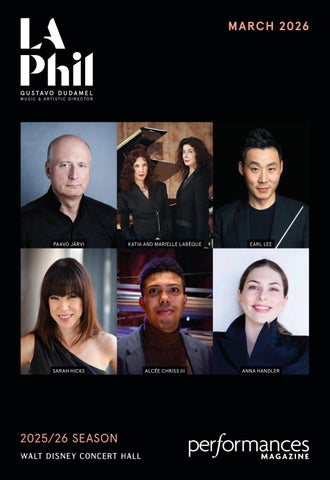
COLBURN CELEBRITY RECITAL Glass’ Cocteau Trilogy Katia and Marielle Labèque
A culinary
for your theatre outing encore
A PERFECT DINING EXPERIENCE TO PAIR WITH YOUR PERFORMANCE
Indulge in a seasonal three-course prix fixe menu at Noé Restaurant & Bar, just a short walk from the theatre. Enjoy a stress-free meal with valet parking for $25 and receive 15% off your bill at Noé when you present your theatre program. Scan the QR code & reserve your table now for an unforgettable evening.
The California Institute of Technology (Caltech) recently made history by wirelessly transmitting power from space to our campus in Pasadena. By capturing sunlight in space—where energy is unaffected by Earth’s rotation or atmosphere—Caltech is pioneering a new way to power our future.
Will uninterrupted sunlight supply Earth’s growing energy needs?
As one of the world’s leading science and engineering universities, we’re applying the same bold thinking to improve lives in ways that range from precisely targeting cancer cells using ultrasound-activated drug technology to leveraging fiber optic cable to transform our ability to understand, and prepare for, earthquakes.
An artist’s rendering of Caltech’s Space Solar Power Demonstrator in Earth’s orbit.
By including the Institute in your estate plans, you can join the Caltech community and establish a legacy of discovery and innovation.
Make Discovery Part of Your Next Act
Caltech’s Office of Gift Planning (626) 395-2927
giftplanning@caltech.edu
WELCOME
We’re delighted to have you join us at Walt Disney Concert Hall for this month’s diverse array of events. In addition to our slate of orchestral concerts, we’re presenting a new opera by Gerald Barry, Bernard Herrmann’s chilling score to Vertigo live to picture, an experimental performance with the Museum of Contemporary Art, era-spanning recitals of chamber and organ music, and a multisensory duo-piano program enhanced by specially designed perfumes under a dazzling lighting installation.
However, some of the most meaningful performances this month are not available to the general public: our Symphonies for Schools concerts. Since our founding in 1919, the Los Angeles Philharmonic has invited local students, elementary through high school, to join us for these free concerts. I cannot describe the joy of seeing buses lined up Grand Avenue filled with hundreds of young people about to discover the magic of symphonic music. This year DJ Lance Rock, the host of children’s TV series Yo Gabba Gabba!, treats us to his blend of creativity, warmth, and musical curiosity at our elementary-school concerts as well as our public Symphonies for Youth concerts on March 14 and 28. Architect Frank Gehry intended Walt Disney Concert Hall as a living room for all Angelenos, regardless of age. It is a place where creativity soars, listening is cherished, and people of all backgrounds come together to appreciate beauty, and it’s our privilege to share this experience with the next generation of music lovers.
Warmly,
Kim Noltemy
President & Chief Executive Officer
David C. Bohnett Presidential Chair Los Angeles Philharmonic Association
BOARD OF DIRECTORS
CHAIR
Jason Subotky*
PRESIDENT & CEO
David C. Bohnett Presidential Chair
Kim Noltemy
VICE CHAIRS
Thomas L. Beckmen*
Reveta Bowers*
Jane B. Eisner*
David Meline*
Diane Paul*
Jay Rasulo*
DIRECTORS
Nancy L. Abell
Gregory A. Adams
Julie Andrews
Camilo Esteban
Becdach
Linda Brittan
Jennifer Broder
Kawanna Brown
Andrea Chao-Kharma*
R. Martin Chavez
Christian D. Chivaroli
Jonathan L. Congdon
Donald P. de Brier*
Louise D. Edgerton
Dotty Ewing
Lisa Field
David A. Ford
Alfred Fraijo Jr.
Hilary Garland
Jennifer Miller Goff*
Tamara Golihew
Lori Greene Gordon
David Greenbaum
Carol Colburn Grigor
Marian L. Hall
Antonia Hernández*
Jonathan Kagan*
In Memoriam
Darioush Khaledi
Winnie Kho
Joey Lee
Daniel R. Lewis
Francois Mobasser
Margaret Morgan Leith O’Leary
Andy S. Park
Sandy Pressman
Geoff Rich*
Laura Rosenwald
Michael Saei
Richard Schirtzer
John Sinnema G. Gabrielle Starr
Jay Stein*
Christian Stracke*
Ronald D. Sugar*
Vikki Sung
Jack Suzar
Sue Tsao
Megan Watanabe
Regina Weingarten
Jenny Williams
Alyce de Roulet
Williamson
Irwin Winkler
Debra Wong Yang
HONORARY LIFE DIRECTORS
David C. Bohnett
Frank Gehry †
Lenore S. Greenberg
Bowen H. “Buzz” McCoy†
PAST CHAIRS**
Thomas L. Beckmen
Jay Rasulo
Diane B. Paul
David C. Bohnett
Jerrold L. Eberhardt
John F. Hotchkis †
Executive Committee Member as of September 26, 2025
From the opening of Walt Disney Concert Hall on October 24, 2003, to present
usbank.com/privatewealth
GUSTAVO DUDAMEL
Music & Artistic Director, Walt and Lilly Disney Chair
Gustavo Dudamel is committed to creating a better world through music. Guided by an unwavering belief in the power of art to inspire and transform lives, he has worked tirelessly to expand education and access for underserved communities around the world and to broaden the impact of classical music on new and ever-larger audiences. His rise, from humble beginnings as a child in Venezuela to an unparalleled career of artistic and social achievements, offers living proof that culture can bring meaning to the life of an individual and greater harmony to the world at large. He currently serves as the Music & Artistic Director of the Los Angeles Philharmonic and the Simón Bolívar Symphony Orchestra of Venezuela, and in 2026, he becomes the Music and Artistic Director of the New York Philharmonic, continuing a legacy that includes Gustav Mahler, Arturo Toscanini, and Leonard Bernstein. Throughout 2025, Dudamel celebrated the 50th Anniversary of El Sistema, honoring the global impact of José Antonio Abreu’s visionary education program across five generations and acknowledging the vital importance of arts education.
Dudamel’s advocacy for the power of music to unite, heal, and inspire is global in scope. In appearances from the United Nations to the White House to the Nobel Peace Prize Concert, Dudamel has served as a passionate advocate for music education and social integration through art, sharing his own transformative experience in Venezuela’s El Sistema program as an example of how music can give a sense of purpose and meaning to young people and help them rise above challenging circumstances. In 2007, Dudamel, the LA Phil, and its community
partners founded YOLA (Youth Orchestra Los Angeles), which now provides more than 1,700 young people with free instruments, intensive music instruction, academic support, and leadership training. In 2012, Dudamel launched the Dudamel Foundation, which he co-chairs with his wife, actress and director María Valverde, with the goal of expanding access to music and the arts for young people by providing tools and opportunities to shape their creative futures.
As a conductor, Dudamel is one of the few classical musicians to become a bona fide pop-culture phenomenon and has worked tirelessly to ensure that music reaches an ever-greater audience. He was the first classical artist to participate in the Super Bowl halftime show and the youngest conductor ever to lead the Vienna Philharmonic’s New Year’s Concert. He has performed at global mainstream events from the Academy Awards to Coachella, and has worked with musical icons like Billie Eilish, Christina Aguilera, LL Cool J, Ca7riel & Paco Amoroso, Laufey, Coldplay, and Nas. Dudamel conducted the score to Steven Spielberg’s new adaptation of West Side Story, and at John Williams’ personal request, he guest conducted the opening and closing credits of Star Wars: The Force Awakens. His film and television appearances include Sesame Street, The Simpsons, Mozart in the Jungle, Trolls World Tour, and The Nutcracker and the Four Realms, and in 2019 Dudamel was honored with a star on the Hollywood Walk of Fame.
For more information about Gustavo Dudamel, visit his official website at gustavodudamel.com and the Dudamel Foundation at dudamelfoundation.org.
LOS ANGELES PHILHARMONIC
The Los Angeles Philharmonic, under the vibrant leadership of Music & Artistic Director Gustavo Dudamel, presents an inspiring array of music through a commitment to foundational works and adventurous explorations. Both at home and abroad, the LA Phil—recognized as one of the world’s outstanding orchestras—is leading the way in groundbreaking and diverse programming, onstage and in the community, that reflects the orchestra’s artistry and demonstrates its vision. The 2025/26 season is the orchestra’s 107th.
Nearly 300 concerts are either performed or presented by the LA Phil at its three iconic venues: the Frank Gehry-designed Walt Disney Concert Hall, the Hollywood Bowl, and The Ford. During its winter season at Walt Disney Concert Hall, with approximately 165 performances, the LA Phil creates festivals, artist residencies, and other thematic programs designed to enhance the audience’s experience of orchestral music. Since 1922, its summer home has been the world-famous Hollywood Bowl, host to the finest artists from all genres of music. The Ford,
situated in a 32-acre park and under the stewardship of the LA Phil since December 2019, presents an eclectic summer season of music, dance, film, and family events that are reflective of the communities that comprise Los Angeles.
The orchestra’s involvement with Los Angeles extends far beyond its venues. Among its influential and multifaceted learning initiatives is YOLA (Youth Orchestra Los Angeles). Through YOLA, inspired by Gustavo Dudamel’s own training as a young musician, the LA Phil and its community partners provide free instruments, intensive music training, and academic support to over 1,700 young musicians, empowering them to become vital citizens, leaders, and agents of change. In the fall of 2021, YOLA opened its own permanent, purpose-built facility: the Judith and Thomas L. Beckmen YOLA Center at Inglewood, designed by Frank Gehry.
The orchestra also undertakes tours, both domestically and internationally, including regular visits to New York, London (where the orchestra is the Barbican Centre’s International Orchestral Partner), Paris, and Tokyo. As part of its global
Centennial activities, the orchestra visited Seoul, Tokyo, Mexico City, London, Boston, and New York. The LA Phil’s first tour was in 1921, and the orchestra has made annual tours since the 1969/70 season.
The LA Phil has released an array of critically acclaimed recordings, including world premieres of the music of John Adams and Louis Andriessen, along with Grammy-winning recordings featuring the music of Brahms, Ives, Andrew Norman, Thomas Adès, and Gabriela Ortiz—whose Yanga recieved three Grammys in 2026.
The Los Angeles Philharmonic was founded in 1919 by William Andrews Clark, Jr., a wealthy amateur musician. Walter Henry Rothwell became its first Music Director, serving until 1927; since then, 10 renowned conductors have served in that capacity: Georg Schnéevoigt (1927-1929), Artur Rodziński (1929-1933), O tto Klemperer (1933-1939), Alfred Wallenstein (1943-1956), Eduard van Beinum (1956-1959), Zubin Mehta (1962-1978), Carlo Maria Giulini (1978-1984), André Previn (1985-1989), Esa-Pekka Salonen (1992-2009), and Gustavo Dudamel (2009-present).
LOS ANGELES PHILHARMONIC
Gustavo
Herbie
[Position
* Judith and Thomas L. Beckmen
L A Phil Resident Fellow
+ On Sabbatical ◊ On Leave
CELLOS
Elise Shope Henry
Mari L. Danihel Chair
Sarah Jackson
Piccolo
Sarah Jackson OBOES
Ryan Roberts Principal Carol Colburn Grigor Chair
Marion Arthur Kuszyk
Associate Principal
Anne Marie Gabriele
English Horn [Position vacant]
CLARINETS
BASSES
Christopher Hanulik
M. Meza
Assistant Principal
David Allen Moore
Ted Botsford
Jory Herman
Brian Johnson Peter Rofé Matthew Peralta*
FLUTES
Denis Bouriakov Principal Virginia and Henry Mancini Chair
Catherine Ransom
Karoly
Associate Principal Mr. and Mrs. H. Russell Smith Chair
Boris Allakhverdyan Principal Michele and Dudley Rauch Chair
[Position vacant]
HORNS
Andrew Bain Principal
John Cecil Bessell Chair
David Cooper Associate Principal
Gregory Roosa
Alan Scott Klee Chair
Amy Jo Rhine Loring Charitable Trust Chair
Elyse Lauzon
Ethan Bearman
Elizabeth Linares Montero*
Nancy and Leslie Abell LA Phil Resident Fellow Chair
TRUMPETS
Thomas Hooten
Principal
M. David and Diane Paul Chair
James Wilt
Associate Principal
Nancy and Donald de Brier Chair
Christopher Still
Ronald and Valerie Sugar Chair
Eiffert
BASSOONS Whitney Crockett
vacant]
Ronus Chair Evan Kuhlmann
Kuhlmann
Houston Dalzell and James DaoDalzell Chair for Artistic Service to the Community
The Los Angeles Philharmonic string section utilizes revolving seating on a systematic basis. Players listed alphabetically change seats periodically.
Jeffrey Strong
TROMBONES
David Rejano Cantero Principal Koni and Geoff Rich Chair
James Miller
Associate Principal
Judith and Thomas L. Beckmen Chair
Paul Radke
Bass Trombone
John Lofton
Miller and Goff Family Chair
TUBA
Mason Soria Principal
TIMPANI
Joseph Pereira Principal
Cecilia and Dudley Rauch Chair
David Riccobono Assistant Principal
PERCUSSION
Matthew Howard Principal
Wesley Sumpter
Assistant Principal
David Riccobono
Jeremy Davis*
KEYBOARDS
Joanne Pearce
Martin Katharine Bixby Hotchkis Chair
HARP
Emmanuel Ceysson Principal Ann Ronus Chair
LIBRARIANS
Stephen Biagini
Benjamin Picard KT Somero
CONDUCTING FELLOWS
Kinga Głowacka
Ana María Patiño-Osorio
José Salazar
Miguel Sepúlveda
The musicians of the Los Angeles Philharmonic are represented by Professional Musicians Local 47, AFM.
THIS EVENING IS SUPPORTED BY
FOREVER SUMMER
CENTENNIAL CELEBRATIONS, HISTORIC COLLABORATIONS, E PIC DANCE NIGHTS: THE STARS ARE COMING OUT FOR THE 2026 HOLLYWOOD BOWL SEASON.
Last month the LA Phil announced the 2026 Hollywood Bowl season. From SaintSaëns to St. Vincent, this summer’s schedule is packed with annual favorites, up-and-coming artists, and the extraordinary music that makes every night at the Bowl special. It’s a lot to take in, so here are some of the thematic threads and fascinating connections running through the season. See you this summer!
OPENING NIGHT AT THE BOWL: THE BEST OF BROADWAY
Stars of stage and screen join for a joyous night of musical theater as we kick off the Bowl season with a little razzle-dazzle on JUNE 20. From high-kicking dance numbers to heartbreaking ballads, the evening showcases the wide-ranging artistry of the American musical with the Hollywood Bowl Orchestra and Principal Conductor Thomas Wilkins. The event not only promises a good time but also raises funds for the LA Phil’s Learning programs such as YOLA (Youth Orchestra Los Angeles).
CELEBRATING GUSTAVO AT THE BOWL
A four-night festival ( AUG 20–23) honors Gustavo Dudamel’s legacy of extraordinary music-making, community building, and thrilling cross-genre collaborations. The weekend starts with a performance of Beethoven’s Ninth Symphony and the world premiere of a work by Michael Giacchino with lyrics by poet Amanda Gorman. It continues with an evening of some of Dudamel’s favorite artists; the Foo Fighters headlining a night with the LA Phil and YOLA; and a showcase sampling the incredible music made over the past 17 years spanning the worlds of classical, pop, Latin, and more.
TWO JAZZ LUMINARIES TURN 100
The year 2026 marks the centennial of two of jazz’s greatest musicians: Miles Davis and John Coltrane. Herbie Hancock, who was famously part of Davis’ Second Great Quintet, anchors a tribute to his former collaborator (AUG 19). And saxophonist Lakecia Benjamin, who paid homage to John and Alice Coltrane on her 2020 album, Pursuance: The Coltranes, offers a salute as part of an evening featuring Wynton Marsalis and the Jazz at Lincoln Center Orchestra (SEPT 23)
MOVIE MUSIC SHINES
Maestro of the Movies: A Tribute to John Williams (SEPT 4–6) returns, and for the first time it will be performed on the John Williams Stage, named last fall in honor of the greatest film composer. In addition, a trio of concerts celebrates the music of Wes Anderson’s films (JULY 10–12), and Composer in Focus Joe Hisaishi conducts three evenings devoted to his Studio Ghibli scores and more (JULY 21–23)
DANCE AS YOU LIKE
Two evenings of electronic music are sure to keep audiences on their feet: Boris Brejcha (JULY 26) brings his signature “high-tech minimal” style along with his Venetian carnival mask, and the duo known as Bob Moses teams up with Cannons (JULY 19) for an evening of reflective songwriting with a heart-pounding beat. And the Los Angeles Ballet, currently celebrating its 20th anniversary, makes an elegant Bowl debut with its inaugural collaboration with the LA Phil (SEPT 8).
To find out more about the 2026 Hollywood Bowl season, visit hollywoodbowl.com
TAKING CENTER STAGE IN BOLSTERING MUSIC EDUCATION
The LA Phil is proud to celebrate our longtime partner Pasadena Showcase House for the Arts, whose generosity has supported the LA Phil and its learning initiatives for more than 75 years. Founded to nurture the study and appreciation of music, Pasadena Showcase continues to be a vital force in strengthening arts education across Southern California.
Now in its 61st year, the Pasadena Showcase House of Design returns in 2026 with an extraordinary new setting: Baldwin Oaks Estate, a 1907 shingle-style residence in Arcadia that has never before been open to the public. Once owned by Clara Baldwin Stocker—daughter of legendary pioneer “Lucky” Baldwin—the estate is a rare architectural treasure of the American Arts and Crafts movement. Spanning more than 8,000 square feet and set on nearly 2 acres of oak-shaded grounds, the home features a sweeping oak staircase, richly detailed interiors, and gardens
designed for lingering and discovery. This spring, 30 interior and landscape designers will transform the property, offering visitors a daylong experience that includes curated shopping, dining, and special events.
True to Pasadena Showcase’s belief that this is “more than just a pretty house,” proceeds from the Showcase House provide meaningful support for music education and access. Each year, Pasadena Showcase contributes more than $1 million to over 80 nonprofit organizations, including the LA Phil, YOLA (Youth
Orchestra Los Angeles), and the Judith and Thomas L. Beckmen LA Phil Resident Fellowship program, while also sustaining scholarships, Music Mobile performances for thousands of third graders, and youth concerts at Walt Disney Concert Hall.
The 61st Pasadena Showcase House of Design will be open April 19–May 17. We invite you to experience this remarkable home—and to celebrate the enduring impact of Pasadena Showcase’s commitment to sharing the joy of music with our community.
For tickets and information, visit pasadenashowcase.org.
BALDWIN OAKS ESTATE, THE 61ST PASADENA SHOWCASE HOUSE OF DESIGN. PHOTO BY SUSAN PICKERING
YANGA AWARDED THREE GRAMMYS
Yanga, the Los Angeles Philharmonic and Music & Artistic Director Gustavo Dudamel’s second album of symphonic works by Gabriela Ortiz, won three Grammys on February 1. The title work, featuring the Los Angeles Master Chorale and Tambuco Percussion Ensemble, received the Best Choral Performance award; the cello concerto Dzonot, with soloist Alisa Weilerstein, was awarded Best Contemporary Classical Composition; and the album was named Best Classical Compendium. Reflecting on her wins, Ortiz said, “My music is rooted in the belief that sound connects us to our origins, and music becomes a way of speaking about who we are, and what affects us as human beings. Inspired by the historical figure of Yanga, the work explores the essence of freedom—not only as a historical achievement, but as a living and urgent concept.... I am deeply grateful to the Los Angeles Philharmonic, Gustavo
Dudamel, and Alisa Weilerstein for their trust and sustained support of my work. Their commitment has made it possible for me to develop artistic projects that have borne meaningful results and have been a fundamental learning process in my artistic life.”
“I’m deeply proud to have this recording be recognized with a Grammy Award,” Dudamel said. “Yanga powerfully symbolizes the strength and resilience of those who fight for freedom, and offers a reminder of the enduring struggle against oppression that continues to this day. This is music that resonates with the rhythms of culture, nature, and humanity.”
Recorded live at Walt Disney Concert Hall and released on Platoon last July, Yanga includes Ortiz’s cello concerto, Dzonot; Seis piezas a Violeta; and the powerful title track. Yanga follows last year’s triple-Grammy Award-winning Revolución diamantina, also featuring the Los Angeles Philharmonic conducted by Dudamel.
Yanga , Dzonot , and Seis piezas a Violeta were commissioned with generous support from R. Martin Chavez, the MaddocksBrown Fund for New Music, and the Deborah Borda Women in the Arts Initiative, respectively.
TWO NEW ALBUMS FEATURE PROKOFIEV
Last month Deutsche Grammophon released a new recording of Prokofiev’s Romeo & Juliet with the Los Angeles Philharmonic conducted by Gustavo Dudamel. It’s the first of two albums in partnership with the label celebrating Dudamel’s 17-year tenure with the LA Phil as Music & Artistic Director. Recorded at Walt Disney Concert Hall in October 2018, the album showcases Prokofiev’s complete ballet score. The performance was a critical success, with Dudamel praised for his “full-throttle, rhythmically vital interpretation” (The New Yorker ).
The second album, recorded at the Hollywood Bowl in 2021,
will be released May 22 and features Prokofiev’s Peter and the Wolf narrated by EGOT winner Viola Davis. “Without fuss or exaggeration,” said the Los Angeles Times, “the celebrated actress was on mark with a clever subtle edge.… For Dudamel, every instrument, not just the flute/bird, clarinet/ cat, bassoon/grandfather, became a living being.”
The albums are the 27th and 28th recorded partnerships of the LA Phil and Dudamel, joining a robust canon. Artist Alexandra Grant designed both album covers.
For more information on the LA Phil’s recordings, please visit laphil.com/recordings
GABRIELA ORTIZ. PHOTO BY RANKIN FOR THE RECORDING ACADEMY® 2026
PRESIDENT, HOLLYWOOD BOWL AND CHIEF PROGRAMMING OFFICER
Johanna Rees
VICE PRESIDENT, PROGRAMMING AND CREATIVE PARTNERSHIPS
Kelvin Vu
VICE PRESIDENT, VENUE OPERATIONS
Programming
Alan J. Benson
SENIOR DIRECTOR, PROGRAMMING
Linda Diaz
ARTIST LIAISON
Kristen Flock-Ritchie
ARTISTIC ADMINISTRATOR
Brian Grohl
ASSOCIATE DIRECTOR, PROGRAMMING
Ljiljana Grubisic
ARCHIVES AND MUSEUM DIRECTOR
Eun Lee
PROGRAMMING MANAGER, ORCHESTRAL
Rafael Marino
SENIOR PROGRAMMING MANAGER
Mark McNeill
CREATIVE PRODUCER
Ray Melencio
Stephanie Yoon
MANAGER, ARTIST SERVICES
Rebeca Zepeda
ASSISTANT TO THE MUSIC AND ARTISTIC DIRECTOR
The Ford Chelo Montoya
DIRECTOR OF THE FORD
Gaby Hernandez
COORDINATOR, THE FORD
Gina Leoni
ASSOCIATE DIRECTOR OF OPERATIONS & LOGISTICS
Hollywood Bowl
Steve Arredondo
TRANSIT/TRAFFIC MANAGER
Dreima Flores
OPERATIONS ADMINISTRATOR
Sienna Garcia
PARKING AND TRAFFIC ASSISTANT
Emilia House
EVENT MANAGER
Norm Kinard
PARKING MANAGER
Mark Ladd
DIRECTOR, OPERATIONS/ HOLLYWOOD BOWL
Megan Ly-Lim EVENT MANAGER
Tom Waldron
ASSOCIATE DIRECTOR, OPERATIONS
Media Initiatives
Jessica Farber
ASSOCIATE DIRECTOR, MEDIA INITIATIVES
Raymond Horwitz
PROJECT MANAGER, MEDIA INITIATIVES
STRATEGIC INITIATIVES AND ENGAGEMENT
Summer Bjork
CHIEF STRATEGY OFFICER
Kevin Ma
ASSOCIATE DIRECTOR, STRATEGIC INITIATIVES
Community and Government Engagement
Cynthia Fuentes
VICE PRESIDENT, COMMUNITY AND GOVERNMENT ENGAGEMENT
Jackelinne Rodriguez
ASSISTANT MANAGER, COMMUNITY AND GOVERNMENT ENGAGEMENT
Learning Camille
Delaney-McNeil
VICE PRESIDENT, LEARNING
Jermaine Banks
ASSOCIATE OPERATIONS DIRECTOR, YOLA
Lorenzo Johnson
ASSOCIATE DIRECTOR OF PROGRAMS, YOLA
Mariam Kaddoura MANAGER, LEARNING
Sarah Little DIRECTOR, LEARNING
Diana Melgar
MANAGER, STUDENT ENGAGEMENT AND COLLEGE ACCESS, YOLA
Karla Melgar
SENIOR PROGRAM COORDINATOR, YOLA AT TORRES
Michael Salas MANAGER, YOLA NATIONAL
Gaudy Sanchez
YOLA ARTISTIC DIRECTOR
Julie West
FACILITIES MANAGER, BECKMEN YOLA CENTER
Carolina Orellana
2ND ASSISTANT TREASURER
Genevieve Goetz
DIRECTOR, GIFT PLANNING
PROGRAM MANAGER
Julia Ward
SENIOR DIRECTOR, PROGRAMMING
Miles Williams
SENIOR PROGRAM COORDINATOR, YOLA AT INGLEWOOD
The Philharmonic Box Office and Audience Services Center are staffed by members of IATSE Local 857, Treasurers and Ticket Sellers.
CORPORATE PARTNERS
The Los Angeles Philharmonic Association is honored to recognize our corporate partners, whose generosity supports the LA Phil’s mission of bringing music in its varied forms to audiences at Walt Disney Concert Hall, the Hollywood Bowl, and The Ford. To learn more about becoming a partner, email corporatepartnerships@laphil.org.
ANNUAL GIVING
From the concerts that take place onstage at Walt Disney Concert Hall, the Hollywood Bowl, and The Ford to the learning programs that fill our community with music, it is the consistent support of Annual Donors that sustains and propels our work. We hope you, too, will consider making a gift today. Your contribution will enable the LA Phil to build on a long history of artistic excellence and civic engagement. Through your patronage, you become a part of the music—sharing in its power to uplift, unite, and transform the lives of its listeners. Your participation, at any level, is critical to our success.
FRIENDS OF THE LA PHIL
Friends and Patrons of the LA Phil share a deep love of music and are committed to ensuring that great musical performance thrives in Los Angeles. As a Friend or Patron, you will be supporting the LA Phil’s critically acclaimed artistic programs at Walt Disney Concert Hall, the Hollywood Bowl, and The Ford, as well as groundbreaking learning initiatives such as YOLA (Youth Orchestra Los Angeles), which provides free after-school music instruction to children in culturally vibrant and ethnically diverse communities across LA County. Let your passion be your guide, and join us as a member of the Friends and Patrons of the LA Phil. For more information, or to learn about membership benefits, please call 213 972 7557 or email friends@laphil.org.
PHILHARMONIC COUNCIL
Winnie Kho and Chris Testa, Co-Chairs
Christian and Tiffany Chivaroli, Co-Chairs
The Philharmonic Council is a vital leadership group whose members provide critical resources in support of the LA Phil’s general operations. Their vision and generosity enable the LA Phil to recruit the best musicians, invest in groundbreaking learning initiatives, and stage innovative artistic programs, heralded worldwide for the quality of their artistry and imagination. We invite you to consider joining the Philharmonic Council as a major donor. For more information, please call 213 972 7209 or email patrons@laphil.org.
John Williams & Rachmaninoff
Los Angeles Philharmonic
Anna Handler, conductor
Thomas Hooten, trumpet
John WILLIAMS Theme from Jurassic Park (c. 5 minutes)
— except friday
John WILLIAMS Concerto for Trumpet and Orchestra (c. 20 minutes)
Maestoso
Slowly
Allegro deciso
Thomas Hooten
INTERMISSION — except friday
RACHMANINOFF Symphonic Dances, Op. 45 (c. 35 minutes) Non allegro
Andante con moto (Tempo di valse) Lento assai—Allegro vivace
Programs and artists subject to change.
FRIDAY
MARCH 13, 2026 8PM
SATURDAY
MARCH 14 8PM
SUNDAY
MARCH 15 2PM
Anna Handler’s appearance on Friday is generously supported by Margaret Klinkow Hartmann and Thomas Hartmann
AT A GLANCE
Though best known as a film composer—the film composer, for many—John Williams has written concert music throughout his career, starting in the 1960s. His concert catalog now numbers over 50 pieces, written in a personal style as protean and distinctive as his music for screens, without its restrictions. “I don’t make a particular distinction between ‘high art’ and ‘low art,’” he has said. “Music is there for everybody. It’s a river we can all put our cups into, and drink it and be sustained by it.”
Concertos and other works for solo instruments and orchestra comprise a substantial part of his concert output. Williams’ 1996 Trumpet Concerto is built on the three-movement, fast-slow-fast
First LA Phil performance: August 20, 1993, the composer conducting
Novelist Michael Crichton was a master of the “techno-thriller,” in which he extrapolated contemporary scientific knowledge into dangerous future possibilities; the result was a series of bestsellers including The Andromeda Strain, The Terminal Man, Sphere, and Jurassic Park
He began writing Jurassic Park in 1983, imagining that
structure of concerto tradition: head, heart, and dancing feet, as pianist Christopher O’Riley once described concertos. LA Phil Principal Trumpet Thomas Hooten has been a prominent advocate for the piece, producing his own recording of a 2018 performance, with the composer conducting.
Rachmaninoff’s three dramatic, highly kinetic Symphonic Dances make a stylistically compatible match for the Williams concerto (and the theme from Jurassic Park that prefaces it). This was the last music Rachmaninoff wrote (except for the second major revision he made of his Fourth Piano Concerto), and it has a leaner, more edgy sonic profile than his earlier work, while maintaining his legendary tunesmithing standards. —John Henken
dinosaurs could be cloned from ancient DNA. He worked on it for several years, and its 1990 publication—in which the creatures were the main attraction for visitors at an island theme park—was met with huge book sales and an immediate commitment from Steven Spielberg to turn it into a big-screen summer blockbuster with astounding visual effects.
In the 1993 film, Sam Neill and Laura Dern play scientists who visit the island, and Richard Attenborough, a billionaire businessman who masterminds the entire operation. John Williams’ two main themes have become among his most popular: a celebratory fanfare and high-spirited adventure theme that accompanies the scientists’ initial visit to the island, and music of awe and beauty for the gentle, majestic creatures they first encounter there.
Jurassic Park pioneered the extensive use of computer-
generated visual effects that is commonplace today; it won three Oscars for its innovative visual and sound work. It eventually made more than $1 billion and launched a franchise that includes six sequels, most recently last summer’s Jurassic World Rebirth —Jon Burlingame
John Williams is among the world’s most famous, respected, and honored film composers. But that is only part of his musical life. He has actively contributed music for the concert hall since the mid-1960s. Large-scale works for symphony orchestra, fanfares and other celebratory pieces, chamber music, and more than a dozen concertos spotlighting individual soloists are equally important aspects of his overall musical output.
The Concerto for Trumpet and Orchestra was commissioned by The Cleveland Orchestra and premiered in September 1996. In a preface to the work, Williams wrote:
As a youngster growing up in the 1940s, I was not unaware of the enormous influence that the brass players of the great swing bands had on the young people of our country. Beginning with Louis Armstrong, whose contribution inspired generations of trumpeters, these artists extended the expressive capabilities of their instruments and can certainly be credited with developing a school of brass playing, the influence of which can still be felt in nearly every musical ensemble that employs brass. In my teen years, I too wanted to join in the fun. My father agreed that if I continued with my piano studies, I could have a trombone; and he arranged for me to take lessons. I also
taught myself to play a little on the trumpet, but I was never very comfortable switching mouthpiece sizes, so my brass playing—always amateur level to be sure—was pretty much restricted to the trombone. Given this background, and after writing so much brass music for films and for ceremonial pieces, you can imagine my pleasure when The Cleveland Orchestra asked me to write a concerto...an opportunity to compose a work for an instrument that I truly love.
Trumpeter Michael Sachs, who premiered the work, called it “the great American trumpet concerto,” and over three decades of performances it has been frequently hailed as a significant addition to the trumpet literature. Certainly the work’s virtuosity, its rhythmic drive, the brilliance of its orchestration, and its compelling melodic content assure its future for the best brass players.
The composer has revised the work twice. Williams wrote a new ending to the first movement for a United States Marine Band performance in December 2016. Minor revisions were also made in the second and third movements in anticipation of a later recording.
The first movement offers a series of heroic fanfares against inventive orchestral accompaniment, followed by a cadenza for solo trumpet; the second movement takes
a more lyrical, contemplative turn, with hints of the jazz influences that Williams spoke about; the third movement is one of nonstop energy and excitement, with endless technical challenges for the soloist.
LA Phil Principal Trumpet Thomas Hooten recorded the concerto, with Williams conducting, in 2018, a recording that is today considered definitive. “This piece may not be what many would expect from John Williams if they only heard his movie music,” says Hooten. “This is a more complicated and sophisticated composition that showcases the best parts of the instrument while challenging the soloist to push the limits of lyricism and color of sound.” —J.B.
First LA Phil performance: February 18, 1943, William Steinberg conducting
We now recognize and admire Rachmaninoff as a creator of moodily memorable melodies, without feeling the need, as we once did, to apologize for the beauty of those melodies—or blame him for being widely emulated by composers of film scores (who, likewise, are now regarded with a degree of respect formerly denied them) or the creators of the popular love songs his melodies inspired.
Rachmaninoff summed up his life as a composer shortly before his death, in Beverly Hills, his final home: “In my own compositions, no conscious effort has been made to be original, or Romantic, or Nationalistic, or anything else. I write down on paper the music I hear within me, as naturally as possible. I am a Russian composer, and the land of my birth has influenced my temperament and outlook. My music is the product of my temperament, and so it is Russian music.... I have been strongly influenced by Tchaikovsky and RimskyKorsakov; but I have never, to the best of my knowledge, imitated anyone. What I try to do when writing down my music is to make it say simply and directly that which is in my heart when I am composing. If there is love there, or bitterness, or sadness, or religion, these moods become part of my music, and it becomes either beautiful or bitter or sad or religious.”
For most of his career Rachmaninoff, also one of the great pianists of his time, was the object of critics’ scorn for remaining stylistically rooted in the 19th century while living in the 20th.
However, with the Symphonic Dances, Rachmaninoff combined a modernist rhythmic element—inspired by Stravinsky and Prokofiev—with his own unquenchable penchant for the big tune.
The Symphonic Dances had its beginnings as far back as 1915, in sketches for a ballet score called The Scythians (not to be confused with Prokofiev’s Scythian Suite) that he submitted to dancer-choreographer Michel Fokine, who rejected them as “unballetic.” A quarter-century later, while living on New York’s Long Island, Rachmaninoff resurrected ideas from The Scythians to form the first movement of the Symphonic Dances, which was premiered in 1941 by its dedicatees, Eugene Ormandy and his Philadelphia Orchestra. The initial reception for what is now widely regarded as Rachmaninoff’s most important symphonic work was lukewarm. The audience wanted more lushness, the critics less. It has since become the darling of critics among the composer’s scores and, increasingly, an audience favorite.
Rachmaninoff, his performers’ capabilities ever in mind, was in the habit of having an accomplished violinist check the practicability of the bowings for all his works involving strings. For the Symphonic Dances, this function was fulfilled by no less than Fritz Kreisler, Rachmaninoff’s frequent recital partner. Since Kreisler considered no violin part too difficult, the score emerged as music for a virtuoso orchestra. The terse, march-like opening thematic figure dominates
the entire first movement. It features prominently even in the gorgeously mournful, quintessentially Russian episode for the alto saxophone, whose part was tested by another expert, the composer and Broadway arranger Robert Russell Bennett. The final theme of the movement, announced staccato in the strings, is an exotic, richly chromatic affair that Rachmaninoff seems to have lifted from his de facto orchestration textbook, Rimsky-Korsakov’s opera The Golden Cockerel In the coda, Rachmaninoff quotes the opening theme of his First Symphony.
The second dance opens with menacing chords (stopped horns and muted trumpets), followed by an eerie waltz that moves from near lethargy to extreme agitation. The movement concludes with soft, scampering woodwindand-string figures that suggest the participants not so much ending their dance as being blown away, still whirling, out of their dark, ghostly ballroom into an even darker night. The third and final section mixes Russian Orthodox chant and the medieval chant for the dead “Dies irae.” The church is further represented by the “Alleluia” theme from the composer’s own choral Vespers (1915), which eventually muscles out the “Dies irae”: a symbolic triumph of life over death? This was the last music Rachmaninoff ever wrote. Two years later, and a month after becoming an American citizen, he died of cancer, a few days short of his 70th birthday. —Herbert Glass
The German Colombian conductor and pianist Anna Handler has been performing on stages and in concert halls around the world since her debut at the Salzburg Festival in 2022.
In November 2025, she was appointed Chief Conductor of the Ulster Orchestra, a position she will begin in the 2026/27 season. Since the 2025/26 season, she has served as Kapellmeister at the Deutsche Oper Berlin, where she was invited to conduct 11 opera performances in her first season. She was a Dudamel Fellow with the Los Angeles Philharmonic in the 2023/24 season. Following her debut at Walt Disney Concert Hall, she was invited to conduct the orchestra at the Hollywood Bowl in July 2025. Last summer Handler also made her highly successful debut with the Boston Symphony Orchestra at the Tanglewood Music Festival. She had been appointed Assistant Conductor of the Boston Symphony Orchestra by Andris Nelsons for a two-year term beginning with the 2024/25 season and concluding in the summer of 2026, marking another important milestone in her career. The 2025/26 season sees her subscription debuts with both the LA Phil at Walt Disney Concert
Hall and the Boston Symphony at Symphony Hall in Boston. Other notable engagements include appearances with the Dresden Philharmonic and the New Year’s concert of the Royal Swedish Opera, as well as a concert at the Elbphilharmonie Hamburg in April 2026 with tenor Jonathan Tetelman. She previously conducted the Berlin Philharmonic Brass at the Dresden Music Festival.
Handler’s close relationship with the Salzburg Festival began in 2022 with her debut as Music Director of Kát’a Kabanová for the renowned Opera Camp series, followed by Ravel’s L’enfant et les sortilèges in 2023 and Carl Orff’s Die Kluge in 2024. Further highlights include debuts with the Minnesota Orchestra, BBC Philharmonic, and Frankfurt Radio Symphony, as well as collaborations with Barbara Hannigan, Okka von der Damerau, Sabine Meyer, and Yo-Yo Ma.
Handler grew up in Munich and studied piano and conducting at the University of Music and Performing Arts Munich before continuing her studies at the University of Music Franz Liszt in Weimar, the Accademia Pianistica of the Fondazione Accademia Internazionale di Imola, and the Folkwang University of the Arts. She completed her Master’s degree in conducting at The Juilliard School in New York in 2023. At Juilliard, she was the first conductor ever to receive the prestigious Kovner Fellowship. As director of the Ensemble Enigma Classica, which she founded in 2019, Handler works with renowned soloists. She is particularly interested
in technology-supported music mediation in real time. Conducting from the piano and chamber music collaborations with violinist Laura Handler are an important part of her musical identity. Handler received the Rising Star Award from the European Cultural Foundation Europamusicale and is a scholarship holder of the German Foundation for Musical Life. She was also awarded the Maria Ladenburger Prize for Music in cooperation with WDR, the Cusanuswerk Foundation, and Deutsche Grammophon.
THOMAS HOOTEN
Thomas Hooten is Principal Trumpet of the Los Angeles Philharmonic, a position he has held since 2012. Before joining the LA Phil, Hooten served as Principal Trumpet in the Atlanta Symphony from 2006 to 2012 and as Assistant Principal Trumpet with the Indianapolis Symphony. He began his professional career in 2000 with a trumpet/ cornet position in “The President’s Own” United States Marine Band in Washington, DC.
ANNA HANDLER
Alcée Chriss III
Alcée Chriss III, organ
RACHMANINOFF Non allegro from Symphonic Dances, transcribed by Op. 45 (c. 13 minutes) Alcée CHRISS III
FRANCK Allegretto from Symphony in D minor arranged by (c. 11 minutes) HAMPTON
YOUMANS “Tea for Two” (c. 4 minutes) arranged by TATUM and Alcée CHRISS III
GUILLOU Toccata, Op. 9 (c. 9 minutes)
INTERMISSION
J.S. BACH Prelude and Fugue in D major, BWV 532 (c. 10 minutes)
ARLEN “Over the Rainbow” (c. 4 minutes) arranged by PETERSON and Alcée CHRISS III
TRADITIONAL Improvisation on “Amazing Grace” arranged by SWANN (c. 4 minutes) and Alcée CHRISS III
REGER Fantasy and Fugue on B-A-C-H, Op. 46 (c. 19 minutes)
SUNDAY MARCH 15, 2026 7:30PM
Michael Wilson is Walt Disney Concert Hall Organ Conservator.
Manuel Rosales and Morgan Byrd are principal technicians for the Walt Disney Concert Hall organ.
laphil.com/organstoplist
Programs and artists subject to change.
Alongside more than 500 years of music specifically composed for the organ lives a large body of works (transcriptions, arrangements, and adaptions) derived from the repertoire of other instruments or ensembles.
The earliest collections of organ music, dating back to at least the 15th century, contain large numbers of intabulations—arrangements of polyphonic vocal literature for keyboard performance. By the 18th century, transcribing or arranging orchestral music for organ was commonplace in works such as Bach’s arrangements of concertos by Vivaldi and the French Baroque composer Jean-Henri D’Anglebert’s arrangements of popular dance tunes by Lully. During the 19th century, the expressive capabilities of the organ increased while virtuosos such as Franz Liszt and Edwin Lemare made keyboard arrangements of everything from Beethoven symphonies to Wagner operas. In the 20th century, Louis Vierne’s six symphonies, composed for performance on the “symphonic” organs of the Parisian builder Aristide Cavaillé-Coll, further underscored the connections between music for organ and orchestra.
Sergei Rachmaninoff’s Symphonic Dances and César Franck’s Symphony in D minor, both valedictory works written within a few
years of their composer’s death, represent the culmination of each one’s work in symphonic form.
By 1940, when the Symphonic Dances was composed, Rachmaninoff (1873–1943) was living in the US, recovering from an exhausting two decades of touring as pianist and conductor. He found refuge at the Honeyman Estate, “Orchard Point,” overlooking Long Island Sound. Originally titled Fantastic Dances (Noon, Twilight, and Midnight), it was the composer’s last major work and was dedicated to Rachmaninoff’s friend and longtime collaborator Eugene Ormandy and The Philadelphia Orchestra, who premiered the work in 1941. The first movement, Non allegro, like so much of the composer’s output, presents a seemingly limitless string of beautiful melodies, all imaginatively and carefully orchestrated (including some noteworthy solos for alto saxophone).
Franck (1822–90) had a dense, chromatic style that was rooted in German, particularly Wagnerian, models. The very idea of composing a symphony—a form primarily associated with German composers—was seen by some as a betrayal of French musical culture. (Prior to Saint-Saëns’ Third Symphony, Berlioz’s Symphonie fantastique was the only symphony
considered part of the French canon.) The Symphony in D minor, cast in three broad movements, relies on techniques established especially by Liszt where a brief theme is stated and continuously developed throughout a large symphonic work. The third and final movement, Allegretto (here as arranged by Calvin Hampton), based on an extended melodic inversion of the symphony’s primary theme, is a joyful, up-tempo foil to the two darker and more serious movements that precede it.
The astonishing jazz pianists Art Tatum (1909–56) and Oscar Peterson (1925–2007) could keep audiences transfixed while improvising reimagined popular songs such as Vincent Youmans’ (1898–1946) “Tea for Two,” presented in the first half of the program, and Harold Arlen’s “Over the Rainbow,” in the second half. Tatum recorded several versions of “Tea for Two” beginning around 1933 and set the standard for virtuosity among jazz pianists that was rarely if ever exceeded. Although Vladimir Horowitz often included “Tea for Two” as an encore at the end of his recitals, he reportedly vowed never to play it again in public after hearing Tatum improvise on the tune.
Arlen’s (1905–86) classic song “Over the Rainbow,” from the 1939 film The Wizard of Oz, was a favorite of the
Canadian jazz pianist and composer Oscar Peterson. Releasing more than 200 recordings and playing thousands of concerts worldwide over a career that spanned more than 60 years, Peterson was dubbed the “Maharaja of the keyboard” by Duke Ellington. His version of “Over the Rainbow” was a staple of his live concerts and was featured on the 1960 album Oscar Peterson Plays the Harold Arlen Song Book
During his lifetime, Johann Sebastian Bach (1685–1750) was better known as an improviser than as a composer, and as a young man he devoted considerable time to developing both art forms. He famously made a 200-mile trek on foot at the age of 20 to visit one of the great virtuosos of the day, Dieterich Buxtehude, from whom he learned a great deal about composing for—and presumably improvising on—the organ. One of Buxtehude’s claims to fame was his pedal technique, and Bach’s writing for the pedals exceeds that of his teacher by a fair bit, as seen throughout the Prelude and Fugue in D major, BWV 532 The Prelude consists of an opening toccata-like section with virtuosic scale passages and arpeggios for the pedals, a contrasting contrapuntal “Alla breve” (two beats per measure) with Italianate suspensions and slow-moving harmonies, and a concluding
slow section featuring a brief “recitative.” The fugue is built on two ideas: the first using only three notes in a quick up-and-down figure stated four times; the second, a mind-numbing descending sequence with a brief cadential figure. The fugue subject must have been a favorite of Bach’s, because he reused it in the Toccata in D, BWV 912. It was also a favorite of Ottorino Respighi, who transcribed the work for orchestra.
Instruction in improvisation is a part of nearly every serious organ student’s training. Especially in France, the art of improvisation is taught side by side with technique and interpretation, and students are routinely tested on their ability to improvise on material of their own imagining or on a theme presented to them. In the hands of a great improviser, a seemingly innocuous tune can give rise to vast, complex, and thrilling masterpieces, however fleeting. The great organist, conductor, and composer Frederick Swann (1931–2022) was famous for the extended improvisations he routinely dashed off during his long career as organist in several large New York and Los Angeles churches. (Fred, as he was known to friends, happily spent his retirement as artist-in-residence at St. Margaret’s Episcopal Church in Palm Desert, playing
Sunday services until shortly before his death.) Chriss’ arrangement of “Amazing Grace” comes from a collection of improvisations that Swann committed to paper and published in 2006.
Jean Guillou (1930–2019) and Max Reger (1873–1916) both revered the music of Bach and incorporated elements of Bach’s art in their own music, and Chriss closes both halves of tonight’s recital with their works, respectively. Guillou’s standalone Toccata, Op. 9, was composed in 1963, the year he began a 52-year career as Titular Organist of the Church of Saint-Eustache in Paris. The work was recorded by Chriss on his 2019 album Art et Rhapsodie. The piece provides an opportunity for virtuosic display as well as lyrical reflection. The Fantasy and Fugue on B-A-C-H, Op. 46, by Reger, begins with a toccata-like essay on the “Bach” theme—a four-note motive derived from the German musical spelling of the notes B-flat, A, C, and B-natural. The theme is heard throughout and clearly identifiable despite Reger’s densely packed chromatic writing. The Fugue, likewise, focuses on the same four notes, building from a quiet, chant-like statement to a massive 12-note texture in which all the organist’s 10 digits and two feet participate. —Thomas Neenan
ALCÉE CHRISS III
A featured star in the PBS documentary Pipe Dreams (2019), Alcée Chriss III is an organist and keyboardist from Fort Worth, TX. Dr. Chriss is the winner of the 2017 Canadian International Organ Competition and the Firmin Swinnen Silver Medal at the 2016 Longwood Gardens International Organ Competition. He has been celebrated for his “grace, skill and abundant proficiency” by the Journal Assist News (Albuquerque). Of his solo recording at
Montreal Symphony House, Art et Rhapsodie (2019), the American Record Guide wrote that “he plays with clarity, imagination, musicality, virtuosity, and yes, personality.”
Chriss has performed throughout North America and Europe. Recent and upcoming performances include the International Organ Summer (Stuttgart, Germany), Stockholm City Hall (Sweden), and Marion Anderson Hall at the Kimmel Center (Philadelphia), and as soloist with the Montreal Symphony Orchestra in Copland’s Symphony for Organ and Orchestra. Other engagements include the Princeton University Chapel, Longwood Gardens (PA), Spreckels Organ Pavilion (San Diego), and the International Organ Summer (Karlsruhe, Germany). In July 2022, he was a featured performer at the national convention of the American Guild of Organists, held in Seattle.
In July 2019, Chriss was appointed University Organist and Artist-inResidence at Wesleyan University, where he teaches courses in organ and keyboard skills. In October 2019, he was awarded his Doctor of Music degree from McGill University, where he studied with Hans-Ola Ericsson. He previously studied at Oberlin Conservatory of Music, where he received his Master’s degree in historical keyboard and a Bachelor’s degree in organ performance, studying with Olivier Latry, Marie-Louise Langlais, and James David Christie. Chriss is active as a church musician and guest lecturer. He also remains engaged with his lifelong love of gospel and jazz music. He is currently Assistant Organist at Trinity Church Wall Street (New York) and serves on the editorial board of Vox Humana magazine.
Mozart & Benavides
Members of the Los Angeles Philharmonic
Joshua Blue, tenor
John Adagio (c. 3 minutes)
HAYHURST Jin-Shan Dai, violin
Ashley Park, violin
Jenni Seo, viola
Robert deMaine, cello
Christopher Hanulik, bass
Nicolás Lell Sueño en mi sueño (c. 28 minutes)
BENAVIDES No te amo como si fueras rosa de sal (Soneto 17) Tal vez no ser es ser sin que tú seas (Soneto 69) Cuando yo muera quiero tus manos en mis ojos (Soneto 89)
Pensé morir, sentí de cerca el frío (Soneto 90)
Si muero sobrevíveme con tanta fuerza pura (Soneto 94)
Ya eres mía. Reposa con tu sueño en mi sueño (Soneto 81)
Joshua Blue, tenor
Anne Marie Gabriele, oboe
Jin-Shan Dai, violin
Ashley Park, violin
Dana Lawson, viola
Brent Samuel, cello
INTERMISSION
GARDEL “Por una cabeza” (c. 6 minutes)
arranged Dahae Kim, cello by James Gloria Lum, cello
BARRALET Brent Samuel, cello
Jason Lippmann, cello
MOZART String Quintet No. 3 in C major, K. 515 (c. 37 minutes)
Allegro
Menuetto: Allegretto
Andante
Allegro
Mark Kashper, violin
Jung Eun Kang, violin
Minor L. Wetzel, viola
Michael Larco, viola
Barry Gold, cello
TUESDAY MARCH 17, 2026 8PM
Programs and artists subject to change.
AT A GLANCE
Richly expressive music of love and loss fills the first half of this program. The brief Adagio by John Hayhurst, a longtime stalwart of the LA Phil viola section, is a precisely measured elegy for strings. Concision proves no impediment to depth of feeling, and sonic warmth gives comfort to the leave-taking expressed here.
Sustaining love’s caring impetus through terminal illness is the subject of Sueño en mi sueño (Dream in my dream), New Mexican composer Nicolás Lell Benavides’ song cycle on six sonnets by Pablo Neruda. It is dedicated to LA Phil oboist Anne Marie Gabriele’s husband, who passed away in 2022, and in this pocket cantata the oboe is the wordless caregiver for the ailing lover voiced by the tenor. The cycle progresses from animated love through fear and acceptance of separation to a serene final benediction.
ADAGIO
John Hayhurst
Composed: 2014
The Adagio for string quintet was composed by John Hayhurst, a violist in the Los Angeles Philharmonic since 1984. This piece was inspired by the warmth of Berg, the brevity of Webern, and the structural integrity of both. It’s highly organized, with a six-note theme stated in turn by all instruments. The viola begins the theme and continues with a descending chromatic line, which connects to the
Sunny spirits prevail in the second half. Carlos Gardel’s classic tango “Por una cabeza” alternates between major and minor mode, but even on the dark side it is passionate, not tragic, and James Barralet’s arrangement stresses its insouciant elegance.
There is little music more elegant—and eloquent—in the best sense than Mozart’s late string quintets. The C-major quintet, K . 515, is an organically expansive work; the opening movement is perhaps the longest in sonata form of its time, sublimely developed without a hint of artificial padding. The Menuetto dances with both grace and energy, and the Andante is an almost operatic duet for violin and viola—a particularly magical combination for Mozart. The fleet finale wraps up this ear-ravishing work with the sort of grand exuberance only Mozart could manage. —John Henken
final entrance in the bass. Subsequently, chromatic tension is created by theme manipulation in retrograde with the chromatic line ascending, bringing the Adagio to a resolution. When writing the Adagio in August of 2014, Hayhurst was focused on the structure and its tight form. Upon revisiting the Adagio, he noticed a sadness in the music that felt like a melancholy farewell. He later wrote a choral arrangement with lyrics inspired by the last words of Emily Dickinson, Jane Austen, and Michael Landon. —Courtesy of John Hayhurst
SUEÑO EN MI SUEÑO
Nicolás Lell Benavides (b. 1987)
Composed: 2025
Sueño en mi sueño (Dream in my dream) is a collection of six love sonnets by Pablo Neruda that explore the depth of love in times of sickness. These iconic poems use symbols of loneliness, dreams, and death to describe the feeling of being away from your lover, even for a moment. In this setting of Neruda’s love sonnets, there are two soloists: a tenor and an oboe. The oboe is the wordless caregiver of the tenor.
Though exhausted, the oboe still finds moments of joy, affection, and warmth, while the tenor channels bravery and grace in the face of a horrible diagnosis. It takes grit and determination to care for a loved one, but this piece also acknowledges the humility and grace required to be cared for. The singer ultimately comforts the caregiver by asking them to rest, singing, “Reposa tu sueño en mi sueño / Rest with your dream in my dream.” It is impossible to ignore the impact and legacy of Peter Lieberson’s Neruda Songs, which were commissioned by the Los Angeles Philharmonic and the Boston Symphony Orchestra to be premiered in 2005 in performances featuring his wife, the mezzo-soprano Lorraine Hunt Lieberson. Tragically, Lorraine died of breast cancer only a year after having premiered it. Presciently, Peter Lieberson wrote, “There is the recognition that no matter how blessed one is with love, there will be a time when we must part from those whom we cherish so much.”
This new set of songs is dedicated to oboist Anne Marie Gabriele’s husband, Mike Pandolfi, who passed away in 2022. Three weeks after finding out he was diagnosed with stage 4 cancer, they got married and faced it as a couple. I hope their story inspires gratitude for every precious moment together, even when those moments are difficult.
—Nicolás Lell Benavides
Nicolás Lell Benavides’ Sueño en mi sueño was commissioned by Elizabeth and Justus Schlichting in honor of Mike Pandolfi.
”POR UNA CABEZA”
Carlos Gardel (1890–1935)
Arranged by James Barralet
Composed: 1935
Born Charles Gardès in 1890 in Toulouse, France, Carlos Gardel was taken by his single mother to Buenos Aires when he was 2 years old. He grew up to become an enormously popular icon of Latin American culture, a singer-songwriter and film star whose fame
only grew with his tragic death in a plane crash in 1935. He revolutionized the tango-canción with numerous miniature masterpieces, including “Por una Cabeza,” written the year he died. (Gardel wrote the music; Alfredo Le Pera, his lyricist partner, died with him and other members of his entourage in the crash.)
Capturing the yearning essence of tango, “Por una Cabeza” has been covered by artists across many musical genres and seemed to have a monopoly on musical passion in Hollywood in the early 1990s, when it was featured in Scent of a Woman, Schindler’s List, and True Lies. (The title, “By a Head,” is a phrase from horse racing; the lyrics compare a racing gambler’s addiction to his love for women.)
British cellist and improvisatory musician James Barralet has arranged everything from Vivaldi and Verdi to Arabic folk songs to Pirates of the Caribbean for cello ensembles. His version of “Por una Cabeza” draws on elements of the original as well as various film incarnations and adds some new bits, including a fugal finale. —J.H.
STRING QUINTET NO. 3
IN C MAJOR, K. 515
Wolfgang Amadeus Mozart (1756–91)
Composed: 1787
Mozart reaches his most breathtaking peaks of chamber-music inspiration in his late works for five instruments: the four quintets for strings, K. 515, K. 516, K. 593, and the generally underrated K. 614, all scored for string quartet with a second viola; and the quintet for clarinet and string quartet, K. 581. The notion of a string quintet with two violas was new in the 1770s, when Mozart wrote his first such work. After hearing Michael Haydn’s first string quintet (in C) in March 1773, 17-year-old Mozart plunged into these barely charted waters with his Quintet in B-flat, K. 174—hardly music to stand with his mature masterpieces, but a work of some consequence, with a greatly expressive slow movement. That Mozart took the work seriously is evidenced by the fact that he rewrote its last two movements after a two-month stay in Vienna, where he had been hugely impressed by the latest
quartets of another Haydn, Michael’s older brother Joseph. No concrete evidence exists as to the occasion(s) for which Mozart wrote the three string quintets of 1787, K. 515, K. 516, and K. 406/K. 516b, the last an arrangement of his wind octet, K. 388. The composer likely wrote them on speculation, “hoping to sell manuscript copies to amateurs by subscription,” according to musicologist H.C. Robbins Landon.
These were by no means the first large-scale works that Mozart had created on spec, but unlike the piano concertos of 1783, which quickly sold, the quintets were hardly snapped up by amateurs, who would have found them technically daunting. The composer was neither consciously catering to Vienna’s aristocratic salons nor being courted by them as the year 1787 waned. He finally sold them for a pittance to the publisher Artaria and Co.
The opening of K. 515, as the cello dances upward through light accompaniment, recalls the opening of Joseph Haydn’s “Bird” Quartet (Op. 33, No. 3), but thereafter the tone and texture are entirely Mozartian: the uniquely rich and mellow texture he created by
emphasizing the inner voices (here, the two violas) that had been regarded as unnecessary “thickening” elements, even rude, by 18th-century listeners.
The pianist and writer Charles Rosen noted of K. 515’s opening that after that mounting cello phrase, there is “the same inner accompanying motion, the same placing of the first violin [as in Haydn’s ‘Bird’].
Yet Haydn’s nervous rhythm is avoided: In place of his independent six-measure phrases—the motion broken abruptly between them—Mozart has a linked series of five-measure phrases with absolutely uninterrupted continuity.”
The minuet is elegant but by no means lightweight, with a chromatically tinged trio of grand proportions. The slow movement is one of Mozart’s seemingly effortless heartbreakers—in essence a dialogue between first violin and first viola. The finale is a jubilant, elegant sublimation of feeling of the finest and strongest sort by a man who, while only 31 years old, was in the process of being discarded by those who had so recently set him on a pedestal. —Herbert Glass
JOSHUA BLUE
British American tenor Joshua Blue appeared with the LA Phil last fall in Mozart’s Requiem at the Hollywood Bowl, reuniting with conductor James Gaffigan. During the 2025/26 season, Blue has major return engagements at the Metropolitan Opera to revive his portrayal of Tamino in Julie Taymor’s family-friendly version of The Magic Flute led by Erina Yashima; St. John the Divine for a special New Year’s Eve concert of Beethoven’s Symphony No. 9 under the baton of Kent Tritle; and the English National Opera to reprise Ferrando in Così fan tutte with multi-award-winning director Phelim McDermott and conductor Dinis Sousa for performances in London and Manchester. Debuts during the season include Opéra national de Nancy-Lorraine for a new staged production of Verdi’s Requiem, with design and scenography by César Vayssié and Sora Elisabeth Lee conducting; and Rodolfo in La bohème with both Opera North, conducted by Garry Walker and Catriona Beveridge in a
production by Phyllida Lloyd, and Austin Opera, with Music Director Timothy Myers on the podium and stage director Eboni Adams.
Blue earned his Bachelor’s degree from the Oberlin Conservatory of Music and graduated from The Juilliard School with a Master’s degree, studying voice with Robert C. White, Jr. He is a former Apprentice Singer with Santa Fe Opera and is an alumnus of the Cafritz Young Artists program with the Washington National Opera.
JIN-SHAN DAI
Dynamic violinist Jin-Shan Dai has performed extensively throughout North America, Europe, and Asia. He joined the Los Angeles Philharmonic at the beginning of the 2010/11 season. He was a member of the Toronto Symphony from 2004 to 2010 and made his debut as a soloist with that orchestra in 2008, playing Vivaldi’s The Four Seasons
ROBERT deMAINE
Robert deMaine is an American virtuoso cellist who has been hailed by The New York Times as “an artist who makes one hang on every note.” He has received critical acclaim as soloist, recitalist, orchestra principal, recording artist, chamber musician, and composer-arranger. In 2012, he was invited to join the Los Angeles Philharmonic as Principal Cello.
ANNE MARIE GABRIELE
Anne Marie Gabriele joined the Los Angeles Philharmonic in January 2000 as second oboist, a position she held in the Columbus Symphony Orchestra from 1993 to 1999 and in the Honolulu Symphony from 1990 to 1993. In addition to her duties in Columbus, she was Principal Oboist of the Canton (OH) Symphony Orchestra from 1993 to 1999.
BARRY GOLD
Los Angeles-born cellist Barry Gold, a member of the Los Angeles Philharmonic since 1982, began cello studies with Gretchen Geber. He earned his Bachelor’s and Master’s degrees from The Juilliard School.
CHRISTOPHER HANULIK
Christopher Hanulik joined the LA Phil in 1984 and was appointed Principal Bass in 1987. He also served as Principal Bass of The Cleveland Orchestra. During his tenure in Cleveland, he made numerous recordings, including Histoire du Soldat, conducted by Pierre Boulez for Deutche Grammophon.
JUNG EUN KANG
Violinist Jung Eun Kang is a versatile musician who has performed across the United States and South Korea as a soloist, chamber musician, and orchestra player. She was a fellow at the New World Symphony from 2019 until she joined the Los Angeles Philharmonic in 2022.
MARK KASHPER
Born and raised in St. Petersburg, Russia, Mark Kashper started taking violin lessons at the age of 5. In February 1978, Kashper arrived in the United States as a refugee and three months later won an audition to become a member of the Los Angeles Philharmonic. In September 1979 he was promoted to the first violin section, and he became the orchestra’s Associate Principal Second Violin in May 1986.
DAHAE KIM
Cellist Dahae Kim joined the LA Phil as Assistant Principal in 2016. Previously, she served as Assistant Principal Cello of the Detroit Symphony Orchestra. She was a featured soloist with the DSO in the Benjamin Lees Concerto for String Quartet and Orchestra led by Leonard Slatkin.
MICHAEL LARCO
Michael Larco was Assistant Principal Violist of the Rochester Philharmonic Orchestra from 2005 to 2012 and joined the Los Angeles Philharmonic in July 2012. Larco, who received his Bachelor‘s and Master’s degrees at The Juilliard School, has served as principal violist of the Juilliard Orchestra and of the Tanglewood Music Center Orchestra under Seiji Ozawa, Kurt Masur, and James Conlon.
DANA LAWSON
Violist Dana Lawson began violin studies at the age of 5 and took up the viola at 15. After
graduating from Harvard College, she attended The Juilliard School, where she received her Master’s degree in 2003. She was a member of the St. Louis Symphony Orchestra before joining the Los Angeles Philharmonic in 2004.
JASON LIPPMANN
Cellist Jason Lippmann joined the Los Angeles Philharmonic during the 2004/05 season, after five years as a member of the New Jersey Symphony Orchestra. He has been active as a chamber and solo musician, most recently on the LA Phil’s Chamber Music and Green Umbrella series. Lippmann received his Bachelor of Music from the Manhattan School of Music.
GLORIA LUM
Cellist Gloria Lum, a native of Berkeley, CA, attended the University of California at Los Angeles and the University of Southern California. A student of Gabor Rejto and Ronald Leonard, she was a member of the Oakland Symphony and the Denver Symphony before joining the Los Angeles Philharmonic in 1985.
ASHLEY PARK
Ashley Jeehyun Park is a violinist from New York. She joined the Los Angeles Philharmonic in February 2022. A graduate of The Juilliard School, she studied
principally with Joel Smirnoff, Ronald Copes, Hyo Kang, I-Hao Lee, and K.G. Zhang. She was concertmaster of the Juilliard Orchestra and has performed with the Princeton Symphony Orchestra (as visiting Principal Second Violin), Verbier Festival Orchestra, and New York Philharmonic.
BRENT SAMUEL
Cellist Brent Samuel has toured and performed extensively in the United States and Asia and is an active soloist and chamber musician. He joined the Los Angeles Philharmonic in 1999 and frequently performs in its Chamber Music and Green Umbrella contemporary music series.
JENNI SEO
Korean violist Jenni Seo is a compelling and versatile musician known for her rich sound and artistic integrity. Before joining the LA Phil, she was Assistant Principal Viola for the Minnesota Orchestra and a member of the Baltimore Symphony Orchestra.
MINOR L. WETZEL
A native of Almira, WA, violist Minor L. Wetzel studied at Indiana University and received his Bachelor’s and Master’s degrees from the University of Michigan. Wetzel completed his doctoral degree in viola performance at UCLA in 2010. He joined the LA Phil at the start of the 1994/95 season.
Los Angeles Philharmonic
Sarah Hicks, conductor
Vertigo in Concert VERTIGO
CAST
James Stewart John “Scottie” Ferguson
Kim Novak Madeleine Elster / Judy Barton
Barbara Bel Geddes Midge Wood
Tom Helmore G avin Elster
Screenplay by Alec Coppel
Samuel A. Taylor
Directed by Alfred Hitchcock
Associate Producer Herbert Coleman Music by Bernard Herrmann
“We are born with only one fear, the fear of falling,” writes the nameless narrator of Edmund White’s 1978 novel, Nocturnes for the King of Naples, to a lover who has abandoned him. “And that primeval anxiety now held me as I plummeted farther and farther away from your indifferent hands.”
White wasn’t just waxing poetically when he linked our fear of falling with feelings of longing and desire. Rather, his words mirrored the mid-century clinical definition of vertigo, which described the dizzying condition as both a manifestation of our hardwired fear of falling and a profound desire to experience that dangerous plunge.
The interlacing of fear and desire had also captured the imagination of
Romantic artists of the 19th century. Across the literary and performing arts, the Romantics spun gripping tales exploring the mix of love and longing, beauty and obsession inherent in the human condition—a mantle gladly inherited by British director Alfred Hitchcock, who employed such themes as the bedrock of his films. But the realm of Gothic romance Hitchcock conjured in his body of work isn’t driven solely by the director’s subject matter or his distinct visual aesthetics. Music also plays a pivotal role in establishing the macabre tone of Hitchcock’s films—especially in his string of postwar thrillers, from 1956’s The Man Who Knew Too Much to the early 1960s’ Psycho, The Birds, and Marnie, all of which boast a spine-tingling orchestral score by Bernard Herrmann. The New York City-born composer believed in film’s power to create musical experiences that matched the emotional immediacy of a symphony or opera. And while he never considered himself a “film composer,” but rather a composer who worked in film, Herrmann’s greatest successes blossomed under the bright lights of Hollywood—a celebrated career of film scoring that began in 1941 with Orson Welles’ Citizen Kane and ended 35 years later with Martin Scorsese’s Taxi Driver But no director let Herrmann flex his musical muscles
like Alfred Hitchcock.
United by a shared quest to investigate the dark recesses of the mind, the pair unleashed their shadowy poetic vision across eight films. Hitchcock crafted the plot, dialogue, and visuals while Herrmann’s hyperexpressive music established the atmosphere and the characters’ psychological depths—those unseen elements of a film that haunt us long after the credits roll. (Or, as Herrmann shared in an interview after falling out with the director: “[Hitchcock] only finishes a picture 60 percent. I have to finish it for him.”)
For many, this directorcomposer relationship reached its artistic apex in Vertigo, a tale of obsession, anxiety, and desire based on the French crime novel D’entre les Morts (From Among the Dead), by Pierre Boileau and Thomas Narcejac. The film traces the steps of Scottie Ferguson (James Stewart), a retired San Francisco detective hired by Gavin Elster (Tom Helmore) to follow his wife, Madeleine (Kim Novak), who he claims is suicidally possessed by her great-grandmother Carlotta. Scottie and Madeleine fall in love, but the detective later discovers—after believing he’d witnessed Madeleine’s death—that the object of his infatuation is, in fact, a woman named Judy pretending to be Madeleine after Gavin murdered his wife.
If that plot sounds particularly operatic, there’s good reason: The source novel was a modern twist on the medieval myth of Tristan and Isolde, which had also inspired Richard Wagner’s staged saga of love and death. And like Wagner, Herrmann burrows the audience deep into each character’s psyche by using leitmotifs—short, recurring musical themes that represent specific characters or emotions.
Take the opening credits, where Herrmann’s score and the legendary designer Saul Bass’ swirling, acid-colored spirals commence our initial descent into a vortex of fear. A pair of relentless, winding figurations—known as the “vertigo” theme— simultaneously rise and fall in the strings and harp, imitating the breathless dizziness the condition causes as grisly chords erupt in the orchestral depths like jump scares. The music’s anxiety soon gives way to the first statement of Vertigo’s “love” theme in the horn section’s warm, bronzed baritone. Together these themes of fear and love establish the film’s primary focus: Scottie’s obsessive desire to fall in love with Madeleine/Judy—and
his paralyzing fear to do so. Herrmann’s leitmotifs also take on various guises throughout the film, their intensity ebbing and flowing as the plot progresses. Early on, when Scottie trails the woman he thinks is Madeleine across San Francisco—from her Nob Hill apartment to a flower shop and the Mission Dolores cemetery—the two end up at an art gallery in the Legion of Honor, where a harp quietly plucks a habanera rhythm (dumm dah-dahdah) as Madeleine gazes at a portrait of her Spanish great-grandmother. But later in the film, as the detective’s subconscious pieces together Gavin and Judy’s crime during a nightmarish dream sequence, the habanera theme is hammered by the full orchestra, complete with clacking castanets. The thunderous drumming ratchets Scottie’s anxiety— and our own—as his obsessive visions of Madeleine/Judy culminate in his falling into an abyss of white below.
And in the pivotal Scène d’amour, when Scottie completes his Pygmalion-like transformation of Judy into Madeleine, Herrmann emphasizes the doomed nature of the detective’s
desire by employing the sensual harmonies and orchestration of Wagner’s opera. The “love” theme heard in the opening credits returns—first in the ethereal sound of muted violins, then slowly building to a fevered climax for full orchestra that embodies the duality of fear and desire, anxiety and ecstasy at the heart of the film. With the volcanic passion of the Scène d’amour ’s sonic backdrop, Herrmann redirects Scottie away from his fear of the vertical—the fall that pulls him farther away from the object of his desire— and onto the horizontal plane of love’s tranquil waters, where the lovers experience a moment of sublime pleasure. In doing so, he mirrors Wagner’s own description of the musical momentum that drives his Tristan and Isolde:
one long succession of linked phrases to let that insatiable longing swell forth…through hopes and fears, laments and desires, bliss and torment…to find the breach that will open out to the infinitely craving heart the path into the sea of love’s endless delight —Michael Cirigliano II
Sarah Hicks’ versatile and vibrant musicianship has secured her place as an in-demand conductor across an array of genres, as well as an educator, Emmy-winning producer, writer, and speaker. Her career has seen collaborations with diverse artists, from Olga Kern and Dmitri Hvorostovsky to Rosanne Cash and the Dirty Projectors; during summer 2011 she toured with Sting as conductor of his Symphonicities Tour. Her cross-genre partnerships include a 2019 album with rap artist Dessa and the Minnesota Orchestra, with which she holds a titled position, and the 2023 premiere of Rufus Wainwright’s Want Symphonic at the BBC Proms.
A highly sought-after guest conductor, Hicks has worked extensively in the US and abroad. Notable ensembles include The Philadelphia Orchestra, Chicago Symphony, Cleveland Orchestra, San Francisco Symphony, Los Angeles Philharmonic, Boston Pops, Toronto Symphony, Czech National Symphony, Royal Liverpool Philharmonic, WDR Funkhausorchester Köln, St. Petersburg Philharmonic, and Tokyo Philharmonic, among many others. Her opera appearances include the East Slovak State Opera Theater and the Curtis Opera Theater, as well as operas in concert with the Minnesota Orchestra and the RTÉ Concert Orchestra. Hicks is a specialist in film music and the filmin-concert genre. Her live concert recording of “A Celebration of the Music of Coco at the Hollywood Bowl” can be seen on Disney+, and her work on “Little Mermaid Live” was broadcast on ABC. Film credits include Renfield, released by Universal Pictures in April 2023. Her concerts with the Danish National Symphony Orchestra of film music,
The Morricone Duel, were released as an album and worldwide broadcast in 2018 and have garnered over 200 million views on YouTube.
A frequent lecturer and panelist, Hicks was on faculty at the Curtis Institute of Music from 2000 to 2005 and served as its Staff Conductor until 2012. Her interest in mental wellness and mindfulness has led to numerous projects, including Music & Healing with the Minnesota Orchestra. Available digitally, it includes a concert, commissioned works, and conversations with neuroscientists and wellness experts. She is developing concert experiences that combine music and mindfulness and is pursuing studies in MBSR and teacher training in Vipassana meditation. Sarah Hicks was born in Tokyo and raised in Honolulu. Trained on the piano and the viola, she received degrees from Harvard University and the Curtis Institute of Music. In her spare time, Hicks enjoys running, hiking, her Papillon, and cooking (and eating) with her husband. She is currently writing her first book, a collection of essays.
SARAH HICKS
Yefim Bronfman
Yefim Bronfman, piano
R. SCHUMANN Arabeske, Op. 18 (c. 6 minutes)
BRAHMS
Piano Sonata No. 3 in F minor, Op. 5 (c. 35 minutes)
Allegro maestoso
Andante: Andante espressivo—Andante molto
Scherzo: Allegro energico
Intermezzo (Rückblick): Andante molto
Finale: Allegro moderato ma rubato
INTERMISSION
DEBUSSY Images, Book 2 (c. 13 minutes)
Cloches à travers les feuilles
Et la lune descend sur le temple qui fut Poissons d’or
BEETHOVEN
Piano Sonata No. 23 in F minor, Op. 57, “Appassionata” (c. 25 minutes)
Allegro assai
Andante con moto
Allegro ma non troppo—Presto
Programs and artists subject to change.
SUNDAY MARCH 22, 2026 2PM
This series is generously supported by the Colburn Foundation
AT A GLANCE
Graceful arabesques, moonlit trysts, watery reflections, stormy seas—Robert Schumann, Johannes Brahms, Claude Debussy, and Ludwig van Beethoven attempted to capture these visions and their ineffable qualities on the keyboard. Schumann’s Arabeske and Debussy’s Images announce their inspiration in their titles; Brahms cited his literary sources for his Third Piano Sonata with lines of poetry buried
ARABESKE, OP. 18
Robert Schumann (1810–56)
Composed: 1839
The Arabeske, Op. 18, was written in early 1839, perhaps as an act of appeasement in a troubled time. Schumann’s marriage to his beloved Clara would not take place for more than a year, and the couple was busy petitioning the courts for permission to marry over Clara’s father’s objection to the union. During this time of courtship, Schumann’s compositions had become more experimental and complex; their overt emotionalism and unconventional structures were baffling to average audiences and even controversial to experts. The C-major Fantasy, the Third Sonata (known as the “Concerto without Orchestra”), and Kreisleriana were all products of this fertile period. Clara, herself not yet 21 and already a famous virtuoso pianist, with a keen sense for what the future might hold for them should they become a couple, began suggesting simplifications and reconsiderations in his music to make them more salable.
As a result, Schumann published the Arabeske and Blumenstück (Flower Piece), as Opp. 18 and 19. Schumann was somewhat dismissive
in the margins of his music; and Beethoven’s pupil and amanuensis Carl Czerny called the “Appassionata” Sonata a “great tonal painting.” But unlike a painting or a book, music’s ephemeral nature requires an interpreter to render these images in the moment. Tonight’s extraordinary recitalist, Yefim Bronfman, realizes the task, painting with notes and allowing us to envision the composers’ intended scenes.
of the Arabeske and thought it “feeble,” but this sounds like the grousing of an artist obliged to work under the dictates of finances rather than imagination. There is magic in this short work.
The title is informative: An Arabeske or arabesque is an ornament of figural, floral, or animal outlines inspired by Arab architecture and used to create intricate patterns. It is also a ballet position. In the work, a simple ambling tune makes three appearances, interrupted by two minor-key passages. The tune itself is unchanged in each occurrence, but notice how Schumann obliges us to reassess the figure, as though our view changes when seen through the differing shadows cast by the intervening passages. —Grant Hiroshima
PIANO SONATA NO. 3
IN F MINOR, OP. 5
Johannes Brahms (1833–97)
Composed: 1853
Brahms composed his Third Piano Sonata in mid-to-late 1853, the months that saw him transformed from a gifted
but unknown 19-year-old pianist to a 20-year-old star. While touring with the flamboyant Hungarian violinist Eduard Reményi that spring, Brahms met Joseph Joachim, an entirely different sort of violinist whose sober musical ideals were akin to Brahms’ own. In June Brahms and Reményi arrived in Weimar, where they met Liszt and his considerable band of followers. In a split that anticipated the battle lines forming in German music, Reményi joined Liszt’s circle and stayed in Weimar, while Brahms left to spend July and August in Göttingen visiting Joachim, who would remain a lifelong friend and colleague. With an introduction from Joachim in hand, Brahms visited Robert Schumann in Düsseldorf at the end of September and made an immediate impression. On October 28, an article by Schumann in Neue Zeitschrift für Musik appeared with the following proclamation: “...sooner or later…someone would and must appear, fated to give us the ideal expression of times, one who would not gain his mastery by gradual
stages, but rather spring fully armed like Minerva from the head of Jove. And he has come, a young blood at whose cradle graces and heroes mounted guard. His name is Johannes Brahms.…”
Schumann was the most important musical journalist in Germany, and his effusive testimonial flashed as bright a spotlight as could be shown on the grateful, if embarrassed, young composer. Overnight, the German musical establishment knew of “Schumann’s young Messiah.” In November Brahms went to Leipzig, where he had several works published by a major publishing house, and met Hector Berlioz, who was impressed with Brahms and his music. Berlioz wrote to Joachim: “I am grateful to you for having let me make the acquaintance of this diffident, audacious young man who has taken it into his head to make a new music. He will suffer greatly.”
The sonata justifies Schumann’s Olympian fanfare. It is a work of symphonic proportions and scope, bursting at the seams with ideas to the point that it needs an extra movement to explore different directions with material from earlier movements. It is Brahms’ biggest solo piano work and his last piano sonata.
The first movement, with its tumultuous principal theme and serene secondary material, is typical of the sharp contrasts that would always mark Brahms’ music, as would the complex, constantly shifting rhythms.
The Andante, containing moments of great melodic tenderness and climactic passion, is headed by a verse from a Bentzel-Sternau poem:
The evening dims The moonlight shines There are two hearts That join in love And embrace in rapture
While the second movement is a great flowering of melodies that are allowed time to run their course, the boisterous, bounding Scherzo is built around short phrases that are broken into even smaller fragments, with a striking sequence of kaleidoscopically shifting arpeggios and a middle section that moves in stately block chords.
The extra movement is the fourth, “Rückblick” (looking back). It looks back mainly on the slow movement, though there are elements from the other two, recast as a brooding meditation, remarkable in some places for its inexorable momentum and in others for a static use of sound and harmony that could be mistaken for Debussy.
The Finale is a rondo that has nearly everything in it, including a jaunty main theme, swelling lyrical melody, stately marches, and even a few moments of pianistic bravura. —Howard Posner
IMAGES, BOOK 2
Claude Debussy (1862–1918)
Composed: 1907
In 1911, Claude Debussy wrote in a letter to composer Edgard Varèse (1883–1965): “I love pictures almost as much as music.” This linking of his aural art to the graphic one calls to mind a similar connection made by Robert Schumann between music and a different creative discipline. In the mid-19th
century, Schumann wrote: “The painter can learn from a symphony by Beethoven, just as the musician can learn from a work by [the great German writer] Goethe.” Debussy sought to paint pictures with tones, to create visions as yet unrecorded in music; and to the extent that his music evolved in a manner consonant with such a painter as Monet, it was inevitable that he become associated with the painterly movement called Impressionism. But Debussy rejected that term just as he recoiled at being dubbed a Symbolist. It was not so much that he disdained the terms Impressionism and Symbolism as it was his intense desire not to be categorized.
Debussy’s contemporaries clearly recognized the musician’s desire to be allied to the visual arts. His close friend René Peter said, “To judge by his works, and by their titles, he is a painter and that is what he wants to be. He calls his compositions pictures, sketches, prints, arabesques, masques, studies in black and white. Plainly it is his delight to paint in music.” The painter Maurice Denis expressed it this way: “His music kindled strange resonances within us, awakened a need at the deepest level for a lyricism that only he could satisfy. What the Symbolist generation was searching for with such passion and anxiety—light, sonority, and color, the expression of the soul, and the frisson of mystery—was realized by him unerringly; almost, it seemed to us then, without effort. We perceived that here was something new.”
Like an inspired chef, Debussy created a ravishing new pianistic menu by reshaping, reordering, and adding distinctly new flavorings to the ingredients at
hand, namely a heritage passed down by Chopin and Liszt. In the area of harmony, he conjured East Asia by exploiting the whole-tone and pentatonic (five-note) scales, and he broke down the traditional system of key relationships. Further in his quest for originality, he abandoned classical forms almost completely and freed rhythm from confining strictures. With all of these methods, he created music that served as a sensuous suggestion of poetry, nature, and a myriad variety of moods and atmospheres. And he accomplished all of this with such originality that the 20th century’s great innovator Igor Stravinsky said simply, “The musicians of my generation and myself owe the most to Debussy.”
In 1905 Debussy began three sets of compositions depicting or conveying a variety of pictures—Images—one set of three pieces for orchestra and two sets with three pieces each for piano.
Cloches à travers les feuilles (Bells through the leaves)
Debussy first heard Javanese musicians at the Paris Universal Exposition, and the sounds of the gamelan stayed with him, surfacing in the allusions in this piece. The bells of the title are initiated in the first two measures by way of a wholetone scale, from which the entire piece is constructed. The simplicity of this opening belies a complexity of intertwining parts that requires the music to be written on three staves. A middle episode of pianistic brilliance contrasts strongly with the otherworldly sonorities of the first and last sections.
Et la lune descend sur le temple qui fut (And the moon sets over the temple that was) Debussy dedicated this piece to his good friend and biographer Louis Laloy, an authority on Eastern and ancient Greek music. The poetic wording of the title, the fragmentary melodic structure, the pungent dissonances, and the almost floating nature of the sonorities confirm what Debussy referred to as the search by the Symbolists for “the inexpressible, which is the ideal of all art.”
Poissons
d’or (Goldfish)
This piece, along with “Reflections in the water” from Book 1, is probably the most frequently performed of the Images. And no wonder, since it is both brilliant and evocative. It is said that a painting of two gold-colored fish on a small Japanese lacquer panel that Debussy owned inspired this work. To suggest the darting movements of the tiny creatures, a pianist must at once master grace, elegance, and freedom of expression. —Orrin Howard
PIANO SONATA NO. 23 IN F MINOR, OP. 57, “APPASSIONATA”
Ludwig van Beethoven (1770–1827)
Composed: c. 1804–06
Both the opening movement of the “Appassionata” Sonata in F minor, Op. 57, composed 1804–05, and its finale are in sonata form, and that tonal opposition is the principal dualism of the work. But Beethoven also plays powerfully with severe contrasts of dynamics, range, and articulation, and he is a master of expressive silences.
All of this is immediately apparent in the opening bars of the “Appassionata.” (The nickname is not the composer’s, but it accurately suggests the defining character of the piece.) It begins in ominous mystery, with a hushed traversal of the notes of the F-minor triad, full of latent energy and developmental potential while defining the tonic key as starkly as possible. There are suggestive silences, unexpected harmonic bumps, great sonic holes between the widely spread right and left hands, and a kinetic explosion at the end. You will recognize the recapitulation when all of this returns, but now it’s presented over a throbbing bass line that fills in the expectant silences with audible urgency.
The central movement is a contemplative theme in D-flat major—a key much alluded to in the first movement—and increasingly agitated variations. It ends with an enriched reprise of the theme, leading directly into the whirlwind finale, a physically grueling dramatic challenge that raises the violence ante to bank-breaking levels in a furiously accelerated coda.
“If Beethoven, who was so fond of portraying scenes from nature, was perhaps thinking of ocean waves on a stormy night when from the distance a cry for help is heard, then such a picture will give the pianist a guide to the correct playing of this great tonal painting,” wrote Beethoven’s virtuoso pupil Carl Czerny about the finale of Op. 57. “There is no doubt that in many of his most beautiful works Beethoven was inspired by similar visions or pictures from his reading or from his own lively imagination. It is equally certain that if it were always possible to know the idea behind the composition, we would have the key to the music and its performance.” —John Henken
YEFIM BRONFMAN
Internationally recognized as one of today’s most acclaimed and admired pianists, Yefim Bronfman stands among a handful of artists regularly sought by festivals, orchestras, conductors, and recital series. His commanding technique, power, and exceptional lyrical gifts are consistently acknowledged by the press and audiences alike.
Following summer festival appearances in Vail, Tanglewood, and Aspen, the 2025/26 season began with an extensive recital and orchestral tour in Asia. In Europe, Bronfman performed with orchestras in London, Kristiansand, Paris, Berlin, Amsterdam, and Dresden and on tour with the Israel Philharmonic. He then performed in a special trio project with Anne-Sophie Mutter and Pablo Ferrández in
Switzerland, Spain, Germany, and France. With orchestras in North America he returns to New York, Rochester, Cleveland (in Miami), Pittsburgh, Kansas City, and Montreal. In recital, Bronfman can be heard in Prague, Milan, Los Angeles, San Francisco, San Diego, Orange County, Charlottesville, and Toronto. Bronfman works regularly with an illustrious group of conductors, including Daniel Barenboim, Herbert Blomstedt, Semyon Bychkov, Riccardo Chailly, Christoph von Dohnányi, Gustavo Dudamel, Charles Dutoit, Daniele Gatti, Valery Gergiev, Alan Gilbert, Vladimir Jurowski, Zubin Mehta, Riccardo Muti, Andris Nelsons, Yannick Nézet-Séguin, Simon Rattle, Esa-Pekka Salonen, Jaap van Zweden, Franz Welser-Möst, and David Zinman. Summer engagements have regularly taken him to the major festivals of Europe and the US. Always keen to explore chamber music repertoire, he has performed with Pinchas Zukerman, Martha Argerich, Magdalena Kožená, Anne-Sophie Mutter, Emmanuel Pahud, and many others. In 1991 he gave a series of joint recitals with Isaac Stern in Russia, marking Bronfman’s first public performances there since his emigration to Israel at age 15. Widely praised for his solo, chamber, and orchestral
recordings, Bronfman has received seven Grammy nominations, winning in 1997 with Esa-Pekka Salonen and the Los Angeles Philharmonic for their recording of the three Bartók Piano Concertos. His prolific catalog of recordings includes works for two pianos by Rachmaninoff and Brahms with Emanuel Ax, the complete Prokofiev concertos with the Israel Philharmonic and Zubin Mehta, a Schubert/Mozart disc with the Zukerman Chamber Players, and the soundtrack to Disney’s Fantasia 2000
Born in Tashkent in the Soviet Union, Yefim Bronfman immigrated to Israel with his family in 1973, studying with pianist Arie Vardi, head of the Rubin Academy of Music at Tel Aviv University. In the United States, he studied at The Juilliard School, Marlboro School of Music, and the Curtis Institute of Music under Rudolf Firkušný, Leon Fleisher, and Rudolf Serkin. The 1991 recipient of the prestigious Avery Fisher Prize, one of the highest honors given to American instrumentalists, Bronfman was further honored in 2010 as the recipient of the Jean Gimbel Lane prize in piano performance from Northwestern University and in 2015 with an honorary doctorate from the Manhattan School of Music.
ENDOWMENT DONORS
We are honored to recognize our endowment donors, whose generosity ensures the long-term health of our organization. The following list represents cumulative contributions to the Los Angeles Philharmonic Endowment Fund as of October 31, 2025.
$25,000,000 AND ABOVE
Walt and Lilly
Disney Foundation
Cecilia and Dudley Rauch
$20,000,000 TO $24,999,999
David Bohnett Foundation
$10,000,000 TO $19,999,999
The Annenberg Foundation
Colburn Foundation
Lenore S. and Bernard A. Greenberg Fund
$5,000,000 TO $9,999,999
Anonymous Dunard Fund USA
Carol Colburn Grigor
Terri and Jerry M. Kohl
Los Angeles
Philharmonic
Affiliates
Diane and Ron Miller
Charitable Fund
M. David and Diane Paul
Ann and Robert Ronus
Ronus Foundation
John and Samantha Williams
$2,500,000 TO $4,999,999
Peggy Bergmann YOLA Endowment Fund in Memory of Lenore Bergmann and John Elmer Bergmann
Lynn Booth/The Otis Booth Foundation
Elaine and Bram Goldsmith
Norman and Sadie Lee Foundation
Karl H. Loring
Alfred E. Mann
Elise Mudd
Marvin Trust
Barbara and Jay Rasulo
Flora L. Thornton
$1,000,000 TO $2,499,999
Linda and Robert Attiyeh
Judith and Thomas Beckmen
Gordon Binder and Adele Haggarty
Helen and Peter Bing
William H. Brady, III
Linda and Maynard Brittan
Richard and Norma Camp
Mr. and Mrs.
Michael J. Connell
Mark Houston
Dalzell and James
Dao-Dalzell
Mari L. Danihel
Nancy and Donald de Brier
The Rafael & Luisa de Marchena-Huyke Foundation
The Walt Disney Company
Fairchild-Martindale Foundation
Eris and Larry Field
Max H. Gluck Foundation
Reese and Doris Gothie
Joan and John Hotchkis
Janeway Foundation
Bernice and Wendell Jeffrey
Carrie and Stuart Ketchum
Kenneth N. and Doreen R. Klee
B. Allen and Dorothy Lay
Los Angeles Philharmonic Committee
Estate of Judith Lynne
Maddocks-Brown Foundation
Ginny Mancini
Raulee Marcus
Barbara and Buzz McCoy
Merle and Peter Mullin
William Powers and Carolyn Powers
Koni and Geoff Rich
H. Russell Smith Foundation
Jay and Deanie Stein Foundation Trust
Ronald and Valerie Sugar
I.H. Sutnick
$500,000 TO $999,999
Ann and Martin Albert
Abbott Brown
Mr. George L. Cassat
Kathleen and Jerrold L. Eberhardt
Valerie Franklin
Yvonne and Gordon Hessler
Barbara Leidenfrost
Ernest Mauk and Doyce Nunis
Mr. and Mrs. David Meline
Sandy and Barry D. Pressman
Earl and Victoria Pushee
William and Sally Rutter
Nancy and Barry Sanders
Kenneth D. Sanson
Richard and Bradley Seeley
Christian Stracke
Donna Swayze
Judy Ungar and Adrienne Fritz
Lee and Hope Landis Warner
YOLA Student Fund
Edna Weiss
$250,000 TO $499,999
Nancy and Leslie Abell
Mr. Gregory A. Adams
Baker Family Trust
Kawanna and Jay Brown
Leah Danberg
Veronica and Robert Egelston
Gordon Family Foundation
Ms. Kay Harland
Joan Green Harris Trust
Bud and Barbara Hellman
Bill and Ratna Jones
Gerald L. Katell
Norma Kayser
Joyce and Kent Kresa
Raymond Lieberman
Mr. Kevin MacCarthy and Ms. Lauren Lexton
Alfred E. Mann Charities
Glenn Miya and Steven Llanusa
Jane and Marc B. Nathanson
Miguel A. Navarro
Y & S Nazarian
Family Foundation
Nancy and Sidney Petersen
Rice Family Foundation
Robert Robinson
Stacey Schuman
Katharine and Thomas Stoever
Sue Tsao
Alyce and Warren Williamson
$100,000 TO $249,999
Mr. Robert J. Abernethy
William A. Allison
Rachel and Lee Ault
W. Lee Bailey, M.D.
Angela Bardowell
Deborah Borda
The Eli and Edythe
Broad Foundation
Jane Carruthers
Pei-yuan Chia and Katherine Shen
James and Paula
Coburn Foundation
The Geraldine P. Coombs Trust in memory of Gerie P. Coombs
Mr. and Mrs. Terry Cox
Silvia and Kevin Dretzka
Allan and Diane Eisenman
Christine and Daniel Ewell
Diane Futterman
Arnold Gilberg, M.D., Ph.D.
David and Paige Glickman
Nicholas T. Goldsborough
Gonda Family Foundation
Margaret Grauman
Kathryn Kert Green and Mark Green
Freya and Mark Ivener
Ruth Jacobson
Estate of Mary Calfas Janos
Stephen A. Kanter, M.D.
Jo Ann and Charles Kaplan
Yates Keir
Susanne and Paul Kester
Vicki King
Sylvia Kunin
Ann and Edward Leibon
Ellen and Mark Lipson
Ms. Gloria Lothrop
Vicki and Kerry McCluggage
Heidi and Steve McLean in memory of Katharine Lamb
David and Margaret Mgrublian
Diane and Leon Morton
Mary Pickford Foundation
Sally and Frank Raab
Mr. David Sanders
Malcolm Schneer and Cathy Liu
David and Linda Shaheen Foundation
William E.B. and Laura K. Siart
Tom and Janet Unterman
Terence Van Vliet and Jan Keller
Magda and Frederick R. Waingrow
Wasserman Foundation
Robert Wood
Syham Yohanna and James W. Manns
$25,000 TO $99,999
Mr. and Mrs.
Karl J. Abert
Marie Baier Foundation
Dr. Richard Bardowell, M.D.
Jacqueline Briskin
Dona Burrell
Ying Cai & Wann S. Lee Foundation
Ann and Tony Cannon
Juan Carrillo and Dominique Mielle
Dee and Robert E. Cody
The Colburn Fund
Margaret Sheehy Collins
Mr. Allen Don Cornelsen
Ginny and John Cushman
Marilyn J. Dale
Mrs. Barbara A. Davis
Dr. and Mrs. Roger DeBard
Jennifer and Royce Diener
Jane B. and Michael D. Eisner
The Englekirk Family
Claudia and Mark Foster
Lillian and Stephen Frank
Margaret E. Gascoigne
Dr. Suzanne Gemmell
Paul and Florence Glaser
Good Works Foundation
Anne Heineman
Ann and Jean Horton
Drs. Judith and Herbert Hyman
Albert E. and Nancy C. Jenkins
Robert Jesberg and Michael J. Carmody
William Johnson and Daniel Meeks
Ms. Ann L. Kligman
Sandra Krause and William Fitzgerald
Michael and Emily Laskin
B. and Lonis Liverman
Sarah and Ira R. Manson
Carole McCormac
Meitus Marital Trust
Sharyl and Rafael Mendez, M.D.
John Millard
National Endowment for the Arts
Alfred and Arlene Noreen
Occidental Petroleum Corporation
Dr. M. Lee Pearce
Lois Rosen
Anne and James Rothenberg
Donald Tracy Rumford Family Trust
The SahanDaywi Foundation
Mrs. Nancie Schneider
William and Luiginia Sheridan
Virginia Skinner Living Trust
Nancy and Richard Spelke
Mary H. Statham
Ms. Fran H. Tuchman
Rhio H. Weir
Mrs. Joseph F. Westheimer
Jean Willingham
Winnick Family Foundation
Cheryl and Peter Ziegler
Lynn and Roger Zino
LA PHIL MUSICIANS
Anonymous
Kenneth Bonebrake
Nancy and Martin Chalifour
Brian Drake
Perry Dreiman
Barry Gold
Christopher Hanulik
John Hayhurst
Jory and Selina Herman
Ingrid Hutman
Andrew Lowy
Gloria Lum
Joanne Pearce Martin
Kazue Asawa McGregor
Oscar and Diane Meza
Mitchell Newman
Peter Rofé
Meredith Snow and Mark Zimoski
Barry Socher
Paul Stein
Leticia Oaks Strong
Lyndon and Beth Johnston Taylor
Dennis Trembly
Allison and Jim Wilt
Suli Xue
We extend our heartfelt appreciation to the many donors who have contributed to the LA Phil Endowment with contributions below $25,000, whose names are too numerous to list due to space considerations. If your name has been misspelled or omitted from this list in error, please contact the Philanthropy Department at contributions@laphil.org. Thank you.
ANNUAL DONORS
The LA Phil is pleased to recognize and thank our generous donors. The following list includes donors who have contributed $3,500 or more to the LA Phil, including special event fundraisers (LA Phil Gala and Opening Night at the Hollywood Bowl) between November 1, 2024 and October 31, 2025.
$1,000,000 AND ABOVE
Anonymous (2)Dunard Fund USATerri and Jerry M. Kohl
$500,000 TO $999,999
Anonymous (2) Ballmer Group
Jennifer Miller GoffMusic Center Foundation
$200,000 TO $499,999
Mr. Gregory A. Adams
Judith and Thomas L. Beckmen
The Blue Ribbon Canon Insurance Service
Colburn Foundation
Valerie Dillon and Daniel Lewis
Lisa Field/Robyn Field and Anthony O’Carroll
Gordon P. Getty
$100,000 TO $199,999
Anonymous (5)
Nancy and Leslie Abell
Kawanna and Jay Brown
Michael J. Connell Foundation
R. Martin Chavez
De Marchena-Huyke Foundation
Jane B. and Michael D. Eisner
The Eisner Foundation
Mary Fisher and David Kessler
Estate of Joseph Garcia
Lori Greene Gordon
Lenore S. and Bernard A. Greenberg Fund
$50,000 TO $99,999
Anonymous (2)
Amazon Studios
Ms. Kate Angelo and Mr. Francois Mobasser
Linda and Phil Becker Jr.
Mr. Joe Berchtold
Linda and Maynard Brittan
California Community Foundation
Dan Clivner
Becca and Jonathan Congdon
Nancy and Donald de Brier
The Rafael & Luisa de Marchena-Huyke Foundation
The Walt Disney Company
Joseph Drown Foundation
Kathleen and Jerry L. Eberhardt
Louise and Brad Edgerton/Edgerton Foundation
Dr. Paul and Patti Eisenberg
Mr. James Gleason
Goldman Sachs Co. LLC
Yvonne Hessler
$25,000 TO $49,999
Anonymous (8)
Mr. Robert J. Abernethy
The Herb Alpert Foundation
Dr. William Benbassat
Susan and Adam Berger
Samuel and Erin Biggs
Mr. and Mrs.
Norris J. Bishton, Jr.
Jill Black Zalben
Tracey BoldemannTatkin and Stan Tatkin
The Otis Booth Foundation
Philippe Browning
Michele Brustin
Gail Buchalter and Warren Breslow
Steven and Lori Bush
Business and Professional Committee
California Arts Council
Andrea Chao-Kharma and Kenneth Kharma
Chevron Products Company
Chivaroli and Associates, Tiffany and Christian Chivaroli
Esther S.M. Chui Chao &
Andrea Chao-Kharma
Mr. Richard W. Colburn
Mr. and Mrs.
Robert Cook
Mr. Lawrence Doyle and Dr. LuAnn Wilkerson
Malsi and Johnny Doyle
Mike Dreyer and Hannah An
James and Andrea Drollinger
Dr. and Mrs.
William M. Duxler
East West Bank
Edison International
Ms. Erika J. Glazer
Max H. Gluck Foundation
GRoW @ Annenberg
The Hearthland Foundation
Faye Greenberg and David Lawrence
The José Iturbi Foundation
Kaiser Permanente
Winnie Kho and Chris Testa
Alfred E. Mann Charities
Ms. Irene Mecchi
Mr. Philip Hettema
David Z. & Young O. Hong Family
Foundation
Barbara and Amos Hostetter
Frank Hu and Vikki Sung
Monique and Jonathan Kagan
Linda and Donald Kaplan
Terri and Michael Kaplan
W.M. Keck Foundation
Darioush and Shahpar Khaledi
Dr. Ralph A. Korpman
Emil Ellis Farrar and Bill Ramackers
Marianna J. Fisher and David Fisher
Austin and Lauren Fite Foundation
Alfred Fraijo Jr. and Arturo Becerra
Debra Frank
Drs. Jessie and Steven Galson
The Rosalinde and Arthur Gilbert Foundation
Alexandra S. Glickman and Gayle Whittemore
Francis Goelet
Charitable Lead Trusts
Mr. Gregg Goldman and Mr. Anthony
DeFrancesco
Ms. Susanne H. Goldstein
Pasadena Showcase House for the Arts
The Hillenburg Family
Tylie Jones
Los Angeles County
Metropolitan
Transit Authority
County of Los Angeles
Michael and Lori Milken Family Foundation
John Mohme Foundation
Maureen and Stanley Moore
James D. Rigler/Lloyd E. Rigler - Lawrence E. Deutsch Foundation
Mr. and Mrs. Keith Landenberger
The Norman and Sadie Lee Foundation
Live Nation-Hewitt
Silva Concerts, LLC
Roger Lustberg and Cheryl Petersen
The Seth MacFarlane Foundation
Linda May and Jack Suzar
Barbara and Buzz McCoy
Mr. and Mrs. David Meline Peninsula Committee
Kate Good
Liz and Peter Goulds
The Green Foundation
David Greenbaum
Marnie and Dan Gruen
Renée and Paul Haas
Vicken and Susan J. Haleblian
Harman Family Foundation
Sam Harris
Lynette Maria
Carlucci Hayde
Donna and Walter Helm
Stephen D. Henry and Rudy M. Oclaray
Marion and Tod Hindin
Mr. Tyler Holcomb
Thomas Dubois
Hormel Foundation
David and Michelle Horowitz
Jay and Deanie Stein
M. David and Diane Paul
Barbara and Jay Rasulo
The Rauch Family Foundation
Koni and Geoff Rich
Rolex Watch USA, Inc.
Michael Ritz
The Rose Hills Foundation
Rosenthal Family Foundation
James and Laura Rosenwald/Orinoco Foundation
Snap Foundation
Ms. Linda L. Pierce
Sandy and Barry D. Pressman
Katy and Michael S. Saei
Richard and Diane Schirtzer
John Sinnema and Laura Sinnema
Audre Slater Foundation
Smidt Family Foundation Trust
Sony Pictures Entertainment, Inc.
Marilyn and Eugene Stein
Ms. Teena Hostovich and Mr. Doug Martinet
Jim and Joanne Hunter
Rif and Bridget Hutton
Mr. Gregory Jackson and Mrs. Lenora Jackson
Robin and Gary Jacobs
Stephen E. Jones
Julia Kalmus and Abe Lillard
Jo Ann and
Charles Kaplan
Mr. and Mrs.
Joshua R. Kaplan
Tobe and Greg Karns
Paul Kester
Margaret Klinkow Hartmann and Thomas Hartmann
Elizabeth Kolawa
Delores M. Komar and Susan M. Wolford
Maria Seferian
Linda and David Shaheen
Mrs. Jessica Valentine
Christian Stracke
Alyce de Roulet
Williamson
Margo and Irwin Winkler
Ellen and Arnold Zetcher
Ronald and Valerie Sugar
Cecilia Terasaki
Sue Tsao
David William Upham Foundation
Bob and Michelle Valentine
Ellen Goldsmith-Vein and Jon Vein
Mr. Alex Weingarten
John and Marilyn Wells Family Foundation
Jenny Williams
Debra Wong Yang and John W. Spiegel
Ms. Marilyn Ziering
Mrs. Grace E. Latt
David Lee
Ms. Agnes Lew
Simon and June Li
Charlene and Vinny Lingham
Ms. Judith W. Locke
City of Los Angeles, Department of Cultural Affairs
Los Angeles
Philharmonic Affiliates
Renee and Meyer Luskin
The Mailman Foundation
Mrs. Beverly C. Marksbury
Matt Construction
Corporation
Ms. Kim McCarthy and Mr. Ben Cheng
Dwayne and Eileen McKenzie
Heidi and Steve McLean
Anne Akiko Meyers and Jason Subotky
Come watch—and complete the experience. CAP.UCLA.EDU
Featuring:
Join us for fearless and transformative theater, dance and music that unites and inspires.
> Bill T. Jones/Arnie Zane Company > Wild Up
> Ain Gordon and Josh Quillen > Brokentalkers
> Jeremy Nedd > Charles Gaines > Tyshawn Sorey
> Luciana Souza and Marcel Camargo
BILL T. JONES/ ARNIE ZANE COMPANY
Photo by Jim Coleman
Marcy Miller
Ms. Christine Muller and Mr. John Swanson
Molly Munger and Stephen English
Deena and Edward Nahmias
Anthony and Olivia Neece
Mr. and Mrs. Randy Newman
Estate of Robert W. Olsen
Tye Ouzounian
Mr. Ralph Page and Patty Lesh
Ellen Pansky
Bruce and Aulana Peters
Madeline and Bruce Ramer
Mr. Bennett Rosenthal
Ross Endowment Fund
Bill and Amy Roth
$15,000 TO $24,999
Anonymous (6)
Drew and Susan Adams
Honorable and Mrs. Richard Adler
Tichina Arnold
Ms. Michelle Ashford and Mr. Greg Walker
Ms. Elizabeth Barbatelli
Karen Barragan
Mr. Joseph A. Bartush
Camilo Esteban
Becdach
Joni and Miles Benickes
Josh and Jeanie Bertman
Robert and Joan Blackman Family Foundation
Mr. Ronald H. Bloom
David Bohnett Foundation
Mr. and Mrs.
Wade Bourne
Ms. Janet Braun
Jennifer Broder and Soham Patel
Thy Bui
Campagna Family Trust
Mara and Joseph Carieri
Dominic Chan
Marlene Schall Chavez, Ph.D
Ms. Jessica Chen
Sarah and Roger Chrisman
Larison Clark
Mr. and Mrs. V. Shannon Clyne
Dr. Lawrence J. Cohen and Mrs.
Jane Z. Cohen
Mr. Garrett Collins and Mr. Matthew McIntyre
Faith and Jonathan Cookler
Cary Davidson and Andrew Ogilvie
Victoria Seaver Dean, Patrick Seaver, Carlton Seaver
Jennifer Diener and Eric Small
Van and Francine Durrer
Michael Edelstein
Ms. Robin Eisenman and Mr. Maurice LaMarche
Geoff Emery
Bonnie and Ronald Fein
Evelyn and Norman Feintech Family Foundation
E. Mark Fishman and Carrie N. Feldman
Ella Fitzgerald
Charitable Foundation
Foothill Philharmonic Committee
Tony and Elisabeth Freinberg
Joan Friedman, Ph.D., and Robert N. Braun, M.D.
Mr. and Mrs.
Josh Friedman
Gary and Cindy Frischling
Lisa Fung
Roberta and Conrad Furlong
Beth Gertmenian
Mr. and Mrs. Ronald Gertz
Leslie and Cliff Gilbert-Lurie
Carrie and Rob Glicksteen
$10,000 TO $14,999
Anonymous (5)
Debra and Benjamin Ansell
Van Cleef and Arpels
Ms. Lisette Arsuaga and Mr. Gilbert Davila
Audrey & Sydney Irmas
Charitable Foundation
Aversa Foundation
Stephanie Barron
Susan Baumgarten
Sondra Behrens
Mr. and Mrs.
Philip Bellomy
Mr. and Mrs.
Bill Benenson
Mark and Pat Benjamin
Suzette and Monroe Berkman
Ms. Gail K. Bernstein
Helen and Peter S. Bing
Kenneth Blakeley and Quentin O’Brien
Mitchell Bloom
Thomas J. Blumenthal
Linda and Tony Rubin
The Ruby Family
The SahanDaywi Foundation
Mr. Lee C. Samson
San Marino-Pasadena
Philharmonic Committee
Ron and Melissa Sanders
Ellen and Richard Sandler
Elizabeth and Justus Schlichting
Greg and Etty Goetzman
Goodman Family Foundation
Robert and Lori Goodman
The Gorfaine/Schwartz
Agency
Rob and Jan Graner
Mr. Bill Grubman
Laurie and Chris
Harbert and Family
The Harding-Huth Family
Paul Hastings LLP
Erin W. Hearst
Madeleine Heil and Sean Petersen
Diane Henderson, M.D.
Jackson N. Henry
Antonia Hernandez and Michael L. Stern
Ms. Julia Huang
Deedie and Tom Hudnut
International Committee of the LA Philharmonic Association
Harry and Judy Isaacs
Meredith Jackson and Jan Voboril
Meg and Bahram Jalali
Sharon and Alan Jones
Robin and Craig Justice
Mr. Eugene Kapaloski
Rizwan and Hollee Kassim
Marty and Cari Kavinoky
Sandi and Kevin Kayse
Diann Kim
Vicki King
Mr. and Mrs. Elmar and Katrina Klotz
Larry and Lisa Kohorn
Naomi and Fred Kurata
Joey Lee
Mr. and Mrs.
Hal Borthwick
Mr. and Mrs.
Steven Bristing
Drs. Maryam and Iman Brivanlou
Oleg and Tatiana Butenko
Garrett Camp
The Capital Group
Companies
Charitable Foundation
Ms. Nancy Carson and Mr. Chris Tobin
Chien Family
Jay and Nadege Conger
Hillary and Weston Cookler
Alison Moore Cotter
Jessica and James Dabney
Dr. and Mrs. Nazareth
E. Darakjian
Howard and Stephanie Sherwood
Ms. Pilar Simmons
Melanie and Harold Snedcof
Randy and Susan Snyder
Terry and Karey Spidell
Jeremy and Luanne Stark
Eva and Marc Stern
Dr. James Thompson and Dr. Diane Birnbaumer
Arthur E. Levine and Lauren B. Leichtman
Allyn and Jeffrey L. Levine
Saul Levine
Dr. Stuart Levine and Dr. Donna Richey
Karen and Clark Linstone
Mr. Steven Llanusa and Dr. Glenn Miya
Anita Lorber
Bethany Lukitsch and Bart Nelson
Raulee Marcus
Mr. and Mrs. Andrew W. Marlowe
Leslie and Ray Mathiasen
Jonathan and Delia Matz
David and Margaret Mgrublian
Mrs. Judith S. Mishkin
Mr. John Monahan
The Morad Family
Mr. Brian R. Morrow
John Nagler
Ms. Kari Nakama
Mr. and Mrs. Dan Napier
Mr. Jose Luis Nazar
NBCUniversal
Shelby Notkin and Teresita Tinajero
Laura Owens
Melissa Papp-Green and Jeff Green
Andy S. Park
Gregory Pickert and Beth Price
Nancy and Glenn Pittson
Mark Proksch and Amelie Gillette
Eduardo Repetto and
Lynette and Michael C. Davis
Rosette Delug
Nancy and Patrick Dennis
The Randee and Ken Devlin Foundation
Michael Dreyer
Mr. Tommy Finkelstein and Mr. Dan Chang
Mr. Michael Fox
Ms. Kimberly Friedman
Dr. and Mrs. David Fung
Dr. and Mrs.
Bruce Gainsley
Kiki Ramos Gindler and David Gindler
Tina Warsaw Gittelson
Sharon and Herb z”l Glaser
Harriett and Richard E. Gold
Mr. and Mrs.
Louis L. Gonda
Manuela Cerri Goren
Michael Frazier Thompson
Michael Tyler
Vhernier USA LLC
Jennifer and Dr. Ken Waltzer
Walter and Shirley Wang
Debra and John Warfel
Stasia and
Michael Washington
Mindy and David Weiner
Carla Figueroa
Cathleen and Scott Richland
John Peter Robinson and Denise Hudson
Mimi Rotter
Ann M. Ryder
Thomas Safran
Alexander and Mariette Sawchuk
Dena and Irv Schechter/ The Hyman Levine Family Foundation: L’DOR V’DOR
Evy and Fred Scholder Family
Howard and Linda Schwimmer
Samantha and Marc Sedaka
Mr. Murat Sehidoglu
In Memory of Joan and Arnold Seidel
Neil Selman and
Cynthia Chapman
Marc Seltzer and Christina Snyder
Mr. James J. Sepe
Ava Shamban
Julie and Bradley Shames
Ruth and Mitchell Shapiro
Mr. Steven Shapiro
Nina Shaw and Wallace Little
Jill and Neil Sheffield
Lauren Shuler Donner
Grady and Shelley Smith
Mr. and Mrs. Richard Sondheimer
Joseph and Suzanne Sposato
Mr. and Mrs.
Daniel M. Gottlieb
Mr. and Mrs. Ken Gouw
Diane and Peter H. Gray
Tricia and Richard Grey
Cindi Griffith
Beverly and Felix Grossman
Beth Fishbein Hansen
Mr. and Mrs.
John R. Harbison
Mr. and Mrs. Irwin
Helford and Family
Betsydiane and Larry Hendrickson
Carol Henry
Mr. and Mrs. Enrique
Hernandez, Jr.
Liz Levitt Hirsch
Elizabeth Hirsh
Jessica and Elliot Hirsch
Elizabeth Hofert-Dailey Trust
Mr. Raymond W. Holdsworth
Shannon and Kirk Wickstrom & Erin Hearst
Alana L. Wray and Chase Thomas
Ying Cai and Wann S. Lee Foundation
Lynn and Roger Zino Zolla Family Foundation
Joyce and Fredric Horowitz
Terry Huang
Mr. Frank J. Intiso
James Jackoway
Kristi Jackson and William Newby
Elizabeth Bixby
Janeway Foundation
Mr. and Mrs.
Steaven K. Jones, Jr.
Dr. William B. Jones
Marilee and Fred Karlsen
Estate of Yates Keir
Mr. and Mrs.
Stephen Keller
Sharon Kerson
Remembering
Lynn Wheeler Kinikin
Jay T. Kinn and Jules B. Vogel
Mr. and Mrs.
Kenneth N. Klee
Hon. Ruth A. Kwan
Stein Family FundJudie Stein
Zenia Stept and Lee Hutcherson
James C. Stewart
Charitable Foundation
Katharine and Thomas Stoever
Tom Strickler
Akio Tagawa
Priscilla and Curtis S. Tamkin
Megan Watanabe and Hideya Terashima
Warren B. and Nancy L. Tucker
Elinor and Rubin Turner
Charles Edward Uhlmann
Mr. and Mrs.
Leonard Unger
Tom and Janet Unterman
Arnold Urquidez and Martha Shen-Urquidez
Nancy Valentine
Noralisa Villarreal and John Matthew Trott
Frank Wagner and Lynn O’Hearn Wagner
Warner Bros. Discovery
Steven and Angela White
Renae and Greg Niles
Libby Wilson, M.D.
Karen and Rick Wolfen
Mahvash and Farrok Yazdi
Karl and Dian Zeile
Kevork and Elizabeth Zoryan
Craig Kwiatkowski and Oren Rosenthal
Ellie and Mark Lainer
Joan and Chris Larkin
The Laufey Foundation
Mr. and Mrs. Norman A. Levin
Randi Levine
Maria and Matthew Lichtenberg
Loeb and Wilson Family
Los Angeles County Department of Arts and Culture
Milli Martinez and Donald Wilson
Vilma S. Martinez, Esq.
Forrest McCartney
Janis B. McEldowney
Cathy McMullen
Lisa and Willem Mesdag
Ms. Marlane Meyer
Cynthia Miscikowski
Marc and Jessica Mitchell
Wendy Stark Morrissey
Carrie Nery
Dick and Chris Newman / C & R
Newman Family Foundation
Kenneth T. & Eileen L.
Norris Foundation
Amelia and Joe Norris
Steve and Gail Orens
Ana Paludi and Michael Lebovitz
Loren Pannier
Ms. Debra Pelton and Mr. Jon Johannessen
Debbie and Rick Powell
Risk Placement Services
Robert Robinson
Ernesto Rocco
Murphy and Ed Romano and Family
Mr. Steven F. Roth
Ms. Rita Rothman
Bill Rowland
Jesse Russo and
$5,500 TO $9,999
Anonymous (11)
Mr. Robert A. Ahdoot
Bobken and Hasmik Amirian
Art and Pat Antin
Dr. Mehrdad Ariani
Sandra Aronberg, M.D.
Ms. Judith A. Avery
Mr. Mustapha Baha
Terence Balagia
Dr. Richard Bardowell, M.D.
Mrs. Linda E. Barnes
Catherine and Joseph Battaglia
Reed Baumgarten
Ms. Nettie Becker
Logan Beitler
Maria and Bill Bell
Carlo Bernardino
Richard Birnholz
Greg Borrud
The Hon. Bob Bowers and Mrs. Reveta Bowers
Dr. and Mrs. Hans Bozler
Faith Branvold
Ms. Marie Brazil
Anita Brenner and Len Torres
Lynne Brickner and Gerald Gallard
The Eli and Edythe
Broad Foundation
Ryan and Michelle Brown
Lupe Burson
Lisa Calderon
CBS Entertainment
Mr. Jon C. Chambers
Mr. Louis Chertkow
Arthur and
Alicia Hirsch
Dr. and Mrs.
Heinrich Schelbert
The Sikand Foundation
Larry Shafritz
Smart & Final
Charitable Foundation
Angelina and Mark Speare
Lael Stabler and Jerone English
Mr. and Mrs. Mark Stern
Tammy E. Strome
Mr. and Mrs.
Ronald Clements
Committee of Professional Women
Mr. and Mrs.
Richard W. Cook
Mr. Michael Corben and Ms. Linda Covette
Mr. and Mrs.
Bruce Corwin
Lloyd Eric Cotsen
Mrs. Nancy A. Cypert
Felicia Davis and Eric Gutshall
Orna and David Delrahim
Elizabeth and Kenneth M. Doran
Dody Dorn and Kevin Hughes
Julie and Stan Dorobek
Rose and Mark Sturza
Mark G. and Kathryn Sullivan
Marcie Polier Swartz and David Swartz
Tamara L. Harris
Foundation, Inc.
Christine Upton
Kathy Valentino
Jack VanAken and Kathy Marsailes
Valerie Vanaman
Kathleen and Louis Victorino
Sean Dugan and Joe Custer
Mr. and Mrs.
Brack W. Duker
Victoria Dummer and Brion Allen
Anna Sanders Eigler
John B. Emerson and Kimberly Marteau
Emerson
Janice Feldman, JANUS et cie
Michael Firestein and Deborah Krakow
The Franke Family Trust
Lynn Franklin
Linda and James Freund
Mrs. Diane Futterman
Ruchika Garga
Mr. and Mrs.
Christopher V. Walker
Lisa and Tim Wallender
Darryl Wash and
Heidi Durrow
Bob and
Dorothy Webb
Sheila and Wally Weisman
Abby and Ray Weiss
Bryan D. Weissman and Jennifer Resnik
Doris Weitz and Alexander Williams
Dr. and Mrs.
Steven Goldberg
Jory Goldman
Carol Goldsmith
Mr. and Mrs.
Russell Goldsmith
Edith Gould
Lee Graff Foundation
Mr. and Mrs.
Paul E. Griffin III
Mr. and Mrs. Paul Guerin
Mr. William Hair
Ms. Marian L. Hall
Dwight Hare and Stephanie Bergsma
Jeff Hasler
Mr. Rex Heinke and Judge Margaret Nagle
Myrna and Uri Herscher
Family Foundation
Tina and Ivan Hindshaw
Estate of Ronald Wilkniss
Susan Winfield and Stephen Grynberg
Shelley and Richard Wynne
Edward and Terrilyn Zaelke
Mr. and Mrs. Howard Zelikow
David Zuckerman and Ellie Kanner
Linda Joyce Hodge
Janice and Laurence Hoffmann
Glenn Hogan
Rachel Hollis
Douglas Honig
Dr. Louise Horvitz and Carrie Fishman
Dr. and Mrs. Mel Hoshiko
Ms. Christine Houser
Jonathan Howard
Brian J Burka and Jerry W Hussong
Mrs. Carole Innes
Michael Insalago
Libby and Arthur Jacobson
Mrs. Leonard Jaffe
Gordon M. Johnson and Barbara A. Schnell
Randi and
County
of
Los
BOARD OF SUPERVISORS
Hilda L. Solis Chair
Holly J. Mitchell
Lindsey P. Horvath
Janice Hahn
Kathryn Barger
DEPARTMENT OF ARTS AND CULTURE
Kristin Sakoda Director COUNTY ARTS COMMISSION
Randi Tahara
President
Rogerio V. Carvalheiro Vice President
Sandra P. Hahn
Secretary
Jennifer Price-Letscher
Executive Committee
Member
Leticia Buckley Immediate Past President
Pamela Bright-Moon
Diana Diaz
Eric R. Eisenberg
Brad Gluckstein
Helen Hernandez
Constance Jolcuvar
Alis Clausen Odenthal
Anita Ortiz
Tara L. Taylor
Liane Weintraub
Angeles The Los Angeles Philharmonic Association’s programs are made possible, in part, by generous grants from the Los Angeles County Board of Supervisors through the Los Angeles County Department of Arts and Culture and from the City of Los Angeles Department of Cultural Affairs.
Hun and Jee Kang
Judith and Russell Kantor
Leigha Kemmett and Jacob Goldstein
Nona Khodai
Daisietta Kim
Mr. Mark Kim and Ms. Jeehyun Lee
Brian and Molly Kirk
Phyllis H. Klein, M.D.
Lee Kolodny
Mr. and Mrs. Scott Krivis
Nickie and Marc Kubasak
Dr. Kihong and Mrs. Wonmi Kwon
Lena and Mark Labowe
Mr. Richard W. Labowe
Katherine Lance
Mechelle LawrenceAdams and Joe Adams
Craig Lawson and Terry Peters
Mr. George Lee
Mr. Randall Lee and Ms. Stella M. Jeong
Mr. Benjamin Lench
Lennox Foundation
Mr. and Mrs.
Russ Lesser
Mr. Donald S. Levin
Mr. and Mrs.
Edward B. Levine
Marie and Edward Lewis
Ms. Diana Longarzo
Kyle Lott
Crystal and Elwood Lui
Mr. Joseph Lund and Mr. James Kelley
Theresa Macellaro / The Macellaro Law Firm
Ronald Manzani
Samantha Grant Marsh
Pam and Ron Mass
Mr. and Mrs.
Thomas E. McCarthy
Mr. and Mrs.
William F. McDonald
Jeffrey and Tracy McEvoy
Courtney McKeown
Lawry Meister
Carlos Melich
$3,500 TO $5,499
Anonymous (12)
Ty Ahmad-Taylor
Cary Albertsone
Edgar Aleman
Adrienne S. Alpert
Lynne Alschuler
Juliette Ambatzidis
Mr. Peter Anderson and Ms. Valerie Goo
Dr. Philip Anthony
Victor and Iris Antola
Javi Arango
Linda and Robert Attiyeh
Myla Azer
Carlo and Amy Baghoomian
Pamela and Jeffrey Balton
Howard Banchik
Clare Baren and David Dwiggins
Mr. Robert Merz
Mr. and Mrs.
Dana Messina
Linda and David Michaelson
Lori Miller
Mr. Weston F. Milliken
Linda and
Kenneth Millman
Mr. Alexander Moradi
Mrs. Lillian Mueller
Malika Mukhamedkulova
Sheila Muller
Craig and Lisa Murray
Ms. Yvonne Nam and Mr. David Sands
Mrs. Cynthia Nelson
Ms. Mary D. Nichols
Mr. Michael B. Nissman
Mr. and Mrs.
Charles R. Norman
Irene and Edward Ojdana
Mr. Dale Okuno
Cynthia Patton
Alyssa Phaneuf
Peggy Phillips
Ken and Lisa Baronsky
Kay and Joe Baumbach
Newton and Rochelle
Becker Charitable
Trust
Ellis N. Beesley, Jr., M.D.
Ms. Barbara Beezy
Garrett Bell and Catherine Simms
Lorena and R. Joseph Plascencia
Julie and Marc Platt
Lyle and Lisi Poncher
James S. Pratty, M.D.
Mr. Albert Praw
William “Mito” Rafert
Marcia and Roger Rashman
Susan Erburu Reardon and George D. Reardon
Maria Rodriguez and Victoria Bullock
Mr. and Mrs.
William C. Roen
Peter and Marla Rosen
Nancy and Michael Rouse
Andrew E. Rubin, and Roberta and Stanley Bogen
Mr. and Mrs. Paul Rutter
Thomas C. Sadler and Dr. Eila C. Skinner
Dr. and Mrs.
Bernard Salick
Ms. Karen S. Bell and Mr. Robert Cox
Patricia Bellinger
Benjamin Family
Foundation
Dr. and Mrs.
Gerald Berke
Mr. and Mrs.
Elliot S. Berkowitz
Mr. and Mrs. Gregg and Dara Bernstein
Mr. Brian Sandquist and Mr. James R. Kisel
Schlatter Sang Family
Santa Monica-Westside
Philharmonic Committee
Miguel Santana
Mr. and Mrs.
Conrad Schweitzer
Michael Sedrak
Dr. and Mrs.
Hervey Segall
Mr. Chris Sheridan
Mr. and Mrs.
Michael S. Shore
Mr. Adam Sidy
Scott Silver
Loraine Sinskey
Peter and Kay Skinner
Mr. Douglas H. Smith
Pamela J. Smith
Mr. and Mrs.
Michael G. Smooke
Adam Snyder
Ms. Katherine Sohigian
Michael and Millie Sondermann
Mr. Alan N. Berro
Timothy Bigelow
Mr. and Mrs. Dan Biles
Dr. Andrew C. Blaine and Dr. Leigh Lindsey
Ms. Leslie Botnick
Anita and Joel Boxer
Mrs. William Brand and Ms. Carla B. Breitner
Mr. Donald M. Briggs and Mrs. Deborah J. Briggs
Dr. Michael Sopher and Dr. Debra Vilinsky
William Spiller
Jennifer Taguchi
Andrew Tapper and Mary Ann Weyman
Mr. Stephen S. Taylor
Mrs. Elayne Techentin
Ms. Evangeline
M. Thomson
Mrs. Bonnie K. Trapp
Carol and Andrew Valdivia
Olga Vidueira
Terry and Ann Marie Volk
Mr. Nate Walker
Jeffrey Westheimer
Ms. Jill Wickert
Mr. Robert E. Willett
David and Michele Wilson
Mr. Steve Winfield
Bill Wishner
Ms. Eileen Wong
Emiko Wong
Mr. Nabih Youssef
Carrie Brillstein
Kevin Brockman and Dan Berendsen
Ronald and Linda Brot
Dwight Buchanan
Diana Buckhantz
Ken Bunt
Mary Lou Byrne and Gary W. Kearney
Cardinal Industrial
Susan Chait
CONTINUED ON PAGE 32
TEMPORAL ECHOES: MARTÍN + BANSAL + SHOSTAKOVICH
SAT, APR 11 | 7:30 PM | ZIPPER HALL ONE NIGHT ONLY
Jaime Martín, Music Director Anne Akiko Meyers, Violin
Juhi Bansal, SOUND INVESTMENT WORLD PREMIERE Eric Whitacre, THE PACIFIC HAS NO MEMORY CO-COMMISSION / WEST COAST PREMIERE R. Vaughn Williams, The Lark Ascending D. Shostakovich, Chamber Symphony for Strings in C minor S. Prokofiev, Symphony No. 1 in D major, “Classical” GET TICKETS AT LACO.ORG
Charities Aid Foundation of America
Adam Chase
Dr. Hai S. Chen
Mr. and Mrs.
Joel T. Chitea
Ms. Barbara Cohn
Mr. and Mrs.
Michael Colby
Susan and David Cole
Ms. Ina Coleman
Cox Family—Pernell, Keila, and Harper Q.
Dr. Carey Cullinane
Ms. Laurie Dahlerbruch
Katherine d’Arbeloff
Mr. and Mrs. Leo David
Jim Davidson and Michael Nunez
Howard and Francee Davine
Gloria De Olarte
Jeremy Dee
Ms. Mary Denove
Wanda Denson-Low and Ronald Low
Tim and Neda Disney
R. Stephen Doan and Donna E. Doan
Mr. Gregory C. Drapac
Ray Duncan and Lauren Crosby
Miguel Duran
Robert and Betsy Eaton
Dr. David Eisenberg
Susan Entin
Bob Estrin
Joshua Feffer and Jessica Nadel
Jen and Ted Fentin
Lyn and Bruce Ferber
Robyn Field and Anthony O’Carroll
Dr. Walter Fierson and Dr. Carolyn Fierson
A.B. Fischer
Mr. and Mrs.
Robert T. Flesh
Mrs. Diane Forester
Bruce Fortune and Elodie Keene
Mr. and Mrs.
Michael Freeland
Dr. and Mrs.
Robert Freilich
Ms. Alisa J. Freundlich
Friars Charitable Foundation
Mr. Jerry Friedman
Steven Friednam
Susan and David Gersh
Susan and Jaime Gesundheit
Mr. and Mrs. Harlan Gibbs
Jon M. Gibson
Jason Gilbert
Mr. and Mrs. David A. Gill
William and Phyllis Glantz
Rockland Glenn
Madelyn and Bruce S. Glickfeld
Sheila Golden
Dr. Patricia Goldring
Elliot Gordon and
Carol Schwartz
Mr. James Granger
Dr. Stuart and Adrienne Green
Mr. and Mrs.
Carl C. Gregory
Rita and William Griffin
Barrie Grobstein
Mr. Frank Gruber and Ms. Janet Levin
Mr. Gary M. Gugelchuk
Roberta L. Haft and Howard L. Rosoff
Judith and
Robert D. Hall
Fred Hameetman
Mr. Robert T. Harkins
Trish Harrison and John Runnette
Mr. and Mrs.
Brian L. Harvey
Mr. and Mrs.
Lewis K. Hashimoto
Kaitlin and Jonathan Hawk
Byron and DeAnne Hayes
Mr. Donald V. Hayes
Peter and Nicolette Hebert
Gail and Murray E. Heltzer
Ms. Gail Herring
Jim Herzfeld
Mr. Bruce Heymont
The Hill Family
Dr. and Mrs. Hank Hilty
Fritz Hoelscher
Eugene and Katinka Holt
In Hong
Dr. Timothy Howard and Jerry Beale
Hung Foundation
Jackie and Warren Jackson
Mr. and Mrs.
Richard Jacobs
Mr. Channing Johnson
Mr. Sean Johnson
Doug and Minda Johnstone
Ratna Jones
Mr. Ken Kahan
Lawrence Kalantari
Catherine and Harry Kane
Karen and Don Karl
Mr. and Mrs.
David S. Karton
Jonathan and Christine
Kaunitz
Dr. and Mrs.
David Kawanishi
Kayne, Anderson and Rudnick
Mary and
Stephen Kayne
Mr. and Mrs.
Michael C. Kelley
Richard Kelton
Mr. and Mrs.
Jon Kirchner
Michael and Patricia Klowden
Mr. and Mrs.
Bruce Konheim
Mr. and Mrs.
Lyn Konheim
Carla and Archy Kotoyantz
Sandra Krause and William Fitzgerald
Sharon and Joel Krischer
Brett Kroha and Ryan Bean
Mr. and Mrs.
Howard A. Kroll
Carole and Norm La Caze
Gary Lachman
Tom Lallas and Sandy Milo
Thomas and Gloria Lang
James Laur and Peter Kongkasem
Rick Lax
Mr. Les Lazar
Ms. Leerae Leaver
Mr. Robert Leevan
Dr. Bob Leibowitz
Mr. Stephen Leidner
Alan J. Levi and Sondra Currie-Levi
Lydia and Charles Levy
Mr. and Mrs.
Bertram Lewitt
David and Meghan Licata
David and Rebecca Lindberg
Ms. Elisabeth Lipsman
Mr. Greg Lipstone
Mr. and Mrs. Lewis Lipstone
Robert and Susan Long
Los Angeles
Philharmonic Committee
Kristine and David Losito
Mr. and Mrs.
Boutie Lucas
Jane and Bob Lurie
Dr. Jamshid Maddahi
Malibu Music
Mona and Frank Mapel
Dorrie and Paul Markovits
Allan Marks and Dr. Mara Cohen
Barbara Marshall
Phillip and Stephanie Martineau
Stephen Martinez
Mr. Gary J. Matus
David McGowan
Ms. Paula Meichtry
Professors Anne and Ronald Mellor
Dr. Yolanda Mendoza
Marcia Bonner Meudell and Mike Merrigan
MA Mielke
Dr. Gary Milan
Coco Miller
Mr. and Mrs. Simon Mills
Janet Minami
Mr. and Mrs. William Mingst
Mr. Lawrence A. Mirisch
Maria and Marzi Mistry
Robert and Claudia Modlin
Katherine Molloy
Linda and John Moore
Kathy and Michael Moray
William Morton
Gretl and Arnold Mulder
Munger, Tolles & Olson
Mr. James A. Nadal and Amelia Nadal
Rachel Nass
Bruce Needleman
Robert and Sally Neely
Mr. Liron Nelik
Lorraine Nelson
Mr. Jerold B. Neuman
CITY OF LOS ANGELES
Karen Bass Mayor
Hydee Feldstein Soto
City Attorney
Kenneth Mejia Controller
CITY COUNCIL
Bob Blumenfield
Marqueece Harris-Dawson
President
Eunisses Hernandez
Heather Hutt
Ysabel J. Jurado
John Lee
Tim McOsker
Adrin Nazarian
Imelda Padilla
Traci Park
Curren D. Price, Jr.
Nithya Raman
Monica Rodriguez
Hugo Soto-Martínez
Katy Yaroslavsky
DEPARTMENT OF CULTURAL AFFAIRS
Daniel Tarica
General Manager
CULTURAL AFFAIRS COMMISSION
Robert Vinson President
Tria Blu Wakpa Vice President
Natasha Case
Thien Ho
Ray Jimenez
Asantewa Olatunji
Christina Tung
WALT DISNEY
CONCERT HALL HOUSE STAFF
Marcus Conroy
Master Electrician, Steward
Charles Miledi
Master Props
Sergio Quintanar
Master Carpenter
Kevin F. Wapner
Master Audio/Video
The stage crew is represented by
International Alliance of
Stage Employees and Moving Picture Machine Operators of the United States and Canada, Local No. 33.
SEASON 25 26
MARCH 21, 2026
FROM THE NEW WORLD
JUAN PABLO CONTRERAS, composer & special guest
BERNSTEIN Three Variations from Fancy Free CONTRERAS Symphony No. 1* DVOR ˇ ÁK Symphony No. 9, “From the New World”
BEETHOVEN EROICA
APRIL 25, 2026
JULIAN SCHWARZ, cello
QUINN MASON Heroic Overture
JENNIFER HIGDON Cello Concerto † BEETHOVEN Symphony No. 3, “Eroica”
AMERICA @ 250 MAY 30, 2026
TERENCE WILSON, piano
JOHN WILLIAMS Liberty Fanfare
JONATHAN LESHNOFF Rhapsody on “America” * †
COPLAND Appalachian Spring Suite
COPLAND Lincoln Portrait
Courtney
Lindberg
Photography
KASIMOFF-BLÜTHNER PIANO CO.
L.A.’s oldest piano store
Concert and Home Rentals
Blüthner Pianos (since 1853)
Neupert Harpsichords (since 1868)
Schiedmayer Celesta (since 1890) 337 N. Larchmont Blvd., Hollywood 323 466 7707 • kasimoffpianoslosangeles.com
John W. Newbold
Sabraj Nijjar
Steven A. Nissen
Ms. Jeri L. Nowlen
Mr. and Mrs. Oberfeld
Mr. and Mrs. Arthur J. Ochoa
Ms. Margo Leonetti O’Connell
Mr. Frank O’Dea
Mr. John O’Keefe
David Olson and Ruth Stevens
Michael Olson
Susan Oppenheimer
Mr. and Mrs. Richard Orkand
Adriana Ortiz
Kim and P.F. James Overton
Alicyn Packard and Jason Friedman
January Parkos-Arnall
Mrs. Ethel Phipps
Ms. Virginia Pollack
Ms. Eleanor Pott
Joseph Powe
Joyce and David Primes
John R. Privitelli
Ms. Marci Proietto
Q-Mark Manufacturing, Inc.
Ms. Miriam Rain
Bradley Ramberg
Mr. and Mrs. Wayne Ratkovich
Mr. and Mrs. Harold Ray
Gay and Ronald Redcay
David and Mary Beth Redding
Diana Reid and Marc Chazaud
Kirk and Cathy Reynolds
Susan F and Donald B Rice
Mrs. Barrie Richter and Mr. Charles Richter
Mr. Ronald Ridgeway
Mr. and Mrs. Kenneth Riley
Anne Rimer
Amy Ritz
Mr. and Mrs. Norman L. Roberts
Mr. Jed Robinson
Ernest M. Robles
Rock River
Ms. Kristina Rodgers
In memory of RJ and JK Roe
Mr. Lee N. Rosenbaum and Mrs. Corinna Cotsen
Michelle and Mark Rosenblatt
Mr. Richard Rosenthal and Ms. Katherine Spillar
Mr. Bradley Ross and Ms. Linda McDonough
Joshua Roth and Amy Klimek
Mr. and Mrs. Matthew Rowland
Ms. Karen Roxborough
Mrs. Ferrel Salen
Valerie Salkin
Ms. Allison Sampson
Curtis Sanchez
Mr. and Mrs. Charles M. Sarff
Ms. Maryanne Sawoski
Claudia and John Schauerman
Dr. and Mrs. Ronald Schwartz
Mr. Alan Scolamieri
John L. Segal
Cyrus Semnani
Dr. and Mrs. Hooshang Semnani
Ms. Amy J. Shadur-Stein
Shamban Family
Emmanuel Sharef
Hope and Richard N. Shaw
Dr. Alexis M. Sheehy
Muriel and Neil Sherman
Dr. Stephen and Mrs. Janet Sherman
Pamela and Russ Shimizu
Mr. and Mrs. Elliot Shoenman
Mr. Murray Siegel
Andrew Silver
Nancy and Bruce Silverman
June Simmons
Leah R. Sklar
Donna and Charles Slavik
Professor Judy and Dr. William Sloan
Cynthia and John Smet
Thank you.
Don’t miss this world premiere before it heads to New York! Directed by Tony Award Nominee Kristin Hanggi. A contemporary pop-rock score offering a fierce, funny look at identity in the age of social media. A high-flying, splashy Broadway musical based on the hit DreamWorks motion picture. Directed by 10 time Artios Award Winner Michael Donovan.
Welcome to The Music Center!
L.A.’s performing arts center is your place to experience the magic of live performances and special events—where you can experience the joy that moves you, the stories that unite us and the moments that remind us why the arts matter. Across our theatres, on Jerry Moss Plaza and in Gloria Molina Grand Park, there is always something to inspire and connect us all.
We are dedicated to ensuring you have the best possible experience here. Help us keep The Music Center safe, inclusive and welcoming for everyone by visiting musiccenter.org/guestagreement.
Find out what’s happening next at musiccenter.org—your guide to performances, celebrations and events across our campus.
@musiccenterla
General Information (213) 972-7211 | musiccenter.org
Support The Music Center (213) 972-3333 | musiccenter.org/support
TAKE A FREE TOUR!
Step behind-the-scenes of one of the world’s leading performing arts centers. Our free, 90-minute docent-led tours invite you to discover the stories, architecture and art that bring the Dorothy Chandler Pavilion, Ahmanson Theatre, Mark Taper Forum, Walt Disney Concert Hall and Jerry Moss Plaza to life.
Tours run daily—visit musiccenter.org to check the schedule and make a day of it in Downtown L.A.!
OFFICERS
Robert J. Abernethy
Chair
Cary J. Lefton
Darrell D. Miller
Vice Chairs
Rachel S. Moore
President & CEO
Michael J. Pagano
Secretary
Susan M. Wegleitner
Treasurer
William Taylor
Assistant Treasurer and Chief Financial Officer
MEMBERS AT LARGE
Charlene Achki Repko
Charles F. Adams
William H. Ahmanson
Romesh Anketell
Jill C. Baldauf
Phoebe Beasley
Kristin Burr
Dannielle Campos
Alberto M. Carvalho
Elizabeth Khuri Chandler
Terri B. Childs
William E. Dolan
Amy R. Forbes
Greg T. Geyer
Joan E. Herman
Jeffrey M. Hill
Jonathan B. Hodge
Mary Ann Hunt-Jacobsen
Maria Rosario Jackson
Ronald D. Kaplan
Richard B. Kendall
Lily Lee
Keith R. Leonard, Jr.
Kelsey N. Martin
Elizabeth Michelson
Cindy Miscikowski
Teresita Notkin
Karen Kay Platt
Susan Erburu Reardon
Joseph J. Rice
Beverly P. Ryder
Thomas L. Safran
Maria S. Salinas
Corinne Jessie Sanchez
Mimi Song
Johnese Spisso
Michael Stockton
Jason Subotky
Timothy S. Wahl
Jennifer M. Walske
GENERAL COUNSEL
Rollin A. Ransom
DIRECTORS
EMERITI
Peter K. Barker
Judith Beckmen
Darrell R. Brown
Ronald W. Burkle
John B. Emerson **
Richard M. Ferry
Bernard A. Greenberg
Kent Kresa
Mattie McFaddenLawson
Fredric M. Roberts
Richard K. Roeder
Claire L. Rothman
Joni J. Smith
Lisa Specht **
Cynthia A. Telles
James A. Thomas
Andrea L. Van de Kamp **
Thomas R. Weinberger
Alyce de Roulet
Williamson
** Chair Emeritus
Current as of 1/23/26
John McCoy for The Music Center.
Alvin Ailey American Dance Theater's James Gilmer and Samantha Figgins. Photo by Andrew Eccles.
BOARD OF SUPERVISORS
COUNTY OF LOS ANGELES
Support from the Los Angeles County Board of Supervisors plays an invaluable role in the successful operation of The Music Center.
Kathryn Barger Supervisor, Fifth District
Janice Hahn Supervisor, Fourth District
Hilda L. Solis Chair, First District
Lindsey P. Horvath Supervisor, Third District
Holly J. Mitchell Chair Pro Tem, Second District
(From left to right)
LAND ACKNOWLEDGMENT
As a steward of The Music Center of Los Angeles County, we recognize that we occupy land originally and still inhabited and cared for by the Tongva, Tataviam, Serrano, Kizh and Chumash Peoples. We honor and pay respect to their elders and descendants — past, present and emerging — as they continue their stewardship of these lands and waters. We acknowledge that settler colonization resulted in land seizure, disease, subjugation, slavery, relocation, broken promises, genocide and multigenerational trauma. This acknowledgment demonstrates our responsibility and commitment to truth, healing and reconciliation and to elevating the stories, culture and community of the original inhabitants of Los Angeles County.
We are grateful to have the opportunity to live and work on these ancestral lands. We are dedicated to growing and sustaining relationships with Native peoples and local tribal governments, including (in no particular order) the:
• Fernandeño Tataviam Band of Mission Indians
• Gabrielino Tongva Indians of California Tribal Council
• Gabrieleno/Tongva San Gabriel Band of Mission Indians
• Gabrieleño Band of Mission Indians-Kizh Nation
• San Manuel Band of Mission Indians
• San Fernando Band of Mission Indians
To learn more about the First Peoples of Los Angeles County, please visit the Los Angeles City/County Native American Indian Commission website at lanaic.lacounty.go
Photo Credit: David Franco, Los Angeles County Board of Supervisors Photographer.
Happening at The Music Center
SUN 1 MAR / 1:00 & 7:00 p.m.
Here Lies Love
CENTER THEATRE GROUP
@ Mark Taper Forum Thru 3/22/2026
SUN 1 MAR / 2:00 p.m.
Beethoven and Ortiz with Dudamel
LA PHIL
@ Walt Disney Concert Hall
THU 5 MAR / 8:00 p.m.
Dudamel, Dante, and Beethoven 6
LA PHIL
@ Walt Disney Concert Hall Thru 3/8/2026
SAT 7 MAR / 2:00 p.m.
The Great Wall of Los Angeles
LA PHIL
@ Walt Disney Concert Hall
SUN 8 MAR / 2:00 p.m.
Akhnaten
LA OPERA
@ Dorothy Chandler Pavilion Thru 3/22/2026
FRI 13 MAR / 8:00 p.m.
John Williams & Rachmaninoff
LA PHIL
@ Walt Disney Concert Hall Thru 3/15/2026
SAT 14 MAR / 11:00 a.m.
Symphonies for Youth
—The Conductor with
Ana María Patiño-Osorio
LA PHIL
@ Walt Disney Concert Hall
Also 3/28/2026
MARCH
2026
Visit musiccenter.org for additional information on all upcoming events. @musiccenterla
SUN 15 MAR / 7:30 p.m.
Alcée Chriss III—Organ Recital
LA PHIL
@ Walt Disney Concert Hall
TUE 17 MAR / 8:00 p.m.
Mozart & Benavides—Chamber Music with Members of the Los Angeles Philharmonic
LA PHIL
@ Walt Disney Concert Hall
FRI 20 MAR / 6:00 p.m.
The Music Center’s Innovation Social THE MUSIC CENTER / TMC ARTS
@ Dorothy Chandler Pavilion
SAT 21 MAR / 8:00 p.m.
Kim's Convenience CENTER THEATRE GROUP
@ Ahmanson Theatre Thru 4/19/2026
SAT 21 MAR / 8:00 p.m.
Vertigo in Concert
LA PHIL
@ Walt Disney Concert Hall
TUE 24 MAR / 8:00 p.m.
Gerald Barry's Salome
LA PHIL
@ Walt Disney Concert Hall
WED 25 MAR / 7:30 p.m.
Alvin Ailey American Dance Theater
THE MUSIC CENTER
@ Dorothy Chandler Pavilion Thru 3/29/2026
FRI 27 MAR / 8:00 p.m.
Brahms & Beethoven
LA PHIL
@ Walt Disney Concert Hall Thru 3/29/2026
TUE 31 MAR / 8:00 p.m.
Glass' Cocteau Trilogy
Katia and Marielle Labèque
—Colburn Celebrity Recital
LA PHIL
@ Walt Disney Concert Hall
SCAN TO VIEW FULL CALENDAR
Photo by John McCoy for The Music Center.
March 25–29, 2026
The Music Center’s Dorothy Chandler Pavilion musiccenter.org/ailey | (213) 972-0711 BRING A GROUP AND SAVE! For groups of 8+, please visit musiccenter.org/groups for special pricing and offers.
This groundbreaking company embodies African American strength and resilience through mixed repertory programs featuring beloved classics and new works, including Alvin Ailey’s soul-stirring Revelations. 2025/2026 Season Dedicated to the Memory of Glorya Kaufman
Alvin Ailey American Dance Theater's Xavier Mack. Photo by Andrew Eccles.
JUNE 24–28, 2026
New York City Ballet returns to The Music Center after more than 20 years with two electrifying programs featuring extraordinary dancers and works by George Balanchine, Jerome Robbins, Christopher Wheeldon and more, performed with live music by the New York City Ballet Orchestra.
The Music Center’s Dorothy Chandler Pavilion musiccenter.org/NYCB | (213) 972-0711
BRING A GROUP AND SAVE! For groups of 8+, please visit musiccenter.org/groups for special pricing and offers.
2025/2026 Season Dedicated to the Memory of Glorya Kaufman