SEPTEMBER 2026
A
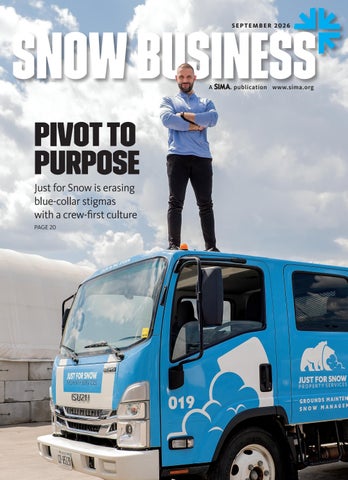
Pivot to Purpose Just for Snow is erasing blue-collar stigmas with a crew-first culture PAGE 20
publication www.sima.org
30 YEARS KEEPING THE SNOW & ICE INDUSTRY MOVING
For three decades, the Snow & Ice Management Association has stood as a beacon for an industry that never sleeps. Since 1996, SIMA has been driven by a singular mission: to support and elevate the professionals who endure the toughest winter conditions to keep our communities safe and mobile. SIMA’s journey began with just nine charter members in Erie, PA. Today, we are proud to represent a thriving community of over 1,000 contractor and supplier companies. While our scale has grown, our core commitment to empowering your success remains as strong as ever. Whether you joined us at the very beginning or just three months ago, we invite you to explore some of the milestones that have shaped SIMA and the industry we serve.
30 YEARS OF IMPACT AT A GLANCE Let’s look back on SIMA’s 30-year evolution from a bold startup into a thriving community that has helped shape the winter management industry.
SIMA FIRSTS
MAY: First Snow & Ice Symposium held in Pittsburgh, PA. AUGUST: Clintar becomes the first Canadian member company.
CSP
Certified Snow Professional credential program launches.
1996
2000 1998
2006 2001 100th CSP awarded.
SNOW BUSINESS
FOUNDERS MEETING
JUNE: The Snow & Ice Management Association was born in Erie, PA. SEPTEMBER: SIMA is officially incorporated.
SEPTEMBER: Snow Business Magazine debuts as a special supplement. It becomes a standalone magazine in 2003. NOVEMBER: 100th member joins SIMA.
NEW HEADQUARTERS
NEW HOME
JULY: SIMA moves to Milwaukee, WI. DECEMBER: MPS Property Services’ Jim Monk, CSP, becomes the first SIMA board chair from Canada.
MAY: 1,000th member joins SIMA. 500th member joins SIMA.
2008 2007
AUGUST: SIMA moves to current location.
2014 2009
2017 2015 AUGUST 100th issue of Snow Business magazine is published.
Canadian CSP program launches.
AUGUST 2017
A
publication | www.sima.org
SPECIAL FOCUS: RECRUIT & RETAIN
ASM
Advanced Snow Manager credential program launches.
Culture comes first If You Build it, They Will Come
Companies with solid foundations built on purpose, vision and beliefs lead the pack when it comes to hiring and retaining great employees
CH EA & T YEE AR LO TY TE EMP AFE S
CHEERS TO 30 YEARS! SIMA is dedicated to empowering and equipping our members for success. We believe that when snow and ice management professionals—and those who hire them—adhere to the highest industry standards, everyone wins. Guided by our core values of quality, trust, service, innovation, sustainability, and passion, we strive to establish the benchmark for the next generation. Together, we are building a future where our community thrives and sets the standard for excellence every season.
SIMA reaches 1,500 members strong.
1,000th ASM is awarded.
2020
7 2019
2025 2022 SEPTEMBER 150th issue of Snow Business magazine is published.
Foundation
2026 Looking ahead to
2027!
30 years of the Best Show in Snow!
SIMA FOUNDATION
The SIMA Foundation is established— funding scholarships, supporting research in snow and ice management, and raising public awareness.
30 Milwaukee, WI June 22–25, 2027
Vol. 26, Issue 3 // www.sima.org
CONTENTS SEPT 2026 SIMA 4 Industry Voice
COVER STORY
Reflections on 30 years of SIMA By John Allin
20 P ivot to purpose
6 SIMA News 2026-27 Accelerate class announced,
Just for Snow is erasing blue-collar stigmas with a crew-first culture By Patrick White // Photos by Rob Davidson
Certified Deicer Applicator course
8 2026 Snow & Ice Awards
SIMA celebrated safety, company culture, outstanding employees and more at the Snow & Ice Symposium in Cincinnati, OH.
business 28 Be curious, not comfortable
Snow and ice management runs on experience, but don’t be afraid to question it to improve operations By Nicole Boegeman
30 What leaders look like
They recognize employees, encourage development and listen to feedback By Evan Tachoir
32 What culture is really about
Employees decide whether they’re part of a great company during a snow event By Erik Dyba, CSP, ASM
34 Thriving amid change
How snow and ice leaders can use uncertainty to build stronger operations, teams and client relationships By Avi S. Olitzky
56 Ultima Palabra / Last Word El cimiento del éxito invernal / The foundation of winter success By Orlando Chavez, ASM
operations 44 Contract-fleet compatibility
Align portfolio with your equipment strategy to create a winning outcome By Mike McCarron
48 To-do list activated
What are you doing now to prepare for winter 2027? By JP Sanieski, CSP, ASM
50 Get ready
Whether you operate 2 trucks or 500, preparation leads to success By William Moore, ASM
TOOLS 52 Test Drive 55 Ad index
risk management 40 The deposition test
Why every word in your snow contract matters By Lisa Rose SEPTEMBER 2026 // SNOW BUSINESS
3
SIMA // INDUSTRY VOICE 2
1
Looking back after three decades, I can say without hesitation that the satisfaction of watching SIMA grow has exceeded anything we envisioned in that Erie, PA., basement.
30
Reflections on 30 Years of SIMA
L
ooking back, it’s amazing how something that began with a simple idea has grown into an organization that has influenced an entire industry. Back in 1995, my business was slow, and I found myself thinking about the future of the snow and ice industry. Years earlier there had been a snow association that had dissolved, and I wondered whether there was enough interest to build something new. Our marketing person mailed letters to about 50 contractors whose business cards I had collected over the years, asking whether they would be interested in resurrecting a professional association dedicated to snow and ice management. Twenty-five contractors responded that they were interested.
Setting the foundation
John Allin, CSP, ASM, is considered the founder of SIMA. He has been in the snow industry for almost 60 years. He is still involved in the industry at 73 years old and will work in this industry until he passes on. Contact him at John@allinrose.com.
4
In early 1996, I invited everyone to my home in Erie, PA, to discuss the possibility. In the end, eight contractors traveled to Erie at their own expense, armed with little more than optimism, a shared vision and a willingness to build something meaningful. That Saturday morning, we gathered in my basement and spent the next 10 hours developing a mission statement, drafting bylaws and laying the foundation for what would eventually become the Snow & Ice Management Association. During those discussions, the original proposed name for the organization was discarded because it felt too limiting. The late Phil Christian suggested “Snow & Ice Management Association,” and, thankfully, the name stuck. SIMA was officially incorporated in September 1996. Sadly, only a few months
SNOW BUSINESS // SEPTEMBER 2026 // www.sima.org/snowbusiness
later, we lost Phil, one of the driving forces behind the organization. His passing was devastating, and for a time we wondered whether the association would survive. Fortunately, it did, and in many ways his vision continues to live on through the organization he helped create.
Gaining momentum
In those early years, growth required creativity. I volunteered to speak about snow and ice management at landscape industry conferences whenever organizers would provide booth space for SIMA, free of charge. Those opportunities introduced contractors to the association, and membership steadily increased. By our second year, we introduced the idea of a dedicated educational symposium. The first Symposium, held in Pittsburgh, PA, in 1997, attracted about 35 attendees. The following year, attendance grew to roughly 100. As the event continued to expand, equipment manufacturers, suppliers and service providers became active participants, helping transform the Symposium into the industry’s premier educational and networking event. We also made a conscious decision to move the Symposium around the country so contractors from every region would have the opportunity to participate. That decision proved to be an important part of SIMA’s growth. Seeing nearly 2,000 attendees at this year’s Symposium in Cincinnati, OH, reminded me just how far the organization has come.
Handing over the reins
After serving in leadership for the first six
Trim: 2.1875" W x 10" H • Bleed: .None
3
THE EVOLUTION IN
PERFORMANCE SmartTouch+ Universal Controller • Universal Compatibility • Instant, Seamless Response • Custom Control
EARLY SYMPOSIUM 1 About 35 people attended the first Snow & Ice Symposium in Pittsburgh, PA, in 1997. This year, nearly 2,000 people attended the 29th event in Cincinnati, OH.
FIRST MEETING 2 In June 1996, eight people joined John Allin at his home in Erie, PA, to build the foundation of what would become the Snow & Ice Management Association.
SL4 Headlights • Premium Visibility • Redesigned Optics • Rugged Durability
EARLY BOARD 3 (Front from left) John Allin, Rick Kier, Tammy (Higham) Johnson, Tom Yackley, Charles
Glossop; (back from left) Bill Milbier, Kyle Hanson, Jeff Tovar, Chris James, unknown.
years, I believed it was time for others to guide the association forward. The membership embraced that responsibility, and each successive generation of leaders has continued to elevate the organization beyond anything we imagined in 1996. Today, SIMA has become an international association representing every segment of the snow and ice management profession. Hundreds of volunteers, industry leaders, manufacturers, suppliers and contractors have contributed their time and expertise to build an organization that continues to raise the standards of our profession.
An industry transformed
Perhaps the greatest accomplishment has been the transformation of the industry. Thirty years ago, most of us believed we were good snow contractors. Looking back, we were only beginning to understand what professionalism in snow and ice management could become. Through education, collaboration, innovation and the willingness to learn from one another, contractors have become stronger business
owners, better risk managers and more knowledgeable professionals. Equipment has advanced, technology has revolutionized operations, and business practices have matured in ways few of us could have predicted. The original founders hoped to create something that would help contractors become more than simply people who pushed snow. We wanted to build a profession — one grounded in education, professionalism and a commitment to continuous improvement. Looking back after three decades, I can say without hesitation that the satisfaction of watching SIMA grow has exceeded anything we envisioned in that Erie basement. What began as eight contractors sharing ideas has become a thriving organization that continues to shape the future of our industry. As we celebrate 30 years of SIMA, I find myself wondering what the next 30 years will bring. While I may not be around to see all of it, I have complete confidence that the spirit of innovation, collaboration and professionalism that started in 1996 will continue to drive this industry forward for generations to come.
Cold Front Tech • Eliminates 13-Pin Plug • Seamless Integration • FLIP. PLUG. CLICK.
LEARN MORE
SMARTTOUCH+ IS STANDARD ON ALL COLD FRONT TECHNOLOGY PLOWS. SL4 LED HEADLIGHTS AND SMARTTOUCH+ ARE NOT COMPATIBLE WITH 13-PIN ELECTRICAL SYSTEMS OR SL3 PLOW LIGHTS. ©2025 BOSS PRODUCTS. ALL RIGHTS RESERVED.
www.sima.org/snowbusiness // SEPTEMBER 2026 // SNOW BUSINESS
5
25-boss-0438_BOSS_Ad_NewTech_2.1875x10.indd 1 5/7/25 9:47 AM
SIMA // NEWS
2026-27 SIMA Emerging Leaders class selected The 2026-27 class of SIMA’s Accelerate emerging leaders program was selected in July, and members began their year-long experience at the SIMA Leadership Forum in Savannah, GA. Congratulations to this year’s cohort: Jeremy Avery Earth Development
Ashray Hanasoge, ASM Ashray Property Services
Jack Lutzel Coastal Companies
JP Sanieski, CSP, ASM Perrone Landscaping
Matthew Brandt Highmark Services
Josef Heimerl emi landscape
Aodhan Quinn Donovan Property Service
Mikayel Ter-Grigoryan Just for Snow
Rachel Brown Blades of Steel Landscaping
Jeremy Kirkham, ASM Storm Solutions Plus
Jacob Peffer, ASM GreenerConcepts
Presented with financial support from BOSS Snowplow and the SIMA Foundation
Certified Deicer Applicator course is live! SIMA launched the Certified Deicer Applicator (CDA) credential course in August. Designed for team members who apply materials, as well as supervisors and operations managers, the three-module course covers the following: • Deicer science. • Equipment and safe operations. • Impact of deicing materials on the environment, infrastructure and organizational budgets. • Best management practices for applying chemicals efficiently and effectively. • Decision-making process and interplay between plowing and deicing activities. • Documentation and application procedures for transparent use of deicers. • Scenarios and challenges that result in overapplication and under-application of materials.
Beyond operational efficiency and cost savings that can be achieved, the CDA credential positions your company at the forefront of the industry’s shift toward sustainable, compliant and responsible winter maintenance. As state-level legislation continues to evolve — linking liability protections directly to certified applicators — earning the CDA is a proactive step in protecting your operations. Cost for the two-year certification is $150 (SIMA members) and $250 (non-members). Group discounts are also available. Learn more about the course and how to purchase at sima.org/getcda.
The Certified Deicer Applicator course features three modules covering the tools, science and operations of deicing and anti-icing management. The course is self-paced and includes videos, downloads and interactivity.
6
SNOW BUSINESS // SEPTEMBER 2026 // www.sima.org/snowbusiness
SAVE $250 Save on fall training SIMA members can save up to $250 a year when they apply their training commitment credit to the purchase of Advanced Snow Manager, Certified Snow Professional and Safety 1st group training. It’s a “use it or lose it” benefit, so email andrew@sima.org take advantage of your member benefit!
CHEERS TO 30 YEARS!
Salt strategy takes center stage at regional events Want to learn about tools, techniques and strategies to reduce salt use? It’s not too late to register for the NH Salt Symposium (Sept. 15, Concord, NH) and the Midwest Snow & Ice Conference (Sept. 23, Pewaukee, WI). Each one-day event will feature presentations, panelists and demonstrations to help you maximize your salt use. See the full schedules and speakers at sima.org/nhss and sima.org/msic.
SIMA is turning 30! Join the fun and enter our giveaway extravaganza for a chance to win thousands of dollars in prizes. You could win a trip to the 2027 Leadership Forum or Snow & Ice Symposium, CSP/ASM/CDA courses, work tools, a pizza party for your team, fun stuff and more. Plus some of our dedicated supplier members—BOSS, Metal Pless, Douglas Dynamics and TrucBrush have provided prizes. Thirty winners will be announced on SIMA’s official birthday—September 23. Visit sima.org/30 to enter!
WINTER DOES NOT WAIT AND NEITHER SHOULD YOU!
www.sima.org/snowbusiness // SEPTEMBER 2026 // SNOW BUSINESS
7
SIMA // AWARDS
2026 SNOW & ICE AWARDS SIMA celebrated safety, company culture, outstanding employees, emerging leaders and more at the Snow & Ice Symposium in Cincinnati, OH, June 23-24. Congratulations to all of this year’s winners!
LIFETIME ACHIEVEMENT AWARD Paul Vanderzon, ASM, was honored by the SIMA Board of Directors as the ninth recipient of the Lifetime Achievement Award. As the association’s most prestigious accolade, this award celebrates individuals whose enduring contributions have significantly influenced the snow and ice management industry and furthered SIMA’s mission. A highly respected leader and innovator, Paul is recognized for his ethical leadership and extensive volunteer work. Throughout his career, he has served as a mentor to many, held key positions on the SIMA Board of Directors and chaired the SIMA Foundation.
Scan the QR to code to watch Paul’s acceptance speech and tribute video.
8
SNOW BUSINESS // SEPTEMBER 2026 // www.sima.org/snowbusiness
Y G D N A O R E FOR L
S T H G NI THE
The right configuration for every job.
Box Blade
Straight Blade
Traditional box blade.
Up to 10' of extra clearing width on select models when fully extended.
180°
of
Snow-Clearing
Possibilities
GET IT WITH
Reverse Box Blade
Minimum Road Transfer Width
In full reverse box.
Approx. 9" narrower than main mouldboard width.
Maximize Performance Watch how to correctly set up the floating hinge for optimal results.
SIMA // AWARDS
Beverly Companies Markham, IL Bates Landscaping Phoenixville, PA
Sponsored by
Coastal Companies Westerly, RI
Clintar Ottawa, ON
DJ’s Landscape Management Grand Rapids, MI
10
SNOW BUSINESS // SEPTEMBER 2026 // www.sima.org/snowbusiness
Earth Development De Pere, WI
Hahn Snow & Ice Lake Villa, IL
Environmental Management Inc. Plain City, OH
G. McNeill & Son Contracting Group Stoughton, MA
Just for Snow Bolton, ON
Monster Plowing Company Toronto, ON Kasel Rocks Facilities Services Allentown, PA
www.sima.org/snowbusiness // SEPTEMBER 2026 // SNOW BUSINESS
11
SIMA // AWARDS
MSNW Group Ferndale, WA
North Point Outdoors Derry, NH
Perrone Landscaping Holden, MA
12
SNOW BUSINESS // SEPTEMBER 2026 // www.sima.org/snowbusiness
Outdoor Pride Landscape and Snow Management Manchester, NH
SBC Outdoor Services Baltimore, MD
Sig-Nature Laval, QC
Sneller Snow & Grounds Byron Center, MI
Strathmore Lasalle, QC
The Bruce Company of Wisconsin Middleton, WI Tricon Palatine, IL
NOT PICTURED:
AJT Management, Foxboro, MA Akehurst Landscape Service, Joppa, MD David J. Frank Landscape Contracting, Germantown, WI EPM Professional Grounds Services, Jackson, MI Greg’s Lawn and Landscaping, Cedar Rapids, IA Landscape America, Wrentham, MA Lyons Landscaping, Kamloops, BC Wild Ridge Landscapes Nepean, ON
MPS Property Services, Markham, ON Navy Federal Credit Union, Vienna, VA Oakridge Landscape Contractors, Hannon, ON Urban Life Solutions, Toronto, ON
www.sima.org/snowbusiness // SEPTEMBER 2026 // SNOW BUSINESS
13
SIMA // AWARDS
GOLD
GOLD
DJ’s Landscape Management Grand Rapids, MI
GOLD
Executive Property Maintenance Plymouth, MI
SILVER General Services Corporation Boulder, CO
BRONZE
Rocky Fork Company New Albany, OH
American Facilities Professionals Derry, NH (not pictured)
The Gordon Company Caledon, ON
14
SNOW BUSINESS // SEPTEMBER 2026 // www.sima.org/snowbusiness
Progressive Casualty Insurance Co. & affiliates.
Small business owners’ to-do lists can add up. So see if you can save money on a commercial auto quote at ProgressiveCommercial.com.
Get a quote online in as little as 8 minutes
SIMA // AWARDS
ALL-STARS OF SNOW & ICE
Nicole Cicero, Office Manager Tricon, Palatine, IL
Stella Grigoryan, Finance Manager Just for Snow, Bolton, ON
Courtney Gordon, CSP, Sales Manager The Beverly Companies, Markham, IL
Meghan Geer, Client Relations Specialist Coastal Companies, Bradford, RI
BUSINESS DEVELOPMENT
16
SNOW BUSINESS // SEPTEMBER 2026 // www.sima.org/snowbusiness
FIELD Henrry De La Cruz, Team Leader Facility Care Solutions Providers, Scarborough, ON
Angela Moore, Territory Operator | Director of Marketing Executive Property Maintenance, Plymouth, MI
(not pictured) Brad Larwood, Lead Mechanic The Gordon Company, Caledonia, ON
Pierre François Ostiguy, Mechanical Workshop Manager Sig-Nature, Laval, QC
Molly McGeehan Bates Landscaping, Phoenixville, PA
Kim Rozon, ASM Strathmore, LaSalle, QC
www.sima.org/snowbusiness // SEPTEMBER 2026 // SNOW BUSINESS
17
FOUNDATION // AWARDS
SIMA FOUNDATION AWARDS
Thanks to the generosity of its donors, the SIMA Foundation provided scholarships and financial support to first-time contractor and supplier attendees, including:
Benjamin Johnson Forge Site Solutions Constantine, MI
Rylie Hannis Blades of Steel Landscaping Reading, PA
Midwest Air Drones Kamden Crum www.midwestairdrones.com
18
SNOW BUSINESS // SEPTEMBER 2026 // www.sima.org/snowbusiness
Rick Schaeffer CR Lawn & Snow Maintenance Menasha, WI
ACCELERATE EMERGING LEADERS
SIMA celebrated the first graduating class of the Accelerate program, honoring these individuals for their dedication to professional growth and industry leadership:
Cassandra Baron, CSP, ASM Earth Development De Pere, WI
Derek Dillard Rocky Fork Company New Albany, OH
Erik Dyba, CSP, ASM The Bruce Company of Wisconsin Middleton, WI
Kyle Gravel, CSP Evergreen Yard Care Winslow, MA
Nicholas Higgins, CSP, ASM Higgins Snow & Ice Management Waterford, NY
Stephen Knott Knott’s Land Care Nashua, NH
Lindsey Miller RPM Landscape Hammonton, NJ
Ben Morin, ASM JC Grounds Management Danvers, MA
Mariah Paul, ASM Snow Troopers Cincinnati, OH
Robert Stephens, ASM Piscataqua Landscaping & Tree Service, Piscataqua, ME
Davor Zeba The Grounds Guys of McHenry McHenry, IL
www.sima.org/snowbusiness // SEPTEMBER 2026 // SNOW BUSINESS
19
BUSINESS // COVER STORY
pivot to purpose Just for Snow is erasing blue-collar stigmas with a crew-first culture BY PATRICK WHITE // Photos by Rob Davidson
20
SNOW BUSINESS // SEPTEMBER 2026 // www.sima.org/snowbusiness
JUST FOR SNOW TEAM: President Mikayel Ter-Grigoryan (top), with Nemanja Vasic, business development manager; and Youssef Mahmoud.
JUST FOR SNOW GETS SERIOUS WITH NEW APPROACH, HIGH-VALUE CLIENTS The company shifts from lawns to snow and reevaluates its portfolio after realizing the growth potential. Page 24
www.sima.org/snowbusiness // SEPTEMBER 2026 // SNOW BUSINESS
21
BUSINESS // COVER STORY the Snow & Ice Symposium in 2021, where he met other business owners, “helped me understand what other companies were doing, and I thought it was really interesting,” Ter-Grigoryan says. Inspired, he decided to shift toward focusing primarily on snow and Just for Lawns became Just for Snow.
Setting standards
INDUSTRY INSPIRATION: A trip to the SIMA show in Cleveland, OH, in 2021 helped Mikayel Ter-Grigoryan realize the potential of the snow industry.
R
unning a chaotic operation out of a 10x10-foot shed with beat-up pickup trucks and messy schedules, Just for Lawns’ founder Mikayel Ter-Grigoryan was ready to quit the green industry forever — until a shift in perspective changed everything. Early on, Ter-Grigoryan was focusing a lot of his energy on pursuing other business ventures, reluctant to commit to the green and white industries largely over what he saw as a “big stigma ... a negative connotation” associated with the work. That inattention was taking a
22
toll. By 2020, when COVID-19 hit, the Bolton, Ontario-based company was unraveling. “We started around 2014, and it was basically just me and a couple guys from there for about five years. I was doing all the sales, and I had a couple guys running around cutting grass. The company was relatively flat,” he says. “At the time, I thought, ‘I’m gonna fully get out of the business.’ ”
With a new focus came a new mission — to instill a culture centered on supporting his employees. “I wanted to set a new standard of the way we were working and just improve and make things better,” he says. “Honestly, I was just tired of working the way that we were working. When new team members joined the company, I wanted to make it better for them. I thought that customers would eventually see this difference and respond, but it was a lot more about creating a better environment for us to work every single day.” Beginning in the summer of 2020, company practices were organized, standardized, and professionalized: Operations: Transitioned from chaos to control through structured practices. Culture: Employees felt valued and were provided a clear career path. Results: The changes led to a much more successful season and immediate growth.
Rethinking the business
The turning point came when new people joined the company, including Nemanja Vasic, who now serves as business development manager. Informal chats with the new team led Ter-Grigoryan to rethink his outlook on the business. “I said, ‘Let me take this seriously and actually double down on the industry, not just be avoiding the stigma of the business,” he says. “Second, let’s actually have a mission around the company — something that is bigger than just us going out there and trying to make money, cutting lawns or shoveling driveways.” That new mindset, plus a trip to
SNOW BUSINESS // SEPTEMBER 2026 // www.sima.org/snowbusiness
Strong and united
“Just from making those first few changes, we got some initial momentum,” Ter-Grigoryan says. “Going into that winter, I started to realize that there was a lot more to the business, and that we could actually do something significant with it.” What was once a company of two crew members has grown to as many as 120 in the winter. More importantly, the team is strong and united, Ter-Grigoryan says. “We’ve been able to put the right people in Continued on page 26
MEET THE AUTO SPEED CONTROL This winter, we’re rebuilding the workflow for snow and ice operators with something new: The Auto Speed Control. This easy-to-use module sits in your cab and adapts your salt and sand delivery to the speed of your truck—so
Dig in at
you can feel confident hitting target service levels
FISHERPLOWS.COM
every time. The Auto Speed system seamlessly integrates with all FISHER Fleet Flex Electrical Hopper Spreaders from 2016 and newer. And while the old-fashioned way of doing things will always have a place in our hearts—it’s time to take the guesswork out of your hard work.
BUSINESS // COVER STORY
Just for Snow gets serious with new approach, high-value clients In 2021, Mikayel TerGrigoryan discovered a community that he wanted to become a part of at the Snow & Ice Symposium in Cleveland. They were a small company but wanted to build something at the level that they were seeing in the U.S. market. He didn’t need to be the biggest, but he wanted to be the best with the most recognizable brand. The company’s name says it all. “A lot of companies have ‘green’ or ‘landscape’ in their names, but many of them are also doing snow; and for a lot of them, snow is their main business,” Ter-Grigoryan says. “So, I thought, ‘Why don’t we just double down on the snow and then say: This is what we do.’ ” Even with systems and a plan in place, the path to building a serious snow company was not without bumps. “That first big season was really, really challenging. Obviously, in the beginning, we made tons of mistakes,” Ter-Grigoryan acknowledges. “It was complete chaos. But things improved as we restructured the entire business around having the right equipment, the right setup and the right approach to service.”
KEEPING THINGS MOVING: Just for Snow has developed a niche serving the transportation industry, including both trucking and transit facilities in the Toronto area.
24
SNOW BUSINESS // SEPTEMBER 2026 // www.sima.org/snowbusiness
Refining the portfolio Ter-Grigoryan knew it wasn’t enough to just change the way the company operated — it needed to transition out of the residential business and find clients that would appreciate its higher-level service approach. That shift took time and some bad clients before it could break through. “When you’re breaking into commercial, you’re taking all the scraps in the industry — typically it’s the customers that don’t want to pay, or customers that treat their contractors poorly. But you’ll work with them so you can break through,” says Business Development Manager Nemanja Vasic. As its book of business grew, Just for Snow reached a point where it could be more selective. “Every year we would always look at our clients; specifically, we’d look at our bottom 10%, 15%, 20% — clients who would take forever to pay or wouldn’t pay, clients who had completely unreasonable expectations, clients who would speak to you like you’re much lesser than they are — and dump them out of the business,” Vasic explains. “We would replace them with better clients, and that’s evolved into working with AAA clients.”
3X MORE POWER!
“We kept doubling down on snow. We kept trying to find the right customers to work with and find the right team members to help them, and the right equipment, and just getting everything aligned. We found some amazing people along the way, and that really is what made the difference.” MIKAYEL TER-GRIGORYAN, PRESIDENT, JUST FOR SNOW
The client base today is strictly commercial, and the company has developed a specific niche serving transportation clients, including logistics (trucking) companies and public transit facilities in Toronto. “We’re working with clients that will sign blank checks because they need good service completed, and they’ll pay anything for that,” Vasic says. “And that’s now translating to clients that look at you as a partner; they don’t look at you as a contractor, they look at you as an integral part of their business, particularly during the winter months. And that’s how they treat you, that’s how they talk to you.”
A win-win approach Working with higher quality clients comes with some pressure: Quality work is absolutely required. Because trucks and buses need to run on time, the standards for snow and ice work at these facilities is exacting. But Vasic says that serving clients with high expectations has helped to elevate Just for Snow, both in terms of capabilities and in terms of morale: “It’s been a slow and steady evolution, but now we know what clients we need to target in order to offer better work and better pay and better everything for our team, so then our team is incentivized to provide better work, so we get better clients,” Vasic says.
• Works to -16o F & Melts Ice Fast • Non-Toxic & Biodegradable (Safer for Fish & Pets) • Use 3X Less Product than Rock Salt • Does Not Harm Lawns, Vegetation, Hardscapes, or One Year Old, Properly Cured Concrete*
TOXIC
SLIPPERY
FREEZE
WHEN WET
C H LO RI DE - FR E E
100% CMA 100% Calcium Magnesium Acetate Dehydrates Snow & Ice for Easier Removal
• Includes an Activator to Initiate the Deicing Process • LEED Compliant with the U.S. Green Building Council • Less Corrosive than Tap Water, Non-Toxic & Biodegradable • Safe on Properly Sealed and Installed Concrete 30 Days after Installation
MADE IN AMERICA
••••••••••••••••••••••••••••••
IceMelter.com
Questions? Visit our website or call us at 888-546-5941. Safer For Our Planet, Your Pets & Your Property.™ ©2026. Natural Alternative® is a registered trademark of Signum, LLC. An Organic Alternative® brand.
www.sima.org/snowbusiness // SEPTEMBER 2026 // SNOW BUSINESS
25
BUSINESS // COVER STORY Continued from page 22
the right places, and they’re people who are passionate about what they’re doing, and who get rewarded for what they’re doing.” As the company has scaled, TerGrigoryan has made sure to keep its focus on its employees. “Whether it’s a clean elevated facility or the best equipment possible, that sets the tone and provides a good work environment,” he says. “Even if we couldn’t do a lot, we did a little bit, but we did it at a really high level, just to show the team that we care. And I think that was a fundamental point to our culture of the team, understanding that we do have a certain level of care toward them.”
A commitment to personal development
Beyond the financial success of Just for Snow and its team, Ter-Grigoryan is aiming higher: “We want to make
CAREER TRACK: Just for Snow’s management team is comprised entirely of former field staff. A concerted effort is made to train and develop talented employees and move them up in the company.
TOUGH ON STORMS E A SY O N O P E R AT O R S
SCHEDULE A DEMO TODAY
866.836.8722 VENTRAC.COM 26
SNOW BUSINESS // SEPTEMBER 2026 // www.sima.org/snowbusiness
WATCH THE VIDEO: Just for Snow’s Mikayel Ter-Grigoryan shared his views on employee recognition during the awards luncheon at the Snow & Ice Symposium.
things better for the next generation in the trades.” Initially, he envisioned promoting this message to the public in general, regardless of industry — sort of a bluecollar public service campaign. But with limited resources, he decided to start small, by walking the walk within his own company, showing employees of Just for Snow that they can make
their jobs into meaningful, rewarding careers. That includes, but means much more than paying a good wage. TerGrigoryan has built a culture and a system of personal development, which includes meetings around the company’s monthly book club, offsite retreats and full-day training camps, and other training opportunities — and not just for the management staff. Just for Snow’s management team (which is relatively young from the top down) is entirely made up of former crew members who’ve worked their way up the career ladder. “We’ve demonstrated that they can go from a shoveler to virtually
any other position in the business. And they can see that the entirety of the management team is comprised of people who were in positions just like them,” Ter-Grigoryan says. “All we’ve really done is lived up to the promise of taking talent from those positions and putting them in higher positions. From my perspective, if every single company makes these changes within their businesses, that’s going to change the industry, and the view of bluecollar jobs at large.” Patrick White has covered the landscape and snow and ice management industries for a variety of magazines for over 25 years. He is based in Vermont. Contact him at pwhite@meadowridgemedia.com.
H A K K A P E L I I T TA T R I
H A K K A P E L I I T TA L O A D E R
The first winter tire for tractors, Nokian Hakkapeliitta TRI, makes sure your winter contracting has all the grip and control you need – with or without studs.
The first winter tire for wheel loaders, Hakkapeliitta Loader, offers you speed, stamina and control. Unmatched grip and durability in the market – both winter and summer.
800.565.2525
nokianheavytyres.com www.sima.org/snowbusiness // SEPTEMBER 2026 // SNOW BUSINESS
27
BUSINESS // CONTINUOUS IMPROVEMENT
E L B A T R O F M O C T O N , S BE CURIOU Snow and ice management runs on experience, but don’t be afraid to question it to improve operations By NICOLE BOEGEMAN
A
bout a year and a half ago, my husband Ken and I sat down to write out our company’s culture. Not create it. Write it down. We had been operating on the same values for years: talent, passion and personality in who we hired; speed, accuracy and excellence in what we do; and communication, initiative and ownership in how we do it. None of that was new. What
was new was putting it into words everyone could actually read. While writing it, I kept asking myself an uncomfortable question: If this is genuinely how we operate, why has it taken us this long to say so out loud? I realized the values hadn’t actually been shared by everyone. Some people lived those values without ever needing to say them out loud. Others didn’t, and as long as nothing was written down, that wasn’t always obvious. Vague expectations are comfortable that way. Nobody fails a standard that was never stated. Once we put it on paper and started actually holding people to it, that comfort went away. Clarifying what we believed came with a side effect. We found out who didn’t believe it. Over the months that followed, we lost some people. As we began to talk about those core values in job interviews, we gained people who embodied them fully. We still aren’t perfect, but we are building a team of people who don’t accept that “it is what it is.” They ask why. Writing down our culture taught me something else. We fixed problems we disagreed about because we gave attention to them, but the biggest obstacles were the things we hadn’t questioned in years.
“We’ve always done it that way” isn’t the answer
Snow and ice management runs on experience, and experience is valuable. But experience has a side effect: The longer something works, even moderately well, the less likely anyone is to ask whether it should still work that way. “Because we’ve always done it that way” isn’t dishonest. It’s usually true. It’s just not a good answer. For a company to grow, people need to stop, look around and ask why it was always done that way. Of course, every process in a company was designed by someone at some point for reasons that made sense at the time. However, times change, crews change, customers change and technology changes. The reasons don’t always keep up. Years ago, trying to remember everything that needed to happen before the season started, I felt like someone trying to remember 100 things at once, and that started to worry me. So I created an annual project in our CRM called Season Prep and Cleanup, with a pipeline that automatically created tasks for every stage of the season: preseason, before the first storm, after the first storm and after the season ended.
EDITOR’S NOTE: This article is the first in a five-part series for readers who’ve built something that works and have stopped asking whether it still should. The series draws on real decisions inside a snow and ice management company. The argument underneath all five issues is the same: Experience is valuable, but left unexamined, it quietly becomes risk. The businesses that keep improving aren’t the ones with the most experience. They’re the ones that keep questioning it.
28
SNOW BUSINESS // SEPTEMBER 2026
There were so many tasks that were repeated every year that relying on memory wasn’t realistic. For example, preseason tasks like updating contact lists, onboarding seasonal employees, checking for unsigned contracts and editing the customer information in QuickBooks when a property changes hands. None of those had much to do with the act of snow removal, but they were all necessary, and none of them had been written down. Every one of those tasks depended on someone remembering it at exactly the right time for as long as they held the role. We had relied on memory because that was the way we had always done it. But with company growth, changing roles and different people stepping into those roles over time, I knew something would eventually get missed — not because anyone was careless but because memory was
never a system to begin with. So, I asked the question that had been unasked for years: What happens if we stop trusting memory and start trusting a system instead?
Curiosity as a business asset, not a personality trait
There’s a line in the TV show “Ted Lasso” that I want to put on a yellow sign and hang slightly askew on a wall at our office — “Be curious, not judgmental.” It’s four words, but they pack quite a punch. Judgment assumes you already know the answer. Curiosity assumes you might not but are willing to find out. Companies willing to let someone ask, “Why do we do it this way?” in a meeting without it sounding like an accusation tend to get more from their people, not less. It has to be modeled by the people at the top, or it dies the
first time someone asks why and gets a defensive answer instead of a real or thoughtful one.
The takeaway
Curiosity separates a company still running on last decade’s assumptions from one built for growth and change. A culture nobody had written down. A checklist nobody questioned. A pricing rule nobody remembers the origin of. Every one of those is a question waiting to be asked, and every day that it goes unasked, it gets a little more expensive to fix. As you head into another season, ask yourself: Does this work because it’s actually the best way, or because nobody has asked about it in a while? Nicole Boegeman is executive vice president of Swinter Group and SG Advantage. Contact her at nicoleb@swintergroup.com.
www.sima.org/snowbusiness // SEPTEMBER 2026 // SNOW BUSINESS
29
BUSINESS // CONTINUOUS IMPROVEMENT
what leaders look like They recognize employees, encourage development and listen to feedback BY EVAN TACHOIR
70%
E
mployees need to know what is expected of them at work. This goes far beyond simply telling them what to do. The best leaders paint a clear picture of what success looks like. For example, if you’re servicing a distribution center, where are the priority areas? When do employees arrive for work, and how do they enter the building? The more details you clarify, the more clearly you show your team what good service looks like. Having what you need to do the job starts with ensuring each employee has the right equipment and technology. Use a checklist for each employee so everything is ready to go for the first day. Employees also need the right information at the right time to do the job. As an example, if your sales team sold an account and the client added specific requests, such as treated salt, your operations team needs to know this when planning for the season. If the information affects how others do their jobs, they need to know, too.
Culture builders
Leaders set the tone for building a preferred work culture. Gallup research shows that up to 70% of the variance in employee engagement is driven by the direct manager. This should encourage you that you have a chance to make a difference. To start today, here are a few things you can do to move the needle: 1 Conduct regular one-on-one
meetings with direct reports. One-onone meetings provide each employee with a forum to update you on their work as well as raise any concerns or questions they might have. These
30
of variance in employee engagement is driven by the direct manager. Leadership makes a difference.
meetings allow employees to connect with you and the company. If you take nothing else from this article, start or continue having at least biweekly one-on-one meetings with each of your direct reports. 2 Recognition. The best recognition is consistent, timely, sincere and purposeful. When recognizing employees for good work, highlight what they did well and how it made an impact on the business. Provide this recognition in a timely manner. Some employees are more open to public recognition than others; therefore, it’s best practice to ask your direct reports how they prefer to be recognized (i.e., public vs. private). A great way to build a habit of recognizing others for good work is to put a calendar reminder in your email/task list about it. 3 Encourage development. Employees want to learn and grow at work. Ask your direct reports to name one thing they want to learn or one area where they want to grow in this quarter, and then make the effort to help them get there. That effort can be job shadowing, sending them to training, attending a conference, reading industry publications, earning certifications and more. Adults learn best in small bites, by discussing learnings with others and by applying what they learned on the job. Follow up with your employee to discuss what they learned and how they’ll apply it at work.
SNOW BUSINESS // SEPTEMBER 2026 // www.sima.org/snowbusiness
4 Listen to their feedback. Feedback is like playing the game with a cheat code. Your one-on-one meetings should allow time for employee feedback and questions. Company-wide surveys, where feedback is reviewed and acted upon, are also great ways to drive engagement. Gallup research shows that if employees feel their opinions count at work, they are more likely to be engaged. This doesn’t mean you need to do whatever they suggest. However, if you can’t act on their feedback, let them know why. This shows them their feedback was accounted for and builds trust between them and you as their leader. Evan Tachoir is the founder of Jack of All People Trades, HR/People Consulting to help snow companies recruit, develop and retain the best employees. He leads the monthly networking/teaching series NET Gain. Email him at evan@jackofallpeopletrades.com.
Editor’s note: This article is part two of a three-part series on employee engagement and focuses on what leaders can do today to make their companies a preferred place to work. Part one, which appeared in the June issue of Snow Business, focused on the “hygiene” factors that play into becoming a preferred employer. Part three will appear in October’s Snow Business.
Want Superior Back Dragging Results?
DOUBLE-DOWN with Scrape Maxx™ Down-Force.
The Scrape Maxx down-force kit is now an exclusive feature on all SnowEx® truck plows. Allowing plow operators to apply downward force to bust through hard pack and maximize to-the-pavement scraping performance. Don’t cover the same ground twice—just double-down with Scrape Maxx.
Standard On All SnowEx Truck Plows.
LEARN MORE AT SNOWEXPRODUCTS.COM
BUSINESS // LEADERSHIP
what culture is really about Employees don’t decide whether they’re part of a great company during an annual survey. They decide during a snow event By ERIK DYBA, CSP, ASM
T
here are certain snow events you never forget. One winter, a member of our commercial business development team came out to help during a major snow event. We were servicing one of our highestpriority, lowest-tolerance properties, and the site supervisor had been going for hours. Like many storms, the event lasted longer than expected, plans kept changing, and fatigue was starting to show. Our commercial development team member had a full day of customer commitments waiting for him the next morning. Nobody would have blamed him for staying home. Instead, he came out in the middle of the night, climbed into a plow truck and took over so the site supervisor could get a few hours of much-needed rest before returning to finish the event safely. Nobody asked him to do it. He simply saw what the team needed and stepped in. I’ve thought about that night many times over the years because it reminded me that leadership isn’t defined by a title or an organizational chart. Sometimes leadership looks like climbing into a truck when everyone expects you to be somewhere else.
Building the right culture
When I think about building a Best Place to Work culture, I don’t think about awards or applications. I think about nights like that. Participating in SIMA’s Best Places to Work program reinforced something I’ve believed for a
32
long time. The real value isn’t the recognition — it’s the opportunity to step back and honestly evaluate the culture you’re creating. In our industry, we’re always moving. One storm ends and another is already in the forecast. Equipment needs repairs. Customers need updates. Employees need direction. There is always another problem waiting to be solved. Very few of us stop long enough to ask a simple question: What is it really like to work here? That’s a harder question than it sounds. Most leaders genuinely care about their people. We want them to succeed, stay safe and build long careers with our organizations. Good intentions don’t build culture. Daily actions do.
When culture is built
Culture isn’t created during orientation or discussed once a year at a company meeting. It’s built during pre-storm briefings when expectations are clear. It’s built when supervisors explain the “why” behind a decision instead of simply giving directions. It’s built when another crew finishes its route and volunteers to help a teammate before heading home. Employees don’t decide whether they’re part of a great organization during an annual employee survey. They decide during a snow event. They notice whether leaders remain calm when conditions change. They notice whether expectations are consistent from one supervisor to the next. They notice whether someone takes the time to coach after a mistake instead of assigning blame. They notice whether leadership is willing to step in and help when the workload becomes overwhelming.
SNOW BUSINESS // SEPTEMBER 2026 // www.sima.org/snowbusiness
Those moments become stories. Those stories become culture. One thing the Best Places to Work process challenged me to think about was whether we are intentionally developing people or simply managing today’s work.
Building the next leader
The best organizations don’t wait until someone becomes a supervisor to begin developing leadership. It starts when an experienced operator teaches someone else how to read changing pavement conditions instead of simply taking over. It continues when a crew leader asks a seasonal employee for his or her opinion, or when someone is encouraged to earn a certification, attend an industry conference or lead a tailgate meeting for the first time. Those opportunities send a message that’s far more powerful than many leaders realize: “We believe in your potential.” People rarely build careers where they feel replaceable. They build careers where they feel invested in.
The right recognition
Recognition is another part of that investment, and it’s one of the most overlooked leadership tools we have. Our industry naturally focuses on solving problems. Equipment breaks down. Weather changes. Customers call. Routes fall behind. It’s easy for every conversation to become about what still needs attention. The strongest cultures create balance. I’ve found that meaningful recognition always has three characteristics. It should be genuine, specific and timely. It has to be genuine because people know the difference between sincere appreciation and routine praise. It should be specific so employees understand exactly what they did well and why it mattered. And it should be timely because recognition has the greatest impact when it’s given soon after the accomplishment. Sometimes a two-minute conversation at the end of a storm reinforces your culture more effectively than an annual recognition banquet. When leaders recognize someone for helping another crew, identifying a safety concern before it becomes an incident, mentoring a new employee or simply stepping up when the team needs them most, they’re doing more than thanking someone for a job well done. They’re defining what success looks like.
Safety works the same way
Every company has written safety policies. Great workplaces build a safety culture, and employees know the difference by watching the decisions leaders make every day. They see when work is delayed because conditions aren’t safe. They remember when someone speaks up about fatigue and leadership listens. They notice when a near miss becomes a learning opportunity instead of a blame session. Those decisions send a powerful message: People matter here. Perhaps that’s the greatest lesson I took away from the Best Places to Work process. Building a great workplace isn’t a program, an application or an award. It’s an ongoing commitment to the people who make our organizations successful. Looking back, I believe that’s the real value of the Best Places to Work process. It reminds us that great workplaces aren’t built through one big initiative. They’re built through ordinary leadership decisions
repeated consistently over time — a conversation before the storm begins, a supervisor who coaches instead of criticizes, a leader willing to climb into a truck because the team needs help, or a sincere “thank you” given when no one expects it. Employees may not remember every storm or every route they serviced, but they’ll remember how they were treated. Those experiences become the stories they tell about the organization — and, over time, those stories become its culture. That’s what keeps great people coming back season after season. And ultimately, that’s what makes an organization a Best Place to Work. Erik Dyba, CSP, ASM, is the Specialty Services Operations Manager at the Bruce Company of Wisconsin, a SIMA Foundation board member, and a Wisconsin Salt Wise subject matter expert. Contact him at EDyba@brucecompany.com.
SEPTEMBER 2026 // SNOW BUSINESS
33
BUSINESS // LEADERSHIP
thriving amid change How snow and ice leaders can use uncertainty to build stronger operations, teams and client relationships By AVI S. OLITZKY
A
nyone who has spent enough time in the snow and ice industry has probably stopped saying, “Once things get back to normal.” The reason is simple: Normal keeps changing. One season brings record snowfall, while the next barely justifies firing up the fleet. Insurance costs rise, labor becomes harder to find, and clients expect faster response times while scrutinizing every invoice. New technologies emerge, competitors enter the market, regulations evolve, and just when an operation adjusts to one challenge, another appears. Many organizations respond by trying to preserve yesterday’s operating model. They work harder, add temporary fixes and wait for conditions to stabilize. The strongest organizations take a different approach. They recognize that disruption is no longer an interruption to the business; it is part of the business. The companies that grow through uncertainty are not necessarily the ones with the most resources or the fewest challenges. They are the ones that learn how to respond faster, listen more carefully and use change as a reason to improve rather than retreat. The goal is no longer simply to survive disruption. It is to build an organization that becomes stronger because of it.
Stop waiting for “normal”
Leaders naturally crave stability. Predictability makes it easier to plan
34
routes, manage budgets, schedule crews and make long-term investments. When conditions shift, the instinct is often to wait until the market settles or to restore the practices that worked before. That instinct is understandable, but it can become a liability. Customer expectations continue to evolve. Employees are redefining what they want from work. Weather patterns remain inconsistent, and the costs of labor, equipment, materials and insurance rarely move in straight lines. Waiting for conditions to return to a familiar state can leave an operation solving yesterday’s problems while new opportunities pass by. Thriving organizations approach things differently. Instead of asking, “How do we get back to where we were?” they ask, “Given today’s reality, what should we become?” That shift may sound subtle, but it changes the tone of the entire organization. Conversations move away from loss and frustration and toward possibility. Leaders become more open to redesigning systems, rethinking services and reconsidering assumptions that may no longer fit. Change becomes less about protecting the past and more about preparing for what comes next.
Resistance usually contains useful information
One of the most common mistakes leaders make is assuming that employees resist change because they are stubborn, negative or unwilling to adapt. Most people do not resist improvement. They resist uncertainty. When a supervisor questions a new routing process, the concern may be that it will create confusion during the
SNOW BUSINESS // SEPTEMBER 2026 // www.sima.org/snowbusiness
next storm. When operators hesitate to adopt new technology, they may be wondering whether it will truly make the work easier, whether they will receive enough training, or what will happen if the system fails in the middle of an event. Those are practical concerns and dismissing them can cause leaders to overlook valuable insight. The strongest organizations treat resistance as information. They listen for what employees are actually trying to protect. Sometimes it is safety. Sometimes it is efficiency. Sometimes it is a client relationship built over many years. At other times, resistance reveals that leadership has not explained the reason for the change clearly enough. Understanding the source of concern allows leaders to design better solutions and build stronger commitment. Employees are more likely to support a change when they understand why it matters, how it will affect their work, and what role they will play in making it successful. Listening does not mean allowing every objection to stop progress. It means using those objections to strengthen the plan.
Small experiments create better decisions
Many organizations associate innovation with major transformation. They imagine new platforms, large capital investments, broad restructurings or companywide initiatives. In practice, lasting improvement often begins with something much smaller. Continued on page 36
THINK BIGGER RELIABILITY TO OUTLAST ANY STORM Built for contractors who demand more from every pass, the WESTERN® MVP 3™ combines rugged durability with the versatility to tackle virtually any snow event. Tall, flared wings, reliable hydraulics, and proven performance help you clear more ground, tackle more storms, and keep moving.
“
MORE JOBS. DONE FASTER.
westernplows.com
MVP 3 V-PLOW
BUSINESS // LEADERSHIP how to turn change into growth Continued from page 34
An operation might test a revised dispatch process with one crew, pilot a new communication tool for a month, or try a different client update process with a small group of accounts. Leaders can then measure the results, gather feedback and adjust before expanding the idea. This approach lowers risk while increasing learning. It also creates momentum. When employees see that a small change produces a clear improvement, they become more willing to test the next idea. The better question is not, “Will this work everywhere?” It is, “What is the smallest, responsible way to test this before making a larger commitment?” That mindset reduces the fear of having to get everything right on the first attempt. It allows organizations to move forward without pretending they have perfect information. In uncertain environments, the ability to learn quickly is often more valuable than the ability to make a flawless plan.
Ask what has actually changed. Separate temporary disruption from a lasting shift. Avoid building a long-term response around a short-term problem. Listen for the concern behind resistance. Employees may be protecting safety, efficiency, client relationships or proven practices. Understanding the concern leads to better decisions. Start with a small test. Pilot a new process with one crew, route or client group before making a broad commitment. Bring frontline employees into the conversation. Ask what is slowing them down, what is working, and what should change before the next event. Measure before expanding. Define what success looks like before testing an idea. Use results, feedback and operational data to guide the next step. Help clients navigate change. Use disruption as an opportunity to educate clients, clarify risk and strengthen your role as a trusted advisor. Reward learning, not just perfect results. Recognize employees who identify problems, suggest improvements and share lessons that help the entire operation.
Your best ideas are often already in the field
Innovation rarely begins in a conference room. It is more likely to begin with an operator who notices a recurring delay at four in the morning, a site supervisor who finds a better sequence for servicing a property, or a dispatcher who identifies a communication pattern that saves valuable time. The challenge is usually not a lack of ideas. It is the absence of a system for capturing them. Organizations that improve consistently create regular opportunities for employees to share what they are seeing throughout the season. They do not wait for an annual review or a major problem. They ask simple questions during normal operations: • What slowed us down this week? • What worked better than expected? • Where did the process become confusing?
36
• What should we change before the next event? Those conversations matter because frontline employees experience the consequences of operational decisions first. They know where handoffs break down, where routes become inefficient and where client expectations do not align with actual conditions. When leaders invite that input and act on it, employees begin to see themselves differently. They are no longer simply carrying out someone else’s plan. They become participants in designing better work. That sense of ownership strengthens engagement while giving leaders access to information they could never collect from behind a desk.
Change is also happening to your clients
Disruption affects clients just as much as it affects contractors. Property managers are dealing with staffing
SNOW BUSINESS // SEPTEMBER 2026 // www.sima.org/snowbusiness
shortages, tighter budgets, liability concerns, and rising expectations from tenants and occupants. They are being asked to do more with fewer resources, often while managing risk they cannot fully control. Snow and ice companies that understand those pressures can position themselves differently. Instead of acting only as service providers, they can become strategic partners. They can help clients understand changing weather patterns, explain the operational implications of different service levels, identify risk and recommend adjustments before problems occur. This changes the nature of the relationship. The conversation becomes less about price alone and more about value, foresight and reliability. A client who views a contractor as a trusted advisor is less likely to make decisions based solely on the lowest Continued on page 38
YOUR COMPETITIVE ADVANTAGE
The future of snow and ice management is smarter. Liquid deicing gives contractors the ability to optimize applications, improve efficiency, and protect profitability.
ELEVATE YOUR LIQUID IQ
MAXIMIZE EVERY DROP
COVER MORE GROUND
REDUCE MATERIAL WASTE
TURN EFFICIENCY INTO PROFIT
STAY AHEAD WHEN EVERY DROP, EVERY HOUR, AND EVERY DOLLAR COUNTS. ©2026 BOSS Products. All Rights Reserved.
BUSINESS // LEADERSHIP Continued from page 36
bid. That client is more likely to value proactive communication, professional judgment and a partner who can help navigate uncertainty. In that sense, disruption creates an opportunity to deepen relationships rather than simply defend them.
Build a culture that expects change
Some organizations treat every disruption like an emergency. Others treat it as a prompt to learn. The difference is culture. When leaders encourage curiosity, employees become more comfortable asking questions and suggesting alternatives. When mistakes are examined for lessons rather than used as opportunities for blame, people become more willing to speak up. When supervisors recognize thoughtful experimentation, improvement becomes part of normal operations rather than a special initiative.
Culture is created through repetition. It develops through team meetings, post-storm conversations, coaching discussions, and everyday decisions about whether to reward initiative or preserve the status quo. Over time, employees begin to understand that adapting is not a sign that the organization failed to plan. It is simply part of how a strong organization operates. That matters because no leader can anticipate every disruption. What leaders can do is build a team that knows how to respond when the plan no longer fits the situation.
Growth begins with a leadership choice
No leader can control snowfall totals, labor markets, insurance rates or every shift in customer behavior. What leaders can control is how the organization interprets and responds to those forces. They can decide whether disruption
YOUR PUSHER SHOES WEA R
creates fear or focus. They can decide whether challenges become excuses or information. They can decide whether the team spends its energy protecting yesterday’s success or building tomorrow’s capabilities. Change is no longer something that happens every few years. It is the operating environment. The organizations that accept that reality are better positioned to improve while others struggle to keep up. They listen closely, test ideas, involve their people and look for ways to create value when old assumptions no longer hold. The next disruption is coming. The opportunity is to make sure the organization that meets it is stronger, more adaptable and more prepared than the one that faced the last. Avi S. Olitzky is the president and principal consultant of Olitzky Consulting Group, based in Minneapolis, MN. Contact him at avi@olitzkyconsulting.com.
IN ONE SPOT ››› ALL OF IT OUT
Standard snow pusher sho
YOU REPLACE
es wear unevenly — whe
n one section goes, you
MōDUS Modular Skid Shoe System
®
1,643
STARTING $ FROM
replace everything.
MōDUS’ patented design lets you replace only the worn pad — not the whole shoe — in minutes, in the field.
Lasts 5X longer with Winter Carbide™
Fits Arctic®, Pro-Tech® & Metal Pless®
Thicker steel protects pusher sidewalls
1
2
3
Pick Your Plow Model
Order Online or Call Us
Get Back to Work
HOW TO BUY
“Been using the carbide shoes on our Arctic pusher for 3 seasons with no sign of wear.” – Robert Wile Jr.
WinterEquipment.com SIMA Snow Business Symposium Xtra MoDUS Half Page 4 052026.indd 1 38Ad SNOW BUSINESS // SEPTEMBER 2026 // www.sima.org/snowbusiness
SCAN FOR FULL DETAILS
844.294.7971
PURCHASE TODAY 5/20/26 1:33 PM
RISK MANAGEMENT // BEST PRACTICES
the deposition test Why every word in your snow contract matters By LISA ROSE, CSP, ASM
I
have spent years reviewing snow and ice management contracts. Some are reviewed before the season begins. Others reach my desk after someone has fallen, a lawsuit has been filed, and every decision made during a winter event is being questioned. Those cases have taught me one lesson repeatedly: Ambiguity is expensive. A contract isn’t just a legal document. It becomes the roadmap for operations, the measuring stick for performance, and ultimately the evidence used to determine whether everyone involved met the accepted standard of care. After reviewing these cases for years, I have learned this: Every sentence you leave vague becomes someone else’s interpretation in court. When I review contracts as an expert witness, I often ask a simple question that I believe every contractor, property owner and property manager should ask themselves before signing an agreement. Imagine you are sitting in a deposition two years from now. An attorney projects your contract onto a large screen for everyone in the room to see. The attorney points to a sentence and asks: “Can you explain exactly what you meant when you wrote this?” or “Can you explain what you thought this meant when you signed the contract?” Would your answer be immediate and confident? Or would it begin with … “Well, what we really intended was …” or “Well, we thought it meant …” If your explanation begins with what you intended rather than what the contract actually says, you’ve already identified a problem. That is what I call The Deposition Test. Every provision in your contract should withstand that level of scrutiny.
40
The Most Expensive Words in a Contract Some of the costliest words I encounter when reviewing contracts sound harmless. These phrases may seem flexible, but flexibility often creates uncertainty. Consider the phrase: “Contractor will apply salt as needed.” • Needed according to whom? • Based on what weather conditions? • Who makes that decision? • How often is the property evaluated? • What documentation supports that decision? During litigation, one vague phrase can generate hours of testimony because everyone has a different interpretation. The goal isn’t simply to write a contract. The goal is to eliminate unnecessary interpretation.
“Reasonable” “As needed” Your contract becomes your operations manual
Many companies view contracts as paperwork that needs to be completed before the first snowfall. I see them differently. The contract is your operations manual before the snow starts. It should answer every important operational question before the first truck leaves the shop: • What services will be performed and when? • What conditions trigger service? • Who authorizes additional work? • Who documents the work? • Who monitors conditions after service is complete? • Who decides whether additional deicing is necessary? If the contract doesn’t answer these questions, someone will answer them later — but that answer may not favor you. Just because you have had a long-standing relationship with a customer, that is no guarantee that customer will stand by your side during an expensive litigation process.
SNOW BUSINESS // SEPTEMBER 2026 // www.sima.org/snowbusiness
Scope of work: Where expectations become reality
Many disputes don’t arise because someone failed to perform. They arise because everyone assumed something different, including: • Does snow removal include sidewalks? • Are loading docks included? • Who clears accessible parking stalls? • Who removes snow around fire hydrants? • Who treats shaded walkways? • Who is responsible for refreeze after daytime melting? • What about roof runoff? Downspouts? • Snow relocated by another contractor or on-site personnel? • Landscape islands that create drainage problems? I have reviewed contracts in which the contractor, property owner and property manager gave a different answer about who was responsible for sidewalks. All three believed the contract supported
formed excellent work; unfortunately, the contractor can’t prove it. Today’s contracts should define documentation expectations just as carefully as plowing expectations. They should include: • GPS records. • Arrival and departure times. • Weather observations. • Material application rates.
their position. That is not flexibility — that is a failure to define the scope. If those responsibilities aren’t clearly assigned, they don’t disappear. They simply become disputed.
Service levels matter
One of the best ways to eliminate misunderstandings is to clearly define service levels and what those services entail. • How frequently will the property be monitored? • Who will monitor the property after a snow event? • Will anti-icing applications be performed? • Is pretreatment included? • How many return visits are included? • Are refreeze inspections included? • Who authorizes additional applications? The more clearly expectations are defined before winter begins, the fewer disagreements occur after an incident. In one matter, the contractor believed its responsibility ended when precipitation stopped. The property manager believed the contractor was also responsible for monitoring melt and refreeze conditions throughout the following day. The contract did not clearly resolve the issue. By the time the parties were deposed, each had a different explanation of the same language. A few additional sentences in the scope of work could have prevented hours of testimony and a significant dispute over responsibility.
• Site photographs. • Inspection notes. • Customer communications. • Service verification. Documentation no longer supports operations. It is part of operations and a critical defense to a lawsuit that can occur years after the event. Continued on page 42
New Year. New Model. Built for professionals who demand durability without compromise, our new stainless drop spreader is engineered to stand the test of time. Crafted from corrosion-resistant stainless steel and precision components, it delivers consistent, accurate spreading season after season—no rust, no warping, no shortcuts. It’s not just a new tool—it’s a long-term investment in reliability, efficiency, and confidence on every pass.
Features 40" Drop - 4 Cubic Ft. Capacity Stainless Drum, Agitator, & Hardware Durable Polymer Finger Bar Options Stainless Lid 2 Cubic Ft. Hopper Extension 3-Point Hitch Mount Bracket Adaptor
3 Industrial Drive Elmira, ON. N3B 2S1 519-669-4333 | sales@baumanmfg.com
Sold through Equipment Dealers.
Documentation is part of the scope One of the most common observations I make during litigation has nothing to do with snow removal itself. Sometimes I believe the contractor probably per-
baumanmfg.com
made in canada. fabrique au canada.
www.sima.org/snowbusiness // SEPTEMBER 2026 // SNOW BUSINESS
41
RISK MANAGEMENT // BEST PRACTICES Continued from page 41
Snow doesn’t read contracts
Winter weather rarely follows trigger depths. Snow changes to freezing rain. Rain changes to sleet. Daytime melting becomes overnight refreeze. Snow piles begin producing runoff several days after the storm. Yet, many contracts still focus almost exclusively on snowfall accumulation. A well-written contract should address ice management separately from snow removal. It should define how freeze-thaw cycles, refreeze events, runoff, and changing weather conditions will be monitored and managed. These are the situations that frequently lead to litigation.
Communication is a risk management tool
Every contract should identify who has authority to make decisions. A property manager may believe the contractor has authority to apply additional salt,
while the contractor believes prior approval is required. That disagreement should be resolved in the contract, not during testimony after a fall. Clear communication prevents assumptions, which often become allegations.
Ambiguity is expensive
Over the years, I’ve reviewed contracts of every size from contractors and property owners/managers. Some were one-page agreements, others exceeded 50 pages. The best contracts do not need to be the longest contracts. They need to clearly identify the work, assign responsibility and establish how performance will be documented. The best contracts don’t necessarily contain more language. They contain better language. Most importantly, they provide a clear operational roadmap long before the first winter event arrives.
Final thoughts
Every winter storm and every property
is different. Every customer has different expectations. Your contract should acknowledge those differences instead of relying on generic language copied from another agreement. Because when an incident occurs, no one asks what you intended. They ask what your contract required. Before you finalize your next agreement, perform The Deposition Test. Read every sentence and ask: “If this sentence was projected on a screen during my deposition two years from now, would I be completely comfortable explaining exactly what it meant?” If the answer is anything less than an immediate “yes,” rewrite it. Because ambiguity is expensive. And every sentence you leave vague becomes someone else’s interpretation in court. Lisa Rose, CSP, ASM, is a partner in Allin / Rose Consulting, Inc., a consultant and expert witness in various aspects of snow and ice management. Contact her at Lisa@AllinRose.com
fall webinar
CSP DAYS
Transform Your Ops. Elevate Your Safety. Lead with Impact. Discover how to assess, strategize, and execute change seamlessly by leveraging the 4-S Model of Operations and Safety.
—THE 4-S FRAMEWORK— and build the exact capabilities your | Identify team needs to execute safely and efficiently. operational processes so high Systems | Streamline performance becomes the path of least resistance. a high-trust culture where Psychological Safety | Cultivate transparency, accountability, and safety thrive. your team around a powerful, collective Shared Commitment | Unify vision that drives intrinsic motivation.
Skills
DATE: October 14 TIME: 1:00 PM EST/NOON CST REGISTER: sima.org/getcsp NOT A CSP? That’s OK—all are welcome! All attendees must register to save a spot.
FEATURED SPEAKER
Jackson Kerchis
Founder, Happiness Means Business
Register today: sima.org/getcsp
OPERATIONS // STRATEGY
contract-fleet compatIbility Align portfolio with your equipment strategy to create a winning outcome By MIKE McCARRON
I
n the snow and ice management industry, growth is often measured by the number and size of contracts secured each season. While winning new business is essential, successful contractors understand that not every opportunity is worth pursuing. One of the most important — and often overlooked — factors in determining whether a contract will be profitable is whether your current equipment fleet can effectively and efficiently service the property. Too many contractors focus on the revenue potential of a new account without fully evaluating the equipment, labor and operational resources needed to meet the client’s expectations. The result can be increased costs, reduced profitability and unnecessary stress during winter storms. Successful snow companies recognize a simple truth: The best contracts are the ones that match your operational capabilities and equipment resources.
Conducting a contract-to-fleet analysis Before pursuing any new opportunity, snow contractors should conduct a thorough contract-to-fleet analysis. The process is straightforward but can have a significant impact on profitability. Ask the following questions: 1 Do we currently own the equipment required to service this property? 2 If not, what equipment will need to be rented or purchased? 3 What are the annual ownership or rental costs? 4 Can the equipment be utilized on other contracts? 5 How long will it take to recover the investment? 6 What happens if the contract is lost after one season?
These questions shift the focus from contract revenue alone and toward long-term financial performance. Too often, contractors win work only to discover that the equipment investment required leaves little room for profit. A disciplined evaluation process helps prevent these situations.
Looking beyond contract revenue
A large commercial property can be an exciting opportunity. A distribution center, corporate campus, healthcare facility or shopping center may represent significant annual revenue. A property may look attractive based on annual contract value alone, but servicing it successfully could require substantial equipment investments. Depending on the site’s size and service requirements, contractors may need additional wheel loaders, skid steers, containment plows, sidewalk machines, spreaders, liquid deicing equipment or backup equipment required by the contract. These costs can quickly change
44
the financial picture. For example, a contractor whose fleet consists primarily of pickup trucks and plows may consider bidding on a large industrial site that requires multiple loaders. While the revenue may look impressive on paper, the cost of acquiring, maintaining, transporting, insuring and storing those loaders could significantly reduce profit
SNOW BUSINESS // SEPTEMBER 2026 // www.sima.org/snowbusiness
margins. Growth should never be measured solely by revenue. It should be measured by profitable revenue.
Understanding seasonal equipment challenges
Unlike landscaping equipment that may be utilized for much of the year, many snow-specific assets generate revenue only during the winter
months. This creates one of the biggest financial challenges in the snow industry: equipment utilization. A dedicated sidewalk machine, for example, may be required to service one account. While that equipment can dramatically improve productivity during snow events, it may remain idle for eight or nine months of the year. Despite limited use, the contractor must still account for equipment payments, depreciation, insurance, maintenance, transportation, storage and repairs. The same challenge applies to wheel loaders, pushers, liquid application systems and other snowspecific equipment. Before investing in specialized equipment, contractors must understand the total cost of ownership, not just the purchase price. A piece of equipment that sits unused most of the year must generate enough winter revenue to justify the investment.
It’s OK to say no
One of the most valuable lessons a growing snow contractor can learn is when to say “no.” The desire to win every bid is understandable, particularly
in a competitive marketplace. However, chasing every opportunity can be costly if the contract requires major equipment purchases that cannot be justified by the expected return. A contractor may excel at servicing parking lots with trucks and loaders but struggle with a property that includes miles of sidewalks requiring multiple dedicated sidewalk machines. Another contractor may perform well on small commercial sites but find itself overwhelmed by a distribution facility requiring loader support and rapid response times throughout a storm. In both situations, the issue is not capability — it is fit. The most profitable contracts are usually the ones that align with a company’s existing strengths, fleet composition and operational model. Winning a contract is only half the battle. Consistently meeting service expectations throughout every event is what retains clients and creates longterm success.
The role of efficiency
Equipment is more than a collection of machines; it is the foundation
of operational efficiency. The right equipment can dramatically reduce labor costs, improve production rates and help crews meet service requirements more consistently. For example, a single wheel loader equipped with a containment plow may outperform several pickup trucks on a large parking lot. Likewise, a dedicated sidewalk machine can clear walkways faster and more consistently than multiple shovel crews. As labor shortages continue to impact the industry, productivity becomes increasingly important. Contractors should evaluate how equipment choices affect labor requirements and overall efficiency: • Can our existing equipment service the property efficiently? • How many labor hours will the account require? • Can specialized equipment reduce labor dependency? • Do we have adequate backup equipment available? • Can we meet the client’s service standards during major snow events? Continued on page 46
renting versus buying When pursuing new work, contractors often face the decision of whether to rent equipment or purchase it. There is no one-size-fits-all answer. The right decision depends on the type of contract, expected duration and long-term business goals. For new opportunities, renting equipment can provide several advantages. It allows contractors to evaluate the profitability of an account without making a large capital investment. It also preserves cash flow and reduces financial risk if the contract is not renewed in future seasons. However, equipment rentals also come with challenges. During major snow events, demand for loaders and specialty equipment can become extremely competitive. Contractors relying on rental equipment should secure commitments well before winter begins and develop strong relationships with equipment suppliers. Many successful contractors rent equipment initially and transition to ownership once they have secured enough recurring business to justify the investment.
www.sima.org/snowbusiness // SEPTEMBER 2026 // SNOW BUSINESS
45
OPERATIONS // STRATEGY Continued from page 45
Answering these questions before submitting a proposal can prevent costly surprises later.
Strategic growth creates long-term success
Many of the most successful snow and ice management companies didn’t grow by pursuing every available opportunity. Instead, they expanded strategically, adding contracts that complemented their equipment fleet and operational structure. As revenue increased, they gradually invested in additional equipment to support larger and more complex properties. This approach creates natural progression. A company may begin with pickup trucks servicing small commercial sites, then expand into skid steers and loaders as account size and complexity increase. Over time, a larger fleet allows the company to pursue
more demanding contracts while maintaining profitability. The key is to ensure that equipment investments support multiple accounts rather than being dependent on a single property. When an asset can be utilized across numerous contracts, ownership costs are spread over a larger revenue base, improving overall return on investment.
Profitability over prestige
Every contractor would like to land the biggest property in town, but bigger is not always better. A $250,000 contract that requires significant equipment acquisitions may ultimately be less profitable than a $100,000 contract that fits perfectly within an existing operation. While large contracts often attract attention, the smartest contractors focus on margins, efficiency and return on investment. The goal is not simply to grow but to grow profitably. In the
WHY WE GALVANIZE
WE GALVANIZE. THEY DON'T. 20+ years of rust protection. Zero maintenance. Every Arctic frame is hot-dip galvanized — not painted — for protection that outlasts the equipment around it.
SCAN TO VISIT US arcticsnowplows.com
snow and ice management industry, sustainable success comes from aligning contract opportunities with equipment capabilities. Contractors who understand this relationship make smarter bidding decisions, operate more efficiently and build stronger, more resilient businesses. At the end of the day, the best contract is not necessarily the largest one, it is the one that allows your team to deliver exceptional service while generating a healthy profit. By carefully matching contracts to equipment resources, snow contractors can avoid costly mistakes and position themselves for long-term success in an increasingly competitive and/or low-snow marketplace. Mike McCarron is president and founder of Image Works Landscape Management, a commercial landscape maintenance and snow removal firm in the Northern Virginia market. He has 20+ years of industry experience. Email him at mike@imageworkslandscaping.com.
SAFETY 1ST
ROLE-FOCUSED TRAINING
SAFETY 1ST SIDEWALK CREW MEMBER
SAFETY 1ST PLOWING CREW MEMBER
WHAT MAKES SIMA’S SAFETY 1ST DIFFERENT? ✓
Focused—Short, role-focused lessons
✓
Real—Field-tested
✓
Consistent—A single safety standard
✓
Credible—Designed by SIMA experts
✓
Repeatable—Quick onboarding for new hires
✓
Comprehensive—Training and resources for all levels
Buy NOW and be ready for fall training!
SCHEDULE A DEMO! memberservices@sima.org
OPERATIONS // PLANNING
to-do list activated What are you doing now to prepare for winter 2027? Contracts should already be locked By JP SANIESKI, CSP, ASM
T
he leaves are turning, mowing season is winding down, and winter still feels far off to a lot of people — but not to the operators who win next season. They’re not waiting for the first forecast to start moving; they built their plans months ago. Whether you self-perform your routes or manage a portfolio of properties, what’s locked in — and what still isn’t — decides how smooth (or chaotic) this winter looks. If you want to be that top-performing company, this is what you should have already done and be doing now:
If you’re not already, you should treat your snow season like a 52-week business, not a seasonal scramble. That means planning sales and staffing at least six months out and targeting Sept. 1 as your contract finalization deadline. If you’re still negotiating new business, you’re compressing the time in which you must hire, train and line up subcontractors; and a contract signed with less than 60 working days of lead time should be evaluated carefully, not rushed. For management companies: If contracts aren’t finalized, push for it this week. Every day it slips pushes your contractor’s staffing and equipment planning later, and that risk lands back on your properties.
Remember, you still need to source reliable and ready contractors to do the work, and they need the time to be able to prepare, as well.
Walk the property before it snows Contracts get signed on paper, but winter gets fought on the pavement, and too many disputes trace back to a site nobody actually walked before the season. Top-performing companies are scheduling preseason walk-throughs now: mapping salt zones, confirming gate codes and access points, flagging drainage issues and hardscape damage from last winter, and setting a shared understanding with the property manager of what “serviced” looks like. Do this in September and October, not the morning after the first storm.
Define dispatch, scope in writing
STRONG. SIMPLE. LONG-LASTING PERFORMANCE.
Get ahead of labor, don’t chase it
Move snow efficiently with the PRO-PLOW® 3, a robust straight blade for long-lasting performance. • Red powder-coat or stainless steel • 7’6” and 8’ blade widths, 29” blade height • 2 trip springs to protect your plow & truck
Lock in preseason availability! Call 952-888-2525 | westerndealers.com Scan to Find a Dealer
48
SNOW BUSINESS // SEPTEMBER 2026 // www.sima.org/snowbusiness
Ambiguity in a snow contract is a lawsuit waiting to happen. Response thresholds, scope, geographic boundaries and billing terms need to be nailed down before the first flake falls, not negotiated mid-storm. The industry still doesn’t have a universal standard for when plowing or salting should trigger, which means your contract must spell it out, or you’re exposed. This is also where weather and dispatch technology earns its keep — hyperlocal forecasting and automated dispatch tools are quickly becoming the difference between crews that respond on time and crews that find out too late. Labor is still the tightest bottleneck in this trade. Skilled operators are harder to keep than to find, and the companies that retain crews are moving to year-round employment models and investing in equipment that lets one operator cover more properties and square feet of pavement with less fatigue. Sectional pushers, high-flow hydraulics and precision spreaders are just a few ways to combat speed and total square feet covered with less
equipment. If you’re still planning to run more trucks with more part-time drivers to solve capacity, that’s a 2015 answer to a 2027 problem.
Order equipment and salt like it’s November
Parts, spreaders and plows are taking longer to source, and salt supply keeps tightening every season the market grows. Waiting until October to order is how you end up short in January. Lock in suppliers, calibrate equipment, and get salt contracts signed this summer, not right before the first storm.
the longer you wait. The companies that treat summer as game-planning season are the ones still standing and profitable after the last storm melts. If you’re a management company, your to-do list looks the same: audit your contractor’s insurance certificates, make sure you know how they document proof of service, and get the
site walk on the calendar before you sign off on the season. If you don’t already think snow 52 weeks out of the year, start now! Your January self will thank you. JP Sanieski, CSP, ASM is director of commercial accounts for Perrone Landscaping. Email him at jp@perronelandscaping.com.
Insurance is now a planning line item, not a renewal surprise
Commercial liability costs for snow keep climbing. One facilities study put average increases north of 6% a year, with insurance now ranked alongside labor and equipment as a top-three cost driver. Most commercial and property management contracts now require $1 million to $2 million in coverage with a specific snow/ice endorsement before they’ll even sign. Credentials like SIMA’s Advanced Snow Manager and Certified Snow Professional have measurably helped members defend claims and hold premiums down, along with weather monitoring systems and forecasts specific to their service areas. If you’re not documenting to that standard, your renewal will hurt more than it needs to.
Proof of service isn’t optional
Timestamps, GPS breadcrumbs and photos on every route are now the baseline defense against slip-and-fall claims, not an upgrade or a premium add-on for removing snow. GPS tracking is already used by 72% of commercial fleets for routing and accountability. If your crews aren’t documenting every push and every application, you’re carrying risk you don’t have to. Invest in the proper technology to show the work you do is done properly and correctly.
The bottom line
Winter 2027 isn’t a season away; it’s a to-do list sitting on your desk right now. Contracts, staffing, equipment, salt, insurance and documentation all get harder and more expensive www.sima.org/snowbusiness // SEPTEMBER 2026 // SNOW BUSINESS
49
OPERATIONS // PRESEASON
get ready Whether you operate two trucks or 500, preparation is the foundation of every successful snow season By WILLIAM MOORE, ASM
a
s we embark on another snow season, with SIMA 2026 in Cincinnati, OH, now behind us, it’s the perfect time to reflect on the challenges and lessons from last winter. For many of us across the country, last season brought average, aboveaverage and even historic snowfall. We dealt with salt shortages, supply chain disruptions, rising fuel costs, labor shortages, expensive equipment repairs, trucking challenges and inflation. These are the moments that separate true professionals from the novices. Now is the time to adjust, retool and evaluate what we can do better — not only within our companies, but as individuals and as an industry. Here are a few key areas to focus on as you prepare for another successful snow season.
Learn from last season
Start by evaluating what went right and what went wrong. Every challenge is an opportunity to improve your operation. Whether it was routing inefficiencies, equipment breakdowns, staffing issues, communication problems or simply not being prepared, turn those experiences into teaching moments. Develop checklists, standard operating procedures and systems that help eliminate repeat mistakes. Success rarely happens by accident — it comes from preparation and process.
1
Review your contracts and know your numbers
As renewal season and the RFP process begin, take the opportunity to audit your contracts.
2
50
Make sure they address aboveaverage snowfall, fuel surcharges, supply shortages, escalation clauses and other unforeseen costs. Measure every site accurately, understand your overhead, and know both your fixed and variable expenses. Ask yourself if you’re leaving money on the table, if your prices are keeping pace with today’s costs, and if you’re underbidding just to win work. Know who you’re doing business with, whether it’s directly with the client or through an aggregator or broker. Not all partnerships are created equal, and it’s perfectly acceptable to say no if the fit is bad. Do your homework. Every season I hear stories about contractors chasing unpaid invoices, dealing with unrealistic scopes of work, or accepting pricing that was never sustainable. Some clients, brokers and management companies simply aren’t worth doing business with — and that’s OK. Protect your company by choosing your partners wisely.
Educate your clients
One of the most overlooked responsibilities we have is educating our customers. In my experience, many clients simply don’t understand what goes into providing professional snow and ice management. They don’t see the capital investment in equipment, insurance requirements, weather monitoring, staffing, maintenance, logistics and year-round planning. Once we take the time to explain our pricing structure, most clients gain a much better appreciation for the value we provide. They begin to understand that professional snow management involves far more than simply jumping into a plow truck when the first flakes begin to fall.
3
SNOW BUSINESS // SEPTEMBER 2026 // www.sima.org/snowbusiness
Prepare for salt and material challenges
If there’s one subject I could spend days discussing, it’s salt and deicing materials. Build relationships early with multiple suppliers. Strengthen those relationships year after year, and purchase material early whenever possible if you have the storage capacity. Unfortunately, I believe supply challenges and price volatility are becoming the new normal in many markets. As contractors, we have a responsibility to secure materials under our contractual obligations. It’s never a good look to tell a client you couldn’t obtain salt because you waited too long. Preparation starts months before the first storm. Here in Michigan, we’ve experienced multiple salt shortages and dramatic price increases over the years. While they’re frustrating, they shouldn’t catch us off guard anymore. This is also where adapting to new technology becomes essential. Let’s move beyond the mindset of, “That’s how we’ve always done it.” My mother used to say, “You can’t teach an old dog new tricks.” Well, in this industry, we have to keep learning new ones if we want to stay ahead.
4
One thing I’ve consistently shared during presentations is that every additional tool you add to your toolbox gives your business more flexibility. Implementing a liquid brine program, for example, not only expands your capabilities, but also gives your company greater control over costs while providing a more environmentally responsible and sustainable solution. This is especially important during uncertain salt markets.
making steady progress during the offseason puts you in a much better position. Whether your goal is to have your fleet ready by August, September or another target date, set that goal — and exceed it. There’s nothing more satisfying than entering the season prepared instead of scrambling at the eleventh hour looking for parts before the next snow event. As the saying goes: Failing to prepare is preparing to fail.
Stay ahead of repairs
Get involved
can’t stress this enough: 5 IPreparation starts before last season is even over. As soon as the final storm passes, begin creating your repair and maintenance list. Work through those repairs systematically throughout the spring and summer instead of waiting until the fall rush. I know many of us transition into landscaping or other seasonal work, but
Become active in your local trade associations, attend SIMA events and participate in the Symposium whenever possible. Networking with contractors, vendors, suppliers and industry leaders is one of the most valuable investments you can make. Talk with your peers. Ask questions. Learn about the challenges they’re facing and the solutions they’ve found.
6
Every one of us has experienced setbacks. Sharing those experiences builds relationships, strengthens our industry, and helps each of us become better business owners and professionals.
In closing
Set goals that fit your company. Build processes that work for your operation. Create checklists, establish timelines and develop systems that allow your team to succeed. Whether you operate two trucks or 500, preparation is the foundation of every successful snow season. Winter will be here before we know it. Let’s get after it and make this our safest, most efficient and most profitable season yet. William Moore, ASM, is president of Executive Property Maintenance in Plymouth, MI, and a member of the Snow Business Editorial Advisory Committee. Contact him at will@executiveground.com.
TEST DRIVE
>>> HEAVY EQUIPMENT / ATTACHMENTS
CASE Construction Equipment CASE Construction Equipment’s SL15 small articulated loader maximizes winter productivity with a compact footprint and rearmounted cab for excellent visibility and a tight turning radius. An oscillation feature helps stabilize the machine and provides better traction while the universal CII coupler and optional continuousflow hydraulics allow for use of more snow attachments. www.casece.com/en-us
Frost Inc. A skid loader sprayer attachment tool for the most versatile machine in your fleet. Features include 85g tank, quick-attach plate, 30-foot coverage and optional individual nozzle control to spray brine before ice becomes an issue. Proven to reduce your environmental footprint and get rid of slippery surfaces faster than using granular salt. www.frostserv.com
Double Coin
Team Eagle Eagle Edge Lite is a snow blower-mounted runway edge light clearing system that removes snow from around edge lights, reduces infield buildup and eliminates the need for a separate edge light cleaning machine. www.team-eagle.ca
The REM-2S is an all-weather/mud and snow radial OTR tire designed with a wide, non-directional tread pattern for increased traction and year-round performance. The tread siping allows for increased traction in icy conditions, while the wide tread blocks are designed for a flatter footprint and longer tire life. These features make it an excellent choice in earthmover, loader and grader applications. www.doublecointires.com
Caterpillar Caterpillar offers a versatile lineup of snow removal equipment, from compact track loaders to small wheel loaders, designed to perform in the toughest winter conditions. Combined with purpose-built attachments such as snow blowers, snow wings and V-plows, Cat machines help deliver the reliability, productivity and efficiency needed to keep roads, parking lots and job sites clear. Backed by industry-leading dealer support, Caterpillar helps you stay productive all season long. Cat.com
52 SNOW BUSINESS // SEPTEMBER 2026 // www.sima.org/snowbusiness
SOUFFLEUSES PRONOVOST
GAM
LA LA PLUS
CO
Trois groupes de souf tous adaptés aux mu
Reconnus pour la per souffleuses à neige, n concepts novateurs t Inversés et les modèl
Les machineries Pronovost
POUR VAINCRE LAmanufacturer NEIGEspecializing , LES PROS UTILISEN Pronovost is a Quebec-based in
The Kranken Engineered for professionals, The Kranken is a heavy-duty, stainless-steel snow chain-tensioning system that keeps tire chains centered, secure and performing reliably on commercial trucks and heavy equipment in the toughest winter conditions. www.thekranken.com
high-performance snow removal and agricultural equipment. Known for durability, innovation and reliability, Pronovost designs products built for harsh North American conditions. With decades of expertise, the company offers snowblowers GRANDE VIS trusted by municipalities, contractors, farmers and equipment dealers across North America. CYCLONE www.pronovost.qc.ca/en
w PXPL / X-PRO
Ventrac Bauman Manufacturing Bauman drop spreaders are designed to prevent material waste and property damage by efficiently dispensing a range of deicing products in a direct drop. With nine models varying in capacity and drive, the company offers solutions for a range of applications. www.baumanmfg.com
Ventrac delivers innovative snow equipment solutions and offers versatile options for year-round use. From snow removal and sidewalk management to mowing and landscape maintenance, Ventrac’s versatile compact tractors and attachments maximize productivity, efficiency and return on investment while providing unmatched performance, comfort and reliability in every season. www.ventrac.com
MUSKOX The MUSKOX 27-82I is an inverted, USA-made snowblower designed for tractors capable of 40-70 HP. It features patent-pending AXIS Torsion Technology, zero shear bolts, adjustable hydraulic auger speed and snow recycling to improve efficiency. www.muskoxmn.com
www.sima.org/snowbusiness // SEPTEMBER 2026 // SNOW BUSINESS
53
TEST DRIVE HEAVY EQUIPMENT // ATTACHMENTS // ACCESSORIES Dig-It Rentals Dig-It Rentals is a nationwide equipment company offering low-hour, like-new machines with warranties. They help contractors be more profitable, standardize their fleet and scale growth. www.digit.rentals
Snocom Snowcuber is a compact snow-compressing machine with patented Dutch technology. It reduces snow volume up to 50%, enabling 20%-50% more removal per transport and providing for accurate, controlled disposal. Faster, safer and environmentally responsible. https://snocom.com/
TrucBrush Corporation Grow your business with the TrucBrush loader attachment to clear snow off trailer, truck, bus and intermodal container rooftops. Fast, effective and safer. New revenue generating service, plus great utilization of loaders. “We were awarded a large airport freight facility snow contract because of our introduction of TrucBrush.” (Outdoor Pride). Available in North America. Financing and rent-to-buy program for U.S. customers. trucbrush.com/price/
Software built for snow, ice, and exterior maintenance contractors — keep your crews moving and your business protected. Learn more at yetisoftware.com.
BOOK A DEMO
ADVERTISING // INDEX Special thanks to our Power Buy advertisers indicated in bold.
WANT MORE PRODUCTS? Don’t miss out on the latest and greatest products. Check out the Test Drive section on the Snow & Ice Resource Center (resources.sima.org) and subscribe to the Test Drive newsletter at sima.org/subscribe! Submit a product release: sima.org/product-spotlight.com
Custom Built De De-Icing Equipment for Storage, Transfer and Spraying Application
Arctic Snow & Ice Products
2
Nokian Tyres
27
Arctic Snowplows
46
Progressive
15
Bauman Manufacturing
41
Rhomar Industries Inc.
49
BOSS Snowplow
5, 37
SIMA
Buyers Products
CV3
SnowEx Products
31
Central Equipment
55
Tamarisk Legal Advisors
55
Dig-It Rentals
7
Trecan Snowmelters
42
Everblades Inc.
51
Ventrac
26
Fisher Engineering/Snowplows
23
Western Products
35
Hilltip Ltd.
CV4
Winter Equipment Company
38
Yeti Software Inc.
54
Horst Welding
9
Ice Solutions
39
Metal Pless
29
MGX Equipment Services
48
Natural Alternative Inc.
25
Gatefold, 43, 47
Mention of products and their attributes does not constitute an endorsement by Snow Business, SIMA, its agents or staff. Snow Business assumes no liability for claims made in regard to products appearing in this magazine.
NEED TO REACH US? A
Shown in picture (left to right): Pumping System in lockable weatherproof enclosure, 3000 Gallon Vertical Storage Tank and Skidded Spraying Applicator System
1.800.706.5060
www.centralequipmentllc.com
Publication | www.sima.org
BUSINESS | ADMINISTRATION Nikki Luedtke Office Manager / Executive Assistant
SIMA LEADERSHIP Chief Executive Officer Martin Tirado, CAE martin@sima.org
K.C. Hallgren Chief Business Officer CONTENT MANAGEMENT Education & Content Director Cheryl Higley cheryl@sima.org
CentralEquipment_SC.indd 1
12/30/15 10:47 AM
Nakishia Randle Business Process Manager
SIMA BOARD OF DIRECTORS OFFICERS Board Chair Jeff Heller, CSP, Innovative Maintenance Solutions
Amanda Peacock Accounts Receivable Specialist
Immediate Past Chair Chris Hinton, CSP, GRM Inc.
EDITORIAL COMMITTEE Charmaine Allen Allen Builders & Landscape
Design & Production Lisa Lehman lisa@sima.org
Nichole Ashton, CSP North Country Snow and Ice Management
SALES AND ENGAGEMENT Andrew LaPorte Membership and Engagement Senior Manager
Jim Hornung Jr., CSP Elbers Landscape Service
Veronica Polcyn, CSP Member Experience and Relations Manager Aimee Krzywicki Advertising and Industry Partnerships Manager EDUCATION AND EVENTS Heather Carew Events Director
10140 N. Port Washington Road, Mequon, WI 53092 414-375-1940 // info@sima.org // www.sima.org
Rick Kier, CSP Forge Ahead Consulting and Software LLC
Vice Chair Chris Thacker, CSP, Mr. Mow It All Secretary / Treasurer Tom Fitzgerald, CSP, Donovan Property Service Directors Matt Crinklaw, Greenius by Granum Connie Gaul, ASM, SNOWGO National Services Andy McArdle, CSP, ASM Douglas Dynamics
William Moore, CSP, ASM Executive Property Maintenance
Robert Miller Jr., CSP, ASM RPM Landscape Contractor
Dean Outhouse, CSP, ASM North Point Outdoors
Dean Outhouse, CSP, ASM North Point OUtdoors
Jason Ostrander, CSP Eastern LLC
Robert Young, CSP K.E.Y. Property Services
Thomas Skuta, CSP USM
Ellen Lobello Education Senior Manager
Robert Young, CSP K.E.Y. Property Services
MARKETING AND DESIGN Gwendolyn Gabree Brand and Design Manager
Michael Wagner, CSP, ASM Colorado DesignScapes Co.
RENEW AND SUBSCRIBE www.sima.org/subscribe
Stephanie Orvis Marketing and Operations Senior Manager Talyn Gilliland Marketing and Communications Specialist
www.sima.org/snowbusiness // SEPTEMBER 2026 // SNOW BUSINESS
55
ÚLTIMA PALABRA // LAST WORD WITH ORLANDO CHAVEZ
El cimiento del éxito invernal Resource: Read the English version of Orlando's article in the Snow & Ice Resource Center at resources.sima.org.
A
medida que las hojas comienzan a caer y el aire de septiembre nos recuerda la inminente llegada del invierno, las empresas de snow industry entran en su fase más crítica: la preparación operativa. Sin embargo, la preparación ya no se limita únicamente a revisar la maquinaria o asegurar el inventario de sal. En el mercado actual, el verdadero factor de diferenciación radica en la profesionalización de los equipos y en el reconocimiento del capital humano que mueve esta industria desde la base hasta la gerencia. Mientras nos preparamos para los desafíos climáticos que se avecinan, también celebramos el Mes de la Herencia Hispana. La comunidad hispana es el motor que impulsa las operaciones de invierno en innumerables empresas. Desde el operador que maneja un esparcidor a las tres de la mañana hasta el supervisor que coordina las rutas, “cada aportación en el grupo, en la compañía y en la empresa es fundamental” para mantener nuestras ciudades seguras y en movimiento. Pero para que ese esfuerzo rinda al máximo, debe ir de la mano con la educación continua y los más altos estándares de la industria.
La importancia de las certificaciones
Orlando Chávez, ASM, es gerente de operaciones en Executive Property Maintenance, en Plymouth, MI.
56
Obtener certificaciones oficiales de la SIMA, tales como las credenciales de Advanced Snow Management (ASM), es una garantía de seguridad, eficiencia y mitigación de riesgos legales: Mitigación de riesgos: Un equipo certificado aplica protocolos validados por la industria, lo que constituye la mejor defensa documentada ante cualquier litigio. Optimización de recursos: La capacitación formal enseña la ciencia detrás de la aplicación de sal, el uso de químicos líquidos y las técnicas de pre-tratamiento. Esto se traduce de inmediato en un menor impacto ambiental y un ahorro drástico en costos de material. Dignificación del oficio: Deja de ver su labor como un trabajo temporal de invierno y comienza a verla como una carrera profesional técnica y respetada.
SNOW BUSINESS // SEPTEMBER 2026 // www.sima.org/snowbusiness
El aula donde se comprende la industria La educación en nuestra industria no ocurre de manera aislada. Asistir al SIMA Snow & Ice Symposium permite a los líderes y mandos medios asimilar las mejores prácticas operativas, entender las tendencias de contratación y, lo más importante, compartir los desafíos comunes con colegas de distintas regiones. Cuando las empresas invierten en enviar a sus equipos clave a estos eventos, están cerrando la brecha de conocimiento y trayendo a casa estrategias que transforman por completo la eficiencia de la temporada.
Cada aportación cuenta
Para que una empresa experimente verdaderamente los beneficios de las credenciales SIMA y la educación de los simposios, debe asegurarse de que este conocimiento sea accesible para todos los miembros de la organización. En el marco del Mes de la Herencia Hispana, debemos enfatizar que la diversidad en nuestras plantillas es nuestra mayor ventaja competitiva. Cada hispano aporta una perspectiva única, una resiliencia inquebrantable y una dedicación al trabajo que define el éxito de nuestras campañas invernales. Como líderes de la industria, nuestro deber es derribar las barreras del idioma y de la formación, traduciendo estos altos estándares de seguridad y eficiencia bilingüe para que cada operador comprenda la importancia crucial de su rol. Cuando un trabajador hispano domina los conceptos de la gestión avanzada de nieve y aplica con orgullo esos conocimientos en el campo, no solo mejora la rentabilidad de la empresa: eleva la reputación de toda nuestra comunidad en la industria de servicios comerciales. El éxito de esta temporada no dependerá de cuánta nieve caiga, sino de qué tan preparados y valorados estén nuestros equipos. Invertir en certificaciones, educarse en los grandes foros de la industria y reconocer explícitamente el valor fundamental de cada uno de nuestros colaboradores hispanos es la fórmula definitiva para asegurar un invierno seguro, profesional y próspero para todos.
ALL YOUR WORK TRUCK PRODUCTS ALL THE TIME
Shown With Our Top Selling 8891060 Mini Light Bar
Stainless Steel V-Plows Available for 1/2 Ton, 3/4+ Ton, & Class 4-6 Trucks
VMX75II shown
GEAR UP FOR WINTER WITH BUYERS SPREADERS
SALTDOGG PRO-M SERIES POLY SPREADERS ®
WITH IN-CAB MULTIPLEX CONTROLLER
Combines the power and reliability of SaltDogg® PRO Series Spreaders with the advantages of modern CAN bus technology for simpler installation.
PUSHERS
PLOWS
SCOOPDOGG BY BUYERS SNOW PUSHERS
SNOWDOGG® MXII SNOW PLOW
MAXIMIZE THE SNOW-CLEARING POWER OF SKID STEERS, LOADERS, AND BACKHOES Heavy-duty snow removal with quick-attach convenience and lasting performance.
PRO2000M shown
2603108 shown
OPTIMIZED FOR 1/2-TON PICK-UP TRUCKS
Designed to move heavy, wet snow in a compact design. The plow incorporates the upgraded RapidLink™ Attachment System and Floating A-Frame™ to contour the pavement for a clean, efficient scrape.
MX75II shown
MADE WITH PRIDE IN THE USA NOTHING WORKS LIKE A DOGG™ BuyersProducts.com