The ReMarker | April 2026

Page 1


“You don’t know how your words will be received. What you say can have an enourmous impact on someone’s life, long after they’re said.”

Friday, April 17, 2026

Volume 72, Issue 6 St. Mark’s School of Texas

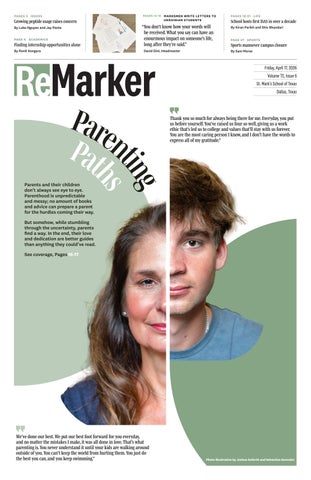
Parents and their children don’t always see eye to eye. Parenthood is unpredictable and messy; no amount of books and advice can prepare a parent for the hurdles coming their way.

Parenting

Path s

But somehow, while stumbling through the uncertainty, parents find a way. In the end, their love and dedication are better guides than anything they could’ve read.

See coverage, Pages

Thank you so much for always being there for me. Everyday, you put us before yourself. You’ve raised us four so well, giving us a work ethic that’s led us to college and values that’ll stay with us forever. You are the most caring person I know, and I don’t have the words to express all of my gratitude.”

We’ve done our best. We put our best foot forward for you everyday, and no matter the mistakes I make, it was all done in love. That’s what parenting is. You never understand it until your kids are walking around outside of you. You can’t keep the world from hurting them. You just do the best you can, and you keep swimming.”

Photo Illustration by Sebastian Gonzalez and Joshua Goforth
Photo illustration by Joshua Goforth and Sebastian Gonzalez

I see you

On Jan. 14, I saw that it was my uncle’s birthday. I texted him, and, a few minutes later, wished him well with his sickness. The next two weeks went on as usual. I came home one day to my mom’s genuine concern. Her voice was irritated and nervous. She couldn’t even look up from her phone, only gave me enough attention to say the words: “Tell Somchoon to go see a doctor.”

I wasn’t even rattled, just confused. He visited us during Christmas break; I didn’t know what could’ve gone wrong. A thousand miles away, my life continued as usual.Just a week later, it happened again. My mom got a call from my uncle. There weren’t many words said as he gasped for air. That night, my mom and dad argued about what to do, and, by the time I finished eating, my mom had a one-way ticket to Chicago.

He suffered an extremely severe pneumonia, causing necrotic and irreversible damage to his lungs and kidneys. Since that dinner, I’ve seen my mom three times. She lives there now. There, mornings aren’t synonymous with the sun rising. Daylight has no effect on the time she sleeps or eats… if she even has the appetite for that. Her days revolve around her younger brother; he’s become her sun. And a thousand miles away, my life no longer continued as usual. I’ve visited my uncle twice. Both times, I knew that could’ve been the last time I saw him. As I walked to the locked door of the Intensive Care Unit for the first time, I felt my heart drop. My breath pressed against my face mask, speeding up and getting heavier until I pressed the button.

“Room 949.”

The lock snapped, and I made my way through the cold corridor, filled with living bodies and vapid minds. The nurses’ cheerful attitude gave the sterile air some personality, but not enough to ease my angst. There, a few feet away in that full medical gown, my life didn’t matter. I stared at my uncle until my eyes grew heavy, weighed down with this merciless reality that my thousand-mile buffer could no longer protect me from.

The entourage of machines and doctors that kept him alive looked like an extension of him. A dozen tubes ran into his neck, arms, backside and chest. I shed a weak tear at the sight, too confused to process anything. My mom began to talk at him, showing little emotion from what I guess is months of desensitization and familiarity with his condition. It was just us three in the room. I couldn’t hear the busy streets of downtown Chicago, just the steady beep of his vitals and rush of fluid moving about the tube in his chest when he coughed. Through my glove, I could feel nothing but the warmth of his hand. As he looked at me with delirium and nodded, I broke.

My now blurry vision obscured any definition of his body. I saw what my mom saw: a man so helpless and sick that entire lives had to revolve around him for a chance at life. He’s since received a double lung and kidney transplant – his second chance. A few weeks ago, I got news that I never expected. By the end of July, there would be no thousand-mile disconnect. We are moving.

The phrase “I would die for you” always felt like an exaggeration to me. The past few months proved it’s not.

Because in that ICU, everything faded into the background except the three people in the room.

Uncle, I see you.

Dallas golf course breakdown and rankings

Since the Masters just wrapped up, let’s take a quick look at how Dallas golf courses stack up. Here are the top four courses in the area and what each one brings to the table.

For these web exclusive stories and more website content, visit smremarker.com and @remarkernewspaper on Instagram.

5

Growing peptide market creates uncertainty

Marketed as a fitness shortcut, many peptides are exploding in popularity.

PAGE 6

Legal action targets engagement-driven algorithms

Under rising scrutiny, platforms are changing how students spend their time.

PAGE 8

Challenging authority redefines respect

With youth increasingly questioning authority, the boundary between curiosity and disrespect grows more complex.

The ReMarker Friday, April 17, 2026

Alumnus pursues military career

Balancing classes with daily physical and field training, Gavin Bowles ’25 is preparing for a future in military service through the structure and demands of ROTC.

Every morning, Gavin Bowles ’25, a freshman at Texas A&M, wakes up at 4:30 a.m., makes his bed, sweeps the floor and cleans his dorm room — as a freshman, his room has to be spotless.

At 5:20 a.m., Bowles does an hour of grueling physical training. Then, he’s off to classes.

When he returns at 4:30 p.m., he has yet another session, this time for field training and drills. At 10:15 p.m., he goes to sleep, repeating this cycle every single week.

Bowles, a member of Texas A&M’s Corp of Cadets Reserve Officers’ Training Corps (ROTC) program, doesn’t shy away from this rigorous, military-style routine. In fact, this structured lifestyle was partially what convinced him to join ROTC.

“I felt called to do that and serve,” Bowles said. “It matched with some of the ideals that I was going for in terms of development over the course of my life. I was looking for a disciplined atmosphere, a high emphasis on physical fitness and respect – the core values that you would expect from a military type environment. I saw it as a higher quality and a way to maintain motivation to improve myself.”

Bowles is set on becoming a military officer: in fact, he had planned on pursuing ROTC since the beginning of high school. In addition, next year, Bowles plans on transferring to the United States Military Academy at West Point, and after four years of college, he will enter into the Army.

The ROTC was initially created as part of the National Defense Act of 1916 with the goal of creating a larger population of military-ready civilians at non-military academies for the imminent war effort. Further conflicts, especially World War II, would increase the pool of cadets and add scholarships to incentivize joining.

I would much rather be doing this than being a regular college student. But you have to care for this lifestyle. It’s definitely not for everyone.

Gavin Bowles ‘25

ROTC cadet

However, during the Vietnam Era, many of these contracts were revoked because of public pressure. In the 1980s they were reinstated, and are being used by students like Bowles.

“I personally got an ROTC contract, which means that I will commission,” Bowles said. “It also means my college is free. They’ll look at your numbers, and they’ll look at your GPA and your fitness test scores, and if they’re good enough, and they have a slot, they’ll give you a contract, they’ll pay for your tuition, and they’ll give you

mandatory service: two years of service for every one year paid for college.”

In Bowles’s case, he knew he wanted to serve in the military since high school, meaning that he could obtain his contract extremely early on.

For those who obtain contracts before college, like Bowles, the applicants typically apply using letters of recommendation and sponsorships from state congresspeople. Many cadets, however, can also obtain their contracts early in their college career.

See ROTC, Page 6

Youth eyesight declines from prolonged screen use

A student walks into class and sits down, ready to endure a long math class of notetaking. As he gets his notes out and looks up at what his teacher has already written on the board, he finds himself squinting to see what was written, confused by the blurry characters on the board. The next day he may sit closer to the board so he can see, but it’s a temporary solution. This change in eyesight is a growing problem for students.

According to ScienceDirect.com, myopia prevalence among children has risen from 25 to 36 percent from 2010 to 2020, continuing to surge currently. Myopia, an eye disease, can develop when someone’s eyes are too close to a screen for too long, leading to clarity at close distances and blurred vision at longer distances.

“Since they’re seeing an increase in myopia in younger children and students, people are working on more myopia control such as special contacts and glasses,” optom-

etrist Dr. Roshanka Moshtaghfard said. Moshtaghfard concludes that eyesight is deteriorating and there is a myopia uprising mainly because of an increase in screentime.

“It makes your focusing stuck at that range of your distance to your screens,” Moshtaghfard said.“If you do that for four to 10 hours a day then your brain isn’t relaxing. You’re focusing. And so now your brain perceives that your world is to the distance or depth of the screen that you’re looking at.”

Then, looking away from the screen, things farther away are technically blurry. Since people gravitate towards being on screens more than getting fresh air and doing things outdoors, eyesight continues to worsen the more people of all ages are on screens.

“Thirty years ago, we were a lot more active, and we weren’t looking at screens in school, we were looking at books,” Moshtaghfard said.

3

Conversation Starters

Interesting news headlines from the month that sparked conversation

ARTEMIS II

The four-person crew aboard Artemis II circled around the moon, and after a nine-day journey, they splashed back down in the Pacific Ocean. Artemis II is the first manned mission to the moon since 1972.

STRAIT OF HORMUZ

President Trump announced his intent to take control of the waterway. The Strait of Hormuz controls around 20 percent of global oil production, and throughout the past few months, Iran has blocked off the strait following conflicts with the United States and Israel.

TIGER WOODS DUI

Tiger Woods was involved in a crash and was arrested following suspicions of drug usage.

5 MINUTES WITH Ken Owens ‘89

Ken Owens ’89 Chemistry Teacher

“My freshman summer, I worked for Fuddruckers, the burger joint. My junior summer, I volunteered at Mount Rushmore. And my senior summer after I graduated, before graduate school, I worked for the campus police. And that was a lot of learning, and I’m glad I did it.”

“Not every skill is required at every time for every activity, and I got to be myself in a way, at every one of my jobs that I wasn’t always able to be at school. It was good that I could exercise those parts of myself.”

“I would like to start making things again. I mentioned glass working, woodworking, scale model building, cooking and baking over the summer...I think it’s important to remember that you’re not painting and acting and playing music to get into college, you’re doing it so you can do it the rest of your life.”

“So some of these technological advances are affecting our focusing system, even in the young adult population.”

While screen usage is nearly inevitable from middle school onward, maximizing time without technology and spending more time outdoors will pay great dividends for eye health.

“I tell my patients every half an hour, try to look away from the screen and focus on something far away so your focusing relaxes,” Moshtaghfard said. “I also tell the parents of my patients to have their kids play outside, throw a ball, kick a ball, do outside activities.”

Photo Courtesy Gavin Bowles ‘25
Gavin Bowles ’25 trains as part of Texas A&M’s Corps of Cadets ROTC program.

Comparison between students redefines success

In a digital culture that compares nearly everything, competition can bring both benefits and consequences for reshaping students’ sense of achievement.

From books to movies to colleges, seemingly everything is being ranked these days.

Since rankings display the prestige or success of a certain item, person or event, they can also invite a great deal of comparison and competition to rise through the ranks.

Apart from the valedictorian and salutatorian, the school does not rank students based on their academic performance. Nevertheless, the goal of winning a prestigious award, getting admitted to a top college or simply standing at the top remains prevalent for many students.

To reach a prestigious college, a high test score and GPA are essential for forming a competitive application — and they’re also easy to compare with classmates.

You don’t have to hold yourself up to a standard that is only 0.0001 percent of the population. You should only compare and compete yourself to yourself, because everybody does different things.

However, Junior Class Sponsor Sherry George believes that dwelling too much on the result rather than focusing on the process can be detrimental to a student’s learning experience.

“You’re not supposed to be focused on the numbers for your grades because everything else will follow once you actually understand material and once you get to

enjoy classes more when you’re not focused on trying to make the A,” George said.

Although some doses of competition can bring forth healthy motivation, comparing oneself in an already high-achieving environment can create damaging perceptions of who the ideal student is supposed to be.

“It’s really hard for some students to keep in mind that you’re comparing yourself to a really strong pool already,” George said.

Furthermore, if a student begins to idolize the idea of success instead of recognizing his own strengths and weaknesses, competition can manifest into stress evolve into a race for an impossible goal.

“(Comparison and competition) can be harmful when you judge your ability based on if someone is so called ‘better’ than you,” George said. “(Competition) is harmful if you judge your inability for things and your lack of not being there yet.”

In more extreme cases, hypercompetitiveness can lead to toxicity, which can ruin friendships and relationships.

“Everybody wants to achieve something,” sophomore Adam Zhang said. “Everybody wants to win an award, and that’s human. If you’re confident in your abilities because of the hard work you’ve put in and the passion that you have for the hobby, then you shouldn’t be toxic and overly competitive about it.”

Students, faculty trained in lifesaving CPR skills

When a person’s heart fails, maintaining blood flow is essential to keep them alive. And often, Cardiopulmonary Resuscitation (CPR), a life saving procedure that’s relatively easy to learn, can accomplish that.

Following advice from the American Heart Association, the school has been educating students on CPR techniques for over a decade.

“Trainer Matt came in 2008, and in 2013, he joined the Health and Wellness Team for teaching, and he has been teaching the fifth grade CPR since that time,” school nurse Julie Doerge said.

Even without proper experience, first responders can perform CPR intuitively by com-

pressing the patient’s chest to the beat of popular rhythms.

“It is such an easy skill to learn that, even if you’ve never learned CPR, you call 911, you push hard and fast on their chest to the beat of songs like, ‘Not Like Us’ by Kendrick Lamar (or) ‘Staying Alive’ by the Bee Gees,” Doerge said.

Alumni of the school generously donated 150 practice kits called “Mini Annies,” designed to train large groups of people with accurate models. The Mini Annie indicated where to press on the chest and how deep to press. In 2014, the Texas congress passed Senate Bill 261, mandating CPR training for older students in public schools.

“In public schools, grades 7 through 12 had to be trained, but not certified,” Doerge said.

Skills and training in CPR extend beyond the school. Real world emergencies may prompt the need for CPR, especially forolder people. Knowing how to perform CPR can prove to be lifesaving even if cardiac arrests are a rare encounter.

“I think it helps you in the world and helps you with your family if someone has a heart attack,” Doerge said. “You’re more likely than not going to use this skill outside of school even though cardiac arrests happen in kids.”

In a life threatening situation, proper care and procedure can mean the difference between life and death. Without the right protocol, execution can’t revive a patient. CPR is a temporary solution, so several compressions

Although colleges look for high grades and scores, a positive, collaborative mindset is still crucial to escape toxic competition.

“If you let something you hear once get stuck in your head, I feel like it’s not worth letting it get to you, because you’ll end up where you’re supposed to be going,” George said. “You just find your strengths and your areas that colleges want to prefer, because obviously, it’s not just the numbers.”

Ultimately, George believes students should trust that the admissions process is not a direct competition with their peers, and instead focus on their own achievement.

“If you’re meant to go to a college and there’s 10 people who got in, it’s possible that they’ll pick 11,” George said. “You don’t have to sell yourself short, and you don’t have to compete with your friends or think that you’re competing with your friends.”

This mindset doesn’t just pertain to college decisions. Zhang believes that people should not focus too much on other people’s achievements but rather concentrate on factors within their own control.

“You don’t have to hold yourself up to a standard that is only 0.0001 percent of the population,” Zhang said. “You should only compare and compete yourself to yourself, because everybody does different things. Everyone’s good at different things. It’s especially true for things out of your control, like looks or height.”

Similarly, George believes that the most productive and healthy motivation comes from measuring and reflecting on one’s personal progress over time.

“There’s some people in general that are also driven by exceeding what they’ve done in the past,” George said. “I think that’s the best kind of competition that you could have.”

True self-improvement starts with understanding oneself rather than just chasing external results in order to improve in a healthy and sustainable way.

“The most important part is to find out your own personality and be able to know what your weaknesses and strengths are,” Zhang said. “Work on your weaknesses, and this lets you live a healthier life, because you are improving, not just in the quantity aspect like ‘I have a million dollars’ or ‘I have all A’s.’”

won’t fix everything.

“You check the scene for safety: ‘Are there power lines down? Are they in water?’” Doerge said.

“And then you check the victim: ‘Are they breathing? Do they have a pulse?’ Then you call 911 and then you start high quality compressions. And one of the things I think you learn pretty quickly is that if you begin CPR, then you can’t stop when they run and call 911.”

It’s not only important for students to get trained in CPR, however. When Doerge came to the school in 2007, CPR training was optional, only reserved to faculty members going on outdoor trips. Since then, the entire faculty has been trained in CPR.

“The people who had been trained were the team that went

out to Pecos, and they are also trained in wilderness medicine, as well as in CPR. So I felt at that time, it was important to have more people trained.”

Before COVID, the school brought in an ICU nurse from Parkland Memorial Hospital who helped train and CPR certify the faculty. While the program was temporarily paused during COVID, training quickly resumed afterwards.

“After COVID, we went back to bringing in a company that does certify our faculty and staff,” Doerge said. “They get a certificate that’s good for two years. And that’s a 2.5 hour course in August every year. You learn CPR, you learn AED, they do some first aid.”

Photo by Peter Clark
A student studies academic rankings, measuring his success against others.

Growing peptide market deceives users

Marketed as a shortcut to more muscle, recovery and longevity, peptides are booming across fitness circles. But behind its veil of popularity, limited research and weak regulation leave users navigating serious uncertainty.

The global peptide supplement market was valued at $4.1 billion in 2025 and is projected to reach $11.2 billion by 2035 — but the consumers driving that growth aren’t just major pharmaceutical companies or elite professional athletes.

They’re teenagers trying to build muscle faster, middle-aged professionals chasing sharper focus, bodybuilders injecting vials before a morning workout and retirees looking to smooth their skin.

Peptides have become a onesize-fits-all solution for nearly every imaginable health problem, but with one serious catch: the science is still catching up.

The term “peptides” refers to short chains of amino acids, the same building blocks that make up all proteins, and different combinations produce dramatically different effects in the body. Some examples of peptides include retatrutide, which targets three hormonal receptors to suppress appetite and accelerate fat loss, BPC-157 (Body Protection Compound 157), a synthetic derived from a protein found in stomach acid used to speed healing in tendons, ligaments and muscles and GHK-Cu (copper peptide) a naturally occurring compound used extensively in anti-aging skincare for its ability to stimulate collagen production and promote skin repair.

Unlike anabolic steroids, which are chemically lipids commonly used in the bodybuilding community to enhance musculature, peptides don’t directly stimulate muscle growth. Sophomore Alex Gawel, who has friends that have used peptides, notes that people often mistakenly see peptides as an alternative to steroids when, in reality, they have different functions.

“Peptides help promote muscle growth, but they themselves don’t cause any muscle growth,” Gawel said. “If you were to take steroids without lifting, you would still put on muscle. If you were to take peptides without lifting, it would all just go to waste. They minimally help.”

Social media has played a key role in peptides’ rise to fame. They’re easily accessible and low risk, and it’s easy for an influencer to promote them and their overwhelming positive benefits.

Peptide Market

I haven’t seen any high quality literature — studies where, for example, we took a hundred athletes... and then tracked some outcome. I think it is, at this time, more marketing than science.”

Dr. Powell Auer Orthopedic Surgeon

“There’s a peptide for almost every goal, and that makes them really attractive to everyday users,” Gawel said. “You can go online and buy many of these compounds without a prescription, which makes the barrier to entry extremely low.”

The industry in which peptides are produced doesn’t prioritize safety or quality of product. Peptide companies conduct biased or blatantly false research in support of their products. Many of them use third-world country laborers to lower expenses, and sometimes those countries lack standard safety measures, which can lead to contamination.

“Since many peptides exist in a ‘gray market,’ you don’t always know what you’re actually injecting in your body,” Gawel said. “You can very easily become susceptible to an ugly infection. It’s a big, big gamble, and in most cases, it’s really just not worth it.”

The absence of FDA approval compounds that uncertainty. Companies can get around lawsuits by indicating that a peptide is not meant for human consumption when it really is, or by marketing it as a “supplement” with an unofficial name rather than explicitly listing it as a peptide, leaving consumers without the safety guarantees that regulate standard pharmaceuticals.

The surge in peptide use among athletes has not gone unnoticed by the medical community, either. Dr. Powell Auer, an orthopedic surgeon specializing in spine disorders, urg-

es caution — not because peptides are inherently dangerous, but because the science hasn’t caught up.

“The word peptide just means protein, and the two words are basically synonyms,” Auer said. “When a non-medical person says, ‘I’m taking peptides,’ you could be taking peptides by eating a hamburger. The term has become sort of a marketing catch-all.”

That doesn’t mean all supplementation is ineffective. Auer points to specific amino acids and compounds with legitimate research behind them, such as leucine, one of the nine essential amino acids the body cannot produce on its own, has been shown to support muscle recovery, and two to five grams per day is a reasonable supplement range for a high schoolaged athlete.

Creatine, while not a peptide itself, is a byproduct of amino acid metabolism and has clear evidence supporting its role in recovery during intense training — though Auer warns that overuse causes severe gastrointestinal side effects and that only a few grams per day are needed.

His broader concern is with the practice of injecting peptides, which has become increasingly common among athletes seeking faster recovery. Auer says the core problem is a lack of rigorous clinical data.

“I haven’t seen any high quality literature — studies where, for example, we took a hundred athletes, had 50 of them inject these pep -

tides, had 25 of them inject water as a control, had 25 of them take it orally and then tracked some outcome,” Auer said.“I think it is at this time more marketing than science.”

Despite the risks, some people will double down on peptides, taking multiple injections that are said to amplify each other’s effects. There are social peptides, which are supposed to supplement neuroplasticity, anti-aging peptides and more, so people will take as many as they want to see improvement in.

“You can walk into your gym, and you might see a man who has nine vials of clear liquid, injecting them one after the next,” Gawel said. “In theory, they don’t interfere with each other. You’ll have individuals who will take five to 10 peptides that will decrease appetite, don’t eat for days and become very, very unhealthy, especially since the effects of peptides come quickly.”

Amid the uncertainty, Auer remains optimistic about where the research is headed, particularly as artificial intelligence accelerates the pace of clinical study. For now, though, his recommendation is straightforward: eat a protein-rich diet, supplement with leucine and creatine if needed and wait for the science.

“We may get within a reasonably short time to where injectable peptides are both safe, common and effective,” Auer said. “It’s an exciting pathway, but as of right now, we just don’t know yet.”

Photo Courtesy Creative Commons
In the pursuit of faster results, peptides blur the line between innovation and risk.

Lawsuits push back against addictive algorithms

Amid growing legal challenges, platforms built to maximize engagement are reshaping how students focus, learn and spend their time.

On March 25, 2026, Meta and YouTube were found liable for intentionally designing addictive algorithms, leaving children and adolescents with lasting mental health disorders. The plaintiff in the case received a combined $6 million from the companies.

Although the money is pocket change for trillion dollar companies such as Meta and Google, this case sets a powerful precedent for future lawsuits, especially against similar applications, such as TikTok and Snapchat.

Director of Marksman Wellness Center Gabby Reed sees image sharing features as beneficial for staying connected to family and friends.

“These apps were put out there as a way to connect with people,” Reed said. “For example, I have a family that lives in Bolivia. I’m able to see pictures of them and their babies, and it feels like we’re connected in a lot of ways that I didn’t feel when I was young and my grandparents lived in Bolivia.”

Over time, these apps have turned into something completely different, to the point where juries are ruling that they are intentionally curating a malicious product.

“As ads started taking over, it became a way for the platform to make lots and lots of money by keeping people’s eyeballs on the platform,” Reed said. “So now it’s basically become a place to have things sold to you.”

One of the biggest additions on these apps is short form videos. Instagram, for example, has Reels, a feature where users can infinitely scroll through thousands of videos that usually last under a minute. Other platforms, such as YouTube, Tiktok, Snapchat, Facebook and ESPN have their own versions of short-form videos.

“What the data tells us is that short form videos keep our brain from actually being able to have prolonged, sustained attention,” Reed said. “We get used to being entertained quickly and for short periods of time, and our brain wants to jump to the next thing. We’re basically training our brain to switch over and over again quickly.”

For students in particular, social media becomes more than just a distraction. With lessened attention spans, social media can actually im-

pair a student’s ability to focus and do homework.

“The urge kicks in when you’re bored and you’re at home, especially when you’ve had a long day or you just finished a lot of work. I think of it as a way to unwind,” sophomore Terrence Cao said. “Instead of scrolling (I) try to go do something more productive like listen to music or (doing) photos I haven’t edited. Sometimes, even long form entertainment; maybe I’ll go watch half an episode of a show.”

Cao, who uses social media for his photography account, his business, his club and entertainment, finds that keeping checks on himself has been extremely important for helping him focus.

“My parents put screen time on my phone, so my screen time for a day is around four and a half five hours, but (before) it was around six or seven hours,” Cao said. “(Screen time) keeps me away from social media. It helped me realize that I was spending too much time on social media before.”

Cao believes that he’s been able to build stronger connections with his friends because he’s spending less time on social media, especially because of how conscious he has be-

come of how much time he’s spending on social media.

“I have a lot more time for extracurriculars and sports and especially photography, just because of the reduction of social media screen time.”

Still, Cao finds that he struggles with focusing on work for a long time. One of the strategies that he’s come up with, however, is that while studying, he will stay on call with one of his friends, which will discourage him from going on his phone and just scrolling through social media.

“When we sit down to try to do something really hard, like read “The Odyssey,,” “The Iliad” or something that takes a lot of sustained attention, it becomes even harder to do,” Reed said.“It hurts, physically, to try to do this, and it becomes more and more and more difficult the more we expose ourselves to short form videos.”

Looking back to the civil lawsuit against Meta and YouTube, the court case revealed internal documents from executives that acknowledged their apps’ potential harm against children: company directors know that Instagram and YouTube may be harmful to adolescent brains,

As ads started taking over, it became a way for the platform to make lots and lots of money by keeping people’s eyeballs on the platform.

Wellness Center

with plaintiffs claiming that the apps cause anxiety and depression.

“It’s almost like reading internal documents from Marlboro or other tobacco companies,” Reed said. “It’s like them saying ‘Oh, we know this causes cancer, but we’re going to do it anyway.’ Or,‘we know our product is addictive, but we’re going to do it anyway.’”

To avoid potential harmful effects from addictive algorithms, experts such as Jonathan Haidt, author of “The Anxious Generation,” suggest that young adults and adolescents should avoid watching short-form videos entirely.

“Because brains don’t finish forming until you’re around 28 to 32, his recommendation is that no one watch videos shorter than 10 minutes,” Reed said.

Ultimately, this court case serves as a reminder to students about the dangers of social media overconsumption. It also opens the door for future lawsuits and legislation against large tech companies.

The court case extends beyond a $6 million settlement; rather, it serves as a major pushback against social media giants.

Alumnus prepares for future military service

“One of the ways to do it (in high school) is to have a recruiter hold your hand through the entire thing,” Manny Rubio, a current cadet at Texas A&M, said.“But now we don’t have recruiters, we just have actual officers on campus who work with the contracted people. And there’s different routes depending on what branch.”

In addition to providing government-funded contracts, pursuing a military career can open the door

for future career opportunities.

Bowles, for example, plans on applying for law school, with his tuition being paid entirely by the government. In addition, he plans to be recommissioned into the Judge Advocate General’s Corps (JAG), where he will practice law for the military.

“I’ll be recommissioned as a JAG corps officer, which is army law,” Bowles said. “Then eventually, once I hit however many years, I’ll get out and probably do corporate law.” Before then, Bowles has to com-

plete at least eight years of military service, and his daily routine in college, consisting of physical training and field training, are all preparing him for life in the military.

“In PT, sometimes you’re just running unnecessarily hard, doing bear crawls, doing a ton of uncomfortable calisthenics or mud PT, just to test your mentality,” Bowles said. “Other times, you’ll hit a really good lift or do a good endurance run. It’s a combination of both mental and physical training.” Bowles also learns combat tac-

tics from field training, directly teaching him applicable skills for the military. These training sessions are meant to build teamwork and create an organized group of cadets.

“For field training, we primarily do infantry tactics. We’ll train attacks, raids, ambushes and movement-to-contact,” Bowles said.“They teach how you attack an objective, how you clear it, how you do the different orders, how you take care of casualties or clear enemies and how you take prisoners of war.”

Ultimately, ROTC takes up a

large portion of Bowles’s day. This extra burden, on top of his academic workload, can be difficult to manage. Still, Bowles appreciates the extra work that he puts into the program.

“I would much rather be doing this than being a regular college student,” Bowles said. “But you have to care for this lifestyle. It’s definitely not for everyone.”

Photo Courtesy Creative Commons
A landmark lawsuit found Meta and YouTube liable for designing addictive algorithms, setting a precedent for future cases.
ROTC

Networking influences future job opportunities

In a highly competitive job market, students are turning to networking more and earlier than ever. But although connections can open doors, students still have to earn their place once they step through them.

“It’s not what you know but who you know.”

Although there are deferring opinions about the validity of this common phrase, most would agree that it carries some merit.

According to Apollo Network, 85 percent of jobs are filled through networking, and 70 percent are never even posted publicly. For some students, statistics like these are the catalyst for a generation that may feel driven — or even required — to network earlier than ever.

As the job market grows more competitive, with fewer entry-level positions carrying lower and lower acceptance rates, networking and connections appear to be a shortcut to even getting a student’s name seriously considered.

In fact, around 85 percent of Fortune 500 executives were fraternity members, according to Greek Gear. And while top universities do offer excellent academic opportunities, some students may be more interested in the doors that their networks can open.

Although there’s varying opinions on how important it really is relative to personal talent, social capital does maintain some level of influence throughout nearly every system people move through.

And its importance may be felt most significantly at the beginning — when achievements and experience are limited and there’s little to separate one candidate from the other.

In that sense, connections can be the difference between getting that first opportunity early on and never getting one at all.

Having worked at both an ice cream shop and a golf club, and with a data analyst internship lined up for this summer, junior Sam Merryman has seen both sides of the process — applying without connections and benefitting from them.

From his view, while professionals can rely on years of results, students will often need to lean on relationships.

“I think social capital in high school and college is more important, it’s really the people you know at this time,” Merryman said. “I do, however, think that once you get out into the real world, who you know can get you in the door, but if you’re not performing, they’re not going to keep you in there.”

Even as early as high school, schools offer opportunities to connect with alumni and other resources to help students explore specific fields with professional guidance.

And these conversations can often lead to student internships or deeper insights and advice into aspects of a sector.

“It’s there to be used. If you’re looking to shadow a doctor thinking about oncology, chances are really good we have a successful

oncologist who went to St. Mark’s, who’s going to look at that and be like,‘A young Marksman who wants to do this as well,’” English teacher Cameron Hillier ‘13 said. “That’s social capital, knowing the guy. By virtue of graduating from St. Mark’s, you’re going to have some of that.”

Still, connections are only half of the story. Despite their value, Hillier warns that it’s incredibly dangerous for people to solely rely on their network.

“If you think because I know a guy, I’m guaranteed this job, so I don’t really need to worry too much about my grades or my accomplishments, much less building myself into the kind of person who would do well in this position, we can see how maybe that would breed entitlement, lack of work or things of that nature,” Hillier said.

Instead, Hillier frames networking as a powerful tool, just not something to depend upon.

Social capital can only do so much if a student does not possess the qualities or skills a company demands.

“Having that connection is awesome, but you still have to have the goods,” Hillier said.“You still have to have done the thing, achieved the achievement, worked hard, put in the time and made something of yourself.”

And that pressure to accumulate both strong connections and talent is only mounting.

Entry-level postings have dropped 15 percent over a year and there has been a late 13 percent decline in employment for workers aged 22 to 25 in multiple AI-exposed jobs since 2022, according to Demand Sage.

As AI continues to impose itself into the workforce, the human relationships, trust and advocacy — what AI cannot replicate — may eventually become the most valuable currency of all.

So with this seemingly unstable job market increasing in erraticness

Having that connection is awesome, but you still have to have the goods. You still have to have done the thing, achieved the achievement, worked hard, put in the time and made something of yourself.

and competitiveness, networking and referrals will become even more crucial as opportunities decrease.

“He’s not going to give away a free job if it could be automated, and that’s just good business sense. You’re not going to hire someone to do a job if it costs you a salary, benefits, all that kind of stuff when you just have AI do it,” Hillier said.“So in that case, I would say, yeah, having that connection would be great.”

But to even be recommended for a job, Hillier emphasizes that opportunity starts internally. More than just skill, students can develop the work ethic and relationships that make them someone worth advocating for, because external opportunities often grow out of an initial internal foundation.

“You still need to be a recommendable guy, a guy who’s got the quality, the character and the competency that we see, such that we would want to hire you and someone would want to make that connection,” Hillier said.

And the importance of social capital stretches beyond the workplace and into all aspects of life, especially the classroom. Building rapport with teachers is stressed early on and can carry real weight — both for grades and for learning purposes.

“If you’re on the edge of a B and A, just going in and meeting with them and showing that you care is very important,” Merryman said. “Having a teacher liking you literally never hurts you.”

Ultimately, a school’s network and brand image can provide some baseline network and hand students their first opportunity — but it’s what they do with it that defines what comes next.

In some situations, students can have doors opened for them.

In other cases, they’ll open doors themselves.

But walking through is what will eventually count.

By The Numbers

Even though it doesn’t account for everything, networking and connections are especially beneficial for receiving job recommendations, interviews and offers. Of jobs were filled through networking 85 Percent

Of job hires were never posted publicly

Percent More likely to be hired through referrals

Photo by Wyatt Gair
The school’s community lays a foundation for a network that endures long after students leave.

Questioning authority redefines respect

As younger generations challenge traditional authority structures, navigating the line between curiosity and disrespect becomes increasingly important.

A lot of what gets called “respect” from authority figures can actually be compliance through fear or tradition.

But real respect — the kind that serves a backbone for relationships and communities — is an entirely different thing.

And in many ways, that begins with how one sees themself; self-respect shapes the baseline and reflects outward in the ways people treat others.

Yet knowing how to extend respect to others is rarely straightforward, especially when the definition of respect itself can be blurry. Many young people grow up navigating conflicting definitions.

From a traditional hierarchical standpoint, young people respect their elders and authority figures unconditionally, regardless of whether that same level of treatment is returned.

While they’re taught that respect must be earned, it can seem as though adults never had to earn it at all, receiving it automatically simply by the virtue of being older.

There’s a widespread sense that younger generations show less respect towards their elders these days. And it’s true that young people tend to ask questions and challenge the structures and status quo they were born into, particularly when they find themselves at the bottom of the social ladder.

Those questions typically come from a place of genuine curiosity, but at the same time, they can quickly tip into perceived disrespect.

“When you’re questioning authority, it’s respectful if it’s coming from a place rooted in learning,” Director of Inclusion, Diversity and Human Resources Lorre Allen said. “I think it’s disrespectful if you’re trying to undermine the situation or that person. And that’s the difference between the two.”

Allen believes most people, despite their differences, are generally working towards the same goals — it’s just the methodology that divides them.

When that goes unacknowledged, disconnect follows, and what was meant to be a productive exchange turns into an accusation or a fracture in the community.

The same words carrying the

same message and even the same intent, can land entirely differently depending on the person and the small social cues that accumulate throughout the message.

“It’s about three things in my opinion — intent, tone and timing,” Allen said. “That’s why I say respect evolves as you grow and mature and have more experiences. These are things that you recognize and then you pivot and change how you deliver the same message.”

And from an authority figure’s standpoint, it’s equally important to consider the other person’s point of view.

Moving communities forward requires both sides to approach issues collaboratively as partners rather than opponents.

In the heat of the moment, that’s easier said than done.

People say things they don’t mean, and certain words will always leave a permanent mark, even after countless apologies.

Some words can simply never be taken back.

“Sometimes it’s a byproduct of

The line is different for each person, and that seems very vague. The worst answer that a kid could ever get is that it’s different for everybody, because then this gray space got even grayer.

GayMarie Vaughan

English Teacher

a knee jerk reaction to something, and they just do something that they wish they may have handled in a different way,” Victor F. White Master Teaching Chair in English GayMarie Vaughan said.

For this reason, timing and restraint can be invaluable tools for calming intense situations.

“You don’t always have to respond right then and there,” Allen said. “We can always come back right the next day to the person, and you’re less likely to have a tone that is disrespectful if we just take the time and step back a little before we respond.”

While there are actions that are clear signs of disrespect, part of what makes respect so difficult to navigate is that the line between honest challenge and outright disrespect shifts from person to person, day to day, situation to situation.

“The line is different for each person, and that seems very vague,” Vaughan said. “The worst answer that a kid could ever get is that it’s different for everybody, because then this gray space got even

Convenience drives surge in delivery services

As of 2026, 28 percent of people in the US use delivery services such as Doordash, Uber Eats and Grubhub weekly, and 44 percent use them less frequently.

Currently, Doordash controls 67 percent of the market, with Uber Eats at 23 percent.

And the average Doordash order comes in at $37.28, with a similar cost for other services.

Meal-kit delivery services in 2026 such as HelloFresh are estimated to serve tens of millions of subscribers in the US, with roughly 17 percent of American consum-

ers having tried it at some point. These meal-kit delivery services saw a huge growth in revenue since COVID. And most customers who used these services during the pandemic continued using them.

For sophomore Rayhaan Rizvon, his use of delivery services comes from a mix of convenience and also the lack of time on most school days to go out and buy food.

“Grubhub is my (favorite) because you can get the free premium service through Amazon. A lot of times there are restaurants that are either not close to my house that I would want or if the wait at the

restaurant is normally super long” Rizvon said. “If I could just place an order and then be at home while I wait, that makes it a lot more convenient.”

Rizvon started using Grubhub during the fall of 2025, and despite thinking that after getting his license he would use it less, he discovered that it was far more convenient to just stay home.

“I realized how much more I would rather be at home, studying somewhere and then getting to come home to my food, rather than having to drive somewhere else to go pick it up,” Rizvon said. “It’s also more convenient for my family,

if my mom doesn’t want to cook, then we can just pick up or order delivery.”

Rizvon is also subscribed to a meal-kit delivery service that comes from Home Chef, which usually consists of 3 dinners. Since he began using Grubhub more frequently, his family cooks far less than before.

“We’ve been using meal kit services for several years. I think it helps take a lot of time out of the shopping, but in terms of actually cooking, it’s about the same amount of time,” Rizvon said.

Junior Taiting Zhou also has very similar reasons to Rizvon for

grayer.”

And many times, it becomes difficult to directly question an authority figure face-to-face due to this uncertainty, leading towards people talking behind someone’s back or simply keeping negative thoughts to themselves entirely, neither of which resolves anything.

“In the world at large, I think not being able to question authority could lead into some really dangerous places and spaces for people,” Vaughan said.

Ultimately, Allen and Vaughan both suggest that clarity from both parties is essential to fostering mutual respect. When expectations and boundaries are made explicit rather than assumed, the guesswork around tone, intent and timing diminishes.

Then, the gray space surrounding respect becomes at least a little easier to navigate.

“Respect is earned, and it boils down to, at the end of the day, how we treat people,” Allen said. “To go back to when we were all little, when we treat people the way we want to be treated.”

why he uses food delivery services. Due to his sporadic schedule, he can’t always have dinner with his family, and being able to get food delivered to him means he doesn’t have to waste time on other things.

“Before I could drive I’d probably use (food delivery services) three times a week, maybe four. Now I probably use it once a week,” Zhou said. “I think (my parents) understand where I’m coming from, and they use it to their convenience. We kind of think that it’s beneficial.”

Photo by Holden Purvis
Respect can become tangled as words are interpreted differently from how they were meant.

A

ACADEMICS

Seniors exhibit work in art galleries

Every year, seniors in fine arts courses have the opportunity to showcase a few of their best works on campus.

Cursive facing decline, still taught at the school

Nationally, cursive education and usage has seen a significant decline over the years, but many at the school champion its benefits.

PAGE 13

Science department utilizes hands-on experiments

The science department invests significant amounts of time and equipment for students to do experiments in class. The ReMarker

Games see more use in education

Game-based education methods have seen an increase in use as teachers look for ways to increase student engagement in the classroom while still prioritizing education and avoiding distractions.

Usually, you’re not supposed to play games at school. But for some reason, almost all students know the thrill of winning a Kahoot in class.

Because while older generations may not be familiar with the use of games in the classroom, for current students in grades ranging from elementary to high school, the use of games for learning is almost ubiquitous. Everyone has participated in a game-based activity in class,

THE GALLERY

“Ol’

TB: I listen to Frank Sinatra often — when I study, drive, wherever. He’s an icon from an era I’ve always been drawn to, and I wanted to start capturing that through my art. I’ve been working on a series of charcoal portraits of famous figures from around 60 years ago, whose images feel timeless in black and white. The goal is to make artwork that both older and younger people can connect with, so Frank Sinatra was the obvious first choice. The piece took me about 10 to 15 hours to make over a few days, and I’m really happy with how it came out.

especially in younger grades.

The use of games in education to increase student engagement has seen an increase in popularity among teachers, and nowadays they are commonplace in middle school classrooms and can even be found in the Upper School. Teachers across the country have turned toward a style of teaching that involves more gamebased learning.

Many educators find games to be a useful tool in the classroom to help with learning, especially when introducing new vocabulary or concepts that need repetition in order to be committed to memory.

“I think (games) are really good as a way of getting kids to learn terminology and facts that they will then need to use in the day-to-day and on tests and quizzes,” biology teacher Dan Lipin said. “It’s fun, and kids get animated.”

The diversity of options teachers have for implementing games in their teaching allows for significant flexibility and choice. In general, games can be applica-

TECH WATCH

ble for various subjects, ranging from language and the humanities to STEM.

“Some of the games I use I have created myself,” J.J. Connolly Master Teaching Chair Nancy Marmion said. “Others I have learned from other teachers or they are games that are real life games, like a board game or something, that I’ve converted to using in the classroom.”

Teachers can use many different kinds of games in many different ways to try to reach their unique objectives, allowing them to be useful for various classes and levels of difficulty.

“I think creating games is possible in all classes,” Lipin said. “I would make board games, and I’ve seen games used in any subject. Firstly, any subject has facts that you need to know in order to help you. So any subject could use games just to help kids learn the basics. And then secondly, you can develop all kinds of games to help someone learn the interactions between concepts.”

See EDUCATIONAL GAMES, Page 12

Oakley Meta Vanguard Glasses RELEASED

Benjamin Yi: The Oakley Meta Vanguard glasses were announced at Meta Connect in September 2025 and then released on Oct. 21 of the same year. The Vanguard features a 12 megapixel camera with an ultra-wide 122 degree field of view with 3K video, built-in Meta AI, Garmin and Strava integration and powerful open-ear speakers. They’re priced at $499 and rated IP67. Unlike the Meta Ray-Ban glasses, however, the Vanguard does not have a screen but it does still include built-in Meta AI technology.

Building Pathways

COMMENTARY

Last spring, I spent weeks writing emails — 27 of them, to research labs, to companies and to anyone in Dallas who might give me something real to work on. I rewrote them over and over, trying to sound professional without sounding desperate, trying to make a case for why a high school student was worth someone’s time. Two people responded. Neither said yes.

I didn’t know what I had done wrong. The emails were good. The interest was genuine. I wasn’t asking for much, just a chance to contribute something, to be in the room where the real work was happening. But somewhere between sending those emails and waiting for the responses that never came, I started to understand something I hadn’t considered before. It was that I was doing this completely alone, and I didn’t have to be.

Around the same time, I started learning about what students at other schools had access to. Hockaday has a formal summer research program that connects students to labs across Dallas before their senior year. Greenhill has a pitch night where students present business ideas to local executives and compete for real funding. Keller ISD has formal partnerships with companies like Lockheed Martin and Caterpillar, giving students structured internship pipelines across engineering, healthcare and business. Frisco ISD operates a dedicated CTE Center with over 30 industry-aligned programs built in collaboration with companies and universities. These were practical additions to the curriculum, stemming from schools recognizing that student ambition needs pathways to achieve more.

That’s not a criticism of St. Mark’s. If anything, it is an opportunity. This school has the resources, the relationships and the reputation to build something like those and do it even better than most. The foundation is already there.

College admissions have shifted in ways that make all of this matter more than it used to. Admissions officers today aren’t looking for students who are generally good at things. They want depth. They want something pursued with enough focus and consistency to set the student apart from the rest. Research, ventures, publications, specialized awards. These aren’t impressive extras anymore. They’re becoming more and more of the baseline. And building that kind of record requires more than just ambition and enthusiasm. It requires access.

What St. Mark’s already does well is real and worth preserving. The education here is serious, and the people who teach it are exceptional. What could make it stronger is not a departure from, but an extension. An alumni network where students can easily reach out. Research and internship programs with Dallas universities and companies. A more robust college counseling department that has the resources to start early enough to shape a plan rather than jam stuff together to fit a narrative. Funding for students who want to build something. These are the kinds of additions that would let students take everything they’ve developed here and actually show it to the world. I found my way eventually, but it took many emails and a long couple of months to get there. With the right infrastructure, it doesn’t have to be that hard.

Photo by Christopher Huang
Foreign language instructors commonly use games like Kahoots and Gimkits to make their classes more exciting and engaging.
Blue Eyes”

Seniors showcase art in galleries

As an annual tradition, the senior class displays their best art work in the Nearburg Gallery. There, students, teachers and visitors can observe their work year-round.

Every year, fine arts students from the senior class submit their best work to various art galleries in the school. Throughout the year, thousands of students, faculty and parents can admire a culmination of hard work and effort, showcased here on campus.

The process for deciding which pieces to highlight in the gallery may vary between fine arts, but for the senior photography class, decisions were collectively made.

“We helped each other brainstorm for the best picture and help each other decide between two or three pictures, which one would think would look best,” photography senior Max Bean said.

Photography students can go to galleries for extra credit. During one visit, Bean was impressed by David Yarrow’s wildlife photography and inspired to recreate the photos himself.

“He has a lot of these super cool pictures of big, animal safari faces super zoomed in,” Bean said.“Those were really cool, and going to that gallery, I was kind of just shocked how cool it was.”

Wildlife photography is unique in that timing is crucially important. Capturing perfect moments on camera requires not only precision and skill but also persistence and determination.

“Ninety nine percent of the time there’s nothing happening. Things are sleeping, the light’s not right,” Bean said. “And so you have to be really patient.”

While on a trip in one of Africa’s safaris, Bean saw a cheetah, zooming in to capture a close up of the cheetah’s face beneath a cloudy sky.

“We were able to get pretty close, and then it yawned, right whenever I was taking pictures,” Bean said.

After Bean captured his close up photo of the cheetah, he shared it with other photography seniors. The class discussed which photos were strongest and most appealing.

“They’d probably pick, like, two or three (photos),” Bean said. “And then you would ask around,‘Do you

like this one? Which one do you think would be better on the wall?’”

Wildlife in Dallas doesn’t offer the same scenery that other locations do. The senior class travels to different locations in search of new places to take photos. A tight knit class evolves into a community of enthusiastic artists where photographers can bond while spending time taking breath taking photos.

“We’ll drive to some small town in Texas or something, an hour or something away,” Bean said. “Just being able to do something so cool like photography, and making art with such a good group of people — that’s really awesome.”

Exotic scenery like the savannahs in Africa show people a side of the world they haven’t seen before, which is part of the reason why Bean chose his photography. The dramatic image of a wild animal surprises passerby.

“I was just trying to catch (people’s) attention and do something that (they) don’t see every day,” Bean said. “Once they stop (to look), they see a deeper meaning behind it. They see this anmal that they

don’t normally see.”

Senior Beau Bacon has done drawing and painting for multiple years, featuring his best work in the school’s art gallery in Decherd. Across the pieces he’s made throughout his career, many come

I just hope people look at it and think, ‘Wow, that’s really cool.’ I’m super proud of having my work chosen to be in an exhibition.

from inspirations in his life.

“I like to choose subject matters and pieces that represent my values,” Bacon said. “A lot of my pieces are inspired by western films, country music and pop culture and music.”

One of Bacon’s most notable featured pieces was of Gus McCrae

from the old Western movie “Lonesome Dove”.

“He’s a Texas Ranger with his buddy, and they travel across the plains and do everything together,” he said. “He dies with valor, a very peaceful death.”

Other inspirations for Bacon’s artwork come from artists whose style he finds interesting and admires. One such artist is the Chinese painter Z.S Liang.

“While (Liang) was on a trip to America, he was at a museum and saw all of this Native American culture,” he said. “That inspired him a lot. All of his pieces are based on the Native American way of life.”

Bacon finds Liang’s assimilation of a different culture fascinating and relevant to his own life. Mimicking artwork styles and ideas from other cultures can broaden an available skillset.

“I want to have that mindset, especially because I’m graduating,” he said. “You don’t just want to stay stuck and know your home culture. You want to find things that inspire you and continue to develop new ideas.”

New engineering classes to be added next year

Following a huge popularity in robotics with slight logistical issues, computer science teacher Stewart Mayer found a solution.

Two brand new computer science classes will be added in the 2026-2027 school year, allowing robotics and engineering enthusiasts a chance to expand their knowledge and skill set.

In the Middle School, interest in robotics proved difficult to accommodate in an after school schedule.

“Our first Lego teams have been wanting to move on into higher, more difficult robotics programs, such as FTC,” Mayer said. “But it’s been a real struggle, because the middle school sports schedule basically prevents anything from happening after school until 6 p.m.”

In the eighth grade, Mayer will add a robotics computer science class, designed for students more interested in engineering aspects

than traditional computer science. This class not only provides a new option for eighth graders, it also solves the logistical problem surrounding after school conflicts.

“It is an engineering based class that will include aspects of robotics, and so now eighth graders have two great choices to decide amongst,” Mayer said. “To decide between a more standard computer science curriculum, or a more engineering based curriculum.”

In the past, engineering options were limited to one semester courses. This year, Mayer created a full length engineering class to the curriculum for the first time. Engineering 2 serves as a follow-up, expanding into more advanced projects and concepts.

“So it’s very exciting that we kind of have an engineering tract that is being built, and hopefully students that wish to go into engineering will start taking these classes and get a lot of value out of them.”

With the addition of multiple new courses, Mayer can’t teach all of the classes by himself. Former Tesla engineer, and St. Mark’s Engineering/Science teacher, Kevin Fine will teach some of the classes as well.

“I’m very, very happy to have Mr. Fine here, who is so qualified to teach any or all of these classes. He and I, and potentially other teachers, will be dividing up the workload.”

Multiple teachers provide other advantages as well. Varying perspectives offer students unique opportunities to learn from qualified teachers.

“Every teacher has his or her own area of expertise and styles of teaching, and getting to experience that diversity from the student’s point of view, is nothing but positive,” Mayer said.

In the next school year, Mayer has two primary goals for his new courses. The courses are not inher-

ently designed for students exclusively interested in college level or professional level engineering. By introducing more options into engineering, Mayer hopes to spark an interest in students who weren’t exposed to engineering in the past.

“So many times, students late in their student career will discover that they have a love and passion for engineering and haven’t had a chance to explore it,” Mayer said.

“My hope is to get those humans in earlier, so they can discover their passions for engineering earlier, and follow it and pursue it throughout their high school and then college career.”

For the students who do excel in engineering, Mayer has different objectives. Classes like Engineering 2 can prepare students for more advanced engineering beyond high school. Students explicitly interested in difficult engineering courses now have options.

“My second hope is that the stu-

Working on many pieces for long periods of time can quickly become tedious. Bacon acknowledges that he sometimes feels stuck and unsure how to continue with his work.

“When you’re working on something for multiple hours a day it starts to not be as cool to you,” he said. “I will look back on my reference image and try to put myself back in that place where I was first fascinated with the image, and that motivates me to keep working on it.”

After taking inspiration from artists like Liang, Bacon hopes to serve as a similar inspiration for others. As Bacon’s best work is featured in Dechard, the gallery feels like a culmination of effort and practice, selectively presented for everyone to see.

“I like being able to paint my ideas on a surface and make them come to life,” Bacon said.“I just hope people look at it and think, ‘Wow, that’s really cool.’ I’m super proud of having my work chosen to be in an exhibition.”

dents who do want to do engineering in college, and as a profession, will take these classes,” Mayer said. “Because now we have higher levels of engineering classes available that will meet the needs of those students that know what they want to do and are looking for something more challenging.”

There isn’t a set national curriculum for engineering. And with the addition of several new courses, Mayer can experiment with new projects and ideas.

“We have the freedom to do really cool and interesting projects, and quite honestly, I like varying up the projects,” Mayer said.“If it’s fresh for me, it’s fresh for the students, fresh projects and ideas make it very exciting for everyone.”

Photo Courtesy Max Bean
Senior Max Bean’s photo of a yawning cheetah was recently featured in one of the school’s galleries.

Feeder schools supply large volume of applicants

The Admissions Office finds familiarity in certain local institutions, accepting more applicants from these “feeder schools.”

With a 16 percent admission rate, the school is one of the most exclusive schools in the greater Dallas area. This exclusivity largely derives from the large number of applications the Admissions Office receives each year. While this large number of applicants come from a wide range of schools, a handful of local schools consistently send a high volume of candidates, creating a perception that attending certain schools augment students’ admission rates.

Korey Mack ’00, Director of Student Recruitment, believes that the idea that schools “feed” into the school is not an observation, but a reality.

“We try to avoid terms like feeder schools, because though we admit a lot of kids from those schools, we also decline more kids from those schools than any other schools because they have more kids applying every year,” Mack said.

Still, the Admissions Office has found a certain familiarity in applicants from certain feeder schools, and while that familiarity does not always equate to admission, it provides the admissions team with more information about an applicant’s background. This context can be a benefit in deciding whether to admit a student.

“The more that we know about the school that he’s coming from, the more we can have confidence that those skills will transfer the competencies that he’s learning and demonstrating at his current school,” Mack said. “We know those tend to transfer if we have other students that have come from that school and then found success here. It’s not a foregone conclusion, but it helps when you know someone else has applied from that school to come (here) and done a really good job.”

At the end of the day, the Admissions Office admits the student, not the school from which they come from. Mack acknowledges that the two are hard to separate.

“We certainly look at the student isolated from the school when you talk about what he would potentially bring to St Mark’s,” Mack said. “I

You’re not sending your child to school just to get into St. Mark’s. You’re sending him to learn, to grow and to reach his full potential, whatever that may be.

think it’s impossible to divorce the two, because ultimately, a student is a product of his learning environment, so we take that into account.”

When students from a particular institution thrive here, it shows the admissions office that the school’s environment is suitable for creating successful Marksmen. With that, parents will often ask Mack what school to send their child to in order to prepare them for the school. He disagrees with that thought process.

“You’re not sending your child to school just to get into St. Mark’s,” he said. “You’re sending him to learn, to grow and to reach his full potential, wherever that may be. The students who are best prepared for St. Mark’s usually aren’t the ones who planned their entire education around getting here. They’re the ones who focused on learning, asking questions and growing wherever they were.”

The school employs the use of the Independent School Entrance Exam (ISEE) which gives students from unfamiliar schools equal opportunity to assert their value as a

student. It is through this test that students from foreign countries or states qualify for admission to the school.

“If a student from a school that doesn’t offer test prep has slightly lower scores, we might interpret that differently,” Mack said. “And on the flip side, if a school does prepare students and someone underperforms compared to peers, that can also tell us something.”

For students transferring from feeder schools, differences in culture between a previous school and the school can often make the transition challenging. The same variations in school structure that the Admissions Office takes into account upon admitting students plays a role in the adjustment process for a new student.

“Switching from co-ed education to single sex education was difficult for me just because I had grown up used to something different,” junior Azim Moosa said. “St. Mark’s is a pretty small school compared to many other schools, and its course rigor is also much harder.”

However, the transition process

from feeder schools can often be made easier by the fact that many students join from the same school every year. Moosa, who attended Alcuin, has several friends in various grades that have helped each other adapt to the environment here.

“Even though the St. Mark’s culture is very welcoming, it was nice having people I already knew when I joined the school and was getting used to it at the start of freshman year,” Moosa said. “It made it easier for me to assimilate into St. Mark’s culture.”

As more students transfer here from feeder schools, they often encourage some of their classmates to also apply to the school, continuing the relationship between the two institutions.

“I still talk to my friends at my old school routinely, and sometimes I’ll mention St. Mark’s,” Moosa said. “If one person in the group comes (here), maybe somebody else will. The connection just gets stronger.”

Classes use March Madness activities to boost engagement

Towards the end of the year, classes might start to get a little repetitive. That’s why many teachers across campus introduce different March Madness activities to create a fun environment in a time of stress.

History teacher Michelle Santosuosso, for example, created Santo Madness, an activity in which each person in the class picks a historical figure and then creates a video and propaganda piece to try and propel their character into the next round. The class then votes on who should move on to the next round.

“I did something similar at Ur-

suline a long time ago, but it wasn’t an actual competition,” Santosuosso said. “My first year here, 11 years ago, I attempted to do the same project and it wasn’t successful. So I thought because it’s around March, April time, ‘Oh, what if I made it into, like, a March Madness competition?’ And so I tried that out next year, and it was a blast. I have been doing it for 10 years since.”

History is not a competitive class by nature, but Santo Madness allows students who are competitive to thrive while still practicing their history and reviewing for the upcoming final exam.

“For the competition part, it’s

fun because it allows students to get a little bit creative,” Santosuosso said.“There’s a video piece and then the propaganda piece, and I think we, just as a community, thrive on healthy competition.”

Santosuosso has seen students who, for most of the year, were quiet and not as interested in the subject, become very enthusiastic about Santo Madness and show a different side that she hadn’t known about.

“Sometimes certain characters think they should win it all, and then there’s such beef that they didn’t win or got cut round one,” Santosuosso said. “They graduate

and come back and are still talking about how they feel they should have won.”

Santo Madness is a very engaging activity, especially for students having Santosuosso for the first time. Cannon Beatey, a sophomore in her history class, is looking forward to experiencing the thrilling activities.

“I have heard great things about Santo Madness,” Beatey said. “I am really looking forward to participating and hopefully winning the game. I think it will be a very fun way to bring together all of the history I have learned this year.”

Santo Madness isn’t the only

March Madness themed activity across campus during the months of March and April. In sixth grade science, students learn about animals through March Mammal Madness. In eighth grade Spanish, some students participate in a verb conjugation game known as “La Lo de Marzo.” Although the excitement of the famed basketball tournament may be hard to beat, teachers across the school try to use various activities and exercises to boost student engagement as the school year comes to a close.

Photo by Winston Lin
The school consistently accepts students from certain “feeder institutions” like The Guthrie School and The Lamplighter School.

Cursive education still taught while facing decline

The usage of cursive has declined significantly. However, students at the school are still taught cursive in the Lower School, and many teachers praise its benefits.

Screens glow in nearly every classroom across the country. Keyboards click where pencils once scratched. And for millions of students, the looping letters of cursive handwriting have become as foreign as a dead language.

Ever since cursive was removed as a requirement in the Common Core Standards in 2010, instruction in cursive has quietly disappeared from public school curricula across the country. A 2016 survey by the American Association of School Administrators found that fewer than half of public elementary schools still taught the skill, a steep drop from decades prior.

As laptops and tablets replace notebooks, educators and researchers are asking a harder question: what exactly is lost when students stop writing by hand?

“The ability to go from print to cursive indicated that you were in second or third grade and that you got to learn the adult way of writing,” Dr. GayMarie Vaughan, Victor F. White Master Teaching Chair in English, said.

In the school’s curriculum, however, cursive remains a central part of lower school Language Arts classes. By opting to continue the craft, students gain a neurological and literary foundation that screens cannot replicate — but perhaps at the cost of the typing speed and digital fluency that an increasingly keyboard-driven world demands early.

“Cursive has been taught at (the school) since the beginning, and I’ve been here 17 years,” Second-grade instructor Susan Morris said. “It’s been around the entire time.”

For Morris, who teaches cursive to the boys, the process begins in January of second grade, when students transition from D’Nealian print — a style that uses slight curves to ease the shift — into full cursive. From that point on, everything is written in cursive.

“It’s a struggle,” Morris said, “but once they do it, it takes about a full month before they feel comfortable with it.”

Morris and Vaughan argue that the struggle is precisely the point.

Research increasingly supports

what many educators have long suspected: writing by hand does something to the brain that typing simply cannot replicate. Cursive, in particular, engages both the left and right hemispheres simultaneously, building neural pathways that print and keyboard input do not.

Studies have linked handwriting to stronger memory retention, improved eye-hand coordination and measurable benefits for students with learning differences such as dyslexia and dysgraphia.

“Handwriting really improves coordination,” Morris said. “You retain things more if you handwrite them than if you type them on a computer, by far.”

Vaughan points to the “kinesthetic” dimension of the skill — the physical, muscle-memory quality of forming letters by hand — as something irreplaceable.

“It gets cemented in a kinesthetic way,” Vaughan said. “I know there’s magic in the kinesthetic because I remember back in the day, my own kid struggled when he was learning how to write — ‘Ps’ would go backwards or ‘Ss’ would go backwards.”

That struggle, she said, is developmental. The resistance of the pencil against paper and the deliberate tracing of connected letters

forces the brain to process language differently than it does when fingers tap keys.

We feel like it’s important because cursive enforces learning. The boys see words instead of just letters and it sticks in their heads better.

“I like the idea of hand to paper,” Vaughan said. “I think you remember things when you write them in a different way than you do when you type them out.”

Morris echoed the point through the lens of the classroom. She argues that students who write in cursive, begin to see words as unified shapes rather than collections of individual letters: a shift that reinforces spelling, comprehension and retention, all at once.

In fact, the benefits of cursive education extend beyond the classroom. This year, Morris’s second graders studied famous texts from

hundreds of years ago — many of which were written in cursive — and were actually able to read and understand them.

“(Students) feel very grown up (reading cursive) because they can read documents,” Morris said. “This year, for example, we studied the Declaration of Independence, and they couldn’t have read that if they hadn’t learned cursive.”

Vaughan raises a similar point about cultural literacy and access to the past.

“Being able to read letters from times gone by that people wrote in cursive — it would be good to know how to do that,” Vaughan said.

However, as cursive continues to fade nationally, some worry the skill will become a marker of privilege, offered in private schools and wealthy districts while disappearing from underfunded public classrooms.

“We certainly don’t want to have it turn into a privilege thing,” Vaughan said. “Particularly if it’s something that helps brain development, it doesn’t need to be kept for just a few.”

Morris offers a starker warning about the window for learning the skill. Cursive is not a subject that can simply be added to a curriculum later; it must be taught to

young students while the brain is still forming the fine motor and cognitive connections the skill depends on.

“Once you miss the window to teach cursive, you pretty much miss it; you’ll never learn it again,” Morris said. “We feel like it’s important because cursive enforces learning. The boys see words instead of just letters, and it sticks in their heads better.”

One major caveat in the entire “cursive vs. typing” debate that Vaughan stresses is that none of this requires abandoning one or the other. The debate, simply put, is a false one.

“Learning cursive doesn’t mean you’re not going to be digitally literate,” Vaughan said. “I definitely think we need to learn keyboarding, because I’ve had students who didn’t know how to type fast.”

The goal is not to choose between the loop of a cursive letter and the click of a key. It is to recognize that both serve the developing mind, and that surrendering one in favor of the other may cost more than it saves.

“I don’t think it’s a trade-off,” Vaughan said. “I think it could be a both-and situation.”

Teachers aim to balance fun and productivity with games in class

EDUCATIONAL GAMES, from Page 9

In general, there has been an increase in the use of games in classrooms as teachers search for ways to increase student engagement. With increases in accessibility, more and more teachers have introduced game-based learning methods in their teaching.

“There’s definitely something that I think has changed in education, probably in part because of the prevalence of games in society for young people — from video games to different types of (other) things,” Marmion said. “I think that’s one of the reasons that teachers in multiple disciplines have started using more games — because kids are

more used to being entertained.”

The main issue teachers deal with when implementing games is the tradeoff between engagement or fun and productivity. Although games boost entertainment in the classroom, they can also prevent students from diligently reviewing and internalizing the material.

“A negative of (games), which we have to be careful about, is that sometimes the students are not actually learning what you want them to learn,” Lipin said. “There are certain games that I try to steer away from where they have to answer questions in order to get points to do the game, and they’ll end up not answering the questions and just playing the game.”

Lipin also cautions students

against using in-game performance as an indicator for how well they’ll do on actual tests or assessments. Classes and lectures often examine concepts and ideas in much more depth than his games, which only serve as quick overviews of units.

“The other problem I found is that kids will memorize all the answers,” Lipin said.“So there’s a question with words, and then there are the answer choices with a bunch of words, and so are the students learning the (information), or are they just learning which words to click? I’ve had to encourage my students to not just rely on the game, like, ‘You have to use the Kahoot! to know what you don’t know and then do your own studying based on the game.’”

Technology has also affected how games are used in the classroom, as web-based games like Kahoot!, Gimkit, Blooket and others are popular among students and teachers alike. For teachers, the internet has also increased the accessibility and ease of finding games to use, likely increasing the prevalence of the game-based learning phenomenon as well. However, some teachers may shy away from overusing technology-based games because they could also prove to be more distracting to the students.

“There’s certain games that are easier to make because of technology,” Marmion said. “I (also) think there’s a point at which I want to get away from the screen-based games too. I think some of them are

fine, like Kahoot!. But I think there’s also a lot to be said for other types of games that aren’t necessarily screen-based, because we have so many screens in our lives. I think you can still have classroom games that don’t do that and can be effective as well.”

Overall, game-based learning has seen a general increase in classrooms around the country as teachers aim to liven up the atmosphere and improve engagement. With technology and the internet making educational games more widely available, this trend seems likely to continue spreading.

Photo by Winston Lin
Cursive education for younger students has seen a dramatic decline among the new generation of public schools.

Science labs foster student development

Various science classes across campus offer labs and experiments to help students physically see concepts in action.

In the classes within the secluded alcove of the Winn Science Center, the often mundane-seeming activities of laboratories serve as true reminders of the privileges presented within the school.

All Upper School students must take at least three science classes as part of their graduation requirements, and labs are worked into all possible science courses that a student could take. From reactions in chemistry to splicing in DNA Science, students are provided a wide variety of hands-on learning experiences. For Cecil H. and Ida Green Master Teaching Chair in Science Mark Adame, the sheer quality and quantity of the provided equipment is staggering.

“We have autoclaves, we have sterilizers, tissue culture hoods, ultra freezers, normal freezers, thermocyclers, sets of laptops, electronic balances and, of course, the pipette gear,” Adame said. “I have students come back and say that this is better than college.”

It’s not just the equipment that Adame says is helping, but rather the real-life experience students can get from working in hands-on, technical environments, which he believes grants an edge in those tasks later on. He also highlights how these opportunities are few and far between for most public school students.

“We’re fortunate to be able to get (the equipment) in the first place and not have to scrounge for things like I’ve done in the past,” Adame said. “(The kids) get to see the technology, and if they do go into the life science field, they’ll definitely see it again. (Learning how to use equipment) makes them stand out in their class, their labs and classes in college… I think that although there’s a steep learning curve, once they get (the skill), they’ll never forget it. So I’ve had too many kids come back and say, ‘Oh, I had to show everybody how to use the pipettes. Or had to show everybody how to pour plates, or show everybody how to make a gel.’”

It is this very mentality, that the best way to learn or understand a concept is through doing it, that permeates through the science department. Allowing students to do

You have to be a good citizen coming out of an education, not just good at science, not just good at history, not just good at math. We do not ask you to learn all of these different subjects so you can forget them as soon as you get your diploma.

the activities themselves not only gives them freedom to learn, but also creates practices of curiosity in learning. Cecil and Ida Green Master Teaching Chair Ken Owens ’89, incorporates this mentality into his labs.

“Students need to see the chemistry for themselves.” Owens said. ‘Even demonstrations are not enough. A demonstration that is not explained is just theater. They also need to learn physical skills, manipulation of beakers and burettes and the equipment — how to build their apparatus, how to use their apparatus. I have kept a lot of older classical gear like the large burettes instead of doing titrations with eye droppers, because I think working with real equipment is more meaningful and provides a better educational experience. It’s

not true everywhere.”

Working in labs also provides a platform for students to gauge what they really want to focus on, even if they realize that the hard sciences might not be for them. For the department, it is not about forcing them to love labs, but rather teaching them to use their skills to solve new kinds of problems.

“Labs are helpful because you actually do stuff with your hands instead of just using your brain all the time.” physics teacher Stephen Houpt said. “In general, it’s a good thing to know how to think and problem-solve whether you’re going to use it or not. Now, do I, for instance, think that knowing how to do Precalculus is going to be helpful for somebody that’s a history major? No, but I think it’s about learning how to think.”

The lessons imparted within what may seem mundane is a core part of what Owens teaches, and he hopes that doing labs is just a small part of building up the whole man.

“You have to be a good citizen coming out of an education, not just good at science, not just good at history, not just good at math.” Owens said.“We do not ask you to learn all of these different subjects so you can forget them as soon as you get your diploma. You may come here thinking that you are going to be a chemist and find out you don’t like it. That’s valuable information for you to have. You may come here thinking you want to do history and find out that as a serious student, it’s not for you. That’s valuable information.”

AP foreign language exams to undergo redesign in 2027

Starting in the 2026-27 school year, the College Board will overhaul all six of its Advanced Placement (AP) world language exams — Spanish, French, German, Italian, Japanese and Chinese — introducing a new research-based project that will account for 35 percent of a student’s total exam score.

The centerpiece of the redesign is the Project Presentation, worth 20 percent of the total exam grade, in which students receive a research topic months before the exam, investigate it independently and deliver a three-minute spoken presentation on test day. Students may bring a written outline, called a Personal Project Reference, to use

during the presentation. Afterward, they will answer four pre-recorded follow-up questions in a section called the Project Q&A, which is worth 15 percent. Together, the two components replace the current cultural comparison and conversation tasks.

While the changes help address current problems, they also raise new ones. For teachers, a major concern is how to uphold academic integrity.

“The College Board seems to be pretty confident that they are going to be able to identify things that are written by AI, that are written and memorized by the student and regurgitated on the exam,” said Nancy Marmion, J.J. Connolly Master Teaching Chair and AP Spanish

Language and Culture teacher. “I just don’t know if there are enough guardrails in place.”

The integrity concern is compounded by the fact that guidelines on AI use and the extent to which teachers may assist students remain unclear. The College Board has yet to issue specific rules on either front.

Despite those concerns, teachers see potential benefits in the new format, especially for non-heritage speakers who have historically faced a disadvantage on open-ended cultural comparison questions that reward background knowledge.

“If you are a heritage student or a student who has spent significant time in a target language country, then if you are thrown one of those

cultural comparison questions from left field, you have more to draw on than a student who’s only studied in the classroom,” Marmion said.

Gene and Alice Oltrogge Master Teaching Chair Janet Lin, who teaches AP Chinese Language and Culture, echoed that view, adding that the project gives all students a more level playing field, provided that they put in the work.

“In general, I think the changes are beneficial for both the teacher and the student: we will no longer have to guess what the question is supposed to be in the official test,” Lin said.

Still, Lin raised a concern specific to Chinese: the College Board’s push to align all six languages under the same assessment format

may not account for the language’s steep learning curve.

“For Chinese, it’s not really fair because (students) will need more time,” Lin said. “To reach the same proficiency level when comparing Chinese to other languages, it takes around four times longer.”

Both teachers will attend training sessions and workshops this summer to prepare for the changes. The College Board is expected to release the Course Project Manual and revised Course and Exam Descriptions in the coming months, which will likely address the concerns from students and teachers alike.

Photo by Asher Ridzinski
Seniors Jackson Barnes, Enzo Henry and Charles McCoin use labs as a way to better grasp concepts and ideas in AP Physics C.
Mark Adame Biology Teacher
“AS FAR AS MOLECULAR BIOLOGY OR DNA SCIENCE GOES, WE DO A LOT OF GENETIC ENGINEERING.”
“THE UNKNOWN LAB I DO WITH THE FIRST-YEARS IS MY FAVORITE LAB.”
“THE PROJECTILES LAB WITH THE CANNONS IS FUN. I ALSO LIKE ALL THE LABS THAT INVOLVE ELECTRICITY.”
Ken Owens ’89 Chemistry Teacher
Stephen Houpt Physics Teacher

LPAGE 15

Staff member recieves Citizen’s Hero award

Stefen Glenn, an electrician at St. Mark’s for 14 years, was recognized for pulling a man from a burning vehicle.

The school hosted the ISAS festival for this first time since 2010, celebrating fine arts through coffeehouses, performances, exhibitions and plays over the course of three days.

ReMarker

Students write letters to Ukrainian peers

As part of a school project, fifth grade students composed handwritten letters for distribution to students in Ukraine through the Olena Zelenska Foundation.

In a navy box tucked in the cabinet behind his desk, Headmaster David Dini keeps his cards.

Not trophies. Not collectibles. Handwritten cards.

Notes from students and parents. Decades of people who passed through his life and thought to put something on paper before they left. He never throws them away. Every once in a while he’ll pull one out and read it.

Dini knows what a letter can do, how powerful simple words on paper can be. So when the opportunity came to send some to children in Ukraine, he didn’t hesitate.

In March, students across multiple Middle School humanities classes wrote letters to children affected by four years of ongoing war in Ukraine, part of an effort organized through trustee Kathy Crow and the Olena Zelenska Foundation, a nonprofit run by Ukraine’s first lady dedicated to the welfare of children displaced or harmed by the conflict.

It came together in eight days. The story begins in Washington.

In late March, first lady Olena Zelens-

ka traveled to the United States to participate in a global summit on children’s welfare, education and technology. During her visit, she spoke of a resilience story: that even as Russian missiles had dismantled Ukraine’s physical infrastructure, the country had built digital platforms powerful enough to keep its children in school — children who spend a significant part of their day underground in a bunker but still can log on, attend class and learn.

Zelenska and her foundation believe that even in the middle of war, children deserve an education, a sense of normalcy and the feeling that someone beyond their borders knows who they are and cares about them. She describes the foundation’s mission in three words: help life win.

From Washington, Zelenska traveled to Dallas for a private meeting with George W. Bush. The Bush center reached out to Crow to ask if she would host a gathering at Old Parkland — a meeting of roughly 100 civic and business leaders who would hear directly from the first lady about her foundation’s work.

Crow agreed. And then, with a little more than a week and a visit from a wartime first lady on the horizon, she started thinking about what to give someone like Zelenska to thank her — something that would reflect what Zelenska cared about most.

Crow thought of the children in Ukraine. Then she thought of the boys in the Lower, Middle and Upper School.

“I reached out during spring break, not really sure if anything could come togeth-

er that quickly,” Crow said.

A couple of days later, Dini called back with the letters ready.

Across Ukraine, the children the foundation serves live in a reality most Marksmen will never encounter.

A typical day, according to Viktoria Romanova, CEO of the Oleana Zelenska Foundation, bears little resemblance to one in Dallas. Air raid sirens interrupting classes are a common occurrence in many regions. When the sirens sound, children stop whatever they are doing and go to shelters. For many, this cycle has become routine — not an emergency, just an accepted part of the day.

Many children have been displaced from their homes entirely, continuing their education remotely from cities far from where they used to be. The physical markers of a normal childhood have, for most, simply disappeared.

“Despite all of this, they keep studying, making friends, laughing, and dreaming,” Romanova said. “Most importantly, many of them see their future in Ukraine.”

The foundation works to make that future possible. It equips schools with bomb shelters, provides devices for remote education and runs a network of “12-21” youth spaces, open environments where teenagers can spend time, connect with others and receive support from professionals. Its focus, Romanova says, is on restoring something the war has tried to take: a sense of normal life.

See LETTERS, Page 15

Drinking the Kool-Aid

COMMENTARY

At the beginning of this year, I tried my hardest and earned a C in Dr. Feng’s infamous Precalculus Honors class. What else is new? But it still hurt to think that my best was no longer enough. And that’s dangerous — to have a sense of self so focused on performance that it wavers every time a point is deducted.

Someone else read this column before you did.

His verdict? Smart, but not quite right. He went to a school like ours. Felt the same pressure, made the same complaints. But when he looks back now, he’s grateful — not despite what the school tried to do, but because of it. The formation worked, he said. Even when it didn’t feel like it was working.

I fired back. Here, we learn the vocabulary about character. 10th grade English is dedicated to exploring it. We memorize the definitions, we give the right answers in the right rooms, sometimes verbatim. But it’ll never become real. It won’t leave campus when we eventually do.

I’ve been stuck on what he said next ever since.

You’re probably already living it. You just can’t see it. Maybe that’s the thing about being 17. The processes of growing and of reflecting are happening at the same time, and they get in each other’s way — especially when we’re so focused on what the end goal is. There’s a word for what he was talking about. Not instruction. Formation. Formation doesn’t work like instruction. It’s slow and untestable. It happens in the background, through friction and repetition and failure, unannounced. You don’t feel it taking hold. You just eventually notice that you’re different, or someone who knew you before tells you that you are.

The problem is that a school built around achievement doesn’t have a great language for something that can barely be defined. But it tries anyway. It gives formation a map. It turns integrity into a vocabulary word to be memorized by Friday and courage into a chapel talk given last Wednesday and then hopes that students can perform the concept and truly inhabit it. Still, performance and inhabiting aren’t always as far apart as they seem. That’s what I keep coming back to.

In Spanish, we learned the phrase “toma agua bendita y acabarás creyendo.” I won’t translate it for you or explain why we were learning about the French philosopher Blas Pascal in Spanish class, but we were. It gets at the idea that if you practice something for long enough, even without fully meaning it, something shifts somewhere in that repetition.

The athlete who practices a movement until it becomes muscle memory isn’t faking the movement. The musician who plays scales until they’re drumming them out on the Harkness table during APUSH isn’t pretending to be a musician. Character development might work the same way.

Maybe you say the right things enough times in enough high-pressure moments that it stops being something that you just say.

Maybe you start to believe. Even unconsciously. I’m not sure I completely believe that. It feels too convenient, too much like a justification for a system I want to blame. But I can’t dismiss it either.

But when I got that C, I stopped and asked a question. And, whether I like it or not, the fact that I asked who I was without the grade didn’t come from nowhere.

Ilan Gunawardena Junior
Tony Lu Junior Dylan Bosita Junior Jack Shepro Junior
Kiran Parikh Life Editor
Photo courtesy Kathy Crow
School trustee Kathy Crow meets with Ukranian first lady Olena Zelenska.

Glenn saves life, receives Citizen’s Hero award

Staff member Stefen Glenn pulled a man from a burning, overturned vehicle on his way to work in March, earning the Citizen’s Hero Award.

Early in the morning of Feb. 24, as he was driving to the school, Electrical Maintenance Engineer Stefen Glenn spotted a wreck on the road. The truck was upside down. There was a fire where the motor should be, and none of the doors were open. He pulled over.

“I saw all of this debris and started to weave through it,” Glenn said. “I noticed his truck and that there was a fire under where the motor would be. I looked at this truck that’s upside down and has fire on it, with no doors open and I felt something wasn’t right.”

Glenn got out of his truck and ran up to the scene. After getting vague answers from fellow bystanders about the conditions of the driver and briefly considering calling 911, he ultimately decided to take the risk and inspect the wrecked vehicle for any survivors.

“I ran up to the truck, grabbed the back door handle, and jerked with all my body weight. It popped open, and the guy was in there,” Glenn said. “He was laying on what would be the roof, and I told him ‘We have to get you out of here.’ I started pulling him, but then he screamed about his leg.”

The victim had broken both of his feet in the accident, which made the attempt to pry him out of the vehicle much more difficult. With more smoke blowing in and the fire on the roof spreading to more of the car, Glenn was eventually able to pry the man’s injured legs out of the wreckage before calling on help from bystanders to make the final pull to safety.

No more than 90 seconds after the rescue effort, the truck exploded.

“We had dragged him across three lanes of traffic, and had him on the shoulder, and then there was a big pop,” Glenn said. “I said we needed to move him farther because I thought it was going to ex-

plode, and at that time, the whole thing went up in flames.”

I noticed his truck and that there was a fire under where the motor would be. I look back at this truck that’s upside down and has fire on it, with no doors open, and I felt something wasn’t right.

Stefen Glenn Electrical Maintenance Engineer

This kind of instinct wasn’t simply developed on the spot, however. Glenn grew up in Dallas, and he split his time between the city and his grandparents’ land in McKinney. Glenn believes that his real growth and development happened out there—where he made most of his friends and learned the most about himself as he matured.

“My granddad had a house and a lot of land,” Glenn said. “I grew up with him teaching me stuff. I remember we had this huge garden the size of the football field, and I grew up helping him take care of that. I would pick pecans off the ground and from the pecan trees. It was a farm life.”

After middle school, Glenn attended Lake Highlands High School for a year and a half before making a permanent move to McKinney

with his grandparents, leaving his love of football behind. In its place, a new obsession took root: cars.

“I got tired of football and got more interested in cars,” Glenn said. “When I moved to McKinney I started getting involved in auto mechanics, messing around with cars. My first job was working an oil change, and I did that all throughout high school.”

Despite finishing high school, Glenn did not immediately attend college. He had been offered a job out of state, but he turned it down because it would mean moving away from his grandparents. However, he would soon find his path into electrical school and receive his license in 1999.

“I’ve done ground up construction work, new construction, remodeling, residential and ran bucket trucks, but as far as getting to St. Mark’s, I was running a service van

for a company and the school was one of our clients,” Glenn said. “I started working here a bunch, and my boss liked me, so this place became my customer. One day they came to me, wanting me here full time. I knew here, I could grow and do more.”

Throughout his 14 years at the school, Glenn has been able to connect with the student base on a personal level, forming connections with many students.

“I’ve always said that we get to watch them grow up,” Glenn said. “It’s cool getting to know them, and getting to see them when they’re (little) to then being on the stage at graduation as seniors. That’s what’s fun about being part of the St. Mark’s community, getting to know some of you all.”

Middle School students reach across the ocean

See LETTERS, Page 14

When Zelenska spoke in Dallas, she didn’t come with a list of specific requests. What she came with was a refusal. A refusal to allow the world to grow numb to what was happening. A refusal to let the world get used to the war.

That refusal stayed with Crow long after the event ended.

Fifth grade Humanities teacher Eric Slingerland heard about the project through Head of Middle School Dean Clayman: Crow was meeting with Zelenska, and she wanted his students to write letters to children in Ukraine. Slingerland didn’t hesitate.

“It was a wonderful opportunity for our students to make a meaningful difference in someone’s life,” Slingerland said. “(To make a difference for) people that they’ve never met from very different cultures, who have been going through a difficult time.”

Because of the subject, there were some guidelines and high expectations for the letters.

Slingerland projected his own

letter on the screen before his students began theirs. He wanted to show them how someone navigates a near-impossible task: offering support without assuming understanding and reaching across an ocean without pretending to know what’s on the other side.

His guidance was simple. Be clear, be kind, don’t assign blame and don’t say you know what they’re going through, because you don’t. And write neatly.

“Simple messages can be powerful,” Slingerland said. “It’s just about conveying that we care about the people in Ukraine.”

The letters that they wrote were exactly what Slingerland had hoped for: thoughtful, kind and considerate.

Two common themes emerged across the letters. The first was hope: an encouragement to keep going, a reminder that even when things are hard, they can get better. The second was presence: the message that there are people in the United States who are thinking about you, even if they have never met you and probably never will.

One student quoted a Bible passage. A prayer, Slingerland thought, that someone on the other end could say when things got hard. He read every single one before they went out.

Crow read them too. She went through the bundle before the gathering at Old Parkland.

She saw the blue and yellow drawings, the hearts, the flags. She read the boys writing about their own lives before reaching toward something they couldn’t fully imagine.

“You could just feel that our Marksmen understood, in their own way, that something very serious was happening,” Crow said. “They wanted to reach out and show they cared despite the distance.”

When Zelenska arrived, Crow handed her the bundle. The First Lady was moved. There was, Crow says, a humility and gratitude in how she received them that made the moment feel larger than the room it happened in.

“In that moment, it became clear that something simple and sincere—a collection of letters from

young students in Dallas—could carry real emotional weight across the world,” Crow said.

Zelenska told Crow she would distribute the letters to schools her foundation supports, specifically to children in Kharkiv, a frontline city that happens to be Dallas’ sister city in Ukraine. In Romanova’s words, it is a place where air raid sirens can sound several times a day, and at the same time, people continue to study, work and dream.

For Dini, the project was never just about Ukraine.

It was about what happens when a boy has to think outside of himself, to sit down and reckon with the fact that the world goes beyond just him, his friends and his school. It was about showing him that halfway across the world, a kid his age is navigating through something he can’t imagine.

It was about teaching him that his couple dozen words will matter to that kid in ways he’ll never see.

“You don’t know how your words will be received,” Dini said. “What you say can have an enormous impact on someone’s life,

long after they’re said.”

He has evidence of that, sitting in a navy box in the cabinet behind his desk.

The letters are currently being prepared for delivery to Kharkiv. Crow and her husband are traveling to Ukraine in early May to visit one of the schools the foundation supports, and if things go as planned, to meet some of the children who received them. When the letters arrive, Romanova says, the effect will be difficult to describe but easy to feel.

“It feels like a small miracle,” Romanova said. “It is as if someone far away thought about you and reached out. In that moment, the distance simply disappears.”

The boy who wrote his letter in March may not have known if it would ever arrive.

But soon, he will find out.

His letter from Kharkiv arrived in Dallas, and a friend he has never met before has written him back across the same ocean.

Photo by Asher Ridzinski
Stefen Glenn stands in front of the campus he has worked on for 14 years.

Parenthood comes with unpredictable challenges

Parents step into the unknown the moment a child is born, learning alongside them through trial and error. As childhood shifts from freewheeling independence to a more structured world, parenting evolves with experience.

By mid-afternoon, the St. Louis heat settles in – thick and unmoving. It’s the kind that sticks to your skin and slows everything down. Shirts cling, the air almost feels drinkable and the sidewalk radiates warmth back into your feet.

But as a kid, you don’t feel trapped by it. You run straight through it.

The sweat turns into something to laugh at, diluted under the mist of a backyard sprinkler. The heat becomes a reason to stay outside longer. Days pass without structure, leaving the house in the morning and not returning until your father’s distant whistle calls you back.

And somewhere between the morning you leave and the evening you return, you forget anyone was keeping track at all.

For Dana McGowan, this was her childhood. It was freedom.

With a mother who worked nights and a father who worked days, there simply wasn’t much room for constant supervision. They trusted the values instilled in Dana, and she found independence.

Every Saturday, she and her brother would race to wake up first because the winner would get the riding lawnmower and the other had to use the push mower. After that, the cars had to be washed. Looking back, these chores, which once seemed unfair and annoying, gave her skills and self-confidence.

When she became a parent, Dana wanted to translate the foundation that made her successful:

church, chores, school and everything else. But doing so in a completely different world with instant communication proved harder than she expected. The freedom she grew up with didn’t exist in the same way anymore, replaced by tighter schedules, constant activities and a looming but subtle fear of what could go wrong.

So at first, she held on a little tighter.

One night, some decade ago, Dana attended a talk hosted by the school.

“I remember someone asking if I would ever let my kid walk into a store by themselves,” Dana said. “And I thought, ‘absolutely not.’”

It felt unthinkable from her new role; sure, she had done it herself, but the safety of her children was something she couldn’t compromise. Yet she tried it anyway, She let her son Evan ’22 walk into a store alone to grab a drink. Of course, she was incredibly vigilant, eyeing him the entire time. But that cold iced tea in his hand changed something.

He had done it, on his own, and the smile on his face showed pride.

From there, the moments got slightly bigger. A little more distance. A little less hovering.

“What you realize is that when you give your kid a chance to go out in the world and succeed at something small, it builds their confidence,” Dana said.

The task itself didn’t matter, whether it was grabbing a drink or running into the grocery store for a few items. It was the same confidence she had built years earlier, racing for the riding lawnmower or figuring things out without anyone watching. Now, she was learning how to give it back.

Ann Marie Love gets up early every morning and groggily makes her way to the kitchen to make breakfast. Despite the cracking of the eggs and sizzling of the frying pan, it’s the quietest that the Love house -

hold will be for the rest of the day.

Just 30 minutes later, the peaceful morning silence is gone. Four of her seven children barge into the kitchen.

Mom, have you seen my cleats? Mom, I need you to sign this. Mom, what’s for breakfast? Her husband Andy shuffles in. Then her father. The kitchen, quiet enough to think in just moments ago, is now the loudest room in Dallas.

Twenty-five years earlier, the same woman was reading the parenting textbook, “What to Expect the First Year,” from cover to cover while pregnant with her first child, Sophia.

Ann Marie and Andy raised Sophia the way many first-time parents do: pouring all their love and attention into their only child. Sophia was a people-pleaser and a rule-follower; her parents almost never had to get on her for anything. If she was acting out of character, all it took was a look from Ann Marie and she would straighten up.

And two years later, when their second-oldest Ava was born, the pair felt what it was like to take care of a newborn again. They started consulting the parenting textbooks less. Parenting advice online stopped mattering so much. After Ava, they had five more children, and somewhere along the way, the Loves stopped needing any outside sources. They knew how to respond to a misbehaving kid. A crying kid. A misbehaving kid who was crying at the same time.

“We used to pick every single battle with our earlier kids,” Ann Marie said. “Eventually, we realized that we didn’t need to push on every front all the time.”

The result was a household where the rules shifted slightly with each child. The older kids got more scrutiny and all of their parents’ firsts, from first diaper change to first teenage argument. The younger kids grew up with different types of parents — parents who were seasoned in the battlefield of parenthood.

Junior Alex Love, the middle child of the Love family, notices how rules have softened slightly or certain privileges being loosened.

Compared to the oldest children, the younger children had become more independent at a younger age. Some nights, Alex will hear his mother use his name when she struggles getting Oscar, the youngest of the family, to sleep earlier. You know, Alex went to bed at 9:00 p.m. every night. He used to get 10 hours of sleep when he was your age!

What hasn’t changed is the method of parenting Andy and Ann Marie practice. Two decades of parenting means that they’ve seen certain parenting trends come and go.

Gentle parenting is the latest: parents are meant to display empathy, respect, and understanding by connecting with their children. Instead of punishment, parents aim to patiently guide their misbehaving child. Andy and Ann Marie don’t completely dismiss it; as parents, they want to be warm and approachable to their children. But warmth is not the same as friendship, and friendship is not the same as parenthood.

“Some people want to be their child’s pal or buddy, and I think it denies the uniqueness of the relationship between parent and child,” Andy said.

But even though the Loves will be experiencing seven high school graduations, seven 21st birthdays, and seven marriages, they know each milestone for one will never be exactly the same as the other children. Each child arrives with their own temperament, their own particular way of testing Ann Marie and Andy.

“I don’t think any one type of parenting is the perfect method,” Ann Marie said. “It really depends on the child. Even with the same gene pool and same rearing, the stark difference between each kid is shocking.”

And no matter how many times they’ll nag or pressure the kids, the Love parents’ intention has never changed.

“Everything that we do is in the interest of their well-being,” Andy said. “The expectations are high because they have every advantage. There’s no excuse for them to not do their best.”

Tomorrow morning, Ann Marie will definitely be in the kitchen preparing breakfast. And with her husband, they’ll be running through the mental checklist of seven different children with several different needs. The Love parents have been doing it for 25 years, and by their math, they have at least eight more until Oscar graduates from high school. But even then, any parent will tell you, that parenting never stops.

But not every family arrives at that balance on their own. And even the ones that think they do sometimes don’t always see what it costs their children to maintain that familial atmosphere.

“They’re protecting the parents from their struggle because they really don’t feel like the parent can handle the truth of their struggle,” said Jodie Elder, a licensed professional counselor and family therapist.

She distills parenting into two forces in contention. The first is responsiveness: the emotional warmth at play and the willingness to empathetically sit down with their children during their hardest moments. The other half is demandingness: structure, rules, the ability to set limits and say no and mean it.

From Elder’s counseling experience, the families that thrive are the ones holding both in harmony. The ones that don’t tend to falter in one direction without realizing it.

All control, no warmth, authoritarian-like, and the kid goes quiet. All warm, giving, no control, and the kid will likely stride into the classroom with a different air. One where the word “no” might sound foreign. One where their parents might argue that a teacher’s expectations are too unfair.

“You need to give the kids space to express their feelings

Your kid is supposed to struggle. That is how they grow and mature. And you can’t do that if you take away the struggle and mow down your child’s obstacles as a parent. They don’t grow and learn.”
Jodie Elder Licensed professional counselor

as much as needed while also setting and holding boundaries around the behavior,” Elder said. “All feelings are okay. Not all behavior is.”

But when a parent leans too far into control, when the rules seem to tighten endlessly and the emotional room keeps shrinking, the pattern becomes a self-sustaining cycle. A kid acts out. The parent, concerned, clamps down harder. The kid, feeling cornered, pushes back. Fear typically drives both sides of the spiraling conflict, and neither side can resolve it alone.

“You get trapped in this cycle,” Elder said. “And to break the cycle, it’s two-fold, because both parents and kids have to change. The kid has to start behaving responsibly, and the parent has to back off on the control. But they almost have to happen simultaneously.”

And other times, instead of tightening the laws of the house, some parents go in the opposite direction entirely. They choose to clear the road. Choose to pay for their kid’s speeding ticket. Choose to call the other kid’s mom when their child gets left out of an activity. It’s lawnmower parenting — cutting down every obstacle they can before the kid ever reaches it.

The intention is love. The cost is growth.

Elder points to metamorphosis as a natural example. A butterfly emerging from its cocoon has to push against the interior walls to pop out. That pressure is what forces fluid into the wings and hardens them. Strengthens them. It’s the entire and sole mechanism for flight.

Cut the cocoon open for it, and the butterfly won’t recover or benefit from an easier path. It dies. Because it never put in any effort to build what it needed for

its own survival.

“Your kid is supposed to struggle,” Elder said. “That is how they grow and mature. And you can’t do that if you take away the struggle and mow down your child’s obstacles as a parent. They don’t grow and learn.”

And this struggle doesn’t stop at discipline in the household.

Sometime during adolescence, a switch flips. Abstract thinking kicks in, and the questions that used to have easy answers turn from truths kids absorb from their parents into ideas they begin to interrogate on their own. Responsibility, faith, freedom, identity, what kind of person they want to become. Pushback becomes a normal part of that development.

Elder believes the process is supposed to be inherently uncomfortable. From her view, a teenager who argues at the dinner table but holds it together beyond the walls of home isn’t rejecting them. They just feel safe enough to be honest. To Elder, that’s a compliment.

But take that room away, remove the space essential to a healthy familial foundation, and the kid will adopt whatever was given to them. Sure, they might not rebel as much. But they won’t grow into themselves, either. Just whoever their parents molded them to be.

But the families who figure it out, the ones who loosen the grip just enough, tend to find what was waiting on the other side. A kid who walked into a store alone and came back proud. A household that stopped picking every battle and started watching their children grow into life. The crucial part of parenting wasn’t all about holding on, but learning how to let go.

PARENTING TRENDS

Every few years, a new parenting trend catches steam, and parents try new approaches with their children. Here are a few popular ones over the years.

GENTLE PARENTING

Focuses on empathy and understanding a child’s emorions rather than punishment. Behavior is guided through communication and “natural” consequences.

HELICOPTER PARENTING

Parents closely monitor and often intervene in their child’s life — academics, relationships, activites — in an effort to protect them from failure.

FREE-RANGE PARENTING

Encourages giving children more indepence, like walking to school alone or solving problems with friends, to build confidence.

AUTHORATATIVE PARENTING

Balances high expectations with warmth and support. Clear rules are set, but with explained reasons and a “middle-ground” reasoning.

TIGER PARENTING

A demanding style often associated with academic achievement. “Tiger” parents push children toward excellence in school or structured activites.

Families celebrate community-wide events, showing a lifelong bond with and care for one

Photos courtesy Development Office

ISAS Arts Festival

UPPER SCHOOL ROCK BAND

After months of preparation, the St. Mark’s Upper School Rock Band (SMURB) took the stage at ISAS in front of an enormous crowd.

Faculty sponsor Marion Glorioso-Kirby spearheaded the ambitious vision to create a grand set, looking to incorporate students from band, orchestra or choir to play alongside the rock band.

Months of meetings with teachers followed, and although not everything went as smoothly as planned, the performance was ultimately a massive success, drawing one of the largest crowds on the first night of the event.

“We kicked it off, and we were the last performance of the night,” junior drummer Eli Thorne said.

SMURB opened the night with Kilby Girl by The Backseat Lovers and closed with Mr. Brightside by The Killers. When the lights came on and the band took the stage, the moment felt bigger than just another performance.

“There’s a lot of setup to go into the actual songs,” Thorne said. “We didn’t do much for setting up the actual stage or anything, but we couldn’t have done any of this without Mrs. Glorioso.”

Q. What was your favorite performance?

A. “Was just at the St. Mark’s choir event and it was pretty enjoyable.”

Q. What did you have for breakfast today?

A. “Haven’t eaten. I just bought a loaf of brioche.”

Jasper St. Stephen’s
Photos by Shiv Bhandari, Caleb Cathey, and Sebastian Medina
The Upper School Rock Band, SMURB, performs before a crowd of hundreds of people.
Thousands of students from many states flocked to campus to enjoy the arts festival.
Photo courtesy the Development Office

MUSICAL ARTS

Q. What was your favorite performance?

A. “Probably the auditorium show. Wait I mean the planetarium show.”

Q. What are you looking forward to?

A. “Getting Cane’s probably.”

FINE ARTS TAKES OVER CAMPUS

From April 9-11, campus came alive with creativity as schools from across the country gathered for the annual arts festival, this year held on the St. Mark’s campus.. Students representing a wide range of disciplines came together to showcase their work, collaborate and learn from one another.

Throughout the festival, performances and exhibitions highlighted the diversity of artistic expression present among the participating schools. From carefully curated gallery displays to dynamic stage productions, each event reflected not only technical skill but also a deep commitment to storytelling and creativity. Musical performances ranged from classical ensembles to contemporary pieces, while theater groups delivered compelling one-acts that captured the attention of packed audiences.

Beyond the performances themselves, the festival fostered meaningful connections. Students had the opportunity to engage with peers from different regions, exchanging ideas and gaining new perspectives on their craft. Workshops and discussions further encouraged collaboration, allowing participants to refine their skills while building a broader artistic community.

Q. What has been your favorite performance?

A. “I’ve mostly been going to the one acts, all the rock band stuff yesterday was really cool to see.”

Q. What’s your favorite food?

A. “I had a pringles can today. That was pretty good.”

Raelyn Wichita Collegiate School

Performances by choirs, bands, and orchestras continued throughout the weekend.

Photos by Shiv Bhandari and Caleb Cathey.
Zach Holland Hall

VISUAL ARTS

ISAS: AN ACCOUNT

Junior Julian Gerstle experienced ISAS for the first time.

From Wednesday to Saturday, Gerstle helped to set up the campus, wrapping lines around trees and making sure everything would run smoothly.

But when the festival actually arrived, Gerstle found himself overwhelmed.

But not in a bad way.

“I had a great time,” Gerstle said. “It was cool seeing people from other schools on campus. At first, it was kind of weird, but I think you gotta get used to it. It almost doesn’t feel like campus anymore. It transforms so much, and there are so many other people here.”

In addition to getting his pottery critiqued by professionals, Gerstle made sure to take full advantage of this unique opportunity, going to as many experiences and events as his schedule could fit.

Suprisingly, he found himself spending nearly as much time in the drama and acting wing of campus as he did in the Zierk Athletic Center where his ceramics pieces were stationed.

“There’s a bunch of workshops for like printmaking, ceramic stuff, drawing stuff,” Gerstle said. “There were a lot of one-act plays, a lot of musicals, a bunch of improv acts and a lot of bands. I went to a piano concert, a rock band concert and the St. Mark’s ‘The Play That Goes Wrong,’ which was hilarious.”

Although he won’t experience another ISAS at the school as a student, Gerstle is hopeful that he’ll be able to meet other artists his age and connect over an overarching love for creativity.

Q. What are you looking forward to?

A. “I’m excited for the watercolor dog portraits because I have two dogs and I really like them.”

Q. What’s your favorite thing you’ve done?

A.“Workshops are a great opportunity to try different things. It’s a great way to let loose and create a lot of things with various pieces of paper.”

Photos by Caleb Cathey and Shiv Bhandari
Students check out their work during the 2D exhibitions in the Hicks Gym.
Photo by Caleb Cathey
A student draws a mural, one of many created during the festival.

PERFORMING ARTS

ISAS: AN ACCOUNT

As sophomore Kyle Lin steps up onto the stage of the Decherd Performance Hall, hundreds of faces from dozens of schools stare back at him, watching every one of his movements.

The nerves are the most he’s ever felt, but he knows how to manage them. A deep breath, a quick moment to gather himself, and then he’s off, going into his set.

“The most memorable part of ISAS was just the nerves before my performance,” Lin said. “And then you’re done with the first performance, and everyone applauds, and it feels like you’ve done it. Having your hard work acknowledged and enjoyed by others is something that I found extremely memorable.”

More than just the laughter and applause he received, Lin values the entire process that went into preparing for ISAS.

“We spent every class running the play or practicing scenes,” Lin said.“At home, I’d spend any small bits of free time going through lines in my head or saying them out loud. Slowly, we received different critiques from other teachers, students and even critiques amongst ourselves. Each critique helped us improve our performance and greatly improved our final show.”

Between his performances, Lin went to as many different events as possible. Among his favorites was the St. Mark’s Upper School Rock Band, whose performance opened the festival on Thursday night

“I did make some friends,” Lin said. “I met random people from random schools that were pretty cool, and I connected with some old friends. I’d do it again, of course. It’s really rewarding to see my work bring joy to other people. And applause is pretty addictive.”

Q. What’s your favorite thing you’ve done?

A.“I mean, the live music has done it the most for me. There’s been some stuff that’s blown me away genuinely.”

Q. What’s been your favorite meal?

A.“Big fan of Cane’s, but pancakes this morning were pretty nice.”

Gavriel

Keystone School

Q. What are you looking forward to?

A. “I guess seeing like all of the talents from all of the schools and performing and stuff.”

Q. What’s been your favorite thing that you’ve eaten so far?

A. “Cane’s. Cane’s.”

Olivia Fort Worth Country Day
Photo by Shiv Bhandari
Juniors Reid Smith and Manning Trubey embrace during their performance of “The Play That Went Wrong”
Photo by Shiv Bhandari
The Alcuin School shows off their improv skills (middle left) St. Mark’s and The Hockaday School’s improv club performs (left).
Photo by Shiv Bhandari
Hockaday Dance puts on multiple performances, showing off different styles of dance.

RComing soon:

APRIL 17, 2026

Mother Mary

Starring Anne Hathaway, a rising pop icon collides with a reclusive fashion legend in a haunting exploration of fame, identity and artistic obsession

APRIL 24, 2026

Michael

Starring the nephew of legendary singer Michael Jackson, director Antoine Fuqua’s docudrama traces the cost of global superstardom

MAY 1, 2026

The Devil Wears Prada 2

Old rivalries resurface and new ambitions ignite in The Devil Wears Prada 2, as the fashion world evolves around them.

Friday, April 17, 2026 REVIEWS 22

Gosling delivers first great movie of 2026

During the 2025 Literary Festival, visiting author Andy Weir shared insight into the process of producing the movie adaptation of his 2021 novel “Project Hail Mary.” Unlike his first book to film adaptation, 2015’s The Martian, Weir worked closely alongside directors and Spider-Verse creators Phil Lord and Chris Miller to build the perfect visual world of beloved science teacher turned astronaut Ryland Grace.

While “The Martian” is a great movie and an even greater book, Weir’s newest adaptation feels more authentic to the source material, perhaps because of his closer work alongside Lord, Miller, and The Martian screenwriter Drew Goddard, who also penned this film’s script.

“Project Hail Mary” follows Grace as he wakes up in the middle of outer space with no memory and two astronaut corpses on board. Throughout the novel, which includes multiple flashbacks to Earth to explain the mission’s goal, he joins forces with a rock-resembling alien to save each other’s planets.

While the book partly takes place on Earth, most of it is based around the relationship between Grace and the alien, cleverly named Rocky. The film captures this part of the story perfectly. Along with Ryan Gosling’s incredible leading performance, the voice acting and practical visual effects of Rocky do the book much justice and create an incredibly unique and surprisingly beautiful relationship on screen.

Another aspect of the film to note is the cinematography. Greig Fraser, who most recently worked on Dune: Part Two, served as director of photography on the project. I particularly enjoyed how the camera often spiraled as the ship, the Hail Mary, changed to and from zero gravity.

The visual effects are also incredible. Reportedly using no green or blue screens during filming, the movie creates a beautiful and very real looking portrait of space that at some points rivals even that of Christopher Nolan’s Interstellar.

While the movie handles Grace and Rocky’s relationship with tenderness and compassion, it unfortunately skips out on quite a lot of the science that makes the book so special. While they do go into the reason for the “hail mary” mission, the science doesn’t go nearly as in depth as the book, and I left the theater wanting a bit more.

Overall, “Project Hail Mary” delivers an action-packed, comedic, heartfelt, and all-in-all amazing adaptation. Lord and Miller, along with Weir as producer, really bring the source material to life, and I’d consider this the first great movie of 2026.

Other must-watch content:

Peaky Blinders: The Immortal Man

Peaky Blinders returns in Peaky Blinders: The Immortal Man with higher stakes, sharper cinematography and a more cinematic scale than ever before. It dives deeper into Tommy Shelby, exploring legacy, power and the cost of survival in a changing world. If you liked the series, it promises a darker, more intense payoff that finally brings Shelby’s story full circle.

Cattleack Barbeque Food Review

Digital Editor-in-Chief Rohan Kakkar and Guest Reviewer Dilan Koganti went to Cattleack Barbeque, one of the best BBQ spots in the state of Texas. Scan the QR code to watch their full, indepth review or head straight to the @remarkernewspaper Instagram.

One Piece liveaction surpasses expectations

After two and a half years of waiting, Netflix has released Season 2 of the highly anticipated live-action adaptation of One Piece. Following the immense success of its first season, expectations were high. Season 2 not only meets those expectations but surpasses them. With improved CGI and choreography, the series captures the adventurous spirit of the source material while delivering its key emotional beats.

The original One Piece is the best-selling comic book series of all time, known for its fantastical world, larger-than-life characters and emotional intensity. The story follows a young pirate in search of a legendary treasure known as the One Piece, with the goal of becoming King of the Pirates. He is driven not only by ambition, but also by a free spirit, a friendly nature and unwavering resilience.

Season 2 of the live-action series leans further into these themes, expanding the scope of its world and deepening its characters. The show is at its best in the dynamics among the main cast, translating their distinct quirks and unbreakable bonds effectively to television.

While the acting is not consistently strong across the board, the series succeeds in capturing the essence and aesthetic of each character, which in this case is what matters most.

The most noticeable improvement this season is in the set design and CGI. The world of One Piece feels more expansive and vibrant, with each island offering a distinct identity that enhances the sense of adventure. Although the CGI is not flawless, it is significantly more refined, particularly in its depiction of Devil Fruit powers and large-scale set pieces, which now carry greater weight and spectacle.

That spectacle is further elevated by improved action sequences. The choreography is tighter and more inventive, striking a balance between grounded combat and superhuman ability.

Perhaps the season’s greatest strength is its emotional storytelling. What makes the absurd world of One Piece work is the deeply human stories within it, and the series captures that effectively.

Overall, while Season 2 is not without flaws, it is a clear success that builds on, and often surpasses, its predecessor. One Piece remains a difficult story to adapt to live action due to its humor, scale and tone, but the series continues to rise to the challenge.

Photo Courtesy Sony Pictures
REVIEW
Jack Wilson Guest Reviewer
REVIEW
Armaan Newaskar Reviews Editor

With today’s college admissions environment creating a need for cutthroat efficiency and maximizing one’s time, students face pressing choices about where to save time and prioritize other areas. At what point does it go too far?

ReMarker

Editor-in-Chief

Enterprise

Managing

Ho, Michael Jimenez

Digital

Editorial

As President Trump and his administration continue firing through items on his agenda, his habit of making threats and ultimatums but not following through with them has come under greater scrutiny.

A president needs to keep his word

Section

Holden Purvis, Nicholas Huang, Emiliano Mayo (Digital)

Academics

Christopher Huang, Michael Chang, Rishik Kapoor (Digital) Life

Shiv Bhandari, Kiran Parikh, Grayson Kirby (Digital)

Sports Sam Morse, Marshall Sudbury (Digital)

Reviews Armaan Newaskar

Focus Editors Andrew Ye, Kayden Zhong Wyatt Auer (Assistant)

Head Writers Ronit Kongara, Christopher Guffey

Social Media Manager Archer Wilburn Staff

Diego Armendariz, Alex Calder, Nolan Driesse, Sebastian Garcia-Toledo, Wes Jackson, Dominic Liaw, Luke Nguyen, Jay Panta, Lucas Pei, Jake Pinnell, Eddie Stehel, Ben Yi

Adviser

Jenny Dial Creech

Headmaster David Dini

Audience

The ReMarker is intended for the students, faculty, staff and alumni community of St. Mark’s School of Texas. Press run is 3,800 copies, with more than 2,600 of those mailed out to alumni, courtesy of the school’s offices of External Affairs, Development and Alumni divisions.

Opinions and Editorials

Editorials present the views of the Editorial Board and are not necessarily those of the Board of Trustees, administration, faculty or staff. All personal opinion columns, bylined with the writer’s name and photo, represent the views of that writer and only and not necessarily those of the ReMarker, Board of Trustees, administration, faculty or staff.

Online www.smremarker.com lnstagram: @remarkernewspaper

Reader Involvement

The ReMarker encourages reader input through guest columns and story ideas. Contact the appropriate editor for suggestions. Letters to the editor are welcomed and encouraged. They must be typed, signed and not exceed 300 words. Submissions are

Membership

With President Trump and his administration flying through items on his foreign policy agenda, one particular habit of his has come under greater scrutiny: his tendency to make threats or ultimatums abroad that he doesn’t end up following through on. While many have already begun to internally dismiss this behavior as a new normal, the impacts of making idle or meaningless threats to other nations are critical and can’t be ignored.

The ambiguity becomes most apparent when something stops being easy.

At the beginning of any commitment, effort feels natural. Progress is visible, and improvement comes quickly. But eventually, the learning curve flattens, and the novelty fades. The work becomes repetitive or difficult in a way that is no longer immediately rewarding.

It is at this point that the real decision, the one that is truly important, emerges.

Do you keep going, knowing that the return on your effort may be slower or less visible, or do you step back, accept

what you have achieved, and move on?

There is a tendency to frame this moment in moral terms. Pushing through is seen as discipline, while stepping back is seen as giving up. But that framing is too simple. Continuing is not always the better decision, just as quitting is not always the worse one. Both choices involve tradeoffs, and both can be justified depending on the situation. What matters is not the label attached to the decision, but the reasoning behind it. The limitations of advice become clear. While intended well and useful for the

most part, mentors, teachers and parents often offer guidance grounded in their own experiences. They encourage perseverance, consistency and effort – qualities that are undeniably valuable. But their perspectives are necessarily incomplete. They are not operating under your exact constraints. They do not share your schedule, your priorities or your internal sense of what matters. Their advice can point you in a direction, but it cannot and must never make the decision for you.

Photo Courtesy Creative Commons

A double-edged sword

COMMENTARY

Sorry to disappoint, but this column is not about swords at all. But this is about something that affects every single one of us on this campus, and that’s the way we do grading here.

No, I’m not here to lambast our school because it’s hard and I like things to be easy. The way we do things here has a lot of merit, but its benefits do come with drawbacks.

First, let’s start with the good. Yes, the curriculum here is challenging. But the goal of school, more than anything, is to shape our minds and give us the skills we need to approach life as ably-equipped critical thinkers ready to achieve our goals.

At that, St. Mark’s does an excellent job. Few schools do as well in preparing the breadth of their student body for the challenges that life will pose.

When we leave St. Mark’s, we might be a bit jaded from the countless hours of homework, tough classes, extracurriculars and more. But we come out of all of that as better men who will have an easier road through life’s future challenges. It would be a bit inaccurate, though, to say that our time at St. Mark’s is only for shaping us into the most complete man we can be by the time we graduate. Of course, I’d wager the vast majority of people came to this school for some factor relating to college admissions. St. Mark’s has some of the best resources and best college results of any school in Dallas and Texas, historically.

But that’s where the difficulty, or “grade deflation” really hits. The unfortunate reality nowadays is that elite colleges are typically accustomed to seeing at most one or two Bs on the transcript of a student that they would like to admit. Any more than that, and you truly have to be outstanding in some other area to make up for the deficit.

And that makes sense, doesn’t it? Having straight As has long been the mark of a truly excellent student who applies themselves to their learning. Here’s the problem, though: it’s nigh-impossible at this school.

The number of graduating seniors each year who graduate having earned only As, all while taking the most rigorous courses and involving themselves in time-consuming activities, can probably be counted on two hands or maybe even just one.

Even kids who regularly score in the 99th percentile on standardized tests are getting multiple Bs by the time they graduate. Meanwhile, even average students at other schools can achieve all As.

Again, St. Mark’s being difficult and pushing its students hard is not inherently bad. But the unfortunate reality of today’s situation is that the school is inadvertently damaging the results of its students’ college applications. No matter where you are from, it’s simply really hard to compete when many other students have all As and you do not, even if every other aspect of your application is superior.

All of this adds up to the following: yes, students who come out of here tend to have an easier time in college. They tend to be better prepared than almost all their peers around the nation. But the results they’re getting can often undercut what they could’ve achieved had they not been held back by the difficulty of their coursework.

St. Mark’s absolutely shouldn’t back down from being a challenging school. But if it re-strategized to adjust to the new college admissions environment, it would go a long way to restoring a sense of equilibrium.

Cutting

expectations can be a strategic decision, not an obviously wrong one

TAKING from Page 23

More broadly, many of the models we are given for how to become a “good” student, or even a good person, operate the same way.

They offer principles: work hard, stay disciplined, push through adversity.

But they rarely address the grey area where those principles come into conflict. They do not tell you what to do when working harder in one area requires neglecting another or when pushing through comes at the cost of something else you value.

In those moments, the responsibility shifts back to you to decide what must be done.

Because of that, the bare minimum takes on a more complicated role than it is usually given. It is easy to dismiss it as laziness or apathy, but often, it’s neither.

Sometimes, doing the bare minimum is a calculated decision, a way of preserving time and energy for something else, a recognition that not everything can be pursued fully. In a system filled with competing demands, that kind of prioritization is not only understandable, but necessary.

The real problem arises when that decision stops being intentional and thought out. When the bare minimum becomes the default, rather than the result of a conscious choice, it shifts from a beneficial strategy to an apathetic habit.

AC

B

C

Sometimes, doing the bare minimum is a calculated decision, a way of preserving time and energy for something else, a recognition that not everything can be pursued fully.

Independence, in this sense, is not about doing more. It is no longer about maximizing effort in every area or refusing to step back when something becomes difficult. It is about taking ownership of the decision itself and recognizing that no system, no mentor and no model can fully resolve the tradeoffs you face.

Choosing to continue can be an expression of independence. So can choosing to stop. What matters is that the choice is made deliberately, with an awareness of what is gained and what is given up.

This also means accepting that some of those decisions will be wrong.

There will be times when you step back too early and times when you push through something that was not worth it. There is no way to avoid that entirely. Growth doesn’t come from consistently and always making the right decision, but from making decisions at all, learning from their consequences, and applying those lessons going forward.

At some point, the question stops being whether you did your best. That standard is too vague and too dependent on shifting definitions and external expectations.

The more meaningful question is whether the decision you made, whether to push through or to do less, was the right one for you.

Report Card

Middle schoolers visit Italy

Twelve Middle Schoolers visited Italy over spring break, marking a global opportunity for students. However, the opportunity is limited to few and is once every two years.

With continued restrictions on what seniors can do, yet another unmemorable and unremarkable senior prank went by. Maybe it’s time to allow something more exciting. Senior Prank falls short

Spring weather arrives

While April showers (and storms) have arrived at some inconvenience, the overall weather is relatively mild with moderately warm temperatures and a good amount of sunlight.

PSAT 10 harsher than expected

For sophomores gaining their first experience with College Board exams, it was a rude awakening as many reported an especially difficult exam.

AYet again, six of last year’s school publications including the ReMarker and smremarker.com received recognition from the Columbia School Press Association. Publications receive acclaim

A+

After last hosting nearly two decades ago, ISAS here was a major success, representing 3,000 students across countless schools in the Southwest. ISAS at St. Mark’s

Flood in journalism suite

F

A

In March a brief flood caused soaked floors and damge to in the publications wing of Hoffman, though the room is still usable.

Spring sports start strong

Across the board, the Lions are firing on all cylinders this spring and putting up remarkable starts to their seasons as they look towards the home stretch and SPC.

Idle threats and constant presidential bluffing weaken America

A PRESIDENT from Page 23

Around the world, the word of an American president has always meant something. After all, he has consistently been, arguably, the most powerful and influential person in the world.

When presidents make big commitments, they’re held accountable to them. When presidents make threats, the expectation exists that they could very well carry them out. And when a president takes decisive action, it’s assumed that he will stand firm with said action and not back down right afterwards.

But that’s begun to change, especially under the current administration. And the consequences for America are real.

When President Trump speaks, often seeking to rile someone up, many dismiss his outlandish or boisterous statements as simply him just ‘being himself.’

But when he makes a threat, his opponents may have some semblance of peace knowing that he often retreats from poor statements or decisions that he later realizes were political mistakes — this happens so often, in fact, that the neologism ‘Trump Always Chickens OUT,’ or simply TACO, has been coined and widely used to describe his now-signature flip-flopping behavior.

It leaves Americans and members of the American government in a constant spiral of confusing and conflicting news. It’s hard to know if a drastic policy change will even still exist in six months, or if an expletiveladen threat that could put the country in danger was meant seriously or just in jest.

Diplomats and military officials of all levels , who already work in high-pressure environments, must now deal with the headwinds of constantly-shifting and even contradictory commands from above.

Internal government sources even indicate that officials feel stuck in a constant state of fear, paralysis, and confusion as to how to carry out their own jobs.

But with this habit also comes some predictability. If the world or the market

believes that Trump won’t follow through on a decision, it will actively bet on that about-face becoming a reality. When Trump announced his Liberation Day tariffs around this time last year, one thing that kept the market from falling further below its 10-15% collapse was the fact that many investors guessed that a falling stock market would cause Trump to turn around and lift his most severe tariffs. And they were right.

Like those investors, though, America’s rivals and enemies have also begun to learn and change their behavior in light of this phenomenon. Now more emboldened than ever to act in open defiance of the president, his statements, and his policies, many simply ignore threats from America, knowing that they are idle. Russia and Afghanistan have been among the many adversaries to ignore or laugh in the face of many of Trump’s exaggerated threats and largely get away with doing so.

Increasingly, America is losing leverage on the international stage and at the negotiating table.

If the other side knows our ultimatums and our terms are not just flexible, but in fact are complete bluffs that we have no true intention of carrying out, they simply won’t respect what we bring to the table or fear any consequences.

Beyond just the humiliation of our country getting disregarded or even laughed out of the room, this trend could have severe and lasting consequences for America and its ability to project influence abroad.

If a president or administration’s word can no longer be taken seriously, it will cease to mean anything. Increasingly, the president will be viewed as a ‘boy who cried wolf’ and the country as a rash and untrustworthy belligerent on the world stage.

With time, this could lead to an exodus of nations abandoning the United States as a close ally and instead seeking more reliable, steady and coolheaded alternatives.

Countries across Europe have already had major internal discussions about decoupling from American influence and control. In doing so, many of them have turned to national adversaries like China for

If a president or administration’s word can no longer be taken seriously, it will cease to mean anything. Increasingly, the president will be viewed as a ‘boy who cried wolf’ and the country as a rash and untrusworthy belligerent on the world stage.

economic, military, and geopolitical support.

When Americans want changes in foreign policy, they’ll find it more difficult when their own government isn’t even trusted to be earnest or intentional in its actions.

Beyond that, they’ll have to confront a strengthening network of countries coalescing around its rivals. In other words, a complete disaster for American foreign policy and the careful network of alliancebuilding that the country has continously worked on since the end of World War II.

And if the threats being made and the lashing out isn’t even being acted upon, what was the point of all of it?

A lot of damage has already been done at this point, and it’s hard to say whether President Trump will be able to actually recover his reputation in the three years remaining in his term. The onus may now be on figures like Secretary of State Marco Rubio to maintain America’s ability to have serious negotiations and an international reputation matching what it should be.

Ironically, one can only hope that the administration engages in yet another turnaround before more irreparable harm is done to our nation’s future standing, because the consequences are real: America faces a true global recknoning if its leadership cannot rein in its more wild and drastic behaviors. Hopefully, cooler heads prevail.

For seniors all around the country and even around the world, the last month or so has been nothing short of momentous. Of course, I’m talking about the release of most college admissions decisions in midlate March.

It’s hard to imagine how surreal it is for someone who hasn’t gone through it. Over a million students are figuring out where they will be spending the next years of their lives.

Some of the most hardworking high school students in history have their fate revealed after the click of a button. For many, it’s the culmination of much their life’s work. It’s what they’ve devoted countless hours to, sacrificed passions to chase, spent years stressing over or dreamed of for a lifetime. And the fruit of their years-long labor all comes to light in just a span of about two to three weeks.

I’m sure you’ve seen at least one of the countless videos online before. It’s a time of great excitement, of great elation, of great disappointment and of great reflection for those having to decide which institution they’ll attend. But more than anything, it’s a time of great anxiety in the leadup to decisions’ release. Because it’s more than just a screen saying congratulations or sorry. It’s years of work. It’s your pride. It’s your parents’ high expectations that have been placed upon you since childhood. It’s your future.

I knew this, too. And I was definitely not free from the stress that can drive some to the point of near-insanity when a critical decision comes. But I managed to come to peace with it. My heart always pounds out of my chest when I’m under duress to do something really important or to deliver on a task I’ve worked hard for a long time on.

But I distinctly remember my calm as I opened almost all my decisions. If someone had told me just a year ago that I would be opening all my Ivy League letters with a resting pulse, I’d laugh.

And while I can’t say why exactly that was the case. I can say this: as a I stepped back and reflected after having submitted my apps in January,I realized a fundamental truth. While these decisions are definitely indicators of my competence and appeal, they’re not the be all, end all of my success in the future.

All the things I’ve done on my resume are my achievements. They can’t be taken away from me by a rejection — neither can the knowledge I’ve accumulated, the great people I’ve met, the skills I’ve learned and the dreams and aspirations I hold. Whatever a committee of people way older than me decide about whether they like me or not, I still have all of those. Remembering that gave me a sense of peace in the face of a sea of uncertainty.

I also thought of what comes next: endless opportunity to explore the next arena of my life, no matter where it is. College is a time where so much more is available to us than is high school. And that is really exciting, too.

But most of all, I enjoyed newfound company with my friends and peers. Something changed about the senior class after we all finished with our college applications. We spent more time with each other, came together and gained a whole new level of brotherhood and solidarity that we didn’t have before. Exiting the weird bubble of grinding for college made me again realize the true joys in life: time to explore, time to spend with friends and time to grow and learn.

And so, opening those letters, my heart did not pound through my chest. It kept strumming along, content to know that I’d be happy and whole no matter what happened. And it was right.

COMMENTARY
William Kozoman Editorial Director

SIntramural sports help class identity

Annual track meet honors alum’s journey

From freshmen to seniors, classes in the Upper School have created recreational sports leagues that bring them together. The

The work behind confidence

Many people think confidence in basketball is loud. They see the and-1 celebrations, trash talk or someone pulling up for a deep 3 without hesitation. But the truth is, real confidence in basketball is built quietly. It’s created during the hours when nobody is watching; early mornings in an empty gym, personal ball handling workouts at 9 p.m., the repetition of the same shot over and over.

I know this because I used to struggle with confidence. For a long time, I doubted myself on the court and didn’t believe in myself. I would catch the ball and hesitate. I was worried about missing shots, turning the ball over or making the wrong decision. I was playing to not get subbed out. Instead of just playing, I was overthinking everything.

What nobody tells you is how much outside factors can influence your confidence. Coaches and teammates shape how players see themselves. Some coaches build confidence by putting their trust in you. Others create second guessing through favoritism or politics behind the scenes. Anyone who has played sports knows this side of it: the rotation, the expectations and the decision about who gets the opportunities. When you feel like the system isn’t fair, it’s easy to disengage and stop investing because why pour everything if the ceiling’s already been decided for you. I felt that before. But I’ve also learned that waiting for something to change is a losing game. The only thing you can control is what you do on your own.

Over time I realized something key; confidence shouldn’t come from coaches, playing time or recognition from others. It comes from the work. The same drills and footwork until it becomes automatic. Confidence isn’t something you can wait for. It’s something you have to build rep by rep until doubt can’t exist anymore.

And then there are referees. A bad call at the start of the game can flip the entire energy of a player. What makes this really irritating is that it’s completely out of your hands. But, over time, I’ve learned that the players who check out after a bad call are giving away something more valuable than the possession. They’re giving away their focus. Refs are going to miss calls, for it’s apart of the game, but the only response that helps you is the one that bring you back to the next possession, not the one still concerned and shaken on the last one.

And some games do go wrong. There are some nights when nothing falls, the gym feels like a fever dream and you dribble the ball off your leg. Those types of games feel endless, but I have held on to a quote that my mom told me growing up: “It can’t rain forever.” Every slump breaks, every bad game ends and shots will fall eventually. The question is whether you can take the lows.

I’m still learning all of this. I’ll have more bad games. There will be nights I walk off the court and wonder why I even play. But to me, that’s the point. The love has to be bigger than the doubt. I have to keep going no matter what setback happens. If you’re in the middle of your own slump, in basketball, academics or anything, just know that the rain is real, but there will always be brighter days.

asked around campus for some hot takes. Here are our favorites. COMMENTARY

The Bradley V. Urschel Invitational track meet celebrates the athlete’s triumph following a career-ending car crash.

PAGE 30

Freshman stars on track through persistent passion

Anderson Love has improved as a sprinter and long-jumper because of his various mentors on the team.

Social media sparks scrutiny toward athletes

In an age of sports media that promotes heated debate and critical, unpopular opinions, the tendency to put down success has skyrocketed. Despite records being broken, fans continue to make the exceptional feel mundane.

In an era when fans have access to nonstop sports coverage online, greatness is no longer celebrated — it is scrutinized. Today, even the most decorated athletes constantly find their legacies criticized as fans discount achievements in favor of debate.

As conversations around legacy amplify, athletes are increasingly judged not just by what they accomplish, but by what critics believe they lack.

Matt Young, sports reporter for the Houston Chronicle, has seen this shift firsthand from fans and people within the media industry, specifically those on the “takes” shows.

“In the past, there wasn’t so much media around, so you didn’t have 24/7 sports analysis on,” Young said. “People could just kind of appreciate what (Michael) Jordan did or what whoever did. I just feel like the society we live in these days

is a society of haters.”

The rise of social media has certainly allowed for fans’ ideas to be spread rapidly. Social media also makes it easier for people from around the world to connect, allowing one person’s negative comments to gain a lot of attention.

“Everyone thinks they’re Stephen A. Smith, even with their 10 followers on Twitter,” Young said. “To have a take, you have to be contrarian.”

With this shift toward discounting greatness, it can be difficult for those within the media to avoid making takes just for clicks. While Young admits that he has to look at what kind of articles recieve the most interaction and views, he acknowledges that he has a tough time writing about what he doesn’t believe.

“I think it is good to have a voice, if it’s genuine, to have a take,” Young said. “Just to have a take is not good for our business, or for society really.”

As a writer, a lot of times the focus goes on writing the story that most people will read instead of highlighting how amazing a moment was that happened in a game. Especially with the uptick in technology, where many news sites can track which stories do well.

“We can see exactly how many people click on our stories and how long they read the stories,” Young said. “There’s this competitive sense that you write a story that you think is really good, and you’re like, ‘Man, no one read it.’”

Sometimes, greatness is harder to rec-

ognize in the moment than it is to look back. This is where many fans find themselves in the trap of hating on players who are doing amazing things.

“There’s a difference between saying, ‘This is the greatest moment ever,’ and saying, ‘This was a really great game, or a great moment,’ so I just try to appreciate it,” Young said. “I think 20 years from now people are gonna be like, ‘Man, I remember Kevin Durant, what a great scorer, people don’t score like him anymore,’ and you were there in the moment, and that’s not what you were saying.”

Recently, on March 10, 2026, Miami Heat forward Bam Adebayo scored 83 points, second most by an NBA player alltime, trailing only Wilt Chamberlain. This event caused a lot of controversy within the sports world due to the way the feat was achieved. Many discredit the game because he made an NBA record 36 free throws. Young feels like it is unfair to discount the greatness that is unfolding in front of our eyes.

“I went back and re -watched the game,” Young said. “That first quarter he had was incredible. I think people just need to enjoy the moment and get over the fact that Kobe (Bryant) is NO. 3 instead of NO. 2. I think people just need to relax and enjoy the moment.”

Nick Kiehn Junior
Tripp
Brady
Sophomore
ReMarker
Peter Clark Junior
SHAI GILGEOUSALEXANDER IS WORSE THAN DWIGHT POWELL. COOPER
We
Wes Jackson Staff Writer
An athlete celebrates on the court following his impressive performance. Despite his historic night, critics swarm to discredit the accomplish, finding reasons to call it fraudulent or worthless.
Graphic by Josh Goforth

ISAS festival restricts practice time

With campus closed all day for the ISAS Arts Festival, athletes have to find alternative ways to practice sport, often making sacrifices to do so.

From Apr. 9-11, thousands of students arrived on campus from across the country to participate in the ISAS Arts Festival. Each part of campus was roaring with activities: Morris G. Spencer gymnasium converted into a performance dance hall, Hunt Stadium for the drumline, and the Zierk Athletic Complex reserved for ceramics, painting, photography and wood and metal showcases.

While the campus is preparing for the arts, Marksmen athletes are preparing for their upcoming games. However, these athletic facilities meant for practice and competition, are filled with breakable art and lively performances.

With a fragile object or piece of equipment within 100 feet of you at all times, training for sports on campus is simply impossible. Athletes participating in ISAS face a difficult fork in the road between their sport and their art. Because of the festival, the art has to take priority.

Lacrosse captain Mac Saye understands the importance of such a largescale festival and realizes that finding time to participate in the arts and practice lacrosse takes sacrifices.

“I’m here for photography, and I couldn’t go to either of the practices because ISAS takes precedence,” Saye said. “It’s more important at this time. I am a captain, but I am signed up for this very cool, high production event. I think I’d be remiss if I had to miss it for a couple lacrosse practices.”

Despite not being able to practice on campus, the lacrosse team has been trying to navigate their own player-led practices. While Saye was at the festival, his teammates not attending the festival can spend the free time to get extra practice in. Despite being unavailable, Saye has been leading efforts for off-campus practice to prepare for their upcoming game against ESD.

“Our intent in scheduling player-led lacrosse practices was to give guys that

weren’t participating in ISAS an opportunity to play and get better, especially ahead of our big Tuesday game against ESD,” Saye said.

Taking advantage of the time and space that they have, the team’s goal was to not lose momentum during the festival. As team captain, Saye regrets not being able to attend the practices and wishes he could offer his leadership and direction. However, he still hopes to instill a high standard of individual training amongst the team.

“It stinks that I can’t play with my team,” Saye said. “But, at the same time, we have an expectation that everybody’s keeping up their work individually. And then, hopefully, we’ll put everything together after the festival is over, and hit that game strong.”

It stinks that I can’t play with my team, but we have an expectation that everybody’s keeping up their work individually. Hopefully we’ll put everything together after the festival and hit that game strong.”

Although Saye believes that his absence might hurt the team, he also trusts his fellow captains to reinforce their efforts.

Due to security reasons, campus was essentially put into lockdown during the festival, allowing no student to enter or exit from 8:30 a.m. to 10 p.m. For athletes, this security limits their ability to practice, despite having significant time in between events. For sophomore Dillon Kennedy, the amount of free time while not being able to leave campus sometimes made the festival feel unproductive.

“You sit around, and you’re doing stuff, but a lot of the time it’s playing with a hacky sack in the quad or throwing a football,” Kennedy said. “That isn’t as good as, if I was at school and practicing and focusing on my technique.”

On days of the festival that lasted 14 hours, Kennedy found the length and

Augusta’s glory clashes with modern game

COMMENTARY

Every April, I try to clear my calendar from Thursday to Sunday for The Masters Tournament. It’s one of the rare sporting events that still truly feels special to me. The lucious fairways, the azaleas and the fans watching the tournament for the golf without phones in hand.

optionality of the activities daunting. Since activities were simply first-comefirst-serve, Kennedy found himself having hours of free time, unable to practice for SPC.

“You either get there on time or you don’t do it,” Kennedy said. “When my improv show ran a little bit late, I couldn’t do anything for like two hours after improv. I could have been using that time to throw and work on other goals as an athlete.”

Saye also feels the frustration of staying on campus for hours on end, but also recognizes why it’s necessary to take such precautions.

“I understand the security risks that come with leaving campus,” Saye said. “If we were to let anybody and everybody leave when they wanted, then it would pose a lot more of a security threat to the school. In an ideal world, I wish I could do both.”

Kennedy has found other ways to work around the time restrictions of ISAS. Determined to prepare for the upcoming tournament, Kennedy decided to wake up early in the morning to throw off-campus. Like a lot of his fellow throwers, he took shot puts and discuses home prior to the festival to train at a local park. Even so, the individual training is not optimal for throwers.

“I went out on Wednesday morning and threw at Germany Park,” Kennedy said. “But, a lot of the time, especially for throwing, you want somebody there to look at your technique to see how you’re doing. Because we were only allowed to practice by ourselves during ISAS, I threw without anyone watching. It’s really challenging.”

While Kennedy thinks that the long break gives his other thrower’s rejuvenation, he also thinks it could be detrimental to their habit and momentum.

“Honestly, the breaks can be beneficial sometimes, but they can also be very hurtful,” Kennedy said. “If you’re throwing poorly, a break can clear your mind and get you refocused. But for a lot of the kids who are just coming back after the long (Spring) break that we had who might’ve lost rhythm and technique, another three days of practicing by yourself once or twice while not knowing what you’re doing wrong can be really hurtful.”

Very rarely will I find a complaint watching The Masters, yet this year I left with one gripe. While the United States Golf Association’s decision to roll back golf balls has received heavy criticism from the golf community, Gary Player said it best during his interview this year. Most, if not all of the premier, major tournament venues across the country were designed hundreds of years ago, when professional players weren’t hitting their drives 300 plus yards. It’s simply too much to ask for these courses to completely redesign their clubs to lengthen every hole just for a single tournament a year, which is why I now agree that the golf ball should be rolled back exclusively for pro’s. Watching Bryson DeChambeau bomb a 350 yard drive and hitting a 7-iron into a par 5 simply takes the skill out of the game.

That said, Sunday’s final round was as good as it can get. Watching Rory Mcilroy and Justin Rose battle it out for the green jacket was truly enthralling to watch, even though I only caught the end of it because of practice. Although I was rooting for Sam Burns to pull off his first major win, I personally would’ve rather seen anyone else win it than Rory. Cameron Young gave me real hope after his third round 65. Going into the final round, I was sure Rory would choke the win, especially after he fell back a couple of shots early. Young played beautifully early in his final round, even holding the lead for a while. Although he came up short, watching the world number two and three ranked players in the final round was awesome.

Then there’s Scottie Scheffler. Going into his third round sitting at even par, Scottie firing off a seven under 65 in his third round was expected. You quite literally can never count out Scottie of any tournament, especially The Masters. His ability to find a way to climb the leaderboard late on the weekends is the reason why he’s been ranked world number one for 175 weeks in a row.

In my eyes, Justin Rose is maybe the most deserving player of the win. Although I’m honestly not the biggest fan of his game, it’s hard not to want him to finally get his green jacket. After Rory dropped back on his front nine and Rose led through the turn, I thought this would finally be his year. If there’s one player who you know can perform at The Masters, it’s him. He’s finished runner-up three times already. Once in a playoff to Sergio Garcia in 2017 and last year to Rory when he completed his career Grand Slam. He also finished tied for second with Phil Mickleson at 14 under par in 2015, with Jordan Spieth being crowned the winner. The man is 45 years old and still competing at this level. To me, the golf gods owe him one at Augusta before he calls it quits.

As for Rory, credit where it’s due. He now joins the very exclusive company of players like Jack Nicklaus, Nick Faldo and Tiger Woods as the only players to ever go back-to-back at Augusta National. Rory now stands amongst three of the greatest players to ever live and it’s hard to argue with the history he just made.

Students attending ISAS play on the outdoor basketball court during the festival, limiting space for formal team practices (left). The lacrosse team takes time after ISAS ends to practice as a team and prepare their gameplan against ESD. Normally practicing in the afternoon, the team now has to wait until the evening to begin practice (right).
Photos by Sam Morse

Classes organize leagues to spark spirit

arrange recreational leagues to give students a chance to bond and relieve stress during the school day.

A true Marksman’s journey does not lie in the academic training he receives, but rather in the bonds he creates with his brothers. Many of these connections between Marksmen happen throughout the school day at lunch or flex time.

An easy way for a group of friends or a class to connect with each other is through a game of basketball or another intramural sport. That is why every Upper School grade has some form of basketball league or olympic games established to relieve the stress from a busy day. The difference between these leagues is how they are organized.

For the freshman class, the student council made sure to bring the whole grade together to participate in the Freshman Basketball League, even if not everybody is a player.

“There’s still a significant amount of kids who aren’t playing basketball, but every single game there’s about four guys who look super official at the chair with their stats out, typing away,” Freshman class sponsor Michele Santosuosso said. “And then they’re the media guys.”

When students graduate from St. Mark’s, they take the relationships and memories with them more than facts or formulas. That is part of why so many kids have bought into these leagues, even if they are not the best athletes.

“I think it brings people together because not everyone is an athlete, and not everyone’s a numbers guy,” Santosuosso said. “It forces the class all together in a really awesome way.”

Organizing grade-wide events often doesn’t achieve great success the first time. Especially for students entering upper school, student councils take a while to figure out how to appeal to the entire grade, not just to certain friend groups.

“This student council group

is awesome, and Bryce, the president, wanted to do a Rocket League tournament,” Santosuosso said. “It was going to be Monday before school, which, in hindsight, was a big fat failure. Probably Monday before school is not the best time, but it’s trial and error.”

When freshmen transition from Middle School to Upper School, they rely on upperclassmen for advice on how to connect their grade. Upperclassmen offer a chance for younger students to have a mentor to lean on. In addition, tactics of previous successful leagues have been passed down to the current leaders of the school.

“This current senior class has killed it from freshman year as leaders,” Santosuosso said. “They are now starting a kickball league. I love the silly games, like kickball and dodgeball, because anyone can do it.”

The sophomore class has done many fun events organized by the student council, ranging from Brawl Stars tournaments to community service projects. But from

an athletic perspective, many of the leagues are created within a friend group. One group has been playing a basketball league since 7th grade, hence the name G7. Although they have been playing for a while, the league is very fluid and has added many new members over time.

“I really enjoy playing G7 during lunch,” sophomore Thomas Zielenski said. “It is really nice to be able to play during lunch. It acts as a great way to burn some energy during a busy school week.”

The priority for varsity athletics is to win as many games as possible while fostering a cooperative environment for the athletes. On the other hand, the intramural sports leagues have the goal of creating a fun environment for any student, whether they are a great player or simply just enjoy watching their friends compete.

“Joining St. Mark’s as a freshman, my first interaction with students was through offseason football practice, which was awesome,” Zielenski said. “However,

I think it brings people together becuase not everyone is an athlete, and not everyone’s a numbers guy. It forces the class all together in a really awesome way.”

being included in G7 was great for another reason, and that was it allowed me to connect with my friends on a much more casual level.”

Drafts are not a common feature; in fact, almost all recreational sports leagues begin with a draft. After the draft, the teams get together to agree on a schedule that works for everyone while still prioritizing academics. In case of a conflict, there are reserves ready to step in at a minute’s notice.

“(The freshmen) had an actual draft,” Santosuosso said. “They took the best basketball players, and then each one drafted five guys.”

Even though the stakes are not as high for most of the intramural leagues, many students still take them seriously and enjoy the opportunity to be active. Intramural sports are not simply pick-up basketball games, but well-thought-out leagues that every person involved buys into.

Students use specialized sports as route for college admission

As college admissions grow increasingly competitive, some students are turning to unconventional sports; not for the love of the game, but for the edge they may provide in a crowded applicant pool.

Sports like fencing and crew require specialized equipment, trained coaches and a small community of fellow athletes, making them far less accessible than mainstream options like basketball or track. That limited accessibility, combined with a commitment to the sport, is what some

student-athletes use to set themselves apart in the recruiting and college admissions process.

For sophomore Jack Wilson, the decision to join crew was not initially strategic. After quitting water polo, he was simply searching for something different.

“I was looking for something that I hadn’t tried before,” Wilson said. “Now, it’s really become a big part of my high school career, and I think it’s something that I’ll definitely try to incorporate when I’m applying to college.”

Still, Wilson is careful to draw a line between true, authentic dedication and what he calls “resumé farming” — signing up for a

niche sport simply to list it on an application.

“You can’t just do it to do it, go through the motions, only sign up for college applications and not try at the sport,” Wilson said. “If you’re gonna do something that’s differentiating your profile from other people’s, you really need to commit yourself.”

That same tension between strategy and passion comes up for sophomore Hamzah Salman who started fencing over four years ago after his friend first brought him to practice. Unlike many fencers, who may only choose to continue with the sport for its potential benefits in the

college application process, Salman’s dedication to the sport is rooted in passion and appeal.

“I was really into Star Wars, so I liked fighting with blades and all that,” Salman said. “My friend nearby was fencing, so then I kind of just went to fencing with him one day, and I started loving it.”

Salman acknowledges that fencing’s rarity does carry benefit in the admissions process, but he argues the sport’s deeper value lies in the mindset it builds: determination, resilience and discipline. He compares the mental demands of fencing to a more familiar game.

“(Fencing) is a lot like chess: if

you have the right concept, then you can basically put those concepts together and build out a good result,” Salman said.

For students weighing whether to pick up a so-called “niche” sport with college in mind, Salman’s advice is straightforward.

“You should do it only if you’re not just doing it for the college application,” Salman said. “You should have a passion for it, because if you’re just doing it solely for college apps, you probably won’t succeed because you’re not thinking with the right goal in place.”

Photos courtesy Sean Madine and Senior Olympics
A post from the 2027 Junior Basketball League’s Instagram page (Left). A promotion for the a Senior Olympics game (Right).
Michele Santosuosso Freshman Class Sponsor

BVU Invitational celebrates legacy of resilience

Each year, the school hosts the Bradley V. Urschel Invitational to honor one of the school’s greatest athletes.

Every spring, hundreds of athletes fill Norma and Lamar Hunt Family Stadium for the Bradley V. Urschel Track & Field Invitational, one of the largest track meets in North Texas. The event, known as the BVU, serves not only as a place to foster competition, but also to honor one of St. Mark’s greatest athletes and the values he represents.

Bradley V. Urschel ’79 served as captain of the football, basketball and track teams and was class president. While he excelled in all sports, Urschel stood out especially on the track, finishing second at the U.S. Junior Championships in the decathlon, a 2-day, 10-event competition encompassing all parts of track and field. After graduating from St. Mark’s, Urschel studied neuroscience at Princeton University where he was a wide receiver on the football team and a decathlete on the

track. In 1984, Urschel took a year off from medical school to train for the 1984 Olympic games; however, his dream of representing the country fell apart while traveling to an Olympic trial qualifier.

“Brad was in a serious car accident. He was thrown from a car, and the car rolled over on him. He suffered traumatic brain and physical injuries,” track and field head coach John Turek said. “He was not expected to live and was in a coma for 30 days until he woke up on Christmas and was told he was never going to be normal again.”

In the years that followed, Urschel dealt with paralysis, memory loss and the challenge of rebuilding his life. Still, he presses on and now brings hope and inspiration to others through his ministry, Spirit In Brad. In 1997, Urschel’s story and character inspired Turek to name the new St. Mark’s track meet in his honor.

“He’s the head of a youth group in a church and goes to head trauma places and talks with injured people. He’s a great inspiration to never give up… he refuses to be a victim,” Turek said. “I love his diehard attitude and I think other people can learn from him not giving up hope. I’m

in awe of him.”

Urschel still comes every year to watch the meet and talk with athletes, coaches and parents. Track and field captain Omar Jenkins developed a deep respect for Urschel from the moment the two first interacted.

He was not expected to live and was in a coma for 30 days until he woke up on Christmas and was told he was never going to be normal again.

Over the decades, the event has grown into the largest all-private schools meet in the metroplex.

“This year, we had 901 athletes from 27 high schools and 14 middle schools,” Turek said. “I only let in private schools because those schools don’t get the same chance to compete and get recognition, and I want everyone to get their recognition.”

To host, Turek, Don Denman and Lions’ athletes spend countless hours preparing the throwing field and track area for competition.

“We get here early in the morning. We set up tents, get all the throwing equipment, snacks, medals. We make sure we have the correct starting blocks and that everyone gets proper hydration,” Jenkins said. “All that work is for one day, then we do the whole thing again the next day.”

“Mr. Urschel is one of the nicest people I’ve ever known. When I first met him, he treated me with respect,” Jenkins said. “We had a whole conversation about keeping Christ first and he asked me what events I did, how I felt about my season and what was going on in my life. He’s just a very kind person.”

Fans discount modern sports greatness

ATHLETES, from Page 26

Bam Adebayo’s 83-point game should have stopped the internet. Instead, it was met with a shrug. A consequence of an NBA regular season that doesn’t carry the attention it used to. Stars sit out games, others play limited minutes, and the casual fans slowly disappear until the playoffs. Without the hyped nightly viewing, even record-breaking performances fall under the surface.

“I really hardly ever watch any NBA regular season,” sophomore Graham Smith said. “I’d say I’m a casual fan. I tune in for the

playoffs. I just don’t think there’s as much following as far as the regular season goes. That’s why some of these records can go unnoticed.”

Miami, Ohio’s 31-0 regular season record separates it from the rest of the NCAA. The RedHawks were extraordinary within their conference, and no one could touch them. But in college basketball, respect is earned against power-conference opponents or dominant blowout wins. An undefeated MAC record doesn’t always receive national attention. Close games against Western Michigan and a first-round loss to UMass in the MAC tournament

did little to silence the critics. And when they finally drew a top opponent in the NCAA Tournament, the result was clear.

“For a mid-major, in order for people to really respect what you did, you have to be blowing teams out or have statement wins against power-four teams,” Smith said. “They weren’t really dominating anyone. And when they ran into Tennessee, they got destroyed.”

Bam Adebayo warms up before an evening game.

While the event may require much effort, Turek and the team take pride in displaying the best of the school.

“It’s a chance to showcase St. Mark’s facilities, the St. Mark’s team and our whole community. We are blessed with some of the best facilities in the state of Texas, but what you do with those fa-

cilities is the key,” Turek said. “St. Mark’s believes ‘if you’re going to do something, do it right,’ and I have carried that mantra since I started here 33 years ago.”

A special part of hosting the event is that all Lions’ track members get to compete as part of the team instead of the select members chosen to represent the school at other events.

“It’s an awesome opportunity we get once a year to really show off all the hard work we’ve been putting in,” Jenkins said. “This could possibly be someone’s entire season, what they’ve been training up for. All the work they put in leads up to this.”

Turek has been in charge of the meet for over 20 years. During this time, countless personal bests, school records, and team accomplishments have happened at the BVU. Still, one of Turek’s most special memories comes from the dedication of the event to Urschel in 1997.

“When his parents came out and just the magnitude of the moment, Brad was just beside himself,” Turek said. “The kids do a great job, but that was the highlight.”

John Turek Track and field head coach
Track and field head coach John Turek talks to runners before a race (Left). A banner welcoming atheletes to the BVU (Top). Turek looks on as runners take their mark (Bottom).
Photos by Sam Morse
Photo Courtesy Reuters Images

Freshman’s passion ignites under veteran leadership

Over his freshman season, Anderson Love’s passion for track has been fosterered by older teammates and influential coaches.

Freshman Anderson Love doesn’t see running as a way to get from one place to another: he sees it as a race.

Even since his races on the playground of Bradfield Elementary, Love’s had a burning desire to be the fastest. To be the first. To win. In those early contests, Love often lined up beside his close friend. But, on the track, as the two fastest kids, they were no longer companions, but rivals.

“When you have that one guy who’s right up next to you, you always want to see who’s winning,” Love said. “He always claimed he was faster. I always claimed I was faster.”

While most people see track and field as nonstop running or a spring sport to get them in shape, Love sees each sprint as an opportunity to improve and perfect what he’s most passionate about.

“I’ve always done track, but it’s never really felt like track,” Love said. “Because people just think of track as, ‘if you can run, you run, and all you do is run.’”

First coming to 10600 in 8th grade, Anderson arrived on the track scene and grabbed the attention of the varsity coaches. Amidst his hot start, Love broke his clavicle, taking him out for the remainder of the season.

Beginning his freshman season, Love had to adjust to the increase in competition. At first, the change was daunting.

“It’s a lot more serious in high school,” Love said. “I would get jealous or wish I was like them. You see these people who are super fast or who are jumping 2324 feet, and it’s just amazing. It just makes you want to practice more.”

Despite being injury-ridden the previous year, Love knocked the rust off quickly, being put in the first heat for sprints. A freshman alongside juniors and seniors, Love can’t help but admire his fellow sprinters, observing their approach and learning from them.

“When you’re a freshman and you’re with the juniors and se -

niors, you might try to hide how fun it is,” Love said. “But, you know it’s cool to be with a junior or senior. Because they’re older than you, they’re usually a lot faster.”

Running with elite company has only fostered Love’s passion for the sport. Junior Tripp Schoellkopf and senior Max Bean for sprints. Junior Braden Scott for long jump. Love takes notes from them, applying it to his own approach.

Track and Field Coach John Turek believes Love’s exposure to better competition puts him at a significant advantage, being able to level with people that are more experienced.

“Just hang on to them. Hang on to their coattails,” Love said. “He’s going to learn from the older guys, and that’s the best way to learn. Iron sharpens iron. Some

of his teammates are some of the best in the conference, so why not run with them, practice with them, and learn from them.”

Although Love admires his teammates, he takes the most inspiration from his coaches: John Turek and Kevin Dilworth. Dilworth’s motivational and strenuous approach to coaching perfectly compliments Love’s passion.

“I will be running and feeling like I’m doing my best, and then Coach Dilworth just comes in telling you, ‘This is not your max. Give it your all. Give it all you got.’ And the next one, I run so much faster,” Love said.

While Dilworth pushes Love to new heights, Love has a special connection with Turek. Both rooted in their strong Christian faith and love for their family, Love and Turek have established a mutual respect. Love believes

His desire to compete and win is something you can’t teach. You either have it or you don’t, and he has it.”

Dilworth and Turek are an ideal combination for his development.

“Dilworth’s impact is in the weight room. Around Dilworth, there’s going to be a lot more yelling, and he’s going to get to your bones,” Love said. “Turek says he really sees me as he saw himself when he was younger, so he gets more to my heart.”

Turek has noticed Love’s love for the sport, and sees intangible qualities in him that go beyond simple technique and skill.

“His desire to compete and win is something you can’t coach,” Turek said. “You either have it or you don’t, and he has it. My job is to bring that desire to the surface. You don’t want to discourage that, you need him to channel it.”

That desire was put to the test when Love caught a stomach bug before a meet. Despite no sleep and hourly vomiting, Love woke up the following morning with a mission.

“I was in horrible shape in the morning, but I wanted to run, so I ran that track meet,” Love said.

Though Love’s off to a stellar season, he still has lots of areas for improvement. Most recently, he’s been focusing on the mental aspect of track, trying not to overthink.

“He’s really bright, but he has a tendency to overthink everything,” Turek said. “What I’m trying to get him to do is to leave his thinking for Monday through Friday, but when the weekend comes, just compete. Let it happen.”

Turek finds Love’s doubts to occur the most during the long jump, often failing to calm himself before his approach. Turek doesn’t believe that he needs to overwork his athletes, but rather expose them to new things and find out what they’re best at. He hopes that, over time, Love will find his strengths and perfect them.

“I use the analogy of a camera,” Turek said. “When somebody’s a beginning photographer, they don’t know how to do aperture, f-stop, so all their pictures are fuzzy. But, as they get more and more experienced, that picture becomes clearer and clearer, and then by senior year, it’s crystal clear.”

Lack of lights leaves baseball games incomplete

Jake DeBoever steps up to the plate, draws a line in the dirt and waits for the pitch that could make him a hero.

But that pitch never comes: the umpire calls time, ending the game because it’s too dark to see. The Lions lose and everyone is left wondering if he would’ve hit that walk-off home run or if the team would’ve lost fair and square. According to DeBoever, either possibility is better than the reality.

“It sucks to lose a game and

not even have a chance to finish, have the chance to win,” DeBoever said.

The lack of lighting on its home field has been a challenge the baseball team has faced for the better part of a century, but with the combination of a few close games being called early, a new head coach and changes in facilities all around the athletic department, the issue has come roaring back into relevance and players, fans and coaches are looking for answers.

Baseball coach Dennis Kelly agrees that, especially before daylight savings time, the lighting

situation was problematic.

“Lights definitely impact the game schedule and the pre-DST pre-season and practice schedule,” Kelly said. “Home games start at 4 p.m. pre-DST; and even then are typically shortened due to sundown. We are fortunate to have the fieldhouse, so practices can be adapted quite easily to finish inside if the need arises.”

The fieldhouse, recently implemented next to Morris G. Spencxer gymnasium, has been a game-changer for how the team adapts to this setback. Sophomore Clayton Sacha said the fieldhouse has been a useful space to

practice when conditions outside don’t allow for it.

“I think (the fieldhouse) is a huge upgrade from previous outdoor batting cages,” Sacha said. “It’s great to have an indoor space now for practice when it’s raining or when it gets dark.”

DeBoever agrees that the fieldhouse is a great addition, but he points out that it doesn’t solve many of what he feels are the fundamental problems with team facilities.

“The fieldhouse is awesome, but I don’t think that on the list of priorities, the fieldhouse was necessarily up there,” DeBoev-

er said, “I think a lot of people would have traded the fieldhouse for lights, maybe a revamped field or cages with a cover.”

Kelly emphasizes the importance of making the most out of what the team has rather than focusing on uncontrollables.

“We could probably list dozens of things that we lack, but I am more grateful for the abundance we do have,” Kelly said. “We have a great coaching staff, dedicated athletes, a brand new fieldhouse, renovated outdoor cages, enough baseballs and I could go on.”

John Turek Track and field head coach
Photo courtesy Anderson Love
Freshman Anderson Love (far right) stands with fellow sprinters Braden Scott (far left), Riggs Bean (left), Tripp Schoellkopf (middle), and Max Bean (right) at Texas Relays in Austin.

Mental imagery enhances athletic performance

Through the incorporation of mental imagery, a struggling baseball team turned into conference champions.

2-37.

That was the Austin College the baseball team’s record when Dennis Kelly, head coach of the Lions’ varsity baseball team, was a freshman. Starting off with 37 losses out of 39 games, the team had nowhere to go but up. Following Carl Iwasaki’s promotion from assistant to head coach, the team improved, reaching nine wins the following season.

Then 10 wins.

Then 19 wins.

And the year after Kelly graduated, the Kangaroos won their conference championship with a 22-25 record. While the improvement may not be exponential by any means, slowly racking up more wins eventually helped them achieve their goal.

While most players and coaches focus on improving the physical side of their performance, what changed the Kangaroos from an underperforming team to conference champions was Iwasaki’s game-changing focus on mental imagery, which led Kelly and his team to success.

“He brought in a sports performance psychologist to take us through some exercises one day.” Kelly said. “I didn’t fully buy it yet but I believe we have to know what to do intellectually so we can do it physically, just the visualization part was a little murky to me.”

In Kelly’s freshman year at Austin College, he hit .271, capping off a solid first year. But he knew he could improve, that he had more in him than just being good.

Ten minutes into an hourlong spin class, Kelly had no idea how he could suffer through 50 more minutes of biking in a heated room, doing sprints, going up hills and changing the intensity throughout. While he could’ve fixated on the slow-burning exercise, how Kelly spent these next 50 minutes took him from being the good player he was to the great player he wanted to be.

“I think it was accidental. I just went somewhere else mentally and I started playing highlight reels of myself in my mind,” Kelly said. “Sometimes they were real and sometimes I was seeing myself making diving plays, throwing guys out, stealing bases and hitting doubles. It helped me get through the class and I felt better at the end.”

With nothing to lose, Kelly put his trust in Iwasaki’s philosophy, leading to a greater understanding of the mental side of the game and an even greater boost in his stats. His average went from hitting .271 to a mind-blowing .436, a near-exponential improvement mainly due to his newfound focus on visualization. All it took was experiencing success before it happened.

“Your brain creates images of what is going to happen and gets comfortable in those images,” mental performance coach Kevin Guzzo said. “Now when it actually happens, there’s more of a sense of calm that overcomes you, because your brain feels like it has been there before.”

Your brain creates images of what is going to happen and gets comfortable in those images.”

Not many athletes incorporate mental imagery into their routine, relying on physical attributes and mechanics. While the physical side of sports is still of huge importance, the mental side is often overlooked. Envisioning routine or clutch plays repetitively in one’s mind helps athletes see success before it happens, leading to more confidence and less stress on the field or court.

“If you’ve watched a horror movie before, at some point you’ve jumped,” Guzzo said. “How does that happen? Your brain thinks it’s in the moment and can’t tell the difference. That’s the power of mental imagery: getting yourself to believe you’re in a moment, leading to more confidence and comfort in the real moments.”

The most important part of developing an athlete’s mental game is having a consistent routine. And the key to building a beneficial routine is consistency. Simply “daydreaming” about success and envisioning executing plays at random doesn’t help anything.

Guzzo creates an eight to 10-minute audio track for his ath-

letes, recommending they use it at least three times a week. Starting off with some full-body breathing and meditation, he wants to calm the player down as much as possible. This sense of relaxation and focus is a vital component of every sport, and when mastered, the game can begin to “slow down” for athletes.

Then, continuing with some positive affirmations, Guzzo reinforces the players’ positivity and invokes a sense of confidence necessary to succeed. The brain focuses on negative outcomes 20 times more than positive, so Guzzo wants athletes to reframe their thinking and get rid of any negativity.

After the warm-up is done, Guzzo’s athletes look back to their previous games, reliving uplifting moments of success.

“Visualization isn’t just seeing the game in your mind, the most

important part of mental imagery is invoking the senses,” Guzzo said. “Can I smell the popcorn being popped at the concession stand? Can I hear the parents, coaches and players? Can I feel the sweat dripping down my back from the heat?”

Invoking as many senses as possible makes the visualization feel the most real, capturing the athlete in the moment. After Guzzo has his players look back on previous moments of success, he has them not only picture, but truly envision future competitions.

“Some people might only visualize success, but I like to visualize success and a mistake, no, not the mistake, but how you recover from the mistake,” Guzzo said. “Because we all know we’re going to make mistakes, and we want to see ourselves having good body language, having that ‘so what’s next?’ mentality.”

Not many athletes want to think of failure while practicing mental imagery. Watching oneself fail, then focusing on the response and adaptation to the mistake, builds character and reminds players that not every moment in a game is going to be perfect.

All athletes get caught up in the past. They get stuck in the realm of what they could have, should have and would have done differently. Living in the moment, makes every second the most important second of the day. Putting maximum effort and focus into not only every physical rep, but every mental rep too, took a 2-37 team and led it to a conference championship.

“I love the acronym WIN: What’s. Important. Now,” Guzzo said.

Dallas to host nine FIFA World Cup matches

The 2026 FIFA World Cup will kick off in Mexico City on June 11 and continue through July 19. This year’s world cup is the first of its kind in regards to the games being co-hosted across three different countries.

Mexico, Canada and the U.S. will host 104 matches across 16 cities, including 11 venues in the U.S. such as MetLife Stadium in New York and AT&T Stadium in Dallas. This year the tournament also

is expanding from 32 teams in the past to 48 teams. The growth not only increases the duration of the tournament, but also allows for more fans to feel connected through their country.

For sophomore JP Hanks, a longtime soccer fan, hosting this year’s World Cup in North America will change the environment for the event in a positive way.

“I think that there will be more of a soccer fever that goes around compared to in a country like Qatar,” Hanks said. “When you’re in a country with 350 million people, it makes the environ-

ment more special.”

In 2002 the World Cup was co-hosted by South Korea and Japan; however, FIFA banned co-hosting after that and only recently reversed their policy for the 2026 World Cup.

Hanks expects the tournament to bring in casual fans across all three host countries.

“The environment is contagious,” Hanks said. “When fan bases are very good and the environments in stadiums and outside the stadiums are very good, it makes people excited about what’s about to happen.”

Ticket prices have started to draw criticism due to the almost five times increase in some select matchups and the finals.

“FIFA introduced dynamic pricing, which means that FIFA can raise and lower costs as needed,” Hanks said. “The middle class person is not going to be able to afford tickets.”

Some of the highlights in the first round include the Colombia-Portugal game and the USA-Uruguay match. As for some favorites to win it all, Hanks thinks Spain and Frances have a good chance as well as Argentina

as the defending champion with Colombia, Morocco and Ecuador as dark horses.

Hanks believes the World Cup carries a weight that stems from national pride, a feeling that club tournaments such as the Champions League can not match.

“There is something that brings the world together that most tournaments do not do,” Hanks said. “Everyone takes a break from whatever they’re doing to sit behind their television and watch their respective countries.”

Photo-illustration by Josh Goforth
A baseball player envisions his role in the outfield in preparation for the next inning.

Students enjoy senior prank day

For this year’s senior prank, the class of 2026 transformed campus into Area 51. Complete with volleyball nets, an inflatable slide, the dunk tank, a Kona Ice truck, as well as artwork and props, the community came together for a day full of unexpected surprises.

ST. MARK’S SCHOOL OF TEXAS
PRESTON ROAD, DALLAS, TX 75230
Photos courtesy Development Office
1. Senior Jack Levy and Director of Community Service Jorge Correa pose for a photo together
2. A group of students play a game of volleyball together on the quad. 3. A student jumps up in excitement after making it down the slide. 4. The two students on the statue outside of Centennial Hall have their faces covered with alien masks. 5. An alien drawn on the windows of the commons looks out on to passerby’s 6. An inflatable UFO hangs next to the walkway outside of the commons.

Turn static files into dynamic content formats.

Create a flipbook
The ReMarker | April 2026 by St. Mark's School of Texas - Issuu