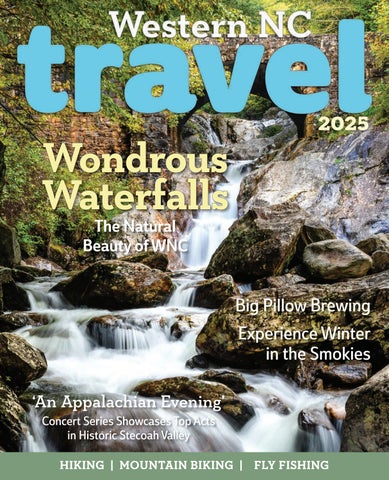
WNC Travel Guide | 2025

Page 1


Wondrous Waterfalls

The Natural Beauty of WNC

‘An Appalachian Evening’ Concert Series Showcases Top Acts in Historic Stecoah Valley

If you’ve picked up this publication, then, by all accounts, you’re in search of outdoors adventure and countless memorable experiences in our backyard paradise that is Western North Carolina.

As folks proud of our region, we also take a lot of pride in making those who visit feel as welcomed and embraced as possible. Life is about trying new things and meeting new people, and what better place to do so than with Mother Nature’s masterpiece of the Great Smoky and Blue Ridge mountain ranges as the backdrop?

Take to the trail for a day hike or mountain bike ride, or to the river for some vigorous kayaking or tranquil fly fishing, or take to Main Street for an afternoon of shopping, perhaps a farm-to-table dinner or live bluegrass performance. The beauty of Western North Carolina resides in the mere notion that every day is a blank canvas by which we have all the colors of possibility at our disposal to paint with. Between our array of weekend festivals and seasonal events, the hardest part is simply figuring out what to do. It’s all here, and more.

I’ve always believed the litmus test of the strength of a place resides in how well its community aims at bringing one and all together. Give me a town where the people really care and are well vested in the community and its potential, and I’ll give you a location that is pulsating with activity, with love and passion, intellectuality and enthusiasm for the unknowns of tomorrow — bring it on, y’all.

INSIDE:

Food+Drink

Art+Culture

Outdoors+Recreation

Editor/Publisher:

Scott McLeod info@smokymountainnews.com

Advertising Director: Greg Boothroyd greg@smokymountainnews.com

Composition & Design:

Micah McClure micah@smokymountainnews.com

Jessica Murray jessica.m@smokymountainnews.com

Jack Snyder jack.s@smokymountainnews.com

Writing/Photography:

Garret K. Woodward garret@smokymountainnews.com

Adam Bigelow bigelownc@gmail.com

Cory Vaillancourt, Kyle Perrotti

Advertising:

Amanda Bradley ... amanda.b@smokymountainnews.com

Maddie Woodard maddie.w@smokymountainnews.com

Bookkeeping: Jamie Cogdill smnbooks@smokymountainnews.com

Eats+Drinks Country coffee

Blue Ridge Bootleg Roastery

Situated in the heart of downtown Sylva, Blue Ridge Bootleg Roastery is a beloved home for coffee drinkers, country music lovers and those looking for a place to work or catch up with a friend.

Upon entering the roastery, you’re greeted with the smell of fresh ground coffee beans, quiet chatter of patrons and a rustic ambiance. It’s also likely your eyes will be immediately drawn to the large stage set for live music.

Soon therea er, you may notice a man in a cowboy hat either behind the bar brewing

coffee or chatting with customers. That man is roastery owner Matt King.

Born and raised in Hendersonville, King’s entire life involved the mountains of Western North Carolina and the music that called him home, specifically bluegrass. A er spending a little time at Appalachian State University in Boone, King dropped out to pursue a career in music. For a year, King commuted from Hendersonville to Nashville, Tennessee.

“Eventually, I realized there’s going to be 20 people that get up every morning that are there and I’m not,” King said of Music

City. “So, I went with $300 and a 1980 Jeep Wagoneer with a hole in the floorboard and I said, ‘I’m going to make it.’”

Four years later, King signed with his dream label, Atlantic Records. A er a few years with Atlantic, King became a staff writer for Warner Chappell Music, where he wrote and produced songs for film and television. That job ultimately led him to coffee.

“Rather than [write] in the cubicles, which I hated, I would go to this coffee roastery in Nashville,” King said. “I loved to drive [the owner] crazy. I would ask him a million

Located in Sylva, Blue Ridge Bootleg Roastery & Coffee Shop provides high-quality beans and a delightful atmosphere in the heart of the Jackson County town. Donated photos

questions about coffee roasting.”

King frequented the roastery so o en that eventually the barista let him make his own coffee behind the bar. Coffee had always been an anchor to King, especially during his touring days.

“When you’re on the road constantly, you [need] a sense of normality,” King said. “So, I would stop in every town and look for a bookstore and all the hipsters. If I saw skinny jeans and a hat, I would go, ‘I bet that’s good coffee in there.’”

Much like everyone else, King’s life was put on pause during the COVID Pandemic until his birthday when a new path presented itself.

“My two best friends from California sent me 50 pounds of green coffee and said, ‘See what you can do with this,’” King said. “Ironically, it was the coffee that my [Nashville] buddy used to roast at his roastery.”

King began experimenting and working with the Nashville roaster to perfect his own coffee. To test its success, he sold the coffee on his website. A er the Pandemic ended, King began to pick up gigs again.

“I got to play a gig at Castle Ladyhawk. It was just an acoustic night to get out of Tennessee for a night. And I fell in love with Sylva and Cullowhee and the Tuckasegee,” said King. “It was what I always wanted. And I like college towns. They were always my favorite places to play.”

“It’s always going to be a musical space,” said King. “If you really want to pursue music, I want us to really foster that part of their career and say, ‘You can come here and play.’”

Outside of live music, King also hopes to incorporate different activities to engage with the local community like trivia nights and board games. Since opening the roastery in 2024, King has been overwhelmed with positive feedback from customers who have already wandered into the popular business.

“Being here and being welcomed by the community, I’m thankful to the community for the opportunity to give back what I’ve been given,” said King.

King adopted his own space to roast coffee on the Tuckasegee River and began providing coffee to many Sylva businesses. As King’s venture continued to expand, he was approached about opening a location in Sylva. The stars were aligning.

“When I le [WNC], I said the one thing I want to do is go do music and then bring that back to the mountains and share that through the eyes of music,” King said.” “So, with coffee, I’m getting to do the two things I love the most.”

As an artist, King hopes to make the roastery a place where musicians can share their work.

King aims to create an experience for customers that extends beyond a cup of coffee by combining the best elements of every coffee shop he’s been to around the world and incorporating it at the roastery. In addition, he has ensured that all baristas working at the roastery are certified by the Specialty Coffee Association. King also hopes to eventually offer coffee workshops where anyone interested can learn about coffee through cupping events and by watching it be roasted.

Beyond coffee, King imagines his roastery can become a place where the community can gather. He wants people to utilize the roastery to catch up with friends, host club meetings, study and create their own workshops to hold in the space.

“Both [my wife] and myself feel incredibly fortunate to be able to come here and share, not just our passion for coffee, but for the community,” King said. “We want to create a legacy and we want to be another chapter in this town’s legacy.”

Matt King

Eats+Drinks

Tapping into community

Big Pillow Brewing

On a recent sunny day in Hot Springs, it was almost impossible to find a parking spot within vicinity of Big Pillow Brewing in downtown. And, for the tiny mountain town, this was a joyous sight com-pared to what the community has gone through as of late. “It feels great to see all these smiling

faces,” said Chris Donochod, co-owner of Big Pillow. “And things are starting to feel a little more familiar again.”

Just about eight months ago, floodwaters from Hurricane Helene bulldozed through the mountains of Western North Carolina, with Hot Springs (population: 538) smack dab between the French Broad River and

Spring Creek. Both bodies of water ripped through the community, destroying most of downtown in the process.

“It’s still a little shocking, to say the least,” Donochod reminisced when asked about the flood. “I was able to find parts of our [live music] stage downstream. Someone even found one of our kegs seven miles

Hours of operation are noon to 9 p.m. Tuesday-Thursday, noon to 10 p.m. Friday-Saturday and noon to 9 p.m. Sunday. Closed Monday. As well, the brewery features culinary delights through a partnership with The Grey Eagle Taqueria. For information, call 828.539.1939 or visit bigpillowbrewing.com.

Featuring a wide range of handcra ed ales, Big Pillow Brewing is lo-cated at 25 Andrews Avenue North in downtown Hot Springs.
A er several months of unknowns in following the destruction from Hurricane Helene, Big Pillow Brewing in Hot Springs is gearing up for a busy summer season. File photo

downstream.”

And yet, here we are. The town of Hot Springs remains, so do its residents. A good portion of the downtown still remains in limbo, with many of its businesses yet to reopen. Following extensive damage to the brewery from the flood, Big Pillow reopened its doors in March. The return of the business has been an inspiration to the community for the inevitable return of their beloved town.

“It’s been a long road to get here. And we realize what we lost for six months of so,” Donochod noted. “The commu-

was also the co-founder of the former French Broad River Festival, a cherished annual music gathering that lasted the better part of a quarter-century.

“[Cra beer] was always kind of a side hobby of our,” Donochod said. “We enjoy good beer and a good atmosphere to enjoy that good beer.”

Alongside its 10-barrel system pumping out some of the finest ales in the region, the cozy property features live music regularly, with the large stage anchored in the back of the beer garden. For culinary delights, Big Pillow has an onsite partnership with The Grey Eagle Taqueria. The space also plays host to weddings and other events.

nity here is a group of amazing people. And I think the storm brought out the best in our community — so many people helping other people.”

Pouring its first ales on Christmas Day 2020, Big Pillow Brewing is the creation of Donochod and his wife, Amy Rubin. Longtime residents of WNC with a deep appreciation for the cra beer scene here (Rubin formerly worked for Oskar Blues Brewery in Brevard), the couple was looking to spark something special in Hot Springs.

A former ra ing guide in WNC, Donochod named the brewery a er a whitewater rapid on Section 9 on the French Broad River. To note, Donochod

“It was a huge gamble, but we’re glad we did it,” Donochod said of the road to the here and now. “People really do enjoy the space we’ve created — our vision was correct.”

And even though Big Pillow relaunched to the public earlier this spring, there was a low-key so opening on Christmas Day 2024. It was not only the fourth anniversary, but also a symbolic gesture to the community that things were starting to return to normal.

“We thought maybe 60 people would come, but we wound up having over 200 people here — it was pretty magical,” Donochod shook his head in awe. “People were just happy to be able to get together and do something other than shovel mud.”

Gazing around the large beer garden at Big Pillow, Donochod takes note of the buzz in the air of people and conversation. It’s not lost on him, or anyone else in the company, how unique and treasured of a place the brewery has become in Hot Springs. It’s not lost on the community it serves, either.

“We pretty much built this place with our own hands and our friends,” Donochod said. “People see that we’re here for the right reasons — we want to be here.”

WNC BREWERIES

Although Asheville is the epicenter of the world-renowned cra beer scene here in Western North Carolina with dozens of breweries represented, there are several award-winning establishments west of the city, right here in our backyard.

• 7 Clans (Waynesville)

• Angry Elk Brewing (Whittier)

• Appalachian Grail Brewing (Hayesville)

• Balsam Falls Brewing (Sylva)

• BearWaters Brewing (Canton/Maggie Valley)

• Big Pillow Brewing (Hot Springs)

• Boojum Brewing (Waynesville)

• Bryson City Brewing (Bryson City)

• Buck Bald Brewing (Murphy)

• Currahee Brewing (Franklin)

• Frog Level Brewing (Waynesville)

• Hayesville Brew (Hayesville)

• Hoppy Trout Brewing (Andrews)

• Innovation Brewing (Sylva/Dillsboro/Cullowhee)

• Laughing Dogs Brewing (Hayesville)

• Lazy Hiker Brewing (Franklin/Sylva)

• Mountain Layers Brewing (Bryson City)

• Native Brews (Cherokee)

• Nocturnal Brewing (Hayesville)

• Satulah Mountain Brewing (Highlands)

• Snowbird Mountains Brewery (Andrews)

• Testament Brewery (Murphy)

• Valley River Brewing (Murphy)

• Whiteside Brewing (Cashiers)

Chris Donochod, owner of Big Pillow Brewing. Garret K. Woodward photo

Eats+Drinks A little taste of home Junction Pub opens in Sylva

It’s mid-a ernoon and the seats are starting to fill up at the Junction Pub in Sylva. Located along Skyland Drive near downtown, the old-style railroad depot structure is now entering its next chapter.

“This building has been sitting empty for many years,” said Junction Pub owner/ chef Craig Szymanski. “And I’d been looking around at every building around here that’d been a restaurant before — this place just

seemed to fit what I was looking to do.”

With its official grand opening held this spring, the Jackson County establishment is a much-anticipated addition to the already-bustling culinary scene in the small mountain town.

Formerly No Name Sports Pub, the building itself has remained dormant for the better part of the last decade. And as No Name, the business was a highly-popular

spot when it came to watching sports and seeing live music — two aspects of the Junction Pub that Szymanski aims to revive and focus on.

“I heard all these stores from people about how they loved this place and how great it was [for music and food],” Szymanski said. “And that’s exactly what we’re trying to bring back.”

If Szymanski’s name sounds familiar, it’s because he’s also the owner/chef for the Rivers & Rails Tavern in Dillsboro. Opened in 2020, the tavern has become a haven for those in search of a wide-range of food styles and offerings — Korean to Mexican and beyond.

“R&R has some Asian flare to it that I took

from my time living out west [in California],” Szymanski said. So, [with the Junction], I’m bringing more of my New York/Eastern stuff [to the table].”

In contrast to R&R, the Junction Pub has a keen focus on Italian and Greek cuisine — gyros to mussels, lamb meatballs to shrimp fra diavolo — which harkens back to Szymanski’s roots as a New York native. There’s also a “Weekend Brunch” component to the

Craig Szymanski

menu atop the usual pub standbys (burgers, wings, etc.).

“[The Junction] is scratching that Northeast itch,” Szymanski said.

Raised just outside of New York City in Rockland County, New York, Szymanski was a teen-ager in the 1980s when he started washing dishes and prepping ingredients at city eateries, gradually working his way up to becoming a chef of his own.

As expected, those decades-old metropolitan restaurants were tight ships that expected quality and respect to what not only what was being served, but also who was serving it.

“I learned so much from growing up in New York, where we’d go right into the city and experience some of the greatest food you’ll ever eat, everything from Italian or Chinese — you soak in all of this culture and tradition,” Szymanski reminisced.

From New York, Szymanski headed for culinary work in California, working and honing his kitchen cra in authentic Mexican and Asian restaurants for the better part of 20 years. During this West Coast period, Szymanski also acquired and developed a successful catering company.

find anywhere else — we love it here.”

Aesthetically, Szymanski did an extensive renovation of the Junction Pub building, from brand new bathrooms to a complete overhaul of the live music stage in the backroom. A life-long musician himself, Szymanski is excited for the acts to jump up behind the microphone.

“I just love music and I know this area loves music,” Szymanski said, who also plays drums in the venue’s house band, Break Cutter.

• American Legion Post 47 Waynesville

828.456.8691

• Angry Elk Brewing

Whittier

828.497.1015 facebook.com/angryelkbrewingco

• Balsam Falls Brewing

Sylva

828.631.1987 / balsamfallsbrewing.com

• Balsam Mountain Inn Balsam

828.283.0145 / thebalsammountaininn.com

• Bevel Bar Waynesville 828.246.0996 / bevelbar.com

• Blue Ridge Beer Hub Waynesville 828.246.9320 / blueridgebeerhub.com

• Blue Stage Andrews 828.361.2534 / thebluestage.com

• Boojum Brewing Waynesville 828.246.0350 / boojumbrewing.com

• Breadheads Tiki Shak Sylva 828.307.2160 / breadheadstikishak.com

• Classic Wineseller Waynesville

828.452.6000 / classicwineseller.com

• Concerts On The Creek Sylva 828.586.2155 mountainlovers.com/concerts-on-the-creek

• Cowee School Arts & Heritage Center Franklin 828.369.4080 / coweeschool.org/music

• Currahee Brewing

By December 2018, Szymanski and his family had decided to relocate to Western North Carolina. It was a fresh start, with Szymanski eventually becoming the chef at Balsam Falls Brewing when its kitchen opened in August 2019. That move eventually parleyed itself into the opportunity for Szymanski to open Rivers & Rails Tavern.

“We want to offer these dishes you can’t find anywhere,” Szymanski said. “There’s so much room for growth in the food scene here, this growth you really can’t

To note, there’s an “Open Jam” starting at 7 p.m. on Tuesdays and an “Open Mic” 6 p.m. Thursdays, all of which atop a slew of live bands and singer-songwriters that are booked on the weekends. Talks are also in the works to create a “Comedy Night” and feature stand-up.

“This place is about everybody being able to come in and enjoy all of the things we have,” Szymanski said.

Hours of operation are 11 a.m. to midnight Monday through Saturday and 11 a.m. to 11 p.m. on Sunday.

For more information, call 828.370.2090 or visit facebook.com/jctpub.

Franklin

828.634.0078 / curraheebrew.com

• Farm At Old Edwards

Highlands 866.526.8008

oldedwardshospitality.com/orchardsessions

• Folkmoot Friendship Center Waynesville 828.452.2997 / folkmoot.org

• Fontana Village Resort Wildwood Grill Fontana Dam 800.849.2258 / fontanavillage.com

• Friday Night Live

Highlands highlandschamber.org

• Frog Level Brewing Waynesville

828.454.5664 / froglevelbrewing.com

• Frog Quarters

Franklin 828.369.8488 / littletennessee.org

• Groovin’ on the Green Cashiers villagegreencashiersnc.com/concerts

• Happ’s Place

Glenville

828.742.5700 / happsplace.com

• Harrah’s Cherokee Casino Resort Cherokee caesars.com/harrahs-cherokee

• High Dive

Highlands 828.526.2200 highlandsdive.com

• Highlander Mountain House Highlands 828.526.2590 highlandermountainhouse.com

• Highlands Performing Arts Center

Highlands 828.526.9047 highlandsperformingarts.com

• Innovation Brewing

Sylva

• Meadowlark Motel

Maggie Valley

828.926.1717 / meadowlarkmotel.com

• Mountain Layers Brewing Bryson City

828.538.0115

mountainlayersbrewingcompany.com

• Nantahala Outdoor Center Nantahala Gorge

828.785.5082 / noc.com

• Orchard Coffee Waynesville

828.246.9264 / orchardcoffeeroasters.com

• Otto Community Center

Otto 770.335.0967 / go2ottonc.com

• Saturdays On Pine Highlands highlandschamber.org

• Sauced Waynesville

828.246.9585 / saucedwnc.com

• Scotsman Waynesville 828.246.6292 / scotsmanpublic.com

• Slanted Window Tasting Station

Franklin 828.276.9463 / slantedwindow.com

• SlopeSide Tavern Sapphire 828.743.8655 / slopesidetavern.com

• Peacock Performing Arts Center

Hayesville

828.586.9678 / innovation-brewing.com

• Innovation Station

Dillsboro

828.226.0262 / innovation-brewing.com

• Lazy Hiker Brewing

Franklin

828.349.2337 / lazyhikerbrewing.com

• Lazy Hiker Brewing

Sylva

828.349.2337 / lazyhikerbrewing.com

• Legends Sports Bar & Grill

Maggie Valley

828.944.0403 facebook.com/legendssportsgrillmaggievalley

• Lineside at Frog Level Brewing Waynesville

828.454.5664 / froglevelbrewing.com

• Macon County Public Library Franklin

828.524.3600 / fontanalib.org

• Marianna Black Library Bryson City

828.488.3030 / fontanalib.org

828.389.ARTS / thepeacocknc.org

• Pickin’ On The Square

Franklin franklinnc.com/pickin-on-the-square.html

• Pinnacle Relief CBD Wellness Lounge

Sylva

828.508.3018 / facebook.com/pinnaclerelief

• Quirky Birds Treehouse & Bistro Dillsboro

828.586.1717 / facebook.com/quirkybirdstreehouse

• Rathskeller Coffee Haus & Pub

Franklin

828.369.6796

facebook.com/rathskellercoffeebarandpub

• Salty’s Dogs Seafood & Grill

Maggie Valley

828.926.9105 / facebook.com/saltydogs2005

• Santé Wine Bar

Sylva

828.631.3075

facebook.com/thewinebarandcellar

• Satulah Mountain Brewing Highlands 828.482.9794 / satulahmountainbrewing.com

• Smoky Mountain Center for the Performing Arts

Franklin 828.524.1598 / smokymountainarts.com

• Southern Porch Canton 828.492.8009 southern-porch.com

• Stecoah Valley Center Robbinsville 828.479.3364 stecoahvalleycenter.com

• Swain Arts Center Bryson City 828.488.7843 swainartscenter.com

• Ugly Dog Pub Cashiers

828.743.3000 / theuglydogpub.com

• Ugly Dog Pub

Highlands

828.526.8364 / theuglydogpub.com

• Valley Cigar & Wine Co.

Waynesville

828.944.0686 valleycigarandwineco.com

• Valley Tavern

Maggie Valley

828.926.7440 / valley-tavern.com

• Water’n Hole Bar & Grill Waynesville 828.456.4750 facebook.com/waternhole.bar

• Whiteside Brewing Cashiers

828.743.6000 / whitesidebrewing.com

• Yonder Community Market

Franklin

828.200.2169 / eatrealfoodinc.com

Arts+Culture

To here from there

‘An

Appalachian Evening’

With her latest album, “Highlander,” bluegrass/Americana icon Missy Raines takes inventory of where she stands at this current juncture in her storied career — this melodic ode to her native West Virginia, which simultaneously serves as an ideal prism of time and space Raines peers through into the unknowns of tomorrow.

“Making this record and having this band has been sort of a homecoming,” the legendary bassist/vocalist said. “I’m at a point in my life where I’ve been able to look back at what I’ve gone through, what I’ve done, and the path I ultimately wanted to take.”

Captured in Nashville, Tennessee, the

10-song LP once again brings together Raines with producer Alison Brown, a bluegrass star in her own right. The record showcases Raines backed by her steadfast group Allegheny, named a er the peaks and valleys of Raines’ homeland in the rural depths of Appalachia via the Mid-Atlantic.

“Lately, I’ve realized so much of the music I’ve created comes from personal experience,” Raines noted. “Songs about growing up in a small town, songs about making hard choices when you’re coming-of-age — do I stay in this remote area and try to make a living or do I leave my family behind and face what’s out there on my own?”

Choosing the latter, Raines headed for

the bright lights of Nashville, ultimately garnering some of the biggest accolades in the music industry, including 14 International Bluegrass Music Association honors, with 10 being awarded for “Bass Player of the Year.” Raines’ 2018 release “Royal Traveller” was also nominated for a Grammy Award for “Best Bluegrass Album” in 2020.

To note, Missy Raines & Allegheny will be part of the “An Appalachian Evening” summer concert series at the Stecoah Valley Cultural Arts Center in Robbinsville. The group will hit the stage on July 5. Other legendary bluegrass, Americana and folk acts will also be appearing at the SVCAC throughout the summer.

Missy Raines.

And amid this existential quest of sorts for Raines emerges a finely-honed internal antenna within “Highlander,” one that places her atop this lyrical platform of personal reflection, cultural observation, and artistic cultivation.

“Maybe it’s because I’m an artist, but the best of me comes out when I feel deeply about something,” Raines said. “And I have to choose things that I feel passionate about, which will allow me to reproduce and translate those feelings musically.”

For Raines, when approaching the sacred art of singing, she’s able to visualize the words and emotions put forth through the selections on “Highlander” — cherished images and vivid scenes from her own continued journey conjured to the forefront of her intent.

“As a singer, it took me a while to find how my voice fits into this music that I love so much,” Raines said. “I try to tap into what I’m feeling, to convey all the energy and the drive that sets bluegrass apart — it’s a personal music, but it’s universal at the same time.”

“Highlander” brings together some of the finest musicians in Nashville and beyond, including country star and fellow West Virginian Kathy Mattea; fiddle virtuosos Michael Cleveland, Bronwyn KeithHynes, Darol Anger and Shad Cobb; renowned bluegrass vocalists Danny Paisley, Dudley Connell and Laurie Lewis; with dobro wizard Rob Ickes and banjo great Alison Brown also making guest appearances.

down the rabbit hole and immerse herself into other sonic realms that has led to an abundance of lauded collaborations in the areas of Americana, country and folk.

Peeling back the layers of “Highlander,” Raines returns to her bluegrass roots. Coming into the recording process, Raines found herself, perhaps subconsciously, digging deep into the people, places and things residing at the foundation of her life and career.

And though Raines emerged onto the national scene through the ancient tones of bluegrass music, it’s her unrelenting urge to wander

Reflecting on the tracks selected for “Highlander,” Raines found the gem “Ghost of a Love,” a tune by Virginia-based Big Country Bluegrass.

“Their version was a little different, but I heard it with that classic bluegrass fastwaltz vibe that feels completely genuine to me,” Raines recalled. “It’s the perfect song to feature Dudley Connell, founding member of the traditional iconic band, The Johnson Mountain Boys.”

The number also features Raines’ husband, Ben Surratt, who engineered the album, and the inspiration for the ballad “Looking to You” — a Raines original paying tribute to the couple’s almost 40 years together.

“These songs represent both sides of me,” Raines said. “Even though they’re different grooves and different feels, I believe they each fall comfortably within the context of bluegrass — that’s how I see bluegrass, with a wide lens.”

Whether it was being a kid and heading to bluegrass festivals around the Mid-Atlantic with her family or seeing pillars of the genre onstage — Bill Monroe, Stanley Brothers, Mac Wiseman, Sam Bush — each moment remains etched on the walls of Raines’

memory. And although Raines has ducked down numerous other avenues of sound and scope in recent years, she’s never le bluegrass behind.

“I love so many different kinds of music,” Raines said. “But I cannot describe how bluegrass affects me, and why it affects me so deeply.”

WANT TO GO?

If anything, Raines has always kept the intricate skillset and lifelong adoration for bluegrass in her back pocket amid her adventures into other musical circles. It’s like Monroe said long ago, “If you can play my music, you can play anything.” And so goes Missy Raines, further and farther into her purposeful curiosity and bountiful discovery of self.

“I’m embracing bluegrass again, and it’s all been incredibly good for me,” Raines said. “In every sense of the way, I almost can just go back [in my mind] and rely on those intrinsic things I learned as a 15-year-old in a field at a blue-

A popular annual concert series, “An Appalachian Evening,” has recently announced its return to the Stecoah Valley Cultural Arts Center in Robbinsville.

Kicking off on June 28 will be Jeff Little Trio, Missy Raines &

grass festival — tapping into how I felt back then, and how I still feel today about this music.”

With modern-day bluegrass currently experiencing another high-water mark as names like Billy Strings, Molly Tuttle and Sierra Hull proudly carry the torch of tradition and evolution, Raines finds solidarity in the ongoing growth and progress of the “high, lonesome sound” — this fine line between respect and rebellion that Raines has seamlessly balanced since the beginning.

“I watched that first generation of [bluegrass] people doing all that — creating traditional music, then breaking away from it to do their own thing,” Raines said. “And all of it is still surviving and flourishing. To me, there’s nothing more bluegrass than the act of absolute innovation — and that’s what we’re doing, because that’s what Monroe did from the start.”

Allegheny (July 5), Amanda Cook Band (July 12), Kruger Brothers (July 19), Unspoken Tradition (July 26), Special Consensus (Aug. 2), Mean Mary (Aug. 9), Appalachian Smoke (Aug. 16), Liam Purcell & Cane Mill Road (Aug. 23) and Darren Nicholson Band (Aug. 30). Season passes and individual tickets are now available for purchase. For more information, visit stecoahvalleycenter.com/an-appalachian-evening or call 828.479.3364.

Arts+Culture

Full circle

Astro Record

Store

While wandering the Historic Frog Level District in Waynesville, the sounds of hard rock act AC/DC dri ed out the front door of 24 Commerce St. The retro sign on the window states Astro Record Store. The friendly face behind the counter is Kevin “Lippy” Mawby.

“There’s enjoyment and there’s convenience,” Mawby said. “As things become more and more convenient, I think people look for ways to invest their time and find enjoyment.”

One of those ways is collecting and listening to vinyl records. Once disregarded as dusty, scratched relics of a bygone era in the music industry, the tangible, yet incredibly intrinsic product that is an actual record has roared back to life over the last decade.

“The thing about these records — Led Zeppelin, Queen, Steely Dan, Fleetwood Mac — they’re all supremely well-recorded,” Mawby said. “And you absorb those records — you listen instead of just hearing.”

Stacked neatly in bright yellow storage crates, Mawby estimates there’s roughly 10,000 records in his shop — rock to pop, jazz to country, new and old, freshly-pressed and vintage finds.

“It’s crazy, it’s fantastic,” Mawby said about the opening. “It’s like putting on an old pair of pants, you know? I’m real comfortable in this thing.”

Originally from London, England, Mawby came of age in the vibrant British punk rock scene in the late 1970s. In 1981, at just 19 years old, Mawby come to the United States to seek his fortune.

“I was a little lost and trying to figure it all out,” Mawby chuckled. Mawby found his way to New Orleans, Louisiana. And it was there when he got his first big break, becoming a roadie for NOLA-based punk/new wave act Red Rockers, whose song “China” was a radio hit in 1983. Through that, Mawby got to see America.

When he wasn’t on the road and on tour with Red Rockers, Mawby found work at Record Ron’s, a legendary business in NOLA.

“I’d always been a record collector, but I never thought of doing that for a living,” Mawby said. “And then I got a job [at Record Ron’s].”

By 1991, Mawby opened his own record store in the French Quarter of NOLA. Dubbed “Magic Bus,” the shop was inside an old school bus.

“I got to listen to music all day and expand my knowledge,” Mawby said. “So, I used my knowledge to expand the store, and the store to expand my knowledge.”

Mawby had Magic Bus for many years, only to be displaced from NOLA when Hurricane Katrina unleashed its wrath in 2005. Unable to return for a period of time, Mawby bounced from a shelter in rural Louisiana to a friend’s house (also a record dealer) in Austin, Texas. He then found work at a local Head Start program.

But Mawby never stopped being part of the vinyl record scene. He was still searching, purchasing, trading and selling countless records online and at swap-meets around Texas and beyond. Eventually, he opened the first Astro Record Store in Bastrop, not far from Austin.

“It’s not really about shopping,” Mawby said of the allure of record stores. “It’s about collecting and finding things. You don’t go into a lot of stores and don’t know what you want, but you know you want something — you get that experience in this store.”

While in Bastrop, Mawby met his now fiancé. With family ties to Western North Carolina, the couple found a deep love for the landscape, culture and people of Southern Appalachia. Thus, last year, they took the leap and bought a house in Waynesville.

From there? Mawby started to host pop-up record sales in Frog

Astro Record Store recently launched in

Level Brewing Company on Commerce Street. Therea er, the opportunity emerged to take over a vacant space a couple doors down, with the idea of another Astro Record Store quickly coming to fruition.

“There’s a huge need for a record shop,” Mawby said. “This is a little part of society that becomes kind of a town square. This is where we do our socializing, our expression.”

So, why are vinyl records back on top? Well, the return to popularity for records

there’s something sonically sacred and spiritually cleansing when you drop the needle down and immerse yourself in a record — especially in a modern, fast-paced world of distraction, this society where sitting still and actually listening comes at a premium.

“This place is about the pleasure I get from it, and the pleasure I give to other people,” Mawby said. “There’s not as many jobs that are as satisfying as this.”

Leaning against one of the yellow record bins,

resides in several reasons. For one, it’s a piece of art you can listen to, display and collect. Two, the depth of sound captured in the grooves supersedes anything digital or otherwise. Three, it’s become a much-needed new avenue of revenue for current artists who can’t count on streaming services for financial stability. Another reason? Well, for music lover,

Mawby scans the 1910 shotgun-style building. Thousands of records are sitting patiently, each awaiting the day they get flipped, picked up and taken back home to once again shi the course of your day, your life.

“The secret to happiness is finding it in what you already have,” Mawby said. “And, if you’re going to listen to music, do it in a way that you enjoy doing it.”

Nestled along Jonathan Creek. Family and pet friendly with seasonal pool and splash park. Rental cabins, Creekside, and Premium Pull through sites. Open Year Round. Book online today or call! stonebridgecampgrounds.com 828.926.1904

Kevin “Lippy” Mawby, owner of Astro Record Store.

Arts+Culture

What lies beneath Winding Stair Farm & Nursery

Located in Franklin, the Winding Stair Farm & Nursery is home to a bevy of native plants and seemingly whatever else one might need for their homes, gardens and/or landscaping needs. Garret K. Woodward photos

At the corner of Highlands and Saunders roads in Franklin sits a nine-acre property of natural beauty, one filled with endless species of flowers and plants, this wondrous piece of earth welcoming the public with open arms — Winding Stair Farm & Nursery.

“If you want to make a difference, come with me,” Winding Stair General Manager Amanda Chappell said in a playful tone. “Let’s just go wander out there — I’ll show you.”

To preface, there’s many moving parts when it comes to Winding Stair. First, you have the nursery, with the retail space taking up five acres. The remaining four acres is the Valley Farm component, which cultivates certified naturally grown produce for sale at local farmers markets and area restaurants.

To note, Winding Stair was formerly the Spring Valley Nursery, a longtime beloved community business. The property’s current owners, Stacy Bredendieck and Greg Mullins, acquired the original nursery and trans-

formed it into Winding Stair in 2017.

“Greg and Stacy said, ‘We can’t lose this. It’s a great community place,’” Chappell said. “And, at the same time they purchased the nursery, they were also developing the Mountain Farm location.”

The five-acre Mountain Farm is located

on West Old Murphy Road in Franklin. Besides raising sheep and chickens, it grows produce (squash, onions, cucumbers) to complement the Valley Farm’s annual haul of tomatoes, watermelons, peppers,

lettuces, beans, potatoes and more. Recently, the Mountain Farm added its own grist mill.

Aside from that, there’s also the Winding Stair Farm Campground that’s connected to the Mountain Farm property. Located just off U.S. 64 near the Winding Stair Gap crossing of the Appalachian Trail, the nineacre property includes primitive camping and glamping options.

Before it was redeveloped by Bredendieck and Mullins, the property was formerly known as Rainbow Springs Campground, which was famously noted in Bill Bryson’s bestselling book, “A Walk in the Woods: Rediscovering America on the Appalachian Trail.”

“It’s this magical getaway,” Chappell said of the campground.

But, beyond everything that Winding Stair is about, and also looking to do moving forward, the biggest underlying theme within the ethos of the business itself is one key word — education.

Alongside training its employees in the

ways and means of running a nursery and/ or farm, all with sincere hopes of those folks someday heading out into the world to plant their own roots, literally and figuratively, Winding Stair also aims to have continual programming throughout the year at the Valley Farm.

“We like to think of the farm as an incubator place for people where you can learn in this garden,” Chappell said.

From children’s workshops to teaching customers about the importance of native plants when one considers what they may or may not want to do with their property, the emphasis is squarely placed on responsible gardening in your own backyard.

“We’ll teach classes about elements in garden design, where people learn about how to plant a tree or what plants work best on a steep bank,” Chappell said. “But the answers that they’ll learn is with a native plant solution in mind.”

So, why native plants? Why must that be taken into consideration?

“‘Plant a garden for the planet’ is basically the way we talk about it,” Chappell said. “When you get that blank canvas [for a garden or landscape], let’s think about growing for the planet and not just for aesthetics. If you want the [native] pollinators, you need those [native] plants.”

And for Chappell, one of the great joys of life is simply walking out of her office and immediately into the vast landscape of the nursery. It’s in that time and space where she observes butterflies swirling around the flowers and songbirds radiating nature’s melodies from high up in the trees cradling the property.

“If I’m going to get away from my computer and walk around, that’s where I go — the native plant section,” Chappell said. “I’ll just go out there and fluff or clean the plants. And I’m very happy. There’s a reason ‘soul’ and ‘soil’ sound the same — being out here feeds your soul.”

Amanda Chappell.

Museums

Although the rich history and culture of Western North Carolina is alive and thriving through the hands of our local artisans and performers, there are also numerous museums here preserving and perpetuating the heritage of Southern Appalachia. These buildings each pay homage to the cra s, sounds, and deeply held traditions of these ancient mountains and its people.

• American Museum of The House Cat

Over 5,000 items dedicated to entire history of the house cat, here and abroad.

5063 U.S. 441, Sylva 828.421.0275 or 828.506.1236 facebook.com/americanmuseumofthehousecat

• Andrews Art Museum

Exhibits and galleries featuring local and regional artists.

Corner of Chestnut and Third streets, Andrews 828.360.5071 • andrewsvalleyarts.com

• Appalachian Rivers Aquarium

Exhibits regional species of fish, amphibians, reptiles and hellbenders.

117 Island Street

828.488.7857

flyfishingmuseum.org/aquarium

• Canton Area Historical Museum

Displays focusing on the cultural history of Canton and Haywood County.

36 Park Street, Canton 828.646.3412 cantonnc.com

• Cherokee County Historical Museum

Artifacts and exhibits showcasing the Cherokee Indians, local history and artisans. 87 Peachtree Street, Murphy 828.837.6792 cherokeecounty-nc.gov

• Clay County Historical & Arts Council Museum

Displays exhibiting the history, art and people of the area.

21 Davis Loop, Hayesville 828.389.6814 clayhistoryarts.org

• Fly Fishing Museum of the Southern Appalachians

Showcasing the history of fly fishing in the Southeast.

210 Main Street, Bryson City 828.488.3681

flyfishingmuseum.org

• Franklin Gem & Mineral Museum

Extensive exhibits on the region’s gems and minerals.

25 Phillips Street, Franklin 828.369.7831

fgmm.org

• Glenville Historical Museum

Showcasing the history and culture of Glenville and greater Western North Carolina with exhibits and displays.

4735 N.C. 107 North, Glenville 828.743.1658

• Highlands Museum & Historical Village

A village composed of several restored buildings, with historical exhibits in the museum. 524 North 4th Street, Highlands 828.787.1050 highlandshistory.com

• John W. Bardo Fine & Performing Arts Center

Local and regional art, with historical exhibits. 199 Centennial Drive, Cullowhee 828.227.2787

wcu.edu/bardo-arts-center

• Graham County History Museum

Museum preview featuring educational and interpretive displays and rotating exhibits managed by the Graham County Historical Association at the Graham County Welcome Center.

747 Rodney Orr Bypass 828.479.3790 historygc.org

• Graham County Museum of Prehistoric Relics

A collection of prehistoric artifacts from North, South and Central America.

3204 Fontana Road, Fontana Dam 828.479.3677 thehikeinn.com

• Haywood County Historical & Genealogical Society, Inc. Post Office Box 444 Waynesville, NC 28786 nchchgs.org

• Junaluska Memorial & Medicine Trail

Displays dedicated to preserving Cherokee Indian history and culture. Not a museum but a trail.

1 Junaluska Drive, Robbinsville 828.479.4727

• Macon County Historical Society & Museum

Antiques and artifacts showcasing the history of Macon and Western North Carolina.

36 West Main Street, Franklin 828.524.9758 maconnchistorical.org

• Mountain Farm Museum

Collection of historical log buildings and artifacts.

150 U.S. 441 North, Oconaluftee Visitor Center 423.436.1200 nps.gov/grsm

Museum of the Cherokee People

• Mountain Heritage Center

Extensive displays of Western North Carolina and Southern Appalachian history.

150 H.F. Robinson Building, Western Carolina University, Cullowhee

828.227.7129 wcu.edu

• Museum of American Cut & Engraved Glass

Exhibits presenting one of the finest collections of its kind in the world.

472 Chestnut Street, Highlands 828.526.3415 ashevilleguidebook.com

• Museum of the Cherokee Indian Large exhibits showcasing the extensive and intricate tribe history.

589 Tsali Boulevard, Cherokee 828.497.3481 cherokeemuseum.org

• Museum of Haywood County History

Located in the historic Shook-Smathers House, one of the oldest frame homes in Western North Carolina. Operated by the Haywood County Historical and Genealogical Society, the museum features exhibits on local families, industries, military service, and mountain traditions.

178 Morgan Street, Clyde nchchgs.org/mhch

828.564.1044

• Museum of North Carolina Handicrafts

Featuring unique works from some of the state’s most acclaimed artisans.

49 Shelton Street, Waynesville 828.452.1551 sheltonhouse.org

• Ruby City Gems Museum

Thousands of gem and mineral specimens on display.

131 East Main Street, Franklin 828.524.3967 rubycity.com

• Scottish Tartans Museum

Exhibit on Scottish history and culture abroad and in Western North Carolina. 86 East Main Street, Franklin 828.524.7472 scottishtartans.org

• Smoky Mountain Trains Museum

Collection of 7,000 Lionel engines, cars, accessories, plus large operating layout. 100 Greenlee Street, Bryson City 800.872.4681, x215 gsmr.com/smoky-mountain-trains-museum

• Wheels Through Time Museum

Rare and extensive collection of vintage motorcycles and classic automobiles.

62 Vintage Lane, Maggie Valley 828.926.6266 wheelsthroughtime.com

Theatres & Playhouses

• Haywood Arts Regional Theatre Waynesville 828.456.6322 / harttheater.org

• Highlands Performing Arts Center

Highlands 828.526.9047

highlandsperformingarts.com

• Highlands Playhouse

Highlands 828.526.2695 / highlandsplayhouse.org

• John W. Bardo Fine & Performing Arts Center Western Carolina University Cullowhee 828.227.2479 wcu.edu/bardoartscenter

• Peacock Performing Arts Center Hayesville 828.389.2787 / peacockplayhouse.org

• Smoky Mountain Center for the Performing Arts

Franklin 828.524.1598 / greatmountainmusic.com

• Smoky Mountain Community Theatre Bryson City 828.488.8227 / smctheatre.com

• Stecoah Valley Cultural Arts Center Robbinsville 828.479.3364 / stecoahvalleycenter.com

WCU Bardo Fine & Performing Arts Center
Haywood Arts Regional Theatre

Outdoors+Recreation

Botany, beauty and Bartram

The flower hunter’s legacy

Centuries a er William Bartram explored the Southern Appalachian foothills, his words, like his footsteps, still echo through the ridgelines and river valleys he once traversed.

“How cheerful and gay all nature appears! Hark! The musical savanna cranes, ere the chirping sparrow flirts from his grassy couch, or the glorious sun gilds the tops of the pines, spread their expansive wings, leave their lo y roosts, and repair to the ample plains,” Bartram wrote in his landmark 1791 book, “Bartram’s Travels.”

True then as now, Bartram’s astute observations remain foundational to modern

understandings of biodiversity and cultural heritage in the Southeast; a botanist, explorer and chronicler of both nature and Native American cultures, his legacy endures not only in libraries and botanical gardens but also in the once-remote places he once roamed — preserved and promoted by the Blue Ridge Bartram Trail Conservancy, a group committed to ensuring that Bartram’s passion for the natural world continues.

“I tell people sometimes that he’s the only 18th century American that still has groupies,” said Brent Martin, executive director of the Conservancy. “He was not like most Americans of his day by any stretch. I think anyone who’s interested in the botanical

world and what’s been lost — the type of wholesale clearing we’ve done, the bad ecological practices — anyone who’s drawn to art and nature and science, I think they’re just going to be intrigued by the guy.”

Born in Philadelphia in 1739 to Quaker botanist John Bartram, young William was surrounded by science from an early age. John, appointed Royal Botanist for North America by King George III, nurtured his son’s interest in nature.

A er failed attempts at business, William devoted himself to exploration. Traveling mostly alone by foot, horseback and boat,

Naturalist William Bartram traveled extensively throughout North Georgia and Western North Carolina. Blue Ridge Bartram Trail Conservancy photo

his four-year expedition from 1773 to 1777 traced earlier routes he had taken with his father and documented plant and animal species — some previously unknown to Western science.

Perhaps his most important contributions were his illustrations and the poetic context he wove around the wild places he walked.

“Dewy evening now came on; the animating breezes, which cooled and tempered the meridian hours of this sultry season, now gently ceased,” Bartram wrote. “The glorious sovereign of the day, calling in his bright beaming emanations, le us in his absence to the milder government and protection of the silver queen of night, attended by millions of brilliant luminaries.”

Bartram’s writings were later compiled into his 1791 book — a rare work of both beauty and brilliance that influenced Romantic thinkers like Ralph Waldo Emerson. In his 1815 poem, “Ruth,” William Wordsworth even cited Bartram’s description of flowers that “cover a hundred leagues and seem to set the hills on fire.”

“I think Bartram was America’s first creative nonfiction writer,” Martin said. “His writings are really weird in the sense that he kind of goes between Linnaean scientific nomenclature and being very specific and scientific in how he describes things, and then the very next paragraph he would just kind of go totally rhapsodic on whatever it is he’s seeing.”

Together, John and William Bartram identified more than 200 native plant species, including Franklinia alatamaha, named a er their friend Benjamin Franklin. The Bartram legacy lives on at his preserved Philadelphia homestead, home to America’s oldest botanical garden. Visited by such Colonial-era luminaries as Franklin, Thomas Jefferson and George Washington, the site remains open to the public and continues to inspire appreciation for the natural world.

The Conservancy — originally called the North Carolina Bartram Trail Society — was established by a group of visionaries in 1977. Early contributors included J. Dan Pittillo, a Western Carolina University botanist.

“Dan introduced me to the Bartram Trail Society and the trail by taking me on some trail-building work days with him,” said Burt Kornegay, longtime Western North Carolina Resident and author of a monthly column in The Smoky Mountain News called “Up Moses Creek.”

Kornegay would go on to serve as president of the Society for a total of 12 years over two stints. The organization’s primary achievement has been the creation and ongoing maintenance of a 112-mile trail tracing Bartram’s original route through northeast Georgia and Western North Carolina. The trail largely traverses the Nantahala National Forest. Now with over 200 members, the Con-

servancy draws support from individuals across the U.S. and abroad. Governed by a volunteer board representing a wide array of professions, the group’s members share a commitment to sustaining the spirit of Bartram, whom the Seminole called “Puc Puggy,” meaning “flower hunter.”

Bartram also recorded detailed observations of Native American culture, offering a rare etno-graphic account of the era.

“He did not see the Cherokee, for instance, as being subhuman or savage. He admired them, in many ways, more than the Whites. He thought they were more upright and more moral and treated each other better and treated the White man better than they were getting treated,” Kornegay said. “This is one way he was odd — he thought the Indians of the southeast were human.”

This week, a slew of events will give

visitors the chance to learn more about Bartram, whether they’ve been lifelong fans or are just getting to know Bartram and his work.

The Bartram 250th anniversary celebration kicks off June 4 with a commemorative beer release and trivia night at Lazy Hiker Brewing in Franklin. The following days offer a blend of outdoor exploration and scientific inquiry, including stream biomonitoing on Tellico Creek, birding along the Little Tennessee River Greenway and multiple guided hikes across historically significant routes like the Chattooga and Warwoman Dell.

A ernoon programs such as botany walks on Wayah Bald and happy hour socials at Lazy Hiker provide a relaxed setting to connect with fellow enthusiasts.

As the events continue through June 7, attendees can expect a deepening engagement with Bartram’s legacy through interdisciplinary activities including garden tours and boat trips on the Little Tennessee River.

A salute to Bartram’s artistic talents takes center stage on the final day, with watercolor botanical workshops, a literary panel exploring nature’s role in 21st-century art and a screening of Garrett Martin’s “Paradise,” a documentary about a man who lived off the grid for five decades. The celebration concludes with a community luncheon at the historic Cowee School and one last toast at the Bartram Base Camp happy hour.

Financial support for the Conservancy comes through memberships and occasional board-authored grants, with all donations tax-deductible. Members o en share interests in camping, hiking and studying the native biodiversity of the region.

By fostering an appreciation for the intricate natural and cultural landscape Bartram once explored, they all seek to inspire environmental stewardship and ensure the preservation of these resources so future generations will still be able to experience the feelings — and follow in the footsteps — of Bartram.

“That takes us out of our little tiny lives, which tend to make us kind of mouse-like — our little tiny focus is on getting and spending, and when you go out into the big world of nature, it opens us up to a wider world and to a kind of a wildness in us,” Kornegay said. “We are more than just those things — getting and spending.”

Seeking the high places

Why do we seek the high places?

The easiest explanation for going to the mountains is for the scenery. Even so, there must be something ingrained in the human experience that draws us to lo y summits and places where we can look out over the landscape. The reasons vary from the practical to the spiritual. High places represent safety and security. Elevated vantage points have been used throughout history for human survival. From the heights, an approaching enemy can be detected from a long distance, or an attack more easily fended off. A path through unknown territory might be scouted out as waterways and passes can all be seen better from a high perch. Hunters are better able spot herds of animals from an overlook. Migratory animals o en use mountain ridges to travel long distances. Surely the Cherokee utilized ridge tops in their network of trails connecting villages and hunting grounds. There is something about the Appalachians that evokes a deep emotional response in most folks. When you are able to get an encompassing view of your surroundings, you automatically know more about your place in the world. For many, this serves to stimulate the curiosity to learn about nature or to seek wilderness. Others find the experience to be humbling, revealing

SELECT PEAKS

Mt. Pisgah (5,749 feet)

Located near milepost 408 on the Blue Ridge Parkway, this mountain with the Biblical name used to be part of the George Vanderbilt Estate (he’s the man who built Biltmore Estate). A parking area is well marked, and the hike is only about a mile but it is relatively strenuous to the platform atop the mountain. Once there, however, the 360-degree views are fabulous.

Tsali’s Fontana Lake overlooks (2,000 feet plus)

If you’re a mountain biker, too often you are in the trees or too dog tired after a climb to enjoy the views, but there are several in Tsali that are worth getting off your bike and using as a rest break, photo-op or both. All of these are just above 2,000 feet in elevation, but because of the lake’s backdrop they make for stunning views. Tsali Recreation Area is located 12 miles west of Bryson City in the Nantahala National Forest. Go west on U.S. 74 and turn right on N.C. 28. Tsali is about five minutes down the road. Once there, the Mouse Branch, Right and Left loops all have great overlooks. According Timm

the relative insignificance of the individual in the vastness of creation.

The religious and spiritual connection with natural heights is easily explained in the context of being closer to Heaven, the gods and spirits. On Mt. Sinai, God presented Moses with the Ten Commandments and on Mt. Pisgah, Moses got a glimpse of the Promised Land. Native Americans attached sacred significance to high places. The Incas performed human sacrifice on sacred peaks in the Andes. Monks of various Eastern religions have built almost inaccessible monasteries on high precipices.

At times, mountain travel involves personal challenge and extraordinary risk. When asked why he wanted to climb Mt. Everest, George Mallory replied, “Because it is there.” Whether Mallory reached the summit in 1924 is still in

Muth, author “Mountain Biking North Carolina,” the Mouse Branch overlook 4.5 miles into that loop is the most stunning. On the Right it’s Windy Gap Overlook and the overlook on the Left trail isn’t named. All are fabulous.

Mt. LeConte (6,643 feet)

The vistas are endless in the Smokies, but getting to the top of this mountain has the added advantage of being to check out LeConte Lodge, the only commercial lodging facility in the Great Smoky Mountains National Park. There are five trails to the lodge, the shortest and steepest being Alum Cave Trail at 5.5 miles, which a hiker in good condition can do in approximately four hours. None of these trails can be considered a stroll and you occasionally encounter ice and snow as late as May or as early as October. The other trails are Rainbow Falls and Trillium Gap, each 6.5 miles, a hike of about five hours; Bullhead at 7.2 miles and about five hours; and Boulevard, 8 miles and about 5.5 hours. Parking is available at the start of each trail. Once at the top signs lead to the best overlooks.

Wayah Bald (5,342 feet)

The Nantahala Mountains are not as tall as the Smokies, but the views are every bit as stunning.

question, but the same adventurous spirit still drives many to climb the most difficult mountains. Even in Western North Carolina, the most remote peaks require no small amount of effort to reach.

“Peakbagging” is the sport of getting to the top of as many peaks as possible. Hiking up a mountain is great exercise. The air is less dense and flows easily in and out of your lungs, but the lower concentration of oxygen means greater oxygen debt during physical activity. Eventually, the body becomes more efficient and compensates. Unfortunately, summer hikers in the Smokies may have difficulty with respiration due to the low oxygen density combined with high ozone levels caused by pollution from autos and power plants.

Visiting the high places can even be a social event. In Japan, large numbers of hikers may crowd a summit trail. The camaraderie of sharing the journey and the view with good friends or a loved one is definitely a bonding experience and o en requires cooperation to get there. On the other hand, the sense of solitude one experiences when standing alone on a lo y wilderness summit is difficult to describe or explain.

(Ed Kelley is a photographer, musician and outdoorsman who lives in Waynesville.)

This is a land of 4,000- and 5,000-foot mountains in one of the region’s wildest areas. Follow State Route 1310 out of Franklin until you pass Wayah Crest, where there is a camping area. A forest service road, with signs, leads to the parking area at Wayah Bald, where there is an old Civilian Conservation Corps firetower made of stone. Views from the platform are wonderful, and the Appalachian Trail passes right by.

Max Patch (4,629 feet)

This may be the most scenic bald in the Smokies as well as one of the most accessible. From the top, the 360-degree views, the sheer vastness of the bald (which is mowed by the Forest Service) and the beauty is well worth the trip. Since the trail to the parking area is about a quarter of a mile max, it’s a great place to picnic and watch the sunset. Take Exit 7, the Harmon Den Exit, and turn right off the exit onto Cold Springs Creek Road. The dirt road goes into Pisgah National Forest. Stay on the main road for several miles until you come to a sign for Max Patch. It is a left-hand turn. Stay on the road until you come to a parking area with an unobstructed view of the bald. Follow the trail to the top of the bald and it intersects with the Appalachian Trail.

Max Patch

Outdoors+Recreation

Andrews Valley Rail Tours

In 2022, Judy Fitzpatrick was in Georgia and had successfully set up another (of many) RailBike venues. The Andrews Chamber of Commerce then contacted her to ask if she would consider creating a venue in their community in Cherokee County.

At that time, the chamber director had hiked the tracks to the Valley River Tunnel with friends many times and explained to Fitzpatrick that it would make a unique RailBike ride destination. Fitzpatrick came to visit Andrews and hiked to the tunnel, quickly realizing it was indeed a great destination for a “Rail Tour.”

Soon a er, Fitzpatrick started Andrews Valley Rail Tours in the ticket office of the old train depot in Andrews, which included a Tracklery Cart that was built on an old railroad car chassis. The rides given during the fall of 2022 were similar to a “hayride” in that cart, all while the tours gained popularity by word-of-mouth and extensive advertising.

In May 2023, the RailBikes arrived for a full season of fun on the rails. People began to come from far and wide to ride the RailBikes and explore the bucolic

mountain town of Andrews.

Since then, AVRT has added a cart with nine swiveling captain’s chairs and a Choo-Choo speeder with two passenger seats. This greatly expands the number of passengers and allows for people of

all abilities to take the trip through the Andrews Valley.

This unique adventure begins at the Andrews Train Depot when you embark on your choice of an electric pedal-assisted RailBike, a Cart Ride or a Speeder Ride. Once everyone is aboard their vehicle, the 4.3-mile trip to the tunnel begins. You will travel through the edge of town and eventually leave civilization behind for a peaceful and beautiful ride over the river and through the woods.

As you move through the tunnel at the halfway point of your trip, you will notice the temperature drop by 15-20 degrees. The tunnel was hand-carved by workers from Southern Railway in the 1890s and was completed in 1894.

The community surrounding your destination is known as Rhodo, where legend has it that it was so named because of the biscuits served at a stop along the tracks.

There wasn’t much time to cook for all of the travelers on the train, thus more times than not, your biscuit would be slightly “raw.” It took on the nickname “Raw Dough,” which eventually morphed into “Rhodo.”

A er your 30-minute stop at the Valley River Tunnel, you will re-embark for the trip back to the depot.

During your trip can expect to see lots of beautiful trees, native wildflowers, mountain laurels, rhododendrons, flame azaleas and more. Occasionally, when we ride through the farms we will encounter curious cows and calves, as well as turkeys and chickens. The really special days are when you get to see great gray herons or bald eagles.

Tours leave promptly, seven days a week, at 8:30 a.m., 11:30 a.m. and 3 p.m. from the Andrews Train Depot.

For more information, visit andrewsvalleyrailtours.com or call 828.557.4021.

Outdoors+Recreation

Notes from a plant nerd

Heal all of yourself

There are a few native plants whose names I call out loud like a prayer whenever I see them. This is especially true since the crazy times of the global pandemic and resulting shutdown. One of those is the whorled loosestrife (Lysimachia quadrifolia) whose name I slowly pronounce out loud as a benediction, “world, lose strife.” And I mean it.

Another plant that invokes deep reverence and awe when I see its beautiful flowers — when I use its medicine as a tea and especially when I say its name aloud is Prunella vulgaris — commonly known as self-heal or heal-all.

Self-heal. I’ve certainly been through many challenges in my personal life that created scars that could use some healing. There are both physical and emotional wounds whose effects linger and bring me reminders of past joys and past mistakes. I am constantly working to help heal those many old and current wounds.

Heal-all. We need it for the intense times we are living in from the many wars, political challenges and upheavals, and most especially from the environmental harms that our modern way of life continues to unleash and compound the many ecological wounds. Both our modern culture and the many diverse people living in it need healing that can only come once we first stop the harm. And healing will come as that is what nature does. She heals, eventually. When I first started studying plants so long ago, there were a few that we were taught as having been introduced from Europe or Asia that it turns out are also native to North America. This includes entire species like yarrow (Achillea millifolium) or European species like broad-leaved

The Prunella vulgars is a member of the mint family and has medicinal benefits.
Adam Bigelow photo

plantain (Plantago major) that are actually less common than the native look-alike, the blackseed plantain (Plantago rugelli) whose leaf stalk, or petiole is red in color, as opposed to the green petiole of the exotic plantain.

Heal-all is another of those plants that upon further scientific study has been shown to have a European version and one that is native to North America. While there is continued study going on, these two varieties have been generally agreed upon to be distinct. The European self-heal is Prunella vulgaris var. vulgaris, and the native one is Prunella vulgaris var. lanceolata.

The flowers of both varieties look similar and are not distinctive enough to tell apart from floral characteristics alone. They are blueish-purple flowers with white fringes on the lower petals that grow from dense buds with many florets (little flowers) in a cluster, o en with multiple flowers in bloom at once.

The flower type, leaf arrangement and stem shape give this plant away as a member of the mint family (Lamiaceae) even as it does not produce a strong scent from the leaves or flowers, making this a non-aromatic mint. Mints all have opposite leaf arrangement, which means that where a leaf emerges from the stem there will be another leaf at the exact same point on the other side of the stem. Mint family plants also have a square stem with four equal sides. And the flowers are usually in the shape of a hood with a lower lip, as can be seen in the accompanying photo of heal-all.

According to the Plants For a Future database (pfaf.org) self-heal has a long history of use for a variety of ailments and as a general health tonic. Heal-all is useful to help treat wounds, ulcers and sores externally. Internally it is used to help heal mouth sores, diarrhea, and fever. The entire plant is a powerful antibacterial and antibiotic medicine and can be used either fresh or dried. I encourage you to look for healing in many different forms and to look around you as you travel the woods and open verges for heal-all blooming its full summer beauty. And when it comes to melancholy and anxiety, o en a nice and gentle walk in the woods looking for flowers is just the prescription you need. Cures what ails you.

(Adam Bigelow leads weekly wildflower walks most Fridays and offers consultations and private group tours through Bigelow’s Botanical Excursions. bigelownc@gmail.com.)

Outdoors+Recreation

Great Smoky Mountains National Park

The Great Smoky Mountains National Park has an amazing array of mini-ecosystems within its borders — from peaks over 6,000 feet to low valleys, from moist densely forested coves to dry meadows. A walk from mountain base to peak compares with traveling 1,250 miles north. Several resident plants and animals live only in the Smokies.

The park has more than 100 species of trees and 4,000 species of plants. Some people say if you throw a rock and then trace its path, you’re likely to walk by at least 30 different kinds of trees.

The Great Smoky Mountains National Park encompasses more than 500,00 acres, making it the largest national park in the East

Here are a few of the highlights on the North Carolina side of the GSMNP.

Oconalu ee Visitor Center

Along with knowledgeable rangers who can help you plan your time in the park, fabulous exhibits will take you back in time among the early settlers and Cherokee who called these mountains home.

The visitor center chronicles the culture and history of the Smokies, from exhibits on the Civil War in the Smokies to moonshine making.

Located on U.S. 441 at the North Carolina entrance to the park, north of Cherokee and near the terminus of the Blue Ridge Parkway. 828.497.1904.

Mountain Farm Museum

This stroll through an historic Appalachian farm offers a window on the ingenuity and self-reliance of early mountain people and Cherokee. A blacksmith shop to make everything from barn door hinges to horseshoes, a spring house to keep milk and butter cool, and sundry buildings for storing the food they raised, from corn cribs to apple houses to smoke houses. The outhouse is a guaranteed eye-opener for kids.

Located at the entrance to the park on U.S. 441 just north of Cherokee.

Deep Creek

Enjoy a little of everything at Deep Creek. Hiking to waterfalls, picnicking, mountain

biking, camping and what Deep Creek is famous for: tubing. Several outfitters rent inner tubes for just a few dollars to float all day in the creek. This is a fantastic place to visit for a few hours because you can do so many different activities without having to go to different places. If you are in the Bryson City area, treat yourself to a visit.

Mingus Mill

The rumble of mill stones, the whistle of corn meal sliding down the wooden shoot, the slap-slap-slap of water falling over the giant paddle wheel. Explore this historic site just one mile from the park entrance on U.S. 441 north of Cherokee.

Clingmans Dome

A paved half-mile trail leads to a soaring lookout tower atop the highest peak in the Smokies. At 6,643 feet, the panoramic view offers spectacular scenery and is one of the best examples of the region’s famed blue mountain ridges marching endlessly across the horizon. The tower features a spiraling 375-foot ramp to the top.

Midnight Hole (Big Creek)

Cataloochee Valley

History and nature intersect in this picturesque meadow, a long, narrow valley cradled by mountains on all sides. An elk herd has been re-introduced into the park and calls the valley home. Cataloochee Valley is also home to a former mountain settlement, with intact farm houses, churches, schoolhouse and cemeteries that can be toured by car and short walks. Pick up an interpretive brochure at the campground on the le a er you get down to the valley floor that describes the historic buildings.

Big Creek

This relatively isolated area is a favorite of locals, with a campground, bathroom, picnic area and jumping off point for some great hikes into the Smokies, including the all-day hike up to Mount Cammerer look-out tower. One of the coldest, clearest swimming holes in the Smokies — aptly named Midnight Hole — is a short 1.5 mile hike up the wide Big Creek Trail.

LEAVE NO TRACE

The future of wilderness camping, hiking and other sustainable outdoor recreation depends on more people adopting what’s known as Leave No Trace Principles. Leave No Trace Principles:

• Plan Ahead and Prepare

• Travel and Camp on Durable Surfaces

• Dispose of Waste Properly

• Leave What You Find

• Minimize Campfire Impacts

• Respect Wildlife

• Be Considerate of Other Visitors For more info, visit www.lnt.org.

Blue Ridge Parkway serves up the best of the mountains Outdoors+Recreation

The Blue Ridge Parkway is a National Parkway and All-American Road that winds for 469 miles from the southern end of Shenandoah National Park’s Skyline Drive in Virginia to U.S. 441 at Oconalu ee in the Great Smoky Mountains National Park near Cherokee.

It’s hard to get lost on the Blue Ridge Parkway. It only goes in two directions — north or south. Short, wooden posts along the edge of the road mark off each mile — the entire 469-mile length of the Parkway — making it easy to know exactly where you are. The mile-marker is listed for the

section of the Parkway runs from the southern end in Oconalu ee to the Pisgah Inn on the Haywood, Transylvania County line. Along this stretch of scenic road you’ll find highlights such as the Parkway’s highest elevation overlook at Richland Balsam (6,053 feet), views of Cold Mountain made famous by author Charles Frazier, Waterrock Knob and Oconalu ee Visitors Centers, and Devil’s Courthouse Trail.

The Parkway is made for exploring. Here are few suggested highlights in our region, but feel free to ignore them. It’s all about the journey, not the destination.

Parkway map and browse the bookstore. Views are fabulous if you are looking for a picnic spot. Also, there is a one-mile hike to the summit of Waterrock Knob. Interesting fact: the visitor center is powered by solar panels.

Richland Balsam

Mile-marker 432

The views are great all along the Parkway, but there’s even a milestone achievement available for those don’t want to hike but prefer just getting out of their car to take

recommended stops on the Parkway below, and should be easy to find by watching the mileposts. Hint: the numbers get bigger as you go south, so the end of the Parkway in Cherokee is mile 469.

The Parkway boasts more than 200 overlooks and more than 100 trails. The local

Waterrock Knob

Visitors Center

Mile-marker 451

A must for Parkway travelers. Stop here to get recommendations from park rangers on things to do and see, plus pick up a free

a picture, enjoy the view, or have a picnic. Just about halfway between the Balsam Gap (U.S. 23-74) and N.C. 215 entrance to the Parkway, near milepost 432, is the Parkway’s highest point (6,053 feet), which is marked with a large sign and a great overlook. Just a mile away at milepost 431 is the

Devil’s Courthouse

Richland-Balsam Self-Guiding Trail, which is just one mile long and meanders through a spruce-fir forest. You’ll top out at an elevation of 6,410 feet, the 10th highest peak in the Eastern U.S.

Devil’s Courthouse

Mile-marker 422

This one-mile round-trip trail leads to the top of stunning rock formation, a giant pedestal that seems to rise up magically from the mountains around it and makes you feel like you’re on top of the world looking out. Despite the sheer drop off all around you, rock walls provide a sense of safety — just don’t hop over them or let kids climb on the edge. Ecologically, visitors should stay off the cliff face, which is home to peregrine falcons and endangered rock-clinging lichens and plant life. The trail is steep but paved, making it accessible to anyone if you take it slow and steady.

Sam’s Knob Mile-marker 420

Stellar hiking trails lead into the Shining Rock Wilderness, passing over grassy balds, rock outcrops, high elevation streams and fir forests. The area is riddled with trails, some of which extend for miles into the Shining Rock Wilderness, so if you don’t have a map, watch the way you came carefully. To reach the parking area, turn down a gravel forest service road.

Upper Falls at Graveyard Fields

Mile-marker 419

A high-elevation bowl is home to two waterfalls, a swimming hole and crystal clear rocky stream. Unlike the dense forests that engulf most hiking trails in the Smokies, this area is defined by open meadows.

Mt.

Pisgah (5,749 feet)

Located near milepost 408, this mountain with the Biblical name used to be part of the George Vanderbilt Estate (he’s the man who built Biltmore Estate). A parking area is well marked, and the hike is only about a mile but it is relatively strenuous to the platform atop the mountain. Once there, however, the 360-degree views are fabulous. Nearby campground and one of the only restaurants on the Parkway at the Pisgah Inn.

Mountain Biking

This is one of the fastest growing recreational activities in the Smokies, one easily witnessed by all the vehicles with mountain bikes strapped to the back or top. Pretty straightforward as to why so may partake of this sport: the Smokies contain some of the best bike trails anywhere. Here are the popular spots:

Cherokee’s

Fire Mountain Trails

Twelve-mile system with wide variety of terrain from beginners to relatively serious downhill sections. This is one of the best-maintained trail systems in the Smokies region. Trailhead is in downtown Cherokee at the Oconalu ee Indian Village.

Chestnut Mountain

Located just east of Canton, this mountain biking skills course includes a Berm Park and a 0.6-mile hiking/biking trail that climbs 350 feet to connect the gateway and pedestrian bridge to the park’s main trailhead. While hikers and bikers will use the same path to ascend the mountain, a dedicated descent trail for bikers aims to prevent conflicts and accidents. Berm Park includes jumps, ramps and all kinds of terrain to test one’s skills.

Tsali Recreation Area

This is the granddaddy of Western North Carolina mountain biking, boasting 40 miles of trails on four loops. Rated as one of top 10 places to ride in the U.S. Fast, hard-packed singletrack, and you can’t go wrong with any of the loops. Off N.C. 28 past Bryson City, or if coming from Robbinsville N.C. 143 until you reach N.C. 28, go east. Entrance on north side of N.C. 28, well-marked.

Santeetlah Lake Trail

A 15-mile trail open to mountain bikes, horses, and hikers.  The trail follows a number of open and gated Forest Service roads with a short portion of single-track. Large sections of the trail hug the shoreline of Lake Santeetlah offering beautiful mountain lake views. The primary trailhead is located at the intersection of N.C. 143 (NC1127) and Snowbird Road.

Jackrabbit Mountain

Located next to the huge Jackrabbit Campground at Lake Chatuge, this 14-mile trail system is gaining popularity fast. Mostly flat with rolling dips and berms and just a few technical areas. At Lake Chatuge get on N.C. 175, turn onto Jackrabbit Road, signed parking area on le .

Western Carolina University Trail

More than 7 miles of singletrack across the street from main WCU campus in Cullowhee. The trail system has two trailheads. One is located near the so ball field and picnic area on WCU main campus, east of N.C.107. Trail users then travel through the pedestrian tunnel under N.C. 107 and access the trail on NCCAT property. The second trailhead is located at the parking lot of the Health and Human Sciences building.

Bent Creek

Asheville

Located near where N.C. 191 intersects the Blue Ridge Parkway and I-26, this favorite among Asheville locals because of its proximity to this outdoors-loving city. Lots of hardpacked singletrack with very few technical sections, great place for beginner to intermediate riders and for children. mtbikewnc.com

Dupont State Park Brevard

Located near Brevard, this has become one of the premier destinations in the region. 10,000 acres of trails, waterfalls, and rivers. Great spot with numerous trailheads. dupontforest.com

Pisgah National Forest Brevard

Hundreds of miles of trails for bikers, some of it among the most technical in the region. For information on specific trails and trailheads, visit mtbikewnc.com

Nantahala Outdoor Center Bryson City

The Nantahala Outdoor Center in the Nantahala Gorge has its own trail, which allows riders to try their hand at some technical maneuvering. The 4.5-mile Flint Ridge Trail system was designed specifically for mountain bikers. It features technical riding as well as some rolling single-track.

Directions: From Bryson City, go south on U.S. 74 for 12 miles and the NOC campus will be on the right. noc.com/noccom/adventures/biking/ mountain-biking

Fontana Village Robbinsville

Fontana Village’s trails are labeled and fairly well blazed. Mix and match from numerous options to make your own loop. You can get a good bit of climbing and long descents, plus technical rock gardens, stream crossings and log crossings on the 20-mile trail system.

Directions: From Bryson City, take U.S. 74 southbound 8 miles past Bryson City. Turn right on N.C. 28. Go about 25 miles. fontanavillage.com/hiking

JACKSON COUNTY, NC

Outdoors+Recreation

Reelin’ in Appalachia WNC Fly Fishing Trail

All of Western North Carolina is renowned for its fly fishing, and its reputation continues to grow.

Jackson County developed the first official, mapped fly fishing trail, and that has been emulated by Swain County. And of course there are plenty of outfitters and guides ready to take visitors to the best fishing holes in the mountains.

Below are the stops on Jackson County’s Fly Fishing Trail. Encompassing big rivers, small streams, easy access and backcountry hike-ins, the 15-spot trail was the first of its kind in the United States. For more information, click on flyfishingtrail.com.

Numbers or Size? Numbers

Noteworthy: Mountainous terrain, includes several large waterfalls

Caney Fork

The Stretch: Roughly 10 miles from East Laporte Park to headwaters at fork of Mull Creek and Piney Mountain Creek

Access Point(s): Access via Caney Fork Road (SR 1737), avoid posted land

Type of Water: Undesignated

Available Fish: Rainbow, Brown, occasional Brook Numbers or Size? Numbers

Noteworthy: Respect private landowners

Tanasee Creek

The Stretch: Roughly 2-3 miles from Tanasee Creek

Scott Creek

The Stretch: Roughly 10 miles from headwaters near Balsam down to Sylva

Access Point(s): Parking and access available via several pull-off areas along U.S. 23/74

Type of Water: Hatchery supported Available Fish: Brown, Rainbow Numbers or Size? Numbers

Noteworthy: Stretch also includes North Fork Scott Creek and Buff Creek, which are very scenic

Small Streams: Moses Creek, Mull Creek, Rough Butt Creek, Chastine Creek, Piney Mountain Creek

The Stretch: Collection of small streams in eastern Jackson County, below Blue Ridge Parkway

Access Point(s): Via Moses Creek Rd (SR 1740) and Caney Fork Rd (SR 1737), avoid posted land

Type of Water: Wild Trout

Available Fish: Brook, Rainbow

bridge up to headwaters

Access Point(s): Parking and access available at bridge on Tanasee Creek Road (SR 1762)

Type of Water: Wild Trout

Available Fish: Brown Numbers or Size? Both

Noteworthy: Very scenic stretch in the Nantahala National Forest

Panthertown Creek

The Stretch: Entire stream, roughly 3 miles

Access Point(s): Parking and access at end of Breedlove Rd (SR 1121), with 2-mile walk to creek

Type of Water: Catch and release single hook artificial lure

Available Fish: Brook Numbers or Size? Numbers

Noteworthy: Located in Panthertown Valley, which is known as the “Yosemite of the East” because of its bowl shape and rocky bluffs

Raven Fork

The Stretch: Starts at Blue Ridge Parkway bridge near Cherokee and goes north for 2.2 miles

Access Point(s): Parking and access via several pull-off areas along Big Cove Road; paths run along stream

Type of Water: Catch and release fly fishing only

Available Fish: Golden, Rainbow, Brown, Brook, Donaldson

Numbers or Size? Both

Noteworthy: This stretch is also called Cherokee Trophy Water and fish of 20-30 inches are common; Cherokee annual permit and daily permit required

Whitewater River

The Stretch: Roughly 2-3 miles from N.C. 107 down to the South Carolina state line

Access Point(s): Parking and access along N.C. 107, a few miles south of Cashiers

Type of Water: Wild Trout

Available Fish: Brook, Brown, Rainbow Numbers or Size? Numbers

Noteworthy: Flows into Whitewater Falls, the highest waterfall east of the Mississippi

Scotsman And Fowler Creeks Into Chattooga River

The Stretch: Roughly 2-3 miles of each stream flowing down into the Chattooga River

Access Point(s): Access available via Whiteside Cove Rd (SR 1107) or Bullpen Rd (SR 1100) in Nantahala National Forest

Type of Water: Wild Trout with Natural Bait

Available Fish: Brown, Rainbow Numbers or Size? Numbers (creeks), Size (Chattooga)

Noteworthy: The film Deliverance was shot on the Chattooga River

West Fork Tuckasegee River

The Stretch: From small reservoir at Thorpe Power House upstream several hundred yards

Access Point(s): Parking and access available both sides of N.C. 107 near Thorpe Power House

Type of Water: Hatchery supported

Available Fish: Brown, Rainbow Numbers or Size? Numbers

Noteworthy: Although hatchery supported, this has nice concentration of stream-raised fish

Tuckasegee River

(East Laporte Park to N.C. 107 Bridge)

The Stretch: Roughly 2-3 miles from park to bridge

Access Point(s): Parking and access available at East Laporte Park and pull-off areas along Old

Cullowhee Road

Type of Water: Hatchery supported

Available Fish: Rainbow, Brook, Brown Numbers or Size? Numbers

Noteworthy: East Laporte Park has picnic tables and public restrooms

Savannah Creek

The Stretch: About 10 miles from headwaters in Pumpkintown into Tuckasegee River

Access Point(s): Parking and access available via several pull-offs along U.S. 23/441

Type of Water: Hatchery supported

Available Fish: Rainbow, Brown Numbers or Size? Numbers

Noteworthy: Access limited the closer you get to the Tuckasegee River

Tuckasegee River

(NC 107 Bridge to Dillsboro park)

The Stretch: Roughly 4-5 mile stretch from bridge to the riverside park in Dillsboro

Access Point(s): Parking and access available via numerous pull-offs along North River Road

Type of Water: Delayed harvest

Available Fish: Brook, Brown, Rainbow Numbers or Size? Both

Noteworthy: Best place to achieve the Tuckasegee Slam (catch all three species in one spot)

Greens Creek

The Stretch: About 3-4 miles from Macon County line to Savannah Creek

Access Point(s): Various places along Greens Creek Road (SR 1370)

Types of Water: Wild Trout, undesignated, hatchery supported

Available Fish: Rainbow, some Brown Numbers or Size? Numbers

Noteworthy: Portion of the creek flows through the Nantahala National Forest

Tuckasegee River (in Dillsboro)

The Stretch: About 1 mile from Dillsboro park through town

Access Point(s): Various places between park and Best Western River Escape Inn

Type of Water: Hatchery supported

Available Fish: Rainbow, Brown Numbers or Size? Size

Noteworthy: Includes two lodging options: Best Western River Escape Inn and Dillsboro Inn

Lower Tuckasegee River

(Barker’s Creek Bridge to Whittier)

The Stretch: Roughly 8-10 miles from bridge to Whittier

Access Point(s): Parking and access via pull-offs and businesses along U.S. 19/74 freeway

Type of Water: Hatchery supported, undesignated

Available Fish: Rainbow, Brown Numbers or Size? Size

Noteworthy: The stretch is also home to smallmouth bass

Outdoors+Recreation Outdoorswoman Nancy East publishes second book

One of the best things about the mountains of Western North Carolina is that even in places we’ve seen a hundred times, we can always find something new and intriguing. This is a lesson Nancy East, an avid hiker and seasoned search-and-rescue operator, learned over and over again as she wrote her second book, “Historic Hikes in Western North Carolina.”

The work details over 30 hikes, ranging from the Great Smoky Mountains National Park in the West to the high peaks near Boone in the eastern part of North Carolina’s Blue Ridge Mountains.

While the hikes featured in the book are o en well-known for their beauty, whether that’s sprawling forests or sweeping vistas, East focuses on the rich history of the area, highlighting old homesteads and cemeteries while also paying homage to the Cherokee who loved this land long before white settlers ever arrived.

The book also features a few sections in the beginning that will speak to beginner hikers, including a basic gear list and some

things to do if someone loses a trail and gets lost.

East said that a couple of years ago, she was speaking with a couple other

nature-loving friends who are also writers. They mentioned that History Press had presented an idea to them to write about historic hikes all over the southeast. The idea piqued East’s interest, but she wanted to stay closer to home. A er some back and forth with the publishers, they nailed down an arrangement.

“I said, ‘Sure, why not. I’ll give it a try,’” East said.

The first step was for East to figure out which hikes she wanted to cover. As she looked around to see if anything similar had been done, she was surprised to learn that while there are some guides specific to the Smokies or certain national forests, there was nothing like she was hoping to write, the kind of thing that focuses on the greater Western North Carolina region, particularly one that prioritized historic hikes.

East hiked each trail, taking everything in through the lens of a guidebook writer, a change of pace for a woman who is more used to the purposeful pace required for search and rescue missions. Not to mention, along with her hiking partner, East set a

Nancy East takes in the scenery near Hickory Nut Gorge. Donated photo

speed record for hiking the 900-plus miles of trails in the Great Smoky Mountains National Park. But for someone who is so used to getting in as many miles as possible during “production hikes,” as she calls them, the change of pace was refreshing.

“Before, it wasn’t so much to sit there and look at every wildflower and take pictures,” she said. “It was nice to hike slower and really notice things, stop and smell the roses, I guess.”

As she hiked, East used her phone to drop pins at waypoints and take notes, something she wasn’t used to. East chuckled as she recalled that editors would sometimes have notes where they asked for specific mile markers and waypoints, which required her to go back and re-hike certain areas — not that she minded. Any excuse to get out into the woods is a good one.

“I made it harder than it had to be sometimes,” East said. “But that’s just my personality. I would get lost in my thoughts and forget that I’m there for this purpose of writing a book.”

Although East enjoyed taking in these beautiful trails with a different goal in mind, she said that prioritizing the historical perspective was a bit intimidating, especially

when it came time to sitting down and outlining each section of the book.

“Once I started to take a deeper dive into beyond what I knew about the history of some of these areas and trails, it was just this mountain of information sometimes,” she said. “Sometimes, it was hard to find more information about certain things, and then sometimes you’d find conflicting sources.”

Next, it was time to sit down and write the book.

“Writing a book is such a long process,” she said, drawing out the last couple of words.

East enjoys that process but admitted that sometimes it can be “soul crushing” when the words don’t come as she’d hope. However, that process was made a bit easier by her familiarity with both the trails and other guidebooks. East has a stack of books she went through, tabbing things along the way that she thought worked.

It also helps that this isn’t East’s first rodeo. In 2021, she published her first book, “Chasing the Smokies Moon: An audacious 948 mile hike — fueled by love, loss, laughter and lunacy,” which documented her record-setting quest to hike every mile of

trails in the national park. She said already having one book under her belt did make things a bit easier, if only to understand the challenge that awaited her.

But East isn’t stopping with two books; she’s already working on another project, a young adult novel. While she didn’t go into too much detail, she said it will involve search and rescue and will be based on things she’s seen in the field.

For now, East hopes her guidebook can bring others the joy she and her family have drawn from these ancient mountains and the trails that explore their deepest reaches.

“If that could inspire a family to go and start their own tradition of picnics and throwing a Frisbee up on Purchase Knob … that would be a really cool thing to inspire more families to do stuff together outdoors,” she said. “That’s always been important to me because it was so important to our family as our kids grew up.”

(Copies of “Historic Hikes in Western North Carolina” are available at Malaprop’s, City Lights Bookstore and Blue Ridge Books, as well as Amazon. In addition, anyone interested can order a signed copy from nancyeast.com.

Nancy East takes a break at a vista along the Plott Balsams. Donated photo

Hiking

Hiking is one of the best ways to get out and commune with nature. With a quiet step you stand a great chance of seeing some of the multitude of wildlife Western North Carolina has to offer.

There are hikes for all kinds — climbs along the rocks to a high mountain waterfalls, casual strolls to expansive mountain views, all-day treks out into the wilderness and brisk jaunts to perfect picnic places. Wherever you go, trying making part of your hike a “so walk.” Tread quietly and use your senses to experience the world around you without talking. If you see something worth pointing out, communicate without speech. The process will help you tune in to nature and how it communicates with us. When hiking, you know best what you’re looking for and what you’re capable of — injuries happen when you take on too much or get too tired. Find a hike that suits your tastes and skills.

Easy

Panthertown Valley

Panthertown Valley is a 6,700-acre area in the Nantahala National Forest. It’s been nicknamed “the Yosemite of the East” and is home to granite domes, waterfalls, valley floors and rare high altitude bogs, as well as the headwaters for Greenland and Panthertown Creeks and the East Fork of the Tuckasegee River. Trails abound and primitive overnight camping and catch-andrelease fishing is allowed.

Horsepasture River Trail

This out and back three-mile hike in Sapphire offers outstanding view of four large waterfalls and good camping along the way. The trail can be a little gnarly. Use extreme caution when viewing waterfalls, particularly Rainbow Falls, which can be viewed from the top. Falls are slippery and that closer look just isn’t worth the type of injuries that may occur. The trailhead is located approximately 10 miles east of Cashiers.

Boogerman Trail

This 3.8 mile loop hike in the Great Smoky Mountains National Park takes you past old growth hemlocks and Robert “Booger” Palmer’s home place (hence the name). There’s plenty of creek views and wildflowers. Nealry a mile in, you’ll see a sign for Boogerman Trail. To avoid a relentless and steep climb, continue further up Caldwell Fork Trail and take the upper loop of Boogerman Trail. The hike begins near the Cataloochee campground.

Wayah Bald

Located near Franklin in Macon County, this paved trail suitable for the handicapped leads to the Wayah Bald lookout tower, which is a National Historic Land-

mark offering breathtaking, panoramic views of the area. The Appalachian Trail and Bartram Trail intersect at the tower.

Joyce Kilmer

Memorial Trail

Joyce Kilmer Forest, the last remnant of virgin forest in the Southern Appalachians, offers a spectacular 2-mile loop trail. Near Robbinsville.

Medium

Hemphill Bald

The Loop hike at Hemphill Bald is 13.7 miles in total, but just 4.7 miles in will get you to the Bald. The bald was named a er a pioneer family.

Tsali Recreation Area

Located in Graham County the Tsali Recreation Area is known for its excellent trails. Hikers, bikers and horses all must share, but a bike/horse usage schedule keeps down the melee. Hikers may use any trail at any time. The Thompson Loop and Mouse Branch Looop are billed as easy to moderate and good for families.

Looking Glass Rock

This 6-mile hike through the Pisgah National Forest travels first through small cove, then steeply up the backside of Looking Glass Rock through many switchbacks, hardwood forests, Carolina hemlocks. At the top of the trail there are cliffs providing views of Pisgah Ridge from Mt. Pisgah toward the Shining Rock/Black Balsam Area and the valleys below.

Hard

Shining Rock Wilderness Area

Shining Rock became one of the original components of the Wilderness System in September 1964. A series of high ridges extends east and west from the north-south

Joyce Kilmer Memorial Trail

oriented Shining Rock Ledge. There are three main access points for trails within this Wilderness. First and foremost is the Black Balsam area near the Blue Ridge Parkway. Although this is not part of the Wilderness itself, The Art Loeb (moderate) and Ivestor Gap (easy) trails lead into the wilderness area from here.

Mount Sterling Gap Trail

This low ridge trail begins at Mt. Sterling Gap on Cataloochee-Big Creek Road. It’s only 2.8 miles to the firetower, but is rated extremely strenuous because of a 2,000foot climb in 2.3 miles along an old jeep trail to the ridge just below the firetower. This firetower is one of three remaining in the Park. There are several excellent lookouts from the trail prior to reaching the main ridge, but the view from the tower is unequalled in the Park.

Fontana to Wesser

This 30-mile hike along the Appalachian Trails is full of ups and downs. There are shelters along the way, and in the end you’ll find yourself at the Nantahala Outdoor Center. Or do the hike in reverse and end at Fontana Dam. To learn more about the Appalachian Trail visit www.appalachiantrail.org.

(Some hike recommendations courtesy of Danny Bernstein, author of “Hiking the Carolina Mountains.”)

Fontana Dam

Outdoors+Recreation

Swinging for the Smokies

Hhere’s nothing like playing a round of golf at high elevation to quicken the blood and make you feel alive. Golf courses in Western North Carolina have attitude as well as altitude, challenging golfers in the most gorgeous of settings.

In this mountain region, there are a handful of top-notch courses, including the Sequoyah National in Cherokee (designed by Robert Trent Jones II) and the historic Waynesville Inn and Golf Club. In the Cashiers area of Jackson County, the scenic High Hampton Resort is regarded as one of the most picturesque courses in the country.

Other area golf

courses include:

n Cherokee Hills Golf Club

Murphy

828.837.5853

n Franklin Golf Course

Franklin

828.524.2288 • franklingolfcourse.com

n The Golf Club at Mill Creek

Franklin

828.524.4653

thegolfclubatmillcreek.com

n High Hampton Resort Cashiers

800.334.2551 • highhampton.com

n Lake Junaluska Golf Course

Lake Junaluska

800.222.4930 • lakejunaluska.com

n Maggie Valley Club & Resort

Maggie Valley

855.467.2430 • maggievalleyclub.com

n The Ridges Golf Club Hayesville

828.233.5273 • theridgesgolfclub.com

n Sequoyah National Golf Club Whittier

828.497.3000 • sequoyahnational.com

n Smoky Mountain Country Club

Whittier

800.474.0070 • smokymountaincc.com.

n Springdale Country Club

Canton

800.553.3027 • springdalegolf.com

n Waynesville Inn & Golf Club

Waynesville

828.456.3551 • waynesvilleinnandgolf.com

THROWING CAUTION TO THE WIND

WNC Disc Golf

Alongside trail running, hiking and mountain biking, disc golf has become one of the most popular outdoor activities — it really is that much fun. Western North Carolina is home to several fantastic disc golf courses. Here are a handful of local favorites, for beginners all the way up to expert levels:

Beginner

Waynesville Disc Golf Course, Waynesville Recreation Center

Though plenty of holes are very welcoming for beginners, there are definitely some difficult ones. If you don’t know the 18-hole course, which can be a little tricky to navigate, ask the center for a complimentary map, or simply ask around (lots of folks play this course).

Key hole: #14. Quite possibly one of the nicest mountain viewpoints in town, the launch pad is absolutely gorgeous to throw from, especially nearing sunset. Trouble hole: #14. As pretty as it is, this hole can also be a terror. Play it conservative if you’re not sure how to “attack” the bucket. Throw it too hard to the left, you’re in poison ivy. Too hard to the right and you’ll have to ask the center to help get your disc off their roof.

Intermediate

Haywood Community College, Clyde

Tranquil, quiet course. Not too many folks around. Holes meander into the woods, which surround the school. Nice trails. The 18-holes are somewhat challenging, but not too far out of reach for intermediate players.

Key hole: #16. Launch pad is situated right in front of an apple tree grove. On a sunny southern afternoon, there’s no place you’d rather throw from.

Trouble hole: #17. Your love of #16 can quickly diminish if you throw your disc too hard and it winds up in the nearby pond bordering the bucket. Throw more to the right and play it safe.

Advanced

Richmond Hill, Asheville

Quite possibly the most beloved disc golf course in the region, it’s 18 holes of utter chaos looping around a wooded mountain ridge. One hole you’re throwing way uphill, the next it’s back down the other side. Very challenging, but if played with respect and caution (for intermediate players), one can have the time of their lives out there.

Key hole: #9. As rough and tough as this hole is, aesthetically it’s the reason (and ultimate goal) why we disc golf freaks play this sport day in and day out.

Trouble hole: #5. Simply put, you can’t see the bucket over the hill from the launch pad. With woods on both sides of the path, and with a bad throw, you could spend awhile tracking down your disc.

There are also courses at Heritage Park (18) in Andrews, Bethel Elementary (9); Meadowbrook Elementary (9) in Canton, Fire Mountain (18) in Cherokee, Fontana Village (18) in Fontana Dam, as well as the Bear Lake Reserve (9) and the Jackson County Recreation Center (18), which are both in Cullowhee. For more information on the sport of disc golf and course locations, click on pdga.org.

Outdoors+Recreation Paddling ahead: Nantahala Outdoor Center

It’s not lost on Colin McBeath how unique and cherished the Nantahala Outdoor Center (NOC) is to locals and visitors alike.

“It’s re-energizing every day. You walk across the campus and the energy is infectious,” McBeath said. “You hear the laughter and see the smiles on the faces of the people coming off the river — it’s a magical place where people let their hair down, kick off their shoes and just enjoy it.”

McBeath is the president of the NOC. Located along the Nantahala River on U.S. 19 in the Nantahala Gorge (just west of Bryson City), the NOC has become a highly sought-a er national and international

WANT TO GO?

Featuring world-class whitewater ra ing, kayaking, zip-lining, mountain biking, tubing, hiking and more, the Nantahala Outdoor Center is on the Nantahala River along U.S. 19 in Bryson City.

For more information, a full list of activities/ events and a list of all the NOC properties around Southern Appalachia, go to noc.com.

beacon of outdoor recreation and relaxation since its creation in 1972.

It’s a place where world-class athletes and those just looking to dip their toes in the water of river adventures come together to create this beehive of people and passion. To note, over 700,000 people descend upon the NOC annually. It’s a very large number also on the rise in a post-pandemic world, one where countless new faces fell in love with the outdoors in 2020 and therea er.

“The NOC brand is so powerful within the outdoor industry,” McBeath said. “It’s a brand that stands for outdoor recreation, nature and authenticity. And you can’t build that brand in a year or two — it’s something that has to be proven and tested over decades.”

Since he was hired to oversee the NOC in May 2021, McBeath has envisioned and put forth big plans for not only the flagship Nantahala River property, but also the company in general, which includes 10 locations in four states around Southern Appalachia — the aim ultimately to complement its incredible natural resources with modern, high-quality amenities.

“There’s already so much in motion,” McBeath said “We have over 500 acres [on the Nantahala River] and we’re going to utilize as much of it as we can, to really elevate the gorge experience for everybody — keep upgrading, keep improving.”

With the NOC’s 50th anniversaries of its inception (2022) and the advent of its renowned Paddling School (2023) now in the rearview mirror, McBeath and his staff are looking squarely towards the future, all with one key question in mind — what appropriate layers can be added to the already-stellar legacy of the NOC?

Cue the latest three-phase approach to enhancing the NOC to bring it headlong into the 21st century. With an emphasis on new lodging options onsite at the NOC, Phase One includes The Hemlocks on the Wesser Campus, which includes eight newly constructed bungalow-style cabins.

“The NOC is really great about our river activities, but a lot of our stuff is pretty old,” McBeath said. “Our existing lodging and a lot of the restaurants were built in the 1980s. We knew if we were going to continue to elevate the guest experience, we had to focus on some things that were perhaps

not river-related.”

Within The Hemlocks, there are four one-bedroom cabins and four two-bedroom cabins, each with a large deck and big windows for optimum natural light and views of Mother Nature. Reservations for The Hemlocks are currently available for booking.

“This is the first time we’ve done something like this in decades,” McBeath said. “We’re great at ra ing and we’re great at river activities, but we’ve got to li everything up to match that.”

Currently, Phase Two includes upgraded food/beverage facilities (restaurants/bars) and upgraded infrastructure (parking/entries) around the NOC property. Phase Three will construct more lodging to meet customer demand, which may also offer some residential components.

“It’s about making [the NOC] more of a year-round destination,” McBeath said. “It’s something we’re serious about, something we’ve already worked out a lot of details on. And now we’re just in the process of working out financing so we can take that next jump.”

Looking around Western North Carolina, McBeath makes note of how rapidly the cultural and economic landscape is changing. With nearby Bryson City quickly becoming a bustling hub for locals and tourists, McBeath points to the current sea change of what visitors are wanting in their trips to the NOC and surrounding communities. Nowadays, it’s about quality amenities.

“There’s a lot of investment and development happening [in our region] and we need to keep pace with all the other stuff that’s going on,” McBeath said. “But, we want to stay true to our roots. We don’t want to lose the authenticity and genuineness of the NOC — we’re going to keep [development] within the spirit of the NOC.”

Finding that ideal balance is important for the NOC, which has always prided itself as an outdoor destination with a keen sense of purpose — one that resides in a tightly-held ethos of natural aesthetics over generic settings.

“It’s a tricky dance. You’ve got to be careful on what you build and to make sure it fits within the NOC framework,” McBeath said. “You don’t want anything big and gaudy. So, that goes all the way down to who your architects and designers are, what building materials you use. It’s the lazy way to just put up a big structure and cross your fingers — to make it authentic, it’s a lot harder.”

THE NOC: A BRIEF HISTORY

• 1971: Nantahala Outdoor Center founder Payson Kennedy is a stunt double in the Academy Award-winning film “Deliverance.” Soon a er, whitewater ra ing surges in popularity.

• 1972: Payson & Aurelia Kennedy and Horace Holden Sr. establish the NOC with a motel and gas station along the Nantahala River. Trips are now available on the Nantahala and Chattooga rivers.

• 1973: First whitewater instructional clinics are held at Camp Chattahoochee in Georgia and on the Nantahala River.

• 1982: NOC outposts on the French Broad River in North Carolina and the Nolichucky River in Tennessee are added. The inaugural Guest Appreciation Festival (GAF) takes place at the Nantahala River headquarters.

• 1978: NOC opens its third whitewater operation on the Ocoee River in Tennessee.

The NOC looked somewhat different in 1980. File photo

• 1985: Basecamp lodging opens on the Nantahala River, which now adds to the dining/shopping components already onsite.

• 1999: Ra ing operations open on the Pigeon River near Gatlinburg, Tennessee.

• 2013: NOC plays host to the ICF Canoe Freestyle World Championships.

• 2015: Chattahoochee River outposts open in Atlanta, Georgia.

• 2022: NOC celebrates 50 years in operation.

• 2023: NOC’s Paddling School crosses over the 50-year mark.

Outdoors+Recreation

Rivers + waterfalls

From mild to wild, paddlers can find whatever kind of river experience they’re looking for in the mountains of Western North Carolina.

The area around Western North Carolina has earned a reputation as one of the premier whitewater regions in the country, for many reasons.

In addition to ra ing becoming one of the top activities sought by visitors to the area, the region has become a magnet for top kayakers and whitewater canoers. The Nantahala Outdoor Center located in the Nantahala Gorge south of Bryson City is the leader of the ra ing and paddling industry in the region. The NOC is more than an outfitter and guide company but a support network for the many world.class paddlers — including members of current and past U.S. Olympic paddling team and the World Cup champions — that come here to train and live. Many of them work for NOC. The center hosts several top competitions each year that draws international paddlers.

There are many other quality outfitters in the region offering an array of whitewater adventures for local and travelers. Recreational ra ers should consider several factors before embarking on a trip.

• Are you looking for a mild trip or a wild ride?

• How long do you want to be on the river?

• Are their any children in you party, and how much do they weigh?

• How comfortable are the members of your party in the water should they take a fall out of the ra ?

These are questions you should have at least partially answered for before contacting a ra ing company.

Many of the ra companies operate their own lodging facilities, from campgrounds and rustic cabins by the river to luxury cabin rentals secluded in the woods.

Expect $10 to $30 per person for ra ing trips depending on the trip and how much is included, such as guided versus self-guided and what type of water cra you’re traveling in.

The types of watercra include:

• large group ra s

• smaller four-person ra s

• even smaller ra s holding one or two people called Duckys or Funyaks

• sit-on-top kayaks — the person is not strapped in as with regular kayaks; these are sometimes called Funyaks as well

• kayaks

• canoes

The Rivers

Nantahala

The Nantahala River in Swain and Macon counties has been called every man’s river. It is an eight-mile run of basically Class II rapids (19 of them) with Class III Nantahala Falls waiting at the end. There is a slalom course on the river at the Nantahala Outdoor Center as well as “the wave” for playboaters. It is a wonderful river for rafting and beginner kayakers. Several outfitters on the river allow raft rentals without guides, and they’ll also shuttle you to the put.in.

Tuckasegee

For beginners, tubers and those looking for a leisurely river trip, there is the Tuckasegee River in Jackson and Swain counties. There are five sections, almost 40 miles of navigable waterway from the tiny community of Tuckaseigee to Bryson City. The Tuck is great for family outings. Calmer water allows for a minimum weight requirement of 40 pounds.

French Broad

Chattooga

The Chattooga River winds up in Lake Tugaloo. This scenic, free-flowing river offers a variety of whitewater experiences. Section II from N.C. 28 to Earl’s Ford is basically Class II with one Class III rapids, Bull Shoals. Section III begins at Earl’s Ford and runs 10 miles to U.S. 76. There are six rapids on this section ending with Bull Sluice, which is class IV or V depending on water level. Section IV is eight miles, from U.S. 76 to Lake Tugaloo. This section includes the difficult and potentially treacherous Woodall Shoals and finishes with “Five Falls;” First Falls, Corkscrew, Crack in the Rock, Jawbone and Sock’em Dog.

Nolichucky

One of the most scenic paddles in the region would be the Nolichucky. Born out of the confluence of the Toe and Cane rivers, the first few miles of the Nolichucky are full of big water and challenging rapids. The run from Poplar to Erwin, Tenn., is 8.5 miles of Class III and IV rapids, provided the river is up. The Nolichucky is not dam controlled and is dependent on rainfall.

Pigeon

The Pigeon has scheduled releases from Memorial Day weekend through Labor Day, with Class III and IV rapids. It has become a popular whitewater trip for paddlers and rafters in recent years, providing a shorter but exciting trip. A number of outfitters are located in Hartford, Tenn.

Ocoee

The Ocoee is the furthest west of the whitewater rivers, flowing through a beautiful gorge in east Tennessee. Rafters must be at least 12 years old to go on either the upper or lower Ocoee, and it has Class III and IV rapids for the entire ride.

The French Broad River through Buncombe and Madison counties offers opportunities from flat water to waves for surfers to the class IV Frank Bell’s rapids. The most popular run on the French Broad is section nine from Barnard to Hot Springs. There is also a kayakers’ playground at the Ledges Park in Asheville.

Cheoah

The Cheoah River is located in the extreme southwestern corner of the state, near Robbinsville and is one of the hidden whitewater gems in the region. Whitewater releases on the Cheoah began in the fall of 2005 and there are nine miles of almost continuous Class IV and V+ rapids.

Ocoee River

Waterfalls

Waterfalls have long had an almost spiritual appeal among humans. Whether one is an avid outdoorsman or an occasional hiker, there is something special about making a gorgeous waterfall the destination for a hike.

Among the Cherokee Indians, rivers were known as “The Long Man” and special ceremonies were o en held at waterfalls.

There are hundreds of waterfalls in Western North Carolina, and we’ve compiled a fairly extensive list and an interactive map on our newspaper website smokymountainnews.com (navigate to the Outdoors section and you’ll find it).

The following waterfalls are just a few of the more popular falls in the region.

Bridal Veil Falls

Bridal Veil Falls is fairly easy to get to and impossible to miss. If you are headed west from Highlands through the Cullasaja Gorge on U.S. 64, the falls will go over a small pull off road on the right. Cars use to be able to drive behind the falls, but now it is only accessible by foot and people are still able to walk behind the falls, a great experience for young and old alike.

Bridal Veil Falls is 2.3 miles west of Highlands on U.S. 64. You’ll see a pull off road on the right side of U.S. 64 under the falls. From Franklin, it’s a 14.5mile drive toward Highlands on U.S. 64.

Dry Falls

Dry Falls is one of the most popular waterfalls in Western North Carolina and an easy stop if you are seeing the other falls on U.S. 64 through the Cullasaja Gorge. Visitors can walk behind the falls and to the other side. The powerful waterfall is about 65 feet tall.

Dry Falls is in between Quarry Falls and Bridal Veil Falls about three miles west of Highlands on U.S. 64. There’s a small parking area on the left if you are headed west. Signs mark the falls on both sides of the road. If you come on a Saturday during peak tourist season, a parking space will be hard to come by. The trail to the falls is short with some steps.

Cullasaja Falls

Cullasaja Falls is the final waterfall on the Cullasaja River before leaving the Gorge. The falls, a 200-foot cascade, is powerful and beautiful. You can get a good view of it from the road, but it would be a hike to get to the base, and I haven’t seen any trails that lead down to it. The downside to Cullasaja Falls is that the pull off is small and is a dangerous place for traffic to stop.

Cullasaja Falls is about two and a half miles west of Quarry Falls on U.S. 64. The pull off is small and

at a sharp curve. The small pull off fills up quickly during peak tourism days. You might have to drive past it a few times before you can get a spot. Heading west, the pull off is on the left side of the road. You might want to drive past it, turn around and approach it from the eastbound side of the highway.

Mingo Falls

On the Qualla Indian Reservation in Cherokee, you’ll find the popular Mingo Falls. A small creek falls about 150 feet over mossy rocks. Access to the falls is good – if you can handle lots of steps. A small bridge goes across the creek, giving hikers a face on view of the falls. People often climb around the bridge and on the rocks in front of the falls. Some of the rocks are very slippery, so be very careful if you choose to stray from the bridge. Coming from Cherokee, head north on U.S. 441. You’ll turn right onto Acquoni Road. There will be signs telling you to turn there for Big Cove Road. In about .1 mile, turn left on to Big Cove Road. Again you’ll see signs pointing to Big Cove Road. Drive about 5 miles and turn right into Mingo Falls Campground. The parking area is straight ahead. The trail starts there, goes up a lot of stairs, levels out and comes to a bridge overlooking the falls. The trail is about 265 yards.

Soco Falls

Soco Falls is one of the closest large falls to Waynesville. Two creeks flow over steep rock cascades at a right angle from each other. There’s a wooden platform that faces the higher of the two falls. The other falls is nearly impossible to see face on without going down to the base of the falls.

There’s a really steep dirt incline that goes down there without a lot to hold on to. I’ve never gotten the guts to slide down – especially with my camera. From Waynesville, drive north on U.S. 19. You’ll pass under the Blue Ridge Parkway. After passing the Blue Ridge Parkway, drive 1.4 miles to a pull off on the left. At the corner before the pull off you want, you’ll see a large gravel pull off. This is actually a private driveway and not the way to Soco Falls. A sign on the right side of the road will tell you to go another half mile. You want a pull off with a guardrail.

A short, steep path goes down between the guardrails. Follow the trail, which leads to a wooden platform. The trail beyond the platform is steeper and more difficult but will take you to the top of one of the falls. A dirt incline leads to the bottom of the falls that you’d have to slide down. It looks like it would be a challenge to get back up.

Midnight Hole

There’s not much of a waterfall at Midnight Hole, but if you’re looking for a good place to jump in the water, this is it. Midnight Hole is very popular and crowded at times. There’s a rope that goes up one of the boulders so swimmers can jump off the rocks into the pool. The water is cold and crystal clear and feels wonderful after the hike on a hot, muggy afternoon.

Take I-40 Exit 451 in Tennessee. It will be the first exit after you cross the state line. Stay left after crossing the Pigeon River and follow the road 2 miles. You’ll drive by a power plant and community park. You’ll come to a stop sign at an intersection. To your right there will be a small hut with signs for honey, jam and fresh lemonade. Go straight through the intersection and enter the Big Creek section of the Great Smoky Mountains National Park. Follow the gravel road 0.8 miles to a picnic area and campground entrance.

From the parking area, walk back up the road. You’ll see a sign on the left for the trailhead. The hike to Midnight Hole is about 1.5 miles. Stay on the main path and the hole is on the left. The hike is easy. I even saw a family pushing a stroller up the trail, although they seemed to have a little trouble with some of the slightly rocky parts. Horses and their riders also frequent the trail.

Waterfall on West Fork Pigeon River

The waterfall on West Fork Pigeon River runs under an old stone bridge on N.C. 215. Although this waterfall isn’t one to plan a trip around, if you’re driving to the other falls on N.C. 215, it’s worth a stop. You can take shots from the road and the bridge but watch out for traffic. I tried to hike down to the base of the falls and failed miserably. I wouldn’t recommend trying it.

The waterfall is under a bridge on N.C. 215, 4.2 miles from where N.C. 215 crosses the Blue Ridge Parkway. It’s 13.6 miles south of where N.C. 215 intersects with U.S. 276.

Mingo Falls

Outdoors+Recreation

On the weekdays, Alex Masciarelli proudly works as principal of Junaluska Elementary School in Waynesville. But, on the weekends during the winter, he’s also a member of the Ski Patrol at Cataloochee Ski Area in Maggie Valley.

“With absolute confidence, I can say that being a member of Ski Patrol has supported growth in leadership skills that applies to my daytime profession,” Masciarelli said. “I’ve taken so much sage wisdom and leadership training back to my day job as a principal.”

Born and raised just outside of Boston, Massachusetts, in the suburban community of Canton, Masciarelli was just four years old when he first clicked into a pair of skies and hit the snowy slopes. It was alongside his family at storied Sugarloaf Mountain in Maine.

“My memories of those days are vivid,” Masciarelli said. “The crunch of the snow under my boots. The anticipation of putting my skis on. The sound of skis gliding over the snow and the ever-present accompaniment of the squeak of the chairli wheels turning.

Hitting the slopes: Cataloochee Ski Area SKI TIPS

Those sounds have been a constant in my life for over 45 years.”

Now in his early 50s, Masciarelli’s lifelong love for skiing has not only taken him on numerous adventures across America (New England and Montana) and abroad (Spain), it’s also become something he could share and pass on to his wife and three daughters.

“A day when the whole family is together on the mountain is so special, riding the li s [where] we catch up on many meaningful things,” Masciarelli said. “It’s fun to see our daughters skiing with the same childlike enthusiasm that I also feel — skiing is the one thing that we all still share.”

Though Masciarelli has been skiing for decades, it wasn’t until about 14 years ago when he was asked if he was interested at all in being on Ski Patrol at Cataloochee. Curious as to the prospect of doing so, Masciarelli

• Scout the trail map beforehand and take a picture of it on your phone to refer to when you’re on the mountain accordingly.

• Wear the appropriate gear and make sure you’re comfortable in your attire, which includes preparing for all weather possibilities, where temperatures can fluctuate at a moment’s notice.

signed up for a “Ski with a Patroller” weekend and was immediately hooked on the notion of joining the team.

“The mere possibility [of Ski Patrol] took my love of skiing to the next level,” Masciarelli said. “Marrying my desire to help others with something I have loved most of my life.”

In February 2013, Masciarelli became an official Alpine Patroller and received the trademark red jacket. He passed numerous tests, including the Outdoor Emergency Care (OEC) medical course and on-hill training. Three years ago, Masciarelli was named as a Team Leader on one of three rotating weekend groups.

“We address everything from improving efficiency of procedures to recruiting and training the next generation of patrollers,” Masciarelli said. “I’m now patrolling alongside adult children of former patrollers, who I

• Take your time as you hone your skillset and don’t be shy to book a lesson to enhance your abilities.

• Make sure your friends and family are aware of your plans for the day when it comes to your ski routes and time on the mountain.

• If you’re unsure of something on the mountain, as to where to go and what trails are best for your ability, be sure to ask Ski Patrol and Mountain Hosts questions to better enhance your experience.

Alex Masciarelli is a member of the Ski Patrol at Cataloochee Ski Area in Maggie Valley. Donated photo
A lifelong skier, Masciarelli (le ) first learned how to ski on Sugarloaf Mountain in Maine (pictured). (Donated photo)

• Cataloochee Ski area was founded in 1961.

• Acreage: 50

• Peak elevation: 5,400 feet

• Base elevation: 4,660 feet

• Vertical drop: 740 feet

• Longest run: 3,500 feet (Upper & Lower Snowbird)

• Snowmaking: 100% coverage

• Li s: 5

watched grow up at Cataloochee with my own daughters. That’s pretty darn cool.”

And each year, as winter slowly creeps in, the temperature drops and the snowflakes begin to cascade down upon the mountains of Western North Carolina, the excitement of another season at Cataloochee Ski Area grows within Masciarelli’s heart and soul.

“Being on the mountain is a multisensory experience,” Masciarelli said. “It’s everything I love. Smell of frosty air and the cold woods. Sounds of the snow, wind over the ridgetops, creak of the trees. Views of faraway mountains. As fall leans towards cold, I look forward to experiencing Cataloochee in these ways — no two seasons are ever the same.”

WANT TO GO? CAT

Located in Maggie Valley, Cataloochee Ski Area opens its season in late fall, which will last roughly through late March. The mountain offers an array of skiing options and other winter activities throughout each week.

For more information and/or to purchase ski passes, click on cataloochee.com, call 828.926.0285 or email info@cataloochee.com.

Turn static files into dynamic content formats.

Create a flipbook
WNC Travel Guide | 2025 by Smoky Mountain News - Issuu